EP3740424B1 - Système de réduction active de roulis à réservoir en u et procédé de réduction active de roulis de navire - Google Patents
Système de réduction active de roulis à réservoir en u et procédé de réduction active de roulis de navire Download PDFInfo
- Publication number
- EP3740424B1 EP3740424B1 EP19741270.3A EP19741270A EP3740424B1 EP 3740424 B1 EP3740424 B1 EP 3740424B1 EP 19741270 A EP19741270 A EP 19741270A EP 3740424 B1 EP3740424 B1 EP 3740424B1
- Authority
- EP
- European Patent Office
- Prior art keywords
- tank
- vessel
- air pressure
- vacuum
- tanks
- Prior art date
- Legal status (The legal status is an assumption and is not a legal conclusion. Google has not performed a legal analysis and makes no representation as to the accuracy of the status listed.)
- Active
Links
Images


Classifications
-
- B—PERFORMING OPERATIONS; TRANSPORTING
- B63—SHIPS OR OTHER WATERBORNE VESSELS; RELATED EQUIPMENT
- B63B—SHIPS OR OTHER WATERBORNE VESSELS; EQUIPMENT FOR SHIPPING
- B63B39/00—Equipment to decrease pitch, roll, or like unwanted vessel movements; Apparatus for indicating vessel attitude
- B63B39/02—Equipment to decrease pitch, roll, or like unwanted vessel movements; Apparatus for indicating vessel attitude to decrease vessel movements by displacement of masses
- B63B39/03—Equipment to decrease pitch, roll, or like unwanted vessel movements; Apparatus for indicating vessel attitude to decrease vessel movements by displacement of masses by transferring liquids
-
- B—PERFORMING OPERATIONS; TRANSPORTING
- B63—SHIPS OR OTHER WATERBORNE VESSELS; RELATED EQUIPMENT
- B63B—SHIPS OR OTHER WATERBORNE VESSELS; EQUIPMENT FOR SHIPPING
- B63B79/00—Monitoring properties or operating parameters of vessels in operation
- B63B79/40—Monitoring properties or operating parameters of vessels in operation for controlling the operation of vessels, e.g. monitoring their speed, routing or maintenance schedules
Definitions
- the present invention is related to a U-tank active roll dampening system for vessel, according to the preamble of claim 1.
- the present invention is also related to a method for active roll dampening of a vessel provided with a U-tank, according to the preamble of claim 10.
- U-tube tanks were pioneered by Frahm in Germany at the start of the 20th century and they are often referred to as Frahm tanks.
- Frahm tanks These partially filled tanks consists of two side tanks connected at the bottom by a substantial crossover duct. The air columns above the liquid in the two tanks are also connected by a duct.
- As in the free surface tanks as the ship begins to roll the fluid flows from side tank to side tank causing a time varying roll moment to the ship and with careful design this roll moment is of correct phasing to reduce the roll motion of the ship. They do not restrict fore and aft passage as space above and below the crossover duct is available for other purposes.
- JP7251793A , KR20160104884A , JP7251793A , KR101235329 B1 and KR20150045323A are examples of such a system where air supply means are arranged to both the side tanks, at upper end thereof.
- GB 1213853 A also describes a system as mentioned above requiring an upper connection of the side tanks to ensure that the air spaces above the liquid in both of the tanks are at the same pressure by a vent against atmospheric pressure.
- a booster arrangement is arranged supplying air to both the side tanks, one at the time when controlled in relation to roll measurements. I.e. in GB 1213853 A the system works such that when supplying air to first side tank, the fluid level in the second tank rises, and when the fluid level in the second tank is to be lowered, air is supplied to the second tank, lowering the fluid level in the second tank and raising the fluid level in the first tank. Excess air is flowing back to reservoirs via the interconnecting duct at upper part of the two tanks.
- GB 1213853 A thus describes a closed system wherein each tank is connected to a booster arrangement via piping at upper part thereof. It is clearly stated in GB 1213853 A that the system cannot be classified as an active stabilizer, as the booster arrangement is incapable of providing a sufficient force to produce the necessary flow of liquid between the tanks in order to stabilize roll motion of the ship.
- GB 2087818 A discloses a system similar to the system in GB 1213853 A working in the similar manner as GB 1213853 A and suffer from the same disadvantages as GB 1213853 A .
- the mentioned U-tank systems are mainly designed for Anti-heeling when utilizing blowers at top of the tanks, but in addition these systems can provide passive roll dampening by means of free flow of fluid between the tanks as a result of the vessel roll motions, with full opening of tank airings between the top of the tanks, wherein the fluid flow is designed to the shortest roll period of the vessel. If the vessel should have a longer roll period the tank airings at top of the tanks are reduced for reducing the velocity of the fluid flow between the tanks. In such a passive roll dampening mode the system attempts to achieve the flow of fluid as close to 90 degrees after the vessel roll movement period.
- prior art solutions further suffer from that they are not capable of providing the volume capacity or response time required to counteract the roll affection from waves before they have started to affect the vessel, only after, and accordingly will not be able to provide an active roll dampening of the vessel. Accordingly, prior art solution are not arranged or capable of moving sufficient fluid volume in advance, approximately 90 degrees in front of a roll motion.
- the main object of the present invention is to provide a U-tank active roll dampening system for and a method for active roll dampening of a vessel that partly or entirely solve the drawbacks of prior art.
- An object of the present invention is to provide a U-tank active roll dampening system for and method for active roll dampening of a vessel enabling sufficient volume capacity capable of moving sufficient fluid volume between side tanks thereof in anti-phase in front of vessel roll motion period.
- a U-tank active roll dampening system for vessel according to the present invention is disclosed in claim 1. Preferable features of the system are disclosed in claims 2-9.
- a method for active roll dampening of a vessel provided with a U-tank is disclosed in claim 10. Preferable features of the method are disclosed in claims 11-12.
- the present invention discloses an active roll dampening system for and method for active roll dampening of a vessel based on a U-tank.
- the U-tank is formed by a port side tank and a starboard side tank, the side tanks at upper end sealed and at lower end connected by a crossover duct, wherein the U-tank is partly filled with a fluid, which typically is water or seawater.
- the actual fluid volume inside the U-tank must be defined by the crew based on the actual loading of the vessel.
- the U-tank active roll dampening system according to the present invention further comprises at least one vacuum and air pressure manipulation unit arranged to upper part of an associated side tank and at least one aeration device against open air connected to upper part of the other side tank.
- the at least one vacuum and air pressure manipulation unit is arranged to supply air pressure or vacuum on fluid surface in the associated side tank with the other side tank open for aeration to open air to control fluid level in both side tanks.
- the at least one vacuum and air pressure manipulation unit is arranged to supply air pressure on fluid surface of the other side tank via a controllable valve. Accordingly, the other tank is connected to the pressure side of the vacuum and air pressure manipulation unit via the controllable valve.
- aeration devices to both the side tanks. This embodiment will be especially suitable for solutions where the fluid level difference between the two side tanks have to be larger than 5 meters, i.e. the fluid level in the side tank associated with the at least one vacuum and air pressure manipulation unit is to be higher than 5 meters above the fluid level in the other side tank.
- the aeration device of the side tank associated with the vacuum and air pressure manipulation unit is set open to air, while the aeration device of the other side tank is closed and wherein the vacuum and air pressure manipulation unit is set to supply air pressure on the fluid surface of other side tank, whereupon the fluid level will further be lowered in the other side tank and correspondingly increased in the side tank associated with the vacuum and air pressure manipulation unit.
- at least one separate air pressure unit is connected to the other tank instead of the vacuum and air pressure manipulation unit for supplying pressure on the fluid surface in the other side tank.
- the vacuum and air pressure manipulation unit comprises at least one vacuum and air pressure generation unit connected to a demand controlled ventilation unit enabling controlled switching between supply of vacuum or pressure.
- two or more vacuum and air pressure generation units are connected to a common demand controlled ventilation unit.
- the U-tank active roll dampening system according to the present invention it comprises two or more of the vacuum and air pressure manipulation units arranged to the same side tank.
- the vacuum and air pressure manipulation unit is provided with a valve for opening or closing the connection to the associated side tank and the aeration device(s) is/are provided with a valve for opening or closing the aeration to open air.
- the vacuum and air pressure manipulation unit is arranged for aeration against open air of the associated side tank.
- the system according to the present invention can operate in passive mode.
- a separate aeration device can be arranged for this.
- the system according to the present invention can operate in a stabilized mode locking the fluid level in the side tanks at a desired level by closing the mentioned valves.
- the U-tank active roll dampening system comprises at least one fluid level sensors arranged in each of the side tanks for measuring fluid level in the associated tank.
- the U-tank active roll dampening system for vessel further comprises a dedicated motion reference unit (MRU) for measuring accelerations of the vessel in a roll motion.
- MRU dedicated motion reference unit
- the U-tank active roll dampening system further comprises a control unit arranged for controlling the vacuum and air pressure manipulation unit and aeration device(s), as well as associated valves and further is provided with means and/or software for controlling the fluid level in the side tanks based on measurements by the dedicated motion reference unit and measurements from the fluid level sensors so as to control the fluid level in the respective side tanks in anti-phase in front of the vessel roll motion period, approximately 90 degrees in front of a roll motion period.
- the present invention provides a U-tank active roll dampening system capable of controlling fluid volume in the side tanks to move in anti-phase in front of the vessel roll motion period. Accordingly, the U-tank active roll dampening system according to the present invention is capable of moving sufficient fluid volume from one of the side tanks to the other side tank approximately 90 degrees in front of a roll motion period, and by this counteracting the affection of a passing wave before the wave starts to affect the vessel.
- the controlling of the system according to the present invention is plain, as the fluid level/volume in only one of the side tanks requires to be controlled, which directly affects the fluid level/volume in the other side tank. This reduces the space required in the vessel for arrangement of the system, as well reduces the number of components of the system, resulting in low maintenance and installation costs.
- a method for active roll dampening of a vessel provided with a the U-tank comprises controlling fluid level in both the side tanks by supplying air pressure or vacuum by means of at least one vacuum and air pressure manipulation unit on fluid surface in an associated side tank and aeration against open air of the other side tank by means of an aeration device, and controlling the fluid level in both side tanks in anti-phase in front of vessel roll motion period.
- the method comprises controlling the fluid level in the side tanks based on measurements by a dedicated motion reference unit and measurements from fluid level sensors associated with the side tanks so as to control the fluid level in the respective side tank in anti-phase in front of vessel roll motion period, approximately 90 degrees in front of the vessel roll motion period.
- the method comprises closing the aeration of the other side tank and opening for aeration of the side tank associated with the at least one vacuum and air pressure manipulation unit by means of at least one aeration device arranged thereto, and supplying pressure utilizing the at least one vacuum and air pressure manipulation unit or at least one separate air pressure unit on fluid surface of the other side tank when additional increasing of the fluid level in the side tank associated with the vacuum and air pressure manipulation unit is required.
- the fluid level in both the side tanks will attempt to maintain in horizontal even when the vessel is tilting.
- one of the side tanks i.e. the side tank associated with the vacuum and air pressure manipulation unit
- one with the present invention is able to move the fluid rapidly enough that one achieve controlled roll dampening.
- the method according to the present invention and the control unit of the system will be arranged to use latest historical information from the dedicated motion reference unit regarding roll motion of the vessel, and based on this predict probable future next roll motion/sequence and based on this control the fluid level in the side tanks in front/advance of the affection of the waves on the vessel.
- the system can operate in passive roll dampening mode with aeration of both the side tanks such that fluid passively flows freely between the two side tanks. This will match the vessels minimum roll period. If this period is to be extended this will be done by controlling the opening of the valves of the vacuum and air pressure manipulation unit and aeration device.
- the system can further be set in a stabilizing mode, wherein the present fluid level in the side tanks are locked by closing the valves of the vacuum and air pressure manipulation unit and aeration device(s).
- the present invention can further make use of tanks already present in the vessel, such as Anti-heeling system tanks, and make use of the same tank volumes.
- FIG. 1 is a principle drawing of a U-tank active roll dampening system for a vessel 100 according to the present invention.
- the U-tank 10 is formed by a pair of side tanks 11a-b, one arranged on the starboard side of the vessel 100 and one arranged on port side of the vessel 100.
- the side tanks 11a-b are sealed at upper end and are at lower end connected by a crossover duct 12, thus forming a U-tank 10 inside the vessel 100.
- the U-tank 10 will initially be filled with a fluid volume that is defined based on actual loading of the vessel 100. This configuration of a U-tank 10 is well known for a skilled person.
- the crossover duct 12 will be designed to allow sufficient flow of fluid between the side tanks 11a-b to counteract a part of the roll movement within natural roll period of the vessel 100.
- the mentioned side tanks 11a-b and crossover duct 12 thus form a closed fluid system in the vessel 100.
- the only connection between the two side tanks 11a-b is the crossover duct 12.
- the present invention is related how to use this known U-tank for active roll dampening of the vessel 100.
- the system further comprises at least one vacuum and air pressure manipulation unit 20 connected to upper part of one of an associated side tank 11a-b, and an aeration device 30 connected to upper part of the other side tank 11a-b.
- the vacuum and air pressure manipulation unit 20 is connected to the port side tank 11a and the aeration device 30 is connected to the starboard side tank 11b, but the vacuum and air pressure manipulation unit 20 can be connected to the starboard side tank 11b and the aeration device 30 to the port side tank 11a.
- the vacuum and air pressure manipulation unit 20 comprises at least one vacuum and air pressure generation unit 21 connected to a demand controlled ventilation unit 22 connected to upper part of the interior of associated side tank 11a via a controllable valve 23.
- the vacuum and air pressure manipulation unit 20 is arranged to supply air pressure (overpressure) or vacuum (underpressure) on the fluid surface in the associated side tank 11a.
- the aeration device 30 further comprises a controllable valve 31 for controlling the aeration of the mentioned side tank 11b.
- FIG. 2 is a principle drawing of a second embodiment of the U-tank active roll dampening system according to the present invention.
- the at least one vacuum and air pressure manipulation unit 20 is in addition arranged to supply air pressure on fluid surface of the other side tank 11b via a controllable valve 24 and a pipe 25 extending from the pressure side of the vacuum and air pressure manipulation unit 20 to upper part of the other side tank 11b.
- aeration devices 30 to both the side tanks 11a-b.
- This embodiment will be especially suitable for solutions where the fluid level difference between the two side tanks 11a-b have to be larger than 5 meters, i.e.
- the fluid level in the associated side tank 11a is to be higher than 5 meters above the fluid level in the other side tank 11b.
- at least one separate air pressure unit is arranged to upper part of the side tank 11b to supply pressure to the fluid surface therein in the same manner as the vacuum and air pressure manipulation unit 20 as described above.
- the system according to the present invention provides a U-tank active roll dampening system that can operate both in a passive mode and in an active mode for performing roll damping.
- a system that provides full control of fluid moving between the two side tanks 11a-b.
- the system according to the present invention further comprises fluid level sensors 40 arranged in the side tanks 11a-b for reading/measuring current fluid level in the side tanks 11a-b.
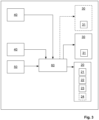
- FIG. 3 is block diagram of a system according to the present invention.
- the system according to the present invention further comprises a dedicated motion reference unit 50 for measuring accelerations of the vessel 100 in a roll motion, hereunder providing roll angle for the vessel which can be used for controlling of the fluid level/volume in the side tanks 11a-b.
- the system according to the present invention further comprises a control unit 60 arranged for controlling the at least one air pressure manipulation unit 20, aeration device(s) 30 and valves 23, 31, 24.
- the control unit 60 is provided with means and/or software for controlling the vacuum and air pressure manipulation unit 20, aeration device(s) 30, as well as valves 23, 31, 24, based on operation mode, hereunder passive or active roll dampening, or stabilization mode.
- control unit 60 In active mode the control unit 60 is arranged to set the aeration device 30 of the starboard side tank 11b open towards open air and the vacuum and air pressure manipulation unit 20 is set to supply air pressure or vacuum in the port side tank 11a based on measurement from the motion reference unit 50 and measurement of current fluid level in the side tanks 11a-b from the fluid level sensors 40. Accordingly, in active mode, instead of the fluid moving passively in relation to the vessel 100 motions and thus moving approximately 90 degrees behind the vessel roll motion, active control of the fluid movement is achieved by means of the system according to the present invention, and able to move the fluid in the respective side tanks 11a-b in anti-phase in front/advance of the vessel roll motion period.
- the vacuum and air pressure manipulation unit 20 capability of supplying air pressure or vacuum on the fluid surface in the port side tank 11a one can control the fluid to move between the mentioned side tanks 11a-b.
- the aeration device 30 of the starboard side tank 11b open against air and by supplying air pressure in the port side tank 11a the fluid level in port side tank 11a will be reduced by that the air pressure will force the fluid to move from the port side tank 11a via the crossover duct 12 to the starboard side tank 11b, thus correspondingly elevating the fluid level in the starboard side tank 11b.
- the second embodiment works as the first embodiment as described above, but when the fluid level difference of 5 meters is achieved, the aeration device 30 of the port side tank 11a is set open to air, while the aeration device 30 of the starboard side tank 11b is closed and wherein the vacuum and air pressure manipulation unit 20 is set to supply air pressure on the fluid surface of the starboard side tank 11b, whereupon the fluid level will further be lowered in the starboard side tank 11b and correspondingly increased in the port side tank 11a.
- a fluid level difference of 5 meters between the side tanks 11a-b will provide sufficient roll dampening, but for larger vessel there might be a need for larger fluid level difference which can be achieved by the second embodiment.
- the second embodiment will further result in that one more rapid can achieve the required pressure difference in the two side tanks 11a-b in a more rapid manner.
- this information can be used to move the fluid between the side tanks 11a-b, i.e. the fluid level in the respective side tanks 11a-b, in anti-phase in front/advance of the vessel roll motion period.
- the control unit 60 can predict and calculate the fluid level in the respective side tanks 11a-b such that the fluid level/volume can be controlled to be in anti-phase in front/advance of the vessel roll motion period.
- the system according to the present invention supplies a sufficient amount of fluid in the respective side tanks 11a-b in correct anti-phase point in time in front of the roll motion period (frequency) of the vessel 100, i.e. optimally moving the fluid level in the respective side tanks 11a-b approximately 90 degrees in front/advance of the vessel roll period.
- the control unit 60 is for this provided with means and/or software for software for controlling the fluid level in the side tanks 11a-b based on measurements by the dedicated motion reference unit 50 and measurements from the fluid level sensors 40 by calculating and provide optimal fluid level in the side tanks 11a-b.
- control unit 60 is arranged to calculate and provide optimal fluid level in the side tanks 11a-b based on input from a dedicated motion reference unit 50 measuring the vessel motion accelerations and in this way capable of setting the fluid level in anti-phase in front of the vessel roll period.
- control unit 60 will be provided with means and/or software for using latest historical information from the dedicated motion reference unit 50 regarding roll motion of the vessel, and based on this predict probable future next roll motion/sequence and based on this control the fluid level in the side tanks 11a-b such that the fluid level is controlled in front/advance of the affection of the waves on the vessel.
- the initial fluid volume inside the U-tank 10 must be defined by the crew based on the actual loading of the vessel 100.
- the present invention can utilize the same tank volumes as Anti-heeling systems already present on a vessel or the vessel can be provided with a U-tank according to the present invention.
- the system according to the present invention can also be set in a passive mode.
- passive mode the control unit 60 will set the vacuum and air pressure manipulation unit 20 in aeration mode, where the port side tank 11a is set open towards air, and the aeration device 30 of the starboard side tank 11b is set open towards air. Accordingly, in passive mode the fluid can flow freely (passively) between the side tanks 11a-b via the crossover duct 12 according to the vessels minimum roll period, 90 degrees behind the roll motion period. If this period is to be extended, one can achieve this by controlling the valves 23 and 31 via the control unit 60.
- the aeration device 30 in the port side tank 11a can be used for this purpose.
- the system according to the present invention can further be provided with a stabilization mode, wherein the control unit 60 is arranged to close the valve 23 of the air pressure manipulation unit 20 and valve 31 of the aeration unit 30 in starboard side tank 11b locking the current fluid level in the side tanks 11a-b.
- the aeration device 30 of the port side tank 11a have to be closed.
- the U-tank 10 of the present invention can further be arranged to a fluid supply and removal system for supply and removal of fluid in the U-tank 10, for changing the total fluid amount in the U-tank, which is well known in prior art and requires no further description herein.
- the system according to the present invention can further be provided with two or more vacuum and air pressure manipulation units 20 and aeration devices 30, respectively, connected to the associated side tanks 11a-b, respectively, for redundancy.
- the vacuum and air pressure manipulation unit 20 can further be provided with two or more vacuum and air pressure generation units 21 connected to the same demand controlled ventilation unit 22 dimensioned for this.
- the system can further comprise two or more vacuum and air pressure manipulation units 20 separately arranged to the same side tank 11a via separate valves 23 or via the same valve 23.
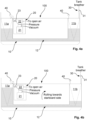
- Figure 4a show an initial state of fluid level in the side tanks 11a-b where the fluid level of in the port side tank 11a and the starboard side tank 11b are levelled, for the first embodiment.
- Figure 4a could also represent a stabilized mode, where the valves 23 and 31 are closed. In connection with stabilized mode, the valves 23 and 31 can also be closed with different fluid levels in the port side tank 11a and starboard side tank 11b if desired.
- Figure 4b show a state, for the first embodiment of the system, where the fluid level in port side tank 11a is elevated in relation to the fluid level in starboard side tank 11b, by that the vacuum and air pressure manipulation unit 20 supplies a vacuum on the fluid surface of the fluid in the port side tank 11a, resulting in a pressure difference between the side tanks 11a-b resulting in that fluid flows from the starboard tank 11b and into the port side tank 11a, and thus compensating for roll movements caused by a wave hitting on port side or a wave passing from starboard side.
- Figure 4c show a state, for the first embodiment of the system, where the fluid level in starboard side tank 11b is elevated in relation to the fluid level in port side tank 11a, by that the vacuum and air pressure manipulation unit 20 supplies pressure on the fluid surface of the port side tank 11a forcing the fluid to flow to the starboard side tank 11b, reducing the fluid level in the port side tank 11a and elevating the fluid level in the starboard side tank 11b, and thus compensating for roll movement caused by a wave hitting on starboard side or a wave passing from port side.
- the present invention is achieved a system where the fluid level in the respective side tanks 11a-b are set to be in anti-phase in front/advance of the vessel roll motion period, and optimally approximately 90 degrees in front/advance of roll motion period.
- the fluid level difference between the side tanks 11a-b will return to levelled with almost none use of energy due to the pressure difference between the side tanks 11a-b.
- the vacuum and air pressure manipulation unit 20 will only require power consumption for half of the required pressure difference, as the first half of the pressure difference can be achieved with the vacuum and air pressure manipulation unit 20 in idle running.
- the shape and volume of the side tanks 11a-b will have to be adapted the actual properties of vessel. Further, it will an advantage, that the tanks have large volume and that the system can operate with low pressure differences.
Landscapes
- Chemical & Material Sciences (AREA)
- Engineering & Computer Science (AREA)
- Combustion & Propulsion (AREA)
- Mechanical Engineering (AREA)
- Ocean & Marine Engineering (AREA)
- Filling Or Discharging Of Gas Storage Vessels (AREA)
- Control Of Fluid Pressure (AREA)
- Vehicle Body Suspensions (AREA)
- Vibration Prevention Devices (AREA)
- Treatment Of Fiber Materials (AREA)
- Physical Or Chemical Processes And Apparatus (AREA)
Claims (12)
- Système de stabilisation antiroulis active à réservoir en U pour un navire (100), dans lequel le réservoir en U (10) est formé par des réservoirs latéraux (11a-b), l'un étant agencé côté bâbord du navire (100) et l'autre étant agencé côté tribord du navire (100), les réservoirs latéraux (11a-b) étant scellés à l'extrémité supérieure et connectés par un conduit de passage (12) à l'extrémité inférieure, dans lequel le réservoir en U (10) est partiellement rempli de fluide, le système comprenant une unité de référence de mouvement (50) mesurant les accélérations du mouvement de roulis du navire (100), et une unité de commande (60),
caractérisé en ce qu'au moins une unité (20) de manipulation de vide et de pression atmosphérique est agencée sur une partie supérieure d'un réservoir latéral associé (11a-b), et au moins un dispositif d'aération (30) à l'air libre est raccordé à la partie supérieure de l'autre réservoir latéral (11a-b), dans lequel ladite au moins une unité (20) de manipulation de vide et de pression atmosphérique est agencée pour fournir une pression atmosphérique ou un vide à la surface de fluide dans le réservoir latéral associé (11a), dans lequel l'unité de commande (60) est pourvue de moyens et/ou d'un logiciel pour commander ladite au moins une unité (20) de manipulation de vide ou de pression atmosphérique pour commander le niveau de fluide dans les deux réservoirs latéraux (11a-b) en opposition de phase avant/ en avance d'une période de mouvement de roulis du navire en prédisant et en calculant le niveau de fluide dans les réservoirs latéraux respectifs (11a-b) en opposition de phase avant/ en avance d'une période de mouvement de roulis du navire sur la base de mesures de l'unité de référence de mouvement (50). - Système de stabilisation antiroulis active à réservoir en U pour un navire (100) selon la revendication 1, caractérisé en ce que l'unité (20) de manipulation de vide et de pression atmosphérique est pourvue d'une vanne (23) pour ouvrir ou fermer le raccordement au réservoir latéral associé (11a-b), et le dispositif d'aération (30) est pourvu d'une vanne (31) pour ouvrir ou fermer l'aération à l'air libre.
- Système de stabilisation antiroulis active à réservoir en U pour un navire (100) selon la revendication 1, caractérisé en ce que l'unité (20) de manipulation de vide et de pression atmosphérique est agencée pour l'aération à l'air libre du réservoir latéral associé (11a-b).
- Système de stabilisation antiroulis active à réservoir en U pour un navire (100) selon la revendication 1, caractérisé en ce que le système comprend au moins un capteur de niveau de fluide (40) agencé dans chacun des réservoirs latéraux (11a-b) pour mesurer le niveau de fluide dans le réservoir latéral respectif (11a-b).
- Système de stabilisation antiroulis active à réservoir en U pour un navire (100) selon l'une quelconque des revendications précédentes, caractérisé en ce que ladite au moins une unité (20) de manipulation de vide et de pression atmosphérique est agencée pour fournir une pression atmosphérique à la surface de fluide de l'autre réservoir latéral (11a-b) ou en ce qu'au moins une unité de pression atmosphérique séparée est agencée pour fournir une pression à la surface de fluide de l'autre réservoir latéral (11a-b), et en ce que les dispositifs d'aération (30) pourvus de vannes (31) pouvant être commandées pour ouvrir ou fermer l'aération à l'air libre sont agencés sur les deux réservoirs latéraux (11a-b).
- Système de stabilisation antiroulis active à réservoir en U pour un navire selon la revendication 5, caractérisé en ce que ladite au moins une unité (20) de manipulation de vide et de pression atmosphérique est agencée sur l'autre réservoir latéral (11a-b) par l'intermédiaire d'une vanne (24) pouvant être commandée et d'un tuyau (25) s'étendant du côté pression de l'unité (20) de manipulation de vide et de pression atmosphérique à la partie supérieure de l'autre réservoir latéral (11a-b).
- Système de stabilisation antiroulis active à réservoir en U pour un navire (100) selon la revendication 1, caractérisé en ce que l'unité de référence de mouvement (50) dédiée mesure les accélérations du navire (100) dans un mouvement de roulis.
- Système de stabilisation antiroulis active à réservoir en U pour un navire (100) selon la revendication 1 ou 2, caractérisé en ce que l'unité de commande (60) commande en outre le(s) dispositif(s) d'aération (30) et les vannes (23, 31, 24).
- Système de stabilisation antiroulis active à réservoir en U pour un navire (100) selon l'une quelconque des revendications précédentes, caractérisé en ce que l'unité (20) de manipulation de vide et de pression atmosphérique comprend au moins une unité (21) de génération de vide et de pression atmosphérique raccordée à une unité de ventilation (22) commandée à la demande.
- Procédé de stabilisation antiroulis active d'un navire (100) pourvu d'un réservoir en U (10) formé par des réservoirs latéraux (11a-b), l'un étant agencé côté bâbord du navire (100) et l'autre étant agencé côté tribord du navire (100), les réservoirs latéraux (11a-b) étant scellées à l'extrémité supérieure et raccordés par un conduit de passage (12) à l'extrémité inférieure, dans lequel le réservoir en U (10) est partiellement rempli de fluide, caractérisé par les étapes consistant àmesurer les accélérations du mouvement de roulis du navire (100), prédire et calculer le niveau de fluide dans les deux réservoirs latéraux (11a-b) en opposition de phase avant/ en avance de la période de mouvement de roulis du navire sur la base des mesures, etcommander le niveau de fluide dans les deux réservoirs latéraux (11a-b) en opposition de phase avant/ en avance de la période de mouvement de roulis du navire en fournissant une pression atmosphérique ou un vide au moyen d'au moins une unité (20) de manipulation de vide et de pression atmosphérique à la surface de fluide dans un réservoir latéral associé (11a-b) et une aération à l'air libre de l'autre réservoir latéral (11a-b) au moyen d'un dispositif d'aération (30).
- Procédé selon la revendication 10, caractérisé par la commande du niveau de fluide dans les réservoirs latéraux (11a-b) sur la base de mesures effectuées par une unité de référence de mouvement (50) dédiée et de mesures provenant des capteurs de niveau de fluide (40) associés aux réservoirs latéraux (11a-b) de façon à commander le niveau de fluide dans le réservoir latéral respectif (11a-b) en opposition de phase avant/ en avance de la période de mouvement de roulis du navire, environ 90 degrés avant/ en avance de la période de mouvement de roulis du navire.
- Procédé selon l'une quelconque des revendications 10 à 11, caractérisé par la fermeture de l'aération de l'autre réservoir latéral (11a-b) et l'ouverture de l'aération du réservoir latéral (11a-b) associé à ladite au moins une unité (20) de manipulation de vide et de pression atmosphérique au moyen d'au moins un dispositif d'aération (30) agencé sur celle-ci, et la fourniture de pression atmosphérique en utilisant ladite au moins une unité (20) de manipulation de vide et de pression atmosphérique ou au moins une unité de pression atmosphérique séparée à la surface de fluide de l'autre réservoir latéral (11a-b) lorsqu'une augmentation supplémentaire du niveau de fluide dans le réservoir latéral (11a-b) associé à l'unité (20) de manipulation de vide et de pression atmosphérique est nécessaire.
Applications Claiming Priority (2)
| Application Number | Priority Date | Filing Date | Title |
|---|---|---|---|
| NO20180092A NO344388B1 (en) | 2018-01-19 | 2018-01-19 | U-tank active roll dampening system for and method for active roll dampening of a vessel |
| PCT/NO2019/050011 WO2019143257A1 (fr) | 2018-01-19 | 2019-01-18 | Système de réduction active de roulis à réservoir en u et procédé de réduction active de roulis de navire |
Publications (4)
| Publication Number | Publication Date |
|---|---|
| EP3740424A1 EP3740424A1 (fr) | 2020-11-25 |
| EP3740424A4 EP3740424A4 (fr) | 2021-11-24 |
| EP3740424B1 true EP3740424B1 (fr) | 2024-05-01 |
| EP3740424C0 EP3740424C0 (fr) | 2024-05-01 |
Family
ID=67301541
Family Applications (1)
| Application Number | Title | Priority Date | Filing Date |
|---|---|---|---|
| EP19741270.3A Active EP3740424B1 (fr) | 2018-01-19 | 2019-01-18 | Système de réduction active de roulis à réservoir en u et procédé de réduction active de roulis de navire |
Country Status (5)
| Country | Link |
|---|---|
| US (1) | US11299242B2 (fr) |
| EP (1) | EP3740424B1 (fr) |
| CN (1) | CN110753658B (fr) |
| NO (1) | NO344388B1 (fr) |
| WO (1) | WO2019143257A1 (fr) |
Families Citing this family (5)
| Publication number | Priority date | Publication date | Assignee | Title |
|---|---|---|---|---|
| CN112278161B (zh) * | 2020-11-03 | 2021-08-10 | 江苏科技大学 | Lng货船主动缓摇装置及缓摇系统和工作方法 |
| CN112389598A (zh) * | 2020-11-20 | 2021-02-23 | 中海石油气电集团有限责任公司 | 一种适用于无动力flng/fsru的拖航姿态控制方法 |
| CN114560053A (zh) * | 2022-04-08 | 2022-05-31 | 交通运输部天津水运工程科学研究所 | 一种船用空气压缩抗横摇装置 |
| CN115107946A (zh) * | 2022-08-04 | 2022-09-27 | 上海船舶研究设计院(中国船舶工业集团公司第六0四研究院) | 用于海上浮式平台的主动减摇方法 |
| CN119874138B (zh) * | 2025-03-28 | 2025-06-17 | 中国海洋大学 | 一种应用光催化剂的船舶污水处理系统 |
Family Cites Families (18)
| Publication number | Priority date | Publication date | Assignee | Title |
|---|---|---|---|---|
| GB408796A (en) * | 1932-04-11 | 1934-04-19 | Nicolai Minorsky | Improvements in anti-rolling tank systems for ships and other craft |
| GB419028A (en) * | 1933-03-29 | 1934-11-05 | Siemens App Und Maschinen Gmbh | Stabilization of ships by means of liquid-filled tanks |
| DE1277060B (de) * | 1966-10-13 | 1968-09-05 | Licentia Gmbh | Einrichtung zur Veraenderung des Fluessigkeitsstandes in dem Tankraum von Tankstabilisierungsanlagen |
| GB1213853A (en) * | 1968-02-02 | 1970-11-25 | Muirhead Ltd | Improvements in and relating to ship stabilizers |
| FR2053697A5 (fr) * | 1969-07-15 | 1971-04-16 | Polouektoff Jean Paul | |
| DE2338557A1 (de) * | 1973-07-30 | 1975-02-20 | Ulf Dipl Ing Palm | Schlingertank zur daempfung von schiffsbewegungen |
| DE2508748A1 (de) * | 1975-02-28 | 1976-09-09 | Horst Dipl Ing Halden | Kraengungsausgleichsanlage von schiffen mit steuerventilanordnung |
| GB2087818A (en) * | 1980-11-25 | 1982-06-03 | Vickers Ltd | Tank fluid transfer device |
| US4864958A (en) | 1987-09-25 | 1989-09-12 | Belinsky Sidney I | Swap type floating platforms |
| DE10045921A1 (de) * | 2000-09-16 | 2002-03-28 | Intering Interferenztechnik In | Vorrichtung und Verfahren zur Verminderung des Rollens bei Schiffen |
| DE10315294B4 (de) * | 2003-04-04 | 2006-09-28 | Dallach, Gert, Dr. Ing. | Rolldämpfungsanlage für Schiffe |
| NO333766B1 (no) * | 2007-12-07 | 2013-09-16 | Marine Roll & Pitch Control As | System og fremgangsmate for aktiv og passiv stabilisering av fartoy |
| CN101624087B (zh) * | 2008-07-11 | 2011-12-21 | 中国船舶重工集团公司第七○四研究所 | 减摇水舱控制装置 |
| NO332151B1 (no) * | 2009-08-06 | 2012-07-09 | Eirik Hellesvik | Rulledempningstank |
| KR101235329B1 (ko) * | 2009-12-24 | 2013-02-19 | 울산대학교 산학협력단 | 횡요방지 탱크를 이용한 선박의 안정화 장치 |
| CN102910264B (zh) * | 2012-10-09 | 2015-09-30 | 哈尔滨工程大学 | 一种船舶系泊状态的减摇装置 |
| KR101541063B1 (ko) * | 2013-10-18 | 2015-07-31 | 삼성중공업 주식회사 | 선박의 횡경사 저감 장치 및 저감 방법 |
| KR101690924B1 (ko) * | 2015-02-27 | 2016-12-29 | 삼성중공업 주식회사 | 밸러스트 장치 |
-
2018
- 2018-01-19 NO NO20180092A patent/NO344388B1/en unknown
-
2019
- 2019-01-18 US US16/959,194 patent/US11299242B2/en active Active
- 2019-01-18 EP EP19741270.3A patent/EP3740424B1/fr active Active
- 2019-01-18 WO PCT/NO2019/050011 patent/WO2019143257A1/fr not_active Ceased
- 2019-01-18 CN CN201980003079.4A patent/CN110753658B/zh active Active
Also Published As
| Publication number | Publication date |
|---|---|
| EP3740424A4 (fr) | 2021-11-24 |
| NO344388B1 (en) | 2019-11-25 |
| WO2019143257A1 (fr) | 2019-07-25 |
| CN110753658B (zh) | 2022-11-18 |
| BR112020013386A2 (pt) | 2020-12-01 |
| US11299242B2 (en) | 2022-04-12 |
| EP3740424A1 (fr) | 2020-11-25 |
| US20200398950A1 (en) | 2020-12-24 |
| CN110753658A (zh) | 2020-02-04 |
| EP3740424C0 (fr) | 2024-05-01 |
| NO20180092A1 (en) | 2019-07-22 |
Similar Documents
| Publication | Publication Date | Title |
|---|---|---|
| EP3740424B1 (fr) | Système de réduction active de roulis à réservoir en u et procédé de réduction active de roulis de navire | |
| DK2214955T3 (en) | SYSTEM AND PROCEDURE FOR ACTIVE AND PASSIVE STABILIZATION OF A VESSEL | |
| US20160068238A1 (en) | Underwater floating body and installation method thereof | |
| KR101964836B1 (ko) | 횡동요 저감장치 | |
| KR20110139870A (ko) | 중력을 이용한 안티 힐링 시스템 | |
| US20240391565A1 (en) | Transport ship comprising a trim control system which is not in communication with the sea | |
| CN118790417A (zh) | 一种船舶抗衡倾系统 | |
| KR20160069637A (ko) | 횡동요 감소 탱크 | |
| KR101102347B1 (ko) | 부유체 스태빌라이저 | |
| CN219927938U (zh) | 一种钻采船海上综合定位装置 | |
| CN105667725B (zh) | 半潜式施工平台 | |
| BR112020013386B1 (pt) | Sistema de amortecimento ativo de rotação de tanque em u para embarcação, e, método para amortecimento ativo de rotação de uma embarcação | |
| WO2011074926A4 (fr) | Barge pour gnl à double coque | |
| CN219948513U (zh) | 一种集装箱船抗横倾系统 | |
| CN117646451B (zh) | 一种沉井浮运减摇装置及其控制方法 | |
| CN223658388U (zh) | 一种海上石油钻井平台稳定装置 | |
| CN222040675U (zh) | 一种取水趸船智能平衡系统 | |
| KR20210155699A (ko) | 안티 롤링 및 안티 힐링 기능을 구비한 선박 안정화 시스템 및 동 시스템을 포함하는 선박 | |
| CN114701614A (zh) | 一种用于大型船舶的智能稳定系统 | |
| RU2529244C1 (ru) | Способ умерения бортовой качки судна посредством пассивного успокоителя бортовой качки и пассивный успокоитель бортовой качки судна | |
| KR102830894B1 (ko) | Wtiv의 쿨링워터 공급 시스템 | |
| KR20120084385A (ko) | 에어 캐비티 선박의 압력센서를 이용한 공기방 공기 공급 제어방법 | |
| CN119840795A (zh) | 减摇水舱、养殖平台和减摇控制方法 | |
| CN108036681A (zh) | 真空容器式水中设备定深悬浮装置 | |
| KR20140057071A (ko) | 선박 및 부유식 구조물의 횡동요 방지장치 |
Legal Events
| Date | Code | Title | Description |
|---|---|---|---|
| STAA | Information on the status of an ep patent application or granted ep patent |
Free format text: STATUS: THE INTERNATIONAL PUBLICATION HAS BEEN MADE |
|
| PUAI | Public reference made under article 153(3) epc to a published international application that has entered the european phase |
Free format text: ORIGINAL CODE: 0009012 |
|
| STAA | Information on the status of an ep patent application or granted ep patent |
Free format text: STATUS: REQUEST FOR EXAMINATION WAS MADE |
|
| 17P | Request for examination filed |
Effective date: 20200811 |
|
| AK | Designated contracting states |
Kind code of ref document: A1 Designated state(s): AL AT BE BG CH CY CZ DE DK EE ES FI FR GB GR HR HU IE IS IT LI LT LU LV MC MK MT NL NO PL PT RO RS SE SI SK SM TR |
|
| AX | Request for extension of the european patent |
Extension state: BA ME |
|
| DAV | Request for validation of the european patent (deleted) | ||
| DAX | Request for extension of the european patent (deleted) | ||
| A4 | Supplementary search report drawn up and despatched |
Effective date: 20211025 |
|
| RIC1 | Information provided on ipc code assigned before grant |
Ipc: B63B 39/03 20060101AFI20211019BHEP |
|
| P01 | Opt-out of the competence of the unified patent court (upc) registered |
Effective date: 20230526 |
|
| GRAP | Despatch of communication of intention to grant a patent |
Free format text: ORIGINAL CODE: EPIDOSNIGR1 |
|
| STAA | Information on the status of an ep patent application or granted ep patent |
Free format text: STATUS: GRANT OF PATENT IS INTENDED |
|
| INTG | Intention to grant announced |
Effective date: 20231206 |
|
| GRAS | Grant fee paid |
Free format text: ORIGINAL CODE: EPIDOSNIGR3 |
|
| GRAA | (expected) grant |
Free format text: ORIGINAL CODE: 0009210 |
|
| STAA | Information on the status of an ep patent application or granted ep patent |
Free format text: STATUS: THE PATENT HAS BEEN GRANTED |
|
| AK | Designated contracting states |
Kind code of ref document: B1 Designated state(s): AL AT BE BG CH CY CZ DE DK EE ES FI FR GB GR HR HU IE IS IT LI LT LU LV MC MK MT NL NO PL PT RO RS SE SI SK SM TR |
|
| REG | Reference to a national code |
Ref country code: GB Ref legal event code: FG4D |
|
| REG | Reference to a national code |
Ref country code: CH Ref legal event code: EP |
|
| REG | Reference to a national code |
Ref country code: IE Ref legal event code: FG4D |
|
| REG | Reference to a national code |
Ref country code: DE Ref legal event code: R096 Ref document number: 602019051396 Country of ref document: DE |
|
| U01 | Request for unitary effect filed |
Effective date: 20240528 |
|
| P04 | Withdrawal of opt-out of the competence of the unified patent court (upc) registered |
Free format text: CASE NUMBER: APP_33185/2024 Effective date: 20240603 |
|
| U07 | Unitary effect registered |
Designated state(s): AT BE BG DE DK EE FI FR IT LT LU LV MT NL PT SE SI Effective date: 20240606 |
|
| PG25 | Lapsed in a contracting state [announced via postgrant information from national office to epo] |
Ref country code: IS Free format text: LAPSE BECAUSE OF FAILURE TO SUBMIT A TRANSLATION OF THE DESCRIPTION OR TO PAY THE FEE WITHIN THE PRESCRIBED TIME-LIMIT Effective date: 20240901 |
|
| PG25 | Lapsed in a contracting state [announced via postgrant information from national office to epo] |
Ref country code: HR Free format text: LAPSE BECAUSE OF FAILURE TO SUBMIT A TRANSLATION OF THE DESCRIPTION OR TO PAY THE FEE WITHIN THE PRESCRIBED TIME-LIMIT Effective date: 20240501 |
|
| PG25 | Lapsed in a contracting state [announced via postgrant information from national office to epo] |
Ref country code: GR Free format text: LAPSE BECAUSE OF FAILURE TO SUBMIT A TRANSLATION OF THE DESCRIPTION OR TO PAY THE FEE WITHIN THE PRESCRIBED TIME-LIMIT Effective date: 20240802 |
|
| PG25 | Lapsed in a contracting state [announced via postgrant information from national office to epo] |
Ref country code: ES Free format text: LAPSE BECAUSE OF FAILURE TO SUBMIT A TRANSLATION OF THE DESCRIPTION OR TO PAY THE FEE WITHIN THE PRESCRIBED TIME-LIMIT Effective date: 20240501 |
|
| PG25 | Lapsed in a contracting state [announced via postgrant information from national office to epo] |
Ref country code: PL Free format text: LAPSE BECAUSE OF FAILURE TO SUBMIT A TRANSLATION OF THE DESCRIPTION OR TO PAY THE FEE WITHIN THE PRESCRIBED TIME-LIMIT Effective date: 20240501 |
|
| PG25 | Lapsed in a contracting state [announced via postgrant information from national office to epo] |
Ref country code: PL Free format text: LAPSE BECAUSE OF FAILURE TO SUBMIT A TRANSLATION OF THE DESCRIPTION OR TO PAY THE FEE WITHIN THE PRESCRIBED TIME-LIMIT Effective date: 20240501 Ref country code: NO Free format text: LAPSE BECAUSE OF FAILURE TO SUBMIT A TRANSLATION OF THE DESCRIPTION OR TO PAY THE FEE WITHIN THE PRESCRIBED TIME-LIMIT Effective date: 20240801 Ref country code: IS Free format text: LAPSE BECAUSE OF FAILURE TO SUBMIT A TRANSLATION OF THE DESCRIPTION OR TO PAY THE FEE WITHIN THE PRESCRIBED TIME-LIMIT Effective date: 20240901 Ref country code: HR Free format text: LAPSE BECAUSE OF FAILURE TO SUBMIT A TRANSLATION OF THE DESCRIPTION OR TO PAY THE FEE WITHIN THE PRESCRIBED TIME-LIMIT Effective date: 20240501 Ref country code: GR Free format text: LAPSE BECAUSE OF FAILURE TO SUBMIT A TRANSLATION OF THE DESCRIPTION OR TO PAY THE FEE WITHIN THE PRESCRIBED TIME-LIMIT Effective date: 20240802 Ref country code: ES Free format text: LAPSE BECAUSE OF FAILURE TO SUBMIT A TRANSLATION OF THE DESCRIPTION OR TO PAY THE FEE WITHIN THE PRESCRIBED TIME-LIMIT Effective date: 20240501 Ref country code: RS Free format text: LAPSE BECAUSE OF FAILURE TO SUBMIT A TRANSLATION OF THE DESCRIPTION OR TO PAY THE FEE WITHIN THE PRESCRIBED TIME-LIMIT Effective date: 20240801 |
|
| P05 | Withdrawal of opt-out of the competence of the unified patent court (upc) changed |
Free format text: CASE NUMBER: APP_33185/2024 Effective date: 20240606 |
|
| U20 | Renewal fee for the european patent with unitary effect paid |
Year of fee payment: 7 Effective date: 20241218 |
|
| PG25 | Lapsed in a contracting state [announced via postgrant information from national office to epo] |
Ref country code: CZ Free format text: LAPSE BECAUSE OF FAILURE TO SUBMIT A TRANSLATION OF THE DESCRIPTION OR TO PAY THE FEE WITHIN THE PRESCRIBED TIME-LIMIT Effective date: 20240501 |
|
| PG25 | Lapsed in a contracting state [announced via postgrant information from national office to epo] |
Ref country code: SK Free format text: LAPSE BECAUSE OF FAILURE TO SUBMIT A TRANSLATION OF THE DESCRIPTION OR TO PAY THE FEE WITHIN THE PRESCRIBED TIME-LIMIT Effective date: 20240501 Ref country code: RO Free format text: LAPSE BECAUSE OF FAILURE TO SUBMIT A TRANSLATION OF THE DESCRIPTION OR TO PAY THE FEE WITHIN THE PRESCRIBED TIME-LIMIT Effective date: 20240501 |
|
| PG25 | Lapsed in a contracting state [announced via postgrant information from national office to epo] |
Ref country code: SM Free format text: LAPSE BECAUSE OF FAILURE TO SUBMIT A TRANSLATION OF THE DESCRIPTION OR TO PAY THE FEE WITHIN THE PRESCRIBED TIME-LIMIT Effective date: 20240501 |
|
| PG25 | Lapsed in a contracting state [announced via postgrant information from national office to epo] |
Ref country code: SM Free format text: LAPSE BECAUSE OF FAILURE TO SUBMIT A TRANSLATION OF THE DESCRIPTION OR TO PAY THE FEE WITHIN THE PRESCRIBED TIME-LIMIT Effective date: 20240501 Ref country code: SK Free format text: LAPSE BECAUSE OF FAILURE TO SUBMIT A TRANSLATION OF THE DESCRIPTION OR TO PAY THE FEE WITHIN THE PRESCRIBED TIME-LIMIT Effective date: 20240501 Ref country code: RO Free format text: LAPSE BECAUSE OF FAILURE TO SUBMIT A TRANSLATION OF THE DESCRIPTION OR TO PAY THE FEE WITHIN THE PRESCRIBED TIME-LIMIT Effective date: 20240501 Ref country code: CZ Free format text: LAPSE BECAUSE OF FAILURE TO SUBMIT A TRANSLATION OF THE DESCRIPTION OR TO PAY THE FEE WITHIN THE PRESCRIBED TIME-LIMIT Effective date: 20240501 |
|
| REG | Reference to a national code |
Ref country code: DE Ref legal event code: R097 Ref document number: 602019051396 Country of ref document: DE |
|
| PLBE | No opposition filed within time limit |
Free format text: ORIGINAL CODE: 0009261 |
|
| STAA | Information on the status of an ep patent application or granted ep patent |
Free format text: STATUS: NO OPPOSITION FILED WITHIN TIME LIMIT |
|
| 26N | No opposition filed |
Effective date: 20250204 |
|
| U1N | Appointed representative for the unitary patent procedure changed after the registration of the unitary effect |
Representative=s name: METIDA; LT |
|
| REG | Reference to a national code |
Ref country code: CH Ref legal event code: PL |
|
| PG25 | Lapsed in a contracting state [announced via postgrant information from national office to epo] |
Ref country code: MC Free format text: LAPSE BECAUSE OF FAILURE TO SUBMIT A TRANSLATION OF THE DESCRIPTION OR TO PAY THE FEE WITHIN THE PRESCRIBED TIME-LIMIT Effective date: 20240501 |
|
| GBPC | Gb: european patent ceased through non-payment of renewal fee |
Effective date: 20250118 |
|
| PG25 | Lapsed in a contracting state [announced via postgrant information from national office to epo] |
Ref country code: GB Free format text: LAPSE BECAUSE OF NON-PAYMENT OF DUE FEES Effective date: 20250118 |
|
| PG25 | Lapsed in a contracting state [announced via postgrant information from national office to epo] |
Ref country code: CH Free format text: LAPSE BECAUSE OF NON-PAYMENT OF DUE FEES Effective date: 20250131 |
|
| PG25 | Lapsed in a contracting state [announced via postgrant information from national office to epo] |
Ref country code: IE Free format text: LAPSE BECAUSE OF NON-PAYMENT OF DUE FEES Effective date: 20250118 |
|
| U20 | Renewal fee for the european patent with unitary effect paid |
Year of fee payment: 8 Effective date: 20251212 |