EP3740432B1 - Palette et bâtiment formé par une pluralité de palettes interconnectées - Google Patents
Palette et bâtiment formé par une pluralité de palettes interconnectées Download PDFInfo
- Publication number
- EP3740432B1 EP3740432B1 EP19703643.7A EP19703643A EP3740432B1 EP 3740432 B1 EP3740432 B1 EP 3740432B1 EP 19703643 A EP19703643 A EP 19703643A EP 3740432 B1 EP3740432 B1 EP 3740432B1
- Authority
- EP
- European Patent Office
- Prior art keywords
- pallet
- bar
- transit
- clip
- releasably
- Prior art date
- Legal status (The legal status is an assumption and is not a legal conclusion. Google has not performed a legal analysis and makes no representation as to the accuracy of the status listed.)
- Active
Links
Images





Classifications
-
- B—PERFORMING OPERATIONS; TRANSPORTING
- B65—CONVEYING; PACKING; STORING; HANDLING THIN OR FILAMENTARY MATERIAL
- B65D—CONTAINERS FOR STORAGE OR TRANSPORT OF ARTICLES OR MATERIALS, e.g. BAGS, BARRELS, BOTTLES, BOXES, CANS, CARTONS, CRATES, DRUMS, JARS, TANKS, HOPPERS, FORWARDING CONTAINERS; ACCESSORIES, CLOSURES, OR FITTINGS THEREFOR; PACKAGING ELEMENTS; PACKAGES
- B65D19/00—Pallets or like platforms, with or without side walls, for supporting loads to be lifted or lowered
- B65D19/0004—Rigid pallets without side walls
- B65D19/0006—Rigid pallets without side walls the load supporting surface being made of a single element
- B65D19/0008—Rigid pallets without side walls the load supporting surface being made of a single element forming a continuous plane contact surface
- B65D19/001—Rigid pallets without side walls the load supporting surface being made of a single element forming a continuous plane contact surface the base surface being made of a single element
- B65D19/0012—Rigid pallets without side walls the load supporting surface being made of a single element forming a continuous plane contact surface the base surface being made of a single element forming a continuous plane contact surface
-
- B—PERFORMING OPERATIONS; TRANSPORTING
- B65—CONVEYING; PACKING; STORING; HANDLING THIN OR FILAMENTARY MATERIAL
- B65D—CONTAINERS FOR STORAGE OR TRANSPORT OF ARTICLES OR MATERIALS, e.g. BAGS, BARRELS, BOTTLES, BOXES, CANS, CARTONS, CRATES, DRUMS, JARS, TANKS, HOPPERS, FORWARDING CONTAINERS; ACCESSORIES, CLOSURES, OR FITTINGS THEREFOR; PACKAGING ELEMENTS; PACKAGES
- B65D81/00—Containers, packaging elements, or packages, for contents presenting particular transport or storage problems, or adapted to be used for non-packaging purposes after removal of contents
- B65D81/36—Containers, packaging elements, or packages, for contents presenting particular transport or storage problems, or adapted to be used for non-packaging purposes after removal of contents adapted to be used for non-packaging purposes after removal of contents
- B65D81/361—Modular elements with complementary shapes, interengageable parts or the like
-
- E—FIXED CONSTRUCTIONS
- E04—BUILDING
- E04B—GENERAL BUILDING CONSTRUCTIONS; WALLS, e.g. PARTITIONS; ROOFS; FLOORS; CEILINGS; INSULATION OR OTHER PROTECTION OF BUILDINGS
- E04B1/00—Constructions in general; Structures which are not restricted either to walls, e.g. partitions, or floors or ceilings or roofs
- E04B1/02—Structures consisting primarily of load-supporting, block-shaped, or slab-shaped elements
- E04B1/10—Structures consisting primarily of load-supporting, block-shaped, or slab-shaped elements the elements consisting of wood
-
- E—FIXED CONSTRUCTIONS
- E04—BUILDING
- E04B—GENERAL BUILDING CONSTRUCTIONS; WALLS, e.g. PARTITIONS; ROOFS; FLOORS; CEILINGS; INSULATION OR OTHER PROTECTION OF BUILDINGS
- E04B1/00—Constructions in general; Structures which are not restricted either to walls, e.g. partitions, or floors or ceilings or roofs
- E04B1/343—Structures characterised by movable, separable, or collapsible parts, e.g. for transport
- E04B1/34315—Structures characterised by movable, separable, or collapsible parts, e.g. for transport characterised by separable parts
- E04B1/34321—Structures characterised by movable, separable, or collapsible parts, e.g. for transport characterised by separable parts mainly constituted by panels
-
- E—FIXED CONSTRUCTIONS
- E04—BUILDING
- E04B—GENERAL BUILDING CONSTRUCTIONS; WALLS, e.g. PARTITIONS; ROOFS; FLOORS; CEILINGS; INSULATION OR OTHER PROTECTION OF BUILDINGS
- E04B1/00—Constructions in general; Structures which are not restricted either to walls, e.g. partitions, or floors or ceilings or roofs
- E04B1/38—Connections for building structures in general
- E04B1/61—Connections for building structures in general of slab-shaped building elements with each other
- E04B1/6108—Connections for building structures in general of slab-shaped building elements with each other the frontal surfaces of the slabs connected together
- E04B1/6116—Connections for building structures in general of slab-shaped building elements with each other the frontal surfaces of the slabs connected together by locking means on lateral surfaces
-
- B—PERFORMING OPERATIONS; TRANSPORTING
- B65—CONVEYING; PACKING; STORING; HANDLING THIN OR FILAMENTARY MATERIAL
- B65D—CONTAINERS FOR STORAGE OR TRANSPORT OF ARTICLES OR MATERIALS, e.g. BAGS, BARRELS, BOTTLES, BOXES, CANS, CARTONS, CRATES, DRUMS, JARS, TANKS, HOPPERS, FORWARDING CONTAINERS; ACCESSORIES, CLOSURES, OR FITTINGS THEREFOR; PACKAGING ELEMENTS; PACKAGES
- B65D2519/00—Pallets or like platforms, with or without side walls, for supporting loads to be lifted or lowered
- B65D2519/00004—Details relating to pallets
- B65D2519/00258—Overall construction
- B65D2519/00263—Overall construction of the pallet
- B65D2519/00273—Overall construction of the pallet made of more than one piece
-
- B—PERFORMING OPERATIONS; TRANSPORTING
- B65—CONVEYING; PACKING; STORING; HANDLING THIN OR FILAMENTARY MATERIAL
- B65D—CONTAINERS FOR STORAGE OR TRANSPORT OF ARTICLES OR MATERIALS, e.g. BAGS, BARRELS, BOTTLES, BOXES, CANS, CARTONS, CRATES, DRUMS, JARS, TANKS, HOPPERS, FORWARDING CONTAINERS; ACCESSORIES, CLOSURES, OR FITTINGS THEREFOR; PACKAGING ELEMENTS; PACKAGES
- B65D2519/00—Pallets or like platforms, with or without side walls, for supporting loads to be lifted or lowered
- B65D2519/00004—Details relating to pallets
- B65D2519/00258—Overall construction
- B65D2519/00283—Overall construction of the load supporting surface
- B65D2519/00288—Overall construction of the load supporting surface made of one piece
-
- B—PERFORMING OPERATIONS; TRANSPORTING
- B65—CONVEYING; PACKING; STORING; HANDLING THIN OR FILAMENTARY MATERIAL
- B65D—CONTAINERS FOR STORAGE OR TRANSPORT OF ARTICLES OR MATERIALS, e.g. BAGS, BARRELS, BOTTLES, BOXES, CANS, CARTONS, CRATES, DRUMS, JARS, TANKS, HOPPERS, FORWARDING CONTAINERS; ACCESSORIES, CLOSURES, OR FITTINGS THEREFOR; PACKAGING ELEMENTS; PACKAGES
- B65D2519/00—Pallets or like platforms, with or without side walls, for supporting loads to be lifted or lowered
- B65D2519/00004—Details relating to pallets
- B65D2519/00258—Overall construction
- B65D2519/00313—Overall construction of the base surface
- B65D2519/00318—Overall construction of the base surface made of one piece
-
- B—PERFORMING OPERATIONS; TRANSPORTING
- B65—CONVEYING; PACKING; STORING; HANDLING THIN OR FILAMENTARY MATERIAL
- B65D—CONTAINERS FOR STORAGE OR TRANSPORT OF ARTICLES OR MATERIALS, e.g. BAGS, BARRELS, BOTTLES, BOXES, CANS, CARTONS, CRATES, DRUMS, JARS, TANKS, HOPPERS, FORWARDING CONTAINERS; ACCESSORIES, CLOSURES, OR FITTINGS THEREFOR; PACKAGING ELEMENTS; PACKAGES
- B65D2519/00—Pallets or like platforms, with or without side walls, for supporting loads to be lifted or lowered
- B65D2519/00004—Details relating to pallets
- B65D2519/00258—Overall construction
- B65D2519/00313—Overall construction of the base surface
- B65D2519/00328—Overall construction of the base surface shape of the contact surface of the base
- B65D2519/00343—Overall construction of the base surface shape of the contact surface of the base contact surface being substantially in the form of a panel
-
- B—PERFORMING OPERATIONS; TRANSPORTING
- B65—CONVEYING; PACKING; STORING; HANDLING THIN OR FILAMENTARY MATERIAL
- B65D—CONTAINERS FOR STORAGE OR TRANSPORT OF ARTICLES OR MATERIALS, e.g. BAGS, BARRELS, BOTTLES, BOXES, CANS, CARTONS, CRATES, DRUMS, JARS, TANKS, HOPPERS, FORWARDING CONTAINERS; ACCESSORIES, CLOSURES, OR FITTINGS THEREFOR; PACKAGING ELEMENTS; PACKAGES
- B65D2519/00—Pallets or like platforms, with or without side walls, for supporting loads to be lifted or lowered
- B65D2519/00004—Details relating to pallets
- B65D2519/00258—Overall construction
- B65D2519/00368—Overall construction of the non-integral separating spacer
- B65D2519/00373—Overall construction of the non-integral separating spacer whereby at least one spacer is made of one piece
-
- B—PERFORMING OPERATIONS; TRANSPORTING
- B65—CONVEYING; PACKING; STORING; HANDLING THIN OR FILAMENTARY MATERIAL
- B65D—CONTAINERS FOR STORAGE OR TRANSPORT OF ARTICLES OR MATERIALS, e.g. BAGS, BARRELS, BOTTLES, BOXES, CANS, CARTONS, CRATES, DRUMS, JARS, TANKS, HOPPERS, FORWARDING CONTAINERS; ACCESSORIES, CLOSURES, OR FITTINGS THEREFOR; PACKAGING ELEMENTS; PACKAGES
- B65D2519/00—Pallets or like platforms, with or without side walls, for supporting loads to be lifted or lowered
- B65D2519/00004—Details relating to pallets
- B65D2519/00736—Details
- B65D2519/00741—Dimensional aspects of the pallet
- B65D2519/00746—Dimensional aspects of the pallet divisible into sub-pallets of smaller dimensions
- B65D2519/00756—Dimensional aspects of the pallet divisible into sub-pallets of smaller dimensions joined together by removable elements, e.g. bands encircling the feed
-
- B—PERFORMING OPERATIONS; TRANSPORTING
- B65—CONVEYING; PACKING; STORING; HANDLING THIN OR FILAMENTARY MATERIAL
- B65D—CONTAINERS FOR STORAGE OR TRANSPORT OF ARTICLES OR MATERIALS, e.g. BAGS, BARRELS, BOTTLES, BOXES, CANS, CARTONS, CRATES, DRUMS, JARS, TANKS, HOPPERS, FORWARDING CONTAINERS; ACCESSORIES, CLOSURES, OR FITTINGS THEREFOR; PACKAGING ELEMENTS; PACKAGES
- B65D2519/00—Pallets or like platforms, with or without side walls, for supporting loads to be lifted or lowered
- B65D2519/00004—Details relating to pallets
- B65D2519/00736—Details
- B65D2519/00741—Dimensional aspects of the pallet
- B65D2519/00761—Dimensional aspects of the pallet the surface being variable, e.g. extendable pallets
-
- B—PERFORMING OPERATIONS; TRANSPORTING
- B65—CONVEYING; PACKING; STORING; HANDLING THIN OR FILAMENTARY MATERIAL
- B65D—CONTAINERS FOR STORAGE OR TRANSPORT OF ARTICLES OR MATERIALS, e.g. BAGS, BARRELS, BOTTLES, BOXES, CANS, CARTONS, CRATES, DRUMS, JARS, TANKS, HOPPERS, FORWARDING CONTAINERS; ACCESSORIES, CLOSURES, OR FITTINGS THEREFOR; PACKAGING ELEMENTS; PACKAGES
- B65D2519/00—Pallets or like platforms, with or without side walls, for supporting loads to be lifted or lowered
- B65D2519/00004—Details relating to pallets
- B65D2519/00736—Details
- B65D2519/00776—Accessories for manipulating the pallet
- B65D2519/00796—Guiding means for fork-lift
-
- E—FIXED CONSTRUCTIONS
- E04—BUILDING
- E04B—GENERAL BUILDING CONSTRUCTIONS; WALLS, e.g. PARTITIONS; ROOFS; FLOORS; CEILINGS; INSULATION OR OTHER PROTECTION OF BUILDINGS
- E04B1/00—Constructions in general; Structures which are not restricted either to walls, e.g. partitions, or floors or ceilings or roofs
- E04B1/38—Connections for building structures in general
- E04B1/61—Connections for building structures in general of slab-shaped building elements with each other
- E04B2001/6195—Connections for building structures in general of slab-shaped building elements with each other the slabs being connected at an angle, e.g. forming a corner
Definitions
- the invention relates to a pallet of the type used to facilitate the transportation of goods.
- the pallet of the invention has additional functionality. As well as carrying goods it is reconfigurable to provide a module for building structures, such as buildings or dwellings.
- the invention further resides in a building, structure or dwelling having a plurality of assembled or interconnected pallets.
- pallets of the type for transportation of goods, are designed and constructed to be strong, low cost and re-usable as pallets - they are not suitable for being reconfigured. Such pallets are often constructed with minimal materials, such as slatted support surfaces, and robust connections, having glued portions or nails, which are purposively extremely difficult to disassemble - even with a claw-hammer or crow-bar - never mind doing so without damaging them.
- pallets The reutilisation of pallets is known from AT506044 , which describes Euro-pallets connected together.
- An adaptable shipping platform is known from US9060606.
- a modular pallet is known from WO2010/128261 .
- the invention resides in a pallet as claimed in claim 1.
- a pallet for transporting goods or materials wherein the pallet is movable by lifting devices such as a forklift vehicle or a pallet-truck, the pallet having: a body; a bar, releasably attachable to the body and movable between a transport position, and a connection position; and a fixing, configured to releasably secure the position of the bar and/or releasably secure the pallet to an adjacent pallet.
- the bar In the transport position the bar can reside within the perimeter volume of the pallet or the body. In the connection position the bar can extend from the perimeter volume of the pallet. In the connection configuration the bar can reliably attach to another body of another pallet.
- the body has an upper and lower support having surfaces defining upper and lower faces or planes, which are arranged to be substantially parallel, and wherein the bar is positioned between said supports.
- the upper surface can support goods to be transported thereon.
- the lower surface is the surface upon which the pallet can rest.
- the or each support can have a recess shaped to receive the fixing such that the fixing in a secured position extends in the direction of said planes.
- the clip can be, and is preferably, flush to the surface of the support. Preferably, the clip can lie between the planes defined by the surface of the supports, within the recess.
- the recess can be a countersunk slot or machined area.
- the recess can have slots to receive limbs of a clip - thus prevent rotation about axis defined by the spine and/or the rod of the clip.
- the pallet can have a plurality of recesses.
- the recesses can be on the or each support. A plurality of recesses can provide for flexible reconfiguration and/or positioning of the bar and/or body in the connection position.
- the or each support can have a plurality of recesses, and at least one recess on at least two of the opposing sides.
- the body has a structure configured between, and secured to, an upper and lower support.
- the body has substantially parallel upper and lower supports having surfaces defining upper and lower faces or planes, and a structure configured between, and secured to, the supports, wherein the bar is positioned between said supports.
- the structure can have two beams arranged adjacent opposing edges of the pallet, said opposing edges defining a beam-side of the body and the other opposing edges defining an access-side of the body, wherein the body has a space of cavity between the supports and the beams and said space or cavity is open on the or each access-side.
- the pallet can have at least two, or at at least three, recesses configured on a beam-side.
- the pallet can have at least one recess on each face of a beam-side.
- the pallet can have at least two recesses, with one on each face, on each beam-side.
- the recesses can be evenly spaced along the length of the beam-side. Six recesses can be configured on each beam-side.
- the or each recess can be a semi-recess. That is, a recess can have two sides, or semi-recesses.
- the semi-recesses can be aligned with each other when two bodies are aligned or the body and transit body 44- are aligned. Therefore, one side of the recess can reside on the body of the pallet and the other side of the recess can reside on the transit body. If no transit body is utilised in a pallet then the recess and both sides thereof can reside solely on the body.
- the bar In the transport position the bar can be mounted upon the body such that no part of the bar extends beyond the access-side of the body, and in the connection position the bar extends beyond the access-side of the body. In the connection position the bar can extend by up to half its length beyond the access-side of the body.
- the fixing is a clip, the clip having a limb configured to releasably engage with a recess on a support.
- the limb can be configured to grip or clinch two bodies together.
- the clip has a rod.
- the rod is configured to connect with the support and/or bar, and releasably secure the position of the bar.
- the clip has a spine configured to extend across the boundary between two bodies being held together by the clip.
- the clips can function to releasably secure the body to a transit body, or secure the body to another body.
- the clip can achieve this is one or more of the following ways: the limbs extend from the spine and are resiliently biased, or sprung, such that they grasp the recess in to which they extend; the limbs can have formations, such as teeth-like protrusions, which engage with the beam; the beam can be shaped, such as having grooves, configured to receive the ends of the limbs; the rod extending from the spine inhibits uncontrolled movement or creep of the spine from the recess by inhibiting rotation of the spine; or the clip can be secured with additional fixings that reliably secure the spine of the clip to the recess in which it is mounted.
- the clip can be "U” shaped.
- the clip can also be “W” shaped. End pieces can project in to panels to which they are fixed, the arms holding them together.
- the centre piece - like the middle of the "w” can inserts in to the bar and/or the panel to engage with those parts.
- the pallet can have a transit body removably connectable to a side of the body with the fixing or clip.
- the transit body can have an upper and lower support having surfaces defining upper and lower faces or planes, which are arranged to be substantially parallel, and wherein the transit body, when connected to the body, provides an extension of the upper and lower faces of the body to increase the footprint of the pallet in a transport configuration.
- the or each support of the transit body can have a recess shaped to receive a fixing such that the fixing in a secured position lies between the planes defined by the surface of the supports on both the body and the transit body.
- the recess on the transit body can be configured in the same manner, layout and as the recess described above in relation to the body and the features are not repeated.
- the transit body can have a structure configured between, and secured to, an upper and lower support.
- the transit body can releasably connect to a beam-side of the body and have a beam that is aligned substantially parallel with a beam in the body.
- both the body of the pallet and the transit body if provided, have beams that function like a spine and extend substantially across the body or transit body.
- the beams in the respective bodies are aligned.
- a cavity can be formed between the body and the transit body when connected, and the bar can be releasably secured therein.
- the bar can be telescopic.
- the bar can have a sleeve and a core, movable within the sleeve.
- a plurality of holes or formations can be provided on the sleeve and/or core such that the core can be releasably secured in multiple positions with respect to the sleeve.
- the clip may have a first limb configured to releasably engage with a recess on a support on the body, a second limb configured to releasably engage with a recess on a support on the transit body, and a rod configured to connect with the bar, and releasably secure the transit body to the body and the bar therebetween.
- An engagement bar or connector can be removably mounted between an upper and lower support having surfaces defining upper and lower faces or planes, which are arranged to be substantially parallel.
- the body can have opposing edges defining a beam-side of the body and other opposing edges defining an access-side of the body, wherein the connector or engagement bar is configured to releasably engage with the access-sides of the body and inhibit the support from deforming between beam-sides of the body.
- the body can have opposing edges defining a beam-side of the body and other opposing edges defining a first access-side and a second access-side of the body, wherein the engagement bar is configured to releasbly engage with the first access-side of a first pallet and releasably engage with the second access-side of a second pallet.
- the body has substantially parallel upper and lower supports having surfaces defining upper and lower faces or planes, and a structure configured between, and secured to, the supports, wherein a bracket may be removably mounted between said supports and configured to guide a lifting device, such as guide the forks of forklift vehicle or pallet-truck.
- the structure can have two beams arranged adjacent opposing edges of the pallet, said opposing edges defining a beam-side of the body and the other opposing edges defining an access-side of the body, wherein the body has a space of cavity between the supports and the beams and said space or cavity is open on the or each access-side, and the bracket is removably mounted within the cavity.
- the pallet can have a transport configuration, wherein the body of the pallet has a transit body removably connectable to a side of the body with the fixing or clip, and with the transit body mounted to the body the footprint of the pallet is a shape suitable for grid-pattern tessellation when a plurality of panels are arranged together; and an assembly configuration, wherein the body of the pallet alone, is a shape suitable for grid-pattern tessellation when a plurality of panels are arranged together.
- a building such as a dwelling, is formed by a plurality of interconnected bodies, bars and clips of a plurality of pallets as described above.
- the building can have a first body, a second body, a bar and a clip releasably securing the bar between the first and second body, which are arranged adjacent each other.
- the beam-sides of the bodies can be abutted against each other and the edges of the access-sides aligned.
- the building can have a first body, a second body, a bar and a clip releasably securing the bar between the first and second body, which are arranged adjacent each other.
- the access-sides of the bodies can be abutted against each other and the edges of the access-sides aligned.
- the building can have a third body, a fourth body and a second clip, wherein the bar can be releasably secured between the first and second body and extend perpendicularly from a perimeter defined by the first a second body and the second clip releasably secures the extended portion of the bar between the third and fourth body, such that the first, second, third and fourth bodies are arranged adjacent each other in tessellated configuration.
- the four bodies can form a rectangular footprint.
- Two pallets can be connected and a body has substantially parallel upper and lower supports having surfaces defining upper and lower faces or planes, and a structure configured between, and secured to, the supports, wherein a bar is positioned between said supports, wherein the structure has two beams arranged adjacent opposing edges of the pallet, said opposing edges defining a beam-side of the body and the other opposing edges defining an access-side of the body, wherein the body has a space or cavity between the supports and the beams and said space or cavity is open on the or each access-side, and wherein the beam-side of the two panels are releasably connected by a fixing or clip.
- Two pallets can be connected and the body has substantially parallel upper and lower supports having surfaces defining upper and lower faces or planes, and a structure configured between, and secured to, the supports, wherein the bar is positioned between said supports, wherein the structure has two beams arranged adjacent opposing edges of the pallet, said opposing edges defining a beam-side of the body and the other opposing edges defining an access-side of the body, wherein the body has a space or cavity between the supports and the beams and said space or cavity is open on the or each access-side, and wherein the bar extends from one pallet beyond the access-side of the body and extends in to the access-side of the other pallet and the bar is releasably secured to both the one pallet and the other pallet by at least two fixings.
- the body has substantially parallel upper and lower supports having surfaces defining upper and lower faces or planes, and a structure configured between, and secured to, the supports, wherein the bar is positioned between said supports, wherein the structure has two beams arranged adjacent opposing edges of the pallet, said opposing edges defining a beam-side of the body and the other opposing edges defining an access-side of the body, wherein the body has a space or cavity between the supports and the beams and said space or cavity is open on the or each access-side, and wherein the beam-side of the two panels are releasably connected by a fixing or clip, and wherein the bar extends from one pallet beyond the access-side of the body and extends in to the access-side of the other pallet and the bar is releasably secured to both the one pallet and the other pallet by at least two fixings.
- the building can have four sides, a floor and/or a roof and wherein at least one of the sides, floor or roof has two pallets releasably connected along a beam-sides and/or two pallets releasably connected along an access-side.
- the roof can be optional and, alternatively, be formed by a tent-like structure.
- the body has upper and lower supports extending in a parallel manner having surfaces defining upper and lower faces or planes, and a structure configured between, and secured to, the supports, wherein a bracket may be removably mounted between said supports and configured to: guide a lifting device, such as guide the forks of forklift vehicle or pallet-truck, when in use as a pallet, and be released from between the supports and releasably secured to a bar arranged to extend vertically to support a bar within a pallet arranged to extend horizontally.
- a lifting device such as guide the forks of forklift vehicle or pallet-truck
- the bars, clips and brackets can connect to form part of a skeleton structure of the building, said skeleton residing primarily between the supports of the bodies of the pallets.
- the skeleton can have legs protruding in a downward direction to support the floor of the building off the ground, said legs preferably independently adjustable in length.
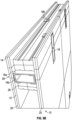
- FIGS 1a through to 10 show a pallet in different configurations and orientations. Various cross-sections are also shown.
- the pallet 10 has two main components - a body 12 and an optional transit body 14, which can be used when pallet sizes vary. As described below the pallet, by way of example, has a standard 1000mm x 1200mm footprint. In the example embodiments shown an optional transit body is used. Together the body and transit body enable the pallet to transform and change from a transport configuration, in which the body and transit body are connected, and an assembly configuration in which the body and transit body 14 are separated. Without the transit body the footprint of the body 12 of the transport and assembly configurations are the same.
- a pallet 10 that has no transit body can be differentiated between the transport and assembly configuration by the reconfiguration of other components of the pallet. The inventor, however, considers an example embodiment of the invention with a transit body to be adaptable.
- the body 12 is used as the primary component in forming a building 100, or part thereof, comprising a plurality of pallets, as shown in Figures 11 to 19 .
- the pallet 10 in the transport configuration can be used to transporting goods or materials. This configuration is illustrated best in Figures 4a and 4b , and also in Figures 5a and 5b , wherein the pallet is shown together with the forks of a pallet-truck PT.
- a bar 16, shown in Figure 5b is retained within the perimeter or volume defined by the pallet 10.
- a fixing or clip 18 is shown securing the body 12 and the transit body 14 together. The clip 18 can, additionally secure the position of the bar with respect to the body 12.
- the pallet 10 is provided with three clips.
- the body 12 and the transit body 14 have upper and lower support surfaces 20 defining upper and lower faces or planes of the pallet 10. These surfaces are arranged to be substantially parallel such that goods would rest on the upper surface while the lower surface would rest on a floor.
- the lower surface 20 can have four spaces formed by displacing knock-out panels 22 that, when removed, form four apertures.
- the pallet is provided without knock-out panels and four apertures are provided.
- the apertures enable the wheels of a pallet-truck PT moving the pallet 10 to access the floor on which a pallet is resting to facilitate movement of the pallet. This is best illustrated by Figure 5a and 5b .
- the pallet 10 has a recess 24 shaped on the surfaces to receive the clip 18.
- the recess 24 enables the fixing or clip to form a secure hold of the body 12 and/or transit body 14.
- Each recess 24 has two sides, or semi-recesses, which align with each other when the body 12 and transit body 14 are aligned - thus one side of the recess resides on the body 12 of the pallet and the other side of the recess resides on the transit body 14. If no transit body is utilised in a pallet 10 then the recess and both sides thereof reside solely on the body 12. On the opposite side of the body semi-recesses are also provided - these match the semi-recess on an adjacent body - for configurations in which connect in an assembly configuration.
- each side of the recess i.e. each semi-recess
- the clip 18 engages with the transit body and the body and bridges the interface therebetween to hold these two parts together.
- a transit body 14 If a transit body 14 is used it is removed for the assembly configuration, when two bodies 12 are aligned and adjacent with each other then the semi-recess of each pallet - that is the sides of the recess on each pallet body 12 - are aligned such that the clip 18 engages with each body to releasably hold the two together.
- the pallet 10 comprises a body 12 then additional recesses can be provided to retain the clip within the perimeter or envelope of the pallet 10 before clips 18 are repositioned to span between two bodies such that the clip lies in a recess on each part of the body in the same way it would if connecting to a transit body.
- the recess is preferably shaped to accommodate the clip such that the clip does not protrude beyond a plane defined by the surface 20 of the pallet 10.
- the clip can be countersunk within the support or surface of the pallet 10.
- the clip 18 additionally or alternatively engages with the bar 16.
- the bar in the transport configuration resides between the body 12 and the transit body 14 and can also be held with the clip.
- Each of the body 12 and transit body 14 have a structure 26 configured between, and secured to, the upper and lower support 20.
- the structure on the body has three beams 26, while the transit body has a single beam.
- the longitudinal sides of the beams 26 located adjacent the edge of the surfaces are set back from said edges.
- a cavity 28 is formed between the beams 26 of the body and transit body and the support surfaces 20 by the beams being set-back.
- the bar 16, and position of the beams, are configured such that the bar is enclosed, in the cavity.
- Figure 5b shows the bar 16 located is the transportation configuration. If no transit body is used then the bar is stored in the body 12 between the beams 26.
- Both the beam 26 of the body 12 and the beam 26 of the transit body 15, if provided, function like a spine and extends substantially across the body or transit body as shown. When configured together their beams 26 extend parallel to one another. In other words, when the transit body and body are aligned, the beams in the respective bodies are aligned.
- the body 12 of the pallet 10 has two beams 26 arranged adjacent opposite edges of the pallet, said edges defining a beam-side 30 of the body.
- the other opposing edges define an access-side of the body 32, wherein the body has a space between the supports and said space is open on the or each access-side.
- the pallet includes a connector 34, shown in Figure 2a .
- Figure 4a and 5b illustrate the connector removably connected to the pallet in the transport configuration.
- Figure 4a and 5b also show a bracket 36 removably connected to the pallet in the transport configuration.
- These components can aid guidance of a pallet truck PT when the pallet is used for transporting goods. Their function changes when the pallet is reconfigured to an assembly configuration for forming part of the building 100.
- the connector and bracket can be secured using, for example, coach-bolts and wing-nuts, such that no tools are required for the removal or attachment of these components.
- Figures 7a and 7b show the clip 18 and bracket 36, respectively, in more detail.
- the bracket is triangular in shape, typical of a corner bracket used for bracing structures together.
- the bracket has a triangular footprint with at least two flanges extending therefrom. Reinforcement forming can be provided.
- a plurality of mounting holes are provided for securing the bracket to a beam 26 of the pallet 10 as shown in Figure 5b . Removable bolts are used for fixing the bracket.
- FIG 9b and Figure 5b show the clip 18 in position when the pallet is in the transport configuration i.e. holding the body 12 to the transport body 14 such that the pallet can accommodate goods for shipping thereon.
- the clip has a main body or spine 18a, that extends substantially parallel to the surfaces 20 of the pallet 10.
- a limb 18b at each end of the spine extends perpendicularly from the spine.
- the limbs extend, preferably, in to slots in the recess 24.
- the limbs 18b clamp the body and transit body together providing a removable hold or lock therebetween.
- the semi-recesses 24 in each body are aligned and the spine 18a of the clip spans the join or interface and each limb 18b extends in to a slot in the respective recesses.
- a rod 18c extends perpendicularly from a central portion of the spine 18a. The rod 18c is configured to locate within the bar 16. Fixings can be used to further secure the clip 18 to the body 12 and transit body. Such fixings can further secure or hold the spine 18a in position in the recess.
- a portion, such as the end portion, of the rod 18c can be provided with a thread to, at least in part, engage with the bar 16. Additionally or alternatively to a thread a bayonet fixing can be provided.
- Figures 8a and 8b show a sleeve 16a and a core 16b of the bar, respectively, while Figure 8c shows the core located in the sleeve, with an optional foot 38 that can fit within the end of the core 16b.
- the core and sleeve are provided with holes, slots or apertures for receiving the rod 18c of the clip 18.
- Figure 8d shows the rod 18c of clips 18 in partial engagement with the bar.
- the sleeve 16a when installed in the pallet can be fixedly secured to the body 12, and separable from the transit body 14. Alternatively, the sleeve can also be removable from the body 12.
- the core 16b can move within the sleeve to be releasably held in position by the rod 18c of the clip.
- the dimensions of the rod 18c and holes of the bracket 36 are such that they enable co-operation with the bolt-type fixings and the bar 16.
- the clip 18 is shown engaged with one body 12 only.
- the spine 18a lies in one side of a recess 24 upon the surface 20 of the body.
- a limb 18b extends in to the body.
- the beam 26 is set-back, or positioned slightly inward of the edge of the surface 20 such that the rod 18c extends, as shown, to be adjacent a space or void at the side of the body because the bar is not shown.
- Figure 9a is for illustrative purposes only - indicating the body in an assembly configuration (i.e. without a transit body 14) with three clips and recesses on each beam-side 32 of a body.
- Four semi-recesses are provided on one support surface 20 and two semi-recesses are provided on the opposite support 20.
- the support having four recesses can be the lower-most support in use, resting on the floor because this is considered to provide a suitably strong surface.
- Six semi-recesses can be provided on each support surface in order to provide a choice of position during assembly.
- the assembly configuration is such that another body abuts the body 12 to form a structure.
- the clip 18 shown connected to the body 12 in Figure 9a connects in an identical manner to the other body. This occurs because the recesses 24 align between the bodies to receive the spine and limbs of the clip.
- the rod 18c does not extend in to a void between the bodies but instead engages with the bar 16 that is connected to one of the bodies.
- connection between the body 12 and the transit body 14, shown in Figure 9b is analogous to the connection between two bodies 12.
- the edge of the body 12 adjacent the beam 26 are of the same dimensions such that the bar 16 sits between them, while fixed to the body (one of them).
- the clip can releasably secure the transit body 14 in the same manner as it would secure another body.
- the clip can extend in to a recess to engage with the bar between the bodies.
- the beam 26 can have a recess or similar feature for enabling the limb 18b of a clip to engage.
- the clips can function to releasably secure the body 12 to a transit body 14, or secure the body 12 to another body 14, in one or more of the following ways: the limbs 18b extending from the spine 18a are resiliently biased, or sprung, such that they grasp the recess in to which they extend; the limbs have formations, such as teeth-like protrusions, which engage with the beam 26; the beam 26 can be shaped, such as having grooves, configured to receive the ends of the limbs; the rod 18c extending from the spine inhibits uncontrolled movement or creep of the spine from the recess by inhibiting rotation of the spine; or the clip can be secured with additional fixings (see Figure 5b ) that reliably secure the spine of the clip to the recess in which it is mounted.
- Figures 10a to 10c show a custom-pallet, which is a variation or modification of the aforementioned pallet of Figures 1 to 9 , which accommodates a window and/or door function while retaining the beam-side 30 and access-side 32 connectivity using clips 18 together with the bar 16 (not shown in Figure 10 ).
- the custom pallet When arranged to extend horizontally the custom pallet functions as a void for passing therethrough e.g. for a stairwell.
- a stairwell can be implemented by arrangement of bars 16, connected with clips 16 angled at 45 degree to the horizontal, with brackets 36 releasably secured thereon to support the transit body 14 resting on the bracket 36.
- a portion 40 of the support surface 20 is hinged to provide a central, preferably hinged, opening 42.
- the hinged portion configured to open can be made of the same material as the support 20, or be provided as a Perspex TM portion or similar transparent material.
- the aperture can be provided with a mesh that forms a barrier to insects and, therefore, functioning as a fly-screen or mosquito-net.
- inserts or reinforcements can be provided, such as around the periphery of the opening 42.
- any transportation reinforcements are removed to provide a U-shaped frame with the same peripheral or configuration as the panels shown in Figures 1 to 9 and, therefore, this custom pallet is arrangeable or connectable to the pallets shown in Figures 1 to 9 in the same manner.
- Two of these U-shaped panels aligned with the open ends facing one another can function as a door-frame.
- These custom panels can be seen installed in Figures 11 to 19 .
- the pallet 10 has been described above in a transport configuration and, in part, its assembly configuration.
- the aim of the invention is to provide a pallet that is reconfigurable to function as a building module. This is achieved, at least, by the connectivity of the body 12 of the pallet to another body of, preferably, the same kind of pallet, when pallets are in an assembly configuration.
- the buildings or dwellings described herein use a pallet with a common interface and common dimensions or size. In light of the teaching herein it would be possible to connect pallets of different sizes, which had the same interface.
- the term interface is used to describe edges of bodies 12 that connect using clips, as described above in relation to Figures 1 to 10 , and illustrated in Figure 9b .
- Each body 12 can connect to another body along its beam-side 30 and/or its access-side 32.
- the additional functionality of the clip 18, bar 16, connector 34, bracket 36 and transit body 14 can facilitate the assembly of the building.
- Each pallet has three recesses and clips 18, equally spaced along the beam-side 30 - two clips on one surface 20, one on the other. As shown in the Figures the clips are evenly spaced along the beam-side. The position of the clips and their associated recesses are such that the load can be evenly distributed throughout a building or structure formed from the pallets of the invention. Other recess positions are configurable depending on the size of the pallet, number of clips available and load to be supported.
- the sleeve of the bar 16 can be secured to the body 12 and partially exposed by the removal of the transit body 14. With the clips removed the core 18b of the bar can extend beyond the perimeter of the body 12 partially out of the sleeve 18a.
- An arrangement of two connected bodies involves a second body 12 from another panel being aligned with the beam-side 30 edge of the first body to enclose the sleeve of the bar between.
- the core of the bar is drawn out to extend perpendicularly from the bodies.
- the three clips are re-inserted into the recesses - the recesses on the bodies being aligned.
- the rod 18c of one of the clips engages with the sleeve only, because the core 18b has been displaced from that part of the sleeve.
- the core is extended such that the other two rods of clips can engage with the sleeve and the core, thus securing the core in an extended position from the adjoining connected panels.
- Three clips now hold the two bodies together, with two of the three clips securing the core of the bar in a fixed position within the sleeve.
- a substantially rigid module of two pallet bodies is formed.
- two bodies can connect along their access-sides, with an optional connector 34 therebetween. In such a configuration the clips would hold the bar against a beam-side of each body.
- two clips are provided and configured on the underside, or lowermost, surface 20 when holding two bodies together. This is because a mass pressing down upon the uppermost surface can cause the core 16b located in a sleeve 16a to attempt to rotate within the sleeve thus applying a sheer force to the rod 18c. With two clips and rods 18c on the underside the sheer force can be distributed evenly.
- the first and second set can be connected along their access-sides 32.
- the second set is aligned such that the access-sides 32 of the first connected panels is adjacent the access side of the first set.
- the core 16b of the first set of panels is arranged to extend in to the sleeve 16a of the bar 16 of the second set of adjoining panels.
- the access sides 32 are configured to accommodate and locate the connector 34 between the supports 20, while the opposite access side has beams formed with slots to receive a protrusion on the connector.
- This is illustrated clearly in Figure 2a , wherein on one access-side the beams are set-back from the edge of the support to accommodate a connector, while on the opposite access side the beams are keyed to receive the connector 34.
- the connector facilitates the engagement of the access-sides 32 of the bodies 12.
- the connector improves the planar strength of the connected first and second sets of pallet bodies i.e. four bodies 12 arranged in a square-grid pattern. A substantially rigid module of four pallet bodies is formed.
- the connector 34 has a rectangular cross-sectional profile and the recesses on the access-sides 32 of the body 12 both receive a portion of the connector.
- each access-side of a pallet can receive a portion of a connector 34.
- a number of pallets would arrive at a location supporting a shipment of goods thereon - this could be for a music festival, a research expedition or an emergency scenario, such as an earthquake or typhoon. After the goods are unloaded the pallets, still in their transport configuration, can easily be carried to where they are needed.
- Clips, and additional fixings where used can be removed to allow the bar 16 to be repositioned, if required. All removable components are disassembled. No special tools are required. If a transport body 14 is used it too is removed.
- the bodies 12 of two pallets are aligned.
- clips are re-applied such that the edges of the pallet bodies are releasably secured together. If bodies are to be placed on the access-side 32 then the core 16b of the bar is slid partly out of its sleeve 16a until the core extends in to the sleeve of the bar 16 located in the body aligned against the access side.
- the clips 18 re-applied in to the recesses between the bodies can, therefore, not only releasably secure an adjacent body on a beam-side 30 the body, but releasably secure the body 12 to another body on the access-side 32 of the body.
- the clips 12 can releasably secure a body to each of the four adjacent sides.
- the grid-pattern arrangement, or tessellation, of bodies can be arranged to implement a wide range of shapes and dimensions of planar structures.
- the maximum dimensions of, for example, a planar floor formed of grid-tessellated panels is determined by the load it must support and the materials used in fabricating the supports 20, bars 16, clips 12, beams 26 etc.
- a practical example of a dwelling formed from grid-pattern planar structures is described below.
- any building assembled by transforming or assembling pallets of the invention can be done so easily and with minimal skill levels and, similarly, can the building can be transformed or be disassembled to provide a collection of parts that can be assembled to form pallets.
- a family displaced due to war and residing in a dwelling 100 while displaced from their original home could, if possible, disassemble the dwelling, and ship the component parts, perhaps in the form of pallets 10, back to their original home such that on their return they would have at least a dwelling in which to reside on their return (i.e. by reassembling the dwelling again.
- the pallet of the invention is agnostic to the shape and type of building that a collection of pallets can be transformed in to a first building, disassembled to be transformed in to a second building and finally disassembled to create the original pallets.
- the invention therefore, provides for a low-impact and environmentally friendly building or structure because, in effect, pallets can be recycled in to buildings, buildings can be recycled in to a dwelling having a different size and buildings or dwellings can be recycled back in to pallets.
- Figure 11 is a partially completed dwelling or building 100 having a plurality of connected pallets 10 that have been reconfigured to form the walls, floor and balconied walkway.
- the completed dwelling is shown in Figures 16 and 17 , while Figures 12 to 15 show sections through said dwelling.
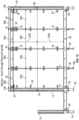
- Figure 18 shows the connections between the bars 16, clips 18 and brackets 36 of the building 100.
- the connected bars form a skeleton within the support or skin 20 of the structure.
- the floors and walls of the dwelling are formed by making sets of bodies, connected in a grid-pattern, as described above, and not repeated in detail again.
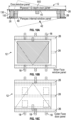
- Figures 12 and 13 show sections through the floor and roof of the building.
- the core 16b of the bar 16 on the lower-most body 12 in each of the walls and walkway is slid downward from within these vertically orientated bodies 12 to rest upon the ground on which the building will rest.
- the hashed-lines indicate the location of a bar 16 extending within between the skin 20 of the building.
- the balconied walkway shown in Figure 12 can, alternatively, be located on the other side (i.e. the face-on side as viewed).
- the position is secured, as has been described above, using a clip.
- the core 18b functions as a leg such that the building can be kept substantially level on uneven ground.
- the foot 34 can be used to improve stability on certain types of ground.
- the position of each is adjustable and determined by the alignment of holes on the core with holes in the sleeve and their fixing with the rod 18c of the clip (see Figure 8 ). With the floor level of the building levelled by the extension of the core around the perimeter of the building brackets 36 are then fixed, also to the core, to enable horizontally orientated panels to rest thereon.
- the transit body 14 can be utilised around the junction between the floor and the wall, around the perimeter, as a joist to support the walls and/or to provide reinforcement.
- the transit body 14 when utilised, can be used to support the corners of the dwelling. To enable this application of the transit body it can be disassembled to provide two support 20 components and a beam 26.
- a beam can be positioned in the corner to enable a clip 18 to engage with a bar 16 (via the rod 18c), the support 20 of a body 12 (via one limb 18b) extending vertically and with the beam (via the other limb 18b of the clip 18).
- connectors 34 are configured upon the access-side 32 of the panel to facilitate engagement with the adjoining panel, which core 16b extends downwards in the sleeve of the panel below.
- Connectors 34 are also utilised in the floor and roof.
- Brackets 36 are additionally used to support the roof, which is formed in the same manner as the floor, to enable horizontally orientated panels to rest thereon. Brackets can additionally be used to connect the vertical sides of walls to increase stability.
- Figures 14a and 15 show sections through the walls looking down on the topside and underside of the floor respectively.
- the hashed lines indicate the bars extending between the support or skin 20.
- FIG 14b shows a configuration in which two connectors are arranged in the space between the bar16.
- Each connector 34 has a number of with recesses, or apertures, to receive the limb 18b of a clip 18.
- a clip can provide additional bracing or strengthening at the corners. This is achieved by one limb locating with a recess 24 of a support 20 on a body 12, the limb engaging with the bar 16 and the other limb engaging with the connector.
- the clips 18 are shown only partially inserted into recess for illustrative purposes only - in use the spine 18c would lie flush upon the surface 20 and against the connector.
- Custom pallets as shown in Figure 10 , can be seen in Figures 16 and 17 , functioning as a door and window, respectively.
- the inventor has presented the dwelling as shown to illustrate just one form of a building.
- the roof can be optional, and could alternatively be replaced by an alternative structure, or tarpaulin, or similar kind of covering.
- the walkway too is optional, but has been added because it is envisaged that a plurality of dwellings shown are adjoined and the walkway enables easy access therebewteen.
- the standard dimensions of known pallets vary by region. In North America they typically have a 48 inch by 40 inch footprint. In Asia there are three common footprints: 1000mm x 1200mm; 1100mm x 1100mm; and 800mm x 1200mm. In Europe the standard footprints are often 1000mm x 1200mm, or and 800mm x 1200mm. The inventor considers that the invention is suitable for all pallet footprints - even those not listed above, providing that the body 12 of the pallets are sized to be able to tessellate in to a grid pattern.
- the difference in size between a body 12 that can be arranged in a grid-pattern and one of the standard dimensions can be accommodated by a transit panel of an appropriate size.
- the transit body therefore, is optional - to enable flexibility and accommodate variation in the size.
- the grid pattern is important because the bodies of the pallets, and the bar 16 therein, must align. In alignment, and when clipped together, the clips and the bars form part of a frame that distributes a load upon the supports 20 that are held to the frame via the clip 18.
- the inventor prefers to demonstrate the invention through a pallet having a 1000mm x 1200mm footprint. Not only because this is an industry standard size but pallets of standard sizes are manoeuvrable by a single able-bodied person.
- the invention is envisaged as being used in applications in which no mechanical lifting devices, such as cranes, are available. Further, it is anticipated that pallets of such dimensions can be manually carried over terrain that a wheeled or tracked vehicle would have difficulty traversing.
- a body 12 of the pallet is 900mm x 1200mm because this size enables a floor formed by 12 pallets arranged in a 3x4 grid pattern, said floor being matched to walls having 8 pallets in a 2x4 grid pattern, in which the beam-side 30 of the pallets forming the walls extend vertically.
- two vertically aligned pallets see Figure 11 , at least
- the cores 16b of the bars can extend downwards beyond a plane defined by the floor to interface with the ground.
- the floor can be arranged to extend horizontally by adjusting the length of the core extending out of the pallet, said adjustment being possible by the variation of the position of the rod 18c of the clip engaging with the body and bar.
- any fixings can be packed within the body of the pallet 10.
- These tools can consist of no more than a lever because, if required, fixings can be manually operable without the need for tools.
- the recess 24 can be used to package additional items to improve the habitability of the dwelling 100 formed by pallets 10. Component parts of additional items can be distributed amongst a plurality of pallets. Additional items can be provided to, for example, enable the dwelling 100 to be used as a storm shelter
- Tarpaulin sheets, or a Tyvek TM type covering can be packed within the cavity of the pallets to provide at least a portion of a water-proof shell for covering the dwelling.
- Transit bodies which are optional, can be used to form steps, or the rungs of ladders, in conjunction with other materials, such as the bar 16 and brackets 36, should any be available from surplus pallets 10.
- the materials used to form the support 20 and/or structure 26 can be treated to be fire-retardant.
Landscapes
- Engineering & Computer Science (AREA)
- Architecture (AREA)
- Physics & Mathematics (AREA)
- Electromagnetism (AREA)
- Civil Engineering (AREA)
- Structural Engineering (AREA)
- Mechanical Engineering (AREA)
- Life Sciences & Earth Sciences (AREA)
- Wood Science & Technology (AREA)
- Pallets (AREA)
Claims (12)
- Palette (10) pour le transport de marchandises ou de matériaux, la palette étant mobile par des dispositifs de levage tels qu'un chariot élévateur à fourche ou un transpalettes, la palette ayant :un corps (12) dans lequel le corps (12) aun support supérieur et inférieur (20) ayant des surfaces définissant des faces ou des plans supérieurs et inférieurs,qui sont agencés pour être sensiblement parallèles etune structure (26) conçue entre les supports et arrimée à ceux-ci ;une barre (16) positionnée entre lesdits supports (20), pouvant être fixée de manière amovible au corps (12) et mobile entreune position de transport, dans laquelle la barre (16) est conçue pour se trouver dans le volume de périmètre de la palette, etune position de raccordement, dans laquelle la barre (16) est conçue pour s'étendre du volume de périmètre de la palette, dans laquelle la barre peut être raccordée pour un attachement fiable à un autre corps d'une autre palette ; etune fixation (18), conçue pour arrimer de manière amovible la position de la barre et arrimer de manière amovible la palette à une palette adjacente, caractérisée en ce que la fixation est une attache (18) ayant une tige (18c), un membre (18b) et une colonne vertébrale (18a),dans laquelle la tige (18c) est conçue pour se raccorder à un des supports (20) et se situer dans la barre (16), et arrimer de manière amovible la position de la barre, dans laquelle la tige (18c) s'étend perpendiculairement d'une partie centrale de la colonne vertébrale (18a), etdans laquelle la colonne vertébrale (18a) est conçue pour s'étendre à travers la limite entre deux corps (12) maintenus ensemble par l'attache, en cours d'utilisation, etdans laquelle le membre (18b) est conçu pour venir en prise de manière amovible avec un évidement (24) sur le support.
- Palette selon la revendication 1, dans laquelle l'évidement (24) est façonnée pour recevoir la fixation (18) de telle sorte que la fixation dans une position sécurisée s'étend dans la direction desdits plans et affleure à la surface du support (20) et, de préférence, se trouve entre les plans définis par la surface des supports.
- Palette selon la revendication 1, dans laquelle la structure (26) a deux poutres agencées adjacentes aux bords opposés de la palette, lesdits bords opposés définissant un côté de poutre du corps et les autres bords opposés définissant un côté d'accès du corps, dans laquelle le corps a un espace ou une cavité entre les supports et les poutres et ledit espace ou ladite cavité est ouvert(e) sur le ou chaque côté d'accès.
- Palette selon une quelconque revendication précédente, ayant en outre un corps de transit (14) pouvant être raccordé de manière amovible à un côté du corps (12) avec l'attache (18).
- Palette selon la revendication 4, dans laquelle le corps de transit (14) a un support supérieur et inférieur ayant des surfaces définissant des faces ou des plans supérieurs et inférieurs, qui sont agencés pour être sensiblement parallèles, et dans laquelle le corps de transit, lorsqu'il est raccordé au corps, fournit une extension de faces supérieure et inférieure du corps pour augmenter l'encombrement de la palette dans une configuration de transport.
- Palette selon la revendication 5, dans laquelle le corps de transit (14) a une structure (26) conçue entre le support supérieur et inférieur du corps de transit (14 ), et arrimée à ceux-ci.
- Palette selon la revendication 6, dans laquelle le corps de transit (14) se raccorde de manière amovible à un côté de poutre du corps et a une poutre qui est alignée sensiblement parallèlement à une poutre dans le corps.
- Palette selon la revendication 7, dans laquelle une cavité est formée entre le corps et le corps de transit lorsqu'elle est raccordée, et la barre (16) est arrimée de manière amovible à l'intérieur.
- Palette selon la revendication 8, dans laquelle l'attache (18) a un premier membre (18b) conçu pour venir en prise de manière amovible avec l'évidement (24) sur ledit support sur le corps (20), un second membre (18b) conçu pour venir en prise de manière amovible avec un évidement (24) sur un support sur le corps de transit (14), et la tige (18c) est conçue pour se raccorder à la barre (16), et arrimer de manière amovible le corps de transit au corps et à la barre entre eux.
- Palette selon une quelconque revendication précédente, dans laquelle la barre est télescopique et a un manchon (16a) et un noyau (16b), mobile à l'intérieur du manchon.
- Bâtiment, tel qu'une habitation, formé par une pluralité de corps (12), barres (16) et attaches (18) interconnectés d'une pluralité de palettes (20) selon une quelconque revendication précédente.
- Bâtiment selon la revendication 11, dans lequel le bâtiment a un premier corps (12), un second corps (12), une barre (16) et une attache (18) arrimant de manière amovible la barre entre le premier corps et le second corps, qui sont agencés de manière adjacents l'un à l'autre.
Applications Claiming Priority (2)
| Application Number | Priority Date | Filing Date | Title |
|---|---|---|---|
| GBGB1800958.9A GB201800958D0 (en) | 2018-01-21 | 2018-01-21 | Improved pallet |
| PCT/EP2019/051304 WO2019141830A1 (fr) | 2018-01-21 | 2019-01-20 | Palette et bâtiment constitué d'une pluralité de palettes interconnectées |
Publications (3)
| Publication Number | Publication Date |
|---|---|
| EP3740432A1 EP3740432A1 (fr) | 2020-11-25 |
| EP3740432B1 true EP3740432B1 (fr) | 2023-08-23 |
| EP3740432C0 EP3740432C0 (fr) | 2023-08-23 |
Family
ID=61283759
Family Applications (1)
| Application Number | Title | Priority Date | Filing Date |
|---|---|---|---|
| EP19703643.7A Active EP3740432B1 (fr) | 2018-01-21 | 2019-01-20 | Palette et bâtiment formé par une pluralité de palettes interconnectées |
Country Status (3)
| Country | Link |
|---|---|
| EP (1) | EP3740432B1 (fr) |
| GB (1) | GB201800958D0 (fr) |
| WO (1) | WO2019141830A1 (fr) |
Families Citing this family (1)
| Publication number | Priority date | Publication date | Assignee | Title |
|---|---|---|---|---|
| CN111926973A (zh) * | 2020-08-13 | 2020-11-13 | 江苏苏阳建设有限公司 | 一种连接稳定的叠合板 |
Family Cites Families (8)
| Publication number | Priority date | Publication date | Assignee | Title |
|---|---|---|---|---|
| US20070175132A1 (en) * | 2006-01-17 | 2007-08-02 | Daw Technologies, Inc. | Raised access floor |
| WO2007145666A1 (fr) * | 2006-06-12 | 2007-12-21 | Xm International, Inc. | Palette |
| AT506044B1 (de) * | 2007-11-14 | 2010-07-15 | Andreas Claus Schnetzer | Gebäude |
| FR2945276B1 (fr) * | 2009-05-07 | 2015-07-10 | Geprom | Palette modulaire separable applicable a la demi-palette. |
| US9060606B1 (en) * | 2010-01-02 | 2015-06-23 | Harry Steinbok | Table display, bench and shipping platform convertible apparatus and method of use |
| US8671848B2 (en) * | 2011-08-04 | 2014-03-18 | Wayne Randall | Pallet protector device and method |
| US9919835B2 (en) * | 2013-06-06 | 2018-03-20 | Good Works Studio, Inc. | Multi-purpose transport and flooring structures, and associated methods of manufacture |
| WO2017023163A1 (fr) * | 2015-08-06 | 2017-02-09 | Yap Swee Wun | Ensemble de palette modulaire |
-
2018
- 2018-01-21 GB GBGB1800958.9A patent/GB201800958D0/en not_active Ceased
-
2019
- 2019-01-20 EP EP19703643.7A patent/EP3740432B1/fr active Active
- 2019-01-20 WO PCT/EP2019/051304 patent/WO2019141830A1/fr not_active Ceased
Also Published As
| Publication number | Publication date |
|---|---|
| WO2019141830A1 (fr) | 2019-07-25 |
| GB201800958D0 (en) | 2018-03-07 |
| EP3740432C0 (fr) | 2023-08-23 |
| EP3740432A1 (fr) | 2020-11-25 |
Similar Documents
| Publication | Publication Date | Title |
|---|---|---|
| US11619041B2 (en) | Modular housing system | |
| US6463705B1 (en) | Container for prefabricated transportable buildings | |
| US5333426A (en) | Wood frame construction system with prefabricated components | |
| CA2824364C (fr) | Systeme d'ossature portante pouvant etre erige de facon pivotante | |
| US20130074424A1 (en) | Building system and method | |
| EP4508289A1 (fr) | Section de remise de trottoir | |
| US20110099936A1 (en) | Interlocking building structure | |
| US20240254753A1 (en) | Collapsible Structural Support and Storage Module | |
| EP2960391A1 (fr) | Unite modulaire prefabriquee pour la construction de batiments | |
| US20200002954A1 (en) | Scaffold System | |
| CA1192368A (fr) | Systeme de groupage d'elements prefabriques pour le batiment aux fins de leur transport et de leur stockage | |
| EP3740432B1 (fr) | Palette et bâtiment formé par une pluralité de palettes interconnectées | |
| US20090107078A1 (en) | Modular building system and methods thereof | |
| KR101970404B1 (ko) | 모듈식 조립구조의 건축물 | |
| US6295766B1 (en) | Building construction | |
| JP7578278B2 (ja) | 室内用組立て式構造体 | |
| US4807410A (en) | Self-containing package system for storage and transportation of pre-fabricated portions of a building structure and the assembly thereof | |
| AU2011202177C1 (en) | Transportable Building | |
| JP4469483B2 (ja) | 折り畳み式足場台および該足場台を連結してなる足場 | |
| EP4729708A2 (fr) | Construction de module en bois | |
| AU2025252602A1 (en) | Wooden module construction | |
| JP2020100937A (ja) | 柱部材及び組立式ブース | |
| CN121002260A (zh) | 模块化铺板或地板系统 | |
| CA1174428A (fr) | Batiment modulaire a charpente-squelette | |
| JPH0419153Y2 (fr) |
Legal Events
| Date | Code | Title | Description |
|---|---|---|---|
| STAA | Information on the status of an ep patent application or granted ep patent |
Free format text: STATUS: UNKNOWN |
|
| STAA | Information on the status of an ep patent application or granted ep patent |
Free format text: STATUS: THE INTERNATIONAL PUBLICATION HAS BEEN MADE |
|
| PUAI | Public reference made under article 153(3) epc to a published international application that has entered the european phase |
Free format text: ORIGINAL CODE: 0009012 |
|
| STAA | Information on the status of an ep patent application or granted ep patent |
Free format text: STATUS: REQUEST FOR EXAMINATION WAS MADE |
|
| 17P | Request for examination filed |
Effective date: 20200818 |
|
| AK | Designated contracting states |
Kind code of ref document: A1 Designated state(s): AL AT BE BG CH CY CZ DE DK EE ES FI FR GB GR HR HU IE IS IT LI LT LU LV MC MK MT NL NO PL PT RO RS SE SI SK SM TR |
|
| AX | Request for extension of the european patent |
Extension state: BA ME |
|
| DAV | Request for validation of the european patent (deleted) | ||
| DAX | Request for extension of the european patent (deleted) | ||
| STAA | Information on the status of an ep patent application or granted ep patent |
Free format text: STATUS: EXAMINATION IS IN PROGRESS |
|
| 17Q | First examination report despatched |
Effective date: 20210922 |
|
| GRAP | Despatch of communication of intention to grant a patent |
Free format text: ORIGINAL CODE: EPIDOSNIGR1 |
|
| STAA | Information on the status of an ep patent application or granted ep patent |
Free format text: STATUS: GRANT OF PATENT IS INTENDED |
|
| RIC1 | Information provided on ipc code assigned before grant |
Ipc: E04B 1/61 20060101ALI20230222BHEP Ipc: E04B 1/343 20060101ALI20230222BHEP Ipc: E04B 1/10 20060101ALI20230222BHEP Ipc: B65D 81/36 20060101ALI20230222BHEP Ipc: B65D 19/26 20060101AFI20230222BHEP |
|
| INTG | Intention to grant announced |
Effective date: 20230315 |
|
| P01 | Opt-out of the competence of the unified patent court (upc) registered |
Effective date: 20230528 |
|
| GRAS | Grant fee paid |
Free format text: ORIGINAL CODE: EPIDOSNIGR3 |
|
| P02 | Opt-out of the competence of the unified patent court (upc) changed |
Effective date: 20230528 |
|
| GRAA | (expected) grant |
Free format text: ORIGINAL CODE: 0009210 |
|
| STAA | Information on the status of an ep patent application or granted ep patent |
Free format text: STATUS: THE PATENT HAS BEEN GRANTED |
|
| AK | Designated contracting states |
Kind code of ref document: B1 Designated state(s): AL AT BE BG CH CY CZ DE DK EE ES FI FR GB GR HR HU IE IS IT LI LT LU LV MC MK MT NL NO PL PT RO RS SE SI SK SM TR |
|
| REG | Reference to a national code |
Ref country code: GB Ref legal event code: FG4D |
|
| REG | Reference to a national code |
Ref country code: CH Ref legal event code: EP |
|
| REG | Reference to a national code |
Ref country code: IE Ref legal event code: FG4D |
|
| REG | Reference to a national code |
Ref country code: DE Ref legal event code: R096 Ref document number: 602019035538 Country of ref document: DE |
|
| U01 | Request for unitary effect filed |
Effective date: 20230919 |
|
| P04 | Withdrawal of opt-out of the competence of the unified patent court (upc) registered |
Effective date: 20230929 |
|
| U07 | Unitary effect registered |
Designated state(s): AT BE BG DE DK EE FI FR IT LT LU LV MT NL PT SE SI Effective date: 20231005 |
|
| PG25 | Lapsed in a contracting state [announced via postgrant information from national office to epo] |
Ref country code: GR Free format text: LAPSE BECAUSE OF FAILURE TO SUBMIT A TRANSLATION OF THE DESCRIPTION OR TO PAY THE FEE WITHIN THE PRESCRIBED TIME-LIMIT Effective date: 20231124 |
|
| PG25 | Lapsed in a contracting state [announced via postgrant information from national office to epo] |
Ref country code: IS Free format text: LAPSE BECAUSE OF FAILURE TO SUBMIT A TRANSLATION OF THE DESCRIPTION OR TO PAY THE FEE WITHIN THE PRESCRIBED TIME-LIMIT Effective date: 20231223 |
|
| PG25 | Lapsed in a contracting state [announced via postgrant information from national office to epo] |
Ref country code: RS Free format text: LAPSE BECAUSE OF FAILURE TO SUBMIT A TRANSLATION OF THE DESCRIPTION OR TO PAY THE FEE WITHIN THE PRESCRIBED TIME-LIMIT Effective date: 20230823 Ref country code: NO Free format text: LAPSE BECAUSE OF FAILURE TO SUBMIT A TRANSLATION OF THE DESCRIPTION OR TO PAY THE FEE WITHIN THE PRESCRIBED TIME-LIMIT Effective date: 20231123 Ref country code: IS Free format text: LAPSE BECAUSE OF FAILURE TO SUBMIT A TRANSLATION OF THE DESCRIPTION OR TO PAY THE FEE WITHIN THE PRESCRIBED TIME-LIMIT Effective date: 20231223 Ref country code: HR Free format text: LAPSE BECAUSE OF FAILURE TO SUBMIT A TRANSLATION OF THE DESCRIPTION OR TO PAY THE FEE WITHIN THE PRESCRIBED TIME-LIMIT Effective date: 20230823 Ref country code: GR Free format text: LAPSE BECAUSE OF FAILURE TO SUBMIT A TRANSLATION OF THE DESCRIPTION OR TO PAY THE FEE WITHIN THE PRESCRIBED TIME-LIMIT Effective date: 20231124 |
|
| U20 | Renewal fee for the european patent with unitary effect paid |
Year of fee payment: 6 Effective date: 20240105 |
|
| PG25 | Lapsed in a contracting state [announced via postgrant information from national office to epo] |
Ref country code: PL Free format text: LAPSE BECAUSE OF FAILURE TO SUBMIT A TRANSLATION OF THE DESCRIPTION OR TO PAY THE FEE WITHIN THE PRESCRIBED TIME-LIMIT Effective date: 20230823 |
|
| PG25 | Lapsed in a contracting state [announced via postgrant information from national office to epo] |
Ref country code: ES Free format text: LAPSE BECAUSE OF FAILURE TO SUBMIT A TRANSLATION OF THE DESCRIPTION OR TO PAY THE FEE WITHIN THE PRESCRIBED TIME-LIMIT Effective date: 20230823 |
|
| PG25 | Lapsed in a contracting state [announced via postgrant information from national office to epo] |
Ref country code: SM Free format text: LAPSE BECAUSE OF FAILURE TO SUBMIT A TRANSLATION OF THE DESCRIPTION OR TO PAY THE FEE WITHIN THE PRESCRIBED TIME-LIMIT Effective date: 20230823 Ref country code: RO Free format text: LAPSE BECAUSE OF FAILURE TO SUBMIT A TRANSLATION OF THE DESCRIPTION OR TO PAY THE FEE WITHIN THE PRESCRIBED TIME-LIMIT Effective date: 20230823 Ref country code: ES Free format text: LAPSE BECAUSE OF FAILURE TO SUBMIT A TRANSLATION OF THE DESCRIPTION OR TO PAY THE FEE WITHIN THE PRESCRIBED TIME-LIMIT Effective date: 20230823 Ref country code: CZ Free format text: LAPSE BECAUSE OF FAILURE TO SUBMIT A TRANSLATION OF THE DESCRIPTION OR TO PAY THE FEE WITHIN THE PRESCRIBED TIME-LIMIT Effective date: 20230823 Ref country code: SK Free format text: LAPSE BECAUSE OF FAILURE TO SUBMIT A TRANSLATION OF THE DESCRIPTION OR TO PAY THE FEE WITHIN THE PRESCRIBED TIME-LIMIT Effective date: 20230823 |
|
| REG | Reference to a national code |
Ref country code: DE Ref legal event code: R097 Ref document number: 602019035538 Country of ref document: DE |
|
| PLBE | No opposition filed within time limit |
Free format text: ORIGINAL CODE: 0009261 |
|
| STAA | Information on the status of an ep patent application or granted ep patent |
Free format text: STATUS: NO OPPOSITION FILED WITHIN TIME LIMIT |
|
| 26N | No opposition filed |
Effective date: 20240524 |
|
| PG25 | Lapsed in a contracting state [announced via postgrant information from national office to epo] |
Ref country code: MC Free format text: LAPSE BECAUSE OF FAILURE TO SUBMIT A TRANSLATION OF THE DESCRIPTION OR TO PAY THE FEE WITHIN THE PRESCRIBED TIME-LIMIT Effective date: 20230823 |
|
| PG25 | Lapsed in a contracting state [announced via postgrant information from national office to epo] |
Ref country code: MC Free format text: LAPSE BECAUSE OF FAILURE TO SUBMIT A TRANSLATION OF THE DESCRIPTION OR TO PAY THE FEE WITHIN THE PRESCRIBED TIME-LIMIT Effective date: 20230823 |
|
| REG | Reference to a national code |
Ref country code: CH Ref legal event code: PL |
|
| PG25 | Lapsed in a contracting state [announced via postgrant information from national office to epo] |
Ref country code: CH Free format text: LAPSE BECAUSE OF NON-PAYMENT OF DUE FEES Effective date: 20240131 |
|
| PG25 | Lapsed in a contracting state [announced via postgrant information from national office to epo] |
Ref country code: CH Free format text: LAPSE BECAUSE OF NON-PAYMENT OF DUE FEES Effective date: 20240131 |
|
| P05 | Withdrawal of opt-out of the competence of the unified patent court (upc) changed |
Free format text: CASE NUMBER: APP_577645/2023 Effective date: 20231005 |
|
| U20 | Renewal fee for the european patent with unitary effect paid |
Year of fee payment: 7 Effective date: 20250127 |
|
| PG25 | Lapsed in a contracting state [announced via postgrant information from national office to epo] |
Ref country code: CY Free format text: LAPSE BECAUSE OF FAILURE TO SUBMIT A TRANSLATION OF THE DESCRIPTION OR TO PAY THE FEE WITHIN THE PRESCRIBED TIME-LIMIT; INVALID AB INITIO Effective date: 20190120 |
|
| PG25 | Lapsed in a contracting state [announced via postgrant information from national office to epo] |
Ref country code: HU Free format text: LAPSE BECAUSE OF FAILURE TO SUBMIT A TRANSLATION OF THE DESCRIPTION OR TO PAY THE FEE WITHIN THE PRESCRIBED TIME-LIMIT; INVALID AB INITIO Effective date: 20190120 |
|
| PG25 | Lapsed in a contracting state [announced via postgrant information from national office to epo] |
Ref country code: TR Free format text: LAPSE BECAUSE OF FAILURE TO SUBMIT A TRANSLATION OF THE DESCRIPTION OR TO PAY THE FEE WITHIN THE PRESCRIBED TIME-LIMIT Effective date: 20230823 |
|
| U20 | Renewal fee for the european patent with unitary effect paid |
Year of fee payment: 8 Effective date: 20260115 |
|
| PGFP | Annual fee paid to national office [announced via postgrant information from national office to epo] |
Ref country code: GB Payment date: 20260115 Year of fee payment: 8 |
|
| PGFP | Annual fee paid to national office [announced via postgrant information from national office to epo] |
Ref country code: IE Payment date: 20260120 Year of fee payment: 8 |