EP3743131B1 - Système de timbre pour surveiller et améliorer l'alignement du rythme circadien et du sommeil - Google Patents
Système de timbre pour surveiller et améliorer l'alignement du rythme circadien et du sommeil Download PDFInfo
- Publication number
- EP3743131B1 EP3743131B1 EP19743919.3A EP19743919A EP3743131B1 EP 3743131 B1 EP3743131 B1 EP 3743131B1 EP 19743919 A EP19743919 A EP 19743919A EP 3743131 B1 EP3743131 B1 EP 3743131B1
- Authority
- EP
- European Patent Office
- Prior art keywords
- subject
- sleep
- patch
- data
- circadian
- Prior art date
- Legal status (The legal status is an assumption and is not a legal conclusion. Google has not performed a legal analysis and makes no representation as to the accuracy of the status listed.)
- Active
Links
Images



Classifications
-
- A—HUMAN NECESSITIES
- A61—MEDICAL OR VETERINARY SCIENCE; HYGIENE
- A61B—DIAGNOSIS; SURGERY; IDENTIFICATION
- A61B5/00—Measuring for diagnostic purposes; Identification of persons
- A61B5/01—Measuring temperature of body parts ; Diagnostic temperature sensing, e.g. for malignant or inflamed tissue
-
- A—HUMAN NECESSITIES
- A61—MEDICAL OR VETERINARY SCIENCE; HYGIENE
- A61B—DIAGNOSIS; SURGERY; IDENTIFICATION
- A61B5/00—Measuring for diagnostic purposes; Identification of persons
- A61B5/16—Devices for psychotechnics; Testing reaction times ; Devices for evaluating the psychological state
- A61B5/163—Devices for psychotechnics; Testing reaction times ; Devices for evaluating the psychological state by tracking eye movement, gaze, or pupil change
-
- A—HUMAN NECESSITIES
- A61—MEDICAL OR VETERINARY SCIENCE; HYGIENE
- A61B—DIAGNOSIS; SURGERY; IDENTIFICATION
- A61B5/00—Measuring for diagnostic purposes; Identification of persons
- A61B5/48—Other medical applications
- A61B5/4806—Sleep evaluation
- A61B5/4809—Sleep detection, i.e. determining whether a subject is asleep or not
-
- A—HUMAN NECESSITIES
- A61—MEDICAL OR VETERINARY SCIENCE; HYGIENE
- A61B—DIAGNOSIS; SURGERY; IDENTIFICATION
- A61B5/00—Measuring for diagnostic purposes; Identification of persons
- A61B5/48—Other medical applications
- A61B5/4806—Sleep evaluation
- A61B5/4815—Sleep quality
-
- A—HUMAN NECESSITIES
- A61—MEDICAL OR VETERINARY SCIENCE; HYGIENE
- A61B—DIAGNOSIS; SURGERY; IDENTIFICATION
- A61B5/00—Measuring for diagnostic purposes; Identification of persons
- A61B5/68—Arrangements of detecting, measuring or recording means, e.g. sensors, in relation to patient
- A61B5/6801—Arrangements of detecting, measuring or recording means, e.g. sensors, in relation to patient specially adapted to be attached to or worn on the body surface
- A61B5/683—Means for maintaining contact with the body
- A61B5/6832—Means for maintaining contact with the body using adhesives
- A61B5/6833—Adhesive patches
-
- A—HUMAN NECESSITIES
- A61—MEDICAL OR VETERINARY SCIENCE; HYGIENE
- A61M—DEVICES FOR INTRODUCING MEDIA INTO, OR ONTO, THE BODY; DEVICES FOR TRANSDUCING BODY MEDIA OR FOR TAKING MEDIA FROM THE BODY; DEVICES FOR PRODUCING OR ENDING SLEEP OR STUPOR
- A61M21/00—Other devices or methods to cause a change in the state of consciousness; Devices for producing or ending sleep by mechanical, optical, or acoustical means, e.g. for hypnosis
- A61M21/02—Other devices or methods to cause a change in the state of consciousness; Devices for producing or ending sleep by mechanical, optical, or acoustical means, e.g. for hypnosis for inducing sleep or relaxation, e.g. by direct nerve stimulation, hypnosis, analgesia
-
- A—HUMAN NECESSITIES
- A61—MEDICAL OR VETERINARY SCIENCE; HYGIENE
- A61B—DIAGNOSIS; SURGERY; IDENTIFICATION
- A61B2562/00—Details of sensors; Constructional details of sensor housings or probes; Accessories for sensors
- A61B2562/02—Details of sensors specially adapted for in-vivo measurements
- A61B2562/0219—Inertial sensors, e.g. accelerometers, gyroscopes, tilt switches
-
- A—HUMAN NECESSITIES
- A61—MEDICAL OR VETERINARY SCIENCE; HYGIENE
- A61B—DIAGNOSIS; SURGERY; IDENTIFICATION
- A61B5/00—Measuring for diagnostic purposes; Identification of persons
- A61B5/02—Detecting, measuring or recording for evaluating the cardiovascular system, e.g. pulse, heart rate, blood pressure or blood flow
- A61B5/0205—Simultaneously evaluating both cardiovascular conditions and different types of body conditions, e.g. heart and respiratory condition
- A61B5/02055—Simultaneously evaluating both cardiovascular condition and temperature
-
- A—HUMAN NECESSITIES
- A61—MEDICAL OR VETERINARY SCIENCE; HYGIENE
- A61B—DIAGNOSIS; SURGERY; IDENTIFICATION
- A61B5/00—Measuring for diagnostic purposes; Identification of persons
- A61B5/145—Measuring characteristics of blood in vivo, e.g. gas concentration or pH-value ; Measuring characteristics of body fluids or tissues, e.g. interstitial fluid or cerebral tissue
- A61B5/14507—Measuring characteristics of blood in vivo, e.g. gas concentration or pH-value ; Measuring characteristics of body fluids or tissues, e.g. interstitial fluid or cerebral tissue specially adapted for measuring characteristics of body fluids other than blood
- A61B5/14517—Measuring characteristics of blood in vivo, e.g. gas concentration or pH-value ; Measuring characteristics of body fluids or tissues, e.g. interstitial fluid or cerebral tissue specially adapted for measuring characteristics of body fluids other than blood for sweat
-
- A—HUMAN NECESSITIES
- A61—MEDICAL OR VETERINARY SCIENCE; HYGIENE
- A61B—DIAGNOSIS; SURGERY; IDENTIFICATION
- A61B5/00—Measuring for diagnostic purposes; Identification of persons
- A61B5/145—Measuring characteristics of blood in vivo, e.g. gas concentration or pH-value ; Measuring characteristics of body fluids or tissues, e.g. interstitial fluid or cerebral tissue
- A61B5/1455—Measuring characteristics of blood in vivo, e.g. gas concentration or pH-value ; Measuring characteristics of body fluids or tissues, e.g. interstitial fluid or cerebral tissue using optical sensors, e.g. spectral photometrical oximeters
-
- A—HUMAN NECESSITIES
- A61—MEDICAL OR VETERINARY SCIENCE; HYGIENE
- A61B—DIAGNOSIS; SURGERY; IDENTIFICATION
- A61B5/00—Measuring for diagnostic purposes; Identification of persons
- A61B5/24—Detecting, measuring or recording bioelectric or biomagnetic signals of the body or parts thereof
- A61B5/25—Bioelectric electrodes therefor
- A61B5/279—Bioelectric electrodes therefor specially adapted for particular uses
- A61B5/297—Bioelectric electrodes therefor specially adapted for particular uses for electrooculography [EOG]: for electroretinography [ERG]
-
- A—HUMAN NECESSITIES
- A61—MEDICAL OR VETERINARY SCIENCE; HYGIENE
- A61B—DIAGNOSIS; SURGERY; IDENTIFICATION
- A61B5/00—Measuring for diagnostic purposes; Identification of persons
- A61B5/48—Other medical applications
- A61B5/4821—Determining level or depth of anaesthesia
-
- A—HUMAN NECESSITIES
- A61—MEDICAL OR VETERINARY SCIENCE; HYGIENE
- A61B—DIAGNOSIS; SURGERY; IDENTIFICATION
- A61B5/00—Measuring for diagnostic purposes; Identification of persons
- A61B5/48—Other medical applications
- A61B5/4836—Diagnosis combined with treatment in closed-loop systems or methods
- A61B5/4839—Diagnosis combined with treatment in closed-loop systems or methods combined with drug delivery
-
- A—HUMAN NECESSITIES
- A61—MEDICAL OR VETERINARY SCIENCE; HYGIENE
- A61K—PREPARATIONS FOR MEDICAL, DENTAL OR TOILETRY PURPOSES
- A61K9/00—Medicinal preparations characterised by special physical form
- A61K9/70—Web, sheet or filament bases ; Films; Fibres of the matrix type containing drug
- A61K9/7023—Transdermal patches and similar drug-containing composite devices, e.g. cataplasms
-
- A—HUMAN NECESSITIES
- A61—MEDICAL OR VETERINARY SCIENCE; HYGIENE
- A61M—DEVICES FOR INTRODUCING MEDIA INTO, OR ONTO, THE BODY; DEVICES FOR TRANSDUCING BODY MEDIA OR FOR TAKING MEDIA FROM THE BODY; DEVICES FOR PRODUCING OR ENDING SLEEP OR STUPOR
- A61M21/00—Other devices or methods to cause a change in the state of consciousness; Devices for producing or ending sleep by mechanical, optical, or acoustical means, e.g. for hypnosis
- A61M2021/0005—Other devices or methods to cause a change in the state of consciousness; Devices for producing or ending sleep by mechanical, optical, or acoustical means, e.g. for hypnosis by the use of a particular sense, or stimulus
-
- A—HUMAN NECESSITIES
- A61—MEDICAL OR VETERINARY SCIENCE; HYGIENE
- A61M—DEVICES FOR INTRODUCING MEDIA INTO, OR ONTO, THE BODY; DEVICES FOR TRANSDUCING BODY MEDIA OR FOR TAKING MEDIA FROM THE BODY; DEVICES FOR PRODUCING OR ENDING SLEEP OR STUPOR
- A61M21/00—Other devices or methods to cause a change in the state of consciousness; Devices for producing or ending sleep by mechanical, optical, or acoustical means, e.g. for hypnosis
- A61M2021/0005—Other devices or methods to cause a change in the state of consciousness; Devices for producing or ending sleep by mechanical, optical, or acoustical means, e.g. for hypnosis by the use of a particular sense, or stimulus
- A61M2021/0016—Other devices or methods to cause a change in the state of consciousness; Devices for producing or ending sleep by mechanical, optical, or acoustical means, e.g. for hypnosis by the use of a particular sense, or stimulus by the smell sense
-
- A—HUMAN NECESSITIES
- A61—MEDICAL OR VETERINARY SCIENCE; HYGIENE
- A61M—DEVICES FOR INTRODUCING MEDIA INTO, OR ONTO, THE BODY; DEVICES FOR TRANSDUCING BODY MEDIA OR FOR TAKING MEDIA FROM THE BODY; DEVICES FOR PRODUCING OR ENDING SLEEP OR STUPOR
- A61M21/00—Other devices or methods to cause a change in the state of consciousness; Devices for producing or ending sleep by mechanical, optical, or acoustical means, e.g. for hypnosis
- A61M2021/0005—Other devices or methods to cause a change in the state of consciousness; Devices for producing or ending sleep by mechanical, optical, or acoustical means, e.g. for hypnosis by the use of a particular sense, or stimulus
- A61M2021/0044—Other devices or methods to cause a change in the state of consciousness; Devices for producing or ending sleep by mechanical, optical, or acoustical means, e.g. for hypnosis by the use of a particular sense, or stimulus by the sight sense
-
- A—HUMAN NECESSITIES
- A61—MEDICAL OR VETERINARY SCIENCE; HYGIENE
- A61M—DEVICES FOR INTRODUCING MEDIA INTO, OR ONTO, THE BODY; DEVICES FOR TRANSDUCING BODY MEDIA OR FOR TAKING MEDIA FROM THE BODY; DEVICES FOR PRODUCING OR ENDING SLEEP OR STUPOR
- A61M2205/00—General characteristics of the apparatus
- A61M2205/35—Communication
- A61M2205/3546—Range
- A61M2205/3561—Range local, e.g. within room or hospital
-
- A—HUMAN NECESSITIES
- A61—MEDICAL OR VETERINARY SCIENCE; HYGIENE
- A61M—DEVICES FOR INTRODUCING MEDIA INTO, OR ONTO, THE BODY; DEVICES FOR TRANSDUCING BODY MEDIA OR FOR TAKING MEDIA FROM THE BODY; DEVICES FOR PRODUCING OR ENDING SLEEP OR STUPOR
- A61M2205/00—General characteristics of the apparatus
- A61M2205/50—General characteristics of the apparatus with microprocessors or computers
- A61M2205/52—General characteristics of the apparatus with microprocessors or computers with memories providing a history of measured variating parameters of apparatus or patient
-
- A—HUMAN NECESSITIES
- A61—MEDICAL OR VETERINARY SCIENCE; HYGIENE
- A61M—DEVICES FOR INTRODUCING MEDIA INTO, OR ONTO, THE BODY; DEVICES FOR TRANSDUCING BODY MEDIA OR FOR TAKING MEDIA FROM THE BODY; DEVICES FOR PRODUCING OR ENDING SLEEP OR STUPOR
- A61M2205/00—General characteristics of the apparatus
- A61M2205/58—Means for facilitating use, e.g. by people with impaired vision
- A61M2205/588—Means for facilitating use, e.g. by people with impaired vision by olfactory feedback, i.e. smell
-
- A—HUMAN NECESSITIES
- A61—MEDICAL OR VETERINARY SCIENCE; HYGIENE
- A61M—DEVICES FOR INTRODUCING MEDIA INTO, OR ONTO, THE BODY; DEVICES FOR TRANSDUCING BODY MEDIA OR FOR TAKING MEDIA FROM THE BODY; DEVICES FOR PRODUCING OR ENDING SLEEP OR STUPOR
- A61M2205/00—General characteristics of the apparatus
- A61M2205/82—Internal energy supply devices
- A61M2205/8206—Internal energy supply devices battery-operated
-
- A—HUMAN NECESSITIES
- A61—MEDICAL OR VETERINARY SCIENCE; HYGIENE
- A61M—DEVICES FOR INTRODUCING MEDIA INTO, OR ONTO, THE BODY; DEVICES FOR TRANSDUCING BODY MEDIA OR FOR TAKING MEDIA FROM THE BODY; DEVICES FOR PRODUCING OR ENDING SLEEP OR STUPOR
- A61M2230/00—Measuring parameters of the user
- A61M2230/04—Heartbeat characteristics, e.g. ECG, blood pressure modulation
-
- A—HUMAN NECESSITIES
- A61—MEDICAL OR VETERINARY SCIENCE; HYGIENE
- A61M—DEVICES FOR INTRODUCING MEDIA INTO, OR ONTO, THE BODY; DEVICES FOR TRANSDUCING BODY MEDIA OR FOR TAKING MEDIA FROM THE BODY; DEVICES FOR PRODUCING OR ENDING SLEEP OR STUPOR
- A61M2230/00—Measuring parameters of the user
- A61M2230/08—Other bio-electrical signals
- A61M2230/10—Electroencephalographic signals
-
- A—HUMAN NECESSITIES
- A61—MEDICAL OR VETERINARY SCIENCE; HYGIENE
- A61M—DEVICES FOR INTRODUCING MEDIA INTO, OR ONTO, THE BODY; DEVICES FOR TRANSDUCING BODY MEDIA OR FOR TAKING MEDIA FROM THE BODY; DEVICES FOR PRODUCING OR ENDING SLEEP OR STUPOR
- A61M2230/00—Measuring parameters of the user
- A61M2230/08—Other bio-electrical signals
- A61M2230/14—Electro-oculogram [EOG]
-
- A—HUMAN NECESSITIES
- A61—MEDICAL OR VETERINARY SCIENCE; HYGIENE
- A61M—DEVICES FOR INTRODUCING MEDIA INTO, OR ONTO, THE BODY; DEVICES FOR TRANSDUCING BODY MEDIA OR FOR TAKING MEDIA FROM THE BODY; DEVICES FOR PRODUCING OR ENDING SLEEP OR STUPOR
- A61M2230/00—Measuring parameters of the user
- A61M2230/20—Blood composition characteristics
- A61M2230/202—Blood composition characteristics partial carbon oxide pressure, e.g. partial dioxide pressure (P-CO2)
- A61M2230/204—Blood composition characteristics partial carbon oxide pressure, e.g. partial dioxide pressure (P-CO2) partial carbon monoxide pressure (P-CO)
-
- A—HUMAN NECESSITIES
- A61—MEDICAL OR VETERINARY SCIENCE; HYGIENE
- A61M—DEVICES FOR INTRODUCING MEDIA INTO, OR ONTO, THE BODY; DEVICES FOR TRANSDUCING BODY MEDIA OR FOR TAKING MEDIA FROM THE BODY; DEVICES FOR PRODUCING OR ENDING SLEEP OR STUPOR
- A61M2230/00—Measuring parameters of the user
- A61M2230/50—Temperature
Definitions
- the present inventions relate to the field of devices and systems for measuring, tracking, and actuating on sleep/wake and circadian rhythms via direct and indirect stimuli, including delivering certain agents at specific times of day and specific times relative to scheduled sleep/sleep states to improve sleep and facilitate sleep hygiene.
- Circadian rhythms are endogenous biological rhythms that have a period of about twenty-four hours that allow the brains and bodies of a subject (e.g., a mammal) to anticipate and prepare for daily events (e.g., waking up, eating, sleeping). Circadian rhythms persist in the absence of external cues (e.g., solar light/dark cycle) and are entrainable (e.g., can be reset by exposure to stimuli, such as light). Circadian rhythms are displayed in the biology, physiology, and behaviors of most organisms on earth, including humans.
- external cues e.g., solar light/dark cycle
- Circadian rhythms are displayed in the biology, physiology, and behaviors of most organisms on earth, including humans.
- circadian rhythms favor sleep at certain times of day and wake at others and also influence a host of other physiologic and behavioral processes including alertness, performance, hormone production, metabolism, drug metabolism, cardiovascular functioning, etc.
- a functional circadian system is vital for optimal health, performance, and survival.
- Core body temperature and dim light melatonin onset are commonly used markers for monitoring internal circadian phase or biological time (e.g., what time it is in the brain) in humans.
- monitoring sleep/wake patterns across days and weeks allows for the prediction/estimation of circadian phase.
- physiological and behavioral processes are enhanced (e.g., enhanced or improved sleep, cognitive and physical performance, alertness, metabolism, and gastrointestinal function); however, when the internal circadian timing system and external environment are misaligned (e.g., due to shiftwork or jetlag) a host of physiological and behavioral processes are negatively impacted.
- circadian rhythms, sleep, and performance e.g., light and melatonin
- appropriately timed e.g., circadian phase, time relative to sleep or wake, and time relative to scheduled performance
- administration of such stimuli can shift circadian biology to better match the external environment thereby enhancing performance, alertness, mood, sleep, etc. of a subject.
- the appropriately timed delivery of these stimuli is paramount.
- the administration of circadian-targeted stimuli e.g., light and melatonin
- can have an undesired outcome e.g., decreased performance, alertness and/or disrupted sleep
- military personnel e.g., during combat
- new parents experience significant disruption to sleep quality and amount, as well as parents of children with autism or other children with special needs.
- One of the major issues in pediatric populations, as well as some adult populations, is a lack of non-pharmaceutical based sleep aids that are safe to use in newborns or in children with autism who are already on other medications, for example.
- US 2014/0276552 discloses a system for diagnosing and/or treating a patient comprising a patient information database for storing and retrieving patient health data related to the patient.
- the data includes one or more of real-time patient health information, at least one clinical practice guideline, at least one patient questionnaire and a patient medical history.
- At least one server is operative to access the patient information database.
- a computing device remotely located from the server including a microprocessor, configured to store a computer application and is configured for communication with the server for retrieving of the patient health data.
- the computer application generates at least one of a patient diagnosis or a patient treatment recommendation using the retrieved patient health data.
- US 2004/097871 discloses apparatus for the treatment of sleeping disorders, including a biosensor adapted to sense a phenomenon associated with a sleeping disorder event, a drug delivery module in communication with the biosensor and adapted to administer a relaxant to a patient, the relaxant being capable of relaxing at least one of an obruxism muscle and an obruxism nerve, and a processor in communication with the biosensor and the drug delivery module for processing signals received from biosensor and for controlling operation of the drug delivery module, wherein in response to the phenomenon, the biosensor communicates a signal to the processor and the processor operates the drug delivery module to initiate administration of the relaxant.
- US 2017/014572 discloses a system for diagnosing and/or treating a patient comprising a patient information database for storing and retrieving patient health data related to the patient.
- the data includes one or more of real-time patient health information, at least one clinical practice guideline, at least one patient questionnaire and a patient medical history.
- At least one server is operative to access the patient information database.
- a computing device remotely located from the server including a microprocessor, configured to store a computer application and is configured for communication with the server for retrieving of the patient health data.
- the computer application generates at least one of a patient diagnosis or a patient treatment recommendation using the retrieved patient health data.
- WO 2013/184965 discloses apparatus for physiological monitoring to determine the depth of consciousness of a patient under sedation.
- the monitor includes an EEG sensor and a depth of consciousness monitor.
- the depth of consciousness monitor can utilize treatment data, such as patient data and/or drug profile information with an EEG signal to determine whether the patient is adequately sedated.
- the consciousness patterns (comprising sleep and/or wake pattern data) monitoring and circadian phase estimations are used to appropriately determine and time the delivery of sleep, circadian, and performance agents.
- Sleep, circadian, and performance agents may include or comprise, for example, stimulants, such as caffeine, performance enhancing stimuli, such as, for example, steroids, sleep inducing agents, such as sedatives (e.g., sleeping pills) or phase shifting medications/stimuli, such as melatonin or light.
- circadian agents e.g., circadian agents
- Delivery of such agents serve to align the subject's circadian biology to the external environment.
- the result of aligning the subject's circadian biology with the external environment is the enhancement of the subject's physiological and cognitive processes.
- the devices, patches or systems include or comprise a microcontroller, volatile and non-volatile memory, a communications interface, and a battery, one or more electrical pads configured to contact skin of the subject and collect and monitor polysomnographic data for the subject, one or more actuating devices configured for controlled transdermal delivery of one or more agents that alter circadian rhythm, sleep and/or alertness state of the subject through at least one nozzle, and a container encasing the microcontroller, the volatile and non-volatile memory, the communications interface, the battery, the one or more electrical pads, the one or more actuating devices, and the at least one nozzle.
- such devices, patches and systems further include or comprise a flexible circuit board with the microcontroller, the volatile and non-volatile memory, the communications interface, the battery, the one or more electrical pads, and the one or more actuating devices embedded thereon.
- the flexible circuit board is coated with impermeable resin or other material to prevent damage from moisture.
- monitoring polysomnographic data comprises measuring polysomnographic data selected from the group consisting of brainwave data, eye movement data and muscle tone data, collected from one or more patch mounted sensors, and activity/inactivity patterns are monitored by one or more sensors measuring rest and activity cycles via actigraphy.
- the one or more electrical pads are further configured to measure at least one of skin temperature and blood oxygen saturation levels of the subject.
- the one or more electrical pads are further configured to sense pulse/blood oximetry and analyze sweat and other skin secretions of the subject.
- the devices, patches and systems disclosed herein are configured to be worn on the skin of a subject, and the container further includes a breathable polymer or fabric that allows the skin of the subject to breathe while maintaining close contact with the skin of the subject.
- a breathable polymer or fabric that allows the skin of the subject to breathe while maintaining close contact with the skin of the subject.
- such polymer or fabric may also act as an occlusive material to facilitate the transdermal absorption of one or more agents.
- the container further includes a skin-compatible adhesive to adhere the patch to skin of the subject.
- the container further includes a conductive gel or adhesive to increase conductivity of skin of the subject and the one or more electrical pads.
- the devices, patches and systems disclosed herein include or comprise a communications interface configured to communicate with other patches, and/or transfer measured and calculated data to be stored at or by other patches containing memory, and/or trigger the delivery of stimuli in other patches that are capable of delivering such stimuli.
- a communications interface may communicate with the other patches by applying low power electrical signals to the skin of the subject such that the signals propagate on the surface of the skin to the other patches.
- the container of the devices, patches and systems disclosed herein further include or comprise a vessel capable of storing various doses of an agent to be delivered transdermally to the subject by the one or more actuating devices.
- the devices, patches or systems disclosed herein further include or comprise photodiodes configured to measure environmental light exposure, and for estimating the total light dosage (e.g., stimulus content) received by the subject over a period of time, wherein a specific time relative to sleep onset, offset, or estimated circadian phase at which the light stimuli were received can also be derived from these measurements.
- the devices, patches and systems disclosed herein may be configured to deliver one or more agents, for example, one or more agents selected from the group consisting of a central nervous system depressant and a central nervous system stimulator.
- the one or more agents modulate the circadian biology of the subject.
- the one or more agents include or comprise one or more central nervous system depressants (e.g., a central nervous system depressant selected from the group consisting of an opioid, a hypnotic, a benzodiazepine, a barbiturate, a sleeping medication, a pain medication, and combinations thereof).
- the one or more agents include or comprise one or more phase shifting medications/stimuli, (e.g., melatonin).
- the one or more agents include or comprise one or more central nervous system stimulants (e.g., a central nervous system stimulants selected from the group consisting of caffeine, modafinil, methylphenidate and combinations thereof).
- the one or more agents include or comprise combinations of one or more central nervous system depressants, one or more phase shifting stimuli, and one or more central nervous system stimulants.
- Delivery of the one or more agents may be provided at a specific time relative to sleep/wake based on collected or historical data or during a specific sleep state (e.g., relying upon sensor input and data, such as from polysomnography) or delivery of the one or more agents may be provided at a specific circadian phase (e.g., based upon monitored sleep/wake patterns).
- the one or more agents are selected from the group consisting of one or more central nervous system depressants and one or more central nervous system stimulants.
- the one or more agents include or comprise one or more central nervous system depressants (e.g., one or more central nervous system depressants selected from the group consisting of an opioid, a hypnotic, a benzodiazepine, melatonin and combinations thereof).
- the one or more agents include or comprise one or more central nervous system stimulants (e.g., caffeine, modafinil, methylphenidate and combinations thereof).
- the agent is or comprises an olfactory agent.
- Olfactory agents comprise non-invasive, effective non-pharmaceutical based sleep, wake, energy and/or relaxation enhancers that are safe to use in humans including vulnerable populations (e.g., newborns, children with autism, and/or those who are already on other medications).
- vulnerable populations e.g., newborns, children with autism, and/or those who are already on other medications.
- the result of enhancing sleep, enhancing alertness, aligning the subject's circadian biology with the external environment is a system that improves sleep in populations that cannot or prefer not to use pharmaceutical interventions, shifting of timing of sleep, adjusting circadian phase, enhancing alertness, enhancing performance, reducing sleep onset latency, enhancing sleep consolidation and reducing variability in sleep patterns, adjusting mood and enhancing physiological processes.
- olfactory agents can be automatically dispensed at specific times of day or specific times relative to sleep/wake to facilitate at least one action selected from the group consisting of sleep, wake, increased energy, and relaxation. Delivery of such agents sets a sleep-and-wake schedule for the subject and, in certain embodiments, specific olfactory agents may be specifically assigned to activity events selected from the group consisting of bed time, rise time, nap time, awake time and combinations thereof.
- the systems and inventions disclosed herein use algorithms to avoid habituation to agents (e.g., olfactory agents) relative to onset of activity events.
- the subject is a mammal, more specifically a human subject (e.g., an adult, an elderly adult, an adolescent or an infant).
- Certain example embodiments disclosed herein are directed to a system for adjusting consciousness patterns (comprising sleep and/or wake pattern data) and circadian states of one or more subjects.
- the system includes an olfactory dispensing unit configured to dispense olfactory agents, a control unit, a user interface and a set of sensors.
- the control unit configured to actuate the olfactory dispensing unit and store data from one or more sensors configured to perform one or more functions selected from the group consisting of estimating and tracking activity and inactivity data for the one or more subjects, measuring a presence then concentration of olfactory agents, collecting and monitoring consciousness patterns data for the one or more subjects, and quantifying measurements of circadian outcomes for the one or more subjects.
- the user interface receives control commands, input from a user (e.g., the subject), for using the control unit to actuate the olfactory dispensing unit to dispense the olfactory agents.
- the olfactory dispensing unit and the control unit are configured to be in electronic communication, and the user interface and the control unit are configured to be in electronic communication.
- the system dispenses the olfactory agents to modulate a circadian phase and consciousness state of the one or more subjects in response to a condition of the one or more subjects and an environment of the one or more subjects.
- the olfactory dispensing unit can be one or more containers that store the olfactory agents, and one or more actuators that dispense the olfactory agents into the environment of the one or more subjects.
- control unit can actuate the olfactory dispensing unit as a function of time, according to a formulation, using a timing device configured to keep time.
- the control unit can use memory to store the olfactory formulation and data from the one or more sensors and other system components, using a processor to compute relevant parameters and adjust the formulation in real-time to control timing indicating when olfactory agents are dispensed and amounts indicating how much olfactory agents are dispensed (e.g., indicating the volume of olfactory agents dispensed).
- the olfactory dispensing unit can be configured to dispense olfactory agents using an actuator that uses at least one mechanism selected from the group consisting of electrical heating of olfactory agents comprising one or more liquids actuated by the control unit at specific times designated by the formulation to cause evaporation, ultrasonic nebulizers comprising a vibrating transducer actuated by the control unit, one or more solids in contact with a heating element actuated by the control unit at specific times designated by the formulation to facilitate delivery of olfactory agents, ultrasonic nebulizers comprising a vibrating transducer actuated by the control unit, air-stream atomizers comprising an air-stream generator actuated by the control unit, and volatile substances stored in a container that is opened and closed by the control unit to allow and prevent vapors of the olfactory agents to propagate out of the olfactory dispensing unit into the environment of the one or more subjects.
- an actuator that uses at least one mechanism
- the olfactory agents can modulate sleep, alertness, and/or circadian biology of the one or more subjects.
- the one or more sensors can be configured to perform collecting and monitoring of consciousness patterns data for the one or more subjects.
- the monitoring of consciousness patterns data can include or comprise using the sensors to quantify the sleep and circadian patterns of the one or more subjects by sensing at least one signal, which at least one signal may be selected from the group consisting of rest and activity cycles using actigraphy, signals using polysomnography, skin temperature, sleep onset time and duration, environmental light exposure, total light dosage received by the one or more subjects over a period of time, pulse oximetry, blood oxygen saturation levels, sweat and other skin secretions of the one or more subjects, and biofeedback signals indicative of sleep patterns of the one or more subjects.
- control unit can reference, use or otherwise rely on consciousness pattern data of each of the one more subjects to optimize a formulation of the olfactory agents in real-time to provide cues to achieve a stimuli response in each of the one or more subjects.
- the stimuli response can be one or more actions selected from the group consisting of shifting of timing of sleep, adjusting circadian phase, enhancing alertness, enhancing performance, reducing sleep onset latency, enhancing sleep consolidation and reducing variability in sleep patterns and adjusting mood.
- the system can include or comprise at least one smart olfactory dispensing unit and software that tracks sleep history information of the one or more subjects, then sets a sleep-and-wake schedule for the one or more subjects and designates specific olfactory agents assigned to activity events selected from the group consisting of bedtime, risetime, nap time, awake time and combinations thereof.
- the olfactory agents can be automatically dispensed at specific times of day to facilitate at least one action selected from the group consisting of sleep, wake, increased energy, and relaxation.
- the system uses algorithms to avoid habituation to olfactory agents relative to onset of activity events.
- the one or more sensors can be configured to sense the environment of the one or more subjects by directly measuring the concentration of olfactory agents in the air of the environment of the one or more subjects, allowing the system to control a quantity of olfactory agents present in the environment of the one or more subjects.
- the one or more sensors can include or comprise a sensor selected from the group consisting of sensors configured for estimating concentrations in air for certain specific gases, sensors configured for estimating concentrations in air for volatile organic compounds, sensors that map aromas to images and combinations thereof.
- a formulation can include or comprise a list of times and desired concentrations of the olfactory agents at each time.
- concentrations of olfactory agents for use in the formulation can be determined from measured amounts of the olfactory agents absorbed by the one or more subjects over a certain exposure period.
- concentrations of olfactory agents for use in the formulation can be measured using absolute units, empirical units and combinations thereof.
- control unit can actuate the olfactory dispensing unit to dispense olfactory agents with output and intensity based upon measurements of circadian outcomes and application of machine learning techniques to indirectly infer adequate concentrations of a formulation and the olfactory agents in an environment of the one or more subjects.
- the olfactory dispensing unit and the control unit both can be contained within a physical device that further comprises a smart plug and wireless communication unit, and wherein a formulation is stored in memory of the control unit controlling dispensing of the olfactory agents.
- the control unit can be controlled remotely using wireless electronic communication sent from a separate device comprising the user interface configured to receive input from the user (e.g., a subject) to modify parameters of the system and adjust the formulations.
- control unit can be physically separated from the olfactory dispensing unit and communicates electronically with the olfactory dispensing unit using wired or wireless technologies.
- the control unit can use processors, memory and dedicated software that control the system and the control unit is physically connected to the user interface configured to receive input from the user (e.g., a subject) to modify parameters of the system and adjust the formulations.
- control unit the olfactory dispensing unit and the one or more sensors can communicate electronically using transceivers, wireless communication units and wireless routers configured to operate using wireless technology standards selected from the group consisting of Bluetooth ® , Bluetooth ® low energy (BLE), Zigbee ® , Wi-Fi ® , infrared, near field communication and combinations thereof.
- wireless technology standards selected from the group consisting of Bluetooth ® , Bluetooth ® low energy (BLE), Zigbee ® , Wi-Fi ® , infrared, near field communication and combinations thereof.
- the system can include or comprise a fan, configured to circulate air through the system.
- the olfactory agents can include or comprise one or more agents that can be central nervous system depressants or central nervous system stimulators.
- the subjects are mammals (e.g., humans).
- one or more sensors can include or comprise a skin-compatible adhesive to adhere the one or more sensors to skin of the one or more subjects.
- Also disclosed herein are devices, systems and methods of modulating and adjusting consciousness patterns and circadian states of one or more subjects in response to the subjects' environment comprising steps of: providing an olfactory dispensing unit; actuating the olfactory dispensing unit using a control unit, and storing data from one or more sensors; performing, using the one or more sensors, a function selected from the group consisting of estimating and tracking activity and inactivity data for one or more subjects, collecting and monitoring consciousness patterns data for one or more subjects, and quantifying measurements of circadian outcomes for one or more subjects; inputting, using a user interface, control commands for using the control unit to actuate the olfactory dispensing unit to dispense the olfactory agents; electronically communicating, between the olfactory dispensing unit and the control unit and between the user interface and control unit; and dispensing of the olfactory agents, thereby modulating sleep/wake and/or a circadian phase of the one or more subjects in response to
- the one or more sensors are configured to collect and monitor consciousness patterns data of the one or more subjects.
- the monitoring consciousness patterns data can comprise using the one or more sensors to quantify the sleep and circadian phase/rhythms of the one or more subjects by sensing at least one signal selected from the group consisting of rest and activity cycles using actigraphy, signals using polysomnography, skin temperature, sleep onset time and duration, environmental light exposure, total light dosage received by the one or more subjects over a period of time, pulse oximetry, blood oxygen saturation levels, sweat and other skin secretions of the one or more subjects, and biofeedback signals indicative of sleep patterns of the one or more subjects.
- the control unit can use consciousness patterns data of each of the one more subjects to optimize a formulation of the olfactory agents in real-time to provide cues to achieve a stimuli response in each of the one or more subjects.
- the stimuli response can include or comprise one or more actions selected from the group consisting of shifting of timing of sleep, reducing sleep onset latency, enhancing sleep consolidation and reducing variability in sleep patterns.
- control unit can actuate the olfactory dispensing unit as a function of time, according to a formulation, using a timing device configured to keep time.
- the control unit can use memory to store the formulation and data from the one or more sensors and other system components, using a processor to compute relevant parameters and adjust the formulation in real-time to control timing when the olfactory agents are dispensed and amounts indicating a quantity of the olfactory agents to dispense.
- the olfactory dispensing unit can be configured to dispense the olfactory agents using an actuator that uses at least one mechanism selected from the group consisting of electrical heating of olfactory agents comprising one or more liquids actuated by the control unit at specific times designated by the formulation to cause evaporation, ultrasonic nebulizers comprising a vibrating transducer actuated by the control unit, air-stream atomizers comprising an air-stream generator actuated by the control unit, and volatile substances stored in a container that is opened and closed by the control unit to respectively allow and prevent vapors of the olfactory agents to propagate out of the olfactory dispensing unit and into the environment of the one or more subjects.
- an actuator that uses at least one mechanism selected from the group consisting of electrical heating of olfactory agents comprising one or more liquids actuated by the control unit at specific times designated by the formulation to cause evaporation, ultrasonic nebulizers comprising a vibrating trans
- the subject inventions are directed to wearable skin-patches and related systems for determining and/or estimating and tracking a subject's sleep/wake patterns and circadian state, as well as for administering timed agents (e.g., stimuli) with the object of shifting and/or aligning the subject's circadian state to external schedules based on measured data and smart algorithms.
- the patches and systems disclosed herein include or comprise patches that are worn on the skin of a subject.
- the patches and systems described herein comprise, include or comprise or are equipped with one or more different sensors and actuator devices, a microcontroller, volatile and non-volatile memory for storing program code and measured data, a communications interface, wired or wireless, that allows for data to be transferred from the patches to a computer, tablet or phone, a real-time clock for providing timestamps for the measurements, and a battery, which can be rechargeable or not.
- the system uses a control unit to control a dispensing unit to dispense olfactory agents in specific quantities over specific time durations together with sensors that provide data about the subjects and environment for estimating and tracking subject activity (e.g., sleep/wake), collecting and monitoring consciousness patterns of subjects and quantifying circadian outcomes of subjects, wherein the system comprises a user interface for users to input commands to the control unit, which is in electronic communication with the components of the system to modulate a circadian phase and consciousness state or consciousness pattern (comprising sleep and/or wake pattern data) of the one or more subjects by dispensing quantities of the olfactory agents over time in response to a condition of the one or more subjects and an environment of the one or more subjects.
- the novel compositions, devices, systems and methods are useful for estimating and/or determining the circadian phase of a subject by the continuous monitoring and/or tracking consciousness patterns of a subject. These sleep/wake pattern monitoring and circadian phase estimations are used to appropriately determine and time the delivery of olfactory agents for promoting sleep, circadian phase, and performance.
- the agents may comprise one or more sleep, circadian, and performance agents, for example, stimulants, such as caffeine, performance enhancing stimuli, such as, for example, steroids, sleep inducing agents, such as sedatives (e.g., sleeping pills) or phase shifting medications/stimuli, such as melatonin or light.
- olfactory agents e.g., olfactory agents
- Delivery of such agents at the appropriate time aligns the subject's circadian biology to the external environment.
- the result of directly enhancing sleep/wake and/or aligning the subject's circadian biology with the external environment is the enhancement of physiological and cognitive processes.
- this system accomplishes adjusting consciousness patterns (comprising sleep/wake pattern data) and circadian states of one or more subjects using safer olfactory agents.
- patches with different functions include or comprise the devices, systems and methods of modulating and adjusting consciousness patterns and circadian states of one or more subjects in response to the subjects' environment disclosed herein.
- one or more sensors are configured to perform these different functions to collect and monitor consciousness patterns data of the one or more subjects.
- these functions include or comprise monitoring a subject's rest and activity cycles via actigraphy (movement measurement with an accelerometer), measuring environmental light exposure with photodiodes or other light sensitive devices, collecting and monitoring polysomnographic data (e.g., electroencephalogram, electrooculogram, and electromyogram, and electrocardiogram) via electrical pads that contact the subject's skin, measuring the subject's skin temperature, and/or measuring the subject's blood oxygen saturation levels.
- actigraphy movement measurement with an accelerometer
- photodiodes or other light sensitive devices measuring environmental light exposure with photodiodes or other light sensitive devices
- polysomnographic data e.g., electroencephalogram, electrooculogram, and electromyogram, and electrocardiogram
- the patch system allows for timed (e.g., both time of day, time relative to sleep, and/or circadian phase) transdermal delivery of one or more agents (e.g., natural substances) that alter or otherwise modulate circadian rhythm (e.g., agents such as caffeine and melatonin), as well as for transdermal sensing, such as pulse/blood oximetry and analysis of sweat and other skin secretions of the subject (e.g., for hormones or metabolites that may contain information relevant for the assessment and manipulation of circadian rhythms and sleep patterns).
- agents e.g., natural substances
- circadian rhythm e.g., agents such as caffeine and melatonin
- transdermal sensing such as pulse/blood oximetry and analysis of sweat and other skin secretions of the subject (e.g., for hormones or metabolites that may contain information relevant for the assessment and manipulation of circadian rhythms and sleep patterns).
- the monitoring consciousness patterns data can include or comprise using the one or more sensors to quantify the sleep and circadian system of the one or more subjects by sensing at least one signal selected from the group consisting of rest and activity cycles using actigraphy, signals using polysomnography, skin temperature, sleep onset time and duration, environmental light exposure, total light dosage received by the one or more subjects over a period of time, pulse oximetry, blood oxygen saturation levels, sweat and other skin secretions of the one or more subjects, and biofeedback signals indicative of sleep patterns of the one or more subjects.
- the system can use consciousness patterns data of each of the one more subjects to optimize manipulation of circadian rhythms and sleep patterns in real-time to provide cues to achieve a stimuli response in each of the one or more subjects.
- the stimuli response can include or comprise one or more actions selected from the group consisting of shifting of timing of sleep, reducing sleep onset latency, enhancing sleep consolidation, reducing variability in sleep patterns, reducing fatigue and increasing alertness and focus.
- the internal memory of the patch possess the capability to download a tapered dosage plan to be implemented at controlled intervals using intervention schedulers rather than simply receiving a signal from sensors/external sources at the appropriate interval to administer the appropriate dosage based on measured response.
- the patch/device can contain program logic to derive intervention schedules without having to communicate to an external computer.
- An array of one or more patches may also be controlled by the means of communication via one or more external computers (including one or more central computers) to initiate or adjust delivery of agents in an integrated and coordinated manner.
- the patch includes a flexible circuit board with a microcontroller, memory (for program and data storage), real-time clock, sensors, battery, antenna, and a means of communicating with and transfer data to the external world, which could be wired (e.g., USB, UART, CAN, SPI, I2C, etc.) or wireless (e.g., Bluetooth, BLE, RF, Zigbee, WiFi, RFID, etc.).
- the circuit components may be coated with impermeable resin or other material to prevent damage from moisture.
- an envelope or pouch container comprising or made at least partially of a breathable polymer or fabric, or other material that allows the subject's skin to breathe while maintaining close contact with the subject's skin is used to house and protect the circuit board.
- a skin-compatible adhesive attaches the device to the skin of a subject.
- the devices, systems and methods disclosed herein may include or comprise a conductive gel or adhesive for increasing the conductivity of the subject's skin when measuring electrical signals generated by the subject's brain, eyes, muscles, or the heart.
- the device, systems and methods disclosed herein include or comprise one or more sensing electrodes, terminals and/or probes on the device-skin interface and that may be used to allow measurements to be conducted onto the subject's skin surface.
- the devices, systems and methods disclosed herein e.g., a patch
- short e.g., RFID
- long range e.g., BLE, WiFi and/or Zigbee
- low power electrical signals of certain frequencies applied to the skin and propagate on the surface of the subject's skin may be used by patches to communicate with other patches (e.g., other patches worn by the subject).
- the patch includes or is equipped with sensors to measure actigraphy and optionally response time.
- the sensors may include or comprise an accelerometer for measuring a subject's movement, and a thermometer, for measuring the subject's skin surface temperature.
- the devices e.g., a patch
- the devices may include or comprise one or more or an LED, pushbutton or capacitive touch sense pad for measurement of a subject's reaction times (e.g., modified psychomotor vigilance task).
- the pushbutton/pad may be substituted by detection of finger tapping motion via the accelerometer.
- the one or more sensors may be physically or electrically connected in a variety of configurations known to persons of ordinary skill in the art.
- sensors may be part of the patch as a component of the same physical package, wherein the sensors connect to the patch microcontroller via wires or physical placement on the same circuit board. In this configuration the sensors receive power from the same power pack that powers the patch (comprising a battery, etc.).
- one or more sensors may be external (not connected to the patch) or stand-alone components, connected to the system or the patch via one of the wireless protocols described herein or known to persons of ordinary skill in the art. In this configuration sensors will be equipped with sensor-specific batteries or power supplies. More generally, sensor networking may be achieved via any one of various network topologies known to persons of ordinary skill in the art, including but not limited to: point to point, mesh, star, etc.
- Sensor networking depends on how the intervention scheduler is configured. If the scheduler runs on a central node/computer that processes the information gathered from various sensor nodes and then sends out commands/schedules to various devices, then a type of star topology is preferred. If, on the other hand, the schedule computation is done in the device itself, then a mesh or ring topology is preferred. In this latter case very small amounts of data are transferred between devices, mostly for the devices to check their schedule computations against the other devices and computers. Sensor data storage requirements also vary based on implementation. Where the patch is to compute sleep sleep/wake on the fly based on sensor data, store the minute by minute sleep states for the past few days, and then use that information to compute intervention schedules on the fly, small amounts of memory are required.
- the patch controller comprises a built in real time clock that keeps track of time for timestamping sensor measurements, timing delivery of agents comprising dosages, etc.
- Each patch may perform data analysis and provide feedback, including intervention schedules and delivery of one or more agents, in a variety of ways including: using only the patch's microcontroller, using an array of patches and associated data, using a networked set of one or more central computers, and combinations thereof, where sensor data from the various sources may be integrated (using e.g., the means of communication detailed herein) to perform such tasks.
- the patch design may include or comprise a transparent, outside facing window, through which certain environmental conditions, such as light levels (Lux), light dosage, and light color and/or light spectral information can be measured.
- certain environmental conditions such as light levels (Lux), light dosage, and light color and/or light spectral information can be measured.
- these measurements are collected using photometer/photodiode chips, on-chip filter colorimeters, reverse biased color LEDs, or on-chip spectrometers.
- compositions and systems e.g., a patch
- Various such electrode-containing patches may be attached to various points on the subject's body to capture specific signals relevant to PSG.
- compositions and systems e.g., a patch
- a container capable of storing various doses of an agent (e.g., a central nervous system stimulant or depressant) known to influence or modulate a subject's sleep, circadian rhythms, and or performance, such as caffeine or melatonin, to be delivered transdermally in a timed manner, as determined by algorithms contained in the system and by parameters derived from previously collected data. For instance, activity counts may be collected by the subject patches and systems using an accelerometer and scored as sleep or wake in 1-minute intervals. Form these sleep/wake timing data, circadian phase and timing of biological day/night can be estimated.
- an agent e.g., a central nervous system stimulant or depressant
- activity counts may be collected by the subject patches and systems using an accelerometer and scored as sleep or wake in 1-minute intervals. Form these sleep/wake timing data, circadian phase and timing of biological day/night can be estimated.
- One example of how algorithms are generated includes the knowledge of an individual subject's (or group of subjects') current location (e.g., Boston), location of destination (e.g., London, UK), and the amount of time until arrival at destination.
- London is 5 hours ahead of Boston, the subject's biological clock needs to be advanced (moved forward in time) in order for performance to be enhanced while in London.
- the patch and systems disclosed herein would administer melatonin the phase advance region of the melatonin and light in the phase advance portion of the phase response curve.
- the container is actuated via an electrical signal from the microcontroller to perform timed delivery of the agent onto the skin of the subject.
- agents such as caffeine and melatonin can be absorbed by the skin of a subject and do not need to be driven into the skin (e.g., via iontophoresis)
- the compositions and system described herein operate by delivering (e.g., spraying) a predetermined dose of caffeine onto the subject's skin and allowing the sprayed content to be absorbed by the skin.
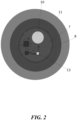
- the circuitry of the patch is laid out on a flexible sheet material [1], such as pyralux, that allows the patch to conform to the contour of the region of the subject's body to which it is applied.
- a flexible sheet material [1] such as pyralux
- a conventional hard printed circuit board may be used.
- Circuit components [2] are soldered to the copper, tin or silver tracks [3] on the pyralux or on the hard circuit board with lead-free solder. Electrical components and tracks may be placed on both sides of the pyralux sheet and the sides may be electrically connected with vias [4].
- the circuitry may then be covered with a thin impermeable layer of acrylic or silicone polymer, or the entire device is placed in a sealed plastic or polymer envelope to protect the circuit elements from moisture and other environmental elements that could cause damage.
- the circuit and tracks may be printed with silver-based ink onto a thin and flexible film, such as polyethylene terephthalate (PET).
- PET polyethylene terephthalate
- the layer is then covered in acrylic or silicone to become impermeable to moisture.
- a protective sheet [5] may be used that can be made of woven fabric, plastic (PVC, polyethylene or polyurethane), or latex.
- the edges of the adhesive sheet extend beyond the edges of the circuit board.
- This sheet forms the outward facing side of the device, and serves to conceal and protect the device circuitry, as well as to provide a free adhesive border to attach the device to the skin.
- One or more transparent windows [6] may be fabricated onto this protective sheet, by cutting a hole on the sheet and then covering the hole with transparent flexible film material, such as polyethylene terephthalate (PET). Such windows allow light from the external environment to be captured by sensors placed on the printed circuit board.
- transparent flexible film material such as polyethylene terephthalate (PET).
- a permeable fabric [7] such as cotton cloth or polyester, that may be used to allow the skin to breath and to absorb sweat.
- the edges [8] of the permeable fabric [7] are glued to the protective sheet [5] with a high tack adhesive to form a sealed pocket [9] that houses the circuit board [1].
- the circuit board [1] is glued directly to the protective sheet [5] with high tack adhesive, and a bottom layer is not used, in which case the bottom of the circuit board [1] makes direct contact with the skin of a subject.
- One or more contacts [10] may be attached on the permeable fabric bottom-layer [7] to allow measurement of electrical signals on the skin of a subject, such as for PSG applications.
- the contact pads are made of conductive material.
- the conductive pad is made of a piece of metal-clad pyralux or a thin, flexible copper film, coated with a thin layer of gold for passivation, and glued on the edges so as to cover a hole cut on the fabric bottom layer [7].
- the contact pads [10] may be directly woven into the fabric bottom layer [7] with conductive yarn. Electrical contact to the contact pads is extended from the printed circuit board with wires, vias, or solder.
- Adhesive [11] compatible with the skin of the subject (e.g., a human subject), is applied to the bottom of the device, either (preferably) only on the edges of the protective sheet [5] that are exposed (e.g., not covered by the permeable fabric bottom-layer [7]), or, in cases where the permeable fabric bottom-layer [7] is not used, on the entire bottom surface of the device.
- the bottom surface of the device including the contact pads [10], that is not covered by adhesive may be coated with a conductive electrolyte solution/gel or other conductive substance to allow measurement of electrical signals on the skin.
- the devices and/or patches disclosed herein may house a container [12] for storing such agents in either liquid/gel/foam form.
- a mechanism for actuating the container with electrical pulses may be used to control the delivery of the agents onto or into the skin of the subject.
- the mechanism for actuating the substance container consists of a piezo-actuated nozzle or set of nozzles [13], similar to those found on the cartridges of some inkjet printers, such as those produced by EPSON.
- Some other types of inkjet printers rely on a temperature actuated mechanism for dispensing a liquid agent, which involves heating the liquid to high temperatures and forming steam.
- the selected temperature to which such agents are heated take into consideration whether the agents may be heat-labile (e.g., heating certain agents such as caffeine or melatonin solutions to produce steam that may degrade or alter the stability or efficacy of such agents).
- the nozzles [13] are positioned on the bottom face of the patch, preferably so that their exit surface stays slightly above the skin surface.
- the nozzles spray a dose of the substance onto the skin of the subject.
- the precise dose amount is controlled via 1) the number of nozzles, 2) the rate at which the nozzle(s) dispense(s) the agent (e.g., a liquid agent) with each electrical pulse, 3) the number of pulses applied, 4) the dilution and composition of the agents loaded into the patches, and 5) the rate and efficiency with which the skin absorbs the agents.
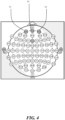
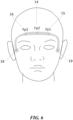
- Electrodes are placed on different positions on the subject's head (scalp).
- One preferred positioning of the electrodes is indicated in FIG. 4 , which shows the common locations for electrodes using the International 10-20 EEG placement system ( Jasper, H. H. (1958). The ten-twenty electrode system of the International Federation. Electroencephalography and Clinical Neurophysiology, 10, 371-375 , the entire contents of which are incorporated by reference herein.). In certain embodiments, not all of the electrode locations will be used by the present compositions and systems for determining sleep/wake state.
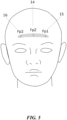
- the electrodes of the present compositions and systems will include or comprise includes Fp1[15], Fp2 [16], Fz and reference electrodes FpZ [14], A1 and A2.
- Fp Frontal pole, which is 10% from the nasion, based on the distance from nasion to inion.
- Fp1 and Fp2 are each 5% distance to the left (Fp1) or right (Fp2) Fp, based on the distance from pre-aricular to pre-aricular.
- the location Fz may be obstructed by hair.
- at least three electrodes are used - one of these being an active electrode located at Fp1 [15], another being an active electrode located at Fp2 [16] and the third being a reference electrode located at Fpz [14].
- the colored/shaded region in FIG. 5 indicates a possible form for such a patch.
- the electronic components are not shown in the FIG. 5 , and the electrode locations are indicated with an X.
- the patches and devices disclosed herein can extend around the eyes of a subject to include or comprise electrodes [18] and [19] for capturing such subject's eye movements, as depicted in FIG. 6 .
- the subject's eye movement is detected by electrodes positioned on the outer canthi and placed slightly above or below the midline of the subject's pupil - [18] and [19], as illustrated in FIG. 6 . Because these electrodes have to be referenced to the same voltage ground level, they must be electrically connected via physical conductor wires to the other electrodes to which they are referenced. This means that the patches and devices used in this type of measurement must extend and connect all of the involved electrodes, rather than comprising physically (and electrically) isolated patches.
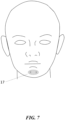
- electrodes positioned on the chin, [17] as indicated in FIG. 7 are used to measure muscle movement.
- the subject inventions include or comprise one or more patches that can be deployed in a military population (e.g., ARMY, NAVY, AIR FORCE, etc.) to track a subject's sleep duration and frequency, and to estimate the subject's circadian phase and administer one or more agents (e.g., stimulants or sedatives or sleep/circadian stimuli) in order to prepare the subject for mission critical work.
- a military population e.g., ARMY, NAVY, AIR FORCE, etc.
- agents e.g., stimulants or sedatives or sleep/circadian stimuli
- the subject inventions include or comprise one or more patches can be deployed in a medical setting on subject for whom chronotherapy would reduce the side effects of certain medications or where administration of medication is more desirable during sleep (e.g., sleeping pill) or during a particular state of sleep (e.g., hormones).
- chronotherapy would reduce the side effects of certain medications or where administration of medication is more desirable during sleep (e.g., sleeping pill) or during a particular state of sleep (e.g., hormones).
- the subject inventions include or comprise one or more patches that can be deployed in space on astronaut subjects in a similar capacity to that in military personal. Patches can be deployed in pediatric populations that have been historically difficult to study due to available technology to track sleep (e.g., babies or children with autism).
- the subject inventions include or comprise one or more patches that can be deployed in any individual subject whom performing well at various circadian phase and various intervals of time awake is important (e.g., businessmen, professional athletes, Olympic athletes, shift workers, medical professionals, pilots, captains, truck drivers, emergency responders, etc.).
- data measured by the various functions described and included in the patch devices disclosed herein allow for measurement and estimation of the crucial parameters that influence the subject's circadian rhythm, namely, sleep onset time, sleep frequency, sleep duration, quality of sleep (presence of disturbances/wake events, etc.).
- Knowledge of sleep parameters allows for the programmed delivery of stimuli aimed at regulating sleep, improving sleep conditions, shifting sleep onset times according to desired schedules (e.g., time zone changes, etc.), and stabilizing sleep schedules in relation to activities for achieving peak cognitive and/or physical performance and disposition.
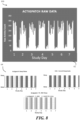
- FIG. 8 depicts data collected by deployment of a patch and system 100 wherein data were collected during a 28-hours forced desynchrony laboratory study (FD).
- Activity/inactivity raw data [62] from patch sensors across seven earth days are presented.
- the graph at the top shows activity level on the y-axis and earth day on the x-axis.
- a clear pattern of high activity (wake) and low activity (sleep) are seen across study days.
- the smaller graphs show sleep/wake estimates [64] based from the raw data in the top graph.
- Actigpatch sleep/wake estimates (left), Ambulatory Monitoring, Inc. (AMI) actigraphy sleep/wake estimates (right) and the comparison of Actigpatch to AMI estimates (bottom) are displayed.
- FIG. 9 depicts data collected during a one night in-laboratory study measuring polysomnography (PSG) and activity/inactivity using the Actigpatch. Patch-based sleep/wake estimates across one night [62] are presented in the top graph. The subsequent graphs show polysomnographically (PSG) measured sleep/wake [74] scored according to Rechtschaffen and Kales (1968) criteria (top) and Actigpatch vs. PSG sleep/wake [76] (bottom). These data show reliability in sleep/wake estimates between Actigpatch and PSG.
- PSG polysomnographically
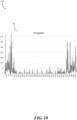
- FIG. 10 depicts data collected by Actigpatch showing activity level [82] (y-axis) across 24 hours (1 minute epochs; x-axis).
- Circadian phase was measured from salivary dim light melatonin onset (DLMO).
- DLMO salivary dim light melatonin onset
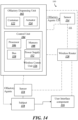
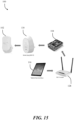
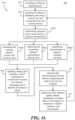
- FIGS. 11 through 16 illustrate an example embodiment or embodiments of the devices, systems and methods for estimating, modulating and improving the circadian phase and consciousness patterns of a subject (e.g., a human subject) by the dispensing of measured quantities of olfactory agents into an environment of the subject and the continuous monitoring and/or tracking of the subject's consciousness patterns, thereby aligning the subject's circadian biology to an external environment, improving the quality and duration of sleep, according to the present examples not covered by the claimed invention.
- a subject e.g., a human subject
- FIGS. 11 through 16 illustrate an example embodiment or embodiments of the devices, systems and methods for estimating, modulating and improving the circadian phase and consciousness patterns of a subject (e.g., a human subject) by the dispensing of measured quantities of olfactory agents into an environment of the subject and the continuous monitoring and/or tracking of the subject's consciousness patterns, thereby aligning the subject's circadian biology to an external environment, improving the quality and duration of sleep, according to the
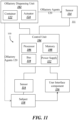
- FIG. 11 depicts an overview of the components and data flow of the system 100.
- An aspect of the disclosure provides a system 100 for adjusting consciousness patterns/sleep/wake patterns and circadian states of one or more subjects 118 based on tracking and estimating subject 118 responses, the system comprising a control unit 104 to control an olfactory dispensing unit 102 and being operative to dispense olfactory agents 120 including at least one of: a fragrance, odor, scent, and olfactory stimuli, which are dispensed during a programmed or specified time/circadian phase relative to sleep onset/offset in order to facilitate, enhance, and consolidate sleep or enhance mood and alertness in a subject.
- the subject 118 is a human (e.g., a shift worker or a member of the military), but may be another organism that has suitably responsive olfactory cells.
- control unit 104 applies an olfactory formulation to facilitate or enhance sleep or the timing of sleep or enhance alertness/performance and mood.
- the control unit 104 controls a set of olfactory agents 120 including at least one of odors, scents, fragrances and olfactory stimuli to set a prescribed olfactory supplement and/or schedule.
- the control unit 104, olfactory dispensing unit 102 and the olfactory agents 120 are assembled in a kit or container, which is portable.
- the control unit 104 receives a biofeedback signal or data indicative of one or more subjects' 118 consciousness patterns, defined as either sleep patterns, patterns detected from a subject 118 while awake, or a combination of both, and determines the formulation in accordance with that signal or data, to achieve a desired response in the subject 118 (e.g., shifting of the subject's timing of sleep, reducing sleep onset latency, enhancing sleep consolidation, reducing variability in sleep patterns, etc.).
- the control unit 104 of the system 100 allows for timed (e.g., both time of day, time relative to sleep, and/or circadian phase) delivery of precisely measured quantities of olfactory agents 120 that alter or otherwise modulate circadian rhythms and consciousness patterns of subjects 118, wherein the control unit 104 comprises a real-time clock or timing device for providing precise times to perform functions and timestamps for the measurements taken by the system 100.
- timed e.g., both time of day, time relative to sleep, and/or circadian phase
- the control unit 104 comprises a real-time clock or timing device for providing precise times to perform functions and timestamps for the measurements taken by the system 100.
- This system 100 is located in a designated area (e.g., bedroom, bathroom, playroom, office, car, gym, plane, ship, etc.) defined as the environment 101 of the one or more subjects 118.
- a designated area e.g., bedroom, bathroom, playroom, office, car, gym, plane, ship, etc.
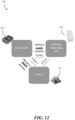
- FIG. 12 illustrates the flow of data and electronic communication for commonly used components for embodiments of the system.
- the olfactory agent 120 delivery can be accomplished via the use of electrical heating of odor oils and other liquids to cause evaporation (a similar operative mechanism to commercial scented oil heating devices e.g., Glade ® Plug-Ins ® ), via ultrasonic nebulizers, via air-stream atomizers, or via the use of volatile substances.
- the heater In the case of electrical heating, the heater must be actuated by the control unit 104 at specific times dictated by the formulations; for the ultrasonic nebulizer, the vibrating (piezo) element must be actuated by the control unit 104; for the air stream nebulizers, an air pump or other air-stream generating device must be actuated by the control unit 104; for volatile substances, the compartment containing the substance must be opened and closed by the control unit 104, allowing or not allowing the vapors to propagate out of the device and into the air.
- a fan (not shown), for circulating air through the device or the system 100 may be added.
- Each olfactory formulation consists of a list of times and desired olfactory stimulus (odor, aroma) concentrations, in the form of olfactory agents 120, at each time.
- the critical quantity that dictates the system's 100 operation and quantifies the size of the olfactory stimulus is the amount of olfactory agents 120 absorbed by the subject 118 over a certain period (i.e. concentration multiplied by exposure time).
- the stimulus and olfactory agent 120 concentrations can be measured in absolute units (e.g., ⁇ g of odor per liter of air) or in "empirical" units (e.g., the concentration that results when the olfactory dispensing unit 102 is actuated for X units of time in a room of Y cubic meters of volume). Once the characteristics of the dispenser are known, these two measurement methods are completely equivalent.
- the control unit 104 actuates the olfactory dispensing unit 102 as a function of time, according to the formulation.
- the control unit contains a clock that allows it to keep time for precise function initiation and timestamping data, and memory 108 (comprising volatile and non-volatile memory for storing program code and measured data) to store the formulation. Additionally, the control unit's 104 memory 108 may store data from sensors 114 and other devices that allow it to compute relevant parameters and adjust the formulation in real-time.
- the control unit uses consciousness patterns data of each of the one more subjects to optimize a formulation of the olfactory agents in real-time to provide cues to achieve a stimuli response in each of the one or more subjects.
- Optimization occurs when the measured stimuli response of the one or more subjects matches the data provided by the formulation and user input including maintaining specific concentrations of olfactory agents in the environment 101 and absorbed by the one or more subjects 118.
- the stimuli response comprises one or more actions selected from the group consisting of shifting of timing of sleep, adjusting circadian phase, enhancing alertness, enhancing performance, reducing sleep onset latency, enhancing sleep consolidation and reducing variability in sleep patterns and adjusting mood.
- physiological and behavioral processes are enhanced (e.g., sleep, cognitive and physical performance, alertness, metabolism, and gastrointestinal function perform more efficiently).
- Alertness and performance are defined and measured by comparison of patterns of activity for persons awake with historic activity with respect to timing to perform known tasks and accuracy in performance.
- Enhancing sleep consolidation means reducing in duration or removing discontinuities in sleep or lengthening the duration of uninterrupted sleep or both.
- Adjusting mood means delivering olfactory agents 120 known to cause physiological changes to observed phenomena identified in the art as moods or triggering behavior in a subject using pre-conditioning of the subject to initiate or cease moods based on prior associations and administrations of olfactory agents 120.
- rhythms, sleep, and performance e.g., light, melatonin and caffeine
- timed e.g., circadian phase, time relative to sleep or wake, and time relative to scheduled performance
- administration of such stimuli can shift circadian biology to better match the external environment, thereby enhancing performance, alertness, mood, sleep, etc. of a subject.
- Different formulations that promote different stimuli responses may be stored in the memory 108 of the control unit, input by the user, or determined by analysis of sensor 114 data processed by the processor 106 of the control unit 104.
- the control unit 104 works in conjunction with a user interface 116 that may be a component of the control unit 104 or a separate component, wherein the users can modify the system's 110 parameters, tweak formulations, etc.
- This user interface 116 can be provided via wired (USB, UART, etc.) or wireless technologies (Bluetooth, Bluetooth low energy (BLE), Zigbee, Wi-Fi, infrared, near field communication, etc.) or via a display and buttons on the control unit 104 itself.
- the control unit 104 can be a dedicated hardware device, built solely for the purpose of controlling this system100, or a general purpose device, such as a smart-phone or a tablet computer running dedicated software that controls the system.
- the system 100 can include or comprise software that tracks sleep history information of the one or more subjects, then sets a sleep-and-wake schedule for the one or more subjects and designates specific olfactory agents assigned to activity events selected from the group consisting of bedtime, risetime, nap time, awake time and combinations thereof.
- the olfactory agents can be automatically dispensed at specific times of day to facilitate at least one action selected from the group consisting of sleep, wake, increased alertness, and relaxation.
- the system uses algorithms to avoid habituation to olfactory agents relative to onset of activity events.
- the system 100 comprises sensors 114, and the olfactory dispensing unit 102, which comprises one or more containers 122 that store the olfactory agents 120, and actuators 124 that deliver the olfactory agents 120 into the environment 101.
- the olfactory dispensing unit 102 which comprises one or more containers 122 that store the olfactory agents 120, and actuators 124 that deliver the olfactory agents 120 into the environment 101.
- Different system embodiments can be contemplated. Various methods of actuation are possible.
- the system 100 may comprise one or more sensors 114, that collect data and measurements associated with the subject 118, the environment 101 of the subject 118, or both. In some cases, it may be possible to directly measure the concentration of olfactory stimulant or olfactory agents 120 in the air. Technologies for measuring aromas are a subject of current active development. Sensors 114 for certain specific gases and volatile organic compounds (VOC) may be suitable for estimating the concentration of certain aromas in the air. Certain novel sensors 114 that map aromas to images (e.g., the Aroma Bit sensor) may be suitable for these applications.
- VOC volatile organic compounds
- the system 100 can be operated as a "servo" to precisely control the quantity of olfactory agent 120 present in the air at any given time. If measurement of such concentration is not possible, then the system 100 operates exclusively as an actuator, and its output (or intensity) must be configured according to the ambient environment 101 in which it is used for achieving the desired concentrations. Additionally, if such direct measurements of the olfactory agent's 120 concentration are impossible, the system's 100 operation may also be precisely controlled as a "servo" by measurements of circadian outcomes and application of machine learning techniques to indirectly infer adequate concentrations.
- the system 100 can use this information to improve the formulation in real time.
- the sensors 114 may be separate from the control unit 104, however in some embodiments the control unit 104 may have components that act as one or more sensor 114.
- sensors 114 include or comprise patches that are worn on the skin of one or more subjects 118 and related components for determining and/or estimating and tracking subjects' 118 consciousness patterns (wake/sleep patterns) and circadian state, and other data related to shifting and/or aligning the subject's circadian state to external schedules based on measured data and smart algorithms.
- sensors 114 may include or comprise a communications interface, wired or wireless, that allows for data to be transferred from the sensors 114 to the control unit 104, a computer, tablet or phone, or other device incorporating a real-time clock capable of providing timestamps for the measurements from sensors 114.
- control unit 104 is physically separated from the olfactory dispensing unit 102 that stores and dispenses the olfactory agents 120.
- more than one olfactory dispensing unit 102 can be controlled by one control unit 104.
- the olfactory dispensing units 102 are connected to the control unit 104 via wired or wireless technologies, including Bluetooth, Bluetooth low energy (BLE), Zigbee, Wi-Fi, infrared, near field communication, etc. Referring to FIG. 13 , the system is configured to use wireless electronic communication.
- the control unit 104 provides a user interface 116 wherein the users can modify the system's 100 parameters, tweak formulations, etc.
- This interface can be provided via wireless technologies (Bluetooth, Bluetooth low energy (BLE), Zigbee, Wi-Fi, infrared, near field communication, etc.) or via a display and buttons on the control unit itself.
- the control unit 104 can be a dedicated hardware device, built solely for the purpose of controlling this system, or a general purpose device, such as a smart-phone or a tablet computer running dedicated software that controls the system 100.
- the control unit 104 can contain a wireless communication unit 126 that allows the control unit 104 to communicate electronically using wireless technologies, including the use of devices including wireless routers 128 that enable the control unit 104 to remotely communicate with the olfactory dispensing units 102 and sensors 114 to send commands and receive data.
- a wireless communication unit 126 that allows the control unit 104 to communicate electronically using wireless technologies, including the use of devices including wireless routers 128 that enable the control unit 104 to remotely communicate with the olfactory dispensing units 102 and sensors 114 to send commands and receive data.
- control unit 104 and olfactory dispensing unit 102 with container 122 and actuator 124 reside in the same physical device.
- FIG. 14 illustrates an embodiment of the system wherein the control unit 104 and olfactory dispensing unit 102 operate within a single device. The formulation is stored in the control unit's 104 memory 108, and the control unit 102 then controls the dispensing of olfactory agents 120 as required.
- FIG. 15 depicts an alternative embodiment of the system wherein the control unit and dispensing unit operate as components of a smart plug.
- this smart device can be used to improve the sleep of babies and infants, by providing olfactory cues circa bedtime.
- this alternative embodiment comprises a single physical unit, similar in form to a Glade ® Plug-In ® device, but rather than simply containing scented oil warming components activated by insertion into an outlet, the smart plug device contains the control unit 104, the olfactory dispensing unit 102 complete with the one or more actuators 124 and 122 one or more containers of olfactory agents 120, and wireless transceiver 126 in the same package.
- the control unit 104 can be accessed and configured via Bluetooth Low Energy or other similar technology. Configuration comprises simply of inputting the desired bedtime, duration and intensity of dispensing, and dimensions of the subjects' 118 environment 101 which in this embodiment would include or comprise the baby's bedroom. With this information, the system 100 pre odorizes the baby's bedroom with olfactory agents 120 every day at bedtime using the control units 104 ability to perform actions as a function of time, and thereby pre-conditions the baby to want to sleep at that time.
- FIG. 16 depicts an exemplary flowchart showing the method 600 for carrying out the operation of the system 100 to provide adjustment of consciousness patterns and circadian states to one or more subjects 118 through the monitoring and use of olfactory agents 120 supplied into the environment 101 of the one or more subjects 118.
- a user who may also be one of the subjects 118, provides the olfactory dispensing unit 102 into the desired environment 101 of the one or more subjects 118, by performing actions such as, initial set up of the olfactory dispensing unit 102, unpacking the olfactory dispensing unit102 from a kit, and supplying power to the olfactory dispensing unit 102 by inserting a power supply such as a battery (rechargeable or not) or inserting the olfactory dispensing unit 102 into an electrical outlet found in the desired environment 101 of the one or more subjects 118.
- a power supply such as a battery (rechargeable or not)
- a user activates the control unit, by performing actions such as, initial set up of the control unit 104, unpacking control unit102 from a kit, supplying power to the control unit 104 by inserting a power supply 112 such as a battery (rechargeable or not) or connecting the control unit 104 to an electrical outlet, then powering on the control unit 104 and actuating the olfactory dispensing unit 102 using a control unit 104, and storing data in memory 108 gathered from one or more sensors 114 using a processor 106, that are activated by the control unit 104.
- a power supply 112 such as a battery (rechargeable or not) or connecting the control unit 104 to an electrical outlet
- the one or more sensors 114 may be used to perform one or more of several functions that use data gathered from the sensors 114 and the control unit 104 including: estimating tracking and predicting 606b activity and inactivity data for one or more subjects 118, collecting and monitoring 606c consciousness patterns data for one or more subjects 118, and quantifying measurements of circadian outcomes 606d for one or more subjects 118.
- the user inputs control commands using the user interface 116, which use the control unit 104 to actuate the olfactory dispensing unit 102 to dispense the olfactory agents 120 into the environment 101 of the one or more subjects 118, according to a specific formulation and parameters selected by the user and stored in the memory 108 of the control unit 104 which performs functions related thereto using the processor 106.
- control unit 104 and the olfactory dispensing unit electronically communicate with each other to control further actuation and dispensing of olfactory agents 120 to follow the formulation required by the control unit 104.
- the control unit and the user interface electronically communicate to provide the user with information related to the dispensing of olfactory agents 120 and data related to the environment 101 and the one or more subjects 118 collected from the sensors 114 or stored in the control unit 104 memory 108.
- control unit 104 continues to follow the specific formulation as a function of time, actuating the olfactory dispensing unit to continue dispensing various amounts of the olfactory agents 102, thereby modulating sleep/wake and/or a circadian phase of the one or more subjects 118, based on data related to the environment 101 and the one or more subjects 118 collected from the sensors 114 or stored in the control unit 104 memory 108, where adjustments to timing and amount of olfactory agents 120 dispensed are made in response to a condition of the one or more subjects 118 and an environment 101 of the one or more subjects 118 as measured by the sensors 114 in real time.
- This process of adjusted dispensing of olfactory agents 120 based on sensor 114 measurements is iteratively repeated to continually adjust the stimulus provided to the subjects 118, modulating a circadian phase of the one or more subjects 118 for the duration specified by the control unit 104.
- the control unit 104 may end dispensing of olfactory agents 120 or introduce other olfactory agents 120 to signal the end of a particular administration, consciousness pattern, or circadian phase of the one or more subjects 118, for example when the sleeping period has ended.
- the devices, patches, systems and methods disclosed herein modulate the circadian phase and/or sleep/wake of a subject in response to the subject's environment.
- Such devices, patches, systems and methods include or comprise a step of determining the subject's activity counts when the subject is awake or asleep. Based on the subject's pattern of sleep/wake the beginning and end of biological night would then be determined.
- This estimate of early biological night and late biological night allows for the administration of one or more interventions, for example by controlling or administering light, stimuli and/or agents, capable of shifting the subject's circadian system.
- melatonin can be administered to a subject in the early biological night to advance the subject's circadian rhythms and very late biological night to delay the subject's circadian rhythms.
- light can be used in the early biological night to delay phase and late biological night to advance the subject's circadian phase.
- the particular intervention is determined based on estimated circadian phase during the biological night/day and desired time of performance. For example, if a subject has one week to phase advance to European time from New York, USA time, the devices, patches and systems disclosed herein would use the current sleep/wake schedule of that subject to determine when late biological night is and administer a specific light recipe (e.g., as described in United States Provisional Application No.
- the devices, patches and systems disclosed herein can administer, for example, caffeine to a subject in advance of critical performance times.
- FIG. 8 Activity/inactivity data across seven earth days are presented in FIG. 8 . These data are from a healthy adolescent-aged participant.
- the graph on the top presents raw actigraphy data collected by a patch (“Actigpatch") that shows activity level on the y-axis and earth day on the x-axis. A clear pattern of high activity (wake) and low activity (sleep) are seen across study days.
- the graphs in the middle of the figure show sleep/wake estimates based on the raw data in the top graph.
- Actigpatch sleep/wake estimates left
- Ambulatory Monitoring, Inc. AMI actigraphy sleep/wake estimates (right) and the comparison of Actigpatch to AMI estimates are displayed on the bottom graph.
- FIG. 10 Activity level (y-axis) is plotted across 24 hours (1 minute epochs; x-axis).
- Circadian phase was measured from salivary dim light melatonin onset (DLMO; a "gold standard” by which circadian phases are measured).
- the first vertical indicator line shows measured circadian phase and the second vertical indicator line shows sleep onset.
- a predictable time interval occurs between DLMO and sleep onset and this figure demonstrates that DLMO (circadian phase) can be estimated from sleep estimates using data collected from patches.
- a "subject" means a human or animal whose circadian state (e.g., sleep onset) is modulated by the inventions disclosed herein.
- the subject is also the user of the inventions disclosed herein.
- the subject is not the user, but rather the user may be, for example, an administrative user of the system that is responsible for modulating the circadian states of one or more subjects (e.g., a group of military subjects under the command of the users).
- the subject is a mammal (e.g., a primate or a human).
- the subject may be an infant, a toddler, a child, a young adult, an adult or a geriatric.
- the subject is a member of the military.
- the term "agent” broadly refers to any compound or molecule (e.g., a small molecule organic compound) that is delivered to a subject in accordance with the inventions disclosed herein.
- the agents modulate circadian biology of the subject.
- the agents are used to modulate a subject's circadian biology or circadian rhythm (e.g., to align such subject's circadian biology or rhythm to an external environment).
- the agents include or comprise one or more central nervous system stimulants (e.g., modafinil, methylphenidate, and/or methylxanthines such as caffeine,).
- the agents include or comprise one or more central nervous system depressants (e.g., melatonin, opioids, hypnotics, benzodiazepines, barbiturate and/or antihistamines).
- the agent includes modafinil.
- the agent includes one or more sedatives (e.g., sleeping pills, pain medications and combinations thereof).
- the agent includes a circadian phase shifting agent (e.g., melatonin, hormones, and combinations thereof).
- the agents include or comprise one or more hormones.
- the agents are topically administered.
- the agents are absorbed transdermally.
- modulating means to affect, alter or otherwise adjust the circadian biology or circadian phase of a subject.
- modulating the circadian biology or circadian phase of a subject means to correct, adjust or otherwise change the subject's circadian biology or circadian phase consistent with such subject's current or anticipated environment. For example, modulating a subject's circadian phase to better coincide or align with a subject's anticipated travel to a new time zone.
- references to a subject's “circadian phase,” “circadian rhythm” or “circadian biology” generally refer to such subject's internal timing of the circadian clock and outputs of the circadian clock housed in the mammalian suprachiasmatic nucleus of the anterior hypothalamus.
- the devices, patches, systems and methods disclosed herein may, in certain aspects, collect data from a subject and/or the subject's environment, and use such data to inform the degree to which such subject's circadian phase will be modulated, shifted or otherwise corrected in accordance with the present inventions.
Landscapes
- Health & Medical Sciences (AREA)
- Life Sciences & Earth Sciences (AREA)
- Engineering & Computer Science (AREA)
- Animal Behavior & Ethology (AREA)
- Physics & Mathematics (AREA)
- Veterinary Medicine (AREA)
- Biomedical Technology (AREA)
- Heart & Thoracic Surgery (AREA)
- Public Health (AREA)
- General Health & Medical Sciences (AREA)
- Pathology (AREA)
- Surgery (AREA)
- Molecular Biology (AREA)
- Medical Informatics (AREA)
- Biophysics (AREA)
- Anesthesiology (AREA)
- Psychology (AREA)
- Pain & Pain Management (AREA)
- Hematology (AREA)
- Acoustics & Sound (AREA)
- Hospice & Palliative Care (AREA)
- Psychiatry (AREA)
- Educational Technology (AREA)
- Social Psychology (AREA)
- Developmental Disabilities (AREA)
- Child & Adolescent Psychology (AREA)
- Pharmacology & Pharmacy (AREA)
- Medicinal Chemistry (AREA)
- Bioinformatics & Cheminformatics (AREA)
- Chemical & Material Sciences (AREA)
- Measurement Of The Respiration, Hearing Ability, Form, And Blood Characteristics Of Living Organisms (AREA)
- Acyclic And Carbocyclic Compounds In Medicinal Compositions (AREA)
- Medicines That Contain Protein Lipid Enzymes And Other Medicines (AREA)
- Pharmaceuticals Containing Other Organic And Inorganic Compounds (AREA)
- Steroid Compounds (AREA)
- Measuring And Recording Apparatus For Diagnosis (AREA)
- Medical Preparation Storing Or Oral Administration Devices (AREA)
Claims (11)
- Timbre permettant de déterminer et de suivre un ou plusieurs profils d'activité/inactivité, profils polysomnographiques et états circadiens d'un sujet (118), le timbre comprenant :un micro-dispositif de commande (106), une mémoire volatile et non volatile (108), une interface de communication et une pile (112) ;une ou plusieurs pastilles électriques (10, 114) conçues pour entrer en contact avec la peau du sujet et collecter et surveiller les données polysomnographiques et les données d'actigraphie pour le sujet ;le micro-dispositif de commande estimant ou déterminant la phase circadienne du sujet sur la base des données collectées et polysomnographiques et des données d'actigraphie ;un ou plusieurs dispositifs d'actionnement (124) délivrant un ou plusieurs agents (120) par l'intermédiaire d'au moins une buse dans une administration transdermique commandée, par lesdits un ou plusieurs dispositifs d'actionnement, à la peau du sujet sur la base de la phase circadienne estimée ou déterminée ;ladite administration d'un ou de plusieurs agents modulant la phase circadienne et/ou les profils de conscience comprenant les profils de sommeil/éveil du sujet en réponse à l'environnement du sujet ; etun contenant (12, 122) renfermant le micro-dispositif de commande, la mémoire volatile et non volatile, l'interface de communication, la pile, lesdites une ou plusieurs pastilles électriques, lesdits un ou plusieurs dispositifs d'actionnement et ladite au mois une buse (13) ;lesdits profils d'activité/inactivité étant surveillés par un ou plusieurs capteurs mesurant les cycles de repos et d'activité par actigraphie.
- Timbre selon la revendication 1, comprenant en outre une carte de circuit imprimé souple (1) avec le micro-dispositif de commande, la mémoire volatile et non volatile, l'interface de communication, la pile, lesdites une ou plusieurs pastilles électriques et lesdits un ou plusieurs dispositifs d'actionnement incorporésà celle-ci ; éventuellement,
ladite carte de circuit imprimé souple étant recouverte d'une résine imperméable ou d'un autre matériau pour éviter les dommages causés par l'humidité. - Timbre selon la revendication 1, lesdites données polysomnographiques de surveillance comprenant la mesure de données polysomnographiques sélectionnées dans le groupe constitué par les données d'ondes cérébrales, les données de mouvement des yeux et les données de tonus musculaire, collectées à partir d'un ou plusieurs capteurs montés sur le timbre.
- Timbre selon la revendication 1, lesdites une ou plusieurs pastilles électriques étant en outre conçues pour : mesurer au moins un paramètre parmi la température de la peau et les niveaux de saturation en oxygène du sang du sujet ; et/ou détecter l'oxymétrie de pouls/du sang et analyser la sueur et d'autres sécrétions de la peau du sujet.
- Timbre selon la revendication 1, ledit contenant comprenant en outre un polymère ou un tissu respirant qui permet à la peau du sujet de respirer tout en maintenant un contact étroit avec la peau du sujet.
- Timbre selon la revendication 1, ledit contenant comprenant en outre : un adhésif compatible avec la peau destiné à faire adhérer le timbre à la peau du sujet et/ou un gel ou adhésif conducteur (11) destiné à augmenter la conductivité de la peau du sujet et desdites une ou plusieurs pastilles électriques.
- Timbre selon la revendication 1, ladite interface de communication étant configurée pour communiquer avec d'autres timbres, et/ou transférer des données mesurées et calculées devant être stockées dans d'autres timbres contenant une mémoire, et/ou déclencher la délivrance de stimulus dans d'autres timbres qui sont capables de délivrer de tels stimulus ; éventuellement,
ladite interface de communication communicant avec les autres timbres en appliquant des signaux électriques de faible puissance sur la peau du sujet de sorte que les signaux se propagent à la surface de la peau jusqu'aux autres timbres. - Timbre selon la revendication 1, ledit contenant comprenant en outre un récipient capable de stocker diverses doses d'un agent devant être administré par voie transdermique au sujet par lesdits un ou plusieurs dispositifs d'actionnement; et/ou comprenant en outre des photodiodes configurées pour mesurer l'exposition à la lumière environnementale, et pour estimer la dose totale de lumière (par ex., le contenu du stimulus) reçue par le sujet sur une période de temps, des moments spécifiques relatifs au début du sommeil/à la phase circadienne auxquels les stimulus lumineux ont été reçus pouvant également être déduits de ces mesures.
- Timbre selon la revendication 1, lesdits un ou plusieurs agents : modulant le sommeil/l'éveil ou la biologie circadienne du sujet, et/ou étant choisis dans le groupe constitué d'un ou plusieurs dépresseurs du système nerveux central et d'un ou plusieurs stimulants du système nerveux central.
- Timbre selon la revendication 9, lesdits un ou plusieurs agents comprenant un ou plusieurs dépresseurs du système nerveux central ; éventuellement, lesdits un ou plusieurs dépresseurs du système nerveux central étant choisis dans le groupe constitué par un opioïde, un hypnotique, une benzodiazépine, un barbiturique et leurs combinaisons.
- Timbre selon la revendication 9, lesdits un ou plusieurs agents comprenant un ou plusieurs :stimulus à décalage de phase comprenant de la mélatonine ;et/ou stimulants du système nerveux central, éventuellement choisis dans le groupe constitué par la caféine, les méthylxanthines, le modafinil, le méthylphénidate, les amphétamines et leurs combinaisons.
Priority Applications (1)
| Application Number | Priority Date | Filing Date | Title |
|---|---|---|---|
| EP25152850.1A EP4520384A3 (fr) | 2018-01-25 | 2019-01-25 | Système de timbre pour surveiller et améliorer l'alignement du sommeil et du rythme circadien |
Applications Claiming Priority (3)
| Application Number | Priority Date | Filing Date | Title |
|---|---|---|---|
| US201862621898P | 2018-01-25 | 2018-01-25 | |
| US201862692292P | 2018-06-29 | 2018-06-29 | |
| PCT/US2019/015292 WO2019148039A1 (fr) | 2018-01-25 | 2019-01-25 | Système de timbre pour surveiller et améliorer l'alignement du rythme circadien et du sommeil |
Related Child Applications (2)
| Application Number | Title | Priority Date | Filing Date |
|---|---|---|---|
| EP25152850.1A Division EP4520384A3 (fr) | 2018-01-25 | 2019-01-25 | Système de timbre pour surveiller et améliorer l'alignement du sommeil et du rythme circadien |
| EP25152850.1A Division-Into EP4520384A3 (fr) | 2018-01-25 | 2019-01-25 | Système de timbre pour surveiller et améliorer l'alignement du sommeil et du rythme circadien |
Publications (3)
| Publication Number | Publication Date |
|---|---|
| EP3743131A1 EP3743131A1 (fr) | 2020-12-02 |
| EP3743131A4 EP3743131A4 (fr) | 2022-01-05 |
| EP3743131B1 true EP3743131B1 (fr) | 2025-03-05 |
Family
ID=67299628
Family Applications (2)
| Application Number | Title | Priority Date | Filing Date |
|---|---|---|---|
| EP25152850.1A Pending EP4520384A3 (fr) | 2018-01-25 | 2019-01-25 | Système de timbre pour surveiller et améliorer l'alignement du sommeil et du rythme circadien |
| EP19743919.3A Active EP3743131B1 (fr) | 2018-01-25 | 2019-01-25 | Système de timbre pour surveiller et améliorer l'alignement du rythme circadien et du sommeil |
Family Applications Before (1)
| Application Number | Title | Priority Date | Filing Date |
|---|---|---|---|
| EP25152850.1A Pending EP4520384A3 (fr) | 2018-01-25 | 2019-01-25 | Système de timbre pour surveiller et améliorer l'alignement du sommeil et du rythme circadien |
Country Status (4)
| Country | Link |
|---|---|
| US (2) | US11642490B2 (fr) |
| EP (2) | EP4520384A3 (fr) |
| FI (1) | FI3743131T3 (fr) |
| WO (1) | WO2019148039A1 (fr) |
Families Citing this family (18)
| Publication number | Priority date | Publication date | Assignee | Title |
|---|---|---|---|---|
| ES2781873T3 (es) | 2012-08-28 | 2020-09-08 | Delos Living Llc | Sistemas y métodos para mejorar el bienestar asociado con ambientes habitables |
| CA2940766A1 (fr) | 2014-02-28 | 2015-09-03 | Delos Living Llc | Systemes, procedes et articles pour ameliorer le bien-etre associe a des environnements habitables |
| WO2019046580A1 (fr) | 2017-08-30 | 2019-03-07 | Delos Living Llc | Systèmes, procédés et articles pour évaluer et/ou améliorer la santé et le bien-être |
| US12558513B2 (en) | 2018-01-25 | 2026-02-24 | Circadian Positioning Systems, Inc. | Patch system for monitoring and enhancing sleep and circadian rhythm alignment |
| US11649977B2 (en) | 2018-09-14 | 2023-05-16 | Delos Living Llc | Systems and methods for air remediation |
| GB2617102A (en) * | 2022-03-29 | 2023-10-04 | John Hemming Trading Ltd | Sleep therapy |
| US11844163B2 (en) | 2019-02-26 | 2023-12-12 | Delos Living Llc | Method and apparatus for lighting in an office environment |
| US11898898B2 (en) | 2019-03-25 | 2024-02-13 | Delos Living Llc | Systems and methods for acoustic monitoring |
| WO2020223033A2 (fr) * | 2019-04-16 | 2020-11-05 | The Government Of The United States, As Represented By The Secretary Of The Army | Procédé et système permettant de mesurer, de prédire et d'optimiser la vigilance d'un être humain |
| US11666269B2 (en) * | 2020-05-14 | 2023-06-06 | International Business Machines Corporation | Sleeping mask methods and panels with integrated sensors |
| WO2022039067A1 (fr) * | 2020-08-20 | 2022-02-24 | 株式会社村田製作所 | Appareil de détection de capacité cognitive et procédé de détection de capacité cognitive |
| EP3967214A1 (fr) * | 2020-09-09 | 2022-03-16 | Koninklijke Philips N.V. | Système de distribution de médicaments pour le sommeil |
| CN113229824A (zh) * | 2021-05-18 | 2021-08-10 | 十堰市郧阳区人民医院 | 一种新型自动脑电图帽 |
| US20230293845A1 (en) * | 2022-03-18 | 2023-09-21 | City University Of Hong Kong | Flexible smell generating device and methods for use thereof |
| CN115137312B (zh) * | 2022-08-31 | 2023-01-24 | 首都医科大学附属北京同仁医院 | 睡眠质量评估方法、装置及穿戴设备 |
| GB2611635B (en) * | 2022-11-04 | 2024-12-18 | Polar Electro Oy | Circadian rhythm detection |
| US12504818B2 (en) * | 2023-10-24 | 2025-12-23 | Pison Technology, Inc. | Systems and methods for determining physiological state based on surface biopotentials |
| US12502110B2 (en) * | 2023-10-24 | 2025-12-23 | Pison Technology, Inc. | Systems and methods for determining physiological state based on surface biopotentials |
Family Cites Families (28)
| Publication number | Priority date | Publication date | Assignee | Title |
|---|---|---|---|---|
| PT100973A (pt) | 1991-10-18 | 1994-06-30 | Alza Corp | Dispositivo e composicoes farmaceuticas para a administracao de melatonina por via transdermica |
| US6690959B2 (en) * | 2000-09-01 | 2004-02-10 | Medtronic, Inc. | Skin-mounted electrodes with nano spikes |
| US20040097871A1 (en) * | 2002-01-03 | 2004-05-20 | Israel Yerushalmy | Apparatus for treating sleep disorders |
| US20050113646A1 (en) * | 2003-11-24 | 2005-05-26 | Sotos John G. | Method and apparatus for evaluation of sleep disorders |
| US7097863B2 (en) * | 2002-08-15 | 2006-08-29 | International Flavors & Fragrances Inc. | Process for effecting the relaxation of muscles of a human by means of fragrance |
| US7041049B1 (en) * | 2003-11-21 | 2006-05-09 | First Principles, Inc. | Sleep guidance system and related methods |
| US20070176020A1 (en) * | 2006-01-17 | 2007-08-02 | Tai-Her Yang | Timer controlled olfactory fragrance dispenser |
| EP2023965A1 (fr) * | 2006-05-05 | 2009-02-18 | Givaudan SA | Dispositif de distribution de liquide volatil |
| WO2008017979A2 (fr) | 2006-08-07 | 2008-02-14 | Koninklijke Philips Electronics N.V. | Système et procédé pour influencer un état photobiologique |
| JP2010504797A (ja) | 2006-09-29 | 2010-02-18 | コーニンクレッカ フィリップス エレクトロニクス エヌ ヴィ | 複数ノズル経皮ドラッグデリバリー(drugdelivery)システム |
| GB2445732A (en) * | 2007-01-18 | 2008-07-23 | Givaudan Sa | Deodorisation apparatus |
| US20080262376A1 (en) * | 2007-04-17 | 2008-10-23 | Proactive Health Devices, Inc. | Wireless sensor system for monitoring skin condition using the body as communication conduit |
| WO2009036327A1 (fr) | 2007-09-14 | 2009-03-19 | Corventis, Inc. | Dispositif adhérent pour la surveillance de la respiration et de troubles respiratoires pendant le sommeil |
| US20090259176A1 (en) | 2008-04-09 | 2009-10-15 | Los Gatos Research, Inc. | Transdermal patch system |
| EP2521585B1 (fr) * | 2010-01-05 | 2021-05-26 | Yeda Research and Development Co. Ltd. | DISPOSITIF à odeur POUR ÉVITER DES ronflements ou les apnées |
| EP2460464A1 (fr) * | 2010-12-03 | 2012-06-06 | Koninklijke Philips Electronics N.V. | Appareil de surveillance des troubles du sommeil |
| WO2012138761A1 (fr) * | 2011-04-04 | 2012-10-11 | Sheepdog Sciences, Inc. | Appareil, système et procédé pour moduler une consolidation de la mémoire durant le sommeil |
| WO2013184965A1 (fr) | 2012-06-07 | 2013-12-12 | Masimo Corporation | Appareil de surveillance du degré de conscience |
| US20140207047A1 (en) | 2013-01-22 | 2014-07-24 | Chrono Therapeutics, Inc. | Transdermal drug delivery system and method |
| US10303851B2 (en) | 2013-03-15 | 2019-05-28 | Md24 Patent Technology, Llc | Physician-centric health care delivery platform |
| EP3050043A4 (fr) * | 2013-09-23 | 2017-05-17 | The Board Of Trustees Of The Leland Stanford Junior University | Surveillance et traitement de troubles du sommeil |
| JP6654575B2 (ja) * | 2014-04-24 | 2020-02-26 | コーニンクレッカ フィリップス エヌ ヴェKoninklijke Philips N.V. | 概日フェーズを予想するシステム及び方法 |
| US9636457B2 (en) | 2015-07-19 | 2017-05-02 | Sanmina Corporation | System and method for a drug delivery and biosensor patch |
| US11226124B2 (en) * | 2015-10-09 | 2022-01-18 | The Procter & Gamble Company | Systems and methods for coupling the operations of an air handling device and a volatile composition dispenser |
| KR20170074000A (ko) * | 2015-12-21 | 2017-06-29 | 삼성전자주식회사 | 전자 장치 및 수면 관리 방법 |
| US20190313934A1 (en) | 2016-06-10 | 2019-10-17 | Biotrak Health, Inc. | Device and system for monitoring and treating muscle tension-related medical conditions |
| US10384032B2 (en) * | 2016-12-23 | 2019-08-20 | Luma Llc | Systems and methods for managing ambient conditions |
| WO2018218241A1 (fr) | 2017-05-26 | 2018-11-29 | Brown University | Système d'éclairage pour régulation du rythme circadien et performances améliorées |
-
2019
- 2019-01-25 EP EP25152850.1A patent/EP4520384A3/fr active Pending
- 2019-01-25 FI FIEP19743919.3T patent/FI3743131T3/fi active
- 2019-01-25 WO PCT/US2019/015292 patent/WO2019148039A1/fr not_active Ceased
- 2019-01-25 US US16/258,472 patent/US11642490B2/en active Active
- 2019-01-25 EP EP19743919.3A patent/EP3743131B1/fr active Active
-
2023
- 2023-04-18 US US18/135,773 patent/US20230390520A1/en active Pending
Also Published As
| Publication number | Publication date |
|---|---|
| US20190224445A1 (en) | 2019-07-25 |
| US20230390520A1 (en) | 2023-12-07 |
| EP4520384A3 (fr) | 2025-05-21 |
| US11642490B2 (en) | 2023-05-09 |
| EP4520384A2 (fr) | 2025-03-12 |
| EP3743131A4 (fr) | 2022-01-05 |
| EP3743131A1 (fr) | 2020-12-02 |
| FI3743131T3 (fi) | 2025-04-07 |
| WO2019148039A1 (fr) | 2019-08-01 |
Similar Documents
| Publication | Publication Date | Title |
|---|---|---|
| US20230390520A1 (en) | Patch system for monitoring and enhancing sleep and circadian rhythm alignment | |
| US12558513B2 (en) | Patch system for monitoring and enhancing sleep and circadian rhythm alignment | |
| US10537703B2 (en) | Systems and methods for transdermal electrical stimulation to improve sleep | |
| CN106573123B (zh) | 用于活性剂的肺部递送的方法、装置及系统 | |
| US20170319815A1 (en) | Method and apparatuses for modulating sleep by chemical activation of temperature receptors | |
| US20100106076A1 (en) | Drug administration based on a patient's activity status measured by acceleration sensors | |
| AU2022254775A1 (en) | Photobiomodulation therapy garment, methods and uses | |
| KR20190058538A (ko) | 다기능 폐쇄 루프 신경 피드백 자극 디바이스 및 그 방법 | |
| JP2018516702A (ja) | 取り外し可能な治療装置および監視装置で振戦を治療するための末梢神経刺激用のシステムおよび方法 | |
| EP3866671B1 (fr) | Dispositif multicouche pouvant être porté | |
| US10842433B2 (en) | Methods and systems using conditioning for pain minimization | |
| US20240148299A1 (en) | Ingestible anxiety monitoring and treatment system | |
| EP4292640B1 (fr) | Élément d'électrode, orthèse de tête, orthèse de corps et ensemble à porter | |
| WO2025196303A1 (fr) | Technologie de parfum numérique adaptative pour une qualité de sommeil améliorée | |
| HK1228819A1 (en) | Transdermal electrical stimulation devices and methods for modifying or inducing cognitive state |
Legal Events
| Date | Code | Title | Description |
|---|---|---|---|
| STAA | Information on the status of an ep patent application or granted ep patent |
Free format text: STATUS: THE INTERNATIONAL PUBLICATION HAS BEEN MADE |
|
| PUAI | Public reference made under article 153(3) epc to a published international application that has entered the european phase |
Free format text: ORIGINAL CODE: 0009012 |
|
| STAA | Information on the status of an ep patent application or granted ep patent |
Free format text: STATUS: REQUEST FOR EXAMINATION WAS MADE |
|
| 17P | Request for examination filed |
Effective date: 20200812 |
|
| AK | Designated contracting states |
Kind code of ref document: A1 Designated state(s): AL AT BE BG CH CY CZ DE DK EE ES FI FR GB GR HR HU IE IS IT LI LT LU LV MC MK MT NL NO PL PT RO RS SE SI SK SM TR |
|
| AX | Request for extension of the european patent |
Extension state: BA ME |
|
| DAV | Request for validation of the european patent (deleted) | ||
| DAX | Request for extension of the european patent (deleted) | ||
| RIC1 | Information provided on ipc code assigned before grant |
Ipc: A61M 37/00 20060101ALI20210923BHEP Ipc: A61M 21/02 20060101ALI20210923BHEP Ipc: A61B 5/11 20060101ALI20210923BHEP Ipc: A61B 5/0205 20060101ALI20210923BHEP Ipc: A61B 5/00 20060101ALI20210923BHEP Ipc: A61M 5/14 20060101AFI20210923BHEP |
|
| RIC1 | Information provided on ipc code assigned before grant |
Ipc: A61M 37/00 20060101ALI20211123BHEP Ipc: A61M 21/02 20060101ALI20211123BHEP Ipc: A61B 5/11 20060101ALI20211123BHEP Ipc: A61B 5/0205 20060101ALI20211123BHEP Ipc: A61B 5/00 20060101ALI20211123BHEP Ipc: A61M 5/14 20060101AFI20211123BHEP |
|
| A4 | Supplementary search report drawn up and despatched |
Effective date: 20211208 |
|
| RIC1 | Information provided on ipc code assigned before grant |
Ipc: A61M 37/00 20060101ALI20211202BHEP Ipc: A61M 21/02 20060101ALI20211202BHEP Ipc: A61B 5/11 20060101ALI20211202BHEP Ipc: A61B 5/0205 20060101ALI20211202BHEP Ipc: A61B 5/00 20060101ALI20211202BHEP Ipc: A61M 5/14 20060101AFI20211202BHEP |
|
| P01 | Opt-out of the competence of the unified patent court (upc) registered |
Effective date: 20230523 |
|
| STAA | Information on the status of an ep patent application or granted ep patent |
Free format text: STATUS: EXAMINATION IS IN PROGRESS |
|
| 17Q | First examination report despatched |
Effective date: 20230907 |
|
| GRAP | Despatch of communication of intention to grant a patent |
Free format text: ORIGINAL CODE: EPIDOSNIGR1 |
|
| STAA | Information on the status of an ep patent application or granted ep patent |
Free format text: STATUS: GRANT OF PATENT IS INTENDED |
|
| INTG | Intention to grant announced |
Effective date: 20240912 |
|
| GRAS | Grant fee paid |
Free format text: ORIGINAL CODE: EPIDOSNIGR3 |
|
| GRAA | (expected) grant |
Free format text: ORIGINAL CODE: 0009210 |
|
| STAA | Information on the status of an ep patent application or granted ep patent |
Free format text: STATUS: THE PATENT HAS BEEN GRANTED |
|
| AK | Designated contracting states |
Kind code of ref document: B1 Designated state(s): AL AT BE BG CH CY CZ DE DK EE ES FI FR GB GR HR HU IE IS IT LI LT LU LV MC MK MT NL NO PL PT RO RS SE SI SK SM TR |
|
| REG | Reference to a national code |
Ref country code: GB Ref legal event code: FG4D |
|
| REG | Reference to a national code |
Ref country code: CH Ref legal event code: EP |
|
| REG | Reference to a national code |
Ref country code: IE Ref legal event code: FG4D |
|
| REG | Reference to a national code |
Ref country code: DE Ref legal event code: R096 Ref document number: 602019066876 Country of ref document: DE |
|
| REG | Reference to a national code |
Ref country code: FI Ref legal event code: FGE |
|
| REG | Reference to a national code |
Ref country code: NL Ref legal event code: FP |
|
| REG | Reference to a national code |
Ref country code: SE Ref legal event code: TRGR |
|
| PG25 | Lapsed in a contracting state [announced via postgrant information from national office to epo] |
Ref country code: RS Free format text: LAPSE BECAUSE OF FAILURE TO SUBMIT A TRANSLATION OF THE DESCRIPTION OR TO PAY THE FEE WITHIN THE PRESCRIBED TIME-LIMIT Effective date: 20250605 |
|
| PG25 | Lapsed in a contracting state [announced via postgrant information from national office to epo] |
Ref country code: ES Free format text: LAPSE BECAUSE OF FAILURE TO SUBMIT A TRANSLATION OF THE DESCRIPTION OR TO PAY THE FEE WITHIN THE PRESCRIBED TIME-LIMIT Effective date: 20250305 |
|
| REG | Reference to a national code |
Ref country code: LT Ref legal event code: MG9D |
|
| PG25 | Lapsed in a contracting state [announced via postgrant information from national office to epo] |
Ref country code: NO Free format text: LAPSE BECAUSE OF FAILURE TO SUBMIT A TRANSLATION OF THE DESCRIPTION OR TO PAY THE FEE WITHIN THE PRESCRIBED TIME-LIMIT Effective date: 20250605 |
|
| PG25 | Lapsed in a contracting state [announced via postgrant information from national office to epo] |
Ref country code: HR Free format text: LAPSE BECAUSE OF FAILURE TO SUBMIT A TRANSLATION OF THE DESCRIPTION OR TO PAY THE FEE WITHIN THE PRESCRIBED TIME-LIMIT Effective date: 20250305 |
|
| PG25 | Lapsed in a contracting state [announced via postgrant information from national office to epo] |
Ref country code: LV Free format text: LAPSE BECAUSE OF FAILURE TO SUBMIT A TRANSLATION OF THE DESCRIPTION OR TO PAY THE FEE WITHIN THE PRESCRIBED TIME-LIMIT Effective date: 20250305 |
|
| PG25 | Lapsed in a contracting state [announced via postgrant information from national office to epo] |
Ref country code: GR Free format text: LAPSE BECAUSE OF FAILURE TO SUBMIT A TRANSLATION OF THE DESCRIPTION OR TO PAY THE FEE WITHIN THE PRESCRIBED TIME-LIMIT Effective date: 20250606 Ref country code: BG Free format text: LAPSE BECAUSE OF FAILURE TO SUBMIT A TRANSLATION OF THE DESCRIPTION OR TO PAY THE FEE WITHIN THE PRESCRIBED TIME-LIMIT Effective date: 20250305 |
|
| REG | Reference to a national code |
Ref country code: AT Ref legal event code: MK05 Ref document number: 1772339 Country of ref document: AT Kind code of ref document: T Effective date: 20250305 |
|
| PG25 | Lapsed in a contracting state [announced via postgrant information from national office to epo] |
Ref country code: SM Free format text: LAPSE BECAUSE OF FAILURE TO SUBMIT A TRANSLATION OF THE DESCRIPTION OR TO PAY THE FEE WITHIN THE PRESCRIBED TIME-LIMIT Effective date: 20250305 |
|
| PG25 | Lapsed in a contracting state [announced via postgrant information from national office to epo] |
Ref country code: PT Free format text: LAPSE BECAUSE OF FAILURE TO SUBMIT A TRANSLATION OF THE DESCRIPTION OR TO PAY THE FEE WITHIN THE PRESCRIBED TIME-LIMIT Effective date: 20250707 |
|
| PG25 | Lapsed in a contracting state [announced via postgrant information from national office to epo] |
Ref country code: IT Free format text: LAPSE BECAUSE OF FAILURE TO SUBMIT A TRANSLATION OF THE DESCRIPTION OR TO PAY THE FEE WITHIN THE PRESCRIBED TIME-LIMIT Effective date: 20250305 Ref country code: PL Free format text: LAPSE BECAUSE OF FAILURE TO SUBMIT A TRANSLATION OF THE DESCRIPTION OR TO PAY THE FEE WITHIN THE PRESCRIBED TIME-LIMIT Effective date: 20250305 |
|
| PG25 | Lapsed in a contracting state [announced via postgrant information from national office to epo] |
Ref country code: AT Free format text: LAPSE BECAUSE OF FAILURE TO SUBMIT A TRANSLATION OF THE DESCRIPTION OR TO PAY THE FEE WITHIN THE PRESCRIBED TIME-LIMIT Effective date: 20250305 |
|
| PG25 | Lapsed in a contracting state [announced via postgrant information from national office to epo] |
Ref country code: CZ Free format text: LAPSE BECAUSE OF FAILURE TO SUBMIT A TRANSLATION OF THE DESCRIPTION OR TO PAY THE FEE WITHIN THE PRESCRIBED TIME-LIMIT Effective date: 20250305 Ref country code: EE Free format text: LAPSE BECAUSE OF FAILURE TO SUBMIT A TRANSLATION OF THE DESCRIPTION OR TO PAY THE FEE WITHIN THE PRESCRIBED TIME-LIMIT Effective date: 20250305 |
|
| PG25 | Lapsed in a contracting state [announced via postgrant information from national office to epo] |
Ref country code: RO Free format text: LAPSE BECAUSE OF FAILURE TO SUBMIT A TRANSLATION OF THE DESCRIPTION OR TO PAY THE FEE WITHIN THE PRESCRIBED TIME-LIMIT Effective date: 20250305 |
|
| PG25 | Lapsed in a contracting state [announced via postgrant information from national office to epo] |
Ref country code: SK Free format text: LAPSE BECAUSE OF FAILURE TO SUBMIT A TRANSLATION OF THE DESCRIPTION OR TO PAY THE FEE WITHIN THE PRESCRIBED TIME-LIMIT Effective date: 20250305 |
|
| PG25 | Lapsed in a contracting state [announced via postgrant information from national office to epo] |
Ref country code: IS Free format text: LAPSE BECAUSE OF FAILURE TO SUBMIT A TRANSLATION OF THE DESCRIPTION OR TO PAY THE FEE WITHIN THE PRESCRIBED TIME-LIMIT Effective date: 20250705 |
|
| REG | Reference to a national code |
Ref country code: DE Ref legal event code: R097 Ref document number: 602019066876 Country of ref document: DE |
|
| PLBE | No opposition filed within time limit |
Free format text: ORIGINAL CODE: 0009261 |
|
| STAA | Information on the status of an ep patent application or granted ep patent |
Free format text: STATUS: NO OPPOSITION FILED WITHIN TIME LIMIT |
|
| PG25 | Lapsed in a contracting state [announced via postgrant information from national office to epo] |
Ref country code: DK Free format text: LAPSE BECAUSE OF FAILURE TO SUBMIT A TRANSLATION OF THE DESCRIPTION OR TO PAY THE FEE WITHIN THE PRESCRIBED TIME-LIMIT Effective date: 20250305 |
|
| REG | Reference to a national code |
Ref country code: CH Ref legal event code: L10 Free format text: ST27 STATUS EVENT CODE: U-0-0-L10-L00 (AS PROVIDED BY THE NATIONAL OFFICE) Effective date: 20260114 |
|
| 26N | No opposition filed |
Effective date: 20251208 |
|
| PGFP | Annual fee paid to national office [announced via postgrant information from national office to epo] |
Ref country code: NL Payment date: 20260126 Year of fee payment: 8 |
|
| PGFP | Annual fee paid to national office [announced via postgrant information from national office to epo] |
Ref country code: SE Payment date: 20260127 Year of fee payment: 8 |
|
| PGFP | Annual fee paid to national office [announced via postgrant information from national office to epo] |
Ref country code: GB Payment date: 20260127 Year of fee payment: 8 |
|
| PGFP | Annual fee paid to national office [announced via postgrant information from national office to epo] |
Ref country code: DE Payment date: 20260128 Year of fee payment: 8 |
|
| PGFP | Annual fee paid to national office [announced via postgrant information from national office to epo] |
Ref country code: FI Payment date: 20260126 Year of fee payment: 8 |
|
| PGFP | Annual fee paid to national office [announced via postgrant information from national office to epo] |
Ref country code: FR Payment date: 20260126 Year of fee payment: 8 |