EP3744701A1 - Mortier conducteur - Google Patents
Mortier conducteur Download PDFInfo
- Publication number
- EP3744701A1 EP3744701A1 EP19176999.1A EP19176999A EP3744701A1 EP 3744701 A1 EP3744701 A1 EP 3744701A1 EP 19176999 A EP19176999 A EP 19176999A EP 3744701 A1 EP3744701 A1 EP 3744701A1
- Authority
- EP
- European Patent Office
- Prior art keywords
- weight
- slag
- binder
- iron
- binder composition
- Prior art date
- Legal status (The legal status is an assumption and is not a legal conclusion. Google has not performed a legal analysis and makes no representation as to the accuracy of the status listed.)
- Withdrawn
Links
- 239000004570 mortar (masonry) Substances 0.000 title claims description 37
- 239000011230 binding agent Substances 0.000 claims abstract description 160
- XEEYBQQBJWHFJM-UHFFFAOYSA-N Iron Chemical compound [Fe] XEEYBQQBJWHFJM-UHFFFAOYSA-N 0.000 claims abstract description 151
- 239000002893 slag Substances 0.000 claims abstract description 144
- 239000000203 mixture Substances 0.000 claims abstract description 136
- 229910052742 iron Inorganic materials 0.000 claims abstract description 73
- 239000000463 material Substances 0.000 claims abstract description 38
- 238000004519 manufacturing process Methods 0.000 claims abstract description 24
- 229920000647 polyepoxide Polymers 0.000 claims description 52
- 239000003822 epoxy resin Substances 0.000 claims description 51
- 239000000945 filler Substances 0.000 claims description 39
- VYPSYNLAJGMNEJ-UHFFFAOYSA-N silicon dioxide Inorganic materials O=[Si]=O VYPSYNLAJGMNEJ-UHFFFAOYSA-N 0.000 claims description 39
- 239000002245 particle Substances 0.000 claims description 38
- XLYOFNOQVPJJNP-UHFFFAOYSA-N water Substances O XLYOFNOQVPJJNP-UHFFFAOYSA-N 0.000 claims description 35
- 239000004848 polyfunctional curative Substances 0.000 claims description 31
- 229910052500 inorganic mineral Inorganic materials 0.000 claims description 29
- 239000011707 mineral Substances 0.000 claims description 29
- 229920005862 polyol Polymers 0.000 claims description 28
- 150000003077 polyols Chemical class 0.000 claims description 25
- 229910000831 Steel Inorganic materials 0.000 claims description 22
- 238000000034 method Methods 0.000 claims description 22
- 239000010959 steel Substances 0.000 claims description 22
- 239000012764 mineral filler Substances 0.000 claims description 20
- 239000005056 polyisocyanate Substances 0.000 claims description 19
- 229920001228 polyisocyanate Polymers 0.000 claims description 19
- 229910052910 alkali metal silicate Inorganic materials 0.000 claims description 16
- 230000008569 process Effects 0.000 claims description 16
- 150000001875 compounds Chemical class 0.000 claims description 13
- RYGMFSIKBFXOCR-UHFFFAOYSA-N Copper Chemical compound [Cu] RYGMFSIKBFXOCR-UHFFFAOYSA-N 0.000 claims description 10
- 229910052802 copper Inorganic materials 0.000 claims description 10
- 239000010949 copper Substances 0.000 claims description 10
- 239000002706 dry binder Substances 0.000 claims description 10
- 239000010453 quartz Substances 0.000 claims description 9
- GWEVSGVZZGPLCZ-UHFFFAOYSA-N Titan oxide Chemical compound O=[Ti]=O GWEVSGVZZGPLCZ-UHFFFAOYSA-N 0.000 claims description 8
- YKTSYUJCYHOUJP-UHFFFAOYSA-N [O--].[Al+3].[Al+3].[O-][Si]([O-])([O-])[O-] Chemical compound [O--].[Al+3].[Al+3].[O-][Si]([O-])([O-])[O-] YKTSYUJCYHOUJP-UHFFFAOYSA-N 0.000 claims description 8
- 238000002156 mixing Methods 0.000 claims description 8
- CWYNVVGOOAEACU-UHFFFAOYSA-N Fe2+ Chemical compound [Fe+2] CWYNVVGOOAEACU-UHFFFAOYSA-N 0.000 claims description 7
- 235000019738 Limestone Nutrition 0.000 claims description 7
- 239000011248 coating agent Substances 0.000 claims description 7
- 238000000576 coating method Methods 0.000 claims description 7
- 239000006028 limestone Substances 0.000 claims description 7
- 235000013312 flour Nutrition 0.000 claims description 5
- QVGXLLKOCUKJST-UHFFFAOYSA-N atomic oxygen Chemical compound [O] QVGXLLKOCUKJST-UHFFFAOYSA-N 0.000 claims description 4
- TWNQGVIAIRXVLR-UHFFFAOYSA-N oxo(oxoalumanyloxy)alumane Chemical compound O=[Al]O[Al]=O TWNQGVIAIRXVLR-UHFFFAOYSA-N 0.000 claims description 4
- 229910052760 oxygen Inorganic materials 0.000 claims description 4
- 239000001301 oxygen Substances 0.000 claims description 4
- 230000008439 repair process Effects 0.000 claims description 4
- 239000004408 titanium dioxide Substances 0.000 claims description 4
- 238000007664 blowing Methods 0.000 claims description 3
- 238000010891 electric arc Methods 0.000 claims description 3
- 239000011505 plaster Substances 0.000 claims description 3
- UQSXHKLRYXJYBZ-UHFFFAOYSA-N Iron oxide Chemical compound [Fe]=O UQSXHKLRYXJYBZ-UHFFFAOYSA-N 0.000 description 46
- 239000004568 cement Substances 0.000 description 28
- ODINCKMPIJJUCX-UHFFFAOYSA-N Calcium oxide Chemical compound [Ca]=O ODINCKMPIJJUCX-UHFFFAOYSA-N 0.000 description 27
- 235000010755 mineral Nutrition 0.000 description 26
- 238000012360 testing method Methods 0.000 description 21
- 239000004576 sand Substances 0.000 description 20
- 239000007787 solid Substances 0.000 description 19
- -1 Fe 3 O 4 Chemical compound 0.000 description 17
- 150000001412 amines Chemical class 0.000 description 17
- 239000000654 additive Substances 0.000 description 16
- 239000000292 calcium oxide Substances 0.000 description 14
- 235000012255 calcium oxide Nutrition 0.000 description 14
- 229920000642 polymer Polymers 0.000 description 14
- 229920005989 resin Polymers 0.000 description 14
- 239000011347 resin Substances 0.000 description 14
- 229910052751 metal Inorganic materials 0.000 description 13
- 239000002184 metal Substances 0.000 description 13
- 125000003700 epoxy group Chemical group 0.000 description 12
- 239000007788 liquid Substances 0.000 description 12
- 239000000843 powder Substances 0.000 description 12
- OKTJSMMVPCPJKN-UHFFFAOYSA-N Carbon Chemical compound [C] OKTJSMMVPCPJKN-UHFFFAOYSA-N 0.000 description 11
- 239000010881 fly ash Substances 0.000 description 11
- 239000000126 substance Substances 0.000 description 11
- 229920000876 geopolymer Polymers 0.000 description 10
- 235000013339 cereals Nutrition 0.000 description 9
- 239000000835 fiber Substances 0.000 description 9
- LNEPOXFFQSENCJ-UHFFFAOYSA-N haloperidol Chemical compound C1CC(O)(C=2C=CC(Cl)=CC=2)CCN1CCCC(=O)C1=CC=C(F)C=C1 LNEPOXFFQSENCJ-UHFFFAOYSA-N 0.000 description 9
- UPMLOUAZCHDJJD-UHFFFAOYSA-N 4,4'-Diphenylmethane Diisocyanate Chemical compound C1=CC(N=C=O)=CC=C1CC1=CC=C(N=C=O)C=C1 UPMLOUAZCHDJJD-UHFFFAOYSA-N 0.000 description 8
- 239000011398 Portland cement Substances 0.000 description 8
- 229920001577 copolymer Polymers 0.000 description 8
- 229910004298 SiO 2 Inorganic materials 0.000 description 7
- 239000006227 byproduct Substances 0.000 description 7
- 238000006243 chemical reaction Methods 0.000 description 7
- 239000004927 clay Substances 0.000 description 7
- 239000000470 constituent Substances 0.000 description 7
- 239000010439 graphite Substances 0.000 description 7
- 229910002804 graphite Inorganic materials 0.000 description 7
- 229920000768 polyamine Polymers 0.000 description 7
- 229920005906 polyester polyol Polymers 0.000 description 7
- 238000003860 storage Methods 0.000 description 7
- PPBRXRYQALVLMV-UHFFFAOYSA-N Styrene Chemical compound C=CC1=CC=CC=C1 PPBRXRYQALVLMV-UHFFFAOYSA-N 0.000 description 6
- 230000000996 additive effect Effects 0.000 description 6
- 239000006004 Quartz sand Substances 0.000 description 5
- 239000011575 calcium Substances 0.000 description 5
- 239000007795 chemical reaction product Substances 0.000 description 5
- 238000012545 processing Methods 0.000 description 5
- 238000004064 recycling Methods 0.000 description 5
- 239000004071 soot Substances 0.000 description 5
- RTZKZFJDLAIYFH-UHFFFAOYSA-N Diethyl ether Chemical compound CCOCC RTZKZFJDLAIYFH-UHFFFAOYSA-N 0.000 description 4
- 239000004721 Polyphenylene oxide Substances 0.000 description 4
- 239000004566 building material Substances 0.000 description 4
- 229910052799 carbon Inorganic materials 0.000 description 4
- 239000004020 conductor Substances 0.000 description 4
- 239000000539 dimer Substances 0.000 description 4
- 150000002009 diols Chemical class 0.000 description 4
- 238000009826 distribution Methods 0.000 description 4
- 239000000428 dust Substances 0.000 description 4
- 238000006703 hydration reaction Methods 0.000 description 4
- NIMLQBUJDJZYEJ-UHFFFAOYSA-N isophorone diisocyanate Chemical compound CC1(C)CC(N=C=O)CC(C)(CN=C=O)C1 NIMLQBUJDJZYEJ-UHFFFAOYSA-N 0.000 description 4
- 229920000570 polyether Polymers 0.000 description 4
- 238000007873 sieving Methods 0.000 description 4
- 239000000243 solution Substances 0.000 description 4
- 235000015112 vegetable and seed oil Nutrition 0.000 description 4
- 239000008158 vegetable oil Substances 0.000 description 4
- 229910018072 Al 2 O 3 Inorganic materials 0.000 description 3
- WVDDGKGOMKODPV-UHFFFAOYSA-N Benzyl alcohol Chemical compound OCC1=CC=CC=C1 WVDDGKGOMKODPV-UHFFFAOYSA-N 0.000 description 3
- KAKZBPTYRLMSJV-UHFFFAOYSA-N Butadiene Chemical compound C=CC=C KAKZBPTYRLMSJV-UHFFFAOYSA-N 0.000 description 3
- 229920000049 Carbon (fiber) Polymers 0.000 description 3
- 239000005058 Isophorone diisocyanate Substances 0.000 description 3
- BPQQTUXANYXVAA-UHFFFAOYSA-N Orthosilicate Chemical compound [O-][Si]([O-])([O-])[O-] BPQQTUXANYXVAA-UHFFFAOYSA-N 0.000 description 3
- 229910000805 Pig iron Inorganic materials 0.000 description 3
- HEMHJVSKTPXQMS-UHFFFAOYSA-M Sodium hydroxide Chemical compound [OH-].[Na+] HEMHJVSKTPXQMS-UHFFFAOYSA-M 0.000 description 3
- 150000001298 alcohols Chemical class 0.000 description 3
- 125000001931 aliphatic group Chemical group 0.000 description 3
- 229910052782 aluminium Inorganic materials 0.000 description 3
- IISBACLAFKSPIT-UHFFFAOYSA-N bisphenol A Chemical compound C=1C=C(O)C=CC=1C(C)(C)C1=CC=C(O)C=C1 IISBACLAFKSPIT-UHFFFAOYSA-N 0.000 description 3
- OSGAYBCDTDRGGQ-UHFFFAOYSA-L calcium sulfate Chemical compound [Ca+2].[O-]S([O-])(=O)=O OSGAYBCDTDRGGQ-UHFFFAOYSA-L 0.000 description 3
- 239000004917 carbon fiber Substances 0.000 description 3
- 239000003795 chemical substances by application Substances 0.000 description 3
- 235000014113 dietary fatty acids Nutrition 0.000 description 3
- 239000003995 emulsifying agent Substances 0.000 description 3
- 239000000839 emulsion Substances 0.000 description 3
- 238000000605 extraction Methods 0.000 description 3
- 239000000194 fatty acid Substances 0.000 description 3
- 229930195729 fatty acid Natural products 0.000 description 3
- 125000003827 glycol group Chemical group 0.000 description 3
- 239000010440 gypsum Substances 0.000 description 3
- 229910052602 gypsum Inorganic materials 0.000 description 3
- 230000001788 irregular Effects 0.000 description 3
- IQPQWNKOIGAROB-UHFFFAOYSA-N isocyanate group Chemical group [N-]=C=O IQPQWNKOIGAROB-UHFFFAOYSA-N 0.000 description 3
- NLYAJNPCOHFWQQ-UHFFFAOYSA-N kaolin Chemical compound O.O.O=[Al]O[Si](=O)O[Si](=O)O[Al]=O NLYAJNPCOHFWQQ-UHFFFAOYSA-N 0.000 description 3
- CPLXHLVBOLITMK-UHFFFAOYSA-N magnesium oxide Inorganic materials [Mg]=O CPLXHLVBOLITMK-UHFFFAOYSA-N 0.000 description 3
- 238000005259 measurement Methods 0.000 description 3
- 150000002739 metals Chemical class 0.000 description 3
- 239000004014 plasticizer Substances 0.000 description 3
- 229920005646 polycarboxylate Polymers 0.000 description 3
- 229920000728 polyester Polymers 0.000 description 3
- 229920001451 polypropylene glycol Polymers 0.000 description 3
- 239000004814 polyurethane Substances 0.000 description 3
- 229920002635 polyurethane Polymers 0.000 description 3
- 239000000047 product Substances 0.000 description 3
- 239000004575 stone Substances 0.000 description 3
- 150000004072 triols Chemical class 0.000 description 3
- 239000002699 waste material Substances 0.000 description 3
- NIXOWILDQLNWCW-UHFFFAOYSA-M Acrylate Chemical compound [O-]C(=O)C=C NIXOWILDQLNWCW-UHFFFAOYSA-M 0.000 description 2
- 239000004593 Epoxy Substances 0.000 description 2
- 239000005057 Hexamethylene diisocyanate Substances 0.000 description 2
- YGYAWVDWMABLBF-UHFFFAOYSA-N Phosgene Chemical compound ClC(Cl)=O YGYAWVDWMABLBF-UHFFFAOYSA-N 0.000 description 2
- 239000005062 Polybutadiene Substances 0.000 description 2
- XTXRWKRVRITETP-UHFFFAOYSA-N Vinyl acetate Chemical compound CC(=O)OC=C XTXRWKRVRITETP-UHFFFAOYSA-N 0.000 description 2
- NIXOWILDQLNWCW-UHFFFAOYSA-N acrylic acid group Chemical group C(C=C)(=O)O NIXOWILDQLNWCW-UHFFFAOYSA-N 0.000 description 2
- 229910052784 alkaline earth metal Inorganic materials 0.000 description 2
- 150000001342 alkaline earth metals Chemical class 0.000 description 2
- 239000007864 aqueous solution Substances 0.000 description 2
- 125000003118 aryl group Chemical group 0.000 description 2
- TZCXTZWJZNENPQ-UHFFFAOYSA-L barium sulfate Chemical compound [Ba+2].[O-]S([O-])(=O)=O TZCXTZWJZNENPQ-UHFFFAOYSA-L 0.000 description 2
- 239000010428 baryte Substances 0.000 description 2
- 229910052601 baryte Inorganic materials 0.000 description 2
- 230000008901 benefit Effects 0.000 description 2
- BVKZGUZCCUSVTD-UHFFFAOYSA-N carbonic acid Chemical class OC(O)=O BVKZGUZCCUSVTD-UHFFFAOYSA-N 0.000 description 2
- 150000004649 carbonic acid derivatives Chemical class 0.000 description 2
- 125000002843 carboxylic acid group Chemical group 0.000 description 2
- 238000005266 casting Methods 0.000 description 2
- 239000004359 castor oil Substances 0.000 description 2
- 235000019438 castor oil Nutrition 0.000 description 2
- 229910052681 coesite Inorganic materials 0.000 description 2
- 239000002131 composite material Substances 0.000 description 2
- 238000001816 cooling Methods 0.000 description 2
- 229910052906 cristobalite Inorganic materials 0.000 description 2
- 125000005442 diisocyanate group Chemical group 0.000 description 2
- 238000007786 electrostatic charging Methods 0.000 description 2
- 150000002118 epoxides Chemical group 0.000 description 2
- 150000004665 fatty acids Chemical class 0.000 description 2
- 150000002191 fatty alcohols Chemical class 0.000 description 2
- 238000009415 formwork Methods 0.000 description 2
- 150000004676 glycans Chemical class 0.000 description 2
- ZEMPKEQAKRGZGQ-XOQCFJPHSA-N glycerol triricinoleate Natural products CCCCCC[C@@H](O)CC=CCCCCCCCC(=O)OC[C@@H](COC(=O)CCCCCCCC=CC[C@@H](O)CCCCCC)OC(=O)CCCCCCCC=CC[C@H](O)CCCCCC ZEMPKEQAKRGZGQ-XOQCFJPHSA-N 0.000 description 2
- 238000010438 heat treatment Methods 0.000 description 2
- 150000004677 hydrates Chemical class 0.000 description 2
- 230000036571 hydration Effects 0.000 description 2
- 229910052622 kaolinite Inorganic materials 0.000 description 2
- 150000002576 ketones Chemical class 0.000 description 2
- 239000002075 main ingredient Substances 0.000 description 2
- 239000000178 monomer Substances 0.000 description 2
- 239000003921 oil Substances 0.000 description 2
- 235000019198 oils Nutrition 0.000 description 2
- 229920001515 polyalkylene glycol Polymers 0.000 description 2
- 229920002857 polybutadiene Polymers 0.000 description 2
- 239000004417 polycarbonate Substances 0.000 description 2
- 229920000515 polycarbonate Polymers 0.000 description 2
- 238000006068 polycondensation reaction Methods 0.000 description 2
- 229920001282 polysaccharide Polymers 0.000 description 2
- 239000005017 polysaccharide Substances 0.000 description 2
- 235000019353 potassium silicate Nutrition 0.000 description 2
- 239000002994 raw material Substances 0.000 description 2
- 229910021487 silica fume Inorganic materials 0.000 description 2
- 239000000377 silicon dioxide Substances 0.000 description 2
- 229910001220 stainless steel Inorganic materials 0.000 description 2
- 239000010935 stainless steel Substances 0.000 description 2
- 229910052682 stishovite Inorganic materials 0.000 description 2
- 239000003784 tall oil Substances 0.000 description 2
- 229910052905 tridymite Inorganic materials 0.000 description 2
- 238000004056 waste incineration Methods 0.000 description 2
- 239000000080 wetting agent Substances 0.000 description 2
- 229940008841 1,6-hexamethylene diisocyanate Drugs 0.000 description 1
- 229930185605 Bisphenol Natural products 0.000 description 1
- LCFVJGUPQDGYKZ-UHFFFAOYSA-N Bisphenol A diglycidyl ether Chemical compound C=1C=C(OCC2OC2)C=CC=1C(C)(C)C(C=C1)=CC=C1OCC1CO1 LCFVJGUPQDGYKZ-UHFFFAOYSA-N 0.000 description 1
- VTYYLEPIZMXCLO-UHFFFAOYSA-L Calcium carbonate Chemical compound [Ca+2].[O-]C([O-])=O VTYYLEPIZMXCLO-UHFFFAOYSA-L 0.000 description 1
- BVKZGUZCCUSVTD-UHFFFAOYSA-L Carbonate Chemical compound [O-]C([O-])=O BVKZGUZCCUSVTD-UHFFFAOYSA-L 0.000 description 1
- VEXZGXHMUGYJMC-UHFFFAOYSA-M Chloride anion Chemical compound [Cl-] VEXZGXHMUGYJMC-UHFFFAOYSA-M 0.000 description 1
- 206010011416 Croup infectious Diseases 0.000 description 1
- VGGSQFUCUMXWEO-UHFFFAOYSA-N Ethene Chemical compound C=C VGGSQFUCUMXWEO-UHFFFAOYSA-N 0.000 description 1
- 239000005977 Ethylene Substances 0.000 description 1
- KRHYYFGTRYWZRS-UHFFFAOYSA-M Fluoride anion Chemical compound [F-] KRHYYFGTRYWZRS-UHFFFAOYSA-M 0.000 description 1
- UFHFLCQGNIYNRP-UHFFFAOYSA-N Hydrogen Chemical compound [H][H] UFHFLCQGNIYNRP-UHFFFAOYSA-N 0.000 description 1
- DGAQECJNVWCQMB-PUAWFVPOSA-M Ilexoside XXIX Chemical compound C[C@@H]1CC[C@@]2(CC[C@@]3(C(=CC[C@H]4[C@]3(CC[C@@H]5[C@@]4(CC[C@@H](C5(C)C)OS(=O)(=O)[O-])C)C)[C@@H]2[C@]1(C)O)C)C(=O)O[C@H]6[C@@H]([C@H]([C@@H]([C@H](O6)CO)O)O)O.[Na+] DGAQECJNVWCQMB-PUAWFVPOSA-M 0.000 description 1
- 229910002651 NO3 Inorganic materials 0.000 description 1
- 241000642480 Nastra Species 0.000 description 1
- NHNBFGGVMKEFGY-UHFFFAOYSA-N Nitrate Chemical compound [O-][N+]([O-])=O NHNBFGGVMKEFGY-UHFFFAOYSA-N 0.000 description 1
- IOVCWXUNBOPUCH-UHFFFAOYSA-M Nitrite anion Chemical compound [O-]N=O IOVCWXUNBOPUCH-UHFFFAOYSA-M 0.000 description 1
- 229920000538 Poly[(phenyl isocyanate)-co-formaldehyde] Polymers 0.000 description 1
- 239000002202 Polyethylene glycol Chemical group 0.000 description 1
- 239000004111 Potassium silicate Substances 0.000 description 1
- 229910004283 SiO 4 Inorganic materials 0.000 description 1
- 238000003723 Smelting Methods 0.000 description 1
- 239000004115 Sodium Silicate Substances 0.000 description 1
- QAOWNCQODCNURD-UHFFFAOYSA-L Sulfate Chemical compound [O-]S([O-])(=O)=O QAOWNCQODCNURD-UHFFFAOYSA-L 0.000 description 1
- 229910021536 Zeolite Inorganic materials 0.000 description 1
- 239000006230 acetylene black Substances 0.000 description 1
- 239000002253 acid Substances 0.000 description 1
- 150000007513 acids Chemical class 0.000 description 1
- 230000009471 action Effects 0.000 description 1
- 239000003513 alkali Substances 0.000 description 1
- PNEYBMLMFCGWSK-UHFFFAOYSA-N aluminium oxide Inorganic materials [O-2].[O-2].[O-2].[Al+3].[Al+3] PNEYBMLMFCGWSK-UHFFFAOYSA-N 0.000 description 1
- 150000001408 amides Chemical class 0.000 description 1
- 125000003277 amino group Chemical group 0.000 description 1
- 229910021486 amorphous silicon dioxide Inorganic materials 0.000 description 1
- 238000004458 analytical method Methods 0.000 description 1
- 229910052925 anhydrite Inorganic materials 0.000 description 1
- 125000000129 anionic group Chemical group 0.000 description 1
- 239000012736 aqueous medium Substances 0.000 description 1
- 239000007900 aqueous suspension Substances 0.000 description 1
- 230000001580 bacterial effect Effects 0.000 description 1
- 239000000440 bentonite Substances 0.000 description 1
- 229910000278 bentonite Inorganic materials 0.000 description 1
- SVPXDRXYRYOSEX-UHFFFAOYSA-N bentoquatam Chemical compound O.O=[Si]=O.O=[Al]O[Al]=O SVPXDRXYRYOSEX-UHFFFAOYSA-N 0.000 description 1
- 235000019445 benzyl alcohol Nutrition 0.000 description 1
- 230000015572 biosynthetic process Effects 0.000 description 1
- XUCHXOAWJMEFLF-UHFFFAOYSA-N bisphenol F diglycidyl ether Chemical compound C1OC1COC(C=C1)=CC=C1CC(C=C1)=CC=C1OCC1CO1 XUCHXOAWJMEFLF-UHFFFAOYSA-N 0.000 description 1
- 229920001400 block copolymer Polymers 0.000 description 1
- 238000001354 calcination Methods 0.000 description 1
- 239000002008 calcined petroleum coke Substances 0.000 description 1
- AXCZMVOFGPJBDE-UHFFFAOYSA-L calcium dihydroxide Chemical class [OH-].[OH-].[Ca+2] AXCZMVOFGPJBDE-UHFFFAOYSA-L 0.000 description 1
- BRPQOXSCLDDYGP-UHFFFAOYSA-N calcium oxide Chemical compound [O-2].[Ca+2] BRPQOXSCLDDYGP-UHFFFAOYSA-N 0.000 description 1
- ZOMBKNNSYQHRCA-UHFFFAOYSA-J calcium sulfate hemihydrate Chemical compound O.[Ca+2].[Ca+2].[O-]S([O-])(=O)=O.[O-]S([O-])(=O)=O ZOMBKNNSYQHRCA-UHFFFAOYSA-J 0.000 description 1
- 239000011411 calcium sulfoaluminate cement Substances 0.000 description 1
- XFWJKVMFIVXPKK-UHFFFAOYSA-N calcium;oxido(oxo)alumane Chemical compound [Ca+2].[O-][Al]=O.[O-][Al]=O XFWJKVMFIVXPKK-UHFFFAOYSA-N 0.000 description 1
- 239000006229 carbon black Substances 0.000 description 1
- 239000002041 carbon nanotube Substances 0.000 description 1
- 229910021393 carbon nanotube Inorganic materials 0.000 description 1
- 239000003054 catalyst Substances 0.000 description 1
- 229920002678 cellulose Polymers 0.000 description 1
- 229920003086 cellulose ether Polymers 0.000 description 1
- 239000011083 cement mortar Substances 0.000 description 1
- 239000003638 chemical reducing agent Substances 0.000 description 1
- 150000001805 chlorine compounds Chemical class 0.000 description 1
- 239000003818 cinder Substances 0.000 description 1
- 239000002734 clay mineral Substances 0.000 description 1
- 238000004140 cleaning Methods 0.000 description 1
- 239000008032 concrete plasticizer Substances 0.000 description 1
- 230000007797 corrosion Effects 0.000 description 1
- 238000005260 corrosion Methods 0.000 description 1
- 229910052593 corundum Inorganic materials 0.000 description 1
- 239000013078 crystal Substances 0.000 description 1
- 238000002425 crystallisation Methods 0.000 description 1
- 230000008025 crystallization Effects 0.000 description 1
- 230000006735 deficit Effects 0.000 description 1
- 230000001419 dependent effect Effects 0.000 description 1
- 230000008021 deposition Effects 0.000 description 1
- GYZLOYUZLJXAJU-UHFFFAOYSA-N diglycidyl ether Chemical class C1OC1COCC1CO1 GYZLOYUZLJXAJU-UHFFFAOYSA-N 0.000 description 1
- 239000003085 diluting agent Substances 0.000 description 1
- HNPSIPDUKPIQMN-UHFFFAOYSA-N dioxosilane;oxo(oxoalumanyloxy)alumane Chemical compound O=[Si]=O.O=[Al]O[Al]=O HNPSIPDUKPIQMN-UHFFFAOYSA-N 0.000 description 1
- 239000002270 dispersing agent Substances 0.000 description 1
- 239000006185 dispersion Substances 0.000 description 1
- 239000004815 dispersion polymer Substances 0.000 description 1
- 239000000975 dye Substances 0.000 description 1
- 230000007613 environmental effect Effects 0.000 description 1
- 229920006333 epoxy cement Polymers 0.000 description 1
- 150000002148 esters Chemical class 0.000 description 1
- 150000002170 ethers Chemical class 0.000 description 1
- 238000004880 explosion Methods 0.000 description 1
- 239000003925 fat Substances 0.000 description 1
- 239000010433 feldspar Substances 0.000 description 1
- 150000002222 fluorine compounds Chemical class 0.000 description 1
- 238000005194 fractionation Methods 0.000 description 1
- 230000009477 glass transition Effects 0.000 description 1
- 239000008187 granular material Substances 0.000 description 1
- 238000000227 grinding Methods 0.000 description 1
- RRAMGCGOFNQTLD-UHFFFAOYSA-N hexamethylene diisocyanate Chemical compound O=C=NCCCCCCN=C=O RRAMGCGOFNQTLD-UHFFFAOYSA-N 0.000 description 1
- 239000008240 homogeneous mixture Substances 0.000 description 1
- 239000004572 hydraulic lime Substances 0.000 description 1
- 229910052739 hydrogen Inorganic materials 0.000 description 1
- 239000001257 hydrogen Substances 0.000 description 1
- 125000004435 hydrogen atom Chemical group [H]* 0.000 description 1
- 230000007062 hydrolysis Effects 0.000 description 1
- 238000006460 hydrolysis reaction Methods 0.000 description 1
- 230000002209 hydrophobic effect Effects 0.000 description 1
- XLYOFNOQVPJJNP-UHFFFAOYSA-M hydroxide Chemical compound [OH-] XLYOFNOQVPJJNP-UHFFFAOYSA-M 0.000 description 1
- 150000004679 hydroxides Chemical class 0.000 description 1
- 125000002887 hydroxy group Chemical group [H]O* 0.000 description 1
- 239000004615 ingredient Substances 0.000 description 1
- 239000003112 inhibitor Substances 0.000 description 1
- 150000002506 iron compounds Chemical class 0.000 description 1
- 239000012948 isocyanate Substances 0.000 description 1
- 150000002513 isocyanates Chemical class 0.000 description 1
- 150000002596 lactones Chemical class 0.000 description 1
- 238000009847 ladle furnace Methods 0.000 description 1
- 239000004850 liquid epoxy resins (LERs) Substances 0.000 description 1
- 239000011344 liquid material Substances 0.000 description 1
- 229910052744 lithium Inorganic materials 0.000 description 1
- 238000012423 maintenance Methods 0.000 description 1
- 239000011159 matrix material Substances 0.000 description 1
- 239000002609 medium Substances 0.000 description 1
- 238000010310 metallurgical process Methods 0.000 description 1
- 229910052605 nesosilicate Inorganic materials 0.000 description 1
- 150000002823 nitrates Chemical class 0.000 description 1
- 150000002826 nitrites Chemical class 0.000 description 1
- 229910052757 nitrogen Inorganic materials 0.000 description 1
- 229910052755 nonmetal Inorganic materials 0.000 description 1
- 150000002843 nonmetals Chemical class 0.000 description 1
- 229920003986 novolac Polymers 0.000 description 1
- 150000002894 organic compounds Chemical class 0.000 description 1
- 150000002902 organometallic compounds Chemical class 0.000 description 1
- 150000004762 orthosilicates Chemical class 0.000 description 1
- 239000010451 perlite Substances 0.000 description 1
- 235000019362 perlite Nutrition 0.000 description 1
- 238000005191 phase separation Methods 0.000 description 1
- 230000000704 physical effect Effects 0.000 description 1
- 239000000049 pigment Substances 0.000 description 1
- 239000004033 plastic Substances 0.000 description 1
- 229920003023 plastic Polymers 0.000 description 1
- 229920000058 polyacrylate Polymers 0.000 description 1
- 229920001281 polyalkylene Polymers 0.000 description 1
- 229920001223 polyethylene glycol Chemical group 0.000 description 1
- 239000003505 polymerization initiator Substances 0.000 description 1
- 229920000193 polymethacrylate Polymers 0.000 description 1
- 239000011148 porous material Substances 0.000 description 1
- 229910052700 potassium Inorganic materials 0.000 description 1
- 229910052913 potassium silicate Inorganic materials 0.000 description 1
- NNHHDJVEYQHLHG-UHFFFAOYSA-N potassium silicate Chemical compound [K+].[K+].[O-][Si]([O-])=O NNHHDJVEYQHLHG-UHFFFAOYSA-N 0.000 description 1
- 238000004382 potting Methods 0.000 description 1
- 239000003755 preservative agent Substances 0.000 description 1
- 125000002924 primary amino group Chemical group [H]N([H])* 0.000 description 1
- 239000008262 pumice Substances 0.000 description 1
- 238000005086 pumping Methods 0.000 description 1
- 239000012925 reference material Substances 0.000 description 1
- 150000003839 salts Chemical class 0.000 description 1
- 229920006395 saturated elastomer Polymers 0.000 description 1
- 125000000467 secondary amino group Chemical group [H]N([*:1])[*:2] 0.000 description 1
- 239000010801 sewage sludge Substances 0.000 description 1
- 150000004760 silicates Chemical class 0.000 description 1
- 229910052708 sodium Inorganic materials 0.000 description 1
- 239000011734 sodium Substances 0.000 description 1
- NTHWMYGWWRZVTN-UHFFFAOYSA-N sodium silicate Chemical compound [Na+].[Na+].[O-][Si]([O-])=O NTHWMYGWWRZVTN-UHFFFAOYSA-N 0.000 description 1
- 229910052911 sodium silicate Inorganic materials 0.000 description 1
- 238000005507 spraying Methods 0.000 description 1
- 238000013112 stability test Methods 0.000 description 1
- 150000005846 sugar alcohols Polymers 0.000 description 1
- 150000003467 sulfuric acid derivatives Chemical class 0.000 description 1
- 229920002994 synthetic fiber Polymers 0.000 description 1
- 239000012209 synthetic fiber Substances 0.000 description 1
- 239000002562 thickening agent Substances 0.000 description 1
- DVKJHBMWWAPEIU-UHFFFAOYSA-N toluene 2,4-diisocyanate Chemical compound CC1=CC=C(N=C=O)C=C1N=C=O DVKJHBMWWAPEIU-UHFFFAOYSA-N 0.000 description 1
- RUELTTOHQODFPA-UHFFFAOYSA-N toluene 2,6-diisocyanate Chemical compound CC1=C(N=C=O)C=CC=C1N=C=O RUELTTOHQODFPA-UHFFFAOYSA-N 0.000 description 1
- XSQUKJJJFZCRTK-UHFFFAOYSA-N urea group Chemical group NC(=O)N XSQUKJJJFZCRTK-UHFFFAOYSA-N 0.000 description 1
- JOYRKODLDBILNP-UHFFFAOYSA-N urethane group Chemical group NC(=O)OCC JOYRKODLDBILNP-UHFFFAOYSA-N 0.000 description 1
- 239000010455 vermiculite Substances 0.000 description 1
- 229910052902 vermiculite Inorganic materials 0.000 description 1
- 235000019354 vermiculite Nutrition 0.000 description 1
- 238000004876 x-ray fluorescence Methods 0.000 description 1
- 229910001845 yogo sapphire Inorganic materials 0.000 description 1
- 239000010457 zeolite Substances 0.000 description 1
Images
Classifications
-
- C—CHEMISTRY; METALLURGY
- C04—CEMENTS; CONCRETE; ARTIFICIAL STONE; CERAMICS; REFRACTORIES
- C04B—LIME, MAGNESIA; SLAG; CEMENTS; COMPOSITIONS THEREOF, e.g. MORTARS, CONCRETE OR LIKE BUILDING MATERIALS; ARTIFICIAL STONE; CERAMICS; REFRACTORIES; TREATMENT OF NATURAL STONE
- C04B18/00—Use of agglomerated or waste materials or refuse as fillers for mortars, concrete or artificial stone; Treatment of agglomerated or waste materials or refuse, specially adapted to enhance their filling properties in mortars, concrete or artificial stone
- C04B18/04—Waste materials; Refuse
- C04B18/06—Combustion residues, e.g. purification products of smoke, fumes or exhaust gases
- C04B18/067—Slags
-
- C—CHEMISTRY; METALLURGY
- C04—CEMENTS; CONCRETE; ARTIFICIAL STONE; CERAMICS; REFRACTORIES
- C04B—LIME, MAGNESIA; SLAG; CEMENTS; COMPOSITIONS THEREOF, e.g. MORTARS, CONCRETE OR LIKE BUILDING MATERIALS; ARTIFICIAL STONE; CERAMICS; REFRACTORIES; TREATMENT OF NATURAL STONE
- C04B28/00—Compositions of mortars, concrete or artificial stone, containing inorganic binders or the reaction product of an inorganic and an organic binder, e.g. polycarboxylate cements
- C04B28/006—Compositions of mortars, concrete or artificial stone, containing inorganic binders or the reaction product of an inorganic and an organic binder, e.g. polycarboxylate cements containing mineral polymers, e.g. geopolymers of the Davidovits type
- C04B28/008—Mineral polymers other than those of the Davidovits type, e.g. from a reaction mixture containing waterglass
-
- C—CHEMISTRY; METALLURGY
- C04—CEMENTS; CONCRETE; ARTIFICIAL STONE; CERAMICS; REFRACTORIES
- C04B—LIME, MAGNESIA; SLAG; CEMENTS; COMPOSITIONS THEREOF, e.g. MORTARS, CONCRETE OR LIKE BUILDING MATERIALS; ARTIFICIAL STONE; CERAMICS; REFRACTORIES; TREATMENT OF NATURAL STONE
- C04B28/00—Compositions of mortars, concrete or artificial stone, containing inorganic binders or the reaction product of an inorganic and an organic binder, e.g. polycarboxylate cements
-
- C—CHEMISTRY; METALLURGY
- C04—CEMENTS; CONCRETE; ARTIFICIAL STONE; CERAMICS; REFRACTORIES
- C04B—LIME, MAGNESIA; SLAG; CEMENTS; COMPOSITIONS THEREOF, e.g. MORTARS, CONCRETE OR LIKE BUILDING MATERIALS; ARTIFICIAL STONE; CERAMICS; REFRACTORIES; TREATMENT OF NATURAL STONE
- C04B26/00—Compositions of mortars, concrete or artificial stone, containing only organic binders, e.g. polymer or resin concrete
- C04B26/02—Macromolecular compounds
- C04B26/10—Macromolecular compounds obtained otherwise than by reactions only involving carbon-to-carbon unsaturated bonds
- C04B26/14—Polyepoxides
-
- C—CHEMISTRY; METALLURGY
- C04—CEMENTS; CONCRETE; ARTIFICIAL STONE; CERAMICS; REFRACTORIES
- C04B—LIME, MAGNESIA; SLAG; CEMENTS; COMPOSITIONS THEREOF, e.g. MORTARS, CONCRETE OR LIKE BUILDING MATERIALS; ARTIFICIAL STONE; CERAMICS; REFRACTORIES; TREATMENT OF NATURAL STONE
- C04B26/00—Compositions of mortars, concrete or artificial stone, containing only organic binders, e.g. polymer or resin concrete
- C04B26/02—Macromolecular compounds
- C04B26/10—Macromolecular compounds obtained otherwise than by reactions only involving carbon-to-carbon unsaturated bonds
- C04B26/16—Polyurethanes
-
- C—CHEMISTRY; METALLURGY
- C04—CEMENTS; CONCRETE; ARTIFICIAL STONE; CERAMICS; REFRACTORIES
- C04B—LIME, MAGNESIA; SLAG; CEMENTS; COMPOSITIONS THEREOF, e.g. MORTARS, CONCRETE OR LIKE BUILDING MATERIALS; ARTIFICIAL STONE; CERAMICS; REFRACTORIES; TREATMENT OF NATURAL STONE
- C04B28/00—Compositions of mortars, concrete or artificial stone, containing inorganic binders or the reaction product of an inorganic and an organic binder, e.g. polycarboxylate cements
- C04B28/006—Compositions of mortars, concrete or artificial stone, containing inorganic binders or the reaction product of an inorganic and an organic binder, e.g. polycarboxylate cements containing mineral polymers, e.g. geopolymers of the Davidovits type
-
- C—CHEMISTRY; METALLURGY
- C04—CEMENTS; CONCRETE; ARTIFICIAL STONE; CERAMICS; REFRACTORIES
- C04B—LIME, MAGNESIA; SLAG; CEMENTS; COMPOSITIONS THEREOF, e.g. MORTARS, CONCRETE OR LIKE BUILDING MATERIALS; ARTIFICIAL STONE; CERAMICS; REFRACTORIES; TREATMENT OF NATURAL STONE
- C04B28/00—Compositions of mortars, concrete or artificial stone, containing inorganic binders or the reaction product of an inorganic and an organic binder, e.g. polycarboxylate cements
- C04B28/02—Compositions of mortars, concrete or artificial stone, containing inorganic binders or the reaction product of an inorganic and an organic binder, e.g. polycarboxylate cements containing hydraulic cements other than calcium sulfates
- C04B28/021—Ash cements, e.g. fly ash cements ; Cements based on incineration residues, e.g. alkali-activated slags from waste incineration ; Kiln dust cements
-
- C—CHEMISTRY; METALLURGY
- C04—CEMENTS; CONCRETE; ARTIFICIAL STONE; CERAMICS; REFRACTORIES
- C04B—LIME, MAGNESIA; SLAG; CEMENTS; COMPOSITIONS THEREOF, e.g. MORTARS, CONCRETE OR LIKE BUILDING MATERIALS; ARTIFICIAL STONE; CERAMICS; REFRACTORIES; TREATMENT OF NATURAL STONE
- C04B28/00—Compositions of mortars, concrete or artificial stone, containing inorganic binders or the reaction product of an inorganic and an organic binder, e.g. polycarboxylate cements
- C04B28/02—Compositions of mortars, concrete or artificial stone, containing inorganic binders or the reaction product of an inorganic and an organic binder, e.g. polycarboxylate cements containing hydraulic cements other than calcium sulfates
- C04B28/04—Portland cements
-
- C—CHEMISTRY; METALLURGY
- C04—CEMENTS; CONCRETE; ARTIFICIAL STONE; CERAMICS; REFRACTORIES
- C04B—LIME, MAGNESIA; SLAG; CEMENTS; COMPOSITIONS THEREOF, e.g. MORTARS, CONCRETE OR LIKE BUILDING MATERIALS; ARTIFICIAL STONE; CERAMICS; REFRACTORIES; TREATMENT OF NATURAL STONE
- C04B28/00—Compositions of mortars, concrete or artificial stone, containing inorganic binders or the reaction product of an inorganic and an organic binder, e.g. polycarboxylate cements
- C04B28/02—Compositions of mortars, concrete or artificial stone, containing inorganic binders or the reaction product of an inorganic and an organic binder, e.g. polycarboxylate cements containing hydraulic cements other than calcium sulfates
- C04B28/06—Aluminous cements
-
- C—CHEMISTRY; METALLURGY
- C04—CEMENTS; CONCRETE; ARTIFICIAL STONE; CERAMICS; REFRACTORIES
- C04B—LIME, MAGNESIA; SLAG; CEMENTS; COMPOSITIONS THEREOF, e.g. MORTARS, CONCRETE OR LIKE BUILDING MATERIALS; ARTIFICIAL STONE; CERAMICS; REFRACTORIES; TREATMENT OF NATURAL STONE
- C04B28/00—Compositions of mortars, concrete or artificial stone, containing inorganic binders or the reaction product of an inorganic and an organic binder, e.g. polycarboxylate cements
- C04B28/02—Compositions of mortars, concrete or artificial stone, containing inorganic binders or the reaction product of an inorganic and an organic binder, e.g. polycarboxylate cements containing hydraulic cements other than calcium sulfates
- C04B28/06—Aluminous cements
- C04B28/065—Calcium aluminosulfate cements, e.g. cements hydrating into ettringite
-
- C—CHEMISTRY; METALLURGY
- C04—CEMENTS; CONCRETE; ARTIFICIAL STONE; CERAMICS; REFRACTORIES
- C04B—LIME, MAGNESIA; SLAG; CEMENTS; COMPOSITIONS THEREOF, e.g. MORTARS, CONCRETE OR LIKE BUILDING MATERIALS; ARTIFICIAL STONE; CERAMICS; REFRACTORIES; TREATMENT OF NATURAL STONE
- C04B28/00—Compositions of mortars, concrete or artificial stone, containing inorganic binders or the reaction product of an inorganic and an organic binder, e.g. polycarboxylate cements
- C04B28/02—Compositions of mortars, concrete or artificial stone, containing inorganic binders or the reaction product of an inorganic and an organic binder, e.g. polycarboxylate cements containing hydraulic cements other than calcium sulfates
- C04B28/08—Slag cements
-
- C—CHEMISTRY; METALLURGY
- C04—CEMENTS; CONCRETE; ARTIFICIAL STONE; CERAMICS; REFRACTORIES
- C04B—LIME, MAGNESIA; SLAG; CEMENTS; COMPOSITIONS THEREOF, e.g. MORTARS, CONCRETE OR LIKE BUILDING MATERIALS; ARTIFICIAL STONE; CERAMICS; REFRACTORIES; TREATMENT OF NATURAL STONE
- C04B28/00—Compositions of mortars, concrete or artificial stone, containing inorganic binders or the reaction product of an inorganic and an organic binder, e.g. polycarboxylate cements
- C04B28/02—Compositions of mortars, concrete or artificial stone, containing inorganic binders or the reaction product of an inorganic and an organic binder, e.g. polycarboxylate cements containing hydraulic cements other than calcium sulfates
- C04B28/10—Lime cements or magnesium oxide cements
-
- C—CHEMISTRY; METALLURGY
- C04—CEMENTS; CONCRETE; ARTIFICIAL STONE; CERAMICS; REFRACTORIES
- C04B—LIME, MAGNESIA; SLAG; CEMENTS; COMPOSITIONS THEREOF, e.g. MORTARS, CONCRETE OR LIKE BUILDING MATERIALS; ARTIFICIAL STONE; CERAMICS; REFRACTORIES; TREATMENT OF NATURAL STONE
- C04B28/00—Compositions of mortars, concrete or artificial stone, containing inorganic binders or the reaction product of an inorganic and an organic binder, e.g. polycarboxylate cements
- C04B28/14—Compositions of mortars, concrete or artificial stone, containing inorganic binders or the reaction product of an inorganic and an organic binder, e.g. polycarboxylate cements containing calcium sulfate cements
-
- E—FIXED CONSTRUCTIONS
- E04—BUILDING
- E04F—FINISHING WORK ON BUILDINGS, e.g. STAIRS, FLOORS
- E04F13/00—Coverings or linings, e.g. for walls or ceilings
- E04F13/02—Coverings or linings, e.g. for walls or ceilings of plastic materials hardening after applying, e.g. plaster
-
- E—FIXED CONSTRUCTIONS
- E04—BUILDING
- E04F—FINISHING WORK ON BUILDINGS, e.g. STAIRS, FLOORS
- E04F15/00—Flooring
- E04F15/12—Flooring or floor layers made of masses in situ, e.g. seamless magnesite floors, terrazzo gypsum floors
-
- C—CHEMISTRY; METALLURGY
- C04—CEMENTS; CONCRETE; ARTIFICIAL STONE; CERAMICS; REFRACTORIES
- C04B—LIME, MAGNESIA; SLAG; CEMENTS; COMPOSITIONS THEREOF, e.g. MORTARS, CONCRETE OR LIKE BUILDING MATERIALS; ARTIFICIAL STONE; CERAMICS; REFRACTORIES; TREATMENT OF NATURAL STONE
- C04B2111/00—Mortars, concrete or artificial stone or mixtures to prepare them, characterised by specific function, property or use
- C04B2111/00474—Uses not provided for elsewhere in C04B2111/00
- C04B2111/00482—Coating or impregnation materials
- C04B2111/00508—Cement paints
-
- C—CHEMISTRY; METALLURGY
- C04—CEMENTS; CONCRETE; ARTIFICIAL STONE; CERAMICS; REFRACTORIES
- C04B—LIME, MAGNESIA; SLAG; CEMENTS; COMPOSITIONS THEREOF, e.g. MORTARS, CONCRETE OR LIKE BUILDING MATERIALS; ARTIFICIAL STONE; CERAMICS; REFRACTORIES; TREATMENT OF NATURAL STONE
- C04B2111/00—Mortars, concrete or artificial stone or mixtures to prepare them, characterised by specific function, property or use
- C04B2111/60—Flooring materials
-
- C—CHEMISTRY; METALLURGY
- C04—CEMENTS; CONCRETE; ARTIFICIAL STONE; CERAMICS; REFRACTORIES
- C04B—LIME, MAGNESIA; SLAG; CEMENTS; COMPOSITIONS THEREOF, e.g. MORTARS, CONCRETE OR LIKE BUILDING MATERIALS; ARTIFICIAL STONE; CERAMICS; REFRACTORIES; TREATMENT OF NATURAL STONE
- C04B2111/00—Mortars, concrete or artificial stone or mixtures to prepare them, characterised by specific function, property or use
- C04B2111/90—Electrical properties
- C04B2111/94—Electrically conducting materials
-
- C—CHEMISTRY; METALLURGY
- C04—CEMENTS; CONCRETE; ARTIFICIAL STONE; CERAMICS; REFRACTORIES
- C04B—LIME, MAGNESIA; SLAG; CEMENTS; COMPOSITIONS THEREOF, e.g. MORTARS, CONCRETE OR LIKE BUILDING MATERIALS; ARTIFICIAL STONE; CERAMICS; REFRACTORIES; TREATMENT OF NATURAL STONE
- C04B2201/00—Mortars, concrete or artificial stone characterised by specific physical values
- C04B2201/30—Mortars, concrete or artificial stone characterised by specific physical values for heat transfer properties such as thermal insulation values, e.g. R-values
- C04B2201/32—Mortars, concrete or artificial stone characterised by specific physical values for heat transfer properties such as thermal insulation values, e.g. R-values for the thermal conductivity, e.g. K-factors
-
- E—FIXED CONSTRUCTIONS
- E04—BUILDING
- E04F—FINISHING WORK ON BUILDINGS, e.g. STAIRS, FLOORS
- E04F2290/00—Specially adapted covering, lining or flooring elements not otherwise provided for
-
- Y—GENERAL TAGGING OF NEW TECHNOLOGICAL DEVELOPMENTS; GENERAL TAGGING OF CROSS-SECTIONAL TECHNOLOGIES SPANNING OVER SEVERAL SECTIONS OF THE IPC; TECHNICAL SUBJECTS COVERED BY FORMER USPC CROSS-REFERENCE ART COLLECTIONS [XRACs] AND DIGESTS
- Y02—TECHNOLOGIES OR APPLICATIONS FOR MITIGATION OR ADAPTATION AGAINST CLIMATE CHANGE
- Y02P—CLIMATE CHANGE MITIGATION TECHNOLOGIES IN THE PRODUCTION OR PROCESSING OF GOODS
- Y02P40/00—Technologies relating to the processing of minerals
- Y02P40/10—Production of cement, e.g. improving or optimising the production methods; Cement grinding
-
- Y—GENERAL TAGGING OF NEW TECHNOLOGICAL DEVELOPMENTS; GENERAL TAGGING OF CROSS-SECTIONAL TECHNOLOGIES SPANNING OVER SEVERAL SECTIONS OF THE IPC; TECHNICAL SUBJECTS COVERED BY FORMER USPC CROSS-REFERENCE ART COLLECTIONS [XRACs] AND DIGESTS
- Y02—TECHNOLOGIES OR APPLICATIONS FOR MITIGATION OR ADAPTATION AGAINST CLIMATE CHANGE
- Y02W—CLIMATE CHANGE MITIGATION TECHNOLOGIES RELATED TO WASTEWATER TREATMENT OR WASTE MANAGEMENT
- Y02W30/00—Technologies for solid waste management
- Y02W30/50—Reuse, recycling or recovery technologies
- Y02W30/91—Use of waste materials as fillers for mortars or concrete
Definitions
- the invention relates to binder compositions with improved electrical conductivity, and to their production and use as mortar, screed, plastering, casting compound, coating, leveling compound or for sacrificial anodes.
- Building materials with electrically conductive properties are prescribed or desirable in many areas. For example, good electrical conductivity is required for floors in rooms at risk of explosion in order to prevent the formation of sparks in the event of electrostatic charging. In rooms in which medical devices are used or in areas in which electronic components are produced or used, the floor must have good electrical conductivity to avoid electrostatic charging.
- An electrically conductive and possibly still magnetic building material is also advantageous for the electrostatic shielding of spatial areas. For use in combination with underfloor heating, a floor with good thermal conductivity is an advantage.
- Soot or graphite dust are fine, black, dusty materials, the handling of which is typically associated with the deposition of black dust in the environment. Soot and graphite dust can negatively affect the processability of the material and reduce the effectiveness of additives. Furthermore, the homogeneous mixing of fibers into a binder matrix is difficult, and the presence of fibers typically impairs processability. The addition of soot or graphite dust, carbon fibers or metal fibers also increases the cost of the material.
- the object of the present invention is to provide a binder composition for the production of materials with improved electrical conductivity, which can be processed easily and easily and which overcomes the disadvantages of the prior art. Surprisingly, this object is achieved by a binder composition as described in claim 1.
- binder compositions which contain iron-containing slag show improved electrical conductivity.
- the iron-containing slag can be used in large quantities and without any loss of quality in the binder composition.
- the binder composition containing iron-containing slag shows good properties, such as, in particular, high strength and good processability.
- the properties, in particular the strength are even improved compared to the prior art.
- waste products such as slag
- filler in binder compositions means an ecological advantage over this the use of specially prepared fillers from natural deposits.
- the increasingly scarce natural raw material sources are preserved and, on the other hand, less landfill space is required for the disposal of waste materials. This is advantageous from an economic and environmental point of view.
- the electrically conductive material additionally has magnetic properties, which is possible through the use of iron-containing slag with magnetic properties.
- the electrically conductive material can additionally have improved thermal conductivity.
- the invention relates to the use of a binder composition, comprising at least one binder and at least one mineral filler, for the production of materials with improved electrical conductivity at 20 ° C, characterized in that at least 20% by weight, preferably at least 30% by weight, more preferably at least 40% by weight, even more preferably at least 50% by weight, in particular at least 60% by weight, in particular at least 70% by weight, of the mineral filler are iron-containing slag.
- An improved electrical conductivity within the meaning of the invention is present in particular when the electrical resistance of the material containing iron-containing slag compared to a material which has the same composition but instead of the iron-containing slag Contains quartz sand of the same grain size is reduced by a factor of at least 1.5.
- a lower electrical resistance means better electrical conductivity.
- the binder composition preferably comprises 30 to 95% by weight, in particular 40 to 90% by weight, of mineral filler, based on the total weight of the dry binder composition.
- the binder composition preferably has a proportion of iron-containing slag of 10 to 95% by weight, more preferably 20 to 80% by weight, in particular 30 to 75% by weight, based on the total weight of the dry binder composition.
- a high proportion of iron-containing slag improves conductivity and is therefore particularly advantageous.
- binder is understood to mean a powdery or liquid material which can be converted into a solid shaped body by a suitable reaction.
- the binder can be present as a single component, which means that it reacts when water is added to form a solid, or it can be present as a multicomponent, which means that it reacts to form a solid after the components have been mixed, optionally with the addition of water.
- the binder forms a compact material together with the filler after curing.
- the binding agent can be a mineral or an organic binding agent, or a combination of mineral and organic binding agents.
- organic binder is understood to mean a binder which comprises at least one organic compound and is free from mineral binders.
- the organic binder is preferably multicomponent and, after mixing the components, reacts at 20 ° C. to form a solid shaped body.
- multicomponent organic binders are curable epoxy resins and suitable hardeners, for example polyamines that can react to form cured epoxy resins, or polyisocyanates and polyols that can cure to form polyurethanes, or polymerizable monomers, such as (meth) acrylate-based monomers, for example for example, can cure with polymerization initiators to form (meth) acrylate resins.
- binder composition is used to denote a composition which comprises at least one binder.
- a "dry binder composition” is used to denote a binder composition which does not contain water.
- containing iron which comprises at least 5% by weight of iron, the iron being calculated as FeO, regardless of the compound in which it is present.
- bulk density is understood to mean the density of a solid.
- the bulk density results from the quotient of the weight of the solid and its volume, including the enclosed pore volume.
- Slag is typically a by-product of the extraction of metals in ore smelting, metal recycling or waste incineration. It is a mixture of substances that is mainly composed of oxides and silicates of various metals.
- the chemical composition of slags is typically given in the form of the oxides of the elements it contains, regardless of the compounds in which the elements are effectively present.
- the Si content is specified as SiO 2
- the Al content as Al 2 O 3
- Fe content as FeO.
- the percentage given for constituents for a composition of slag refers to the percentage of the constituent as its oxide, based on the sum of all constituents in the composition, the weight of which is also calculated in the form of their oxides.
- the main constituents of slag are CaO, SiO 2 , Al 2 O 3 , MgO and FeO.
- the proportion of these substances in the various types of slag can vary greatly.
- the chemical composition of the slag can be determined using X-ray fluorescence analysis in accordance with DIN EN ISO 12677.
- the iron in the slag is typically present as an iron compound, for example as iron oxide such as Fe 3 O 4 , Fe 2 O 3 and / or FeO and / or as iron silicate such as Fe 2 SiO 4 , with various mixed crystals or mixed phases also with other metals or non-metals can also be present.
- the specification as FeO in no way restricts the iron in the slag to this configuration, but includes all iron present in the slag, regardless of the mineral or the compound in which it is present, converted to FeO. For example, an analytically determined amount of 10 g iron (Fe) corresponds to an amount of 12.9 g FeO.
- a ferrous slag is steel slag. It is a by-product of steel recycling or steel production from pig iron. In contrast to the blast furnace slag (HOS), which occurs during the production of pig iron and which has an iron content, calculated as FeO, of typically less than 3% by weight steel slag contains about 5 to 45% by weight, iron, calculated as FeO.
- Steel slag is created in several processes and steps in steel production. Examples of steel slag are Basic Oxygen Slag (BOS), which is a by-product of steel production using the oxygen blowing process, LD slag, which is produced by the Linz-Donawitz process, or Electric Furnace Slag (EOS), which is produced during steel production or steel recycling by means of an electric arc furnace.
- BOS Basic Oxygen Slag
- LD slag which is produced by the Linz-Donawitz process
- EOS Electric Furnace Slag
- steel slag are, for example, slag that accumulates in further steel cleaning processes, such as slag from the ladle furnace, ladle slag.
- Steel slag typically has a bulk density of around 3.0-3.7 kg / l.
- iron-containing slag can arise in various processes in which iron-containing slag can arise are, for example, metallurgical processes for the extraction of non-ferrous metals. These slags are known as metallurgical slag and can have a high iron content.
- metallurgical slag is known as metallurgical slag and can have a high iron content.
- copper slag is a by-product of copper production. Copper slags typically have an iron content of over 40% by weight, calculated as FeO.
- the iron in copper slags is typically largely in the form of iron silicate. Copper slags typically have a bulk density in the region of 3.7 kg / l.
- Slag from waste or sewage sludge incineration plants also often contains a high proportion of iron.
- the iron-containing slag preferably comprises at least 8% by weight, more preferably at least 10% by weight, even more preferably at least 12% by weight, iron, calculated as FeO, based on the weight of the iron-containing slag.
- the iron-containing slag comprises 8 to 70% by weight, preferably 10 to 65% by weight, in particular 12 to 60% by weight, especially 15 to 35% by weight, iron, calculated as FeO,
- Such slags can improve the electrical and also the thermal conductivity of the cured binder composition.
- the iron-containing slag is preferably selected from the group comprising steel slag, metallurgical slag and slag from waste incineration.
- the iron-containing slag is preferably steel slag, in particular slag from the electric arc furnace, the pouring ladle, the Linz-Donawitz process or the oxygen blowing process. It is particularly advantageous if the iron-containing slag is copper slag. Binder compositions which contain copper slag have a significantly improved conductivity.
- the iron-containing slag preferably has a bulk density of more than 3.0 g / l, in particular more than 3.2 g / l.
- the iron-containing slag preferably has a content of free CaO of less than 1% by weight, preferably less than 0.5% by weight, based on the weight of the iron-containing slag.
- Free CaO is understood to mean reactive calcium oxide that can react with water to form Ca (OH) 2 .
- the iron-containing slag shows an increase in volume of less than 2%, preferably less than 1.5%, after a test duration of 168 hours in the volume stability test in the steam test according to DIN EN 1744-1.
- the iron-containing slag can consist of different iron-containing slags.
- the binding agent composition comprises several iron-containing slags which differ in their chemical composition, in particular in their iron content.
- the moisture content of the iron-containing slag is preferably below 5% by weight, more preferably below 3% by weight, especially preferably below 1% by weight, in particular below 0.5% by weight.
- the porosity of the iron-containing slag is in the range of 5% by volume. In this way, the weight of the product can be reduced without major impairment of the end properties.
- the porosity of the iron-containing slag is over 5% by volume, so that the weight of the product can be reduced.
- the porosity of the slag is below 5% by volume, preferably below 3% by volume.
- the slag particles preferably have an irregular shape and / or surface and, in particular, are not spherical. This is advantageous, in particular for interlocking the particles with one another and for a good bond with the binder.
- the slag particles can have any non-spherical geometric shape, either uniform or non-uniform.
- the particles can have a conical, polygonal, cubic, pentagonal, hexagonal, octagonal, prismatic and / or polyhedral shape.
- Non-uniform particles can have, for example, circular, elliptical, oval, square, rectangular, triangular or polygonal cross-sections that are at least partially located therein.
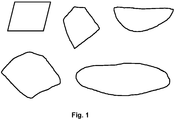
- irregularly or “irregularly” shaped particles relate to three-dimensional particle shapes, with at least two different cross-sections through the particles having a different shape. Exemplary cross-sections through slag particles with an irregular shape are shown schematically in Fig. 1 shown.
- Slag in particular slag from metal extraction or metal recycling, is typically separated from the molten metal in the liquid state and stored to cool down, typically in cinder beds.
- the cooling can be accelerated, for example by spraying on water.
- the cooling process can influence the physical properties, in particular the crystallinity and the grain size of the slag.
- a slag is advantageous, in particular a steel slag that has been cooled with water, especially in slag beds. As it cools down more quickly, the slag breaks into small pieces.
- a slag in particular a copper slag which has been granulated as a slag stream with a pressurized water jet, is also advantageous. This saves energy for comminution and typically angular particles with a rough and / or uneven surface are obtained.
- any free CaO that may be present is converted into Ca (OH) 2 through contact with water, which is desirable.
- the iron-containing slag also has magnetic properties.
- the iron-containing slag preferably has a particle size of a maximum of 16 mm, more preferably a maximum of 8 mm, even more preferably a maximum of 4 mm, in particular a maximum of 3.5 mm.
- a maximum of 10% by weight of the iron-containing slag has a particle size of less than 0.06 mm.
- the iron-containing slag particularly preferably has a particle size of 0.06 to 8 mm, preferably 0.06 to 4 mm, more preferably 0.06 to 3.5 mm.
- Slag particles with a suitable grain size can be obtained, for example, by fractionation, typically by sieving.
- the slag can be comminuted by breaking and / or grinding. Such methods are known to the person skilled in the art.
- the particle size can be determined by a sieving method according to DIN EN 933-1.
- the slag advantageously has the same or comparable particle size distribution (grading curve) as the fillers which are customary for the respective application and which are replaced by the slag. This can be achieved by mixing suitable grain size fractions.
- the binder composition in addition to the iron-containing slag, is mixed with a further material which has a high iron content and which is obtained in particular during steel forming.
- a further material which has a high iron content and which is obtained in particular during steel forming.
- One such material is mill scale, for example.
- Mill scale is a by-product that is produced when the steel is rolled and typically contains 70-80% iron by weight, calculated as FeO.
- the mill scale is preferably free of oil.
- the binder composition additionally comprises mill scale.
- the proportion of mill scale in the binder composition is preferably 0.1 to 10% by weight, in particular 1 to 8% by weight, based on the total weight of the dry binder composition.
- Fillers are chemically inert, solid, particulate substances and are offered in different shapes, sizes and as different materials.
- Mineral fillers can vary from fine sand particles to large, coarse stones.
- Particularly suitable fillers are sand, gravel, crushed stones, calcined pebbles or light fillers, such as in particular clay, pumice stone, perlite or vermiculite.
- Further suitable fillers are ground limestone, chalk, quartz powder, titanium dioxide, barite or aluminum oxide. Different fillers are advantageously mixed.
- the filler preferably comprises powdered limestone, chalk, powdered quartz, fine titanium dioxide, heavy spar powder, fine aluminum oxide, limestone sand or quartz sand, or mixtures thereof.
- the particle size of the fillers depends on the respective application and can be up to 32 mm or more.
- the particle size is preferably a maximum of 16 mm, particularly preferably a maximum of 8 mm.
- the particle size of the fillers is particularly preferably below 4 mm.
- the fillers have a particle size in the range from 0.1 ⁇ m to 3.5 mm.
- the particle size can be determined by a sieving method according to DIN EN 933-1. Fillers of different particle sizes are advantageously mixed in accordance with the desired grading curve. Suitable grading curves for various applications are known to the person skilled in the art.
- the binder composition preferably comprises at least one fine mineral filler, preferably with a particle size of at most 0.1 mm, selected from the group consisting of limestone powder, chalk, Quartz flour, fine titanium dioxide, barite flour, silica fume and fine aluminum oxide, and mixtures thereof.
- the binder composition preferably contains slag with a particle size of more than 0.06 mm and fine mineral filler, which is not a slag, with a particle size of at most 0.1 mm. Apart from slag and the fine mineral filler, the binder composition preferably contains no further fillers. Such binder compositions are easy to process and give materials with good strength after curing.
- a mass ratio of slag to the fine mineral filler is preferably 100: 0 to 60:40, in particular 95: 5 to 70:30.
- the binder composition contains slag as the only filler.
- the slag comprises all mineral particles in the binder composition with a size of about 0.1 ⁇ m up to 1 mm, 2 mm, 4 mm, 8 mm, or more. This is advantageous for improved electrical and also improved thermal conductivity of the cured binder composition and for maximum utilization of the slag.
- the binder comprises at least one mineral binder.
- the mineral binder preferably comprises a binder which, in the presence of water, reacts in a hydration reaction to form solid hydrates or hydrate phases.
- this is a hydraulic binder which, after adding water, can also be hardened under water, such as in particular cement or hydraulic lime, or a latent hydraulic binder which binds with water under the action of additives, such as in particular blast furnace slag, or pozzolanic binders, such as in particular fly ash , or a non-hydraulic binder, such as in particular calcium sulfate in the form of anhydrite, or hemihydrate gypsum.
- the mineral binder is preferably selected from the group consisting of cement, gypsum, quicklime, fly ash and slag sand.
- the mineral binding agent preferably comprises at least one hydraulic binding agent, preferably a cementitious binding agent.
- the mineral binder is particularly preferably a cement according to DIN EN 197-1, a calcium sulfoaluminate cement or a calcium aluminate cement, or mixtures thereof. Any available cement type or a mixture of two or more cement types can be used as cement, for example the cements classified under DIN EN 197-1: Portland cement (CEM I), Portland composite cement (CEM II), blast furnace slag cement (CEM III), pozzolanic cement ( CEM IV) and composite cement (CEM V). Of course, cements that are produced according to an alternative standard, such as the ASTM standard or the JIS standard, are equally suitable. Portland cement or a cement containing Portland cement according to DIN EN 197-1 is most preferred. Portland cement is particularly easily available and enables the production of materials with good mechanical and processing properties.
- the mineral binder contains other binders in addition to or instead of the cement.
- These are in particular latent hydraulic binders and / or pozzolanic binders.
- Suitable latent hydraulic and / or pozzolanic binders are in particular blast furnace slag, fly ash and / or silica dust (amorphous SiO 2 , silica fume).
- the mineral binder contains, in addition to Portland cement, finely ground blast furnace slag, fly ash and / or silica dust, preferably in 2 to 95% by weight, in particular 5 to 65% by weight, particularly preferably 10 to 40% by weight, based on the Total weight of the mineral binder.
- the cement content in the binder composition is advantageously 5 to 50% by weight, preferably 10 to 45% by weight, based on 100% by weight of the dry binder composition.
- the binding agent is Portland cement, optionally in combination with fly ash and / or finely ground slag sand.
- the binder advantageously also comprises at least one epoxy resin and at least one hardener for the epoxy resin.
- the chemical as well as physical resistance of the cured binder composition can be improved by combining an organic with a mineral binder.
- Epoxy resins are low molecular weight or polymeric compounds that contain epoxy groups. Suitable epoxy resins for the production of plastics are known in the prior art and are commercially available. If the epoxy resins are equipped with a defined number of epoxy groups per molecule, they preferably have at least two epoxy groups per molecule, for example two, three, four or more epoxy groups per molecule. If the epoxy resin is a polymer with a varying number of epoxy groups in the molecule, it has on average more than one epoxy group per molecule.
- the epoxy resin then preferably contains an average of at least two epoxy groups per molecule.
- the epoxy resin is preferably a liquid resin or a mixture containing two or more epoxy liquid resins.
- a technical polyepoxide with a glass transition temperature below 25 ° C. is referred to as "liquid epoxy resin”.
- the epoxy resin composition additionally contains proportions of solid epoxy resin.
- the epoxy resin is in particular a liquid resin based on a bisphenol, in particular a bisphenol A diglycidyl ether and / or bisphenol F diglycidyl ether, such as are commercially available, for example from Olin, Huntsman or Momentive. These liquid resins have a low viscosity for epoxy resins and enable rapid curing and the maintenance of high-modulus and high-pressure-resistant materials. They can contain proportions of bisphenol A solid resin or novolak glycidyl ethers.
- At least one reactive thinner can also advantageously be added to the epoxy resin.
- Suitable reactive diluents are low-viscosity, aliphatic or cycloaliphatic compounds containing epoxy groups.
- Emulsifiers in particular nonionic emulsifiers, can also be added to the epoxy resin. This improves the emulsifiability during processing of the composition.
- the epoxy resin is advantageously emulsified or dispersed in water.
- Commercial epoxy resin emulsions are particularly suitable, such as in particular Sika® Repair / Sikafloor® EpoCem® Module A (from Sika) or epoxy resin emulsions from manufacturers such as Huntsman, Dow or Momentive.
- the epoxy resin reacts with a suitable hardener to form a solid.
- a suitable hardener Customary and known compounds which react with the epoxy groups can be used as hardeners. This cross-links the epoxy resin.
- the hardeners are preferably basic hardeners, in particular amine compounds or amides.
- the hardener is preferably a polyamine with at least three amine hydrogens which are reactive toward epoxy groups.
- Amine hydrogens are hydrogen atoms that are bound directly to an amine nitrogen atom and can react with epoxy groups.
- the hardener preferably contains at least two primary or secondary amino groups per molecule.
- Amine compounds having two or more amino groups per molecule are hereinafter referred to as "polyamines".
- Polyamines are preferably present in the binder composition in such an amount that the molar ratio of amine hydrogen to epoxy groups is in the range from 0.6 to 1.5, in particular 0.8 to 1.2. According to the invention, mixtures of different hardeners can be used, for example of two, three or more different hardeners.
- the amine with at least three amine hydrogens reactive toward epoxide groups is preferably a water-dilutable amine or a component of a water-dilutable amine mixture.
- a suitable water-dilutable amine mixture comprises in particular a mixture of (i) di- or polyamines, (ii) polyalkylene amines and (iii) amine-functionalized adducts of amines with epoxides.
- water-dilutable means that a liquid, when mixed with water, forms a homogeneous mixture without phase separation.
- Suitable amine hardeners for the epoxy resin are commercially available, in particular as Sika® Repair / Sikafloor® EpoCem® Modul B (from Sika), Beckopox® EH 623w or Beckocure® EH 2100w / 44WA (both from Allnex), Epilink® 701 (from Evonik) , Incorez® 148/700 (from Incorez) or DEH® 804 (from Dow). They can be used as such or diluted with water.
- An advantageous binder composition that comprises an epoxy resin, a hardener for the epoxy resin and a hydraulic binder is a three-component system.
- a liquid component, the resin component, the epoxy resin, a second liquid component, the hardener component, the hardener, and a solid component comprises the fillers and the hydraulic binder.
- the resin component and / or the hardener component are preferably present in an aqueous solution, suspension or emulsion and contain the water necessary for the reaction of the hydraulic binder.
- the three components are advantageously separated from one another in separate containers until they are processed.
- the mineral binder likewise preferably comprises at least one aluminum silicate and at least one alkali metal silicate. In the presence of water, these react to form a geopolymer. Geopolymers are considered to be environmentally friendly building materials, as the production of their raw materials produces significantly less CO 2 than the production of Portland cement.
- All aluminum silicates with which a geopolymer can be produced are suitable as aluminum silicate.
- Particularly suitable aluminum silicates are clay, calcined clay, fly ash, finely ground blast furnace slag, zeolite, feldspar or mixtures thereof.
- Preferred aluminum silicates are selected from the group consisting of clay, calcined clay, fly ash and blast furnace slag.
- “Clay” is the name given to water-containing aluminum silicate, which is formed during weathering processes.
- the clays include kaolinite, bentonite, common clays, and kaolinite clays.
- the reaction product from calcining a clay mineral, for example metakaolin, is referred to as "calcined clay".
- Fluor ash is a by-product from coal-fired power plants, which is filtered out of the exhaust air in the form of a fine powder.
- the predominantly amorphous, non-metallic by-product of pig iron production in the blast furnace is referred to as "slag sand".
- Alkali silicate is also known as water glass and is a substance of the formula M 2 O * n SiO 2 , where M stands for Na, K or Li and n stands for the ratio of SiO 2 to M 2 O.
- Commercially available alkali silicates typically have values of n in the range from about 0.5 to 4.
- Alkali silicate dissolved in water is an alkaline, clear, colloidal solution or gel.
- the alkali silicates also include orthosilicates, M 4 O 4 Si where n is 0.5, and metasilicates, M 2 O 3 Si where n is 1.
- the alkali silicate is a sodium and / or potassium silicate.
- the alkali silicate preferably has a molar ratio of SiO 2 to M 2 O in the range from 0.8 to 2.4, preferably from 1.0 to 2.0, in particular from 1.4 to 2.0. This preferred ratio can be set by adding, for example, NaOH or KOH.
- the alkali silicate for the geopolymer is preferably an aqueous alkali silicate.
- the weight ratio of aluminum silicate to alkali metal silicate in this binder composition is preferably in the range from 6: 1 to 2: 1.
- the binder comprises an organic binder, in particular at least one epoxy resin and at least one hardener for the epoxy resin or at least one polyisocyanate and at least one polyol, and is preferably free from mineral binders.
- the binder advantageously comprises an epoxy resin and is free from mineral binders.
- Compounds as described above are suitable as epoxy resins, reactive thinners and hardeners for the epoxy resin.
- binder compositions which contain an epoxy resin as a binder and are free from mineral binders are preferably essentially free from water.
- An advantageous binder composition in this case is a three-component system.
- Suitable commercially available resin and hardener components for the epoxy resin are, for example, Sikadur®-42 component A, containing the epoxy resin, and Sikadur®-42 component B, containing the hardener, both available from Sika.
- the three components are advantageously separated from one another in separate containers until they are processed. It is also possible to integrate the filler into the resin component and / or the hardener component. In this case the system is two-part.
- the binder likewise advantageously comprises a polyisocyanate and at least one polyol and is free from mineral binders.
- Polyisocyanate is understood to mean a compound which contains two or more isocyanate groups.
- polyisocyanate also includes polymers containing isocyanate groups.
- Polyisocyanates produce polyurethanes when they react with atmospheric moisture or with polyols.
- polyurethane here denotes polymers which are formed by what is known as diisocyanate polyaddition. In addition to the urethane groups, these polymers can also have other groups, in particular urea groups.
- Preferred polyisocyanates are aliphatic, cycloaliphatic or aromatic diisocyanates, in particular 1,6-hexamethylene diisocyanate (HDI), 1-isocyanato-3,3,5-trimethyl-5-isocyanatomethylcyclohexane (isophorone diisocyanate or IPDI), perhydro-2,4'- and / or -4,4'-diphenylmethane diisocyanate (H 12 MDI), 4,4'-diphenylmethane diisocyanate, optionally with proportions of 2,4'- and / or 2,2'-diphenylmethane diisocyanate (MDI), 2,4-tolylene diisocyanate or Mixtures of these with 2,6-tolylene diisocyanate (TDI), mixtures of MDI and MDI homologues (polymeric MDI or PMDI) or oligomeric isocyanates.
- HDI 1,6-hexamethylene diisocyanate
- a suitable polymer containing isocyanate groups is obtained in particular from the reaction of at least one polyol with a more than stoichiometric amount of at least one polyisocyanate, in particular diisocyanate, preferably MDI, TDI, IPDI or HDI.
- the binder composition if it comprises a polyisocyanate, preferably comprises at least one aromatic polyisocyanate and at least one polyol selected from the group comprising epoxidized vegetable oils and their reaction products with monofunctional alcohols, polybutadiene polyols, reaction products of vegetable oils, in particular castor oil, with ketone resins, polyesters -Polyols based on hydrogenated tall oil and polyester polyols based on dimer fatty acids or dimer fatty alcohols.
- Such binder compositions are particularly hydrophobic, do not absorb moisture after curing and are stable to hydrolysis, which is advantageous.
- An advantageous binder composition comprising polyisocyanates and polyols is a three-component system.
- a liquid component here comprises the polyisocyanate, a second liquid component the polyol and a solid component the filler. It is also possible to incorporate the filler in the component that comprises the polyisocyanate or in the component that comprises the polyol. In this case the binder composition is two-component.
- the binder composition comprises at least one polyisocyanate, at least one polyol and at least one cement.
- a binder composition consists in particular of three components.
- a first component contains the at least one polyisocyanate
- a second component contains the at least one polyol
- a third component (powder component) contains the fillers and the cement.
- the binder composition according to the invention also contains 0.1 to 5% by weight, based on the total weight of the binder composition, of electrically conductive powder or fibers, in particular carbon black, graphite, steel fibers or carbon fibers. This can increase the electrical conductivity of the material.
- the binder composition is preferably free from carbon-based additives, such as in particular soot, graphite, carbon fibers or carbon nanotubes, and free from metallic additives such as metal powder or metal fibers.
- the binder composition can be in the form of a one-component, two-component or multi-component composition.
- “one-component” refers to a composition in which all the constituents of the composition are present in the same container, which as such is storage-stable, and which can be hardened with water.
- a composition is referred to as “two-component” or “multi-component” in which the constituents of the composition are present in two or more different components. In this case, at least those constituents of the composition which can react with one another are stored in separate containers or in separate compartments of a container and only mixed with one another shortly before the composition is applied.
- the binder composition is processed by mixing the binder composition with a suitable amount of water.
- all components are mixed in a suitable order and amount, optionally with the addition of a suitable amount of water. Such processing is known to those skilled in the art.
- the mass ratio of water to hydraulic binder after all components have been mixed is in the range from 0.25 to 1.0, preferably 0.28 to 0.8, in particular 0.30 to 0.6.
- the water is advantageously added to such binder compositions only shortly before processing.
- binder compositions which comprise one, two or more components the water is preferably already present in one or more of the components.
- the water-containing components do not include any Components that can react with the water under normal storage conditions.
- Another object of the present invention is a process for the production of materials with improved electrical conductivity at 20 ° C, characterized in that all components of a binder composition, comprising at least one binder and at least one mineral filler, are mixed and the mixture is allowed to harden, wherein at least 20% by weight of the filler is ferrous slag, and wherein water is present when binder compositions containing a mineral binder are mixed.
- the material with improved electrical conductivity preferably has a specific electrical volume resistance reduced by at least a factor of 1.5, more preferably at least 1.8, in particular at least 2.0, compared to an otherwise identical material, which, however, contains quartz sand of the same particle size instead of the iron-containing slag .
- the electrical resistance is between the two opposite 40 x 40 mm areas of a prism of 40 x 40 x 160 mm by applying a voltage of 100 mV and a frequency of 1 kHz, at 20 ° C, determined.
- the measurement of the specific electrical volume resistance is carried out on test specimens that contain at least one mineral binder after 28 days of storage at 20 ° C and 57% rel. Humidity, and for test specimens that contain only organic binders, after 7 days of storage at 20 ° C and 57% rel. Humidity.
- the curing of the binder composition takes place with the application of an electrical voltage to electrodes which are attached or embedded in the binder composition to be cured. Since the electrical conductivity of the material is increased by the slag, heat can be generated by applying a voltage to the electrodes, which accelerates the hardening reaction.
- Another object of the present invention is a material with improved electrical conductivity at 20 ° C, obtainable by mixing all components of a binder composition, comprising at least one binder and at least one mineral filler, and curing the mixture obtained, with at least 20% by weight of mineral filler are ferrous slag.
- Another object of the invention is the use of the material with improved electrical conductivity at 20.degree. C., as described above, for the production of sacrificial anodes, in particular in buildings.
- the binding agent is preferably a mineral binding agent, in particular a binding agent which is a geopolymer after curing.
- Another object of the invention is the use of the material with improved electrical conductivity at 20 ° C, as described above, as mortar, repair mortar, leveling mortar, screed, grouting mortar, plaster, Potting compound, coating, in particular floor coating, or leveling compound.
- EOS-Sand is an electric furnace slag from Stahl Gerlafingen, Switzerland.
- the material used had a bulk density of around 3.3 kg / l and an iron content, calculated as FeO, of around 19% by weight.
- CS is NAstra® iron silicate granulate, a glassy copper slag, available from Sibelco, Germany, with a bulk density of about 3.7 kg / l and an iron content, calculated as FeO, of about 51% by weight.
- HOS is a blast furnace slag from Hüttenwerke Krupp Mannesmann, Germany, available from Hermann Rauen GmbH & Co., Germany.
- the material used had a bulk density of 2.9 kg / l and an iron content, calculated as FeO, of around 3% by weight.
- Raulit® is a blast furnace slag from DK-Recycling und Roheisen GmbH, Germany, available under the brand name Raulit® mineral building material mixture from Hermann Rauen GmbH & Co., Germany.
- the material used had a bulk density of about 2.9 kg / l and an iron content, calculated as FeO, of about 1% by weight.
- HS is a slag sand from voestalpine AG, Austria.
- the material used had a bulk density of about 2.9 kg / l and an iron content, calculated as FeO, of less than 1% by weight.
- Sikadur®-42 HE is a three-component grouting mortar based on epoxy resin, available from Sika Sau AG.
- the electrical surface resistance of the test pieces was measured at regular time intervals. For this purpose, the resistance was determined on one of the longitudinal surfaces of a 40 ⁇ 40 ⁇ 160 mm test specimen using the Resipod resistance meter, available from Proceq, Switzerland. It is a 4-point measuring device. The electrodes are arranged linearly at a distance of 50 mm. An electric current is applied to the outer electrodes and the potential difference between the two inner electrodes is measured. The current amplitude is selected automatically by the device according to the electrical resistance of the sample and is typically between 10 and 200 ⁇ A. This method corresponds to AASHTO 95-11. In order to avoid contact problems between the electrodes and the surface, the surface being measured was briefly moistened with a sponge soaked with a saturated Ca (OH) 2 solution before each measurement.
- the specific volume resistance of the 40 x 40 x 160 mm test specimens was determined using the EIS method.
- stainless steel electrodes were placed at the ends (40 x 40 mm surfaces) of the test specimens, which completely covered the surfaces.
- a sponge soaked with a saturated calcium hydroxide solution was clamped between the test surface and the electrode.
- the volume resistance of the test specimens was then determined within about 15 seconds by applying an amplitude signal of 100 mV at a frequency of 1 kHz or 10 kHz to the two stainless steel electrodes.
- test specimens measuring 40 x 40 x 160 mm were determined in accordance with DIN EN 196-1.
- composition of the mortars is given in Table 1.
- the compositions of the mortars differ only in the sand used.
- the grain size distribution of the sands and the additives added were the same in all mixtures.
- Table 1 Composition of the mortar Amount in weight% Cement (type CEM I) 33.5 Quartz sand or slag sand 0.06-2.2 mm 60 Limestone powder 4th Additives 2.5
- the dry ingredients of the mortar were mixed homogeneously. Subsequently, water was added in such an amount that a W / C (weight ratio of water to cement) of 0.45.
- the fresh mortar was mixed well and homogeneously with a mechanical mixer for three minutes.
- the workability of the mortars M1 to M4 was comparable.
- the mortar was filled into steel molds measuring 40 x 40 x 160 mm and stored covered in the formwork for 24 hours at 20 ° C. The test specimens were then removed from the formwork and placed at 57% rel. Humidity and 20 ° C or at 68% rel. Humidity and 20 ° C.
- Table 2 shows the specific electrical surface resistance R OF of the mortars M1 and M2 in k ⁇ ⁇ cm as a function of storage time and relative humidity (RH).
- the sample age is the age of the test specimen in days.
- the measured values are mean values from measurements on three test specimens. Table 2 Ref. 1 Ex. 1 Ref. 2 Ex.
- Table 4 shows the compressive strength of the test specimens in MPa after storage at 21 ° C. and 68% relative humidity. Table 4 Ref. 5 Ex. 5 mortar M1 M2 sand quartz EOS Age of the test specimen [days] Compressive strength [MPa] 1 22nd 26th 7th 50 54 28 66 71
- Sikadur®-42 HE component A (containing the epoxy resin) was mixed well with the associated component B (containing the hardener) in a weight ratio of 3: 1 and then a solid component with the one in the table 5 specified composition added and mixed well.
- the weight ratio of component A to component B to solid component was 3: 1: 34.
- Table 5 shows the composition of the solid component.
- Table 5 component Weight% Mixture of limestone and heavy spar flour, ⁇ 0.1 mm 24.9 Quartz sand or slag sand 0.12-3.2 mm * 74.6
- Table 6 shows the strength, the type of sand used and the specific volume resistance (R DU ) of the mortars M5 to M10 after the test specimens were stored for 7 days at 20 ° C. and 57% relative humidity.
- Test specimens with a diameter of 30 mm and a height of 2 mm were produced by casting in appropriate molds and allowed to cure for 7 days at 20 ° C.
- the thermal conductivity of the M11 grouting mortar was 2.06 W / (m ⁇ K). This is significantly higher than the thermal conductivity of a cured commercial, filler-free epoxy resin of typically 0.20 W / (m ⁇ K).
Landscapes
- Chemical & Material Sciences (AREA)
- Engineering & Computer Science (AREA)
- Ceramic Engineering (AREA)
- Structural Engineering (AREA)
- Materials Engineering (AREA)
- Organic Chemistry (AREA)
- Chemical Kinetics & Catalysis (AREA)
- Inorganic Chemistry (AREA)
- Architecture (AREA)
- Environmental & Geological Engineering (AREA)
- Civil Engineering (AREA)
- Combustion & Propulsion (AREA)
- Life Sciences & Earth Sciences (AREA)
- General Life Sciences & Earth Sciences (AREA)
- Geochemistry & Mineralogy (AREA)
- Geology (AREA)
- Curing Cements, Concrete, And Artificial Stone (AREA)
Priority Applications (6)
| Application Number | Priority Date | Filing Date | Title |
|---|---|---|---|
| EP19176999.1A EP3744701A1 (fr) | 2019-05-28 | 2019-05-28 | Mortier conducteur |
| CN202080024797.2A CN113631526A (zh) | 2019-05-28 | 2020-05-28 | 导电砂浆 |
| PCT/EP2020/064809 WO2020239893A1 (fr) | 2019-05-28 | 2020-05-28 | Mortier conducteur |
| EP20728050.4A EP3976548A1 (fr) | 2019-05-28 | 2020-05-28 | Mortier conducteur |
| EP22182425.3A EP4101824A1 (fr) | 2019-05-28 | 2020-05-28 | Mortier conducteur |
| US17/609,091 US12304862B2 (en) | 2019-05-28 | 2020-05-28 | Conductive mortar |
Applications Claiming Priority (1)
| Application Number | Priority Date | Filing Date | Title |
|---|---|---|---|
| EP19176999.1A EP3744701A1 (fr) | 2019-05-28 | 2019-05-28 | Mortier conducteur |
Publications (1)
| Publication Number | Publication Date |
|---|---|
| EP3744701A1 true EP3744701A1 (fr) | 2020-12-02 |
Family
ID=66668829
Family Applications (3)
| Application Number | Title | Priority Date | Filing Date |
|---|---|---|---|
| EP19176999.1A Withdrawn EP3744701A1 (fr) | 2019-05-28 | 2019-05-28 | Mortier conducteur |
| EP22182425.3A Pending EP4101824A1 (fr) | 2019-05-28 | 2020-05-28 | Mortier conducteur |
| EP20728050.4A Pending EP3976548A1 (fr) | 2019-05-28 | 2020-05-28 | Mortier conducteur |
Family Applications After (2)
| Application Number | Title | Priority Date | Filing Date |
|---|---|---|---|
| EP22182425.3A Pending EP4101824A1 (fr) | 2019-05-28 | 2020-05-28 | Mortier conducteur |
| EP20728050.4A Pending EP3976548A1 (fr) | 2019-05-28 | 2020-05-28 | Mortier conducteur |
Country Status (4)
| Country | Link |
|---|---|
| US (1) | US12304862B2 (fr) |
| EP (3) | EP3744701A1 (fr) |
| CN (1) | CN113631526A (fr) |
| WO (1) | WO2020239893A1 (fr) |
Families Citing this family (3)
| Publication number | Priority date | Publication date | Assignee | Title |
|---|---|---|---|---|
| CN114671633B (zh) * | 2022-05-05 | 2022-12-23 | 华北理工大学 | 一种全固废无熟料胶凝材料、导电砂浆及其制备方法 |
| IT202200014143A1 (it) * | 2022-07-04 | 2024-01-04 | Alisea S R L Soc Benefit | Rivestimento a base di legante geopolimerico e metodo per ottenere un rivestimento a base di legante geopolimerico |
| CN118405881B (zh) * | 2024-07-01 | 2024-09-24 | 河南人邦科技股份有限公司 | 一种超高性能地聚合物及其制备方法与应用 |
Citations (13)
| Publication number | Priority date | Publication date | Assignee | Title |
|---|---|---|---|---|
| US3962142A (en) | 1973-02-07 | 1976-06-08 | The Marconi Company Limited | Electrically conducting concrete |
| DE3733564C1 (en) * | 1987-10-03 | 1988-12-01 | Bt Baustoff & Transp Gmbh & Co | Component of high compressive strength made of lime/silica compositions |
| JPH01148738A (ja) * | 1987-12-04 | 1989-06-12 | Denki Kagaku Kogyo Kk | 導電性水硬性組成物 |
| DE19750162A1 (de) * | 1996-11-12 | 1998-05-14 | Sicowa Verfahrenstech | Bauelemente sowie Verfahren zu ihrer Herstellung und deren Verwendung |
| DE19915093A1 (de) * | 1999-04-01 | 2000-10-05 | Crc Chemical Research Co Ltd | Verfahren zum Herstellen eines säurefesten und elektrisch ableitfähigen Baustoffbelags |
| KR20030028859A (ko) * | 2001-10-04 | 2003-04-11 | 주식회사 인트켐 | 전자파 흡수용 시멘트 조성물 |
| CN101113089A (zh) * | 2007-06-25 | 2008-01-30 | 马鞍山钢铁股份有限公司 | 一种导电水泥及其制备方法 |
| CN101525224A (zh) * | 2009-03-27 | 2009-09-09 | 重庆大学 | 高铁粉煤灰水泥基复合建筑吸波材料及其制备方法 |
| EP2476658A1 (fr) | 2011-01-17 | 2012-07-18 | Cugini S.p.A. | Mélange de liaison pour fabriquer des chapes conductrices hautement thermiques |
| DE102014017049A1 (de) * | 2014-11-13 | 2016-05-19 | Ce-Sys Engineering Gmbh | Baustoff zur Abschirmung von elektromagnetischen Wellen durch Absorption, Verfahren zu seiner Herstellung sowie dessen Verwendung |
| EP3095769A1 (fr) * | 2015-05-22 | 2016-11-23 | Arraela, S.L. | Préparation de masse pour fabrication de bétons techniques protégeant contre le rayonnement et procédé pour obtenir cette préparation |
| EP3339343A1 (fr) | 2016-12-23 | 2018-06-27 | Sika Technology Ag | Composition de polyuréthane bi-composants |
| EP3415544A1 (fr) | 2017-06-12 | 2018-12-19 | Sika Technology Ag | Composition de polyuréthane bi-composants |
Family Cites Families (16)
| Publication number | Priority date | Publication date | Assignee | Title |
|---|---|---|---|---|
| US3166518A (en) * | 1960-12-29 | 1965-01-19 | Schlumberger Well Surv Corp | Electrically conductive concrete |
| US7141112B2 (en) | 2003-01-31 | 2006-11-28 | Douglas C Comrie | Cementitious materials including stainless steel slag and geopolymers |
| CN101250034B (zh) * | 2008-03-31 | 2011-09-14 | 芮志平 | 一种地质聚合物土壤固结注浆材料 |
| EP2313352B1 (fr) * | 2008-08-11 | 2014-10-08 | Wolfgang Schwarz | Anode métallique galvanique encastrée dans un liant hydraulique comprenant un verre alumosilicate latent-hydraulique et un activateur alcalin |
| WO2010059169A1 (fr) * | 2008-11-24 | 2010-05-27 | Board Of Regents Of University Of Nebraska | Béton conducteur pour chauffage et sécurité électrique |
| CN101456708B (zh) * | 2009-01-06 | 2011-02-23 | 中建商品混凝土有限公司 | 一种轻集料及其制备方法 |
| CN101698576B (zh) * | 2009-10-22 | 2012-11-21 | 厦门市建筑科学研究院集团股份有限公司 | 钢渣-偏高岭土地聚合胶凝材料的制备方法 |
| CN101712546B (zh) * | 2009-10-31 | 2012-03-07 | 浙江大学宁波理工学院 | 地聚合物灌浆材料 |
| FR2955104B1 (fr) * | 2010-01-13 | 2014-08-08 | Kerneos | Materiau pour isolation thermique et son procede de fabrication |
| CN103224369A (zh) * | 2013-04-09 | 2013-07-31 | 四川省交通运输厅公路规划勘察设计研究院 | 矿渣集料制备的防辐射混凝土及其生产方法 |
| BR112015025029B1 (pt) * | 2013-04-10 | 2021-12-28 | Sika Technology Ag | Composição cimentícia de múltiplos componentes, uso da mesma, uso de uma solução de silicato de sódio e método para a fabricação de um artigo cimentício endurecido |
| CN103469212B (zh) * | 2013-08-05 | 2015-11-25 | 青岛双瑞海洋环境工程股份有限公司 | 用于钢筋混凝土阴极保护系统的阳极导电填充物 |
| US10930405B2 (en) * | 2015-03-03 | 2021-02-23 | The King Abdulaziz City For Science And Technology | Mixture for anti-radiation pozzolon-polymeric cementitious material |
| CN105621991A (zh) * | 2016-01-08 | 2016-06-01 | 中电建路桥集团有限公司 | 基于复合功能型外加剂的海工混凝土 |
| US9802865B1 (en) | 2016-09-13 | 2017-10-31 | Nano And Advanced Materials Institute Limited | Nano-modified alkali-activated cementitious materials for rapid repair |
| CN109678414A (zh) * | 2018-08-31 | 2019-04-26 | 南京优邦加能新材料科技有限公司 | 一种埋入式复合牺牲阳极多孔砂浆及其制备方法 |
-
2019
- 2019-05-28 EP EP19176999.1A patent/EP3744701A1/fr not_active Withdrawn
-
2020
- 2020-05-28 EP EP22182425.3A patent/EP4101824A1/fr active Pending
- 2020-05-28 EP EP20728050.4A patent/EP3976548A1/fr active Pending
- 2020-05-28 US US17/609,091 patent/US12304862B2/en active Active
- 2020-05-28 CN CN202080024797.2A patent/CN113631526A/zh active Pending
- 2020-05-28 WO PCT/EP2020/064809 patent/WO2020239893A1/fr not_active Ceased
Patent Citations (13)
| Publication number | Priority date | Publication date | Assignee | Title |
|---|---|---|---|---|
| US3962142A (en) | 1973-02-07 | 1976-06-08 | The Marconi Company Limited | Electrically conducting concrete |
| DE3733564C1 (en) * | 1987-10-03 | 1988-12-01 | Bt Baustoff & Transp Gmbh & Co | Component of high compressive strength made of lime/silica compositions |
| JPH01148738A (ja) * | 1987-12-04 | 1989-06-12 | Denki Kagaku Kogyo Kk | 導電性水硬性組成物 |
| DE19750162A1 (de) * | 1996-11-12 | 1998-05-14 | Sicowa Verfahrenstech | Bauelemente sowie Verfahren zu ihrer Herstellung und deren Verwendung |
| DE19915093A1 (de) * | 1999-04-01 | 2000-10-05 | Crc Chemical Research Co Ltd | Verfahren zum Herstellen eines säurefesten und elektrisch ableitfähigen Baustoffbelags |
| KR20030028859A (ko) * | 2001-10-04 | 2003-04-11 | 주식회사 인트켐 | 전자파 흡수용 시멘트 조성물 |
| CN101113089A (zh) * | 2007-06-25 | 2008-01-30 | 马鞍山钢铁股份有限公司 | 一种导电水泥及其制备方法 |
| CN101525224A (zh) * | 2009-03-27 | 2009-09-09 | 重庆大学 | 高铁粉煤灰水泥基复合建筑吸波材料及其制备方法 |
| EP2476658A1 (fr) | 2011-01-17 | 2012-07-18 | Cugini S.p.A. | Mélange de liaison pour fabriquer des chapes conductrices hautement thermiques |
| DE102014017049A1 (de) * | 2014-11-13 | 2016-05-19 | Ce-Sys Engineering Gmbh | Baustoff zur Abschirmung von elektromagnetischen Wellen durch Absorption, Verfahren zu seiner Herstellung sowie dessen Verwendung |
| EP3095769A1 (fr) * | 2015-05-22 | 2016-11-23 | Arraela, S.L. | Préparation de masse pour fabrication de bétons techniques protégeant contre le rayonnement et procédé pour obtenir cette préparation |
| EP3339343A1 (fr) | 2016-12-23 | 2018-06-27 | Sika Technology Ag | Composition de polyuréthane bi-composants |
| EP3415544A1 (fr) | 2017-06-12 | 2018-12-19 | Sika Technology Ag | Composition de polyuréthane bi-composants |
Non-Patent Citations (1)
| Title |
|---|
| GORAI ET AL: "Characteristics and utilisation of copper slag-a review", RESOURCES, CONSERVATION AND RECYCLING, ELSEVIER, AMSTERDAM, NL, vol. 39, no. 4, 1 November 2003 (2003-11-01), pages 299 - 313, XP004464534, ISSN: 0921-3449, DOI: 10.1016/S0921-3449(02)00171-4 * |
Also Published As
| Publication number | Publication date |
|---|---|
| US20220212991A1 (en) | 2022-07-07 |
| CN113631526A (zh) | 2021-11-09 |
| EP4101824A1 (fr) | 2022-12-14 |
| US12304862B2 (en) | 2025-05-20 |
| WO2020239893A1 (fr) | 2020-12-03 |
| EP3976548A1 (fr) | 2022-04-06 |
Similar Documents
| Publication | Publication Date | Title |
|---|---|---|
| EP3976550B1 (fr) | Utilisation d'une composition de liant durcie pour conduire un courant électrique | |
| EP2297061B1 (fr) | Mélange, en particulier mélange pour matériaux de construction contenant du sable de fonderie | |
| EP2190798A1 (fr) | Composition à base de matières premières phosphatées et procédé de production de celle-ci | |
| EP2428499A1 (fr) | Utilisation de liaisons contenant de l'aluminium et du silicium pour la fabrication d'un produit en matériau de construction hydrophile | |
| EP2746237B1 (fr) | Activateur pour ciment | |
| WO2020239893A1 (fr) | Mortier conducteur | |
| EP1964825A1 (fr) | Accélérateur de prise et de durcissement pour liant hydraulique et son procédé de fabrication | |
| EP3696153A1 (fr) | Mélange cimentaire permettant de produire un béton léger à ultra haute résistance | |
| WO2022112149A1 (fr) | Bétons polymères à base de polyuréthane et mortiers de jointoiement à densité contrôlée | |
| DE3049003A1 (de) | Hydraulische anorganische masse | |
| EP3538499B1 (fr) | Accélérateur de durcissement | |
| EP3909933A1 (fr) | Composant initiateur à base d'alcalisilicate pour l'utilisation dans un système de mortier inorganique cimentaire à composants multiples | |
| EP0540552B1 (fr) | Procede de production de liant riche en hydrate de chaux pour betons ou pour mortiers et utilisation du liant | |
| EP4227285A1 (fr) | Additif hydraulique pouzzolanique ou latent | |
| DE102013007937A1 (de) | Mineralisches, hydraulisches Bindemittel sowie mineralischer, hydraulischer Trockenmörtel, Frischbeton und Festbeton enthaltend das Bindemittel | |
| DE2723233A1 (de) | Verfahren zur herstellung eines hydraulischen moertels oder betons | |
| EP4149902A1 (fr) | Clinker de ciment portland finement broyé dans un système de mortier multicomposants à base de ciment, destiné à être utilisé comme système de scellement chimique inorganique | |
| EP4417591B1 (fr) | Composition pour la préparation de béton, son procédé de préparation et son utilisation, et béton comprenant cette composition | |
| DE102016001761A1 (de) | Formulierung einer schnellerstarrenden Betonmischung und Verfahren zur Anwendung | |
| Khalil et al. | Some properties of high strength sustainable concrete containing glass powder waste | |
| EP4342867A1 (fr) | Procédés de régulation du retrait de compositions cimentaires et coulis cimentaires présentant un retrait contrôlé | |
| Nguyen et al. | Study of the effects of gympsum, pozzolanic additive mixtures and their fineness on the strength of PCB50 Fico cement | |
| WO2025237531A1 (fr) | Mélange de composants principaux et son procédé de production | |
| DE19533998C1 (de) | Kupolofenschlacke als gebrochener Mineralstoff | |
| DE102023119344A1 (de) | Baustoff, Verfahren zur Herstellung und Verwendung |
Legal Events
| Date | Code | Title | Description |
|---|---|---|---|
| PUAI | Public reference made under article 153(3) epc to a published international application that has entered the european phase |
Free format text: ORIGINAL CODE: 0009012 |
|
| STAA | Information on the status of an ep patent application or granted ep patent |
Free format text: STATUS: THE APPLICATION HAS BEEN PUBLISHED |
|
| AK | Designated contracting states |
Kind code of ref document: A1 Designated state(s): AL AT BE BG CH CY CZ DE DK EE ES FI FR GB GR HR HU IE IS IT LI LT LU LV MC MK MT NL NO PL PT RO RS SE SI SK SM TR |
|
| AX | Request for extension of the european patent |
Extension state: BA ME |
|
| STAA | Information on the status of an ep patent application or granted ep patent |
Free format text: STATUS: THE APPLICATION IS DEEMED TO BE WITHDRAWN |
|
| 18D | Application deemed to be withdrawn |
Effective date: 20210603 |