EP3745264B1 - Mise à l'échelle automatisée des ressources sur la base de réseaux neuronaux récurrents de mémoire à long et court terme et de mécanismes d'attention - Google Patents
Mise à l'échelle automatisée des ressources sur la base de réseaux neuronaux récurrents de mémoire à long et court terme et de mécanismes d'attention Download PDFInfo
- Publication number
- EP3745264B1 EP3745264B1 EP20165743.4A EP20165743A EP3745264B1 EP 3745264 B1 EP3745264 B1 EP 3745264B1 EP 20165743 A EP20165743 A EP 20165743A EP 3745264 B1 EP3745264 B1 EP 3745264B1
- Authority
- EP
- European Patent Office
- Prior art keywords
- time interval
- layer
- resources
- utilization
- lstm
- Prior art date
- Legal status (The legal status is an assumption and is not a legal conclusion. Google has not performed a legal analysis and makes no representation as to the accuracy of the status listed.)
- Active
Links
Images


Classifications
-
- G—PHYSICS
- G06—COMPUTING OR CALCULATING; COUNTING
- G06F—ELECTRIC DIGITAL DATA PROCESSING
- G06F9/00—Arrangements for program control, e.g. control units
- G06F9/06—Arrangements for program control, e.g. control units using stored programs, i.e. using an internal store of processing equipment to receive or retain programs
- G06F9/46—Multiprogramming arrangements
- G06F9/50—Allocation of resources, e.g. of the central processing unit [CPU]
- G06F9/5061—Partitioning or combining of resources
- G06F9/5072—Grid computing
-
- G—PHYSICS
- G06—COMPUTING OR CALCULATING; COUNTING
- G06F—ELECTRIC DIGITAL DATA PROCESSING
- G06F9/00—Arrangements for program control, e.g. control units
- G06F9/06—Arrangements for program control, e.g. control units using stored programs, i.e. using an internal store of processing equipment to receive or retain programs
- G06F9/46—Multiprogramming arrangements
- G06F9/50—Allocation of resources, e.g. of the central processing unit [CPU]
- G06F9/5005—Allocation of resources, e.g. of the central processing unit [CPU] to service a request
- G06F9/5027—Allocation of resources, e.g. of the central processing unit [CPU] to service a request the resource being a machine, e.g. CPUs, Servers, Terminals
-
- G—PHYSICS
- G06—COMPUTING OR CALCULATING; COUNTING
- G06F—ELECTRIC DIGITAL DATA PROCESSING
- G06F11/00—Error detection; Error correction; Monitoring
- G06F11/30—Monitoring
- G06F11/34—Recording or statistical evaluation of computer activity, e.g. of down time, of input/output operation ; Recording or statistical evaluation of user activity, e.g. usability assessment
- G06F11/3409—Recording or statistical evaluation of computer activity, e.g. of down time, of input/output operation ; Recording or statistical evaluation of user activity, e.g. usability assessment for performance assessment
-
- G—PHYSICS
- G06—COMPUTING OR CALCULATING; COUNTING
- G06F—ELECTRIC DIGITAL DATA PROCESSING
- G06F11/00—Error detection; Error correction; Monitoring
- G06F11/30—Monitoring
- G06F11/34—Recording or statistical evaluation of computer activity, e.g. of down time, of input/output operation ; Recording or statistical evaluation of user activity, e.g. usability assessment
- G06F11/3447—Performance evaluation by modeling
-
- G—PHYSICS
- G06—COMPUTING OR CALCULATING; COUNTING
- G06F—ELECTRIC DIGITAL DATA PROCESSING
- G06F9/00—Arrangements for program control, e.g. control units
- G06F9/06—Arrangements for program control, e.g. control units using stored programs, i.e. using an internal store of processing equipment to receive or retain programs
- G06F9/44—Arrangements for executing specific programs
- G06F9/455—Emulation; Interpretation; Software simulation, e.g. virtualisation or emulation of application or operating system execution engines
- G06F9/45533—Hypervisors; Virtual machine monitors
- G06F9/45558—Hypervisor-specific management and integration aspects
-
- G—PHYSICS
- G06—COMPUTING OR CALCULATING; COUNTING
- G06F—ELECTRIC DIGITAL DATA PROCESSING
- G06F9/00—Arrangements for program control, e.g. control units
- G06F9/06—Arrangements for program control, e.g. control units using stored programs, i.e. using an internal store of processing equipment to receive or retain programs
- G06F9/46—Multiprogramming arrangements
- G06F9/50—Allocation of resources, e.g. of the central processing unit [CPU]
- G06F9/5005—Allocation of resources, e.g. of the central processing unit [CPU] to service a request
- G06F9/5011—Allocation of resources, e.g. of the central processing unit [CPU] to service a request the resources being hardware resources other than CPUs, Servers and Terminals
- G06F9/5016—Allocation of resources, e.g. of the central processing unit [CPU] to service a request the resources being hardware resources other than CPUs, Servers and Terminals the resource being the memory
-
- G—PHYSICS
- G06—COMPUTING OR CALCULATING; COUNTING
- G06F—ELECTRIC DIGITAL DATA PROCESSING
- G06F9/00—Arrangements for program control, e.g. control units
- G06F9/06—Arrangements for program control, e.g. control units using stored programs, i.e. using an internal store of processing equipment to receive or retain programs
- G06F9/46—Multiprogramming arrangements
- G06F9/50—Allocation of resources, e.g. of the central processing unit [CPU]
- G06F9/5083—Techniques for rebalancing the load in a distributed system
-
- G—PHYSICS
- G06—COMPUTING OR CALCULATING; COUNTING
- G06N—COMPUTING ARRANGEMENTS BASED ON SPECIFIC COMPUTATIONAL MODELS
- G06N3/00—Computing arrangements based on biological models
- G06N3/02—Neural networks
- G06N3/04—Architecture, e.g. interconnection topology
-
- G—PHYSICS
- G06—COMPUTING OR CALCULATING; COUNTING
- G06N—COMPUTING ARRANGEMENTS BASED ON SPECIFIC COMPUTATIONAL MODELS
- G06N3/00—Computing arrangements based on biological models
- G06N3/02—Neural networks
- G06N3/04—Architecture, e.g. interconnection topology
- G06N3/044—Recurrent networks, e.g. Hopfield networks
-
- G—PHYSICS
- G06—COMPUTING OR CALCULATING; COUNTING
- G06N—COMPUTING ARRANGEMENTS BASED ON SPECIFIC COMPUTATIONAL MODELS
- G06N3/00—Computing arrangements based on biological models
- G06N3/02—Neural networks
- G06N3/04—Architecture, e.g. interconnection topology
- G06N3/044—Recurrent networks, e.g. Hopfield networks
- G06N3/0442—Recurrent networks, e.g. Hopfield networks characterised by memory or gating, e.g. long short-term memory [LSTM] or gated recurrent units [GRU]
-
- G—PHYSICS
- G06—COMPUTING OR CALCULATING; COUNTING
- G06N—COMPUTING ARRANGEMENTS BASED ON SPECIFIC COMPUTATIONAL MODELS
- G06N3/00—Computing arrangements based on biological models
- G06N3/02—Neural networks
- G06N3/04—Architecture, e.g. interconnection topology
- G06N3/045—Combinations of networks
-
- G—PHYSICS
- G06—COMPUTING OR CALCULATING; COUNTING
- G06N—COMPUTING ARRANGEMENTS BASED ON SPECIFIC COMPUTATIONAL MODELS
- G06N3/00—Computing arrangements based on biological models
- G06N3/02—Neural networks
- G06N3/04—Architecture, e.g. interconnection topology
- G06N3/049—Temporal neural networks, e.g. delay elements, oscillating neurons or pulsed inputs
-
- G—PHYSICS
- G06—COMPUTING OR CALCULATING; COUNTING
- G06N—COMPUTING ARRANGEMENTS BASED ON SPECIFIC COMPUTATIONAL MODELS
- G06N3/00—Computing arrangements based on biological models
- G06N3/02—Neural networks
- G06N3/08—Learning methods
-
- G—PHYSICS
- G06—COMPUTING OR CALCULATING; COUNTING
- G06N—COMPUTING ARRANGEMENTS BASED ON SPECIFIC COMPUTATIONAL MODELS
- G06N3/00—Computing arrangements based on biological models
- G06N3/02—Neural networks
- G06N3/08—Learning methods
- G06N3/09—Supervised learning
-
- G—PHYSICS
- G06—COMPUTING OR CALCULATING; COUNTING
- G06F—ELECTRIC DIGITAL DATA PROCESSING
- G06F2201/00—Indexing scheme relating to error detection, to error correction, and to monitoring
- G06F2201/81—Threshold
-
- G—PHYSICS
- G06—COMPUTING OR CALCULATING; COUNTING
- G06N—COMPUTING ARRANGEMENTS BASED ON SPECIFIC COMPUTATIONAL MODELS
- G06N3/00—Computing arrangements based on biological models
- G06N3/02—Neural networks
- G06N3/04—Architecture, e.g. interconnection topology
- G06N3/048—Activation functions
Definitions
- Elasticity can be an important feature of cloud computing systems.
- the provisioning platform may dynamically adapt to changing workloads. In some instances, the platform scales up to add more resource. In other instances, the platform scales down to remove unused resources.
- a scalability feature allows users to run their applications in an elastic manner, use only computational resources they need, and pay only for what they use.
- Various existing scaling techniques of cloud platform include manual approaches or are based on statically defined rules. Many auto-scaling techniques function in a reactive fashion where resource availability is modified when a threshold value has been passed. After a worst-case scenario occurs, the service provider responds to it by adjusting resource capacity. This sometimes affects the resilience and availability of applications on cloud platform. The result of which could be violation of service level agreements or losing market share. Some existing techniques may also adjust resource capacity in a pre-deterministic way. The resource availability is modified by a pre-defined constant value whenever threshold value is reached.
- Document CN 108 874 542 A (UNIV GUILIN ELECTRONIC TECH, 2018-11 -23 ) describes an orchestration system that utilizes a neural network consisting of multiple LSTM-RNN interconnected layers for predicting resource utilization in container-based distributed system and dynamically adjusting the resource allocation based on the predicted outcome.
- a computing system includes one or more resource consumers that are each configured to consume resources (e.g., processors, memory, network bandwidth, etc.) provided by the computing system.
- the computing system may monitor the utilization of resources by the resource consumers and collect data associated with the utilization of the resources. Based on the collected data, the computing system can generate a model that includes several LSTM-RNN layers and one or more attention mechanism layers.
- the model may be configured to predict the utilization of resources at one or more future points in time based on the collected data. Based on the predicted utilization of resources, the computing system can automatedly scale (e.g., scale up and/or scale down) resources.
- the techniques described in the present application provide a number of benefits and advantages over conventional methods for automatedly scaling of resources.
- the computing system may be able to scale resources by a sufficient amount to meet the predicted demands for the resources (as opposed to scaling the resources by a defined amount and potentially not meeting the demands for the resources).
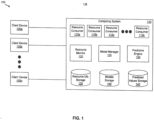
- FIG. 1 illustrates a system 100 that automatedly scales resources based on long short-term memory recurrent neural networks and attention mechanisms according to some embodiments.
- system 100 includes client devices 105a-n and computing system 110.
- Each of client devices 105a-n can be configured to communicate and interact with computing system 110.
- a user of a client device 105a-n may access and interact with one or more of resource consumers 115a-k operating on computing system 110.
- computing system includes resource consumers 115a-k, resource monitor 120, model manager 125, predictive engine 130, and storages 135-145.
- Resource utilization storage 135 is configured to store metrics representing the utilization of resources provided by computing system 110. Examples of such resources include processors, memory (e.g., random access memory (RAM), storage space (e.g., hard disk storage space), network bandwidth, etc.
- metrics representing the utilization of such resources include a processor utilization metric, a memory utilization metric, a storage utilization metric, a response time metric (e.g., the time it takes to respond to a request such as a request for memory, a request to read from or write to a hard disk, a request to query data from a database, or any other type of computing-related task), a bandwidth utilization metric (e.g., throughput), etc.
- resource utilization storage 135 stores separate metrics for each resource consumer 115a-k.
- resource utilization storage 135 may store a first set of metrics representing utilization of resources by resource consumer 115a, a second set of metrics representing utilization of resources by resource consumer 115b, a third set of metrics representing utilization of resources by resource consumer 115c, and so on and so forth.
- Models storage 140 can store models generated by model manager 125.
- each model stored in models storage 140 is configured to predict utilization of a set of resources by a resource consumer 115 based on a history of utilization of the set of resources by the resource consumer 115. That is, separate models are used to predict utilization of resources for different resource consumers 115.
- a first model may be configured to predict utilization of a set of resources by resource consumer 115a
- a second model may be configured to predict utilization of a set of resources by resource consumer 115b
- a third model may be configured to predict utilization of a set of resources by resource consumer 115c
- Predicted values storage 145 is configured to store predicted values representing utilization of resources.
- storages 135-145 are implemented in a single physical storage while, in other embodiments, storages 135-145 may be implemented across several physical storages. While FIG. 1 shows storages 135-145 as part of computing system 110, one of ordinary skill in the art will appreciate that resource utilization storage 135, models storage 140, and/or predicted values storage 145 may be external to computing system 110 in some embodiments.
- Resource consumers 115a-k are each configured to consume resources provided by computing system 110.
- resources provided by computing system 110 include processors, memory, storage space, network bandwidth, etc.
- Each resource consumer 115 may be an application operating on computing system 110, a service operating on computing system 110, a virtual machine operating on computing system 110, a container instantiated by and operating on computing machine 110, a unikernel operating on computing system 110, or any other type of computing element that may consume resources provided by computing system 110.
- Resource monitor 120 is responsible for monitoring the utilization of resources by each of resource consumers 115a-k.
- resource monitor 120 can monitor the utilization of resources by resource consumer 115a, monitor the utilization of resources resource by consumer 115b, monitor the utilization of resources by resource consumer 115c, etc.
- resource monitor 120 monitors the utilization of resources by a resource consumer 115 by measuring the utilization of the resources by the resource consumer 115 and storing in resource utilization storage 135 the measured utilization of the resources in terms of metrics representing the utilization of the resources.
- examples of such metrics include a processor utilization metric, a memory utilization metric, a storage utilization metric, a response time metric (e.g., the time it takes to respond to a request such as a request for memory, a request to read from or write to a hard disk, a request to query data from a database, or any other type of computing-related task), a bandwidth utilization metric (e.g., throughput), etc.
- resource monitor 120 measures the utilization of resources by a resource consumer 115 and stores the measured utilization of the resources in terms of metrics at defined intervals (e.g., once per second, once per ten seconds, once per thirty seconds, once a minute, etc.).
- Model manager 125 handles the generation of models.
- a model generated by model manager 125 is configured to predict utilization of a resource by a resource consumer 115 at one or more points in time in the future based on a history of utilization of the resource by the resource consumer 115.
- model manager 125 generates a model that includes several LSTM-RNN layers and one or more attention mechanism layers.
- FIG. 2 illustrates a model 200 that includes long short-term memory recurrent neural network layers and attention mechanism layers according to some embodiments.
- model manager 125 generates model 200.
- model 200 includes input layer 205, LSTM-RNN layer 210, attention mechanism layer 215, LSTM-RNN layer 220, attention mechanism layer 225, LSTM-RNN layer 230, and output layer 235.
- Input layer 205 is configured to receive input data.
- the input data that input layer 205 receives includes a set of time series data associated with utilization of a set of resources by a resource consumer 115.
- such a set of time series data can include a set of metrics representing the utilization of the set of resources by the resource consumer 115 at a series of instances of time in the past.
- input layer 205 performs a set of activation function computations based on the input data and then forwards the results of the computations to LSTM-RNN layer 210.
- Each of the LSTM-RNN layers 210, 220, and 230 may be implemented by an LSTM-RNN cell described below by reference to FIG. 3 .
- Each of the attention mechanism layers 215 and 225 can be implemented by an attention mechanism described below by reference to FIG. 4 .
- Output layer 235 is configured to output predicted values representing utilization of a resource at a set of intervals of time in the future (e.g., a predicted value representing utilization of a resource at one second in the future, a predicted value representing utilization of a resource at two seconds in the future, a predicted value representing utilization of a resource at three seconds in the future, etc.).
- FIG. 2 illustrates one example of a model configured to predict utilization of a resource by a resource consumer 115 at one or more points in time in the future based on a history of utilization of the resource by the resource consumer 115.
- Any model may be used that includes an input layer followed by an LSTM-RNN layer followed by an attention mechanism layer followed by zero or more pairs of an LSTM-RNN layer and an attention mechanism layer followed by an LSTM-RNN layer and ending with an output layer.
- one such model may include an input layer followed by followed by an LSTM-RNN layer followed by an attention mechanism layer followed by an LSTM-RNN layer and ending with an output layer. This particular has zero pairs of an LSTM-RNN layer and an attention mechanism layer.
- Another example of such a model may include an input layer followed by an LSTM-RNN layer followed by an attention mechanism layer followed by an LSTM-RNN layer followed by an attention mechanism layer (a first pair of an LSTM-RNN layer and an attention mechanism layer) followed by an LSTM-RNN layer followed by an attention mechanism layer (a second pair of an LSTM-RNN layer and an attention mechanism layer) followed by an LSTM-RNN layer and ending with an output layer.
- an attention mechanism layer followed by an LSTM-RNN layer followed by an attention mechanism layer followed by an LSTM-RNN layer followed by an attention mechanism layer (a first pair of an LSTM-RNN layer and an attention mechanism layer) followed by an LSTM-RNN layer followed by an attention mechanism layer (a second pair of an LSTM-RNN layer and an attention mechanism layer) followed by an LSTM-RNN layer and ending with an output layer.
- FIG. 3 illustrates long short-term memory recurrent neural network (LSTM-RNN) cell 300 according to some embodiments.
- LSTM-RNN cell 300 may be used to implement each of LSTM-RNN layers 210, 220, and 230.
- LSTM-RNN cell 300 includes a forget gate layer (ft), an input gate layer (it), an input gate modulation layer (z t ), and an output gate layer (ot).
- LSTM-RNN cell 300 receives a cell state of a previous time interval (C t-1 ), a hidden state of a previous time interval (h t-1 ), and input variables for the present time interval (xt).
- C t-1 previous time interval
- h t-1 hidden state of a previous time interval
- xt input variables for the present time interval
- input variables x t may be a vector of input variables.
- LSTM-RNN cell 300 outputs a cell state of the present time interval (Ct) and a hidden state of the present time interval (ht).
- the forget gate layer is configured to determine what information is thrown away from the cell state. To make such a determination, the forget gate layer applies a sigmoid activation function on the hidden state at time interval t-1 and the input variables for time interval t .
- the forget gate layer can output a value between 0 and 1 for each number in the cell state at time interval t-1. A value of 1 indicates to completely keep the corresponding number while a value of 0 indicates to completely get remove the corresponding value.
- the next step is to decide what new information will be stored in the cell state at time interval t. First, the input gate layer applies a sigmoid activation function to determine which values to update.
- the input gate modulation layer applies a hyperbolic tangent activation function to produce a vector of new candidate values that may be added to the cell state. Then, the results of the input gate layer and the input gate modulation layer are combined to update the cell state. Finally, the output gate layer applies a sigmoid activation function to determine which parts of the cell state will be included in the output. Then, a hyperbolic tangent activation function is applied to the cell state at the time interval t in order to produce values to be between -1 and 1, which is then multiplied by the output in order to output only the determined parts.
- FIG. 4 illustrates an attention mechanism 400 according to some embodiments.
- attention mechanism 400 may be used to implement each of attention mechanism layers 215 and 225.
- attention mechanism 400 receives n number of inputs y 1 , y 2 , y 3 , ..., y n and a context C.
- the output of LSTM-RNN cell 300 h i is the input for y i and the cell state C t of LSTM-RNN cell 300 is the input for context C.
- Attention mechanism 400 outputs a vector z.
- vector z is a weighted arithmetic mean of the y i . In some such embodiments, the weights are determined according the relevance of each y i given the context C.
- model manager 125 may retrieve from resource utilization storage 135 data associated with utilization of a resource by a resource consumer 115 (e.g., metrics representing the utilization of the resources by the resource consumer 115) over a period of time (e.g., a period of time starting from a point in time at which the resource consumer 115 started using the resource and ending at the current point in time). Next, model manager 125 can train the model with the retrieved data. Once model manager 125 is finished training the model, model manager 125 stores it in models storage 140.
- resource utilization storage 135 data associated with utilization of a resource by a resource consumer 115 (e.g., metrics representing the utilization of the resources by the resource consumer 115) over a period of time (e.g., a period of time starting from a point in time at which the resource consumer 115 started using the resource and ending at the current point in time).
- model manager 125 can train the model with the retrieved data. Once model manager 125 is finished training the model, model manager 125 stores it in models storage 140.
- Model manager 125 can also perform updates on models. In some instances, model manager 125 performs updates on models stored in models storage 140 at defined intervals (e.g., once an hour, once a day, once a week, etc.). To update a model, model manager 125 retrieves it from models storage 140. Next, model manager 125 calculates a set of error metrics. In some embodiments, model manager 125 calculates a normalized root mean square error (NRMSE) metric and a normalized mean absolute percentage error (NMAPE) metric.
- NPMSE normalized root mean square error
- NMAPE normalized mean absolute percentage error
- MAPE the mean absolute percentage error value
- y i the actual value representing the utilization of a resource that model manager 125 retrieves from resource utilization storage 135
- ⁇ i the predicted value representing the utilization of the resource that model manager 125 retrieves from predicted values storage 145
- n is the number of observations in the dataset for which predictions have been determined
- NMAPE is the normalized mean absolute percentage error value
- y max is the maximum value in the dataset for which predictions have been determined
- y min is the minimum value in the dataset for which predictions have been determined.
- model manager 125 After calculating the set of error metrics, model manager 125 then determines whether one of the error metric values is greater than a defined threshold value (e.g. five percent, ten percent, fifteen percent, twenty-five percent, etc.). If so, model manager 125 updates the model by retrieving from resource utilization storage 135 data associated with utilization of a resource by a resource consumer 115 that has not been used to train the model and training the model with the retrieved data. Upon completing the training of the model, model manager 125 replaces the old version of the model in in models storage 140 with the updated model.
- a defined threshold value e.g. five percent, ten percent, fifteen percent, twenty-five percent, etc.
- Predictive engine 130 is responsible for predicting utilization of resources by resource consumers 115a-k. For instance, to predict utilization of a resource by a resource consumer 115, predictive engine 130 may retrieve the model from models storage 140 that is configured to predict utilization of the resource by the resource consumer 115. Next, predictive engine 130 retrieves data associated with past utilization of the resource by the resource consumer 115 from resource utilization storage 135. In some embodiments, the retrieved data is a defined number of the most recent data (e.g., the most recent five datum, the most recent ten datum, etc.) associated with past utilization of the resource by the resource consumer 115.
- the most recent data e.g., the most recent five datum, the most recent ten datum, etc.
- the retrieved data is the most recent data for a defined period of time (e.g., the most recent thirty seconds of data, the most recent five minutes of data, the most recent fifteen minutes of data, etc.) associated with past utilization of the resource by the resource consumer 115.
- Predictive engine 130 uses the model to generate a set of predicted values representing utilization of the resource by the resource consumer 115 by using the retrieved data as input to the model.
- predictive engine 130 stores the generated set of predicted values in predicted values storage 145.
- predictive engine 130 determines predicted values representing utilization of a resource by a resource consumer 115 at defined intervals (e.g., once per second, once per ten seconds, once per thirty seconds, once a minute, etc.).
- Predictive engine 130 can perform a variety of operations after generating the set of predicted values representing utilization of a resource by a resource consumer 115.
- predictive engine 130 may scale resources utilized by the resource consumer 115 to meet the predicted demand for the resource. For example, if the resource consumer 115 is an application operating on computing system 110 currently using one gigabyte (GB) of memory and the predicted utilization of memory five seconds from now is two GBs of memory, predictive engine 130 may allocate an additional GB of memory (i.e., scale up) for the application in order to meet the anticipated utilization of two GBs of memory. Predictive engine 130 can also scale down (e.g., deallocate) memory for the application if the predicted utilization of memory is less than one GB of memory.
- GB gigabyte
- predictive engine 130 can instantiate an additional similarly-configured virtual machine to handle the anticipated increased processing load.
- predictive engine 130 can send a client device 105 that may be using the resource consumer 115 a notification warning a user of the client device 105 that utilization of the resource is high.
- FIG. 5 illustrates a process 500 for predicting resource usage according to some embodiments.
- computing system 110 performs process 500.
- Process 500 begins by monitoring, at 510, utilization of a set of resources by a resource consumer operating on a computing system.
- resource monitor 120 may monitor utilization of the set of resources by a resource consumer 115 operating on computing system 110.
- resource monitor 120 measures the utilization of the set of resources by the resource consumer 115 and stores the measured utilization of the resources in terms of metrics representing the utilization of the set of resources.
- process 500 generates, at 520, a model comprising a plurality of long short-term memory recurrent neural network (LSTM-RNN) layers and a set of attention mechanism layers, the model configured to predict future utilization of the set of resources.
- model manager 125 can generate the model comprising the plurality of LSTM-RNN layers and a set of attention mechanism layers, such as model 200 illustrated in FIG. 2 .
- model manager 125 can retrieve from resource utilization storage 135 data associated with utilization of a resource by a resource consumer 115 over a period of time, train the model with the retrieved data, and then store the model in models storage 140 when model manager 125 finishes training of the model.
- process 500 determines, at 530, a set of predicted values representing utilization of the set of resources by the resource consumer operating on the computing system.
- predictive engine 130 may determine the set of predicated values by first retrieving the model from models storage 140 that is configured to predict utilization of the resource by the resource consumer 115, retrieving data associated with past utilization of the resource by the resource consumer 115 from resource utilization storage 135, and then using the model to generate the set of predicted values with the retrieved data as inputs to the model. Predictive engine 130 then stores the determined set of predicted values in predicted values storage 145.
- FIG. 6 illustrates an exemplary computer system 600 for implementing various embodiments described above.
- computer system 600 may be used to implement client devices 105a-n and computing system 110.
- Computer system 600 may be a desktop computer, a laptop, a server computer, or any other type of computer system or combination thereof.
- Some or all elements of resource consumers 115a-n, resource monitor 120, model manager 125, predictive engine 130, or combinations thereof can be included or implemented in computer system 600.
- computer system 600 can implement many of the operations, methods, and/or processes described above (e.g., process 500).
- processing subsystem 602 which communicates, via bus subsystem 626, with input/output (I/O) subsystem 608, storage subsystem 610 and communication subsystem 624.
- Bus subsystem 626 is configured to facilitate communication among the various components and subsystems of computer system 600. While bus subsystem 626 is illustrated in FIG. 6 as a single bus, one of ordinary skill in the art will understand that bus subsystem 626 may be implemented as multiple buses. Bus subsystem 626 may be any of several types of bus structures (e.g., a memory bus or memory controller, a peripheral bus, a local bus, etc.) using any of a variety of bus architectures.
- bus subsystem 626 may be any of several types of bus structures (e.g., a memory bus or memory controller, a peripheral bus, a local bus, etc.) using any of a variety of bus architectures.
- bus architectures may include an Industry Standard Architecture (ISA) bus, a Micro Channel Architecture (MCA) bus, an Enhanced ISA (EISA) bus, a Video Electronics Standards Association (VESA) local bus, a Peripheral Component Interconnect (PCI) bus, a Universal Serial Bus (USB), etc.
- ISA Industry Standard Architecture
- MCA Micro Channel Architecture
- EISA Enhanced ISA
- VESA Video Electronics Standards Association
- PCI Peripheral Component Interconnect
- USB Universal Serial Bus
- Processing subsystem 602 which can be implemented as one or more integrated circuits (e.g., a conventional microprocessor or microcontroller), controls the operation of computer system 600.
- Processing subsystem 602 may include one or more processors 604.
- Each processor 604 may include one processing unit 606 (e.g., a single core processor such as processor 604-1) or several processing units 606 (e.g., a multicore processor such as processor 604-2).
- processors 604 of processing subsystem 602 may be implemented as independent processors while, in other embodiments, processors 604 of processing subsystem 602 may be implemented as multiple processors integrate into a single chip or multiple chips. Still, in some embodiments, processors 604 of processing subsystem 602 may be implemented as a combination of independent processors and multiple processors integrated into a single chip or multiple chips.
- processing subsystem 602 can execute a variety of programs or processes in response to program code and can maintain multiple concurrently executing programs or processes. At any given time, some or all of the program code to be executed can reside in processing subsystem 602 and/or in storage subsystem 610. Through suitable programming, processing subsystem 602 can provide various functionalities, such as the functionalities described above by reference to process 500, etc.
- I/O subsystem 608 may include any number of user interface input devices and/or user interface output devices.
- User interface input devices may include a keyboard, pointing devices (e.g., a mouse, a trackball, etc.), a touchpad, a touch screen incorporated into a display, a scroll wheel, a click wheel, a dial, a button, a switch, a keypad, audio input devices with voice recognition systems, microphones, image/video capture devices (e.g., webcams, image scanners, barcode readers, etc.), motion sensing devices, gesture recognition devices, eye gesture (e.g., blinking) recognition devices, biometric input devices, and/or any other types of input devices.
- pointing devices e.g., a mouse, a trackball, etc.
- a touchpad e.g., a touch screen incorporated into a display
- scroll wheel e.g., a click wheel, a dial, a button, a switch, a keypad
- User interface output devices may include visual output devices (e.g., a display subsystem, indicator lights, etc.), audio output devices (e.g., speakers, headphones, etc.), etc.
- Examples of a display subsystem may include a cathode ray tube (CRT), a flat-panel device (e.g., a liquid crystal display (LCD), a plasma display, etc.), a projection device, a touch screen, and/or any other types of devices and mechanisms for outputting information from computer system 600 to a user or another device (e.g., a printer).
- CTR cathode ray tube
- LCD liquid crystal display
- plasma display etc.
- a projection device e.g., a touch screen
- storage subsystem 610 includes system memory 612, computer-readable storage medium 620, and computer-readable storage medium reader 622.
- System memory 612 may be configured to store software in the form of program instructions that are loadable and executable by processing subsystem 602 as well as data generated during the execution of program instructions.
- system memory 612 may include volatile memory (e.g., random access memory (RAM)) and/or non-volatile memory (e.g., read-only memory (ROM), programmable read-only memory (PROM), erasable programmable read-only memory (EPROM), electrically erasable programmable read-only memory (EEPROM), flash memory, etc.).
- RAM random access memory
- ROM read-only memory
- PROM programmable read-only memory
- EPROM erasable programmable read-only memory
- EEPROM electrically erasable programmable read-only memory
- System memory 612 may include different types of memory, such as static random access memory (SRAM) and/or dynamic random access memory (DRAM).
- System memory 612 may include a basic input/output system (BIOS), in some embodiments, that is configured to store basic routines to facilitate transferring information between elements within computer system 600 (e.g., during start-up).
- BIOS basic input/output system
- Such a BIOS may be stored in ROM (e.g., a ROM chip), flash memory, or any other type of memory that may be configured to store the BIOS.
- system memory 612 includes application programs 614, program data 616, and operating system (OS) 618.
- OS 618 may be one of various versions of Microsoft Windows, Apple Mac OS, Apple OS X, Apple macOS, and/or Linux operating systems, a variety of commercially-available UNIX or UNIX-like operating systems (including without limitation the variety of GNU/Linux operating systems, the Google Chrome ® OS, and the like) and/or mobile operating systems such as Apple iOS, Windows Phone, Windows Mobile, Android, BlackBerry OS, Blackberry 10, and Palm OS, WebOS operating systems.
- Computer-readable storage medium 620 may be a non-transitory computer-readable medium configured to store software (e.g., programs, code modules, data constructs, instructions, etc.). Many of the components (e.g., resource consumers 115a-n, resource monitor 120, model manager 125, and predictive engine 130) and/or processes (e.g., process 500) described above may be implemented as software that when executed by a processor or processing unit (e.g., a processor or processing unit of processing subsystem 602) performs the operations of such components and/or processes. Storage subsystem 610 may also store data used for, or generated during, the execution of the software.
- software e.g., programs, code modules, data constructs, instructions, etc.
- Many of the components e.g., resource consumers 115a-n, resource monitor 120, model manager 125, and predictive engine 130
- processes e.g., process 500
- Storage subsystem 610 may also store data used for, or generated during, the execution of the software.
- Storage subsystem 610 may also include computer-readable storage medium reader 622 that is configured to communicate with computer-readable storage medium 620. Together and, optionally, in combination with system memory 612, computer-readable storage medium 620 may comprehensively represent remote, local, fixed, and/or removable storage devices plus storage media for temporarily and/or more permanently containing, storing, transmitting, and retrieving computer-readable information.
- Computer-readable storage medium 620 may be any appropriate media known or used in the art, including storage media such as volatile, non-volatile, removable, non-removable media implemented in any method or technology for storage and/or transmission of information. Examples of such storage media includes RAM, ROM, EEPROM, flash memory or other memory technology, compact disc read-only memory (CD-ROM), digital versatile disk (DVD), Blu-ray Disc (BD), magnetic cassettes, magnetic tape, magnetic disk storage (e.g., hard disk drives), Zip drives, solid-state drives (SSD), flash memory card (e.g., secure digital (SD) cards, CompactFlash cards, etc.), USB flash drives, or any other type of computer-readable storage media or device.
- RAM random access memory
- ROM read-only memory
- DVD digital versatile disk
- BD Blu-ray Disc
- magnetic cassettes magnetic tape
- magnetic disk storage e.g., hard disk drives
- Zip drives solid-state drives (SSD)
- flash memory card e.g., secure digital (SD) cards
- Communication subsystem 624 serves as an interface for receiving data from, and transmitting data to, other devices, computer systems, and networks.
- communication subsystem 624 may allow computer system 600 to connect to one or more devices via a network (e.g., a personal area network (PAN), a local area network (LAN), a storage area network (SAN), a campus area network (CAN), a metropolitan area network (MAN), a wide area network (WAN), a global area network (GAN), an intranet, the Internet, a network of any number of different types of networks, etc.).
- Communication subsystem 624 can include any number of different communication components.
- radio frequency (RF) transceiver components for accessing wireless voice and/or data networks (e.g., using cellular technologies such as 2G, 3G, 4G, 5G, etc., wireless data technologies such as Wi-Fi, Bluetooth, ZigBee, etc., or any combination thereof), global positioning system (GPS) receiver components, and/or other components.
- RF radio frequency
- communication subsystem 624 may provide components configured for wired communication (e.g., Ethernet) in addition to or instead of components configured for wireless communication.
- FIG. 6 is only an example architecture of computer system 600, and that computer system 600 may have additional or fewer components than shown, or a different configuration of components.
- the various components shown in FIG. 6 may be implemented in hardware, software, firmware or any combination thereof, including one or more signal processing and/or application specific integrated circuits.
- FIG. 7 illustrates an exemplary computing device 700 for implementing various embodiments described above.
- computing device 700 may be used to implement client devices 105a-n.
- Computing device 700 may be a cellphone, a smartphone, a wearable device, an activity tracker or manager, a tablet, a personal digital assistant (PDA), a media player, or any other type of mobile computing device or combination thereof.
- computing device 700 includes processing system 702, input/output (I/O) system 708, communication system 718, and storage system 720. These components may be coupled by one or more communication buses or signal lines.
- Processing system 702 which can be implemented as one or more integrated circuits (e.g., a conventional microprocessor or microcontroller), controls the operation of computing device 700. As shown, processing system 702 includes one or more processors 704 and memory 706. Processors 704 are configured to run or execute various software and/or sets of instructions stored in memory 706 to perform various functions for computing device 700 and to process data.
- processors 704 are configured to run or execute various software and/or sets of instructions stored in memory 706 to perform various functions for computing device 700 and to process data.
- Each processor of processors 704 may include one processing unit (e.g., a single core processor) or several processing units (e.g., a multicore processor).
- processors 704 of processing system 702 may be implemented as independent processors while, in other embodiments, processors 704 of processing system 702 may be implemented as multiple processors integrate into a single chip. Still, in some embodiments, processors 704 of processing system 702 may be implemented as a combination of independent processors and multiple processors integrated into a single chip.
- Memory 706 may be configured to receive and store software (e.g., operating system 722, applications 724, I/O module 726, communication module 728, etc. from storage system 720) in the form of program instructions that are loadable and executable by processors 704 as well as data generated during the execution of program instructions.
- memory 706 may include volatile memory (e.g., random access memory (RAM)), non-volatile memory (e.g., read-only memory (ROM), programmable read-only memory (PROM), erasable programmable read-only memory (EPROM), electrically erasable programmable read-only memory (EEPROM), flash memory, etc.), or a combination thereof.
- I/O system 708 is responsible for receiving input through various components and providing output through various components. As shown for this example, I/O system 708 includes display 710, one or more sensors 712, speaker 714, and microphone 716. Display 710 is configured to output visual information (e.g., a graphical user interface (GUI) generated and/or rendered by processors 704). In some embodiments, display 710 is a touch screen that is configured to also receive touch-based input. Display 710 may be implemented using liquid crystal display (LCD) technology, light-emitting diode (LED) technology, organic LED (OLED) technology, organic electro luminescence (OEL) technology, or any other type of display technologies.
- LCD liquid crystal display
- LED light-emitting diode
- OLED organic LED
- OEL organic electro luminescence
- Sensors 712 may include any number of different types of sensors for measuring a physical quantity (e.g., temperature, force, pressure, acceleration, orientation, light, radiation, etc.). Speaker 714 is configured to output audio information and microphone 716 is configured to receive audio input.
- I/O system 708 may include any number of additional, fewer, and/or different components.
- I/O system 708 may include a keypad or keyboard for receiving input, a port for transmitting data, receiving data and/or power, and/or communicating with another device or component, an image capture component for capturing photos and/or videos, etc.
- Communication system 718 serves as an interface for receiving data from, and transmitting data to, other devices, computer systems, and networks.
- communication system 718 may allow computing device 700 to connect to one or more devices via a network (e.g., a personal area network (PAN), a local area network (LAN), a storage area network (SAN), a campus area network (CAN), a metropolitan area network (MAN), a wide area network (WAN), a global area network (GAN), an intranet, the Internet, a network of any number of different types of networks, etc.).
- PAN personal area network
- LAN local area network
- SAN storage area network
- CAN campus area network
- MAN metropolitan area network
- WAN wide area network
- GAN global area network
- intranet the Internet
- Internet a network of any number of different types of networks, etc.
- radio frequency (RF) transceiver components for accessing wireless voice and/or data networks (e.g., using cellular technologies such as 2G, 3G, 4G, 5G, etc., wireless data technologies such as Wi-Fi, Bluetooth, ZigBee, etc., or any combination thereof), global positioning system (GPS) receiver components, and/or other components.
- RF radio frequency
- communication system 718 may provide components configured for wired communication (e.g., Ethernet) in addition to or instead of components configured for wireless communication.
- Storage system 720 handles the storage and management of data for computing device 700.
- Storage system 720 may be implemented by one or more non-transitory machine-readable mediums that are configured to store software (e.g., programs, code modules, data constructs, instructions, etc.) and store data used for, or generated during, the execution of the software.
- software e.g., programs, code modules, data constructs, instructions, etc.
- storage system 720 includes operating system 722, one or more applications 724, I/O module 726, and communication module 728.
- Operating system 722 includes various procedures, sets of instructions, software components and/or drivers for controlling and managing general system tasks (e.g., memory management, storage device control, power management, etc.) and facilitates communication between various hardware and software components.
- Operating system 722 may be one of various versions of Microsoft Windows, Apple Mac OS, Apple OS X, Apple macOS, and/or Linux operating systems, a variety of commercially-available UNIX or UNIX-like operating systems (including without limitation the variety of GNU/Linux operating systems, the Google Chrome ® OS, and the like) and/or mobile operating systems such as Apple iOS, Windows Phone, Windows Mobile, Android, BlackBerry OS, Blackberry 10, and Palm OS, WebOS operating systems.
- Applications 724 can include any number of different applications installed on computing device 700. Examples of such applications may include a browser application, an address book application, a contact list application, an email application, an instant messaging application, a word processing application, JAVA-enabled applications, an encryption application, a digital rights management application, a voice recognition application, location determination application, a mapping application, a music player application, etc.
- I/O module 726 manages information received via input components (e.g., display 710, sensors 712, and microphone 716) and information to be outputted via output components (e.g., display 710 and speaker 714).
- Communication module 728 facilitates communication with other devices via communication system 718 and includes various software components for handling data received from communication system 718.
- FIG. 7 is only an example architecture of computing device 700, and that computing device 700 may have additional or fewer components than shown, or a different configuration of components.
- the various components shown in FIG. 7 may be implemented in hardware, software, firmware or any combination thereof, including one or more signal processing and/or application specific integrated circuits.
- FIG. 8 illustrates an exemplary system 800 for implementing various embodiments described above.
- client devices 802-808 may be used to implement client devices 105a-n and cloud computing system 812 may be used to implement computing system 110.
- system 800 includes client devices 802-808, one or more networks 810, and cloud computing system 812.
- Cloud computing system 812 is configured to provide resources and data to client devices 802-808 via networks 810.
- cloud computing system 800 provides resources to any number of different users (e.g., customers, tenants, organizations, etc.).
- Cloud computing system 812 may be implemented by one or more computer systems (e.g., servers), virtual machines operating on a computer system, or a combination thereof.
- cloud computing system 812 includes one or more applications 814, one or more services 816, and one or more databases 818.
- Cloud computing system 800 may provide applications 814, services 816, and databases 818 to any number of different customers in a self-service, subscription-based, elastically scalable, reliable, highly available, and secure manner.
- cloud computing system 800 may be adapted to automatically provision, manage, and track a customer's subscriptions to services offered by cloud computing system 800.
- Cloud computing system 800 may provide cloud services via different deployment models.
- cloud services may be provided under a public cloud model in which cloud computing system 800 is owned by an organization selling cloud services and the cloud services are made available to the general public or different industry enterprises.
- cloud services may be provided under a private cloud model in which cloud computing system 800 is operated solely for a single organization and may provide cloud services for one or more entities within the organization.
- the cloud services may also be provided under a community cloud model in which cloud computing system 800 and the cloud services provided by cloud computing system 800 are shared by several organizations in a related community.
- the cloud services may also be provided under a hybrid cloud model, which is a combination of two or more of the aforementioned different models.
- any one of applications 814, services 816, and databases 818 made available to client devices 802-808 via networks 810 from cloud computing system 800 is referred to as a "cloud service.”
- cloud service any one of applications 814, services 816, and databases 818 made available to client devices 802-808 via networks 810 from cloud computing system 800.
- servers and systems that make up cloud computing system 800 are different from the on-premises servers and systems of a customer.
- cloud computing system 800 may host an application and a user of one of client devices 802-808 may order and use the application via networks 810.
- Applications 814 may include software applications that are configured to execute on cloud computing system 812 (e.g., a computer system or a virtual machine operating on a computer system) and be accessed, controlled, managed, etc. via client devices 802-808.
- applications 814 may include server applications and/or mid-tier applications (e.g., HTTP (hypertext transport protocol) server applications, FTP (file transfer protocol) server applications, CGI (common gateway interface) server applications, JAVA server applications, etc.).
- Services 816 are software components, modules, application, etc. that are configured to execute on cloud computing system 812 and provide functionalities to client devices 802-808 via networks 810. Services 816 may be web-based services or on-demand cloud services.
- Databases 818 are configured to store and/or manage data that is accessed by applications 814, services 816, and/or client devices 802-808. For instance, storages 135-145 may be stored in databases 818. Databases 818 may reside on a non-transitory storage medium local to (and/or resident in) cloud computing system 812, in a storage-area network (SAN), on a non-transitory storage medium local located remotely from cloud computing system 812. In some embodiments, databases 818 may include relational databases that are managed by a relational database management system (RDBMS). Databases 818 may be a column-oriented databases, row-oriented databases, or a combination thereof. In some embodiments, some or all of databases 818 are in-memory databases. That is, in some such embodiments, data for databases 818 are stored and managed in memory (e.g., random access memory (RAM)).
- RAM random access memory
- Client devices 802-808 are configured to execute and operate a client application (e.g., a web browser, a proprietary client application, etc.) that communicates with applications 814, services 816, and/or databases 818 via networks 810. This way, client devices 802-808 may access the various functionalities provided by applications 814, services 816, and databases 818 while applications 814, services 816, and databases 818 are operating (e.g., hosted) on cloud computing system 800.
- Client devices 802-808 may be computer system 600 or computing device 700, as described above by reference to FIGS. 6 and 7 , respectively. Although system 800 is shown with four client devices, any number of client devices may be supported.
- Networks 810 may be any type of network configured to facilitate data communications among client devices 802-808 and cloud computing system 812 using any of a variety of network protocols.
- Networks 810 may be a personal area network (PAN), a local area network (LAN), a storage area network (SAN), a campus area network (CAN), a metropolitan area network (MAN), a wide area network (WAN), a global area network (GAN), an intranet, the Internet, a network of any number of different types of networks, etc.
- PAN personal area network
- LAN local area network
- SAN storage area network
- CAN campus area network
- MAN metropolitan area network
- WAN wide area network
- GAN global area network
- intranet the Internet, a network of any number of different types of networks, etc.
Landscapes
- Engineering & Computer Science (AREA)
- Theoretical Computer Science (AREA)
- Physics & Mathematics (AREA)
- Software Systems (AREA)
- General Engineering & Computer Science (AREA)
- General Physics & Mathematics (AREA)
- Life Sciences & Earth Sciences (AREA)
- Mathematical Physics (AREA)
- Computing Systems (AREA)
- Health & Medical Sciences (AREA)
- General Health & Medical Sciences (AREA)
- Molecular Biology (AREA)
- Data Mining & Analysis (AREA)
- Computational Linguistics (AREA)
- Biophysics (AREA)
- Biomedical Technology (AREA)
- Artificial Intelligence (AREA)
- Evolutionary Computation (AREA)
- Computer Hardware Design (AREA)
- Quality & Reliability (AREA)
- Bioinformatics & Cheminformatics (AREA)
- Bioinformatics & Computational Biology (AREA)
- Evolutionary Biology (AREA)
- Debugging And Monitoring (AREA)
- Management, Administration, Business Operations System, And Electronic Commerce (AREA)
Claims (9)
- Procédé, pouvant être exécuté par un dispositif informatique (110, 700), comprenant :surveiller l'utilisation d'un ensemble de ressources par un consommateur de ressources (115) opérant sur le dispositif informatique (110, 700) ;en fonction de l'utilisation surveillée de l'ensemble de ressources, générer un modèle comprenant une pluralité de couches de réseau neuronal récurrent à mémoire court et long terme, LSTM-RNN, (210, 220, 230) et un ensemble de couches de mécanisme d'attention (215, 225), le modèle étant configuré pour prédire l'utilisation future de l'ensemble de ressources, dans lequel le modèle inclut une couche d'entrée (205) configurée pour recevoir un ensemble de données de série temporelle associées à l'utilisation d'un ensemble de ressources par un consommateur de ressources (115), la couche d'entrée (205) étant suivie d'une couche LSTM-RNN (210) suivie d'une couche de mécanisme d'attention (215) suivie d'un zéro ou de davantage de paires d'une couche LSTM-RNN (220) et d'une couche de mécanisme d'attention (225) suivies d'une couche LSTM-RNN (230) et se terminant par une couche de sortie (235) configurée pour émettre l'ensemble de valeurs prédites ; eten fonction de l'utilisation surveillée de l'ensemble de ressources et du modèle, déterminer un ensemble de valeurs prédites représentant l'utilisation de l'ensemble de ressources par le consommateur de ressources (115) opérant sur le dispositif informatique (110, 700),dans lequel surveiller l'utilisation de l'ensemble de ressources par le consommateur de ressources (115) opérant sur le dispositif informatique (110, 700) comprend :mesurer, à chaque intervalle de temps dans une pluralité d'intervalles de temps, l'utilisation de l'ensemble de ressources par le consommateur de ressources (115) opérant sur le dispositif informatique (110, 700) ; etstocker l'utilisation mesurée à chaque intervalle de temps dans la pluralité d'intervalles de temps en termes d'un ensemble de valeurs pour un ensemble de mesures représentant l'utilisation de l'ensemble de ressources par le consommateur de ressources (115) opérant sur le dispositif informatique (110, 700) ; etdans lequel générer le modèle comprend entraîner le modèle en utilisant l'ensemble de valeurs pour l'ensemble de mesures mesurées à chaque intervalle de temps dans un sous-ensemble de la pluralité d'intervalles de temps ; etdans lequel le procédé comprend en outre exécuter un ensemble d'instructions pour ajuster, en fonction de l'ensemble de valeurs prédites, l'attribution de ressources dans l'ensemble de ressources, dans lequel :chacune des couches LSTM-RNN (210, 220, 230) est mise en œuvre par une cellule LSTM-RNN (300), chaque cellule LSTM-RNN (300) recevant un état de cellule d'un intervalle de temps précédent Ct-1, un état caché d'un intervalle de temps précédent ht-1 et des variables d'entrée pour l'intervalle de temps présent xi et émet un état de cellule de l'intervalle de temps présent Ct et un état caché de l'intervalle de temps présent ht,chacune des couches de mécanisme d'attention (215, 225) est mise en œuvre par un mécanisme d'attention (400), le mécanisme d'attention (400) reçoit un nombre (n) d'entrées y1, y2, y3, ..., yn et un contexte C,un état caché émis hi d'une cellule LSTM-RNN (300) des cellules LSTM-RNN est une entrée yi du nombre n d'entrées y1, y2, y3, ..., yn et un état de cellule émis Ct de la cellule LSTM-RNN (300) est une entrée pour le contexte C,le mécanisme d'attention (400) émet un vecteur z,le vecteur z est un moyen arithmétique pondéré de l'entrée yi du nombre (n) d'entrées y1, y2, y3, ..., yn, etun poids pour le moyen arithmétique pondéré est déterminé en fonction de la pertinence de chaque entrée yi du nombre n d'entrées y1, y2, y3, ..., yn étant donné le contexte C, dans lequel :chaque entrée yi du nombre n d'entrées y1, y2, y3, ..., yn est pondérée par un poids respectif si,

 softmax(m) i est une fonction softmax sur un vecteur m, m=(m 1, m 2, m 3, ..., m n), évaluée pour le ie composant m i ; ettanh est une fonction d'activation de tangente hyperbolique, etdans lequel :
la cellule LTSM-RNN (300) inclut une couche de porte d'oubli, une couche de porte d'entrée, une couche de modulation de porte d'entrée et une couche de porte de sortie, et dans lequel les paramètres de la cellule LTSM-RNN (300) sont déterminés en utilisant les équations suivantes :


 ft est la couche de porte d'oubli à l'intervalle de temps t,σ est une fonction d'activation sigmoïde,Wf est une matrice pondérale pour la couche de porte d'oubli,ht-1 est l'état caché de l'intervalle de temps t-1,xt sont des variables d'entrée pour l'intervalle de temps t,bf est un biais pour la couche de porte d'oubli,it est une couche de porte d'entrée à l'intervalle de temps t,Wi est une matrice pondérale pour la couche de porte d'entrée, bi est un biais pour la couche de porte d'entrée,zt est une couche de modulation de porte d'entrée à l'intervalle de temps t, tanh est une fonction d'activation de tangente hyperbolique,WC est une matrice pondérale pour la couche de modulation de porte d'entrée,bc est un biais pour la couche de modulation de porte d'entrée,Ct est un état de cellule à l'intervalle de temps t,Ct-1 est un état de cellule à l'intervalle de temps t-1,ot est une couche de porte de sortie à l'intervalle de temps t,Wo est une matrice pondérale pour la couche de porte de sortie,bo est un biais pour la couche de porte de sortie, etht est un état caché à l'intervalle de temps t.
 - Procédé selon la revendication 1, comprenant en outre :calculer un ensemble de mesures d'erreur en fonction d'une pluralité d'ensembles de valeurs prédites et d'une pluralité d'ensembles de valeurs correspondantes pour un ensemble de mesures représentant l'utilisation de l'ensemble de ressources par le consommateur de ressources (115) opérant sur le dispositif informatique (110, 700) ;déterminer si une valeur d'une des mesures d'erreur dans l'ensemble de mesures d'erreur est supérieure à une valeur seuil définie ; etdès la détermination que la valeur d'une des mesures d'erreur dans l'ensemble de mesures d'erreur est supérieure à la valeur seuil définie, mettre à jour le modèle.
- Procédé selon la revendication 2, dans lequel mettre à jour le modèle comprend :entraîner le modèle en utilisant un ensemble de valeurs pour un ensemble de mesures mesurées à chaque intervalle de temps dans un ensemble d'intervalles de temps les plus récents ; etstocker le modèle mis à jour dans un stockage.
- Procédé selon l'une quelconque des revendications 1 à la revendication 3, dans lequel le procédé comprend en outre un ensemble d'instructions pour envoyer une notification à un dispositif client avertissant que l'utilisation d'une ressource dans l'ensemble de ressources est élevée.
- Support non transitoire lisible par machine stockant un programme pouvant être exécuté par au moins une unité de traitement (606) d'un dispositif informatique (110, 700), le programme comprenant des ensembles d'instructions pour :surveiller l'utilisation d'un ensemble de ressources par un consommateur de ressources (115) opérant sur le dispositif informatique (110, 700) ;en fonction de l'utilisation surveillée de l'ensemble de ressources, générer un modèle comprenant une pluralité de couches de réseau neuronal récurrent à mémoire court et long terme (LSTM-RNN) (210, 220, 230) et un ensemble de couches de mécanisme d'attention (215, 225), le modèle étant configuré pour prédire l'utilisation future de l'ensemble de ressources, dans lequel le modèle inclut une couche d'entrée (205) configurée pour recevoir un ensemble de données de série temporelle associées à l'utilisation d'un ensemble de ressources par un consommateur de ressources (115), la couche d'entrée (205) étant suivie d'une couche LSTM-RNN (210) suivie d'une couche de mécanisme d'attention (215) suivie d'un zéro ou de davantage de paires d'une couche LSTM-RNN (220) et d'une couche de mécanisme d'attention (225) suivies d'une couche LSTM-RNN (230) et se terminant par une couche de sortie (235) configurée pour émettre l'ensemble de valeurs prédites ; eten fonction de l'utilisation surveillée de l'ensemble de ressources et du modèle, déterminer un ensemble de valeurs prédites représentant l'utilisation de l'ensemble de ressources par le consommateur de ressources (115) opérant sur le dispositif informatique ; etdans lequel surveiller l'utilisation de l'ensemble de ressources par le consommateur de ressources (115) opérant sur le dispositif informatique (110, 700) comprend :mesurer, à chaque intervalle de temps dans une pluralité d'intervalles de temps, l'utilisation de l'ensemble de ressources par le consommateur de ressources (115) opérant sur le dispositif informatique (110, 700) ; etstocker l'utilisation mesurée à chaque intervalle de temps dans la pluralité d'intervalles de temps en termes d'un ensemble de valeurs pour un ensemble de mesures représentant l'utilisation de l'ensemble de ressources par le consommateur de ressources (115) opérant sur le dispositif informatique (110, 700) ; etdans lequel générer le modèle comprend entraîner le modèle en utilisant l'ensemble de valeurs pour l'ensemble de mesures mesurées à chaque intervalle de temps dans un sous-ensemble de la pluralité d'intervalles de temps ; etajuster l'attribution de ressources dans l'ensemble de ressources en fonction de l'ensemble de valeurs prédites,dans lequel :chacune des couches LSTM-RNN (210, 220, 230) est mise en œuvre par une cellule LSTM-RNN (300), chaque cellule LSTM-RNN (300) recevant un état de cellule d'un intervalle de temps précédent Ct-1, un état caché d'un intervalle de temps précédent ht-1 et des variables d'entrée pour l'intervalle de temps présent xi et émet un état de cellule de l'intervalle de temps présent Ct et un état caché de l'intervalle de temps présent ht ;chacune des couches de mécanisme d'attention (215, 225) est mise en œuvre par un mécanisme d'attention (400),le mécanisme d'attention (400) reçoit un nombre n d'entrées y1, y2, y3, ...,Yn et un contexte C,un état caché émis hi de la cellule LSTM-RNN (300) des cellules LSTM-RNN est une entrée yi du nombre n d'entrées y1, y2, y3, ..., yn et un état de cellule émis Ct de la cellule LSTM-RNN (300) est une entrée pour le contexte C,le mécanisme d'attention (400) émet un vecteur z,le vecteur z est un moyen arithmétique pondéré de l'entrée yi du nombre n d'entrées y1, y2, y3, ..., yn, etun poids pour le moyen arithmétique pondéré est déterminé en fonction de la pertinence de chaque entrée yi du nombre n d'entrées y1, y2, y3, ..., Yn étant donné le contexte C,dans lequel :chaque entrée yi du nombre n d'entrées y1, y2, y3, ..., yn est pondérée par un poids respectif si,

 softmax(m)i est une fonction softmax sur un vecteur m, m=(m 1, m 2, m 3, ..., m n), évaluée pour le ie composant m i ; ettanh est une fonction d'activation de tangente hyperbolique, etdans lequel :
la cellule LTSM-RNN (300) inclut une couche de porte d'oubli, une couche de porte d'entrée, une couche de modulation de porte d'entrée et une couche de porte de sortie, et dans lequel les paramètres de la cellule LTSM-RNN (300) sont déterminés en utilisant les équations suivantes :



 ft est la couche de porte d'oubli à l'intervalle de temps t,σ est une fonction d'activation sigmoïde,Wf est une matrice pondérale pour la couche de porte d'oubli,ht-l est l'état caché de l'intervalle de temps t-l,xt sont des variables d'entrée pour l'intervalle de temps t,bf est un biais pour la couche de porte d'oubli,it est une couche de porte d'entrée à l'intervalle de temps t,Wi est une matrice pondérale pour la couche de porte d'entrée, bi est un biais pour la couche de porte d'entrée,zt est une couche de modulation de porte d'entrée à l'intervalle de temps t, tanh est une fonction d'activation de tangente hyperbolique,Wc est une matrice pondérale pour la couche de modulation de porte d'entrée,bc est un biais pour la couche de modulation de porte d'entrée,Ct est un état de cellule à l'intervalle de temps t,Ct-l est un état de cellule à l'intervalle de temps t-1,ot est une couche de porte de sortie à l'intervalle de temps t,Wo est une matrice pondérale pour la couche de porte de sortie,bo est un biais pour la couche de porte de sortie, etht est un état caché à l'intervalle de temps t.
 - Système (100) comprenant :un ensemble d'unités de traitement (606) ; etun support non transitoire lisible par machine stockant des instructions qui, lors de leur exécution par au moins une unité de traitement (606) dans l'ensemble d'unités de traitement (606), amènent l'au moins une unité de traitement (606) à :surveiller l'utilisation d'un ensemble de ressources par un consommateur de ressources (115) opérant sur le système (100) ;en fonction de l'utilisation surveillée de l'ensemble de ressources, générer un modèle comprenant une pluralité de couches de réseau neuronal récurrent à mémoire court et long terme (LSTM-RNN) (210, 220, 230) et un ensemble de couches de mécanisme d'attention (215, 225), le modèle étant configuré pour prédire l'utilisation future de l'ensemble de ressources, dans lequel le modèle inclut une couche d'entrée (205) configurée pour recevoir un ensemble de données de série temporelle associées à l'utilisation d'un ensemble de ressources par un consommateur de ressources (115), la couche d'entrée (205) étant suivie d'une couche LSTM-RNN (210) suivie d'une couche de mécanisme d'attention (215) suivie d'un zéro ou de davantage de paires d'une couche LSTM-RNN (220) et d'une couche de mécanisme d'attention (225) suivies d'une couche LSTM-RNN (230) et se terminant par une couche de sortie (235) configurée pour émettre l'ensemble de valeurs prédites ; eten fonction de l'utilisation surveillée de l'ensemble de ressources et du modèle, déterminer un ensemble de valeurs prédites représentant l'utilisation de l'ensemble de ressources par le consommateur de ressources (115) opérant sur le système (100), et dans lequel surveiller l'utilisation de l'ensemble de ressources par le consommateur de ressources (115) opérant sur le système (100) comprend :mesurer, à chaque intervalle de temps dans une pluralité d'intervalles de temps, l'utilisation de l'ensemble de ressources par le consommateur de ressources (115) opérant sur le système (100) ; etstocker l'utilisation mesurée à chaque intervalle de temps dans la pluralité d'intervalles de temps en termes d'un ensemble de valeurs pour un ensemble de mesures représentant l'utilisation de l'ensemble de ressources par le consommateur de ressources (115) opérant sur le système (100) ; etdans lequel générer le modèle comprend entraîner le modèle en utilisant l'ensemble de valeurs pour l'ensemble de mesures mesurées à chaque intervalle de temps dans un sous-ensemble de la pluralité d'intervalles de temps ; etajuster l'attribution de ressources dans l'ensemble de ressources en fonction de l'ensemble de valeurs prédites,dans lequel :chacune des couches LSTM-RNN (210, 220, 230) est configurée pour être mise en œuvre par une cellule LSTM-RNN (300), chaque cellule LSTM-RNN (300) recevant un état de cellule d'un intervalle de temps précédent Ct-l, un état caché d'un intervalle de temps précédent ht-l et des variables d'entrée pour l'intervalle de temps présent xi et émet un état de cellule de l'intervalle de temps présent Ct et un état caché de l'intervalle de temps présent ht,chacune des couches de mécanisme d'attention (215, 225) est configurée pour être mise en œuvre par un mécanisme d'attention (400),le mécanisme d'attention (400) est configuré pour recevoir un nombre n d'entrées y1, y2, y3, ..., yn et un contexte C,un état caché émis hi d'une cellule LSTM-RNN (300) des cellules LSTM-RNN est une entrée yi du nombre n d'entrées y1, y2, y3, ..., yn et un état de cellule émis Ct de la cellule LSTM-RNN (300) est une entrée pour le contexte C,le mécanisme d'attention (400) émet un vecteur z,le vecteur z est un moyen arithmétique pondéré du nombre n d'entrées y1, y2, y3, ..., yn, etun poids pour le moyen arithmétique pondéré est déterminé en fonction de la pertinence de chaque entrée yi du nombre n d'entrées y1, y2, y3, ..., yn étant donné le contexte C,dans lequel :chaque entrée yi du nombre n d'entrées y1, y2, y3, ..., yn est pondérée par un poids respectif si,

 softmax(m)i est une fonction softmax sur un vecteur m, m=(m 1 , m 2 , m 3 , ..., m n), évaluée pour le ie composant m i ; ettanh est une fonction d'activation de tangente hyperbolique, etdans lequel :
la cellule LTSM-RNN (300) inclut une couche de porte d'oubli, une couche de porte d'entrée, une couche de modulation de porte d'entrée et une couche de porte de sortie, et dans lequel les paramètres de la cellule LTSM-RNN (300) sont déterminés en utilisant les équations suivantes :


 f t est la couche de porte d'oubli à l'intervalle de temps t,σ est une fonction d'activation sigmoïde,Wf est une matrice pondérale pour la couche de porte d'oubli,ht-l est l'état caché de l'intervalle de temps t-1,xt sont des variables d'entrée pour l'intervalle de temps t,bf est un biais pour la couche de porte d'oubli,it est une couche de porte d'entrée à l'intervalle de temps t,Wi est une matrice pondérale pour la couche de porte d'entrée, bi est un biais pour la couche de porte d'entrée,zt est une couche de modulation de porte d'entrée à l'intervalle de temps t, tanh est une fonction d'activation de tangente hyperbolique,Wc est une matrice pondérale pour la couche de modulation de porte d'entrée,bc est un biais pour la couche de modulation de porte d'entrée,Ct est un état de cellule à l'intervalle de temps t,Ct-l est un état de cellule à l'intervalle de temps t-1,ot est une couche de porte de sortie à l'intervalle de temps t,Wo est une matrice pondérale pour la couche de porte de sortie,bo est un biais pour la couche de porte de sortie, etht est un état caché à l'intervalle de temps t.
 - Système (100) selon la revendication 6, dans lequel les instructions amènent en outre l'au moins une unité de traitement (606) à :calculer un ensemble de mesures d'erreur en fonction d'une pluralité d'ensembles de valeurs prédites et d'une pluralité d'ensembles de valeurs correspondantes pour un ensemble de mesures représentant l'utilisation de l'ensemble de ressources par le consommateur de ressources (115) opérant sur le système (100) ;déterminer si une valeur d'une des mesures d'erreur dans l'ensemble de mesures d'erreur est supérieure à une valeur seuil définie ; etdès la détermination que la valeur d'une des mesures d'erreur dans l'ensemble de mesures d'erreur est supérieure à la valeur seuil définie, mettre à jour le modèle.
- Système (100) selon la revendication 7, dans lequel mettre à jour le modèle comprend :entraîner le modèle en utilisant un ensemble de valeurs pour un ensemble de mesures mesurées à chaque intervalle de temps dans un ensemble d'intervalles de temps les plus récents ; etstocker le modèle mis à jour dans un stockage.
- Système (100) selon l'une quelconque des revendications 6 à la revendication 8, lequel les instructions amènent en outre l'au moins une unité de traitement (606) à ajuster, en fonction de l'ensemble de valeurs prédites, l'attribution de ressources dans l'ensemble de ressources.
Applications Claiming Priority (1)
| Application Number | Priority Date | Filing Date | Title |
|---|---|---|---|
| US16/424,166 US20200380351A1 (en) | 2019-05-28 | 2019-05-28 | Automated Scaling Of Resources Based On Long Short-Term Memory Recurrent Neural Networks And Attention Mechanisms |
Publications (3)
| Publication Number | Publication Date |
|---|---|
| EP3745264A1 EP3745264A1 (fr) | 2020-12-02 |
| EP3745264C0 EP3745264C0 (fr) | 2025-05-28 |
| EP3745264B1 true EP3745264B1 (fr) | 2025-05-28 |
Family
ID=70008406
Family Applications (1)
| Application Number | Title | Priority Date | Filing Date |
|---|---|---|---|
| EP20165743.4A Active EP3745264B1 (fr) | 2019-05-28 | 2020-03-26 | Mise à l'échelle automatisée des ressources sur la base de réseaux neuronaux récurrents de mémoire à long et court terme et de mécanismes d'attention |
Country Status (3)
| Country | Link |
|---|---|
| US (1) | US20200380351A1 (fr) |
| EP (1) | EP3745264B1 (fr) |
| CN (1) | CN112015543B (fr) |
Families Citing this family (13)
| Publication number | Priority date | Publication date | Assignee | Title |
|---|---|---|---|---|
| US11699065B2 (en) * | 2019-08-08 | 2023-07-11 | Nec Corporation | Ensemble of clustered dual-stage attention-based recurrent neural networks for multivariate time series prediction |
| TWI725744B (zh) * | 2020-02-19 | 2021-04-21 | 先智雲端數據股份有限公司 | 透過多層次相關性建立系統資源預測及資源管理模型的方法 |
| US11500686B2 (en) * | 2020-07-31 | 2022-11-15 | International Business Machines Corporation | Resource management of a software application with multiple software components |
| CN115129420B (zh) * | 2021-03-29 | 2024-12-24 | 中国移动通信集团安徽有限公司 | 虚拟机承载状态的预测方法、装置、设备及介质 |
| CN113505879B (zh) * | 2021-07-12 | 2024-02-02 | 中国科学技术大学 | 一种基于多注意力特征记忆模型的预测方法和装置 |
| US11868812B2 (en) * | 2021-08-12 | 2024-01-09 | International Business Machines Corporation | Predictive scaling of container orchestration platforms |
| CN114064203B (zh) * | 2021-10-28 | 2024-07-23 | 西安理工大学 | 基于多尺度分析和深度网络模型的云虚拟机负载预测方法 |
| US20230168929A1 (en) * | 2021-11-30 | 2023-06-01 | Rakuten Mobile, Inc. | Resource optimization for reclamation of resources |
| KR102775253B1 (ko) * | 2022-11-17 | 2025-02-28 | 숭실대학교산학협력단 | Bi-LSTM 기반 다변수 오토스케일링 방법 및 장치 |
| US20240311718A1 (en) * | 2023-03-14 | 2024-09-19 | Prophetstor Data Services, Inc. | System and method for providing adaptive prescriptive analytics for remcommendation engines using multi-layer correlation and data analytics |
| TR2023017838A1 (tr) * | 2023-12-20 | 2024-09-23 | Bts Kurumsal Bilisim Teknolojileri Anonim Sirketi | Ari̇tmeti̇k ortalama tabanli bi̇r ölçeklendi̇rme si̇stemi̇ ve bunun çalişma yöntemi̇ |
| CN117455205B (zh) * | 2023-12-25 | 2024-04-19 | 中国移动通信集团设计院有限公司 | 资源需求预测模型训练方法、系统及资源需求预测方法 |
| CN120234221B (zh) * | 2025-03-28 | 2025-09-12 | 中国科学院合肥物质科学研究院 | 一种基于lstm的等离子体控制系统资源使用预测方法 |
Family Cites Families (18)
| Publication number | Priority date | Publication date | Assignee | Title |
|---|---|---|---|---|
| US20140180738A1 (en) * | 2012-12-21 | 2014-06-26 | Cloudvu, Inc. | Machine learning for systems management |
| US20170294091A1 (en) * | 2016-04-06 | 2017-10-12 | Nec Laboratories America, Inc. | Video-based action recognition security system |
| US10929674B2 (en) * | 2016-08-29 | 2021-02-23 | Nec Corporation | Dual stage attention based recurrent neural network for time series prediction |
| EP3385862A1 (fr) * | 2017-04-03 | 2018-10-10 | Siemens Aktiengesellschaft | Procédé et appareil permettant d'effectuer une classification d'entité hiérarchique |
| US20180300621A1 (en) * | 2017-04-13 | 2018-10-18 | International Business Machines Corporation | Learning dependencies of performance metrics using recurrent neural networks |
| US10747568B2 (en) * | 2017-05-30 | 2020-08-18 | Magalix Corporation | Systems and methods for managing a cloud computing environment |
| US10817803B2 (en) * | 2017-06-02 | 2020-10-27 | Oracle International Corporation | Data driven methods and systems for what if analysis |
| CN107844469B (zh) * | 2017-10-26 | 2020-06-26 | 北京大学 | 基于词向量查询模型的文本简化方法 |
| US20190236439A1 (en) * | 2018-01-31 | 2019-08-01 | Hewlett Packard Enterprise Development Lp | Resource allocation based on decomposed utilization data |
| CN108764303A (zh) * | 2018-05-10 | 2018-11-06 | 电子科技大学 | 一种基于注意力机制的遥感图像自然语言生成方法 |
| CN108874542A (zh) * | 2018-06-07 | 2018-11-23 | 桂林电子科技大学 | 基于神经网络的Kubernetes调度优化方法 |
| CN109344391B (zh) * | 2018-08-23 | 2022-10-21 | 昆明理工大学 | 基于神经网络的多特征融合中文新闻文本摘要生成方法 |
| CN109389091B (zh) * | 2018-10-22 | 2022-05-03 | 重庆邮电大学 | 基于神经网络和注意力机制结合的文字识别系统及方法 |
| CN109583565B (zh) * | 2018-11-07 | 2022-08-26 | 河海大学 | 基于注意力模型长短时记忆网络的洪水预测方法 |
| CN109582789B (zh) * | 2018-11-12 | 2021-07-09 | 北京大学 | 基于语义单元信息的文本多标签分类方法 |
| US11341372B2 (en) * | 2018-11-23 | 2022-05-24 | POSTECH Research and Business Development Foundation | Method of predicting demand of virtual network function resources to which machine learning is applied |
| CN109598387A (zh) * | 2018-12-14 | 2019-04-09 | 华东师范大学 | 基于双向跨模态注意力网络模型的股价预测方法及系统 |
| CN109492839A (zh) * | 2019-01-17 | 2019-03-19 | 东华大学 | 一种基于rnn-lstm网络的矿热炉工况预测方法 |
-
2019
- 2019-05-28 US US16/424,166 patent/US20200380351A1/en not_active Abandoned
-
2020
- 2020-03-26 EP EP20165743.4A patent/EP3745264B1/fr active Active
- 2020-04-09 CN CN202010275401.3A patent/CN112015543B/zh active Active
Non-Patent Citations (2)
| Title |
|---|
| KARIM FAZLE ET AL: "LSTM Fully Convolutional Networks for Time Series Classification", IEEE ACCESS, vol. 6, 4 December 2017 (2017-12-04), pages 1662 - 1669, XP011677431, DOI: 10.1109/ACCESS.2017.2779939 * |
| THANG LUONG ET AL: "Effective Approaches to Attention-based Neural Machine Translation", PROCEEDINGS OF THE 2015 CONFERENCE ON EMPIRICAL METHODS IN NATURAL LANGUAGE PROCESSING, 17 September 2015 (2015-09-17), Stroudsburg, PA, USA, pages 1412 - 1421, XP055435303, DOI: 10.18653/v1/D15-1166 * |
Also Published As
| Publication number | Publication date |
|---|---|
| US20200380351A1 (en) | 2020-12-03 |
| EP3745264C0 (fr) | 2025-05-28 |
| CN112015543A (zh) | 2020-12-01 |
| CN112015543B (zh) | 2025-07-22 |
| EP3745264A1 (fr) | 2020-12-02 |
Similar Documents
| Publication | Publication Date | Title |
|---|---|---|
| EP3745264B1 (fr) | Mise à l'échelle automatisée des ressources sur la base de réseaux neuronaux récurrents de mémoire à long et court terme et de mécanismes d'attention | |
| US11403131B2 (en) | Data analysis for predictive scaling of container(s) based on prior user transaction(s) | |
| US11157782B2 (en) | Anomaly detection in multidimensional time series data | |
| US10409642B1 (en) | Customer resource monitoring for versatile scaling service scaling policy recommendations | |
| JP2023548405A (ja) | クラスタコンピューティング環境を修正するための技術 | |
| US11276493B2 (en) | Device configuration based on predicting a health affliction | |
| US11816550B1 (en) | Confidence score generation for boosting-based tree machine learning models | |
| JP2020517004A (ja) | パイプ漏れを予測する新規な自律的人工知能システム | |
| CN113632112A (zh) | 增强的集成模型多样性和学习 | |
| US10832150B2 (en) | Optimized re-training for analytic models | |
| US10097019B2 (en) | Alternate alarm notifications based on battery condition | |
| KR20200052245A (ko) | 다수의 시스템 지시자의 모니터링 | |
| US12547907B2 (en) | Detecting and rectifying model drift using governance | |
| US20230297416A1 (en) | Migrating data based on user experience as a service when developing and deploying a cloud-based solution | |
| US12602307B2 (en) | Root cause detection of struggle events with digital experiences and responses thereto | |
| US12608735B2 (en) | Systems and methods for providing customized recommendations via data analysis | |
| WO2023116257A1 (fr) | Apprentissage fédéré pour des modèles de formation de machine d'apprentissage | |
| US20210097637A1 (en) | Reducing waiting times using queuing networks | |
| US12474972B2 (en) | Systems and methods for apportioning cloud-based resources based on real-time cloud-based database engine traffic patterns | |
| US20250077901A1 (en) | Multi-output model based forecasting | |
| US12561174B2 (en) | Framework for effective stress testing and application parameter prediction | |
| US20250021388A1 (en) | Using machine learning for executing batch jobs in distributed cloud environment | |
| US12001310B2 (en) | Approximating activity loads in databases using smoothed time series | |
| US20250094861A1 (en) | Time-bound hyperparameter tuning | |
| US20190026664A1 (en) | Automatic disaster recovery solution for inclement weather |
Legal Events
| Date | Code | Title | Description |
|---|---|---|---|
| PUAI | Public reference made under article 153(3) epc to a published international application that has entered the european phase |
Free format text: ORIGINAL CODE: 0009012 |
|
| STAA | Information on the status of an ep patent application or granted ep patent |
Free format text: STATUS: THE APPLICATION HAS BEEN PUBLISHED |
|
| AK | Designated contracting states |
Kind code of ref document: A1 Designated state(s): AL AT BE BG CH CY CZ DE DK EE ES FI FR GB GR HR HU IE IS IT LI LT LU LV MC MK MT NL NO PL PT RO RS SE SI SK SM TR |
|
| AX | Request for extension of the european patent |
Extension state: BA ME |
|
| STAA | Information on the status of an ep patent application or granted ep patent |
Free format text: STATUS: REQUEST FOR EXAMINATION WAS MADE |
|
| 17P | Request for examination filed |
Effective date: 20210527 |
|
| RBV | Designated contracting states (corrected) |
Designated state(s): AL AT BE BG CH CY CZ DE DK EE ES FI FR GB GR HR HU IE IS IT LI LT LU LV MC MK MT NL NO PL PT RO RS SE SI SK SM TR |
|
| STAA | Information on the status of an ep patent application or granted ep patent |
Free format text: STATUS: EXAMINATION IS IN PROGRESS |
|
| 17Q | First examination report despatched |
Effective date: 20221007 |
|
| GRAP | Despatch of communication of intention to grant a patent |
Free format text: ORIGINAL CODE: EPIDOSNIGR1 |
|
| STAA | Information on the status of an ep patent application or granted ep patent |
Free format text: STATUS: GRANT OF PATENT IS INTENDED |
|
| INTG | Intention to grant announced |
Effective date: 20241219 |
|
| GRAS | Grant fee paid |
Free format text: ORIGINAL CODE: EPIDOSNIGR3 |
|
| GRAA | (expected) grant |
Free format text: ORIGINAL CODE: 0009210 |
|
| STAA | Information on the status of an ep patent application or granted ep patent |
Free format text: STATUS: THE PATENT HAS BEEN GRANTED |
|
| AK | Designated contracting states |
Kind code of ref document: B1 Designated state(s): AL AT BE BG CH CY CZ DE DK EE ES FI FR GB GR HR HU IE IS IT LI LT LU LV MC MK MT NL NO PL PT RO RS SE SI SK SM TR |
|
| REG | Reference to a national code |
Ref country code: GB Ref legal event code: FG4D |
|
| REG | Reference to a national code |
Ref country code: CH Ref legal event code: EP |
|
| REG | Reference to a national code |
Ref country code: DE Ref legal event code: R096 Ref document number: 602020051937 Country of ref document: DE |
|
| REG | Reference to a national code |
Ref country code: IE Ref legal event code: FG4D |
|
| U01 | Request for unitary effect filed |
Effective date: 20250618 |
|
| U07 | Unitary effect registered |
Designated state(s): AT BE BG DE DK EE FI FR IT LT LU LV MT NL PT RO SE SI Effective date: 20250627 |
|
| PG25 | Lapsed in a contracting state [announced via postgrant information from national office to epo] |
Ref country code: ES Free format text: LAPSE BECAUSE OF FAILURE TO SUBMIT A TRANSLATION OF THE DESCRIPTION OR TO PAY THE FEE WITHIN THE PRESCRIBED TIME-LIMIT Effective date: 20250528 |
|
| PG25 | Lapsed in a contracting state [announced via postgrant information from national office to epo] |
Ref country code: NO Free format text: LAPSE BECAUSE OF FAILURE TO SUBMIT A TRANSLATION OF THE DESCRIPTION OR TO PAY THE FEE WITHIN THE PRESCRIBED TIME-LIMIT Effective date: 20250828 Ref country code: GR Free format text: LAPSE BECAUSE OF FAILURE TO SUBMIT A TRANSLATION OF THE DESCRIPTION OR TO PAY THE FEE WITHIN THE PRESCRIBED TIME-LIMIT Effective date: 20250829 |
|
| PG25 | Lapsed in a contracting state [announced via postgrant information from national office to epo] |
Ref country code: PL Free format text: LAPSE BECAUSE OF FAILURE TO SUBMIT A TRANSLATION OF THE DESCRIPTION OR TO PAY THE FEE WITHIN THE PRESCRIBED TIME-LIMIT Effective date: 20250528 |
|
| PG25 | Lapsed in a contracting state [announced via postgrant information from national office to epo] |
Ref country code: HR Free format text: LAPSE BECAUSE OF FAILURE TO SUBMIT A TRANSLATION OF THE DESCRIPTION OR TO PAY THE FEE WITHIN THE PRESCRIBED TIME-LIMIT Effective date: 20250528 |
|
| PG25 | Lapsed in a contracting state [announced via postgrant information from national office to epo] |
Ref country code: RS Free format text: LAPSE BECAUSE OF FAILURE TO SUBMIT A TRANSLATION OF THE DESCRIPTION OR TO PAY THE FEE WITHIN THE PRESCRIBED TIME-LIMIT Effective date: 20250828 |
|
| PG25 | Lapsed in a contracting state [announced via postgrant information from national office to epo] |
Ref country code: IS Free format text: LAPSE BECAUSE OF FAILURE TO SUBMIT A TRANSLATION OF THE DESCRIPTION OR TO PAY THE FEE WITHIN THE PRESCRIBED TIME-LIMIT Effective date: 20250928 |
|
| PG25 | Lapsed in a contracting state [announced via postgrant information from national office to epo] |
Ref country code: SM Free format text: LAPSE BECAUSE OF FAILURE TO SUBMIT A TRANSLATION OF THE DESCRIPTION OR TO PAY THE FEE WITHIN THE PRESCRIBED TIME-LIMIT Effective date: 20250528 |
|
| PG25 | Lapsed in a contracting state [announced via postgrant information from national office to epo] |
Ref country code: CZ Free format text: LAPSE BECAUSE OF FAILURE TO SUBMIT A TRANSLATION OF THE DESCRIPTION OR TO PAY THE FEE WITHIN THE PRESCRIBED TIME-LIMIT Effective date: 20250528 |
|
| PG25 | Lapsed in a contracting state [announced via postgrant information from national office to epo] |
Ref country code: SK Free format text: LAPSE BECAUSE OF FAILURE TO SUBMIT A TRANSLATION OF THE DESCRIPTION OR TO PAY THE FEE WITHIN THE PRESCRIBED TIME-LIMIT Effective date: 20250528 |
|
| PLBE | No opposition filed within time limit |
Free format text: ORIGINAL CODE: 0009261 |
|
| STAA | Information on the status of an ep patent application or granted ep patent |
Free format text: STATUS: NO OPPOSITION FILED WITHIN TIME LIMIT |
|
| PGFP | Annual fee paid to national office [announced via postgrant information from national office to epo] |
Ref country code: GB Payment date: 20260324 Year of fee payment: 7 |
|
| REG | Reference to a national code |
Ref country code: CH Ref legal event code: L10 Free format text: ST27 STATUS EVENT CODE: U-0-0-L10-L00 (AS PROVIDED BY THE NATIONAL OFFICE) Effective date: 20260409 |
|
| U20 | Renewal fee for the european patent with unitary effect paid |
Year of fee payment: 7 Effective date: 20260326 |