EP3745751B1 - Endgerät-zu-endgerät kommunikation unter einbeziehung eines relay-endgeräts - Google Patents
Endgerät-zu-endgerät kommunikation unter einbeziehung eines relay-endgeräts Download PDFInfo
- Publication number
- EP3745751B1 EP3745751B1 EP20185256.3A EP20185256A EP3745751B1 EP 3745751 B1 EP3745751 B1 EP 3745751B1 EP 20185256 A EP20185256 A EP 20185256A EP 3745751 B1 EP3745751 B1 EP 3745751B1
- Authority
- EP
- European Patent Office
- Prior art keywords
- terminal
- base station
- terminal device
- communication
- station device
- Prior art date
- Legal status (The legal status is an assumption and is not a legal conclusion. Google has not performed a legal analysis and makes no representation as to the accuracy of the status listed.)
- Active
Links
Images

Classifications
-
- H—ELECTRICITY
- H04—ELECTRIC COMMUNICATION TECHNIQUE
- H04W—WIRELESS COMMUNICATION NETWORKS
- H04W72/00—Local resource management
- H04W72/20—Control channels or signalling for resource management
- H04W72/23—Control channels or signalling for resource management in the downlink direction of a wireless link, i.e. towards a terminal
-
- H—ELECTRICITY
- H04—ELECTRIC COMMUNICATION TECHNIQUE
- H04W—WIRELESS COMMUNICATION NETWORKS
- H04W8/00—Network data management
-
- H—ELECTRICITY
- H04—ELECTRIC COMMUNICATION TECHNIQUE
- H04W—WIRELESS COMMUNICATION NETWORKS
- H04W72/00—Local resource management
- H04W72/04—Wireless resource allocation
-
- H—ELECTRICITY
- H04—ELECTRIC COMMUNICATION TECHNIQUE
- H04W—WIRELESS COMMUNICATION NETWORKS
- H04W76/00—Connection management
- H04W76/10—Connection setup
- H04W76/14—Direct-mode setup
-
- H—ELECTRICITY
- H04—ELECTRIC COMMUNICATION TECHNIQUE
- H04W—WIRELESS COMMUNICATION NETWORKS
- H04W8/00—Network data management
- H04W8/005—Discovery of network devices, e.g. terminals
-
- H—ELECTRICITY
- H04—ELECTRIC COMMUNICATION TECHNIQUE
- H04W—WIRELESS COMMUNICATION NETWORKS
- H04W88/00—Devices specially adapted for wireless communication networks, e.g. terminals, base stations or access point devices
- H04W88/02—Terminal devices
- H04W88/04—Terminal devices adapted for relaying to or from another terminal or user
-
- H—ELECTRICITY
- H04—ELECTRIC COMMUNICATION TECHNIQUE
- H04W—WIRELESS COMMUNICATION NETWORKS
- H04W40/00—Communication routing or communication path finding
- H04W40/34—Modification of an existing route
-
- H—ELECTRICITY
- H04—ELECTRIC COMMUNICATION TECHNIQUE
- H04W—WIRELESS COMMUNICATION NETWORKS
- H04W92/00—Interfaces specially adapted for wireless communication networks
- H04W92/16—Interfaces between hierarchically similar devices
- H04W92/18—Interfaces between hierarchically similar devices between terminal devices
Definitions
- the present invention relates to a radio control device, a terminal device, and a communication method and, more particularly, to a radio control device, a terminal device, and a communication method for performing direct communication between terminal devices in a wireless communication system.
- E-UTR_AN Evolved Universal Terrestrial Radio Access Network
- D2D communication Device-to-device communication
- UE User Equipment
- D2D communication is executed using, for example, some of radio resources used in uplink of cellular communication such as LTE.
- the distance between terminal devices to which the D2D communication can be applied is said to be several hundred m.
- 3GPP (3rd Generation Partnership Project) Release 12 a method of causing a terminal device to detect a terminal located in the vicinity and a method of broadcasting data to unspecified terminal devices have been proposed (for example, see NPL 1 or 2).
- EP 2 790 456 A1 US 2014/219261 A1 , and a paper by Ericsson entitled “Mobility for D2D UEs” (3GPP TSG-RAN WG3 #82, R3-132277, San Francisco, USA, November 2013 ).
- EP 2 790 456 A1 discloses the setting-up of a D2D link in a wireless communication network using a Random Access (RACH) procedure modified to enable a D2D-capable UE to indicate its capability to other UEs, to receive additional information from a base station, and to enable the handshake procedure used to establish a D2D link.
- RACH Random Access
- US 2014/219261 A1 discloses a method and system for operator-assisted D2D discovery, wherein a transmission station in an operator network receives a request for data service from a requesting wireless device.
- the transmission station identifies a serving wireless device to provide the data service for the requesting wireless device.
- the transmission station transmits a device discovery message to the requesting wireless device and the serving wireless device.
- the device discovery message provides a device discovery period for communication via an ad-hoc, D2D network between the requesting wireless device and the serving wireless device.
- a terminal device (to be referred to as an "out-of-area terminal” hereinafter) that is not under the control of a base station device can be connected to a wireless network via a terminal device (to be referred to as a "relay terminal” hereinafter) that is under the control of the base station device.
- a terminal device to be referred to as a "relay terminal” hereinafter
- the present invention has been made in consideration of the above-described problem, and has as its object to be capable of efficiently connecting an out-of-area terminal that is not under the control of a base station device to a wireless network.
- the present invention provides a terminal device as defined in the appended claim.
- a radio control device for controlling terminal-to-terminal communication in which wireless communication is performed directly without an intervention of a predetermined base station device between a first terminal device that is in a state in which wireless communication with the predetermined base station device can be executed and a second terminal device that is not in the state in which wireless communication with the predetermined base station device can be executed, comprising control means for generating control information necessary for the first terminal device to search for the second terminal device, and communication means for transmitting the control information generated by the control means to the first terminal device.
- the first terminal device may be a relay terminal
- the second terminal device may be an out-of-area terminal.
- the radio control device notifies the first terminal device of the control information necessary to search for the second terminal device and instructs the first terminal device to do the search, thereby efficiently connecting the second terminal device that is not under the control of the base station device to a wireless network via the first terminal device.
- the radio control device includes, for example, E-UTRAN, and means a concept including a base station device or a host apparatus thereof.
- the control means may generate information including one of transmission setting information used to transmit a search signal from the first terminal device to the second terminal device and waiting setting information used by the first terminal device to wait for the search signal from the second terminal device.
- the control means may include a search signal transmission period and a timer concerning a time limit of search signal transmission in the transmission setting information, or may include radio resource information to be waited and a timer concerning a waiting time limit in the waiting setting information. According to this aspect, the first terminal device can efficiently search for the second terminal device.
- the communication means may transmit the control information to the first terminal device by a broadcast signal.
- the communication means may transmit the control information including information about an access type to the first terminal device, and to cause a terminal device that has received a signal from the communication means to determine whether to start searching for the second terminal device, the control means may set, as the access type, an access type to be given to a terminal device permitted to do an operation of searching for the second terminal device.
- the base station device can efficiently designate the relay terminal device.
- the communication means may transmit the control information to a terminal device located in an adjacent cell and/or a second adjacent cell to a cell of the base station device in addition to all first terminal devices located in the cell of the base station device.
- the communication means may transmit the control information when one of signal quality of a communication link of the terminal-to-terminal communication between the first terminal device and the second terminal device and signal quality of a communication link between the first terminal device and the base station device is not more than a predetermined threshold, or when the terminal-to-terminal communication has abnormally ended.
- the communication means may transmit the control information to a terminal device that should newly be a relay terminal.
- the base station device can notify the control information at a necessary timing and efficiently search for the second terminal device.
- a terminal device that performs terminal-to-terminal communication in which wireless communication with a relay terminal device that is in a state in which wireless communication with a first base station device can be executed is performed directly without an intervention of the first base station device, and can execute wireless communication with a second base station device capable of communicating with the first base station device via a wired network, comprising communication means for receiving, from the second base station device, search information notified from the first base station device to the second base station device to search for the relay terminal device, and control means for executing control to search for the relay terminal device using the search information received by the communication means.
- the communication means may receive, as the search information, search information including a search signal transmission period, a transmission time limit timer concerning a time limit of search signal transmission, radio resource information to be waited, and a waiting time limit timer concerning a time limit of waiting, and the control means may control to transmit a search signal in accordance with the transmission period and the transmission time limit timer, and may control to wait for a response signal to the search signal in accordance with the radio resource information and the waiting time limit timer.
- search information including a search signal transmission period, a transmission time limit timer concerning a time limit of search signal transmission, radio resource information to be waited, and a waiting time limit timer concerning a time limit of waiting
- the control means may control to transmit a search signal in accordance with the transmission period and the transmission time limit timer, and may control to wait for a response signal to the search signal in accordance with the radio resource information and the waiting time limit timer.
- the control means may control to transmit the search signal to the relay terminal device only when one or both of a condition that the terminal-to-terminal communication with the relay terminal device is permitted in advance and a condition that an appropriate connection destination cell does not exist are met. According to this aspect, even the second terminal device serving as an out-of-area terminal searches for the relay terminal device as far as possible. As a result, two terminal devices in a terminal-to-terminal device can efficiently be searched for.
- a communication method in a communication system including a first terminal device that is in a state in which wireless communication with a base station device can be executed, a second terminal device that is not in the state in which wireless communication with the base station device can be executed, and a radio control device configured to control terminal-to-terminal communication in which wireless communication is performed directly between the first terminal device and the second terminal device without an intervention of the base station device.
- the radio control device generates control information necessary for the first terminal device to search for the second terminal device, and transmits the generated control information to the first terminal device.
- the first terminal device receives the control information transmitted from the radio control device, and searches for the second terminal device in accordance with the control information.
- the second terminal device responds to the control information received from the first terminal device.
- the first terminal device executes the terminal-to-terminal communication with the second terminal device if a response from the second terminal device is received during a waiting period.
- a radio control device and a communication method capable of efficiently connecting an out-of-area terminal that is not under the control of a base station device to a wireless network.
- the present disclosure provides a method of efficiently connecting an out-of-area terminal that is not under the control of a base station device to a wireless network via a terminal device that is under the control of the base station device using a technique of D2D communication in which terminal devices directly perform wireless communication.
- a radio control device generates control information concerning an operation of causing a terminal device under the control of a base station device to search for a terminal device that is not under the control of the base station device, and transmits the generated control information to the terminal device that is under the control of the base station device.
- the control information includes, for example, a condition to cause the terminal device that is under the control of the base station device to transmit a search signal or a condition to cause the terminal device that is under the control of the base station device to wait for a search signal from the terminal device that is not under the control of the base station device.
- the terminal device under the control of the base station device is thus made to function as a relay terminal, the out-of-area terminal that is not under the control of the base station device can be connected to a wireless network via the relay terminal.
- the base station device or terminal device can provide a wireless access to the out-of-area terminal only by an inefficient and incorrect method of, for example, transmitting a search signal at random.
- the present invention solves the above-described problems.
- the out-of-area terminal that is not under the control of the base station device can efficiently be connected to the wireless network by causing, from the wireless network side, the terminal device that is under the control of the base station device to search for the out-of-area terminal.
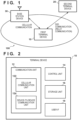
- FIG. 1 is a block diagram showing an example of the arrangement of a wireless communication system useful for understanding the present invention.
- a wireless communication system 100 includes a first terminal device 10, a second terminal device 20, and a base station device (E-UTRAN) 30.
- E-UTRAN base station device
- the present invention is not limited to this, and those skilled in the art can easily understand that the present invention can also be applied to communication by a wireless LAN system or short distance wireless communication such as infrared communication.
- the wireless communication system 100 includes the first terminal device 10 that is in a state in which wireless communication with the base station device 30 can be executed, the second terminal device 20 that is not in the state in which wireless communication with the base station device 30 can be executed, and the base station device 30 that controls D2D communication in which the first terminal device 10 and the second terminal device 20 directly perform wireless communication without an intervention of the base station device 30.
- the base station device 30 generates control information necessary for the first terminal device 10 to search for the second terminal device 20, and transmits the generated control information to the first terminal device 10.
- the first terminal device 10 receives the control information transmitted from the base station device 30, and searches for the second terminal device 20 in accordance with the control information.
- the second terminal device 20 responds to the control information received from the first terminal device 10. If a response from the second terminal device 20 is received during the waiting period, the first terminal device 10 executes D2D communication with the second terminal device 20.
- the first terminal device 10 is under the control of the base station device 30 and is in a state in which the terminal device can execute cellular communication with the base station device 30.
- the second terminal device 20 is not under the control of the base station device 30.
- the second terminal device 20 is not in a state in which the terminal device can execute cellular communication with the base station device 30, and therefore cannot be connected to the wireless network.
- this provides a method of searching for the second terminal device 20 as an out-of-area terminal that is not under the control of the base station device 30 using the first terminal device 10 that is under the control of the base station device 30 as a relay terminal.
- the first terminal device 10 will also be referred to as a relay terminal, the second terminal device 20 as an out-of-area terminal, and D2D communication between the first terminal device 10 and the second terminal device 20 as relay communication hereinafter for the descriptive convenience.
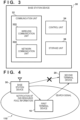
- Fig. 2 is a block diagram showing an example of the arrangement of a terminal device used as the first terminal device 10 and the second terminal device 20 shown in Fig. 1 .
- the terminal device includes a communication unit 12, a control unit 14, a storage unit 16, and a user interface (user IF) 18.
- user IF user interface
- the communication unit 12 includes a cellular communication unit 122 and a device-to-device communication unit 124.
- the cellular communication unit 122 performs wireless communication with the base station device 30.
- the device-to-device communication unit 124 directly communicates with a terminal device as the partner of D2D communication without an intervention of the base station device 30 using a radio resource for D2D communication assigned by the base station device. These communication processes may be done using a known modulation/demodulation technology or antenna technology.
- the storage unit 16 may store data transmitted from the base station device 30 or the terminal device as the partner of D2D communication, or may store data that is obtained via the user IF 18 and should be transmitted to the base station device 30 or the terminal device as the partner of D2D communication.
- the user IF 18 may include a screen interface, an input interface such as an operation button or a touch panel configured to receive an input from the user, and an image capturing means such as a camera.
- the control unit 14 is formed by, for example, a CPU and generally controls the units using information received from the cellular communication unit 122 or the device-to-device communication unit 124 or information stored in the storage unit 16.
- RRC_CONNECTED state a connected state in RRC (Radio Resource Control) for controlling the wireless network
- RRC_IDLE state an idle state
- the RRC_IDLE state represents a state in which radio resources are not managed by the base station device. In this state, only limited functions such as monitoring of a paging channel, reception of ETWS (Earthquake and Tsunami Warning System) information, measurement of radio quality of a peripheral cell, cell selection/reselection, and system information acquisition are active to minimize power consumption.
- ETWS Earthquake and Tsunami Warning System
- RRC_CONNECTED state represents a state in which radio resources are managed by the base station device, and the terminal device can transmit/receive data. Not only the processes in the RRC_IDLE state but also functions such as data transmission/reception and feedback of information such as CQI (Channel Quality Indicator) to the base station device can be executed.
- CQI Channel Quality Indicator
- a state transition from the RRC_IDLE state to the RRC_CONNECTED state occurs when a paging signal is received.
- the first terminal device 10 Based on, for example, reception of a paging signal, the first terminal device 10 receives, from the base station device 30, control information concerning an operation of searching for the out-of-area terminal.
- the control information includes, for example, a condition to transmit a search signal to search for the out-of-area terminal or a condition to wait for a search signal transmitted from the out-of-area terminal. More specifically, the control information can include an arbitrary combination of following pieces of information.
- the control unit 14 starts connection waiting for relay communication and performs transmission/waiting of a search signal using a resource designated by the control information. If a search signal transmission/waiting period and a search signal transmission/waiting duration are designated, transmission/waiting of a search signal can be performed periodically for a predetermined time. If a response to the search signal is received from the second terminal device 20 during the waiting period, the first terminal device 10 executes connection processing to execute D2D communication with the second terminal device 20. If the connection processing for relay communication by a D2D link with the found out-of-area terminal is completed, the control unit 14 performs a location registration procedure of the found out-of-area terminal to the base station device 30.
- the control unit 14 relays a broadcast message or control message from the base station device 30 to the out-of-area terminal of the partner of D2D communication. Accordingly, even the out-of-area terminal that is not in a state in which it can execute cellular communication with the base station device 30 can indirectly receive the broadcast message or control message from the base station device 30. If a control message including radio resource information to be used for D2D communication is indirectly received from the base station device 30 by the cellular communication unit 122, the control unit 14 executes D2D communication with the terminal device of the partner by the device-to-device communication unit 124 using the assigned radio resource.
- control unit 14 measures the radio quality of the downlink for each cell of the base station device 30 and base station devices on the periphery using a radio signal received by the cellular communication unit 122.
- RSRP Reference Signal Received Power
- RSRQ Reference Signal Received Quality
- the control unit 14 reports radio quality information including the identifier (ID) of each cell and measured radio quality to the base station device 30 by a measurement report as needed.
- the second terminal device 20 that is the out-of-area terminal can execute wireless communication with a second base station device capable of communicating with the first base station device 30 via a wired network while performing D2D communication to directly perform wireless communication without an intervention of the first base station device 30 with the relay terminal device in a state in which the terminal device can execute wireless communication with the first base station device 30.
- the wired network includes a public network such as the Internet as well as a logically defined connection channel such as an X2 interface or S1 interface.
- the communication unit 12 receives, from the second base station device, search information notified from the first base station device 30 to the second base station device to search for the relay terminal device 10.
- search information the communication unit 12 may receive search information including a search signal transmission period, a transmission time limit timer concerning the time limit of search signal transmission, radio resource information to be waited, and a waiting time limit timer concerning the time limit of waiting.
- the control unit 14 executes control to search for the relay terminal device 10 using the search information received by the communication unit 12.
- the control unit 14 may also control to transmit a search signal in accordance with the transmission period and the transmission time limit timer and control to receive a response signal for the search signal in accordance with the radio resource information and the waiting time limit timer.
- control unit 14 may control to transmit the search signal to the relay terminal device 10 only when one or both of a condition that D2D communication with the relay terminal device 10 is permitted in advance and a condition that an appropriate connection destination cell cannot be found are met.
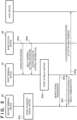
- Fig. 3 is a block diagram showing an example of the arrangement of the base station device 30 shown in Fig. 1 .
- the base station device 30 includes a communication unit 32, a control unit 34, and a storage unit 36.
- the communication unit 32 includes a wireless communication unit 322 and a network communication unit 324.
- the wireless communication unit 322 executes wireless cellular communication using a predetermined cellular method with a terminal device belonging to the communication area of the local station while the control unit 34 uses information stored in the storage unit 36.
- the network communication unit 324 executes inter-base station communication with another adjacent or second adjacent base station device via an X2 interface or the like, or performs communication with a host device via an S1 interface.
- the communication unit 32 also transmits control information generated by the control unit 34 to the first terminal device 10. This transmission may be done by a broadcast signal. In addition, the communication unit 32 may transmit control information including information about an access type to the first terminal device 10. The communication unit 32 may transmit the control information to terminal devices located in the adjacent cells/second adjacent cells to the cell of the base station device 30 in addition to all first terminal devices 10 located in the cell of the base station device 30. The communication unit 32 may transmit the control information when the signal quality of the communication link of D2D communication between the first terminal device 10 and the second terminal device 20 or the signal quality of the communication link between the first terminal device 10 and the base station device 30 is equal to or less than a predetermined threshold, or when D2D communication has abnormally ended. Alternatively, in response to a terminal change request from the first terminal device 10, the communication unit 32 may transmit the control information to a terminal device that should be a new relay terminal.
- control unit 34 In response to a D2D radio resource assignment request sent from a terminal device capable of executing D2D communication, the control unit 34 assigns some of radio resources of cellular communication as a D2D radio resource, and transmits a control message including information (D2D resource pool information) about the assigned D2D radio resource to the terminal device of the request source.
- information D2D resource pool information
- the control unit 34 also generates control information necessary for the first terminal device 10 to search for the second terminal device 20.
- control information information including transmission setting information used to transmit a search signal from the first terminal device 10 to the second terminal device 20 or waiting setting information used by the first terminal device 10 to wait for a search signal from the second terminal device 20 is included.
- the transmission setting information may include a search signal transmission period and a timer concerning a search signal transmission time limit.
- the waiting setting information may include radio resource information to be waited and a timer concerning a waiting time limit.
- the control unit 34 may set, as an access class (to be also referred to as an access class hereinafter), an access class to be given to a terminal device permitted to do an operation of searching for the second terminal device 20. Details of the access class will be described later.
- the control unit 34 also transmits, to a terminal device under the control of the local station, a paging signal to instruct the terminal device to search for an out-of-area terminal that is not under the control of the local station.
- the control unit 34 generates control information concerning the operation of searching for an out-of-area terminal, and notifies the terminal device of it individually or by broadcast.
- Example 1 a method of, by a base station device, causing a relay terminal to transmit a search signal used to search for an out-of-area terminal to search for the out-of-area terminal that can perform D2D communication with the relay terminal and newly unexpectedly appears in a state unpredictable by the base station device will be described.
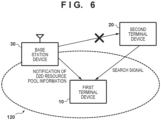
- Fig. 4 is a block diagram showing an example of the arrangement of a first wireless communication system 110 according to Example 1.
- a base station device 30 cannot directly know the presence of a second terminal device 20 that is not under the control of the local station.
- the second terminal device 20 that is not under the control of the base station device 30 cannot know D2D resource pool information of a first terminal device 10 that is under the control of the base station device 30.
- the first terminal device 10 which should serve as a relay terminal when the second terminal device 20 suddenly appears as a new out-of-area terminal, is explicitly instructed to search for the out-of-area terminal (paging processing) and simultaneously notified, individually or by broadcast, of control information concerning search signal transmission for the search of the out-of-area terminal.
- the base station device 30 may notify a period to execute the search of the out-of-area terminal and a search execution time, instead of explicitly instructing to search for the out-of-area terminal.
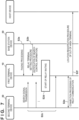
- Fig. 5 is a sequence chart showing the operation of the wireless communication system according to Example 1. Note that details of paging processing of step S1a and the processing of the out-of-area terminal in the second terminal device 20 in Fig. 5 will be described later. This also applies to operation sequences according to other examples to be described later.
- the first terminal device 10 capable of operating as a relay terminal receives control information from the base station device 30 and performs a relay terminal setting procedure for execution of relay communication in the terminal (step S1b).
- the control information from the base station device 30 can include an arbitrary combination of following information.
- an absolute position may be designated explicitly by a frequency offset value, a frequency index, and a time direction index, or a pattern of a resource in the time-frequency direction may be designated.
- the second terminal device 20 out of the communication area starts waiting for a search signal from the relay terminal (step S1c).
- the first terminal device 10 starts relay waiting in accordance with the received control information (step S1d), and periodically transmits a search signal to the out-of-area terminal (step S1e).
- the second terminal device 20 Upon receiving the search signal, transmits a response to the search signal to the first terminal device 10 and performs connection processing of relay communication by D2D (step S1f). If connection of relay communication is completed, the first terminal device 10 performs a location registration procedure of the second terminal device 20 to the host device (step S1g).
- the base station device 30 instructs the relay terminal to transmit the search signal, thereby efficiently connecting the newly appearing out-of-area terminal to the wireless network via the relay terminal.
- this can be implemented with low power and a little delay by periodically transmitting the search signal.
- Example 2 a method of, by a base station device, causing a relay terminal to wait for a search signal transmitted from an out-of-area terminal to search for the out-of-area terminal that newly appears will be described.
- Fig. 6 is a block diagram showing an example of the arrangement of a second wireless communication system 120 according to Example 2.
- a base station device 30 cannot directly know the presence of a second terminal device 20 that is not under the control of the local station.
- the second terminal device 20 that is not under the control of the base station device 30 cannot know D2D resource pool information of a first terminal device 10 that is under the control of the base station device 30.
- the second terminal device 20, which should serve as a relay terminal when the second terminal device 20 appears as a new out-of-area terminal is explicitly instructed to search for the out-of-area terminal (paging processing) and simultaneously notified, individually or by broadcast, of control information concerning an operation of waiting for a search signal from the out-of-area terminal.
- the base station device 30 may notify a period to execute the search of the out-of-area terminal and a search execution time, instead of explicitly instructing to search for the out-of-area terminal.
- Fig. 7 is a sequence chart showing the operation of the wireless communication system according to Example 2. Note that details of paging processing of step S2a and the processing of the out-of-area terminal in the second terminal device 20 will be described later, as in Example 1.
- the first terminal device 10 capable of operating as a relay terminal receives a paging signal from the base station device 30 (step S2a). Based on the reception of the paging signal, the first terminal device 10 receives control information from the base station device 30 and performs a relay terminal setting procedure for execution of relay communication in the terminal (step S2b).
- the control information from the base station device 30 can include, for example, an arbitrary combination of following information.
- an absolute position may be designated explicitly by a frequency offset value, a frequency index, and a time direction index, or a pattern of a resource in the time-frequency direction may be designated.
- the second terminal device 20 out of the communication area transmits a search signal periodically for a predetermined time (step S2c).
- the first terminal device 10 starts relay waiting in accordance with the received control information (step S2d), and waits for the search signal from the out-of-area terminal for a predetermined time.
- the first terminal device 10 Upon receiving the search signal, the first terminal device 10 performs connection processing of relay communication by D2D with respect to the first terminal device 20 (step S2e). If connection of relay communication is completed, the first terminal device 10 performs a location registration procedure of the second terminal device 20 to the host device (step S2f) .
- the base station device instructs the relay terminal to wait for the search signal, thereby efficiently connecting the newly appearing out-of-area terminal to the wireless network via the relay terminal.
- this can be implemented with low power and a little delay by periodically waiting for the search signal.
- Example 3 a state is assumed in which during execution of relay communication as described in Examples 1 and 2, an out-of-area terminal that is executing the relay communication moves, and the relay communication with a relay terminal is interrupted.
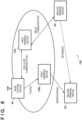
- Fig. 8 is a block diagram showing an example of the arrangement of a third wireless communication system 130 according to Example 3.
- a second terminal device 20 is in a state in which it can be connected to a wireless network via a first terminal device 10A operating as a relay terminal, and along with the movement of the second terminal device 20 (to the first terminal device 10A), relay communication with the first terminal device 10A is disconnected. At this time, a new relay terminal needs to be set for the second terminal device 20.
- the base station device 30 Upon detecting, based on a quality report from the relay terminal, disconnection of the relay communication between the second terminal device 20 and the first terminal device 10A or disconnection of cellular communication between the first terminal device 10A and a base station device 30, the base station device 30 starts a connection procedure between the second terminal device 20 as the out-of-area terminal and a first terminal device 10B capable of operating as a new relay terminal.
- the base station device 30 can determine disconnection of relay communication based on following three conditions or an arbitrary combination thereof.
- an RSRQ or RSRP value can be used.
- the base station device 30 can determine disconnection of the other relay communications as well.
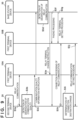
- Fig. 9 shows an operation example in a case in which the base station device issues a relay terminal change instruction. Note that details of paging processing of step S3f and the processing of the out-of-area terminal in the second terminal device 20 will be described later as other examples in the last of the specification.
- the second terminal device 20 serving as an out-of-area terminal is performing relay communication by D2D with the first terminal device 10A operating as a relay terminal (step S3a).
- the second terminal device 20 upon detecting that the communication quality of the relay communication is equal to or less than a predetermined threshold (detection of degradation) (step S3b), the second terminal device 20 notifies the base station device 30 of communication quality information via the first terminal device 10A (step S3c).
- the base station device 30 Upon detecting the degradation of the relay communication by the communication quality information (step S3d), the base station device 30 transmits a relay terminal change instruction to the second terminal device 20 via the first terminal device 10A (step S3e).
- the base station device 30 performs paging processing for the first terminal device 10B that is a terminal under the control of the base station and can operate as a relay terminal (step S3f), and notifies the first terminal device 10B of control information concerning an operation of searching for an out-of-area terminal as a relay terminal setting procedure (step S3g), as described in Example 1 or 2. Based on this notification, the first terminal device 10B performs transmission or waiting processing of a search signal (step S3h), as described in Example 1 or 2. If determining that the relay communication connection destination should be changed to the first terminal device 10B (step S3i), the second terminal device 20 performs a relay communication setting procedure for the first terminal device 10B as a new relay terminal (step S3j).
- the new relay terminal a terminal capable of performing D2D communication with the out-of-area terminal and also capable of performing cellular communication with the base station device 30 is selected.
- the terminal may be selected from a relay terminal candidate list successively updated in the base station device 30 based on quality reports periodically transmitted from terminal devices under the control or from a list of changeable terminal device candidates received from the out-of-area terminal.
- Example 3 even in a case in which communication of the out-of-area terminal that is performing relay communication is interrupted, if the base station device sets a new relay terminal, the out-of-area terminal can continuously be connected to the wireless network.
- Example 4 a case is assumed in which during execution of relay communication as described in Examples 1 and 2, an out-of-area terminal that is executing the relay communication moves, and the communication is interrupted, as in Example 3.
- Example 4 is different from Example 3 in that a relay terminal determines switching of the relay terminal and transmits a relay terminal change request to a base station device. Hence, a description of the same points as in Example 3 will be omitted, and different points will be explained.
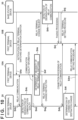
- Fig. 10 shows an operation example in a case in which a relay terminal change request is transmitted to a base station device. Note that details of paging processing of step S4i and the processing of the out-of-area terminal in a second terminal device 20 will be described later, as in Example 1 and the like.
- a first terminal device 10A capable of operating as a relay terminal is notified of a relay terminal switching determination condition in advance (step S4a).
- the switching determination condition can be, for example, one of the conditions (1) to (3) described in Example 3 or a condition decided by an arbitrary combination of the conditions. Note that in a case in which the first terminal device 10A serving as a relay terminal provides relay communication to a plurality of out-of-area terminals, if the switching determination condition is met for one relay communication, disconnection of the other relay communications can also be determined.
- the second terminal device 20 serving as an out-of-area terminal is performing relay communication by D2D with the first terminal device 10A operating as a relay terminal (step S4b).
- the second terminal device 20 upon detecting that the communication quality of the relay communication is equal to or less than a predetermined threshold (step S4c), the second terminal device 20 notifies the first terminal device 10A of communication quality information (step S4d).
- the first terminal device 10A determines the necessity of relay terminal switching based on the communication quality information and the relay terminal switching determination condition notified in step S2a (step S4e).
- the first terminal device 10A Upon determining in step S2e that relay terminal switching is necessary, the first terminal device 10A transmits a relay terminal change request to a base station device 30 (step S4f) and also transmits a relay terminal change instruction to the second terminal device 30 (step S4g).
- the base station device 30 Upon detecting the degradation of the relay communication by the relay terminal change request from the first terminal device 10A (step S4h), the base station device 30 performs paging processing for a first terminal device 10B that is a terminal under the control of the base station and can operate as a relay terminal (step S4i), and notifies the first terminal device 10B of control information concerning an operation of searching for an out-of-area terminal as a relay terminal setting procedure (step S2j), as described in Example 1 or 2. Based on this notification, the first terminal device 10B performs transmission or waiting processing of a search signal (step S4k), as described in Example 1 or 2. If determining that the relay communication connection destination should be changed to the first terminal device 10B (step S41), the second terminal device 20 performs a relay communication setting procedure for the first terminal device 10B as a new relay terminal (step S4m).
- Example 4 even in a case in which communication of the out-of-area terminal that is performing relay communication is interrupted, if the base station device sets a new relay terminal in response to the change request from the relay terminal, the out-of-area terminal can continuously be connected to the wireless network.
- Paging processing performed by the base station device 30 for the relay terminal in each of the above-described examples can be A-1 to A-3 to be described below depending on the state of the relay terminal.
- the base station device 30 executes the relay terminal setting procedure for the relay terminal without executing the paging processing of step S1a.
- the first terminal device 10 On the side of the base station device 30 or host device, it is determined whether the first terminal device 10 can operate as a relay terminal. If the first terminal device can be the target, it is individually called. As for the selection criterion of the relay terminal to execute paging, paging is performed for a terminal whose RSRQ or RSRP value notified by a measurement report from the terminal is equal to or less than a predetermined threshold. Alternatively, paging is performed for a specific terminal set as a relay terminal in advance.
- the base station device 30 executes broadcast type paging for terminals in the RRC_idle state located within a predetermined range.
- the access class in the paging signal is set to a value different from that for a normal consumer.
- this different value is set as the access class in advance.
- the terminal device can determine by itself whether it should operate as a relay terminal by confirming the access class in the paging signal. That is, even by the broadcast type paging, the paging instruction can reliably be issued to a terminal device that can be a relay terminal device.
- the range of paging target terminals is selected from the cell, the cell and an adjacent cell or second adjacent cell to the cell, and the entire system. If connection of the out-of-area terminal to the relay terminal cannot be confirmed, another range may be selected, and paging may be executed again.
- Fig. 11 is a block diagram showing an example of the arrangement of a fourth wireless communication system 140 in a case in which a base station device 40 of LTE exists as a different frequency band network.
- the base station device 30 can communicate with the adjacent or second adjacent base station device 40 via an X2 interface or S1 interface.
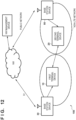
- Fig. 12 is a block diagram showing an example of the arrangement of a fifth wireless communication system 150 in a case in which a base station device 50 that forms a non-LTE network such as Wi-Fi ® or Wimax ® exists as a different frequency band network.
- the base station device 30 can communicate with the base station device 50 via an S1 interface and a public network.
- the second terminal device 20 that is not under the control of the base station device 30 receives control information concerning search signal transmission or waiting, which is transmitted from the base station device 30, via the base station device 40 or base station device 50 in the different frequency band, performs search signal transmission or waiting in accordance with the received control information to search for a relay terminal, and after the search, starts D2D communication.
- the control information is the same as that described in Example 1 or 2.
- the control information may be managed for each base station device or each terminal device by a host device such as a network management device, and may be notified from the host device or the base station device 30 to the base station device 50 in advance.
- the out-of-area terminal receives control information concerning search signal transmission or waiting from the base station device 30 via a relay terminal that is performing relay communication at a timing when the conditions (1) to (3) described in Example 3 or the like are met, and executes search signal transmission or waiting based on the control information.
- the notified control information is the same as that described in Example 1 or 2.
- the out-of-area terminal may transmit or wait for the search signal for a predetermined period in a case in which, for example, a Public Safety capable bit or the like sets that the out-of-area terminal is a terminal permitted in advance to perform D2D communication, and the state in RRC_idle is an Any_Cell_Selection state (a state in which an appropriate connation destination cell is not found) and continues for a predetermined time.
- the search signal transmission/waiting frequency band and resource position are determined in advance.
Landscapes
- Engineering & Computer Science (AREA)
- Computer Networks & Wireless Communication (AREA)
- Signal Processing (AREA)
- Databases & Information Systems (AREA)
- Mobile Radio Communication Systems (AREA)
Claims (1)
- Eine Endgerätvorrichtung (20) zum Durchführen einer Endgerät-zu-Endgerät-Kommunikation, bei der eine drahtlose Kommunikation mit einer Relaisendgerätvorrichtung (10), die sich in einem Zustand befindet, bei dem eine drahtlose Kommunikation mit einer ersten Basisstationsvorrichtung (30) ausgeführt, direkt ohne einen Eingriff der ersten Basisstationsvorrichtung (30) durchgeführt wird, und die konfiguriert ist, um eine drahtlose Kommunikation mit einer zweiten Basisstationsvorrichtung (40; 50) auszuführen, die fähig ist, mit der ersten Basisstationsvorrichtung (30) zu kommunizieren, wobei die Endgerätvorrichtung (20) dadurch gekennzeichnet ist, dass sie Folgendes beinhaltet:ein Kommunikationsmittel (12) zum Empfangen, von der zweiten Basisstationsvorrichtung (40; 50), von Suchinformationen, die von der ersten Basisstationsvorrichtung (30) an die zweite Basisstationsvorrichtung mitgeteilt (40; 50) werden, um nach der Relaisendgerätvorrichtung (10) zu suchen; undein Steuerungsmittel (14) zum Ausführen einer Steuerung, um nach der Relaisendgerätvorrichtung (10) zu suchen, unter Verwendung der von dem Kommunikationsmittel (12) empfangenen Suchinformationen;wobei das Kommunikationsmittel (12) konfiguriert ist, um, als die Suchinformationen, Suchinformationen zu empfangen, die eine Suchsignalübertragungsperiode und eine Funkressource, die verwendet wird, um auf ein Reaktionssignal zu warten, umfassen;wobei, falls sich die zweite Basisstationsvorrichtung (40; 50) in einem Zustand befindet, bei dem eine Kommunikation mit der ersten Basisstationsvorrichtung (30) nicht ausgeführt werden kann,das Steuerungsmittel (14) konfiguriert ist, um ein Suchsignal nur an die Relaisendgerätvorrichtung (10) zu übertragen, wenn eine oder beide von einer Bedingung, dass die Endgerät-zu-Endgerät-Kommunikation mit der Relaisendgerätvorrichtung (10) vorab gestattet ist, und einer Bedingung, dass eine passende Verbindungszielzelle nicht existiert, erfüllt wird/werden.
Applications Claiming Priority (4)
| Application Number | Priority Date | Filing Date | Title |
|---|---|---|---|
| JP2014232178A JP6539439B2 (ja) | 2014-11-14 | 2014-11-14 | 無線制御装置、端末装置および通信方法 |
| PCT/JP2015/081861 WO2016076395A1 (ja) | 2014-11-14 | 2015-11-12 | 無線制御装置、端末装置および通信方法 |
| EP15859943.1A EP3220672B1 (de) | 2014-11-14 | 2015-11-12 | Funksteuerungsvorrichtung, endgerätevorrichtung und kommunikationsverfahren |
| EP19153839.6A EP3496434B1 (de) | 2014-11-14 | 2015-11-12 | Terminal-zu-terminal kommunikation |
Related Parent Applications (3)
| Application Number | Title | Priority Date | Filing Date |
|---|---|---|---|
| EP15859943.1A Division EP3220672B1 (de) | 2014-11-14 | 2015-11-12 | Funksteuerungsvorrichtung, endgerätevorrichtung und kommunikationsverfahren |
| EP19153839.6A Division-Into EP3496434B1 (de) | 2014-11-14 | 2015-11-12 | Terminal-zu-terminal kommunikation |
| EP19153839.6A Division EP3496434B1 (de) | 2014-11-14 | 2015-11-12 | Terminal-zu-terminal kommunikation |
Publications (2)
| Publication Number | Publication Date |
|---|---|
| EP3745751A1 EP3745751A1 (de) | 2020-12-02 |
| EP3745751B1 true EP3745751B1 (de) | 2023-11-01 |
Family
ID=55954472
Family Applications (3)
| Application Number | Title | Priority Date | Filing Date |
|---|---|---|---|
| EP15859943.1A Active EP3220672B1 (de) | 2014-11-14 | 2015-11-12 | Funksteuerungsvorrichtung, endgerätevorrichtung und kommunikationsverfahren |
| EP20185256.3A Active EP3745751B1 (de) | 2014-11-14 | 2015-11-12 | Endgerät-zu-endgerät kommunikation unter einbeziehung eines relay-endgeräts |
| EP19153839.6A Active EP3496434B1 (de) | 2014-11-14 | 2015-11-12 | Terminal-zu-terminal kommunikation |
Family Applications Before (1)
| Application Number | Title | Priority Date | Filing Date |
|---|---|---|---|
| EP15859943.1A Active EP3220672B1 (de) | 2014-11-14 | 2015-11-12 | Funksteuerungsvorrichtung, endgerätevorrichtung und kommunikationsverfahren |
Family Applications After (1)
| Application Number | Title | Priority Date | Filing Date |
|---|---|---|---|
| EP19153839.6A Active EP3496434B1 (de) | 2014-11-14 | 2015-11-12 | Terminal-zu-terminal kommunikation |
Country Status (5)
| Country | Link |
|---|---|
| US (1) | US10531446B2 (de) |
| EP (3) | EP3220672B1 (de) |
| JP (1) | JP6539439B2 (de) |
| CN (1) | CN107113587B (de) |
| WO (1) | WO2016076395A1 (de) |
Families Citing this family (16)
| Publication number | Priority date | Publication date | Assignee | Title |
|---|---|---|---|---|
| CN105744625A (zh) | 2014-12-12 | 2016-07-06 | 索尼公司 | 用于无线通信的装置和方法 |
| JP6726628B2 (ja) * | 2017-01-24 | 2020-07-22 | 株式会社Kddi総合研究所 | 制御装置、通信装置、制御方法、及びプログラム |
| CN108347772A (zh) * | 2017-01-25 | 2018-07-31 | 华为技术有限公司 | 资源分配方法及装置 |
| WO2018170858A1 (zh) | 2017-03-23 | 2018-09-27 | Oppo广东移动通信有限公司 | 寻呼方法和寻呼装置 |
| US20190320358A1 (en) * | 2018-04-17 | 2019-10-17 | Qualcomm Incorporated | User equipment power optimization in millimeter wave access networks |
| WO2019209784A1 (en) * | 2018-04-23 | 2019-10-31 | Kyocera Corporation | Method of determining number of repetitions for multiuser broadcast in iot deployments |
| JP7105132B2 (ja) * | 2018-08-06 | 2022-07-22 | Kddi株式会社 | レガシーシステムとの共存を実行するための通信装置、通信方法、及びプログラム |
| WO2020030124A1 (en) * | 2018-08-10 | 2020-02-13 | FG Innovation Company Limited | Method and apparatus for rrc state transition |
| JP7214074B2 (ja) * | 2018-10-18 | 2023-01-30 | トヨタ自動車株式会社 | 移動体 |
| CN110264063A (zh) * | 2019-06-20 | 2019-09-20 | 北京凌壹世纪科技有限公司 | 一体化实战指挥方法及系统 |
| CN111148282A (zh) * | 2019-12-31 | 2020-05-12 | 成都车晓科技有限公司 | 一种机动车辆的智能化资产管理方法及系统 |
| CN118175565A (zh) * | 2019-12-31 | 2024-06-11 | 华为技术有限公司 | 通信方法及装置 |
| CN111727653A (zh) * | 2020-05-15 | 2020-09-29 | 北京小米移动软件有限公司 | 转移业务的方法、装置、通信设备及存储介质 |
| CN112135292B (zh) * | 2020-09-24 | 2023-06-27 | 维沃移动通信有限公司 | 信号获取方法、装置、电子设备和存储介质 |
| JP2023553127A (ja) * | 2020-12-10 | 2023-12-20 | 華為技術有限公司 | 通信方法および装置 |
| EP4271044B1 (de) * | 2021-02-25 | 2025-09-24 | Honda Motor Co., Ltd. | Kommunikationsvorrichtung, basisstation, steuerungsverfahren und programm |
Family Cites Families (10)
| Publication number | Priority date | Publication date | Assignee | Title |
|---|---|---|---|---|
| WO2012068731A1 (en) * | 2010-11-25 | 2012-05-31 | Nokia Corporation | Network assisted sensing on a shared band for local communications |
| JP5702246B2 (ja) * | 2011-07-27 | 2015-04-15 | 京セラ株式会社 | 無線通信システムおよび通信制御方法 |
| AU2012376802A1 (en) * | 2012-04-11 | 2014-10-02 | Intel Corporation | Operator-assisted device-to-device (D2D) discovery |
| CN103582069B (zh) * | 2012-07-26 | 2019-04-05 | 中兴通讯股份有限公司 | 设备到设备d2d设备的发现方法及装置 |
| CN103686691B (zh) | 2012-09-18 | 2018-01-05 | 电信科学技术研究院 | 信号及配置信息发送和终端发现方法与设备 |
| EP2925067B1 (de) | 2012-12-31 | 2018-02-28 | Huawei Technologies Co., Ltd. | Vorrichtung-zu-vorrichtung-kommunikationsverfahren und -system |
| US9313607B2 (en) * | 2013-01-18 | 2016-04-12 | Telefonaktiebolaget L M Ericsson (Publ) | Network-assisted UE detection in direct mode UE-to-UE communication |
| EP2785092B1 (de) * | 2013-03-28 | 2015-09-23 | Fujitsu Limited | Drahtloses Kommunikationssystem |
| EP2790456B1 (de) * | 2013-04-10 | 2015-10-21 | Fujitsu Limited | D2D-Kommunikation in drahtlosen Netzen |
| JP2014232178A (ja) | 2013-05-28 | 2014-12-11 | 株式会社ジャパンディスプレイ | 表示装置 |
-
2014
- 2014-11-14 JP JP2014232178A patent/JP6539439B2/ja active Active
-
2015
- 2015-11-12 EP EP15859943.1A patent/EP3220672B1/de active Active
- 2015-11-12 WO PCT/JP2015/081861 patent/WO2016076395A1/ja not_active Ceased
- 2015-11-12 EP EP20185256.3A patent/EP3745751B1/de active Active
- 2015-11-12 CN CN201580061708.0A patent/CN107113587B/zh active Active
- 2015-11-12 EP EP19153839.6A patent/EP3496434B1/de active Active
-
2017
- 2017-05-11 US US15/592,900 patent/US10531446B2/en active Active
Also Published As
| Publication number | Publication date |
|---|---|
| US10531446B2 (en) | 2020-01-07 |
| JP6539439B2 (ja) | 2019-07-03 |
| EP3220672B1 (de) | 2019-03-06 |
| US20170245254A1 (en) | 2017-08-24 |
| EP3496434B1 (de) | 2020-09-09 |
| EP3220672A4 (de) | 2017-11-01 |
| CN107113587A (zh) | 2017-08-29 |
| EP3496434A1 (de) | 2019-06-12 |
| CN107113587B (zh) | 2020-09-11 |
| JP2016096480A (ja) | 2016-05-26 |
| EP3745751A1 (de) | 2020-12-02 |
| EP3220672A1 (de) | 2017-09-20 |
| WO2016076395A1 (ja) | 2016-05-19 |
Similar Documents
| Publication | Publication Date | Title |
|---|---|---|
| EP3745751B1 (de) | Endgerät-zu-endgerät kommunikation unter einbeziehung eines relay-endgeräts | |
| US10004104B2 (en) | Mobile communication system, base station, user terminal, and processor | |
| EP3562227B1 (de) | Ran paging eines teilnehmergeräts in leichtem verbindungszustand | |
| CN103384382B (zh) | 无线链路管理的方法、用户设备和基站 | |
| US10555353B2 (en) | Radio control device, terminal device, and communication method | |
| US9560687B2 (en) | Network nodes, a user equipment and methods therein for enabling D2D communication | |
| WO2021230595A1 (ko) | 무선 통신 시스템에서 mbs 서비스 연속성을 위한 bwp 설정 방법 및 장치 | |
| CN107592649B (zh) | 一种邻区关系建立方法、装置、基站及终端 | |
| WO2015059899A1 (ja) | 基地局装置、通信装置、制御方法及びプログラム | |
| US9998902B2 (en) | Mobile communication system, user terminal, base station, and processor transmitting a discovery-use signal | |
| EP3840251A1 (de) | Verfahren und vorrichtung zur verarbeitung von staatlichen informationen im kommunikationssystem | |
| US10382570B2 (en) | Base station and user terminal | |
| US9668202B2 (en) | Communication control method, user terminal, and processor | |
| WO2014023254A1 (zh) | 切换或承载分离的判决及测量上报方法和设备 | |
| WO2015170476A1 (ja) | 基地局装置、制御方法及びプログラム | |
| CN117099421A (zh) | 用户设备、基站以及通信控制方法 | |
| JP6762403B2 (ja) | 端末装置、方法、及びプログラム | |
| US20130244674A1 (en) | Mobile terminal, radio base station, control method for a mobile terminal and method for a radio base station | |
| JP2016072856A (ja) | 基地局装置、端末装置、通信方法、および通信システム |
Legal Events
| Date | Code | Title | Description |
|---|---|---|---|
| PUAI | Public reference made under article 153(3) epc to a published international application that has entered the european phase |
Free format text: ORIGINAL CODE: 0009012 |
|
| STAA | Information on the status of an ep patent application or granted ep patent |
Free format text: STATUS: REQUEST FOR EXAMINATION WAS MADE |
|
| 17P | Request for examination filed |
Effective date: 20200710 |
|
| AC | Divisional application: reference to earlier application |
Ref document number: 3220672 Country of ref document: EP Kind code of ref document: P Ref document number: 3496434 Country of ref document: EP Kind code of ref document: P |
|
| AK | Designated contracting states |
Kind code of ref document: A1 Designated state(s): AL AT BE BG CH CY CZ DE DK EE ES FI FR GB GR HR HU IE IS IT LI LT LU LV MC MK MT NL NO PL PT RO RS SE SI SK SM TR |
|
| RBV | Designated contracting states (corrected) |
Designated state(s): AL AT BE BG CH CY CZ DE DK EE ES FI FR GB GR HR HU IE IS IT LI LT LU LV MC MK MT NL NO PL PT RO RS SE SI SK SM TR |
|
| STAA | Information on the status of an ep patent application or granted ep patent |
Free format text: STATUS: EXAMINATION IS IN PROGRESS |
|
| 17Q | First examination report despatched |
Effective date: 20211029 |
|
| RIC1 | Information provided on ipc code assigned before grant |
Ipc: H04W 92/18 20090101ALN20230331BHEP Ipc: H04W 40/34 20090101ALN20230331BHEP Ipc: H04W 88/04 20090101ALI20230331BHEP Ipc: H04W 76/14 20180101ALI20230331BHEP Ipc: H04W 72/04 20090101ALI20230331BHEP Ipc: H04W 8/00 20090101AFI20230331BHEP |
|
| GRAP | Despatch of communication of intention to grant a patent |
Free format text: ORIGINAL CODE: EPIDOSNIGR1 |
|
| STAA | Information on the status of an ep patent application or granted ep patent |
Free format text: STATUS: GRANT OF PATENT IS INTENDED |
|
| RIC1 | Information provided on ipc code assigned before grant |
Ipc: H04W 92/18 20090101ALN20230414BHEP Ipc: H04W 40/34 20090101ALN20230414BHEP Ipc: H04W 88/04 20090101ALI20230414BHEP Ipc: H04W 76/14 20180101ALI20230414BHEP Ipc: H04W 72/04 20090101ALI20230414BHEP Ipc: H04W 8/00 20090101AFI20230414BHEP |
|
| INTG | Intention to grant announced |
Effective date: 20230516 |
|
| GRAS | Grant fee paid |
Free format text: ORIGINAL CODE: EPIDOSNIGR3 |
|
| GRAA | (expected) grant |
Free format text: ORIGINAL CODE: 0009210 |
|
| STAA | Information on the status of an ep patent application or granted ep patent |
Free format text: STATUS: THE PATENT HAS BEEN GRANTED |
|
| AC | Divisional application: reference to earlier application |
Ref document number: 3220672 Country of ref document: EP Kind code of ref document: P Ref document number: 3496434 Country of ref document: EP Kind code of ref document: P |
|
| AK | Designated contracting states |
Kind code of ref document: B1 Designated state(s): AL AT BE BG CH CY CZ DE DK EE ES FI FR GB GR HR HU IE IS IT LI LT LU LV MC MK MT NL NO PL PT RO RS SE SI SK SM TR |
|
| REG | Reference to a national code |
Ref country code: GB Ref legal event code: FG4D |
|
| REG | Reference to a national code |
Ref country code: CH Ref legal event code: EP |
|
| REG | Reference to a national code |
Ref country code: IE Ref legal event code: FG4D |
|
| REG | Reference to a national code |
Ref country code: DE Ref legal event code: R096 Ref document number: 602015086432 Country of ref document: DE |
|
| REG | Reference to a national code |
Ref country code: LT Ref legal event code: MG9D |
|
| REG | Reference to a national code |
Ref country code: NL Ref legal event code: MP Effective date: 20231101 |
|
| PG25 | Lapsed in a contracting state [announced via postgrant information from national office to epo] |
Ref country code: GR Free format text: LAPSE BECAUSE OF FAILURE TO SUBMIT A TRANSLATION OF THE DESCRIPTION OR TO PAY THE FEE WITHIN THE PRESCRIBED TIME-LIMIT Effective date: 20240202 |
|
| PG25 | Lapsed in a contracting state [announced via postgrant information from national office to epo] |
Ref country code: IS Free format text: LAPSE BECAUSE OF FAILURE TO SUBMIT A TRANSLATION OF THE DESCRIPTION OR TO PAY THE FEE WITHIN THE PRESCRIBED TIME-LIMIT Effective date: 20240301 |
|
| PG25 | Lapsed in a contracting state [announced via postgrant information from national office to epo] |
Ref country code: LT Free format text: LAPSE BECAUSE OF FAILURE TO SUBMIT A TRANSLATION OF THE DESCRIPTION OR TO PAY THE FEE WITHIN THE PRESCRIBED TIME-LIMIT Effective date: 20231101 |
|
| REG | Reference to a national code |
Ref country code: AT Ref legal event code: MK05 Ref document number: 1628623 Country of ref document: AT Kind code of ref document: T Effective date: 20231101 |
|
| PG25 | Lapsed in a contracting state [announced via postgrant information from national office to epo] |
Ref country code: NL Free format text: LAPSE BECAUSE OF FAILURE TO SUBMIT A TRANSLATION OF THE DESCRIPTION OR TO PAY THE FEE WITHIN THE PRESCRIBED TIME-LIMIT Effective date: 20231101 |
|
| PG25 | Lapsed in a contracting state [announced via postgrant information from national office to epo] |
Ref country code: AT Free format text: LAPSE BECAUSE OF FAILURE TO SUBMIT A TRANSLATION OF THE DESCRIPTION OR TO PAY THE FEE WITHIN THE PRESCRIBED TIME-LIMIT Effective date: 20231101 |
|
| PG25 | Lapsed in a contracting state [announced via postgrant information from national office to epo] |
Ref country code: ES Free format text: LAPSE BECAUSE OF FAILURE TO SUBMIT A TRANSLATION OF THE DESCRIPTION OR TO PAY THE FEE WITHIN THE PRESCRIBED TIME-LIMIT Effective date: 20231101 |
|
| PG25 | Lapsed in a contracting state [announced via postgrant information from national office to epo] |
Ref country code: NL Free format text: LAPSE BECAUSE OF FAILURE TO SUBMIT A TRANSLATION OF THE DESCRIPTION OR TO PAY THE FEE WITHIN THE PRESCRIBED TIME-LIMIT Effective date: 20231101 Ref country code: LT Free format text: LAPSE BECAUSE OF FAILURE TO SUBMIT A TRANSLATION OF THE DESCRIPTION OR TO PAY THE FEE WITHIN THE PRESCRIBED TIME-LIMIT Effective date: 20231101 Ref country code: IS Free format text: LAPSE BECAUSE OF FAILURE TO SUBMIT A TRANSLATION OF THE DESCRIPTION OR TO PAY THE FEE WITHIN THE PRESCRIBED TIME-LIMIT Effective date: 20240301 Ref country code: GR Free format text: LAPSE BECAUSE OF FAILURE TO SUBMIT A TRANSLATION OF THE DESCRIPTION OR TO PAY THE FEE WITHIN THE PRESCRIBED TIME-LIMIT Effective date: 20240202 Ref country code: ES Free format text: LAPSE BECAUSE OF FAILURE TO SUBMIT A TRANSLATION OF THE DESCRIPTION OR TO PAY THE FEE WITHIN THE PRESCRIBED TIME-LIMIT Effective date: 20231101 Ref country code: BG Free format text: LAPSE BECAUSE OF FAILURE TO SUBMIT A TRANSLATION OF THE DESCRIPTION OR TO PAY THE FEE WITHIN THE PRESCRIBED TIME-LIMIT Effective date: 20240201 Ref country code: AT Free format text: LAPSE BECAUSE OF FAILURE TO SUBMIT A TRANSLATION OF THE DESCRIPTION OR TO PAY THE FEE WITHIN THE PRESCRIBED TIME-LIMIT Effective date: 20231101 Ref country code: PT Free format text: LAPSE BECAUSE OF FAILURE TO SUBMIT A TRANSLATION OF THE DESCRIPTION OR TO PAY THE FEE WITHIN THE PRESCRIBED TIME-LIMIT Effective date: 20240301 |
|
| PG25 | Lapsed in a contracting state [announced via postgrant information from national office to epo] |
Ref country code: SE Free format text: LAPSE BECAUSE OF FAILURE TO SUBMIT A TRANSLATION OF THE DESCRIPTION OR TO PAY THE FEE WITHIN THE PRESCRIBED TIME-LIMIT Effective date: 20231101 Ref country code: RS Free format text: LAPSE BECAUSE OF FAILURE TO SUBMIT A TRANSLATION OF THE DESCRIPTION OR TO PAY THE FEE WITHIN THE PRESCRIBED TIME-LIMIT Effective date: 20231101 Ref country code: PL Free format text: LAPSE BECAUSE OF FAILURE TO SUBMIT A TRANSLATION OF THE DESCRIPTION OR TO PAY THE FEE WITHIN THE PRESCRIBED TIME-LIMIT Effective date: 20231101 Ref country code: NO Free format text: LAPSE BECAUSE OF FAILURE TO SUBMIT A TRANSLATION OF THE DESCRIPTION OR TO PAY THE FEE WITHIN THE PRESCRIBED TIME-LIMIT Effective date: 20240201 Ref country code: LV Free format text: LAPSE BECAUSE OF FAILURE TO SUBMIT A TRANSLATION OF THE DESCRIPTION OR TO PAY THE FEE WITHIN THE PRESCRIBED TIME-LIMIT Effective date: 20231101 Ref country code: HR Free format text: LAPSE BECAUSE OF FAILURE TO SUBMIT A TRANSLATION OF THE DESCRIPTION OR TO PAY THE FEE WITHIN THE PRESCRIBED TIME-LIMIT Effective date: 20231101 |
|
| REG | Reference to a national code |
Ref country code: CH Ref legal event code: PL |
|
| PG25 | Lapsed in a contracting state [announced via postgrant information from national office to epo] |
Ref country code: DK Free format text: LAPSE BECAUSE OF FAILURE TO SUBMIT A TRANSLATION OF THE DESCRIPTION OR TO PAY THE FEE WITHIN THE PRESCRIBED TIME-LIMIT Effective date: 20231101 |
|
| PG25 | Lapsed in a contracting state [announced via postgrant information from national office to epo] |
Ref country code: LU Free format text: LAPSE BECAUSE OF NON-PAYMENT OF DUE FEES Effective date: 20231112 |
|
| PG25 | Lapsed in a contracting state [announced via postgrant information from national office to epo] |
Ref country code: CH Free format text: LAPSE BECAUSE OF NON-PAYMENT OF DUE FEES Effective date: 20231130 |
|
| PG25 | Lapsed in a contracting state [announced via postgrant information from national office to epo] |
Ref country code: CZ Free format text: LAPSE BECAUSE OF FAILURE TO SUBMIT A TRANSLATION OF THE DESCRIPTION OR TO PAY THE FEE WITHIN THE PRESCRIBED TIME-LIMIT Effective date: 20231101 |
|
| PG25 | Lapsed in a contracting state [announced via postgrant information from national office to epo] |
Ref country code: SK Free format text: LAPSE BECAUSE OF FAILURE TO SUBMIT A TRANSLATION OF THE DESCRIPTION OR TO PAY THE FEE WITHIN THE PRESCRIBED TIME-LIMIT Effective date: 20231101 |
|
| PG25 | Lapsed in a contracting state [announced via postgrant information from national office to epo] |
Ref country code: SM Free format text: LAPSE BECAUSE OF FAILURE TO SUBMIT A TRANSLATION OF THE DESCRIPTION OR TO PAY THE FEE WITHIN THE PRESCRIBED TIME-LIMIT Effective date: 20231101 Ref country code: SK Free format text: LAPSE BECAUSE OF FAILURE TO SUBMIT A TRANSLATION OF THE DESCRIPTION OR TO PAY THE FEE WITHIN THE PRESCRIBED TIME-LIMIT Effective date: 20231101 Ref country code: LU Free format text: LAPSE BECAUSE OF NON-PAYMENT OF DUE FEES Effective date: 20231112 Ref country code: IT Free format text: LAPSE BECAUSE OF FAILURE TO SUBMIT A TRANSLATION OF THE DESCRIPTION OR TO PAY THE FEE WITHIN THE PRESCRIBED TIME-LIMIT Effective date: 20231101 Ref country code: EE Free format text: LAPSE BECAUSE OF FAILURE TO SUBMIT A TRANSLATION OF THE DESCRIPTION OR TO PAY THE FEE WITHIN THE PRESCRIBED TIME-LIMIT Effective date: 20231101 Ref country code: DK Free format text: LAPSE BECAUSE OF FAILURE TO SUBMIT A TRANSLATION OF THE DESCRIPTION OR TO PAY THE FEE WITHIN THE PRESCRIBED TIME-LIMIT Effective date: 20231101 Ref country code: CZ Free format text: LAPSE BECAUSE OF FAILURE TO SUBMIT A TRANSLATION OF THE DESCRIPTION OR TO PAY THE FEE WITHIN THE PRESCRIBED TIME-LIMIT Effective date: 20231101 Ref country code: CH Free format text: LAPSE BECAUSE OF NON-PAYMENT OF DUE FEES Effective date: 20231130 |
|
| REG | Reference to a national code |
Ref country code: BE Ref legal event code: MM Effective date: 20231130 |
|
| REG | Reference to a national code |
Ref country code: DE Ref legal event code: R097 Ref document number: 602015086432 Country of ref document: DE |
|
| PG25 | Lapsed in a contracting state [announced via postgrant information from national office to epo] |
Ref country code: MC Free format text: LAPSE BECAUSE OF FAILURE TO SUBMIT A TRANSLATION OF THE DESCRIPTION OR TO PAY THE FEE WITHIN THE PRESCRIBED TIME-LIMIT Effective date: 20231101 |
|
| PG25 | Lapsed in a contracting state [announced via postgrant information from national office to epo] |
Ref country code: MC Free format text: LAPSE BECAUSE OF FAILURE TO SUBMIT A TRANSLATION OF THE DESCRIPTION OR TO PAY THE FEE WITHIN THE PRESCRIBED TIME-LIMIT Effective date: 20231101 |
|
| PLBE | No opposition filed within time limit |
Free format text: ORIGINAL CODE: 0009261 |
|
| STAA | Information on the status of an ep patent application or granted ep patent |
Free format text: STATUS: NO OPPOSITION FILED WITHIN TIME LIMIT |
|
| REG | Reference to a national code |
Ref country code: IE Ref legal event code: MM4A |
|
| 26N | No opposition filed |
Effective date: 20240802 |
|
| PG25 | Lapsed in a contracting state [announced via postgrant information from national office to epo] |
Ref country code: IE Free format text: LAPSE BECAUSE OF NON-PAYMENT OF DUE FEES Effective date: 20231112 |
|
| PG25 | Lapsed in a contracting state [announced via postgrant information from national office to epo] |
Ref country code: BE Free format text: LAPSE BECAUSE OF NON-PAYMENT OF DUE FEES Effective date: 20231130 |
|
| PG25 | Lapsed in a contracting state [announced via postgrant information from national office to epo] |
Ref country code: SI Free format text: LAPSE BECAUSE OF FAILURE TO SUBMIT A TRANSLATION OF THE DESCRIPTION OR TO PAY THE FEE WITHIN THE PRESCRIBED TIME-LIMIT Effective date: 20231101 |
|
| PG25 | Lapsed in a contracting state [announced via postgrant information from national office to epo] |
Ref country code: SI Free format text: LAPSE BECAUSE OF FAILURE TO SUBMIT A TRANSLATION OF THE DESCRIPTION OR TO PAY THE FEE WITHIN THE PRESCRIBED TIME-LIMIT Effective date: 20231101 Ref country code: IE Free format text: LAPSE BECAUSE OF NON-PAYMENT OF DUE FEES Effective date: 20231112 Ref country code: BE Free format text: LAPSE BECAUSE OF NON-PAYMENT OF DUE FEES Effective date: 20231130 |
|
| PG25 | Lapsed in a contracting state [announced via postgrant information from national office to epo] |
Ref country code: RO Free format text: LAPSE BECAUSE OF FAILURE TO SUBMIT A TRANSLATION OF THE DESCRIPTION OR TO PAY THE FEE WITHIN THE PRESCRIBED TIME-LIMIT Effective date: 20231101 |
|
| PG25 | Lapsed in a contracting state [announced via postgrant information from national office to epo] |
Ref country code: FI Free format text: LAPSE BECAUSE OF FAILURE TO SUBMIT A TRANSLATION OF THE DESCRIPTION OR TO PAY THE FEE WITHIN THE PRESCRIBED TIME-LIMIT Effective date: 20231101 |
|
| PG25 | Lapsed in a contracting state [announced via postgrant information from national office to epo] |
Ref country code: CY Free format text: LAPSE BECAUSE OF FAILURE TO SUBMIT A TRANSLATION OF THE DESCRIPTION OR TO PAY THE FEE WITHIN THE PRESCRIBED TIME-LIMIT; INVALID AB INITIO Effective date: 20151112 |
|
| PG25 | Lapsed in a contracting state [announced via postgrant information from national office to epo] |
Ref country code: HU Free format text: LAPSE BECAUSE OF FAILURE TO SUBMIT A TRANSLATION OF THE DESCRIPTION OR TO PAY THE FEE WITHIN THE PRESCRIBED TIME-LIMIT; INVALID AB INITIO Effective date: 20151112 |
|
| PG25 | Lapsed in a contracting state [announced via postgrant information from national office to epo] |
Ref country code: TR Free format text: LAPSE BECAUSE OF FAILURE TO SUBMIT A TRANSLATION OF THE DESCRIPTION OR TO PAY THE FEE WITHIN THE PRESCRIBED TIME-LIMIT Effective date: 20231101 |
|
| PGFP | Annual fee paid to national office [announced via postgrant information from national office to epo] |
Ref country code: DE Payment date: 20251119 Year of fee payment: 11 |
|
| PGFP | Annual fee paid to national office [announced via postgrant information from national office to epo] |
Ref country code: GB Payment date: 20251121 Year of fee payment: 11 |
|
| PGFP | Annual fee paid to national office [announced via postgrant information from national office to epo] |
Ref country code: FR Payment date: 20251126 Year of fee payment: 11 |