EP3746202B1 - Reaktor zur trennung von natriumchlorid und kaliumchlorid aus polymineralquellen und verfahren dafür - Google Patents
Reaktor zur trennung von natriumchlorid und kaliumchlorid aus polymineralquellen und verfahren dafür Download PDFInfo
- Publication number
- EP3746202B1 EP3746202B1 EP19708370.2A EP19708370A EP3746202B1 EP 3746202 B1 EP3746202 B1 EP 3746202B1 EP 19708370 A EP19708370 A EP 19708370A EP 3746202 B1 EP3746202 B1 EP 3746202B1
- Authority
- EP
- European Patent Office
- Prior art keywords
- sodium chloride
- zone
- vertical
- reactor
- crystals
- Prior art date
- Legal status (The legal status is an assumption and is not a legal conclusion. Google has not performed a legal analysis and makes no representation as to the accuracy of the status listed.)
- Active
Links
Images


Classifications
-
- B—PERFORMING OPERATIONS; TRANSPORTING
- B01—PHYSICAL OR CHEMICAL PROCESSES OR APPARATUS IN GENERAL
- B01D—SEPARATION
- B01D9/00—Crystallisation
- B01D9/0004—Crystallisation cooling by heat exchange
-
- C—CHEMISTRY; METALLURGY
- C01—INORGANIC CHEMISTRY
- C01D—COMPOUNDS OF ALKALI METALS, i.e. LITHIUM, SODIUM, POTASSIUM, RUBIDIUM, CAESIUM, OR FRANCIUM
- C01D3/00—Halides of sodium, potassium or alkali metals in general
- C01D3/04—Chlorides
- C01D3/08—Preparation by working up natural or industrial salt mixtures or siliceous minerals
-
- B—PERFORMING OPERATIONS; TRANSPORTING
- B01—PHYSICAL OR CHEMICAL PROCESSES OR APPARATUS IN GENERAL
- B01D—SEPARATION
- B01D9/00—Crystallisation
- B01D9/0036—Crystallisation on to a bed of product crystals; Seeding
-
- B—PERFORMING OPERATIONS; TRANSPORTING
- B01—PHYSICAL OR CHEMICAL PROCESSES OR APPARATUS IN GENERAL
- B01D—SEPARATION
- B01D9/00—Crystallisation
- B01D9/004—Fractional crystallisation; Fractionating or rectifying columns
- B01D9/0045—Washing of crystals, e.g. in wash columns
-
- B—PERFORMING OPERATIONS; TRANSPORTING
- B01—PHYSICAL OR CHEMICAL PROCESSES OR APPARATUS IN GENERAL
- B01J—CHEMICAL OR PHYSICAL PROCESSES, e.g. CATALYSIS OR COLLOID CHEMISTRY; THEIR RELEVANT APPARATUS
- B01J8/00—Chemical or physical processes in general, conducted in the presence of fluids and solid particles; Apparatus for such processes
- B01J8/08—Chemical or physical processes in general, conducted in the presence of fluids and solid particles; Apparatus for such processes with moving particles
- B01J8/12—Chemical or physical processes in general, conducted in the presence of fluids and solid particles; Apparatus for such processes with moving particles moved by gravity in a downward flow
-
- B—PERFORMING OPERATIONS; TRANSPORTING
- B03—SEPARATION OF SOLID MATERIALS USING LIQUIDS OR USING PNEUMATIC TABLES OR JIGS; MAGNETIC OR ELECTROSTATIC SEPARATION OF SOLID MATERIALS FROM SOLID MATERIALS OR FLUIDS; SEPARATION BY HIGH-VOLTAGE ELECTRIC FIELDS
- B03D—FLOTATION; DIFFERENTIAL SEDIMENTATION
- B03D1/00—Flotation
- B03D1/02—Froth-flotation processes
-
- B—PERFORMING OPERATIONS; TRANSPORTING
- B03—SEPARATION OF SOLID MATERIALS USING LIQUIDS OR USING PNEUMATIC TABLES OR JIGS; MAGNETIC OR ELECTROSTATIC SEPARATION OF SOLID MATERIALS FROM SOLID MATERIALS OR FLUIDS; SEPARATION BY HIGH-VOLTAGE ELECTRIC FIELDS
- B03D—FLOTATION; DIFFERENTIAL SEDIMENTATION
- B03D1/00—Flotation
- B03D1/14—Flotation machines
- B03D1/1443—Feed or discharge mechanisms for flotation tanks
- B03D1/1468—Discharge mechanisms for the sediments
-
- C—CHEMISTRY; METALLURGY
- C01—INORGANIC CHEMISTRY
- C01B—NON-METALLIC ELEMENTS; COMPOUNDS THEREOF; METALLOIDS OR COMPOUNDS THEREOF NOT COVERED BY SUBCLASS C01C
- C01B9/00—General methods of preparing halides
- C01B9/02—Chlorides
-
- C—CHEMISTRY; METALLURGY
- C01—INORGANIC CHEMISTRY
- C01D—COMPOUNDS OF ALKALI METALS, i.e. LITHIUM, SODIUM, POTASSIUM, RUBIDIUM, CAESIUM, OR FRANCIUM
- C01D3/00—Halides of sodium, potassium or alkali metals in general
- C01D3/04—Chlorides
-
- C—CHEMISTRY; METALLURGY
- C01—INORGANIC CHEMISTRY
- C01D—COMPOUNDS OF ALKALI METALS, i.e. LITHIUM, SODIUM, POTASSIUM, RUBIDIUM, CAESIUM, OR FRANCIUM
- C01D3/00—Halides of sodium, potassium or alkali metals in general
- C01D3/14—Purification
- C01D3/16—Purification by precipitation or adsorption
-
- B—PERFORMING OPERATIONS; TRANSPORTING
- B01—PHYSICAL OR CHEMICAL PROCESSES OR APPARATUS IN GENERAL
- B01D—SEPARATION
- B01D9/00—Crystallisation
- B01D2009/0086—Processes or apparatus therefor
-
- C—CHEMISTRY; METALLURGY
- C01—INORGANIC CHEMISTRY
- C01P—INDEXING SCHEME RELATING TO STRUCTURAL AND PHYSICAL ASPECTS OF SOLID INORGANIC COMPOUNDS
- C01P2006/00—Physical properties of inorganic compounds
- C01P2006/80—Compositional purity
-
- Y—GENERAL TAGGING OF NEW TECHNOLOGICAL DEVELOPMENTS; GENERAL TAGGING OF CROSS-SECTIONAL TECHNOLOGIES SPANNING OVER SEVERAL SECTIONS OF THE IPC; TECHNICAL SUBJECTS COVERED BY FORMER USPC CROSS-REFERENCE ART COLLECTIONS [XRACs] AND DIGESTS
- Y02—TECHNOLOGIES OR APPLICATIONS FOR MITIGATION OR ADAPTATION AGAINST CLIMATE CHANGE
- Y02P—CLIMATE CHANGE MITIGATION TECHNOLOGIES IN THE PRODUCTION OR PROCESSING OF GOODS
- Y02P20/00—Technologies relating to chemical industry
- Y02P20/10—Process efficiency
- Y02P20/129—Energy recovery, e.g. by cogeneration, H2recovery or pressure recovery turbines
Definitions
- the present invention relates to sylvinite ore processing in the extraction industry and provides a resource-efficient method of separating potassium chloride and sodium chloride from polymineral sources comprising potassium chloride and sodium chloride and a vertical three-zone reactor for separating potassium chloride and sodium chloride from polymineral sources comprising potassium chloride and sodium chloride.
- the halurgic method is the oldest technique used since the dawn of the potash industry in the XIX century.
- the main idea of the halurgic separation of potassium chloride from sylvinite also known as the selective dissolution and separate crystallization method is based on the differences between solubility temperature coefficients of potassium and sodium chlorides in their joint presence, i.e. in the system "KCl - NaCl - H 2 O".
- temperature increase from 20°C to 100°C results in potassium chloride content going up approximately two times, and sodium chloride slightly decreasing.
- When such hot solution is cooled down, it becomes supersaturated with potassium chloride that further crystallizes, while sodium chloride remains in the solution.
- the advantage of this method is in the highest purity of the potassium chloride resulting therefrom, with up to 98% of the useful constituent.
- the drawback of the halurgic method potassium chloride is not entirely extracted from the ore, but only up to 86-88%.
- the content of potassium in the halite waste is 2-3%.
- this method is known for high energy consumption for heating and cooling of the solutions.
- the halurgic method consists in dissolution and recrystallization of only one of two solid phases contained in sylvinite, namely, potassium chloride.
- the main component - halite - remains in its native state, which means that potassium chloride particles encapsulated halite crystal aggregates are not released into the solution.
- Particles of insoluble minerals (calcium sulfate anhydrite, dolomite, clay) remain bonded with the halite constituent of the ore. That is what causes potassium losses and a high level of contamination of the halite waste in this enrichment method.
- the flotation method consists in the separation of KCl and NaCl comprised in the ore that has been freed from clay slime. Separation of minerals by flotation is based on different water affinity of their surfaces. Pre-ground ore is suspended in a solution saturated with KCl and NaCl, throughout which air is passed and distributed in the form of small bubbles. Hydrophobic minerals adhere to air bubbles and are carried off to surface of the suspension as a froth, which is then removed and filtered to separate solid particles. Hydrophilic minerals precipitate onto the bottom of the flotation machine and are removed through a drain opening.
- flotation agents are distinguished: collectors, froth generators, depressors, activators, environment regulators. Flotation methods of production of potassium chloride vary depending on a mineral and granulometric composition of the floated sylvinite, as well impurity content (clay slime), particle size of components, and clay slime processing methods (see Pozin M.E.
- Tehnologiya mineralnyh solej (udobrenij, pesticidov, promyshlennyh solej, okislov i kislot). Chast 1 / Posin M.E. Technology mineral salts (fertilizers, pesticides, industrial salts, sesquioxides and acids). Part 1 ed. 4, Leningrad, ed. Khimiia, 1974, p. 164-170 ).
- Flotation enrichment of sylvinite ores includes the following principal operations:
- the flotation method is efficient for potassium chloride extraction from high-quality sylvinite ores comprising minor amounts of slime.
- the potassium chloride extraction rate is up to 86%, and the finished product (concentrate) contains 93% to 95% of potassium chloride.
- the advantage of this method is lower capital and operating expense rate compared to that of the halurgic method.
- the drawback of the flotation method is lower content of potassium chloride in the concentrate, which is no more than 95%.
- the flotation method does not involve dissolution and recrystallization of any of the solid phases present in sylvinite - potassium chloride and sodium chloride.
- Both components i.e. halite and sylvine, remain in their native state, which means that potassium chloride particles encapsulated in halite crystal aggregates end up in waste, and particles of insoluble minerals (calcium sulfate anhydrite, dolomite, clay) also remain bonded with the halite component of the ore. That is what causes potassium losses in this enrichment method.
- some sodium chloride particles encapsulated in halite crystal aggregates and particles of insoluble minerals bonded with sylvine end up in the concentrate - hence the reduced potassium chloride content in the concentrate.
- Another drawback of the method is a high level of contamination of the halite waste with foreign substances that prevent such halite from being commercialized as sodium chloride.
- both methods are characterized by incomplete separation of potassium chloride from the ore, with 3% of potash ending up in the halite waste. It is equally important to note high amounts of the halite waste: 3-4 tonnes per tonne of KCl.
- sodium chloride content up to 95% in the flotation method and up to 97% in the halurgic method
- that material cannot be used as a source of food grade salt because such halite is contaminated with insoluble impurities and potassium chloride and, in in case of separation by flotation, also with flotation agents.
- US 2,329,149 discloses a method of separating potassium chloride from a pulp containing potassium and sodium chlorides by flotation with flotation agents.
- the maximum separation rate of potassium chloride is no more than 85%, which is a major drawback of this method.
- US 2,604,988 discloses a method of separation of potassium chloride and sodium chloride from ore, in particular, from sylvinite ore by at least one stage of flotation with the help of a flotation agent to recover potassium chloride into a froth.
- This method does not involve stages of separation of potassium chloride and sodium chloride from other components of sylvinite ore, which does not allow to produce potassium chloride concentrate with a high potassium chloride content, and neither does it allow to produce sufficiently pure sodium chloride.
- this method does not ensure conditions for complete dissolution of halite, which also results in incomplete separation of potassium chloride.
- US 8,888,867 discloses a method of producing sodium chloride comprising the steps of preparing a brine having a sodium chloride concentration which is higher than the sodium chloride concentration of the eutectic point but lower than the sodium chloride concentration of a saturated brine by dissolving a sodium chloride source in water; cooling the resulting brine by indirect cooling in a self-cleaning fluidized bed heat exchanger / crystallizer to a temperature lower than 0°C, but higher than the eutectic temperature of the resulting brine, thereby forming a slurry comprising sodium chloride dihydrate and a mother liquor, feeding the sodium chloride dihydrate to a recrystallizer to form sodium chloride and a mother liquor, and recycling at least part of the mother liquor .
- This method relates to production of only sodium chloride and excludes stages of separation of potassium chloride from the brine that is used as the primary material.
- Potassium chloride is separated only in the form of impurities, which makes it impossible to produce potassium chloride suitable for industrial solution.
- a major drawback of this method is that separation of impurities is mainly done through segregation of crystals by size, which makes it impossible to remove occluded liquid phase and finely dispersed impurities.
- US 6,267,789 discloses a method of enriching crude salt, in which the crude salt is cooled in a saturated aqueous sodium chloride solution to a temperature below the anhydrous sodium chloride to sodium chloride dihydrate transition temperature and, after cooling, a stock of a powder comprising sodium chloride crystals is collected, the said method being characterized in that the crude salt is ground before it is cooled and the powder is subjected to particle-size fractionation from which a fine particle-size fraction and a coarse particle-size fraction comprising the enriched salt are collected.
- the method appreciably enriches the salt, wherein the sodium chloride content amounts to 99.8%.
- degree of purity is insufficient for use, inter alia, in the food industry.
- US 8,771,380 discloses a method of production of sodium chloride, comprising the steps of preparing a brine comprising at least 150 g/l of sodium chloride by dissolving a sodium chloride source in water, subjecting the resulting brine to a eutectic freeze crystallization step by indirect cooling of the said brine, in which leads to the formation of ice, sodium chloride dihydrate, and a mother liquor, separating the resulting sodium chloride dihydrate from the ice and, optionally, from the mother liquor at the eutectic temperature, so that a sodium chloride dihydrate-rich stream is formed, and feeding the said sodium chloride dihydrate-rich stream to a recrystallizer to form sodium chloride and a mother liquor.
- the formation of ice facilitates separation of the sodium chloride dihydrate, however, it produces a number of problems associated with equipment icing, which is the drawback of a sodium chloride production method comprising the step of eutectic crystallization by freezing.
- US 3,655,333 discloses a method of producing anhydrous sodium chloride, comprising incorporation of solid sodium chloride into the sodium chloride saturated brine containing dissolved organic or inorganic contaminants, in order to raise concentration in relation to the liquid phase.
- the temperature of such solid sodium chloride suspension is maintained within the range of about 0°C to about -21°C, while simultaneously stirring the suspension enough to prevent the compaction of solid crystals during the period sufficient to produce the sodium chloride dihydrate.
- Sodium chloride dihydrate is then separated from the brine in the form of the solid matter, thereby producing the desired relative concentration of dissolved organic or inorganic impurities in the brine, after which the sodium chloride dihydrate is decomposed to produce solid anhydrous sodium chloride and the purified saturated brine.
- Solid sodium chloride is further separated from the brine and partially recirculated to the first step of the method in which solid sodium chloride is incorporated into the crude brine.
- This method cannot produce sufficiently pure sodium chloride because it excludes the step of particle size segregation of solid impurities. Moreover, this method doesn't allow the separation of potassium chloride as a product, thus, leading to loss of potassium chloride in the form of separable impurities.
- US 2 211 397 A discloses a process for separating soluble and valuable constituents from sylvinite ores and the product or products to be obtained by such process.
- GB 1 240 667 A discloses a method of recovering potassium chloride from a brine or like solution containing potassium chloride and sodium chloride.
- DE 44 22 034 C1 discloses high grade sodium chloride purification by leaching and flotation.
- EP 0 703 190 A1 discloses a process for the production of persalt particles.
- the first subject matter item of the present invention is a method of separation of sodium chloride and potassium chloride from a polymineral source, containing sodium and potassium chlorides, which includes the following steps:
- the polymineral source comprises sylvinite ore.
- the polymineral source comprises halite waste obtained from flotation enrichment of potassium chloride.
- the polymineral source is preferably ground to obtain particles with a hydrodynamic diameter less than 90 microns, preferably, less than 70 microns, more preferably, within the range of 70 to 90 microns, whereas the minimum hydrodynamic diameter of the sodium chloride dihydrate crystals entering the lower zone of the three-zone reactor is within the range of 110 to 90 microns, provided that a higher upper limit of the size of the polymineral source particles corresponds to a higher lower limit of the hydrodynamic diameter of the sodium chloride dihydrate crystals.
- the temperature in the upper zone of the said vertical three-zone reactor is maintained within the range of -3°C to - 5°C.
- a sodium chloride and potassium chloride saturated solution has a NaCl concentration from 20.5 to 23 wt.% and a KCl concentration from 6 to 7 wt.%.
- the temperature of the upward flow of the liquid phase is maintained below 0°C, preferably, below -3°C.
- the linear velocity of the upward flow of the liquid phase in the middle zone of the vertical three-zone reactor is within the range of 2 to 10 mm/s.
- the sodium chloride solution produced from water released in the recrystallization step (iv) serves as the liquid phase in the middle zone of the vertical three-zone reactor.
- the liquid phase in the middle zone of the vertical three-zone reactor is additionally turbulized to foster quantitative purification of sodium chloride dihydrate crystals.
- the flotation in step (ii) involves the use of flotation agents.
- the sodium chloride saturated solution filling the lower zone of the vertical three-zone reactor has a concentration of 26 to 26.6 wt.%.
- the said method further includes, after step (iv), an additional step of washing the anhydrous sodium chloride crystals.
- the said method further includes, after step (iv), a step of filtering and a step of drying the suspension of anhydrous sodium chloride to obtain anhydrous sodium chloride crystals.
- step (ii) the resulting sodium chloride dihydrate crystals are separated by flotation from potassium chloride crystals and insoluble residue, whereby a froth is formed containing the potassium chloride crystals together with the insoluble residue.
- said method further includes, after step (ii), a step of removing the froth and a step of squeezing the froth product to obtain a potassium chloride concentrate.
- the said method further includes a step of halurgic or flotation processing of the potassium chloride concentrate to obtain pure potassium chloride crystals.
- This method of the present invention achieves the separation of more than 98% of potassium chloride into a concentrate having the purity of more than 98% of KCl, because physically and chemically, the method of the present invention ensures the complete dissolution and recrystallization of sodium chloride.
- Halite as the main component of the polymineral source, contains sylvine inclusions that are released as a result of grinding of the ore. However, some sylvine remains inside the crystalline aggregates of halite, and since the solution used for leaching has no access to surfaces of the potassium chloride crystals, the latter cannot be separated by either flotation or the halurgic method.
- the supersaturated solution serves as a source of crystalline hydrate, and sodium chloride dihydrate does not co-crystallize with anhydrous salt nor with any other constituent of the polymineral source. This property is cornerstone for complete dissolution of the initial halite excluding the risk of secondary "encapsulation" of the polymineral source particles by the newly formed crystalline hydrate, which helps to achieve the described technical effect, namely, the quantitative separation of potassium chloride.
- the authors of the present invention incidentally discovered that the said method also allows the separation of more than 99% of sodium chloride into a concentrate having the purity of more than 99.9% of NaCl, wherein the residual concentration of organic impurities (in particular, amines) is not detectable by standard methods of analytical control used in food grade product analysis.
- waste comprises solid halite and liquid slimes in the amount of 2 to 3 tonnes and 0.1 to 0.2 tonnes per tonne of concentrate, respectively.
- the waste comprises only slimes in the amount of 0.1 to 0.2 tonnes per tonne of concentrate, i.e., the total amount of waste is reduced more than 10 times.
- the second subject matter item of the present invention is a vertical three-zone reactor for separation of sodium chloride and potassium chloride from a polymineral source containing sodium and potassium chlorides, which comprises:
- the first reservoir comprises a cover in which the means of supply of ground polymineral source, the means of flotation air inlet and outlet, the means of supply of flotation agent and the means of supply of other reagents are arranged, while the means of extraction of froth containing potassium chloride and the means of supply of saturated solution of sodium and potassium chlorides are arranged at the upper part of the side wall of the first reservoir.
- the means of discharge of anhydrous sodium chloride suspension is in the bottom of the second reservoir, and the means of supply of saturated solution of sodium chloride is in the side wall of the second reservoir.
- the heat exchanger for heat removal and/or the heat exchanger for heat supply is an internal heat exchanger.
- the heat exchanger for heat removal and/or the heat exchanger for heat supply is an external heat exchanger.
- the heat exchanger for heat supply and the heat exchanger for heat removal are integrated into a single closed thermal circuit representing a heat pump.
- the said multistage countercurrent wash column is a rotary disk column.
- the said multistage countercurrent wash column is a pulse column.
- the said reactor comprises an additional multistage countercurrent wash column under the second reservoir.
- the said additional multistage countercurrent wash column is a pulse column.
- the said additional multistage countercurrent wash column is a rotary disk column.
- the means of supply and/or the means of discharge are defined by a supply tube and/or a discharge tube.
- the described vertical three-zone reactor according to the present invention is designed to perform the described method of separation of potassium chloride and sodium chloride according to the present invention and allows to perform the said method of the present invention in an uninterrupted manner in a single reactor.
- the present invention relates to a method of separation of potassium chloride and sodium chloride from a polymineral source comprising sodium chloride and potassium chloride, which includes the following steps:
- polymineral source comprising sodium chloride and potassium chloride shall be read as referring to sylvinite ore, as well as waste produced by flotation enrichment of potassium chloride.
- “Sylvinite ore” means a mixture consisting mainly of potassium chloride and sodium chloride in the proportion of 1:1000 to 1000:1, the sum of their percentage contents in the mixture exceeding 80%, and other impurities that accompany sylvine and halite in the natural deposits of potassium salts, such as dolomite, carnallite, anhydrite, kieserite, clay, etc., with their aggregate content of less than 20%, in terms of an anhydrous mixture.
- a mixture of potassium chloride and sodium chloride can also be of artificial origin, specifically, that can be a concentrate resulting from the electrostatic enrichment method, halite waste from flotation or halurgic method, cyclone dust from various enrichment processes.
- Waste produced by flotation enrichment of potassium chloride means a mixture resulting from flotation enrichment of sylvinite. Flotation enrichment of sylvanite ensures only partial extraction of potassium chloride at 84 to 86%, while the rest of it passes to the halite waste.
- the content of potassium in the halitic wastes is 2.5% to 3%.
- the amount of such waste is quite significant: 3 to 4 tonnes per tonne of KCl, and despite its high sodium chloride content (93% to 95%) it is generally not accepted as a source of NaCl because of contamination of halite, firstly, with amines (a flotation reagent used in that method) that have carcinogenic properties and secondly, with insoluble impurities and potassium chloride.
- Waste produced by flotation enrichment of potassium chloride has the following typical composition with regard to inorganic compounds: Table 1 NaCl KCl Insol. (clay) CaSO 4 Br - CaCO 3 , MgCO 3 Mg 2+ Ca 2+ Mass fraction, % 95-97.5 0.5-1.5 0.5-1.5 1-2 ⁇ 0.02 ⁇ 0.5 ⁇ 0.5 ⁇ 0.5 and the following typical composition with regard to organic compositions: Table 2 Collector (primary amine) 50-80 g/t ⁇ 5 g/t Amine disperser (alcohols C 5 - C 8 ) ⁇ 15 g/t Apolar additives to collector (liquid petroleum waxes) ⁇ 5 g/t Frothers (PEG, pine oil) ⁇ 8 g/t Coagulant (PAM) 30-200 g/t Depressor (starch)
- potassium chloride concentrate means a froth resulting from the flotation process, which has been squeezed (to a residual moisture content of 7% to 10%), comprising (in terms of an anhydrous product) 93% to 95% of potassium chloride, 2% to 3% of sodium chloride and 3% to 4% of insoluble residue.
- the composition of the latter varies depending on the properties of the sylvinite deposit and typically comprises anhydrous calcium sulfate, calcium and magnesium carbonates, aluminosilicates (clay), iron oxides and sulfides, as well as organic components.
- insoluble residue means the solid phase remaining after dissolution of a sample of polymineral source (or sodium chloride, or potassium chloride concentrate) with a fivefold (by mass) amount of distilled water at 90 0 C, followed by quantitative washing from chloride ion and drying.
- the mass fraction of water-insoluble residue is determined by the gravimetric method according to GOST R 54345-2011 ( Russian national standard).
- hydrodynamic diameter of a particle means the diameter of a spherical particle of a known density, which has the same drift rate with respect of the liquid medium subject to the same force as the one acting on the measured particle (see Russian national standard GOST R 8.712-2010: State system for ensuring the uniformity of measurements. Dispersion characteristics of nanometric aerosols and suspensions. Measurement methods).
- maximum hydrodynamic diameter means the mean hydrodynamic diameter of the last percentile on the differential particle size distribution curve.
- the polymineral source is subjected to grinding ground.
- the pre-ground mixture is continuously fed into the upper zone of the vertical three-zone reactor.
- the liquid phase (mother liquor) of the upper zone is a solution saturated simultaneously with at least two salts, namely, with NaCl and KCl.
- the typical concentration of the salts in the solution is 20.5 to 23 wt.% of NaCl and 6 to 7 wt.% of KCl.
- the upper zone temperature is maintained within such a range that one of the solid phases in equilibrium with the liquid phase is sodium chloride dihydrate.
- the said temperature range is from -20°C to -2.5°C.
- the temperature in the upper zone is maintained closer to the upper limit of the said range, namely, from -5°C to -3°C.
- Characteristic to the sodium chloride dihydrate lattice is that the distribution coefficient of impurities between the mother liquor and the solid phase is greater than 10 4 , in other words, the recrystallization effectively purifies dihydrate from all impurities, including soluble ones.
- the total concentration of bivalent cations in the liquid phase is kept below 2 wt.%, preferably below 1 wt.%, which is achieved by continuously dosing into the reactor upper zone the corresponding amount of a reagent that transfers the Mg 2+ and Ca 2+ cations to calcium and magnesium compounds of poor solubility.
- the functions of that said reagent can be fulfilled by sodium or potassium salts with anions such as carbonate, phosphate, oxalate, sulfide - preferably sodium carbonate.
- the stationary mineral composition of the solid phase suspended in the mother liquor in the upper zone comprises, first of all, growing crystals of "pure” sodium chloride dihydrate, "dirty” crystals of anhydrous sodium chloride in the process of dissolution, crystals of native potassium chloride, insoluble native impurities (CaSO 4 , CaCO 3 , MgCO 3 , clay), as well as calcium and magnesium carbonates of secondary origin, i.e. obtained in the upper zone of the reactor as a result of conversion of calcium and magnesium chlorides by means of sodium carbonate.
- the preferred recrystallization mode was found in the area of thermodynamic parameters close to the line of NaCl - NaCl*2H 2 O phase transition, namely, in the temperature range of -5°C to -3°C. It is in these conditions (composition of liquid phase and temperature range in the upper zone) the abnormal course of crystallization of dihydrate was experimentally discovered - it is not accompanied, as usual, by the appearance of small particles and further growth thereof; instead, after a short period of induction, during which crystalline phase is completely absent, crystals start emerging in the solution that are already relatively large, with a hydrodynamic diameter of more than 70 microns, and shortly grow to the size corresponding to a sizing boundary, i.e., >90 microns, preferably, >110 microns.
- the correlation of particle sizes of the polymineral source and sodium chloride dihydrate crystals is configured in such a way that the stationary particle size distribution of sodium chloride dihydrate crystals in the upper zone includes a large crystalline fraction with a hydrodynamic diameter greater than the maximum hydrodynamic diameter of polymineral source particles by not less than 20 microns.
- the presence of the sodium chloride dihydrate crystal fraction with significant hydrodynamic diameter of is achieved by lowering the degree of solution supersaturation which, in turn, is done by means of common chemical processes, e.g., by reducing the feed of raw mixture in the conditions of intense agitation.
- the stationary particle size distribution of the initial mixture particles is narrower on the upper limit side than the stationary particle size distribution of sodium chloride dihydrate crystals: the composition of newly formed dihydrate comprises a fraction with a hydrodynamic diameter of sodium chloride dihydrate crystals which exceeds the maximum hydrodynamic diameter of polymineral source particles by at least 20 microns.
- latent crystallization heat is emitted, therefore, to maintain the upper zone temperature within the predetermined range, heat has to be removed, for example, without limitation, through the wall of a heat exchanger, either external or immersed directly into the suspension in the upper zone.
- Potassium chloride crystals and insoluble impurities are separated from sodium chloride dihydrate in the upper zone by known methods of the art, preferably, by flotation. Potassium chloride, together with accompanying impurities, is discharged via an upper drain in the form of froth containing potassium chloride and insoluble residue.
- the surface of potassium chloride is partially hydrophobized by known flotation reagents used in the industrial flotation enrichment, for instance, primary amine as collector, alcohols C 5 -C 8 as amine disperser, liquid petroleum waxes as apolar additives to collector, pine oil as frother, polyacrylamide as coagulant, and starch as depressor.
- the flotation method ensures strict separation of potassium chloride and insoluble impurities from sodium chloride dihydrate.
- the flotation of potassium chloride is carried out at temperatures incompatible with presence of NaCl dihydrate crystals in the solution.
- the liquid phase affinity of dihydrate crystals is significantly higher than that of anhydrous sodium chloride, which excludes adhesion of air bubbles to growing crystals even under sub-zero temperatures and prevents sodium chloride dihydrate from ending up in the froth.
- an air inlet is arranged in the upper zone of the reactor, and at the same time flotation reagents are continuously dosed into said upper zone.
- the liquid phase in the upper zone has a stationary concentration of organic additives, which are flotation reagents including primary amines.
- the lower part of the reactor upper zone leads into the coaxially positioned middle zone of the reactor.
- the middle zone is where multistage size fractionation of crystals is carried out using an upward flow of liquid phase, as well as the multistage countercurrent washing of falling crystals by the same upward flow of liquid phase.
- the sodium chloride dihydrate crystals in the upper zone have a wide stationary size distribution, including, in particular, a crystal fraction with a hydrodynamic diameter which is greater than the maximum hydrodynamic diameter of the polymineral source by 20 microns.
- a sizing boundary is defined by the upward flow velocity which is so fixed that only the aforementioned large crystals can pass through the middle zone down to the lower zone, while the polymineral source particles remain in the upper zone.
- the presence of the said coarse fraction in the first zone is maintained by continuous growth of smaller sodium chloride dihydrate crystals whose size was smaller than the defined sizing boundary.
- the sizing of the particles in the said zone is organized in a multistage manner, which is ensured by a sufficient number of inner partition devices (plates) inhibiting the longitudinal mixing of countercurrent flows of solid and liquid phases.
- the partition devices form a sequential cascade of steps which divides crystals quantitatively according to the predetermined size boundary.
- the combination of parameters, such as crystal size (hydrodynamic diameter) and density, liquid phase density and viscosity predetermine a low linear velocity of the upward flow of the washing fluid required for particle size fractionation at the boundary of more than 90 microns, preferably more than 110 microns, and more preferably between 90 and 110 microns, to the said velocity ranging within 2 to 10 mm/s.
- Velocities this low while ensuring the separation of sodium chloride dihydrate from impurities insoluble in the mother liquor, do not allow washing out soluble impurities and a finely dispersed clay, which are present in the occluded liquid phase captured by the crystals from the "dirty" upper zone.
- the liquid phase can be captured by the dihydrate crystals in the form of an "adherent" boundary layer of fluid in the conditions of laminar flow of.
- each liquid batch disposed between the corresponding partition devices is turbulized by communicating tangential velocity, i. e. perpendicular to the reactor axis.
- the turbulization is achieved by means of external mechanical energy, for example, by turning rotors mounted between partition devices.
- the effect of turbulization is created by periodic pulsation of the column of liquid within the reactor.
- the pulsation creates an instantaneous velocity of the liquid phase with a magnitude sufficient to destroy the adherent boundary layer, which, coupled with the desired number of steps, ensures the quantitative purification of the dihydrate crystals from the soluble impurities and clay.
- the sodium chloride dihydrate crystals with the hydrodynamic diameter exceeding the maximum hydrodynamic diameter of polymineral source particles by at least 20 microns enter the lower "clean" zone of the reactor.
- the lower zone is filled with a suspension, in which the liquid phase (mother liquor) is a solution saturated with NaCl.
- the typical salt concentration in the solution is: 26 to 26.6 wt.% of NaCl.
- the lower zone temperature is maintained within such a range that anhydrous sodium chloride is the solid phase that is in equilibrium with the liquid phase.
- the said temperature range is +0.15°C and up.
- the lower zone temperature is maintained closer to the lower limit of the said range, namely, from +1°C to +2°C.
- sodium chloride dihydrate When entering the lower zone of the reactor, sodium chloride dihydrate is recrystallized, i.e. subjected to double phase transition: the sodium chloride dihydrate is dissolved, whereby the liquid phase becomes supersaturated with anhydrous sodium chloride. This supersaturation of the solution consequently drives the crystallization of a new solid phase - anhydrous NaCl.
- Dissolution of sodium chloride dihydrate is accompanied by absorptions of latent crystallization heat, therefore, to maintain the lower zone temperature within the predetermined range the heat is supplied, for example, without limitation, through the wall of a heat exchanger, either external or immersed directly into the suspension in the lower zone
- the heat is supplied to, and removed from, the respective zones by means of a heat pump.
- the stationary composition of the solid phase suspended in the mother liquor of the lower zone comprises the growing crystals of anhydrous sodium chloride and crystals of sodium chloride dihydrate in the process of dissolution.
- the recrystallization is also accompanied by release of liquid phase production - two moles of water per mole of dihydrate that have been brought in the crystalline state from the upper zone.
- the water has been captured in the "contaminated" zone, virtually no impurities end up in the composition of crystalline hydrate, consequently, the lower zone is supplied with pure water from the upper zone with no external source involved.
- the water is purified by means of fractional crystallization in the upper zone and countercurrent washing in the middle zone of the reactor.
- the newly formed liquid phase is displaced by the downward flow of dihydrate crystals up to the middle zone, thus generating an upward flow of a pure sodium chloride solution.
- the latter represents the washing fluid which is used in the middle zone for countercurrent sizing and washing of dihydrate crystals.
- the upward flow of the washing fluid is driven by the difference in the densities between sodium chloride dihydrate crystals and the saturated sodium chloride solution.
- the countercurrent movement of liquid and solid phases is achieved without any mechanical drivers and takes place within a single reactor; dihydrate crystallization, washing from impurities and recrystallization to obtain anhydrous salt are carried out without the separation of the dihydrate solid phase from the liquid phase of the mother liquor.
- the temperature of the washing fluid upward flow is kept below 0°C, preferably, below -3°C, and to that end a heat exchanger is used with a coolant circulating therein.
- Newly formed crystals of anhydrous sodium chloride are removed from the lower zone as a suspension; they are further separated from the liquid phase by known techniques, then dried and can be finally used as a source of high-purity salt.
- the upper-zone froth consisting of potassium chloride crystals and insoluble residue is recycled by known techniques, e.g., by the halurgic method, specifically, after decantation, potassium chloride is leached with the recycled hot mother liquor and subsequently crystallized to obtain a halurgic quality product.
- the only waste of the described sylvinite ore processing method is an insoluble residue concentrate consisting of calcium sulfate, magnesium and calcium carbonates, clay and occluded solution saturated with sodium and potassium chlorides.
- the major characteristic feature of the method according to the present invention is the multistage sizing of sodium chloride dihydrate crystals using the upward flow of liquid phase and the simultaneous multistage countercurrent washing of descending sodium chloride dihydrate crystals by the same upward flow of liquid phase, since the raw material of interest contains, in addition to the insoluble impurities, soluble contaminants that, during the recrystallization, transfer into the mother liquor:
- the vertical three-zone reactor as shown in Fig. 1 , is a column-type apparatus 1 comprising an upper cylindroconical reservoir 2, a lower cylindroconical reservoir 3 and a column 4 placed in the middle section of apparatus 1 between reservoirs 2 and 3.
- the upper reservoir 2 corresponding to the upper zone I of the reactor is equipped with a mixer 5, an inner device 6 for pulp aeration, and an integrated heat exchanger 7 for pulp cooling.
- the upper cylindroconical reservoir 2 is closed with a top cover 8 provided with various flow supply and discharge pipes, in addition, a discharge pipe 2a for froth product flow is provided in an upper part of the side wall of reservoir 2.
- the lower conical part of the upper reservoir 2 is connected to column 4 that corresponds to the middle zone II of reactor 1.
- column 4 Inside column 4, an appropriate number of inner partition devices 9 are arranged preventing the countercurrent flows of liquid and solid phases from longitudinal mixing.
- the partition devices form a cascade of sequential steps cascade that segregates crystals according to a predetermined size boundary.
- middle zone II of reactor 1 can be arranged as a rotary disk column, in which each cascade is an assembly of a turning disc (rotor) and an annular diaphragm (stator), or, in one of the preferred embodiments, as a pulsing column.
- partition devices 9 are plates with a flow section of 20-50%, and a pipe is arranged in the lower part of the column, which is connected to an external generator of pulsations of the fluid in the three-zone reactor.
- the lower cylindroconical reservoir 3 defining the lower zone III of reactor 1 is equipped with a mixer 10 and an integrated heat exchanger 11 for pulp heating.
- the upper cover 12 of this reservoir 3 is attached to the lower end of column 4.
- the lower, conical part of reservoir 3 is provided with a discharge pipe 14 for pure anhydrous sodium chloride suspension.
- the side wall can comprise a discharge pipe 13 for saturated sodium chloride solution obtained in the step of separation of the solid phase from the pure anhydrous sodium chloride suspension.
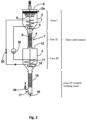
- Fig. 2 shows another embodiment of the vertical three-zone reactor according to the present invention. It has no fundamental differences from the reactor shown in Fig. 1 , however, to quantitatively purify sodium chloride from toxic flotation reagents, the lower part of the reactor is equipped with an additional control washing column 15 defining the additional zone IV of reactor 1.
- the configuration of the additional column 15 is similar to the configuration of the column 4 disposed in the middle zone II of reactor 1 and it is preferably a pulse column.
- a discharge pipe 16 for pure anhydrous sodium chloride suspension and an inlet pipe 17 for an external flow of the saturated sodium chloride solution required for the multistage countercurrent washing are disposed in the lower part of the additional column 15. If the additional column 15 is used, an external pulse generator 18 is connected to generate pulsations of the columns of fluid in the middle zone II and the additional zone IV of reactor 1.
- the heat balance is maintained by a heat pump comprising two heat exchangers 7 and 11, i.e. a condenser in the lower zone II and an evaporator in the upper zone I of reactor 1, a compressor 19 and a throttling device 20, together forming a closed thermal circuit which, in terms of technical thermodynamics, is a heat pump, as shown in Figs. 1 and 2 .
- Fig. 3 is a diagram of flows in the vertical three-zone reactor shown in Fig. 2 , where.
- the sample was dried and then ground in an impact mill, whereupon a fraction with a hydrodynamic diameter ⁇ of 70 microns was sieved.
- hydrodynamic diameter of ground particles smaller than or equal to 70 microns corresponds to the fraction produced by the dry sieving method (GOST 18318-94) passing through a square meshed sieve of 80x80 microns.
- the mass of the fraction with particle hydrodynamic diameter of ⁇ 70 microns was 1384 g.
- a vertical three-zone reactor made of organic glass with total volume of 15 liters was filled with a saturated solution of sodium chloride pre-cooled to 0°C, the said solution prepared from bidistilled water and anhydrous sodium chloride classified as "analytically pure".
- the finished product with a mass of 920 g had the following chemical composition (in wt.%):
- Example 1 The experiment was conducted according to Example 1. Once the feeding of the ground ore was discontinued, the flow rate of the external washing fluid was increased to 5 l/h, followed by wait time for dihydrate crystals to leave the upper zone (visual emptying control). After that, the upper zone was cut off from the rest of the reactor with a valve, the suspension from the upper zone was transferred into a thermostat it was heated to the temperature of 112°C to dissolve native potassium chloride crystals collected in the upper zone over the course of the experiment.
- the suspension was filtered in a heated filter at 110°C.
- a resulting filtrate had a turbidity of 35 FEU.
- the filtrate was cooled in a thermostat under intensive agitation at a cooling rate of 7 deg/hour to achieve the temperature of 25°C, as a result of which potassium chloride was crystallized.
- the suspension was separated in a nutsche filter, the solid phase was washed once with a saturated potassium chloride solution, dried for 2 hours at 130°C and analyzed.
- the finished product with a mass of 272 g had the following chemical composition (in wt.%):
- the sample was dried and then ground in an impact mill, whereupon a fraction of ⁇ 90 microns was sieved.
- the mass of the fraction with particle hydrodynamic diameter of ⁇ 90 microns was 1155 g.
- the experiment was conducted according to Example 1. Dihydrate started falling down to the middle zone represented by section of the pulse column disposed in the middle part of the reactor once the hydrodynamic diameter of the crystals reached ⁇ 110 microns, i.e. the value at which the particle flotation velocity exceeds the velocity of the upward flow of the washing fluid,. At the end of feeding of the ground halite, the liquid phase turbidity in the upper zone was 1220 FEU, whereas in the lower "pure" zone it was less than 5 FEU.
- the finished product with a mass of 762 g had the following chemical composition (in wt.%):
- the sample was dried and then ground in an impact mill, whereupon a fraction ⁇ 70 microns was sieved.
- the mass of the fraction with the particle hydrodynamic diameter of ⁇ 70 microns was 1504 g.
- the experiment was conducted according to Example 1. Additionally, prior to the ground ore feeding, a single load of flotation agents was supplied into the upper zone in the following amounts per 1 kg of the ore: • Primary amine mixture C18 - C20 - 45 mg • Apolar reagent (kerosene) - 12 mg • Frother (pine oil) - 35 mg • Flocculant (polyacrylamide) - 15 mg
Landscapes
- Chemical & Material Sciences (AREA)
- Organic Chemistry (AREA)
- Chemical Kinetics & Catalysis (AREA)
- Crystallography & Structural Chemistry (AREA)
- Engineering & Computer Science (AREA)
- Inorganic Chemistry (AREA)
- Materials Engineering (AREA)
- Life Sciences & Earth Sciences (AREA)
- General Life Sciences & Earth Sciences (AREA)
- Geology (AREA)
- Geochemistry & Mineralogy (AREA)
- Physics & Mathematics (AREA)
- Thermal Sciences (AREA)
- Biotechnology (AREA)
- Health & Medical Sciences (AREA)
- General Health & Medical Sciences (AREA)
- Compounds Of Alkaline-Earth Elements, Aluminum Or Rare-Earth Metals (AREA)
- Manufacture And Refinement Of Metals (AREA)
- Processing Of Solid Wastes (AREA)
Claims (26)
- Verfahren zur Abscheidung von Natriumchlorid und Kaliumchlorid aus einem polymineralischen Ausgangsstoff, der Natrium- und Kaliumchloride enthält, umfassend die folgenden Schritte:(i) Beschicken eines vorgemahlenen polymineralischen Ausgangsstoffs in die obere Zone (I) eines vertikalen Drei-Zonen-Reaktors (1), der mit einer gesättigten Natriumchlorid- und Kaliumchloridlösung gefüllt ist, in welcher Zone die Temperatur zwischen -2,5 °C und -20 °C gehalten wird, wobei eine Gesamtkonzentration von zweiwertigen Kationen in der flüssigen Phase unter 2 Gew.-% gehalten wird,(ii) Umkristallisieren des Natriumchlorids zum Bilden von Natriumchloriddihydrat und Abscheiden der gebildeten Natriumchloriddihydrat-Kristalle von Kristallen von Kaliumchlorid durch Flotation, um einen Schaum zu erzeugen, der Kaliumchloridkristalle enthält, wohingegen die Natriumchloriddihydrat-Kristalle in die mittlere Zone (II) des vertikalen Drei-Zonen-Reaktors absinken,(iii) mehrstufiges Größenordnen der Natriumchloriddihydrat-Kristalle durch einen Aufwärtsstrom der flüssigen Phase und gleichzeitiges mehrstufiges Gegenstromwaschen der absinkenden Natriumchloriddihydrat-Kristalle durch denselben Aufwärtsstrom der flüssigen Phase, wobei die Aufwärtsstromgeschwindigkeit gleich der Flotationsgeschwindigkeit von Natriumchloriddihydrat-Kristallen ist, deren hydrodynamischer Durchmesser um nicht weniger als 20 Mikrometer größer ist als der maximale hydrodynamische Durchmesser der polymineralischen Ausgangsstoffteilchen; dadurch Ermöglichen, dass die gewaschenen Natriumchloriddihydrat-Kristalle in die untere Zone (III) des vertikalen Drei-Zonen-Reaktors eintreten, mit der Maßgabe, dass der hydrodynamische Durchmesser der Natriumchloriddihydrat-Kristalle, die in die untere Zone (III) des vertikalen Drei-Zonen-Reaktors eintreten, den maximalen hydrodynamischen Durchmesser der polymineralischen Ausgangsstoffteilchen um mindestens 20 Mikrometer übersteigt,(iv) Umkristallisieren der gewaschenen Natriumchloriddihydrat-Kristalle zu wasserfreiem Natriumchlorid in der unteren Zone des vertikalen Drei-Zonen-Reaktors, der mit einer gesättigten Natriumchloridlösung gefüllt ist, in welcher Zone die Temperatur zwischen 0,5 °C und 15 °C gehalten wird, um eine Suspension von wasserfreiem Natriumchlorid zu erzeugen.
- Verfahren nach Anspruch 1, worin der polymineralische Ausgangsstoff Sylviniterz ist.
- Verfahren nach Anspruch 1, worin der polymineralische Ausgangsstoff halitischer Abfallstoff ist, der durch Flotationsanreicherung von Kaliumchlorid erzeugt wurde.
- Verfahren nach Anspruch 1, worin die Temperatur in der oberen Zone (I) des vertikalen Drei-Zonen-Reaktors (1) innerhalb des Bereichs von -3 °C bis -5 °C gehalten wird.
- Verfahren nach Anspruch 1, worin die gesättigte Natriumchlorid- und Kaliumchloridlösung eine NaCl-Konzentration von 20,5 bis 23 Gew.-% und eine KCI-Konzentration von 6 bis 7 Gew.-% aufweist.
- Verfahren nach Anspruch 1, wo in der mittleren Zone (II) des vertikalen Drei-Zonen-Reaktors (1) die Temperatur des Aufwärtsstroms der flüssigen Phase unter 0 °C, vorzugsweise unter -3 °C, gehalten wird.
- Verfahren nach Anspruch 1, worin die lineare Geschwindigkeit des Aufwärtsstroms der flüssigen Phase in der mittleren Zone (II) des vertikalen Drei-Zonen-Reaktors innerhalb des Bereichs von 2 bis 10 mm/s ist.
- Verfahren nach Anspruch 1, worin eine Natriumchloridlösung, die aus dem in dem Umkristallisierungsschritt (iv) freigesetzten Wasser erzeugt wurde, als die flüssige Phase in der mittleren Zone (II) des vertikalen Drei-Zonen-Reaktors dient.
- Verfahren nach Anspruch 1, worin die flüssige Phase in der mittleren Zone (II) des vertikalen Drei-Zonen-Reaktors zusätzlich verwirbelt wird, um eine quantitative Aufreinigung der Natriumchloriddihydrat-Kristalle zu unterstützen.
- Verfahren nach Anspruch 1, worin die Flotation in Schritt (ii) die Verwendung von Flotationsmitteln einschließt.
- Verfahren nach Anspruch 1, worin die gesättigte Natriumchloridlösung, die die untere Zone des vertikalen Drei-Zonen-Reaktors füllt, eine Konzentration von 26 - 26,6 Gew.-% aufweist.
- Verfahren nach Anspruch 1, weiter enthaltend nach Schritt (iv) einen zusätzlichen Schritt des Waschens der wasserfreien Natriumchloridkristalle.
- Verfahren nach Anspruch 1, weiter enthaltend nach Schritt (iv) einen Schritt des Filtrierens und einen Schritt des Trocknens der Suspension des wasserfreien Natriumchlorids, um wasserfreie Natriumchloridkristalle zu erhalten.
- Verfahren nach Anspruch 1, weiter enthaltend nach Schritt (ii) einen Schritt des Entfernens des Schaums und einen Schritt des Auspressens des Schaumprodukts, um ein Kaliumchloridkonzentrat zu erhalten.
- Verfahren nach Anspruch 14, weiter enthaltend einen Schritt des halurgischen oder flotativen Verarbeitens des Kaliumchloridkonzentrats, um reine Kaliumchloridkristalle zu erhalten.
- Vertikaler Drei-Zonen-Reaktor (1) zur Abscheidung von Natriumchlorid und Kaliumchlorid aus einem polymineralischen Ausgangsstoff, der Natrium- und Kaliumchloride enthält, umfassend:- einen ersten Behälter (2), der eine obere Zone (I) des Reaktors definiert und einen Belüfter (6), einen Wärmetauscher (7) zur Wärmeableitung und einen ersten Mischer (5) umfasst, wobei der erste Behälter (2) mit einer Zufuhreinrichtung von gemahlenem polymineralischen Ausgangsstoff, einer Einrichtung zum Einlass und Auslass von Flotationsluft, einer Zufuhreinrichtung von Flotationsreagenz, einer Zufuhreinrichtung von anderen Reagenzien, einer Extraktionseinrichtung von kaliumchloridenthaltendem Schaum und einer Eingabeeinrichtung von gesättigter Lösung von Natrium- und Kaliumchloriden ausgestattet ist,- eine mehrstufige Gegenstrom-Waschkolonne (4), die eine mittlere Zone (II) des Reaktors definiert,- einen zweiten Behälter (3), der eine untere Zone (III) des Reaktors definiert und einen Wärmetauscher (11) zur Wärmezufuhr und einen zweiten Mischer (10) umfasst, wobei der zweite Behälter (3) mit einer Abführeinrichtung von einer Suspension von wasserfreiem Natriumchlorid und einer Zufuhreinrichtung von gesättigter Natriumchloridlösung ausgestattet ist.
- Vertikaler Drei-Zonen-Reaktor nach Anspruch 16, wobei der erste Behälter (2) einen Deckel (8) umfasst, in welchem die Zufuhreinrichtung des gemahlenen polymineralischen Ausgangsstoffs, die Einrichtung zum Einlass und Auslass von Flotationsluft, die Zufuhreinrichtung von Flotationsmittel und die Zufuhreinrichtung von anderen Reagenzien angeordnet sind, während die Extraktionseinrichtung von kaliumchloridenthaltendem Schaum und die Zufuhreinrichtung von gesättigter Lösung von Natrium- und Kaliumchloriden in einem oberen Teil einer Seitenwand des ersten Behälters (2) angeordnet sind.
- Vertikaler Drei-Zonen-Reaktor nach Anspruch 16, in welchem sich die Abführeinrichtung von der Suspension von wasserfreiem Natriumchlorid in einem Boden des zweiten Behälters (3) befindet und sich die Zufuhreinrichtung von gesättigter Natriumchloridlösung in einer Seitenwand des zweiten Behälters (3) befindet.
- Vertikaler Drei-Zonen-Reaktor nach Anspruch 16, in welchem der Wärmetauscher (7) zur Wärmeableitung und/oder der Wärmetauscher (11) zur Wärmezufuhr ein interner Wärmetauscher ist.
- Vertikaler Drei-Zonen-Reaktor nach Anspruch 16, in welchem der Wärmetauscher (7) zur Wärmeableitung und/oder der Wärmetauscher (11) zur Wärmezufuhr ein externer Wärmetauscher ist.
- Vertikaler Drei-Zonen-Reaktor nach Anspruch 16, in welchem der Wärmetauscher (7) zur Wärmezufuhr und der Wärmetauscher (11) zur Wärmeableitung in einen einzigen geschlossenen Wärmekreislauf integriert sind, der eine Wärmepumpe darstellt.
- Vertikaler Drei-Zonen-Reaktor nach Anspruch 16, in welchem die mehrstufige Gegenstrom-Waschkolonne (4) eine Drehscheibenkolonne ist.
- Vertikaler Drei-Zonen-Reaktor nach Anspruch 16, in welchem die mehrstufige Gegenstrom-Waschkolonne (4) eine Pulsationskolonne ist.
- Vertikaler Drei-Zonen-Reaktor nach Anspruch 16, umfassend eine zusätzliche mehrstufige Gegenstrom-Waschkolonne (15), welche sich unter dem zweiten Behälter (3) befindet.
- Vertikaler Drei-Zonen-Reaktor nach Anspruch 24, wobei die zusätzliche mehrstufige Gegenstrom-Waschkolonne (15) eine Pulsationskolonne ist.
- Vertikaler Drei-Zonen-Reaktor nach Anspruch 24, wobei die zusätzliche mehrstufige Gegenstrom-Waschkolonne (15) eine Drehscheibenkolonne ist.
Applications Claiming Priority (2)
| Application Number | Priority Date | Filing Date | Title |
|---|---|---|---|
| RU2018103759A RU2669622C1 (ru) | 2018-01-31 | 2018-01-31 | Способ и реактор для извлечения хлорида натрия и хлорида калия из полиминеральных источников |
| PCT/RU2019/000011 WO2019151897A1 (en) | 2018-01-31 | 2019-01-14 | Reactor for separation of sodium chloride and potassium chloride from polymineral sources and method thereof |
Publications (3)
| Publication Number | Publication Date |
|---|---|
| EP3746202A1 EP3746202A1 (de) | 2020-12-09 |
| EP3746202B1 true EP3746202B1 (de) | 2023-11-22 |
| EP3746202C0 EP3746202C0 (de) | 2023-11-22 |
Family
ID=63862264
Family Applications (1)
| Application Number | Title | Priority Date | Filing Date |
|---|---|---|---|
| EP19708370.2A Active EP3746202B1 (de) | 2018-01-31 | 2019-01-14 | Reaktor zur trennung von natriumchlorid und kaliumchlorid aus polymineralquellen und verfahren dafür |
Country Status (6)
| Country | Link |
|---|---|
| US (1) | US12043552B2 (de) |
| EP (1) | EP3746202B1 (de) |
| CN (1) | CN111615414B (de) |
| EA (1) | EA038091B1 (de) |
| RU (1) | RU2669622C1 (de) |
| WO (1) | WO2019151897A1 (de) |
Families Citing this family (4)
| Publication number | Priority date | Publication date | Assignee | Title |
|---|---|---|---|---|
| CN112062330A (zh) * | 2020-08-30 | 2020-12-11 | 南京中电环保水务有限公司 | 一种高负荷晶核固液分离装置及方法 |
| CN114835140B (zh) * | 2022-05-19 | 2024-04-16 | 中国科学院青海盐湖研究所 | 一种用于提升氯化钾品位的方法及应用 |
| CN116947073B (zh) * | 2022-09-30 | 2025-10-31 | 郭柏春 | 一种氯化钾的生产工艺 |
| GB2634094A (en) * | 2023-09-29 | 2025-04-02 | Emmerson Plc | Processing of evaporite minerals |
Family Cites Families (30)
| Publication number | Priority date | Publication date | Assignee | Title |
|---|---|---|---|---|
| US2015165A (en) * | 1932-11-29 | 1935-09-24 | Dunlop Rubber Co | Golf ball |
| US2211397A (en) * | 1936-05-25 | 1940-08-13 | Saskatchewan Potash | Selective flotation of sodium chloride from sylvinite ores |
| US2329149A (en) | 1940-11-04 | 1943-09-07 | Bonneville Ltd | Flotation process |
| US2353673A (en) * | 1943-05-18 | 1944-07-18 | American Telephone & Telegraph | Code signaling system |
| US2604988A (en) | 1946-07-16 | 1952-07-29 | Mines Domaniales De Potasse | Froth flotation of potassium chloride from sodium chloride |
| GB648903A (en) | 1947-11-27 | 1951-01-17 | Gunnar Olof Assarsson | Improved process for separating sodium chloride and potassium chloride |
| GB1240668A (en) | 1968-05-02 | 1971-07-28 | Garrett Res And Dev Co Inc | Improvements relating to crystallizing apparatus |
| US3655333A (en) * | 1970-05-04 | 1972-04-11 | Dow Chemical Co | Process for producing anhydrous sodium chloride and purified saturated brine |
| IL40016A (en) | 1972-07-28 | 1975-05-22 | Dead Sea Works Ltd | Process for the recovery of potassium chloride from its mixtures with sodium chloride |
| JPS52148201A (en) * | 1976-06-01 | 1977-12-09 | Toyo Pulp Co Ltd | Process for making alkali pulp and lignin separation |
| DE2801705A1 (de) * | 1978-01-16 | 1979-07-19 | Metallgesellschaft Ag | Verfahren zur gewinnung von kaliumchlorid |
| FR2501181A1 (fr) | 1981-03-05 | 1982-09-10 | Mdpa | Procede de traitement de minerais carnallitiques |
| US4997637A (en) * | 1989-05-09 | 1991-03-05 | Occidental Chemical Corporation | Digestive crystallizing process and apparatus for purification of KC1 |
| ATE128104T1 (de) * | 1993-06-03 | 1995-10-15 | Kali & Salz Ag | Verfahren und vorrichtung zur behandlung eines kaliumchloridgemenges. |
| DE4422034C1 (de) | 1994-06-23 | 1995-08-31 | Kali & Salz Ag | Verfahren und Vorrichtung zur Reinigung eines Natriumchloridgemenges |
| IT1270000B (it) | 1994-09-22 | 1997-04-16 | Solvay Interox | Procedimento per la fabbricazione di particelle di persali |
| FR2761977B1 (fr) | 1997-04-11 | 1999-06-11 | Solvay | Procede d'enrichissement de sel brut |
| RU2307790C1 (ru) * | 2006-03-13 | 2007-10-10 | Валерий Владимирович Мараков | Способ получения хлористого калия и хлористого натрия |
| MY151044A (en) * | 2007-03-06 | 2014-03-31 | Potasio Rio Colorado S A | A method of treating potash |
| RU2369558C2 (ru) * | 2007-08-07 | 2009-10-10 | ОАО "Сильвинит" | Устройство для переработки сильвинито-карналлитового сырья |
| US8771380B2 (en) | 2008-07-22 | 2014-07-08 | Akzo Nobel N.V. | Sodium chloride production process |
| EP2349928B1 (de) | 2008-11-03 | 2017-05-31 | Akzo Nobel N.V. | Verfahren zur erzeugung von natriumchlorid |
| RU2441183C1 (ru) | 2010-08-20 | 2012-01-27 | Алексей Михайлович Кузьмин | Способ термического обезвреживания хлорсодержащих органических веществ и устройство для его осуществления |
| RU2457180C2 (ru) * | 2010-11-09 | 2012-07-27 | Закрытое акционерное общество ВНИИ Галургии (ЗАО ВНИИ Галургии) | Способ получения хлорида калия |
| CN102963912B (zh) * | 2012-12-25 | 2014-08-27 | 中蓝连海设计研究院 | 利用钾盐矿制取氯化钾的工艺 |
| CN103253685B (zh) | 2013-03-04 | 2014-12-17 | 云南省化工研究院 | 一种地下埋藏固体钾盐矿热溶结晶生产工业氯化钾的方法 |
| CN103787372A (zh) | 2014-02-19 | 2014-05-14 | 中国科学院青海盐湖研究所 | 从高含泥低品位钾石盐矿提取氯化钾的方法 |
| CN104058427B (zh) | 2014-07-03 | 2016-05-18 | 青海盐湖工业股份有限公司 | 一种高品位氯化钾生产系统及其方法 |
| CN106185994B (zh) | 2016-07-05 | 2018-01-02 | 化工部长沙设计研究院 | 一种利用光卤石矿制取优质氯化钾的生产工艺 |
| CN106914030B (zh) | 2017-03-08 | 2022-12-06 | 中建安装工程有限公司 | 一种多级环流式无机械搅拌硫酸铵结晶器及操作方法 |
-
2018
- 2018-01-31 RU RU2018103759A patent/RU2669622C1/ru active
-
2019
- 2019-01-14 WO PCT/RU2019/000011 patent/WO2019151897A1/en not_active Ceased
- 2019-01-14 EA EA202091670A patent/EA038091B1/ru unknown
- 2019-01-14 EP EP19708370.2A patent/EP3746202B1/de active Active
- 2019-01-14 US US16/965,082 patent/US12043552B2/en active Active
- 2019-01-14 CN CN201980009067.2A patent/CN111615414B/zh active Active
Also Published As
| Publication number | Publication date |
|---|---|
| EP3746202A1 (de) | 2020-12-09 |
| US20210114890A1 (en) | 2021-04-22 |
| EA038091B1 (ru) | 2021-07-05 |
| EP3746202C0 (de) | 2023-11-22 |
| RU2669622C1 (ru) | 2018-10-12 |
| US12043552B2 (en) | 2024-07-23 |
| WO2019151897A1 (en) | 2019-08-08 |
| EA202091670A1 (ru) | 2020-10-16 |
| CN111615414A (zh) | 2020-09-01 |
| CN111615414B (zh) | 2022-05-13 |
Similar Documents
| Publication | Publication Date | Title |
|---|---|---|
| EP3746202B1 (de) | Reaktor zur trennung von natriumchlorid und kaliumchlorid aus polymineralquellen und verfahren dafür | |
| CA1334821C (en) | Method of reforming soluble salts to effect purification and increase crystal size thereof | |
| CN102387993B (zh) | 结晶的碳酸钠、碳酸氢钠、或亚硫酸钠的生产中的杂质去除 | |
| US3981686A (en) | Clarifier process for producing sodium carbonate | |
| US3425795A (en) | Method for preparing superdense sodium carbonate from wyoming trona and the product thereof | |
| RU2203854C2 (ru) | Способ обогащения необработанной соли | |
| US2211397A (en) | Selective flotation of sodium chloride from sylvinite ores | |
| CN102264644B (zh) | 联合生产碳酸钠和碳酸氢钠的方法 | |
| JPH10113673A (ja) | 廃水処理装置及び方法 | |
| US4021527A (en) | Production of sodium carbonate | |
| US4283277A (en) | Beneficiation of trona by flotation | |
| US3904520A (en) | Process for the clarification of brine | |
| CA2125005C (en) | Method and apparatus for treatment of a potassium chloride mixture | |
| US4385902A (en) | Process for purifying crystalline potassium chloride | |
| US3917801A (en) | Flotation of boric acid from sodium sulfate obtained during the processing of borate ores | |
| RU2315713C2 (ru) | Способ выделения хлористого калия | |
| US2594723A (en) | Process for producing granular clusters of crystalline matter | |
| US3358740A (en) | Salt water concentration with alumina-silica additive and separation of sodium sulfate-calcium sulfate double salt | |
| US7517509B2 (en) | Purification of trona ores by conditioning with an oil-in-water emulsion | |
| CN117003257B (zh) | 由光卤石生产氯化钾的工艺和设备 | |
| RU2232130C2 (ru) | Способ получения кристаллического хлористого калия из циклонной пыли флотоконцентрата калийной руды | |
| US3623848A (en) | Process for brine manufacture | |
| DE4422034C1 (de) | Verfahren und Vorrichtung zur Reinigung eines Natriumchloridgemenges | |
| CN110650807A (zh) | 采用多级分离过程处理盐溶液的方法及为此目的的处理系统 | |
| SU1445786A1 (ru) | Способ мокрого измельчени руд |
Legal Events
| Date | Code | Title | Description |
|---|---|---|---|
| STAA | Information on the status of an ep patent application or granted ep patent |
Free format text: STATUS: UNKNOWN |
|
| STAA | Information on the status of an ep patent application or granted ep patent |
Free format text: STATUS: THE INTERNATIONAL PUBLICATION HAS BEEN MADE |
|
| PUAI | Public reference made under article 153(3) epc to a published international application that has entered the european phase |
Free format text: ORIGINAL CODE: 0009012 |
|
| STAA | Information on the status of an ep patent application or granted ep patent |
Free format text: STATUS: REQUEST FOR EXAMINATION WAS MADE |
|
| 17P | Request for examination filed |
Effective date: 20200821 |
|
| AK | Designated contracting states |
Kind code of ref document: A1 Designated state(s): AL AT BE BG CH CY CZ DE DK EE ES FI FR GB GR HR HU IE IS IT LI LT LU LV MC MK MT NL NO PL PT RO RS SE SI SK SM TR |
|
| AX | Request for extension of the european patent |
Extension state: BA ME |
|
| RAP1 | Party data changed (applicant data changed or rights of an application transferred) |
Owner name: LIMITED LIABILITY COMPANY "GSM CHEMICAL" |
|
| DAV | Request for validation of the european patent (deleted) | ||
| DAX | Request for extension of the european patent (deleted) | ||
| STAA | Information on the status of an ep patent application or granted ep patent |
Free format text: STATUS: EXAMINATION IS IN PROGRESS |
|
| 17Q | First examination report despatched |
Effective date: 20221109 |
|
| GRAP | Despatch of communication of intention to grant a patent |
Free format text: ORIGINAL CODE: EPIDOSNIGR1 |
|
| STAA | Information on the status of an ep patent application or granted ep patent |
Free format text: STATUS: GRANT OF PATENT IS INTENDED |
|
| INTG | Intention to grant announced |
Effective date: 20230623 |
|
| GRAS | Grant fee paid |
Free format text: ORIGINAL CODE: EPIDOSNIGR3 |
|
| GRAA | (expected) grant |
Free format text: ORIGINAL CODE: 0009210 |
|
| STAA | Information on the status of an ep patent application or granted ep patent |
Free format text: STATUS: THE PATENT HAS BEEN GRANTED |
|
| RAP3 | Party data changed (applicant data changed or rights of an application transferred) |
Owner name: LIMITED LIABILITY COMPANY "GSM CHEMICAL" |
|
| AK | Designated contracting states |
Kind code of ref document: B1 Designated state(s): AL AT BE BG CH CY CZ DE DK EE ES FI FR GB GR HR HU IE IS IT LI LT LU LV MC MK MT NL NO PL PT RO RS SE SI SK SM TR |
|
| REG | Reference to a national code |
Ref country code: GB Ref legal event code: FG4D |
|
| REG | Reference to a national code |
Ref country code: CH Ref legal event code: EP Ref country code: DE Ref legal event code: R096 Ref document number: 602019041833 Country of ref document: DE |
|
| REG | Reference to a national code |
Ref country code: IE Ref legal event code: FG4D |
|
| U01 | Request for unitary effect filed |
Effective date: 20231130 |
|
| U07 | Unitary effect registered |
Designated state(s): AT BE BG DE DK EE FI FR IT LT LU LV MT NL PT SE SI Effective date: 20231208 |
|
| U20 | Renewal fee for the european patent with unitary effect paid |
Year of fee payment: 6 Effective date: 20240108 |
|
| PG25 | Lapsed in a contracting state [announced via postgrant information from national office to epo] |
Ref country code: GR Free format text: LAPSE BECAUSE OF FAILURE TO SUBMIT A TRANSLATION OF THE DESCRIPTION OR TO PAY THE FEE WITHIN THE PRESCRIBED TIME-LIMIT Effective date: 20240223 |
|
| PG25 | Lapsed in a contracting state [announced via postgrant information from national office to epo] |
Ref country code: IS Free format text: LAPSE BECAUSE OF FAILURE TO SUBMIT A TRANSLATION OF THE DESCRIPTION OR TO PAY THE FEE WITHIN THE PRESCRIBED TIME-LIMIT Effective date: 20240322 |
|
| PG25 | Lapsed in a contracting state [announced via postgrant information from national office to epo] |
Ref country code: ES Free format text: LAPSE BECAUSE OF FAILURE TO SUBMIT A TRANSLATION OF THE DESCRIPTION OR TO PAY THE FEE WITHIN THE PRESCRIBED TIME-LIMIT Effective date: 20231122 |
|
| PG25 | Lapsed in a contracting state [announced via postgrant information from national office to epo] |
Ref country code: IS Free format text: LAPSE BECAUSE OF FAILURE TO SUBMIT A TRANSLATION OF THE DESCRIPTION OR TO PAY THE FEE WITHIN THE PRESCRIBED TIME-LIMIT Effective date: 20240322 Ref country code: GR Free format text: LAPSE BECAUSE OF FAILURE TO SUBMIT A TRANSLATION OF THE DESCRIPTION OR TO PAY THE FEE WITHIN THE PRESCRIBED TIME-LIMIT Effective date: 20240223 Ref country code: ES Free format text: LAPSE BECAUSE OF FAILURE TO SUBMIT A TRANSLATION OF THE DESCRIPTION OR TO PAY THE FEE WITHIN THE PRESCRIBED TIME-LIMIT Effective date: 20231122 |
|
| PG25 | Lapsed in a contracting state [announced via postgrant information from national office to epo] |
Ref country code: RS Free format text: LAPSE BECAUSE OF FAILURE TO SUBMIT A TRANSLATION OF THE DESCRIPTION OR TO PAY THE FEE WITHIN THE PRESCRIBED TIME-LIMIT Effective date: 20231122 Ref country code: PL Free format text: LAPSE BECAUSE OF FAILURE TO SUBMIT A TRANSLATION OF THE DESCRIPTION OR TO PAY THE FEE WITHIN THE PRESCRIBED TIME-LIMIT Effective date: 20231122 Ref country code: NO Free format text: LAPSE BECAUSE OF FAILURE TO SUBMIT A TRANSLATION OF THE DESCRIPTION OR TO PAY THE FEE WITHIN THE PRESCRIBED TIME-LIMIT Effective date: 20240222 Ref country code: HR Free format text: LAPSE BECAUSE OF FAILURE TO SUBMIT A TRANSLATION OF THE DESCRIPTION OR TO PAY THE FEE WITHIN THE PRESCRIBED TIME-LIMIT Effective date: 20231122 |
|
| PG25 | Lapsed in a contracting state [announced via postgrant information from national office to epo] |
Ref country code: CZ Free format text: LAPSE BECAUSE OF FAILURE TO SUBMIT A TRANSLATION OF THE DESCRIPTION OR TO PAY THE FEE WITHIN THE PRESCRIBED TIME-LIMIT Effective date: 20231122 |
|
| PG25 | Lapsed in a contracting state [announced via postgrant information from national office to epo] |
Ref country code: SK Free format text: LAPSE BECAUSE OF FAILURE TO SUBMIT A TRANSLATION OF THE DESCRIPTION OR TO PAY THE FEE WITHIN THE PRESCRIBED TIME-LIMIT Effective date: 20231122 |
|
| PG25 | Lapsed in a contracting state [announced via postgrant information from national office to epo] |
Ref country code: SM Free format text: LAPSE BECAUSE OF FAILURE TO SUBMIT A TRANSLATION OF THE DESCRIPTION OR TO PAY THE FEE WITHIN THE PRESCRIBED TIME-LIMIT Effective date: 20231122 Ref country code: SK Free format text: LAPSE BECAUSE OF FAILURE TO SUBMIT A TRANSLATION OF THE DESCRIPTION OR TO PAY THE FEE WITHIN THE PRESCRIBED TIME-LIMIT Effective date: 20231122 Ref country code: RO Free format text: LAPSE BECAUSE OF FAILURE TO SUBMIT A TRANSLATION OF THE DESCRIPTION OR TO PAY THE FEE WITHIN THE PRESCRIBED TIME-LIMIT Effective date: 20231122 Ref country code: CZ Free format text: LAPSE BECAUSE OF FAILURE TO SUBMIT A TRANSLATION OF THE DESCRIPTION OR TO PAY THE FEE WITHIN THE PRESCRIBED TIME-LIMIT Effective date: 20231122 |
|
| REG | Reference to a national code |
Ref country code: DE Ref legal event code: R097 Ref document number: 602019041833 Country of ref document: DE |
|
| PG25 | Lapsed in a contracting state [announced via postgrant information from national office to epo] |
Ref country code: MC Free format text: LAPSE BECAUSE OF FAILURE TO SUBMIT A TRANSLATION OF THE DESCRIPTION OR TO PAY THE FEE WITHIN THE PRESCRIBED TIME-LIMIT Effective date: 20231122 |
|
| PG25 | Lapsed in a contracting state [announced via postgrant information from national office to epo] |
Ref country code: MC Free format text: LAPSE BECAUSE OF FAILURE TO SUBMIT A TRANSLATION OF THE DESCRIPTION OR TO PAY THE FEE WITHIN THE PRESCRIBED TIME-LIMIT Effective date: 20231122 |
|
| REG | Reference to a national code |
Ref country code: CH Ref legal event code: PL |
|
| PLBE | No opposition filed within time limit |
Free format text: ORIGINAL CODE: 0009261 |
|
| STAA | Information on the status of an ep patent application or granted ep patent |
Free format text: STATUS: NO OPPOSITION FILED WITHIN TIME LIMIT |
|
| PG25 | Lapsed in a contracting state [announced via postgrant information from national office to epo] |
Ref country code: CH Free format text: LAPSE BECAUSE OF NON-PAYMENT OF DUE FEES Effective date: 20240131 |
|
| GBPC | Gb: european patent ceased through non-payment of renewal fee |
Effective date: 20240222 |
|
| 26N | No opposition filed |
Effective date: 20240823 |
|
| PG25 | Lapsed in a contracting state [announced via postgrant information from national office to epo] |
Ref country code: CH Free format text: LAPSE BECAUSE OF NON-PAYMENT OF DUE FEES Effective date: 20240131 |
|
| PG25 | Lapsed in a contracting state [announced via postgrant information from national office to epo] |
Ref country code: GB Free format text: LAPSE BECAUSE OF NON-PAYMENT OF DUE FEES Effective date: 20240222 |
|
| PG25 | Lapsed in a contracting state [announced via postgrant information from national office to epo] |
Ref country code: IE Free format text: LAPSE BECAUSE OF NON-PAYMENT OF DUE FEES Effective date: 20240114 |
|
| PG25 | Lapsed in a contracting state [announced via postgrant information from national office to epo] |
Ref country code: IE Free format text: LAPSE BECAUSE OF NON-PAYMENT OF DUE FEES Effective date: 20240114 Ref country code: GB Free format text: LAPSE BECAUSE OF NON-PAYMENT OF DUE FEES Effective date: 20240222 |
|
| U20 | Renewal fee for the european patent with unitary effect paid |
Year of fee payment: 7 Effective date: 20250127 |
|
| PG25 | Lapsed in a contracting state [announced via postgrant information from national office to epo] |
Ref country code: CY Free format text: LAPSE BECAUSE OF FAILURE TO SUBMIT A TRANSLATION OF THE DESCRIPTION OR TO PAY THE FEE WITHIN THE PRESCRIBED TIME-LIMIT; INVALID AB INITIO Effective date: 20190114 |
|
| PG25 | Lapsed in a contracting state [announced via postgrant information from national office to epo] |
Ref country code: HU Free format text: LAPSE BECAUSE OF FAILURE TO SUBMIT A TRANSLATION OF THE DESCRIPTION OR TO PAY THE FEE WITHIN THE PRESCRIBED TIME-LIMIT; INVALID AB INITIO Effective date: 20190114 |
|
| PG25 | Lapsed in a contracting state [announced via postgrant information from national office to epo] |
Ref country code: TR Free format text: LAPSE BECAUSE OF FAILURE TO SUBMIT A TRANSLATION OF THE DESCRIPTION OR TO PAY THE FEE WITHIN THE PRESCRIBED TIME-LIMIT Effective date: 20231122 |
|
| U20 | Renewal fee for the european patent with unitary effect paid |
Year of fee payment: 8 Effective date: 20260127 |