EP3748154A1 - Verfahren zur computerimplementierten überwachung einer komponente einer windturbine - Google Patents
Verfahren zur computerimplementierten überwachung einer komponente einer windturbine Download PDFInfo
- Publication number
- EP3748154A1 EP3748154A1 EP19178834.8A EP19178834A EP3748154A1 EP 3748154 A1 EP3748154 A1 EP 3748154A1 EP 19178834 A EP19178834 A EP 19178834A EP 3748154 A1 EP3748154 A1 EP 3748154A1
- Authority
- EP
- European Patent Office
- Prior art keywords
- component
- wind turbine
- vibration signals
- machine learning
- learning model
- Prior art date
- Legal status (The legal status is an assumption and is not a legal conclusion. Google has not performed a legal analysis and makes no representation as to the accuracy of the status listed.)
- Withdrawn
Links
Images

Classifications
-
- G—PHYSICS
- G05—CONTROLLING; REGULATING
- G05B—CONTROL OR REGULATING SYSTEMS IN GENERAL; FUNCTIONAL ELEMENTS OF SUCH SYSTEMS; MONITORING OR TESTING ARRANGEMENTS FOR SUCH SYSTEMS OR ELEMENTS
- G05B23/00—Testing or monitoring of control systems or parts thereof
- G05B23/02—Electric testing or monitoring
- G05B23/0205—Electric testing or monitoring by means of a monitoring system capable of detecting and responding to faults
- G05B23/0218—Electric testing or monitoring by means of a monitoring system capable of detecting and responding to faults characterised by the fault detection method dealing with either existing or incipient faults
- G05B23/0224—Process history based detection method, e.g. whereby history implies the availability of large amounts of data
- G05B23/024—Quantitative history assessment, e.g. mathematical relationships between available data; Functions therefor; Principal component analysis [PCA]; Partial least square [PLS]; Statistical classifiers, e.g. Bayesian networks, linear regression or correlation analysis; Neural networks
-
- F—MECHANICAL ENGINEERING; LIGHTING; HEATING; WEAPONS; BLASTING
- F03—MACHINES OR ENGINES FOR LIQUIDS; WIND, SPRING, OR WEIGHT MOTORS; PRODUCING MECHANICAL POWER OR A REACTIVE PROPULSIVE THRUST, NOT OTHERWISE PROVIDED FOR
- F03D—WIND MOTORS
- F03D17/00—Monitoring or testing of wind motors, e.g. diagnostics
-
- F—MECHANICAL ENGINEERING; LIGHTING; HEATING; WEAPONS; BLASTING
- F03—MACHINES OR ENGINES FOR LIQUIDS; WIND, SPRING, OR WEIGHT MOTORS; PRODUCING MECHANICAL POWER OR A REACTIVE PROPULSIVE THRUST, NOT OTHERWISE PROVIDED FOR
- F03D—WIND MOTORS
- F03D15/00—Transmission of mechanical power
-
- G—PHYSICS
- G06—COMPUTING OR CALCULATING; COUNTING
- G06N—COMPUTING ARRANGEMENTS BASED ON SPECIFIC COMPUTATIONAL MODELS
- G06N3/00—Computing arrangements based on biological models
- G06N3/02—Neural networks
- G06N3/04—Architecture, e.g. interconnection topology
- G06N3/045—Combinations of networks
-
- G—PHYSICS
- G06—COMPUTING OR CALCULATING; COUNTING
- G06N—COMPUTING ARRANGEMENTS BASED ON SPECIFIC COMPUTATIONAL MODELS
- G06N3/00—Computing arrangements based on biological models
- G06N3/02—Neural networks
- G06N3/08—Learning methods
-
- G—PHYSICS
- G06—COMPUTING OR CALCULATING; COUNTING
- G06N—COMPUTING ARRANGEMENTS BASED ON SPECIFIC COMPUTATIONAL MODELS
- G06N3/00—Computing arrangements based on biological models
- G06N3/02—Neural networks
- G06N3/08—Learning methods
- G06N3/09—Supervised learning
-
- F—MECHANICAL ENGINEERING; LIGHTING; HEATING; WEAPONS; BLASTING
- F05—INDEXING SCHEMES RELATING TO ENGINES OR PUMPS IN VARIOUS SUBCLASSES OF CLASSES F01-F04
- F05B—INDEXING SCHEME RELATING TO WIND, SPRING, WEIGHT, INERTIA OR LIKE MOTORS, TO MACHINES OR ENGINES FOR LIQUIDS COVERED BY SUBCLASSES F03B, F03D AND F03G
- F05B2240/00—Components
- F05B2240/50—Bearings
-
- F—MECHANICAL ENGINEERING; LIGHTING; HEATING; WEAPONS; BLASTING
- F05—INDEXING SCHEMES RELATING TO ENGINES OR PUMPS IN VARIOUS SUBCLASSES OF CLASSES F01-F04
- F05B—INDEXING SCHEME RELATING TO WIND, SPRING, WEIGHT, INERTIA OR LIKE MOTORS, TO MACHINES OR ENGINES FOR LIQUIDS COVERED BY SUBCLASSES F03B, F03D AND F03G
- F05B2260/00—Function
- F05B2260/84—Modelling or simulation
-
- F—MECHANICAL ENGINEERING; LIGHTING; HEATING; WEAPONS; BLASTING
- F05—INDEXING SCHEMES RELATING TO ENGINES OR PUMPS IN VARIOUS SUBCLASSES OF CLASSES F01-F04
- F05B—INDEXING SCHEME RELATING TO WIND, SPRING, WEIGHT, INERTIA OR LIKE MOTORS, TO MACHINES OR ENGINES FOR LIQUIDS COVERED BY SUBCLASSES F03B, F03D AND F03G
- F05B2270/00—Control
- F05B2270/30—Control parameters, e.g. input parameters
- F05B2270/334—Vibration measurements
-
- F—MECHANICAL ENGINEERING; LIGHTING; HEATING; WEAPONS; BLASTING
- F05—INDEXING SCHEMES RELATING TO ENGINES OR PUMPS IN VARIOUS SUBCLASSES OF CLASSES F01-F04
- F05B—INDEXING SCHEME RELATING TO WIND, SPRING, WEIGHT, INERTIA OR LIKE MOTORS, TO MACHINES OR ENGINES FOR LIQUIDS COVERED BY SUBCLASSES F03B, F03D AND F03G
- F05B2270/00—Control
- F05B2270/70—Type of control algorithm
- F05B2270/709—Type of control algorithm with neural networks
-
- G—PHYSICS
- G05—CONTROLLING; REGULATING
- G05B—CONTROL OR REGULATING SYSTEMS IN GENERAL; FUNCTIONAL ELEMENTS OF SUCH SYSTEMS; MONITORING OR TESTING ARRANGEMENTS FOR SUCH SYSTEMS OR ELEMENTS
- G05B17/00—Systems involving the use of models or simulators of said systems
- G05B17/02—Systems involving the use of models or simulators of said systems electric
-
- G—PHYSICS
- G05—CONTROLLING; REGULATING
- G05B—CONTROL OR REGULATING SYSTEMS IN GENERAL; FUNCTIONAL ELEMENTS OF SUCH SYSTEMS; MONITORING OR TESTING ARRANGEMENTS FOR SUCH SYSTEMS OR ELEMENTS
- G05B2219/00—Program-control systems
- G05B2219/30—Nc systems
- G05B2219/37—Measurements
- G05B2219/37351—Detect vibration, ultrasound
-
- Y—GENERAL TAGGING OF NEW TECHNOLOGICAL DEVELOPMENTS; GENERAL TAGGING OF CROSS-SECTIONAL TECHNOLOGIES SPANNING OVER SEVERAL SECTIONS OF THE IPC; TECHNICAL SUBJECTS COVERED BY FORMER USPC CROSS-REFERENCE ART COLLECTIONS [XRACs] AND DIGESTS
- Y02—TECHNOLOGIES OR APPLICATIONS FOR MITIGATION OR ADAPTATION AGAINST CLIMATE CHANGE
- Y02E—REDUCTION OF GREENHOUSE GAS [GHG] EMISSIONS, RELATED TO ENERGY GENERATION, TRANSMISSION OR DISTRIBUTION
- Y02E10/00—Energy generation through renewable energy sources
- Y02E10/70—Wind energy
- Y02E10/72—Wind turbines with rotation axis in wind direction
Definitions
- the invention refers to a method and an apparatus for computer-implemented monitoring of a component of a wind turbine. Furthermore, the invention refers to a corresponding computer program product and a corresponding computer program.
- the invention refers to the field of fault detection with respect to components within a wind turbine based on vibration analysis. It known from the prior art to use machine learning models, like neural networks, in order to detect faults in wind turbines. Such machine learning models receive vibration signals of a monitored component in the wind turbine as an input and provide an output indicating the presence or absence of a specific fault occurring in the component.
- Machine learning models for detecting a specific fault need to be trained by appropriate training data including fault data, i.e. vibration signals present at the occurrence of the specific fault within the wind turbine.
- fault data i.e. vibration signals present at the occurrence of the specific fault within the wind turbine.
- fault data are rare or need to be generated based on expensive test stands where faults (e.g. damages) are introduced to the components to be monitored.
- machine learning models trained for one turbine type only have a good performance when used for monitoring this turbine type and not other turbine types.
- the method of the invention enables a computer-implemented monitoring of a component of a wind turbine.
- the wind turbine having the monitored component is designated as the first wind turbine and the monitored component is designated as the first component.
- the method has access to an already trained machine learning model which has been trained for one or more second components of the same type of one or more second wind turbines, the one or more second wind turbines being wind turbines of another type than the first wind turbine.
- the training data are operation data from the one or more second components.
- the one or more second components of the one or more second wind turbines each have a function equivalent to the function of the first component of the first wind turbine.
- the function of the second components and the function of the first component may also be different. This difference is reflected by the mapping of step ii) described below.
- the first component may refer to a planet wheel whereas the type of the second components is a high speed pinion.
- the trained machine learning model is configured to provide an output referring to a predetermined fault occurring at a second component of a second wind turbine by processing vibration signals in a predetermined domain which are measured in the vicinity of the second component during the operation of the second wind turbine.
- This second component can be any second component out of the one or more second components.
- step ii) described below reference is made to this second component.
- the trained machine learning model may be any known data driven model having been trained by machine learning using training data comprising vibration signals. Depending on the circumstances, the machine learning may be a supervised learning or unsupervised learning. In supervised learning, it is known for the vibration signals of a training data set whether the predetermined fault is present. This is not the case for unsupervised learning.
- step i) of the method according to the invention vibration signals in the predetermined domain (being or having been) measured in the vicinity of the first component during the operation of the first wind turbine are provided.
- the process of measuring those vibration signals may be part of step i).
- the vibration signals have been measured and stored beforehand so that step i) merely comprises the step of reading the vibration signals having been previously measured and stored.
- the vibration signals provided in step i) are based on outputs of one or more vibration sensors.
- the vibration signals need not refer directly to the sensor outputs but to signals derived from these outputs.
- the vibration signals may be derived from the sensor outputs by a transformation, e.g. a Fourier transformation.
- the vibration signals are mapped to corresponding vibration signals valid for the second component based on one or more given kinematic parameters of the first component and one or more given kinematic parameters of the second component.
- step iii) of the method according to the invention the machine learning model is applied to the vibration signals valid for the second component which are determined in step ii). Due to the mapping in step ii), this will lead to an output referring to the predetermined fault occurring at the first component.
- This output may be stored in a storage and/or may be provided on a user interface, e.g. a display, in order to inform the user about the occurrence of a fault.
- the invention is based on the finding that vibration signals of different components can be mapped to each other by considering the kinematics of both components. Hence, the machine learning model applied to the mapped vibration signals will provide the correct output with respect to the vibration signals of the monitored turbine.
- the inventors found out that good results can be achieved provided that a mapping of the vibration signals can be found, irrespective of the type of mapping. However, particularly good results can be achieved in case that a linear mapping is used between the vibration signals of the first component and the vibration signals of the second component.
- the vibration signals provided in step i) are determined in the frequency domain, i.e. the vibration signals include a frequency spectrum of the vibrations. Nevertheless, the vibration signals may also be provided in the well-known cepstrum-domain or any other domain.
- the one or more given kinematic parameters of the first component are described by the same function type as the one or more given kinematic parameters of the second component but with different function parameters.
- the one or more given kinematic parameters of the first component are one or more specific values within the predetermined domain contained within the vibration signals measured in the vicinity of the first component in case that the predetermined fault occurs.
- the one or more given kinematic parameters of the second component are one or more specific values within the predetermined domain contained within the vibration signals measured in the vicinity of the second component in case that the predetermined fault occurs.
- the one or more specific values may refer to specific frequencies in the frequency domain or to corresponding values in the cepstrum-domain. It is known beforehand that a particular fault is associated with such specific values.
- the component being monitored is a part of the drivetrain of the monitored wind turbine.
- the component may refer to a bearing supporting the rotor or to a gearbox or to a generator providing the electric power produced by the wind turbine.
- the predetermined fault refers to a damage of a gearwheel or a damage of a bearing race or a damage of balls or rollers in a ball or roller bearing.
- These elements may e.g. be included in one of the above components of a drivetrain in a wind turbine.
- the machine learning model is based on one or more neural networks or on Principal Component Analysis.
- any other machine learning model may be used as well.
- the invention refers to an apparatus for monitoring of a component of a wind turbine, where the apparatus comprises a means for performing the above described step i), a means for performing the above described step ii) and a means for performing the above described step iii).
- the means for performing step i) may comprise a measuring means for acquiring the vibration signals.
- the means may comprise one or more vibration sensors.
- the means may only be implemented as a means for reading the vibration signals from a storage in case that the vibration signals have been stored beforehand. This type of means is used within the computer program product and the computer program as defined below.
- the apparatus of the invention is preferably configured to perform one or more preferred embodiments of the method according to the invention.
- the invention also refers to a computer program product with program code which is stored on a non-transitory machine-readable carrier, for carrying out the method of the invention or one or more preferred embodiments of this method when the program code is executed on a computer.
- the invention refers to a computer program with program code for carrying out the method according to the invention or one or more preferred embodiments of this method when the program code is executed on a computer.
- the method as described in the following is used for monitoring a component in a wind turbine.
- An example of such a wind turbine is shown in Fig. 1 .
- the wind turbine is designated with reference numeral 1 and comprises a tower 2 on top of which a nacelle 3 is arranged.
- the nacelle is connected to a rotor having a hub 4 at which three rotating blades 5 are attached.
- a drivetrain for the wind turbine is accommodated within the nacelle 3.
- this drivetrain comprises a main bearing 6 for supporting the hub of the rotor as well as a gearbox 7 and a generator 8 for converting the mechanical power generated by the rotation of the rotor into electric power.
- the vibration sensor 9 is located adjacent to the bearing 6, the vibration sensor 10 is located adjacent to the gearbox 7 and the vibration sensor 11 is located adjacent to the generator 8.
- the invention is not restricted to the use of just three vibration sensors. I.e., in other embodiments, a higher or lower number of vibration sensors may be used.
- one of the components 6 to 8 of the drivetrain is monitored by processing the vibration signals detected by the sensor adjacent to the component.
- the method described in the following may be used for each of the components 6 to 8 so that all components within the nacelle are monitored.
- the signals of several vibration sensors detecting vibrations of a respective components may be used for monitoring the respective component.
- the invention is described in the following for monitoring the gearbox 7 based on the vibration signals of sensor 10.
- This machine learning model has been trained by training data from another turbine than the turbine 1.
- This turbine is shown in Fig. 2 and designated with reference numeral 1'.
- the turbine has the same components as the turbine in Fig. 1 .
- the turbine 1' is a turbine of another type than turbine 1 which is indicated by using apostrophes for the elements of the turbine in Fig. 2 .
- the turbine 1' may be a turbine having the same construction as the turbine 1 but being from another manufacturer.
- the machine learning model has been trained based on training data from several turbines 1' of the same type.
- the above-mentioned machine learning model has been trained based on vibration signals of the sensor 10' where it was known whether the vibration signals refer to an operation of the wind turbine 1' where a specific fault and particularly a specific damage was present within the gearbox 7'.
- the training was based on a high number of training data sets including a considerable amount of vibrations signals referring to an operation accompanied by the specific fault within the gearbox 7'.
- the machine learning model can be trained for different fault types.
- a fault type may refer to a damage of a gearwheel or a damage of an inner race or outer race of a bearing or a damage of the balls or rollers of a bearing.
- the machine learning model was trained for one of such particular fault types.
- the machine learning model refers to a neural network.
- other machine learning models e.g. Principal Component Analysis
- the machine learning model may be trained by any suitable learning method.
- the learning method is based on supervised learning where the training data include the information whether a fault is present in the gearbox for the respective training data sets. Nevertheless, the machine learning model may also be used in combination with a training based on unsupervised learning.
- vibration signals of the vibration sensor 10' are input into the model during the operation of the wind turbine 1' resulting in an output indicative of the specific fault.
- the output may be such that it indicates if the fault is present or not.
- the output may also be a probability with respect to the presence of the specific fault.
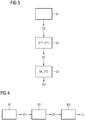
- the idea of the invention is to enable a monitoring of the turbine 1 based on the trained machine learning model although the training of the model was performed for another wind turbine 1'. This is achieved by an appropriate mapping taking into account kinematic parameters with respect to both turbines 1 and 1'. This will be described in the following with respect to Fig. 3 and Fig. 4 .
- Fig. 3 shows a flowchart illustrating an embodiment of the invention for monitoring the gearbox 7 of the turbine 1.
- vibration signals VS originating from the sensor 10 are recorded.
- the vibration signals need not refer to the direct sensor outputs but may be pre-processed signals.
- the vibration signals are the sensor data after having applied a Fourier transform, i.e. the vibration signals are signals within the frequency domain.
- the vibration signals VS valid for the sensor 10 of the turbine 1 are converted by a mapping into vibration signals VS' which are vibration signals which would have been occurred in the turbine 1' in case that the operation states of both gearboxes 7 and 7' were the same. I.e., in case that the vibration signals VS refer to a fault within the gearbox 7, this fault would also be present in the gearbox 7' if vibration signals VS' were detected.
- the knowledge of kinematic parameters KP1 with respect to wind turbine 1 and of kinematic parameters KP2 with respect to turbine 1' is used.
- the kinematic parameters KP1 refer to the component 7 and the specific fault being monitored.
- the kinematic parameters KP2 refer to the component 7' and the specific fault being monitored.
- f c represents the gearmesh frequency in case that a damage of a gearwheel is the specific fault.
- f c may refer to the frequency of an inner race or an outer race in case of a specific fault referring to cracks in these races or it may refer to a ball or roller spin frequency in case of a specific fault referring to the balls or rollers within a ball/roller bearing.
- the frequency f c is known but is different for the components 7 and 7'.
- f m in the above formula represents a known sideband frequency present when the specific fault occurs.
- the frequency f m is known but is different for the components 7 and 7'.
- n, z are integers.
- index A refers to the component 7
- index B refers to the component 7'
- other mappings than linear mappings also provide good results in case that a corresponding mapping can be found.
- f A n ⁇ f A c + z ⁇ f A m
- f B n ⁇ f B c + z ⁇ f B m
- f B T(f A ).
- mapping is dependent on n.
- the mapping was derived within the frequency domain. Nevertheless, the mapping may also be derived in the same way for the well-known cepstrum-domain.
- the vibration signals VS are converted in step S2 into the vibration signals VS' as shown in Fig. 3 .
- the vibration signals VS' are fed as input data to the trained machine learning model which is designated as ML in Fig. 3 .
- the machine learning model provides an output indicative of the specific fault where this fault is designated as FT in Fig. 3 .
- the output OU referring to the fault FT is generated. Due to the mapping, this output will indicate whether there is a fault within the gearbox 7 of the wind turbine 1 although the machine learning model has been trained for a different gearbox 7' in another wind turbine 1'.
- the invention as described in the foregoing is based on the knowledge that vibration signals of rotating machines are characterized by variations in amplitudes and frequencies that can be explained by the kinematics of the machine components. These characteristics change when anomalies occur.
- a fault or damage type has a vibrational pattern that can be described by the component kinematics. Therefore, for each fault type, the vibration signals from one component can be mapped to another component using the kinematics of both components.
- Fig. 4 shows an apparatus for performing the method described with respect to Fig. 3 .
- the apparatus comprises a means M1 providing the vibration signals VS.
- means M1 comprises the vibration sensor 10 detecting the vibrations.
- the vibration sensor is not part of the apparatus.
- the vibration signals have been acquired and stored beforehand and means M1 just accesses the storage for retrieving the vibration signals.
- means M1 is part of a computer program implemented on a computer. This computer program also comprises means M2 and M3 which are described in the following.
- Means M2 performs the mapping as shown in step S2 of Fig. 3 .
- the vibration signals VS' resulting from this mapping are processed by means M3 which performs step S3 of Fig. 3 .
- the machine learning model ML is implemented in means M3 and, by applying this model to the vibration signals VS', the output OU indicative of the specific fault is generated.
- This output may be stored in a storage and/or may be provided on a user interface, e.g. a display, in order to inform the user about the occurrence of a fault.
- a pre-trained machine learning model can be used for monitoring a wind turbine other than the wind turbine for which the machine learning model has been trained. This can be achieved by an appropriate mapping based on known kinematic parameters with respect to the monitored wind turbine and the wind turbine used for training the machine learning model. Due to the use of a pre-trained machine learning method, there is no need for developing fault detection algorithms for new wind turbines. Moreover, the method of the invention artificially generates new training data and allows for further development and design of new machine learning algorithms.
Landscapes
- Engineering & Computer Science (AREA)
- Physics & Mathematics (AREA)
- General Engineering & Computer Science (AREA)
- Life Sciences & Earth Sciences (AREA)
- Theoretical Computer Science (AREA)
- Evolutionary Computation (AREA)
- General Physics & Mathematics (AREA)
- Mathematical Physics (AREA)
- Artificial Intelligence (AREA)
- Chemical & Material Sciences (AREA)
- Sustainable Energy (AREA)
- Sustainable Development (AREA)
- Combustion & Propulsion (AREA)
- Mechanical Engineering (AREA)
- Computing Systems (AREA)
- Molecular Biology (AREA)
- Software Systems (AREA)
- General Health & Medical Sciences (AREA)
- Data Mining & Analysis (AREA)
- Computational Linguistics (AREA)
- Biophysics (AREA)
- Biomedical Technology (AREA)
- Health & Medical Sciences (AREA)
- Automation & Control Theory (AREA)
- Testing Of Devices, Machine Parts, Or Other Structures Thereof (AREA)
- Measurement Of Mechanical Vibrations Or Ultrasonic Waves (AREA)
- Wind Motors (AREA)
Priority Applications (6)
| Application Number | Priority Date | Filing Date | Title |
|---|---|---|---|
| EP19178834.8A EP3748154A1 (de) | 2019-06-06 | 2019-06-06 | Verfahren zur computerimplementierten überwachung einer komponente einer windturbine |
| US17/612,005 US12442360B2 (en) | 2019-06-06 | 2020-06-02 | Method for computer-implemented monitoring of a component of a wind turbine |
| CN202080041564.3A CN113994088B (zh) | 2019-06-06 | 2020-06-02 | 用于对风涡轮机的部件进行计算机实现的监测的方法 |
| EP20732774.3A EP3953580B1 (de) | 2019-06-06 | 2020-06-02 | Verfahren zur computerimplementierten überwachung einer komponente einer windturbine |
| DK20732774.3T DK3953580T3 (da) | 2019-06-06 | 2020-06-02 | Fremgangsmåde til computerimplementeret monitorering af en komponent i en vindmølle |
| PCT/EP2020/065196 WO2020245108A1 (en) | 2019-06-06 | 2020-06-02 | A method for computer-implemented monitoring of a component of a wind turbine |
Applications Claiming Priority (1)
| Application Number | Priority Date | Filing Date | Title |
|---|---|---|---|
| EP19178834.8A EP3748154A1 (de) | 2019-06-06 | 2019-06-06 | Verfahren zur computerimplementierten überwachung einer komponente einer windturbine |
Publications (1)
| Publication Number | Publication Date |
|---|---|
| EP3748154A1 true EP3748154A1 (de) | 2020-12-09 |
Family
ID=66999550
Family Applications (2)
| Application Number | Title | Priority Date | Filing Date |
|---|---|---|---|
| EP19178834.8A Withdrawn EP3748154A1 (de) | 2019-06-06 | 2019-06-06 | Verfahren zur computerimplementierten überwachung einer komponente einer windturbine |
| EP20732774.3A Active EP3953580B1 (de) | 2019-06-06 | 2020-06-02 | Verfahren zur computerimplementierten überwachung einer komponente einer windturbine |
Family Applications After (1)
| Application Number | Title | Priority Date | Filing Date |
|---|---|---|---|
| EP20732774.3A Active EP3953580B1 (de) | 2019-06-06 | 2020-06-02 | Verfahren zur computerimplementierten überwachung einer komponente einer windturbine |
Country Status (5)
| Country | Link |
|---|---|
| US (1) | US12442360B2 (de) |
| EP (2) | EP3748154A1 (de) |
| CN (1) | CN113994088B (de) |
| DK (1) | DK3953580T3 (de) |
| WO (1) | WO2020245108A1 (de) |
Families Citing this family (1)
| Publication number | Priority date | Publication date | Assignee | Title |
|---|---|---|---|---|
| CN116910570B (zh) * | 2023-09-13 | 2023-12-15 | 华能新能源股份有限公司山西分公司 | 一种基于大数据的风电机组故障监测预警方法及系统 |
Citations (1)
| Publication number | Priority date | Publication date | Assignee | Title |
|---|---|---|---|---|
| US20180119677A1 (en) * | 2015-12-31 | 2018-05-03 | Beijing Goldwind Science & Creation Windpower Equipment Co., Ltd. | Computer storage medium, computer program product, method for monitoring fault of wind power generator set, and device |
Family Cites Families (6)
| Publication number | Priority date | Publication date | Assignee | Title |
|---|---|---|---|---|
| US8924162B2 (en) | 2010-05-13 | 2014-12-30 | University Of Cincinnati | Turbine-to-turbine prognostics technique for wind farms |
| US10031048B2 (en) * | 2010-06-28 | 2018-07-24 | Vestas Wind Systems A/S | Method for performing condition monitoring in a wind farm |
| EP3221579B1 (de) * | 2014-11-18 | 2023-03-29 | Hitachi Energy Switzerland AG | Verfahren und system zur überwachung des zustands einer windturbine |
| US10794366B2 (en) | 2015-11-26 | 2020-10-06 | Vestas Wind Systems A/S | Method for monitoring and assessing power performance changes of a wind turbine |
| CN105604807B (zh) | 2015-12-31 | 2019-02-15 | 北京金风科创风电设备有限公司 | 风电机组监测方法及装置 |
| CN109477464B (zh) * | 2016-05-03 | 2021-10-29 | 维斯塔斯风力系统集团公司 | 机械设备,尤其是风力涡轮机的状态监控 |
-
2019
- 2019-06-06 EP EP19178834.8A patent/EP3748154A1/de not_active Withdrawn
-
2020
- 2020-06-02 DK DK20732774.3T patent/DK3953580T3/da active
- 2020-06-02 CN CN202080041564.3A patent/CN113994088B/zh active Active
- 2020-06-02 US US17/612,005 patent/US12442360B2/en active Active
- 2020-06-02 EP EP20732774.3A patent/EP3953580B1/de active Active
- 2020-06-02 WO PCT/EP2020/065196 patent/WO2020245108A1/en not_active Ceased
Patent Citations (1)
| Publication number | Priority date | Publication date | Assignee | Title |
|---|---|---|---|---|
| US20180119677A1 (en) * | 2015-12-31 | 2018-05-03 | Beijing Goldwind Science & Creation Windpower Equipment Co., Ltd. | Computer storage medium, computer program product, method for monitoring fault of wind power generator set, and device |
Non-Patent Citations (4)
| Title |
|---|
| HASEGAWA TAKANORI ET AL: "Tandem Connectionist Anomaly Detection: Use of Faulty Vibration Signals in Feature Representation Learning", 2018 IEEE INTERNATIONAL CONFERENCE ON PROGNOSTICS AND HEALTH MANAGEMENT (ICPHM), IEEE, 11 June 2018 (2018-06-11), pages 1 - 7, XP033395788, DOI: 10.1109/ICPHM.2018.8448450 * |
| LEI JINHAO ET AL: "Fault diagnosis of wind turbine based on Long Short-term memory networks", RENEWABLE ENERGY, PERGAMON PRESS, OXFORD, GB, vol. 133, 9 October 2018 (2018-10-09), pages 422 - 432, XP085591803, ISSN: 0960-1481, DOI: 10.1016/J.RENENE.2018.10.031 * |
| ZHANG ET AL: "An Overview of Deep Learning in Prognostics and Health ManagementLiangwei", 2019 ANNUAL RELIABILITY AND MAINTAINABILITY SYMPOSIUM (RAMS), IEEE, 28 January 2019 (2019-01-28), pages 1 - 7, XP033580280, DOI: 10.1109/RAMS.2019.8768978 * |
| ZHENG HUAILIANG ET AL: "Cross-Domain Fault Diagnosis Using Knowledge Transfer Strategy: A Review", IEEE ACCESS, vol. 7, 23 September 2019 (2019-09-23), pages 129260 - 129290, XP011746957, DOI: 10.1109/ACCESS.2019.2939876 * |
Also Published As
| Publication number | Publication date |
|---|---|
| CN113994088A (zh) | 2022-01-28 |
| US12442360B2 (en) | 2025-10-14 |
| CN113994088B (zh) | 2024-12-24 |
| EP3953580B1 (de) | 2023-10-25 |
| DK3953580T3 (da) | 2023-11-20 |
| EP3953580A1 (de) | 2022-02-16 |
| WO2020245108A1 (en) | 2020-12-10 |
| US20220228569A1 (en) | 2022-07-21 |
Similar Documents
| Publication | Publication Date | Title |
|---|---|---|
| CN110276416B (zh) | 一种滚动轴承故障预测方法 | |
| Mishra et al. | Rolling element bearing fault diagnosis under slow speed operation using wavelet de-noising | |
| KR102120756B1 (ko) | 실시간 진동 분석을 이용한 회전기계의 자동진단방법 | |
| US10337958B2 (en) | Bearing device vibration analysis method, bearing device vibration analyzer, and rolling bearing condition monitoring system | |
| Shahriar et al. | Electrical signature analysis-based detection of external bearing faults in electromechanical drivetrains | |
| JP5216903B2 (ja) | 歯車噛み合い障害検出の側波帯エネルギー比率方法 | |
| US10520397B2 (en) | Methods and apparatuses for defect diagnosis in a mechanical system | |
| US20160187226A1 (en) | Bearing device vibration analysis method, bearing device vibration analyzer, and rolling bearing condition monitoring system | |
| US20150160101A1 (en) | Method and System for Testing Operational Integrity of a Drilling Rig | |
| JP7098399B2 (ja) | 状態監視装置および状態監視方法 | |
| Elforjani et al. | Analysis of extremely modulated faulty wind turbine data using spectral kurtosis and signal intensity estimator | |
| Irfan et al. | Condition monitoring of induction motors via instantaneous power analysis | |
| EP4321851A1 (de) | Verfahren zur bereitstellung einer physikalisch erklärbaren fehlerinformation eines lagers durch ein fehlererkennungsmodell | |
| Pancaldi et al. | Time-varying metrics of cyclostationarity for bearing diagnostic | |
| CN113686576A (zh) | 基于非线性卷积稀疏滤波的旋转机械早期故障诊断方法 | |
| Rao et al. | Normalizing vibration signals with a novel piecewise power fitting method for intelligent fault detection of rotating machinery | |
| EP3953580B1 (de) | Verfahren zur computerimplementierten überwachung einer komponente einer windturbine | |
| US20240133954A1 (en) | System and Method for Eccentricity Severity Estimation of Induction Machines using a Sparsity-Driven Regression Model | |
| JP6869156B2 (ja) | 状態監視装置および状態監視方法 | |
| Hussain et al. | Robust electric motor fault classification with extra trees classifier on comprehensive dataset | |
| JP6934832B2 (ja) | 状態監視装置、状態監視システムおよび状態監視方法 | |
| CN119768673A (zh) | 监视装置及监视方法 | |
| Nayak et al. | Design and development of machine fault simulator (MFS) for fault diagnosis | |
| Zhu et al. | Wavelet-based high order spectrum for local damage diagnosis of gears | |
| Arun Balaji et al. | A Comparative Study of Image Representation for Roller Bearing Fault Diagnosis Using Pretrained Networks |
Legal Events
| Date | Code | Title | Description |
|---|---|---|---|
| PUAI | Public reference made under article 153(3) epc to a published international application that has entered the european phase |
Free format text: ORIGINAL CODE: 0009012 |
|
| STAA | Information on the status of an ep patent application or granted ep patent |
Free format text: STATUS: THE APPLICATION HAS BEEN PUBLISHED |
|
| AK | Designated contracting states |
Kind code of ref document: A1 Designated state(s): AL AT BE BG CH CY CZ DE DK EE ES FI FR GB GR HR HU IE IS IT LI LT LU LV MC MK MT NL NO PL PT RO RS SE SI SK SM TR |
|
| AX | Request for extension of the european patent |
Extension state: BA ME |
|
| STAA | Information on the status of an ep patent application or granted ep patent |
Free format text: STATUS: THE APPLICATION IS DEEMED TO BE WITHDRAWN |
|
| 18D | Application deemed to be withdrawn |
Effective date: 20210610 |