EP3748798A1 - Verarbeitungsvorrichtung, verarbeitungsverfahren und programm - Google Patents
Verarbeitungsvorrichtung, verarbeitungsverfahren und programm Download PDFInfo
- Publication number
- EP3748798A1 EP3748798A1 EP18903396.2A EP18903396A EP3748798A1 EP 3748798 A1 EP3748798 A1 EP 3748798A1 EP 18903396 A EP18903396 A EP 18903396A EP 3748798 A1 EP3748798 A1 EP 3748798A1
- Authority
- EP
- European Patent Office
- Prior art keywords
- power demand
- consumer
- controlled
- control
- time period
- Prior art date
- Legal status (The legal status is an assumption and is not a legal conclusion. Google has not performed a legal analysis and makes no representation as to the accuracy of the status listed.)
- Pending
Links
Images




Classifications
-
- H—ELECTRICITY
- H02—GENERATION; CONVERSION OR DISTRIBUTION OF ELECTRIC POWER
- H02J—ELECTRIC POWER NETWORKS; CIRCUIT ARRANGEMENTS OR SYSTEMS FOR SUPPLYING OR DISTRIBUTING ELECTRIC POWER; SYSTEMS FOR STORING ELECTRIC ENERGY
- H02J3/00—Circuit arrangements for AC mains or AC distribution networks
- H02J3/17—Demand-responsive operation of AC power transmission or distribution networks
-
- G—PHYSICS
- G05—CONTROLLING; REGULATING
- G05B—CONTROL OR REGULATING SYSTEMS IN GENERAL; FUNCTIONAL ELEMENTS OF SUCH SYSTEMS; MONITORING OR TESTING ARRANGEMENTS FOR SUCH SYSTEMS OR ELEMENTS
- G05B19/00—Program-control systems
- G05B19/02—Program-control systems electric
- G05B19/04—Program control other than numerical control, i.e. in sequence controllers or logic controllers
- G05B19/042—Program control other than numerical control, i.e. in sequence controllers or logic controllers using digital processors
-
- H—ELECTRICITY
- H02—GENERATION; CONVERSION OR DISTRIBUTION OF ELECTRIC POWER
- H02J—ELECTRIC POWER NETWORKS; CIRCUIT ARRANGEMENTS OR SYSTEMS FOR SUPPLYING OR DISTRIBUTING ELECTRIC POWER; SYSTEMS FOR STORING ELECTRIC ENERGY
- H02J3/00—Circuit arrangements for AC mains or AC distribution networks
- H02J3/003—Load forecast, e.g. methods or systems for forecasting future load demand
-
- H—ELECTRICITY
- H02—GENERATION; CONVERSION OR DISTRIBUTION OF ELECTRIC POWER
- H02J—ELECTRIC POWER NETWORKS; CIRCUIT ARRANGEMENTS OR SYSTEMS FOR SUPPLYING OR DISTRIBUTING ELECTRIC POWER; SYSTEMS FOR STORING ELECTRIC ENERGY
- H02J3/00—Circuit arrangements for AC mains or AC distribution networks
- H02J3/12—Arrangements for adjusting voltage in AC networks by changing a characteristic of the network load
- H02J3/14—Arrangements for adjusting voltage in AC networks by changing a characteristic of the network load by switching loads on to, or off from, the networks, e.g. progressively balanced loading
-
- G—PHYSICS
- G05—CONTROLLING; REGULATING
- G05B—CONTROL OR REGULATING SYSTEMS IN GENERAL; FUNCTIONAL ELEMENTS OF SUCH SYSTEMS; MONITORING OR TESTING ARRANGEMENTS FOR SUCH SYSTEMS OR ELEMENTS
- G05B2219/00—Program-control systems
- G05B2219/20—Pc systems
- G05B2219/26—Pc applications
- G05B2219/2639—Energy management, use maximum of cheap power, keep peak load low
-
- H—ELECTRICITY
- H02—GENERATION; CONVERSION OR DISTRIBUTION OF ELECTRIC POWER
- H02J—ELECTRIC POWER NETWORKS; CIRCUIT ARRANGEMENTS OR SYSTEMS FOR SUPPLYING OR DISTRIBUTING ELECTRIC POWER; SYSTEMS FOR STORING ELECTRIC ENERGY
- H02J2103/00—Details of circuit arrangements for mains or AC distribution networks
- H02J2103/30—Simulating, planning, modelling, reliability check or computer assisted design [CAD] of electric power networks
-
- H—ELECTRICITY
- H02—GENERATION; CONVERSION OR DISTRIBUTION OF ELECTRIC POWER
- H02J—ELECTRIC POWER NETWORKS; CIRCUIT ARRANGEMENTS OR SYSTEMS FOR SUPPLYING OR DISTRIBUTING ELECTRIC POWER; SYSTEMS FOR STORING ELECTRIC ENERGY
- H02J2105/00—Networks for supplying or distributing electric power characterised by their spatial reach or by the load
- H02J2105/40—Networks for supplying or distributing electric power characterised by their spatial reach or by the load characterised by the loads connecting to the networks or being supplied by the networks
- H02J2105/42—Home appliances
-
- H—ELECTRICITY
- H02—GENERATION; CONVERSION OR DISTRIBUTION OF ELECTRIC POWER
- H02J—ELECTRIC POWER NETWORKS; CIRCUIT ARRANGEMENTS OR SYSTEMS FOR SUPPLYING OR DISTRIBUTING ELECTRIC POWER; SYSTEMS FOR STORING ELECTRIC ENERGY
- H02J2105/00—Networks for supplying or distributing electric power characterised by their spatial reach or by the load
- H02J2105/50—Networks for supplying or distributing electric power characterised by their spatial reach or by the load for selectively controlling the operation of the loads
- H02J2105/52—Networks for supplying or distributing electric power characterised by their spatial reach or by the load for selectively controlling the operation of the loads for limitation of the power consumption in the networks or in one section of the networks, e.g. load shedding or peak shaving
-
- H—ELECTRICITY
- H02—GENERATION; CONVERSION OR DISTRIBUTION OF ELECTRIC POWER
- H02J—ELECTRIC POWER NETWORKS; CIRCUIT ARRANGEMENTS OR SYSTEMS FOR SUPPLYING OR DISTRIBUTING ELECTRIC POWER; SYSTEMS FOR STORING ELECTRIC ENERGY
- H02J2105/00—Networks for supplying or distributing electric power characterised by their spatial reach or by the load
- H02J2105/50—Networks for supplying or distributing electric power characterised by their spatial reach or by the load for selectively controlling the operation of the loads
- H02J2105/57—Networks for supplying or distributing electric power characterised by their spatial reach or by the load for selectively controlling the operation of the loads according to a pre-established time schedule
-
- Y—GENERAL TAGGING OF NEW TECHNOLOGICAL DEVELOPMENTS; GENERAL TAGGING OF CROSS-SECTIONAL TECHNOLOGIES SPANNING OVER SEVERAL SECTIONS OF THE IPC; TECHNICAL SUBJECTS COVERED BY FORMER USPC CROSS-REFERENCE ART COLLECTIONS [XRACs] AND DIGESTS
- Y02—TECHNOLOGIES OR APPLICATIONS FOR MITIGATION OR ADAPTATION AGAINST CLIMATE CHANGE
- Y02B—CLIMATE CHANGE MITIGATION TECHNOLOGIES RELATED TO BUILDINGS, e.g. HOUSING, HOUSE APPLIANCES OR RELATED END-USER APPLICATIONS
- Y02B90/00—Enabling technologies or technologies with a potential or indirect contribution to GHG emissions mitigation
- Y02B90/20—Smart grids as enabling technology in buildings sector
-
- Y—GENERAL TAGGING OF NEW TECHNOLOGICAL DEVELOPMENTS; GENERAL TAGGING OF CROSS-SECTIONAL TECHNOLOGIES SPANNING OVER SEVERAL SECTIONS OF THE IPC; TECHNICAL SUBJECTS COVERED BY FORMER USPC CROSS-REFERENCE ART COLLECTIONS [XRACs] AND DIGESTS
- Y04—INFORMATION OR COMMUNICATION TECHNOLOGIES HAVING AN IMPACT ON OTHER TECHNOLOGY AREAS
- Y04S—SYSTEMS INTEGRATING TECHNOLOGIES RELATED TO POWER NETWORK OPERATION, COMMUNICATION OR INFORMATION TECHNOLOGIES FOR IMPROVING THE ELECTRICAL POWER GENERATION, TRANSMISSION, DISTRIBUTION, MANAGEMENT OR USAGE, i.e. SMART GRIDS
- Y04S20/00—Management or operation of end-user stationary applications or the last stages of power distribution; Controlling, monitoring or operating thereof
-
- Y—GENERAL TAGGING OF NEW TECHNOLOGICAL DEVELOPMENTS; GENERAL TAGGING OF CROSS-SECTIONAL TECHNOLOGIES SPANNING OVER SEVERAL SECTIONS OF THE IPC; TECHNICAL SUBJECTS COVERED BY FORMER USPC CROSS-REFERENCE ART COLLECTIONS [XRACs] AND DIGESTS
- Y04—INFORMATION OR COMMUNICATION TECHNOLOGIES HAVING AN IMPACT ON OTHER TECHNOLOGY AREAS
- Y04S—SYSTEMS INTEGRATING TECHNOLOGIES RELATED TO POWER NETWORK OPERATION, COMMUNICATION OR INFORMATION TECHNOLOGIES FOR IMPROVING THE ELECTRICAL POWER GENERATION, TRANSMISSION, DISTRIBUTION, MANAGEMENT OR USAGE, i.e. SMART GRIDS
- Y04S20/00—Management or operation of end-user stationary applications or the last stages of power distribution; Controlling, monitoring or operating thereof
- Y04S20/20—End-user application control systems
- Y04S20/222—Demand response systems, e.g. load shedding, peak shaving
Definitions
- the present invention relates to a processing apparatus, a processing method, and a program.
- PTL 1 discloses that an aggregator has a plurality of consumers share and bear power demand suppression notified from an electric power company.
- a problem to be solved by the present invention is to provide a technique contributing to adjustment of supply-demand balance in a power system.
- a processing apparatus includes an acquiring unit that acquires an adjustment request specifying a control time period during which power demand is controlled and a control amount by which power demand is controlled, a determining unit that determines, based on the adjustment request, a first consumer whose power demand is to be controlled, a control amount of the first consumer, and a time period during which power demand of the first consumer is controlled, and an inference unit that infers whether, when power demand of the first consumer is controlled in accordance with a determination result made by the determining unit, power demand of the first consumer before and/or after control changes from power demand of the first consumer when the power demand is not controlled.
- a processing method executed by a compute includes an acquiring step of acquiring an adjustment request specifying a control time period during which power demand is controlled and a control amount by which power demand is controlled, a determining step of determining, based on the adjustment request, a first consumer whose power demand is to be controlled, a control amount of the first consumer, and a time period during which power demand of the first consumer is controlled, and an inference step of inferring whether, when power demand of the first consumer is controlled in accordance with a determination result made in the determining step, power demand of the first consumer before and/or after control changes from power demand of the first consumer when the power demand is not controlled.
- a program causes a computer to function as an acquiring unit that acquires an adjustment request specifying a control time period during which power demand is controlled and a control amount by which power demand is controlled, a determining unit that determines, based on the adjustment request, a first consumer whose power demand is to be controlled, a control amount of the first consumer, and a time period during which power demand of the first consumer is controlled, and an inference unit that infers whether, when power demand of the first consumer is controlled in accordance with a determination result made by the determining unit, power demand of the first consumer before and/or after control changes from power demand of the first consumer when the power demand is not controlled.
- the processing apparatus of the present example embodiment is used by a resource aggregator.
- the resource aggregator provides services to fulfill adjustment requests (power demand suppression, power demand promotion, and the like) from electricity transmission and distribution utilities, electricity retailer, electricity generation utilities, and the like by utilizing resources (such as storage batteries and electric equipment) of consumers.
- the processing apparatus determines consumers whose resources are to be utilized and details of the utilization for each adjustment request.
- the processing apparatus of the present example embodiment has characteristic functions as follows. That is, the processing apparatus determines consumers whose power demand is to be controlled in response to an adjustment request to control power demand, details of the control, and the like and subsequently infers an effect of performing control of power demand in accordance with the determined details. Specifically, the processing apparatus infers whether power demand before and/or after control when the power demand is controlled in accordance with the determined details changes (increases or decreases) from power demand when the power demand is not controlled.
- the temperature of the room may become lower than that when the heating is kept operating without being stopped.
- the power consumption of heating at a point in time (a first point of time) immediately after termination of suppression in which the heating was stopped in response to a power demand suppression request may become greater than the power consumption of heating at the first point of time when the heating has been kept operating without suppressing power demand (see Fig. 1 ).
- the power consumption of heating at a point in time (a second point of time) immediately before suppression in which power demand is suppressed in response to a power demand suppression request may become greater than the power consumption of heating at the second point of time when the heating is kept operating without suppressing power demand (see Fig. 2 ).
- charging in a time period immediately before the predetermined time period is sometimes suppressed or stopped in order to secure the charging in the predetermined time period.
- charging power to a storage battery at a point in time (a third point of time) immediately before promotion in which power demand is promoted in the predetermined time period in response to a power demand promotion request may become smaller than charging power at the third point of time when the charging is kept performed without promoting power demand (see Fig. 10 ).
- Such change (increase or decrease) in power demand before and after control caused by control of power demand may affect adjustment of supply-demand balance in a power system.
- the processing apparatus of the present example embodiment enables inference as to whether an event (the change described above) that may affect adjustment of supply-demand balance in the power system occurs.
- Fig. 3 is a block diagram illustrating a hardware configuration of the processing apparatus of the present example embodiment.
- the processing apparatus includes a processor 1A, a memory 2A, an input/output interface 3A, a peripheral circuit 4A, and a bus 5A.
- the peripheral circuit 4A various modules are included.
- a telephone system 1 does not have to include the peripheral circuit 4A.
- the bus 5A is a data transmission line through which the processor 1A, the memory 2A, the peripheral circuit 4A, and the input/output interface 3A transmit and receive data to and from one another.
- the processor 1A is an arithmetic processing unit, such as a central processing unit (CPU) and a graphic processing unit (GPU).
- the memory 2A is a memory, such as a random access memory (RAM) and a read only memory (ROM).
- the input/output interface 3A includes, for example, an interface for acquiring information from an input apparatus (such as a keyboard, a mouse, and a microphone), an external apparatus, an external server, an external sensor, or the like and an interface for outputting information to an output apparatus (such as a display, a speaker, a printer, and an emailer), an external apparatus, an external server, or the like.
- the processor 1A can send commands to the modules and perform calculation, based on calculation results of the modules.
- the processing apparatus 10 includes an acquiring unit 11, a determining unit 12, and an inference unit 13.
- the acquiring unit 11 acquires an adjustment request to control power demand.
- the acquiring unit 11 acquires, for example, an adjustment request to suppress power demand or an adjustment request to promote power demand.
- the acquiring unit 11 may receive an adjustment request transmitted from a system of an electricity transmission and distribution utility, an electricity retailer, an electricity generation utility, or the like.
- the systems and the processing apparatus 10 may be configured to be communicable with each other via any communication network (such as the Internet and a local area network (LAN)).
- LAN local area network
- an operator of the processing apparatus 10 may input details of an adjustment request received from an electricity transmission and distribution utility, an electricity retailer, an electricity generation utility, or the like into the processing apparatus 10.
- such means are no more than examples and the acquiring unit 11 may acquire an adjustment request by means of other means.
- a control time period In an adjustment request, a control time period, a control amount (such as a demand suppression amount and a demand promotion amount), and the like are specified.
- a control time period is specified by a date, a control start time, a control end time, and the like, such as "13:00-15:00, August 10, 2017".
- a control amount is indicated by, for example, suppressed power [W] or promoted power [W] during a control time period.
- the suppressed power [W] indicates power demand [W] to be suppressed.
- the promoted power [W] indicates power demand [W] to be promoted. Note that, the suppressed power [W] and the promoted power [W] may be constant or vary during a control time period.
- a temporal change in the suppressed power [W] or the promoted power [W] during a control time period is specified in an adjustment request.
- the control time period may be divided into a plurality of time periods and suppressed power [W] may be specified with respect to each of the divided time periods, such as "13:00-13:30, August 10, 2017, suppressed power: X1 W", "13:30-14:00, August 10, 2017, suppressed power: X2 W", “14:00-14:30, August 10, 2017, suppressed power: X3 W", and "14:30-15:00, August 10, 2017, suppressed power: X4 W”.
- the duration of each of divided time periods is a matter of design variation that can be determined in any manner. Alternatively, temporal change in suppressed power [W] or promoted power [W] during a control time period may be specified using a function or the like.
- the determining unit 12 determines, with respect to each adjustment request, a consumer (hereinafter, referred to as a "first consumer") whose power demand is to be controlled and a control amount by which and a time period during which the power demand of the first consumer is controlled, based on details of the adjustment request. For example, the determining unit 12 may determine a first consumer whose power demand is to be suppressed and a suppression amount by which and a time period during which the power demand of the first consumer is suppressed, based on an adjustment request for power demand suppression. The determining unit 12 may also determine a first consumer whose power demand is to be promoted and a promotion amount by which and a time period during which the power demand of the first consumer is promoted, based on an adjustment request for power demand promotion.
- Information on consumers (hereinafter, referred to as "contracted consumers") who have agreed to utilization of resources of the consumers by a resource aggregator in advance is registered in a system of the resource aggregator. Based on information indicating registered contracted consumers, the determining unit 12 determines first consumers from among the contracted consumers. The determining unit 12 also determines a control amount (hereinafter, referred to as an "individual control amount") by which and a time period (hereinafter, referred to as an “individual control time period”) during which power demand of each of the determined first consumers is controlled.
- a control amount hereinafter, referred to as an "individual control amount”
- time period hereinafter, referred to as an “individual control time period
- An individual control time period is at least a portion of a control time period.
- the individual control time period may be a portion of or the whole of the control time period.
- a first consumer whose individual control time period is a portion of the control time period and a first consumer whose individual control time period is the whole of the control time period may coexist. For example, when the control time period is "13:00-15:00, August 10, 2017", a first consumer whose individual control time period is "13:00-14:00, August 10, 2017" and a first consumer whose individual control time period is "13:00-15:00, August 10, 2017" may coexist.
- first consumers whose individual control time periods are portions of the control time period may coexist. For example, when the control time period is "13:00-15:00, August 10, 2017", a first consumer whose individual control time period is "13:00-14:00, August 10, 2017”, a first consumer whose individual control time period is "13:00-14:30, August 10, 2017”, and a first consumer whose individual control time period is "14:00-15:00, August 10, 2017” may coexist.
- the determining unit 12 may divide a control time period into a plurality of time periods and determine a first consumer whose power demand is to be controlled with respect to each of the divided time periods (hereinafter, sometimes referred to as "divided control time periods").
- first consumers are determined in such a manner, a situation may occur in which various types of individual control time periods (the whole of a control time period, a portion of the control time period, another portion of the control time period, and the like) coexist as described above.
- the determining unit 12 may determine a first consumer whose power demand is to be controlled with respect to each control time period.
- first consumers are determined in such a manner, a situation occurs in which only first consumers whose individual control time periods coincide with the whole of the control time period exist.
- An individual control amount is indicated by, for example, suppressed power [W] or promoted power [W] during an individual control time period.
- the suppressed power [W] indicates power demand [W] to be suppressed.
- the promoted power [W] indicates power demand [W] to be promoted.
- suppressed power [W] of each first consumer is referred to as individual suppressed power [W].
- promoted power [W] of each first consumer is referred to as individual promoted power [W].
- Individual suppressed power [W] and individual promoted power [W] may be constant or vary during an individual control time period.
- the individual control time period may be divided into a plurality of time periods and the individual suppressed power [W] may be specified with respect to each of the divided time periods, such as "13:00-13:30, August 10, 2017, individual suppressed power: x1 W" and "13:30-14:00, August 10, 2017, individual suppressed power: x2 W".
- the duration of each of divided time periods is a matter of design variation that can be determined in any manner.
- temporal change in individual suppressed power [W] or individual promoted power [W] during an individual control time period may be specified using a function or the like.
- the determining unit 12 determines first consumers and an individual control time period and an individual control amount of each of the first consumers in such a way as to fulfill an adjustment request.
- a means to achieve the determination is not particularly limited, and any techniques can be employed. Although an example of the means to achieve the determination will be described below, the means is only an example and is not limited to the example.
- the determining unit 12 can use resource utilization conditions that each contracted consumer has specified, past actual utilization results of resources of the contracted consumer, a prediction of power demand of the contracted consumer on the day, and the like.
- a period during which resources is allowed to be utilized (a resource utilization period), a time period during which the resources is allowed to be utilized (resource utilization time period), upper limits for resource utilization (a suppressed power upper limit and a promoted power upper limit), and the like may be specified.
- a resource utilization period a month(s), a day(s) of the week, or the like may be specified.
- a suppressed power upper limit an upper limit for power demand [W] allowed to be suppressed is specified.
- a promoted power upper limit an upper limit for power demand [W] allowed to be promoted is specified.
- the suppressed power upper limit and the promoted power upper limit to be specified may be constant during the resource utilization time period.
- the resource utilization time period may be divided into a plurality of time periods and a suppressed power upper limit and a promoted power upper limit may be specified with respect to each of the divided time periods.
- the duration of each of divided time periods is a matter of design variation that can be determined in any manner.
- the prediction of power demand of each contracted consumer on the day is generated based on weather, temperature, a day of the week, and the month of the day, past actual results of power demand of the contracted consumer, and the like.
- the prediction may be achieved by employing any techniques.
- the determining unit 12 may determine, for example, a contracted consumer who satisfies the following conditions as a first consumer who responds to an adjustment request for power demand suppression.
- the determining unit 12 may determine, for example, a contracted consumer who satisfies the following conditions as a first consumer who responds to an adjustment request for power demand suppression with respect to each of the divided time periods.
- the determining unit 12 may also determine, for example, a contracted consumer who satisfies the following conditions as a first consumer who responds to an adjustment request for power demand promotion.
- the determining unit 12 may send, to contracted consumers, a notification showing a time period during which power demand is to be controlled and calling for participation in the power demand control. Still alternatively, the determining unit 12 may send, to contracted consumers, a notification showing divided control time periods and calling for participation in the power demand control with respect to each divided control time period.
- the notification may be achieved by means of electronic mail or push notification of an application, or achieved by means of any other means.
- Each contracted consumer who participates in the power demand control may send a reply indicating an intention of participation to the processing apparatus 10.
- resource utilization conditions may be specified.
- Such a reply may be achieved by means of electronic mail or achieved by way of an application, a website, or the like that the resource aggregator provides. Note that, resource utilization conditions of each contracted consumer may be registered in the system of the resource aggregator in advance.
- the determining unit 12 may determine a contracted consumer who has expressed an intention of participation as a first consumer. When participation is called for with respect to each divided control time period, the determining unit 12 can determine a contracted consumer who has expressed an intention of participation in each divided control time period as a first consumer in the divided control time period.
- the first consumers may be narrowed down based on past actual utilization results. For example, a contracted consumer whose date on which resources were utilized most recently is old may be preferentially chosen as a first consumer. Alternatively, a contracted consumer whose accumulated value of the amount of utilization of resources (a suppressed power amount [Wh] or a promoted power amount [Wh]) is small may be preferentially chosen as a first consumer. This configuration enables opportunities of being chosen as a first consumer to be equally provided to contracted consumers.
- the determining unit 12 allocates a control amount specified in an adjustment request to a plurality of first consumers.
- the determining unit 12 may divide the control amount equally to the plurality of first consumers or proportionally to the plurality of first consumers according to a predetermined ratio (for example, a ratio of resource utilization upper limits, demand predictions, rated capacities of storage batteries, or rated outputs of storage batteries).
- the determining unit 12 may, with respect to each divided control time period, allocate a control amount (suppressed power [W] or promoted power [W]) during the divided control time period which is specified in the adjustment request to a plurality of first consumers in the divided control time period equally or according to a predetermined proportional division ratio.
- a control amount compressed power [W] or promoted power [W]
- the determining unit 12 may, with respect to each control time period, allocate a control amount (suppressed power [W] or promoted power [W]) specified in the adjustment request to a plurality of first consumers equally or according to a predetermined proportional division ratio.
- first consumers who are at least some of the contracted consumers, are determined.
- a time period (individual control time period) during which power demand is controlled and control details (individual control amount) are also determined.
- the inference unit 13 infers whether, when power demand of a first consumer is controlled in accordance with a determination result by the determining unit 12, power demand of the first consumer before and/or after control changes from power demand of the first consumer when the power demand is not controlled.
- control-caused change the change is referred to as "control-caused change".
- the inference unit 13 may infer whether, when power demand of a first consumer is suppressed in accordance with a determination result made by the determining unit 12, power demand of the first consumer before and/or after control changes (for example, increases or decreases) from power demand of the first consumer when the power demand is not suppressed.
- the inference unit 13 may also infer whether, when power demand of a first consumer is promoted in accordance with a determination result made by the determining unit 12, power demand of the first consumer before and/or after control changes (for example, increases or decreases) from power demand of the first consumer in a case in which the power demand is not promoted.
- inference methods will be exemplified.
- the inference unit 13 infers whether a control-caused change occurs, based on a power demand prediction (hereinafter, referred to as a "controlled power demand prediction") of a first consumer when power demand is controlled and a power demand prediction (hereinafter, referred to as an "uncontrolled power demand prediction") of the first consumer when the power demand is not controlled.
- a power demand prediction hereinafter, referred to as a "controlled power demand prediction”
- an uncontrolled power demand prediction a power demand prediction of the first consumer when the power demand is not controlled.
- the controlled power demand prediction is a prediction of power demand [W] of a first consumer when the power demand is suppressed or a prediction of power demand [W] of the first consumer when the power demand is promoted.
- the uncontrolled power demand prediction is a prediction of power demand [W] of the first consumer when the power demand is not suppressed or a prediction of power demand [W] of the first consumer when the power demand is not promoted.
- the inference unit 13 acquires a controlled power demand prediction and an uncontrolled power demand prediction with respect to each first consumer.
- the controlled power demand prediction and the uncontrolled power demand prediction can be estimated based on environmental information (a month, a day, a day of the week, weather, temperature, and the like) during a control time period on the day during which power demand is to be controlled, actual power demand results of each contracted consumer and environmental information in the past when power demand control was not performed, actual power demand results of each contracted consumer, environmental information, and details of demand control (an individual control time period and an individual control amount) in the past when power demand suppression was performed, and the like.
- environmental information a month, a day, a day of the week, weather, temperature, and the like
- an estimation model to estimate power demand when the power demand is not controlled from environmental information may be generated.
- An uncontrolled power demand prediction with respect to each first consumer on the day when power demand is to be controlled may be obtained by inputting the environmental information during the control time period on the day during which the power demand is to be controlled into the estimation model of the first consumer.
- an estimation model to estimate power demand when the power demand is controlled from environmental information and details of demand control may be generated.
- a controlled power demand prediction with respect to each first consumer on the day when power demand is to be controlled may be obtained by inputting the environmental information during the control time period on the day during which the power demand is to be controlled and an individual control time period and an individual control amount of the first consumer determined by the determining unit 12 into the estimation model of the first consumer.
- the inference unit 13 computes a total controlled power demand prediction by time synchronizing and summing up controlled power demand predictions of all first consumers.
- the inference unit 13 also computes a total uncontrolled power demand prediction by time synchronizing and summing up uncontrolled power demand predictions of all first consumers.
- the total controlled power demand prediction and the total uncontrolled power demand prediction are indicated by temporal change in power demand [W].
- the inference unit 13 compares a magnitude relation between a total controlled power demand prediction and a total uncontrolled power demand prediction at each time point.
- the inference unit 13 When power demands of first consumers are to be suppressed based on an adjustment request for power demand suppression, the inference unit 13 infers a timing (time point) at which (total controlled power demand prediction)> ⁇ (total uncontrolled power demand prediction)-(suppressed power) ⁇ is satisfied as a timing at which a control-caused change (increase) occurs. Note that, the inference unit 13 may infer a timing (time point) at which ⁇ (total uncontrolled power demand prediction)-(suppressed power) ⁇ >(total controlled power demand prediction) is satisfied as a timing at which a control-caused change (decrease) occurs.
- the suppressed power [W] at a timing that is not included in the control time period is "0".
- the inference unit 13 may compute a change in power demand at each timing at which a control-caused change occurs as control-caused changed power [W] at the timing.
- the control-caused changed power [W] may be defined as, for example, a difference between (the sum of a total controlled power demand prediction and suppressed power) and (a total uncontrolled power demand prediction).
- the inference unit 13 may also compute an integrated value of the control-caused changed power [W] as a control-caused changed power amount [Wh].
- the integrated value an integrated value of increases, an integrated value of decreases, an integrated value obtained by assigning opposite signs to and summing up increases and decreases, or the like may be employed.
- the inference unit 13 When power demands of first consumers are to be promoted based on an adjustment request for power demand promotion, the inference unit 13 infers a timing (time point) at which (total uncontrolled power demand prediction)> ⁇ (total controlled power demand prediction)-(promoted power) ⁇ is satisfied as a timing at which a control-caused change (decrease) occurs. Note that, the inference unit 13 may infer a timing (time point) at which ⁇ (total controlled power demand prediction)-(promoted power) ⁇ >(total uncontrolled power demand prediction) is satisfied as a timing at which a control-caused change (increase) occurs.
- the promoted power [W] at a timing that is not included in the control time period is "0".
- the inference unit 13 may compute a change in power demand at each timing at which a control-caused change occurs as control-caused changed power [W] at the timing.
- the control-caused changed power [W] may be defined as, for example, a difference between (total uncontrolled power demand prediction) and (sum of a total controlled power demand prediction and promoted power).
- the inference unit 13 may also compute an integrated value of the control-caused changed power [W] as a control-caused changed power amount [Wh].
- the integrated value an integrated value of increases, an integrated value of decreases, an integrated value obtained by assigning opposite signs to and summing up increases and decreases, or the like may be employed.
- the inference unit 13 may also infer whether a control-caused change occurs in the control time period.
- the inference unit 13 may compute a control-caused changed power [W] and a control-caused changed power amount [Wh] during the control time period.
- the determining unit 12 determines, with respect to each first consumer, pieces of electric equipment the operation of which is to be controlled in order to control power demand.
- the method for determining pieces of electric equipment to be controlled is a matter of design variation.
- change in power consumption [W] of the piece of electric equipment when an operation is performed in which the operation of the piece of electric equipment in operation is suspended for a certain period and subsequently the operation is resumed is measured in advance.
- Change in the power consumption [W] of the piece of electric equipment in the case where conditions differ from those in the above-described measurement only in that the piece of electric equipment is kept operating without suspending the operation for a certain period is also measured.
- a difference between (temporal change in the power consumption [W] in the case of suspension for a certain period) and (temporal change in the power consumption [W] in the case of without suspension for a certain period) is obtained as change data indicating temporal change in the power consumption [W] that has increased caused by the suspension for a certain period.
- the change data and environmental information (a month, a day, weather, temperature, and the like) at the time of measurement are stored in association with each other.
- the above-described measurement is performed under various environments and a large amount of information is thereby accumulated.
- the above-described measurement may be performed using pieces of electric equipment that each contracted consumer possesses (the contracted consumer's property) or using pieces of electric equipment (not the contracted consumer's property) having the same model numbers as the pieces of electric equipment that each contracted consumer possesses. In the former case, since change data reflecting conditions (aging degradation and the like) of the pieces of electric equipment can be obtained, inference precision improves.
- the inference unit 13 infers whether a control-caused change occurs, based on information on pieces of electric equipment the operations of which are to be controlled.
- temporal change (hereinafter, referred to as "temporal change data") in power consumption [W] that changes (for example, increases or decreases) when the operation of the piece of electric equipment the operation of which is to be controlled is controlled is obtained.
- the inference unit 13 By time synchronizing and summing up the above-described temporal change data of the plurality of pieces of electric equipment the operations of which are to be controlled, the inference unit 13 obtains data indicating temporal change in power demand that changes (for example, increases or decreases) when the power demand is controlled. The inference unit 13 infers a timing at which the amount of change (for example, the amount of increase or the amount of decrease) is greater than a criterion value (a value equal to or more than 0 [W]) as a timing at which a control-caused change occurs. The inference unit 13 may determine whether a control-caused change occurs in the control time period.
- a criterion value a value equal to or more than 0 [W]
- the inference unit 13 may compute an integrated value of the above-described amount of change as a control-caused increased power amount [Wh].
- the inference unit 13 may also compute an integrated value of the above-described amount of change during the control time period as a control-caused increased power amount [Wh] during the control time period.
- the determining unit 12 determines a first consumer whose power demand is to be controlled and an individual control amount by which and an individual control time period during which the power demand of the first consumer is controlled, based on an "adjustment request in which a control time period during which and a control amount by which power demand is controlled are specified", which was acquired by the acquiring unit 11.
- the inference unit 13 infers whether, when power demand of the first consumer is controlled in accordance with a determination result by the determining unit 12, power demand of the first consumer before and/or after control changes from power demand of the first consumer when the power demand is not controlled.
- the inference unit 13 outputs a result of the inference.
- the result of the inference is output via every possible output apparatus, such as a display, an emailer, and a speaker.
- the processing apparatus 10 of the present example embodiment it is possible to infer whether, when power demand is controlled, the power demand before and after the control changes compared with power demand when the power demand is not controlled. It is also possible to infer the amount of change (change in power [W] and a power amount [Wh]). Performing adjustment of supply-demand balance in a power system in consideration of the result of the inference enables adjustment of supply-demand balance in the power system to be performed with good precision.
- a control-caused change occurs in a "control time period" specified in an adjustment request and the amount of change (change in power [W] and a power amount [Wh]). Since a control time period is a time period during which adjustment of supply-demand balance in the power system is difficult, every possible information that may affect the supply-demand balance is expected to be provided. According to the processing apparatus 10 of the present example embodiment that is capable of inferring whether a control-caused change occurs in a "control time period" specified in an adjustment request and the amount of change (change in power [W] and a power amount [Wh]), it becomes possible to perform the adjustment of supply-demand balance in the power system with good precision.
- a situation in which a suppression-caused increase occurs during a control time period may occur when, as illustrated in Fig. 8 , an individual control time period of each of first consumers (consumers A to D illustrated in the drawing) is a portion of the control time period specified in the adjustment request.
- a control time period is from to to t 1
- an individual control time period of the consumer A is from to to t 2
- an individual control time period of the consumer B is from t 2 to t 3
- individual control time periods of the consumers C and D are from t 3 to t 1 .
- a control-caused change after control may occur within the control time period (control-caused change A).
- a control-caused change after control may also occur within the control time period (control-caused change B).
- control-caused change B a control-caused change before the control may occur during the control time period.
- control-caused change C a control-caused change before control may occur during the control time period (control-caused change C).
- control-caused change C a control-caused change before control may occur within the control time period.
- a processing apparatus 10 of the present example embodiment differs from the processing apparatus 10 of the first example embodiment in that the processing apparatus 10 of the present example embodiment includes a means for, when a control-caused change is inferred to occur, determining a consumer whose power demand equivalent to the change is to be controlled (for example, power demand equivalent to an increase is suppressed or power demand equivalent to a decrease is promoted).
- FIG. 10 An example of a functional block diagram of the processing apparatus 10 is, as with the first example embodiment, illustrated in Fig. 4 .
- the processing apparatus 10 includes an acquiring unit 11, a determining unit 12, and an inference unit 13. Configurations of the acquiring unit 11 and the inference unit 13 are the same as those of the first example embodiment.
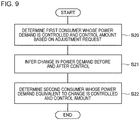
- the determining unit 12 determines a second consumer whose power demand equivalent to the change is to be controlled and a control amount (individual control amount) by which and a time period (individual control time period) during which the power demand of the second consumer is controlled.
- the determining unit 12 may determine a second consumer whose power demand equivalent to the increase is to be suppressed and a suppression amount (individual suppression amount) and an individual control time period of the second consumer.
- the determining unit 12 may determine a second consumer whose power demand equivalent to the decrease is to be promoted and a promotion amount (individual promotion amount) and an individual control time period of the second consumer.
- the determining unit 12 may determine a second consumer whose power demand equivalent to the change in the control time period is to be controlled and a control amount (individual control amount) by which and a time period (individual control time period) during which the power demand of the second consumer is controlled.
- first consumers (consumers A to D illustrated in the drawing) and control details for the first consumers are determined based on an adjustment request and control-caused changes with respect to the first consumers are inferred as illustrated in the drawing.
- the adjustment request is a request for power demand suppression and the control-caused changes are increases in power demand caused by the request for power demand suppression.
- a suppression amount in the adjustment request can be fulfilled by the control details determined with respect to the consumers A to D.
- the increases (control-caused changes) in power demand caused by the power demand suppression are subtracted, the suppression amount in the adjustment request becomes unfulfilled during partial time periods, as illustrated in Fig. 11 .
- determining second consumers whose power demands equivalent to portions of the suppression amount having become unfulfilled are to be controlled and control details enables precision in responding to an adjustment request to be increased.
- the determining unit 12 may determine a second consumer whose power demand equivalent to the change is to be controlled and a control amount (individual control amount) by which and a time period (individual control time period) during which the power demand of the second consumer is controlled.
- the determining unit 12 can perform determination of a second consumer and determination of an individual control amount and an individual control time period of the second consumer, using a similar method to the method for determination of a first consumer and an individual control amount and an individual control time period of the first consumer. That is, the determining unit 12 can perform the determination of a second consumer and determination of an individual control amount and an individual control time period of the second consumer by performing similar processing with a "control time period" and a "control amount”, which are referred to in the determination of a first consumer and an individual control amount and an individual control time period of the first consumer, replaced with a "time period during which the above-described change occurs" and "the amount of change", respectively.
- the determining unit 12 determines a first consumer whose power demand is to be controlled and an individual control amount by which and an individual control time period during which the power demand of the first consumer is controlled, based on an "adjustment request in which a control time period during which and a control amount by which power demand is controlled are specified", which was acquired by the acquiring unit 11.
- the inference unit 13 infers whether, when power demand of the first consumer is controlled in accordance with a determination result by the determining unit 12, power demand of the first consumer before and/or after control changes from power demand of the first consumer when the power demand is not controlled.
- the determining unit 12 determines a second consumer whose power demand equivalent to the change is to be controlled and an individual control amount by which and an individual control time period during which the power demand of the second consumer is controlled.
- the processing apparatus 10 of the present example embodiment when a control-caused change occurs in a control time period specified in an adjustment request, it is possible to determine a power consumer who absorbs power demand equivalent to the change (suppresses or promotes the power demand equivalent to the change). Even when consumers (first consumers) whose power demands are to be controlled and control details (individual control amounts and individual control time periods) are determined in such a way as to fulfill an adjustment request, an occurrence of a control-caused change during a control time period makes it difficult to say that the determination completely meets the adjustment request.
- the processing apparatus 10 of the present example embodiment that is capable of absorbing a control-caused change enables an adjustment request to be completely met. As a result, by requesting a resource aggregator using the processing apparatus 10 to perform supply-demand control, an electricity transmission and distribution utility or the like can perform adjustment of supply-demand balance with good precision.
- the processing apparatus 10 of the present example embodiment is also capable of absorbing a control-caused change occurring during a time period other than a control time period specified in an adjustment request.
- an electricity transmission and distribution utility or the like can perform adjustment of supply-demand balance with good precision.
- the determining unit 12 may preferentially determine a consumer who brings about a control-caused change the amount of which (for example, the amount of a control-caused change occurring during a control time period) is small as a first consumer.
- the determining unit 12 may also preferentially determine a consumer who brings about a control-caused change the amount of which (for example, the amount of a control-caused change occurring during a control time period) is small as a second consumer. When configured in such a manner, it is possible to suppress an effect of a control-caused change.
- the processing apparatus 10 may further include a replying unit that replies an inference result made by the inference unit 13 to the transmission source of an adjustment request (for example, an electricity transmission and distribution utility).
- a reply to a transmission source may be performed by an electronic mail, performed in a web page provided by a resource aggregator (notification in a login window), or achieved by another means.
- the replying unit may transmit an inference result during periods before and after a control time period to the transmission source of the adjustment request.
- the replying unit may also transmit an inference result during the control time period to the transmission source of the adjustment request.
- the replying unit may also transmit inference results during periods before and after the control time period and during the control time period to the transmission source of the adjustment request.
- temporal change in the amount of a control-caused change (the amount of change (increase or decrease) in power demand from power demand when not controlled) when control is performed based on the adjustment request, an integrated value of the amount of change, or temporal change in power demand when control is performed based on the adjustment request may be indicated.
- the variation enables the transmission source of an adjustment request to recognize an effect of the adjustment request.
- the variation also enables, for example, adjustment of supply-demand balance in a power system to be performed with the effect taken into consideration. As a result, it is possible to perform desired adjustment with high precision.
Landscapes
- Engineering & Computer Science (AREA)
- Power Engineering (AREA)
- Physics & Mathematics (AREA)
- General Physics & Mathematics (AREA)
- Automation & Control Theory (AREA)
- Supply And Distribution Of Alternating Current (AREA)
- Remote Monitoring And Control Of Power-Distribution Networks (AREA)
Applications Claiming Priority (2)
| Application Number | Priority Date | Filing Date | Title |
|---|---|---|---|
| JP2018014834 | 2018-01-31 | ||
| PCT/JP2018/038062 WO2019150662A1 (ja) | 2018-01-31 | 2018-10-12 | 処理装置、処理方法及びプログラム |
Publications (2)
| Publication Number | Publication Date |
|---|---|
| EP3748798A1 true EP3748798A1 (de) | 2020-12-09 |
| EP3748798A4 EP3748798A4 (de) | 2021-03-24 |
Family
ID=67478025
Family Applications (1)
| Application Number | Title | Priority Date | Filing Date |
|---|---|---|---|
| EP18903396.2A Pending EP3748798A4 (de) | 2018-01-31 | 2018-10-12 | Verarbeitungsvorrichtung, verarbeitungsverfahren und programm |
Country Status (5)
| Country | Link |
|---|---|
| US (1) | US11451056B2 (de) |
| EP (1) | EP3748798A4 (de) |
| JP (1) | JP6901011B2 (de) |
| AU (1) | AU2018405724A1 (de) |
| WO (1) | WO2019150662A1 (de) |
Families Citing this family (2)
| Publication number | Priority date | Publication date | Assignee | Title |
|---|---|---|---|---|
| CN110362377B (zh) * | 2018-04-09 | 2023-05-30 | 阿里巴巴集团控股有限公司 | 虚拟机的调度方法和装置 |
| JP7487007B2 (ja) | 2020-05-22 | 2024-05-20 | 清水建設株式会社 | 電力需要予測システム及び電力需要予測方法 |
Family Cites Families (15)
| Publication number | Priority date | Publication date | Assignee | Title |
|---|---|---|---|---|
| JP3742920B2 (ja) * | 2000-11-20 | 2006-02-08 | ダイキン工業株式会社 | デマンド制御運用方法およびその装置 |
| US7747357B2 (en) * | 2006-11-13 | 2010-06-29 | Lutron Electronics Co., Inc. | Method of communicating a command for load shedding of a load control system |
| US8744638B2 (en) * | 2009-09-11 | 2014-06-03 | General Electric Company | Method and system for demand response in a distribution network |
| EP2652855B1 (de) * | 2010-12-17 | 2019-06-12 | ABB Research Ltd. | Systeme und verfahren zur vorhersage der kundencompliance mit lastmanagementanfragen |
| US20120310431A1 (en) * | 2011-05-31 | 2012-12-06 | General Electric Company | System and method for selecting consumers for demand response |
| US9461470B2 (en) * | 2012-04-10 | 2016-10-04 | Cooper Technologies Company | Distributed electricity demand-reserve prediction |
| US9595070B2 (en) * | 2013-03-15 | 2017-03-14 | Google Inc. | Systems, apparatus and methods for managing demand-response programs and events |
| US20160086199A1 (en) * | 2013-04-12 | 2016-03-24 | Neurio Technology Inc. | System and method for performing demand response optimizations |
| JP2014236605A (ja) * | 2013-06-03 | 2014-12-15 | 三菱電機株式会社 | 空気調和装置の管理システム |
| JP2015076931A (ja) | 2013-10-07 | 2015-04-20 | 株式会社日立製作所 | 電力需要調整システム、電力需要調整方法および電力管理装置 |
| JP5967265B2 (ja) | 2014-07-31 | 2016-08-10 | ダイキン工業株式会社 | 機器制御装置 |
| US9876356B2 (en) * | 2014-10-02 | 2018-01-23 | Mitsubishi Electric Research Laboratories, Inc. | Dynamic and adaptive configurable power distribution system |
| JP6414456B2 (ja) * | 2014-12-12 | 2018-10-31 | 住友電気工業株式会社 | 需要家装置、電力消費管理装置、電力消費管理システム、電力消費管理方法および電力消費管理プログラム |
| JP2017041971A (ja) | 2015-08-19 | 2017-02-23 | 富士通株式会社 | 電力需要家評価方法、電力需要家評価プログラム及び電力需要家評価装置 |
| JP6631431B2 (ja) | 2016-07-21 | 2020-01-15 | 株式会社デンソー | 電力変換装置 |
-
2018
- 2018-10-12 US US16/964,311 patent/US11451056B2/en active Active
- 2018-10-12 EP EP18903396.2A patent/EP3748798A4/de active Pending
- 2018-10-12 AU AU2018405724A patent/AU2018405724A1/en not_active Abandoned
- 2018-10-12 JP JP2019568581A patent/JP6901011B2/ja not_active Expired - Fee Related
- 2018-10-12 WO PCT/JP2018/038062 patent/WO2019150662A1/ja not_active Ceased
Also Published As
| Publication number | Publication date |
|---|---|
| EP3748798A4 (de) | 2021-03-24 |
| US11451056B2 (en) | 2022-09-20 |
| AU2018405724A1 (en) | 2020-07-30 |
| JPWO2019150662A1 (ja) | 2021-01-07 |
| WO2019150662A1 (ja) | 2019-08-08 |
| JP6901011B2 (ja) | 2021-07-14 |
| US20210044112A1 (en) | 2021-02-11 |
Similar Documents
| Publication | Publication Date | Title |
|---|---|---|
| JP6457447B2 (ja) | データセンターのネットワークトラフィックスケジューリング方法及び装置 | |
| US11032212B2 (en) | Systems and methods for provision of a guaranteed batch | |
| US10831848B2 (en) | Management of software applications based on social activities relating thereto | |
| US20120324471A1 (en) | Control device, management device, data processing method of control device, and program | |
| JP6493400B2 (ja) | サービスチェーン管理装置、サービスチェーン管理システム、サービスチェーン管理方法、及び、プログラム | |
| JP2012079124A (ja) | ジョブ分散処理システム、情報処理装置及びプログラム | |
| CN111104227A (zh) | 一种K8s平台的资源控制方法、装置及相关组件 | |
| US11451056B2 (en) | Processing apparatus, processing method, and program for inferring demand response | |
| US20180145883A1 (en) | Server, computer program product, and communication system | |
| CN116599873B (zh) | VoLTE系统监控方法及装置、存储介质和电子设备 | |
| CN114936089A (zh) | 资源调度方法、系统、设备及存储介质 | |
| US9501321B1 (en) | Weighted service requests throttling | |
| CN117093439A (zh) | 容量数据处理的方法、装置、电子设备和存储介质 | |
| EP4163863A1 (de) | Programm, informationsverarbeitungsverfahren und informationsverarbeitungsvorrichtung | |
| US11513856B2 (en) | Method, devices and computer program products for resource usage | |
| CN120353629A (zh) | 基于反馈机制的kvm故障预测方法、系统、介质及设备 | |
| Cunha et al. | Exploiting user patience for scaling resource capacity in cloud services | |
| CN110990219B (zh) | 一种基于预测模型的计算机监控方法 | |
| JP6619938B2 (ja) | リソース制御システムおよびリソース制御方法 | |
| CN119127467B (zh) | 一种多租户环境下的模型训练资源隔离与管理系统及方法 | |
| CN114416326A (zh) | 大数据管控方法、装置、管控系统及可读存储介质 | |
| US20170201535A1 (en) | Estimation device and estimation method | |
| CN118802795B (zh) | 一种带宽调节方法、装置、设备、存储介质及产品 | |
| CN118659973B (zh) | 带宽资源分配方法、系统、电子设备及存储介质 | |
| CN119759581A (zh) | 基于网关的算力分配方法、装置、网关设备及存储介质 |
Legal Events
| Date | Code | Title | Description |
|---|---|---|---|
| STAA | Information on the status of an ep patent application or granted ep patent |
Free format text: STATUS: THE INTERNATIONAL PUBLICATION HAS BEEN MADE |
|
| PUAI | Public reference made under article 153(3) epc to a published international application that has entered the european phase |
Free format text: ORIGINAL CODE: 0009012 |
|
| STAA | Information on the status of an ep patent application or granted ep patent |
Free format text: STATUS: REQUEST FOR EXAMINATION WAS MADE |
|
| 17P | Request for examination filed |
Effective date: 20200828 |
|
| AK | Designated contracting states |
Kind code of ref document: A1 Designated state(s): AL AT BE BG CH CY CZ DE DK EE ES FI FR GB GR HR HU IE IS IT LI LT LU LV MC MK MT NL NO PL PT RO RS SE SI SK SM TR |
|
| AX | Request for extension of the european patent |
Extension state: BA ME |
|
| A4 | Supplementary search report drawn up and despatched |
Effective date: 20210222 |
|
| RIC1 | Information provided on ipc code assigned before grant |
Ipc: H02J 13/00 20060101ALI20210216BHEP Ipc: H02J 3/14 20060101AFI20210216BHEP Ipc: H02J 3/00 20060101ALI20210216BHEP |
|
| DAV | Request for validation of the european patent (deleted) | ||
| DAX | Request for extension of the european patent (deleted) | ||
| STAA | Information on the status of an ep patent application or granted ep patent |
Free format text: STATUS: EXAMINATION IS IN PROGRESS |
|
| 17Q | First examination report despatched |
Effective date: 20230102 |