EP3748820B1 - Rotor für eine dynamoelektrische maschine und dynamoelektrische maschine - Google Patents
Rotor für eine dynamoelektrische maschine und dynamoelektrische maschine Download PDFInfo
- Publication number
- EP3748820B1 EP3748820B1 EP18903091.9A EP18903091A EP3748820B1 EP 3748820 B1 EP3748820 B1 EP 3748820B1 EP 18903091 A EP18903091 A EP 18903091A EP 3748820 B1 EP3748820 B1 EP 3748820B1
- Authority
- EP
- European Patent Office
- Prior art keywords
- rotor
- shaft
- key
- keyway
- electromagnetic steel
- Prior art date
- Legal status (The legal status is an assumption and is not a legal conclusion. Google has not performed a legal analysis and makes no representation as to the accuracy of the status listed.)
- Active
Links
Images




Classifications
-
- H—ELECTRICITY
- H02—GENERATION; CONVERSION OR DISTRIBUTION OF ELECTRIC POWER
- H02K—DYNAMO-ELECTRIC MACHINES
- H02K1/00—Details of the magnetic circuit
- H02K1/06—Details of the magnetic circuit characterised by the shape, form or construction
- H02K1/22—Rotating parts of the magnetic circuit
- H02K1/28—Means for mounting or fastening rotating magnetic parts on to, or to, the rotor structures
-
- H—ELECTRICITY
- H02—GENERATION; CONVERSION OR DISTRIBUTION OF ELECTRIC POWER
- H02K—DYNAMO-ELECTRIC MACHINES
- H02K1/00—Details of the magnetic circuit
- H02K1/06—Details of the magnetic circuit characterised by the shape, form or construction
- H02K1/22—Rotating parts of the magnetic circuit
- H02K1/28—Means for mounting or fastening rotating magnetic parts on to, or to, the rotor structures
- H02K1/30—Means for mounting or fastening rotating magnetic parts on to, or to, the rotor structures using intermediate parts, e.g. spiders
-
- H—ELECTRICITY
- H02—GENERATION; CONVERSION OR DISTRIBUTION OF ELECTRIC POWER
- H02K—DYNAMO-ELECTRIC MACHINES
- H02K1/00—Details of the magnetic circuit
- H02K1/06—Details of the magnetic circuit characterised by the shape, form or construction
- H02K1/22—Rotating parts of the magnetic circuit
- H02K1/27—Rotor cores with permanent magnets
- H02K1/2706—Inner rotors
- H02K1/272—Inner rotors the magnetisation axis of the magnets being perpendicular to the rotor axis
- H02K1/274—Inner rotors the magnetisation axis of the magnets being perpendicular to the rotor axis the rotor consisting of two or more circumferentially positioned magnets
- H02K1/2753—Inner rotors the magnetisation axis of the magnets being perpendicular to the rotor axis the rotor consisting of two or more circumferentially positioned magnets the rotor consisting of magnets or groups of magnets arranged with alternating polarity
- H02K1/276—Magnets embedded in the magnetic core, e.g. interior permanent magnets [IPM]
-
- H—ELECTRICITY
- H02—GENERATION; CONVERSION OR DISTRIBUTION OF ELECTRIC POWER
- H02K—DYNAMO-ELECTRIC MACHINES
- H02K21/00—Synchronous motors having permanent magnets; Synchronous generators having permanent magnets
- H02K21/12—Synchronous motors having permanent magnets; Synchronous generators having permanent magnets with stationary armatures and rotating magnets
- H02K21/14—Synchronous motors having permanent magnets; Synchronous generators having permanent magnets with stationary armatures and rotating magnets with magnets rotating within the armatures
-
- H—ELECTRICITY
- H02—GENERATION; CONVERSION OR DISTRIBUTION OF ELECTRIC POWER
- H02K—DYNAMO-ELECTRIC MACHINES
- H02K7/00—Arrangements for handling mechanical energy structurally associated with dynamo-electric machines, e.g. structural association with mechanical driving motors or auxiliary dynamo-electric machines
- H02K7/003—Couplings; Details of shafts
Definitions
- the present invention relates to a rotor for a dynamo-electric machine and a dynamo-electric machine.
- JP 2016 123240 discloses a rotor for a dynamo-electric machine in which a shaft and a rotor core are fastened to each other such that a key provided on an inner peripheral side of each of electromagnetic steel sheets forming the rotor core is accommodated in a keyway formed on an outer peripheral surface of the shaft.
- JP 2007-181270 A discloses a rotor for a dynamo-electric machine in which a shaft and a rotor core are fastened to each other such that a key provided on an inner peripheral side of each of electromagnetic steel sheets forming the rotor core is accommodated in a keyway formed on an outer peripheral surface of the shaft.
- a pin hole into which a pin is to be inserted is provided near the key of each of the electromagnetic steel sheets, and a cut portion extending from the pin hole to the key is provided.
- a distal end of the key of the electromagnetic steel sheet is opened, and the key is pressed against the keyway provided in the shaft, so that the shaft and the rotor core are fastened to each other.
- the pin hole is provided in each of the electromagnetic steel sheets, and therefore, durability strength of the rotor against a centrifugal force generated at the time when the rotor rotates might decrease. Further, due to the configuration in which the distal end of the key of the electromagnetic steel sheet is opened by pressing the pin into the pin hole, there is such a concern that a strain generated when the rotor core and the shaft are fastened is transmitted so that an unnecessary stress is applied to the rotor core, thereby causing an adverse effect on rotor strength.
- An object of the present invention is to provide a rotor for a dynamo-electric machine in which a shaft and a rotor core can be fastened while an adverse effect on rotor strength is reduced.
- a rotor for a dynamo-electric machine is defined in the appended independent claim. Specific embodiments are defined in the dependent claims.
- Such a rotor for a dynamo-electric machine includes a shaft and a rotor core constituted by laminating a plurality of electromagnetic steel sheets, and the rotor core is configured such that the shaft is attached to an inner periphery of the rotor core.
- Each of the electromagnetic steel sheets constituting the rotor core includes an insertion hole into which the shaft is inserted, and a key protruding radially inwardly from the insertion hole, the shaft includes a keyway formed along an axial direction, the shaft is attached by clearance fit to the insertion holes of the electromagnetic steel sheets, and the key is fitted by pressing into the keyway such that a side face of the key abuts with a side face of the keyway.
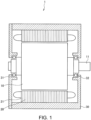
- FIG. 1 is a schematic configuration diagram illustrating a motor 1 using a rotor 10 according to a first embodiment.
- the motor 1 illustrated in FIG. 1 rotates upon receipt of supply of electric power from a power supply such as a battery and functions as an electric motor for driving wheels of a vehicle. Further, the motor 1 also functions as a generator driven by external force to generate electric power. Accordingly, the motor 1 is configured as a so-called dynamo-electric machine (a motor generator) functioning as an electric motor and a generator.
- the motor 1 includes the rotor 10, a stator 20 placed on an outer peripheral side of the rotor 10, and a case 30 in which the rotor 10 and the stator 20 are accommodated.
- the rotor 10 is placed inside the stator 20 so as to be rotatable relative to the stator 20.
- the rotor 10 includes a shaft 11 as a rotating shaft.
- the shaft 11 is rotatably supported by bearings 31, 32 provided in the case 30.
- the stator 20 is a cylindrical member formed such that a plurality of electromagnetic steel sheets 21 is laminated. Coils of a U-phase, a V-phase, and a W-phase are wounded around teeth of the stator 20.
- the case 30 is a housing configured as a cylindrical member in which the rotor 10 and the stator 20 can be accommodated.
- An inner peripheral surface of the case 30 is formed as a flat mounting surface on which the stator 20 is provided.
- FIG. 2 is a schematic configuration diagram of the rotor 10 viewed from the axial direction of the shaft 11.
- the rotor 10 includes the shaft 11, a rotor core 12, and magnets 13.
- the rotor core 12 is formed such that a plurality of electromagnetic steel sheets 14 is laminated in the axial direction of the shaft 11.
- the rotor core 12 includes a shaft insertion hole 121 that is a cylindrical hole formed in the center of the rotor core 12, and a plurality of (e.g., eight) magnet storage holes 131 provided at regular intervals along the circumferential direction at a position closer to an outer periphery of the rotor core 12.
- the magnets 13 are inserted into the magnet storage holes 131.
- the shaft 11 is inserted into the shaft insertion hole 121 of the rotor core 12 and transmits power caused by rotational motion of the rotor 10.
- Keyways 111 that are recessed grooves formed along the axial direction are formed on an outer peripheral surface of the shaft 11. Two keyways 111 are formed at regular intervals in the circumferential direction of the shaft 11.
- a key 15 (described later) of the electromagnetic steel sheet 14 is fitted by pressing into the keyway 111.
- the electromagnetic steel sheet 14 constituting the rotor core 12 has a toric shape and includes an insertion hole 16, holes 17 for magnet storage, and keys 15.
- the insertion hole 16 is a circular hole formed in the center of the electromagnetic steel sheet 14, and when the electromagnetic steel sheets 14 are laminated so that the insertion holes 16 are put on top of each other, the shaft insertion hole 121 of the rotor core 12 is formed.
- the holes 17 for magnet storage are provided at regular intervals along the circumferential direction at a position close to the outer periphery of the rotor core 12.
- the holes 17 form the magnet storage holes 131 of the rotor core such that the electromagnetic steel sheets 14 are laminated so that the holes 17 are put on top of each other.
- the key 15 is a part protruding radially inwardly from the insertion hole 16.
- Two keys 15 are formed at regular intervals in the circumferential direction of the electromagnetic steel sheet 14, and in a state where the electromagnetic steel sheets 14 are laminated, the keys 15 are fitted by pressing into the keyways 111 of the shaft 11.
- the shaft 11 is inserted into the shaft insertion hole 121 such that the keys 15 are fitted by pressing into the keyways 111, the rotor core 12 and the shaft 11 are fastened to each other. Details of a fastening structure for the rotor core 12 and the shaft 11 will be described later.
- the keys 15 of the electromagnetic steel sheet 14 are formed at two parts, but the number of keys 15 is not limited to this.
- the number of parts where the key 15 is formed may be one or may be equal to or more than three.
- the number and arrangement of the keyways 111 in the shaft 11 are set to correspond to the number and arrangement of the keys 15 in the electromagnetic steel sheet 14.
- FIG. 3 is a partial enlarged view of the electromagnetic steel sheet and illustrates a region A in FIG. 2 in an enlarged manner
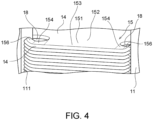
- FIG. 4 is a view illustrating a fastening part between the rotor core 12 and the shaft 11 in an enlarged manner.
- the electromagnetic steel sheet 14 in the present embodiment is a thin member having a thickness of around 0.2 to 0.5 mm, but the thickness of the electromagnetic steel sheet 14 is not limited to this. As illustrated in FIG.
- the key 15 protruding radially inwardly from the insertion hole 16 of the electromagnetic steel sheet 14 includes an extension portion 151 protruding radially inwardly from the insertion hole 16, and projection portions 154 protruding outwardly (on side faces) in the width direction of the extension portion 151 from opposite side faces of the extension portion 151 in the width direction (the circumferential direction).
- the shaft 11 is inserted by clearance fit into the shaft insertion hole 121 of the rotor core 12, the shaft insertion hole 121 being formed such that the insertion holes 16 of the electromagnetic steel sheets 14 are put on top of each other.
- the clearance fit is such that a slight gap is formed between the outer peripheral surface of the shaft 11 and an inner peripheral surface of the rotor core 12.
- each electromagnetic steel sheet 14 is made of a thin plate, the electromagnetic steel sheet 14 easily deforms plastically, and at the time of press-fitting, distal ends 156 of the projection portions 154 of the key 15 abut with the side faces of the keyway 111 in a state where the distal ends 156 deform in the axial direction as illustrated in FIG. 4 .
- a recessed portion 18 surrounded by the side face of the keyway 111 and the rotor core 12 is formed on an outer peripheral side of the projection portion 154.
- the recessed portion 18 is placed inwardly (on a central side of the shaft 11) from an inside diameter line B of the rotor core 12.
- the recessed portion 18 projects outwardly (on an outside diameter side) from the inside diameter line of the rotor core 12
- an adverse effect on the strength of the rotor core 12 against a centrifugal force might be caused.
- the recessed portion 18 since the recessed portion 18 is placed inwardly from the inside diameter line of the rotor core 12, it is possible to restrain the adverse effect on the strength of the rotor core 12.
- a radial distal end 153 of the extension portion 151 has a slight gap from the keyway 111 and does not abut with the keyway 111.
- an unnecessary stress is not applied to the rotor core 12.
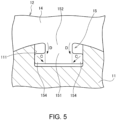
- FIG. 5 is a view illustrating a compressive stress and a tensile stress applied to the key 15 when the key 15 of the electromagnetic steel sheet 14 is fitted by pressing into the keyway 111 of the shaft 11.
- a compressive stress to act on the projection portion 154 from the side face of the keyway 111 is diagonally applied in an inside-diameter direction (a direction indicated by an arrow C in FIG. 5 ) of the rotor 10.
- a tensile stress in an inside-diameter direction (a direction indicated by an arrow D in FIG. 5 ) of the rotor core 12 is applied to the vicinity of the root 152 of the extension portion 151 of the key 15.
- FIG. 6A is a view illustrating a result obtained by analyzing a maximum value (MPa) of the tensile stress applied to the root 152 of the key 15 by changing L/W. As illustrated in FIG. 6B , the tensile stress and L/W have a generally inversely proportional relationship until the value of L/W is around 1.0.
- MPa maximum value
- the electromagnetic steel sheet 14 having a thickness of around 0.2 to 0.5 mm and a yield stress of 300 MPa is used.
- L/W should be equal to or more than 0.5. This makes it possible to prevent the tensile stress to be applied to the root 152 of the key 15 from exceeding the yield stress of the electromagnetic steel sheet 14. As such, it is preferable to design the value of L/W to be equal to or more than 0.5.
- an internal corner 157 at a position where the extension portion 151 is connected to the insertion hole 16 and an internal corner 158 at a position where the extension portion 151 is connected to the projection portion 154 are formed in a curved shape.
- the tensile stress applied to the key 15 is dispersed by a curved portion having a curved shape. Accordingly, it is possible to more effectively reduce the tensile stress applied to the root 152 of the key 15 in the inside-diameter direction of the rotor core 12.
- the rotor 10 of the motor 1 of the first embodiment can yield the following effects.
- the rotor core 12 and the shaft 11 are fastened to each other by performing press-fitting such that the side face of the key 15 of the electromagnetic steel sheet 14 abuts with the side face of the keyway 111 of the shaft 11, and the shaft 11 is inserted by clearance fit in other parts of the insertion hole 16 of the electromagnetic steel sheet 14.
- the shaft 11 is inserted by clearance fit in other parts of the insertion hole 16 of the electromagnetic steel sheet 14.
- the rotor core 12 and the shaft 11 are fastened to each other by fitting, by pressing, the key-15 part of the electromagnetic steel sheet 14 into the keyway 111 of the shaft 11, and therefore, unlike JP 2007-181270 A , it is not necessary to provide a pin hole in the rotor core 12 and to insert a pin therein. On this account, it is possible to prevent such a situation that a strain generated by opening the distal end of the key of the electromagnetic steel sheet by insertion of the pin is transmitted and an unnecessary stress is applied to the rotor core, and it is possible to prevent the pin hole from decreasing the durability strength of the rotor 10 against a centrifugal force generated at the time when the rotor rotates.
- the rotor 10 of the motor 1 does not require provision of a pin hole in the rotor core 12 and insertion of a pin into the rotor core 12, and therefore, it is possible to simplify assembly of the rotor 10 and to achieve a reduction in cost.
- the distal ends 156 of the projection portions 154, the distal ends 156 abutting with the keyway 111 deform in the axial direction. The deformation relieves a press-fitting stress, thereby making it possible to restrain occurrence of contamination due to shaving of the shaft 11 when the shaft 11 rubs against the electromagnetic steel sheets 14.
- the distal end 156 of the projection portion 154 is configured to be deformable in the axial direction, it is possible to set the width of the keyway 111 of the shaft 11 to be small, or it is possible to set the length L from the root 155 to the distal end 156 in the projection portion 154 to be long.
- machining accuracy of the shaft 11 and the rotor core 12 decreases, it is possible to surely fasten the shaft 11 to the rotor 10.
- the projection portion 154 protruding from the side face of the extension portion 151 of the key 15 is fitted by pressing, a compressive stress applied to the key 15 in the press-fitting concentrates on the projection portion 154. Accordingly, a strain caused by the compressive stress is hardly transmitted to the root 152 of the key 15. On this account, the root 152 of the key 15 should tolerate only a torque generated in the rotor core 12, and in comparison with a case where the projection portion 154 is not provided, it is possible to largely reduce a requested strength of the key 15. Further, since the strain caused by the compressive stress is not transmitted to an outside-diameter side relative to an inner peripheral surface of the electromagnetic steel sheet 14, it is possible to prevent an adverse effect on the strength of the rotor 10.
- the extension portion 151 of the key 15 makes contact with the shaft 11, so that rotational power of the rotor 10 can be transmitted to the shaft 11. This can maintain traveling of the vehicle.
- an adverse effect on the strength of the rotor core 12 against a centrifugal force caused by rotation of the rotor 10 can be restrained.
- the electromagnetic steel sheet 14 is designed such that the value of L/W is equal to or more than 0.5 when L indicates the length from the root 155 to the distal end 156 in the projection portion 154 of the key 15, and W indicates the width dimension of the projection portion. This makes it possible to prevent the tensile stress to be applied to the root 155 of the key 15 from exceeding the yield stress of the electromagnetic steel sheet 14.
- the internal corner 158 at the position where the extension portion 151 of the key 15 is connected to the projection portion 154 and the internal corner 157 at the position where the extension portion 151 of the key 15 is connected to the insertion hole 16 are formed in a curved shape.
- the tensile stress applied to the key 15 is dispersed by a curved portion having a curved shape. This accordingly makes it possible to reduce the tensile stress applied to the root 152 of the key 15 in the inside-diameter direction of the rotor core 12.
- the keys 15 in the electromagnetic steel sheet 14 are formed at regular intervals in the circumferential direction of the electromagnetic steel sheet 14, and the keyways 111, of the shaft 11, that correspond to the keys 15 are formed at regular intervals in the circumferential direction of the shaft 11.
- the keys 15 and the keyways 111 are not placed at regular intervals, it is possible to restrain deformation of the rotor core 12 and occurrence of the tensile stress due to a centrifugal force, and it is possible to restrain the adverse effect on the strength of the rotor core 12.
- FIG. 7 is a partial enlarged view of the electromagnetic steel sheet 14 according to the second embodiment and is a view illustrating a part corresponding to the part A in FIG. 2 in an enlarged manner.
- the second embodiment is different from the rotor 10 of the motor 1 in the first embodiment in that the key 15 of the electromagnetic steel sheet 14 does not include the projection portion 154.
- a constituent having the same function as a constituent in the first embodiment has the same reference sign as the constituent in the first embodiment, and descriptions are made by omitting redundant descriptions appropriately.
- the key 15 of the electromagnetic steel sheet 14 does not include the projection portion 154 and includes only an extension portion 151A.
- the shaft 11 is inserted by clearance fit into the shaft insertion hole 121 of the rotor core 12, the shaft insertion hole 121 being formed such that the insertion holes 16 of the electromagnetic steel sheets 14 are put on top of each other.
- the key 15 is fitted by pressing into the keyway 111, so that the shaft 11 and the rotor core 12 are fastened to each other.
- the rotor 10 of the motor 1 of the second embodiment can yield the following effects.
- the rotor core 12 and the shaft 11 are fastened to each other by performing press-fitting such that the side faces of the key 15 of the electromagnetic steel sheet 14 abut with the side faces of the keyway 111 of the shaft 11, and the shaft 11 is inserted by clearance fit in other parts of the insertion hole 16 of the electromagnetic steel sheet 14.
- the shaft 11 is inserted by clearance fit in other parts of the insertion hole 16 of the electromagnetic steel sheet 14.
- the rotor core 12 and the shaft 11 are fastened to each other by fitting, by pressing, the key 15 of the electromagnetic steel sheet 14 into the keyway 111 of the shaft 11, and therefore, unlike JP 2007-181270 A , it is not necessary to provide a pin hole in the rotor core 12 and to insert a pin therein. On this account, it is possible to prevent such a situation that a strain generated by opening the distal end of the key of the electromagnetic steel sheet due to insertion of the pin is transmitted and an unnecessary stress is applied to the rotor core, and it is possible to prevent the pin hole from decreasing the durability strength of the rotor 10 against a centrifugal force generated at the time when the rotor rotates. Further, the rotor 10 of the motor 1 does not require provision of a pin hole in the rotor core 12 and insertion of a pin into the rotor core 12. This can simplify assembly of the rotor 10 and achieve a reduction in cost.
- the keys 15 are fitted by pressing into the keyway 111 while the opposite side faces of the keys 15 provided in the electromagnetic steel sheets 14 are brought into contact with the opposite side faces of the keyway 111, respectively.
- the external corners 160 where the distal end 153A of the extension portion 151A of the key 15 is connected to the side faces of the extension portion 151A deform in the axial direction. Due to this deformation, a press-fitting stress is relieved, thereby making it possible to restrain occurrence of contamination due to shaving of the shaft 11 when the shaft 11 rubs against the electromagnetic steel sheets 14.
- the external corners 160 where the distal end 153A of the extension portion 151A is connected to the side faces of the extension portion 151A are configured to be deformable in the axial direction, it is possible to set the width of the keyway 111 of the shaft 11 to be small or to set the width of the extension portion 151A to be large.
- machining accuracy of the shaft 11 and the rotor core 12 decreases, it is possible to surely fasten the shaft 11 to the rotor 10.
- FIG. 8 is a partial enlarged view of the electromagnetic steel sheet 14 according to the third embodiment and is a view illustrating a part corresponding to the part A in FIG. 2 in an enlarged manner.
- the third embodiment is different from the rotors 10 of the motors 1 in the first and second embodiments in that the key 15 of the electromagnetic steel sheet 14 includes the projection portion 154 only on one side face of an extension portion 151B.
- the key 15 of the electromagnetic steel sheet 14 includes the projection portion 154 protruding outwardly (on the side face) in the width direction of the extension portion 151B from one side face of the extension portion 151B in the width direction (the circumferential direction).
- the shaft 11 is inserted by clearance fit into the shaft insertion hole 121 of the rotor core 12, the shaft insertion hole 121 being formed such that the insertion holes 16 of the electromagnetic steel sheets 14 are put on top of each other.
- the key 15 is fitted by pressing into the keyway 111 such that the projection portion 154 of the key 15 abuts with a side face, on one side, of the keyway 111 of the shaft 11, and a side face of the extension portion 151B of the key 15 on a side where the projection portion 154 is not extended abuts with a side face, on the other side, of the keyway 111.
- the shaft 11 and the rotor core 12 are fastened to each other.
- press-fitting is also performed such that the side faces of the key 15 abut with the side faces of the keyway 111, and the shaft 11 is inserted by clearance fit in other parts of the insertion hole 16 of the electromagnetic steel sheet 14.
- an unnecessary stress is not applied to the rotor core 12, thereby making it possible to reduce an adverse effect on the rotor 10.
- the distal end 156 of the projection portion 154 of the key 15 and the external corner 160 where the distal end 153B of the extension portion 151B of the key 15 is connected to the side face of the extension portion 151B deform in the axial direction the distal end 156 and the external corner 160 abut with the side faces of the keyway 111, so that a press-fitting stress is relieved.
- the projection portion 154 protruding from the side face of the extension portion 151B of the key 15 is fitted by pressing, a compressive stress applied to the key 15 in the press-fitting concentrates on the projection portion 154. Accordingly, the rotor 10 of the third embodiment can also yield effects similar to those in the first embodiment and the second embodiment.
- FIG. 9 is a partial enlarged view of the electromagnetic steel sheet 14 according to the fourth embodiment and is a view illustrating a part corresponding to the part A in FIG. 2 in an enlarged manner.
- the fourth embodiment is different from the rotor 10 of the motor 1 in the first embodiment in that the key 15 of the electromagnetic steel sheet 14 includes a protruding portion 161 in the distal end of the extension portion 151 such that the protruding portion 161 protrudes radially inwardly.
- the key 15 of the electromagnetic steel sheet 14 includes the protruding portion 161 in the distal end of the extension portion 151 such that the protruding portion 161 protrudes radially inwardly, in addition to the projection portions 154 extended outwardly (on the side faces) in the width direction of the extension portion 151 from the opposite side faces of the extension portion 151 in the width direction (the circumferential direction).
- the shaft 11 is inserted into the shaft insertion hole 121 by clearance fit, and the key 15 is fitted by pressing into the keyway 111 such that two projection portions 154 of the key 15 abut with the opposite side faces of the keyway 111 of the shaft 11, respectively.
- the distal ends 156 of the projection portions 154 of the key 15 abut with the side faces of the keyway 111 in a state where the distal ends 156 deform in the axial direction.
- a magnitude of a width dimension of the protruding portion 161 is equal to a magnitude of a width dimension of the extension portion 151.
- a radial distal end 163 of the protruding portion 161 has a slight gap from the keyway 111 and does not abut with the keyway 111.
- the internal corner 157 at the position where the extension portion 151 is connected to the insertion hole 16, the internal corner 158 at the position where the extension portion 151 is connected to the projection portion 154, and an internal corner 159 at a position where the protruding portion 161 is connected to the projection portion 154 are formed to have a curved shape.
- FIG. 10 is a view illustrating a compressive stress and a tensile stress applied to the key 15 when the key 15 of the electromagnetic steel sheet 14 is fitted by pressing into the keyway 111.
- a compressive stress to act on the projection portion 154 from the side face of the keyway 111 is diagonally applied in the inside-diameter direction (a direction indicated by an arrow C in FIG. 10 ) of the rotor 10. Due to the action of the compressive stress, the projection portion 154 deforms in the inside-diameter direction of the rotor, and a tensile stress in the inside-diameter direction (a direction indicated by an arrow D in FIG. 10 ) of the rotor core 12 is applied to the vicinity of the root 152 of the extension portion 151 of the key 15.
- the deformation of the projection portion 154 in the inside-diameter direction of the rotor due to the compressive stress to act on the projection portion 154 is restrained by the protruding portion 161 of the key 15.
- the inventors of the present invention found, from results of study and analysis, that, as a length T from a root 162 to the distal end 163 in the protruding portion 161 is increased, a maximum value of the tensile stress to be applied to the vicinity of the root 152 of the key 15 is reduced rapidly until T reaches 0.5 mm, and when T exceeds 0.5 mm, the maximum value is reduced slowly. Accordingly, it is preferable to design a dimension of T to be equal to or more than 0.5 mm. However, T is not limited to this.
- the magnitude of the width dimension of the protruding portion 161 is equal to the magnitude of the width dimension of the extension portion 151.
- the magnitude of the width dimension of the protruding portion 161 is not limited to this, as long as the magnitude of the width dimension of the protruding portion 161 is smaller than a width dimension of the keyway 111.
- the width dimension of the protruding portion 161 is smaller than the width dimension of the extension portion 151, an effect to restrain deformation of the projection portion 154 in the inside-diameter direction at the time of press-fitting of the key 15 is small, and therefore, it is preferable that the magnitude of the width dimension of the protruding portion 161 be equal to or larger than the width dimension of the extension portion 151.
- the rotor for the dynamo-electric machine in the fourth embodiment can yield the following effects in addition to the effects obtained by the rotor for the dynamo-electric machine in the first embodiment.
- the key 15 of the electromagnetic steel sheet includes the protruding portion 161 in the distal end of the extension portion 151 such that the protruding portion 161 protrudes radially inwardly, in addition to the projection portions 154 protruding outwardly in the width direction of the extension portion 151 from the opposite side faces of the extension portion 151 in the width direction.
- the deformation of the projection portion 154 in the inside-diameter direction of the rotor due to the compressive stress to act on the projection portion 154 can be restrained, thereby making it possible to reduce the tensile stress to be applied to the vicinity of the root 152 of the key 15. This makes it possible to prevent the tensile stress to be applied to the root 152 of the key 15 from exceeding the yield stress of the electromagnetic steel sheet 14.
- the length T from the root 162 to the distal end 163 in the protruding portion 161 is designed to be equal to or more than 0.5 mm. This makes it possible to reduce the tensile stress to be applied to the vicinity of the root 152 of the key 15 and to prevent the tensile stress to be applied to the root 152 of the key 15 from exceeding the yield stress of the electromagnetic steel sheet 14.
- FIG. 11 is a partial enlarged view of the electromagnetic steel sheet 14 according to the modification of the fourth embodiment and is a view illustrating a part corresponding to the part A in FIG. 2 in an enlarged manner.
- the side faces of the keyway 111 of the shaft 11 are formed in a tapered shape in which a width between the side faces becomes narrow toward an outer-periphery direction of the shaft 11.
- the electromagnetic steel sheet 14 forming the rotor core 12 has such a concern that the key 15 might deviate from the shaft 11 toward the outer-periphery direction of the shaft 11 due to a centrifugal force caused by rotation of the rotor 10 or an impact load caused by a collision or the like of the vehicle.
- the side faces of the keyway 111 of the shaft 11 are formed in a tapered shape in which the width between the side faces becomes narrow toward the outer-periphery direction of the shaft 11. This makes it possible to prevent the key 15 from deviating from the shaft 11 toward the outer-periphery direction of the shaft 11 due to the centrifugal force or the impact load.
- a plurality of keys 15 in the electromagnetic steel sheet 14 be provided at regular intervals in the circumferential direction of the electromagnetic steel sheet 14, but the arrangement of the keys 15 is not limited to this, and the keys 15 may not be placed at regular intervals.
- the magnets 6 are placed at regular intervals on the end face of the rotor core 12 on the outer peripheral side, but the arrangement of the magnets 6 is not limited to this.
- the radial distal end 153 of the extension portion 151 or the radial distal end 163 of the protruding portion 161 do not abut with the keyway 111.
- the rotor is not necessarily limited to this, and the radial distal end 153 or the radial distal end 163 may abut with the keyway 111.
- the recessed portion 18 formed on the outer peripheral side of the projection portion 154 such that the recessed portion 18 is surrounded by the side face of the keyway 111 and the rotor core 12 be placed inwardly from the inside diameter line of the rotor core 12.
- the rotor is not necessarily limited to this, and the recessed portion 18 may project outwardly from the inside diameter line of the rotor core 12.
- the value of L/W be equal to or more than 0.5 when L indicates the length from the root 155 to the distal end 156 in the projection portion 154 of the key 15, and W indicates the width dimension of the projection portion 154.
- the rotor is not limited to this.
- the internal corner 159 at the position where the protruding portion 161 is connected to the projection portion 154 be formed to have a curved shape.
- the rotor is not limited to this, and the internal corner 157, the internal corner 158, and the internal corner 159 may be formed to have a square shape, for example.
Landscapes
- Engineering & Computer Science (AREA)
- Power Engineering (AREA)
- Iron Core Of Rotating Electric Machines (AREA)
- Connection Of Motors, Electrical Generators, Mechanical Devices, And The Like (AREA)
Claims (10)
- Ein Rotor (10) für eine dynamoelektrische Maschine, wobei der Rotor (10) aufweist:eine Welle (11); undeinen Rotorkern (12), der durch Laminieren einer Vielzahl von elektromagnetischen Stahlblechen (14) gebildet ist, wobei der Rotorkern (12) so konfiguriert ist, dass die Welle (11) mit dem Innenumfang des Rotorkerns (12) verbunden ist, wobei:jedes der elektromagnetischen Stahlbleche (14), die den Rotorkern (12) bilden, ein Einführungsloch (16) aufweist, in das die Welle (11) eingeführt wird, und eine Paßfeder (15), die von dem Einführungsloch (16) radial nach innen vorsteht;die Welle (11) eine Passfedernut (111) aufweist, die entlang einer axialen Richtung ausgebildet ist und gegenüberliegende Seitenflächen aufweist;die Welle (11) ist durch Spielpassung mit den Einführungslöchern (16) der elektromagnetischen Stahlbleche (14) verbunden;die Paßfeder (15) einen Verlängerungsabschnitt (151) aufweist, der von dem Einführungsloch (16) radial nach innen vorsteht, und Vorsprungsabschnitte (154), die sich in einer Breitenrichtung des Verlängerungsabschnitts (151) von gegenüberliegenden Seitenflächen des Verlängerungsabschnitts (151) in der Breitenrichtung nach außen erstrecken, und
die Passfeder (15) durch Einpressen in die Passfedernut (111) eingepasst wird, so dass jede der Seitenflächen der Passfeder (15) an einer entsprechenden der Seitenflächen der Passfedernut (111) anliegt,dadurch gekennzeichnet, dassdie Passfeder (15) ferner einen vorstehenden Abschnitt (161) aufweist, der von einem distalen Ende des Verlängerungsabschnitts (151) radial nach innen vorsteht. - Der Rotor (10) für die dynamoelektrische Maschine nach Anspruch 1, wobei
ein eingelassener Abschnitt (18), der von jeder der Seitenflächen der Passfedernut (111) und des Rotorkerns (12) umgeben ist, an einer äußeren Umfangsseite des Vorsprungsabschnitts (154) ausgebildet ist und von einer Innendurchmesserlinie des Rotorkerns (12) nach innen angeordnet ist. - Der Rotor (10) für die dynamoelektrische Maschine nach Anspruch 1 oder 2, wobei
L/W gleich oder mehr als 0,5 ist, wenn L die Länge von der Wurzel bis zum distalen Ende in jedem der Vorsprungsteile (154) angibt und W die Abmessung der Breite jedes der Vorsprungsteile (154) angibt. - Der Rotor (10) für die dynamoelektrische Maschine nach einem der Ansprüche 1 bis 3, wobei
die Magnitude der Breitenabmessung des vorstehenden Abschnitts (161) gleich oder größer ist als die Breitenabmessung des Verlängerungsabschnitts (151), aber kleiner als die Breite der Passfedernut (111). - Der Rotor (10) für die dynamoelektrische Maschine nach einem der Ansprüche 1 bis 4, wobei
die Länge von der Wurzel bis zum distalen Ende in dem vorstehenden Abschnitt (161) gleich oder größer als 0,5 mm ist. - Der Rotor (10) für die dynamoelektrische Maschine nach einem der Ansprüche 1 bis 5, wobei
eine innere Ecke (158) an einer Stelle, an der der Verlängerungsabschnitt (151) mit jedem der Vorsprungsabschnitte (154) verbunden ist, und eine innere Ecke (157) an einer Stelle, an der jede der Seitenflächen des Verlängerungsabschnitts (151) mit dem Einführungsloch (16) verbunden ist, so ausgebildet sind, dass sie eine gebogene Form aufweisen. - Der Rotor (10) für die dynamoelektrische Maschine nach einem der Ansprüche 1 bis 6, wobeieine innere Ecke (158) an einer Stelle, an der der Verlängerungsabschnitt (151) mit jedem der Vorsprungsabschnitte (154) verbunden ist,eine innere Ecke (157) an einer Stelle, an der jede der Seitenflächen des Verlängerungsabschnitts (151) mit dem Einführungsloch (16) verbunden ist, undeine innere Ecke (159) an einer Stelle, an der der vorstehende Abschnitt (161) mit jedem der Vorsprungsabschnitte (154) verbunden ist, so ausgebildet sind, dass sie eine gebogene Form aufweisen.
- Der Rotor (10) für die dynamoelektrische Maschine nach einem der Ansprüche 1 bis 7, wobei
eine Vielzahl von Passfedernuten (111) und eine Vielzahl von Passfedern (15) in regelmäßigen Abständen in einer Umfangsrichtung auf der Welle (11) bzw. auf den elektromagnetischen Stahlblechen (14) ausgebildet sind. - Der Rotor (10) für die dynamoelektrische Maschine nach einem der Ansprüche 1 bis 8, wobei
die Passfedernut (111) in einer sich verjüngenden Form ausgebildet ist, in der sich die Breite zwischen den Seitenflächen der Passfedernut (111) in Richtung des Außenumfangs der Welle (11) verjüngt. - Eine dynamoelektrische Maschine, aufweisend:den Rotor (10) nach einem der Ansprüche 1 bis 9; undeinen Stator (20), der um den Rotor (10) herum bereitgestellt ist.
Applications Claiming Priority (1)
| Application Number | Priority Date | Filing Date | Title |
|---|---|---|---|
| PCT/JP2018/003428 WO2019150527A1 (ja) | 2018-02-01 | 2018-02-01 | 回転電機のロータ及び回転電機 |
Publications (3)
| Publication Number | Publication Date |
|---|---|
| EP3748820A1 EP3748820A1 (de) | 2020-12-09 |
| EP3748820A4 EP3748820A4 (de) | 2021-01-20 |
| EP3748820B1 true EP3748820B1 (de) | 2024-08-28 |
Family
ID=67478096
Family Applications (1)
| Application Number | Title | Priority Date | Filing Date |
|---|---|---|---|
| EP18903091.9A Active EP3748820B1 (de) | 2018-02-01 | 2018-02-01 | Rotor für eine dynamoelektrische maschine und dynamoelektrische maschine |
Country Status (5)
| Country | Link |
|---|---|
| US (1) | US11462962B2 (de) |
| EP (1) | EP3748820B1 (de) |
| JP (1) | JP7010309B2 (de) |
| CN (1) | CN111684688B (de) |
| WO (1) | WO2019150527A1 (de) |
Families Citing this family (5)
| Publication number | Priority date | Publication date | Assignee | Title |
|---|---|---|---|---|
| KR102611335B1 (ko) * | 2019-01-02 | 2023-12-08 | 엘지마그나 이파워트레인 주식회사 | 모터의 회전축 구조 |
| FR3104849B1 (fr) * | 2019-12-17 | 2023-03-17 | Nidec Psa Emotors | Rotor de machine électrique tournante |
| JP7540454B2 (ja) * | 2022-03-10 | 2024-08-27 | トヨタ自動車株式会社 | 電動機のロータ |
| WO2025083763A1 (ja) * | 2023-10-16 | 2025-04-24 | 日産自動車株式会社 | 回転電機 |
| CN121566813A (zh) * | 2026-01-26 | 2026-02-24 | 天蔚蓝电驱动科技(江苏)有限公司 | 转子叠及转子 |
Family Cites Families (11)
| Publication number | Priority date | Publication date | Assignee | Title |
|---|---|---|---|---|
| FR2586070B1 (fr) * | 1985-08-12 | 1987-12-18 | Europ Propulsion | Palier magnetique radial de grand diametre |
| US4987330A (en) * | 1990-01-16 | 1991-01-22 | General Motors Corporation | Rotor lamination assembly for a dynamoelectric machine |
| JP2004032943A (ja) * | 2002-06-27 | 2004-01-29 | Toyota Motor Corp | 嵌合構造 |
| JP2005168128A (ja) * | 2003-12-01 | 2005-06-23 | Honda Motor Co Ltd | 回転電機用ロータ |
| JP2007181270A (ja) | 2005-12-27 | 2007-07-12 | Toyota Motor Corp | 回転電機のロータ |
| JP5035613B2 (ja) | 2007-08-31 | 2012-09-26 | アイシン精機株式会社 | ロータ |
| JP5707863B2 (ja) | 2010-10-29 | 2015-04-30 | 株式会社明電舎 | 電動機のロータ構造 |
| CN103930472B (zh) | 2011-07-29 | 2016-01-06 | 艾德昂有限责任公司 | 一种通过电子束辐射、并通过气体产生的等离子和紫外辐射进行固化组合物的方法 |
| US8766502B2 (en) | 2011-09-27 | 2014-07-01 | Lg Innotek Co., Ltd. | Rotor having shaft slip inhibition structure and motor having the same |
| CN107005108B (zh) * | 2014-12-03 | 2018-07-24 | 日产自动车株式会社 | 旋转电机的转子构造 |
| JP2016123240A (ja) * | 2014-12-25 | 2016-07-07 | アイシン・エィ・ダブリュ株式会社 | 電動機用ロータ及びその製造方法 |
-
2018
- 2018-02-01 CN CN201880088300.6A patent/CN111684688B/zh active Active
- 2018-02-01 WO PCT/JP2018/003428 patent/WO2019150527A1/ja not_active Ceased
- 2018-02-01 JP JP2019568500A patent/JP7010309B2/ja active Active
- 2018-02-01 US US16/966,695 patent/US11462962B2/en active Active
- 2018-02-01 EP EP18903091.9A patent/EP3748820B1/de active Active
Also Published As
| Publication number | Publication date |
|---|---|
| US20210036564A1 (en) | 2021-02-04 |
| EP3748820A1 (de) | 2020-12-09 |
| JPWO2019150527A1 (ja) | 2021-01-14 |
| CN111684688A (zh) | 2020-09-18 |
| WO2019150527A1 (ja) | 2019-08-08 |
| CN111684688B (zh) | 2022-07-08 |
| EP3748820A4 (de) | 2021-01-20 |
| US11462962B2 (en) | 2022-10-04 |
| JP7010309B2 (ja) | 2022-01-26 |
Similar Documents
| Publication | Publication Date | Title |
|---|---|---|
| EP3748820B1 (de) | Rotor für eine dynamoelektrische maschine und dynamoelektrische maschine | |
| JP5324673B2 (ja) | 分割式コアを有する電動機の回転子及びその製造方法 | |
| JP4807219B2 (ja) | ステータコアおよび回転電機 | |
| EP1193827B1 (de) | Läuferaufbau für Dauermagnetmotor | |
| US7906883B2 (en) | Axial gap motor | |
| US10944306B2 (en) | Rotary electric rotor and method of manufacturing rotary electric rotor | |
| KR101967648B1 (ko) | 전동기의 로터 조립체 | |
| JP5685506B2 (ja) | 回転電機の回転子、回転電機および回転子の端面部材 | |
| WO2018116738A1 (ja) | 回転電機の回転子、及び回転電機 | |
| CN115250017A (zh) | 定子 | |
| JP5495045B2 (ja) | 回転電機の回転子 | |
| JP6957631B2 (ja) | 回転電機 | |
| US20200227963A1 (en) | Rotor core of rotating electrical machine | |
| US9106116B2 (en) | Rotor of rotating electrical machine | |
| CN109141219B (zh) | 旋转角度检测装置及具备旋转角度检测装置的车用驱动电动机 | |
| CN109560632B (zh) | 转子 | |
| WO2021157061A1 (ja) | 回転電機 | |
| US20130076197A1 (en) | Rotor for electric rotating machine and method for manufacturing the same | |
| JP6947015B2 (ja) | ロータコアの取付構造 | |
| JP7740195B2 (ja) | ロータコア | |
| US11063483B2 (en) | Electric motor | |
| JP6910413B2 (ja) | 回転電機 | |
| US10873225B2 (en) | Rotor for rotary electric machine having a gap for alleviating stress during rotation | |
| JP2008312366A (ja) | 回転電機及びそのコア | |
| CN114402507A (zh) | 转子 |
Legal Events
| Date | Code | Title | Description |
|---|---|---|---|
| STAA | Information on the status of an ep patent application or granted ep patent |
Free format text: STATUS: THE INTERNATIONAL PUBLICATION HAS BEEN MADE |
|
| PUAI | Public reference made under article 153(3) epc to a published international application that has entered the european phase |
Free format text: ORIGINAL CODE: 0009012 |
|
| STAA | Information on the status of an ep patent application or granted ep patent |
Free format text: STATUS: REQUEST FOR EXAMINATION WAS MADE |
|
| 17P | Request for examination filed |
Effective date: 20200831 |
|
| AK | Designated contracting states |
Kind code of ref document: A1 Designated state(s): AL AT BE BG CH CY CZ DE DK EE ES FI FR GB GR HR HU IE IS IT LI LT LU LV MC MK MT NL NO PL PT RO RS SE SI SK SM TR |
|
| AX | Request for extension of the european patent |
Extension state: BA ME |
|
| REG | Reference to a national code |
Ref country code: DE Ref legal event code: R079 Free format text: PREVIOUS MAIN CLASS: H02K0007000000 Ipc: H02K0001280000 Ref country code: DE Ref legal event code: R079 Ref document number: 602018073809 Country of ref document: DE Free format text: PREVIOUS MAIN CLASS: H02K0007000000 Ipc: H02K0001280000 |
|
| A4 | Supplementary search report drawn up and despatched |
Effective date: 20201218 |
|
| RIC1 | Information provided on ipc code assigned before grant |
Ipc: H02K 1/28 20060101AFI20201214BHEP |
|
| DAV | Request for validation of the european patent (deleted) | ||
| DAX | Request for extension of the european patent (deleted) | ||
| STAA | Information on the status of an ep patent application or granted ep patent |
Free format text: STATUS: EXAMINATION IS IN PROGRESS |
|
| 17Q | First examination report despatched |
Effective date: 20220504 |
|
| GRAP | Despatch of communication of intention to grant a patent |
Free format text: ORIGINAL CODE: EPIDOSNIGR1 |
|
| STAA | Information on the status of an ep patent application or granted ep patent |
Free format text: STATUS: GRANT OF PATENT IS INTENDED |
|
| INTG | Intention to grant announced |
Effective date: 20240618 |
|
| GRAS | Grant fee paid |
Free format text: ORIGINAL CODE: EPIDOSNIGR3 |
|
| GRAA | (expected) grant |
Free format text: ORIGINAL CODE: 0009210 |
|
| STAA | Information on the status of an ep patent application or granted ep patent |
Free format text: STATUS: THE PATENT HAS BEEN GRANTED |
|
| AK | Designated contracting states |
Kind code of ref document: B1 Designated state(s): AL AT BE BG CH CY CZ DE DK EE ES FI FR GB GR HR HU IE IS IT LI LT LU LV MC MK MT NL NO PL PT RO RS SE SI SK SM TR |
|
| REG | Reference to a national code |
Ref country code: GB Ref legal event code: FG4D |
|
| REG | Reference to a national code |
Ref country code: CH Ref legal event code: EP |
|
| REG | Reference to a national code |
Ref country code: DE Ref legal event code: R096 Ref document number: 602018073809 Country of ref document: DE |
|
| REG | Reference to a national code |
Ref country code: IE Ref legal event code: FG4D |
|
| REG | Reference to a national code |
Ref country code: LT Ref legal event code: MG9D |
|
| PG25 | Lapsed in a contracting state [announced via postgrant information from national office to epo] |
Ref country code: NO Free format text: LAPSE BECAUSE OF FAILURE TO SUBMIT A TRANSLATION OF THE DESCRIPTION OR TO PAY THE FEE WITHIN THE PRESCRIBED TIME-LIMIT Effective date: 20241128 |
|
| REG | Reference to a national code |
Ref country code: AT Ref legal event code: MK05 Ref document number: 1719062 Country of ref document: AT Kind code of ref document: T Effective date: 20240828 |
|
| PG25 | Lapsed in a contracting state [announced via postgrant information from national office to epo] |
Ref country code: NL Free format text: LAPSE BECAUSE OF FAILURE TO SUBMIT A TRANSLATION OF THE DESCRIPTION OR TO PAY THE FEE WITHIN THE PRESCRIBED TIME-LIMIT Effective date: 20240828 Ref country code: FI Free format text: LAPSE BECAUSE OF FAILURE TO SUBMIT A TRANSLATION OF THE DESCRIPTION OR TO PAY THE FEE WITHIN THE PRESCRIBED TIME-LIMIT Effective date: 20240828 Ref country code: PT Free format text: LAPSE BECAUSE OF FAILURE TO SUBMIT A TRANSLATION OF THE DESCRIPTION OR TO PAY THE FEE WITHIN THE PRESCRIBED TIME-LIMIT Effective date: 20241230 Ref country code: GR Free format text: LAPSE BECAUSE OF FAILURE TO SUBMIT A TRANSLATION OF THE DESCRIPTION OR TO PAY THE FEE WITHIN THE PRESCRIBED TIME-LIMIT Effective date: 20241129 Ref country code: PL Free format text: LAPSE BECAUSE OF FAILURE TO SUBMIT A TRANSLATION OF THE DESCRIPTION OR TO PAY THE FEE WITHIN THE PRESCRIBED TIME-LIMIT Effective date: 20240828 |
|
| PG25 | Lapsed in a contracting state [announced via postgrant information from national office to epo] |
Ref country code: BG Free format text: LAPSE BECAUSE OF FAILURE TO SUBMIT A TRANSLATION OF THE DESCRIPTION OR TO PAY THE FEE WITHIN THE PRESCRIBED TIME-LIMIT Effective date: 20240828 |
|
| PG25 | Lapsed in a contracting state [announced via postgrant information from national office to epo] |
Ref country code: LV Free format text: LAPSE BECAUSE OF FAILURE TO SUBMIT A TRANSLATION OF THE DESCRIPTION OR TO PAY THE FEE WITHIN THE PRESCRIBED TIME-LIMIT Effective date: 20240828 |
|
| REG | Reference to a national code |
Ref country code: NL Ref legal event code: MP Effective date: 20240828 |
|
| PG25 | Lapsed in a contracting state [announced via postgrant information from national office to epo] |
Ref country code: IS Free format text: LAPSE BECAUSE OF FAILURE TO SUBMIT A TRANSLATION OF THE DESCRIPTION OR TO PAY THE FEE WITHIN THE PRESCRIBED TIME-LIMIT Effective date: 20241228 Ref country code: AT Free format text: LAPSE BECAUSE OF FAILURE TO SUBMIT A TRANSLATION OF THE DESCRIPTION OR TO PAY THE FEE WITHIN THE PRESCRIBED TIME-LIMIT Effective date: 20240828 |
|
| PG25 | Lapsed in a contracting state [announced via postgrant information from national office to epo] |
Ref country code: HR Free format text: LAPSE BECAUSE OF FAILURE TO SUBMIT A TRANSLATION OF THE DESCRIPTION OR TO PAY THE FEE WITHIN THE PRESCRIBED TIME-LIMIT Effective date: 20240828 |
|
| PG25 | Lapsed in a contracting state [announced via postgrant information from national office to epo] |
Ref country code: RS Free format text: LAPSE BECAUSE OF FAILURE TO SUBMIT A TRANSLATION OF THE DESCRIPTION OR TO PAY THE FEE WITHIN THE PRESCRIBED TIME-LIMIT Effective date: 20241128 Ref country code: ES Free format text: LAPSE BECAUSE OF FAILURE TO SUBMIT A TRANSLATION OF THE DESCRIPTION OR TO PAY THE FEE WITHIN THE PRESCRIBED TIME-LIMIT Effective date: 20240828 |
|
| PG25 | Lapsed in a contracting state [announced via postgrant information from national office to epo] |
Ref country code: RS Free format text: LAPSE BECAUSE OF FAILURE TO SUBMIT A TRANSLATION OF THE DESCRIPTION OR TO PAY THE FEE WITHIN THE PRESCRIBED TIME-LIMIT Effective date: 20241128 Ref country code: PT Free format text: LAPSE BECAUSE OF FAILURE TO SUBMIT A TRANSLATION OF THE DESCRIPTION OR TO PAY THE FEE WITHIN THE PRESCRIBED TIME-LIMIT Effective date: 20241230 Ref country code: PL Free format text: LAPSE BECAUSE OF FAILURE TO SUBMIT A TRANSLATION OF THE DESCRIPTION OR TO PAY THE FEE WITHIN THE PRESCRIBED TIME-LIMIT Effective date: 20240828 Ref country code: NO Free format text: LAPSE BECAUSE OF FAILURE TO SUBMIT A TRANSLATION OF THE DESCRIPTION OR TO PAY THE FEE WITHIN THE PRESCRIBED TIME-LIMIT Effective date: 20241128 Ref country code: NL Free format text: LAPSE BECAUSE OF FAILURE TO SUBMIT A TRANSLATION OF THE DESCRIPTION OR TO PAY THE FEE WITHIN THE PRESCRIBED TIME-LIMIT Effective date: 20240828 Ref country code: LV Free format text: LAPSE BECAUSE OF FAILURE TO SUBMIT A TRANSLATION OF THE DESCRIPTION OR TO PAY THE FEE WITHIN THE PRESCRIBED TIME-LIMIT Effective date: 20240828 Ref country code: IS Free format text: LAPSE BECAUSE OF FAILURE TO SUBMIT A TRANSLATION OF THE DESCRIPTION OR TO PAY THE FEE WITHIN THE PRESCRIBED TIME-LIMIT Effective date: 20241228 Ref country code: HR Free format text: LAPSE BECAUSE OF FAILURE TO SUBMIT A TRANSLATION OF THE DESCRIPTION OR TO PAY THE FEE WITHIN THE PRESCRIBED TIME-LIMIT Effective date: 20240828 Ref country code: GR Free format text: LAPSE BECAUSE OF FAILURE TO SUBMIT A TRANSLATION OF THE DESCRIPTION OR TO PAY THE FEE WITHIN THE PRESCRIBED TIME-LIMIT Effective date: 20241129 Ref country code: FI Free format text: LAPSE BECAUSE OF FAILURE TO SUBMIT A TRANSLATION OF THE DESCRIPTION OR TO PAY THE FEE WITHIN THE PRESCRIBED TIME-LIMIT Effective date: 20240828 Ref country code: ES Free format text: LAPSE BECAUSE OF FAILURE TO SUBMIT A TRANSLATION OF THE DESCRIPTION OR TO PAY THE FEE WITHIN THE PRESCRIBED TIME-LIMIT Effective date: 20240828 Ref country code: BG Free format text: LAPSE BECAUSE OF FAILURE TO SUBMIT A TRANSLATION OF THE DESCRIPTION OR TO PAY THE FEE WITHIN THE PRESCRIBED TIME-LIMIT Effective date: 20240828 Ref country code: AT Free format text: LAPSE BECAUSE OF FAILURE TO SUBMIT A TRANSLATION OF THE DESCRIPTION OR TO PAY THE FEE WITHIN THE PRESCRIBED TIME-LIMIT Effective date: 20240828 |
|
| PG25 | Lapsed in a contracting state [announced via postgrant information from national office to epo] |
Ref country code: DK Free format text: LAPSE BECAUSE OF FAILURE TO SUBMIT A TRANSLATION OF THE DESCRIPTION OR TO PAY THE FEE WITHIN THE PRESCRIBED TIME-LIMIT Effective date: 20240828 Ref country code: SM Free format text: LAPSE BECAUSE OF FAILURE TO SUBMIT A TRANSLATION OF THE DESCRIPTION OR TO PAY THE FEE WITHIN THE PRESCRIBED TIME-LIMIT Effective date: 20240828 Ref country code: RO Free format text: LAPSE BECAUSE OF FAILURE TO SUBMIT A TRANSLATION OF THE DESCRIPTION OR TO PAY THE FEE WITHIN THE PRESCRIBED TIME-LIMIT Effective date: 20240828 |
|
| PG25 | Lapsed in a contracting state [announced via postgrant information from national office to epo] |
Ref country code: EE Free format text: LAPSE BECAUSE OF FAILURE TO SUBMIT A TRANSLATION OF THE DESCRIPTION OR TO PAY THE FEE WITHIN THE PRESCRIBED TIME-LIMIT Effective date: 20240828 |
|
| PG25 | Lapsed in a contracting state [announced via postgrant information from national office to epo] |
Ref country code: CZ Free format text: LAPSE BECAUSE OF FAILURE TO SUBMIT A TRANSLATION OF THE DESCRIPTION OR TO PAY THE FEE WITHIN THE PRESCRIBED TIME-LIMIT Effective date: 20240828 |
|
| PG25 | Lapsed in a contracting state [announced via postgrant information from national office to epo] |
Ref country code: SK Free format text: LAPSE BECAUSE OF FAILURE TO SUBMIT A TRANSLATION OF THE DESCRIPTION OR TO PAY THE FEE WITHIN THE PRESCRIBED TIME-LIMIT Effective date: 20240828 Ref country code: IT Free format text: LAPSE BECAUSE OF FAILURE TO SUBMIT A TRANSLATION OF THE DESCRIPTION OR TO PAY THE FEE WITHIN THE PRESCRIBED TIME-LIMIT Effective date: 20240828 |
|
| REG | Reference to a national code |
Ref country code: DE Ref legal event code: R097 Ref document number: 602018073809 Country of ref document: DE |
|
| PLBE | No opposition filed within time limit |
Free format text: ORIGINAL CODE: 0009261 |
|
| STAA | Information on the status of an ep patent application or granted ep patent |
Free format text: STATUS: NO OPPOSITION FILED WITHIN TIME LIMIT |
|
| 26N | No opposition filed |
Effective date: 20250530 |
|
| PG25 | Lapsed in a contracting state [announced via postgrant information from national office to epo] |
Ref country code: SE Free format text: LAPSE BECAUSE OF FAILURE TO SUBMIT A TRANSLATION OF THE DESCRIPTION OR TO PAY THE FEE WITHIN THE PRESCRIBED TIME-LIMIT Effective date: 20240828 |
|
| PG25 | Lapsed in a contracting state [announced via postgrant information from national office to epo] |
Ref country code: MC Free format text: LAPSE BECAUSE OF FAILURE TO SUBMIT A TRANSLATION OF THE DESCRIPTION OR TO PAY THE FEE WITHIN THE PRESCRIBED TIME-LIMIT Effective date: 20240828 |
|
| REG | Reference to a national code |
Ref country code: CH Ref legal event code: PL |
|
| PG25 | Lapsed in a contracting state [announced via postgrant information from national office to epo] |
Ref country code: LU Free format text: LAPSE BECAUSE OF NON-PAYMENT OF DUE FEES Effective date: 20250201 |
|
| PG25 | Lapsed in a contracting state [announced via postgrant information from national office to epo] |
Ref country code: CH Free format text: LAPSE BECAUSE OF NON-PAYMENT OF DUE FEES Effective date: 20250228 |
|
| REG | Reference to a national code |
Ref country code: BE Ref legal event code: MM Effective date: 20250228 |
|
| PG25 | Lapsed in a contracting state [announced via postgrant information from national office to epo] |
Ref country code: BE Free format text: LAPSE BECAUSE OF NON-PAYMENT OF DUE FEES Effective date: 20250228 |
|
| PG25 | Lapsed in a contracting state [announced via postgrant information from national office to epo] |
Ref country code: IE Free format text: LAPSE BECAUSE OF NON-PAYMENT OF DUE FEES Effective date: 20250201 |
|
| PGFP | Annual fee paid to national office [announced via postgrant information from national office to epo] |
Ref country code: GB Payment date: 20260121 Year of fee payment: 9 |
|
| PGFP | Annual fee paid to national office [announced via postgrant information from national office to epo] |
Ref country code: DE Payment date: 20260121 Year of fee payment: 9 |
|
| PGFP | Annual fee paid to national office [announced via postgrant information from national office to epo] |
Ref country code: FR Payment date: 20260121 Year of fee payment: 9 |