EP3749342B1 - Bactériophage pour le traitement et la prévention de cancers associés à des bactéries - Google Patents
Bactériophage pour le traitement et la prévention de cancers associés à des bactéries Download PDFInfo
- Publication number
- EP3749342B1 EP3749342B1 EP19751368.2A EP19751368A EP3749342B1 EP 3749342 B1 EP3749342 B1 EP 3749342B1 EP 19751368 A EP19751368 A EP 19751368A EP 3749342 B1 EP3749342 B1 EP 3749342B1
- Authority
- EP
- European Patent Office
- Prior art keywords
- bacteriophage
- composition
- seq
- bacteria
- bacteriophages
- Prior art date
- Legal status (The legal status is an assumption and is not a legal conclusion. Google has not performed a legal analysis and makes no representation as to the accuracy of the status listed.)
- Active
Links
Images


Classifications
-
- A—HUMAN NECESSITIES
- A61—MEDICAL OR VETERINARY SCIENCE; HYGIENE
- A61K—PREPARATIONS FOR MEDICAL, DENTAL OR TOILETRY PURPOSES
- A61K39/00—Medicinal preparations containing antigens or antibodies
- A61K39/12—Viral antigens
-
- A—HUMAN NECESSITIES
- A61—MEDICAL OR VETERINARY SCIENCE; HYGIENE
- A61K—PREPARATIONS FOR MEDICAL, DENTAL OR TOILETRY PURPOSES
- A61K35/00—Medicinal preparations containing materials or reaction products thereof with undetermined constitution
- A61K35/66—Microorganisms or materials therefrom
- A61K35/76—Viruses; Subviral particles; Bacteriophages
- A61K35/768—Oncolytic viruses not provided for in groups A61K35/761 - A61K35/766
-
- A—HUMAN NECESSITIES
- A61—MEDICAL OR VETERINARY SCIENCE; HYGIENE
- A61K—PREPARATIONS FOR MEDICAL, DENTAL OR TOILETRY PURPOSES
- A61K35/00—Medicinal preparations containing materials or reaction products thereof with undetermined constitution
- A61K35/66—Microorganisms or materials therefrom
- A61K35/76—Viruses; Subviral particles; Bacteriophages
-
- A—HUMAN NECESSITIES
- A61—MEDICAL OR VETERINARY SCIENCE; HYGIENE
- A61K—PREPARATIONS FOR MEDICAL, DENTAL OR TOILETRY PURPOSES
- A61K45/00—Medicinal preparations containing active ingredients not provided for in groups A61K31/00 - A61K41/00
- A61K45/06—Mixtures of active ingredients without chemical characterisation, e.g. antiphlogistics and cardiaca
-
- C—CHEMISTRY; METALLURGY
- C12—BIOCHEMISTRY; BEER; SPIRITS; WINE; VINEGAR; MICROBIOLOGY; ENZYMOLOGY; MUTATION OR GENETIC ENGINEERING
- C12N—MICROORGANISMS OR ENZYMES; COMPOSITIONS THEREOF; PROPAGATING, PRESERVING, OR MAINTAINING MICROORGANISMS; MUTATION OR GENETIC ENGINEERING; CULTURE MEDIA
- C12N7/00—Viruses; Bacteriophages; Compositions thereof; Preparation or purification thereof
-
- C—CHEMISTRY; METALLURGY
- C12—BIOCHEMISTRY; BEER; SPIRITS; WINE; VINEGAR; MICROBIOLOGY; ENZYMOLOGY; MUTATION OR GENETIC ENGINEERING
- C12N—MICROORGANISMS OR ENZYMES; COMPOSITIONS THEREOF; PROPAGATING, PRESERVING, OR MAINTAINING MICROORGANISMS; MUTATION OR GENETIC ENGINEERING; CULTURE MEDIA
- C12N2795/00—Bacteriophages
- C12N2795/00011—Details
- C12N2795/10011—Details dsDNA Bacteriophages
- C12N2795/10111—Myoviridae
- C12N2795/10121—Viruses as such, e.g. new isolates, mutants or their genomic sequences
-
- C—CHEMISTRY; METALLURGY
- C12—BIOCHEMISTRY; BEER; SPIRITS; WINE; VINEGAR; MICROBIOLOGY; ENZYMOLOGY; MUTATION OR GENETIC ENGINEERING
- C12N—MICROORGANISMS OR ENZYMES; COMPOSITIONS THEREOF; PROPAGATING, PRESERVING, OR MAINTAINING MICROORGANISMS; MUTATION OR GENETIC ENGINEERING; CULTURE MEDIA
- C12N2795/00—Bacteriophages
- C12N2795/00011—Details
- C12N2795/10011—Details dsDNA Bacteriophages
- C12N2795/10111—Myoviridae
- C12N2795/10132—Use of virus as therapeutic agent, other than vaccine, e.g. as cytolytic agent
-
- C—CHEMISTRY; METALLURGY
- C12—BIOCHEMISTRY; BEER; SPIRITS; WINE; VINEGAR; MICROBIOLOGY; ENZYMOLOGY; MUTATION OR GENETIC ENGINEERING
- C12N—MICROORGANISMS OR ENZYMES; COMPOSITIONS THEREOF; PROPAGATING, PRESERVING, OR MAINTAINING MICROORGANISMS; MUTATION OR GENETIC ENGINEERING; CULTURE MEDIA
- C12N2795/00—Bacteriophages
- C12N2795/00011—Details
- C12N2795/10011—Details dsDNA Bacteriophages
- C12N2795/10311—Siphoviridae
- C12N2795/10332—Use of virus as therapeutic agent, other than vaccine, e.g. as cytolytic agent
-
- Y—GENERAL TAGGING OF NEW TECHNOLOGICAL DEVELOPMENTS; GENERAL TAGGING OF CROSS-SECTIONAL TECHNOLOGIES SPANNING OVER SEVERAL SECTIONS OF THE IPC; TECHNICAL SUBJECTS COVERED BY FORMER USPC CROSS-REFERENCE ART COLLECTIONS [XRACs] AND DIGESTS
- Y02—TECHNOLOGIES OR APPLICATIONS FOR MITIGATION OR ADAPTATION AGAINST CLIMATE CHANGE
- Y02A—TECHNOLOGIES FOR ADAPTATION TO CLIMATE CHANGE
- Y02A50/00—TECHNOLOGIES FOR ADAPTATION TO CLIMATE CHANGE in human health protection, e.g. against extreme weather
- Y02A50/30—Against vector-borne diseases, e.g. mosquito-borne, fly-borne, tick-borne or waterborne diseases whose impact is exacerbated by climate change
Definitions
- the methods include administering to the patient a composition including one or more bacteriophages.
- the bacteriophages target at least one bacterial species that is associated with colorectal cancer.
- each individual bacteriophage is not prone to generalized transduction and/or does not carry antibiotic resistance genes.
- one or more of the bacteriophages are not naturally occurring.
- the compositions as described herein have been shown to be efficacious in lysing bacteria associated with colorectal cancers (e.g., E. coli, B. fragilis ) .
- the bacteriophage composition can be an alternative to conventional antibacterial agents and/or cancer therapeutics, and overcomes one or more problems associated therewith. In embodiments, the bacteriophage composition can be utilized as co-treatment or in combination with conventional antibacterial agents and/or cancer therapeutics.
- bacteriophage compositions including one or more obligately lytic bacteriophages that infect and lyse carcinogenic bacteria.
- the bacteriophage are selected from Ec20 (SEQ ID NO: 1), Ec34 (SEQ ID NO: 2), Ec35 (SEQ ID NO: 3), Ec45 (SEQ ID NO: 4), Ec56 (SEQ ID NO: 5), and Ec57 (SEQ ID NO: 6) and wherein the target bacteria is Escherichia coli optionally wherein the bacteriophage are Ec34 (SEQ ID NO: 2), Ec35 (SEQ ID NO: 3), Ec45 (SEQ ID NO: 4) and Ec57 (SEQ ID NO: 6) or wherein the bacteriophage are Ec34 (SEQ ID NO: 2), Ec35 (SEQ ID NO: 3), and Ec57 (SEQ ID NO: 6); or selected from Bf1 (Accession No.
- the bacteriophages have a narrow spectrum of activity against the target bacterium.
- the composition is substantially free of bacterial components.
- each individual bacteriophage is not prone to generalized transduction.
- the bacteriophage does not carry antibiotic resistance genes.
- one or more of the bacteriophages are not naturally occurring.
- the compositions as described herein have been shown to be efficacious in lysing bacteria associated with cancers.
- the bacteria species or strain targeted by the bacteriophages secrete a toxin that interferes with a eukaryotic cell cycle.
- the toxin is a cyclomodulin.
- the cyclomodulin is colibactin, a cyclomodulin synthesized by the pks genomic island in E. coli.
- the bacteria include species of Escherichia, Bacteroides, Salmonella, Streptococcus, Chlamydia, mycoplasma, Helicobacter, and/or Campylobacter.
- the bacteria species is Escherichia coli, Bacteroides fragilis, Salmonella Typhi, Streptococcus bovis, Chlamydia pneumonia, Helicobacter pylori, Helicobacter hepaticus, and/or Campylobacter jejuni.
- the bacteria include E . coli and/or B . fragilis.
- the E . coli are pks + E. coli.
- the B . fragilis is enterotoxigenic Bacteroides fragilis (ETBF).
- the bacteriophage composition can be an alternative to conventional antibacterial agents and/or cancer therapeutics, and overcomes one or more problems associated therewith.
- the bacteriophage composition can be utilized as co-treatment or in combination with conventional antibacterial agents and/or cancer therapeutics.
- a bacteriophage composition that includes one or more bacteriophages that target a carcinogenic bacteria, and a cryoprotectant.
- the composition is substantially free of bacterial components.
- each individual bacteriophage is not prone to generalized transduction and/or does not carry antibiotic resistance genes.
- one or more of the bacteriophages are not naturally occurring.
- the compositions as described herein have been shown to be efficacious in lysing bacteria associated with cancers.
- the bacteria species or strain targeted by the bacteriophages secrete a toxin that interferes with a eukaryotic cell cycle.
- the toxin is a cyclomodulin.
- the cyclomodulin is colibactin, a cyclomodulin synthesized by the pks genomic island in E. coli.
- the bacteria include species of Escherichia, Bacteroides, Salmonella, Streptococcus, Chlamydia, mycoplasma, Helicobacter, and/or Campylobacter.
- the bacteria species is Escherichia coli, Bacteroides fragilis, Salmonella Typhi, Streptococcus bovis, Chlamydia pneumonia, Helicobacter pylori, Helicobacter hepaticus, and/or Campylobacter jejuni.
- the bacteria include E . coli and/or B . fragilis.
- the E . coli are pks + E. coli.
- the B . fragilis is enterotoxigenic Bacteroides fragilis (ETBF).
- the bacteriophage composition can be an alternative to conventional antibacterial agents and/or cancer therapeutics, and overcomes one or more problems associated therewith. In embodiments, the bacteriophage composition can be utilized as co-treatment or in combination with conventional antibacterial agents and/or cancer therapeutics.
- bacteriophage compositions for use in treating a bacterial associated cancer in a subject.
- the methods include selecting a patient with a bacterial-associated cancer and administering a bacteriophage composition.
- the cancer may be any cancer that is caused by or associated with infection by a bacteria or bacteria strain.
- the bacterial-associated cancer is colorectal cancer, esophageal cancer, gallbladder cancer, lung cancer, squamous cell carcinoma, bladder cancer, stomach cancer, or mucosa-associated lymphoid tissue (MALT) lymphoma.
- the cancer is a colorectal cancer caused by infection by E.coli bacteria and/or B . fragilis bacteria.
- the cancer is a colorectal cancer caused by infection by E.coli bacteria and/or B. fragilis bacteria.
- the uses include treatment of bacterial-associated cancer including administration to said human of a composition, the composition comprising at least one bacteriophage that targets and lyses a bacteria associated with cancer.
- the composition is substantially free of bacterial components.
- each individual bacteriophage is not prone to generalized transduction and/or does not carry antibiotic resistance genes.
- one or more of the bacteriophages are not naturally occurring.
- compositions as described herein have been shown to be efficacious in lysing bacteria associated with cancers.
- the bacteria species or strain targeted by the bacteriophages secrete a toxin that interferes with a eukaryotic cell cycle.
- the toxin is a cyclomodulin.
- the cyclomodulin is colibactin, a cyclomodulin synthesized by the pks genomic island in E. coli.
- the bacteria include species of Escherichia, Bacteroides, Salmonella, Streptococcus, Chlamydia, mycoplasma, Helicobacter, and/or Campylobacter.
- the bacteria species is Escherichia coli, Bacteroides fragilis ), Salmonella Typhi, Streptococcus bovis, Chlamydia pneumonia, Helicobacter pylori, Helicobacter hepaticus, and/or Campylobacter jejuni.
- the bacteria include E . coli and/or B . fragilis.
- the E . coli are pks + E. coli.
- the B . fragilis is enterotoxigenic Bacteroides fragilis (ETBF).
- the bacteriophage composition can be an alternative to conventional antibacterial agents and/or cancer therapeutics, and overcomes one or more problems associated therewith.
- the bacteriophage composition can be utilized as co-treatment or in combination with conventional antibacterial agents and/or cancer therapeutics.
- kits that includes a bacteriophage composition and instructions for use of the same.
- a bacteriophage composition comprising one or more (preferably at least two) bacteriophages selected from phages that infect and lyse carcinogenic bacteria, or mutants thereof, is particularly advantageous for use in both medical and non-medical applications such as a rapid companion diagnostic, and particularly for treating a bacterial associated cancer in a subject.
- % identity or "% sequence identity” in relation to nucleic acid or amino acid sequences designates the level of identity or homology between said sequences and may be determined by techniques known per se in the art. Any of a variety of sequence alignment methods can be used to determine percent identity, including, without limitation, global methods, local methods and hybrid methods, such as segment approach methods. Protocols to determine percent identity are routine procedures within the scope of one skilled in the art. Global methods align sequences from the beginning to the end of the molecule and determine the best alignment by adding up scores of individual nucleotide pairs and by imposing gap penalties. Non-limiting methods include, e.g., CLUSTAL W, see, e.g., Julie D.
- E . coli bacteriophages include EC200pp ( Bolocan et al, FEMS Microbiology Letters, Vol. 363, Issue 22, Nov 1 2016 ), LM33-P1 ( Dufour et al, J. Antimicrobial Chemotherapy, Vol. 71, Issue 11, Nov 1 2016, p3072-3080 ), 536_P1 ( Dufour et al, Clinical Infectious Diseases, Vol.
- Non-limiting examples of Chlamydia pneumonia bacteriophages include ⁇ CPAR39 ( Hoestgaard-Jensen et al, FEMS Immunology & Medical Microbiology, Vol. 62, Issue 2, Jul 1 2011, p148-156 ).
- Non-limiting examples of Helicobacter bacteriophages include KHP30 ( Uchiyama et al, Appl. Environ. Microbiol. Apr 2013, 79(10) 3176-3184 ), HP1 ( Heintschel et al, J. Med. Microbiol., Apr 1 1993, 38:245-249), 1961 P ( Luo et al, Journal of Virology, Jul 2012, 86 (16) 8781-8792 ).
- Campylobacter jejuni bacteriophages include CP8 and CP34 ( Loc Carrillo et al, Appl. Environ. Microbiol., Nov 2005, 71(11) 6554-6563 ), c/958 ( Ritchie et al, J. Med. Microbiol., Vol 16, 1983, 333-340 ), phages 1-14 identified by Grajewski et al ( Grajewski et al, Journal of Clinical Microbiology, July 1985, p13-18 ).
- compositions and methods provided herein exclude one or more bacteriophage described herein.
- prevent or "preventing” as used herein is intended to encompass preventing a disease or disorder (e.g., cancer) from occurring in a patient or patient population, as well as reducing the occurrence of the disease or disorder, slowing/prolonging the onset of the disease or disorder, and the like.
- a disease or disorder e.g., cancer
- bacterial-associated cancer refers to infectious organisms that are known or suspected to cause cancer. While cancer-associated bacteria have been considered to be opportunistic (i.e., infecting healthy tissues after cancer has already established itself), there is evidence that bacteria may be directly carcinogenic. The complex relationship between bacteria and humans is demonstrated by Helicobacter pylori and Salmonella Typhi infections. Research has shown that H. pylori can cause gastric cancer or MALT lymphoma in some individuals. Salmonella Typhi infection has been associated with the development of gallbladder cancer. Many species, however, share an important characteristic: highly site-specific colonization.
- a use or method of the invention typically comprises administering a bacteriophage composition described herein to a subject or patient.
- a "subject" or “patient” is a mammal, such as a human or other animal.
- the subject or patient is a human.
- the subject or patient is in need of treatment with the composition as described herein, e.g., has a bacterial infection susceptible to treatment with the composition.
- isolated indicates that the bacteriophage is removed from the environment in which it naturally occurs.
- an isolated bacteriophage is, e.g., cultivated, cultured separately from the environment in which it is naturally located.
- Some aspects herein relate to isolated bacteriophage (individually and/or collectively), compositions of the same, and methods of using the same to treat bacteria associated cancers.
- the isolated bacteriophage include, but are not limited to, those specifically described and listed herein.
- the term “substantially purified” refers to a composition containing less than 1%, less than 0.1 %, less than 0.001 %, or no detectable amount of contaminants such as host bacterial proteins or endotoxin.
- the term “substantially pure” when used to describe a bacteriophage strain refers to the genetic purity of the composition such that the consensus sequence of each phage within the composition is greater than 99%, greater than 99.9%, greater than 99.999%, or 100% identical to the expected nucleic acid sequence for that phage.
- Some aspects herein relate to substantially purified bacteriophage (individually and/or collectively), compositions of the same, and methods of using the same to treat bacteria associated cancers.
- the substantially purified bacteriophage include, but are not limited to, those specifically described and listed herein.
- a composition is substantially pure when at least 80%, more preferably at least 85%, more preferably at least 90%, more preferably at least 95%, more preferably at least 98%, and most preferably at least 99% of the total material (by volume, by wet or dry weight, or by mole percent or mole fraction) in a sample is free of impurities and/or genetic variants.
- substantially free can refer to something having less than 10% of the substance that it is to be free from. For example, 0.01 % to 10% free, including any subvalue and subrange therein, including endpoints. For example, 0.01, 0.02, 0.03, 0.04, 0.05, 0.06, 0.07, 0.08, 0.09, 1, 2, 3, 4, 5, 6, 7, 8, 9, or 10%.
- bacteriophage composition consists essentially of
- bacteriophage(s) explicitly indicated are present in the bacteriophage composition, but that said composition may also contain a further non-bacteriophage constituent, such as an appropriate carrier, diluent, antibiotic (e.g., chemical antibiotic), etc.
- At least one of the bacteriophage do not have 100% identity to one or more of SEQ ID NO: 1, SEQ ID NO: 2, SEQ ID NO: 3, SEQ ID NO: 4, SEQ ID NO: 5, SEQ ID NO: 6. In some aspects of the disclosure at least one of the bacteriophage do not have 100% identity to one or more of the genomic sequence of deposited strain Bf1 (Accession No. 040219-02), Bf2 (Accession No. 040219-03), Bf3 (Accession No. 040219-04), and/or Bf4 (Accession No. 040219-05) deposited at the Canadian Science Centre for Human and Animal Health (International Depository of Canada).
- bacteriophage compositions including one or more bacteriophage that infect and lyse carcinogenic bacteria.
- the bacteriophage have a narrow spectrum of action against the target bacterium.
- one or more of the bacteriophage are not naturally occurring.
- the composition is substantially free of bacterial components.
- each individual bacteriophage is not prone to generalized transduction and/or does not carry antibiotic resistance genes.
- the bacteriophage differ in nucleotide or genomic sequence by up to about 15%, up to about 14%, up to about 13%, up to about 12%, up to about 11%, up to about 10%, up to about 9%, up to about 8%, up to about 7%, up to about 6%, up to about 5%, up to about 4%, up to about 3%, up to about 2%, or up to about 1 % compared to the genomic sequence of E . coli phage Ec20 (SEQ ID NO: 1), Ec34 (SEQ ID NO: 2), Ec35 (SEQ ID NO: 3), Ec45 (SEQ ID NO: 4), Ec56 (SEQ ID NO: 5) and/or Ec57 (SEQ ID NO: 6).
- compositions as described herein have been shown to be particularly useful in for treating bacterial infections, in particular bacteria associated with cancers.
- oncogenic bacteria As used herein, the terms “oncogenic bacteria”, “tumorigenic bacteria”, and “bacteria associated with cancers” are used interchangeable.
- the bacteriophages precisely target the tumorigenic bacteria without broadly destroying microbiota (e.g., other bacteria and/or microbes) present in the patient.
- the bacteriophages are specific for tumorigenic bacteria and do not target other microorganisms.
- the bacteria include Escherichia coli, Bacteroides species (e.g., Bacteroides fragilis ) , Salmonella Typhi, Streptococcus bovis, Chlamydia pneumonia, mycoplasma, Helicobacter species (e.g., Helicobacter pylori, Helicobacter hepaticus ), and/or Campylobacter jejuni.
- the bacteria include E . coli and/or B . fragilis.
- the E . coli are pks + E. coli.
- the B . fragilis are enterotoxigenic Bacteroides fragilis (ETBF).
- the B . enterotoxigenic Bacteroides fragilis
- the bacteriophage composition includes at least one, at least two, at least three, or at least four bacteriophages such that the composition is effective against at least about 60% of target bacterial strains.
- the bacteriophage composition is effective against ( e.g ., kills or lyses) at least 60% of E . coli and/or B . fragilis strains in a given panel.
- the bacteriophage composition includes at least one, at least two, at least three, or at least four bacteriophages such that the composition is effective against at least about 70% of target bacterial strains.
- the bacteriophage composition includes at least one, at least two, at least three, or at least four bacteriophages such that the composition is effective against at least about 75% of target bacterial strains. In one embodiment, the bacteriophage composition includes at least one, at least two, at least three, or at least four bacteriophage such that the composition is effective against at least about 76% of target bacterial strains. In one embodiment, the bacteriophage composition includes at least one, at least two, at least three, or at least four bacteriophages such that the composition is effective against at least about 77% of target bacterial strains.
- the bacteriophage composition comprises at least one, at least two, at least three, or at least four bacteriophages such that the composition is effective against at least about 78% of target bacterial strains. In one embodiment, the bacteriophage composition includes at least one, at least two, at least three, or at least four bacteriophages such that the composition is effective against at least about 79% of target bacterial strains. In one embodiment, the bacteriophage composition includes at least one, at least two, at least three, or at least four bacteriophages such that the composition is effective against at least about 80% of target bacterial strains.
- the bacteriophage composition includes at least one, at least two, at least three, or at least four bacteriophages such that the composition is effective against at least about 81% of target bacterial strains. In one embodiment, the bacteriophage composition includes at least one, at least two, at least three, or at least four bacteriophages such that the composition is effective against at least about 82% of target bacterial strains. In one embodiment, the bacteriophage composition includes at least one, at least two, at least three, or at least four bacteriophage such that the composition is effective against at least about 83% of target bacterial strains.
- the bacteriophage composition includes at least one, at least two, at least three, or at least four bacteriophages such that the composition is effective against at least about 84% of target bacterial strains. In one embodiment, the bacteriophage composition includes at least one, at least two, at least three, or at least four bacteriophage such that the composition is effective against at least about 85% of target bacterial strains. In one embodiment, the bacteriophage composition includes at least one, at least two, at least three, or at least four bacteriophage such that the composition is effective against at least about 90% of target bacterial strains. In another embodiment, the bacteriophage composition includes at least one, at least two, at least three, or at least four bacteriophages such that the composition is effective against one or more bacterial strains (or isolates) from a subject with a bacterial infection.
- the bacteria or bacteria strain targeted by the bacteriophages are associated with cancer.
- the bacteria species or strain targeted by the bacteriophages secrete a toxin that interferes with a eukaryotic cell cycle.
- the toxin is a cyclomodulin.
- the cyclomodulin is colibactin, a cyclomodulin synthesized by the pks genomic island in E. coli.
- a "mutant" bacteriophage is capable of lysing the same target bacterial strains as the parent bacteriophage, and further capable of lysing one or more additional bacterial strains.
- a mutant may have at least 75%, 80%, 85%, 86%, 87%, 88%, 89%, 90%, 91%, 92%, 93%, 94%, 95%, 96%, 97%, 98%, or 99% sequence identity across its entire genome when compared to the parent bacteriophage.
- the bacteriophage are selected from Ec20 (SEQ ID NO: 1), Ec34 (SEQ ID NO: 2), Ec35 (SEQ ID NO: 3), Ec45 (SEQ ID NO: 4), Ec56 (SEQ ID NO: 5), and Ec57 (SEQ ID NO: 6) and wherein the target bacteria is Escherichia coli optionally wherein the bacteriophage are Ec34 (SEQ ID NO: 2), Ec35 (SEQ ID NO: 3), Ec45 (SEQ ID NO: 4) and Ec57 (SEQ ID NO: 6) or wherein the bacteriophage are Ec34 (SEQ ID NO: 2), Ec35 (SEQ ID NO: 3), and Ec57 (SEQ ID NO: 6), optionally comprising about a 1:1 ratio of at least two of the bacteriophage strains.
- the composition includes six bacteriophage selected from Ec20, Ec34, Ec35, Ec45, Ec56, and Ec57.
- the bacteriophage are Ec34 (Accession No. 040219-07), Ec35 (Accession No. 040219-08), Ec45 (Accession No. 040219-09), and Ec57 (Accession No. 040219-10) deposited at the Canadian Science Centre for Human and Animal Health (International Depository of Canada).
- the bacteriophage are Ec34 (Accession No. 040219-07), Ec35 (Accession No. 040219-08), and Ec57 (Accession No. 040219-10) deposited at the Canadian Science Centre for Human and Animal Health (International Depository of Canada).
- compositions provided herein exclude one or more bacteriophage described herein.
- bacteriophages known to target Bacteroides fragilis including Bf1 (Accession No. 040219-02), Bf2 (Accession No. 040219-03), Bf3 (Accession No. 040219-04), and/or Bf4 (Accession No. 040219-05) deposited at the Canadian Science Centre for Human and Animal Health (International Depository of Canada).
- the bacteriophage are selected from Bf1 (Accession No. 040219-02), Bf2 (Accession No. 040219-03), Bf3 (Accession No. 040219-04), and Bf4 (Accession No.
- the bacteriophage composition targets one or more Chlamydia species. In one embodiment, the bacteriophage composition targets one or more Chlamydia pneumonia strains. In embodiments, provided herein are bacteriophages known to target Chlamydia pneumonia including bacteriophage ⁇ CPAR39. In embodiments, compositions provided herein exclude one or more bacteriophage described herein.
- the bacteriophage composition targets one or more Helicobacter species (e.g., Helicobacter pylori, Helicobacter hepaticus ) .
- the bacteriophage composition targets one or more Helicobacter pylori strains.
- the bacteriophage composition targets one or more Helicobacter hepaticus strains.
- provided herein are bacteriophages known to target Helicobacter including bacteriophage KHP30, HP1, and 1961P.
- compositions provided herein exclude one or more bacteriophage described herein.
- the bacteriophage composition targets one or more Campylobacter species. In embodiments, the bacteriophage composition targets one or more Campylobacter jejuni strains. In embodiments, provided herein are bacteriophages known to target Campylobacter jejuni including bacteriophage CP8, CP34, and c/958. In embodiments, compositions provided herein exclude one or more bacteriophage described herein.
- compositions provided herein include one or more bacteriophage selected from Ec20, Ec34, Ec35, Ec45, Ec56, Ec57, Bf1, Bf2, Bf3, and Bf4.
- the composition includes two bacteriophage selected from Ec20, Ec34, Ec35, Ec45, Ec56, Ec57, Bf1, Bf2, Bf3, and Bf4.
- the composition includes three bacteriophage selected from Ec20, Ec34, Ec35, Ec45, Ec56, Ec57, Bf1, Bf2, Bf3, and Bf4.
- the composition includes four bacteriophage selected from Ec20, Ec34, Ec35, Ec45, Ec56, Ec57, Bf1, Bf2, Bf3, and Bf4.
- the composition includes five bacteriophage selected from Ec20, Ec34, Ec35, Ec45, Ec56, Ec57, Bf1, Bf2, Bf3, and Bf4. In embodiments, the composition includes six bacteriophage selected from Ec20, Ec34, Ec35, Ec45, Ec56, Ec57, Bf1, Bf2, Bf3, and Bf4. In embodiments, the composition includes seven bacteriophage selected from Ec20, Ec34, Ec35, Ec45, Ec56, Ec57, Bf1, Bf2, Bf3, and Bf4. In embodiments, the composition includes eight bacteriophage selected from Ec20, Ec34, Ec35, Ec45, Ec56, Ec57, Bf1, Bf2, Bf3, and Bf4.
- each bacteriophage is present at a ratio of about 1:3 compared to one or more other bacteriophages in the composition. In embodiments, each bacteriophage is present at a ratio of about 1:4 compared to one or more other bacteriophages in the composition. In embodiments, each bacteriophage is present at a ratio of about 1:5 compared to one or more other bacteriophages in the composition. In embodiments, each bacteriophage is present at a ratio of about 1:6 compared to one or more other bacteriophages in the composition. In embodiments, each bacteriophage is present at a ratio of about 1:7 compared to one or more other bacteriophages in the composition.
- each bacteriophage is present at a ratio of about 1:8 compared to one or more other bacteriophages in the composition. In embodiments, each bacteriophage is present at a ratio of about 1:9 compared to one or more other bacteriophages in the composition. In embodiments, each bacteriophage is present at a ratio of about 1:10 compared to one or more other bacteriophages in the composition. In embodiments, each bacteriophage is present at a ratio of about 10:1 compared to one or more other bacteriophages in the composition. In embodiments, each bacteriophage is present at a ratio of about 5:1 compared to one or more other bacteriophages in the composition.
- each bacteriophage is present at a ratio of about 10:3 compared to one or more other bacteriophages in the composition. In embodiments, each bacteriophage is present at a ratio of about 5:2 compared to one or more other bacteriophages in the composition. In embodiments, each bacteriophage is present at a ratio of about 2:1 compared to one or more other bacteriophages in the composition. In embodiments, each bacteriophage is present at a ratio of about 5:3 compared to one or more other bacteriophages in the composition. In embodiments, each bacteriophage is present at a ratio of about 10:7 compared to one or more other bacteriophages in the composition. In embodiments, each bacteriophage is present at a ratio of about 5:4 compared to one or more other bacteriophages in the composition.
- a bacteriophage for inclusion in a composition may be propagated by any suitable method known in the art.
- one or more bacteriophage(s) may be grown separately in host bacterial strains capable of supporting growth of the bacteriophage.
- the bacteriophage will be grown in said host bacterial strain to high concentrations, titrated and combined to form the composition.
- the amount of each bacteriophage employed e.g., in a bacteriophage composition, method or use) will depend upon its virulence against the target bacterial species.
- each bacteriophage employed may depend upon its virulence against the target bacterial isolate.
- Pre-selected or baseline bacterial strains may be used in the development of a composition, i.e., bacterial strains which are indicators for individual prospective members of the composition (e.g. panel).
- a preselected or baseline strain may permit at least 1000 times more plaque formation by one prospective member of the bacteriophage composition than another may. In this way, a composition (e.g. panel) that is consistently effective against a wide range of bacterial isolates may be achieved.
- the one or more bacteriophage(s) may be combined to form a composition including at least about 1 ⁇ 10 5 , 1 ⁇ 10 6 , 1 ⁇ 10 7 , 1 ⁇ 10 8 , 1 ⁇ 10 9 or 1 ⁇ 10 10 , or 1 ⁇ 10 11 plaque forming units (PFU) of each phage per mL of composition.
- the composition may include 1 ⁇ 10 5 to 1 ⁇ 10 11 PFU of each phage per mL of composition.
- the composition may include 1 ⁇ 10 5 to 1 ⁇ 10 6 PFU, 1 ⁇ 10 5 to 1 ⁇ 10 7 PFU, 1 ⁇ 10 5 to 1 ⁇ 10 8 PFU, 1 ⁇ 10 5 to 1 ⁇ 10 9 PFU, or 1 ⁇ 10 5 to 1 ⁇ 10 10 PFU of each phage per mL of composition.
- the composition may include 1 ⁇ 10 6 to 1 ⁇ 10 7 PFU, 1 ⁇ 10 6 to 1 ⁇ 10 8 PFU, 1 ⁇ 10 6 to 1 ⁇ 10 9 PFU, 1 ⁇ 10 6 to 1 ⁇ 10 10 PFU, or 1 ⁇ 10 6 to 1 ⁇ 10 11 PFU of each phage per mL of composition.
- the composition may include 1 ⁇ 10 7 to 1 ⁇ 10 8 PFU, 1 ⁇ 10 7 to 1 ⁇ 10 9 PFU, 1 ⁇ 10 7 to 1 ⁇ 10 10 PFU, or 1 ⁇ 10 7 to 1 ⁇ 10 11 PFU of each phage per mL of composition.
- the composition may include 1 ⁇ 10 8 to 1 ⁇ 10 9 PFU, 1 ⁇ 10 8 to 1 ⁇ 10 10 PFU, or 1 ⁇ 10 8 to 1 ⁇ 10 11 PFU of each phage per mL of composition.
- the composition may include 1 ⁇ 10 9 to 1 ⁇ 10 10 PFU or 1 ⁇ 10 9 to 1 ⁇ 10 11 PFU of each phage per mL of composition.
- the bacteriophage in the composition are purified or substantially purified.
- the methods taught in WO 2013/164640 A1 may be used.
- the method comprises: a. providing two or more different bacteriophages, wherein each of the bacteriophages independently retards growth of a target bacteria species or strain; b. combining at least two of the bacteriophages; and c. determining growth of the target bacteria species or strain in the presence of the combination of two or more different bacteriophages, wherein the target bacteria species or strain growth conditions are the same or equivalent in steps a. and c.; d.
- the combination if the combination retards growth of the target bacterial species or strain at least equal to the greatest growth retardation achieved independently by any one of the bacteriophages, the combination is accepted as a composition of bacteriophages; and e. wherein, if the combination retards growth of the target bacterial species or strain less than the greatest growth retardation achieved independently by any one of the bacteriophages, the combination is initially rejected as a composition of bacteriophages.
- the range of target bacteria affected (i.e. lysed, killed) by the composition is broader than the range of target bacteria affected by any single bacteriophage included within the composition.
- Such activity may be considered additive and/or synergistic.
- Activity can be considered synergistic if the effect of the composition (target killing range) is greater than the sum of individual effects (target killing range) of each component bacteriophage.
- a "mutant" bacteriophage is capable of lysing some or all the same target bacterial strains as one or more of E. coli phage Ec20, Ec34, Ec35, Ec45, Ec56, and Ec57, and/or further capable of lysing one or more additional bacterial strains.
- a mutant may have at least 90%, 91%, 92%, 93%, 94%, 95%, 96%, 97%, 98%, or 99% sequence identity to a nucleic acid sequence of one or more of E. coli phage Ec20, Ec34, Ec35, Ec45, Ec56, and Ec57.
- a mutant or variant may have at least 90%, 91%, 92%, 93%, 94%, 95%, 96%, 97%, 98%, or 99% sequence identity across its entire genome when compared to one more E. coli phage. In one embodiment, a mutant may have at least 93%, 94%, 95%, 96%, 97%, 98%, or 99% sequence identity across its entire genome when compared to SEQ ID NO.: 1, SEQ ID NO.: 2, SEQ ID NO.: 3, SEQ ID NO.: 4, SEQ ID NO.: 5, and/or SEQ ID NO.: 6.
- a "mutant" bacteriophage is capable of lysing some or all the same target bacterial strains as one or more of B. fragilis phage Bf1, Bf2, Bf3, and Bf4, and/or further capable of lysing one or more additional bacterial strains.
- a mutant may have at least 90%, 91%, 92%, 93%, 94%, 95%, 96%, 97%, 98%, or 99% sequence identity to a nucleic acid sequence of one or more of B. fragilis phage Bf1, Bf2, Bf3, and Bf4.
- a mutant or variant may have at least 90%, 91%, 92%, 93%, 94%, 95%, 96%, 97%, 98%, or 99% sequence identity across its entire genome when compared to one more of B. fragilis phage Bf1, Bf2, Bf3, and Bf4.
- a bacteriophage progeny is obtainable by contacting one or more bacteriophage(s) described herein, including for example, Ec20, Ec34, Ec35, Ec45, Ec56, Ec57, Bf1, Bf2, Bf3, and/or Bf4, with a target bacteria such that the one or more bacteriophage(s) infects and lyses the target bacteria; and obtaining a bacteriophage released following lysis of the target bacteria.
- the bacteriophage progeny will typically comprise one or more nucleotide(s) mutation(s) when compared to the relevant parent bacteriophage.
- the buffer may include 1 mM to 20 mM MgSO 4 , 2 mM to 19 mM MgSO 4 ,3 mM to 17 mM MgSO 4 , 4 mM to 16 mM MgSO 4 , 5 mM to 15 mM MgSO 4 , 6 mM to 14 mM MgSO 4 , 7 mM to 13 mM MgSO 4 , 8 mM to 12 mM MgSO 4 , 9 mM to 11 mM MgSO 4 , or about 10 mM MgSO 4 .
- the concentration may be any value or subrange within the recited ranges, including endpoints.
- oral formulations including the bacteriophage and/or bacteriophage compositions/formulations as described herein. Some embodiments relate to methods and uses of such oral formulations.
- cancers or tumors include breast cancer, lymphoma, multiple myeloma, and melanoma.
- the cancer is colorectal cancer, esophageal cancer, gallbladder cancer, lung cancer, squamous cell carcinoma, bladder cancer, stomach cancer, or MALT lymphoma.
- the cancer is colorectal cancer.
- the cancer is esophageal cancer.
- the cancer is gallbladder cancer.
- the cancer is lung cancer.
- the cancer is squamous cell carcinoma.
- the cancer is bladder cancer.
- the cancer is stomach cancer.
- the cancer is MALT lymphoma.
- An appropriate dosage range is one that produces the desired therapeutic effect (e.g. , the composition is dosed in a therapeutically or prophylactically effective amount).
- the composition includes 1 ⁇ 10 6 to 1 ⁇ 10 7 PFU, 1 ⁇ 10 6 to 1 ⁇ 10 8 PFU, 1 ⁇ 10 6 to 1 ⁇ 10 9 PFU, 1 ⁇ 10 6 to 1 ⁇ 10 10 PFU, or 1 ⁇ 10 6 to 1 ⁇ 10 11 PFU of each phage per mL of composition.
- the composition includes 1 ⁇ 10 7 to 1 ⁇ 10 8 PFU, 1 ⁇ 10 7 to 1 ⁇ 10 9 PFU, 1 ⁇ 10 7 to 1 ⁇ 10 10 PFU, or 1 ⁇ 10 7 to 1 ⁇ 10 11 PFU of each phage per mL of composition.
- the bacteriophage composition is administered at a dosage of between about 1 ⁇ 10 5 to about 1 ⁇ 10 6 PFU, between about 1 ⁇ 10 5 to about 1 ⁇ 10 7 PFU, between about 1 ⁇ 10 5 to about 1 ⁇ 10 8 PFU, between about 1 ⁇ 10 5 to about 1 ⁇ 10 9 PFU, or between about 1 ⁇ 10 5 to about 1 ⁇ 10 10 PFU of total phage per mL of composition.
- the bacteriophage composition is administered at least once, twice, three times, or four times daily.
- the bacteriophage composition may be administered twice daily.
- a dosage of at least about 1 ⁇ 10 5 PFU of each phage is administered at least once, twice, three times, or four times daily.
- a dosage of at least about 1 ⁇ 10 6 PFU of each phage is administered at least once, twice, three times, or four times daily.
- at least about 1 ⁇ 10 7 PFU of each phage is administered at least once, twice, three times, or four times daily.
- at least about 1 ⁇ 10 8 PFU of each phage is administered at least once, twice, three times, or four times daily.
- the bacteriophage composition is administered for at least one day, at least 2 days, at least 3 days, at least 4 days, at least 5 days, at least 6 days, one week, at least two weeks, at least three weeks, at least four weeks, at least 5 weeks, at least 6 weeks, at least 7 weeks, at least 8 weeks, at least 9 weeks, at least 10 weeks, or more than 10 weeks.
- the bacteriophage composition is administered for at least one day.
- the bacteriophage composition is administered for at least one week.
- the bacteriophage composition is administered for at least two weeks.
- the bacteriophage composition is administered for at least three weeks.
- Duration of administration includes any value or range within the recited ranges, including endpoints.
- treatment may be delivered prophylactically (i.e. if the bacteria is detected, there is a genetic predisposition to cancer, but no cancer detected yet) to decontaminate the gut.
- decolonization periods could be as long as those of treatment as described above.
- a bacteriophage composition for use as a medicament may be administered by any route selected based on the condition to be treated.
- the route of administration is nasal, oral, pulmonary, parenteral, intramuscular, intravenous, subcutaneous, transdermal, ocular, aural or combinations thereof.
- the route of administration is oral.
- the composition may be administered to the patient via more than one route, for example oral and intravenous.
- bacteriophage composition comprising a plurality of bacteriophages is employed with each member of the composition exhibiting different strain specificity, it will suffice that at least a proportion (e.g., one or more bacteriophage(s)) of the composition is capable of targeting the bacterial infection.
- a bacteriophage composition comprises one or more antibiotics, such as one or more chemical antibiotics.
- An antibiotic may be selected based on sensitivity of the target species or strain to said antibiotic.
- the species or strain may be the same species or strain present in a subject to be treated.
- a species or strain is taken from a subject to be treated and tested for antibiotic sensitivity. Sensitivity may be determined by in vitro sensitivity assays known in the art.
- an antibiotic may be selected because it is known to be active against a bacteria known to be (or thought likely to be) present together with a bacterial infection to be treated (e.g., as part of a bacterial biofilm).
- an antibiotic is one or more selected from: a penicillin, a lincosamide, a monobactam, a cephalexin, a macrolide, a fluoroquinolone, a sulfonamide, a tetracycline, a cephalosporin, a cephamycin, a carbapenem a glycylcycline, a phenicol, a folate pathway inhibitor, a polymyxin, a phosphonic acid, a nitroimidazole, or an aminoglycoside.
- the antibiotic e.g., chemical antibiotic
- the time period may be at least 12, 24 or 48 hours.
- the bacteriophage composition and the antibiotic may be administered at intervals of one day to two months apart, preferably at intervals of one to four weeks apart, suitably at intervals of two weeks apart.
- anti-cancer agents approved for stomach (gastric) cancers include Cyramza (Ramucirumab), Docetaxel, Doxorubicin Hydrochloride, 5-FU (Fluorouracil Injection), Fluorouracil Injection, Herceptin (Trastuzumab), Mitomycin C, Mitozytrex (Mitomycin C), Mutamycin (Mitomycin C), Ramucirumab, Taxotere (Docetaxel), Trastuzumab, FU-LV, TPF, XELIRI.
- Anti-cancer agents approved for colon and/or rectal cancer include, for example and without limitation, Avastin (Bevacizumab), Camptosar (Irinotecan Hydrochloride), Capecitabine, Cetuximab, Cyramza (Ramucirumab), Eloxatin (Oxaliplatin), Erbitux (Cetuximab), 5-FU (Fluorouracil Injection), Fluorouracil Injection, Irinotecan Hydrochloride, Leucovorin Calcium, Lonsurf (Trifluridine and Tipiracil Hydrochloride), Nivolumab, Opdivo (Nivolumab), Oxaliplatin, Panitumumab, Ramucirumab, Regorafenib, Stivarga (Regorafenib), Trifluridine and Tipiracil Hydrochloride, Vectibix (Panitumumab), Wellcovorin (Leucovorin Calcium), Xeloda (
- phage lysates are prepared using one or more manufacturing hosts (e.g., E. coli strains numbers SPS69, SPS759, SPS765, SPS932), preferably which do not release endogenous prophage(s) during the production cycle. Cultures are grown in bioreactors to an OD 600 0.2 prior to phage addition. Incubation at 37 °C is continued and absorbance read at least every 60 minutes.
- manufacturing hosts e.g., E. coli strains numbers SPS69, SPS759, SPS765, SPS932
- the purified phage samples are diluted 1:10, 1:100 or 1:1000 to obtain the dosing solutions and subsequently combined such that each phage is present in the final cocktail at the desired concentration (e.g., about 2 ⁇ 10 10 2 ⁇ 10 9 or 2 ⁇ 10 8 PFU/mL) per phage.
- Final endotoxin levels are determined.
- Bacteroides fragilis 086 (Clindamycin resistant) - AmpliPhi ID # 2849; 2.
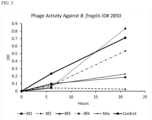
- Bacteroides fragilis NCTC 9343 (Clindamycin sensitive) - AmpliPhi ID # 2850; 3.
- E. coli PL1 (p ks + E.coli ) - AmpliPhi ID # 2851.
- Bacteroides fragilis strains were grown anaerobically on BHI/Yeast Extract/L-Cysteine agar plates supplemented with Hemin and Vitamin K1 as requested by JHU and stocks prepared on both beads and in 30% glycerol/BHI broth. Stocks were stored frozen at -80°C.
- Phage isolation was undertaken for the Bacteroides fragilis isolates. Using sewage water samples from the Sydney (Australia) area, phages were successfully isolated against B. fragilis ID # 2849. Plaque purification of four selected phages (preliminary chosen based on their differing plaque morphology and origin of sewage water samples) was performed and master stocks prepared in phage buffer. Master research stocks of the Bacteroides fragilis phages Bf1, Bf2, Bf3 and Bf4, targeting Bacteroides fragilis 086 (ID # 2849), were propagated by the plate method and further characterized as described in Table 1.
- BHI/Yeast Extract/L-Cysteine agar plates supplemented with Hemin and Vitamin K1 were used to propagate the phages.
- a bacteriophage dilution that was likely to give plates with "confluent lysis” was prepared and mixed with an aliquot of an overnight BHI/Yeast Extract/L-Cysteine supplemented with Hemin and Vitamin K1 broth culture of Bacteroides fragilis 086 (ID # 2849).
- Bacteriophage treatment with the compositions provided herein may be provided in a subset of experimental mice. Analysis of survival of bacteriophage treated and untreated mice may be undertaken.
Landscapes
- Health & Medical Sciences (AREA)
- Life Sciences & Earth Sciences (AREA)
- Chemical & Material Sciences (AREA)
- General Health & Medical Sciences (AREA)
- Virology (AREA)
- Medicinal Chemistry (AREA)
- Microbiology (AREA)
- Bioinformatics & Cheminformatics (AREA)
- Wood Science & Technology (AREA)
- Epidemiology (AREA)
- Animal Behavior & Ethology (AREA)
- Zoology (AREA)
- Public Health (AREA)
- Veterinary Medicine (AREA)
- Pharmacology & Pharmacy (AREA)
- Engineering & Computer Science (AREA)
- Organic Chemistry (AREA)
- Genetics & Genomics (AREA)
- Immunology (AREA)
- Mycology (AREA)
- Biotechnology (AREA)
- Biomedical Technology (AREA)
- Biochemistry (AREA)
- General Engineering & Computer Science (AREA)
- Oncology (AREA)
- Medicines Containing Material From Animals Or Micro-Organisms (AREA)
- Micro-Organisms Or Cultivation Processes Thereof (AREA)
- Acyclic And Carbocyclic Compounds In Medicinal Compositions (AREA)
- Medicinal Preparation (AREA)
- Medicines That Contain Protein Lipid Enzymes And Other Medicines (AREA)
- Pharmaceuticals Containing Other Organic And Inorganic Compounds (AREA)
- Measuring Or Testing Involving Enzymes Or Micro-Organisms (AREA)
- Medicines Containing Antibodies Or Antigens For Use As Internal Diagnostic Agents (AREA)
- Peptides Or Proteins (AREA)
Claims (17)
- Composition de bactériophage comprenant un ou plusieurs bactériophages obligatoirement lytiques qui infectent et lysent une bactérie carcinogène, dans laquelle chaque bactériophage individuel ne porte pas de gènes de résistance à un antibiotique, et dans laquelle la composition est substantiellement exempte de composants bactériens, dans laquellea) les bactériophages sont sélectionnés parmi Ec20 (SEQ ID NO: 1), Ec34 (SEQ ID NO: 2), Ec35 (SEQ ID NO: 3), Ec45 (SEQ ID NO: 4), Ec56 (SEQ ID NO: 5) et Ec57 (SEQ ID NO: 6) et dans laquelle la bactérie cible est Escherichia coli, éventuellement, dans laquelle le bactériophage est Ec34 (SEQ ID NO: 2), Ec35 (SEQ ID NO: 3), Ec45 (SEQ ID NO: 4) et Ec57 (SEQ ID NO: 6) ou dans laquelle le bactériophage est Ec34 (SEQ ID NO: 2), Ec35 (SEQ ID NO: 3) et Ec57 (SEQ ID NO: 6), éventuellement comprenant environ un rapport 1:1 d'au moins deux souches de bactériophage ; oub) sélectionnés parmi Bf1 (n° d'accès 040219-02), Bf2 (n° d'accès 040219-03), Bf3 (n° d'accès 040219-04) et Bf4 (n° d'accès 040219-05) et dans laquelle la bactérie cible est Bacteroides fragilis, éventuellement comprenant environ un rapport 1:1 d'au moins deux souches de bactériophage.
- Composition de bactériophage selon l'une quelconque des revendications précédentes, comprenant en outre un cryoprotecteur, dans laquelle le cryoprotecteur comprend du glycérol, éventuellement dans laquelle le cryoprotecteur comprend 5 à 50 % de glycérol ou 10 % de saccharose.
- Composition de bactériophage selon l'une quelconque des revendications précédentes dans laquelle la composition est congelée, lyophilisée, liquide ou solide, dans laquelle la composition comprend en outre un cryoprotecteur pour le stockage à des températures comprises d'environ 0 °C à environ -80 °C, ou d'environ 0 °C à environ -20 °C.
- Composition ou bactériophage selon l'une quelconque des revendications précédentes pour une utilisation comme médicament.
- Bactériophage ou composition selon l'une quelconque des revendications précédentes pour une utilisation dans un procédé de traitement d'un cancer qui est causé par une infection par une bactérie, dans laquelle le cancer est un cancer colorectal causé par une infection par les bactéries E. coli et/ou B. fragilis.
- Composition comprenant au moins deux bactériophages, pour une utilisation dans un procédé de traitement ou de prévention d'un cancer, dans laquelle le cancer est un cancer colorectal causé par une infection par les bactéries E. coli et/ou B. fragilis , et dans laquelle les bactériophages ciblent les bactéries, dans laquellea) les bactériophages sont sélectionnés parmi Ec20 (SEQ ID NO: 1), Ec34 (SEQ ID NO: 2), Ec35 (SEQ ID NO: 3), Ec45 (SEQ ID NO: 4), Ec56 (SEQ ID NO: 5) et Ec57 (SEQ ID NO: 6) et dans laquelle la bactérie cible est Escherichia coli, éventuellement, dans laquelle le bactériophage est Ec34 (SEQ ID NO: 2), Ec35 (SEQ ID NO: 3), Ec45 (SEQ ID NO: 4) et Ec57 (SEQ ID NO: 6) ou dans laquelle le bactériophage est Ec34 (SEQ ID NO: 2), Ec35 (SEQ ID NO: 3) et Ec57 (SEQ ID NO: 6), éventuellement comprenant environ un rapport 1:1 d'au moins deux souches de bactériophage ; oub) sélectionnés parmi Bf1 (n° d'accès 040219-02), Bf2 (n° d'accès 040219-03), Bf3 (n° d'accès 040219-04) et Bf4 (n° d'accès 040219-05) et dans laquelle la bactérie cible est Bacteroides fragilis, éventuellement comprenant environ un rapport 1:1 d'au moins deux souches de bactériophage.
- Composition ou composition pour une utilisation selon l'une quelconque des revendications précédentes dans laquelle la composition comprend au moins environ 1×10⁵ à environ 1×10¹¹ UFP de bactériophages totaux par millilitre de composition d'au moins une des souches de bactériophage, éventuellement, dans laquelle la composition comprend entre 1×10⁵ et 1×10¹¹ UFP de chaque bactériophage.
- Composition ou composition pour une utilisation selon l'une quelconque des revendications précédentes, dans laquellea) la composition comprend en outre un support, un diluant, un excipient pharmaceutiquement acceptable ou des combinaisons correspondantes, éventuellement, dans laquelle le support, le diluant, l'excipient pharmaceutiquement acceptable ou les combinaisons correspondantes comprennent un sel de calcium ou un sel de magnésium ; oub) la composition comprend en outre un antibiotique (p. ex., un antibiotique chimique) ou peut être utilisée avec un antibiotique.
- Composition pour une utilisation selon l'une quelconque des revendications ci-dessus, dans laquelle les bactériesa) sont caractérisées par la présence d'un biofilm bactérien ; et/oub) sont résistantes à un antibiotique.
- Composition ou composition pour une utilisation selon l'une quelconque des revendications précédentes formulée pour une administration orale, nasale, parentérale, intramusculaire, intraveineuse ou sous-cutanée.
- Composition ou composition pour une utilisation selon une quelconque revendication précédente, dans laquelle l'espèce bactérienne est E. coli et/ou B. fragilis, éventuellement, dans laquelle les E. coli sont pks+ E. coli et/ou dans laquelle les B. fragilis sont des Bacteroides fragilis entérotoxigéniques (ETBF).
- Composition pour une utilisation selon une quelconque revendication précédente, appropriée pour une administration en combinaison avec un agent immunothérapeutique éventuellement, dans laquelle l'agent immunothérapeutique comprend un inhibiteur de point de contrôle immunitaire, éventuellement, dans laquelle l'agent immunothérapeutique comprend des anticorps anti-PD-1, anti-PD-L1, anti-CTLA-4, anti-CD27 ou anti-IDO-1.
- Composition pour une utilisation selon une quelconque revendication précédente, comprenant en outre une administration en combinaison avec un agent chimiothérapeutique, éventuellement, dans laquelle l'agent chimiothérapeutique comprend du 5-fluorouracile (5-FU), de la capécitabine, de l'irinotécan, de l'oxaliplatine, de la TriFluridine et/ou du tipiracil.
- Composition pour une utilisation selon l'une quelconque des revendications ci-dessus, dans laquellea) les bactériophages dans la composition ciblent une ou plusieurs souches oncogéniques des bactéries ; et/oub) la composition minimise le développement d'une résistance bactérienne ; et/ouc) les bactériophages sont obligatoirement lytiques ; et/oud) les bactériophages sont spécifiques pour les bactéries et ne ciblent pas d'autres micro-organismes.
- Kit comprenant :a. un bactériophage ou une composition selon l'une quelconque des revendications 1 à 3 ; etb. des instructions pour une utilisation de celui-ci (p. ex. en médecine).
- Kit selon la revendication 15, comprenant en outre un antibiotique et des instructions pour une utilisation de celui-ci en combinaison avec la composition de bactériophage, dans lequel lesdites instructions sont pour une utilisation de celui-ci dans le traitement d'un cancer colorectal causé par une infection par de bactéries E. coli et/ou B. fragilis.
- Composition, utilisation, procédé ou kit selon l'une quelconque des revendications précédentes, dans lequel/laquelle les bactériophages de la composition infectent et lysent E. coli et/ou B. fragilis.
Priority Applications (1)
| Application Number | Priority Date | Filing Date | Title |
|---|---|---|---|
| EP24187372.8A EP4417710A3 (fr) | 2018-02-07 | 2019-02-07 | Bactériophage pour le traitement et la prévention de cancers associés à des bactéries |
Applications Claiming Priority (2)
| Application Number | Priority Date | Filing Date | Title |
|---|---|---|---|
| US201862627725P | 2018-02-07 | 2018-02-07 | |
| PCT/US2019/017129 WO2019157231A2 (fr) | 2018-02-07 | 2019-02-07 | Bactériophage pour le traitement et la prévention de cancers associés à des bactéries |
Related Child Applications (1)
| Application Number | Title | Priority Date | Filing Date |
|---|---|---|---|
| EP24187372.8A Division EP4417710A3 (fr) | 2018-02-07 | 2019-02-07 | Bactériophage pour le traitement et la prévention de cancers associés à des bactéries |
Publications (3)
| Publication Number | Publication Date |
|---|---|
| EP3749342A2 EP3749342A2 (fr) | 2020-12-16 |
| EP3749342A4 EP3749342A4 (fr) | 2021-12-08 |
| EP3749342B1 true EP3749342B1 (fr) | 2024-07-10 |
Family
ID=67549601
Family Applications (2)
| Application Number | Title | Priority Date | Filing Date |
|---|---|---|---|
| EP19751368.2A Active EP3749342B1 (fr) | 2018-02-07 | 2019-02-07 | Bactériophage pour le traitement et la prévention de cancers associés à des bactéries |
| EP24187372.8A Pending EP4417710A3 (fr) | 2018-02-07 | 2019-02-07 | Bactériophage pour le traitement et la prévention de cancers associés à des bactéries |
Family Applications After (1)
| Application Number | Title | Priority Date | Filing Date |
|---|---|---|---|
| EP24187372.8A Pending EP4417710A3 (fr) | 2018-02-07 | 2019-02-07 | Bactériophage pour le traitement et la prévention de cancers associés à des bactéries |
Country Status (8)
| Country | Link |
|---|---|
| US (1) | US12268720B2 (fr) |
| EP (2) | EP3749342B1 (fr) |
| JP (2) | JP7404249B2 (fr) |
| CN (1) | CN112243377A (fr) |
| AU (1) | AU2026200437A1 (fr) |
| CA (1) | CA3093658A1 (fr) |
| ES (1) | ES2986675T3 (fr) |
| WO (1) | WO2019157231A2 (fr) |
Families Citing this family (7)
| Publication number | Priority date | Publication date | Assignee | Title |
|---|---|---|---|---|
| EP3749342B1 (fr) * | 2018-02-07 | 2024-07-10 | Armata Pharmaceuticals, Inc. | Bactériophage pour le traitement et la prévention de cancers associés à des bactéries |
| US20220331381A1 (en) * | 2021-04-10 | 2022-10-20 | Intron Biotechnology, Inc. | Compositions and methods for inhibiting the proliferation of enterotoxigenic bacteroides fragilis |
| US20220323518A1 (en) * | 2021-04-10 | 2022-10-13 | Intron Biotechnology, Inc. | Compositions and methods for inhibiting the proliferation of enterotoxigenic bacteroides fragilis |
| US20220323517A1 (en) * | 2021-04-10 | 2022-10-13 | Intron Biotechnology, Inc. | Compositions and methods for inhibiting the proliferation of enterotoxigenic bacteroides fragilis |
| MX2023012454A (es) * | 2021-04-22 | 2023-10-31 | Ferring Bv | Terapia con bacteriofagos contra escherichia coli adherente-invasiva. |
| US20240087684A1 (en) * | 2022-06-17 | 2024-03-14 | Phagelab Chile Spa | Methods and systems for designing phage cocktails |
| WO2025262649A1 (fr) | 2024-06-21 | 2025-12-26 | Technophage | Compositions contenant des bacteriophages antibacteriens et leurs procedes d'utilisation |
Family Cites Families (9)
| Publication number | Priority date | Publication date | Assignee | Title |
|---|---|---|---|---|
| ES2527994T3 (es) | 2003-07-23 | 2015-02-03 | Biocontrol Limited | Agentes terapéuticos que contienen bacteriófagos frente a P. aeruginosa |
| US8178087B2 (en) * | 2006-04-04 | 2012-05-15 | Centre National de la Recherche Scientifique —CNRS | Process of production of bacteriophage compositions and methods in phage therapy field |
| GB0704553D0 (en) | 2007-03-09 | 2007-04-18 | Harper David R | Beneficial effects of bacteriophage treatments |
| CA2871986C (fr) | 2012-05-04 | 2020-11-03 | Biocontrol Limited | Compositions therapeutiques a base de bacteriophages |
| EP2958575B1 (fr) | 2013-02-22 | 2019-04-03 | The Regents of The University of California | Composition comprenant lactobacillus johnsonii 456 et son utilisation pour traiter ou prévenir des maladies |
| US10413577B2 (en) * | 2013-02-22 | 2019-09-17 | The Regents Of The University Of California | Compositions and methods for promoting growth of beneficial microbes to treat or prevent disease or prolong life |
| EP2893933A1 (fr) * | 2014-01-10 | 2015-07-15 | Pherecydes Pharma | Thérapie bactériophage des infections d'E. coli |
| ME03511B (fr) * | 2015-06-15 | 2020-04-20 | 4D Pharma Res Ltd | Compositions comprenant des souches bactériennes |
| EP3749342B1 (fr) * | 2018-02-07 | 2024-07-10 | Armata Pharmaceuticals, Inc. | Bactériophage pour le traitement et la prévention de cancers associés à des bactéries |
-
2019
- 2019-02-07 EP EP19751368.2A patent/EP3749342B1/fr active Active
- 2019-02-07 ES ES19751368T patent/ES2986675T3/es active Active
- 2019-02-07 US US16/968,132 patent/US12268720B2/en active Active
- 2019-02-07 WO PCT/US2019/017129 patent/WO2019157231A2/fr not_active Ceased
- 2019-02-07 JP JP2020542415A patent/JP7404249B2/ja active Active
- 2019-02-07 EP EP24187372.8A patent/EP4417710A3/fr active Pending
- 2019-02-07 CN CN201980017417.XA patent/CN112243377A/zh active Pending
- 2019-02-07 CA CA3093658A patent/CA3093658A1/fr active Pending
-
2023
- 2023-12-13 JP JP2023209992A patent/JP2024028957A/ja active Pending
-
2026
- 2026-01-22 AU AU2026200437A patent/AU2026200437A1/en active Pending
Also Published As
| Publication number | Publication date |
|---|---|
| EP3749342A4 (fr) | 2021-12-08 |
| US20210369798A1 (en) | 2021-12-02 |
| EP3749342A2 (fr) | 2020-12-16 |
| WO2019157231A2 (fr) | 2019-08-15 |
| ES2986675T3 (es) | 2024-11-12 |
| AU2019217977A1 (en) | 2020-08-13 |
| CA3093658A1 (fr) | 2019-08-15 |
| US12268720B2 (en) | 2025-04-08 |
| WO2019157231A3 (fr) | 2020-03-26 |
| EP4417710A2 (fr) | 2024-08-21 |
| AU2026200437A1 (en) | 2026-02-12 |
| JP2024028957A (ja) | 2024-03-05 |
| JP7404249B2 (ja) | 2023-12-25 |
| JP2021512885A (ja) | 2021-05-20 |
| EP4417710A3 (fr) | 2024-11-06 |
| AU2019217977B2 (en) | 2025-10-23 |
| CN112243377A (zh) | 2021-01-19 |
Similar Documents
| Publication | Publication Date | Title |
|---|---|---|
| EP3749342B1 (fr) | Bactériophage pour le traitement et la prévention de cancers associés à des bactéries | |
| US12168040B2 (en) | Sequence specific antimicrobials | |
| US12239677B2 (en) | Therapeutic bacteriophage compositions for treating Staphylococcus infection | |
| CN101977616B (zh) | 制备噬菌体混合物的方法以及该噬菌体混合物在抗生素抗性葡萄球菌治疗中的用途 | |
| JP7449967B2 (ja) | 療法バクテリオファージ組成物 | |
| Moradpour et al. | Synergistic bactericidal activity of a naturally isolated phage and ampicillin against urinary tract infecting Escherichia coli O157 | |
| US11253557B2 (en) | Therapeutic bacteriophage compositions | |
| Zhang et al. | Siderophores in clinical isolates of Klebsiella pneumoniae promote ciprofloxacin resistance by inhibiting the oxidative stress | |
| JP2025525414A (ja) | E coli細胞の標的化 | |
| WO2019136108A1 (fr) | Compositions de bactériophages pour le traitement d'infections à pseudomonas | |
| AU2019217977C1 (en) | Bacteriophage for treatment and prevention of bacteria-associated cancers | |
| HK40115261A (en) | Bacteriophage for treatment and prevention of bacteria-associated cancers | |
| HK40042827B (en) | Bacteriophage for treatment and prevention of bacteria-associated cancers | |
| HK40042827A (en) | Bacteriophage for treatment and prevention of bacteria-associated cancers | |
| HK40110087A (en) | Targeting e coli cells | |
| HK40110087B (en) | Targeting e coli cells | |
| Lin et al. | Isolation of a bacteriophage and its depolymerase specific for K1 capsule of Klebsiella | |
| Zhu-Qiang et al. | Distribution of carbapenemases and efflux pump in carbopenems-resistance Acinetobacter baumannii |
Legal Events
| Date | Code | Title | Description |
|---|---|---|---|
| STAA | Information on the status of an ep patent application or granted ep patent |
Free format text: STATUS: THE INTERNATIONAL PUBLICATION HAS BEEN MADE |
|
| PUAI | Public reference made under article 153(3) epc to a published international application that has entered the european phase |
Free format text: ORIGINAL CODE: 0009012 |
|
| STAA | Information on the status of an ep patent application or granted ep patent |
Free format text: STATUS: REQUEST FOR EXAMINATION WAS MADE |
|
| 17P | Request for examination filed |
Effective date: 20200904 |
|
| AK | Designated contracting states |
Kind code of ref document: A2 Designated state(s): AL AT BE BG CH CY CZ DE DK EE ES FI FR GB GR HR HU IE IS IT LI LT LU LV MC MK MT NL NO PL PT RO RS SE SI SK SM TR |
|
| AX | Request for extension of the european patent |
Extension state: BA ME |
|
| DAV | Request for validation of the european patent (deleted) | ||
| DAX | Request for extension of the european patent (deleted) | ||
| REG | Reference to a national code |
Ref country code: HK Ref legal event code: DE Ref document number: 40042827 Country of ref document: HK |
|
| A4 | Supplementary search report drawn up and despatched |
Effective date: 20211110 |
|
| RIC1 | Information provided on ipc code assigned before grant |
Ipc: C12R 1/92 20060101ALI20211103BHEP Ipc: C12N 7/02 20060101ALI20211103BHEP Ipc: C12N 7/01 20060101ALI20211103BHEP Ipc: C12N 1/06 20060101ALI20211103BHEP Ipc: A61P 31/04 20060101ALI20211103BHEP Ipc: A61K 45/06 20060101ALI20211103BHEP Ipc: A61K 35/768 20150101ALI20211103BHEP Ipc: A61K 35/76 20150101AFI20211103BHEP |
|
| STAA | Information on the status of an ep patent application or granted ep patent |
Free format text: STATUS: EXAMINATION IS IN PROGRESS |
|
| 17Q | First examination report despatched |
Effective date: 20230223 |
|
| GRAP | Despatch of communication of intention to grant a patent |
Free format text: ORIGINAL CODE: EPIDOSNIGR1 |
|
| STAA | Information on the status of an ep patent application or granted ep patent |
Free format text: STATUS: GRANT OF PATENT IS INTENDED |
|
| INTG | Intention to grant announced |
Effective date: 20240212 |
|
| P01 | Opt-out of the competence of the unified patent court (upc) registered |
Effective date: 20240404 |
|
| GRAS | Grant fee paid |
Free format text: ORIGINAL CODE: EPIDOSNIGR3 |
|
| GRAA | (expected) grant |
Free format text: ORIGINAL CODE: 0009210 |
|
| STAA | Information on the status of an ep patent application or granted ep patent |
Free format text: STATUS: THE PATENT HAS BEEN GRANTED |
|
| AK | Designated contracting states |
Kind code of ref document: B1 Designated state(s): AL AT BE BG CH CY CZ DE DK EE ES FI FR GB GR HR HU IE IS IT LI LT LU LV MC MK MT NL NO PL PT RO RS SE SI SK SM TR |
|
| REG | Reference to a national code |
Ref country code: CH Ref legal event code: EP |
|
| REG | Reference to a national code |
Ref country code: DE Ref legal event code: R096 Ref document number: 602019054993 Country of ref document: DE |
|
| REG | Reference to a national code |
Ref country code: LT Ref legal event code: MG9D |
|
| REG | Reference to a national code |
Ref country code: ES Ref legal event code: FG2A Ref document number: 2986675 Country of ref document: ES Kind code of ref document: T3 Effective date: 20241112 |
|
| REG | Reference to a national code |
Ref country code: NL Ref legal event code: MP Effective date: 20240710 |
|
| PG25 | Lapsed in a contracting state [announced via postgrant information from national office to epo] |
Ref country code: PT Free format text: LAPSE BECAUSE OF FAILURE TO SUBMIT A TRANSLATION OF THE DESCRIPTION OR TO PAY THE FEE WITHIN THE PRESCRIBED TIME-LIMIT Effective date: 20241111 |
|
| REG | Reference to a national code |
Ref country code: AT Ref legal event code: MK05 Ref document number: 1701462 Country of ref document: AT Kind code of ref document: T Effective date: 20240710 |
|
| PG25 | Lapsed in a contracting state [announced via postgrant information from national office to epo] |
Ref country code: NL Free format text: LAPSE BECAUSE OF FAILURE TO SUBMIT A TRANSLATION OF THE DESCRIPTION OR TO PAY THE FEE WITHIN THE PRESCRIBED TIME-LIMIT Effective date: 20240710 |
|
| PG25 | Lapsed in a contracting state [announced via postgrant information from national office to epo] |
Ref country code: PT Free format text: LAPSE BECAUSE OF FAILURE TO SUBMIT A TRANSLATION OF THE DESCRIPTION OR TO PAY THE FEE WITHIN THE PRESCRIBED TIME-LIMIT Effective date: 20241111 Ref country code: NL Free format text: LAPSE BECAUSE OF FAILURE TO SUBMIT A TRANSLATION OF THE DESCRIPTION OR TO PAY THE FEE WITHIN THE PRESCRIBED TIME-LIMIT Effective date: 20240710 |
|
| PG25 | Lapsed in a contracting state [announced via postgrant information from national office to epo] |
Ref country code: NO Free format text: LAPSE BECAUSE OF FAILURE TO SUBMIT A TRANSLATION OF THE DESCRIPTION OR TO PAY THE FEE WITHIN THE PRESCRIBED TIME-LIMIT Effective date: 20241010 |
|
| PG25 | Lapsed in a contracting state [announced via postgrant information from national office to epo] |
Ref country code: FI Free format text: LAPSE BECAUSE OF FAILURE TO SUBMIT A TRANSLATION OF THE DESCRIPTION OR TO PAY THE FEE WITHIN THE PRESCRIBED TIME-LIMIT Effective date: 20240710 Ref country code: PL Free format text: LAPSE BECAUSE OF FAILURE TO SUBMIT A TRANSLATION OF THE DESCRIPTION OR TO PAY THE FEE WITHIN THE PRESCRIBED TIME-LIMIT Effective date: 20240710 Ref country code: GR Free format text: LAPSE BECAUSE OF FAILURE TO SUBMIT A TRANSLATION OF THE DESCRIPTION OR TO PAY THE FEE WITHIN THE PRESCRIBED TIME-LIMIT Effective date: 20241011 |
|
| PG25 | Lapsed in a contracting state [announced via postgrant information from national office to epo] |
Ref country code: BG Free format text: LAPSE BECAUSE OF FAILURE TO SUBMIT A TRANSLATION OF THE DESCRIPTION OR TO PAY THE FEE WITHIN THE PRESCRIBED TIME-LIMIT Effective date: 20240710 |
|
| PG25 | Lapsed in a contracting state [announced via postgrant information from national office to epo] |
Ref country code: LV Free format text: LAPSE BECAUSE OF FAILURE TO SUBMIT A TRANSLATION OF THE DESCRIPTION OR TO PAY THE FEE WITHIN THE PRESCRIBED TIME-LIMIT Effective date: 20240710 |
|
| PG25 | Lapsed in a contracting state [announced via postgrant information from national office to epo] |
Ref country code: AT Free format text: LAPSE BECAUSE OF FAILURE TO SUBMIT A TRANSLATION OF THE DESCRIPTION OR TO PAY THE FEE WITHIN THE PRESCRIBED TIME-LIMIT Effective date: 20240710 Ref country code: IS Free format text: LAPSE BECAUSE OF FAILURE TO SUBMIT A TRANSLATION OF THE DESCRIPTION OR TO PAY THE FEE WITHIN THE PRESCRIBED TIME-LIMIT Effective date: 20241110 |
|
| PG25 | Lapsed in a contracting state [announced via postgrant information from national office to epo] |
Ref country code: HR Free format text: LAPSE BECAUSE OF FAILURE TO SUBMIT A TRANSLATION OF THE DESCRIPTION OR TO PAY THE FEE WITHIN THE PRESCRIBED TIME-LIMIT Effective date: 20240710 |
|
| PG25 | Lapsed in a contracting state [announced via postgrant information from national office to epo] |
Ref country code: RS Free format text: LAPSE BECAUSE OF FAILURE TO SUBMIT A TRANSLATION OF THE DESCRIPTION OR TO PAY THE FEE WITHIN THE PRESCRIBED TIME-LIMIT Effective date: 20241010 |
|
| PG25 | Lapsed in a contracting state [announced via postgrant information from national office to epo] |
Ref country code: RS Free format text: LAPSE BECAUSE OF FAILURE TO SUBMIT A TRANSLATION OF THE DESCRIPTION OR TO PAY THE FEE WITHIN THE PRESCRIBED TIME-LIMIT Effective date: 20241010 Ref country code: PL Free format text: LAPSE BECAUSE OF FAILURE TO SUBMIT A TRANSLATION OF THE DESCRIPTION OR TO PAY THE FEE WITHIN THE PRESCRIBED TIME-LIMIT Effective date: 20240710 Ref country code: NO Free format text: LAPSE BECAUSE OF FAILURE TO SUBMIT A TRANSLATION OF THE DESCRIPTION OR TO PAY THE FEE WITHIN THE PRESCRIBED TIME-LIMIT Effective date: 20241010 Ref country code: LV Free format text: LAPSE BECAUSE OF FAILURE TO SUBMIT A TRANSLATION OF THE DESCRIPTION OR TO PAY THE FEE WITHIN THE PRESCRIBED TIME-LIMIT Effective date: 20240710 Ref country code: IS Free format text: LAPSE BECAUSE OF FAILURE TO SUBMIT A TRANSLATION OF THE DESCRIPTION OR TO PAY THE FEE WITHIN THE PRESCRIBED TIME-LIMIT Effective date: 20241110 Ref country code: HR Free format text: LAPSE BECAUSE OF FAILURE TO SUBMIT A TRANSLATION OF THE DESCRIPTION OR TO PAY THE FEE WITHIN THE PRESCRIBED TIME-LIMIT Effective date: 20240710 Ref country code: GR Free format text: LAPSE BECAUSE OF FAILURE TO SUBMIT A TRANSLATION OF THE DESCRIPTION OR TO PAY THE FEE WITHIN THE PRESCRIBED TIME-LIMIT Effective date: 20241011 Ref country code: FI Free format text: LAPSE BECAUSE OF FAILURE TO SUBMIT A TRANSLATION OF THE DESCRIPTION OR TO PAY THE FEE WITHIN THE PRESCRIBED TIME-LIMIT Effective date: 20240710 Ref country code: BG Free format text: LAPSE BECAUSE OF FAILURE TO SUBMIT A TRANSLATION OF THE DESCRIPTION OR TO PAY THE FEE WITHIN THE PRESCRIBED TIME-LIMIT Effective date: 20240710 Ref country code: AT Free format text: LAPSE BECAUSE OF FAILURE TO SUBMIT A TRANSLATION OF THE DESCRIPTION OR TO PAY THE FEE WITHIN THE PRESCRIBED TIME-LIMIT Effective date: 20240710 |
|
| REG | Reference to a national code |
Ref country code: DE Ref legal event code: R097 Ref document number: 602019054993 Country of ref document: DE |
|
| PG25 | Lapsed in a contracting state [announced via postgrant information from national office to epo] |
Ref country code: RO Free format text: LAPSE BECAUSE OF FAILURE TO SUBMIT A TRANSLATION OF THE DESCRIPTION OR TO PAY THE FEE WITHIN THE PRESCRIBED TIME-LIMIT Effective date: 20240710 Ref country code: DK Free format text: LAPSE BECAUSE OF FAILURE TO SUBMIT A TRANSLATION OF THE DESCRIPTION OR TO PAY THE FEE WITHIN THE PRESCRIBED TIME-LIMIT Effective date: 20240710 Ref country code: SM Free format text: LAPSE BECAUSE OF FAILURE TO SUBMIT A TRANSLATION OF THE DESCRIPTION OR TO PAY THE FEE WITHIN THE PRESCRIBED TIME-LIMIT Effective date: 20240710 |
|
| PG25 | Lapsed in a contracting state [announced via postgrant information from national office to epo] |
Ref country code: EE Free format text: LAPSE BECAUSE OF FAILURE TO SUBMIT A TRANSLATION OF THE DESCRIPTION OR TO PAY THE FEE WITHIN THE PRESCRIBED TIME-LIMIT Effective date: 20240710 |
|
| PG25 | Lapsed in a contracting state [announced via postgrant information from national office to epo] |
Ref country code: CZ Free format text: LAPSE BECAUSE OF FAILURE TO SUBMIT A TRANSLATION OF THE DESCRIPTION OR TO PAY THE FEE WITHIN THE PRESCRIBED TIME-LIMIT Effective date: 20240710 |
|
| PG25 | Lapsed in a contracting state [announced via postgrant information from national office to epo] |
Ref country code: SK Free format text: LAPSE BECAUSE OF FAILURE TO SUBMIT A TRANSLATION OF THE DESCRIPTION OR TO PAY THE FEE WITHIN THE PRESCRIBED TIME-LIMIT Effective date: 20240710 |
|
| PLBE | No opposition filed within time limit |
Free format text: ORIGINAL CODE: 0009261 |
|
| STAA | Information on the status of an ep patent application or granted ep patent |
Free format text: STATUS: NO OPPOSITION FILED WITHIN TIME LIMIT |
|
| 26N | No opposition filed |
Effective date: 20250411 |
|
| PG25 | Lapsed in a contracting state [announced via postgrant information from national office to epo] |
Ref country code: SE Free format text: LAPSE BECAUSE OF FAILURE TO SUBMIT A TRANSLATION OF THE DESCRIPTION OR TO PAY THE FEE WITHIN THE PRESCRIBED TIME-LIMIT Effective date: 20240710 |
|
| PG25 | Lapsed in a contracting state [announced via postgrant information from national office to epo] |
Ref country code: MC Free format text: LAPSE BECAUSE OF FAILURE TO SUBMIT A TRANSLATION OF THE DESCRIPTION OR TO PAY THE FEE WITHIN THE PRESCRIBED TIME-LIMIT Effective date: 20240710 |
|
| REG | Reference to a national code |
Ref country code: CH Ref legal event code: PL |
|
| PG25 | Lapsed in a contracting state [announced via postgrant information from national office to epo] |
Ref country code: LU Free format text: LAPSE BECAUSE OF NON-PAYMENT OF DUE FEES Effective date: 20250207 |
|
| PG25 | Lapsed in a contracting state [announced via postgrant information from national office to epo] |
Ref country code: CH Free format text: LAPSE BECAUSE OF NON-PAYMENT OF DUE FEES Effective date: 20250228 |
|
| REG | Reference to a national code |
Ref country code: BE Ref legal event code: MM Effective date: 20250228 |
|
| PGFP | Annual fee paid to national office [announced via postgrant information from national office to epo] |
Ref country code: GB Payment date: 20251218 Year of fee payment: 8 |
|
| PGFP | Annual fee paid to national office [announced via postgrant information from national office to epo] |
Ref country code: FR Payment date: 20251208 Year of fee payment: 8 |
|
| PG25 | Lapsed in a contracting state [announced via postgrant information from national office to epo] |
Ref country code: BE Free format text: LAPSE BECAUSE OF NON-PAYMENT OF DUE FEES Effective date: 20250228 |
|
| PG25 | Lapsed in a contracting state [announced via postgrant information from national office to epo] |
Ref country code: IE Free format text: LAPSE BECAUSE OF NON-PAYMENT OF DUE FEES Effective date: 20250207 |
|
| PGFP | Annual fee paid to national office [announced via postgrant information from national office to epo] |
Ref country code: ES Payment date: 20260305 Year of fee payment: 8 |
|
| PGFP | Annual fee paid to national office [announced via postgrant information from national office to epo] |
Ref country code: DE Payment date: 20251216 Year of fee payment: 8 |
|
| PGFP | Annual fee paid to national office [announced via postgrant information from national office to epo] |
Ref country code: IT Payment date: 20260122 Year of fee payment: 8 |