EP3749406B1 - Appareils et systèmes d'administration sous-mucosique de médicament - Google Patents
Appareils et systèmes d'administration sous-mucosique de médicament Download PDFInfo
- Publication number
- EP3749406B1 EP3749406B1 EP19750916.9A EP19750916A EP3749406B1 EP 3749406 B1 EP3749406 B1 EP 3749406B1 EP 19750916 A EP19750916 A EP 19750916A EP 3749406 B1 EP3749406 B1 EP 3749406B1
- Authority
- EP
- European Patent Office
- Prior art keywords
- drug delivery
- branch portion
- delivery device
- dilation balloon
- dissecting head
- Prior art date
- Legal status (The legal status is an assumption and is not a legal conclusion. Google has not performed a legal analysis and makes no representation as to the accuracy of the status listed.)
- Active
Links
Images







Classifications
-
- A—HUMAN NECESSITIES
- A61—MEDICAL OR VETERINARY SCIENCE; HYGIENE
- A61M—DEVICES FOR INTRODUCING MEDIA INTO, OR ONTO, THE BODY; DEVICES FOR TRANSDUCING BODY MEDIA OR FOR TAKING MEDIA FROM THE BODY; DEVICES FOR PRODUCING OR ENDING SLEEP OR STUPOR
- A61M25/00—Catheters; Hollow probes
- A61M25/0067—Catheters; Hollow probes characterised by the distal end, e.g. tips
- A61M25/0082—Catheter tip comprising a tool
-
- A—HUMAN NECESSITIES
- A61—MEDICAL OR VETERINARY SCIENCE; HYGIENE
- A61B—DIAGNOSIS; SURGERY; IDENTIFICATION
- A61B17/00—Surgical instruments, devices or methods
- A61B17/34—Trocars; Puncturing needles
- A61B17/3468—Trocars; Puncturing needles for implanting or removing devices, e.g. prostheses, implants, seeds, wires
-
- A—HUMAN NECESSITIES
- A61—MEDICAL OR VETERINARY SCIENCE; HYGIENE
- A61B—DIAGNOSIS; SURGERY; IDENTIFICATION
- A61B17/00—Surgical instruments, devices or methods
- A61B17/34—Trocars; Puncturing needles
- A61B17/3478—Endoscopic needles, e.g. for infusion
-
- A—HUMAN NECESSITIES
- A61—MEDICAL OR VETERINARY SCIENCE; HYGIENE
- A61M—DEVICES FOR INTRODUCING MEDIA INTO, OR ONTO, THE BODY; DEVICES FOR TRANSDUCING BODY MEDIA OR FOR TAKING MEDIA FROM THE BODY; DEVICES FOR PRODUCING OR ENDING SLEEP OR STUPOR
- A61M25/00—Catheters; Hollow probes
- A61M25/0021—Catheters; Hollow probes characterised by the form of the tubing
- A61M25/0041—Catheters; Hollow probes characterised by the form of the tubing pre-formed, e.g. specially adapted to fit with the anatomy of body channels
-
- A—HUMAN NECESSITIES
- A61—MEDICAL OR VETERINARY SCIENCE; HYGIENE
- A61M—DEVICES FOR INTRODUCING MEDIA INTO, OR ONTO, THE BODY; DEVICES FOR TRANSDUCING BODY MEDIA OR FOR TAKING MEDIA FROM THE BODY; DEVICES FOR PRODUCING OR ENDING SLEEP OR STUPOR
- A61M25/00—Catheters; Hollow probes
- A61M25/0067—Catheters; Hollow probes characterised by the distal end, e.g. tips
- A61M25/0082—Catheter tip comprising a tool
- A61M25/0084—Catheter tip comprising a tool being one or more injection needles
-
- A—HUMAN NECESSITIES
- A61—MEDICAL OR VETERINARY SCIENCE; HYGIENE
- A61M—DEVICES FOR INTRODUCING MEDIA INTO, OR ONTO, THE BODY; DEVICES FOR TRANSDUCING BODY MEDIA OR FOR TAKING MEDIA FROM THE BODY; DEVICES FOR PRODUCING OR ENDING SLEEP OR STUPOR
- A61M29/00—Dilators with or without means for introducing media, e.g. remedies
- A61M29/02—Dilators made of swellable material
-
- A—HUMAN NECESSITIES
- A61—MEDICAL OR VETERINARY SCIENCE; HYGIENE
- A61B—DIAGNOSIS; SURGERY; IDENTIFICATION
- A61B1/00—Instruments for performing medical examinations of the interior of cavities or tubes of the body by visual or photographical inspection, e.g. endoscopes; Illuminating arrangements therefor
- A61B1/00064—Constructional details of the endoscope body
- A61B1/00071—Insertion part of the endoscope body
-
- A—HUMAN NECESSITIES
- A61—MEDICAL OR VETERINARY SCIENCE; HYGIENE
- A61B—DIAGNOSIS; SURGERY; IDENTIFICATION
- A61B1/00—Instruments for performing medical examinations of the interior of cavities or tubes of the body by visual or photographical inspection, e.g. endoscopes; Illuminating arrangements therefor
- A61B1/04—Instruments for performing medical examinations of the interior of cavities or tubes of the body by visual or photographical inspection, e.g. endoscopes; Illuminating arrangements therefor combined with photographic or television appliances
- A61B1/05—Instruments for performing medical examinations of the interior of cavities or tubes of the body by visual or photographical inspection, e.g. endoscopes; Illuminating arrangements therefor combined with photographic or television appliances characterised by the image sensor, e.g. camera, being in the distal end portion
-
- A—HUMAN NECESSITIES
- A61—MEDICAL OR VETERINARY SCIENCE; HYGIENE
- A61B—DIAGNOSIS; SURGERY; IDENTIFICATION
- A61B17/00—Surgical instruments, devices or methods
- A61B17/24—Surgical instruments, devices or methods for use in the oral cavity, larynx, bronchial passages or nose; Tongue scrapers
-
- A—HUMAN NECESSITIES
- A61—MEDICAL OR VETERINARY SCIENCE; HYGIENE
- A61B—DIAGNOSIS; SURGERY; IDENTIFICATION
- A61B17/00—Surgical instruments, devices or methods
- A61B17/32—Surgical cutting instruments
- A61B2017/320044—Blunt dissectors
-
- A—HUMAN NECESSITIES
- A61—MEDICAL OR VETERINARY SCIENCE; HYGIENE
- A61B—DIAGNOSIS; SURGERY; IDENTIFICATION
- A61B17/00—Surgical instruments, devices or methods
- A61B17/32—Surgical cutting instruments
- A61B2017/320044—Blunt dissectors
- A61B2017/320048—Balloon dissectors
-
- A—HUMAN NECESSITIES
- A61—MEDICAL OR VETERINARY SCIENCE; HYGIENE
- A61B—DIAGNOSIS; SURGERY; IDENTIFICATION
- A61B90/00—Instruments, implements or accessories specially adapted for surgery or diagnosis and not covered by any of the groups A61B1/00 - A61B50/00, e.g. for luxation treatment or for protecting wound edges
- A61B90/36—Image-producing devices or illumination devices not otherwise provided for
- A61B90/361—Image-producing devices, e.g. surgical cameras
-
- A—HUMAN NECESSITIES
- A61—MEDICAL OR VETERINARY SCIENCE; HYGIENE
- A61M—DEVICES FOR INTRODUCING MEDIA INTO, OR ONTO, THE BODY; DEVICES FOR TRANSDUCING BODY MEDIA OR FOR TAKING MEDIA FROM THE BODY; DEVICES FOR PRODUCING OR ENDING SLEEP OR STUPOR
- A61M2210/00—Anatomical parts of the body
- A61M2210/06—Head
- A61M2210/0618—Nose
-
- A—HUMAN NECESSITIES
- A61—MEDICAL OR VETERINARY SCIENCE; HYGIENE
- A61M—DEVICES FOR INTRODUCING MEDIA INTO, OR ONTO, THE BODY; DEVICES FOR TRANSDUCING BODY MEDIA OR FOR TAKING MEDIA FROM THE BODY; DEVICES FOR PRODUCING OR ENDING SLEEP OR STUPOR
- A61M2210/00—Anatomical parts of the body
- A61M2210/06—Head
- A61M2210/0681—Sinus (maxillaris)
-
- A—HUMAN NECESSITIES
- A61—MEDICAL OR VETERINARY SCIENCE; HYGIENE
- A61M—DEVICES FOR INTRODUCING MEDIA INTO, OR ONTO, THE BODY; DEVICES FOR TRANSDUCING BODY MEDIA OR FOR TAKING MEDIA FROM THE BODY; DEVICES FOR PRODUCING OR ENDING SLEEP OR STUPOR
- A61M5/00—Devices for bringing media into the body in a subcutaneous, intra-vascular or intramuscular way; Accessories therefor, e.g. filling or cleaning devices, arm rests
- A61M5/14—Infusion devices, e.g. infusing by gravity; Blood infusion; Accessories therefor
- A61M5/142—Pressure infusion, e.g. using pumps
- A61M5/145—Pressure infusion, e.g. using pumps using pressurised reservoirs, e.g. by means of pistons
Definitions
- the present application relates generally to the field of drug delivery.
- Various neurological disorders can be treated through the delivery of drugs or therapeutic agents to the central nervous system.
- Biological defenses such as the blood brain-barrier prevent many therapeutic agents, such as proteins and oligonucleotides, from reaching the central nervous system, thereby inhibiting the efficacy of the therapeutic agents.
- Surgically implanted mucosal grafts allow therapeutic agents to be effectively delivered at high molecular weight to the central nervous systems; however, certain patients, such as infant and pediatric patients, are not well suited for surgical treatment.
- Direct transnasal delivery (e.g., spaying) of therapeutic agents for diffusion through the olfactory mucosa is one non-surgical method for delivering therapeutic agents to patients not well suited for or surgery or for whom surgery is impractical or impossible.
- direct transnasal delivery has highly inefficient and variable drug distribution and drug residence time in view of the variation and limitations of available surface area for delivery to the olfactory through topical nasal applications.
- US 2005/0240147 A1 discloses a nasal drug delivery device having a catheter with a balloon.
- the inventor has discovered that the efficacy of non-invasive delivery of therapeutic agents to the central nervous system is greatly enhanced through controlled depot delivery directly to the submucosal space of the olfactory mucosa.
- the controlled depot delivery elutes drug over a prescribed period of time based on the polymer or carrier used. By dosing in the submucosal space, the barriers to diffusion to the olfactory nerves are minimized relative to transepithelial delivery and the drugs are thereby protected from multiple degradative enzymes present in nasal mucus.
- various embodiments disclosed herein provide apparatuses, systems, and example methods for a controlled depot delivery where a drug can be delivered directly to the submucosal space of the olfactory mucosa.
- the apparatuses create a precision controlled pocket in this space in a reproducible manner to standardize the volume of drug delivery.
- the apparatuses permit delivery of an array of drug carriers from solutions and thermosensitive polymers to solid formulations.
- the drug delivery devices include a catheter component comprising a stem portion and a branch portion.
- the catheter component includes a pre-defined bend whereby the branch portion is angled with respect to the stem portion at an obtuse angle.
- the branch portion includes a dissecting head and at least one delivery port.
- the dilation balloon is positioned on the branch portion between the pre-defined bend and the dissecting head. The dilation balloon can advance from the outer sheath along the branch portion. Once the dilation balloon advances into position, the dilation balloon is configured to expand around at least a portion of a cylindrical wall of the branch portion.
- the drug delivery device includes a drug delivery reservoir fluidly coupled to the drug delivery port through the branch portion and through at least a portion of the stem portion.
- the drug delivery device includes a handle portion coupled to the stem portion.
- the dilation balloon enables pocket formation to precise specifications through a small mucosal puncture, thereby preventing loss of drug through the mucosal puncture site and minimizing trauma that can occur to the mucosa over repeated injections.
- the drug delivery device includes an outer sheath positioned between the pre-defined bend and the dilation balloon.
- the branch portion is configured to retract into and extend from the outer sheath at the obtuse angle.
- At least a portion of the branch portion is configured to retract into and extend from the outer sheath at the obtuse angle.
- the dilation balloon is configured to retract into and extend from the outer sheath at the obtuse angle with the branch portion.
- the devices also enable direct visualization of the pocket to enable precise pocket placement in the correct plane while minimizing the risk of injury or penetration of the overlying mucosa and prevent injury or penetration of the skull base.
- certain implementations comprise an onboard micro-endoscope device that enables direct visualization and pocket development during navigation of the narrow olfactory cleft by the drug delivery device.
- the endoscope is positioned adjacent to the pre-defined bend so as to have a field of view of the dissecting head and the plane above the dissecting head.
- the endoscope comprises a camera.
- the dissecting head comprises a flattened disc geometry.
- the dissecting head comprises a beveled edge.
- the dissecting head comprises a cannula having a diameter in the range of 0.25 mm and 3 mm.
- the drug delivery device includes a pump communicably coupled to the drug delivery reservoir and configured to move a drug from the drug delivery reservoir to the at least one delivery port.
- the pump comprises a plunger assembly.
- the obtuse angle is in the range of 155-170 degrees.
- the branch portion has a length in the range of 10-20cm.
- the balloon has length in the range of 1-4 cm.
- the balloon has a diameter in the range of 0.1-3 mm.
- the balloon is configured to dilate asymmetrically.
- the branch is configured to extend 2-3 cm pass the outer sheath.
- the branch portion extends upstream and downstream of the balloon portion such that the balloon is positioned between the dissecting head a section of the branch portion that is narrower than balloon in an inflated state, whereby the cross section of the entry to the depot upon retraction of the branch portion is narrower than the cross section of the depot.
- the reservoir contains a therapeutically effective amount of a drug for treating a central nervous system disorder.
- the therapeutically effective amount of the drug from treating the central nervous system disorder comprises at least one of oligonucleotides and antibodies.
- the therapeutically effective amount of the drug from treating the central nervous system disorder comprises at least one pharmaceutical agent with a molecular size of greater than 500 Da (e.g., greater than 600 Da, 700 Da, 800 Da, 900 Da, 1 kDa, 2 kDa, 3 kDa, 4 kDa, 5 kDa, 10 kDa, 20 kDa, 30 kDa, 70 kD, or 100 kD) or a net positive or net negative charge.
- the therapeutically effective amount of the drug from treating the central nervous system disorder comprises at least one pharmaceutical agent that is a polar molecule.
- the therapeutically effective amount of the drug comprises at least one pharmaceutical agent present in the composition that decreases unregulated or mis-regulated cell growth (e.g., reduces the rate of cancer cell growth), mediates or induces cancer cell death (e.g., necrosis or apoptosis), decreases protein misfolding and/or aggregation, mediates an increase or decrease in neurohormone or neurotransmitter production or turn-over, decreases loss of myelin, reduces neuronal cell death or neuronal loss, reduces loss of axons, mediates an increase or decrease in neurohormone or neurotransmitter receptor activity, mediates an increase or decrease in synaptic transmission between neurons, and mediates an increase or decrease in neuronal intracellular signaling pathways.
- the at least pharmaceutical agent is an analgesic.
- the therapeutically effective amount of the drug comprises at least one of a chemotherapeutic agent, L-DOPA, carbidopa, an anti-depressant agent, an anti-psychotic agent, donepezil, rivastigmine tartrate, galantamine, memantine, ISIS-SOD1, ISIS-SMN, ISIS-TTR, ELND005, ⁇ - or ⁇ -sectretase inhibitors, neurotrophic peptides, nanoparticles, fusion proteins, and gene therapy vectors.
- a chemotherapeutic agent L-DOPA, carbidopa
- an anti-depressant agent an anti-psychotic agent
- donepezil donepezil
- rivastigmine tartrate galantamine
- memantine memantine
- ISIS-SOD1 ISIS-SMN
- ISIS-TTR ISIS-TTR
- ELND005 ⁇ - or ⁇ -sectretase inhibitors
- neurotrophic peptides
- Non-limiting examples of chemotherapeutic agents include proteins (e.g., antibodies, antigen-binding fragments of antibodies, or conjugates or derivatives thereof), nucleic acids, lipids, or small molecules, or combinations thereof.
- Non-limiting examples of chemotherapeutic agents include: cyclophosphamide, mechlorethamine, chlorabucil, melphalan, daunorubicin, doxorubicin, epirubicin, idarubicin, mitoxantrone, valrubicin, paclitaxel, docetaxel, etoposide, teniposide, tafluposide, azacitidine, azathioprine, capecitabine, cytarabine, doxifluridine, fluorouracil, gemcitabine, mercaptopurine, methotrexate, tioguanine, bleomycin, carboplatin, cisplatin, oxaliplatin, all
- Non-limiting examples of anti-depressant agents include: selective serotonin reuptake inhibitors (e.g., citalopram, escitalopram, fluoxetine, paroxetine, or sertraline), serotonin-norepinephrine reuptake inhibitors (e.g., desvenlafaxine, duloxetine, milnacipran, and venlafaxine), noradrenergic and specific serotonergic antidepressants (e.g., mianserin and mirtazapine), norephinephrine reuptake inhibitors (e.g., atomoxetine, mazindol, reboxetine, and viloxazine), norepinephrine-dopamine reuptake inhibitors (e.g., bupropion), selective serotonin reuptake enhancers (e.g., tianeptine), norephinephrine-dopamine disinhibitors (e.g.
- the dissecting head is configured to create an opening having a cross sectional area that is smaller than a cross sectional area of the dilation balloon when inflated.
- the methods include inserting a catheter component of a drug delivery device into a submucosal tissue by penetrating the tissue via a dissecting head positioned at an end of a branch portion of the catheter component extending from a stem portion of the catheter component.
- the catheter component includes a pre-defined bend whereby the branch portion is angled with respect to the stem portion at an obtuse angle.
- the methods include creating a depot in the submucosal tissue by inflating a dilation balloon positioned on the branch portion between the pre-defined bend and the dissecting head to compress the submucosal tissue.
- the methods include deflating the dilation balloon.
- the methods include ejecting a drug through a delivery port in the dissecting head. The drug is pushed or pumped from a drug reservoir through the stem portion and the branch portion.
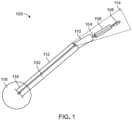
- FIG. 1 shows a top perspective view of a drug delivery device as described herein.
- a drug delivery device 100 is particularly suited for olfactory submucosal depot delivery of a drug or therapeutic agent. As described in further detail herein, the drug delivery device 100 allows a large standardized space to be created with a pinhole opening to enable a precise volume of a therapeutic agent to be deposited trans olfactory while substantially preventing the drug from leaking out of the submucosal space.
- the drug delivery device 100 includes a catheter component 100 having two portions, a stem portion 102 and a branch portion 104.
- the catheter component 100 includes a pre-defined bend about a point so that the branch portion 104 of the catheter component 100 is positioned at an angle with respect to the stem portion 102.
- the branch portion 104 is positioned at an obtuse angle with respect to the stem portion 102.
- the branch portion 104 is angulated with respect to the stem portion 102 in the range of 155-170 degrees (i.e. the angle between the stem portion 102 and the branch portion 104).
- the catheter component 100 is composed out of surgical metal in certain implementations and has a rigidity that allows it to maintain the pre-defined angulated shape during insertion.
- the angulation of the branch portion 104 with respect to the stem portion 102 allows the drug delivery depot or space to be properly created in the olfactory mucosa while limiting or precluding intracranial penetration or penetration of the skull base.
- the angulation of the branch portion 104 with respect to the stem portion 102 allows the drug delivery depot to be created substantially parallel to the olfactory bulb in the submucosal space, for example in supramucoperichondrial or submucoperichondrial plane.
- the catheter component 100 includes a dissecting head 106 positioned at the tip of the branch portion 104.
- the dissecting head 106 is on a leading edge of the branch portion 104 to create a pinhole opening through the olfactory mucosa tissue as the drug delivery device is advanced therein.
- the dissecting head 106 includes a flattened disc geometry (e.g., flat semi-circular) in accordance with the present claimed invention.
- the dissecting head 106 includes a tapered or beveled geometry in certain implementations.
- the dissecting head comprises a port coupled via a channel extending through the branch portion 104 and at least a portion of the stem portion 102.
- the dissecting head is configured as a cannula or a needle tip in certain implementations.
- the port provides a pathway for fluids to be delivered through the catheter component 100 to the depot created thereby.
- the port is used to retrieve anatomical fluids.
- the port is connected to a reservoir 118 in certain implementations.
- the reservoir 118 can be positioned adjacent to and/or in a handle portion 116.
- the reservoir 118 is used to hold a drug or the therapeutic agent for delivery.
- the drug can be pumped from the reservoir 118 to the port via an actuator generating a change in pressure in the catheter component 100.
- the drug can include a liquid, a gel (e.g., thermosensitive gels), and/or a solid in accordance with certain implementations.
- the catheter component 100 also includes a dilation balloon 108, positioned on the branch portion.
- the dilation balloon 108 is positioned between the pre-defined bend in the catheter component and the dissecting head 106.
- the dilation balloon 108 is configured to expand upon actuation.
- the actuation can be initiated via an actuator button positioned on or near the handle 116.
- the dilation balloon is fluidly coupled to a fluid source for increasing the volume of the balloon. Expansion of the dilation balloon creates the olfactory submucosal depot by compressing the tissue in the region.
- the dilation balloon 108 is positioned so that the dissecting head 106 is upstream of the dilation balloon 108 and at least a portion of the branch portion 104 is downstream of the dilation balloon 108. This configuration ensures that once the dilation balloon 108 is contracted back from the expanded state, before the branch portion is at least partially retracted, the pinhole opening created via the dissecting head 106 upon entry into submucosa space maintains its size (e.g. smaller than the depot and smaller than the expanded dilation balloon).
- the dilation balloon 108 has a length in the range of 1-4 cm, an inflated diameter in the range of 0.1-3mm.
- the dilation balloon 108 is symmetrical in certain implementations, but may also be configured asymmetrically in particular implementations.
- the branch portion 104 is at least partially retracted from the depot or void created by the dilation balloon 108 and the drug or therapeutic agent is ejected through the port in the branch portion to reside in the depot for diffusion into the central nervous system.
- the dilation balloon 108 is illustrated by way of example as cylindrical, the dilation balloon can be formed in a variety of different shapes or geometries to form various depot geometries and size, for example depending on the patient, dosage, and/or therapeutic agent or drug.
- the catheter component 100 also includes an outer sheath 110.
- the outer sheath 110 is positioned downstream of the bend in the catheter component 100.
- the outer sheath 110 is configured to house the branch portion 104 in implementations where the branch portion 104 is partially or wholly retractable into the outer sheath 110.
- the outer sheath 110 is also angulated with respect to the stem portion 102 in the range of 155-170 degrees.
- the catheter component 100 can also include an endoscopic device 112 positioned on the stem portion.
- the endoscopic device 112 is positioned adjacent the pre-defined bend so as to have a field of view of the dissecting head 106 and the plane directly above the dissecting head 106.
- the endoscopic device 112 can include a camera (e.g. a digital video camera) for recording the views obtainable via the endoscopic device 112.
- a camera e.g. a digital video camera
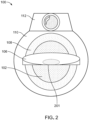
- FIG. 2 illustrates a front sectional view of the drug delivery device of FIG 1 .
- the drug delivery port 201 positioned in the dissecting head 106 of the branch portion 104 is visible in FIG. 2 .
- the dissecting head 106 is sized to create an opening sufficient for the branch portion 104 to extend through, but smaller than the outer sheath 110 into which the balloon 108 can be retracted.
- the branch portion 104 has a length in the range of 2-4 cm and a diameter in the range of.
- the outer sheath 110 has a length in the range of 8-15 cm and a diameter in the range of 2-3 mm.
- the optional endoscope 112 is positioned atop the stem portion 102 to provide a view of the position of the dissecting head 106 and the dilation balloon 108.
- the camera of the endoscope 112 allows the operator to watch the surface of the mucosa so that the operator can ensure that as the dissecting head 106 and the branch portion 104 are advanced, they are advanced backwards rather than upwards.
- the camera allows the operator to watch the area/plane above the dissecting head 106, while the dissecting head and dilation balloon are operating in the plane below.
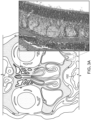
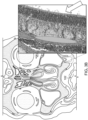
- FIGS. 3A-3B show a front sectional anatomical view magnifying the submucosal, space of the olfactory mucosa in which a drug is delivered using a drug delivery device as described herein.
- FIG. 3A shows a magnified view of submucosal layers in which the depot for drug delivery will be created and
- FIG. 3B shows the depot 302 created in the mucosal layers after the depot is generated.
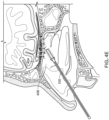
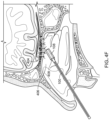
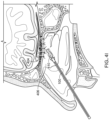
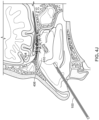
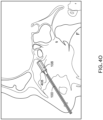
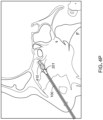
- FIGS. 4A-4L illustrate a method for submucosal drug delivery via the drug delivery device of FIG. 1 .
- the drug delivery device 100 is inserted into the nasal cavity.
- the dissecting head 106 can be retracted into the outer sheath until device 100 encounters tissue to be penetrated.
- the drug delivery device penetrates the submucosal tissue.
- the dissecting head 106 is extended from the outer sheath 110 at the predefined bend angle.
- the outer sheath 110 and the branch portion are at the predefined bend angle in both the extended and the retracted position.
- FIG. 4C shows the delivery device 100, with the branch portion 104 extending through the opening 401 created by the dissecting head 106.
- FIG. 4D shows the delivery device 100 with the dilation balloon 108 beginning to deploy.
- the branch portion 104 of the device 100 is substantially parallel to the olfactory bulb 404 and positioned in the submucosal space 406.
- the dilation balloon 108 is fully deployed and thereby pushes the mucosal tissue apart to create a depot or void 408 within the tissue to be filled by the drug or therapeutic agent.
- the dilation balloon 108 is contracted leaving a space in the submucosal tissue into which the therapeutic agent will be delivered.
- the delivery device is retracting.
- the branch portion 104 can be retracted at least in part into the outer sheath 110.
- the branch portion can be retracted such that the balloon is inside the outer sheath 110 while the dissecting head is still extending from the outer sheath and is positioned inside the depot 408 with the delivery port 201 positioned in the depot 408 or at the narrowed opening entry way into the depot 408.
- the outer sheath 110 may not be extended through the opening created by the dissecting head 106 in order to minimize the size of the opening and prevent the flow of the drug or therapeutic agent from the depot 408.
- the drug or therapeutic agent 410 is ejected from device 100 through the delivery port 201.
- the therapeutic agent 410 can be pumped from a reservoir 118 in or near the handle 116 through the stem portion 102 and through the branch portion 104 (e.g. via a channel or conduit extending contiguously through the stem portion 102 and 104). Accordingly, the system is operable via single-handed operation to penetrate, space, and inject.
- the therapeutic agent 410 can also be contained in vial or cartridge that can be coupled to device 100 and pumped from the cartridge through the stem and branch portions 102, 104 respectively and out of the delivery port 201.
- the device 100 includes two plungers in the handle a first plunger for inflating and deflating the dilation balloon and a second plunger for injecting the therapeutic agent 410.
- the device 100 can be configured as a syringe.
- embodiments of the present invention provide an alternative method of treating conditions affecting the central nervous system that presently warrant general anesthesia, surgery, and/or intrathecal injections.
- the devices and methods afforded by implementations disclosed herein limit drug leak out, thereby increasing the efficacy and allowing a precise amount of a drug or therapeutic agent to be administered.
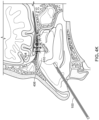
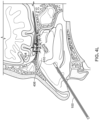
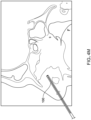
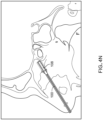
- FIGS. 4M-4P illustrate the method for submucosal drug delivery of FIGS. 4A-4L depicted by a CT scan along the septum.
- the drug delivery device 100 is inserted into the nasal cavity.
- the dilation balloon 108 of the delivery device 100 is beginning to deploy.
- the dilation balloon 108 is fully deployed and thereby pushes the mucosal tissue apart to create a depot or void 408 within the tissue to be filled by the drug or therapeutic agent.
- the delivery device 100 is partially retracted (e.g. into the outer sheath) and the drug or therapeutic agent 410 is ejected from device 100 through the delivery port 201.
- FIGS. 5A-5B illustrate a drug delivery device according to particular implementations.
- the drug delivery device 500 is positioned in the submucosal space for depot delivery of a therapeutic agent in a manner similar to device 100.
- the branch portion 504 of the device 500 is substantially parallel to the olfactory bulb and positioned in the submucosal space.
- the drug delivery device 500 can be angled about a second axis. Accordingly, the device is also configured for extending inwardly through the nasal cavity to reach the submucosal space.
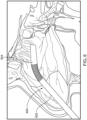
- FIG 6 shows a side sectional view of another drug delivery device according to certain implementations.
- a drug delivery device 600 can be configured to flex and thereby change the degree of the obtuse angle between a branch portion 604 and a stem portion 602 of the cannulated drug delivery device 600.
- the flexibility can be provided about more than one axis in particular implementations.
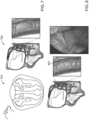
- FIG. 7 illustrates a cross sectional illustration of rat model of a depot.
- the depot is delivered where the dorsal nasal bone is removed (as shown in FIG. 9 ) from the rat to expose the mucoperichondrium of the nasal and olfactory rodent mucosa.
- the depot is then applied to this surface, which is anatomically identical to the submucosal space in the human model 702.
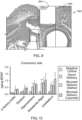
- FIG. 8 shows an endoscopic view of the olfactory submucosal space with an olfactory nerve trunk 801 seen extending from the intracranial space into the submucosal space. This space represents the potential space where the depot will be dosed.
- FIG. 9 is a cross sectional histological view (H&E) of the rat model 701 depicted in FIG. 7 at low and high magnification.
- FIG. 10 shows a comparison of ipsi-lateral BDNF upregulation (e.g. craniotomy side) following BDNF AntagoNAT (0. 15mg/kg) delivery via a mucosal graft in saline or liposome, versus minimally invasive nasal depot (MIND), versus saline control in various brain subregions.
- the depot approach results in significant BDNF upregulation relative to control in hippocampus and substantia nigra relative to negative control.
- FIG. 11 shows a comparison of contra-lateral BDNF upregulation (e.g. non-craniotomy side) following BDNF AntagoNAT (0. 15mg/kg) delivery via a mucosal graft in saline or liposome, versus minimally invasive nasal depot (MIND), versus saline control in various brain subregions.
- the depot approach results in significant BDNF upregulation relative to control in substantia nigra and cerebellum relative to negative control.
- FIG. 12 shows a comparison of BDNF AntagoNAT (0. 15mg/kg, 60micL) distribution in the rat brain following depot delivery versus traditional nasal irrigation and negative saline control demonstrating increased distribution in all regions examined using the minimally invasive nasal depot (MIND) technique.
- MIND minimally invasive nasal depot
- the technology described herein may be embodied as an example method, of which at least one example has been provided.
- the acts performed as part of the method may be ordered in any suitable way. Accordingly, implementations may be constructed in which acts are performed in an order different than illustrated, which may include performing some acts simultaneously, even though shown as sequential acts in illustrative implementations.
Landscapes
- Health & Medical Sciences (AREA)
- Life Sciences & Earth Sciences (AREA)
- Veterinary Medicine (AREA)
- Animal Behavior & Ethology (AREA)
- Engineering & Computer Science (AREA)
- Public Health (AREA)
- Biomedical Technology (AREA)
- Heart & Thoracic Surgery (AREA)
- General Health & Medical Sciences (AREA)
- Surgery (AREA)
- Anesthesiology (AREA)
- Hematology (AREA)
- Pulmonology (AREA)
- Biophysics (AREA)
- Medical Informatics (AREA)
- Molecular Biology (AREA)
- Nuclear Medicine, Radiotherapy & Molecular Imaging (AREA)
- Pathology (AREA)
- Vascular Medicine (AREA)
- Dentistry (AREA)
- Oral & Maxillofacial Surgery (AREA)
- Otolaryngology (AREA)
- Infusion, Injection, And Reservoir Apparatuses (AREA)
- Physics & Mathematics (AREA)
- Optics & Photonics (AREA)
- Radiology & Medical Imaging (AREA)
Claims (13)
- Dispositif d'administration nasale de médicament, comprenant :un élément cathéter (100) comprenant une partie tige (102) et une partie branche (104), l'élément cathéter (100) comprenant une courbure prédéfinie de telle sorte que la partie branche (104) soit inclinée par rapport à la partie tige (102) selon un angle obtus, la partie branche (104) comprenant une tête de dissection (106) positionnée au niveau de l'extrémité de la partie branche (104), la tête de dissection (106) comprenant une géométrie de disque aplati et au moins un orifice d'administration (201) positionné dans la tête de dissection (106) ;un ballonnet de dilatation (108) positionné sur la partie branche (104) entre la courbure prédéfinie et la tête de dissection (106), le ballonnet de dilatation (108) étant configuré pour se dilater autour d'au moins une partie d'une paroi cylindrique de la partie branche (104) ;un réservoir d'administration de médicament (118) accouplé fluidiquement à l'au moins un orifice d'administration (201) par l'intermédiaire de la partie branche (104) et par l'intermédiaire d'au moins une partie de la partie tige (102) ; etune partie poignée (116) accouplée à la partie tige (102).
- Dispositif d'administration nasale de médicament selon la revendication 1, dans lequel la partie branche (104) est inclinée par rapport à la partie tige (102) selon un angle obtus autour de deux axes.
- Dispositif d'administration nasale de médicament selon la revendication 1 ou 2, comprenant en outre une gaine extérieure (110) positionnée entre la courbure prédéfinie et le ballonnet de dilatation (108).
- Dispositif d'administration nasale de médicament selon la revendication 3, dans lequel la partie branche (104) est configurée pour se rétracter dans la gaine extérieure (110) et s'étendre à partir de celle-ci selon l'angle obtus, ou dans lequel au moins une partie de la partie branche (104) est configurée pour se rétracter dans la gaine extérieure (110) et s'étendre à partir de celle-ci selon l'angle obtus ; et/ou dans lequel le ballonnet de dilatation (108) est configuré pour se rétracter dans la gaine extérieure (110) et s'étendre à partir de celle-ci selon l'angle obtus avec la partie branche (104), et/ou dans lequel la partie branche (104) est configurée pour s'étendre sur 2 à 3 cm au-delà de la gaine extérieure (110).
- Dispositif d'administration nasale de médicament selon l'une quelconque des revendications 1 à 4, comprenant un endoscope (112) positionné à proximité de la courbure prédéfinie afin de permettre l'obtention d'un champ de vision de la tête de dissection (106), l'endoscope (112) comprenant de préférence une caméra.
- Dispositif d'administration nasale de médicament selon l'une quelconque des revendications 1 à 5, dans lequel la tête de dissection (106) comprend une canule ayant un diamètre de l'ordre de 0,25 mm à 3 mm.
- Dispositif d'administration nasale de médicament selon l'une quelconque des revendications 1 à 6, comprenant en outre une pompe accouplée en communication au réservoir d'administration de médicament (118) et configurée pour déplacer un médicament du réservoir d'administration de médicament (118) vers l'au moins un orifice d'administration (201), la pompe comprenant de préférence un ensemble piston.
- Dispositif d'administration nasale de médicament selon l'une quelconque des revendications 1 à 7, dans lequel l'angle obtus est de l'ordre de 155 à 170 degrés.
- Dispositif d'administration nasale de médicament selon l'une quelconque des revendications 1 à 8, dans lequel la partie branche (104) a une longueur de l'ordre de 10 à 20 cm.
- Dispositif d'administration nasale de médicament selon l'une quelconque des revendications 1 à 9, dans lequel le ballonnet de dilatation (108) a une longueur de l'ordre de 1 à 4 cm, et/ou dans lequel le ballonnet de dilatation (108) a un diamètre de l'ordre de 0,1 à 3 mm.
- Dispositif d'administration nasale de médicament selon l'une quelconque des revendications 1 à 10, dans lequel la partie branche (104) s'étend en amont et en aval du ballonnet de dilatation (108) de telle sorte que le ballonnet de dilatation (108) soit positionné entre la tête de dissection (106) et une section de la partie branche (104) qui est plus étroite que le ballonnet de dilatation (108) dans un état gonflé, de telle sorte qu'une entrée dans un dépôt lors de la rétraction de la partie branche (104) soit plus étroite que le dépôt lui-même.
- Dispositif d'administration nasale de médicament selon l'une quelconque des revendications 1 à 11, dans lequel le réservoir d'administration de médicament (118) contient une quantité thérapeutiquement efficace d'un médicament destiné à traiter un trouble du système nerveux central.
- Dispositif d'administration nasale de médicament selon l'une quelconque des revendications 1 à 12, dans lequel la tête de dissection (106) est configurée pour créer une ouverture ayant une section transversale qui est inférieure à une section transversale du ballonnet de dilatation (108) lorsqu'il est gonflé.
Applications Claiming Priority (2)
| Application Number | Priority Date | Filing Date | Title |
|---|---|---|---|
| US201862627878P | 2018-02-08 | 2018-02-08 | |
| PCT/US2019/017178 WO2019157259A1 (fr) | 2018-02-08 | 2019-02-08 | Appareils, systèmes, et procédés d'administration sous-mucosique de médicament |
Publications (3)
| Publication Number | Publication Date |
|---|---|
| EP3749406A1 EP3749406A1 (fr) | 2020-12-16 |
| EP3749406A4 EP3749406A4 (fr) | 2021-11-03 |
| EP3749406B1 true EP3749406B1 (fr) | 2024-07-24 |
Family
ID=67549664
Family Applications (1)
| Application Number | Title | Priority Date | Filing Date |
|---|---|---|---|
| EP19750916.9A Active EP3749406B1 (fr) | 2018-02-08 | 2019-02-08 | Appareils et systèmes d'administration sous-mucosique de médicament |
Country Status (3)
| Country | Link |
|---|---|
| US (1) | US20210023295A1 (fr) |
| EP (1) | EP3749406B1 (fr) |
| WO (1) | WO2019157259A1 (fr) |
Families Citing this family (4)
| Publication number | Priority date | Publication date | Assignee | Title |
|---|---|---|---|---|
| EP4161410A4 (fr) | 2020-06-03 | 2024-07-17 | Northeastern University | Implant biodégradable pour l'administration trans-nasale prolongée d'agents thérapeutiques au niveau du cerveau |
| EP4313248A4 (fr) * | 2021-03-29 | 2025-02-26 | Massachusetts Eye and Ear Infirmary | Appareils, systèmes, et méthodes d'administration sous-muqueuse de médicament implantable |
| WO2025170025A1 (fr) | 2024-02-08 | 2025-08-14 | テルモ株式会社 | Dispositif et système d'administration nasale |
| WO2025170026A1 (fr) | 2024-02-08 | 2025-08-14 | テルモ株式会社 | Dispositif d'administration nasale et système d'administration nasale |
Family Cites Families (18)
| Publication number | Priority date | Publication date | Assignee | Title |
|---|---|---|---|---|
| US5735817A (en) * | 1995-05-19 | 1998-04-07 | Shantha; T. R. | Apparatus for transsphenoidal stimulation of the pituitary gland and adjoining brain structures |
| US6478775B1 (en) * | 2000-10-02 | 2002-11-12 | Genyx Medical Inc. | Device for delivering non-biodegradable bulking composition to a urological site |
| US6855124B1 (en) * | 2002-10-02 | 2005-02-15 | Advanced Cardiovascular Systems, Inc. | Flexible polymer needle catheter |
| US20060063973A1 (en) * | 2004-04-21 | 2006-03-23 | Acclarent, Inc. | Methods and apparatus for treating disorders of the ear, nose and throat |
| US20060004323A1 (en) * | 2004-04-21 | 2006-01-05 | Exploramed Nc1, Inc. | Apparatus and methods for dilating and modifying ostia of paranasal sinuses and other intranasal or paranasal structures |
| US7654997B2 (en) * | 2004-04-21 | 2010-02-02 | Acclarent, Inc. | Devices, systems and methods for diagnosing and treating sinusitus and other disorders of the ears, nose and/or throat |
| US9101384B2 (en) * | 2004-04-21 | 2015-08-11 | Acclarent, Inc. | Devices, systems and methods for diagnosing and treating sinusitis and other disorders of the ears, Nose and/or throat |
| RU2506056C2 (ru) * | 2008-09-18 | 2014-02-10 | Аккларент, Инк. | Способы и аппарат для лечения заболеваний уха, горла, носа |
| US8728024B2 (en) * | 2008-10-10 | 2014-05-20 | Deka Products Limited Partnership | Infusion pump methods, systems and apparatus |
| EP2544757A4 (fr) * | 2010-03-09 | 2013-11-06 | Toxcure Inc | Dispositif d'administration nasale par microaiguilles |
| US8673338B2 (en) * | 2011-07-29 | 2014-03-18 | Massachusetts Eye And Ear Infirmary | Methods of delivering pharmaceutical agents |
| US20130174849A1 (en) * | 2012-01-10 | 2013-07-11 | Prospex Medical III | Olfactory modifying devices and related methods |
| US9579448B2 (en) * | 2012-04-13 | 2017-02-28 | Acclarent, Inc. | Balloon dilation catheter system for treatment and irrigation of the sinuses |
| JP2014180571A (ja) * | 2013-03-15 | 2014-09-29 | Custom Medical Applications | 安全な神経注射システム及び関連する方法 |
| US9295798B2 (en) * | 2013-10-09 | 2016-03-29 | Danny Martin Sartore | Laryngoscopic device with drug and oxygen delivery conduits |
| US9480828B2 (en) * | 2013-11-14 | 2016-11-01 | Gyrus Acmi, Inc. | Treatment method for the inferior turbinate |
| EP3383288A1 (fr) * | 2015-12-01 | 2018-10-10 | Cook Medical Technologies LLC | Dispositif d'incision à profondeur d'incision précise |
| CN107898540B (zh) * | 2017-09-29 | 2020-04-03 | 依奈德医疗技术(上海)有限公司 | 鼻窦球囊导管和球囊扩张式鼻内支架的组合件 |
-
2019
- 2019-02-08 EP EP19750916.9A patent/EP3749406B1/fr active Active
- 2019-02-08 WO PCT/US2019/017178 patent/WO2019157259A1/fr not_active Ceased
- 2019-02-08 US US16/968,093 patent/US20210023295A1/en active Pending
Also Published As
| Publication number | Publication date |
|---|---|
| US20210023295A1 (en) | 2021-01-28 |
| WO2019157259A1 (fr) | 2019-08-15 |
| EP3749406A1 (fr) | 2020-12-16 |
| EP3749406A4 (fr) | 2021-11-03 |
Similar Documents
| Publication | Publication Date | Title |
|---|---|---|
| US20210023295A1 (en) | Submucosal drug delivery apparatuses, systems, and methods | |
| US12004997B2 (en) | Gland or duct diagnostic and treatment methods and related apparatus | |
| US11906719B2 (en) | Devices, systems, and methods for treating ear disorders | |
| RU2207845C2 (ru) | Твердая лекарственная форма пролонгированного действия для парентерального введения и способ ее получения | |
| JP5581692B2 (ja) | 目的の薬物送出のためのマイクロカテーテル器具および方法 | |
| CA3175975C (fr) | Appareil pour l'administration sous-retinienne d'un agent therapeutique par l'intermediaire d'une aiguille courbe | |
| ES2336626T3 (es) | Dispositivo introductor de electrodos. | |
| JP7061595B2 (ja) | 薬物送達システム及びゲムシタビンによる膀胱がんの治療方法 | |
| JP2002543868A (ja) | 注射アレイ装置及び方法 | |
| US9949989B2 (en) | Intranasal medication delivery device and method of use thereof | |
| JP2012513253A (ja) | 前頭洞スペーサー | |
| JP2021520908A (ja) | 経皮的腫瘍内治療送達のための装置および方法 | |
| EP1409040A2 (fr) | Catheter pour administration de medicaments a invasion minimale | |
| US20040243101A1 (en) | Minimally invasive drug delivery catheter | |
| US20260027327A1 (en) | Otic drug delivery system and methods | |
| US20240181231A1 (en) | Submucosal implantable drug delivery apparatuses, systems, and methods | |
| KR20160043186A (ko) | 생분해성 고분자로 형성된 분리형 침첨을 갖는 약물 전달용 한방침 및 제조방법 | |
| US20070213701A1 (en) | Implanting devices and methods thereof | |
| CN106361416A (zh) | 用于立体定向导航设备的脑内微创微量多靶点注射系统 | |
| WO2010127395A1 (fr) | Système de distribution d'agent | |
| EP2152236A1 (fr) | Composition pharmaceutique d'une anthracycline | |
| WO2023080251A1 (fr) | Instrument médical | |
| RU176144U1 (ru) | Нанокатетер для введения/извлечения межклеточной жидкости из/в биологическую среду | |
| FR2770134A1 (fr) | Formulations solides ou semi-solides pour administration locale | |
| TWM341494U (en) | Implanted vertebral supporting device |
Legal Events
| Date | Code | Title | Description |
|---|---|---|---|
| STAA | Information on the status of an ep patent application or granted ep patent |
Free format text: STATUS: THE INTERNATIONAL PUBLICATION HAS BEEN MADE |
|
| PUAI | Public reference made under article 153(3) epc to a published international application that has entered the european phase |
Free format text: ORIGINAL CODE: 0009012 |
|
| STAA | Information on the status of an ep patent application or granted ep patent |
Free format text: STATUS: REQUEST FOR EXAMINATION WAS MADE |
|
| 17P | Request for examination filed |
Effective date: 20200908 |
|
| AK | Designated contracting states |
Kind code of ref document: A1 Designated state(s): AL AT BE BG CH CY CZ DE DK EE ES FI FR GB GR HR HU IE IS IT LI LT LU LV MC MK MT NL NO PL PT RO RS SE SI SK SM TR |
|
| AX | Request for extension of the european patent |
Extension state: BA ME |
|
| DAV | Request for validation of the european patent (deleted) | ||
| DAX | Request for extension of the european patent (deleted) | ||
| A4 | Supplementary search report drawn up and despatched |
Effective date: 20210930 |
|
| RIC1 | Information provided on ipc code assigned before grant |
Ipc: A61B 17/32 20060101ALN20210924BHEP Ipc: A61B 17/34 20060101ALI20210924BHEP Ipc: A61B 17/29 20060101ALI20210924BHEP Ipc: A61B 17/28 20060101ALI20210924BHEP Ipc: A61B 17/24 20060101ALI20210924BHEP Ipc: A61M 25/10 20130101AFI20210924BHEP |
|
| STAA | Information on the status of an ep patent application or granted ep patent |
Free format text: STATUS: EXAMINATION IS IN PROGRESS |
|
| 17Q | First examination report despatched |
Effective date: 20230403 |
|
| GRAP | Despatch of communication of intention to grant a patent |
Free format text: ORIGINAL CODE: EPIDOSNIGR1 |
|
| STAA | Information on the status of an ep patent application or granted ep patent |
Free format text: STATUS: GRANT OF PATENT IS INTENDED |
|
| RIC1 | Information provided on ipc code assigned before grant |
Ipc: A61M 25/10 20130101AFI20240220BHEP Ipc: A61B 17/32 20060101ALN20240220BHEP Ipc: A61M 29/02 20060101ALI20240220BHEP Ipc: A61M 25/00 20060101ALI20240220BHEP Ipc: A61B 17/34 20060101ALI20240220BHEP Ipc: A61B 17/29 20060101ALI20240220BHEP Ipc: A61B 17/28 20060101ALI20240220BHEP Ipc: A61B 17/24 20060101ALI20240220BHEP |
|
| INTG | Intention to grant announced |
Effective date: 20240327 |
|
| GRAS | Grant fee paid |
Free format text: ORIGINAL CODE: EPIDOSNIGR3 |
|
| GRAA | (expected) grant |
Free format text: ORIGINAL CODE: 0009210 |
|
| STAA | Information on the status of an ep patent application or granted ep patent |
Free format text: STATUS: THE PATENT HAS BEEN GRANTED |
|
| RIN1 | Information on inventor provided before grant (corrected) |
Inventor name: BLEIER, BENJAMIN S. |
|
| AK | Designated contracting states |
Kind code of ref document: B1 Designated state(s): AL AT BE BG CH CY CZ DE DK EE ES FI FR GB GR HR HU IE IS IT LI LT LU LV MC MK MT NL NO PL PT RO RS SE SI SK SM TR |
|
| REG | Reference to a national code |
Ref country code: GB Ref legal event code: FG4D |
|
| REG | Reference to a national code |
Ref country code: CH Ref legal event code: EP |
|
| P01 | Opt-out of the competence of the unified patent court (upc) registered |
Free format text: CASE NUMBER: APP_39649/2024 Effective date: 20240703 |
|
| REG | Reference to a national code |
Ref country code: IE Ref legal event code: FG4D Ref country code: DE Ref legal event code: R096 Ref document number: 602019055718 Country of ref document: DE |
|
| REG | Reference to a national code |
Ref country code: LT Ref legal event code: MG9D |
|
| REG | Reference to a national code |
Ref country code: NL Ref legal event code: MP Effective date: 20240724 |
|
| PG25 | Lapsed in a contracting state [announced via postgrant information from national office to epo] |
Ref country code: PT Free format text: LAPSE BECAUSE OF FAILURE TO SUBMIT A TRANSLATION OF THE DESCRIPTION OR TO PAY THE FEE WITHIN THE PRESCRIBED TIME-LIMIT Effective date: 20241125 |
|
| REG | Reference to a national code |
Ref country code: AT Ref legal event code: MK05 Ref document number: 1705735 Country of ref document: AT Kind code of ref document: T Effective date: 20240724 |
|
| PG25 | Lapsed in a contracting state [announced via postgrant information from national office to epo] |
Ref country code: NL Free format text: LAPSE BECAUSE OF FAILURE TO SUBMIT A TRANSLATION OF THE DESCRIPTION OR TO PAY THE FEE WITHIN THE PRESCRIBED TIME-LIMIT Effective date: 20240724 |
|
| PG25 | Lapsed in a contracting state [announced via postgrant information from national office to epo] |
Ref country code: PT Free format text: LAPSE BECAUSE OF FAILURE TO SUBMIT A TRANSLATION OF THE DESCRIPTION OR TO PAY THE FEE WITHIN THE PRESCRIBED TIME-LIMIT Effective date: 20241125 Ref country code: NL Free format text: LAPSE BECAUSE OF FAILURE TO SUBMIT A TRANSLATION OF THE DESCRIPTION OR TO PAY THE FEE WITHIN THE PRESCRIBED TIME-LIMIT Effective date: 20240724 |
|
| PG25 | Lapsed in a contracting state [announced via postgrant information from national office to epo] |
Ref country code: NO Free format text: LAPSE BECAUSE OF FAILURE TO SUBMIT A TRANSLATION OF THE DESCRIPTION OR TO PAY THE FEE WITHIN THE PRESCRIBED TIME-LIMIT Effective date: 20241024 |
|
| PG25 | Lapsed in a contracting state [announced via postgrant information from national office to epo] |
Ref country code: GR Free format text: LAPSE BECAUSE OF FAILURE TO SUBMIT A TRANSLATION OF THE DESCRIPTION OR TO PAY THE FEE WITHIN THE PRESCRIBED TIME-LIMIT Effective date: 20241025 Ref country code: FI Free format text: LAPSE BECAUSE OF FAILURE TO SUBMIT A TRANSLATION OF THE DESCRIPTION OR TO PAY THE FEE WITHIN THE PRESCRIBED TIME-LIMIT Effective date: 20240724 Ref country code: PL Free format text: LAPSE BECAUSE OF FAILURE TO SUBMIT A TRANSLATION OF THE DESCRIPTION OR TO PAY THE FEE WITHIN THE PRESCRIBED TIME-LIMIT Effective date: 20240724 |
|
| PG25 | Lapsed in a contracting state [announced via postgrant information from national office to epo] |
Ref country code: BG Free format text: LAPSE BECAUSE OF FAILURE TO SUBMIT A TRANSLATION OF THE DESCRIPTION OR TO PAY THE FEE WITHIN THE PRESCRIBED TIME-LIMIT Effective date: 20240724 |
|
| PG25 | Lapsed in a contracting state [announced via postgrant information from national office to epo] |
Ref country code: LV Free format text: LAPSE BECAUSE OF FAILURE TO SUBMIT A TRANSLATION OF THE DESCRIPTION OR TO PAY THE FEE WITHIN THE PRESCRIBED TIME-LIMIT Effective date: 20240724 |
|
| PG25 | Lapsed in a contracting state [announced via postgrant information from national office to epo] |
Ref country code: IS Free format text: LAPSE BECAUSE OF FAILURE TO SUBMIT A TRANSLATION OF THE DESCRIPTION OR TO PAY THE FEE WITHIN THE PRESCRIBED TIME-LIMIT Effective date: 20241124 Ref country code: AT Free format text: LAPSE BECAUSE OF FAILURE TO SUBMIT A TRANSLATION OF THE DESCRIPTION OR TO PAY THE FEE WITHIN THE PRESCRIBED TIME-LIMIT Effective date: 20240724 |
|
| PG25 | Lapsed in a contracting state [announced via postgrant information from national office to epo] |
Ref country code: HR Free format text: LAPSE BECAUSE OF FAILURE TO SUBMIT A TRANSLATION OF THE DESCRIPTION OR TO PAY THE FEE WITHIN THE PRESCRIBED TIME-LIMIT Effective date: 20240724 |
|
| PG25 | Lapsed in a contracting state [announced via postgrant information from national office to epo] |
Ref country code: ES Free format text: LAPSE BECAUSE OF FAILURE TO SUBMIT A TRANSLATION OF THE DESCRIPTION OR TO PAY THE FEE WITHIN THE PRESCRIBED TIME-LIMIT Effective date: 20240724 |
|
| PG25 | Lapsed in a contracting state [announced via postgrant information from national office to epo] |
Ref country code: PL Free format text: LAPSE BECAUSE OF FAILURE TO SUBMIT A TRANSLATION OF THE DESCRIPTION OR TO PAY THE FEE WITHIN THE PRESCRIBED TIME-LIMIT Effective date: 20240724 Ref country code: NO Free format text: LAPSE BECAUSE OF FAILURE TO SUBMIT A TRANSLATION OF THE DESCRIPTION OR TO PAY THE FEE WITHIN THE PRESCRIBED TIME-LIMIT Effective date: 20241024 Ref country code: LV Free format text: LAPSE BECAUSE OF FAILURE TO SUBMIT A TRANSLATION OF THE DESCRIPTION OR TO PAY THE FEE WITHIN THE PRESCRIBED TIME-LIMIT Effective date: 20240724 Ref country code: IS Free format text: LAPSE BECAUSE OF FAILURE TO SUBMIT A TRANSLATION OF THE DESCRIPTION OR TO PAY THE FEE WITHIN THE PRESCRIBED TIME-LIMIT Effective date: 20241124 Ref country code: HR Free format text: LAPSE BECAUSE OF FAILURE TO SUBMIT A TRANSLATION OF THE DESCRIPTION OR TO PAY THE FEE WITHIN THE PRESCRIBED TIME-LIMIT Effective date: 20240724 Ref country code: GR Free format text: LAPSE BECAUSE OF FAILURE TO SUBMIT A TRANSLATION OF THE DESCRIPTION OR TO PAY THE FEE WITHIN THE PRESCRIBED TIME-LIMIT Effective date: 20241025 Ref country code: FI Free format text: LAPSE BECAUSE OF FAILURE TO SUBMIT A TRANSLATION OF THE DESCRIPTION OR TO PAY THE FEE WITHIN THE PRESCRIBED TIME-LIMIT Effective date: 20240724 Ref country code: ES Free format text: LAPSE BECAUSE OF FAILURE TO SUBMIT A TRANSLATION OF THE DESCRIPTION OR TO PAY THE FEE WITHIN THE PRESCRIBED TIME-LIMIT Effective date: 20240724 Ref country code: BG Free format text: LAPSE BECAUSE OF FAILURE TO SUBMIT A TRANSLATION OF THE DESCRIPTION OR TO PAY THE FEE WITHIN THE PRESCRIBED TIME-LIMIT Effective date: 20240724 Ref country code: AT Free format text: LAPSE BECAUSE OF FAILURE TO SUBMIT A TRANSLATION OF THE DESCRIPTION OR TO PAY THE FEE WITHIN THE PRESCRIBED TIME-LIMIT Effective date: 20240724 |
|
| PG25 | Lapsed in a contracting state [announced via postgrant information from national office to epo] |
Ref country code: RO Free format text: LAPSE BECAUSE OF FAILURE TO SUBMIT A TRANSLATION OF THE DESCRIPTION OR TO PAY THE FEE WITHIN THE PRESCRIBED TIME-LIMIT Effective date: 20240724 Ref country code: DK Free format text: LAPSE BECAUSE OF FAILURE TO SUBMIT A TRANSLATION OF THE DESCRIPTION OR TO PAY THE FEE WITHIN THE PRESCRIBED TIME-LIMIT Effective date: 20240724 Ref country code: SM Free format text: LAPSE BECAUSE OF FAILURE TO SUBMIT A TRANSLATION OF THE DESCRIPTION OR TO PAY THE FEE WITHIN THE PRESCRIBED TIME-LIMIT Effective date: 20240724 |
|
| PG25 | Lapsed in a contracting state [announced via postgrant information from national office to epo] |
Ref country code: EE Free format text: LAPSE BECAUSE OF FAILURE TO SUBMIT A TRANSLATION OF THE DESCRIPTION OR TO PAY THE FEE WITHIN THE PRESCRIBED TIME-LIMIT Effective date: 20240724 |
|
| PG25 | Lapsed in a contracting state [announced via postgrant information from national office to epo] |
Ref country code: CZ Free format text: LAPSE BECAUSE OF FAILURE TO SUBMIT A TRANSLATION OF THE DESCRIPTION OR TO PAY THE FEE WITHIN THE PRESCRIBED TIME-LIMIT Effective date: 20240724 |
|
| REG | Reference to a national code |
Ref country code: DE Ref legal event code: R097 Ref document number: 602019055718 Country of ref document: DE |
|
| PG25 | Lapsed in a contracting state [announced via postgrant information from national office to epo] |
Ref country code: IT Free format text: LAPSE BECAUSE OF FAILURE TO SUBMIT A TRANSLATION OF THE DESCRIPTION OR TO PAY THE FEE WITHIN THE PRESCRIBED TIME-LIMIT Effective date: 20240724 Ref country code: SK Free format text: LAPSE BECAUSE OF FAILURE TO SUBMIT A TRANSLATION OF THE DESCRIPTION OR TO PAY THE FEE WITHIN THE PRESCRIBED TIME-LIMIT Effective date: 20240724 |
|
| PLBE | No opposition filed within time limit |
Free format text: ORIGINAL CODE: 0009261 |
|
| STAA | Information on the status of an ep patent application or granted ep patent |
Free format text: STATUS: NO OPPOSITION FILED WITHIN TIME LIMIT |
|
| 26N | No opposition filed |
Effective date: 20250425 |
|
| PG25 | Lapsed in a contracting state [announced via postgrant information from national office to epo] |
Ref country code: SE Free format text: LAPSE BECAUSE OF FAILURE TO SUBMIT A TRANSLATION OF THE DESCRIPTION OR TO PAY THE FEE WITHIN THE PRESCRIBED TIME-LIMIT Effective date: 20240724 |
|
| PG25 | Lapsed in a contracting state [announced via postgrant information from national office to epo] |
Ref country code: MC Free format text: LAPSE BECAUSE OF FAILURE TO SUBMIT A TRANSLATION OF THE DESCRIPTION OR TO PAY THE FEE WITHIN THE PRESCRIBED TIME-LIMIT Effective date: 20240724 |
|
| REG | Reference to a national code |
Ref country code: CH Ref legal event code: PL |
|
| PG25 | Lapsed in a contracting state [announced via postgrant information from national office to epo] |
Ref country code: LU Free format text: LAPSE BECAUSE OF NON-PAYMENT OF DUE FEES Effective date: 20250208 |
|
| PG25 | Lapsed in a contracting state [announced via postgrant information from national office to epo] |
Ref country code: CH Free format text: LAPSE BECAUSE OF NON-PAYMENT OF DUE FEES Effective date: 20250228 |
|
| REG | Reference to a national code |
Ref country code: BE Ref legal event code: MM Effective date: 20250228 |
|
| PG25 | Lapsed in a contracting state [announced via postgrant information from national office to epo] |
Ref country code: BE Free format text: LAPSE BECAUSE OF NON-PAYMENT OF DUE FEES Effective date: 20250228 |
|
| PG25 | Lapsed in a contracting state [announced via postgrant information from national office to epo] |
Ref country code: IE Free format text: LAPSE BECAUSE OF NON-PAYMENT OF DUE FEES Effective date: 20250208 |
|
| PGFP | Annual fee paid to national office [announced via postgrant information from national office to epo] |
Ref country code: GB Payment date: 20260227 Year of fee payment: 8 |
|
| PGFP | Annual fee paid to national office [announced via postgrant information from national office to epo] |
Ref country code: DE Payment date: 20260227 Year of fee payment: 8 |
|
| PGFP | Annual fee paid to national office [announced via postgrant information from national office to epo] |
Ref country code: FR Payment date: 20260225 Year of fee payment: 8 |
|
| PG25 | Lapsed in a contracting state [announced via postgrant information from national office to epo] |
Ref country code: CY Free format text: LAPSE BECAUSE OF FAILURE TO SUBMIT A TRANSLATION OF THE DESCRIPTION OR TO PAY THE FEE WITHIN THE PRESCRIBED TIME-LIMIT Effective date: 20240724 |
|
| PG25 | Lapsed in a contracting state [announced via postgrant information from national office to epo] |
Ref country code: TR Free format text: LAPSE BECAUSE OF FAILURE TO SUBMIT A TRANSLATION OF THE DESCRIPTION OR TO PAY THE FEE WITHIN THE PRESCRIBED TIME-LIMIT Effective date: 20240724 |
|
| PG25 | Lapsed in a contracting state [announced via postgrant information from national office to epo] |
Ref country code: RS Free format text: LAPSE BECAUSE OF FAILURE TO SUBMIT A TRANSLATION OF THE DESCRIPTION OR TO PAY THE FEE WITHIN THE PRESCRIBED TIME-LIMIT Effective date: 20240724 |
|
| PG25 | Lapsed in a contracting state [announced via postgrant information from national office to epo] |
Ref country code: LT Free format text: LAPSE BECAUSE OF FAILURE TO SUBMIT A TRANSLATION OF THE DESCRIPTION OR TO PAY THE FEE WITHIN THE PRESCRIBED TIME-LIMIT Effective date: 20240724 |