EP3749866B1 - Cheville murale auto-foreuse - Google Patents
Cheville murale auto-foreuse Download PDFInfo
- Publication number
- EP3749866B1 EP3749866B1 EP18705113.1A EP18705113A EP3749866B1 EP 3749866 B1 EP3749866 B1 EP 3749866B1 EP 18705113 A EP18705113 A EP 18705113A EP 3749866 B1 EP3749866 B1 EP 3749866B1
- Authority
- EP
- European Patent Office
- Prior art keywords
- wall
- plug
- wall plug
- cup
- rotational axis
- Prior art date
- Legal status (The legal status is an assumption and is not a legal conclusion. Google has not performed a legal analysis and makes no representation as to the accuracy of the status listed.)
- Active
Links
Images






Classifications
-
- F—MECHANICAL ENGINEERING; LIGHTING; HEATING; WEAPONS; BLASTING
- F16—ENGINEERING ELEMENTS AND UNITS; GENERAL MEASURES FOR PRODUCING AND MAINTAINING EFFECTIVE FUNCTIONING OF MACHINES OR INSTALLATIONS; THERMAL INSULATION IN GENERAL
- F16B—DEVICES FOR FASTENING OR SECURING CONSTRUCTIONAL ELEMENTS OR MACHINE PARTS TOGETHER, e.g. NAILS, BOLTS, CIRCLIPS, CLAMPS, CLIPS OR WEDGES; JOINTS OR JOINTING
- F16B13/00—Dowels or other devices fastened in walls or the like by inserting them in holes made therein for that purpose
- F16B13/002—Dowels or other devices fastened in walls or the like by inserting them in holes made therein for that purpose self-cutting
-
- F—MECHANICAL ENGINEERING; LIGHTING; HEATING; WEAPONS; BLASTING
- F16—ENGINEERING ELEMENTS AND UNITS; GENERAL MEASURES FOR PRODUCING AND MAINTAINING EFFECTIVE FUNCTIONING OF MACHINES OR INSTALLATIONS; THERMAL INSULATION IN GENERAL
- F16B—DEVICES FOR FASTENING OR SECURING CONSTRUCTIONAL ELEMENTS OR MACHINE PARTS TOGETHER, e.g. NAILS, BOLTS, CIRCLIPS, CLAMPS, CLIPS OR WEDGES; JOINTS OR JOINTING
- F16B13/00—Dowels or other devices fastened in walls or the like by inserting them in holes made therein for that purpose
- F16B13/12—Separate metal or non-separate or non-metal dowel sleeves fastened by inserting the screw, nail or the like
- F16B13/124—Separate metal or non-separate or non-metal dowel sleeves fastened by inserting the screw, nail or the like fastened by inserting a threaded element, e.g. screw or bolt
-
- F—MECHANICAL ENGINEERING; LIGHTING; HEATING; WEAPONS; BLASTING
- F16—ENGINEERING ELEMENTS AND UNITS; GENERAL MEASURES FOR PRODUCING AND MAINTAINING EFFECTIVE FUNCTIONING OF MACHINES OR INSTALLATIONS; THERMAL INSULATION IN GENERAL
- F16B—DEVICES FOR FASTENING OR SECURING CONSTRUCTIONAL ELEMENTS OR MACHINE PARTS TOGETHER, e.g. NAILS, BOLTS, CIRCLIPS, CLAMPS, CLIPS OR WEDGES; JOINTS OR JOINTING
- F16B13/00—Dowels or other devices fastened in walls or the like by inserting them in holes made therein for that purpose
- F16B13/001—Dowels or other devices fastened in walls or the like by inserting them in holes made therein for that purpose with means for preventing rotation of the dowel
-
- F—MECHANICAL ENGINEERING; LIGHTING; HEATING; WEAPONS; BLASTING
- F16—ENGINEERING ELEMENTS AND UNITS; GENERAL MEASURES FOR PRODUCING AND MAINTAINING EFFECTIVE FUNCTIONING OF MACHINES OR INSTALLATIONS; THERMAL INSULATION IN GENERAL
- F16B—DEVICES FOR FASTENING OR SECURING CONSTRUCTIONAL ELEMENTS OR MACHINE PARTS TOGETHER, e.g. NAILS, BOLTS, CIRCLIPS, CLAMPS, CLIPS OR WEDGES; JOINTS OR JOINTING
- F16B25/00—Screws that cut thread in the body into which they are screwed, e.g. wood screws
- F16B25/001—Screws that cut thread in the body into which they are screwed, e.g. wood screws characterised by the material of the body into which the screw is screwed
- F16B25/0026—Screws that cut thread in the body into which they are screwed, e.g. wood screws characterised by the material of the body into which the screw is screwed the material being a hard non-organic material, e.g. stone, concrete or drywall
-
- F—MECHANICAL ENGINEERING; LIGHTING; HEATING; WEAPONS; BLASTING
- F16—ENGINEERING ELEMENTS AND UNITS; GENERAL MEASURES FOR PRODUCING AND MAINTAINING EFFECTIVE FUNCTIONING OF MACHINES OR INSTALLATIONS; THERMAL INSULATION IN GENERAL
- F16B—DEVICES FOR FASTENING OR SECURING CONSTRUCTIONAL ELEMENTS OR MACHINE PARTS TOGETHER, e.g. NAILS, BOLTS, CIRCLIPS, CLAMPS, CLIPS OR WEDGES; JOINTS OR JOINTING
- F16B37/00—Nuts or like thread-engaging members
- F16B37/12—Nuts or like thread-engaging members with thread-engaging surfaces formed by inserted coil-springs, discs, or the like; Independent pieces of wound wire used as nuts; Threaded inserts for holes
- F16B37/122—Threaded inserts, e.g. "rampa bolts"
- F16B37/125—Threaded inserts, e.g. "rampa bolts" the external surface of the insert being threaded
- F16B37/127—Threaded inserts, e.g. "rampa bolts" the external surface of the insert being threaded and self-tapping
Definitions
- the invention relates to a self-drilling wall plug for screwing in, according to the preamble of claim 1.
- Such self-drilling wall plugs are known from the prior art.
- Publications EP 0 575 295 A , EP 0 874 165 A , EP 0 965 767 A , EP 0 165 674 A , EP 1 669 615 A and EP 1 298 331 A show such self-drilling wall plugs for screwing into lightweight building materials.
- the object of the invention is to provide a self-drilling wall plug of the kind initially specified, which is an improvement on self-drilling wall plugs of the known kind.
- the cup disposed according to the invention in the tip region of the self-drilling wall plug, for receiving the front end of a fixing element penetrating the wall plug, allows the front end of the fixing element penetrating the wall plug, for example the front end of a screw which is screwed into the wall plug, to be guided in a specific manner for the first time ever.
- a preferred embodiment of the invention is one in which the cup is substantially cone-shaped.
- Another preferred embodiment of the invention is one in which substantially only one half of the cup is substantially cone-shaped.
- Yet another preferred embodiment of the invention is one in which the cup is designed such that it resists a fixing element penetrating the wall plug with a greater cut-through resistance on a first side, in particular on a first half, than on a second side, in particular on the second half. It is possible in this way to specify systematically on which side a fixing element penetrating the wall plug, for example a screw screwed into it, cuts through the wall of the cup and is thus guided in a targeted manner onto a specific side or half of the cup which has a lower cut-through resistance.
- a preferred embodiment of the invention is one in which the greater cut-through resistance is provided on the one side by a greater wall thickness of the cup compared to the other side.
- This also achieves the advantage that a fixing element penetrating the wall plug, for example a screw, breaks out of the cup, or breaks through the wall of the cup, on the side with the smaller wall thickness, when the front end of the fixing element penetrates the cup.
- the fixing element penetrating the cup is steered to a particular side, in this case to the side with the thinner wall thickness.
- a rotational axis of the cup is non-coaxial with a rotational axis of the wall plug. Due to the rotational axis of the cup being arranged non-coaxially, the overall orientation of the cup advantageously ensures that a front end of a fixing element screwed into the wall plug and penetrating the cup exits the wall plug to one side of the front tip of the wall plug.
- the rotational axis of the cup is arranged at an angle of preferably 5 to 10 degrees, even more preferably of approximately 6.5 degrees to the rotational axis of the wall plug.
- the aforementioned angular ranges have proved to be an optimal range within which it is possible to systematically deflect a front end of a fixing element penetrating the wall plug, while simultaneously ensuring that not too much resistance is given to the front end of the fixing element penetrating the wall plug.
- a preferred embodiment of the invention is one in which the cup has at least two preferably non-rotationally symmetric areas on its inner surface.
- the front end of a fixing element penetrating the cup can be deflected in a particular direction, for example to prevent the front end of a fixing element penetrating the cup from striking from behind a pre-drilling element which is arranged on the front end of the wall plug.
- a preferred embodiment of the invention is one in which at least two preferably substantially symmetrically arranged cutting teeth like milling tools are provided in the region of the front end comprising the tip. Improved cutting of board, for example of a plasterboard wall, is achieved with the help of such cutting teeth.
- Another preferred embodiment of the invention is one in which the at least one cutting tooth has an outer surface which is substantially flush with an outer surface of the plug body, which does not have the thread. In this way, the capacity of the wall plug to cut through board, for example of a plasterboard wall, is systematically improved.
- a preferred embodiment of the invention is one in which the at least one cutting tooth has a land which is offset. This provides more space for the borehole debris or plaster dust that is produced in that region, so that the borehole debris or plaster dust can be conveyed more easily into the rear region of the wall plug. This also results in the tip of the wall plug breaking off less easily.
- a preferred embodiment of the invention is one in which one end of the longitudinal ribs of the inner profile, facing the tip, is arranged at a distance from the tip which is substantially equal to the distance to an end of the cutting thread facing the tip.
- a preferred embodiment of the invention is one in which pivotable wall portions are provided in wall openings in the plug body, which have a region which projects into an interior space provided inside the inner wall of the plug body, such that the wall portions can be pressed outwards into an anchoring position by a fixing element penetrating the wall plug. This provides additional anchorage of the wall plug in the lightweight building material.
- a preferred embodiment of the invention is one in which the wall portion, on at least the side facing the front end of the wall plug, has a linear notch running substantially circumferentially.
- a preferred embodiment of the invention is one in which the linear notch forms a hinge-like connection, between the wall portion and the plug body, for an at least outwardly directed hinging motion of the wall portion.
- Fig. 1 shows a perspective view of a wall plug 1 according to a first embodiment of the invention.
- the wall plug 1 in Fig. 1 is a self-drilling wall plug 1 for screwing into lightweight building materials, such as plaster walls or the like.
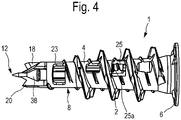
- Wall plug 1 has a sleeve-shaped plug body 4 surrounded by a cutting thread 2.
- wall plug 1 On its rear side, i.e. at its rear end shown on the right in the Figure, wall plug 1 has a flange 6 by means of which the wall plug 1 screwed substantially completely into a wall of the aforementioned kind supports itself at the surface of such a wall.
- an outer surface or circumferential surface 8 of plug body 4 tapers slightly in a conical shape.
- Cutting thread 2 extends with approximately three turns over the larger part of the length of plug body 4 and ends at the front end, shown on the left in Fig. 1 , a significant distance A from a front end 10 of wall plug 1, having a tip 12.
- Wall plug 1 thus has a front leading portion 14 of length A and free of cutting thread, by means of which wall plug 1 is guided in a hole which is prepared, in particular, by the front end 10 of wall plug 1 having tip 12.
- the flank angle of outer cutting thread 2 is relatively sharp, and the pitch angle is relatively small.
- Cutting thread 2 also has recesses 16 which open towards the circumferential surface 8 of plug body 4, and which serve, inter alia, as a means for conveying the borehole debris that is produced.
- the wall plug 2 has two cutting teeth 18 and 20. Improved cutting of board, for example of a plasterboard wall, is achieved with the help of such cutting teeth 18, 20.
- the two cutting teeth 18, 20 are preferably arranged substantially mirror-symmetrically to each other in relation to the rotational axis X of wall plug 1.
- Each of the two cutting teeth 18, 20 also has an outer side 18a, 20a, each of which is preferably substantially flush with the outer or circumferential surface 8 of plug body 4 which does not have the thread.
- cutting teeth 18, 20 are also preferably arranged at a radial distance from rotational axis X, which is substantially equal to their radial extension perpendicular to rotational axis X.
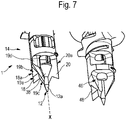
- cutting teeth 18, 20 as shown in Fig. 1 , Fig. 7 and Figs. 8 preferably have a land consisting of sloping sections 19a and 19c, which preferably merge with straight sections 19b and 19d, i.e. with sections with extend parallel to rotational axis X.
- the first sloping section 19a of the land preferably lies immediately adjacent to cutting edge 18b, 20b of cutting tooth 18, 20. It is preferably adjoined immediately, looking towards flange 6, by the straight section 19b of the land, i.e. the section extending parallel to rotational axis X.
- section 19c preferably extends from immediately before straight section 19b - viewed from flange 6 - beyond section 19a, viewed from flange 6 along rotational axis X, towards the tip of wall plug 12, as can be seen well from Figs. 1 and 7 .
- Straight section 19b preferably adjoins once again then, on the side of section 19c facing away from tip 12, i.e. on the side of section 19c facing towards flange 6.
- a stepped pre-drilling element 22 is provided at the front end 10 of hollow plug body 4.
- the stepping in pre-drilling element 22 is provided by two different sharp angles, with a smaller sharp angle of approximately 17 degrees relative to rotational axis X at the foremost part of pre-drilling element 22 and with a larger sharp angle of approximately 30 degrees relative to rotational axis X at the rear part of pre-drilling element 22.
- the part of the sloping section 19c of the land which extends from the cutting edge 18b, 20b towards tip 12 preferably forms the rear part of pre-drilling element 22, whereas the final, rotationally symmetric portion 12a of wall plug 1, ending at tip 12, preferably forms the foremost part of pre-drilling element 22.
- the borehole debris which is produced can be advantageously conveyed backwards into the interior of the hollow plug body 4. It has proved particularly advantageous and it is therefore preferred when the second ledge 19d of land 19a, 19b, 19c, 19d is formed not only straight, i.e. parallel to rotational axis X, but is also formed, even more preferably, such that its surface is mutually parallel with land section 19b which is closer to cutting edge 18b, 20b. This is because the borehole debris can be conveyed particularly efficiently in this way towards flange 6.
- plug body 4 In order that the borehole debris or the borehole cuttings that ensue can enter the interior of plug body 4, the latter is designed to be open not only to the front end 10, but additionally has openings 24 in its wall. To further improve the transportation of the borehole debris into openings 24, the outer or circumferential surface 8 of plug body 4 is also provided with a conveying thread 26 which conveys the borehole debris from left to right in Fig. 1 when the inventive wall plug 1 is screwed in.
- An outer diameter of cutting thread 2 is preferably twice as large as that of plug body 4, thus resulting in good anchoring of wall plug 1 in a soft building material, for example in a gypsum wall. Cutting thread 2 also supports the driving force when drilling into building material.
- pivotable wall portions 25 are provided which have a region which projects into an interior space 27 provided inside the inner wall 30 of plug body 4, such that wall portions 25 can be pressed outwards into an anchoring position by a fixing element penetrating wall plug 1.
- Wall portions 25 are preferably in a region which extends from flange 6, measured along rotational axis X towards tip 12, between about 20% and about 30% of the plug length, more preferably between about 22% and about 26%, or between about 28% and about 38% of the plug length, and even more preferably between about 30% and about 34% of the plug length.
- one wall portion 25 is arranged on one side of the wall plug at a position which lies at about 22% to about 26% of the plug length, whereas a wall portion 25 arranged on the opposite side of the wall plug is arranged at a position which lies at about 30% to about 34% of the plug length.
- the longitudinal extension of wall elements 25, measured in the direction of rotational axis X of wall plug 1, preferably amounts to approximately 6% to approximately 8% of the total length of the wall plug.
- the width of wall elements 25, measured in the circumferential direction of the wall plug is preferably about 4% to about 7% of the total length of the wall plug.
- Wall portion 25, on at least its side facing the front end 10 of wall plug 1, has a linear notch 25a running substantially circumferentially.
- Linear notch 25a forms a hinge-like connection between wall portion 25 and plug body 4, for an at least outwardly directed hinging motion of wall portion 25.
- wall plug 1 has a recess 28 for engaging a driving tool.
- recess 28 is cross-slotted so that bit driving tools can be used that are well-known on the market.
- all other kinds of recess 28 for receiving matching driving tools are also conceivable.
- Plug body 4 also has an inner profile formed by a plurality of longitudinal ribs 32 along its inner wall 30, into which the thread of a fixing element to be inserted into wall plug 1 can cut.
- wall plug 1 In the region of front end 10, preferably directly behind pre-drilling element 22, wall plug 1 according to the invention has a cup 28 for receiving a front end or a tip of a fixing element which penetrates wall plug 1. It is preferable that cup 38 is substantially cone-shaped. It is further preferred that substantially only one half of cup 38 is substantially cone-shaped. Cup 38 is also preferably designed such that it resists a fixing element penetrating wall plug 1 with a greater cut-through resistance on a first side, in particular on a first half, than on a second side, in particular on a second half. This greater cut-through resistance is preferably provided by cup 38 having a thicker wall thickness on the one side, preferably on its one half, than on the other side, preferably the other half.
- a rotational axis 44 of cup 38 is not coaxial with a rotational axis X of wall plug 1. Instead, and as shown in Fig. 3 , the rotational axis 44 of cup 38 is arranged at an angle ( ⁇ ) of preferably 5 to 10 degrees, even more preferably of approximately 6.5 degrees to the rotational axis of wall plug 1. Due to the rotational axis 44 of cup 38 being slightly tilted relative to the rotational axis X of wall plug 1, a screw penetrating with its tip into cup 38 of wall plug 1 is guided to one side in a targeted manner, then guided outwards, preferably in a targeted manner, through the side with the thinner wall, by the tip of the screw then breaking through this thinner wall on the respective side.
- cup 38 according to the invention can have a plurality of areas 40a, 40b, 40c, 40d on its inner surface 40, as shown in Fig. 6 . These areas 40a - 40d are preferably not rotationally symmetric.
- Fig. 2 shows a cross-section through wall plug 1 of Fig. 1 , the sectional plane being chosen such that the cutting tooth 18 that can be seen on the upper side in Fig. 2 lies behind the sectional plane and thus remains visible, whereas cutting tooth 20 on the lower side in Fig. 1 lies in front of the sectional plane and is therefore no longer visible.
- Fig. 3 shows an enlarged view of the cross-section shown in Fig. 2 . It shows the angle ⁇ by which the rotational axis 44 of cup 38 is tilted relative to the rotational axis X of wall plug 1.
- Fig. 4 shows a side view of the wall plug shown in Figs. 1 - 3 .
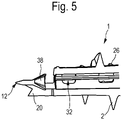
- Fig. 5 shows a partial section through a front section of the side view in Fig. 4 , where the upper cutting tooth 18 shown in Fig. 4 is in front of the sectional plane and therefore remains invisible.
- Fig. 6 shows a perspective view of the cup of wall plug 1 shown in Figs. 1 - 5 ; in which areas 40a - 40d of the inner surface 40 of cup 38 can be seen well.
- Fig. 7 shows a perspective view of the wall plug 1 shown in Figs. 1 - 6 , viewed from an angle from the front, onto a front section 14 of the wall plug compared to a corresponding view of a prior art wall plug, shown on the right.
- the lower section 19d of the land of wall plug 1 according to the invention shown on the left, differs from the land 46 of the prior art wall plug, shown on the right, in that section 19d in wall plug 1 according to the invention has a surface which is oriented parallel to the surface of section 19b of the land of cutting tooth 18 that lies further up, whereas the surface 46 of the land of the wall plug shown on the right is not parallel to the corresponding surface 48.
- Fig. 8a shows a top view onto the front end of wall plug 1, with tip 12, as shown in Figs. 1 - 6 . More particularly, Fig. 8a shows that the ledges or sections 19b and 19d extending perpendicularly to the plane of the paper in Fig. 8a , preferably have surfaces which are oriented mutually parallel to each other. Fig. 8a also shows the preferred position of land 19a offset from tip 12 and directly adjoining cutting edge 18b. Land 19a is preferably separated from cone of rotation 12a by the sloping land 19c that extends as far as the cone of rotation 12a underneath tip 12.
- Fig. 8a also shows the distance a of the lowermost section 19d of the land from cutting edge 18b and the distance b of the lowermost ledge or section 19d of the land from the greatest outer periphery of wall plug 1 as defined by flange 6, likewise measured perpendicularly to cutting edge 18b.
- the sum of "a+b" is the radius of the largest outer diameter of wall plug 1, as measured at flange 6.
- the distance of the ledge or section 19b from cutting edge 18b is preferably about half of a.
- the opening angle ⁇ 1 viewed from the tip, between a line drawn from tip 12 or rotational axis X through cutting edge 18b, and a line drawn from tip 12 or rotational axis X through the most distant corner of land 19a is preferably between about 15 degrees and about 20 degrees, even more preferably about 18 degrees.
- Angle ⁇ between a line drawn from rotational axis X through cutting edge 18b, and the edge of the lowermost ledge or section 19d most distant from rotational axis X is preferably about 30 degrees to about 40 degrees, even more preferably about 37 degrees.
- Fig. 8b shows a side view of the wall plug in Figs. 1 - 6 , showing preferred dimensions and ratios of lengths.
- Fig. 8b shows that the end of cup 38 closest to the tip 12 of wall plug 1 is preferably positioned at a distance c from tip 12, said distance c preferably being about 8% to about 10% of plug length G, measured from the tip 12.
- Fig. 8b also shows that the end of cup 38 closest to the end or flange 6 of wall plug 1 is preferably positioned at a distance d, said distance d being approximately 15% to about 18% of plug length G, measured from the tip 12.
- Fig. 8b also shows that length e along rotational axis X is preferably about 6% to about 9% of the total length G of wall plug 1.
- Fig. 8b also shows that the total length f of the lowermost ledge or section 19d of the land of cutting teeth 18, 20, measured along rotational axis X, is preferably about 7% to about 10% of the total length G of wall plug 1.
- Fig. 8b also shows that length f is preferably approximately equal to length e, and that length f is even more preferably 1.1 to 1.2 times length e.
- Fig. 8b also shows that it is preferred that distance g between the bottom edge of the lowermost section 19d of the land, facing flange 6, and the tip of cutting edge 18b closest along rotational axis X is preferably equal to about 1.5 to 2 times distance f.
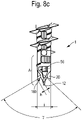
- Fig. 8c shows a partial view of the wall plug in Figs. 1 - 6 for showing preferred dimensioning.
- the length h of cutting edges 18b and 20b of cutting teeth 18 and 20 is equal to approximately 28% to 32% of the diameter i of the wall plug, measured in the front region A of wall plug 1.
- the angle ⁇ between cutting edge 18b and the slope of the lower edge 50 of the land, facing away from the tip 12 of wall plug 1 is between about 100 degrees and about 115 degrees.
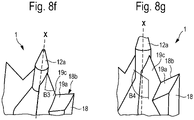
- Figs. 8d - 8g show perspective partial views onto the front end of the wall plug in Figs. 1 - 6 , with tip 12.
- Fig. 8d shows that the relative angle B1 between the slope of that part of section 19c lying between ledges 19b and 19d of the land of cutting tooth 18, and rotational axis X, is about 35 degrees.
- Fig. 8e shows that the angle B2 by which the upper part of section 19c of the land of cutting tooth 18 is inclined relative to section 19a of the land is approximately 130 degrees.
- Fig. 8f shows that the uppermost edge of the sloping section 19c of the land of cutting tooth 18 connecting the cutting edge 18b of cutting tooth 18 to the portion below cone 12a of wall plug 1 forms an angle B3 of approximately 30 degrees with rotational axis X.
- Fig. 8g shows that the upper part of section 19c of the land of cutting tooth 18 is inclined by an angle B4 of approximately 130 degrees relative to the rotational axis X of wall plug 1.
Landscapes
- Engineering & Computer Science (AREA)
- General Engineering & Computer Science (AREA)
- Mechanical Engineering (AREA)
- Dowels (AREA)
- Joining Of Building Structures In Genera (AREA)
- Drilling And Boring (AREA)
Claims (14)
- Cheville murale (1) auto-foreuse destinée à être vissée dans des matériaux de construction légers, en particulier dans des murs de plâtre, ayant un corps de cheville en forme de manchon (4) entouré d'un filetage de coupe (2), une bride (6) sur le côté arrière, au moins une dent de coupe (18, 20) comme un outil de fraisage dans la région de son extrémité avant (10) comprenant une pointe (12), un profil intérieur formé le long d'une paroi intérieure (30) par une pluralité de nervures longitudinales (32), dans lesquelles le filetage d'un élément de fixation se coupe, et dans sa bride (6) un évidement (28) destiné à venir en prise avec un outil d'entraînement,comprenant une coupelle (38) destiné à la réception de l'extrémité avant d'un élément de fixation pénétrant dans la cheville murale (1) et qui est prévue dans la région de l'extrémité avant de celle-ci,caractérisée en ce qu'un axe de rotation (44) de la coupelle (38) n'est pas coaxial avec un axe de rotation (X) de la cheville murale, dans laquelle l'axe de rotation (44) de la coupelle (38) est agencé à un angle (α) par rapport à l'axe de rotation (X) de la cheville murale (1).
- Cheville murale (1) selon la revendication 1,
dans laquelle la coupelle (38) est sensiblement en forme de cône. - Cheville murale (1) selon l'une quelconque des revendications précédentes,
dans laquelle sensiblement seulement une moitié de la coupelle (38) est sensiblement en forme de cône. - Cheville murale (1) selon l'une quelconque des revendications précédentes,
dans laquelle la coupelle (38) est conçue de sorte qu'elle résiste à un élément de fixation pénétrant dans la cheville murale (1) avec une plus grande résistance à la coupure sur un premier côté, en particulier sur une première moitié, que sur un second côté, en particulier sur la seconde moitié. - Cheville murale (1) selon la revendication précédente,
dans laquelle la plus grande résistance à la coupure est prévue sur un côté par une plus grande épaisseur de paroi de la coupelle (38) par rapport à l'autre côté. - Cheville murale (1) selon la revendication précédente,
dans laquelle l'axe de rotation (44) de la coupelle (38) est agencé selon un angle (α) de 5 à 10 degrés, de préférence d'environ 6,5 degrés par rapport à l'axe de rotation (X) de la cheville murale (1). - Cheville murale (1) selon l'une quelconque des revendications précédentes,
dans laquelle la coupelle (38) a sur sa surface intérieure au moins deux zones (40a, 40b, 40c, 40d) de préférence non symétriques en rotation. - Cheville murale (1) selon l'une quelconque des revendications précédentes,
dans laquelle au moins deux dents de coupe (18, 20) agencées de préférence de manière sensiblement symétrique comme des outils de fraisage sont prévues dans la région de son extrémité avant (10) comprenant la pointe (12). - Cheville murale (1) selon l'une quelconque des revendications précédentes,
dans laquelle l'au moins une dent de coupe (18, 20) a une surface extérieure (18a, 20a) qui sensiblement affleure une surface extérieure (8) du corps de cheville (4), qui n'a pas de filetage. - Cheville murale (1) selon l'une quelconque des revendications précédentes,
dans laquelle l'au moins une dent de coupe (18, 20) a un méplat (19a, 19b, 19c, 19d) constitué par au moins quatre sections (19a, 19b, 19c, 19d), dans laquelle au moins deux parmi lesdites sections (19a, 19b, 19c, 19d) ont des surfaces situées dans des plans parallèles entre eux. - Cheville murale (1) selon l'une quelconque des revendications précédentes,
dans laquelle une extrémité parmi les nervures longitudinales (32) du profil intérieur, faisant face à la pointe (12), est agencée à une distance de la pointe (12) qui est sensiblement égale à la distance d'une extrémité du filetage de coupe (2) faisant face à la pointe (12). - Cheville murale (1) selon l'une quelconque des revendications précédentes,
dans laquelle des parties de paroi (25) pivotantes sont prévues dans des ouvertures de paroi (24) dans le corps de cheville (4), qui ont une région qui fait saillie dans un espace intérieur (27) prévu à l'intérieur de la paroi intérieure (30) du corps de cheville (4), de sorte que les parties de paroi (25) peuvent être pressées vers l'extérieur dans une position d'ancrage par un élément de fixation pénétrant dans la cheville murale (1) . - Cheville murale (1) selon la revendication précédente,
dans laquelle la partie de paroi (25), sur au moins le côté faisant face à l'extrémité avant (10) de la cheville murale (1), a une encoche linéaire (25a) s'étendant de manière sensiblement circonférentielle. - Cheville murale (1) selon la revendication précédente,
dans laquelle l'encoche linéaire (25a) forme une liaison articulée, entre la partie de paroi (25) et le corps de cheville (4), destinée à un mouvement d'articulation au moins dirigé vers l'extérieur de la partie de paroi (25).
Priority Applications (2)
| Application Number | Priority Date | Filing Date | Title |
|---|---|---|---|
| PL18705113.1T PL3749866T3 (pl) | 2018-02-07 | 2018-02-07 | Samowiercący kołek rozporowy |
| SI201830801T SI3749866T1 (sl) | 2018-02-07 | 2018-02-07 | Samovrtalni stenski čep |
Applications Claiming Priority (1)
| Application Number | Priority Date | Filing Date | Title |
|---|---|---|---|
| PCT/EP2018/053036 WO2019154485A1 (fr) | 2018-02-07 | 2018-02-07 | Cheville murale auto-foreuse |
Publications (2)
| Publication Number | Publication Date |
|---|---|
| EP3749866A1 EP3749866A1 (fr) | 2020-12-16 |
| EP3749866B1 true EP3749866B1 (fr) | 2022-08-10 |
Family
ID=61223891
Family Applications (1)
| Application Number | Title | Priority Date | Filing Date |
|---|---|---|---|
| EP18705113.1A Active EP3749866B1 (fr) | 2018-02-07 | 2018-02-07 | Cheville murale auto-foreuse |
Country Status (7)
| Country | Link |
|---|---|
| US (1) | US20210040971A1 (fr) |
| EP (1) | EP3749866B1 (fr) |
| JP (1) | JP2021513033A (fr) |
| ES (1) | ES2932275T3 (fr) |
| PL (1) | PL3749866T3 (fr) |
| SI (1) | SI3749866T1 (fr) |
| WO (1) | WO2019154485A1 (fr) |
Families Citing this family (6)
| Publication number | Priority date | Publication date | Assignee | Title |
|---|---|---|---|---|
| US12085108B2 (en) * | 2018-11-29 | 2024-09-10 | The Hillman Group, Inc. | Wallboard anchor |
| US11209037B2 (en) * | 2019-07-03 | 2021-12-28 | David Adams | Screw and anchor assembly |
| AU2020200215B1 (en) * | 2020-01-10 | 2021-04-15 | Taiwan Shan Yin International Co., Ltd. | Self-Drilling Screw |
| USD985421S1 (en) * | 2021-05-07 | 2023-05-09 | Classic Home & Garden, LLC | Plug |
| USD1122742S1 (en) * | 2021-06-14 | 2026-04-21 | Cobra Fixations Cie Ltée—Cobra Anchors Co. Ltd. | Wall anchor |
| WO2025051556A1 (fr) * | 2023-09-04 | 2025-03-13 | Fischerwerke Gmbh & Co. Kg | Ancrage pour cloison sèche et procédé d'installation de l'ancrage pour cloison sèche |
Family Cites Families (15)
| Publication number | Priority date | Publication date | Assignee | Title |
|---|---|---|---|---|
| US4601625A (en) * | 1984-05-11 | 1986-07-22 | Illinois Tool Works Inc. | Self drilling threaded insert for drywall |
| US5234299A (en) * | 1987-08-03 | 1993-08-10 | Giannuzzi Louis | Self-drilling anchor |
| US5267423A (en) * | 1987-08-03 | 1993-12-07 | Giannuzzi Louis | Self-drilling anchor and bearing plate assembly |
| JPH0547847Y2 (fr) * | 1988-09-26 | 1993-12-17 | ||
| FR2673251B1 (fr) * | 1991-02-25 | 1994-07-08 | Legrand Sa | Vis, en particulier vis a fut creux du type vis cheville pour materiau tendre. |
| CH686637A5 (de) | 1992-06-18 | 1996-05-15 | Mungo Befestigungstech Ag | Schraubhulse. |
| DE19717420A1 (de) | 1997-04-25 | 1998-10-29 | Mungo Befestigungstech Ag | Vorrichtung für Befestigungen |
| DK79098A (da) | 1998-06-15 | 1999-12-16 | Tillegreen Poul | Selvborende dyvel |
| US6382892B1 (en) * | 2001-01-16 | 2002-05-07 | Dave C. Hempfling | Wall anchor with improved drilling tip |
| EP1298331B1 (fr) | 2001-10-01 | 2006-06-07 | Mungo Befestigungstechnik Ag | Vis-cheville |
| US20050084360A1 (en) * | 2003-10-10 | 2005-04-21 | Panasik Cheryl L. | Self-drilling anchor |
| US7934895B2 (en) * | 2003-10-10 | 2011-05-03 | Illinois Tool Works Inc. | Self-drilling anchor |
| JP2005179913A (ja) * | 2003-12-16 | 2005-07-07 | Mungo Befestigungstechnik Ag | ねじ込みスリーブ |
| US20060165506A1 (en) * | 2004-02-05 | 2006-07-27 | Panasik Cheryl L | Anchor |
| CH697361B1 (de) * | 2004-12-10 | 2008-08-29 | Mungo Befestigungstech Ag | Schraubdübel. |
-
2018
- 2018-02-07 EP EP18705113.1A patent/EP3749866B1/fr active Active
- 2018-02-07 WO PCT/EP2018/053036 patent/WO2019154485A1/fr not_active Ceased
- 2018-02-07 JP JP2020535573A patent/JP2021513033A/ja active Pending
- 2018-02-07 SI SI201830801T patent/SI3749866T1/sl unknown
- 2018-02-07 US US16/966,828 patent/US20210040971A1/en not_active Abandoned
- 2018-02-07 PL PL18705113.1T patent/PL3749866T3/pl unknown
- 2018-02-07 ES ES18705113T patent/ES2932275T3/es active Active
Also Published As
| Publication number | Publication date |
|---|---|
| JP2021513033A (ja) | 2021-05-20 |
| EP3749866A1 (fr) | 2020-12-16 |
| ES2932275T3 (es) | 2023-01-17 |
| WO2019154485A1 (fr) | 2019-08-15 |
| US20210040971A1 (en) | 2021-02-11 |
| SI3749866T1 (sl) | 2023-02-28 |
| PL3749866T3 (pl) | 2023-02-20 |
Similar Documents
| Publication | Publication Date | Title |
|---|---|---|
| EP3749866B1 (fr) | Cheville murale auto-foreuse | |
| US5160225A (en) | Structure of a self-drilling threaded insert for use on drywall | |
| EP1957806B1 (fr) | Ancrage | |
| CA2454767C (fr) | Vis d'ancrage pour materiau friable | |
| EP1727990B1 (fr) | Piece d'ancrage autoperceuse | |
| US10605289B2 (en) | Screw with cutting teeth | |
| CA2364076C (fr) | Dispositif d'ancrage au mur a extremite de percage amelioree | |
| US20060285940A1 (en) | Screw For Use In Concrete | |
| ES2702153T3 (es) | Tornillo para madera con secciones intermedias de rosca que se estrechan hacia la parte delantera | |
| US10954987B2 (en) | Plug screw | |
| JP2008537989A (ja) | タッピング式のコンクリートねじ | |
| EP0469290B1 (fr) | Insert avec filetage à utiliser en maçonnerie sèche | |
| US20040052606A1 (en) | Dowell for lightweight building materials and use of a screw driver bit for screwing in such dowels | |
| US20060127199A1 (en) | Screwed insert | |
| GB2564450A (en) | A fastener | |
| EP1493929B1 (fr) | Vis-cheville | |
| EP3855026A1 (fr) | Vis | |
| US11293475B2 (en) | Screw | |
| TW202028621A (zh) | 牆板錨 | |
| AU669986B2 (en) | Improved self-drilling wall anchor | |
| JP2002039134A (ja) | タッピングねじ | |
| US11879487B1 (en) | Self-tapping fastener | |
| US20030138306A1 (en) | Self-drilling insert | |
| CA3062913C (fr) | Ancre de panneau mural | |
| HK1119220A (en) | Thread-cutting masonry screw |
Legal Events
| Date | Code | Title | Description |
|---|---|---|---|
| STAA | Information on the status of an ep patent application or granted ep patent |
Free format text: STATUS: UNKNOWN |
|
| STAA | Information on the status of an ep patent application or granted ep patent |
Free format text: STATUS: THE INTERNATIONAL PUBLICATION HAS BEEN MADE |
|
| PUAI | Public reference made under article 153(3) epc to a published international application that has entered the european phase |
Free format text: ORIGINAL CODE: 0009012 |
|
| STAA | Information on the status of an ep patent application or granted ep patent |
Free format text: STATUS: REQUEST FOR EXAMINATION WAS MADE |
|
| 17P | Request for examination filed |
Effective date: 20200907 |
|
| AK | Designated contracting states |
Kind code of ref document: A1 Designated state(s): AL AT BE BG CH CY CZ DE DK EE ES FI FR GB GR HR HU IE IS IT LI LT LU LV MC MK MT NL NO PL PT RO RS SE SI SK SM TR |
|
| AX | Request for extension of the european patent |
Extension state: BA ME |
|
| RIN1 | Information on inventor provided before grant (corrected) |
Inventor name: PIROZZI, MASSIMO |
|
| DAV | Request for validation of the european patent (deleted) | ||
| DAX | Request for extension of the european patent (deleted) | ||
| GRAP | Despatch of communication of intention to grant a patent |
Free format text: ORIGINAL CODE: EPIDOSNIGR1 |
|
| STAA | Information on the status of an ep patent application or granted ep patent |
Free format text: STATUS: GRANT OF PATENT IS INTENDED |
|
| INTG | Intention to grant announced |
Effective date: 20220221 |
|
| GRAS | Grant fee paid |
Free format text: ORIGINAL CODE: EPIDOSNIGR3 |
|
| GRAA | (expected) grant |
Free format text: ORIGINAL CODE: 0009210 |
|
| STAA | Information on the status of an ep patent application or granted ep patent |
Free format text: STATUS: THE PATENT HAS BEEN GRANTED |
|
| AK | Designated contracting states |
Kind code of ref document: B1 Designated state(s): AL AT BE BG CH CY CZ DE DK EE ES FI FR GB GR HR HU IE IS IT LI LT LU LV MC MK MT NL NO PL PT RO RS SE SI SK SM TR |
|
| REG | Reference to a national code |
Ref country code: AT Ref legal event code: REF Ref document number: 1510742 Country of ref document: AT Kind code of ref document: T Effective date: 20220815 Ref country code: CH Ref legal event code: EP |
|
| REG | Reference to a national code |
Ref country code: DE Ref legal event code: R096 Ref document number: 602018039048 Country of ref document: DE |
|
| REG | Reference to a national code |
Ref country code: IE Ref legal event code: FG4D |
|
| REG | Reference to a national code |
Ref country code: NL Ref legal event code: FP |
|
| REG | Reference to a national code |
Ref country code: LT Ref legal event code: MG9D |
|
| REG | Reference to a national code |
Ref country code: ES Ref legal event code: FG2A Ref document number: 2932275 Country of ref document: ES Kind code of ref document: T3 Effective date: 20230117 |
|
| PG25 | Lapsed in a contracting state [announced via postgrant information from national office to epo] |
Ref country code: SE Free format text: LAPSE BECAUSE OF FAILURE TO SUBMIT A TRANSLATION OF THE DESCRIPTION OR TO PAY THE FEE WITHIN THE PRESCRIBED TIME-LIMIT Effective date: 20220810 Ref country code: RS Free format text: LAPSE BECAUSE OF FAILURE TO SUBMIT A TRANSLATION OF THE DESCRIPTION OR TO PAY THE FEE WITHIN THE PRESCRIBED TIME-LIMIT Effective date: 20220810 Ref country code: PT Free format text: LAPSE BECAUSE OF FAILURE TO SUBMIT A TRANSLATION OF THE DESCRIPTION OR TO PAY THE FEE WITHIN THE PRESCRIBED TIME-LIMIT Effective date: 20221212 Ref country code: NO Free format text: LAPSE BECAUSE OF FAILURE TO SUBMIT A TRANSLATION OF THE DESCRIPTION OR TO PAY THE FEE WITHIN THE PRESCRIBED TIME-LIMIT Effective date: 20221110 Ref country code: LV Free format text: LAPSE BECAUSE OF FAILURE TO SUBMIT A TRANSLATION OF THE DESCRIPTION OR TO PAY THE FEE WITHIN THE PRESCRIBED TIME-LIMIT Effective date: 20220810 Ref country code: LT Free format text: LAPSE BECAUSE OF FAILURE TO SUBMIT A TRANSLATION OF THE DESCRIPTION OR TO PAY THE FEE WITHIN THE PRESCRIBED TIME-LIMIT Effective date: 20220810 Ref country code: FI Free format text: LAPSE BECAUSE OF FAILURE TO SUBMIT A TRANSLATION OF THE DESCRIPTION OR TO PAY THE FEE WITHIN THE PRESCRIBED TIME-LIMIT Effective date: 20220810 |
|
| REG | Reference to a national code |
Ref country code: AT Ref legal event code: MK05 Ref document number: 1510742 Country of ref document: AT Kind code of ref document: T Effective date: 20220810 |
|
| PG25 | Lapsed in a contracting state [announced via postgrant information from national office to epo] |
Ref country code: IS Free format text: LAPSE BECAUSE OF FAILURE TO SUBMIT A TRANSLATION OF THE DESCRIPTION OR TO PAY THE FEE WITHIN THE PRESCRIBED TIME-LIMIT Effective date: 20221210 Ref country code: HR Free format text: LAPSE BECAUSE OF FAILURE TO SUBMIT A TRANSLATION OF THE DESCRIPTION OR TO PAY THE FEE WITHIN THE PRESCRIBED TIME-LIMIT Effective date: 20220810 Ref country code: GR Free format text: LAPSE BECAUSE OF FAILURE TO SUBMIT A TRANSLATION OF THE DESCRIPTION OR TO PAY THE FEE WITHIN THE PRESCRIBED TIME-LIMIT Effective date: 20221111 |
|
| PG25 | Lapsed in a contracting state [announced via postgrant information from national office to epo] |
Ref country code: SM Free format text: LAPSE BECAUSE OF FAILURE TO SUBMIT A TRANSLATION OF THE DESCRIPTION OR TO PAY THE FEE WITHIN THE PRESCRIBED TIME-LIMIT Effective date: 20220810 Ref country code: RO Free format text: LAPSE BECAUSE OF FAILURE TO SUBMIT A TRANSLATION OF THE DESCRIPTION OR TO PAY THE FEE WITHIN THE PRESCRIBED TIME-LIMIT Effective date: 20220810 Ref country code: DK Free format text: LAPSE BECAUSE OF FAILURE TO SUBMIT A TRANSLATION OF THE DESCRIPTION OR TO PAY THE FEE WITHIN THE PRESCRIBED TIME-LIMIT Effective date: 20220810 Ref country code: AT Free format text: LAPSE BECAUSE OF FAILURE TO SUBMIT A TRANSLATION OF THE DESCRIPTION OR TO PAY THE FEE WITHIN THE PRESCRIBED TIME-LIMIT Effective date: 20220810 |
|
| REG | Reference to a national code |
Ref country code: DE Ref legal event code: R097 Ref document number: 602018039048 Country of ref document: DE |
|
| PG25 | Lapsed in a contracting state [announced via postgrant information from national office to epo] |
Ref country code: SK Free format text: LAPSE BECAUSE OF FAILURE TO SUBMIT A TRANSLATION OF THE DESCRIPTION OR TO PAY THE FEE WITHIN THE PRESCRIBED TIME-LIMIT Effective date: 20220810 Ref country code: EE Free format text: LAPSE BECAUSE OF FAILURE TO SUBMIT A TRANSLATION OF THE DESCRIPTION OR TO PAY THE FEE WITHIN THE PRESCRIBED TIME-LIMIT Effective date: 20220810 |
|
| PLBE | No opposition filed within time limit |
Free format text: ORIGINAL CODE: 0009261 |
|
| STAA | Information on the status of an ep patent application or granted ep patent |
Free format text: STATUS: NO OPPOSITION FILED WITHIN TIME LIMIT |
|
| PG25 | Lapsed in a contracting state [announced via postgrant information from national office to epo] |
Ref country code: AL Free format text: LAPSE BECAUSE OF FAILURE TO SUBMIT A TRANSLATION OF THE DESCRIPTION OR TO PAY THE FEE WITHIN THE PRESCRIBED TIME-LIMIT Effective date: 20220810 |
|
| 26N | No opposition filed |
Effective date: 20230511 |
|
| PG25 | Lapsed in a contracting state [announced via postgrant information from national office to epo] |
Ref country code: MC Free format text: LAPSE BECAUSE OF FAILURE TO SUBMIT A TRANSLATION OF THE DESCRIPTION OR TO PAY THE FEE WITHIN THE PRESCRIBED TIME-LIMIT Effective date: 20220810 |
|
| REG | Reference to a national code |
Ref country code: BE Ref legal event code: MM Effective date: 20230228 |
|
| GBPC | Gb: european patent ceased through non-payment of renewal fee |
Effective date: 20230207 |
|
| PG25 | Lapsed in a contracting state [announced via postgrant information from national office to epo] |
Ref country code: LU Free format text: LAPSE BECAUSE OF NON-PAYMENT OF DUE FEES Effective date: 20230207 |
|
| REG | Reference to a national code |
Ref country code: IE Ref legal event code: MM4A |
|
| PG25 | Lapsed in a contracting state [announced via postgrant information from national office to epo] |
Ref country code: GB Free format text: LAPSE BECAUSE OF NON-PAYMENT OF DUE FEES Effective date: 20230207 |
|
| PG25 | Lapsed in a contracting state [announced via postgrant information from national office to epo] |
Ref country code: IE Free format text: LAPSE BECAUSE OF NON-PAYMENT OF DUE FEES Effective date: 20230207 Ref country code: GB Free format text: LAPSE BECAUSE OF NON-PAYMENT OF DUE FEES Effective date: 20230207 |
|
| PG25 | Lapsed in a contracting state [announced via postgrant information from national office to epo] |
Ref country code: BE Free format text: LAPSE BECAUSE OF NON-PAYMENT OF DUE FEES Effective date: 20230228 |
|
| PGFP | Annual fee paid to national office [announced via postgrant information from national office to epo] |
Ref country code: ES Payment date: 20240319 Year of fee payment: 7 Ref country code: NL Payment date: 20240228 Year of fee payment: 7 |
|
| PGFP | Annual fee paid to national office [announced via postgrant information from national office to epo] |
Ref country code: CZ Payment date: 20240226 Year of fee payment: 7 |
|
| PGFP | Annual fee paid to national office [announced via postgrant information from national office to epo] |
Ref country code: SI Payment date: 20240227 Year of fee payment: 7 |
|
| PGFP | Annual fee paid to national office [announced via postgrant information from national office to epo] |
Ref country code: TR Payment date: 20240226 Year of fee payment: 7 Ref country code: PL Payment date: 20240206 Year of fee payment: 7 Ref country code: IT Payment date: 20240228 Year of fee payment: 7 Ref country code: FR Payment date: 20240228 Year of fee payment: 7 |
|
| PG25 | Lapsed in a contracting state [announced via postgrant information from national office to epo] |
Ref country code: BG Free format text: LAPSE BECAUSE OF FAILURE TO SUBMIT A TRANSLATION OF THE DESCRIPTION OR TO PAY THE FEE WITHIN THE PRESCRIBED TIME-LIMIT Effective date: 20220810 |
|
| PG25 | Lapsed in a contracting state [announced via postgrant information from national office to epo] |
Ref country code: BG Free format text: LAPSE BECAUSE OF FAILURE TO SUBMIT A TRANSLATION OF THE DESCRIPTION OR TO PAY THE FEE WITHIN THE PRESCRIBED TIME-LIMIT Effective date: 20220810 |
|
| PGFP | Annual fee paid to national office [announced via postgrant information from national office to epo] |
Ref country code: CH Payment date: 20250301 Year of fee payment: 8 |
|
| PG25 | Lapsed in a contracting state [announced via postgrant information from national office to epo] |
Ref country code: CY Free format text: LAPSE BECAUSE OF FAILURE TO SUBMIT A TRANSLATION OF THE DESCRIPTION OR TO PAY THE FEE WITHIN THE PRESCRIBED TIME-LIMIT; INVALID AB INITIO Effective date: 20180207 |
|
| PG25 | Lapsed in a contracting state [announced via postgrant information from national office to epo] |
Ref country code: HU Free format text: LAPSE BECAUSE OF FAILURE TO SUBMIT A TRANSLATION OF THE DESCRIPTION OR TO PAY THE FEE WITHIN THE PRESCRIBED TIME-LIMIT; INVALID AB INITIO Effective date: 20180207 |
|
| REG | Reference to a national code |
Ref country code: NL Ref legal event code: MM Effective date: 20250301 |
|
| PG25 | Lapsed in a contracting state [announced via postgrant information from national office to epo] |
Ref country code: CZ Free format text: LAPSE BECAUSE OF NON-PAYMENT OF DUE FEES Effective date: 20250207 |
|
| PG25 | Lapsed in a contracting state [announced via postgrant information from national office to epo] |
Ref country code: NL Free format text: LAPSE BECAUSE OF NON-PAYMENT OF DUE FEES Effective date: 20250301 |
|
| PG25 | Lapsed in a contracting state [announced via postgrant information from national office to epo] |
Ref country code: IT Free format text: LAPSE BECAUSE OF NON-PAYMENT OF DUE FEES Effective date: 20250207 Ref country code: FR Free format text: LAPSE BECAUSE OF NON-PAYMENT OF DUE FEES Effective date: 20250228 |
|
| REG | Reference to a national code |
Ref country code: CH Ref legal event code: U11 Free format text: ST27 STATUS EVENT CODE: U-0-0-U10-U11 (AS PROVIDED BY THE NATIONAL OFFICE) Effective date: 20260326 |
|
| REG | Reference to a national code |
Ref country code: ES Ref legal event code: FD2A Effective date: 20260327 |
|
| PG25 | Lapsed in a contracting state [announced via postgrant information from national office to epo] |
Ref country code: ES Free format text: LAPSE BECAUSE OF NON-PAYMENT OF DUE FEES Effective date: 20250208 |
|
| PGFP | Annual fee paid to national office [announced via postgrant information from national office to epo] |
Ref country code: DE Payment date: 20260309 Year of fee payment: 9 |