EP3752964B1 - Redestilübertragung - Google Patents
Redestilübertragung Download PDFInfo
- Publication number
- EP3752964B1 EP3752964B1 EP19716599.6A EP19716599A EP3752964B1 EP 3752964 B1 EP3752964 B1 EP 3752964B1 EP 19716599 A EP19716599 A EP 19716599A EP 3752964 B1 EP3752964 B1 EP 3752964B1
- Authority
- EP
- European Patent Office
- Prior art keywords
- neural network
- speech
- person
- audio data
- data
- Prior art date
- Legal status (The legal status is an assumption and is not a legal conclusion. Google has not performed a legal analysis and makes no representation as to the accuracy of the status listed.)
- Active
Links
Images






Classifications
-
- G—PHYSICS
- G06—COMPUTING OR CALCULATING; COUNTING
- G06N—COMPUTING ARRANGEMENTS BASED ON SPECIFIC COMPUTATIONAL MODELS
- G06N3/00—Computing arrangements based on biological models
- G06N3/02—Neural networks
- G06N3/08—Learning methods
-
- G—PHYSICS
- G10—MUSICAL INSTRUMENTS; ACOUSTICS
- G10L—SPEECH ANALYSIS TECHNIQUES OR SPEECH SYNTHESIS; SPEECH RECOGNITION; SPEECH OR VOICE PROCESSING TECHNIQUES; SPEECH OR AUDIO CODING OR DECODING
- G10L13/00—Speech synthesis; Text to speech systems
- G10L13/02—Methods for producing synthetic speech; Speech synthesisers
-
- G—PHYSICS
- G06—COMPUTING OR CALCULATING; COUNTING
- G06F—ELECTRIC DIGITAL DATA PROCESSING
- G06F40/00—Handling natural language data
- G06F40/40—Processing or translation of natural language
- G06F40/42—Data-driven translation
-
- G—PHYSICS
- G06—COMPUTING OR CALCULATING; COUNTING
- G06N—COMPUTING ARRANGEMENTS BASED ON SPECIFIC COMPUTATIONAL MODELS
- G06N3/00—Computing arrangements based on biological models
- G06N3/02—Neural networks
- G06N3/04—Architecture, e.g. interconnection topology
- G06N3/044—Recurrent networks, e.g. Hopfield networks
-
- G—PHYSICS
- G06—COMPUTING OR CALCULATING; COUNTING
- G06N—COMPUTING ARRANGEMENTS BASED ON SPECIFIC COMPUTATIONAL MODELS
- G06N3/00—Computing arrangements based on biological models
- G06N3/02—Neural networks
- G06N3/04—Architecture, e.g. interconnection topology
- G06N3/044—Recurrent networks, e.g. Hopfield networks
- G06N3/0442—Recurrent networks, e.g. Hopfield networks characterised by memory or gating, e.g. long short-term memory [LSTM] or gated recurrent units [GRU]
-
- G—PHYSICS
- G06—COMPUTING OR CALCULATING; COUNTING
- G06N—COMPUTING ARRANGEMENTS BASED ON SPECIFIC COMPUTATIONAL MODELS
- G06N3/00—Computing arrangements based on biological models
- G06N3/02—Neural networks
- G06N3/04—Architecture, e.g. interconnection topology
- G06N3/045—Combinations of networks
-
- G—PHYSICS
- G06—COMPUTING OR CALCULATING; COUNTING
- G06N—COMPUTING ARRANGEMENTS BASED ON SPECIFIC COMPUTATIONAL MODELS
- G06N3/00—Computing arrangements based on biological models
- G06N3/02—Neural networks
- G06N3/04—Architecture, e.g. interconnection topology
- G06N3/045—Combinations of networks
- G06N3/0455—Auto-encoder networks; Encoder-decoder networks
-
- G—PHYSICS
- G06—COMPUTING OR CALCULATING; COUNTING
- G06N—COMPUTING ARRANGEMENTS BASED ON SPECIFIC COMPUTATIONAL MODELS
- G06N3/00—Computing arrangements based on biological models
- G06N3/02—Neural networks
- G06N3/04—Architecture, e.g. interconnection topology
- G06N3/0464—Convolutional networks [CNN, ConvNet]
-
- G—PHYSICS
- G06—COMPUTING OR CALCULATING; COUNTING
- G06N—COMPUTING ARRANGEMENTS BASED ON SPECIFIC COMPUTATIONAL MODELS
- G06N3/00—Computing arrangements based on biological models
- G06N3/02—Neural networks
- G06N3/04—Architecture, e.g. interconnection topology
- G06N3/0475—Generative networks
-
- G—PHYSICS
- G06—COMPUTING OR CALCULATING; COUNTING
- G06N—COMPUTING ARRANGEMENTS BASED ON SPECIFIC COMPUTATIONAL MODELS
- G06N3/00—Computing arrangements based on biological models
- G06N3/02—Neural networks
- G06N3/04—Architecture, e.g. interconnection topology
- G06N3/048—Activation functions
-
- G—PHYSICS
- G06—COMPUTING OR CALCULATING; COUNTING
- G06N—COMPUTING ARRANGEMENTS BASED ON SPECIFIC COMPUTATIONAL MODELS
- G06N3/00—Computing arrangements based on biological models
- G06N3/02—Neural networks
- G06N3/08—Learning methods
- G06N3/084—Backpropagation, e.g. using gradient descent
-
- G—PHYSICS
- G06—COMPUTING OR CALCULATING; COUNTING
- G06N—COMPUTING ARRANGEMENTS BASED ON SPECIFIC COMPUTATIONAL MODELS
- G06N3/00—Computing arrangements based on biological models
- G06N3/02—Neural networks
- G06N3/08—Learning methods
- G06N3/09—Supervised learning
-
- G—PHYSICS
- G10—MUSICAL INSTRUMENTS; ACOUSTICS
- G10L—SPEECH ANALYSIS TECHNIQUES OR SPEECH SYNTHESIS; SPEECH RECOGNITION; SPEECH OR VOICE PROCESSING TECHNIQUES; SPEECH OR AUDIO CODING OR DECODING
- G10L13/00—Speech synthesis; Text to speech systems
- G10L13/02—Methods for producing synthetic speech; Speech synthesisers
- G10L13/033—Voice editing, e.g. manipulating the voice of the synthesiser
-
- G—PHYSICS
- G10—MUSICAL INSTRUMENTS; ACOUSTICS
- G10L—SPEECH ANALYSIS TECHNIQUES OR SPEECH SYNTHESIS; SPEECH RECOGNITION; SPEECH OR VOICE PROCESSING TECHNIQUES; SPEECH OR AUDIO CODING OR DECODING
- G10L25/00—Speech or voice analysis techniques not restricted to a single one of groups G10L15/00 - G10L21/00
- G10L25/27—Speech or voice analysis techniques not restricted to a single one of groups G10L15/00 - G10L21/00 characterised by the analysis technique
- G10L25/30—Speech or voice analysis techniques not restricted to a single one of groups G10L15/00 - G10L21/00 characterised by the analysis technique using neural networks
Definitions
- This disclosure relates to a computer-implemented audio processing method and to a speech synthesizing apparatus.
- this disclosure relates to processing audio signals for speech style transfer implementations.
- the training method involves: (a) receiving, by a content extraction process implemented via a control system comprising one or more processors and one or more non-transitory storage media, first audio data corresponding to first speech of a first person; (b) producing, by the content extraction process, a first time-stamped phoneme sequence and first pitch contour data corresponding to the first speech; (c) receiving, by a first neural network implemented via the control system, the first time-stamped phoneme sequence and the first pitch contour data; (d) producing, by the first neural network, first neural network output corresponding to the first time-stamped phoneme sequence and the first pitch contour data, the first neural network output comprising a plurality of frame sizes; (e) receiving, by a second neural network implemented via the control system, the first neural network output, the second neural network comprising a hierarchy of modules, each module operating at a different temporal resolution; (f) generating, by the second neural network, first predicted audio signals; (g) comparing, via the control system, the first predicted audio signals to first test data;
- the method involves changing a physical state of at least one non-transitory storage medium location.
- Repeating (f) involves changing a physical state of at least one non-transitory storage medium location corresponding with at least one weight of the second neural network.
- (a) may involve receiving first time-stamped text corresponding to the first speech of the first person.
- (a) may involve receiving first identification data corresponding to the first person.
- the method may involve controlling the speech synthesizer for speech generation.
- the speech generation may involve: (j) receiving, by the content extraction process, second audio data corresponding to second speech of a second person, second time-stamped text corresponding to the second speech and first identification data corresponding to speech of the first person; (k) producing, by the content extraction process, a second time-stamped phoneme sequence and second pitch contour data corresponding to the second speech; (l) receiving, by the first neural network, the second time-stamped phoneme sequence and the second pitch contour data of (k); (m) producing, by the first neural network, first neural network output corresponding to the second time-stamped phoneme sequence and the second pitch contour data of (k); (n) receiving, by the second neural network, the first neural network output of (m) and the first identification data; and (o) generating, by the second neural network, synthesized audio data corresponding to the first neural network output of (m) and the first identification data.
- the second audio data may correspond to speech of the first person when the first person was a different age.
- the second audio data may be speech that is received from the first person at a current time, or a recent time.
- the first speech of the first person may, for example, correspond to speech of the first person when the first person was younger.
- the synthesized audio data may correspond to words uttered by the second person according to speech characteristics of the first person.
- the training may involve receiving the first audio data in a first language and the synthesized audio data may correspond to words uttered by the second person in a second language.
- the synthesized audio data may correspond to words uttered by the first person at a second age according to speech characteristics of the first person at a first age, or during a time in which the first person was in a first age range.
- the first age may, for example, be a younger age than the second age.
- Some examples may involve causing one or more transducers to reproduce the synthesized audio data.
- the training may involve receiving, by a third neural network, the first audio data.
- the training may involve training the third neural network to determine first speech characteristics corresponding to speech of the first person and to output encoded audio data.
- the training may involve training a fourth neural network to determine whether the encoded audio data corresponds to speech of the first person.
- the speech generation may involve: receiving, by the third neural network, the second audio data; generating, by the third neural network, second encoded audio data corresponding to the second audio data; receiving, by the fourth neural network, the second encoded audio data; generating modified second encoded audio data via an iterative process until the fourth neural network determines that the modified second encoded audio data corresponds to speech of the first person.
- the method may involve providing the modified second encoded audio data to the second neural network.
- repeating (a) through (h) may involve training at least one of the first neural network or the second neural network via backward propagation based on a current loss function value.
- the first neural network may include a bi-directional recurrent neural network.
- Non-transitory media may include memory devices such as those described herein, including but not limited to random access memory (RAM) devices, read-only memory (ROM) devices, etc.
- RAM random access memory
- ROM read-only memory
- various innovative aspects of the subject matter described in this disclosure can be implemented in a non-transitory medium having software stored thereon.
- the software may, for example, include instructions for controlling at least one device to process audio data.
- the software may, for example, be executable by one or more components of a control system such as those disclosed herein.
- the software may, for example, include instructions for performing one or more of the methods disclosed herein.
- an apparatus may include an interface system and a control system.
- the interface system may include one or more network interfaces, one or more interfaces between the control system and a memory system, one or more interfaces between the control system and another device and/or one or more external device interfaces.
- the control system may include at least one of a general purpose single- or multi-chip processor, a digital signal processor (DSP), an application specific integrated circuit (ASIC), a field programmable gate array (FPGA) or other programmable logic device, discrete gate or transistor logic, or discrete hardware components.
- DSP digital signal processor
- ASIC application specific integrated circuit
- FPGA field programmable gate array
- the control system may include one or more processors and one or more non-transitory storage media operatively coupled to the one or more processors.
- the speech synthesizing apparatus includes an interface system and a control system.
- the control system is configured for implementing a speech synthesizer.
- the speech synthesizer includes a content extractor, a first neural network and a second neural network.
- the first neural network includes a bi-directional recurrent neural network.
- the second neural network includes a plurality of modules, comprising a hierarchy of modules. Each module operates at a different temporal resolution.
- the first neural network and the second neural network have been trained according to a process that includes: (a) receiving, via the interface system and by the content extractor, first audio data corresponding to first speech of a first person; (b) producing, by the content extractor, a first time-stamped phoneme sequence and first pitch contour data corresponding to the first speech; (c) receiving, by the first neural network, the first time-stamped phoneme sequence and the first pitch contour data; (d) producing, by the first neural network, first neural network output corresponding to the first time-stamped phoneme sequence and the first pitch contour data, the first neural network output comprising a plurality of frame sizes, each of the frame sizes corresponding with a temporal resolution of a module of the second neural network; (e) receiving, by the second neural network, the first neural network output; (f) generating, by the second neural network, first predicted audio signals; (g) comparing the first predicted audio signals to first test data; (h) determining a loss function value for the first predicted audio signals; and (i) repeating
- the control system is configured for controlling the speech synthesizer module for speech generation.
- the speech generation may involves: (j) receiving, by the content extractor and via the interface system, second audio data corresponding to second speech of a second person, second time-stamped text corresponding to the second speech and first identification data corresponding to speech of the first person; (k) producing, by the content extractor, a second time-stamped phoneme sequence and second pitch contour data corresponding to the second speech; (l) receiving, by the first neural network, the second time-stamped phoneme sequence and the second pitch contour data of (k); (m) producing, by the first neural network, first neural network output corresponding to the second time-stamped phoneme sequence and the second pitch contour data of (k); (n) receiving, by the second neural network, the first neural network output of (m) and the first identification data; and (o) generating, by the second neural network, synthesized audio data corresponding to the first neural network output of (m) and the first identification data.
- the second audio data may correspond to speech of the first person when the first person was a different age, or in a different range of ages.
- the second audio data may be speech that is received from the first person at a current time, or a recent time.
- the first speech of the first person may, for example, correspond to speech of the first person when the first person was younger.
- the synthesized audio data may correspond to words uttered by the second person according to speech characteristics of the first person.
- the training may involve receiving the first audio data in a first language and the synthesized audio data may correspond to words uttered by the second person in a second language.
- the synthesized audio data may correspond to words uttered by the first person at a second age according to speech characteristics of the first person at a first age, or during a range of ages that includes the first age (e.g., 21 through 25 years of age, 26 through 30 years of age, etc.).
- the first age may, for example, be a younger age than the second age.
- control system may be configured for causing one or more transducers to reproduce the second synthesized audio data.
- generating the synthesized audio data may involve changing a physical state of at least one non-transitory storage medium location corresponding with at least one weight of the second neural network.
- aspects of the present application may be embodied, at least in part, in an apparatus, a system that includes more than one device, a method, a computer program product, etc. Accordingly, aspects of the present application may take the form of a hardware embodiment, a software embodiment (including firmware, resident software, microcodes, etc.) and/or an embodiment combining both software and hardware aspects.
- Such embodiments may be referred to herein as a "circuit,” a “module” or “engine.”
- Some aspects of the present application may take the form of a computer program product embodied in one or more non-transitory media having computer readable program code embodied thereon.
- Such non-transitory media may, for example, include a hard disk, a random access memory (RAM), a read-only memory (ROM), an erasable programmable read-only memory (EPROM or Flash memory), a portable compact disc read-only memory (CD-ROM), an optical storage device, a magnetic storage device, or any suitable combination of the foregoing. Accordingly, the teachings of this disclosure are not intended to be limited to the implementations shown in the figures and/or described herein, but instead have wide applicability.
- Speech style transfer is sometimes referred to as "voice transformation” or “voice conversion,” and therefore these terms may be used interchangeably herein.
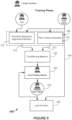
- Figure 1 shows processes of training one or more neural networks for speech style transfer according to some implementations disclosed herein.
- the training process involves providing audio data corresponding to the speech of one person (speaker A) being fed into a content extraction block.
- Speaker A may, in some disclosed examples, be referred to as a "target speaker.”
- a neural network based phoneme classifier may, for example, be trained and used in the content extraction block to obtain a time-stamped phoneme sequence that corresponds to input speech.
- a neural network based phoneme classifier may, for example, be trained and used in the content extraction block to obtain a time-stamped phoneme sequence that corresponds to input speech.
- text corresponding to the speech of person A may be input along with the input speech waveforms.
- the text may be provided along with time stamps.
- the outputs of the content extraction block are data comprising pitch contours of the input speech, which may sometimes be referred to herein as "pitch contour data," or “intonation” as well as a time-stamped phoneme sequence corresponding to the input speech which may sometimes be referred to as speech tempo.
- the pitch contour data may, for example, be a function or curve that tracks the pitch of the input speech over time.
- the pitch contour data at a particular time may correspond to a fundamental frequency of the input speech at that time, a log value of the fundamental frequency of the input speech, a normalized log value of the fundamental frequency of the input speech, or a peak (highest energy) frequency of the input speech at that time.
- the pitch contour data may correspond to multiple pitches at a given time.
- the pitch contour data and the time-stamped phoneme sequence are used to train one or more vocal model neural networks to generate the same series of words used for the input speech (the "training data set").
- the training process may involve training two or more neural networks.
- the training process may involve providing the output of one or more neural networks to a second neural network.
- the second neural network may be a vocal model neural network. After the neural network or networks have been trained, it or they may be used for speech generation, which will also be referred to herein as "speech synthesis.”
- Figure 2 shows processes of using one or more trained neural networks for speech style transfer according to some implementations disclosed herein.
- another person's speech (speaker B's) is input to the same content extraction block that is described above with reference to Figure 1 .
- the pitch contour data and the time-stamped phoneme sequence of the second person's speech that are output by the content extraction block are provided to the vocal model neural network that has been trained for the voice of speaker A.
- the vocal model neural network has been trained for the voice of speaker A at a first age.
- some implementations involve providing the speech of speaker A at a second age.
- the first age may, for example, be a younger age than the second age.
- the vocal model neural network that has been trained for the voice of speaker A is also provided with identification data (which may be a simple "ID" or more complex identification data) corresponding to speaker A, or corresponding to the speech of speaker A. Therefore, according to this example, the vocal model neural network outputs the words of speaker B in the voice of speaker A with speaker B's speech tempo and intonation. Put another way, in this example the vocal model neural network outputs synthesized audio data includes the words uttered by speaker B according to speech characteristics of speaker A that have been learned by the vocal model neural network.
- a vocal model neural network that has been trained for the voice of speaker A at a first age is provided with identification data corresponding to speaker A at the first age.
- the input words of speaker A at a second age may be output in the voice of speaker A at the first age.
- the first age may, for example, be a younger age than the second age.
- the training process may involve receiving the first audio data in a first language and the synthesized audio data may correspond to words uttered by the second person in a second language.
- the identification data for speaker A may be associated with English (language 1) and the identification data for speaker B could be associated with Mandarin (language 2).
- the vocal model neural network or networks are provided with speech from person B, but are provided with the identification data for person A. The result is speech in language 2, in the style of person A.
- some implementations may involve training the vocal model neural network(s) for sounds in language 1 (for example, Mandarin) that do not exist in language 2 (for example, English).
- Some training implementations may use a joint phoneme collection (a "superset") for both languages, instead of one for English and one for Mandarin.
- Some examples may involve a training process in which a target speaker who normally speaks in language 2 is prompted to make sounds that correspond with phonemes of language 1 (for example, Mandarin phonemes) for which there are no counterparts in language 2.
- the target speaker may, for example, repeat sounds into a microphone that are provided to her or him via headphones, so that they are not picked up by a microphone that is being used to input the target speaker's voice.
- the target speaker may provide sounds that only include phonemes of her or his native language (language 1).
- the speech generation process may involve using the most similar phoneme from language 1 when producing speech in language 2.
- the training process may involve creating a representation of a superset of atomic utterances.
- Atomic utterances include both phonemes and non-speech utterances humans are capable of making, including fricatives and glottal sounds. Atomic utterances are regarded by some as being the basic units of vocalization.
- sampleRNN is an end-to-end neural audio generation model developed by the Montreal Institute for Learning Algorithms (MILA), which generates audio one sample at a time.
- MILA Montreal Institute for Learning Algorithms
- SAMPLERNN An Unconditional End-To-End Neural Audio Generation Model, Published as a conference paper at the International Conference on Learning Representations, Toulon, France, April 24-26, 2017 .
- This model combines autoregressive deep neural networks and stateful recurrent neural networks in a hierarchical structure to capture underlying sources of variations in the temporal sequences over long time spans.
- SampleRNN represented a step forward in the voice transformation field
- SampleRNN has some drawbacks.
- the speech signal produced by SampleRNN is babbling, not intelligible speech.
- the emotions that are conveyed by actors cannot be voiced naturally: even the use of semantic analysis to extract emotions of a text is not satisfactory, as people can voice the same emotion in different ways.
- SampleRNN provides no mechanism for handling multiple target speakers.
- the speech signals produced according to various disclosed implementations is intelligible speech, not babbling.
- multiple speakers' voice styles may be learned through a training process. Some embodiments do not require parallel speech from a source speaker and a target speaker for training. Some implementations take into account the semantic meaning of voice actors' input speech signals (or other talkers' input speech signals) and/or the characteristics of the input speech signals to improve the prosody of the generated speech signals. Some implementations provide a learnable high-dimensional representation of multiple target speakers, to create a more intelligible and natural-sounding speech signal.
- Figure 3 is a block diagram that shows examples of components of an apparatus that may be configured to perform at least some of the methods disclosed herein.
- the apparatus 305 may be, or may include, a personal computer, a desktop computer or other local device that is configured to provide audio processing.
- the apparatus 305 may be, or may include, a server.
- the apparatus 305 may be a client device that is configured for communication with a server, via a network interface.
- the components of the apparatus 305 may be implemented via hardware, via software stored on non-transitory media, via firmware and/or by combinations thereof.
- the types and numbers of components shown in Figure 3 , as well as other figures disclosed herein, are merely shown by way of example. Alternative implementations may include more, fewer and/or different components.
- the apparatus 305 includes an interface system 310 and a control system 315.
- the interface system 310 may include one or more network interfaces, one or more interfaces between the control system 315 and a memory system and/or one or more external device interfaces (such as one or more universal serial bus (USB) interfaces).
- the interface system 310 may include a user interface system.
- the user interface system may be configured for receiving input from a user.
- the user interface system may be configured for providing feedback to a user.
- the user interface system may include one or more displays with corresponding touch and/or gesture detection systems.
- the user interface system may include one or more microphones and/or speakers.
- the user interface system may include apparatus for providing haptic feedback, such as a motor, a vibrator, etc.
- the control system 315 may, for example, include a general purpose single- or multi-chip processor, a digital signal processor (DSP), an application specific integrated circuit (ASIC), a field programmable gate array (FPGA) or other programmable logic device, discrete gate or transistor logic, and/or discrete hardware components.
- DSP digital signal processor
- ASIC application specific integrated circuit
- FPGA field programmable gate array
- the apparatus 305 may be implemented in a single device. However, in some implementations, the apparatus 305 may be implemented in more than one device. In some such implementations, functionality of the control system 315 may be included in more than one device. In some examples, the apparatus 305 may be a component of another device.
- Figure 4 is a flow diagram that outlines blocks of a method of training a speech synthesizer according to one example.
- the method may, in some instances, be performed by the apparatus of Figure 3 or by another type of apparatus.
- the blocks of method 400 may be implemented via software stored on one or more non-transitory media.
- the blocks of method 400 like other methods described herein, are not necessarily performed in the order indicated. Moreover, such methods may include more or fewer blocks than shown and/or described.
- block 405 involves receiving audio data corresponding to speech of a first person.
- the "first person” is a target speaker, who may or may not actually be the first person for whose voice the speech synthesizer has been trained.
- the audio data received in block 405 may be referred to herein as the "first audio data” and the speech of the first person may be referred to herein as the "first speech.”
- block 405 involves receiving text corresponding to the first speech.
- the received text may include time stamps corresponding to times of the first audio data.
- block 405 may involve receiving identification data corresponding to the first person, which may be referred to herein as "first identification data.”
- first identification data may simply indicate, in essence, "this is speaker A.”
- the first identification data may include information regarding one or more attributes of the first speech.
- the speech of speaker A at a first age (or a range of ages that includes the first age) may be designated A1 and the speech of speaker A at a second age (or a range of ages that includes the second age) may be designated A2.
- block 405 involves receiving, by a content extraction process implemented via a control system comprising one or more processors and one or more tangible storage media, the first audio data.
- the content extraction process may, for example, be implemented by one or more processors of the control system according to software stored in one or more non-transitory storage media.
- the content extraction process is configured for producing, in block 410, a time-stamped phoneme sequence and pitch contour data corresponding to the first speech.
- the time-stamped phoneme sequence produced in block 410 may be referred to herein as the "first time-stamped phoneme sequence” and the pitch contour data produced in block 410 may be referred to herein as the "first pitch contour data.”
- block 405 involves receiving, by a neural network, the first time-stamped phoneme sequence and the first pitch contour data produced by the content extraction process.
- the neural network may be referred to herein as the "first neural network.”
- the first neural network also may be referred to herein as a "conditioning network,” because in some implementations the first neural network may pre-process or condition the first time-stamped phoneme sequence and the first pitch contour data before these data are provided to a voice modeling neural network.
- Block 420 provides one example of how the first neural network may condition the first time-stamped phoneme sequence and the first pitch contour data.
- the first neural network is configured to produce first neural network output corresponding to the first time-stamped phoneme sequence and the first pitch contour data, wherein the first neural network output is produced at two or more (a "plurality") of frame sizes.
- the frame sizes of the first neural network output may, in some examples, correspond to suitable input frame sizes of a second neural network.
- the first neural network may process multiple frames before passing the first neural network output to the second neural network. However, in alternative implementations, the first neural network may not delay passing the first neural network output to the second neural network while multiple frames of the first neural network output are processed.
- block 425 involves receiving, by a second neural network implemented via the control system, the first neural network output.
- the second neural network includes a hierarchy of modules and each module operates at a different temporal resolution.
- the frame sizes of the first neural network output correspond to the temporal resolution of the modules of the second neural network.
- block 430 involves generating, by the second neural network, first predicted audio signals.
- block 435 involves comparing, via the control system, the first predicted audio signals to first test data and block 440 involves determining, via the control system, a loss function value for the first predicted audio signals.
- the loss function value may be used to train the second neural network. According to some implementations, the loss function value also may be used to train the first neural network.
- training the second neural network may continue until the loss function is relatively "flat," such that the difference between a current loss function value and a prior loss function value (such as the previous loss function value) is at or below a threshold value.
- block 445 involves repeating at least some of blocks 405 through 440 until a difference between a current loss function value for the first predicted audio signals and a prior loss function value for the first predicted audio signals is less than or equal to a predetermined value, for example 1.90, 1.92, 1.94, 1.96, 1.98, 2.00, etc.
- repeating some blocks may involve changing a physical state of at least one tangible storage medium location corresponding with at least one weight of the second neural network.
- providing identification data can allow one or more neural networks to be trained with speech from multiple target speakers.
- the processes described above with reference to Figure 4 may be repeated for each target speaker and the training results may be saved and associated with identification data corresponding to each target speaker.
- Such training results may be used, e.g., for speech generation based on a selected target speaker.
- Figure 5 shows blocks of a speech synthesizer training system according to some examples.
- System 500 may, in some instances, be performed by the apparatus of Figure 3 or by another type of apparatus disclosed herein.
- the blocks of system 500 may be implemented via software stored on one or more non-transitory media.
- Alternative implementations may include more or fewer blocks than shown and/or described.
- system 500 is configured for providing input audio data corresponding to speech of a target speaker to a content extraction block 505.
- the target speaker may, in some instances, correspond to the "first speech of the first person" referred to elsewhere herein.
- the input audio data may be provided via an interface system such as the interface system 310 shown in Figure 3 and described above.
- the input audio data may be provided via microphone signals from contemporaneous speech of the target speaker.
- the input audio data may be provided via previously-recorded speech of the target speaker.
- the previously-recorded speech may have been recorded years or even decades prior to the time that the input audio data is provided to the content extraction block 505.
- the previously-recorded speech may have been recorded during an earlier phase of a persons' career, e.g., during a specific period of time of an earlier phase of an actor's career, a musician's career, a politician's career, etc.
- Such previously-recorded speech may, for example, correspond to portions of a movie or television sound track, interview recordings, etc.
- the content extraction block 505 includes a phoneme sequence alignment estimator block 510 and a pitch contour estimator block 515.
- the phoneme sequence alignment estimator block 510 receives the input audio data and text corresponding to the input audio data.
- the received text may, in some examples, include time stamps corresponding to times of the input audio data.
- the received text may include interview transcript text, script text, transcription text, etc.
- the pitch contour estimator block 515 receives the input audio data, but not the text corresponding to the input audio data.
- the content extraction block 505 may also receive identification data corresponding to the target speaker.
- the phoneme sequence alignment estimator block 510 is configured for producing a time-stamped phoneme sequence 512 corresponding to the input audio data.
- the phoneme sequence alignment estimator block 510 may convert input audio data into mel-frequency cepstral coefficients (MFCCs), which are representations of the short-term power spectrum of a sound, based on a linear cosine transform of a log power spectrum on a nonlinear mel scale of frequency.
- MFCCs mel-frequency cepstral coefficients
- the phoneme sequence alignment estimator block 510 may be configured for converting text to known phonemes by reference to a dictionary.
- the phoneme sequence alignment estimator block 510 may be configured for making alignments between the MFCC features and the phonemes.
- the phoneme sequence alignment estimator block 510 may, in some examples, be a forced aligner based on a speech recognition system, such as a Kaldi speech recognition system. However, other implementations may employ other types of speech recognition systems.
- the pitch contour estimator block 515 is configured for producing pitch contour data 517 corresponding to the input audio data.
- the pitch contour data 517 may indicate, for each audio frame, a normalized log value of the pitch.
- an audio frame may be 5 milliseconds (ms) in duration.
- alternative examples may implement smaller or larger audio frames, such as 4 ms frames, 6 ms frames, 8 ms frames, 10 ms frames, etc.
- the pitch contour estimator block 515 may be configured to generate, e.g., 200 floating numbers in sequence representing pitch absolute values.
- the pitch contour estimator block 515 may be configured to perform a log operation on these floating numbers and for normalizing the resulting values for each target speaker, so that the output is a contour around 0.0 (e.g., 0.5), instead of absolute pitch values (e.g., 200.0 Hz).
- the pitch contour estimator block 515 may be configured to use speech temporal characteristics.
- the pitch contour estimator block 515 may first use several low-pass filters with different cutoff frequencies. In one example, a low-pass filter may have a cut-off frequency of 50Hz, so that the will pass signals between 0Hz and 50Hz. Other implementations may have other cut-off frequencies.
- the cut-off frequencies of these low-pass filters may vary between 50Hz and 500Hz. If the filtered signals only consist of the fundamental frequency, the pitch contour estimator block 515 may form a sine wave. The fundamental frequency may be obtained based on the period of this sine wave. In some instances, the pitch contour estimator block 515 may use zero-crossings and peak dip intervals to choose the best fundamental frequency candidate. In some examples, the pitch contour estimator block 515 may include a pitch estimator such as the World pitch estimator that is provided on Github. However, in other examples the pitch contour estimator block 515 may include another type of pitch estimator.
- the content extraction block 505 is configured to output an indicator that indicates whether a current audio frame is voiced or unvoiced. According to some implementations, the content extraction block 505 is configured to output multiple phonemes, including a current phoneme, one or more of the most recent phonemes and one or more future phonemes (e.g., the next phoneme and possibly additional phonemes). According to one such example, the content extraction block 505 is configured to output five phonemes, including the current phoneme, the two previous phonemes and the two next phonemes.
- the time-stamped phoneme sequence 512 and the pitch contour data 517 are received by a conditioning neural network 520.
- the conditioning neural network 520 is an instance of the "first neural network” that is described above with reference to Figure 4 .
- the conditioning neural network 520 is configured to pre-process or condition the time-stamped phoneme sequence 512 and the pitch contour data 517 before these data are provided to the voice modeling neural network 525.
- the voice modeling neural network 525 may include a plurality of modules, each module operating at a different rate or temporal resolution.
- the frame sizes output by the conditioning neural network 520 may correspond to the temporal resolution of the modules of the voice modeling neural network 525.
- the voice modeling neural network 525 is configured to generate a predicted audio signal 530 and to provide the predicted audio signal 530 to the loss function determining block 535.
- the loss function determining block 535 is configured for comparing the predicted audio signals to test data 540 and for determining a loss function value for the predicted audio signals.
- the test data 540 is audio data corresponding to speech of the target speaker.
- the test data 540 includes audio data corresponding to speech of the target speaker that has not previously been provided to the content extraction block 505.
- the loss function value is used to train the voice modeling neural network 525.
- the loss function value also may be used to train the conditioning neural network 520.
- training the voice modeling neural network 525 may continue until the loss function is relatively "flat," such that the difference between a current loss function value and a prior loss function value is at or below a threshold value.
- training the voice modeling neural network 525 may involve changing a physical state of tangible storage medium locations corresponding with weights and/or activation function values of the voice modeling neural network 525.
- Figure 6 shows an example of causing a trained speech synthesizer to generate synthesized audio data.
- the voice modeling neural network 525 has already been trained to synthesize audio data corresponding to the voice of the target speaker.
- input audio data corresponding to speech of a source speaker is provided to the content extraction block 505.
- the speech of the source speaker may, in some instances, correspond to the "second speech of the second person" referred to elsewhere herein.
- the voice modeling neural network 525 may already have been trained to synthesize audio data corresponding to the voice of the target speaker when the speaker was at a first age, or during a time in which the speaker was in a range of ages (e.g., 21 through 25 years of age, 26 through 30 years of age, etc.) that includes the first age.
- the speech of the source speaker may correspond to speech of the target speaker during a time at which the target speaker was a different age, e.g., when the target speaker was older.
- the phoneme sequence alignment estimator block 510 receives the input audio data and text corresponding to the input audio data
- the pitch contour estimator block 515 receives the input audio data, but not the text corresponding to the input audio data.
- the received text may include time stamps corresponding to times of the input audio data.
- the content extraction block 505 receives identification data corresponding to the target speaker. In some implementations wherein the source speaker and the target speaker are the same person at different ages, identification data for the target speaker at the desired age, or age range, may be provided to block 505.
- the speech of speaker A at a first age may be designated A1 and the speech of speaker A at a second age (or range of ages) may be designated A2. Therefore, in such examples the system 500 will generate synthesized audio data that corresponds to words uttered by the source speaker according to speech characteristics of the target speaker.
- the phoneme sequence alignment estimator block 510 is configured for producing a time-stamped phoneme sequence 512 corresponding to the input audio data from the source speaker.
- the pitch contour estimator block 515 is configured for producing pitch contour data 517 corresponding to the input audio data from the source speaker.
- the conditioning neural network 520 is configured to pre-process or condition the time-stamped phoneme sequence 512 and the pitch contour data 517 before conditioned versions of these data (which are examples of the "first neural network output" referenced elsewhere herein) are provided to the voice modeling neural network 525.
- the voice modeling neural network 525 in addition to receiving the conditioned versions of the time-stamped phoneme sequence 512 and the pitch contour data 517 corresponding to the input audio data from the source speaker, the voice modeling neural network 525 also receives the identification data corresponding to the target speaker. Accordingly, in this example the voice modeling neural network 525 is configured to generate a predicted audio signal 530 (alk/a "synthesized audio data") that includes synthesized audio data corresponding to the first neural network output and the first identification data. In such instances, the synthesized audio data corresponds to words uttered by the source speaker according to speech characteristics of the target speaker. According to some examples wherein the training process involves receiving the audio data corresponding to the target speaker in a first language, the synthesized audio data may correspond to words uttered by the source speaker in a second language.
- the predicted audio signal 530 may be evaluated and refined before it is output for storage, for reproduction via one or more transducers, etc.
- the predicted audio signal 530 may be provided to the loss function determining block 535.
- the loss function determining block 535 may comparing the predicted audio signal 530 to test data and may determine a loss function value for the predicted audio signal 530.
- the loss function value may be used to further refine the predicted audio signal 530.
- the loss function value also may be used to train the conditioning neural network 520.
- the first neural network and/or the second neural network may be a recurrent neural network.
- a recurrent neural network is a class of neural network in which connections between the individual units or "neurons" form a directed cycle. This feature allows recurrent neural networks to exhibit dynamic temporal behavior. Unlike feedforward neural networks, recurrent neural networks can use their internal memory to process arbitrary sequences of inputs. This capability makes recurrent neural networks applicable to tasks such as handwriting recognition or speech recognition.
- Basic recurrent neural networks include a network of nodes, which are often referred to as "neurons.” Each neuron has a directed (one-way) connection to other neurons. Each neuron has a time-varying real-valued activation function, commonly referred to as an "activation,” which defines the output of that neuron given an input or set of inputs. Each connection (also referred to as a “synapse") between neurons has a modifiable real-valued weight.
- a neuron may be an input neuron (receiving data from outside the network), an output neuron, or a hidden neuron that modifies the data en route from an input neuron to an output neuron.
- Some recurrent neural networks may include several layers of hidden neurons between a layer of input neurons and a layer of output neurons.
- a neural network may be implemented by a control system such as the control system 315 that is described above with reference to Figure 3 . Accordingly, for implementations wherein the first neural network or the second neural network is a recurrent neural network, training the first neural network or the second neural network may involve changing the physical state of non-transitory storage medium locations corresponding to the weights in the recurrent neural network.
- the storage medium locations may be parts of one or more storage media that are accessible by, or part of, the control system.
- the weights as noted above, correspond to connections between neurons. Training the first neural network or the second neural network also may involve changing the physical state of non-transitory storage medium locations corresponding to the values of the neurons' activation functions.
- the first neural network may, in some examples, be a bi-directional recurrent neural network.
- a bi-directional recurrent neural network With a standard recurrent neural network, input corresponding to a future time cannot be reached from the current state.
- bi-directional recurrent neural networks do not require their input data to be fixed.
- the future input information of bi-directional recurrent neural networks is reachable from the current state.
- a fundamental process of bi-directional recurrent neural networks is connecting two hidden layers, corresponding to opposite time directions, to the same input and output. By implementing this type of structure, neurons in the output layer of a bi-directional recurrent neural network can receive information from past and future states.
- Bi-directional recurrent neural networks are particularly useful when the context of the input is needed. For example, in handwriting recognition applications, performance may be enhanced by knowledge of the letters located before and after the current letter.
- Figure 7 shows one example of a bi-directional recurrent neural network.
- the number of layers, the number of neurons in each layer, etc., that are shown in Figure 7 are merely examples: other implementations may include more or fewer layers, neurons in each layer, etc.
- the neurons 701 are represented as circles.
- the "x" neurons of layer 705 are input neurons, which are configured for receiving data from outside the bi-directional recurrent neural network 700.
- the "y" neurons of layer 730 are output neurons, which are configured for outputting data from the bi-directional recurrent neural network 700.
- the neurons in layers 710-725 are hidden neurons that modify the data en route from an input neuron to an output neuron.
- the neurons of the bi-directional recurrent neural network 700 may employ sigmoidal activation functions, tanh activation functions, or both sigmoidal and tanh activation functions.
- four hidden layers are shown in Figure 7 , some implementations may include more or fewer hidden layers. Some implementations may include many more hidden layers, e.g., hundreds or thousands of hidden layers. For example, some implementations may include 128, 256, 512, 1024, 2048 or more hidden layers.
- the bi-directional recurrent neural network 700 includes three columns of neurons, each of which corresponds to a different time.
- the times may, for example, correspond to a time interval at which input data are provided to the bi-directional recurrent neural network 700.
- the central column 704 corresponds to a time t
- the left column 702 corresponds to a time t-1
- the right column 706 corresponds to a time t + 1.
- the time t-1 may, for example, correspond with a data sample taken at a time immediately prior to time t
- the time t + 1 may correspond with a data sample taken at a time immediately after time t .
- hidden layers 710 and 715 correspond to opposite time directions.
- the neurons 701 of the hidden layer 710 pass data forward in time, whereas the neurons 701 of the hidden layer 715 pass data backward in time.
- the hidden layer 710 does not provide input to the hidden layer 715 and the hidden layer 715 does not provide input to the hidden layer 710.
- the input neurons of layer 705 corresponding to a particular time-such as the input neurons in column 704, corresponding to time t- provide information to the neurons of hidden layer 710 and the neurons of hidden layer 715 corresponding to the same time.
- the neurons of hidden layer 710 and the neurons of hidden layer 715 provide information to a single neuron of the layer 720 corresponding to the same time.
- Backpropagation is a method used in neural networks to calculate the error contribution of each neuron after a batch of data is processed. Backpropagation may involve applying a gradient descent optimization algorithm to adjust the weight of neurons by calculating the gradient of the loss function.
- the output neurons of layer 730 may provide output to the loss function determination block, which may provide a current loss function value to the output neurons of layer 730.
- the backpropagation technique is also sometimes called backward propagation of errors, because the error may be calculated at the output and distributed back through the neural network layers as shown by the stippled arrows 740.
- backpropagation has been illustrated and described in the context of a bi-directional recurrent neural network
- backpropagation techniques may be applied in other types of neural networks, including but not limited to other types of recurrent neural networks.
- backpropagation techniques may be applied to the voice modeling neural network ("the second neural network"), to the autoencoder and/or to the speech classifier neural network described elsewhere herein.
- Figure 8 shows example blocks of a voice modeling neural network and examples of inputs that may be provided to the voice modeling neural network during training.
- neurons of the voice modeling neural network 525 may employ sigmoidal activation functions and/or tanh activation functions.
- neurons of the voice modeling neural network 525 may employ rectified linear unit (ReLU) activation functions.
- ReLU rectified linear unit
- S_t, P_t, Q_t and F_t are provided to the voice modeling neural network 525.
- S_t represents the target speaker identification data
- P_t represents the previous predicted audio signals that were generated by the voice modeling neural network 525 for the target speaker
- Q_t represents an input time-aligned phoneme sequence corresponding to the target speaker's voice
- F_t represents fundamental frequency contour data corresponding to the target speaker's voice.
- the voice modeling neural network 525 includes modules 805, 810 and 815, each of which operates at a different temporal resolution.
- the module 805 processes more samples per frame than module 810 and the module 815 processes more samples per frame than module 805.
- the module 805 processes ten times more samples per frame than module 810 and the module 815 processes eighty times more samples per frame than module 810.
- the voice modeling neural network 525 may comprise a modified version of a SampleRNN neural network as described above.
- the SampleRNN neural network may, for example, be modified to be trained for multiple target speakers and to generate synthesized audio data corresponding to a selected one of the multiple target speakers.
- the voice modeling neural network 525 may include a different numbers of modules and/or the modules may be configured to process different frame sizes.
- input data of different frame sizes may be input to the voice modeling neural network 525, e.g., by the conditioning neural network 520 (not shown in Figure 8 ).
- the audio data is sampled at 16 KHz, so the conditioning neural network 520 may provide 80 samples (the "big frame” size), equaling 5 ms of audio data, for each frame of the module 805.
- the conditioning neural network 520 may provide 8 samples (the "small frame” size) equaling .5 ms of audio data, for each frame of the module 810.
- the conditioning neural network 520 may provide 640 samples (the "sample predictor" frame size), equaling 40 ms of audio data, for each frame of the module 815.
- the module 810 may be operating ten times faster than the module 805 and 80 times faster than the module 815.
- the conditioning neural network 520 may simply repeat the same 8 samples provided to the module 810 ten times, to produce 80 samples for input to the module 805. According to some such implementations, the conditioning neural network 520 may repeat the same 8 samples provided to the module 810 eighty times, to produce 640 samples for input to the module 815. However, in alternative implementations the conditioning neural network 520 may provide input to the voice modeling neural network 525 according to other methods. For example, the input audio data may be sampled at a frequency other than 16 KHz, the modules 805, 810 and 815 may operate on different frame sizes, etc. In one alternative implementation, the module 805 may receive 20 samples per frame and the module 815 may use the prior 20 samples as history. Some detailed examples of the modules 805, 810 and 815 are described below with reference to Figure 14 .
- C_t represents the synthesized audio data that is output by the voice modeling neural network 525 for the current target speaker.
- the training process would involve providing C_t to a loss function determination block, receiving a loss function value from the loss function determination block and training at least the voice modeling neural network 525 according to the loss function value. Some implementations also involve training the conditioning neural network according to the loss function value.
- Figure 9 shows example blocks of a voice modeling neural network and examples of inputs that may be provided to the voice modeling neural network during a speech generation process.
- S_t, P_s ⁇ t, Q_s and F_s are provided to the voice modeling neural network 525.
- S_t represents the target speaker identification data
- P_s ⁇ t represents the previous predicted (source-to-target style-transferred) audio signals that were generated by the voice modeling neural network 525
- Q_s represents an input time-aligned phoneme sequence corresponding to the source speaker's voice
- F_s represents fundamental frequency contour data corresponding to the source speaker's voice.
- the voice modeling neural network 525 includes modules 805, 810 and 815 in this example, each of which operates at a different temporal resolution. Accordingly, input data of different frame sizes may be input to the voice modeling neural network 525, for example by the conditioning neural network 520 (not shown in Figure 9 ).
- a third neural network may receive the input audio data (such as the "first speech" described above with reference to Figure 4 ) during a training process.
- the training process may involve training the third neural network to determine first speech characteristics corresponding to speech of the first person and to output encoded audio data.
- the third neural network may be, or may include, an autoencoder.
- An autoencoder is a neural network that may be used for unsupervised learning of efficient coding. Generally speaking, the goal of an autoencoder is to learn a representation or "encoding" for a set of data, typically for the purpose of dimensionality reduction.
- Figure 10 shows an example of blocks of an autoencoder.
- the autoencoder 1005 may, for example, be implemented by a control system such as the control system 315 that is described above with reference to Figure 3 .
- the autoencoder 1005 may, for example, be implemented by one or more processors of the control system according to software stored in one or more non-transitory storage media.
- the numbers and types of elements shown in Figure 10 are merely examples. Other implementations of the autoencoder 1005 may include more, fewer or different elements.
- the autoencoder 1005 includes a recurrent neural network (RNN) having three layers of neurons.
- neurons of the autoencoder 1005 may employ sigmoidal activation functions and/or tanh activation functions.
- the neurons in RNN layers 1-3 process the N-dimensional input data while maintain its N-dimensional state.
- the layer 1010 is configured to receive the output of RNN layer 3 and apply a pooling algorithm. Pooling is a form of non-linear down-sampling.
- the layer 1010 is configured to apply a max pooling function that partitions the output of RNN layer 3 into a set of M non-overlapping portions or "subregions" and, for each such sub-region, outputs the maximum value.
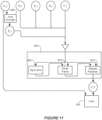
- Figure 11 shows example blocks for a process of training a speech synthesizer that includes an autoencoder.
- most aspects of the training process may be implemented as described above with reference to Figure 8 .
- the values of S_t, F_t, Q_t and P_t are as described above with reference to Figure 8 .
- the autoencoder 1005 also provides input to the voice modeling neural network 525.
- the autoencoder 1005 receives input audio data C_t from the target speaker during the training process and outputs Z_t to the voice modeling neural network 525.
- Z_t includes encoded audio data that is reduced in dimension as compared to the input audio data C_t.
- C_t' represents the synthesized audio data that is output by the voice modeling neural network 525 for the current target speaker.
- the training process involves providing C_t' and "ground truth" audio data-which is the input audio data C_t in this example-to the loss function determination block 535, receiving a loss function value from the loss function determination block and training at least the voice modeling neural network 525 according to the loss function value.
- This example also involves training the autoencoder 1005 according to the loss function value.
- Figure 10 does not include arrows indicating the loss function value being provided to the voice modeling neural network 525 and the autoencoder 1005 by the loss function determination block 535.
- Some implementations also involve training the conditioning neural network according to the loss function value. In all cases, the training process involves changing a physical state of at least one tangible storage medium location corresponding with at least one weight of the neural network being trained.
- the training also may involve training a fourth neural network to determine whether the encoded audio data generated by the third neural network corresponds to speech of the first person.
- the fourth neural network may be referred to herein as a "speaker identity classifier” or simply as a “speaker classifier.”
- the speech generation process may involve receiving, by the third neural network, audio data corresponding to speech of a source speaker.
- the source speaker may, in some instances, correspond to the "second person” referred to elsewhere herein (e.g., in the description of Figure 6 ). Therefore, the received audio data may correspond with the "second audio data corresponding to second speech of the second person" referenced elsewhere herein.
- the speech generation process may involve generating, by the third neural network, second encoded audio data corresponding to the second audio data.
- the speech generation process may involve receiving, by the fourth neural network, the second encoded audio data.
- the speech generation process may involve generating modified second encoded audio data via an iterative process until the fourth neural network determines that the modified second encoded audio data corresponds to speech of the first person and, after the fourth neural network determines that the modified second encoded audio data corresponds to speech of the first person, providing the modified second encoded audio data to the second neural network (e.g., to the voice modeling neural network 525).
- Figure 12A illustrates examples of blocks that may be used during a process of training a speaker classifier.
- the speaker classifier 1205 is a type of neural network and is trained according to input from the autoencoder 1005 and feedback from the loss function determination block 535.
- a more detailed example of the speaker classifier 1205 is illustrated in Figure 12B and is described below.
- the autoencoder 1005 has already been trained and the weights of the autoencoder 1005 are fixed.
- the autoencoder 1005 receives input audio data C_t from the target speaker during the training process and outputs Z_t to the speaker classifier 1205.
- Z_t includes encoded audio data that is reduced in dimension as compared to the input audio data C_t.
- the speaker classifier 1205 outputs S_t ⁇ , which is a predicted speaker identification data for the target speaker, to the loss function determination block 535.
- S_t the "ground truth” speaker identification data for the target speaker, is also input to the loss function determination block 535.
- the type and quantity of data that is included in the "speaker identification data" may vary according to the particular implementation.
- the speaker identification data may simply indicate the identity of a particular speaker (e.g., "speaker A").
- the speaker classifier 1205 may simply be trained to determine, e.g., whether a speaker is speaker A or is not speaker A. According to some such implementations the speaker classifier 1205 may, for example, be trained until the loss function determination block 535 determines that S_t ⁇ matches S_t.
- the speaker identification data may be more complex.
- the speaker identification data may indicate speech characteristics of the target speaker that have been learned by the speaker classifier 1205 and/or by the autoencoder 1005.
- the speaker identification data may be a multi-dimensional vector that represents speech characteristics of the target speaker.
- the dimensionality of the vector may be 8, 16, 32, 64 or 128.
- the speaker classifier 1205 may be trained until the loss function determination block 535 determines that the difference between S_t ⁇ and S_t is at or below a threshold value.
- the training process involves changing a physical state of at least one tangible storage medium location corresponding with at least one weight of the speaker classifier 1205.
- Figure 12B illustrates one example of a speaker classifier.
- the speaker classifier 1205 includes a convolutional neural network.
- the speaker classifier 1205 receives the output of the autoencoder 1005 as input and makes speaker classifications based on this input.
- the input to the speaker classifier 1205 includes M x N features, wherein N is a number of input frames and M is a feature dimension.
- the convolution layer 1210 includes 64 filters. However in other implementations the convolution layer 1210 may include a different number of filters, such as 30 filters, 40 filters, 50 filters, 60 filters, 70 filters, 80 filters, 90 filters, 100 filters, etc.
- each filter kernel has a 16 ⁇ 1 filter size.
- the convolution layer 1210 performs convolution operations with a step size or "stride" of 4. The stride indicates how many features are traversed when sliding the filters. Accordingly, sliding filters along the input data is the type of convolution operation that the convolution layer 1210 performs in this example. Given the M x N input in this example, we have an output size of C1 x floor((N - 16)/4 + 1), wherein floor(x) represents an operation that takes the largest integer i, such that i ⁇ x.
- the neural network layers 1215 receive output from the convolution layer 1210 and apply ReLU activation functions.
- the max pool block 1220 applies max pool operations to the output of the neural network layers 1215.
- the max pool block 1220 reduces the dimensionality of the output of the neural network layers 1215 by taking the maximum value from every 8 features.
- the max pool block 1220 has an 8x1 kernel size and applies a stride of 8.
- the convolution layer 1225 includes 100 filters. However in other implementations the convolution layer 1225 may include a different number of filters, such as 30 filters, 40 filters, 50 filters, 60 filters, 70 filters, 80 filters, 90 filters, 110 filters, 120 filters, 130 filters, etc.
- each filter kernel has a 5 ⁇ 1 filter size.
- the convolution layer 1225 performs convolution operations with a step size or "stride" of 1.
- the neural network layers 1230 receive output from the convolution layer 1225 and apply ReLU activation functions.
- the max pool block 1235 applies max pool operations to the output of the neural network layers 1230.
- the max pool block 1235 reduces the dimensionality of the output of the neural network layers 1230 by taking the maximum value from every 6 features.
- the max pool block 1220 has a 6x1 kernel size and applies a stride of 1.
- Equation 1 x represents the input, A represents a learnable weight matrix and b represents a learnable bias.
- layer 1245 applies a softmax function to the output of the linear layer 1240.
- a softmax function which is also known as a normalized exponential function, is a generalization of a logistic function that reduces a K-dimensional vector z of arbitrary real values to a K-dimensional vector ⁇ (z) of real values in the range [0, 1] that add up to 1.
- the output 1250 of the speaker classifier 1205 is speaker identification information.
- the output 1250 includes a speaker classification probability distribution for each speaker identity class of a total number of speaker identity classes.
- the output 1250 may include a probability of P1 that the speaker was Speaker A, a probability of P2 that the speaker was Speaker B, etc.
- Figure 13 provides an example of using a speaker classifier and an autoencoder for speech synthesis. Some aspects of this process, including what C_s, S_t, P_s->t and F_s represent, are described above (e.g., with reference to Figure 9 ) and will not be repeated here.
- C_s represents the input audio data for the source speaker that is provided to the autoencoder 1005.
- Z_s represents the output of the autoencoder 1005, which is input to the speaker classifier 1205.
- the autoencoder 1005 and the speaker classifier 1205 have been trained and their weights have been stored and fixed.
- feedback from the loss function determination block 535 is not used to change the weights of the autoencoder 1005 or the speaker classifier 1205, but is instead used to modify the values of Z_s until the speaker classifier 1205 classifies the modified source speaker's speech as being the target speaker's speech.
- the process of modifying the values of Z_s may, in some implementations, include a reverse optimization process, such as a stochastic gradient descent process.
- Equation 3 Y represents the ground truth label.
- the reverse optimization process may involve updating or optimizing the value of x in order to minimize the value of L in Equation 3.
- Equation 4 ⁇ represents the learning rate.
- x represents encoded audio data received from the autoencoder 1005.
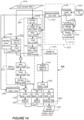
- Figure 14 illustrates blocks of a conditioning neural network and a voice modeling neural network according to one example.
- the blocks of Figure 14 may, for example, be implemented via a control system such as the control system 315 shown in Figure 3 and described above.
- blocks of Figure 14 may be implemented by a control system according to software instructions stored on one or more non-transitory media.
- the frame sizes, frame rates, numbers of elements and types of elements shown in Figure 14 are merely examples.
- the conditioning neural network 520 includes a bi-directional RNN 1415.
- the conditioning neural network 520 also includes block 1407, in which speech characteristic data of a plurality of speakers (109 speakers in this instance) are stored.
- the speech characteristic data correspond to the speech characteristics of target speakers that have been learned by the conditioning neural network 520 during processes of training the conditioning neural network 520 for each of the speakers.
- block 1407 may include pointers to memory locations in which speech characteristic data are stored.
- the speech characteristic data are represented by 32-dimensional vectors, in other examples the speech characteristic data may be represented in other ways, such as by vectors of other dimensionality.
- block 1405 represents a particular target speaker that has been selected, e.g., according to input received from a user.
- Speaker identification data from block 1405 is provided to block 1407, which provides speech characteristic data 1410 to the concatenation block 1414.
- the concatenation block 1414 also receives phoneme features 1412(e.g., from a content extraction block, such as the content extraction block 505 described above).
- the concatenation block 1414 is configured to concatenate the speech characteristic data 1410 with the phoneme features 1412 and to provide the output to the bi-directional RNN 1415.
- the bi-directional RNN 1415 may, for example, be configured to function as described above (e.g., with reference to Figure 7 ).
- the voice modeling neural network 525 includes modules 805, 810 and 815, each of which operates at a different temporal resolution.
- the module 805 processes more samples per frame than module 810 and the module 815 processes more samples per frame than module 805.
- the module 805 processes ten times more samples per frame than module 810 and the module 815 processes eighty times more samples per frame than module 810.
- the voice modeling neural network 525 may comprise a modified version of a SampleRNN neural network as described above. However, these are merely examples. In other implementations, the voice modeling neural network 525 may include a different numbers of modules and/or the modules may be configured to process different frame sizes.
- the conditioning neural network 520 provides output of different frame sizes to each of the modules 805, 810 and 815.
- the conditioning neural network 520 provides 50 frames having a size of 1024 samples to the module 805 during a time interval that corresponds to the 50 frames, e.g., a time interval during which the conditioning neural network 520 generated the 50 frames.
- the conditioning neural network 520 provides 50 frames having a size of 1024 samples to the repeating tensor block 1430, which repeats the 50 frames 10 times and provides the module 810 with 500 frames having a size of 1024 samples.
- the conditioning neural network 520 provides 50 frames having a size of 1024 samples to the repeating tensor block 1445, which repeats the 50 frames 80 times and provides the module 815 with 4000 frames having a size of 1024 samples.
- the module 805 includes a reshaping block 1418 that is configured to reshape a single frame of 4000 audio samples to 50 frames having 80 samples each.
- the linear operations block 1420 is configured to perform linear operations on each frame such that 1024 samples per frame are created from the 80 samples per frame output by the reshaping block 1418.
- Equation 5 X represents an input matrix, which in this example has dimensions of 50 by 80 and corresponds to the output of the reshaping block 1418.
- Equation 5 Y represents an output matrix of dimension 50 by 1024 and W represents a matrix of dimension 80 by 1024. Therefore, the output of the linear operations block 1420 has the same number of frames and the same frame size as the output of the bidirectional RNN 1415, so that the output of the linear operations block 1420 and the output of the bidirectional RNN 1415 may be summed and provided to the RNN 1422.
- the linear operations block 1425 is configured to perform linear operations on each frame such that 10240 samples per frame are created from the 1024 samples per frame output by the RNN 1422. In some examples, the linear operations block 1425 is configured to perform linear operations on each frame via matrix multiplication.
- the reshaping block 1427 in this example, is configured to reshape 50 frames of 10240 audio samples to 500 frames having 1024 samples each. Therefore, the output of the reshaping block 1427 may be summed with the output of the repeating tensor block 1430.
- the reshaping block 1432 is configured to reshape one frame of input audio data having 4000 samples to 500 frames having 8 samples each.
- the linear operations block 1435 is configured to perform linear operations on each frame such that 1024 samples are created from the 8 samples per frame output by the reshaping block 1432.
- the linear operations block 1435 is configured to perform linear operations on each frame via matrix multiplication. After these operations, the output of the linear operations block 1435 may be summed with the output of the reshaping block 1427 and the output of the repeating tensor block 1430.
- the output of the RNN 1437 is provided to the linear operations block 1440, which in this example is configured to perform linear operations on each frame such that 8192 samples per frame are created from the 1024 samples per frame output by the RNN 1437.
- the linear operations block 1440 is configured to perform linear operations on each frame via matrix multiplication.
- the reshaping block 1442 is configured to reshape 500 frames of data having 8192 samples each to 4000 frames having 1024 samples each. The output of the reshaping block 1442 then has the same dimensionality as the output of the repeating tensor block 1445 and may therefore be summed with the output of the repeating tensor block 1445.
- the module 815 includes a nearest neighbors block 1447, which is configured to provide the previous 7 samples along with the current sample of audio data to the linear operations block 1450.
- the linear operations block 1450 is configured to perform linear operations on each frame such that 1024 samples per frame are created from the 8 samples per frame output by the nearest neighbors block 1447.
- the output of the linear operations block 1450 then has the same dimensionality as the output of the repeating tensor block 1445 and may therefore be summed with the output of the repeating tensor block 1445 and the output of the reshaping block 1442.
- block 1447 and block 1450 may be replaced by a single convolution layer, e.g., with a total of 1024 filters, each filter's size being 8 by 1. With a filter size of 8x1, the convolution filters could operate on the previous 7 samples and the current sample.
- the linear operations block 1452 is configured to be one portion of a multilayer perceptron that also includes the linear operations block 1457 and the linear operations block 1462.
- the output of the linear operations block 1452 is provided to the ReLU block 1455, which provides its output to the linear operations block 1457.
- the output of the linear operations block 1457 is provided to the ReLU block 1460, which provides its output to the linear operations block 1462.
- the linear operations block 1462 is configured to perform linear operations on each frame such that 256 samples per frame are created from the 1024 samples per frame output by the ReLU block 1460.
- the audio data is 8-bit audio data and therefore the 256 samples per frame correspond to the number of possible audio sample values of the input audio data.
- block 1465 applies a softmax function to the output of the linear operations block 1462.
- the softmax function provides a classification for each of the 256 values or classes per frame.
- the output data 1470 that is output by the voice modeling neural network 525 includes audio sample distributions, which indicate a probability for each of the 256 values or classes per frame.
Landscapes
- Engineering & Computer Science (AREA)
- Physics & Mathematics (AREA)
- Theoretical Computer Science (AREA)
- Health & Medical Sciences (AREA)
- Computational Linguistics (AREA)
- Artificial Intelligence (AREA)
- General Health & Medical Sciences (AREA)
- General Physics & Mathematics (AREA)
- General Engineering & Computer Science (AREA)
- Evolutionary Computation (AREA)
- Computing Systems (AREA)
- Life Sciences & Earth Sciences (AREA)
- Data Mining & Analysis (AREA)
- Biophysics (AREA)
- Biomedical Technology (AREA)
- Mathematical Physics (AREA)
- Software Systems (AREA)
- Molecular Biology (AREA)
- Audiology, Speech & Language Pathology (AREA)
- Human Computer Interaction (AREA)
- Acoustics & Sound (AREA)
- Multimedia (AREA)
- Signal Processing (AREA)
- User Interface Of Digital Computer (AREA)
- Electrically Operated Instructional Devices (AREA)
Claims (15)
- Computerimplementiertes Audioverarbeitungsverfahren, umfassend:
Trainieren eines Sprachsynthesizers, wobei das Trainieren beinhaltet:(a) Empfangen (405) von ersten Audiodaten, die einer ersten Sprache einer ersten Person entsprechen, durch einen Inhaltsextraktionsprozess, der über ein Steuersystem implementiert wird, das einen oder mehrere Prozessoren und ein oder mehrere nichtflüchtige Speichermedien umfasst;(b) Produzieren (410) einer ersten zeitgestempelten Phonemsequenz und von ersten Tonhöhenkonturdaten, die der ersten Sprache entsprechen, durch den Inhaltsextraktionsprozess;(c) Empfangen (415) der ersten zeitgestempelten Phonemsequenz und der ersten Tonhöhenkonturdaten durch ein erstes neuronales Netzwerk, das über das Steuersystem implementiert wird;(d) Produzieren (420) einer ersten neuronalen Netzwerkausgabe, die der ersten zeitgestempelten Phonemsequenz und den ersten Tonhöhenkonturdaten entspricht, durch das erste neuronale Netzwerk, wobei die erste neuronale Netzwerkausgabe eine Vielzahl von Rahmengrößen umfasst;(e) Empfangen (425) der ersten neuronalen Netzwerkausgabe durch ein zweites neuronales Netzwerk, das über das Steuersystem implementiert wird, wobei das zweite neuronale Netzwerk eine Hierarchie von Modulen umfasst, wobei jedes Modul mit einer anderen zeitlichen Auflösung arbeitet, wobei das erste neuronale Netzwerk die erste neuronale Netzwerkausgabe derart produziert hat, dass jede der Vielzahl von Rahmengrößen der ersten neuronalen Netzwerkausgabe einer zeitlichen Auflösung eines Moduls des zweiten neuronalen Netzwerks entspricht;(f) Erzeugen (430) von ersten vorhergesagten Audiosignalen durch das zweite neuronale Netzwerk;(g) Vergleichen (435) der ersten vorhergesagten Audiosignale über das Steuersystem mit ersten Testdaten, wobei die Testdaten Audiodaten sind, die der Sprache der ersten Person entsprechen;(h) Bestimmen (440) eines Verlustfunktionswerts für die ersten vorhergesagten Audiosignale über das Steuersystem; und(i) Wiederholen von (a) bis (h), bis eine Differenz zwischen einem aktuellen Verlustfunktionswert für die ersten vorhergesagten Audiosignale und einem früheren Verlustfunktionswert für die ersten vorhergesagten Audiosignale kleiner als oder gleich einem vorbestimmten Wert (445) ist, wobei das Wiederholen (i) das Ändern eines physikalischen Zustands von mindestens einem nichtflüchtigen Speichermedienort entsprechend mindestens einem Gewicht des zweiten neuronalen Netzwerks umfasst. - Audioverarbeitungsverfahren nach Anspruch 1, wobei (a) weiter umfasst- Empfangen von erstem zeitgestempeltem Text, der der ersten Sprache der ersten Person entspricht, und/oder- Empfangen von ersten Identifikationsdaten, die der ersten Person entsprechen.
- Audioverarbeitungsverfahren nach Anspruch 1 oder 2, weiter das Steuern des Sprachsynthesizers zur Spracherzeugung umfassend, wobei die Spracherzeugung umfasst:(j) Empfangen von zweiten Audiodaten, die einer zweiten Sprache einer zweiten Person entsprechen, von zweitem zeitgestempeltem Text, der der zweiten Sprache entspricht, und von ersten Identifikationsdaten, die einer Sprache der ersten Person entsprechen, durch den Inhaltsextraktionsprozess;(k) Produzieren einer zweiten zeitgestempelten Phonemsequenz und von zweiten Tonhöhenkonturdaten, die der zweiten Sprache entsprechen, durch den Inhaltsextraktionsprozess;(l) Empfangen der zweiten zeitgestempelten Phonemsequenz und der zweiten Tonhöhenkonturdaten aus (k) durch das erste neuronale Netzwerk;(m) Produzieren einer ersten neuronalen Netzwerkausgabe, die der zweiten zeitgestempelten Phonemsequenz und den zweiten Tonhöhenkonturdaten aus (k) entspricht, durch das erste neuronale Netzwerk;(n) Empfangen der ersten neuronalen Netzwerkausgabe aus (m) und der ersten Identifikationsdaten durch das zweite neuronale Netzwerk; und(o) Erzeugen von synthetisierten Audiodaten, die der ersten neuronalen Netzwerkausgabe aus (m) und den ersten Identifikationsdaten entsprechen, durch das zweite neuronale Netzwerk.
- Audioverarbeitungsverfahren nach Anspruch 3, wobei die synthetisierten Audiodaten Wörtern entsprechen, die von der zweiten Person gemäß Sprachmerkmalen der ersten Person ausgesprochen werden.
- Audioverarbeitungsverfahren nach Anspruch 4, wobei das Trainieren das Empfangen der ersten Audiodaten in einer ersten Sprache beinhaltet, und wobei die synthetisierten Audiodaten Wörtern entsprechen, die von der zweiten Person in einer zweiten Sprache ausgesprochen werden.
- Audioverarbeitungsverfahren nach einem der Ansprüche 3 bis 5, weiter das Bringen eines oder mehrerer Wandler dazu, die synthetisierten Audiodaten wiederzugeben, umfassend.
- Audioverarbeitungsverfahren nach einem der Ansprüche 3 bis 6, wobei das Trainieren weiter umfasst:Empfangen der ersten Audiodaten durch ein drittes neuronales Netzwerk; undTrainieren des dritten neuronalen Netzwerks, um erste Sprachmerkmale zu bestimmen, die der Sprache der ersten Person entsprechen, und kodierte Audiodaten auszugeben.
- Audioverarbeitungsverfahren nach Anspruch 7, wobei das Trainieren weiter das Trainieren eines vierten neuronalen Netzwerks umfasst, um zu bestimmen, ob die codierten Audiodaten der Sprache der ersten Person entsprechen.
- Audioverarbeitungsverfahren nach Anspruch 8, wobei die Spracherzeugung weiter umfasst:Empfangen der zweiten Audiodaten durch das dritte neuronale Netzwerk;Erzeugen von zweiten codierten Audiodaten, die den zweiten Audiodaten entsprechen, durch das dritte neuronale Netzwerk;Empfangen der zweiten codierten Audiodaten durch das vierte neuronale Netzwerk;Erzeugen von modifizierten zweiten codierten Audiodaten über einen iterativen Prozess, bis das vierte neuronale Netzwerk bestimmt, dass die modifizierten zweiten codierten Audiodaten der Sprache der ersten Person entsprechen, und, nachdem das vierte neuronale Netzwerk bestimmt, dass die modifizierten zweiten codierten Audiodaten der Sprache der ersten Person entsprechen, Bereitstellen der modifizierten zweiten codierten Audiodaten an das zweite neuronale Netzwerk.
- Audioverarbeitungsverfahren nach einem der Ansprüche 1-9, wobei das Wiederholen von (a) bis (h) das Trainieren von mindestens einem aus dem ersten neuronalen Netzwerk oder dem zweiten neuronalen Netzwerk über Rückpropagierung auf Basis eines aktuellen Verlustfunktionswerts beinhaltet.
- Audioverarbeitungsverfahren nach einem der Ansprüche 1-10, wobei das erste neuronale Netzwerk ein bidirektionales rekurrentes neuronales Netzwerk umfasst.
- Sprachsyntheseeinrichtung, umfassend: ein Schnittstellensystem (310);
ein Steuersystem (315), das einen oder mehrere Prozessoren und ein oder mehrere nichtflüchtige Speichermedien umfasst, die betriebsmäßig mit dem einen oder den mehreren Prozessoren gekoppelt sind, wobei das Steuersystem zum Implementieren eines Sprachsynthesizers konfiguriert ist, wobei der Sprachsynthesizer einen Inhaltsextraktor, ein erstes neuronales Netzwerk und ein zweites neuronales Netzwerk beinhaltet, wobei das erste neuronale Netzwerk ein bidirektionales rekurrentes neuronales Netzwerk umfasst, wobei das zweite neuronale Netzwerk eine Hierarchie von Modulen umfasst, wobei jedes Modul mit einer anderen zeitlichen Auflösung arbeitet, wobei das erste neuronale Netzwerk und das zweite neuronale Netzwerk gemäß einem Prozess trainiert wurden, welcher umfasst:(a) Empfangen, über das Schnittstellensystem und durch den Inhaltsextraktor, von ersten Audiodaten, die einer ersten Sprache einer ersten Person entsprechen;(b) Produzieren einer ersten zeitgestempelten Phonemsequenz und von ersten Tonhöhenkonturdaten, die der ersten Sprache entsprechen, durch den Inhaltsextraktor;(c) Empfangen der ersten zeitgestempelten Phonemsequenz und der ersten Tonhöhenkonturdaten durch das erste neuronale Netzwerk;(d) Produzieren einer ersten neuronalen Netzwerkausgabe, die der ersten zeitgestempelten Phonemsequenz und den ersten Tonhöhenkonturdaten entspricht, durch das erste neuronale Netzwerk, wobei die erste neuronale Netzwerkausgabe eine Vielzahl von Rahmengrößen umfasst, wobei jede der Rahmengrößen einer zeitlichen Auflösung eines Moduls des zweiten neuronalen Netzwerks entspricht;(e) Empfangen der ersten neuronalen Netzwerkausgabe durch das zweite neuronale Netzwerk;(f) Erzeugen von ersten vorhergesagten Audiosignalen durch das zweite neuronale Netzwerk;(g) Vergleichen der ersten vorhergesagten Audiosignale mit ersten Testdaten, wobei die Testdaten Audiodaten sind, die der Sprache der ersten Person entsprechen;(h) Bestimmen eines Verlustfunktionswerts für die ersten vorhergesagten Audiosignale; und(i) Wiederholen von (a) bis (h), bis eine Differenz zwischen einem aktuellen Verlustfunktionswert für die ersten vorhergesagten Audiosignale und einem früheren Verlustfunktionswert für die ersten vorhergesagten Audiosignale kleiner als oder gleich einem vorbestimmten Wert ist, wobei das Steuersystem zum Steuern des Sprachsynthesizermoduls zur Spracherzeugung konfiguriert ist, und wobei die Spracherzeugung umfasst:(j) Empfangen, durch den Inhaltsextraktor und über das Schnittstellensystem, von zweiten Audiodaten, die einer zweiten Sprache einer zweiten Person entsprechen, von zweitem zeitgestempeltem Text, der der zweiten Sprache entspricht, und von ersten Identifikationsdaten, die einer Sprache der ersten Person entsprechen;(k) Produzieren einer zweiten zeitgestempelten Phonemsequenz und von zweiten Tonhöhenkonturdaten, die der zweiten Sprache entsprechen, durch den Inhaltsextraktor;(l) Empfangen der zweiten zeitgestempelten Phonemsequenz und der zweiten Tonhöhenkonturdaten aus (k) durch das erste neuronale Netzwerk;(m) Produzieren einer ersten neuronalen Netzwerkausgabe, die der zweiten zeitgestempelten Phonemsequenz und den zweiten Tonhöhenkonturdaten aus (k) entspricht, durch das erste neuronale Netzwerk;(n) Empfangen der ersten neuronalen Netzwerkausgabe aus (m) und der ersten Identifikationsdaten durch das zweite neuronale Netzwerk; und(o) Erzeugen von synthetisierten Audiodaten, die der ersten neuronalen Netzwerkausgabe aus (m) und den ersten Identifikationsdaten entsprechen, durch das zweite neuronale Netzwerk. - Sprachsyntheseeinrichtung nach Anspruch 12, wobei die synthetisierten Audiodaten Wörtern entsprechen, die von der zweiten Person gemäß Sprachmerkmalen der ersten Person ausgesprochen werden.
- Sprachsyntheseeinrichtung nach Anspruch 13, wobei das Trainieren das Empfangen der ersten Audiodaten in einer ersten Sprache beinhaltet, und wobei die synthetisierten Audiodaten Wörtern entsprechen, die von der zweiten Person in einer zweiten Sprache ausgesprochen werden.
- Sprachsyntheseeinrichtung nach Anspruch 12, wobei die erste Sprache der ersten Person der Sprache einer Person in einem ersten Alter oder in einem Altersbereich entspricht, der das erste Alter beinhaltet, und die zweite Sprache der zweiten Person der Sprache der Person in einem zweiten Alter entspricht, und gegebenenfalls wobei das erste Alter ein jüngeres Alter als das zweite Alter ist.
Applications Claiming Priority (4)
| Application Number | Priority Date | Filing Date | Title |
|---|---|---|---|
| US201862710501P | 2018-02-16 | 2018-02-16 | |
| EP18157080 | 2018-02-16 | ||
| US201962797864P | 2019-01-28 | 2019-01-28 | |
| PCT/US2019/017941 WO2019161011A1 (en) | 2018-02-16 | 2019-02-14 | Speech style transfer |
Publications (2)
| Publication Number | Publication Date |
|---|---|
| EP3752964A1 EP3752964A1 (de) | 2020-12-23 |
| EP3752964B1 true EP3752964B1 (de) | 2023-06-28 |
Family
ID=66102176
Family Applications (1)
| Application Number | Title | Priority Date | Filing Date |
|---|---|---|---|
| EP19716599.6A Active EP3752964B1 (de) | 2018-02-16 | 2019-02-14 | Redestilübertragung |
Country Status (4)
| Country | Link |
|---|---|
| EP (1) | EP3752964B1 (de) |
| JP (1) | JP6911208B2 (de) |
| CN (1) | CN111771213B (de) |
| WO (1) | WO2019161011A1 (de) |
Families Citing this family (17)
| Publication number | Priority date | Publication date | Assignee | Title |
|---|---|---|---|---|
| GB201804073D0 (en) * | 2018-03-14 | 2018-04-25 | Papercup Tech Limited | A speech processing system and a method of processing a speech signal |
| US20210089909A1 (en) * | 2019-09-25 | 2021-03-25 | Deepmind Technologies Limited | High fidelity speech synthesis with adversarial networks |
| SG11202010803VA (en) | 2019-10-31 | 2020-11-27 | Alipay Hangzhou Inf Tech Co Ltd | System and method for determining voice characteristics |
| CN111627420B (zh) * | 2020-04-21 | 2023-12-08 | 升智信息科技(南京)有限公司 | 极低资源下的特定发音人情感语音合成方法及装置 |
| CN111599343B (zh) * | 2020-05-14 | 2021-11-09 | 北京字节跳动网络技术有限公司 | 用于生成音频的方法、装置、设备和介质 |
| CN112116906B (zh) * | 2020-08-27 | 2024-03-22 | 山东浪潮科学研究院有限公司 | 一种基于gan网络的现场混音方法、装置、设备及介质 |
| CN112309365B (zh) * | 2020-10-21 | 2024-05-10 | 北京大米科技有限公司 | 语音合成模型的训练方法、装置、存储介质以及电子设备 |
| CN112382272B (zh) * | 2020-12-11 | 2023-05-23 | 平安科技(深圳)有限公司 | 可控制语音速度的语音合成方法、装置、设备及存储介质 |
| CN112633381B (zh) * | 2020-12-24 | 2023-09-01 | 北京百度网讯科技有限公司 | 音频识别的方法及音频识别模型的训练方法 |
| CN112992107B (zh) * | 2021-03-25 | 2024-06-11 | 腾讯音乐娱乐科技(深圳)有限公司 | 训练声学转换模型的方法、终端及存储介质 |
| EP4293660A4 (de) * | 2021-06-22 | 2024-07-17 | Samsung Electronics Co., Ltd. | Elektronische vorrichtung und verfahren zur steuerung davon |
| JP7069386B1 (ja) | 2021-06-30 | 2022-05-17 | 株式会社ドワンゴ | 音声変換装置、音声変換方法、プログラム、および記録媒体 |
| CN114171053B (zh) * | 2021-12-20 | 2024-04-05 | Oppo广东移动通信有限公司 | 一种神经网络的训练方法、音频分离方法、装置及设备 |
| CN115132196B (zh) * | 2022-05-18 | 2024-09-10 | 腾讯科技(深圳)有限公司 | 语音指令识别的方法、装置、电子设备及存储介质 |
| CN117546238A (zh) * | 2022-06-07 | 2024-02-09 | 北京小米移动软件有限公司 | 一种生成音频的方法、装置及存储介质 |
| CN115424604B (zh) * | 2022-07-20 | 2024-03-15 | 南京硅基智能科技有限公司 | 一种基于对抗生成网络的语音合成模型的训练方法 |
| CN115762494B (zh) * | 2022-12-09 | 2025-11-28 | 思必驰科技股份有限公司 | 语音识别系统训练方法、电子设备和存储介质 |
Citations (1)
| Publication number | Priority date | Publication date | Assignee | Title |
|---|---|---|---|---|
| US20090281815A1 (en) * | 2008-05-08 | 2009-11-12 | Broadcom Corporation | Compensation technique for audio decoder state divergence |
Family Cites Families (9)
| Publication number | Priority date | Publication date | Assignee | Title |
|---|---|---|---|---|
| CN101199002B (zh) * | 2005-06-09 | 2011-09-07 | 株式会社A.G.I. | 检测音调频率的语音分析器和语音分析方法 |
| US8527276B1 (en) * | 2012-10-25 | 2013-09-03 | Google Inc. | Speech synthesis using deep neural networks |
| JP6543820B2 (ja) * | 2015-06-04 | 2019-07-17 | 国立大学法人電気通信大学 | 声質変換方法および声質変換装置 |
| US9558734B2 (en) * | 2015-06-29 | 2017-01-31 | Vocalid, Inc. | Aging a text-to-speech voice |
| US9792897B1 (en) * | 2016-04-13 | 2017-10-17 | Malaspina Labs (Barbados), Inc. | Phoneme-expert assisted speech recognition and re-synthesis |
| CN105869630B (zh) * | 2016-06-27 | 2019-08-02 | 上海交通大学 | 基于深度学习的说话人语音欺骗攻击检测方法及系统 |
| US10176819B2 (en) * | 2016-07-11 | 2019-01-08 | The Chinese University Of Hong Kong | Phonetic posteriorgrams for many-to-one voice conversion |
| CN106328122A (zh) * | 2016-08-19 | 2017-01-11 | 深圳市唯特视科技有限公司 | 一种利用长短期记忆模型递归神经网络的语音识别方法 |
| CN106875007A (zh) * | 2017-01-25 | 2017-06-20 | 上海交通大学 | 用于语音欺骗检测的基于卷积长短期记忆端对端深度神经网络 |
-
2019
- 2019-02-14 EP EP19716599.6A patent/EP3752964B1/de active Active
- 2019-02-14 JP JP2020542648A patent/JP6911208B2/ja active Active
- 2019-02-14 CN CN201980013180.8A patent/CN111771213B/zh active Active
- 2019-02-14 WO PCT/US2019/017941 patent/WO2019161011A1/en not_active Ceased
Patent Citations (1)
| Publication number | Priority date | Publication date | Assignee | Title |
|---|---|---|---|---|
| US20090281815A1 (en) * | 2008-05-08 | 2009-11-12 | Broadcom Corporation | Compensation technique for audio decoder state divergence |
Non-Patent Citations (1)
| Title |
|---|
| SOROUSH MEHRI ET AL: "SampleRNN: An Unconditional End-to-End Neural Audio Generation Model", 22 December 2016 (2016-12-22), XP055491777, Retrieved from the Internet <URL:https://www.researchgate.net/profile/Jose_Sotelo7/publication/311900821_SampleRNN_An_Unconditional_End-to-End_Neural_Audio_Generation_Model/links/5864833b08ae329d6203aadc/SampleRNN-An-Unconditional-End-to-End-Neural-Audio-Generation-Model.pdf> * |
Also Published As
| Publication number | Publication date |
|---|---|
| EP3752964A1 (de) | 2020-12-23 |
| CN111771213A (zh) | 2020-10-13 |
| JP2021508859A (ja) | 2021-03-11 |
| WO2019161011A1 (en) | 2019-08-22 |
| JP6911208B2 (ja) | 2021-07-28 |
| CN111771213B (zh) | 2021-10-08 |
Similar Documents
| Publication | Publication Date | Title |
|---|---|---|
| US11538455B2 (en) | Speech style transfer | |
| EP3752964B1 (de) | Redestilübertragung | |
| US12039969B2 (en) | Speech processing system and a method of processing a speech signal | |
| Sun | End-to-end speech emotion recognition with gender information | |
| Basak et al. | Challenges and limitations in speech recognition technology: A critical review of speech signal processing algorithms, tools and systems | |
| US11475874B2 (en) | Generating diverse and natural text-to-speech samples | |
| Gonzalez et al. | Direct speech reconstruction from articulatory sensor data by machine learning | |
| Ling et al. | Deep learning for acoustic modeling in parametric speech generation: A systematic review of existing techniques and future trends | |
| Das et al. | A hybrid meta-heuristic feature selection method for identification of Indian spoken languages from audio signals | |
| Algihab et al. | Arabic speech recognition with deep learning: A review | |
| Rahman et al. | Arabic speech recognition: Advancement and challenges | |
| Qian et al. | A survey of technologies for automatic Dysarthric speech recognition | |
| Roy et al. | A survey of classification techniques in speech emotion recognition | |
| Hasija et al. | Out domain data augmentation on punjabi children speech recognition using tacotron | |
| US10783873B1 (en) | Native language identification with time delay deep neural networks trained separately on native and non-native english corpora | |
| Mohanty et al. | Application of deep learning approach for recognition of voiced Odia digits | |
| Kaur et al. | Formant Text to Speech Synthesis Using Artificial Neural Networks | |
| Ronanki | Prosody generation for text-to-speech synthesis | |
| CN119207366B (zh) | 一种细粒度强调可控的情感语音合成方法 | |
| Spijkerman | Using voice conversion and time-stretching to enhance the quality of dysarthric speech for automatic speech recognition | |
| Yaser et al. | Speech Emotion Recognition using Transfer Learning Approach and Real-Time Evaluation in English and Bengali Language | |
| Eirini | End-to-end neural based greek text-to-speech synthesis | |
| Do | Neural networks for automatic speaker, language, and sex identification | |
| Monica et al. | Emotion Recognition Results using Deep Learning Neural Networks for the Romanian and German Language | |
| Kotangale et al. | A Novel Hybrid Deep Learning Model Optimized by Pelican Algorithm for Robust Dysarthric Speech Classification with Multi-feature Fusion and Attention-GAN |
Legal Events
| Date | Code | Title | Description |
|---|---|---|---|
| STAA | Information on the status of an ep patent application or granted ep patent |
Free format text: STATUS: UNKNOWN |
|
| STAA | Information on the status of an ep patent application or granted ep patent |
Free format text: STATUS: THE INTERNATIONAL PUBLICATION HAS BEEN MADE |
|
| PUAI | Public reference made under article 153(3) epc to a published international application that has entered the european phase |
Free format text: ORIGINAL CODE: 0009012 |
|
| STAA | Information on the status of an ep patent application or granted ep patent |
Free format text: STATUS: REQUEST FOR EXAMINATION WAS MADE |
|
| 17P | Request for examination filed |
Effective date: 20200916 |
|
| AK | Designated contracting states |
Kind code of ref document: A1 Designated state(s): AL AT BE BG CH CY CZ DE DK EE ES FI FR GB GR HR HU IE IS IT LI LT LU LV MC MK MT NL NO PL PT RO RS SE SI SK SM TR |
|
| AX | Request for extension of the european patent |
Extension state: BA ME |
|
| RIN1 | Information on inventor provided before grant (corrected) |
Inventor name: HORGAN, MICHAEL GETTY Inventor name: MORALES, JAIME H. Inventor name: KUMAR, VIVEK Inventor name: ZHOU, CONG Inventor name: VASCO, CRISTINA MICHEL |
|
| DAV | Request for validation of the european patent (deleted) | ||
| DAX | Request for extension of the european patent (deleted) | ||
| STAA | Information on the status of an ep patent application or granted ep patent |
Free format text: STATUS: EXAMINATION IS IN PROGRESS |
|
| 17Q | First examination report despatched |
Effective date: 20210715 |
|
| GRAP | Despatch of communication of intention to grant a patent |
Free format text: ORIGINAL CODE: EPIDOSNIGR1 |
|
| STAA | Information on the status of an ep patent application or granted ep patent |
Free format text: STATUS: GRANT OF PATENT IS INTENDED |
|
| INTG | Intention to grant announced |
Effective date: 20230201 |
|
| GRAS | Grant fee paid |
Free format text: ORIGINAL CODE: EPIDOSNIGR3 |
|
| GRAA | (expected) grant |
Free format text: ORIGINAL CODE: 0009210 |
|
| STAA | Information on the status of an ep patent application or granted ep patent |
Free format text: STATUS: THE PATENT HAS BEEN GRANTED |
|
| P01 | Opt-out of the competence of the unified patent court (upc) registered |
Effective date: 20230417 |
|
| AK | Designated contracting states |
Kind code of ref document: B1 Designated state(s): AL AT BE BG CH CY CZ DE DK EE ES FI FR GB GR HR HU IE IS IT LI LT LU LV MC MK MT NL NO PL PT RO RS SE SI SK SM TR |
|
| REG | Reference to a national code |
Ref country code: CH Ref legal event code: EP |
|
| REG | Reference to a national code |
Ref country code: AT Ref legal event code: REF Ref document number: 1583368 Country of ref document: AT Kind code of ref document: T Effective date: 20230715 |
|
| REG | Reference to a national code |
Ref country code: IE Ref legal event code: FG4D |
|
| REG | Reference to a national code |
Ref country code: DE Ref legal event code: R096 Ref document number: 602019031677 Country of ref document: DE |
|
| REG | Reference to a national code |
Ref country code: LT Ref legal event code: MG9D |
|
| PG25 | Lapsed in a contracting state [announced via postgrant information from national office to epo] |
Ref country code: SE Free format text: LAPSE BECAUSE OF FAILURE TO SUBMIT A TRANSLATION OF THE DESCRIPTION OR TO PAY THE FEE WITHIN THE PRESCRIBED TIME-LIMIT Effective date: 20230628 Ref country code: NO Free format text: LAPSE BECAUSE OF FAILURE TO SUBMIT A TRANSLATION OF THE DESCRIPTION OR TO PAY THE FEE WITHIN THE PRESCRIBED TIME-LIMIT Effective date: 20230928 |
|
| REG | Reference to a national code |
Ref country code: NL Ref legal event code: MP Effective date: 20230628 |
|
| REG | Reference to a national code |
Ref country code: AT Ref legal event code: MK05 Ref document number: 1583368 Country of ref document: AT Kind code of ref document: T Effective date: 20230628 |
|
| PG25 | Lapsed in a contracting state [announced via postgrant information from national office to epo] |
Ref country code: RS Free format text: LAPSE BECAUSE OF FAILURE TO SUBMIT A TRANSLATION OF THE DESCRIPTION OR TO PAY THE FEE WITHIN THE PRESCRIBED TIME-LIMIT Effective date: 20230628 Ref country code: NL Free format text: LAPSE BECAUSE OF FAILURE TO SUBMIT A TRANSLATION OF THE DESCRIPTION OR TO PAY THE FEE WITHIN THE PRESCRIBED TIME-LIMIT Effective date: 20230628 Ref country code: LV Free format text: LAPSE BECAUSE OF FAILURE TO SUBMIT A TRANSLATION OF THE DESCRIPTION OR TO PAY THE FEE WITHIN THE PRESCRIBED TIME-LIMIT Effective date: 20230628 Ref country code: LT Free format text: LAPSE BECAUSE OF FAILURE TO SUBMIT A TRANSLATION OF THE DESCRIPTION OR TO PAY THE FEE WITHIN THE PRESCRIBED TIME-LIMIT Effective date: 20230628 Ref country code: HR Free format text: LAPSE BECAUSE OF FAILURE TO SUBMIT A TRANSLATION OF THE DESCRIPTION OR TO PAY THE FEE WITHIN THE PRESCRIBED TIME-LIMIT Effective date: 20230628 Ref country code: GR Free format text: LAPSE BECAUSE OF FAILURE TO SUBMIT A TRANSLATION OF THE DESCRIPTION OR TO PAY THE FEE WITHIN THE PRESCRIBED TIME-LIMIT Effective date: 20230929 |
|
| PG25 | Lapsed in a contracting state [announced via postgrant information from national office to epo] |
Ref country code: FI Free format text: LAPSE BECAUSE OF FAILURE TO SUBMIT A TRANSLATION OF THE DESCRIPTION OR TO PAY THE FEE WITHIN THE PRESCRIBED TIME-LIMIT Effective date: 20230628 |
|
| PG25 | Lapsed in a contracting state [announced via postgrant information from national office to epo] |
Ref country code: SK Free format text: LAPSE BECAUSE OF FAILURE TO SUBMIT A TRANSLATION OF THE DESCRIPTION OR TO PAY THE FEE WITHIN THE PRESCRIBED TIME-LIMIT Effective date: 20230628 |
|
| PG25 | Lapsed in a contracting state [announced via postgrant information from national office to epo] |
Ref country code: ES Free format text: LAPSE BECAUSE OF FAILURE TO SUBMIT A TRANSLATION OF THE DESCRIPTION OR TO PAY THE FEE WITHIN THE PRESCRIBED TIME-LIMIT Effective date: 20230628 |
|
| PG25 | Lapsed in a contracting state [announced via postgrant information from national office to epo] |
Ref country code: IS Free format text: LAPSE BECAUSE OF FAILURE TO SUBMIT A TRANSLATION OF THE DESCRIPTION OR TO PAY THE FEE WITHIN THE PRESCRIBED TIME-LIMIT Effective date: 20231028 |
|
| PG25 | Lapsed in a contracting state [announced via postgrant information from national office to epo] |
Ref country code: SM Free format text: LAPSE BECAUSE OF FAILURE TO SUBMIT A TRANSLATION OF THE DESCRIPTION OR TO PAY THE FEE WITHIN THE PRESCRIBED TIME-LIMIT Effective date: 20230628 Ref country code: SK Free format text: LAPSE BECAUSE OF FAILURE TO SUBMIT A TRANSLATION OF THE DESCRIPTION OR TO PAY THE FEE WITHIN THE PRESCRIBED TIME-LIMIT Effective date: 20230628 Ref country code: RO Free format text: LAPSE BECAUSE OF FAILURE TO SUBMIT A TRANSLATION OF THE DESCRIPTION OR TO PAY THE FEE WITHIN THE PRESCRIBED TIME-LIMIT Effective date: 20230628 Ref country code: PT Free format text: LAPSE BECAUSE OF FAILURE TO SUBMIT A TRANSLATION OF THE DESCRIPTION OR TO PAY THE FEE WITHIN THE PRESCRIBED TIME-LIMIT Effective date: 20231030 Ref country code: IS Free format text: LAPSE BECAUSE OF FAILURE TO SUBMIT A TRANSLATION OF THE DESCRIPTION OR TO PAY THE FEE WITHIN THE PRESCRIBED TIME-LIMIT Effective date: 20231028 Ref country code: ES Free format text: LAPSE BECAUSE OF FAILURE TO SUBMIT A TRANSLATION OF THE DESCRIPTION OR TO PAY THE FEE WITHIN THE PRESCRIBED TIME-LIMIT Effective date: 20230628 Ref country code: EE Free format text: LAPSE BECAUSE OF FAILURE TO SUBMIT A TRANSLATION OF THE DESCRIPTION OR TO PAY THE FEE WITHIN THE PRESCRIBED TIME-LIMIT Effective date: 20230628 Ref country code: CZ Free format text: LAPSE BECAUSE OF FAILURE TO SUBMIT A TRANSLATION OF THE DESCRIPTION OR TO PAY THE FEE WITHIN THE PRESCRIBED TIME-LIMIT Effective date: 20230628 Ref country code: AT Free format text: LAPSE BECAUSE OF FAILURE TO SUBMIT A TRANSLATION OF THE DESCRIPTION OR TO PAY THE FEE WITHIN THE PRESCRIBED TIME-LIMIT Effective date: 20230628 |
|
| PG25 | Lapsed in a contracting state [announced via postgrant information from national office to epo] |
Ref country code: PL Free format text: LAPSE BECAUSE OF FAILURE TO SUBMIT A TRANSLATION OF THE DESCRIPTION OR TO PAY THE FEE WITHIN THE PRESCRIBED TIME-LIMIT Effective date: 20230628 |
|
| REG | Reference to a national code |
Ref country code: DE Ref legal event code: R097 Ref document number: 602019031677 Country of ref document: DE |
|
| PG25 | Lapsed in a contracting state [announced via postgrant information from national office to epo] |
Ref country code: DK Free format text: LAPSE BECAUSE OF FAILURE TO SUBMIT A TRANSLATION OF THE DESCRIPTION OR TO PAY THE FEE WITHIN THE PRESCRIBED TIME-LIMIT Effective date: 20230628 |
|
| PLBE | No opposition filed within time limit |
Free format text: ORIGINAL CODE: 0009261 |
|
| STAA | Information on the status of an ep patent application or granted ep patent |
Free format text: STATUS: NO OPPOSITION FILED WITHIN TIME LIMIT |
|
| PG25 | Lapsed in a contracting state [announced via postgrant information from national office to epo] |
Ref country code: IT Free format text: LAPSE BECAUSE OF FAILURE TO SUBMIT A TRANSLATION OF THE DESCRIPTION OR TO PAY THE FEE WITHIN THE PRESCRIBED TIME-LIMIT Effective date: 20230628 |
|
| 26N | No opposition filed |
Effective date: 20240402 |
|
| PG25 | Lapsed in a contracting state [announced via postgrant information from national office to epo] |
Ref country code: SI Free format text: LAPSE BECAUSE OF FAILURE TO SUBMIT A TRANSLATION OF THE DESCRIPTION OR TO PAY THE FEE WITHIN THE PRESCRIBED TIME-LIMIT Effective date: 20230628 |
|
| PG25 | Lapsed in a contracting state [announced via postgrant information from national office to epo] |
Ref country code: MC Free format text: LAPSE BECAUSE OF FAILURE TO SUBMIT A TRANSLATION OF THE DESCRIPTION OR TO PAY THE FEE WITHIN THE PRESCRIBED TIME-LIMIT Effective date: 20230628 |
|
| REG | Reference to a national code |
Ref country code: CH Ref legal event code: PL |
|
| PG25 | Lapsed in a contracting state [announced via postgrant information from national office to epo] |
Ref country code: LU Free format text: LAPSE BECAUSE OF NON-PAYMENT OF DUE FEES Effective date: 20240214 |
|
| PG25 | Lapsed in a contracting state [announced via postgrant information from national office to epo] |
Ref country code: CH Free format text: LAPSE BECAUSE OF NON-PAYMENT OF DUE FEES Effective date: 20240229 |
|
| PG25 | Lapsed in a contracting state [announced via postgrant information from national office to epo] |
Ref country code: LU Free format text: LAPSE BECAUSE OF NON-PAYMENT OF DUE FEES Effective date: 20240214 Ref country code: CH Free format text: LAPSE BECAUSE OF NON-PAYMENT OF DUE FEES Effective date: 20240229 |
|
| PG25 | Lapsed in a contracting state [announced via postgrant information from national office to epo] |
Ref country code: BG Free format text: LAPSE BECAUSE OF FAILURE TO SUBMIT A TRANSLATION OF THE DESCRIPTION OR TO PAY THE FEE WITHIN THE PRESCRIBED TIME-LIMIT Effective date: 20230628 |
|
| PG25 | Lapsed in a contracting state [announced via postgrant information from national office to epo] |
Ref country code: BG Free format text: LAPSE BECAUSE OF FAILURE TO SUBMIT A TRANSLATION OF THE DESCRIPTION OR TO PAY THE FEE WITHIN THE PRESCRIBED TIME-LIMIT Effective date: 20230628 |
|
| REG | Reference to a national code |
Ref country code: BE Ref legal event code: MM Effective date: 20240229 |
|
| PG25 | Lapsed in a contracting state [announced via postgrant information from national office to epo] |
Ref country code: BE Free format text: LAPSE BECAUSE OF NON-PAYMENT OF DUE FEES Effective date: 20240229 |
|
| PG25 | Lapsed in a contracting state [announced via postgrant information from national office to epo] |
Ref country code: IE Free format text: LAPSE BECAUSE OF NON-PAYMENT OF DUE FEES Effective date: 20240214 |
|
| PG25 | Lapsed in a contracting state [announced via postgrant information from national office to epo] |
Ref country code: IE Free format text: LAPSE BECAUSE OF NON-PAYMENT OF DUE FEES Effective date: 20240214 Ref country code: BE Free format text: LAPSE BECAUSE OF NON-PAYMENT OF DUE FEES Effective date: 20240229 |
|
| PG25 | Lapsed in a contracting state [announced via postgrant information from national office to epo] |
Ref country code: CY Free format text: LAPSE BECAUSE OF FAILURE TO SUBMIT A TRANSLATION OF THE DESCRIPTION OR TO PAY THE FEE WITHIN THE PRESCRIBED TIME-LIMIT; INVALID AB INITIO Effective date: 20190214 |
|
| PG25 | Lapsed in a contracting state [announced via postgrant information from national office to epo] |
Ref country code: HU Free format text: LAPSE BECAUSE OF FAILURE TO SUBMIT A TRANSLATION OF THE DESCRIPTION OR TO PAY THE FEE WITHIN THE PRESCRIBED TIME-LIMIT; INVALID AB INITIO Effective date: 20190214 |
|
| PG25 | Lapsed in a contracting state [announced via postgrant information from national office to epo] |
Ref country code: TR Free format text: LAPSE BECAUSE OF FAILURE TO SUBMIT A TRANSLATION OF THE DESCRIPTION OR TO PAY THE FEE WITHIN THE PRESCRIBED TIME-LIMIT Effective date: 20230628 |
|
| PGFP | Annual fee paid to national office [announced via postgrant information from national office to epo] |
Ref country code: GB Payment date: 20260121 Year of fee payment: 8 |
|
| PGFP | Annual fee paid to national office [announced via postgrant information from national office to epo] |
Ref country code: DE Payment date: 20260121 Year of fee payment: 8 |
|
| PGFP | Annual fee paid to national office [announced via postgrant information from national office to epo] |
Ref country code: FR Payment date: 20260121 Year of fee payment: 8 |