EP3754548A1 - Verfahren zum erkennen eines objekts in einem bild unter verwendung von charakteristischen vektoren eines neuronalen encoding-netzes - Google Patents
Verfahren zum erkennen eines objekts in einem bild unter verwendung von charakteristischen vektoren eines neuronalen encoding-netzes Download PDFInfo
- Publication number
- EP3754548A1 EP3754548A1 EP19180588.6A EP19180588A EP3754548A1 EP 3754548 A1 EP3754548 A1 EP 3754548A1 EP 19180588 A EP19180588 A EP 19180588A EP 3754548 A1 EP3754548 A1 EP 3754548A1
- Authority
- EP
- European Patent Office
- Prior art keywords
- image
- textual
- feature vector
- visual
- images
- Prior art date
- Legal status (The legal status is an assumption and is not a legal conclusion. Google has not performed a legal analysis and makes no representation as to the accuracy of the status listed.)
- Granted
Links
Images


Classifications
-
- G—PHYSICS
- G06—COMPUTING OR CALCULATING; COUNTING
- G06F—ELECTRIC DIGITAL DATA PROCESSING
- G06F18/00—Pattern recognition
- G06F18/20—Analysing
- G06F18/24—Classification techniques
- G06F18/241—Classification techniques relating to the classification model, e.g. parametric or non-parametric approaches
- G06F18/2413—Classification techniques relating to the classification model, e.g. parametric or non-parametric approaches based on distances to training or reference patterns
- G06F18/24133—Distances to prototypes
-
- G—PHYSICS
- G06—COMPUTING OR CALCULATING; COUNTING
- G06V—IMAGE OR VIDEO RECOGNITION OR UNDERSTANDING
- G06V10/00—Arrangements for image or video recognition or understanding
- G06V10/70—Arrangements for image or video recognition or understanding using pattern recognition or machine learning
- G06V10/82—Arrangements for image or video recognition or understanding using pattern recognition or machine learning using neural networks
-
- G—PHYSICS
- G06—COMPUTING OR CALCULATING; COUNTING
- G06V—IMAGE OR VIDEO RECOGNITION OR UNDERSTANDING
- G06V10/00—Arrangements for image or video recognition or understanding
- G06V10/70—Arrangements for image or video recognition or understanding using pattern recognition or machine learning
- G06V10/764—Arrangements for image or video recognition or understanding using pattern recognition or machine learning using classification, e.g. of video objects
Definitions
- the disclosure relates to computer vision, and particularly to a method for recognizing an object in an image.
- Object categorization may be a challenging problem as the objects belonging to the same category may vary greatly in various respects. For example, in the category birds, large variations in shapes and color appearances may be present in different birds e.g. they may vary in colors and may have pictures or patterns on them. However, the objects have to be recognized as belonging to the same category despite such diversity. The same applies analogously to other classes of objects.
- the invention relates to a method for recognizing an object in an input image.
- the method comprises:
- the invention relates to a object recognition method.
- the method comprises:
- the invention in another aspect, relates to a computer program comprising machine executable instructions for execution by a processor, wherein execution of the machine executable instructions causes the processor to perform the method of any one of the preceding embodiments.
- the invention relates to a system configured to perform a method of any one of the preceding embodiments.
- the input image may be a digital image.
- the present subject matter may enable a digital image analysis for recognizing objects in digital images. For example, using the trained CNN of the image encoder may enable the classification of input digital images based on low-level features such as edges or pixel attributes of digital images.
- the object of the input image may be recognized as the object of the selected visual center of mass feature vector.
- the visual center of mass feature vectors representing the object classes in the image space may be obtained from images and/or textual samples.
- a visual center of mass vector representing a given object class may be the combination of visual feature vectors of images and/or visual feature vectors of textual samples having that given object class.
- the visual center of mass feature vectors may for example be obtained from a few-shot training sample that has a small number of images per class of the object classes.
- the visual feature vectors such as the multi-modal center of mass feature vectors may enable a compressed version of the input images because the image space may enable to represent images by vectors of numbers where the dimensions of the vectors are much lesser than the dimensions of an original space of images.
- a textual sample as used herein may refer to a computer readable, text-related data having a textual description of an image.
- the visual center of mass feature vector is a vector.
- the visual feature vector is a vector.
- the multi-modal visual center of mass feature vector is a vector.
- the vector may for example be a vector of numbers.
- the CNN of the image encoder may comprise components. These components may be an input and an output layer, as well as multiple hidden layers.
- the hidden layers of the CNN may for example comprise convolutional layers, RELU layer, pooling layers, fully connected layers and normalization layers.
- the present method may comprise: configuring at least part of the components of the CNN of the image encoder such that the image space may enable a discriminative distribution of vectors in the image space.
- the number of nodes or units in each of the fully connected layers of the CNN may be configured or set to a predefined number e.g. the last hidden layers may be provided with a number of nodes that is smaller than a predefined maximum threshold.
- the maximum threshold may for example be 256. This may enable to control the size of the generated feature vectors for compact storage of images and fast processing while still enabling a reliable representation of the images.
- the image space may for example be defined by the last fully connected hidden layer of the CNN of the image encoder.
- the CNN of the image encoder may be a residual neural network. This may provide a powerful feature representation and may enable the classification in the image space to be performed with a nearest neighbor approach.
- the nearest neighbor approach may be advantageous for few-shot learning.
- the selecting of the one of the visual center of mass vectors may be performed using a nearest neighbor search (NNS), which is a form of proximity search.
- NSS nearest neighbor search
- the nearest neighbor search may enable to find one of the visual center of mass vectors in the image space as the closest vector (or most similar) to the input visual feature vector.
- the closeness may be quantified using a dissimilarity function or a distance function.
- An object class refers to a set of objects that are similar in shape and appearance such as human faces, bodies, cars, bird species, flowers, etc.
- the object classes may be novel classes or unseen classes.
- the class of the input image may be a novel class that may need to be determined.
- a novel class refers to a class that is represented by a number of images (having that novel class) that is smaller than a predefined number of images e.g. 10.
- the CNN of the image encoder may be trained with images that have base classes.
- the base classes may be different from the novel classes.
- the base classes may be classes for which there is sufficient data samples, and novel classes are underrepresented in the data.
- a base class refers to a class that is represented by a number of images (having that base class) that is larger than the predefined number of images.
- the proximity criterion comprises: using a distance function for determining the distance of the input visual feature vector to each visual center of mass feature vector of the visual center of mass feature vectors; selecting the visual center of mass feature vector having the smallest distance to the input visual feature vector.
- the distance function is a function that defines a distance between each of the visual center of mass feature vectors and the input visual feature vector.
- the distance function may for example enable to measure or determine a cosine distance.
- This embodiment may be advantageous as it may provide an accurate classification and thus an improved object recognition.
- the visual center of mass feature vectors may be stored in a database of the computer system e.g. in association with images from which they have been derived.
- the visual center of mass feature vectors may be provided as an index structure used for searching images in the database.
- the present method may comprise recognizing or determining the object class of the input image and retrieving from the database all images that have that same object class of the input image.
- the input image may be a search criterion for searching similar images in the database. Using the visual center of mass feature vectors may provide an efficient search and accurate search results.
- the method further comprises repeating the encoding and the recognizing steps for recognizing objects in multiple inputs images, resulting in multiple recognized objects, storing the input images in a database and searching the images of the database using the recognized object classes as a search criterion.
- the input images may be stored in association with labels indicating their classes. This may enable to search images based on their content in an efficient manner.
- the method further comprises entering the class of the recognized object into an enterprise resource planning system or a catalogue system, querying a database related to the recognized object using the class for the query.
- the method further comprises entering the recognized object class into an electronic payment system, performing a database access for obtaining a price information related to the recognized object and out-putting a request for payment in accordance with the obtained price information.
- the method further comprises generating by the generator at least one visual feature vector representing in the image space at least one further textual sample of at least one further class; if the at least one visual feature vector comprises multiple visual feature vectors of a same further class of the at least one further class combining the multiple visual feature vectors of that same further class into a visual center of mass feature vector; storing the at least one visual center of mass feature vector and/or the at least one visual feature vector as further reference values for object recognition.
- the object classes C novel comprise classes C1, C2 and C3.
- the at least one further class may comprise classes C4 and C5.
- the dataset may comprise multiple further textual samples descriptive of images having the class C5.
- the dataset may comprise one further textual sample descriptive of an image having the class C4.
- this embodiment may enable to combine the visual feature vectors of the multiple further textual samples descriptive of images having the class C5, into a visual center of mass feature vector. Since class C4 is associated with a single textual sample, this embodiment may provide the visual feature vector (no combination) of that single textual sample.
- This embodiment may enable to store the visual center of mass feature vector of C5 and the visual feature vector of C4.
- This embodiment may enable a zero-shot learning method e.g.
- the present method may be configured to classify objects into that further class.
- This embodiment may provide the basis for recognizing a category, forming a new category. This embodiment may enable to classify objects in existing categories and recognizing the objects that do not belong to any existing categories.
- the combining of the feature vectors comprises computing a weighted average of the feature vectors.
- This embodiment may enable an accurate representation of the images of the dataset.
- the object recognition may be improved.
- the image space may be a condensed space and may thus move the single-modal feature vectors towards a more reliable multimodal prototypes improving the classification accuracy of unseen samples in few-shot scenarios.
- generating by the generator visual feature vectors representing the textual samples of the dataset in the image space comprises encoding by a text encoder each textual sample to provide a textual feature vector in a textual space, performing a compression/condensing (e.g. using a conditioning augmentation layer) of the textual feature vector to a smaller vector dimension and generating from the compressed textual feature vector the visual feature vector in the image space, the text encoder comprising a trained convolutional neural network, wherein the textual space is defined by a last hidden layer of the convolutional neural network.
- the generation of the visual feature vector from the compressed textual feature vector comprises sampling a noise vector from a noise prior and concatenating the noise vector with the compressed textual feature vector. This results in a concatenated (or noised) text vector, generating from the concatenated feature vector the visual feature vector.
- the text encoder may enable to represent fine-grained visual descriptions.
- the text encoder may for example be a trained text-based CNN e.g. a hybrid character-level convolutional recurrent neural network.
- the training of the text encoder may use textual samples descriptive of images having the classes of the base classes.
- the method further comprises obtaining the trained generative model by: providing a discriminative model; providing a base training dataset comprising at least textual samples descriptive of images of a number of base classes; inputting the textual samples of the base classes into the text encoder; out-putting by the text encoder textual feature vectors of the input textual samples; training the generative model and the discriminative model using the textual feature vectors of the input textual samples, the training comprising: training the generative model to generate visual feature vectors from the textual feature vectors and training the discriminative model, using generated visual feature vectors by the generative model and real visual feature vectors of images, to determine if a visual feature vector is a real visual feature vector or generated feature vector, and to classify the visual feature vector into one of the base classes, wherein the training is performed with backpropagation for optimizing a loss function of the generative model and another loss function of the discriminative model. This may enable that the optimizing of the loss functions is performed in an adversarial way.
- the generative model and discriminative model may be the generator and discriminator of a GAN framework.
- the discriminator looks at real visual feature vectors of real images and generated visual feature vectors separately. The discriminator may distinguish whether an input visual feature vector is real or generated.
- the discriminator may classify the input visual feature vector (e.g. into one of base classes). This may enable that the generator is conditioned with textual samples, and the discriminator can be used directly as a classifier for the final image-only classification task (e.g. when there is not access to the text data in the test time). This may enable that, instead of generating images from noise only, textual samples may be combined with noise and may be used by the generative model to generate the images.
- the training of the generator and discriminator of the GAN may then be performed in an adversarial way as with training the GAN, but the generator is conditioned with the textual samples. This may enable a better convergence of the training.
- Both networks of the discriminative model and generative model are trained in alternating steps.
- the generative model's parameters may be fixed a single iteration of gradient descent on the discriminative model is performed using the real and the generated visual feature vectors. Then the discriminative model's parameters may be fixed and the generative model may be trained for another iteration.
- the training of the discriminative model comprises a backpropagation of an error of the classification of an input (the input may be a generated visual feature vector or a real visual feature vector of a real image) into one of the base classes and an error on the determination if the input is a real or fake(generated) visual feature vector.
- the training of the generative model comprises a backpropagation of an error of the classification of an input (the input may be a generated feature vector by the generative model during training) into one of the base classes and an error on the determination if the input is a real or fake visual feature vector.
- the weights of each of the networks of the discriminative model and the generative model may be updated based on the errors back propagated.
- the CNN of the discriminative model may comprise an output layer having nodes representing the base classes and the nodes representing fake and real options.
- the output layer of the CNN of the discriminative model may comprise two head layers, one head layer for the class labels and another head layer for the real/fake options.
- This embodiment may enable to train the generative model in an adversarial way such that the discriminative model may be in a feedback loop with the ground truth of the images and the generative model may be in a feedback loop with the discriminative model.
- the discriminative model may receive visual feature vectors which are labeled as being generated from real images or as being provided by the generative model.
- the base training dataset further comprises images of the number of base classes.
- the method further comprises: inputting the images of the base classes into the image encoder; outputting by the image encoder the real visual feature vectors of the input images.
- the generative model may be trained in a generative adversarial nets (GAN) framework, wherein the generative model is the generator of the GAN.
- GAN generative adversarial nets
- the generative model may be conditioned with textual samples.
- the loss function of the discriminative model is E x i ⁇ p data log D ⁇ I x i + E t i ⁇ p data , z log D G t ⁇ T t i , z + E C , I log p C
- the generator is a generator of a GAN framework.
- GAN Generative adversarial nets
- the GAN framework may be configured to use the loss functions and the CNN configuration of the generative model as described herein.
- This embodiment may enable to train a deep convolutional generative adversarial network conditioned on text features encoded by a hybrid character-level convolutional recurrent neural network.
- Both the generator network G and the discriminator network D of the GAN perform feed-forward inference conditioned on the text feature.
- the generative model may be trained using a loss function relative to the visual feature vectors 615 using a-backpropagation indicative of the error in generating the visual feature vectors 615.
- the computer system is a server computer system having an electronic memory storing the visual center of mass vectors representing object classes in the image space, the computer system having a network interface for enabling downloading of the visual center of mass vectors to an end user device.
- the end user device being battery powered handheld appliance. This embodiment may enable a centralized management of the object recognition for ensuring consistent classification results between different end user devices.
- the computer system comprises a battery powered handheld device.
- the handheld device may be configured to store the visual center of mass feature vectors and the trained image encoder and performing at least part of the present method with less resources compared to processing images.
- the computer system is a medical device, wherein at least one of the classes is indicative of a disease being diagnosable by optical inspection.
- the computer system is a computer vision system.
- This embodiment may for example enable face recognition even if only textual description of person is available. This may particularly be advantageous for a surveillance system or a control system such as for autonomous driving.
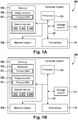
- Figure 1A depicts a schematic block diagram of a computer system 100 in accordance with an example of the present subject matter.
- the computer system 100 may be a mobile phone, measuring device, smartphone, PDA, laptop, netbook or workstation.
- the components of the computer system 100 may include, but are not limited to, one or more processors or processing units 103, a storage system 111, a memory unit 105, and a bus 107 that couples various system components including memory unit 105 to processor 103.
- the storage system 111 may include for example a hard disk drive (HDD).
- the memory unit 105 may include computer system readable media in the form of volatile memory, such as random access memory (RAM) and/or cache memory.
- the computer system 100 may communicate with one or more external devices such as a keyboard, a pointing device, a display, etc.; one or more devices that enable a user to interact with the computer system 100; and/or any devices (e.g., network card, modem, etc.) that enable the computer system 100 to communicate with one or more other computing devices. Such communication may occur via I/O interface(s) 119. Still yet, the computer system 100 may communicate with one or more networks such as a local area network (LAN), a general wide area network (WAN), and/or a public network (e.g., the Internet) via a network adapter 109. As depicted, the network adapter 109 communicates with the other components of the computer system 100 via bus 107.
- the memory unit 105 is configured to store applications that are executable on the processor 103. For example, the memory unit 105 may comprise an operating system as well as application programs.
- the memory unit 105 may comprise an image encoder 120.
- the image encoder 120 may comprise a trained convolutional neural network (CNN) 121.
- CNN convolutional neural network
- the image encoder may be the trained CNN 121.
- the CNN 121 may be advantageous as it may use little pre-processing compared to other image classification algorithms.
- the CNN 121 may for example be constructed using convolution, pooling and thresholding activation function layers, followed by fully-connected layers to project onto an image space.
- CNN parameters of the CNN 121 may be configured in accordance with the present subject matter such that the trained CNN may generate from an image x i a visual feature vector ⁇ I ( x i ) representing the image x i in an image space I .
- the CNN parameter may comprise at least one of the number of layers, the feature mapping, the number of channels per layer, the pooling operation's type, the strides of the pooling operation, the number of fully connected layers and activation functions.
- the image space may for example be defined using the trained CNN 121 in order to provide an optimal discrimination between different object classes.
- a fully connected layer of the trained CNN 121 may be employed as the image space I e.g. the last hidden layer of the trained CNN 121 may be employed as the image space. This may enable to represent an image in the image space I by the activation vector of that hidden layer.
- the CNN 121 may be obtained from a residual neural network such as ResNet-18 ( K. He, X. Zhang, S. Ren, and J. Sun. Deep residual learning for image recognition. In CVPR, pages 770-778, 2016. 6 ) by halving the dimensionality of every layer of the residual neural network and adding two 256-dimensional fully connected layers with a LeakyRelu activation after the last pooling layer of the residual neural network, followed by a softmax classification layer with a number of units corresponding to a predefined number of object classes.
- Using the residual neural network may be advantageous as it can be trained with 152 layers while still having lower complexity than other CNNs.
- the CNN 121 may be trained on base classes C base using the Adam optimizer ( D. P.
- the last fully connected hidden layer of the CNN 121 is employed as the image space I (or image embedding space).
- the image space I may enable to represent images by vectors of numbers where the dimensions of the vector is much lesser than the dimensions of an original space of images.
- the image encoder may for example be trained using images of base classes C base , wherein the C base classes may be used to train the generative model as described with reference to Figure 5 . This may provide a discriminative visual embedding space (or image space).
- the memory unit 105 may for example store visual center of mass feature vectors 122 that represent novel object classes C novel , in the image space. For example, each visual center of mass feature vector may be determined or generated from a set of images having the same object class of C novel that the visual center of mass feature vector represents.
- the memory unit 105 may further store visual center of mass feature vectors 123 that represent the novel object classes C novel , of textual samples in the image space. For example, each visual center of mass feature vector 123 may be determined or generated from a set of textual samples having the same object class of C novel that the visual center of mass feature vector 123 represents.
- the memory unit 105 may further store for each object class C novel , a combination of the respective visual center of mass feature vectors 122 and 123 obtained from images and textual samples, resulting in multi-modal center of mass feature vectors 124.
- the combination may for example be a weighted average.
- the system of Figure 1A may enable to perform a nearest neighbor search in visual embedding space, using one of the visual center of mass feature vectors 122 and 123 and the multi-modal center of mass feature vectors 124.
- Figure 1B depicts a schematic block diagram of the computer system 100 in accordance with an example of the present subject matter.
- the computer system 100 of Figure 1B may comprise in addition to the components of the computer system of Figure 1A , a generator 130 in the memory unit 105.
- the generator 130 may comprise a trained generative model 131.
- the generative model 131 may for example be a CNN.
- the generative model may be referred to as a text-conditional generative network.
- the generator 130 may be configured to receive pre-processed textual samples t i .
- the textual sample t i may be pre-processed such that a text vector ⁇ T ( t i ) representing the textual sample t i in a textual space T may be generated.
- the text vector ⁇ T ( t i ) may be (pre)stored in the computer system 100 or may be obtained by the computer system as described with reference to Figure 1C .
- the text vector ⁇ T ( t i ) may first be passed, in the generator 130, into a conditioning augmentation layer to condense/compress the input space during training. This is followed by some up-sampling convolutions, yielding a 256-dimension output vector, equivalent to the dimensionality of the image space I .
- the generator 130 may be configured to sample a noise vector from a noise prior z ⁇ R Z ⁇ N 0 1 and to concatenate the noise vector with a text vector ⁇ T ( t i ) representing a textual sample t i in the textual space T . This results in a concatenated (or noised) text vector ⁇ T ( t i ).
- the text vector ⁇ T ( t i ) may for example be compressed using a fully-connected layer (such as the conditioning augmentation layer) to a small dimension followed by a leaky-ReLU activation.
- the generative model 131 may generate from the concatenated vector ⁇ T ( t i ) a visual feature vector G t ( ⁇ T (t i )) representing the textual sample t i in the image space I .
- the image generation by the generative model 131 corresponds to a feed-forward inference in the generative model conditioned on a query text and a noise sample.
- the inference may proceed as in a normal deconvolutional network to feed-forward it through the generative model.
- the generative model 131 may for example be denoted as a G t : R Y ⁇ R V ⁇ R B , where V is the dimension of the text space, B is the dimension of the image space, and Y is the dimension of the noise input to the generative model.
- the system of Figure 1B may enable to use textual descriptions provided in training data to generate additional visual feature vectors compensating the few-shot feature sparsity.
- the representation vector as enabled by the generative model 131 in the image space has a lower dimensionality than the original image. Consequentially, the generation of feature vectors is a computational cheaper task compared to the generation of images.
- the generative model 131 may be trained as described in Figure 5 such that it learns a mapping from an encoded textual description into the pre-trained image space / for a given training tuple ( x i , t i , y i ) according to G t ( ⁇ T ( t i ) ⁇ ⁇ T ( x i ).
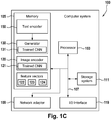
- Figure 1C depicts a schematic block diagram of the computer system 100 in accordance with an example of the present subject matter.
- the computer system 100 may comprise in addition to the components of the computer system of Figure 1B , a text encoder 150.
- the generator 130 may comprise a trained generative model 131.
- the generative model 131 may for example be a CNN.
- the generative model 131 may be referred to as a text-conditional generative network.
- the generator 130 may be configured to receive a pre-processed textual sample t i .
- the textual sample may be pre-processed such that a text vector ⁇ T ( t i ) representing the textual sample in a textual space T may be generated.
- the textual sample t i may for example be pre-processed by the text encoder 150.
- the text encoder 150 may for example be a trained CNN (text-based CNN), that is configured to receive a textual sample that is descriptive of an image and to generate from the textual sample a text vector representing the textual sample in the textual space T (text embedding space).
- the text encoder 150 may be used as a standard CNN for images, except that the image width is 1 pixel and the number of channels is equal to the alphabet size.
- the text encoder 150 may be the pre-trained text encoder as described in S. Reed, Z. Akata, H. Lee, and B. Schiele. Learning deep representations of fine-grained visual descriptions. In CVPR, pages 49-58, 2016. 3, 5 , yielding the given textual space as T ⁇ R 1024 with a CNN-RNN-based encoding function.
- Figure 2 is a flowchart of a method for recognizing an object in an input image.
- the recognition may enable to identify a pattern in data and to associate the identified pattern with an object.
- the input image may for example be a digital image having a number of pixels.
- the digital image may contain a fixed number of rows and columns of pixels, wherein pixels are the smallest individual element in an image, holding values that represent the brightness of a given color at any specific point.
- the input image may for example comprise 28 x 28 pixels.
- the input image may for example be accessed or received by an image encoder from a predefined database of images such as a database Caltech-UCSD Birds 200 (CUB-200) with photos of 200 bird species.
- the image encoder may for example be the image encoder of Figures 1A-1C .
- the image encoder may be a trained convolutional neural network (CNN) that is configured to access an input image and generate a L-dimensional feature vector, where L may be determined using the structure of the CNN.
- the CNN of the image encoder may for example be constructed using convolution, pooling and thresholding activation function layers, followed by fully-connected layers to project onto the image space.
- the CNN of the image encoder may for example be obtained by composing several different functions. For example, in addition to linear filters used for the convolution, non-linear operators may be used. The non-linearity may for example be obtained by following a linear filter by a non-linear activation function (e.g. Rectified Linear Unit (ReLU)), applied to each component of a feature map.
- the last hidden fully connected layer of the CNN of the image encoder may be employed as the image space.
- the visual feature vector that is produced by the image encoder from an image may be the activation vector of that last hidden fully connected layer of the CNN of the image encoder.
- the image encoder may encode in step 301 the input image to provide an input visual feature vector representing the input image in the image space as described with reference to Figure 1A or 1B .
- the image encoder may generate in step 301 using the input image an input visual feature vector representing the input image in the image space. For example, by inputting the 28x28 pixel image, to the trained CNN 121 of the image encoder, the trained CNN 121 may apply the trained weights at each layer resulting in the last hidden layer of the trained CNN having activation values that may be used as the input visual feature vector.
- the input visual feature vector may be the activation vector of the last fully connected hidden layer of the CNN of the image encoder.
- the object of the input image may be recognized in step 303, by selecting one of the visual center of mass vectors that fulfils a proximity criterion relative to the input visual feature vector.
- the visual center of mass vectors may for example be the vectors 122-124 stored in the computer system 100. In another example, the visual center of mass vectors may be obtained by the method of Figure 3 , before performing step 303.
- the proximity criterion may typically be (or comprise) a requirement that the class of the input image (or the class of the object in the input image) is the class represented by the closest visual feature vector to the input visual feature vector.
- a distance function such as a cosine distance may be used to determine the distance of the input visual feature vector to each multi-modal center of mass feature vector 124 of the multi-modal center of mass feature vectors 124 and the multi-modal center of mass feature vector 124 having the smallest distance to the input visual feature vector may be selected.
- the class represented by the selected multi-modal center of mass feature vector may be provided as the recognized object class of the object in the input image.
- the distance of the input visual feature vector may be determined to each visual center of mass feature vector 122 of the visual center of mass feature vectors 122 which are obtained from images only and the visual center of mass feature vector 122 having the smallest distance to the input visual feature vector may be selected. This may for example be advantageous when enough images exist in the few-short training sample or when the images of the few-short training sample may be reused in the training.
- the distance of the input visual feature vector may be determined to each visual center of mass feature vector 123 of the visual center of mass feature vectors 123 which are obtained from textual samples only and the visual center of mass feature vector 123 having the smallest distance to the input visual feature vector may be selected. This may for example be advantageous in case of zero-shot training samples.
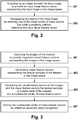
- Figure 3 is a flowchart of a method for generating visual feature vectors in accordance with an example of the present subject matter.
- a dataset comprising images of a number of classes e.g. C novel and textual samples descriptive of the respective images
- an image encoder may encode in step 401, the images of the dataset to provide respective visual feature vectors representing the images in the image space.
- the image encoder may for example be one of the image encoders described with reference to Figures 1A to 1C .
- a generator such as the generator of Figures 1B-C may generate visual feature vectors from textual samples that represent the textual samples of the dataset in the image space.
- step 405 the visual feature vectors of the images and the visual feature vectors the textual samples of a same class of the classes may be combined into a multi-modal center of mass feature vector.
- the multi-modal center of mass feature vectors may be stored in step 407 as reference values for object recognition.
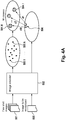
- Figure 4A is a diagram illustrating a method for recognizing an object in an image 505.
- subset C base comprises base labels or classes for which sufficient data samples exist
- the number of novel classes may be smaller than the number of base classes,
- a dataset or training dataset may be determined or defined as follows.
- the few-shot training dataset S train novel comprises a number q of images 501 which may be input to an image encoder 502 such as the image encoder of Figure 1A or the image encoder of Figure 1B .
- the image encoder 502 may generate from the image a corresponding visual feature vector ⁇ I ( x i ) in the image space I .
- the resulting N visual feature vectors 503.1-503.N are illustrated by dots in Figure 5A .
- the image encoder 502 may further generate from the input image 505 xinput a corresponding input visual feature vector ⁇ I ( x input ) in the image space I .
- the resulting visual feature vector 506 is illustrated by a dot in Figure 5A .
- a distance function such as a cosine distance may be used to compute the distance of the input visual feature vector ⁇ I ( x input ) to each of the M visual center of mass feature vector p k 504.1-M. This may result in M distances d1 to dM as indicated in Figure 5A .
- the computed distances d1 to dM may be used to determine the class membership of the object in the input image 505.
- the class k whose associated distance dk is the smallest distance among d1 to dM may be the class of the object in the input image 505.
- the class membership may for example be determined by finding the closest prototype given a distance function d (.) as follows arg k min d ( ⁇ I ( x input ), p k ). This equation may provide a powerful classification in particular as the image space is a discriminative representation of visual data.
- the method of Figure 4A may enable to assign the class of the closest visual center of mass feature vector to an unseen test sample.
- the few-shot training dataset S train novel may be limited such that the computed class prototypes ⁇ p k : k ⁇ C novel ⁇ may yield a rough approximation of the true class mean.
- the training space may be enriched by leveraging the multimodality in S train novel as described with reference to Figure 4B . This may enable the calculation of more reliable estimations of the class prototypes.
- Figure 4B is a diagram illustrating a method for recognizing an object in an image 505.
- the method of Figure 5B generates the visual center of mass feature vectors 504.1-M and the input visual feature vector 506 as described with reference to Figure 5A .
- the number of samples per class may be limited to g , denoted by S train novel g .
- the few-shot training dataset comprises textual samples that may be descriptive of the images 501 or other images.
- each textual sample t i of the few-shot training dataset may be descriptive of a respective image x i of the images 501.
- the textual samples may for example be pre-processed as described with reference to Figure 1B or Figure 1C to generate respective text vectors in the text space T by a text encoder, wherein the text vectors are concatenated with noise vectors to provide noised textual vectors 521 ⁇ T ( t i ).
- the vectors ⁇ T ( t i ) are input to a trained generative model 522.
- the trained generative model 522 may for example be the generative model of Figure 1B or the generative module of Figure 1C .
- the generative model 522 may generate a corresponding visual feature vector G t ( ⁇ T (t i )) in the image space I .
- the resulting N visual feature vectors 523.1-523.N are illustrated by full squares in Figure 4B .
- the generative model 522 may be used to generate additional visual features G t ( ⁇ T (t i )) given a textual description t i and a pre-trained text encoder ⁇ T (.).
- the visual feature vectors G t ( ⁇ T ( t i ) of the textual samples may be combined based on their respective object class. For example, for each object class k of the M object classes, the ( N k ) visual feature vectors G t ( ⁇ T (t i )) that represent that object class k may be combined to provide a visual center of mass feature vector p T k . This may result in M visual center of mass feature vectors 524.1-M as indicated in Figure 4B by the triangles, wherein each triangle has a different filling structure to indicate the respective object class.
- the visual center of mass feature vectors 504.1-M that are obtained from images and the visual center of mass feature vectors 524.1-M that are obtained from textual samples may be combined e.g. using a weighted average to provide M multi-modal center of mass feature vectors 533.1-M as indicated in Figure 4B by squares, wherein each square has a different filling structure to indicate the respective object class.
- the combination may be performed as follows: p k + ⁇ ⁇ p T k 1 + ⁇ , where p k ⁇ is a predefined weighting factor.
- a distance function such as a cosine distance may be used to compute the distance of the input visual feature vector ⁇ I ( x input ) to each of the M multi-modal center of mass feature vector. This may result in M distances D1 to DM as indicated in Figure 5B .
- the computed distances D1 to DM may be used to determine the class membership of the object in the input image 505.
- the class k whose associated distance Dk is the smallest distance among D1 to DM may be the class of the object in the input image 505.
- the class membership may for example be determined as follows arg k min d ⁇ I x input , p k + ⁇ ⁇ p T k 1 + ⁇ .
- the methods of Figure 4A and 4B may for example be tested using images 501, 505 and textual samples from known databases as follows.
- a fine-grained multimodal classification dataset may be used.
- the classification dataset may comprise a CUB-200 dataset obtained from the CUB-200-2011 data source with bird data.
- the CUB-200 dataset contains 11,788 images of 200 different bird species, with J ⁇ R 256 ⁇ 256 .
- the dataset is split equally into training and test data. As a consequence, samples are roughly equally distributed, with training and test set each containing 30 images per category or class. Additionally, 10 short textual descriptions per image are provided.
- a text-encoder pre-trained yielding a text embedding space T ⁇ R 1024 with a CNN-RNN-based encoding function may be used.
- the dataset is split such that
- 150 and
- 50.
- n ⁇ ⁇ 1, 2, 5,10, 20 ⁇ images of C novel are used for training.
- a 50-way classification may be performed such that during test time, all classes are considered for the classification task.
- the experiments may run 600 times following and a random few-shot episode may be sampled, i.e. a random choice of n samples per class in every iteration to cover randomness.
- the average top-5 accuracy including 95% confidence intervals are shown in Table 580 of Figure 4C for the method Figure 4A 582 and the method Figure 4B 583.
- ReseNet-18 are reported for 5-way classification in the 1- and 5-shot scenarios. This implies that in every few-shot learning episode, 5 random classes are sampled for which a classification task has to be solved, followed by the choice of n samples that are available per class. For the sake of comparability, the present method is evaluated in the same experimental setup.
- Figure 5 is a diagram of a computer system 600 for training a text-conditional generative model 605 (such as the generative model 131 and 522) in accordance with an example of the present subject matter.
- a text-conditional generative model 605 such as the generative model 131 and 522
- the computer system 600 comprises an image encoder 601.
- the image encoder 601 is configured to generate from an image x i 611 a visual feature vector ⁇ I ( x i ) 613 representing the image 611 in an image space I .
- the image encoder 601 may for example be a trained encoder as described with the image encoder of Figure 1A, 1B or 1C .
- the computer system 600 further comprises a text encoder 603.
- the text encoder 603 may be configured to encode a textual sample t i 612 to provide a textual feature vector ⁇ T ( t i ) in a textual space.
- the text encoder 603 may for example be the text encoder described with reference to Figure 1C .
- a conditioning augmentation may be performed on the textual feature vector ⁇ T ( t i ) to condense the textual space during training.
- a noise vector may be sampled from a noise prior z ⁇ R z ⁇ N 0 1 and the noise vector may be concatenated with the textual feature vector ⁇ T ( t i ) (after being condition augmented) and the resulting textual feature vector ⁇ T ( t i ) 614 is provided as input to the generative model 605.
- the generative model 605 is configured to generate from the input textual feature vector ⁇ T ( t i ) a visual feature vector G t ( ⁇ T (t i )) representing the textual sample t i (and also representing the textual feature vector ⁇ T ( t i )) in the image space I .
- the computer system 600 further comprises a discriminative model 607 that may be used for training the generative model 605 as follows.
- the generative model 605 and the discriminative model 607 may be trained (or jointly trained) using the textual feature vectors ⁇ T ( t i ) 614 and the visual feature vector ⁇ I ( x i ) 613 so that the generative model 605 may generate visual feature vectors G t ( ⁇ T (t i )) from textual feature vectors ⁇ T ( t i ) 614 and the discriminative model 607 may determine if the generated visual feature vector G t ( ⁇ T (t i )) is a real feature vector or generated feature vector.
- the generative model 605 and the discriminative model 607 may be trained by optimizing the following first loss function E x i ⁇ p data log D ⁇ I x i + E t i ⁇ p data , z log D G t ⁇ T t i , z .
- the discriminative model 607 may further be configured or trained to classify the generated feature vector G t ( ⁇ T (t i )) into one of predefined object classes such as the base classes C base described with reference to Figure 4A .
- the two loss functions are optimized in an adversarial fashion. The adversarial nature of the task forces the generative model 605 to focus on the most class-discriminative feature elements.
- the optimization of the augmented loss function of the discriminative model may for example comprise backpropagation of error information indicative of the error produced by the neural network of the discriminative model when it makes predictions of a real or false visual feature vector and the error produced by the neural network of the discriminative model and when it makes predictions of a class of a visual feature vector.
- the optimization of the augmented loss function of the discriminative model may for example comprise backpropagation of error information indicative of the error produced by the neural network of the generative model when it generates a visual feature vector with a given class.
- the discriminative model 607 may for example be in a feedback loop with the classes and or a label indicating real or false images 611 and the generative model 605 may for example be in a feedback loop with the discriminative model 607.
- the term "computer system” refers to data processing hardware and encompasses all kinds of apparatus, devices, and machines for processing data, including by way of example, a programmable processor, a computer, or multiple processors or computers.
- the apparatus can also be or further include special purpose logic circuitry, e.g., a central processing unit (CPU), a FPGA (field programmable gate array), or an ASIC (application specific integrated circuit).
- the data processing apparatus and/or special purpose logic circuitry may be hardware-based and/or software-based.
- the apparatus can optionally include code that creates an execution environment for computer programs, e.g., code that constitutes processor firmware, a protocol stack, a database management system, an operating system, or a combination of one or more of them.
- the present disclosure contemplates the use of data processing apparatuses with or without conventional operating systems, for example LINUX, UNIX, WINDOWS, MAC OS, ANDROID, IOS or any other suitable conventional operating system.
- a computer program which may also be referred to or described as a program, software, a software application, a module, a software module, a script, or code, can be written in any form of programming language, including compiled or interpreted languages, or declarative or procedural languages, and it can be deployed in any form, including as a stand-alone program or as a module, component, subroutine, or other unit suitable for use in a computing environment.
- a computer program may, but need not, correspond to a file in a file system.
- a program can be stored in a portion of a file that holds other programs or data, e.g., one or more scripts stored in a markup language document, in a single file dedicated to the program in question, or in multiple coordinated files, e.g., files that store one or more modules, sub programs, or portions of code.
- a computer program can be deployed to be executed on one computer or on multiple computers that are located at one site or distributed across multiple sites and interconnected by a communication network. While portions of the programs illustrated in the various figures are shown as individual modules that implement the various features and functionality through various objects, methods, or other processes, the programs may instead include a number of sub-modules, third-party services, components, libraries, and such, as appropriate. Conversely, the features and functionality of various components can be combined into single components as appropriate.
- the processes and logic flows described in this specification can be performed by one or more programmable computers executing one or more computer programs to perform functions by operating on input data and generating output.
- the processes and logic flows can also be performed by, and apparatus can also be implemented as, special purpose logic circuitry, e.g., a CPU, a FPGA, or an ASIC.
- Computers suitable for the execution of a computer program can be based on general or special purpose microprocessors, both, or any other kind of CPU.
- a CPU will receive instructions and data from a read only memory (ROM) or a random access memory (RAM) or both.
- ROM read only memory
- RAM random access memory
- the essential elements of a computer are a CPU for performing or executing instructions and one or more memory devices for storing instructions and data.
- a computer will also include, or be operatively coupled to, receive data from or transfer data to, or both, one or more mass storage devices for storing data, e.g., magnetic, magneto optical disks, or optical disks.
- mass storage devices for storing data, e.g., magnetic, magneto optical disks, or optical disks.
- a computer need not have such devices.
- a computer can be embedded in another device, e.g., a mobile telephone, a personal digital assistant (PDA), a mobile audio or video player, a game console, a global positioning system (GPS) receiver, or a portable storage device, e.g., a universal serial bus (USB) flash drive, to name just a few.
- PDA personal digital assistant
- GPS global positioning system
- USB universal serial bus
- Computer readable media suitable for storing computer program instructions and data include all forms of non-volatile memory, media and memory devices, including by way of example semiconductor memory devices, e.g., erasable programmable read-only memory (EPROM), electrically-erasable programmable read-only memory (EEPROM), and flash memory devices; magnetic disks, e.g., internal hard disks or removable disks; magneto optical disks; and CD ROM, DVD+/-R, DVD-RAM, and DVD-ROM disks.
- semiconductor memory devices e.g., erasable programmable read-only memory (EPROM), electrically-erasable programmable read-only memory (EEPROM), and flash memory devices
- EPROM erasable programmable read-only memory
- EEPROM electrically-erasable programmable read-only memory
- flash memory devices e.g., electrically-erasable programmable read-only memory (EEPROM), and flash memory devices
- magnetic disks e.g., internal hard disk
- the memory may store various objects or data, including caches, classes, frameworks, applications, backup data, jobs, web pages, web page templates, database tables, repositories storing business and/or dynamic information, and any other appropriate information including any parameters, variables, algorithms, instructions, rules, constraints, or references thereto. Additionally, the memory may include any other appropriate data, such as logs, policies, security or access data, reporting files, as well as others.
- the processor and the memory can be supplemented by, or incorporated in, special purpose logic circuitry.
- GUI graphical user interface
- GUI may be used in the singular or the plural to describe one or more graphical user interfaces and each of the displays of a particular graphical user interface. Therefore, a GUI may represent any graphical user interface, including but not limited to, a web browser, a touch screen, or a command line interface (CLI) that processes information and efficiently presents the information results to the user.
- a GUI may include a plurality of user interface (Ul) elements, some or all associated with a web browser, such as interactive fields, pull-down lists, and buttons operable by the business suite user. These and other UI elements may be related to or represent the functions of the web browser.
- Implementations of the subject matter described in this specification can be implemented in a computing system that includes a back end component, e.g., as a data server, or that includes a middleware component, e.g., an application server, or that includes a front-end component, e.g., a client computer having a graphical user interface or a web browser through which a user can interact with an implementation of the subject matter described in this specification, or any combination of one or more such back end, middleware, or front end components.
- the components of the system can be interconnected by any form or medium of wireline and/or wireless digital data communication, e.g., a communication network.
- Examples of communication networks include a local area network (LAN), a radio access network (RAN), a metropolitan area network (MAN), a wide area network (WAN), Worldwide In-teroperability for Microwave Access (WIMAX), a wireless local area network (WLAN) using, for example, 802.11 a/b/g/n and/or 802.20, all or a portion of the Internet, and/or any other communication system or systems at one or more locations.
- the network may communicate with, for example, Internet Protocol (IP) packets, Frame Relay frames, Asynchronous Transfer Mode (ATM) cells, voice, video, data, and/or other suitable information between network addresses.
- IP Internet Protocol
- ATM Asynchronous Transfer Mode
- the computing system can include clients and servers.
- a client and server are generally remote from each other and typically interact through a communication network.
- the relationship of client and server arises by virtue of computer programs running on the respective computers and having a client-server relationship to each other.
- any or all of the components of the computing system may interface with each other and/or the interface using an application programming interface (API) and/or a service layer.
- the API may include specifications for routines, data structures, and object classes.
- the API may be either computer language independent or dependent and refer to a complete interface, a single function, or even a set of APIs.
- the service layer provides software services to the computing system. The functionality of the various components of the computing system may be accessible for all service consumers via this service layer.
- Software services provide reusable, defined business functionalities through a defined interface.
- the interface may be software written in JAVA, C++, or other suitable language providing data in extensible markup language (XML) format or other suitable format.
- the API and/or service layer may be an integral and/or a stand-alone component in relation to other components of the computing system. Moreover, any or all parts of the service layer may be implemented as child or sub-modules of another software module, enterprise application, or hardware module without departing from the scope of this disclosure.
- example processes and computer implementable techniques. But example environment (or their software or other components) contemplate using, implementing, or executing any suitable technique for performing these and other tasks. It will be understood that these processes are for illustration purposes only and that the described or similar techniques may be performed at any appropriate time, including concurrently, individually, in parallel, and/or in combination. In addition, many of the operations in these processes may take place simultaneously, concurrently, in parallel, and/or in different orders than as shown. Moreover, the example environment may use processes with additional, fewer and/or different operations, as long as the methods remain appropriate.
- Implementations of the subject matter and the functional operations described in this specification can be implemented in digital electronic circuitry, in tangibly-embodied computer software or firmware, in computer hardware, including the structures disclosed in this specification and their structural equivalents, or in combinations of one or more of them.
- Implementations of the subject matter described in this specification can be implemented as one or more computer programs, i.e., one or more modules of computer program instructions encoded on a tangible, non-transitory computer-storage medium for execution by, or to control the operation of, data processing apparatus.
- the program instructions can be encoded on an artificially generated propagated signal, e.g., a machine-generated electrical, optical, or electromagnetic signal that is generated to encode information for transmission to suitable receiver apparatus for execution by a data processing apparatus.
- the computer-storage medium can be a machine-readable storage device, a machine-readable storage substrate, a random or serial access memory device, or a combination of one or more of them.
- control system refers to data processing hardware and encompasses all kinds of apparatus, devices, and machines for processing data, including by way of example, a programmable processor, a computer, or multiple processors or computers.
- the apparatus can also be or further include special purpose logic circuitry, e.g., a central processing unit (CPU), a FPGA (field programmable gate array), or an ASIC (application specific integrated circuit).
- the data processing apparatus and/or special purpose logic circuitry may be hardware-based and/or software-based.
- the apparatus can optionally include code that creates an execution environment for computer programs, e.g., code that constitutes processor firmware, a protocol stack, a database management system, an operating system, or a combination of one or more of them.
- the present disclosure contemplates the use of data processing apparatuses with or without conventional operating systems, for example LINUX, UNIX, WINDOWS, MAC OS, ANDROID, IOS or any other suitable conventional operating system.
- a computer program which may also be referred to or described as a program, software, a software application, a module, a software module, a script, or code, can be written in any form of programming language, including compiled or interpreted languages, or declarative or procedural languages, and it can be deployed in any form, including as a stand-alone program or as a module, component, subroutine, or other unit suitable for use in a computing environment.
- a computer program may, but need not, correspond to a file in a file system.
- a program can be stored in a portion of a file that holds other programs or data, e.g., one or more scripts stored in a markup language document, in a single file dedicated to the program in question, or in multiple coordinated files, e.g., files that store one or more modules, sub programs, or portions of code.
- a computer program can be deployed to be executed on one computer or on multiple computers that are located at one site or distributed across multiple sites and interconnected by a communication network. While portions of the programs illustrated in the various figures are shown as individual modules that implement the various features and functionality through various objects, methods, or other processes, the programs may instead include a number of sub-modules, third-party services, components, libraries, and such, as appropriate. Conversely, the features and functionality of various components can be combined into single components as appropriate.
- the processes and logic flows described in this specification can be performed by one or more programmable computers executing one or more computer programs to perform functions by operating on input data and generating output.
- the processes and logic flows can also be performed by, and apparatus can also be implemented as, special purpose logic circuitry, e.g., a CPU, a FPGA, or an ASIC.
- Computers suitable for the execution of a computer program can be based on general or special purpose microprocessors, both, or any other kind of CPU.
- a CPU will receive instructions and data from a read only memory (ROM) or a random access memory (RAM) or both.
- ROM read only memory
- RAM random access memory
- the essential elements of a computer are a CPU for performing or executing instructions and one or more memory devices for storing instructions and data.
- a computer will also include, or be operatively coupled to, receive data from or transfer data to, or both, one or more mass storage devices for storing data, e.g., magnetic, magneto optical disks, or optical disks.
- mass storage devices for storing data, e.g., magnetic, magneto optical disks, or optical disks.
- a computer need not have such devices.
- a computer can be embedded in another device, e.g., a mobile telephone, a personal digital assistant (PDA), a mobile audio or video player, a game console, a global positioning system (GPS) receiver, or a portable storage device, e.g., a universal serial bus (USB) flash drive, to name just a few.
- PDA personal digital assistant
- GPS global positioning system
- USB universal serial bus
- Computer readable media suitable for storing computer program instructions and data include all forms of non-volatile memory, media and memory devices, including by way of example semiconductor memory devices, e.g., erasable programmable read-only memory (EPROM), electrically-erasable programmable read-only memory (EEPROM), and flash memory devices; magnetic disks, e.g., internal hard disks or removable disks; magneto optical disks; and CD ROM, DVD+/-R, DVD-RAM, and DVD-ROM disks.
- semiconductor memory devices e.g., erasable programmable read-only memory (EPROM), electrically-erasable programmable read-only memory (EEPROM), and flash memory devices
- EPROM erasable programmable read-only memory
- EEPROM electrically-erasable programmable read-only memory
- flash memory devices e.g., electrically-erasable programmable read-only memory (EEPROM), and flash memory devices
- magnetic disks e.g., internal hard disk
- the memory may store various objects or data, including caches, classes, frameworks, applications, backup data, jobs, web pages, web page templates, database tables, repositories storing business and/or dynamic information, and any other appropriate information including any parameters, variables, algorithms, instructions, rules, constraints, or references thereto. Additionally, the memory may include any other appropriate data, such as logs, policies, security or access data, reporting files, as well as others.
- the processor and the memory can be supplemented by, or incorporated in, special purpose logic circuitry.
- GUI graphical user interface
- GUI may be used in the singular or the plural to describe one or more graphical user interfaces and each of the displays of a particular graphical user interface. Therefore, a GUI may represent any graphical user interface, including but not limited to, a web browser, a touch screen, or a command line interface (CLI) that processes information and efficiently presents the information results to the user.
- a GUI may include a plurality of user interface (Ul) elements, some or all associated with a web browser, such as interactive fields, pull-down lists, and buttons operable by the business suite user. These and other UI elements may be related to or represent the functions of the web browser.
- Implementations of the subject matter described in this specification can be implemented in a computing system that includes a back end component, e.g., as a data server, or that includes a middleware component, e.g., an application server, or that includes a front-end component, e.g., a client computer having a graphical user interface or a web browser through which a user can interact with an implementation of the subject matter described in this specification, or any combination of one or more such back end, middleware, or front end components.
- the components of the system can be interconnected by any form or medium of wireline and/or wireless digital data communication, e.g., a communication network.
- Examples of communication networks include a local area network (LAN), a radio access network (RAN), a metropolitan area network (MAN), a wide area network (WAN), Worldwide In-teroperability for Microwave Access (WIMAX), a wireless local area network (WLAN) using, for example, 802.11 a/b/g/n and/or 802.20, all or a portion of the Internet, and/or any other communication system or systems at one or more locations.
- the network may communicate with, for example, Internet Protocol (IP) packets, Frame Relay frames, Asynchronous Transfer Mode (ATM) cells, voice, video, data, and/or other suitable information between network addresses.
- IP Internet Protocol
- ATM Asynchronous Transfer Mode
- the computing system can include clients and servers.
- a client and server are generally remote from each other and typically interact through a communication network.
- the relationship of client and server arises by virtue of computer programs running on the respective computers and having a client-server relationship to each other.
- any or all of the components of the computing system may interface with each other and/or the interface using an application programming interface (API) and/or a service layer.
- the API may include specifications for routines, data structures, and object classes.
- the API may be either computer language independent or dependent and refer to a complete interface, a single function, or even a set of APIs.
- the service layer provides software services to the computing system. The functionality of the various components of the computing system may be accessible for all service consumers via this service layer.
- Software services provide reusable, defined business functionalities through a defined interface.
- the interface may be software written in JAVA, C++, or other suitable language providing data in extensible markup language (XML) format or other suitable format.
- the API and/or service layer may be an integral and/or a stand-alone component in relation to other components of the computing system. Moreover, any or all parts of the service layer may be implemented as child or sub-modules of another software module, enterprise application, or hardware module without departing from the scope of this disclosure.
Landscapes
- Engineering & Computer Science (AREA)
- Theoretical Computer Science (AREA)
- Evolutionary Computation (AREA)
- Data Mining & Analysis (AREA)
- Artificial Intelligence (AREA)
- General Physics & Mathematics (AREA)
- Computer Vision & Pattern Recognition (AREA)
- Physics & Mathematics (AREA)
- General Engineering & Computer Science (AREA)
- Evolutionary Biology (AREA)
- Bioinformatics & Computational Biology (AREA)
- Bioinformatics & Cheminformatics (AREA)
- Life Sciences & Earth Sciences (AREA)
- Health & Medical Sciences (AREA)
- Computing Systems (AREA)
- Databases & Information Systems (AREA)
- General Health & Medical Sciences (AREA)
- Medical Informatics (AREA)
- Software Systems (AREA)
- Multimedia (AREA)
- Image Analysis (AREA)
Priority Applications (1)
| Application Number | Priority Date | Filing Date | Title |
|---|---|---|---|
| EP19180588.6A EP3754548B1 (de) | 2019-06-17 | 2019-06-17 | Verfahren zum erkennen eines objekts in einem bild unter verwendung von merkmalsvektoren eines neuronalen encoding-netzes |
Applications Claiming Priority (1)
| Application Number | Priority Date | Filing Date | Title |
|---|---|---|---|
| EP19180588.6A EP3754548B1 (de) | 2019-06-17 | 2019-06-17 | Verfahren zum erkennen eines objekts in einem bild unter verwendung von merkmalsvektoren eines neuronalen encoding-netzes |
Publications (3)
| Publication Number | Publication Date |
|---|---|
| EP3754548A1 true EP3754548A1 (de) | 2020-12-23 |
| EP3754548C0 EP3754548C0 (de) | 2026-03-04 |
| EP3754548B1 EP3754548B1 (de) | 2026-03-04 |
Family
ID=66912726
Family Applications (1)
| Application Number | Title | Priority Date | Filing Date |
|---|---|---|---|
| EP19180588.6A Active EP3754548B1 (de) | 2019-06-17 | 2019-06-17 | Verfahren zum erkennen eines objekts in einem bild unter verwendung von merkmalsvektoren eines neuronalen encoding-netzes |
Country Status (1)
| Country | Link |
|---|---|
| EP (1) | EP3754548B1 (de) |
Cited By (26)
| Publication number | Priority date | Publication date | Assignee | Title |
|---|---|---|---|---|
| CN112633297A (zh) * | 2020-12-28 | 2021-04-09 | 浙江大华技术股份有限公司 | 目标对象的识别方法、装置、存储介质以及电子装置 |
| CN112949722A (zh) * | 2021-03-05 | 2021-06-11 | 北京大学深圳研究生院 | 一种基于图像组合特征表述的少样本学习方法及系统 |
| CN112992308A (zh) * | 2021-03-25 | 2021-06-18 | 腾讯科技(深圳)有限公司 | 医学图像报告生成模型的训练方法及图像报告生成方法 |
| CN113569080A (zh) * | 2021-01-15 | 2021-10-29 | 腾讯科技(深圳)有限公司 | 基于人工智能的字库处理方法、装置、设备及存储介质 |
| CN113723288A (zh) * | 2021-08-30 | 2021-11-30 | 平安科技(深圳)有限公司 | 基于多模态混合模型的业务数据处理方法及装置 |
| CN113807413A (zh) * | 2021-08-30 | 2021-12-17 | 北京百度网讯科技有限公司 | 对象的识别方法、装置、电子设备 |
| CN113920404A (zh) * | 2021-11-09 | 2022-01-11 | 北京百度网讯科技有限公司 | 训练方法、图像处理方法、装置、电子设备以及存储介质 |
| CN114048350A (zh) * | 2021-11-08 | 2022-02-15 | 湖南大学 | 一种基于细粒度跨模态对齐模型的文本-视频检索方法 |
| CN114519395A (zh) * | 2022-02-22 | 2022-05-20 | 平安科技(深圳)有限公司 | 模型的训练方法和装置、文本摘要生成方法和装置、设备 |
| CN114564616A (zh) * | 2022-03-04 | 2022-05-31 | 北方工业大学 | 基于多模态特征融合的高效视频检索模型 |
| CN114821602A (zh) * | 2022-06-28 | 2022-07-29 | 北京汉仪创新科技股份有限公司 | 训练对抗神经网络生成字库的方法、系统、设备和介质 |
| CN115527216A (zh) * | 2022-11-09 | 2022-12-27 | 中国矿业大学(北京) | 基于调制融合和生成对抗网络的文本生成图像方法 |
| EP4134840A1 (de) * | 2021-08-12 | 2023-02-15 | Naver Corporation | Berechnung der datenkompatibilität für die text-erweiterte visuelle abfrage unter verwendung einer text-bild-pair-vector-repräsentation |
| WO2023051583A1 (zh) * | 2021-09-30 | 2023-04-06 | 中兴通讯股份有限公司 | 视频编码单元划分方法及装置、计算机设备和计算机可读存储介质 |
| WO2023051238A1 (zh) * | 2021-09-29 | 2023-04-06 | 北京字跳网络技术有限公司 | 动物形象的生成方法、装置、设备及存储介质 |
| CN116452895A (zh) * | 2023-06-13 | 2023-07-18 | 中国科学技术大学 | 基于多模态对称增强的小样本图像分类方法、装置及介质 |
| CN116611496A (zh) * | 2023-05-29 | 2023-08-18 | 光控特斯联(重庆)信息技术有限公司 | 文本到图像的生成模型优化方法、装置、设备及存储介质 |
| CN117077085A (zh) * | 2023-10-17 | 2023-11-17 | 中国科学技术大学 | 大模型结合双路记忆的多模态有害社交媒体内容识别方法 |
| US20240070232A1 (en) * | 2022-08-22 | 2024-02-29 | Nec Laboratories America, Inc. | Snr detection with few-shot trained models |
| CN117726721A (zh) * | 2024-02-08 | 2024-03-19 | 湖南君安科技有限公司 | 基于主题驱动与多模态融合的图像生成方法、设备及介质 |
| EP4361852A1 (de) * | 2022-10-31 | 2024-05-01 | Genetec Inc. | Identifizierungssystem und -verfahren unter verwendung von texteingabedaten und maschinenlearning |
| WO2024186177A1 (ko) * | 2023-03-09 | 2024-09-12 | 주식회사 엘지 경영개발원 | 비전-언어 트랜스포머를 사전 훈련하는 방법 및 이를 통해 사전 훈련된 비전-언어 트랜스포머를 포함하는 인공지능 시스템 |
| CN118823496A (zh) * | 2023-04-21 | 2024-10-22 | 腾讯科技(深圳)有限公司 | 图像生成模型的训练方法、装置、计算机设备及存储介质 |
| CN119274239A (zh) * | 2024-12-12 | 2025-01-07 | 国开在线教育科技有限公司 | 开放教育体系下基于多模态的考后违规行为判定方法 |
| CN119887772A (zh) * | 2025-03-27 | 2025-04-25 | 宁德思客琦智能装备有限公司 | 一种基于主动学习检测激光焊接缺陷的方法及系统 |
| CN120894456A (zh) * | 2025-09-28 | 2025-11-04 | 南京邮电大学 | 基于空间感知解耦的文本到图像生成方法及系统 |
Citations (4)
| Publication number | Priority date | Publication date | Assignee | Title |
|---|---|---|---|---|
| CN108596265A (zh) * | 2018-05-02 | 2018-09-28 | 中山大学 | 基于文本描述信息和生成对抗网络的视频生成模型 |
| WO2018192672A1 (en) * | 2017-04-19 | 2018-10-25 | Siemens Healthcare Gmbh | Target detection in latent space |
| US20190046068A1 (en) * | 2017-08-10 | 2019-02-14 | Siemens Healthcare Gmbh | Protocol independent image processing with adversarial networks |
| US10223586B1 (en) * | 2018-07-15 | 2019-03-05 | Cognigo Research Ltd. | Multi-modal electronic document classification |
Family Cites Families (1)
| Publication number | Priority date | Publication date | Assignee | Title |
|---|---|---|---|---|
| WO2019011936A1 (en) * | 2017-07-10 | 2019-01-17 | Katholieke Universiteit Leuven | IMAGE EVALUATION METHOD |
-
2019
- 2019-06-17 EP EP19180588.6A patent/EP3754548B1/de active Active
Patent Citations (4)
| Publication number | Priority date | Publication date | Assignee | Title |
|---|---|---|---|---|
| WO2018192672A1 (en) * | 2017-04-19 | 2018-10-25 | Siemens Healthcare Gmbh | Target detection in latent space |
| US20190046068A1 (en) * | 2017-08-10 | 2019-02-14 | Siemens Healthcare Gmbh | Protocol independent image processing with adversarial networks |
| CN108596265A (zh) * | 2018-05-02 | 2018-09-28 | 中山大学 | 基于文本描述信息和生成对抗网络的视频生成模型 |
| US10223586B1 (en) * | 2018-07-15 | 2019-03-05 | Cognigo Research Ltd. | Multi-modal electronic document classification |
Non-Patent Citations (3)
| Title |
|---|
| D. P. KINGMAJ. BA. ADAM: "A method for stochastic optimization", ICLR, vol. 6, 2014 |
| K. HEX. ZHANGS. RENJ. SUN: "Deep residual learning for image recognition", CVPR, vol. 6, 2016, pages 770 - 778 |
| S. REEDZ. AKATAH. LEEB. SCHIELE: "Learning deep representations of fine-grained visual descriptions", CVPR, vol. 3, no. 5, 2016, pages 49 - 58 |
Cited By (39)
| Publication number | Priority date | Publication date | Assignee | Title |
|---|---|---|---|---|
| CN112633297A (zh) * | 2020-12-28 | 2021-04-09 | 浙江大华技术股份有限公司 | 目标对象的识别方法、装置、存储介质以及电子装置 |
| CN112633297B (zh) * | 2020-12-28 | 2023-04-07 | 浙江大华技术股份有限公司 | 目标对象的识别方法、装置、存储介质以及电子装置 |
| CN113569080A (zh) * | 2021-01-15 | 2021-10-29 | 腾讯科技(深圳)有限公司 | 基于人工智能的字库处理方法、装置、设备及存储介质 |
| CN112949722A (zh) * | 2021-03-05 | 2021-06-11 | 北京大学深圳研究生院 | 一种基于图像组合特征表述的少样本学习方法及系统 |
| CN112992308A (zh) * | 2021-03-25 | 2021-06-18 | 腾讯科技(深圳)有限公司 | 医学图像报告生成模型的训练方法及图像报告生成方法 |
| CN112992308B (zh) * | 2021-03-25 | 2023-05-16 | 腾讯科技(深圳)有限公司 | 医学图像报告生成模型的训练方法及图像报告生成方法 |
| US12488042B2 (en) | 2021-08-12 | 2025-12-02 | Naver Corporation | Data compatibility for text-enhanced visual retrieval |
| EP4134840A1 (de) * | 2021-08-12 | 2023-02-15 | Naver Corporation | Berechnung der datenkompatibilität für die text-erweiterte visuelle abfrage unter verwendung einer text-bild-pair-vector-repräsentation |
| CN113723288A (zh) * | 2021-08-30 | 2021-11-30 | 平安科技(深圳)有限公司 | 基于多模态混合模型的业务数据处理方法及装置 |
| CN113807413A (zh) * | 2021-08-30 | 2021-12-17 | 北京百度网讯科技有限公司 | 对象的识别方法、装置、电子设备 |
| CN113807413B (zh) * | 2021-08-30 | 2024-02-06 | 北京百度网讯科技有限公司 | 对象的识别方法、装置、电子设备 |
| CN113723288B (zh) * | 2021-08-30 | 2023-10-27 | 平安科技(深圳)有限公司 | 基于多模态混合模型的业务数据处理方法及装置 |
| WO2023051238A1 (zh) * | 2021-09-29 | 2023-04-06 | 北京字跳网络技术有限公司 | 动物形象的生成方法、装置、设备及存储介质 |
| WO2023051583A1 (zh) * | 2021-09-30 | 2023-04-06 | 中兴通讯股份有限公司 | 视频编码单元划分方法及装置、计算机设备和计算机可读存储介质 |
| CN114048350A (zh) * | 2021-11-08 | 2022-02-15 | 湖南大学 | 一种基于细粒度跨模态对齐模型的文本-视频检索方法 |
| CN113920404A (zh) * | 2021-11-09 | 2022-01-11 | 北京百度网讯科技有限公司 | 训练方法、图像处理方法、装置、电子设备以及存储介质 |
| WO2023159763A1 (zh) * | 2022-02-22 | 2023-08-31 | 平安科技(深圳)有限公司 | 模型的训练方法和装置、文本摘要生成方法和装置、设备 |
| CN114519395B (zh) * | 2022-02-22 | 2024-05-14 | 平安科技(深圳)有限公司 | 模型的训练方法和装置、文本摘要生成方法和装置、设备 |
| CN114519395A (zh) * | 2022-02-22 | 2022-05-20 | 平安科技(深圳)有限公司 | 模型的训练方法和装置、文本摘要生成方法和装置、设备 |
| CN114564616A (zh) * | 2022-03-04 | 2022-05-31 | 北方工业大学 | 基于多模态特征融合的高效视频检索模型 |
| CN114821602A (zh) * | 2022-06-28 | 2022-07-29 | 北京汉仪创新科技股份有限公司 | 训练对抗神经网络生成字库的方法、系统、设备和介质 |
| US12517983B2 (en) * | 2022-08-22 | 2026-01-06 | Nec Corporation | SNR detection with few-shot trained models |
| US20240070232A1 (en) * | 2022-08-22 | 2024-02-29 | Nec Laboratories America, Inc. | Snr detection with few-shot trained models |
| US12174842B2 (en) | 2022-10-31 | 2024-12-24 | Genetec Inc. | System and method for record identification |
| EP4361852A1 (de) * | 2022-10-31 | 2024-05-01 | Genetec Inc. | Identifizierungssystem und -verfahren unter verwendung von texteingabedaten und maschinenlearning |
| CN115527216A (zh) * | 2022-11-09 | 2022-12-27 | 中国矿业大学(北京) | 基于调制融合和生成对抗网络的文本生成图像方法 |
| CN115527216B (zh) * | 2022-11-09 | 2023-05-23 | 中国矿业大学(北京) | 基于调制融合和生成对抗网络的文本生成图像方法 |
| WO2024186177A1 (ko) * | 2023-03-09 | 2024-09-12 | 주식회사 엘지 경영개발원 | 비전-언어 트랜스포머를 사전 훈련하는 방법 및 이를 통해 사전 훈련된 비전-언어 트랜스포머를 포함하는 인공지능 시스템 |
| CN118823496A (zh) * | 2023-04-21 | 2024-10-22 | 腾讯科技(深圳)有限公司 | 图像生成模型的训练方法、装置、计算机设备及存储介质 |
| CN116611496A (zh) * | 2023-05-29 | 2023-08-18 | 光控特斯联(重庆)信息技术有限公司 | 文本到图像的生成模型优化方法、装置、设备及存储介质 |
| CN116452895A (zh) * | 2023-06-13 | 2023-07-18 | 中国科学技术大学 | 基于多模态对称增强的小样本图像分类方法、装置及介质 |
| CN116452895B (zh) * | 2023-06-13 | 2023-10-20 | 中国科学技术大学 | 基于多模态对称增强的小样本图像分类方法、装置及介质 |
| CN117077085B (zh) * | 2023-10-17 | 2024-02-09 | 中国科学技术大学 | 大模型结合双路记忆的多模态有害社交媒体内容识别方法 |
| CN117077085A (zh) * | 2023-10-17 | 2023-11-17 | 中国科学技术大学 | 大模型结合双路记忆的多模态有害社交媒体内容识别方法 |
| CN117726721B (zh) * | 2024-02-08 | 2024-04-30 | 湖南君安科技有限公司 | 基于主题驱动与多模态融合的图像生成方法、设备及介质 |
| CN117726721A (zh) * | 2024-02-08 | 2024-03-19 | 湖南君安科技有限公司 | 基于主题驱动与多模态融合的图像生成方法、设备及介质 |
| CN119274239A (zh) * | 2024-12-12 | 2025-01-07 | 国开在线教育科技有限公司 | 开放教育体系下基于多模态的考后违规行为判定方法 |
| CN119887772A (zh) * | 2025-03-27 | 2025-04-25 | 宁德思客琦智能装备有限公司 | 一种基于主动学习检测激光焊接缺陷的方法及系统 |
| CN120894456A (zh) * | 2025-09-28 | 2025-11-04 | 南京邮电大学 | 基于空间感知解耦的文本到图像生成方法及系统 |
Also Published As
| Publication number | Publication date |
|---|---|
| EP3754548C0 (de) | 2026-03-04 |
| EP3754548B1 (de) | 2026-03-04 |
Similar Documents
| Publication | Publication Date | Title |
|---|---|---|
| EP3754548B1 (de) | Verfahren zum erkennen eines objekts in einem bild unter verwendung von merkmalsvektoren eines neuronalen encoding-netzes | |
| EP3754549B1 (de) | Computervisionsverfahren zum erkennen einer objektkategorie in einem digitalen bild | |
| Alajrami et al. | Handwritten signature verification using deep learning | |
| CN114255403B (zh) | 基于深度学习的光学遥感图像数据处理方法及系统 | |
| CN110362677B (zh) | 文本数据类别的识别方法及装置、存储介质、计算机设备 | |
| Demir et al. | Batch-mode active-learning methods for the interactive classification of remote sensing images | |
| US9977968B2 (en) | System and method for relevance estimation in summarization of videos of multi-step activities | |
| US20240185582A1 (en) | Annotation-efficient image anomaly detection | |
| Rasool | Feature‐Level vs. Score‐Level Fusion in the Human Identification System | |
| Zhang et al. | Large-scale aerial image categorization using a multitask topological codebook | |
| Suvarnam et al. | Combination of CNN-GRU model to recognize characters of a license plate number without segmentation | |
| Talab et al. | A Novel Statistical Feature Analysis‐Based Global and Local Method for Face Recognition | |
| CN110414299A (zh) | 一种基于计算机视觉的猴脸亲缘关系分析方法 | |
| CN110780965A (zh) | 基于视觉的流程自动化方法、设备及可读存储介质 | |
| Pattnaik et al. | AI-based techniques for real-time face recognition-based attendance system-A comparative study | |
| CN117372144A (zh) | 应用于小样本场景的风控策略智能化方法及系统 | |
| Majumder et al. | Siamese-transformer network for offline handwritten signature verification using few-shot | |
| Bellante et al. | Quantum eigenfaces: Linear feature mapping and nearest neighbor classification with outlier detection | |
| CN119939359B (zh) | 一种随钻围岩分类与识别方法、装置、介质及设备 | |
| CN110070018A (zh) | 一种结合深度学习的地震灾害场景识别方法 | |
| CN119068238B (zh) | 基于改进的yolov8s的人体安检违禁品检测模型、方法及系统 | |
| Bhuvaneswari et al. | Robust image forgery classification using SqueezeNet network | |
| CN114385843A (zh) | 分类网络构建方法以及图像检索方法 | |
| Natarajan et al. | Multi-channel shape-flow kernel descriptors for robust video event detection and retrieval | |
| KR20220084931A (ko) | 이물질 선별 방법 및 장치 |
Legal Events
| Date | Code | Title | Description |
|---|---|---|---|
| PUAI | Public reference made under article 153(3) epc to a published international application that has entered the european phase |
Free format text: ORIGINAL CODE: 0009012 |
|
| STAA | Information on the status of an ep patent application or granted ep patent |
Free format text: STATUS: REQUEST FOR EXAMINATION WAS MADE |
|
| 17P | Request for examination filed |
Effective date: 20200402 |
|
| AK | Designated contracting states |
Kind code of ref document: A1 Designated state(s): AL AT BE BG CH CY CZ DE DK EE ES FI FR GB GR HR HU IE IS IT LI LT LU LV MC MK MT NL NO PL PT RO RS SE SI SK SM TR |
|
| AX | Request for extension of the european patent |
Extension state: BA ME |
|
| STAA | Information on the status of an ep patent application or granted ep patent |
Free format text: STATUS: EXAMINATION IS IN PROGRESS |
|
| 17Q | First examination report despatched |
Effective date: 20210531 |
|
| REG | Reference to a national code |
Ref country code: DE Ref legal event code: R079 Free format text: PREVIOUS MAIN CLASS: G06K0009620000 Ipc: G06V0010820000 Ref country code: DE Ref legal event code: R079 Ref document number: 602019082004 Country of ref document: DE Free format text: PREVIOUS MAIN CLASS: G06K0009620000 Ipc: G06V0010820000 |
|
| GRAP | Despatch of communication of intention to grant a patent |
Free format text: ORIGINAL CODE: EPIDOSNIGR1 |
|
| STAA | Information on the status of an ep patent application or granted ep patent |
Free format text: STATUS: GRANT OF PATENT IS INTENDED |
|
| RIC1 | Information provided on ipc code assigned before grant |
Ipc: G06V 10/82 20220101AFI20251001BHEP Ipc: G06F 18/00 20230101ALI20251001BHEP |
|
| INTG | Intention to grant announced |
Effective date: 20251014 |
|
| GRAS | Grant fee paid |
Free format text: ORIGINAL CODE: EPIDOSNIGR3 |
|
| GRAA | (expected) grant |
Free format text: ORIGINAL CODE: 0009210 |
|
| STAA | Information on the status of an ep patent application or granted ep patent |
Free format text: STATUS: THE PATENT HAS BEEN GRANTED |
|
| AK | Designated contracting states |
Kind code of ref document: B1 Designated state(s): AL AT BE BG CH CY CZ DE DK EE ES FI FR GB GR HR HU IE IS IT LI LT LU LV MC MK MT NL NO PL PT RO RS SE SI SK SM TR |
|
| REG | Reference to a national code |
Ref country code: CH Ref legal event code: F10 Free format text: ST27 STATUS EVENT CODE: U-0-0-F10-F00 (AS PROVIDED BY THE NATIONAL OFFICE) Effective date: 20260304 Ref country code: GB Ref legal event code: FG4D |
|
| REG | Reference to a national code |
Ref country code: IE Ref legal event code: FG4D |
|
| REG | Reference to a national code |
Ref country code: DE Ref legal event code: R096 Ref document number: 602019082004 Country of ref document: DE |
|
| U01 | Request for unitary effect filed |
Effective date: 20260312 |
|
| U07 | Unitary effect registered |
Designated state(s): AT BE BG DE DK EE FI FR IT LT LU LV MT NL PT RO SE SI Effective date: 20260317 |