EP3756461A1 - Processus de lavage des vêtements - Google Patents
Processus de lavage des vêtements Download PDFInfo
- Publication number
- EP3756461A1 EP3756461A1 EP20187990.5A EP20187990A EP3756461A1 EP 3756461 A1 EP3756461 A1 EP 3756461A1 EP 20187990 A EP20187990 A EP 20187990A EP 3756461 A1 EP3756461 A1 EP 3756461A1
- Authority
- EP
- European Patent Office
- Prior art keywords
- composition
- quaternary ammonium
- water soluble
- lactic acid
- ammonium compounds
- Prior art date
- Legal status (The legal status is an assumption and is not a legal conclusion. Google has not performed a legal analysis and makes no representation as to the accuracy of the status listed.)
- Pending
Links
Images
Classifications
-
- C—CHEMISTRY; METALLURGY
- C11—ANIMAL OR VEGETABLE OILS, FATS, FATTY SUBSTANCES OR WAXES; FATTY ACIDS THEREFROM; DETERGENTS; CANDLES
- C11D—DETERGENT COMPOSITIONS; USE OF SINGLE SUBSTANCES AS DETERGENTS; SOAP OR SOAP-MAKING; RESIN SOAPS; RECOVERY OF GLYCEROL
- C11D3/00—Other compounding ingredients of detergent compositions covered in group C11D1/00
- C11D3/48—Medical, disinfecting agents, disinfecting, antibacterial, germicidal or antimicrobial compositions
-
- A—HUMAN NECESSITIES
- A01—AGRICULTURE; FORESTRY; ANIMAL HUSBANDRY; HUNTING; TRAPPING; FISHING
- A01N—PRESERVATION OF BODIES OF HUMANS OR ANIMALS OR PLANTS OR PARTS THEREOF; BIOCIDES, e.g. AS DISINFECTANTS, AS PESTICIDES OR AS HERBICIDES; PEST REPELLANTS OR ATTRACTANTS; PLANT GROWTH REGULATORS
- A01N33/00—Biocides, pest repellants or attractants, or plant growth regulators containing organic nitrogen compounds
- A01N33/02—Amines; Quaternary ammonium compounds
- A01N33/12—Quaternary ammonium compounds
-
- A—HUMAN NECESSITIES
- A01—AGRICULTURE; FORESTRY; ANIMAL HUSBANDRY; HUNTING; TRAPPING; FISHING
- A01N—PRESERVATION OF BODIES OF HUMANS OR ANIMALS OR PLANTS OR PARTS THEREOF; BIOCIDES, e.g. AS DISINFECTANTS, AS PESTICIDES OR AS HERBICIDES; PEST REPELLANTS OR ATTRACTANTS; PLANT GROWTH REGULATORS
- A01N37/00—Biocides, pest repellants or attractants, or plant growth regulators containing organic compounds containing a carbon atom having three bonds to hetero atoms with at the most two bonds to halogen, e.g. carboxylic acids
- A01N37/36—Biocides, pest repellants or attractants, or plant growth regulators containing organic compounds containing a carbon atom having three bonds to hetero atoms with at the most two bonds to halogen, e.g. carboxylic acids containing at least one carboxylic group or a thio analogue, or a derivative thereof, and a singly bound oxygen or sulfur atom attached to the same carbon skeleton, this oxygen or sulfur atom not being a member of a carboxylic group or of a thio analogue, or of a derivative thereof, e.g. hydroxy-carboxylic acids
-
- C—CHEMISTRY; METALLURGY
- C11—ANIMAL OR VEGETABLE OILS, FATS, FATTY SUBSTANCES OR WAXES; FATTY ACIDS THEREFROM; DETERGENTS; CANDLES
- C11D—DETERGENT COMPOSITIONS; USE OF SINGLE SUBSTANCES AS DETERGENTS; SOAP OR SOAP-MAKING; RESIN SOAPS; RECOVERY OF GLYCEROL
- C11D1/00—Detergent compositions based essentially on surface-active compounds; Use of these compounds as a detergent
- C11D1/38—Cationic compounds
- C11D1/62—Quaternary ammonium compounds
-
- C—CHEMISTRY; METALLURGY
- C11—ANIMAL OR VEGETABLE OILS, FATS, FATTY SUBSTANCES OR WAXES; FATTY ACIDS THEREFROM; DETERGENTS; CANDLES
- C11D—DETERGENT COMPOSITIONS; USE OF SINGLE SUBSTANCES AS DETERGENTS; SOAP OR SOAP-MAKING; RESIN SOAPS; RECOVERY OF GLYCEROL
- C11D3/00—Other compounding ingredients of detergent compositions covered in group C11D1/00
- C11D3/0005—Other compounding ingredients characterised by their effect
- C11D3/001—Softening compositions
- C11D3/0015—Softening compositions liquid
-
- C—CHEMISTRY; METALLURGY
- C11—ANIMAL OR VEGETABLE OILS, FATS, FATTY SUBSTANCES OR WAXES; FATTY ACIDS THEREFROM; DETERGENTS; CANDLES
- C11D—DETERGENT COMPOSITIONS; USE OF SINGLE SUBSTANCES AS DETERGENTS; SOAP OR SOAP-MAKING; RESIN SOAPS; RECOVERY OF GLYCEROL
- C11D3/00—Other compounding ingredients of detergent compositions covered in group C11D1/00
- C11D3/16—Organic compounds
- C11D3/20—Organic compounds containing oxygen
- C11D3/2075—Carboxylic acids-salts thereof
- C11D3/2086—Hydroxy carboxylic acids-salts thereof
-
- C—CHEMISTRY; METALLURGY
- C11—ANIMAL OR VEGETABLE OILS, FATS, FATTY SUBSTANCES OR WAXES; FATTY ACIDS THEREFROM; DETERGENTS; CANDLES
- C11D—DETERGENT COMPOSITIONS; USE OF SINGLE SUBSTANCES AS DETERGENTS; SOAP OR SOAP-MAKING; RESIN SOAPS; RECOVERY OF GLYCEROL
- C11D2111/00—Cleaning compositions characterised by the objects to be cleaned; Cleaning compositions characterised by non-standard cleaning or washing processes
- C11D2111/10—Objects to be cleaned
- C11D2111/12—Soft surfaces, e.g. textile
Definitions
- This invention relates to a biocidal composition to be added to a laundry washing process to treat items being laundered, such as clothes, particularly in a washing machine.
- Pseudomonas spp. are a commonly found genus on laundered cotton in both developed and developing countries. Infections of the skin or soft tissues by Pseudomonas spp. tend to be serious and complex because these bacteria are both invasive and toxigenic. These opportunistic pathogens are more likely to cause illness amongst the growing global population of immunocompromised people.
- Pseudomonas aeruginosa P. aeruginosa
- P. aeruginosa is a Gram-negative bacterium that is commonly found in the environment e.g. soil, water and other moist locations.
- P. aeruginosa is an opportunistic pathogen.
- This organism produces tissue-damaging toxins and can cause urinary tract infections, respiratory system infections, dermatitis, soft tissue infections, bacteremia, bone and joint infections, gastrointestinal infections and a variety of systemic infections, particularly in patients with severe burns and in cancer and AIDS patients who are immunosuppressed.
- This bacterium is of particular concern to individuals with cystic fibrosis, who are highly susceptible to pseudomonal lung infections. The case fatality rate for such individuals infected with P. aeruginosa approaches 50%. It can also cause ear infections in more healthy individuals.
- Laundry hygiene products can be classified into two main classes. Those containing bleach and those containing other biocides. A major drawback with the otherwise excellent bleach based products is that they may also bleach any coloured fabrics. Also, they are typically powder based and consumers prefer a liquid additive to fit with the liquid laundry detergent and/or liquid fabric conditioner they use.
- DDAC didecyl ammonium chloride
- ADBAC alkyl dimethyl benzalkonium chloride
- the recommended dose of 120g delivered via the rinse conditioner drawer would deliver 2.88g of the 60: 40 DDAC: ADBAC mixed quaternary ammonium salt biocide system.
- P . aeruginosa in a suspension test with 5 minutes contact time at 20°C and under "dirty" conditions as defined by the EN1276 protocol is insufficient to give claimable hygiene and even under "clean” conditions, sometimes argued to represent the state of clothes entering the final rinse, it does not always deliver the log 5 reduction required for claim support.
- the high dose (2 X 60mL capfuls) can fully utilise the rinse conditioner compartment leaving no room for a fabric conditioner to be added.
- WO2013/156371 discloses an aqueous fabric conditioner composition
- a fabric softening active comprising an ester-linked triethanolamine quaternary ammonium compound and from 0.001 % to 2 wt%, of a non-ionic, antimicrobial, and from 0.01 to 10 wt% perfume.
- the selected nonionic antimicrobial gives a composition stability advantage over other antimicrobials tested and shows synergistic in-wear antimicrobial activity in combination with the ester linked triethanolamine quaternary ammonium compound in the fabric conditioner.
- non-ionic antimicrobial in addition to the non-ionic antimicrobial other antimicrobial agents may also be present, provided that these are not present at a level which causes instability in the formulation.
- useful further antimicrobial agents are chelating agents, which are particularly useful in reducing the resistance of Gram-negative microbes in hard water. Acid biocides may also be present.
- the publication also discloses that for more sensitive formulations ultra-pure grades of L-lactic acid are available that enable formulations to rely on lactic acid for antimicrobial claims or preservation, while promoting the fact that they are fragrance-free.
- the article also notes that other secondary ingredients like preservatives, chelating agents and alcohols, can boost the bactericidal action of lactic acid.
- the disclosure reports that a mixture of the lactic acid and SLES was tested for synergy for 5 mins (ended by dilution neutralisation) at 20 °C against P . aeruginosa (DSM939), S . aureus (ATCC 6538), E. coli (ATCC 10536) and E. hirae (ATCC 10541) looking for a 99.999% or log 5 reduction following a modified DIN EN 1040 protocol. They found a pronounced synergy between the two components over a broad range of concentrations.
- the surfactant helps the lactic acid to overcome and penetrate the bacterial cell walls.
- the lactic acid can fulfil its entire biocidal potential and the cell perishes subsequently.
- single substances lactic acid, surfactant
- the combination of both results in a drastic enhancement of the biocidal performance. Due to this favourable synergy, comprehensive disinfection claims (reducing 99.999% of all bacteria - log 5 reduction) are supported even at lactic acid concentrations down to 1% and below. This, in turn, means that end formulations may be developed bearing less strict labelling.
- WO 2001/00777 discloses surface disinfecting compositions containing a mixture of disinfecting agents, a booster agent for the disinfecting agents an anionic surfactant and a hydrocarbon ingredient, a water soluble cosurfactant and water.
- the disinfecting agent is used at a level of 0.05 to 10 wt%.
- the booster agent is selected from chelants including organic acids such as lactic acid or citric acid and is used at a level of from 0 to 6 wt%.
- the examples all use 2.5 wt% of Bardac 2170 (DDAC) and from 0 to 2 wt% of lactic acid or citric acid.
- DDAC Bardac 2170
- Bardac 114 is taught as an alternative mixture of quaternary ammonium compound biocides.
- both the general teaching and the examples point to the use of an excess of quaternary ammonium compound biocide over lactic acid.
- the booster agent is taught to improve the bacterial activity of the disinfecting agent thereby increasing the bacterial kill.
- WO 2001/81519 discloses a toilet bowl cleaner which contains nonionic surfactant, a disinfecting agent, a polymeric viscosity modifier and water.
- the disinfecting agent is present at a level of from 0.05 to 2.5 wt% and is selected from various quaternary ammonium compounds including Bardac 114.
- the composition may optionally further include from 0 to 2.5 wt % of a proton donating agent selected from a long list of organic acids, including lactic acid. These are not used in the one example.
- US 3932655 discloses a disinfecting concentrate that includes a mixture of n-alkylated benzalkonium halides, preferably, n-alkylated benzyl ammonium chlorides or benzalkonium chlorides, each having from C8-18 in their respective alkyl portions, preferably C12-18, and mixtures thereof.
- the concentrate further includes a preservative and water.
- Use solutions prepared from the concentrate contain minor amounts thereof in order to be efficacious.
- the concentrate consists of 99.5 to 99.9 wt% inert ingredients and 0.1 to 0.5 wt% active ingredient consisting of a mixture of: a chelating agent and a mixture of n-alkylated benzyl alkyl ammonium halides or n-alkylated benzyl alkyl ammonium halides or n-alkyl benzalkonium halides.
- the chelating agent is preferably either ethylenediamine tetraacetic acid or the alkali metal salts thereof such as disodium ethylene diamine tetraacetic acid.
- Other useful compounds include the sugar acids or alkali metal salts thereof, such as, gluconic acid, lactic acid, citric acid, sodium or potassium gluconate, lactate, citrate and the like.
- the active ingredient contains from about 50 to 75 wt% of the mixture of quaternary ammonium chlorides and from about 25 to 50 wt% of chelating agent. Preferably, the active ingredient contains from about 50 to 60 wt% of the mixture of quaternary ammonium chlorides and from about 40 to 50 wt% of chelating agent.
- US 5861371 discloses an aqueous composition for the post-treatment of washed laundry containing 0.1 to 30 wt% of a water insoluble quaternary ammonium compound, 0.1 to 50 wt% of a water-soluble quaternary ammonium compound, 0 to 5 wt% of a terpene compound, 0.1 to 20 wt% of a water-soluble acid, and 0.1 to 20 wt% of an emulsifier.
- the composition is for improving fabric hygiene and deodorizing properties.
- the addition of the terpene provides this benefit without using destabilising amounts of water soluble quaternary ammonium compound biocides.
- WO 2010/027863 discloses a biocidal composition containing a biocidal agent and a potentiator system, the mixture having synergistic biocidal activity.
- a synergy index is defined in paragraph 048.
- the biocidal agent comprises at least one quaternary ammonium compound and the potentiator system comprises at least one surfactant, solvent, chelating agent and /or buffering agent.
- Chelating agents are said to be particularly suited for dilutable biocidal compositions where the diluent can have a high mineral content. Lactic acid is not mentioned as a suitable chelating agent. It is mentioned as a suitable buffering agent.
- the buffering agent is taught at a level of 0 to 6 wt%, down to 0.3 to 0.5 wt%, whereas the quaternary ammonium compound active level taught is 6 to 25 wt% down to 10 to 12 wt%.
- a buffering agent such as lactic acid
- EP 1454638 (Bode Chemie) discloses concentrated disinfecting compositions based on quaternary ammonium compounds and their use for chemical-thermal care for instruments. Examples 1 and 3 use lactic acid and 2 types of QAC. There is an excess of total QAC over lactic acid.
- WO 2013/067150 (Univ Columbia) describes compositions with sustained antimicrobial activity comprising one or more cationic antimicrobial agent and an optional organic acid and or zinc salt as an anti-irritant. The amount of QAC appears to exceed that of the organic acid.
- WO 2013/098547 discloses antimicrobial compositions comprising at least one antimicrobial quaternary ammonium compound, a hydrophilic polymer, a polar solvent, at least one nonionic surfactant and a chelate.
- the invention resides in the particular type of polymer chosen. The examples all have a large excess of quaternary ammonium compound over chelate / lactic acid.
- a method for adding a biocidal composition to a laundry washing process comprising the steps of adding a dose of from 2 to 100 ml of a liquid composition to the rinse aid dispenser of an automatic washing machine, optionally together with a dose of liquid fabric conditioner in the same dispensing compartment, the composition comprising one or more water soluble quaternary ammonium compounds and one or more water soluble organic hydroxy acids; wherein the weight ratio of the water soluble organic hydroxy acids to the quaternary ammonium compounds lies in the range from 95:5 to 52:48.
- the liquid composition comprises at least two different water-soluble quaternary ammonium compounds.
- the weight ratio of water soluble organic hydroxy acids to water soluble quaternary ammonium compounds preferably lies in the range 75:25 to 54:46.
- the water-soluble organic hydroxy acids preferably comprises lactic acid, or a mixture of citric acid and malonic acid.
- L-lactic acid is particularly suitable.
- composition there are two water soluble quaternary ammonium compounds in the composition, one being ADEBAC and the other ADBAC.
- the composition may further comprise DDAC.
- the biocidal composition may comprise a carrier solvent and a mixture of:
- ADBAC comprising C8-18 alkyl chains with even numbers of carbon atoms is preferred.
- a high content of C12-14 is most preferred as these chain lengths are thought to be the most biocidal.
- ADEBAC is preferably liquid with C8-12 alkyl chains. Preferably greater than 90% of the alkyl chains by number should be C10.
- a method for adding a liquid biocidal composition according to the first aspect to a laundry washing process comprising the steps of adding a dose of from 2 to 100 ml of the liquid composition to the rinse aid dispenser of an automatic washing machine, optionally together with a dose of liquid fabric conditioner in the same dispensing compartment.
- the dose is preferably from 4 to 40 ml, more preferably from 5 to 25 ml.
- composition is formulated as a liquid.
- Adding the biocide to the rinse in this way is preferable to adding it to the initial wash liquor because (i) of incompatibility with anionic surfactant containing main wash products and (ii) fresh microbes may be introduced with the rinse water and they too will need to be treated with biocide to ensure hygiene of the washed and rinsed laundry items.
- Providing the mixed biocide system as a separate concentrate for addition to the laundry process, preferably during the rinse phase, can also avoid the issue of the quaternary ammonium compound biocides destabilising the fabric conditioner if they are formulated together with the fabric conditioner and stored in contact in a bottle for extended periods.
- compositions according to the invention provides hygienically clean clothes with greatly reduced bacterial loading, especially reduced loading of P . aeruginosa.
- Use of the compositions can further provide improved clothes freshness and fewer incidences of residual malodour on clothes and from machines themselves.
- Use of the compositions can also reduce the incidence of black mould often seen in fabric-conditioner drawers of automatic washing machines.
- the composition is suitably formulated at a pH greater than 2, preferably at a pH of 2.2 or higher. This improves the safety of the formulation for consumers. In use the compositions will normally be diluted and the pH will rise to something nearer to neutral. Generally, a more acid composition will kill more bacteria.
- the present invention allows for delivery of an effective antimicrobial mix via a concentrated composition that may either be provided in single- or multi-dose form. It is effective when used alone and it is also effective when combined with fabric conditioner. This allows consumer flexibility to dose the composition together with a fabric-conditioner via the rinse compartment of an automatic washing machine or to use it as a standalone rinse treatment.
- the technology can be formulated into a fabric conditioner composition to provide an additional benefit from such a combined product.
- Smart in-wash delivery devices may be configured to enable sequential release of benefit agents; the concentrated antimicrobial compositions of this invention may be conveniently released, especially into the rinse, from such a device.
- compositions of this invention are primarily intended for delivery in the rinse; they could alternatively be adapted to deliver antimicrobial action to any step of the wash cycle including pre-wash, main wash, soak, steam, UV-irradiated or any rinse step.
- the invention is not restricted to machine washing and will also provide a hygiene benefit when used in a hand wash laundry process.
- compositions are designed to be sufficiently concentrated to provide the required level of hygiene when 2 to 100 ml, preferably about 4 to 40 ml more preferably 5 to 25 ml, of the composition is delivered to the rinse cycle of an automatic washing machine.
- L-Lactic acid alone fails to kill sufficient bacteria to pass the EN1276 regulatory test when delivered as a 10 mL dose. Indeed even at 100 ml dose it still gives inadequate kill when used on its own.
- L-Lactic acid is an organic acid and shares several features with similar sized acids.
- the combination of low acid dissociation constant (pKa) and low hydrophobicity makes it readily miscible with water.
- L-Lactic acid resides primarily in the water phase of an emulsion. This gives it an advantage over more hydrophobic organic acids, because the water phase is where bacteria also reside. It is particularly good at "shuttling" protons, or acidity, across cell membranes. Once inside the cell, there are four broad-acting mechanisms that inhibit the bacterial cell. These four mechanisms were reviewed by Desriac and coworkers in 2013:
- Lactic acid is effective against Gram-negative bacteria in the absence of surfactants.
- Gram-positive bacteria are generally less sensitive to lactic acid.
- Secondary ingredients like preservatives, chelating agents and alcohols, can boost the bactericidal action of lactic acid.
- Lu et al., J. Food Protection (2011) Vol 74(6) p893 to 8 discloses only a small difference in E. coli reduction between L- and D-lactic acid under anaerobic conditions, but refers to earlier work in aerobic environments where L-lactic acid gives significantly better results. As the laundry operation carried out under agitation in a washing machine is primarily an aerobic process we believed that the L-lactic acid would be preferred for that use.
- carboxylic acids can be used, either alone or in mixtures which each other or with lactic acid.
- One useful mixture is a 50:50 wt% mix of citric and malonic acids. Acids that are in liquid form (e.g. lactic acid) and that can therefore easily be mixed with the quaternary ammonium compounds that are also in liquid form are preferred for processing reasons. L-Lactic acid is preferred over the racemic mixture because it is a registered biocide and can therefore be more readily used to support a claim to biocidal activity.
- quaternary ammonium compound (QAC) biocides and biocide mixtures suitable for use in the invention are given in Table 1: Table 1 Material name Supplier Active level Active substances Bardac 114 Lonza 0.48 ADEBAC : ADBAC : DDAC BTC 2125 M80E Stepan 0.81 ADEBAC : ADBAC BTC 8358F Stepan 0.81 ADBAC BTC 1010-E Stepan 0.5 DDAC Sanilac 80* Corbion 0.8 L-Lactic acid Tinosan HP100 BASF 0.3 Diclosan Citric acid Sigma Aldrich 1.0 Citric Acid Malonic acid Sigma Aldrich 1.0 Malonic Acid *Purac® Sanilac (L-lactic acid) is being registered as a biocide by Corbion.
- Table 1 Material name Supplier Active level Active substances Bardac 114 Lonza 0.48 ADEBAC : ADBAC : DDAC BTC 2125 M80E Stepan 0.81 ADEBAC : ADBAC BTC 8358F Stepan 0.81 ADBAC BTC 10
- ADEBAC C12-14-alkyl [(ethylphenyl) methyl] dimethyl chlorides CAS No 85409-23-0
- ADBAC Benzyl C12-16 alkyl dimethyl chlorides CAS No. 68424-85-1
- DDAC Didecyldimethylammonium chloride CAS No 7173-51-5
- L-lactic acid 2-hydroxypropanoic acid (C 3 H 6 O 3 )
- Bardac 114 which comprises three antimicrobial quaternary ammonium compounds (QACs) in equal measure (ADEBAC, ADBAC & DDAC) in propan-2-ol (7%) and water. This is marketed as a synergistic mixture and is said to be about 3 times more efficient than ADBAC (i.e. BKC).
- the active content of Bardac 114 is:
- EN1276 usually requires testing against 4 species of bacteria. They are:
- P . aeruginosa One of the species used in the EN1276 challenge test is P . aeruginosa and the concentrated composition is very effective against this.
- Pseudomonas spp. is a major contributor to the microbiome associated with laundered clothes in many markets.
- QAC based systems it is known that P . aeruginosa is the most difficult of the species to kill in the EN 1276 test.
- Diclosan a bi-halogenated compound; 4-4' dichloro-2-hydroxy diphenyl ether may be added to the composition in some embodiments to provide weight efficient biocidal mixtures.
- the viscosity, colour, smell and pH of the compositions may be adjusted by the addition of thickeners, colorants, fragrances, and pH modifiers.
- Suitable thickeners include: gellan gum, diutan gum, xanthan gum, guar gum, acrylate/acrylic copolymers, acrylate/aminoacrylate copolymers, alginate, arabinogalactan, carrageenan, pectin, water swellable clays, fumed silicas, compatible non-ionics and glycerol in combination with any of the aforementioned materials.
- Suitable pH modifiers should be cheap, odourless, non-toxic and produce clear solutions upon modification of the pH. They include: Sodium Hydroxide, Potassium Hydroxide, Calcium Hydroxide and Lithium Hydroxide.
- compositions When they are supplied as concentrates the compositions may either be packed as single doses, or in a package capable of delivering multiple doses. Suitable packs that assist with the measurement of doses as low as 10 ml are familiar to the person skilled in the art.
- the synergy gain of the mixture is defined as 1 S abc and is therefore synergistic when > 1.
- compositions were made by blending raw materials using a simple overhead mixer to form the compositions in Table 2. No order of addition issues were encountered.
- a high throughput quantitative suspension test conducted in micro titre plates (MTP) and based upon a scaled down version of the classical suspension testing encompassed in BS EN 1276: 1997 is used for evaluating the bactericidal activity of the mixed biocide systems.
- the approach can be used with any bacterium but in this example the bacterial strain P . aeruginosa ATCC 15442 is used exclusively.
- the scaled down version of the full EN 1276 assay is carried out using a Hamilton robotics automated liquid handling system with a 96-well head.
- Table 3 Comparison of BS EN 1276 and the scaled down MTP method
- BS EN 1276 Classical Suspension Test Scaled Down 96-well MTP EN 1276 MTP Suspension test 1 ml test bacteria into 1 ml interfering substance (0.3/0.0 3g/L bovine serum albumin) in a 30 ml sterilin. 100 ⁇ l test bacteria into 100 ⁇ l interfering substance (0.3g/L bovine serum albumin) in a 96-well MTP.
- a span of 6 Logs in bacterial population is thus compared to the bacterial growth control wells. 1 ml into a petri dish and overlaid with molten agar ⁇ 40°C
- End point optical density read at 620 nm A change of 0.2 OD units with respect to the initial reading is used to set the growth threshold. The concentration prior to the one at which this threshold is passed indicates the Most Probable Number of bacteria that a given concentration of the biocidal mixture can kill at each dilution.
- MTP suspension test the following reagents are used:- Neutralizer: Tween 80, 60 g/L; lecithin, 6 g/L; L-histidine, 2 g/L; sodium thiosulphate, 10 g/L; sterilised by autoclaving.
- Recover media Tryptone Soya Broth 30 g/L sterilised by autoclaving.
- Bacterial suspension media Bacteriological Tryptone Powder, 1 g/L; sodium chloride 8.5 g/L sterilised by autoclaving.
- Bacterial strain used Pseudomonas aeruginosa ATCC 15442 Contact Time: 5 minutes ⁇ 10 seconds Test Temperature: 20°C ⁇ 1°C Interfering Substance: Dirty conditions: 0.3% w/v bovine serum albumin in test
- Interfering substance prepared in sterile distilled water at 3% and filter sterilised by passing through a 0.2 ⁇ m cellulose filter unit. Temperature and duration of incubation: 37°C ⁇ 1°C for 20 hour duration
- Bacterial suspensions were prepared from fresh plate cultures on tryptone soya agar and incubated for 18 hours at 37°C. Suspensions were made up to a density of 1.7 McFarland units (1 to 1.5 x 10 8 cfu/ml) in tryptone diluent.
- Formulations were prepared as detailed above and diluted in a 2.2 ml deep well plate using water of 24°FH for all dilutions. Concentrations were made to allow for a 1.25 in test dilution. Positive and negative controls of 1% Virkon solution and water of 24°FH were used.
- the error is obtained by summing up the sum of the squares of the errors over all experimental data points for a composition.
- the minimisation of the error by varying the values of a3 and a4 can be obtained by any suitable optimisation strategy, e.g. using the "solver" within excel.
- LOG10 (x) is the logarithm of x in base 10.
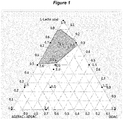
- Figure 1 is a plot of the data in Table 4 showing the composition area according to the invention, where the synergy gain is greater than or equal to 2.7.
- 2.6 being the synergy gain for a mixture of 50 wt% L-lactic acid, 25 wt% ADEBAC and 25% ADBAC.
- 2.6 is the synergy gain obtained when 67% ADEBAC: ADBAC is blended with 33% DDAC to create a mixture equivalent in QAC composition to the synergistic Bardac 114 blend.
- Table 4 Example DDAC ADEBAC: ADBAC * L-Lactic acid High soil P.
- ADBAC is a 50 wt% mix of the two quaternary materials
Landscapes
- Life Sciences & Earth Sciences (AREA)
- Chemical & Material Sciences (AREA)
- Engineering & Computer Science (AREA)
- Wood Science & Technology (AREA)
- Chemical Kinetics & Catalysis (AREA)
- Oil, Petroleum & Natural Gas (AREA)
- Organic Chemistry (AREA)
- Health & Medical Sciences (AREA)
- Pest Control & Pesticides (AREA)
- Plant Pathology (AREA)
- Agronomy & Crop Science (AREA)
- Dentistry (AREA)
- General Health & Medical Sciences (AREA)
- Zoology (AREA)
- Environmental Sciences (AREA)
- Emergency Medicine (AREA)
- Agricultural Chemicals And Associated Chemicals (AREA)
- Detergent Compositions (AREA)
Applications Claiming Priority (3)
| Application Number | Priority Date | Filing Date | Title |
|---|---|---|---|
| EP16203653 | 2016-12-13 | ||
| PCT/EP2017/079945 WO2018108466A1 (fr) | 2016-12-13 | 2017-11-21 | Composition biocide destinée à être utilisée dans un procédé de lavage de linge |
| EP17800886.8A EP3554232B1 (fr) | 2016-12-13 | 2017-11-21 | Composition biocide destinée à être utilisée dans un procédé de lavage de linge |
Related Parent Applications (2)
| Application Number | Title | Priority Date | Filing Date |
|---|---|---|---|
| EP17800886.8A Division EP3554232B1 (fr) | 2016-12-13 | 2017-11-21 | Composition biocide destinée à être utilisée dans un procédé de lavage de linge |
| EP17800886.8A Division-Into EP3554232B1 (fr) | 2016-12-13 | 2017-11-21 | Composition biocide destinée à être utilisée dans un procédé de lavage de linge |
Publications (1)
| Publication Number | Publication Date |
|---|---|
| EP3756461A1 true EP3756461A1 (fr) | 2020-12-30 |
Family
ID=57569907
Family Applications (2)
| Application Number | Title | Priority Date | Filing Date |
|---|---|---|---|
| EP20187990.5A Pending EP3756461A1 (fr) | 2016-12-13 | 2017-11-21 | Processus de lavage des vêtements |
| EP17800886.8A Active EP3554232B1 (fr) | 2016-12-13 | 2017-11-21 | Composition biocide destinée à être utilisée dans un procédé de lavage de linge |
Family Applications After (1)
| Application Number | Title | Priority Date | Filing Date |
|---|---|---|---|
| EP17800886.8A Active EP3554232B1 (fr) | 2016-12-13 | 2017-11-21 | Composition biocide destinée à être utilisée dans un procédé de lavage de linge |
Country Status (7)
| Country | Link |
|---|---|
| EP (2) | EP3756461A1 (fr) |
| JP (1) | JP7023949B2 (fr) |
| CN (1) | CN110049672B (fr) |
| BR (1) | BR112019011935B1 (fr) |
| ES (1) | ES2938638T3 (fr) |
| WO (1) | WO2018108466A1 (fr) |
| ZA (1) | ZA201902805B (fr) |
Cited By (3)
| Publication number | Priority date | Publication date | Assignee | Title |
|---|---|---|---|---|
| EP4112706A1 (fr) * | 2021-06-29 | 2023-01-04 | Reckitt Benckiser Health Limited | Composition de désinfection de lessive |
| WO2023275536A1 (fr) | 2021-06-29 | 2023-01-05 | Reckitt Benckiser Health Limited | Composition d'assainissement du linge |
| WO2023105205A1 (fr) * | 2021-12-06 | 2023-06-15 | Reckitt Benckiser Health Limited | Composition de désinfection et d'adoucissement du linge |
Families Citing this family (11)
| Publication number | Priority date | Publication date | Assignee | Title |
|---|---|---|---|---|
| EP3771741A1 (fr) | 2019-07-29 | 2021-02-03 | The Procter & Gamble Company | Traitement des tissus |
| EP3771770B1 (fr) | 2019-07-29 | 2025-04-09 | The Procter & Gamble Company | Compositions désodorisantes antimicrobiennes |
| WO2021062091A1 (fr) | 2019-09-26 | 2021-04-01 | Ecolab Usa Inc. | Dégraissant et nettoyant à base de solvant hautement alcalin renfermant de la gomme de diutane en tant que système épaississant principal |
| US12344819B2 (en) | 2019-09-27 | 2025-07-01 | Church & Dwight Co., Inc. | Liquid fabric softening composition |
| WO2021156297A1 (fr) * | 2020-02-03 | 2021-08-12 | Arch Uk Biocides Ltd | Compositions de désinfection du linge et procédé d'utilisation |
| CN112640903B (zh) * | 2020-12-23 | 2021-12-14 | 北京瞬行生物科技有限公司 | 一种复合季铵盐消毒剂及其制备方法 |
| WO2022225049A1 (fr) * | 2021-04-23 | 2022-10-27 | ミヨシ油脂株式会社 | Agent antibactérien, et composition antibactérienne ainsi que composition antivirale mettant en œuvre celui-ci |
| GB2608380B (en) * | 2021-06-29 | 2024-08-28 | Reckitt Benckiser Health Ltd | Laundry sanitizing composition |
| EP4426807A1 (fr) | 2021-11-03 | 2024-09-11 | La Superquimica, S.A. | Compositions biocides pour procédés de lavage du linge |
| US12600925B2 (en) | 2023-04-21 | 2026-04-14 | Reckitt Benckiser Llc | Laundry sanitizing and softening compositions |
| GB2629206A (en) | 2023-04-21 | 2024-10-23 | Reckitt Benckiser Llc | Laundry sanitizing and softening compositions |
Citations (12)
| Publication number | Priority date | Publication date | Assignee | Title |
|---|---|---|---|---|
| US3932655A (en) | 1972-09-14 | 1976-01-13 | International Pharmakon Laboratories, Inc. | Surgical skin scrub |
| WO1995029217A1 (fr) * | 1994-04-25 | 1995-11-02 | The Procter & Gamble Company | Compositions detergentes a lessive, aqueuses, stables et presentant des proprietes adoucissantes ameliorees |
| WO1996014375A1 (fr) * | 1994-11-05 | 1996-05-17 | Henkel Kommanditgesellschaft Auf Aktien | Agent de post-traitement pour le linge |
| WO2001000777A1 (fr) | 1999-06-29 | 2001-01-04 | Colgate-Palmolive Company | Microemulsion antimicrobienne multi-usage contenant un tensio-actif cationique |
| WO2001081519A1 (fr) | 2000-04-20 | 2001-11-01 | Colgate-Palmolive Company | Compositions de nettoyage de cuvette de toilettes |
| EP1454638A1 (fr) | 2003-03-07 | 2004-09-08 | Bode Chemie GmbH & Co. | Désinfectants concentrés à base d'ammoniums quaternaires et leur utilisation pour la maintenance chimio-thermique d'instruments |
| WO2009125305A2 (fr) * | 2008-04-08 | 2009-10-15 | Ecolab Inc. | Nettoyant sanitaire |
| WO2010027863A2 (fr) | 2008-08-27 | 2010-03-11 | Stepan Company | Compositions biocides potentialisées et procédés d'utilisation |
| WO2013067150A2 (fr) | 2011-11-03 | 2013-05-10 | The Trustees Of Columbia University In The City Of New York | Composition ayant une activité antimicrobienne prolongée |
| WO2013098547A1 (fr) | 2011-12-29 | 2013-07-04 | Byotrol Plc | Composition antimicrobienne |
| WO2013156371A1 (fr) | 2012-04-17 | 2013-10-24 | Unilever Plc | Améliorations relatives à des conditionneurs de tissus |
| WO2016040230A1 (fr) * | 2014-09-09 | 2016-03-17 | Lonza, Inc. | Composition désinfectante contenant des composés d'ammonium quaternaire |
Family Cites Families (3)
| Publication number | Priority date | Publication date | Assignee | Title |
|---|---|---|---|---|
| US5851980A (en) | 1996-07-10 | 1998-12-22 | S. C. Johnson & Sons, Inc. | Liquid hard surface cleaner comprising a monocarboxylate acid and an ampholytic surfactant having no carboxyl groups |
| JP5095308B2 (ja) | 2007-08-24 | 2012-12-12 | 花王株式会社 | 殺菌剤組成物 |
| CN102876525A (zh) | 2012-08-02 | 2013-01-16 | 陈斌 | 一种衣物去斑剂 |
-
2017
- 2017-11-21 WO PCT/EP2017/079945 patent/WO2018108466A1/fr not_active Ceased
- 2017-11-21 ES ES17800886T patent/ES2938638T3/es active Active
- 2017-11-21 JP JP2019524439A patent/JP7023949B2/ja active Active
- 2017-11-21 CN CN201780075970.XA patent/CN110049672B/zh active Active
- 2017-11-21 BR BR112019011935-3A patent/BR112019011935B1/pt active IP Right Grant
- 2017-11-21 EP EP20187990.5A patent/EP3756461A1/fr active Pending
- 2017-11-21 EP EP17800886.8A patent/EP3554232B1/fr active Active
-
2019
- 2019-05-03 ZA ZA2019/02805A patent/ZA201902805B/en unknown
Patent Citations (13)
| Publication number | Priority date | Publication date | Assignee | Title |
|---|---|---|---|---|
| US3932655A (en) | 1972-09-14 | 1976-01-13 | International Pharmakon Laboratories, Inc. | Surgical skin scrub |
| WO1995029217A1 (fr) * | 1994-04-25 | 1995-11-02 | The Procter & Gamble Company | Compositions detergentes a lessive, aqueuses, stables et presentant des proprietes adoucissantes ameliorees |
| WO1996014375A1 (fr) * | 1994-11-05 | 1996-05-17 | Henkel Kommanditgesellschaft Auf Aktien | Agent de post-traitement pour le linge |
| US5861371A (en) | 1994-11-05 | 1999-01-19 | Henkel-Ecolab Gmbh & Co. Ohg | Laundry aftertreatment compositions |
| WO2001000777A1 (fr) | 1999-06-29 | 2001-01-04 | Colgate-Palmolive Company | Microemulsion antimicrobienne multi-usage contenant un tensio-actif cationique |
| WO2001081519A1 (fr) | 2000-04-20 | 2001-11-01 | Colgate-Palmolive Company | Compositions de nettoyage de cuvette de toilettes |
| EP1454638A1 (fr) | 2003-03-07 | 2004-09-08 | Bode Chemie GmbH & Co. | Désinfectants concentrés à base d'ammoniums quaternaires et leur utilisation pour la maintenance chimio-thermique d'instruments |
| WO2009125305A2 (fr) * | 2008-04-08 | 2009-10-15 | Ecolab Inc. | Nettoyant sanitaire |
| WO2010027863A2 (fr) | 2008-08-27 | 2010-03-11 | Stepan Company | Compositions biocides potentialisées et procédés d'utilisation |
| WO2013067150A2 (fr) | 2011-11-03 | 2013-05-10 | The Trustees Of Columbia University In The City Of New York | Composition ayant une activité antimicrobienne prolongée |
| WO2013098547A1 (fr) | 2011-12-29 | 2013-07-04 | Byotrol Plc | Composition antimicrobienne |
| WO2013156371A1 (fr) | 2012-04-17 | 2013-10-24 | Unilever Plc | Améliorations relatives à des conditionneurs de tissus |
| WO2016040230A1 (fr) * | 2014-09-09 | 2016-03-17 | Lonza, Inc. | Composition désinfectante contenant des composés d'ammonium quaternaire |
Non-Patent Citations (3)
| Title |
|---|
| BOOMSMA ET AL., SOFW JOURNAL, vol. 141, no. 10, 2015, pages 2 - 6 |
| CHEMICAL ABSTRACTS, Columbus, Ohio, US; abstract no. 68424-85-1 |
| LU ET AL., J. FOOD PROTECTION, vol. 74, no. 6, 2011, pages 893 - 8 |
Cited By (3)
| Publication number | Priority date | Publication date | Assignee | Title |
|---|---|---|---|---|
| EP4112706A1 (fr) * | 2021-06-29 | 2023-01-04 | Reckitt Benckiser Health Limited | Composition de désinfection de lessive |
| WO2023275536A1 (fr) | 2021-06-29 | 2023-01-05 | Reckitt Benckiser Health Limited | Composition d'assainissement du linge |
| WO2023105205A1 (fr) * | 2021-12-06 | 2023-06-15 | Reckitt Benckiser Health Limited | Composition de désinfection et d'adoucissement du linge |
Also Published As
| Publication number | Publication date |
|---|---|
| ES2938638T3 (es) | 2023-04-13 |
| EP3554232A1 (fr) | 2019-10-23 |
| CN110049672A (zh) | 2019-07-23 |
| JP7023949B2 (ja) | 2022-02-22 |
| BR112019011935A2 (pt) | 2019-11-05 |
| JP2020502055A (ja) | 2020-01-23 |
| BR112019011935B1 (pt) | 2022-11-16 |
| EP3554232B1 (fr) | 2023-01-04 |
| CN110049672B (zh) | 2022-01-28 |
| ZA201902805B (en) | 2020-10-28 |
| WO2018108466A1 (fr) | 2018-06-21 |
Similar Documents
| Publication | Publication Date | Title |
|---|---|---|
| EP3554232B1 (fr) | Composition biocide destinée à être utilisée dans un procédé de lavage de linge | |
| US20220125045A1 (en) | High Osmolarity Antimicrobial Composition Containing One or More Organic Solvents | |
| AU2003302067B2 (en) | Hydrogen peroxide disinfectant containing an acid and/or an alcohol | |
| EP2797413B1 (fr) | Composition antimicrobielle | |
| KR101575380B1 (ko) | 살바이러스 조성물 | |
| US8940792B2 (en) | Antimicrobial composition and methods for using same | |
| US20050019421A1 (en) | Disinfecting compositions and methods of making and using same | |
| US20090176887A1 (en) | Biocidal Compositions and Methods | |
| JP2012512882A (ja) | 殺胞子性の手指消毒用ローション | |
| JP2002532398A (ja) | 高活性を有する過酸化水素系消毒薬 | |
| WO2021116092A1 (fr) | Formulation universelle | |
| CA2941690C (fr) | Composition desinfectante pour appareils dentaires amovibles | |
| WO2014060755A1 (fr) | Préparations nettoyantes, aseptisantes et stérilisantes | |
| AU2026202822A1 (en) | High osmolarity antimicrobial composition containing one or more organic solvents | |
| HK40081099A (en) | Universal formulation | |
| WO2017063848A1 (fr) | Compositions d'assainissement et de désinfection | |
| HK1152335B (en) | Cleaning, sanitising and sterilising preparations | |
| HK1152335A1 (en) | Cleaning, sanitising and sterilising preparations | |
| HK1203311B (en) | Anti-microbial composition |
Legal Events
| Date | Code | Title | Description |
|---|---|---|---|
| PUAI | Public reference made under article 153(3) epc to a published international application that has entered the european phase |
Free format text: ORIGINAL CODE: 0009012 |
|
| STAA | Information on the status of an ep patent application or granted ep patent |
Free format text: STATUS: THE APPLICATION HAS BEEN PUBLISHED |
|
| AC | Divisional application: reference to earlier application |
Ref document number: 3554232 Country of ref document: EP Kind code of ref document: P |
|
| AK | Designated contracting states |
Kind code of ref document: A1 Designated state(s): AL AT BE BG CH CY CZ DE DK EE ES FI FR GB GR HR HU IE IS IT LI LT LU LV MC MK MT NL NO PL PT RO RS SE SI SK SM TR |
|
| RBV | Designated contracting states (corrected) |
Designated state(s): AL AT BE BG CH CY CZ DE DK EE ES FI FR GB GR HR HU IE IS IT LI LT LU LV MC MK MT NL NO PL PT RO RS SE SI SK SM TR |
|
| RAP1 | Party data changed (applicant data changed or rights of an application transferred) |
Owner name: UNILEVER GLOBAL IP LIMITED Owner name: UNILEVER IP HOLDINGS B.V. |
|
| RAP3 | Party data changed (applicant data changed or rights of an application transferred) |
Owner name: UNILEVER GLOBAL IP LIMITED Owner name: UNILEVER IP HOLDINGS B.V. |
|
| RAP3 | Party data changed (applicant data changed or rights of an application transferred) |
Owner name: UNILEVER IP HOLDINGS B.V. Owner name: UNILEVER GLOBAL IP LIMITED |