EP3760087B1 - Fleischgrillanlage - Google Patents
Fleischgrillanlage Download PDFInfo
- Publication number
- EP3760087B1 EP3760087B1 EP20182006.5A EP20182006A EP3760087B1 EP 3760087 B1 EP3760087 B1 EP 3760087B1 EP 20182006 A EP20182006 A EP 20182006A EP 3760087 B1 EP3760087 B1 EP 3760087B1
- Authority
- EP
- European Patent Office
- Prior art keywords
- meat
- cylindrical element
- grill installation
- installation according
- heaters
- Prior art date
- Legal status (The legal status is an assumption and is not a legal conclusion. Google has not performed a legal analysis and makes no representation as to the accuracy of the status listed.)
- Active
Links
Images



Classifications
-
- A—HUMAN NECESSITIES
- A47—FURNITURE; DOMESTIC ARTICLES OR APPLIANCES; COFFEE MILLS; SPICE MILLS; SUCTION CLEANERS IN GENERAL
- A47J—KITCHEN EQUIPMENT; COFFEE MILLS; SPICE MILLS; APPARATUS FOR MAKING BEVERAGES
- A47J37/00—Baking; Roasting; Grilling; Frying
- A47J37/04—Roasting apparatus with movably-mounted food supports or with movable heating implements; Spits
- A47J37/044—Roasting apparatus with movably-mounted food supports or with movable heating implements; Spits with conveyors moving in a horizontal or an inclined plane
-
- A—HUMAN NECESSITIES
- A47—FURNITURE; DOMESTIC ARTICLES OR APPLIANCES; COFFEE MILLS; SPICE MILLS; SUCTION CLEANERS IN GENERAL
- A47J—KITCHEN EQUIPMENT; COFFEE MILLS; SPICE MILLS; APPARATUS FOR MAKING BEVERAGES
- A47J37/00—Baking; Roasting; Grilling; Frying
- A47J37/04—Roasting apparatus with movably-mounted food supports or with movable heating implements; Spits
- A47J37/042—Roasting apparatus with movably-mounted food supports or with movable heating implements; Spits with food supports arranged on wheels or spiders rotating about a horizontal axis
-
- A—HUMAN NECESSITIES
- A22—BUTCHERING; MEAT TREATMENT; PROCESSING POULTRY OR FISH
- A22C—PROCESSING MEAT, POULTRY, OR FISH
- A22C17/00—Other devices for processing meat or bones
- A22C17/0006—Cutting or shaping meat
- A22C17/0033—Cutting slices out of a piece of meat
-
- A—HUMAN NECESSITIES
- A47—FURNITURE; DOMESTIC ARTICLES OR APPLIANCES; COFFEE MILLS; SPICE MILLS; SUCTION CLEANERS IN GENERAL
- A47J—KITCHEN EQUIPMENT; COFFEE MILLS; SPICE MILLS; APPARATUS FOR MAKING BEVERAGES
- A47J37/00—Baking; Roasting; Grilling; Frying
- A47J37/04—Roasting apparatus with movably-mounted food supports or with movable heating implements; Spits
- A47J37/041—Roasting apparatus with movably-mounted food supports or with movable heating implements; Spits with food supports rotating about a horizontal axis
-
- A—HUMAN NECESSITIES
- A47—FURNITURE; DOMESTIC ARTICLES OR APPLIANCES; COFFEE MILLS; SPICE MILLS; SUCTION CLEANERS IN GENERAL
- A47J—KITCHEN EQUIPMENT; COFFEE MILLS; SPICE MILLS; APPARATUS FOR MAKING BEVERAGES
- A47J37/00—Baking; Roasting; Grilling; Frying
- A47J37/04—Roasting apparatus with movably-mounted food supports or with movable heating implements; Spits
- A47J37/045—Roasting apparatus with movably-mounted food supports or with movable heating implements; Spits with endless conveyors
Definitions
- the present invention is in the field of a meat grill installation for preparing large quantities of meat, and a method of preparing such large quantities of meat.
- meat may be prepared by heating in an oven, in a stove or in a pan, to a temperature sufficient to cook the meat.
- Meat may be fully cooked or partly cooked.
- Meat comprises water, protein, and fat. It may be eaten raw, but normally it is cooked and often seasoned as well. Unprocessed meat may have health risks due to infection with and decomposition by bacteria and fungi. It is therefore best cooled, or frozen, and thereafter processed quickly.
- the present invention therefore relates to a meat grill installation and a method for heating frozen meat, which solves one or more of the above problems and drawbacks of the prior art, providing reliable results, without jeopardizing functionality and advantages.
- the present invention relates to a meat grill installation comprising a detachable horizontal cylindrical carrier, hereinafter referred to as a cylindrical element for carrying meat, typically a large quantity of meat.
- the cylindrical element comprises a series of meat fixators at its boundary. It further comprises a motor for rotating the cylindrical element around its horizontal axis.
- the horizontal axis may be slightly tilted.
- Further motors may be present, or combined, such as for driving a conveyor belt, for driving adaptable supports, for rotating a cutter, hereinafter named a cutting element, for driving position adapters, etc.
- Heaters are typically provided at a substantially equal distance from the centre of the cylindrical element and are typically rotated, that is to say tilted, such that a heating part thereof faces the to be heated meat as much as possible.
- a length of each heater is individually adapted to a length of the cylindrical element, typically being more or less ( ⁇ 5%) the same length. Therewith the heaters are adapted to heat the meat evenly and as thorough as required.
- It further comprises at least two position adapters for maintaining each individual heater at a predetermined distance from the cylindrical element. Therewith the speed of heating is controlled.
- position adapters are provided to maintain the heaters at a substantially similar distance from the meat over time.
- at least one sensor is provided, preferably at least two sensors, for determining a temperature of the heated meat. The sensed temperature can be used to increase or decrease the distance of the heaters with respect to the meat, to increase or decrease the temperature of the heaters, to increase or decrease a rotation velocity of the cylindrical element, or maintain these variables, or a combination thereof.
- a conveyer belt is provided located underneath the cylindrical element for receiving and transporting heated meat.
- the conveyor belt typically moves in operation in a direction parallel to the longitudinal axis of the cylindrical element.
- a cutting element is provided for removing a slice of a predetermined thickness of meat from the detachable cylindrical element, which typically moves in operation in the same or opposite direction as the conveyor belt.
- the thickness may be varied by tilting the cutting element and/or adjusting the vertical position thereof.
- the width may be varied by providing a wider or smaller cutting element, and the length may be varied by increasing or decreasing a speed of the cutting element and a length of a path travelled by the cutting element, or a combination thereof.
- At least one controller is provided for driving the motor, for maintaining and/or adapting a temperature of each individual heater, for driving the at least two position adapters, for receiving the sensor output, for providing feedback to at least one heater, and for controlling thickness of slices of meat, and combinations thereof.
- the installation may be provided on a frame, and further security measures may be present, such as a fencing.
- controls are typically provided, such as start and stop buttons.
- software may be provided for controlling the installation, typically loaded on a storage medium and provided as a processor. Therewith large quantities of meat can be processed in a well-controlled manner in a relatively short time.
- the present invention relates to a method of heating 100-3000 kg of frozen meat, comprising providing a cylindrical element provided with meat, and the at least one diaphragm opened, moving the cylindrical element into the meat grill installation of the present invention, heating the meat, and cutting at least one slice of meat.
- the present invention provides a solution to one or more of the above-mentioned problems and drawbacks.
- the present invention relates in a first aspect to an installation according to claim 1.
- the present meat grill installation may further comprise at least three in height adaptable supports, wherein the height of the supports is controlled by the at least one controller, and wherein the conveyor belt, at least one sensor, and cutting element are attached to the at least three supports.
- the present meat grill installation may further comprise at least one water supply, preferably at least one water supply at each side, for adapting a water content of the meat, and/or comprising at least one steam supply 56, preferably at least one steam supply at each side, for adapting a temperature of the meat.
- These supplies are typically directed towards the to be processed meat, i.e. in a direction parallel to a radius of the cylindrical element
- the cylindrical element may comprise two diaphragms, one at either side thereof, for enclosing meat, which diaphragms are adapted to at least partly open and close. Such as under the influence of escaping gasses, such as steam, during the heating of the meat.
- the cylindrical element may be adapted to be maintained at a fixed height.
- the supports may be mutually connected by a connector, such as a chain.
- the at least one controller may drive the connector and thereby the height of the supports.
- the supports may comprise a worm gear, and a gear adapted to be driven by the connector.
- the conveyor belt may be an endless conveyor belt.
- the horizontal speed of the cutting element and conveyor belt may be adapted to one and another.
- the cutting element may be adapted to be driven back and forth.
- the present meat grill installation may further comprise a shuttle in connection with the cutting element, wherein the shuttle is adapted for forward movement and backward movement, wherein during forward movement the shuttle tilts and fixes the cutting element in a forward angle of 5-35 degrees, such as 10-30 degrees, e.g. 20-25 degrees, with respect to the horizontal plane, and wherein during backward movement the shuttle tilts and fixes the cutting element in a backward angle of minus 5-35 degrees, such as 10-30 degrees, e.g. 20-25 degrees, with respect to the horizontal plane, wherein tilting is preferably provided by at least one tilt activator 66, such as a notch.
- the shuttle is adapted for forward movement and backward movement, wherein during forward movement the shuttle tilts and fixes the cutting element in a forward angle of 5-35 degrees, such as 10-30 degrees, e.g. 20-25 degrees, with respect to the horizontal plane, and wherein during backward movement the shuttle tilts and fixes the cutting element in a backward angle of minus 5-35 degrees, such as 10-30 degrees, e.
- the cutting element may be a rotating disc provided with a sharp edge.
- the rotating disc may have a diameter of 10-300 mm, such as 20-150 mm, and may rotate with a speed of 100-6000 rpm, preferably 200-1000 rpm, such as 300-600 rpm.
- the present meat grill installation may further comprise a hydrocarbon gas supply, and wherein the at least one heater is a gas heater, such as ceramic gas heater.
- the hydrocarbon gas may be methane.
- the senor may be an Infrared sensor.
- the cylindrical element may comprise an alarm, such as an audio and/or visual alarm.
- an alarm such as an audio and/or visual alarm.
- the alarm is triggered when, is use, a meat temperature is detected below a minimum desired cooking temperature and/or when, in use, a meat temperature is detected above a maximum desired cooking temperature.
- the series of meat fixators may comprise 2-30 spikes, such as 5-20 spikes.
- the cylindrical element may comprise at least two uptake elements 13 per meat fixator, such as 3-6 uptake elements, such as trapezium shaped uptake elements provided with an opening therein.
- uptake elements, and spikes are well fixed and can carry the weight of the meat.
- the cylindrical element may comprise at least four recesses 14 provided along a longitudinal axis of the cylindrical element, such as 2-30 recesses, preferably wherein recesses have a trapezium shaped cross-section.
- the trapezium shape is found to improve fixation of uptake elements and spikes.
- the slice of meat may have a length of 1-150 cm, preferably 20-100 cm, such as 30-80 cm, a thickness of 1-5 mm, such as 2-4 mm, and a width of 10-100 mm, such as 20-50 mm.
- the meat may be heated to a temperature of 100-170 °C, such as 120-150 °C.
- Said temperature refers to an outer layer of the meat (of a thickness to be cut typically) and may be measured with the present sensor. Too high temperatures are found to burn the meat and/or to dry the meat too much, whereas too low temperatures result in not fully prepared meat.
- the temperature and the rotating speed of the present cylindrical element may be adjusted and adapted to one and another, such as by the present controller and/or feedback loop.
- the heaters may provide infrared radiation at a wavelength of 1-5 ⁇ m, preferably 2-4 ⁇ m. This radiation is found particularly suited, and may be provided by the ceramic elements in the heaters.
- the heaters may provide infrared radiation at an intensity of 100-1000 W/m 2 , preferably 200-800 W/m 2 , more preferably 300-600 W/m 2 , such as preferably 400-500 W/m 2 .
- the heaters may operate at a temperature of 700-1000 °C, preferably 800-900 °C.
- the infrared gas burner wave length is 2-4 microns.
- the gas fired infrared radiant burners may be unidirectional. A temperature of 900°C can be achieved, and radiant energy is emitted.
- This wave band is found to be ideal for application to cooking equipment because it provides suitable radiation penetration into protein comprising meat to convert the radiated energy to heat.
- penetration of the electromagnetic radiation below the surface of the meat to be cooked is found to be limited to the outer 2mm.
- an intense skin heating is provided. It is found that heat generated and absorbed at the surface of the meat is small, as a result of placing the meat at a distance from the heat source. Slight heat increases at the meat's surface will help to shorten the cooking time.
- the surface of the meat is best heated not too much as than only a slow rate of moisture content loss is observed. The rate of flavor and color development will also be slow. Evaporation of water may be compensated for, by providing water and/or steam.
- the cylindrical element may rotate with a speed of 1-10 degrees/sec, preferably 1-3 degrees/sec. At this rate good cooking properties and sufficient yield are obtained.
- the conveyor belt may run with a speed of 0.5-2 m/sec, such as 1-1.5 m/sec.
- the meat may be heated at a rate of 1000 kg/4-12 h, such as 500 kg/4-12 h.
- the meat may be selected from chicken, pork, lamb, beef, fish, plant protein, microbial protein, cell protein, insect protein, and combinations thereof. It is noted that strictly speaking plant protein and some of the further sources of protein mentioned are not meat, but the installation works equally well for those other forms of protein, mutatis mutandis.
- the meat may be cooked, grilled, or a combination thereof.
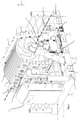
- Fig. 1 shows a layout of the present meat grill installation 100.
- the meat grill installation has a detachable horizontal cylindrical element 10.
- This cylindrical element is more particularly a cylindrical carrier for meat 22.
- the cylindrical element 10 is connected to a frame 21 of the installation 100 in such a manner that it can rotate around its main axis A.
- the element 10 may, in order to become reversibly disconnected from the installation as shown in Fig. 1 , be lifted out of connection in an upward direction D with respect to the frame 21.
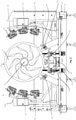
- Fig. 2 shows a cross-sectional view of the installation 100 according to Fig. 1 .
- the cylindrical element 10 comprises a series of meat fixators 12 at its boundary 24. That is to say that the cylindrical element 10 has, distributed along its circumference, a series of fixators 12, such as skewers or spikes onto which meat 22 can be removably fixed to the cylindrical element. Skewer and spike are here used as interchangeable terms.
- the skewers extend in the axial direction of the cylindrical element 10.
- the boundary 24 can be understood to mean the cylindrical surface of the cylindrical element 10 on which meat is carried, such as via the skewers.
- This cylindrical surface is provided with recesses 14 extending axially along the circumference such that fixators 12, such as the skewers, can be received therein.
- the cylindrical element 10 has in this example in each recess 14 a plurality of uptake elements 13.
- These uptake elements 13 are holders or clamps for removably fixing the fixators 12 within a respective recess.
- the uptake elements are holed partitions which extend in a radially outward direction from the base of a respective recess to an upper edge of said respective recess. The diameter of the hole (not shown, but customary) of such a partition is greater or equal to the diameter of the skewers.
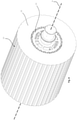
- Figure 7b shows the condition of the cylindrical element prior to the casting of meat onto the element 10.
- Figure 7a the skewers are shown for the purpose of showing their final position after insertion.
- Fig. 4 also shows condition of the cylindrical element 10 after the meat 22 has been fixed thereto.
- Fig. 5 shows that an adaptable diaphragm 11 is provided at each distal end of the cylindrical element.
- Each diaphragm comprises a plurality of partially overlapping flaps 26 which at least partially cover the meat at the distal ends of the cylindrical element 10.
- Each diaphragm is arranged to at least partly open and close by the overlapping of the flaps.
- the diaphragm 11 is at least partially open when the flaps assume a position in which the flaps extend radially outward with respect to the cylindrical element 10 such that there exists an opening between flaps.
- the diaphragm 11 is closed when the flaps are retracted radially inwards such that there is no opening between flaps.
- Fig. 5 shows a position wherein the diaphragm is closed.
- each flap 26 of a particular diaphragm 11 is able to rotate around a connection point 27 by which it is fixed to the cylindrical element for radially extending or retracting thereby.
- the flaps 26 of each diaphragm 11 may be connected to move jointly in order to assume a partly open or closed position.
- the installation 100 can further be seen to have a motor 20 for rotating the cylindrical element 10.
- This motor can be an electromotor.
- the main axis is also referred to as the horizontal axis. However, it shall be understood that in practice this axis may be tilted with respect to a gravitational horizontal, such as between 0 - 10 degrees.
- the installation can also be seen to comprise at least two, in this case six, heaters 30 for grilling the meat.
- the installation may optionally have a conveyor belt 60, which is in this example arranged directly underneath the cylindrical element 10.
- the conveyor belt 60 and is in this example used for receiving and transporting cooked meat that has been cut off from the cylindrical element 10 by a cutting element 70.
- the conveyor belt moves, in use, in a direction parallel to the longitudinal axis of the cylindrical element 10.
- the six heaters are optionally distributed in two groups as shown in Fig.2 . Each group is provided to heat opposite sides of the cylindrical element 10 such as to allow space between heating elements for the conveyor belt.
- the heaters are in this example gas heaters and as such a gas supply 31 for feeding gas to the heaters is provided to the installation.
- IR-radiation heaters may, such as electrical heaters, may be used.
- the (gas) heaters 30 provide heat at an intensity of 100-200 W/m 2 , and operate at a temperature of 700-1000 °C.
- the heaters are merely arranged to emit infrared radiation at 100-200 W/m 2 at a wavelength of 1-5 ⁇ m and do not require to operate at any specific temperature.
- the meat 22 is heated at a rate of 1000 kg/4-12 h.
- the heaters heat the outer surface of the meat 22 as the meat is rotated with the cylindrical element 10.
- the heaters can be seen to be placed at equal distance from the main axis A.
- the heaters are rotated, that is to say tilted, such that the direction of heating of each heater is directed towards and is substantially perpendicular to the axis A.
- An Additional motor (not shown, but customary) may also be comprised in the installation for tilting the heaters.
- each heater 30 is arranged for being manually tilted.
- a length of each heater 30 is individually adapted to a length of the cylindrical element, typically being more or less ( ⁇ 5%) the same length. That is to say that the total length of the heater is equal to 0,95 - 1,05 times the length of the cylindrical element 10.
- the installation 100 comprises a position adapter 40.
- Each heater is connected to the frame 21 of the installation 100 via such an adapter 40.
- the distance of each heater 30 to the cylindrical element 10 may be adjusted manually.
- the adapter 40 is in this example, but entirely optionally arranged for slidably connecting the heater 30 to the frame 21 and for maintaining the heater at a predetermined distance from the cylindrical element, that is to say to the meat on the cylindrical element 10.
- At least one sensor 50 is provided, preferably at least two sensors, for determining a temperature of the heated meat.
- This at least one sensor 50 is in this example an infrared temperature sensor. The sensed temperature is in this example used to increase or decrease the distance of the heaters with respect to the meat.
- the distance of the heaters is adjusted such that the temperature remains equal throughout the cooking process.
- the at least one sensor 50 is used to increase or decrease the temperature of the heaters themselves, to increase or decrease a rotation velocity of the cylindrical element, or maintain these variables, or a combination thereof.
- the conveyer belt 60 is provided located underneath the cylindrical element for receiving and transporting heated meat that is cut off from .
- the conveyor belt typically moves in operation in a direction parallel to the longitudinal axis of the cylindrical element.
- a cutting element 70 in this example a knife, is provided for removing a slice of a predetermined thickness of meat from the detachable cylindrical element, which typically moves in operation in the same or opposite direction as the conveyor belt.
- Fig. 6 shows the cutting element 60 to be a rotating disc provided with a sharp edge.
- the cutting element 60 is provided on a shuttle 65.
- Said shuttle is arranged for moving within a shuttle track 68.
- the shuttle 65 is adapted for forward movement and backward movement along a shuttle track 68.
- the shuttle track extends in a direction parallel to the axis A.
- a tilt of the cutting element can be adjusted via a tilt actuator 67, such as a tilt handle, comprised in the shuttle 65.
- a tilt activator 66 such as a notch, is provided along the shuttle track 68.
- the tilt actuator 67 is actuated by the activator 66 when, is use, the shuttle reaches the activator 66 as it is moved along the track.
- the activator 66 is arranged such that the shuttle tilts and fixes the cutting element in a forward angle of 5-35 degrees with respect to the horizontal plane, and wherein during backward movement the shuttle tilts and fixes the cutting element in a backward angle of minus 5-35 degrees with respect to the horizontal plane.
- the shuttle track 68 and conveyor 60 are jointly supported on at least three adaptable supports 80. These supports 80 can be raised or lowered such as to jointly move the cutting element 60 in a direction towards or away from the cylindrical element respectively.
- the supports 80 are mutually connected by a connector 81, in this example a chain.
- the supports 80 further comprise a worm gear 82, and a gear 83 adapted to be driven by the connector.
- the manner in which the shuttle moves along the track is also motorized.
- the shuttle may be operated such as to move across the full or a partial length of the track 68 and at adjustable speed. This determines the length of slices.
- At least one controller such as a computer (not shown, but customary), is provided for driving the motor, for maintaining and/or adapting a temperature of each individual heater, for driving the at least two position adapters, for receiving the sensor output, for providing feedback to at least one heater, and for controlling the length of slices of meat, for controlling the thickness of slices of meat, and combinations thereof.
- a computer not shown, but customary
- the at least one controller is optionally arranged for controlling all motorized operations described herein above, including regulating heater temperature by regulating for example the gas flow to the heaters. Further optionally the controller is provided with a human interface (not shown, but customary), to allow an operator to control at least some of the motorized operations and/or heater temperature via said human interface.
- the human interface may comprise start and stop buttons (not shown, but customary) as well as buttons for regulating the above mentioned motorized operations and gas flow.
- software may be provided for controlling the installation, typically loaded on a storage medium and provided as a processor or to a processor.
- the storage medium may be part of the processor memory of the processor or a non-transitory computer readable medium, such as a hard drive or solid state drive. Therewith large quantities of meat can be processed in a well-controlled manner in a relatively short time.
- the cooking and cutting process can be controlled by the controller such that slices of meat have a length of 1-150 cm, a thickness of 1-5 mm, and a width of 10-100 mm.
- the meat is heated to a temperature of 100-170 °C.
- the cylindrical element 10 rotates with a speed of 1-10 degrees/sec and the conveyor belt runs with a speed of 0.5-2 m/sec.
- the meat 22 is selected from chicken, pork, lamb, beef, fish, plant protein, microbial protein, cell protein, insect protein, in vitro meat, or a combinations thereof.
- a water supply 55 is present for adjusting the water content of the meat. This prevents the meat from drying out during the cooking process.
- a steam supply 56 is also present for adjusting the temperature of the meat as it is cooked.
- the water and/or steam supply is controlled by means of the controller.
- the frame comprises a support base 27 for keeping the installation elevated off of the floor. Further security measures may also be present, such as a fencing 28.
- Figs. 7a and b show the present cylindrical element without and with meat. Further a releasable confinement 17 and a closure 18 is also shown in these figures, in a partly opened situation.
- cutter and cutting element will be understood to be interchangeable.
- cylindrical element and cylindrical carrier will also be understood to be interchangeable.
Landscapes
- Engineering & Computer Science (AREA)
- Food Science & Technology (AREA)
- Life Sciences & Earth Sciences (AREA)
- Wood Science & Technology (AREA)
- Zoology (AREA)
- Baking, Grill, Roasting (AREA)
Claims (15)
- Fleischgrillvorrichtung (100), welche Folgendes umfasst:ein abnehmbares horizontales zylindrisches Element (10) zum Tragen von Fleisch, wobei das zylindrische Element eine Reihe von Fleischfixierern (l2) aufweist,einen Motor (20) zum Drehen des zylindrischen Elements um seine horizontale Achse,mindestens zwei Heizelemente (30) zum Grillen des Fleisches, wobei die mindestens zwei Heizelemente über einen Umfang des zylindrischen Elements verteilt sind, und wobei eine Länge jedes Heizelements individuell an eine Länge des zylindrischen Elements angepasst ist,mindestens zwei Positionsadapter (40), um jedes einzelne Heizelement in einem vorbestimmten Abstand von dem zylindrischen Element zu halten,mindestens einen Sensor (50), vorzugsweise mindestens zwei Sensoren, zur Bestimmung einer Temperatur des erhitzten Fleisches,ein unterhalb des zylindrischen Elements angeordnetes Förderband (60) zur Aufnahme und zum Transport des erhitzten Fleisches,ein Schneidelement (70) zum Entfernen einer Scheibe mit einer vorbestimmten Dicke des Fleisches von dem abnehmbaren zylindrischen Element, undmindestens eine Steuerung zum Antreiben des Motors, zum Halten und/oder Anpassen einer Temperatur der einzelnen Heizelemente, zum Antreiben der mindestens zwei Positionsadapter, zum Empfangen der Sensorausgabe, zum Bereitstellen einer Rückmeldung an mindestens ein Heizelement und zum Steuern der Dicke der Scheiben des Fleisches.
- Fleischgrillvorrichtung nach Anspruch 1, ferner umfassend mindestens drei in der Höhe veränderbare Stützen (80), wobei die Höhe der Stützen durch die mindestens eine Steuerung gesteuert wird, und wobei das Förderband, der mindestens eine Sensor und das Schneidelement an den mindestens drei Stützen befestigt sind.
- Fleischgrillvorrichtung nach Anspruch 1 oder 2, ferner umfassend mindestens einen Wasservorrat (55), vorzugsweise mindestens einen Wasservorrat auf jeder Seite, um einen Wasseranteil des Fleisches anzupassen, und/oder umfassend mindestens einen Dampfvorrat (56), vorzugsweise mindestens einen Dampfvorrat auf jeder Seite, um eine Temperatur des Fleisches anzupassen.
- Fleischgrillvorrichtung nach einem der Ansprüche 1 bis 3, wobei das zylindrische Element zwei Membranen (11) umfasst, eine auf jeder Seite davon, um Fleisch einzuschließen, wobei die Membranen angepasst sind, um sich zumindest teilweise zu öffnen und zu schließen.
- Fleischgrillvorrichtung nach einem der Ansprüche 2 bis 4, wobei die Stützen durch einen Verbinder (81) miteinander verbunden sind, wie eine Kette, und wobei die mindestens eine Steuerung den Verbinder, und dadurch die Höhe der Stützen ansteuert.
- Fleischgrillvorrichtung nach einem der Ansprüche 2 bis 5, wobei die Stützen ein Schneckengetriebe (82) und ein Zahnrad umfassen (83), das durch den Verbinder angetrieben werden kann.
- Fleischgrillvorrichtung nach einem der Ansprüche 1 bis 6, wobei die horizontale Geschwindigkeit des Schneidelements und Förderbands aneinander angepasst sind.
- Fleischgrillvorrichtung nach einem der Ansprüche 1 bis 7, wobei das Schneidelement angepasst ist, um vor und zurück bewegt zu werden.
- Fleischgrillvorrichtung nach einem der Ansprüche 1 bis 8, ferner umfassend einem Läufer (65) in Verbindung mit dem Schneidelement, wobei der Läufer für eine Vorwärtsbewegung und eine Rückwärtsbewegung angepasst ist, wobei der Läufer während der Vorwärtsbewegung das Schneidelement in einem Vorwärtswinkel von 5-35 Grad in Bezug auf die horizontale Ebene kippt und fixiert, und wobei der Läufer während der Rückwärtsbewegung das Schneidelement in einem Rückwärtswinkel von minus 5-35 Grad in Bezug auf die horizontale Ebene kippt und fixiert, wobei das Kippen vorzugsweise durch mindestens einen Kippaktivator (66), wie beispielsweise eine Kerbe, bereitgestellt wird.
- Fleischgrillvorrichtung nach einem der Ansprüche 1 bis 9, wobei die Reihe an Fleischfixierern 2-30 Stachel aufweisen, beispielsweise 5-20 Stachelund/oderwobei das zylindrische Element mindestens zwei Aufnahmeelement (13) pro Fleischfixierer (12) umfasst, beispielsweise 3-6 Aufnahmeelemente, beispielsweise trapezförmige Aufnahmeelemente mit einer Öffnung darin und/oderwobei das zylindrische Element mindestens vier entlang einer longitudinalen Achse des zylindrischen Elements bereitgestellte Aussparungen (14) umfasst, beispielsweise 2-30 Aussparungen, wobei die Aussparungen vorzugsweise einen trapezförmigen Querschnitt aufweisen.
- Verfahren zum Erhitzen von 100-3000kg gefrorenem Fleisch, umfassendBereitstellen eines zylindrischen Elements (10) das mit Fleisch bestückt ist, wobei die mindestens eine Membran geöffnet ist,Bewegen des zylindrischen Elements in die Fleischgrillvorrichtung nach einem der Ansprüche 1 bis 10,Erhitzen des Fleisches, undSchneiden mindestens einer Scheibe Fleisch.
- Verfahren nach Anspruch 11, wobei die Scheibe Fleisch eine Länge von 1-150 cm, eine Dicke von 1-5 mm, und eine Breite von 10-100 mm aufweist.
- Verfahren nach Anspruch 11 oder 12, wobei das Fleisch auf eine Temperatur von 100-170°C erhitzt wird.
- Verfahren nach einem der Ansprüche 11 bis 13, wobei die Heizelemente Infrarotstrahlung bereitstellen mit einer Wellenlänge von 1-5 µm, und/oder mit einer Intensität von 100-200 W/m2, und/oder mit einer Temperatur von 700-1000°C betrieben werden.
- Verfahren nach einem der Ansprüche 11 bis 14, wobei das Fleisch gekocht, gegrillt, oder eine Kombination davon ist.
Priority Applications (1)
| Application Number | Priority Date | Filing Date | Title |
|---|---|---|---|
| PL20182006T PL3760087T3 (pl) | 2019-06-26 | 2020-06-24 | Instalacja grilla do mięsa |
Applications Claiming Priority (1)
| Application Number | Priority Date | Filing Date | Title |
|---|---|---|---|
| NL2023386A NL2023386B1 (en) | 2019-06-26 | 2019-06-26 | Meat grill installation |
Publications (2)
| Publication Number | Publication Date |
|---|---|
| EP3760087A1 EP3760087A1 (de) | 2021-01-06 |
| EP3760087B1 true EP3760087B1 (de) | 2022-03-02 |
Family
ID=68000021
Family Applications (1)
| Application Number | Title | Priority Date | Filing Date |
|---|---|---|---|
| EP20182006.5A Active EP3760087B1 (de) | 2019-06-26 | 2020-06-24 | Fleischgrillanlage |
Country Status (7)
| Country | Link |
|---|---|
| US (1) | US11684209B2 (de) |
| EP (1) | EP3760087B1 (de) |
| DK (1) | DK3760087T3 (de) |
| ES (1) | ES2914862T3 (de) |
| NL (1) | NL2023386B1 (de) |
| PL (1) | PL3760087T3 (de) |
| PT (1) | PT3760087T (de) |
Citations (1)
| Publication number | Priority date | Publication date | Assignee | Title |
|---|---|---|---|---|
| EP2412283B1 (de) * | 2010-07-30 | 2014-08-13 | Mustafa Pusat | Fleischschneidevorrichtung, Verfahren zu ihrer Verwendung und Vorbereitungsvorrichtung zur Verwendung mit der Fleischschneidevorrichtung |
Family Cites Families (10)
| Publication number | Priority date | Publication date | Assignee | Title |
|---|---|---|---|---|
| US4050370A (en) * | 1976-03-11 | 1977-09-27 | Schmidt, Trustee Under Harry J. Hoenselaar Trust Agreement Of Oct. 4, 1973, Mary Jane | Spiral meat slicer with improved reciprocating knife structure |
| DE19545699C1 (de) * | 1995-12-07 | 1997-05-22 | Tevfik Guel | Grill mit einem motorisch drehbaren Fleischspieß |
| IES20030130A2 (en) * | 2003-02-24 | 2004-09-08 | Higgins Stevens | Food processing |
| WO2017062524A1 (en) * | 2015-10-05 | 2017-04-13 | Nieco Corporation | Automated broiler with product temperature feedback system |
| NL2019287B1 (en) * | 2017-07-20 | 2019-02-01 | Cjet B V | Automatic meat cutting apparatus |
| US20190059644A1 (en) * | 2017-08-25 | 2019-02-28 | Taylor Commercial Foodservice Inc. | Grill conveyor staging system |
| US20190191926A1 (en) * | 2017-12-21 | 2019-06-27 | Buckaroo Taco & Grill, LLC | Automatic grilling systems and methods |
| WO2019209624A1 (en) * | 2018-04-24 | 2019-10-31 | Enodis Corporation | Horizontal griddle with automatic dispensing |
| US20190387921A1 (en) * | 2018-06-20 | 2019-12-26 | Creator, Inc. | Forced-Air Food-Heating Apparatus |
| US20210330120A1 (en) * | 2020-04-28 | 2021-10-28 | Duke Manufacturing Co. | Food cooking system |
-
2019
- 2019-06-26 NL NL2023386A patent/NL2023386B1/en active
-
2020
- 2020-06-24 ES ES20182006T patent/ES2914862T3/es active Active
- 2020-06-24 EP EP20182006.5A patent/EP3760087B1/de active Active
- 2020-06-24 DK DK20182006.5T patent/DK3760087T3/da active
- 2020-06-24 PT PT201820065T patent/PT3760087T/pt unknown
- 2020-06-24 PL PL20182006T patent/PL3760087T3/pl unknown
- 2020-06-26 US US16/913,974 patent/US11684209B2/en active Active
Patent Citations (1)
| Publication number | Priority date | Publication date | Assignee | Title |
|---|---|---|---|---|
| EP2412283B1 (de) * | 2010-07-30 | 2014-08-13 | Mustafa Pusat | Fleischschneidevorrichtung, Verfahren zu ihrer Verwendung und Vorbereitungsvorrichtung zur Verwendung mit der Fleischschneidevorrichtung |
Also Published As
| Publication number | Publication date |
|---|---|
| NL2023386B1 (en) | 2021-02-01 |
| ES2914862T3 (es) | 2022-06-17 |
| PL3760087T3 (pl) | 2022-07-11 |
| US11684209B2 (en) | 2023-06-27 |
| US20200405097A1 (en) | 2020-12-31 |
| DK3760087T3 (da) | 2022-05-23 |
| PT3760087T (pt) | 2022-06-17 |
| EP3760087A1 (de) | 2021-01-06 |
Similar Documents
| Publication | Publication Date | Title |
|---|---|---|
| EP3403468B1 (de) | Küchengerät und kochüberwachungsverfahren | |
| EP2230922B1 (de) | Verfahren zur herstellung vorgekochter speckscheiben | |
| EP2412283B1 (de) | Fleischschneidevorrichtung, Verfahren zu ihrer Verwendung und Vorbereitungsvorrichtung zur Verwendung mit der Fleischschneidevorrichtung | |
| CN1889844A (zh) | 食物加热装置和方法 | |
| US10225893B2 (en) | Cooking apparatus | |
| EP2866584B1 (de) | Verfahren zur herstellung von geschnittenen lebensmittelprodukten | |
| US4584984A (en) | Barbecue cover support device | |
| US20170007071A1 (en) | Multi-zone spit-rotisserie device for meat roasting and grilling | |
| EP3760087B1 (de) | Fleischgrillanlage | |
| US8445049B2 (en) | Roasting apparatus and packaging system for providing a cooked food product having a long shelf life | |
| EP2286700B1 (de) | Gerät und Verfahren zum Erwärmen von Lebensmitteln | |
| KR20100093642A (ko) | 테이블 로스터 | |
| CN105686684A (zh) | 远红外烧烤炉 | |
| US20030000395A1 (en) | Heating arrangement for automated apparatus | |
| KR102027446B1 (ko) | 식품건조 및 구이장치 | |
| GB2232346A (en) | Infrared oven | |
| WO2018004090A1 (ko) | 가열헤드의 위치 가변이 가능한 적외선 조리기 | |
| CN222786841U (zh) | 多挂料柱肉食烘烤装置 | |
| KR200264153Y1 (ko) | 근적외선 램프를 이용한 바베큐용 구이기 | |
| KR100630391B1 (ko) | 회전식 숯불 구이장치 | |
| KR20150072134A (ko) | 근적외선을 이용한 돈까스 냉동육 해동장치 | |
| KR200394453Y1 (ko) | 회전식 숯불 구이장치 | |
| WO2018198014A1 (en) | Crisping wand system and method | |
| IL324129A (en) | Mechanized fencing and method of use | |
| KR20210082002A (ko) | 구근 농산물 연속 가공장치 |
Legal Events
| Date | Code | Title | Description |
|---|---|---|---|
| PUAI | Public reference made under article 153(3) epc to a published international application that has entered the european phase |
Free format text: ORIGINAL CODE: 0009012 |
|
| STAA | Information on the status of an ep patent application or granted ep patent |
Free format text: STATUS: THE APPLICATION HAS BEEN PUBLISHED |
|
| AK | Designated contracting states |
Kind code of ref document: A1 Designated state(s): AL AT BE BG CH CY CZ DE DK EE ES FI FR GB GR HR HU IE IS IT LI LT LU LV MC MK MT NL NO PL PT RO RS SE SI SK SM TR |
|
| AX | Request for extension of the european patent |
Extension state: BA ME |
|
| STAA | Information on the status of an ep patent application or granted ep patent |
Free format text: STATUS: REQUEST FOR EXAMINATION WAS MADE |
|
| 17P | Request for examination filed |
Effective date: 20210706 |
|
| RBV | Designated contracting states (corrected) |
Designated state(s): AL AT BE BG CH CY CZ DE DK EE ES FI FR GB GR HR HU IE IS IT LI LT LU LV MC MK MT NL NO PL PT RO RS SE SI SK SM TR |
|
| GRAP | Despatch of communication of intention to grant a patent |
Free format text: ORIGINAL CODE: EPIDOSNIGR1 |
|
| STAA | Information on the status of an ep patent application or granted ep patent |
Free format text: STATUS: GRANT OF PATENT IS INTENDED |
|
| INTG | Intention to grant announced |
Effective date: 20210929 |
|
| GRAS | Grant fee paid |
Free format text: ORIGINAL CODE: EPIDOSNIGR3 |
|
| GRAA | (expected) grant |
Free format text: ORIGINAL CODE: 0009210 |
|
| STAA | Information on the status of an ep patent application or granted ep patent |
Free format text: STATUS: THE PATENT HAS BEEN GRANTED |
|
| AK | Designated contracting states |
Kind code of ref document: B1 Designated state(s): AL AT BE BG CH CY CZ DE DK EE ES FI FR GB GR HR HU IE IS IT LI LT LU LV MC MK MT NL NO PL PT RO RS SE SI SK SM TR |
|
| REG | Reference to a national code |
Ref country code: GB Ref legal event code: FG4D |
|
| REG | Reference to a national code |
Ref country code: CH Ref legal event code: EP Ref country code: AT Ref legal event code: REF Ref document number: 1471561 Country of ref document: AT Kind code of ref document: T Effective date: 20220315 |
|
| REG | Reference to a national code |
Ref country code: DE Ref legal event code: R096 Ref document number: 602020002032 Country of ref document: DE |
|
| REG | Reference to a national code |
Ref country code: IE Ref legal event code: FG4D |
|
| REG | Reference to a national code |
Ref country code: FI Ref legal event code: FGE |
|
| REG | Reference to a national code |
Ref country code: DK Ref legal event code: T3 Effective date: 20220519 |
|
| REG | Reference to a national code |
Ref country code: NL Ref legal event code: FP |
|
| REG | Reference to a national code |
Ref country code: PT Ref legal event code: SC4A Ref document number: 3760087 Country of ref document: PT Date of ref document: 20220617 Kind code of ref document: T Free format text: AVAILABILITY OF NATIONAL TRANSLATION Effective date: 20220602 Ref country code: ES Ref legal event code: FG2A Ref document number: 2914862 Country of ref document: ES Kind code of ref document: T3 Effective date: 20220617 |
|
| REG | Reference to a national code |
Ref country code: SE Ref legal event code: TRGR |
|
| REG | Reference to a national code |
Ref country code: GR Ref legal event code: EP Ref document number: 20220401091 Country of ref document: GR Effective date: 20220608 |
|
| REG | Reference to a national code |
Ref country code: LT Ref legal event code: MG9D |
|
| REG | Reference to a national code |
Ref country code: NO Ref legal event code: T2 Effective date: 20220302 |
|
| PG25 | Lapsed in a contracting state [announced via postgrant information from national office to epo] |
Ref country code: RS Free format text: LAPSE BECAUSE OF FAILURE TO SUBMIT A TRANSLATION OF THE DESCRIPTION OR TO PAY THE FEE WITHIN THE PRESCRIBED TIME-LIMIT Effective date: 20220302 Ref country code: LT Free format text: LAPSE BECAUSE OF FAILURE TO SUBMIT A TRANSLATION OF THE DESCRIPTION OR TO PAY THE FEE WITHIN THE PRESCRIBED TIME-LIMIT Effective date: 20220302 Ref country code: HR Free format text: LAPSE BECAUSE OF FAILURE TO SUBMIT A TRANSLATION OF THE DESCRIPTION OR TO PAY THE FEE WITHIN THE PRESCRIBED TIME-LIMIT Effective date: 20220302 Ref country code: BG Free format text: LAPSE BECAUSE OF FAILURE TO SUBMIT A TRANSLATION OF THE DESCRIPTION OR TO PAY THE FEE WITHIN THE PRESCRIBED TIME-LIMIT Effective date: 20220602 |
|
| PGFP | Annual fee paid to national office [announced via postgrant information from national office to epo] |
Ref country code: PT Payment date: 20220620 Year of fee payment: 3 |
|
| REG | Reference to a national code |
Ref country code: HU Ref legal event code: AG4A Ref document number: E058632 Country of ref document: HU |
|
| PG25 | Lapsed in a contracting state [announced via postgrant information from national office to epo] |
Ref country code: LV Free format text: LAPSE BECAUSE OF FAILURE TO SUBMIT A TRANSLATION OF THE DESCRIPTION OR TO PAY THE FEE WITHIN THE PRESCRIBED TIME-LIMIT Effective date: 20220302 |
|
| PGFP | Annual fee paid to national office [announced via postgrant information from national office to epo] |
Ref country code: FI Payment date: 20220629 Year of fee payment: 3 |
|
| PGFP | Annual fee paid to national office [announced via postgrant information from national office to epo] |
Ref country code: FR Payment date: 20220627 Year of fee payment: 3 |
|
| PG25 | Lapsed in a contracting state [announced via postgrant information from national office to epo] |
Ref country code: SM Free format text: LAPSE BECAUSE OF FAILURE TO SUBMIT A TRANSLATION OF THE DESCRIPTION OR TO PAY THE FEE WITHIN THE PRESCRIBED TIME-LIMIT Effective date: 20220302 Ref country code: SK Free format text: LAPSE BECAUSE OF FAILURE TO SUBMIT A TRANSLATION OF THE DESCRIPTION OR TO PAY THE FEE WITHIN THE PRESCRIBED TIME-LIMIT Effective date: 20220302 Ref country code: RO Free format text: LAPSE BECAUSE OF FAILURE TO SUBMIT A TRANSLATION OF THE DESCRIPTION OR TO PAY THE FEE WITHIN THE PRESCRIBED TIME-LIMIT Effective date: 20220302 Ref country code: EE Free format text: LAPSE BECAUSE OF FAILURE TO SUBMIT A TRANSLATION OF THE DESCRIPTION OR TO PAY THE FEE WITHIN THE PRESCRIBED TIME-LIMIT Effective date: 20220302 Ref country code: CZ Free format text: LAPSE BECAUSE OF FAILURE TO SUBMIT A TRANSLATION OF THE DESCRIPTION OR TO PAY THE FEE WITHIN THE PRESCRIBED TIME-LIMIT Effective date: 20220302 |
|
| PGFP | Annual fee paid to national office [announced via postgrant information from national office to epo] |
Ref country code: ES Payment date: 20220701 Year of fee payment: 3 |
|
| PG25 | Lapsed in a contracting state [announced via postgrant information from national office to epo] |
Ref country code: IS Free format text: LAPSE BECAUSE OF FAILURE TO SUBMIT A TRANSLATION OF THE DESCRIPTION OR TO PAY THE FEE WITHIN THE PRESCRIBED TIME-LIMIT Effective date: 20220702 Ref country code: AL Free format text: LAPSE BECAUSE OF FAILURE TO SUBMIT A TRANSLATION OF THE DESCRIPTION OR TO PAY THE FEE WITHIN THE PRESCRIBED TIME-LIMIT Effective date: 20220302 |
|
| REG | Reference to a national code |
Ref country code: DE Ref legal event code: R097 Ref document number: 602020002032 Country of ref document: DE |
|
| PLBE | No opposition filed within time limit |
Free format text: ORIGINAL CODE: 0009261 |
|
| STAA | Information on the status of an ep patent application or granted ep patent |
Free format text: STATUS: NO OPPOSITION FILED WITHIN TIME LIMIT |
|
| PG25 | Lapsed in a contracting state [announced via postgrant information from national office to epo] |
Ref country code: MC Free format text: LAPSE BECAUSE OF FAILURE TO SUBMIT A TRANSLATION OF THE DESCRIPTION OR TO PAY THE FEE WITHIN THE PRESCRIBED TIME-LIMIT Effective date: 20220302 |
|
| 26N | No opposition filed |
Effective date: 20221205 |
|
| PG25 | Lapsed in a contracting state [announced via postgrant information from national office to epo] |
Ref country code: SI Free format text: LAPSE BECAUSE OF FAILURE TO SUBMIT A TRANSLATION OF THE DESCRIPTION OR TO PAY THE FEE WITHIN THE PRESCRIBED TIME-LIMIT Effective date: 20220302 |
|
| PG25 | Lapsed in a contracting state [announced via postgrant information from national office to epo] |
Ref country code: LU Free format text: LAPSE BECAUSE OF NON-PAYMENT OF DUE FEES Effective date: 20220624 Ref country code: IE Free format text: LAPSE BECAUSE OF NON-PAYMENT OF DUE FEES Effective date: 20220624 |
|
| REG | Reference to a national code |
Ref country code: AT Ref legal event code: UEP Ref document number: 1471561 Country of ref document: AT Kind code of ref document: T Effective date: 20220302 |
|
| P01 | Opt-out of the competence of the unified patent court (upc) registered |
Effective date: 20230804 |
|
| PG25 | Lapsed in a contracting state [announced via postgrant information from national office to epo] |
Ref country code: PT Free format text: LAPSE BECAUSE OF NON-PAYMENT OF DUE FEES Effective date: 20231226 Ref country code: FI Free format text: LAPSE BECAUSE OF NON-PAYMENT OF DUE FEES Effective date: 20230624 |
|
| REG | Reference to a national code |
Ref country code: CH Ref legal event code: PL |
|
| PG25 | Lapsed in a contracting state [announced via postgrant information from national office to epo] |
Ref country code: MK Free format text: LAPSE BECAUSE OF FAILURE TO SUBMIT A TRANSLATION OF THE DESCRIPTION OR TO PAY THE FEE WITHIN THE PRESCRIBED TIME-LIMIT Effective date: 20220302 Ref country code: CY Free format text: LAPSE BECAUSE OF FAILURE TO SUBMIT A TRANSLATION OF THE DESCRIPTION OR TO PAY THE FEE WITHIN THE PRESCRIBED TIME-LIMIT Effective date: 20220302 Ref country code: CH Free format text: LAPSE BECAUSE OF NON-PAYMENT OF DUE FEES Effective date: 20230630 |
|
| PG25 | Lapsed in a contracting state [announced via postgrant information from national office to epo] |
Ref country code: FR Free format text: LAPSE BECAUSE OF NON-PAYMENT OF DUE FEES Effective date: 20230630 |
|
| REG | Reference to a national code |
Ref country code: ES Ref legal event code: FD2A Effective date: 20240729 |
|
| PG25 | Lapsed in a contracting state [announced via postgrant information from national office to epo] |
Ref country code: MT Free format text: LAPSE BECAUSE OF FAILURE TO SUBMIT A TRANSLATION OF THE DESCRIPTION OR TO PAY THE FEE WITHIN THE PRESCRIBED TIME-LIMIT Effective date: 20220302 |
|
| PG25 | Lapsed in a contracting state [announced via postgrant information from national office to epo] |
Ref country code: ES Free format text: LAPSE BECAUSE OF NON-PAYMENT OF DUE FEES Effective date: 20230625 |
|
| PG25 | Lapsed in a contracting state [announced via postgrant information from national office to epo] |
Ref country code: ES Free format text: LAPSE BECAUSE OF NON-PAYMENT OF DUE FEES Effective date: 20230625 |
|
| PGFP | Annual fee paid to national office [announced via postgrant information from national office to epo] |
Ref country code: PL Payment date: 20250520 Year of fee payment: 6 Ref country code: DE Payment date: 20250627 Year of fee payment: 6 |
|
| PGFP | Annual fee paid to national office [announced via postgrant information from national office to epo] |
Ref country code: GB Payment date: 20250627 Year of fee payment: 6 Ref country code: DK Payment date: 20250625 Year of fee payment: 6 |
|
| PGFP | Annual fee paid to national office [announced via postgrant information from national office to epo] |
Ref country code: NO Payment date: 20250627 Year of fee payment: 6 |
|
| PGFP | Annual fee paid to national office [announced via postgrant information from national office to epo] |
Ref country code: NL Payment date: 20250623 Year of fee payment: 6 Ref country code: BE Payment date: 20250625 Year of fee payment: 6 |
|
| PGFP | Annual fee paid to national office [announced via postgrant information from national office to epo] |
Ref country code: HU Payment date: 20250612 Year of fee payment: 6 |
|
| PGFP | Annual fee paid to national office [announced via postgrant information from national office to epo] |
Ref country code: GR Payment date: 20250626 Year of fee payment: 6 |
|
| PGFP | Annual fee paid to national office [announced via postgrant information from national office to epo] |
Ref country code: AT Payment date: 20250721 Year of fee payment: 5 |
|
| PGFP | Annual fee paid to national office [announced via postgrant information from national office to epo] |
Ref country code: TR Payment date: 20250620 Year of fee payment: 6 |
|
| PGFP | Annual fee paid to national office [announced via postgrant information from national office to epo] |
Ref country code: SE Payment date: 20250627 Year of fee payment: 6 |
|
| PGFP | Annual fee paid to national office [announced via postgrant information from national office to epo] |
Ref country code: IT Payment date: 20250619 Year of fee payment: 6 |