EP3760700A1 - Verfahren zur behandlung von würze - Google Patents
Verfahren zur behandlung von würze Download PDFInfo
- Publication number
- EP3760700A1 EP3760700A1 EP19183785.5A EP19183785A EP3760700A1 EP 3760700 A1 EP3760700 A1 EP 3760700A1 EP 19183785 A EP19183785 A EP 19183785A EP 3760700 A1 EP3760700 A1 EP 3760700A1
- Authority
- EP
- European Patent Office
- Prior art keywords
- wort
- kettle
- gas
- target temperature
- process according
- Prior art date
- Legal status (The legal status is an assumption and is not a legal conclusion. Google has not performed a legal analysis and makes no representation as to the accuracy of the status listed.)
- Granted
Links
Images

Classifications
-
- C—CHEMISTRY; METALLURGY
- C12—BIOCHEMISTRY; BEER; SPIRITS; WINE; VINEGAR; MICROBIOLOGY; ENZYMOLOGY; MUTATION OR GENETIC ENGINEERING
- C12C—BEER; PREPARATION OF BEER BY FERMENTATION; PREPARATION OF MALT FOR MAKING BEER; PREPARATION OF HOPS FOR MAKING BEER
- C12C11/00—Fermentation processes for beer
- C12C11/003—Fermentation of beerwort
-
- C—CHEMISTRY; METALLURGY
- C12—BIOCHEMISTRY; BEER; SPIRITS; WINE; VINEGAR; MICROBIOLOGY; ENZYMOLOGY; MUTATION OR GENETIC ENGINEERING
- C12C—BEER; PREPARATION OF BEER BY FERMENTATION; PREPARATION OF MALT FOR MAKING BEER; PREPARATION OF HOPS FOR MAKING BEER
- C12C7/00—Preparation of wort
- C12C7/20—Boiling the beerwort
-
- C—CHEMISTRY; METALLURGY
- C12—BIOCHEMISTRY; BEER; SPIRITS; WINE; VINEGAR; MICROBIOLOGY; ENZYMOLOGY; MUTATION OR GENETIC ENGINEERING
- C12C—BEER; PREPARATION OF BEER BY FERMENTATION; PREPARATION OF MALT FOR MAKING BEER; PREPARATION OF HOPS FOR MAKING BEER
- C12C13/00—Brewing devices, not covered by a single group of C12C1/00 - C12C12/04
- C12C13/02—Brew kettles
-
- C—CHEMISTRY; METALLURGY
- C12—BIOCHEMISTRY; BEER; SPIRITS; WINE; VINEGAR; MICROBIOLOGY; ENZYMOLOGY; MUTATION OR GENETIC ENGINEERING
- C12C—BEER; PREPARATION OF BEER BY FERMENTATION; PREPARATION OF MALT FOR MAKING BEER; PREPARATION OF HOPS FOR MAKING BEER
- C12C13/00—Brewing devices, not covered by a single group of C12C1/00 - C12C12/04
- C12C13/02—Brew kettles
- C12C13/08—Brew kettles with internal heating elements
-
- C—CHEMISTRY; METALLURGY
- C12—BIOCHEMISTRY; BEER; SPIRITS; WINE; VINEGAR; MICROBIOLOGY; ENZYMOLOGY; MUTATION OR GENETIC ENGINEERING
- C12C—BEER; PREPARATION OF BEER BY FERMENTATION; PREPARATION OF MALT FOR MAKING BEER; PREPARATION OF HOPS FOR MAKING BEER
- C12C7/00—Preparation of wort
-
- C—CHEMISTRY; METALLURGY
- C12—BIOCHEMISTRY; BEER; SPIRITS; WINE; VINEGAR; MICROBIOLOGY; ENZYMOLOGY; MUTATION OR GENETIC ENGINEERING
- C12C—BEER; PREPARATION OF BEER BY FERMENTATION; PREPARATION OF MALT FOR MAKING BEER; PREPARATION OF HOPS FOR MAKING BEER
- C12C7/00—Preparation of wort
- C12C7/04—Preparation or treatment of the mash
-
- C—CHEMISTRY; METALLURGY
- C12—BIOCHEMISTRY; BEER; SPIRITS; WINE; VINEGAR; MICROBIOLOGY; ENZYMOLOGY; MUTATION OR GENETIC ENGINEERING
- C12C—BEER; PREPARATION OF BEER BY FERMENTATION; PREPARATION OF MALT FOR MAKING BEER; PREPARATION OF HOPS FOR MAKING BEER
- C12C7/00—Preparation of wort
- C12C7/20—Boiling the beerwort
- C12C7/205—Boiling with hops
- C12C7/22—Processes or apparatus specially adapted to save or recover energy
Definitions
- the present invention relates to an improvement of conventional wort boiling techniques in beer brewing processes.
- it concerns such process which is substantially more economical in terms of energy consumption than hitherto achieved.
- Brewing a beer or a malt based beverage comprises feeding malt to a grinder which is then mixed with water and mashed at a moderately high temperature to promote enzymatic conversion of starches into fermentable sugars.
- the lautering or mash press step the mash is separated into the clear liquid wort and the residual grain.
- the thus separated wort is then fed to a kettle, in a step traditionally referred to as "boiling" step because the wort is conventionally heated above its boiling temperature to sterilize it, terminate enzymatic activity, develop favourable flavour characteristics, and convert and/or remove undesired components.
- trub which has formed during the boiling step is separated from the wort usually in a whirlpool tun, as for example disclosed in DE10 2008 033 287 .
- Wort is then cooled, fermented, matured, filtered and packaged, e.g., in bottles, kegs, cans, and the like.
- Breweries face challenges including the ever-increasing energy prices and complicated transportation due to exportation.
- the increased exportation forces the breweries to search for technological changes that improve the colloidal, microbial and flavour stability.
- Flavour stability is today not yet fully understood. It is known, however, that the wort boiling process has a major impact on beer flavour stability.
- Wort boiling is one of the most energy-consuming process steps in the brewery. Traditionally, the boiling of wort aimed to achieve multiple objectives. As the understanding of the biochemical and physical processes has improved, it has been possible to separate the requirements for each objective and re-visit how these could be achieved in a less energy-intensive process. Traditionally, wort boiling serves the following functions:
- Wort sterilization and termination of enzymatic activity are easily achieved when reaching temperatures of more than 90°C.
- the isomerization rate of hop acids is temperature dependent, roughly doubling every 10°C.
- Denaturation of enzymes and haze-active proteins with subsequent coagulation and precipitation with polyphenols must be completed during the wort boiling process.
- the coagulation process is dramatically enhanced when the interface between liquid and gas is enlarged.
- vapour bubbles provide this extra interface.
- Flavour Formation requires heat and time and is assisted by effective mixing. Removal of unwanted flavour compounds requires mass transfer of the targeted compounds from the wort into an alternative medium in a separation process. Given the volatility of these components one method of separation is to strip them off using a carrier gas. In standard boiling technologies the 'carrier gas' is in fact water vapour from the boiling process itself.
- wort boiling techniques are known in the art.
- the internal boiler is cylindrically shaped formed by a bundle of hollow heated tubes, and wort can freely flow through these tubes.
- the working principle is of the 'thermosyphon' type, whereby wort enters the heating tubes, reaches boiling temperature and vapour bubbles will form and arise. These vapour bubbles (very low density) are the driving force upward through the internal boiler, thereby ensuring a natural convection.
- the boiler can be located outside the kettle and wort is fed therethrough by means of a pump and returned into the kettle. In the last decade numerous new and innovative boiling systems have been introduced.
- wort boiling systems are based on: dynamic wort boiling; thin-film evaporation; external thermosyphon boiler with increased heating surface; continuous wort boiling; vacuum boiling, internal boiler with forced convection; gentle boiling with flash evaporation; and wort boiling with inert gas sparging.
- wort boiling with inert gas sparging consists of boiling wort for a duration of about 30 min at which point, while still boiling, an inert gas is sparged into the boiling wort, which considerably enhances the removal rate of DMS.
- the sparging is provided by a ring-structure located at the bottom of the wort kettle, such as disclosed in EP875560 . Owing to the facilitated DMS removal, the boiling time can be shortened and evaporation rates could be reduced to about 4 wt.%.
- the present invention concerns a process for treating a wort composition in a kettle, said method comprising the steps of:
- the present invention concerns a process for treating a wort composition in a kettle, said method comprising the steps of:
- the present invention concerns a process for treating a wort composition in a kettle, said method comprising the steps of:
- step (d) is referred to as the hot hold step.
- the advantage of this step is that the wort composition undergoes less heat stress and wort damage is minimized at the lower temperature. The reasons for this are twofold: 1) the lower temperature involved reduces the heat stress and wort damage; and 2) the attainment of the target temperature used in steps (e) and (f) is delayed (relative to other prior art processes) allowing a reduced sugar concentration in the kettle, both of which increase shelf-life and flavor stability of the final beverage ( i.e., beer).
- the hot hold step uses 2 to 3 MJ/hl less energy than the traditional boiling process, such as that employed in EP3066185 (0.56 - 0.83 KWh/hl for the present invention versus ⁇ 0.94 kWh/hl for Example 2 of EP3066185 ).
- the process of the invention also uses less energy required for same conversion of S-methylmethionine (SMM) into dimethylsulfide (DMS) (when combined with subsequent standard brewing processes). Furthermore, less sparge gas is required to remove the DMS as much of this has been generated before the sparging commences.
- SMM S-methylmethionine
- DMS dimethylsulfide
- the wort composition in step (c) is heated to the target temperature at a rate of between 0.2°C and 1°C per minute, preferably between 0.4°C and 0.75°C per minute, most preferably about 0.5°C per minute until target temperature is met.
- step (d) preferably the wort composition is heated to the target temperature of step (e) at a rate of between 0.2°C and 1°C per minute, preferably between 0.4°C and 0.75°C per minute, most preferably about 0.5°C per minute until target temperature is met.
- the sparged gas is selected from CO 2 , N 2 and air, and combinations thereof, preferably CO 2 . This is because CO 2 is inert and cheap.
- the byproduct CO 2 generated during the fermentation process in the brewery is used as the sparge gas.
- a surprising aspect of the present invention is the low levels of combined S-methylmethionine (SMM) into dimethylsulfide (DMS) measured immediately at the end of step (f) of the process of the invention.
- SMM S-methylmethionine
- DMS dimethylsulfide
- the wort composition at the end of step (f) contains less than 150 ppb of combined SMM and DMS, more preferably less than 100 ppb, more preferably less than 75 ppb.
- the wort composition exiting step (f) of the process of the invention achieves a DMS (dimethyl sulphide) concentration of less than 150 ppb, more preferably less than 100 ppb, more preferably less than 50 ppb, more preferably less than 20 ppb.
- DMS dimethyl sulphide
- the kettle used in the present invention is preferably heated using a heat exchanger.
- This may be an external wort boiler (EWB).
- the variation (min T to max T) of the temperature in step (f) is T ⁇ 0.75 °C, more preferably T ⁇ 0.5 °C.
- the gas flow in the sparging process of step (f) is uninterrupted.
- any interruption of greater than 10 minutes in the gas sparging process of step (f) should be followed by a continuous gas sparge of not less than 30 minutes. This ensures an adequate removal of volatiles formed during the phase interruption.
- the sparging process of step (f) is constant and uninterrupted.
- the sparging rate of gas does not vary by more than ⁇ 10%, more preferably ⁇ 5% of the average gas sparging rate in step (f).
- the process of the present invention preferably results in less than 2%, more preferably less than 1.5%, more preferably 0.8 - 1.2% evaporation of water based on the weight of the initial wort composition.
- This 2% quantity corresponds to approximately 2MJ/hl, a reduction of 6MJ/hl from a base of 4% and 8MJ/hl from a base of 5% evaporation.
- the process of the present invention is essentially a two-step process
- the first of wort is the process of flavour formation, i.e., the formation of key flavour-active compounds from precursors via chemical reactions which require heat, agitation and time (and may be influenced by pH), and are also dependent on concentration of relevant species.
- Step 2 is the process of volatile stripping, i.e., the removal of volatile flavour-active compounds via mass transfer into a vapour phase provided by a carrier gas, which requires heat, agitation and bubbles, with the bubbles providing the surface area for mass transfer of volatiles into the vapour phase.
- the 'carrier gas' providing the bubbles of the vapour phase is steam generated through boiling of wort.
- volatile stripping is effected entirely by the gas sparging. As such, the need for boiling is unnecessary, as heat, agitation and time are adequately provided.
- the process of the present invention preferably uses a circulation pump.
- the process of the present invention preferably requires the process to target a temperature of at least 1°C below the natural boiling point of the wort composition, at the heater outlet, and preferably no more than a 3°C difference between this heater outlet temperature and the wort bulk temperature in the kettle.
- the object is to bring the wort mass up to temperature without boiling the wort and ensure there is not a large temperature differential between the heat outlet and the wort mass. Normally there is heat loss of the mass of 1-2°C through radiant and loss and gas purging through the wort.
- An internal or an external boiler may be used to transfer the heat to the wort.
- the wort is preferably pumped through the heat exchanger to ensure a flow rate which will allow heat transfer.
- the gas can be sparged into the wort by means of a gas sparger located at or near the bottom of the kettle and oriented upwards or sideways in the radial direction.
- Said sparger preferably comprises a circular plate, cylinder or ring provided with a multitude of apertures.
- the apertures can be orifices or open pores of a sintered material, such as sintered stainless steel.
- the kettle houses a plurality of gas spargers which are spaced apart from one another. This allows a homogeneous sparging of the wort composition to take place. This has the advantage of improving the volatilisation of the undesirable volatile compounds such as DMS.
- the kettle houses at least 4 gas spargers, their apertures being at least 30 cm apart from one another, more preferably at least 50 cm apart.
- the treated wort composition can be transferred to a trub separation step, for example in a whirlpool tun, and then to further treatment vessels to produce a beer or a malt based beverage.
- the beer or malt based beverage thus produced preferably has one or more of the following properties:
- a forced flow across the calandria heating surfaces is preferably maintained throughout the kettle period, from the start of heat-up until heat supply ceases prior to final checks and cast-out. This is easily achieved with a EWB circulation pump. It can also be achieved where an IWB design (internal wort boiler) already incorporates a suitable circulation pump (e.g. Stromboli kettles). In some IWB cases the existing wort cast-out pump is capable of achieving the required circulation.
- the hottest spot in a kettle operation occurs at the exit of the heating means, such as the calandria, which is not necessarily the same as the temperature in the body of the wort. Therefore, it is possible for a temperature differential to develop between the, e.g., calandria exit and the bulk wort, the extent of which would be influenced by the specific configuration of each kettle, including aspects such as: excess heat input to wort passing through calandria; system heat losses; temperature, specific heat capacity and flowrate of the gas used for sparging; vigour of the boil (and hence rate of heat loss through evaporation).
- step (f) the temperature of the bulk wort is kept within 3°C (below) the heater outlet temperature.
- the potential for a temperature differential between the calandria outlet (as the hottest point in the system) and the body of the wort may be even more dramatic with the present process due to the lower heat input into the system.
- it is highly preferable to measure the kettle body temperature / bulk wort temperature ideally at the point expected to be the 'coldest' during kettle operation (e.g. furthest point from return of hot wort ex-calandria into kettle).
- the kettle may contain several temperature monitoring means. These are preferably spaced apart, such that the temperatue of the wort body can be accurately monitored.
- the present invention addresses the wort treatment step following lautering (400) and preceding trub separation (500) such as is most often performed in a whirlpool tun. It is clear that a buffer or pre-heating tank can be interposed between a lautering tun and the kettle (1) without changing anything to the present invention.
- the wort treatment step subject of the present invention is traditionally referred to as a "boiling" step because the wort is traditionally heated above its boiling temperature to sterilize it, terminate enzymatic activity, and convert and/or remove undesired components.
- the term "pseudo-boiling" step is used instead because, contrary to the prior art processes, wort is not brought to its boiling temperature at any moment during the treatment time.
- the pseudo-boiling process of the present invention is meant to replace advantageously the boiling processes disclosed and used to date in the art, with a concomitant substantial reduction of the energy consumption.
- a boiling and a pseudo boiling step
- Boiling water is very energy consuming. Wort physical heat properties are very comparable to those of water.
- VLE vapour-liquid equilibrium
- a kettle (1) which is provided with an inlet (1u) suitable for feeding a wort into the kettle and with an outlet (1d) suitable for flowing the wort out of the kettle.
- Heating means (2) suitable for heating the wort in the kettle must be provided.
- the heating means are generally in the form of a bundle of parallel jacketed hollow tubes, wherein the wort is circulated through the lumen of the hollow tubes which are heated by a heating fluid circulating in the jackets.
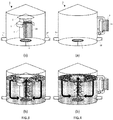
- the heating means (2) can be located inside the kettle, thus forming an internal boiler kettle as illustrated in Figure 3(a) . Due to their very low density these vapour bubbles are the driving force upward through the internal boiler, thereby ensuring a natural convection.
- a pump is located below the internal boiler to force wort collected at various points of the kettle to flow through the heating pipes.
- forced convection system is not mandatory in the present invention because, as will be discussed below, the sparged gas bubbles create already a forced convection.
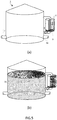
- the heating means (2) can be located outside the kettle, fluidly connected thereto by pipes, thus forming an external boiler kettle as illustrated in Figures 4(a) and 5(a) .
- a pump (8) is usually used to force wort flow through the boiler, Most kettles of the prior art, traditionally used to carry out a wort boiling step fulfill the foregoing requirements,
- the equipment required for the present invention requires a gas sparging system (3) suitable for sparging an inert gas into said wort.
- a gas sparging system can be very simple; and may include a circular plate, cylinder or ring provided with a multitude of apertures. The apertures can be through channels, like in a shower head, or they may be the pores of an open pore structure, such as a sintered material (e.g., sintered stainless steel). If the inert gas used is nitrogen, a nitrogen converter is very simple and inexpensive to install, and if CO 2 is used instead, it is clear that such gas is abundantly available in all breweries.
- the gas sparger (3) is preferably located at the bottom of the kettle, so that the gas bubbles may rise to the surface of the wort, fixing on their way up volatiles and haze active proteins.
- an external boiler kettle is provided with a gas sparging system located at the upstream end of the external boiler with respect to the wort flow direction (in case of Figure 5 , at the bottom of the boiler). The bubbles are forced through the hollow heating tubes (2a) and injected into the kettle together with the wort.
- the sparger be located below the heating tubes (2a) and preferably have a largest dimension (diameter in case of a disc, cylinder, or a ring) which is smaller than the largest diameter of the boiler (2).
- a baffle (5) and a deflector-roof (6) are preferably provided on top of the internal boiler in order to channel the flow of rising gas bubbles and wort, redistribute them over the top liquid-air interface of the wort, and reduce the thickness of the foam thus formed to permit better elimination in the air of the volatiles entrained with the bubbles (cf. Figure 3(b) ).
- Wort is fed to the kettle from a mash separating step, such as a lautering step (400).
- wort is first passed through a buffer or pre-heating tun prior to entering the kettle.
- the temperature of the wort is generally below 80°C,.
- no gas sparging takes place during this phase of the process.
- the temperature of the wort composition is increased to a target temperature of between 98°C and 99°C.
- a gas is sparged through the wort composition at an average rate of 200 g/HI/Hr while maintaining an average target temperature of between 98°C and 99°C for a period of about 60 minutes; and during which the wort composition does not reach its boiling point.
- the wort composition is transferred to a trub separation step.
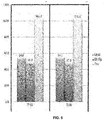
- this shows an embodiment illustrating the process of a preferred embodiment the present invention.
- the temperature is raised at a rate of 0.6 to 1.2°C/min until the temperature reaches about 3°C below the natural boiling temperature of the wort.
- the wort composition is then enters the "hot stand” phase, where the temperature is maintained at this temperature.
- the temperature is then raised again to about 1.5°C below the natural boiling temperature of the wort, and is held there for a period of time during which the composition is sparged with an inert gas.
- the volatile materials, such as SMM and DMS are stripped from the composition during this part of the process.
- the exit temperature of the external heater is kept above that of the wort body composition. This is because some of the heat is lost to the process (radiation, sparging, etc. ) .
- an inert gas sparger located at the bottom of the kettle generates a column of gas bubbles.
- the volatile components present in the wort are thus in equilibrium between gas and liquid phases without need for the wort to boil.
- the column of bubbles penetrating through the lumens of the hollow tubes of an internal boiler as depicted in Figure 3(b) creates a forced convection independent of temperature, contrary to natural convection which is highly temperature dependent for the creation of sufficient vapour bubbles.
- inert gas bubbles act like vapour bubbles when surfacing, yielding the same effect as with the latter with respect to elimination of volatiles and coagulation of haze active proteins, but without having to boil and evaporate large amounts of wort.
- the gas flow is also advantageous because it homogenizes the wort by creating a gas lift system with a central ascending flow and a lateral descending flow, as illustrated by the black arrows in Figures 3(b) and 4(b) .
- wort can be fed to a whirlpool tun or the like for separating trub from clear wort, and thence proceed to fermentation (700), maturation (800), filtering (900) and packaging (1000) of the thus produced beer exactly in the same way as in the conventional brewing processes.
Landscapes
- Chemical & Material Sciences (AREA)
- Organic Chemistry (AREA)
- Engineering & Computer Science (AREA)
- Bioinformatics & Cheminformatics (AREA)
- Life Sciences & Earth Sciences (AREA)
- Biochemistry (AREA)
- Health & Medical Sciences (AREA)
- General Engineering & Computer Science (AREA)
- General Health & Medical Sciences (AREA)
- Genetics & Genomics (AREA)
- Food Science & Technology (AREA)
- Wood Science & Technology (AREA)
- Zoology (AREA)
- Distillation Of Fermentation Liquor, Processing Of Alcohols, Vinegar And Beer (AREA)
Priority Applications (7)
| Application Number | Priority Date | Filing Date | Title |
|---|---|---|---|
| HRP20231279TT HRP20231279T1 (hr) | 2019-07-02 | 2019-07-02 | Postupak za preradu sladovine |
| CA3048302A CA3048302C (en) | 2019-07-02 | 2019-07-02 | Process for treating wort |
| EP19183785.5A EP3760700B8 (de) | 2019-07-02 | 2019-07-02 | Verfahren zur behandlung von würze |
| HUE19183785A HUE064267T2 (hu) | 2019-07-02 | 2019-07-02 | Sörlé kezelésére szolgáló eljárás |
| US16/460,039 US11788037B2 (en) | 2019-07-02 | 2019-07-02 | Process for treating wort |
| ES19183785T ES2960337T3 (es) | 2019-07-02 | 2019-07-02 | Procedimiento para tratar mosto |
| RS20230912A RS64673B1 (sr) | 2019-07-02 | 2019-07-02 | Postupak za obradu sladovine |
Applications Claiming Priority (3)
| Application Number | Priority Date | Filing Date | Title |
|---|---|---|---|
| CA3048302A CA3048302C (en) | 2019-07-02 | 2019-07-02 | Process for treating wort |
| EP19183785.5A EP3760700B8 (de) | 2019-07-02 | 2019-07-02 | Verfahren zur behandlung von würze |
| US16/460,039 US11788037B2 (en) | 2019-07-02 | 2019-07-02 | Process for treating wort |
Publications (3)
| Publication Number | Publication Date |
|---|---|
| EP3760700A1 true EP3760700A1 (de) | 2021-01-06 |
| EP3760700B1 EP3760700B1 (de) | 2023-09-20 |
| EP3760700B8 EP3760700B8 (de) | 2023-10-25 |
Family
ID=88469865
Family Applications (1)
| Application Number | Title | Priority Date | Filing Date |
|---|---|---|---|
| EP19183785.5A Active EP3760700B8 (de) | 2019-07-02 | 2019-07-02 | Verfahren zur behandlung von würze |
Country Status (3)
| Country | Link |
|---|---|
| US (1) | US11788037B2 (de) |
| EP (1) | EP3760700B8 (de) |
| CA (1) | CA3048302C (de) |
Cited By (5)
| Publication number | Priority date | Publication date | Assignee | Title |
|---|---|---|---|---|
| DK202300244A1 (da) * | 2023-03-19 | 2024-07-25 | Frank Innovation Aps | Kulsyre stripning af urtledning |
| WO2025016835A1 (en) | 2023-07-14 | 2025-01-23 | Heineken Supply Chain B.V. | Process for the production of non-alcoholic fermented malt beverages |
| WO2025108579A1 (en) | 2023-11-24 | 2025-05-30 | Heineken Supply Chain B.V. | Energy efficient process for the production of fermented malt beverages |
| WO2025108580A1 (en) | 2023-11-24 | 2025-05-30 | Heineken Supply Chain B.V. | Energy efficient process for the production of fermented malt beverages |
| WO2025146486A1 (en) | 2024-01-04 | 2025-07-10 | Heineken Supply Chain B.V. | Energy efficient process for the production of lager beer |
Families Citing this family (2)
| Publication number | Priority date | Publication date | Assignee | Title |
|---|---|---|---|---|
| US12595445B1 (en) * | 2021-07-22 | 2026-04-07 | 4th Wave Craft LLC | Transparent alcohol brewing system |
| USD1099609S1 (en) | 2022-03-28 | 2025-10-28 | 4th Wave Craft LLC | Transparent alcohol brewing system |
Citations (7)
| Publication number | Priority date | Publication date | Assignee | Title |
|---|---|---|---|---|
| DE2245435A1 (de) * | 1972-09-13 | 1974-03-21 | Alexander Mario Hinz | Drucksudpfanne zum brauen von bieren und biermaischen-wuerze |
| ZA978962B (en) * | 1996-10-07 | 1998-06-02 | Sapporo Breweries | Method of boiling wort and wort boiling apparatus for realizing the same. |
| EP0875560A1 (de) | 1996-10-07 | 1998-11-04 | Sapporo Breweries Ltd. | Verfahren zum kochen von stammwürze und stammwürzekocher zur verwendung hierfür |
| EP1420064A1 (de) * | 2002-11-12 | 2004-05-19 | Hrch. Huppmann GmbH | Verfahren zur Kochung von Würze |
| DE102008033287A1 (de) | 2008-07-11 | 2010-01-14 | Scheuren, Hans, Dipl.-Ing. | Verfahren zur Aromastoffaustreibung während der Heißtrubabscheidung sowie Vorrichtung zur Heißtrubabscheidung |
| DE102011081648A1 (de) * | 2011-08-26 | 2013-02-28 | Krones Ag | Bierbrauverfahren |
| EP2871227A1 (de) * | 2013-11-07 | 2015-05-13 | Anheuser-Busch InBev S.A. | Verfahren zur Behandlung von Würze in einem Kochtopf |
Family Cites Families (1)
| Publication number | Priority date | Publication date | Assignee | Title |
|---|---|---|---|---|
| DE102007049159B4 (de) | 2007-10-13 | 2009-09-24 | Kaspar Schulz Brauereimaschinenfabrik & Apparatebauanstalt Kg | Verfahren und Vorrichtung zur Würzebereitung bei der Bierherstellung |
-
2019
- 2019-07-02 EP EP19183785.5A patent/EP3760700B8/de active Active
- 2019-07-02 CA CA3048302A patent/CA3048302C/en active Active
- 2019-07-02 US US16/460,039 patent/US11788037B2/en active Active
Patent Citations (8)
| Publication number | Priority date | Publication date | Assignee | Title |
|---|---|---|---|---|
| DE2245435A1 (de) * | 1972-09-13 | 1974-03-21 | Alexander Mario Hinz | Drucksudpfanne zum brauen von bieren und biermaischen-wuerze |
| ZA978962B (en) * | 1996-10-07 | 1998-06-02 | Sapporo Breweries | Method of boiling wort and wort boiling apparatus for realizing the same. |
| EP0875560A1 (de) | 1996-10-07 | 1998-11-04 | Sapporo Breweries Ltd. | Verfahren zum kochen von stammwürze und stammwürzekocher zur verwendung hierfür |
| EP1420064A1 (de) * | 2002-11-12 | 2004-05-19 | Hrch. Huppmann GmbH | Verfahren zur Kochung von Würze |
| DE102008033287A1 (de) | 2008-07-11 | 2010-01-14 | Scheuren, Hans, Dipl.-Ing. | Verfahren zur Aromastoffaustreibung während der Heißtrubabscheidung sowie Vorrichtung zur Heißtrubabscheidung |
| DE102011081648A1 (de) * | 2011-08-26 | 2013-02-28 | Krones Ag | Bierbrauverfahren |
| EP2871227A1 (de) * | 2013-11-07 | 2015-05-13 | Anheuser-Busch InBev S.A. | Verfahren zur Behandlung von Würze in einem Kochtopf |
| EP3066185A1 (de) | 2013-11-07 | 2016-09-14 | Anheuser-Busch InBev S.A. | Verfahren zur behandlung von würze in einem kochtopf |
Cited By (6)
| Publication number | Priority date | Publication date | Assignee | Title |
|---|---|---|---|---|
| DK202300244A1 (da) * | 2023-03-19 | 2024-07-25 | Frank Innovation Aps | Kulsyre stripning af urtledning |
| DK181621B1 (da) * | 2023-03-19 | 2024-07-25 | Frank Innovation Aps | Kulsyre stripning af urtledning |
| WO2025016835A1 (en) | 2023-07-14 | 2025-01-23 | Heineken Supply Chain B.V. | Process for the production of non-alcoholic fermented malt beverages |
| WO2025108579A1 (en) | 2023-11-24 | 2025-05-30 | Heineken Supply Chain B.V. | Energy efficient process for the production of fermented malt beverages |
| WO2025108580A1 (en) | 2023-11-24 | 2025-05-30 | Heineken Supply Chain B.V. | Energy efficient process for the production of fermented malt beverages |
| WO2025146486A1 (en) | 2024-01-04 | 2025-07-10 | Heineken Supply Chain B.V. | Energy efficient process for the production of lager beer |
Also Published As
| Publication number | Publication date |
|---|---|
| US20210002593A1 (en) | 2021-01-07 |
| EP3760700B8 (de) | 2023-10-25 |
| EP3760700B1 (de) | 2023-09-20 |
| CA3048302A1 (en) | 2021-01-02 |
| US11788037B2 (en) | 2023-10-17 |
| CA3048302C (en) | 2023-01-24 |
Similar Documents
| Publication | Publication Date | Title |
|---|---|---|
| EP3760700B1 (de) | Verfahren zur behandlung von würze | |
| US12187990B2 (en) | Method for treating a wort in a boiling kettle | |
| AU681128B2 (en) | Improvements in production of fermented malt beverages | |
| AU695392B2 (en) | A process for the continuous boiling of wort | |
| US20190177672A1 (en) | Method for producing beer-flavored beverage | |
| AU2018271250A1 (en) | Method for producing saccharified moromi | |
| Willaert et al. | Wort boiling today-boiling systems with low thermal stress in combination with volatile stripping | |
| EP4495217A1 (de) | Verfahren zur behandlung von würze in einem kessel | |
| US20190211290A1 (en) | Method for producing fermented beverage | |
| ES2960337T3 (es) | Procedimiento para tratar mosto | |
| WO2024193861A1 (en) | Method for removing undesired substances from wort and process equipment for beer production |
Legal Events
| Date | Code | Title | Description |
|---|---|---|---|
| REG | Reference to a national code |
Ref country code: HR Ref legal event code: TUEP Ref document number: P20231279T Country of ref document: HR |
|
| PUAI | Public reference made under article 153(3) epc to a published international application that has entered the european phase |
Free format text: ORIGINAL CODE: 0009012 |
|
| STAA | Information on the status of an ep patent application or granted ep patent |
Free format text: STATUS: THE APPLICATION HAS BEEN PUBLISHED |
|
| AK | Designated contracting states |
Kind code of ref document: A1 Designated state(s): AL AT BE BG CH CY CZ DE DK EE ES FI FR GB GR HR HU IE IS IT LI LT LU LV MC MK MT NL NO PL PT RO RS SE SI SK SM TR |
|
| AX | Request for extension of the european patent |
Extension state: BA ME |
|
| STAA | Information on the status of an ep patent application or granted ep patent |
Free format text: STATUS: REQUEST FOR EXAMINATION WAS MADE |
|
| 17P | Request for examination filed |
Effective date: 20210706 |
|
| RBV | Designated contracting states (corrected) |
Designated state(s): AL AT BE BG CH CY CZ DE DK EE ES FI FR GB GR HR HU IE IS IT LI LT LU LV MC MK MT NL NO PL PT RO RS SE SI SK SM TR |
|
| RIC1 | Information provided on ipc code assigned before grant |
Ipc: C12C 13/08 20060101ALI20230206BHEP Ipc: C12C 13/02 20060101ALI20230206BHEP Ipc: C12C 7/22 20060101ALI20230206BHEP Ipc: C12C 7/20 20060101AFI20230206BHEP |
|
| GRAP | Despatch of communication of intention to grant a patent |
Free format text: ORIGINAL CODE: EPIDOSNIGR1 |
|
| STAA | Information on the status of an ep patent application or granted ep patent |
Free format text: STATUS: GRANT OF PATENT IS INTENDED |
|
| INTG | Intention to grant announced |
Effective date: 20230413 |
|
| GRAS | Grant fee paid |
Free format text: ORIGINAL CODE: EPIDOSNIGR3 |
|
| GRAA | (expected) grant |
Free format text: ORIGINAL CODE: 0009210 |
|
| STAA | Information on the status of an ep patent application or granted ep patent |
Free format text: STATUS: THE PATENT HAS BEEN GRANTED |
|
| REG | Reference to a national code |
Ref country code: DE Ref legal event code: R081 Ref document number: 602019037713 Country of ref document: DE Owner name: COORS BREWING COMPANY, MILWAUKEE, US Free format text: FORMER OWNER: COORS BREWING COMPANY, DENVER, CO, US |
|
| P01 | Opt-out of the competence of the unified patent court (upc) registered |
Effective date: 20230804 |
|
| AK | Designated contracting states |
Kind code of ref document: B1 Designated state(s): AL AT BE BG CH CY CZ DE DK EE ES FI FR GB GR HR HU IE IS IT LI LT LU LV MC MK MT NL NO PL PT RO RS SE SI SK SM TR |
|
| REG | Reference to a national code |
Ref country code: GB Ref legal event code: FG4D |
|
| RAP4 | Party data changed (patent owner data changed or rights of a patent transferred) |
Owner name: COORS BREWING COMPANY |
|
| REG | Reference to a national code |
Ref country code: CH Ref legal event code: PK Free format text: BERICHTIGUNG B8 Ref country code: CH Ref legal event code: EP |
|
| REG | Reference to a national code |
Ref country code: DE Ref legal event code: R096 Ref document number: 602019037713 Country of ref document: DE |
|
| REG | Reference to a national code |
Ref country code: IE Ref legal event code: FG4D |
|
| REG | Reference to a national code |
Ref country code: LT Ref legal event code: MG9D |
|
| PG25 | Lapsed in a contracting state [announced via postgrant information from national office to epo] |
Ref country code: GR Free format text: LAPSE BECAUSE OF FAILURE TO SUBMIT A TRANSLATION OF THE DESCRIPTION OR TO PAY THE FEE WITHIN THE PRESCRIBED TIME-LIMIT Effective date: 20231221 |
|
| REG | Reference to a national code |
Ref country code: NL Ref legal event code: MP Effective date: 20230920 |
|
| PG25 | Lapsed in a contracting state [announced via postgrant information from national office to epo] |
Ref country code: SE Free format text: LAPSE BECAUSE OF FAILURE TO SUBMIT A TRANSLATION OF THE DESCRIPTION OR TO PAY THE FEE WITHIN THE PRESCRIBED TIME-LIMIT Effective date: 20230920 Ref country code: NO Free format text: LAPSE BECAUSE OF FAILURE TO SUBMIT A TRANSLATION OF THE DESCRIPTION OR TO PAY THE FEE WITHIN THE PRESCRIBED TIME-LIMIT Effective date: 20231220 Ref country code: LV Free format text: LAPSE BECAUSE OF FAILURE TO SUBMIT A TRANSLATION OF THE DESCRIPTION OR TO PAY THE FEE WITHIN THE PRESCRIBED TIME-LIMIT Effective date: 20230920 Ref country code: LT Free format text: LAPSE BECAUSE OF FAILURE TO SUBMIT A TRANSLATION OF THE DESCRIPTION OR TO PAY THE FEE WITHIN THE PRESCRIBED TIME-LIMIT Effective date: 20230920 Ref country code: GR Free format text: LAPSE BECAUSE OF FAILURE TO SUBMIT A TRANSLATION OF THE DESCRIPTION OR TO PAY THE FEE WITHIN THE PRESCRIBED TIME-LIMIT Effective date: 20231221 Ref country code: FI Free format text: LAPSE BECAUSE OF FAILURE TO SUBMIT A TRANSLATION OF THE DESCRIPTION OR TO PAY THE FEE WITHIN THE PRESCRIBED TIME-LIMIT Effective date: 20230920 |
|
| REG | Reference to a national code |
Ref country code: HR Ref legal event code: T1PR Ref document number: P20231279 Country of ref document: HR |
|
| REG | Reference to a national code |
Ref country code: AT Ref legal event code: MK05 Ref document number: 1613423 Country of ref document: AT Kind code of ref document: T Effective date: 20230920 |
|
| REG | Reference to a national code |
Ref country code: HU Ref legal event code: AG4A Ref document number: E064267 Country of ref document: HU |
|
| PG25 | Lapsed in a contracting state [announced via postgrant information from national office to epo] |
Ref country code: NL Free format text: LAPSE BECAUSE OF FAILURE TO SUBMIT A TRANSLATION OF THE DESCRIPTION OR TO PAY THE FEE WITHIN THE PRESCRIBED TIME-LIMIT Effective date: 20230920 |
|
| REG | Reference to a national code |
Ref country code: ES Ref legal event code: FG2A Ref document number: 2960337 Country of ref document: ES Kind code of ref document: T3 Effective date: 20240304 |
|
| PG25 | Lapsed in a contracting state [announced via postgrant information from national office to epo] |
Ref country code: IS Free format text: LAPSE BECAUSE OF FAILURE TO SUBMIT A TRANSLATION OF THE DESCRIPTION OR TO PAY THE FEE WITHIN THE PRESCRIBED TIME-LIMIT Effective date: 20240120 |
|
| PG25 | Lapsed in a contracting state [announced via postgrant information from national office to epo] |
Ref country code: AT Free format text: LAPSE BECAUSE OF FAILURE TO SUBMIT A TRANSLATION OF THE DESCRIPTION OR TO PAY THE FEE WITHIN THE PRESCRIBED TIME-LIMIT Effective date: 20230920 |
|
| PG25 | Lapsed in a contracting state [announced via postgrant information from national office to epo] |
Ref country code: SM Free format text: LAPSE BECAUSE OF FAILURE TO SUBMIT A TRANSLATION OF THE DESCRIPTION OR TO PAY THE FEE WITHIN THE PRESCRIBED TIME-LIMIT Effective date: 20230920 Ref country code: IS Free format text: LAPSE BECAUSE OF FAILURE TO SUBMIT A TRANSLATION OF THE DESCRIPTION OR TO PAY THE FEE WITHIN THE PRESCRIBED TIME-LIMIT Effective date: 20240120 Ref country code: EE Free format text: LAPSE BECAUSE OF FAILURE TO SUBMIT A TRANSLATION OF THE DESCRIPTION OR TO PAY THE FEE WITHIN THE PRESCRIBED TIME-LIMIT Effective date: 20230920 Ref country code: AT Free format text: LAPSE BECAUSE OF FAILURE TO SUBMIT A TRANSLATION OF THE DESCRIPTION OR TO PAY THE FEE WITHIN THE PRESCRIBED TIME-LIMIT Effective date: 20230920 Ref country code: PT Free format text: LAPSE BECAUSE OF FAILURE TO SUBMIT A TRANSLATION OF THE DESCRIPTION OR TO PAY THE FEE WITHIN THE PRESCRIBED TIME-LIMIT Effective date: 20240122 Ref country code: SK Free format text: LAPSE BECAUSE OF FAILURE TO SUBMIT A TRANSLATION OF THE DESCRIPTION OR TO PAY THE FEE WITHIN THE PRESCRIBED TIME-LIMIT Effective date: 20230920 |
|
| PG25 | Lapsed in a contracting state [announced via postgrant information from national office to epo] |
Ref country code: PL Free format text: LAPSE BECAUSE OF FAILURE TO SUBMIT A TRANSLATION OF THE DESCRIPTION OR TO PAY THE FEE WITHIN THE PRESCRIBED TIME-LIMIT Effective date: 20230920 |
|
| REG | Reference to a national code |
Ref country code: DE Ref legal event code: R026 Ref document number: 602019037713 Country of ref document: DE |
|
| PLBI | Opposition filed |
Free format text: ORIGINAL CODE: 0009260 |
|
| PLAX | Notice of opposition and request to file observation + time limit sent |
Free format text: ORIGINAL CODE: EPIDOSNOBS2 |
|
| REG | Reference to a national code |
Ref country code: HR Ref legal event code: ODRP Ref document number: P20231279 Country of ref document: HR Payment date: 20240626 Year of fee payment: 6 |
|
| PG25 | Lapsed in a contracting state [announced via postgrant information from national office to epo] |
Ref country code: DK Free format text: LAPSE BECAUSE OF FAILURE TO SUBMIT A TRANSLATION OF THE DESCRIPTION OR TO PAY THE FEE WITHIN THE PRESCRIBED TIME-LIMIT Effective date: 20230920 |
|
| 26 | Opposition filed |
Opponent name: ANHEUSER-BUSCH INBEV SA Effective date: 20240619 |
|
| PG25 | Lapsed in a contracting state [announced via postgrant information from national office to epo] |
Ref country code: DK Free format text: LAPSE BECAUSE OF FAILURE TO SUBMIT A TRANSLATION OF THE DESCRIPTION OR TO PAY THE FEE WITHIN THE PRESCRIBED TIME-LIMIT Effective date: 20230920 |
|
| PG25 | Lapsed in a contracting state [announced via postgrant information from national office to epo] |
Ref country code: SI Free format text: LAPSE BECAUSE OF FAILURE TO SUBMIT A TRANSLATION OF THE DESCRIPTION OR TO PAY THE FEE WITHIN THE PRESCRIBED TIME-LIMIT Effective date: 20230920 |
|
| PG25 | Lapsed in a contracting state [announced via postgrant information from national office to epo] |
Ref country code: SI Free format text: LAPSE BECAUSE OF FAILURE TO SUBMIT A TRANSLATION OF THE DESCRIPTION OR TO PAY THE FEE WITHIN THE PRESCRIBED TIME-LIMIT Effective date: 20230920 |
|
| PLBB | Reply of patent proprietor to notice(s) of opposition received |
Free format text: ORIGINAL CODE: EPIDOSNOBS3 |
|
| PG25 | Lapsed in a contracting state [announced via postgrant information from national office to epo] |
Ref country code: MC Free format text: LAPSE BECAUSE OF FAILURE TO SUBMIT A TRANSLATION OF THE DESCRIPTION OR TO PAY THE FEE WITHIN THE PRESCRIBED TIME-LIMIT Effective date: 20230920 |
|
| REG | Reference to a national code |
Ref country code: CH Ref legal event code: PL |
|
| PG25 | Lapsed in a contracting state [announced via postgrant information from national office to epo] |
Ref country code: LU Free format text: LAPSE BECAUSE OF NON-PAYMENT OF DUE FEES Effective date: 20240702 |
|
| PG25 | Lapsed in a contracting state [announced via postgrant information from national office to epo] |
Ref country code: LU Free format text: LAPSE BECAUSE OF NON-PAYMENT OF DUE FEES Effective date: 20240702 |
|
| PG25 | Lapsed in a contracting state [announced via postgrant information from national office to epo] |
Ref country code: CH Free format text: LAPSE BECAUSE OF NON-PAYMENT OF DUE FEES Effective date: 20240731 Ref country code: BE Free format text: LAPSE BECAUSE OF NON-PAYMENT OF DUE FEES Effective date: 20240731 |
|
| PG25 | Lapsed in a contracting state [announced via postgrant information from national office to epo] |
Ref country code: FR Free format text: LAPSE BECAUSE OF NON-PAYMENT OF DUE FEES Effective date: 20240731 |
|
| REG | Reference to a national code |
Ref country code: BE Ref legal event code: MM Effective date: 20240731 |
|
| PGFP | Annual fee paid to national office [announced via postgrant information from national office to epo] |
Ref country code: GB Payment date: 20250619 Year of fee payment: 7 |
|
| PGFP | Annual fee paid to national office [announced via postgrant information from national office to epo] |
Ref country code: RS Payment date: 20250625 Year of fee payment: 7 |
|
| PGFP | Annual fee paid to national office [announced via postgrant information from national office to epo] |
Ref country code: HR Payment date: 20250624 Year of fee payment: 7 |
|
| REG | Reference to a national code |
Ref country code: HR Ref legal event code: ODRP Ref document number: P20231279 Country of ref document: HR Payment date: 20250624 Year of fee payment: 7 |
|
| PGFP | Annual fee paid to national office [announced via postgrant information from national office to epo] |
Ref country code: BG Payment date: 20250627 Year of fee payment: 7 |
|
| PGFP | Annual fee paid to national office [announced via postgrant information from national office to epo] |
Ref country code: CZ Payment date: 20250627 Year of fee payment: 7 |
|
| PGFP | Annual fee paid to national office [announced via postgrant information from national office to epo] |
Ref country code: IE Payment date: 20250623 Year of fee payment: 7 |
|
| PGFP | Annual fee paid to national office [announced via postgrant information from national office to epo] |
Ref country code: HU Payment date: 20250714 Year of fee payment: 7 |
|
| PGFP | Annual fee paid to national office [announced via postgrant information from national office to epo] |
Ref country code: ES Payment date: 20250801 Year of fee payment: 7 |
|
| PGFP | Annual fee paid to national office [announced via postgrant information from national office to epo] |
Ref country code: DE Payment date: 20250620 Year of fee payment: 7 |
|
| PGFP | Annual fee paid to national office [announced via postgrant information from national office to epo] |
Ref country code: IT Payment date: 20250619 Year of fee payment: 7 |
|
| PGFP | Annual fee paid to national office [announced via postgrant information from national office to epo] |
Ref country code: RO Payment date: 20250702 Year of fee payment: 7 |
|
| PG25 | Lapsed in a contracting state [announced via postgrant information from national office to epo] |
Ref country code: CY Free format text: LAPSE BECAUSE OF FAILURE TO SUBMIT A TRANSLATION OF THE DESCRIPTION OR TO PAY THE FEE WITHIN THE PRESCRIBED TIME-LIMIT; INVALID AB INITIO Effective date: 20190702 |
|
| PLCK | Communication despatched that opposition was rejected |
Free format text: ORIGINAL CODE: EPIDOSNREJ1 |
|
| APBP | Date of receipt of notice of appeal recorded |
Free format text: ORIGINAL CODE: EPIDOSNNOA2O |
|
| APAH | Appeal reference modified |
Free format text: ORIGINAL CODE: EPIDOSCREFNO |
|
| APAW | Appeal reference deleted |
Free format text: ORIGINAL CODE: EPIDOSDREFNO |
|
| APBQ | Date of receipt of statement of grounds of appeal recorded |
Free format text: ORIGINAL CODE: EPIDOSNNOA3O |