EP3761238B1 - Dispositifs et procédés de précodage assisté par apprentissage machine - Google Patents
Dispositifs et procédés de précodage assisté par apprentissage machine Download PDFInfo
- Publication number
- EP3761238B1 EP3761238B1 EP19305887.2A EP19305887A EP3761238B1 EP 3761238 B1 EP3761238 B1 EP 3761238B1 EP 19305887 A EP19305887 A EP 19305887A EP 3761238 B1 EP3761238 B1 EP 3761238B1
- Authority
- EP
- European Patent Office
- Prior art keywords
- radius
- sphere
- function
- current
- vector
- Prior art date
- Legal status (The legal status is an assumption and is not a legal conclusion. Google has not performed a legal analysis and makes no representation as to the accuracy of the status listed.)
- Active
Links
Images



Classifications
-
- G—PHYSICS
- G06—COMPUTING OR CALCULATING; COUNTING
- G06N—COMPUTING ARRANGEMENTS BASED ON SPECIFIC COMPUTATIONAL MODELS
- G06N20/00—Machine learning
-
- G—PHYSICS
- G06—COMPUTING OR CALCULATING; COUNTING
- G06N—COMPUTING ARRANGEMENTS BASED ON SPECIFIC COMPUTATIONAL MODELS
- G06N20/00—Machine learning
- G06N20/10—Machine learning using kernel methods, e.g. support vector machines [SVM]
-
- G—PHYSICS
- G06—COMPUTING OR CALCULATING; COUNTING
- G06N—COMPUTING ARRANGEMENTS BASED ON SPECIFIC COMPUTATIONAL MODELS
- G06N3/00—Computing arrangements based on biological models
- G06N3/02—Neural networks
- G06N3/04—Architecture, e.g. interconnection topology
- G06N3/048—Activation functions
-
- G—PHYSICS
- G06—COMPUTING OR CALCULATING; COUNTING
- G06N—COMPUTING ARRANGEMENTS BASED ON SPECIFIC COMPUTATIONAL MODELS
- G06N3/00—Computing arrangements based on biological models
- G06N3/02—Neural networks
- G06N3/08—Learning methods
- G06N3/084—Backpropagation, e.g. using gradient descent
-
- G—PHYSICS
- G06—COMPUTING OR CALCULATING; COUNTING
- G06N—COMPUTING ARRANGEMENTS BASED ON SPECIFIC COMPUTATIONAL MODELS
- G06N5/00—Computing arrangements using knowledge-based models
- G06N5/01—Dynamic search techniques; Heuristics; Dynamic trees; Branch-and-bound
-
- G—PHYSICS
- G06—COMPUTING OR CALCULATING; COUNTING
- G06N—COMPUTING ARRANGEMENTS BASED ON SPECIFIC COMPUTATIONAL MODELS
- G06N7/00—Computing arrangements based on specific mathematical models
- G06N7/01—Probabilistic graphical models, e.g. probabilistic networks
-
- H—ELECTRICITY
- H04—ELECTRIC COMMUNICATION TECHNIQUE
- H04B—TRANSMISSION
- H04B7/00—Radio transmission systems, i.e. using radiation field
- H04B7/02—Diversity systems; Multi-antenna system, i.e. transmission or reception using multiple antennas
- H04B7/04—Diversity systems; Multi-antenna system, i.e. transmission or reception using multiple antennas using two or more spaced independent antennas
- H04B7/0413—MIMO systems
- H04B7/0452—Multi-user MIMO systems
-
- H—ELECTRICITY
- H04—ELECTRIC COMMUNICATION TECHNIQUE
- H04B—TRANSMISSION
- H04B7/00—Radio transmission systems, i.e. using radiation field
- H04B7/02—Diversity systems; Multi-antenna system, i.e. transmission or reception using multiple antennas
- H04B7/04—Diversity systems; Multi-antenna system, i.e. transmission or reception using multiple antennas using two or more spaced independent antennas
- H04B7/0413—MIMO systems
- H04B7/0456—Selection of precoding matrices or codebooks, e.g. using matrices antenna weighting
-
- H—ELECTRICITY
- H04—ELECTRIC COMMUNICATION TECHNIQUE
- H04L—TRANSMISSION OF DIGITAL INFORMATION, e.g. TELEGRAPHIC COMMUNICATION
- H04L1/00—Arrangements for detecting or preventing errors in the information received
- H04L1/02—Arrangements for detecting or preventing errors in the information received by diversity reception
- H04L1/06—Arrangements for detecting or preventing errors in the information received by diversity reception using space diversity
- H04L1/0618—Space-time coding
-
- H—ELECTRICITY
- H04—ELECTRIC COMMUNICATION TECHNIQUE
- H04L—TRANSMISSION OF DIGITAL INFORMATION, e.g. TELEGRAPHIC COMMUNICATION
- H04L25/00—Baseband systems
- H04L25/02—Details ; arrangements for supplying electrical power along data transmission lines
- H04L25/0202—Channel estimation
- H04L25/0212—Channel estimation of impulse response
-
- H—ELECTRICITY
- H04—ELECTRIC COMMUNICATION TECHNIQUE
- H04L—TRANSMISSION OF DIGITAL INFORMATION, e.g. TELEGRAPHIC COMMUNICATION
- H04L25/00—Baseband systems
- H04L25/02—Details ; arrangements for supplying electrical power along data transmission lines
- H04L25/03—Shaping networks in transmitter or receiver, e.g. adaptive shaping networks
- H04L25/03006—Arrangements for removing intersymbol interference
- H04L25/03343—Arrangements at the transmitter end
-
- H—ELECTRICITY
- H04—ELECTRIC COMMUNICATION TECHNIQUE
- H04L—TRANSMISSION OF DIGITAL INFORMATION, e.g. TELEGRAPHIC COMMUNICATION
- H04L25/00—Baseband systems
- H04L25/02—Details ; arrangements for supplying electrical power along data transmission lines
- H04L25/03—Shaping networks in transmitter or receiver, e.g. adaptive shaping networks
- H04L25/03006—Arrangements for removing intersymbol interference
- H04L2025/03433—Arrangements for removing intersymbol interference characterised by equaliser structure
- H04L2025/03439—Fixed structures
- H04L2025/03445—Time domain
- H04L2025/03458—Lattice
-
- H—ELECTRICITY
- H04—ELECTRIC COMMUNICATION TECHNIQUE
- H04L—TRANSMISSION OF DIGITAL INFORMATION, e.g. TELEGRAPHIC COMMUNICATION
- H04L25/00—Baseband systems
- H04L25/02—Details ; arrangements for supplying electrical power along data transmission lines
- H04L25/03—Shaping networks in transmitter or receiver, e.g. adaptive shaping networks
- H04L25/03006—Arrangements for removing intersymbol interference
- H04L2025/03433—Arrangements for removing intersymbol interference characterised by equaliser structure
- H04L2025/03439—Fixed structures
- H04L2025/03445—Time domain
- H04L2025/03464—Neural networks
-
- Y—GENERAL TAGGING OF NEW TECHNOLOGICAL DEVELOPMENTS; GENERAL TAGGING OF CROSS-SECTIONAL TECHNOLOGIES SPANNING OVER SEVERAL SECTIONS OF THE IPC; TECHNICAL SUBJECTS COVERED BY FORMER USPC CROSS-REFERENCE ART COLLECTIONS [XRACs] AND DIGESTS
- Y02—TECHNOLOGIES OR APPLICATIONS FOR MITIGATION OR ADAPTATION AGAINST CLIMATE CHANGE
- Y02D—CLIMATE CHANGE MITIGATION TECHNOLOGIES IN INFORMATION AND COMMUNICATION TECHNOLOGIES [ICT], I.E. INFORMATION AND COMMUNICATION TECHNOLOGIES AIMING AT THE REDUCTION OF THEIR OWN ENERGY USE
- Y02D30/00—Reducing energy consumption in communication networks
- Y02D30/70—Reducing energy consumption in communication networks in wireless communication networks
Definitions
- the invention generally relates to digital communications and in particular to methods and devices for precoding data signals.
- MIMO Multiple-input multiple-output
- MIMO systems One major challenge for MIMO systems is to adapt to increasing demands in terms of data rates for real-time services and applications. Another challenge relates to the complexity and energy consumption of the signal processing at transceiver devices.
- precoding enables emitting multiple data streams from the transmit antennas with independent and appropriate weightings such that the link throughput is maximized at the receiver output.
- a multi-antenna transmitter communicates with multiple receivers according to space division multiple access (SDMA) techniques.
- SDMA space division multiple access
- Precoding enables separating user data streams and pre-cancelling interference based on channel knowledge at the transmitter such that one or more objective functions (e.g. throughput maximization, fairness maximization) is satisfied under one or more constraints (e.g. sum transmit power constraint, per antenna transmit power constraint).
- objective functions e.g. throughput maximization, fairness maximization
- constraints e.g. sum transmit power constraint, per antenna transmit power constraint.
- Different precoding techniques exist to solve different objective functions under different constraints, such as for example the hybrid predecoding technique disclosed in HONGJI HUANG ET AL.: Deep-Learning-based Millimeter-Wave Massive MIMO for Hybrid Precoding, Arxiv.org, Cornell University, 19 January 2019 .
- Precoding techniques can be grouped into two categories: linear and non-linear.
- Linear precoding is realized when the signal processing procedures only involve linear operations and refers to linear transmit filters.
- Exemplary linear precoding techniques include:
- Linear precoding techniques require reasonable computational complexity. However they provide suboptimal performance. For example MRT only maximizes the signal gain at intended users/receivers and is close-to-optimal only in noise-limited systems where the inter-user interference is negligible compared to the noise.
- ZF precoding performs far from optimal in the noise limited regime.
- the transmitted vector is pre-filtered using the pseudo-inverse of the channel matrix, which requires a high transmission power particularly when the channel matrix is ill-conditioned.
- Non-linear precoding is based on the concept of dirty paper coding disclosed in " H. Weingarten, Y. Steinberg, and S. Shamai, The capacity region of the Gaussian multiple-input multiple-output broadcast channel Archived 2012-10-23 at the Wayback Machine, IEEE Transactions on Information Theory, vol. 52, no. 9, pp. 3936-3964, 2006 ". Dirty paper coding shows that any known interference at the transmitter can be subtracted without the penalty of radio resources if optimal precoding scheme can be applied on the transmit signal. In such coding schemes, only the transmitter needs to know the interference, while full channel state information is required at the transmitter and the receivers in order to achieve the weighted sum capacity.
- Exemplary non-linear precoding techniques include:
- THP achieves better performance than linear precoding strategies by limiting the transmit power via a non-linear modulo operation.
- Vector perturbation techniques enable to further reduce the transmit power by perturbing the transmitted vector, where the optimum perturbation vector is found using the Sphere Encoder disclosed in " B. Hochwald, C. Peel, and L. Swindlehurst, "A vector-perturbation technique for near-capacity multiantenna multiuser communication-Part II: Perturbation,"IEEE Transactions on Communications, vol. 53, no. 3, pp.537-544, Mar. 2005 ".
- the Sphere Encoder achieves full diversity order and good performance, it requires high computational complexity that increases exponentially as the number of the antennas increases.
- Sphere Encoder implementations have been developed, as disclosed for example in FEDERICO BOCCARDI ET AL: "The -Sphere Encoder: Peak-Power Reduction by Lattice Precoding for the MIMO Gaussian Broadcast Channel", IEEE TRANSACTIONS ON COMMUNICATIONS, IEEE SERVICE CENTER, PISCATAWAY, NJ. USA, vol. 54, no. 11, 1 November 2006 (2006-11-01), pages 2085-2091 .
- Another exemplary implementation referred to as the M-algorithm encoder has been proposed in " J.Z. Zhang and K.J.
- the M-algorithm encoder is based on the reduction of the number of candidates at each encoding tree level to M candidates.
- the M-algorithm encoder achieves the same performance as the Sphere Encoder, however it still requires a high complexity.
- the embodiments of the invention provide efficient sphere radius design and controlling techniques that allow reducing the complexity of sphere encoder-based vector perturbation precoding techniques without compromising the precoding error performance.
- the embodiments of the invention provide efficient non-linear precoding techniques that require reduced computational complexity and reduced processing time.
- Embodiments of the invention provide devices, methods, and computer programs for precoding a vector of information symbols sent from a multi-antenna transmitter to a plurality of receivers through a transmission channel in a communication system with a reduced computational complexity.
- embodiments of the present invention provide methods, devices and computer program products for low-complexity and optimal performance vector permutation precoding based on Sphere Encoder that implements efficient sphere radius design techniques.
- Sphere radius design techniques according to the embodiments of the invention enable determining optimal precoding vector for the Sphere Encoder with a reduced complexity and reduced processing time.
- the design and control of the search sphere radius according to the embodiments of the invention relies on machine learning techniques.
- ⁇ refers to an n -dimensional lattice constructed over the Euclidean space R n and represents an additive discrete subgroup of the Euclidean space R n .
- a lattice generator matrix P ⁇ R n ⁇ n refers to a real-value matrix that comprises real-value components W ij ⁇ R .
- the activation function ⁇ refers to a computational non-linear function that defines the output of a neuron in the hidden layers of the multilayer deep neural network.
- An optimizer (hereinafter referred to as 'an optimization algorithm' or 'a gradient descent optimization algorithm') refers to an optimization algorithm used to update parameters of the deep neural network during a training phase.
- Epochs refer to the number of times the training data have passed through the deep neural network in the training phase.
- a mini-batch refers to a sub-set of training data extracted from the training data and used in an iteration of the training phase.
- the mini-batch size refers to the number of training data samples in each partitioned mini-batch.
- the learning rate (also referred to as 'a step size') of a gradient descent algorithm refers to a scalar value that is multiplied by the magnitude of the gradient.
- the embodiments of the invention provide devices, methods and computer program products for precoding a vector of information symbol in multi-antenna systems with a reduced complexity and optimal precoding performance.
- the embodiments of the invention may be implemented in multi-antenna systems to precode a vector of information symbols conveyed from a multi-antenna transmitter to a plurality of receivers, each receiver being equipped with one or more antennas.
- Such multi-antenna communication systems are known as multiuser MIMO systems or distributed MIMO systems.
- Multiuser MIMO systems are used for data transmission in various applications comprising, without limitation, radio communications (e.g. LTE, LTE-advanced, and 5G), Internet of Thing communications (e.g. vehicle-to-everything communications), local area network communications (e.g. wireless ad-hoc communications), massive MIMO supported for example in next 5G radio communications.
- radio communications e.g. LTE, LTE-advanced, and 5G
- Thing communications e.g. vehicle-to-everything communications
- local area network communications e.g. wireless ad-hoc communications
- massive MIMO supported for example in next 5G radio communications e.g. LTE, LTE-advanced, and 5G
- FIG. 1 is a block diagram of an exemplary application of the invention to a wireless communication system 100, according to some embodiments.
- the communication system 100 may comprise a transmitter device 101 (hereinafter referred to as a "transmitter”) configured to transmit data to a plurality of N receiver devices 103-1 to 103-N (hereinafter referred to as "receivers") through a transmission channel.
- the transmitter 101 may implement a precoder 1015 to precode a vector of information symbols sent to the one or more receivers 103-1 to 103-N.
- Data transmission in the communication system 100 may correspond to a downlink communication scenario during which the transmitter 101 is configured to serve a plurality of receivers 103-1 to 103-N simultaneously.
- the transmitter 101 may be any device configured to operate in a wireless environment to serve a plurality of users.
- transmitter 101 may be a base station, a relay station, an eNode B in a cellular network, an access point in a local area network or ad-hoc networks or any other interfacing device operating in a wireless environment.
- the transmitter 101 may be fixed or mobile.
- the receivers may be any fixed or mobile device configured to operate in a wireless network and to decode the conveyed symbols by the transmitter 101. Exemplary receiver devices comprise without limitations mobile phones, computers, laptops, tablets, drones, and loT devices.
- the transmitter 101 may be equipped with two or more transmit antennas M and each of the receivers 103-1 to 103-N may be equipped with one or more receive antennas, the number M of transmit antennas being higher than or equal to the number N of receivers.
- the communication system 100 may use, alone or in combination, any multiple access technique such as Time Division Multiple Access (TDMA), Frequency Division Multiple Access (FDMA), Code Division Multiple Access (CDMA), and Space-Division Multiple Access (SDMA).
- TDMA Time Division Multiple Access
- FDMA Frequency Division Multiple Access
- CDMA Code Division Multiple Access
- SDMA Space-Division Multiple Access
- the transmission channel may be any linear Additive White Gaussian Noise (AWGN) channel or a multipath channel using single-carrier or multi-carrier modulation formats such as OFDM (Orthogonal Frequency Division Multiplexing) and FBMC (Filter Bank Multi-Carrier) for mitigating frequency-selectivity, interference and delays.
- AWGN additive White Gaussian Noise
- FBMC Filter Bank Multi-Carrier
- the transmitter 101 may receive a data vector that comprises data destined to each of the plurality of receivers 103-1 to 103-N over a noisy wireless multiuser channel represented by a channel matrix.
- the transmitter 101 may comprise:
- the transmitter 101 may be configured to encode the received data that is a flow of information bits using a FEC encoder 1011 implementing for example a linear block code, a convolutional code, a LDPC code, or a polar code.
- the encoded binary signal may be then modulated into a symbol vector s c using the modulator 1013.
- Different modulation schemes may be implemented such as 2 q -QAM or 2 q -PSK with 2 q symbols or states.
- the modulated vector s c may be a complex-value vector comprising ⁇ complex-value symbols s 1 , s 2 , ... , s ⁇ with q bits per symbol.
- the 2 q symbols or states represent a sub-set of the integer field Z [ i ].
- the corresponding constellation is composed of 2 q points representing the different states or symbols.
- the minimum distance d min of a modulation scheme represents the Euclidean distance between two adjacent points in the constellation and is equal to 2 in such example.
- the transmitter 101 may implement Space-Time coding to encode the precoded information symbols into a codeword that is sent over the different antennas during a plurality of time slots that correspond to the time dimension of the used Space-Time coding scheme.
- the precoded vector of information symbols may be converted from the time domain to the frequency domain using a multicarrier modulation technique, using for example OFDM or FBMC modulators, and spread over the transmit antennas. Signals may be sent from the transmit antennas after optional filtering, frequency transposition and amplification.
- c max designates the absolute value of the constellation point with the largest magnitude.
- the upper triangular matrix is referred to as a predefined precoding matrix.
- a tree representation may be associated with the optimization problem, the tree representation being a graph data structure comprising a plurality of nodes, levels, branches and paths. More specifically, the tree comprises n levels where each level comprises a plurality of nodes.
- Nodes in the tree correspond to the different possible values of the components s i + ⁇ t j .
- Levels correspond to the ranks of the information symbols in the vector s in a reverse order such that nodes located in the first level of the tree correspond to the last component of the vector of symbols s, the second level to the penultimate, and so on.
- a node located at a level k in the tree corresponds to a possible value of the component s n - k +1 + ⁇ t n-k +1 .
- Nodes located in the last level of the tree are termed leaf nodes and correspond to the possible values of the first component s 1 + ⁇ t 1 .
- branches depart from a virtual node termed 'root node' and link nodes located in two consecutive levels.
- a branch denoted as ( s i +1 + ⁇ t i +1 , s i + ⁇ t i ) corresponds to a connection between two nodes s i +1 + ⁇ t i +1 and s i + ⁇ t i located in the consecutive levels n - i and n - i + 1.
- Each branch is associated with a cost function (also referred to hereinafter as 'partial metric' or 'partial Euclidean Distance').
- Each node in the tree may be associated with a metric.
- a metric associated with a given node in the tree may be seen as a summation of the partial metrics of the different branches constituting the path from the root node to this given node.
- a path from the root node to a leaf node corresponds to a possible value of the vector s + ⁇ t.
- the optimization problem may be equivalently solved by performing a tree-search using a sequential algorithm.
- the solution of the optimization problem corresponds to the path in the tree resulting in the lowest metric.
- the precoder 1015 implements the Sphere Encoder (SE) approach to determine the optimal perturbation vector used for data precoding.
- SE Sphere Encoder
- the Sphere Encoder relies on searching the optimal perturbation vector inside a spherical region S r s centered at the origin and having as a radius a search sphere radius r s .
- sphere search-based sequential algorithms search for a first lattice point associated with one of the possible values of the vector s + ⁇ t inside the spherical region S r s .
- the value of the search sphere radius is updated to the value of the cumulated metric associated with the lattice point found in the spherical region S r s corresponding to the vector s + ⁇ t.
- This sphere-constrained search and the radius update are performed iteratively until finding the path in the tree which corresponds to the smallest cumulated metric.
- the complexity of the lattice points search phase depends critically on the choice of the search sphere radius r s .
- the embodiments of the invention provide efficient devices and methods for determining search sphere radius r s that enables reducing the complexity of the tree-search phase without sacrificing optimal performance.
- Figure 2 is a block diagram illustrating the structure of a precoder 200 according to some embodiments of the invention in which machine learning techniques are used to efficiently design the search sphere radius considered to seek for the optimal perturbation vector.
- the radius determination unit 201 is configured to determine the search sphere radius r s according to an iterative process by applying one or more iterations (a number of iterations N iter ⁇ 1) of a radius update function to update a current radius until a stopping condition (also referred to as 'a termination condition') is fulfilled.
- the termination condition is satisfied if the current prediction N pred i of number of lattice points is smaller than or equal to the given threshold N th .
- the radius determination unit 201 may be configured to set the search sphere radius r s to the last updated current radius r s N iter that is associated with the current predicted number N pred N iter of lattice points that satisfies the stopping condition such that N pred N iter ⁇ N th . This means that the radius determination unit 201 sets the search sphere radius to the current radius in response to the fulfillment of the termination condition.
- the radius determination unit 201 may be configured to process the machine learning algorithm to determine a predicted number of lattice points N pred i that corresponds to a predicted number of lattice points that fall inside a spherical region centered at the origin and having of a sphere radius the current radius r s i .
- the radius determination unit 201 may be configured to determine the preliminary radius r 0 randomly.
- N iter log 2 r 0 2 + 2 n log 2 V n ⁇ E log 2 det ⁇ R ⁇ E log 2 N n
- the sphere search-based sequential algorithm may be chosen in a group comprising the sphere decoder and the SB-Stack decoder.
- the sphere constraint can be found recursively by scanning the points in the spherical region S r s of radius r s according to a branch and bound approach and selecting the lattice points that satisfy the shaping constraint expressed in the optimization problem.
- the sphere decoder is based on a depth-first tree search strategy.
- the search sphere radius may be updated by setting the search sphere radius to a new value equal to the cumulated metric associated with the corresponding path.
- the last found lattice point having the cumulated metric may be selected to determine the vector s + ⁇ t.
- a best-first tree-search may be used to explore the nodes in the tree. Starting from the root node, all or a sub-set of the child nodes are explored and a partial metric is computed for each explored child node. Only nodes that have a partial metric that satisfy the sphere constraint and the search intervals are generated and stored in a stack. The search is continued until finding a leaf node and the optimal path corresponding to the minimum cumulated metric, without any update of the search sphere radius.
- the machine learning algorithm may be a supervised machine learning algorithm that maps input data to predicted data using a function that is determined based on labeled training data that consists of a set of labeled input-output pairs.
- supervised machine learning algorithms comprise, without limitation, Support Vector Machines (SVM), linear regression, logistic regression, naive Bayes, linear discriminant analysis, decision trees, k-nearest neighbor algorithm, neural networks, and similarity learning.
- the supervised machine learning algorithm may be a multilayer perceptron that is a multilayer feed-forward artificial neural network made up of an input layer and at least two layers ( K ⁇ 2) that comprise one or more hidden layers and an output layer.
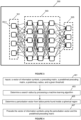
- a multilayer deep neural network D ( K, ⁇ k 1,..., K , ⁇ ) 300 made up of an input layer 301, at least one hidden layer 303, and an output layer 305 ( K ⁇ 2), is illustrated.
- Each layer among the input layer 301, the one or more hidden layers 303, and the output layer 305 comprises a plurality of artificial neurons or computation nodes 3011.
- the multilayer deep neural network 300 is fully connected. Accordingly, each computation node in one layer connects with a certain weight to every computation node in the following layer, i.e. combines input from the connected nodes from a previous layer with a set of weights that either amplify or dampen the input values. Each layer's output is simultaneously the subsequent layer's input, starting from the input layer 301 that is configured to receive input data.
- each computation node 4011 comprised in the one or more hidden layers may implement a non-linear activation function ⁇ that maps the weighted inputs of the computation node to the output of the computation node.
- the input-weight products performed at the computation nodes of the k th layer are represented by the product function W k x k ⁇ 1 i between the weight matrix W ( k ) and the input vector x k ⁇ 1 i processed as input by the k th layer, these input-weight products are then summed and the sum is passed through the activation function ⁇ .
- the activation function may be implemented in at least one computation node 3011 among the plurality of computation nodes of the one or more hidden layers 303 and the output layer 305.
- the activation function may be implemented at each node of the hidden layers.
- the activation function may be chosen in a group comprising a linear activation function, a sigmoid function, the Tanh, the softmax function, a rectified linear unit (ReLU) function, and the CUBE function.
- the linear activation function is the identity function in which the signal does not change.
- the sigmoid function converts independent variables of almost infinite range into simple probabilities between '0' and '1'. It is a non-linear function that takes a value as input and outputs another value between '0' and '1'.
- the softmax activation generalizes the logistic regression and returns the probability distribution over mutually exclusive output classes.
- the softmax activation function may be implemented in the output layer of the deep neural network.
- the ReLU activation function activates a neuron if the input of the neuron is above a given threshold.
- the given threshold may be equal to zero ('0'), in which case the ReLU activation function outputs a zero value if the input variable is a negative value and outputs the input variable according to the identity function if the input variable is a positive value.
- the radius determination unit 201 may be configured to previously determine and update the model parameters of the multilayer deep neural network during a training phase from training data.
- the radius determination unit 201 may be configured to perform the training phase offline before implementing the N iter iteration performed to determine the search sphere radius r s .
- the model parameters may be initially set to initial parameters that may be, for example, randomly generated. The initial parameters are then updated during the training phase and adjusted in a way that enables the neural network to converge to the best predictions.
- the multilayer deep neural network may be trained using back-propagation supervised learning techniques and uses training data to predict unobserved data.
- the back-propagation technique is an iterative process of forward and backward propagations of information by the different layers of the multilayer deep neural network.
- the neural network receives training data that comprises training input values and expected values (also referred to as 'labels') associated with the training input values, the expected values corresponding to the expected output of the neural network when the training input values are used as input.
- the expected values are known by the radius determination unit 201 in application of supervised machine learning techniques.
- the neural network passes the training data across the entire multilayer neural network to determine estimated values (also referred to as 'intermediate values') that correspond to the predictions obtained for the training input values.
- the training data are passed in a way that all the computation nodes comprised in the different layers of the multilayer deep neural network apply their transformations or computations to the input values they receive from the computation nodes of the previous layers and send their output values to the computation nodes of the following layer.
- the output layer delivers the estimated values corresponding to the training data.
- the last step of the forward propagation phase consists in comparing the expected values associated with the training data with the estimated values obtained when the training data was passed through the neural network as input.
- the comparison enables measuring how good/bad the estimated values were in relation to the expected values and to update the model parameters with the purpose of approaching the estimated values to the expected values such that the prediction error (also referred to 'estimation error' or 'cost') is near to zero.
- the prediction error may be estimated using a loss function based on a gradient procedure that updates the model parameters in the direction of the gradient of an objective function.
- the forward propagation phase is followed with a backward propagation phase during which the model parameters, for instance the weights of the interconnections of the computation nodes 3011, are gradually adjusted in reverse order by applying an optimization algorithm until good predictions are obtained and the loss function is minimized.
- model parameters for instance the weights of the interconnections of the computation nodes 3011
- the computed prediction error is propagated backward starting from the output layer to all the computation nodes 3011 of the one or more hidden layers 303 that contribute directly to the computation of the estimated values.
- Each computation node receives a fraction of the total prediction error based on its relative contribution to the output of the deep neural network.
- the process is repeated, layer by layer, until all the computation nodes in the deep neural network have received a prediction error that corresponds to their relative contribution to the total prediction error.
- the layer parameters for instance the first layer parameters (i.e. the weights) and the second layer parameters (i.e. the biases), may be updated by applying an optimization algorithm in accordance to the minimization of the loss function.
- the radius determination unit 201 may be configured to update the model parameters during the training phase according to a 'batch gradient descent approach' by computing the loss function and updating the model parameters for the entire training data.
- the radius determination unit 201 may be configured to update the model parameters during the training phase according to online learning by adjusting the model parameters for each sample of the training data. Using online learning, the loss function is evaluated for each sample of the training data. Online learning is also referred to as 'online training' and 'stochastic gradient descent'.
- the radius determination unit 201 may be configured to update the model parameters during the training phase from training data according to mini-batch learning (also referred to as 'mini-batch gradient descent') using mini-batches of data, a mini-batch of data of size s b is a subset of s b training samples. Accordingly, the radius determination unit 201 may be configured to partition the training data into two or more batches of data of size s b , each batch comprising s b samples of input data. The input data is then passed through the network in batches. The loss function is evaluated for each mini-batch of data passed through the neural network and the model parameters are updated for each mini-batch of data. The forward propagation and backward propagation phases are accordingly performed for each mini-batch of data until the last batch.
- mini-batch learning also referred to as 'mini-batch gradient descent'
- the radius determination unit 201 may be configured to pass all the training data through the deep neural network 300 in the training process a plurality of times, referred to as epochs.
- the number of epochs may be increased until an accuracy metric evaluating the accuracy of the training data starts to decrease or continues to increase (for example when a potential overfitting is detected).
- the radius determination unit 201 may be configured to determine (update or adjust) the model parameters during a training phase in mini-batches extracted from the received training data.
- the radius determination unit 201 may be configured to partition the received training data into a plurality NB of sets of training data denoted x ( * ,1) ,x (*,2) , ... , x ( *,NB ) , a set of training data being a mini-batch of size s b comprising a set of s b training examples from the training data, i.e.
- each mini-batch x ( *,l ) comprises s b samples x *, m with m varying between 1 and Nb s .
- a mini-batch x ( *,l ) is also designated by S l with training samples extracted from the Nb s training samples, that is S l ⁇ S.
- the sets of training data and the target values may be grouped into vector pairs such that each vector pair denoted x ⁇ , l N exp ⁇ , l corresponds to the training examples and target values of the l th mini-batch.
- the radius determination unit 201 may be configured to perform the forward propagation and backward propagation phases of the training process.
- the training phase may comprise two or more processing iterations.
- the radius determination unit 201 may be configured to:
- the radius determination unit 201 may be configured to determine initial first layer parameters and initial second layer parameters associated with the different layers (hidden layers and output layer) of the deep neural network randomly from a random set of values, for example following a standard normal distribution.
- the optimization algorithm used to adjust the model parameters and determine updated model parameters may be chosen in a group comprising the Adadelta optimization algorithm, the Adagrad optimization algorithm, the adaptive moment estimation algorithm (ADAM) that computes adaptive learning rates for each model parameter, the Nesterov accelerated gradient (NAG) algorithm, the Nesterov-accelerated adaptive moment estimation (Nadam) algorithm, the RMSprop algorithm, stochastic gradient optimization algorithms, and adaptive learning rate optimization algorithms.
- the Adadelta optimization algorithm the Adadelta optimization algorithm
- the Adagrad optimization algorithm the adaptive moment estimation algorithm that computes adaptive learning rates for each model parameter
- ADAM adaptive moment estimation algorithm
- NAG Nesterov accelerated gradient
- Nadam Nesterov-accelerated adaptive moment estimation
- RMSprop stochastic gradient optimization algorithms
- stochastic gradient optimization algorithms stochastic gradient optimization algorithms
- adaptive learning rate optimization algorithms stochastic gradient optimization algorithms
- the loss function considered to evaluate the prediction error or loss may be chosen in a group comprising a mean square error function (MSE) that is used for linear regression, and the exponential log likelihood (EXPLL) function used for Poisson regression.
- MSE mean square error function
- EXPLL exponential log likelihood
- the list sphere decoding algorithm and the list spherical-bound stack decoding algorithm are sphere-based decoding algorithms used to solve the closest vector problem.
- the LSD outputs a list of the codewords that lie inside a given bounded region of a given radius. More details on the LSD implementations are disclosed in " M. El-Khamy et al., Reduced Complexity List Sphere Decoding for MIMO Systems, Digital Signal Processing, Vol. 25, Pages 84-92, 2014 ".
- a precoding method for precoding a vector of information symbols s ⁇ R n that comprises real and imaginary parts of a modulated complex-value information symbols vector s c relies on using vector perturbation recoding to precode the vector of information symbols s into a precoded vector of information symbols s p .
- step 401 inputs comprising a vector of information symbols s , a predefined precoding matrix R , a preliminary radius r 0 , and a given threshold N th may be received.
- a search sphere radius r s may be determined, the determination of the search sphere radius comprising applying a machine learning algorithm to input data that depend on the vector of information symbols s , an integer scaling factor ⁇ , and the predefined precoding matrix R .
- the sphere search-based sequential algorithm may be chosen in a group comprising the sphere decoder and the SB-Stack decoder.
- Figure 5 is a flowchart illustrating a method of determining the search sphere radius r s performed at step 403, according to some embodiments in which an iterative process is performed during a number of iterations N iter of a radius update function to update a current radius.
- Steps 503 to 507 may be repeated during a number of iterations N iter of a radius update function until a termination condition is satisfied.
- a machine learning algorithm may be processed using input data derived from the vector of information symbols s , the predefined precoding matrix R and the current radius r s i , which provides a current predicted number of lattice points N pred i associated with the current radius r s i .
- the current predicted number of lattice points N pred i corresponds to a predicted number of lattice points that fall inside a spherical region centered at the origin and having of a sphere radius the current radius r s i .
- the current predicted number of lattice points N pred i may be compared to the given threshold N th .
- the machine learning algorithm may be a supervised machine learning algorithm chosen in a group, comprising without limitation, Support Vector Machines, linear regression, logistic regression, naive Bayes, linear discriminant analysis, decision trees, k-nearest neighbor algorithm, neural networks, and similarity learning.
- the activation function may be chosen in a group comprising a linear activation function, a sigmoid function, the Tanh, the softmax function, a rectified linear unit function, and the CUBE function.
- step 503 may comprise a sub-step that is performed to determine updated model parameters according to a back-propagation supervised training or learning process that uses training data to train the multilayer deep neural network before processing the neural network for the determination of current radius during the decoding process.
- the model parameters may be updated during the training process according to online learning by adjusting the model parameters for each sample of the training data and computing a loss for each sample of the training data.
- the model parameters may be updated during the training process from training data according to mini-batch learning using mini-batches of data, a mini-batch of data of size s b is a subset of s b training samples.
- the training data may be partitioned into two or more mini-batches of data of size s b , each batch comprising s b samples of the input data.
- the input data is then passed through the network in mini-batches.
- a loss function is evaluated for each mini-batch of data and the model parameters are updated for each mini-batch of data.
- training data may be partitioned into a plurality NB of sets of training data x (*,1) , x (*,2) , ... , x (*, NB ) ,
- the training process may comprise two or more processing iterations that are repeated until a training condition is reached.
- the training condition may be related to the number of epochs which refers to the number of times the training data have passed through the deep neural network during the training phase and/or to goodness of the updated model parameters with respect to the minimization of the prediction errors resulting from the updated model parameters.
- the initial first layer parameters and the initial second layer parameters associated with the hidden layers and the output layer of the deep neural network may be determined randomly from a random set of values, for example following a standard normal distribution.
- Steps 607 to 613 may be repeated for processing the mini-batches of data until the stopping condition is reached.
- the multilayer deep neural network may be processed using a mini-batch x ( *,l ) among the plurality of training sets as input, which provides an intermediate number of lattice points denoted N est ⁇ , l associated with the mini-batch x (*, l ) .
- the intermediate number of lattice points N est ⁇ , l is predicted at the output layer of the multilayer deep neural network.
- a loss function L N exp ⁇ , l N est ⁇ , l may be computed for the processed mini-batch x ( *,l ) from the known expected number N exp ⁇ , l of lattice points associated with the mini-batch x ( *,l ) and the intermediate number of lattice points N est ⁇ , l determined by processing the mini-batch of data x ( *,l ) at step 609.
- the optimization algorithm may be chosen in a group comprising the Adadelta optimization algorithm, the Adagrad optimization algorithm, the adaptive moment estimation algorithm, the Nesterov accelerated gradient algorithm, the Nesterov-accelerated adaptive moment estimation algorithm, the RMSprop algorithm, stochastic gradient optimization algorithms, and adaptive learning rate optimization algorithms.
- the loss function may be chosen in a group comprising a mean square error function and the exponential log likelihood function.
- the computer program product comprises a non-transitory computer readable storage medium that, when executed by a processor, cause the processor to:
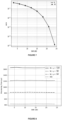
- Performance of the precoding techniques provided in the various embodiments of the invention has been evaluated in terms of bit error rate, average processing time, and average number of radius updates function of the preliminary radius in the smart sphere Encoder.
- 'SE' refers to the Sphere Encoder implementation in which the search sphere radius is determined using deep neural networks according to the embodiments of the invention and 'SSE' refers to the Smart Sphere Encoder implementation in which the search sphere radius is determined according to function relating the given threshold to the preliminary radius without processing a machine learning algorithm.
- a distribued 8x8 MIMO system using 16-QAM modulations is considered. Multilayer deep neural networks made up of one input layer, one hidden layer, and one output layer are used.
- Figure 7 shows diagrams evaluating the bit error rate (BER) performance as function of the signal-to-noise ratio for the SE and the SSE. Numerical results show that both the proposed SE and the SSE implementations achieve optimal decoding performance.
- BER bit error rate
- Figure 8 shows diagrams evaluating the average processing time function of the signal to noise ratio obtained for the SE considering different preliminary radiuses r 0 and SSE implementations. Numerical results show that the SSE greatly reduces the precoding processing time compared to the classical SE implementation.
- the processing elements of the precoder 200 can be implemented for example according to a hardware-only configuration (for example in one or more FPGA, ASIC, or VLSI integrated circuits with the corresponding memory) or according to a configuration using both VLSI and Digital Signal Processor (DSP).
- a hardware-only configuration for example in one or more FPGA, ASIC, or VLSI integrated circuits with the corresponding memory
- DSP Digital Signal Processor
- the method described herein can be implemented by computer program instructions supplied to the processor of any type of computer to produce a machine with a processor that executes the instructions to implement the functions/acts specified herein.
- These computer program instructions may also be stored in a computer-readable medium that can direct a computer to function in a particular manner. To that end, the computer program instructions may be loaded onto a computer to cause the performance of a series of operational steps and thereby produce a computer implemented process such that the executed instructions provide processes for implementing the functions specified herein.
Landscapes
- Engineering & Computer Science (AREA)
- Theoretical Computer Science (AREA)
- Physics & Mathematics (AREA)
- Software Systems (AREA)
- General Physics & Mathematics (AREA)
- Computer Networks & Wireless Communication (AREA)
- Signal Processing (AREA)
- Computing Systems (AREA)
- General Engineering & Computer Science (AREA)
- Mathematical Physics (AREA)
- Evolutionary Computation (AREA)
- Data Mining & Analysis (AREA)
- Artificial Intelligence (AREA)
- Computational Linguistics (AREA)
- Power Engineering (AREA)
- Biophysics (AREA)
- General Health & Medical Sciences (AREA)
- Molecular Biology (AREA)
- Health & Medical Sciences (AREA)
- Life Sciences & Earth Sciences (AREA)
- Biomedical Technology (AREA)
- Computer Vision & Pattern Recognition (AREA)
- Medical Informatics (AREA)
- Mathematical Analysis (AREA)
- Mathematical Optimization (AREA)
- Pure & Applied Mathematics (AREA)
- Computational Mathematics (AREA)
- Algebra (AREA)
- Probability & Statistics with Applications (AREA)
- Radio Transmission System (AREA)
Claims (13)
- Précodeur (200) pour précoder un vecteur de symboles d'information, dans lequel le précodeur (200) comprend :- une unité de détermination de rayon (201) configurée pour déterminer un rayon de sphère de recherche, ladite détermination du rayon de sphère de recherche comprenant l'application d'un algorithme d'apprentissage machine sur des données d'entrée sur la base dudit vecteur de symboles d'information et d'une matrice de précodage prédéfinie ;- une unité de codage de sphère (203) configurée pour déterminer un vecteur de perturbation à partir de points de réseau trouvés à l'intérieur d'une région sphérique en appliquant un algorithme séquentiel basé sur une recherche par sphère, ladite région sphérique ayant comme rayon ledit rayon de sphère de recherche, et- une unité de précodage (205) configurée pour précoder ledit vecteur de symboles d'information en utilisant ledit vecteur de perturbation et une matrice de précodage,
dans lequel l'unité de détermination de rayon (201) est configurée pour déterminer le rayon de sphère de recherche selon un processus itératif comprenant un nombre d'itérations Niter , comprenant une ou plusieurs itérations d'une fonction de mise à jour de rayon, pour mettre à jour un rayon courant jusqu'à ce qu'une condition de fin soit satisfaite, ledit rayon courant étant initialement défini selon un rayon préliminaire, chaque itération de la fonction de mise à jour de rayon comprenant :- l'application dudit algorithme d'apprentissage machine sur des données d'entrée dérivées dudit vecteur de symboles d'information, à partir de ladite matrice de précodage prédéfinie et à partir dudit rayon courant, ce qui fournit un nombre prédit courant de points de réseau associés à un rayon courant ;- la comparaison dudit nombre prédit courant de points de réseau avec un seuil donné ;- la mise à jour dudit rayon courant si ledit nombre prédit courant de points de réseau est strictement supérieur audit seuil donné, ledit rayon courant étant mis à jour en appliquant une fonction linéaire audit rayon courant ;ladite condition de fin étant liée au nombre prédit courant de points de réseau, l'unité de détermination de rayon (201) étant configurée pour définir le rayon de sphère de recherche selon le rayon courant, en réponse à la satisfaction de la condition de fin,dans lequel ladite fonction linéaire appliquée pour mettre à jour le rayon de sphère courant fournit le rayon de sphère courant
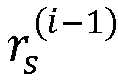 dans lequel ladite condition de fin est satisfaite si le nombre prédit courant de points de réseau est inférieur ou égal audit seuil donné.
 - Précodeur selon la revendication 1, dans lequel la fonction linéaire présente un paramètre de pente égal à ½ et un paramètre d'interception égal à zéro, de telle sorte que

- Précodeur selon l'une quelconque des revendications précédentes, dans lequel l'algorithme d'apprentissage machine est un algorithme d'apprentissage machine supervisé choisi dans un groupe comprenant des machines à vecteurs de support, une régression linéaire, une régression logistique, un classifieur bayésien naïf, une analyse discriminante linéaire, des arbres décisionnels, un algorithme des k plus proches voisins, des réseaux neuronaux et un apprentissage basé sur la similarité.
- Précodeur selon la revendication 3, dans lequel l'algorithme d'apprentissage machine supervisé est un réseau neuronal profond multicouche (300) comprenant une couche d'entrée (301), une ou plusieurs couches cachées (303) et une couche de sortie (305), chaque couche comprenant une pluralité de nœuds de calcul (3011), ledit réseau neuronal profond multicouche (300) étant associé à des paramètres de modèle et à une fonction d'activation, ladite fonction d'activation étant mise en œuvre dans au moins un nœud de calcul (3011) parmi la pluralité de nœuds de calcul desdites une ou plusieurs couches cachées.
- Précodeur selon la revendication 4, dans lequel ladite fonction d'activation est choisie dans un groupe comprenant une fonction d'activation linéaire, une fonction sigmoïde, une fonction ReLU, la tangente hyperbolique, la fonction softmax et la fonction CUBE.
- Précodeur selon la revendication 4, dans lequel l'unité de détermination de rayon (201) est configurée pour déterminer préalablement lesdits paramètres de modèle pendant une phase d'apprentissage à partir de données d'apprentissage reçues, ladite unité de détermination de rayon (201) étant configurée pour déterminer une pluralité d'ensembles de données d'apprentissage à partir desdites données d'apprentissage et à partir d'un ensemble de nombres attendus de points de réseau, chaque nombre attendu de points de réseau étant associé à un ensemble de données d'apprentissage parmi ladite pluralité d'ensembles de données d'apprentissage, ladite phase d'apprentissage comprenant deux itérations ou plus des étapes suivantes :- le traitement dudit réseau neuronal profond (300) en utilisant un ensemble de données d'apprentissage parmi ladite pluralité de données d'apprentissage en tant qu'entrée, ce qui fournit un nombre intermédiaire de points de réseau associés audit ensemble de données d'apprentissage ;- la détermination d'une fonction de perte à partir du nombre attendu de points de réseau et du nombre intermédiaire de points de réseau associés audit ensemble de données d'apprentissage ; et- la détermination de paramètres de modèle mis à jour en appliquant un algorithme d'optimisation selon une minimisation de ladite fonction de perte.
- Précodeur selon la revendication 6, dans lequel ledit algorithme d'optimisation est choisi dans un groupe comprenant l'algorithme d'optimisation AdaDelta, l'algorithme d'optimisation AdaGrad, l'algorithme d'estimation adaptative du moment, l'algorithme de gradient accéléré de Nesterov, l'algorithme d'estimation adaptative du moment accélérée de Nesterov, l'algorithme RMSprop, des algorithmes d'optimisation par gradient stochastique et des algorithmes d'optimisation par vitesse d'apprentissage adaptative.
- Précodeur selon la revendication 6, dans lequel ladite fonction de perte est choisie dans un groupe comprenant une fonction par erreur quadratique moyenne et une fonction logarithmique du rapport de vraisemblance exponentielle.
- Précodeur selon la revendication 6, dans lequel l'unité de détermination de rayon (201) est configurée pour appliquer préalablement un algorithme de décodage de sphère en liste ou un algorithme de décodage de piles à délimitation sphérique en liste pour déterminer lesdits nombres attendus de points de réseau à partir dudit rayon de sphère de recherche et à partir de ladite matrice de canaux.
- Précodeur selon l'une quelconque des revendications précédentes, dans lequel l'unité de détermination de rayon (201) est configurée pour déterminer ledit nombre d'itérations Niter de la fonction de mise à jour de rayon en fonction dudit rayon préliminaire r0 , dudit seuil donné et d'un déterminant ΛR de ladite matrice de précodage prédéfinie.
- Précodeur selon la revendication 1, dans lequel ledit algorithme séquentiel basé sur une recherche par sphère est choisi parmi un groupe comprenant l'algorithme de décodage de sphère et l'algorithme de décodage de sphère à délimitation sphérique.
- Émetteur (101) mettant en œuvre un précodeur (200) selon l'une quelconque des revendications précédentes, dans lequel l'émetteur (101) est muni de multiples antennes et est configuré pour émettre ledit vecteur de symboles d'information vers une pluralité de récepteurs dans un système à multiples utilisateurs, multiples entrées et multiples sorties.
- Procédé mis en œuvre par ordinateur pour précoder un vecteur de symboles d'information, dans lequel le procédé comprend :- la détermination (403) d'un rayon de sphère de recherche, la détermination du rayon de sphère de recherche comprenant l'application d'un algorithme d'apprentissage machine sur des données d'entrée sur la base dudit vecteur de symboles d'information et d'une matrice de précodage prédéfinie ;- la détermination (405) d'un vecteur de perturbation à partir de points de réseau trouvés à l'intérieur d'une région sphérique en appliquant un algorithme séquentiel basé sur une recherche par sphère, ladite région sphérique ayant comme rayon ledit rayon de sphère de recherche, et- le précodage (407) dudit vecteur de symboles d'information en utilisant ledit vecteur de perturbation et une matrice de précodage,
dans lequel le procédé comprend la détermination du rayon de sphère de recherche selon un processus itératif comprenant un nombre d'itérations Niter , comprenant une ou plusieurs itérations d'une fonction de mise à jour de rayon, pour mettre à jour un rayon courant jusqu'à ce qu'une condition de fin soit satisfaite, ledit rayon courant étant initialement défini selon un rayon préliminaire, chaque itération de la fonction de mise à jour de rayon comprenant :- l'application dudit algorithme d'apprentissage machine sur des données d'entrée dérivées dudit vecteur de symboles d'information, à partir de ladite matrice de précodage prédéfinie et à partir dudit rayon courant, ce qui fournit un nombre prédit courant de points de réseau associés à un rayon courant ;- la comparaison dudit nombre prédit courant de points de réseau avec un seuil donné ;- la mise à jour dudit rayon courant si ledit nombre prédit courant de points de réseau est strictement supérieur audit seuil donné, ledit rayon courant étant mis à jour en appliquant une fonction linéaire audit rayon courant ;ladite condition de fin étant liée au nombre prédit courant de points de réseau, le procédé comprenant la définition du rayon de sphère de recherche selon le rayon courant, en réponse à la satisfaction de la condition de fin,dans lequel ladite fonction linéaire appliquée pour mettre à jour le rayon de sphère courant fournit le rayon de sphère courant
 dans lequel ladite condition de fin est satisfaite si le nombre prédit courant de points de réseau est inférieur ou égal audit seuil donné.
Priority Applications (6)
| Application Number | Priority Date | Filing Date | Title |
|---|---|---|---|
| EP19305887.2A EP3761238B1 (fr) | 2019-07-01 | 2019-07-01 | Dispositifs et procédés de précodage assisté par apprentissage machine |
| US17/620,716 US11996915B2 (en) | 2019-07-01 | 2020-06-23 | Devices and methods for machine learning assisted precoding |
| KR1020227001691A KR20220031624A (ko) | 2019-07-01 | 2020-06-23 | 머신 학습 지원 프리코딩을 위한 디바이스들 및 방법들 |
| CN202080048329.9A CN114051701B (zh) | 2019-07-01 | 2020-06-23 | 用于机器学习辅助预编码的设备和方法 |
| JP2021574803A JP7830130B2 (ja) | 2019-07-01 | 2020-06-23 | 機械学習支援プリコーディングのためのデバイス及び方法 |
| PCT/EP2020/067407 WO2021001202A1 (fr) | 2019-07-01 | 2020-06-23 | Dispositifs et procédés destinés au précodage assisté par apprentissage automatique |
Applications Claiming Priority (1)
| Application Number | Priority Date | Filing Date | Title |
|---|---|---|---|
| EP19305887.2A EP3761238B1 (fr) | 2019-07-01 | 2019-07-01 | Dispositifs et procédés de précodage assisté par apprentissage machine |
Publications (2)
| Publication Number | Publication Date |
|---|---|
| EP3761238A1 EP3761238A1 (fr) | 2021-01-06 |
| EP3761238B1 true EP3761238B1 (fr) | 2025-03-12 |
Family
ID=67988949
Family Applications (1)
| Application Number | Title | Priority Date | Filing Date |
|---|---|---|---|
| EP19305887.2A Active EP3761238B1 (fr) | 2019-07-01 | 2019-07-01 | Dispositifs et procédés de précodage assisté par apprentissage machine |
Country Status (6)
| Country | Link |
|---|---|
| US (1) | US11996915B2 (fr) |
| EP (1) | EP3761238B1 (fr) |
| JP (1) | JP7830130B2 (fr) |
| KR (1) | KR20220031624A (fr) |
| CN (1) | CN114051701B (fr) |
| WO (1) | WO2021001202A1 (fr) |
Families Citing this family (17)
| Publication number | Priority date | Publication date | Assignee | Title |
|---|---|---|---|---|
| US11625610B2 (en) * | 2019-03-12 | 2023-04-11 | Samsung Electronics Co., Ltd | Multiple-input multiple-output (MIMO) detector selection using neural network |
| US11438038B1 (en) | 2021-02-17 | 2022-09-06 | Qualcomm Incorporated | Neural network based nonlinear MU-MIMO precoding |
| CN113030849B (zh) * | 2021-03-04 | 2023-06-30 | 西北工业大学 | 一种基于自编码器与并行网络的近场源定位方法 |
| CN113162666B (zh) * | 2021-04-19 | 2022-04-26 | 北京科技大学 | 一种面向智慧钢铁的大规模mimo混合预编码方法及装置 |
| CN113193896B (zh) * | 2021-04-23 | 2022-12-09 | 西安交通大学 | 一种最大化两接收端和速率的波束成形神经网络决策方法 |
| CN114297053A (zh) * | 2021-12-15 | 2022-04-08 | 国网上海市电力公司 | 一种基于多层感知机平滑的软件程序安全检测方法 |
| KR102754066B1 (ko) * | 2021-12-29 | 2025-01-10 | 순천향대학교 산학협력단 | 스마트 기기 기반의 다중 감각 접근 시스템 및 그 방법 |
| CN114567358B (zh) * | 2022-03-03 | 2023-04-07 | 东南大学 | 大规模mimo鲁棒wmmse预编码器及其深度学习设计方法 |
| GB2616469B (en) * | 2022-03-11 | 2024-10-16 | British Telecomm | Precoding for beamforming |
| CN115128441A (zh) * | 2022-06-10 | 2022-09-30 | 国网福建省电力有限公司电力科学研究院 | 一种断路器电寿命预测及健康状态评估方法 |
| CN116112044A (zh) * | 2022-08-09 | 2023-05-12 | 西安电子科技大学 | 基于神经网络的高能效混合预编码方法 |
| KR102665621B1 (ko) * | 2022-10-24 | 2024-05-16 | 주식회사 크로스웍스 | 이동형 기지국의 머신러닝 기반 매시브 mimo 처리 방법 |
| WO2024173785A1 (fr) * | 2023-02-17 | 2024-08-22 | Intel Corporation | Procédés et agencements de rétroaction d'informations d'état de canal |
| KR102920848B1 (ko) * | 2023-03-02 | 2026-02-02 | 한국전자통신연구원 | 극 부호와 대수 부호를 이용하여 부호를 설계하기 위한 장치 및 방법 |
| CN116683951B (zh) * | 2023-03-21 | 2026-04-07 | 浙江工业大学 | 一种多输入多输出分子通信系统的分子释放数量优化方法 |
| CN117614497B (zh) * | 2023-11-27 | 2025-08-29 | 南方电网科学研究院有限责任公司 | 虚拟电厂边缘网关信号在线保持方法、系统、设备和介质 |
| CN120675597B (zh) * | 2025-08-22 | 2025-12-26 | 荣耀终端股份有限公司 | 信号发送方法、信号接收方法、设备及信号处理系统 |
Family Cites Families (11)
| Publication number | Priority date | Publication date | Assignee | Title |
|---|---|---|---|---|
| US20090175375A1 (en) * | 2005-11-23 | 2009-07-09 | Nokia Corporation | Joint Optimization of Linear Pre-Filtering and Nonlinear Vector Perturbation for MIMO Multiuser Precoding |
| GB2458883B (en) * | 2008-03-20 | 2010-09-29 | Toshiba Res Europ Ltd | Wireless communication apparatus |
| US8290096B2 (en) * | 2008-04-14 | 2012-10-16 | Qualcomm Incorporated | Radius adaptive sphere decoding with probabilistic noise constraint |
| JP5804594B2 (ja) * | 2011-08-05 | 2015-11-04 | シャープ株式会社 | プリコーディング装置、プリコーディング用プログラムおよび集積回路 |
| JP2013123196A (ja) * | 2011-12-12 | 2013-06-20 | Sharp Corp | プリコーディング装置、無線送信装置、プリコーディング方法、プログラムおよび集積回路 |
| GB201420944D0 (en) * | 2014-11-25 | 2015-01-07 | Univ Surrey | Signal transmission |
| GB201509910D0 (en) * | 2015-06-08 | 2015-07-22 | Univ Surrey | Parallel processing of sphere decoders and other vector finding approaches using tree search |
| JP6159839B1 (ja) | 2016-03-08 | 2017-07-05 | ソフトバンク株式会社 | 基地局装置 |
| JP6484205B2 (ja) * | 2016-09-20 | 2019-03-13 | ソフトバンク株式会社 | 基地局装置、摂動ベクトル探索方法及びプログラム |
| US11361758B2 (en) * | 2017-04-18 | 2022-06-14 | D5Ai Llc | Multi-stage machine learning and recognition |
| WO2019183371A1 (fr) * | 2018-03-22 | 2019-09-26 | Apomatix Inc. | Gestion et commande de système informatique en réseau |
-
2019
- 2019-07-01 EP EP19305887.2A patent/EP3761238B1/fr active Active
-
2020
- 2020-06-23 KR KR1020227001691A patent/KR20220031624A/ko active Pending
- 2020-06-23 US US17/620,716 patent/US11996915B2/en active Active
- 2020-06-23 CN CN202080048329.9A patent/CN114051701B/zh active Active
- 2020-06-23 WO PCT/EP2020/067407 patent/WO2021001202A1/fr not_active Ceased
- 2020-06-23 JP JP2021574803A patent/JP7830130B2/ja active Active
Non-Patent Citations (1)
| Title |
|---|
| FEDERICO BOCCARDI ET AL: "The -Sphere Encoder: Peak-Power Reduction by Lattice Precoding for the MIMO Gaussian Broadcast Channel", IEEE TRANSACTIONS ON COMMUNICATIONS, IEEE SERVICE CENTER, PISCATAWAY, NJ. USA, vol. 54, no. 11, 1 November 2006 (2006-11-01), pages 2085 - 2091, XP011143108, ISSN: 0090-6778, DOI: 10.1109/TCOMM.2006.881396 * |
Also Published As
| Publication number | Publication date |
|---|---|
| CN114051701B (zh) | 2024-04-23 |
| JP7830130B2 (ja) | 2026-03-16 |
| US11996915B2 (en) | 2024-05-28 |
| WO2021001202A1 (fr) | 2021-01-07 |
| EP3761238A1 (fr) | 2021-01-06 |
| US20220247460A1 (en) | 2022-08-04 |
| CN114051701A (zh) | 2022-02-15 |
| KR20220031624A (ko) | 2022-03-11 |
| JP2022537979A (ja) | 2022-08-31 |
Similar Documents
| Publication | Publication Date | Title |
|---|---|---|
| EP3761238B1 (fr) | Dispositifs et procédés de précodage assisté par apprentissage machine | |
| Mohammadkarimi et al. | Deep learning-based sphere decoding | |
| EP3761237B1 (fr) | Dispositifs et procédés de décodage de sphère assisté par apprentissage machine | |
| Sohrabi et al. | Deep learning for distributed channel feedback and multiuser precoding in FDD massive MIMO | |
| Askri et al. | DNN assisted sphere decoder | |
| EP3229428B1 (fr) | Procédés et dispositifs de décodage séquentiel par sphère | |
| Song et al. | Benchmarking end-to-end learning of MIMO physical-layer communication | |
| Alawad et al. | A deep learning-based detector for IM-MIMO-OFDM | |
| KR102064301B1 (ko) | Mimo 시스템 기반의 앙상블 기계 학습을 이용한 신호 검출 장치 및 그 방법 | |
| Ye et al. | Bilinear convolutional auto-encoder based pilot-free end-to-end communication systems | |
| Kumar et al. | Decoder design for massive-MIMO systems using deep learning | |
| Le et al. | RIS-assisted MIMO communication systems: Model-based versus autoencoder approaches | |
| Pathapati et al. | Supervised deep learning for MIMO precoding | |
| Fu et al. | Grassmannian constellation design for noncoherent MIMO systems using autoencoders | |
| Mayouche et al. | Data-driven precoded MIMO detection robust to channel estimation errors | |
| Kumar et al. | RS-net: Neural network-enhanced receivers for MIMO rate splitting multiple access | |
| Arvinte et al. | Joint high-dimensional soft bit estimation and quantization using deep learning | |
| Raja Kumar | AI-driven multi-antenna designs for next generations of wireless communication systems | |
| Ajayi et al. | Low-complexity neural networks for denoising imperfect CSI in physical layer security | |
| Fu et al. | On deep learning techniques for noncoherent MIMO systems | |
| Huang et al. | A deep MIMO detector based on MQAM signal decomposition and channel ordering | |
| Liu | Channel estimation and signal detection with model-driven deep learning for massive multiuser MIMO-OFDM systems | |
| Gümüş | Deep-Learning for Communication Systems: New Channel Estimation, Equalization, and Secure Transmission Solutions | |
| Bashir et al. | A comparative study of heuristic algorithms: GA and UMDA in spatially multiplexed communication systems | |
| Xie | Applications of deep learning for physical layer of wireless communication systems |
Legal Events
| Date | Code | Title | Description |
|---|---|---|---|
| PUAI | Public reference made under article 153(3) epc to a published international application that has entered the european phase |
Free format text: ORIGINAL CODE: 0009012 |
|
| STAA | Information on the status of an ep patent application or granted ep patent |
Free format text: STATUS: THE APPLICATION HAS BEEN PUBLISHED |
|
| AK | Designated contracting states |
Kind code of ref document: A1 Designated state(s): AL AT BE BG CH CY CZ DE DK EE ES FI FR GB GR HR HU IE IS IT LI LT LU LV MC MK MT NL NO PL PT RO RS SE SI SK SM TR |
|
| AX | Request for extension of the european patent |
Extension state: BA ME |
|
| STAA | Information on the status of an ep patent application or granted ep patent |
Free format text: STATUS: REQUEST FOR EXAMINATION WAS MADE |
|
| 17P | Request for examination filed |
Effective date: 20210706 |
|
| RBV | Designated contracting states (corrected) |
Designated state(s): AL AT BE BG CH CY CZ DE DK EE ES FI FR GB GR HR HU IE IS IT LI LT LU LV MC MK MT NL NO PL PT RO RS SE SI SK SM TR |
|
| RAP3 | Party data changed (applicant data changed or rights of an application transferred) |
Owner name: INSTITUT MINES-TELECOM |
|
| STAA | Information on the status of an ep patent application or granted ep patent |
Free format text: STATUS: EXAMINATION IS IN PROGRESS |
|
| 17Q | First examination report despatched |
Effective date: 20240116 |
|
| REG | Reference to a national code |
Ref country code: DE Ref legal event code: R079 Free format text: PREVIOUS MAIN CLASS: G06N0020000000 Ipc: G06N0005010000 Ref country code: DE Ref legal event code: R079 Ref document number: 602019067136 Country of ref document: DE Free format text: PREVIOUS MAIN CLASS: G06N0020000000 Ipc: G06N0005010000 |
|
| GRAP | Despatch of communication of intention to grant a patent |
Free format text: ORIGINAL CODE: EPIDOSNIGR1 |
|
| STAA | Information on the status of an ep patent application or granted ep patent |
Free format text: STATUS: GRANT OF PATENT IS INTENDED |
|
| RIC1 | Information provided on ipc code assigned before grant |
Ipc: G06N 7/01 20230101ALN20240930BHEP Ipc: H04L 25/03 20060101ALN20240930BHEP Ipc: H04L 25/02 20060101ALI20240930BHEP Ipc: H04B 7/0456 20170101ALI20240930BHEP Ipc: H04B 7/0452 20170101ALI20240930BHEP Ipc: G06N 3/084 20230101ALI20240930BHEP Ipc: G06N 3/048 20230101ALI20240930BHEP Ipc: G06N 20/00 20190101ALI20240930BHEP Ipc: G06N 5/01 20230101AFI20240930BHEP |
|
| INTG | Intention to grant announced |
Effective date: 20241009 |
|
| GRAS | Grant fee paid |
Free format text: ORIGINAL CODE: EPIDOSNIGR3 |
|
| GRAA | (expected) grant |
Free format text: ORIGINAL CODE: 0009210 |
|
| STAA | Information on the status of an ep patent application or granted ep patent |
Free format text: STATUS: THE PATENT HAS BEEN GRANTED |
|
| AK | Designated contracting states |
Kind code of ref document: B1 Designated state(s): AL AT BE BG CH CY CZ DE DK EE ES FI FR GB GR HR HU IE IS IT LI LT LU LV MC MK MT NL NO PL PT RO RS SE SI SK SM TR |
|
| REG | Reference to a national code |
Ref country code: GB Ref legal event code: FG4D |
|
| REG | Reference to a national code |
Ref country code: CH Ref legal event code: EP |
|
| REG | Reference to a national code |
Ref country code: DE Ref legal event code: R096 Ref document number: 602019067136 Country of ref document: DE |
|
| REG | Reference to a national code |
Ref country code: IE Ref legal event code: FG4D |
|
| PG25 | Lapsed in a contracting state [announced via postgrant information from national office to epo] |
Ref country code: RS Free format text: LAPSE BECAUSE OF FAILURE TO SUBMIT A TRANSLATION OF THE DESCRIPTION OR TO PAY THE FEE WITHIN THE PRESCRIBED TIME-LIMIT Effective date: 20250612 |
|
| PG25 | Lapsed in a contracting state [announced via postgrant information from national office to epo] |
Ref country code: FI Free format text: LAPSE BECAUSE OF FAILURE TO SUBMIT A TRANSLATION OF THE DESCRIPTION OR TO PAY THE FEE WITHIN THE PRESCRIBED TIME-LIMIT Effective date: 20250312 |
|
| PG25 | Lapsed in a contracting state [announced via postgrant information from national office to epo] |
Ref country code: ES Free format text: LAPSE BECAUSE OF FAILURE TO SUBMIT A TRANSLATION OF THE DESCRIPTION OR TO PAY THE FEE WITHIN THE PRESCRIBED TIME-LIMIT Effective date: 20250312 |
|
| REG | Reference to a national code |
Ref country code: LT Ref legal event code: MG9D |
|
| PG25 | Lapsed in a contracting state [announced via postgrant information from national office to epo] |
Ref country code: NO Free format text: LAPSE BECAUSE OF FAILURE TO SUBMIT A TRANSLATION OF THE DESCRIPTION OR TO PAY THE FEE WITHIN THE PRESCRIBED TIME-LIMIT Effective date: 20250612 |
|
| PG25 | Lapsed in a contracting state [announced via postgrant information from national office to epo] |
Ref country code: HR Free format text: LAPSE BECAUSE OF FAILURE TO SUBMIT A TRANSLATION OF THE DESCRIPTION OR TO PAY THE FEE WITHIN THE PRESCRIBED TIME-LIMIT Effective date: 20250312 |
|
| REG | Reference to a national code |
Ref country code: NL Ref legal event code: MP Effective date: 20250312 |
|
| PG25 | Lapsed in a contracting state [announced via postgrant information from national office to epo] |
Ref country code: LV Free format text: LAPSE BECAUSE OF FAILURE TO SUBMIT A TRANSLATION OF THE DESCRIPTION OR TO PAY THE FEE WITHIN THE PRESCRIBED TIME-LIMIT Effective date: 20250312 |
|
| PG25 | Lapsed in a contracting state [announced via postgrant information from national office to epo] |
Ref country code: GR Free format text: LAPSE BECAUSE OF FAILURE TO SUBMIT A TRANSLATION OF THE DESCRIPTION OR TO PAY THE FEE WITHIN THE PRESCRIBED TIME-LIMIT Effective date: 20250613 Ref country code: BG Free format text: LAPSE BECAUSE OF FAILURE TO SUBMIT A TRANSLATION OF THE DESCRIPTION OR TO PAY THE FEE WITHIN THE PRESCRIBED TIME-LIMIT Effective date: 20250312 |
|
| REG | Reference to a national code |
Ref country code: AT Ref legal event code: MK05 Ref document number: 1775630 Country of ref document: AT Kind code of ref document: T Effective date: 20250312 |
|
| PG25 | Lapsed in a contracting state [announced via postgrant information from national office to epo] |
Ref country code: NL Free format text: LAPSE BECAUSE OF FAILURE TO SUBMIT A TRANSLATION OF THE DESCRIPTION OR TO PAY THE FEE WITHIN THE PRESCRIBED TIME-LIMIT Effective date: 20250312 |
|
| PG25 | Lapsed in a contracting state [announced via postgrant information from national office to epo] |
Ref country code: SE Free format text: LAPSE BECAUSE OF FAILURE TO SUBMIT A TRANSLATION OF THE DESCRIPTION OR TO PAY THE FEE WITHIN THE PRESCRIBED TIME-LIMIT Effective date: 20250312 |
|
| PG25 | Lapsed in a contracting state [announced via postgrant information from national office to epo] |
Ref country code: SM Free format text: LAPSE BECAUSE OF FAILURE TO SUBMIT A TRANSLATION OF THE DESCRIPTION OR TO PAY THE FEE WITHIN THE PRESCRIBED TIME-LIMIT Effective date: 20250312 |
|
| PG25 | Lapsed in a contracting state [announced via postgrant information from national office to epo] |
Ref country code: PT Free format text: LAPSE BECAUSE OF FAILURE TO SUBMIT A TRANSLATION OF THE DESCRIPTION OR TO PAY THE FEE WITHIN THE PRESCRIBED TIME-LIMIT Effective date: 20250714 |
|
| PGFP | Annual fee paid to national office [announced via postgrant information from national office to epo] |
Ref country code: DE Payment date: 20250702 Year of fee payment: 7 |
|
| PG25 | Lapsed in a contracting state [announced via postgrant information from national office to epo] |
Ref country code: PL Free format text: LAPSE BECAUSE OF FAILURE TO SUBMIT A TRANSLATION OF THE DESCRIPTION OR TO PAY THE FEE WITHIN THE PRESCRIBED TIME-LIMIT Effective date: 20250312 Ref country code: IT Free format text: LAPSE BECAUSE OF FAILURE TO SUBMIT A TRANSLATION OF THE DESCRIPTION OR TO PAY THE FEE WITHIN THE PRESCRIBED TIME-LIMIT Effective date: 20250312 |
|
| PGFP | Annual fee paid to national office [announced via postgrant information from national office to epo] |
Ref country code: GB Payment date: 20250703 Year of fee payment: 7 |
|
| PG25 | Lapsed in a contracting state [announced via postgrant information from national office to epo] |
Ref country code: AT Free format text: LAPSE BECAUSE OF FAILURE TO SUBMIT A TRANSLATION OF THE DESCRIPTION OR TO PAY THE FEE WITHIN THE PRESCRIBED TIME-LIMIT Effective date: 20250312 |
|
| PGFP | Annual fee paid to national office [announced via postgrant information from national office to epo] |
Ref country code: FR Payment date: 20250703 Year of fee payment: 7 |
|
| PG25 | Lapsed in a contracting state [announced via postgrant information from national office to epo] |
Ref country code: EE Free format text: LAPSE BECAUSE OF FAILURE TO SUBMIT A TRANSLATION OF THE DESCRIPTION OR TO PAY THE FEE WITHIN THE PRESCRIBED TIME-LIMIT Effective date: 20250312 Ref country code: CZ Free format text: LAPSE BECAUSE OF FAILURE TO SUBMIT A TRANSLATION OF THE DESCRIPTION OR TO PAY THE FEE WITHIN THE PRESCRIBED TIME-LIMIT Effective date: 20250312 |
|
| PG25 | Lapsed in a contracting state [announced via postgrant information from national office to epo] |
Ref country code: RO Free format text: LAPSE BECAUSE OF FAILURE TO SUBMIT A TRANSLATION OF THE DESCRIPTION OR TO PAY THE FEE WITHIN THE PRESCRIBED TIME-LIMIT Effective date: 20250312 |
|
| PG25 | Lapsed in a contracting state [announced via postgrant information from national office to epo] |
Ref country code: SK Free format text: LAPSE BECAUSE OF FAILURE TO SUBMIT A TRANSLATION OF THE DESCRIPTION OR TO PAY THE FEE WITHIN THE PRESCRIBED TIME-LIMIT Effective date: 20250312 |
|
| PG25 | Lapsed in a contracting state [announced via postgrant information from national office to epo] |
Ref country code: IS Free format text: LAPSE BECAUSE OF FAILURE TO SUBMIT A TRANSLATION OF THE DESCRIPTION OR TO PAY THE FEE WITHIN THE PRESCRIBED TIME-LIMIT Effective date: 20250712 |
|
| REG | Reference to a national code |
Ref country code: DE Ref legal event code: R097 Ref document number: 602019067136 Country of ref document: DE |
|
| PG25 | Lapsed in a contracting state [announced via postgrant information from national office to epo] |
Ref country code: DK Free format text: LAPSE BECAUSE OF FAILURE TO SUBMIT A TRANSLATION OF THE DESCRIPTION OR TO PAY THE FEE WITHIN THE PRESCRIBED TIME-LIMIT Effective date: 20250312 |
|
| PLBE | No opposition filed within time limit |
Free format text: ORIGINAL CODE: 0009261 |
|
| STAA | Information on the status of an ep patent application or granted ep patent |
Free format text: STATUS: NO OPPOSITION FILED WITHIN TIME LIMIT |
|
| REG | Reference to a national code |
Ref country code: CH Ref legal event code: L10 Free format text: ST27 STATUS EVENT CODE: U-0-0-L10-L00 (AS PROVIDED BY THE NATIONAL OFFICE) Effective date: 20260121 |
|
| 26N | No opposition filed |
Effective date: 20251215 |
|
| REG | Reference to a national code |
Ref country code: CH Ref legal event code: H13 Free format text: ST27 STATUS EVENT CODE: U-0-0-H10-H13 (AS PROVIDED BY THE NATIONAL OFFICE) Effective date: 20260224 |
|
| PG25 | Lapsed in a contracting state [announced via postgrant information from national office to epo] |
Ref country code: LU Free format text: LAPSE BECAUSE OF NON-PAYMENT OF DUE FEES Effective date: 20250701 |
|
| REG | Reference to a national code |
Ref country code: BE Ref legal event code: MM Effective date: 20250731 |
|
| PG25 | Lapsed in a contracting state [announced via postgrant information from national office to epo] |
Ref country code: BE Free format text: LAPSE BECAUSE OF NON-PAYMENT OF DUE FEES Effective date: 20250731 |