EP3761429A1 - Batterie secondaire à électrolyte non aqueux - Google Patents
Batterie secondaire à électrolyte non aqueux Download PDFInfo
- Publication number
- EP3761429A1 EP3761429A1 EP19761129.6A EP19761129A EP3761429A1 EP 3761429 A1 EP3761429 A1 EP 3761429A1 EP 19761129 A EP19761129 A EP 19761129A EP 3761429 A1 EP3761429 A1 EP 3761429A1
- Authority
- EP
- European Patent Office
- Prior art keywords
- negative electrode
- mol
- electrolyte secondary
- secondary battery
- lfsi
- Prior art date
- Legal status (The legal status is an assumption and is not a legal conclusion. Google has not performed a legal analysis and makes no representation as to the accuracy of the status listed.)
- Pending
Links
Images
Classifications
-
- H—ELECTRICITY
- H01—ELECTRIC ELEMENTS
- H01M—PROCESSES OR MEANS, e.g. BATTERIES, FOR THE DIRECT CONVERSION OF CHEMICAL ENERGY INTO ELECTRICAL ENERGY
- H01M4/00—Electrodes
- H01M4/02—Electrodes composed of, or comprising, active material
- H01M4/13—Electrodes for accumulators with non-aqueous electrolyte, e.g. for lithium-accumulators; Processes of manufacture thereof
- H01M4/133—Electrodes based on carbonaceous material, e.g. graphite-intercalation compounds or CFx
-
- H—ELECTRICITY
- H01—ELECTRIC ELEMENTS
- H01M—PROCESSES OR MEANS, e.g. BATTERIES, FOR THE DIRECT CONVERSION OF CHEMICAL ENERGY INTO ELECTRICAL ENERGY
- H01M10/00—Secondary cells; Manufacture thereof
- H01M10/05—Accumulators with non-aqueous electrolyte
- H01M10/056—Accumulators with non-aqueous electrolyte characterised by the materials used as electrolytes, e.g. mixed inorganic/organic electrolytes
- H01M10/0564—Accumulators with non-aqueous electrolyte characterised by the materials used as electrolytes, e.g. mixed inorganic/organic electrolytes the electrolyte being constituted of organic materials only
- H01M10/0566—Liquid materials
- H01M10/0568—Liquid materials characterised by the solutes
-
- H—ELECTRICITY
- H01—ELECTRIC ELEMENTS
- H01M—PROCESSES OR MEANS, e.g. BATTERIES, FOR THE DIRECT CONVERSION OF CHEMICAL ENERGY INTO ELECTRICAL ENERGY
- H01M10/00—Secondary cells; Manufacture thereof
- H01M10/05—Accumulators with non-aqueous electrolyte
- H01M10/056—Accumulators with non-aqueous electrolyte characterised by the materials used as electrolytes, e.g. mixed inorganic/organic electrolytes
- H01M10/0564—Accumulators with non-aqueous electrolyte characterised by the materials used as electrolytes, e.g. mixed inorganic/organic electrolytes the electrolyte being constituted of organic materials only
- H01M10/0566—Liquid materials
- H01M10/0569—Liquid materials characterised by the solvents
-
- H—ELECTRICITY
- H01—ELECTRIC ELEMENTS
- H01M—PROCESSES OR MEANS, e.g. BATTERIES, FOR THE DIRECT CONVERSION OF CHEMICAL ENERGY INTO ELECTRICAL ENERGY
- H01M4/00—Electrodes
- H01M4/02—Electrodes composed of, or comprising, active material
- H01M4/13—Electrodes for accumulators with non-aqueous electrolyte, e.g. for lithium-accumulators; Processes of manufacture thereof
- H01M4/134—Electrodes based on metals, Si or alloys
-
- H—ELECTRICITY
- H01—ELECTRIC ELEMENTS
- H01M—PROCESSES OR MEANS, e.g. BATTERIES, FOR THE DIRECT CONVERSION OF CHEMICAL ENERGY INTO ELECTRICAL ENERGY
- H01M4/00—Electrodes
- H01M4/02—Electrodes composed of, or comprising, active material
- H01M4/36—Selection of substances as active materials, active masses, active liquids
- H01M4/362—Composites
- H01M4/364—Composites as mixtures
-
- H—ELECTRICITY
- H01—ELECTRIC ELEMENTS
- H01M—PROCESSES OR MEANS, e.g. BATTERIES, FOR THE DIRECT CONVERSION OF CHEMICAL ENERGY INTO ELECTRICAL ENERGY
- H01M4/00—Electrodes
- H01M4/02—Electrodes composed of, or comprising, active material
- H01M4/36—Selection of substances as active materials, active masses, active liquids
- H01M4/38—Selection of substances as active materials, active masses, active liquids of elements or alloys
- H01M4/386—Silicon or alloys based on silicon
-
- H—ELECTRICITY
- H01—ELECTRIC ELEMENTS
- H01M—PROCESSES OR MEANS, e.g. BATTERIES, FOR THE DIRECT CONVERSION OF CHEMICAL ENERGY INTO ELECTRICAL ENERGY
- H01M4/00—Electrodes
- H01M4/02—Electrodes composed of, or comprising, active material
- H01M4/36—Selection of substances as active materials, active masses, active liquids
- H01M4/58—Selection of substances as active materials, active masses, active liquids of inorganic compounds other than oxides or hydroxides, e.g. sulfides, selenides, tellurides, halogenides or LiCoFy; of polyanionic structures, e.g. phosphates, silicates or borates
- H01M4/583—Carbonaceous material, e.g. graphite-intercalation compounds or CFx
- H01M4/587—Carbonaceous material, e.g. graphite-intercalation compounds or CFx for inserting or intercalating light metals
-
- H—ELECTRICITY
- H01—ELECTRIC ELEMENTS
- H01M—PROCESSES OR MEANS, e.g. BATTERIES, FOR THE DIRECT CONVERSION OF CHEMICAL ENERGY INTO ELECTRICAL ENERGY
- H01M4/00—Electrodes
- H01M4/02—Electrodes composed of, or comprising, active material
- H01M4/62—Selection of inactive substances as ingredients for active masses, e.g. binders, fillers
- H01M4/621—Binders
- H01M4/622—Binders being polymers
-
- H—ELECTRICITY
- H01—ELECTRIC ELEMENTS
- H01M—PROCESSES OR MEANS, e.g. BATTERIES, FOR THE DIRECT CONVERSION OF CHEMICAL ENERGY INTO ELECTRICAL ENERGY
- H01M4/00—Electrodes
- H01M4/02—Electrodes composed of, or comprising, active material
- H01M4/62—Selection of inactive substances as ingredients for active masses, e.g. binders, fillers
- H01M4/621—Binders
- H01M4/622—Binders being polymers
- H01M4/623—Binders being polymers fluorinated polymers
-
- H—ELECTRICITY
- H01—ELECTRIC ELEMENTS
- H01M—PROCESSES OR MEANS, e.g. BATTERIES, FOR THE DIRECT CONVERSION OF CHEMICAL ENERGY INTO ELECTRICAL ENERGY
- H01M10/00—Secondary cells; Manufacture thereof
- H01M10/05—Accumulators with non-aqueous electrolyte
- H01M10/052—Li-accumulators
- H01M10/0525—Rocking-chair batteries, i.e. batteries with lithium insertion or intercalation in both electrodes; Lithium-ion batteries
-
- H—ELECTRICITY
- H01—ELECTRIC ELEMENTS
- H01M—PROCESSES OR MEANS, e.g. BATTERIES, FOR THE DIRECT CONVERSION OF CHEMICAL ENERGY INTO ELECTRICAL ENERGY
- H01M4/00—Electrodes
- H01M4/02—Electrodes composed of, or comprising, active material
- H01M2004/021—Physical characteristics, e.g. porosity, surface area
-
- H—ELECTRICITY
- H01—ELECTRIC ELEMENTS
- H01M—PROCESSES OR MEANS, e.g. BATTERIES, FOR THE DIRECT CONVERSION OF CHEMICAL ENERGY INTO ELECTRICAL ENERGY
- H01M4/00—Electrodes
- H01M4/02—Electrodes composed of, or comprising, active material
- H01M2004/026—Electrodes composed of, or comprising, active material characterised by the polarity
- H01M2004/027—Negative electrodes
-
- H—ELECTRICITY
- H01—ELECTRIC ELEMENTS
- H01M—PROCESSES OR MEANS, e.g. BATTERIES, FOR THE DIRECT CONVERSION OF CHEMICAL ENERGY INTO ELECTRICAL ENERGY
- H01M4/00—Electrodes
- H01M4/02—Electrodes composed of, or comprising, active material
- H01M2004/026—Electrodes composed of, or comprising, active material characterised by the polarity
- H01M2004/028—Positive electrodes
-
- Y—GENERAL TAGGING OF NEW TECHNOLOGICAL DEVELOPMENTS; GENERAL TAGGING OF CROSS-SECTIONAL TECHNOLOGIES SPANNING OVER SEVERAL SECTIONS OF THE IPC; TECHNICAL SUBJECTS COVERED BY FORMER USPC CROSS-REFERENCE ART COLLECTIONS [XRACs] AND DIGESTS
- Y02—TECHNOLOGIES OR APPLICATIONS FOR MITIGATION OR ADAPTATION AGAINST CLIMATE CHANGE
- Y02E—REDUCTION OF GREENHOUSE GAS [GHG] EMISSIONS, RELATED TO ENERGY GENERATION, TRANSMISSION OR DISTRIBUTION
- Y02E60/00—Enabling technologies; Technologies with a potential or indirect contribution to GHG emissions mitigation
- Y02E60/10—Energy storage using batteries
Definitions
- the present invention relates to a non-aqueous electrolyte secondary battery.
- the polyacrylic acid When the negative electrode containing polyacrylic acid is impregnated with an electrolyte, the polyacrylic acid sometimes swells. When the polyacrylic acid swells, this weakens the binding force of the polyacrylic acid that is acting between the negative electrode active material particles and between the negative electrode active material particles and the negative current collector. Since the Si-containing material greatly expands and contracts during charge and discharge, when the binding force of the polyacrylic acid is weakened in association with the expansion, the internal resistance tends to increase, and the cycle characteristics also tend to deteriorate.
- one aspect of the present invention relates to a non-aqueous electrolyte secondary including a positive electrode, a negative electrode, and an electrolyte, the negative electrode including a negative electrode active material capable of electrochemically absorbing and releasing lithium, and a binder; the negative electrode active material including a Si-containing material; the binder including an acrylic resin; the electrolyte including a non-aqueous solvent, and a lithium salt dissolved in the non-aqueous solvent; the lithium salt including lithium bis(fluorosulfonyl)imide: LFSI.
- non-aqueous electrolyte secondary battery having a high capacity and having a small internal resistance and excellent cycle characteristics.
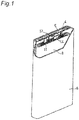
- FIG. 1 A schematic partially cut-away oblique view of a non-aqueous electrolyte secondary battery according to an embodiment of the present invention.
- a non-aqueous electrolyte secondary includes a positive electrode, a negative electrode, and an electrolyte.
- the negative electrode includes a negative electrode active material capable of electrochemically absorbing and releasing lithium, and a binder.
- the negative electrode active material includes a Si-containing material.
- the binder includes an acrylic resin.
- the electrolyte includes a non-aqueous solvent, and a lithium salt (solute) dissolved in the non-aqueous solvent, and the lithium salt includes lithium bis(fluorosulfonyl)imide: LiN(SO 2 F) 2 (hereinafter sometimes referred to as LFSI).
- Including a Si-containing material in the negative electrode active material leads to a high capacity; however, the Si-containing material expands and contracts greatly during charge and discharge, which tends to cause the internal resistance to increase and the cycle characteristics to deteriorate.
- an acrylic resin is used as the binder, and LFSI is contained in the electrolyte, so that the increase in the internal resistance and the deterioration in the cycle characteristics can be significantly suppressed.
- the negative electrode including an acrylic resin is impregnated with an electrolyte including LFSI, the swelling of the acrylic resin can be reduced.
- the high binding force of the acrylic resin can be maintained, and the increase in the contact resistance between the negative electrode active material particles and between the negative electrode active material particles and the negative electrode current collector can be suppressed.
- the swelling of the acrylic resin is reduced, it is not necessary to increase the amount of the acrylic resin, in consideration of a reduction in the binding force of the acrylic resin due to its swelling. Therefore, even with a small amount of the acrylic resin (e.g., 1.5 parts by mass or less per 100 parts by mass of the negative electrode active material), the binding force can be maintained. Therefore, a sufficiently large amount of the negative electrode active material can be contained in the negative electrode, and thus, a high capacity can be achieved. Moreover, an increase in the viscosity of the negative electrode slurry can be avoided which otherwise occurs when the amount of the acrylic resin is increased.
- the factors affecting the degree of swelling of the acrylic resin are, for example, the ion concentrations of the electrolyte and the acrylic resin at the time of impregnating the negative electrode containing the acrylic resin with the electrolyte.
- the ion concentration of the electrolyte is smaller than that of the acrylic resin, a tendency develops that the solvent permeates from outside toward inside of the acrylic resin so as to reduce the ion concentration of the acrylic resin. This makes the acrylic resin likely to swell.
- LFSI has a high dissociation degree, and the Li ion concentration in the electrolyte tends to increase. This is presumably one of the factors that serve to suppress the swelling of the acrylic resin.
- the acrylic resin is a polymer containing at least one kind selected from the group consisting of a (meth)acrylic acid unit and a (meth)acrylic acid salt unit.
- the polymer may be a homopolymer or a copolymer.
- the total of the (meth)acrylic acid unit and the (meth)acrylic acid salt unit is preferably 50 mol% or more, more preferably 80 mol% or more.
- the "(meth)acrylic acid unit” herein means at least one kind selected from the group consisting of an "acrylic acid unit” and a "methacrylic acid unit.”
- the acrylic resin preferably contains at least a (meth)acrylic acid salt unit.
- the (meth)acrylic acid salt include: an alkali metal salt, such as lithium salt and sodium salt, and an ammonium salt. Among them, in view of the reduction in the internal resistance, a lithium salt of (meth)acrylic acid is preferable, and a lithium salt of acrylic acid is more preferable.
- a ratio (degree of neutralization) of the hydrogen atoms of the carboxyl groups replaced with other atoms such as alkali metal atoms is preferably 50 % or more.
- acrylic resin examples include polyacrylic acid, polymethacrylic acid, copolymers containing repeating units of acrylic acid and/or methacrylic acid (e.g., acrylic acid-methacrylic acid copolymer, ethylene-acrylic acid copolymer), and salts thereof These may be used singly or in combination of two or more kinds.
- the acrylic resin has a weight-average molecular weight of preferably 3,000 or more and 10,000,000 or less.
- the acrylic resin can fully exert its effect on improving the cycle characteristics and reducing the internal resistance, and the gelation (increase in viscosity) of the negative electrode slurry can be suppressed, which eases the production of the negative electrode.
- the acrylic resin is contained in the negative electrode in an amount of preferably 1.5 parts by mass or less per 100 parts by mass of the negative electrode active material.
- the amount of the acrylic resin in the negative electrode is 1.5 parts by mass or less per 100 parts by mass of the negative electrode active material, the amount of the negative electrode active material can be sufficiently large, and a further high capacity can be achieved. In this case, the negative electrode can have sufficient flexibility, and the cycle characteristics can be further improved. Moreover, the viscosity of the negative electrode slurry can be reduced, which eases the preparation of the negative electrode slurry.
- the amount of the acrylic resin in the negative electrode is preferably 0.4 parts by mass or more and 1.5 parts by mass or less per 100 parts by mass of the negative electrode active material.
- the acrylic resin can fully exert its effect on improving the cycle characteristics and reducing the internal resistance. More preferably, the amount of the acrylic resin in the negative electrode is 0.5 parts by mass or more and 1.5 parts by mass or less per 100 parts by mass of the negative electrode active material.
- the electrolyte may further include LiPF 6 , in addition to LFSI, as a lithium salt dissolved in the non-aqueous solvent.
- the LiPF 6 is likely to form a passivation film on a surface of a member constituting a battery, such as an outer can.
- the passivation film serves to protect the member.
- a ratio of LFSI to the total of LFSI and LIPF 6 is preferably 7 mol% or more and 79 mol% or less, more preferably 15 mol% or more and 50 mol% or less.
- the lithium salt may further contain another lithium salt, in addition to LFSI and LiPF 6 .
- a ratio of the total of LFSI and LIPF 6 in the lithium salt is preferably 80 mol% or more, more preferably 90 mol% or more.
- a total concentration of LFSI and LIPF 6 in the electrolyte is preferably 1 mol/L or more and 2 mol/L or less.
- the LFSI and the LiPF 6 are preferably contained in the electrolyte respectively at a concentration of 0.1 mol/L or more and 1.1 mol/L or less and at a concentration 0.3 mol/L or more and 1.3 mol/L or less.
- the negative electrode active material includes a Si-containing material (a later-described negative electrode material LSX and the like) that electrochemically absorbs and releases lithium ions.
- the Si-containing material expands and contracts during charge and discharge. Increasing the ratio thereof in the negative electrode active material tends to cause a contact failure between the negative electrode active material and the negative electrode current collector, as the charge and discharge proceed.
- the negative electrode active material preferably further includes a carbon material that electrochemically absorbs and releases lithium ions.
- a ratio of the carbon material to a total of the Si-containing material and the carbon material is preferably 98 mass% or less, more preferably 70 mass% or more and 98 mass % or less, still more preferably 75 mass% or more and 95 mass% or less.
- Examples of the carbon material used for the negative electrode active material include graphite, graphitizable carbon (soft carbon), and non-graphitizable carbon (hard carbon). Preferred among them is graphite, which is stable during charge and discharge and whose irreversible capacity is small.
- the graphite means a material having a graphite-like crystal structure, examples of which include natural graphite, artificial graphite, and graphitized mesophase carbon particles. These carbon materials may be used singly or in combination of two or more kinds.
- the non-aqueous electrolyte secondary battery includes, for example, a negative electrode as described below, a positive electrode, and an electrolyte.
- the negative electrode includes, for example, a negative electrode current collector, and a negative electrode mixture layer formed on a surface of the negative electrode current collector and containing a negative electrode active material.
- the negative electrode mixture layer can be formed by applying a negative electrode slurry of a negative electrode mixture dispersed in a dispersion medium, to a surface of the negative electrode current collector, and drying the slurry. The dry coating film may be rolled, if necessary.
- the negative electrode mixture layer may be formed on one surface or both surfaces of the negative electrode current collector.
- the negative electrode mixture includes a negative electrode active material and a binder as essential components, and may contain a conductive agent, a thickener, and other optional components.
- the negative electrode active material includes at least the above-mentioned Si-containing material, and preferably further includes the above-mentioned carbon material.
- Si-containing material examples include a silicon oxide (SiO x : 0.5 ⁇ x ⁇ 1.5), and a composite material including a lithium silicate phase and silicon particles dispersed in the lithium silicate phase (hereinafter, "negative electrode material LSX" or simply “LSX").
- negative electrode material LSX a composite material including a lithium silicate phase and silicon particles dispersed in the lithium silicate phase
- the lithium silicate phase has a composition represented by Li y SiO z , where 0 ⁇ y ⁇ 8 and 0.2 ⁇ z ⁇ 6.
- a composition represented by Li 2u SiO 2+u (0 ⁇ u ⁇ 2) is more preferable.
- the lithium silicate phase As compared to in SiO x , which is a composite of SiO 2 and microfine silicon, the number of sites that can react with lithium is small, and a new irreversible reaction hardly occurs during charge and discharge.
- the lithium silicate phase includes silicon particles dispersed therein, excellent charge-discharge efficiency can be obtained at the early stage of charge and discharge. Moreover, since the content of silicon particles can be changed as desired, a high-capacity negative electrode can be designed.
- Silicon particles dispersed in the lithium silicate phase has a crystallite size of, for example, 10 nm or more.
- the silicon particles have a particulate phase of silicon (Si) simple substance.
- Si silicon
- the crystallite size of the silicon particles can be calculated from the Scherrer formula, using a half-width of a diffraction peak attributed to the Si (111) plane of an X-ray diffractometry pattern of the silicon particle.
- the negative electrode material LSX is excellent also in structural stability. This is because silicon particles are dispersed in the lithium silicate phase, which can suppress the expansion and contraction of the negative electrode material LSX associated with charge and discharge.
- the average particle diameter of the silicon particles before the first charge is preferably 500 nm or less, more preferably 200 nm or less, still more preferably 50 nm or less.
- the average particle diameter of the silicon particles is preferably 400 nm or less, more preferably 100 nm or less.
- the average particle diameter of the silicon particles is measured by observing a cross-sectional SEM (scanning electron microscope) photograph of the negative electrode material LSX. Specifically, the average particle diameter of the silicon particles is obtained by averaging the maximum diameters of randomly selected 100 silicon particles.
- the silicon particle is formed of an aggregate of a plurality of crystallites.
- the content of silicon particles in the negative electrode material LSX is, for example, 30 mass% or more, and preferably, 35 mass% or more. In this case, the diffusion of the lithium ions is facilitated, and excellent load characteristics tend to be obtained.
- the content of silicon particles in the negative electrode material LSX is preferably 95 mass% or less, more preferably 75 mass% or less. In this case, the surface of the silicon particles is less exposed without being covered with the lithium silicate phase, and the side reaction between the non-aqueous electrolyte and the silicon particles tends to be reduced.
- the content of silicon particles can be measured by Si-NMR Desirable Si-NMR measuring conditions are shown below.
- Measuring apparatus solid nuclear magnetic resonance spectrometer (INOVA-400), available from Varian, Inc.
- composition of the lithium silicate phase Li y SiO z can be analyzed by, for example, the following procedure.
- the mass of a sample of the negative electrode material LSX is weighed. Then, the contents of carbon, lithium, and oxygen in the sample are measured as described below. Next, the carbon content is subtracted from the mass of the sample. The contents of lithium and oxygen in the remaining amount are then measured. From the molar ratio of lithium (Li) to oxygen (O), a ratio of y to z can be determined.
- the carbon content can be measured using a carbon/sulfur analyzer (e.g., EMIA-520, available from Horiba, Ltd.).
- EMIA-520 available from Horiba, Ltd.
- the sample is weighted out on a magnetic board, to which an auxiliary agent is added.
- the sample is inserted into a combustion furnace (carrier gas: oxygen) heated to 1350 °C.
- carrier gas oxygen
- the amount of carbon dioxide gas generated during combustion is detected by infrared absorption spectroscopy.
- a calibration curve is obtained using carbon steel (carbon content: 0.49 %) available from Bureau of Analysed Sampe. Ltd., from which the carbon content in the sample is determined (a high-frequency induction heating furnace combustion and infrared absorption method).
- the oxygen content can be measured using an oxygen/nitrogen/hydrogen analyzer (e.g., EGMA-830, available from Horiba, Ltd.).
- EGMA-830 available from Horiba, Ltd.
- the sample is placed in a Ni capsule and put together with Sn pellets and Ni pellets serving as flux, into a carbon crucible heated at a power of 5.75 kW, to detect a produced carbon monoxide gas.
- the oxygen content in the sample is determined (an inert gas melting and non-dispersive infrared absorption method).
- the lithium content can be measured as follows: the sample is completely dissolved in a heated fluoronitric acid (a heated mixed acid of hydrofluoric acid and nitric acid), followed by filtering to remove an undissolved residue, i.e., carbon, and then analyzing the obtained filtrate by inductively coupled plasma emission spectroscopy (ICP-AES). From a calibration curve obtained using a commercially available standard solution of lithium, the lithium content in the sample is determined.
- a heated fluoronitric acid a heated mixed acid of hydrofluoric acid and nitric acid
- ICP-AES inductively coupled plasma emission spectroscopy
- silicon content involves the contribution of both forms of silicon present in the form of silicon particles and in the form of lithium silicate.
- the content of silicon particles can be determined by Si-NMR measurement, which can determine the content of silicon present in the form of lithium silicate in the negative electrode material LSX.
- the negative electrode material LSX is preferably a particulate material having an average particle diameter of preferably 1 to 25 ⁇ m, more preferably 4 to 15 ⁇ m (hereinafter sometimes referred to as LSX particles). Within the above particle dimeter range, the negative electrode material LSX is less likely to undergo the stress caused by changes in volume associated with charge and discharge, and thus, excellent cycle characteristics tend to be obtained. Also, the LSX particles tend to have a moderate surface area, and the reduction in capacity due to a side reaction with the non-aqueous electrolyte can be suppressed.
- the average particle diameter of the LSX particles means a particle diameter at 50% cumulative volume (volume average particle diameter) in a volumetric particle diameter distribution measured by a laser diffraction and scattering method.
- LA-750 available from Horiba, Ltd. (HORIBA) can be used.
- the LSX particles preferably each include an electrically conductive material covering at least part of its surface.
- the lithium silicate phase is poor in electron conductivity.
- the electric conductivity of the LSX particles therefore tends to be low.
- the conductive layer is preferably thin enough not to substantially influence the average particle diameter of the LSX particles.
- the negative electrode current collector examples include a non-porous electrically conductive substrate (e.g., metal foil), and a porous electrically conductive substrate (e.g., mesh, net, punched sheet).
- the negative electrode current collector may be made of, for example, stainless steel, nickel, a nickel alloy, copper, or a copper alloy.
- the negative electrode current collector may have any thickness. In view of balancing between maintaining the strength and reducing the weight of the negative electrode, the thickness is preferably 1 to 50 ⁇ m, more preferably 5 to 20 ⁇ m.
- the binder includes at least the above-mentioned acrylic resin.
- the binder include: in addition to the above-mentioned acrylic resin, fluorocarbon resin, such as polytetrafluoroethylene and polyvinylidene fluoride; polyolefin resin, such as polyethylene and polypropylene; polyamide resin, such as aramid resin; polyimide resin, such as polyimide and polyamide-imide; vinyl resin, such as polyacrylonitrile and polyvinyl acetate; polyvinyl pyrrolidone; polyether sulfone; and a rubbery material, such as styrene-butadiene copolymer rubber (SBR). These may be used singly or in combination of two or more kinds.
- fluorocarbon resin such as polytetrafluoroethylene and polyvinylidene fluoride
- polyolefin resin such as polyethylene and polypropylene
- polyamide resin such as aramid resin
- polyimide resin such as poly
- the conductive agent examples include: carbons, such as acetylene black and carbon nanotubes; conductive fibers, such as carbon fibers and metal fibers; fluorinated carbon; metal powders, such as aluminum; conductive whiskers, such as zinc oxide and potassium titanate; conductive metal oxides, such as titanium oxide; and organic conductive materials, such as phenylene derivatives. These may be used singly or in combination of two or more kinds.
- the thickener examples include: carboxymethyl cellulose (CMC) and modified products thereof (including salts, such as Na salt); derivatives of cellulose, such as methyl cellulose (e.g., cellulose ether); saponificated products of a polymer having a vinyl acetate unit, such as polyvinyl alcohol; polyether (e.g., polyalkylene oxide, such as polyethylene oxide). These may be used singly or in combination of two or more kinds.
- CMC carboxymethyl cellulose
- modified products thereof including salts, such as Na salt
- derivatives of cellulose such as methyl cellulose (e.g., cellulose ether)
- saponificated products of a polymer having a vinyl acetate unit such as polyvinyl alcohol
- polyether e.g., polyalkylene oxide, such as polyethylene oxide
- dispersion medium examples include: water; alcohols, such as ethanol; ethers, such as tetrahydrofuran; amides, such as dimethylformamide; N-methyl-2-pyrrolidone (NMP); and a mixed solvent of these.
- the positive electrode includes, for example, a positive electrode current collector, and a positive electrode mixture layer formed on a surface of the positive electrode current collector.
- the positive electrode mixture layer can be formed by applying a positive electrode slurry of a positive electrode mixture in a dispersion medium, onto a surface of the positive electrode current collector, and drying the slurry. The dry applied film may be rolled, if necessary.
- the positive electrode mixture layer may be formed on one surface or both surfaces of the positive electrode current collector.
- the positive electrode active material may be a lithium composite metal oxide.
- Examples thereof include Li a CoO 2 , Li a NiO 2 , Li a MnO 2 , Li a Co b Ni 1-b O 2 , Li a Co b M 1-b O c , Li a Ni 1-b M b O c , Li a Mn 2 O 4 , Li a Mn 2-b M b O 4 , LiMPO 4 , and Li 2 MPO 4 F
- M represents at least one selected from Na, Mg, Sc, Y, Mn, Fe, Co, Ni, Cu, Zn, Al, Cr, Pb, Sb and B.
- a 0 to 1.2
- b 0 to 0.9
- c 2.0 to 2.3.
- the value "a" representing the molar ratio of lithium is measured upon production of the active material and is subjected to increase and decrease during charge and discharge.
- Li a Ni b M 1-b O 2 M represents at least one selected from Mn, Co and Al, 0 ⁇ a ⁇ 1.2, 0.3 ⁇ b ⁇ 1).
- M represents at least one selected from Mn, Co and Al, 0 ⁇ a ⁇ 1.2, 0.3 ⁇ b ⁇ 1.
- b preferably satisfies 0.85 ⁇ b ⁇ 1.
- Li a Ni b Co c Al d O 2 containing Co and Al as elements represented by M (0 ⁇ a ⁇ 1.2, 0.85 ⁇ b ⁇ 1,0 ⁇ c ⁇ 0.15,0 ⁇ d ⁇ 0.1, b+c+d 1).
- Examples of the binder and the conductive agent may be as those exemplified for the negative electrode.
- the conductive agent may be graphite, such as natural graphite and artificial graphite.
- the form and the thickness of the positive electrode current collector may be respectively selected from the forms and the ranges corresponding to those of the negative electrode current collector.
- the positive electrode current collector may be made of, for example, stainless steel, aluminum, an aluminum alloy, and titanium.
- the electrolyte includes a non-aqueous solvent and a lithium salt dissolved in the non-aqueous solvent, and the lithium salt includes LFSI.
- the lithium salt is contained in the electrolyte preferably at a concentration of, for example, 0.5 mol/L or more and 2 mol/L or less. By controlling the lithium salt concentration within the above range, an electrolyte having excellent ion conductivity and moderate viscosity can be obtained. Note that the lithium salt concentration is not limited to the above.
- the lithium salt that may be used in addition to LFSI is a known lithium salt.
- the preferred lithium salt include: LiClO 4 , LiBF 4 , LiPF 6 , LiAlCl 4 , LiSbF 6 , LiSCN, LiCF 3 SO 3 , LiCF 3 CO 2 , LiAsF 6 , LiB 10 Cl 10 , lithium lower aliphatic carboxylate, LiCl, LiBr, LiI, borates, and imides.
- borates examples include lithium bis(1,2-benzenediolate(2-)-O,O') borate, lithium bis(2,3-naphthalenediolate(2-)-O,O') borate, lithium bis(2,2'-biphenyldiolate(2-)-O,O') borate, lithium bis(5-fluoro-2-olate-1-benzenesulfonate-O,O') borate.
- the imides include lithium bistrifluoromethanesulfonyl imide (LiN(CF 3 SO 2 ) 2 ), lithium trifluoromethanesulfonyl nonafluorobutanesulfonyl imide (LiN(CF 3 SO 2 )(C 4 F 9 SO 2 )), and lithium bispentafluoroethanesulfonyl imide (LiN(C 2 F 5 SO 2 ) 2 ). More preferred among them is LiPF 6 . These lithium salts may be used singly or in combination of two or more kinds
- non-aqueous solvent examples include cyclic carbonic acid esters (except a later-described unsaturated cyclic carbonic acid ester), chain carbonic acid esters, cyclic carboxylic acid esters, and chain carboxylic acid esters.
- the cyclic carbonic acid esters are exemplified by propylene carbonate (PC) and ethylene carbonate (EC).
- the chain carbonic acid esters are exemplified by diethyl carbonate (DEC), ethyl methyl carbonate (EMC), and dimethyl carbonate (DMC).
- the cyclic carboxylic acid esters are exemplified by ⁇ -butyrolactone (GBL) and ⁇ -valerolactone (GVL).
- the chain carboxylic acid esters are exemplified by methyl formate, ethyl formate, propyl formate, methyl acetate, ethyl acetate, propyl acetate, methyl propionate, ethyl propanoate, and propyl propionate.
- These non-aqueous solvents may be used singly or in combination of two or more kinds.
- the non-aqueous solvent preferably includes a chain carboxylic acid ester.
- the lithium salt (LFSI and the like) easily dissociates in the electrolyte, which is advantageous in suppressing the swelling of the acrylic resin.
- the ratio of the chain carboxylic acid ester in the non-aqueous solvent is preferably 4 vol% or more and 90 vol% or less.
- the electrolyte may further include, as an additive, a cyclic carbonic acid ester having at least one carbon-carbon unsaturated bond in its molecule (hereinafter referred to as an unsaturated cyclic carbonic acid ester).
- an unsaturated cyclic carbonic acid ester a cyclic carbonic acid ester having at least one carbon-carbon unsaturated bond in its molecule
- Decomposition of the unsaturated cyclic carbonic acid ester on the negative electrode forms a film with excellent lithium ion conductivity, on the negative electrode surface. This can enhance the charge-discharge efficiency.
- the unsaturated cyclic carbonic acid ester may be a known compound.
- Preferred examples of the unsaturated cyclic carbonic acid ester include vinylene carbonate, 4-methylvinylene carbonate, 4,5-dimethylvinylene carbonate, 4-ethylvinylene carbonate, 4,5-diethylvinylene carbonate, 4-propylvinylene carbonate, 4,5-dipropylvinylene carbonate, 4-phenylvinylene carbonate, 4,5-diphenylvinylene carbonate, vinyl ethylene carbonate, and divinyl ethylene carbonate.
- at least one selected from the group consisting of vinylene carbonate, vinyl ethylene carbonate, and divinyl ethylene carbonate is preferred.
- These unsaturated cyclic carbonic acid esters may be used singly or in combination of two or more kinds. In the unsaturated cyclic carbonate ester, one or more hydrogen atoms may be replaced with fluorine atoms.
- the separator is excellent in ion permeability and has moderate mechanical strength and electrically insulating properties.
- the separator may be, for example, a microporous thin film, a woven fabric, or a nonwoven fabric.
- the separator is preferably made of, for example, polyolefin, such as polypropylene or polyethylene.
- an electrode group formed by winding the positive electrode and the negative electrode with the separator interposed therebetween is housed together with the non-aqueous electrolyte in an outer case.
- the wound-type electrode group may be replaced with a different form of the electrode group, for example, a stacked-type electrode group formed by stacking the positive electrode and the negative electrode with the separator interposed therebetween.
- the non-aqueous electrolyte secondary battery may be in any form, such as cylindrical type, prismatic type, coin type, button type, or laminate type.
- FIG. 1 is a schematic partially cut-away oblique view of a non-aqueous electrolyte secondary battery according to an embodiment of the present invention.
- the battery includes a bottomed prismatic battery case 6, and an electrode group 9 and an electrolyte (not shown) housed in the battery case 6.
- the electrode group 9 has a long negative electrode, a long positive electrode, and a separator interposed therebetween and preventing them from directly contacting with each other.
- the electrode group 9 is formed by winding the negative electrode, the positive electrode, and the separator around a flat plate-like winding core, and then removing the winding core.
- a negative electrode lead 11 is attached at its one end to the negative electrode current collector of the negative electrode, by means of welding or the like.
- a positive electrode lead 14 is attached at its one end to the positive electrode current collector of the positive electrode, by means of welding or the like.
- the negative electrode lead 11 is electrically connected at its other end to a negative electrode terminal 13 disposed at a sealing plate 5.
- the positive electrode lead 14 is electrically connected at its other end to the battery case 6 serving as a positive electrode terminal.
- a resin frame member 4 is disposed on top of the electrode group 9, the frame member serving to insulate the electrode group 9 from the sealing plate 5, as well as to insulate the negative electrode lead 11 from the battery case 6. The opening of the battery case 6 is sealed with the sealing plate 5.
- Silicon dioxide was mixed with lithium carbonate such that the atomic ratio: Si/Li became 1.05.
- the obtained lithium silicate was pulverized to have an average particle diameter of 10 ⁇ m.
- the lithium silicate (Li 2 Si 2 O 5 ) having an average particle diameter of 10 ⁇ m and a raw material silicon (3N, average particle diameter: 10 ⁇ m) were mixed at a mass ratio of 45:55.
- the mixture was placed in a pot (made of SUS, volume: 500 mL) of a planetary ball mill (P-5, available from Fritsch Co., Ltd.), together with 24 SUS balls (diameter: 20 mm). In the pot with the lid closed, the mixture was pulverized at 200 rpm for 50 h in an inert atmosphere.
- the powdered mixture was taken out from the pot in an inert atmosphere, which was then fired at 800 °C for 4 h, in an inert atmosphere, with a predetermined pressure applied by a hot press machine, to give a sintered body of the mixture (negative electrode material LSX).
- the negative electrode material LSX were pulverized and passed through a 40- ⁇ m mesh, and then, the obtained LSX particles were mixed with a coal pitch (MCP 250, available from JFE Chemical Corporation). The mixture was fired at 800 °C in an inert atmosphere, to coat the LSX particles with an electrically conductive carbon, so that a conductive layer was formed on the particle surfaces. The amount of the conductive layer relative to the total mass of the LSX particles and the conductive layer was 5 mass%. Thereafter, a sieve was used to obtain LSX particles with the conductive layer formed thereon and having an average particle diameter of 5 ⁇ m.
- MCP 250 coal pitch
- the crystallite size of the silicon particles calculated by using the Scherrer formula from a diffraction peak attributed to the Si (111) plane obtained by XRD analysis of the LSX particles was 15 nm.
- the composition of the lithium silicate phase was analyzed using the methods above (high-frequency induction heating furnace combustion and infrared absorption method, inert gas melting and non-dispersion type infrared absorption method, inductively coupled plasma emission spectroscopy (ICP-AES)).
- the result showed that the Si/Li ratio was 1.0, and the content of Li 2 Si 2 O 5 measured by Si-NMR was 45 mass% (the content of silicon particles was 55 mass%).
- the LSX particles with the conductive layer formed thereon were mixed with graphite, and the resultant mixture was used as a negative electrode active material.
- the ratio of the graphite to the total of the LSX particles with the conductive layer formed thereon and the graphite was 94 mass%.
- the negative electrode active material was mixed with a lithium salt of polyacrylic acid (PAA-Li), sodium carboxymethylcellulose (CMC-Na), and styrene-butadiene rubber (SBR), to which water was added.
- the mixture was stirred in a mixer (T.K. HIVIS MIX, available from PRIMIX Corporation), to prepare a negative electrode slurry.
- the PAA-Li had a degree of neutralization of 95 % and a weight-average molecular weight of 100,000.
- the PAA-Li was added in an amount of 1 part by mass per 100 parts by mass of the negative electrode active material.
- the CMC-Na was added in an amount of 1 part by mass per 100 parts by mass of the negative electrode active material.
- the SBR was added in an amount of 1 part by mass per 100 parts by mass of the negative electrode active material.
- the negative electrode slurry was applied onto copper foil, so that the mass of a negative electrode mixture per 1 m 2 of the copper foil was 190 g.
- the applied film was dried, and then rolled, to give a negative electrode with a negative electrode mixture layer having a density of 1.5 g/cm 3 formed on both sides of the copper foil.
- a lithium-nickel composite oxide (LiNi 0.8 Co 0.18 Al 0.02 O 2 ) was mixed with acetylene black and polyvinylidene fluoride in a mass ratio of 95:2.5:2.5, to which N-methyl-2-pyrrolidone (NMP) was added.
- NMP N-methyl-2-pyrrolidone
- the mixture was stirred in a mixer (T.K. HIVIS MIX, available from PRIMIX Corporation), to prepare a positive electrode slurry.
- the positive electrode slurry was applied onto aluminum foil.
- the applied film was dried, and then rolled, to give a positive electrode with a positive electrode mixture layer having a density of 3.6 g/cm 3 formed on both sides of the aluminum foil.
- a lithium salt was dissolved in a non-aqueous solvent, to prepare an electrolyte.
- the non-aqueous solvent used here was a mixed solvent containing ethylene carbonate (EC), dimethyl carbonate (DMC), and methyl acetate (MA) in a volume ratio of 20:40:40.
- EC ethylene carbonate
- DMC dimethyl carbonate
- MA methyl acetate
- the concentration of LFSI in the electrolyte and the concentration of LiPF 6 in the electrolyte were as shown in Table 1.
- the electrode group was inserted into an outer case made of aluminum laminated film and dried under vacuum at 105 °C for 2 h.
- the non-aqueous electrolyte was injected into the case, and the opening of the outer case was sealed. A battery A1 was thus obtained.
- the ratio of the graphite to the total of the LSX particles with the conductive layer formed thereon and the graphite was as shown in Table 1, and PAA-Li was added in an amount as shown in Table 1 per 100 parts by mass of the negative electrode active material.
- the concentration of LFSI in the electrolyte and the concentration of LiPF 6 in the electrolyte were as shown in Table 1.
- Batteries A2 to A9 were fabricated in the same manner as in Example 1, except the above.
- the ratio of the graphite to the total of the LSX particles with the conductive layer formed thereon and the graphite was 91 mass%, and no PAA-Li was used.
- LiPF 6 was used singly as the lithium salt, and the concentration of LiPF 6 in the electrolyte was 1.2 mol/L.
- a battery B1 was fabricated in the same manner as in Example 1, except the above.
- LiPF 6 was used singly as the lithium salt, and the concentration of LiPF 6 in the electrolyte was 1.2 mol/L.
- a battery B2 was fabricated in the same manner as in Example 1, except the above.
- a battery B3 was fabricated in the same manner as in Example 1, except that in the production of a negative electrode, no PAA-Li was used.
- a constant-current charge was performed at a current of 0.3 It (990 mA) until the voltage reached 4.2 V, and then a constant-voltage charge was performed at a voltage of 4.2 V until the current reached 0.015 It (50 mA). This was followed by a constant-current discharge at 0.3 It (990 mA) until the voltage reached 2.75 V The rest time between charge and discharge was 10 min. The charge and discharge were performed in a 25 °C environment. A discharge capacity D1 at this time was measured as an initial capacity.
- a constant-current charge was performed at a current of 0.3 It (990 mA) until the voltage reached 4.2 V, and then, a constant-voltage charge was performed at a voltage of 4.2 V until the current reached 0.015 It (50 mA). This was followed by a constant-current discharge at 0.3 It (990 mA) until the voltage reached 2.75 V The rest time between charge and discharge was 10 min. The charge and discharge were performed in a 25 °C environment.
- a ratio of a discharge capacity at the 500th cycle to a discharge capacity at the 1st cycle was calculated as a cycle capacity retention ratio.
- the evaluation results are shown in Table 1.
- the PAA-Li amount in Table 1 is an amount (parts by mass) per 100 parts by mass of the negative electrode active material.
- the graphite amount is a ratio (mass%) of the graphite to the total of the LSX particles (Si-containing material) with the conductive layer formed thereon and the graphite.
- C1 + C2 is a total concentration (mol/L) of LFSI and LiPF 6 in the electrolyte.
- C1(C1 + C2) ⁇ 100 is a ratio (mol%) of LFSI to the total of LFSI and LiPF 6 .
- the batteries A1 to A9 of Examples 1 to 9 exhibited a high initial capacity, a low internal resistance, and a high cycle capacity retention ratio.
- the graphite amount was 98 mass% or less, and the PAA-Li amount was 1.5 parts by mass or less.
- the total concentration of LFSI and LiPF 6 in the electrolyte was 1 mol/L or more and 2 mol/L or less; and the ratio of LFSI to the total of LFSI and LiPF 6 was 7 mol% or more and 79 mol% or less.
- the concentration of LFSI in the electrolyte was 0.1 mol/L or more and 1.1 mol/L or less, and the concentration of LiPF 6 in the electrolyte was 0.3 mol/L to 1.3 mol/L or less.
- the non-aqueous electrolyte secondary battery according to the present invention is useful as a main power supply for mobile communication equipment, portable electronic equipment, and other devices.
Landscapes
- Chemical & Material Sciences (AREA)
- General Chemical & Material Sciences (AREA)
- Chemical Kinetics & Catalysis (AREA)
- Electrochemistry (AREA)
- Engineering & Computer Science (AREA)
- Materials Engineering (AREA)
- Manufacturing & Machinery (AREA)
- Inorganic Chemistry (AREA)
- General Physics & Mathematics (AREA)
- Condensed Matter Physics & Semiconductors (AREA)
- Physics & Mathematics (AREA)
- Composite Materials (AREA)
- Battery Electrode And Active Subsutance (AREA)
- Secondary Cells (AREA)
Applications Claiming Priority (2)
| Application Number | Priority Date | Filing Date | Title |
|---|---|---|---|
| JP2018033753 | 2018-02-27 | ||
| PCT/JP2019/004940 WO2019167610A1 (fr) | 2018-02-27 | 2019-02-13 | Batterie secondaire à électrolyte non aqueux |
Publications (2)
| Publication Number | Publication Date |
|---|---|
| EP3761429A1 true EP3761429A1 (fr) | 2021-01-06 |
| EP3761429A4 EP3761429A4 (fr) | 2021-04-28 |
Family
ID=67808898
Family Applications (1)
| Application Number | Title | Priority Date | Filing Date |
|---|---|---|---|
| EP19761129.6A Pending EP3761429A4 (fr) | 2018-02-27 | 2019-02-13 | Batterie secondaire à électrolyte non aqueux |
Country Status (5)
| Country | Link |
|---|---|
| US (1) | US20200403222A1 (fr) |
| EP (1) | EP3761429A4 (fr) |
| JP (1) | JPWO2019167610A1 (fr) |
| CN (1) | CN111742436B (fr) |
| WO (1) | WO2019167610A1 (fr) |
Families Citing this family (3)
| Publication number | Priority date | Publication date | Assignee | Title |
|---|---|---|---|---|
| JP7032968B2 (ja) * | 2018-03-27 | 2022-03-09 | Fdk株式会社 | ニッケル水素二次電池用の負極及びニッケル水素二次電池 |
| WO2021172005A1 (fr) * | 2020-02-28 | 2021-09-02 | パナソニックIpマネジメント株式会社 | Électrode négative pour batterie secondaire à électrolyte non aqueux et batterie secondaire à électrolyte non aqueux |
| WO2022009734A1 (fr) * | 2020-07-06 | 2022-01-13 | 株式会社Gsユアサ | Élément de stockage d'énergie à électrolyte non aqueux |
Family Cites Families (25)
| Publication number | Priority date | Publication date | Assignee | Title |
|---|---|---|---|---|
| JP2006210208A (ja) * | 2005-01-31 | 2006-08-10 | Matsushita Electric Ind Co Ltd | 非水電解質二次電池 |
| JP2006339093A (ja) * | 2005-06-06 | 2006-12-14 | Matsushita Electric Ind Co Ltd | 巻回型非水電解液二次電池およびその負極 |
| KR101233325B1 (ko) * | 2011-04-11 | 2013-02-14 | 로베르트 보쉬 게엠베하 | 리튬 이차 전지용 전해액 및 이를 포함하는 리튬 이차 전지 |
| JP2013008586A (ja) * | 2011-06-24 | 2013-01-10 | Sony Corp | リチウムイオン二次電池、リチウムイオン二次電池用負極、電池パック、電動車両、電力貯蔵システム、電動工具および電子機器 |
| JP2014067583A (ja) * | 2012-09-26 | 2014-04-17 | Sanyo Electric Co Ltd | 非水電解質二次電池 |
| CN104995784A (zh) * | 2013-02-27 | 2015-10-21 | 三菱化学株式会社 | 非水电解液及使用该非水电解液的非水电解质电池 |
| JP2014192143A (ja) * | 2013-03-28 | 2014-10-06 | Shin Kobe Electric Mach Co Ltd | リチウムイオン電池 |
| JP2015063428A (ja) * | 2013-09-25 | 2015-04-09 | 株式会社Nicher | エアゾール容器入り有機質肥料 |
| KR20150048499A (ko) * | 2013-10-28 | 2015-05-07 | 주식회사 엘지화학 | 비수 전해액 및 그를 갖는 리튬 이차전지 |
| TWI553941B (zh) * | 2013-10-29 | 2016-10-11 | Lg化學股份有限公司 | 凝膠聚合物電解質以及含有該電解質之鋰二次電池 |
| CN103779574B (zh) * | 2014-01-21 | 2017-01-25 | 南京安普瑞斯有限公司 | 一种锂离子电池负极用粘结剂 |
| CN106030887A (zh) * | 2014-03-12 | 2016-10-12 | 松下知识产权经营株式会社 | 薄型电池及电池搭载设备 |
| KR102422838B1 (ko) * | 2014-04-01 | 2022-07-19 | 스미토모 세이카 가부시키가이샤 | 전기 이중층 커패시터 전극용 바인더, 이 바인더를 포함하는 전기 이중층 커패시터 전극, 이 전극을 이용한 전기 이중층 커패시터 및 전기기기 |
| US10978737B2 (en) * | 2014-06-23 | 2021-04-13 | Nec Corporation | Nonaqueous electrolyte solution and secondary battery |
| US10093688B2 (en) * | 2014-08-25 | 2018-10-09 | Ube Industries, Ltd. | Non-aqueous liquid electrolyte, electricity storage device using same, and phosphorus compound used therein |
| US20160149263A1 (en) * | 2014-11-26 | 2016-05-26 | Johnson Controls Technology Company | Lithium ion electrolytes with lifsi for improved wide operating temperature range |
| US20180013131A1 (en) | 2015-01-27 | 2018-01-11 | Sanyo Electric Co., Ltd. | Negative electrode plate for nonaqueous electrolyte secondary battery and nonaqueous electrolyte secondary battery including negative electrode plate |
| US10516153B2 (en) * | 2015-01-28 | 2019-12-24 | Sanyo Electric Co., Ltd. | Negative-electrode active material for non-aqueous electrolyte secondary battery and non-aqueous electrolyte secondary battery |
| US10177403B2 (en) * | 2015-02-23 | 2019-01-08 | Sanyo Electric Co., Ltd. | Negative-electrode active material for non-aqueous electrolyte secondary battery, negative electrode for non-aqueous electrolyte secondary battery, and non-aqueous electrolyte secondary battery |
| CN107251304B (zh) * | 2015-03-12 | 2020-04-24 | 精工电子有限公司 | 非水电解质二次电池 |
| JP6477329B2 (ja) * | 2015-07-28 | 2019-03-06 | 株式会社村田製作所 | 負極、電池、電池パック、電子機器、電動車両、蓄電装置および電力システム |
| WO2017081854A1 (fr) * | 2015-11-09 | 2017-05-18 | 株式会社豊田自動織機 | Matériau actif d'électrode négative |
| WO2017154788A1 (fr) * | 2016-03-07 | 2017-09-14 | 日本電気株式会社 | Solution électrolytique pour batteries secondaires, et batterie secondaire |
| WO2018025621A1 (fr) * | 2016-08-03 | 2018-02-08 | 日本電気株式会社 | Solution d'électrolyte non aqueuse et batterie secondaire au lithium-ion |
| CN107104245A (zh) * | 2017-05-03 | 2017-08-29 | 南京安普瑞斯有限公司 | 一种锂离子电池 |
-
2019
- 2019-02-13 JP JP2020502914A patent/JPWO2019167610A1/ja active Pending
- 2019-02-13 CN CN201980014126.5A patent/CN111742436B/zh active Active
- 2019-02-13 EP EP19761129.6A patent/EP3761429A4/fr active Pending
- 2019-02-13 WO PCT/JP2019/004940 patent/WO2019167610A1/fr not_active Ceased
- 2019-02-13 US US16/975,870 patent/US20200403222A1/en active Pending
Also Published As
| Publication number | Publication date |
|---|---|
| JPWO2019167610A1 (ja) | 2021-02-04 |
| US20200403222A1 (en) | 2020-12-24 |
| EP3761429A4 (fr) | 2021-04-28 |
| CN111742436A (zh) | 2020-10-02 |
| WO2019167610A1 (fr) | 2019-09-06 |
| CN111742436B (zh) | 2025-04-25 |
Similar Documents
| Publication | Publication Date | Title |
|---|---|---|
| JPWO2018101072A1 (ja) | 負極材料および非水電解質二次電池 | |
| CN113165884B (zh) | 二次电池和电解液 | |
| JP7372244B2 (ja) | 非水電解質二次電池 | |
| US12062779B2 (en) | Non-aqueous electrolyte secondary battery | |
| EP3817120B1 (fr) | Batterie secondaire à électrolyte non-aqueux | |
| US20220069307A1 (en) | Non-aqueous electrolyte secondary battery | |
| JP7458036B2 (ja) | 非水電解質二次電池 | |
| US11362321B2 (en) | Negative electrode material and non-aqueous electrolyte secondary battery | |
| EP3748758B1 (fr) | Batterie secondaire à électrolyte non aqueux, solution électrolytique et procédé de fabrication d'une batterie secondaire à électrolyte non aqueux | |
| US11916237B2 (en) | Non-aqueous electrolyte secondary battery | |
| EP3761429A1 (fr) | Batterie secondaire à électrolyte non aqueux | |
| US20220190320A1 (en) | Nonaqueous electrolyte secondary battery negative electrode and nonaqueous electrolyte secondary battery | |
| EP4024509B1 (fr) | Électrode négative pour batterie secondaire et batterie secondaire à électrolyte non aqueux | |
| US20200176818A1 (en) | Non-aqueous electrolyte secondary battery |
Legal Events
| Date | Code | Title | Description |
|---|---|---|---|
| STAA | Information on the status of an ep patent application or granted ep patent |
Free format text: STATUS: THE INTERNATIONAL PUBLICATION HAS BEEN MADE |
|
| PUAI | Public reference made under article 153(3) epc to a published international application that has entered the european phase |
Free format text: ORIGINAL CODE: 0009012 |
|
| STAA | Information on the status of an ep patent application or granted ep patent |
Free format text: STATUS: REQUEST FOR EXAMINATION WAS MADE |
|
| 17P | Request for examination filed |
Effective date: 20200921 |
|
| AK | Designated contracting states |
Kind code of ref document: A1 Designated state(s): AL AT BE BG CH CY CZ DE DK EE ES FI FR GB GR HR HU IE IS IT LI LT LU LV MC MK MT NL NO PL PT RO RS SE SI SK SM TR |
|
| AX | Request for extension of the european patent |
Extension state: BA ME |
|
| A4 | Supplementary search report drawn up and despatched |
Effective date: 20210324 |
|
| RIC1 | Information provided on ipc code assigned before grant |
Ipc: H01M 4/134 20100101AFI20210319BHEP Ipc: H01M 4/36 20060101ALI20210319BHEP Ipc: H01M 4/133 20100101ALI20210319BHEP Ipc: H01M 4/38 20060101ALI20210319BHEP Ipc: H01M 4/587 20100101ALI20210319BHEP Ipc: H01M 4/62 20060101ALI20210319BHEP Ipc: H01M 10/0568 20100101ALI20210319BHEP Ipc: H01M 10/0569 20100101ALI20210319BHEP Ipc: H01M 10/0525 20100101ALN20210319BHEP Ipc: H01M 4/02 20060101ALN20210319BHEP |
|
| DAV | Request for validation of the european patent (deleted) | ||
| DAX | Request for extension of the european patent (deleted) | ||
| STAA | Information on the status of an ep patent application or granted ep patent |
Free format text: STATUS: EXAMINATION IS IN PROGRESS |
|
| 17Q | First examination report despatched |
Effective date: 20240703 |