EP3761777B1 - System und verfahren zur wasserpflanzenernte - Google Patents
System und verfahren zur wasserpflanzenernte Download PDFInfo
- Publication number
- EP3761777B1 EP3761777B1 EP19763222.7A EP19763222A EP3761777B1 EP 3761777 B1 EP3761777 B1 EP 3761777B1 EP 19763222 A EP19763222 A EP 19763222A EP 3761777 B1 EP3761777 B1 EP 3761777B1
- Authority
- EP
- European Patent Office
- Prior art keywords
- harvesting
- culture medium
- aquatic plants
- scraper
- belt
- Prior art date
- Legal status (The legal status is an assumption and is not a legal conclusion. Google has not performed a legal analysis and makes no representation as to the accuracy of the status listed.)
- Active
Links
Images




Classifications
-
- A—HUMAN NECESSITIES
- A01—AGRICULTURE; FORESTRY; ANIMAL HUSBANDRY; HUNTING; TRAPPING; FISHING
- A01D—HARVESTING; MOWING
- A01D44/00—Harvesting of underwater plants, e.g. harvesting of seaweed
-
- A—HUMAN NECESSITIES
- A01—AGRICULTURE; FORESTRY; ANIMAL HUSBANDRY; HUNTING; TRAPPING; FISHING
- A01G—HORTICULTURE; CULTIVATION OF VEGETABLES, FLOWERS, RICE, FRUIT, VINES, HOPS OR SEAWEED; FORESTRY; WATERING
- A01G33/00—Cultivation of seaweed or algae
-
- E—FIXED CONSTRUCTIONS
- E02—HYDRAULIC ENGINEERING; FOUNDATIONS; SOIL SHIFTING
- E02B—HYDRAULIC ENGINEERING
- E02B15/00—Cleaning or keeping clear the surface of open water; Apparatus therefor
- E02B15/04—Devices for cleaning or keeping clear the surface of open water from oil or like floating materials by separating or removing these materials
- E02B15/10—Devices for removing the material from the surface
- E02B15/102—Discs
-
- E—FIXED CONSTRUCTIONS
- E02—HYDRAULIC ENGINEERING; FOUNDATIONS; SOIL SHIFTING
- E02B—HYDRAULIC ENGINEERING
- E02B15/00—Cleaning or keeping clear the surface of open water; Apparatus therefor
- E02B15/04—Devices for cleaning or keeping clear the surface of open water from oil or like floating materials by separating or removing these materials
- E02B15/10—Devices for removing the material from the surface
- E02B15/103—Rotary drums
-
- E—FIXED CONSTRUCTIONS
- E02—HYDRAULIC ENGINEERING; FOUNDATIONS; SOIL SHIFTING
- E02B—HYDRAULIC ENGINEERING
- E02B15/00—Cleaning or keeping clear the surface of open water; Apparatus therefor
- E02B15/04—Devices for cleaning or keeping clear the surface of open water from oil or like floating materials by separating or removing these materials
- E02B15/10—Devices for removing the material from the surface
- E02B15/104—Conveyors; Paddle wheels; Endless belts
Definitions
- the present invention relates to a system and method for harvesting aquatic plants and, more particularly, but not exclusively, to a system and method for harvesting duckweed from a body of water.
- Some aquatic plants such as duckweed and aquatic algae are known for their high nutritional value as well as their rapid growth rate. Due to these qualities there is a growing interest in using such aquatic plants for various applications. Known applications include water remediation, bio-energy production, and more recently for food application. Duckweed is known to have a relatively high protein yield, e.g. as compared to soya beans, high green pigment content and as well as being a good vitamins and polyphenol source.
- Wolffia also known as watermeal is one known genus of duckweed. Wolffia are gibbous and float unattached on fresh water surfaces. Wolffia globosa is an example species of Wolffia. Wolffia globosa is known to grow in mats on the surface of calm, freshwater bodies, such as ponds, lakes, and marshes. It is a very tiny, oval-shaped plant with no leaves, stems, or roots. Wolffia globosa has been described as the world's smallest flowering plant, at 0.1-1 mm in diameter. Like other Wolffia, the plant is edible and makes a nutritious food.
- U.S. Patent Publication No. 2012/0117869 entitled “Cultivation, harvesting and processing of floating aquatic species with high growth rate” describes an apparatus for culturing a duckweed species outdoors.
- the apparatus includes a container configured to contain the duckweed species in culture medium.
- the container has a raceway configuration allowing the culture medium to flow in a continuous loop, a propulsion mechanism to cause the motion thereof and a sensor configured to monitor thickness of a floating mat of the duckweed species.
- a harvesting system includes a conveyer belt configured to be lowered into the culture medium below the floating mat of the duckweed species and a surface skimmer configured to skim a top surface of the culture medium. It is also described that the harvesting system includes a mechanism for recycling the culture medium to the container.
- US Patent No. 5,197,263 entitled “Method and apparatus for harvesting aquatic plants,” describes a recovering a duckweed slurry from the body of water by adjusting a feed head having a mixing chamber, the feed head being proximate the surface of the body of water so duckweed from the surface of the body of water, and water from the body of water flow into the feed head and the mixing chamber.
- Duckweed slurry comprising duckweed and water from the body of water is transported to a land-based dewatering station in which a majority of the water is removed. The water removed from the duckweed slurry is then returned to the body of water.
- Japanese Patent Publication JP H07 108107 A - Hitachi - 25 April 1995 discloses continuously performing dust removal without lowering filtration efficiency of wastewater by removing films or fibers from a filter medium.
- the filter medium is submerged in water to clean it and means are provided to subsequently clean the dirt from the filter.
- US Patent Application No. 2017/072345 A1- Syed et al -16 March 2017 discloses cleaning of a micro-sieve medium such as a belt in a rotating belt sieve.
- US Patent Application No.2016/288027 A1 - Choi Yoeng Mo - 6 October 2016 discloses a removal apparatus for green algae floating in water.
- a screen unit pulls the algae from the water as it rotates, and the algae are cleaned off and collected using cleaning and collecting units.
- the apparatus comprises first and second cleaning units arranged to spray air to so as to separate and remove green algae.
- a brush unit contacts with the outer surface of the screen unit.
- EP 2 586 289 A1 - Canter Cremers Henri Carel Johan - 5 March 2013 discloses a method and system for cultivating aquatic plants at the surface of a body of water.
- the plants are cultivated in a basin to which is supplied nutrient rich water at one location. Water is extracted at another location inducing movement of the aquatic plants to a collection region.
- the present invention is directed to a system and method to continuously harvest aquatic plants in a culture medium while maintaining stable growing conditions in the culture.
- the harvesting is based on skimming a surface of a culture medium.
- the harvesting (or skimming) is performed without disrupting a floating or immersed culture surface area of the aquatic plants, e.g. without breaking a continuum of a floating or immersed mat formed by the aquatic plants. Maintaining the floating (or immersed) culture surface area intact during harvesting is advantageous as it may significantly reduce a potential of algae contamination that may occur due to unintentional light penetration.
- system and method also provides for harvesting the aquatic plant with little residual of liquid medium and with substantially no mechanical damage to the aquatic plant.
- a harvesting system for harvesting aquatic plants in or floating on a culture medium, the system comprising: a harvesting bed configured to be circulated in and out of the culture medium; an actuator configured to circulate the harvesting bed; a scraper positioned against the harvesting bed and configured to scrap the aquatic plants on the harvesting bed; a channel configured to transport the aquatic plants removed by the scraper; and a collection vat configured to receive the aquatic plants transported via the channel.
- the harvesting bed is a plate and the actuator is configured to rotate the plate about an axis of rotation, wherein the axis of rotation is perpendicular to the harvesting bed.
- the plate is fixedly supported on an axle and wherein the actuator is configured to rotate the axle.
- the system includes a plurality of plates is fixedly supported on a single axle and wherein the actuator is configured to rotate the axle.
- the plate is disc shaped.
- the plate has a thickness of 1-15 mm.
- the system includes a Z stage configured to position the plate at a desired height.
- the harvesting bed is a belt.
- the belt is an endless belt that is circulated with a conveyor system.
- the belt is configured to be immersed in the culture medium such that a surface of the belt is parallel to a direction of flow in a tank containing the culture medium.
- the harvesting bed is a roller.
- the scraper is stationary and circulation of the harvesting bed is configured to actuate scraping of the aquatic plants.
- the scraper is fixedly attached to a trough configured to collect the aquatic plants scrapped by the scraper.
- the trough is tilted toward the channel.
- the system includes a pair of the scrapers positioned against each of the two opposing flat surfaces of the harvesting bed.
- the system includes a nozzle configured to spray fluid on a surface of the harvesting bed at a height above a position of the scraper; and a fluid source configured to supply the nozzle with fluid.
- the fluid is water.
- the system includes a pair of the nozzles configured to spray fluid on each of two opposing surfaces of the harvesting bed.
- the system includes a controller configured to control a rate of the circulating.
- a method for harvesting aquatic plants in or floating on a culture medium comprising: partially immersing a harvesting bed in a culture medium, the culture medium comprising aquatic plants; circulating the harvesting bed in and out of the culture medium; scraping the aquatic plants adhering to the harvesting bed as the harvesting bed as it is being circulated; channeling the aquatic plants removed by the scraper toward a collection vat; and collecting the aquatic plants in the collection vat.
- the harvesting bed is a plate.
- the scraping is actuated based on the rotating of the plate.
- the method includes spraying a portion of the plate above the scraper with a fluid.
- the method includes aligning an edge of the plate with a direction of flow of the culture medium.
- the method includes aligning a surface of the plate at an acute angle with respect to a direction of flow of the culture medium.
- the method includes partially immersing a plurality of plates in a culture medium wherein the plurality of plates displaced from each other by a defined distance and wherein the plurality of plates are rotated about a same axis of rotation.
- the harvesting bed is an endless belt that is circulated with a conveyor system.
- the method includes immersing the endless belt in the culture medium such that a surface of the belt is parallel to a direction of flow in a tank containing the culture medium.
- the method includes aligning a surface of the belt at an acute angle with respect to a direction of flow of the culture medium.
- the harvesting bed is a roller.
- the method includes positioning a longitudinal axis of the roller perpendicular to a flow direction of the culture medium.
- a invention relates harvesting system includes a harvesting bed that is circulated in and out of the culture medium.
- the harvesting bed is at least one rotating plate, e.g. disc that is configured to be partially submerged in the culture medium so that it cuts into the surface of the medium as it rotates about its axis.
- the aquatic plants floating on or near the surface of the culture medium may adhere to surfaces of the disc.
- the aquatic plants that adhere to the disc may grow fully immersed in the culture medium. Adhesion to the surfaces of the disc may be due to adhesive properties of the aquatic plant and may also be due to surface tension between the plant and the surface of the disc.
- the disc is mounted on an axle or a shaft rotated with a motor.
- more than one disc may be mounted on a shaft.
- more than one shaft each with one or more discs may be extended into the tank with the culture medium.
- the tank includes flow in a defined direction and the disks are oriented in a direction of the flow so surfaces of the discs are substantially parallel to a direction of flow. As such, the discs do not disturb the flow through the tank and a mat that may be formed by the aquatic plants is left intact.
- the harvesting system additionally includes a scraper that engages the disc above a surface of the culture medium and scraps off the aquatic plants from surfaces of the disc.
- the scraping may be actuated by rotation of the disc.
- the aquatic plants removed from surfaces of the disc are then be pipelined through a collection channel positioned below the scraper and into a collection tank.
- the harvesting system additionally includes a spray nozzle that directs a water flow on the surfaces of the rotating disc above the scraper. The water flow may assist in detaching the aquatic plant from the surface of the disc and may also provide flow for channeling the collected aquatic plants through the collection channel in to the collection tank.
- the harvesting bed is a belt.
- the belt is part of a conveyor system that is partially immersed in the culture medium. As portions of the belt are immersed in the culture medium the aquatic plants adhere to surfaces of the belt. Scrapers positioned along the belt above the culture medium may scrap a surface of the belt as the belt is advanced between rotating drums of the system.
- the system includes one or more nozzles that direct a water flow on the surfaces of the belt to aid in releasing the plants from the surface of the belt.
- the belt is oriented so that its surface is parallel with a direction of flow of the culture medium in the tank. In this orientation, movement of the belt does not significantly break up the mat formed by the aquatic plants.
- the harvesting system provides continuous harvesting of the floating material in a fully automated operation.
- a rate at which the aquatic plant is harvested may be controlled based on one or more of controlling a depth at which the disc is submerged in the culture medium, controlling rotation speed of the discs and number of discs being used for harvesting.
- harvesting may also be controlled based selectively altering a material of the disc.
- an angle of the rotating disc may be altered to actuate a mixing of the culture medium.
- the harvesting system may be positioned on a bend in the flow direction of the culture medium so that an angle (an acute angle) is formed between a direction of flow and a surface of the disc.
- the angle may be between 0-60 degrees.
- the harvesting system is positioned at a rounded end of a raceway tank.
- the discs which are rotating perpendicular to the water surface, may be placed in parallel to the flow direction, causing no disturbance to the water flow or in a minimal angle to the laminar flow, causing slight disturbance to the water motion and generating desired mixing effect.
- the angle at which the disc is positioned with respect to the direction of flow may be periodically altered to further perturb the medium.
- mixing may assist in dispersion of the nutrients in the medium.
- the harvesting system is configured to be a self-regulated system.
- the amount of plants able to adhere to a rotating disc may be in direct proportion to density of the aquatic plant in the pool.
- the harvesting system may include a sensor configured to sense density of material adhered to the rotating disc.
- the sensor includes a camera that is configured to capture images of the surface of the disc as it immerges from the culture medium.
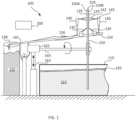
- a harvesting system 100 includes a disc 150 providing two opposing surfaces on which aquatic plants 120 may adhere when disc 150 is dipped into a tank 110 in which aquatic plants 120 are cultivated in culture medium 115.
- Disc 150 may be supported by an axle or shaft 160 fixedly engaged to a center of disc 150 and rotated about its longitudinal axis with motor 165.
- Disc 150 may be partially immersed in tank 110 at a substantially vertical orientation so that an edge of disc 150 cuts into the body of water as disc 150 is rotated without substantially disrupting a continuum of a floating or immersed mat formed by aquatic plants 120.
- tank 110 may include induced flow in a defined raceway and disc 150 may be oriented in tank 110 so that it surface is parallel to a direction of the flow.
- disc 150 may be oriented in tank 110 so that its surface is angled with respect to a direction of the flow.
- angling disc 150 with a direction of the flow induces mixing of the culture medium.
- a scraper 130 is positioned to engage each of surfaces 150A and 150B of disc 150 at a height above the surface of the culture medium 115 in tank 110 and scrapes off plants 120 collected on disc 150. As disc 150 continues to rotate, a section of disc 150 that has been scraped with scraper 130 is immersed again in the culture medium and provides a clean area on which additional plants 120 may adhere. Plants 120 scraped off the disc 150 may be collected in a trough 134 and channeled through a channel 136 to a collecting vat 138.
- the harvesting system 100 additionally includes a nozzle 140 connected to a water source 145 that sprays fluid 142, e.g. water on a surface of disc 150 above scraper 130.
- Nozzle 140 may be installed for each of the two surfaces of disc 150.
- Fluid 142 may help detach plants 120 from disc 150 in a gentle manner to prevent mechanical damage to plants 120.
- detachment is based on fluid 142 being sprayed on disc 150 and scraper 130 provides a surface that directs plants 120 detached with fluid142 toward trough 134.
- the spray nozzle may spray a thin layer of water or other fluid that may aid in detaching the plant parts from the disc without creating a spill flow. In this manner, the plants may be harvested with little extra fluid.
- operation of harvesting system 100 is automated and the automated operation is controlled by a controller 200.
- Controller 200 may include a user interface from which a user may selectively alter operation parameters for operating harvesting 100.
- operational parameters of system 100 may be controlled based on one or more sensors 145.
- sensor 145 may include an imaging system and a processor and sensor 145 may sense density of plants on disc 150. Density may be detected based on output from the imaging system.
- a harvesting rate may be controlled by controller 200 based on controlling a rotational speed of shaft 160, based on controlling a depth at which disc 150 is immersed in culture medium 115 with plants 120 and may also be controlled based on controlling flow rate of culture medium 115 in tank 110.
- axle 160 and motor 165 may be supported on a stand 162 that may be height adjusted, e.g. with a Z axis stage to alter depth of immersion of disc 150.
- disc 150 may be 30-150 cm in diameter, e.g. 80 cm and may be submerged at a depth of 5-20 cm or 15-20 cm.
- Disc 150 may be selected to be thin enough to avoid creating openings through a mat formed with plants 120 while maintaining mechanical stability.
- thickness of disc 150 may be 2-10 mm, e.g. 4-6 mm or 4 mm.
- Disc 150 may be formed from stainless steel, e.g. stainless steel 304, a polymer, e.g. polyethylene or polyvinylidene difluoride or other material that may provide adequate surface tension for accumulating plant 120.
- harvesting system 100 may include a plurality of stations around tank 110.
- Each station may include disc 150 including scrapers 130 and nozzles 140 supported by shaft 160 and rotated by a motor 165.
- Each station may also include dedicated troughs 134, channels 136 and a dedicated collection vat 138.
- plants 120 collected from a plurality of different stations may be channeled to a common collecting vat 138.
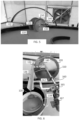
- disc 150 is partially submerged in a culture medium 115 including a layer of plants 120.
- Plants 120 may be for example a floating (or immersed) mat of aquatic plants.
- surfaces of disc 150 e.g. surface 150A and forms a ring of biomass.
- a width W of the ring is defined by a depth D at which disc 150 is immersed in culture medium 115.
- a scraper 130 is positioned against surface 150A and collects plants 120 accumulated on surface 150A as disc 150 rotates.
- nozzle 140 sprays water on surface 150A just above scraper 130 to gently release plants 120 from surface 150A.
- nozzle 140 sprays fluid 142 at a height of about 2-10 cm above scraper 130.
- fluid 142 sprayed by nozzle 140 is water or a water based solution that may help release plants 120 from surface 150A.
- Fluid supplied by nozzle 140 may additionally provide flow for transporting plants 120 from trough 134 through channel 136. As disk 150 rotates, a portion 151 of surface 150A that is cleaned with scraper 130 is immersed again in culture medium 115 and collects more plants 120. A similar process may be performed on a surface opposite surface 150A.
- Scraper 130 is shown to be positioned at angle with respect to a radial direction on surface 150A but may alternately be aligned with the radial direction.
- scraper 130 is sized to extend over a substantial portion a radius of disc 150 and including width W.
- a harvesting system 101 may include a plurality of discs 150 that are optionally supported and rotated by a common shaft 160.
- a pair of scrapers 130 and collecting channels 134 may be installed on each of discs 150.
- plants 120 collected in each of baths 134 is directed toward a channel 136 that continues to transport harvested plants to a collection vat.
- discs 150 may be positioned on shaft 160 with a gap of 50-800 mm, e.g. 500 mm between them. Distance between discs 150 may be selected based on size of the tank in which they are immersed, a desired rate for harvesting and based on growing characteristics of the layer 120 of aquatic plants.
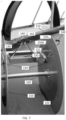
- harvesting system 101 includes two discs 150 supported on a common shaft 160. Each disc 150 is installed with a pair of scrapers 140 and a pair of nozzles 140, one on each surface of disc 150. Each of scrapers 130 and nozzles 140 may be fixed to a trough 134 that collects plants 120. Optionally, trough 134 is angled so that the collected plants may spill toward a channel 136 based on gravitation force.
- directed water flow, a conveyer belt, or other mechanical means may urge the collected plants toward channel 136.
- troughs 134 may be attached and supported by channel 136 that may extend generally parallel to shaft 160 toward an edge of tank 110 and a collection vat 138.
- Channel 136 may be supported with frame 164 positioned adjacent tank 110.
- frame 162 may include structure extending over tank 110 to further support channel 136 as well as other elements of the harvesting system.
- Channel 136 and trough 134 may be formed from aluminum or other light weight material.
- columns may be positioned in tank 110 to support elements of the harvesting system 101.
- frame 162 is mounted on a Z-axis (vertical) stage with which shaft 160 may be selectively lifted or lowered to position discs 150 at a desired depth of immersion.
- scraper 130 may include a blade 131.
- scraper 130 with blade 131 is formed from stainless steel or aluminum.
- blade 131 may be formed from an elastic material.
- Scraper 130 is installed so that blade 131 touches the surface of disc 150 without substantially interfering with rotation of disc 150.
- Blade 130 may be fixed to trough 134 so that plants120 scraped off disc 150 with scraper 130 may be collected and channeled to common channel 136 that may run generally parallel to shaft 160 but at an angle to provide flow of plants 120 with gravitation force.
- nozzle head 140 is fixedly attached to trough 134, e.g. with a bracket and positioned at an orientation in which nozzle 140 sprays fluid 5-15 cm above scraper 130 and generally normal to surface 150A.
- spraying with nozzle 140 loosen the plants 120 from surface 150A so that plants may drop into trough 134.
- a disc that is supported on an axle is partially immersed in a culture medium in which aquatic plants are being cultured (block 810).
- the disc is immersed in a generally vertical orientation, e.g. with surfaces of discs being normal or substantially normal to surface of the body of water and with surfaces of the disc being generally parallel to a direction of flow of the body of water in the tank.
- the disc or discs are rotated with an axle which they are supported (block 820).
- rotation is in a direction that corresponds with a direction of flow in the tank.
- plants may be collected on surfaces of the disc.
- the plants collected on the disc may be released by spraying water on a portion of the disc above surface of the culture medium (block 830).
- a scraper position against disc 150 may scrap a surface of disc 150 to collect the plants (block 840).
- the plants collected may then be channeled with flow based on gravitation motion to a collection vat (block 850).
- a harvesting system 200 is a conveyor type system and includes an endless belt 250 and an electric motor and drive unit 230.
- Belt 250 may be suspended from a pulley 220, with the lower portion immersed in culture medium 115 including aquatic plants 120.
- aquatic plants 120 adheres to one or both sides of the belt.
- One or more scrapers 130 mounted along belt 250.
- the harvested aquatic plants (the biomass) may be collected into a trough 134 and channeled via channel 136 to a collection vat.
- belt 250 may be partially immersed in culture medium 115 so that its surface is substantially parallel to a direction of flow 117, e.g. a width W extends along direction of flow 117 in tank 110. In this manner, the conveyor motion does not significantly disrupt a surface of growing aquatic plants 120 in medium 115.
- harvesting system 200 may include a dedicated scraper 130 that removes the aquatic plants on one side of the belt prior to the aquatic plants reaching the upper pulley 220.
- a conveyor belt system is partially immersed in a culture medium in which aquatic plants are being cultured (block 810).
- the conveyer belt system is partially immersed, e.g. with surfaces of the belt positioned generally parallel to a direction of flow in the tank.
- the belt is advanced in and out of the culture medium based on rotating drums of the conveyor system (block 820). As the belts advances, plants may be collected on surfaces of the belt.
- the plants collected on the disc may be released by spraying water on a portion of the belt above surface of the culture medium (block 830).
- a scraper position against the belt may scrap a surface of belt to collect the plants (block 840).
- the plants collected may then be channeled based on gravitation motion to a collection vat (block 850).
- a harvesting system 400 is a roller type system and includes a roller 450 and an electric motor and drive unit 465.
- Roller 550 may be rotatably supported on an axle 460.
- Axle 460 may be engaged with electric motor and drive unit 465.
- a scraper 430 may extend along length of roller 450 and a trough 434 may collect plants 120 that is scraped.
- a channel 436 may direct collected plants to a collection vat 138.
- a shaft 461 may support the trough 434 and scraper 430.
- One or more water drip or spraying nozzles 440 may spray water on the roller to aid in releasing plants 120 from roller prior to scraping. The water nozzles may also be supported on shaft 461.
- roller 450 may be partially immersed in culture medium 115 so that its longitudinal axis is substantially perpendicular to a direction of flow 117, e.g. a length of roller 450 is perpendicular to a direction of flow 117 in tank 110. In this manner, the conveyor motion does not significantly disrupt a surface of growing aquatic plants 120 in medium 115. In other example embodiments, roller 450 may be aligned with a direction of flow 117.
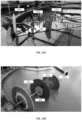
- FIGs. 12A and 12B A harvesting system prototype shown in FIGs. 12A and 12B was made with three discs, 80 cm in diameter all supported on a common shaft 160. Each of the discs was made from different material:
- the three discs were partially submerged at a depth of 10-15 cm in a tank including wolffia culture as shown in FIG. 12B .
- the wolffia culture was at a density of 400-800 gm/m 2 , which enabled substantially full coverage of the water surface area.
- the discs were rotated at a rotating speed of 1.5-3.0 rpm.
- the adhesion ability of the plant, e.g. the fronds to each of the discs material under different depth and speed condition was studied.
- Harvesting was achieved on each of the three discs.
- the highest harvesting capacity of the wolffia culture was achieved with the stainless-steel disc 253 in all various conditions tested.
- a harvesting system as shown in FIG. 5 including two spinning stainless steel 304 discs 150 with a diameter of 90 cm was constructed and installed in a tank 110 including a wolffia globosa culture with an approximate surface density of 600 gm/m 2 .
- the tank includes a raceway curve.
- the harvesting system was positioned at the beginning of the raceway curve of tank 110.
- the spinning discs 150 were inserted into the culture a depth of 15-18 cm and rotated at a rotation speed of 2.4 RPM. The rotation was controlled by variable frequency converter.
- a scraper 130 made from PVDF were installed to scrap the plants off of surface of discs 150.
Landscapes
- Engineering & Computer Science (AREA)
- Life Sciences & Earth Sciences (AREA)
- General Engineering & Computer Science (AREA)
- Marine Sciences & Fisheries (AREA)
- Environmental Sciences (AREA)
- Environmental & Geological Engineering (AREA)
- Mechanical Engineering (AREA)
- Civil Engineering (AREA)
- Structural Engineering (AREA)
- Hydroponics (AREA)
- Apparatus Associated With Microorganisms And Enzymes (AREA)
- Harvesting Machines For Specific Crops (AREA)
Claims (14)
- Erntesystem (100) zum Ernten von Wasserpflanzen (120) in oder auf einem Kulturmedium (115) treibend, wobei das System Folgendes umfasst:ein Erntebeet, das so konfiguriert ist, dass es in und aus dem Kulturmedium (115) zirkuliert;einen Aktuator (165), der so konfiguriert ist, dass er das Erntebeet zirkuliert;einen Abstreifer (130), der gegen eine Oberfläche des Erntebeets positioniert und so konfiguriert ist, dass er die Wasserpflanzen (120) auf dem Erntebeet abstreift;eine Düse (140), die so konfiguriert ist, dass sie ein Fluid (142) auf eine Oberfläche des Erntebeets in einer Höhe oberhalb einer Position des Abstreifers (130) sprüht;eine Fluidquelle (145), die so konfiguriert ist, dass sie die Düse (140) mit Fluid versorgt;einen Kanal (136), der so konfiguriert ist, dass er die von dem Abstreifer (130) entfernten Wasserpflanzen (120) transportiert; undeinen Sammelbehälter (138), der so konfiguriert ist, dass er die über den Kanal (136) transportierten Wasserpflanzen (120) aufnimmt, wobei das Erntebeet eine Platte (150) ist, wobei der Aktuator so konfiguriert ist, dass er die Platte (150) um eine Drehachse dreht, wobei die Drehachse senkrecht zum Erntebeet steht und wobei die Platte (150) scheibenförmig ist.
- System nach Anspruch 1, wobei eine Vielzahl von Platten (150) fest auf einer einzigen Achse (160) gestützt ist und wobei der Aktuator so konfiguriert ist, dass er die Achse (160) dreht.
- System nach Anspruch 1, wobei die Platte (150) eine Dicke von 1-15 cm aufweist.
- System nach Anspruch 1, umfassend einen Z-Tisch, der so konfiguriert ist, dass er die Platte (150) in einer gewünschten Höhe positioniert.
- System nach Anspruch 1, wobei das Erntebeet ein Band (250) ist, wobei das Band (250) ein Endlosband ist, das mit einem Fördersystem zirkuliert wird, und wobei das Band (250) so konfiguriert ist, dass es in das Kulturmedium (115) eingetaucht wird, sodass eine Oberfläche des Bandes (250) parallel zu einer Strömungsrichtung in einem Tank (110) ist, der das Kulturmedium (115) enthält.
- System nach Anspruch 1, wobei das Erntebeet eine Walze (450) ist.
- System nach Anspruch 1, umfassend eine Steuerung, die so konfiguriert ist, dass sie die Zirkulationsrate steuert, wobei der Abstreifer (130) stationär ist und die Zirkulation des Erntebeets so konfiguriert ist, dass sie das Abstreifen der Wasserpflanzen (120) auslöst, wobei der Abstreifer (130) fest an einem Trog (134) befestigt ist, der so konfiguriert ist, dass er die vom Abstreifer (130) abgestreiften Wasserpflanzen (120) sammelt, wobei der Trog (134) zum Kanal (136) hin geneigt ist.
- System nach einem der Ansprüche 1-7, umfassend ein Paar Abstreifer (130), das an jeder der beiden gegenüberliegenden flachen Oberflächen des Erntebeets positioniert ist, und ein Paar Düsen (140), das so konfiguriert ist, dass es Fluid (142) auf jede der beiden gegenüberliegenden Oberflächen des Erntebeets sprüht, wobei das Fluid (142) Wasser ist.
- Verfahren zum Ernten von Wasserpflanzen (120) in oder auf einem Kulturmedium (115) treibend, wobei das Verfahren Folgendes umfasst:teilweises Eintauchen eines Erntebeets in ein Kulturmedium (115), wobei das Kulturmedium (115) Wasserpflanzen (120) umfasst;Zirkulieren des Erntebeets in und aus dem Kulturmedium (115);Abstreifen der an dem Erntebeet haftenden Wasserpflanzen (120), während das Erntebeet zirkuliert wird;Besprühen eines Teils des Erntebeets oberhalb des Abstreifers (130) mit einem Fluid (142);Leiten der von dem Abstreifer (130) entfernten Wasserpflanzen (120) zu einem Sammelbehälter (138); undSammeln der Wasserpflanzen (120) in dem Sammelbehälter (138).
- Verfahren nach Anspruch 9, wobei das Erntebeet eine Platte (150) ist und wobei das Abstreifen durch die Drehung der Platte (150) ausgelöst wird.
- Verfahren nach Anspruch 10, umfassend das Ausrichten einer Kante der Platte (150) mit einer Strömungsrichtung des Kulturmediums (115) oder das Ausrichten einer Oberfläche der Platte (150) in einem spitzen Winkel in Bezug auf eine Strömungsrichtung des Kulturmediums (115).
- Verfahren nach Anspruch 10 oder Anspruch 11, umfassend das teilweise Eintauchen einer Vielzahl von Platten (150) in ein Kulturmedium (115), wobei die Vielzahl von Platten (150) um einen definierten Abstand voneinander entfernt ist und wobei die Vielzahl von Platten (150) um dieselbe Drehachse gedreht wird.
- Verfahren nach Anspruch 9, wobei das Erntebeet ein Endlosband (250) ist, das mit einem Fördersystem zirkuliert wird, und das das Eintauchen des Endlosbandes (250) in das Kulturmedium (115) umfasst, sodass eine Oberfläche des Bandes (250) parallel zu einer Strömungsrichtung in einem Tank (110) ist, der das Kulturmedium (115) enthält, oder das Ausrichten einer Oberfläche des Bandes (250) in einem spitzen Winkel in Bezug auf eine Strömungsrichtung des Kulturmediums (115).
- Verfahren nach Anspruch 9, wobei das Erntebeet eine Walze (450) ist und eine Längsachse der Walze senkrecht zu einer Strömungsrichtung des Kulturmediums (115) positioniert wird.
Applications Claiming Priority (2)
| Application Number | Priority Date | Filing Date | Title |
|---|---|---|---|
| US201862639570P | 2018-03-07 | 2018-03-07 | |
| PCT/IL2019/050251 WO2019171380A1 (en) | 2018-03-07 | 2019-03-07 | System and method for harvesting aquatic plants |
Publications (4)
| Publication Number | Publication Date |
|---|---|
| EP3761777A1 EP3761777A1 (de) | 2021-01-13 |
| EP3761777A4 EP3761777A4 (de) | 2021-12-15 |
| EP3761777B1 true EP3761777B1 (de) | 2025-01-15 |
| EP3761777C0 EP3761777C0 (de) | 2025-01-15 |
Family
ID=67843149
Family Applications (1)
| Application Number | Title | Priority Date | Filing Date |
|---|---|---|---|
| EP19763222.7A Active EP3761777B1 (de) | 2018-03-07 | 2019-03-07 | System und verfahren zur wasserpflanzenernte |
Country Status (5)
| Country | Link |
|---|---|
| US (1) | US10925212B2 (de) |
| EP (1) | EP3761777B1 (de) |
| ES (1) | ES3019212T3 (de) |
| IL (1) | IL277202B2 (de) |
| WO (1) | WO2019171380A1 (de) |
Families Citing this family (4)
| Publication number | Priority date | Publication date | Assignee | Title |
|---|---|---|---|---|
| ES3019212T3 (en) | 2018-03-07 | 2025-05-20 | Hinoman Ltd | System and method for harvesting aquatic plants |
| US11266068B2 (en) | 2019-12-02 | 2022-03-08 | FYTO, Inc. | System and method for aquatic plant harvesting |
| CN112119753B (zh) * | 2020-10-09 | 2021-09-07 | 中国石油大学胜利学院 | 一种莲藕采收作业装备链条换向水力射流机构 |
| WO2024191931A1 (en) | 2023-03-10 | 2024-09-19 | FYTO, Inc. | Method and system for computer-assisted harvesting |
Family Cites Families (23)
| Publication number | Priority date | Publication date | Assignee | Title |
|---|---|---|---|---|
| US3358838A (en) * | 1965-04-30 | 1967-12-19 | Ajem Lab Inc | Oil skimming device |
| US3449892A (en) | 1965-12-29 | 1969-06-17 | Sea Chem Ind Ltd | Sea plant harvesting apparatus |
| USRE32298E (en) * | 1975-02-20 | 1986-12-02 | Harold J. Baer | Liquid-separating device |
| US4253271A (en) | 1978-12-28 | 1981-03-03 | Battelle Memorial Institute | Mass algal culture system |
| US4473469A (en) * | 1982-03-01 | 1984-09-25 | Giuseppe Ayroldi | Apparatus for recovering fluid substances floating on a water surface |
| US4600694A (en) * | 1985-05-24 | 1986-07-15 | Clyde Robert A | Apparatus for harvesting cells |
| JPH0346802Y2 (de) * | 1986-04-03 | 1991-10-03 | ||
| ATE78413T1 (de) * | 1989-05-30 | 1992-08-15 | Blaser & Co Ag | Vorrichtung zum abtrennen von substanzen von der oberflaeche einer fluessigkeit. |
| GB8924980D0 (en) * | 1989-11-06 | 1989-12-28 | Burt Separators | Recovery of floating liquid |
| GB9107957D0 (en) | 1991-04-15 | 1991-05-29 | Little Steven W | Apparatus for use in removing a viscous substance from a surface |
| US5197263A (en) | 1991-09-13 | 1993-03-30 | The Lemna Corporation | Method and apparatus for harvesting aquatic plants |
| JPH07108107A (ja) * | 1993-10-08 | 1995-04-25 | Hitachi Kiden Kogyo Ltd | 濾体移動式除塵機 |
| US5522990A (en) * | 1994-08-08 | 1996-06-04 | Davidian; Steven | Oil removal device with integrated gravity separator |
| US5659977A (en) | 1996-04-29 | 1997-08-26 | Cyanotech Corporation | Integrated microalgae production and electricity cogeneration |
| US8388839B1 (en) | 2008-10-28 | 2013-03-05 | M. Thomas Hobson | Oil skimming apparatus |
| US8287740B2 (en) * | 2008-12-15 | 2012-10-16 | Desert Lake Technologies, Llc | Apparatus for extracting material from liquid and methods therefor |
| CN106376448A (zh) | 2009-04-20 | 2017-02-08 | 帕拉贝尔有限责任公司 | 高生长率的浮游水生物种的培育、收获及加工 |
| NL2007648C2 (en) | 2011-10-25 | 2013-05-01 | Cremers Henri Carel Johan Canter | Method and system for cultivating aquatic plants. |
| KR101486477B1 (ko) | 2013-06-04 | 2015-01-26 | 한국에너지기술연구원 | 흡수식 현탁액 농축장치 |
| US10039244B2 (en) | 2014-03-04 | 2018-08-07 | Greenonyx Ltd | Systems and methods for cultivating and distributing aquatic organisms |
| US20170072345A1 (en) * | 2014-03-20 | 2017-03-16 | General Electric Company | Method and apparatus for cleaning a rotating belt sieve |
| KR101575765B1 (ko) * | 2015-04-06 | 2015-12-21 | 청호환경산업(주) | 녹조 제거장치 |
| ES3019212T3 (en) | 2018-03-07 | 2025-05-20 | Hinoman Ltd | System and method for harvesting aquatic plants |
-
2019
- 2019-03-07 ES ES19763222T patent/ES3019212T3/es active Active
- 2019-03-07 WO PCT/IL2019/050251 patent/WO2019171380A1/en not_active Ceased
- 2019-03-07 EP EP19763222.7A patent/EP3761777B1/de active Active
- 2019-03-07 US US16/294,956 patent/US10925212B2/en active Active
-
2020
- 2020-09-07 IL IL277202A patent/IL277202B2/en unknown
Also Published As
| Publication number | Publication date |
|---|---|
| US10925212B2 (en) | 2021-02-23 |
| US20190274247A1 (en) | 2019-09-12 |
| WO2019171380A1 (en) | 2019-09-12 |
| IL277202B1 (en) | 2023-04-01 |
| EP3761777C0 (de) | 2025-01-15 |
| IL277202B2 (en) | 2023-08-01 |
| EP3761777A4 (de) | 2021-12-15 |
| IL277202A (en) | 2020-10-29 |
| EP3761777A1 (de) | 2021-01-13 |
| ES3019212T3 (en) | 2025-05-20 |
Similar Documents
| Publication | Publication Date | Title |
|---|---|---|
| EP3761777B1 (de) | System und verfahren zur wasserpflanzenernte | |
| CA2528876C (en) | Method and apparatus for preparation of genetically transformable plant tissue | |
| US8286801B2 (en) | Method and apparatus for separating particles from a liquid | |
| US10801147B2 (en) | Cleaner system and method for plant growing media | |
| US20120252105A1 (en) | Systems, apparatuses and methods of cultivating organisms and mitigation of gases | |
| EP2619145A2 (de) | Systeme, vorrichtungen und verfahren zur kultivierung von organismen und zur abschwächung von gasen | |
| US20250212729A1 (en) | System and method for aquatic plant harvesting | |
| EP0625003B1 (de) | Handhabungssystem für rasen | |
| KR20230055139A (ko) | 꼬막 치패 분리장치 | |
| JP3069779U (ja) | 貝類の養殖かご洗浄排水濾過装置 | |
| CN109294958B (zh) | 一种养殖螺旋藻的清洗与采收方法 | |
| KR101918517B1 (ko) | 해조류 양식선 | |
| KR102196997B1 (ko) | 플랑크톤 농축장치 | |
| GB2473866A (en) | Rotating filter | |
| US5836101A (en) | Brine shrimp separation apparatus and methods | |
| KR102385621B1 (ko) | 김사상체 잠입용 굴패각 이물질 제거 및 세척장치 | |
| JP3091134U (ja) | 貝類養殖かご洗浄後排水濾過装置 | |
| CN117481086A (zh) | 一种贻贝养殖的机械化采收设备及采收方法 | |
| JP2004033805A (ja) | 貝類養殖かご洗浄後排水濾過装置 | |
| AU2006200746A1 (en) | Oyster bag cleaning machine |
Legal Events
| Date | Code | Title | Description |
|---|---|---|---|
| STAA | Information on the status of an ep patent application or granted ep patent |
Free format text: STATUS: THE INTERNATIONAL PUBLICATION HAS BEEN MADE |
|
| PUAI | Public reference made under article 153(3) epc to a published international application that has entered the european phase |
Free format text: ORIGINAL CODE: 0009012 |
|
| STAA | Information on the status of an ep patent application or granted ep patent |
Free format text: STATUS: REQUEST FOR EXAMINATION WAS MADE |
|
| 17P | Request for examination filed |
Effective date: 20200918 |
|
| AK | Designated contracting states |
Kind code of ref document: A1 Designated state(s): AL AT BE BG CH CY CZ DE DK EE ES FI FR GB GR HR HU IE IS IT LI LT LU LV MC MK MT NL NO PL PT RO RS SE SI SK SM TR |
|
| AX | Request for extension of the european patent |
Extension state: BA ME |
|
| DAV | Request for validation of the european patent (deleted) | ||
| DAX | Request for extension of the european patent (deleted) | ||
| A4 | Supplementary search report drawn up and despatched |
Effective date: 20211112 |
|
| RIC1 | Information provided on ipc code assigned before grant |
Ipc: A01G 33/00 20060101ALI20211108BHEP Ipc: A01D 44/00 20060101AFI20211108BHEP |
|
| GRAP | Despatch of communication of intention to grant a patent |
Free format text: ORIGINAL CODE: EPIDOSNIGR1 |
|
| STAA | Information on the status of an ep patent application or granted ep patent |
Free format text: STATUS: GRANT OF PATENT IS INTENDED |
|
| RIC1 | Information provided on ipc code assigned before grant |
Ipc: A01G 33/00 20060101ALI20240708BHEP Ipc: A01D 44/00 20060101AFI20240708BHEP |
|
| INTG | Intention to grant announced |
Effective date: 20240722 |
|
| GRAS | Grant fee paid |
Free format text: ORIGINAL CODE: EPIDOSNIGR3 |
|
| RAP3 | Party data changed (applicant data changed or rights of an application transferred) |
Owner name: HINOMAN LTD |
|
| GRAA | (expected) grant |
Free format text: ORIGINAL CODE: 0009210 |
|
| STAA | Information on the status of an ep patent application or granted ep patent |
Free format text: STATUS: THE PATENT HAS BEEN GRANTED |
|
| AK | Designated contracting states |
Kind code of ref document: B1 Designated state(s): AL AT BE BG CH CY CZ DE DK EE ES FI FR GB GR HR HU IE IS IT LI LT LU LV MC MK MT NL NO PL PT RO RS SE SI SK SM TR |
|
| REG | Reference to a national code |
Ref country code: CH Ref legal event code: EP Ref country code: GB Ref legal event code: FG4D |
|
| REG | Reference to a national code |
Ref country code: DE Ref legal event code: R096 Ref document number: 602019064889 Country of ref document: DE |
|
| REG | Reference to a national code |
Ref country code: IE Ref legal event code: FG4D |
|
| U01 | Request for unitary effect filed |
Effective date: 20250207 |
|
| U07 | Unitary effect registered |
Designated state(s): AT BE BG DE DK EE FI FR IT LT LU LV MT NL PT RO SE SI Effective date: 20250213 |
|
| U20 | Renewal fee for the european patent with unitary effect paid |
Year of fee payment: 7 Effective date: 20250324 |
|
| REG | Reference to a national code |
Ref country code: ES Ref legal event code: FG2A Ref document number: 3019212 Country of ref document: ES Kind code of ref document: T3 Effective date: 20250520 |
|
| PG25 | Lapsed in a contracting state [announced via postgrant information from national office to epo] |
Ref country code: RS Free format text: LAPSE BECAUSE OF FAILURE TO SUBMIT A TRANSLATION OF THE DESCRIPTION OR TO PAY THE FEE WITHIN THE PRESCRIBED TIME-LIMIT Effective date: 20250415 |
|
| PG25 | Lapsed in a contracting state [announced via postgrant information from national office to epo] |
Ref country code: PL Free format text: LAPSE BECAUSE OF FAILURE TO SUBMIT A TRANSLATION OF THE DESCRIPTION OR TO PAY THE FEE WITHIN THE PRESCRIBED TIME-LIMIT Effective date: 20250115 |
|
| PGFP | Annual fee paid to national office [announced via postgrant information from national office to epo] |
Ref country code: ES Payment date: 20250402 Year of fee payment: 7 |
|
| PG25 | Lapsed in a contracting state [announced via postgrant information from national office to epo] |
Ref country code: IS Free format text: LAPSE BECAUSE OF FAILURE TO SUBMIT A TRANSLATION OF THE DESCRIPTION OR TO PAY THE FEE WITHIN THE PRESCRIBED TIME-LIMIT Effective date: 20250515 Ref country code: NO Free format text: LAPSE BECAUSE OF FAILURE TO SUBMIT A TRANSLATION OF THE DESCRIPTION OR TO PAY THE FEE WITHIN THE PRESCRIBED TIME-LIMIT Effective date: 20250415 |
|
| PG25 | Lapsed in a contracting state [announced via postgrant information from national office to epo] |
Ref country code: HR Free format text: LAPSE BECAUSE OF FAILURE TO SUBMIT A TRANSLATION OF THE DESCRIPTION OR TO PAY THE FEE WITHIN THE PRESCRIBED TIME-LIMIT Effective date: 20250115 |
|
| PG25 | Lapsed in a contracting state [announced via postgrant information from national office to epo] |
Ref country code: GR Free format text: LAPSE BECAUSE OF FAILURE TO SUBMIT A TRANSLATION OF THE DESCRIPTION OR TO PAY THE FEE WITHIN THE PRESCRIBED TIME-LIMIT Effective date: 20250416 |
|
| PG25 | Lapsed in a contracting state [announced via postgrant information from national office to epo] |
Ref country code: SM Free format text: LAPSE BECAUSE OF FAILURE TO SUBMIT A TRANSLATION OF THE DESCRIPTION OR TO PAY THE FEE WITHIN THE PRESCRIBED TIME-LIMIT Effective date: 20250115 |
|
| PG25 | Lapsed in a contracting state [announced via postgrant information from national office to epo] |
Ref country code: MC Free format text: LAPSE BECAUSE OF FAILURE TO SUBMIT A TRANSLATION OF THE DESCRIPTION OR TO PAY THE FEE WITHIN THE PRESCRIBED TIME-LIMIT Effective date: 20250115 |
|
| PG25 | Lapsed in a contracting state [announced via postgrant information from national office to epo] |
Ref country code: CZ Free format text: LAPSE BECAUSE OF FAILURE TO SUBMIT A TRANSLATION OF THE DESCRIPTION OR TO PAY THE FEE WITHIN THE PRESCRIBED TIME-LIMIT Effective date: 20250115 |
|
| REG | Reference to a national code |
Ref country code: CH Ref legal event code: H13 Free format text: ST27 STATUS EVENT CODE: U-0-0-H10-H13 (AS PROVIDED BY THE NATIONAL OFFICE) Effective date: 20251023 |
|
| PG25 | Lapsed in a contracting state [announced via postgrant information from national office to epo] |
Ref country code: SK Free format text: LAPSE BECAUSE OF FAILURE TO SUBMIT A TRANSLATION OF THE DESCRIPTION OR TO PAY THE FEE WITHIN THE PRESCRIBED TIME-LIMIT Effective date: 20250115 |
|
| PLBE | No opposition filed within time limit |
Free format text: ORIGINAL CODE: 0009261 |
|
| STAA | Information on the status of an ep patent application or granted ep patent |
Free format text: STATUS: NO OPPOSITION FILED WITHIN TIME LIMIT |
|
| 26N | No opposition filed |
Effective date: 20251016 |
|
| PG25 | Lapsed in a contracting state [announced via postgrant information from national office to epo] |
Ref country code: CH Free format text: LAPSE BECAUSE OF NON-PAYMENT OF DUE FEES Effective date: 20250331 |
|
| PGFP | Annual fee paid to national office [announced via postgrant information from national office to epo] |
Ref country code: GB Payment date: 20260324 Year of fee payment: 8 |
|
| PGFP | Annual fee paid to national office [announced via postgrant information from national office to epo] |
Ref country code: IE Payment date: 20260319 Year of fee payment: 8 |
|
| U20 | Renewal fee for the european patent with unitary effect paid |
Year of fee payment: 8 Effective date: 20260326 |