EP3763861B1 - Système de conception de tricots pour la création de données de patron adapté à une longueur d'un corps - Google Patents
Système de conception de tricots pour la création de données de patron adapté à une longueur d'un corps Download PDFInfo
- Publication number
- EP3763861B1 EP3763861B1 EP20180238.6A EP20180238A EP3763861B1 EP 3763861 B1 EP3763861 B1 EP 3763861B1 EP 20180238 A EP20180238 A EP 20180238A EP 3763861 B1 EP3763861 B1 EP 3763861B1
- Authority
- EP
- European Patent Office
- Prior art keywords
- data
- stitch
- length
- knitted fabric
- unit
- Prior art date
- Legal status (The legal status is an assumption and is not a legal conclusion. Google has not performed a legal analysis and makes no representation as to the accuracy of the status listed.)
- Active
Links
Images


Classifications
-
- G—PHYSICS
- G06—COMPUTING OR CALCULATING; COUNTING
- G06F—ELECTRIC DIGITAL DATA PROCESSING
- G06F30/00—Computer-aided design [CAD]
- G06F30/10—Geometric CAD
-
- D—TEXTILES; PAPER
- D04—BRAIDING; LACE-MAKING; KNITTING; TRIMMINGS; NON-WOVEN FABRICS
- D04B—KNITTING
- D04B15/00—Details of, or auxiliary devices incorporated in, weft knitting machines, restricted to machines of this kind
- D04B15/66—Devices for determining or controlling patterns ; Program-control arrangements
- D04B15/68—Devices for determining or controlling patterns ; Program-control arrangements characterised by the knitting instruments used
- D04B15/78—Electrical devices
-
- D—TEXTILES; PAPER
- D04—BRAIDING; LACE-MAKING; KNITTING; TRIMMINGS; NON-WOVEN FABRICS
- D04B—KNITTING
- D04B15/00—Details of, or auxiliary devices incorporated in, weft knitting machines, restricted to machines of this kind
- D04B15/66—Devices for determining or controlling patterns ; Program-control arrangements
- D04B15/68—Devices for determining or controlling patterns ; Program-control arrangements characterised by the knitting instruments used
- D04B15/70—Devices for determining or controlling patterns ; Program-control arrangements characterised by the knitting instruments used in flat-bed knitting machines
-
- D—TEXTILES; PAPER
- D04—BRAIDING; LACE-MAKING; KNITTING; TRIMMINGS; NON-WOVEN FABRICS
- D04B—KNITTING
- D04B37/00—Auxiliary apparatus or devices for use with knitting machines
- D04B37/02—Auxiliary apparatus or devices for use with knitting machines with weft knitting machines
-
- G—PHYSICS
- G06—COMPUTING OR CALCULATING; COUNTING
- G06F—ELECTRIC DIGITAL DATA PROCESSING
- G06F30/00—Computer-aided design [CAD]
- G06F30/20—Design optimisation, verification or simulation
-
- G—PHYSICS
- G06—COMPUTING OR CALCULATING; COUNTING
- G06F—ELECTRIC DIGITAL DATA PROCESSING
- G06F2113/00—Details relating to the application field
- G06F2113/12—Cloth
Definitions
- the present invention relates to a knit design system that can edit design data of a knitted fabric to be knitted by a flat knitting machine.
- Mass customization has recently been drawing attention in the field of apparel.
- An example of this is the following production modeling.
- Apparel manufacturers and the like preset basic sizes (such as, e.g., S, M, L) for each piece of wear.
- the actual measurements of the body of a customer are compared with the basic sizes, and the piece of wear from basic sizes that is most fitted to the actual measurements of a customer is selected from pieces of wear selected by the customer.
- the size of the selected piece of wear is adjusted based on the actual measurements of the customer, and a product is made.
- the color or pattern of each product may be changed according to the desire of the customer.
- made-to-measure for suits made of cloth.
- paper patterns of basic sizes for each suit are prepared, a paper pattern is adjusted in a possible range so as to fit to the actual measurements of the body of a customer, cloth is cut along the adjusted paper pattern, and the cut pieces of the clothes are sewn together, thereby producing the suit.
- Design data is data that includes information relating to stitches constituting a knitted fabric, and defines what types of stitches are used in each portion of the knitted fabric and in which order knitting is to be performed. Accordingly, design data includes, for example, information relating to dimensions of a knitted fabric, and information relating to patterns of the knitted fabric.
- Patent Literature 1 discloses that design data is made visible as a design sheet and is displayed on a monitor, and in this state, the size is changed on the design data.
- Patent Literature 1 WO 2002/033598A
- Prior art document WO 2016/044288 A1 discloses a knit design system in which apparel patterns may be generated as a function of custom apparel information provided by a user, such as one or more measurements, colors, etc., such that the user can have apparel custom-knitted to their particular size and shape without having to acquiesce the high expense and long wait times typically associated with custom-fit clothing.
- a custom apparel pattern is generated, a custom- knitted article can be manufactured based on the pattern by transmitting appropriate information to a knitting machine.
- Data produced while generating custom apparel patterns can be stored and used to optimize and improve the manufacturing of customized knitwear for subsequent users.
- a knit design system for causing a flat knitting machine to knit a knitted fabric based on design data that includes information relating to stitches constituting the knitted fabric, including: an input unit configured to input information relating to the actual measurements of the body of a customer;
- the change determination unit may be configured to be able to set a preferential order of the modification for the plurality of variable course, and may select the stitch rows in the set preferential order.
- the change determination unit may be configured to evenly distribute the stitch row positions to be used for the change over the plurality of variable courses.
- the change determination unit may be configured to be able to set an upper limit number of stitch rows to be added or deleted to or from the selected variable courses.
- the fixed course may include at least one type of stitch row selected from a group constituted by a stitch row for widening, a stitch row for narrowing, and a stitch row constituting a predetermined pattern.
- the knit design system of the present invention since the direction of modification to be made on the possible data is limited to the length direction, the number of pieces of basic data to be prepared in advance needs to be small, compared to a case where the direction of modification is not limited. In this respect, the burden on an operator who creates basic data is reduced.
- a length dimension such as a body length or a sleeve length is adjusted with the possible data, based on the actual measurement of the body of a customer. Accordingly, it is possible to knit a knitted fabric having a body length or sleeve length that is fitted to the actual measurement of a customer's body.
- a predetermined design or silhouette is likely to be maintained. The reason is that, as the position at which modification is preferentially made in the variable course, a position at which a predetermined design or silhouette is hardly affected can be set.
- a predetermined design or silhouette is likely to be maintained.
- the influence on the design or silhouette due to adding or deleting the stitch rows is likely to be reduced, compared to a case where a plurality of stitch rows are added or deleted to or from one variable course in a concentrated manner.
- a predetermined design or silhouette is likely to be maintained. The reason is that it is possible to set the number of rows that are to be added or deleted to or from the selected variable courses to such an extent that a predetermined design or silhouette is less likely to be affected.
- the knit design system of the present invention in which the fixed course includes the above-described specific stitch row, a predetermined design or silhouette is likely to be maintained, and a knitted fabric knitted with a favorable knitting efficiency is likely to be obtained.
- the reason is that the above-described specific stitch row is likely to affect, for example, the predetermined design or the knitting efficiency of the flat knitting machine, and the variable course is not such a stitch row.
- a knit design system 100 according to Embodiment 1 shown in a functional block diagram of FIG. 1 includes an input unit 1, an editing unit 2, a memory 3, and a display unit 4.
- This knit design system 100 has a function of creating a program for causing a flat knitting machine 9 to knit a knitted fabric based on design data that includes information relating to stitches constituting the knitted fabric.
- This knit design system 100 also has a function of designing a knitted fabric, that is, a function of newly creating design data of a knitted fabric, modifying existing design data, and the like.
- the flat knitting machine 9 may be, for example, a two-bed flat knitting machine or a four-bed flat knitting machine.
- a characteristic of the knit design system 100 of Embodiment 1 may be such that the knit design system 100 is configured to adjust the length dimension to be set for design data of a knitted fabric based on the actual measurement of the body of a customer who is to wear knit wear. More specifically, the knit design system 100 regards design data that corresponds to a predetermined number of body dimensions set in advance as basic data, and adjusts, based on the above-described actual measurement, the length dimension of the basic data that has the body dimension most fitted to the actual measurement.
- Design data is data that includes information relating to stitches constituting a knitted fabric, that is, data that includes information relating to the outer shape line of a knitted fabric, information relating to the dimensions, information relating to patterns of the knitted fabric, and the like, and defines what types of stitches are used in each portion of the knitted fabric and in which order knitting is to be performed.
- Information relating to stitches may be information relating to front stitches, back stitches, transfer, and the like, the numbers of stitches in the course direction and the wale direction, and the like.
- design data is data in which an execution procedure of a later-described knitting code is defined, and is like a blueprint of a knitted fabric. Design data is typically created based on the paper pattern that indicates the outer shape of a knitted fabric.
- an operator first sets a predetermined number of body dimensions for knit wear to be newly produced. Then, the operator creates pieces of design data that respectively correspond to the set body dimensions. The created pieces of design data are used as basic data for the body dimensions.
- the types of body dimensions, the ranges of the dimensions, the number of classifications, and the like can be suitably selected by the operator.
- the types of body dimensions may include, for example, the body length, the sleeve length, the bust size, the waist size, the hip size, the shoulder width, and the like. Since the knit design system 100 adjusts the length dimension, the operator sets either or both of the body length and the sleeve length.
- each of the classifications is further divided into sub-classifications.
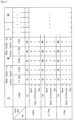
- One such classification for example the S size, may have nine sub-classifications S1 to S9.
- the body length (s 10 , m 10 ), the sleeve length (sn, m 11 ), the bust size (s, m), the bust difference (a to c), and the hip size (d to i) are denoted by small letter characters or the like, but actually numerical ranges (cm) are set.
- a configuration is also possible in which, instead of the above-described thirty six types of basic data being prepared at the beginning, only basic data for the sub-classifications that are expected to be predominant in the distribution of the actual measurements of customers is created, and basic data for a sub-classification for which no basic data has been created will be created in response to a request from a customer.
- Basic data for a sub-classification for which no basic data has been created can be created in a short time by modifying existing basic data. If existing basic data is modified in this way, the burden on the operator is further mitigated compared to a case where pieces of basic data for all of the sub-classifications are created.
- An editing operation such as creating new design data or modifying a size is performed in such a manner that, as shown in FIG. 3 , design data serving as a design sheet 40 is displayed on the display unit 4 such as a monitor.
- the design sheet 40 may be typically a sheet on which cells are arranged in a grid and a knitting code is assigned to each cell, each cell corresponding to one stitch.
- the lateral direction (in FIG. 3 , the left-right direction of the paper plane) of the design sheet 40 corresponds to the course direction, that is, the width direction, of the knitted fabric.
- the longitudinal direction (in FIG. 3 , the up-down direction of the paper plane) of the design sheet 40 corresponds to the wale direction, that is, the length direction, of the knitted fabric.
- the knitting codes are icons expressed so that knitting operations to be performed by the flat knitting machine 9 can be distinguished visually.
- Each knitting code is expressed with, for example, a color, a numeric character, a figure, or a combination thereof.
- the knitting operation that corresponds to a knitting code is predetermined.
- a knitting code expressed in red is defined as a knitting code for instructing the flat knitting machine 9 to form a front stitch
- a knitting code expressed in green is defined as a knitting code for instructing the flat knitting machine 9 to form a back stitch
- a plurality of knitting operations may also be defined for one knitting code. For example, there may be a knitting code for forming a front stitch and moving this front stitch to an opposite needle bed.
- FIG. 3 schematically shows the design sheet 40 of a sweater in which a knitted fabric includes a body 41 and sleeves 42 (here, long sleeves).
- a knitted fabric includes a body 41 and sleeves 42 (here, long sleeves).
- regions between outer lines extending from the lower ends of arm hole portions 43 of the body 41 to the lower end of the rib of the body 41, and outer lines extending from the lower ends of the arm hole portions 43 of the sleeves 42 to the lower ends of the cuffs are cross-hatched. These regions are portions in which no knitted fabric is provided.
- White regions of the body 41 and the sleeves 42 shown in FIG. 3 are regions to which a knitting code is assigned for instructing the flat knitting machine 9 to knit a predetermined pattern.
- Hatched rectangular regions of the body 41 and the sleeves 42 shown in FIG. 3 are regions (which may be, hereinafter, referred to as increasing/decreasing portions 45) to which a knitting code for instructing the flat knitting machine 9 to form a widening or narrowing stitch is assigned.
- hatched horizontally-long bars range specification bars 410 and 420
- two vertically-long bars guide bars 415 and 425) located on the left side of the paper plane respectively indicate representative knitting codes assigned to the body 41 and the sleeves 42.
- Hatched short bars specifically bars 411 and 421 that are located below the guide bars 415 and 425 mean the body 41 and the sleeves 42, respectively. The usage of the guide bars 415 and 425 will be described later.
- Variable courses and fixed courses are set in basic data.
- a variable course is a knitting course in which, in the basic data, at least one of modifications of inserting and deleting a stitch row along the course direction is possible.
- a fixed course is a knitting course in which, in the basic data, both of the modifications of inserting and deleting a stitch row along the course direction are prohibited.
- a plurality of variable courses are set.
- one or more fixed courses are set.
- the fixed course may be set, for example, in the basic data at a position that is likely to have an influence on a predetermined design, the knitting efficiency, or the like.
- the fixed course may be set at the position where, if a stitch row along the course direction is inserted or deleted in the basic data, a predetermined design or silhouette is unlikely to be kept, wear comforts likely to be deteriorated, or the knitting efficiency is likely to be impaired, for example.
- the above-described position may be a position of, for example, a stitch row for widening, a stitch row for narrowing, a stitch row for constituting a predetermined pattern, or the like. If a fixed course includes at least one type of stitch row selected from a group of the above-listed stitch rows, variable courses are constituted by stitch rows other than the above-listed stitch rows. Accordingly, at least one of the following effects can be achieved.
- variable courses may be set from the positions other than the fixed courses in the basic data.
- the variable courses may be set at positions on the lower side of the arm hole portions 43 excluding the increasing/decreasing portions 45.
- the variable courses may be set at positions on the lower side of a crotch excluding the increasing/decreasing portions 45.
- variable courses and the fixed courses may be automatically set using knitting codes as indices, for example.
- a configuration is possible in which stitch rows are searched for in the wale direction over the entire body 41 or the entire sleeves 42, and stitch rows included in the above-described group are automatically set as fixed courses and the stitch rows other than the stitch rows included in the above-described group are automatically set as variable courses.
- the search range is not necessarily the entire body 41 or the entire sleeves 42, but, for example, a portion in which no length adjustment is to be performed, or the like may be excluded from the search range.
- the portion in which no length adjustment is to be performed may be, for example, the rib, the cuffs (in FIG. 3 , the striped regions), the sides, and the vicinity thereof.
- An operator may also designate variable courses and fixed courses while viewing the design sheet 40.
- the basic data includes settings of the above-described knitting codes, variable courses, and fixed courses, and is stored in the memory 3 (here, a first memory 31).
- the input unit 1 of the present example is used when an operator inputs information relating to the actual measurements of the body of a customer who is to wear knit wear to the editing unit 2 or the memory 3 (here, a second memory 32).
- the input unit 1 may include various types of input interfaces. If the information relating to the actual measurements is imported into the knit design system 100 via a network 5 ( FIG. 6 ) as described later, a receiving unit for receiving the information relating to the actual measurements will function as the input unit 1.
- the method for inputting the actual measurements will be described in "Application Example of Knit Design System", which will be described later.
- the input unit 1 is used when the operator edits design data.
- the input unit 1 is used to set a fixed course or the like in the design sheet 40 displayed on the display unit 4 as described above, or to set the preferential order of modification or the upper limit number of modification in the design sheet 40 of the possible data as will be described later, for example.
- the input unit 1 may include, for example, a keyboard, a mouse, a scanner, a digitizer, or the like.
- the editing unit 2 has a function of creating various types of data relating to the design of a knitted fabric.
- the editing unit 2 of the present example includes a selection unit 20, a first calculation unit 21, a second calculation unit 22, a change determination unit 23, a creating unit 24, a program creating unit 25, and the like.
- the editing unit 2 may be constituted by one or more computers. Furthermore, the editing unit 2 may also include a basic data creating unit (not shown) for creating the above-described basic data.
- the selection unit 20 compares the input actual measurements of the body of a customer with the body dimensions set in the basic data, and selects, from the basic data, possible data that is fitted to the actual measurements. In a case where thirty six pieces of basic data are set as described above, the selection unit 20 compares the actual measurements with basic data of sub-classifications of the body dimension table shown in FIG. 2 , and selects, from the thirty six pieces of basic data, the basic data of the sub-classification that matches the actual measurements, or the basic data of the sub-classification that is the closest to the actual measurements.
- the possible data is the basic data of the sub-classification M5 (body length: m 10 , and the sleeve length: m 11 ).
- the selection unit 20 uses actual measurements directly input to the editing unit 2 or actual measurements read from the memory 3 as the "input actual measurements of the body of a customer".
- the types of actual measurements may be, for example, the body height, the sleeve length (arm length), the bust size, the waist size, the hip size, the shoulder width, and the like.
- the actual measurement needed for adjusting the length dimension at least one of the body height and the sleeve length is input.
- the first calculation unit 21 calculates the length dimension that is suitable for the knitted fabric, based on the above-described actual measurements of the body of the customer.
- a calculation formula for calculating the length dimension that is suitable for a knitted fabric is preset based on the design of the knitted fabric or the like.
- the calculation formula for the body length is set in a ratio to the body height of a customer.
- the calculation formula for the sleeve length is set in a ratio to the sleeve length of a customer.
- the calculation formula for the sleeve length of a three-quarter sleeve is set as "sleeve length of a customer ⁇ 0.8" or the like. Constants of these calculation formulae are given as examples, and an operator can suitably change and set them.
- the calculation formulae are stored in the memory 3 (here, a third memory 33).
- the first calculation unit 21 uses actual measurements directly input to the editing unit 2 or actual measurements read from the memory 3 to perform calculation.
- the second calculation unit 22 obtains the number of stitch rows required for the modification. Typically, insertion or deletion is performed in units of two courses. The second calculation unit 22 obtains the number of units.
- the second calculation unit 22 calculates a difference between the length dimension set in the possible data, and the length dimension calculated by the first calculation unit 21. If, for example, the calculated body length is m 0 , the difference in the body length is obtained as a result of (m 0 - m 10 ). If, for example, the calculated sleeve length is m 1 , the difference in the sleeve length is obtained as a result of (m 1 - m 11 ).
- the second calculation unit 22 calculates, based on the above-described difference, the number of stitch rows along the course direction that are to be used for a change in the length direction with respect to the length dimension of the possible data.
- the number of stitch rows (hereinafter, referred to as the number of units of change) is the number of stitch rows arranged parallel to each other in the wale direction, and can be obtained by dividing the above-described difference by the length dimension of each stitch.
- the length dimension of each stitch is obtained based on the number of stitches, gauge information, or the like.
- the second calculation unit 22 reads information needed for calculation, such as a calculation formula, from the memory 3, and uses the read information for the calculation.
- the change determination unit 23 determines the position in the length direction in the possible data at which the change is to be made. Specifically, the change determination unit 23 determines the positions, in the length direction, of the stitch rows, based on the number of stitch rows for performing at least one of modifications of inserting and deleting the stitch rows along the course direction with respect to the length dimension set in the possible data. Based on the number of units of change obtained by the second calculation unit 22, the positions of the stitch rows for performing the modification, that is, the positions of the stitch rows to be used for the change are determined. Specifically, the change determination unit 23 selects the stitch rows to be used for the change from the variable courses of the possible data, rather than from the fixed courses.
- the change determination unit 23 of the present example is configured to be able to set the preferential order of modification (insertion or deletion) for a plurality of variable courses. Also, the change determination unit 23 selects the stitch row to be used for the change in the set preferential order.
- variable course is set as a knitting course in which a modification such as insertion or deletion of a stitch row is to be made.
- the degree of influence on, for example, the design, the silhouette, wear comfort, or the knitting efficiency of the knitted fabric, or the like may differ.
- a stitch row to be used for the change is preferentially selected from the variable course at the position at which the degree of the influence is considered to be small, a knitted fabric with a favorable silhouette or wear comfort, or a knitted fabric that is easily to be knitted is likely to be obtained.
- the preferential order of modification may be automatically set using knitting codes or the like as indices, for example.
- the knitting courses constituting a portion immediately below the increasing/decreasing portion 45 or in the vicinity thereof, knitting courses constituting a portion in which outer shape does not substantially change or changes a little, the knitting courses constituting a plain portion without patterns, or the like may be set as variable courses having a high preferential order.
- An operator may also designate the preferential order of modification while viewing the design sheet 40 of the possible data.
- Squares and numerical characters added to the left side of the guide bars 415 and 425 shown in FIG. 3 indicate the preferential order. This means that the smaller the numerical character in the square is, the higher the preferential order is.
- the preferential order is not necessarily indicated by numerical characters, and may also be indicated by colors.
- the preferential order of modification is automatically preset, and the preset preferential order is displayed on the guide bars 415 and 425 of the design sheet 40, so that an operator can change the displayed preferential order.
- the change determination unit 23 of the present example is configured to be able to set an upper limit number of stitch rows to be added or deleted, with respect to the selected variable courses.
- the above-described upper limit number can be set suitably by an operator.
- a configuration is possible in which the set upper limit number is automatically set for selected variable courses.
- the editing unit 2 includes a third calculation unit (not shown), and the third calculation unit may perform calculation by dividing the number of units of change calculated by the second calculation unit 22 by the number of selected variable courses, and may regard the calculated value as the upper limit number.
- a configuration is possible in which the upper limit number calculated by the third calculation unit is automatically set for each variable course. In these two configurations, the same number of stitch rows are inserted or deleted to or from selected variable courses.
- the upper limit number is automatically set with reference to the knitting codes of selected variable courses.
- the upper value may be set based on the number of variable courses interposed (hereinafter, referred to as number of interposed courses) between the two fixed courses.
- the upper limit number may be set such that, if the number of interposed courses is small (for example, 5 or less), the upper limit number is set to be 1, if the number of interposed courses is large to some extent (for example, between 6 and 10 inclusive), the upper limit number is set to be 2, and if the number of interposed courses is large (for example, 11 or more), the upper limit number is set to be 3, for example. In this way, the upper limit number may be different from each other for variable courses, or may be the same as described above.
- An operator may also designate the above-described upper limit number for each of selected variable courses, while viewing the design sheet 40. If the designated upper limit number is displayed, for example, on the left side of the guide bars 415 and 425, together with the above-described preferential order (not shown), the operator can easily recognize them.
- the method for displaying the upper limit number can be selected as appropriate.
- the possible data that includes above-described number of units of change calculated by the second calculation unit 22, and modification information such as the positions of stitch rows determined by the change determination unit 23 are output to the creating unit 24.
- the creating unit 24 increases or decreases the number of stitch rows along the course direction on the possible data, based on the above-described modification information, and creates modification data obtained by modifying the possible data.
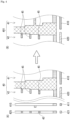
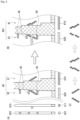
- FIGS. 4 and 5 show enlarged portions of regions enclosed by a rectangle indicated by a dotted line on the design sheet 40 of the possible data shown in FIG. 3 .
- FIGS. 4(B) and 5(B) show a design sheet 401 of the modification data.
- the creating unit 24 deletes a predetermined number of stitch rows at the position of selected variable course of the possible data in the preferential order to create modification data.
- the sleeve 42 is maintained in the same state as in the possible data, and the body 41 is in a state in which the stitch row at the position of the variable course of the top of the preferential order is deleted.
- the portion in which the stitch row is deleted is cross-hatched.
- the creating unit 24 inserts a predetermined number of stitch rows at selected positions in the variable courses of the possible data in the preferential order to create modification data.
- the creating unit 24 is configured to create modification data in accordance with the following procedure.
- FIG. 5 for ease of understanding of the following procedure, hatched step-shaped stitch groups are added to the body 41 and the sleeve 42.
- FIG. 5(C) shows only the step-shaped stitch groups, illustrating insertion or deletion of stitch rows, with the left figure showing the step-shaped stitch groups before modification, the central figure showing the step-shaped stitch groups during the modification, and the right figure showing the step-shaped stitch groups after the modification.
- a stitch row is once inserted into both of the body 41 and the sleeve 42 of the possible data, at the position of the top of the preferential order in a variable course of the body 41 (see the central figure of FIG. 5(C) ). Then, the stitch row inserted into the sleeve 42 is deleted, and the stitch row inserted into the body 41 is left as is (see the right figure of FIG. 5(C) ).
- the sleeve 42 is in a state in which the stitch row at the above-described position is deleted, and the body 41 is in a state in which the stitch row at the above-described position is inserted.
- the portion of FIG. 5(B) in which the above-described stitch row is deleted is cross-hatched.
- the same procedure as the above-described procedure can be performed, when only the sleeve length is modified and when both of the body length and the sleeve length are modified.
- the modification information relating to the body length, and the modification information relating to the sleeve length can be set independently. Accordingly, it is possible to modify the body length and the sleeve length independently, while maintaining a series of knitting information in the course direction of the body 41 and the sleeves 42.
- the creating unit 24 of the present example further creates modification data upon input of a knitting code relating to, for example, color or pattern as needed, with reference to the later-described additional items.
- the program creating unit 25 creates a program for causing the flat knitting machine 9 to perform knitting based on the created modification data.
- the program is transmitted to the flat knitting machine 9 via a recording medium such as a USB memory, wired communication, or wireless communication, for example.
- a knitted fabric is knitted.
- the memory 3 of the present example includes, as described above, the first memory 31 for storing basic data, the second memory 32 for storing the actual measurements of the body of a customer, and the third memory 33 for storing the above-described calculation formulae, setting values needed for other types of calculation, information relating to calculation such as calculation results, and the like.
- the memory 3 of the present example further includes a fourth memory 34 for storing information relating to variable additional items of a knitted fabric.
- the additional items are set as variable items with respect to a knitted fabric, separately from the length modification that corresponds to the actual measurement.
- Examples of the additional items may include color, pattern, and preferable length.
- "Preferable length" e.g., +2 cm or -2 cm
- the memory 3 is constituted by one or more storage devices. Furthermore, the memory 3 can store another type of information relating to the design of a knitted fabric.
- the display unit 4 is used for an operator to visually recognize information relating to the design of a knitted fabric.
- the information to be displayed may include the above-described design sheets 40 and 401, and the like.
- Examples of the display unit 4 include a liquid crystal display and a touch panel. If the display unit 4 is a touch panel, part of the display unit 4 may function as the input unit 1.
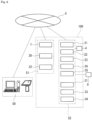
- a knit design system 100 includes a plurality of servers (here, servers 51 and 52), which may be connected to each other via the network 5.
- the actual measurements of the body of a customer may be transmitted from a terminal device 50 of the customer, a shop of an apparel manufacturer, or the like to the knit design system 100 via the network 5.
- the terminal device 50 may be an information processing device such as a personal computer, a tablet computer, or a smartphone. Actual measurements may be obtained by the customer itself or a staff of a shop, or using a measurement application or the like.
- the server 51 may mainly input the above-described actual measurements, and select possible data.
- the server 52 may mainly modify the possible data.
- the server 51 of the present example includes the input unit 1, the selection unit 20, the second memory 32, and the like.
- the server 51 also includes a memory (not shown) for storing codes of sub-classifications added to the above-described body dimension table shown in FIG. 2 , codes relating to the above-described additional items, and the like.
- the selection unit 20 of the server 51 compares the actual measurements with the sub-classifications, and selects the sub-classification that is fitted to the actual measurements.
- the server 51 transmits the code of the selected sub-classification, the additional item code, the actual measurements, and the like to the server 52.
- the server 52 of the present example includes the first calculation unit 21, the second calculation unit 22, the change determination unit 23, the creating unit 24, the program creating unit 25, the first memory 31, the third memory 33, the fourth memory 34, and the like.
- the server 52 compares the sub-classification code transmitted from the server 51 with the basic data stored in the first memory 31, and specifies possible data.
- the first calculation unit 21 of the server 52 uses the transmitted actual measurement to calculate the length dimension. If there is the above-described additional item (preferable length), the first calculation unit 21 of the server 52 calculates the length dimension by adding or subtracting the preferable length value to or from the actual measurement, based on the additional item code transmitted from the server 51. If there is the above-described additional item (color/pattern), the creating unit 24 of the server 52 compares the additional item code transmitted from the server 51 with the information relating to the additional item stored in the fourth memory 34 to specify the knitting code, and creates modification data.
- the knit design system 100 of the present example it is possible to reduce the number of pieces of design data to be prepared in advance, while enabling knitting of a knitted fabric that matches the body of a customer, specifically, the body length or the sleeve length. In the above-described example, it is sufficient to prepare thirty six types of basic data, eliminating the need of preparing several thousand pieces of basic data or more. Also, the knit design system 100 only needs to modify selected possible data based on the above-described difference, and does not need to newly create design data based on the actual measurement of the body of a customer.
- Embodiment 1 an example has been described in which the preferential order and the upper limit number can be set.
- the change determination unit 23 may be configured to evenly distribute a plurality of stitch rows to be used for a change over a plurality of variable courses.
- the editing unit 2 may include the following a fourth calculation unit (not shown).
- the fourth calculation unit divides the number of selected variable courses by the number of units of change calculated by the second calculation unit 22, thereby calculating the number of stitch rows to be inserted or deleted in the variable courses.
- the number of selected variable courses may be preset.
- the change determination unit 23 may be configured to select, if the preferential order of modification is set, the variable courses from the top to, for example, x-th position therefrom in the preferential order, and distribute the stitch rows over the selected variable courses.
- x is an integer that is suitably set.
- the change determination unit 23 may be configured in the following manner. First, for each of the variable courses, the change determination unit 23 performs insertion or deletion for each unit of change in the preferential order. Then, for each of the variable courses having the upper limit number of 2 or more, the change determination unit 23 performs insertion or deletion for each unit of change in the preferential order. Then, for each of the variable courses having the upper limit number of 3 or more, the change determination unit 23 performs insertion or deletion for each unit of change in the preferential order.
- the change determination unit 23 is configured to set the positions of variable courses by repeatedly performing such a procedure.
- a knitted fabric having a favorable silhouette and wear conform, and the like is more likely to be obtained than in a configuration in which, as described above, insertion or deletion of the stitch rows is made in a concentrated manner with respect to one variable course.
- a knitted fabric having a favorable silhouette and wear conform is further likely to be obtained.
Landscapes
- Engineering & Computer Science (AREA)
- Textile Engineering (AREA)
- Physics & Mathematics (AREA)
- Theoretical Computer Science (AREA)
- General Physics & Mathematics (AREA)
- Geometry (AREA)
- General Engineering & Computer Science (AREA)
- Evolutionary Computation (AREA)
- Computer Hardware Design (AREA)
- Computational Mathematics (AREA)
- Mathematical Analysis (AREA)
- Mathematical Optimization (AREA)
- Pure & Applied Mathematics (AREA)
- Knitting Machines (AREA)
- Knitting Of Fabric (AREA)
Claims (5)
- Système de conception de tricot (100) comprenant une unité de création de programme (25) pour amener une machine à tricoter à plat (9) à effectuer une opération de tricotage sur la base de données de conception qui comportent des informations concernant des mailles constituant le tricot, et comprenant :une unité d'entrée (1) configurée pour entrer des informations concernant des mesures réelles du corps d'un client ;une mémoire (3) dans laquelle les données de conception qui correspondent à un nombre prédéterminé de dimensions de corps définies à l'avance sont stockées en tant que données de base, dans lequel les données de base comportent les informations du nombre de rangs de mailles agencés en parallèle dans la direction de colonne et d'une dimension de longueur de chaque maille ;une unité de sélection (20) configurée pour comparer une mesure réelle entrée d'un corps d'un client comportant au moins une longueur parmi la longueur du corps et la longueur de manches aux dimensions du corps, et pour sélectionner, parmi les données de base, des données possibles qui sont des données de base sélectionnées qui correspondent à la mesure réelle ou au plus proche de la mesure réelle ;une première unité de calcul (21) configurée pour calculer, sur la base de la mesure réelle et d'une formule de calcul qui est prédéfinie sur la base du motif du tricot et stockée dans la mémoire (3), une dimension de longueur dans la direction de colonne du tricot, la dimension de longueur étant adaptée au tricot ;une deuxième unité de calcul (22) configurée pour calculer, sur la base d'une différence entre une dimension de longueur définie dans les données possibles et la dimension de longueur calculée, le nombre de rangs de mailles le long d'une direction d'extension qui doivent être insérées dans ou supprimées des données possibles pour modifier la direction de longueur des données possibles dans la dimension de longueur calculée ;une unité de détermination de modification (23) configurée pour déterminer une ou plusieurs positions de rangs de mailles dans les données possibles auxquelles la modification dans la direction de longueur, par ajout ou par suppression de rangs de mailles, doit être effectuée ; etune unité de création (24) configurée pour créer des données de modification qui sont les données possibles auxquelles sont ajoutées ou supprimées les rangs de mailles sur la base du nombre calculé de rangs de mailles et de la position déterminée,dans lequel, dans les données de base, une pluralité de directions variables dans lesquelles au moins une des modifications d'insertion et de suppression d'un rang de mailles le long de la direction d'extension est possible, et d'un rang fixe dans lequel les deux modifications sont interdites sont définies, etl'unité de détermination de modification (23) sélectionne, à partir des rangs variables, les rangs de mailles à utiliser pour la modification.
- Système de conception de tricot selon la revendication 1,
dans lequel l'unité de détermination de modification (23) est configurée pour pouvoir définir un ordre préférentiel de la modification pour la pluralité de rangs variables, et sélectionne les positions de rang de mailles dans l'ordre préférentiel défini. - Système de conception de tricot selon la revendication 1,
dans lequel l'unité de détermination de changement (23) est configurée pour répartir uniformément les positions de rang de mailles à utiliser pour la modification sur la pluralité de directions variables. - Système de conception de tricot selon l'une quelconque des revendications 1 à 3,
dans lequel l'unité de détermination de modification (23) est configurée pour pouvoir régler un nombre limite supérieur de rang de mailles à ajouter aux ou supprimer des rangs variables sélectionnés. - Système de conception de tricot selon l'une quelconque des revendications 1 à 4,
dans lequel la direction fixe comporte au moins un type de range de mailles sélectionné dans un groupe constitué d'un rang de mailles pour l'élargissement, d'un rang de mailles pour le rétrécissement, et d'un rang de mailles constituant un motif prédéterminé.
Applications Claiming Priority (1)
| Application Number | Priority Date | Filing Date | Title |
|---|---|---|---|
| JP2019113052A JP7204589B2 (ja) | 2019-06-18 | 2019-06-18 | ニットデザインシステム |
Publications (2)
| Publication Number | Publication Date |
|---|---|
| EP3763861A1 EP3763861A1 (fr) | 2021-01-13 |
| EP3763861B1 true EP3763861B1 (fr) | 2023-03-08 |
Family
ID=71103290
Family Applications (1)
| Application Number | Title | Priority Date | Filing Date |
|---|---|---|---|
| EP20180238.6A Active EP3763861B1 (fr) | 2019-06-18 | 2020-06-16 | Système de conception de tricots pour la création de données de patron adapté à une longueur d'un corps |
Country Status (4)
| Country | Link |
|---|---|
| EP (1) | EP3763861B1 (fr) |
| JP (1) | JP7204589B2 (fr) |
| KR (1) | KR102393875B1 (fr) |
| CN (1) | CN112095219B (fr) |
Families Citing this family (2)
| Publication number | Priority date | Publication date | Assignee | Title |
|---|---|---|---|---|
| US11421355B2 (en) * | 2018-06-15 | 2022-08-23 | Nike, Inc. | Tool for design and fabrication of knitted components |
| JP6994796B1 (ja) | 2021-08-31 | 2022-02-15 | 株式会社Symbol | プログラム、情報処理装置、及び方法 |
Family Cites Families (14)
| Publication number | Priority date | Publication date | Assignee | Title |
|---|---|---|---|---|
| EP0147139B1 (fr) * | 1983-12-19 | 1988-08-10 | Watanabe Kutsushita Kogyo Co., Ltd. | Métier à tricoter circulaire Jacquard |
| JP2656405B2 (ja) * | 1991-09-17 | 1997-09-24 | 旭化成工業株式会社 | ニットデザインシステムおよびその編成データの作成方法 |
| JP2969423B2 (ja) * | 1994-06-30 | 1999-11-02 | 株式会社図研 | Cadシステムにおけるグラフィックス表示装置とテキスト・ファイル表示装置との間のコミュニケーション・システム |
| KR100351612B1 (ko) * | 1994-09-02 | 2002-12-26 | 가부시키가이샤 시마세이키 세이사쿠쇼 | 횡편기에서의실길이제어방법과그장치 |
| JP2913266B2 (ja) * | 1995-09-18 | 1999-06-28 | 株式会社島精機製作所 | 横編機用の筒状編地のデザイン方法とその装置 |
| AU2001288049A1 (en) * | 2000-09-19 | 2002-04-02 | Shima Seiki Mfg., Ltd. | Knitting support system for knitted product and knitting support server system |
| AU2001294262A1 (en) | 2000-10-18 | 2002-04-29 | Shima Seiki Mfg., Ltd. | Knit design system |
| JPWO2003032204A1 (ja) * | 2001-10-05 | 2005-01-27 | 株式会社島精機製作所 | ニットデザイン方法および装置 |
| JP5349315B2 (ja) * | 2007-09-10 | 2013-11-20 | 株式会社島精機製作所 | ニットデザイン装置とニットデザイン方法及びニットデザインプログラム |
| WO2010010775A1 (fr) * | 2008-07-25 | 2010-01-28 | 株式会社島精機製作所 | Procédé de dessin de tricot, dispositif de dessin de tricot, et programme de dessin |
| JP5800530B2 (ja) | 2011-02-28 | 2015-10-28 | 株式会社島精機製作所 | ニットデザイン装置とニットデザイン方法 |
| JP6109105B2 (ja) * | 2014-03-18 | 2017-04-05 | 株式会社島精機製作所 | ニットデザインシステムとニットデザイン方法 |
| JP6120792B2 (ja) * | 2014-03-18 | 2017-04-26 | 株式会社島精機製作所 | ニットデザインシステムとニットデザイン方法 |
| US10351982B2 (en) * | 2014-09-15 | 2019-07-16 | Appalatch Outdoor Apparel Company | Systems, methods, and software for manufacturing a custom-knitted article |
-
2019
- 2019-06-18 JP JP2019113052A patent/JP7204589B2/ja active Active
-
2020
- 2020-06-16 EP EP20180238.6A patent/EP3763861B1/fr active Active
- 2020-06-17 KR KR1020200073429A patent/KR102393875B1/ko active Active
- 2020-06-18 CN CN202010556654.8A patent/CN112095219B/zh active Active
Also Published As
| Publication number | Publication date |
|---|---|
| JP7204589B2 (ja) | 2023-01-16 |
| JP2020204122A (ja) | 2020-12-24 |
| KR20200144504A (ko) | 2020-12-29 |
| CN112095219A (zh) | 2020-12-18 |
| KR102393875B1 (ko) | 2022-05-02 |
| CN112095219B (zh) | 2022-03-01 |
| EP3763861A1 (fr) | 2021-01-13 |
Similar Documents
| Publication | Publication Date | Title |
|---|---|---|
| JP2676182B2 (ja) | ニット製品の生産方法 | |
| US10351982B2 (en) | Systems, methods, and software for manufacturing a custom-knitted article | |
| Choi et al. | Three dimensional seamless garment knitting on V-bed flat knitting machines | |
| US7657341B2 (en) | System, apparatus and method for facilitating pattern-based clothing design activities | |
| EP3763861B1 (fr) | Système de conception de tricots pour la création de données de patron adapté à une longueur d'un corps | |
| US11131045B2 (en) | Systems, methods, and software for manufacturing a knitted article | |
| CN113221323A (zh) | 一种适用于毛针织产品的3d仿真建模方法 | |
| CN1307334C (zh) | 编织品编织支持系统和编织支持服务器系统 | |
| KR102336505B1 (ko) | 맞춤형 의류 주문 제작 장치 및 방법 | |
| CN104933217B (zh) | 针织设计系统和针织设计方法 | |
| Atalie | Application of digital CAD in whole-garment knitting manufacturing: A review | |
| Liu et al. | The size prediction and auto-generation of garment template | |
| Francis et al. | Knitted textile design | |
| CN102619016A (zh) | 用于借助设计装置设计在横机上制造的成型针织品的方法 | |
| Bilgiç et al. | The effects of width of the fabric, fabric and model type on the efficiency of marker plan in terms of apparel | |
| Lu et al. | Rapid design and algorithm implementation for knitted sweater pattern | |
| Luo et al. | Conversion from 3D to 2D pattern algorithm for the 3D-shaped knitwear | |
| Blaga | Use of CAD in knitted apparels | |
| CN109242599A (zh) | 一种潮流定制服装管理方法及系统 | |
| Power et al. | Comparative study of calculated and actual dimensions in shaped weft-knitwear | |
| NL2038525B1 (en) | 3D knitting patterns | |
| WO2021011791A1 (fr) | Systèmes, procédés et logiciel pour fabrication d'un article tricoté | |
| CN102084049A (zh) | 针织产品的线圈数的决定方法和设计系统、设计程序 | |
| Evans-Miellis | New product development in knitted textiles | |
| EP2955258B1 (fr) | Dispositif de conception de tricot |
Legal Events
| Date | Code | Title | Description |
|---|---|---|---|
| PUAI | Public reference made under article 153(3) epc to a published international application that has entered the european phase |
Free format text: ORIGINAL CODE: 0009012 |
|
| STAA | Information on the status of an ep patent application or granted ep patent |
Free format text: STATUS: THE APPLICATION HAS BEEN PUBLISHED |
|
| AK | Designated contracting states |
Kind code of ref document: A1 Designated state(s): AL AT BE BG CH CY CZ DE DK EE ES FI FR GB GR HR HU IE IS IT LI LT LU LV MC MK MT NL NO PL PT RO RS SE SI SK SM TR |
|
| AX | Request for extension of the european patent |
Extension state: BA ME |
|
| STAA | Information on the status of an ep patent application or granted ep patent |
Free format text: STATUS: REQUEST FOR EXAMINATION WAS MADE |
|
| 17P | Request for examination filed |
Effective date: 20210709 |
|
| RBV | Designated contracting states (corrected) |
Designated state(s): AL AT BE BG CH CY CZ DE DK EE ES FI FR GB GR HR HU IE IS IT LI LT LU LV MC MK MT NL NO PL PT RO RS SE SI SK SM TR |
|
| GRAP | Despatch of communication of intention to grant a patent |
Free format text: ORIGINAL CODE: EPIDOSNIGR1 |
|
| STAA | Information on the status of an ep patent application or granted ep patent |
Free format text: STATUS: GRANT OF PATENT IS INTENDED |
|
| RIC1 | Information provided on ipc code assigned before grant |
Ipc: G06F 30/10 20200101ALI20220613BHEP Ipc: D04B 37/02 20060101AFI20220613BHEP |
|
| INTG | Intention to grant announced |
Effective date: 20220712 |
|
| GRAJ | Information related to disapproval of communication of intention to grant by the applicant or resumption of examination proceedings by the epo deleted |
Free format text: ORIGINAL CODE: EPIDOSDIGR1 |
|
| STAA | Information on the status of an ep patent application or granted ep patent |
Free format text: STATUS: REQUEST FOR EXAMINATION WAS MADE |
|
| GRAP | Despatch of communication of intention to grant a patent |
Free format text: ORIGINAL CODE: EPIDOSNIGR1 |
|
| STAA | Information on the status of an ep patent application or granted ep patent |
Free format text: STATUS: GRANT OF PATENT IS INTENDED |
|
| INTC | Intention to grant announced (deleted) | ||
| INTG | Intention to grant announced |
Effective date: 20221010 |
|
| GRAS | Grant fee paid |
Free format text: ORIGINAL CODE: EPIDOSNIGR3 |
|
| GRAA | (expected) grant |
Free format text: ORIGINAL CODE: 0009210 |
|
| STAA | Information on the status of an ep patent application or granted ep patent |
Free format text: STATUS: THE PATENT HAS BEEN GRANTED |
|
| AK | Designated contracting states |
Kind code of ref document: B1 Designated state(s): AL AT BE BG CH CY CZ DE DK EE ES FI FR GB GR HR HU IE IS IT LI LT LU LV MC MK MT NL NO PL PT RO RS SE SI SK SM TR |
|
| REG | Reference to a national code |
Ref country code: CH Ref legal event code: EP Ref country code: AT Ref legal event code: REF Ref document number: 1552641 Country of ref document: AT Kind code of ref document: T Effective date: 20230315 |
|
| REG | Reference to a national code |
Ref country code: IE Ref legal event code: FG4D |
|
| REG | Reference to a national code |
Ref country code: DE Ref legal event code: R096 Ref document number: 602020008646 Country of ref document: DE |
|
| REG | Reference to a national code |
Ref country code: LT Ref legal event code: MG9D |
|
| REG | Reference to a national code |
Ref country code: NL Ref legal event code: MP Effective date: 20230308 |
|
| PG25 | Lapsed in a contracting state [announced via postgrant information from national office to epo] |
Ref country code: RS Free format text: LAPSE BECAUSE OF FAILURE TO SUBMIT A TRANSLATION OF THE DESCRIPTION OR TO PAY THE FEE WITHIN THE PRESCRIBED TIME-LIMIT Effective date: 20230308 Ref country code: NO Free format text: LAPSE BECAUSE OF FAILURE TO SUBMIT A TRANSLATION OF THE DESCRIPTION OR TO PAY THE FEE WITHIN THE PRESCRIBED TIME-LIMIT Effective date: 20230608 Ref country code: LV Free format text: LAPSE BECAUSE OF FAILURE TO SUBMIT A TRANSLATION OF THE DESCRIPTION OR TO PAY THE FEE WITHIN THE PRESCRIBED TIME-LIMIT Effective date: 20230308 Ref country code: LT Free format text: LAPSE BECAUSE OF FAILURE TO SUBMIT A TRANSLATION OF THE DESCRIPTION OR TO PAY THE FEE WITHIN THE PRESCRIBED TIME-LIMIT Effective date: 20230308 Ref country code: HR Free format text: LAPSE BECAUSE OF FAILURE TO SUBMIT A TRANSLATION OF THE DESCRIPTION OR TO PAY THE FEE WITHIN THE PRESCRIBED TIME-LIMIT Effective date: 20230308 Ref country code: ES Free format text: LAPSE BECAUSE OF FAILURE TO SUBMIT A TRANSLATION OF THE DESCRIPTION OR TO PAY THE FEE WITHIN THE PRESCRIBED TIME-LIMIT Effective date: 20230308 |
|
| REG | Reference to a national code |
Ref country code: AT Ref legal event code: MK05 Ref document number: 1552641 Country of ref document: AT Kind code of ref document: T Effective date: 20230308 |
|
| PG25 | Lapsed in a contracting state [announced via postgrant information from national office to epo] |
Ref country code: SE Free format text: LAPSE BECAUSE OF FAILURE TO SUBMIT A TRANSLATION OF THE DESCRIPTION OR TO PAY THE FEE WITHIN THE PRESCRIBED TIME-LIMIT Effective date: 20230308 Ref country code: NL Free format text: LAPSE BECAUSE OF FAILURE TO SUBMIT A TRANSLATION OF THE DESCRIPTION OR TO PAY THE FEE WITHIN THE PRESCRIBED TIME-LIMIT Effective date: 20230308 Ref country code: GR Free format text: LAPSE BECAUSE OF FAILURE TO SUBMIT A TRANSLATION OF THE DESCRIPTION OR TO PAY THE FEE WITHIN THE PRESCRIBED TIME-LIMIT Effective date: 20230609 Ref country code: FI Free format text: LAPSE BECAUSE OF FAILURE TO SUBMIT A TRANSLATION OF THE DESCRIPTION OR TO PAY THE FEE WITHIN THE PRESCRIBED TIME-LIMIT Effective date: 20230308 |
|
| PG25 | Lapsed in a contracting state [announced via postgrant information from national office to epo] |
Ref country code: SM Free format text: LAPSE BECAUSE OF FAILURE TO SUBMIT A TRANSLATION OF THE DESCRIPTION OR TO PAY THE FEE WITHIN THE PRESCRIBED TIME-LIMIT Effective date: 20230308 Ref country code: RO Free format text: LAPSE BECAUSE OF FAILURE TO SUBMIT A TRANSLATION OF THE DESCRIPTION OR TO PAY THE FEE WITHIN THE PRESCRIBED TIME-LIMIT Effective date: 20230308 Ref country code: PT Free format text: LAPSE BECAUSE OF FAILURE TO SUBMIT A TRANSLATION OF THE DESCRIPTION OR TO PAY THE FEE WITHIN THE PRESCRIBED TIME-LIMIT Effective date: 20230710 Ref country code: EE Free format text: LAPSE BECAUSE OF FAILURE TO SUBMIT A TRANSLATION OF THE DESCRIPTION OR TO PAY THE FEE WITHIN THE PRESCRIBED TIME-LIMIT Effective date: 20230308 Ref country code: CZ Free format text: LAPSE BECAUSE OF FAILURE TO SUBMIT A TRANSLATION OF THE DESCRIPTION OR TO PAY THE FEE WITHIN THE PRESCRIBED TIME-LIMIT Effective date: 20230308 Ref country code: AT Free format text: LAPSE BECAUSE OF FAILURE TO SUBMIT A TRANSLATION OF THE DESCRIPTION OR TO PAY THE FEE WITHIN THE PRESCRIBED TIME-LIMIT Effective date: 20230308 |
|
| PG25 | Lapsed in a contracting state [announced via postgrant information from national office to epo] |
Ref country code: SK Free format text: LAPSE BECAUSE OF FAILURE TO SUBMIT A TRANSLATION OF THE DESCRIPTION OR TO PAY THE FEE WITHIN THE PRESCRIBED TIME-LIMIT Effective date: 20230308 Ref country code: PL Free format text: LAPSE BECAUSE OF FAILURE TO SUBMIT A TRANSLATION OF THE DESCRIPTION OR TO PAY THE FEE WITHIN THE PRESCRIBED TIME-LIMIT Effective date: 20230308 Ref country code: IS Free format text: LAPSE BECAUSE OF FAILURE TO SUBMIT A TRANSLATION OF THE DESCRIPTION OR TO PAY THE FEE WITHIN THE PRESCRIBED TIME-LIMIT Effective date: 20230708 |
|
| REG | Reference to a national code |
Ref country code: DE Ref legal event code: R097 Ref document number: 602020008646 Country of ref document: DE |
|
| PLBE | No opposition filed within time limit |
Free format text: ORIGINAL CODE: 0009261 |
|
| STAA | Information on the status of an ep patent application or granted ep patent |
Free format text: STATUS: NO OPPOSITION FILED WITHIN TIME LIMIT |
|
| PG25 | Lapsed in a contracting state [announced via postgrant information from national office to epo] |
Ref country code: MC Free format text: LAPSE BECAUSE OF FAILURE TO SUBMIT A TRANSLATION OF THE DESCRIPTION OR TO PAY THE FEE WITHIN THE PRESCRIBED TIME-LIMIT Effective date: 20230308 |
|
| PG25 | Lapsed in a contracting state [announced via postgrant information from national office to epo] |
Ref country code: SI Free format text: LAPSE BECAUSE OF FAILURE TO SUBMIT A TRANSLATION OF THE DESCRIPTION OR TO PAY THE FEE WITHIN THE PRESCRIBED TIME-LIMIT Effective date: 20230308 Ref country code: MC Free format text: LAPSE BECAUSE OF FAILURE TO SUBMIT A TRANSLATION OF THE DESCRIPTION OR TO PAY THE FEE WITHIN THE PRESCRIBED TIME-LIMIT Effective date: 20230308 Ref country code: DK Free format text: LAPSE BECAUSE OF FAILURE TO SUBMIT A TRANSLATION OF THE DESCRIPTION OR TO PAY THE FEE WITHIN THE PRESCRIBED TIME-LIMIT Effective date: 20230308 |
|
| REG | Reference to a national code |
Ref country code: CH Ref legal event code: PL |
|
| 26N | No opposition filed |
Effective date: 20231211 |
|
| REG | Reference to a national code |
Ref country code: BE Ref legal event code: MM Effective date: 20230630 |
|
| PG25 | Lapsed in a contracting state [announced via postgrant information from national office to epo] |
Ref country code: LU Free format text: LAPSE BECAUSE OF NON-PAYMENT OF DUE FEES Effective date: 20230616 |
|
| REG | Reference to a national code |
Ref country code: IE Ref legal event code: MM4A |
|
| PG25 | Lapsed in a contracting state [announced via postgrant information from national office to epo] |
Ref country code: LU Free format text: LAPSE BECAUSE OF NON-PAYMENT OF DUE FEES Effective date: 20230616 |
|
| PG25 | Lapsed in a contracting state [announced via postgrant information from national office to epo] |
Ref country code: IE Free format text: LAPSE BECAUSE OF NON-PAYMENT OF DUE FEES Effective date: 20230616 |
|
| PG25 | Lapsed in a contracting state [announced via postgrant information from national office to epo] |
Ref country code: IE Free format text: LAPSE BECAUSE OF NON-PAYMENT OF DUE FEES Effective date: 20230616 Ref country code: CH Free format text: LAPSE BECAUSE OF NON-PAYMENT OF DUE FEES Effective date: 20230630 |
|
| PG25 | Lapsed in a contracting state [announced via postgrant information from national office to epo] |
Ref country code: FR Free format text: LAPSE BECAUSE OF NON-PAYMENT OF DUE FEES Effective date: 20230630 Ref country code: BE Free format text: LAPSE BECAUSE OF NON-PAYMENT OF DUE FEES Effective date: 20230630 |
|
| PG25 | Lapsed in a contracting state [announced via postgrant information from national office to epo] |
Ref country code: BG Free format text: LAPSE BECAUSE OF FAILURE TO SUBMIT A TRANSLATION OF THE DESCRIPTION OR TO PAY THE FEE WITHIN THE PRESCRIBED TIME-LIMIT Effective date: 20230308 |
|
| PG25 | Lapsed in a contracting state [announced via postgrant information from national office to epo] |
Ref country code: BG Free format text: LAPSE BECAUSE OF FAILURE TO SUBMIT A TRANSLATION OF THE DESCRIPTION OR TO PAY THE FEE WITHIN THE PRESCRIBED TIME-LIMIT Effective date: 20230308 |
|
| GBPC | Gb: european patent ceased through non-payment of renewal fee |
Effective date: 20240616 |
|
| PG25 | Lapsed in a contracting state [announced via postgrant information from national office to epo] |
Ref country code: GB Free format text: LAPSE BECAUSE OF NON-PAYMENT OF DUE FEES Effective date: 20240616 |
|
| PGFP | Annual fee paid to national office [announced via postgrant information from national office to epo] |
Ref country code: DE Payment date: 20250402 Year of fee payment: 6 |
|
| PGFP | Annual fee paid to national office [announced via postgrant information from national office to epo] |
Ref country code: IT Payment date: 20250522 Year of fee payment: 6 |
|
| PG25 | Lapsed in a contracting state [announced via postgrant information from national office to epo] |
Ref country code: CY Free format text: LAPSE BECAUSE OF FAILURE TO SUBMIT A TRANSLATION OF THE DESCRIPTION OR TO PAY THE FEE WITHIN THE PRESCRIBED TIME-LIMIT; INVALID AB INITIO Effective date: 20200616 |
|
| PG25 | Lapsed in a contracting state [announced via postgrant information from national office to epo] |
Ref country code: HU Free format text: LAPSE BECAUSE OF FAILURE TO SUBMIT A TRANSLATION OF THE DESCRIPTION OR TO PAY THE FEE WITHIN THE PRESCRIBED TIME-LIMIT; INVALID AB INITIO Effective date: 20200616 |
|
| PG25 | Lapsed in a contracting state [announced via postgrant information from national office to epo] |
Ref country code: TR Free format text: LAPSE BECAUSE OF FAILURE TO SUBMIT A TRANSLATION OF THE DESCRIPTION OR TO PAY THE FEE WITHIN THE PRESCRIBED TIME-LIMIT Effective date: 20230308 |