EP3764372A1 - Câble comprenant une couche résistante au feu - Google Patents
Câble comprenant une couche résistante au feu Download PDFInfo
- Publication number
- EP3764372A1 EP3764372A1 EP20184791.0A EP20184791A EP3764372A1 EP 3764372 A1 EP3764372 A1 EP 3764372A1 EP 20184791 A EP20184791 A EP 20184791A EP 3764372 A1 EP3764372 A1 EP 3764372A1
- Authority
- EP
- European Patent Office
- Prior art keywords
- cable according
- cable
- fire
- electrically conductive
- resistant layer
- Prior art date
- Legal status (The legal status is an assumption and is not a legal conclusion. Google has not performed a legal analysis and makes no representation as to the accuracy of the status listed.)
- Withdrawn
Links
- 230000009970 fire resistant effect Effects 0.000 title claims abstract description 49
- 238000000034 method Methods 0.000 claims abstract description 7
- 239000000203 mixture Substances 0.000 claims description 60
- 239000007788 liquid Substances 0.000 claims description 35
- HNPSIPDUKPIQMN-UHFFFAOYSA-N dioxosilane;oxo(oxoalumanyloxy)alumane Chemical compound O=[Si]=O.O=[Al]O[Al]=O HNPSIPDUKPIQMN-UHFFFAOYSA-N 0.000 claims description 28
- 229910000323 aluminium silicate Inorganic materials 0.000 claims description 24
- 229920000642 polymer Polymers 0.000 claims description 23
- 238000010438 heat treatment Methods 0.000 claims description 22
- 239000004014 plasticizer Substances 0.000 claims description 12
- 229910052723 transition metal Inorganic materials 0.000 claims description 12
- 150000003624 transition metals Chemical class 0.000 claims description 12
- BPQQTUXANYXVAA-UHFFFAOYSA-N Orthosilicate Chemical compound [O-][Si]([O-])([O-])[O-] BPQQTUXANYXVAA-UHFFFAOYSA-N 0.000 claims description 11
- 239000002904 solvent Substances 0.000 claims description 11
- RYGMFSIKBFXOCR-UHFFFAOYSA-N Copper Chemical compound [Cu] RYGMFSIKBFXOCR-UHFFFAOYSA-N 0.000 claims description 8
- XLYOFNOQVPJJNP-UHFFFAOYSA-N water Substances O XLYOFNOQVPJJNP-UHFFFAOYSA-N 0.000 claims description 5
- RVTZCBVAJQQJTK-UHFFFAOYSA-N oxygen(2-);zirconium(4+) Chemical compound [O-2].[O-2].[Zr+4] RVTZCBVAJQQJTK-UHFFFAOYSA-N 0.000 claims description 3
- 238000007711 solidification Methods 0.000 claims description 3
- 230000008023 solidification Effects 0.000 claims description 3
- 229910001928 zirconium oxide Inorganic materials 0.000 claims description 3
- 229910000838 Al alloy Inorganic materials 0.000 claims description 2
- 229910000881 Cu alloy Inorganic materials 0.000 claims description 2
- 229910052782 aluminium Inorganic materials 0.000 claims description 2
- XAGFODPZIPBFFR-UHFFFAOYSA-N aluminium Chemical compound [Al] XAGFODPZIPBFFR-UHFFFAOYSA-N 0.000 claims description 2
- 229910052802 copper Inorganic materials 0.000 claims description 2
- 239000010949 copper Substances 0.000 claims description 2
- 238000004519 manufacturing process Methods 0.000 claims 1
- 230000001681 protective effect Effects 0.000 description 12
- VGGSQFUCUMXWEO-UHFFFAOYSA-N Ethene Chemical compound C=C VGGSQFUCUMXWEO-UHFFFAOYSA-N 0.000 description 9
- 239000005977 Ethylene Substances 0.000 description 9
- 229920001577 copolymer Polymers 0.000 description 9
- -1 polyethylene Polymers 0.000 description 9
- 239000003063 flame retardant Substances 0.000 description 6
- 229910052751 metal Inorganic materials 0.000 description 6
- 239000002184 metal Substances 0.000 description 6
- 229920000620 organic polymer Polymers 0.000 description 6
- 229920000573 polyethylene Polymers 0.000 description 6
- RNFJDJUURJAICM-UHFFFAOYSA-N 2,2,4,4,6,6-hexaphenoxy-1,3,5-triaza-2$l^{5},4$l^{5},6$l^{5}-triphosphacyclohexa-1,3,5-triene Chemical compound N=1P(OC=2C=CC=CC=2)(OC=2C=CC=CC=2)=NP(OC=2C=CC=CC=2)(OC=2C=CC=CC=2)=NP=1(OC=1C=CC=CC=1)OC1=CC=CC=C1 RNFJDJUURJAICM-UHFFFAOYSA-N 0.000 description 5
- 229920000592 inorganic polymer Polymers 0.000 description 5
- 239000000463 material Substances 0.000 description 5
- 239000004698 Polyethylene Substances 0.000 description 4
- VYPSYNLAJGMNEJ-UHFFFAOYSA-N Silicium dioxide Chemical compound O=[Si]=O VYPSYNLAJGMNEJ-UHFFFAOYSA-N 0.000 description 4
- 239000000919 ceramic Substances 0.000 description 4
- 238000001125 extrusion Methods 0.000 description 4
- HEMHJVSKTPXQMS-UHFFFAOYSA-M Sodium hydroxide Chemical compound [OH-].[Na+] HEMHJVSKTPXQMS-UHFFFAOYSA-M 0.000 description 3
- 239000007864 aqueous solution Substances 0.000 description 3
- 239000004020 conductor Substances 0.000 description 3
- 238000005238 degreasing Methods 0.000 description 3
- 229920001903 high density polyethylene Polymers 0.000 description 3
- 229920000092 linear low density polyethylene Polymers 0.000 description 3
- 229920001684 low density polyethylene Polymers 0.000 description 3
- 238000002161 passivation Methods 0.000 description 3
- 229910052615 phyllosilicate Inorganic materials 0.000 description 3
- 238000005554 pickling Methods 0.000 description 3
- 239000002861 polymer material Substances 0.000 description 3
- 229920005862 polyol Polymers 0.000 description 3
- 229920000098 polyolefin Polymers 0.000 description 3
- 150000003077 polyols Chemical class 0.000 description 3
- QQONPFPTGQHPMA-UHFFFAOYSA-N propylene Natural products CC=C QQONPFPTGQHPMA-UHFFFAOYSA-N 0.000 description 3
- 125000004805 propylene group Chemical group [H]C([H])([H])C([H])([*:1])C([H])([H])[*:2] 0.000 description 3
- 238000004381 surface treatment Methods 0.000 description 3
- 238000010301 surface-oxidation reaction Methods 0.000 description 3
- 229920001169 thermoplastic Polymers 0.000 description 3
- 239000004711 α-olefin Substances 0.000 description 3
- NLXLAEXVIDQMFP-UHFFFAOYSA-N Ammonia chloride Chemical compound [NH4+].[Cl-] NLXLAEXVIDQMFP-UHFFFAOYSA-N 0.000 description 2
- FBPFZTCFMRRESA-FSIIMWSLSA-N D-Glucitol Natural products OC[C@H](O)[C@H](O)[C@@H](O)[C@H](O)CO FBPFZTCFMRRESA-FSIIMWSLSA-N 0.000 description 2
- 229920002943 EPDM rubber Polymers 0.000 description 2
- LYCAIKOWRPUZTN-UHFFFAOYSA-N Ethylene glycol Chemical compound OCCO LYCAIKOWRPUZTN-UHFFFAOYSA-N 0.000 description 2
- BAPJBEWLBFYGME-UHFFFAOYSA-N Methyl acrylate Chemical compound COC(=O)C=C BAPJBEWLBFYGME-UHFFFAOYSA-N 0.000 description 2
- PXHVJJICTQNCMI-UHFFFAOYSA-N Nickel Chemical compound [Ni] PXHVJJICTQNCMI-UHFFFAOYSA-N 0.000 description 2
- QAOWNCQODCNURD-UHFFFAOYSA-N Sulfuric acid Chemical compound OS(O)(=O)=O QAOWNCQODCNURD-UHFFFAOYSA-N 0.000 description 2
- 241001080024 Telles Species 0.000 description 2
- XTXRWKRVRITETP-UHFFFAOYSA-N Vinyl acetate Chemical compound CC(=O)OC=C XTXRWKRVRITETP-UHFFFAOYSA-N 0.000 description 2
- 239000002585 base Substances 0.000 description 2
- 230000005540 biological transmission Effects 0.000 description 2
- 150000001720 carbohydrates Chemical class 0.000 description 2
- 239000001913 cellulose Substances 0.000 description 2
- 229920002678 cellulose Polymers 0.000 description 2
- 239000004927 clay Substances 0.000 description 2
- 230000000694 effects Effects 0.000 description 2
- CGPRUXZTHGTMKW-UHFFFAOYSA-N ethene;ethyl prop-2-enoate Chemical compound C=C.CCOC(=O)C=C CGPRUXZTHGTMKW-UHFFFAOYSA-N 0.000 description 2
- 229920001519 homopolymer Polymers 0.000 description 2
- VTHJTEIRLNZDEV-UHFFFAOYSA-L magnesium dihydroxide Chemical compound [OH-].[OH-].[Mg+2] VTHJTEIRLNZDEV-UHFFFAOYSA-L 0.000 description 2
- 239000000347 magnesium hydroxide Substances 0.000 description 2
- 229910001862 magnesium hydroxide Inorganic materials 0.000 description 2
- 229920001179 medium density polyethylene Polymers 0.000 description 2
- 230000008018 melting Effects 0.000 description 2
- 238000002844 melting Methods 0.000 description 2
- 229910052618 mica group Inorganic materials 0.000 description 2
- 239000012764 mineral filler Substances 0.000 description 2
- 239000000178 monomer Substances 0.000 description 2
- ANISOHQJBAQUQP-UHFFFAOYSA-N octyl prop-2-enoate Chemical compound CCCCCCCCOC(=O)C=C ANISOHQJBAQUQP-UHFFFAOYSA-N 0.000 description 2
- 229920001343 polytetrafluoroethylene Polymers 0.000 description 2
- 239000004810 polytetrafluoroethylene Substances 0.000 description 2
- 229920002635 polyurethane Polymers 0.000 description 2
- 239000004814 polyurethane Substances 0.000 description 2
- 229920000915 polyvinyl chloride Polymers 0.000 description 2
- 239000004800 polyvinyl chloride Substances 0.000 description 2
- 239000000377 silicon dioxide Substances 0.000 description 2
- 239000000600 sorbitol Substances 0.000 description 2
- 229920001897 terpolymer Polymers 0.000 description 2
- 239000004416 thermosoftening plastic Substances 0.000 description 2
- 230000007704 transition Effects 0.000 description 2
- 239000005995 Aluminium silicate Substances 0.000 description 1
- QYLJIYOGHRGUIH-CIUDSAMLSA-N Arg-Ile Chemical compound CC[C@H](C)[C@@H](C(O)=O)NC(=O)[C@@H](N)CCCNC(N)=N QYLJIYOGHRGUIH-CIUDSAMLSA-N 0.000 description 1
- 229910001335 Galvanized steel Inorganic materials 0.000 description 1
- MXRIRQGCELJRSN-UHFFFAOYSA-N O.O.O.[Al] Chemical compound O.O.O.[Al] MXRIRQGCELJRSN-UHFFFAOYSA-N 0.000 description 1
- 239000004952 Polyamide Substances 0.000 description 1
- 239000002202 Polyethylene glycol Substances 0.000 description 1
- 239000004111 Potassium silicate Substances 0.000 description 1
- 239000004115 Sodium Silicate Substances 0.000 description 1
- 229910021536 Zeolite Inorganic materials 0.000 description 1
- 239000002253 acid Substances 0.000 description 1
- 238000010306 acid treatment Methods 0.000 description 1
- 239000002671 adjuvant Substances 0.000 description 1
- 229910000272 alkali metal oxide Inorganic materials 0.000 description 1
- WNROFYMDJYEPJX-UHFFFAOYSA-K aluminium hydroxide Chemical compound [OH-].[OH-].[OH-].[Al+3] WNROFYMDJYEPJX-UHFFFAOYSA-K 0.000 description 1
- 235000012211 aluminium silicate Nutrition 0.000 description 1
- 235000019270 ammonium chloride Nutrition 0.000 description 1
- 238000005452 bending Methods 0.000 description 1
- CQEYYJKEWSMYFG-UHFFFAOYSA-N butyl acrylate Chemical compound CCCCOC(=O)C=C CQEYYJKEWSMYFG-UHFFFAOYSA-N 0.000 description 1
- 239000000378 calcium silicate Substances 0.000 description 1
- 229910052918 calcium silicate Inorganic materials 0.000 description 1
- OYACROKNLOSFPA-UHFFFAOYSA-N calcium;dioxido(oxo)silane Chemical compound [Ca+2].[O-][Si]([O-])=O OYACROKNLOSFPA-UHFFFAOYSA-N 0.000 description 1
- 230000015556 catabolic process Effects 0.000 description 1
- 239000003795 chemical substances by application Substances 0.000 description 1
- 239000011248 coating agent Substances 0.000 description 1
- 238000000576 coating method Methods 0.000 description 1
- 239000002131 composite material Substances 0.000 description 1
- 238000005336 cracking Methods 0.000 description 1
- 229920006037 cross link polymer Polymers 0.000 description 1
- 238000006731 degradation reaction Methods 0.000 description 1
- 238000007598 dipping method Methods 0.000 description 1
- 239000000839 emulsion Substances 0.000 description 1
- 229920001038 ethylene copolymer Polymers 0.000 description 1
- 239000010433 feldspar Substances 0.000 description 1
- 239000000945 filler Substances 0.000 description 1
- 238000011049 filling Methods 0.000 description 1
- 229920002313 fluoropolymer Polymers 0.000 description 1
- 239000008397 galvanized steel Substances 0.000 description 1
- 229910052736 halogen Inorganic materials 0.000 description 1
- 150000002367 halogens Chemical class 0.000 description 1
- 239000004700 high-density polyethylene Substances 0.000 description 1
- 239000012943 hotmelt Substances 0.000 description 1
- WGCNASOHLSPBMP-UHFFFAOYSA-N hydroxyacetaldehyde Natural products OCC=O WGCNASOHLSPBMP-UHFFFAOYSA-N 0.000 description 1
- 239000011256 inorganic filler Substances 0.000 description 1
- 229910003475 inorganic filler Inorganic materials 0.000 description 1
- 229910001853 inorganic hydroxide Inorganic materials 0.000 description 1
- NLYAJNPCOHFWQQ-UHFFFAOYSA-N kaolin Chemical compound O.O.O=[Al]O[Si](=O)O[Si](=O)O[Al]=O NLYAJNPCOHFWQQ-UHFFFAOYSA-N 0.000 description 1
- 239000004707 linear low-density polyethylene Substances 0.000 description 1
- 239000004702 low-density polyethylene Substances 0.000 description 1
- HCWCAKKEBCNQJP-UHFFFAOYSA-N magnesium orthosilicate Chemical compound [Mg+2].[Mg+2].[O-][Si]([O-])([O-])[O-] HCWCAKKEBCNQJP-UHFFFAOYSA-N 0.000 description 1
- 239000000391 magnesium silicate Substances 0.000 description 1
- 229910052919 magnesium silicate Inorganic materials 0.000 description 1
- 235000019792 magnesium silicate Nutrition 0.000 description 1
- 239000000155 melt Substances 0.000 description 1
- 229910000000 metal hydroxide Inorganic materials 0.000 description 1
- 150000004692 metal hydroxides Chemical class 0.000 description 1
- 239000010445 mica Substances 0.000 description 1
- 229910052759 nickel Inorganic materials 0.000 description 1
- 230000003647 oxidation Effects 0.000 description 1
- 238000007254 oxidation reaction Methods 0.000 description 1
- 229920002647 polyamide Polymers 0.000 description 1
- 229920000728 polyester Polymers 0.000 description 1
- 229920001223 polyethylene glycol Polymers 0.000 description 1
- 229910052913 potassium silicate Inorganic materials 0.000 description 1
- 235000019353 potassium silicate Nutrition 0.000 description 1
- NNHHDJVEYQHLHG-UHFFFAOYSA-N potassium silicate Chemical compound [K+].[K+].[O-][Si]([O-])=O NNHHDJVEYQHLHG-UHFFFAOYSA-N 0.000 description 1
- 239000002243 precursor Substances 0.000 description 1
- 238000002360 preparation method Methods 0.000 description 1
- 239000012763 reinforcing filler Substances 0.000 description 1
- 230000000979 retarding effect Effects 0.000 description 1
- 230000011664 signaling Effects 0.000 description 1
- 229920005573 silicon-containing polymer Polymers 0.000 description 1
- 239000000779 smoke Substances 0.000 description 1
- 229910052911 sodium silicate Inorganic materials 0.000 description 1
- NTHWMYGWWRZVTN-UHFFFAOYSA-N sodium silicate Chemical compound [Na+].[Na+].[O-][Si]([O-])=O NTHWMYGWWRZVTN-UHFFFAOYSA-N 0.000 description 1
- 239000000243 solution Substances 0.000 description 1
- 239000003381 stabilizer Substances 0.000 description 1
- 239000000454 talc Substances 0.000 description 1
- 229910052623 talc Inorganic materials 0.000 description 1
- 229910052645 tectosilicate Inorganic materials 0.000 description 1
- 229920002554 vinyl polymer Polymers 0.000 description 1
- 238000005491 wire drawing Methods 0.000 description 1
- 239000010457 zeolite Substances 0.000 description 1
- DXZMANYCMVCPIM-UHFFFAOYSA-L zinc;diethylphosphinate Chemical compound [Zn+2].CCP([O-])(=O)CC.CCP([O-])(=O)CC DXZMANYCMVCPIM-UHFFFAOYSA-L 0.000 description 1
Images

Classifications
-
- H—ELECTRICITY
- H01—ELECTRIC ELEMENTS
- H01B—CABLES; CONDUCTORS; INSULATORS; SELECTION OF MATERIALS FOR THEIR CONDUCTIVE, INSULATING OR DIELECTRIC PROPERTIES
- H01B3/00—Insulators or insulating bodies characterised by the insulating materials; Selection of materials for their insulating or dielectric properties
- H01B3/02—Insulators or insulating bodies characterised by the insulating materials; Selection of materials for their insulating or dielectric properties mainly consisting of inorganic substances
- H01B3/12—Insulators or insulating bodies characterised by the insulating materials; Selection of materials for their insulating or dielectric properties mainly consisting of inorganic substances ceramics
-
- H—ELECTRICITY
- H01—ELECTRIC ELEMENTS
- H01B—CABLES; CONDUCTORS; INSULATORS; SELECTION OF MATERIALS FOR THEIR CONDUCTIVE, INSULATING OR DIELECTRIC PROPERTIES
- H01B7/00—Insulated conductors or cables characterised by their form
- H01B7/17—Protection against damage caused by external factors, e.g. sheaths or armouring
- H01B7/29—Protection against damage caused by extremes of temperature or by flame
- H01B7/292—Protection against damage caused by extremes of temperature or by flame using material resistant to heat
-
- C—CHEMISTRY; METALLURGY
- C09—DYES; PAINTS; POLISHES; NATURAL RESINS; ADHESIVES; COMPOSITIONS NOT OTHERWISE PROVIDED FOR; APPLICATIONS OF MATERIALS NOT OTHERWISE PROVIDED FOR
- C09K—MATERIALS FOR MISCELLANEOUS APPLICATIONS, NOT PROVIDED FOR ELSEWHERE
- C09K21/00—Fireproofing materials
- C09K21/02—Inorganic materials
-
- H—ELECTRICITY
- H01—ELECTRIC ELEMENTS
- H01B—CABLES; CONDUCTORS; INSULATORS; SELECTION OF MATERIALS FOR THEIR CONDUCTIVE, INSULATING OR DIELECTRIC PROPERTIES
- H01B13/00—Apparatus or processes specially adapted for manufacturing conductors or cables
- H01B13/0016—Apparatus or processes specially adapted for manufacturing conductors or cables for heat treatment
-
- H—ELECTRICITY
- H01—ELECTRIC ELEMENTS
- H01B—CABLES; CONDUCTORS; INSULATORS; SELECTION OF MATERIALS FOR THEIR CONDUCTIVE, INSULATING OR DIELECTRIC PROPERTIES
- H01B3/00—Insulators or insulating bodies characterised by the insulating materials; Selection of materials for their insulating or dielectric properties
- H01B3/02—Insulators or insulating bodies characterised by the insulating materials; Selection of materials for their insulating or dielectric properties mainly consisting of inorganic substances
- H01B3/08—Insulators or insulating bodies characterised by the insulating materials; Selection of materials for their insulating or dielectric properties mainly consisting of inorganic substances quartz; glass; glass wool; slag wool; vitreous enamels
-
- H—ELECTRICITY
- H01—ELECTRIC ELEMENTS
- H01B—CABLES; CONDUCTORS; INSULATORS; SELECTION OF MATERIALS FOR THEIR CONDUCTIVE, INSULATING OR DIELECTRIC PROPERTIES
- H01B3/00—Insulators or insulating bodies characterised by the insulating materials; Selection of materials for their insulating or dielectric properties
- H01B3/02—Insulators or insulating bodies characterised by the insulating materials; Selection of materials for their insulating or dielectric properties mainly consisting of inorganic substances
- H01B3/10—Insulators or insulating bodies characterised by the insulating materials; Selection of materials for their insulating or dielectric properties mainly consisting of inorganic substances metallic oxides
-
- H—ELECTRICITY
- H01—ELECTRIC ELEMENTS
- H01B—CABLES; CONDUCTORS; INSULATORS; SELECTION OF MATERIALS FOR THEIR CONDUCTIVE, INSULATING OR DIELECTRIC PROPERTIES
- H01B3/00—Insulators or insulating bodies characterised by the insulating materials; Selection of materials for their insulating or dielectric properties
- H01B3/02—Insulators or insulating bodies characterised by the insulating materials; Selection of materials for their insulating or dielectric properties mainly consisting of inorganic substances
- H01B3/10—Insulators or insulating bodies characterised by the insulating materials; Selection of materials for their insulating or dielectric properties mainly consisting of inorganic substances metallic oxides
- H01B3/105—Wires with oxides
-
- H—ELECTRICITY
- H01—ELECTRIC ELEMENTS
- H01B—CABLES; CONDUCTORS; INSULATORS; SELECTION OF MATERIALS FOR THEIR CONDUCTIVE, INSULATING OR DIELECTRIC PROPERTIES
- H01B7/00—Insulated conductors or cables characterised by their form
- H01B7/17—Protection against damage caused by external factors, e.g. sheaths or armouring
- H01B7/29—Protection against damage caused by extremes of temperature or by flame
- H01B7/295—Protection against damage caused by extremes of temperature or by flame using material resistant to flame
-
- H—ELECTRICITY
- H01—ELECTRIC ELEMENTS
- H01B—CABLES; CONDUCTORS; INSULATORS; SELECTION OF MATERIALS FOR THEIR CONDUCTIVE, INSULATING OR DIELECTRIC PROPERTIES
- H01B13/00—Apparatus or processes specially adapted for manufacturing conductors or cables
- H01B13/06—Insulating conductors or cables
- H01B13/16—Insulating conductors or cables by passing through or dipping in a liquid bath; by spraying
Definitions
- the present invention relates to a power cable comprising at least one elongated conductive element and at least one fire-resistant insulating layer, as well as to the method of preparing such a cable.
- safety cables typically but not exclusively applies to fire-resistant safety cables capable of operating for a given period of time under fire conditions, without however being a fire propagator or generating significant smoke.
- These safety cables are in particular low or medium voltage cables (in particular from 6 to 45-60 kV) of the power transmission cable type or transmission cables, such as for example control or signaling cables.
- An energy cable is a cable intended for the transport of electrical energy. It conventionally comprises one or more insulated conductive elements, or in other words one or more elongated electrical conductor (s) surrounded by at least one insulating layer.
- the insulating layer can typically be an electrically insulating polymer layer in physical contact with the electrical conductor (s). Said or said insulated conductive element or elements are generally surrounded by an outer protective sheath intended to mechanically protect the insulated conductive element or elements.
- the materials which can be used to form the insulating layer are generally composite materials based on polymers, in particular silicone polymers, and various adjuvants, in particular reinforcing fillers such as silica.
- fire-resistant cables are cables configured to be able to continue to operate with acceptable performance even if, in the event of a fire, they are directly exposed to flames for a period of time. certain time, at temperatures of 750 ° C to 900 ° C or even at higher temperatures.
- Cables comprising a fire-resistant insulating layer have already been proposed, in particular in international application WO2017 / 199060 which describes a fire resistant cable comprising an elongated conductive element surrounded by a layer of a ceramifiable composition comprising a specific blend of thermoplastic polymers comprising (a) a copolymer of ethylene and an alpha-olefin having a density of 0.860 to 0.910 g / cm 3 , a hot melt flow index (IFC) not exceeding 3 g / 10 minutes and a melting point not exceeding 105 ° C, (b) a homopolymer of ethylene or a copolymer of ethylene and an alpha-olefin having a density of 0.900 to 0.985 g / cm 3 , a melt flow index (IFC) not exceeding 5 g / 10 minutes and a melting point of at most 110 ° C, and (c) a polyethylene substituted by a monomer having ethylenic unsaturation
- This composition is generally implemented by extrusion in the form of a layer having a thickness of several millimeters.
- This ceramifiable layer can constitute the outer layer of the cable (outer sheath) or else the filling material (or " bedding " in English) between the insulated conductive elements and the outer sheath.
- this ceramic layer When this ceramic layer is exposed to high temperatures such as those caused by fires, it reacts to form a fire resistant ceramic layer.
- Cables comprising such a layer have good fire resistance but however have a large diameter given the thickness of the ceramifiable layer.
- the aim of the present invention is to provide a cable having good fire resistance while having a smaller diameter than cables of the prior art, thanks in particular to the presence of a fire resistance layer having a small thickness.
- the first object of the present invention is a cable comprising at least one elongated electrically conductive element and at least one fire resistant layer surrounding said elongated electrically conductive element, said cable being characterized in that said fire resistant layer is in direct physical contact with it.
- said elongated electrically conductive element, and in that said fire resistant layer is obtained by heat treatment of a liquid inorganic composition.
- the liquid inorganic composition can be solidified by virtue of the heat treatment: this is then referred to as a fire-resistant layer obtained by solidification of the liquid inorganic composition.
- the expression “in direct physical contact” means that no layer of any kind whatsoever comes between said elongated electrically conductive element and said fire resistant layer.
- the cable does not include any intermediate layer (s), in particular layer (s) comprising at least one polymer, positioned between said elongated electrically conductive element and said fire resistant layer.
- a so-called "passivation" layer formed by oxidation, for example in air or by surface treatment of the elongated electrically conductive element, is not considered as a layer interposed or positioned between said elongated electrically conductive element and said fire resistant layer.
- the elongated electrically conductive element can include a passivation layer. Therefore, the fire resistant layer can be in direct physical contact with the passivation layer of the elongated electrically conductive element.
- the heat treatment of the liquid inorganic composition, or more particularly the solidification of the liquid inorganic composition can be carried out at a temperature of at most approximately 300 ° C, preferably at a temperature chosen in a range from 90 ° C to 300 ° C approximately, and even more preferably at a temperature chosen in a range going from 200 ° C to 300 ° C approximately.
- the duration of the heat treatment varies depending on the temperature at which said treatment is carried out. However, when the heat treatment is carried out at a temperature between approximately 95 ° C and 300 ° C, the duration of the heat treatment typically varies from 1 second (s) to 2 hours (h), and preferably from 15 s to 5 minutes (min), especially for continuous application.
- the heat treatment can comprise one or more cycles chosen from 95 ° C for 2 h, 25 ° C for 30 min, 95 ° C for 10 min, 150 ° C for 1 min, 200 ° C for 15 s, 250 ° C for 5 s, 250 ° C for 30 s, and a combination thereof.
- the liquid inorganic composition is in particular a composition resistant to fire. It is preferably a composition comprising at least one oxide of a transition metal, at least one aluminosilicate, and at least one solvent, the solvent making it possible in particular to obtain a liquid composition.
- the solvent can advantageously be evaporated during the heat treatment of the liquid inorganic composition.
- It can also comprise at least one other silicate different from said aluminosilicate, such as for example a sodium silicate, a calcium silicate or a potassium silicate.
- the liquid inorganic composition comprises at least 10% approximately by weight of at least one oxide of a transition metal, and even more preferably from 15% to 60% approximately by weight of 'at least one oxide of a transition metal, said percentages being expressed relative to the total weight of said composition.
- the oxide of a transition metal is preferably zirconium oxide.
- the liquid inorganic composition comprises at least 2% approximately by weight of at least one aluminosilicate, and even more preferably from 5% to 20% approximately by weight of at least one aluminosilicate, said percentages being expressed relative to the total weight of said composition.
- the aluminosilicate (s) are preferably chosen from phyllosilicates, such as, for example, mica or kaolin; and tectosilicates, such as for example feldspar or zeolite.
- the liquid inorganic composition comprises at least 10% approximately by weight of at least one solvent, and even more preferably from 20% to 75% approximately by weight of at least one solvent, said percentages being expressed relative to the total weight of said composition.
- the solvent can be water.
- the liquid inorganic composition is an aqueous composition.
- the liquid inorganic composition may further comprise at least approximately 10% by weight of at least one other silicate other than said aluminosilicate, and even more preferably from 15% to 40% approximately by weight. of at least one other silicate different from said aluminosilicate, said percentages being expressed relative to the total weight of said composition.
- the liquid inorganic composition can also comprise at least one plasticizer.
- the liquid inorganic composition can comprise from 0.01 to 10.0% by weight of plasticizer, preferably from 0.01 to 5.0% by weight of plasticizer, preferably from 0.1 to 2.0%. by weight of plasticizer, and particularly preferably from 0.1 to 1.0% by weight of plasticizer, said percentages being expressed relative to the total weight of said composition.
- the plasticizer can be advantageously added to the liquid inorganic composition to improve the resistance to folding of the fire-resistant layer, or in other words to significantly limit, or even prevent, cracks or cracks during the bending of the cable of the l. 'invention.
- the plasticizer can be selected from a polyol, a low molecular weight polymer, ammonium chloride, a carbohydrate, a clay, and a mixture thereof.
- said liquid inorganic composition is an aqueous composition comprising about 15 to 45% by weight of zirconium oxide, about 5% to 20% by weight of aluminosilicate, and about from 15 to 35% by weight of another silicate other than said aluminosilicate, the remainder of the composition being water.
- aqueous composition comprising about 15 to 45% by weight of zirconium oxide, about 5% to 20% by weight of aluminosilicate, and about from 15 to 35% by weight of another silicate other than said aluminosilicate, the remainder of the composition being water.
- a composition is marketed under the trade name Pyropaint® 634-ZO by the company Aremco (New York, USA) and distributed by the company Polytec France (Chatillon, France).
- the liquid inorganic composition preferably has a viscosity ranging from 10 -3 to 2.10 -3 m 2 / s approximately (1000 to 2000 centistokes approximately), and even more preferably from 10 -3 to 1.4.10 -3 m 2 / s approximately (1000 to 1400 centistokes approximately), said viscosity being measured at a temperature of 25 ° C., using a Ford No. 4 viscosity cup, according to standard ASTM D1200.
- the fire-resistant layer of the invention can comprise at least one oxide of a transition metal and at least one aluminosilicate, and optionally at least one other silicate different from said aluminosilicate and / or at least one plasticizer, said oxide of a transition metal, said aluminosilicate, said other silicate and said plasticizer being as described above in the description.
- the thickness of said fire-resistant layer preferably varies from 20 to 500 ⁇ m approximately, and even more preferably from 100 to 200 ⁇ m approximately.
- the thickness of said fire resistant layer has no significant impact on the diameter of the cable, which has a great advantage in terms of cable design.
- the expression “elongated electrically conductive element” means an electrically conductive element having a longitudinal axis.
- the electrically conductive element is elongated because it has in particular undergone at least one drawing step.
- Wire drawing conventionally includes a deformation step cold, in particular through one or more channels.
- the elongate conductive element is preferably copper, aluminum, a copper alloy, or an aluminum alloy. According to a preferred embodiment of the invention, said conductive element does not include a nickel-based coating.
- the cable according to the present invention may include a plurality of elongated electrically conductive elements.
- each of the elongated electrically conductive elements is individually surrounded by at least one fire-resistant layer as defined above, each of said layers being in direct physical contact with each of said elongated electrically conductive elements.
- the cable further comprises at least one polymer layer surrounding said fire-resistant layer.
- Said polymer layer is preferably an electrically insulating layer.
- the expression “electrically insulating layer” means a layer whose electrical conductivity can be at most approximately 1.10 -8 S / m (at 25 ° C. in direct current).
- the polymer layer comprises a polymer material chosen from crosslinked and noncrosslinked polymers, polymers of the inorganic type and of the organic type.
- the polymer material can in particular be a homopolymer or a copolymer having thermoplastic and / or elastomeric properties.
- the polymers of the inorganic type can be polyorganosiloxanes.
- the polymers of the organic type can be polyolefins, polyurethanes, polyamides, polyesters, polyvinyls or halogenated polymers such as fluorinated polymers (e.g. polytetrafluoroethylene PTFE) or chlorinated polymers (e.g. polyvinyl chloride PVC).
- fluorinated polymers e.g. polytetrafluoroethylene PTFE
- chlorinated polymers e.g. polyvinyl chloride PVC
- the polyolefins can be chosen from polymers of ethylene and of propylene.
- ethylene polymers such as linear low density polyethylenes (LLDPE), low density polyethylenes (LDPE), medium density polyethylenes (MDPE), high density polyethylenes (HDPE), copolymers of 'ethylene and vinyl acetate (EVA), copolymers of ethylene and butyl acrylate (EBA), methyl acrylate (EMA), 2-hexylethyl acrylate (2HEA), ethylene copolymers and alpha-olefins such as, for example, polyethylene-octene (PEO), copolymers of ethylene and propylene (EPR), copolymers of ethylene / ethyl acrylate (EEA), or terpolymers of ethylene and of propylene (EPT) such as, for example, ethylene propylene diene monomer (EPDM) terpolymers.
- LLDPE linear low density polyethylenes
- LDPE
- low density polyethylene means a polyethylene having a density ranging from approximately 0.91 to 0.925.
- high density polyethylene means a polyethylene having a density ranging from approximately 0.94 to 0.965.
- the polymer layer is preferably a layer extruded by techniques well known to those skilled in the art.
- the cable according to the present invention may further include a protective sheath and / or a metal screen.
- Said protective sheath may preferably be the outermost layer of said cable: one can then speak of an outer protective sheath.
- the protective sheath may surround the polymer layer (s), and the metal screen if the cable has one.
- the protective sheath is preferably made of a halogen-free material. It can be carried out conventionally from materials retarding the propagation of the flame or resistant to the propagation of the flame. In particular, if the latter do not contain halogen, it is referred to as HFFR type sheathing (for the anglicism “ Halogen Free Flame Retardant”).
- It comprises at least one organic or inorganic polymer.
- organic or inorganic polymer is not limiting and these are well known to those skilled in the art.
- the organic or inorganic polymer is chosen from crosslinked and non-crosslinked polymers.
- the organic or inorganic polymer can be a homo- or a co-polymer having thermoplastic and / or elastomeric properties.
- the inorganic polymers can be polyorganosiloxanes.
- the organic polymers can be polyurethanes or polyolefins identical to those defined above for the electrically insulating polymer layer.
- the polymer of said sheath is preferably an organic polymer, more preferably an ethylene polymer, and more preferably a copolymer of ethylene and vinyl acetate, a linear low density polyethylene or a mixture thereof.
- the protective sheath may further include a hydrated flame retardant mineral filler.
- This hydrated flame-retardant mineral filler acts mainly by physical means by decomposing endothermically (eg release of water), which has the consequence of lowering the temperature of the sheath and limiting the propagation of flames along the cable.
- endothermically eg release of water
- the hydrated flame retardant inorganic filler can be a metal hydroxide such as magnesium hydroxide or aluminum trihydroxide.
- the protective sheath may further comprise an inert filler, in particular chosen from talc, micas, dehydrated clays and a mixture thereof.
- steps i) and ii) can be repeated several times, typically 2 or 3 times. It is thus possible to vary the thickness of the fire-resistant layer.
- Step i) of applying the liquid inorganic composition to the surface of the elongated electrically conductive element can for example be carried out by immersing said element in said composition.
- Heat treatment step ii) is preferably a step of solidifying the liquid inorganic composition. Said heat treatment causes the solvent to evaporate from the liquid inorganic composition, and thus solidify the inorganic composition.
- the heat treatment is preferably carried out at a temperature of at most approximately 300 ° C, preferably at a temperature in a range ranging from 95 ° C to approximately 300 ° C, and particularly preferably at a temperature in a range from 200 ° C to 300 ° C approximately.
- the heat treatment can be carried out using heating systems well known to those skilled in the art such as for example an ultraviolet, microwave, infrared or ceramic radiant heating system.
- the elongated electrically conductive element (s) may be subjected to one or more surface treatment (s).
- the surface treatment can in particular be chosen from a surface oxidation, a degreasing, a pickling, and a combination thereof.
- Surface oxidation can provide an appropriate radius of curvature of elongated electrically conductive elements.
- the surface oxidation can be carried out by acid treatment of the elongated electrically conductive element (s), in particular in the presence of an electric current. Degreasing may make it possible to remove the drawing emulsion on the elongated electrically conductive element (s).
- Degreasing can be carried out with an aqueous solution containing a base, such as for example sodium hydroxide.
- the pickling can deoxidize the surface of the elongated electrically conductive element (s).
- the pickling can be carried out with an aqueous solution containing an acid, such as for example sulfuric acid.
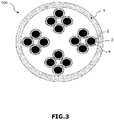
- the figure 3 shows a cable (100) according to the invention comprising several elongated electrically conductive elements (2), each elongated electrically conductive element (2) being surrounded successively by the fire resistant layer (3) and the electrically insulating layer (4), each elongated electrically conductive element, fire resistant layer and electrically insulating layer being as described in figure 2 .
- the cable (100) further comprises a protective sheath (5) surrounding all of the components of the cable.
- the protective sheath (5) may for example be a polymer layer of HFFR type, formed in particular by extrusion.
- the protective sheath can also surround a metal screen (not shown), said metal screen surrounding all of the components of the cable.
- the metal screen may for example be one or more metal tapes, in particular made of galvanized steel.
- Example 1 Preparation of a cable according to the invention comprising a fire-resistant layer 150 ⁇ m thick
- a copper wire with a diameter of 1.2 mm was dipped in an aqueous solution with a viscosity of about 1.2.10 -3 m 2 / s (1200 centistokes) (measured at a temperature of 25 ° C, using a Ford N ° 4 viscosity cup, according to standard ASTM D1200), marketed by the company Aremco under the reference Pyropaint ® 634-ZO, then subjected to a heat treatment at a temperature of 250 ° C for a duration of 30 seconds, using a ceramic radiant heating system.
- a cable covered with a white fire-resistant layer with a thickness of 150 ⁇ m was obtained.
- Example 2 High temperature resistance test
- Example 1 The cable obtained above in Example 1 was introduced into a vertical oven heated to 830 ° C for 30 minutes in order to test the resistance of the layer applied to the copper wire at exposure to very high temperature.
Landscapes
- Chemical & Material Sciences (AREA)
- Inorganic Chemistry (AREA)
- Engineering & Computer Science (AREA)
- Ceramic Engineering (AREA)
- Physics & Mathematics (AREA)
- Thermal Sciences (AREA)
- Manufacturing & Machinery (AREA)
- Insulated Conductors (AREA)
- Materials Engineering (AREA)
- Organic Chemistry (AREA)
Abstract
Description
- La présente invention se rapport à un câble d'énergie comprenant au moins un élément conducteur allongé et au moins une couche isolante résistante au feu, ainsi qu'au procédé de préparation d'un tel câble.
- Elle s'applique typiquement mais non exclusivement aux câbles de sécurité résistants au feu susceptibles de fonctionner pendant un laps de temps donné dans des conditions d'incendie, sans être pour autant propagateur d'incendie ni générateur de fumées importantes. Ces câbles de sécurité sont en particulier des câbles à basse ou moyenne tension (notamment de 6 à 45-60 kV) du type câbles de transport d'énergie ou câbles de transmission, tels que par exemple des câbles de contrôle ou de signalisation.
- Un câble d'énergie est un câble destiné au transport de l'énergie électrique. Il comprend classiquement un ou plusieurs éléments conducteurs isolés, ou en d'autres termes un ou plusieurs conducteur(s) électrique(s) allongé(s) entouré(s) par au moins une couche isolante. La couche isolante peut être typiquement une couche polymère électriquement isolante en contact physique avec le ou les conducteur(s) électrique(s). Ledit ou lesdits éléments conducteurs isolés sont généralement entourés par une gaine extérieure de protection destinée à protéger mécaniquement le ou les éléments conducteurs isolés.
- Les matériaux utilisables pour former la couche isolante sont généralement des matériaux composites à base de polymères, en particulier de polymères siliconés, et de divers adjuvants notamment des charges de renfort telles que de la silice.
- Si ces matériaux présentent en principe de bonnes propriétés mécaniques et diélectriques, ils ne sont cependant pas résistants au feu et fondent rapidement sous l'effet des températures élevées générées par lors des incendies.
- Or, selon la norme de résistance au feu IEC 60331, les câbles dits « résistants au feu » sont des câbles configurés pour pouvoir continuer de fonctionner avec des performances acceptables même si, en cas d'incendie, ils sont directement exposés aux flammes pendant une certaine durée, à des températures de 750°C à 900°C ou même à des températures supérieures.
- Des câbles comportant une couche isolante résistante au feu ont déjà été proposés, notamment dans la demande internationale
WO2017/199060 qui décrit un câble résistant au feu comprenant un élément conducteur allongé entouré par une couche d'une composition céramifiable comprenant un mélange spécifique de polymères thermoplastiques comprenant (a) un copolymère d'éthylène et d'une alpha-oléfine ayant une densité de 0,860 à 0,910 g/cm3, un indice de fluidité à chaud (IFC) ne dépassant pas 3 g/10 minutes et un point de fusion d'au plus 105°C, (b) un homopolymère d'éthylène ou un copolymère d'éthylène et d'une alpha-oléfine ayant une densité de 0,900 à 0,985 g/cm3, un indice de fluidité à chaud (IFC) ne dépassant pas 5 g/10 minutes et un point de fusion d'au plus 110°C, et (c) un polyéthylène substitué par un monomère comportant un insaturation éthylénique ; au moins 25 % en poids de silice ; un agent de fluxage choisi parmi les oxydes métaux alcalins et leurs précurseurs ; un hydroxyde inorganique tel que l'hydroxyde de magnésium, l'hydroxyde d'aluminium et leurs mélanges ; et au moins 5 % en poids d'un agent stabilisant à base de silicate de magnésium hydraté. Cette composition est généralement mise en œuvre par extrusion sous la forme d'une couche ayant une épaisseur de plusieurs millimètres. Cette couche céramifiable peut constituer la couche externe du câble (gaine externe) ou bien le matériau de remplissage (ou « bedding » en anglais) entre les éléments conducteurs isolés et la gaine externe. Lorsque cette couche céramifiable est exposée à des températures élevées telles que celles occasionnées par les incendies, elle réagit pour former une couche céramique résistante au feu. - Les câbles comportant une telle couche présentent une bonne résistance au feu mais ont cependant un diamètre important compte tenu de l'épaisseur de la couche céramifiable.
- Le but de la présente invention est de fournir un câble présentant une bonne résistance au feu tout en ayant un diamètre inférieur aux câbles de l'art antérieur, grâce notamment à la présence d'une couche résistance au feu présentant une faible épaisseur.
- La présente invention a pour premier objet un câble comprenant au moins un élément électriquement conducteur allongé et au moins une couche résistante au feu entourant ledit élément électriquement conducteur allongé, ledit câble étant caractérisé en ce que ladite couche résistante au feu est en contact physique direct avec ledit élément électriquement conducteur allongé, et en ce que ladite couche résistante au feu est obtenue par traitement thermique d'une composition inorganique liquide. De préférence, la composition inorganique liquide peut être solidifiée grâce au traitement thermique : on parle alors d'une couche résistante au feu obtenue par solidification de la composition inorganique liquide.
- Au sens de la présente invention, l'expression « en contact physique direct » signifie qu'aucune couche, de quelque nature que ce soit, ne vient s'intercaler entre ledit élément électriquement conducteur allongé et ladite couche résistante au feu. En d'autres termes, le câble ne comprend pas de couche(s) intermédiaire(s), notamment de couche(s) comprenant au moins un polymère, positionnée(s) entre ledit élément électriquement conducteur allongé et ladite couche résistante au feu.
- Une couche dite de « passivation » formée par oxydation, par exemple à l'air ou par traitement de surface de l'élément électriquement conducteur allongé, n'est pas considérée comme une couche s'intercalant ou positionnée entre ledit élément électriquement conducteur allongé et ladite couche résistante au feu. En d'autres termes, l'élément électriquement conducteur allongé peut comprendre une couche de passivation. De ce fait, la couche résistante au feu peut être en contact physique direct avec la couche de passivation de l'élément électriquement conducteur allongé.
- Le traitement thermique de la composition inorganique liquide, ou plus particulièrement la solidification de la composition inorganique liquide, peut être réalisée à une température d'au plus 300°C environ, de préférence à une température choisie dans une gamme allant de 90°C à 300°C environ, et encore plus préférentiellement à une température choisie dans une gamme allant de 200°C à 300°C environ.
- La durée du traitement thermique varie en fonction de la température à laquelle ledit traitement est effectué. Cependant, lorsque le traitement thermique est effectué à une température comprise entre 95°C et 300°C environ, la durée du traitement thermique varie typiquement de 1 seconde (s) à 2 heures (h), et préférentiellement de 15 s à 5 minutes (min), notamment pour une application en continue.
- A titre d'exemple, le traitement thermique peut comprendre un ou plusieurs cycles choisis parmi 95 °C pendant 2 h, 25 °C pendant 30 min, 95 °C pendant 10 min, 150 °C pendant 1 min, 200 °C pendant 15 s, 250 °C pendant 5 s, 250 °C pendant 30 s, et une de leur combinaison.
- La composition inorganique liquide est notamment une composition résistante au feu. Elle est de préférence une composition comprenant au moins un oxyde d'un métal de transition, au moins un aluminosilicate, et au moins un solvant, le solvant permettant notamment d'obtenir une composition liquide. Le solvant peut être avantageusement évaporer lors du traitement thermique de la composition inorganique liquide.
- . Elle peut en outre comprendre au moins un autre silicate différent dudit aluminosilicate, tel que par exemple un silicate de sodium, un silicate de calcium ou un silicate de potassium.
- Selon une forme de réalisation préférée de l'invention, la composition inorganique liquide comprend au moins 10 % environ en poids d'au moins un oxyde d'un métal de transition, et encore plus préférentiellement de 15 % à 60 % environ en poids d'au moins un oxyde d'un métal de transition, lesdits pourcentages étant exprimés par rapport au poids total de ladite composition.
- L'oxyde d'un métal de transition est de préférence l'oxyde de zirconium.
- Selon une forme de réalisation préférée de l'invention, la composition inorganique liquide comprend au moins 2 % environ en poids d'au moins un aluminosilicate, et encore plus préférentiellement de 5 % à 20 % environ en poids d'au moins un aluminosilicate, lesdits pourcentages étant exprimés par rapport au poids total de ladite composition.
- Le ou les aluminosilicates sont de préférence choisis parmi les phyllosilicates, tels que par exemple le mica ou le kaolin ; et les tectosilicates, tels que par exemple le feldspath ou la zéolithe.
- Selon une forme de réalisation préférée de l'invention, la composition inorganique liquide comprend au moins 10 % environ en poids d'au moins un solvant, et encore plus préférentiellement de 20 % à 75 % environ en poids d'au moins un solvant, lesdits pourcentages étant exprimés par rapport au poids total de ladite composition.
- A titre d'exemple préféré, le solvant peut être de l'eau. Lorsque le solvant utilisé dans la composition inorganique liquide est de l'eau, la composition inorganique liquide est une composition aqueuse.
- Selon une forme de réalisation préférée de l'invention, la composition inorganique liquide peut comprendre en outre au moins 10 % environ en poids d'au moins un autre silicate différent dudit aluminosilicate, et encore plus préférentiellement de 15 % à 40 % environ en poids d'au moins un autre silicate différent dudit aluminosilicate, lesdits pourcentages étant exprimés par rapport au poids total de ladite composition.
- Dans un mode de réalisation particulièrement avantageux, la composition inorganique liquide peut comprendre en outre au moins un plastifiant.
- Plus particulièrement, la composition inorganique liquide peut comprendre de 0,01 à 10,0 % en poids de plastifiant, de préférence de 0,01 à 5,0 % en poids de plastifiant, de préférence de 0,1 à 2,0 % en poids de plastifiant, et de façon particulièrement préférée de 0,1 à 1,0 % en poids de plastifiant, lesdits pourcentages étant exprimés par rapport au poids total de ladite composition.
- Le plastifiant peut être avantageusement ajouté dans la composition inorganique liquide pour améliorer la tenue au pliage de la couche résistante au feu, ou en d'autres termes limiter de façon significative, voire éviter, les fissures ou craquelures lors de la courbure du câble de l'invention.
- Le plastifiant peut être choisi parmi un polyol, un polymère de bas poids moléculaire, le chlorure d'ammonium, un glucide, une argile, et un de leurs mélanges.
- A titre d'exemple :
- le polyol peut être le sorbitol ;
- le polymère de bas poids moléculaire peut être un oligomère ayant de 2 à 40, et de préférence de 2 à 20, motifs monomères identiques ou différents, et/ou un polymère ayant un poids moléculaire d'au plus 50 000 g/mol, et de préférence d'au plus 20 000 g/mol, le polymère de bas poids moléculaire étant par exemple un polyéthylène glycol ;
- l'argile peut être un phyllosilicate ;
- le glucide peut être la cellulose.
- Selon une forme de réalisation particulièrement préférée de l'invention, ladite composition inorganique liquide est une composition aqueuse comprenant environ de 15 à 45 % en poids d'oxyde de zirconium, environ de 5 % à 20 % en poids d'aluminosilicate, et environ de 15 à 35 % en poids d'un autre silicate différent dudit aluminosilicate, le reste de la composition étant de l'eau. Une telle composition est commercialisée sous la dénomination commerciale Pyropaint ® 634-ZO par la société Aremco (New York, USA) et distribuée par la société Polytec France (Chatillon, France).
- La composition inorganique liquide présente de préférence une viscosité allant de 10-3 à 2.10-3 m2/s environ (1000 à 2000 centistokes environ), et encore plus préférentiellement de 10-3 à 1,4.10-3 m2/s environ (1000 à 1400 centistokes environ), ladite viscosité étant mesurée à une température de 25°C, à l'aide d'une coupe de viscosité Ford N°4, selon la norme ASTM D1200.
- La couche résistante au feu de l'invention peut comprendre au moins un oxyde d'un métal de transition et au moins un aluminosilicate, et optionnellement au moins un autre silicate différent dudit aluminosilicate et/ou au moins un plastifiant, ledit oxyde d'un métal de transition, ledit aluminosilicate, ledit autre silicate et ledit plastifiant étant tels que décrits ci-avant dans la description.
- Plus particulièrement, la couche résistante au feu peut comprendre :
- au moins 25 % environ en poids d'au moins un oxyde d'un métal de transition, et de préférence au plus 65 % environ en poids d'au moins un oxyde d'un métal de transition,
- au moins 10 % environ en poids d'au moins un aluminosilicate, et de préférence au plus 25 % environ en poids d'au moins un aluminosilicate,
- optionnellement au moins 25 % environ en poids d'au moins un autre silicate différent dudit aluminosilicate, et de préférence au plus 50 % environ en poids d'au moins un autre silicate différent dudit aluminosilicate, et
- optionnellement au moins 0,01 % environ en poids d'au moins un plastifiant, et de préférence au plus 10 % environ en poids d'au moins un plastifiant,
- L'épaisseur de ladite couche résistante au feu varie de préférence de 20 à 500 µm environ, et encore plus préférentiellement de 100 à 200 µm environ.
- L'épaisseur de ladite couche résistante au feu n'a pas d'impact significatif sur le diamètre du câble, ce qui présente un grand avantage en termes de design du câble.
- Selon l'invention, l'expression « élément électriquement conducteur allongé » signifie un élément électriquement conducteur présentant un axe longitudinal. En particulier, l'élément électriquement conducteur est allongé car il a notamment subi au moins une étape de tréfilage. Le tréfilage comprend classiquement une étape de déformation à froid, notamment à travers une ou plusieurs filières.
- L'élément conducteur allongé est de préférence en cuivre, en aluminium, en un alliage de cuivre, ou en un alliage d'aluminium. Selon une forme de réalisation préférée de l'invention, ledit élément conducteur ne comprend pas de revêtement à base de nickel.
- Le câble conforme à la présente invention peut comprendre une pluralité d'éléments électriquement conducteurs allongés. Dans ce cas, chacun des éléments électriquement conducteurs allongés est individuellement entouré par au moins une couche résistante au feu telle définie précédemment, chacune desdites couches étant en contact physique direct avec chacun desdits éléments électriquement conducteurs allongés.
- Selon une forme de réalisation particulière et préférée de la présente invention, le câble comprend en outre au moins une couche polymère entourant ladite couche résistante au feu.
- Ladite couche polymère est de préférence une couche électriquement isolante.
- Selon la présente invention, l'expression « couche électriquement isolante » signifie une couche dont la conductivité électrique peut être d'au plus 1.10-8 S/m environ (à 25°C en courant continu).
- Selon une forme de réalisation particulièrement préférée de l'invention, la couche polymère comprend un matériau polymère choisi parmi les polymères réticulés et non réticulés, les polymères du type inorganique et du type organique.
- Le matériau polymère peut en particulier être un homopolymère ou un copolymère ayant des propriétés thermoplastiques et/ou élastomères.
- Les polymères du type inorganique peuvent être des polyorganosiloxanes.
- Les polymères du type organique peuvent être des polyoléfines, des polyuréthanes, des polyamides, des polyesters, des polyvinyliques ou des polymères halogénés tels que des polymères fluorés (e.g. polytétrafluoroéthylène PTFE) ou des polymères chlorés (e.g. polychlorure de vinyle PVC).
- Les polyoléfines peuvent être choisies parmi les polymères d'éthylène et de propylène. A titre d'exemple de polymères d'éthylène, on peut citer les polyéthylènes linéaires basse densité (LLDPE), les polyéthylènes basse densité (LDPE), les polyéthylènes moyenne densité (MDPE), les polyéthylènes haute densité (HDPE), les copolymères d'éthylène et d'acétate de vinyle (EVA), les copolymères d'éthylène et d'acrylate de butyle (EBA), d'acrylate de méthyle (EMA), de 2-hexyléthyl acrylate (2HEA), les copolymères d'éthylène et d'alpha-oléfines tels que par exemple les polyéthylène-octène (PEO), les copolymères d'éthylène et de propylène (EPR), les copolymères d'éthylène/éthyle acrylate (EEA), ou les terpolymères d'éthylène et de propylène (EPT) tels que par exemple les terpolymères d'éthylène propylène diène monomère (EPDM).
- Selon la présente invention, l'expression « polyéthylène basse densité » signifie un polyéthylène ayant une densité allant de 0,91 à 0,925 environ.
- Selon la présente invention, l'expression « polyéthylène haute densité » signifie un polyéthylène ayant une densité allant de 0,94 à 0,965 environ.
- La couche polymère est, de préférence, une couche extrudée par des techniques bien connues de l'homme du métier.
- Le câble conforme à la présente invention peut en outre comporter une gaine de protection et/ou un écran métallique. Ladite gaine de protection peut être de préférence la couche la plus externe dudit câble : on peut alors parler de gaine externe de protection. La gaine de protection peut entourer la ou les couches polymères, et l'écran métallique si le câble en comporte un.
- La gaine de protection est de préférence réalisée en un matériau exempt d'halogène. Elle peut être réalisée classiquement à partir de matériaux retardant la propagation de la flamme ou résistant à la propagation de la flamme. Notamment, si ces derniers ne contiennent pas d'halogène, on parle de gainage de type HFFR (pour l'anglicisme « Halogen Free Flame Retardant »).
- Elle comprend au moins un polymère organique ou inorganique.
- Le choix du polymère organique ou inorganique n'est pas limitatif et ceux-ci sont bien connus de l'homme du métier.
- Selon une forme de réalisation préférée de l'invention, le polymère organique ou inorganique est choisi parmi les polymères réticulés et non réticulés.
- Le polymère organique ou inorganique peut être un homo- ou un co-polymère ayant des propriétés thermoplastiques et/ou élastomères.
- Les polymères inorganiques peuvent être des polyorganosiloxanes.
- Les polymères organiques peuvent être des polyuréthanes ou des polyoléfines identiques à ceux définis ci-dessus pour la couche polymère électriquement isolante.
- Le polymère de ladite gaine est de préférence un polymère organique, de préférence encore un polymère d'éthylène, et de préférence encore un copolymère d'éthylène et d'acétate de vinyle, un polyéthylène linéaire basse densité ou un de leurs mélanges.
- La gaine de protection peut comprendre en outre une charge minérale ignifugeante hydratée. Cette charge minérale ignifugeante hydratée agit principalement par voie physique en se décomposant de manière endothermique (e.g. libération d'eau), ce qui a pour conséquence d'abaisser la température de la gaine et de limiter la propagation des flammes le long du câble. On parle notamment de propriétés de retard à la flamme, bien connues sous l'anglicisme « flame retardant ».
- La charge minérale ignifugeante hydratée peut être un hydroxyde métallique tel que l'hydroxyde de magnésium ou le trihydroxyde d'aluminium.
- La gaine de protection peut comprendre en outre une charge inerte, notamment choisi parmi le talc, les micas, les argiles déshydratées et un de leurs mélanges.
- Dans un mode de réalisation particulier, le câble selon la présente invention peut comprendre :
- plusieurs éléments électriquement conducteurs allongés, chacun desdits éléments électriquement conducteurs allongés étant entouré par une ou plusieurs couches résistantes au feu conforme à l'invention,
- une couche électriquement isolante, telle que notamment décrite ci-avant, entourant chaque élément électriquement conducteur allongé ensemble avec la ou les couches résistantes au feu, et
- une gaine de protection, telle que notamment décrite ci-avant, entourant l'ensemble des éléments constitutifs du câble.
- La présente invention a également pour objet un procédé de préparation du câble tel que défini précédemment, c'est-à-dire d'un câble comprenant au moins un élément électriquement conducteur allongé et au moins une couche résistante au feu entourant ledit élément électriquement conducteur allongé, ladite couche résistante au feu étant en contact physique direct avec ledit élément électriquement conducteur allongé, ledit procédé étant caractérisé en ce qu'il comprend au moins :
- i) une étape d'application d'une composition inorganique liquide directement sur la surface d'au moins un élément électriquement conducteur allongé dudit câble,
- ii) une étape de traitement thermique de ladite composition inorganique liquide pour former ladite couche résistante au feu.
- Selon une forme de réalisation particulière du procédé conforme à la présente invention, les étapes i) et ii) peuvent être réitérées plusieurs fois, typiquement 2 ou 3 fois. Il est ainsi possible de faire varier l'épaisseur de la couche résistante au feu.
- L'étape i) d'application de la composition inorganique liquide sur la surface de l'élément électriquement conducteur allongé peut par exemple être réalisée par immersion dudit élément dans ladite composition.
- L'étape ii) de traitement thermique est de préférence une étape de solidification de la composition inorganique liquide. Ledit traitement thermique entraîne l'évaporation du solvant de la composition inorganique liquide, et ainsi la solidification de la composition inorganique.
- Comme indiqué précédemment, le traitement thermique est de préférence réalisé à une température d'au plus 300°C environ, de préférence à une température comprise dans une gamme allant de 95°C à 300°C environ, et de façon particulièrement préférée à une température comprise dans une gamme allant de 200°C à 300°C environ.
- Le traitement thermique peut être réalisé en utilisant des systèmes de chauffe bien connu de l'homme du métier tels que par exemple un système de chauffage par ultra-violet, par micro-onde, par infra-rouge, ou par radiant céramique..
- Avant l'étape i), le ou les éléments électriquement conducteurs allongés peuvent être soumis à un ou plusieurs traitement(s) de surface.
Le traitement de surface peut être notamment choisi parmi une oxydation de surface, un dégraissage, un décapage, et une de leur combinaison. L'oxydation de surface peut permettre de produire un rayon de courbure approprié des éléments électriquement conducteurs allongés. L'oxydation de surface peut être effectuée par traitement acide du ou des éléments électriquement conducteurs allongés, notamment en présence d'un courant électrique. Le dégraissage peut permettre d'enlever l'émulsion de tréfilage sur le ou les éléments électriquement conducteurs allongés. Le dégraissage peut être effectuée par une solution aqueuse contenant une base, telle que par exemple de la soude. Le décapage peut permettre de désoxyder la surface du ou des éléments électriquement conducteurs allongés. Le décapage peut être effectué par une solution aqueuse contenant un acide, tel que par exemple de l'acide sulfurique. - Les dessins annexés illustrent l'invention :
- [
Fig. 1 ] représente de manière schématique une structure, en coupe transversale, d'un câble conforme à l'invention selon un premier mode de réalisation.
Lafigure 1 montre un câble (1) conforme à l'invention comprenant un élément électriquement conducteur allongé (2) et une couche résistante au feu (3) entourant ledit élément électriquement conducteur allongé (2), et étant en contact physique direct avec l'élément électriquement conducteur allongé (2). L'élément électriquement conducteur allongé (2) est notamment un fil de cuivre. - [
Fig. 2 ] représente de manière schématique une structure, en coupe transversale, d'un câble conforme à l'invention selon un deuxième mode de réalisation.
Lafigure 2 montre un câble (10) conforme à l'invention comprenant l'élément électriquement conducteur allongé (2) et la couche résistante au feu (3) tels que décrits à lafigure 1 , ainsi qu'une couche électriquement isolante (4) entourant la couche résistante au feu (3). La couche électriquement isolante (4) peut être par exemple une couche d'un matériau polymère à base de polyéthylène, formée notamment par extrusion. - [
Fig. 3 ] représente de manière schématique une structure, en coupe transversale, d'un câble conforme à l'invention selon un troisième mode de réalisation. - La
figure 3 montre un câble (100) conforme à l'invention comprenant plusieurs éléments électriquement conducteurs allongés (2), chaque élément électriquement conducteur allongé (2) étant entouré successivement par la couche résistante au feu (3) et la couche électriquement isolante (4), chaque élément électriquement conducteur allongé, couche résistante au feu et couche électriquement isolante étant tels que décrits dans lafigure 2 . Le câble (100) comprend en outre une gaine de protection (5) entourant l'ensemble des éléments constitutifs du câble. La gaine de protection (5) peut être par exemple une couche polymère de type HFFR, formée notamment par extrusion. La gaine de protection peut en outre entourer un écran métallique (non représenté), ledit écran métallique entourant l'ensemble des éléments constitutifs du câble. L'écran métallique peut être par exemple un ou plusieurs rubans métalliques, notamment en acier galvanisé. - D'autres caractéristiques et avantages de la présente invention apparaîtront à la lumière des exemples qui vont suivre en référence aux figures annotées, lesdits exemples et figures étant donnés à titre illustratif et nullement limitatif.
- Un fil de cuivre d'un diamètre de 1,2 mm a été trempé dans une solution aqueuse d'une viscosité d'environ 1,2.10-3 m2/s (1200 centistokes) (mesurée à une température de 25 °C, à l'aide d'une coupe de viscosité Ford N°4, selon la norme ASTM D1200), commercialisée par la société Aremco sous la référence Pyropaint ® 634-ZO, puis soumis à un traitement thermique à une température de 250°C pendant une durée de 30 secondes, à l'aide d'un système de chauffage par radiant céramique.
- Après le traitement thermique, on a obtenu un câble recouvert par une couche blanche résistante au feu d'une épaisseur de 50 µm.
- Les étapes de trempage du fil de cuivre dans la solution Pyropaint ® 634-ZO et de traitement thermique ont ensuite été réitérées deux fois dans les mêmes conditions.
- On a obtenu un câble recouvert par une couche blanche résistante au feu d'une épaisseur de 150 µm.
- Le câble obtenu ci-dessus à l'exemple 1 a été introduit dans un four vertical chauffé à 830°C pendant 30 minutes afin de tester la résistance de couche appliquée sur le fil de cuivre à une exposition à très haute température.
- Après ce test, on a observé que la couche résistante au feu n'avait subi aucune dégradation (aucune craquelure) et qu'elle permet donc de protéger efficacement le fil de cuivre des effets négatifs d'une exposition à très haute température.
Claims (19)
- Câble (1, 10, 100) comprenant au moins un élément électriquement conducteur allongé (2) et au moins une couche résistante au feu (3) entourant ledit élément électriquement conducteur allongé (2), ledit câble étant caractérisé en ce que ladite couche résistante au feu est en contact physique direct avec ledit élément électriquement conducteur allongé, et en ce que ladite couche résistante au feu est obtenue par traitement thermique d'une composition inorganique liquide.
- Câble selon la revendication 1, caractérisé en ce la couche résistante au feu est obtenue par solidification de la composition inorganique liquide.
- Câble selon la revendication 1 ou 2, caractérisé en ce que le traitement thermique est réalisé à une température d'au plus 300°C.
- Câble selon l'une quelconque des revendications précédentes, caractérisé en ce que la composition inorganique liquide comprend au moins un oxyde d'un métal de transition, au moins un aluminosilicate, et au moins un solvant.
- Câble selon la revendication 4, caractérisé en ce que la composition inorganique liquide comprend au moins 10 % en poids d'au moins un oxyde d'un métal de transition par rapport au poids total de ladite composition.
- Câble selon la revendication 4 ou 5, caractérisé en ce que l'oxyde d'un métal de transition est l'oxyde de zirconium.
- Câble selon l'une quelconque des revendications 4 à 6, caractérisé en ce que la composition inorganique liquide comprend au moins 2 % en poids d'au moins un aluminosilicate par rapport au poids total de ladite composition.
- Câble selon l'une quelconque des revendications 4 à 7, caractérisé en ce que la composition inorganique liquide comprend au moins 10 % en poids d'au moins un solvant par rapport au poids total de ladite composition.
- Câble selon la revendication 8, caractérisé en ce que le solvant est de l'eau.
- Câble selon l'une quelconque des revendications 4 à 9, caractérisé en ce que la composition inorganique liquide comprend en outre au moins un autre silicate différent dudit aluminosilicate.
- Câble selon l'une quelconque des revendications 4 à 10, caractérisé en ce que la composition inorganique liquide comprend en outre au moins un plastifiant.
- Câble selon l'une quelconque des revendications précédentes, caractérisé en ce que la composition inorganique liquide présente une viscosité allant de 10-3 à 2.10-3 m2/s (1000 à 2000 centistokes), ladite viscosité étant mesurée à une température de 25 °C, à l'aide d'une coupe de viscosité Ford N°4, selon la norme ASTM D1200.
- Câble selon l'une quelconque des revendications précédentes, caractérisé en ce que la couche résistante au feu comprend au moins un oxyde d'un métal de transition et au moins un aluminosilicate.
- Câble selon l'une quelconque des revendications précédentes, caractérisé en ce que l'épaisseur de ladite couche résistante au feu varie de 20 à 500 µm.
- Câble selon l'une quelconque des revendications précédentes, caractérisé en ce que l'élément conducteur allongé est en cuivre, en aluminium, en un alliage de cuivre, ou en un alliage d'aluminium.
- Câble selon l'une quelconque des revendications précédentes, caractérisé en ce qu'il comprend une pluralité d'éléments électriquement conducteurs allongés, chacun des éléments électriquement conducteurs allongés étant individuellement entouré par au moins une couche résistante au feu, et en ce que chacune desdites couches résistantes au feu est en contact physique direct avec chacun desdits éléments électriquement conducteurs allongés.
- Câble selon l'une quelconque des revendications précédentes, caractérisé en ce qu'il comprend en outre au moins une couche polymère (4) entourant ladite couche résistante au feu.
- Procédé de préparation d'un câble tel que défini à l'une quelconque des revendications 1 à 17, caractérisé en ce qu'il comprend au moins :i) une étape d'application d'une composition inorganique liquide sur la surface d'au moins un élément électriquement conducteur allongé dudit câble, etii) une étape de traitement thermique de ladite composition inorganique liquide pour former ladite couche résistante au feu.
- Procédé selon la revendication 18, caractérisé en ce que les étapes i) et ii) sont réitérées plusieurs fois.
Applications Claiming Priority (1)
| Application Number | Priority Date | Filing Date | Title |
|---|---|---|---|
| FR1907865A FR3098636B1 (fr) | 2019-07-12 | 2019-07-12 | Câble comprenant une couche résistante au feu |
Publications (1)
| Publication Number | Publication Date |
|---|---|
| EP3764372A1 true EP3764372A1 (fr) | 2021-01-13 |
Family
ID=69743276
Family Applications (1)
| Application Number | Title | Priority Date | Filing Date |
|---|---|---|---|
| EP20184791.0A Withdrawn EP3764372A1 (fr) | 2019-07-12 | 2020-07-08 | Câble comprenant une couche résistante au feu |
Country Status (4)
| Country | Link |
|---|---|
| US (1) | US20210050130A1 (fr) |
| EP (1) | EP3764372A1 (fr) |
| CN (1) | CN112216432A (fr) |
| FR (1) | FR3098636B1 (fr) |
Cited By (1)
| Publication number | Priority date | Publication date | Assignee | Title |
|---|---|---|---|---|
| FR3118725A1 (fr) * | 2021-01-14 | 2022-07-15 | Nexans | Câble armé résistant au feu avec une limitation de la projection de matières incandescentes |
Families Citing this family (1)
| Publication number | Priority date | Publication date | Assignee | Title |
|---|---|---|---|---|
| CN118727478A (zh) * | 2024-07-24 | 2024-10-01 | 金冠(山东)防护用品有限公司 | 一种耐高温防火安全绳及其制备方法 |
Citations (8)
| Publication number | Priority date | Publication date | Assignee | Title |
|---|---|---|---|---|
| US2495630A (en) * | 1944-05-20 | 1950-01-24 | Sprague Electric Co | Electrically insulated conductor and process for producing same |
| US2650975A (en) * | 1950-03-15 | 1953-09-01 | Sprague Electric Co | Electrically insulated conductor and production thereof |
| WO1993005520A1 (fr) * | 1991-09-09 | 1993-03-18 | American Technology, Inc. | Composants electriques isoles par un spinelle et procede de fabrication de ceux-ci |
| US5372886A (en) * | 1989-03-28 | 1994-12-13 | Sumitomo Electric Industries, Ltd. | Insulated wire with an intermediate adhesion layer and an insulating layer |
| US20090000518A1 (en) * | 2005-07-26 | 2009-01-01 | Ineos Silicas Limited | Aqueous Aluminosilicate Gel-Forming Composition |
| FR3046288A1 (fr) * | 2015-12-29 | 2017-06-30 | Nexans | Couche isolante resistante au feu pour cable |
| WO2017174941A1 (fr) * | 2016-04-07 | 2017-10-12 | Nexans | Dispositif comprenant un câble ou un accessoire pour câble contenant une couche composite résistante au feu |
| WO2017199060A1 (fr) | 2016-05-17 | 2017-11-23 | Prysmian S.P.A. | Câble résistant au feu ayant une couche céramifiable |
Family Cites Families (2)
| Publication number | Priority date | Publication date | Assignee | Title |
|---|---|---|---|---|
| US5371150A (en) * | 1992-07-08 | 1994-12-06 | Shin-Etsu Chemical Co., Ltd. | Fluorocarbon rubber composition |
| EP3791410A4 (fr) * | 2018-05-07 | 2022-01-12 | Essex Furukawa Magnet Wire USA LLC | Fil d'aimant doté d'isolation en polyimide résistant à l'effet couronne |
-
2019
- 2019-07-12 FR FR1907865A patent/FR3098636B1/fr not_active Expired - Fee Related
-
2020
- 2020-07-08 EP EP20184791.0A patent/EP3764372A1/fr not_active Withdrawn
- 2020-07-09 US US16/924,882 patent/US20210050130A1/en not_active Abandoned
- 2020-07-10 CN CN202010661908.2A patent/CN112216432A/zh not_active Withdrawn
Patent Citations (8)
| Publication number | Priority date | Publication date | Assignee | Title |
|---|---|---|---|---|
| US2495630A (en) * | 1944-05-20 | 1950-01-24 | Sprague Electric Co | Electrically insulated conductor and process for producing same |
| US2650975A (en) * | 1950-03-15 | 1953-09-01 | Sprague Electric Co | Electrically insulated conductor and production thereof |
| US5372886A (en) * | 1989-03-28 | 1994-12-13 | Sumitomo Electric Industries, Ltd. | Insulated wire with an intermediate adhesion layer and an insulating layer |
| WO1993005520A1 (fr) * | 1991-09-09 | 1993-03-18 | American Technology, Inc. | Composants electriques isoles par un spinelle et procede de fabrication de ceux-ci |
| US20090000518A1 (en) * | 2005-07-26 | 2009-01-01 | Ineos Silicas Limited | Aqueous Aluminosilicate Gel-Forming Composition |
| FR3046288A1 (fr) * | 2015-12-29 | 2017-06-30 | Nexans | Couche isolante resistante au feu pour cable |
| WO2017174941A1 (fr) * | 2016-04-07 | 2017-10-12 | Nexans | Dispositif comprenant un câble ou un accessoire pour câble contenant une couche composite résistante au feu |
| WO2017199060A1 (fr) | 2016-05-17 | 2017-11-23 | Prysmian S.P.A. | Câble résistant au feu ayant une couche céramifiable |
Cited By (2)
| Publication number | Priority date | Publication date | Assignee | Title |
|---|---|---|---|---|
| FR3118725A1 (fr) * | 2021-01-14 | 2022-07-15 | Nexans | Câble armé résistant au feu avec une limitation de la projection de matières incandescentes |
| EP4030444A1 (fr) * | 2021-01-14 | 2022-07-20 | Nexans | Câble armé résistant au feu avec une limitation de la projection de matières incandescentes |
Also Published As
| Publication number | Publication date |
|---|---|
| CN112216432A (zh) | 2021-01-12 |
| FR3098636B1 (fr) | 2023-10-13 |
| US20210050130A1 (en) | 2021-02-18 |
| FR3098636A1 (fr) | 2021-01-15 |
Similar Documents
| Publication | Publication Date | Title |
|---|---|---|
| EP2441076B1 (fr) | Câble électrique apte à assurer la continuité de distribution électrique en cas d'incendie | |
| EP1504887B1 (fr) | Cable électrique ignifugé par une gaine externe multicouche | |
| FR3006494A1 (fr) | Dispositif electrique a moyenne ou haute tension | |
| EP3443563B1 (fr) | Câble électrique présentant une résistance à la corrosion galvanique améliorée | |
| EP2346931B1 (fr) | Cable electrique resistant au feu | |
| FR3098636A1 (fr) | Câble comprenant une couche résistante au feu | |
| WO2007014983A1 (fr) | Cable de securite resistant au feu a une seule enveloppe isolante | |
| EP3398194B1 (fr) | Câble ayant une couche isolante résistante au feu | |
| EP3358575B1 (fr) | Câble electrique resistant aux decharges partielles | |
| WO2007012703A1 (fr) | Cable de securite resistant au feu, sensiblement plat | |
| EP2194092B1 (fr) | Cable électrique | |
| FR2934410A1 (fr) | Composition ceramisable pour cable d'energie et/ou de telecommunication | |
| EP2535901B1 (fr) | Câble moyenne ou haute tension avec gaine polyoléfine contenant des charges minérales | |
| EP3828900A1 (fr) | Câble comprenant une couche résistante au feu | |
| EP3404673B1 (fr) | Cable resistant au feu | |
| EP2862896B1 (fr) | Câble d'énergie et/ou de télécommunication comprenant une couche polymère résistante aux rayures | |
| EP3764373A1 (fr) | Câble comprenant une couche céramique résistante au feu | |
| EP2498264B1 (fr) | Câble électrique à moyenne ou haute tension | |
| EP3671768A1 (fr) | Câble électrique résistant aux arborescences d'eau | |
| FR3029004A1 (fr) | Cable electrique avec une emissivite amelioree | |
| EP3503125A1 (fr) | Câble comprenant au moins une couche métallisée d'un matériau carboné |
Legal Events
| Date | Code | Title | Description |
|---|---|---|---|
| PUAI | Public reference made under article 153(3) epc to a published international application that has entered the european phase |
Free format text: ORIGINAL CODE: 0009012 |
|
| STAA | Information on the status of an ep patent application or granted ep patent |
Free format text: STATUS: THE APPLICATION HAS BEEN PUBLISHED |
|
| AK | Designated contracting states |
Kind code of ref document: A1 Designated state(s): AL AT BE BG CH CY CZ DE DK EE ES FI FR GB GR HR HU IE IS IT LI LT LU LV MC MK MT NL NO PL PT RO RS SE SI SK SM TR |
|
| AX | Request for extension of the european patent |
Extension state: BA ME |
|
| STAA | Information on the status of an ep patent application or granted ep patent |
Free format text: STATUS: REQUEST FOR EXAMINATION WAS MADE |
|
| 17P | Request for examination filed |
Effective date: 20210713 |
|
| RBV | Designated contracting states (corrected) |
Designated state(s): AL AT BE BG CH CY CZ DE DK EE ES FI FR GB GR HR HU IE IS IT LI LT LU LV MC MK MT NL NO PL PT RO RS SE SI SK SM TR |
|
| STAA | Information on the status of an ep patent application or granted ep patent |
Free format text: STATUS: EXAMINATION IS IN PROGRESS |
|
| 17Q | First examination report despatched |
Effective date: 20220809 |
|
| GRAP | Despatch of communication of intention to grant a patent |
Free format text: ORIGINAL CODE: EPIDOSNIGR1 |
|
| STAA | Information on the status of an ep patent application or granted ep patent |
Free format text: STATUS: GRANT OF PATENT IS INTENDED |
|
| RIC1 | Information provided on ipc code assigned before grant |
Ipc: H01B 3/12 20060101ALI20231227BHEP Ipc: H01B 3/10 20060101ALI20231227BHEP Ipc: H01B 7/295 20060101AFI20231227BHEP |
|
| INTG | Intention to grant announced |
Effective date: 20240118 |
|
| STAA | Information on the status of an ep patent application or granted ep patent |
Free format text: STATUS: THE APPLICATION IS DEEMED TO BE WITHDRAWN |
|
| 18D | Application deemed to be withdrawn |
Effective date: 20240522 |