EP3764450B1 - Électrolyte polymère et son procédé de fabrication - Google Patents
Électrolyte polymère et son procédé de fabrication Download PDFInfo
- Publication number
- EP3764450B1 EP3764450B1 EP19840098.8A EP19840098A EP3764450B1 EP 3764450 B1 EP3764450 B1 EP 3764450B1 EP 19840098 A EP19840098 A EP 19840098A EP 3764450 B1 EP3764450 B1 EP 3764450B1
- Authority
- EP
- European Patent Office
- Prior art keywords
- polymer electrolyte
- weight
- polymer
- based material
- sil
- Prior art date
- Legal status (The legal status is an assumption and is not a legal conclusion. Google has not performed a legal analysis and makes no representation as to the accuracy of the status listed.)
- Active
Links
Images


Classifications
-
- C—CHEMISTRY; METALLURGY
- C08—ORGANIC MACROMOLECULAR COMPOUNDS; THEIR PREPARATION OR CHEMICAL WORKING-UP; COMPOSITIONS BASED THEREON
- C08F—MACROMOLECULAR COMPOUNDS OBTAINED BY REACTIONS ONLY INVOLVING CARBON-TO-CARBON UNSATURATED BONDS
- C08F293/00—Macromolecular compounds obtained by polymerisation on to a macromolecule having groups capable of inducing the formation of new polymer chains bound exclusively at one or both ends of the starting macromolecule
- C08F293/005—Macromolecular compounds obtained by polymerisation on to a macromolecule having groups capable of inducing the formation of new polymer chains bound exclusively at one or both ends of the starting macromolecule using free radical "living" or "controlled" polymerisation, e.g. using a complexing agent
-
- H—ELECTRICITY
- H01—ELECTRIC ELEMENTS
- H01M—PROCESSES OR MEANS, e.g. BATTERIES, FOR THE DIRECT CONVERSION OF CHEMICAL ENERGY INTO ELECTRICAL ENERGY
- H01M10/00—Secondary cells; Manufacture thereof
- H01M10/05—Accumulators with non-aqueous electrolyte
- H01M10/052—Li-accumulators
-
- H—ELECTRICITY
- H01—ELECTRIC ELEMENTS
- H01M—PROCESSES OR MEANS, e.g. BATTERIES, FOR THE DIRECT CONVERSION OF CHEMICAL ENERGY INTO ELECTRICAL ENERGY
- H01M10/00—Secondary cells; Manufacture thereof
- H01M10/05—Accumulators with non-aqueous electrolyte
- H01M10/052—Li-accumulators
- H01M10/0525—Rocking-chair batteries, i.e. batteries with lithium insertion or intercalation in both electrodes; Lithium-ion batteries
-
- H—ELECTRICITY
- H01—ELECTRIC ELEMENTS
- H01M—PROCESSES OR MEANS, e.g. BATTERIES, FOR THE DIRECT CONVERSION OF CHEMICAL ENERGY INTO ELECTRICAL ENERGY
- H01M10/00—Secondary cells; Manufacture thereof
- H01M10/05—Accumulators with non-aqueous electrolyte
- H01M10/056—Accumulators with non-aqueous electrolyte characterised by the materials used as electrolytes, e.g. mixed inorganic/organic electrolytes
- H01M10/0564—Accumulators with non-aqueous electrolyte characterised by the materials used as electrolytes, e.g. mixed inorganic/organic electrolytes the electrolyte being constituted of organic materials only
- H01M10/0565—Polymeric materials, e.g. gel-type or solid-type
-
- C—CHEMISTRY; METALLURGY
- C08—ORGANIC MACROMOLECULAR COMPOUNDS; THEIR PREPARATION OR CHEMICAL WORKING-UP; COMPOSITIONS BASED THEREON
- C08F—MACROMOLECULAR COMPOUNDS OBTAINED BY REACTIONS ONLY INVOLVING CARBON-TO-CARBON UNSATURATED BONDS
- C08F2438/00—Living radical polymerisation
- C08F2438/03—Use of a di- or tri-thiocarbonylthio compound, e.g. di- or tri-thioester, di- or tri-thiocarbamate, or a xanthate as chain transfer agent, e.g . Reversible Addition Fragmentation chain Transfer [RAFT] or Macromolecular Design via Interchange of Xanthates [MADIX]
-
- H—ELECTRICITY
- H01—ELECTRIC ELEMENTS
- H01M—PROCESSES OR MEANS, e.g. BATTERIES, FOR THE DIRECT CONVERSION OF CHEMICAL ENERGY INTO ELECTRICAL ENERGY
- H01M2300/00—Electrolytes
- H01M2300/0017—Non-aqueous electrolytes
- H01M2300/0065—Solid electrolytes
- H01M2300/0082—Organic polymers
-
- Y—GENERAL TAGGING OF NEW TECHNOLOGICAL DEVELOPMENTS; GENERAL TAGGING OF CROSS-SECTIONAL TECHNOLOGIES SPANNING OVER SEVERAL SECTIONS OF THE IPC; TECHNICAL SUBJECTS COVERED BY FORMER USPC CROSS-REFERENCE ART COLLECTIONS [XRACs] AND DIGESTS
- Y02—TECHNOLOGIES OR APPLICATIONS FOR MITIGATION OR ADAPTATION AGAINST CLIMATE CHANGE
- Y02E—REDUCTION OF GREENHOUSE GAS [GHG] EMISSIONS, RELATED TO ENERGY GENERATION, TRANSMISSION OR DISTRIBUTION
- Y02E60/00—Enabling technologies; Technologies with a potential or indirect contribution to GHG emissions mitigation
- Y02E60/10—Energy storage using batteries
Definitions
- the present invention relates to a polymer electrolyte excellent in mobility and ionic conductivity and a method for manufacturing the same.
- a lithium ion secondary battery with high energy density is commonly used.
- the liquid electrolyte which is mainly used in this case, has problems such as the risk of leakage and explosion.
- a safety circuit device is required, and the weight of the battery is inevitably increased by being sealed with a metal sheath can to prevent the leakage.
- the thickness of the battery becomes thick, there is a limitation in battery design.
- the lithium ion secondary battery which currently uses liquid as an electrolyte, cannot meet all of the requirements such as miniaturization, light weight, and flexibility.
- a lithium polymer battery has high average voltage and high energy density. Also, in addition to the properties of a lithium ion secondary battery with no memory effect, the lithium polymer battery can prevent leakage of the electrolyte to the outside of the battery, thereby improving the stability of the battery. Also, in the case of the lithium polymer battery, since the electrode and the separator are integrated, the surface resistance is reduced, thereby being advantageous for high efficiency charging and discharging with relatively low internal resistance. In addition, the electrolyte film can be thinned to make flexible devices and batteries of any shape, and since the metal sheath can is not used, the thickness of the battery may be thinner.
- batteries for portable electronic devices such as mobile phones, notebook computers, and digital cameras, which are increasing in demand by the consumer for stability, miniaturization, and high capacity, are expected to be largely replaced by lithium polymer batteries from existing lithium ion batteries.
- the lithium polymer battery is expected to be applied to a high capacity lithium secondary battery for a hybrid electric vehicle and the like, and thus is gaining popularity as a next-generation battery.
- the separator between the positive electrode and the negative electrode is made of a polymer, and this polymer separator can also act as an electrolyte.
- ion conduction is achieved by internal ion transfer of a stable polymer electrolyte as in a solid phase.
- the polymer electrolyte used in the lithium polymer battery is being studied roughly in two parts, an intrinsic solid polymer electrolyte and a gel-type polymer electrolyte, wherein in the case of the intrinsic solid polymer electrolyte, ions of dissociated salts by adding electrolytic salts to the polymer containing heteroatoms such as O, N, and S are moved by segmental movement of the polymer, and wherein in the case of the gel-type polymer electrolyte, ionic conductivity is obtained by impregnating a liquid electrolyte into the polymer film and immobilizing it with electrolytic salts.
- the intrinsic solid polymer electrolyte has been studied continuously since the discovery by P. V. Wright in 1975 that sodium ions are conducted in poly(ethylene oxide) (PEO).
- the intrinsic solid polymer electrolyte has high chemical and electrochemical stability and has the advantage that a high capacity lithium metal electrode can be used, but it has a problem of very low ionic conductivity at room temperature.
- the ionic conductivity in the intrinsic solid polymer electrolyte has been found to be closely related to the degree of local motion of the polymer chain, and thus several methods have been studied to lower the high crystallinity of the PEO-based polymer electrolyte so that dissociated ions move freely.
- Korean Patent No. 1232607 relates to a polymer electrolyte membrane for a lithium secondary battery comprising an organic-inorganic hybrid copolymer, wherein the organic-inorganic hybrid copolymer can be polymerized by reversible addition fragmentation chain transfer polymerization (RAFT) to form a polymer electrolyte membrane.
- RAFT reversible addition fragmentation chain transfer polymerization
- Korean Laid-open Patent Publication No. 2017-0083387 relates to an electrolyte comprising a block copolymer, wherein the block copolymer can also be obtained by RAFT reaction.
- the block copolymer is obtained by a reversible addition fragmentation chain transfer polymerization (RAFT) reaction and discloses the use of a monomer, a chain transfer agent, an ionic liquid, a lithium salt, and an initiator as raw materials.
- RAFT reversible addition fragmentation chain transfer polymerization
- the polymer electrolyte membrane thus manufactured has excellent ionic conductivity and excellent mobility of the electrolyte membrane itself, and thus was found to be advantageous in improving the performance of the battery.
- the present invention provides a polymer electrolyte comprising a polymer comprising a monomer containing ethylene oxide (EO) repeating units; a reversible addition fragmentation chain transfer polymerization agent (RAFT agent) comprising styrene groups at respective ends thereof; and a solvate ionic liquid (SIL) containing (a) a lithium salt and (b) a glyme-based material or an amide-based material.
- EO ethylene oxide
- RAFT agent reversible addition fragmentation chain transfer polymerization agent
- SIL solvate ionic liquid
- the polymer electrolyte contains 40 % by weight to 60 % by weight of the polymer; 3 % by weight to 10 % by weight of the RAFT agent; and 30 % by weight to 50 % by weight of the SIL.
- the monomer containing the ethylene oxide repeating units may be at least one selected from the group consisting of poly(ethylene glycol) methyl ether acrylate (PEGMEA) and poly (ethylene glycol) methyl ether methacrylate (PEGMEMA).
- PEGMEA poly(ethylene glycol) methyl ether acrylate
- PEGMEMA poly (ethylene glycol) methyl ether methacrylate
- the RAFT agent may be crosslinked with the polymer.
- the molar ratio of the lithium salt and the glyme-based material may be 1 : 0.1 to 3, and the molar ratio of the lithium salt and the amide-based material may be 1 : 1 to 6.
- the glyme-based material may be at least one selected from the group consisting of monoglyme, diglyme, triglyme, and tetraglyme.
- the lithium salt may be at least one selected from the group consisting of LiSCN, LiN(CN) 2 , LiClO 4 , LiBF 4 , LiAsF 6 , LiPF 6 , LiCF 3 SO 3 , LiN(SO 2 F) 2 , Li(CF 3 SO 2 ) 3 C, LiN(SO 2 CF 3 ) 2 , LiN(SO 2 CF 2 CF 3 ) 2 , LiSbF 6 , LiPF 3 (C 2 F 5 ) 3 , LiPF 3 (CF 3 ) 3 , and LiB(C 2 O 4 ) 2 .
- the solvate ionic liquid may be impregnated inside the chain of the polymer or contained in a swollen form inside the chain of the polymer.
- the polymer electrolyte may be a polymer electrolyte membrane in a network form.
- the present invention also provides a method for manufacturing a polymer electrolyte comprising the steps of (S1) mixing a monomer containing ethylene oxide repeating units, a RAFT agent comprising styrene groups at respective ends thereof a solvate ionic liquid (SIL) containing a lithium salt and a glyme-based material or an amide-based material, and an initiator; (S2) removing oxygen from the mixed solution obtained in step (S1) above; and (S3) applying the mixed solution, from which oxygen has been removed in step (S2) above, to the substrate and curing it.
- S1 mixing a monomer containing ethylene oxide repeating units, a RAFT agent comprising styrene groups at respective ends thereof a solvate ionic liquid (SIL) containing a lithium salt and a glyme-based material or an amide-based material, and an initiator
- S2 removing oxygen from the mixed solution obtained in step (S1) above
- S3 applying the mixed solution, from which
- step (S1) above 40 to 60 % by weight of the monomer containing ethylene oxide repeating units; 3 to 10 % by weight of the RAFT agent comprising styrene groups at respective ends thereof; 30 to 50 % by weight of the solvate ionic liquid (SIL) containing the lithium salt and the glyme-based material; and 0.1 to 1 % by weight of the initiator may be mixed.
- SIL solvate ionic liquid
- the curing may be thermal-curing or photo-curing.
- the present invention also provides a lithium secondary battery comprising the polymer electrolyte.
- the polymer electrolyte according to the present invention can be manufactured in the form of a polymer membrane having a network form that has a homogeneous and low crosslinking degree by RAFT polymerization using a RAFT agent, and thus can improve the phenomenon of the decrease of the mobility of the polymer chain and can solve the problem of the occurrence of leakage in assembling the battery using the conventional polymer electrolyte.
- ionic conductivity can be improved by using the solvate ionic liquid.
- the present invention relates to a polymer electrolyte prepared by a reversible addition fragmentation chain transfer polymerization (RAFT), which has a network form with homogeneous and low crosslinking degree and has high ionic conductivity.
- RAFT reversible addition fragmentation chain transfer polymerization
- the polymer electrolyte of the present invention comprises a polymer comprising a monomer containing ethylene oxide repeating units; a reversible addition fragmentation chain transfer polymerization agent (RAFT agent) into which a styrene group is introduced at both ends; and a solvate ionic liquid (SIL) containing a lithium salt and a glyme-based material or an amide-based material.
- RAFT agent reversible addition fragmentation chain transfer polymerization agent
- SIL solvate ionic liquid
- the polymer electrolyte may comprise the SIL and a random copolymer comprising the repeating units having ethylene oxide and styrene.
- the polymer comprising a monomer containing ethylene oxide repeating units is contained in an amount of 40 to 60% by weight, preferably 43 to 57% by weight, and more preferably 45 to 55% by weight, based on the total weight of the polymer electrolyte. If the amount is less than the above range, leakage may occur. If the amount is more than the above range, the ionic conductivity of the polymer electrolyte may be lowered.
- the RAFT agent may function as a crosslinker and a chain transfer agent in the manufacture of the polymer electrolyte, thereby enabling the formation of a polymer electrolyte membrane having a network form with homogeneous and low crosslinking degree.
- the RAFT agent may be comprised in the polymer electrolyte in a state crosslinked with the polymer containing ethylene oxide monomer, thereby enabling the formation of a polymer electrolyte membrane having a network form with homogeneous and low crosslinking degree.
- the RAFT agent is contained in an amount of 3 to 10% by weight, preferably 4 to 9% by weight, more preferably 5 to 8% by weight based on the total weight of the polymer electrolyte. If the amount is less than the above range, leakage may occur. If the amount is more than the above range, the ionic conductivity of the polymer electrolyte may be lowered.
- the RAFT agent is 3,4-divinyl benzyl trithiocarbonate (DVBTC) represented by Formula 1
- the solvate ionic liquid can function to improve the ionic conductivity of the polymer electrolyte.
- the solvate ionic liquid may be impregnated inside the chain of the polymer containing the ethylene oxide repeating units or contained in a swollen form inside the chain of the polymer.
- the solvate ionic liquid is contained in an amount of 30 to 50% by weight, preferably 30 to 45% by weight, and more preferably 30 to 40% by weight, based on the total weight of the polymer electrolyte. If the amount is less than the above range, leakage may occur. If the amount is more than the above range, the ionic conductivity of the polymer electrolyte may be lowered.
- the solvate ionic liquid may contain the lithium salt and the glyme-based material, or may contain the lithium salt and the amide-based material.
- the solvate ionic liquid contains the lithium salt and the glyme-based material
- the molar ratio of the glyme-based material and the lithium salt is 1 : 0.1 to 3, preferably 1 : 0.1 to 2, and more preferably 1 : 0.5 to 1.5. If the molar ratio of the glyme-based material to the lithium salt is less than or greater than the above range, the solvate ionic liquid cannot be formed.
- the glyme-based material may be at least one selected from the group consisting of monoglyme, diglyme, triglyme, and tetraglyme.
- the glyme-based material contains oxygen to coordinate lithium salts.
- the lithium salt may be at least one selected from the group consisting of LiSCN, LiN(CN) 2 , LiClO 4 , LiBF 4 , LiAsF 6 , LiPF 6 , LiCF 3 SO 3 , LiN (SO 2 F) 2 , Li (CF 3 SO 2 ) 3 C, LiN (SO 2 CF 3 ) 2 , LiN (SO 2 CF 2 CF 3 ) 2 , LiSbF 6 , LiPF 3 (C 2 F 5 ) 3 , LiPF 3 (CF 3 ) 3 , and LiB(C 2 O 4 ) 2 .
- the lithium salt may be LiN(SO 2 F) 2 or LiN(SO 2 CF 3 ) 2 , which may be more advantageous in improving ionic conductivity and mechanical properties of the polymer electrolyte.
- FIG. 1 is a schematic diagram of solvate ionic liquid according to one embodiment of the present invention.
- the solvate ionic liquid improves the mobility of lithium ions by having a structure in which lithium (11) of the lithium salt is coordinated to the oxygen of the glyme-based material (10) and anion X - (12) of lithium salt is present.
- X - can be, for example, fluorosulfonylimide (FSI - ) or (trifluoromethane)sulfonimide (TFSI - ).
- FIG. 1 illustrates tetraethylene glycol dimethyl ether as an example of a glyme-based material. If such solvate ionic liquid is contained, it is possible to effectively prevent disturbance of the movement of lithium due to the excessive formation of coordination bonds between monomer polymer containing ethylene oxide repeating units and lithium ions, as compared to the case where the electrolyte does not contain solvate ionic liquid. As a result, as shown in FIG. 1 , the electrochemical stability is excellent due to the coordination bond between lithium and glyme-based material, and the mobility of lithium ion on the surface of the lithium negative electrode can be improved to obtain an electrolyte having excellent ionic conductivity.
- the solvate ionic liquid is one of the Lewis bases and has excellent effects in stabilizing the surface of lithium metal and inhibiting the formation of lithium dendrite on the surface of lithium metal negative electrode.
- the molar ratio of the lithium salt and the amide-based material may be 1 : 1 to 6, preferably 1 : 2 to 6, and more preferably 1 : 3 to 5. If the molar ratio of the amide-based material to the lithium salt is less than or greater than the above range, the solvate ionic liquid cannot be formed.
- the amide-based material may be at least one selected from the group consisting of N-methylacetamide (NMAC), acetamide, N-methylpropionamide, N-ethylacetamide, propionamide, formamide, N-methylformamide, N-ethylformamide, N,N-dimethylformamide, N,N-diethylformamide, N,N-dimethylacetamide and N,N-diethylacetamide, and preferably may be N-methylacetamide.
- NMAC N-methylacetamide
- acetamide N-methylpropionamide
- N-ethylacetamide propionamide
- formamide N-methylformamide, N-ethylformamide, N,N-dimethylformamide, N,N-diethylformamide, N,N-dimethylacetamide and N,N-diethylacetamide
- NMAC N-methylacetamide
- acetamide N-methylpropionamide
- N-ethylacetamide
- the polymer electrolyte according to the present invention may be a polymer electrolyte membrane in a network form.
- the present invention also relates to a method for manufacturing a polymer electrolyte having a network form with a homogeneous and low crosslinking degree and having high ionic conductivity, using RAFT polymerization.
- the method for manufacturing the polymer electrolyte according to the present invention may comprise the steps of (S1) mixing a monomer containing ethylene oxide repeating units, a RAFT agent comprising styrene groups at respective ends thereof, a solvate ionic liquid (SIL) containing a lithium salt and a glyme-based material or an amide-based material, and an initiator; (S2) removing oxygen from the mixed solution obtained in step (S1) above; and (S3) applying the mixed solution, from which oxygen has been removed in step (S2) above, to the substrate and curing it.
- S1 mixing a monomer containing ethylene oxide repeating units, a RAFT agent comprising styrene groups at respective ends thereof, a solvate ionic liquid (SIL) containing a lithium salt and a glyme-based material or an amide-based material, and an initiator
- S2 removing oxygen from the mixed solution obtained in step (S1) above
- S3 applying the mixed solution, from which
- step (S1) a monomer containing ethylene oxide repeating units; a RAFT agent comprising styrene groups at respective ends thereof; a solvate ionic liquid (SIL) containing a lithium salt and a glyme-based material or an amide-based material; and an initiator may be mixed.
- SIL solvate ionic liquid
- the monomer containing the ethylene oxide repeating units may be at least one selected from the group consisting of poly(ethylene glycol) methyl ether acrylate (PEGMEA) and poly(ethylene glycol) methyl ether methacrylate (PEGMEMA), and preferably may be PEGMEA.
- PEGMEA poly(ethylene glycol) methyl ether acrylate
- PEGMEMA poly(ethylene glycol) methyl ether methacrylate
- the monomer containing the ethylene oxide repeating units is mixed in an amount of 40 to 60% by weight, preferably 43 to 57% by weight, and more preferably 45 to 55% by weight, based on the total weight of the four mixed materials, i.e. the monomer containing ethylene oxide repeating units, the RAFT agent, the solvate ionic liquid containing the lithium salt and the glyme-based material, and the initiator. If the amount is less than the above range, leakage may occur. If the amount is more than the above range, the ionic conductivity of the polymer electrolyte may be lowered.
- the initiator may allow the RAFT polymerization reaction to commence.
- the initiator may be at least one selected from the group consisting of azobis(isobutyronitrile) (AIBN), benzoyl peroxide, acetyl peroxide, dilauryl peroxide, di-tert-butylperoxide, t-butyl peroxy-2-ethyl-hexanoate, cumyl hydroperoxide, hydrogen peroxide, 2,2-azobis(2-cyanobutane), 2,2-azobis(methylbutyronitrile) and azobisdimethyl valeronitrile (AMVN), and preferably, may be azobis(isobutyronitrile) (AIBN).
- AIBN azobis(isobutyronitrile)
- the initiator may be mixed in an amount of 0.1 to 1% by weight, preferably 0.1 to 0.8% by weight, and more preferably 0.1 to 0.5% by weight, based on the total weight of the four mixed materials, i.e. the monomer containing ethylene oxide repeating units, the RAFT agent, the solvate ionic liquid containing the lithium salt and the glyme-based material, and the initiator. If the amount is less than the above range, the RAFT polymerization reaction may not be initiated, and even if the amount exceeds the above range, it does not cause the RAFT polymerization reaction to initiate more smoothly, so there is no benefit from exceeding the above range.
- step (S2) oxygen can be removed from the mixed solution obtained in step (S1). Since oxygen plays a role of eliminating the radicals necessary for the polymerization reaction, it is preferable to remove oxygen from the mixed solution.
- the method of removing oxygen may be a bubbling method or a freeze-pump-thaw method, and preferably oxygen may be removed by nitrogen bubbling.
- step (S3) the mixed solution from which oxygen is removed in step (S2) may be applied on the substrate and cured.
- the method of applying the oxygen-removed mixed solution onto the substrate may be selected from the group consisting of spraying method, screen printing method, doctor blade method, and slot die method. There is no particular limitation as long as it is a method of applying a solution on a substrate, which can be used in the art.
- the polymer electrolyte formed on the substrate specifically, the polymer electrolyte membrane may be peeled off.
- the substrate may preferably be a release film.
- the release film is not particularly limited as long as it is a release film used in the art, and for example, the release film formed by polyester resins such as polyethylene terephthalate, polybutylene terephthalate, polyethylene naphthalate and polybutylene naphthalate; polyimide resin; acrylic resin; styrene resins such as polystyrene and acrylonitrile-styrene; polycarbonate resin; polylactic acid resin; polyurethane resin; polyolefin resins such as polyethylene, polypropylene, and ethylene-propylene copolymer; vinyl resins such as polyvinyl chloride and polyvinylidene chloride; polyamide resins; sulfonic resin; polyether-ether ketone resin; allylate-based resin; or a mixture thereof may be used.
- polyester resins such as polyethylene terephthalate, polybutylene terephthalate, polyethylene naphthalate and polybutylene naphthalate
- the curing may be thermal-curing or photo-curing.
- the thermal-curing may be performed by heating to a temperature of 50 to 80 °C, preferably 55 to 75 °C, and more preferably 60 to 70 °C. If the above-mentioned thermal-curing temperature is lower than the above-mentioned range, the polymer electrolyte cannot be obtained because the curing is not performed as much as desired. If the thermal-curing temperature is higher than the above range, the physical properties of the polymer electrolyte itself may be denatured.
- the photo-curing may be UV curing.
- the present invention also relates to a lithium secondary battery comprising the polymer electrolyte as described above.
- the lithium secondary battery according to the present invention comprises a positive electrode, a negative electrode, and an electrolyte interposed therebetween, wherein the electrolyte may be the polymer electrolyte as described above.
- the polymer electrolyte exhibits high lithium ion conductivity while satisfying both electrochemically excellent voltage stability and cation transportation rate, and thus can be preferably used as an electrolyte of the battery to improve the performance of the battery.
- the electrolyte may further comprise a substance used for this purpose.
- the polymer electrolyte further comprises an inorganic solid electrolyte or an organic solid electrolyte.
- the inorganic solid electrolyte may be a ceramic material, which is a crystalline material or an amorphous material, and may be inorganic solid electrolytes such as thio-LISICON (Li 3.25 Ge 0.25 P 0.75 S 4 ), Li 2 S-SiS 2 , LiI-Li 2 S-SiS 2 , LiI-Li 2 S-P 2 S 5 , LiI-Li 2 S-P 2 O 5 , LiI-Li 3 PO 4 -P 2 S 5 , Li 2 S-P 2 S 5 , Li 3 PS 4 , Li 7 P 3 S 11 , Li 2 O-B 2 O 3 , Li 2 O-B 2 O 3 -P 2 O 5 , Li 2 O-V 2 O 5 -SiO 2 , Li 2 O-B 2 O 3 , Li 3 PO 4 , Li 2 O-Li 2 WO 4
- organic solid electrolyte may be organic solid electrolytes prepared by mixing lithium salt to polymeric materials such as polyethylene derivatives, polyethylene oxide derivatives, polypropylene oxide derivatives, phosphate ester polymers, polyalginate lysine, polyester sulfide, polyvinyl alcohol, and polyvinylidene fluoride. In this case, these may be used alone or in combination of at least one.
- polymeric materials such as polyethylene derivatives, polyethylene oxide derivatives, polypropylene oxide derivatives, phosphate ester polymers, polyalginate lysine, polyester sulfide, polyvinyl alcohol, and polyvinylidene fluoride. In this case, these may be used alone or in combination of at least one.
- the specific application method of the polymer electrolyte is not particularly limited in the present invention, and can be selected from methods known to those skilled in the art.
- the lithium secondary battery to which the polymer electrolyte can be applied as an electrolyte has no limitations on positive or negative electrodes, and especially is applicable to lithium-air battery, lithium oxide battery, lithium-sulfur battery, lithium metal battery, and all-solid-state battery which operate at high temperature.
- This positive electrode active material can be formed on a positive electrode current collector.
- the positive electrode current collector is not particularly limited as long as it has high conductivity without causing chemical change in the battery.
- stainless steel, aluminum, nickel, titanium, sintered carbon; aluminum or stainless steel surface-treated with carbon, nickel, titanium, silver or the like may be used as the positive electrode current collector.
- the positive electrode current collector may be formed in various forms such as film having fine irregularities on its surface, sheet, foil, net, porous body, foam, or nonwoven fabric to enhance the bonding force with the positive electrode active material.
- the negative electrode is manufactured by forming a negative electrode mixture layer with a negative electrode active material on the negative electrode current collector, or may be a negative electrode mixture layer (for example, lithium foil) alone.
- the types of the negative electrode current collector and the negative electrode mixture layer are not particularly limited in the present invention, and known materials can be used.
- the negative electrode current collector is not particularly limited as long as it has electrical conductivity without causing a chemical change in the battery.
- copper, stainless steel, aluminum, nickel, titanium, sintered carbon, copper or stainless steel surface-treated with carbon, nickel, titanium, silver or the like; aluminum-cadmium alloy or the like may be used as the negative electrode current collector.
- the shape of the negative electrode current collector can be various forms such as a film having fine irregularities on its surface, sheet, foil, net, porous body, foam, nonwoven fabric and the like.
- the negative electrode active material may comprises, but is not limited to, at least one carbon-based material selected from the group consisting of crystalline artificial graphite, crystalline natural graphite, amorphous hard carbon, low crystalline soft carbon, carbon black, acetylene black, Ketjen black, Super-P, graphene, and fibrous carbon, Si-based material, metal composite oxides such as LixFe 2 O 3 (0 ⁇ x ⁇ 1), Li x WO 2 (0 ⁇ x ⁇ 1), Sn x Me 1-x Me' y O z (Me: Mn, Fe, Pb, Ge; Me': Al, B, P, Si, elements of groups 1, 2, and 3 of the periodic table, halogen; 0 ⁇ x ⁇ 1; 1 ⁇ y ⁇ 3; 1 ⁇ z ⁇ 8); lithium metal; lithium alloy; silicon-based alloy; tin-based alloy; metal oxide such as SnO, SnO 2 , PbO, PbO 2 , Pb 2 O 3 , Pb 3 O 4 , Sb
- the negative electrode active material may be metal composite oxides such as Sn x Me 1-x Me' y O z (Me: Mn, Fe, Pb, Ge; Me': Al, B, P, Si, elements of groups 1, 2, and 3 of the periodic table, halogen; 0 ⁇ x ⁇ 1; 1 ⁇ y ⁇ 3; 1 ⁇ z ⁇ 8); oxides such as SnO, SnO 2 , PbO, PbO 2 , Pb 2 O 3 , Pb 3 O 4 , Sb 2 O 3 , Sb 2 O 4 , Sb 2 O 5 , GeO, GeO 2 , Bi 2 O 3 , Bi 2 O 4 , and Bi 2 O 5 , and carbon-based negative electrode active materials such as crystalline carbon, amorphous carbon, or carbon composite may be used alone or in combination of two or more.
- metal composite oxides such as Sn x Me 1-x Me' y O z (Me: Mn, Fe, Pb, Ge; Me': Al, B, P, Si
- the electrode material mixture layer may further include a binder resin, an electrically conductive material, a filler, and other additives.
- the binder resin is used for the bonding of the electrode active material and the electrically conductive material and for the bonding to the current collector.
- binder resins may comprise polyvinylidene fluoride (PVDF), polyvinyl alcohol, carboxymethylcellulose (CMC), starch, hydroxypropyl cellulose, regenerated cellulose, polyvinyl pyrrolidone, tetrafluoroethylene, polyethylene, polypropylene, ethylene-propylene-diene polymer (EPDM), sulfonated-EPDM, styrene-butadiene rubber, fluorine rubber, and various copolymers thereof.
- PVDF polyvinylidene fluoride
- CMC carboxymethylcellulose
- EPDM ethylene-propylene-diene polymer
- EPDM ethylene-propylene-diene polymer
- sulfonated-EPDM styrene-butadiene rubber
- fluorine rubber and various copolymers thereof.
- the electrically conductive material is used to further improve the electrical conductivity of the electrode active material.
- the electrically conductive material is not particularly limited as long as it has electrical conductivity without causing chemical changes in the battery, and for example, graphite such as natural graphite or artificial graphite; carbon blacks such as carbon black, acetylene black, Ketjen black, channel black, furnace black, lamp black, and thermal black; electrically conductive fibers such as carbon fiber and metal fiber; carbon fluoride; metal powders such as aluminum powder and nickel powder; electrically conductive whiskers such as zinc oxide and potassium titanate; electrically conductive metal oxides such as titanium oxide; polyphenylene derivative can be used.
- graphite such as natural graphite or artificial graphite
- carbon blacks such as carbon black, acetylene black, Ketjen black, channel black, furnace black, lamp black, and thermal black
- electrically conductive fibers such as carbon fiber and metal fiber
- carbon fluoride metal powders such as aluminum powder and nickel powder
- the filler is selectively used as a component for suppressing the expansion of the electrode and is not specifically limited as long as it is a fibrous material without causing chemical change in the battery, and for example, includes olefin-based polymers such as polyethylene and polypropylene; and fibrous materials such as glass fiber and carbon fiber.
- the shape of the lithium secondary battery as described above is not particularly limited and may be, for example, a jelly-roll type, a stack type, a stack-folding type (comprising a stack-Z-folding type), or a lamination-stacking type, and preferably a stack-folding type.
- the electrode assembly in which the negative electrode, polymer electrolyte, and the positive electrode are sequentially stacked is prepared, and the electrode assembly is inserted into the battery case, and then sealed with cap plate and gasket to obtain the lithium secondary battery.
- the lithium secondary battery can be classified into various types of batteries such as lithium-sulfur battery, lithium-air battery, lithium-oxide battery, and lithium all-solid-state battery depending on the type of positive electrode/negative electrode materials used, can be classified into cylindrical, rectangular, coin-shaped, pouch type depending on the type, and can be divided into bulk type and thin film type depending on the size.
- batteries such as lithium-sulfur battery, lithium-air battery, lithium-oxide battery, and lithium all-solid-state battery depending on the type of positive electrode/negative electrode materials used
- the lithium secondary battery can be classified into cylindrical, rectangular, coin-shaped, pouch type depending on the type, and can be divided into bulk type and thin film type depending on the size.
- the structure and preparing method of these batteries are well known in the art, and thus detailed description thereof is omitted.
- the lithium secondary battery according to the present invention can be used as a power source for devices requiring high capacity and high rate characteristics, etc.
- the device may comprise, but are not limited to, a power tool that is powered by a battery powered motor; electric cars comprising an electric vehicle (EV), a hybrid electric vehicle (HEV), a plug-in hybrid electric vehicle (PHEV), and the like; an electric motorcycle comprising an electric bike (E-bike) and an electric scooter (Escooter); an electric golf cart; and a power storage system.
- VBC 3,4-vinylbenzyl chloride
- DI water deionized water
- the reaction terminated solution was mixed with 300 mL of ethyl acetate (EtAC, Sigma-Aldrich), and then the yellow reactant of the EtAC layer was collected using a separation funnel, and residual water was removed using magnesium sulfate (MgSO 4 ).
- EtAC ethyl acetate
- MgSO 4 magnesium sulfate
- the reactant was separated by filtration, the EtAc was removed using a rotary evaporator, and then the residual solvent was removed by vacuum drying (room temperature, 24 hours).
- FIG. 2 is a 1 H-NMR spectrum of the reversible addition fragmentation chain transfer polymerization agent (RAFT agent) synthesized in Preparation Example 1 of the present invention.
- RAFT agent reversible addition fragmentation chain transfer polymerization agent
- NMAC N-methylacetamide
- LiTFSI bis(trifluoromethane)sulfonimide lithium salt
- the mixture was stirred in a glove box at room temperature for 4 hours to synthesize the solvate ionic liquid (Li [NMAC] [TFSI], 1.9M) represented by the following Formula 3.
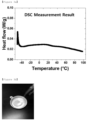
- DSC Differential Scanning Calorimeter
- FIG. 3a is a DSC graph for the solvate ionic liquid (SIL) synthesized in Preparation Example 2 of the present invention.
- FIG. 3b is a photograph showing the result of the ignition test on the solvate ionic liquid synthesized in Preparation Example 2 of the present invention.
- the synthesized SIL Li[NMAC][TFSI] was not ignited during the ignition experiment using the torch, and from this, it was confirmed that the flame retardancy was excellent.
- the mixed solution was bubbled with nitrogen for 2 minutes to remove residual oxygen from the mixed solution.
- the mixed solution from which the residual oxygen was removed was applied onto a release film (polyester film (SKC, SH71S, 100 ⁇ m)) using a pipette and thermal-cured.
- the thermal-curing method was performed in two steps as described below.
- the polymer electrolyte membrane was peeled from the release film.
- Example 1 the polymerization reaction in the manufacture of the polymer electrolyte is as shown in the following Reaction Scheme 2.
- the polymerized polymer electrolyte is shown as a schematic representation of the crosslinked form of PEGMEA (-) and RAFT agent (---).
- Example 2 The same procedure as in Example 1 was carried out, except that a polymer electrolyte was manufactured according to the composition as shown in Table 1 above using a photo-curing method. At this time, the SIL was synthesized according to the same method as Preparation Example 2, except that the SIL was synthesized so as to satisfy the composition ratio as shown in Table 1 above.
- the photo-curing method was performed in two steps as described below.
- Example 2 The same procedure as in Example 2 was carried out, except that a polymer electrolyte was manufactured according to the composition as described in Table 1 above.
- the SIL was synthesized according to the same method as Preparation Example 2, except that the SIL was synthesized so as to satisfy the composition ratio as described in Table 1 above.
- Example 2 The same procedure as in Example 1 was carried out, except that a polymer electrolyte was manufactured by photo-curing method using 2-(dodecylthiocarbonothioylthio)-2-methylpropionic acid (Sigma-Aldrich) as a RAFT agent, which is not crosslinkable.
- the SIL was synthesized according to the same method as Preparation Example 2, except that the SIL was synthesized so as to satisfy the composition ratio as described in Table 1 above.
- SIL Poly(ethylene oxide) having molecular weight of 1,000,000 (PEO, Sigma-Aldrich), NMAC, and LiTFSI were dissolved in acetonitrile (Sigma-Aldrich) to have a solid content of 10% by weight, and then solution casting was performed to prepare a polymer electrolyte membrane.
- the SIL was synthesized according to the same method as Preparation Example 2, except that the SIL was synthesized so as to satisfy the composition ratio as described in Table 1 above.
- the ionic conductivity, voltage stability, and cation transportation rate of the polymer electrolytes prepared in examples and comparative examples were measured and evaluated as follows.
- the ionic conductivity was measured by using a potentiostat, wherein the ionic conductivity was measured by applying a voltage of 10 mV in the range of 1 Hz to 5 MHz at 25 °C.
- FIG. 4 is a photograph showing a result of visually checking the form of the polymer electrolytes manufactured in Examples 1 and 3 of the present invention and Comparative Examples 1 and 2.
- Examples 1 and 3 and Comparative Example 2 are in the form of a polymer electrolyte membrane, and Comparative Example 1 is in the form of a viscous liquid without forming a polymer electrolyte membrane.
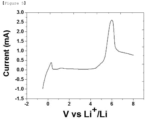
- the voltage stability was measured by using a potentiostat, wherein the voltage stability was measured at a scan rate of 5 mV/s in the range of -0.5 to 8V.
- FIG. 5 is a graph showing the measurement results of the voltage stability of the polymer electrolyte manufactured in Example 3 of the present invention.
- the cation transportation rate was obtained by applying a voltage of 10 mV and measuring the current change over 20 hours.
- the cation transportation rate (t Li + ) was calculated by the ratio of the steady state current (I s ) and the initial current amount (I 0 ) according to the following Equation (1).
- t L i + I S I 0
- the cation transportation rate of the polymer electrolyte prepared in Example 3 is 0.39.
Landscapes
- Chemical & Material Sciences (AREA)
- Engineering & Computer Science (AREA)
- Chemical Kinetics & Catalysis (AREA)
- General Chemical & Material Sciences (AREA)
- Manufacturing & Machinery (AREA)
- Electrochemistry (AREA)
- General Physics & Mathematics (AREA)
- Physics & Mathematics (AREA)
- Condensed Matter Physics & Semiconductors (AREA)
- Dispersion Chemistry (AREA)
- Inorganic Chemistry (AREA)
- Materials Engineering (AREA)
- Medicinal Chemistry (AREA)
- Health & Medical Sciences (AREA)
- Polymers & Plastics (AREA)
- Organic Chemistry (AREA)
- Secondary Cells (AREA)
- Conductive Materials (AREA)
- Addition Polymer Or Copolymer, Post-Treatments, Or Chemical Modifications (AREA)
- Macromonomer-Based Addition Polymer (AREA)
Claims (14)
- Électrolyte polymère, comprenant :un polymère comprenant un monomère comprenant des unités de répétition d'oxyde d'éthylène (EO) ;un agent de polymérisation par transfert de chaîne réversible par addition-fragmentation (agent RAFT) comprenant des groupes styrène à ses extrémités respectives ; etun liquide ionique de solvate (SIL) comprenant (a) un sel de lithium et (b) un matériau à base de glyme ou un matériau à base d'amide ; dans lequel le polymère est présent en une quantité de 40 % en poids à 60 % en poids ;l'agent RAFT est présent en une quantité de 3 % en poids à 10 % en poids ; etle SIL est présent en une quantité de 30 % en poids à 50 % en poids.
- Électrolyte polymère selon la revendication 1, dans lequel le monomère comprenant les unités de répétition d'oxyde d'éthylène est au moins un choisi parmi le groupe constitué de poly(éthylène glycol) méthyl éther acrylate (PEGMEA) et poly(éthylène glycol) méthyl éther méthacrylate (PEGMEMA).
- Électrolyte polymère selon la revendication 1, dans lequel l'agent RAFT comprend un groupe fonctionnel styrène ayant des doubles liaisons C=C à ses extrémités respectives.
- Électrolyte polymère selon la revendication 1, dans lequel l'agent RAFT est le trithiocarbonate de 3,4-divinylbenzyle (DVBTC) représenté par la formule 1 ci-dessous :

- Électrolyte polymère selon la revendication 1, dans lequel l'agent RAFT est réticulé avec le polymère.
- Électrolyte polymère selon la revendication 1, dans lequel dans le SIL, un rapport molaire du sel de lithium et du matériau à base de glyme est de 1 : 0,1 à 3, ou un rapport molaire du sel de lithium et du matériau à base d'amide est de 1 : 1 à 6.
- Électrolyte polymère selon la revendication 6, dans lequel le matériau à base de glyme est au moins un choisi parmi le groupe constitué de monoglyme, diglyme, triglyme et tétraglyme.
- Électrolyte polymère selon la revendication 6, dans lequel le matériau à base d'amide est au moins un choisi parmi le groupe constitué de N-méthylacétamide (NMAC), acétamide, N-méthylpropionamide, N-éthylacétamide, propionamide, formamide, N-méthylformamide, N-éthylformamide, N,N-diméthylformamide, N,N-diéthylformamide, N,N-diméthylacétamide et N,N-diéthylacétamide.
- Électrolyte polymère selon la revendication 6, dans lequel le sel de lithium est au moins l'un choisi parmi le groupe constitué de LiSCN, LiN(CN)2, LiClO4, LiBF4, LiAsF6, LiPF6, LiCF3SO3, LiN(SO2F)2, Li(CF3SO2)3C, LiN(SO2CF3)2, LiN (SO2CF2CF3)2, LiSbF6, LiPF3(C2F5)3, LiPF3(CF3)3, et LiB(C2O4)2.
- Électrolyte polymère selon la revendication 1, dans lequel le SIL est imprégné à l'intérieur d'une chaîne du polymère ou contenu sous une forme gonflée à l'intérieur de la chaîne du polymère.
- Électrolyte polymère selon la revendication 1, dans lequel l'électrolyte polymère est une membrane d'électrolyte polymère sous forme de réseau.
- Procédé de fabrication d'un électrolyte polymère selon la revendication 1 comprenant les étapes de :(S1) mélanged'un monomère comprenant des unités de répétition d'oxyde d'éthylène (EO),d'un agent de polymérisation par transfert de chaîne réversible par addition-fragmentation (agent RAFT) comprenant des groupes styrène à ses extrémités respectives,d'un liquide ionique de solvate (SIL) comprenant (a) un sel de lithium et (b) un matériau à base de glyme ou un matériau à base d'amide, etd'un initiateur, pour préparer une solution mélangée ;(S2) élimination de l'oxygène dans la solution mélangée obtenue à l'étape (S1) ci-dessus ; et(S3) application de la solution mélangée, dont l'oxygène a été retiré à l'étape (S2) ci-dessus, sur un substrat et durcissement du résultat.
- Procédé de fabrication de l'électrolyte polymère selon la revendication 12, dans lequel, à l'étape (S1), 40 % en poids à 60 % en poids du monomère contenant des unités de répétition d'OE ; 3 % en poids à 10 % en poids de l'agent RAFT ; 30 % en poids à 50 % en poids du SIL ; et 0,1 % en poids à 1 % en poids de l'initiateur sont mélangés.
- Batterie secondaire au lithium comprenant l'électrolyte polymère selon l'une quelconque des revendications 1 à 11.
Applications Claiming Priority (2)
| Application Number | Priority Date | Filing Date | Title |
|---|---|---|---|
| KR1020180086460A KR102244912B1 (ko) | 2018-07-25 | 2018-07-25 | 고분자 전해질 및 이의 제조방법 |
| PCT/KR2019/008106 WO2020022665A1 (fr) | 2018-07-25 | 2019-07-03 | Électrolyte polymère et son procédé de fabrication |
Publications (3)
| Publication Number | Publication Date |
|---|---|
| EP3764450A1 EP3764450A1 (fr) | 2021-01-13 |
| EP3764450A4 EP3764450A4 (fr) | 2021-06-23 |
| EP3764450B1 true EP3764450B1 (fr) | 2025-04-23 |
Family
ID=69180917
Family Applications (1)
| Application Number | Title | Priority Date | Filing Date |
|---|---|---|---|
| EP19840098.8A Active EP3764450B1 (fr) | 2018-07-25 | 2019-07-03 | Électrolyte polymère et son procédé de fabrication |
Country Status (8)
| Country | Link |
|---|---|
| US (1) | US20210028488A1 (fr) |
| EP (1) | EP3764450B1 (fr) |
| JP (1) | JP7053945B2 (fr) |
| KR (1) | KR102244912B1 (fr) |
| CN (1) | CN111886743B (fr) |
| ES (1) | ES3028095T3 (fr) |
| HU (1) | HUE071219T2 (fr) |
| WO (1) | WO2020022665A1 (fr) |
Families Citing this family (4)
| Publication number | Priority date | Publication date | Assignee | Title |
|---|---|---|---|---|
| CN114944508A (zh) * | 2021-02-17 | 2022-08-26 | 通用汽车环球科技运作有限责任公司 | 含稀释剂的不可燃溶剂化离子液体电解质 |
| WO2025091014A1 (fr) | 2023-10-27 | 2025-05-01 | Anthro Energy, Inc. | Système et procédé pour des propriétés structurelles de batterie améliorées |
| US20250329799A1 (en) * | 2024-04-19 | 2025-10-23 | Anthro Energy, Inc. | System and method for improved battery safety |
| WO2026027743A1 (fr) * | 2024-08-01 | 2026-02-05 | Solithor | Électrolyte solide et électrode pour batterie tout solide, produits par sol-gel, et leur procédé de fabrication |
Family Cites Families (10)
| Publication number | Priority date | Publication date | Assignee | Title |
|---|---|---|---|---|
| KR100232607B1 (ko) * | 1997-06-25 | 1999-12-01 | 구자홍 | 가전제품의 설계평가 방법 |
| KR101232607B1 (ko) | 2011-09-15 | 2013-02-13 | 서울대학교산학협력단 | 블록형 또는 랜덤형 유무기 복합 공중합체와 이로부터 제조된 리튬 이차전지용 고분자 전해질막 및 리튬 이차전지 |
| JP6603210B2 (ja) | 2013-05-24 | 2019-11-06 | リージェンツ オブ ザ ユニバーシティ オブ ミネソタ | ポリマー電解質膜 |
| KR20160034173A (ko) * | 2014-09-19 | 2016-03-29 | 삼성전자주식회사 | 전해질, 그 제조방법 및 이를 포함하는 리튬이차전지 |
| US10361456B2 (en) * | 2014-09-26 | 2019-07-23 | Samsung Electronics Co., Ltd. | Electrolyte, method of preparing the electrolyte, and secondary battery including the electrolyte |
| KR102466670B1 (ko) * | 2015-05-29 | 2022-11-14 | 삼성전자주식회사 | 리튬 전지용 전해질, 및 이를 포함하는 음극 및 리튬 전지 |
| KR102578822B1 (ko) | 2016-01-08 | 2023-09-15 | 삼성전자주식회사 | 리튬이차전지용 전해질 및 이를 포함하는 리튬이차전지 |
| CN108474369A (zh) | 2016-01-27 | 2018-08-31 | 三菱电机株式会社 | 压缩机 |
| KR102601602B1 (ko) | 2016-04-11 | 2023-11-14 | 삼성전자주식회사 | 복합 고체전해질, 이를 포함하는 보호음극 및 리튬 전지, 및 상기 복합 고체 전해질의 제조방법 |
| CN107154512B (zh) * | 2017-05-05 | 2019-06-18 | 华中科技大学 | 一种具有自愈合功能的聚合物电解质及其制备与应用 |
-
2018
- 2018-07-25 KR KR1020180086460A patent/KR102244912B1/ko active Active
-
2019
- 2019-07-03 US US17/040,495 patent/US20210028488A1/en active Pending
- 2019-07-03 EP EP19840098.8A patent/EP3764450B1/fr active Active
- 2019-07-03 ES ES19840098T patent/ES3028095T3/es active Active
- 2019-07-03 WO PCT/KR2019/008106 patent/WO2020022665A1/fr not_active Ceased
- 2019-07-03 JP JP2021503689A patent/JP7053945B2/ja active Active
- 2019-07-03 HU HUE19840098A patent/HUE071219T2/hu unknown
- 2019-07-03 CN CN201980018640.6A patent/CN111886743B/zh active Active
Also Published As
| Publication number | Publication date |
|---|---|
| HUE071219T2 (hu) | 2025-08-28 |
| JP7053945B2 (ja) | 2022-04-12 |
| KR102244912B1 (ko) | 2021-04-26 |
| ES3028095T3 (en) | 2025-06-18 |
| CN111886743B (zh) | 2024-07-05 |
| JP2021518048A (ja) | 2021-07-29 |
| US20210028488A1 (en) | 2021-01-28 |
| CN111886743A (zh) | 2020-11-03 |
| WO2020022665A1 (fr) | 2020-01-30 |
| EP3764450A1 (fr) | 2021-01-13 |
| EP3764450A4 (fr) | 2021-06-23 |
| KR20200011691A (ko) | 2020-02-04 |
Similar Documents
| Publication | Publication Date | Title |
|---|---|---|
| EP3001494B1 (fr) | Électrolyte, procédé de préparation de l'électrolyte et pile secondaire au lithium comprenant l'électrolyte | |
| KR100661680B1 (ko) | 비수전해질 이차 전지 | |
| CN110178258B (zh) | 用于锂二次电池的电解质和包括该电解质的锂二次电池 | |
| US12148882B2 (en) | Method for fabricating all-solid-state battery including binding electrode portions having electrolyte slurry layer together | |
| KR20160079574A (ko) | 고분자, 이를 포함하는 전해질 및 리튬이차전지 | |
| EP3955360A1 (fr) | Membrane électrolytique solide et batterie entièrement solide la comprenant | |
| KR20160034173A (ko) | 전해질, 그 제조방법 및 이를 포함하는 리튬이차전지 | |
| EP3764450B1 (fr) | Électrolyte polymère et son procédé de fabrication | |
| CN113273010A (zh) | 复合固体电解质及复合固体电解质二次电池 | |
| KR20190072968A (ko) | 금속전지용 음극, 이를 포함하는 금속전지, 및 상기 금속전지용 음극의 제조방법 | |
| KR20160118958A (ko) | 리튬이차전지용 전해질 및 이를 포함하는 리튬이차전지 | |
| WO2004057690A2 (fr) | Electrolytes polymeres reticulees et procede de fabrication de ceux-ci | |
| CN117280512A (zh) | 凝胶聚合物电解质二次电池的制造方法及由此得到的凝胶聚合物电解质二次电池 | |
| KR100462668B1 (ko) | 폴리머 전지 | |
| CN116670882A (zh) | 凝胶聚合物电解质二次电池的制造方法及由此获得的凝胶聚合物电解质二次电池 | |
| KR102680028B1 (ko) | 고분자 전해질 및 이의 제조방법 | |
| JPWO2018155713A1 (ja) | エネルギーデバイス電極用樹脂、エネルギーデバイス電極形成用組成物、エネルギーデバイス電極及びエネルギーデバイス | |
| EP3758107A1 (fr) | Procédé de fabrication d'électrode comprenant un électrolyte solide polymère, et électrode fabriquée à l'aide de celui-ci | |
| JP2003518709A (ja) | ポリマーゲル電解質 | |
| KR102268183B1 (ko) | 고분자 전해질 및 이의 제조방법 | |
| KR102763143B1 (ko) | 고분자 전해질 및 이의 제조방법 | |
| KR102253763B1 (ko) | 치밀한 구조를 가지는 이차전지 용 고체상 복합 전해질 막 제조방법 | |
| KR102254814B1 (ko) | 이차전지의 제조방법 및 이에 따라 제조된 이차전지 | |
| KR20170120897A (ko) | 유기전해액 및 이를 포함하는 리튬전지 | |
| JP6631363B2 (ja) | 負極活物質、負極活物質を含む負極及び負極を含むリチウムイオン二次電池 |
Legal Events
| Date | Code | Title | Description |
|---|---|---|---|
| STAA | Information on the status of an ep patent application or granted ep patent |
Free format text: STATUS: THE INTERNATIONAL PUBLICATION HAS BEEN MADE |
|
| PUAI | Public reference made under article 153(3) epc to a published international application that has entered the european phase |
Free format text: ORIGINAL CODE: 0009012 |
|
| STAA | Information on the status of an ep patent application or granted ep patent |
Free format text: STATUS: REQUEST FOR EXAMINATION WAS MADE |
|
| 17P | Request for examination filed |
Effective date: 20201006 |
|
| AK | Designated contracting states |
Kind code of ref document: A1 Designated state(s): AL AT BE BG CH CY CZ DE DK EE ES FI FR GB GR HR HU IE IS IT LI LT LU LV MC MK MT NL NO PL PT RO RS SE SI SK SM TR |
|
| AX | Request for extension of the european patent |
Extension state: BA ME |
|
| A4 | Supplementary search report drawn up and despatched |
Effective date: 20210525 |
|
| RIC1 | Information provided on ipc code assigned before grant |
Ipc: H01M 10/0565 20100101AFI20210518BHEP Ipc: H01M 10/052 20100101ALI20210518BHEP Ipc: H01M 10/0525 20100101ALI20210518BHEP |
|
| DAV | Request for validation of the european patent (deleted) | ||
| DAX | Request for extension of the european patent (deleted) | ||
| RAP1 | Party data changed (applicant data changed or rights of an application transferred) |
Owner name: LG ENERGY SOLUTION LTD. |
|
| RAP3 | Party data changed (applicant data changed or rights of an application transferred) |
Owner name: LG ENERGY SOLUTION, LTD. |
|
| GRAP | Despatch of communication of intention to grant a patent |
Free format text: ORIGINAL CODE: EPIDOSNIGR1 |
|
| STAA | Information on the status of an ep patent application or granted ep patent |
Free format text: STATUS: GRANT OF PATENT IS INTENDED |
|
| INTG | Intention to grant announced |
Effective date: 20250115 |
|
| GRAS | Grant fee paid |
Free format text: ORIGINAL CODE: EPIDOSNIGR3 |
|
| P01 | Opt-out of the competence of the unified patent court (upc) registered |
Free format text: CASE NUMBER: APP_6318/2025 Effective date: 20250206 |
|
| GRAA | (expected) grant |
Free format text: ORIGINAL CODE: 0009210 |
|
| STAA | Information on the status of an ep patent application or granted ep patent |
Free format text: STATUS: THE PATENT HAS BEEN GRANTED |
|
| AK | Designated contracting states |
Kind code of ref document: B1 Designated state(s): AL AT BE BG CH CY CZ DE DK EE ES FI FR GB GR HR HU IE IS IT LI LT LU LV MC MK MT NL NO PL PT RO RS SE SI SK SM TR |
|
| REG | Reference to a national code |
Ref country code: GB Ref legal event code: FG4D |
|
| REG | Reference to a national code |
Ref country code: CH Ref legal event code: EP |
|
| REG | Reference to a national code |
Ref country code: DE Ref legal event code: R096 Ref document number: 602019069096 Country of ref document: DE |
|
| REG | Reference to a national code |
Ref country code: IE Ref legal event code: FG4D |
|
| REG | Reference to a national code |
Ref country code: ES Ref legal event code: FG2A Ref document number: 3028095 Country of ref document: ES Kind code of ref document: T3 Effective date: 20250618 |
|
| PGFP | Annual fee paid to national office [announced via postgrant information from national office to epo] |
Ref country code: GB Payment date: 20250624 Year of fee payment: 7 |
|
| PGFP | Annual fee paid to national office [announced via postgrant information from national office to epo] |
Ref country code: BE Payment date: 20250512 Year of fee payment: 7 |
|
| PGFP | Annual fee paid to national office [announced via postgrant information from national office to epo] |
Ref country code: FR Payment date: 20250624 Year of fee payment: 7 |
|
| PGFP | Annual fee paid to national office [announced via postgrant information from national office to epo] |
Ref country code: HU Payment date: 20250721 Year of fee payment: 7 |
|
| REG | Reference to a national code |
Ref country code: NL Ref legal event code: MP Effective date: 20250423 |
|
| REG | Reference to a national code |
Ref country code: HU Ref legal event code: AG4A Ref document number: E071219 Country of ref document: HU |
|
| PG25 | Lapsed in a contracting state [announced via postgrant information from national office to epo] |
Ref country code: NL Free format text: LAPSE BECAUSE OF FAILURE TO SUBMIT A TRANSLATION OF THE DESCRIPTION OR TO PAY THE FEE WITHIN THE PRESCRIBED TIME-LIMIT Effective date: 20250423 |
|
| REG | Reference to a national code |
Ref country code: AT Ref legal event code: MK05 Ref document number: 1788709 Country of ref document: AT Kind code of ref document: T Effective date: 20250423 |
|
| PG25 | Lapsed in a contracting state [announced via postgrant information from national office to epo] |
Ref country code: FI Free format text: LAPSE BECAUSE OF FAILURE TO SUBMIT A TRANSLATION OF THE DESCRIPTION OR TO PAY THE FEE WITHIN THE PRESCRIBED TIME-LIMIT Effective date: 20250423 Ref country code: PT Free format text: LAPSE BECAUSE OF FAILURE TO SUBMIT A TRANSLATION OF THE DESCRIPTION OR TO PAY THE FEE WITHIN THE PRESCRIBED TIME-LIMIT Effective date: 20250825 |
|
| PGFP | Annual fee paid to national office [announced via postgrant information from national office to epo] |
Ref country code: ES Payment date: 20250822 Year of fee payment: 7 |
|
| PGFP | Annual fee paid to national office [announced via postgrant information from national office to epo] |
Ref country code: DE Payment date: 20250624 Year of fee payment: 7 |
|
| REG | Reference to a national code |
Ref country code: LT Ref legal event code: MG9D |
|
| PG25 | Lapsed in a contracting state [announced via postgrant information from national office to epo] |
Ref country code: NO Free format text: LAPSE BECAUSE OF FAILURE TO SUBMIT A TRANSLATION OF THE DESCRIPTION OR TO PAY THE FEE WITHIN THE PRESCRIBED TIME-LIMIT Effective date: 20250723 Ref country code: GR Free format text: LAPSE BECAUSE OF FAILURE TO SUBMIT A TRANSLATION OF THE DESCRIPTION OR TO PAY THE FEE WITHIN THE PRESCRIBED TIME-LIMIT Effective date: 20250724 |
|
| PG25 | Lapsed in a contracting state [announced via postgrant information from national office to epo] |
Ref country code: PL Free format text: LAPSE BECAUSE OF FAILURE TO SUBMIT A TRANSLATION OF THE DESCRIPTION OR TO PAY THE FEE WITHIN THE PRESCRIBED TIME-LIMIT Effective date: 20250423 |
|
| PG25 | Lapsed in a contracting state [announced via postgrant information from national office to epo] |
Ref country code: BG Free format text: LAPSE BECAUSE OF FAILURE TO SUBMIT A TRANSLATION OF THE DESCRIPTION OR TO PAY THE FEE WITHIN THE PRESCRIBED TIME-LIMIT Effective date: 20250423 |
|
| PG25 | Lapsed in a contracting state [announced via postgrant information from national office to epo] |
Ref country code: HR Free format text: LAPSE BECAUSE OF FAILURE TO SUBMIT A TRANSLATION OF THE DESCRIPTION OR TO PAY THE FEE WITHIN THE PRESCRIBED TIME-LIMIT Effective date: 20250423 |
|
| PG25 | Lapsed in a contracting state [announced via postgrant information from national office to epo] |
Ref country code: AT Free format text: LAPSE BECAUSE OF FAILURE TO SUBMIT A TRANSLATION OF THE DESCRIPTION OR TO PAY THE FEE WITHIN THE PRESCRIBED TIME-LIMIT Effective date: 20250423 |
|
| PG25 | Lapsed in a contracting state [announced via postgrant information from national office to epo] |
Ref country code: RS Free format text: LAPSE BECAUSE OF FAILURE TO SUBMIT A TRANSLATION OF THE DESCRIPTION OR TO PAY THE FEE WITHIN THE PRESCRIBED TIME-LIMIT Effective date: 20250723 |
|
| PG25 | Lapsed in a contracting state [announced via postgrant information from national office to epo] |
Ref country code: IS Free format text: LAPSE BECAUSE OF FAILURE TO SUBMIT A TRANSLATION OF THE DESCRIPTION OR TO PAY THE FEE WITHIN THE PRESCRIBED TIME-LIMIT Effective date: 20250823 |
|
| PG25 | Lapsed in a contracting state [announced via postgrant information from national office to epo] |
Ref country code: LV Free format text: LAPSE BECAUSE OF FAILURE TO SUBMIT A TRANSLATION OF THE DESCRIPTION OR TO PAY THE FEE WITHIN THE PRESCRIBED TIME-LIMIT Effective date: 20250423 |
|
| PG25 | Lapsed in a contracting state [announced via postgrant information from national office to epo] |
Ref country code: SM Free format text: LAPSE BECAUSE OF FAILURE TO SUBMIT A TRANSLATION OF THE DESCRIPTION OR TO PAY THE FEE WITHIN THE PRESCRIBED TIME-LIMIT Effective date: 20250423 Ref country code: DK Free format text: LAPSE BECAUSE OF FAILURE TO SUBMIT A TRANSLATION OF THE DESCRIPTION OR TO PAY THE FEE WITHIN THE PRESCRIBED TIME-LIMIT Effective date: 20250423 |
|
| PG25 | Lapsed in a contracting state [announced via postgrant information from national office to epo] |
Ref country code: CZ Free format text: LAPSE BECAUSE OF FAILURE TO SUBMIT A TRANSLATION OF THE DESCRIPTION OR TO PAY THE FEE WITHIN THE PRESCRIBED TIME-LIMIT Effective date: 20250423 |
|
| PG25 | Lapsed in a contracting state [announced via postgrant information from national office to epo] |
Ref country code: EE Free format text: LAPSE BECAUSE OF FAILURE TO SUBMIT A TRANSLATION OF THE DESCRIPTION OR TO PAY THE FEE WITHIN THE PRESCRIBED TIME-LIMIT Effective date: 20250423 |
|
| REG | Reference to a national code |
Ref country code: DE Ref legal event code: R097 Ref document number: 602019069096 Country of ref document: DE |
|
| PG25 | Lapsed in a contracting state [announced via postgrant information from national office to epo] |
Ref country code: SK Free format text: LAPSE BECAUSE OF FAILURE TO SUBMIT A TRANSLATION OF THE DESCRIPTION OR TO PAY THE FEE WITHIN THE PRESCRIBED TIME-LIMIT Effective date: 20250423 Ref country code: RO Free format text: LAPSE BECAUSE OF FAILURE TO SUBMIT A TRANSLATION OF THE DESCRIPTION OR TO PAY THE FEE WITHIN THE PRESCRIBED TIME-LIMIT Effective date: 20250423 |
|
| PG25 | Lapsed in a contracting state [announced via postgrant information from national office to epo] |
Ref country code: IT Free format text: LAPSE BECAUSE OF FAILURE TO SUBMIT A TRANSLATION OF THE DESCRIPTION OR TO PAY THE FEE WITHIN THE PRESCRIBED TIME-LIMIT Effective date: 20250423 |
|
| REG | Reference to a national code |
Ref country code: CH Ref legal event code: H13 Free format text: ST27 STATUS EVENT CODE: U-0-0-H10-H13 (AS PROVIDED BY THE NATIONAL OFFICE) Effective date: 20260224 |
|
| PLBE | No opposition filed within time limit |
Free format text: ORIGINAL CODE: 0009261 |
|
| STAA | Information on the status of an ep patent application or granted ep patent |
Free format text: STATUS: NO OPPOSITION FILED WITHIN TIME LIMIT |
|
| REG | Reference to a national code |
Ref country code: CH Ref legal event code: L10 Free format text: ST27 STATUS EVENT CODE: U-0-0-L10-L00 (AS PROVIDED BY THE NATIONAL OFFICE) Effective date: 20260304 |
|
| PG25 | Lapsed in a contracting state [announced via postgrant information from national office to epo] |
Ref country code: LU Free format text: LAPSE BECAUSE OF NON-PAYMENT OF DUE FEES Effective date: 20250703 |
|
| 26N | No opposition filed |
Effective date: 20260126 |
|
| PG25 | Lapsed in a contracting state [announced via postgrant information from national office to epo] |
Ref country code: CH Free format text: LAPSE BECAUSE OF NON-PAYMENT OF DUE FEES Effective date: 20250731 |