EP3764686A1 - Coordination de communication et atténuation de collisions pour dispositifs de module d'identité multi-abonnés - Google Patents
Coordination de communication et atténuation de collisions pour dispositifs de module d'identité multi-abonnés Download PDFInfo
- Publication number
- EP3764686A1 EP3764686A1 EP20184524.5A EP20184524A EP3764686A1 EP 3764686 A1 EP3764686 A1 EP 3764686A1 EP 20184524 A EP20184524 A EP 20184524A EP 3764686 A1 EP3764686 A1 EP 3764686A1
- Authority
- EP
- European Patent Office
- Prior art keywords
- sim
- network
- page
- paging
- communication
- Prior art date
- Legal status (The legal status is an assumption and is not a legal conclusion. Google has not performed a legal analysis and makes no representation as to the accuracy of the status listed.)
- Granted
Links
Images

Classifications
-
- H—ELECTRICITY
- H04—ELECTRIC COMMUNICATION TECHNIQUE
- H04W—WIRELESS COMMUNICATION NETWORKS
- H04W68/00—User notification, e.g. alerting and paging, for incoming communication, change of service or the like
- H04W68/02—Arrangements for increasing efficiency of notification or paging channel
-
- H—ELECTRICITY
- H04—ELECTRIC COMMUNICATION TECHNIQUE
- H04W—WIRELESS COMMUNICATION NETWORKS
- H04W60/00—Affiliation to network, e.g. registration; Terminating affiliation with the network, e.g. de-registration
- H04W60/005—Multiple registrations, e.g. multihoming
-
- H—ELECTRICITY
- H04—ELECTRIC COMMUNICATION TECHNIQUE
- H04W—WIRELESS COMMUNICATION NETWORKS
- H04W72/00—Local resource management
- H04W72/12—Wireless traffic scheduling
- H04W72/1215—Wireless traffic scheduling for collaboration of different radio technologies
-
- H—ELECTRICITY
- H04—ELECTRIC COMMUNICATION TECHNIQUE
- H04W—WIRELESS COMMUNICATION NETWORKS
- H04W72/00—Local resource management
- H04W72/50—Allocation or scheduling criteria for wireless resources
- H04W72/56—Allocation or scheduling criteria for wireless resources based on priority criteria
- H04W72/566—Allocation or scheduling criteria for wireless resources based on priority criteria of the information or information source or recipient
-
- H—ELECTRICITY
- H04—ELECTRIC COMMUNICATION TECHNIQUE
- H04W—WIRELESS COMMUNICATION NETWORKS
- H04W68/00—User notification, e.g. alerting and paging, for incoming communication, change of service or the like
- H04W68/12—Inter-network notification
-
- H—ELECTRICITY
- H04—ELECTRIC COMMUNICATION TECHNIQUE
- H04W—WIRELESS COMMUNICATION NETWORKS
- H04W8/00—Network data management
- H04W8/18—Processing of user or subscriber data, e.g. subscribed services, user preferences or user profiles; Transfer of user or subscriber data
- H04W8/183—Processing at user equipment or user record carrier
-
- H—ELECTRICITY
- H04—ELECTRIC COMMUNICATION TECHNIQUE
- H04W—WIRELESS COMMUNICATION NETWORKS
- H04W88/00—Devices specially adapted for wireless communication networks, e.g. terminals, base stations or access point devices
- H04W88/02—Terminal devices
- H04W88/06—Terminal devices adapted for operation in multiple networks or having at least two operational modes, e.g. multi-mode terminals
Definitions
- the present application relates to wireless communications, and more particularly to systems, apparatuses, and methods for coordinating communication and avoiding and/or mitigating collisions for multi-subscriber identity module devices in a wireless communication system.
- Wireless communication systems are rapidly growing in usage.
- wireless devices such as smart phones and tablet computers have become increasingly sophisticated.
- mobile devices i.e., user equipment devices or UEs
- GPS global positioning system
- wireless communication standards include GSM, UMTS (associated with, for example, WCDMA or TD-SCDMA air interfaces), LTE, LTE Advanced (LTE-A), HSPA, 3GPP2 CDMA2000 (e.g., 1xRTT, 1xEV-DO, HRPD, eHRPD), IEEE 802.11 (WLAN or Wi-Fi), BLUETOOTHTM, etc.
- UEs user equipment devices
- wireless devices such as cellular phones, base stations and relay stations used in wireless cellular communications.
- some UEs may include multiple subscriber identity modules (SIMs) which may be active concurrently.
- SIMs subscriber identity modules
- collisions may occur between transmissions to such UEs associated with different SIMs.
- Such collisions may negatively impact user experience and performance of the UE.
- increasing the functionality of a UE device can place a significant strain on the battery life of the UE device. For example, certain paging schedules for different SIMs may require increased power use. Thus, it is very important to also reduce power requirements in UE device designs while allowing the UE device to maintain good transmit and receive abilities for improved communications.
- wireless communication technologies under development including fifth generation (5G) new radio (NR) communication. Accordingly, improvements in the field in support of such development and design are desired.
- 5G fifth generation
- NR new radio
- Embodiments are presented herein of apparatuses, systems, and methods for coordinating communication and avoiding and/or mitigating collisions for multi-subscriber identity module (MUSIM) devices in a wireless communication system.
- MUSIM multi-subscriber identity module
- a MUSIM device may determine which SIMs are active and may determine networks associated with the active SIMs.
- the MUSIM device may detect potential collisions and/or other uncoordinated communications among the various SIMs.
- the MUSIM device may coordinate communication in order to avoid collisions and/or otherwise improve communication schedules to improve performance and/or reduce energy use.
- the MUSIM device may mitigate some collisions, e.g., by prioritizing communications according to various decision rules.
- the MUSIM device may communicate with one or more base stations according to the coordination and mitigation.
- a network may provide information to a MUSIM device in order enable the MUSIM device to detect collisions and uncoordinated communication. Further, the network may provide information to the MUSIM device to enable the MUSIM device to mitigate collisions, e.g., by providing priority information and paging repetition patterns and information. Further, the network may adjust one or more paging schedules and/or approaches for delivering commercial mobile alert system messages based on information received from a MUSIM device in order to improve coordination of communications.
- the techniques described herein may be implemented in and/or used with a number of different types of devices, including but not limited to base stations, access points, cellular phones, portable media players, tablet computers, wearable devices, and various other computing devices.
- Figure 1 illustrates an exemplary (and simplified) wireless communication system in which aspects of this disclosure may be implemented, according to some embodiments. It is noted that the system of Figure 1 is merely one example of a possible system, and embodiments may be implemented in any of various systems, as desired.
- the exemplary wireless communication system includes a base station 102 which communicates over a transmission medium with one or more (e.g., an arbitrary number of) user devices 106A, 106B, etc. through 106N.
- Each of the user devices may be referred to herein as a "user equipment” (UE) or UE device.
- UE user equipment
- the user devices 106 are referred to as UEs or UE devices.
- the base station 102 may be a base transceiver station (BTS) or cell site, and may include hardware and/or software that enables wireless communication with the UEs 106A through 106N. If the base station 102 is implemented in the context of LTE, it may alternately be referred to as an 'eNodeB' or 'eNB'. If the base station 102 is implemented in the context of 5G NR, it may alternately be referred to as a 'gNodeB' or 'gNB'. The base station 102 may also be equipped to communicate with a network 100 (e.g., a core network of a cellular service provider, a telecommunication network such as a public switched telephone network (PSTN), and/or the Internet, among various possibilities).
- PSTN public switched telephone network
- the base station 102 may facilitate communication among the user devices and/or between the user devices and the network 100.
- the communication area (or coverage area) of the base station may be referred to as a "cell.”
- a base station may sometimes be considered as representing the network insofar as uplink and downlink communications of the UE are concerned.
- a UE communicating with one or more base stations in the network may also be interpreted as the UE communicating with the network.
- the base station 102 and the user devices may be configured to communicate over the transmission medium using any of various radio access technologies (RATs), also referred to as wireless communication technologies, or telecommunication standards, such as GSM, UMTS (WCDMA), LTE, LTE-Advanced (LTE-A), LAA/LTE-U, 5G NR, 3GPP2 CDMA2000 (e.g., 1xRTT, 1xEV-DO, HRPD, eHRPD), Wi-Fi, etc.
- RATs radio access technologies
- GSM Global System for Mobile communications
- WCDMA UMTS
- LTE LTE-Advanced
- LAA/LTE-U LAA/LTE-U
- 5G NR 5G NR
- 3GPP2 CDMA2000 e.g., 1xRTT, 1xEV-DO, HRPD, eHRPD
- Wi-Fi Wi-Fi
- Base station 102 and other similar base stations operating according to the same or a different cellular communication standard may thus be provided as one or more networks of cells, which may provide continuous or nearly continuous overlapping service to UE 106 and similar devices over a geographic area via one or more cellular communication standards.
- a UE 106 may be capable of communicating using multiple wireless communication standards.
- a UE 106 might be configured to communicate using either or both of a 3GPP cellular communication standard or a 3GPP2 cellular communication standard.
- the UE 106 might also or alternatively be configured to communicate using WLAN, BLUETOOTHTM, one or more global navigational satellite systems (GNSS, e.g., GPS or GLONASS), one and/or more mobile television broadcasting standards (e.g., ATSC-M/H), etc.
- GNSS global navigational satellite systems
- ATSC-M/H mobile television broadcasting standards
- the UE 106 may be configured to coordinate communications and avoid or mitigate collisions associated with different identities, at least according to the various methods as described herein.
- FIG. 2 illustrates an exemplary user equipment 106 (e.g., one of the devices 106A through 106N) in communication with the base station 102, according to some embodiments.
- the UE 106 may be a device with wireless network connectivity such as a mobile phone, a hand-held device, a wearable device, a computer or a tablet, or virtually any type of wireless device.
- the UE 106 may include a processor (processing element) that is configured to execute program instructions stored in memory. The UE 106 may perform any of the method embodiments described herein by executing such stored instructions.
- the UE 106 may include a programmable hardware element such as an FPGA (field-programmable gate array), an integrated circuity, and/or any of various other possible hardware components that are configured to perform (e.g., individually or in combination) any of the method embodiments described herein, or any portion of any of the method embodiments described herein.
- the UE 106 may be configured to communicate using any of multiple wireless communication protocols. For example, the UE 106 may be configured to communicate using two or more of CDMA2000, LTE, LTE-A, 5G NR, WLAN, or GNSS. Other combinations of wireless communication standards are also possible.
- the UE 106 may include one or more antennas for communicating using one or more wireless communication protocols according to one or more RAT standards. In some embodiments, the UE 106 may share one or more parts of a receive chain and/or transmit chain between multiple wireless communication standards.
- the shared radio may include a single antenna, or may include multiple antennas (e.g., for MIMO) for performing wireless communications.
- a radio may include any combination of a baseband processor, analog RF signal processing circuitry (e.g., including filters, mixers, oscillators, amplifiers, etc.), or digital processing circuitry (e.g., for digital modulation as well as other digital processing). Similarly, the radio may implement one or more receive and transmit chains using the aforementioned hardware.
- the UE 106 may include separate transmit and/or receive chains (e.g., including separate antennas and other radio components) for each wireless communication protocol with which it is configured to communicate.
- the UE 106 may include one or more radios that are shared between multiple wireless communication protocols, and one or more radios that are used exclusively by a single wireless communication protocol.
- the UE 106 may include a shared radio for communicating using either of LTE or CDMA2000 1xRTT (or LTE or NR, or LTE or GSM or WCDMA), and separate radios for communicating using each of Wi-Fi and BLUETOOTHTM. Other configurations are also possible.
- the UE 106 may include multiple subscriber identity modules (SIMs, sometimes referred to as SIM cards).
- SIMs subscriber identity modules
- MUSIM multi-SIM
- Any of the various SIMs may be physical SIMs (e.g., SIM cards) or embedded (e.g., virtual) SIMs. Any combination of physical and/or virtual SIMs may be included.
- Each SIM may provide various services (e.g., packet switched and/or circuit switched services) to the user.
- UE 106 may share common receive (Rx) and/or transmit (Tx) chains for multiple SIMs (e.g., UE 106 may have a dual SIM dual standby architecture).
- Rx receive
- Tx transmit
- Other architectures are possible.
- UE 106 may be a dual SIM dual active architecture, may include separate Tx and/or Rx chains for the various SIMs, may include more than two SIMs, etc.
- the different identities may have different identifiers, e.g., different UE identities (UE IDs).
- UE IDs e.g., different UE identities
- IMSI international mobile subscriber identity
- IMEI international mobile equipment identity
- IMSI and/or IMEI may be examples of possible UE IDs, however other identifiers may be used as UE ID.
- the different identities may have the same or different relationships to various public land mobile networks (PLMNs). For example, a first identity may have a first home PLMN, while a second identity may have a different home PLMN. In such cases, one identity may be camped on a home network (e.g., on a cell provided by BS 102) while another identity may be roaming (e.g., while also camped on the same cell provided by BS 102, or a different cell provided by the same or different BS 102). In other circumstances, multiple identities may be concurrently home (e.g., on the same or different cells of the same or different networks) or may be concurrently roaming (e.g., on the same or different cells of the same or different networks).
- PLMNs public land mobile networks
- SIM-A may be roaming into SIM-B's network (SIM-A CMCC user roaming into AT&T and SIM-B is also AT&T).
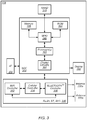
- FIG. 3 illustrates a block diagram of an exemplary UE 106, according to some embodiments.
- the UE 106 may include a system on chip (SOC) 300, which may include portions for various purposes.
- the SOC 300 may include processor(s) 302 which may execute program instructions for the UE 106 and display circuitry 304 which may perform graphics processing and provide display signals to the display 360.
- the processor(s) 302 may also be coupled to memory management unit (MMU) 340, which may be configured to receive addresses from the processor(s) 302 and translate those addresses to locations in memory (e.g., memory 306, read only memory (ROM) 350, NAND flash memory 310) and/or to other circuits or devices, such as the display circuitry 304, radio 330, connector I/F 320, and/or display 360.
- MMU memory management unit
- the MMU 340 may be configured to perform memory protection and page table translation or set up. In some embodiments, the MMU 340 may be included as a portion of the processor(s) 302.
- the SOC 300 may be coupled to various other circuits of the UE 106.
- the UE 106 may include various types of memory (e.g., including NAND flash 310), a connector interface 320 (e.g., for coupling to a computer system, dock, charging station, etc.), the display 360, and wireless communication circuitry 330 (e.g., for LTE, LTE-A, NR, CDMA2000, BLUETOOTHTM, Wi-Fi, GPS, etc.).
- the UE device 106 may include at least one antenna (e.g. 335a), and possibly multiple antennas (e.g. illustrated by antennas 335a and 335b), for performing wireless communication with base stations and/or other devices.
- Antennas 335a and 335b are shown by way of example, and UE device 106 may include fewer or more antennas. Overall, the one or more antennas are collectively referred to as antenna 335. For example, the UE device 106 may use antenna 335 to perform the wireless communication with the aid of radio circuitry 330. As noted above, the UE may be configured to communicate wirelessly using multiple wireless communication standards in some embodiments.
- the UE 106 may include hardware and software components for implementing methods and embodiments.
- the processor(s) 302 of the UE device 106 may be configured to implement part or all of the methods described herein, e.g., by executing program instructions stored on a memory medium (e.g., a non-transitory computer-readable memory medium).
- processor(s) 302 may be configured as a programmable hardware element, such as an FPGA (Field Programmable Gate Array), or as an ASIC (Application Specific Integrated Circuit).
- processor(s) 302 may be coupled to and/or may interoperate with other components as shown in Figure 3 , to perform communication according to various embodiments disclosed herein. For example, processor(s) 302 may cause UE 106 to avoid and/or mitigate collisions between transmissions associated with different SIMs. Processor(s) 302 may also implement various other applications and/or end-user applications running on UE 106.
- radio 330 may include separate controllers dedicated to controlling communications for various respective RAT standards.
- radio 330 may include a Wi-Fi controller 332, a cellular controller (e.g. NR controller) 334, and BLUETOOTHTM controller 336, and in at least some embodiments, one or more or all of these controllers may be implemented as respective integrated circuits (ICs or chips, for short) in communication with each other and with SOC 300 (and more specifically with processor(s) 302).
- Wi-Fi controller 332 may communicate with cellular controller 334 over a cell-ISM link or WCI interface
- BLUETOOTHTM controller 336 may communicate with cellular controller 334 over a cell-ISM link, etc.
- controllers While three separate controllers are illustrated within radio 330, other embodiments have fewer or more similar controllers for various different RATs that may be implemented in UE device 106. Any or all of such controllers may be configured to implement any of the various methods and embodiments disclosed herein, e.g., to avoid and/or mitigate collisions between transmissions associated with different SIMs.
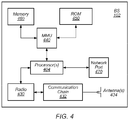
- FIG. 4 illustrates a block diagram of an exemplary base station 102, according to some embodiments. It is noted that the base station of Figure 4 is merely one example of a possible base station. As shown, the base station 102 may include processor(s) 404 which may execute program instructions for the base station 102. The processor(s) 404 may also be coupled to memory management unit (MMU) 440, which may be configured to receive addresses from the processor(s) 404 and translate those addresses to locations in memory (e.g., memory 460 and read only memory (ROM) 450) or to other circuits or devices.
- MMU memory management unit
- the base station 102 may include at least one network port 470.
- the network port 470 may be configured to couple to a telephone network and provide a plurality of devices, such as UE devices 106, access to the telephone network as described above in Figures 1 and 2 .
- the network port 470 (or an additional network port) may also or alternatively be configured to couple to a cellular network, e.g., a core network of a cellular service provider.
- the core network may provide mobility related services and/or other services to a plurality of devices, such as UE devices 106.
- the network port 470 may couple to a telephone network via the core network, and/or the core network may provide a telephone network (e.g., among other UE devices serviced by the cellular service provider).
- the base station 102 may include at least one antenna 434, and possibly multiple antennas.
- the antenna(s) 434 may be configured to operate as a wireless transceiver and may be further configured to communicate with UE devices 106 via radio 430.
- the antenna(s) 434 communicates with the radio 430 via communication chain 432.
- Communication chain 432 may be a receive chain, a transmit chain or both.
- the radio 430 may be designed to communicate via various wireless telecommunication standards, including, but not limited to, NR, LTE, LTE-A WCDMA, CDMA2000, etc.
- the processor 404 of the base station 102 may be configured to implement and/or support implementation of part or all of the methods described herein, e.g., by executing program instructions stored on a memory medium (e.g., a non-transitory computer-readable memory medium).
- the processor 404 may be configured as a programmable hardware element, such as an FPGA (Field Programmable Gate Array), or as an ASIC (Application Specific Integrated Circuit), or a combination thereof.
- base station 102 may be designed as an access point (AP), in which case network port 470 may be implemented to provide access to a wide area network and/or local area network (s), e.g. it may include at least one Ethernet port, and radio 430 may be designed to communicate according to the Wi-Fi standard.
- AP access point
- network port 470 may be implemented to provide access to a wide area network and/or local area network (s), e.g. it may include at least one Ethernet port
- radio 430 may be designed to communicate according to the Wi
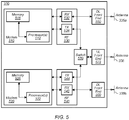
- Figure 5 illustrates an example simplified block diagram of cellular communication circuitry, according to some embodiments. It is noted that the block diagram of the cellular communication circuitry of Figure 5 is only one example of a possible cellular communication circuit; other circuits, such as circuits including or coupled to sufficient antennas for different RATs to perform uplink activities using separate antennas, are also possible. According to embodiments, cellular communication circuitry 330 may be included in a communication device, such as communication device 106 described above.
- communication device 106 may be a user equipment (UE) device, a mobile device or mobile station, a wireless device or wireless station, a desktop computer or computing device, a mobile computing device (e.g., a laptop, notebook, or portable computing device), a tablet and/or a combination of devices, among other devices.
- UE user equipment
- mobile device or mobile station e.g., a mobile device or mobile station
- wireless device or wireless station e.g., a desktop computer or computing device
- a mobile computing device e.g., a laptop, notebook, or portable computing device
- tablet e.g., a tablet and/or a combination of devices, among other devices.
- the cellular communication circuitry 330 may couple (e.g., communicatively; directly or indirectly) to one or more antennas, such as antennas 335a-b and 336 as shown (in Figure 3 ).
- cellular communication circuitry 330 may include dedicated receive chains for multiple RATs (e.g., a first receive chain for LTE and a second receive chain for 5G NR).
- Such receive chains may include and/or be communicatively coupled (e.g., directly or indirectly) to dedicated processors and/or radios.
- cellular communication circuitry 330 may include a modem 510 and a modem 520.
- Modem 510 may be configured for communications according to a first RAT, e.g., such as LTE or LTE-A, and modem 520 may be configured for communications according to a second RAT, e.g., such as 5G NR.
- a first RAT e.g., such as LTE or LTE-A
- modem 520 may be configured for communications according to a second RAT, e.g., such as 5G NR.
- modem 510 may include one or more processors 512 and a memory 516 in communication with processors 512. Modem 510 may be in communication with a radio frequency (RF) front end 530.
- RF front end 530 may include circuitry for transmitting and receiving radio signals.
- RF front end 530 may include receive circuitry (RX) 532 and transmit circuitry (TX) 534.
- receive circuitry 532 may be in communication with downlink (DL) front end 550, which may include circuitry for receiving radio signals via antenna 335a.
- DL downlink
- modem 520 may include one or more processors 522 and a memory 526 in communication with processors 522. Modem 520 may be in communication with an RF front end 540.
- RF front end 540 may include circuitry for transmitting and receiving radio signals.
- RF front end 540 may include receive circuitry 542 and transmit circuitry 544.
- receive circuitry 542 may be in communication with DL front end 560, which may include circuitry for receiving radio signals via antenna 335b.
- a switch 570 may couple transmit circuitry 534 to uplink (UL) front end 572.
- switch 570 may couple transmit circuitry 544 to UL front end 572.
- UL front end 572 may include circuitry for transmitting radio signals via antenna 336.
- switch 570 may be switched to a first state that allows modem 510 to transmit signals according to the first RAT (e.g., via a transmit chain that includes transmit circuitry 534 and UL front end 572).
- switch 570 may be switched to a second state that allows modem 520 to transmit signals according to the second RAT (e.g., via a transmit chain that includes transmit circuitry 544 and UL front end 572).
- the cellular communication circuitry 330 may be configured to transmit, via the first modem while the switch is in the first state, a request to attach to a first network node operating according to the first RAT and transmit, via the first modem while the switch is in a first state, an indication that the wireless device is capable of maintaining substantially concurrent connections with the first network node and a second network node that operates according to the second RAT.
- the wireless device may also be configured transmit, via the second radio while the switch is in a second state, a request to attach to the second network node.
- the request may include an indication that the wireless device is capable of maintaining substantially concurrent connections with the first and second network nodes.
- the wireless device may be configured to receive, via the first radio, an indication that dual connectivity with the first and second network nodes has been established.
- the modem 510 may include hardware and software components for implementing features for using multiplexing to perform transmissions according to multiple radio access technologies in the same frequency carrier, as well as the various other techniques described herein.
- the processors 512 may be configured to implement part or all of the features described herein, e.g., by executing program instructions stored on a memory medium (e.g., a non-transitory computer-readable memory medium).
- processor 512 may be configured as a programmable hardware element, such as an FPGA (Field Programmable Gate Array), or as an ASIC (Application Specific Integrated Circuit).
- the processor 512 in conjunction with one or more of the other components 530, 532, 534, 550, 570, 572, 335 and 336 may be configured to implement part or all of the features described herein.
- processor(s) 512, 522, etc. may be configured to implement or support implementation of part or all of the methods described herein, e.g., by executing program instructions stored on a memory medium (e.g., a non-transitory computer-readable memory medium).
- the processor(s) 512, 522, etc. may be configured as a programmable hardware element, such as an FPGA, or as an ASIC, or a combination thereof.
- processor(s) 512, 522, etc. may include one or more processing elements.
- processor(s) 512, 522, etc. may include one or more integrated circuits (ICs) that are configured to perform the functions of processor(s) 512, 522, etc.
- each integrated circuit may include circuitry (e.g., first circuitry, second circuitry, etc.) configured to perform the functions of processor(s) 512, 522, etc.
- the modem 520 may include hardware and software components for implementing features for using multiplexing to perform transmissions according to multiple radio access technologies in the same frequency carrier, as well as the various other techniques described herein.
- the processors 522 may be configured to implement part or all of the features described herein, e.g., by executing program instructions stored on a memory medium (e.g., a non-transitory computer-readable memory medium).
- processor 522 may be configured as a programmable hardware element, such as an FPGA (Field Programmable Gate Array), or as an ASIC (Application Specific Integrated Circuit).
- the processor 522 in conjunction with one or more of the other components 540, 542, 544, 550, 570, 572, 335 and 336 may be configured to implement part or all of the features described herein.
- fifth generation (5G) wireless communication will initially be deployed concurrently with other wireless communication standards (e.g., LTE).
- LTE wireless communication standards
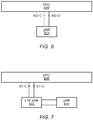
- FIG 6 illustrates a possible standalone (SA) implementation of a next generation core (NGC) network 606 and 5G NR base station (e.g., gNB 604)
- NGC next generation core
- 5G NR or NR dual connectivity between LTE and 5G new radio
- NSA non-standalone
- EPC evolved packet core
- EPC evolved packet core
- eNB 602 may be in communication with a 5G NR base station (e.g., gNB 604) and may pass data between the EPC network 600 and gNB 604.
- the gNB 604 may also have at least a user plane reference point with EPC network 600.
- EPC network 600 may be used (or reused) and gNB 604 may serve as extra capacity for UEs, e.g., for providing increased downlink throughput to UEs.
- LTE may be used for control plane signaling and NR may be used for user plane signaling.
- LTE may be used to establish connections to the network and NR may be used for data services.
- numerous other non-standalone architecture variants are possible.
- a UE 106 may contain multiple SIMs, e.g., UE 106 may be a MUSIM device.
- One or more networks associated with BS 102 may not recognize that the different identities associated with the SIMs of UE 106 may belong to the same physical device (e.g., UE 106). In other words, one or more networks may treat the SIMs of UE 106 independently. Accordingly, communications to and from the various SIMs of UE 106 may not be coordinated by the network(s) and collisions and other problems associated with lack of coordination may occur. Such collisions may result in interference between the communications and missed messages such as missed pages (e.g., mobile terminated (MT) pages).
- missed pages e.g., mobile terminated (MT) pages
- a missed page may result in the UE being penalized by a network, among various possibilities. Additionally, such collisions may result in interruptions of a high priority activity (e.g., a voice call) of one SIM due to a page associated with a lower priority activity (e.g., a page indicating availability of downlink data) of another SIM. Such interruptions may degrade the user experience (e.g., may lower the throughput rate of a data transfer, etc.).
- a high priority activity e.g., a voice call
- a page associated with a lower priority activity e.g., a page indicating availability of downlink data
- collisions may occur between alert system messaging across multiple SIMs.
- alert systems include, but are not limited to: commercial mobile alert system (CMAS), earthquake & tsunami warning system (ETWS), wireless public alerting service (WPAS), etc.
- CMAS commercial mobile alert system
- EWS earthquake & tsunami warning system
- WPAS wireless public alerting service
- Such collisions may lead to interference and the UE 106 may not successfully receive and decode such alert system messages.
- the SIMs may both attempt to retrieve the alert system messages simultaneously.
- Such attempts at simultaneous retrieval may result in the SIMs competing for resources (e.g., RF circuitry, etc.) to perform the retrieval (e.g., the SIMs may each attempt to preempt the other SIMs actions).
- resources e.g., RF circuitry, etc.
- paging occasions of the various identities may be separate. Accordingly, the UE 106 may wake up to monitor paging occasions of each identity. This increased amount of monitoring may significantly increase power consumption and reduce battery life.
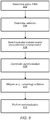
- FIG. 8 is a flow chart diagram illustrating methods of avoiding and/or mitigating coordination problems between communications associated with different SIMs, at least according to some embodiments. Aspects of the method of Figure 8 may be implemented by a wireless device, e.g., in conjunction with one or more base station, such as a UE 106 and a BS 102 illustrated in and described with respect to various of the Figures herein, or more generally in conjunction with any of the computer circuitry, systems, devices, elements, or components shown in the above Figures, among others, as desired.
- a processor (and/or other hardware) of such a device may be configured to cause the device to perform any combination of the illustrated method elements and/or other method elements.
- a UE 106 may determine what SIMs (e.g., or more generally, identities) of the device are active (802), according to some embodiments.
- the UE 106 may determine various parameters of the SIMs, e.g., home and/or preferred networks (e.g., which networks are preferred for roaming based on any subscriptions of the SIM, etc.), which if any SIM is preferred for various functions (e.g., data, voice, etc.), UE IDs, etc.
- the UE 106 may determine that one SIM is preferred for data transfers in a current location of the UE 106 based on the relative costs of data associated with subscriptions of the SIMS in that location.
- the UE 106 may determine one or more networks (e.g., PLMNs) available to each SIM (e.g., or more generally, identity) of the device (804), according to some embodiments. For example, the UE 106 may determine whether or not a home network of a first SIM is available. Similarly, the UE 106 may determine whether each (e.g., or any) SIM is camped on any network, and whether or not a network that each respective SIM is camped on is a home network (e.g., or other preferred network or a roaming network the respective, etc.). The UE 106 may determine what networks are available and whether each available network is a home, preferred, or roaming network for each SIM. The UE may determine the availability of such networks prior to registration with any of the networks and/or after the UE has registered one or more SIMs with one or more networks.
- networks e.g., PLMNs
- the UE 106 may determine one or more parameters associated with each network, e.g., based on system information transmitted by the BS 102. For example, the UE 106 may determine the paging configuration (e.g., the paging occasion(s) and related details) of the network(s). In some embodiments, the paging configuration transmitted by the BS 102 may allow the UE 106 to determine page repetition patterns of the network(s), e.g., the pattern of when and if a network will resend a page that the UE 106 does not acknowledge after a first transmission of the page.
- the paging configuration transmitted by the BS 102 may allow the UE 106 to determine page repetition patterns of the network(s), e.g., the pattern of when and if a network will resend a page that the UE 106 does not acknowledge after a first transmission of the page.
- the paging configuration may specify the number of times a page is repeated (e.g., pending a reply from the UE) and the duration between each repetition.
- the UE may be able to determine expected timing of one or more repetitions associated with a potentially missed page.
- the UE 106 may determine similar configuration information related to CMAS from the one or more networks, e.g., what time and frequency resources the BS 102 may use to transmit alert system messages and related pages to the UE 106.
- the UE 106 may detect potential collisions and/or other problems associated with lack of coordination between communications associated with each SIM (806), according to some embodiments.
- the UE 106 may detect that the paging occasions (e.g., configured discontinuous reception (DRX) parameters) associated with two or more SIMs may be uncoordinated.
- the UE may determine that the paging occasions (e.g., DRX cycles) potentially cause the UE to monitor paging associated with the different SIMs on different time and/or frequency resources.
- the UE may have limited sleep (e.g., DRX off) time and therefore may use battery energy more rapidly than if the paging occasions of the different SIMs were coordinated.
- the UE 106 may detect collisions between paging occasions of different SIMs. For example, the UE 106 may determine that the paging occasions of different SIMs at the same time.
- the UE 106 may recognize possible collisions between alert system messages associated with different SIMs.
- the UE may recognize that the BS 102 (or multiple BS 102s) may send multiple (e.g., related, e.g., associated with the same underlying alert) alert system messages to the UE at the same time, and as a result that the UE 106 may not successfully receive such alert system messages.
- the UE 106 may detect a collision between an activity of first SIM and a page (or other activity) for a second SIM.
- the UE may determine various parameters of the activity and the page or other activity. For example, the UE may determine a priority level associated with the activity for the first SIM, e.g., a voice call may have a high priority level.
- the UE may determine a priority level associated with the page.
- the page may include a paging cause field (or other indicator of an activity with which the page is associated).
- a paging cause field may explicitly or implicitly indicate to a UE whether activity associated with the page is of a relatively high or low priority.
- a page indicating downlink data access (e.g., via such a cause field or other indicator) may be consider a low priority level, among various possibilities.
- the UE 106 may (e.g., in cooperation with the network, e.g. BS 102) coordinate communications associated with different SIMs (808), according to some embodiments.
- the UE 106 may provide a coordination request and/or relevant information to one or more networks associated with one or more of the SIMs.
- Such a coordination request and/or information may indicate to one or more of the networks to adjust upcoming communications (e.g., a paging schedule, provision of alert system messages, etc.) to the UE 106 to avoid a potential collision between communications associated with the different SIMs.
- the coordination request may be based on the potential collision.
- the UE 106 may inform a network that it is a MUSIM device and/or provide a list of UE IDs (e.g., UE ID 1 associated with a first SIM and UE ID 2 associated with a second SIM) on which it may receive pages.
- the UE 106 may indicate a preferred UE ID (e.g., UE ID 1) for receiving pages.
- the UE 106 may transmit a coordination request to the network to provide pages for UE ID 2 on paging occasions for UE ID 1.
- the UE 106 may provide this information to the network upon initial registration (of one or both SIMs) or at any later time or even as a response to a request from the NW to provide such information.
- the UE 106 may include the information in a registration request transmitted to BS 102, which the BS 102 may relay to a core NW element.
- This first coordination example may be particularly useful in scenarios in which two or more SIMs of the UE are camped on the same network (e.g., in some cases of the first detection example, described above). Similarly, this first coordination example may be useful in the case of RAN sharing such that multiple identities of the UE may be camped on different networks provided by the same base station.
- the BS 102 e.g., or other network device
- the BS 102 when it receives (from a network element) a page for the SIM associated with UE ID 2, it may transmit the page on time/frequency resources corresponding to a paging occasion associated with UE ID 1.
- the BS 102 may include an identifier in the page indication identifying the page as a page for UE ID 2.
- the BS 102 may transmit pages for UE ID 1 on resources associated with a paging occasion for UE ID 1, and may include an identifier indicating the page is for UE ID 1.
- the UE 106 may only monitor paging occasions (e.g., DRX on durations) associated with UE ID 1.
- the UE 106 may process it normally, e.g., using the first SIM.
- the UE 106 may internally forward the received page to the second SIM, e.g., or a processing element associated with the second SIM.
- the UE 106 may then proceed with normal page processing, e.g., using the second SIM.
- the UE 106 may identify which SIM the page is associated with and may provide the page to a processing element or stack executing operations for the relevant SIM (e.g., UE ID 1 or UE ID 2).
- the UE 106 may avoid unnecessary tuneaways (e.g., interrupting an activity of the first SIM) or on durations for page monitoring for UE ID 2.
- a page to the SIM associated with UE ID 2 may be transmitted via a link/cell associated with the SIM associated with UE ID 1. However, the page may be transmitted in the paging occasion determined based on UE ID 2.
- the UE 106 may transmit a coordination request to a network in order to alter a paging occasion of first SIM in order to coordinate with a paging occasion of a second SIM.
- This approach may be useful in scenarios where the various SIMs are camped on different networks or base stations. For example, this approach may be useful if the UE detects a potential collision between the paging occasions of the two SIMs (e.g., the second detection example). Further, this approach may be useful in scenarios where the UE detects that the paging occasions are staggered in such a way as to increase the UE's power consumption relative to a coordinated paging schedule (e.g., the first detection example).
- the UE may request to alter one paging occasion to be (e.g., immediately) before or after the other paging occasion.
- the UE 106 may request to alter the paging occasions so that they occur at the same time but on frequencies that the UE 106 may simultaneously monitor.
- the UE may be able to sequentially monitor the two paging occasions (e.g., during a single DRX on period), and then power off some communication circuitry (e.g., for a DRX off period).
- the UE 106 may request to the network to provide an offset to the pre-calculated paging occasion of the first SIM, e.g., to shift the paging occasion by an amount of time equal to the offset.
- the network may determine limits on such offsets and may indicate such limits as part of paging configuration information, in response to a query from UE 106, and/or in response to a request from UE 106 to alter is paging occasion (e.g., requesting an offset larger than the maximum offset limit).
- the UE 106 may (e.g., additionally or alternatively) provide an indication to the network of the paging occasion of the second SIM.
- the UE may provide information to the network associated with the first SIM so that the network may determine and provide a collision free paging configuration (e.g., and coordinated DRX parameters) for the first SIM.
- the network may be aware of and minimize the potential for tuneaways.
- Such a request to alter a paging occasion (e.g., DRX, etc.) may be transmitted from the UE to the network using radio resource control (RRC) signaling, among various possibilities.
- RRC radio resource control
- the UE 106 may transmit a coordination request including an indication to one or more networks regarding how or if that network should transmit alert system messages to the UE and/or may determine which SIM to use to retrieve alert system messages.
- an indication may allow the network(s) to implement a standardized approach to avoid alert system collisions to MUSIM devices.
- the UE 106 may autonomously determine which SIM to use to retrieve a alert system messages based on the following possible decision rules. In such embodiments, the UE 106 may or may not indicate to the network(s) which SIM may be used to retrieve alert system messages.
- the UE 106 may indicate to a first network that a second network has been selected to retrieve alert system messages and that the first network may not transmit alert system messages to the UE 106. Moreover, the UE 106 may transmit an indication to one or more (e.g., all connected) networks indicating that the alert system message has been received (e.g., using the selected SIM).
- the UE may select a data preferred network or SIM to retrieve alert system messages. For example, if two SIMs are camped on their respective home networks, the UE 106 may determine to use a data preferred SIM to retrieve alert system messages, according to some embodiments. Thus, the UE 106 may indicate to one or both of the networks that the UE 106 will retrieve alert system messages of a network that is associated with a data preferred SIM. Thus, the other network may not provide alert system messages to the other SIM.
- the UE 106 may determine to use a home network (e.g., rather than a roaming network) to retrieve alert system messages. For example, if a first SIM is camped on a home network and the second SIM is roaming, the UE may determine to retrieve alert system messages via the home network, according to some embodiments. Thus, the UE 106 may indicate to one or both networks that the home network (and corresponding first SIM) may be used to retrieve alert system messages and/or that alert system messages to the second SIM (e.g., over the roaming network) may not be retrieved. Thus, the roaming network may not provide alerts to the second SIM.
- a home network e.g., rather than a roaming network
- the UE may determine to retrieve alert system messages via the connected SIM (e.g., regardless of whether the SIMS are connected to the same or different networks), according to some embodiments.
- the UE 106 may indicate to one or both networks that the connected SIM may be used to retrieve alert system messages and/or that alert system alerts to the idle SIM may not be retrieved.
- the network associated with the idle SIM may not provide alerts, e.g., while that SIM remains in idle mode.
- multiple SIMs of a UE 106 may be camped on a same cell, but with different mobile country code (MCC) and/or mobile network code (MNC).
- MCC mobile country code
- MNC mobile network code
- the UE 106 may select one of the SIMs based on the MCC and/or MNC to retrieve alert system messages.
- the UE 106 may indicate to one or both networks that the selected SIM may be used to retrieve alert system messages and/or that alert system messages to the unselected SIM may not be retrieved.
- the network associated with the unselected SIM may not provide alerts.
- the UE 106 may mitigate collisions between communications with different SIMs (810), according to some embodiments.
- the UE 106 may determine which SIM to prioritize in the case of a collision (e.g., a collision that is not avoided based on the coordination described above with respect to 808) between communications on one SIM and communications on another SIM. For example, based on receiving a page for a first SIM, the UE 106 may determine that responding to the page would result in a collision and thus interfere with (e.g., require a tuneaway from) ongoing communication activity of a second SIM.
- the UE 106 may select whether to continue with the activity of the second SIM or to respond to the page for the first SIM based on paging repetition pattern, a one bit indicator of whether a page will be repeated, and/or a paging cause, among various possibilities as explained further below.
- the UE 106 may consider a paging repetition pattern (e.g., as indicated in paging configuration information) of a network, according to some embodiments.
- a network may provide (e.g., potentially in response to a request from UE 106) information about how a page is repeated if a first instance of the page is not acknowledged by the UE 106.
- the paging repetition pattern may include a number of repetitions and the time interval(s) between the repetitions (e.g., a first repetition may occur 2 frames after the initial page, a second repetition will occur 3 frames later, etc., among various possibilities).
- the UE 106 may determine whether to interrupt a communication of a first SIM (e.g., tuneaway from the first SIM) in order to respond to (e.g., retrieve and decode) a page from a second SIM. For example, the UE 106 may determine based on the paging repetition pattern of a network connected to a first SIM and an expected length of an ongoing communication (e.g., transmission and/or reception) of a second SIM, whether the ongoing communication activity may be complete prior to an expected repetition. The UE 106 may determine whether or not to interrupt the ongoing communication to tuneaway for a paging occasion of the first SIM based on the comparison.
- a first SIM e.g., tuneaway from the first SIM
- the UE 106 may determine based on the paging repetition pattern of a network connected to a first SIM and an expected length of an ongoing communication (e.g., transmission and/or reception) of a second SIM, whether the ongoing communication activity may be complete prior to an expected repetition.
- the UE 106 may
- the UE 106 may compare the expected length of the ongoing communication to an expected time until a particular page repetition. If the expected length is shorter than the expected time until the repetition, the UE 106 may determine to ignore the page occasion (e.g., and not tuneaway) in order to avoid interrupting the ongoing communication. Thus, determining not to respond to the page may allow the ongoing communication to complete prior to answering the page (e.g., at the particular page repetition or a page repetition prior to the particular page repetition). The UE 106 may select the particular page repetition as desired.
- the page occasion e.g., and not tuneaway
- the UE 106 may select a particular page repetition so that a threshold number of further page repetitions are expected after the particular page repetition (e.g., to allow for the possibility that the UE 106 may miss the particular page repetition, e.g., due to factors related to or separate from the ongoing communication). For example, if the paging repetition pattern includes four expected repetitions, the UE may select the 2n d or 3 rd repetition to allow for two or one, respectively, additional chances to receive the page of the paging occasion is skipped due to the ongoing communication. The UE 106 may receive and respond to a repetition of the page at any of the expected repetitions of the page (e.g., according to the page repetition pattern).
- a network may include other paging repetition information in a page or associated with a page, and the UE 106 may use this information to select whether to continue with the activity of the second SIM or to respond to the page for the first SIM
- a BS 102 may include one bit indicator in a page to indicate whether or not the page will be repeated (e.g., a page repetition indicator).
- the UE 106 may use the indicator (e.g., instead of or in addition to paging repetition information) to determine whether to respond to a page immediately or to wait for a repetition.
- the UE 106 may use such an indicator in combination with an expected length, as described above in the first mitigation example.
- a network may include a paging cause in a page, according to some embodiments.
- the UE 106 may consider the paging cause (e.g., as indicated in a page of a first SIM) to determine a priority level (e.g., to distinguish between high and low priority) of activity associated with the page and to determine whether or not to preempt activity of a second SIM based on the page.
- the paging cause indicate a sufficiently high priority cause of the page (e.g., a priority level above a threshold)
- the UE 106 may interrupt ongoing activity of the second SIM in order to respond to the page.
- the UE 106 may interrupt a data transfer of the second SIM in order to respond to a page indicating a voice call for the first SIM. Conversely, if the paging cause does not indicate a sufficiently high priority cause of the page, the UE 106 may determine not to interrupt the activity of the second SIM, e.g., and therefore to delay responding to the page of the first SIM. In other words, the UE 106 may consider the priority of the activity of the second SIM as well as (e.g., in comparison to) the priority associated with the paging cause of the first SIM. The UE 106 may consider additional factors such as paging repetition and/or expected duration as in the first mitigation example. Further, the UE 106 may consider factors related to the networks and/or preferences associated with each SIM. For example, the UE 106 may adjust the relative priority attributed to one or more SIM based on whether the network or SIM is preferred for data, voice, etc.
- the UE 106 may consider both a paging repetition pattern and a paging cause.
- aspects of the first and second mitigation examples may be combined.
- the particular paging repetition may be selected based at least in part on a paging cause, e.g., a threshold number of page repetitions may be higher for a higher priority paging cause than for a lower priority paging cause.
- a paging cause indicates a voice call
- the UE 106 may use a higher number of page repetitions than for data availability (e.g., to ensure that the voice call is connected promptly), while allowing some time for the ongoing communication activity to complete.
- the UE 106 may communicate with BS 102 (or multiple base stations) according to the coordination and mitigation (812). This communication may include uplink and/or downlink transmissions using any or all SIMs of UE 106.
- the UE 106 and the BS 102 may coordinate according to any communication request transmitted by the UE 106 to the BS 102 (e.g., as discussed with respect to 808).
- the BS 102 and/or UE 106 may adjust one or more communication schedules to avoid any potential collisions identified (e.g., in 806).
- the UE 106 may prioritize communications (e.g., as discussed with respect to 810).
- the UE 106 and/or BS 102 may adjust various communication parameters (e.g., paging occasions, prioritizations, etc.) as needed based on changes in conditions. For example, the UE 106 may move and connect to different networks, and may thus adjust decision rules regarding tuneaways, coordination between paging schedules, etc.
- various communication parameters e.g., paging occasions, prioritizations, etc.
- the UE 106 may move and connect to different networks, and may thus adjust decision rules regarding tuneaways, coordination between paging schedules, etc.
- Embodiments of the present invention may be realized in any of various forms.
- the present invention may be realized as a computer-implemented method, a computer-readable memory medium, or a computer system.
- the present invention may be realized using one or more custom-designed hardware devices such as ASICs.
- the present invention may be realized using one or more programmable hardware elements such as FPGAs.
- a non-transitory computer-readable memory medium e.g., a non-transitory memory element
- a non-transitory computer-readable memory medium may be configured so that it stores program instructions and/or data, where the program instructions, if executed by a computer system, cause the computer system to perform a method, e.g., any of a method embodiments described herein, or, any combination of the method embodiments described herein, or, any subset of any of the method embodiments described herein, or, any combination of such subsets.
- a device e.g., a UE
- a device may be configured to include a processor (or a set of processors) and a memory medium (or memory element), where the memory medium stores program instructions, where the processor is configured to read and execute the program instructions from the memory medium, where the program instructions are executable to implement any of the various method embodiments described herein (or, any combination of the method embodiments described herein, or, any subset of any of the method embodiments described herein, or, any combination of such subsets).
- the device may be realized in any of various forms.
- personally identifiable information should follow privacy policies and practices that are generally recognized as meeting or exceeding industry or governmental requirements for maintaining the privacy of users.
- personally identifiable information data should be managed and handled so as to minimize risks of unintentional or unauthorized access or use, and the nature of authorized use should be clearly indicated to users.
Landscapes
- Engineering & Computer Science (AREA)
- Computer Networks & Wireless Communication (AREA)
- Signal Processing (AREA)
- Mobile Radio Communication Systems (AREA)
Priority Applications (1)
| Application Number | Priority Date | Filing Date | Title |
|---|---|---|---|
| EP22195497.7A EP4124128B1 (fr) | 2019-07-10 | 2020-07-07 | Coordination de communication et atténuation de collisions pour dispositifs de module d'identité multi-abonnés |
Applications Claiming Priority (2)
| Application Number | Priority Date | Filing Date | Title |
|---|---|---|---|
| CN201910620158.1A CN112218370B (zh) | 2019-07-10 | 2019-07-10 | 用于多用户身份模块设备的通信协调和冲突缓解 |
| US16/892,031 US11317375B2 (en) | 2019-07-10 | 2020-06-03 | Communication coordination and collision mitigation for multi-subscriber identity module devices |
Related Child Applications (2)
| Application Number | Title | Priority Date | Filing Date |
|---|---|---|---|
| EP22195497.7A Division EP4124128B1 (fr) | 2019-07-10 | 2020-07-07 | Coordination de communication et atténuation de collisions pour dispositifs de module d'identité multi-abonnés |
| EP22195497.7A Division-Into EP4124128B1 (fr) | 2019-07-10 | 2020-07-07 | Coordination de communication et atténuation de collisions pour dispositifs de module d'identité multi-abonnés |
Publications (2)
| Publication Number | Publication Date |
|---|---|
| EP3764686A1 true EP3764686A1 (fr) | 2021-01-13 |
| EP3764686B1 EP3764686B1 (fr) | 2023-12-13 |
Family
ID=71527581
Family Applications (2)
| Application Number | Title | Priority Date | Filing Date |
|---|---|---|---|
| EP20184524.5A Active EP3764686B1 (fr) | 2019-07-10 | 2020-07-07 | Coordination de communication et atténuation de collisions pour dispositifs de module d'identité multi-abonnés |
| EP22195497.7A Active EP4124128B1 (fr) | 2019-07-10 | 2020-07-07 | Coordination de communication et atténuation de collisions pour dispositifs de module d'identité multi-abonnés |
Family Applications After (1)
| Application Number | Title | Priority Date | Filing Date |
|---|---|---|---|
| EP22195497.7A Active EP4124128B1 (fr) | 2019-07-10 | 2020-07-07 | Coordination de communication et atténuation de collisions pour dispositifs de module d'identité multi-abonnés |
Country Status (2)
| Country | Link |
|---|---|
| US (2) | US11595942B2 (fr) |
| EP (2) | EP3764686B1 (fr) |
Cited By (4)
| Publication number | Priority date | Publication date | Assignee | Title |
|---|---|---|---|---|
| EP3800948A1 (fr) * | 2019-10-04 | 2021-04-07 | Apple Inc. | Fonctionnement de plusieurs cartes sim d'un dispositif électronique |
| WO2022205072A1 (fr) * | 2021-03-31 | 2022-10-06 | Apple Inc. | Indications de capacité d'ue multi-sim et résolution de conflit de bande |
| WO2023015439A1 (fr) * | 2021-08-10 | 2023-02-16 | Nec Corporation | Procédé, dispositif et support de stockage informatique de communication |
| CN115915395A (zh) * | 2022-10-09 | 2023-04-04 | 哲库科技(北京)有限公司 | 寻呼碰撞处理方法及装置、终端设备、芯片、存储介质 |
Families Citing this family (7)
| Publication number | Priority date | Publication date | Assignee | Title |
|---|---|---|---|---|
| CN112243292B (zh) * | 2019-07-17 | 2022-01-14 | 华为技术有限公司 | 一种通信方法及装置 |
| CN110581809B (zh) * | 2019-09-27 | 2023-02-10 | 腾讯科技(深圳)有限公司 | 数据处理方法、多sim卡业务功能管理实体及终端设备 |
| WO2021186934A1 (fr) * | 2020-03-20 | 2021-09-23 | Sharp Kabushiki Kaisha | Systèmes et procédés de prise en charge d'un équipement utilisateur multi-usim |
| US12010599B2 (en) * | 2020-05-27 | 2024-06-11 | Qualcomm Incorporated | Alert and warning message protection in MSIM |
| US12550207B2 (en) * | 2021-05-12 | 2026-02-10 | Mediatek Inc. | Enhanced handling of 5GSM procedure collision |
| WO2024111853A1 (fr) * | 2022-11-24 | 2024-05-30 | 삼성전자 주식회사 | Dispositif électronique prenant en charge de multiples sim et procédé de fonctionnement de dispositif électronique |
| GB2631707A (en) * | 2023-07-10 | 2025-01-15 | Nokia Technologies Oy | Cross-SIM interference mitigation |
Citations (2)
| Publication number | Priority date | Publication date | Assignee | Title |
|---|---|---|---|---|
| US20150017982A1 (en) * | 2012-02-24 | 2015-01-15 | Deutsche Telekom Ag | Method for using a user equipment with a first public land mobile network and with a second public land mobile network, user equipment, program and computer program product |
| US20170280473A1 (en) * | 2016-03-23 | 2017-09-28 | Qualcomm Incorporated | Methods and apparatus for reducing resource contention |
Family Cites Families (10)
| Publication number | Priority date | Publication date | Assignee | Title |
|---|---|---|---|---|
| US8204516B2 (en) | 2008-02-27 | 2012-06-19 | Mediatek Inc. | Methods for scheduling collided paging occasions of multiple wireless networks and communication apparatuses utilizing the same |
| EP2737762B1 (fr) | 2011-07-25 | 2018-05-30 | Telefonaktiebolaget LM Ericsson (publ) | Réception de radiomessagerie dans des dispositifs de communication sans fil à double carte sim |
| US8583180B2 (en) | 2011-12-22 | 2013-11-12 | Intel Mobile Communications GmbH | Communication terminal |
| US20150163827A1 (en) | 2013-12-06 | 2015-06-11 | Broadcom Corporation | Apparatus and Method for Paging for Mutli-Standby Devices |
| US20160050686A1 (en) * | 2014-08-13 | 2016-02-18 | Qualcomm Incorporated | Managing Transmitter Collisions |
| US9402203B2 (en) * | 2014-09-29 | 2016-07-26 | Qualcomm Incorporated | Control channel collision resolution |
| WO2018005419A1 (fr) * | 2016-06-30 | 2018-01-04 | Intel IP Corporation | Mécanisme de radiorecherche optimisé destiné à un sous-système multimédia ip (ims) |
| CN107690134B (zh) | 2016-08-05 | 2022-07-08 | 北京三星通信技术研究有限公司 | 用于双卡终端的寻呼冲突解决方法及双卡终端 |
| US10034320B2 (en) | 2016-09-15 | 2018-07-24 | Qualcomm Incorporated | System and methods for performing an adaptive access procedure on a multi-SIM wireless communication device |
| WO2018176219A1 (fr) | 2017-03-28 | 2018-10-04 | Qualcomm Incorporated | Système et procédé pour éviter le collision de signal de radiomessagerie à l'aide de combinaison de répétition de radiomessagerie et de demande de répétition automatique hybride (harq) |
-
2020
- 2020-07-07 EP EP20184524.5A patent/EP3764686B1/fr active Active
- 2020-07-07 EP EP22195497.7A patent/EP4124128B1/fr active Active
-
2022
- 2022-03-28 US US17/705,552 patent/US11595942B2/en active Active
-
2023
- 2023-01-16 US US18/155,012 patent/US11706739B2/en active Active
Patent Citations (2)
| Publication number | Priority date | Publication date | Assignee | Title |
|---|---|---|---|---|
| US20150017982A1 (en) * | 2012-02-24 | 2015-01-15 | Deutsche Telekom Ag | Method for using a user equipment with a first public land mobile network and with a second public land mobile network, user equipment, program and computer program product |
| US20170280473A1 (en) * | 2016-03-23 | 2017-09-28 | Qualcomm Incorporated | Methods and apparatus for reducing resource contention |
Non-Patent Citations (3)
| Title |
|---|
| IEEE: INSTITUTE OF ELECTRICAL AND ELECTRONICS ENGINEERS |
| INTEL CORPORATION: "MOTIVATION FOR RAN lEVEl MUlTl-SIM SUPPORT", vol. TSG RAN, no. Newport Beach, USA; 20190603 - 20190606, 25 May 2019 (2019-05-25), XP051739674, Retrieved from the Internet <URL:http://www.3gpp.org/ftp/tsg%5Fran/TSG%5FRAN/TSGR%5F84/Docs/RP%2D191347%2Ezip> [retrieved on 20190525] * |
| QUALCOMM INCORPORATED ET AL: "Avoidance of paging collisions to minimize outage of services", vol. SA WG2, no. San Jose Del Cabo; 20170626 - 20170630, 20 June 2017 (2017-06-20), XP051309326, Retrieved from the Internet <URL:http://www.3gpp.org/ftp/tsg_sa/WG2_Arch/TSGS2_122_Cabo/Docs/> [retrieved on 20170620] * |
Cited By (10)
| Publication number | Priority date | Publication date | Assignee | Title |
|---|---|---|---|---|
| EP3800948A1 (fr) * | 2019-10-04 | 2021-04-07 | Apple Inc. | Fonctionnement de plusieurs cartes sim d'un dispositif électronique |
| US11399273B2 (en) | 2019-10-04 | 2022-07-26 | Apple Inc. | Multiple SIM card operation of an electronic device |
| US12035413B2 (en) | 2019-10-04 | 2024-07-09 | Apple Inc. | Multiple SIM card operation of an electronic device |
| US12549937B2 (en) | 2019-10-04 | 2026-02-10 | Apple Inc. | Multiple sim card operation of an electronic device |
| WO2022205072A1 (fr) * | 2021-03-31 | 2022-10-06 | Apple Inc. | Indications de capacité d'ue multi-sim et résolution de conflit de bande |
| CN115486204A (zh) * | 2021-03-31 | 2022-12-16 | 苹果公司 | 多sim ue能力指示和频带冲突解决 |
| US12256357B2 (en) | 2021-03-31 | 2025-03-18 | Apple Inc. | Multi-SIM UE capability indications and band conflict resolution |
| CN115486204B (zh) * | 2021-03-31 | 2025-10-21 | 苹果公司 | 用于多sim ue能力指示和频带冲突解决的方法、设备和计算机存储介质 |
| WO2023015439A1 (fr) * | 2021-08-10 | 2023-02-16 | Nec Corporation | Procédé, dispositif et support de stockage informatique de communication |
| CN115915395A (zh) * | 2022-10-09 | 2023-04-04 | 哲库科技(北京)有限公司 | 寻呼碰撞处理方法及装置、终端设备、芯片、存储介质 |
Also Published As
| Publication number | Publication date |
|---|---|
| US20220256500A1 (en) | 2022-08-11 |
| US11706739B2 (en) | 2023-07-18 |
| EP4124128A1 (fr) | 2023-01-25 |
| US11595942B2 (en) | 2023-02-28 |
| EP4124128B1 (fr) | 2023-12-13 |
| US20230180182A1 (en) | 2023-06-08 |
| EP3764686B1 (fr) | 2023-12-13 |
Similar Documents
| Publication | Publication Date | Title |
|---|---|---|
| US11317375B2 (en) | Communication coordination and collision mitigation for multi-subscriber identity module devices | |
| US11595942B2 (en) | Communication coordination and collision mitigation for multi-subscriber identity module devices | |
| US12132552B2 (en) | Beam failure recovery using contention based random access | |
| US11252778B2 (en) | Data communication while in RRC inactive state | |
| US20200304984A1 (en) | Timer Activation for Dual SIM Dual Standby Devices | |
| US20240291611A1 (en) | Dynamic Configuration of Aperiodic Sounding Reference Signal Offsets in Cellular Communications Systems | |
| US12219648B2 (en) | Data communication while in RRC inactive state | |
| EP4209082B1 (fr) | Réception de canal physique de contrôle descendant à fiabilité améliorée | |
| US11350260B2 (en) | Public warning system duplicate message detection | |
| US12289606B2 (en) | Wireless device initiated channel occupancy in unlicensed spectrum | |
| US20190350048A1 (en) | Control Information Monitoring Framework for Cellular Communication | |
| US12231204B2 (en) | Cross-cell beam failure recovery | |
| WO2023065216A1 (fr) | Conception de cssf pour équipement utilisateur à capacité de type needforgap | |
| WO2023010307A1 (fr) | Signalisation écoute avant transmission et partage de temps d'occupation de canal | |
| WO2024129268A1 (fr) | Mobilité d'équipement utilisateur sur la base de considérations de tranche de réseau |
Legal Events
| Date | Code | Title | Description |
|---|---|---|---|
| PUAI | Public reference made under article 153(3) epc to a published international application that has entered the european phase |
Free format text: ORIGINAL CODE: 0009012 |
|
| STAA | Information on the status of an ep patent application or granted ep patent |
Free format text: STATUS: REQUEST FOR EXAMINATION WAS MADE |
|
| 17P | Request for examination filed |
Effective date: 20200707 |
|
| AK | Designated contracting states |
Kind code of ref document: A1 Designated state(s): AL AT BE BG CH CY CZ DE DK EE ES FI FR GB GR HR HU IE IS IT LI LT LU LV MC MK MT NL NO PL PT RO RS SE SI SK SM TR |
|
| AX | Request for extension of the european patent |
Extension state: BA ME |
|
| STAA | Information on the status of an ep patent application or granted ep patent |
Free format text: STATUS: EXAMINATION IS IN PROGRESS |
|
| 17Q | First examination report despatched |
Effective date: 20221221 |
|
| REG | Reference to a national code |
Ref country code: DE Free format text: PREVIOUS MAIN CLASS: H04W0028040000 Ipc: H04W0068120000 Ref country code: DE Ref legal event code: R079 Ref document number: 602020022578 Country of ref document: DE Free format text: PREVIOUS MAIN CLASS: H04W0028040000 Ipc: H04W0068120000 |
|
| GRAP | Despatch of communication of intention to grant a patent |
Free format text: ORIGINAL CODE: EPIDOSNIGR1 |
|
| RIC1 | Information provided on ipc code assigned before grant |
Ipc: H04W 60/00 20090101ALI20230703BHEP Ipc: H04W 68/02 20090101ALI20230703BHEP Ipc: H04W 8/18 20090101ALI20230703BHEP Ipc: H04W 68/12 20090101AFI20230703BHEP |
|
| STAA | Information on the status of an ep patent application or granted ep patent |
Free format text: STATUS: GRANT OF PATENT IS INTENDED |
|
| INTG | Intention to grant announced |
Effective date: 20230810 |
|
| GRAS | Grant fee paid |
Free format text: ORIGINAL CODE: EPIDOSNIGR3 |
|
| GRAA | (expected) grant |
Free format text: ORIGINAL CODE: 0009210 |
|
| STAA | Information on the status of an ep patent application or granted ep patent |
Free format text: STATUS: THE PATENT HAS BEEN GRANTED |
|
| AK | Designated contracting states |
Kind code of ref document: B1 Designated state(s): AL AT BE BG CH CY CZ DE DK EE ES FI FR GB GR HR HU IE IS IT LI LT LU LV MC MK MT NL NO PL PT RO RS SE SI SK SM TR |
|
| REG | Reference to a national code |
Ref country code: GB Ref legal event code: FG4D |
|
| REG | Reference to a national code |
Ref country code: CH Ref legal event code: EP |
|
| REG | Reference to a national code |
Ref country code: DE Ref legal event code: R096 Ref document number: 602020022578 Country of ref document: DE |
|
| REG | Reference to a national code |
Ref country code: IE Ref legal event code: FG4D |
|
| P01 | Opt-out of the competence of the unified patent court (upc) registered |
Effective date: 20240126 |
|
| PG25 | Lapsed in a contracting state [announced via postgrant information from national office to epo] |
Ref country code: GR Free format text: LAPSE BECAUSE OF FAILURE TO SUBMIT A TRANSLATION OF THE DESCRIPTION OR TO PAY THE FEE WITHIN THE PRESCRIBED TIME-LIMIT Effective date: 20240314 |
|
| REG | Reference to a national code |
Ref country code: LT Ref legal event code: MG9D |
|
| PG25 | Lapsed in a contracting state [announced via postgrant information from national office to epo] |
Ref country code: LT Free format text: LAPSE BECAUSE OF FAILURE TO SUBMIT A TRANSLATION OF THE DESCRIPTION OR TO PAY THE FEE WITHIN THE PRESCRIBED TIME-LIMIT Effective date: 20231213 |
|
| REG | Reference to a national code |
Ref country code: NL Ref legal event code: MP Effective date: 20231213 |
|
| PG25 | Lapsed in a contracting state [announced via postgrant information from national office to epo] |
Ref country code: ES Free format text: LAPSE BECAUSE OF FAILURE TO SUBMIT A TRANSLATION OF THE DESCRIPTION OR TO PAY THE FEE WITHIN THE PRESCRIBED TIME-LIMIT Effective date: 20231213 |
|
| PG25 | Lapsed in a contracting state [announced via postgrant information from national office to epo] |
Ref country code: LT Free format text: LAPSE BECAUSE OF FAILURE TO SUBMIT A TRANSLATION OF THE DESCRIPTION OR TO PAY THE FEE WITHIN THE PRESCRIBED TIME-LIMIT Effective date: 20231213 Ref country code: GR Free format text: LAPSE BECAUSE OF FAILURE TO SUBMIT A TRANSLATION OF THE DESCRIPTION OR TO PAY THE FEE WITHIN THE PRESCRIBED TIME-LIMIT Effective date: 20240314 Ref country code: ES Free format text: LAPSE BECAUSE OF FAILURE TO SUBMIT A TRANSLATION OF THE DESCRIPTION OR TO PAY THE FEE WITHIN THE PRESCRIBED TIME-LIMIT Effective date: 20231213 Ref country code: BG Free format text: LAPSE BECAUSE OF FAILURE TO SUBMIT A TRANSLATION OF THE DESCRIPTION OR TO PAY THE FEE WITHIN THE PRESCRIBED TIME-LIMIT Effective date: 20240313 |
|
| REG | Reference to a national code |
Ref country code: AT Ref legal event code: MK05 Ref document number: 1641548 Country of ref document: AT Kind code of ref document: T Effective date: 20231213 |
|
| PG25 | Lapsed in a contracting state [announced via postgrant information from national office to epo] |
Ref country code: NL Free format text: LAPSE BECAUSE OF FAILURE TO SUBMIT A TRANSLATION OF THE DESCRIPTION OR TO PAY THE FEE WITHIN THE PRESCRIBED TIME-LIMIT Effective date: 20231213 |
|
| PG25 | Lapsed in a contracting state [announced via postgrant information from national office to epo] |
Ref country code: SE Free format text: LAPSE BECAUSE OF FAILURE TO SUBMIT A TRANSLATION OF THE DESCRIPTION OR TO PAY THE FEE WITHIN THE PRESCRIBED TIME-LIMIT Effective date: 20231213 Ref country code: RS Free format text: LAPSE BECAUSE OF FAILURE TO SUBMIT A TRANSLATION OF THE DESCRIPTION OR TO PAY THE FEE WITHIN THE PRESCRIBED TIME-LIMIT Effective date: 20231213 Ref country code: NO Free format text: LAPSE BECAUSE OF FAILURE TO SUBMIT A TRANSLATION OF THE DESCRIPTION OR TO PAY THE FEE WITHIN THE PRESCRIBED TIME-LIMIT Effective date: 20240313 Ref country code: NL Free format text: LAPSE BECAUSE OF FAILURE TO SUBMIT A TRANSLATION OF THE DESCRIPTION OR TO PAY THE FEE WITHIN THE PRESCRIBED TIME-LIMIT Effective date: 20231213 Ref country code: LV Free format text: LAPSE BECAUSE OF FAILURE TO SUBMIT A TRANSLATION OF THE DESCRIPTION OR TO PAY THE FEE WITHIN THE PRESCRIBED TIME-LIMIT Effective date: 20231213 Ref country code: HR Free format text: LAPSE BECAUSE OF FAILURE TO SUBMIT A TRANSLATION OF THE DESCRIPTION OR TO PAY THE FEE WITHIN THE PRESCRIBED TIME-LIMIT Effective date: 20231213 |
|
| PG25 | Lapsed in a contracting state [announced via postgrant information from national office to epo] |
Ref country code: IS Free format text: LAPSE BECAUSE OF FAILURE TO SUBMIT A TRANSLATION OF THE DESCRIPTION OR TO PAY THE FEE WITHIN THE PRESCRIBED TIME-LIMIT Effective date: 20240413 |
|
| PG25 | Lapsed in a contracting state [announced via postgrant information from national office to epo] |
Ref country code: AT Free format text: LAPSE BECAUSE OF FAILURE TO SUBMIT A TRANSLATION OF THE DESCRIPTION OR TO PAY THE FEE WITHIN THE PRESCRIBED TIME-LIMIT Effective date: 20231213 Ref country code: CZ Free format text: LAPSE BECAUSE OF FAILURE TO SUBMIT A TRANSLATION OF THE DESCRIPTION OR TO PAY THE FEE WITHIN THE PRESCRIBED TIME-LIMIT Effective date: 20231213 |
|
| PG25 | Lapsed in a contracting state [announced via postgrant information from national office to epo] |
Ref country code: SK Free format text: LAPSE BECAUSE OF FAILURE TO SUBMIT A TRANSLATION OF THE DESCRIPTION OR TO PAY THE FEE WITHIN THE PRESCRIBED TIME-LIMIT Effective date: 20231213 |
|
| PG25 | Lapsed in a contracting state [announced via postgrant information from national office to epo] |
Ref country code: SM Free format text: LAPSE BECAUSE OF FAILURE TO SUBMIT A TRANSLATION OF THE DESCRIPTION OR TO PAY THE FEE WITHIN THE PRESCRIBED TIME-LIMIT Effective date: 20231213 Ref country code: SK Free format text: LAPSE BECAUSE OF FAILURE TO SUBMIT A TRANSLATION OF THE DESCRIPTION OR TO PAY THE FEE WITHIN THE PRESCRIBED TIME-LIMIT Effective date: 20231213 Ref country code: RO Free format text: LAPSE BECAUSE OF FAILURE TO SUBMIT A TRANSLATION OF THE DESCRIPTION OR TO PAY THE FEE WITHIN THE PRESCRIBED TIME-LIMIT Effective date: 20231213 Ref country code: IT Free format text: LAPSE BECAUSE OF FAILURE TO SUBMIT A TRANSLATION OF THE DESCRIPTION OR TO PAY THE FEE WITHIN THE PRESCRIBED TIME-LIMIT Effective date: 20231213 Ref country code: IS Free format text: LAPSE BECAUSE OF FAILURE TO SUBMIT A TRANSLATION OF THE DESCRIPTION OR TO PAY THE FEE WITHIN THE PRESCRIBED TIME-LIMIT Effective date: 20240413 Ref country code: EE Free format text: LAPSE BECAUSE OF FAILURE TO SUBMIT A TRANSLATION OF THE DESCRIPTION OR TO PAY THE FEE WITHIN THE PRESCRIBED TIME-LIMIT Effective date: 20231213 Ref country code: CZ Free format text: LAPSE BECAUSE OF FAILURE TO SUBMIT A TRANSLATION OF THE DESCRIPTION OR TO PAY THE FEE WITHIN THE PRESCRIBED TIME-LIMIT Effective date: 20231213 Ref country code: AT Free format text: LAPSE BECAUSE OF FAILURE TO SUBMIT A TRANSLATION OF THE DESCRIPTION OR TO PAY THE FEE WITHIN THE PRESCRIBED TIME-LIMIT Effective date: 20231213 |
|
| PG25 | Lapsed in a contracting state [announced via postgrant information from national office to epo] |
Ref country code: PT Free format text: LAPSE BECAUSE OF FAILURE TO SUBMIT A TRANSLATION OF THE DESCRIPTION OR TO PAY THE FEE WITHIN THE PRESCRIBED TIME-LIMIT Effective date: 20240415 Ref country code: PL Free format text: LAPSE BECAUSE OF FAILURE TO SUBMIT A TRANSLATION OF THE DESCRIPTION OR TO PAY THE FEE WITHIN THE PRESCRIBED TIME-LIMIT Effective date: 20231213 |
|
| PG25 | Lapsed in a contracting state [announced via postgrant information from national office to epo] |
Ref country code: PT Free format text: LAPSE BECAUSE OF FAILURE TO SUBMIT A TRANSLATION OF THE DESCRIPTION OR TO PAY THE FEE WITHIN THE PRESCRIBED TIME-LIMIT Effective date: 20240415 Ref country code: PL Free format text: LAPSE BECAUSE OF FAILURE TO SUBMIT A TRANSLATION OF THE DESCRIPTION OR TO PAY THE FEE WITHIN THE PRESCRIBED TIME-LIMIT Effective date: 20231213 |
|
| REG | Reference to a national code |
Ref country code: DE Ref legal event code: R097 Ref document number: 602020022578 Country of ref document: DE |
|
| PG25 | Lapsed in a contracting state [announced via postgrant information from national office to epo] |
Ref country code: DK Free format text: LAPSE BECAUSE OF FAILURE TO SUBMIT A TRANSLATION OF THE DESCRIPTION OR TO PAY THE FEE WITHIN THE PRESCRIBED TIME-LIMIT Effective date: 20231213 |
|
| PLBE | No opposition filed within time limit |
Free format text: ORIGINAL CODE: 0009261 |
|
| STAA | Information on the status of an ep patent application or granted ep patent |
Free format text: STATUS: NO OPPOSITION FILED WITHIN TIME LIMIT |
|
| PG25 | Lapsed in a contracting state [announced via postgrant information from national office to epo] |
Ref country code: SI Free format text: LAPSE BECAUSE OF FAILURE TO SUBMIT A TRANSLATION OF THE DESCRIPTION OR TO PAY THE FEE WITHIN THE PRESCRIBED TIME-LIMIT Effective date: 20231213 |
|
| PG25 | Lapsed in a contracting state [announced via postgrant information from national office to epo] |
Ref country code: SI Free format text: LAPSE BECAUSE OF FAILURE TO SUBMIT A TRANSLATION OF THE DESCRIPTION OR TO PAY THE FEE WITHIN THE PRESCRIBED TIME-LIMIT Effective date: 20231213 Ref country code: DK Free format text: LAPSE BECAUSE OF FAILURE TO SUBMIT A TRANSLATION OF THE DESCRIPTION OR TO PAY THE FEE WITHIN THE PRESCRIBED TIME-LIMIT Effective date: 20231213 |
|
| 26N | No opposition filed |
Effective date: 20240916 |
|
| PG25 | Lapsed in a contracting state [announced via postgrant information from national office to epo] |
Ref country code: MC Free format text: LAPSE BECAUSE OF FAILURE TO SUBMIT A TRANSLATION OF THE DESCRIPTION OR TO PAY THE FEE WITHIN THE PRESCRIBED TIME-LIMIT Effective date: 20231213 |
|
| REG | Reference to a national code |
Ref country code: CH Ref legal event code: PL |
|
| PG25 | Lapsed in a contracting state [announced via postgrant information from national office to epo] |
Ref country code: LU Free format text: LAPSE BECAUSE OF NON-PAYMENT OF DUE FEES Effective date: 20240707 |
|
| PG25 | Lapsed in a contracting state [announced via postgrant information from national office to epo] |
Ref country code: LU Free format text: LAPSE BECAUSE OF NON-PAYMENT OF DUE FEES Effective date: 20240707 |
|
| PG25 | Lapsed in a contracting state [announced via postgrant information from national office to epo] |
Ref country code: CH Free format text: LAPSE BECAUSE OF NON-PAYMENT OF DUE FEES Effective date: 20240731 Ref country code: BE Free format text: LAPSE BECAUSE OF NON-PAYMENT OF DUE FEES Effective date: 20240731 |
|
| PG25 | Lapsed in a contracting state [announced via postgrant information from national office to epo] |
Ref country code: FR Free format text: LAPSE BECAUSE OF NON-PAYMENT OF DUE FEES Effective date: 20240731 |
|
| REG | Reference to a national code |
Ref country code: BE Ref legal event code: MM Effective date: 20240731 |
|
| PGFP | Annual fee paid to national office [announced via postgrant information from national office to epo] |
Ref country code: GB Payment date: 20250529 Year of fee payment: 6 |
|
| PG25 | Lapsed in a contracting state [announced via postgrant information from national office to epo] |
Ref country code: IE Free format text: LAPSE BECAUSE OF NON-PAYMENT OF DUE FEES Effective date: 20240707 |
|
| PG25 | Lapsed in a contracting state [announced via postgrant information from national office to epo] |
Ref country code: FI Free format text: LAPSE BECAUSE OF FAILURE TO SUBMIT A TRANSLATION OF THE DESCRIPTION OR TO PAY THE FEE WITHIN THE PRESCRIBED TIME-LIMIT Effective date: 20231213 |
|
| PGFP | Annual fee paid to national office [announced via postgrant information from national office to epo] |
Ref country code: DE Payment date: 20250604 Year of fee payment: 6 |
|
| PG25 | Lapsed in a contracting state [announced via postgrant information from national office to epo] |
Ref country code: CY Free format text: LAPSE BECAUSE OF FAILURE TO SUBMIT A TRANSLATION OF THE DESCRIPTION OR TO PAY THE FEE WITHIN THE PRESCRIBED TIME-LIMIT; INVALID AB INITIO Effective date: 20200707 |
|
| PG25 | Lapsed in a contracting state [announced via postgrant information from national office to epo] |
Ref country code: HU Free format text: LAPSE BECAUSE OF FAILURE TO SUBMIT A TRANSLATION OF THE DESCRIPTION OR TO PAY THE FEE WITHIN THE PRESCRIBED TIME-LIMIT; INVALID AB INITIO Effective date: 20200707 |