EP3765072B1 - 3",5"-dialcoxybenzoyl-3'-amino-3'-désoxyadénosine-5'-triphosphates et leurs utilisations pharmaceutiques - Google Patents
3",5"-dialcoxybenzoyl-3'-amino-3'-désoxyadénosine-5'-triphosphates et leurs utilisations pharmaceutiques Download PDFInfo
- Publication number
- EP3765072B1 EP3765072B1 EP19767963.2A EP19767963A EP3765072B1 EP 3765072 B1 EP3765072 B1 EP 3765072B1 EP 19767963 A EP19767963 A EP 19767963A EP 3765072 B1 EP3765072 B1 EP 3765072B1
- Authority
- EP
- European Patent Office
- Prior art keywords
- compound
- cough
- solvate
- pharmaceutically acceptable
- formula
- Prior art date
- Legal status (The legal status is an assumption and is not a legal conclusion. Google has not performed a legal analysis and makes no representation as to the accuracy of the status listed.)
- Active
Links
Images



Classifications
-
- C—CHEMISTRY; METALLURGY
- C07—ORGANIC CHEMISTRY
- C07H—SUGARS; DERIVATIVES THEREOF; NUCLEOSIDES; NUCLEOTIDES; NUCLEIC ACIDS
- C07H19/00—Compounds containing a hetero ring sharing one ring hetero atom with a saccharide radical; Nucleosides; Mononucleotides; Anhydro-derivatives thereof
- C07H19/02—Compounds containing a hetero ring sharing one ring hetero atom with a saccharide radical; Nucleosides; Mononucleotides; Anhydro-derivatives thereof sharing nitrogen
- C07H19/04—Heterocyclic radicals containing only nitrogen atoms as ring hetero atom
- C07H19/16—Purine radicals
- C07H19/20—Purine radicals with the saccharide radical esterified by phosphoric or polyphosphoric acids
-
- A—HUMAN NECESSITIES
- A61—MEDICAL OR VETERINARY SCIENCE; HYGIENE
- A61K—PREPARATIONS FOR MEDICAL, DENTAL OR TOILETRY PURPOSES
- A61K31/00—Medicinal preparations containing organic active ingredients
- A61K31/70—Carbohydrates; Sugars; Derivatives thereof
- A61K31/7042—Compounds having saccharide radicals and heterocyclic rings
- A61K31/7052—Compounds having saccharide radicals and heterocyclic rings having nitrogen as a ring hetero atom, e.g. nucleosides, nucleotides
- A61K31/706—Compounds having saccharide radicals and heterocyclic rings having nitrogen as a ring hetero atom, e.g. nucleosides, nucleotides containing six-membered rings with nitrogen as a ring hetero atom
-
- A—HUMAN NECESSITIES
- A61—MEDICAL OR VETERINARY SCIENCE; HYGIENE
- A61P—SPECIFIC THERAPEUTIC ACTIVITY OF CHEMICAL COMPOUNDS OR MEDICINAL PREPARATIONS
- A61P11/00—Drugs for disorders of the respiratory system
- A61P11/08—Bronchodilators
-
- A—HUMAN NECESSITIES
- A61—MEDICAL OR VETERINARY SCIENCE; HYGIENE
- A61P—SPECIFIC THERAPEUTIC ACTIVITY OF CHEMICAL COMPOUNDS OR MEDICINAL PREPARATIONS
- A61P11/00—Drugs for disorders of the respiratory system
- A61P11/14—Antitussive agents
-
- A—HUMAN NECESSITIES
- A61—MEDICAL OR VETERINARY SCIENCE; HYGIENE
- A61P—SPECIFIC THERAPEUTIC ACTIVITY OF CHEMICAL COMPOUNDS OR MEDICINAL PREPARATIONS
- A61P29/00—Non-central analgesic, antipyretic or antiinflammatory agents, e.g. antirheumatic agents; Non-steroidal antiinflammatory drugs [NSAID]
-
- A—HUMAN NECESSITIES
- A61—MEDICAL OR VETERINARY SCIENCE; HYGIENE
- A61P—SPECIFIC THERAPEUTIC ACTIVITY OF CHEMICAL COMPOUNDS OR MEDICINAL PREPARATIONS
- A61P31/00—Antiinfectives, i.e. antibiotics, antiseptics, chemotherapeutics
- A61P31/10—Antimycotics
-
- A—HUMAN NECESSITIES
- A61—MEDICAL OR VETERINARY SCIENCE; HYGIENE
- A61P—SPECIFIC THERAPEUTIC ACTIVITY OF CHEMICAL COMPOUNDS OR MEDICINAL PREPARATIONS
- A61P31/00—Antiinfectives, i.e. antibiotics, antiseptics, chemotherapeutics
- A61P31/12—Antivirals
-
- C—CHEMISTRY; METALLURGY
- C07—ORGANIC CHEMISTRY
- C07H—SUGARS; DERIVATIVES THEREOF; NUCLEOSIDES; NUCLEOTIDES; NUCLEIC ACIDS
- C07H1/00—Processes for the preparation of sugar derivatives
- C07H1/02—Phosphorylation
- C07H1/04—Introducing polyphosphoric acid radicals
Definitions
- the invention relates to compounds, methods for their preparation, and compositions including them.
- the invention further provides methods for the treatment of disorders treatable with antagonists of P2-purinergic receptors (P2R) in particular P2X3 and P2X2/3.
- P2R P2-purinergic receptors
- Extracellular adenosine 5'-triphosphate is an autocrine and paracrine mediator; the effects of extracellular ATP are mediated by cell- surface P2R, which are divided into two families: (1) trans-cell membrane cationic channels (P2XR); and (2) seven trans-membrane domain G protein-coupled receptors (P2YR).
- P2XR trans-cell membrane cationic channels
- P2YR seven trans-membrane domain G protein-coupled receptors
- Six homomeric P2X receptors (P2X1, P2X2, P2X3, P2X4, P2X5, and P2X7) and three heteromeric receptors (P2X2/3, P2X4/6 and P2X1/5) have been identified heretofore.
- P2XR bimodal P2X receptors
- P2XR bimodal P2X receptors
- Pelleg et al. hypothesized in 2002 for the first time that extracellular ATP plays an important mechanistic role in pulmonary pathophysiology in general and chronic obstructive disease in ( Pelleg & Schulman, Am J Therap 2002; 9(5):454-64 ). Since then, numerous studies have generated voluminous data in support of this hypothesis ( Pelleg et al., Chest. 2016; 150(4):908-915 ). Importantly, multiple studies using various murine models have confirmed that stimulation of vagal sensory nerve endings in the lungs via the activation of P2XR ( Driessen et al., Respir Physiol Neurobiol. 2016;226:115-120 ; McQueen et al., JPhysiol. 1998; 507(pt 3):843-855 ; Kollarik et al., J Physiol. 2003; 551(pt 3):869-879 ).
- ATP binding to P2XR is associated with certain disease etiologies including respiratory diseases. Increased amounts of extracellular ATP are found in the lungs of patients with chronic obstructive pulmonary disease (COPD), and ATP affects multiple cell types in the lungs, resulting in increased inflammation, induction of bronchoconstriction, and cough ( Pelleg et al., Chest. 2016; 150(4):908-915 ).
- COPD chronic obstructive pulmonary disease
- P2X3R and P2X2/3R are predominantly localized on small-to-medium diameter C- and A ⁇ -fibers of sensory neurons within the dorsal root ganglion (DRG) and cranial sensory ganglia, and on their peripheral nerve terminals in receptive fields in various tissues including the skin and joints.
- Aerosolized ATP enhances the cough reflex, an effect that is not abolished by C-fiber desensitization, and capsaicin-induced coughs are inhibited by the desensitization of C fibers.
- Aerosolized ATP acts as a potent tussigenic agent in patients with COPD and asthma ( Bosuglu et al., Chest. 2005;128(4):1905-1909 ; Bosuglu et al., Chest. 2015;148(2):430-435 ).
- results of a recent study have implicated extracellular ATP and the P2X2/3R in the mechanism of cough in patients with chronic idiopathic cough.
- TRPV4 receptor activation was markedly attenuated by either a TRPV4R antagonist or the selective P2X3 receptor antagonist, AF-353, indicating that endogenous release of ATP and the activation of the P2X3 receptor are prerequisites for the TRPV4R-mediated effects of hypoosmotic action on the airways ( Szallasi et al., Br J Pharmacol. 1999;128(2):428-434 ).
- XEN-D0501 a novel TRPV1 antagonist, did not reduce cough in patients with refractory cough ( Belvisi MG, et al., Am J Respir Crit Care Med. 2017;196(10):1255-1263 )
- P2R subtypes that would inhibit specific signal transduction pathways activated by these receptors, particularly the receptors P2X3 and P2X2/3, are candidates for the management of respiratory diseases, including asthma, COPD, and cough, including chronic cough, in particular.
- respiratory diseases including asthma, COPD, and cough, including chronic cough, in particular.
- AF-219 a P2X3 receptor antagonist
- AF-219 a P2X3 receptor antagonist
- P2X3 and/or P2X2/3 receptor antagonists for the treatment of diseases driven or mediated by P2X3 and/or P2X2/3 receptor activation, and cough-induced respiratory disease in particular see US Pat. 9,284,279 .
- P2X3R and/or P2X2/3R antagonists have been demonstrated useful for the treatment of various forms of pain ( Jarvis, Expert Opin Ther Targets. 2003;7(4):513-22 ).
- P2 XR antagonists have been shown to be analgesic in animal models ( Driessen and Starke, Naunyn Schmiedebergs Arch Pharmacol 350:618-625 (1994 )).
- ATP through its actions as an excitatory neurotransmitter, plays a prominent role in the initiation and maintenance of chronic pain states.
- ATP-induced activation of P2 XR on dorsal root ganglion nerve terminals in the spinal cord stimulates the release of glutamate, a key neurotransmitter involved in nociceptive signaling.
- glutamate a key neurotransmitter involved in nociceptive signaling.
- ATP released from damaged cells can evoke pain by activating P2X3 R and/or P2X2/3 R localized on nociceptive nerve endings of sensory nerves.
- P2X3R and/or P2X2/3R antagonists have further been described as useful for the treatment of various forms of disorders of the bladder, including bladder overactivity, urinary incontinence and interstitial cystitis.
- the latter also known as painful bladder syndrome, is a chronic condition causing bladder pressure, bladder pain and sometimes pelvic pain.
- P2X3R and/or P2X2/3R antagonist compounds described as being useful for treatment of such bladder disorders see, e.g ., US Pat. Pub. 2004/0019042 .
- US 2015/0119352 A1 describes a dinucleoside polyphosphate analogue and its inhibition of a pain transducing ATP-gated P2X3 receptor.
- P2X3R and/or P2X2/3R antagonists for the treatment of multiple disorders, in which P2X3R and/or P2X2/3R activation plays a mechanistic role.
- a compound according to Formula (I), or a pharmaceutically acceptable salt, solvate, or coordination complex thereof is provided: wherein: R 1 and R 2 are independently selected from (C 1 -C 6 ) alkyl.
- R 1 and R 2 are preferably independently selected from (C 1 -C 3 ) alkyl. Most preferably, R 1 and R 2 are methyl.
- the compound is a sodium salt of the compound of formula (I) depicted by the following formula:
- the compound 1 may optionally be protected with one or more silyl groups, for example tert-butyldimethylsilyl groups.
- silyl groups for example tert-butyldimethylsilyl groups.
- TBS is tert-butyl(dimethyl)silyl.
- compositions comprising a pharmaceutically acceptable carrier, and a compound according to Formula (I), or a pharmaceutically acceptable salt, solvate, or coordination complex thereof.
- a method for treating a respiratory disease in a subject in need of such treatment comprising administering to the subject in need of such treatment a therapeutically effective amount of a compound of Formula (I) or a pharmaceutically acceptable salt, solvate, or coordination complex thereof.
- the respiratory disorder is chronic obstructive pulmonary disease (COPD), asthma, emphysema, chronic cough, idiopathic pulmonary fibrosis (IPF), or combinations thereof.
- COPD chronic obstructive pulmonary disease
- COPD chronic obstructive pulmonary disease
- emphysema chronic cough
- IPF idiopathic pulmonary fibrosis
- a method for treating or controlling pain in a subject in need of such treatment comprises administering the subject in need thereof a therapeutically effective amount of a compound of Formula (I) or a pharmaceutically acceptable salt, solvate, or coordination complex thereof.
- the pain is nociceptive pain.
- a method for treating a disorder of the bladder in a subject in need of such treatment comprises administering to the subject in need thereof a therapeutically effective amount of a compound of Formula (I) or a pharmaceutically acceptable salt, solvate, or coordination complex thereof.
- the disorder of the bladder is bladder overactivity, urinary incontinence or interstitial cystitis.
- disorders treatable with compounds of the invention comprise disorders that are characterized by activation of P2X3R and/or P2X2/3R.
- compounds of the invention are antagonists of P2X3-containing receptors, that is antagonists of P2X3R and P2X2/3R.
- a compound of Formula (I), or pharmaceutically acceptable salt, solvate, or coordination complex thereof for preparation of a medicament (i) for treating a respiratory disease, wherein the respiratory disease is meditated by a P2X3R or P2X2/3R antagonist; (ii) for treating or controlling pain; or (iii) for treating a disorder of the urinary bladder.
- composition comprising a compound of Formula (I), or pharmaceutically acceptable salt, solvate, or coordination complex thereof, and a pharmaceutically acceptable carrier.
- the embodiments of the invention comprise the components and/or steps disclosed herein.
- the embodiments of the invention consist essentially of the components and/or steps disclosed herein.
- the embodiments of the invention consist of the components and/or steps disclosed herein.
- “About” as used herein when referring to a measurable value such as an amount, a temporal duration, and the like, is meant to encompass variations of +/- 20% or +/- 10%, more preferably +/- 5%, even more preferably +/- 1%, and still more preferably +/- 0.1% from the specified value, as such variations are appropriate to perform the disclosed methods.
- Antagonist refers to a compound that enhances the activity of another compound or receptor site.
- Antagonist refers to a compound that diminishes or prevents the action of another compound or receptor site.
- alkyl by itself or as part of another substituent means, unless otherwise stated, a straight or branched chain hydrocarbyl having the designated number of carbon atoms (i.e., C 1 -C 6 means one to six carbons). Examples include: methyl, ethyl, propyl, isopropyl, butyl, isobutyl, tert-butyl, pentyl, neopentyl, and hexyl. Most preferred is (C 1 -C 3 ) alkyl, particularly methyl and ethyl.
- alkoxy employed alone or in combination with other terms means, unless otherwise stated, an alkyl group, as defined above, connected to the rest of the molecule via an oxygen atom, such as, for example, methoxy, ethoxy, 1-propoxy, 2-propoxy (isopropoxy) and the higher homologs and isomers.
- the alkyl portion of the alkoxy group can have a designated number of carbon atoms as defined for alkyl groups above.
- “Disorder of the bladder” means a pathologic change in the bladder. Examples of disorders of the bladder include, but are not limited to overactive bladder, urinary incontinence, interstitial cystitis, and the like.
- “Overactive bladder” includes, but is not limited to, the changes symptomatically manifested as urgency, frequency, altered bladder capacity, incontinence, micturition threshold, unstable bladder contractions, sphincteric spasticity, detrusor hyperreflexia (neurogenic bladder), detrusor instability, and the like.
- an “effective amount” or “therapeutically effective amount” as used herein means an amount of compound, when administered to a patient provides a therapeutic benefit in alleviating one or more manifestations of the disease. It is understood, however, that the full therapeutic effect does not necessarily occur by administration of one dose, and may occur only after administration of a series of doses. Thus, an effective amount may be administered in one or more administrations.
- mammals include, for example, humans; non-human primates, e.g. apes and monkeys; cattle; horses; sheep; and goats.
- Non-mammals include, for example, fish and birds.
- the individual is, in one embodiment, a human being.
- Module means a molecule that interacts with a target. The interactions include, but are not limited to, agonist, antagonist, and the like, as defined herein.
- “Pharmaceutically acceptable” when referring to a carrier for an active compound, or to a salt, solvate, coordination complex or prodrug of an active compound means that the carrier, salt, solvate, coordination complex or prodrug does not significantly abrogate the biological activity, a pharmacological activity and/or other properties of the active agent when so constituted and administered to a patient.
- Respiratory disorder or “respiratory disease” refers to disorders of the respiratory system, including without limitation, chronic obstructive pulmonary disease (COPD), asthma, emphysema bronchospasm, and the like.
- COPD chronic obstructive pulmonary disease
- asthma emphysema bronchospasm
- respiratory disease refers to disorders of the respiratory system, including without limitation, chronic obstructive pulmonary disease (COPD), asthma, emphysema bronchospasm, and the like.
- COPD chronic obstructive pulmonary disease
- treat and “treatment” in connection with a method of treatment are used interchangeably and are meant to indicate the taking of steps to obtain beneficial or desired clinical results in an individual suffering from disease, including the postponement of further disease progression, or reduction in the severity of symptoms that have or are expected to develop, ameliorating existing symptoms and preventing additional symptoms.
- ranges throughout this disclosure, various aspects of the invention can be presented in a range format. It should be understood that the description in range format is merely for convenience and brevity and should not be construed as an inflexible limitation on the scope of the invention. Accordingly, the description of a range should be considered to have specifically disclosed all the possible subranges as well as individual numerical values within that range. For example, description of a range such as from 1 to 6 should be considered to have specifically disclosed subranges such as from 1 to 3, from 1 to 4, from 1 to 5, from 2 to 4, from 2 to 6, from 3 to 6 etc., as well as individual numbers within that range, for example, 1, 2, 2.7, 3, 4, 5, 5.3, and 6. This applies regardless of the breadth of the range.
- compounds of Formula (I) and pharmaceutically acceptable salts, solvates, and coordination complexes thereof, and methods of treatment and uses thereof.
- the compounds of the invention function as antagonists of P2X3R and/or P2X2/3R.
- the compounds are thus suitable for treatment of disorders that are mediated or driven by activation of P2X3R and/or P2X2/3R.
- disorders include, for example, respiratory disorders; pain; and disorders of the bladder.
- the compounds of Formula (I) may be prepared by the following Scheme 1 which begins with commercially available or readily synthesizable starting compounds:
- TBDMSCl 169.2 g, 1.12 mol
- adenosine 100 g, 0.37 mol
- pyridine 800 mL
- the filtrate was washed with saturated NaHCO 3 , H 2 O brine, and dried over anhydrous Na 2 SO 4 . After evaporation of solvent, the solid product was precipitated out and filtered, to afford 22.4 g of the expected product ( 3 ).
- the filtrate was concentrated and purified by silica gel chromatography (ISCO 220 g column, Hexanes/EtOAc - 0 to 100% EtOAc), to afford 2.3 g product.
- the combined yield of the white solid product ( 3 ) was 24.7 g (82%).
- the compounds of the present invention may take the form of salts.
- Salts embraces addition salts of free acids or free bases which are compounds of the invention.
- pharmaceutically acceptable salt refers to salts which possess toxicity profiles within a range that affords utility in pharmaceutical applications. Pharmaceutically unacceptable salts may nonetheless possess properties such as high crystallinity, which have utility in the practice of the present invention, such as for example utility in process of synthesis, purification or formulation of compounds of the invention. Both mono and polyanionic salts are contemplated, depending on the number of acidic hydrogens available for deprotonation.
- Suitable pharmaceutically acceptable acid addition salts may be prepared from an inorganic acid or from an organic acid.
- inorganic acids include hydrochloric, hydrobromic, hydriodic, nitric, carbonic, sulfuric, and phosphoric acids.
- Appropriate organic acids may be selected from aliphatic, cycloaliphatic, aromatic, araliphatic, heterocyclic, carboxylic and sulfonic classes of organic acids, examples of which include formic, acetic, pivalic, propionic, succinic, glycolic, gluconic, lactic, malic, tartaric, citric, ascorbic, glucuronic, maleic, fumaric, pyruvic, aspartic, glutamic, benzoic, anthranilic, 4-hydroxybenzoic, phenylacetic, mandelic, embonic (pamoic), methanesulfonic, ethanesulfonic, benzenesulfonic, pantothenic, trifluo
- Pharmaceutically acceptable salts of compounds of the present invention can also be formed using organic and inorganic bases.
- Suitable pharmaceutically acceptable base addition salts of compounds of the invention include, for example, metallic salts including alkali metal, alkaline earth metal and transition metal salts such as, for example, calcium, magnesium, potassium, sodium and zinc salts.
- Pharmaceutically acceptable base addition salts also include organic salts made from basic organic amines such as, for example, N,N'-dibenzylethylenediamine, chloroprocaine, choline, diethanolamine, ethylenediamine, tromethamine, meglumine (N-methylglucamine), procaine, morpholine, thiomorpholine, piperidine, pyrrolidine, a mono-, di- or tri-lower alkylamine (e.g., ethyl-, tert-butyl-, diethyl-, diisopropyl-, triethyl-, tributyl- or dimethylpropylamine), or a mono-, di-, or trihydroxy lower alkylamine (e.g., mono-, di- or triethanolamine).
- the salt is a triethylammonium salt of a compound of Formula (I).
- All of these salts may be prepared by conventional means from the corresponding compound according to Formula (I) by reacting, for example, the appropriate acid or base with the compound according to Formula (I).
- the salts are in crystalline form, and preferably prepared by crystallization of the salt from a suitable solvent.
- suitable salt forms for example, as described in Handbook of Pharmaceutical Salts: Properties, Selection, and Use By P. H. Stahl and C. G. Wermuth (Wiley-VCH 2002 ).
- Solids of Formula (I) may exist in unsolvated as well as solvated forms with pharmaceutically acceptable solvents such as water, ethanol, and the like, and it is intended that the invention embrace both solvated and unsolvated forms.
- “Solvate” means a physical association of a compound with one or more solvent molecules.
- “Solvate” includes solvent addition forms that contain either stoichiometric or non-stoichiometric amounts of solvent. This physical association involves varying degrees of ionic and covalent bonding, including hydrogen bonding. In certain instances, the solvate will be capable of isolation, for example when one or more solvent molecules are incorporated in a crystal lattice of a crystalline solid.
- Solidvate encompasses both solution-phase and isolatable solvates. If the solvent is water, the solvate formed is a "hydrate”; when the solvent is alcohol, the solvate formed is an alcoholate. Non-limiting examples of solvates thus include hydrates, ethanolates, methanolates, and the like. Preparation of solvates is generally known. For example, M. Caira et al, J. Pharmaceutical Sci., 93(3), 601-611 (2004 ) describe the preparation of the solvates in ethyl acetate as well as from water.
- a typical, non-limiting, process for solvate formation involves dissolving compound in desired amounts of the desired solvent (organic or water or mixtures thereof) at a higher than room temperature, and cooling the solution at a rate sufficient to form crystals which are then isolated by standard methods.
- a metal can coordinate to one or more of the Lewis bases present in the ATP reagent (e.g., an oxygen present in the phosphate side chain of the ATP reagent).
- the metal can be any metal, including but not limited to alkali metals, alkaline earth metals (e.g., Mg. 2+ or Ca 2+ ), lanthanides, actinides, and transition metals (e.g., Cr 3+ or Co 3+ ).
- the active agent is complexed with Mg 2+ ions.
- prodrugs of compounds of Formula (I) are also disclosed.
- a discussion of prodrugs is provided in T. Higuchi and V. Stella, Pro-drugs as Novel Delivery Systems (1987) 14, ACS. Symposium Series , and in Bioreversible Carriers in Drug Design, (1987) Edward B. Roche, ed., American Pharmaceutical Association and Pergamon Press .
- the term "prodrug” means a compound (e.g., a drug precursor) that is transformed in vivo to provide a compound of Formula (I), or a pharmaceutically acceptable salt, solvate or coordination compound thereof. The transformation may occur by various mechanisms (e.g., by metabolic or chemical processes), such as, for example, through hydrolysis in blood.
- prodrug design see Bundegaard, H. Design of Prodrugs, Elsevier, New York-Oxford (1985 ).
- the compounds of the invention may be administered in the form of a pharmaceutical composition.
- a pharmaceutical composition may be prepared comprising a pharmaceutically acceptable carrier and a compound of Formula (I), or pharmaceutically acceptable salt, solvate, or coordination complex thereof.
- the active ingredient or agent in such formulations may comprise from 0.1 to 99.99 weight percent of the formulation.
- “Pharmaceutically acceptable carrier” means any carrier, diluent or excipient which is compatible with the other ingredients of the formulation and not deleterious to the recipient.
- the active agent is preferably administered with a pharmaceutically acceptable carrier selected on the basis of the selected route of administration and standard pharmaceutical practice.
- the active agent may be formulated into dosage forms according to standard practices in the field of pharmaceutical preparations. See Alphonso Gennaro, ed., Remington's Pharmaceutical Sciences, 18th Edition (1990), Mack Publishing Co., Easton, PA .
- Suitable dosage forms may comprise, for example, aerosol, tablets, capsules, solutions, parenteral solutions, troches, suppositories, or suspensions.
- the active agent may be mixed with a suitable carrier or diluent such as water, an oil (particularly a vegetable oil), ethanol, saline solution, aqueous dextrose (glucose) and related sugar solutions, glycerol, or a glycol such as propylene glycol or polyethylene glycol.
- Solutions for parenteral administration preferably contain a water soluble salt of the active agent.
- Stabilizing agents, antioxidant agents and preservatives may also be added. Suitable antioxidant agents include sulfite, ascorbic acid, citric acid and its salts, and sodium EDTA. Suitable preservatives include benzalkonium chloride, methyl or propyl paraben, and chlorbutanol.
- the composition for parenteral administration may take the form of an aqueous or nonaqueous solution, dispersion, suspension or emulsion.
- the active agent may be combined with one or more solid inactive ingredients for the preparation of tablets, capsules, pills, powders, granules or other suitable oral dosage forms.
- the active agent may be combined with at least one excipient such as fillers, binders, humectants, disintegrating agents, solution retarders, absorption accelerators, wetting agents, absorbents or lubricating agents.
- the active agent may be combined with carboxymethylcellulose calcium, magnesium stearate, mannitol and starch, and then formed into tablets by conventional tableting methods.
- the active agent is delivered as fine particles by a dry-powder medical device, i.e., an inhaler, or alternatively, dissolved in physiologic saline solution, which is delivered by a metered-dose inhaler or nebulizer that deliver a specific amount of aerosolized medication.
- a dry-powder medical device i.e., an inhaler, or alternatively, dissolved in physiologic saline solution, which is delivered by a metered-dose inhaler or nebulizer that deliver a specific amount of aerosolized medication.
- compositions of the present invention may also be formulated so as to provide slow or controlled release of the active ingredient therein using, for example, hydropropylmethyl cellulose in varying proportions to provide the desired release profile, other polymer matrices, gels, permeable membranes, osmotic systems, multilayer coatings, microparticles, liposomes and/or microspheres also known as nano-particles.
- a controlled-release preparation is a pharmaceutical composition capable of releasing the active ingredient at the required rate to maintain constant pharmacological activity for a desirable period of time.
- dosage forms provide a supply of a drug to the body during a predetermined period of time and thus maintain drug levels in the therapeutic range for longer periods of time than conventional non-controlled formulations.
- the components used to formulate the pharmaceutical compositions are of high purity and are substantially free of potentially harmful contaminants (e.g., at least National Food grade, generally at least analytical grade, and more typically at least pharmaceutical grade).
- the composition is preferably manufactured or formulated under Good Manufacturing Practice standards as defined in the applicable regulations of the U.S. Food and Drug Administration.
- suitable formulations may be sterile and/or substantially isotonic and/or in full compliance with all Good Manufacturing Practice regulations of the U.S. Food and Drug Administration.
- the active compound may be rendered in the form of an aqueous solution, such as the aqueous solutions described in US Pat. Pub. 2010/0222294 for delivery of ATP and ATP analogs.
- the solution may be administered by the intranasal or intratracheal route (inhalation), for example.
- Such solutions can contain the active agent and auxiliary agents such as glycine, buffered to a pH of about 8.7 to 9.5. Solutions with other pH values are possible.
- the solutions can further contain a biocompatible buffer, e.g., a phosphate buffer such as a phosphate buffer that contains Na 2 HPO 4 and/or K 2 HPO 4 .
- the biocompatible buffer can also be a bicarbonate buffer, an acetate buffer, a citrate buffer, or a glutamate buffer.
- any of the solutions can contain one or more of 1,3-bis[tris(hydroxymethyl)methylamino]propane (Bis-Tris Propane); tris(hydroxy) aminomethane (Tris); tris(hydroxymethyl)aminomethane (Trizma); 4-(2-hydroxyethyl)-1-piperazinepropanesulfonic acid (EPPS); N-[tris(hydroxymethyl) methyl]glycine (Tricine); glycine; diglycine (Gly-Gly); N,N-Bis(2-hydroxyethyl)glycine (bicine); N-(2-hdroxyethyl)piperazine-N'-(4-butanesulfonic acid) (HEPBS); N-[tris(hydroxymethyl)methyl]-3-aminopropanesulfonic acid (TAPS); 2-Amino-2-
- the solution can further contain a stabilizer.
- the stabilizer can be a chelating agent, e.g., ethylenediaminetetraacetic acid (EDTA) or ethylene glycol tetraacetic acid (EGTA).
- EDTA ethylenediaminetetraacetic acid
- EGTA ethylene glycol tetraacetic acid
- the stabilizer can also be a sugar alcohol (e.g., sorbitol, mannitol, adonitol, erythritol, xylitol, lactitol, isomalt, maltitol, or a cyclitol), glycerol, methionine, or creatinine.
- the appropriate solutions or compositions are delivered in the form of an aerosol spray from pressured container or dispenser which contains a suitable propellant, e.g., a gas such as carbon dioxide, or a nebulizer.
- a suitable propellant e.g., a gas such as carbon dioxide, or a nebulizer.
- the compounds of Formula I may be administered by any route, including oral, rectal, sublingual, aerosol and powder inhalation, and parenteral administration.
- Parenteral administration includes, for example, intravenous, intramuscular, intraarterial, intraperitoneal, intranasal, intratracheal (e.g., by inhaler), intravesical (e.g., to the bladder), intradermal, transdermal, topical or subcutaneous administration.
- parenteral administration includes, for example, intravenous, intramuscular, intraarterial, intraperitoneal, intranasal, intratracheal (e.g., by inhaler), intravesical (e.g., to the bladder), intradermal, transdermal, topical or subcutaneous administration.
- the instillation of a drug in the body of the patient in a controlled formulation with systemic or local release of the drug to occur at a later time.
- the drug may be localized in a depot for controlled release to the circulation, or for release to a
- the specific dose of a compound according to the invention to obtain therapeutic benefit will, of course, be determined by the particular circumstances of the individual patient including the size, weight, age and sex of the patient, the nature and aggressiveness of the disorder treated, and the route of administration of the compound. Dosage regimens may be adjusted by the physician to provide the optimum therapeutic response. For example, the physician may wish to initiate treatment with small dosages substantially less than the optimum dose of the compound and increase the dosage by small increments until the optimum effect under the circumstances is reached. It will generally be found that when the composition is administered orally, larger quantities of the active agent will be required to produce the same effect as a smaller quantity given parenterally.
- the compounds are useful in the same manner as comparable therapeutic agents and the dosage level is of the same order of magnitude as is generally employed with these other therapeutic agents.
- the dosage may be administered once daily, although dividing this recommended daily dose to provide multiple administrations is possible.
- a daily dosage from about 0.05 to about 50 mg/kg/day may be utilized, more preferably from about 0.1 to about 10 mg/kg/day. Higher or lower doses are also contemplated as it may be necessary to use dosages outside these ranges in some cases.
- the daily dosage may be divided, such as being divided equally into two to four times per day daily dosing.
- the compositions are preferably formulated in a unit dosage form, each dosage containing from about 1 to about 500mg, more typically, about 10 to about 100mg of active agent per unit dosage.
- unit dosage form refers to physically discrete units suitable as a unitary dosage for human subjects and other mammals, each unit containing a predetermined quantity of active material calculated to produce the desired therapeutic effect, in association with a suitable pharmaceutical excipient.
- the treatment may be carried out for as long a period as necessary, either in a single, uninterrupted session, or in discrete sessions.
- the treating physician will know how to increase, decrease, or interrupt treatment based on patient response.
- the treatment schedule may be repeated as required.
- One or more compounds useful in the practice of the present invention may be administered simultaneously, by the same or different routes, or at different times during treatment.
- the compounds may be administered before, along with, or after other medications.
- a method for treating a respiratory disease in a subject in need of such treatment wherein the respiratory symptoms are mediated by P2X3R and/or P2X2/3R activation.
- the compounds of the invention are believed useful for treating respiratory disorders that may be mediated by administration of a P2X3R and/or P2X2/3R antagonist.
- the method of treatment comprises administering to a subject in need of such treatment a therapeutically effective amount of a compound according to Formula (I), or a pharmaceutically acceptable salt, solvate, or coordination complex thereof.
- the respiratory disease is chronic obstructive pulmonary disorder (COPD), bronchospasm, emphysema, cough or asthma.
- COPD chronic obstructive pulmonary disorder
- bronchospasm bronchospasm
- emphysema emphysema
- cough or asthma emphysema
- the activation of P2X3R and/or P2X2/3R stimulates vagal sensory nerve terminals in the lungs to cause bronchoconstriction, the induction of cough and the localized release via an axon reflex of neuro-peptides that are proinflammatory.
- P2X2/3R are mechanistically involved in activation of vagal C-fibers and rapidly adapting receptors (A ⁇ -fibers) that are believed to be central to cough initiation and sensitization ( Undem et al., Respir Physiol Neurobiol 167(1):36-44, 2009 ).
- P2X2/3R antagonist A-317491 Abbott
- ATP activation of airways afferents is mediated by P2X3R ( Kwong et al., Am J Physiol Lung Cell Mol Physiol 292:L858-L865, 2008 ).
- the compounds of the present invention are administered for the treatment of a respiratory disease which is a cough related respiratory disease or disorder.
- a respiratory disease which is a cough related respiratory disease or disorder.
- cough related respiratory disease refers to, without limitation, cough hypersensitivity syndrome, chronic obstructive pulmonary disease (COPD), asthma, bronchospasm, and the like.
- “Cough related respiratory disorders” include, for example, sub-acute cough (a cough lasting between two and eight weeks) or chronic cough (persistent or refractory cough lasting longer than eight weeks that may not have an obvious underlying cause and is may not be associated with other respiratory diseases), treatment-resistant cough, idiopathic chronic cough, cough associated with upper respiratory infection, post-viral cough, iatrogenic cough (e.g., as induced by ACE-inhibitors), idiopathic pulmonary fibrosis or cough associated with smoking or a form of bronchitis.
- sub-acute cough a cough lasting between two and eight weeks
- chronic cough persistent or refractory cough lasting longer than eight weeks that may not have an obvious underlying cause and is may not be associated with other respiratory diseases
- treatment-resistant cough e.g., idiopathic chronic cough, cough associated with upper respiratory infection, post-viral cough, iatrogenic cough (e.g., as induced by ACE-inhibitors), idi
- Cough related respiratory disorders can include the urge to cough associated with any respiratory disease, for example urge to cough associated with chronic obstructive pulmonary disease (COPD), cough-variant asthma, interstitial lung disease, or whooping cough.
- COPD chronic obstructive pulmonary disease
- the invention relates to a method of treatment of the symptoms of cough and/or urge to cough associated with a respiratory disease or disorder mediated by a P2X3R and/or P2X2/3R antagonist.
- Antagonism of P2X3R with the P2X3R antagonist AF-219 has been shown to be effective in a trial of refractory chronic cough, indicating the role the P2X3 receptor in mediation of cough neuronal hypersensitivity underlying cough, and the utility of P2X3 receptor antagonists in the treatment of neuronal hypersensitivity underlying acute, sub-acute or chronic cough ( Abdulqawi et al., Lancet. 2015;385(9974):1198-1205 ); US Pat. 9,284,279 .
- the respiratory disease treated includes chronic cough.
- the aim of the treatment is to reduce daytime cough in idiopathic/treatment-resistant chronic cough.
- the chronic cough treated is not caused by an underlying disease or ailment.
- the chronic cough can be caused by persistent endogenous over-activation of a P2X3R and/or a P2X2/3. Such activation may not be the result of a separate ailment.
- P2X3R and P2X2/3R are located on both peripheral and central terminals of primary afferents and implicated in various sensory functions in the urinary bladder ( Khakh and north, Nature 442:527-532, 2006 ). Urinary bladder sensation requires the activation by ATP of P2X3/P2X2/3 receptors located in bladder afferent C-fibers.
- P2X3R and/or P2X2/3R antagonists have been described as useful for the treatment of various forms of disorders of the bladder, including bladder overactivity, urinary incontinence and interstitial cystitis. See, e.g., US Pat. Pub. 2004/0019042 .
- the P2X3/P2X2/3 receptors on bladder afferent nerves have been shown to positively regulate sensory activity and non-voiding contractions in overactive bladders, and are modulated by the P2X3/P2X2/3 antagonist AF-353 ( Munroz et al., BJUI International, 110(8b):E409-E414, 2012 ).
- the P2X3-P2X2/3 antagonist A-317491 has been shown to inhibit cyclophosphamide (CYP)-induced cystitis in experimental animals, thus demonstrating utility for treatment bladder overactivity ( Ito et al., Naunyn-Schmied Arch Pharmacol (2008) 377: 483 .
- a method of treatment of disorders of the bladder comprising administering to a subject in need of such treatment a therapeutically effective amount of a compound according to Formula (I), or a pharmaceutically acceptable salt, solvate, or coordination complex thereof, the aforesaid compounds being P2X3R and P2X2/3R antagonists.
- Disorder of the bladder believed treatable include, but are not limited to bladder overactivity, urinary incontinence and interstitial cystitis.
- Interstitial cystitis is a chronic symptom-complex characterized by pathological sensation of the bladder without evidence of bacterial cystitis or other identifiable lower urinary tract disease. Patients with Interstitial cystitis typically describe feeling the urge to void frequently, as well as pain in the bladder and/or urethra.
- P2X3R subunits are expressed predominately and selectively in C- and A ⁇ -fiber primary afferent neurons in most tissues and organ systems, including skin, joints, and hollow organs, indicating a high degree of specificity to the pain sensing system in the human body.
- compounds such as the compound of the present invention which block or inhibit the activation of P2X3-containing receptors, serve to block the activation of these fibers by ATP and thus block pain stimulus.
- a method of treatment of pain comprising administering to a subject in need of such treatment a therapeutically effective amount of a compound according to Formula (I), or a pharmaceutically acceptable salt, solvate, or coordination complex thereof.
- the compounds of the invention find utility in the treatment of pain, encompassing both nociceptive and neuropathic pain, including both acute, sub-acute and chronic pain.
- the compounds are expected to find utility as analgesics in the treatment of diseases and conditions associated with pain from a wide variety of causes, including, but not limited to, inflammatory pain, surgical pain, visceral pain, dental pain, premenstrual pain, central pain, pain due to burns, migraine or cluster headaches, nerve injury, neuritis, neuralgias, poisoning, ischemic injury, interstitial cystitis, cancer pain, viral, parasitic or bacterial infection, post-traumatic injuries (including fractures and sports injuries), and pain associated with functional bowel disorders such as irritable bowel syndrome.
- reaction monitoring such as by using thin layer chromatography, or HPLC may be used to determine the optimum reaction time.
- Products may be purified by conventional techniques that will vary, for example, according to the amount of side products produced and the physical properties of the compounds.
- recrystallization from a suitable solvent, column chromatography, normal or reverse phase HPLC, or distillation are all techniques which may be useful.
- the person skilled in the art will appreciate how to vary the reaction conditions to synthesize any given compound within the scope of the invention without undue experimentation.
- Compound 11 was prepared according to the scheme of Fig. 1 , and described in further detail above. Compound numbering in this example corresponds to the compound numbering in Fig. 1 .
- DT-0111 does not act as an agonist or antagonist at the following receptors: P2Y2, P2Y4, P2Y6, P2Y11, P2Y12, P2Y13 and P2Y14.
- the assays were carried out utilizing the method set forth in Kroeze et al., PRESTO-Tango as an open-source resource for interrogation of the druggable human GPCRome, Nat. Struct. Mol. Biol. 2015 May; 22(5):362-9 .
- ATP and the agonist ⁇ , ⁇ -methylene-adenosine 5'-triphosphate were obtained from Sigma Chemical Company (Poole, UK).
- ganglia neurons were enzymatically isolated as described by Zhong et al., Br JPharmacol 1998; 125, 771-781 . Briefly, 17- day old male Sprague-Dawley rats were killed by CO 2 inhalation. Ganglia were rapidly dissected and placed in Leibovitz's L-15 medium (Life Technologies, Paisley, UK).
- Ganglia were desheathed, cut and incubated in 4 ml Ca 2 +/Mg 2 +-free Hanks' balanced salt solution with 10 mm Hepes buffer (pH 7.0) (HBSS) (Life Technologies) containing 1.5 mg ml-1 collagenase (Class-II; Worthington Biochemical Corporation, Reading, UK) and 6 mg ml-1 bovine serum albumin (Sigma) at 37°C for 40 min. Ganglia were then incubated with 4 ml HBSS containing 1 mg ml-1 trypsin (Sigma) at 37°C for 20 min.
- HBSS Hepes buffer
- HBSS Hepes buffer
- Ganglia were then incubated with 4 ml HBSS containing 1 mg ml-1 trypsin (Sigma) at 37°C for 20 min.
- the solution was replaced with 3 ml of growth medium comprising L-15 medium supplemented with 10% bovine serum, 50 ng ml-1 nerve growth factor, 0.2% NaHCO 3 , 5.5 mg ml-1 glucose, 200 IU ml-1 penicillin and 200 ⁇ g ml-1 streptomycin.
- the ganglia were dissociated into single neurons by gentle trituration.
- the cells were then centrifuged at 160 g for 5 min, resuspended in 1 ml of growth medium, and plated onto 35 mm Petri dishes coated with 10 ⁇ g ml-1 laminin (Sigma). Cells were maintained at 37°C in a humidified atmosphere containing 5% CO 2 and used between 2 and 48 hours after plating.
- Recording electrodes (resistance 2-4 M) were filled with an internal solution which contained (mm): 56 citric acid, 3 MgCl 2 , 10 CsCl, 10 NaCl, 40 Hepes, 0.1 EGTA, 10 tetraethylammonium chloride, and the pH was adjusted to 7.2 using CsOH (total Cs+ concentration 170 mm). Series resistance compensation of 72-75% was used in all recordings. The threshold for the minimum detectable response was set as 10 pA. Data were acquired using pCLAMP software (Axon Instruments). Signals were filtered at 2 kHz (-3 dB frequency, Bessel filter, 80 dB decade-1).
- the antagonist candidate, compound 11 was allowed to equilibrate for 2 min prior to application of agonist. All drugs were prepared from stock solutions and diluted in extracellular bathing solution to the final concentration. Traces were acquired using Fetchex (pCLAMP software) and plotted using Origin (Microcal, Northampton, MA, USA).
- the assay results are shown in Fig. 2 .
- the bars at the top of the three traces in Fig. 2 indicate time, which is the horizontal axis of the traces.
- the vertical axis of the traces corresponds to current generated.
- Time and current scale are provided by the legend in Fig. 2 .
- Either ATP (10 ⁇ M) or the P2X2/3 receptor agonist ⁇ , ⁇ -meATP invoked a current as indicated in the left-hand trace of Fig. 2 , demonstrating agonism of the P2X2/3 receptor.
- the effect was substantially abrogated by compound 11 ( Fig. 2 , middle trace). When the latter was washed out of the assay system, the agonist effect returned to basal levels ( Fig. 2 , right-hand trace).
- a full concentration/effect plot was then obtained by repeating the above assay with four concentrations of compound 11 indicated in Fig. 3 . At least three neurons were tested at each concentration. The results are shown in Fig. 3 , demonstrating that P2X2/3 receptor antagonizing activity of compound 11 is dose-dependent, achieving complete antagonism at the higher concentrations.
- the curve in Fig. 3 corresponds to an IC 50 of 300 ⁇ M for compound 11 in the conditions of the assay.
- the innervated guinea-pig lung preparation was prepared as was described in Undem BJ, Chuaychoo B, Lee MG, Weinreich D, Myers AC, Kollarik M. Subtypes of vagal afferent C-fibres in guinea-pig lungs. J Physiol 2004; 556: 905-917 ; Weigand LA, Ford AP, Undem BJ. A role for ATP in bronchoconstriction-induced activation of guinea pig vagal intrapulmonary C-fibres. J Physiol 2012; 590: 4109-4120 . The contents of Undem et al. and Weigand et al.
- DT-0111 was prepared in distilled water as a 10 mM solution, and aliquots were stored frozen at -20°C (1-5 days).
- DT-0111 antagonized the effect of ATP (10 ⁇ M) on nodose ganglion vagal sensory nerve terminals in the innervated guinea-pig-lung preparation ex vivo.
- AP neural action potential
- FIG. 6 shows the peak action potential discharge (Hz) in response to ATP in the absence (black bar) and presence (white bar) of DT-01 11 (1 mM).
- Supplementary anesthetic doses (1/4 - 1 ⁇ 2 of the original dose) were administered as needed if ear pinch changed respiratory rate and/or upon the manifestation of an accelerated heart rate.
- Body temperature was monitored continuously with a rectal thermometer and maintained at approximately 36.5 °C using a heating pad and lamp.
- the trachea was cannulated below the larynx and connected to a pneumotachograph to measure the airflow via a differential pressure transducer (ML141, AD Instruments, Castle Hill, Australia).
- Saline and test solutions were aerosolized by a vibrating mesh nebulizer (Ireland Ltd., Galway Ireland, AG-AL1000) and directly delivered into the head chamber.
- the volume of the nebulizer's reservoir is ⁇ 10 ml.
- the output rate of delivered aerosol was 0.5 ml/min with an aerodynamic mass median diameter of 3.7 ⁇ m (manufacture's indications).
- the aerosol generated by the nebulizer was mixed with the airflow (1000 ml/min) to flow into a plastic cylinder (16 mm diameter). The latter was loosely jacketed the inspiration inlet (4.5 mm diameter) of the ventilator, by which the GP was ventilated with the aerosol delivered from the ventilator.
- the side branch of the tracheal cannulation was connected a pressure transducer.
- the pressure signal was pre-amplified by a bridge amplifier (AD Instruments Inc., CO) and then digitized and recorded.
- the pressure signal was pre-calibrated with known water pressure (cm H 2 O).
- the pressure signal and animal rectal temperature were monitored and digitally recorded continuously in computer files throughout the experiment using the PowerLab/8sp data acquisition system (AD Instruments) with DELL XPS 8700 computer equipped with Microsoft Windows 7 and LabChart Pro 7 software.
- the animal in supine position was placed in a standard chemical fume hood (size: 3 x 6 ft) where the ventilator and nebulizer were also located.
- the animal was exposed to a given dose of aerosolized ATP for 2 min.
- the animal was exposed to either another dose of ATP or the same dose of ATP ⁇ 10 min after inhalation of DT-0111 aerosol administered for 2 min.
- the interval between the first and second aerosol exposure was approximately 30-45 min.
- Figure 8 depicts a typical example of the inhibitory effect of aerosolized DT-01 1 1 sodium salt on aerosolized ATP-induced bronchoconstriction in anesthetized guinea pig.
- Example 5 Aerosolized DT-0111 Suppresses Aerosolized ATP-Induced Bronchoconstriction and cough (demonstrated in conscious guinea-pigs)
- ATP was purchased from Sigma-Aldrich (Cat# A2383-10G). Solutions of ATP used for aerosol challenge were freshly made just prior to use by dissolving the powder in 0.9% saline (NaCl) solution. Solutions of DT-0111 used for aerosol administration were freshly made by dissolving the powder in 0.9% saline (NaCl) solution.
- a plethysmograph chamber was continuously flushed with normoxic (21% O 2 and 79% N 2 ) room air at 2 L/min. The same amount of air was drawn through the chamber base outlets using a Buxco bias flow regulator to keep the chamber bias flow balanced.
- ATP or DT solution was aerosolized by using a vibrating mesh nebulizer (Ireland Ltd., Galway Ireland, AG-AL1100). The output rate of delivered aerosol was around 0.5 ml/min with droplet size (volume median diameter) at 2.5-4.0 ⁇ m (manufacture's indications).
- the aerosol was mixed with airflow and directly delivered into the plethysmograph chamber. The latter was placed in a standard chemical fume hood (size: 3 x 6 ft) installed in a standard laboratory.
- a guinea-pig was placed in the chamber again after adaptation. Following stabilization, #1 guinea-pig was exposed to aerosolized ATP at 6 mg/ml, 24 mg/ml, and then 48 mg/ml for 5 min with an interval of 30 min. The remaining animals (#2 - #6 guinea-pigs) were exposed to aerosolized ATP at 48 mg/ml for 5 min. Approximately 140 min later, the same dose of ATP was repeated immediately after DT-0111 aerosol inhalation (12 mg/ml for 5 min). Choose of DT-0111 dose is based on the results from Study 3 in which it significantly blunted the ATP-induced bronchoconstriction. The cough sound and behavioral activities were continuously monitored and recorded before (for 3 min), during 5 min aerosol delivery, and 20 min after cessation of the delivery.
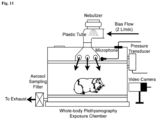
- a microphone system was mounted in the roof of the chamber to record sound; a video camera was placed outside of the chamber to monitor animal body posture; and a Buxco pneumotachograph (differential pressure transducer) attached to the chamber to record airflow. All signals generated by video camera, microphone, and pressure transducer were amplified and recorded continuously by PowerLab/8sp (model ML 785; ADInstruments Inc., Colorado Springs, CO) and a computer with the LabChart Pro 7 software.
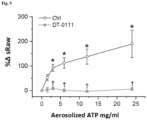
- Figure 9 shows the bronchoconstrictive effect of inhaling increasing doses of aerosolized ATP before (control, labelled "Ctrl”) and after aerosolized DT-0111 in conscious guinea-pigs.
- the results are expressed as percent change in airway pressure (sRaw).
- n 6; * p ⁇ 0.05, vs. ATP 0.0 mg/ml; ⁇ p ⁇ 0.05, DT-0111 vs. Ctrl at the same ATP dose.
- Figure 11 shows the utilized exposure chamber and setup of cough recording system. Arrows point to the flow direction.
- the signals generated by video camera, microphone, and pressure transducer were amplified, digitized, and recorded continuously through a PowerLab system and LabChart Pro software (ADInstruments).
- ATP at 48 mg/ml for 5 min exposure evoked significant coughs.
- the coughs are characterized by mixture of bout(s) of coughs and individual coughs (Table 2).
- Four of six GPs tested presented 2 bouts and the remaining two showed one bout of coughs.
- the individual coughs (1-3 coughs) occurred after the bout of coughs with lauder cough sound compared to the bout of coughs.
- the individual coughs without bout(s) of cough were observed.
- the typical recordings of cough responses before and after DT-0111 and the corresponding group data are illustrated in Fig. 10(A) and Fig. 10(B) , respectively.
- DT-0111 eliminated the bout of coughs with little effect on individual coughs.
- DT-0111 per se did not evoke any cough.
Landscapes
- Health & Medical Sciences (AREA)
- Chemical & Material Sciences (AREA)
- Life Sciences & Earth Sciences (AREA)
- Organic Chemistry (AREA)
- General Health & Medical Sciences (AREA)
- Public Health (AREA)
- Medicinal Chemistry (AREA)
- Veterinary Medicine (AREA)
- Animal Behavior & Ethology (AREA)
- Pharmacology & Pharmacy (AREA)
- Nuclear Medicine, Radiotherapy & Molecular Imaging (AREA)
- Chemical Kinetics & Catalysis (AREA)
- General Chemical & Material Sciences (AREA)
- Engineering & Computer Science (AREA)
- Molecular Biology (AREA)
- Genetics & Genomics (AREA)
- Biotechnology (AREA)
- Biochemistry (AREA)
- Pulmonology (AREA)
- Bioinformatics & Cheminformatics (AREA)
- Communicable Diseases (AREA)
- Oncology (AREA)
- Pain & Pain Management (AREA)
- Rheumatology (AREA)
- Epidemiology (AREA)
- Virology (AREA)
- Pharmaceuticals Containing Other Organic And Inorganic Compounds (AREA)
- Saccharide Compounds (AREA)
- Cephalosporin Compounds (AREA)
Claims (15)
- Composé selon la formule (I), ou un sel, un solvate ou un complexe de coordination pharmaceutiquement acceptable de celui-ci:

R1 et R2 sont indépendamment choisis parmi (C1-C6) alkyle. - Composé selon la revendication 1, ou un sel, un solvate ou un complexe de coordination pharmaceutiquement acceptable de celui-ci, dans lequel R1 et R2 sont du méthyle.
- Composé selon la revendication 1, dans lequel le composé est un sel de sodium de formule suivante:

- Composition pharmaceutique comprenant un véhicule pharmaceutiquement acceptable et un composé selon la revendication 1, ou un sel, un solvate ou un complexe de coordination pharmaceutiquement acceptable de celui-ci.
- Composé selon la revendication 1, ou un sel, un solvate ou un complexe de coordination pharmaceutiquement acceptable de celui-ci, destiné à être utilisé dans le traitement d'une maladie respiratoire médiée par un antagoniste d'un récepteur P2X3 ou un antagoniste d'un récepteur P2X2/3, dans lequel le traitement comprend l'administration d'une quantité thérapeutiquement efficace du composé, du sel, du solvate ou du complexe de coordination au sujet ayant besoin d'un tel traitement.
- Composé destiné à être utilisé selon la revendication 5, dans lequel la maladie respiratoire est une maladie respiratoire liée à la toux.
- Composé destiné à être utilisé selon la revendication 6, dans lequel la maladie respiratoire liée à la toux est la maladie pulmonaire obstructive chronique (MPOC), un bronchospasme ou de l'asthme.
- Composé destiné à être utilisé selon la revendication 5, dans lequel la maladie respiratoire est une toux subaiguë, une toux chronique, une toux résistante au traitement, une toux chronique idiopathique, une toux associée à une infection des voies respiratoires supérieures, une toux post-virale, une toux iatrogène, une fibrose pulmonaire idiopathique ou une toux associée au tabagisme ou à une forme de bronchite.
- Composé destiné à être utilisé selon l'une quelconque des revendications 5 à 8, dans lequel R1 et R2 dans le composé de formule (I), ou dans le sel, le solvate ou le complexe de coordination pharmaceutiquement acceptable de celui-ci, sont du méthyle.
- Composé selon la revendication 1, ou un sel, un solvate ou un complexe de coordination pharmaceutiquement acceptable de celui-ci, destiné à être utilisé dans le traitement d'un trouble de la vessie, dans lequel le traitement comprend l'administration d'une quantité thérapeutiquement efficace du composé, du sel, du solvate ou du complexe de coordination à un sujet ayant besoin d'un tel traitement.
- Composé destiné à être utilisé selon la revendication 10, dans lequel R1 et R2 dans le composé de formule (I), ou dans le sel, le solvate ou le complexe de coordination pharmaceutiquement acceptable de celui-ci, sont du méthyle.
- Composé selon la revendication 1, ou un sel, un solvate ou un complexe de coordination pharmaceutiquement acceptable de celui-ci, destiné à être utilisé dans le traitement de la douleur, dans lequel le traitement comprend l'administration d'une quantité thérapeutiquement efficace du composé, du sel, du solvate ou du complexe de coordination à un sujet ayant besoin d'un tel traitement.
- Composé destiné à être utilisé selon la revendication 12, dans lequel R1 et R2 dans le composé de formule (I), ou dans le sel, le solvate ou le complexe de coordination pharmaceutiquement acceptable de celui-ci, sont du méthyle.
- Procédé de préparation d'un composé selon la formule (I),
 R1 et R2 sont indépendamment choisis parmi (C1-C6) alkyle;le procédé comprenant:(a) faire réagir le composé 1


 (b) 5'-phosphoryler le composé selon la formule (III) pour fournir un composé selon la formule (I).
 - Procédé selon la revendication 14, dans lequel R1 et R2 sont du méthyle.
Applications Claiming Priority (2)
| Application Number | Priority Date | Filing Date | Title |
|---|---|---|---|
| US201862643199P | 2018-03-15 | 2018-03-15 | |
| PCT/US2019/022213 WO2019178331A1 (fr) | 2018-03-15 | 2019-03-14 | 3",5"-dialcoxybenzoyl-3'-amino-3'-désoxyadénosine-5'-triphosphates et leurs utilisations pharmaceutiques |
Publications (4)
| Publication Number | Publication Date |
|---|---|
| EP3765072A1 EP3765072A1 (fr) | 2021-01-20 |
| EP3765072A4 EP3765072A4 (fr) | 2021-12-15 |
| EP3765072C0 EP3765072C0 (fr) | 2024-07-31 |
| EP3765072B1 true EP3765072B1 (fr) | 2024-07-31 |
Family
ID=67907273
Family Applications (1)
| Application Number | Title | Priority Date | Filing Date |
|---|---|---|---|
| EP19767963.2A Active EP3765072B1 (fr) | 2018-03-15 | 2019-03-14 | 3",5"-dialcoxybenzoyl-3'-amino-3'-désoxyadénosine-5'-triphosphates et leurs utilisations pharmaceutiques |
Country Status (9)
| Country | Link |
|---|---|
| US (1) | US11440935B2 (fr) |
| EP (1) | EP3765072B1 (fr) |
| JP (1) | JP7366074B2 (fr) |
| CN (1) | CN112004551A (fr) |
| AU (1) | AU2019235887B2 (fr) |
| BR (1) | BR112020018725A2 (fr) |
| CA (1) | CA3093409A1 (fr) |
| IL (1) | IL277024B (fr) |
| WO (1) | WO2019178331A1 (fr) |
Families Citing this family (1)
| Publication number | Priority date | Publication date | Assignee | Title |
|---|---|---|---|---|
| CN117143942A (zh) * | 2023-10-30 | 2023-12-01 | 泰兴合全药业有限公司 | 3’-氨基-2’,3’-双脱氧鸟苷5’-三磷酸的合成方法 |
Family Cites Families (6)
| Publication number | Priority date | Publication date | Assignee | Title |
|---|---|---|---|---|
| US5620676A (en) * | 1994-03-08 | 1997-04-15 | The United States Of America As Represented By The Department Of Health And Human Services | Biologically active ATP analogs |
| US6693136B1 (en) | 2002-07-26 | 2004-02-17 | Abbott Laboratories | Fluorenes and anthracenes that inhibit P2X3 and P2X2/3 containing receptors |
| JP2007509180A (ja) * | 2003-10-21 | 2007-04-12 | インスパイアー ファーマシューティカルズ,インコーポレイティド | 疼痛を治療するための、非ヌクレオチド組成物および方法 |
| WO2010099542A2 (fr) | 2009-02-27 | 2010-09-02 | Duska Scientific Co. | Formulations d'atp et d'analogues de l'atp |
| GB201209244D0 (en) | 2012-05-25 | 2012-07-04 | Globalacorn Ltd | Compositions |
| AU2014308606B2 (en) | 2013-08-23 | 2017-08-03 | Afferent Pharmaceuticals Inc. | Diaminopyrimidine P2X3 and P2X 2/3 receptor modulators for treatment of acute, sub-acute or chronic cough |
-
2019
- 2019-03-14 EP EP19767963.2A patent/EP3765072B1/fr active Active
- 2019-03-14 CN CN201980019530.1A patent/CN112004551A/zh active Pending
- 2019-03-14 WO PCT/US2019/022213 patent/WO2019178331A1/fr not_active Ceased
- 2019-03-14 IL IL277024A patent/IL277024B/en unknown
- 2019-03-14 BR BR112020018725-9A patent/BR112020018725A2/pt unknown
- 2019-03-14 US US16/981,242 patent/US11440935B2/en active Active
- 2019-03-14 JP JP2020573072A patent/JP7366074B2/ja active Active
- 2019-03-14 CA CA3093409A patent/CA3093409A1/fr active Pending
- 2019-03-14 AU AU2019235887A patent/AU2019235887B2/en active Active
Also Published As
| Publication number | Publication date |
|---|---|
| IL277024A (en) | 2020-10-29 |
| CN112004551A (zh) | 2020-11-27 |
| AU2019235887A1 (en) | 2020-10-08 |
| US11440935B2 (en) | 2022-09-13 |
| JP2021515811A (ja) | 2021-06-24 |
| EP3765072C0 (fr) | 2024-07-31 |
| BR112020018725A2 (pt) | 2020-12-29 |
| CA3093409A1 (fr) | 2019-09-19 |
| EP3765072A1 (fr) | 2021-01-20 |
| JP7366074B2 (ja) | 2023-10-20 |
| US20210054015A1 (en) | 2021-02-25 |
| EP3765072A4 (fr) | 2021-12-15 |
| WO2019178331A1 (fr) | 2019-09-19 |
| IL277024B (en) | 2022-09-01 |
| AU2019235887B2 (en) | 2025-07-03 |
Similar Documents
| Publication | Publication Date | Title |
|---|---|---|
| KR102887587B1 (ko) | 뉴클레오시드 유사체의 항바이러스적 응용 | |
| AU746750B2 (en) | Therapeutic dinucleotide and derivatives | |
| PT2123271E (pt) | Fármaco para o tratamento de gripe | |
| HU199840B (en) | Process for producing xanthine derivatives | |
| OA12384A (en) | 3'-Prodrugs of 2'-deoxy-beta-l-nucleosides. | |
| Cross et al. | Selective class III antiarrhythmic agents. 1. Bis (arylalkyl) amines | |
| EP4126836A1 (fr) | Compositions et méthodes pour la prévention et/ou le traitement d'une maladie mitochondriale, notamment l'ataxie de friedreich | |
| US4562196A (en) | 2,4-Diaminopyridine as a pharmacologic agent | |
| EP2279750A1 (fr) | Dérivé d'aniline ayant une activité anti-virus à arn | |
| EP3765072B1 (fr) | 3",5"-dialcoxybenzoyl-3'-amino-3'-désoxyadénosine-5'-triphosphates et leurs utilisations pharmaceutiques | |
| JP6126204B2 (ja) | プロスタグランジンを主成分とした気管支拡張剤 | |
| WO2009151744A1 (fr) | Composés de s-nitrosomercapto et dérivés apparentés | |
| JP5849336B2 (ja) | アデニル酸シクラーゼの活性調節剤 | |
| US20070117861A1 (en) | Treatment or prevention of cardiovascular and respiratory disorders with novel substituted cyclic-amp specific phosphodiesterase inhibitors | |
| EP3998256A1 (fr) | Forme cristalline d'antagoniste de cxcr2 et son utilisation | |
| WO2022140705A1 (fr) | Promédicaments d'agents pharmaceutiques | |
| PT1664056E (pt) | Poliéteres pentacíclicos fundidos | |
| CN117562915A (zh) | 一种腺苷衍生物在制备预防、缓解或治疗纤维化疾病的药物中的应用 | |
| JP6602297B2 (ja) | ジフェニルオキシアルキルアミン誘導体およびアリールオキシアルキルアミン誘導体、薬学的組成物、慢性肺炎症性疾患を治療、予防、または阻止するための前記薬学的組成物の使用、ならびにそのような疾患を治療または予防するための方法 | |
| KR20260032545A (ko) | 트레프로스티닐 유도체, 이의 제조 방법 및 그의 용도 | |
| EP4735462A1 (fr) | Composés et leurs utilisations | |
| HK40088088A (en) | Antiviral application of nucleoside analog or combination formulation containing nucleoside analog | |
| CN110343068A (zh) | 2-氨基-2-喹啉基乙醇类β2-受体激动剂及其制备方法和应用 | |
| HK1252978B (en) | Compounds for use in treating neuromuscular disorders | |
| CN102526071A (zh) | Ppt抗认知、学习记忆功能障碍的用途 |
Legal Events
| Date | Code | Title | Description |
|---|---|---|---|
| STAA | Information on the status of an ep patent application or granted ep patent |
Free format text: STATUS: THE INTERNATIONAL PUBLICATION HAS BEEN MADE |
|
| PUAI | Public reference made under article 153(3) epc to a published international application that has entered the european phase |
Free format text: ORIGINAL CODE: 0009012 |
|
| STAA | Information on the status of an ep patent application or granted ep patent |
Free format text: STATUS: REQUEST FOR EXAMINATION WAS MADE |
|
| 17P | Request for examination filed |
Effective date: 20201015 |
|
| AK | Designated contracting states |
Kind code of ref document: A1 Designated state(s): AL AT BE BG CH CY CZ DE DK EE ES FI FR GB GR HR HU IE IS IT LI LT LU LV MC MK MT NL NO PL PT RO RS SE SI SK SM TR |
|
| AX | Request for extension of the european patent |
Extension state: BA ME |
|
| DAV | Request for validation of the european patent (deleted) | ||
| DAX | Request for extension of the european patent (deleted) | ||
| A4 | Supplementary search report drawn up and despatched |
Effective date: 20211111 |
|
| RIC1 | Information provided on ipc code assigned before grant |
Ipc: C07H 19/20 20060101ALI20211105BHEP Ipc: A61P 31/12 20060101ALI20211105BHEP Ipc: A61P 29/00 20060101ALI20211105BHEP Ipc: C12N 15/67 20060101ALI20211105BHEP Ipc: A61K 39/00 20060101AFI20211105BHEP |
|
| GRAP | Despatch of communication of intention to grant a patent |
Free format text: ORIGINAL CODE: EPIDOSNIGR1 |
|
| STAA | Information on the status of an ep patent application or granted ep patent |
Free format text: STATUS: GRANT OF PATENT IS INTENDED |
|
| INTG | Intention to grant announced |
Effective date: 20231009 |
|
| GRAJ | Information related to disapproval of communication of intention to grant by the applicant or resumption of examination proceedings by the epo deleted |
Free format text: ORIGINAL CODE: EPIDOSDIGR1 |
|
| STAA | Information on the status of an ep patent application or granted ep patent |
Free format text: STATUS: REQUEST FOR EXAMINATION WAS MADE |
|
| GRAP | Despatch of communication of intention to grant a patent |
Free format text: ORIGINAL CODE: EPIDOSNIGR1 |
|
| STAA | Information on the status of an ep patent application or granted ep patent |
Free format text: STATUS: GRANT OF PATENT IS INTENDED |
|
| INTC | Intention to grant announced (deleted) | ||
| INTG | Intention to grant announced |
Effective date: 20240327 |
|
| GRAS | Grant fee paid |
Free format text: ORIGINAL CODE: EPIDOSNIGR3 |
|
| GRAA | (expected) grant |
Free format text: ORIGINAL CODE: 0009210 |
|
| STAA | Information on the status of an ep patent application or granted ep patent |
Free format text: STATUS: THE PATENT HAS BEEN GRANTED |
|
| AK | Designated contracting states |
Kind code of ref document: B1 Designated state(s): AL AT BE BG CH CY CZ DE DK EE ES FI FR GB GR HR HU IE IS IT LI LT LU LV MC MK MT NL NO PL PT RO RS SE SI SK SM TR |
|
| REG | Reference to a national code |
Ref country code: CH Ref legal event code: EP Ref country code: GB Ref legal event code: FG4D |
|
| REG | Reference to a national code |
Ref country code: DE Ref legal event code: R096 Ref document number: 602019056145 Country of ref document: DE |
|
| REG | Reference to a national code |
Ref country code: IE Ref legal event code: FG4D |
|
| U01 | Request for unitary effect filed |
Effective date: 20240823 |
|
| U07 | Unitary effect registered |
Designated state(s): AT BE BG DE DK EE FI FR IT LT LU LV MT NL PT RO SE SI Effective date: 20240903 |
|
| PG25 | Lapsed in a contracting state [announced via postgrant information from national office to epo] |
Ref country code: NO Free format text: LAPSE BECAUSE OF FAILURE TO SUBMIT A TRANSLATION OF THE DESCRIPTION OR TO PAY THE FEE WITHIN THE PRESCRIBED TIME-LIMIT Effective date: 20241031 |
|
| PG25 | Lapsed in a contracting state [announced via postgrant information from national office to epo] |
Ref country code: PL Free format text: LAPSE BECAUSE OF FAILURE TO SUBMIT A TRANSLATION OF THE DESCRIPTION OR TO PAY THE FEE WITHIN THE PRESCRIBED TIME-LIMIT Effective date: 20240731 Ref country code: GR Free format text: LAPSE BECAUSE OF FAILURE TO SUBMIT A TRANSLATION OF THE DESCRIPTION OR TO PAY THE FEE WITHIN THE PRESCRIBED TIME-LIMIT Effective date: 20241101 |
|
| PG25 | Lapsed in a contracting state [announced via postgrant information from national office to epo] |
Ref country code: IS Free format text: LAPSE BECAUSE OF FAILURE TO SUBMIT A TRANSLATION OF THE DESCRIPTION OR TO PAY THE FEE WITHIN THE PRESCRIBED TIME-LIMIT Effective date: 20241130 |
|
| PG25 | Lapsed in a contracting state [announced via postgrant information from national office to epo] |
Ref country code: HR Free format text: LAPSE BECAUSE OF FAILURE TO SUBMIT A TRANSLATION OF THE DESCRIPTION OR TO PAY THE FEE WITHIN THE PRESCRIBED TIME-LIMIT Effective date: 20240731 |
|
| PG25 | Lapsed in a contracting state [announced via postgrant information from national office to epo] |
Ref country code: ES Free format text: LAPSE BECAUSE OF FAILURE TO SUBMIT A TRANSLATION OF THE DESCRIPTION OR TO PAY THE FEE WITHIN THE PRESCRIBED TIME-LIMIT Effective date: 20240731 Ref country code: RS Free format text: LAPSE BECAUSE OF FAILURE TO SUBMIT A TRANSLATION OF THE DESCRIPTION OR TO PAY THE FEE WITHIN THE PRESCRIBED TIME-LIMIT Effective date: 20241031 |
|
| PG25 | Lapsed in a contracting state [announced via postgrant information from national office to epo] |
Ref country code: RS Free format text: LAPSE BECAUSE OF FAILURE TO SUBMIT A TRANSLATION OF THE DESCRIPTION OR TO PAY THE FEE WITHIN THE PRESCRIBED TIME-LIMIT Effective date: 20241031 Ref country code: PL Free format text: LAPSE BECAUSE OF FAILURE TO SUBMIT A TRANSLATION OF THE DESCRIPTION OR TO PAY THE FEE WITHIN THE PRESCRIBED TIME-LIMIT Effective date: 20240731 Ref country code: NO Free format text: LAPSE BECAUSE OF FAILURE TO SUBMIT A TRANSLATION OF THE DESCRIPTION OR TO PAY THE FEE WITHIN THE PRESCRIBED TIME-LIMIT Effective date: 20241031 Ref country code: IS Free format text: LAPSE BECAUSE OF FAILURE TO SUBMIT A TRANSLATION OF THE DESCRIPTION OR TO PAY THE FEE WITHIN THE PRESCRIBED TIME-LIMIT Effective date: 20241130 Ref country code: HR Free format text: LAPSE BECAUSE OF FAILURE TO SUBMIT A TRANSLATION OF THE DESCRIPTION OR TO PAY THE FEE WITHIN THE PRESCRIBED TIME-LIMIT Effective date: 20240731 Ref country code: GR Free format text: LAPSE BECAUSE OF FAILURE TO SUBMIT A TRANSLATION OF THE DESCRIPTION OR TO PAY THE FEE WITHIN THE PRESCRIBED TIME-LIMIT Effective date: 20241101 Ref country code: ES Free format text: LAPSE BECAUSE OF FAILURE TO SUBMIT A TRANSLATION OF THE DESCRIPTION OR TO PAY THE FEE WITHIN THE PRESCRIBED TIME-LIMIT Effective date: 20240731 |
|
| PG25 | Lapsed in a contracting state [announced via postgrant information from national office to epo] |
Ref country code: SM Free format text: LAPSE BECAUSE OF FAILURE TO SUBMIT A TRANSLATION OF THE DESCRIPTION OR TO PAY THE FEE WITHIN THE PRESCRIBED TIME-LIMIT Effective date: 20240731 |
|
| U20 | Renewal fee for the european patent with unitary effect paid |
Year of fee payment: 7 Effective date: 20250310 |
|
| PG25 | Lapsed in a contracting state [announced via postgrant information from national office to epo] |
Ref country code: CZ Free format text: LAPSE BECAUSE OF FAILURE TO SUBMIT A TRANSLATION OF THE DESCRIPTION OR TO PAY THE FEE WITHIN THE PRESCRIBED TIME-LIMIT Effective date: 20240731 |
|
| PG25 | Lapsed in a contracting state [announced via postgrant information from national office to epo] |
Ref country code: SK Free format text: LAPSE BECAUSE OF FAILURE TO SUBMIT A TRANSLATION OF THE DESCRIPTION OR TO PAY THE FEE WITHIN THE PRESCRIBED TIME-LIMIT Effective date: 20240731 |
|
| PLBE | No opposition filed within time limit |
Free format text: ORIGINAL CODE: 0009261 |
|
| STAA | Information on the status of an ep patent application or granted ep patent |
Free format text: STATUS: NO OPPOSITION FILED WITHIN TIME LIMIT |
|
| 26N | No opposition filed |
Effective date: 20250501 |
|
| PG25 | Lapsed in a contracting state [announced via postgrant information from national office to epo] |
Ref country code: MC Free format text: LAPSE BECAUSE OF FAILURE TO SUBMIT A TRANSLATION OF THE DESCRIPTION OR TO PAY THE FEE WITHIN THE PRESCRIBED TIME-LIMIT Effective date: 20240731 |
|
| REG | Reference to a national code |
Ref country code: CH Ref legal event code: H13 Free format text: ST27 STATUS EVENT CODE: U-0-0-H10-H13 (AS PROVIDED BY THE NATIONAL OFFICE) Effective date: 20251023 |
|
| PG25 | Lapsed in a contracting state [announced via postgrant information from national office to epo] |
Ref country code: CH Free format text: LAPSE BECAUSE OF NON-PAYMENT OF DUE FEES Effective date: 20250331 |
|
| PG25 | Lapsed in a contracting state [announced via postgrant information from national office to epo] |
Ref country code: IE Free format text: LAPSE BECAUSE OF NON-PAYMENT OF DUE FEES Effective date: 20250314 |
|
| U20 | Renewal fee for the european patent with unitary effect paid |
Year of fee payment: 8 Effective date: 20260209 |
|
| PGFP | Annual fee paid to national office [announced via postgrant information from national office to epo] |
Ref country code: GB Payment date: 20260202 Year of fee payment: 8 |