EP3765563B1 - Revêtements biodégradables pour substrats biodégradables - Google Patents
Revêtements biodégradables pour substrats biodégradables Download PDFInfo
- Publication number
- EP3765563B1 EP3765563B1 EP19713170.9A EP19713170A EP3765563B1 EP 3765563 B1 EP3765563 B1 EP 3765563B1 EP 19713170 A EP19713170 A EP 19713170A EP 3765563 B1 EP3765563 B1 EP 3765563B1
- Authority
- EP
- European Patent Office
- Prior art keywords
- rubber
- coating
- composition
- bottle
- total weight
- Prior art date
- Legal status (The legal status is an assumption and is not a legal conclusion. Google has not performed a legal analysis and makes no representation as to the accuracy of the status listed.)
- Active
Links
Images

Classifications
-
- C—CHEMISTRY; METALLURGY
- C08—ORGANIC MACROMOLECULAR COMPOUNDS; THEIR PREPARATION OR CHEMICAL WORKING-UP; COMPOSITIONS BASED THEREON
- C08L—COMPOSITIONS OF MACROMOLECULAR COMPOUNDS
- C08L7/00—Compositions of natural rubber
-
- C—CHEMISTRY; METALLURGY
- C08—ORGANIC MACROMOLECULAR COMPOUNDS; THEIR PREPARATION OR CHEMICAL WORKING-UP; COMPOSITIONS BASED THEREON
- C08L—COMPOSITIONS OF MACROMOLECULAR COMPOUNDS
- C08L7/00—Compositions of natural rubber
- C08L7/02—Latex
-
- C—CHEMISTRY; METALLURGY
- C08—ORGANIC MACROMOLECULAR COMPOUNDS; THEIR PREPARATION OR CHEMICAL WORKING-UP; COMPOSITIONS BASED THEREON
- C08L—COMPOSITIONS OF MACROMOLECULAR COMPOUNDS
- C08L21/00—Compositions of unspecified rubbers
-
- C—CHEMISTRY; METALLURGY
- C09—DYES; PAINTS; POLISHES; NATURAL RESINS; ADHESIVES; COMPOSITIONS NOT OTHERWISE PROVIDED FOR; APPLICATIONS OF MATERIALS NOT OTHERWISE PROVIDED FOR
- C09D—COATING COMPOSITIONS, e.g. PAINTS, VARNISHES OR LACQUERS; FILLING PASTES; CHEMICAL PAINT OR INK REMOVERS; INKS; CORRECTING FLUIDS; WOODSTAINS; PASTES OR SOLIDS FOR COLOURING OR PRINTING; USE OF MATERIALS THEREFOR
- C09D107/00—Coating compositions based on natural rubber
-
- C—CHEMISTRY; METALLURGY
- C08—ORGANIC MACROMOLECULAR COMPOUNDS; THEIR PREPARATION OR CHEMICAL WORKING-UP; COMPOSITIONS BASED THEREON
- C08L—COMPOSITIONS OF MACROMOLECULAR COMPOUNDS
- C08L2201/00—Properties
- C08L2201/06—Biodegradable
Definitions
- This disclosure relates to a biodegradable bottle comprising a water-resistant, or waterproof, biodegradable coating .
- This disclosure also relates to methods of applying a water-resistant, or waterproof, biodegradable composition to biodegradable substrates.
- the present invention addresses these issues by providing an alternative material that can be used as a replacement to plastics, and can therefore find use in the manufacture of containers for food stuffs, personal care and cleaning products.
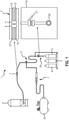
- Figure 1 is a schematic of an apparatus used in the method of the invention for applying the aqueous rubber dispersion of the invention to a biodegradable bottle.
- a biodegradable bottle comprising a structural layer, wherein the structural layer comprises a fibrous substrate comprising at least one surface, where in the at least one surface comprises a layer of coating comprising a composition comprising a rubber and at least one additive that promotes biodegradation of rubber.
- weight percentages are given relative to the total weight of all the components present (e.g. the mass of all the components in the composition or in the aqueous rubber dispersion).
- references to "in one embodiment” or “in an embodiment” means that a particular feature, structure, or characteristic described in connection with the embodiment is included in at least one embodiment.
- the appearance of the phrases “in one embodiment” or “in an embodiment” in various places throughout the specification are not necessarily all referring to the same embodiment.
- the particular features, structures, or characteristics may be combined in any suitable manner in one or more embodiments.
- biodegradable it is meant the breakdown of organic matter by microorganisms such as bacteria and fungi, to afford small molecule and/or gaseous by-products.
- ambient conditions it is meant conditions typical to the natural world, for example temperatures between 5 and 45 °C, such as between 10 and 35 °C, 18 and 30 °C, or 20 and 28 °C, and pressures around atmospheric pressure (101 kPa), such as between 60 and 106 kPa, such as 80 and 101 kPa, or 95 to 101 kPa, or about 101 kPa.
- ambient conditions may include both aerobic (in the presence of oxygen) and anaerobic (in the absence of oxygen) conditions, in addition to conditions in the presence or absence of light, and conditions in the presence or absence of moisture.
- the biodegradation half-life can be calculated for the composition/fibrous substrate/container of the invention.
- the biodegradation half-life is the time at which the weight of the composition/fibrous substrate/container has been reduced by half, i.e. half of the composition has undergone biodegradation to afford gaseous by-products.
- rates of biodegradation suitable for composting it is meant that the item in question will undergo biodegradation in ambient conditions with a half-life of less than one year, such as less than 10 months, less than 6 months, less than 3 months, or less than one month.
- composting it is meant any situation wherein the item is exposed to sources of microorganisms and conditions suitable for decomposing the item.
- composting in the context of the present application includes disposing the composition/fibrous substrate/container of the invention in landfills, compost heaps, bio-reactors, recycling plants, as well as the natural environment, including bodies of water such as lakes, rivers, seas, or sites on/in land such as hedgerows, fields, or gardens.
- ⁇ By food safe, it is meant that the components to which the term refers have been deemed to be non-toxic and safe for human consumption. Such components typically have approval from regulatory bodies such as the European Food Safety Authority (EFSA), or the Food and Drug Administration (FDA), or the German BGA. These bodies set regulations concerning the use of, among other things, rubbers, and additives, for use in food-contact applications. For example, the BGA demands that rubber articles are unobjectionable in aspects of health, smell, and taste.
- the BGA provide a list of Recommendations XXI, which place the responsibility of manufactures to prove that their products do not harm consumers.
- the rubber in the compositions, dispersions, and containers of the invention is preferably Category 1 in the BGA Recommendations XXI.
- sustainably-sourced it is meant that the entire supply chain used in the production is known to use sustainable practices, wherein sustainable practices are defined as those practices that can be continued indefinitely without adversely affecting the environment.
- sustainable practices are defined as those practices that can be continued indefinitely without adversely affecting the environment.
- degradation such as “biodegradation”, and “decomposition” can be used interchangeably.
- fibrous substrate materials composed from fibres, such as cellulosic fibres.
- the present invention is directed towards biodegradable linings for biodegradable containers, such that a fibrous substrate when discussed in the context of the invention will typically be a biodegradable substrate, such as a cellulosic fibrous substrate.
- a fibrous substrate when discussed in the context of the invention will typically be a biodegradable substrate, such as a cellulosic fibrous substrate.
- the composition of the invention may also be applied to fibrous substrates made from other materials, including wool or synthetic fibres.
- the present invention provides a biodegradable bottle comprising a layer of coating comprising a rubber and at least one additive that promotes the biodegradation of rubber.
- the at least one additive that promotes biodegradation of rubber is a polysaccharide, such as methyl cellulose and/or xanthan gum.
- the composition further comprises an emulsifying agent, such as emulsifying wax.
- the composition further comprises a vegetable oil.
- all the components of the rubber composition are sustainably sourced.
- the composition comprises rubber in an amount between 65 and 95 wt%, at least one polysaccharide in an amount between 2 and 18 wt%, and optionally an emulsifying wax in an amount between 1 and 4 wt% and a vegetable oil in an amount between 4 and 14 wt%. In one embodiment of the invention, the composition comprises rubber in an amount between 75 and 85 wt%, at least one polysaccharide in an amount between 6 and 14 wt%, and optionally an emulsifying wax in an amount between 1.2 and 3.8 wt% and a vegetable oil in an amount between 6 and 12 wt%.
- the composition comprises rubber in an amount between 78 and 82 wt%, at least one polysaccharide in an amount between 8 and 12 wt%, and optionally an emulsifying wax in an amount between 2 and 3 wt% and a vegetable oil in an amount between 8 and 10 wt%.
- the composition comprises rubber in an amount between 65 and 95 wt%, methyl cellulose in an amount between 1 and 9 wt%, xanthan gum in an amount between 1 and 9 wt%, and optionally an emulsifying wax in an amount between 1 and 4 wt% and a vegetable oil in an amount between 4 and 14 wt%.
- the composition comprises rubber in an amount between 75 and 85 wt%, methyl cellulose in an amount between 3 and 7 wt%, xanthan gum in an amount between 3 and 7 wt%, and optionally an emulsifying wax in an amount between 1.2 and 3.8 wt% and a vegetable oil in an amount between 6 and 12 wt%.
- the composition comprises rubber in an amount between 78 to 82 wt%, methyl cellulose in an amount between 4 and 6 wt%, xanthan gum in an amount between 4 and 6 wt%, and optionally an emulsifying wax in an amount between 2 and 3 wt% and a vegetable oil in an amount between 8 and 10 wt%.
- the composition comprises a ratio of rubber to polysaccharide of 95:2 to 65:18, such as 85:6 to 75:14, or 82:8 to 78:12. In one embodiment of the invention, the composition comprises a ratio of rubber to methyl cellulose of 95:1 to 65:9, such as 85:3 to 75:7, or 82:4 to 78:6. In one embodiment of the invention, the composition comprises a ratio of rubber to xanthan gum of 95:1 to 65:9, such as 85:3 to 75:7, or 82:4 to 78:6.
- Rubber is used in the compositions of the invention.
- the rubber provides a water-resistant, or waterproof, layer to the substrate to which it coats as rubber is known to be very hydrophobic.
- a rubber liner used as a lining of containers for foodstuffs and/or drinks and provide a barrier to moisture/liquid.
- the rubber can provide a gas barrier.
- substrates that may not be suitable for containing food stuffs i.e. substrates that do not provide a sufficient barrier to air and moisture/liquid
- substrates that may not be suitable for containing food stuffs i.e. substrates that do not provide a sufficient barrier to air and moisture/liquid
- many fibrous biodegradable substrates e.g. paper fibres, bamboo fibres, sugar cane fibres, which do not possess the required barrier properties for use as such containers can be coated with the coating for use in the invention.
- the rubber for use in the coating for use in the invention is preferably non-crosslinked rubber or rubber with a low cross-link density.
- Highly cross-linked rubber e.g. synthetic rubbers that have been vulcanised with sulfur or organic peroxides, have a high crosslink density and form very high molecular weight dense networks. Such rubbers require significant time periods (e.g. >50 years) to undergo complete biodegradation, even when utilising additives that promote biodegradation.
- the cross-link density of rubber can be calculated using methods known in the art.
- Natural rubber is produced by over 2,000 plant species and has as a main constituent poly(cis-1,4-isoprene) having a molecular weight of 100 to 1,000 kDa.
- suitable natural rubbers include the rubbers produced by H. brasiliensis and Guayule rubber produced of Parthenium argentatum, both which are produced commercially. Natural rubber therefore has the further advantage of being non-petrochemically derived.
- the natural rubber for use with the invention is preferably unvulcanised. In a preferred embodiment, the rubber is unvulcanised guayule-derived natural rubber.
- rubbers which are described as unvulcanised may still comprise a nominal degree of crosslinking. However, said degree of cross-linking will not significantly affect the biodegradation rate of the rubber.
- LDPE low-density polyethylene
- STP standard temperature and pressure.
- Natural rubber is therefore particularly well-suited for use in the linings of containers for food stuffs.
- the linings made from the rubber composition of the invention will also be suitable for use in containers for personal care and/or cleaning products.
- the natural rubber is ML200 pre-vulcanised latex, available from Formulated Polymer Products Ltd, Bury, Lancashire, UK.
- Rubber can undergo biodegradation under ambient conditions affording a variety of biodegradation products, including CO 2 , H 2 O, methane, in addition to a number of small molecule by-products.
- the exact composition of the by-products may depend on environmental factors, such as the identity of microorganisms present, and the presence or absence of oxygen, i.e. whether aerobic or anaerobic biodegradation pathways are operative.
- the biodegradation of rubber which has been extensively studied, involves microorganisms such as bacteria (e.g. Streptomyces coelicolor, Pseudomonas citronellolis , and Nocardia spp) and/or fungi comprising suitable enzymes, see Ali Shah, A. et al., Int. Biodeter. Biodegr., 2013, 83, 145-147 .
- bacteria e.g. Streptomyces coelicolor, Pseudomonas citronellolis , and Nocardia spp
- suitable enzymes see Ali Shah, A. et al., Int. Biodeter. Biodegr., 2013, 83, 145-147 .
- the biodegradation process may be slow, requiring many months or years to completely biodegrade into biodegradation products.
- biodegradation rates may affect the rate of biodegradation, including the identity and number of microorganisms present and the availability of oxygen.
- variation in the biodegradation rates has been observed for natural rubber latex gloves, which were buried in either tropical soils "amended” with nitrogen and phosphorus-containing compounds or a composting environment created from dried grass clippings, cattle manure, and soil ("un-amended” conditions).
- soils were amended to favour microbial growth (i.e. adding nitrogen and phosphorous-containing compounds), enhanced biodegradation rates were observed when compared to natural biodegradation processes in un-amended soil.
- Mean specific biodegradation rates of natural rubber gloves have been found to be three times faster in amended soil than in the un-amended soil.
- the coating for use in the invention comprises rubber in an amount of between 65 to 95 wt% based on the total weight of the composition, such as between 70 and 90 wt%, 75 and 85 wt%, 78 and 82 wt%, or about 80 wt% based on the total weight of the composition.
- the coating for use in the invention comprises at least one additive that promotes the biodegradation of rubber.
- promoting the biodegradation of rubber it is meant that, when present, said additives increase the rate of decomposition of rubber into decomposition products (i.e. it has a faster biodegradation half-life) relative to compositions not comprising said additives.
- the additives undergo rapid decomposition in the presence of naturally-occurring microorganisms comprising suitable enzymes, e.g. cellulase, and are converted from polymeric species into biodegradation products, including low molecular weight species and gaseous by-products.
- suitable enzymes e.g. cellulase
- the additives for use in the coating for use in the invention provide sites when microorganisms capable of biodegrading the additives can penetrate the rubber composition. Furthermore, these sites also allow microorganisms capable of metabolising rubber to colonise areas of the composition comprising the additive and initiate the biodegradation process of the rubber.
- the additives for use in the coating for use in of the invention provide "break points" in the rubber composition (e.g. coating/lining), which expedite the biodegradation of the rubber.
- the layer of rubber coating comprises a surface which can act as a barrier to microorganisms entering the rubber coating layer and initiating biodegradation.
- the additives are biodegraded when exposed to composting conditions and the barrier provided by coating layer surface is compromised. This increases the exposed surface area of the rubber, allowing more microorganisms to enter and biodegrade the rubber lining, expediting the process of biodegradation.
- the coating of the bottle of the present invention will undergo biodegradation faster than coatings made from synthetic rubbers, which comprise a high-crosslink density, and also coatings made from unvulcanised natural rubber that does not comprise the additives for use with the invention.
- the coatings of the invention may have biodegradation half-lives that are at least 10% faster than coatings comprising unvulcanised natural rubber without the additives for use with the invention, such as at least 20%, at least 30%, at least 40%, or at least 50% faster than coatings comprising unvulcanised natural rubber without the additives for use with the invention.
- the bottle of the invention has improved biodegradation rates suitable for compositing.
- the additives for use with the invention have certain characteristics that allow them to perform their function in the coating for use in the invention.
- the additives are polysaccharides, including xanthan gum, cellulose and its derivatives such as methyl cellulose, ethyl cellulose, hydroxyethyl cellulose, or cellulose acetate, starches such as amylose or amylopectin, hemicellulose, glycogen, pectin, or combinations thereof.
- the at least one additive comprises a mixture of a cellulose and xanthan gum.
- the at least one additive comprises a mixture of methyl cellulose and xanthan gum.
- Polysaccharides are amenable to biodegradation from a variety of naturally-occurring and abundant microorganisms. Furthermore, the additives are polymeric, which mean that they contribute to the structural integrity of the lining whilst the product is in use (i.e. before the product is composted and exposed to microorganisms in the environment).
- the additives for use in the invention are may be moderate or high molecular weight polymeric species, that can contribute to the structural integrity of the bottle, but that also undergo rapid depolymerisation once composted to provide low molecular weight (e.g. small molecule) and gaseous by-products.
- low molecular weight e.g. small molecule
- methyl cellulose can have a molecular weight between 42 to 500 kDa.
- Xanthan gum has a molecular weight of 300 kDa to 8MDa.
- the additives for use in the composition of the invention are compatible with rubber, such that they do not undergo phase separation in the bulk phase and thus remain blended throughout the rubber composition.
- the additives are evenly dispersed throughout the rubber.
- the coating for use in the invention comprises at least one polysaccharide in an amount of between 2 and 18 wt % based on the total weight of the composition, such as between 4 and 16 wt%, 6 and 14 wt%, 8 and 12wt%, or about 10 wt% based on the total weight of the composition.
- the coating for use in the invention comprises methyl cellulose is present in an amount of between 1 to 9 wt% based on the total weight of the composition, such as between 2 and 8 wt%, 3 and 7 wt%, 4 and 6 wt%, or about 5 wt% based on the total weight of the composition.
- the coating for use in the invention comprises xanthan gum in an amount of between 1 to 9 wt% based on the total weight of the composition, such as between 2 and 8 wt%, 3 and 7 wt%, 4 and 6 wt%, or about 5 wt% based on the total weight of the composition.
- Particularly preferred embodiments of the invention include a mixture of methyl cellulose and xanthan gum as the at least one additive that promotes the biodegradation of rubber. It was found that this particular combination had further advantages, including that the xanthan gum prevents the methyl cellulose from undergoing swelling when water is added to the dispersion. It is believed that xanthan gum improves the dispersion of the methyl cellulose in the vegetable oil, which prevents the methyl cellulose swelling when water is added to the vegetable oil dispersion. Furthermore, this particular combination of additives was found to be particularly stable when coated onto a container, such that no perceptible change in the taste of the contents (water) of the container could be detected.
- methyl cellulose and xanthan gum also provides increased colloidal stability to the aqueous rubber dispersion for use in the invention. Furthermore, when using the method of preparing and disposing the aqueous dispersion for use in the invention onto a fibrous substrate, these additives were found to be evenly distributed throughout the resulting rubber coating.
- the coatings for use in the invention may comprise further additional components.
- the coating for use in of the invention comprises at least one wax.
- the wax is emulsifying wax, or an animal waxes such as bees wax, Chinese wax, lanolin, shellac wax, squalene, or spermaceti, or a plant wax such as rice balm wax, or those derived from Copernicia cerifera, Simmondsia chinensis, or Myrica pensylvanica, or a combination thereof.
- the wax may be a modified plant or animal wax.
- the wax may be a microbial wax, i.e. a wax produced by a bacteria.
- the wax for use in the invention can serve multiple purposes within the composition for use in the invention.
- the wax for example an emulsifying wax, can be used to facilitate formation of a stable aqueous rubber dispersion comprising the coating for use in the invention.
- an aqueous rubber dispersion When the coating for use in of the invention is to be sprayed onto a fibrous substrate, an aqueous rubber dispersion must first be made.
- Emulsifying wax assists in the stability of the rubber in the aqueous phase, by enhancing the colloidal stability of the rubber dispersion by reducing the rate of phase separation of the rubber and other components from the aqueous phase.
- use of an emulsifying wax can increase the storage life of the aqueous rubber dispersion of the invention.
- the aqueous rubber dispersion of the invention is stable under ambient conditions for up to one month, for example up to two months, up to three months, or up to six months.
- Waxes for use in the invention can also contribute to the barrier properties provided by the composition of the invention, for example, once the composition has been coated onto a fibrous substrate.
- the coating for use in the invention may further comprise a vegetable oil. Similar to the waxes that may be incorporated into the coating for use in the invention, vegetable oil contributes to the colloidal stability of the aqueous rubber dispersion for use in the invention.
- vegetable oils suitable for use in the coating for use in the invention include rapeseed oil, olive oil, palm oil, rice bran oil, soybean oil, sunflower oil, cotton seed oil, coconut oil, linseed oil, brazil nut oil, hazelnut oil, grape seed oil, corn oil, carapa oil, sesame oil, or peanut oil.
- the coating for use in the invention comprises an emulsifying agent in an amount of between 1 and 4 wt% based on the total weight of the composition, such as between 1.2 and 3.8 wt%, 1.5 and 3.5 wt%, 2 and 3 wt%, or about 2.5 wt% based on the total weight of the composition.
- the emulsifying agent is emulsifying wax.
- the coating for use in of the invention comprises vegetable oil in an amount of between 4 and 14 wt% based on the total weight of the composition, such as between 5 and 13 wt%, 6 and 12 wt%, 7 and 11 wt%, 8 and 10 wt%, or about 9 wt% based on the total weight of the composition.
- the coating for use in the invention is applied to fibrous substrates in order to provide a barrier to oxygen and moisture. Coating a fibrous substrate with the coating for use in the invention thus allows the fibrous substrate to be used for containing food stuffs (e.g. water) and also personal care and cleaning products.
- food stuffs e.g. water
- the present invention therefore also provides a biodegradable bottle comprising a structural layer comprising a fibrous substrate comprising a coating composition comprising a rubber and at least one additive that promotes biodegradation of rubber.
- Fibrous substrates suitable for use with the present invention include sugar cane fibre, wood fibres such as paper or bamboo fibres, or a combination thereof.
- the fibrous substrate is paper.
- paper suitable for use as the fibrous substrate of the invention for example paper can be obtained from mill broke or internal mill broke waste, which incorporates any substandard or grade-change paper made within the paper mill itself that goes back into the manufacturing system to be re-pulped back into paper.
- Such out-of-specification paper is not sold and is therefore often not classified as genuine reclaimed recycled fibre, however most paper mills have been reusing their own waste fibre for many years, long before recycling became popular.
- An alternative source of paper is from pre-consumer waste, which is offcut and processing waste, such as guillotine trims and envelope blank waste.
- Pre-consumer waste is generated outside the paper mill and could potentially go to landfill. It is a genuine recycled fibre source and includes de-inked waste, including recycled material that has been printed but did not reach its intended end use, such as waste from printers and unsold publications.
- post-consumer waste which is fibre from paper that has been used for its intended end-use and includes office waste, magazine papers and newsprint.
- office waste As the vast majority of this material has been printed, either digitally or by more conventional means, such as lithography or rotogravure, it will either be recycled as printed paper or go through a de-inking process first.
- the fibrous substrate is derived from dyed post-consumer waste.
- Recycled paper for use as the fibrous substrate for use in the invention can be made from 100% recycled materials or a mixture of recycled materials blended with virgin pulp, although 100% recycled materials are (generally) not as strong nor as bright as papers made from the latter.
- the process of waste paper recycling most often involves mixing used/old paper with water and chemicals to break it down. It is then chopped up and heated, which breaks it down further into strands of cellulose. The resulting mixture is called pulp.
- the pulp is strained through screens, which remove any glue or plastic (especially from plastic-coated paper) that may still be present in the mixture, before it is cleaned, de-inked, bleached, and mixed with water.
- Such paper pulp is suitable for use in the manufacture of fibrous substrates for use in the present invention.
- the thickness of the coating layer on the fibrous substrate is between 10 ⁇ m and 2000 ⁇ m, such as between 20 ⁇ m and 1800 ⁇ m, 50 ⁇ m and 1500 ⁇ m, 1000 ⁇ m and 2000 ⁇ m, 100 ⁇ m and 1000 ⁇ m, 100 ⁇ m and 500 ⁇ m, 50 ⁇ m and 300 ⁇ m, 50 ⁇ m and 200 ⁇ m, or between 50 ⁇ m and 100 ⁇ m.
- substantially uniform thickness means that the standard deviation of the thickness of the coating is less than 50% of the mean thickness, such as less than 20% of the mean thickness.
- Reducing the thickness of the layer of coating has several advantages, including that less composition is required in the manufacture of the coated fibrous substrate of the invention.
- a thinner layer of coating composition will provide an item that will undergo faster biodegradation when composted, having a lower biodegradation half-life.
- the thickness of the lining of the bottle of the invention can be made much thinner than the thickness of conventional plastic bottles (e.g. PET bottle - e.g. 0.8 - 1.0 mm).
- the coated fibrous substrate of the invention is in the form of a bottle.
- Other containers include a tub, a soap dispenser, a cup, a jar, a can.
- the coating for use in the invention ideally coats the entire interior surface of the bottle , in order to ensure that the any part of the botte that comes into contact with food stuffs has sufficient barrier properties.
- the bottle of the invention further comprises a printed label. In one embodiment, the bottle of the invention further comprises a cap.
- Fibrous substrates can also take other forms, such as sheets or rolls.
- the present invention provides a method for making a biodegradable bottle comprising depositing an aqueous rubber dispersion comprising at least one additive that promotes biodegradation of rubber on at least one surface of the bottle to form a layer of coating.
- the aqueous rubber dispersion comprises water in an amount between 5 to 25 wt% based on the total weight of the composition, such as between 8 and 22 wt%, 10 and 20 wt%, 12 and 18 wt%, 14 and 16 wt%, or about 15 wt% based on the total weight of the aqueous rubber dispersion.
- the aqueous rubber dispersion comprises rubber in an amount between 50 and 90 wt%, at least one polysaccharide in an amount between 2 and 18 wt%, and optionally an emulsifying wax in an amount between 1 and 4 wt% and a vegetable oil in an amount between 4 and 14 wt% based on the total weight of the aqueous rubber dispersion.
- the aqueous rubber dispersion comprises rubber in an amount between 60 and 70 wt%, at least one polysaccharide in an amount between 6 and 10 wt%, and optionally an emulsifying wax in an amount between 1.5 and 2.5 wt% and a vegetable oil in an amount between 6 and 8 wt % based on the total weight of the aqueous rubber dispersion.
- the aqueous rubber dispersion for use in the method of the invention comprises rubber in an amount of between 50 to 90 wt% based on the total weight of the aqueous rubber dispersion, such as between 60 and 80 wt%, 65 and 75 wt%, 65 and 70 wt%, or about 67 wt% based on the total weight of the aqueous rubber dispersion.
- the aqueous rubber dispersion for use in the method of the invention comprises at least one polysaccharide in an amount of between 2 and 14 wt % based on the total weight of the composition, such as between 4 and 12 wt%, 6 and 10 wt%, 7 and 9 wt%, or about 8 wt% based on the total weight of the aqueous rubber dispersion.
- the aqueous rubber dispersion for use in the method of the invention comprises methyl cellulose is present in an amount of between 1 to 7 wt% based on the total weight of the composition, such as between 2 and 6 wt%, 3 and 5 wt%, or about 4 wt% based on the total weight of the aqueous rubber dispersion.
- the aqueous rubber dispersion for use in the method of the invention comprises xanthan gum in an amount of between 2 and 6 wt%, 3 and 5 wt%, or about 4 wt% based on the total weight of the aqueous rubber dispersion.
- solvents may also be present in the dispersion.
- Said other solvents include alcohols, such as ethanol, propanol (e.g. isopropanol), or butanol, organic acids such as acetic acid, propanonic acid, formic acid, benzoic acid, citric acid, or lactic acid, or combinations thereof.
- the present invention provides a method of making a biodegradable bottle comprising depositing an aqueous rubber suspension comprising at least one additive that promotes the biodegradation of rubber on at least one surface of the bottle to form a layer of coating.
- the aqueous rubber suspension for use in the method of the invention can itself be made in a method comprising the steps of dispersing in water at least one additive that promotes biodegradation of rubber, adding rubber to the dispersion and stirring.
- the aqueous rubber dispersion comprises additional components, for example components that enhance the colloidal stability of the aqueous rubber dispersion (e.g. a wax), these additional components can be added, in the method of making the aqueous rubber suspension, either with or after the addition of the at least one additive that promotes biodegradation of rubber.
- these additions components are preferably added before the addition of rubber to the aqueous dispersion.
- emulsifying wax and a vegetable oil can be added to the dispersion with the at least one additive.
- the method of making the aqueous rubber suspension may further involve the step of heating and stirring the aqueous rubber dispersion after addition of the at least one additive and any additional components.
- the dispersion may be heated at at least 40 °C, such as at least 50 °C, at least 60 °C, at least 70 °C, at least 80 °C, or at least 90 °C.
- the method of the present invention involves coating the fibrous substrate of the biodegradable bottle with a composition comprising a rubber and at least one additive that promotes the biodegradation of rubber.
- the method of the invention comprises the steps of providing a biodegradable bottle comprising a fibrous substrate with at least one surface, depositing an aqueous rubber dispersion comprising at least one additive that promotes the biodegradation of rubber onto the at least one surface of the fibrous substrate to form a layer of coating, then drying the fibrous substrate and layer of coating.
- compressed air-assisted spraying is used.
- the spraying technique employed can be selected depending on the form of the fibrous substrate to be coated.
- a compressed air-assisted spraying technique can be used.
- a 350 ° nozzle may be employed to ensure that a layer of coating is applied to the complete surface of the interior of the bottle.
- aqueous rubber dispersion for use in the invention onto a fibrous substrate.
- the aqueous rubber dispersion is coated onto the fibrous substrate by contacting the fibrous substrate with the aqueous rubber dispersion in the bulk liquid phase.
- an embodiment of the method of the invention comprises filling the bottle with the aqueous rubber dispersion of the invention, so as to coat the entire interior surface area of the bottle. Excess aqueous rubber dispersion is then removed from the bottle by inverting the bottle and pouring the dispersion out, leaving a thin film of the coating on the entire interior surface of the bottle of the invention.
- the fibrous substrate and layer of coating is then dried. Whilst drying can be performed at ambient conditions, the fibrous substrate and coating may also be dried by heating.
- the method further comprises heating the fibrous substrate and the layer of coating at at least 50 °C, at 80 °C, at least 100 °C, at least 150 °C, at least 180 °C, at least, or at least 200 °C. Heating can be performed for up at 120 seconds, up to 80 seconds, up to 60 seconds, up to 30 seconds, up to 15 seconds, or up to 10 seconds.
- the aqueous rubber dispersion for use in the invention can undergo pre-treatment before being sprayed onto the surface of the fibrous substrate.
- the aqueous rubber dispersion is filtered through a fine-mesh filter, which removes any particulate contaminants.
- the aqueous rubber dispersion may be filtered through a mesh with a mesh diameter of up to 1 mm, such as 0.5 mm, 0.25 mm, 0.125 mm, 0.074 mm, 0.044 mm, or 0.002 mm.
- the aqueous rubber dispersion is filtered through at least one fine-mesh filter, such as at least two, at least three, at least four, at least five, at least six, or at least ten fine-mesh filters.
- pre-treatment of the aqueous rubber dispersion involves exposing the dispersion to irradiation, to kill any microorganism present such as bacteria or fungi.
- the aqueous rubber dispersion is irradiated with UV-radiation from a suitable UV-radiation source.
- UVGI ultraviolet germicidal irradiation
- UV-C short wavelength ultraviolet light
- irradiation sources may be used for sterilising the aqueous rubber dispersion for use in the invention, including ionizing radiation, such as gamma rays, X-rays, or electron beams, using suitable radiation sources.
- the aqueous rubber dispersion is exposed to multiple sources of radiation, for example at least two, at least three, at least four, at least six, or at least ten sources of radiation. In one embodiment of the method of the invention, the aqueous rubber dispersion is exposed to at least four UV-radiation sources.
- the aqueous rubber dispersion is filter through at least one fine-mesh filter, such as two fine-mesh filters and is exposed to at least one source of UV-irradiation, such as four UV-irradiation sources.
- One method for producing moulded paper articles from paper pulp involves forming an aqueous suspension of paper fibres, and deposited said paper fibers into a screened mould, wherein the mould may comprise small perforations to allow water to be removed from the pulp. A vacuum may then be applied such that the fibres form a fibre-mat which starts to develop strength. After this step, the moulded preform typically reaches 50 wt% solids. The moulded preform is then completely dried out in a heated mould or an oven.
- the method of making a bottle further involves the step of screen printing.
- the bottle is placed on rollers and therefore screen printing can be conducted uniformly on each bottle, in a method that is both quick and cheap.
- the method of making the bottles of the invention may also comprise trimming and quality inspection, wherein any protruding edges of the container are trimmed. Any scraps or rejected products can be returned to the pulp mixture and re-used.
- the method of making the bottles of the invention may also comprise debossing and other special treatments.
- the method may comprise the use of a mould with a logo embossment, such that when the bottle is formed in the mould, an embossed logo of complementary shape is formed on the bottle.
- the logo embossment on the mould can be in the form of a protrusion, such that the complementary logo on the bottle is in the form of an indentation.
- the logo embossment on the mould can be in the form of an indentation, such that the complementary logo on the bottle is in the form of a protrusion.
- the method of making the bottle of the invention may also comprise the step of adding a cap to the bottle.
- Different capping methods are known in the art and are applicable to the present invention.
- the bottles of the invention can be transported using biodegradable materials.
- the bottles may be packed into cardboard boxes, e.g. 6, 12, 18, or 24 bottles per box, and the boxes secured with twine.
- the materials used in the transportation process are also biodegradable, they may be used in the manufacture of the bottles of the invention.
- Example 1 Preparation of an aqueous rubber dispersion of the invention
- Component Amount (weight %) Distilled water 15.38 Guayule-derived natural rubber 67.20 Methylcellulose 4.12 Xanthan E 415 3.80 Emulsifying wax 2.00 Vegetable oil 7.50
- a dispersion of methyl-cellulose and xanthan gum is first made in a vegetable oil, the mixture is then stirred to produce a dispersion.
- the dispersion is mixed with distilled water and heated.
- the emulsifying wax is added and the dispersion mixed until the wax dissolves.
- the natural rubber mix is then added to the dispersion and the dispersion stirred.
- the aqueous rubber dispersion is now ready for application to a fibrous substrate. In this state (and when kept in an airtight container) the aqueous rubber dispersion may last up to three months without spoiling (i.e. undergoing phase separation).
- Example 2 Application of aqueous rubber dispersion of the invention to a fibrous substrate
- the fibrous substrate to which a layer of the composition of the invention is applied is a biodegradable bottle 3, e.g. a bottle made from paper (i.e. cellulosic) fibres.
- the aqueous rubber dispersion of the present invention creates a biodegradable lining for the biodegradable bottle, said lining providing a barrier to oxygen and moisture.
- the paper bottle 3 is suitable for storing food stuffs and personal care and cleaning products.
- the aqueous rubber dispersion (e.g. from example 1) is introduced into a liner store 5 and pressurised. During application of the composition to the fibrous substrate, the aqueous rubber dispersion flows from the liner store and through a liner filtration and sterilisation filter system 7.
- the filtration process consists of two phases of fine-mesh filters 9, 11 that ensure no contaminants enter the final aqueous rubber dispersion to be applied to the bottle 3.
- the aqueous rubber dispersion is exposed to a series of ultraviolet (UV) lights 13 that kill all bacteria, mould, and fungus that may be present in the aqueous rubber dispersion, such that the lining of the biodegradable bottle 3 is sterile.
- UV ultraviolet
- the system 1 is partnered with a compressed air system 15, which runs through a similar filtration system 7. This ensures that both the compressed air and the liner solution are free from any contaminants that could jeopardise the integrity of the packaging and its contents.
- the compressed air and the liner mix is then combined via a combination valve 17 and is ready for application.
- the applicator 19 consists of a line in (containing the liner and compressed air), trigger system 21 and a 350° spray nozzle 23. It can be used manually or automated by a simple timer and lever system.
- the 350° spray nozzle 23 ensures that the aqueous rubber composition of the invention is applied to the entirety of the internal surface of the bottle 3.
- the water in the aqueous rubber dispersion is drawn into the paper and dries.
- a thin layer of liner is therefore left on the inside of the bottle 3.
- the bottle 3 can either be dried under ambient conditions, or it can enter a conveyor oven for a 10-12 seconds at 180 °C to allow the liner to dry faster.
- the inside of the packaging is completely sealed and water tight. This allows us to utilise the bottle as you would conventional petrochemically-derived (e.g. PET) packaging.
- PET petrochemically-derived
Landscapes
- Chemical & Material Sciences (AREA)
- Organic Chemistry (AREA)
- Polymers & Plastics (AREA)
- Health & Medical Sciences (AREA)
- Chemical Kinetics & Catalysis (AREA)
- Medicinal Chemistry (AREA)
- Materials Engineering (AREA)
- Wood Science & Technology (AREA)
- Engineering & Computer Science (AREA)
- Life Sciences & Earth Sciences (AREA)
- Compositions Of Macromolecular Compounds (AREA)
- Paints Or Removers (AREA)
- Biological Depolymerization Polymers (AREA)
Claims (15)
- Bouteille biodégradable comprenant une couche structurale, la couche structurale comprenant un substrat fibreux comprenant au moins une surface, l'au moins une surface comprenant une couche de revêtement, le revêtement comprenant un caoutchouc et au moins un additif qui favorise la biodégradation du caoutchouc.
- Bouteille biodégradable selon la revendication 1, le caoutchouc possédant une densité de réticulation basse ou n'étant pas réticulé ; et/ou le caoutchouc étant un caoutchouc naturel, tel qu'un caoutchouc naturel issu de guayule non vulcanisé.
- Bouteille biodégradable selon la revendication 1 ou 2, l'au moins un additif qui favorise la biodégradation comprenant un polysaccharide, tel que le polysaccharide soit choisi dans un groupe comprenant une cellulose, un dérivé de cellulose tel qu'une méthylcellulose, une gomme xanthane, un amidon tel que l'amylose ou l'amylopectine, une hémicellulose, un glycogène, une pectine ou des combinaisons correspondantes ; et/ou l'au moins un additif qui favorise la biodégradation comprenant une méthylcellulose, une gomme xanthane combinaison correspondante ; et/ou le revêtement comprenant en outre un agent émulsifiant.
- Bouteille biodégradable selon les revendications 1 à 3, le revêtement comprenant en outre au moins une cire ; éventuellement l'au moins une cire étant choisie dans le groupe comprenant des cires animales telles qu'une cire d'abeille, des cires végétales telles qu'une cire de baume de riz, des cires végétales ou animales modifiées, ou des combinaisons correspondantes ; et/ou l'au moins une cire étant une cire émulsifiante.
- Bouteille biodégradable selon les revendications 1 à 4, le revêtement comprenant en outre une huile végétale ; et/outous les composants du revêtement étant de qualité alimentaire ; et/oule caoutchouc étant présent dans le revêtement en une quantité comprise entre 65 et 95 % en poids sur la base du poids total de la composition, telle qu'entre 70 et 90 % en poids, 75 et 85 % en poids, 78 et 82 % en poids, ou environ 80 % en poids sur la base du poids total de la composition ; et/oul'au moins un additif qui favorise la biodégradation de caoutchouc étant présent dans le revêtement en une quantité comprise entre 2 et 18 % en poids sur la base du poids total de la composition, telle qu'entre 4 et 16 % en poids, 6 et 14 % en poids, 8 et 12 % en poids, ou environ 10 % en poids sur la base du poids total de la composition ; et/ouune méthylcellulose étant présente dans le revêtement en une quantité comprise entre 1 et 9 % en poids sur la base du poids total de la composition, telle qu'entre 2 et 8 % en poids, 3 et 7 % en poids, 4 et 6 % en poids, ou environ 5 % en poids sur la base du poids total de la composition ; et/ouune gomme xanthane étant présente dans le revêtement en une quantité comprise entre 1 et 9 % en poids sur la base du poids total de la composition, telle qu'entre 2 et 8 % en poids, 3 et 7 % en poids, 4 et 6 % en poids, ou environ 5 % en poids sur la base du poids total de la composition.
- Bouteille biodégradable selon les revendications 1 à 5, un agent émulsifiant étant présent dans le revêtement en une quantité comprise entre 1 et 4 % en poids sur la base du poids total de la composition, telle qu'entre 1,5 et 3,5 % en poids, 2 et 3 % en poids, ou environ 2,5% en poids sur la base du poids total de la composition ; éventuellement l'agent émulsifiant étant une cire émulsifiante.
- Bouteille biodégradable selon les revendications 1 à 6, une huile végétale étant présente dans le revêtement en une quantité comprise entre 4 et 14 % en poids sur la base du poids total de la composition, telle qu'entre 5 et 13 % en poids, 6 et 12 % en poids, 7 et 11 % en poids, 8 et 10 % en poids, ou environ 9 % en poids sur la base du poids total de la composition ; et/oule substrat fibreux comprenant des fibres de canne à sucre, des fibres de bois telles qu'un papier ou des fibres de bambou, ou des combinaisons correspondantes ; et/oule substrat fibreux comprenant des fibres de papier ; et/oula couche de revêtement étant d'une épaisseur sensiblement uniforme ; et/oul'épaisseur de la couche de revêtement étant comprise entre 10 µm et 2 000 µm, telle qu'entre 20 µm et 1 800 µm, 50 µm et 1 500 µm, 1 000 µm et 2 000 µm, 100 µm et 1 000 µm, 100 µm et 500 µm, 50 µm et 300 µm, 50 µm et 200 µm, ou entre 50 µm et 100 µm ; et/oula couche de revêtement recouvrant complètement la surface intérieure de la bouteille ; et/ou comprenant en outre un capuchon.
- Procédé de fabrication de la bouteille biodégradable selon les revendications 1 à 7, comprenant :a) la mise à disposition d'une bouteille biodégradable comportant au moins une surface ;b) le dépôt d'une dispersion aqueuse de caoutchouc comprenant un caoutchouc et au moins un additif qui favorise la biodégradation du caoutchouc sur l'au moins une surface pour former une couche de revêtement ; etc) le séchage de la bouteille biodégradable et de la couche de revêtement.
- Procédé selon la revendication 8, b) comprenant la pulvérisation de la dispersion aqueuse de caoutchouc ; et/ou avant b), le procédé comprenant en outre :
la filtration de la dispersion aqueuse de caoutchouc, telle que la dispersion aqueuse de caoutchouc soit filtrée entre au moins un filtre à mailles fines, tel qu'au moins deux, au moins trois, ou au moins cinq filtres à mailles fines. - Procédé selon la revendication 8 ou 9, avant b), le procédé comprenant en outre :
l'exposition de la dispersion aqueuse de caoutchouc à une source d'irradiation ; éventuellement la source d'irradiation étant une irradiation par des ultraviolets (UV), tels que des UV-C comme utilisé dans une irradiation germicide par des ultraviolets (UVGI). - Procédé selon les revendications 8 à 10, b) utilisant un système d'air comprimé.
- Procédé selon les revendications 8 à 11, c) comprenant le chauffage de la bouteille biodégradable ; éventuellement, le chauffage étant réalisé à une température d'au moins 50 °C, telle qu'à 80 °C, au moins 100 °C, au moins 150 °C, au moins 180 °C, ou au moins 200 °C ; et/ou le chauffage étant réalisé pendant jusqu'à 120 secondes, tel que jusqu'à 80 secondes, jusqu'à 60 secondes, jusqu'à 30 secondes, jusqu'à 15 secondes, ou jusqu'à 10 secondes.
- Procédé selon les revendications 8 à 12, l'au moins une surface de b) étant la surface intérieure entière de la bouteille biodégradable ; et/ou
b) comprenant une pulvérisation en utilisant une buse de pulvérisation à 350° ; et/ou comprenant en outre :
la fixation d'un capuchon à la bouteille biodégradable. - Procédé selon les revendications 8 à 13, la bouteille biodégradable étant fabriquée par :a) introduction d'une suspension de fibres dans un moule ;b) application d'un vide ; etc) retrait de la bouteille biodégradable du moule.
- Procédé selon la revendication 14, comprenant en outre après c) :
le séchage de la bouteille biodégradable ; et/ou comprenant en outre après c) :un contrôle qualité et un parage ; et/oule moule comprenant des perforations ; et/oua) comprenant :l'aspiration de la suspension de fibres dans le moule en appliquant un vide ; et/oules fibres étant des fibres de bois, telles que des fibres de bambou ou des fibres de papier, des fibres de canne à sucre, ou une combinaison correspondante.
Priority Applications (1)
| Application Number | Priority Date | Filing Date | Title |
|---|---|---|---|
| EP22160852.4A EP4071207A1 (fr) | 2018-03-16 | 2019-03-18 | Revêtements biodégradables pour substrats biodégradables |
Applications Claiming Priority (2)
| Application Number | Priority Date | Filing Date | Title |
|---|---|---|---|
| GBGB1804218.4A GB201804218D0 (en) | 2018-03-16 | 2018-03-16 | The plasticless bottle - vacuum moulded, wax lined paper bottle |
| PCT/GB2019/050752 WO2019175610A1 (fr) | 2018-03-16 | 2019-03-18 | Revêtements biodégradables pour substrats biodégradables |
Related Child Applications (1)
| Application Number | Title | Priority Date | Filing Date |
|---|---|---|---|
| EP22160852.4A Division EP4071207A1 (fr) | 2018-03-16 | 2019-03-18 | Revêtements biodégradables pour substrats biodégradables |
Publications (2)
| Publication Number | Publication Date |
|---|---|
| EP3765563A1 EP3765563A1 (fr) | 2021-01-20 |
| EP3765563B1 true EP3765563B1 (fr) | 2022-03-09 |
Family
ID=62017908
Family Applications (2)
| Application Number | Title | Priority Date | Filing Date |
|---|---|---|---|
| EP19713170.9A Active EP3765563B1 (fr) | 2018-03-16 | 2019-03-18 | Revêtements biodégradables pour substrats biodégradables |
| EP22160852.4A Pending EP4071207A1 (fr) | 2018-03-16 | 2019-03-18 | Revêtements biodégradables pour substrats biodégradables |
Family Applications After (1)
| Application Number | Title | Priority Date | Filing Date |
|---|---|---|---|
| EP22160852.4A Pending EP4071207A1 (fr) | 2018-03-16 | 2019-03-18 | Revêtements biodégradables pour substrats biodégradables |
Country Status (8)
| Country | Link |
|---|---|
| US (1) | US11053376B2 (fr) |
| EP (2) | EP3765563B1 (fr) |
| AU (1) | AU2019233963B2 (fr) |
| DK (1) | DK3765563T3 (fr) |
| ES (1) | ES2918176T3 (fr) |
| GB (1) | GB201804218D0 (fr) |
| MA (1) | MA52002A (fr) |
| WO (1) | WO2019175610A1 (fr) |
Cited By (1)
| Publication number | Priority date | Publication date | Assignee | Title |
|---|---|---|---|---|
| DE102022117362A1 (de) | 2022-07-12 | 2024-01-18 | Krones Aktiengesellschaft | Palettenanordnung und Verfahren zur Palettierung von Flüssigkeitsbehältern |
Families Citing this family (5)
| Publication number | Priority date | Publication date | Assignee | Title |
|---|---|---|---|---|
| EP4067571A1 (fr) * | 2021-03-31 | 2022-10-05 | BillerudKorsnäs AB | Procédé de revêtement d'un récipient creux comportant de la pulpe moulée |
| EP4067572A1 (fr) * | 2021-03-31 | 2022-10-05 | BillerudKorsnäs AB | Procédé de fourniture d'un revêtement de barrière non uniforme sur un récipient creux comportant de la pulpe moulée |
| FR3137392B1 (fr) * | 2022-07-01 | 2025-10-03 | Tifany Emballages | Composition bicouches et son utilisation pour l’étanchéisation |
| CH720000A9 (de) * | 2022-08-30 | 2024-05-15 | Alpla Werke Alwin Lehner Gmbh & Co Kg | Verfahren zum Beschichten eines getrockneten Rohlings. |
| WO2024229236A2 (fr) * | 2023-05-02 | 2024-11-07 | Koslow Technologies Corporation | Composition et procédé de fabrication d'un filtre à eau par accrétion |
Family Cites Families (15)
| Publication number | Priority date | Publication date | Assignee | Title |
|---|---|---|---|---|
| US3819772A (en) * | 1973-02-23 | 1974-06-25 | Us Health Education & Welfare | Method of making thin defect-free silicone rubber films and membranes |
| DE19945193A1 (de) * | 1999-09-21 | 2001-03-22 | Gbs Beschichtungen Fuer Papier | Beschichtungs- und Imprägniermittel und dessen Verwendung |
| JP2001115122A (ja) * | 1999-10-18 | 2001-04-24 | Plusto:Kk | 生分解性接着剤 |
| JP2001288295A (ja) * | 2000-04-03 | 2001-10-16 | Oji Paper Co Ltd | 生分解性組成物およびその成形物 |
| JP2002238360A (ja) * | 2001-02-14 | 2002-08-27 | Plusto:Kk | 生分解性植栽用容器 |
| WO2002070820A1 (fr) * | 2001-03-07 | 2002-09-12 | Nissin Shokuhin Kabushiki Kaisha | Materiau d'emballage et receptacle |
| FR2843524B1 (fr) | 2002-08-13 | 2005-02-25 | Ahlstrom Research & Services | Support fibreux biodegradable pour paillage de sol |
| AU2004269027A1 (en) * | 2003-08-27 | 2005-03-10 | Biosphere Industries, Llc | Composition for use in biodegradable articles and method of use |
| US20080221246A1 (en) * | 2007-03-09 | 2008-09-11 | The United States Of America, As Represented By The Secretary Of Agriculture | Water soluble films from latex |
| JP4077026B1 (ja) * | 2007-11-02 | 2008-04-16 | 株式会社原子力エンジニアリング | 生分解性組成物及び食品容器等の生分解性加工品並びにその製造方法 |
| JP2010106051A (ja) * | 2008-10-28 | 2010-05-13 | Kobayashi Kk | 生分解性を有する澱粉組成物 |
| US20130085571A1 (en) * | 2009-05-14 | 2013-04-04 | Anja Mueller | Composition and method of preparation of polysaccharide gel-based artificial, biodegradable skin scaffolds |
| US20140349045A1 (en) | 2013-05-24 | 2014-11-27 | Alter Eco Americas, Inc. | Compostable laminated packaging material |
| US9725204B2 (en) | 2014-11-20 | 2017-08-08 | David T. George | Paper-based cylindrical bottle |
| US20160347494A1 (en) | 2015-05-27 | 2016-12-01 | William Horner | Compostable preform |
-
2018
- 2018-03-16 GB GBGB1804218.4A patent/GB201804218D0/en not_active Ceased
-
2019
- 2019-03-18 WO PCT/GB2019/050752 patent/WO2019175610A1/fr not_active Ceased
- 2019-03-18 DK DK19713170.9T patent/DK3765563T3/da active
- 2019-03-18 EP EP19713170.9A patent/EP3765563B1/fr active Active
- 2019-03-18 MA MA052002A patent/MA52002A/fr unknown
- 2019-03-18 AU AU2019233963A patent/AU2019233963B2/en active Active
- 2019-03-18 US US16/980,545 patent/US11053376B2/en active Active
- 2019-03-18 EP EP22160852.4A patent/EP4071207A1/fr active Pending
- 2019-03-18 ES ES19713170T patent/ES2918176T3/es active Active
Cited By (1)
| Publication number | Priority date | Publication date | Assignee | Title |
|---|---|---|---|---|
| DE102022117362A1 (de) | 2022-07-12 | 2024-01-18 | Krones Aktiengesellschaft | Palettenanordnung und Verfahren zur Palettierung von Flüssigkeitsbehältern |
Also Published As
| Publication number | Publication date |
|---|---|
| DK3765563T3 (da) | 2022-06-20 |
| US20210002458A1 (en) | 2021-01-07 |
| AU2019233963A1 (en) | 2020-10-08 |
| EP3765563A1 (fr) | 2021-01-20 |
| AU2019233963B2 (en) | 2020-10-22 |
| ES2918176T3 (es) | 2022-07-14 |
| MA52002A (fr) | 2021-01-20 |
| WO2019175610A1 (fr) | 2019-09-19 |
| EP4071207A1 (fr) | 2022-10-12 |
| US11053376B2 (en) | 2021-07-06 |
| GB201804218D0 (en) | 2018-05-02 |
Similar Documents
| Publication | Publication Date | Title |
|---|---|---|
| US11053376B2 (en) | Biodegradable coatings for biodegradable substrates | |
| KR102058392B1 (ko) | 생분해성 필름의 제조방법 및 이로부터 제조된 멀칭 필름 | |
| KR101436916B1 (ko) | 식물체 바이오매스를 이용한 친환경 사출 성형품 및 그 제조방법 | |
| Samanta et al. | Recycled fibrous and nonfibrous biomass for value-added textile and nontextile applications | |
| US20260125518A1 (en) | Articles of Manufacture Comprising Nanocellulose Elements | |
| RS58764B1 (sr) | Kompozicija polimera obrađenog u vidu rastopa, dobijenog od lisnih rukavaca drveća iz roda arecaceae | |
| EP2547599B1 (fr) | Objets moulés et procédé pour leur préparation | |
| Jamwal et al. | Valorization of agro-industrial waste in composite films for sustainable packaging applications | |
| CN115110346A (zh) | 一种可降解甘蔗纸浆茶具及其制备方法 | |
| EP4041905A2 (fr) | Substance nanocellulosique bactérienne et utilisations associées | |
| CN111995874A (zh) | 一种可自然降解的聚合材料及其制备方法 | |
| Kaur et al. | Novel applications of potatoes | |
| KR100545045B1 (ko) | 폐지를 이용한 생분해성 재료제 성형품 제조 방법 | |
| Mittu et al. | Starch-based nanomaterials, their properties and sources | |
| KR101383866B1 (ko) | 생분해성 폴리스티렌 포장재 및 그 제조 방법 | |
| JPH09501129A (ja) | 薄い押出しポリエチレン被覆を有する紙または板紙包装材 | |
| KR20190045514A (ko) | 셀룰로오스 나노섬유를 함유하는 필름 및 이의 제조방법 | |
| CN101358001A (zh) | 生物降解天然植物纤维素材料 | |
| KR101750624B1 (ko) | 가소화 바이오매스를 이용한 친환경 실리콘 원료 조성물, 및 이의 압출성형품 | |
| KR20150069402A (ko) | 생분해성 pla 코팅 종이용기 및 그 제조방법 | |
| Khumalo et al. | Bioplastics, Biodegradable Polymers and Biocomposites: An Overview | |
| Ramesh Bhat | An extensive theoretical and experimental study of sustainable biopolymer food packaging: multi-layered food trays | |
| Nwanna et al. | The Development of Cellulose Nanocrystals Reinforced with Carboxylmethyl Cellulose/Gelatin for Biodegradable Packaging | |
| KR101420823B1 (ko) | 생분해성 폴리스티렌 시트 및 그 제조 방법 | |
| KR20240177930A (ko) | 톤백을 이용한 재활용 천의 제조방법 및 이에 의해 제조된 재활용 천 |
Legal Events
| Date | Code | Title | Description |
|---|---|---|---|
| STAA | Information on the status of an ep patent application or granted ep patent |
Free format text: STATUS: UNKNOWN |
|
| STAA | Information on the status of an ep patent application or granted ep patent |
Free format text: STATUS: THE INTERNATIONAL PUBLICATION HAS BEEN MADE |
|
| PUAI | Public reference made under article 153(3) epc to a published international application that has entered the european phase |
Free format text: ORIGINAL CODE: 0009012 |
|
| STAA | Information on the status of an ep patent application or granted ep patent |
Free format text: STATUS: REQUEST FOR EXAMINATION WAS MADE |
|
| 17P | Request for examination filed |
Effective date: 20200930 |
|
| AK | Designated contracting states |
Kind code of ref document: A1 Designated state(s): AL AT BE BG CH CY CZ DE DK EE ES FI FR GB GR HR HU IE IS IT LI LT LU LV MC MK MT NL NO PL PT RO RS SE SI SK SM TR |
|
| AX | Request for extension of the european patent |
Extension state: BA ME |
|
| RAV | Requested validation state of the european patent: fee paid |
Extension state: KH Effective date: 20200930 Extension state: MA Effective date: 20200930 |
|
| RIC1 | Information provided on ipc code assigned before grant |
Ipc: C08L 7/02 20060101AFI20210624BHEP Ipc: C08L 1/02 20060101ALI20210624BHEP Ipc: C08L 21/00 20060101ALI20210624BHEP |
|
| GRAP | Despatch of communication of intention to grant a patent |
Free format text: ORIGINAL CODE: EPIDOSNIGR1 |
|
| STAA | Information on the status of an ep patent application or granted ep patent |
Free format text: STATUS: GRANT OF PATENT IS INTENDED |
|
| INTG | Intention to grant announced |
Effective date: 20210929 |
|
| RAP1 | Party data changed (applicant data changed or rights of an application transferred) |
Owner name: CHOOSE WATER LIMITED |
|
| RIN1 | Information on inventor provided before grant (corrected) |
Inventor name: LONGCROFT, JAMES HENRY STODDART |
|
| GRAS | Grant fee paid |
Free format text: ORIGINAL CODE: EPIDOSNIGR3 |
|
| GRAA | (expected) grant |
Free format text: ORIGINAL CODE: 0009210 |
|
| STAA | Information on the status of an ep patent application or granted ep patent |
Free format text: STATUS: THE PATENT HAS BEEN GRANTED |
|
| AK | Designated contracting states |
Kind code of ref document: B1 Designated state(s): AL AT BE BG CH CY CZ DE DK EE ES FI FR GB GR HR HU IE IS IT LI LT LU LV MC MK MT NL NO PL PT RO RS SE SI SK SM TR |
|
| REG | Reference to a national code |
Ref country code: CH Ref legal event code: EP Ref country code: AT Ref legal event code: REF Ref document number: 1474140 Country of ref document: AT Kind code of ref document: T Effective date: 20220315 |
|
| REG | Reference to a national code |
Ref country code: IE Ref legal event code: FG4D |
|
| REG | Reference to a national code |
Ref country code: DE Ref legal event code: R096 Ref document number: 602019012387 Country of ref document: DE |
|
| REG | Reference to a national code |
Ref country code: DK Ref legal event code: T3 Effective date: 20220613 |
|
| REG | Reference to a national code |
Ref country code: NL Ref legal event code: FP |
|
| REG | Reference to a national code |
Ref country code: DE Ref legal event code: R081 Ref document number: 602019012387 Country of ref document: DE Owner name: HP INC UK LIMITED, GB Free format text: FORMER OWNER: CHOOSE WATER LIMITED, NEWCASTLE UPON TYNE, GB Ref country code: DE Ref legal event code: R081 Ref document number: 602019012387 Country of ref document: DE Owner name: PERIDOT PRINT LLC, PALO ALTO, US Free format text: FORMER OWNER: CHOOSE WATER LIMITED, NEWCASTLE UPON TYNE, GB Ref country code: LT Ref legal event code: MG9D |
|
| REG | Reference to a national code |
Ref country code: SE Ref legal event code: TRGR |
|
| REG | Reference to a national code |
Ref country code: ES Ref legal event code: FG2A Ref document number: 2918176 Country of ref document: ES Kind code of ref document: T3 Effective date: 20220714 |
|
| RAP2 | Party data changed (patent owner data changed or rights of a patent transferred) |
Owner name: HP INC UK LIMITED |
|
| PG25 | Lapsed in a contracting state [announced via postgrant information from national office to epo] |
Ref country code: RS Free format text: LAPSE BECAUSE OF FAILURE TO SUBMIT A TRANSLATION OF THE DESCRIPTION OR TO PAY THE FEE WITHIN THE PRESCRIBED TIME-LIMIT Effective date: 20220309 Ref country code: LT Free format text: LAPSE BECAUSE OF FAILURE TO SUBMIT A TRANSLATION OF THE DESCRIPTION OR TO PAY THE FEE WITHIN THE PRESCRIBED TIME-LIMIT Effective date: 20220309 Ref country code: HR Free format text: LAPSE BECAUSE OF FAILURE TO SUBMIT A TRANSLATION OF THE DESCRIPTION OR TO PAY THE FEE WITHIN THE PRESCRIBED TIME-LIMIT Effective date: 20220309 Ref country code: BG Free format text: LAPSE BECAUSE OF FAILURE TO SUBMIT A TRANSLATION OF THE DESCRIPTION OR TO PAY THE FEE WITHIN THE PRESCRIBED TIME-LIMIT Effective date: 20220609 |
|
| REG | Reference to a national code |
Ref country code: NO Ref legal event code: T2 Effective date: 20220309 |
|
| REG | Reference to a national code |
Ref country code: AT Ref legal event code: PC Ref document number: 1474140 Country of ref document: AT Kind code of ref document: T Owner name: HP INC UK LIMITED, GB Effective date: 20220707 |
|
| PG25 | Lapsed in a contracting state [announced via postgrant information from national office to epo] |
Ref country code: LV Free format text: LAPSE BECAUSE OF FAILURE TO SUBMIT A TRANSLATION OF THE DESCRIPTION OR TO PAY THE FEE WITHIN THE PRESCRIBED TIME-LIMIT Effective date: 20220309 Ref country code: GR Free format text: LAPSE BECAUSE OF FAILURE TO SUBMIT A TRANSLATION OF THE DESCRIPTION OR TO PAY THE FEE WITHIN THE PRESCRIBED TIME-LIMIT Effective date: 20220610 Ref country code: FI Free format text: LAPSE BECAUSE OF FAILURE TO SUBMIT A TRANSLATION OF THE DESCRIPTION OR TO PAY THE FEE WITHIN THE PRESCRIBED TIME-LIMIT Effective date: 20220309 |
|
| PG25 | Lapsed in a contracting state [announced via postgrant information from national office to epo] |
Ref country code: SM Free format text: LAPSE BECAUSE OF FAILURE TO SUBMIT A TRANSLATION OF THE DESCRIPTION OR TO PAY THE FEE WITHIN THE PRESCRIBED TIME-LIMIT Effective date: 20220309 Ref country code: SK Free format text: LAPSE BECAUSE OF FAILURE TO SUBMIT A TRANSLATION OF THE DESCRIPTION OR TO PAY THE FEE WITHIN THE PRESCRIBED TIME-LIMIT Effective date: 20220309 Ref country code: RO Free format text: LAPSE BECAUSE OF FAILURE TO SUBMIT A TRANSLATION OF THE DESCRIPTION OR TO PAY THE FEE WITHIN THE PRESCRIBED TIME-LIMIT Effective date: 20220309 Ref country code: PT Free format text: LAPSE BECAUSE OF FAILURE TO SUBMIT A TRANSLATION OF THE DESCRIPTION OR TO PAY THE FEE WITHIN THE PRESCRIBED TIME-LIMIT Effective date: 20220711 Ref country code: EE Free format text: LAPSE BECAUSE OF FAILURE TO SUBMIT A TRANSLATION OF THE DESCRIPTION OR TO PAY THE FEE WITHIN THE PRESCRIBED TIME-LIMIT Effective date: 20220309 Ref country code: CZ Free format text: LAPSE BECAUSE OF FAILURE TO SUBMIT A TRANSLATION OF THE DESCRIPTION OR TO PAY THE FEE WITHIN THE PRESCRIBED TIME-LIMIT Effective date: 20220309 |
|
| PG25 | Lapsed in a contracting state [announced via postgrant information from national office to epo] |
Ref country code: PL Free format text: LAPSE BECAUSE OF FAILURE TO SUBMIT A TRANSLATION OF THE DESCRIPTION OR TO PAY THE FEE WITHIN THE PRESCRIBED TIME-LIMIT Effective date: 20220309 Ref country code: IS Free format text: LAPSE BECAUSE OF FAILURE TO SUBMIT A TRANSLATION OF THE DESCRIPTION OR TO PAY THE FEE WITHIN THE PRESCRIBED TIME-LIMIT Effective date: 20220709 Ref country code: AL Free format text: LAPSE BECAUSE OF FAILURE TO SUBMIT A TRANSLATION OF THE DESCRIPTION OR TO PAY THE FEE WITHIN THE PRESCRIBED TIME-LIMIT Effective date: 20220309 |
|
| REG | Reference to a national code |
Ref country code: BE Ref legal event code: MM Effective date: 20220331 |
|
| REG | Reference to a national code |
Ref country code: DE Ref legal event code: R097 Ref document number: 602019012387 Country of ref document: DE |
|
| PLBE | No opposition filed within time limit |
Free format text: ORIGINAL CODE: 0009261 |
|
| STAA | Information on the status of an ep patent application or granted ep patent |
Free format text: STATUS: NO OPPOSITION FILED WITHIN TIME LIMIT |
|
| PG25 | Lapsed in a contracting state [announced via postgrant information from national office to epo] |
Ref country code: MC Free format text: LAPSE BECAUSE OF FAILURE TO SUBMIT A TRANSLATION OF THE DESCRIPTION OR TO PAY THE FEE WITHIN THE PRESCRIBED TIME-LIMIT Effective date: 20220309 Ref country code: LU Free format text: LAPSE BECAUSE OF NON-PAYMENT OF DUE FEES Effective date: 20220318 |
|
| 26N | No opposition filed |
Effective date: 20221212 |
|
| PG25 | Lapsed in a contracting state [announced via postgrant information from national office to epo] |
Ref country code: SI Free format text: LAPSE BECAUSE OF FAILURE TO SUBMIT A TRANSLATION OF THE DESCRIPTION OR TO PAY THE FEE WITHIN THE PRESCRIBED TIME-LIMIT Effective date: 20220309 Ref country code: BE Free format text: LAPSE BECAUSE OF NON-PAYMENT OF DUE FEES Effective date: 20220331 |
|
| REG | Reference to a national code |
Ref country code: AT Ref legal event code: UEP Ref document number: 1474140 Country of ref document: AT Kind code of ref document: T Effective date: 20220309 |
|
| REG | Reference to a national code |
Ref country code: NL Ref legal event code: PD Owner name: HP INC UK LIMITED; GB Free format text: DETAILS ASSIGNMENT: CHANGE OF OWNER(S), ASSIGNMENT; FORMER OWNER NAME: CHOOSE WATER LIMITED Effective date: 20240314 |
|
| PG25 | Lapsed in a contracting state [announced via postgrant information from national office to epo] |
Ref country code: MK Free format text: LAPSE BECAUSE OF FAILURE TO SUBMIT A TRANSLATION OF THE DESCRIPTION OR TO PAY THE FEE WITHIN THE PRESCRIBED TIME-LIMIT Effective date: 20220309 Ref country code: CY Free format text: LAPSE BECAUSE OF FAILURE TO SUBMIT A TRANSLATION OF THE DESCRIPTION OR TO PAY THE FEE WITHIN THE PRESCRIBED TIME-LIMIT Effective date: 20220309 |
|
| VS25 | Lapsed in a validation state [announced via postgrant information from nat. office to epo] |
Ref country code: MA Free format text: LAPSE BECAUSE OF FAILURE TO SUBMIT A TRANSLATION OF THE DESCRIPTION OR TO PAY THE FEE WITHIN THE PRESCRIBED TIME-LIMIT Effective date: 20220309 |
|
| PG25 | Lapsed in a contracting state [announced via postgrant information from national office to epo] |
Ref country code: HU Free format text: LAPSE BECAUSE OF FAILURE TO SUBMIT A TRANSLATION OF THE DESCRIPTION OR TO PAY THE FEE WITHIN THE PRESCRIBED TIME-LIMIT; INVALID AB INITIO Effective date: 20190318 |
|
| PG25 | Lapsed in a contracting state [announced via postgrant information from national office to epo] |
Ref country code: TR Free format text: LAPSE BECAUSE OF FAILURE TO SUBMIT A TRANSLATION OF THE DESCRIPTION OR TO PAY THE FEE WITHIN THE PRESCRIBED TIME-LIMIT Effective date: 20220309 |
|
| PG25 | Lapsed in a contracting state [announced via postgrant information from national office to epo] |
Ref country code: MT Free format text: LAPSE BECAUSE OF FAILURE TO SUBMIT A TRANSLATION OF THE DESCRIPTION OR TO PAY THE FEE WITHIN THE PRESCRIBED TIME-LIMIT Effective date: 20220309 |
|
| REG | Reference to a national code |
Ref country code: NL Ref legal event code: PD Owner name: HP INC UK LIMITED; GB Free format text: DETAILS ASSIGNMENT: CHANGE OF OWNER(S), ASSIGNMENT; FORMER OWNER NAME: HP INC UK LIMITED Effective date: 20241004 |
|
| REG | Reference to a national code |
Ref country code: ES Ref legal event code: PC2A Owner name: HEWLETT-PACKARD DEVELOPMENT COMPANY, L.P. Effective date: 20241031 |
|
| REG | Reference to a national code |
Ref country code: AT Ref legal event code: PC Ref document number: 1474140 Country of ref document: AT Kind code of ref document: T Owner name: HEWLETT-PACKARD DEVELOPMENT COMPANY L.P., US Effective date: 20240923 |
|
| PGFP | Annual fee paid to national office [announced via postgrant information from national office to epo] |
Ref country code: NL Payment date: 20250219 Year of fee payment: 7 |
|
| REG | Reference to a national code |
Ref country code: DE Ref legal event code: R081 Ref document number: 602019012387 Country of ref document: DE Owner name: PERIDOT PRINT LLC, PALO ALTO, US Free format text: FORMER OWNER: HP INC UK LIMITED, READING, GB |
|
| PGFP | Annual fee paid to national office [announced via postgrant information from national office to epo] |
Ref country code: DE Payment date: 20250218 Year of fee payment: 7 |
|
| PGFP | Annual fee paid to national office [announced via postgrant information from national office to epo] |
Ref country code: DK Payment date: 20250218 Year of fee payment: 7 |
|
| PGFP | Annual fee paid to national office [announced via postgrant information from national office to epo] |
Ref country code: IE Payment date: 20250220 Year of fee payment: 7 Ref country code: SE Payment date: 20250218 Year of fee payment: 7 |
|
| PGFP | Annual fee paid to national office [announced via postgrant information from national office to epo] |
Ref country code: NO Payment date: 20250219 Year of fee payment: 7 |
|
| PGFP | Annual fee paid to national office [announced via postgrant information from national office to epo] |
Ref country code: AT Payment date: 20250220 Year of fee payment: 7 |
|
| PGFP | Annual fee paid to national office [announced via postgrant information from national office to epo] |
Ref country code: FR Payment date: 20250218 Year of fee payment: 7 |
|
| PGFP | Annual fee paid to national office [announced via postgrant information from national office to epo] |
Ref country code: IT Payment date: 20250218 Year of fee payment: 7 Ref country code: GB Payment date: 20250220 Year of fee payment: 7 |
|
| REG | Reference to a national code |
Ref country code: GB Ref legal event code: 732E Free format text: REGISTERED BETWEEN 20250410 AND 20250416 |
|
| REG | Reference to a national code |
Ref country code: DE Ref legal event code: R082 Ref document number: 602019012387 Country of ref document: DE Representative=s name: NOVAGRAAF BREVETS, FR |
|
| PGFP | Annual fee paid to national office [announced via postgrant information from national office to epo] |
Ref country code: ES Payment date: 20250401 Year of fee payment: 7 |
|
| PGFP | Annual fee paid to national office [announced via postgrant information from national office to epo] |
Ref country code: CH Payment date: 20250401 Year of fee payment: 7 |