EP3765962B1 - Procédé d'élimination d'anomalies de processus - Google Patents
Procédé d'élimination d'anomalies de processus Download PDFInfo
- Publication number
- EP3765962B1 EP3765962B1 EP18711288.3A EP18711288A EP3765962B1 EP 3765962 B1 EP3765962 B1 EP 3765962B1 EP 18711288 A EP18711288 A EP 18711288A EP 3765962 B1 EP3765962 B1 EP 3765962B1
- Authority
- EP
- European Patent Office
- Prior art keywords
- anomaly
- instance
- sensor
- instances
- executed
- Prior art date
- Legal status (The legal status is an assumption and is not a legal conclusion. Google has not performed a legal analysis and makes no representation as to the accuracy of the status listed.)
- Active
Links
Images




Classifications
-
- G—PHYSICS
- G06—COMPUTING OR CALCULATING; COUNTING
- G06F—ELECTRIC DIGITAL DATA PROCESSING
- G06F11/00—Error detection; Error correction; Monitoring
- G06F11/07—Responding to the occurrence of a fault, e.g. fault tolerance
- G06F11/0703—Error or fault processing not based on redundancy, i.e. by taking additional measures to deal with the error or fault not making use of redundancy in operation, in hardware, or in data representation
- G06F11/0793—Remedial or corrective actions
-
- G—PHYSICS
- G05—CONTROLLING; REGULATING
- G05B—CONTROL OR REGULATING SYSTEMS IN GENERAL; FUNCTIONAL ELEMENTS OF SUCH SYSTEMS; MONITORING OR TESTING ARRANGEMENTS FOR SUCH SYSTEMS OR ELEMENTS
- G05B19/00—Program-control systems
- G05B19/02—Program-control systems electric
- G05B19/18—Numerical control [NC], i.e. automatically operating machines, in particular machine tools, e.g. in a manufacturing environment, so as to execute positioning, movement or co-ordinated operations by means of program data in numerical form
- G05B19/406—Numerical control [NC], i.e. automatically operating machines, in particular machine tools, e.g. in a manufacturing environment, so as to execute positioning, movement or co-ordinated operations by means of program data in numerical form characterised by monitoring or safety
-
- G—PHYSICS
- G06—COMPUTING OR CALCULATING; COUNTING
- G06F—ELECTRIC DIGITAL DATA PROCESSING
- G06F11/00—Error detection; Error correction; Monitoring
- G06F11/30—Monitoring
- G06F11/3003—Monitoring arrangements specially adapted to the computing system or computing system component being monitored
- G06F11/302—Monitoring arrangements specially adapted to the computing system or computing system component being monitored where the computing system component is a software system
-
- G—PHYSICS
- G06—COMPUTING OR CALCULATING; COUNTING
- G06F—ELECTRIC DIGITAL DATA PROCESSING
- G06F11/00—Error detection; Error correction; Monitoring
- G06F11/30—Monitoring
- G06F11/34—Recording or statistical evaluation of computer activity, e.g. of down time, of input/output operation ; Recording or statistical evaluation of user activity, e.g. usability assessment
- G06F11/3447—Performance evaluation by modeling
-
- G—PHYSICS
- G06—COMPUTING OR CALCULATING; COUNTING
- G06F—ELECTRIC DIGITAL DATA PROCESSING
- G06F11/00—Error detection; Error correction; Monitoring
- G06F11/30—Monitoring
- G06F11/34—Recording or statistical evaluation of computer activity, e.g. of down time, of input/output operation ; Recording or statistical evaluation of user activity, e.g. usability assessment
- G06F11/3466—Performance evaluation by tracing or monitoring
- G06F11/3476—Data logging
-
- G—PHYSICS
- G06—COMPUTING OR CALCULATING; COUNTING
- G06Q—INFORMATION AND COMMUNICATION TECHNOLOGY [ICT] SPECIALLY ADAPTED FOR ADMINISTRATIVE, COMMERCIAL, FINANCIAL, MANAGERIAL OR SUPERVISORY PURPOSES; SYSTEMS OR METHODS SPECIALLY ADAPTED FOR ADMINISTRATIVE, COMMERCIAL, FINANCIAL, MANAGERIAL OR SUPERVISORY PURPOSES, NOT OTHERWISE PROVIDED FOR
- G06Q10/00—Administration; Management
- G06Q10/06—Resources, workflows, human or project management; Enterprise or organisation planning; Enterprise or organisation modelling
- G06Q10/063—Operations research, analysis or management
- G06Q10/0639—Performance analysis of employees; Performance analysis of enterprise or organisation operations
-
- G—PHYSICS
- G05—CONTROLLING; REGULATING
- G05B—CONTROL OR REGULATING SYSTEMS IN GENERAL; FUNCTIONAL ELEMENTS OF SUCH SYSTEMS; MONITORING OR TESTING ARRANGEMENTS FOR SUCH SYSTEMS OR ELEMENTS
- G05B2219/00—Program-control systems
- G05B2219/30—Nc systems
- G05B2219/32—Operator till task planning
- G05B2219/32179—Quality control, monitor production tool with multiple sensors
Definitions
- the invention relates to a method for monitoring process instances in execution and for correcting process anomalies in these process instances.
- the processes to be analyzed can be executed in a computer system, with the help of a computer system, or outside of a computer system.
- the processes executed outside of a computer system can be technical processes, such as assembly processes, manufacturing processes, or the like.
- An executed process is referred to as a process instance of a specific process.
- a process instance can comprise multiple process steps.
- Each process step typically generates data that is stored in a computer system.
- the computer system can store who executed which process step of an ordering process and when.
- For an assembly process for example, it can store when which assembly step was executed with which parameters (e.g., the torque when tightening screws) during the assembly of a vehicle – this data can be provided, for example, by measuring sensors.
- a process anomaly is an error in a process instance that is currently executing.
- a process anomaly can also be a deviation of a process instance from a specified target value, although the deviation does not necessarily have to be an error, such as when the torque used to tighten a screw exceeds a target torque but is still below a maximum permissible torque.
- the method according to the invention can be used to actively intervene in process instances that are currently being executed.
- a specific technical process e.g., a pasteurization process
- the sensor detects an anomaly (e.g., the pasteurization temperature being exceeded) during the monitoring step.
- the anomaly can be remedied (e.g., the pasteurization device can be prompted to reduce the heat energy supplied).
- the process data for each process step are stored in the process log during the execution of the process step or at the end of the process step.
- the sensor definition may contain data and/or instructions used in the monitoring step to select process instances and/or processes from the process log that meet a predetermined selection criterion.
- a process instance can have several sub-process instances, wherein the process steps of the sub-process instances can be executed in different source systems, and wherein the process data for the already executed process steps of the sub-process instances are merged in the at least one process log.
- the process data is stored in a central process log, even if the sub-process instances are executed in different systems (e.g. if a sub-process of an assembly process is carried out with a first assembly machine and another sub-process of this assembly process is carried out with a second assembly machine).
- the process data stored in the process log can be linked to additional auxiliary data describing the respective process instance and/or the respective process step, wherein the process intervention instance is parameterized with the auxiliary data when it is generated.
- This makes it possible to generate a process intervention instance tailored to the respective process instance (for which an anomaly is to be remedied) and to expand the sensor definition with data not stored in the process log.
- the selection of at least one generic action from the set of generic actions assigned to the process anomaly can be performed by performing a simulation for a number of the actions or combinations of actions contained in the set of generic actions. This simulation determines which action or combination of actions, when applied to the process instance, best leads to a predetermined result. This action or combination of actions is then selected. For several potentially suitable actions, an "optimal" action or combination of actions can thus be selected. This prevents the need to "test" an action or combination of actions on the running process instance.
- the anomaly detection engine and the anomaly correction engine can be executed in a computer system.
- the invention makes it possible for the first time to monitor the execution of process instances and to intervene during the execution of a process instance in order to correct an error or anomaly in that process instance.
- a process in progress is also referred to as a process instance of that process.
- the error or anomaly is remedied by executing a process intervention instance, which is generated during the execution of the process instance depending on the detected error or anomaly.
- a process intervention instance can, for example, influence or control the further execution of the process instance.
- a payment hold can be initiated if a supplier's invoice is received before the ordered goods are delivered.
- a PCB assembly machine in an ongoing assembly process can be prompted to change the assembly sequence of the components still to be assembled if the last components assembled threaten to exceed the maximum assembly time.
- a process intervention instance therefore contains one or more instructions adapted to change or control the corresponding process instance.
- this instruction can be, for example, an SAP® transaction that initiates a payment block if the ordering process is executed in an SAP® system.
- the instructions can be interpretable instructions by the placement machine that cause the placement machine to make a corresponding change to the placement sequence.
- a process instance typically comprises multiple process steps.
- an instance of an ordering process may include a step for checking the availability of a product, a step for ordering a specific quantity of the product, and a step for receiving an order confirmation.
- An instance of a painting process performed by a painting machine may include a step for requesting a specific color from a paint warehouse, a step for applying the color to the object, and a step for applying a clear coat.
- Process data for the process steps already executed in a process instance currently being executed is stored in a process log.
- further data may arise or be generated during the execution of the process steps that do not need to be stored in the process log.
- the process data and this additional data are collectively referred to as source data. It can be advantageous to store the source data in the source system (e.g., in the computer system in which an ordering process is executed, or in a storage device assigned to an assembly facility), to extract the process data from the source system, and to store the extracted process data in the process log.
- the process data is stored in the process log in real time, i.e., immediately after the corresponding process step has been executed.
- This also enables real-time monitoring (or near-real-time monitoring) of the process instances, which in turn allows for intervention or control of the process instance in real time. This is particularly important when the process steps of a process instance are executed at short intervals (for example, in an assembly process where a large number of components are mounted on a circuit board within a few seconds).
- sequence of the process steps within the process instance can be specified, for example, by a consecutive unique number or by a timestamp (e.g., the execution time of the process step). Other ways of specifying the sequence are possible, for example, by a process step referencing its subsequent process step.
- the process log can provide master data information on the objects or process instances, for example, the quantity and price of an order, the production type of a good, the transport route of a logistics process, or the maximum duration and temperature of a pasteurization process.
- This master data information can either be stored in the process log or accessed via the identifier of the process step or the The process instance identifier can be referenced.
- This master data information is also called auxiliary data.
- a process instance can have multiple sub-process instances, whereby the process steps of the sub-process instances can be executed in different source systems.
- the process data of the executed process steps of the sub-process instances can be stored in separate process logs. However, it is advantageous if the process data of the sub-process instances are stored or merged in a common process log.
- process steps of a specific process instance are also referred to as process paths. Accordingly, a process protocol has multiple process paths.
- the process data for a process instance executed in a computer system is usually provided by this computer system.
- the computer system in which a process instance is executed is also referred to as the source system.
- the process data is usually provided by the respective technical equipment, such as measuring sensors (e.g., a torque and angle sensor in a screwing process).
- the technical equipment is also referred to as the source system.
- the source system is therefore the system that executes the process instance. If a process instance is executed by multiple source systems (e.g. a first sub-process instance from source system A and a second sub-process instance from source system B), these source systems are collectively referred to as a source system.
- process anomaly is an error occurring in an executing process instance or a process instance's flow that leads to undesirable results or deviates from a predetermined target process.
- the process log is stored in the main memory of a computer system, preferably in such a way that successive process steps of a process instance are stored in adjacent memory locations.
- the process steps can then be read from the main memory as a continuous stream and in the correct order. This eliminates the need for complex sorting.
- Fig. 1 shows a block diagram of an anomaly detection engine to illustrate the sub-process for monitoring executing process instances and the mechanism for discovering or detecting process anomalies.
- the basis for the anomaly detection engine is the process log, which also forms the data input for the anomaly detection engine.
- the anomaly detection engine is adapted to monitor the process log and detect anomalies in all or selected process instances stored in the process log.
- the anomaly(s) to be detected in a process log or for process instances in the process log are characterized by one or more sensor definitions.
- a sensor of the anomaly detection engine uses the sensor definitions to analyze the process log for the process anomalies described in the sensor definitions. At the same time, the sensor detects process instances or processes comprising multiple process instances that exhibit the process anomalies described in the sensor definition.
- the sensor definition can refer to both anomalies/problems in business processes and anomalies/problems in technical processes.
- business process environments include purchasing processes, sales processes, billing processes, IT service management, web analytics, or master data management.
- technical processes include logistics processes, production processes, or assembly processes.
- the above-mentioned classes of anomalies and the corresponding examples refer to the detection of anomalies in individual process instances or in individual process paths.
- the sensor definition includes data and/or instructions used in the monitoring step to select process instances and/or processes from the process log that meet a predetermined selection criterion.
- a predetermined selection criterion are those mentioned above for the classes of anomalies or types of anomalies.
- the instruction or selection criterion of the sensor definition could be: “Find all process instances of the process 'Pasteurizing milk' where the heating time in the heating step is greater than 8 minutes.”
- the heating time is recorded by a timer and made available for storage in the process log.
- a corresponding Process log entry created.
- the heating duration can be stored directly in the process log. Alternatively, the heating duration for this process step can be stored in an external table referenced from the process log.
- the anomaly detection engine's sensor which monitors the process log according to this sensor definition, can detect this anomaly and pass the detected anomaly to an anomaly correction engine (described in more detail below) for correction.
- the instruction or selection criterion of the sensor definition could alternatively be as follows: "Find all process instances of the 'Pasteurizing Milk' process for which more than 8 minutes have passed since the start of heating.”
- the start of heating can be indicated in the process log, for example, by a timestamp.
- the heating time itself is not stored in the process log. Rather, the respective sensor continuously checks (e.g., every 5 seconds) whether the specified heating time (here 8 minutes) has already been exceeded since the start of heating.
- This alternative sensor definition has the significant advantage over the first sensor definition that exceeding the specified heating time can be detected or recognized while the heating step is being executed (with the first sensor definition, however, exceeding the specified heating time can only be detected after the heating step has ended). This allows the anomaly correction engine to intervene in the ongoing heating step using a corresponding process intervention instance and, for example, provide instructions to a pasteurization device that cause the pasteurization device to immediately terminate the heating step.
- the above-mentioned classes and types of anomalies for process instances and processes as a whole can be described in a sensor definition, i.e., defined with the help of data and/or instructions or selection criteria in the sensor definition.
- An example sensor definition is considered, with which a sensor of the anomaly detection engine can detect outstanding deliveries from the USA and Germany in a process log.
- auxiliary data also flow into the sensor definition. All components relevant to this example are listed below. 1.
- the minimal attributes of the process log i.e. the process steps with the corresponding assignments to a process instance and their execution times, are stored here in a "Process Steps" table.
- the "ID” column identifies the process instance
- the "Process Step” column identifies the process step within the process instance
- the "Entry Time” column identifies the time at which the respective process step was executed.
- the "Entry Time” column also determines the order of the process steps within a process instance. 2.
- ID supplier Net value currency 10829382 318623 1000 10182731 327462 2000 USD 20173621 621531 1500 EUR ... ... ...
- the filter condition examines the entire process log for the specified criteria and returns exactly those orders for which the criteria are violated and thus exhibit an anomaly.
- the three "process-equals" expressions limit the data set to those orders for which the supplier's order confirmation has already been received, but no goods have yet been received and no reminder has been sent. This means that the process log is reduced to open orders (in the sense of goods not yet received).
- the "DAYS_BETWEEN" condition specifies the anomaly condition (in this case, the timeout). If at least seven days elapse between the observation time and the last confirmed delivery date, the delivery is considered late and thus constitutes an anomaly.
- the PU_MAX function is intended to determine the exact date furthest in the future for an order item.
- anomalies arise for orders 10829382 (19 days late) and 10182731 (seven days late) at the observation time of February 12, 2018 (e.g., the sensor's execution time).
- Order 20173621 does not represent an anomaly because, among other things, the goods have already been received and the condition "process not equals 'Received Goods'" is therefore not met.
- the sensor itself can be executed at predefined times, e.g., cyclically every two days, or every Monday and Wednesday.
- the sensor's execution can be triggered by an entry in the "Process Steps" table, i.e., as soon as a new entry is added to this table, the sensor is executed. Triggering the sensor by adding an entry to the process log can be advantageous when real-time or near-real-time anomaly detection is required to be able to correct anomalies detected in real time.
- Any process steps and attributes can be included in the sensor definition and any calculation operations can be carried out on them for anomaly detection.
- An example of an ordering process is shown above.
- Corresponding sensor definitions can also be defined for technical processes (e.g., manufacturing processes). The possibilities for sensor definitions are ultimately limited only by the data stored in the process log.
- a sensor according to this sensor definition returns all process instances (painting operations) where the painting process is complete, the paint thickness is less than 1.5 mm, and the corresponding component has not yet left the paint shop.
- the anomaly correction engine can then instruct the painting robot to repaint the component.
- the anomaly correction engine could cause a transport device (e.g. a warehouse robot) to transport the component back to the paint shop to be painted again.
- a transport device e.g. a warehouse robot
- a higher-level sensor is also called a meta-sensor.
- a meta-sensor uses existing sensors as input, so a meta-sensor can be viewed as a sensor that monitors existing sensors. This makes it possible, for example, to detect clusters of certain anomalies across multiple sensors, which is explained in more detail using the following example.
- these three sensors share the attribute "material number,” meaning that when a corresponding anomaly is detected, the sensors can provide data that includes the material number of the corresponding process instance.
- a meta-sensor can be provided that detects anomalies of the "accumulation" type, for example, with regard to the material number.
- the meta-sensor provided in this example can detect that, for example, in the current week, an accumulation across the individual sensors for a specific material (specified here by the material number) is occurring. This accumulation may indicate that a shortage of this material is looming.
- the anomaly detection engine which also runs and controls the meta-sensor, can now provide the anomaly correction engine with information about the detected Provide accumulation.
- the anomaly correction engine can then generate corresponding process intervention instances, which, for example, trigger a merchandise management system to actively and automatically build up the inventory of this material, for example by ordering additional material from alternative suppliers.
- Such clusters can only be detected by means of a computer system because, on the one hand, a large number of sensors can detect different anomalies, all of which can contribute to a specific cluster, and, on the other hand, each sensor can detect a very large number of process instances, each of which can influence the specific cluster quantitatively in different ways.
- anomalies in process instances can be detected during the execution of the process instances.
- An anomaly detection engine executing the sensor passes the detected process instances or information about the detected process instances to an anomaly correction engine, which is adapted to eliminate the anomaly(s) in the detected process instances.
- the anomaly is eliminated during the execution of the respective detected process instance, i.e., the process instance is actively intervened in and, for example, the further execution of the process instance is controlled.
- the anomaly detection engine passes the sensor definition (or sensor) on the basis of which the sensor detected the process instances to the anomaly correction engine.
- Fig. 2 shows a block diagram of an anomaly correction engine to illustrate the subprocess for correcting executing process instances.
- "Correction” here means that anomalies in a process instance are corrected or eliminated.
- the anomaly detection engine and the anomaly correction engine can be executed on different systems connected to a communications network.
- the anomaly correction engine is configured to assign a set of generic actions to each possible sensor definition or sensor.
- the generic actions assigned to a sensor can be used to "correct" the process instances detected by that sensor.
- At least one generic action is selected from the set of generic actions. If the set of generic actions assigned to a sensor contains multiple generic actions, the selection of a generic action can be based, for example, on one or more attribute values of the respective process instance or on a simulation that determines the most suitable action, as described in more detail below.
- the generic actions each define a specific action that can be used to correct an anomalous process instance.
- the definition of the generic action is independent of the source system. For example, a generic action "Generate Reminder" is defined that can be used to correct a corresponding anomaly in a process instance running in an SAP® system or in a process instance running in a Salesforce® system.
- a specific process intervention instance is created for the respective detected process instance.
- the process intervention instance is source system-dependent.
- different process intervention instances would be created for the SAP® system and for the Salesforce® system.
- the process intervention instance itself is then adapted so that it can correct the anomaly in the specific detected process instance.
- This adaptation can be achieved, for example, via parameters of the process intervention instance, to which attribute values of the respective process instance, e.g., a unique identifier of the process instance, can be passed.
- Other types of such adaptation are also possible.
- the process intervention instance is then converted into instructions executable by the source system (where the detected process instance is running). These instructions are then transferred by the anomaly correction engine to the corresponding source system and executed there.
- Non-invasive activities or process intervention instances refer to activities that are executed outside the affected source system. According to the invention, any information from the process log can be utilized.
- the product group of the material causing the overflow or the supplying manufacturer can be determined and visualized.
- the anomaly correction engine In addition to the static visualization of information from the process log, the anomaly correction engine also supports dynamic information calculation. For example, for the hazardous goods warehouse, using existing delivery schedules to customers, it can be automatically calculated when which capacities will become available and when the overflow will be resolved without further intervention.
- a non-invasive activity is the invocation of a process analysis, which can be used to visualize and evaluate the entire process of a process instance based on the process log. Additional information, such as process metrics, can be calculated and displayed.
- the anomaly correction engine can link a detected anomaly with a process analysis associated with the process log, so that an activity can be executed that can directly perform an analysis of the underlying process for a detected anomaly.
- the information required for the analysis is contained in the process log (minimal data of the process log). and auxiliary data), with the minimum data of the process log and the auxiliary data being linked accordingly. This makes it easy to filter the process log with respect to a specific process instance or the process instances of a specific process, so that only the data associated with these process instances is included in the analysis. This enables easy verification of the detected anomaly.
- Invasive activities or process intervention instances refer to activities that are executed within the affected source system and thus trigger changes in the source system in order to correct anomalies or actively make improvements in the executed process instance.
- the process intervention instance generated by the anomaly correction engine can include an invasive activity that places a payment hold for the corresponding order in the source system (e.g., an ERP system in which the order process is executed).
- the anomaly correction engine thus intervenes in the flow of the process instance with the corresponding process intervention instance.
- the anomaly correction engine can trigger a process intervention instance with an invasive activity, where the invasive activity causes an assembly machine to change the assembly sequence of the parts still to be assembled.
- a first invasive activity can trigger an acceleration of the subsequent production steps performed by a machine for timely completion.
- a second invasive activity can trigger an ERP system to inform the freight forwarder and the customer of a delayed delivery. This is also an example of how instructions can be executed partly in a computer system and partly by technical devices.
- the anomaly correction engine can create a process intervention instance that can trigger an automated reallocation of inventory or the early delivery of stored hazardous goods to create additional capacity.
- a desirable action may be to specifically remind the affected supplier.
- This is an example of a dynamically generated, invasive action because, on the one hand, attributes of the anomaly are incorporated into the creation of the process intervention instance, and, on the other hand, a direct execution of the process intervention instance (in the form of executable instructions) is initiated, thus causing a change in the source system.
- “Dynamic” in this case means that, for example, the supplier number is incorporated into the creation of the process intervention instance in order to specifically remind the affected supplier.
- “Invasive” means that the reminder is generated directly in the source system.
- Fig. 3 shows a block diagram of a routing engine.
- the task of the routing engine is to narrow down the process log for a given user so that all anomalies occurring therein correspond to the process instances to be processed by the user.
- Incoming parameters of the routing engine are the process protocol, a mapping attribute (which can be an attribute of the process protocol), and instances (values) of the mapping attribute to be assigned to a given user.
- the routing engine Based on the incoming parameters, the routing engine compares the process log for a given user with regard to all instances of the mapping attribute and the instances assigned to the user and returns the portion of the process log that matches the instances of the mapping attribute assigned to the user.
- the result is a filtered process log that can be monitored by the anomaly detection engine (see also Fig. 4 ).
- a technical advantage of the routing engine is that it automatically restricts the process log to the process anomalies relevant to the user. Manual assignment is not possible given the typically extremely high number of individual process instances (several millions) in the process log.
- attributes of the anomaly can also be included in the assignment. Assigning process instances to individual users via the routing engine is advantageous when The anomaly detection engine detects an anomalous process instance and the anomaly correction engine generates a process intervention instance, but the execution of the process intervention instance must be confirmed by a user. In cases where no user intervention is necessary, the assignment to a user can be omitted.
- the processor should initially be assigned via the corresponding assignment in the production order. If no improvement occurs in the process instance and completion is further delayed, the assignment should be made via another attribute, which is used to assign the process instance to the plant manager.
- the process instances continue to be monitored by the anomaly detection engine even after intervention in the process instance via a process intervention instance. The anomaly detection engine can thus determine whether a timeout still exists after a process intervention instance that has been confirmed by the processor.
- a generic action "Shut down machine” can only be made available to a plant manager for generating a corresponding process intervention instance, but not to a regular employee.
- Another key advantage of the routing engine is that the process log for monitoring by the anomaly detection engine is significantly can be reduced. Especially with a very large number of process instances (typically several million), efficient monitoring of the process log can be ensured.
- Fig. 4 shows a block diagram of a process intervention engine showing the relationships of the anomaly detection engine, the anomaly correction engine, and the routing engine for a given sensor.
- the configuration of a sensor to identify a specific process anomaly includes the process log, the criteria (sensor definition) of the anomaly, the time interval of the periodic review of the process log for this anomaly, the assignment rule and the defined set of possible actions to resolve the anomaly.
- the (optional) calculation of the filtered process log for a user is performed based on the assignment rule. This, if applicable, filtered process log is then made available to the anomaly detection engine.
- the anomaly detection engine monitors the filtered process log and uses it to identify those process instances that match the sensor definition, i.e., that exhibit an anomaly according to the sensor definition.
- process intervention instances are generated for the identified or detected process instances and executed in the respective source systems.
- process anomalies process instances that exhibit an anomie.
- a block diagram of a notification engine is shown in Fig. 5 shown.
- the notification engine does not refer to a single sensor, but refers to all Anomalies that are assigned to a specific user via various sensors are included.
- the starting point for notifying a user is therefore the set of all process intervention instances assigned to him (in Fig. 5 referred to as Process Intervention Store). This set is continuously updated according to the frequency of the sensor (sensor interval) in the sensor configuration, and the newly emerging anomalies are collected over time.
- the Process Intervention Register plays a crucial role in notification.
- the Process Intervention Register records or registers the anomalies already assigned to a user at the time of the previous notification.
- the set of new anomalies i.e., anomalies that have occurred since the last notification, is determined by comparing the Process Intervention Store with the Process Intervention Register. Process intervention instances that are not already part of the Process Intervention Register are also continuously checked for their status. This status can include the validity of an anomaly – if a new anomaly is resolved before the next notification, this anomaly can be removed from the Process Intervention Store or marked as invalid. Alternatively, each anomaly to be transferred to the Process Intervention Register can be checked to see whether this anomaly still exists. This check can be performed using the Anomaly Detection Engine. The comparison and sending of the corresponding notification takes place at the times specified in the notification interval (e.g., daily from Monday to Friday at 11 a.m. and 3 p.m.). A user receives a notification with the bundled anomalies that are not yet part of the Process Intervention Register and still exist at the time of the notification.
- the The timeliness of process intervention instances can be controlled independently of user notifications.
- bundling anomalies across sensors users can be notified centrally. Taking the status of anomalies into account ensures that the responsible processor is only informed about anomalies that actually exist.
- Fig. 6 shows a block diagram of an overall system of the invention.
- anomalies are detected and process intervention instances are created to correct the anomalies, which are sent out notifications and thus promote anomaly correction.
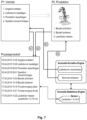
- Fig. 7 Using a specific executing process instance, it demonstrates the interaction between the source system, process log, anomaly detection engine, and anomaly correction engine.
- the process instance comprises two sub-process instances, P1 and P2.
- Subprocess instance P1 is a sales process in which four steps have already been executed: "Create quotation,” “Confirm delivery date,” “Order production,” and “Notify shipping company.” Subprocess instance P1 was executed in an ERP system.
- Sub-process instance P2 is a production process in which a specific prefabricated component is painted according to customer requirements. Three steps have already been executed in sub-process instance P2: "request component” (e.g., from a component warehouse), "paint component” (after painting, the component was dried), and "measure paint thickness.” Sub-process instance P2 was executed by a painting robot equipped with appropriate sensors for measuring paint density.
- step S1 and S2 For the two steps executed in the sub-process instances P1 and P2, corresponding entries are created in the process log (steps S1 and S2), where Fig. 7 For simplicity, only the execution time and the identifier of the respective process step are shown.
- the measured paint density is also stored in the process log.
- the entries in the process log are advantageously generated immediately after the corresponding steps have been executed.
- a sensor of the anomaly detection engine continuously monitors the process log (e.g., every two minutes).
- the sensor definition specifies that the sensor monitors the process protocol to determine whether a "Measure paint thickness" step was executed within a process instance in which the measured paint thickness is less than 3 mm.
- a paint thickness of 1.5 mm was measured in the "Measure Paint Thickness" step.
- a paint thickness of less than 3 mm represents a process anomaly within the meaning of the present invention.
- the minimum paint thickness of 3 mm is fixed here. However, it can also be specified dynamically, for example, based on the requirements of the ordering customer.
- the anomaly detection engine informs the anomaly correction engine in which process instance which anomaly occurred.
- the anomaly detection engine informs the anomaly correction engine that the process instance specified in the process log has measured too low a paint thickness.
- the anomaly correction engine selects from a set of generic actions (which are defined in Fig. 7 are not shown) the generic actions that can be used to correct this process anomaly.
- these are the generic actions "Postpone delivery date” and "Repaint.”
- the generic action "Postpone delivery date” is necessary here because repainting the component delays its availability for handover to the shipping company.
- the anomaly correction engine generates process intervention instances from the selected generic actions.
- the process intervention instance "Postpone delivery date” is transferred by the anomaly correction engine to the ERP system (step S3), in which the first sub-process instance P1 was executed.
- the process intervention instance "Repaint” is transferred by the anomaly correction engine to the production system (e.g., to the painting robot) (step S4), in which the second sub-process instance P2 was executed.
- the process intervention instances are adjusted using a number of parameters.
- the parameter values can be fixed or, for example, can be set depending on the current process instance.
- the generic action "Postpone delivery date” can be used for different process instances of different processes to postpone a delivery date.
- the anomaly correction engine can calculate the delay in the availability of the component from the duration for painting and drying the component and from the availability of the painting robot, and pass this delay (e.g., 36 hours) as a parameter of the process intervention instance "Delay delivery date".
- the anomaly correction engine can pass the parameterized process intervention instances directly to the respective source system.
- the source systems can then convert the respective process intervention instances into instructions that are executable by the respective source system.
- the anomaly correction engine generates corresponding instructions executable by the respective source system from the process intervention instances and then passes these instructions to the respective source system.
- the creation of instructions from the process intervention instances can thus be performed centrally by the anomaly correction engine.
- the anomaly correction engine generates the corresponding instructions depending on the respective source system to which the instructions are to be made available.
- the process intervention instances or the corresponding instructions are then executed by the respective source system. Entries can then be created in the process log for the corresponding steps (according to the executed instructions) (in Fig. 7 (not shown), which in turn can be monitored by the sensor of the anomaly detection engine. For repainting, the entries "19.04.2018 12:00 Repaint component,""19.04.2018 12:30 Drying process start,”"19.04.2018 12:43 Drying process end,” and "19.04.2018 12:32 Measure paint thickness, paint thickness 3.05 mm" could be generated in the process log. Since the paint thickness is now greater than 3 mm, the anomaly is considered resolved according to the sensor definition of the sensor monitoring the process log.
- Fig. 7 Using a specific executing process instance, it demonstrates the interaction between the source system, process log, anomaly detection engine, and anomaly correction engine.
- the process instance comprises two sub-process instances, P1 and P2.
- Subprocess instance P1 is a sales process in which four steps have already been executed: "Create quotation,” “Confirm delivery date,” “Order production,” and “Notify shipping company.” Subprocess instance P1 was executed in an ERP system.
- Sub-process instance P2 is a production process in which a specific prefabricated component is painted according to customer requirements. Three steps have already been executed in sub-process instance P2: "request component” (e.g., from a component warehouse), "paint component” (after painting, the component was dried), and "measure paint thickness.” Sub-process instance P2 was executed by a painting robot equipped with appropriate sensors for measuring paint density.
- step S1 and S2 For the two steps executed in the sub-process instances P1 and P2, corresponding entries are created in the process log (steps S1 and S2), where Fig. 7 For simplicity, only the execution time and the identifier of the respective process step are shown.
- the measured paint density is also stored in the process log.
- the entries in the process log are advantageously generated immediately after the corresponding steps have been executed.
- a sensor of the anomaly detection engine continuously monitors the process log (e.g., every two minutes).
- the sensor definition specifies that the sensor monitors the process protocol to determine whether a "Measure paint thickness" step was executed within a process instance in which the measured paint thickness is less than 3 mm.
- a paint thickness of 1.5 mm was measured in the "Measure paint thickness" step.
- a paint thickness of less than 3 mm represents a process anomaly within the meaning of the present invention.
- the value of the minimum paint thickness of 3 mm is It is fixed here. However, it can also be specified dynamically, for example, based on the requirements of the ordering customer.
- the anomaly detection engine informs the anomaly correction engine in which process instance which anomaly occurred.
- the anomaly detection engine informs the anomaly correction engine that the process instance specified in the process log has measured too low a paint thickness.
- the anomaly correction engine selects from a set of generic actions (which are defined in Fig. 7 not shown) selects the generic actions that can be used to resolve this process anomaly.
- these are the generic actions "Postpone Delivery Date” and "Repaint.”
- the generic action "Postpone Delivery Date” is necessary here because repainting the component will delay its preparation for handover to the shipping company.
- the anomaly correction engine generates process intervention instances from the selected generic actions.
- the process intervention instance "Postpone delivery date” is transferred by the anomaly correction engine to the ERP system (step S3), in which the first sub-process instance P1 was executed.
- the process intervention instance "Repaint” is transferred by the anomaly correction engine to the production system (e.g., to the painting robot) (step S4), in which the second sub-process instance P2 was executed.
- the process intervention instances are adjusted using a number of parameters.
- the parameter values can be fixed or, for example, can be set depending on the current process instance. In this way, the The generic "Postpone Delivery Date" action can be used for different process instances of different processes to postpone a delivery date.
- the anomaly correction engine can calculate the delay in the availability of the component from the duration of painting and drying the component and the availability of the painting robot, and pass this delay (e.g., 36 hours) as a parameter to the "Postpone Delivery Date" process intervention instance.
- the anomaly correction engine can pass the parameterized process intervention instances directly to the respective source system.
- the source systems can then convert the respective process intervention instances into instructions that are executable by the respective source system.
- the anomaly correction engine generates corresponding instructions executable by the respective source system from the process intervention instances and then passes these instructions to the respective source system.
- the creation of instructions from the process intervention instances can thus be performed centrally by the anomaly correction engine.
- the anomaly correction engine generates the corresponding instructions depending on the respective source system to which the instructions are to be made available.
- the process intervention instances or the corresponding instructions are then executed by the respective source system. Entries can then be created in the process log for the corresponding steps (according to the executed instructions) (in Fig. 7 (not shown), which in turn can be monitored by the sensor of the anomaly detection engine. For repainting, the entries "19.04.2018 12:00 Repaint component", “04/19/2018 12:30 Drying process start,””04/19/2018 12:43 Drying process end,” and “04/19/2018 12:32 Measure paint thickness, paint thickness 3.05 mm" are generated in the process log. Since the paint thickness is now greater than 3 mm, the anomaly is considered resolved according to the sensor definition of the sensor monitoring the process log.
- a machine carries out several steps, e.g. of a production process.
- the machine can also be a computer system in or with which a process (e.g. an ordering process in an ERP system) is executed.
- Each process step generates data that is stored as process data PD in the process log. In the case of a machine, this data can include sensor data or operating parameters.
- the process data comprises at least an identifier of the process instance and an identifier of the process step as well as information (e.g. a timestamp) that determines the sequence of the process steps of a process instance.
- Each process step stores the process data during execution or immediately after execution.
- the process log can be stored in a database of a computer system connected to the machine via a communications network. It is advantageous if the database is stored in the computer system's RAM.
- An anomaly detection engine controls one or more sensors that continuously (or at specific time intervals) monitor the process log and, based on one or more sensor definitions, detects faulty or anomalous process instances (PI) in the process log. If the process data is saved in the process log during execution or immediately after the execution of the respective process steps, faulty or anomalous process instances can be detected during the execution of the respective process instance, i.e., before the execution of the respective process instance is completed. Depending on the time intervals at which the sensor(s) query the process log, it is even possible to detect faulty or anomalous process instances in real time, which in turn enables intervention in the respective process instance in real time to correct the error or eliminate the anomaly.
- the anomaly detection engine passes the detected process instances (PI) to the anomaly correction engine.
- the anomaly detection engine can also pass additional data (auxiliary data) to the anomaly correction engine that further describes the respective process instance.
- this data can include information about the customer for whom the workpiece being machined by the machine is intended.
- the anomaly detection engine can query this auxiliary data from other databases and make it available to the anomaly correction engine.
- this auxiliary data can also be queried by the anomaly correction engine, e.g., from additional databases. This is advantageous for reducing the load on the anomaly detection engine, especially when very large process protocols (e.g., with several hundred million process steps) need to be monitored in real time, if possible.
- the Anomaly Correction Engine creates process intervention instances for the process instances passed by the Anomaly Detection Engine, as described above. These process intervention instances are designed to control the respective executing process instance.
- the machine in the example shown is the machine. It is advantageous if the instructions are adapted to the respective source system so that they can be executed directly there.
- Fig. 8 In the example shown, the machine can be instructed to carry out a specific processing step with which the detected error or anomaly can be rectified.
- the anomaly detection engine and the anomaly correction engine can run on the same computer system. Alternatively, the anomaly detection engine and the anomaly correction engine can run on separate computer systems connected via a communications network.
- multiple process logs can be present in which process data from different source systems is stored.
- multiple anomaly detection engines (each of which can control multiple sensors) can be provided, which monitor different process logs or monitor a process log jointly.
- multiple anomaly correction engines can be provided, each adapted to correct specific process anomalies.
- the anomaly detection engines can be adapted to transfer the respective detected process instance to a corresponding anomaly correction engine. This allows a network of process logs, anomaly detection engines, and anomaly correction engines to be provided, in which each engine is configured to solve specific tasks, as exemplified in Fig. 9 shown.
Landscapes
- Engineering & Computer Science (AREA)
- Theoretical Computer Science (AREA)
- Physics & Mathematics (AREA)
- General Physics & Mathematics (AREA)
- General Engineering & Computer Science (AREA)
- Business, Economics & Management (AREA)
- Quality & Reliability (AREA)
- Human Resources & Organizations (AREA)
- Computing Systems (AREA)
- Computer Hardware Design (AREA)
- Strategic Management (AREA)
- Development Economics (AREA)
- Educational Administration (AREA)
- Economics (AREA)
- Entrepreneurship & Innovation (AREA)
- Automation & Control Theory (AREA)
- Manufacturing & Machinery (AREA)
- Human Computer Interaction (AREA)
- Evolutionary Biology (AREA)
- Operations Research (AREA)
- General Business, Economics & Management (AREA)
- Life Sciences & Earth Sciences (AREA)
- Bioinformatics & Cheminformatics (AREA)
- Bioinformatics & Computational Biology (AREA)
- Game Theory and Decision Science (AREA)
- Tourism & Hospitality (AREA)
- Marketing (AREA)
- Mathematical Physics (AREA)
- General Factory Administration (AREA)
- Testing And Monitoring For Control Systems (AREA)
- Debugging And Monitoring (AREA)
- Management, Administration, Business Operations System, And Electronic Commerce (AREA)
Claims (14)
- Procédé mis en œuvre par ordinateur permettant de surveiller des instances de processus en cours d'exécution dans au moins un système source et d'éliminer des anomalies de processus dans lesdites instances de processus, dans lequel chaque instance de processus comprend un certain nombre d'étapes de processus, dans lequel des données de processus sont enregistrées dans au moins un protocole de processus pour les étapes de processus déjà exécutées, dans lequel, pour chaque étape de processus, les données de processus sont enregistrées dans le protocole de processus lors de l'exécution de l'étape de processus, dans lequel les données de processus pour chaque étape de processus comprennent au moins- un identifiant de l'étape de processus,- un identifiant, par lequel l'étape de processus peut être associée de manière univoque à une instance de processus, et- un ordre de l'étape de processus dans l'instance de processus,
dans lequel une anomalie de processus est décrite par au moins une définition de capteur, dans lequel un ensemble d'actions génériques est associé à une anomalie de processus pour l'élimination de l'anomalie de processus, dans lequel(a) dans une étape de surveillance, un capteur, à l'aide de la définition de capteur, surveille le protocole de processus en ce qui concerne l'anomalie de processus décrite dans la définition de capteur et détecte des instances de processus qui présentent l'anomalie de processus décrite dans la définition de capteur, et(b) dans une étape de correction, pour une instance de processus détectée dans l'étape de surveillance, l'anomalie de processus est éliminée au moment de l'exécution de ladite instance de processus, dans lequel- au moins une action générique est sélectionnée parmi l'ensemble d'actions génériques associé à l'anomalie de processus,- sur la base de l'action générique sélectionnée, une instance d'intervention de processus spécifique au processus détecté est produite, et- l'instance d'intervention de processus est mise à exécution pour l'élimination de l'anomalie de processus de l'instance de processus détectée. - Procédé selon la revendication 1, dans lequel la définition de capteur contient des données et/ou des instructions, à l'aide desquelles, dans l'étape de surveillance, des instances de processus qui satisfont à un critère de sélection prédéterminé sont sélectionnées parmi le protocole de processus.
- Procédé selon la revendication précédente, dans lequel le critère de sélection est- au moins un paramètre statique ou dynamique,- au moins un modèle prédéterminé, et/ou- au moins un paramètre pouvant être défini à l'aide d'une reconnaissance de modèle, dans lequel, en cas d'écart ou de non-écart par rapport au critère de sélection, le critère de sélection est satisfait et un écart ou un non-écart par rapport au critère de sélection est indicatif d'une anomalie de processus.
- Procédé selon la revendication 1, dans lequel une instance de processus présente plusieurs sous-instances de processus, dans lequel les étapes de processus des sous-instances de processus peuvent être exécutées dans différents systèmes sources, et dans lequel, pour les étapes de processus déjà exécutées des sous-instances de processus, les données de processus sont combinées dans l'au moins un protocole de processus.
- Procédé selon la revendication 1, dans lequel la définition de capteur comprend une information concernant les instants auxquels l'étape de surveillance est exécutée.
- Procédé selon la revendication 1, dans lequel, avant l'étape de surveillance, le protocole de processus est filtré selon des critères de filtrage prédéterminés et dans lequel le protocole de processus filtré est la base de l'étape de surveillance.
- Procédé selon la revendication 1, dans lequel les données de processus enregistrées dans le protocole de processus peuvent être liées à d'autres données auxiliaires décrivant l'instance de processus respective et/ou l'étape de processus respective, dans lequel, lors de la production de l'instance d'intervention de processus, celle-ci est paramétrée avec les données auxiliaires.
- Procédé selon la revendication précédente, dans lequel l'instance d'intervention de processus présente un certain nombre d'actions non invasives et/ou un certain nombre d'actions invasives, dans lequel- les actions non invasives sont exécutées hors du système source dans lequel l'instance de processus respective est exécutée, et- les actions invasives sont exécutées dans le système source dans lequel l'instance de processus respective est exécutée.
- Procédé selon la revendication précédente, dans lequel, par une action invasive, le déroulement de l'instance de processus respective dans le système source est changé et/ou commandé.
- Procédé selon la revendication 8, dans lequel les actions non invasives et/ou les actions invasives sont converties en instructions pouvant être exécutées pour le système source respectif.
- Procédé selon la revendication 1, dans lequel la sélection de l'au moins une action générique parmi l'ensemble associé à l'anomalie de processus, d'actions génériques est effectuée de telle sorte que, pour un certain nombre d'actions ou de combinaisons d'actions contenues dans l'ensemble d'actions génériques, une simulation est réalisée, dans laquelle il est déterminé quelle action ou combinaison d'actions appliquée à l'instance de processus aboutit au mieux à un résultat prédéterminé, dans lequel ladite action ou combinaison d'actions est sélectionnée.
- Procédé selon la revendication 6, dans lequel le critère de filtrage est formé par au moins un attribut du protocole de processus et les caractéristiques que ledit attribut peut adopter, dans lequel les caractéristiques sont associées à un utilisateur, dans lequel, par l'intermédiaire de l'association des caractéristiques de l'attribut à l'utilisateur, les anomalies de processus se produisant dans le protocole de processus filtré sont également associées audit utilisateur.
- Procédé selon la revendication 1, dans lequel le protocole de processus est enregistré dans une mémoire de travail d'un système informatique, de préférence de telle sorte que des étapes de processus successives d'une instance de processus sont enregistrées dans des cellules de mémoire adjacentes.
- Procédé selon la revendication 5, dans lequel l'étape de surveillance est exécutée par un moteur de détection d'anomalies et l'étape de correction est exécutée par un moteur de correction d'anomalies, dans lequel- le moteur de détection d'anomalies commande l'exécution du capteur, dans lequel l'exécution du capteur est déclenchée conformément aux instants indiqués dans la définition de capteur, et- le moteur de détection d'anomalies transmet au moteur de correction d'anomalies des informations concernant les instances de processus détectées par le capteur.
Applications Claiming Priority (1)
| Application Number | Priority Date | Filing Date | Title |
|---|---|---|---|
| PCT/EP2018/056066 WO2019174709A1 (fr) | 2018-03-12 | 2018-03-12 | Procédé d'élimination d'anomalies de processus |
Publications (3)
| Publication Number | Publication Date |
|---|---|
| EP3765962A1 EP3765962A1 (fr) | 2021-01-20 |
| EP3765962C0 EP3765962C0 (fr) | 2025-04-30 |
| EP3765962B1 true EP3765962B1 (fr) | 2025-04-30 |
Family
ID=61655761
Family Applications (1)
| Application Number | Title | Priority Date | Filing Date |
|---|---|---|---|
| EP18711288.3A Active EP3765962B1 (fr) | 2018-03-12 | 2018-03-12 | Procédé d'élimination d'anomalies de processus |
Country Status (4)
| Country | Link |
|---|---|
| US (1) | US11307557B2 (fr) |
| EP (1) | EP3765962B1 (fr) |
| JP (1) | JP7032557B2 (fr) |
| WO (1) | WO2019174709A1 (fr) |
Families Citing this family (5)
| Publication number | Priority date | Publication date | Assignee | Title |
|---|---|---|---|---|
| AT524002B1 (de) * | 2020-07-10 | 2023-10-15 | Engel Austria Gmbh | Verfahren zur automatischen Überwachung mindestens eines Produktionsprozesses |
| US20230004551A1 (en) * | 2021-07-02 | 2023-01-05 | Viettel Group | Method of processing and storing data for real time anomaly detection problem |
| US12461933B2 (en) | 2022-10-03 | 2025-11-04 | Eygs Llp | Enterprise resource planning database extraction, transformation, and analysis |
| US12072784B2 (en) | 2022-10-17 | 2024-08-27 | Oracle International Corporation | Multi-stage anomaly detection and remediation |
| US12225037B1 (en) * | 2024-03-29 | 2025-02-11 | Wiz, Inc. | Techniques for cybersecurity investigation of cloud entity misuse leveraging runtime context |
Citations (9)
| Publication number | Priority date | Publication date | Assignee | Title |
|---|---|---|---|---|
| US20030149604A1 (en) | 2002-01-25 | 2003-08-07 | Fabio Casati | Exception analysis, prediction, and prevention method and system |
| US20070067452A1 (en) | 2005-05-13 | 2007-03-22 | Fung Casey K | Mobile network dynamic workflow exception handling system |
| TW200928643A (en) | 2007-12-25 | 2009-07-01 | Ind Tech Res Inst | Multi-stages event monitoring method for detecting abnormal manufacturing process |
| CN103701657A (zh) | 2012-09-28 | 2014-04-02 | 中国银联股份有限公司 | 用于不间断运行的数据处理系统的异常监控及处理装置和方法 |
| US20160110277A1 (en) | 2014-10-16 | 2016-04-21 | Siemens Aktiengesellshaft | Method for Computer-Aided Analysis of an Automation System |
| WO2016172316A1 (fr) | 2015-04-24 | 2016-10-27 | Ppg Industries Ohio, Inc. | Gestion de peinture intégrée et intelligente |
| WO2016191639A1 (fr) | 2015-05-28 | 2016-12-01 | Oracle International Corporation | Système automatique de détection et de résolution d'anomalies |
| EP3244334A1 (fr) | 2016-05-09 | 2017-11-15 | Accenture Global Solutions Limited | Décomposition de trajet d'un graph de fichiers de journalisation pour la détection d'anomalie de réseau |
| US20180032393A1 (en) | 2016-08-01 | 2018-02-01 | International Business Machines Corporation | Self-healing server using analytics of log data |
Family Cites Families (9)
| Publication number | Priority date | Publication date | Assignee | Title |
|---|---|---|---|---|
| JP2003022117A (ja) | 2001-07-05 | 2003-01-24 | Mitsubishi Electric Corp | アクション管理装置及びアクション管理方法 |
| JP2003263222A (ja) | 2002-03-08 | 2003-09-19 | Toyota Motor Corp | 生産設備の保守支援装置およびプログラム |
| DE102004046611A1 (de) * | 2004-09-25 | 2006-03-30 | Robert Bosch Gmbh | Verfahren zur Abarbeitung eines Computerprogramms auf einem Computersystem |
| US8725667B2 (en) * | 2008-03-08 | 2014-05-13 | Tokyo Electron Limited | Method and system for detection of tool performance degradation and mismatch |
| JP5534313B2 (ja) | 2010-01-27 | 2014-06-25 | 沖電気工業株式会社 | 取引処理装置の予防保守システム及び予防保守サーバ |
| JP5681453B2 (ja) | 2010-11-08 | 2015-03-11 | 株式会社ディスコ | 測定方法および測定装置 |
| JP2012140648A (ja) | 2010-12-28 | 2012-07-26 | Canon Anelva Corp | スパッタリング装置及びそのスパッタリング方法 |
| US10235227B2 (en) * | 2015-10-12 | 2019-03-19 | Bank Of America Corporation | Detection, remediation and inference rule development for multi-layer information technology (“IT”) structures |
| JP2017199249A (ja) | 2016-04-28 | 2017-11-02 | 株式会社リコー | 情報処理システム、画像処理装置および動作ログの出力方法 |
-
2018
- 2018-03-12 EP EP18711288.3A patent/EP3765962B1/fr active Active
- 2018-03-12 WO PCT/EP2018/056066 patent/WO2019174709A1/fr not_active Ceased
- 2018-03-12 JP JP2020548752A patent/JP7032557B2/ja active Active
-
2020
- 2020-09-11 US US17/018,296 patent/US11307557B2/en active Active
Patent Citations (9)
| Publication number | Priority date | Publication date | Assignee | Title |
|---|---|---|---|---|
| US20030149604A1 (en) | 2002-01-25 | 2003-08-07 | Fabio Casati | Exception analysis, prediction, and prevention method and system |
| US20070067452A1 (en) | 2005-05-13 | 2007-03-22 | Fung Casey K | Mobile network dynamic workflow exception handling system |
| TW200928643A (en) | 2007-12-25 | 2009-07-01 | Ind Tech Res Inst | Multi-stages event monitoring method for detecting abnormal manufacturing process |
| CN103701657A (zh) | 2012-09-28 | 2014-04-02 | 中国银联股份有限公司 | 用于不间断运行的数据处理系统的异常监控及处理装置和方法 |
| US20160110277A1 (en) | 2014-10-16 | 2016-04-21 | Siemens Aktiengesellshaft | Method for Computer-Aided Analysis of an Automation System |
| WO2016172316A1 (fr) | 2015-04-24 | 2016-10-27 | Ppg Industries Ohio, Inc. | Gestion de peinture intégrée et intelligente |
| WO2016191639A1 (fr) | 2015-05-28 | 2016-12-01 | Oracle International Corporation | Système automatique de détection et de résolution d'anomalies |
| EP3244334A1 (fr) | 2016-05-09 | 2017-11-15 | Accenture Global Solutions Limited | Décomposition de trajet d'un graph de fichiers de journalisation pour la détection d'anomalie de réseau |
| US20180032393A1 (en) | 2016-08-01 | 2018-02-01 | International Business Machines Corporation | Self-healing server using analytics of log data |
Non-Patent Citations (4)
Also Published As
| Publication number | Publication date |
|---|---|
| JP2021515948A (ja) | 2021-06-24 |
| US20210041849A1 (en) | 2021-02-11 |
| EP3765962C0 (fr) | 2025-04-30 |
| WO2019174709A1 (fr) | 2019-09-19 |
| JP7032557B2 (ja) | 2022-03-08 |
| US11307557B2 (en) | 2022-04-19 |
| EP3765962A1 (fr) | 2021-01-20 |
Similar Documents
| Publication | Publication Date | Title |
|---|---|---|
| DE69508931T2 (de) | Fabriknetzwerk mit mehreren fabriken und koordinationsverfahren | |
| EP2122428B1 (fr) | Procédé et système de détermination de paramètres de fiabilité d'une installation technique | |
| WO2019174709A1 (fr) | Procédé d'élimination d'anomalies de processus | |
| DE102004023266A1 (de) | Bestimmen eines Sollbestands für einen Knoten einer Lieferkette | |
| EP3139289A1 (fr) | Procede d'analyse de processus | |
| DE102011014817A1 (de) | Inventarmanagement | |
| EP1530770B1 (fr) | Procede et dispositif pour optimiser un processus | |
| DE102018118471A1 (de) | Vorrichtung und Verfahren zur Bereitstellung von Ersatzteilen eines Luftfahrzeuges | |
| WO2019233735A1 (fr) | Procédé de garantie de la qualité lors de la production d'un produit, dispositif de calcul et programme d'ordinateur | |
| DE19930446C1 (de) | Diagnoseverfahren und Diagnosesystem zur Überwachung der verfügbaren Resourcen in einem Herstellungsprozeß | |
| DE69903461T2 (de) | Verfahren und system für die planung von betriebsmittel-anforderungen und zum erzeugen eines produktionsplans mit hilfe eines uniformen datenmodells | |
| EP3139274B1 (fr) | Procede de determination d'un delai d'execution net entre des etapes de processus d'une instance de processus | |
| EP1556811A2 (fr) | Prevision du degre de respect des delais de livraison dans la fabrication en serie | |
| EP4500424B1 (fr) | Optimisation d'un planning de production | |
| EP3139273B1 (fr) | Procede de determination de chemins de processus paralleles dans des donnees de processus | |
| WO2007042055A1 (fr) | Procede de planning de commandes et systeme d'information de gestion | |
| EP3139272A1 (fr) | Procede d'analyse efficace de donnees de processus | |
| EP2569763B1 (fr) | Procédé de surveillance assistée par ordinateur de la puissance fonctionnelle d'un système technique | |
| DE202020006160U1 (de) | System zum Erstellen von Prozessprotokollen | |
| DE10325832A1 (de) | Abwicklung von Planungs- Problemen über Planungs- Zyklen | |
| EP2901384A1 (fr) | Procédé de gestion de stock et/ou d'estimation du risque d'obsolescence | |
| DE202018004070U1 (de) | Maschinenanalyse | |
| WO2004040487A2 (fr) | Procede permettant de determiner un delai de production | |
| EP3783449A1 (fr) | Allocation des appareils d'une installation technique | |
| DE10325831A1 (de) | Bestimmung einer oder mehrerer Hauptursachen eines Planungsproblems |
Legal Events
| Date | Code | Title | Description |
|---|---|---|---|
| STAA | Information on the status of an ep patent application or granted ep patent |
Free format text: STATUS: UNKNOWN |
|
| STAA | Information on the status of an ep patent application or granted ep patent |
Free format text: STATUS: THE INTERNATIONAL PUBLICATION HAS BEEN MADE |
|
| PUAI | Public reference made under article 153(3) epc to a published international application that has entered the european phase |
Free format text: ORIGINAL CODE: 0009012 |
|
| STAA | Information on the status of an ep patent application or granted ep patent |
Free format text: STATUS: REQUEST FOR EXAMINATION WAS MADE |
|
| 17P | Request for examination filed |
Effective date: 20201012 |
|
| AK | Designated contracting states |
Kind code of ref document: A1 Designated state(s): AL AT BE BG CH CY CZ DE DK EE ES FI FR GB GR HR HU IE IS IT LI LT LU LV MC MK MT NL NO PL PT RO RS SE SI SK SM TR |
|
| AX | Request for extension of the european patent |
Extension state: BA ME |
|
| DAV | Request for validation of the european patent (deleted) | ||
| DAX | Request for extension of the european patent (deleted) | ||
| STAA | Information on the status of an ep patent application or granted ep patent |
Free format text: STATUS: EXAMINATION IS IN PROGRESS |
|
| 17Q | First examination report despatched |
Effective date: 20220615 |
|
| REG | Reference to a national code |
Ref country code: DE Ref legal event code: R079 Free format text: PREVIOUS MAIN CLASS: G06F0011070000 Ipc: G06F0011340000 Ref document number: 502018015775 Country of ref document: DE |
|
| RIC1 | Information provided on ipc code assigned before grant |
Ipc: G06F 11/30 20060101ALI20240827BHEP Ipc: G06F 11/07 20060101ALI20240827BHEP Ipc: G06F 11/34 20060101AFI20240827BHEP |
|
| GRAP | Despatch of communication of intention to grant a patent |
Free format text: ORIGINAL CODE: EPIDOSNIGR1 |
|
| STAA | Information on the status of an ep patent application or granted ep patent |
Free format text: STATUS: GRANT OF PATENT IS INTENDED |
|
| INTG | Intention to grant announced |
Effective date: 20241009 |
|
| GRAS | Grant fee paid |
Free format text: ORIGINAL CODE: EPIDOSNIGR3 |
|
| GRAA | (expected) grant |
Free format text: ORIGINAL CODE: 0009210 |
|
| STAA | Information on the status of an ep patent application or granted ep patent |
Free format text: STATUS: THE PATENT HAS BEEN GRANTED |
|
| AK | Designated contracting states |
Kind code of ref document: B1 Designated state(s): AL AT BE BG CH CY CZ DE DK EE ES FI FR GB GR HR HU IE IS IT LI LT LU LV MC MK MT NL NO PL PT RO RS SE SI SK SM TR |
|
| REG | Reference to a national code |
Ref country code: CH Ref legal event code: EP Ref country code: GB Ref legal event code: FG4D Free format text: NOT ENGLISH |
|
| REG | Reference to a national code |
Ref country code: IE Ref legal event code: FG4D Free format text: LANGUAGE OF EP DOCUMENT: GERMAN |
|
| REG | Reference to a national code |
Ref country code: DE Ref legal event code: R096 Ref document number: 502018015775 Country of ref document: DE |
|
| U01 | Request for unitary effect filed |
Effective date: 20250530 |
|
| U07 | Unitary effect registered |
Designated state(s): AT BE BG DE DK EE FI FR IT LT LU LV MT NL PT RO SE SI Effective date: 20250606 |
|
| PG25 | Lapsed in a contracting state [announced via postgrant information from national office to epo] |
Ref country code: ES Free format text: LAPSE BECAUSE OF FAILURE TO SUBMIT A TRANSLATION OF THE DESCRIPTION OR TO PAY THE FEE WITHIN THE PRESCRIBED TIME-LIMIT Effective date: 20250430 |
|
| PG25 | Lapsed in a contracting state [announced via postgrant information from national office to epo] |
Ref country code: NO Free format text: LAPSE BECAUSE OF FAILURE TO SUBMIT A TRANSLATION OF THE DESCRIPTION OR TO PAY THE FEE WITHIN THE PRESCRIBED TIME-LIMIT Effective date: 20250730 Ref country code: GR Free format text: LAPSE BECAUSE OF FAILURE TO SUBMIT A TRANSLATION OF THE DESCRIPTION OR TO PAY THE FEE WITHIN THE PRESCRIBED TIME-LIMIT Effective date: 20250731 |
|
| PG25 | Lapsed in a contracting state [announced via postgrant information from national office to epo] |
Ref country code: PL Free format text: LAPSE BECAUSE OF FAILURE TO SUBMIT A TRANSLATION OF THE DESCRIPTION OR TO PAY THE FEE WITHIN THE PRESCRIBED TIME-LIMIT Effective date: 20250430 |
|
| PG25 | Lapsed in a contracting state [announced via postgrant information from national office to epo] |
Ref country code: HR Free format text: LAPSE BECAUSE OF FAILURE TO SUBMIT A TRANSLATION OF THE DESCRIPTION OR TO PAY THE FEE WITHIN THE PRESCRIBED TIME-LIMIT Effective date: 20250430 |
|
| PG25 | Lapsed in a contracting state [announced via postgrant information from national office to epo] |
Ref country code: RS Free format text: LAPSE BECAUSE OF FAILURE TO SUBMIT A TRANSLATION OF THE DESCRIPTION OR TO PAY THE FEE WITHIN THE PRESCRIBED TIME-LIMIT Effective date: 20250731 |
|
| PG25 | Lapsed in a contracting state [announced via postgrant information from national office to epo] |
Ref country code: IS Free format text: LAPSE BECAUSE OF FAILURE TO SUBMIT A TRANSLATION OF THE DESCRIPTION OR TO PAY THE FEE WITHIN THE PRESCRIBED TIME-LIMIT Effective date: 20250830 |
|
| PG25 | Lapsed in a contracting state [announced via postgrant information from national office to epo] |
Ref country code: SM Free format text: LAPSE BECAUSE OF FAILURE TO SUBMIT A TRANSLATION OF THE DESCRIPTION OR TO PAY THE FEE WITHIN THE PRESCRIBED TIME-LIMIT Effective date: 20250430 |
|
| PG25 | Lapsed in a contracting state [announced via postgrant information from national office to epo] |
Ref country code: CZ Free format text: LAPSE BECAUSE OF FAILURE TO SUBMIT A TRANSLATION OF THE DESCRIPTION OR TO PAY THE FEE WITHIN THE PRESCRIBED TIME-LIMIT Effective date: 20250430 |
|
| PG25 | Lapsed in a contracting state [announced via postgrant information from national office to epo] |
Ref country code: SK Free format text: LAPSE BECAUSE OF FAILURE TO SUBMIT A TRANSLATION OF THE DESCRIPTION OR TO PAY THE FEE WITHIN THE PRESCRIBED TIME-LIMIT Effective date: 20250430 |
|
| PLBI | Opposition filed |
Free format text: ORIGINAL CODE: 0009260 |
|
| PLAX | Notice of opposition and request to file observation + time limit sent |
Free format text: ORIGINAL CODE: EPIDOSNOBS2 |
|
| REG | Reference to a national code |
Ref country code: CH Ref legal event code: L10 Free format text: ST27 STATUS EVENT CODE: U-0-0-L10-L00 (AS PROVIDED BY THE NATIONAL OFFICE) Effective date: 20260211 |
|
| 26 | Opposition filed |
Opponent name: SAP SE Effective date: 20260130 |
|
| PGFP | Annual fee paid to national office [announced via postgrant information from national office to epo] |
Ref country code: GB Payment date: 20260317 Year of fee payment: 9 |
|
| U20 | Renewal fee for the european patent with unitary effect paid |
Year of fee payment: 9 Effective date: 20260327 |