EP3766431A1 - Medizinische vorrichtung und behandlungsverfahren - Google Patents
Medizinische vorrichtung und behandlungsverfahren Download PDFInfo
- Publication number
- EP3766431A1 EP3766431A1 EP19778033.1A EP19778033A EP3766431A1 EP 3766431 A1 EP3766431 A1 EP 3766431A1 EP 19778033 A EP19778033 A EP 19778033A EP 3766431 A1 EP3766431 A1 EP 3766431A1
- Authority
- EP
- European Patent Office
- Prior art keywords
- hold
- expansion body
- medical device
- hole
- distal
- Prior art date
- Legal status (The legal status is an assumption and is not a legal conclusion. Google has not performed a legal analysis and makes no representation as to the accuracy of the status listed.)
- Granted
Links
Images




Classifications
-
- A—HUMAN NECESSITIES
- A61—MEDICAL OR VETERINARY SCIENCE; HYGIENE
- A61B—DIAGNOSIS; SURGERY; IDENTIFICATION
- A61B18/00—Surgical instruments, devices or methods for transferring non-mechanical forms of energy to or from the body
- A61B18/04—Surgical instruments, devices or methods for transferring non-mechanical forms of energy to or from the body by heating
- A61B18/12—Surgical instruments, devices or methods for transferring non-mechanical forms of energy to or from the body by heating by passing a current through the tissue to be heated, e.g. high-frequency current
- A61B18/14—Probes or electrodes therefor
- A61B18/1492—Probes or electrodes therefor having a flexible, catheter-like structure, e.g. for heart ablation
-
- A—HUMAN NECESSITIES
- A61—MEDICAL OR VETERINARY SCIENCE; HYGIENE
- A61B—DIAGNOSIS; SURGERY; IDENTIFICATION
- A61B18/00—Surgical instruments, devices or methods for transferring non-mechanical forms of energy to or from the body
- A61B18/04—Surgical instruments, devices or methods for transferring non-mechanical forms of energy to or from the body by heating
- A61B18/12—Surgical instruments, devices or methods for transferring non-mechanical forms of energy to or from the body by heating by passing a current through the tissue to be heated, e.g. high-frequency current
- A61B18/14—Probes or electrodes therefor
-
- A—HUMAN NECESSITIES
- A61—MEDICAL OR VETERINARY SCIENCE; HYGIENE
- A61B—DIAGNOSIS; SURGERY; IDENTIFICATION
- A61B18/00—Surgical instruments, devices or methods for transferring non-mechanical forms of energy to or from the body
- A61B18/04—Surgical instruments, devices or methods for transferring non-mechanical forms of energy to or from the body by heating
- A61B18/06—Surgical instruments, devices or methods for transferring non-mechanical forms of energy to or from the body by heating caused by chemical reaction, e.g. moxaburners
-
- A—HUMAN NECESSITIES
- A61—MEDICAL OR VETERINARY SCIENCE; HYGIENE
- A61B—DIAGNOSIS; SURGERY; IDENTIFICATION
- A61B18/00—Surgical instruments, devices or methods for transferring non-mechanical forms of energy to or from the body
- A61B18/04—Surgical instruments, devices or methods for transferring non-mechanical forms of energy to or from the body by heating
- A61B18/08—Surgical instruments, devices or methods for transferring non-mechanical forms of energy to or from the body by heating by means of electrically-heated probes
- A61B18/082—Probes or electrodes therefor
-
- A—HUMAN NECESSITIES
- A61—MEDICAL OR VETERINARY SCIENCE; HYGIENE
- A61B—DIAGNOSIS; SURGERY; IDENTIFICATION
- A61B18/00—Surgical instruments, devices or methods for transferring non-mechanical forms of energy to or from the body
- A61B18/18—Surgical instruments, devices or methods for transferring non-mechanical forms of energy to or from the body by applying electromagnetic radiation, e.g. microwaves
- A61B18/20—Surgical instruments, devices or methods for transferring non-mechanical forms of energy to or from the body by applying electromagnetic radiation, e.g. microwaves using laser
- A61B18/22—Surgical instruments, devices or methods for transferring non-mechanical forms of energy to or from the body by applying electromagnetic radiation, e.g. microwaves using laser the beam being directed along or through a flexible conduit, e.g. an optical fibre; Couplings or hand-pieces therefor
-
- A—HUMAN NECESSITIES
- A61—MEDICAL OR VETERINARY SCIENCE; HYGIENE
- A61B—DIAGNOSIS; SURGERY; IDENTIFICATION
- A61B17/00—Surgical instruments, devices or methods
- A61B17/00234—Surgical instruments, devices or methods for minimally invasive surgery
- A61B2017/00238—Type of minimally invasive operation
- A61B2017/00243—Type of minimally invasive operation cardiac
- A61B2017/00247—Making holes in the wall of the heart, e.g. laser Myocardial revascularization
-
- A—HUMAN NECESSITIES
- A61—MEDICAL OR VETERINARY SCIENCE; HYGIENE
- A61B—DIAGNOSIS; SURGERY; IDENTIFICATION
- A61B17/00—Surgical instruments, devices or methods
- A61B17/00234—Surgical instruments, devices or methods for minimally invasive surgery
- A61B2017/00238—Type of minimally invasive operation
- A61B2017/00243—Type of minimally invasive operation cardiac
- A61B2017/00247—Making holes in the wall of the heart, e.g. laser Myocardial revascularization
- A61B2017/00252—Making holes in the wall of the heart, e.g. laser Myocardial revascularization for by-pass connections, i.e. connections from heart chamber to blood vessel or from blood vessel to blood vessel
-
- A—HUMAN NECESSITIES
- A61—MEDICAL OR VETERINARY SCIENCE; HYGIENE
- A61B—DIAGNOSIS; SURGERY; IDENTIFICATION
- A61B17/00—Surgical instruments, devices or methods
- A61B2017/00831—Material properties
- A61B2017/00862—Material properties elastic or resilient
-
- A—HUMAN NECESSITIES
- A61—MEDICAL OR VETERINARY SCIENCE; HYGIENE
- A61B—DIAGNOSIS; SURGERY; IDENTIFICATION
- A61B18/00—Surgical instruments, devices or methods for transferring non-mechanical forms of energy to or from the body
- A61B2018/00053—Mechanical features of the instrument of device
- A61B2018/0016—Energy applicators arranged in a two- or three dimensional array
-
- A—HUMAN NECESSITIES
- A61—MEDICAL OR VETERINARY SCIENCE; HYGIENE
- A61B—DIAGNOSIS; SURGERY; IDENTIFICATION
- A61B18/00—Surgical instruments, devices or methods for transferring non-mechanical forms of energy to or from the body
- A61B2018/00053—Mechanical features of the instrument of device
- A61B2018/00184—Moving parts
- A61B2018/00202—Moving parts rotating
-
- A—HUMAN NECESSITIES
- A61—MEDICAL OR VETERINARY SCIENCE; HYGIENE
- A61B—DIAGNOSIS; SURGERY; IDENTIFICATION
- A61B18/00—Surgical instruments, devices or methods for transferring non-mechanical forms of energy to or from the body
- A61B2018/00053—Mechanical features of the instrument of device
- A61B2018/00214—Expandable means emitting energy, e.g. by elements carried thereon
-
- A—HUMAN NECESSITIES
- A61—MEDICAL OR VETERINARY SCIENCE; HYGIENE
- A61B—DIAGNOSIS; SURGERY; IDENTIFICATION
- A61B18/00—Surgical instruments, devices or methods for transferring non-mechanical forms of energy to or from the body
- A61B2018/00053—Mechanical features of the instrument of device
- A61B2018/00214—Expandable means emitting energy, e.g. by elements carried thereon
- A61B2018/0022—Balloons
-
- A—HUMAN NECESSITIES
- A61—MEDICAL OR VETERINARY SCIENCE; HYGIENE
- A61B—DIAGNOSIS; SURGERY; IDENTIFICATION
- A61B18/00—Surgical instruments, devices or methods for transferring non-mechanical forms of energy to or from the body
- A61B2018/00053—Mechanical features of the instrument of device
- A61B2018/00214—Expandable means emitting energy, e.g. by elements carried thereon
- A61B2018/0022—Balloons
- A61B2018/00232—Balloons having an irregular shape
-
- A—HUMAN NECESSITIES
- A61—MEDICAL OR VETERINARY SCIENCE; HYGIENE
- A61B—DIAGNOSIS; SURGERY; IDENTIFICATION
- A61B18/00—Surgical instruments, devices or methods for transferring non-mechanical forms of energy to or from the body
- A61B2018/00053—Mechanical features of the instrument of device
- A61B2018/00214—Expandable means emitting energy, e.g. by elements carried thereon
- A61B2018/00267—Expandable means emitting energy, e.g. by elements carried thereon having a basket shaped structure
-
- A—HUMAN NECESSITIES
- A61—MEDICAL OR VETERINARY SCIENCE; HYGIENE
- A61B—DIAGNOSIS; SURGERY; IDENTIFICATION
- A61B18/00—Surgical instruments, devices or methods for transferring non-mechanical forms of energy to or from the body
- A61B2018/00315—Surgical instruments, devices or methods for transferring non-mechanical forms of energy to or from the body for treatment of particular body parts
- A61B2018/00345—Vascular system
- A61B2018/00351—Heart
-
- A—HUMAN NECESSITIES
- A61—MEDICAL OR VETERINARY SCIENCE; HYGIENE
- A61B—DIAGNOSIS; SURGERY; IDENTIFICATION
- A61B18/00—Surgical instruments, devices or methods for transferring non-mechanical forms of energy to or from the body
- A61B2018/00315—Surgical instruments, devices or methods for transferring non-mechanical forms of energy to or from the body for treatment of particular body parts
- A61B2018/00345—Vascular system
- A61B2018/00351—Heart
- A61B2018/00357—Endocardium
-
- A—HUMAN NECESSITIES
- A61—MEDICAL OR VETERINARY SCIENCE; HYGIENE
- A61B—DIAGNOSIS; SURGERY; IDENTIFICATION
- A61B18/00—Surgical instruments, devices or methods for transferring non-mechanical forms of energy to or from the body
- A61B2018/00571—Surgical instruments, devices or methods for transferring non-mechanical forms of energy to or from the body for achieving a particular surgical effect
- A61B2018/00595—Cauterization
-
- A—HUMAN NECESSITIES
- A61—MEDICAL OR VETERINARY SCIENCE; HYGIENE
- A61B—DIAGNOSIS; SURGERY; IDENTIFICATION
- A61B18/00—Surgical instruments, devices or methods for transferring non-mechanical forms of energy to or from the body
- A61B18/02—Surgical instruments, devices or methods for transferring non-mechanical forms of energy to or from the body by cooling, e.g. cryogenic techniques
- A61B2018/0212—Surgical instruments, devices or methods for transferring non-mechanical forms of energy to or from the body by cooling, e.g. cryogenic techniques using an instrument inserted into a body lumen, e.g. catheter
-
- A—HUMAN NECESSITIES
- A61—MEDICAL OR VETERINARY SCIENCE; HYGIENE
- A61B—DIAGNOSIS; SURGERY; IDENTIFICATION
- A61B18/00—Surgical instruments, devices or methods for transferring non-mechanical forms of energy to or from the body
- A61B18/04—Surgical instruments, devices or methods for transferring non-mechanical forms of energy to or from the body by heating
- A61B18/12—Surgical instruments, devices or methods for transferring non-mechanical forms of energy to or from the body by heating by passing a current through the tissue to be heated, e.g. high-frequency current
- A61B18/1206—Generators therefor
- A61B2018/1246—Generators therefor characterised by the output polarity
- A61B2018/1253—Generators therefor characterised by the output polarity monopolar
-
- A—HUMAN NECESSITIES
- A61—MEDICAL OR VETERINARY SCIENCE; HYGIENE
- A61B—DIAGNOSIS; SURGERY; IDENTIFICATION
- A61B18/00—Surgical instruments, devices or methods for transferring non-mechanical forms of energy to or from the body
- A61B18/04—Surgical instruments, devices or methods for transferring non-mechanical forms of energy to or from the body by heating
- A61B18/12—Surgical instruments, devices or methods for transferring non-mechanical forms of energy to or from the body by heating by passing a current through the tissue to be heated, e.g. high-frequency current
- A61B18/1206—Generators therefor
- A61B2018/1246—Generators therefor characterised by the output polarity
- A61B2018/126—Generators therefor characterised by the output polarity bipolar
-
- A—HUMAN NECESSITIES
- A61—MEDICAL OR VETERINARY SCIENCE; HYGIENE
- A61B—DIAGNOSIS; SURGERY; IDENTIFICATION
- A61B18/00—Surgical instruments, devices or methods for transferring non-mechanical forms of energy to or from the body
- A61B18/04—Surgical instruments, devices or methods for transferring non-mechanical forms of energy to or from the body by heating
- A61B18/12—Surgical instruments, devices or methods for transferring non-mechanical forms of energy to or from the body by heating by passing a current through the tissue to be heated, e.g. high-frequency current
- A61B18/14—Probes or electrodes therefor
- A61B2018/1405—Electrodes having a specific shape
- A61B2018/142—Electrodes having a specific shape at least partly surrounding the target, e.g. concave, curved or in the form of a cave
-
- A—HUMAN NECESSITIES
- A61—MEDICAL OR VETERINARY SCIENCE; HYGIENE
- A61B—DIAGNOSIS; SURGERY; IDENTIFICATION
- A61B18/00—Surgical instruments, devices or methods for transferring non-mechanical forms of energy to or from the body
- A61B18/04—Surgical instruments, devices or methods for transferring non-mechanical forms of energy to or from the body by heating
- A61B18/12—Surgical instruments, devices or methods for transferring non-mechanical forms of energy to or from the body by heating by passing a current through the tissue to be heated, e.g. high-frequency current
- A61B18/14—Probes or electrodes therefor
- A61B2018/1467—Probes or electrodes therefor using more than two electrodes on a single probe
-
- A—HUMAN NECESSITIES
- A61—MEDICAL OR VETERINARY SCIENCE; HYGIENE
- A61B—DIAGNOSIS; SURGERY; IDENTIFICATION
- A61B18/00—Surgical instruments, devices or methods for transferring non-mechanical forms of energy to or from the body
- A61B18/04—Surgical instruments, devices or methods for transferring non-mechanical forms of energy to or from the body by heating
- A61B18/12—Surgical instruments, devices or methods for transferring non-mechanical forms of energy to or from the body by heating by passing a current through the tissue to be heated, e.g. high-frequency current
- A61B18/14—Probes or electrodes therefor
- A61B2018/1475—Electrodes retractable in or deployable from a housing
-
- A—HUMAN NECESSITIES
- A61—MEDICAL OR VETERINARY SCIENCE; HYGIENE
- A61B—DIAGNOSIS; SURGERY; IDENTIFICATION
- A61B5/00—Measuring for diagnostic purposes; Identification of persons
- A61B5/02—Detecting, measuring or recording for evaluating the cardiovascular system, e.g. pulse, heart rate, blood pressure or blood flow
- A61B5/021—Measuring pressure in heart or blood vessels
Definitions
- the present invention relates to a medical device including a maintenance treatment element which applies energy to a biological tissue, and a treatment method for applying energy to a biological tissue.
- a chronic heart failure is known as one of heart diseases.
- the chronic heart failure is broadly classified into a systolic heart failure and a diastolic heart failure, based on a cardiac function index.
- myocardial hypertrophy appears, and stiffness (hardness) increases. Consequently, blood pressure increases in a left atrium, and a cardiac pumping function is degraded.
- the patient may show heart failure symptoms such as a pulmonary edema.
- there is another heart disease of a patient who shows the following heart failure symptom Due to pulmonary hypertension, blood pressure increases on a right atrium side, and the cardiac pumping function is degraded.
- a shunt treatment has attracted attention.
- a shunt (through-hole) serving as an escape route for increased atrial pressure is formed in an atrial septum, thereby enabling heart failure symptom to be alleviated.
- the atrial septum is accessed using an intravenous approaching method, and the through-hole is formed to have a desired size.
- a medical device disclosed in PTL 1 is used as one of medical devices for performing the shunt treatment on the atrial septum.
- a shunt hole is enlarged using a balloon serving as an expansion body disposed in a distal portion of a shaft portion, and the shunt hole is maintained by an electrode disposed in the balloon.
- the medical device cannot enlarge the shunt hole in a state where a maintenance treatment element such as the electrode is fixed to a biological tissue. Therefore, when the shunt hole is enlarged, there is a possibility that positional displacement may occur between the maintenance treatment element and the biological tissue. For this reason, there is a possibility that a therapeutic effect may be reduced.
- the present invention is made to solve the above-described problem, and an object thereof is to provide a medical device and a treatment method, in which energy is accurately applied to a target site by suppressing positional displacement between an expansion body and a biological tissue.
- a medical device including an elongated shaft portion, and an expansion body disposed in a distal portion of the shaft portion, and configured to expand and contract in a radial direction.
- the expansion body has a hold portion that includes a proximal side hold portion and a distal side hold portion and that is configured to hold a biological tissue and, and a movable portion that is configured to open and close the hold portion in a holding direction.
- a treatment method of enlarging a through-hole of a biological tissue by using a medical device having an expansion body configured to expand and contract in a radial direction includes a step of positioning a hold portion of the expansion body in the through-hole of the biological tissue, a step of causing the hold portion to hold the biological tissue from both sides of the through-hole, a step of enlarging a diameter of the through-hole by expanding the expansion body, and a step of performing a maintenance treatment by using a maintenance treatment element of the hold portion.
- the biological tissue is held from both sides by the hold portion openable and closeable in the holding direction. Therefore, it is possible to suppress the positional displacement of the expansion body.
- the maintenance treatment is performed in a state where the biological tissue is held by the hold portion in this way. Therefore, while the positional displacement of the maintenance treatment element is suppressed, the energy can be accurately applied to the target site.
- distal end a side on which a medical device 10 is inserted into a biological lumen
- proximal end a side on which a medical device 10 is inserted into a biological lumen
- proximal side a side on which a medical device 10 is inserted into a biological lumen
- the medical device is configured as follows. A through-hole Hh formed in an atrial septum HA of a patient's heart H is enlarged, and further, a maintenance treatment is performed so that the through-hole Hh having an increased diameter is maintained to have an increased size.
- the medical device 10 includes an elongated shaft portion 20, an expansion body 21 disposed in a distal portion of the shaft portion 20, and an operation unit 23 disposed in a proximal portion of the shaft portion 20.
- the expansion body 21 has a maintenance treatment element (energy transfer element) 22 for performing the above-described maintenance treatment.
- the shaft portion 20 has an outer shaft 31 that holds the expansion body 21 in the distal portion, and a storage sheath 30 that stores the outer shaft 31.
- the storage sheath 30 is movable forward to and rearward from the outer shaft 31 in an axial direction. In a state where the storage sheath 30 is moved to the distal side of the shaft portion 20, the storage sheath 30 can internally store the expansion body 21 in a contracted state. In a state where the expansion body 21 is stored, the storage sheath 30 is moved to the proximal side. In this manner, the expansion body 21 can be exposed.
- a pulling shaft 33 is stored inside the outer shaft 31.
- the pulling shaft 33 projects from the distal end to the distal side of the outer shaft 31, and a distal portion thereof is fixed to a distal member 35.
- a proximal portion of the pulling shaft 33 is drawn out to the proximal side by the operation unit 23.
- the distal member 35 to which the distal portion of the pulling shaft 33 is fixed may not be fixed to the expansion body 21. In this manner, the distal member 35 can pull the expansion body 21 in a contracting direction.
- the distal member 35 is separated to the distal side from the expansion body 21. Accordingly, the expansion body 21 can be easily moved in a stretching direction, and storage capability can be improved.
- the operation unit 23 has a housing 40 held by an operator, an operation dial 41 that can be rotationally operated by the operator, and a conversion mechanism 42 operated in conjunction with the rotation of the operation dial 41.
- the pulling shaft 33 is held inside the operation unit 23 by the conversion mechanism 42.
- the conversion mechanism 42 can move the held pulling shaft 33 forward and backward along the axial direction.
- a rack and pinion mechanism can be used as the conversion mechanism 42.
- the expansion body 21 has a plurality of wires in a circumferential direction.
- the expansion body 21 has a plurality of wires in a circumferential direction.
- four wires of the expansion body 21 are disposed in the circumferential direction, and each of the four wires is configured to expand and contract in a radial direction.
- the wire of the expansion body 21 has a proximal side expansion portion 56 extending in a diameter increasing direction from the proximal portion toward the distal side, and a distal side expansion portion 57 extending in the diameter increasing direction from the distal portion toward the proximal side.
- a proximal side hold portion 51a is disposed in the distal portion of the proximal side expansion portion 56, and a distal side hold portion 51b is disposed in the proximal portion of the distal side expansion portion 57, respectively.
- the proximal side hold portion 51a and the distal side hold portion 51b form a hold portion 51 that can hold a biological tissue.
- the proximal portion of the proximal side expansion portion 56 is fixed to the distal portion of the outer shaft 31.
- a distal portion 55 of the distal side expansion portion 57 is located on the proximal side from the distal member 35 as the expansion body 21 itself expands.
- a recessed portion 53 is formed by the proximal side hold portion 51a and the distal side hold portion 51b which face each other in the axial direction, and a movable portion 52 that links both of these with each other.
- the movable portion 52 has a bending portion 54 having a smaller diameter than that of the hold portion 51.
- the bending portion 54 has the smaller diameter than that of the hold portion 51. Accordingly, bending portion 54 has bending strength weaker than that of the hold portion 51. Therefore, the bending portion 54 is likely to be bent when the expansion body 21 expands, and can open and close the hold portion 51 in a fan shape.
- the wire forming the expansion body 21 has a flat plate shape cut out from a cylinder.
- the wire forming the expansion body 21 can have a thickness of 50 to 500 ⁇ m and a width of 0.3 to 2.0 mm.
- the wire may have a dimension beyond this range.
- the wire may have a circular shape in a cross section, or may have other shapes in a cross section.
- a maintenance treatment element 22 is disposed in the proximal side hold portion 51a.
- the proximal side hold portion 51a When the hold portion 51 holds the atrial septum HA, the proximal side hold portion 51a is located on a right atrium side. Therefore, energy from the maintenance treatment element 22 is transferred to the atrial septum HA from the right atrium side.
- the maintenance treatment element 22 may be disposed in the distal side hold portion 51b, or may be disposed in both the proximal side hold portion 51a and the distal side hold portion 51b. It is desirable that the maintenance treatment element 22 is disposed in a projection portion projecting from a surface of the hold portion 51.
- the maintenance treatment element 22 is configured to include a bipolar electrode that receives electric energy from an energy supply device (not illustrated) serving as an external device. In this case, electricity is supplied to the maintenance treatment element 22 disposed in the hold portion 51.
- the maintenance treatment element 22 and the energy supply device are connected to each other by a conducting wire (not illustrated) coated with an insulating coating material.
- the conducting wire is drawn outward via the shaft portion 20 and the operation unit 23, and is connected to the energy supply device.
- the maintenance treatment element 22 may be configured to serve as a monopolar electrode. In this case, the electricity is supplied from a counter electrode plate prepared outside a body.
- the maintenance treatment element 22 may be a heating element (electrode chip) that generates heat by receiving high-frequency electric energy from the energy supply device.
- the maintenance treatment element 22 can be configured to include an energy transfer element that applies energy to the through-hole Hh, such as a heater including an electric wire which provides heating and cooling operation or generating frictional heat by using microwave energy, ultrasound energy, coherent light such as laser, a heated fluid, a cooled fluid, or a chemical medium.
- a specific form of the energy transfer element is not particularly limited.
- the wire forming the expansion body 21 can be formed of a metal material.
- a metal material it is possible to use a titanium-based (Ti-Ni, Ti-Pd, or Ti-Nb-Sn) alloy, a copper-based alloy, stainless steel, ⁇ -titanium steel, or a Co-Cr alloy.
- An alloy having a spring property such as a nickel titanium alloy may be used.
- a material of the expansion body 21 is not limited thereto, and the expansion body 21 may be formed of other materials.
- the shaft portion 20 has an inner shaft 32 inside the outer shaft 31, and the pulling shaft 33 is stored inside the inner shaft 32.
- a guide wire lumen is formed in the pulling shaft 33 and the distal member 35 along the axial direction, and a guide wire 11 can be inserted into the guide wire lumen.
- the storage sheath 30, the outer shaft 31, and the inner shaft 32 of the shaft portion 20 are formed of a material having a certain degree of flexibility.
- the material includes polyolefin such as polyethylene, polypropylene, polybutene, ethylene-propylene copolymer, ethylene-vinyl acetate copolymer, ionomer, and a mixture of the above-described two or more materials, fluororesin such as soft polyvinyl chloride resin, polyamide, polyamide elastomer, polyester, polyester elastomer, polyurethane, and polytetrafluoroethylene, polyimide, PEEK, silicone rubber, or latex rubber.
- polyolefin such as polyethylene, polypropylene, polybutene, ethylene-propylene copolymer, ethylene-vinyl acetate copolymer, ionomer, and a mixture of the above-described two or more materials, fluororesin such as soft polyvinyl chloride resin,
- the pulling shaft 33 can be formed of those in which an elongated wire formed of a super elastic alloy such as a nickel-titanium alloy and a copper-zinc alloy, a metal material such as stainless steel, or a resin material having relatively high rigidity is coated with a resin material such as polyvinyl chloride, polyethylene, polypropylene, and ethylene-propylene copolymer.
- a super elastic alloy such as a nickel-titanium alloy and a copper-zinc alloy
- a metal material such as stainless steel
- a resin material having relatively high rigidity is coated with a resin material such as polyvinyl chloride, polyethylene, polypropylene, and ethylene-propylene copolymer.
- the distal member 35 can be formed of a polymer material such as polyolefin, polyvinyl chloride, polyamide, polyamide elastomer, polyurethane, polyurethane elastomer, polyimide, and fluororesin or a mixture thereof.
- the distal member 35 can be formed of a multilayer tube containing two or more polymer materials.
- the expansion body 21 exposed outward of the storage sheath 30 is brought into an expanded state in the radial direction due to a self-expanding force thereof.
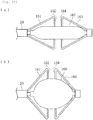
- the expansion body 21 expands, the recessed portion 53 deforms from a state where the hold portion 51 is open in a fan shape ( Fig. 4(a) ) to a state where the bending portion 54 is bent and the hold portion 51 is closed in the holding direction ( Fig. 4(b) ).
- the storage sheath 30 that stores the expansion body 21 in a contracted state is a restriction element which maintains an open state of the hold portion 51. The restriction element is released, that is, the expansion body 21 is exposed outward of the storage sheath 30.
- the hold portion 51 can be closed in the holding direction.
- the expansion body 21 expands in a state where the recessed portion 53 is positioned in the atrial septum HA. Therefore, since the hold portion 51 is closed in the holding direction, the atrial septum HA can be held from both sides.
- the pulling shaft 33 is moved to the proximal side so that the distal member 35 moves to the proximal side. In this manner, the distal portion 55 of the expansion body 21 is moved to the proximal side. In response to the movement, the expansion body 21 further expands in the radial direction. The pulling shaft 33 is moved to the distal side. Accordingly, from this state, the expansion body 21 can return to a state illustrated in Fig. 3 .
- the treatment method according to the present embodiment is performed on a patient suffering from a heart failure (left heart failure). More specifically, as illustrated in Fig. 7 , the treatment method is performed on the patient suffering from a chronic heart failure, who has high blood pressure in a left atrium HLa due to myocardial hypertrophy appearing in a left ventricle of the heart H and increased stiffness (hardness).
- the treatment method according to the present embodiment includes a step of forming the through-hole Hh in the atrial septum HA (Sl-1), a step of disposing the expansion body 21 in the through-hole Hh (S1-2), a step of holding the atrial septum HA by using the expansion body 21 (S1-3), a step of enlarging the diameter of the through-hole Hh by using the expansion body 21 (S1-4), a step of confirming hemodynamics in the vicinity of the through-hole Hh (S1-5), a step of performing the maintenance treatment for maintaining the size of the through-hole Hh (S1-6), and a step of confirming the hemodynamics in the vicinity of the through-hole Hh after the maintenance treatment is performed (S1-7).
- an operator delivers an introducer 210 in which a guiding sheath 211 and a dilator 212 are combined with each other, to the vicinity of the atrial septum HA.
- the introducer 210 can be delivered to a right atrium HRa via an inferior vena cava Iv.
- the introducer 210 can be delivered using the guide wire 11.
- the operator can insert the guide wire 11 into the dilator 212, and can deliver the introducer 210 along the guide wire 11.
- the introducer 210 and the guide wire 11 can be inserted into a living body by using a known method such as using a blood vessel introducer.
- Step S1-1 the operator causes a puncture device 200 to penetrate from the right atrium HRa side toward the left atrium HLa side, thereby forming the through-hole Hh.
- a device such as a wire having a sharp distal end can be used as the puncture device 200.
- the puncture device 200 is inserted into the dilator 212, and is delivered to the atrial septum HA.
- the puncture device 200 can be delivered to the atrial septum HA instead of the guide wire 11 after the guide wire 11 is removed from the dilator 212.
- Step S1-2 as illustrated in Fig. 9 , the medical device 10 is first delivered to the vicinity of the atrial septum HA along the guide wire 11 inserted in advance. At this time, the distal portion of the medical device 10 penetrates the atrial septum HA, and reaches the left atrium HLa. In addition, when the medical device 10 is inserted, the expansion body 21 is in a state of being stored in the storage sheath 30.
- the expansion body 21 is moved to the distal side so that the distal side portion of the expansion body 21 is exposed inside the left atrium HLa. In this manner, the distal side expansion portion 57 in the expansion body 21 expands in the radial direction.
- the distal side hold portion 51b of the expansion body 21 is pressed against a surface on the left atrium HLa side of the atrial septum HA. In this manner, the expansion body 21 is positioned.
- Step S1-3 the movable portion 52 does not expand to be larger than an outer diameter of the storage sheath 30, and does not substantially enlarge the through-hole Hh.
- Step S1-3 the distal side expansion portion 57 and the proximal side expansion portion 56 in the expansion body 21 expand in the radial direction, and the expansion body 21 in which the movable portion 52 does not substantially expand in the radial direction expands primarily.
- the atrial septum HA is held by the hold portion 51.
- Step S1-4 as illustrated in Fig. 12 , the operator operates the operation unit 23 in a state where the atrial septum HA is held by the hold portion 51.
- the pulling shaft 33 is moved to the proximal side.
- the expansion body 21 further expands in the radial direction due to the distal member 35 disposed in the distal portion of the pulling shaft 33.
- the proximal side expansion portion 56, the distal side expansion portion 57, and the movable portion 52 of the expansion body 21 all expand in the radial direction. Since the expansion body 21 expands secondarily, the held through-hole Hh is widened in the radial direction.
- the hemodynamics is confirmed in Step S1-5.
- the operator delivers a hemodynamics confirming device 220 to the right atrium HRa by way of the inferior vena cava Iv.
- a known echo catheter can be used as the hemodynamics confirming device 220.
- the operator can display an echo image acquired by the hemodynamics confirming device 220 on a display apparatus such as a display, and can confirm a blood volume passing through the through-hole Hh, based on a display result thereof.
- the hemodynamics can be confirmed by measuring pressure of each portion.
- the pressure can be measured on the left atrium side through the guide wire lumen of the shaft portion 20.
- the pressure can be measured on the right atrium side through a gap between the storage sheath 30 and the outer shaft 31.
- the pressure can be measured by connecting a known pressure measurement device to the shaft portion 20. In this way, the pressure is measured. Accordingly, it is possible to confirm that the pressure in the left atrium is lowered, and that the pressure in the right atrium is not excessively risen. In this manner, a therapeutic effect of the shunt treatment can be improved, and a risk of excessively enlarging the through-hole Hh can be reduced.
- Step S1-6 the operator performs the maintenance treatment for maintaining the size of the through-hole Hh.
- high-frequency energy is applied to an edge portion of the through-hole Hh through the maintenance treatment element 22, thereby cauterizing (heating and cauterizing) the edge portion of the through-hole Hh by using the high-frequency energy.
- a degenerated portion having the degenerated biological tissue is formed in the vicinity of the edge portion.
- the biological tissue in the degenerated portion is in a state where elasticity is lost. Accordingly, the through-hole Hh can maintain a shape widened by the expansion body 21.
- the maintenance treatment is performed. Therefore, when the maintenance treatment is performed, the positional displacement of the maintenance treatment element 22 can be prevented. In addition, a difference in bending strength is adjusted between the hold portion 51 and the movable portion 52. In this manner, a pressing force and a contact area of the maintenance treatment element 22 can be controlled with respect to the biological tissue. In this manner, fluctuations in cauterizing can be minimized, and reliable maintenance treatment can be performed.
- the maintenance treatment element 22 is disposed in the projection portion of the hold portion 51. Therefore, the hold portion 51 is pressed against the atrial septum HA. In this manner, the maintenance treatment is performed in a state where the maintenance treatment element 22 is incorporated in the biological tissue. In this manner, the maintenance treatment element 22 is prevented from coming into contact with the blood during the maintenance treatment. Accordingly, it is possible to suppress appearance of a thrombus caused by a current leaking into the blood.
- Step S1-7 After the maintenance treatment is performed, the hemodynamics are confirmed again in Step S1-7.
- the operator decreases the diameter of the expansion body 21.
- the expansion body 21 is stored in the storage sheath 30, the expansion body 21 is removed from the through-hole Hh. Furthermore, the whole medical device 10 is removed outward of the living body, and the treatment is completed.
- the medical device 15 according to the present embodiment is the same as that according to the first embodiment except for a configuration of an expansion body 100, and common elements will be omitted in the description.
- the expansion body 100 has a plurality of wires in the circumferential direction, and the wire has a proximal side expansion portion 106, a distal side expansion portion 107, and a movable portion 103.
- the expansion body 100 has a recessed portion 104 in a central portion in the axial direction.
- the recessed portion 104 is formed by a hold portion 102 having the proximal side hold portion 102a and the distal side hold portion 102b, and the movable portion 103 disposed between the hold portions 102.
- the movable portion 103 has a bending portion 105 which has a larger diameter than that of the hold portion 102 and which has greater bending strength than that of the hold portion 102. Therefore, the expansion body 100 has a shape so that the hold portion 102 is largely opened and the movable portion 103 is separated from the pulling shaft 33 in an outer diameter direction of the storage sheath 30.
- the bending portion 105 has the bending strength greater than that of the hold portion 102. Accordingly, when the expansion body 100 is exposed from the storage sheath 30 and expands in the radial direction, while the bending portion 105 is not bent much, the expansion body 100 largely expands in the radial direction. In this manner, as illustrated in Fig. 13 , in the expansion body 100 disposed in the through-hole Hh of the atrial septum HA, all of the proximal side expansion portion 106, the distal side expansion portion 107, and the movable portion 103 expand in the radial direction, and enlarge the diameter of the through-hole Hh. After the diameter of the through-hole Hh is enlarged, the pulling shaft 33 is moved to the proximal side. In this manner, as illustrated in Fig. 14 , the bending portion 105 is bent, and the hold portion 102 is closed in the holding direction to hold the atrial septum HA from both sides.
- the balance in the bending strength of the hold portion and the movable portion is adjusted. In this manner, an expanding operation and a holding operation of the expansion body can be simultaneously performed. In this case, the expansion body is caused to expand in the through-hole Hh. Accordingly, while the through-hole Hh is held from both sides, the diameter of the through-hole Hh can be simultaneously enlarged.
- the treatment method according to the present embodiment includes a step of forming the through-hole Hh in the atrial septum HA (S2-1), a step of disposing the expansion body 100 in the through-hole Hh (S2-2), a step of enlarging the diameter of the through-hole Hh by using the expansion body 100 (S2-3), and a step of holding the atrial septum HA by using the expansion body 100 (S2-4) .
- Steps S2-1 to S2-2 are the same as Steps S1-1 to S1-2 in the first embodiment, and thus, description thereof will be omitted.
- the treatment method according to the present embodiment includes a step of confirming the hemodynamics in the vicinity of the through-hole Hh after S2-4 (S2-5), a step of determining whether the through-hole Hh needs to be additionally enlarged (S2-6), a step of additionally enlarging the through-hole Hh, in a case where it is determined that the through-hole Hh needs to be additionally enlarged in S2-6 (S2-7), a step of performing the maintenance treatment for maintaining the size of the through-hole Hh (S2-8), and a step of confirming the hemodynamics in the vicinity of the through-hole Hh after the maintenance treatment is performed (S2-9).
- Steps S2-8 to S2-9 are the same as Steps S1-6 to S1-7 in the first embodiment, and thus, description thereof will be omitted.
- Step S2-2 the expansion body 100 is in a state of being stored inside the storage sheath 30.
- Step S2-3 the operator moves the storage sheath 30 to the proximal side so that the expansion body 100 is exposed from the storage sheath 30.
- Step S2-3 the operator moves the storage sheath 30 to the proximal side so that the expansion body 100 is exposed from the storage sheath 30.
- the expansion body 100 all of the proximal side expansion portion 106, the distal side expansion portion 107, and the movable portion 103 expand in the radial direction, and the diameter of the through-hole Hh is enlarged.
- Step S2-4 the operator moves the pulling shaft 33 to the proximal side. In this manner, the bending portion 105 of the movable portion 103 is bent, and the hold portion 102 is closed in the holding direction. In this manner, as illustrated in Fig. 14 , the hold portion 102 holds the atrial septum HA from both sides.
- the through-hole Hh is additionally enlarged in Step S2-7.
- the through-hole Hh is additionally enlarged by further moving the pulling shaft 33 to the proximal side in a state illustrated in Fig. 14 so that the diameter of the expansion body 100 is increased.
- the pulling shaft 33 is moved to the distal side, the diameter of the expansion body 100 is decreased once.
- the pulling shaft 33 is moved to the proximal side again. Accordingly, the diameter of the expansion body 100 can be increased.
- the pulling shaft 33 can be repeatedly moved forward and rearward to widen the through-hole Hh little by little.
- a step of preliminarily enlarging the through-hole can be performed between S2-2 and S2-3.
- the through-hole is preliminarily enlarged in a case where the biological tissue is so hardened that the through-hole cannot be sufficiently enlarged by the expansion force of the expansion body 100.
- the expansion body 100 expands to enlarge the diameter of the through-hole.
- the pulling shaft 33 is moved to the proximal side. In this manner, the hold portion 102 holds the atrial septum HA from both sides. Furthermore, as in S2-7, the pulling shaft 33 is further moved to the proximal side.
- the expansion body 100 further expands so that the through-hole Hh is widened. This operation is performed once or multiple times. Accordingly, the biological tissue around the through-hole Hh is torn, and the through-hole Hh can be subsequently enlarged.
- the through-hole Hh of the atrial septum HA is enlarged by the hold portion 102
- the through-hole Hh is held by the hold portion 102.
- the balance in the bending strength of the hold portion 102 and the movable portion 103 may be adjusted. In this manner, in response to the expansion of the expansion body 100, the through-hole Hh may be simultaneously enlarged and held.
- the movable portion that opens and closes the hold portion can have various forms.
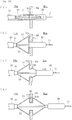
- the first embodiment adopts a configuration in which the bending portion 54 has the diameter smaller than that of the hold portion 51.
- a slit portion 54a can be provided.
- a cutout portion 54b can be provided.
- a plurality of small hole portions 54c can be provided.
- both the slit portion 54a and the cutout portion 54b can be provided.
- a soft portion 54d formed of a material softer than that of the surroundings can be provided.
- the movable portion can be formed by providing a portion thinner than the surroundings.
- a movable portion 112 may link the proximal side hold portion 111a and an intermediate portion in a longitudinal direction of the distal side hold portion 111b with each other.
- a movable portion 117 may have a hinge portion 118 that enables the proximal side hold portion 116a and the distal side hold portion 116b to pivot relative to each other.
- the hinge portion 118 has a rotary shaft portion 118a. A biasing force may be applied to the rotating shaft portion 118a in a direction in which the hold portion 116 is closed. In this manner, the atrial septum HA can be elastically held by the hold portion 116.
- the movable portion is not limited to a case where the hold portion is opened and closed in a fan shape, and may cause the hold portion to move in parallel along the axial direction of the shaft portion 20.
- a parallel movement portion 122 can be disposed in the expansion body 120.
- the parallel movement portion 122 has an extension portion 123 extending from the distal side hold portion 121b to the proximal side hold portion 121a, and the proximal side hold portion 121a has a slide holding portion 124 that holds the extension portion 123.
- the extension portion 123 can be moved along the axial direction by the slide holding portion 124.
- the extension portion 123 can be slid using a wire (not illustrated) linked with the extension portion 123 and extending to a hand-side portion.
- the parallel movement portion 126 can have a structure in which one hold portion 127 is supported by an elastic body 128 such as a spring. In this manner, the hold portion 127 supported by the elastic body 128 is movable along the axial direction. In this case, the elastic body 128 biases the hold portion 127 in an extension direction.
- the biasing force can be restricted using a wire (not illustrated) linked with the hold portion 127 or the elastic body 128 and extending to the hand-side portion.
- a lock portion (not illustrated) for restricting the biasing force of the elastic body 128 may be disposed in the expansion body 125 in a contracted state, and the lock portion may be released as the expansion body 125 expands in the radial direction.
- the parallel movement portion 131 can have a structure in which one hold portion 132 is supported by a moving balloon 133. As the moving balloon 133 is inflated and deflated, the hold portion 132 can move along the axial direction. In this case, an additional lumen (not illustrated) for supplying an inflating fluid to the moving balloon 133 is provided.
- the expansion body may be separated on the proximal side and the distal side.
- an expansion body 140 has two independent members including a proximal side expansion portion 141 and a distal side expansion portion 143.
- the proximal side expansion portion 141 has a proximal side hold portion 142
- the distal side expansion portion 143 has a distal side hold portion 144.
- the proximal side expansion portion 141 and the distal side expansion portion 143 are linked with each other by a link portion 145 such as a wire. In this case, as illustrated by an arrow in the drawing, the pulling shaft 33 is moved to the proximal side.
- the distal side expansion portion 143 moves to the proximal side, thereby shortening a distance between the distal side hold portion 144 and the proximal side hold portion 142. In this manner, the biological tissue can be held by the distal side hold portion 144 and the proximal side hold portion 142.
- the expansion body can also be formed by using a balloon.
- a balloon 150 is disposed in the distal portion of the shaft portion 20.
- a region on the distal side and the proximal side in the axial direction is a high compliance portion 151 which is flexible and likely to be inflated.
- a region in the central portion in the axial direction of the balloon 150 is a low compliance portion 152 which is hard and less likely to be inflated.
- a portion of the high compliance portion 151 is inflated, and a portion of the low compliance portion 152 is not inflated so much.
- respective surfaces on the central side of the high compliance portion 151 face each other across the low compliance portion 152.
- the respectively facing surfaces serve as hold portions 153 and 153 which hold the biological tissue.
- the expansion body may be expanded by using an inflating force of the balloon.
- the distal portion of the shaft portion 20 has a balloon 160, a proximal side expansion portion 161, and a distal side expansion portion 163.
- the proximal side expansion portion 161 has a proximal side hold portion 162, and a distal portion thereof is in contact with the balloon 160.
- the distal side expansion portion 163 has a distal side hold portion 164, a distal portion thereof is in contact with the balloon 160.
- the proximal side expansion portion 161 and the distal side expansion portion 163 respectively expand in the radial direction.
- the expansion body may be configured so that the wire and the balloon are combined with each other.
- the distal portion of the shaft portion 20 has a balloon 172 and a proximal side expansion portion 170.
- a proximal side hold portion 171 is disposed in the proximal side expansion portion 170.
- a region on the proximal side is a low compliance portion 174 which is hard and less likely to be inflated, and a region on the distal side is a high compliance portion 173 which is flexible and likely to be inflated.
- a portion of the high compliance portion 173 which is likely to be inflated in the balloon 172 is greatly inflated, and a surface on the proximal side faces the proximal side hold portion 171 of the proximal side expansion portion 170.
- This portion serves as a distal side hold portion 175 that holds the biological tissue.
- the distal side when the expansion body 21 is expanded, the distal side is first expanded, and thereafter, the proximal side is expanded to hold the atrial septum HA.
- the proximal side of the expansion body 21 can be first expanded, and thereafter, the distal side can be expanded to hold the atrial septum HA.
- the storage sheath 30 in a state where a slightly distal side of the recessed portion 53 in the expansion body 21 is located inside the through-hole Hh, the storage sheath 30 is moved to the proximal side so that the whole expansion body 21 is exposed.
- the through-hole Hh suppresses expansion in the distal side portion from the recessed portion 53 of the expansion body 21, and a portion on the proximal side from the recessed portion 53 of the expansion body 21 is brought into an expanded state in the radial direction.
- the expansion body 21 is moved to the distal side, and the proximal side hold portion 51a of the expansion body 21 is pressed against the atrial septum HA. In this manner, a portion on the distal side of the expansion body 21 enters the inside of the left atrium HLa. In this manner, the portion on the distal side of the expansion body 21 expands in the radial direction. As illustrated in Fig. 23(c) , the atrial septum HA is brought into a held state by the proximal side hold portion 51a and the distal side hold portion 51b.
- a distal side sheath 36 may be used.
- the shaft portion 20 has the storage sheath 30 and the distal side sheath 36.
- the distal side sheath 36 is movable along the axial direction independently of the storage sheath 30.
- the proximal side is stored in the storage sheath 30, and the distal side is stored in the distal side sheath 36.
- the shaft portion 20 is inserted until the proximal portion of the distal side sheath 36 is located inside the through-hole Hh.
- the storage sheath 30 is moved to the proximal side so that a portion on the proximal side is exposed from the recessed portion 53 of the expansion body 21. In this manner, the portion on the proximal side from the recessed portion 53 of the expansion body 21 expands in the radial direction.
- the expansion body 21 is moved to the distal side, and the proximal side hold portion 51a of the expansion body 21 is pressed against the atrial septum HA. Thereafter, the distal side sheath 36 is moved toward the distal side. The distal side sheath 36 is moved to the distal side of the distal end of the expansion body 21.
- a portion on the distal side of the expansion body 21 also expands in the radial direction.
- the proximal side hold portion 51a and the distal side hold portion 51b hold the atrial septum HA.
- the medical device 10 includes the elongated shaft portion 20 and the expansion body 21 disposed in the distal portion of the shaft portion 20 and configured to expand and contract in the radial direction.
- the expansion body 21 has the hold portion 51 having the proximal side hold portion 51a and the distal side hold portion 51b which hold the biological tissue, and the movable portion 52 that opens and closes the hold portion 51 in the holding direction.
- the biological tissue is held from both sides by the hold portion 51 that can be opened and closed in the holding direction. Therefore, it is possible to suppress the positional displacement of the expansion body 21.
- the hold portion 51 can be opened and closed using a simple mechanism.
- the hold portion 51 and the movable portion 52 can be formed by using one wire. Accordingly, a simple structure can be adopted.
- the movable portion 117 has a rotary shaft portion 118a which enables the hold portions 116 to pivot relative to each other, mobility of the hold portions 116 can be improved, and the hold portions 116 can more reliably hold the biological tissue.
- the biological tissue can be easily held by moving the hold portion 127 in parallel.
- the shaft portion 20 has the pulling shaft 33 connected to the expansion body 21 to move the distal portion of the expansion body 21 with respect to the proximal portion of the expansion body 21 in the axial direction, a state of the expansion body can be easily operated by operating the pulling shaft 33 with the hand-side portion.
- the pulling shaft 33 moves the distal portion of the expansion body 21 to the proximal portion side so that the hold portion 51 moves in the expanding direction
- the diameter of the expansion body 21 can be enlarged by operating the pulling shaft 33. Accordingly, it is possible to enlarge the diameter of the through-hole Hh.
- the hold portion 51 can hold the biological tissue by operating the pulling shaft 33.
- the hold portion 51 further has the restriction element 30 that maintains an open state of the hold portion 51, and the restriction element 30 is released so that the hold portion 51 is closed in the holding direction, the hold portion 51 can easily hold the biological tissue by operating the restriction element 30.
- the hold portion 51 has the maintenance treatment element 22 that performs the maintenance treatment on the biological tissue
- the maintenance treatment element 22 is disposed in the hold portion 51 that holds the biological tissue. Therefore, it is possible to suppress the positional displacement of the maintenance treatment element 22.
- the through-hole Hh of the biological tissue is enlarged using the medical device 10 having the expansion body 21 configured to expand and contract in the radial direction.
- the treatment method includes the step of positioning the hold portion 51 of the expansion body 21 in the through-hole Hh of the biological tissue, the step of holding the biological tissue from both sides of the through-hole Hh by using the hold portion 51, the step of enlarging the diameter of through-hole Hh by expanding the expansion body 21, and the step of performing the maintenance treatment by using the maintenance treatment element 22 of the hold portion 51.
- the maintenance treatment is performed in a state where the hold portion 51 holds the biological tissue. Accordingly, while the positional displacement of the maintenance treatment element is suppressed, the energy can be accurately applied to a target site.
- the hold portion 51 can hold the biological tissue at any desired timing. Therefore, it is possible to suppress the positional displacement of the expansion body 21 during the maintenance treatment.
- the movable portion 52 of the expansion body 21 may be shaped in advance in the direction in which the hold portion 51 is closed. In this case, when the storage sheath 30 is moved to the proximal side so that the whole expansion body 21 is exposed outward of the storage sheath 30, the movable portion 52 shaped in advance can automatically move in the direction in which the hold portion 51 is closed. In addition, the pulling shaft 33 can adjust the distance in the axial direction between the proximal side hold portion 51 and the distal side hold portion 51.
- the movable portion 52 may deform due to the elastic force of the biological tissue which acts toward a central axis direction of the medical device 10. In this manner, the biological tissue can be held by moving the hold portion 51.
Landscapes
- Health & Medical Sciences (AREA)
- Surgery (AREA)
- Engineering & Computer Science (AREA)
- Life Sciences & Earth Sciences (AREA)
- Biomedical Technology (AREA)
- Molecular Biology (AREA)
- Nuclear Medicine, Radiotherapy & Molecular Imaging (AREA)
- Plasma & Fusion (AREA)
- Physics & Mathematics (AREA)
- Heart & Thoracic Surgery (AREA)
- Medical Informatics (AREA)
- Otolaryngology (AREA)
- Animal Behavior & Ethology (AREA)
- General Health & Medical Sciences (AREA)
- Public Health (AREA)
- Veterinary Medicine (AREA)
- Cardiology (AREA)
- Surgical Instruments (AREA)
- Media Introduction/Drainage Providing Device (AREA)
Applications Claiming Priority (2)
| Application Number | Priority Date | Filing Date | Title |
|---|---|---|---|
| JP2018064006 | 2018-03-29 | ||
| PCT/JP2019/012383 WO2019188916A1 (ja) | 2018-03-29 | 2019-03-25 | 医療デバイス及び処置方法 |
Publications (3)
| Publication Number | Publication Date |
|---|---|
| EP3766431A1 true EP3766431A1 (de) | 2021-01-20 |
| EP3766431A4 EP3766431A4 (de) | 2021-05-05 |
| EP3766431B1 EP3766431B1 (de) | 2025-06-18 |
Family
ID=68061861
Family Applications (1)
| Application Number | Title | Priority Date | Filing Date |
|---|---|---|---|
| EP19778033.1A Active EP3766431B1 (de) | 2018-03-29 | 2019-03-25 | Medizinische vorrichtung |
Country Status (5)
| Country | Link |
|---|---|
| US (1) | US11950836B2 (de) |
| EP (1) | EP3766431B1 (de) |
| JP (1) | JP7357604B2 (de) |
| CN (1) | CN111936061B (de) |
| WO (1) | WO2019188916A1 (de) |
Cited By (11)
| Publication number | Priority date | Publication date | Assignee | Title |
|---|---|---|---|---|
| EP4035617A4 (de) * | 2019-09-30 | 2022-11-16 | TERUMO Kabushiki Kaisha | Medizinische vorrichtung |
| US11622695B1 (en) | 2020-04-23 | 2023-04-11 | Shifamed Holdings, Llc | Intracardiac sensors with switchable configurations and associated systems and methods |
| US11633194B2 (en) | 2020-11-12 | 2023-04-25 | Shifamed Holdings, Llc | Adjustable implantable devices and associated methods |
| US11801369B2 (en) | 2020-08-25 | 2023-10-31 | Shifamed Holdings, Llc | Adjustable interatrial shunts and associated systems and methods |
| EP4302715A4 (de) * | 2021-03-08 | 2024-09-11 | TERUMO Kabushiki Kaisha | Medizinische vorrichtung |
| US12090290B2 (en) | 2021-03-09 | 2024-09-17 | Shifamed Holdings, Llc | Shape memory actuators for adjustable shunting systems, and associated systems and methods |
| US12151071B2 (en) | 2019-09-09 | 2024-11-26 | Shifamed Holdings, Llc | Adjustable shunts and associated systems and methods |
| US12213817B2 (en) | 2020-04-23 | 2025-02-04 | Shifamed Holdings, Llc | Systems and methods for radiographic monitoring of shunts |
| US12440656B2 (en) | 2020-04-23 | 2025-10-14 | Shifamed Holdings, Llc | Power management for interatrial shunts and associated systems and methods |
| US12533500B2 (en) | 2019-06-18 | 2026-01-27 | Shifamed Holdings, Llc | Adjustable interatrial shunts and associated systems and methods |
| US12544010B2 (en) | 2020-10-28 | 2026-02-10 | Shifamed Holdings, Llc | Systems and methods for electrical monitoring of implantable devices |
Families Citing this family (21)
| Publication number | Priority date | Publication date | Assignee | Title |
|---|---|---|---|---|
| WO2019189079A1 (ja) * | 2018-03-29 | 2019-10-03 | テルモ株式会社 | 医療デバイス |
| CN211862951U (zh) * | 2019-02-03 | 2020-11-06 | 上海魅丽纬叶医疗科技有限公司 | 一种具有活动导丝功能的射频消融导管 |
| EP4017384A1 (de) | 2019-08-22 | 2022-06-29 | Edwards Lifesciences Corporation | Punktionsnadeln |
| JP2022169816A (ja) * | 2019-09-30 | 2022-11-10 | テルモ株式会社 | 医療デバイス |
| EP4054448A4 (de) * | 2019-11-07 | 2023-07-12 | Intershunt Technologies, Inc. | Verfahren und septostomievorrichtung zum erzeugen einer interatrialen apertur |
| CN121694847A (zh) | 2019-11-14 | 2026-03-20 | 爱德华兹生命科学公司 | 经导管的医疗植入物递送 |
| US20210369321A1 (en) * | 2020-04-14 | 2021-12-02 | Medtronic, Inc. | Apparatus and system for creating chronically stable atrial shunt |
| US20210315629A1 (en) * | 2020-04-14 | 2021-10-14 | Medtronic, Inc. | Apparatus and system for creating chronically stable atrial shunt |
| US20230190330A1 (en) * | 2020-06-18 | 2023-06-22 | Boston Scientific Medical Device Limited | Energy-emitting devices for elongated medical assembly |
| EP4205676A4 (de) * | 2020-08-26 | 2024-03-06 | TERUMO Kabushiki Kaisha | Medizinische vorrichtung |
| JP2023175056A (ja) * | 2020-09-29 | 2023-12-12 | テルモ株式会社 | 医療デバイスおよびシャント形成方法 |
| EP4212200A4 (de) * | 2020-09-30 | 2024-03-20 | TERUMO Kabushiki Kaisha | Medizinisches vorrichtungssystem und elektrodenkontakterkennungsverfahren |
| WO2022071170A1 (ja) * | 2020-09-30 | 2022-04-07 | テルモ株式会社 | 医療デバイスおよびシャント形成方法 |
| WO2022071168A1 (ja) * | 2020-09-30 | 2022-04-07 | テルモ株式会社 | 医療デバイスおよびシャント形成方法 |
| CN116710015A (zh) * | 2021-01-25 | 2023-09-05 | 奥林巴斯医疗株式会社 | 处置器具 |
| US12527942B2 (en) | 2021-02-01 | 2026-01-20 | Edwards Lifesciences Corporation | Pulmonary vein shunting |
| JP7810697B2 (ja) * | 2021-03-08 | 2026-02-03 | テルモ株式会社 | 医療デバイス |
| EP4384099A2 (de) * | 2021-08-11 | 2024-06-19 | Medtronic, Inc. | Vorrichtung und system zur erzeugung eines chronisch stabilen vorhof-shunts |
| US12569296B2 (en) | 2021-09-29 | 2026-03-10 | Medtronic Vascular, Inc. | Left-atrium-to-coronary-sinus shunt |
| WO2024105507A1 (en) * | 2022-11-15 | 2024-05-23 | Medtronic, Inc. | Intraluminal accessory for atrio-septal shunt dilation, cryoballoon coupling, and blood shielding |
| WO2025081912A1 (zh) * | 2023-10-15 | 2025-04-24 | 上海魅丽纬叶医疗科技有限公司 | 一种消融导管及相应的消融系统和消融方法 |
Family Cites Families (17)
| Publication number | Priority date | Publication date | Assignee | Title |
|---|---|---|---|---|
| US6579311B1 (en) | 1996-02-02 | 2003-06-17 | Transvascular, Inc. | Method for interstitial transvascular intervention |
| US5853422A (en) * | 1996-03-22 | 1998-12-29 | Scimed Life Systems, Inc. | Apparatus and method for closing a septal defect |
| US8021359B2 (en) * | 2003-02-13 | 2011-09-20 | Coaptus Medical Corporation | Transseptal closure of a patent foramen ovale and other cardiac defects |
| ES2436596T3 (es) * | 2003-07-14 | 2014-01-03 | W.L. Gore & Associates, Inc. | Dispositivo tubular de cierre de foramen oval permeable (FOP) con sistema de retención |
| US9232997B2 (en) * | 2006-11-07 | 2016-01-12 | Corvia Medical, Inc. | Devices and methods for retrievable intra-atrial implants |
| CA2664557C (en) | 2006-11-07 | 2015-05-26 | Corvia Medical, Inc. | Devices and methods for the treatment of heart failure |
| US8529563B2 (en) * | 2008-08-25 | 2013-09-10 | Ethicon Endo-Surgery, Inc. | Electrical ablation devices |
| US9034034B2 (en) * | 2010-12-22 | 2015-05-19 | V-Wave Ltd. | Devices for reducing left atrial pressure, and methods of making and using same |
| JP2012050538A (ja) * | 2010-08-31 | 2012-03-15 | Terumo Corp | アブレーションデバイス |
| WO2012109557A2 (en) | 2011-02-10 | 2012-08-16 | Dc Devices, Inc. | Apparatus and methods to create and maintain an intra-atrial pressure relief opening |
| DE102014102725A1 (de) * | 2014-02-28 | 2015-09-17 | Highlife Sas | Transkatheter-Klappenprothese |
| US9358108B2 (en) | 2011-09-12 | 2016-06-07 | Highlife Sas | Transcatheter valve prosthesis |
| CA2905283C (en) | 2013-03-15 | 2021-03-02 | Corvia Medical, Inc. | Devices and methods for retrievable intra-atrial implants |
| US10357173B2 (en) * | 2015-09-14 | 2019-07-23 | Biosense Webster (Israel) Ltd. | Dual multiray electrode catheter |
| JP6729275B2 (ja) | 2016-10-12 | 2020-07-22 | 信越半導体株式会社 | 発光素子及び発光素子の製造方法 |
| JP7021211B2 (ja) * | 2017-07-04 | 2022-02-16 | テルモ株式会社 | 医療デバイス |
| IL274110B2 (en) | 2017-10-31 | 2024-10-01 | Hangzhou Noya Medtech Co Ltd | Devices, systems and methods for interatrial shunts |
-
2019
- 2019-03-25 JP JP2020510040A patent/JP7357604B2/ja active Active
- 2019-03-25 CN CN201980022826.9A patent/CN111936061B/zh active Active
- 2019-03-25 EP EP19778033.1A patent/EP3766431B1/de active Active
- 2019-03-25 WO PCT/JP2019/012383 patent/WO2019188916A1/ja not_active Ceased
-
2020
- 2020-09-28 US US17/034,056 patent/US11950836B2/en active Active
Cited By (14)
| Publication number | Priority date | Publication date | Assignee | Title |
|---|---|---|---|---|
| US12533500B2 (en) | 2019-06-18 | 2026-01-27 | Shifamed Holdings, Llc | Adjustable interatrial shunts and associated systems and methods |
| US12151071B2 (en) | 2019-09-09 | 2024-11-26 | Shifamed Holdings, Llc | Adjustable shunts and associated systems and methods |
| US12343487B2 (en) | 2019-09-09 | 2025-07-01 | Shifamed Holdings, Llc | Adjustable shunts and associated systems and methods |
| EP4035617A4 (de) * | 2019-09-30 | 2022-11-16 | TERUMO Kabushiki Kaisha | Medizinische vorrichtung |
| US11622695B1 (en) | 2020-04-23 | 2023-04-11 | Shifamed Holdings, Llc | Intracardiac sensors with switchable configurations and associated systems and methods |
| US12440656B2 (en) | 2020-04-23 | 2025-10-14 | Shifamed Holdings, Llc | Power management for interatrial shunts and associated systems and methods |
| US12213817B2 (en) | 2020-04-23 | 2025-02-04 | Shifamed Holdings, Llc | Systems and methods for radiographic monitoring of shunts |
| US11801369B2 (en) | 2020-08-25 | 2023-10-31 | Shifamed Holdings, Llc | Adjustable interatrial shunts and associated systems and methods |
| US12491347B2 (en) | 2020-08-25 | 2025-12-09 | Shifamed Holdings, Llc | Adjustable interatrial shunts and associated systems and methods |
| US12544010B2 (en) | 2020-10-28 | 2026-02-10 | Shifamed Holdings, Llc | Systems and methods for electrical monitoring of implantable devices |
| US11857197B2 (en) | 2020-11-12 | 2024-01-02 | Shifamed Holdings, Llc | Adjustable implantable devices and associated methods |
| US11633194B2 (en) | 2020-11-12 | 2023-04-25 | Shifamed Holdings, Llc | Adjustable implantable devices and associated methods |
| EP4302715A4 (de) * | 2021-03-08 | 2024-09-11 | TERUMO Kabushiki Kaisha | Medizinische vorrichtung |
| US12090290B2 (en) | 2021-03-09 | 2024-09-17 | Shifamed Holdings, Llc | Shape memory actuators for adjustable shunting systems, and associated systems and methods |
Also Published As
| Publication number | Publication date |
|---|---|
| US20210007790A1 (en) | 2021-01-14 |
| CN111936061B (zh) | 2024-02-09 |
| WO2019188916A1 (ja) | 2019-10-03 |
| US11950836B2 (en) | 2024-04-09 |
| CN111936061A (zh) | 2020-11-13 |
| EP3766431A4 (de) | 2021-05-05 |
| JP7357604B2 (ja) | 2023-10-06 |
| EP3766431B1 (de) | 2025-06-18 |
| JPWO2019188916A1 (ja) | 2021-04-01 |
Similar Documents
| Publication | Publication Date | Title |
|---|---|---|
| EP3766431B1 (de) | Medizinische vorrichtung | |
| EP3777741B1 (de) | Medizinische vorrichtung | |
| EP3777740B1 (de) | Medizinische vorrichtung | |
| JP7543293B2 (ja) | 医療デバイス | |
| JP7021211B2 (ja) | 医療デバイス | |
| EP4035617B1 (de) | Medizinische vorrichtung | |
| JP7513624B2 (ja) | 医療デバイス | |
| US20230233255A1 (en) | Medical device and shunt forming method | |
| US20230404655A1 (en) | Medical device | |
| EP4309605A1 (de) | Medizinische vorrichtung | |
| EP4212200A1 (de) | Medizinisches vorrichtungssystem und elektrodenkontakterkennungsverfahren | |
| WO2022071179A1 (ja) | 医療デバイスおよびシャント形成方法 | |
| US20230233225A1 (en) | Medical device and method of controlling same | |
| JP2022038122A (ja) | 医療デバイスおよびシャント形成方法 | |
| WO2022071170A1 (ja) | 医療デバイスおよびシャント形成方法 | |
| JP2022038121A (ja) | 医療デバイスおよびシャント形成方法 |
Legal Events
| Date | Code | Title | Description |
|---|---|---|---|
| STAA | Information on the status of an ep patent application or granted ep patent |
Free format text: STATUS: THE INTERNATIONAL PUBLICATION HAS BEEN MADE |
|
| PUAI | Public reference made under article 153(3) epc to a published international application that has entered the european phase |
Free format text: ORIGINAL CODE: 0009012 |
|
| STAA | Information on the status of an ep patent application or granted ep patent |
Free format text: STATUS: REQUEST FOR EXAMINATION WAS MADE |
|
| 17P | Request for examination filed |
Effective date: 20201014 |
|
| AK | Designated contracting states |
Kind code of ref document: A1 Designated state(s): AL AT BE BG CH CY CZ DE DK EE ES FI FR GB GR HR HU IE IS IT LI LT LU LV MC MK MT NL NO PL PT RO RS SE SI SK SM TR |
|
| AX | Request for extension of the european patent |
Extension state: BA ME |
|
| A4 | Supplementary search report drawn up and despatched |
Effective date: 20210408 |
|
| RIC1 | Information provided on ipc code assigned before grant |
Ipc: A61B 18/02 20060101AFI20210331BHEP Ipc: A61B 18/14 20060101ALI20210331BHEP Ipc: A61B 18/08 20060101ALI20210331BHEP Ipc: A61M 29/00 20060101ALI20210331BHEP Ipc: A61B 18/00 20060101ALN20210331BHEP Ipc: A61B 17/00 20060101ALN20210331BHEP |
|
| DAV | Request for validation of the european patent (deleted) | ||
| DAX | Request for extension of the european patent (deleted) | ||
| REG | Reference to a national code |
Free format text: PREVIOUS MAIN CLASS: A61B0017020000 Ipc: A61B0018020000 Ref country code: DE Ref legal event code: R079 Ref document number: 602019071290 Country of ref document: DE |
|
| STAA | Information on the status of an ep patent application or granted ep patent |
Free format text: STATUS: EXAMINATION IS IN PROGRESS |
|
| RIC1 | Information provided on ipc code assigned before grant |
Ipc: A61B 18/12 20060101ALN20231116BHEP Ipc: A61B 18/06 20060101ALN20231116BHEP Ipc: A61B 5/021 20060101ALN20231116BHEP Ipc: A61B 18/22 20060101ALN20231116BHEP Ipc: A61B 17/00 20060101ALN20231116BHEP Ipc: A61B 18/00 20060101ALN20231116BHEP Ipc: A61M 29/00 20060101ALI20231116BHEP Ipc: A61B 18/08 20060101ALI20231116BHEP Ipc: A61B 18/14 20060101ALI20231116BHEP Ipc: A61B 18/02 20060101AFI20231116BHEP |
|
| 17Q | First examination report despatched |
Effective date: 20231128 |
|
| GRAP | Despatch of communication of intention to grant a patent |
Free format text: ORIGINAL CODE: EPIDOSNIGR1 |
|
| STAA | Information on the status of an ep patent application or granted ep patent |
Free format text: STATUS: GRANT OF PATENT IS INTENDED |
|
| RIC1 | Information provided on ipc code assigned before grant |
Ipc: A61B 18/12 20060101ALN20241213BHEP Ipc: A61B 18/06 20060101ALN20241213BHEP Ipc: A61B 5/021 20060101ALN20241213BHEP Ipc: A61B 18/22 20060101ALN20241213BHEP Ipc: A61B 17/00 20060101ALN20241213BHEP Ipc: A61B 18/00 20060101ALN20241213BHEP Ipc: A61M 29/00 20060101ALI20241213BHEP Ipc: A61B 18/08 20060101ALI20241213BHEP Ipc: A61B 18/14 20060101ALI20241213BHEP Ipc: A61B 18/02 20060101AFI20241213BHEP |
|
| INTG | Intention to grant announced |
Effective date: 20250120 |
|
| GRAS | Grant fee paid |
Free format text: ORIGINAL CODE: EPIDOSNIGR3 |
|
| GRAA | (expected) grant |
Free format text: ORIGINAL CODE: 0009210 |
|
| STAA | Information on the status of an ep patent application or granted ep patent |
Free format text: STATUS: THE PATENT HAS BEEN GRANTED |
|
| AK | Designated contracting states |
Kind code of ref document: B1 Designated state(s): AL AT BE BG CH CY CZ DE DK EE ES FI FR GB GR HR HU IE IS IT LI LT LU LV MC MK MT NL NO PL PT RO RS SE SI SK SM TR |
|
| REG | Reference to a national code |
Ref country code: GB Ref legal event code: FG4D |
|
| REG | Reference to a national code |
Ref country code: CH Ref legal event code: EP |
|
| REG | Reference to a national code |
Ref country code: DE Ref legal event code: R096 Ref document number: 602019071290 Country of ref document: DE |
|
| REG | Reference to a national code |
Ref country code: CH Ref legal event code: EP |
|
| REG | Reference to a national code |
Ref country code: IE Ref legal event code: FG4D |
|
| REG | Reference to a national code |
Ref country code: NL Ref legal event code: FP |
|
| PG25 | Lapsed in a contracting state [announced via postgrant information from national office to epo] |
Ref country code: FI Free format text: LAPSE BECAUSE OF FAILURE TO SUBMIT A TRANSLATION OF THE DESCRIPTION OR TO PAY THE FEE WITHIN THE PRESCRIBED TIME-LIMIT Effective date: 20250618 |
|
| REG | Reference to a national code |
Ref country code: LT Ref legal event code: MG9D |
|
| PG25 | Lapsed in a contracting state [announced via postgrant information from national office to epo] |
Ref country code: NO Free format text: LAPSE BECAUSE OF FAILURE TO SUBMIT A TRANSLATION OF THE DESCRIPTION OR TO PAY THE FEE WITHIN THE PRESCRIBED TIME-LIMIT Effective date: 20250918 Ref country code: GR Free format text: LAPSE BECAUSE OF FAILURE TO SUBMIT A TRANSLATION OF THE DESCRIPTION OR TO PAY THE FEE WITHIN THE PRESCRIBED TIME-LIMIT Effective date: 20250919 |
|
| PG25 | Lapsed in a contracting state [announced via postgrant information from national office to epo] |
Ref country code: BG Free format text: LAPSE BECAUSE OF FAILURE TO SUBMIT A TRANSLATION OF THE DESCRIPTION OR TO PAY THE FEE WITHIN THE PRESCRIBED TIME-LIMIT Effective date: 20250618 |
|
| PG25 | Lapsed in a contracting state [announced via postgrant information from national office to epo] |
Ref country code: HR Free format text: LAPSE BECAUSE OF FAILURE TO SUBMIT A TRANSLATION OF THE DESCRIPTION OR TO PAY THE FEE WITHIN THE PRESCRIBED TIME-LIMIT Effective date: 20250618 |
|
| PG25 | Lapsed in a contracting state [announced via postgrant information from national office to epo] |
Ref country code: RS Free format text: LAPSE BECAUSE OF FAILURE TO SUBMIT A TRANSLATION OF THE DESCRIPTION OR TO PAY THE FEE WITHIN THE PRESCRIBED TIME-LIMIT Effective date: 20250918 |
|
| PG25 | Lapsed in a contracting state [announced via postgrant information from national office to epo] |
Ref country code: LV Free format text: LAPSE BECAUSE OF FAILURE TO SUBMIT A TRANSLATION OF THE DESCRIPTION OR TO PAY THE FEE WITHIN THE PRESCRIBED TIME-LIMIT Effective date: 20250618 |
|
| PG25 | Lapsed in a contracting state [announced via postgrant information from national office to epo] |
Ref country code: PT Free format text: LAPSE BECAUSE OF FAILURE TO SUBMIT A TRANSLATION OF THE DESCRIPTION OR TO PAY THE FEE WITHIN THE PRESCRIBED TIME-LIMIT Effective date: 20251020 |
|
| REG | Reference to a national code |
Ref country code: AT Ref legal event code: MK05 Ref document number: 1803493 Country of ref document: AT Kind code of ref document: T Effective date: 20250618 |
|
| PG25 | Lapsed in a contracting state [announced via postgrant information from national office to epo] |
Ref country code: IS Free format text: LAPSE BECAUSE OF FAILURE TO SUBMIT A TRANSLATION OF THE DESCRIPTION OR TO PAY THE FEE WITHIN THE PRESCRIBED TIME-LIMIT Effective date: 20251018 |
|
| PG25 | Lapsed in a contracting state [announced via postgrant information from national office to epo] |
Ref country code: AT Free format text: LAPSE BECAUSE OF FAILURE TO SUBMIT A TRANSLATION OF THE DESCRIPTION OR TO PAY THE FEE WITHIN THE PRESCRIBED TIME-LIMIT Effective date: 20250618 Ref country code: SM Free format text: LAPSE BECAUSE OF FAILURE TO SUBMIT A TRANSLATION OF THE DESCRIPTION OR TO PAY THE FEE WITHIN THE PRESCRIBED TIME-LIMIT Effective date: 20250618 |
|
| PG25 | Lapsed in a contracting state [announced via postgrant information from national office to epo] |
Ref country code: CZ Free format text: LAPSE BECAUSE OF FAILURE TO SUBMIT A TRANSLATION OF THE DESCRIPTION OR TO PAY THE FEE WITHIN THE PRESCRIBED TIME-LIMIT Effective date: 20250618 |
|
| PG25 | Lapsed in a contracting state [announced via postgrant information from national office to epo] |
Ref country code: PL Free format text: LAPSE BECAUSE OF FAILURE TO SUBMIT A TRANSLATION OF THE DESCRIPTION OR TO PAY THE FEE WITHIN THE PRESCRIBED TIME-LIMIT Effective date: 20250618 |
|
| PG25 | Lapsed in a contracting state [announced via postgrant information from national office to epo] |
Ref country code: EE Free format text: LAPSE BECAUSE OF FAILURE TO SUBMIT A TRANSLATION OF THE DESCRIPTION OR TO PAY THE FEE WITHIN THE PRESCRIBED TIME-LIMIT Effective date: 20250618 |
|
| PG25 | Lapsed in a contracting state [announced via postgrant information from national office to epo] |
Ref country code: RO Free format text: LAPSE BECAUSE OF FAILURE TO SUBMIT A TRANSLATION OF THE DESCRIPTION OR TO PAY THE FEE WITHIN THE PRESCRIBED TIME-LIMIT Effective date: 20250618 Ref country code: SK Free format text: LAPSE BECAUSE OF FAILURE TO SUBMIT A TRANSLATION OF THE DESCRIPTION OR TO PAY THE FEE WITHIN THE PRESCRIBED TIME-LIMIT Effective date: 20250618 |
|
| PG25 | Lapsed in a contracting state [announced via postgrant information from national office to epo] |
Ref country code: ES Free format text: LAPSE BECAUSE OF FAILURE TO SUBMIT A TRANSLATION OF THE DESCRIPTION OR TO PAY THE FEE WITHIN THE PRESCRIBED TIME-LIMIT Effective date: 20250618 |
|
| PGFP | Annual fee paid to national office [announced via postgrant information from national office to epo] |
Ref country code: NL Payment date: 20260213 Year of fee payment: 8 |
|
| PGFP | Annual fee paid to national office [announced via postgrant information from national office to epo] |
Ref country code: GB Payment date: 20260202 Year of fee payment: 8 |
|
| PG25 | Lapsed in a contracting state [announced via postgrant information from national office to epo] |
Ref country code: DK Free format text: LAPSE BECAUSE OF FAILURE TO SUBMIT A TRANSLATION OF THE DESCRIPTION OR TO PAY THE FEE WITHIN THE PRESCRIBED TIME-LIMIT Effective date: 20250618 |
|
| PGFP | Annual fee paid to national office [announced via postgrant information from national office to epo] |
Ref country code: DE Payment date: 20260128 Year of fee payment: 8 Ref country code: IE Payment date: 20260211 Year of fee payment: 8 |
|
| PG25 | Lapsed in a contracting state [announced via postgrant information from national office to epo] |
Ref country code: IT Free format text: LAPSE BECAUSE OF FAILURE TO SUBMIT A TRANSLATION OF THE DESCRIPTION OR TO PAY THE FEE WITHIN THE PRESCRIBED TIME-LIMIT Effective date: 20250618 |
|
| PGFP | Annual fee paid to national office [announced via postgrant information from national office to epo] |
Ref country code: FR Payment date: 20260209 Year of fee payment: 8 |
|
| PLBE | No opposition filed within time limit |
Free format text: ORIGINAL CODE: 0009261 |
|
| STAA | Information on the status of an ep patent application or granted ep patent |
Free format text: STATUS: NO OPPOSITION FILED WITHIN TIME LIMIT |
|
| REG | Reference to a national code |
Ref country code: CH Ref legal event code: L10 Free format text: ST27 STATUS EVENT CODE: U-0-0-L10-L00 (AS PROVIDED BY THE NATIONAL OFFICE) Effective date: 20260430 |