EP3766447A1 - Transfert de chaleur amélioré par l'intermédiaire d'une pointe de cathéter - Google Patents
Transfert de chaleur amélioré par l'intermédiaire d'une pointe de cathéter Download PDFInfo
- Publication number
- EP3766447A1 EP3766447A1 EP20185673.9A EP20185673A EP3766447A1 EP 3766447 A1 EP3766447 A1 EP 3766447A1 EP 20185673 A EP20185673 A EP 20185673A EP 3766447 A1 EP3766447 A1 EP 3766447A1
- Authority
- EP
- European Patent Office
- Prior art keywords
- catheter
- ablation
- approximately
- thermally
- substrate
- Prior art date
- Legal status (The legal status is an assumption and is not a legal conclusion. Google has not performed a legal analysis and makes no representation as to the accuracy of the status listed.)
- Granted
Links
Images








Classifications
-
- A—HUMAN NECESSITIES
- A61—MEDICAL OR VETERINARY SCIENCE; HYGIENE
- A61B—DIAGNOSIS; SURGERY; IDENTIFICATION
- A61B18/00—Surgical instruments, devices or methods for transferring non-mechanical forms of energy to or from the body
- A61B18/04—Surgical instruments, devices or methods for transferring non-mechanical forms of energy to or from the body by heating
- A61B18/12—Surgical instruments, devices or methods for transferring non-mechanical forms of energy to or from the body by heating by passing a current through the tissue to be heated, e.g. high-frequency current
- A61B18/14—Probes or electrodes therefor
- A61B18/1492—Probes or electrodes therefor having a flexible, catheter-like structure, e.g. for heart ablation
-
- A—HUMAN NECESSITIES
- A61—MEDICAL OR VETERINARY SCIENCE; HYGIENE
- A61B—DIAGNOSIS; SURGERY; IDENTIFICATION
- A61B18/00—Surgical instruments, devices or methods for transferring non-mechanical forms of energy to or from the body
- A61B18/04—Surgical instruments, devices or methods for transferring non-mechanical forms of energy to or from the body by heating
- A61B18/12—Surgical instruments, devices or methods for transferring non-mechanical forms of energy to or from the body by heating by passing a current through the tissue to be heated, e.g. high-frequency current
-
- A—HUMAN NECESSITIES
- A61—MEDICAL OR VETERINARY SCIENCE; HYGIENE
- A61B—DIAGNOSIS; SURGERY; IDENTIFICATION
- A61B18/00—Surgical instruments, devices or methods for transferring non-mechanical forms of energy to or from the body
- A61B18/04—Surgical instruments, devices or methods for transferring non-mechanical forms of energy to or from the body by heating
- A61B18/08—Surgical instruments, devices or methods for transferring non-mechanical forms of energy to or from the body by heating by means of electrically-heated probes
- A61B18/082—Probes or electrodes therefor
-
- A—HUMAN NECESSITIES
- A61—MEDICAL OR VETERINARY SCIENCE; HYGIENE
- A61B—DIAGNOSIS; SURGERY; IDENTIFICATION
- A61B18/00—Surgical instruments, devices or methods for transferring non-mechanical forms of energy to or from the body
- A61B18/04—Surgical instruments, devices or methods for transferring non-mechanical forms of energy to or from the body by heating
- A61B18/12—Surgical instruments, devices or methods for transferring non-mechanical forms of energy to or from the body by heating by passing a current through the tissue to be heated, e.g. high-frequency current
- A61B18/14—Probes or electrodes therefor
- A61B18/1477—Needle-like probes
-
- A—HUMAN NECESSITIES
- A61—MEDICAL OR VETERINARY SCIENCE; HYGIENE
- A61B—DIAGNOSIS; SURGERY; IDENTIFICATION
- A61B18/00—Surgical instruments, devices or methods for transferring non-mechanical forms of energy to or from the body
- A61B18/04—Surgical instruments, devices or methods for transferring non-mechanical forms of energy to or from the body by heating
- A61B18/12—Surgical instruments, devices or methods for transferring non-mechanical forms of energy to or from the body by heating by passing a current through the tissue to be heated, e.g. high-frequency current
- A61B18/14—Probes or electrodes therefor
- A61B18/1482—Probes or electrodes therefor having a long rigid shaft for accessing the inner body transcutaneously in minimal invasive surgery, e.g. laparoscopy
-
- A—HUMAN NECESSITIES
- A61—MEDICAL OR VETERINARY SCIENCE; HYGIENE
- A61M—DEVICES FOR INTRODUCING MEDIA INTO, OR ONTO, THE BODY; DEVICES FOR TRANSDUCING BODY MEDIA OR FOR TAKING MEDIA FROM THE BODY; DEVICES FOR PRODUCING OR ENDING SLEEP OR STUPOR
- A61M25/00—Catheters; Hollow probes
- A61M25/0009—Making of catheters or other medical or surgical tubes
- A61M25/001—Forming the tip of a catheter, e.g. bevelling process, join or taper
-
- C—CHEMISTRY; METALLURGY
- C25—ELECTROLYTIC OR ELECTROPHORETIC PROCESSES; APPARATUS THEREFOR
- C25D—PROCESSES FOR THE ELECTROLYTIC OR ELECTROPHORETIC PRODUCTION OF COATINGS; ELECTROFORMING; APPARATUS THEREFOR
- C25D7/00—Electroplating characterised by the article coated
-
- A—HUMAN NECESSITIES
- A61—MEDICAL OR VETERINARY SCIENCE; HYGIENE
- A61B—DIAGNOSIS; SURGERY; IDENTIFICATION
- A61B17/00—Surgical instruments, devices or methods
- A61B2017/00526—Methods of manufacturing
-
- A—HUMAN NECESSITIES
- A61—MEDICAL OR VETERINARY SCIENCE; HYGIENE
- A61B—DIAGNOSIS; SURGERY; IDENTIFICATION
- A61B18/00—Surgical instruments, devices or methods for transferring non-mechanical forms of energy to or from the body
- A61B2018/00005—Cooling or heating of the probe or tissue immediately surrounding the probe
-
- A—HUMAN NECESSITIES
- A61—MEDICAL OR VETERINARY SCIENCE; HYGIENE
- A61B—DIAGNOSIS; SURGERY; IDENTIFICATION
- A61B18/00—Surgical instruments, devices or methods for transferring non-mechanical forms of energy to or from the body
- A61B2018/00005—Cooling or heating of the probe or tissue immediately surrounding the probe
- A61B2018/00011—Cooling or heating of the probe or tissue immediately surrounding the probe with fluids
-
- A—HUMAN NECESSITIES
- A61—MEDICAL OR VETERINARY SCIENCE; HYGIENE
- A61B—DIAGNOSIS; SURGERY; IDENTIFICATION
- A61B18/00—Surgical instruments, devices or methods for transferring non-mechanical forms of energy to or from the body
- A61B2018/00005—Cooling or heating of the probe or tissue immediately surrounding the probe
- A61B2018/00011—Cooling or heating of the probe or tissue immediately surrounding the probe with fluids
- A61B2018/00029—Cooling or heating of the probe or tissue immediately surrounding the probe with fluids open
-
- A—HUMAN NECESSITIES
- A61—MEDICAL OR VETERINARY SCIENCE; HYGIENE
- A61B—DIAGNOSIS; SURGERY; IDENTIFICATION
- A61B18/00—Surgical instruments, devices or methods for transferring non-mechanical forms of energy to or from the body
- A61B2018/00053—Mechanical features of the instrument of device
- A61B2018/00059—Material properties
- A61B2018/00071—Electrical conductivity
- A61B2018/00077—Electrical conductivity high, i.e. electrically conducting
-
- A—HUMAN NECESSITIES
- A61—MEDICAL OR VETERINARY SCIENCE; HYGIENE
- A61B—DIAGNOSIS; SURGERY; IDENTIFICATION
- A61B18/00—Surgical instruments, devices or methods for transferring non-mechanical forms of energy to or from the body
- A61B2018/00053—Mechanical features of the instrument of device
- A61B2018/00059—Material properties
- A61B2018/00089—Thermal conductivity
- A61B2018/00095—Thermal conductivity high, i.e. heat conducting
-
- A—HUMAN NECESSITIES
- A61—MEDICAL OR VETERINARY SCIENCE; HYGIENE
- A61B—DIAGNOSIS; SURGERY; IDENTIFICATION
- A61B18/00—Surgical instruments, devices or methods for transferring non-mechanical forms of energy to or from the body
- A61B2018/00053—Mechanical features of the instrument of device
- A61B2018/00107—Coatings on the energy applicator
- A61B2018/00136—Coatings on the energy applicator with polymer
-
- A—HUMAN NECESSITIES
- A61—MEDICAL OR VETERINARY SCIENCE; HYGIENE
- A61B—DIAGNOSIS; SURGERY; IDENTIFICATION
- A61B18/00—Surgical instruments, devices or methods for transferring non-mechanical forms of energy to or from the body
- A61B2018/00053—Mechanical features of the instrument of device
- A61B2018/00107—Coatings on the energy applicator
- A61B2018/00148—Coatings on the energy applicator with metal
-
- A—HUMAN NECESSITIES
- A61—MEDICAL OR VETERINARY SCIENCE; HYGIENE
- A61B—DIAGNOSIS; SURGERY; IDENTIFICATION
- A61B18/00—Surgical instruments, devices or methods for transferring non-mechanical forms of energy to or from the body
- A61B2018/00571—Surgical instruments, devices or methods for transferring non-mechanical forms of energy to or from the body for achieving a particular surgical effect
- A61B2018/00577—Ablation
-
- A—HUMAN NECESSITIES
- A61—MEDICAL OR VETERINARY SCIENCE; HYGIENE
- A61B—DIAGNOSIS; SURGERY; IDENTIFICATION
- A61B18/00—Surgical instruments, devices or methods for transferring non-mechanical forms of energy to or from the body
- A61B2018/00636—Sensing and controlling the application of energy
- A61B2018/00696—Controlled or regulated parameters
- A61B2018/00714—Temperature
-
- A—HUMAN NECESSITIES
- A61—MEDICAL OR VETERINARY SCIENCE; HYGIENE
- A61B—DIAGNOSIS; SURGERY; IDENTIFICATION
- A61B18/00—Surgical instruments, devices or methods for transferring non-mechanical forms of energy to or from the body
- A61B2018/00636—Sensing and controlling the application of energy
- A61B2018/00696—Controlled or regulated parameters
- A61B2018/0072—Current
-
- A—HUMAN NECESSITIES
- A61—MEDICAL OR VETERINARY SCIENCE; HYGIENE
- A61B—DIAGNOSIS; SURGERY; IDENTIFICATION
- A61B18/00—Surgical instruments, devices or methods for transferring non-mechanical forms of energy to or from the body
- A61B2018/00994—Surgical instruments, devices or methods for transferring non-mechanical forms of energy to or from the body combining two or more different kinds of non-mechanical energy or combining one or more non-mechanical energies with ultrasound
-
- A—HUMAN NECESSITIES
- A61—MEDICAL OR VETERINARY SCIENCE; HYGIENE
- A61B—DIAGNOSIS; SURGERY; IDENTIFICATION
- A61B2218/00—Details of surgical instruments, devices or methods for transferring non-mechanical forms of energy to or from the body
- A61B2218/001—Details of surgical instruments, devices or methods for transferring non-mechanical forms of energy to or from the body having means for irrigation and/or aspiration of substances to and/or from the surgical site
- A61B2218/002—Irrigation
-
- A—HUMAN NECESSITIES
- A61—MEDICAL OR VETERINARY SCIENCE; HYGIENE
- A61M—DEVICES FOR INTRODUCING MEDIA INTO, OR ONTO, THE BODY; DEVICES FOR TRANSDUCING BODY MEDIA OR FOR TAKING MEDIA FROM THE BODY; DEVICES FOR PRODUCING OR ENDING SLEEP OR STUPOR
- A61M25/00—Catheters; Hollow probes
- A61M25/0067—Catheters; Hollow probes characterised by the distal end, e.g. tips
- A61M25/0068—Static characteristics of the catheter tip, e.g. shape, atraumatic tip, curved tip or tip structure
- A61M2025/0073—Tip designed for influencing the flow or the flow velocity of the fluid, e.g. inserts for twisted or vortex flow
-
- C—CHEMISTRY; METALLURGY
- C25—ELECTROLYTIC OR ELECTROPHORETIC PROCESSES; APPARATUS THEREFOR
- C25D—PROCESSES FOR THE ELECTROLYTIC OR ELECTROPHORETIC PRODUCTION OF COATINGS; ELECTROFORMING; APPARATUS THEREFOR
- C25D5/00—Electroplating characterised by the process; Pretreatment or after-treatment of workpieces
- C25D5/02—Electroplating of selected surface areas
- C25D5/022—Electroplating of selected surface areas using masking means
Definitions
- the present disclosure is related to ablation catheters and the use thereof in ablation procedures.
- an electrode disposed at the catheter tip of an ablation catheter is brought into contact with tissue, and radiofrequency (RF) energy is then passed from the electrode into the tissue.
- RF energy raises the temperature of the tissue, thus creating lesions in the tissue.
- US Patent Application Publication 2018/0110562 whose disclosure is incorporated herein by reference, describes a catheter that includes an insertion tube, a flexible substrate, and one or more electrical devices.
- the insertion tube is configured for insertion into a patient body.
- the flexible substrate is configured to wrap around a distal end of the insertion tube and includes electrical interconnections.
- the electrical devices are coupled to the flexible substrate and are connected to the electrical interconnections.
- an electrophysiology catheter tip that includes a flexible thermally-insulating substrate that includes an inner surface and an outer surface and is shaped to define (i) multiple narrower channels passing between the inner surface and the outer surface, and (ii) one or more wider channels passing between the inner surface and the outer surface.
- the tip further includes an outer layer of an electrically and thermally-conducting metal covering at least part of the outer surface, an inner layer of the electrically and thermally- conducting metal covering at least part of the inner surface, a plating layer of the electrically and thermally-conducting metal that plates the wider channels such as to connect the outer layer to the inner layer, and respective columns of the thermally-conducting metal that fill the narrower channels such as to connect the outer layer to the inner layer.
- the substrate is shaped to define at least 1,000 narrower channels.
- a total area of respective outer openings of the narrower channels is at least 10% of an area of the outer surface.
- the electrically and thermally-conducting metal includes gold.
- the tip further includes:
- the tip further includes a supporting structure bonded to the inner layer, and the substrate and the supporting structure are shaped to define an interior lumen.
- the substrate and the supporting structure are shaped to define a thimble that contains the interior lumen.
- the tip further includes a catheter configured for insertion into a body of a subject, and the supporting structure is coupled to a distal end of the catheter.
- the distal end of the catheter includes a flow diverter configured to divert fluid received from a proximal end of the catheter, and the supporting structure is coupled to the flow diverter such that the flow diverter is disposed inside of the interior lumen.
- an average diameter of each of the narrower channels is between 5 and 50 microns.
- an average narrower-channel diameter of each of the narrower channels is less than 50% of an average wider-5 channel diameter of each of the wider channels.
- a thickness of the substrate is between 5 and 75 microns.
- the apparatus further includes one or more electrically-conductive traces disposed on the inner surface and electrically isolated from the inner layer, the substrate is shaped to define respective holes opposite the traces, and the outer layer includes a main portion; and one or more islands that are electrically isolated from the main portion and contact the traces, respectively, by virtue of at least partly filling the holes.
- an electrophysiology catheter tip that includes a dual metal layered electrically and thermally-insulating substrate including an outer layer of an thermally-conducting metal; an inner layer of an thermally-conducting metal; a polymer layer between the inner and outer layer; and a plurality of thermal bridges selectively positioned between the inner and outer layers and through the polymer layer increase the heat transfer of the catheter tip through the polymer layer such that when approximately 0.63 Amperes are delivered to the outer layer tip, at least approximately 100% improvement in what is believed to be clinically safe ablation time is achieved as compared to a standard flex circuit ablation catheter with approximately 0.63 Amperes and when approximately 0.90 Amperes are delivered to the outer layer of the tip, at least approximately 100% improvement in what is believed to be clinically safe ablation time versus a standard flex circuit ablation catheter with ablation current of about 0.90 Amperes..
- the catheter tip comprises at least 1000 thermal bridges.
- the thermal bridges electrically and thermally join the inner and outer layers, thereby permitting heat transfer from the outside to the inside of the catheter tip and temperatures are coolable by saline used during irrigation.
- the thermal bridges include solid cylinders, allowing irrigation liquid to transfer heat to the exterior (e.g., plated irrigation holes that transfer heat both between the layers and to the liquid).
- a diameter of the thermal bridges is approximately about 60 microns.
- distance between the bridges is about 0.2 to 0.3 mm.
- the thermally-conducting metal of the inner layer and the outer layer are the same material.
- the thermally-conducting metal of the inner layer and the outer layer are different materials.
- the thermally-conducting metal of the inner and outer layers is gold and thickness of approximately about 40 microns.
- the polymer layer is a printed circuit board (PCB) having a thickness of approximately about 50 microns.
- PCB printed circuit board
- the catheter tip is a distal tip of an ablation catheter, further including a plurality of electrodes oriented to contact cardiac tissue; and a plurality of irrigation holes between the inner and outer layers.
- the irrigation holes comprise heat transfer metal plated walls.
- a thickness of wall plating in the irrigation holes is approximately 25 microns.
- the catheter tip comprises a total shell thickness of approximately 130 microns.
- the catheter tip is configured to generate a heat generated hemispherical ablation zone of at least approximately 2mm radius.
- the thermal bridges are positioned in the cylindrical and dome sections.
- a method that includes inserting, into a body of a subject, a distal end of a catheter that includes a substrate having an inner surface, which is covered at least partly by an inner thermally conductive layer, and an outer surface, which is covered at least partly by an outer thermally conductive layer, the substrate being shaped to define (i) multiple narrower channels, which pass between the inner surface and the outer surface and are filled by thermally conductive columns, and (ii) one or more thermally-plated wider channels that pass between the inner surface and the outer surface.
- the method further includes, subsequently to inserting the distal end of the catheter into the body of the subject, contacting tissue of the subject with the outer thermally-conducting layer.
- the method further includes, while contacting the tissue, passing an electric current, via an outer thermally-conducting layer (which can be as low as 1 micron as long as it is overlaying a thicker thermally conductive layer), into the tissue, such that heat is generated in the tissue.
- an outer thermally-conducting layer which can be as low as 1 micron as long as it is overlaying a thicker thermally conductive layer
- the method can provide for the inner and/or outer layers and the connecting bridges and thermally-plated irrigation channels to act as a single thermally conductive structure, so that the heat can be conducted from the tissue to this structure and dissipated convectively by the irrigation fluid and the blood in contact with this structure.
- this decreases the hot spot temperature without adversely affecting the extent of the thermal lesion in the tissue.
- the tissue includes cardiac tissue of the subject.
- the outer tip layer includes a main portion and one or more islands that are electrically isolated from the main portion, and the method further includes, using the 10 islands, sensing electrographic signals from the cardiac tissue.
- a method that includes drilling multiple narrower channels, and one or more wider channels, through a flexible thermally-insulating substrate, such that the narrower channels and the wider channels pass between an inner surface of the substrate and an outer surface of the substrate.
- the method further includes, using a thermally-conducting material, at least partly covering the inner surface and the outer surface, completely filling the narrower channels, and plating the wider channels.
- the method includes at least partly covering the inner surface and the outer surface, completely filling the narrower channels
- plating the wider channels includes at least partly covering the inner surface and the outer surface, completely filling the narrower channels, and plating the wider channels by depositing the thermally conducting material onto the inner surface and the outer surface of the substrate, and into the narrower channels and the wider channels; subsequently to depositing the thermally conducting material onto the inner surface of the substrate, while the outer surface of the substrate is covered, plating the substrate in a plating bath of the thermally conducting material for a first time interval; subsequently to plating the substrate for the first time interval, at least partly uncovering the outer surface of the substrate; and subsequently to at least partly uncovering the outer surface of the substrate, plating the substrate in the plating bath for a second time interval.
- the method further includes bonding the thermally conducting material that covers the inner surface to a supporting structure; and shaping the substrate and the supporting structure to define an interior lumen.
- shaping the substrate and the supporting structure includes shaping the substrate and the supporting structure to define a thimble that contains the interior lumen.
- the method further includes etching one or more electrically-conductive traces onto the inner surface of the substrate, depositing the thermally conducting material onto the inner surface of the substrate includes depositing the thermally conducting material onto the inner surface of the substrate such that the electrically-conductive traces remain electrically isolated from the thermally conducting material, the method further includes forming holes in the substrate opposite the traces, respectively, and depositing the thermally conducting material onto the outer surface of the substrate includes depositing the thermally conducting material onto the outer surface of the substrate such as to form (i) a main portion, and (ii) one or more islands that are electrically isolated from the main portion and contact the traces, respectively, by virtue of at least partly filling the holes.
- a method that includes inserting, into a body of a subject, a distal end of a catheter , the distal end including an outer layer of an electrically and thermally-conducting material; an inner layer of a thermally-conducting material; a polymer layer between the inner and outer layer; and a plurality of thermally conductive bridges selectively positioned between the inner and outer layers and through the polymer layer thereby significantly increasing the heat transfer of the catheter tip through the polymer layer; subsequently to inserting the distal end of the catheter into the body of the subject, contacting tissue of the subject with the outer layer; while contacting the tissue, passing an ablation current, via the outer layer, into the tissue.
- thermal bridge thermally-conducting layer thermally-conducting layer via the thermally conductive structure of two layers (inner and outer) connected by thermal bridges and finally convectively removed from the tip by the irrigation fluid and blood.
- the method further includes orienting the distal end of the catheter at some predetermined angle (e.g., 45°, 90°, etc.) to the tissue; penetrating the tissue to a penetration depth; ablating tissue, through the distal end of the catheter, with the ablation current/power for a predetermined duration of time under a predetermined safety temperature condition.
- some predetermined angle e.g., 45°, 90°, etc.
- the catheter tip penetration depth is approximately about 0.8mm.
- the step of ablating tissue results in a lesion depth of approximately about 5.6 mm at ablation current about 0.63 Amperes.
- the step of ablating tissue results in a lesion width of approximately about 8.9 mm at ablation current about 0.63 Amperes.
- the predetermined safety temperature is less than or equal to approximately about 130° C.
- the predetermined duration of time is at least about 30 s and the ablation current is about 0.63 Amperes whereby the throughout ablation the catheter maintains an ablation zone less than or equal to approximately about 130° C thereby avoiding tissue rupture.
- the step of ablating tissue results in at least about a 93% improvement in lesion width versus a standard flex circuit ablation catheter where an ablation current is about 0.63 Amperes.
- the step of ablating tissue results in at least about a 500% improvement in what is believed to be clinically safe ablation time versus a standard flex circuit ablation catheter where an ablation current is about 0.63 Amperes.
- the step of ablating tissue results in at least about an 85% improvement in lesion depth versus a standard flex circuit ablation catheter where an ablation current is about 0.63 Amperes.
- the predetermined duration of time is at least about 5 s and the ablation current is about 0.90 Amperes whereby the throughout ablation the catheter maintains an ablation zone less than or equal to approximately about 130° C thereby avoiding tissue rupture.
- the step of ablating tissue results in at least about a 60% improvement in lesion width versus a standard flex circuit ablation catheter where an ablation current is about 0.90 Amperes.
- the step of ablating tissue results in at least about a 160% improvement in what is believed to be clinically safe ablation time versus a standard flex circuit ablation catheter where an ablation current is about 0.90 Amperes.
- the step of ablating tissue results in at least about an 38% improvement in lesion depth versus a standard flex circuit ablation catheter where an ablation current is about 0.90 Amperes.
- the step of ablating tissue results in a lesion depth of approximately about 3.6 mm at ablation current about 0.90 Amperes.
- the step of ablating tissue results in a lesion width of approximately about 6.9 mm at ablation current about 0.90 Amperes.
- a method that includes drilling a plurality of thermal bridges, through a flexible thermally-insulating polymer substrate; and using a thermally-conducting metal to sandwich the flexible thermally-insulating polymer substrate between an inner surface and an outer surface.
- the step of drilling the thermal bridges comprises drilling at least 1,000 thermal bridges
- the method further includes drilling a plurality of irrigation holes through the inner and outer layers and the thermally-insulating polymer substrate, the irrigation holes having a diameter larger than the thermal bridges.
- Embodiments of the present disclosure include an ablation electrode comprising at least one flexible printed circuit board (PCB) that is bonded, by an adhesive, to a supporting metallic sheet.
- the flexible PCB comprises a flexible thermally-insulating substrate comprising an outer surface that is coated by an outer layer of an electrically-conducting (and biocompatible) metal, such as gold, palladium, or platinum, and an inner surface that is coated by an inner layer of the same (and/or another) thermally-conducting metal.
- the inner surface may further support one or more electric components such as sensors (e.g., thermocouples) and traces, which are electrically isolated from the inner thermally-conducting layer.
- the flexible PCB (together with the supporting sheet) may be deformed into any suitable shape.
- the flexible PCB is deformed into a thimble-shaped electrode, referred to hereinbelow as a "tip electrode.”
- the electrode is then coupled to the distal end of a catheter.
- the outer thermally-conducting layer is brought into contact with the tissue that is to be ablated, and ablating currents are then passed, via the outer thermally-conducting layer, into the tissue. While the ablating currents are applied to the tissue, the sensors may acquire any relevant physiological readings from the tissue.
- open, plated vias which pass through the electrode, provide electrical connectivity between the inner and outer thermally-conducting layers, such that the ablating currents may pass outward through the plated vias, and electrographic signals from the tissue may pass inward through the plated vias. Electrical connectivity may also be provided by blind vias, each such via being formed by the removal of a portion of the substrate such that the outer thermally-conducting layer directly contacts a trace underneath.
- the aforementioned plated vias also provide fluid communication between the inner and outer surfaces of the electrode, such that an irrigating fluid (e.g., saline) may pass through the plated vias into the surrounding blood.
- the irrigating fluid evacuates heat from the interior of the electrode into the blood, and additionally dilutes the blood at the tissue-electrode interface, thus reducing the probability of coagulum or charring.
- the plated vias may also be referred to as "irrigation channels" or "irrigation holes.”
- thermal vias that increase the thermal connectivity between the two surfaces of the electrode.
- thermal vias may comprise, for example, columns of a thermally-conducting metal, such as gold, that connect the outer thermally-conducting layer to the inner thermally-conducting layer.
- the thermal vias are distributed over the entire surface of the electrode. The thermal vias increase the amount of heat that is transferred to the interior of the electrode, thus facilitating the evacuation of heat by the irrigating fluid.
- Embodiments of the present disclosure also include a manufacturing process for the electrode.
- both surfaces of the substrate are initially coated with copper; hence, the manufacture of the electrode typically begins with the etching away of this copper, except for where copper traces are required on the inner surface of the substrate.
- constantan traces, to be used for thermocouples are deposited onto the inner surface.
- one or more wide channels, a large number of relatively narrow channels, and, optionally, one or more blind vias are drilled through the substrate.
- a mask is applied over the traces and the surrounding exclusion zones that will insulate the traces from the inner thermally-conducting layer. (The mask is not applied over the portions of the constantan traces that are designated as thermocouple junctions.) Similarly, on the outer surface, another mask is applied over exclusion zones that will insulate microelectrode "islands" from the rest of the outer thermally-conducting layer.
- a thin layer of metal (typically gold) is sputtered into the channels and onto both surfaces of the substrate.
- the metal sputtered onto the inner surface includes traces that intersect the constantan traces, thus forming thermocouple junctions.
- the masks are removed, the interior traces and exclusion zones are covered by another mask, and the entire outer surface is also masked.
- the substrate is placed in a plating bath for a period of time, such that (i) any remaining exposed portions of the inner surface of the substrate are covered by the metal, i.e., the layer of metal expands laterally over the inner surface, (ii) the thickness of the inner layer is increased, (iii) the narrow channels are sealed shut, thus becoming thermal vias, and (iv) the wide channels are narrowed, thus becoming plated irrigation channels.
- the interior and exterior surfaces are then unmasked.
- the interior traces and exclusion zones are covered by at least one coverlay.
- the substrate is returned to the plating bath for another period of time, such that the thickness of both the outer layer and inner layer are increased, and the plated irrigation channels are narrowed.
- the total duration of time for which the substrate remains in the plating bath is set such that the thickness of the inner layer reaches the thickness of the coverlay. (Typically, the thickness of the outer layer is not increased significantly, so as to reduce the risk of the outer layer cracking when the substrate is folded into its final shape.)
- apertures which have a diameter greater or equal to that that of the irrigation holes, are drilled through a supporting sheet of metal, comprising, for example, an alloy of cobalt chromium.
- the supporting sheet is then bonded to the inner thermally-conducting layer and the coverlay, such that the apertures in the supporting sheet are aligned with the irrigation channels in the substrate.
- the plated substrate and supporting sheet are deformed into their desired shape.
- the relevant wires are connected to the electrode, and the electrode is then coupled to the catheter.
- FIG. 1 is a schematic illustration of a system 20 for ablating tissue of a subject 26, in accordance with some embodiments of the present disclosure.
- Fig. 1 depicts a physician 28 performing a unipolar ablation procedure on subject 26, using an ablation catheter 22.
- physician 28 first inserts the distal tip 32 of catheter 22 into the subject, and then navigates distal tip 32 to the tissue that is to be ablated.
- the physician may advance the distal tip through the vasculature of the subject until the distal tip is in contact with cardiac tissue belonging to the heart 24 of the subject.
- the physician causes radiofrequency (RF) electric currents to be passed between distal tip 32 and a neutral electrode patch 30 that is coupled externally to the subject, e.g., to the subject's back.
- RF radiofrequency
- catheter 22 may comprise one or more electromagnetic position sensors, which, in the presence of an external magnetic field, generate signals that vary with the positions of the sensors.
- any other suitable tracking system such as an impedance-based tracking system, may be used.
- an impedance-based tracking system may be used.
- both electromagnetic tracking and impedance-based tracking may be used, as described, for example, in US Patent 8,456,182 , whose disclosure is incorporated herein by reference.
- Catheter 22 is proximally connected to a console 34, comprising, for example, a processor (PROC) 23, a pump 25, and a signal generator (GEN) 27.
- a console 34 comprising, for example, a processor (PROC) 23, a pump 25, and a signal generator (GEN) 27.
- PROC processor
- GEN signal generator
- Electrode patch 30 is typically also connected to console 34, via a wire 42.
- signal generator 27 generates the aforementioned ablating currents. These currents are carried through catheter 22, over one or more wires, to distal tip 32.
- pump 25 supplies an irrigating fluid, such as saline, to the distal tip of the catheter, as further described below with reference to Figs. 2A-B and Fig. 3 .
- Console 34 further comprises controls 35, which may be used by the physician to control the parameters of the ablating currents.
- processor 23 may adjust the parameters of the ablating currents, by outputting appropriate instructions to signal generator 27 over any suitable wired or wireless communication interface.
- Processor 23 may similarly control pump 25 over any suitable wired or wireless interface.
- the processor may receive and process any relevant signals from the distal tip of the catheter, such as the signals received from any of the sensors described herein.
- system further comprises a display 38, which may display relevant output to physician 28 during the procedure.
- Fig. 2A is a schematic illustration of distal tip 32, in accordance with some embodiments of the present disclosure.
- Fig. 3 schematically illustrates a longitudinal cross-section through distal tip 32, in accordance with some embodiments of the present disclosure.
- Distal tip 32 comprises at least one ablation electrode 40, 30 such as the catheter tip electrode depicted in Fig. 2A and Fig. 3 .
- Electrode 40 comprises a plated flexible thermally-insulating substrate 41 that is bonded, by an adhesive, to a supporting structure 36 at the distal end of catheter 22.
- Substrate 41 may be made of any suitable flexible thermally-insulating material, such as a flexible polymer (e.g., polyimide) or liquid crystal polymer (LCP).
- Supporting structure 36 may be made of any suitably strong material, such as cobalt chromium, stainless steel, magnesium, and/or an alloy of any of the above.
- supporting structure 36 may comprise the L-605 cobalt-chromium-tungsten-nickel alloy.
- electrode 40 may have any suitable shape.
- electrode 40 is thimble-shaped, comprising a cylindrical portion 40b that is capped by a dome-shaped portion 40a.
- tabs 47 at the proximal end of the electrode comprise soldering pads onto which wires, which run through the length of the catheter, may be soldered, such as to establish electrical connectivity between the electrode and the proximal end of the catheter. These soldering pads are described in further detail below, with reference to Figs. 4-5 .
- substrate 41 comprises an inner surface 76, which faces supporting structure 36, and an outer surface 45, which faces away from supporting structure 36.
- the thickness T0 of the substrate - i.e., the distance between the inner and outer surfaces of the substrate - is between 5 and 75 (e.g., between 12 and 50) microns.
- At least part of the inner surface is covered by an inner layer 70 of a thermally-conducting metal, such as gold.
- inner layer 70 has a thickness T1 of between 10 and 50 microns.
- at least part of outer surface 45 is covered by an outer layer 50 of the metal.
- outer layer 50 has a thickness T2 of between 1 and 5 microns.
- outer layer 50 is discontinuous, in that the outer layer comprises a main portion 54 along with one or more isolated portions that are electrically isolated from main portion 54 by exposed portions of the substrate. These isolated portions may include one or more "islands" that function as sensing microelectrodes 56.
- outer layer 50 may comprise 3-7 microelectrodes 56 distributed around the circumference of the distal tip.
- the isolated portions may comprise a sensing ring electrode 43, which may be disposed, for example, near the proximal end of distal tip 32.
- a respective electrically-conductive trace 78 which is electrically isolated from inner layer 70 by an exposed portion of inner surface 76, is disposed beneath each of the sensing electrodes.
- holes referred to herein as blind vias 80, are formed (e.g., drilled) in the substrate above traces 78.
- the sensing electrodes are deposited onto the outer surface of the substrate, the sensing electrodes at least partly fill blind vias 80, thus contacting the traces.
- electrographic signals from the cardiac tissue of the subject that are sensed by the sensing electrodes may be carried over traces 78 to wires that run through catheter 22 to the proximal end of the catheter.
- the signals may thus be delivered to processor 23 for analysis.
- FIG. 2B schematically illustrates a cross-section through a portion of electrode 40, in accordance with some embodiments of the present disclosure.
- Fig. 2B corresponds to the "B-B" cross-section indicated in Fig. 2A .
- Substrate 41 is shaped to define a plurality of channels, including multiple narrower channels 46 and one or more wider channels 44, that pass between the inner and outer surfaces of the substrate.
- each channel is tapered along the length of the channel, with the cross-sectional area of the channel at the inner surface of the substrate being slightly greater than the cross-sectional area at the outer surface.
- the cross-sectional area (or average cross-sectional area) of each narrower channel 46 is less than that of each wider channel 44.
- the channels have a circular cross-section.
- the average diameter d0 of each of the narrower channels may be less than 50% (e.g., less than 25%) of the average diameter d1 of each of the wider channels.
- diameter d0 may be between 5 and 50 (e.g., between 5 and 30) microns, and/or diameter d1 may be between 50 and 300 microns.
- at least some of the channels may have a cross-section having a square shape, or any other suitable shape. (In such embodiments, the average cross-sectional area of each of the channels may correspond to 10 that implied above by the ranges for d0 and d1.)
- the electrode typically includes 30-100 wider channels.
- Each wider channel 44 is plated by a plating layer 52 of the electrically and thermally conducting metal, which connects outer layer 50 to inner layer 70.
- the plated wider channels thus provide electrical and thermal conductivity between the outer and inner layers of metal.
- the plated wider channels provide a fluid passageway between the interior and exterior of distal tip 32, such that an irrigating fluid 39, supplied by pump 25 ( Fig. 1 ), may flow therethrough.
- the plated wider channels may be referred to as "irrigation holes" 72.
- Supporting structure 36 is shaped to define apertures 62 that are aligned with irrigation holes 72, such that the supporting structure does not obstruct the irrigation holes.
- the number of narrower channels 46 is relatively large.
- substrate 41 may be shaped to define at least 1,000, 5,000, 10,000, or 20,000 narrower channels.
- the ratio of narrower channels to wider channels may be at least 300:1.
- the total area of the respective outer openings of the narrower channels i.e., the openings of the narrower channels at the outer surface of the substrate
- the number of narrower channels may be approximately 16,500 (for a total area of 8.1 mm 2 ), such that the outer openings of the narrower channels cover approximately 30% of the outer surface.
- narrower channels 46 are not merely plated, but rather, are filled by respective columns 48 of the thermally-conducting metal, which connect outer layer 50 to inner layer 70.
- Columns 48 are not necessarily cylindrical, since, as noted above, narrower channels 46 do not necessarily have a circular cross-section.
- the cross-sectional area of each column may vary along the length of 15 the column.
- outer layer 50, inner layer 70, plating layer 52 and columns 48 may be collectively described as a single body of metal that covers the substrate.) Due to the large number of channels 46, and by virtue of each of these channels being filled, a large amount of heat may be transferred via channels 46. Hence, the filled narrower channels may be referred to as "thermal vias" 74. (For ease of illustration, no thermal vias are shown in the "A-A" cross section of Fig. 2A .)
- the narrower channels are not filled, but rather, are merely plated, similarly to the wider channels. Even in such embodiments, a large amount of heat may be transferred to the interior of the electrode.
- catheter 22 comprises a fluid-delivery tube (not shown), which runs through the full length of the tubular body 22m of catheter 22.
- the fluid-delivery tube is distally coupled to a flow diverter 60 that is shaped to define one or more fluid-flow apertures 64.
- Flow diverter 60 diverts fluid 39, which is received, via the fluid-delivery tube, from the proximal end of the catheter, through fluid-flow apertures 64.
- electrode 40 may be coupled to the base 58 of flow diverter 60, such that the flow diverter is disposed inside of the interior lumen of the electrode.
- supporting structure 36 may be bonded to base 58.
- base 58 may be shaped to define a plurality of protrusions
- supporting structure 36 may be shaped to define a plurality of complementary holes, such that the protrusions snap into the holes.
- physician 28 contacts tissue of subject 26 with distal tip 32, and in particular, with outer layer 50. While contacting the tissue with outer layer 50, the physician passes electric currents, via the outer layer, into the tissue. The electric currents cause heat to be generated in the tissue, such that a lesion is formed in the tissue. This heat is transferred, via thermal vias 74 (i.e., via columns 48) to inner layer 70.
- pump 25 Fig. 1
- Fig. 4 is a flow diagram for a method 400 of manufacturing electrode 40, in accordance with some embodiments of the present disclosure.
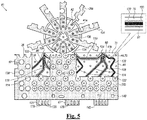
- Fig. 5 is a schematic illustration of electrode 40 prior to the deformation thereof, in accordance with some embodiments of the present disclosure.
- Fig. 5 shows the interior of electrode 40, i.e., the various elements that are coupled to the inner surface of substrate 41.
- Fig. 4 assumes that at least the inner surface of the substrate is initially coated with a layer of copper.
- method 400 begins with an etching step 84, in which all of the copper is etched away from the inner surface, with the exception of copper traces 114, which are to be connected to the sensing electrodes on the exterior of the electrode. (Any copper on the 5 outer surface is also etched away.)
- This etching may be performed, for example, by placing a mask over the portions of the copper that are designated for traces 114, and then chemically removing the exposed copper.
- copper traces 114 may be deposited onto the inner surface.
- a trace-depositing step 86 constantan traces 118, which are to be used for thermocouples, are deposited onto the inner surface of the substrate.
- Trace-depositing step 86 may be performed, for example, by physical vapor deposition (PVD), such as sputter deposition.
- PVD physical vapor deposition
- a mask may be placed over the entire inner surface, with the exception of those portions of the inner surface that are designated for constantan traces 118.
- a seed layer of a base metal such as titanium-tungsten, may be sputtered onto the substrate.
- the constantan may be sputtered over the base metal.
- the constantan traces terminate at a common constantan-trace soldering pad 120.
- a hole or "stake via" is drilled through the substrate at the site of soldering pad 120.
- the deposited constantan fills the hole, and then forms soldering pad 120 above the hole.
- a depression may be drilled into the substrate, such that the deposited constantan fills the depression.
- soldering pad 120 is "staked" to the substrate by the constantan underneath the soldering pad. (To facilitate the filling of the hole or depression, a draft angle may be used to taper the hole or depression, as described immediately below for the narrower and wider channels.)
- a drilling step 88 multiple narrower channels and one or more wider channels 44 are drilled through the substrate, typically using laser drilling.
- the channels are drilled from the inner surface of the substrate, using a draft angle such that the channels narrow as they approach the outer surface; this facilitates the collection of metal onto the walls of the channels during the subsequent sputtering process.
- blind vias 80 may be drilled (e.g., laser-drilled) through the substrate from the outer surface of the substrate at those portions of the outer surface that are designated for sensing electrodes, using copper traces 114 as stops.
- a draft angle is used for the blind vias, such that the blind vias narrow as they approach the inner surface of the substrate; this facilitates the collection of metal onto the walls of the blind vias.
- a first masking step 90 the copper and constantan traces, along with exclusion zones 91 (i.e., exposed portions of the inner surface of the substrate) that are designated for insulating these traces, are masked. (Portions of the constantan traces that are designated for the thermocouple junctions are not masked.) Additional exclusion zones designated for insulating the gold traces that will intersect the constantan traces (thus forming constantan-gold thermocouples) are also masked. Additionally, exclusion zones on the outer surface that are designated for insulating the sensing electrodes are masked.
- a thin layer of gold 30 is deposited onto the inner and outer surfaces of the substrate and into the channels.
- Depositing step 92 may be performed, for example, by physical vapor deposition (PVD), such as sputter deposition.
- PVD physical vapor deposition
- a seed layer of a base metal, such as titanium-tungsten is sputtered onto the substrate prior to the sputtering of the gold.
- the gold is not deposited onto the traces or exclusion zones.
- the deposited gold includes an initializing layer for inner layer 70, outer layer 50, plating layer 52, and columns 48.
- the deposited gold further includes gold traces 122 that cover the constantan traces at thermocouple junctions 124. Each gold trace 122 terminates at a respective gold-trace soldering pad 126.
- the deposited gold further includes a respective copper-trace soldering pad 116 for each of the copper traces. In some embodiments, copper-trace soldering pads 116 and/or gold-trace soldering pads 126 are staked to the substrate, as described above for the constantan-trace soldering pad.
- the deposited gold further includes at least one gold soldering pad 128, which is connected to inner layer 70. Gold soldering pad 128 may also be staked to the substrate.
- the masks (along with any gold that was deposited onto the masks) are removed at a mask-removing step 93. Subsequently, at a second masking step 94, the traces, the inner-surface exclusion zones that surround the traces, and the entire outer surface of the substrate are masked.
- the substrate is plated in a plating bath of gold for a first time interval, at a first plating step 98.
- the plating of the substrate causes any gaps in the gold to be filled, and further increases the thickness of the gold, such that, for example, inner layer 70 reaches a thickness of between 5 and 40 microns, while the diameter of the wider channels is reduced to between 30 and 200 microns. Additionally, the narrower channels may become completely filled.
- the plating of the substrate is electrochemical, whereby the flow of electric current through the gold that already coats the substrate causes this gold to attract gold ions in the plating bath.
- the amplitude and duration of the current may be controlled such that the gold reaches the desired thickness.
- coverlay 130 is applied over the traces and inner-surface exclusion zones. (In some embodiments, as illustrated in the inset portion of Fig. 5 , coverlay 130 is transparent or nearly transparent.)
- the proximal portion of coverlay 130 that covers 10 tabs 47 is shaped to define windows 132 that expose the soldering pads, such that the soldering pads may be thickened during the subsequent plating process.
- additional cover 142 having windows that are aligned with windows 132, may cover the proximal portion of the coverlay.
- the soldering pads are not completely exposed, but rather, are held “captive” by coverlay 130, in that one or more edges of each soldering pad are covered by the rims of windows 132. Coverlay 130 thus helps hold the soldering pads to substrate 41 during the subsequent soldering process.
- the substrate is plated in the plating bath for a second time interval, such that any gaps in outer layer 50 are filled, while the inner, outer, and plating layers are thickened.
- the second plating may increase the thickness of the inner layer to between 10 and 50 microns, while reducing the diameter of the wider channels to between 15 and 150 microns.
- the final thickness of the inner layer is the same as the thickness of the coverlay, such as to attain a smooth interior surface.
- the term "interior surface” is used herein to refer to the surface that is formed by the coverlay and the inner gold layer, whereas the term “inner surface” is used to refer to the underlying surface of the substrate.)
- the amplitude and duration of the electric current in the plating bath may be controlled such that the desired thicknesses are attained.
- the outer surface is masked prior to depositing step 92, such that no gold is deposited onto the outer surface during depositing step 92. In such embodiments, following unmasking step 100 and prior to second plating step 102, a thin layer of gold is deposited onto the outer surface.
- apertures 62 are drilled through supporting structure 36.
- any other suitable technique such as chemical etching, may be used to form the apertures.
- a bonding step 106 by the application of a suitable adhesive between supporting structure 36 and the smooth interior surface that is formed by coverlay 130 and inner layer 70, the supporting structure is bonded to the interior surface, with apertures 62 being aligned with irrigation holes 72.
- the area of the apertures is greater than that of the irrigation holes, such as to compensate for any small misalignments when bonding the supporting structure.
- electrode 40 is deformed into the desired shape.
- the electrode may be inserted into a forming jig that shapes the electrode around a suitable mandrel.
- the jig is placed inside an oven. Subsequently, the oven heats the electrode to a suitable temperature, while pressure is applied to the electrode. The combination of heat and pressure causes the electrode to bond to itself in the desired shape.
- the substrate and supporting structure may be deformed into any desired shape.
- the substrate and supporting structure are shaped to define an interior lumen; for example, the substrate and supporting structure may be shaped to define a thimble that contains an interior lumen, as described above with reference to Fig. 2A and Fig. 3 .
- the substrate and supporting structure may be shaped to define a ring.
- substrate 41 comprises two portions that are continuous with one another: a distal, circular portion 41a, and a proximal, rectangular portion 41b.
- supporting structure 36 comprises two portions that are continuous with one another: a distal supporting portion 36a, typically comprising a plurality of spokes 134 that radiate from a central hub 136, and a proximal supporting portion 36b.
- distal supporting portion 36a is bonded to the interior surface of circular portion 41a, and the adhesive is applied to the outer surfaces of spokes 134. (These surfaces are opposite the surfaces shown in Fig.
- proximal supporting portion 36b is bonded to the interior surface of rectangular portion 41b, leaving some distal portions of this interior surface exposed.
- the adhesive is applied to the outer surface of an overhanging tab 138 of proximal supporting portion 36b, which hangs over the side of rectangular portion 41b. (Proximal supporting portion 36b may also hang over the proximal end of rectangular portion 41b.)
- distal supporting portion 36a and circular portion 41a are folded over the top of the mandrel, while proximal supporting portion 36b and rectangular portion 41b are rolled around the mandrel.
- the outer surfaces of spokes 134 are bonded to the exposed distal portions of the interior surface of rectangular portion 41b, and the outer surface of tab 138 is bonded to the opposite end of proximal supporting portion 36b.
- the inner surface of at least one of the spokes may bond to tab 138.
- distal supporting portion 36a and circular portion 41a are formed into dome-shaped portion 40a ( Fig. 2A ), while proximal supporting portion 36b and rectangular portion 41b are formed into cylindrical portion 40b.
- wires are soldered onto the soldering pads.
- the wire that delivers RF currents from generator 27 ( Fig. 1 ) is soldered onto gold soldering pad 128, while other wires, which deliver signals to processor 23, are soldered to the other soldering pads.
- proximal supporting portion 36b may be bonded to base 58 of the flow diverter ( Fig. 3 ).
- protrusions belonging to base 58 may snap into complementary holes 140 in proximal supporting portion 36b.
- the flow diverter may be coupled to the fluid-delivery tube belonging to the catheter. (Alternatively, the flow diverter may be coupled to the fluid-delivery tube before the electrode is coupled to the flow diverter.)
- Certain known ablation catheters are constructed from a double-sided flexible circuit, and the exterior metal of the circuit is used to form a catheter tip electrode that is used for ablation.
- a polymer layer between the exterior metal and the interior metal in these known approaches can create significant thermal resistance and serve to keep the exterior surface temperature elevated.
- One solution to these and other problems is shown in Figs. 6-8 , whereby the depicted solution significantly increases the heat transfer through the polymer layer (e.g., PCB) through a plurality of thermal vias 80 (e.g., thousands of vias 80) formed in the polymer layer.
- the vias 80 electrically and thermally join the exterior metal layer 70 to the interior metal layer 50 of the example described in Figs.
- the vias 80 shown in Figs. 6-8 may be solid cylinders, typically of gold, or at least some may be plated through vias, allowing irrigation liquid to transfer to the exterior.
- Layers 50, 70 are thermally conducting and particularly effective for transferring out of the tissue at least because the heat flow from the central (and hottest) region of the ablation zone is critically dependent on the thermal conductivity of the tip 32 as it is positioned above the hottest part of the tissue.
- the heat flow through the catheter tip 32 is increased, including into the fluid (e.g., irrigation and/or blood), by providing a thermal pathway from the tissue.
- the heat comes from the outside, and the outer thermally conductive layer 70 passes some of it directly to the blood. Part of the heat flows through the thermal bridges, as described more particularly below.
- the herein described plated irrigation holes transfer some of the heat into the irrigation fluid, to the inner layer 50 and the inner layer 50 can transfer the remaining heat to the irrigation fluid through its surface.
- the irrigation fluid flowing through the plated holes lose some heat to the walls of the irrigation holes and mostly to the blood after exiting the catheter tip 32.
- thermally-conducting layers 50, 70 are to increase the flow of heat there inside thus providing the greatest contact area with the cooling fluid flow (e.g., blood, irrigation, etc.). Layers 50, 70 are also effective at efficient heat transfer between layers to increase the contact area. Layers 50, 70 are also effective at emulating structure of an all-metal tip, where the cooling occurs from all the surfaces exposed to the liquid.
- the cooling fluid flow e.g., blood, irrigation, etc.
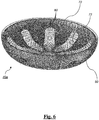
- Fig. 6 depicts a perspective view of an example construction distal tip 32 of ablation catheter 22 of this disclosure.
- tip 32 can include a PCB 160 (shown more particularly in Figs. 7A-B ) attached or otherwise formed with dome-shaped portion 40a and cylindrical portion 40b.
- PCB 160 can be wrapped with inner layer 70 and outer layer 50 with irrigation holes 72 and corresponding electrodes of tip 32 facing the internal tissue of heart 24.
- the configuration of distal tip 32 shown in Fig. 6 is an example configuration that is chosen purely for the sake of conceptual clarity. In alternative embodiments, any other suitable configuration can be used.
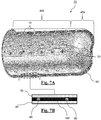
- Figs.7A-8 depict an example distal tip 32 construction of the ablation catheter 22 of this disclosure.
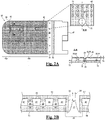
- Fig. 7A shows an inner perspective view of distal tip 32 at cross-section along centerline of the distal tip 32 to show the inner surface of the catheter tip 32 while
- Fig. 8 depicts an outer perspective view of the same example tip 32.
- tip 32 in the illustrated example includes cylindrical portion 40b and dome-shaped portion 40b, each of which include selectively positioned irrigation holes 72 and blind vias 80.
- Blind vias 80 can be provided for electrical conductivity so inner layer 70 is in direct contact with outer layer 70 and one example distance between each blind via 80 can be approximately about 0.2 to 0.3 mm.
- Irrigation holes 72 of the depicted example can be heat transfer vias by themselves (e.g., be gold-plated walls).
- Fig. 7B schematically illustrates a close-up longitudinal cross-section at C-C through distal tip 32.
- the depicted example is dual metal layered whereby inner layer 70 and outer layer 50 are shown and constructed from metal. Sandwiched therebetween can be a PCB 160 with a plurality of selectively positioned vias 80 (e.g., thermal bridges).
- the inner and outer layers 70, 50 can be constructed from gold and typical thickness for each can be approximately about 40 microns.
- a typical diameter of the vias 80 in this example can be approximately about 60 microns.
- a typical thickness of the wall plating in the irrigation holes 72 of this example can be approximately about 25 microns.
- a typical thickness of the PCB layer 160 of this example can be approximately about 50 microns.
- a total shell thickness of the catheter tip 32 illustrated in Fig. 7A can therefore be approximately about 130 microns (i.e. 0.13mm).
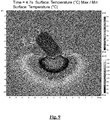
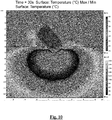
- Fig. 9 a graphical depiction is provided showing results from a finite element simulation (COMSOL) performed to compare the performance of a PCB based catheter tip utilizing the inter-connected metal layers with a catheter tip without such the inventive components (hereafter "standard flex circuit).
- the simulation parameters were approximately identical for the standard flex circuit and dual metal layered examples, regarding both the ablation conditions (e.g., time, ablation current, irrigation, position of the ablation catheter, etc.) and the environment comprising blood and tissue with the relevant thermoelectric properties and geometry.
- the ablation catheter 22 of the example analysis was set at a 45° angle to the tissue, with penetration depth of 0.8mm, which were considered typical and normal working conditions.
- Two scenarios were analyzed, including a first scenario where the ablation current was set at 0about 0.63 Amperes for up to 30s, equivalent to 30-40W depending on measured impedance. Results of this first scenario are shown in Figs. 9 and 10 .
- a second scenario included the ablation current being set at 0.9A for up to 5s, equivalent to 80-100W depending on measured impedance.
- Safety in both scenarios was evaluated where temperatures over 130°C because such temperatures are considered dangerous with a high probability that the tissue will be ruptured by steam build-up (e.g., steam-pop).
- a temperature field is depicted at approximately 130° C maximum with a standard flex circuit distal tip.
- distal tip 32 has been positioned on an ablation surface and maintained for approximately 4.7 seconds with ablation current about 0.63 Amperes thereby resulting in a lesion width of approximately 4.6 mm and a lesion depth of approximately 3.0 mm.
- Fig. 10 depicts a temperature field at approximately 130° C maximum for an example dual metal layered distal tipped ablation catheter.
- distal tip 32 has been positioned on an ablation surface and maintained for 30 seconds with ablation current about 0.63 Amperes thereby resulting in a lesion width of approximately 8.9 mm and a lesion depth of approximately 5.6 mm.
- the dual metal layered distal tip e.g., similar embodiment of tip 32 illustrated in Figs. 7-8
- ablation current about 0.63 Amperes demonstrated approximately about 93.5% improvement in lesion width (i.e. from approximately 4.6 mm to approximately 9.6 mm), approximately about 86.7% improvement in lesion depth (i.e.
- the catheter tip 32 construction of Figs. 7-8 was demonstrably safer and more effective, longer-lasting, and imparted a larger ablation zone than standard flex circuit tips at ablation current about 0.63 Amperes.
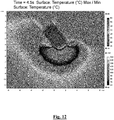
- a temperature field is depicted at approximately 130° C maximum with a standard flex circuit distal tip.
- distal tip 32 of catheter 22 has been positioned on an ablation surface and maintained for 1.7 seconds with ablation current about 0.90 Amperes thereby resulting in a lesion width of 4.3 mm and a lesion depth of 2.6 mm.
- Fig. 12 depicts a temperature field at approximately 130° C maximum for an examplary dual metal layered distal tipped ablation catheter.
- distal tip 32 has been positioned on an ablation surface and maintained for 4.5 seconds with ablation current about 0.90 Amperes thereby resulting in a lesion width of about 6.9 mm and a lesion depth of about 3.6 mm.
- the double metal layer e.g., similar embodiment of tip 32 illustrated in Figs. 7-8
- ablation current about 0.90 Amperes the double metal layer example tip demonstrated approximately about 60.5% improvement in lesion width (i.e. from 4.3 mm to 6.9 mm), approximately about 38.5% improvement in lesion depth (i.e.
- the catheter tip 32 construction of Figs. 7-8 demonstrate what is believed to be a safer and more effective, longer-lasting, and imparted a larger ablation zone than standard flex circuit tips at ablation current of about 0.90 Amperes.
- Fig. 13 depicts a heat flux map with dual metal layers and constructed with platinum and connected by thermal vias 80 through an example PCB 160, whereby catheter 22 during the simulation was positioned at approximately a 45° angle to the tissue and maintained for 30 seconds at 1mm insertion.
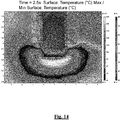
- Fig. 14 depicts a temperature map with dual metal layers and constructed with platinum and connected by thermal vias 80 through an example PCB 160, whereby catheter 22 was positioned at a vertical insertion (e.g., approximately 90° angle with the tissue) and maintained for 2.5 seconds.
- a vertical insertion e.g., approximately 90° angle with the tissue
- Fig. 15 depicts a graph summarizing maximum temperature in the tissue during ablation as between standard flex circuit and dual metal layered distal catheter tips 32.
- the ablation current 0about 0.63 Amperes ( ⁇ 35W) is shown across 0-30s of ablation duration time with temperature ranging from approximately 40-220° C during ablation. It can be seen that the temperature curve for the standard flex circuit distal tip reaches the temperature safety limit of 130° C after approximately about 5 seconds of ablation time.
- the dual metal layered distal catheter tip of this disclosure never quite reaches the temperature safety limit of 130° even after 30 seconds of ablation time.
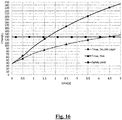
- Fig. 16 depicts a graph summarizing maximum temperature in the tissue during ablation as between flex and double metal layered distal catheter tips 32.
- the ablation current 0.9A ( ⁇ 90W equivalent) is shown across 0-5s of ablation with temperature ranging from approximately 40-245° C during ablation. It can be seen that the temperature curve for the standard flex circuit distal tip reaches the temperature safety limit of 130° after approximately about 4.5 seconds of ablation time. In contrast, the dual metal layered distal catheter tip of this disclosure reaches the temperature safety limit of 130° C after approximately about 1.7 seconds of ablation time.
- Fig. 17 depicts a perspective view of heat generated in a hemisphere of approximately 2mm radius under an example illustration of the dual metal layered distal tip 32 of the catheter 22 of this disclosure at approximately about 1.5W.
- the depicted hemisphere is approximately about where the ablation center of distal tip 32 generally resides.
- the depicted hemisphere is merely representational of one embodiment and other shaped ablation zones are contemplated as well as ablation radii according to the solution of this disclosure.
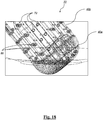
- Fig. 18 depicts a perspective view of an example embodiment of the dual metal layered distal tip of the catheter in contact with tissue.
- Total heat flux through the surface of the distal tip 32 in Fig. 18 is approximately about -0.82W whereas it is approximately about -0.3W for a standard flex circuit tip of this disclosure.
- 1.5W there remains 0.7W in the dual metal layered distal tip vs 1.2W in the standard flex circuit case, which is approximately a 71.5 % increase.
- Other cases e.g. single metal layer
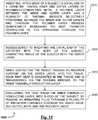
- Fig. 19 is a flow diagram for a method 1900 in accordance with some embodiments of the present disclosure.
- Step 1910 includes inserting, into a body of a subject, a distal end of a catheter, the distal end comprising an outer layer of a thermally-conducting metal; an inner layer of an thermally-conducting metal; a polymer layer between the inner and outer layer; and a plurality of thermal bridges selectively positioned between the inner and outer layers and through the polymer layer thereby significantly increasing the heat transfer of the catheter tip through the polymer layer.
- Step 1920 includes while contacting the tissue, passing an ablation current, via the outer layer, into the tissue, such that heat is generated in the tissue and is transferred, via the thermal bridges, to the inner thermally-conducting layer.
- Step 1930 includes subsequently to inserting the distal end of the catheter into the body of the subject, contacting tissue of the subject with the outer layer.
- Step 1940 includes evacuating the heat, from the inner thermally-conducting layer, into blood of the subject, by passing an irrigating fluid through a plurality of irrigation channels through the inner layer, the outer layer, and the polymer layer.
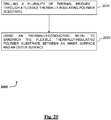
- Fig. 20 is a flow diagram for a method 2000 of manufacturing a catheter tip electrode, in accordance with some embodiments of the present disclosure.
- Step 2010 includes drilling a plurality of thermal bridges, through a flexible thermally-insulating polymer substrate.
- Step 2020 includes using a thermally-conducting metal to sandwich the flexible thermally-insulating polymer substrate between an inner surface and an outer surface. It is understood that any thermally conductive material can be used in the herein disclosed examples, including diamond.
- the catheter tip electrode can also be a separate thin (e.g., approximately about 1 micron) metal layer deposited over the thermally conducting layer.
- any other suitable electric or electronic components may be deposited onto the inner surface of the substrate.
- Such components may include thermistors for measuring the temperature of the tissue, pressure sensors for measuring the pressure applied to the distal end of the catheter, and/or electromagnetic sensors for navigating the catheter. These components (along with suitable surrounding exclusion zones) may be masked or covered whenever such masking or covering is required, as described above for the traces.
- any suitable modification to method 82 with respect to the order of the steps that are performed and/or with respect to the various materials that are used, as will be apparent to any person of skill in the art.
- any suitable thermally-conducting metal may be used in lieu of copper, gold, or constantan.
Landscapes
- Health & Medical Sciences (AREA)
- Engineering & Computer Science (AREA)
- Life Sciences & Earth Sciences (AREA)
- Surgery (AREA)
- Public Health (AREA)
- Animal Behavior & Ethology (AREA)
- Veterinary Medicine (AREA)
- General Health & Medical Sciences (AREA)
- Biomedical Technology (AREA)
- Heart & Thoracic Surgery (AREA)
- Medical Informatics (AREA)
- Molecular Biology (AREA)
- Otolaryngology (AREA)
- Plasma & Fusion (AREA)
- Physics & Mathematics (AREA)
- Nuclear Medicine, Radiotherapy & Molecular Imaging (AREA)
- Cardiology (AREA)
- Chemical & Material Sciences (AREA)
- Electrochemistry (AREA)
- Chemical Kinetics & Catalysis (AREA)
- Materials Engineering (AREA)
- Metallurgy (AREA)
- Organic Chemistry (AREA)
- Biophysics (AREA)
- Pulmonology (AREA)
- Anesthesiology (AREA)
- Hematology (AREA)
- Surgical Instruments (AREA)
Applications Claiming Priority (1)
| Application Number | Priority Date | Filing Date | Title |
|---|---|---|---|
| US16/512,136 US11712294B2 (en) | 2018-05-25 | 2019-07-15 | Heat transfer through a catheter tip |
Publications (3)
| Publication Number | Publication Date |
|---|---|
| EP3766447A1 true EP3766447A1 (fr) | 2021-01-20 |
| EP3766447B1 EP3766447B1 (fr) | 2024-07-31 |
| EP3766447C0 EP3766447C0 (fr) | 2024-07-31 |
Family
ID=71614748
Family Applications (1)
| Application Number | Title | Priority Date | Filing Date |
|---|---|---|---|
| EP20185673.9A Active EP3766447B1 (fr) | 2019-07-15 | 2020-07-14 | Transfert de chaleur amélioré par l'intermédiaire d'une pointe de cathéter |
Country Status (4)
| Country | Link |
|---|---|
| EP (1) | EP3766447B1 (fr) |
| JP (2) | JP7683159B2 (fr) |
| CN (1) | CN112220553B (fr) |
| IL (1) | IL275929B2 (fr) |
Cited By (1)
| Publication number | Priority date | Publication date | Assignee | Title |
|---|---|---|---|---|
| WO2023102391A1 (fr) * | 2021-11-30 | 2023-06-08 | Shockwave Medical, Inc. | Conception d'électrode pour cathéters de lithotritie directionnelle |
Families Citing this family (1)
| Publication number | Priority date | Publication date | Assignee | Title |
|---|---|---|---|---|
| KR102576064B1 (ko) * | 2021-02-05 | 2023-09-11 | 주식회사 세라젬 | 온열 치료기 |
Citations (4)
| Publication number | Priority date | Publication date | Assignee | Title |
|---|---|---|---|---|
| US8456182B2 (en) | 2008-09-30 | 2013-06-04 | Biosense Webster, Inc. | Current localization tracker |
| US20160014908A1 (en) * | 2010-06-03 | 2016-01-14 | Hsio Technologies, Llc | Fusion bonded liquid crystal polymer circuit structure |
| US20180110562A1 (en) | 2016-10-25 | 2018-04-26 | Biosense Webster (Israel) Ltd. | Catheter distal end made of plastic tube and flexible printed circuit boards |
| EP3572024A1 (fr) * | 2018-05-25 | 2019-11-27 | Biosense Webster (Israel) Ltd. | Transfert de chaleur amélioré par l'intermédiaire d'une pointe de cathéter |
Family Cites Families (11)
| Publication number | Priority date | Publication date | Assignee | Title |
|---|---|---|---|---|
| WO1981003271A1 (fr) * | 1980-05-13 | 1981-11-26 | American Hospital Supply Corp | Dispositif electro-chirurgical multipolaire |
| US6533781B2 (en) * | 1997-12-23 | 2003-03-18 | Team Medical Llc | Electrosurgical instrument |
| JP4635331B2 (ja) * | 2000-12-08 | 2011-02-23 | イビデン株式会社 | プリント配線板 |
| JP2006086358A (ja) * | 2004-09-16 | 2006-03-30 | Sumitomo Electric Printed Circuit Inc | 両面プリント配線板の製造方法 |
| US20090143651A1 (en) * | 2006-06-01 | 2009-06-04 | Bengt Kallback | Device for Invasive Use |
| US20120109118A1 (en) * | 2010-10-29 | 2012-05-03 | Medtronic Ablation Frontiers Llc | Cryogenic-radiofrequency ablation system |
| US9539056B2 (en) * | 2012-03-20 | 2017-01-10 | Biosense Webster (Israel) Ltd. | Catheter with multiple irrigated electrodes and a force sensor |
| US10980598B2 (en) * | 2015-11-20 | 2021-04-20 | St. Jude Medical, Cardiology Division, Inc. | Multi-electrode ablator tip having dual-mode, omni-directional feedback capabilities |
| US20170156791A1 (en) * | 2015-12-08 | 2017-06-08 | Biosense Webster (Israel) Ltd. | Ablating and sensing electrodes |
| US10653480B2 (en) * | 2016-04-28 | 2020-05-19 | Biosense Webster (Israel) Ltd. | Method for constructing irrigated balloon catheter with flexible circuit electrode assembly |
| US20190117298A1 (en) * | 2017-10-25 | 2019-04-25 | Biosense Webster (Israel) Ltd. | Catheter with improved temperature response |
-
2020
- 2020-07-08 IL IL275929A patent/IL275929B2/en unknown
- 2020-07-14 EP EP20185673.9A patent/EP3766447B1/fr active Active
- 2020-07-14 JP JP2020120435A patent/JP7683159B2/ja active Active
- 2020-07-15 CN CN202010680328.8A patent/CN112220553B/zh active Active
-
2025
- 2025-03-13 JP JP2025040119A patent/JP2025085714A/ja active Pending
Patent Citations (6)
| Publication number | Priority date | Publication date | Assignee | Title |
|---|---|---|---|---|
| US8456182B2 (en) | 2008-09-30 | 2013-06-04 | Biosense Webster, Inc. | Current localization tracker |
| US20160014908A1 (en) * | 2010-06-03 | 2016-01-14 | Hsio Technologies, Llc | Fusion bonded liquid crystal polymer circuit structure |
| US20180110562A1 (en) | 2016-10-25 | 2018-04-26 | Biosense Webster (Israel) Ltd. | Catheter distal end made of plastic tube and flexible printed circuit boards |
| EP3315087A1 (fr) * | 2016-10-25 | 2018-05-02 | Biosense Webster (Israel), Ltd. | Extrémité distale de cathéter constituée d'un tube en plastique et cartes de circuits imprimées flexibles |
| EP3572024A1 (fr) * | 2018-05-25 | 2019-11-27 | Biosense Webster (Israel) Ltd. | Transfert de chaleur amélioré par l'intermédiaire d'une pointe de cathéter |
| US20190357972A1 (en) * | 2018-05-25 | 2019-11-28 | Biosense Webster (Israel) Ltd. | Heat Transfer Through a Catheter Tip |
Cited By (1)
| Publication number | Priority date | Publication date | Assignee | Title |
|---|---|---|---|---|
| WO2023102391A1 (fr) * | 2021-11-30 | 2023-06-08 | Shockwave Medical, Inc. | Conception d'électrode pour cathéters de lithotritie directionnelle |
Also Published As
| Publication number | Publication date |
|---|---|
| JP7683159B2 (ja) | 2025-05-27 |
| CN112220553A (zh) | 2021-01-15 |
| JP2021013749A (ja) | 2021-02-12 |
| IL275929B1 (en) | 2024-02-01 |
| CN112220553B (zh) | 2025-08-01 |
| EP3766447B1 (fr) | 2024-07-31 |
| JP2025085714A (ja) | 2025-06-05 |
| IL275929A (en) | 2021-01-31 |
| IL275929B2 (en) | 2024-06-01 |
| EP3766447C0 (fr) | 2024-07-31 |
Similar Documents
| Publication | Publication Date | Title |
|---|---|---|
| JP7753413B2 (ja) | カテーテル先端部を介した熱伝達 | |
| JP2025085714A (ja) | カテーテル先端部を介した熱伝達 | |
| EP3610814B1 (fr) | Transfert de chaleur amélioré pendant des procédures d'ablation | |
| US20230310074A1 (en) | Heat transfer through a catheter tip | |
| US20230147174A1 (en) | Heat transfer through an ablation electrode | |
| US20250114141A1 (en) | Flexible circuit for use with a catheter and related manufacturing method |
Legal Events
| Date | Code | Title | Description |
|---|---|---|---|
| PUAI | Public reference made under article 153(3) epc to a published international application that has entered the european phase |
Free format text: ORIGINAL CODE: 0009012 |
|
| STAA | Information on the status of an ep patent application or granted ep patent |
Free format text: STATUS: THE APPLICATION HAS BEEN PUBLISHED |
|
| AK | Designated contracting states |
Kind code of ref document: A1 Designated state(s): AL AT BE BG CH CY CZ DE DK EE ES FI FR GB GR HR HU IE IS IT LI LT LU LV MC MK MT NL NO PL PT RO RS SE SI SK SM TR |
|
| AX | Request for extension of the european patent |
Extension state: BA ME |
|
| STAA | Information on the status of an ep patent application or granted ep patent |
Free format text: STATUS: REQUEST FOR EXAMINATION WAS MADE |
|
| 17P | Request for examination filed |
Effective date: 20210708 |
|
| RBV | Designated contracting states (corrected) |
Designated state(s): AL AT BE BG CH CY CZ DE DK EE ES FI FR GB GR HR HU IE IS IT LI LT LU LV MC MK MT NL NO PL PT RO RS SE SI SK SM TR |
|
| RAP3 | Party data changed (applicant data changed or rights of an application transferred) |
Owner name: BIOSENSE WEBSTER (ISRAEL) LTD. |
|
| GRAP | Despatch of communication of intention to grant a patent |
Free format text: ORIGINAL CODE: EPIDOSNIGR1 |
|
| STAA | Information on the status of an ep patent application or granted ep patent |
Free format text: STATUS: GRANT OF PATENT IS INTENDED |
|
| RIC1 | Information provided on ipc code assigned before grant |
Ipc: A61B 18/00 20060101ALN20231129BHEP Ipc: A61B 17/00 20060101ALN20231129BHEP Ipc: C25D 5/10 20060101ALI20231129BHEP Ipc: C25D 5/02 20060101ALI20231129BHEP Ipc: A61B 18/14 20060101AFI20231129BHEP |
|
| INTG | Intention to grant announced |
Effective date: 20231222 |
|
| GRAJ | Information related to disapproval of communication of intention to grant by the applicant or resumption of examination proceedings by the epo deleted |
Free format text: ORIGINAL CODE: EPIDOSDIGR1 |
|
| STAA | Information on the status of an ep patent application or granted ep patent |
Free format text: STATUS: REQUEST FOR EXAMINATION WAS MADE |
|
| GRAP | Despatch of communication of intention to grant a patent |
Free format text: ORIGINAL CODE: EPIDOSNIGR1 |
|
| STAA | Information on the status of an ep patent application or granted ep patent |
Free format text: STATUS: GRANT OF PATENT IS INTENDED |
|
| INTC | Intention to grant announced (deleted) | ||
| INTG | Intention to grant announced |
Effective date: 20240402 |
|
| RIC1 | Information provided on ipc code assigned before grant |
Ipc: A61B 18/00 20060101ALN20240319BHEP Ipc: A61B 17/00 20060101ALN20240319BHEP Ipc: C25D 5/10 20060101ALI20240319BHEP Ipc: C25D 5/02 20060101ALI20240319BHEP Ipc: A61B 18/14 20060101AFI20240319BHEP |
|
| GRAS | Grant fee paid |
Free format text: ORIGINAL CODE: EPIDOSNIGR3 |
|
| GRAA | (expected) grant |
Free format text: ORIGINAL CODE: 0009210 |
|
| STAA | Information on the status of an ep patent application or granted ep patent |
Free format text: STATUS: THE PATENT HAS BEEN GRANTED |
|
| AK | Designated contracting states |
Kind code of ref document: B1 Designated state(s): AL AT BE BG CH CY CZ DE DK EE ES FI FR GB GR HR HU IE IS IT LI LT LU LV MC MK MT NL NO PL PT RO RS SE SI SK SM TR |
|
| REG | Reference to a national code |
Ref country code: CH Ref legal event code: EP Ref country code: GB Ref legal event code: FG4D |
|
| REG | Reference to a national code |
Ref country code: DE Ref legal event code: R096 Ref document number: 602020034749 Country of ref document: DE |
|
| REG | Reference to a national code |
Ref country code: IE Ref legal event code: FG4D |
|
| U01 | Request for unitary effect filed |
Effective date: 20240819 |
|
| U07 | Unitary effect registered |
Designated state(s): AT BE BG DE DK EE FI FR IT LT LU LV MT NL PT RO SE SI Effective date: 20240902 |
|
| PG25 | Lapsed in a contracting state [announced via postgrant information from national office to epo] |
Ref country code: NO Free format text: LAPSE BECAUSE OF FAILURE TO SUBMIT A TRANSLATION OF THE DESCRIPTION OR TO PAY THE FEE WITHIN THE PRESCRIBED TIME-LIMIT Effective date: 20241031 |
|
| PG25 | Lapsed in a contracting state [announced via postgrant information from national office to epo] |
Ref country code: PL Free format text: LAPSE BECAUSE OF FAILURE TO SUBMIT A TRANSLATION OF THE DESCRIPTION OR TO PAY THE FEE WITHIN THE PRESCRIBED TIME-LIMIT Effective date: 20240731 Ref country code: GR Free format text: LAPSE BECAUSE OF FAILURE TO SUBMIT A TRANSLATION OF THE DESCRIPTION OR TO PAY THE FEE WITHIN THE PRESCRIBED TIME-LIMIT Effective date: 20241101 |
|
| PG25 | Lapsed in a contracting state [announced via postgrant information from national office to epo] |
Ref country code: IS Free format text: LAPSE BECAUSE OF FAILURE TO SUBMIT A TRANSLATION OF THE DESCRIPTION OR TO PAY THE FEE WITHIN THE PRESCRIBED TIME-LIMIT Effective date: 20241130 |
|
| PG25 | Lapsed in a contracting state [announced via postgrant information from national office to epo] |
Ref country code: HR Free format text: LAPSE BECAUSE OF FAILURE TO SUBMIT A TRANSLATION OF THE DESCRIPTION OR TO PAY THE FEE WITHIN THE PRESCRIBED TIME-LIMIT Effective date: 20240731 |
|
| PG25 | Lapsed in a contracting state [announced via postgrant information from national office to epo] |
Ref country code: RS Free format text: LAPSE BECAUSE OF FAILURE TO SUBMIT A TRANSLATION OF THE DESCRIPTION OR TO PAY THE FEE WITHIN THE PRESCRIBED TIME-LIMIT Effective date: 20241031 Ref country code: ES Free format text: LAPSE BECAUSE OF FAILURE TO SUBMIT A TRANSLATION OF THE DESCRIPTION OR TO PAY THE FEE WITHIN THE PRESCRIBED TIME-LIMIT Effective date: 20240731 |
|
| PG25 | Lapsed in a contracting state [announced via postgrant information from national office to epo] |
Ref country code: RS Free format text: LAPSE BECAUSE OF FAILURE TO SUBMIT A TRANSLATION OF THE DESCRIPTION OR TO PAY THE FEE WITHIN THE PRESCRIBED TIME-LIMIT Effective date: 20241031 Ref country code: PL Free format text: LAPSE BECAUSE OF FAILURE TO SUBMIT A TRANSLATION OF THE DESCRIPTION OR TO PAY THE FEE WITHIN THE PRESCRIBED TIME-LIMIT Effective date: 20240731 Ref country code: NO Free format text: LAPSE BECAUSE OF FAILURE TO SUBMIT A TRANSLATION OF THE DESCRIPTION OR TO PAY THE FEE WITHIN THE PRESCRIBED TIME-LIMIT Effective date: 20241031 Ref country code: IS Free format text: LAPSE BECAUSE OF FAILURE TO SUBMIT A TRANSLATION OF THE DESCRIPTION OR TO PAY THE FEE WITHIN THE PRESCRIBED TIME-LIMIT Effective date: 20241130 Ref country code: HR Free format text: LAPSE BECAUSE OF FAILURE TO SUBMIT A TRANSLATION OF THE DESCRIPTION OR TO PAY THE FEE WITHIN THE PRESCRIBED TIME-LIMIT Effective date: 20240731 Ref country code: GR Free format text: LAPSE BECAUSE OF FAILURE TO SUBMIT A TRANSLATION OF THE DESCRIPTION OR TO PAY THE FEE WITHIN THE PRESCRIBED TIME-LIMIT Effective date: 20241101 Ref country code: ES Free format text: LAPSE BECAUSE OF FAILURE TO SUBMIT A TRANSLATION OF THE DESCRIPTION OR TO PAY THE FEE WITHIN THE PRESCRIBED TIME-LIMIT Effective date: 20240731 |
|
| PG25 | Lapsed in a contracting state [announced via postgrant information from national office to epo] |
Ref country code: SM Free format text: LAPSE BECAUSE OF FAILURE TO SUBMIT A TRANSLATION OF THE DESCRIPTION OR TO PAY THE FEE WITHIN THE PRESCRIBED TIME-LIMIT Effective date: 20240731 |
|
| PG25 | Lapsed in a contracting state [announced via postgrant information from national office to epo] |
Ref country code: CZ Free format text: LAPSE BECAUSE OF FAILURE TO SUBMIT A TRANSLATION OF THE DESCRIPTION OR TO PAY THE FEE WITHIN THE PRESCRIBED TIME-LIMIT Effective date: 20240731 |
|
| PG25 | Lapsed in a contracting state [announced via postgrant information from national office to epo] |
Ref country code: SK Free format text: LAPSE BECAUSE OF FAILURE TO SUBMIT A TRANSLATION OF THE DESCRIPTION OR TO PAY THE FEE WITHIN THE PRESCRIBED TIME-LIMIT Effective date: 20240731 |
|
| PLBE | No opposition filed within time limit |
Free format text: ORIGINAL CODE: 0009261 |
|
| STAA | Information on the status of an ep patent application or granted ep patent |
Free format text: STATUS: NO OPPOSITION FILED WITHIN TIME LIMIT |
|
| 26N | No opposition filed |
Effective date: 20250501 |
|
| PGFP | Annual fee paid to national office [announced via postgrant information from national office to epo] |
Ref country code: GB Payment date: 20250529 Year of fee payment: 6 |
|
| U20 | Renewal fee for the european patent with unitary effect paid |
Year of fee payment: 6 Effective date: 20250606 |
|
| REG | Reference to a national code |
Ref country code: CH Ref legal event code: H13 Free format text: ST27 STATUS EVENT CODE: U-0-0-H10-H13 (AS PROVIDED BY THE NATIONAL OFFICE) Effective date: 20260224 |
|
| PG25 | Lapsed in a contracting state [announced via postgrant information from national office to epo] |
Ref country code: CH Free format text: LAPSE BECAUSE OF NON-PAYMENT OF DUE FEES Effective date: 20250731 |