EP3767513A1 - Procédé de mise en uvre sécurisée d'une signature à distance ainsi que système de sécurité - Google Patents
Procédé de mise en uvre sécurisée d'une signature à distance ainsi que système de sécurité Download PDFInfo
- Publication number
- EP3767513A1 EP3767513A1 EP19187009.6A EP19187009A EP3767513A1 EP 3767513 A1 EP3767513 A1 EP 3767513A1 EP 19187009 A EP19187009 A EP 19187009A EP 3767513 A1 EP3767513 A1 EP 3767513A1
- Authority
- EP
- European Patent Office
- Prior art keywords
- network unit
- test message
- user
- digital signature
- network
- Prior art date
- Legal status (The legal status is an assumption and is not a legal conclusion. Google has not performed a legal analysis and makes no representation as to the accuracy of the status listed.)
- Granted
Links
Images




Classifications
-
- G—PHYSICS
- G06—COMPUTING OR CALCULATING; COUNTING
- G06F—ELECTRIC DIGITAL DATA PROCESSING
- G06F21/00—Security arrangements for protecting computers, components thereof, programs or data against unauthorised activity
- G06F21/60—Protecting data
- G06F21/64—Protecting data integrity, e.g. using checksums, certificates or signatures
- G06F21/645—Protecting data integrity, e.g. using checksums, certificates or signatures using a third party
-
- H—ELECTRICITY
- H04—ELECTRIC COMMUNICATION TECHNIQUE
- H04L—TRANSMISSION OF DIGITAL INFORMATION, e.g. TELEGRAPHIC COMMUNICATION
- H04L63/00—Network architectures or network communication protocols for network security
- H04L63/12—Applying verification of the received information
-
- H—ELECTRICITY
- H04—ELECTRIC COMMUNICATION TECHNIQUE
- H04L—TRANSMISSION OF DIGITAL INFORMATION, e.g. TELEGRAPHIC COMMUNICATION
- H04L9/00—Cryptographic mechanisms or cryptographic arrangements for secret or secure communications; Network security protocols
- H04L9/32—Cryptographic mechanisms or cryptographic arrangements for secret or secure communications; Network security protocols including means for verifying the identity or authority of a user of the system or for message authentication, e.g. authorization, entity authentication, data integrity or data verification, non-repudiation, key authentication or verification of credentials
- H04L9/321—Cryptographic mechanisms or cryptographic arrangements for secret or secure communications; Network security protocols including means for verifying the identity or authority of a user of the system or for message authentication, e.g. authorization, entity authentication, data integrity or data verification, non-repudiation, key authentication or verification of credentials involving a third party or a trusted authority
Definitions
- the present invention relates to a method for the secure implementation of a remote signature of an electronic document and to a corresponding security system.
- Electronic signatures are generally known and use cryptographic methods.
- electronic signatures are based on asymmetrical encryption methods that are known from general cryptography.
- asymmetrical encryption methods that are used for digital signatures, key pairs are used which are each composed of a private key for generating the signature and a public key for verifying the signature.
- card-based electronic signatures have mainly been used, in which the private key of a user is stored on a signature card specially designed for him.
- the user In order to carry out an electronic signature, the user must therefore be in possession of the signature card and a card reader. In addition, he may also have to know about a password or PIN assigned to him.
- a signature card and a corresponding card reader must be provided for each individual user. Obtaining and installing these necessary components is considered cumbersome for many users. The process of creating numerous signature cards and card reading devices is also very time-consuming and costly, especially when a large part of the population wants to participate in electronic legal transactions.
- the object of the present invention is to provide a cost-effective, efficient and, moreover, secure method for performing a signature on an electronic document, as well as a corresponding system.
- the method according to the invention offers the user several advantages.
- the proposed method obviates the need to purchase a signature card or a card reader.
- the present invention thus provides a method with which electronic documents can be signed simply, conveniently and inexpensively.
- the method according to the invention offers a particularly high level of security. This is guaranteed by the special form of verification of the test messages.
- the individual steps for performing a remote signature are carried out on different network units. These communicate with one another via test messages, each of the test messages being signed by the corresponding network unit. By verifying the individual digital signatures, a network unit can check whether the test message received is authentic and with integrity. In this way, manipulation of the relevant data is practically impossible or at least very improbable. In the event of a potential hacker attack, for example, a network unit could recognize that the relevant data has been manipulated, since one (or more) of the checked digital signatures is recognized as invalid. Overall, the method according to the invention advantageously ensures a secure transmission of information across multiple systems.
- each test message has the previous test messages, so that a nested structure of the test messages is created.
- all previous process steps can be checked.
- the third network unit can check whether all of the process steps that were carried out by the first network unit and the second network unit were actually carried out correctly or whether manipulation can be observed in one of the process steps.
- the method according to the invention offers the advantage that all process steps take place in a central and, preferably, self-contained network, and that all information relating to the process steps is managed within the central network.
- the management of sensitive information in a central network has the advantage over management in a decentralized network that all network components or network units counteract Attacks can be secured centrally.
- the three network units are part of a central network.
- a further advantage of the method according to the invention can be seen in the fact that the individual process steps required to carry out the remote signature can be carried out by distributing the individual steps to the various network units in different environments.
- the first network unit is set up with a service provider who would like to offer its customers the option of remote signature
- the second network unit and the third network unit are set up with a trust service provider (VDA ) are located.
- VDA trust service provider
- the network units that are set up with the provider of security services are protected in a special manner in terms of security by this provider.
- the method according to the invention ensures that a remote signature is only carried out on behalf of the user if all the process steps necessary for this have been carried out properly.
- the remote signature is only carried out if the identity and authenticity of the user could be proven.
- the term "remote signature” is to be interpreted broadly. In the context of the invention, this is to be understood in particular as digital signatures which make it possible to generate a signature via a trust service provider (VDA) and thereby to electronically sign a document. Proof of origin and authenticity can be provided for a specific document. In the context of the present invention, it is also to be regarded as immaterial whether the signatory of the document is a natural or a legal person. To this extent are also expressly within the scope of the present invention electronic signatures of legal persons, which are sometimes also referred to as “electronic seals” or “electronic remote seals”, are explicitly included in the term "remote signature" within the meaning of the present invention.
- the individual steps of the process for generating a digital remote signature are distributed over three individual network units.
- the network units can be, for example, individual network computers that are connected to one another and that can communicate with one another.
- the network units can also be designed as individual subsystems within a server system that communicate with one another.
- the user logs in or logs on to the first network unit using a user name and a password. This can be done in particular via a web interface or a smartphone app.
- the electronic document to be signed can be available in PDF format, for example.
- the electronic document to be signed can be stored on the network unit, for example, or on the user's terminal device.
- This check message contains in particular identification data of the user, identification data for example being able to include an ID, the name, the address and / or the date of birth of the user and a user name.
- the ID can in particular be a combination of numbers and / or characters by means of which the user can be identified.
- the expression “identification data” is not necessarily to be understood in the plural. Rather, it can also be provided, for example, that the identification data consist exclusively of an ID and contain no further data. Also it can be provided that the identification data contain the password or a hash value generated from the password.
- the first test message has the document to be signed or a hash value that was generated from this document.
- the first test message contains a digital signature of the first network unit.
- a private key of the first network unit is used.
- this private key can be used to sign a hash value calculated from the digital document.
- the hash value is generated using a hash function or a hash method. For example, functions known as SHA (Secure Hash Algorithm), in particular SHA-256, can be used.
- the recipient of the first test message who has a public key of the first network unit belonging to the private key of the first network unit, can verify whether the digital signature of the first network unit contained in the first test message is valid .
- the second network unit which is in possession of the public key of the first network unit, can verify whether the process steps carried out by the first network unit have been carried out correctly and whether those of the first network unit in the first
- the information provided in the audit message is authentic and with integrity.
- the authenticity of the user is then checked at the second network unit. This can be done, for example, using two-factor authentication, as will be described in detail below. If the authenticity of the user could be confirmed by the second network unit, the second network unit generates a second test message which contains the first test message and the authentication data of the user. In addition, the second test message includes a digital signature of the second network unit. As a result, a recipient of the second test message can verify whether the second test message is authentic and is of integrity. Following the generation of the second test message, it is transmitted to the third network unit.
- Another, third network unit is responsible for the subsequent implementation of the remote signature.
- the process of performing the electronic remote signature is only carried out if the second test message could previously be verified.
- the digital signature of the second network unit and the digital signature of the first network unit, both of which are contained in the second test message, are verified.
- the remote signature is only carried out by the third network unit if both signatures are valid.
- the first test message has identification data of the user and the document to be signed or a hash value generated from the document to be signed
- the named identification data of the user and the document to be signed or the hash value generated from the document to be signed are only optionally included in the first test message.
- the security of the method according to the invention compared to the methods known from the prior art is in fact already increased in that the two signatures generated by the first network unit and the second network unit are verified by the third network unit. In this way, the present invention ensures a complete check of the individual steps in the process chain.
- the second test message does not contain the authentication data. Accordingly, in the context of the present invention, it can be regarded as optional (but preferred) that the second test message contains the authentication data.
- the verification of the second test message also includes a check of the user's authentication data.
- the additional checking of the user's authentication data can further increase the security of the method according to the invention and reduce the risk of manipulation.
- the verification of the second test message also includes a check of the identification data of the user.
- the verification of the identification data which was previously carried out by the first network unit, is verified by the third network unit.
- a digital four-eyes principle is provided with regard to the verification of the identification data, which ensures an improved verification of the process chain.
- the security of the method according to the invention can be increased even further by additionally checking the identification data of the user.
- the verification of the second check message also includes a check of the authentication data.
- the verification of the authentication data which was previously carried out by the second network unit, is verified by the third network unit.
- a digital four-eyes principle is provided with regard to the verification of the authentication data, which ensures an improved verification of the process chain.
- both the authentication data of the user and his identification data are checked.
- the individual process steps are checked separately by the third network unit before the remote signature is carried out.
- the third network unit can additionally check all of the preceding process steps. It can preferably be provided that the third network unit can access all data that are necessary for the verification of the identification data and the authentication data. This makes it practically impossible to manipulate the individual process steps and to incorrectly check the identification data by the first network unit or incorrectly check the authentication data by the second network unit without this being recognized by the third network unit.
- the verification of the second check message also has a step for checking the integrity of the document to be signed.
- a hash value is calculated from the electronic document to be signed and the third network unit checks the digital signature of the second network unit using the public key of the second network unit and compares it with the hash value. If the decrypted value and the hash value are identical, it can be assumed that the document to be signed is integer. In the case of the hash value, it can be provided that it is calculated by the third network unit. In this case it can be provided that the electronic document to be signed is transmitted from the first network unit to the third network unit via the second network unit.
- the third network unit does not need to calculate the hash value itself, but rather compares this hash value with the decrypted signature of the second network unit.
- the first, the second and / or the third network unit have a hardware security module (HSM), preferably all of the first, second and / or third network units Process steps carried out unit are executed within the hardware security module (HSM).
- HSM hardware security module
- the second network unit and / or the third network unit have the hardware security module. In this way, the more safety-critical steps in the process chain can be particularly protected.
- the security of the method according to the invention can be further increased by using a hardware security module.
- the process steps run through during the method according to the invention can be protected against attacks.
- the use of hardware security modules can also protect the keys that must be available to the individual network units for verification of the signatures.
- the authentication of the user is checked by the second network unit on the basis of multi-factor authentication, in particular on the basis of two-factor authentication.
- Multi-factor authentication uses a combination of multiple credentials to check the authenticity of a user. This can further increase the security of the user authentication. Compared to authentication methods where only one proof of authorization is required (for example in the case of methods in which only a user name and a password are required), the use of multi-factor authentication makes identity theft much more difficult in the method according to the invention.
- a check of authenticity based on two-factor authentication also known as SCA - Strong Customer Authentication
- Two-factor authentication provides for the user to provide two independent credentials that can be based on possession, knowledge, or inherence.
- the user may be necessary for the user to have secret knowledge (for example a specific user name and an associated password) on the one hand and to be in possession of a specific item (for example a smartphone) on the other. It can be assumed that the user name and the associated password are only known to the user. Furthermore, the possession of the smartphone can be checked by sending a transaction number (TAN) to the smartphone via SMS and the user then having to enter this TAN via a website. Alternatively, the TAN can also be generated using a photoTAN process, whereby the user has to read a usually colored barcode with his smartphone so that the TAN is displayed to him for the authentication process.
- TAN transaction number
- the TAN can also be generated using a photoTAN process, whereby the user has to read a usually colored barcode with his smartphone so that the TAN is displayed to him for the authentication process.
- the first network unit and the second network unit are different from one another and that the private key used for the digital signature of the first network unit differs from that for the digital signature of the the private key used by the second network unit.
- the network units form a common network unit.
- the second network unit and the third network unit are designed as an integral network unit.
- the first network unit, the second network unit and the third network unit are designed as an integral system or an integral network unit.
- the first test message and / or the second test message have a digital certificate, the digital certificate being in particular a digital public key certificate.
- the respective digital certificate can contain, for example, the public key assigned to a network unit, which is used to verify the signature of the network unit.
- the present invention can also provide that the public keys are exchanged between the individual network units in a different manner. The use of digital certificates for the exchange of public keys is therefore explicitly not required. It can also be provided that the public keys are stored in a database that is accessible by all network units and, in particular, cryptographically protected, so that each network unit can access all of the required keys to verify a test message or a signature contained therein.
- the digital certificate has information on the issuer of the certificate, a test message ID and / or a hash function.
- At least the first check message and / or the second check message has a time stamp and that the verification of the first and / or the second check message preferably includes a check of the time stamp.
- test messages when checking the time stamp, only those test messages are classified as valid that were generated within the last 30, 15 or 5 minutes. For this purpose, the difference between the current time and the time information contained in the time stamp is determined. If this exceeds a predetermined limit, the test message is classified as invalid.
- the verification of the second test message also includes a check of the user's authentication data.
- the verification of the second test message also includes a check of the identification data of the user.
- the first network unit, the second network unit and / or the third network unit has a hardware security module (HSM), preferably all through the first, second and / or the third network unit performed procedural steps within the hardware security module (HSM).
- HSM hardware security module
- the method for generating a digital certificate can be used to register a user in a security system.
- a key pair which can consist of a secret and a public key, is generated which is assigned to the user and which is used to make the signature on behalf of the user.
- the digital certificate for the user is only issued by the fourth network unit if all process steps have been carried out correctly beforehand. The correctness of the individual process steps is checked by verifying the digital signatures of the first, second and third network units.
- the verification of the third test message additionally includes a check of the user's authentication data.
- the verification of the third test message includes a check of the identification data of the user.
- the verification of the second test message additionally includes a check of the user's authentication data.
- the verification of the second check message also includes a check of the user's identification data.
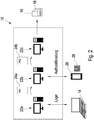
- FIG. 1 a schematic representation of the method according to the invention is shown.
- a central element is the security system 10, within which the secure implementation of a remote signature of an electronic document 12 to be signed is carried out.
- a user can select the electronic document 12 to be signed via his computer 14, for example, and transfer it to the security system 10.
- the electronic document 12 can for example be stored on the user's computer 14 or stored in the security system 10.
- the document 12 to be signed is made available on a website or via a mobile app so that the user can select this document 12 and transfer it to the security system 10.
- the security system 10 then carries out the signature for the user.
- the remote signature is performed after certain security precautions have been taken, as will be done later in connection with the Figs. 2 to 8 is explained.
- the security system 10 thus generates a signed document 16 which contains a digital signature 18 of the user.
- the signed document 16 can then be transmitted to the computer 20 of a contractual partner of the user. In this way, an electronic legal transaction can be carried out without the user needing their own signature card or a card reader. Alternatively, it can also be provided that the signed document 16 is delivered to the user or remains in the security system 10.
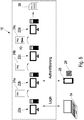
- the security system 10 is composed of three network units 22a, 22b, 22c, which can be implemented as separate network computers.
- Each of the network units 22a, 22b, 22c is responsible for one of the three process steps that are necessary for performing the remote signature.
- a total of two test messages 24a, 24b are generated by the respective network unit 22a, 22b and are each checked by a network unit 22b, 22c.
- the security system 10 In order for the security system 10 to electronically sign a document 12 to be signed, it is necessary for the user to log on to the first network unit 22a, for example via his computer 14. This is usually done using a user name and password.
- the identification data are checked by the first network unit 22a. After the user has successfully logged on to the first network unit 22a, the user selects a document 12 to be signed. As already explained above, the document 12 to be signed can be located, for example, on the user's computer 14 or within the security system 10.
- the first network unit 22a checks the identification data of the user and generates a first check message 24a.
- the test message 24a is provided with a digital signature 18.
- the test message 24a is then transmitted to the second network unit 22b, which is responsible for authenticating the user. In particular, the second network unit 22b can check the integrity and authenticity of the first check message 24a.
- the user can be authenticated via his smartphone 26 in the illustrated embodiment.
- the user is shown a barcode 28, for example, which he has to pick up through the camera of his smartphone 26 in order to prove that he is in possession of this terminal.
- a TAN is displayed to him, for example on his smartphone 26, which he then has to enter on request. If the TAN is valid, the authentication of the user can be regarded as successful.
- the second network unit 22b If the user is successfully authenticated, the second network unit 22b generates a second test message 24b and transmits this to the third network unit 22c, which is responsible for performing the signature.
- the third network unit 22c can check the authenticity and integrity of the second test message 24b. In addition, the third network unit 22c can verify the signature of the first test message 24a, since the first test message 24a (and thus also the signature of the first network unit 22a) is complete is contained in the second test message 24b. If the network unit 22c determines that the second check message 24b and the first check message 24a are unadulterated, it generates the signed document 16, which is provided with the digital signature 18 of the user. In this way, the individual process steps are protected against possible manipulation attacks, since the individual network units 22a, 22b, 22c can check each other and especially since the last link in the chain (the third network unit 22c) can check all previous process steps.
- the schematic structure of the first test message 24a according to the first embodiment of the method according to the invention is shown.
- the first check message 24a contains identification data 30, a hash value 32 of the document 12 to be signed and a signature 34a of the first network unit 24a.
- the first check message 24a contains the complete document 12 to be signed instead of the hash value 32.
- the identification data 30 can contain, for example, a user name and a password assigned to the user name. It can also be provided that the password is not contained uncoded in the identification data 30, but only in the form of a hash value generated from the password.
- the identification data 30 only contain an ID by which the user can be uniquely identified.
- the authentication data can contain, for example, a barcode or the information contained in the barcode and an associated TAN.
- the authentication data can alternatively have confirmation data or confirmation information.
- the authentication data have a flag that can be set to the value "1", for example, if the authentication of the user was successful and can be set to the value "0" if the authentication of the user failed is.
- the signature 34a can be calculated from the test message 24a by adding the remaining data of the test message 24a using a hash algorithm (for example SHA-256) is hashed and the hash value determined in this way is encrypted with the private key of the first network unit.
- a hash algorithm for example SHA-256
- Fig. 4 shows a schematic structure of the second test message 24b according to the first embodiment of the present invention.
- the second test message 24b has the identification data 30, the first test message 24a and a signature 34b of the second network unit 24b.
- the test messages are interleaved.
- the second test message 24b contains the complete data set contained in the first test message 24a, so that the recipient of the second test message 24b can not only check the signature 34b of the second network unit 24b, but also the signature 34a of the first network unit at the same time 24a.
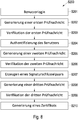
- the security system 10 is composed of a total of four network units 22a, 22b, 22c, 22d.
- the steps of user registration at the first network unit 22a and user authentication by the second network unit 22b follow in a manner similar to that in FIG Fig. 2 illustrated first embodiment.
- the third network unit 22c is responsible for the generation 40 of the key pair, the secret part (private key) of which is required later for the implementation of the electronic signature of the document 12 to be signed.
- the generation of the signature key pair takes place only if the authentication of the user by the second network unit 22b was previously successful, which is verified by the third network unit 22c by checking the second test message 24b.
- the third network unit 22c After the signature key pair has been generated by the third network unit 22c, the third network unit 22c generates a third test message 24c which contains the public signature key 40 and a digital signature 34c of the third network unit 22c.
- the third test message 24c is then to the fourth Network unit 22d is transmitted, which verifies this test message 24c or the signature 34c contained therein. If the third test message 24c could be verified by the fourth network unit 22d, the fourth network unit 22d issues a digital certificate 38 for the user.
- the fourth network unit 22d has the option of checking all digital signatures 34a, 34b, 34c of the first network unit 22a, the second network unit 22b and the third network unit 22c. In this way, the digital certificate 38 is only issued if all process steps in the entire process chain have been carried out correctly.
- FIG. 6 is the structure of the third test message 24c according to that in FIG Fig. 5 shown second embodiment.
- the third test message 24c contains the public signature key 40 generated by the third network unit 22c, the second test message 24b, which completely contains the first test message 24a, and a signature 34c of the third network unit 22c.
- the nested structure of the test messages can also be seen in this figure. As already explained, the nesting of the test messages enables a particularly reliable test of the individual steps in the process chain.
Landscapes
- Engineering & Computer Science (AREA)
- Computer Security & Cryptography (AREA)
- Signal Processing (AREA)
- General Engineering & Computer Science (AREA)
- Computer Networks & Wireless Communication (AREA)
- Computer Hardware Design (AREA)
- Theoretical Computer Science (AREA)
- General Physics & Mathematics (AREA)
- Physics & Mathematics (AREA)
- Bioethics (AREA)
- Software Systems (AREA)
- General Health & Medical Sciences (AREA)
- Health & Medical Sciences (AREA)
- Computing Systems (AREA)
- Storage Device Security (AREA)
- Data Exchanges In Wide-Area Networks (AREA)
Priority Applications (2)
| Application Number | Priority Date | Filing Date | Title |
|---|---|---|---|
| EP19187009.6A EP3767513B1 (fr) | 2019-07-18 | 2019-07-18 | Procédé de mise en uvre sécurisée d'une signature à distance ainsi que système de sécurité |
| DE102020118716.5A DE102020118716A1 (de) | 2019-07-18 | 2020-07-15 | Verfahren zur sicheren Durchführung einer Fernsignatur sowie Sicherheitssystem |
Applications Claiming Priority (1)
| Application Number | Priority Date | Filing Date | Title |
|---|---|---|---|
| EP19187009.6A EP3767513B1 (fr) | 2019-07-18 | 2019-07-18 | Procédé de mise en uvre sécurisée d'une signature à distance ainsi que système de sécurité |
Publications (2)
| Publication Number | Publication Date |
|---|---|
| EP3767513A1 true EP3767513A1 (fr) | 2021-01-20 |
| EP3767513B1 EP3767513B1 (fr) | 2021-09-15 |
Family
ID=67438070
Family Applications (1)
| Application Number | Title | Priority Date | Filing Date |
|---|---|---|---|
| EP19187009.6A Active EP3767513B1 (fr) | 2019-07-18 | 2019-07-18 | Procédé de mise en uvre sécurisée d'une signature à distance ainsi que système de sécurité |
Country Status (2)
| Country | Link |
|---|---|
| EP (1) | EP3767513B1 (fr) |
| DE (1) | DE102020118716A1 (fr) |
Cited By (2)
| Publication number | Priority date | Publication date | Assignee | Title |
|---|---|---|---|---|
| CN114666133A (zh) * | 2022-03-23 | 2022-06-24 | 重庆傲雄在线信息技术有限公司 | 一种基于原笔迹签名的远程问询取证系统及方法 |
| AT525728B1 (de) * | 2022-02-04 | 2023-07-15 | Primesign Gmbh | Verfahren und Vorrichtung zur Erstellung elektronischer Signaturen |
Citations (3)
| Publication number | Priority date | Publication date | Assignee | Title |
|---|---|---|---|---|
| US6745327B1 (en) * | 1998-05-20 | 2004-06-01 | John H. Messing | Electronic certificate signature program |
| US6959382B1 (en) * | 1999-08-16 | 2005-10-25 | Accela, Inc. | Digital signature service |
| EP1921556A1 (fr) * | 2006-11-11 | 2008-05-14 | Authentidate International AG | Elargissement de signature |
-
2019
- 2019-07-18 EP EP19187009.6A patent/EP3767513B1/fr active Active
-
2020
- 2020-07-15 DE DE102020118716.5A patent/DE102020118716A1/de not_active Withdrawn
Patent Citations (3)
| Publication number | Priority date | Publication date | Assignee | Title |
|---|---|---|---|---|
| US6745327B1 (en) * | 1998-05-20 | 2004-06-01 | John H. Messing | Electronic certificate signature program |
| US6959382B1 (en) * | 1999-08-16 | 2005-10-25 | Accela, Inc. | Digital signature service |
| EP1921556A1 (fr) * | 2006-11-11 | 2008-05-14 | Authentidate International AG | Elargissement de signature |
Cited By (4)
| Publication number | Priority date | Publication date | Assignee | Title |
|---|---|---|---|---|
| AT525728B1 (de) * | 2022-02-04 | 2023-07-15 | Primesign Gmbh | Verfahren und Vorrichtung zur Erstellung elektronischer Signaturen |
| AT525728A4 (de) * | 2022-02-04 | 2023-07-15 | Primesign Gmbh | Verfahren und Vorrichtung zur Erstellung elektronischer Signaturen |
| CN114666133A (zh) * | 2022-03-23 | 2022-06-24 | 重庆傲雄在线信息技术有限公司 | 一种基于原笔迹签名的远程问询取证系统及方法 |
| CN114666133B (zh) * | 2022-03-23 | 2023-09-15 | 重庆傲雄在线信息技术有限公司 | 一种基于原笔迹签名的远程问询取证系统及方法 |
Also Published As
| Publication number | Publication date |
|---|---|
| EP3767513B1 (fr) | 2021-09-15 |
| DE102020118716A1 (de) | 2021-01-21 |
Similar Documents
| Publication | Publication Date | Title |
|---|---|---|
| EP3256977B1 (fr) | Procédé mis en oeuvre par ordinateur pour le contrôle d'accès | |
| EP2765752B1 (fr) | Procédé destiné à pourvoir un terminal mobile d'un certificat d'authentification | |
| DE102009055947A1 (de) | Authentisierte Übertragung von Daten | |
| EP2561461A1 (fr) | Procédé de lecture d'un attribut à partir d'un jeton id | |
| DE102012206341A1 (de) | Gemeinsame Verschlüsselung von Daten | |
| EP2962439A1 (fr) | Lecture d'un attribut enregistré dans un jeton id | |
| EP3748521B1 (fr) | Méthode pour lire les attributs d'un témoin d'identité | |
| EP3422628B1 (fr) | Procédé, dispositif de sécurité et système de sécurité | |
| EP3422274A1 (fr) | Procédé de configuration ou de modification d'une configuration d'un terminal de paiement et/ou d'attribution d'un terminal de paiement à un exploitant | |
| EP4224786A1 (fr) | Procédé et dispositif de génération de signatures électroniques | |
| EP3767513B1 (fr) | Procédé de mise en uvre sécurisée d'une signature à distance ainsi que système de sécurité | |
| EP3271855B1 (fr) | Procédé de génération d'un certificat pour un jeton de sécurité | |
| EP2080144B1 (fr) | Procédé pour la libération d'une carte à puce | |
| DE102015208098B4 (de) | Verfahren zur Erzeugung einer elektronischen Signatur | |
| EP3358488B1 (fr) | Procédé de reconnaissance de copies non autorisées de jetons de sécurité numériques | |
| EP1306820B1 (fr) | Signature d'un document | |
| DE102019109343A1 (de) | Verfahren und Vorrichtung zur Übertragung digitaler Daten | |
| EP1054364A2 (fr) | Méthode pour améliorer la sécurité de systèmes utilisant des signatures digitales | |
| DE19801241A1 (de) | Verfahren zur Generierung asymmetrischer Kryptoschlüssel beim Anwender | |
| EP3361436B1 (fr) | Procédé d'autorisation d'une transaction | |
| EP4703938A1 (fr) | Système, procédé et produit de programme informatique pour une communication sécurisée entre deux fichiers | |
| DE102007014971B4 (de) | Versteckte Sicherheitsmerkmale in digitalen Signaturen | |
| DE102020105668A1 (de) | Verfahren und System zur elektronischen Fernsignatur | |
| WO2024194142A1 (fr) | Procédé et système de transmission de données sécurisées par cryptographie | |
| DE102010026697A1 (de) | Gesicherter automatisierter Austausch von Informationen zur Vertrauenswürdigkeit von Geschäfts- oder Kommunikationspartnern |
Legal Events
| Date | Code | Title | Description |
|---|---|---|---|
| PUAI | Public reference made under article 153(3) epc to a published international application that has entered the european phase |
Free format text: ORIGINAL CODE: 0009012 |
|
| STAA | Information on the status of an ep patent application or granted ep patent |
Free format text: STATUS: THE APPLICATION HAS BEEN PUBLISHED |
|
| AK | Designated contracting states |
Kind code of ref document: A1 Designated state(s): AL AT BE BG CH CY CZ DE DK EE ES FI FR GB GR HR HU IE IS IT LI LT LU LV MC MK MT NL NO PL PT RO RS SE SI SK SM TR |
|
| AX | Request for extension of the european patent |
Extension state: BA ME |
|
| STAA | Information on the status of an ep patent application or granted ep patent |
Free format text: STATUS: REQUEST FOR EXAMINATION WAS MADE |
|
| 17P | Request for examination filed |
Effective date: 20210216 |
|
| RBV | Designated contracting states (corrected) |
Designated state(s): AL AT BE BG CH CY CZ DE DK EE ES FI FR GB GR HR HU IE IS IT LI LT LU LV MC MK MT NL NO PL PT RO RS SE SI SK SM TR |
|
| RIC1 | Information provided on ipc code assigned before grant |
Ipc: H04L 29/06 20060101ALI20210310BHEP Ipc: H04L 9/32 20060101ALI20210310BHEP Ipc: G06F 21/64 20130101AFI20210310BHEP |
|
| GRAP | Despatch of communication of intention to grant a patent |
Free format text: ORIGINAL CODE: EPIDOSNIGR1 |
|
| STAA | Information on the status of an ep patent application or granted ep patent |
Free format text: STATUS: GRANT OF PATENT IS INTENDED |
|
| INTG | Intention to grant announced |
Effective date: 20210503 |
|
| GRAS | Grant fee paid |
Free format text: ORIGINAL CODE: EPIDOSNIGR3 |
|
| GRAA | (expected) grant |
Free format text: ORIGINAL CODE: 0009210 |
|
| STAA | Information on the status of an ep patent application or granted ep patent |
Free format text: STATUS: THE PATENT HAS BEEN GRANTED |
|
| AK | Designated contracting states |
Kind code of ref document: B1 Designated state(s): AL AT BE BG CH CY CZ DE DK EE ES FI FR GB GR HR HU IE IS IT LI LT LU LV MC MK MT NL NO PL PT RO RS SE SI SK SM TR |
|
| REG | Reference to a national code |
Ref country code: CH Ref legal event code: EP |
|
| REG | Reference to a national code |
Ref country code: DE Ref legal event code: R096 Ref document number: 502019002283 Country of ref document: DE |
|
| REG | Reference to a national code |
Ref country code: IE Ref legal event code: FG4D Free format text: LANGUAGE OF EP DOCUMENT: GERMAN |
|
| REG | Reference to a national code |
Ref country code: AT Ref legal event code: REF Ref document number: 1431070 Country of ref document: AT Kind code of ref document: T Effective date: 20211015 |
|
| REG | Reference to a national code |
Ref country code: LT Ref legal event code: MG9D |
|
| REG | Reference to a national code |
Ref country code: NL Ref legal event code: MP Effective date: 20210915 |
|
| PG25 | Lapsed in a contracting state [announced via postgrant information from national office to epo] |
Ref country code: HR Free format text: LAPSE BECAUSE OF FAILURE TO SUBMIT A TRANSLATION OF THE DESCRIPTION OR TO PAY THE FEE WITHIN THE PRESCRIBED TIME-LIMIT Effective date: 20210915 Ref country code: NO Free format text: LAPSE BECAUSE OF FAILURE TO SUBMIT A TRANSLATION OF THE DESCRIPTION OR TO PAY THE FEE WITHIN THE PRESCRIBED TIME-LIMIT Effective date: 20211215 Ref country code: LT Free format text: LAPSE BECAUSE OF FAILURE TO SUBMIT A TRANSLATION OF THE DESCRIPTION OR TO PAY THE FEE WITHIN THE PRESCRIBED TIME-LIMIT Effective date: 20210915 Ref country code: BG Free format text: LAPSE BECAUSE OF FAILURE TO SUBMIT A TRANSLATION OF THE DESCRIPTION OR TO PAY THE FEE WITHIN THE PRESCRIBED TIME-LIMIT Effective date: 20211215 Ref country code: FI Free format text: LAPSE BECAUSE OF FAILURE TO SUBMIT A TRANSLATION OF THE DESCRIPTION OR TO PAY THE FEE WITHIN THE PRESCRIBED TIME-LIMIT Effective date: 20210915 Ref country code: RS Free format text: LAPSE BECAUSE OF FAILURE TO SUBMIT A TRANSLATION OF THE DESCRIPTION OR TO PAY THE FEE WITHIN THE PRESCRIBED TIME-LIMIT Effective date: 20210915 Ref country code: SE Free format text: LAPSE BECAUSE OF FAILURE TO SUBMIT A TRANSLATION OF THE DESCRIPTION OR TO PAY THE FEE WITHIN THE PRESCRIBED TIME-LIMIT Effective date: 20210915 |
|
| PG25 | Lapsed in a contracting state [announced via postgrant information from national office to epo] |
Ref country code: LV Free format text: LAPSE BECAUSE OF FAILURE TO SUBMIT A TRANSLATION OF THE DESCRIPTION OR TO PAY THE FEE WITHIN THE PRESCRIBED TIME-LIMIT Effective date: 20210915 Ref country code: GR Free format text: LAPSE BECAUSE OF FAILURE TO SUBMIT A TRANSLATION OF THE DESCRIPTION OR TO PAY THE FEE WITHIN THE PRESCRIBED TIME-LIMIT Effective date: 20211216 |
|
| PG25 | Lapsed in a contracting state [announced via postgrant information from national office to epo] |
Ref country code: IS Free format text: LAPSE BECAUSE OF FAILURE TO SUBMIT A TRANSLATION OF THE DESCRIPTION OR TO PAY THE FEE WITHIN THE PRESCRIBED TIME-LIMIT Effective date: 20220115 Ref country code: SM Free format text: LAPSE BECAUSE OF FAILURE TO SUBMIT A TRANSLATION OF THE DESCRIPTION OR TO PAY THE FEE WITHIN THE PRESCRIBED TIME-LIMIT Effective date: 20210915 Ref country code: SK Free format text: LAPSE BECAUSE OF FAILURE TO SUBMIT A TRANSLATION OF THE DESCRIPTION OR TO PAY THE FEE WITHIN THE PRESCRIBED TIME-LIMIT Effective date: 20210915 Ref country code: RO Free format text: LAPSE BECAUSE OF FAILURE TO SUBMIT A TRANSLATION OF THE DESCRIPTION OR TO PAY THE FEE WITHIN THE PRESCRIBED TIME-LIMIT Effective date: 20210915 Ref country code: PT Free format text: LAPSE BECAUSE OF FAILURE TO SUBMIT A TRANSLATION OF THE DESCRIPTION OR TO PAY THE FEE WITHIN THE PRESCRIBED TIME-LIMIT Effective date: 20220117 Ref country code: PL Free format text: LAPSE BECAUSE OF FAILURE TO SUBMIT A TRANSLATION OF THE DESCRIPTION OR TO PAY THE FEE WITHIN THE PRESCRIBED TIME-LIMIT Effective date: 20210915 Ref country code: NL Free format text: LAPSE BECAUSE OF FAILURE TO SUBMIT A TRANSLATION OF THE DESCRIPTION OR TO PAY THE FEE WITHIN THE PRESCRIBED TIME-LIMIT Effective date: 20210915 Ref country code: ES Free format text: LAPSE BECAUSE OF FAILURE TO SUBMIT A TRANSLATION OF THE DESCRIPTION OR TO PAY THE FEE WITHIN THE PRESCRIBED TIME-LIMIT Effective date: 20210915 Ref country code: EE Free format text: LAPSE BECAUSE OF FAILURE TO SUBMIT A TRANSLATION OF THE DESCRIPTION OR TO PAY THE FEE WITHIN THE PRESCRIBED TIME-LIMIT Effective date: 20210915 Ref country code: CZ Free format text: LAPSE BECAUSE OF FAILURE TO SUBMIT A TRANSLATION OF THE DESCRIPTION OR TO PAY THE FEE WITHIN THE PRESCRIBED TIME-LIMIT Effective date: 20210915 Ref country code: AL Free format text: LAPSE BECAUSE OF FAILURE TO SUBMIT A TRANSLATION OF THE DESCRIPTION OR TO PAY THE FEE WITHIN THE PRESCRIBED TIME-LIMIT Effective date: 20210915 |
|
| REG | Reference to a national code |
Ref country code: DE Ref legal event code: R097 Ref document number: 502019002283 Country of ref document: DE |
|
| PLBE | No opposition filed within time limit |
Free format text: ORIGINAL CODE: 0009261 |
|
| STAA | Information on the status of an ep patent application or granted ep patent |
Free format text: STATUS: NO OPPOSITION FILED WITHIN TIME LIMIT |
|
| PG25 | Lapsed in a contracting state [announced via postgrant information from national office to epo] |
Ref country code: DK Free format text: LAPSE BECAUSE OF FAILURE TO SUBMIT A TRANSLATION OF THE DESCRIPTION OR TO PAY THE FEE WITHIN THE PRESCRIBED TIME-LIMIT Effective date: 20210915 |
|
| 26N | No opposition filed |
Effective date: 20220616 |
|
| PG25 | Lapsed in a contracting state [announced via postgrant information from national office to epo] |
Ref country code: IT Free format text: LAPSE BECAUSE OF FAILURE TO SUBMIT A TRANSLATION OF THE DESCRIPTION OR TO PAY THE FEE WITHIN THE PRESCRIBED TIME-LIMIT Effective date: 20210915 |
|
| PG25 | Lapsed in a contracting state [announced via postgrant information from national office to epo] |
Ref country code: MC Free format text: LAPSE BECAUSE OF FAILURE TO SUBMIT A TRANSLATION OF THE DESCRIPTION OR TO PAY THE FEE WITHIN THE PRESCRIBED TIME-LIMIT Effective date: 20210915 |
|
| P01 | Opt-out of the competence of the unified patent court (upc) registered |
Effective date: 20230524 |
|
| PG25 | Lapsed in a contracting state [announced via postgrant information from national office to epo] |
Ref country code: MK Free format text: LAPSE BECAUSE OF FAILURE TO SUBMIT A TRANSLATION OF THE DESCRIPTION OR TO PAY THE FEE WITHIN THE PRESCRIBED TIME-LIMIT Effective date: 20210915 Ref country code: CY Free format text: LAPSE BECAUSE OF FAILURE TO SUBMIT A TRANSLATION OF THE DESCRIPTION OR TO PAY THE FEE WITHIN THE PRESCRIBED TIME-LIMIT Effective date: 20210915 |
|
| PG25 | Lapsed in a contracting state [announced via postgrant information from national office to epo] |
Ref country code: HU Free format text: LAPSE BECAUSE OF FAILURE TO SUBMIT A TRANSLATION OF THE DESCRIPTION OR TO PAY THE FEE WITHIN THE PRESCRIBED TIME-LIMIT; INVALID AB INITIO Effective date: 20190718 |
|
| PG25 | Lapsed in a contracting state [announced via postgrant information from national office to epo] |
Ref country code: MT Free format text: LAPSE BECAUSE OF FAILURE TO SUBMIT A TRANSLATION OF THE DESCRIPTION OR TO PAY THE FEE WITHIN THE PRESCRIBED TIME-LIMIT Effective date: 20210915 |
|
| PGFP | Annual fee paid to national office [announced via postgrant information from national office to epo] |
Ref country code: LU Payment date: 20250722 Year of fee payment: 7 |
|
| PGFP | Annual fee paid to national office [announced via postgrant information from national office to epo] |
Ref country code: DE Payment date: 20250717 Year of fee payment: 7 |
|
| PGFP | Annual fee paid to national office [announced via postgrant information from national office to epo] |
Ref country code: BE Payment date: 20250722 Year of fee payment: 7 Ref country code: GB Payment date: 20250724 Year of fee payment: 7 |
|
| PGFP | Annual fee paid to national office [announced via postgrant information from national office to epo] |
Ref country code: FR Payment date: 20250723 Year of fee payment: 7 Ref country code: AT Payment date: 20250721 Year of fee payment: 7 |
|
| PGFP | Annual fee paid to national office [announced via postgrant information from national office to epo] |
Ref country code: CH Payment date: 20250801 Year of fee payment: 7 |
|
| PGFP | Annual fee paid to national office [announced via postgrant information from national office to epo] |
Ref country code: IE Payment date: 20250724 Year of fee payment: 7 |
|
| PG25 | Lapsed in a contracting state [announced via postgrant information from national office to epo] |
Ref country code: TR Free format text: LAPSE BECAUSE OF FAILURE TO SUBMIT A TRANSLATION OF THE DESCRIPTION OR TO PAY THE FEE WITHIN THE PRESCRIBED TIME-LIMIT Effective date: 20210915 |
|
| PG25 | Lapsed in a contracting state [announced via postgrant information from national office to epo] |
Ref country code: SI Free format text: LAPSE BECAUSE OF FAILURE TO SUBMIT A TRANSLATION OF THE DESCRIPTION OR TO PAY THE FEE WITHIN THE PRESCRIBED TIME-LIMIT Effective date: 20210915 |