EP3767530A1 - Procédé d'identification de plaque d'immatriculation et système associé - Google Patents
Procédé d'identification de plaque d'immatriculation et système associé Download PDFInfo
- Publication number
- EP3767530A1 EP3767530A1 EP19768532.4A EP19768532A EP3767530A1 EP 3767530 A1 EP3767530 A1 EP 3767530A1 EP 19768532 A EP19768532 A EP 19768532A EP 3767530 A1 EP3767530 A1 EP 3767530A1
- Authority
- EP
- European Patent Office
- Prior art keywords
- license plate
- image
- plate identification
- character
- characters
- Prior art date
- Legal status (The legal status is an assumption and is not a legal conclusion. Google has not performed a legal analysis and makes no representation as to the accuracy of the status listed.)
- Withdrawn
Links
Images






Classifications
-
- G—PHYSICS
- G06—COMPUTING OR CALCULATING; COUNTING
- G06V—IMAGE OR VIDEO RECOGNITION OR UNDERSTANDING
- G06V10/00—Arrangements for image or video recognition or understanding
- G06V10/20—Image preprocessing
- G06V10/26—Segmentation of patterns in the image field; Cutting or merging of image elements to establish the pattern region, e.g. clustering-based techniques; Detection of occlusion
- G06V10/267—Segmentation of patterns in the image field; Cutting or merging of image elements to establish the pattern region, e.g. clustering-based techniques; Detection of occlusion by performing operations on regions, e.g. growing, shrinking or watersheds
-
- G—PHYSICS
- G06—COMPUTING OR CALCULATING; COUNTING
- G06F—ELECTRIC DIGITAL DATA PROCESSING
- G06F18/00—Pattern recognition
- G06F18/20—Analysing
- G06F18/21—Design or setup of recognition systems or techniques; Extraction of features in feature space; Blind source separation
- G06F18/217—Validation; Performance evaluation; Active pattern learning techniques
-
- G—PHYSICS
- G06—COMPUTING OR CALCULATING; COUNTING
- G06F—ELECTRIC DIGITAL DATA PROCESSING
- G06F18/00—Pattern recognition
- G06F18/20—Analysing
- G06F18/22—Matching criteria, e.g. proximity measures
-
- G—PHYSICS
- G06—COMPUTING OR CALCULATING; COUNTING
- G06T—IMAGE DATA PROCESSING OR GENERATION, IN GENERAL
- G06T7/00—Image analysis
- G06T7/10—Segmentation; Edge detection
- G06T7/194—Segmentation; Edge detection involving foreground-background segmentation
-
- G—PHYSICS
- G06—COMPUTING OR CALCULATING; COUNTING
- G06V—IMAGE OR VIDEO RECOGNITION OR UNDERSTANDING
- G06V10/00—Arrangements for image or video recognition or understanding
- G06V10/40—Extraction of image or video features
- G06V10/44—Local feature extraction by analysis of parts of the pattern, e.g. by detecting edges, contours, loops, corners, strokes or intersections; Connectivity analysis, e.g. of connected components
- G06V10/443—Local feature extraction by analysis of parts of the pattern, e.g. by detecting edges, contours, loops, corners, strokes or intersections; Connectivity analysis, e.g. of connected components by matching or filtering
- G06V10/449—Biologically inspired filters, e.g. difference of Gaussians [DoG] or Gabor filters
- G06V10/451—Biologically inspired filters, e.g. difference of Gaussians [DoG] or Gabor filters with interaction between the filter responses, e.g. cortical complex cells
- G06V10/454—Integrating the filters into a hierarchical structure, e.g. convolutional neural networks [CNN]
-
- G—PHYSICS
- G06—COMPUTING OR CALCULATING; COUNTING
- G06V—IMAGE OR VIDEO RECOGNITION OR UNDERSTANDING
- G06V10/00—Arrangements for image or video recognition or understanding
- G06V10/70—Arrangements for image or video recognition or understanding using pattern recognition or machine learning
- G06V10/74—Image or video pattern matching; Proximity measures in feature spaces
- G06V10/75—Organisation of the matching processes, e.g. simultaneous or sequential comparisons of image or video features; Coarse-fine approaches, e.g. multi-scale approaches; using context analysis; Selection of dictionaries
- G06V10/758—Involving statistics of pixels or of feature values, e.g. histogram matching
-
- G—PHYSICS
- G06—COMPUTING OR CALCULATING; COUNTING
- G06V—IMAGE OR VIDEO RECOGNITION OR UNDERSTANDING
- G06V10/00—Arrangements for image or video recognition or understanding
- G06V10/70—Arrangements for image or video recognition or understanding using pattern recognition or machine learning
- G06V10/82—Arrangements for image or video recognition or understanding using pattern recognition or machine learning using neural networks
-
- G—PHYSICS
- G06—COMPUTING OR CALCULATING; COUNTING
- G06V—IMAGE OR VIDEO RECOGNITION OR UNDERSTANDING
- G06V20/00—Scenes; Scene-specific elements
- G06V20/60—Type of objects
- G06V20/62—Text, e.g. of license plates, overlay texts or captions on TV images
- G06V20/63—Scene text, e.g. street names
-
- G—PHYSICS
- G06—COMPUTING OR CALCULATING; COUNTING
- G06V—IMAGE OR VIDEO RECOGNITION OR UNDERSTANDING
- G06V30/00—Character recognition; Recognising digital ink; Document-oriented image-based pattern recognition
- G06V30/10—Character recognition
- G06V30/14—Image acquisition
- G06V30/148—Segmentation of character regions
- G06V30/153—Segmentation of character regions using recognition of characters or words
-
- G—PHYSICS
- G06—COMPUTING OR CALCULATING; COUNTING
- G06V—IMAGE OR VIDEO RECOGNITION OR UNDERSTANDING
- G06V30/00—Character recognition; Recognising digital ink; Document-oriented image-based pattern recognition
- G06V30/10—Character recognition
- G06V30/19—Recognition using electronic means
- G06V30/191—Design or setup of recognition systems or techniques; Extraction of features in feature space; Clustering techniques; Blind source separation
- G06V30/1916—Validation; Performance evaluation
-
- G—PHYSICS
- G06—COMPUTING OR CALCULATING; COUNTING
- G06T—IMAGE DATA PROCESSING OR GENERATION, IN GENERAL
- G06T2207/00—Indexing scheme for image analysis or image enhancement
- G06T2207/30—Subject of image; Context of image processing
- G06T2207/30248—Vehicle exterior or interior
- G06T2207/30252—Vehicle exterior; Vicinity of vehicle
-
- G—PHYSICS
- G06—COMPUTING OR CALCULATING; COUNTING
- G06V—IMAGE OR VIDEO RECOGNITION OR UNDERSTANDING
- G06V20/00—Scenes; Scene-specific elements
- G06V20/60—Type of objects
- G06V20/62—Text, e.g. of license plates, overlay texts or captions on TV images
- G06V20/625—License plates
Definitions
- the present invention relates in general to a license plate identification method and a license plate identification system, and in particular it relates to a license plate identification method and a license plate identification system that can recognize each character on a license plate using a neural network.
- License plate identification technology has been widely known to use image processing.
- the common technical means for obtaining license plate information using conventional license plate identification technology are license plate positioning, license plate character cutting, and license plate character identification.
- unrecognizable license plate features, license plate distortion, license plate deformation, light noise, and license plate breakage may occur in license plate images due to the different shooting angles or interference from light sources, time (day or night), weather (rain or shine), etc., thereby exacerbating identification accuracy.
- the existing license plate positioning technology usually finds the image location of the license plate based on the edge density value. If the license plate is stained, decorated, etc., the features of the edge density value may be destroyed, resulting in a significant decrease in the accuracy of the license plate positioning.
- An embodiment of the present invention provides a license plate identification method, which includes the following steps of: obtaining a to-be-processed image including all of the characters on a license plate; obtaining several feature maps including to character features of the to-be-processed image through a feature map extraction module; for each of the characters, extracting a block and a coordinate according to the feature maps through a character identification model based on a neural network; and obtaining a license plate identification result according to the respective blocks and the respective coordinates of the characters.
- a license plate identification system which includes an image capturing unit and a processing unit.
- the image capturing unit is configured to capture at least one raw image.
- the processing unit is configured to: receive the raw image from the image capturing unit; obtain a to-be-processed image including all of characters on a license plate according to the raw image; obtain several feature maps including character features of the to-be-processed image through a feature map extraction module; for each of the characters, extract a block and a coordinate according to the feature maps through a character identification model based on a neural network; and obtain a license plate identification result according to the respective blocks and the respective coordinates of the characters.
- Another embodiment of the present invention further provides a license plate identification method, which includes the following steps of: obtaining a to-be-processed image; obtaining several feature maps including target features through a feature map extraction module; obtaining at least one region including the target feature in each feature map and giving each frame of each feature map scores corresponding to the target features through a target location extraction module; classifying each frame in each feature map according to the scores through a target candidate classification module and retaining at least one region that corresponds to character features; and obtaining a license plate identification result according to the region that corresponds to the character feature through a voting/statistics module.
- FIG. 1 is a diagram showing a license plate identification system according to an embodiment of the present invention.
- the license plate identification system 100 can be implemented in an electronic device, such as a desktop computer, a notebook computer, or a tablet computer, and the license plate identification system 100 at least includes a processing unit 110.
- the processing unit 110 can be implemented in a variety of means, such as a dedicated hardware circuit or general-purpose hardware (for example, a single processor, a multi-processor with a parallel processing capability, a graphics processor, or another processor with a computing capability).
- a dedicated hardware circuit for example, a single processor, a multi-processor with a parallel processing capability, a graphics processor, or another processor with a computing capability.
- the license plate identification system 100 further includes a storage unit 120 for storing the captured images, the data required during the execution process, and various electronic files, such as various algorithms and/or various models.
- the license plate identification system 100 may further include an image capturing unit 130, such as a monitor, a video camera, and/or a camera, for obtaining at least one image or continuous video images, and sending them back to the processing unit 110.
- the display unit 140 can be a display panel (for example, a thin-film liquid crystal display panel, an organic light-emitting diode panel, or another panel with a display capability) for displaying input characters, input numbers, input symbols, a movement track of dragging a mouse, or a user interface provided by an application program for users to watch.
- the license plate identification system 100 may further include an input device (not shown), such as a mouse, a stylus, or a keyboard, for the user to perform corresponding operations.
- FIG. 2 shows a flow chart of a license plate identification method according to an embodiment of the invention.
- the image capturing unit 130 obtains an image which is to be processed (thereinafter, the image which is to be processed is referred to as "to-be-processed image").
- the processing unit 110 can determine whether a current image shows a vehicle or another object entering a shooting range based on an operation which is performed to compare the current image with a historical image in advance.
- the processing unit 110 may obtain a historical background image through a background subtraction module which operates according to several historical images, so that the processing unit 110 can quickly make a determination based on the historical background image and the current image.
- the processing unit 110 determines that a vehicle or another object has entered the shooting range corresponding to the current image and then performs the following operation on the current image.
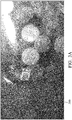
- FIG. 3A is a diagram showing the current image
- FIG. 3B is a schematic diagram showing the image change between the current image and the historical background image. According to the content of FIG. 3B , it can be known that the area of the image change is about 37%. If the predetermined value is set to 35%, the processing unit 110 can determine that a vehicle or another object appears in the current image.
- Step S202 the processing unit 110 receives the to-be-processed image and obtains several feature maps through a feature map extraction module.
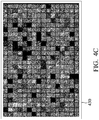
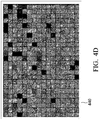
- the feature map extraction module can be trained through matrices for enhancing character features, which is mainly used to highlight characters such as English letters or numbers in the image.
- FIG. 4A-4D are schematic diagrams showing trained matrices used to generate feature maps according to some embodiments of the invention.
- Step S203 after obtaining the feature maps, the processing unit 110 extracts blocks, each of which corresponds to one character, and the corresponding coordinates through a character identification model based on the feature maps.
- the character identification model is a neural-network-based module, which mainly uses multiple images corresponding to various letters (i.e. A ⁇ Z) and numbers (i.e.
- each of the blocks shown in FIG. 5A is a block that is determined to include a character.
- the character identification model can directly find each of the blocks corresponding to the characters, without the need to divide the characters in the license plate in advance.
- some blocks without any characters are incorrectly determined to include characters, for example, since the image of the surrounding environment resembles a character or since noise occurs in the images.
- the processing unit 110 may further select regions with higher reliability (for example, the processing unit 110 selects a region where several blocks overlap) as blocks having characters and obtain the coordinates of the regions at the same time as the basis for the arrangement of the sequence of the characters on the license plate.
- the regions represented by the thick frame lines are the finally extracted regions with the characters.
- the erroneous blocks can be effectively filtered by the above manner.
- Step S204 after obtaining all the characters and the corresponding coordinates of the characters, the processing unit 110 obtains a license plate identification result according to the characters and the sequence of the corresponding coordinates.
- the processing unit 110 may further vote for multiple license plate images through a voting/statistics module to improve the accuracy of the license plate identification result.
- the processing unit 110 can divide the license plate into at least two groups according to a license plate grouping rule.
- the license plate grouping rules may include a license plate naming grouping rule, an English character region and number character region grouping rule, a dash grouping rule, a character relative position grouping rule, etc.
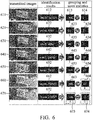
- FIG. 6 is a schematic diagram of a voting/statistics module according to an embodiment of the invention.
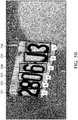
- the processing unit 110 uses the dash grouping rule to divide the license plate into two groups based on the position of the dash (that is, the left half and the right half of the dash). Then, after obtaining the identification results of the two groups, the processing unit 110 votes for the different identification results of each group and accumulates the voting scores if there are duplicate identification results for the same group. For example, as shown in FIG.
- the processing unit 110 can output the final license plate identification result as "2806-J3" after completing the seventh set of identification results for the license plate.
- the processing unit 110 may further assign different weights to the identification results according to the time sequence of the identification results. For example, a newer identification result is assigned a larger weight, while an older identification result is assigned a smaller weight, thereby accelerating the convergence speed of the final license plate identification result.
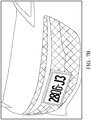
- the processing unit 110 may obtain a front image or a rear image from the current image through a vehicle front image capturing module or a vehicle rear image capturing module, thereby reducing the area of the to-be-processed image.
- the vehicle front image capturing module or the vehicle rear image capturing module uses several image features (such as Haar Feature, HOG, LBP, etc.) with classifiers (cascade classifiers, Ada boost, or SVM) to train various vehicle front images or vehicle rear images, thereby obtaining a front image or a rear image of the vehicle from the current image.
- FIG. 7A is a schematic diagram showing the current image
- FIG. 7B is a schematic diagram showing the front image of the vehicle which is obtained through the vehicle front image capturing module.
- the processing unit 110 may further obtain the region near the license plate from the front image or rear image of the vehicle through a license plate character region detection model.
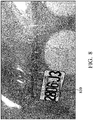
- the license plate character region detection model also trains each character image by using several image features (such as Haar Feature, HOG, LBP, etc.) with classifiers (cascade classifiers, Ada boost, or SVM) to find each character from the front image or rear image of the vehicle. For example, as shown in FIG. 8 , the processing unit 110 finds four regions 801-804 including characters in the front head image of the vehicle through the license plate character region detection model.
- the processing unit 110 combines the regions 801-804 to obtain a larger region 810 and expands the region 810 according to the format of the license plate to obtain another region containing all the characters on the license plate. For example, there are six characters on the license plate, and the license plate character region detection model finds only four regions with characters in the front image. Therefore, in order to ensure that the to-be-processed image contains all the characters in the license plate, the processing unit 110 may further determine the magnification of the outward expansion according to the number of found characters. For example, as shown in FIG.
- the processing unit 110 has found four characters, and, thus, the processing unit 110 expands the region 810 outward from the four sides of the region 810 by two times to obtain another region (that is, the region 820 shown in FIG. 8 ), which makes sure that all characters are contained in the image to-be-processed.
- the processing unit 110 finds only one region including characters, the processing unit 110 adaptively increases the magnification of the expansion (for example, the processing unit 110 expands the region to the left and right by ten times) to ensure that all characters are contained in the to-be-processed image.
- the magnification of the expansion can be adjusted according to the user's requirements.
- the license plate character region detection model is a weak classifier, that is, its detection accuracy is low but the calculation speed is faster.
- the license plate character region detection model and the front image capturing module or rear image capturing module use different image features and classifiers.
- Step S205 in order to further improve the accuracy of the character identification model, the processing unit 110 further uses images and corresponding identification results as training data to update the character identification model.
- the above-mentioned identification results include correct license plate identification results and incorrect license plate identification results, thereby reducing the identification error of the character identification model and indirectly speeding up the processing speed of the license plate identification system.
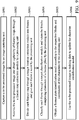
- FIG. 9 shows a flowchart of a license plate identification method according to another embodiment of the present invention.
- the image capturing unit 130 obtains at least one to-be-processed image.
- the processing unit 110 receives the obtained to-be-processed image from the image capturing unit 130 and obtains several feature maps through a feature map extraction module.
- the information contained in the feature maps includes several target features corresponding to different spatial frequencies (for example, from a low frequency to a high frequency), and the target features include character features of the license plate, the features of the license plate appearance, background features, and vehicle information features (such as direction mirrors, vehicle models, wheels, etc. which represent the features of the vehicle).
- the feature map extraction module can be trained through matrices containing the aforementioned target features.
- the processing unit 110 finds out the regions including the aforementioned target features according to the feature maps through a target location extraction module.
- the processing unit 110 may extract one frame every predetermined number of pixels on the feature map by clustering or a custom size, determine the features that may be contained in each frame according to the feature map extraction module, and give each frame the scores each which corresponds to one target feature.
- the processing unit 110 first obtains a target sensitivity score drawing of the feature maps through a simple classifier. In other words, the processing unit 110 finds several target feature points or target feature regions having the target features on the feature maps and circles several regions located near the target feature points by using frames with different sizes, and gives the regions the scores that correspond to the target features.
- Step S904 the processing unit 110 retains only the target features whose scores are largest and exceed a predetermined value by means of non-maximum value suppression and through a target candidate classification module. For example, for a certain frame, if the score corresponding to the background feature is the largest, and it is higher than a predetermined value, the processing unit 110 classifies the frame as corresponding to the background feature. In addition, for a certain frame, when all of the scores that correspond to the target features are not higher than the predetermined value, the frame is classified as corresponding to a non-target feature.
- the processing unit 110 may further combine adjacent frames with the same target feature into a larger region through a target candidate classification module, so as to facilitate the subsequent identification process. Then, the processing unit 110 only reserves the regions corresponding to the character features, and the method proceeds to Step S905.
- the processing unit 110 obtains a license plate identification result according to the characters and the sequence of the coordinates (for example, from left to right, from top to bottom). As mentioned above, the processing unit 110 can vote on several images of the license plate through the aforementioned voting/statistics module to improve the accuracy of the license plate identification result.
- the identification of the license plate in Step S905 is similar to that in Step S204 and will not be described here to simplify the description.
- Step S906 the processing unit 110 further uses to-be-processed images and corresponding identification results as training data to update the character identification model.
- the aforementioned identification results include correct license plate identification results and incorrect license plate identification results, thereby reducing the identification error of the character identification model.
- the identification speed can be maintained fast in an environment with poor viewing angle or complicated changes through the aforementioned license plate image capturing step and license plate character identification step. Moreover, by continuously using the identification results as training data, the error of the license plate identification can be reduced, and the calculation speed of the license plate identification system can be indirectly sped up.
Landscapes
- Engineering & Computer Science (AREA)
- Theoretical Computer Science (AREA)
- General Physics & Mathematics (AREA)
- Physics & Mathematics (AREA)
- Multimedia (AREA)
- Computer Vision & Pattern Recognition (AREA)
- Evolutionary Computation (AREA)
- Artificial Intelligence (AREA)
- Health & Medical Sciences (AREA)
- General Health & Medical Sciences (AREA)
- Medical Informatics (AREA)
- Data Mining & Analysis (AREA)
- Computing Systems (AREA)
- Software Systems (AREA)
- Life Sciences & Earth Sciences (AREA)
- Databases & Information Systems (AREA)
- Bioinformatics & Cheminformatics (AREA)
- Molecular Biology (AREA)
- Biomedical Technology (AREA)
- Biodiversity & Conservation Biology (AREA)
- Bioinformatics & Computational Biology (AREA)
- Evolutionary Biology (AREA)
- General Engineering & Computer Science (AREA)
- Character Discrimination (AREA)
- Traffic Control Systems (AREA)
- Image Analysis (AREA)
- Character Input (AREA)
Applications Claiming Priority (2)
| Application Number | Priority Date | Filing Date | Title |
|---|---|---|---|
| CN201810208466.9A CN110276342B (zh) | 2018-03-14 | 2018-03-14 | 车牌辨识方法以及其系统 |
| PCT/CN2019/072542 WO2019174405A1 (fr) | 2018-03-14 | 2019-01-21 | Procédé d'identification de plaque d'immatriculation et système associé |
Publications (2)
| Publication Number | Publication Date |
|---|---|
| EP3767530A1 true EP3767530A1 (fr) | 2021-01-20 |
| EP3767530A4 EP3767530A4 (fr) | 2021-05-19 |
Family
ID=67907354
Family Applications (1)
| Application Number | Title | Priority Date | Filing Date |
|---|---|---|---|
| EP19768532.4A Withdrawn EP3767530A4 (fr) | 2018-03-14 | 2019-01-21 | Procédé d'identification de plaque d'immatriculation et système associé |
Country Status (5)
| Country | Link |
|---|---|
| US (2) | US11443535B2 (fr) |
| EP (1) | EP3767530A4 (fr) |
| JP (1) | JP7044898B2 (fr) |
| CN (1) | CN110276342B (fr) |
| WO (1) | WO2019174405A1 (fr) |
Families Citing this family (20)
| Publication number | Priority date | Publication date | Assignee | Title |
|---|---|---|---|---|
| CN110276342B (zh) * | 2018-03-14 | 2023-04-18 | 台达电子工业股份有限公司 | 车牌辨识方法以及其系统 |
| US11567632B2 (en) | 2018-07-03 | 2023-01-31 | Apple Inc. | Systems and methods for exploring a geographic region |
| CN110659640B (zh) * | 2019-09-27 | 2021-11-30 | 深圳市商汤科技有限公司 | 文本序列的识别方法及装置、电子设备和存储介质 |
| US11275934B2 (en) * | 2019-11-20 | 2022-03-15 | Sap Se | Positional embeddings for document processing |
| JP7373367B2 (ja) * | 2019-11-20 | 2023-11-02 | 日本放送協会 | 文字領域検出モデル学習装置およびそのプログラム、ならびに、文字領域検出装置およびそのプログラム |
| CN111079744B (zh) * | 2019-12-06 | 2020-09-01 | 鲁东大学 | 适用于复杂光照环境的车辆车牌智能识别方法及装置 |
| CN111340045B (zh) * | 2020-02-12 | 2023-09-01 | 浙江大华技术股份有限公司 | 车牌号码的识别方法、装置及存储介质 |
| CN111582261B (zh) * | 2020-04-30 | 2024-01-19 | 浙江大华技术股份有限公司 | 一种非机动车的车牌识别方法和车牌识别装置 |
| US20210356288A1 (en) | 2020-05-15 | 2021-11-18 | Apple Inc. | User interfaces for providing navigation directions |
| US11846515B2 (en) | 2020-06-11 | 2023-12-19 | Apple Inc. | User interfaces for customized navigation routes |
| CN112560608B (zh) * | 2020-12-05 | 2024-05-24 | 江苏爱科赛尔云数据科技有限公司 | 一种车辆车牌识别方法 |
| US12281912B2 (en) | 2021-06-07 | 2025-04-22 | Apple Inc. | User interfaces for maps and navigation |
| CN119223321A (zh) | 2021-06-07 | 2024-12-31 | 苹果公司 | 用于地图和导航的用户界面 |
| CN116095459B (zh) * | 2021-11-02 | 2025-05-30 | 睿能创意公司 | 影像撷取方法 |
| CN116095458B (zh) * | 2021-11-02 | 2025-02-11 | 睿能创意公司 | 影像撷取方法 |
| EP4235595B1 (fr) * | 2022-02-28 | 2025-10-29 | Leica Biosystems Imaging, Inc. | Génération de carte de caractéristiques haute et basse fréquence pour des images de pathologie h&e |
| CN114821019B (zh) * | 2022-03-29 | 2025-02-25 | 烽火通信科技股份有限公司 | 车牌号码识别方法、装置、设备及可读存储介质 |
| CN114998883B (zh) * | 2022-05-30 | 2024-10-18 | 阿波罗智联(北京)科技有限公司 | 车牌识别方法、装置、电子设备、智能交通设备 |
| CN115359460B (zh) * | 2022-10-20 | 2023-02-17 | 小米汽车科技有限公司 | 用于车辆的图像识别方法、装置、车辆和存储介质 |
| CN116580461B (zh) * | 2023-05-12 | 2025-12-09 | 中国工商银行股份有限公司 | 签名验证方法、装置、计算机设备和存储介质 |
Family Cites Families (33)
| Publication number | Priority date | Publication date | Assignee | Title |
|---|---|---|---|---|
| JPH11306283A (ja) | 1998-04-24 | 1999-11-05 | Chuo Spring Co Ltd | ナンバープレート情報読取装置 |
| JP4174279B2 (ja) | 2002-09-19 | 2008-10-29 | 日本放送協会 | 映像オブジェクト識別・追跡装置、その方法及びそのプログラム |
| TWI236638B (en) | 2004-03-24 | 2005-07-21 | Univ Chung Yuan Christian | Multiple recognition system and method for license plates |
| WO2008025092A1 (fr) * | 2006-09-01 | 2008-03-06 | Sensen Networks Pty Ltd | Procédé et système d'identification d'au moins un élément représenté dans une pluralité de fichiers acquis au moyen de capteurs |
| JP4901676B2 (ja) | 2007-09-28 | 2012-03-21 | 株式会社東芝 | ナンバープレート情報処理装置及びナンバープレート情報処理方法 |
| CN101303803A (zh) | 2008-06-11 | 2008-11-12 | 北京中星微电子有限公司 | 一种车牌识别的方法和系统 |
| TWI431559B (zh) * | 2010-10-29 | 2014-03-21 | Univ Nat Chiao Tung | 車牌偵測辨識方法及其系統 |
| US8447112B2 (en) * | 2010-12-17 | 2013-05-21 | Xerox Corporation | Method for automatic license plate recognition using adaptive feature set |
| US8666117B2 (en) * | 2012-04-06 | 2014-03-04 | Xerox Corporation | Video-based system and method for detecting exclusion zone infractions |
| US9014432B2 (en) * | 2012-05-04 | 2015-04-21 | Xerox Corporation | License plate character segmentation using likelihood maximization |
| CN103366577B (zh) * | 2013-05-16 | 2015-12-23 | 王斌 | 车辆牌证真伪识别系统 |
| CN103679191B (zh) * | 2013-09-04 | 2017-02-22 | 西交利物浦大学 | 基于静态图片的自动套牌车检测方法 |
| NL2012327B1 (en) * | 2013-12-13 | 2016-06-21 | Utc Fire & Security B V | Selective intrusion detection systems. |
| JP6471934B2 (ja) * | 2014-06-12 | 2019-02-20 | パナソニックIpマネジメント株式会社 | 画像認識方法、カメラシステム |
| JP2016053763A (ja) | 2014-09-02 | 2016-04-14 | キヤノン株式会社 | 画像処理装置、画像処理方法及びプログラム |
| CN104239867B (zh) | 2014-09-17 | 2017-12-01 | 深圳市捷顺科技实业股份有限公司 | 车牌定位方法及系统 |
| CN106599900B (zh) * | 2015-10-20 | 2020-04-21 | 华中科技大学 | 一种识别图像中的字符串的方法和装置 |
| CN106096607A (zh) * | 2016-06-12 | 2016-11-09 | 湘潭大学 | 一种车牌识别方法 |
| CN106469299B (zh) * | 2016-08-31 | 2019-07-19 | 北京邮电大学 | 一种车辆搜索方法及装置 |
| CN106529532A (zh) * | 2016-11-07 | 2017-03-22 | 湖南源信光电科技有限公司 | 一种基于积分特征通道与灰度投影的车牌识别系统 |
| CN106407981B (zh) * | 2016-11-24 | 2019-04-23 | 北京文安智能技术股份有限公司 | 一种车牌识别方法、装置及系统 |
| CN108121984B (zh) | 2016-11-30 | 2021-09-21 | 杭州海康威视数字技术股份有限公司 | 一种字符识别方法及装置 |
| CN107784303A (zh) * | 2016-12-15 | 2018-03-09 | 平安科技(深圳)有限公司 | 车牌识别方法及装置 |
| CN106650740B (zh) * | 2016-12-15 | 2019-08-13 | 深圳市华尊科技股份有限公司 | 一种车牌识别方法及终端 |
| WO2018112441A1 (fr) * | 2016-12-15 | 2018-06-21 | Progenity Inc. | Dispositif pouvant être ingéré et procédés associés |
| CN106845487B (zh) * | 2016-12-30 | 2020-04-17 | 佳都新太科技股份有限公司 | 一种端到端的车牌识别方法 |
| CN107038442A (zh) | 2017-03-27 | 2017-08-11 | 新智认知数据服务有限公司 | 一种基于深度学习的车牌检测和整体识别方法 |
| CN106980854A (zh) * | 2017-03-29 | 2017-07-25 | 珠海习悦信息技术有限公司 | 车牌号码识别方法、装置、存储介质及处理器 |
| CN107239778B (zh) * | 2017-06-09 | 2020-01-03 | 中国科学技术大学 | 高效准确的车牌识别方法 |
| CN107220638A (zh) * | 2017-07-03 | 2017-09-29 | 深圳市唯特视科技有限公司 | 一种基于深度学习卷积神经网络的车牌检测识别方法 |
| CN107704857B (zh) * | 2017-09-25 | 2020-07-24 | 北京邮电大学 | 一种端到端的轻量级车牌识别方法及装置 |
| CN110276342B (zh) * | 2018-03-14 | 2023-04-18 | 台达电子工业股份有限公司 | 车牌辨识方法以及其系统 |
| CN111524365B (zh) * | 2020-05-11 | 2021-12-17 | 西安电子科技大学 | 一种利用多地磁传感器进行车型分类的方法 |
-
2018
- 2018-03-14 CN CN201810208466.9A patent/CN110276342B/zh active Active
-
2019
- 2019-01-21 JP JP2020548723A patent/JP7044898B2/ja active Active
- 2019-01-21 US US16/980,747 patent/US11443535B2/en active Active
- 2019-01-21 WO PCT/CN2019/072542 patent/WO2019174405A1/fr not_active Ceased
- 2019-01-21 EP EP19768532.4A patent/EP3767530A4/fr not_active Withdrawn
-
2022
- 2022-08-04 US US17/881,218 patent/US20220375236A1/en not_active Abandoned
Also Published As
| Publication number | Publication date |
|---|---|
| WO2019174405A1 (fr) | 2019-09-19 |
| CN110276342A (zh) | 2019-09-24 |
| US20210004627A1 (en) | 2021-01-07 |
| US11443535B2 (en) | 2022-09-13 |
| CN110276342B (zh) | 2023-04-18 |
| EP3767530A4 (fr) | 2021-05-19 |
| JP2021518944A (ja) | 2021-08-05 |
| JP7044898B2 (ja) | 2022-03-30 |
| US20220375236A1 (en) | 2022-11-24 |
Similar Documents
| Publication | Publication Date | Title |
|---|---|---|
| US20220375236A1 (en) | License plate identification method and system thereof | |
| CN110232311B (zh) | 手部图像的分割方法、装置及计算机设备 | |
| US11164027B2 (en) | Deep learning based license plate identification method, device, equipment, and storage medium | |
| US20220383535A1 (en) | Object Tracking Method and Device, Electronic Device, and Computer-Readable Storage Medium | |
| WO2022116282A1 (fr) | Procédé et système d'interaction homme-machine basée sur la reconnaissance dynamique des gestes | |
| EP3754542A1 (fr) | Procédé et appareil de reconnaissance d'écriture manuscrite dans l'air ainsi que dispositif et support d'informations lisible par ordinateur | |
| CN111242088A (zh) | 一种目标检测方法、装置、电子设备及存储介质 | |
| US10891740B2 (en) | Moving object tracking apparatus, moving object tracking method, and computer program product | |
| EP3842995A1 (fr) | Procédé et appareil de génération de carte | |
| WO2020244075A1 (fr) | Procédé et appareil de reconnaissance de langage des signes, dispositif informatique et support d'informations | |
| CN113673281B (zh) | 限速信息确定方法、装置、设备以及存储介质 | |
| US11250269B2 (en) | Recognition method and apparatus for false detection of an abandoned object and image processing device | |
| US20180314911A1 (en) | Target object classification using three-dimensional geometric filtering | |
| EP2370932B1 (fr) | Procédé, appareil et produit de programme d'ordinateur pour fournir une estimation de pose de visage | |
| JP2016099643A (ja) | 画像処理装置、画像処理方法および画像処理プログラム | |
| US20150139547A1 (en) | Feature calculation device and method and computer program product | |
| CN118710904A (zh) | 一种图像分割方法、装置、设备及存储介质 | |
| TWI690857B (zh) | 車牌辨識方法以及其系統 | |
| US20240070516A1 (en) | Machine learning context based confidence calibration | |
| US20220392107A1 (en) | Image processing apparatus, image processing method, image capturing apparatus, and non-transitory computer-readable storage medium | |
| WO2023056833A1 (fr) | Procédé et appareil de génération d'image d'arrière-plan, procédé et appareil de fusion d'image, dispositif électronique et support lisible | |
| Moumen et al. | Real-time Arabic scene text detection using fully convolutional neural networks | |
| CN111476090B (zh) | 水印识别方法和装置 | |
| CN107545261A (zh) | 文本检测的方法及装置 | |
| JP2017117340A (ja) | 文字属性推定装置、及び文字属性推定プログラム |
Legal Events
| Date | Code | Title | Description |
|---|---|---|---|
| STAA | Information on the status of an ep patent application or granted ep patent |
Free format text: STATUS: THE INTERNATIONAL PUBLICATION HAS BEEN MADE |
|
| PUAI | Public reference made under article 153(3) epc to a published international application that has entered the european phase |
Free format text: ORIGINAL CODE: 0009012 |
|
| STAA | Information on the status of an ep patent application or granted ep patent |
Free format text: STATUS: REQUEST FOR EXAMINATION WAS MADE |
|
| 17P | Request for examination filed |
Effective date: 20201014 |
|
| AK | Designated contracting states |
Kind code of ref document: A1 Designated state(s): AL AT BE BG CH CY CZ DE DK EE ES FI FR GB GR HR HU IE IS IT LI LT LU LV MC MK MT NL NO PL PT RO RS SE SI SK SM TR |
|
| AX | Request for extension of the european patent |
Extension state: BA ME |
|
| A4 | Supplementary search report drawn up and despatched |
Effective date: 20210415 |
|
| RIC1 | Information provided on ipc code assigned before grant |
Ipc: G06K 9/32 20060101AFI20210409BHEP Ipc: G06K 9/34 20060101ALI20210409BHEP Ipc: G06K 9/46 20060101ALI20210409BHEP Ipc: G06K 9/62 20060101ALI20210409BHEP |
|
| DAV | Request for validation of the european patent (deleted) | ||
| DAX | Request for extension of the european patent (deleted) | ||
| STAA | Information on the status of an ep patent application or granted ep patent |
Free format text: STATUS: EXAMINATION IS IN PROGRESS |
|
| 17Q | First examination report despatched |
Effective date: 20230404 |
|
| STAA | Information on the status of an ep patent application or granted ep patent |
Free format text: STATUS: THE APPLICATION IS DEEMED TO BE WITHDRAWN |
|
| 18D | Application deemed to be withdrawn |
Effective date: 20250823 |