EP3767540A1 - Moyen de communication sans contact, cartouche de support d'enregistrement, procédé de pilotage pour moyen de communication sans contact et programme - Google Patents
Moyen de communication sans contact, cartouche de support d'enregistrement, procédé de pilotage pour moyen de communication sans contact et programme Download PDFInfo
- Publication number
- EP3767540A1 EP3767540A1 EP19768202.4A EP19768202A EP3767540A1 EP 3767540 A1 EP3767540 A1 EP 3767540A1 EP 19768202 A EP19768202 A EP 19768202A EP 3767540 A1 EP3767540 A1 EP 3767540A1
- Authority
- EP
- European Patent Office
- Prior art keywords
- clock signal
- unit
- frequency
- generation unit
- contact communication
- Prior art date
- Legal status (The legal status is an assumption and is not a legal conclusion. Google has not performed a legal analysis and makes no representation as to the accuracy of the status listed.)
- Granted
Links
Images



Classifications
-
- G—PHYSICS
- G11—INFORMATION STORAGE
- G11B—INFORMATION STORAGE BASED ON RELATIVE MOVEMENT BETWEEN RECORD CARRIER AND TRANSDUCER
- G11B23/00—Record carriers not specific to the method of recording or reproducing; Accessories, e.g. containers, specially adapted for co-operation with the recording or reproducing apparatus ; Intermediate mediums; Apparatus or processes specially adapted for their manufacture
- G11B23/02—Containers; Storing means both adapted to cooperate with the recording or reproducing means
- G11B23/04—Magazines; Cassettes for webs or filaments
- G11B23/08—Magazines; Cassettes for webs or filaments for housing webs or filaments having two distinct ends
- G11B23/087—Magazines; Cassettes for webs or filaments for housing webs or filaments having two distinct ends using two different reels or cores
-
- G—PHYSICS
- G06—COMPUTING OR CALCULATING; COUNTING
- G06F—ELECTRIC DIGITAL DATA PROCESSING
- G06F12/00—Accessing, addressing or allocating within memory systems or architectures
-
- G—PHYSICS
- G06—COMPUTING OR CALCULATING; COUNTING
- G06K—GRAPHICAL DATA READING; PRESENTATION OF DATA; RECORD CARRIERS; HANDLING RECORD CARRIERS
- G06K19/00—Record carriers for use with machines and with at least a part designed to carry digital markings
- G06K19/06—Record carriers for use with machines and with at least a part designed to carry digital markings characterised by the kind of the digital marking, e.g. shape, nature, code
- G06K19/067—Record carriers with conductive marks, printed circuits or semiconductor circuit elements, e.g. credit or identity cards also with resonating or responding marks without active components
- G06K19/07—Record carriers with conductive marks, printed circuits or semiconductor circuit elements, e.g. credit or identity cards also with resonating or responding marks without active components with integrated circuit chips
- G06K19/0701—Record carriers with conductive marks, printed circuits or semiconductor circuit elements, e.g. credit or identity cards also with resonating or responding marks without active components with integrated circuit chips at least one of the integrated circuit chips comprising an arrangement for power management
- G06K19/0712—Record carriers with conductive marks, printed circuits or semiconductor circuit elements, e.g. credit or identity cards also with resonating or responding marks without active components with integrated circuit chips at least one of the integrated circuit chips comprising an arrangement for power management the arrangement being capable of triggering distinct operating modes or functions dependent on the strength of an energy or interrogation field in the proximity of the record carrier
-
- G—PHYSICS
- G06—COMPUTING OR CALCULATING; COUNTING
- G06K—GRAPHICAL DATA READING; PRESENTATION OF DATA; RECORD CARRIERS; HANDLING RECORD CARRIERS
- G06K19/00—Record carriers for use with machines and with at least a part designed to carry digital markings
- G06K19/06—Record carriers for use with machines and with at least a part designed to carry digital markings characterised by the kind of the digital marking, e.g. shape, nature, code
- G06K19/067—Record carriers with conductive marks, printed circuits or semiconductor circuit elements, e.g. credit or identity cards also with resonating or responding marks without active components
- G06K19/07—Record carriers with conductive marks, printed circuits or semiconductor circuit elements, e.g. credit or identity cards also with resonating or responding marks without active components with integrated circuit chips
- G06K19/0723—Record carriers with conductive marks, printed circuits or semiconductor circuit elements, e.g. credit or identity cards also with resonating or responding marks without active components with integrated circuit chips the record carrier comprising an arrangement for non-contact communication, e.g. wireless communication circuits on transponder cards, non-contact smart cards or RFIDs
-
- H—ELECTRICITY
- H04—ELECTRIC COMMUNICATION TECHNIQUE
- H04B—TRANSMISSION
- H04B5/00—Near-field transmission systems, e.g. inductive or capacitive transmission systems
- H04B5/40—Near-field transmission systems, e.g. inductive or capacitive transmission systems characterised by components specially adapted for near-field transmission
- H04B5/48—Transceivers
Definitions
- the present technology relates to, for example, a non-contact communication medium to be housed in a magnetic tape cartridge, a recording medium cartridge including the non-contact communication medium, a method of driving a non-contact communication medium, and a program.
- a magnetic recording medium has been widely used for backing up electronic data, and the like.
- a magnetic recording medium for example, a magnetic tape cartridge has a large capacity and can be preserved for a long time, and thus, the magnetic tape cartridge has attracted increasing attention as a storage medium for big data and the like.
- a magnetic tape cartridge of the LTO (Linear Tape Open) standard includes an RFID (Radio Frequency Identification) tag called a cartridge memory (see, for example, Patent Literature 1).
- the cartridge memory includes an antenna and an IC chip for communication and recording, and is configured to be capable of reading and writing production management information of the magnetic tape, the outline of the recorded content, and the like.
- the cartridge memory receives a signal magnetic field transmitted from a tape drive (reader/writer) to generate electric power, and thus operates without power supply.
- Patent Literature 1 Japanese Patent Application Laid-open No. 2009-211743
- the memory size of the cartridge memory has become larger in proportion to the increase in the recording data size of the magnetic tape.
- the power consumed by the cartridge memory also increases.
- this type of cartridge memory is required to operate at a constant magnetic field strength, there is a limitation on the electric power that can be drawn from the antenna. Accordingly, there is a need for a technology for driving a cartridge memory with electric power that can be drawn from an antenna independent of the memory size and ensuring stable communication with a reader/writer.
- non-contact communication medium capable of ensuring stable communication with electric power that can be drawn from an antenna independent of the memory size
- recording medium cartridge including the non-contact communication medium
- method of driving the non-contact communication medium and a program.
- a non-contact communication medium includes: a voltage generation unit; a memory unit; a clock signal generation unit; and a control unit.
- the voltage generation unit includes an antenna coil for transmission/reception, and receives a signal magnetic field from an external device to generate a voltage.
- the memory unit stores one or more circuit parameters set in the voltage generation unit, and predetermined management information.
- the clock signal generation unit is configured to be capable of selectively generating clock signals having two or more different frequencies.
- the control unit is configured to select a frequency of a clock signal to be supplied to the memory unit from the clock signal generation unit.
- the control unit may be configured to select, when reading the circuit parameter, a first clock signal of a first frequency and select, when reading the management information, a second clock signal of a second frequency higher than the first frequency.
- the voltage generation unit may include a resonant circuit and a resonant capacitance adjustment unit, the resonant circuit including the antenna coil, the resonant capacitance adjustment unit adjusting a resonant frequency of the resonant circuit, and the memory unit may be configured to store, as the circuit parameter, a resonant capacitance value set in the resonant capacitance adjustment unit.
- the voltage generation unit may further include a power source circuit that generates a voltage from the resonant circuit, and the memory unit may be configured to store, as the circuit parameter, a reference voltage adjustment value for setting a reference voltage of the power source circuit.
- the control unit may be configured to select the first clock signal when writing information to the memory unit.
- the control unit may be configured to select a frequency of the clock signal on a basis of an operation request from the external device.
- the non-contact communication medium may further include a monitoring unit that monitors a generated voltage of the voltage generation unit, and the control unit may be configured to select a frequency of the two or more clock signals on a basis of output of the monitoring unit.
- the clock signal generation unit may be configured to generate a clock signal of a frequency multiplied by the frequency of the signal magnetic field.
- a recording medium cartridge includes: an information recording medium; a cartridge body that houses the information recording medium; and a non-contact communication medium.
- the non-contact communication medium includes a voltage generation unit that includes an antenna coil for transmission/reception, and receives a signal magnetic field from an external device to generate a voltage, a memory unit that stores one or more circuit parameters set in the voltage generation unit, and predetermined management information, a clock signal generation unit configured to be capable of selectively generating clock signals having two or more different frequencies, and a control unit configured to select a frequency of a clock signal to be supplied to the memory unit from the clock signal generation unit.
- the non-contact communication medium is housed in the cartridge body.
- a method of driving a non-contact communication medium includes: reading, with a clock signal of a first frequency, a circuit parameter of a voltage generation unit that generates a voltage on a basis of a signal magnetic field from an external device received via an antenna coil.
- Predetermined management information is read from the memory unit with a clock signal of a second frequency higher than the first frequency, and the read predetermined management information is transmitted to the external device.
- the circuit parameter may be a resonant capacitance value of a resonant circuit including the antenna coil.
- the circuit parameter may be a reference voltage adjustment value for setting a reference voltage of the voltage generation unit.
- Fig. 1 is an exploded perspective view showing a magnetic tape cartridge according to an embodiment of the present technology
- Fig. 2 is a schematic perspective view of a tape drive device.
- a magnetic tape cartridge of the LTO standard shown in Fig. 1 (hereinafter, referred to as the tape cartridge 100) will be described as a recording medium cartridge.
- the configuration of the tape cartridge 100 and a tape drive device 200 shown in Fig. 2 will be schematically described.
- the tape cartridge 100 includes a cartridge case 11 formed by connecting an upper shell 11a and a lower shell 11b by a plurality of screw members.
- a single tape reel 13 on which a magnetic tape 12 is wound is rotatably accommodated inside the cartridge case 11.
- a chucking gear (illustration omitted) that engages with a spindle 201 (see Fig. 2 ) of the tape drive device 200 is formed in an annular shape at the bottom center of the tape reel 13, and the chucking gear is exposed to the outside through an opening 14 formed in the center of the lower shell 11b.
- An annular metal plate 15 magnetically attracted to the spindle 201 is fixed to the inner periphery side of the chucking gear.
- a reel spring 16, a reel lock member 17 and a spider 18 are disposed between the inner surface of the upper shell 11a and the tape reel 13. They constitute a reel locking mechanism that prevents the tape reel 13 from rotating when the tape cartridge 100 is not in use.
- a tape outlet 19 for drawing out one end of the magnetic tape 12 to the outside is provided in one side wall portion of the cartridge case 11.
- a slide door 20 for opening and closing the tape outlet 19 is disposed inside the side wall portion.
- the slide door 20 is configured to slide in a direction that opens the tape outlet 19 against the biasing force of a torsion spring 21 by engagement of the tape drive device 200 with a tape loading mechanism (not shown).
- a leader pin 22 is fixed to one end portion of the magnetic tape 12.
- the leader pin 22 is configured to be attachable/detachable to/from a pin holding portion 23 provided on the inner side of the tape outlet 19.
- the pin holding portion 23 includes an elastic holder 24 for elastically holding the upper end portion and the lower end portion of the reader pin 22 between the upper wall inner surface of the cartridge case 11 (the inner surface of the upper shell 11a) and the bottom wall inner surface (the inner surface of the lower shell 11b), respectively.
- a cartridge memory CM capable of reading and writing the content related to the information recorded on the magnetic tape 12 in a non-contact manner is provided inside the other side wall of the cartridge case 21.
- the cartridge memory CM includes a non-contact communication medium in which an antenna coil, an IC chip, and the like are mounted on a substrate.
- the tape drive device 200 is configured to be capable of loading the tape cartridge 100.
- the tape drive device 200 is configured to be capable loading one tape cartridge 100, but may be configured to be capable of loading a plurality of tape cartridges 100 simultaneously.
- the tape drive device 200 includes a spindle 201, a take-up reel 202, a spindle drive device 203, a reel drive device 204, a plurality of guide rollers 205, a head unit 206, a reader/writer 207, a control device 208, and the like.
- the spindle 201 includes a head portion that engages with the chucking gear of the tape reel 13 through the opening 14 formed in the lower shell 11b of the tape cartridge 100.
- the spindle 201 raises the tape reel 13 by a predetermined distance against the biasing force of the reel spring 16, releasing the reel lock function by the reel lock member 17.
- the tape reel 13 is rotatably supported inside the cartridge case 11 by the spindle 201.
- the spindle drive device 203 causes, in response to a command from the control device 208, the spindle 201 to rotate.
- the take-up reel 202 is configured to be capable of fixing the tip (leader pin 22) of the magnetic tape 12 drawn from the tape cartridge 100 via the tape loading mechanism (not shown).
- the plurality of guide rollers 205 guides the travelling of the magnetic tape 12 such that the tape path formed between the tape cartridge 100 and the take-up reel 202 is in a predetermined relative position relative to the head unit 206.
- the reel drive device 204 causes, in response to a command from the control device 208, the take-up reel 202 to rotate.
- the spindle 201 and the take-up reel 202 are caused to rotate by the spindle drive device 203 and the reel drive device 204 and thus, the magnetic tape 12 is caused to travel.
- the head unit 206 is configured to be capable of recording data signals on the magnetic tape 12 or reproducing the data signals written to the magnetic tape 12 in response to a command from the control device 208.
- the reader/writer 207 is configured to be capable of reading predetermined management information from the cartridge memory CM mounted on the tape cartridge 100 or recording predetermined management information on the cartridge memory CM in response to a command the from control device 208.
- a communication system between the reader/writer 207 and the cartridge memory CM for example, an ISO14443 system is adopted.
- the control device 208 includes, for example, a computer including a CPU (Central Processing Unit), a storage unit, a communication unit, and the like, and integrally controls the respective units of the tape drive device 200.
- a computer including a CPU (Central Processing Unit), a storage unit, a communication unit, and the like, and integrally controls the respective units of the tape drive device 200.
- CPU Central Processing Unit
- Fig. 3 is a schematic plan view showing the cartridge memory CM.
- the cartridge memory CM includes an RFID tag including a support substrate 31, an antenna coil 32, and an IC chip 33.
- the support substrate 31 includes a relatively rigid wiring substrate such as a glass-epoxy substrate.
- the antenna coil 32 is a planar loop coil formed on the support substrate 31, and is made of a copper foil, an aluminum foil, or the like, which as a predetermined thickness.
- the IC chip 33 is mounted on the support substrate 31 and electrically connected to the antenna coil 32.
- the IC chip 33 includes, therein, a voltage generation unit a memory unit, a control unit, and the like, the voltage generation unit generating an activation voltage on the basis of a signal magnetic field from the reader/writer 207 received via the antenna coil 32, the memory unit storing predetermined management information regarding the tape cartridge 100, the control unit reading information from the memory unit.
- the cartridge memory CM receives a signal magnetic field transmitted from the reader/writer 207 by the antenna coil 32 to generate power, and thus operates without power supply.
- the power supply/communication frequency from the reader/writer 207 is 13.56 MHz, which is the same as that of NFC (Near Field Communication).
- NVM non-volatile memory
- a non-volatile memory (NVM) is used for the memory incorporated in the IC chip 33.
- the memory size of the cartridge memory of the LTO standard is increasing in proportion to the increase in the size of data recorded on the magnetic tape.
- the data size has been 4 kB in LTOs 1 to 3, but has increased to 8 kB in LTOs 4 and 5 and 16 kB in LTOs 6 and 7. It is expected that as the magnetic recording data size of LTOs further increases, the memory size of the cartridge memory increases.
- the power consumed by the IC tends to increase.
- the electric power is assumed to increase associated with the increase in the memory size, e.g., the idle current of the power supply block increases due to the necessity to increase the stability of the power supply voltage to be supplied to the memory, or the digital power increases associated with processing complexity.
- innovation of ICs reduced power consumption
- innovation antennas increased power extraction from a reader/writer
- the resonant frequencies are adjusted by the capacitance built in the IC from the viewpoints of cost and reliability.
- the capacitive element of the IC has a variation in the capacitance value for each product due to variations in production.
- the electric power can be drawn from the antenna is reduced.
- Fig. 4 shows an experimental result showing an example of the relationship between the resonant capacitance value and the acquired current value.
- the horizontal axis indicates a rate of change of the resonant capacitance value, and the expected value (the capacitance value when the acquired current value is the highest) in the resonant capacitance is set to 1.0. Therefore, the resonant capacitance value of 1.1 represents a state in which the resonant capacitance is 10% larger than the expected value, and the resonant capacitance value of 0.9 represents a state in which the resonant capacitance is 10% smaller than the expected value.
- the vertical axis indicates the value of the current flowing to a constant load, which corresponds to electric power.
- the current (electric power) that can be acquired decreases sharply.
- the acquired current drops to 3/4 of that in the case of the expected value.
- a partial region of the non-volatile memory is used as a region for storing a parameter for adjusting the resonant capacitance, and the resonant capacitance can be adjusted without requiring additional hardware.
- the capacitance value inside the IC is measured in advance, and the capacitance value that is a correct value (expected value) or a set value relating to the difference between the measured value and a correct value (hereinafter, referred to as the resonant capacitance set value) is stored in the memory.
- Fig. 5 shows an example of the adjustment flow of the resonant capacitance value.
- the cartridge memory generates an activation voltage when a magnetic field is input from the outside (Step 101).
- the control unit reads the resonant capacitance set value from the memory and adjusts the resonant capacitance on the basis of the read value (Steps 102 and 103).
- Communication with the reader/writer is started after adjusting the resonant capacitance value.
- information is read from the specified address in the memory in accordance with the operation requested by the reader/writer or information is written to the specified address of the memory (Steps 104 and 105).
- Step 102 it is the Step of reading the resonant capacity set value from the memory that can become a bottleneck in terms of electric power (Step 102).
- the electric power that can be acquired in a state where the capacitance value is shifted is lower than that in the case of the correct value (expected value) of the resonant capacitance, and the electric power for driving the memory tends to increase as the memory size increases.
- the process of reading the resonant capacitance set value Step 102 stops due to power shortage and communication with the reader/writer is defective depending on the amount of deviation of the capacitance value before the adjustment of the resonant capacitance and the memory size.
- the cartridge memory CM in this embodiment is configured as follows in order to solve the above-mentioned concerns.
- Fig. 6 is a block diagram showing a configuration of the cartridge memory CM in this embodiment.
- the cartridge memory CM includes a voltage generation unit 41, a memory unit 42, a clock signal generation unit 43, and a control unit 44.
- the voltage generation unit 41 includes the antenna coil 32, a power source unit 47, and a signal processing unit 45.
- the voltage generation unit 41 includes the antenna coil 32, a resonant capacitance adjustment unit 46, and the power source unit 47.
- the voltage generation unit 41 is configured to be capable of receiving a signal magnetic field transmitted from the reader/writer 207 (see Fig. 2 ), which is an external device, to generate voltages.
- the resonant capacitance adjustment unit 46 includes, for example, a parallel circuit or a series circuit of a plurality of capacitive elements, and a plurality of switching elements (transistors or the like) that is capable of electrically connecting or disconnecting an arbitrary capacitive element of the plurality of capacitive elements in response to a command of the control unit 44.
- the power source unit 47 is a power source circuit that generate a voltage from the resonant circuit constituted by the antenna coil 32 and the resonant capacitance adjustment unit 46, and includes a rectifying circuit for converting an alternating current into a direct current, a regulator, an AD converter for converting an analog signal into a digital signal, and the like.
- the memory unit 42 includes a non-volatile memory.
- the memory unit 42 stores one or more circuit parameters set in the voltage generation unit 41 and predetermined management information.
- Examples of the circuit parameters include a resonant capacitance set value to be input to the resonant capacitance adjustment unit 46 and various adjustment values for adjusting the circuit properties of the power source unit 47.
- Examples of the predetermined management information include information regarding the tape cartridge 100 on which the cartridge memory CM is mounted, such as identification information (ID) of the tape cartridge 100 or the cartridge memory CM and management information of the data recorded on magnetic tape 12.
- the memory unit 42 may further include a memory control unit that controls the non-volatile memory.
- Fig. 7 is a block diagram showing a configuration example of the memory unit 42.
- the memory unit 42 includes a memory control unit 421, an address detection unit 422, a data register 423, a memory array 424, a voltage detection unit 425, and a high voltage generation unit 426.
- the memory control unit 421 generates the voltage required to drive the memory array 424 in accordance with the frequency of the clock signal. As the size of the memory array 424 increases, the memory control unit 421 generates a higher voltage.
- the size of the memory array 424 is not particularly limited.
- the size of the memory array 424 is, for example, 8 kB or 16 kB, and may be 32 kB or more.
- the clock signal generation unit 43 is configured to be capable of selectively generating clock signals of two or more distinct frequencies.
- the clock signal generation unit 43 is configured to be capable of receiving a command from the control unit 44 to provide a clock signal of a predetermined frequency to the memory unit 42.
- the clock signal generation unit 43 typically includes one or more dividers.
- the plurality of dividers may be connected in series or in parallel.
- the clock signal generation unit 43 supplies the frequency obtained by dividing the frequency of the reference clock as a clock signal to the memory unit 42.
- the reference clock for example, the communication frequency (13.56 MHz) of the reader/writer 207 is used. Thus, it is possible to generate clock signals of two or more different frequencies relatively easily.
- Fig. 8 is a block diagram showing a configuration example of the clock signal generation unit 43.
- three dividers 431, 432, and 433 are connected in series.
- the number of dividers may be one, two, or four or more.
- the first to third dividers 431 to 433 divide the frequency of the input signal into 1/2.
- the first divider 431 outputs a clock signal of a frequency of 1/2 of the reference clock (13.56 MHz) to the second divider 432 and a selector circuit 434.
- the second divider 432 outputs a clock signal of a frequency of 1/4 of the reference clock to the third divider 433 and the selector circuit 434.
- the third divider 433 outputs a clock signal of a frequency of 1/8 of the reference clock to the selector circuit 434.
- the selector circuit 434 receives a control command (select signal) from the control unit 44, selects one of the above-mentioned clock signals of three different frequencies, and outputs the selected clock signal to the memory unit 42.
- the clock signal generation unit 43 is configured to be capable of generating a first clock signal (CLK1) of the first frequency and a second clock signal (CLK2) of the second frequency higher than the first frequency.
- CLK1 first clock signal
- CLK2 second clock signal
- the first frequency and the second frequency are not particularly limited, and can be arbitrarily set.
- the first frequency is 848 kHz, which is 1/16 of 13.56 MHz
- the second frequency is 3.39 MHz, which is 1/4 of 13.56 MHz.
- the signal processing unit 45 is a block that processes signals from the reader/writer 207 received via the antenna coil 32 or generates signals to be transmitted to the reader/writer 207 via the antenna coil 32, and includes a transmitting/receiving circuit including a modulating circuit and a demodulating circuit.
- the signal processing unit 45 also includes a circuit that extracts the clock frequency from the received signal and transmits the extracted clock frequency to the control unit 44.
- the control unit 44 includes a computer including a CPU, an internal memory, and the like.
- the control unit 44 integrally controls the respective units of the cartridge memory CM by executing various programs stored in the internal memory.
- the internal memory includes a non-volatile memory and a volatile memory used as a work area.
- the various programs may be read from a portable storage medium or downloaded from a server device on a network.
- the control unit 44 is configured to select the frequency of the clock signal supplied from the clock signal generation unit 43 to the memory unit 42. Specifically, the control unit 44 is configured to select, in the case where a circuit parameter such as the resonant capacitance set value is read from the memory unit 42 when the cartridge memory CM is activated, management information is read from the memory unit 42 in response to a request from the reader/writer 207, or management information is written to the memory unit 42 in response to a request from the reader/writer 207, a clock signal to be supplied to the memory unit 42.
- a circuit parameter such as the resonant capacitance set value
- control unit 44 is configured to select the first clock signal of the first frequency when reading a circuit parameter from the memory unit 42 and select a clock signal of a second frequency higher than the first frequency when reading management information from the memory unit 42.
- the frequency of the clock signal to be supplied to the memory unit 42 corresponds to the access speed of reading/writing information from/to the memory unit 42.
- the power consumption is determined by the access speed, and the power consumption tends to increase as the access speed is higher. In other words, varying the access speed and the frequency of the clock signal to be supplied to the memory unit 42 are equivalent to each other.
- the second clock signal (CLK2) is supplied to the memory unit 42 (the access speed is increased).
- control unit 44 will be described in detail together with the process procedure of the control unit 44.
- the method of driving the cartridge memory CM includes: reading, with a clock signal of the first frequency (first clock signal CLK1), a circuit parameter (in this example, the resonant capacitance set value) of the voltage generation unit 41 that generates a voltage on the basis of a signal magnetic field from the reader/writer 207 (external device) received via the antenna coil 32; and reading, with a clock signal of the second frequency high than the first frequency (the second clock signal CLK2), predetermined management information from the memory unit 42 and transmitting the read predetermined management information to the reader/writer 207.
- first clock signal CLK1 a clock signal of the first frequency
- a circuit parameter in this example, the resonant capacitance set value
- Fig. 9 is a flowchart showing an example of a method of driving the cartridge memory CM.
- the cartridge memory CM generates an activation voltage when a magnetic field (polling signal) is input from the reader/writer 207 (Step 201), reads the resonant capacitance set value from the memory unit 42, and sets the read value to the resonant capacitance adjustment unit 46 to adjust the resonant capacitance (Steps 203 and 204) .
- the control unit 44 selects the first clock signal (CLK1) as a clock signal for reading the resonant capacitance set value from the memory unit 42.
- CLK1 the first clock signal
- enough time is allocated for the first response to the reader/writer 207 when the cartridge memory CM is activated, there is no possibility that the communication with the reader/writer 207 will be interrupted even if the time required to read the circuit parameter is long (the access speed is slow.
- Step 205 and 207 After adjusting the resonant capacitance, communication with the reader/writer 207 is started, and management information is read from the specified address of the memory unit 42 in accordance with the operation requested by the reader/writer 207 or management information is written to the specified address of the memory unit 42 (Steps 205 and 207).
- the control unit 44 selects the second clock signal (CLK2) having a frequency higher than the frequency of the first clock signal (CLK1) as a clock signal for reading the management information from the memory unit 42. Since the electric power generated by the voltage generation unit 41 after the adjustment of the resonant capacitance is larger than that before the adjustment, it is possible to sufficiently secure the electric power required to drive the memory unit 42 even if the frequency of the clock signal to be supplied to the memory unit 42 is increased. This makes it possible to quickly read/write management information from/to the memory unit 42. Therefore, a reply can be sent to the reader/writer 207 within a predetermined response time, and communication can be prevented from being interrupted.
- timing of communication between the cartridge memory CM and the reader/writer 207 is not particularly limited, and may be when the tape cartridge 100 is loaded into the tape drive device 200, when the tape cartridge 100 is removed from the tape drive device 200, or when the tape cartridge 100 is driven by the tape drive device 200.
- Fig. 10 to Fig. 12 each show the temporal change of the input-terminal waveforms of the antenna coil 32 of the cartridge memory CM in a simplified manner.
- Fig. 10 shows the state in which the second clock signal (CLK2) is continued to be used as a clock signal for reading to be supplied to the memory unit 42
- Fig. 11 shows the state in which the first clock signal (CLK1) is continued to be used as a clock signal for reading to be supplied to the memory unit 42
- Fig. 12 shows the state in which the first clock signal (CLK1) and the second clock signal (CLK2) are used in combination as clock signals for reading to be supplied to the memory unit 42.
- a voltage is generated at the input-terminal of the antenna coil 32 and reading of the resonant capacitance set value is performed from the memory unit 42 in a period T2.
- the frequency of a clock signal to be supplied to the memory unit 42 is relatively high, as shown in Fig. 10 , there is a possibility that the activation voltage before adjustment of the resonant capacitance is too low and reading of the resonant capacitance set value will fail (period T2). If this happens, the operation of the cartridge memory CM will stop (period T3), and communication will be interrupted (periods T4 to T6) because the cartridge memory CM will not be capable of responding to subsequent requests from the reader/writer 207.
- the frequency of a clock signal to be supplied to the memory unit 42 before and after the adjustment of the resonant capacitance is set to be variable, as shown in Fig. 12 , it is possible to read the resonant capacitance set value and to appropriately handle with a request for reading information from the reader/writer 207 within the response period (periods T2 to T6).
- This embodiment is applicable not only to the resonant capacitance set value but also to adjustment of other circuit parameters of the voltage generation unit 41.
- a cartridge memory capable of adjusting the reference voltage of the power source unit 47 will be described as an example.
- Fig. 13 is a block diagram showing the configuration of a cartridge memory CM1 in this embodiment.
- configurations different from those in the first embodiment will be mainly described, and configurations similar to those in the first embodiment will be denoted by similar reference symbols, and description thereof will be omitted or simplified.
- the cartridge memory CM1 according to this embodiment is different from that in the first embodiment in that the cartridge memory CM1 includes a reference voltage adjustment unit 48 capable of adjusting the reference voltage of the power source unit 47.
- the reference voltage adjustment unit 48 is for adjusting the characteristic value of the reference voltage generation circuit (BGR: Band Gap Reference) constituting the power source unit 47.
- the reference voltage generation circuit generates a voltage used as a reference of the voltage value to be supplied to the respective units including the memory unit 42, but variation is likely to occur depending on individual differences such as circuit properties.
- the reference voltage adjustment value for setting the reference voltage of the power source unit 47 is stored as a circuit parameter in the memory unit 42, and the control unit 44 is configured to read the reference voltage adjustment value at the time of activation and set the reference voltage adjustment value to the reference voltage adjustment unit 48.
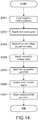
- Fig. 14 is a flowchart showing an example of a method of driving the cartridge memory CM1.
- an activation voltage is generated when a magnetic field (polling signal) is input from the reader/writer 207 (Step 301), and the reference voltage adjustment value is read from the memory unit 42 with the first clock signal (CLK1) and set to the reference voltage adjustment unit 48 (Steps 302 to 304).
- the setting of the reference voltage adjustment value may be performed at the same time as the adjustment of the resonant capacity described in the first embodiment, and the adjustment of the resonant capacitance may be omitted if necessary.
- Step 305 to 307 After adjusting the reference voltage, communication with the reader/writer 207 is started, and management information is read from the specified address of the memory unit 42 with the second clock signal (CLK2) or management information is written to the specified address of the memory unit 42 in accordance with the operation requested by the reader/writer 207 (Steps 305 to 307).
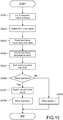
- Fig. 15 is a flowchart showing an example of a method of driving a cartridge memory according to a third embodiment of the present disclosure.
- configurations different from those in the first embodiment will be mainly described, and configurations similar to those in the first embodiment will be denoted by similar reference symbols, and description thereof will be omitted or simplified.
- control unit 44 is configured to select the frequency of the clock signal to be supplied to the memory unit 42 on the basis of the operation request from the reader/writer 207 (external device).
- the time required for an operation of writing information to the memory unit is set longer than the time required for an operation of reading information in some cases.
- the following flow can be applied as an example of the operation of the cartridge memory mounted on these recording medium cartridges.
- the control unit 44 reads the resonant capacitance set value from the memory unit 42 with the first clock signal (CLK1) and sets the read value to the resonant capacitance adjustment unit 46 (Steps 401 to 404).
- communication with the reader/writer 207 is started, and management information is read from the specified address of the memory unit 42 or management information is written to the specified address of the memory unit 42 in accordance with the operation required by the reader/writer 207.
- a clock signal to be supplied to the memory unit 42 is changed from the first clock signal (CLK1) to the second clock signal (CLK2) and information is read at high speed similarly to the first embodiment (Steps 406 to 408).
- an operation of writing information is executed in the first clock signal (CLK1) without changing the clock signal to be supplied to the memory unit 42.
- the operation of writing information to the memory unit 42 is performed with the first clock signal (CLK1), it is possible to reduce the power consumed by the memory unit 42.
- the power consumption of the operation of writing information is larger than that of the operation of reading information in many cases.
- Fig. 16 is a flowchart showing an example of a method of driving a cartridge memory according to a fourth embodiment of the present technology.
- configurations different from those in the first embodiment will be mainly described, and configurations similar to those in the first embodiment will be denoted by similar reference symbols, and description thereof will be omitted or simplified.
- the cartridge memory includes a monitoring unit that monitors the generated voltages of the voltage generation unit 41, and is configured to select a frequency of two or more clock signals on the basis of the output of the monitoring unit. This allows variable control of the clock signal (access speed) to be supplied to the memory unit 42 by looking at the power margin of the voltage generation unit 41.
- the configuration of the above-mentioned monitoring unit is not particularly limited, and it is possible to monitor the generated voltage of the voltage generation unit 41 on the basis of the current value of the voltage adjusting circuit (regulator), the current value of the protection circuit, or the like.
- the control unit 44 reads the resonant capacitance set value from the memory unit 42 with the first clock signal (CLK1) and sets the read value to the resonant capacitance adjustment unit 46 (Steps 501 to 504).
- communication with the reader/writer 207 is started, and management information is read from the specified address of the memory unit 42 or management information is written to the specified address of the memory unit 42 in accordance with the operation requested by the reader/writer 207 (Step 505) .
- the control unit 44 detects the generated voltage of the voltage generation unit 41 (the generated voltage after adjusting the resonant capacitance), and selects the clock frequency at the time when information is read/written from/to the memory unit 42 depending on the magnitude of the voltage (Steps 507 to 509).
- the clock signal generation unit 43 is configured to be capable of selecting the second clock signal (CLK2, 3.39 MHz) and the third clock signal (CLK3) in addition to the first clock signal (CLK1, 848 kHz).
- the frequency of the third clock signal (third frequency) can be set to a suitable value (in this example, 1.69 MHz) higher than the first clock signal (first frequency) and lower than the second clock signal (second frequency).
- the control unit 44 determines whether or not the magnitude of the detected voltage is equal to or greater than a threshold value, and supplies, in the case where the magnitude of the detected voltage is equal to or greater than the threshold value, the second clock signal (CLK2) to the memory unit 42 to perform an operation of reading information or an operation of writing information (Steps 507 and 508). Meanwhile, the control unit 44 supplies, in the case where the magnitude of the detected voltage is less than the threshold value, the third clock signal (CLK3) to the memory unit 42 to perform an operation of reading information or an operation of writing information (Steps 507 and 509).
- the cartridge memory mounted on the magnetic tape cartridge of the LTO standard has been described as an example, but the present technology is not limited thereto and is applicable also to a cartridge memory for a magnetic tape cartridge of another standard other than LTO.
- the present technology is applicable also to an information recording medium other than the magnetic tape, e.g., optical discs, magneto-optical discs, semiconductor memories, or cartridge memories for portable hard disc drives.
- the present technology is not limited to the cartridge memory mounted on the information recording cartridge, and the present technology is applicable also to commuter passes, entrance/exit control cards for expressways or buildings, as well as ID tags attached to electronic apparatuses, vehicles, robots, logistics products, book collections, and the like.
Landscapes
- Engineering & Computer Science (AREA)
- Physics & Mathematics (AREA)
- Computer Hardware Design (AREA)
- Microelectronics & Electronic Packaging (AREA)
- Theoretical Computer Science (AREA)
- General Physics & Mathematics (AREA)
- Computer Networks & Wireless Communication (AREA)
- Electromagnetism (AREA)
- Signal Processing (AREA)
- General Engineering & Computer Science (AREA)
- Near-Field Transmission Systems (AREA)
- Memory System (AREA)
Applications Claiming Priority (2)
| Application Number | Priority Date | Filing Date | Title |
|---|---|---|---|
| JP2018047480 | 2018-03-15 | ||
| PCT/JP2019/002525 WO2019176325A1 (fr) | 2018-03-15 | 2019-01-25 | Moyen de communication sans contact, cartouche de support d'enregistrement, procédé de pilotage pour moyen de communication sans contact et programme |
Publications (3)
| Publication Number | Publication Date |
|---|---|
| EP3767540A1 true EP3767540A1 (fr) | 2021-01-20 |
| EP3767540A4 EP3767540A4 (fr) | 2021-04-14 |
| EP3767540B1 EP3767540B1 (fr) | 2023-03-22 |
Family
ID=67907715
Family Applications (1)
| Application Number | Title | Priority Date | Filing Date |
|---|---|---|---|
| EP19768202.4A Active EP3767540B1 (fr) | 2018-03-15 | 2019-01-25 | Moyen de communication sans contact, cartouche de support d'enregistrement, procédé de pilotage pour moyen de communication sans contact et programme |
Country Status (5)
| Country | Link |
|---|---|
| US (1) | US20210375317A1 (fr) |
| EP (1) | EP3767540B1 (fr) |
| JP (1) | JPWO2019176325A1 (fr) |
| CN (1) | CN112119401A (fr) |
| WO (1) | WO2019176325A1 (fr) |
Families Citing this family (13)
| Publication number | Priority date | Publication date | Assignee | Title |
|---|---|---|---|---|
| JP7376463B2 (ja) * | 2020-02-04 | 2023-11-08 | 富士フイルム株式会社 | 非接触式通信媒体、磁気テープカートリッジ、及び非接触式通信媒体の製造方法 |
| JP6861865B1 (ja) * | 2020-02-04 | 2021-04-21 | 富士フイルム株式会社 | 非接触式通信媒体、磁気テープカートリッジ、非接触式通信媒体の動作方法、及びプログラム |
| JP6798052B1 (ja) | 2020-02-04 | 2020-12-09 | 富士フイルム株式会社 | 非接触式通信媒体、磁気テープカートリッジ、非接触式通信媒体の動作方法、及びプログラム |
| JP7376462B2 (ja) * | 2020-02-04 | 2023-11-08 | 富士フイルム株式会社 | 非接触式通信媒体及び磁気テープカートリッジ |
| US11398249B2 (en) | 2020-02-04 | 2022-07-26 | Fujifilm Corporation | Noncontact communication medium, magnetic tape cartridge, operation method of noncontact communication medium, and storage medium |
| JP6798053B1 (ja) | 2020-02-04 | 2020-12-09 | 富士フイルム株式会社 | 非接触式通信媒体、磁気テープカートリッジ、非接触式通信媒体の動作方法、及びプログラム |
| US11222666B2 (en) | 2020-02-04 | 2022-01-11 | Fujifilm Corporation | Communication device, magnetic tape cartridge unit and manufacturing method thereof, and noncontact management method of magnetic tape cartridge |
| US11809926B2 (en) | 2020-02-04 | 2023-11-07 | Fujifilm Corporation | Noncontact communication medium, magnetic tape cartridge, and manufacturing method of noncontact communication medium |
| JP6844061B1 (ja) * | 2020-05-25 | 2021-03-17 | 富士フイルム株式会社 | 非接触式通信媒体、磁気テープカートリッジ、非接触式通信媒体の動作方法、及びプログラム |
| JP6798058B1 (ja) * | 2020-05-25 | 2020-12-09 | 富士フイルム株式会社 | 非接触式通信媒体、磁気テープカートリッジ、非接触式通信媒体の動作方法、及びプログラム |
| JP6855633B1 (ja) * | 2020-05-25 | 2021-04-07 | 富士フイルム株式会社 | 非接触式通信媒体、磁気テープカートリッジ、非接触式通信媒体の動作方法、及びプログラム |
| JP6798057B1 (ja) * | 2020-05-25 | 2020-12-09 | 富士フイルム株式会社 | 非接触式通信媒体、磁気テープカートリッジ、非接触式通信媒体の動作方法、及びプログラム |
| JP7438911B2 (ja) * | 2020-09-29 | 2024-02-27 | 富士フイルム株式会社 | 非接触式通信装置、磁気テープドライブ、非接触式通信システム、非接触式通信装置の動作方法、及びプログラム |
Family Cites Families (12)
| Publication number | Priority date | Publication date | Assignee | Title |
|---|---|---|---|---|
| JPS58154080A (ja) * | 1982-03-05 | 1983-09-13 | Arimura Giken Kk | 識別信号発生装置 |
| US6317027B1 (en) * | 1999-01-12 | 2001-11-13 | Randy Watkins | Auto-tunning scanning proximity reader |
| JP2004206409A (ja) * | 2002-12-25 | 2004-07-22 | Toshiba Corp | 非接触式icカード |
| JP2005078181A (ja) * | 2003-08-28 | 2005-03-24 | Denso Wave Inc | 非接触icカード |
| JP2005191961A (ja) * | 2003-12-25 | 2005-07-14 | Sharp Corp | 非接触型icカード、電子情報機器、携帯型電子情報機器、開放型システム、消費電力制御方法、制御プログラムおよび可読記録媒体 |
| WO2006117866A1 (fr) * | 2005-04-28 | 2006-11-09 | Hitachi Ulsi Systems Co., Ltd. | Étiquette de ci |
| JP2006318516A (ja) * | 2005-05-10 | 2006-11-24 | Fuji Photo Film Co Ltd | 3次元光記録媒体および光ディスクカートリッジ |
| KR100853189B1 (ko) * | 2006-12-08 | 2008-08-20 | 한국전자통신연구원 | 태그 수명 연장을 위한 저전력 무선 인식 태그 및 그 방법 |
| JP2008225535A (ja) * | 2007-03-08 | 2008-09-25 | Nec Tokin Corp | 非接触icカード |
| JP2009211743A (ja) | 2008-03-03 | 2009-09-17 | Sony Corp | テープリール、テープカートリッジ及びテープドライブシステム |
| JP5401067B2 (ja) * | 2008-09-30 | 2014-01-29 | 株式会社吉川アールエフセミコン | 自動同調回路及びそれを用いたデータキャリア装置 |
| KR101149680B1 (ko) * | 2010-12-28 | 2012-05-30 | 엘에스산전 주식회사 | 태그의 인식 거리 조절이 가능한 rfid 시스템 |
-
2019
- 2019-01-25 WO PCT/JP2019/002525 patent/WO2019176325A1/fr not_active Ceased
- 2019-01-25 US US16/978,960 patent/US20210375317A1/en not_active Abandoned
- 2019-01-25 EP EP19768202.4A patent/EP3767540B1/fr active Active
- 2019-01-25 CN CN201980016303.3A patent/CN112119401A/zh not_active Withdrawn
- 2019-01-25 JP JP2020505640A patent/JPWO2019176325A1/ja active Pending
Also Published As
| Publication number | Publication date |
|---|---|
| WO2019176325A1 (fr) | 2019-09-19 |
| US20210375317A1 (en) | 2021-12-02 |
| CN112119401A (zh) | 2020-12-22 |
| JPWO2019176325A1 (ja) | 2021-03-25 |
| EP3767540B1 (fr) | 2023-03-22 |
| EP3767540A4 (fr) | 2021-04-14 |
Similar Documents
| Publication | Publication Date | Title |
|---|---|---|
| EP3767540B1 (fr) | Moyen de communication sans contact, cartouche de support d'enregistrement, procédé de pilotage pour moyen de communication sans contact et programme | |
| US11393506B2 (en) | Cartridge memory | |
| US11574160B2 (en) | Non-contact communication medium, driving method therefor, and recording medium cartridge | |
| US11562197B2 (en) | Non-contact communication medium and recording medium cartridge | |
| US11145329B2 (en) | Recording medium cartridge and drive device | |
| US11551715B2 (en) | Cartridge memory and control method for the same, cartridge, and recording and reproducing system | |
| US12367902B2 (en) | Noncontact communication medium, magnetic tape cartridge, noncontact communication system, operation method of noncontact communication medium, and program | |
| JP5323765B2 (ja) | 非接触ic媒体制御プログラム、非接触ic媒体、および非接触ic媒体制御方法 |
Legal Events
| Date | Code | Title | Description |
|---|---|---|---|
| STAA | Information on the status of an ep patent application or granted ep patent |
Free format text: STATUS: THE INTERNATIONAL PUBLICATION HAS BEEN MADE |
|
| PUAI | Public reference made under article 153(3) epc to a published international application that has entered the european phase |
Free format text: ORIGINAL CODE: 0009012 |
|
| STAA | Information on the status of an ep patent application or granted ep patent |
Free format text: STATUS: REQUEST FOR EXAMINATION WAS MADE |
|
| 17P | Request for examination filed |
Effective date: 20201005 |
|
| AK | Designated contracting states |
Kind code of ref document: A1 Designated state(s): AL AT BE BG CH CY CZ DE DK EE ES FI FR GB GR HR HU IE IS IT LI LT LU LV MC MK MT NL NO PL PT RO RS SE SI SK SM TR |
|
| AX | Request for extension of the european patent |
Extension state: BA ME |
|
| A4 | Supplementary search report drawn up and despatched |
Effective date: 20210312 |
|
| RIC1 | Information provided on ipc code assigned before grant |
Ipc: G06K 19/07 20060101AFI20210305BHEP Ipc: G06F 12/00 20060101ALI20210305BHEP Ipc: G06K 19/077 20060101ALI20210305BHEP Ipc: G11B 23/087 20060101ALI20210305BHEP Ipc: H04B 5/02 20060101ALI20210305BHEP |
|
| DAV | Request for validation of the european patent (deleted) | ||
| DAX | Request for extension of the european patent (deleted) | ||
| RAP3 | Party data changed (applicant data changed or rights of an application transferred) |
Owner name: SONY SEMICONDUCTOR SOLUTIONS CORPORATION Owner name: SONY GROUP CORPORATION |
|
| GRAP | Despatch of communication of intention to grant a patent |
Free format text: ORIGINAL CODE: EPIDOSNIGR1 |
|
| STAA | Information on the status of an ep patent application or granted ep patent |
Free format text: STATUS: GRANT OF PATENT IS INTENDED |
|
| INTG | Intention to grant announced |
Effective date: 20221011 |
|
| GRAS | Grant fee paid |
Free format text: ORIGINAL CODE: EPIDOSNIGR3 |
|
| GRAA | (expected) grant |
Free format text: ORIGINAL CODE: 0009210 |
|
| STAA | Information on the status of an ep patent application or granted ep patent |
Free format text: STATUS: THE PATENT HAS BEEN GRANTED |
|
| AK | Designated contracting states |
Kind code of ref document: B1 Designated state(s): AL AT BE BG CH CY CZ DE DK EE ES FI FR GB GR HR HU IE IS IT LI LT LU LV MC MK MT NL NO PL PT RO RS SE SI SK SM TR |
|
| REG | Reference to a national code |
Ref country code: GB Ref legal event code: FG4D |
|
| REG | Reference to a national code |
Ref country code: CH Ref legal event code: EP |
|
| REG | Reference to a national code |
Ref country code: IE Ref legal event code: FG4D |
|
| REG | Reference to a national code |
Ref country code: DE Ref legal event code: R096 Ref document number: 602019026698 Country of ref document: DE |
|
| REG | Reference to a national code |
Ref country code: AT Ref legal event code: REF Ref document number: 1555762 Country of ref document: AT Kind code of ref document: T Effective date: 20230415 |
|
| REG | Reference to a national code |
Ref country code: NL Ref legal event code: FP |
|
| REG | Reference to a national code |
Ref country code: LT Ref legal event code: MG9D |
|
| PG25 | Lapsed in a contracting state [announced via postgrant information from national office to epo] |
Ref country code: RS Free format text: LAPSE BECAUSE OF FAILURE TO SUBMIT A TRANSLATION OF THE DESCRIPTION OR TO PAY THE FEE WITHIN THE PRESCRIBED TIME-LIMIT Effective date: 20230322 Ref country code: NO Free format text: LAPSE BECAUSE OF FAILURE TO SUBMIT A TRANSLATION OF THE DESCRIPTION OR TO PAY THE FEE WITHIN THE PRESCRIBED TIME-LIMIT Effective date: 20230622 Ref country code: LV Free format text: LAPSE BECAUSE OF FAILURE TO SUBMIT A TRANSLATION OF THE DESCRIPTION OR TO PAY THE FEE WITHIN THE PRESCRIBED TIME-LIMIT Effective date: 20230322 Ref country code: LT Free format text: LAPSE BECAUSE OF FAILURE TO SUBMIT A TRANSLATION OF THE DESCRIPTION OR TO PAY THE FEE WITHIN THE PRESCRIBED TIME-LIMIT Effective date: 20230322 Ref country code: HR Free format text: LAPSE BECAUSE OF FAILURE TO SUBMIT A TRANSLATION OF THE DESCRIPTION OR TO PAY THE FEE WITHIN THE PRESCRIBED TIME-LIMIT Effective date: 20230322 |
|
| REG | Reference to a national code |
Ref country code: AT Ref legal event code: MK05 Ref document number: 1555762 Country of ref document: AT Kind code of ref document: T Effective date: 20230322 |
|
| PG25 | Lapsed in a contracting state [announced via postgrant information from national office to epo] |
Ref country code: SE Free format text: LAPSE BECAUSE OF FAILURE TO SUBMIT A TRANSLATION OF THE DESCRIPTION OR TO PAY THE FEE WITHIN THE PRESCRIBED TIME-LIMIT Effective date: 20230322 Ref country code: GR Free format text: LAPSE BECAUSE OF FAILURE TO SUBMIT A TRANSLATION OF THE DESCRIPTION OR TO PAY THE FEE WITHIN THE PRESCRIBED TIME-LIMIT Effective date: 20230623 Ref country code: FI Free format text: LAPSE BECAUSE OF FAILURE TO SUBMIT A TRANSLATION OF THE DESCRIPTION OR TO PAY THE FEE WITHIN THE PRESCRIBED TIME-LIMIT Effective date: 20230322 |
|
| PG25 | Lapsed in a contracting state [announced via postgrant information from national office to epo] |
Ref country code: SM Free format text: LAPSE BECAUSE OF FAILURE TO SUBMIT A TRANSLATION OF THE DESCRIPTION OR TO PAY THE FEE WITHIN THE PRESCRIBED TIME-LIMIT Effective date: 20230322 Ref country code: RO Free format text: LAPSE BECAUSE OF FAILURE TO SUBMIT A TRANSLATION OF THE DESCRIPTION OR TO PAY THE FEE WITHIN THE PRESCRIBED TIME-LIMIT Effective date: 20230322 Ref country code: PT Free format text: LAPSE BECAUSE OF FAILURE TO SUBMIT A TRANSLATION OF THE DESCRIPTION OR TO PAY THE FEE WITHIN THE PRESCRIBED TIME-LIMIT Effective date: 20230724 Ref country code: ES Free format text: LAPSE BECAUSE OF FAILURE TO SUBMIT A TRANSLATION OF THE DESCRIPTION OR TO PAY THE FEE WITHIN THE PRESCRIBED TIME-LIMIT Effective date: 20230322 Ref country code: EE Free format text: LAPSE BECAUSE OF FAILURE TO SUBMIT A TRANSLATION OF THE DESCRIPTION OR TO PAY THE FEE WITHIN THE PRESCRIBED TIME-LIMIT Effective date: 20230322 Ref country code: AT Free format text: LAPSE BECAUSE OF FAILURE TO SUBMIT A TRANSLATION OF THE DESCRIPTION OR TO PAY THE FEE WITHIN THE PRESCRIBED TIME-LIMIT Effective date: 20230322 |
|
| PG25 | Lapsed in a contracting state [announced via postgrant information from national office to epo] |
Ref country code: SK Free format text: LAPSE BECAUSE OF FAILURE TO SUBMIT A TRANSLATION OF THE DESCRIPTION OR TO PAY THE FEE WITHIN THE PRESCRIBED TIME-LIMIT Effective date: 20230322 Ref country code: PL Free format text: LAPSE BECAUSE OF FAILURE TO SUBMIT A TRANSLATION OF THE DESCRIPTION OR TO PAY THE FEE WITHIN THE PRESCRIBED TIME-LIMIT Effective date: 20230322 Ref country code: IS Free format text: LAPSE BECAUSE OF FAILURE TO SUBMIT A TRANSLATION OF THE DESCRIPTION OR TO PAY THE FEE WITHIN THE PRESCRIBED TIME-LIMIT Effective date: 20230722 |
|
| REG | Reference to a national code |
Ref country code: DE Ref legal event code: R097 Ref document number: 602019026698 Country of ref document: DE |
|
| PLBE | No opposition filed within time limit |
Free format text: ORIGINAL CODE: 0009261 |
|
| STAA | Information on the status of an ep patent application or granted ep patent |
Free format text: STATUS: NO OPPOSITION FILED WITHIN TIME LIMIT |
|
| PG25 | Lapsed in a contracting state [announced via postgrant information from national office to epo] |
Ref country code: SI Free format text: LAPSE BECAUSE OF FAILURE TO SUBMIT A TRANSLATION OF THE DESCRIPTION OR TO PAY THE FEE WITHIN THE PRESCRIBED TIME-LIMIT Effective date: 20230322 Ref country code: DK Free format text: LAPSE BECAUSE OF FAILURE TO SUBMIT A TRANSLATION OF THE DESCRIPTION OR TO PAY THE FEE WITHIN THE PRESCRIBED TIME-LIMIT Effective date: 20230322 Ref country code: CZ Free format text: LAPSE BECAUSE OF FAILURE TO SUBMIT A TRANSLATION OF THE DESCRIPTION OR TO PAY THE FEE WITHIN THE PRESCRIBED TIME-LIMIT Effective date: 20230322 |
|
| PGFP | Annual fee paid to national office [announced via postgrant information from national office to epo] |
Ref country code: NL Payment date: 20231219 Year of fee payment: 6 |
|
| 26N | No opposition filed |
Effective date: 20240102 |
|
| PGFP | Annual fee paid to national office [announced via postgrant information from national office to epo] |
Ref country code: DE Payment date: 20231219 Year of fee payment: 6 |
|
| P01 | Opt-out of the competence of the unified patent court (upc) registered |
Effective date: 20240329 |
|
| PG25 | Lapsed in a contracting state [announced via postgrant information from national office to epo] |
Ref country code: IT Free format text: LAPSE BECAUSE OF FAILURE TO SUBMIT A TRANSLATION OF THE DESCRIPTION OR TO PAY THE FEE WITHIN THE PRESCRIBED TIME-LIMIT Effective date: 20230322 |
|
| PG25 | Lapsed in a contracting state [announced via postgrant information from national office to epo] |
Ref country code: MC Free format text: LAPSE BECAUSE OF FAILURE TO SUBMIT A TRANSLATION OF THE DESCRIPTION OR TO PAY THE FEE WITHIN THE PRESCRIBED TIME-LIMIT Effective date: 20230322 |
|
| PG25 | Lapsed in a contracting state [announced via postgrant information from national office to epo] |
Ref country code: MC Free format text: LAPSE BECAUSE OF FAILURE TO SUBMIT A TRANSLATION OF THE DESCRIPTION OR TO PAY THE FEE WITHIN THE PRESCRIBED TIME-LIMIT Effective date: 20230322 |
|
| REG | Reference to a national code |
Ref country code: CH Ref legal event code: PL |
|
| PG25 | Lapsed in a contracting state [announced via postgrant information from national office to epo] |
Ref country code: LU Free format text: LAPSE BECAUSE OF NON-PAYMENT OF DUE FEES Effective date: 20240125 |
|
| GBPC | Gb: european patent ceased through non-payment of renewal fee |
Effective date: 20240125 |
|
| PG25 | Lapsed in a contracting state [announced via postgrant information from national office to epo] |
Ref country code: LU Free format text: LAPSE BECAUSE OF NON-PAYMENT OF DUE FEES Effective date: 20240125 |
|
| PG25 | Lapsed in a contracting state [announced via postgrant information from national office to epo] |
Ref country code: GB Free format text: LAPSE BECAUSE OF NON-PAYMENT OF DUE FEES Effective date: 20240125 |
|
| PG25 | Lapsed in a contracting state [announced via postgrant information from national office to epo] |
Ref country code: BE Free format text: LAPSE BECAUSE OF NON-PAYMENT OF DUE FEES Effective date: 20240131 |
|
| PG25 | Lapsed in a contracting state [announced via postgrant information from national office to epo] |
Ref country code: FR Free format text: LAPSE BECAUSE OF NON-PAYMENT OF DUE FEES Effective date: 20240131 |
|
| PG25 | Lapsed in a contracting state [announced via postgrant information from national office to epo] |
Ref country code: CH Free format text: LAPSE BECAUSE OF NON-PAYMENT OF DUE FEES Effective date: 20240131 |
|
| PG25 | Lapsed in a contracting state [announced via postgrant information from national office to epo] |
Ref country code: GB Free format text: LAPSE BECAUSE OF NON-PAYMENT OF DUE FEES Effective date: 20240125 Ref country code: FR Free format text: LAPSE BECAUSE OF NON-PAYMENT OF DUE FEES Effective date: 20240131 Ref country code: CH Free format text: LAPSE BECAUSE OF NON-PAYMENT OF DUE FEES Effective date: 20240131 Ref country code: BE Free format text: LAPSE BECAUSE OF NON-PAYMENT OF DUE FEES Effective date: 20240131 |
|
| REG | Reference to a national code |
Ref country code: BE Ref legal event code: MM Effective date: 20240131 |
|
| PG25 | Lapsed in a contracting state [announced via postgrant information from national office to epo] |
Ref country code: BG Free format text: LAPSE BECAUSE OF FAILURE TO SUBMIT A TRANSLATION OF THE DESCRIPTION OR TO PAY THE FEE WITHIN THE PRESCRIBED TIME-LIMIT Effective date: 20230322 |
|
| PG25 | Lapsed in a contracting state [announced via postgrant information from national office to epo] |
Ref country code: BG Free format text: LAPSE BECAUSE OF FAILURE TO SUBMIT A TRANSLATION OF THE DESCRIPTION OR TO PAY THE FEE WITHIN THE PRESCRIBED TIME-LIMIT Effective date: 20230322 |
|
| PG25 | Lapsed in a contracting state [announced via postgrant information from national office to epo] |
Ref country code: IE Free format text: LAPSE BECAUSE OF NON-PAYMENT OF DUE FEES Effective date: 20240125 |
|
| PG25 | Lapsed in a contracting state [announced via postgrant information from national office to epo] |
Ref country code: IE Free format text: LAPSE BECAUSE OF NON-PAYMENT OF DUE FEES Effective date: 20240125 |
|
| REG | Reference to a national code |
Ref country code: DE Ref legal event code: R119 Ref document number: 602019026698 Country of ref document: DE |
|
| PG25 | Lapsed in a contracting state [announced via postgrant information from national office to epo] |
Ref country code: CY Free format text: LAPSE BECAUSE OF FAILURE TO SUBMIT A TRANSLATION OF THE DESCRIPTION OR TO PAY THE FEE WITHIN THE PRESCRIBED TIME-LIMIT; INVALID AB INITIO Effective date: 20190125 |
|
| PG25 | Lapsed in a contracting state [announced via postgrant information from national office to epo] |
Ref country code: HU Free format text: LAPSE BECAUSE OF FAILURE TO SUBMIT A TRANSLATION OF THE DESCRIPTION OR TO PAY THE FEE WITHIN THE PRESCRIBED TIME-LIMIT; INVALID AB INITIO Effective date: 20190125 |
|
| REG | Reference to a national code |
Ref country code: NL Ref legal event code: MM Effective date: 20250201 |
|
| PG25 | Lapsed in a contracting state [announced via postgrant information from national office to epo] |
Ref country code: DE Free format text: LAPSE BECAUSE OF NON-PAYMENT OF DUE FEES Effective date: 20250801 |
|
| PG25 | Lapsed in a contracting state [announced via postgrant information from national office to epo] |
Ref country code: NL Free format text: LAPSE BECAUSE OF NON-PAYMENT OF DUE FEES Effective date: 20250201 |
|
| PG25 | Lapsed in a contracting state [announced via postgrant information from national office to epo] |
Ref country code: TR Free format text: LAPSE BECAUSE OF FAILURE TO SUBMIT A TRANSLATION OF THE DESCRIPTION OR TO PAY THE FEE WITHIN THE PRESCRIBED TIME-LIMIT Effective date: 20230322 |