EP3767720A1 - Positivelektrodenaktivmaterialpartikel für sekundärbatterie mit wasserfreiem elektrolyt und herstellungsverfahren dafür und sekundärbatterie mit wasserfreiem elektrolyt - Google Patents
Positivelektrodenaktivmaterialpartikel für sekundärbatterie mit wasserfreiem elektrolyt und herstellungsverfahren dafür und sekundärbatterie mit wasserfreiem elektrolyt Download PDFInfo
- Publication number
- EP3767720A1 EP3767720A1 EP19768336.0A EP19768336A EP3767720A1 EP 3767720 A1 EP3767720 A1 EP 3767720A1 EP 19768336 A EP19768336 A EP 19768336A EP 3767720 A1 EP3767720 A1 EP 3767720A1
- Authority
- EP
- European Patent Office
- Prior art keywords
- positive electrode
- metallic element
- active material
- electrode active
- material particles
- Prior art date
- Legal status (The legal status is an assumption and is not a legal conclusion. Google has not performed a legal analysis and makes no representation as to the accuracy of the status listed.)
- Pending
Links
Images

Classifications
-
- H—ELECTRICITY
- H01—ELECTRIC ELEMENTS
- H01M—PROCESSES OR MEANS, e.g. BATTERIES, FOR THE DIRECT CONVERSION OF CHEMICAL ENERGY INTO ELECTRICAL ENERGY
- H01M4/00—Electrodes
- H01M4/02—Electrodes composed of, or comprising, active material
- H01M4/13—Electrodes for accumulators with non-aqueous electrolyte, e.g. for lithium-accumulators; Processes of manufacture thereof
- H01M4/131—Electrodes based on mixed oxides or hydroxides, or on mixtures of oxides or hydroxides, e.g. LiCoOx
-
- H—ELECTRICITY
- H01—ELECTRIC ELEMENTS
- H01M—PROCESSES OR MEANS, e.g. BATTERIES, FOR THE DIRECT CONVERSION OF CHEMICAL ENERGY INTO ELECTRICAL ENERGY
- H01M4/00—Electrodes
- H01M4/02—Electrodes composed of, or comprising, active material
- H01M4/36—Selection of substances as active materials, active masses, active liquids
- H01M4/48—Selection of substances as active materials, active masses, active liquids of inorganic oxides or hydroxides
- H01M4/52—Selection of substances as active materials, active masses, active liquids of inorganic oxides or hydroxides of nickel, cobalt or iron
- H01M4/525—Selection of substances as active materials, active masses, active liquids of inorganic oxides or hydroxides of nickel, cobalt or iron of mixed oxides or hydroxides containing iron, cobalt or nickel for inserting or intercalating light metals, e.g. LiNiO2, LiCoO2 or LiCoOxFy
-
- C—CHEMISTRY; METALLURGY
- C01—INORGANIC CHEMISTRY
- C01G—COMPOUNDS CONTAINING METALS NOT COVERED BY SUBCLASSES C01D OR C01F
- C01G53/00—Compounds of nickel
- C01G53/40—Complex oxides containing nickel and at least one other metal element
-
- C—CHEMISTRY; METALLURGY
- C01—INORGANIC CHEMISTRY
- C01G—COMPOUNDS CONTAINING METALS NOT COVERED BY SUBCLASSES C01D OR C01F
- C01G53/00—Compounds of nickel
- C01G53/40—Complex oxides containing nickel and at least one other metal element
- C01G53/42—Complex oxides containing nickel and at least one other metal element containing alkali metals, e.g. LiNiO2
-
- C—CHEMISTRY; METALLURGY
- C01—INORGANIC CHEMISTRY
- C01G—COMPOUNDS CONTAINING METALS NOT COVERED BY SUBCLASSES C01D OR C01F
- C01G53/00—Compounds of nickel
- C01G53/40—Complex oxides containing nickel and at least one other metal element
- C01G53/42—Complex oxides containing nickel and at least one other metal element containing alkali metals, e.g. LiNiO2
- C01G53/44—Complex oxides containing nickel and at least one other metal element containing alkali metals, e.g. LiNiO2 containing manganese
- C01G53/50—Complex oxides containing nickel and at least one other metal element containing alkali metals, e.g. LiNiO2 containing manganese of the type (MnO2)n-, e.g. Li(NixMn1-x)O2 or Li(MyNixMn1-x-y)O2
-
- H—ELECTRICITY
- H01—ELECTRIC ELEMENTS
- H01M—PROCESSES OR MEANS, e.g. BATTERIES, FOR THE DIRECT CONVERSION OF CHEMICAL ENERGY INTO ELECTRICAL ENERGY
- H01M10/00—Secondary cells; Manufacture thereof
- H01M10/04—Construction or manufacture in general
- H01M10/0422—Cells or battery with cylindrical casing
- H01M10/0427—Button cells
-
- H—ELECTRICITY
- H01—ELECTRIC ELEMENTS
- H01M—PROCESSES OR MEANS, e.g. BATTERIES, FOR THE DIRECT CONVERSION OF CHEMICAL ENERGY INTO ELECTRICAL ENERGY
- H01M10/00—Secondary cells; Manufacture thereof
- H01M10/05—Accumulators with non-aqueous electrolyte
- H01M10/052—Li-accumulators
- H01M10/0525—Rocking-chair batteries, i.e. batteries with lithium insertion or intercalation in both electrodes; Lithium-ion batteries
-
- H—ELECTRICITY
- H01—ELECTRIC ELEMENTS
- H01M—PROCESSES OR MEANS, e.g. BATTERIES, FOR THE DIRECT CONVERSION OF CHEMICAL ENERGY INTO ELECTRICAL ENERGY
- H01M4/00—Electrodes
- H01M4/02—Electrodes composed of, or comprising, active material
- H01M4/04—Processes of manufacture in general
- H01M4/0471—Processes of manufacture in general involving thermal treatment, e.g. firing, sintering, backing particulate active material, thermal decomposition, pyrolysis
-
- H—ELECTRICITY
- H01—ELECTRIC ELEMENTS
- H01M—PROCESSES OR MEANS, e.g. BATTERIES, FOR THE DIRECT CONVERSION OF CHEMICAL ENERGY INTO ELECTRICAL ENERGY
- H01M4/00—Electrodes
- H01M4/02—Electrodes composed of, or comprising, active material
- H01M4/36—Selection of substances as active materials, active masses, active liquids
- H01M4/48—Selection of substances as active materials, active masses, active liquids of inorganic oxides or hydroxides
- H01M4/50—Selection of substances as active materials, active masses, active liquids of inorganic oxides or hydroxides of manganese
- H01M4/505—Selection of substances as active materials, active masses, active liquids of inorganic oxides or hydroxides of manganese of mixed oxides or hydroxides containing manganese for inserting or intercalating light metals, e.g. LiMn2O4 or LiMn2OxFy
-
- C—CHEMISTRY; METALLURGY
- C01—INORGANIC CHEMISTRY
- C01P—INDEXING SCHEME RELATING TO STRUCTURAL AND PHYSICAL ASPECTS OF SOLID INORGANIC COMPOUNDS
- C01P2002/00—Crystal-structural characteristics
- C01P2002/50—Solid solutions
- C01P2002/52—Solid solutions containing elements as dopants
-
- C—CHEMISTRY; METALLURGY
- C01—INORGANIC CHEMISTRY
- C01P—INDEXING SCHEME RELATING TO STRUCTURAL AND PHYSICAL ASPECTS OF SOLID INORGANIC COMPOUNDS
- C01P2002/00—Crystal-structural characteristics
- C01P2002/60—Compounds characterised by their crystallite size
-
- C—CHEMISTRY; METALLURGY
- C01—INORGANIC CHEMISTRY
- C01P—INDEXING SCHEME RELATING TO STRUCTURAL AND PHYSICAL ASPECTS OF SOLID INORGANIC COMPOUNDS
- C01P2002/00—Crystal-structural characteristics
- C01P2002/80—Crystal-structural characteristics defined by measured data other than those specified in group C01P2002/70
- C01P2002/88—Crystal-structural characteristics defined by measured data other than those specified in group C01P2002/70 by thermal analysis data, e.g. TGA, DTA, DSC
-
- C—CHEMISTRY; METALLURGY
- C01—INORGANIC CHEMISTRY
- C01P—INDEXING SCHEME RELATING TO STRUCTURAL AND PHYSICAL ASPECTS OF SOLID INORGANIC COMPOUNDS
- C01P2004/00—Particle morphology
- C01P2004/60—Particles characterised by their size
-
- C—CHEMISTRY; METALLURGY
- C01—INORGANIC CHEMISTRY
- C01P—INDEXING SCHEME RELATING TO STRUCTURAL AND PHYSICAL ASPECTS OF SOLID INORGANIC COMPOUNDS
- C01P2004/00—Particle morphology
- C01P2004/60—Particles characterised by their size
- C01P2004/61—Micrometer sized, i.e. from 1-100 micrometer
-
- C—CHEMISTRY; METALLURGY
- C01—INORGANIC CHEMISTRY
- C01P—INDEXING SCHEME RELATING TO STRUCTURAL AND PHYSICAL ASPECTS OF SOLID INORGANIC COMPOUNDS
- C01P2006/00—Physical properties of inorganic compounds
- C01P2006/40—Electric properties
-
- H—ELECTRICITY
- H01—ELECTRIC ELEMENTS
- H01M—PROCESSES OR MEANS, e.g. BATTERIES, FOR THE DIRECT CONVERSION OF CHEMICAL ENERGY INTO ELECTRICAL ENERGY
- H01M4/00—Electrodes
- H01M4/02—Electrodes composed of, or comprising, active material
- H01M2004/026—Electrodes composed of, or comprising, active material characterised by the polarity
- H01M2004/028—Positive electrodes
-
- Y—GENERAL TAGGING OF NEW TECHNOLOGICAL DEVELOPMENTS; GENERAL TAGGING OF CROSS-SECTIONAL TECHNOLOGIES SPANNING OVER SEVERAL SECTIONS OF THE IPC; TECHNICAL SUBJECTS COVERED BY FORMER USPC CROSS-REFERENCE ART COLLECTIONS [XRACs] AND DIGESTS
- Y02—TECHNOLOGIES OR APPLICATIONS FOR MITIGATION OR ADAPTATION AGAINST CLIMATE CHANGE
- Y02E—REDUCTION OF GREENHOUSE GAS [GHG] EMISSIONS, RELATED TO ENERGY GENERATION, TRANSMISSION OR DISTRIBUTION
- Y02E60/00—Enabling technologies; Technologies with a potential or indirect contribution to GHG emissions mitigation
- Y02E60/10—Energy storage using batteries
Definitions
- the present invention relates to: positive electrode active material particles having a layered rock salt structure for non-aqueous electrolyte secondary batteries, showing excellent thermal stability in addition to excellent structural stability, little resistance increase, and excellent cycle property with maintaining a sufficient battery capacity; methods for producing the same; and non-aqueous electrolyte secondary batteries.
- lithium ion secondary batteries having advantage such as a high charge/discharge capacity, in which lithium cobalt(III) oxide or lithium nickel oxide is used as a positive electrode, are widely used.
- Lithium cobalt(III) oxide is an excellent material showing a high voltage and a high battery capacity, and is essential to a positive electrode material for small electronic devices.
- lithium cobalt(III) oxide takes a high cost because a raw material of lithium cobalt(III) oxide is a cobalt compound which is rare and expensive.
- ternary positive electrode material particles (basic composition: Li(NiCoMn)O 2 ) having a layered rock salt structure and being a solid solution of Ni, Co, and Mn which are excellent in versatility; and lithium-nickel composite oxides (basic composition: Li(NiCoAl)O 2 ) in which Al has been introduced into lithium nickel oxide and an amount of cobalt has been reduced.
- These positive electrode materials have a high charge/discharge capacity as well as a high battery voltage as with lithium-cobalt composite oxides. Therefore, these positive electrode materials are expected as materials which can expand the scope of devices to which lithium ion secondary batteries are applied, such as electric automobiles or stationary storage batteries, and are further energetically researched and developed.
- lithium ion secondary batteries are generally pointed out for disadvantages: a battery capacity is gradually reduced due to a cycle operation in which charge/discharge is repeated; and the battery capacity is reduced due to storage with charged state under a high temperature environment. It is considered these disadvantages are caused because change of crystal structure and/or expansion/contraction occur in the positive electrode materials having a layered rock salt structure due to repeat of charge/discharge or charged state.
- the positive electrode materials having a layered rock salt structure in which Ni is contained as a base element are inferior to lithium cobalt(III) oxide and lithium manganese oxide in thermal stability. In comparison with these oxides, the materials release oxygen with structure thereof being damaged to react with an electrolytic solution at a lower temperature. As a result, the materials cause so-called thermorunaway, and firing and the like in secondary batteries occur.
- Non-Patent Literature 1 heat generation in a cell at a high temperature is mainly caused by oxidization heat of an electrolytic solution due to oxygen generated by decomposition of a positive electrode active material. Therefore, it is important to restrain generation of oxygen due to improvement of thermal stability of the positive electrode active material.
- Patent Literature 1 discloses a lithium-nickel composite oxide having a basic composition of LiNiO 2 and a hexagonal layered rock salt structure. There is also disclosed: a part of Li-site and a part of Ni-site are substituted with Mg in the lithium-nickel composite oxide; Mg having substituted for Li-site plays an prevention role in transfer of Ni from Metal-site to Li-site with charged state in which Li is desorbed from crystal structure when the lithium-nickel composite oxide is applied for batteries; and the crystal structure is stably maintained and internal resistance increase is restrained also during storage at a high temperature with highly charged state.
- Patent Literature 2 discloses a lithium-containing composite oxide having a basic composition of LiMO 2 in which M is an elemental group consisting of four or more elements containing: at least three elements selected from Co, Mn, Al, Mg, and Ti; and Ni. There is also disclosed: expansion/contraction rate of crystal structure due to removed/inserted Li during charge/discharge can be lowered by substituting Metal-site and Li-site with Mg in addition to substitution of the Metal-site with Al in the lithium-containing composite oxide; and as a result, cycle property can be improved because irreversible reaction can be mitigated.
- Patent Literature 3 discloses a positive electrode active material for lithium ion batteries, having: a basic composition of LiNiCoMnO 2 particles which are ternary composite oxides; and Li-Zr-W-O oxides on surface thereof. There is also disclosed: for example, a method for covering the above ternary composite oxide with separately prepared fine particles of the Li-Zr-W-O oxide by a dry process after synthesis of the ternary composite oxides of LiNiCoMnO 2 , as a method for surface treating the above particles of LiNiCoMnO 2 with the Li-Zr-W-O oxide; and protective coatings are formed by such surface treatment to prevent reaction of a positive electrode material with an electrolytic solution.
- Patent Literature 2 As to the lithium-containing composite oxide disclosed in Patent Literature 2, it has been attempted to improve battery capacity, stability, and the cycle property by substituting Ni-site and/or Li-site with Al and/or Mg, and by adjusting an average valence of Ni to +2.5 - +2.9. However, the cycle property is insufficient for practical use, and improvement of properties at a high temperature and thermal stability is not considered and cannot be confirmed.
- the positive electrode active material for lithium ion batteries disclosed in Patent Literature 3 the positive electrode material is protected so as not to react with the electrolytic solution by coating a surface layer of the ternary composite oxide with the fine particles of the Li-Zr-W-O oxide.
- the ternary composite oxide itself which becomes to be a core material, is not subjected to specific treatments. Therefore, although improvement of cycle property and storage property at a high temperature is considered, damage of crystal structure at a high temperature and thermal stability are not considered and cannot be confirmed.
- materials showing all properties which are currently most demanded as a positive electrode active material for non-aqueous electrolyte secondary batteries that is, materials showing excellent thermal stability in addition to excellent cycle property and storage property at a high temperature with maintaining a sufficient battery capacity; and methods for producing the materials.
- An object of the present invention is to provide: a positive electrode active material showing excellent thermal stability in addition to excellent cycle property with maintaining a sufficient battery capacity; and a method for producing the material.
- a further object of the present invention is to provide a non-aqueous electrolyte secondary battery containing such positive electrode active material.
- positive electrode active material particles of the present invention are composed of a layered lithium-composite oxide containing: at least Li and Ni; Co as needed; and surely a divalent metallic element capable of substituting for Li-site.
- the layered lithium-composite oxide has Metal-site containing a large amount of Ni, and is indexed in a space group R-3m by a X-ray diffraction (XRD).
- the positive electrode active material particles for non-aqueous electrolyte secondary batteries have a layered rock salt structure, and are positive electrode active material particles represented by the compositional formula: (Li ⁇ X e )(Ni a Co b X c Z d )O 2 in the compositional formula:
- X is a divalent metallic element capable of substituting for Li-site;
- the method for producing positive electrode active material particles is a method for producing the positive electrode active material particles of Present invention 1, represented by the compositional formula: (Li ⁇ X e )(Ni a Co b X c Z d )O 2 in the compositional formula:
- X is a divalent metallic element capable of substituting for Li-site;
- the non-aqueous electrolyte secondary battery according to the present invention is a non-aqueous electrolyte secondary battery including a positive electrode which contains the positive electrode active material particles of Present invention 1.
- positive electrode active material particles surely showing excellent structural stability with maintaining a sufficient battery capacity when used for a lithium ion secondary battery, and also showing excellent thermal stability in addition to excellent cycle property and little resistance increase after load characteristics, which are suitable as a positive electrode active material for non-aqueous electrolyte secondary batteries.
- the positive electrode active material particles for non-aqueous electrolyte secondary batteries will be firstly described.
- the positive electrode active material particles according to the present invention have a layered rock salt structure, can be indexed in the space group R-3m, and are represented by the compositional formula: (Li ⁇ X e )(Ni a Co b X c Z d )O 2 in the compositional formula:
- X is a divalent metallic element capable of substituting for Li-site;
- An amount of Li, represented by " ⁇ ", in the positive electrode active material particles according to the present invention, that is, a molar ratio of Li to metallic elements "Li/(Ni + optional Co + metallic element X existing in Metal-site + optional metallic element Z)" is 0.93 ⁇ ⁇ ⁇ 1.15, preferably 0.94 ⁇ ⁇ ⁇ 1.12, more preferably 0.95 ⁇ ⁇ ⁇ 1.09, and most preferably 0.95 ⁇ ⁇ ⁇ 1.05.
- the amount of Li is less than the lower limit, an amount of divalent Ni mixing into Li-site of the layered lithium-composite oxide increases, that is, a cation mixing amount increases, and as a result, properties of the positive electrode active material particles are lowered.
- the amount of Li is more than the upper limit, Li components which have not been incorporated into crystal structure during synthesis remain on a surface layer of the positive electrode active material particles, and as a result, it becomes to be difficult to provide a coating material for producing electrodes, a battery capacity decreases, and gas generates.
- An amount of Ni, represented by "a”, in the positive electrode active material particles according to the present invention is 0.82 ⁇ a ⁇ 1.00, preferably 0.85 ⁇ a ⁇ 1.00, more preferably 0.86 ⁇ a ⁇ 1.00, and most preferably 0.86 ⁇ a ⁇ 0.96.
- Li-site in the positive electrode active material particles according to the present invention is substituted with a part of the divalent metallic element X and electrostatic bonding power with oxygen is increased, the crystal structure of the positive electrode active material particles becomes to be stable and the particles show excellent thermal stability with maintaining a sufficient battery capacity in spite of a large amount of Ni.
- An amount of optional Co, represented by "b", in the positive electrode active material particles according to the present invention is 0 ⁇ b ⁇ 0.12, preferably 0 ⁇ b ⁇ 0.10, and more preferably 0.02 ⁇ b ⁇ 0.10.
- phase transition of crystal in LiNiO 2 occurs due to charge/discharge as a battery, and as a result, not only battery properties become to be inferior, but also a crystal lattice is damaged, particles are damaged, and thermal stability is lowered.
- a small amount of Ni is substituted with Co because the phase transition can be mitigated by substituting a suitable amount of Ni with Co.
- a positive electrode active material containing a large amount of Ni and an excessively large amount of Co hardly contributes to a redox reaction, not only a battery capacity is lowered, but also costs rise due to Co which is a rare metal.
- the crystal structure and thermal stability can be improved by substitution with the optional metallic element Z as well as the divalent metallic element X. Therefore, the amount of Co can be reduced and rise of costs can be restrained.
- Mg Mg 2+
- Zn Zn 2+
- Ni Ni 2+
- X the divalent metallic element X.
- Mg is preferred because substitution effect mentioned below is excellent.
- An amount of the divalent metallic element X, represented by "c + e", in the positive electrode active material particles according to the present invention is 0.001 ⁇ c + e ⁇ 0.040, preferably 0.001 ⁇ c + e ⁇ 0.030, more preferably 0.002 ⁇ c + e ⁇ 0.020, furthermore preferably 0.002 ⁇ c + e ⁇ 0.015, and most preferably 0.002 ⁇ c + e ⁇ 0.010.
- the divalent metallic element X is contained therein in such specific amount.
- Substitution of Li-site with a part of the metallic element X could be confirmed by: the phenomenon, i.e., "a peak integrated intensity ratio of the specific planes [(003) plane peak integrated intensity/(104) plane peak integrated intensity] by the XRD of the particles according to the present invention is more changed than that of a material in which the metallic element X is not used for substitution”; and the results of simulation from Rietveld analysis and actual measurement by the XRD Also from the results of demonstration, i.e., "a battery capacity of positive electrode active material particles in which a large amount of the metallic element X is used for substitution is smaller than that supposed from an amount of Ni in the particles", it could be confirmed an occupation rate of Li in Li-site which should be inserted into a crystal lattice becomes to be low and Li-site is substituted with a small amount of the metallic element X.
- Patent Literature 1 and Non-Patent Literature 2 the amount of Ni in Examples is 80mol% or so, and a high-capacity positive electrode material containing Ni in an amount of 80mol% or more is not described at all. Also thermal stability is not described in these literatures.
- the crystal structure could be stabilized and there could be achieved an initial battery capacity almost complying with theory for an amount of Ni within the scope of the present invention. Therefore, in accordance with the present invention, there can be produced the positive electrode active material particles showing excellent thermal stability in addition to excellent cycle property and little resistance increase before/after cycle operation with maintaining a high battery capacity based on a large amount of Ni which is present intentionality.
- Detailed conditions and he like for the thermogravimetry differential thermal analysis are described in EXAMPLES below.
- a layered lithium-composite oxide as in the present invention becomes to be charged state (state of Li being desorbed from crystal structure), distortion occurs in a c-axis direction and the crystal structure becomes to be fragile. It has been known when heating of the layered lithium-composite oxide in such state proceeds, the crystal structure is gradually damaged due to desorption of oxygen, and as a result, phase transition from a layered structure to a spinel structure occurs. It has been also known when heating further proceeds, phase transition of the spinel structure to a rock salt structure which is a stable phase occurs.
- the desorption of oxygen in the layered lithium-composite oxide in charged state occurs at what level of temperature and what level of speed.
- the crystal structure of the positive electrode active material particles is more kept as the layered structure. That is, it is suggested the crystal structure is stable even at a high temperature.
- ethylene carbonate (EC) and dimethyl carbonate (DMC) which are non-aqueous solvents in a non-aqueous electrolytic solution hardly occur heat generation due to oxidation reaction, and the positive electrode active material particles show excellent safety as a battery, i.e., thermal stability.
- thermogravimetry differential thermal analysis (TG-DTA measurement) was adopted and illustrated below.
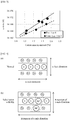
- Fig. 1 shows a graph (DTG curve) of which horizontal axis is a temperature “T (°C)” and vertical axis is a value “DTG (%/min.)” obtained by differentiating weight change "TG (%)” by time, based on the results of the thermogravimetry differential thermal analysis (TG-DTA measurement).
- Various data based on the graph are as follows.
- Fig. 2 shows a graph made by enlarging the graph of which temperature range is 170 - 230°C in Fig. 1 .
- the values "DTG" at 220°C (“DTG 220 ") as representative values of the oxygen desorption speed are shown below.
- a temperature at which the oxygen desorption speed overs 0.04%/min. was regarded as an oxygen desorption starting temperature "T s ".
- T s oxygen desorption starting temperature
- Example 1 By comparing Example 1 and Comparative Example 1 on the results, it is confirmed the following phenomena occurred based on Mg-doping.
- the positive electrode active material particles were in a remarkably unstable state as the layered rock salt structure because about 85% of Li in the layered lithium-composite oxide was desorbed therefrom by charge in the test. It is also considered by proceeding heating of the positive electrode active material particles in an unstable structural state, the crystal structure was damaged, that is, bondings between oxygen and mainly Ni among the metallic elements in crystal were cut and oxygen was released from the crystal, and as a result, damage of the layered rock salt structure proceeded.
- Example 1 it is considered the crystal structure is strengthened because of Pillar effect based on substitution of Li-site and Metal-site with Mg as the metallic element X, which becomes to be a divalent ion, and based on substitution of Metal-site with the metallic element Z.
- strength of a Mg-O bonding melting point of MgO: 2852°C
- strength of a Al-O bonding melting point of Al 2 O 3 : 2072°C
- Example 1 in case of Example 1 according to the present invention, although the detailed reasons cannot be confirmed, it is considered because structural stabilities including thermal stability in charged state are improved, as shown in a model diagram of Fig. 4(b) , Li-site and Metal-site are simultaneously substituted and electrical neutrality in both sites is maintained, Mg ions hardly transit in the both substituted sites, and as a result, there are expected Pillar effect and improvement of bonding power between the divalent ions and oxygen.
- Example 1 is smaller than Comparative Example 1 as to, for example, an amount of generated oxygen within a temperature range from the peak top temperature "T p " to the oxygen desorption starting temperature "T s ", i.e., an integral of DTG within this temperature range on the graph.
- the oxygen desorption starting temperature "T s " of the positive electrode active material particles according to the present invention is preferably 180 - 200°C and more preferably 180 - 195°C.
- the peak top temperature “T p " of the positive electrode active material particles according to the present invention is preferably 218°C or more and more preferably 220°C or more.
- the upper limit of the peak top temperature "T p " is not specified in view of excellent structural stability (thermal stability) of a positive electrode material, it is preferred the peak top temperature "T p " is, for example, about 250°C or less.
- the oxygen desorption speed at 220°C "DTG 220 " of the positive electrode active material particles according to the present invention is preferably 0.27%/min. or less and more preferably 0.26%/min. or less.
- the positive electrode active material particles according to the present invention contains the divalent metallic element X in an amount within the specific range, which has been used for substitution of, mainly, a part of Li capable of being inserted into a crystal lattice.
- the amount of the divalent metallic element X is 0.1 - 4.0mol% relative to a total amount of Ni, Co which is optional and may be substituted, the divalent metallic element X, and the metallic element Z which is optional and may be used for substitution. That is, the amount is represented as X/(Ni + Co + X + Z) and "c + e" in the above-mentioned compositional formula (0.001 ⁇ c + e ⁇ 0.040). Therefore, the positive electrode active material particles according to the present invention shows excellent thermal stability in addition to maintained crystal structural stability and further provide a maintained battery capacity.
- the optional metallic element Z other than the divalent metallic element X contains at least Al and/or Mn.
- the optional metallic element Z other than Al and/or Mn there are exemplified Ti, V, Fe, Ga, Sr, Y, Zr, Nb, Mo, Ru, In, Sn, Ta, W, Bi, and the like.
- An amount of the metallic element Z, represented by "d" in the positive electrode active material particles according to the present invention is 0 ⁇ d ⁇ 0.10, preferably 0.01 ⁇ d ⁇ 0.08, and more preferably 0.01 ⁇ d ⁇ 0.07.
- a ratio of the divalent metallic element X to the metallic element Z can be suitably adjusted to a preferred range in accordance with: types and the amount of the divalent metallic element X; types and the amount of the metallic element Z; and combination of the divalent metallic element X and the metallic element Z.
- the amount of Mg ("c + e" in the above-mentioned compositional formula) is preferably 0.001 ⁇ c + e ⁇ 0.010 and more preferably 0.002 ⁇ c + e ⁇ 0.008, and the amount of Al ("d" in the compositional formula) is preferably 0.020 ⁇ d ⁇ 0.060 and more preferably 0.025 ⁇ d ⁇ 0.050.
- the ratio of Mg to Al (Mg/Al) in the positive electrode active material particles is, for example, preferably 0.02 - 0.4 or so.
- the amount of Mg ("c + e" in the above-mentioned compositional formula) is preferably 0.001 ⁇ c + e ⁇ 0.008, and the amount of Mn ("d" in the compositional formula) is preferably 0.020 ⁇ d ⁇ 0.100 and more preferably 0.030 ⁇ d ⁇ 0.100.
- the ratio of Mg to Mn (Mg/Mn) in the positive electrode active material particles is, for example, preferably 0.01 - 0.5 or so.
- the amount of Mg ("c + e" in the above-mentioned compositional formula) is preferably 0.001 ⁇ c + e ⁇ 0.008
- the amount of Al ("d" in the compositional formula) is preferably 0.005 ⁇ d ⁇ 0.040
- the amount of Mn ("d" in the compositional formula) is preferably 0.001 ⁇ d ⁇ 0.040.
- the ratio of Mg to Al and Mn (Mg/(Al + Mn)) in the positive electrode active material particles is, for example, preferably 0.1 - 1.34 or so.
- each of an average secondary particle diameter (D50), a crystallite size, a length of a-axis and a length of c-axis of a crystal lattice, a ratio of the length of c-axis to the length of a-axis (c/a), and a cation mixing amount is respectively within a range shown below.
- the average secondary particle diameter (D50) is preferably 2 - 20 ⁇ m, more preferably 2 - 18 ⁇ m, furthermore preferably 3 - 15 ⁇ m, and most preferably 3 - 12 ⁇ m.
- D50 is smaller than the lower limit, it is likely a positive electrode containing the positive electrode active material particles easily reacts with an electrolytic solution and battery properties deteriorate. It is also likely, in a practical manner, a density of the positive electrode active material particles becomes to be low and an electrode density of the positive electrode becomes to be excessively low.
- the D50 is larger than the upper limit, it is likely contact of the positive electrode containing the positive electrode active material particles with the electrolytic solution becomes to be bad and deteriorated battery properties such as non-maintained necessary output are shown. It is also likely Li cannot be inserted into central parts during calcination when the positive electrode active material particles are synthesized, distortion occurs within particles, and thermal stability and structural stability are lowered.
- the crystallite size is preferably 50 - 400nm, more preferably 55 - 400nm, furthermore preferably 200 - 380nm, and most preferably 200 - 370nm.
- the crystallite size is smaller than the lower limit, it is likely a crystal structure of the positive electrode active material particles becomes to be unstable.
- the crystallite size is larger than the upper limit, it is likely battery properties of a non-aqueous electrolyte secondary battery in which the positive electrode active material particles are used deteriorate.
- the length of a-axis of a crystal lattice is preferably 2.840 - 2.890 ⁇ and more preferably 2.845 - 2.885 ⁇ .
- the length of c-axis of the crystal lattice is preferably 14.160 - 14.200 ⁇ and more preferably 14.170 - 14.200 ⁇ .
- the crystal lattice tends to be larger than a crystal lattice of conventional positive electrode active material particles in which the metallic element X is not used for substitution.
- the ratio of the length of c-axis to the length of a-axis (c/a) is preferably 4.94 - 4.96, i.e., 4.95 or so.
- the cation mixing amount varies in accordance with: the amount of the divalent metallic element X (X/(Ni + Co + X + Z)), particularly an amount of the divalent metallic element X substituting for Li-site; the molar ratio of Li to the metallic elements (Li/(Ni + Co + X + Z)); and the like.
- the cation mixing amount is preferably 0.7 - 4.0%, more preferably 0.8 - 3.5%, and furthermore preferably 0.8 - 3.0%.
- the cation mixing amount generally indicates the following amount.
- an occupation rate of Li in Li-site is basically 100%, Ni mainly contained in Metal-site converts into divalent Ni and transfers to Li-site during calcination when the layered lithium-composite oxide is synthesized.
- the cation mixing amount is represented as an amount of metal which has transferred to Li-site and with which Li has been substituted. It is known the cation mixing amount is, as usual, 0.5 - 5.0% or so.
- the cation mixing amount in Li-site is based on: the divalent metallic element X which has been used for substitution of Li-site; and partially, divalent Ni existing in Li-sate, which had been converted from Ni during synthesis of a layered lithium-composite oxide (calcination at a high temperature).
- a method for making an assumption in accordance with Rietveld analysis by the XRD such as, for example, a method for fixing a cation mixing amount of only Ni among the amount of Ni in Comparative Example 1 mentioned below as an occupation rate of the divalent Ni in Li-site.
- the cation mixing amount in Li-site is mainly an amount of divalent Ni which has transferred to Li-site during synthesis of a lithium-composite oxide.
- step (I) or the step (II) mentioned below is included.
- the step (I) includes in this order:
- the amount of the divalent metallic element X capable of substituting for Li-site is adjusted to 0.1 - 4.0mol% relative to the total amount of Ni, optional Co, the divalent metallic element X, and the optional metallic element Z when the step (I) or the step (II) is performed.
- the step (I) or the step (II) can be adopted. That is, as procedures in the step (I), the divalent metallic element X is introduced into the precursor compound by a pre-addition method in which the divalent metallic element X compound as an aqueous solution is blended with an aqueous solution of other metallic elements when the precursor compound is synthesized, and as a result, a part of Li which will be inserted into a crystal lattice of the aimed positive electrode active material particles can be substituted with the divalent metallic element X.
- a part of Li which will be inserted into a crystal lattice of the aimed positive electrode active material particles can be substituted with the divalent metallic element X by a post-addition method in which the divalent metallic element X compound is introduced into a mixing system in powder form, droplet form, or spray form after synthesis of the precursor compound.
- the step (I) is adopted.
- step (I) in which the divalent metallic element X compound is added to a reaction system when the precursor compound is synthesized
- a case the step (II) in which the divalent metallic element X compound is added to the mixing system after synthesis of the precursor compound
- differences there are the following differences. That is, there is a possibility of differences in: a half-value width of diffraction peak on a specific crystal plane; and a ratio of an intensity of diffraction peak on one specific crystal plane to an intensity of diffraction peak on the other specific crystal plane, which are obtained by the XRD of the layered lithium-composite oxide.
- nickel compounds used for the method according to the present invention for example, without specific limitations are cited nickel sulfate, nickel oxide, nickel hydroxide, nickel nitrate, nickel carbonate, nickel chloride, nickel iodide, metallic nickel, and the like.
- nickel sulfate nickel oxide, nickel hydroxide, nickel nitrate, nickel carbonate, nickel chloride, nickel iodide, metallic nickel, and the like.
- nickel sulfate nickel oxide, nickel hydroxide, nickel nitrate, nickel carbonate, nickel chloride, nickel iodide, metallic nickel, and the like.
- nickel sulfate nickel oxide, nickel hydroxide, nickel nitrate, nickel carbonate, nickel chloride, nickel iodide, metallic nickel, and the like.
- nickel sulfate nickel oxide, nickel hydroxide, nickel nitrate, nickel carbonate, nickel chloride, nickel iodide, metallic nickel, and the like.
- nickel sulfate nickel oxide, nickel hydroxide
- cobalt compounds used for the method according to the present invention for example, without specific limitations are cited cobalt sulfate, cobalt oxide, cobalt hydroxide, cobalt nitrate, cobalt carbonate, cobalt chloride, cobalt iodide, metallic cobalt, and the like.
- cobalt sulfate for example, without specific limitations are cited cobalt sulfate, cobalt oxide, cobalt hydroxide, cobalt nitrate, cobalt carbonate, cobalt chloride, cobalt iodide, metallic cobalt, and the like.
- cobalt sulfate Preferable example is cobalt sulfate.
- metallic element Z compounds used for the method according to the present invention for example, are cited aluminum compounds, manganese compounds, niobium compounds, tungsten compounds, and the like.
- aluminum compounds for example, without specific limitations are cited aluminum sulfate, aluminum oxide, aluminum hydroxide, aluminum nitrate, aluminum carbonate, aluminum chloride, aluminum iodide, sodium aluminate, metallic aluminum, and the like.
- Preferable example is aluminum sulfate or sodium aluminate when the step (I) is adopted, while preferable example is aluminum oxide when the step (II) is adopted.
- manganese compounds for example, without specific limitations are cited manganese sulfate, manganese oxide, manganese hydroxide, manganese nitrate, manganese carbonate, manganese chloride, manganese iodide, metallic manganese, and the like.
- manganese sulfate when the step (I) is adopted
- manganese oxide or manganese hydroxide when the step (II) is adopted.
- niobium compounds for example, without specific limitations are cited niobium oxide, niobium chloride, lithium niobate, niobium iodide, and the like. Preferable example is niobium oxide.
- compounds showing easy handling can be selected.
- tungsten compounds for example, without specific limitations are cited tungsten oxide, sodium tungstate, ammonium paratungstate, tungsten hexacarbonyl, tungsten sulfide, and the like. Preferable example is tungsten oxide.
- compounds showing easy handling can be selected.
- divalent metallic element X compounds used for the method according to the present invention for example, are cited magnesium compounds, zinc compounds, nickel compounds, and the like.
- Preferable example is the magnesium compounds or the zinc compounds, and more preferable example is the magnesium compounds.
- magnesium compounds for example, without specific limitations are cited magnesium sulfate, magnesium oxide, magnesium hydroxide, magnesium nitrate, magnesium carbonate, magnesium chloride, magnesium iodide, metallic magnesium, and the like.
- magnesium sulfate when the step (I) is adopted
- magnesium oxide when the step (II) is adopted.
- zinc compounds for example, without specific limitations are cited zinc sulfate, zinc oxide, zinc hydroxide, zinc nitrate, zinc carbonate, zinc chloride, zinc iodide, metallic zinc, and the like.
- zinc sulfate when the step (I) is adopted
- zinc oxide when the step (II) is adopted.
- each of an aqueous solution of the nickel compound, an optional aqueous solution of the cobalt compound, and an optional aqueous solution of the metallic element Z compound is prepared, and an aqueous solution of the divalent metallic element X compound is also prepared so that the amount of the divalent metallic element X is adjusted to 0.1 - 4.0mol% relative to the total amount of Ni, optional Co, the divalent metallic element X, and the optional metallic element Z.
- aqueous solution such as a sodium hydroxide aqueous solution or an ammonia solution as a mother liquor
- an aqueous solution containing the aqueous solution of the nickel compound, the optional aqueous solution of the cobalt compound, and the optional aqueous solution of the metallic element Z compound there are dropped: an aqueous solution containing the aqueous solution of the nickel compound, the optional aqueous solution of the cobalt compound, and the optional aqueous solution of the metallic element Z compound; and the aqueous solution of the divalent metallic element X compound.
- a pH of a reaction system in the reaction vessel is monitored and controlled with dropping sodium hydroxide or the like so as to be adjusted to a suitable range, the reaction system is coprecipitated as mainly hydroxides by crystallization and agglomeration, and as a result, the precursor compound can be synthesized.
- the aimed precursor compound can be synthesized by performing a batch type reaction for a prescribed time, stopping drop and stir of raw materials, and coprecipitating. While in case broad particle size distribution is desired, the aimed precursor compound can be synthesized by performing a continuous reaction and overflowing coprecipitates together with a reaction solution. The particle size distribution can be designed by combining these reaction procedures.
- an inner part of the reaction vessel is purged by using inert gas or industrially preferable N 2 gas from a preparation stage of the alkaline aqueous solution as a mother liquor in this reaction, and the reaction is performed at an oxygen concentration as low as possible in a system and the solution of the reaction vessel.
- inert gas or industrially preferable N 2 gas from a preparation stage of the alkaline aqueous solution as a mother liquor in this reaction, and the reaction is performed at an oxygen concentration as low as possible in a system and the solution of the reaction vessel.
- N 2 gas it is likely: coprecipitated hydroxides by crystallization are oxidized due to residual oxygen; and agglomerates cannot be formed by crystallization.
- each of an aqueous solution of the nickel compound, an optional aqueous solution of the cobalt compound, and an optional aqueous solution of the metallic element Z compound is prepared.
- a reaction vessel where at least one alkaline aqueous solution such as a sodium hydroxide aqueous solution or an ammonia solution as a mother liquor is stirred, there is dropped an aqueous solution containing the aqueous solution of the nickel compound, the optional aqueous solution of the cobalt compound, and the optional aqueous solution of the metallic element Z compound.
- a pH of a reaction system in the reaction vessel is monitored and controlled with dropping sodium hydroxide or the like so as to be adjusted to a suitable range, the reaction system is coprecipitated as mainly hydroxides by crystallization and agglomeration, and as a result, the precursor compound can be synthesized.
- a blending ratio of the nickel compound, the optional cobalt compound, and the optional metallic element Z compound is suitably adjusted so that a ratio of the amount of Ni, the amount of optional Co, and the amount of the optional metallic element Z becomes to be a desired value in consideration of composition of the aimed positive electrode active material particles.
- the blending ratio is suitably adjusted so that the positive electrode active material particles produced by the method according to the present invention can be represented by the compositional formula: (Li ⁇ X e )(Ni a Co b X c Z d )O 2 in the compositional formula:
- X is a divalent metallic element capable of substituting for Li-site;
- the amount of the divalent metallic element X is suitably adjusted so that the amount becomes to be 0.1 - 4.0mol%, preferably 0.1 - 3.0mol%, more preferably 0.2 - 2.0mol%, furthermore preferably 0.2 - 1.5mol%, and most preferably 0.2 - 1.0mol%, relative to the total amount of Ni, optional Co, the divalent metallic element X, and the optional metallic element Z.
- the amount is suitably adjusted so that the positive electrode active material particles produced by the method according to the present invention can be represented by the compositional formula: (Li ⁇ X e )(Ni a Co b X c Z d )O 2 in the compositional formula:
- X is a divalent metallic element capable of substituting for Li-site;
- the amount of the divalent metallic element X is less than the lower limit, an amount of the divalent metallic element X used for substitution becomes to be excessively small, and as a result, sufficient effects for improvement of thermal stability, which are aimed in the present invention, cannot be imparted to the positive electrode active material particles.
- the amount of the divalent metallic element X is more than the upper limit, the amount of the divalent metallic element X used for substitution becomes to be excessively large, an amount of Li in Li-site becomes to be insufficient, a battery capacity of a non-aqueous electrolyte secondary battery in which the positive electrode active material particles are used lowers, and as a result, the battery capacity cannot satisfy a battery capacity which is demanded for a battery in which a positive electrode material containing a large amount of Ni is used.
- an amount of the divalent metallic element X in Metal-site becomes to be excessively large, crystal is distorted, and as a result, thermal stability lowers.
- a ratio of the divalent metallic element X to the metallic element Z can be suitably adjusted to a preferred range in accordance with: types and the amount of the divalent metallic element X; types and the amount of the metallic element Z; and combination of the divalent metallic element X and the metallic element Z.
- the amount of Mg is preferably 0.1 - 1.0mol% and more preferably 0.2 - 0.8mol% relative to the above-mentioned total amount
- the amount of Al is preferably 2.0 - 6.0mol% and more preferably 2.5 - 5.0mol% relative to the above-mentioned total amount.
- the ratio of Mg to Al (Mg/Al) in the step (I) is, for example, preferably 0.02 - 0.4 or so.
- the amount of Mg is preferably 0.1 - 0.8mol% relative to the above-mentioned total amount, and the amount of Mn is preferably 2.0 - 10.0mol% and more preferably 3.0 - 10.0mol% relative to the above-mentioned total amount.
- the ratio of Mg to Mn (Mg/Mn) in the step (I) is, for example, preferably 0.01 - 0.5 or so.
- the amount of Mg is preferably 0.1 - 0.8mol% relative to the above-mentioned total amount
- the amount of Al is preferably 0.5 - 4.0mol% relative to the above-mentioned total amount
- the amount of Mn is preferably 0.1 - 4.0mol% relative to the above-mentioned total amount.
- the ratio of Mg to Al and Mn (Mg/(Al + Mn)) in the step (I) is, for example, preferably 0.1 - 1.34 or so.
- a suitable range of a pH when the precursor compound is synthesized is preferably 11.0 - 13.5.
- a suitable range of a pH when the precursor compound is synthesized is preferably 11.0 - 13.5.
- the precursor compound synthesized by a wet type reaction is washed with water, dehydrated, and dried.
- a hydroxide phase of Ni, Co, the divalent metallic element X, and/or the metallic element Z exists as a monolayer in the precursor compound when the precursor compound is identified by the XRD.
- the precursor compound can contain an oxyhydroxide phase or a spinel compound phase as a different phase of the hydroxide phase.
- the drying can be performed under the following conditions. That is, a present temperature of a drying device is within a range of 80 - 300°C or so, and there can be adopted an airflow drying method, a shelf drying method by using a thermostatic chamber, a method by using a vacuum dryer, and the like. It is preferred the drying is performed under: an oxidizing atmosphere; a reducing atmosphere; a decarbonation atmosphere in which, for example, a concentration of carbon dioxide is about 40ppm or less; a vacuum atmosphere; and the like.
- the metallic element Z can exist within particles , on grain boundaries, and/or on an edge of particles of the precursor compound.
- the precursor compound synthesized in the step (I) or the step (II) can be subjected to an oxidation treatment under the oxidizing atmosphere at a temperature of 350 - 680°C.
- the temperature for the oxidation treatment is preferably 530 - 680°C and more preferably 550 - 650°C.
- the precursor compound is oxidized and simultaneously impurities such as residual sulfate radicals and residual carbonate radicals can be desorbed from the precursor compound.
- impurities such as residual sulfate radicals and residual carbonate radicals
- reactivity of the precursor compound with the lithium compound during calcination mentioned below is improved.
- the oxidation treatment there can be used a box type furnace, a roller hearth kiln, a rotary kiln, and the like. It is preferred the rotary kiln is used, by which continuous oxidation treatment can be performed.
- the average secondary particle diameter (D50) of the precursor compound is preferably 2 - 20 ⁇ m, more preferably 2 - 18 ⁇ m, and furthermore preferably 3 - 14 ⁇ m.
- D50 of the precursor compound is within the range, an amount of a positive electrode active material per unit area can be increased because a filling density becomes to be high during produce of a positive electrode by using the positive electrode active material particles.
- crack due to high compression hardly occurs, and the produced non-aqueous electrolyte secondary battery shows sufficient load characteristics and excellent thermal stability.
- step (I) after the precursor compound is washed with water and dried as mentioned above, the lithium compound and the precursor compound are mixed with each other at a prescribed ratio to prepare a mixture, and the mixture is calcinated under the oxidizing atmosphere at 650 - 850°C to prepare a layered lithium-composite oxide.
- a calcination temperature in the step (I) is preferably 680 - 840°C and more preferably 680 - 830°C.
- step (II) after the precursor compound is washed with water and dried as mentioned above, the lithium compound, the precursor compound and the divalent metallic element X compound are mixed with each other at a prescribed ratio to prepare a mixture, and the mixture is calcinated under the oxidizing atmosphere at 650 - 850°C to prepare a layered lithium-composite oxide.
- a calcination temperature in the step (II) is preferably 680 - 840°C and more preferably 680 - 830°C.
- the step (II) there can be adopted the following procedures.
- the precursor compound and the divalent metallic element X compound are mixed with each other to prepare a mixture and the mixture is temporarily calcinated so that uniform substitution in particles can be achieved by the divalent metallic element X, and then, the temporarily calcinated mixture is mixed with the lithium compound in a prescribed amount.
- lithium compounds various lithium salts can be used without specific limitations.
- the lithium compounds for example, are cited lithium hydroxide monohydrate, lithium hydroxide anhydride, lithium nitrate, lithium carbonate, lithium acetate, lithium bromide, lithium chloride, lithium citrate, lithium fluoride, lithium iodide, lithium lactate, lithium oxalate, lithium phosphate, lithium pyruvate, lithium sulfate, lithium oxide, and the like.
- preferable example is lithium carbonate, lithium hydroxide monohydrate, or lithium hydroxide anhydride.
- a blending ratio of the lithium compound and the precursor compound is suitably adjusted so that a ratio of the amount of Li to the total amount of Ni, optional Co, the divalent metallic element X, and the optional metallic element Z becomes to be a desired value in consideration of composition of the aimed positive electrode active material particles.
- the blending ratio in the step (I) is suitably adjusted so that the positive electrode active material particles produced by the method according to the present invention can be represented by the compositional formula: (Li ⁇ X e )(Ni a Co b X c Z d )O 2 in the compositional formula:
- X is a divalent metallic element capable of substituting for Li-site;
- a blending ratio of the lithium compound, the precursor compound, and the divalent metallic element X is suitably adjusted so that a ratio of the amount of Li to the total amount of Ni, optional Co, the divalent metallic element X, and the optional metallic element Z becomes to be a desired value in consideration of composition of the aimed positive electrode active material particles.
- the blending ratio in the step (II) is suitably adjusted so that the positive electrode active material particles produced by the method according to the present invention can be represented by the compositional formula: (Li ⁇ X e )(Ni a Co b X c Z d )O 2 in the compositional formula:
- X is a divalent metallic element capable of substituting for Li-site;
- the amount of the divalent metallic element X is suitably adjusted so that the amount becomes to be 0.1 - 4.0mol%, preferably 0.1 - 3.0mol%, more preferably 0.2 - 2.0mol%, furthermore preferably 0.2 - 1.5mol%, and most preferably 0.2 - 1.0mol%, relative to the total amount of Ni, optional Co, the divalent metallic element X, and the optional metallic element Z.
- the amount is suitably adjusted so that the positive electrode active material particles produced by the method according to the present invention can be represented by the compositional formula: (Li ⁇ X e )(Ni a Co b X c Z d )O 2 in the compositional formula:
- X is a divalent metallic element capable of substituting for Li-site;
- a ratio of the divalent metallic element X to the metallic element Z can be suitably adjusted to a preferred range in accordance with: types and the amount of the divalent metallic element X; types and the amount of the metallic element Z; and combination of the divalent metallic element X and the metallic element Z.
- the amount of Mg is preferably 0.1 - 1.0mol% and more preferably 0.2 - 0.8mol% relative to the above-mentioned total amount
- the amount of Al is preferably 2.0 - 6.0mol% and more preferably 2.5 - 5.0mol% relative to the above-mentioned total amount.
- the ratio of Mg to Al (Mg/Al) in the step (II) is, for example, preferably 0.02 - 0.4 or so.
- the amount of Mg is preferably 0.1 - 0.8mol% relative to the above-mentioned total amount, and the amount of Mn is preferably 2.0 - 10.0mol% and more preferably 3.0 - 10.0mol% relative to the above-mentioned total amount.
- the ratio of Mg to Mn (Mg/Mn) in the step (II) is, for example, preferably 0.01 - 0.5 or so.
- the amount of Mg is preferably 0.1 - 0.8mol% relative to the above-mentioned total amount
- the amount of Al is preferably 0.5 - 4.0mol% relative to the above-mentioned total amount
- the amount of Mn is preferably 0.1 - 4.0mol% relative to the above-mentioned total amount.
- the ratio of Mg to Al and Mn (Mg/(Al + Mn)) in the step (II) is, for example, preferably 0.1 - 1.34 or so.
- a calcination temperature for preparation of the layered lithium-composite oxide is 650 - 850°C, preferably 680 - 840°C, and more preferably 680 - 830°C.
- the calcination temperature is lower than the lower limit, the layered lithium-composite oxide (positive electrode active material particles) having a desired crystal structure cannot be produced.
- the calcination temperature is higher than the upper limit, crystal growth excessively proceeds and battery properties exhibited from the produced layered lithium-composite oxide (positive electrode active material particles) deteriorate.
- calcination is performed under an oxidizing atmosphere. It is preferred the calcination is performed under an atmosphere in an oxygen concentration of preferably 75vol% or more, more preferably 80vol% or more, and furthermore preferably 85vol% or more.
- a dry type mixture or a wet type mixture can be adopted for: mixing the lithium compound and the precursor compound in the step (I); and mixing the lithium compound, the precursor compound, and the divalent metallic element X compound in the step (II), as long as uniform mixing is achieved.
- the wet type mixture for example, the compounds used for mixture are brought into contact with water in a prescribed amount and granulated by using a spray dryer to give a uniform mixture.
- the positive electrode active material particles according to the present invention are composed of the layered lithium-composite oxide containing Ni in a large amount, there is a possibility an amount of residual Li compounds becomes to be larger than that of positive electrode active material particles composed of a lithium-composite oxide containing Ni in a small amount. Therefore, in order to reduce the amount of the residual Li compounds in the method according to the present invention, it is preferred a surface of primary particles and/or a surface of secondary particles of the layered lithium-composite oxide are subjected to a surface treatment and more stabilized.
- a method for the surface treatment for example, without specific limitations are adopted: a method in which fine particles of aluminum oxide are allowed to adhere to a surface layer of agglomerated particles of the layered lithium-composite oxide in a dry type method with adding shearing force thereto, and then, a heat treatment is performed at 300 - 600°C or so; a method in which the layered lithium-composite oxide in a prescribed amount is brought into contact with an aqueous solution prepared by dissolving sodium aluminate in a prescribed amount therein, they are stirred for 5 - 10 minutes or so, dehydrated and dried, and then, they are subjected to a heat treatment at 300 - 700°C or so to give the layered lithium-composite oxide having a surface layer coated with the aluminum compound corresponding thereto; and the like.
- a dry type method and a wet type method each by using the aluminum compound are exemplified as the method for the surface treatment.
- the dry type method for the surface treatment Li - Al- O and Al 2 O 3 are formed on the surface layer of particles by the heat treatment.
- Al traps Li and it becomes to be possible to reduce a residual lithium amount.
- It is said Li - Al- O is an ion conductor and shows high corrosion resistance, and as a result, it becomes to be possible to improve battery properties.
- the wet type method for the surface treatment it is considered residual lithium components dissolve in an aluminum aqueous solution by bringing the layered lithium-composite oxide into contact with the aluminum aqueous solution.
- Al 2 O 3 is formed on the surface layer of the particles by the heat treatment after contact. That is, it is preferred to plan to reduce the residual lithium amount and improve battery properties by using any method for the surface treatment.
- the non-aqueous electrolyte secondary battery according to the present invention will be described.
- the non-aqueous electrolyte secondary battery includes a positive electrode which contains the positive electrode active material particles according to the present invention.
- the non-aqueous electrolyte secondary battery according to the present invention is constituted of the positive electrode, a negative electrode, and an electrolytic solution containing an electrolyte.
- the positive electrode is produced in accordance with an ordinary method. That is, a conductive agent and a binder are added to the positive electrode active material particles according to the present invention, and these are mixed with each other.
- a conductive agent for example, acetylene black, carbon black, graphite, and the like are preferred.
- the binder for example, polytetrafluoroethylene, polyvinylidene fluoride, and the like are preferred.
- negative electrode active materials such as: at least one nonmetallic element or metallic element selected from the group consisting of Si, Al, Sn, Pb, Zn, Bi, and Cd; an alloy containing the element(s) or a chalcogenide containing the element(s); metallic lithium; graphite; and a low crystalline carbon material.
- an organic solvent including at least one of carbonates such as propylene carbonate and dimethyl carbonate, and ethers such as dimethoxyethane, as well as a combination of ethylene carbonate and diethyl carbonate.
- the electrolyte there can be used at least one of lithium salts such as lithium perchlorate and lithium tetrafluoroborate as well as lithium hexafluorophosphate, which are dissolved in the above-mentioned solvent.
- lithium salts such as lithium perchlorate and lithium tetrafluoroborate as well as lithium hexafluorophosphate, which are dissolved in the above-mentioned solvent.
- the positive electrode active material particles according to the present invention contains the divalent metallic element X in a specific amount, and mainly a part of Li-site is substituted with the divalent metallic element X. Therefore, the positive electrode active material particles according to the present invention surely shows excellent structural stability with maintaining a sufficient battery capacity, and also shows excellent thermal stability in addition to little resistance increase and excellent cycle property, in comparison with conventional positive electrode active material particles containing Ni in a large amount, in which Li-site is not substituted with metallic elements.
- the composition of the precursor compound and the positive electrode active material particles was determined in accordance with the following procedures. That is, a sample, i.e., 0.2g of each precursor compound or each positive electrode active material particles, was heated and dissolved in 25mL of a hydrochloric acid solution having a concentration of 20% to give a sample solution. After the sample solution was cooled, the sample solution was transferred to a volumetric flask having a capacity of 100mL, and then pure water was added thereto to give an adjusted solution. The quantity of each element in the precursor compound or the positive electrode active material particles was determined by using the adjusted solution and ICP-AES Spectrometer "Optima 8300" commercially available from PerkinElmer Japan Co., Ltd.
- the average secondary particle diameter (D50) was measured in a volume standard by a wet laser method using a laser type particle size distribution measuring apparatus "Microtrack HRA" commercially available from NIKKISO CO., LTD.
- the XRD data were obtained under the following X-ray diffraction conditions by using X-ray diffractometer "SmartLab" commercially available from Rigaku Corporation.
- X-ray diffraction conditions X-ray source: Cu-K ⁇ ray Accelerating voltage and current: 45kV and 200mA Sampling width: 0.02deg. Scan range: 15 - 122deg. Scan speed: 0.4°/min. step Divergence slit width: 0.65deg. Light receiving slit width: 0.2mm Scattering slit width: 0.65deg.
- the Rietveld analysis was performed by using the obtained XRD data.
- For the Rietveld analysis " R. A. Young, ed., The Rietveld Method, Oxford University Press (1992 )” was used as a reference. The analysis was performed so that S value in fitting is within a range of 1.20 - 1.45. From the results of the Rietveld analysis, there were obtained the crystallite size, the length of a-axis and the length of c-axis of a crystal lattice, the ratio of the length of c-axis to the length of a-axis (c/a), and the cation mixing amount, for the positive electrode active material particles.
- thermogravimetry differential thermal analysis (TG-DTA) apparatus "DTG-60H" commercially available from SHIMADZU CORPORATION
- TG-DTA measurement was performed in accordance with the following method under the following conditions.
- a coin cell was assembled by using the positive electrode active material particles in accordance with a method mentioned below.
- the coin cell was subjected to initial charge (cc-cv) at a current density of 0.1C rate with a cut-off voltage from 3.0V to 4.3V under an environment at 25°C so that 85% of Li (about 4.3V) in the positive electrode active material particles was desorbed.
- the charged coin cell was taken to pieces in a glove box, and a positive electrode was collected.
- the collected positive electrode was washed with DMC for 10 minutes and dried under vacuum. Then, the positive electrode was scraped off from metallic aluminum foil by using a spatula in the glove box.
- a platinum chamber used for measurement was filled with 15mg of the obtained electrode material powder and set on a measurement balance of the TG-DTA apparatus.
- a coin cell having 2032 size was assembled by using a positive electrode containing the positive electrode active material particles, a negative electrode, and an electrolytic solution, which were manufactured in accordance with the following procedures, respectively.
- acetylene black and graphite 1 : 1 (weight ratio)
- polyvinylidene fluoride as the binder
- the positive electrode active material particles, the conductive agent, and the binder 90 : 6 : 4 (weight ratio)
- the coated aluminum foil was dried at 110°C to give a sheet.
- a sample sheet having a diameter of 15mm was stamped out from the sheet and crimped under 3t/cm 2 to give a positive electrode.
- a sample sheet having a diameter of 16mm was stamped out from metallic lithium foil to give a negative electrode having a thickness of 500 ⁇ m.
- the coin cell assembled in accordance with the above-mentioned method was subjected to initial charge (cc-cv) at a current density of 0.2C rate with a voltage from 3.0V to 4.3V under an environment at 25°C. A capacity at this initial charge was indicated as an initial charge capacity (mAh/g).
- the coin cell assembled in accordance with the above-mentioned method was subjected to a charge/discharge cycle operation consisting of: charge at a current density of 0.5C rate with a voltage from 2.8V to 4.3V; and discharge at a current density of 1.0C rate with a voltage from 4.3V to 2.8V, respectively under an environment at 25°C.
- the charge/discharge cycle operation was repeated 100 times.
- Cycle property was calculated in accordance with the following equation.
- Cycle property % Discharge capacity on 100 th cycle / Discharge capacity on 1 st cycle ⁇ 100
- the coin cell assembled in accordance with the above-mentioned method was subjected to charge at a current density of 0.5C rate with a voltage to 4.3V under an environment at 25°C. Then, impedance was measured under the following conditions, and a reaction resistance before cycle operation was calculated.
- Impedance measurement apparatus "Solartron” 1400 type & FRA type 1470 commercially available from Solartron Metrology Measurement environment: 25°C Coin cell: Half cell Measurement voltage: 4.3V Applied voltage: 10mV Scan frequency: 1M - 0.01Hz
- reaction vessel was previously prepared 10L of pure water as a mother liquor, containing 300g of a sodium hydroxide aqueous solution and 500g of an ammonia solution as an alkaline solution.
- An inner part of the reaction vessel was N 2 purged by using N 2 gas at a flow rate of 0.7L/min. The inner part was N 2 purged also during the reaction.
- the mixture solution, the sodium aluminate aqueous solution, the sodium hydroxide aqueous solution, and the ammonia solution were dropped simultaneously at a prescribed speed with rotating agitating blades at 1000rpm.
- the reaction system was coprecipitated so that agglomerated particles were formed by crystallization of Ni, Co, Mg, and Al.
- a precursor compound was synthesized.
- a wet type reaction was performed under the same conditions as in Example 1 to synthesize a precursor compound.
- calcination was performed in the same manner as in Example 1 except that the calcination maximum temperature was changed to 730°C.
- a nickel sulfate aqueous solution and a cobalt sulfate aqueous solution were mixed with each other in each prescribed amount to give a mixture solution.
- a reaction vessel was previously prepared 10L of pure water as a mother liquor, containing 300g of a sodium hydroxide aqueous solution and 500g of an ammonia solution as an alkaline solution.
- An inner part of the reaction vessel was N 2 purged by using N 2 gas at a flow rate of 0.7L/min. The inner part was N 2 purged also during the reaction.
- the mixture solution, the sodium aluminate aqueous solution, the sodium hydroxide aqueous solution, and the ammonia solution were dropped simultaneously at a prescribed speed with rotating agitating blades at 1000rpm.
- the reaction system was coprecipitated so that agglomerated particles were formed by crystallization of Ni, Co, and Al.
- a precursor compound was synthesized.
- the mixture was subjected to calcination under an atmosphere in an oxygen concentration of 95vol% at a calcination maximum temperature of 750°C for 12 hours in total in an electric furnace to give positive electrode active material particles consisting of the layered lithium-composite oxide.
- Positive electrode active material particles consisting of the layered lithium-composite oxide were produced in the same manner as in Comparative Example 1 except that the calcination maximum temperature was changed to 730°C.
- Positive electrode active material particles consisting of the layered lithium-composite oxide were produced in the same manner as in Comparative Example 1 except that the calcination maximum temperature was changed to 710°C.
- a reaction vessel was previously prepared 10L of pure water as a mother liquor, containing 300g of a sodium hydroxide aqueous solution and 500g of an ammonia solution as an alkaline solution.
- An inner part of the reaction vessel was N 2 purged by using N 2 gas at a flow rate of 0.7L/min. The inner part was N 2 purged also during the reaction.
- the mixture solution, the sodium hydroxide aqueous solution, and the ammonia solution were dropped simultaneously at a prescribed speed with rotating agitating blades at 1000rpm.
- the reaction system was coprecipitated so that agglomerated particles were formed by crystallization of Ni, Co, Mn, and Mg.
- a precursor compound was synthesized.
- the mixture was subjected to calcination under an atmosphere in an oxygen concentration of 95vol% at a calcination maximum temperature of 740°C for 12 hours in total in an electric furnace to give positive electrode active material particles consisting of the layered lithium-composite oxide.
- Fig. 1 shows the graph (DTG curve) based on the results of the thermogravimetry differential thermal analysis for the positive electrode active material particles produced in each of Example 1 and Comparative Example 1.
- Fig. 2 shows the graph made by enlarging the graph of which temperature range is 170 - 230°C in Fig. 1 .
- Fig. 3 shows the graph which represents the relationship of the cation mixing amount and the length of c-axis of a crystal lattice for the positive electrode active material particles produced in each of Examples 1 to 4 and Comparative Examples 1 to 3.
- the positive electrode active material particles of Examples 1 to 3 and 5 to 6 each have a-axis and c-axis of a crystal lattice therein, which are approximately same as or longer than those of the positive electrode active material particles of Comparative Example 1.
- the positive electrode active material particles of Example 4 have a-axis and c-axis of a crystal lattice therein, which are longer than those of the positive electrode active material particles of Comparative Example 2. These phenomena are caused by substitution with Mg or Zn which is the divalent metallic element. Although a-axis and c-axis become to be long, the ratio "c/a" is an approximately fixed value, i.e., 4.94 - 4.95.
- Mg capable of substituting mainly acts while a small amount of Ni acts in the positive electrode active material particles each of Examples 1 to 4; and only divalent Ni mainly acts in the positive electrode active material particles each of Comparative Examples 1 to 3. It is considered Mg which has been used for substitution of a part of Li-site can stably exist in Li-site because an ionic radius of Mg ion is close to an ionic radius of Li ion, and as a result, crystal structure and thermal stability of a crystal lattice substituted with Mg are more stable than those of a crystal lattice substituted with Ni.
- thermal stability of the positive electrode active material particles is whether the value "DTG", i.e., the oxygen desorption speed, within the temperature range from the oxygen desorption starting temperature “T s " to the peak top temperature "T p " is high or low. From Table 2 and Fig.
- the oxygen desorption starting temperature "T s " of the positive electrode active material particles of Example 1 shifts toward a high temperature side by about 10°C because of substitution with divalent Mg for Li-site in comparison with the positive electrode active material particles in which there is no substitution with Mg of Comparative Example 1. It is understood the oxygen desorption speed over 200°C of the positive electrode active material particles in which there is no substitution with Mg of Comparative Example 1 is steeper than that of the positive electrode active material particles of Example 1.
- the oxygen desorption speed of the positive electrode active material particles of Comparative Example 1 is higher than that of the positive electrode active material particles of Example 1 at 220°C lower than around 225°C at which desorption of oxygen becomes to be remarkable; and the positive electrode active material particles of Comparative Example 1 show thermal stability inferior to the positive electrode active material particles of Example 1 at the same temperature. Therefore, it is suggested structural disorder of crystal is progressing in the positive electrode active material particles of Comparative Example 1.
- the positive electrode active material particles each of Examples 1 to 6 although Li-site is substituted with divalent Mg or Zn, an amount of divalent Mg or Zn used for substitution is small. Therefore, the positive electrode active material particles each of Examples 1 to 6 show cycle property which is superior to that of the positive electrode active material particles each of Comparative Examples 1 to 3 with having excellent initial charge capacity and initial charge/discharge efficiency which are approximately equivalent to those of the positive electrode active material particles each of Comparative Examples 1 to 3, and also show very little reaction resistance increase due to the cycle operation.
- structural stability which is said to improve cycle property means smallness of structural disorder of crystal during repeating removal/insertion of Li when the positive electrode active material particles are used for batteries, and this smallness indicates high performance of the positive electrode active material particles when the positive electrode active material particles are used for batteries.
- thermal stability which is based on lowness of the oxygen desorption speed up to high temperature indicates the phenomenon such that a temperature at which the positive electrode active material particles disintegrate becomes to be high even if the positive electrode active material particles having an unstable structure from which Li is desorbed are externally heated, that is, the structure as the positive electrode active material particles becomes to be stable even when a temperature of the positive electrode active material particles is heightened.
- the positive electrode active material particles are needed to have simultaneously: so-called dynamic structural stability in case the positive electrode active material particles are used for batteries as mentioned above; and so-called static structural stability which is measured by using a thermal analysis apparatus.
- the present invention could provide the positive electrode active material particles capable of meeting such needs.
- excellent cycle property and low resistance can be achieved without lowering battery capacity in the present invention.
- the positive electrode active material particles of Examples 7 to 9 each have a-axis and c-axis of a crystal lattice therein, which are approximately same as or longer than those of the positive electrode active material particles of Comparative Example 4. This phenomenon is caused by substitution with Mg which is the divalent metallic element. Although a-axis and c-axis become to be long, the ratio "c/a" is a fixed value, i.e., about 4.94.
- thermal stability of the positive electrode active material particles is whether the value "DTG", i.e., the oxygen desorption speed, within the temperature range from the oxygen desorption starting temperature “T s " to the peak top temperature "T p " is high or low.
- the positive electrode active material particles each of Examples 7 to 9 Although Li-site is substituted with divalent Mg, an amount of divalent Mg used for substitution is small. Therefore, the positive electrode active material particles each of Examples 7 to 9 show cycle property which is superior to that of the positive electrode active material particles of Comparative Example 4 with having excellent initial charge capacity and initial charge/discharge efficiency which are approximately equivalent to those of the positive electrode active material particles of Comparative Example 4, and also show very little reaction resistance increase due to the cycle operation.
- the positive electrode active material particles according to the present invention have a high capacity because of Ni in a large amount, and show excellent thermal stability in addition to not only excellent structural stability but also little resistance increase and excellent cycle property with maintaining a sufficient battery capacity. Therefore, the positive electrode active material particles according to the present invention are suitable as positive electrode active materials for non-aqueous electrolyte secondary batteries.
Landscapes
- Chemical & Material Sciences (AREA)
- Chemical Kinetics & Catalysis (AREA)
- Electrochemistry (AREA)
- General Chemical & Material Sciences (AREA)
- Inorganic Chemistry (AREA)
- Organic Chemistry (AREA)
- Engineering & Computer Science (AREA)
- Manufacturing & Machinery (AREA)
- Materials Engineering (AREA)
- Battery Electrode And Active Subsutance (AREA)
- Inorganic Compounds Of Heavy Metals (AREA)
Applications Claiming Priority (3)
| Application Number | Priority Date | Filing Date | Title |
|---|---|---|---|
| JP2018048359 | 2018-03-15 | ||
| JP2019045048A JP6968844B2 (ja) | 2018-03-15 | 2019-03-12 | 非水電解質二次電池用の正極活物質粒子及びその製造方法、並びに非水電解質二次電池 |
| PCT/JP2019/010250 WO2019177017A1 (ja) | 2018-03-15 | 2019-03-13 | 非水電解質二次電池用の正極活物質粒子及びその製造方法、並びに非水電解質二次電池 |
Publications (2)
| Publication Number | Publication Date |
|---|---|
| EP3767720A1 true EP3767720A1 (de) | 2021-01-20 |
| EP3767720A4 EP3767720A4 (de) | 2022-01-19 |
Family
ID=67907825
Family Applications (1)
| Application Number | Title | Priority Date | Filing Date |
|---|---|---|---|
| EP19768336.0A Pending EP3767720A4 (de) | 2018-03-15 | 2019-03-13 | Positivelektrodenaktivmaterialpartikel für sekundärbatterie mit wasserfreiem elektrolyt und herstellungsverfahren dafür und sekundärbatterie mit wasserfreiem elektrolyt |
Country Status (2)
| Country | Link |
|---|---|
| EP (1) | EP3767720A4 (de) |
| WO (1) | WO2019177017A1 (de) |
Families Citing this family (3)
| Publication number | Priority date | Publication date | Assignee | Title |
|---|---|---|---|---|
| KR102255905B1 (ko) * | 2019-08-02 | 2021-05-24 | 삼성에스디아이 주식회사 | 리튬 이차 전지용 양극 활물질, 이의 제조 방법, 이를 포함하는 양극 및 리튬 이차 전지 |
| JP7365565B2 (ja) * | 2020-03-18 | 2023-10-20 | トヨタ自動車株式会社 | 正極活物質および該正極活物質を備える二次電池 |
| JP2024160882A (ja) * | 2023-05-02 | 2024-11-15 | ビーエーエスエフ ソシエタス・ヨーロピア | 非水電解質二次電池用正極活物質及び非水電解質二次電池 |
Family Cites Families (13)
| Publication number | Priority date | Publication date | Assignee | Title |
|---|---|---|---|---|
| JP2003017060A (ja) * | 2001-04-25 | 2003-01-17 | Sony Corp | 正極活物質及び非水電解質電池 |
| US6921609B2 (en) * | 2001-06-15 | 2005-07-26 | Kureha Chemical Industry Co., Ltd. | Gradient cathode material for lithium rechargeable batteries |
| JP3858699B2 (ja) | 2002-01-11 | 2006-12-20 | 株式会社豊田中央研究所 | リチウム二次電池正極活物質用リチウムニッケル複合酸化物およびそれを用いたリチウム二次電池 |
| US7018607B2 (en) * | 2003-06-25 | 2006-03-28 | General Motors Corporation | Cathode material for lithium battery |
| CN100502106C (zh) * | 2006-05-12 | 2009-06-17 | 盐光科技(嘉兴)有限公司 | 二次电池正极材料及制备方法 |
| JP2011023335A (ja) | 2009-06-18 | 2011-02-03 | Hitachi Maxell Ltd | 非水二次電池用電極および非水二次電池 |
| JP5531685B2 (ja) * | 2010-03-11 | 2014-06-25 | 株式会社豊田中央研究所 | 非水系二次電池用負極活物質、非水系二次電池及び使用方法 |
| US10476100B2 (en) * | 2010-10-04 | 2019-11-12 | Ford Global Technologies, Llc | Lithium-containing electrode material for electrochemical cell systems |
| US9028564B2 (en) * | 2012-03-21 | 2015-05-12 | The Gillette Company | Methods of making metal-doped nickel oxide active materials |
| US9570741B2 (en) * | 2012-03-21 | 2017-02-14 | Duracell U.S. Operations, Inc. | Metal-doped nickel oxide active materials |
| JP5978014B2 (ja) * | 2012-06-07 | 2016-08-24 | 日立マクセル株式会社 | 非水二次電池 |
| US9819019B2 (en) * | 2013-12-13 | 2017-11-14 | Samsung Electronics Co., Ltd. | All solid secondary battery and method of preparing all solid secondary battery |
| JP6599209B2 (ja) | 2015-10-29 | 2019-10-30 | Jx金属株式会社 | リチウムイオン電池用正極活物質、リチウムイオン電池用正極及びリチウムイオン電池 |
-
2019
- 2019-03-13 WO PCT/JP2019/010250 patent/WO2019177017A1/ja not_active Ceased
- 2019-03-13 EP EP19768336.0A patent/EP3767720A4/de active Pending
Also Published As
| Publication number | Publication date |
|---|---|
| WO2019177017A1 (ja) | 2019-09-19 |
| EP3767720A4 (de) | 2022-01-19 |
Similar Documents
| Publication | Publication Date | Title |
|---|---|---|
| US12051804B2 (en) | Positive electrode active material particles for non-aqueous electrolyte secondary batteries and method for producing same, and non-aqueous electrolyte secondary battery | |
| US11018339B2 (en) | Positive electrode active material for nonaqueous electrolyte secondary batteries, method for producing same, and nonaqueous electrolyte secondary battery using same | |
| KR101989633B1 (ko) | Li-Ni 복합 산화물 입자 분말 및 그의 제조 방법, 및 비수전해질 이차 전지 | |
| EP2660907B1 (de) | Positivelektrodenmaterial für wiederaufladbare batterien mit nichtwässrigem elektrolyt, verfahren zur herstellung des positivelektrodenmaterials, elektrode für wiederaufladbare batterien mit nichtwässrigem elektrolyt, wiederaufladbare batterien mit nichtwässrigem elektrolyt und verfahren zu ihrer herstellung | |
| EP2693534B1 (de) | Mangan-nickel-verbundoxidteilchenpulver, herstellungsverfahren dafür, positivelektroden-aktivmaterialteilchenpulver für sekundärbatterien mit wasserfreiem elektrolyt, herstellungsverfahren dafür und sekundärbatterie mit wasserfreiem elektrolyt | |
| US10056612B2 (en) | Lithium manganate particles for non-aqueous electrolyte secondary battery, process for producing the same, and nonaqueous electrolyte secondary battery | |
| EP2469630B1 (de) | Aktivmaterial für eine lithiumsekundärbatterie, elektrode für eine lithiumsekundärbatterie und lithiumsekundärbatterie | |
| US20150270545A1 (en) | Doped Lithium-Rich Layered Composite Cathode Materials | |
| EP3518330A1 (de) | Kathodenaktivmaterial und verfahren zur herstellung davon sowie sekundärbatterie mit wasserfreiem elektrolyt | |
| JP5733571B2 (ja) | リチウム含有複合酸化物の製造方法、正極活物質および二次電池 | |
| JPWO2012176471A1 (ja) | リチウム含有複合酸化物粉末およびその製造方法 | |
| JP2004292264A (ja) | 四酸化三マンガン粒子粉末及びその製造法、非水電解質二次電池用正極活物質及びその製造法、並びに非水電解質二次電池 | |
| JP4620926B2 (ja) | 非水電解質二次電池用正極活物質の製造法 | |
| TW201737543A (zh) | 非水電解質二次電池用正極活性物質顆粒及其製造方法以及非水電解質二次電池 | |
| CN110809563A (zh) | 制备正极活性材料的方法 | |
| WO2012032709A1 (ja) | 複合酸化物の製造方法、二次電池用正極活物質および二次電池 | |
| EP3767720A1 (de) | Positivelektrodenaktivmaterialpartikel für sekundärbatterie mit wasserfreiem elektrolyt und herstellungsverfahren dafür und sekundärbatterie mit wasserfreiem elektrolyt | |
| US20230104888A1 (en) | Positive electrode active material for non-aqueous electrolyte secondary battery and method for producing the same | |
| TW201442960A (zh) | 非水電解質蓄電池用錳酸鋰粒子粉末及其製造方法、以及非水電解質蓄電池 | |
| WO2011096236A1 (ja) | 複合酸化物の製造方法、リチウムイオン二次電池用正極活物質およびリチウムイオン二次電池 | |
| JP6109399B1 (ja) | 非水電解質二次電池用の正極活物質粒子及びその製造方法、並びに非水電解質二次電池 | |
| JP7310117B2 (ja) | 金属複合水酸化物とその製造方法、リチウムイオン二次電池用正極活物質とその製造方法、及び、それを用いたリチウムイオン二次電池 | |
| JP5691159B2 (ja) | オキシ水酸化マンガン及びその製造方法並びにそれを用いたリチウムマンガン系複合酸化物 | |
| JP2024173646A (ja) | 二次電池用正極活物質 | |
| JP2025054574A (ja) | リチウム金属複合酸化物の製造方法及び金属複合水酸化物粉末 |
Legal Events
| Date | Code | Title | Description |
|---|---|---|---|
| STAA | Information on the status of an ep patent application or granted ep patent |
Free format text: STATUS: THE INTERNATIONAL PUBLICATION HAS BEEN MADE |
|
| PUAI | Public reference made under article 153(3) epc to a published international application that has entered the european phase |
Free format text: ORIGINAL CODE: 0009012 |
|
| STAA | Information on the status of an ep patent application or granted ep patent |
Free format text: STATUS: REQUEST FOR EXAMINATION WAS MADE |
|
| 17P | Request for examination filed |
Effective date: 20200925 |
|
| AK | Designated contracting states |
Kind code of ref document: A1 Designated state(s): AL AT BE BG CH CY CZ DE DK EE ES FI FR GB GR HR HU IE IS IT LI LT LU LV MC MK MT NL NO PL PT RO RS SE SI SK SM TR |
|
| AX | Request for extension of the european patent |
Extension state: BA ME |
|
| DAV | Request for validation of the european patent (deleted) | ||
| DAX | Request for extension of the european patent (deleted) | ||
| A4 | Supplementary search report drawn up and despatched |
Effective date: 20211221 |
|
| RIC1 | Information provided on ipc code assigned before grant |
Ipc: C01G 53/00 20060101ALI20211215BHEP Ipc: H01M 4/505 20100101ALI20211215BHEP Ipc: H01M 4/525 20100101AFI20211215BHEP |