EP3767899A1 - Procédé de communication de données, réseau, programme informatique et support lisible par ordinateur - Google Patents
Procédé de communication de données, réseau, programme informatique et support lisible par ordinateur Download PDFInfo
- Publication number
- EP3767899A1 EP3767899A1 EP19186769.6A EP19186769A EP3767899A1 EP 3767899 A1 EP3767899 A1 EP 3767899A1 EP 19186769 A EP19186769 A EP 19186769A EP 3767899 A1 EP3767899 A1 EP 3767899A1
- Authority
- EP
- European Patent Office
- Prior art keywords
- domain
- manager
- domains
- path
- neighboring
- Prior art date
- Legal status (The legal status is an assumption and is not a legal conclusion. Google has not performed a legal analysis and makes no representation as to the accuracy of the status listed.)
- Withdrawn
Links
- 238000000034 method Methods 0.000 title claims abstract description 30
- 238000004891 communication Methods 0.000 title claims abstract description 26
- 238000004590 computer program Methods 0.000 title claims abstract description 5
- 238000004519 manufacturing process Methods 0.000 claims description 2
- 241000465502 Tobacco latent virus Species 0.000 claims 1
- 238000007726 management method Methods 0.000 description 9
- 230000008859 change Effects 0.000 description 7
- 230000005540 biological transmission Effects 0.000 description 5
- 108700010388 MIBs Proteins 0.000 description 4
- MHABMANUFPZXEB-UHFFFAOYSA-N O-demethyl-aloesaponarin I Natural products O=C1C2=CC=CC(O)=C2C(=O)C2=C1C=C(O)C(C(O)=O)=C2C MHABMANUFPZXEB-UHFFFAOYSA-N 0.000 description 3
- 238000003032 molecular docking Methods 0.000 description 3
- 230000006855 networking Effects 0.000 description 3
- 125000004122 cyclic group Chemical group 0.000 description 2
- 230000000737 periodic effect Effects 0.000 description 2
- 230000002093 peripheral effect Effects 0.000 description 2
- 230000008569 process Effects 0.000 description 2
- 230000007704 transition Effects 0.000 description 2
- 238000013459 approach Methods 0.000 description 1
- 230000015572 biosynthetic process Effects 0.000 description 1
- 230000006870 function Effects 0.000 description 1
- 230000008520 organization Effects 0.000 description 1
- 238000013468 resource allocation Methods 0.000 description 1
- 238000012546 transfer Methods 0.000 description 1
- 238000013519 translation Methods 0.000 description 1
Images


Classifications
-
- H—ELECTRICITY
- H04—ELECTRIC COMMUNICATION TECHNIQUE
- H04L—TRANSMISSION OF DIGITAL INFORMATION, e.g. TELEGRAPHIC COMMUNICATION
- H04L45/00—Routing or path finding of packets in data switching networks
- H04L45/42—Centralised routing
-
- H—ELECTRICITY
- H04—ELECTRIC COMMUNICATION TECHNIQUE
- H04L—TRANSMISSION OF DIGITAL INFORMATION, e.g. TELEGRAPHIC COMMUNICATION
- H04L45/00—Routing or path finding of packets in data switching networks
- H04L45/64—Routing or path finding of packets in data switching networks using an overlay routing layer
-
- H—ELECTRICITY
- H04—ELECTRIC COMMUNICATION TECHNIQUE
- H04L—TRANSMISSION OF DIGITAL INFORMATION, e.g. TELEGRAPHIC COMMUNICATION
- H04L47/00—Traffic control in data switching networks
- H04L47/10—Flow control; Congestion control
- H04L47/28—Flow control; Congestion control in relation to timing considerations
-
- H—ELECTRICITY
- H04—ELECTRIC COMMUNICATION TECHNIQUE
- H04L—TRANSMISSION OF DIGITAL INFORMATION, e.g. TELEGRAPHIC COMMUNICATION
- H04L45/00—Routing or path finding of packets in data switching networks
- H04L45/02—Topology update or discovery
- H04L45/04—Interdomain routing, e.g. hierarchical routing
-
- Y—GENERAL TAGGING OF NEW TECHNOLOGICAL DEVELOPMENTS; GENERAL TAGGING OF CROSS-SECTIONAL TECHNOLOGIES SPANNING OVER SEVERAL SECTIONS OF THE IPC; TECHNICAL SUBJECTS COVERED BY FORMER USPC CROSS-REFERENCE ART COLLECTIONS [XRACs] AND DIGESTS
- Y02—TECHNOLOGIES OR APPLICATIONS FOR MITIGATION OR ADAPTATION AGAINST CLIMATE CHANGE
- Y02D—CLIMATE CHANGE MITIGATION TECHNOLOGIES IN INFORMATION AND COMMUNICATION TECHNOLOGIES [ICT], I.E. INFORMATION AND COMMUNICATION TECHNOLOGIES AIMING AT THE REDUCTION OF THEIR OWN ENERGY USE
- Y02D30/00—Reducing energy consumption in communication networks
Definitions
- the invention relates to a method for data communication, in particular an industrial network, which comprises several domains or is subdivided into several domains.
- the invention also relates to a network, a computer program and a computer-readable medium.
- a large number of components such as one or more controllers, distributed field devices such as IO devices that include or are connected to sensors and / or actuators, peripheral devices, etc.
- communication can be handled, for example, according to the communication protocol known under the name PFOFINET.
- PROFINET process field network
- PROFINET is the open industrial Ethernet standard of the PROFIBUS user organization e. V. (PNO) for automation.
- the data exchange between the controller (s) and the distributed field devices usually takes place via cyclic communication, with data packets being transmitted cyclically, in particular in real time.
- TSN Time-Sensitive Networking
- AVB Audio / Video Bridging Taskgroup
- TSN includes a large number of standards, purely by way of example in this context time synchronization (IEEE 802.1 AS-REV), frame preemption (IEEE 802.1 Q-2018) and reservation (IEEE 802.1 Q-2018, IEEE 802.1 Qcc).
- the stream is also known Reservation Protocol (SRP, see IEEE 802.1 Q-2018), with which transmission resources can be reserved dynamically and it is possible to determine maximum latency times.
- An automatic configuration of SRP can guarantee a secure transmission within a certain maximum latency for streams with a successful reservation.
- Further protocols are currently being developed with LRP / RAP (RAP stands for the Resource Allocation Protocol, see for example IEEE P802.1CS, and LRP for the Link-local Registration Protocol, see IEEE P802.1Qdd).
- a sender is also referred to as a talker and a receiver as a listener in the context of AVB or TSN.
- a TSN network can be subdivided into several TSN domains or into several TSN domains, in particular in order to map an architecture that is customary or required in the industrial sector.
- Each of the TSN domains is then responsible for establishing paths / streams including the allocation of resources and the determination of latency, one of the fundamentals of TSN.
- a method for data communication in a network in particular an industrial network, which comprises several domains, one or more subscribers belonging to each domain and each domain being assigned or being assigned a domain identifier known to the subscriber or subscribers of the respective domain is or will be announced, and each domain is or will be assigned a domain manager who is responsible for finding paths or path sections in the respective domain and to which a domain manager expert is or will be assigned, with the Participants of each domain know or are given the domain manager identifier of the domain manager belonging to their domain, and the participants of the domains exchange the domain identifier and the domain manager identifier of their domain with neighboring participants and these exchanged participants - Neighbor information is stored by the participants, and the domain managers record the subscriber-neighbor information stored by the subscribers in their domain and thus obtain the domain manager identifiers of the domain managers of neighboring domains, and the domain managers using the obtained domain manager identifiers with neighboring domains Domain managers communicate and exchange manager-neighbor information, with the domain manager neighboring domain managers each having
- the inventive method solves the problems of who is responsible for finding and establishing paths and streams in the case of cross-domain, in particular cross-TSN domain communication, how to get the target TSN domain and a route from a Device in one TSN domain finds a device in another TSN domain.
- To establish the path it is sufficient to have the unique domain identifier of the communication partner.
- additional variables are generally required in a manner known from the prior art, for example the size of the packet, the transmission interval, the maximum permitted latency.
- TSN domains can dynamically dock or undock each other, for example new domains can be added, domains can be dropped or domains can change their "docking point" without an engineering tool having to configure a (new) overall topology.
- the manager-neighbor information is preferably used to establish the at least one path between the two subscribers located in different domains and a stream on this.
- the path and stream establishment belongs or takes place in particular together.
- a domain manager is assigned to each domain, in particular a TSN domain, which is responsible for path finding and in particular the path and stream establishment in the respective domain and handles this.
- the respective domain manager is responsible for those participants who belong to his domain or are in his domain.
- a TSN domain is preferably to be understood as an administratively formed group of network nodes and terminals (in particular bridges, bridged end stations and end stations), the network settings of which are jointly managed. All elements of the group have the same domain identifier, in particular the same TSN domain identification.
- a TSN domain is in particular a TSN domain within the meaning of the draft IEC / IEEE 60802.
- a stream is a protected connection, in particular one as it is specified in particular by the Time-Sensitive Networking (TSN) Task Group in the international standard IEEE 802.1.
- TSN Time-Sensitive Networking
- the path / stream establishment takes place within a domain either centrally, via the domain manager or distributed (in particular using LRP / RAP) or locally in the device with a router forming a domain.
- a domain or TSN domain can, for example, comprise a group of participants that belong together spatially, if necessary, that are spatially adjacent. However, it is also possible that a (TSN) domain only includes a single participant.
- a (TSN) domain can be given by a segment or a section or area of a network, for example by a subnet.
- TSN domains can exist in a network, for example, because the network is divided into several (TSN) domains. For example, there can be two, three or more (TSN) domains.
- the exchange of the domain identifier and domain manager identifier between the neighboring participants is preferably carried out repeatedly or cyclically, for example every 1 to 10, approximately every 5 seconds. Alternatively or in addition, it can also be event-driven, for example when a change is recognized. In this way, the information status is kept up-to-date even if there are changes. For example, participants can then automatically detect or recognize newly added neighbors also from other domains in the next iteration, since they are the participants from them. Receive neighbor information on next round.
- the registration of the subscriber-neighbor information stored by the subscribers by the domain manager of the respective domain is preferably carried out by the respective domain manager reads this information from the participants in its domain. This can be done, for example, as part of the topology acquisition.
- the domain manager also advantageously registers, in particular reads out, the subscriber-neighbor information stored by the subscribers, repetitively or cyclically, for example every 1 to 10, approximately every 5 seconds. Alternatively or in addition, it can also be event-driven, for example when a change is recognized. Thanks to the repeated recording, the domain managers are always up to date and can recognize a newly added neighboring domain in the next iteration.
- a neighboring participant or a neighboring domain is to be understood in particular as a directly neighboring participant or a directly neighboring domain.
- Two participants are particularly adjacent if they are connected to one another via a port, for example an Ethernet or bridge port. In particular, there is no further participant between two neighboring participants.
- a port for example an Ethernet or bridge port.
- two domains are particularly adjacent if there is no other domain between them. Domains are above all neighboring domains if a port of a participant of one domain is connected to a port of a participant of the other domain.
- the subscribers lying on the edge of an adjacent domain or those forming an edge of an adjacent domain have a subscriber from another, adjacent domain as their direct neighbors, according to the invention they receive domain identifier and domain due to the exchange of subscriber-neighbor information -Manager expert of another, specifically the (respective) neighboring domain or, if there are several neighboring domains, domains. This information is in turn received by the (respective) domain manager who, according to the invention records the subscriber-neighbor information received from the subscribers in its domain.
- Subscribers who have a subscriber from another domain as their direct neighbor can also be understood and designated as an edge subscriber of their domain, or a port of such a device that is connected to a port of a device from another domain , can be understood and designated as an edge port.
- the (respective) domain manager By reading out the participant-neighbor information from peripheral or edge participants of the own domain, the (respective) domain manager receives domain experts and domain manager experts of the neighboring domain or, if there are several, domains.
- Networking domain managers are to be understood in particular as domain managers of neighboring domains.
- the communication between domain managers, in particular neighboring domain managers, can take place, for example, via LRP over TCP.
- LRP stands for the Link-Local Registration Protocol (see IEEE 802.1CS) and TCP for the Transmission Control Protocol (see, for example, https://de.wikipedia.org/wiki/Transmission_Control_Protocol/I nternet_Protocol and the Request for Comments of the IETF RFC 1180).
- the participant-neighbor information is preferably exchanged between neighboring participants via a protocol, in particular via LLDP.
- LLDP Link Layer Discovery Protocol
- IEEE 802.1AB The Link Layer Discovery Protocol
- LLDP agent A software component (LLDP agent) is usually implemented on participants that support LLDP, which sends information about itself at periodic intervals to directly neighboring participants, in particular devices, such as network nodes such as bridges and / or end devices, and information from direct Neighboring devices.
- Data is received as so-called LLDP Data Units (LLDP-DUs) and stored locally on the respective device in a data structure, the so-called Management Information Base (MIB).
- MIB Management Information Base
- the stored information can be accessed, for example via the Simple Management Network Protocol (SMNP).
- SMNP Simple Management Network Protocol
- the LLDP-DUs usually consist of Type-Length-Values (TLVs).
- the domain identifier and / or the domain manager identifier are exchanged as (additional) TLVs in protocol messages, in particular LLDP protocol messages, some LLDP-DUs.
- the exchanged subscriber-neighbor information is preferably stored by the subscribers in a Management Information Base (MIB) or an extension MIB.
- MIBs of the participants in their own domain in which additional TLVs are stored for the domains or domain managers, are preferably read out by the domain managers in order to get to the domain experts and / or domain manager experts.
- IEEE 802.1AB specifies how additional "branches" can be "hooked" into an LLDP MIB.
- the subscribers can also know or be made aware of the domain identifier of their own domain and / or the domain manager identifier of the domain manager of their own domain as an object in a management information database.
- Own domain experts and / or own domain manager experts can in particular as objects in an MIB or extension MIB.
- the domain experts are preferably initially written to the participants and / or automatically written to the participants using the domain available in the domain manager.
- the domain identifiers are expediently clear identifiers. It is particularly important that the domain experts of different domains differ from one another. Also with regard to the domain manager connoisseurs, it is preferred that the domain manager connoisseurs differ from the domain managers of different domains.
- the participants can be implemented in software or hardware or a combination of software and hardware.
- the participants are in particular devices (preferably with software).
- a subscriber can for example be given by a terminal device or network node, such as a bridge or a switch.
- the domain managers can be implemented in an analogous manner in software or hardware or a combination of software and hardware.
- a domain manager can, for example, be an independent device or module.
- a domain manager can, however, also be integrated into a terminal, for example a PLC, or a network node, for example a bridge, of a domain.
- NME Network Management Engine
- the domain managers of which one is assigned to each domain according to the invention, can for example be provided by CNCs or NMEs or also be implemented as components or (possibly purely functional) modules of a CNC or an NME.
- a domain manager can, for example, inform each participant / device with more than one port which port is to be used for forwarding data, in particular stream data.
- the domain managers can each be a central entity. However, it is also possible for one or more, possibly all, domain managers to be implemented as distributed or distributed domain managers. The associated TSN domain can then be distributed or managed "distributed".
- At least one of the domain managers comprises two or more domain manager agents or is formed by two or more domain manager agents that are preferably implemented on different participants in its domain.
- at least one domain manager agent is implemented at least on each edge subscriber of the (respective) domain, in particular each subscriber who has a port that is connected to the port of a subscriber in another domain.
- the domain manager agents can, so to speak, take over the communication to the domain managers (possibly to the domain manager agents of this) of the neighboring domain (s) on behalf of a central, dedicated manager.
- the domain manager agents of a domain or a domain manager can communicate with one another in order to receive the information required for inter-domain communication.
- IEEE 802.1Qcc distributed model
- the stream establishment preferably includes, in a manner known per se, that for the stream forwarding rules are entered in forwarding / routing tables of participating participants, in particular participating network nodes such as bridges.
- a domain manager who receives from a neighboring domain manager in addition to its domain identifier the manager-neighbor information about which domains can still be reached via the directly neighboring domain manager gives this information to you or several other neighboring domain managers, if any.
- This "passing on” of the information about who can still be reached is preferably done by each or by each domain manager, who is not the manager of an "edge domain", such as the last domain in a chain of domains that is only linked to another domain. It can only be passed on to other neighboring managers if there is at least one other neighboring domain with an associated domain manager in addition to the neighboring domain from which the information was obtained, but this may not be the case, because a domain can, for example, be the last domain in a chain of domains that is connected to exactly one other domain.
- each domain manager who receives a request for the establishment of a path and in particular stream to a subscriber in another domain, in particular via an interface from a subscriber in his domain or a domain manager of a neighboring domain finds and in particular establishes a path section in its domain and additionally forwards the path request to that neighboring domain manager who is assigned to the other domain or via which the other domain can be reached according to the manager-neighbor information exchanged.
- a domain manager receives a request from a participant in his domain or another domain manager for the establishment of a path and in particular a stream to a participant in his domain, he expediently finds a path to this in his domain and establishes the path in particular Stream preferred. In this case it is not necessary to forward the request.
- the domain manager is the manager of the target domain. This can be the case if only a domain-internal path request has been made, which the affected domain manager then handles alone can, or even if, in the case of a cross-domain request, the affected domain manager is the manager of the last, i.e. the target, domain.
- a request to the domain manager can be made by sending a request to one of its domain manager agents.
- a request for the establishment of a path and, in particular, a stream from a participant in a domain to a participant in the same domain includes the specification of the two participants and, in particular, does not include the specification of the domain or the domain identifier.
- QueryPath a path within the domain that is established by the local domain manager is preferably requested.
- QueryPath is defined in the draft of IEC61158-6-10 and in Profinet specification V2.4 of PROFIBUS and PROFINET International.
- a request for the establishment of a path and in particular stream from a subscriber in one domain to a subscriber in another domain in addition to specifying the two subscribers, specifying their domains, in particular the domain expert, their domains contains.
- the participants can for example be specified by name, e.g. the host name, as defined in DNS (Domain Name System).
- a path is established across all participating domains and domain managers.
- the path request is expediently passed on from the respective domain manager to the next, which is the path established in his domain and forwards the request to the next domain manager if necessary.
- participant ports within the scope of establishing a path / stream between a participant in one domain and a participant in another domain, participants' ports, ie participant ports, that form domain edges are configured, in particular by using a VLAN - An exchange or an exchange of a DMAC and a VLAN is discontinued.
- Stream Identification is described in IEEE802.1CB. The exchange of the fields required for stream identification is explained there as “Active Stream Identification”.
- a stream identification concept is established in a TSN domain. If these differ between the TSN domains, it should be “translated” during the transition. The translation can be done using the "Active Stream Identification", whereby e.g. the fields DMAC (DestinationMAC address) and TCI.VID (Vlan address) are overwritten.
- the domain manager expediently activates this method at the edge / boundary ports as part of the path / stream establishment.
- one or more routers are provided in the network. Then at least one router can form or relate to a domain, in particular a TSN domain. the path / stream establishment across TSN domain boundaries behave like such.
- At least one router can be provided in the network which forms a router domain and to which a domain identifier is assigned and which implements a domain manager or to which one is assigned, and which is responsible for the exchange of subscriber and manager-neighbor information relates to how a domain not formed by a router behaves, with the proviso that it also indicates that it is a router. He can, for example, his domain expert and / or his domain manager expert together with the information "I am a router" to the neighboring domain manager, preferably via LRP over TCP.
- the domain manager of a router domain who receives a request from a domain manager of a neighboring domain to establish a path to a subscriber in another domain, forwards the path request to that neighboring domain manager that is assigned to the other domain or via which the other domain can be reached according to the exchanged manager-neighbor information.
- TSN TSN
- IP / UDP packets can be transmitted via TSN streams between different IP subnets.
- the domain managers of domains not formed by routers indicate that their domains are not router domains. In particular, they inform neighboring domain managers in addition to their domain experts and / or domain manager experts that their domains are not router domains.
- Another object of the invention is a preferably industrial network, in particular for an automation system and / or manufacturing system, which is designed and set up to carry out the method according to the invention.
- the network according to the invention is expediently Ethernet-capable; it is in particular an Ethernet-based network. It can also be a WiFi or 5G network or comprise corresponding segments.
- protected connections such as streams with guaranteed quality of service (English: Quality of Service, QoS) are supported
- the network or, in particular, at least the participating network nodes are TSN-capable, supported or support in particular the establishment of protected connections with reserved network resources at the network nodes involved.
- the present invention also relates to a computer program which comprises program code means for performing the steps of the method according to the invention.
- the subject matter of the invention is a computer-readable medium which comprises instructions which, when executed on at least one computer, cause the at least one computer to carry out the steps of the method according to the invention.
- the computer-readable medium can be, for example, a CD-ROM or DVD or a USB or flash memory. It should be noted that a computer-readable medium should not be understood exclusively as a physical medium, but that such a medium can also be present, for example, in the form of a data stream and / or a signal that represents a data stream.
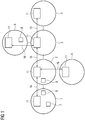
- FIG 1 shows a greatly simplified, purely schematic representation of an industrial TSN network, which is divided into several, in the present case six TSN domains 1-6.
- Each of the domains has a number of participants, which are present in the form of terminals 7, 8 and network nodes, specifically bridges 9.
- terminals 7, 8 and network nodes specifically bridges 9.
- FIG 1 purely by way of example, only two terminals 7, 8 and two bridges 9 are shown, which are located in domains 1, 2 and 5.
- other participants specifically terminals 7, 8 and bridges 9, are provided that also participate in the network.
- the bridges 9 are TSN-capable, so that protected connections in the form of TSN streams are set up in the network and stream data packets are protected, especially when in use can be transmitted by network resources reserved at participating bridges 9.
- TSN reference is also made to the various previously known standards, for example IEEE 802.1Q, IEEE 802.1AB, IEEE 802.1 AS-REV and IEEE 802.1 Qcc.
- Each domain 1-6 is assigned a unique domain identifier 10 (see FIG 2 ).
- the domain experts 10 of different domains 1-6 differ from one another.
- each of the domains 1-6 is assigned a domain manager 11, which is responsible for finding paths P or path sections P1-P3, P5 (see FIG FIG 4 ) is responsible in the respective domain 1-6 and to which a domain manager identifier 12 is or will be assigned.
- the assignment of domain manager 11 is preferably carried out as part of the TSN domain formation as an administrative process.
- the respective domain 1-6 and the respective domain manager 11 are preferably also assigned their identifiers or names.
- the domain managers 11 can also be provided as a component or as a (possibly functional) module of an NME (Network Management Engine) or a CNC (Central Network Controller) of the respective domain 1-6, which in addition to the tasks of the domain manager 11 take on other tasks.
- NME Network Management Engine
- CNC Central Network Controller
- the domain manager identifier 12 of the domain manager 11 belonging to their domain 1-6 and the domain identifier 11 of their domain 1-6 are known or made known to all participants 7-9 of each domain 1-6.
- Each subscriber 7-9 has received the domain identifier 10 of his domain 1-6 via an object in a Management Information Base MIB 13 or extension MIB, which is given by a TSN domain identification in the exemplary embodiment shown.
- each subscriber 7-9 has received the domain manager identifier 12 of the domain manager 11 of his domain 1-6 via an object in his management information base MIB 13.
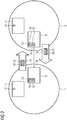
- FIG 2 shows the domains 1 and 2 as well as a subscriber 9 of these, specifically a bridge 9 of each of the two domains 1, 2 in an enlarged view.
- the two bridges shown are edge bridges 9 of their respective domains 1, 2, since they each have a port 15 which is connected to a port 15 of a participant, specifically the bridge 9 from another domain 1, 2.
- the ports 15 are the two last ports 15 or ports 15 located on the edge in their domain 1, 2.
- These ports 15 can also be referred to as edge ports.
- one edge bridge 9 of a domain 1, 2 receives the domain identifier and domain name from the other edge bridge 9 of another domain 1, 2. Manager expert of the neighboring domain 1, 2.
- the subscribers 7-9 store this data or information, subscriber-neighbor information, received from neighbors via LLDP-DUs 14, as objects in their MIBs 13 or extension MIBs.
- the domain managers 11 each read out the subscriber-neighbor information stored by all subscribers in their domain 1-6. In doing so, they receive the domain experts and domain manager experts 12 of their neighboring domains 1-6 via their edge participants.
- FIG 2 it is the case that the domain manager 11 of the domain 1 receives the domain identifier 10 of the domain 2 and the domain manager identifier by reading out the corresponding MIB objects 10, 12 of the edge bridge 9 of its domain shown 12 of the domain manager 11 of domain 2.
- the domain manager 11 of domain 2 receives domain identifier 10 and domain manager identifier 12 of domain 1 in the same way from its edge bridge 9 shown. This means that they know the domain Manager 11, which domains 1-6 are neighboring domains 1-6 and they have the domain manager expert 12 of the domain manager 11 of these.
- Neighboring domain managers 11 then communicate using the domain manager identifier 12 obtained from the respective neighboring domains 1-6.
- a connection 16 is established between adjacent domain managers 11, that is to say domain managers 11 in adjacent domains 1-6, which is purely schematically shown in FIG FIG 3 is shown, there by way of example for a connection 16 between the domain managers 11 of domains 1 and 2.
- Such a connection or neighboring connection 16 is also established between the further neighboring domain managers 11, specifically between those of domains 2 and 6 , 2 and 3, 3 and 5 and 3 and 4, as in FIG 1 indicated by corresponding arrows.
- Manager-neighbor information is then exchanged via the connections 16 established between neighboring domain managers 11.
- Each domain manager 11 shares each neighboring domain manager 11 with its own domain identifier 10 and information as to whether, and if so, which other domains 1-6 the respective neighboring domain manager 11 can reach via the respective domain manager 11 can with.
- This exchange between neighboring domain managers 11 is in FIG 5 shown schematically.
- the information transmitted to the neighbor 11 in each case, which includes the own domain identifier 10 and the indication of which neighbors can possibly still be reached, is provided with the reference symbol 17.
- a domain manager 11 informs its neighbors which TSN domains 1-6 they can reach via its TSN domains 1-6. This information is used to set up a local routing database, from which the information in QueryPath for the domain manager 11 to be asked.
- a domain manager 11 notifies its direct neighbor of all TSN domains 1-6 that can be reached via it. It preferably does not "reflect" any TSN domains back to the neighbor. This means that it supplies the respective neighbor with all TSN domins 1-6 that it knows, but deletes all entries that it has received from this neighbor before the transfer.
- the communication between the respectively neighboring domain managers 11 takes place via LRP over TCP.
- the domain manager 11 from domain 2 informs the domain manager 11 from domain 1, in addition to his domain expert, that the domain manager from domain 1 can not only reach him but all other domains, including domains 3-6, through him .
- the domain manager 11 from the domain 1 informs the domain manager 11 from the domain 2, in addition to the domain expert 10 of his domain 1, that only he can be reached (but no other domain through him).
- the domain manager 11 from domain 2 also informs the person from domain 6, in addition to his domain expert 10, that all other domains, including domains 1, 3-6, can be reached via him.
- the domain manager 11 of domain 3 informs the domain manager 11 of domain 2 that he can still reach the other domains 1 and 6 via him.
- the domain manager 11 of domain 3 notifies the person from domain 2, in addition to the domain expert 10 of his domain 3, that he can also reach domains 4 and 5 through him.
- the domain manager 11 from domain 4 is informed by the one from domain 3 that he can still reach all other domains, i.e. 1, 2, 5 and 6 via him, and he informs the one from domain 5 that he can still access all of them other domains, i.e. 1, 2, 4, and 6.
- the domain managers 11 from domains 4 and 5 each inform the domain manager 11 from domain 3 that it can only reach them directly, but no other domains via them.
- the domain manager 11 from domain 6 also communicates this to the one from domain 2.
- the domain managers 11 each know which domains the respective neighbor can still reach via them because each domain manager 11, which receives the manager-neighbor information from a neighboring domain manager 11 in addition to its domain identifier, tells which domains are via the directly neighboring domain manager 11 can still be reached, forwards this information to one or more other neighboring domain managers, if available.
- domain manager 11 Since the information about who can be reached is passed on from domain manager 11 to domain manager 11, they each know which domains - from the point of view of the respective neighbors - are still "behind them", although in each case only direct neighbor managers with each other " speak".
- the exchanged manager-neighbor information is then used to find and establish at least one path P between two subscribers 7, 8 located in different domains 1-6, which is shown in an exemplary and purely schematic manner FIG 4 is shown.
- the subscriber 7 from domain 1 sends a request 18 for a path / path section and stream to the domain manager 11 from its domain 1.
- the domain manager 11 has an interface via which the subscribers of its domain 1 can request the establishment of a path / path section and stream, for example via a QueryPath service.
- the domain managers 11 of the other domains 2-6 also each have such an interface.
- a domain manager 11 that sends a request for the establishment of a path P / path section P1-P3, via an interface from a subscriber 7, 8 of its domain 1-6 or from another domain manager 11 of a neighboring domain 1-6, P5 and streams to a participant in another domain 1-6 finds a path section P1-P3, P5 in its domain 1-6 and establishes this or the stream on this. It also forwards the request 18 to that neighboring domain manager 11 which is assigned to the other domain 1-6 or via which the other domain 1-6 can be reached according to the exchanged manager-neighbor information 17. This is in FIG 4 shown, the request 18 from subscriber 7 from domain 1 to his domain manager 11 being indicated by an arrow.
- the domain manager 11 checks its route tables established via the domain manager 11 to the domain manager 11 communication to determine whether it knows a path to the other TSN domain 1-6. The route goes through the domain manager 11 of the other TSN domain 1-6. Therefore, an interface defined for the domain manager 11 to domain manager 11 communication addresses the domain manager 11 of the other TSN domain 1-6 for path / stream establishment.
- a domain manager 11 who receives an inquiry 18 for the establishment of a path P or path section from a subscriber 7, 8 of his domain 1-6 or another domain manager 11 P1-P3, P5 to a subscriber 7, 8 of his domain 1-6 and receives stream on this, finds and establishes the required path P or path section P1-P3, P5 or stream on this in his domain 1-6. In this case, the path request does not need to be forwarded and accordingly does not take place.
- a request 18 for the establishment of a path / stream from a subscriber 7, 8 in a TSN domain 1-6 to a subscriber 7, 8 in the same TSN domain 1-6 includes the specification of the two subscribers but not the source - and target domain.
- QueryPath for example, only the terminals 7, 8 involved are specified in this case and a path P or path section P1-P3, P5 within the domain 1-6 is requested, which is established by the local domain manager 11 of the domain 1-6 .
- a request for the establishment of a path P from a subscriber 7, 8 in a TSN domain 1-6 to a subscriber 7, 8 in another TSN domain 16 includes, in addition to specifying the two subscribers, the specification of their domains 1- 6, i.e. the source and target domains.
- the participating end stations 7, 8 including or plus the TSN domain are specified and a path P is established across all participating TSN domains 1-6 and domain manager 11.
- the path request 18 includes, for example, the information TSN Domain 1.7 and TSN Domain 5.8.
- the domain manager 11 from domain 1 finds and establishes a path section P1 in its domain 1 and additionally forwards the request 18 to the neighboring domain manager 11 from domain 2, which also does this, whereby it the path section P2 in its domain finds and established and forwards the request 18 to the manager 11 of domain 3.
- the manager 11 of this domain 3 establishes the path section 3 and forwards the request to the manager of domain 5, who finds and establishes the last path section P5 in his domain 5. A forwarding of the request 18 by the manager 11 of the target domain 5 is then no longer necessary.
- ports of participants that form domain borders are configured, in particular by setting a VLAN exchange or an exchange of a DMAC and a VLAN.
- stream data can be transmitted via the cross-domain path P or stream data are transmitted.
- one or more routers 20 can be provided in a network. If this is the case, at least one of the routers 20 can form a router domain 21. This means in particular that the router 20 forms its own domain, in particular TSN domain 21, or behaves outwardly like a domain, in particular TSN domain 21.
- a router 20 forming a (TSN) router domain 21 is then assigned its own domain identifier 10 and the router 20 implements a domain manager 11 and the router 20 is assigned a domain manager 11.
- TSN TSN
- FIG 6 shows an enlarged illustration of a router 20 n forming a router domain 21
- FIG FIG 7 the network off FIG 1 , with the router 20 being provided instead of the domain 3 with several participants, which in turn forms a domain 21.
- the router has two ports 22, 23 and a bridge 9 from another, neighboring domain 2, 4 is connected to each port 22, 23, specifically to the one in FIG 6 left port 22 a bridge 9 from domain 2 and with right port 23 a bridge from domain 4.
- the bridges 9 shown are edge bridges of the neighboring domains 2, 4.
- a router 20 that forms its own domain 21 behaves, as far as the exchange of subscriber and manager-neighbor information is concerned, like a domain 1-6 that is not formed by a router 20, with the proviso that the router 20 also reveals itself that he is a router 20. He can, for example, transmit his domain identifier 10 and / or his domain manager identifier 12 as subscriber-neighbor information 14 to subscribers in neighboring domains 2, 4. In analogy to domains 1-6, for example in the form of LLDP-DUs.
- the subscriber-neighbor information 14 and the manager-neighbor information 17 are transmitted via the respective port 22, 23.
- the domain manager 11 of a router domain 21 which receives a request for the establishment of a path P to a subscriber 7, 8 in another domain 1-6 from a domain manager 11 of a neighboring domain 1-6, finds complete analogy to the domain managers 11 of classic domains 1-6 a path section in its domain 21 and additionally forwards the path request 18 to that neighboring domain manager 11 which is assigned to the other domain 1-6 or via which the other domain 1-6 6 can be reached according to the exchanged manager-neighbor information 17. It's in the FIG 7 schematically shown in which the path 19 of the path request forwarding and the path P go through the router domain 21. It should be noted that a path or path section is generally found in a router TSN domain 21 when the destination TSN domain 1-6 can be reached via a port of the router 20.
- TSN TSN
- IP / UDP packets can be transmitted via TSN streams between different IP subnets - with IP subnetwork transition .
- the domain manager 11 not only indicates to a router domain 21 that its domain is a router 20 or is formed by such a router, but the domain managers 11 also indicate domains 1-6 not formed by the router 20 indicate that their domains are not router domains. In particular, they inform neighboring domain managers in addition to their domain experts and / or domain manager experts that they are not routers 20 or that their domains 1-6 are not router domains 21. This information is preferably part of the exchanged manager-neighbor information 17, which is shown schematically in FIG.
- the manager-neighbor information 17 would be in the in FIG 5 shown example, in which the network does not have a router forming a router domain, all include the information or specification that the respective domain manager 11, from which the respective information originates, is not a router or its domain is not through a router is formed ("I am not a router").
- the in FIG 7 The example shown would be the manager-neighbor information 17, which the domain manager 11 of the router 20 sends to the manager of domains 2 and 4 that it is a router domain 21 ("I am a router").
- the exchange of subscriber-neighbor information 14 between neighboring subscribers and the acquisition of the associated objects 10, 12 from the MIBs 13 by the respective domain manager 11 and the exchange of manager-neighbor information 17 between neighboring domain managers 11 are preferred cyclically, for example every 5 seconds. Alternatively or additionally, it can also be event-driven, for example every time a change is detected. So the status is always up to date and changes can be recorded.
- a domain manager 11 is a central entity
- one or more, possibly all, domain managers can also be implemented as distributed domain managers 24.
- the (respectively) associated TSN domain 1-6 can be distributed or managed "distributed".
- At least one domain manager 24 comprises two or more domain manager agents 25 or is formed by two or more domain manager agents 25 which are preferably implemented on different subscribers 9 of its domains 1-6 .
- each edge subscriber 9 of the (respective) domain 1-6 specifically each subscriber who has a port 15 that is connected to port 15 of a subscriber 9 of another domain 1-6, at least one domain manager agent 25 implemented.
- the domain manager agents 25 then in particular jointly form a “virtual” domain manager 24 and can communicate with the domain managers 11, 24 (possibly with domain manager agents 25 of these) of the neighboring domain (s) 1 -6 take over.
- the "virtual" domain manager 24 formed by the distributed agents 25 is in the FIG 8 shown with a dot-dash line.
- the domain manager agents 25 of a domain 1-6 or of a domain manager 24 can communicate with one another in order to receive the information required for inter-domain communication. As exemplified in the FIG 8 shown, then in particular each edge bridge 9 of a domain 1-6 implements a domain manager agent 25. The agents 25, so to speak, take over the communication with the (dedicated or distributed) domain managers on behalf of a central / dedicated domain manager 11 11, 24 of the neighboring domains 1-6.
- the domain manager of domain 3 could be from the FIG 1 can be formed by a "virtual" domain manager 24 with a plurality of distributed domain manager agents 25, as in FIG FIG 8 shown.
- request 18 would be passed on via path 19 as in FIG 4 for the case of a central domain manager 11, this being handled in the domain 3 by the domain manager agents 25, and the path P or the path sections P1-P3, P5 would be the same.
- the domain manager it is also possible for the domain manager to select several or all of the domains 1-6 FIG 1 are each formed by a plurality of distributed domain manager agents 25.
- the inventive approach described above solves the problems of who is responsible for finding and in particular establishing paths P and streams in the case of cross-TSN domain communication and how to get the target TSN domain and a route from a device 7,8 in a TSN domain 1-6 to a device 7, 8 in another TSN domain 1-6.
- the procedure according to the invention avoids a domain manager 11, 24 having more than his participants, that is to say more than his participants 7-9 Domain 1-6 must know. Paths and streams can be established between them even without knowing all participants 7-9 of all domains 1-6.
- TSN domains 1-6 can dynamically dock or undock with one another. For example, new TSN domains can be added, TSN domains can be omitted or TSN domains can also change their "docking point" without an engineering tool having to configure a (new) overall topology.
- the change of the "docking point" of a TSN domain 4 is purely schematic in FIG FIG 9 shown. Specifically, the domain 4 is “uncoupled” from the domain 3 and “coupled” to the domain 2.
- the domain 4 is formed by an autonomous guided vehicle, which is an example of a moving machine that can dock on different parts of a system and thus on different TSN domains 1-6, for example when it drives around to pick up and / or unload goods.
- the route information "via which domain connection I can reach which other domain or domains” is automatically updated and the domain can be found again even with such a change (possibly multiple times).
Landscapes
- Engineering & Computer Science (AREA)
- Computer Networks & Wireless Communication (AREA)
- Signal Processing (AREA)
- Data Exchanges In Wide-Area Networks (AREA)
Priority Applications (2)
| Application Number | Priority Date | Filing Date | Title |
|---|---|---|---|
| EP19186769.6A EP3767899A1 (fr) | 2019-07-17 | 2019-07-17 | Procédé de communication de données, réseau, programme informatique et support lisible par ordinateur |
| PCT/EP2020/066676 WO2021008800A1 (fr) | 2019-07-17 | 2020-06-17 | Procédé de communication de données, réseau, programme informatique et support lisible par ordinateur |
Applications Claiming Priority (1)
| Application Number | Priority Date | Filing Date | Title |
|---|---|---|---|
| EP19186769.6A EP3767899A1 (fr) | 2019-07-17 | 2019-07-17 | Procédé de communication de données, réseau, programme informatique et support lisible par ordinateur |
Publications (1)
| Publication Number | Publication Date |
|---|---|
| EP3767899A1 true EP3767899A1 (fr) | 2021-01-20 |
Family
ID=67437847
Family Applications (1)
| Application Number | Title | Priority Date | Filing Date |
|---|---|---|---|
| EP19186769.6A Withdrawn EP3767899A1 (fr) | 2019-07-17 | 2019-07-17 | Procédé de communication de données, réseau, programme informatique et support lisible par ordinateur |
Country Status (2)
| Country | Link |
|---|---|
| EP (1) | EP3767899A1 (fr) |
| WO (1) | WO2021008800A1 (fr) |
Cited By (1)
| Publication number | Priority date | Publication date | Assignee | Title |
|---|---|---|---|---|
| EP3958509A4 (fr) * | 2019-05-20 | 2022-06-15 | Huawei Technologies Co., Ltd. | Procédé, appareil et système de communication entre des contrôleurs dans tsn |
Families Citing this family (2)
| Publication number | Priority date | Publication date | Assignee | Title |
|---|---|---|---|---|
| CN114793207A (zh) * | 2021-01-26 | 2022-07-26 | 中国移动通信有限公司研究院 | 数据处理方法、装置、网络边界设备及分布式管理设备 |
| CN116419100A (zh) * | 2021-12-30 | 2023-07-11 | 华为技术有限公司 | 一种连通光传送网业务的方法和设备 |
Citations (1)
| Publication number | Priority date | Publication date | Assignee | Title |
|---|---|---|---|---|
| US20150244607A1 (en) * | 2014-02-26 | 2015-08-27 | Futurewei Technologies, Inc. | Software Defined Networking (SDN) Specific Topology Information Discovery |
-
2019
- 2019-07-17 EP EP19186769.6A patent/EP3767899A1/fr not_active Withdrawn
-
2020
- 2020-06-17 WO PCT/EP2020/066676 patent/WO2021008800A1/fr not_active Ceased
Patent Citations (1)
| Publication number | Priority date | Publication date | Assignee | Title |
|---|---|---|---|---|
| US20150244607A1 (en) * | 2014-02-26 | 2015-08-27 | Futurewei Technologies, Inc. | Software Defined Networking (SDN) Specific Topology Information Discovery |
Cited By (2)
| Publication number | Priority date | Publication date | Assignee | Title |
|---|---|---|---|---|
| EP3958509A4 (fr) * | 2019-05-20 | 2022-06-15 | Huawei Technologies Co., Ltd. | Procédé, appareil et système de communication entre des contrôleurs dans tsn |
| US11811511B2 (en) | 2019-05-20 | 2023-11-07 | Huawei Technologies Co., Ltd. | Method, apparatus, and system for communication between controllers in TSN |
Also Published As
| Publication number | Publication date |
|---|---|
| WO2021008800A1 (fr) | 2021-01-21 |
Similar Documents
| Publication | Publication Date | Title |
|---|---|---|
| EP1618708B1 (fr) | Procede pour la configuration automatique d'un dispositif de communication | |
| DE69215659T2 (de) | Verfahren und einrichtung für transparente brückenbildung für den verkehr über fernbereichsnetze | |
| DE69918332T2 (de) | Virtuelle lokale netze mit prioritätsregeln | |
| DE60305581T2 (de) | Verfahren zur Ausführung eines Routerschnittstellen-Backups mit VRRP (Virtual Router Redundancy Protocol) | |
| DE60133641T2 (de) | Kommunikationssystem und verfahren dafür | |
| EP3577871B1 (fr) | Procédé et dispositif permettant l'orientation modulaire d'un flux avb | |
| EP3618384B1 (fr) | Procédé de simulation d'un traitement des requêtes de réservation pour flux de données multidiffusion dans des réseaux de communication et un système de simulation | |
| DE60133175T2 (de) | Kommunikationsnetz | |
| EP3767899A1 (fr) | Procédé de communication de données, réseau, programme informatique et support lisible par ordinateur | |
| DE60202454T2 (de) | Mechanismus zum Aufbauen einer Verbindung für ATM über MPLS | |
| DE60211287T2 (de) | Handhabung von Verbindungen, die zwischen Firewalls umziehen | |
| DE60112940T2 (de) | Ausfallsicherer Netzwerkschalter | |
| DE60318601T2 (de) | Verfahren zur automatischen konfiguration einer ip-fernsprecheinrichtung und/oder daten, system und einrichtung zu ihrer implementierung | |
| DE10238291A1 (de) | Effizientes Intra-Domain Routing in Paketnetzen | |
| DE60316158T2 (de) | Filter zur verkehrstrennung | |
| DE60131889T2 (de) | Verfahren und telekommunikationsknoten zur verteilung von abschlussverkehr in einem telekommunikationsknoten | |
| WO2002023828A1 (fr) | Procede pour etablir des liaisons avec des qualites de service predefinies dans un reseau de communication oriente paquet, a l'aide d'un gestionnaire de ressources | |
| EP4125253A1 (fr) | Procédé de transmission de données temporellement critiques, système de communication et appareil de communication couplée | |
| EP3874333B1 (fr) | Procédé de transfert de données à sécurité intégrée, noeud de réseau, programme informatique et support lisible par ordinateur | |
| DE60223386T2 (de) | Verfahren zur überwaltung eines netzes mit einer netzübergangseinrichtung zwischen zwei havi-netzwerken | |
| DE60314890T2 (de) | Verfahren zur leitweglenkung von datenpaketen, und vorrichtungen zur implementierung dieses verfahrens | |
| EP3614642B1 (fr) | Procédé de réglage d'un flux, procédé de fourniture des informations d'identification du flux, utilisation d'un serveur de service nommé, appareil, programme informatique et support lisible par ordinateur | |
| EP3672163A1 (fr) | Procédé de communication de données, appareil de communication, programme informatique et support lisible par ordinateur | |
| WO2019145297A1 (fr) | Procédé de communication de données dans un réseau, en particulier industriel, basé ethernet dispositif pour la mise en oeuvre dudit procédé ainsi que programme informatique et support lisible par ordinateur | |
| WO2020164810A1 (fr) | Procédé de transmission de données, appareil, programme d'ordinateur et support lisible par ordinateur |
Legal Events
| Date | Code | Title | Description |
|---|---|---|---|
| PUAI | Public reference made under article 153(3) epc to a published international application that has entered the european phase |
Free format text: ORIGINAL CODE: 0009012 |
|
| STAA | Information on the status of an ep patent application or granted ep patent |
Free format text: STATUS: THE APPLICATION HAS BEEN PUBLISHED |
|
| AK | Designated contracting states |
Kind code of ref document: A1 Designated state(s): AL AT BE BG CH CY CZ DE DK EE ES FI FR GB GR HR HU IE IS IT LI LT LU LV MC MK MT NL NO PL PT RO RS SE SI SK SM TR |
|
| AX | Request for extension of the european patent |
Extension state: BA ME |
|
| STAA | Information on the status of an ep patent application or granted ep patent |
Free format text: STATUS: THE APPLICATION IS DEEMED TO BE WITHDRAWN |
|
| 18D | Application deemed to be withdrawn |
Effective date: 20210721 |