EP3768109B1 - Procédé, dispositif et système de mesure, d'évaluation et de simulation d'une chaussure - Google Patents
Procédé, dispositif et système de mesure, d'évaluation et de simulation d'une chaussure Download PDFInfo
- Publication number
- EP3768109B1 EP3768109B1 EP19714314.2A EP19714314A EP3768109B1 EP 3768109 B1 EP3768109 B1 EP 3768109B1 EP 19714314 A EP19714314 A EP 19714314A EP 3768109 B1 EP3768109 B1 EP 3768109B1
- Authority
- EP
- European Patent Office
- Prior art keywords
- shoe
- person
- values
- height
- pressure
- Prior art date
- Legal status (The legal status is an assumption and is not a legal conclusion. Google has not performed a legal analysis and makes no representation as to the accuracy of the status listed.)
- Active
Links
Images

Classifications
-
- A—HUMAN NECESSITIES
- A43—FOOTWEAR
- A43D—MACHINES, TOOLS, EQUIPMENT OR METHODS FOR MANUFACTURING OR REPAIRING FOOTWEAR
- A43D1/00—Foot or last measuring devices; Measuring devices for shoe parts
- A43D1/02—Foot-measuring devices
-
- A—HUMAN NECESSITIES
- A43—FOOTWEAR
- A43B—CHARACTERISTIC FEATURES OF FOOTWEAR; PARTS OF FOOTWEAR
- A43B7/00—Footwear with health or hygienic arrangements
- A43B7/14—Footwear with health or hygienic arrangements with foot-supporting parts
- A43B7/1405—Footwear with health or hygienic arrangements with foot-supporting parts with pads or holes on one or more locations, or having an anatomical or curved form
- A43B7/1455—Footwear with health or hygienic arrangements with foot-supporting parts with pads or holes on one or more locations, or having an anatomical or curved form with special properties
- A43B7/1464—Footwear with health or hygienic arrangements with foot-supporting parts with pads or holes on one or more locations, or having an anatomical or curved form with special properties with adjustable pads to allow custom fit
-
- A—HUMAN NECESSITIES
- A43—FOOTWEAR
- A43D—MACHINES, TOOLS, EQUIPMENT OR METHODS FOR MANUFACTURING OR REPAIRING FOOTWEAR
- A43D1/00—Foot or last measuring devices; Measuring devices for shoe parts
- A43D1/02—Foot-measuring devices
- A43D1/025—Foot-measuring devices comprising optical means, e.g. mirrors, photo-electric cells, for measuring or inspecting feet
-
- A—HUMAN NECESSITIES
- A43—FOOTWEAR
- A43D—MACHINES, TOOLS, EQUIPMENT OR METHODS FOR MANUFACTURING OR REPAIRING FOOTWEAR
- A43D1/00—Foot or last measuring devices; Measuring devices for shoe parts
- A43D1/02—Foot-measuring devices
- A43D1/027—Shoe fit indicating devices
-
- A—HUMAN NECESSITIES
- A61—MEDICAL OR VETERINARY SCIENCE; HYGIENE
- A61B—DIAGNOSIS; SURGERY; IDENTIFICATION
- A61B5/00—Measuring for diagnostic purposes; Identification of persons
- A61B5/103—Measuring devices for testing the shape, pattern, colour, size or movement of the body or parts thereof, for diagnostic purposes
- A61B5/1036—Measuring load distribution, e.g. podologic studies
-
- A—HUMAN NECESSITIES
- A61—MEDICAL OR VETERINARY SCIENCE; HYGIENE
- A61B—DIAGNOSIS; SURGERY; IDENTIFICATION
- A61B5/00—Measuring for diagnostic purposes; Identification of persons
- A61B5/103—Measuring devices for testing the shape, pattern, colour, size or movement of the body or parts thereof, for diagnostic purposes
- A61B5/107—Measuring physical dimensions, e.g. size of the entire body or parts thereof
- A61B5/1074—Foot measuring devices
-
- A—HUMAN NECESSITIES
- A43—FOOTWEAR
- A43D—MACHINES, TOOLS, EQUIPMENT OR METHODS FOR MANUFACTURING OR REPAIRING FOOTWEAR
- A43D2200/00—Machines or methods characterised by special features
- A43D2200/60—Computer aided manufacture of footwear, e.g. CAD or CAM
-
- A—HUMAN NECESSITIES
- A61—MEDICAL OR VETERINARY SCIENCE; HYGIENE
- A61B—DIAGNOSIS; SURGERY; IDENTIFICATION
- A61B2562/00—Details of sensors; Constructional details of sensor housings or probes; Accessories for sensors
- A61B2562/02—Details of sensors specially adapted for in-vivo measurements
- A61B2562/0247—Pressure sensors
Definitions
- the invention relates to a method for measuring and evaluating the functions and shape of a shoe, in particular a sports shoe such as a running or ski boot.
- the invention also relates to a method for generating data for the production of a shoe individually adapted to a person.
- the invention relates to a system for simulating a shoe, which can be used to generate data for the production of shoes.
- the invention relates to a shoe simulation device comprising the system and by means of which the method can be carried out.
- molded parts can be precisely designed using 3D printing techniques.
- the wearer When manufacturing parts based solely on measurements, the wearer only has the opportunity to experience how the shoe feels after it has already been manufactured. In particular, the wearer has no direct influence on the final product. As a result, the wearer may be dissatisfied with the finished shoe because it differs from their desired design.
- the object of the present invention is to provide a method and system that is as simple and practical as possible and that can be used in a retail store and makes it possible to generate data on the basis of which a shoe can be produced that corresponds to the person's wishes.
- the shape, dimensions and/or materials of the shoe sole are determined based on the recorded pressure values.
- the pressure distribution of the shoe is first determined using a pressure distribution measuring device, whereby the pressure distribution can be measured statically, i.e. standing, or dynamically, i.e. walking or running.
- the shoe simulation device is then adjusted.
- the person uses the shoe simulation device by applying pressure to the shoe sole or the shoe insole.
- the pressure on the shoe simulation device can be static, i.e., while standing, or dynamic, i.e., while walking or running.
- the person perceives the shoe sole with the properties that a shoe will exhibit after production. This advantageously ensures that the person is familiar with the properties when purchasing the shoe, thus avoiding incorrect purchases.
- the shoe simulation device has a shoe sole, which in turn has a plurality of support sections, wherein the support sections can be individually controlled in terms of height and at least one physical property.
- the support sections can be individually controlled in terms of height and at least one physical property.
- the profile of the shoe sole can be individually adjusted. Based on the pressure distribution, for example, it can be determined which sections of the shoe sole are subjected to greater stress by the person, so that a lower height is set for these sections.
- the support sections are designed so that the mechanical properties for each of the support sections can be individually and independently adjusted. In this way, a shoe sole can be simulated that has comparable mechanical properties to the manufactured shoe.
- the shoe simulation device can also comprise a shoe insert that, during intended use, is inserted into a shoe of a specific type and that has a plurality of adjustable support sections. In this way, a customized shoe insert can be produced for a specific shoe.
- a customized shoe insert as a component of a shoe allows for the creation of a customized shoe.
- controllable mechanical properties of the support sections of the shoe sole and the shoe insole are hardness, flexibility, and elasticity. Controlling the hardness is particularly preferred.
- One embodiment of the method is characterized in that it comprises an additional assessment step in which the person assesses whether the locally set values of the shoe simulation device correspond to the personal optimum or desired setting. If the desired setting is not achieved using the currently set values for the height and/or the mechanical properties of the support sections, a further adjustment step is carried out with modified set values.
- the person and/or a third party for example a store employee, can enter whether the settings correspond to the personal optimum using an operating unit on the computer unit.
- a mobile input device that is wirelessly connected to the computer unit can preferably be used for this purpose.
- the calculation of new, modified values for the height and/or the mechanical properties is performed using the computer unit, with newly set values being calculated for essentially all support sections, which replace the existing set values.
- preset parameters can be selected, using which the person can choose between an overall softer or harder setting for the support sections. The selection can preferably be made using the input device.
- the shoe simulation device is preferably designed so that the person uses it during the adjustment step, i.e., by placing weight on the shoe sole.
- the advantage of performing the adjustment step with the shoe sole under load is that the person immediately perceives the change and can thus better assess whether a change in the desired direction is taking place.
- Manufacturing, measurement and evaluation are significantly improved when the data/measurement data of a known optimal shoe are collected and this data is compared and used with the data measured by one of the above methods.
- an optimization step is carried out in which the height and/or at least one mechanical property of the support sections are each locally adjusted using an input device.
- the input device can be a mobile device with a program application that exchanges data with the computer unit wirelessly.
- the shoe simulation device can also be used, i.e., the shoe sole can be loaded, or not used, i.e., the shoe sole can be unloaded.
- the adjustable local change in the properties of the support sections is particularly advantageous for people for whom a local change in the height profile and/or mechanical properties is necessary for orthopedic or medical reasons. This can be beneficial, for example, for people with neurological disorders, such as diabetes, to apply certain stimuli to the sole of the foot in order to improve their own perception of body movement (proprioception).
- the method utilizes at least one holding device, which is provided in the simulation device to fix the person's foot to the shoe sole, the length of which is adjusted to adapt to the anatomy of the respective person.
- the shoe upper can also be simulated by the shoe simulation device, so that the person perceives the simulated shoe as a coherent unit.
- the precise design of the holding device can vary depending on the shoe type.
- at least one of the holding devices has a contraction unit, the length of which can be adjusted to a desired value using the computer unit, the input device, and/or manually. In this way, the length of the respective holding device can be specifically controlled and specifically maintained for the respective person.
- Controlling the length of the contraction unit using the input device has the advantage that the person can specifically control the length of the holding device, preferably when using the shoe simulation device, i.e., the shoe sole or the shoe insole. This allows the patient to directly experience the effect of changing the length of individual support devices. In particular, in combination with local changes to the height and/or mechanical properties of the support sections, this method allows for individually optimized settings to be found to meet the patient's needs. Targeted adjustment of the length of the support devices can advantageously achieve an orthopedic-technical effect.
- One embodiment of the method is characterized in that the values considered optimal by the person for the height and/or the at least one mechanical property of the support sections and/or the length of the holding means are stored in a memory unit.
- the optimal settings for a person can be recorded and reproduced at any location and at any time.
- a shoe simulation device located elsewhere can be controlled using the stored values so that the setting can be experienced by a person at a different location.
- the person can perceive the simulated shoe at a later time, for example if the person only decides to make a purchase or a purchasing decision at a later time.
- the stored values are used as data for the production of individually fitted shoes.
- the data stored as values for the height and/or at least one mechanical property of the support sections and/or the length of the retaining means make it possible to produce the shoe deemed optimal at a different location. This eliminates any differences between the produced shoe and the simulated shoe, except for manufacturing tolerances. This advantageously prevents incorrect purchases.
- the spatial shape of the person's foot is additionally determined by means of at least one scanning device during the measuring step.
- a scanning device provides additional information that is directly relevant for determining the heights of the support sections, or rather for the profile of the shoe sole or shoe insole.
- Commercially available 3D scanners can be used as scanning devices.
- the shape of the foot is preferably measured when the foot is freely positioned in space, i.e. when not under load.
- a display unit visually suggests to the person that they are wearing a shoe which has an external shape (design, colour, symbolism) which the person has selected or has selected.
- a screen which the person looks at and on which a specific shoe is displayed at the location of the feet can be used as the display unit.
- the display unit is preferably virtual reality glasses on which the shoes are displayed at the location where the person's feet are located.
- the immersion i.e. the perception of the simulated environment as reality
- a perception of the simulated shoe as a real shoe is achieved.
- an external appearance of the shoe can be displayed that the customer has designed or is designing himself, so that individualization can also be carried out and perceived with regard to the external shape.
- Such a system can be used to implement the process described above and thus be used in the production of a shoe that is individually tailored to a person.
- the system features components that have a small footprint, making it ideal for use in retail stores.
- the pressure distribution measuring device of the system is preferably a pressure plate, a pressure measuring film, or a sensitive insole.
- a pressure plate is preferred because it has spatial resolution and pressure sensitivity, which allows the pressure distribution of the sole of the foot to be determined both statically (i.e., while standing) and dynamically (i.e., while walking or running). Capacitive pressure plates are particularly preferred.
- One embodiment of the invention is characterized in that the system comprises at least one scanning device designed to determine the spatial shape of the foot. Using scanning systems, the shape of the foot can be easily determined. The data obtained in this way can be used directly to determine the values for the heights of the support sections, or for the profile of the shoe sole.
- the system comprises an input device designed to adjust the height and/or at least one mechanical property of the support sections depending on the location.
- the values can be changed and optimized locally by the person or a third party.
- the input device is designed to perform a parameter selection during the adjustment step.
- the system comprises a display unit designed to give the user the impression that they are wearing a shoe of a specific type or design.
- the design can preferably be selected by the user, so that a desired version of the shoe can also be simulated with regard to the external design.
- the user can design the external appearance themselves.
- the system preferably comprises a movably mounted shoe simulation device.
- This allows the shoe simulation device to track the corresponding foot during a natural walking movement or weight shift. This advantageously creates a realistic feeling.
- the simulation device is particularly preferably mobile, so that the A person can walk or run around with it. In this case, it is preferred that the shoe simulation device be connected to the computer unit via radio.
- the shoe simulation device is detachable from the system, while retaining the adjusted values for the height and/or the at least one mechanical property.
- the shoe simulation device comprises a shoe insole.
- the shoe insole is inserted into a shoe during adjustment that the person subsequently wishes to continue using.
- the disclosure also relates to a shoe simulation device designed to accommodate a person's foot.
- the shoe simulation device has a shoe bottom or a shoe insert that has a plurality of support sections, the height and/or at least one mechanical property of which can each be individually controlled.
- the support sections can have any basic shape.
- the individual support sections form a grid in which all support sections have the same basic shape, for example, squares or circles.
- the support sections have ergonomically adapted shapes that replicate individual foot zones, for example, an elliptical shape for the heel area or a kidney shape for the ball of the foot. This allows for a better adaptation of the values for the mechanical properties of the support sections to the respective function.
- the shoe simulation device comprises at least one holding means which is adjustable in length and is intended to encompass the person's foot and fix it to the shoe sole. This allows, in particular, the upper structure of the shoe to be simulated and made perceptible to the person.
- at least one holding means comprises at least one contraction element, the length of which can be adjusted by means of a computer unit and/or by an input device and/or manually.
- the support sections of the shoe simulation device each have sensors designed to determine a force exerted on the respective support section.
- the shoe simulation device itself as a sensor unit with which the setting of the height and/or mechanical properties and/or length of the holding means can be checked. For example, load peaks in a specific support section can be identified by measuring a force that is higher than that of the surrounding support sections. This allows automatic monitoring of the set values during the simulation step, assessment step, and/or optimization step.
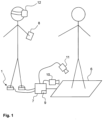
- Fig. 1 represents a system for simulating a shoe that can be used to generate data for the production of shoes or shoe insoles that are individually adapted to a person.
- the system comprises a Pressure distribution measuring device 6, which is intended to determine a pressure distribution of at least one sole of the person's foot, wherein the pressure distribution measuring device 6 is a pressure measuring plate, a pressure measuring film, or a sensitive insole.
- the measured pressure distribution is evaluated by means of a computer unit 7.
- the system has a shoe simulation device 1, which is intended to simulate a shoe.
- the shoe simulation device 1 has Fig. 2 a shoe bottom 2 or a shoe insole with a plurality of support sections 3, the height H and/or at least one mechanical property of which can be individually controlled by means of the computer unit 7 on the basis of the determined pressure distribution.
- the system preferably has two scanning devices 10 and 11. This allows the profile of the shoe sole 2, or the heights of the individual support sections 3, to be directly determined.
- Optical 3D scanners are preferably used for this purpose.
- the scanning devices 10 and 11 are connected to the computer unit via cable or radio for data exchange.
- the system also includes an input device 8, which is designed to adjust the height and/or at least one mechanical property of the support sections 3 depending on the location. In this way, the person can locally optimize the settings of the simulation device 1 to achieve the desired properties.
- the system also has a display unit 12 designed to give the person the impression that they are wearing a specific shoe.
- This is preferably a pair of virtual reality glasses 12 that the person wears while using the simulation device 1 and that gives the impression that the person is wearing a specific shoe.
- the displayed shoe can be a shoe of a specific type or design. In particular, a shoe that the person has selected or designed themselves can be displayed. In this way, the external appearance of the shoe can also be simulated and customized.
- the computer unit 7 has a storage unit 9, which is intended to store the set values for the height and/or the at least one mechanical property of the support sections 3 and/or the length of a holding means 4.
- the values considered optimal or desired by the person are stored. These values can then be used to reproduce a specific, in particular desired, setting.
- the stored values considered optimal are used as data for the production of an individually fitted shoe, wherein the manufactured shoe has the same properties as the shoe simulated by the simulation device 1.
- the shoe simulation devices 1 are movably mounted.
- the simulation device is designed to be mobile, so that the person can walk or run around with it.
- Fig. 2 shows a schematic representation of the shoe simulation device 1 in use, i.e., loaded, state, with the person standing on the shoe sole 2.
- the values for the height H of the individual support sections 3 are set so that the height profile of the shoe sole 2 corresponds to the spatial shape of the sole of the foot.
- the different textures of the individual support sections 3 indicate that the support elements 3 each have different mechanical properties. For example, the outer support sections 3 have less elasticity to provide better support to the foot under load.
- the shoe simulation device 1 has at least one holding means 4, which is intended to encompass the person's foot and to fix it to the shoe sole 2.
- the holding means is, for example, a flat band, which is attached at the end points to the shoe sole 2.
- the length of the illustrated holding means 4 can be changed by means of a contraction element 5.
- the length is set by means of a computer unit 7 and/or by an input device 8 or manually.
- the length can be set by the person or a third party.
- the length of the contraction unit 5 of a simulated shoe is preferably stored in the computer unit 7 so that the length can be reproduced at another location at another time.
- the support sections 3 each have sensors 13 designed to measure a force exerted on the respective support section 3.
- the shoe simulation device 1 has a sensor unit that allows the set values to be directly checked in the loaded state. Undesired force peaks or pressure peaks can thus advantageously be directly recorded.
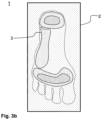
- the support sections 3 of the shoe bottom 2 of the shoe simulation device 1 can have any shape.
- Fig. 3a is shown a design in which the individual support sections 3 form a grid, in which all support sections 3 have the same square basic shape.
- the person's foot is shown as a dashed line.
- the different textures of the individual support sections 3 schematically show that the individual support sections have different mechanical properties that can be adjusted independently of one another.
- the outer support sections 3 have a lower elasticity to support the foot.
- Fig. 3b An alternative design is shown in which the support sections 3 have ergonomically adapted shapes that mimic individual foot zones. For example, the support sections 3 have an elliptical shape in the heel area and a kidney shape in the ball area. This allows for a better adaptation of the values for the mechanical properties of the support sections 3 to the respective function.
- a measuring surface or measuring plate which has a plurality of sensors arranged closely next to one another in a grid.
- the sensor surfaces or sensor surface sections are arranged in a matrix in the x and y directions. If this measuring surface is touched by a shoe with its underside, i.e. with its tread (shoe sole), a plurality of pressure sensors are touched and subjected to a greater or lesser pressure. Each pressure sensor converts the physical quantity of pressure into an electrical quantity (voltage).
- electrical values/signals are recorded and stored by a computer.
- a computer program displays the recorded values graphically and in color, making it possible to identify which areas of the shoe's tread exert greater and which exert lesser pressure on the measuring surface.
- pressure sensors can be used, including both passive and active pressure sensors. Piezoresistive and piezoelectric pressure sensors are preferred.
- the measuring surface/measuring plate is preferably not square, but rather has a greater length than width, allowing walking/running along its length.
- the measuring surface is two-dimensional.
- the measuring surface can be curved/arched three-dimensionally to simulate a natural running path.
- the measuring surface can also represent an incline by forming an inclined plane.
- the data required for assessment and production are further improved by collecting the data/measurement data of a known optimal shoe and comparing and utilizing this data with the data measured by one of the above methods.
Landscapes
- Health & Medical Sciences (AREA)
- Life Sciences & Earth Sciences (AREA)
- Biophysics (AREA)
- General Health & Medical Sciences (AREA)
- Public Health (AREA)
- Physics & Mathematics (AREA)
- Heart & Thoracic Surgery (AREA)
- Oral & Maxillofacial Surgery (AREA)
- Veterinary Medicine (AREA)
- Pathology (AREA)
- Engineering & Computer Science (AREA)
- Biomedical Technology (AREA)
- Dentistry (AREA)
- Medical Informatics (AREA)
- Molecular Biology (AREA)
- Surgery (AREA)
- Animal Behavior & Ethology (AREA)
- Epidemiology (AREA)
- Footwear And Its Accessory, Manufacturing Method And Apparatuses (AREA)
Claims (17)
- Procédé de mesure et d'évaluation des fonctions et de la forme d'une chaussure, notamment d'une chaussure de sport telle qu'une chaussure de course ou de ski, l'utilisateur de la chaussure se tenant debout, avec la chaussure habillant le pied, sans équiper la chaussure de capteurs, sur une surface de mesure et/ou marche ou courant sur une surface de mesure qui présente une pluralité de capteurs de pression dont les valeurs de pression détectées par la chaussure mesurée sont évaluées par un programme informatique, et en ce qu'après les valeurs de pression détectées, la forme, les dimensions et/ou les matériaux de la semelle de la chaussure sont déterminés et une chaussure est fabriquée à partir des données générées.
- Procédé selon la revendication 1, caractérisé en ce qu'après les valeurs de pression détectées, la forme et les dimensions de la tige de la chaussure sont déterminées.
- Procédé selon l'une quelconque des revendications précédentes, comprenant les étapes suivantes :- une étape de mesure, au cours de laquelle une répartition de pression d'au moins une plante de pied de la personne est mesurée sur une surface de mesure au moyen d'un dispositif de mesure de répartition de pression (6),- une étape de réglage, au cours de laquelle un dispositif de simulation de chaussure (1), qui comporte une semelle de chaussure (2) ou une semelle intérieure de chaussure présentant une pluralité de sections d'appui (3) dont la hauteur et/ou au moins une propriété mécanique peuvent respectivement être commandées individuellement, est réglé localement en réglant la hauteur et/ou l'au moins une propriété mécanique des sections d'appui (3) à des valeurs déterminées par une unité de calcul (7) sur la base de la répartition de pression mesurée, et- une étape de simulation, au cours de laquelle la personne sollicite la semelle de chaussure (2) afin de percevoir les caractéristiques d'une chaussure présentant les valeurs réglées.
- Procédé selon la revendication 3, caractérisé en ce qu'il comprend une étape d'évaluation au cours de laquelle la personne évalue si les valeurs réglées localement du dispositif de simulation de chaussure (1) correspondent à l'optimum personnel ou si une autre étape de réglage avec des valeurs réglées modifiées est nécessaire.
- Procédé selon la revendication 3 ou 4, caractérisé en ce qu'il comprend une étape d'optimisation au cours de laquelle la hauteur et/ou l'au moins une propriété mécanique des sections d'appui (3) sont réglées localement au moyen d'un dispositif de saisie (8).
- Procédé selon l'une quelconque des revendications précédentes, caractérisé en ce qu'au moins un moyen de maintien (4), que comporte le dispositif de simulation (1) pour la fixation du pied sur la semelle de chaussure (2), est modifié en longueur, de préférence au moyen d'une unité de contraction (5).
- Procédé selon l'une quelconque des revendications précédentes, caractérisé en ce que les valeurs considérées comme optimales par la personne pour la hauteur et/ou l'au moins une propriété mécanique des sections d'appui (3) et/ou la longueur des moyens de maintien (4) sont stockées dans une unité de stockage (9) .
- Procédé selon la revendication 7, caractérisé en ce que les valeurs stockées sont utilisées comme données pour la fabrication de chaussures adaptées individuellement.
- Procédé selon l'une quelconque des revendications précédentes, caractérisé en ce que, lors de l'étape de mesure, la forme spatiale du pied de la personne est également déterminée au moyen d'au moins un dispositif de balayage (10, 11).
- Procédé selon l'une quelconque des revendications précédentes, caractérisé en ce que, lors de l'utilisation du dispositif de simulation de chaussure (1), il est suggéré optiquement à la personne, au moyen d'une unité d'affichage (12), qu'elle porte une chaussure d'un type ou d'une conception spécifique, notamment une conception qu'elle a elle-même créée.
- Procédé selon l'une quelconque des revendications précédentes, caractérisé en ce que les données/mesures d'une chaussure optimale connue sont collectées et en ce que ces données sont comparées et évaluées avec les données mesurées par l'un des procédés ci-dessus.
- Système de simulation d'une chaussure permettant de générer des données pour la fabrication d'une chaussure adaptée individuellement à une personne par utilisation de l'un des procédés mentionnés ci-dessus, comprenant- une plaque de mesure de pression (6), présentant une certaine résolution spatiale et une sensibilité à la pression, permettant de déterminer une répartition de pression d'une chaussure de manière tant statique que dynamique en situation de marche ou de course,- une unité de calcul (7) qui est prévue pour évaluer la répartition de pression déterminée, et- un dispositif de simulation de chaussure (1), qui comporte une semelle de chaussure (2) ou une semelle intérieure de chaussure présentant une pluralité de sections d'appui (3) dont la hauteur et/ou au moins une propriété mécanique peuvent respectivement être commandées individuellement sur la base de la répartition de pression déterminée au moyen de l'unité de calcul (7).
- Système selon la revendication 12, caractérisé en ce qu'il comporte au moins un dispositif de balayage (10, 11) qui est prévu pour déterminer la forme spatiale du pied.
- Système selon l'une quelconque des revendications 12 à 13, caractérisé en ce qu'il comporte au moins un dispositif de saisie (8) qui est prévu pour régler la hauteur et/ou au moins une propriété mécanique des sections d'appui (3) en fonction de la position.
- Système selon l'une quelconque des revendications 12 à 14, caractérisé en ce qu'il comporte au moins une unité d'affichage (12) qui est prévue pour donner à la personne l'impression qu'elle porte une chaussure spécifique.
- Système selon l'une quelconque des revendications 12 à 15, caractérisé en ce que le dispositif de simulation de chaussure (1) est monté de manière mobile.
- Système selon l'une quelconque des revendications 12 à 16, caractérisé en ce que le dispositif de simulation de chaussure (1), en particulier la semelle intérieure de chaussure (2), peut être séparé du système et en ce que les valeurs réglées pour la hauteur et/ou l'au moins une propriété mécanique restent inchangées.
Applications Claiming Priority (3)
| Application Number | Priority Date | Filing Date | Title |
|---|---|---|---|
| DE102018002284.7A DE102018002284A1 (de) | 2018-03-20 | 2018-03-20 | Verfahren zum Messen und Beurteilen eines Schuhs |
| DE102018002283.9A DE102018002283A1 (de) | 2018-03-20 | 2018-03-20 | Verfahren und System zur Simulation eines Schuhs |
| PCT/EP2019/000083 WO2019179655A1 (fr) | 2018-03-20 | 2019-03-18 | Procédé, dispositif et système de mesure, d'évaluation et de simulation d'une chaussure |
Publications (3)
| Publication Number | Publication Date |
|---|---|
| EP3768109A1 EP3768109A1 (fr) | 2021-01-27 |
| EP3768109B1 true EP3768109B1 (fr) | 2025-06-04 |
| EP3768109C0 EP3768109C0 (fr) | 2025-06-04 |
Family
ID=65991746
Family Applications (1)
| Application Number | Title | Priority Date | Filing Date |
|---|---|---|---|
| EP19714314.2A Active EP3768109B1 (fr) | 2018-03-20 | 2019-03-18 | Procédé, dispositif et système de mesure, d'évaluation et de simulation d'une chaussure |
Country Status (4)
| Country | Link |
|---|---|
| US (1) | US20210093049A1 (fr) |
| EP (1) | EP3768109B1 (fr) |
| CN (1) | CN111867414B (fr) |
| WO (1) | WO2019179655A1 (fr) |
Families Citing this family (3)
| Publication number | Priority date | Publication date | Assignee | Title |
|---|---|---|---|---|
| DE102020120253A1 (de) | 2020-07-31 | 2022-02-03 | Ralf Kreft | Abgabe von Beratungsinformationen |
| DE102021132122A1 (de) | 2021-12-07 | 2023-06-07 | Molibso Entwicklungs- Und Vertriebs Gmbh | Verfahren zum Erfassen der Druckverteilung einer Fußunterseite |
| TWI828541B (zh) * | 2023-02-15 | 2024-01-01 | 橙驛科技有限公司 | 足部特徵量測分析方法及客製化鞋墊設計方法 |
Family Cites Families (18)
| Publication number | Priority date | Publication date | Assignee | Title |
|---|---|---|---|---|
| US5586067A (en) * | 1994-07-19 | 1996-12-17 | Bcam International, Inc. | Support enhancing device and associated method |
| JPH1026579A (ja) * | 1996-07-11 | 1998-01-27 | Asics Corp | 靴の衝撃緩衝性の評価方法 |
| KR100734727B1 (ko) * | 2000-11-15 | 2007-07-02 | 도꾸리쯔교세이호진 상교기쥬쯔 소고겡뀨죠 | 족형정보 배신 시스템 |
| US7493230B2 (en) * | 2006-06-06 | 2009-02-17 | Aetrex Worldwide, Inc. | Method and apparatus for customizing insoles for footwear |
| FR2905830B1 (fr) * | 2006-09-19 | 2008-12-12 | Didier Coissard | Systeme de generation d'une surface permettant notament le positionnement et l'appui optimales du pied selon des caracteristiques definies par un utilisateur |
| TWI440836B (zh) * | 2006-09-21 | 2014-06-11 | Msd Consumer Care Inc | 足部照護產品分裝資訊站 |
| KR100864967B1 (ko) * | 2007-08-14 | 2008-10-22 | 김철운 | 공기압을 이용한 공기압 교정 안창과 그를 위한 족부압력 측정장치 |
| LU91833B1 (en) * | 2011-06-30 | 2012-12-31 | Iee Sarl | Film-type pressure sensor e.g. for article of footwear |
| US11154243B2 (en) * | 2012-01-30 | 2021-10-26 | Sensoria Inc. | Sensor systems for user-specific evaluation of gait, footwear and garment fitting; monitoring of contact, force, pressure and/or shear at or near body surfaces |
| US20130219745A1 (en) * | 2012-02-27 | 2013-08-29 | Eduardo Moreno-Collado | Walking Device |
| CN108741393B (zh) * | 2012-12-19 | 2021-06-11 | 新平衡运动公司 | 定制鞋类以及用于设计且制造其的方法 |
| CN204636392U (zh) * | 2015-03-26 | 2015-09-16 | 吴志龙 | 脚或/和小腿舒适性功能性压力测试袜 |
| US10206456B2 (en) * | 2015-05-27 | 2019-02-19 | Nike, Inc. | Article of footwear comprising a sole member with geometric patterns |
| US20170164899A1 (en) * | 2015-12-14 | 2017-06-15 | Erika Yang | Devices embedded smart shoes |
| DE102016009980A1 (de) | 2016-08-19 | 2018-02-22 | Molibso Entwicklungs- Und Vertriebs Gmbh | Verfahren und System zur Herstellung schaumförmiger Formteile mittels 3D-Druck |
| EP3448193A4 (fr) * | 2016-09-09 | 2020-05-06 | Hewlett-Packard Development Company, L.P. | Composants de chaussure basés sur des données du client |
| CN107114861B (zh) * | 2017-03-22 | 2022-09-16 | 青岛一小步科技有限公司 | 一种基于压力成像及三维建模技术的定制鞋制作方法及系统 |
| CN106901445B (zh) * | 2017-03-22 | 2022-09-20 | 青岛一小步科技有限公司 | 一种基于压力成像及三维建模技术的矫形鞋制作方法及系统 |
-
2019
- 2019-03-18 US US16/981,700 patent/US20210093049A1/en active Pending
- 2019-03-18 CN CN201980019875.7A patent/CN111867414B/zh active Active
- 2019-03-18 EP EP19714314.2A patent/EP3768109B1/fr active Active
- 2019-03-18 WO PCT/EP2019/000083 patent/WO2019179655A1/fr not_active Ceased
Also Published As
| Publication number | Publication date |
|---|---|
| CN111867414A (zh) | 2020-10-30 |
| US20210093049A1 (en) | 2021-04-01 |
| CN111867414B (zh) | 2024-02-06 |
| EP3768109A1 (fr) | 2021-01-27 |
| EP3768109C0 (fr) | 2025-06-04 |
| WO2019179655A1 (fr) | 2019-09-26 |
Similar Documents
| Publication | Publication Date | Title |
|---|---|---|
| EP2060229B1 (fr) | Dispositif d'analyse de la marche | |
| EP3768109B1 (fr) | Procédé, dispositif et système de mesure, d'évaluation et de simulation d'une chaussure | |
| EP2352426B1 (fr) | Dispositif pour l'entraînement à la marche | |
| EP3387401B1 (fr) | Système de mesure servant à tester des planches de glisse | |
| DE202019105992U1 (de) | Laufbandanordnung mit Neigungsverstellung | |
| DE102020211599A1 (de) | Verfahren und System zum Bereitstellen eines individualisierten Schuhwerks | |
| EP2120711A1 (fr) | Procédé et dispositif de détection tridimensionnelle de la forme spatiale d'un pied | |
| DE102020104610A1 (de) | Parameterbestimmungsverfahren, Parameterbestimmungsvorrichtung und Parameterbestimmungsprogramm | |
| DE102011055238B4 (de) | Verfahren zur Herstellung einer Schuheinlage | |
| DE10118397C2 (de) | System und Verfahren zur subjektiven Beurteilung einer Fahrzeugkonstruktion in einer virtuellen Umgebung mit Hilfe von virtueller Realität | |
| DE102015003884B4 (de) | Kraftfahrzeugsimulationsanordnung zur Simulation einer virtuellen Umgebung mit zumindest einem Teil eines virtuellen Kraftfahrzeugs und Verfahren zum Einstellen einer Kraftfahrzeugsimulationsanordnung | |
| DE102010017927A1 (de) | Anordnung zur Untersuchung und/oder zum Training des Ganges | |
| DE102018002283A1 (de) | Verfahren und System zur Simulation eines Schuhs | |
| WO2011141268A1 (fr) | Procédé et dispositif pour la mesure de la posture corporelle | |
| DE102010002913B4 (de) | Anordnung zur Anpassung von sensomotorischen Einlagen mit Stimulationselementen | |
| DE102016009980A1 (de) | Verfahren und System zur Herstellung schaumförmiger Formteile mittels 3D-Druck | |
| EP2543272A1 (fr) | Fond plat pour la détection de l'explosion et/ou de la forme spatiale d'un pied, dispositif d'établissement et son procédé | |
| WO2022199754A1 (fr) | Procédé de fabrication d'un article chaussant | |
| DE102006009454A1 (de) | Vorrichtung zum Erzeugen von Daten zur Endoskopbetrachtung und Endoskopsystem | |
| DE202016000432U1 (de) | Messvorrichtung zur Erfassung von Gangparametern einer Person | |
| DE102023112614B3 (de) | Verfahren zur automatisierten Anpassung eines Fußwerks an eine Fußanatomie | |
| DE102019126966B4 (de) | Vorrichtung und Verfahren zur Aufnahme eines Auflagedrucks eines Reitsattels, Computerprogrammprodukt | |
| DE102014109388B4 (de) | System zur Erstellung einer Schuheinlage | |
| AT508917B1 (de) | Verfahren und vorrichtung zur vermessung der körperhaltung | |
| DE102023111088A1 (de) | Vorrichtung zum erfassen von dynamischem sitzen, system und verfahren dafür, computerprogrammprodukt und nichtflüchtiges computerlesbares speichermedium |
Legal Events
| Date | Code | Title | Description |
|---|---|---|---|
| STAA | Information on the status of an ep patent application or granted ep patent |
Free format text: STATUS: UNKNOWN |
|
| STAA | Information on the status of an ep patent application or granted ep patent |
Free format text: STATUS: THE INTERNATIONAL PUBLICATION HAS BEEN MADE |
|
| PUAI | Public reference made under article 153(3) epc to a published international application that has entered the european phase |
Free format text: ORIGINAL CODE: 0009012 |
|
| STAA | Information on the status of an ep patent application or granted ep patent |
Free format text: STATUS: REQUEST FOR EXAMINATION WAS MADE |
|
| 17P | Request for examination filed |
Effective date: 20200918 |
|
| AK | Designated contracting states |
Kind code of ref document: A1 Designated state(s): AL AT BE BG CH CY CZ DE DK EE ES FI FR GB GR HR HU IE IS IT LI LT LU LV MC MK MT NL NO PL PT RO RS SE SI SK SM TR |
|
| AX | Request for extension of the european patent |
Extension state: BA ME |
|
| DAV | Request for validation of the european patent (deleted) | ||
| DAX | Request for extension of the european patent (deleted) | ||
| STAA | Information on the status of an ep patent application or granted ep patent |
Free format text: STATUS: EXAMINATION IS IN PROGRESS |
|
| 17Q | First examination report despatched |
Effective date: 20211215 |
|
| GRAP | Despatch of communication of intention to grant a patent |
Free format text: ORIGINAL CODE: EPIDOSNIGR1 |
|
| STAA | Information on the status of an ep patent application or granted ep patent |
Free format text: STATUS: GRANT OF PATENT IS INTENDED |
|
| RIC1 | Information provided on ipc code assigned before grant |
Ipc: A43B 7/1464 20220101ALI20250121BHEP Ipc: A43D 1/02 20060101AFI20250121BHEP |
|
| INTG | Intention to grant announced |
Effective date: 20250203 |
|
| GRAS | Grant fee paid |
Free format text: ORIGINAL CODE: EPIDOSNIGR3 |
|
| GRAA | (expected) grant |
Free format text: ORIGINAL CODE: 0009210 |
|
| STAA | Information on the status of an ep patent application or granted ep patent |
Free format text: STATUS: THE PATENT HAS BEEN GRANTED |
|
| AK | Designated contracting states |
Kind code of ref document: B1 Designated state(s): AL AT BE BG CH CY CZ DE DK EE ES FI FR GB GR HR HU IE IS IT LI LT LU LV MC MK MT NL NO PL PT RO RS SE SI SK SM TR |
|
| REG | Reference to a national code |
Ref country code: GB Ref legal event code: FG4D Free format text: NOT ENGLISH |
|
| REG | Reference to a national code |
Ref country code: CH Ref legal event code: EP |
|
| REG | Reference to a national code |
Ref country code: DE Ref legal event code: R096 Ref document number: 502019013404 Country of ref document: DE |
|
| REG | Reference to a national code |
Ref country code: IE Ref legal event code: FG4D Free format text: LANGUAGE OF EP DOCUMENT: GERMAN |
|
| U01 | Request for unitary effect filed |
Effective date: 20250630 |
|
| U07 | Unitary effect registered |
Designated state(s): AT BE BG DE DK EE FI FR IT LT LU LV MT NL PT RO SE SI Effective date: 20250704 |
|
| PG25 | Lapsed in a contracting state [announced via postgrant information from national office to epo] |
Ref country code: ES Free format text: LAPSE BECAUSE OF FAILURE TO SUBMIT A TRANSLATION OF THE DESCRIPTION OR TO PAY THE FEE WITHIN THE PRESCRIBED TIME-LIMIT Effective date: 20250604 |
|
| PG25 | Lapsed in a contracting state [announced via postgrant information from national office to epo] |
Ref country code: GR Free format text: LAPSE BECAUSE OF FAILURE TO SUBMIT A TRANSLATION OF THE DESCRIPTION OR TO PAY THE FEE WITHIN THE PRESCRIBED TIME-LIMIT Effective date: 20250905 Ref country code: NO Free format text: LAPSE BECAUSE OF FAILURE TO SUBMIT A TRANSLATION OF THE DESCRIPTION OR TO PAY THE FEE WITHIN THE PRESCRIBED TIME-LIMIT Effective date: 20250904 |
|
| PG25 | Lapsed in a contracting state [announced via postgrant information from national office to epo] |
Ref country code: PL Free format text: LAPSE BECAUSE OF FAILURE TO SUBMIT A TRANSLATION OF THE DESCRIPTION OR TO PAY THE FEE WITHIN THE PRESCRIBED TIME-LIMIT Effective date: 20250604 |
|
| PG25 | Lapsed in a contracting state [announced via postgrant information from national office to epo] |
Ref country code: HR Free format text: LAPSE BECAUSE OF FAILURE TO SUBMIT A TRANSLATION OF THE DESCRIPTION OR TO PAY THE FEE WITHIN THE PRESCRIBED TIME-LIMIT Effective date: 20250604 |
|
| PG25 | Lapsed in a contracting state [announced via postgrant information from national office to epo] |
Ref country code: RS Free format text: LAPSE BECAUSE OF FAILURE TO SUBMIT A TRANSLATION OF THE DESCRIPTION OR TO PAY THE FEE WITHIN THE PRESCRIBED TIME-LIMIT Effective date: 20250904 |
|
| PG25 | Lapsed in a contracting state [announced via postgrant information from national office to epo] |
Ref country code: IS Free format text: LAPSE BECAUSE OF FAILURE TO SUBMIT A TRANSLATION OF THE DESCRIPTION OR TO PAY THE FEE WITHIN THE PRESCRIBED TIME-LIMIT Effective date: 20251004 |
|
| PG25 | Lapsed in a contracting state [announced via postgrant information from national office to epo] |
Ref country code: SM Free format text: LAPSE BECAUSE OF FAILURE TO SUBMIT A TRANSLATION OF THE DESCRIPTION OR TO PAY THE FEE WITHIN THE PRESCRIBED TIME-LIMIT Effective date: 20250604 |
|
| PG25 | Lapsed in a contracting state [announced via postgrant information from national office to epo] |
Ref country code: CZ Free format text: LAPSE BECAUSE OF FAILURE TO SUBMIT A TRANSLATION OF THE DESCRIPTION OR TO PAY THE FEE WITHIN THE PRESCRIBED TIME-LIMIT Effective date: 20250604 |
|
| PG25 | Lapsed in a contracting state [announced via postgrant information from national office to epo] |
Ref country code: SK Free format text: LAPSE BECAUSE OF FAILURE TO SUBMIT A TRANSLATION OF THE DESCRIPTION OR TO PAY THE FEE WITHIN THE PRESCRIBED TIME-LIMIT Effective date: 20250604 |
|
| PLBE | No opposition filed within time limit |
Free format text: ORIGINAL CODE: 0009261 |
|
| STAA | Information on the status of an ep patent application or granted ep patent |
Free format text: STATUS: NO OPPOSITION FILED WITHIN TIME LIMIT |
|
| REG | Reference to a national code |
Ref country code: CH Ref legal event code: L10 Free format text: ST27 STATUS EVENT CODE: U-0-0-L10-L00 (AS PROVIDED BY THE NATIONAL OFFICE) Effective date: 20260416 |