EP3768676B1 - Composés luminescents - Google Patents
Composés luminescents Download PDFInfo
- Publication number
- EP3768676B1 EP3768676B1 EP19714752.3A EP19714752A EP3768676B1 EP 3768676 B1 EP3768676 B1 EP 3768676B1 EP 19714752 A EP19714752 A EP 19714752A EP 3768676 B1 EP3768676 B1 EP 3768676B1
- Authority
- EP
- European Patent Office
- Prior art keywords
- group
- atom
- reagent
- triphenylene
- compound
- Prior art date
- Legal status (The legal status is an assumption and is not a legal conclusion. Google has not performed a legal analysis and makes no representation as to the accuracy of the status listed.)
- Active
Links
Images





Classifications
-
- C—CHEMISTRY; METALLURGY
- C07—ORGANIC CHEMISTRY
- C07D—HETEROCYCLIC COMPOUNDS
- C07D263/00—Heterocyclic compounds containing 1,3-oxazole or hydrogenated 1,3-oxazole rings
- C07D263/52—Heterocyclic compounds containing 1,3-oxazole or hydrogenated 1,3-oxazole rings condensed with carbocyclic rings or ring systems
-
- C—CHEMISTRY; METALLURGY
- C07—ORGANIC CHEMISTRY
- C07C—ACYCLIC OR CARBOCYCLIC COMPOUNDS
- C07C217/00—Compounds containing amino and etherified hydroxy groups bound to the same carbon skeleton
- C07C217/78—Compounds containing amino and etherified hydroxy groups bound to the same carbon skeleton having amino groups and etherified hydroxy groups bound to carbon atoms of six-membered aromatic rings of the same carbon skeleton
- C07C217/94—Compounds containing amino and etherified hydroxy groups bound to the same carbon skeleton having amino groups and etherified hydroxy groups bound to carbon atoms of six-membered aromatic rings of the same carbon skeleton having amino groups bound to carbon atoms of six-membered aromatic rings being part of condensed ring systems and etherified hydroxy groups bound to carbon atoms of six-membered aromatic rings of the same carbon skeleton
-
- C—CHEMISTRY; METALLURGY
- C07—ORGANIC CHEMISTRY
- C07D—HETEROCYCLIC COMPOUNDS
- C07D409/00—Heterocyclic compounds containing two or more hetero rings, at least one ring having sulfur atoms as the only ring hetero atoms
- C07D409/02—Heterocyclic compounds containing two or more hetero rings, at least one ring having sulfur atoms as the only ring hetero atoms containing two hetero rings
- C07D409/04—Heterocyclic compounds containing two or more hetero rings, at least one ring having sulfur atoms as the only ring hetero atoms containing two hetero rings directly linked by a ring-member-to-ring-member bond
-
- C—CHEMISTRY; METALLURGY
- C07—ORGANIC CHEMISTRY
- C07D—HETEROCYCLIC COMPOUNDS
- C07D413/00—Heterocyclic compounds containing two or more hetero rings, at least one ring having nitrogen and oxygen atoms as the only ring hetero atoms
- C07D413/02—Heterocyclic compounds containing two or more hetero rings, at least one ring having nitrogen and oxygen atoms as the only ring hetero atoms containing two hetero rings
- C07D413/04—Heterocyclic compounds containing two or more hetero rings, at least one ring having nitrogen and oxygen atoms as the only ring hetero atoms containing two hetero rings directly linked by a ring-member-to-ring-member bond
-
- C—CHEMISTRY; METALLURGY
- C09—DYES; PAINTS; POLISHES; NATURAL RESINS; ADHESIVES; COMPOSITIONS NOT OTHERWISE PROVIDED FOR; APPLICATIONS OF MATERIALS NOT OTHERWISE PROVIDED FOR
- C09K—MATERIALS FOR MISCELLANEOUS APPLICATIONS, NOT PROVIDED FOR ELSEWHERE
- C09K11/00—Luminescent materials, e.g. electroluminescent or chemiluminescent
- C09K11/06—Luminescent materials, e.g. electroluminescent or chemiluminescent containing organic luminescent materials
-
- G—PHYSICS
- G01—MEASURING; TESTING
- G01N—INVESTIGATING OR ANALYSING MATERIALS BY DETERMINING THEIR CHEMICAL OR PHYSICAL PROPERTIES
- G01N21/00—Investigating or analysing materials by the use of optical means, i.e. using sub-millimetre waves, infrared, visible or ultraviolet light
- G01N21/62—Systems in which the material investigated is excited whereby it emits light or causes a change in wavelength of the incident light
- G01N21/63—Systems in which the material investigated is excited whereby it emits light or causes a change in wavelength of the incident light optically excited
- G01N21/64—Fluorescence; Phosphorescence
- G01N21/6428—Measuring fluorescence of fluorescent products of reactions or of fluorochrome labelled reactive substances, e.g. measuring quenching effects, using measuring "optrodes"
-
- H—ELECTRICITY
- H10—SEMICONDUCTOR DEVICES; ELECTRIC SOLID-STATE DEVICES NOT OTHERWISE PROVIDED FOR
- H10K—ORGANIC ELECTRIC SOLID-STATE DEVICES
- H10K50/00—Organic light-emitting devices
- H10K50/10—OLEDs or polymer light-emitting diodes [PLED]
- H10K50/11—OLEDs or polymer light-emitting diodes [PLED] characterised by the electroluminescent [EL] layers
-
- H—ELECTRICITY
- H10—SEMICONDUCTOR DEVICES; ELECTRIC SOLID-STATE DEVICES NOT OTHERWISE PROVIDED FOR
- H10K—ORGANIC ELECTRIC SOLID-STATE DEVICES
- H10K85/00—Organic materials used in the body or electrodes of devices covered by this subclass
- H10K85/60—Organic compounds having low molecular weight
- H10K85/615—Polycyclic condensed aromatic hydrocarbons, e.g. anthracene
-
- H—ELECTRICITY
- H10—SEMICONDUCTOR DEVICES; ELECTRIC SOLID-STATE DEVICES NOT OTHERWISE PROVIDED FOR
- H10K—ORGANIC ELECTRIC SOLID-STATE DEVICES
- H10K85/00—Organic materials used in the body or electrodes of devices covered by this subclass
- H10K85/60—Organic compounds having low molecular weight
- H10K85/649—Aromatic compounds comprising a hetero atom
- H10K85/655—Aromatic compounds comprising a hetero atom comprising only sulfur as heteroatom
-
- H—ELECTRICITY
- H10—SEMICONDUCTOR DEVICES; ELECTRIC SOLID-STATE DEVICES NOT OTHERWISE PROVIDED FOR
- H10K—ORGANIC ELECTRIC SOLID-STATE DEVICES
- H10K85/00—Organic materials used in the body or electrodes of devices covered by this subclass
- H10K85/60—Organic compounds having low molecular weight
- H10K85/649—Aromatic compounds comprising a hetero atom
- H10K85/657—Polycyclic condensed heteroaromatic hydrocarbons
-
- H—ELECTRICITY
- H10—SEMICONDUCTOR DEVICES; ELECTRIC SOLID-STATE DEVICES NOT OTHERWISE PROVIDED FOR
- H10K—ORGANIC ELECTRIC SOLID-STATE DEVICES
- H10K85/00—Organic materials used in the body or electrodes of devices covered by this subclass
- H10K85/60—Organic compounds having low molecular weight
- H10K85/649—Aromatic compounds comprising a hetero atom
- H10K85/657—Polycyclic condensed heteroaromatic hydrocarbons
- H10K85/6574—Polycyclic condensed heteroaromatic hydrocarbons comprising only oxygen in the heteroaromatic polycondensed ring system, e.g. cumarine dyes
-
- C—CHEMISTRY; METALLURGY
- C07—ORGANIC CHEMISTRY
- C07C—ACYCLIC OR CARBOCYCLIC COMPOUNDS
- C07C2603/00—Systems containing at least three condensed rings
- C07C2603/02—Ortho- or ortho- and peri-condensed systems
- C07C2603/40—Ortho- or ortho- and peri-condensed systems containing four condensed rings
- C07C2603/42—Ortho- or ortho- and peri-condensed systems containing four condensed rings containing only six-membered rings
-
- C—CHEMISTRY; METALLURGY
- C09—DYES; PAINTS; POLISHES; NATURAL RESINS; ADHESIVES; COMPOSITIONS NOT OTHERWISE PROVIDED FOR; APPLICATIONS OF MATERIALS NOT OTHERWISE PROVIDED FOR
- C09K—MATERIALS FOR MISCELLANEOUS APPLICATIONS, NOT PROVIDED FOR ELSEWHERE
- C09K2211/00—Chemical nature of organic luminescent or tenebrescent compounds
- C09K2211/10—Non-macromolecular compounds
- C09K2211/1018—Heterocyclic compounds
-
- C—CHEMISTRY; METALLURGY
- C09—DYES; PAINTS; POLISHES; NATURAL RESINS; ADHESIVES; COMPOSITIONS NOT OTHERWISE PROVIDED FOR; APPLICATIONS OF MATERIALS NOT OTHERWISE PROVIDED FOR
- C09K—MATERIALS FOR MISCELLANEOUS APPLICATIONS, NOT PROVIDED FOR ELSEWHERE
- C09K2211/00—Chemical nature of organic luminescent or tenebrescent compounds
- C09K2211/10—Non-macromolecular compounds
- C09K2211/1018—Heterocyclic compounds
- C09K2211/1025—Heterocyclic compounds characterised by ligands
- C09K2211/1029—Heterocyclic compounds characterised by ligands containing one nitrogen atom as the heteroatom
- C09K2211/1033—Heterocyclic compounds characterised by ligands containing one nitrogen atom as the heteroatom with oxygen
-
- G—PHYSICS
- G01—MEASURING; TESTING
- G01N—INVESTIGATING OR ANALYSING MATERIALS BY DETERMINING THEIR CHEMICAL OR PHYSICAL PROPERTIES
- G01N21/00—Investigating or analysing materials by the use of optical means, i.e. using sub-millimetre waves, infrared, visible or ultraviolet light
- G01N21/62—Systems in which the material investigated is excited whereby it emits light or causes a change in wavelength of the incident light
- G01N21/63—Systems in which the material investigated is excited whereby it emits light or causes a change in wavelength of the incident light optically excited
- G01N21/64—Fluorescence; Phosphorescence
- G01N21/6428—Measuring fluorescence of fluorescent products of reactions or of fluorochrome labelled reactive substances, e.g. measuring quenching effects, using measuring "optrodes"
- G01N2021/6439—Measuring fluorescence of fluorescent products of reactions or of fluorochrome labelled reactive substances, e.g. measuring quenching effects, using measuring "optrodes" with indicators, stains, dyes, tags, labels, marks
-
- H—ELECTRICITY
- H10—SEMICONDUCTOR DEVICES; ELECTRIC SOLID-STATE DEVICES NOT OTHERWISE PROVIDED FOR
- H10K—ORGANIC ELECTRIC SOLID-STATE DEVICES
- H10K50/00—Organic light-emitting devices
- H10K50/10—OLEDs or polymer light-emitting diodes [PLED]
- H10K50/11—OLEDs or polymer light-emitting diodes [PLED] characterised by the electroluminescent [EL] layers
- H10K50/125—OLEDs or polymer light-emitting diodes [PLED] characterised by the electroluminescent [EL] layers specially adapted for multicolour light emission, e.g. for emitting white light
-
- Y—GENERAL TAGGING OF NEW TECHNOLOGICAL DEVELOPMENTS; GENERAL TAGGING OF CROSS-SECTIONAL TECHNOLOGIES SPANNING OVER SEVERAL SECTIONS OF THE IPC; TECHNICAL SUBJECTS COVERED BY FORMER USPC CROSS-REFERENCE ART COLLECTIONS [XRACs] AND DIGESTS
- Y02—TECHNOLOGIES OR APPLICATIONS FOR MITIGATION OR ADAPTATION AGAINST CLIMATE CHANGE
- Y02E—REDUCTION OF GREENHOUSE GAS [GHG] EMISSIONS, RELATED TO ENERGY GENERATION, TRANSMISSION OR DISTRIBUTION
- Y02E10/00—Energy generation through renewable energy sources
- Y02E10/50—Photovoltaic [PV] energy
- Y02E10/549—Organic PV cells
Definitions
- This invention relates generally to organic luminescent compounds. More specifically, although not exclusively, this invention relates to novel luminescent polycyclic aromatic hydrocarbon, e.g. triphenylene, derivatives, methods of synthesising the same, uses of the same, and devices comprising the same.
- novel luminescent polycyclic aromatic hydrocarbon e.g. triphenylene, derivatives, methods of synthesising the same, uses of the same, and devices comprising the same.
- Luminescent compounds are widely used in industrial and research applications as, for example, dyes, probes, sensors, and in electronic devices. These molecules emit light under external energy excitation from sources such as light and/or electrical current.
- a luminescent compound In photoluminescence, under light irradiation a luminescent compound will absorb light of a specific wavelength and re-emit light of a different wavelength. The type of photoemission observed depends on the molecular structure of the compound.
- the difference between the maximum excitation wavelength and the emission wavelength of a luminescent compound is known as the Stokes shift.
- luminescent compounds For use as dyes, probes and/or sensors in industrial applications, it is advantageous for luminescent compounds to possess a large Stokes shift, often defined as greater than 8000 cm -1 i.e. a comparatively large difference between the excitation wavelength and emission wavelength. This is advantageous because it minimises the reabsorption of light from the emission of the molecule.
- Organometallic complexes that are luminescent often have a large Stokes shift. However, these contain metal centres, e.g. osmium, ruthenium, iridium, rhenium and so on, which are rare, expensive, the complexes are often difficult to synthesise and often toxic. Luminescent organic molecules are often easier to synthesise, but usually exhibit a Stokes shift of relatively smaller magnitude.
- a luminescent compound In contrast, in electroluminescence, a luminescent compound will emit light in response to an electric current.
- OLEDs Organic Light Emitting Diodes
- the OLED material is a layer of a luminescent organic compound, which is situated between two electrodes, one of which is typically transparent. This technology is used in digital displays in electronic devices such as televisions screens, computer monitors, mobile phones, electroluminescent lighting panels and so on.
- luminescent compounds for use in electroluminescent applications to exhibit high brightness. Brightness is defined as the product of the molar extinction coefficient (E) and fluorescence quantum yield ( ⁇ ) divided by 1000. Consequently, it is advantageous for luminescent compounds to exhibit a high molar extinction coefficient (E) (defined by the Beer-Lambert law, in which A is absorbance, c is the molar concentration of the luminescent compound, and I is the path length), and also a high quantum yield ( ⁇ ) as a measure of efficiency.
- E molar extinction coefficient
- ⁇ quantum yield
- polycyclic aromatic hydrocarbons exhibit luminescent properties.
- triphenylene may be functionalised with alkoxy chains appended to the periphery of the molecule.
- these derivatives exhibit discotic liquid crystalline (DLC) behaviour ( J. Nabar and A. Chodkowska, J. Luminescence, 1975, 11, 215 ).
- DLC discotic liquid crystalline
- Discotic liquid crystalline behaviour is characterised in that disc-shaped molecules form stacks or columns in a mesophase, which allows charge transfer through ⁇ stacking, enabling the material to be electrically semiconductive in the stacking direction.
- This DLC behaviour combined with the luminescent properties, is particularly useful for application in technologies such as electronic devices using OLEDs (Organic Light Emitting Diodes), LEDs (Light Emitting Diodes), and for use in solar cells.
- luminescent compounds it is also known for luminescent compounds to exhibit photoconductivity, in which compounds exhibit increased electrical conductivity in the presence of light by converting the light energy into current. It is known to utilise compounds with good photoconductivity in devices such as solar cells.
- EP0847228A2 discloses triphenylene derivatives for use as a hole injection layer in an electroluminescence device.
- US2016/0322569 discloses organic materials as a fluorescent emitting guests in emitting layers in a light emitting diode.
- the invention provides polycyclic aromatic hydrocarbon derivatives according to appended Claims 1-15.
- polycyclic aromatic hydrocarbon derivatives represented by the following general formula: wherein R independently represents an aromatic group and/or an aliphatic group;
- Q may represent C 6 H 4 .
- Q is a polycyclic aromatic hydrocarbon
- Q may be one of naphthalene, anthracene, phenanthrene, tetracene, chrysene, triphenylene, pyrene, pentacene, benzo[a]pyrene, corannulene, benzo[ghi]perylene, coronene, ovalene, fullerene, and/or benzo[c]fluorene.
- Q may be any isomer of the polycyclic aromatic hydrocarbons described, for example, 1-napthalene, 2-napthalene, 2-anthracene, 9-anthracene.
- the polycyclic aromatic hydrocarbon group may be substituted with other moieties such as aryl groups, alkyl groups, heteroatoms, and/or other electron withdrawing or electron donating groups.
- Q is bonded to other six membered rings, e.g. aromatic six membered rings, and/or substituted aromatic six membered rings.
- the number of six membered rings bonded to Q is represented by the integer x wherein x is 0, 1, 2, 3, 4, 5, 6, 7, 8, 9, 10 or more.
- Q may be an aromatic six-membered ring, and x an integer of 2 or above, e.g. 2, 3, 4, 5 or above 5.
- polycyclic aromatic hydrocarbon e.g. triphenylene, derivatives
- triphenylene derivatives
- D may be a linear or branched alkyl chain, an aryl group, or a combination thereof.
- polycyclic aromatic hydrocarbon e.g. the triphenylene, derivatives
- triphenylene derivatives
- D may be a linear or branched alkyl chain, an aryl group, or a combination thereof.
- Y 1 , Y 2 , and Y 3 may comprise a carboxylic acid group, a glycol, an alkoxy, a thioalkoxy, an amino, an acetate, an amide, a thioamide, a thioester, an azo, and/or a silyl group. Additionally or alternatively, Y 1 , Y 2 , and Y 3 may comprise an alkyl group. The alkyl group(s) may be a straight chain, or may comprise a branched chain, and/or may be further functionalised. Additionally or alternatively, Y 1 , Y 2 , and Y 3 may comprise an aryl group. The aryl group(s) may be unsubstituted or may be further functionalised.
- One aspect of the invention provides polycyclic aromatic hydrocarbon derivatives, according to Claim 1.
- polycyclic aromatic hydrocarbon derivatives may be triphenylene derivatives, represented by the following general formula:
- A may be C 5 H 11 and/or C 4 H 9 .
- A represents a polyethylene glycol (PEG) group (e.g. C 2 H 4 OC 2 H 4 OC 2 H 4 OCH 3 .
- the triphenylene derivative may not be the compound wherein A is C 5 H 11 , J is H and R is C 4 H 9 .
- a further aspect of the invention is as set out in Claim 4.
- polycyclic aromatic hydrocarbons are triphenylene derivatives represented by the following general formula:
- A may be C 5 H 11 and/or C 4 H 9 .
- A represents a polyethylene glycol (PEG) group (e.g. C 2 H 4 OC 2 H 4 OC 2 H 4 OCH 3 .
- A comprises further functionality, for example, A may further comprise fluorine atoms, chlorine atoms, cyano groups, nitro groups, glycol, alkoxy, thioalkoxy, polyethylene glycol, amino, acetate, carboxylic acid, amide, thioamide, thioester, azo, and/or silyl groups.
- J comprises or represents an aryl group, e.g. a phenol group. Additionally or alternatively, J comprises a halogen atom, e.g. fluorine, chlorine, bromine, or iodine.
- aryl group e.g. a phenol group.
- J comprises a halogen atom, e.g. fluorine, chlorine, bromine, or iodine.
- R, R 1 , R 2 , or R 3 may be an alkyl group, for example, a straight or branched alkyl chain. In embodiments, at least one of R, R 1 , R 2 , R 3 may be a methyl, ethyl, propyl, butyl group.
- R, R 1 , R 2 , or R 3 is an aromatic group
- the aromatic group may be one of, or a combination of, an aromatic hydrocarbon group, and/or an aromatic heterocyclic group.
- the aromatic hydrocarbon group may comprise one of, or a combination of, a phenyl ring and/or a substituted phenyl ring. There may be one, two, three, four, or five additional substituents on the phenyl ring.
- the substituents are bonded directly to the phenyl ring, and may be one of, or a combination of, fluorine, chlorine, bromine, iodine, a hydroxyl group, an amine group, a nitro group, an alkoxy group, a carboxylic acid, an amide, a cyano group, a trifluoromethyl, an ester, an alkene an alkyne, an azide, an azo, an isocyanate, a ketone, an aldehyde, an alkyl group consisting of a hydrocarbon chain, or a hydrocarbon ring, an alkyl group consisting of other heteroatoms such as fluorine, chlorine, bromine, iodine, oxygen, nitrogen, and/or sulphur.
- the heterocyclic group may be a three membered ring, a four membered ring, a five membered ring, a six membered ring, a seven membered ring, an eight membered ring, a nine membered ring, a ten membered ring, or a fused ring.
- the aliphatic group may be one of, or a combination of, an n-alkyl chain, a branched alkyl chain, an alkyl chain comprising unsaturated moieties, an alkyl chain comprising heteroatoms, for example, fluorine, chlorine, bromine, iodine, oxygen, sulphur, nitrogen.
- the alkyl chain may comprise unsaturated portions, comprising alkenes, or aromatic moieties.
- the alkyl chain may comprise functional groups for further derivatisation of the polycyclic aromatic hydrocarbon, e.g. triphenylene, derivative.
- the functional groups may be one or more of an azide, a carbonyl group, an alcohol, a halogen, or an alkene.
- R, R 1 , R 2 , or R 3 comprise a crown ether.
- a further aspect of the invention provides a device comprising the polycyclic aromatic hydrocarbon derivatives, e.g. the triphenylene derivatives.
- the device may be an electronic device, for example, an organic electroluminescent device, a thin-film transistor and/or an OPV (organic photovoltaic) device.
- the electronic device may comprise a digital display, the digital display comprising the polycyclic aromatic hydrocarbon derivatives, e.g. the triphenylene derivatives, of the present invention, for example, a liquid crystal display.
- the digital display may be in a television screen, a computer monitor, a mobile phone screen, a games console, for example.
- the organic electroluminescent device may comprise a pair of electrodes and one or more layers interposed therebetween, wherein the one or more layers comprise one or more of the polycyclic aromatic hydrocarbon derivatives, e.g. the triphenylene derivatives.
- the LED illumination may be specific to a specific species that is bound to the polycyclic aromatic hydrocarbon derivatives, e.g. the triphenylene derivative, i.e. a specific wavelength of light, wavelength A, is emitted by the LED upon binding to a specific species, species A, and a different wavelength of light, wavelength B, is emitted by the LED upon binding to a specific species, species B.
- the device may be used in biofluorescent microscopy techniques.
- the device may comprise the polycyclic aromatic hydrocarbon derivatives, e.g. the triphenylene derivatives, as a luminescent dye that may be used to label or tag biological, or non-biological samples, which may include DNA or proteins or antigens or biomarkers.
- the polycyclic aromatic hydrocarbon derivatives, e.g. the triphenylene derivative(s), of the device may emit light in the visible spectrum, i.e. between 380 nm and 750 nm.
- the polycyclic aromatic hydrocarbon derivatives, e.g. the triphenylene derivative(s), of the device may exhibit a Stokes shift of between 8000 cm -1 to 25,000cm -1 , for example, between 15,000 cm -1 to 25,000 cm -1 .
- A independently represents a hydrogen atom, an aryl group, an alkyl group comprising 1 to 20 carbons (e.g. 1 to 15 carbons, or 1 to 10 carbons, or 10, 9, 8, 7, 6, 5, 4, 3, 2 or 1 carbons) or an alkyl ether.
- A represents an alkyl chain, for example, comprising between 1 to 10 carbon atoms, e.g. 1, 2, 3, 4, 5, 6, 7, 8, 9, or 10 carbon atoms, e.g. A is C 5 H 11 .
- (SM1) represents the polycyclic aromatic hydrocarbon core and (P1) represents a triphenylene derivative.
- A' represents an alkyl chain comprising between 3 to 20 carbons, e.g. 4, 5, 6, 7, 8, 9, 10, 11, 12, 13, 14, 15, 16, 17, 18, 19, or 20 carbons.
- R represents an alkyl chain with one fewer carbon atoms to that of A'.
- A' comprises a linear alkyl chain comprising five carbons, i.e. C 5 H 11 and R comprises a linear alkyl chain comprising four carbons, i.e. C 4 H 9 .
- the method may involve the polycyclic aromatic hydrocarbon, e.g. triphenylene, core (SM1) undergoing an intramolecular rearrangement to produce polycyclic aromatic hydrocarbon, e.g. triphenylene, derivative (P1).
- the method may comprise the use of a solvent, for example, an inert solvent.
- the method may comprise heating the polycyclic aromatic core (SM1) under pressure to produce the polycyclic aromatic hydrocarbon derivative (P1).
- the method may comprise a catalyst, for example, a transition metal catalyst.
- the transition metal catalyst may be a rhodium catalyst, e.g. [[CH 3 (CH 2 ) 6 CO 2 ] 2 Rh] 2 .
- the method may comprise heating to reflux in the presence of a transition metal catalyst, for example, a rhodium catalyst, e.g. [[CH 3 (CH 2 ) 6 CO 2 ] 2 Rh] 2 using toluene as the solvent.
- the nitrogen atom may be an amine (NH 2 ) wherein B comprises two hydrogen atoms.
- (E) represents the reagent, wherein R is an aromatic group and/or an aliphatic group, and group Z may be one of a derivatised oxygen atom e.g. an OH group; a chlorine atom, or a bromine atom, or any good leaving group.
- Reagent (E) may be an acyl chloride or a carboxylic acid.
- the method may involve the polycyclic aromatic hydrocarbon core (SM3) and the reagent (E) undergoing an intermolecular coupling reaction to produce the polycyclic aromatic hydrocarbon derivative (P3).
- the method may comprise synthesising triphenylene derivatives (P9) comprising the general formula:
- the method may further comprise a transition metal catalyst.
- the transition metal catalyst may be a rhodium based catalyst. Additionally or alternatively, the transition metal catalyst may be a palladium Pd(ll) catalyst, for example, palladium acetate.
- the method may further comprise a reagent to replace, in situ, group Z with a good leaving group.
- the reagent (E) may be a carboxylic acid, for example, benzoic acid or a substituted benzoic acid.
- the reagent (E) may be an acyl chloride, for example, benzyl chloride or a substituted benzyl chloride.
- the method may comprise heating the triphenylene core in a solvent, e.g. toluene, to reflux, in the presence of a palladium catalyst, e.g. Pd(OAc) 2 , wherein Compound (E) is a carboxylic acid, i.e. Z is an OH group.
- a solvent e.g. toluene
- a palladium catalyst e.g. Pd(OAc) 2
- Compound (E) is a carboxylic acid, i.e. Z is an OH group.
- the method may further comprise a species to replace group Z with a good leaving group, for example, the species may be (diacetoxyiodo)benzene).
- the method may comprise heating the polycyclic aromatic hydrocarbon core, e.g. the triphenylene core, in a solvent, e.g. toluene, to reflux, wherein Compound (E) is an acyl chloride, i.e. Z is a chlorine atom.
- the method may further comprise heating the reaction mixture to 240 °C.
- the polycyclic aromatic derivatives may be further functionalised to produce analogues.
- the polycyclic aromatic hydrocarbon derivatives e.g. the triphenylene derivatives
- the bromine atom may act as a functional group to undergo further chemical transformations, e.g. to functionalise the polycyclic aromatic hydrocarbon derivatives with a phenol group.
- J may represent a bromine atom and/or a phenol group.
- the bromine atom and/or phenyl group may be used to further functionalise the polycyclic aromatic hydrocarbon derivative.
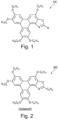
- FIG. 1 there is shown a representative structure of a triphenylene derivative series 100 according to some embodiments of the invention.
- the R group is changed to provide analogues of the triphenylene derivative series 100.
- the R group may be selected to alter the luminescent and/or other advantageous properties of the triphenylene derivative series 100.
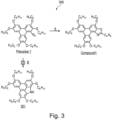
- a triphenylene derivative 200 Compound 1, according to an embodiment of the invention.
- the R group is an alkyl group of the formula C 4 H 9 .
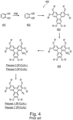
- Pathway A and Pathway B for a rearrangement reaction of Precursor 1, which is an azide (1-azido-2,3,6,7,10,11-hexakis(pentyloxy)triphenylene), under the reaction conditions of heating in xylene under nitrogen at 175 °C for 16 h.
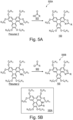
- FIG. 4 there is shown a schematic synthetic route 400 of the prior art ( N. Boden et. al. J. Mater. Chem., 1995, 5, 2275 ) to produce Precursor 1, and in addition Precursor 2, which is an amine (2,3,6,7,10,11-hexakis(pentyloxy)-1-triphenylenylamine), and Precursor 3, which is an amine (2,3,6,7,10,11-hexabutoxy-1-triphenylenylamine).
- Precursor 1 is an amine (2,3,6,7,10,11-hexakis(pentyloxy)-1-triphenylenylamine
- Precursor 3 which is an amine (2,3,6,7,10,11-hexabutoxy-1-triphenylenylamine.
- FIG. 5A there is shown a schematic synthetic route 500A for the formation of the triphenylene derivative series 100 of the present invention.
- Precursor 2 a carboxylic acid 501, and the triphenylene derivative series 100.
- the carboxylic acid 501 comprises an R group, which is incorporated into the oxazole moiety of the triphenylene derivative series 100.
- the R group may be an alkyl group, or an aryl group, i.e. the carbon atom bonded to the oxazole moiety in the triphenylene derivative series 100 may be either sp 2 or sp 3 hybridised.
- the organic phase was washed with aqueous NaOH (1M; 2 ⁇ 20 mL), separated and the organic phase was dried in vacuo.
- the crude black solid was purified by flash column chromatography (silica; 40 % CH 2 Cl 2 : 60 % n-hexane) to afford the triphenylene derivative series 100.
- FIG. 5B there is shown a schematic synthetic route 500B for the formation of the triphenylene derivative series 100 of the present invention.
- Precursor 2 an acyl chloride 502, and the triphenylene derivative series 100.
- an intermediate amide 100A the acyl chloride 502 comprises the R group, which is incorporated into the oxazole moiety of the triphenylene derivative series 100.
- the R group may be an alkyl group, or an aryl group, i.e. the carbon atom bonded to the oxazole moiety in the triphenylene derivative series 100 may be either sp 2 or sp 3 hybridised.
- the inventors believe that the acyl chloride 502 forms an intermediate amide (shown in Figure 5B as intermediate amide 100A) with the Precursor 2 in situ, which subsequently undergoes a ring closure to form the triphenylene derivative series 100.
- the reactions of both method 500A and method 500B are intermolecular coupling reactions of the carboxylic acid or the acyl chloride with the Precursor 2.
- the methods of Figure 5A and Figure 5B enable a huge number of analogues of the triphenylene derivate 100 to be synthesised by varying the R group of the carboxylic acid 501 in the method 500A of Figure 5A , or the acyl chloride 502 in the method 500B of Figure 5B .
- the triphenylene derivative series 100 of the present invention exhibit a number of desirable properties, in particular desirable luminescent characteristics.
- the R group may be altered to 'tune' these properties. More advantageously, within the known parameters of this invention, the R group may be specifically selected to enable the 'tuning' of the desirable luminescent characteristics. This is demonstrated in detail in the section below.
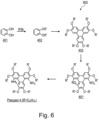
- Precursor 4 is 2,3,6,7,10,11-hexakis(pentyloxy)-1,8-triphenylenediamine.
- Precursor 4 is synthesised from di-nitro triphenylene 601.
- Di-nitro triphenylene 601 is formed as a side product in the prior art method that was used to synthesis the mono-nitro intermediate 404 (shown in Figure 4 ).
- Di-nitro triphenylene 601 may be isolated using flash column chromatography in an earlier fraction than the mono-nitro intermediate 404.
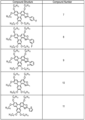
- Compound 1 The name for Compound 1 is 8-butyl-2,3,6,11,12-pentakis(pentyloxy)triphenyleno[1,2-d]oxazole.
- Compound 2 is 2,3,6,11,12-pentakis(pentyloxy)-8-phenyltriphenyleno[1,2-d]oxazole.
- Compound 3 The name for Compound 3 is 8-(naphthalen-2-yl)-2,3,6,11,12-pentakis(pentyloxy)triphenyleno[1,2-d]oxazole.
- Compound 4 was synthesised using the following method.
- a solution of 1-naphthalene carboxylic acid (225 mg, 1.31 mmol), palladium diacetate (0.005 mmol) and iodobenzene diacetate (0.157 mmol) in PhMe (5 mL) was heated at 70 °C under N 2 for 20 min.
- a solution of Precursor 2 (100mg; 0.131 mmol) in PhMe (2 mL) was added and heated under reflux for 48-72 h, whilst stirring. The solution was cooled to room temperature and diluted with CH 2 Cl 2 (20 mL).
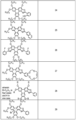
- Compound 4 The name for Compound 4 is 8-(naphthalen-1-yl)-2,3,6,11,12-pentakis(pentyloxy)triphenyleno[1,2-d]oxazole.
- Compound 5 was synthesised using the following method.
- a solution of 2-anthracene carboxylic acid (290 mg, 1.31 mmol), palladium diacetate (0.005 mmol) and iodobenzene diacetate (0.157 mmol) in PhMe (5 mL) was heated at 70 °C under N 2 for 20 min.
- a solution of Precursor 2 (100mg; 0.131 mmol) in PhMe (2 mL) was added and heated under reflux for 48-72 h, whilst stirring. The solution was cooled to room temperature and diluted with CH 2 Cl 2 (20 mL).
- Compound 5 The name for Compound 5 is 8-(anthracen-2-yl)-2,3,6,11,12-pentakis(pentyloxy)triphenyleno[1,2-d]oxazole.
- Compound 6 The name for Compound 6 is 8-(anthracen-9-yl)-2,3,6,11,12-pentakis(pentyloxy)triphenyleno[1,2-d]oxazole.
- Compound 7 The name for Compound 7 is 8-(4-fluorophenyl)-2,3,6,11,12-pentakis(pentyloxy)triphenyleno[1,2-d]oxazole.
- Compound 8 is 8-(3-fluorophenyl)-2,3,6,11,12-pentakis(pentyloxy)triphenyleno[1,2-d]oxazole.
- Compound 9 The name for Compound 9 is 8-(2-fluorophenyl)-2,3,6,11,12-pentakis(pentyloxy)triphenyleno[1,2-d]oxazole.
- Compound 10 is 8-methyl-2,3,6,11,12-pentakis(pentyloxy)triphenyleno[1,2-d]oxazole.
- Compound 12 is 4-(2,3,6,11,12-pentakis(pentyloxy)triphenyleno[1,2-d]oxazol-8-yl)benzonitrile.
- Compound 13 is 2,3,6,11,12-pentakis(pentyloxy)-8-(4-(trifluoromethyl)phenyl)triphenyleno[1,2-d]oxazole.
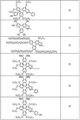
- Compound 14 The name for Compound 14 is 8-(2-iodophenyl)-2,3,6,11,12-pentakis(pentyloxy)triphenyleno[1,2-d]oxazole.
- Compound 15 is 8-(2-chlorophenyl)-2,3,6,11,12-pentakis(pentyloxy)triphenyleno[1,2-d]oxazole.
- Compound 18 was synthesised using the following method. A solution of Compound 17 (66 mg, 0.079 mmol) in acetone (10 mL) was heated to 50 °C and stirred under N 2 , to this was added a solution of sodium azide (7 mg, 0.111 mmol) in water (5 mL) and left stirring under N 2 for 4 h. After this time a precipitate had formed and the solvent was removed under reduced pressure, the precipitate was then filtered under vacumm and dried to give Compound 18 as an off white solid (59 mg, 94 %)
- Compound 19 is S-(4-(2,3,6,11,12-pentakis(pentyloxy)triphenyleno[1,2-d]oxazol-8-yl)butyl) ethanethioate.
- Compound 22 was synthesised using the following method.
- a solution of Compound 17 (260 mg, 0.311 mmol), Sodium Tert-butoxide (90 mg, 0.934 mmol), Potassium Iodide (40 mg, 0.311 mmol) and Ethylene Glycol (193 mg, 3.11 mmol) in MeCN (15 mL) was heated to and held at reflux for 48 h under N 2 .
- the reaction was cooled to room temperature and then evaporated to dryness in vacuo.
- the crude solid was dissolved with CH 2 Cl 2 (20 mL).
- Compound 20 had the following characterisation data: 1 H NMR ⁇ H: (300 MHz, CDCl 3 ) 10.00 (1H, s), 7.92 (1H, s), 7.90 (1H, s), 7.89 (1H, s), 7.84 (1H, s), 6.14-6.00 (1H, ddt, J 16.95, 10.20, 6.45), 5.22 (1H, dd, J 16.95, 1.60), 5.10 (1H, dd, J 10.20, 1.60), 4.43-4.35 (4H, m), 4.30-4.24 (6H, m), 3.22-3.17 (2H, t, J 7.55), 3.17-3.12 (2H, t, J 7.11), 2.86-2.78 (2H, m), 2.08-1.94 (10H, m), 1.62-1.45 (20H, m), 1.03-0.97 (15H, m) ppm.
- Compound 21 is 8-nonyl-2,3,6,11,12-pentakis(pentyloxy)triphenyleno[1,2-d]oxazole.
- Compound 23 was synthesised using the following method.
- a solution of 4-nitrobenzoic acid (1 g, 6 mmol), palladium diacetate (0.005 mmol) and (diacetoxyiodo)benzene (51 mg, 0.157 mmol) in PhMe (10 mL) was heated at 70 °C under N 2 for 20 min.
- a solution of Precursor 2 (100 mg; 0.132 mmol) in PhMe (10 mL) was added and heated under reflux for 48-72 h, whilst stirring. The solution was cooled to room temperature and diluted with CH 2 Cl 2 (20 mL).
- Compound 23 is 8-(4-nitrophenyl)-2,3,6,11,12-pentakis(pentyloxy)triphenyleno[1,2-d]oxazole.
- Compound 24 was synthesised using the following method. A solution of (diacetoxyiodo)benzene (51 mg, 0.157 mmol) and acetylsalicylic acid (550 mg, 3.031 mmol) in toluene (4 mL) was heated to 80 °C and stirred for 10 mins under N 2 . Then Precursor 2 (100 mg, 0.131 mmol) was added to form a black solution which was then stirred for a further 10 mins.
- Precursor 2 100 mg, 0.131 mmol
- Compound 24 is 2-(2,3,6,11,12-pentakis(pentyloxy)triphenyleno[1,2-d]oxazol-8-yl)phenol.
- Compound 25 was synthesised using the following method.
- Precursor 3 was synthesised using the following method. A solution of 2,3,6,7,10,11-hexabutoxy-1-nitrotriphenylene (1.70 g, 2.79 mmol), Sodium borohydride (1.70 g, 45.1. mmol) and Nickel(II) chloride hexahydrate (4.45 g, 18.7 mmol) in a 50/50 mix of MeOH and THF (40 mL) was stirred at room temperature for 5 h under N 2 . The crude black solid was then filtered and washed with CHCl 3 and the filtrate evaporated to dryness in vacuo to afford Precursor 3 as a brown solid (1.6 g, 85 %).
- Precursor 3 is 2,3,6,7,10,11-hexabutoxytriphenylen-1-amine
- Precursor 3 had the following characterization data: 1 H NMR ⁇ H: (300 MHz, CDCl 3 ) 8.82 (1 H, s), 7.83 (1 H, s), 7.80 (1 H, s), 7.78 (1 H, s), 7.37 (1 H, s), 4.57 (2 H, s), 4.29-4.09 (12 H, m), 2.01-1.81 (12 H, m), 1.67-1.52 (12 H, m), 1.13-0.94 (18 H, m) ppm.
- Compound 25 is 2,3,6,11,12-pentabutoxy-8-(naphthalen-2-yl)triphenyleno[1,2-d]oxazole.
- Compound 26 was synthesised using the following method. A solution of Precursor 4 (135 mg, 0.174 mmol) and palladium diacetate (0.0005 mmol) in PhMe (7 mL) was heated at reflux under N 2 for 10 min. 2-flourobenzoyl chloride (0.02 mL, 0.174 mmol) was added and heated under reflux for 40 h. The solution was cooled to room temperature and dried in vacuo and the resultant black solid was heated at 240 °C for 10 minutes before being cooled to room temperature. The crude black solid was purified by flash column chromatography (silica; 40 % CH 2 Cl 2 : 60 % n-hexane) to afford Compound 26 as an off-white solid (6 mg; 4 %).
- Compound 26 is 2,9-bis(2-fluorophenyl)-4,7,12,13-tetrakis(pentyloxy)triphenyleno[1,2-d:8,7-d']bis(oxazole).
- Compound 27 was synthesised using the following method.
- a solution of 4'-Carboxybenzo-15-crown-5 (600 mg, 1.92 mmol), Oxalyl chloride (2.0 mL, 23.6 mmol) and Dimethylformamide (0.01 ml, 0.129 mmol) was heated and held at reflux for 10 minutes under N 2 .
- the reaction was cooled to room temperature and then evaporated to dryness in vacuo.
- a solution of Precursor 2 100 mg, 0.132 mmol
- Compound 27 The name for Compound 27 is 8-(2,3,5,6,8,9,11,12-octahydrobenzo[b][1,4,7,10,13]pentaoxacyclopentadecin-15-yl)-2,3,6,11,12-pentakis(pentyloxy)triphenyleno[1,2-d]oxazole.
- Compound 28 was synthesised using the following method.
- a solution of Compound 2 (60 mg, 0.077 mmol) in degassed dichloromethane (5 mL) was stirred in a nitrogen purged 2 neck flask under nitrogen atmosphere at -20 °C.
- Boron tribromide (1M solution in dichloromethane, 387 ⁇ L, 0.385 mmol, 5 eq) was added via syringe through a Suba-Seal(RTM) and the dark yellow solution was stirred for at room temperature for 24 h.
- Compound 28 is 2,3,11,12-tetrakis(pentyloxy)-8-phenyltriphenyleno[1,2-d]oxazol-6-ol.
- Compound 29 was synthesised using the following method.
- Compound 2 250 mg, 0.322 mmol was disolved in dry dichloromethane (10 mL) and stirred at 0 °C under a nitrogen atmosphere.
- 0.01M solution of Br 2 in dichloromethane (144 mL, 1.449 mmol) was then added over 2 hours (4 ⁇ 36 mL) and monitered by TLC.
- the reaction was quenched by addition of saturated sodium metabisulfate solution (100 mL).
- the product was extracted with dichloromethane (30 mL) washed with water (3 ⁇ 30 mL), dried over MgSO 4 and evaporated to dryness.
- the crude product was then purified by column chromatography (Silica 40 % dichloromethane : hexane) to yield Compound 29 as a yellow solid (170 mg, 62 %).
- Compound 29 is 1-bromo-2,3,6,11,12-pentakis(pentyloxy)-8-phenyltriphenyleno[1,2-d]oxazole.
- Compound 30 was synthesised using the following method.
- Compound 29 (170 mg, 0.199 mmol), K 2 CO 3 (410 mg, 2.97 mmol) and Pd(PPh 3 ) 4 (30 mg, 0.026 mmol) were dissolved in degassed 5 : 1 tertahydrofuran : Water mix (4 mL) under nitrogen atmosphere.
- (4-hydroxyphenyl)boronic acid 140 mg, 1.02 mmol
- the product was extracted with dichloromethane (30 mL), washed with water (3 ⁇ 30 mL) and evaporated to dryness.
- the crude product was purified by column cromatography (Silica DCM : Hexane) to yield impure Compound 30 as a brown solid.
- Compound 31 was synthesised using the following method.
- Compound 10 (50.7 mg, 0.071 mmol) was added to a 2 neck round bottom flask, which was purged with nitrogen for 15 minutes.
- Dry dichloromethane (20 mL) was then added via syringe through a Suba-Seal(RTM) and the brown stirring solution was cooled to -78 °C.
- Boron tribromide (1M solution in dichloromethane, 391 ⁇ L, 0.391 mmol, 5.5 equivalents) was added via syringe through a Suba-Seal(RTM) and the reaction was stirred for 4 h.
- reaction mixture was poured over crushed ice and stirred until the ice had fully melted, 4 drops of hydrochloric acid (1M) were added and the product was extracted with ethyl acetate, washed with water (2 ⁇ 20 mL), and dried over MgSO 4 and evaporated to dryness. The crude product was used without further purification.
- Compound 31 is 8-methyltriphenyleno[1,2-d]oxazole-2,3,6,11,12-pentaol.
- Compound 32 is 2,3,6,12-tetrakis(2-(2-(2-methoxyethoxy)ethoxy)ethoxy)-8-methyl-11-(pentyloxy)triphenyleno[1,2-d]oxazole.
- Compound 32 had the following characterisation data: ES + MS m/z: 1017.51 ([M] + 100 %).
- Compound 32 is water soluble.
- Compound 33 was synthesised from Precursor 5 in the following method.
- the starting material to form Precursor 5 was obtained using the method described in J. Mater. Chem. C, 2017,5, 669-682 (DOI: 10.1039/C6TC04530H ).
- Precursor 5 was synthesised in the following method. 5,6-dimethoxy-2,3,8,9,12,13-hexakis(pentyloxy)dibenzo[fg,op]tetracene (681mg, 0.775 mmol) was dissolved in diethyl ether (20 ml) and then acetic acid (1.33 ml, 23.24 mmol, 30 eqiv) was added and the mixture stirred at room temperature in a nitrogen atmosphere for 10 minutes before the addition of fuming nitric acid (65 ⁇ L, 1.55 mmol, 2 equiv) was added.
- the reaction mixture was stirred under nitrogen for 20 minutes before the further addition of nitric acid (30 ⁇ L, 0.715 mmol, 0.92 equiv) and the reaction mixture was left for 20 minutes stirring at room temperature.
- the mixture was then quenched with water (10 ml) and the organic phase was washed with NaOH (1 M, 2 ⁇ 30 mL) and then dried in vacuo to provide Precursor 5 as a black solid (680 mg, 95 %). This was used in the next step with no further purification.
- Precursor 5 is 5,6-dimethoxy-1-nitro-2,3,8,9,12,13-hexakis(pentyloxy)dibenzo[fg,op]tetracene.
- Precursor 6 was synthesised in the following method. Precursor 5 (680 mg, 0.736 mmol) and NiCl 2 . 6H 2 O (552 mg, 2.33 mmol, 3 equivalents) were dissolved in THF:MeOH (20 mL, 5:4 ratio), to make a yellow solution, and then NaBH 4 (586 mg, 15.5 mmol, 20 equivalents) was added over 15 minutes. The black reaction mixture was left stirring under a nitrogen atmosphere for40 minutes after which time it was diluted with chloroform and the precipitate was gravity filters to leave a brown organic phase, which was then dried in vacuo to provide Precursor 6 as brown solid (614 mg, 93 %).
- Precursor 6 is 5,6-dimethoxy-2,3,8,9,12,13-hexakis(pentyloxy)dibenzo[fg,op]tetracen-1-amine.
- Precursor 7 was synthesised in the following method.
- Precursor 6 (147 mg, 0.181 mmol) was dissolved in dry dichloromethane (20 mL) and dry acetonitrile (20 mL). The solution was cooled to 0 °C under a nitrogen atmosphere then tert-butyl nitrite (34 ⁇ L, 0.309 mmol, 1.7 equivalents) and TMSN 3 (36 ⁇ L, 0.273 mmol, 1.5 equivalents) were added and the reaction mixture stirred 0 °C for 10 minutes and then at room temperature for 20 minutes. The solution was then dried in vacuo and purified via flash column chromatography (silica,30 % DCM, 70 % n-hexane) to provide Precursor 7 as a while solid (120 mg, 72 %).
- Compound 33 was synthesised using the following method. Precursor 7 (100 mg; 0.13 mmol) was dissolved in dry toluene (5 mL) was added to a flask containing rhodium octanoate dimer (5 mg; 0.01 mmol), under a nitrogen atmosphere. This mixture was then heated to reflux and stirred for 20 hours. The reaction was cooled to room temperature and then dried in vacuo, the solid was then purified via flash column chromatography (silica; 95 % n-hexane: 5 % ethyl acetate) to provide Compound 33 as a white solid (58 mg, 50 %).
- Compound 33 is 2-butyl-12,13-dimethoxy-5,6,9,10,15-pentakis(pentyloxy)dibenzo[4,5:9,10]pyreno[1,2-d]oxazole.
- Precursor 6 (47 mg; 0.053 mmol), benzoyl chloride (30 ⁇ L, 0.265 mmol, 5 equivalents), and diisopropylehtylamine (46 ⁇ L, 0.265 mmol, 5 equiv) were dissolved in dry toluene (5 mL) and the mixture was heated to reflux under a nitrogen atmosphere. The reaction mixture was stirred for 1 hour at which point the mixture was dried in vacuo then the solid was heated to 240 °C for 10 minutes. The reaction was cooled to room temperature and the solid was then purified via flash column chromatography (silica; 40 % DCM, 60 % n-hexane) to afford Compound 34 a white solid (16 mg, 33 %).
- Compound 34 is12,13-dimethoxy-5,6,9,10,15-pentakis(pentyloxy)-2-phenyldibenzo[4,5:9,10]pyreno[1,2-d]oxazole.
- Precursor 6 (100 mg; 0.111 mmol) 4-cyanobenzoyl chloride (92 mg, 0.555 mmol, 5 equiv), and diisopropylehtylamine (90 ⁇ L, 0.555 mmol, 5 equiv) were dissolved in dry toluene (5 mL) and the mixture was heated reflux under a nitrogen atmosphere. The reaction mixture was stirred for 1 hour at which point the mixture was dried in vaccuo then the solid was heated to 240 °C for 10 minutes. The reaction was cooled to room temperature and the solid was then purified via flash column chromatography (silica; 40 % DCM, 60 % n-hexane) to afford Compound 35 as a white solid (17 mg, 16 %).
- Compound 35 is 4-(12,13-dimethoxy-5,6,9,10,15-pentakis(pentyloxy)dibenzo[4,5:9,10]pyreno[1,2-d]oxazol-2-yl)benzonitrile.
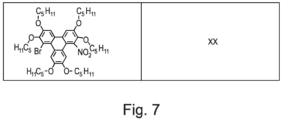
- Compound XX was synthesised using the following method.
- Compound XX is 1-bromo-8-nitro-2,3,6,7,10,11-hexakis(pentyloxy)triphenylene.
- the triphenylene derivative series 100 of the present invention exhibits a number of advantageous properties that are useful in many applications. Some of these advantageous properties are demonstrated below in a non-limiting way.
- FIG. 8 there is shown the normalised absorption and emission spectra 800 for Compounds 1 to 6 of Examples 1 to 6, and for compound 403.
- the solvent used to record the spectra was acetonitrile.
- Table 1 there is shown luminescent data for the Compounds 1 to 6. There is shown the maximum absorption values ⁇ max (nm), the maximum emission values ⁇ max (nm), the pseudo Stokes shift pSS (cm -1 ), the quantum yield ⁇ , and the brightness (M -1 cm -1 ). The luminescent data shown in Table 1 was recorded for each of the Compounds 1 to 6 individually in ethyl acetate, octan-1-ol, and acetonitrile.
- Compounds 1 to 6 exhibit large Stokes shifts in comparison with many commercially available dyes, e.g. the Alexa Fluor series ( J Histochem Cytochem. Vol. 51(12): 1699-1712, 2003 ). It is believed that the Stokes shifts of Compounds 1 to 6 (Compound 6 in particular) are some of the largest Stokes shifts observed for known luminescent organic compounds.
- the advantageous luminescent properties such as the Stokes shift may be altered or 'tuned' by variation of the R group within the triphenylene derivative series 100.
- the maximum absorption wavelength remains relatively constant for each of the Compounds 1 to 6.
- This 'tunable' characteristic is not observed with many other commercially available dyes.
- the triphenylene derivative series 100 of the present invention are push-pull twisted internal charge transfer systems, wherein the triphenylene moiety when substituted with five electron-donating alkoxy groups (shown in Figure 1 as C 5 H 11 ), provides a 'push' moiety.
- the R group provide a 'pull' moiety when conjugatively coupled to the triphenylene moiety by the oxazole unit. Therefore, further stabilisation of the excited state may be achieved by increasing the electron withdrawing nature of the R group. As the energy of the excited state is lowered, this increases the Stokes shift.
- the triphenylene derivative series 100 of the present invention may be tuned to provide this characteristic, as required depending upon the application.
- the emission spectra of Compounds 1 to 6 span a large portion of the visible spectrum.
- the R group need not be limited to those disclosed, and may be any alkyl or aryl group.
- variation of the R group with, for example, a different aromatic hydrocarbon group has been shown to result in a shift in the emission spectra.
- the shift in emission, and consequently the resulting visible colour of a specific triphenylene derivative, within the triphenylene derivative series 100, may be predicted with a good level of certainty for variation of the R group.
- this provides a huge number of analogues, for example wherein R is an aryl group, so that the emission is a colour within the visible spectrum, and this visible colour may be 'tuned' by slight structural alteration to the R group of the triphenylene derivative series 100 of the present invention.
- Compounds 1 to 6 exhibit very large molar extinction coefficients (E) of over 100,000 M -1 cm -1 . This is comparable to commercially available dyes, for example, the Alexa Fluor series, e.g. Alexa Fluor 635 has a molar extinction coefficient of 140,000 M -1 cm -1 .
- Compounds 1 to 6 also advantageously exhibit high quantum yields ⁇ and high brightness values.
- the quantum yield ⁇ in this case is defined as the ratio of the number of photons emitted to the number of photons absorbed.
- the Compounds 1 to 6 exhibit high brightness values, the brightness being defined as the product of the molar extinction coefficient and fluorescence quantum yield.
- FIG. 9 there is shown a graph of the normalised photoemission 900 of Compounds 1 to 6 in the solid state. There is shown the photoemission in the solid state (designated with the prefix ES) for Compounds 1 to 6 (ES1, ES2, ES3, ES4, ES5, ES6).
- the photoemission does not substantially change when Compounds 2 to 6 are dissolved in ethyl acetate in comparison to in the solid state. This demonstrates predictability and stability of photo-emissive behaviour.
- FIG. 10 there is shown a DSC (Differential scanning calorimetry) thermal analysis plot 1000 of phase type of Compounds 1 to 6, shown for both heating and cooling.
- the crystalline phase, the unknown solid phase, the columnar hexagonal phase, and the unknown liquid crystal phase are shown.
- Compounds 1 to 6 show an increase in conductivity, i.e. the photoconductivity values, upon light irradiation.
- the conductivity and the photoconductivity is much higher for the triphenylene derivatives comprising an oxazole moiety, when compared to reference compound 403, which does not comprise an oxazole moiety.
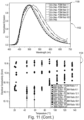
- FIG. 11 there is shown a photoconductivity experiment 1100 for Compound 3 in comparison with the reference compound 403 (shown in Figure 4 ).
- the absorbance spectra 1101 and emission spectra 1102 of Compound 3 was measured in the presence of phenyl-C61-butyric acid methyl ester (PCBM) at different ratios.
- the graph 1103 shows measurements of the electrical conductivity at different temperatures with light irradiation at 350nm for the reference compound 403.
- the graph 1104 shows measurements of the electrical conductivity at different temperatures with light irradiation at 350nm for Compound 3.
- Compound 3 displays improved conductivity, and photoconductivity, when the oxazole moiety is introduced. This is in comparison with the conductivity and photoconductivity of reference compound 403, which does not comprise an oxazole moiety substituted with an R group, as is characteristic of the triphenylene derivative series 100 of the present invention.
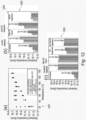
- FIG. 12 there is shown a photoconductivity experiment 1200 for Compound 22. There is shown a graph 1201, a graph 1202, and a graph 1203.
- the graph 1201 shows the electrical conductivity measurements for Compound 22 at different temperatures. Electrical conductivity measurements were recorded for Compound 22 in the presence and absence of irradiating UV light at 350nm, and after treatment with HCl in the presence and absence of irradiating UV light at 350 nm.
- the graph 1203 shows the electrical conductivity measurements for Compound 22 at different pH values.
- the electrical conductivity was measured for Compound 22: (i) untreated; (ii) after a first treatment with NaOH; (iii) after 20 hours; (iv) after treatment with HCl; (v) after a second treatment with NaOH.
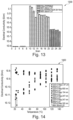
- FIG. 13 there is shown a photoconductivity experiment 1300 for Compound 22.
- the electrical conductivity was measured for Compound 22: (i) untreated; (ii) untreated in the presence of UV light at 350 nm; (iii) after treatment with NaOH (2M for 15 minutes); (iv) after treatment with NaOH (2M for 15 minutes) in the presence of UV light at 350 nm.
- FIG 14 there is shown a photoconductivity experiment 1400 for Compound 3. The electrical conductivity was measured at different temperatures.
- triphenylene derivatives of the present invention may also be used in a functional layer of an OLED (Organic Light Emitting Diode). It has been shown that the triphenylene derivatives of the present invention may exhibit excellent emitting, charge transporting, and/or charge blocking abilities.
- OLED Organic Light Emitting Diode
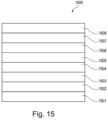
- the OLED 1500 comprises the following successive layers: a substrate 1501, an anode 1502, an optional hole transport layer 1503, an optional electron blocking layer 1504, an emissive layer 1505, an optional hole blocking layer 1506, an optional electron transport layer 1507, and a cathode 1508.
- the hole blocking layer 1506 may comprise 2,9-dimethyl-4,7-dipphenyl-1,10-phenanthroline (bathocuproine, BCP).
- the electron transport layer 1507 may comprise, for example, metal chelates such as, for example, aluminium tris(8-hydroxyquinoline).
- the cathode 1508 may comprise any metal, for example, aluminium, lithium, magnesium, and/or calcium.
- the emissive layer 1505 comprises the triphenylene derivatives of the present invention, e.g. the triphenylene derivative series 100.
- An OLED 1500 may be fabricated in the following manner:
- the R group of the triphenylene derivative series 100 and Precursors 1 and 2 need not be restricted to C 5 H 11 , and may be any stable alkyl or aryl group capable of alkylating the phenol moiety of the triphenylene moiety.
- the triphenylene derivative series 100 of the present invention may be further functionalised, for example, by derivatisation of functional groups within the R group.
- This provides the possibility of using the triphenylene derivative of the present invention as biotags or probes, for example.
Landscapes
- Chemical & Material Sciences (AREA)
- Organic Chemistry (AREA)
- Physics & Mathematics (AREA)
- Engineering & Computer Science (AREA)
- Materials Engineering (AREA)
- Spectroscopy & Molecular Physics (AREA)
- Health & Medical Sciences (AREA)
- Immunology (AREA)
- Optics & Photonics (AREA)
- Chemical Kinetics & Catalysis (AREA)
- Nuclear Medicine, Radiotherapy & Molecular Imaging (AREA)
- Life Sciences & Earth Sciences (AREA)
- Analytical Chemistry (AREA)
- Biochemistry (AREA)
- General Health & Medical Sciences (AREA)
- General Physics & Mathematics (AREA)
- Pathology (AREA)
- Electroluminescent Light Sources (AREA)
- Organic Low-Molecular-Weight Compounds And Preparation Thereof (AREA)
Claims (15)
- Dérivés d'hydrocarbures aromatiques polycycliques représentés par la formule générale suivante :
 dans laquelle R représente indépendamment un groupe aromatique et/ou un groupe aliphatique ;p représente un entier de 1 à 2 ;q et s représentent indépendamment des entiers de 1 à 4 ;Y1, Y2 et Y3 représentent indépendamment un atome d'hydrogène, un atome de deutérium, un atome de fluor, un atome de chlore, un atome de brome, un groupe OH, un groupe acide carboxylique, un groupe glycol, un groupe alcoxy, un groupe thioalcoxy, un groupe amino, un groupe acétate, un groupe amide, un groupe thioamide, un groupe thioester, un groupe azo, un groupe silyle, un atome d'azote alkylé, un groupe cyano, un groupe nitro, un groupe alkyle (par ex. un groupe alkyle à chaîne linéaire ou ramifiée) et/ou un groupe aryle (par ex. un groupe phénol).
 - Dérivés de triphénylène représentés par la formule générale suivante :
 dans laquelle R représente indépendamment un groupe aromatique et/ou un groupe aliphatique ;A représente indépendamment un atome d'hydrogène, un groupe aryle, un groupe aryle comprenant 1 à 20 atomes de carbone (par ex. 1 à 15 atomes de carbone, ou 1 à 10 atomes de carbone, ou 10, 9, 8, 7, 6, 5, 4, 3, 2 ou 1 atomes de carbone) ou un groupe éther alkylique tel qu'un groupe polyéthylène glycol ;J représente indépendamment un atome d'hydrogène, un atome de deutérium, un atome de fluor, un atome de chlore, un atome de brome, un atome d'oxygène alkylé, un atome d'azote alkylé, un groupe cyano, un groupe nitro, un groupe alkyle et/ou un groupe aryle.
 - Dérivés d'hydrocarbures aromatiques polycycliques, représentés par la formule générale suivante :
 dans laquelle R représente indépendamment un groupe aromatique et/ou un groupe aliphatique ;q représente indépendamment un entier de 1 à 3 ;s représente indépendamment un entier de 1 à 4 ;t représente indépendamment un entier de 1 à 4 ;Y2, Y3 et Y4 et J représentent indépendamment un atome d'hydrogène, un atome de deutérium, un atome de fluor, un atome de chlore, un atome de brome, un groupe OH, un atome d'oxygène alkylé, un atome d'azote alkylé, un groupe cyano, un groupe nitro, un groupe alkyle et/ou un groupe aryle (par ex. un groupe phénol).
 - Dérivés d'hydrocarbures aromatiques polycycliques, représentés par la formule générale suivante :
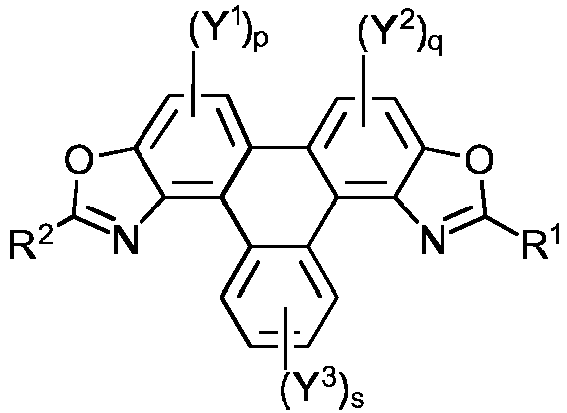 dans laquelle R1 et R2 représentent indépendamment un groupe aromatique et/ou un groupe aliphatique ;p et q représentent indépendamment un entier de 1 à 2 ;s représente un entier de 1 à 4 ;Y1, Y2 et Y3 représentent indépendamment un atome d'hydrogène, un atome de deutérium, un atome de fluor, un atome de chlore, un atome de brome, un groupe OH, un groupe acide carboxylique, un groupe glycol, un groupe alcoxy, un groupe thioalcoxy, un groupe amino, un groupe acétate, un groupe amide, un groupe thioamide, un groupe thioester, un groupe azo, un groupe silyle, un atome d'azote alkylé, un groupe cyano, un groupe nitro, un groupe alkyle (par ex. un groupe alkyle à chaîne droite ou ramifiée) et/ou un groupe aryle,par exemple les dérivés de triphénylène représentés par la formule générale suivante :
 dans laquelle R1 et R2 représentent indépendamment un groupe aromatique et/ou un groupe aliphatique ;A représente indépendamment un atome d'hydrogène, un groupe alkyle comprenant 1 à 20 atomes de carbone (par ex. 1 à 15 atomes de carbone, ou 1 à 10 atomes de carbone, ou 10, 9, 8, 7, 6, 5, 4, 3, 2 ou 1 atomes de carbone) ou un groupe éther alkylique (par ex. un groupe polyéthylène glycol) ;J représente indépendamment un atome d'hydrogène, un atome de deutérium, un atome de fluor, un atome de chlore, un atome de brome, un atome d'oxygène alkylé, un atome d'azote alkylé, un groupe cyano, un groupe nitro, un groupe alkyle et/ou un groupe aryle.
 - Dérivés d'hydrocarbures aromatiques polycycliques, représentés par la formule générale suivante :
 dans laquelle R1, R2, R3 représentent indépendamment un groupe aromatique et/ou aliphatique ;p, q et s représentent chacun indépendamment un entier de 1 à 2 ;Y1, Y2 et Y3 représentent indépendamment un atome d'hydrogène, un atome de deutérium, un atome de fluor, un atome de chlore, un atome de brome, un groupe OH, un groupe acide carboxylique, un groupe glycol, un groupe alcoxy, un groupe thioalcoxy, un groupe amino, un groupe acétate, un groupe amide, un groupe thioamide, un groupe thioester, un groupe azo, un groupe silyle, un atome d'azote alkylé, un groupe cyano, un groupe nitro, un groupe alkyle (par ex. un groupe alkyle à chaîne droite ou ramifiée) et/ou un groupe aryle ;par exemple, les dérivés triphénylène représentés par la formule générale suivante (C3) :
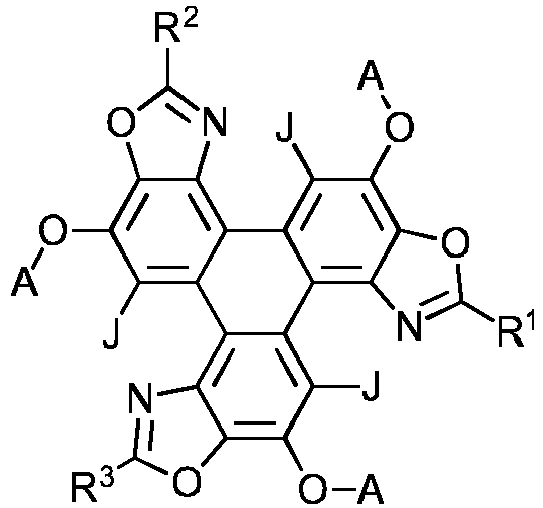 dans laquelle R1, R2, R3 représentent indépendamment un groupe aromatique et/ou un groupe aliphatique ;A représente indépendamment un atome d'hydrogène, un groupe alkyle comprenant 1 à 20 atomes de carbone (par ex. 1 à 15 atomes de carbone, ou 1 à 10 atomes de carbone, ou 10, 9, 8, 7, 6, 5, 4, 3, 2 ou 1 atomes de carbone) ou un groupe éther alkylique ;J représente indépendamment un atome d'hydrogène, un atome de deutérium, un atome de fluor, un atome de chlore, un atome de brome, un atome d'oxygène alkylé, un atome d'azote alkylé, un groupe cyano, un groupe nitro, un groupe alkyle et/ou un groupe aryle (par ex. un groupe phénol).
 - Dérivé d'hydrocarbures aromatiques polycycliques selon l'une quelconque des revendications 1 à 5, au moins l'un des groupes R, R1, R2, R3 lorsqu'il est présent représentant un groupe alkyle et au moins l'un des groupes R, R1, R2, R3 lorsqu'il est présent représentant un groupe aromatique (par ex. un groupe phényle, un groupe phényle substitué, ou un groupe naphtalène, anthracène ou pyrène) ou au moins l'un des groupes R, R1, R2, R3 lorsqu'il est présent représentant un groupe aromatique hétérocyclique, par exemple, un groupe pyridine ou thiophène ou au moins l'un des groupes R, R1, R2, R3 lorsqu'il est présent représentant un groupe hydrocarbure aromatique polycyclique, par ex. un groupe hydrocarbure aromatique polycyclique fusionné.
- Dérivés d'hydrocarbures aromatiques polycycliques, par ex. les dérivés de triphénylène, selon l'une quelconque des revendications 1 à 6 choisis parmi les structures suivantes, c.-à-d. les composés 1 à 36
Structure du composé Numéro du composé 
1 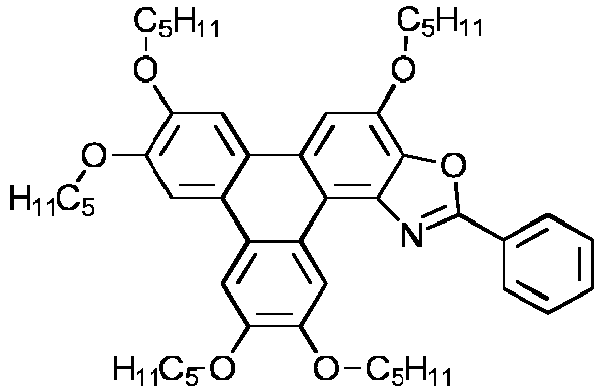
2 
3 
4 
5 
6 
7 
8 
9 
10 
11 
12 
13 
14 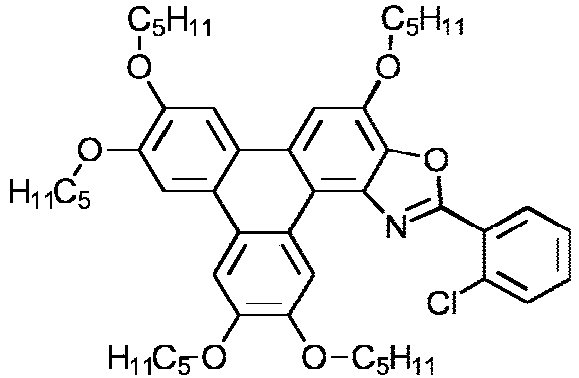
15 
16 
17 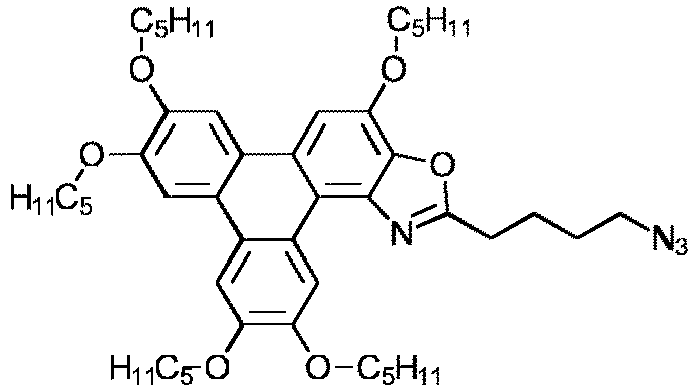
18 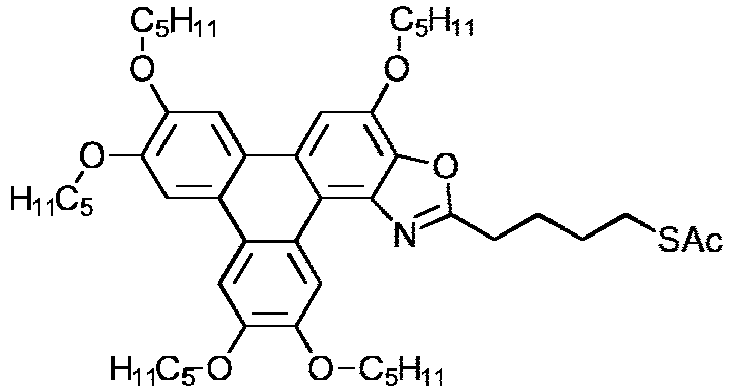
19 
20 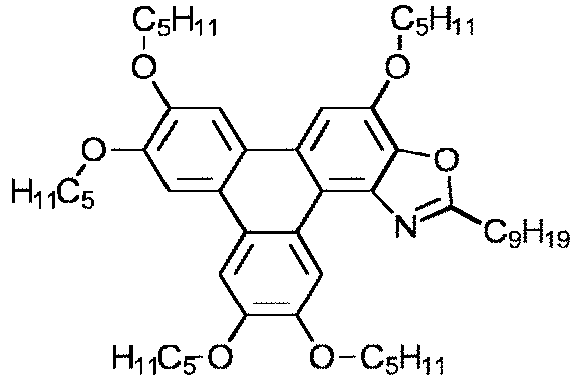
21 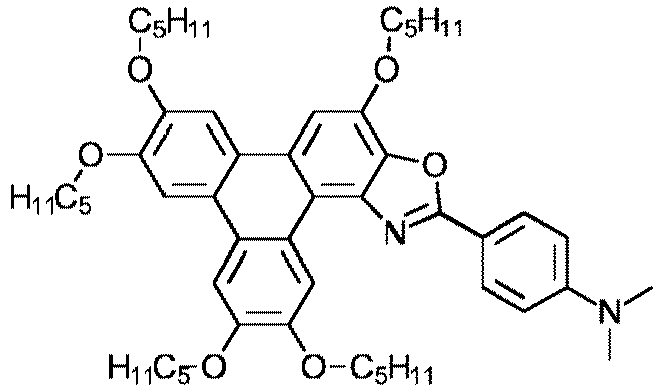
22 
23 
24 
25 
26 
27 
28 
29 
30 
31 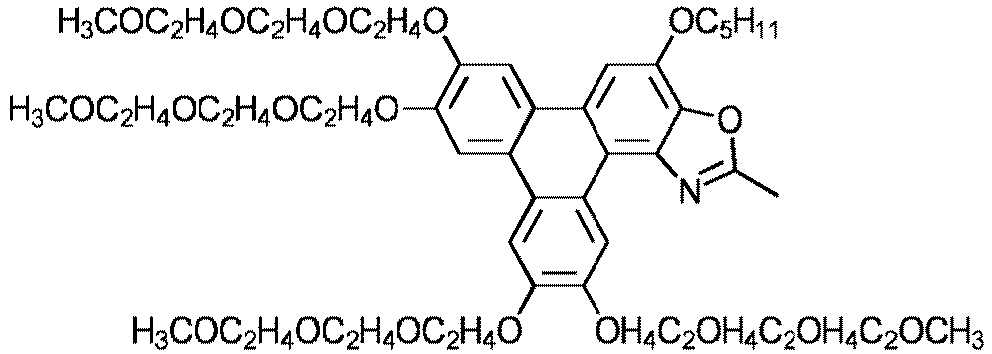
32 
33 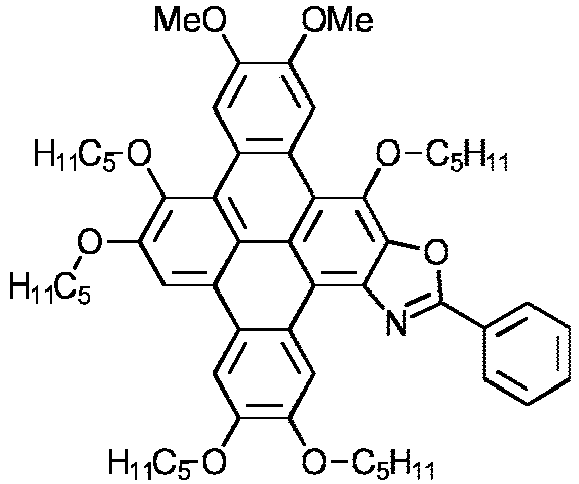
34 
35 - Dispositif comprenant un hydrocarbure aromatique polycyclique selon l'une quelconque des revendications précédentes, par exemple ledit dispositif étant un dispositif électroluminescent organique, un dispositif OPV (photovoltaïque organique), un transistor à couches minces ou un écran à cristaux liquides.
- Composé destiné à la fabrication de dérivés de triphénylène selon la revendication 4 comprenant la structure :

- Procédé de synthèse de dérivés d'hydrocarbures aromatiques polycycliques (P3) comprenant la formule générale :
 dans laquelle (SM3) représente le coeur d'hydrocarbure aromatique polycyclique, (P3) représente le dérivé d'hydrocarbure aromatique polycyclique,p représente un entier de 1 à 2 ;q et s représentent des entiers de 1 à 4 ;Y1, Y2 et Y3 représentent indépendamment un atome d'hydrogène, un atome de deutérium, un atome de fluor, un atome de chlore, un atome de brome, un groupe OH, un groupe acide carboxylique, un groupe glycol, un groupe alcoxy, un groupe thioalcoxy, un groupe amino, un groupe acétate, un groupe amide, un groupe thioamide, un groupe thioester, un groupe azo, un groupe silyle, un atome d'azote alkylé, un groupe cyano, un groupe nitro, un groupe alkyle (par ex. un groupe alkyle à chaîne droite ou ramifiée) et/ou un groupe aryle (par ex. un groupe phénol) ;G représente un atome de carbone substitué ;N représente un atome d'azote ;B représente deux atomes d'hydrogène ;(E) représente le réactif ;R représente indépendamment un groupe aromatique et/ou un groupe aliphatique ;Z représente un élément parmi un atome d'oxygène dérivatisé, un atome de chlore ou un atome de brome ou tout bon groupe partant ;comprenant éventuellement en outre un catalyseur, par ex. un catalyseur de métal de transition, par ex. un catalyseur de palladium Pd(II) par exemple l'acétate de palladium Pd(OAc)2 ;éventuellement ledit réactif (E) étant un acide carboxylique, par exemple, l'acide benzoïque ou un acide benzoïque substitué, ou ledit réactif (E) étant un chlorure d'acyle, par exemple, le chlorure de benzyle ou un chlorure de benzyle substitué ;éventuellement ledit procédé comprenant en outre l'ajout d'un réactif supplémentaire pour remplacer le groupe Z du réactif (E) par un bon groupe partant, par exemple, le réactif supplémentaire peut être le (diacétoxyiodo)benzène ;et ledit coeur d'hydrocarbure aromatique polycyclique (SM3) et ledit réactif (E) subissant une réaction de couplage intermoléculaire pour produire le dérivé d'hydrocarbure aromatique polycyclique (P3).
 - Procédé de synthèse de dérivés de triphénylène (P4) selon la revendication 10, comprenant la formule générale :
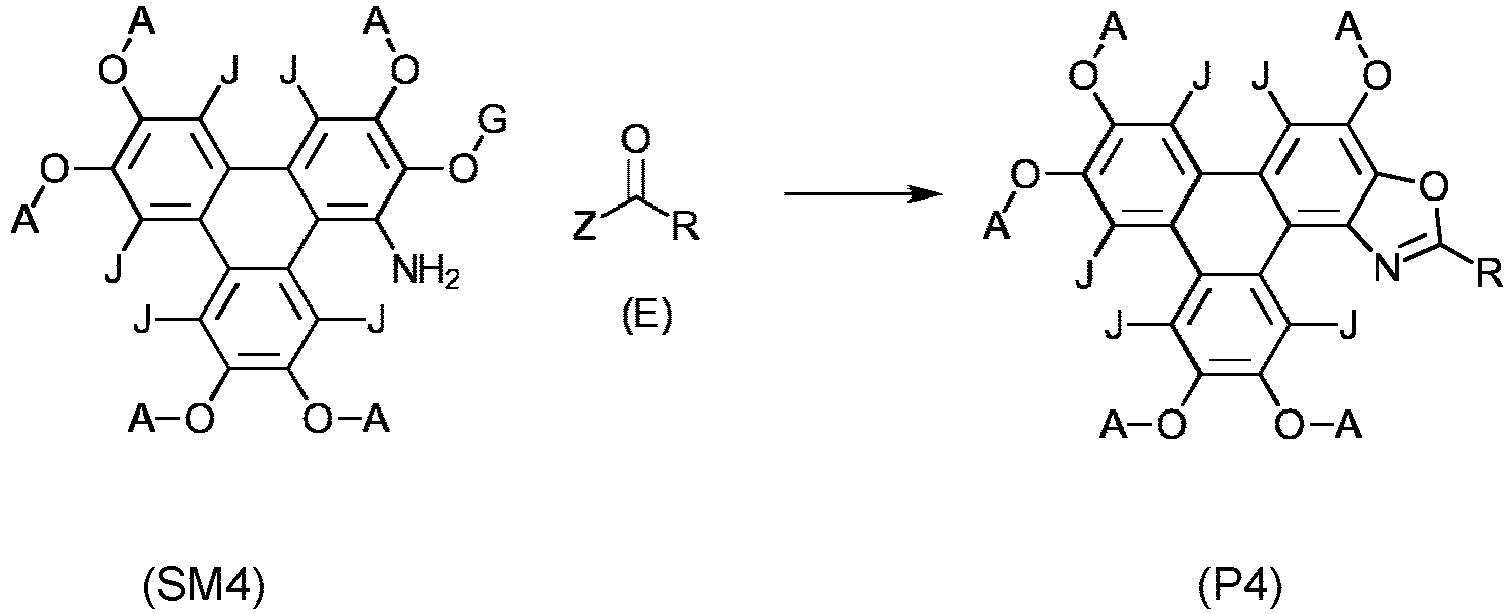 dans laquelle (SM4) représente un coeur de triphénylène, (P4) représente un dérivé de triphénylène ;A représente indépendamment un atome d'hydrogène, un groupe aryle, un groupe alkyle comprenant 1 à 20 atomes de carbone (par ex. 1 à 15 atomes de carbone, ou 1 à 10 atomes de carbone, ou 10, 9, 8, 7, 6, 5, 4, 3, 2 ou 1 atomes de carbone) ;J représente indépendamment un atome d'hydrogène, un atome de deutérium, un atome de fluor, un atome de chlore, un atome de brome, un atome d'oxygène alkylé, un atome d'azote alkylé, un groupe cyano, un groupe nitro, un groupe alkyle et/ou un groupe aryle,G représente un atome de carbone substitué ;(E) représente le réactif ;R représente indépendamment un groupe aromatique et/ou un groupe aliphatique ;Z représente un élément parmi un atome d'oxygène dérivatisé, un atome de chlore ou un atome de brome, ou tout bon groupe partant ;comprenant éventuellement en outre un catalyseur, par ex. un catalyseur de métal de transition, par ex. un catalyseur de palladium Pd(II) par exemple l'acétate de palladium Pd(OAc)2 ;éventuellement ledit réactif (E) étant un acide carboxylique, par exemple, l'acide benzoïque ou un acide benzoïque substitué, ou ledit réactif (E) étant un chlorure d'acyle, par exemple, le chlorure de benzyle ou un chlorure de benzyle substitué ;éventuellement ledit procédé comprenant en outre l'ajout d'un réactif supplémentaire pour remplacer le groupe Z du réactif (E) par un bon groupe partant, par exemple, le réactif supplémentaire peut être le (diacétoxyiodo)benzène ;et ledit coeur de triphénylène (SM4) et ledit réactif (E) subissant une réaction de couplage intermoléculaire pour produire le dérivé de triphénylène (P4) ;par exemple, un procédé de synthèse de dérivés de triphénylène (100), comprenant la formule générale :
 dans laquelle R représente indépendamment un groupe aromatique et/ou un groupe aliphatique.
 - Procédé de synthèse de dérivés d'hydrocarbures aromatiques polycycliques (P6), comprenant la formule générale :
 dans laquelle (SM6) représente un coeur d'hydrocarbure aromatique polycyclique, (P6) représente un dérivé d'hydrocarbure aromatique polycyclique ;p représente un entier de 1 à 2 ;q représente un entier de 1 à 2 ;s représente un entier de 1 à 4 ;Y1, Y2 et Y3 représentent indépendamment un atome d'hydrogène, un atome de deutérium, un atome de fluor, un atome de chlore, un atome de brome, un groupe OH, un groupe acide carboxylique, un groupe glycol, un groupe alcoxy, un groupe thioalcoxy, un groupe amino, un groupe acétate, un groupe amide, un groupe thioamide, un groupe thioester, un groupe azo, un groupe silyle, un atome d'azote alkylé, un groupe cyano, un groupe nitro, un groupe alkyle (par ex. un groupe alkyle à chaîne droite ou ramifiée) et/ou un groupe aryle ;G représente indépendamment un atome de carbone substitué ;N représente un atome d'azote ;B représente deux atomes d'hydrogène ;(E) représente le réactif ;R représente indépendamment un groupe aromatique et/ou un groupe aliphatique ;Z représente un élément parmi un atome d'oxygène dérivatisé, un atome de chlore ou un atome de brome ou tout bon groupe partant ;comprenant éventuellement en outre un catalyseur, par ex. un catalyseur de métal de transition, par ex. un catalyseur de palladium Pd(II) par exemple l'acétate de palladium Pd(OAc)2 ;éventuellement ledit réactif (E) étant un acide carboxylique, par exemple, l'acide benzoïque ou un acide benzoïque substitué, ou ledit réactif (E) étant un chlorure d'acyle, par exemple, le chlorure de benzyle ou un chlorure de benzyle substitué ;éventuellement ledit procédé comprenant l'ajout d'un réactif supplémentaire pour remplacer le groupe Z du réactif (E) par un bon groupe partant, par exemple, le réactif supplémentaire peut être le (diacétoxyiodo)benzène ;et ledit coeur d'hydrocarbure aromatique polycyclique (SM6) et ledit réactif (E) subissant une réaction de couplage intermoléculaire pour produire le dérivé d'hydrocarbure aromatique polycyclique (P6).
 - Procédé de synthèse de dérivés de triphénylène (P7), comprenant la formule générale :
 dans laquelle (SM7) représente un coeur de triphénylène, (P7) représente un dérivé de triphénylène ;A représente indépendamment un atome d'hydrogène, un groupe aryle, un groupe alkyle comprenant 1 à 20 atomes de carbone (par ex. 1 à 15 atomes de carbone, ou 1 à 10 atomes de carbone, ou 10, 9, 8, 7, 6, 5, 4, 3, 2 ou 1 atomes de carbone) ;J représente indépendamment un atome d'hydrogène, un atome de deutérium, un atome de fluor, un atome de chlore, un atome de brome, un atome d'oxygène alkylé, un atome d'azote alkylé, un groupe cyano, un groupe nitro, un groupe alkyle et/ou un groupe aryle (par ex. un groupe phénol) ;G représente indépendamment un atome de carbone substitué ;(E) représente le réactif ;R représente indépendamment un groupe aromatique et/ou un groupe aliphatique ;Z représente un élément parmi un atome d'oxygène dérivatisé, un atome de chlore ou un atome de brome ;comprenant éventuellement en outre un catalyseur, par ex. un catalyseur de métal de transition, par ex. un catalyseur de palladium Pd(II) par exemple l'acétate de palladium Pd(OAc)2 ;éventuellement ledit réactif (E) étant un acide carboxylique, par exemple, l'acide benzoïque ou un acide benzoïque substitué, ou ledit réactif (E) étant un chlorure d'acyle, par exemple, le chlorure de benzyle ou un chlorure de benzyle substitué ;éventuellement ledit procédé comprenant en outre l'ajout d'un réactif supplémentaire pour remplacer le groupe Z du réactif (E) par un bon groupe partant, par exemple, le réactif supplémentaire peut être le (diacétoxyiodo)benzène ;et ledit coeur de triphénylène (SM7) et ledit réactif (E) subissant une réaction de couplage intermoléculaire pour produire le dérivé de triphénylène (P7) ;par exemple, ledit coeur de triphénylène (SM7) comprenant la formule :
- Procédé de synthèse de dérivés d'hydrocarbures polycycliques aromatiques (P8) comprenant la formule générale :
 dans laquelle (SM8) représente un coeur d'hydrocarbure aromatique polycyclique, (P8) représente le dérivé d'hydrocarbure aromatique polycyclique ;p, q et s représentent indépendamment un entier de 1 à 2 ;Y1, Y2 et Y3 représentent indépendamment un atome d'hydrogène, un atome de deutérium, un atome de fluor, un atome de chlore, un atome de brome, un groupe OH, un groupe acide carboxylique, un groupe glycol, un groupe alcoxy, un groupe thioalcoxy, un groupe amino, un groupe acétate, un groupe amide, un groupe thioamide, un groupe thioester, un groupe azo, un groupe silyle, un atome d'azote alkylé, un groupe cyano, un groupe nitro, un groupe alkyle (par ex. un groupe alkyle à chaîne droite ou ramifiée) et/ou un groupe aryle (par ex. un groupe phénol) ;G représente indépendamment un atome de carbone substitué ;N représente un atome d'azote ;B représente deux atomes d'hydrogène ;(E) représente le réactif ;R représente indépendamment un groupe aromatique et/ou un groupe aliphatique ;Z représente un élément parmi un atome d'oxygène dérivatisé, un atome de chlore ou un atome de brome ou tout bon groupe partant ;comprenant éventuellement en outre un catalyseur, par ex. un catalyseur de métal de transition, par ex. un catalyseur de palladium Pd(II) par exemple l'acétate de palladium Pd(OAc)2 ;éventuellement ledit réactif (E) étant un acide carboxylique, par exemple, l'acide benzoïque ou un acide benzoïque substitué, ou ledit réactif (E) étant un chlorure d'acyle, par exemple, le chlorure de benzyle ou un chlorure de benzyle substitué ;éventuellement ledit procédé comprenant en outre l'ajout d'un réactif supplémentaire pour remplacer le groupe Z du réactif (E) par un bon groupe partant, par exemple, le réactif supplémentaire peut être le (diacétoxyiodo)benzène ;et ledit coeur d'hydrocarbure aromatique polycyclique (SM8) et ledit réactif (E) subissant une réaction de couplage intermoléculaire pour produire le dérivé d'hydrocarbure aromatique polycyclique (P8),par exemple un procédé comprenant la synthèse de dérivés de triphénylène (P9) comprenant la formule générale :
 dans laquelle (SM9) représente un coeur de triphénylène, (P9) représente un dérivé de triphénylène ;A représente indépendamment un atome d'hydrogène, un groupe aryle, un groupe alkyle comprenant 1 à 20 atomes de carbone (par ex. 1 à 15 atomes de carbone, ou 1 à 10 atomes de carbone, ou 10, 9, 8, 7, 6, 5, 4, 3, 2 ou 1 atomes de carbone) ;J représente indépendamment un atome d'hydrogène, un atome de deutérium, un atome de fluor, un atome de chlore, un atome de brome, un groupe OH, un atome d'oxygène alkylé, un atome d'azote alkylé, un groupe cyano, un groupe nitro, un groupe alkyle et/ou un groupe aryle (par ex. un groupe phénol) ;G représente indépendamment un atome de carbone substitué ;(E) représente le réactif ;R représente indépendamment un groupe aromatique et/ou un groupe aliphatique ;Z représente un élément parmi un atome d'oxygène dérivatisé, un atome de chlore ou un atome de brome ;comprenant éventuellement en outre un catalyseur, par ex. un catalyseur de métal de transition, par ex. un catalyseur de palladium Pd(II) par exemple l'acétate de palladium Pd(OAc)2 ;éventuellement ledit réactif (E) étant un acide carboxylique, par exemple, l'acide benzoïque ou un acide benzoïque substitué, ou ledit réactif (E) étant un chlorure d'acyle, par exemple, le chlorure de benzyle ou un chlorure de benzyle substitué ;éventuellement ledit procédé comprenant en outre l'ajout d'un réactif supplémentaire pour remplacer le groupe Z du réactif (E) par un bon groupe partant, par exemple, le réactif supplémentaire peut être le (diacétoxyiodo)benzène ;et ledit coeur de triphénylène (SM9) et ledit réactif (E) subissant une réaction de couplage intermoléculaire pour produire le dérivé de triphénylène (P9),par exemple, ledit coeur de triphénylène (SM9) comprenant la formule :
- Bio-étiquette ou bio-marqueur comprenant le dérivé d'hydrocarbure aromatique polycyclique ou de triphénylène selon l'une quelconque des revendications 1 à 7.
Applications Claiming Priority (2)
| Application Number | Priority Date | Filing Date | Title |
|---|---|---|---|
| GBGB1804511.2A GB201804511D0 (en) | 2018-03-21 | 2018-03-21 | Luminescent compounds |
| PCT/GB2019/050809 WO2019180445A1 (fr) | 2018-03-21 | 2019-03-21 | Composés luminescents |
Publications (3)
| Publication Number | Publication Date |
|---|---|
| EP3768676A1 EP3768676A1 (fr) | 2021-01-27 |
| EP3768676C0 EP3768676C0 (fr) | 2025-01-01 |
| EP3768676B1 true EP3768676B1 (fr) | 2025-01-01 |
Family
ID=62017872
Family Applications (1)
| Application Number | Title | Priority Date | Filing Date |
|---|---|---|---|
| EP19714752.3A Active EP3768676B1 (fr) | 2018-03-21 | 2019-03-21 | Composés luminescents |
Country Status (6)
| Country | Link |
|---|---|
| US (1) | US12041850B2 (fr) |
| EP (1) | EP3768676B1 (fr) |
| CN (2) | CN118955418A (fr) |
| ES (1) | ES3010063T3 (fr) |
| GB (1) | GB201804511D0 (fr) |
| WO (1) | WO2019180445A1 (fr) |
Families Citing this family (5)
| Publication number | Priority date | Publication date | Assignee | Title |
|---|---|---|---|---|
| GB201913762D0 (en) * | 2019-09-24 | 2019-11-06 | Chromatwist Ltd | Polymers |
| GB201913756D0 (en) * | 2019-09-24 | 2019-11-06 | Chromatwist Ltd | Contrast agent |
| GB201913767D0 (en) * | 2019-09-24 | 2019-11-06 | Chromatwist Ltd | Luminescent compounds |
| CN113528125B (zh) * | 2021-09-16 | 2021-12-21 | 浙江华显光电科技有限公司 | 主体材料和包含其的有机电致发光器件 |
| CN113528124B (zh) * | 2021-09-16 | 2022-01-11 | 浙江华显光电科技有限公司 | 主体材料和包含其的有机电致发光器件 |
Family Cites Families (14)
| Publication number | Priority date | Publication date | Assignee | Title |
|---|---|---|---|---|
| GB9405793D0 (en) | 1994-03-23 | 1994-05-11 | Cammidge Andrew N | Functionalised discotic liquid crystals mesogens through structural modification of triphenylenes |
| US6150042A (en) * | 1996-12-09 | 2000-11-21 | Toyo Ink Manufacturing Co., Ltd. | Material for organoelectro-luminescence device and use thereof |
| JP2003068469A (ja) | 2000-08-11 | 2003-03-07 | Canon Inc | 有機エレクトロルミネッセンス素子とその製造方法 |
| US6960607B2 (en) | 2001-12-13 | 2005-11-01 | Wyeth | Naphthyl benzoxazoles and benzisoxazoles as estrogenic agents |
| CN101967147B (zh) | 2010-09-15 | 2012-07-04 | 陕西师范大学 | 均三氮杂蒄化合物及其合成方法和应用 |
| CN103384671B (zh) * | 2011-02-22 | 2016-03-23 | 保土谷化学工业株式会社 | 具有吲哚并咔唑环结构的化合物和有机电致发光器件 |
| WO2012148360A1 (fr) * | 2011-04-29 | 2012-11-01 | National University Of Singapore | Membranes en polymère/copolymère de cardo-polybenzoxazole pour une perméabilité améliorée et son procédé de fabrication |
| JP5731346B2 (ja) | 2011-09-28 | 2015-06-10 | 富士フイルムファインケミカルズ株式会社 | トリフェニレン化合物の製造方法 |
| CN104672226B (zh) * | 2015-01-23 | 2017-12-22 | 固安鼎材科技有限公司 | 一种新型化合物、其制备方法及其应用 |
| US9698351B2 (en) * | 2015-04-29 | 2017-07-04 | Feng-wen Yen | Organic material for electroluminescent device |
| KR20170030427A (ko) * | 2015-09-09 | 2017-03-17 | 주식회사 엘지화학 | 유기전계발광소자 |
| CN105713003B (zh) | 2016-01-21 | 2018-03-06 | 陕西师范大学 | π扩展均三氮杂蒄衍生物及其合成方法 |
| CN105503897B (zh) | 2016-01-28 | 2017-12-08 | 华东师范大学 | 非对称苯并菲并三呋喃/噻吩及其衍生物及制备方法 |
| CN107573328B (zh) * | 2017-09-20 | 2020-06-02 | 石家庄诚志永华显示材料有限公司 | 茚并咪唑类化合物、包含该茚并咪唑类化合物的材料和有机电致发光器件 |
-
2018
- 2018-03-21 GB GBGB1804511.2A patent/GB201804511D0/en not_active Ceased
-
2019
- 2019-03-21 CN CN202410983225.7A patent/CN118955418A/zh active Pending
- 2019-03-21 EP EP19714752.3A patent/EP3768676B1/fr active Active
- 2019-03-21 CN CN201980033490.6A patent/CN112135823A/zh active Pending
- 2019-03-21 ES ES19714752T patent/ES3010063T3/es active Active
- 2019-03-21 US US16/982,889 patent/US12041850B2/en active Active
- 2019-03-21 WO PCT/GB2019/050809 patent/WO2019180445A1/fr not_active Ceased
Also Published As
| Publication number | Publication date |
|---|---|
| GB201804511D0 (en) | 2018-05-02 |
| US20210005824A1 (en) | 2021-01-07 |
| ES3010063T3 (en) | 2025-04-01 |
| WO2019180445A1 (fr) | 2019-09-26 |
| EP3768676A1 (fr) | 2021-01-27 |
| EP3768676C0 (fr) | 2025-01-01 |
| CN112135823A (zh) | 2020-12-25 |
| US12041850B2 (en) | 2024-07-16 |
| CN118955418A (zh) | 2024-11-15 |
Similar Documents
| Publication | Publication Date | Title |
|---|---|---|
| EP3768676B1 (fr) | Composés luminescents | |
| JP5676579B2 (ja) | 電子用途用の重水素化合物 | |
| Kim et al. | Exceedingly efficient deep-blue electroluminescence from new anthracenes obtained using rational molecular design | |
| KR101806464B1 (ko) | 피리딜기가 결합된 피리미딘 유도체 및 이를 이용한 유기 전계 발광 소자 | |
| JP6148271B2 (ja) | 有機電子デバイス用の重水素化合物および、それらの重水素化合物を有する有機電子デバイス。 | |
| CN112679548A (zh) | 具有部分氟取代的取代基的辅助配体的有机发光材料 | |
| CN109575083A (zh) | 含环烷基辅助配体的有机发光材料 | |
| US12162847B2 (en) | Luminescent compounds | |
| Thanh et al. | Synthesis of N, N, N′, N′-tetrasubstituted 1, 3-bis (4-aminophenyl) azulenes and their application to a hole-injecting material in organic electroluminescent devices | |
| CN102617466A (zh) | 一类“上-下”不对称型叔丁基螺二芴化合物 | |
| Kim et al. | New limb structured blue light emitting materials for OLEDs | |
| CN114907179B (zh) | 蒽衍生物及使用其的有机电致发光材料、发光装置和消费型产品 | |
| JP2013515053A (ja) | ルミネセンス用途用の重水素化合物 | |
| CN112812108A (zh) | 化合物及包含该化合物的有机电致发光装置 | |
| CN113410401B (zh) | 包含深lumo的空穴注入材料和芳香族胺衍生物的有机电致发光器件 | |
| Park et al. | New blue emitting indenopyrazine derivatives for OLEDs: Improving the EL properties through substitution effects by using terphenyl side group | |
| CN113912636A (zh) | 含硅杂环化合物和含有该化合物的有机电致发光元件 | |
| Shi et al. | Novel dispirobifluorenes and indeno-spirobifluorenes: syntheses and properties | |
| KR101766464B1 (ko) | 피리딜기가 결합된 피리미딘 유도체 및 이를 이용한 유기 전계 발광 소자 | |
| CN117024430B (zh) | 二嘧啶芴化合物、有机电致发光元件及消费型产品 | |
| CN119285437B (zh) | 一种螺芴基格芳烃蓝光材料的制备方法及应用 | |
| CN111825600A (zh) | 一种含有c60稠环的有机光电材料及其制备方法和应用 | |
| TWI588132B (zh) | 延遲螢光化合物、及有機發光二極體以及使用該有機發光二極體的顯示裝置 | |
| Shin et al. | Effect of the Length of Side Group Substitution on Optical and Electroluminescene Properties. | |
| KR101546141B1 (ko) | 플루오렌기가 포함된 유기 발광 화합물 및 이를 포함하는 유기발광다이오드 |
Legal Events
| Date | Code | Title | Description |
|---|---|---|---|
| STAA | Information on the status of an ep patent application or granted ep patent |
Free format text: STATUS: UNKNOWN |
|
| STAA | Information on the status of an ep patent application or granted ep patent |
Free format text: STATUS: THE INTERNATIONAL PUBLICATION HAS BEEN MADE |
|
| PUAI | Public reference made under article 153(3) epc to a published international application that has entered the european phase |
Free format text: ORIGINAL CODE: 0009012 |
|
| STAA | Information on the status of an ep patent application or granted ep patent |
Free format text: STATUS: REQUEST FOR EXAMINATION WAS MADE |
|
| 17P | Request for examination filed |
Effective date: 20201014 |
|
| AK | Designated contracting states |
Kind code of ref document: A1 Designated state(s): AL AT BE BG CH CY CZ DE DK EE ES FI FR GB GR HR HU IE IS IT LI LT LU LV MC MK MT NL NO PL PT RO RS SE SI SK SM TR |
|
| AX | Request for extension of the european patent |
Extension state: BA ME |
|
| DAV | Request for validation of the european patent (deleted) | ||
| DAX | Request for extension of the european patent (deleted) | ||
| RAP1 | Party data changed (applicant data changed or rights of an application transferred) |
Owner name: CHROMATWIST LIMITED |
|
| STAA | Information on the status of an ep patent application or granted ep patent |
Free format text: STATUS: EXAMINATION IS IN PROGRESS |
|
| 17Q | First examination report despatched |
Effective date: 20220615 |
|
| RAP3 | Party data changed (applicant data changed or rights of an application transferred) |
Owner name: CHROMATWIST LIMITED |
|
| RIC1 | Information provided on ipc code assigned before grant |
Ipc: H10K 85/60 20230101ALI20240701BHEP Ipc: C07C 217/94 20060101ALI20240701BHEP Ipc: C07D 263/52 20060101ALI20240701BHEP Ipc: C07C 211/61 20060101ALI20240701BHEP Ipc: C07D 413/04 20060101AFI20240701BHEP |
|
| GRAP | Despatch of communication of intention to grant a patent |
Free format text: ORIGINAL CODE: EPIDOSNIGR1 |
|
| STAA | Information on the status of an ep patent application or granted ep patent |
Free format text: STATUS: GRANT OF PATENT IS INTENDED |
|
| INTG | Intention to grant announced |
Effective date: 20240903 |
|
| GRAJ | Information related to disapproval of communication of intention to grant by the applicant or resumption of examination proceedings by the epo deleted |
Free format text: ORIGINAL CODE: EPIDOSDIGR1 |
|
| STAA | Information on the status of an ep patent application or granted ep patent |
Free format text: STATUS: EXAMINATION IS IN PROGRESS |
|
| GRAP | Despatch of communication of intention to grant a patent |
Free format text: ORIGINAL CODE: EPIDOSNIGR1 |
|
| STAA | Information on the status of an ep patent application or granted ep patent |
Free format text: STATUS: GRANT OF PATENT IS INTENDED |
|
| INTC | Intention to grant announced (deleted) | ||
| GRAS | Grant fee paid |
Free format text: ORIGINAL CODE: EPIDOSNIGR3 |
|
| INTG | Intention to grant announced |
Effective date: 20241025 |
|
| GRAA | (expected) grant |
Free format text: ORIGINAL CODE: 0009210 |
|
| STAA | Information on the status of an ep patent application or granted ep patent |
Free format text: STATUS: THE PATENT HAS BEEN GRANTED |
|
| AK | Designated contracting states |
Kind code of ref document: B1 Designated state(s): AL AT BE BG CH CY CZ DE DK EE ES FI FR GB GR HR HU IE IS IT LI LT LU LV MC MK MT NL NO PL PT RO RS SE SI SK SM TR |
|
| REG | Reference to a national code |
Ref country code: GB Ref legal event code: FG4D |
|
| REG | Reference to a national code |
Ref country code: CH Ref legal event code: EP |
|
| REG | Reference to a national code |
Ref country code: DE Ref legal event code: R096 Ref document number: 602019064231 Country of ref document: DE |
|
| REG | Reference to a national code |
Ref country code: IE Ref legal event code: FG4D |
|
| U01 | Request for unitary effect filed |
Effective date: 20250127 |
|
| U07 | Unitary effect registered |
Designated state(s): AT BE BG DE DK EE FI FR IT LT LU LV MT NL PT RO SE SI Effective date: 20250131 |
|
| REG | Reference to a national code |
Ref country code: ES Ref legal event code: FG2A Ref document number: 3010063 Country of ref document: ES Kind code of ref document: T3 Effective date: 20250401 |
|
| U20 | Renewal fee for the european patent with unitary effect paid |
Year of fee payment: 7 Effective date: 20250221 |
|
| PG25 | Lapsed in a contracting state [announced via postgrant information from national office to epo] |
Ref country code: PL Free format text: LAPSE BECAUSE OF FAILURE TO SUBMIT A TRANSLATION OF THE DESCRIPTION OR TO PAY THE FEE WITHIN THE PRESCRIBED TIME-LIMIT Effective date: 20250101 |
|
| PGFP | Annual fee paid to national office [announced via postgrant information from national office to epo] |
Ref country code: ES Payment date: 20250402 Year of fee payment: 7 |
|
| PG25 | Lapsed in a contracting state [announced via postgrant information from national office to epo] |
Ref country code: NO Free format text: LAPSE BECAUSE OF FAILURE TO SUBMIT A TRANSLATION OF THE DESCRIPTION OR TO PAY THE FEE WITHIN THE PRESCRIBED TIME-LIMIT Effective date: 20250401 Ref country code: IS Free format text: LAPSE BECAUSE OF FAILURE TO SUBMIT A TRANSLATION OF THE DESCRIPTION OR TO PAY THE FEE WITHIN THE PRESCRIBED TIME-LIMIT Effective date: 20250501 |
|
| PG25 | Lapsed in a contracting state [announced via postgrant information from national office to epo] |
Ref country code: HR Free format text: LAPSE BECAUSE OF FAILURE TO SUBMIT A TRANSLATION OF THE DESCRIPTION OR TO PAY THE FEE WITHIN THE PRESCRIBED TIME-LIMIT Effective date: 20250101 |
|
| PG25 | Lapsed in a contracting state [announced via postgrant information from national office to epo] |
Ref country code: GR Free format text: LAPSE BECAUSE OF FAILURE TO SUBMIT A TRANSLATION OF THE DESCRIPTION OR TO PAY THE FEE WITHIN THE PRESCRIBED TIME-LIMIT Effective date: 20250402 |
|
| PGFP | Annual fee paid to national office [announced via postgrant information from national office to epo] |
Ref country code: CH Payment date: 20250416 Year of fee payment: 7 |
|
| PG25 | Lapsed in a contracting state [announced via postgrant information from national office to epo] |
Ref country code: CZ Free format text: LAPSE BECAUSE OF FAILURE TO SUBMIT A TRANSLATION OF THE DESCRIPTION OR TO PAY THE FEE WITHIN THE PRESCRIBED TIME-LIMIT Effective date: 20250101 |
|
| PG25 | Lapsed in a contracting state [announced via postgrant information from national office to epo] |
Ref country code: SM Free format text: LAPSE BECAUSE OF FAILURE TO SUBMIT A TRANSLATION OF THE DESCRIPTION OR TO PAY THE FEE WITHIN THE PRESCRIBED TIME-LIMIT Effective date: 20250101 |
|
| PG25 | Lapsed in a contracting state [announced via postgrant information from national office to epo] |
Ref country code: MC Free format text: LAPSE BECAUSE OF FAILURE TO SUBMIT A TRANSLATION OF THE DESCRIPTION OR TO PAY THE FEE WITHIN THE PRESCRIBED TIME-LIMIT Effective date: 20250101 |
|
| PG25 | Lapsed in a contracting state [announced via postgrant information from national office to epo] |
Ref country code: SK Free format text: LAPSE BECAUSE OF FAILURE TO SUBMIT A TRANSLATION OF THE DESCRIPTION OR TO PAY THE FEE WITHIN THE PRESCRIBED TIME-LIMIT Effective date: 20250101 |
|
| PLBE | No opposition filed within time limit |
Free format text: ORIGINAL CODE: 0009261 |
|
| STAA | Information on the status of an ep patent application or granted ep patent |
Free format text: STATUS: NO OPPOSITION FILED WITHIN TIME LIMIT |
|
| REG | Reference to a national code |
Ref country code: CH Ref legal event code: L10 Free format text: ST27 STATUS EVENT CODE: U-0-0-L10-L00 (AS PROVIDED BY THE NATIONAL OFFICE) Effective date: 20251112 |
|
| 26N | No opposition filed |
Effective date: 20251002 |
|
| PG25 | Lapsed in a contracting state [announced via postgrant information from national office to epo] |
Ref country code: IE Free format text: LAPSE BECAUSE OF NON-PAYMENT OF DUE FEES Effective date: 20250321 |
|
| REG | Reference to a national code |
Ref country code: CH Ref legal event code: U11 Free format text: ST27 STATUS EVENT CODE: U-0-0-U10-U11 (AS PROVIDED BY THE NATIONAL OFFICE) Effective date: 20260401 |
|
| U20 | Renewal fee for the european patent with unitary effect paid |
Year of fee payment: 8 Effective date: 20260305 |
|
| PGFP | Annual fee paid to national office [announced via postgrant information from national office to epo] |
Ref country code: GB Payment date: 20260217 Year of fee payment: 8 |