EP3770028A1 - Détection intérieure et extérieure d'identificateurs pour un véhicule - Google Patents
Détection intérieure et extérieure d'identificateurs pour un véhicule Download PDFInfo
- Publication number
- EP3770028A1 EP3770028A1 EP20179889.9A EP20179889A EP3770028A1 EP 3770028 A1 EP3770028 A1 EP 3770028A1 EP 20179889 A EP20179889 A EP 20179889A EP 3770028 A1 EP3770028 A1 EP 3770028A1
- Authority
- EP
- European Patent Office
- Prior art keywords
- transmitter
- vehicle
- ultra
- interior
- communication
- Prior art date
- Legal status (The legal status is an assumption and is not a legal conclusion. Google has not performed a legal analysis and makes no representation as to the accuracy of the status listed.)
- Granted
Links
Images




Classifications
-
- G—PHYSICS
- G08—SIGNALLING
- G08G—TRAFFIC CONTROL SYSTEMS
- G08G1/00—Traffic control systems for road vehicles
- G08G1/01—Detecting movement of traffic to be counted or controlled
- G08G1/0104—Measuring and analyzing of parameters relative to traffic conditions
- G08G1/0108—Measuring and analyzing of parameters relative to traffic conditions based on the source of data
- G08G1/0116—Measuring and analyzing of parameters relative to traffic conditions based on the source of data from roadside infrastructure, e.g. beacons
-
- B—PERFORMING OPERATIONS; TRANSPORTING
- B60—VEHICLES IN GENERAL
- B60R—VEHICLES, VEHICLE FITTINGS, OR VEHICLE PARTS, NOT OTHERWISE PROVIDED FOR
- B60R25/00—Fittings or systems for preventing or indicating unauthorised use or theft of vehicles
- B60R25/20—Means to switch the anti-theft system on or off
- B60R25/24—Means to switch the anti-theft system on or off using electronic identifiers containing a code not memorised by the user
- B60R25/245—Means to switch the anti-theft system on or off using electronic identifiers containing a code not memorised by the user where the antenna reception area plays a role
-
- G—PHYSICS
- G07—CHECKING-DEVICES
- G07C—TIME OR ATTENDANCE REGISTERS; REGISTERING OR INDICATING THE WORKING OF MACHINES; GENERATING RANDOM NUMBERS; VOTING OR LOTTERY APPARATUS; ARRANGEMENTS, SYSTEMS OR APPARATUS FOR CHECKING NOT PROVIDED FOR ELSEWHERE
- G07C9/00—Individual registration on entry or exit
- G07C9/00174—Electronically operated locks; Circuits therefor; Nonmechanical keys therefor, e.g. passive or active electrical keys or other data carriers without mechanical keys
- G07C9/00309—Electronically operated locks; Circuits therefor; Nonmechanical keys therefor, e.g. passive or active electrical keys or other data carriers without mechanical keys operated with bidirectional data transmission between data carrier and locks
-
- G—PHYSICS
- G07—CHECKING-DEVICES
- G07C—TIME OR ATTENDANCE REGISTERS; REGISTERING OR INDICATING THE WORKING OF MACHINES; GENERATING RANDOM NUMBERS; VOTING OR LOTTERY APPARATUS; ARRANGEMENTS, SYSTEMS OR APPARATUS FOR CHECKING NOT PROVIDED FOR ELSEWHERE
- G07C9/00—Individual registration on entry or exit
-
- G—PHYSICS
- G07—CHECKING-DEVICES
- G07C—TIME OR ATTENDANCE REGISTERS; REGISTERING OR INDICATING THE WORKING OF MACHINES; GENERATING RANDOM NUMBERS; VOTING OR LOTTERY APPARATUS; ARRANGEMENTS, SYSTEMS OR APPARATUS FOR CHECKING NOT PROVIDED FOR ELSEWHERE
- G07C9/00—Individual registration on entry or exit
- G07C9/00174—Electronically operated locks; Circuits therefor; Nonmechanical keys therefor, e.g. passive or active electrical keys or other data carriers without mechanical keys
- G07C9/00182—Electronically operated locks; Circuits therefor; Nonmechanical keys therefor, e.g. passive or active electrical keys or other data carriers without mechanical keys operated with unidirectional data transmission between data carrier and locks
-
- G—PHYSICS
- G08—SIGNALLING
- G08G—TRAFFIC CONTROL SYSTEMS
- G08G1/00—Traffic control systems for road vehicles
- G08G1/01—Detecting movement of traffic to be counted or controlled
- G08G1/0104—Measuring and analyzing of parameters relative to traffic conditions
- G08G1/0108—Measuring and analyzing of parameters relative to traffic conditions based on the source of data
- G08G1/012—Measuring and analyzing of parameters relative to traffic conditions based on the source of data from other sources than vehicle or roadside beacons, e.g. mobile networks
-
- G—PHYSICS
- G06—COMPUTING OR CALCULATING; COUNTING
- G06K—GRAPHICAL DATA READING; PRESENTATION OF DATA; RECORD CARRIERS; HANDLING RECORD CARRIERS
- G06K19/00—Record carriers for use with machines and with at least a part designed to carry digital markings
- G06K19/06—Record carriers for use with machines and with at least a part designed to carry digital markings characterised by the kind of the digital marking, e.g. shape, nature, code
- G06K19/067—Record carriers with conductive marks, printed circuits or semiconductor circuit elements, e.g. credit or identity cards also with resonating or responding marks without active components
- G06K19/07—Record carriers with conductive marks, printed circuits or semiconductor circuit elements, e.g. credit or identity cards also with resonating or responding marks without active components with integrated circuit chips
- G06K19/077—Constructional details, e.g. mounting of circuits in the carrier
- G06K19/07749—Constructional details, e.g. mounting of circuits in the carrier the record carrier being capable of non-contact communication, e.g. constructional details of the antenna of a non-contact smart card
- G06K19/07758—Constructional details, e.g. mounting of circuits in the carrier the record carrier being capable of non-contact communication, e.g. constructional details of the antenna of a non-contact smart card arrangements for adhering the record carrier to further objects or living beings, functioning as an identification tag
-
- G—PHYSICS
- G07—CHECKING-DEVICES
- G07C—TIME OR ATTENDANCE REGISTERS; REGISTERING OR INDICATING THE WORKING OF MACHINES; GENERATING RANDOM NUMBERS; VOTING OR LOTTERY APPARATUS; ARRANGEMENTS, SYSTEMS OR APPARATUS FOR CHECKING NOT PROVIDED FOR ELSEWHERE
- G07C9/00—Individual registration on entry or exit
- G07C9/00174—Electronically operated locks; Circuits therefor; Nonmechanical keys therefor, e.g. passive or active electrical keys or other data carriers without mechanical keys
- G07C2009/00753—Electronically operated locks; Circuits therefor; Nonmechanical keys therefor, e.g. passive or active electrical keys or other data carriers without mechanical keys operated by active electrical keys
- G07C2009/00769—Electronically operated locks; Circuits therefor; Nonmechanical keys therefor, e.g. passive or active electrical keys or other data carriers without mechanical keys operated by active electrical keys with data transmission performed by wireless means
- G07C2009/00793—Electronically operated locks; Circuits therefor; Nonmechanical keys therefor, e.g. passive or active electrical keys or other data carriers without mechanical keys operated by active electrical keys with data transmission performed by wireless means by Hertzian waves
-
- G—PHYSICS
- G07—CHECKING-DEVICES
- G07C—TIME OR ATTENDANCE REGISTERS; REGISTERING OR INDICATING THE WORKING OF MACHINES; GENERATING RANDOM NUMBERS; VOTING OR LOTTERY APPARATUS; ARRANGEMENTS, SYSTEMS OR APPARATUS FOR CHECKING NOT PROVIDED FOR ELSEWHERE
- G07C2209/00—Indexing scheme relating to groups G07C9/00 - G07C9/38
- G07C2209/60—Indexing scheme relating to groups G07C9/00174 - G07C9/00944
- G07C2209/63—Comprising locating means for detecting the position of the data carrier, i.e. within the vehicle or within a certain distance from the vehicle
-
- G—PHYSICS
- G07—CHECKING-DEVICES
- G07C—TIME OR ATTENDANCE REGISTERS; REGISTERING OR INDICATING THE WORKING OF MACHINES; GENERATING RANDOM NUMBERS; VOTING OR LOTTERY APPARATUS; ARRANGEMENTS, SYSTEMS OR APPARATUS FOR CHECKING NOT PROVIDED FOR ELSEWHERE
- G07C5/00—Registering or indicating the working of vehicles
- G07C5/08—Registering or indicating performance data other than driving, working, idle, or waiting time, with or without registering driving, working, idle or waiting time
- G07C5/0841—Registering performance data
-
- H—ELECTRICITY
- H04—ELECTRIC COMMUNICATION TECHNIQUE
- H04W—WIRELESS COMMUNICATION NETWORKS
- H04W4/00—Services specially adapted for wireless communication networks; Facilities therefor
- H04W4/30—Services specially adapted for particular environments, situations or purposes
- H04W4/40—Services specially adapted for particular environments, situations or purposes for vehicles, e.g. vehicle-to-pedestrians [V2P]
- H04W4/48—Services specially adapted for particular environments, situations or purposes for vehicles, e.g. vehicle-to-pedestrians [V2P] for in-vehicle communication
Definitions
- the invention relates to a system and a method for determining whether or not an ID transmitter is located in the interior of a vehicle. This is known as the internal and external identification of an ID transmitter.
- the invention also relates to a vehicle and an ID transmitter with which the method can be carried out.
- ID transmitters are devices that can exchange a code via wireless communication with a vehicle, which the vehicle uses to enable functions such as opening the doors and / or starting the engine. ID transmitters are therefore portable mobile devices that a vehicle user carries on their body. In the prior art, such ID transmitters are known in keyless entry systems, which are referred to as keyless go systems, for example. If a user approaches the vehicle while he is carrying the ID transmitter, the approach of the user to the vehicle is recognized, for example, by means of a proximity sensor. Wireless communication with the ID transmitter is initiated from the vehicle and the ID stored in it is queried. If this corresponds to the vehicle, the vehicle door locks are opened so that the user can get into the vehicle.
- a locked vehicle cannot be unlocked if a user who is not authorized to use the vehicle approaches the vehicle and the ID transmitter corresponding to the vehicle has been forgotten by the authorized user inside the vehicle.
- the ID stored in the ID transmitter In order to prevent the ID stored in the ID transmitter from being queried via the wireless communication when the unauthorized user approaches the vehicle and vehicle functions are then released, it is desirable to only allow the release if the ID Encoder was already outside the vehicle interior when approaching. Accordingly, activation of the vehicle engine via the ID of the ID transmitter should only be possible if the ID transmitter is located in the interior of the vehicle. In both situations, it is therefore desirable to be able to reliably identify the interior and exterior of an ID transmitter for a vehicle.
- the authentication system has a first vehicle ultra broadband interface (vehicle UWB interface) and a second vehicle UWB interface, a control means, optional proximity sensors and optional low-frequency interfaces. At least one antenna of the first vehicle UWB interface is arranged outside the sheet metal casing of the vehicle.
- the system described is intended to prevent so-called relay station attacks in which the wireless communication link between the vehicle and the ID transmitter is bridged using other technical aids that serve as a relay, while the ID transmitter is not in the immediate vicinity of the vehicle. For this purpose, use is made of the fact that ultra-wideband communication (UWB) is carried out using pulsed signals.
- UWB ultra-wideband communication
- the distance between the ultra-wideband transmitting and receiving device of the vehicle and the ID transmitter can be determined from the temporal course of the communication between an ultra-broadband communication request and the subsequent ultra-broadband communication response, taking into account the transit time of electromagnetic waves.
- the US 2015/0291126 A1 describes a system in which the actual opening of a door or flap, for example a trunk lid, is controlled by the fact that a movement of the user relative to the vehicle is detected in the space in front of the vehicle and a pattern is derived from this, which is compared with previously known patterns. If the movement pattern of the user and the pattern stored in the vehicle match, the vehicle door or vehicle flap is opened.
- the ID of an ID transmitter can be evaluated so that opening only takes place if the movement pattern matches the specified movement pattern and the ID is also recognized as corresponding to the vehicle.
- Ultrasonic sensors of a park distance control (PDC) can be used to determine the user's movement pattern. Alternatively, it is described how to measure the distance to the ID transmitter using ultra-broadband communication with the ID transmitter in order to derive the movement pattern therefrom.
- the DE 10 2015 109 468 A1 describes an authorization system for vehicles that has at least one authentication element, at least one device for locating the authentication element and at least one comparison unit, the authentication element, in particular a key or a keyless-go means for a vehicle, at least one radio interface for sending and / or receiving has at least one vehicle-generated location data signal, at least one inertial sensor element for detecting inertial data in connection with at least one movement and / or at least one acceleration, at least one inertial data interface for sending and / or receiving inertial data, the device being provided for vehicle-side arrangement, and wherein the The device has at least one radio device for transmitting and / or receiving the location data signal, and at least one location data signal exchange interface for exchanging location signal data with the comparison unit t, wherein the comparison unit has at least one receiving device for receiving the location signal data and the inertial data, and at least one computing unit for generating comparison data based on the location signal data and the inertial data.
- the invention also relates to a method
- the DE 103 41.286 A1 describes an access control system for a vehicle based on radio, using UWB radio signals, on the basis of which a position or direction of movement of a user can be determined.
- the systems known from the prior art partly use triangulation, ie the evaluation of signal propagation times between the ID transmitter and two different ultra-broadband transmitting and receiving devices, for example ultra-broadband transmitting and receiving antennas, installed on the vehicle at different locations to locate the ID transmitter relative to the vehicle.
- triangulation ie the evaluation of signal propagation times between the ID transmitter and two different ultra-broadband transmitting and receiving devices, for example ultra-broadband transmitting and receiving antennas, installed on the vehicle at different locations to locate the ID transmitter relative to the vehicle.
- ultra-broadband transmitting and receiving devices for example ultra-broadband transmitting and receiving antennas
- the invention is therefore based on the object of creating an improved system and an improved method for inside and outside recognition for an ID transmitter of a vehicle, with which it can be reliably determined whether an ID transmitter is located in the interior of a vehicle or not .
- Another object of the invention is to create a corresponding vehicle and a corresponding ID transmitter.
- the invention is based on the idea of monitoring entry and exit of the ID transmitter into the interior.
- the access area in front of the access openings to the interior space is completely covered by a communication area of one or more ultra-broadband communication devices.
- an ID transmitter must pass through the transmission and reception area, which is referred to here as the communication area, into which the ultra-broadband transmitting and receiving device sends ultra-wideband communication requests as long as an ID transmitter is expected to cross the access area is.
- the ID transmitter is designed accordingly and has a further ultra-wideband transmitting and receiving device, so that the ID transmitter sends an ultra-wideband communication response to the vehicle when it traverses the communication area that covers the access area to the vehicle opening.
- the ID transmitter is located in the access area to the vehicle opening.
- the intrinsic movement of the ID transmitter can be determined by means of an inertial sensor system in the ID transmitter.
- acceleration sensors can be evaluated. If the determined acceleration values are integrated over time, a speed and, from the integration of the speed over time, a distance covered and thus, for example, a path segment that represents the movement of the ID transmitter in space over a period of time, can be determined.
- a speed and, from the integration of the speed over time, a distance covered and thus, for example, a path segment that represents the movement of the ID transmitter in space over a period of time can be determined.
- the rotation of the ID transmitter in space at the same time so that the determined accelerations with respect to a fixed coordinate system or a the ID transmitter coupled coordinate system can be specified, the axis directions of which maintain the same directions at least over a certain period of preferably at least several seconds, preferably 1 minute, preferably 10 minutes, with respect to a stationary coordinate system.
- Stationary means based on a point on the earth's surface.
- a coordinate system coupled to the ID transmitter, the axis directions of which retain their orientation with respect to a stationary coordinate system at least over a period of time, is referred to here as a reference coordinate system.
- a track segment is a set of data that indicates when an object is at which position.
- the data relate to a coordinate system that does not have to be stationary. However, the position information always relates to the same coordinate system.
- a path segment can be represented as a curve in the coordinate system in relation to which it is specified.
- a trajectory segment indicates the movement of the object in the past, i.e. for the period in which the movement of the body was determined.
- a path segment can be understood as being composed of path segment sections.
- a path segment can be completely specified with respect to a stationary coordinate system, a path segment is referred to here as a path curve, on the basis of which the position of the object can be specified at different times. A speed and a direction of movement can thus also be derived. It is not necessary that a trajectory can be specified using a function.
- speed data, acceleration data and rotational position data can also be contained in the path segment, on the basis of which the positions are determined.
- ultra-wideband communication The transmission of signals with a bandwidth of more than 500 MHz or at least 20% of the arithmetic mean of the lower and upper limit frequency of the pulsed frequency band is referred to as ultra-wideband communication. This results in that in time ultrashort signal pulses are exchanged. There are also slightly different definitions.
- the path segments determined can therefore be 3D curves that indicate the relative movement of the ID transmitter in space. Since the ID transmitter is constantly moving in space, the origin of the reference coordinate system moves with the ID transmitter. Since the rotation of the ID transmitter is evaluated, the axes of the reference coordinate system can be kept in a stable orientation with respect to a fixed reference coordinate system that is rigidly linked to the vehicle at rest.
- a path segment output by the ID transmitter thus indicates, for example, a movement in the current reference coordinate system linked to the ID transmitter, on the basis of which the movement of the origin of an ID transmitter coordinate system is specified for a previous time segment.
- a coordinate system is referred to as an ID transmitter coordinate system, the axes of which are linked to the physical shape of the ID transmitter. If the ID transmitter rotates in the fixed coordinate system, the ID transmitter coordinate system also rotates. The reference coordinate system of the ID transmitter, i.e. its axes, do not rotate in the fixed coordinate system. When the ID transmitter is translated in the stationary coordinate system, the origins of both coordinate systems coupled to the ID transmitter, the ID transmitter coordinate system and the reference coordinate system, move.
- the path segment thus indicates the movement of the center of gravity of the ID transmitter for a fixed period of time of, for example, 5 seconds, more preferably 10 seconds, even more preferably 30 seconds or a longer time segment.
- a preferred embodiment provides that the vehicle and the ID transmitter each have a vector field sensor system, so that at least one ground-based vector field is localized Determine the direction that is used as the reference direction for coordinate axis directions, in relation to which the information about the proper movement of the ID transmitter is given.
- the orientation of the reference coordinate system of the ID transmitter can be specified via the local direction, for example of the earth's magnetic field in the coordinates of the reference coordinate system of the ID transmitter, so that the vehicle, which can also determine the direction of the earth’s magnetic field, can use this information Can convert axis directions of the reference coordinate system into the own axis directions of the stationary or vehicle-bound coordinate system.
- the vector variable is a magnetic field strength of the earth's magnetic field.
- the earth's magnetic field can be determined easily and reliably both by the sensors of the ID transmitter and by the corresponding sensors in the vehicle. Local disturbances of the magnetic field are almost the same for both systems.
- the information about the ID transmitter's own movement can be exchanged with the vehicle via any wireless communication device. It has proven to be particularly advantageous to transmit the information about the movement of the ID transmitter from the ID transmitter to the vehicle by means of ultra-broadband communication. This communication takes place anyway, so that the corresponding information about the own movement can also be exchanged.
- the information about the intrinsic movement of the ID transmitter is exchanged with the vehicle via a different type of communication, for example low frequency communication (LF communication) or high frequency communication (HF communication).
- LF communication low frequency communication
- HF communication high frequency communication
- One embodiment of the invention therefore provides that the information about the intrinsic movement of the ID transmitter is transmitted by means of a wireless communication that differs from ultra-broadband communication. All known types of wireless communication, such as Bluetooth, WLAN, etc., can be used.
- the at least one of the one or more ultra-wideband transmitting and receiving devices assigned to one of the access openings is each on a door or flap is arranged, which is provided for closing the respective access opening.
- the access area to the access opening is completely separated from the communication area, ie the area in which between an ID transmitter and the corresponding one on the door or flap Ultra-wide transmission and reception device, ultra-wideband communication can be carried out.
- the at least one of the one or more ultra-broadband is Transmitting and receiving devices which are arranged on a door or flap, ie arranged on a component provided for closing the respective access opening, in a region of a window or adjacent to the window of the component or the door or the flap.
- a door or flap ie arranged on a component provided for closing the respective access opening, in a region of a window or adjacent to the window of the component or the door or the flap.
- an arrangement in the area of the window or on the window can be advantageous. Window materials do not or almost not hinder the propagation of the electromagnetic radiation used for ultra-broadband communication. Therefore, the radiation can penetrate through the window. In this way, the surroundings on both sides of the door can be monitored for the presence of the ID transmitter at the same time using the same ultra-broadband transmitter and receiver.
- the ID transmitter and the ultra-wideband transmitting and receiving device in whose communication area the ID transmitter is located, are determined from the time intervals between the transmission of the ultra-wide-band communication requests and the reception of a subsequent ultra-wide communication response and from this the movement of the ID transmitter through the access area can be determined and / or checked for plausibility together with the transmitted information about the movement of the ID transmitter. Since a distance between the ultra-broadband transmitting and receiving device and the ID transmitter limits the position relative to the ultra-broadband transmitting and receiving device only to a spherical shell segment, the actual trajectory of the movement of the ID transmitter based on the distances cannot or only can be determined very imprecisely.
- path segments derived therefrom can be checked for plausibility in relation to the determined distances. It can be checked, for example, whether the positions of the ID transmitter occurring in a track segment at different times correspond to the distances determined by the ID transmitter at these times, taking into account that the distances are only known up to a spherical shell.
- the information about the intrinsic movement contain or contain data of a path segment of the movement of the ID transmitter a path segment of the movement of the ID transmitter is determined from the information about the intrinsic movement and the path segment is positioned relative to the access area as a path curve based on the determined distance positions and entry into the interior space is determined when the path curve points through the access area into the interior space, and the exit from the interior is detected when the trajectory points out of the interior through the access area.
- a path curve can be determined from a path segment, ie the path segment can be positioned relative to the access area. If the trajectory that results from this points into the interior of the vehicle, it can be concluded from this that the ID transmitter enters the interior of the vehicle. If, on the other hand, the trajectory points out of the interior, it can be concluded that the ID transmitter has left the interior. A direction of the trajectory is given by the fact that the individual positions of the trajectory segment are each assigned a time at which the ID transmitter was at the corresponding position.
- the ultra-wideband transmitting and receiving device is activated when a component which closes an access opening in the vehicle interior is opened.
- the ultra-wideband transmitting and receiving device or the plurality of ultra-broadband transmitting and receiving devices that are necessary to completely cover the access area with their communication areas are activated in such a case.
- an ultra-wideband transmitting and receiving device when, in the case of a closed component that closes an access opening, for example a vehicle door, when approaching the component that is still closed Component in the state is recognized.
- a proximity sensor system can be contained in such a vehicle component.
- the ultra-broadband transmitting and receiving devices is or are activated in a preferred embodiment in order to exit the plausibility of the ID transmitter.
- FIG. 1 the top view of a vehicle 10 with a system 1 for interior and exterior space detection is shown schematically.
- An interior 11 of the vehicle is completely enclosed by the body 12.
- the vehicle shown has access openings 20. These are located front left 20-1, rear left 20-2, rear 20-3, rear right 20-4 and front right 20-5. Adjustments of the form 20-x, where x is a natural number, are used to distinguish the same technical features in an object and to identify them using a counting index.
- the access openings 20 are all closed in the illustrated state of the vehicle.
- a vehicle component 21 In front of each of the access openings 20 is a vehicle component 21, which can be in a closed and an open state.
- the front left door 21-1 is arranged in front of the front left access opening and closes these front left access openings 20-1.
- the other access openings 20-x are closed by a left rear door 21-2, by a tailgate 21-3, by a rear right door 21-4 and by a front right door 21-5.
- An ultra-broadband transmitting and receiving device 30 is arranged on each of the components 21 that closes one of the access openings 20.
- the indices of the ultra-broadband transmitting and receiving devices 30-1 to 30-5 correspond to the corresponding access openings or the vehicle components 21-1 to 21-5 closing these access openings 20-1 to 20-5.
- Fig. 1 communication areas 31-x outside the vehicle 10 for the individual ultra-wideband transmitting and receiving devices 30-x are also shown.
- the ultra-wideband transmitting and receiving devices 30-x are each designed in such a way that they send ultra-wideband communication requests in an active state in their corresponding communication area 31-x. If an ID transmitter 40 is located, for example, in the communication area 31-3 of the ultra-broadband transmitting and receiving device 30-3 of the tailgate 21-3, then another ultra-broadband transmitting and receiving device 41 of the ID transmitter 40 answers the ultra-broadband communication request 33 with a Ultra-broadband communication response 44.
- Information can also be transmitted from ID transmitter 40 to vehicle 10 by exchanging a plurality of broadband communication messages, including broadband communication request 33 and broadband communication response 44.
- the vehicle 10 detects via a proximity sensor 15 that a user (not shown) is approaching the vehicle 10 in the area of the tailgate 21-3 with the ID transmitter 40.
- the ultra-wideband communication is then started by the ultra-wideband transmitting and receiving device 30-3 and the corresponding data are exchanged.
- an identification number is requested which identifies the ID transmitter 40 with respect to the vehicle 10 as being authorized to unlock the tailgate 21-3.
- Fig. 1d the vehicle 10 is shown with the tailgate 21-3 open.
- the access opening 20-3 is now open.
- An access area 25-3 which an object has to traverse in order to get into the interior 11 of the vehicle 10, is completely covered by the communication area 31-3 of the ultra-wideband transmitting and receiving device 30-3 of the tailgate 21-3.
- the vehicle 10 can determine a distance of the ID transmitter from the ultra-wideband transmitting and receiving device 30-3. This uses the propagation speed of electromagnetic radiation and the time span between the transmission and the ultra-wideband communication request and the reception of the ultra-wideband communication response. Since the ultra-broadband communication requests are sent out iteratively, a large number of intervals are determined over time.
- the ID transmitter 40 is equipped with an inertial sensor system 42 that can detect the ID transmitter's own movements via acceleration sensors 45.
- the inertial sensor system 42 includes rotational position sensors 46 which can detect changes in rotational position of the ID transmitter 40 in all spatial directions. This makes it possible to use the detected accelerations to determine a speed of the ID transmitter 40 and, from this, path segments of the ID transmitter 40.
- the ID transmitter 40 has a vector field sensor system 47 which can determine a direction of a field variable, for example the direction of the magnetic field. This makes it possible for the information about the intrinsic movement of the ID transmitter 40 to be related to an external vector direction that is constant, at least on one time scale that clearly exceeds the entry and exit processes.
- the vector field sensor system 47 includes, for example, a magnetic field sensor 48.
- the vehicle 10 also has a vector field sensor system 17, for example with a magnetic field sensor of a magnetic field sensor system 18, with which the vehicle can determine the direction of a vector field, for example the earth's magnetic field.
- the ID transmitter 40 is designed to transmit the information about the intrinsic movement of the ID transmitter 40 to the vehicle 10, which is recorded using the inertial sensor system 42. This is done, for example, via ultra broadband communication, but can also be done via another wireless communication interface 19/49. This can take place, for example, via a low-frequency interface (LF interface) or via a high-frequency interface (HF interface), as is usually already used in the prior art for communication between vehicles 10 and ID transmitters 40. The exchange of an identification number in order to identify the ID transmitter 40 with respect to the vehicle 10 can also take place via such a different communication interface 19/49.
- LF interface low-frequency interface
- HF interface high-frequency interface
- the information about one's own movement transmitted by the ID transmitter 40 is evaluated by the vehicle 10 together with spatial distance information that is determined from the ultra-broadband communication in order to determine whether the ID transmitter is located 40 is moved through the access area 25-3 of the rear access opening 20-3 into the interior 11 of the vehicle 10. If this is determined, an interior signal 61 is provided by the control device 60, which indicates that the ID transmitter 40 is located in the interior 11 of the vehicle 10.
- This interior signal 61 can be evaluated by other control units 70, to which the interior signal 61 is provided, for example via a vehicle bus 80, in order, for example, to allow or prevent the starting of a prime mover if the interior signal 61 indicates that the ID transmitter 40 is not in use Interior 11 of vehicle 10 is present, or no interior signal 61 is available.
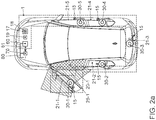
- Fig. 2a and Figure 2b a top view and a rear view of a situation of the vehicle 10, which results when the front left vehicle door 21-1 is open, are respectively shown.
- the access area 25-1 extends over the entire access opening 20-1 of the front left vehicle opening 20-1, which is closed in the closed state by the front left vehicle door 21-1.
- Figures 3a-3f such as Figures 4a-4f
- Figures 5a-5f and 6a-6f the determination of the ID transmitter's own movement when exiting a vehicle through a left front vehicle door is to be explained in an exemplary and simplified manner.
- a vehicle 10 is shown schematically in each case, the left front vehicle door 21-1 of which is open so that the access opening 20-1 is open at the front left in the vehicle 10.
- a vehicle coordinate system 100 the origin of which is located on a central axis of the vehicle, is coupled to the vehicle 10.
- An X-axis 102 points in the direction of travel and a Y-axis 103 oriented perpendicular to this points to the left-hand side of the vehicle.
- the third spatial direction, the Z-axis, which points out of the image plane, is not drawn in and is not considered further in the following explanation, although it is understood by a person skilled in the art that what is described takes place in three-dimensional space and the third Dimension, in this case a Z-direction, must also be taken into account in the real case.
- An ID transmitter 40 has an ID transmitter coordinate system 140 that is permanently coupled to the physical shape of the ID transmitter, its X axis 142 and its Y axis 143 in FIG Fig. 3a are shown schematically. For the sake of simplicity, the ID transmitter 40 itself is not shown physically. In Fig. 3a is also the direction vector 130 of the earth's magnetic field as Shown with double arrow. Since the vehicle 10 is at rest, this always maintains the same orientation with respect to the vehicle coordinate system 100. This orientation in the vehicle coordinate system is determined by the vehicle by means of a corresponding magnetic sensor system 18 (cf. Fig. 1 ) measured. The magnetic sensor system 48 of the ID transmitter 40 (cf. Fig. 1 ) the direction of the directional vector 130 of the earth's magnetic field.
- ID transmitter reference coordinate system 150 In order to be able to determine and indicate an intrinsic movement of the ID transmitter in space determined by means of the inertial sensor system 42, another coordinate system that is movable with respect to the origin but "fixed” or “fixed orientation” with respect to the axis orientations is linked to the ID transmitter. This is referred to as the ID transmitter reference coordinate system 150 or, for short, the reference coordinate system. Its X and Y axes 152 and 153 have a fixed orientation based on the determined direction vector 130 of the earth's magnetic field, which is also plotted as a double arrow from the origin 152 of the ID transmitter reference coordinate system 150.
- the direction of movement of the ID transmitter is indicated above a dotted movement arrow 160 and the distance that the ID transmitter 40 covers up to the next point in time of the exit action, which is shown in the following figure, is indicated via a length of this movement arrow 160.
- the Figures 3a-3f show the exit situation at successive, equally spaced moments. It is assumed here that the current movement arrow 160 at the same time indicates the orientation of the ID transmitter and thus the direction of the X axis of the ID transmitter coordinate system 140 that is permanently linked to the physical shape of the ID transmitter 40. For the sake of clarity, all other Figures 3b to 6f the ID transmitter coordinate system is not shown. Its position can, however, easily be determined using the movement arrow 160 entered in each case.
- the ID transmitter 40 itself does not know the position of the origin 141 of the ID transmitter coordinate system 140 and also the position of the origin 151 of the ID transmitter reference coordinate system 150 in space, ie in relation to the vehicle coordinate system 100.
- the origin 151 of the ID transmitter reference coordinate system 150 thus moves with the ID transmitter 40, so that the origin 151 of the ID transmitter reference coordinate system 150 always coincides with a fixed position in the ID transmitter, for example its center of gravity.
- the position of the ID transmitter 40 can thus be read out using the origin 151 of the ID transmitter reference coordinate system 150.
- the orientation can be recognized at any point in time using the movement arrow 160 shown. It goes without saying for the person skilled in the art that this is a simplification which is chosen here only for the purpose of illustration and explanation.
- the ID transmitter can move in any direction in relation to its axes, ie it can rotate in relation to the direction of movement.
- the inertial sensor system 42 (compare Fig. 1 ) of ID transmitter 40, however, uses these rotations and accelerations to determine a movement in ID transmitter reference coordinate system 150.
- the movement covered is recorded as path segment section 170-n, where n is a natural number and path segment sections 170 are numbered in chronological order.
- the track segment section 170 last covered in each case points to the origin 151 of the ID transmitter reference coordinate system 150 Figures 3a-3f
- the sequence shown is as follows: First, a user with the ID transmitter moves laterally to the front left, then to the left out of the vehicle and crosses the access area 25-1. It moves slightly backwards to the left, then to the left, turns and moves towards the open vehicle door again and in a next step, the result of which is no longer shown, would close the vehicle door by moving to the right.
- the information that the ID transmitter can transmit to the vehicle is now shown schematically.
- the vehicle can determine the orientation of the ID transmitter reference coordinate system 150 relative to its own vehicle coordinate system 100, since it knows the vector direction 130 of the earth's magnetic field in the vehicle coordinate system 100 from its own measurements.
- the ID transmitter 40 supplies path segment information, which can only be acceleration values along the individual axis direction of the ID transmitter reference coordinate system or acceleration information with regard to the ID transmitter coordinate system (not shown) and the angle of rotation with regard to the vector direction of the earth's magnetic field.
- the ID transmitter 40 itself determines path segment sections 170-n and / or path segments 171 on the basis of this acceleration and angle of rotation information and provides them with regard to the ID transmitter reference coordinate system 150.
- this determination can be made by the vehicle itself in its control device 60 (cf. Fig. 1 ). It can be clearly seen that a respective path segment 171 results from the path segment sections 170-n. Its position in space cannot, however, be determined exactly for the vehicle even if the direction vector 130 were aligned parallel to the direction vector 130 in the vehicle coordinate system 100.
- the ID transmitter reference coordinate system 150 is designed in such a way that the x-axis 152 is aligned horizontally on the drawing sheet.
- a trajectory 172 is obtained in each case, which provides information about the point in time at which the ID transmitter was at which location in space with reference to the vehicle coordinate system 100. From this it can be seen that the trajectory 172 runs from the interior 11 of the vehicle 10 through the access area 25-1 in front of the left front access opening 20-1 and points from the inside to the outside, so that it can be clearly established that the ID transmitter 40 is Interior 11 of the vehicle 10 has left. The entry of the ID transmitter into the vehicle can also be determined in a similar manner.
- a determination of a path segment based on inertia information ie the relative positions that an object has traversed in relation to a reference coordinate system linked to the body, can only be used for limited periods of time without renewed calibration.
- the data that can be obtained for example, with acceleration and gyro sensors from conventional (rotation position sensors) so-called smartphone cell phones are sufficient.
- the ID transmitter can be a smartphone.
- designs are also possible in which an ID transmitter is designed like a classic key but with inertia sensors and magnetic sensors as well as communication interfaces and no or only limited human-machine interfaces in the form of buttons and possibly a light signal as feedback are equipped .
Landscapes
- Physics & Mathematics (AREA)
- General Physics & Mathematics (AREA)
- Engineering & Computer Science (AREA)
- Computer Networks & Wireless Communication (AREA)
- Chemical & Material Sciences (AREA)
- Analytical Chemistry (AREA)
- Mechanical Engineering (AREA)
- Lock And Its Accessories (AREA)
- Signal Processing (AREA)
- Computer Hardware Design (AREA)
- Microelectronics & Electronic Packaging (AREA)
- Theoretical Computer Science (AREA)
Applications Claiming Priority (1)
| Application Number | Priority Date | Filing Date | Title |
|---|---|---|---|
| DE102019211192.0A DE102019211192A1 (de) | 2019-07-26 | 2019-07-26 | Innen- und Außenerkennung von ID-Gebern für ein Fahrzeug |
Publications (2)
| Publication Number | Publication Date |
|---|---|
| EP3770028A1 true EP3770028A1 (fr) | 2021-01-27 |
| EP3770028B1 EP3770028B1 (fr) | 2023-12-27 |
Family
ID=71096524
Family Applications (1)
| Application Number | Title | Priority Date | Filing Date |
|---|---|---|---|
| EP20179889.9A Active EP3770028B1 (fr) | 2019-07-26 | 2020-06-15 | Détection intérieure et extérieure d'identificateurs pour un véhicule |
Country Status (4)
| Country | Link |
|---|---|
| US (1) | US11276259B2 (fr) |
| EP (1) | EP3770028B1 (fr) |
| CN (1) | CN112309111B (fr) |
| DE (1) | DE102019211192A1 (fr) |
Cited By (2)
| Publication number | Priority date | Publication date | Assignee | Title |
|---|---|---|---|---|
| WO2024132616A1 (fr) * | 2022-12-19 | 2024-06-27 | Volkswagen Aktiengesellschaft | Procédé de commande d'une fonction d'un véhicule automobile, véhicule automobile et appareil électronique |
| WO2024240310A1 (fr) * | 2023-05-24 | 2024-11-28 | Continental Automotive Technologies GmbH | Procédé et dispositifs de détermination de valeurs de distance respectives, représentant la distance entre un émetteur-récepteur de véhicule et un émetteur-récepteur de dispositif mobile, par échange de messages |
Families Citing this family (9)
| Publication number | Priority date | Publication date | Assignee | Title |
|---|---|---|---|---|
| JP7441116B2 (ja) * | 2020-05-26 | 2024-02-29 | 株式会社東海理化電機製作所 | 制御装置およびプログラム |
| JP7688492B2 (ja) * | 2021-01-29 | 2025-06-04 | 株式会社東海理化電機製作所 | 制御装置およびプログラム |
| US11785449B2 (en) * | 2021-09-30 | 2023-10-10 | Visa International Service Association | Secure on-demand ultra-wideband communication channels systems and methods |
| FR3128295B1 (fr) * | 2021-10-20 | 2023-09-29 | Continental Automotive Gmbh | Procédé d’activation d’une fonction d’un véhicule par ultra large bande avec un équipement portable d’utilisateur, système et dispositif d’activation d’une fonction associés |
| DE102021214340B4 (de) | 2021-12-14 | 2024-11-21 | Volkswagen Aktiengesellschaft | Annäherungserkennung |
| DE102022204235A1 (de) | 2022-04-29 | 2023-11-02 | Volkswagen Aktiengesellschaft | Kraftfahrzeug, Verfahren eines Kraftfahrzeugs und Kommunikationssystem für ein Kraftfahrzeug |
| DE102022118008A1 (de) | 2022-07-19 | 2024-01-25 | Brose Fahrzeugteile Se & Co. Kommanditgesellschaft, Bamberg | Sensorsystem zur Bereitstellung einer Fahrzeugzugangsfunktionalität eines Kraftfahrzeugs |
| DE102023001634A1 (de) | 2023-04-24 | 2024-10-24 | Mercedes-Benz Group AG | Verfahren zum automatisierten Schließen einer Seitentür eines Kraftfahrzeugs |
| DE102024109030A1 (de) * | 2024-03-28 | 2025-10-02 | Brose Schließsysteme GmbH & Co. Kommanditgesellschaft | Verfahren zur Detektion eines Bedieners |
Citations (6)
| Publication number | Priority date | Publication date | Assignee | Title |
|---|---|---|---|---|
| DE10341286A1 (de) | 2003-09-04 | 2005-04-28 | Daimler Chrysler Ag | Zugangskontrollsystem für Fahrzeuge |
| DE102013225600A1 (de) * | 2013-03-01 | 2014-09-04 | Lear Corporation | System und Verfahren zum Erfassen der Position eines drahtlosen Geräts |
| US20150258962A1 (en) | 2012-10-26 | 2015-09-17 | Jaguar Land Rover Limited | Vehicle access system and method |
| US20150291126A1 (en) | 2012-10-26 | 2015-10-15 | Jaguar Land Rover Limited | Vehicle access system and method |
| DE102015109468A1 (de) | 2015-06-15 | 2016-12-15 | Hella Kgaa Hueck & Co. | Zugangs-und Fahrberechtigungssystem mit erhöhter Sicherheit gegen Relaisangriffe durch Verifikation der Ortbestimmung |
| DE102017110144A1 (de) | 2017-04-28 | 2018-10-31 | Huf Hülsbeck & Fürst Gmbh & Co. Kg | Authentifizierungssystem eines Fahrzeugs |
Family Cites Families (16)
| Publication number | Priority date | Publication date | Assignee | Title |
|---|---|---|---|---|
| US7400243B2 (en) * | 2005-06-28 | 2008-07-15 | Mitsubishi Denki Kabushiki Kaisha | Communication apparatus for vehicle |
| JP4191723B2 (ja) * | 2005-11-10 | 2008-12-03 | 三菱電機株式会社 | 車両用通信装置 |
| US9102296B2 (en) * | 2013-06-24 | 2015-08-11 | Texas Instruments Incorporated | Relay attack prevention for passive entry/passive start systems |
| KR102209523B1 (ko) * | 2014-08-14 | 2021-02-01 | 삼성전자주식회사 | 전자 장치 및 그 측위 방법 |
| WO2017144346A1 (fr) * | 2016-02-26 | 2017-08-31 | Huf Hülsbeck & Fürst Gmbh & Co. Kg | Procédé pour activer au moins une fonction de sécurité d'un système de sécurité d'un véhicule |
| WO2017144345A1 (fr) * | 2016-02-26 | 2017-08-31 | Huf Hülsbeck & Fürst Gmbh & Co. Kg | Procédé d'activation d'au moins une fonction de sécurité d'un système de sécurité de véhicule |
| DE102016111276A1 (de) * | 2016-06-20 | 2017-12-21 | Huf Hülsbeck & Fürst Gmbh & Co. Kg | Verfahren zur Kontrolle des Zugriffs auf ein Kraftfahrzeug |
| DE102016112593A1 (de) * | 2016-07-08 | 2018-01-11 | Huf Hülsbeck & Fürst Gmbh & Co. Kg | Verfahren zum Betrieb eines Schließsystems für ein Kraftfahrzeug, tragbarer ID-Geber für ein Kraftfahrzeug und Schließsystem |
| US10328898B2 (en) | 2016-10-12 | 2019-06-25 | Denso International America, Inc. | Passive entry / passive start systems and methods for vehicles |
| JP6702845B2 (ja) | 2016-10-28 | 2020-06-03 | 株式会社東海理化電機製作所 | 電子キーシステム |
| US10214221B2 (en) * | 2017-01-20 | 2019-02-26 | Honda Motor Co., Ltd. | System and method for identifying a vehicle driver by a pattern of movement |
| DE102017120524A1 (de) * | 2017-04-28 | 2018-10-31 | Huf Hülsbeck & Fürst Gmbh & Co. Kg | Tragbarer ID-Geber für ein Authentifizierungssystem und Verfahren zum Betreiben eines Authentifizierungssystems |
| EP3396640B1 (fr) * | 2017-04-28 | 2025-04-30 | HUF Hülsbeck & Fürst GmbH & Co. KG | Émetteur d'identification portable pour un système d'authentification et procédé de fonctionnement d'un système d'authentification |
| US10002535B1 (en) * | 2017-07-11 | 2018-06-19 | Ford Global Technologies, Llc | Dual-stage car finder |
| DE102017214109B4 (de) * | 2017-08-11 | 2024-06-20 | Continental Automotive Technologies GmbH | Mobiler Identifikationsgeber |
| JP2020159766A (ja) * | 2019-03-25 | 2020-10-01 | 株式会社東芝 | 測距システム、測距装置及び測距方法 |
-
2019
- 2019-07-26 DE DE102019211192.0A patent/DE102019211192A1/de active Pending
-
2020
- 2020-06-15 EP EP20179889.9A patent/EP3770028B1/fr active Active
- 2020-07-24 CN CN202010722873.9A patent/CN112309111B/zh active Active
- 2020-07-27 US US16/939,399 patent/US11276259B2/en active Active
Patent Citations (6)
| Publication number | Priority date | Publication date | Assignee | Title |
|---|---|---|---|---|
| DE10341286A1 (de) | 2003-09-04 | 2005-04-28 | Daimler Chrysler Ag | Zugangskontrollsystem für Fahrzeuge |
| US20150258962A1 (en) | 2012-10-26 | 2015-09-17 | Jaguar Land Rover Limited | Vehicle access system and method |
| US20150291126A1 (en) | 2012-10-26 | 2015-10-15 | Jaguar Land Rover Limited | Vehicle access system and method |
| DE102013225600A1 (de) * | 2013-03-01 | 2014-09-04 | Lear Corporation | System und Verfahren zum Erfassen der Position eines drahtlosen Geräts |
| DE102015109468A1 (de) | 2015-06-15 | 2016-12-15 | Hella Kgaa Hueck & Co. | Zugangs-und Fahrberechtigungssystem mit erhöhter Sicherheit gegen Relaisangriffe durch Verifikation der Ortbestimmung |
| DE102017110144A1 (de) | 2017-04-28 | 2018-10-31 | Huf Hülsbeck & Fürst Gmbh & Co. Kg | Authentifizierungssystem eines Fahrzeugs |
Cited By (2)
| Publication number | Priority date | Publication date | Assignee | Title |
|---|---|---|---|---|
| WO2024132616A1 (fr) * | 2022-12-19 | 2024-06-27 | Volkswagen Aktiengesellschaft | Procédé de commande d'une fonction d'un véhicule automobile, véhicule automobile et appareil électronique |
| WO2024240310A1 (fr) * | 2023-05-24 | 2024-11-28 | Continental Automotive Technologies GmbH | Procédé et dispositifs de détermination de valeurs de distance respectives, représentant la distance entre un émetteur-récepteur de véhicule et un émetteur-récepteur de dispositif mobile, par échange de messages |
Also Published As
| Publication number | Publication date |
|---|---|
| CN112309111B (zh) | 2022-10-21 |
| DE102019211192A1 (de) | 2021-01-28 |
| US11276259B2 (en) | 2022-03-15 |
| EP3770028B1 (fr) | 2023-12-27 |
| CN112309111A (zh) | 2021-02-02 |
| US20210027130A1 (en) | 2021-01-28 |
Similar Documents
| Publication | Publication Date | Title |
|---|---|---|
| EP3770028B1 (fr) | Détection intérieure et extérieure d'identificateurs pour un véhicule | |
| EP0523602B1 (fr) | Procédé pour détecter la présence d'un émetteur portable à l'intérieur d'un véhicule | |
| DE19957536C2 (de) | Diebstahlschutzsystem für ein Kraftfahrzeug und Verfahren zum Betreiben eines Diebstahlschutzsystems | |
| EP1900579B1 (fr) | Agencement d'accès pour un véhicule | |
| EP1733937B1 (fr) | Procédé d'ouverture automatique pour un ouvrant d'un véhicule | |
| DE102019212231A1 (de) | Verfahren zur Tür- oder Klappenbedienung bei einem Fahrzeug, Authentifizierungselement sowie Fahrzeug | |
| DE102019216947B4 (de) | Verfahren zum Aktivieren einer fernsteuerbaren Funktion eines Kraftfahrzeugs mittels eines mobilen Steuergeräts sowie System zum Durchführen eines derartigen Verfahrens | |
| DE112015002654T9 (de) | Fahrzeugkommunikationssystem, fahrzeuggebundene Einrichtung, portable Einrichtung und Computerprogramm | |
| DE112015003431T5 (de) | Kommunikationssystem für ein Fahrzeug, fahrzeugeigene Vorrichtung, tragbare Vorrichtung und Computerprogramm | |
| DE112015002999T5 (de) | Fahrzeugkommunikationssystem, fahrzeugeigene Einrichtung, portable Einrichtung und Computerprogramm | |
| EP3501916B1 (fr) | Procédé de fonctionnement d'un système de surveillance radio d'un véhicule automobile ainsi que système de surveillance et répondeur pour le système de surveillance | |
| DE102016207997A1 (de) | Sicherer Zugang zu einem Fahrzeug | |
| DE112015003250T5 (de) | Kommunikationssystem für ein Fahrzeug, fahrzeugeigene Vorrichtung, tragbare Vorrichtung und Computerprogramm | |
| EP3347246B1 (fr) | Procédé et système de localisation d'une unité radio portable | |
| EP4327578A1 (fr) | Procédé et véhicule automobile | |
| DE102013212060A1 (de) | Fahrzeug-Fernbedienungs-System sowie -Verfahren | |
| DE102022208670A1 (de) | Verfahren zum Authentifizieren eines Nutzers, ein System und ein Kraftfahrzeug | |
| WO2023110302A1 (fr) | Détection d'approche | |
| EP3774456B1 (fr) | Système pour un véhicule et procédée | |
| WO2024132616A1 (fr) | Procédé de commande d'une fonction d'un véhicule automobile, véhicule automobile et appareil électronique | |
| EP3507146B1 (fr) | Procédé pour le contrôle d'accès à des fonctions d'un véhicule automobile | |
| DE102018117941A1 (de) | Authentifikationsmittel für ein Kraftfahrzeug, Steuergerät eines Berechtigungssystems zum Öffnen und/oder Starten eines Fahrzeuges, das Berechtigungssystem und Verfahren zum Betreiben des Berechtigungssystems | |
| WO2021249594A1 (fr) | Agencement d'accès pour un véhicule | |
| EP4497017A1 (fr) | Système de détection de personnes non autorisées dans une zone à l'extérieur d'un véhicule, et procédé associé | |
| DE102024127156A1 (de) | Steuerung eines Kraftfahrzeugs |
Legal Events
| Date | Code | Title | Description |
|---|---|---|---|
| PUAI | Public reference made under article 153(3) epc to a published international application that has entered the european phase |
Free format text: ORIGINAL CODE: 0009012 |
|
| STAA | Information on the status of an ep patent application or granted ep patent |
Free format text: STATUS: THE APPLICATION HAS BEEN PUBLISHED |
|
| AK | Designated contracting states |
Kind code of ref document: A1 Designated state(s): AL AT BE BG CH CY CZ DE DK EE ES FI FR GB GR HR HU IE IS IT LI LT LU LV MC MK MT NL NO PL PT RO RS SE SI SK SM TR |
|
| AX | Request for extension of the european patent |
Extension state: BA ME |
|
| STAA | Information on the status of an ep patent application or granted ep patent |
Free format text: STATUS: REQUEST FOR EXAMINATION WAS MADE |
|
| 17P | Request for examination filed |
Effective date: 20210727 |
|
| RBV | Designated contracting states (corrected) |
Designated state(s): AL AT BE BG CH CY CZ DE DK EE ES FI FR GB GR HR HU IE IS IT LI LT LU LV MC MK MT NL NO PL PT RO RS SE SI SK SM TR |
|
| STAA | Information on the status of an ep patent application or granted ep patent |
Free format text: STATUS: EXAMINATION IS IN PROGRESS |
|
| 17Q | First examination report despatched |
Effective date: 20221124 |
|
| RIC1 | Information provided on ipc code assigned before grant |
Ipc: G07C 9/00 20200101ALN20230512BHEP Ipc: B60R 25/24 20130101AFI20230512BHEP |
|
| GRAP | Despatch of communication of intention to grant a patent |
Free format text: ORIGINAL CODE: EPIDOSNIGR1 |
|
| RIC1 | Information provided on ipc code assigned before grant |
Ipc: G07C 9/00 20200101ALN20230613BHEP Ipc: B60R 25/24 20130101AFI20230613BHEP |
|
| STAA | Information on the status of an ep patent application or granted ep patent |
Free format text: STATUS: GRANT OF PATENT IS INTENDED |
|
| INTG | Intention to grant announced |
Effective date: 20230720 |
|
| RIC1 | Information provided on ipc code assigned before grant |
Ipc: G07C 9/00 20200101ALN20230707BHEP Ipc: B60R 25/24 20130101AFI20230707BHEP |
|
| GRAS | Grant fee paid |
Free format text: ORIGINAL CODE: EPIDOSNIGR3 |
|
| GRAA | (expected) grant |
Free format text: ORIGINAL CODE: 0009210 |
|
| STAA | Information on the status of an ep patent application or granted ep patent |
Free format text: STATUS: THE PATENT HAS BEEN GRANTED |
|
| P01 | Opt-out of the competence of the unified patent court (upc) registered |
Effective date: 20231025 |
|
| AK | Designated contracting states |
Kind code of ref document: B1 Designated state(s): AL AT BE BG CH CY CZ DE DK EE ES FI FR GB GR HR HU IE IS IT LI LT LU LV MC MK MT NL NO PL PT RO RS SE SI SK SM TR |
|
| REG | Reference to a national code |
Ref country code: GB Ref legal event code: FG4D Free format text: NOT ENGLISH |
|
| REG | Reference to a national code |
Ref country code: CH Ref legal event code: EP |
|
| REG | Reference to a national code |
Ref country code: DE Ref legal event code: R096 Ref document number: 502020006491 Country of ref document: DE |
|
| REG | Reference to a national code |
Ref country code: IE Ref legal event code: FG4D Free format text: LANGUAGE OF EP DOCUMENT: GERMAN |
|
| PG25 | Lapsed in a contracting state [announced via postgrant information from national office to epo] |
Ref country code: GR Free format text: LAPSE BECAUSE OF FAILURE TO SUBMIT A TRANSLATION OF THE DESCRIPTION OR TO PAY THE FEE WITHIN THE PRESCRIBED TIME-LIMIT Effective date: 20240328 |
|
| REG | Reference to a national code |
Ref country code: LT Ref legal event code: MG9D |
|
| PG25 | Lapsed in a contracting state [announced via postgrant information from national office to epo] |
Ref country code: LT Free format text: LAPSE BECAUSE OF FAILURE TO SUBMIT A TRANSLATION OF THE DESCRIPTION OR TO PAY THE FEE WITHIN THE PRESCRIBED TIME-LIMIT Effective date: 20231227 |
|
| PG25 | Lapsed in a contracting state [announced via postgrant information from national office to epo] |
Ref country code: ES Free format text: LAPSE BECAUSE OF FAILURE TO SUBMIT A TRANSLATION OF THE DESCRIPTION OR TO PAY THE FEE WITHIN THE PRESCRIBED TIME-LIMIT Effective date: 20231227 |
|
| PG25 | Lapsed in a contracting state [announced via postgrant information from national office to epo] |
Ref country code: LT Free format text: LAPSE BECAUSE OF FAILURE TO SUBMIT A TRANSLATION OF THE DESCRIPTION OR TO PAY THE FEE WITHIN THE PRESCRIBED TIME-LIMIT Effective date: 20231227 Ref country code: GR Free format text: LAPSE BECAUSE OF FAILURE TO SUBMIT A TRANSLATION OF THE DESCRIPTION OR TO PAY THE FEE WITHIN THE PRESCRIBED TIME-LIMIT Effective date: 20240328 Ref country code: FI Free format text: LAPSE BECAUSE OF FAILURE TO SUBMIT A TRANSLATION OF THE DESCRIPTION OR TO PAY THE FEE WITHIN THE PRESCRIBED TIME-LIMIT Effective date: 20231227 Ref country code: ES Free format text: LAPSE BECAUSE OF FAILURE TO SUBMIT A TRANSLATION OF THE DESCRIPTION OR TO PAY THE FEE WITHIN THE PRESCRIBED TIME-LIMIT Effective date: 20231227 Ref country code: BG Free format text: LAPSE BECAUSE OF FAILURE TO SUBMIT A TRANSLATION OF THE DESCRIPTION OR TO PAY THE FEE WITHIN THE PRESCRIBED TIME-LIMIT Effective date: 20240327 |
|
| REG | Reference to a national code |
Ref country code: NL Ref legal event code: MP Effective date: 20231227 |
|
| PG25 | Lapsed in a contracting state [announced via postgrant information from national office to epo] |
Ref country code: NL Free format text: LAPSE BECAUSE OF FAILURE TO SUBMIT A TRANSLATION OF THE DESCRIPTION OR TO PAY THE FEE WITHIN THE PRESCRIBED TIME-LIMIT Effective date: 20231227 |
|
| PG25 | Lapsed in a contracting state [announced via postgrant information from national office to epo] |
Ref country code: SE Free format text: LAPSE BECAUSE OF FAILURE TO SUBMIT A TRANSLATION OF THE DESCRIPTION OR TO PAY THE FEE WITHIN THE PRESCRIBED TIME-LIMIT Effective date: 20231227 Ref country code: RS Free format text: LAPSE BECAUSE OF FAILURE TO SUBMIT A TRANSLATION OF THE DESCRIPTION OR TO PAY THE FEE WITHIN THE PRESCRIBED TIME-LIMIT Effective date: 20231227 Ref country code: NO Free format text: LAPSE BECAUSE OF FAILURE TO SUBMIT A TRANSLATION OF THE DESCRIPTION OR TO PAY THE FEE WITHIN THE PRESCRIBED TIME-LIMIT Effective date: 20240327 Ref country code: NL Free format text: LAPSE BECAUSE OF FAILURE TO SUBMIT A TRANSLATION OF THE DESCRIPTION OR TO PAY THE FEE WITHIN THE PRESCRIBED TIME-LIMIT Effective date: 20231227 Ref country code: LV Free format text: LAPSE BECAUSE OF FAILURE TO SUBMIT A TRANSLATION OF THE DESCRIPTION OR TO PAY THE FEE WITHIN THE PRESCRIBED TIME-LIMIT Effective date: 20231227 Ref country code: HR Free format text: LAPSE BECAUSE OF FAILURE TO SUBMIT A TRANSLATION OF THE DESCRIPTION OR TO PAY THE FEE WITHIN THE PRESCRIBED TIME-LIMIT Effective date: 20231227 |
|
| PG25 | Lapsed in a contracting state [announced via postgrant information from national office to epo] |
Ref country code: IS Free format text: LAPSE BECAUSE OF FAILURE TO SUBMIT A TRANSLATION OF THE DESCRIPTION OR TO PAY THE FEE WITHIN THE PRESCRIBED TIME-LIMIT Effective date: 20240427 |
|
| PG25 | Lapsed in a contracting state [announced via postgrant information from national office to epo] |
Ref country code: CZ Free format text: LAPSE BECAUSE OF FAILURE TO SUBMIT A TRANSLATION OF THE DESCRIPTION OR TO PAY THE FEE WITHIN THE PRESCRIBED TIME-LIMIT Effective date: 20231227 |
|
| PG25 | Lapsed in a contracting state [announced via postgrant information from national office to epo] |
Ref country code: SK Free format text: LAPSE BECAUSE OF FAILURE TO SUBMIT A TRANSLATION OF THE DESCRIPTION OR TO PAY THE FEE WITHIN THE PRESCRIBED TIME-LIMIT Effective date: 20231227 |
|
| PG25 | Lapsed in a contracting state [announced via postgrant information from national office to epo] |
Ref country code: SM Free format text: LAPSE BECAUSE OF FAILURE TO SUBMIT A TRANSLATION OF THE DESCRIPTION OR TO PAY THE FEE WITHIN THE PRESCRIBED TIME-LIMIT Effective date: 20231227 Ref country code: SK Free format text: LAPSE BECAUSE OF FAILURE TO SUBMIT A TRANSLATION OF THE DESCRIPTION OR TO PAY THE FEE WITHIN THE PRESCRIBED TIME-LIMIT Effective date: 20231227 Ref country code: RO Free format text: LAPSE BECAUSE OF FAILURE TO SUBMIT A TRANSLATION OF THE DESCRIPTION OR TO PAY THE FEE WITHIN THE PRESCRIBED TIME-LIMIT Effective date: 20231227 Ref country code: IT Free format text: LAPSE BECAUSE OF FAILURE TO SUBMIT A TRANSLATION OF THE DESCRIPTION OR TO PAY THE FEE WITHIN THE PRESCRIBED TIME-LIMIT Effective date: 20231227 Ref country code: IS Free format text: LAPSE BECAUSE OF FAILURE TO SUBMIT A TRANSLATION OF THE DESCRIPTION OR TO PAY THE FEE WITHIN THE PRESCRIBED TIME-LIMIT Effective date: 20240427 Ref country code: EE Free format text: LAPSE BECAUSE OF FAILURE TO SUBMIT A TRANSLATION OF THE DESCRIPTION OR TO PAY THE FEE WITHIN THE PRESCRIBED TIME-LIMIT Effective date: 20231227 Ref country code: CZ Free format text: LAPSE BECAUSE OF FAILURE TO SUBMIT A TRANSLATION OF THE DESCRIPTION OR TO PAY THE FEE WITHIN THE PRESCRIBED TIME-LIMIT Effective date: 20231227 |
|
| PG25 | Lapsed in a contracting state [announced via postgrant information from national office to epo] |
Ref country code: PL Free format text: LAPSE BECAUSE OF FAILURE TO SUBMIT A TRANSLATION OF THE DESCRIPTION OR TO PAY THE FEE WITHIN THE PRESCRIBED TIME-LIMIT Effective date: 20231227 Ref country code: PT Free format text: LAPSE BECAUSE OF FAILURE TO SUBMIT A TRANSLATION OF THE DESCRIPTION OR TO PAY THE FEE WITHIN THE PRESCRIBED TIME-LIMIT Effective date: 20240429 |
|
| PG25 | Lapsed in a contracting state [announced via postgrant information from national office to epo] |
Ref country code: PT Free format text: LAPSE BECAUSE OF FAILURE TO SUBMIT A TRANSLATION OF THE DESCRIPTION OR TO PAY THE FEE WITHIN THE PRESCRIBED TIME-LIMIT Effective date: 20240429 Ref country code: PL Free format text: LAPSE BECAUSE OF FAILURE TO SUBMIT A TRANSLATION OF THE DESCRIPTION OR TO PAY THE FEE WITHIN THE PRESCRIBED TIME-LIMIT Effective date: 20231227 |
|
| REG | Reference to a national code |
Ref country code: DE Ref legal event code: R097 Ref document number: 502020006491 Country of ref document: DE |
|
| PG25 | Lapsed in a contracting state [announced via postgrant information from national office to epo] |
Ref country code: DK Free format text: LAPSE BECAUSE OF FAILURE TO SUBMIT A TRANSLATION OF THE DESCRIPTION OR TO PAY THE FEE WITHIN THE PRESCRIBED TIME-LIMIT Effective date: 20231227 |
|
| PG25 | Lapsed in a contracting state [announced via postgrant information from national office to epo] |
Ref country code: DK Free format text: LAPSE BECAUSE OF FAILURE TO SUBMIT A TRANSLATION OF THE DESCRIPTION OR TO PAY THE FEE WITHIN THE PRESCRIBED TIME-LIMIT Effective date: 20231227 |
|
| PLBE | No opposition filed within time limit |
Free format text: ORIGINAL CODE: 0009261 |
|
| STAA | Information on the status of an ep patent application or granted ep patent |
Free format text: STATUS: NO OPPOSITION FILED WITHIN TIME LIMIT |
|
| 26N | No opposition filed |
Effective date: 20240930 |
|
| PG25 | Lapsed in a contracting state [announced via postgrant information from national office to epo] |
Ref country code: MC Free format text: LAPSE BECAUSE OF FAILURE TO SUBMIT A TRANSLATION OF THE DESCRIPTION OR TO PAY THE FEE WITHIN THE PRESCRIBED TIME-LIMIT Effective date: 20231227 |
|
| REG | Reference to a national code |
Ref country code: CH Ref legal event code: PL |
|
| PG25 | Lapsed in a contracting state [announced via postgrant information from national office to epo] |
Ref country code: LU Free format text: LAPSE BECAUSE OF NON-PAYMENT OF DUE FEES Effective date: 20240615 |
|
| PG25 | Lapsed in a contracting state [announced via postgrant information from national office to epo] |
Ref country code: IE Free format text: LAPSE BECAUSE OF NON-PAYMENT OF DUE FEES Effective date: 20240615 |
|
| PG25 | Lapsed in a contracting state [announced via postgrant information from national office to epo] |
Ref country code: BE Free format text: LAPSE BECAUSE OF NON-PAYMENT OF DUE FEES Effective date: 20240630 Ref country code: SI Free format text: LAPSE BECAUSE OF FAILURE TO SUBMIT A TRANSLATION OF THE DESCRIPTION OR TO PAY THE FEE WITHIN THE PRESCRIBED TIME-LIMIT Effective date: 20231227 Ref country code: CH Free format text: LAPSE BECAUSE OF NON-PAYMENT OF DUE FEES Effective date: 20240630 |
|
| REG | Reference to a national code |
Ref country code: BE Ref legal event code: MM Effective date: 20240630 |
|
| PGFP | Annual fee paid to national office [announced via postgrant information from national office to epo] |
Ref country code: DE Payment date: 20250630 Year of fee payment: 6 |
|
| PGFP | Annual fee paid to national office [announced via postgrant information from national office to epo] |
Ref country code: GB Payment date: 20250617 Year of fee payment: 6 |
|
| PGFP | Annual fee paid to national office [announced via postgrant information from national office to epo] |
Ref country code: FR Payment date: 20250624 Year of fee payment: 6 |
|
| PGFP | Annual fee paid to national office [announced via postgrant information from national office to epo] |
Ref country code: AT Payment date: 20250721 Year of fee payment: 5 |
|
| PG25 | Lapsed in a contracting state [announced via postgrant information from national office to epo] |
Ref country code: CY Free format text: LAPSE BECAUSE OF FAILURE TO SUBMIT A TRANSLATION OF THE DESCRIPTION OR TO PAY THE FEE WITHIN THE PRESCRIBED TIME-LIMIT; INVALID AB INITIO Effective date: 20200615 |
|
| PG25 | Lapsed in a contracting state [announced via postgrant information from national office to epo] |
Ref country code: HU Free format text: LAPSE BECAUSE OF FAILURE TO SUBMIT A TRANSLATION OF THE DESCRIPTION OR TO PAY THE FEE WITHIN THE PRESCRIBED TIME-LIMIT; INVALID AB INITIO Effective date: 20200615 |