EP3770088B1 - Liefereinheit und liefersystem - Google Patents
Liefereinheit und liefersystem Download PDFInfo
- Publication number
- EP3770088B1 EP3770088B1 EP18910745.1A EP18910745A EP3770088B1 EP 3770088 B1 EP3770088 B1 EP 3770088B1 EP 18910745 A EP18910745 A EP 18910745A EP 3770088 B1 EP3770088 B1 EP 3770088B1
- Authority
- EP
- European Patent Office
- Prior art keywords
- data
- unit
- quality
- delivery
- delivery unit
- Prior art date
- Legal status (The legal status is an assumption and is not a legal conclusion. Google has not performed a legal analysis and makes no representation as to the accuracy of the status listed.)
- Active
Links
Images









Classifications
-
- G—PHYSICS
- G06—COMPUTING OR CALCULATING; COUNTING
- G06Q—INFORMATION AND COMMUNICATION TECHNOLOGY [ICT] SPECIALLY ADAPTED FOR ADMINISTRATIVE, COMMERCIAL, FINANCIAL, MANAGERIAL OR SUPERVISORY PURPOSES; SYSTEMS OR METHODS SPECIALLY ADAPTED FOR ADMINISTRATIVE, COMMERCIAL, FINANCIAL, MANAGERIAL OR SUPERVISORY PURPOSES, NOT OTHERWISE PROVIDED FOR
- G06Q10/00—Administration; Management
- G06Q10/08—Logistics, e.g. warehousing, loading or distribution; Inventory or stock management
- G06Q10/083—Shipping
- G06Q10/0832—Special goods or special handling procedures, e.g. handling of hazardous or fragile goods
-
- B—PERFORMING OPERATIONS; TRANSPORTING
- B65—CONVEYING; PACKING; STORING; HANDLING THIN OR FILAMENTARY MATERIAL
- B65D—CONTAINERS FOR STORAGE OR TRANSPORT OF ARTICLES OR MATERIALS, e.g. BAGS, BARRELS, BOTTLES, BOXES, CANS, CARTONS, CRATES, DRUMS, JARS, TANKS, HOPPERS, FORWARDING CONTAINERS; ACCESSORIES, CLOSURES, OR FITTINGS THEREFOR; PACKAGING ELEMENTS; PACKAGES
- B65D88/00—Large containers
- B65D88/02—Large containers rigid
- B65D88/12—Large containers rigid specially adapted for transport
-
- F—MECHANICAL ENGINEERING; LIGHTING; HEATING; WEAPONS; BLASTING
- F25—REFRIGERATION OR COOLING; COMBINED HEATING AND REFRIGERATION SYSTEMS; HEAT PUMP SYSTEMS; MANUFACTURE OR STORAGE OF ICE; LIQUEFACTION SOLIDIFICATION OF GASES
- F25D—REFRIGERATORS; COLD ROOMS; ICE-BOXES; COOLING OR FREEZING APPARATUS NOT OTHERWISE PROVIDED FOR
- F25D23/00—General constructional features
- F25D23/12—Arrangements of compartments additional to cooling compartments; Combinations of refrigerators with other equipment, e.g. stove
-
- F—MECHANICAL ENGINEERING; LIGHTING; HEATING; WEAPONS; BLASTING
- F25—REFRIGERATION OR COOLING; COMBINED HEATING AND REFRIGERATION SYSTEMS; HEAT PUMP SYSTEMS; MANUFACTURE OR STORAGE OF ICE; LIQUEFACTION SOLIDIFICATION OF GASES
- F25D—REFRIGERATORS; COLD ROOMS; ICE-BOXES; COOLING OR FREEZING APPARATUS NOT OTHERWISE PROVIDED FOR
- F25D29/00—Arrangement or mounting of control or safety devices
-
- F—MECHANICAL ENGINEERING; LIGHTING; HEATING; WEAPONS; BLASTING
- F25—REFRIGERATION OR COOLING; COMBINED HEATING AND REFRIGERATION SYSTEMS; HEAT PUMP SYSTEMS; MANUFACTURE OR STORAGE OF ICE; LIQUEFACTION SOLIDIFICATION OF GASES
- F25D—REFRIGERATORS; COLD ROOMS; ICE-BOXES; COOLING OR FREEZING APPARATUS NOT OTHERWISE PROVIDED FOR
- F25D3/00—Devices using other cold materials; Devices using cold-storage bodies
- F25D3/10—Devices using other cold materials; Devices using cold-storage bodies using liquefied gases, e.g. liquid air
-
- G—PHYSICS
- G01—MEASURING; TESTING
- G01D—MEASURING NOT SPECIALLY ADAPTED FOR A SPECIFIC VARIABLE; ARRANGEMENTS FOR MEASURING TWO OR MORE VARIABLES NOT COVERED IN A SINGLE OTHER SUBCLASS; TARIFF METERING APPARATUS; MEASURING OR TESTING NOT OTHERWISE PROVIDED FOR
- G01D9/00—Recording measured values
- G01D9/005—Solid-state data loggers
- G01D9/007—Data loggers attached to transport containers for perishable products, e.g. food or medicines
-
- G—PHYSICS
- G06—COMPUTING OR CALCULATING; COUNTING
- G06Q—INFORMATION AND COMMUNICATION TECHNOLOGY [ICT] SPECIALLY ADAPTED FOR ADMINISTRATIVE, COMMERCIAL, FINANCIAL, MANAGERIAL OR SUPERVISORY PURPOSES; SYSTEMS OR METHODS SPECIALLY ADAPTED FOR ADMINISTRATIVE, COMMERCIAL, FINANCIAL, MANAGERIAL OR SUPERVISORY PURPOSES, NOT OTHERWISE PROVIDED FOR
- G06Q10/00—Administration; Management
- G06Q10/08—Logistics, e.g. warehousing, loading or distribution; Inventory or stock management
- G06Q10/083—Shipping
Definitions
- the present invention relates to a delivery unit that is mounted on a vehicle and is used at the time of accommodating articles in a container filled with a cooling gas and delivering the articles, and a delivery system.
- Patent Literatures are known as a technique of delivering articles in a cooled condition.
- Patent Literature 1 has an object to provide a temperature management system of deliveries in which a predetermined concerned personnel can ascertain the history of temperature data of a freight room of a delivery vehicle in a distribution process reliably and easily, and can perform accurate management while suppressing communication costs.
- Patent Literature 1 discloses a temperature management system of deliveries including a temperature sensor that wirelessly transmits detected temperature data, a GPS receiver, and a control device installed in the delivery vehicle. In the temperature management system, temperature data is detected by the temperature sensor arranged in the freight room at a set predetermined detection interval and the temperature data is memorized in the temperature sensor, and temporal positional data received by the GPS receiver is memorized in the control device.
- a data access point in the distribution process it is set such that the temperature data for a predetermined period memorized in the temperature sensor is wirelessly transmitted to the control device, so that the wirelessly transmitted temperature data and the temporal positional data in the predetermined period memorized in the control device are input to a server through a communication network and memorized therein, and a predetermined terminal device can access to the server through the communication network.
- Patent Literature 2 has an object to provide a food preserving method and a food preserving device that can hold fresh food, particularly, food having a fast deterioration rate of freshness quality in a fresh state for a long time after harvest as compared with a conventional preserving method, without any change of color, change of properties, and damaging the taste.
- Patent Literature 2 discloses a food preserving method for preserving vegetable fresh food and animal fresh food in which air in a food storage container is replaced by a nitrogen gas so that oxygen in an ambient gas in the container becomes less than 1% by volume in order to maintain the inside of the food storage container in a cold misty condition of low temperature and high humidity, and when the fresh food is taken into or out from the food storage container, an ozone gas is added intermittently into the food storage container, so that the ambient temperature is maintained in a range of 1°C to 10°C and the relative humidity is maintained at 90% or higher.
- Patent Literature 3 discloses a method of supplying liquefied oxygen to medical institutions such as a hospital by using an oxygen transportation vehicle including an in-vehicle tank that can hold the state of the liquefied oxygen.
- the method is a supply method of liquefied oxygen for medical use characterized in that the liquefied oxygen, after being transferred from the in-vehicle tank and filled in a hospital tank installed in a medical institution, is partly taken out and vaporized, the quality of the vaporized gaseous oxygen is then checked on the basis of pharmacopoeia oxygen, and after confirmation that the vaporized gaseous oxygen satisfies the standard of the pharmacopoeia oxygen, the transfer and filling of the liquefied oxygen are complete.
- Patent Literature 3 also discloses that a certificate certifying that the liquefied oxygen in the in-vehicle tank and the liquefied oxygen in the hospital tank are not listed as the pharmacopoeia liquefied oxygen is submitted to the medical institutions.
- a certificate certifying that the LO in the in-vehicle tank and the LO in the hospital tank are not listed as the pharmacopoeia liquefied oxygen can be submitted also to hospitals.
- Patent Literature 4 discloses a container for transport of temperature sensitive goods comprising a thermally insulated housing and a lid which is attachable to the housing.
- the container further comprises a means for recording a temperature inside the container in which temperature sensitive goods are accommodated during the transport. The recorded temperature during the transport can be displayed or printed.
- identification means are provided on the goods and, the target temperature in the container is determined based on information included in the identification means.
- the inside of a container needs to be cooled.
- the container accommodating the articles therein has been simply handed over to the delivery destination.
- Patent Literature 1 it is required to prepare the terminal device, acquire temperature data to the terminal device by accessing the server via the communication network, and present the temperature data on a monitor.
- the terminal device needs to be prepared when the delivery vehicle arrives at the delivery destination.
- Patent Literature 2 air in the container is replaced by a nitrogen gas to cool fresh food in the food storage container.
- the quality in chronological order of a cooling environment in the container cannot be confirmed immediately at the site, when the delivery vehicle arrives at a delivery destination.
- Patent Literature 3 there is a problem in that the quality in chronological order of a cooling environment in the in-vehicle tank cannot be confirmed immediately at the site, although a certificate certifying that the liquefied oxygen in the in-vehicle tank is not listed as the pharmacopoeia liquefied oxygen can be submitted to the medical institutions.
- Patent Literature 4 there are similar problems as mentioned above.
- an object of the present invention is to issue a quality certificate by printing a graphic image representing the quality in chronological order of a cooling environment in a container accommodating articles therein on a recording medium, when the articles arrive at a delivery destination.
- the invention of claim 1 provides a delivery unit mounted on a vehicle and , the delivery unit comprising: a container filled with a liquefied cooling gas, in which articles are accommodated, wherein the container is placed in the delivery unit for delivering the accommodated articles; a temperature measurement unit that measures a temperature in the container; a memory unit that memorizes therein the measured temperature data in chronological order; a quality-data generation unit that generates quality data of the articles based on temperature data acquired from the memory unit; a print-data editing unit that edits print data relating to a quality certificate including a graphic image representing quality in chronological order of a cooling environment in a container that accommodates articles therein during delivery, based on a serial number of the article and the quality data; and a printing unit that prints print data relating to the quality certificate on a recording medium, wherein the delivery unit further comprising a liquid-level measurement unit that is configured to measure the liquid level of the liquefied cooling gas filled in the container, wherein the memory unit is configured
- the present invention it is possible to issue a quality certificate by printing a graphic image representing the quality in chronological order of a cooling environment in a container accommodating articles therein on a recording medium, when the articles arrive at a delivery destination. Accordingly, at the delivery destination, the quality in chronological order of the cooling environment in the container can be confirmed immediately at the site, upon reception of the container that accommodates the articles therein.
- the present invention has a configuration described below in order to issue a quality certificate by printing a graphic image representing the quality in chronological order of a cooling environment in a container accommodating articles therein on a recording medium, when the articles arrive at a delivery destination.
- a delivery unit is a delivery unit mounted on a vehicle and is used when articles are accommodated in a container filled with a cooling gas and delivered.
- the delivery unit is characterized by including a temperature measurement unit that measures a temperature in the container, a memory unit that memorizes therein measured temperature data in chronological order, a quality-data generation unit that generates quality data of articles based on the temperature data acquired from the memory unit, a print-data editing unit that edits print data relating to a quality certificate including a graphic image representing the quality in chronological order of a cooling environment in the container accommodating articles therein during delivery, based on a serial number of the article and the quality data, and a printing unit that prints the print data relating to the quality certificate on a recording medium.
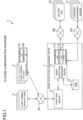
- FIG. 1 is a block diagram of a delivery system according to a first embodiment of the present invention.
- a delivery system 1 is configured by a client terminal (a manufacturer) 3, a client terminal (a delivery destination) 5, networks N1, N2, and N3, an order-acceptance management device 7, an order-acceptance management server 11, a delivery unit 15, a logistics management server 17, and the like.
- client terminals a manufacturer
- client terminal a delivery destination
- an order-acceptance management device 7 an order-acceptance management server 11
- delivery unit a logistics management server 17
- the networks are separate networks of N1, N2, and N3, the networks may be configured by the same network.
- the client terminal 3 (generally, a PC) installed, for example, in a drug manufacturer
- the client terminal 5 (generally, a PC) installed in medical institutions, for example, hospitals and doctor's offices are connected to the order-acceptance management device 7 via the network N1.
- the client terminal 5 includes a fifth transmission unit 5a and a third reception unit 5b.
- the fifth transmission unit 5a transmits a quality data request to the order-acceptance management server 11 as needed.
- the third reception unit 5b receives the quality data from the server.
- the order-acceptance management device 7 is configured to include a front end server 9, the order-acceptance management server 11, and a database DB 13.
- the front end server 9 has a function of receiving data from the client terminal 3 via the network N1, to manage a direct access service to the client terminal 3 and a change of a display format.
- the order-acceptance management server 11 has a function of generating respective pieces of order-acceptance data based on usage date data received from the respective client terminals 3 to transmit the order-acceptance data to the order-acceptance management server 11 of a deliverer, and a function of generating a personal calendar screen corresponding to each client to transmit the screen to the client terminal 3.
- the order-acceptance management server 11 also receives data from the delivery unit 15 via the network N2 to manage the state (status) of each delivery unit 15.
- order-acceptance management server 11 receives data from the logistics management server 17 via the network N3 to manage the state (status) of each logistics management server 17.
- the order-acceptance management server 11 includes therein a ROM (Read Only Memory), a RAM (Random Access Memory), a CPU (Central Processing Unit), and an HDD (Hard Disk Drive), reads an operating system OS from the HDD and loads the OS on the RAM to activate the OS, and reads an application program from the HDD to perform various processes under control of the OS.
- ROM Read Only Memory
- RAM Random Access Memory
- CPU Central Processing Unit
- HDD Hard Disk Drive
- the order-acceptance management server 11 includes a second reception unit 11b, the database DB 13, a third transmission unit 11a, and a fourth transmission unit 11c.
- the second reception unit 11b receives quality data from the delivery unit 15.
- the database DB 13 accumulates therein the quality data received from the delivery unit 15.
- the third transmission unit 11a transmits the quality data acquired from the database DB 13 to the delivery unit 15, upon reception of a quality data request from the delivery unit 15.
- the fourth transmission unit 11c transmits the quality data acquired from the database DB 13 to the client terminal 5, upon reception of a quality data request from the client terminal 5.
- the logistics management server 17 is arranged for each warehouse that stores respective articles therein or for each warehouse that stores a plurality of articles therein, and when there is a request from the logistics management server 17, generates pieces of delivery information associated with respective articles and the delivery unit 15 to transmit the delivery information to the order-acceptance management server 11, in order to execute control for shipping the relevant articles to the client.
- the delivery unit 15 includes a storage container mounted thereon that accommodates specific pharmaceutical products required to be maintained in a predetermined low-temperature condition, and has a function of transmitting the temperature data to the order-acceptance management server 11 via the network N2. Therefore, after having used for delivering the pharmaceutical products to the client, the delivery unit 15 that has stored the pharmaceutical products therein needs to be collected.
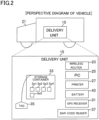
- FIG. 2 is a diagram illustrating a vehicle mounted with the delivery unit 15 according to the first embodiment of the present invention.
- a vehicle 21 has a delivery unit 15 mounted on a loading platform thereof. Further, the delivery unit 15 includes a wireless router 23, a personal computer PC 25, a printer 27, a battery 43, a GPS receiver 31, and a storage container 33.
- a plurality of sensors Se1 to Se5 are accommodated or attached thereto, and a part of a tag string fastened to each article accommodated in the storage container 33 is pulled outside, and a tag 35 is fastened at the end thereof.
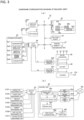
- FIG. 3(a) is a block diagram illustrating respective units provided in the delivery unit 15 according to the first embodiment of the present invention.
- the delivery unit 15 includes the wireless router 23, the personal computer PC 25, the printer 27, the GPS receiver 31, the storage container 33, a bar-code reader 37, a data logger 39, a charger 41, the battery 43, and a DC/DC converter 45.
- the wireless router 23 accesses a plurality of 3G/4G lines arranged on the road where the vehicle 21 runs, and connects to the personal computer PC 25, to connect the personal computer PC 25 and the order-acceptance management server 11 with each other.
- the personal computer PC 25 includes a CPU 25a, a ROM 25b, a RAM 25c, an operation display unit 25d, and a communication unit 25e.
- the CPU 25a controls the entire operation of the delivery unit 15 by using the RAM 25c as a work memory, according to a program memorized beforehand in the ROM 25b.
- the ROM 25b is a read-only non-volatile memory medium, and stores therein firmware and various kinds of data.
- the RAM 25c is a volatile memory medium capable of high-speed reading and writing of information and can be used as a work memory.
- the operation display unit 25d includes key buttons and a screen for displaying a menu for performing various setting and mode selection, and receives various kinds of operation requests from a user.
- the communication unit 25e has a USB interface, and transmits and receives data to and from the order-acceptance management server 11 via the wireless router 23 and the network N2.
- the printer 27 prints a quality certificate 27a on a recording medium such as a sheet according to a printing job received from the personal computer PC 25.
- the GPS receiver 31 receives a radio signal from a plurality of GPS satellites via an antenna ANT2 to calculate positional information of the delivery unit 15, and transmits the calculated positional information to the order-acceptance management server 11 via an antenna ANT3 and the network N2.
- the GPS receiver 31 is not connected to the personal computer PC 25.
- the GPS receiver 31 may be connected to the personal computer PC 25 to output the positional information calculated by the GPS receiver 31 to the personal computer PC 25.
- the storage container 33 can accommodate therein a plurality of articles, and includes various kinds of sensors Se1 to Se5 therein or attached to the outside thereof.
- the bar-code reader 37 reads a bar-code and outputs data to the personal computer PC 25.
- the data logger 39 collects measurement data measured by each sensor, stores various kinds of data therein, and outputs the stored various kinds of data to the personal computer PC 25 according to the request for the readout of the personal computer PC 25.
- the charger 41 connects, for example, to an AC power supply provided in the vehicle 21 or an AC power supply provided in a delivery center as needed, to convert AC power supplied from the AC power supply to DC power, and connects the DC power to each electrode of the battery 43 to charge the battery 43.
- the battery 43 When the charger 41 is connected to each electrode (ON), the battery 43 is charged with the DC power supplied from the charger 41, and when connection between the charger 41 and the respective electrodes is released (OFF), the battery 43 discharges and supplies the DC power to the DC/DC converter 45.
- the DC/DC converter 45 converts the DC power supply supplied from the battery 43 to DC power of, for example, four kinds of voltage levels (5V, 12V, 15V, and 24V) and supplies the DC power to each unit in the delivery unit 15.
- thermometer Se1 is provided in the storage container 33 to measure an ambient temperature in the storage container 33, and outputs temperature data to the data logger 39.
- a liquid level indicator Se2 is provided in the storage container 33 to measure a liquid level of a liquefied cooling gas, and outputs liquid level data to the data logger 39.
- a vibration indicator Se3 is provided outside the storage container 33 to measure vibrations applied to the storage container 33, and outputs vibration data to the data logger 39.
- An opening/closing sensor Se4 is provided in the storage container 33 to detect whether a lid of the storage container 33 is in an opened state or a closed state and outputs opening/closing data to the data logger 39.
- a hygrometer Se5 is provided in the storage container 33 to measure an ambient humidity in the storage container 33, and outputs humidity data to the data logger 39.
- a voltage detection sensor Se6 measures a voltage of DC power supplied from the battery 43 to the DC/DC converter 45, and outputs voltage data to the data logger 39.
- a voltage detection sensor Se7 measures a voltage of DC power supplied from the charger 41 to the battery 43, and outputs voltage data to the data logger 39.
- FIG. 3(b) is a functional block diagram illustrating functions of respective units of the delivery unit 15 according to the first embodiment of the present invention.
- the CPU 25a reads the operating system OS from the ROM 25b and loads the OS on the RAM 25c to activate the OS, and reads a program (programs illustrated in various flowcharts described later) from the ROM 25b to perform various processes under control of the OS, thereby realizing a control unit 55 illustrated in FIG. 3(b) .
- a temperature measurement unit 51s1 is configured by the thermometer Se1 to measure a temperature in the storage container 33 and outputs measured data to a memory unit 53.
- a liquid-level measurement unit 51s2 is configured by the liquid level indicator Se2 to measure a level of a cooling gas filled in the storage container 33 and outputs measured data to the memory unit 53.
- a vibration measurement unit 51s3 is configured by the vibration indicator Se3 to measure vibrations applied to the storage container 33 from a road surface via the vehicle and outputs measured data to the memory unit 53.
- An opening/closing measurement unit 51s4 is configured by the opening/closing sensor Se4 to measure an opened/closed state of the lid provided in the storage container 33 and outputs the measured state to the memory unit 53.
- a humidity measurement unit 51s5 is configured by the hygrometer Se5 to measure a humidity in the storage container 33 and outputs measured data to the memory unit 53.
- a first voltage measurement unit 51s6 is configured by the voltage detection sensor Se6 to measure a voltage of DC power supplied from the battery 43 to the DC/DC converter 45, and outputs measured data to the memory unit 53.
- a second voltage measurement unit 51s7 is configured by the voltage detection sensor Se7 to measure a voltage of DC power supplied from the charger 41 to the battery 43, and outputs measured data to the memory unit 53.
- the memory unit 53 is configured by the data logger 39, and memorizes therein temperature data measured by the respective measurement units in chronological order.
- a hard disk HDD may be used as the memory unit 53 instead of the data logger 39.
- the control unit 55 includes a quality-data generation unit 55a, a printing unit 55b, a first transmission unit 55c, a second transmission unit 55d, a first reception unit 55e, a display input unit 55f, and a print-range acquisition unit 55g.
- the control unit 55 controls each unit provided therein.
- the quality-data generation unit 55a generates quality data of articles based on the temperature data acquired from the memory unit 53.
- the quality-data generation unit 55a generates quality data of articles based on the temperature data acquired from the memory unit 53 corresponding to a printing date-and-time range acquired from the print-range acquisition unit 55g.
- the print-range acquisition unit 55g acquires the printing date-and-time range represented by a printing start date-and-time to a printing end date-and-time displayed on the display input unit 55f.
- a print-data editing unit 55h edits print data relating to a quality certificate including a graphic image representing the quality in chronological order of a cooling environment in the storage container 33 accommodating articles therein during delivery, based on a serial number of the article and quality data.
- the printing unit 55b prints print data relating to a quality certificate on a recording medium.
- the display input unit 55f displays a printing start date-and-time column and a printing end date-and-time column to prompt input of a printing date-and-time range associated with the temperature data to be printed on the quality certificate.
- the first transmission unit 55c transmits the quality data generated by the quality-data generation unit 55a to the order-acceptance management server 11.
- the second transmission unit 55d transmits a quality data request to the order-acceptance management server 11 as needed.
- the first reception unit 55e receives the quality data from the order-acceptance management server 11.
- FIG. 4 is a diagram illustrating a flow in transport of articles according to the first embodiment of the present invention.
- FIG. 4 illustrates that articles manufactured in a manufacturer P1 are delivered to a delivery destination P5 via a warehouse P31 and a warehouse P3n.
- step S105 articles are shipped, and at step S110, the articles are loaded on a vehicle to start delivery to the warehouse P31.
- the logistics management server 17 reads the bar-code from the tag 35 by using a bar-code reader arranged in the warehouse to generate an arrival label.
- step S125 the articles are stocked in a predetermined place.
- the bar-code of the delivery unit 15 is read and stored by using the bar-code reader arranged in the warehouse.
- step S130 when a stock delivery request is received from the warehouse P3n, the articles are delivered from the predetermined place.
- a lid of a first storage container 33 storing the articles therein is opened, and a lid of a second storage container 33 for transporting the articles from the first storage container 33 to the warehouse P3n is opened.
- the articles are then shifted from the first storage container 33 to the second storage container 33, and the respective lids of the first storage container 33 and the second storage container 33 are closed.
- the opening/closing sensor Se4 of the delivery unit 15 outputs opening/closing data to the data logger 39 according to the opened state and closed state of the lid.
- step S140 inter-warehouse delivery of articles from the warehouse P31 to the warehouse P3n is performed.
- step S155 the articles are stocked.
- the lid of the second storage container 33 storing the articles therein is opened, and a lid of a third storage container 33 for transporting the articles from the second storage container 33 to the delivery destination P5 is opened.
- the articles are moved (shipped) from the second storage container 33 to the third storage container 33, and the respective lids of the second storage container 33 and the third storage container 33 are closed.
- the opening/closing sensor Se4 of the delivery unit 15 outputs opening/closing data to the data logger 39 according to the opened state or the closed state of the lid.
- step S165 upon reception of an order request from the delivery destination P5, the articles are delivered from the warehouse P3n to the delivery destination P5.
- step S170 when the vehicle loaded with the articles arrives at the delivery destination P5, delivery is completed.
- the lid of the third storage container 33 is opened to take out the articles from the third storage container 33 and the articles are administered to patients.
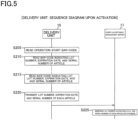
- FIG. 5 is a sequence diagram illustrating an operation at the time of activating the delivery unit according to the first embodiment of the present invention.
- the sequence diagram illustrated in FIG. 5 illustrates an operation to be performed at the time of activation, when the delivery unit 15 is at the manufacturer's site.
- the PC 25 reads a bar-code from an operation start bar-code printed on the tag 35 by using the bar-code reader 37, and inputs the bar-code to the PC 25.
- the PC 25 reads a bar-code indicating a lot number, an expiration date, and a serial number of the articles printed on the product shipped from the manufacturer by using the bar-code reader 37, and inputs the bar-code to the PC 25.
- the PC 25 transmits the lot number, the expiration date, and the serial number of each article to the order-acceptance management server 11 via the wireless router 23.
- step S225 the data received from the delivery unit 15 is memorized in the database DB 13.
- FIG. 6 is a sequence diagram illustrating movement of information and articles between the manufacturer and the warehouse according to the first embodiment of the present invention.
- the logistics management server 17 performs registration to an order screen, as an order operation. At this time, the logistics management server 17 transmits order information to the delivery unit 15.
- the delivery unit 15 reads the bar-code indicating the lot number, the expiration date, and the serial number of the articles, inputs the bar-code to the PC 25, and transmits the bar-code to the order-acceptance management server 11 via the wireless router 23.
- the order-acceptance management server 11 In the warehouse P31, at step S315, the order-acceptance management server 11 generates a shipping-information association file by associating the pieces of shipping information (a lot number, an expiration date, a serial number, a tag information, and the like) with each other received from the delivery unit 15 ( FIGS. 7 ). The order-acceptance management server 11 then transmits a monitoring start instruction to the delivery unit 15.
- the delivery unit 15 upon reception of the monitoring start instruction from the order-acceptance management server 11, the delivery unit 15 starts a monitoring operation. That is, the PC 25 receives measurement data from the sensors Se1 to Se7 recorded in the internal RAM of the data logger 39, and records the measurement data in the internal RAM of the PC 25. The recorded data is transmitted to the order-acceptance management server 11 via the network N2.
- Step S320 the process is under a temperature monitoring condition.
- the delivery unit 15 loaded on the vehicle starts delivery of articles from the manufacturer P1 to the warehouse P3.
- step S330 the delivery unit 15 loaded with the articles arrives at the warehouse.
- the logistics management server 17 performs registration to a purchase screen as a warehousing operation.
- the delivery unit 15 transmits warehousing and storing information to the order-acceptance management server 11.
- the order-acceptance management server 11 performs a stock recording process corresponding to the received warehousing and storing information.
- FIGS. 7(a) to (d) are diagrams illustrating a file generated by being associated with shipping information according to the first embodiment of the present invention.
- a product code, a serial number, a lot number, an expiration date, a tag code, a unit number, a unit type, a date and time, and a work status are included, and these pieces of data are memorized in the database DB 13.
- the order-acceptance management server 11 extracts the lot number, the expiration date, the tag code, the unit number, and the product code from the shipping information ( FIG. 7(a) ) by using the serial number as a key, generates a management file ( FIG. 7(b) ) in which these pieces of data are associated with each other, and memorizes the management file in the database DB 13.
- the order-acceptance management server 11 extracts the status, management number, and the unit type from the shipping information ( FIG. 7(a) ) by using the unit number as a key, generates a unit-number management file ( FIG. 7(c) ) in which these pieces of data are associated with each other, and memorizes the unit-number management file in the database DB 13.
- the order-acceptance management server 11 extracts the unit number and the work status from the shipping information ( FIG. 7(a) ), by using the product code, the date and time, the lot number, the expiration date, and the serial number as a key, generates a trace file ( FIG. 7(d) ) in which these pieces of data are associated with each other, and memorizes the trace file in the database DB 13.
- FIG. 8 is a sequence diagram illustrating movement of information and articles between the warehouse and the delivery destination according to the first embodiment of the present invention.
- the client terminal 5 performs registration to a personal calendar screen as an order operation and generates order information.
- the client terminal 5 transmits the order information to the order-acceptance management server 11.
- the order-acceptance management server 11 having received the order information from the client terminal 5 generates order-acceptance information based on the received order information at step S410, and registers the order-acceptance information in the database DB 13.
- the order-acceptance management server 11 transmits the order-acceptance information to the logistics management server 17.
- the logistics management server 17 having received the order-acceptance information from the order-acceptance management server 11 performs stock extraction based on a special-temperature shipping screen at step S415, to generate shipping information. The logistics management server 17 then transmits the shipping information to the delivery unit 15.
- the delivery unit 15 having received the shipping information from the logistics management server 17 reads the bar-code indicating the lot number, the expiration date, and the serial number of the articles and inputs the information to the PC 25 at step S420, and transmits the information to the order-acceptance management server 11 via the wireless router 23.
- the order-acceptance management server 11 associates the pieces of shipping information (a lot number, an expiration date, a serial number, a tag information, and the like) with each other received from the delivery unit 15, to generate a management file, a unit-No. management file, a trace file, and a customer administration-history file associated with the shipping information ( FIGS. 9 ). The order-acceptance management server 11 then transmits a monitoring start instruction to the delivery unit 15.
- the delivery unit 15 upon reception of the monitoring start instruction from the order-acceptance management server 11, the delivery unit 15 starts a monitoring operation. That is, the PC 25 receives measurement data from the sensors Se1 to Se7 recorded on the internal RAM of the data logger 39, and records the measurement data in the internal RAM of the PC 25. The recorded data is transmitted to the order-acceptance management server 11 via the network N2.
- the delivery unit 15 mounted on the vehicle starts delivery of articles from the warehouse P3n to the delivery destination P5.
- an 'EXECUTE' button B11 on a monitoring/status screen ( FIG. 12(b) ) is pressed and the delivery destination is input to the place, the delivery is completed.
- the PC 25 in the delivery unit 15 displays a menu screen including a 'DISPLAY MONITORING/STATUS' button B9 ( FIG. 12(a) ).
- step S445 when the 'DISPLAY MONITORING/STATUS' button B9 is pressed on the screen of the PC 25, a status screen including a 'PRINT TEMPERATURE TRACE TABLE' button B17 is displayed ( FIG. 12(b) ).
- a print-range designation screen including a 'PRINT' button B21 is displayed ( FIG. 14 ), and further, when the 'PRINT' button B21 is pressed, a quality certificate is printed ( FIGS. 15 ) .
- the PC 25 displays a menu screen including an 'OPERATION IN MEDICAL INSTITUTION' button B7 ( FIG. 12(a) ).
- a medical-institution operation screen 101 FIGS. 13 .
- the PC 25 in the delivery unit 15 transmits the administration information to the order-acceptance management server 11.
- the order-acceptance management server 11 having received the administration information from the delivery unit 15 reflects the administration information on the trace file ( FIGS. 10 ) and the customer administration-history file ( FIGS. 10 ).
- the order-acceptance management server 11 generates a collection instruction of the delivery unit 15 and transmits the instruction to the PC 25 in the delivery unit 15.
- the PC 25 in the delivery unit 15 displays the collection instruction of the delivery unit 15 on the screen.
- the delivery unit 15 is mounted on the vehicle 21, to deliver the delivery unit 15 to the warehouse P3n.
- the delivery unit 15 is stored at a predetermined position in the warehouse P3n.
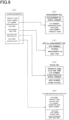
- FIGS. 9(a) to (e) are diagrams illustrating association in a shipping-information association file according to the first embodiment of the present invention.
- the shipping information ( FIG. 9(a) ) transmitted from the delivery unit 15 to the order-acceptance management server 11 includes a product code, a serial number, a lot number, an expiration date, a tag code, a unit number, a unit type, a date and time, a work status, a customer, and a delivery date, and these pieces of data are memorized in the database DB 13.
- the order-acceptance management server 11 extracts the lot number, the expiration date, the tag code, the unit number, and the product code from the shipping information ( FIG. 9(a) ) by using the serial number as a key, generates a management file ( FIG. 9(b) ) in which these pieces of data are associated with each other, and memorizes the management file in the database DB 13.
- the order-acceptance management server 11 extracts the status, the management No., and the unit type from the shipping information ( FIG. 9(a) ) by using the unit number as a key, updates the unit number management file ( FIG. 7(c) ) in which these pieces of data are associated with each other, and memorizes the management file in the database DB 13.
- the order-acceptance management server 11 extracts the unit number and the work status from the shipping information ( FIG. 9(a) ) by using the product code, the date and time, the lot number, the expiration date, and the serial number as a key, generates a trace file ( FIG. 9(d) ) in which these pieces of data are associated with each other, and memorizes the trace file in the database DB 13.
- the order-acceptance management server 11 extracts the customer and the delivery date from the shipping information ( FIG. 9(a) ) by using the serial number as a key, and adds these pieces of data to the customer administration-history file, to update the customer administration-history file ( FIG. 9(e) ), in which the customer, the product code, the delivery date, the lot number, the expiration date, the serial number, the tag code, the unit number, a patient code, and a drug-extracted date-and-time are memorized.
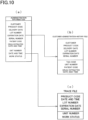
- FIGS. 10(a) to (c) are diagrams illustrating association in an administration-information association file according to the first embodiment of the present invention.
- Administration information ( FIG. 10(a) ) transmitted from the delivery unit 15 to the order-acceptance management server 11 includes a customer, a product code, a delivery date, a lot number, an expiration date, a serial number, a patient code, a drug-extracted date-and-time, a unit number, a date and time, and a work status, and these pieces of data are memorized in the database DB 13.
- the order-acceptance management server 11 extracts the customer, the product code, the delivery date, the lot number, the expiration date, the serial number, the patient code, and the drug-extracted date-and-time from the administration information ( FIG. 10(a) ) by using the serial number as a key, updates the customer administration-history file ( FIG. 9(e) ) in which these pieces of data are associated with each other, and memorizes the updated customer administration-history file in the database DB 13.
- the order-acceptance management server 11 extracts the unit number, the date and time, and the work status from the administration file ( FIG. 10(a) ) by using the serial number as a key, generates a trace file ( FIG. 10(c) ) in which these pieces of data are associated with each other, and memorizes the trace file in the database DB 13.
- FIG. 11(a) is a sequence diagram of a status monitoring process by the delivery system 1 according to the first embodiment of the present invention.
- the PC 25 in the delivery unit 15 performs a status monitoring process for monitoring status information representing a phase, a place, a sequence, and contents of the delivery unit to generate status information, and transmits the status information to the order-acceptance management server 11.
- the order-acceptance management server 11 generates a status information screen by performing a status display process based on the phase, the place, the sequence, and the contents of the delivery unit included in the status information received from the delivery unit 15, and transmits the status information screen to the client terminal 5 at the delivery destination.
- the order-acceptance management server 11 when an abnormal state is included in the phase, the place, the sequence, and the contents of the delivery unit included in the status information received from the delivery unit 15, the order-acceptance management server 11 generates a status-abnormality notification e-mail by performing a status-abnormality display process, and transmits the status-abnormality notification e-mail to the client terminal 5 at the delivery destination.
- the PC 25 in the delivery unit 15 transmits the status information to the order-acceptance management server 11.
- the status information can be referred to by the client terminal 5 at the delivery destination. Further, the e-mail notification is transmitted to the client terminal 5 at the delivery destination.
- FIG. 11(b) is a sequence diagram of a quality certificate printing sequence performed by the delivery system 1 according to the first embodiment of the present invention.
- the first transmission unit 55c of the delivery unit 15 transmits quality data generated by performing a quality-data generation process to the order-acceptance management server 11.
- the second reception unit 11b of the order-acceptance management server 11 receives the quality data from the delivery unit 15, and accumulates the quality data in the database DB 13 by performing an accumulation process.
- the second transmission unit 55d of the delivery unit 15 transmits a quality data request for requesting quality data to the order-acceptance management server 11 by performing a quality data requesting process as needed.
- the third transmission unit 11a of the order-acceptance management server 11 transmits the quality data acquired from the database DB 13 to the delivery unit 15 by performing a quality data transmission process.
- the first reception unit 55e of the delivery unit 15 receives the quality data from the order-acceptance management server 11 and prints a quality certificate by performing a print-data editing process.
- the fifth transmission unit 5a of the client terminal 5 transmits a quality data request to the order-acceptance management server 11 by performing the quality data requesting process as needed.
- the fourth transmission unit 11c of the order-acceptance management server 11 transmits the quality data acquired from the database DB 13 to the client terminal 5.
- the third reception unit 5b of the client terminal 5 receives the quality data from the order-acceptance management server 11, edits the quality data to create a graphic diagram by performing a quality-data display process, and displays the graphic diagram on the operation display UNIT 25d.
- FIG. 12(a) is a diagram illustrating an example of a menu screen displayed on the PC in the delivery unit according to the first embodiment of the present invention.
- a 'UNIT SETTING' button B1 As illustrated in FIG. 12(a) , a 'UNIT SETTING' button B1, a 'MANUFACTURER SHIPPING OPERATION' button B3, a 'SHIPPING OPERATION' button B5, the 'OPERATION IN MEDICAL-INSTITUTION' button B7, and the 'DISPLAY MONITORING/STATUS' button B9 are displayed on the PC 25 in the delivery unit 15 as a menu screen 61.
- FIG. 12(b) is a diagram illustrating a monitoring/status display screen displayed on the PC in the delivery unit according to the first embodiment of the present invention.
- a unit No., a type, an update time, and a temperature in the storage container 33 (temperature in a shipper) 63b as monitoring information are displayed as unit information 63a.
- a phase, a place, a sequence, and contents are displayed as a status operation, and the 'EXECUTE' button B11 is also displayed.
- a 'MONITORING DETAILS' button B13 a 'PRODUCT DETAILS' button B15, a 'PRINT TEMPERATURE TRACE TABLE' button B17, and an 'INITIALIZE OPERATION' button B19 are displayed.
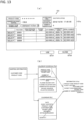
- FIG. 13(a) is a diagram illustrating a medical-institution operation screen according to the first embodiment of the present invention.
- a medical-institution operation screen 101 illustrated in FIG. 13(a) can be displayed on the client terminal 5 at the delivery destination.
- a product name, a temperature in the storage container 33 (a temperature in a shipper), a patient to be administered, a place to be used, a measurement date-and-time, and the number of administrations are displayed as information representing a part of a calendar file and information 101a of the delivery unit 15.
- a tag code, a drug-extracted date-and-time, a patient code, a lot number, an expiration date, and a serial number are displayed on a horizontal axis, as information 101b representing a part of the customer administration-history file acquired from the order-acceptance management server 11, and a 'SELECT' button is displayed corresponding to each record.
- a 'USE' button B101 and a 'CLOSE' button B105 are displayed.
- FIG. 13(b) is a diagram illustrating association in a calendar file according to the first embodiment of the present invention.
- the shipping information transmitted from the delivery unit 15 to the order-acceptance management server 11 includes a customer code and a product code as illustrated in FIG. 13(b) , and these pieces of data are memorized in the database DB 13.
- a calendar schedule file includes a product code, a customer code, a patient code, the number of administrations, a planned administration date, a planned delivery date, a planned collection date, an administration sequence, a delivery sequence, and a collection sequence, and these pieces of data are memorized in the database DB 13.
- the calendar file includes a date, event contents, a product code, a customer code, a patient code, a sequence, a detailed sequence, and a quantity, and these pieces of data are memorized in the database DB 13.
- the order-acceptance management server 11 extracts the product code, the customer code, the patient code, and the planned administration date from the calendar schedule file by using the customer code and the product code as a key, and extracts the quantity from the calendar file by using the planned administration date as a key, and these pieces of data are displayed as the information 101a on the medical-institution operation screen 101 ( FIG. 13(a) ).
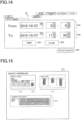
- FIG. 14 is a diagram illustrating a print-range designation screen to be displayed on the PC in the delivery unit according to the first embodiment of the present invention.
- a date-and-time box 65a for inputting a start date-and-time a date-and-time box 65b for inputting an end date-and-time, the 'PRINT' button B21, a 'CLOSE' button B23, and an 'INITIALIZE OPERATION' button B25 are displayed.
- FIGS. 15 are diagrams illustrating respective parts in a quality certificate output from the printer of the delivery unit according to the first embodiment of the present invention.
- a product code (b) such as a lot number, an expiration date, and a serial number
- a bar-code (c) such as a lot number, an expiration date, and a serial number
- a temperature graph (d) is arranged as an article code.
- FIG. 16 is a diagram illustrating association of respective files according to the first embodiment of the present invention.
- the order-acceptance management server 11 acquires temperature data from the data logger 39 provided in the delivery unit 15, and adds the unit number and the date and time to the temperature data, to generate a temperature history file F1.
- the order-acceptance management server 11 acquires status information updated by the PC 25 in the delivery unit 15, to generate a trace file F3 in which the product code, the date and time, the serial number, the unit number, and the status are associated with each other, as status information.
- the order-acceptance management server 11 uses the unit number included in the trace file F3 as a key, extracts temperature data from the temperature history file F1 having the key, to generate a serial temperature-history file F5, and memorizes the serial temperature-history file F5 in the database DB 13.
- FIG. 17 is a flowchart illustrating a print-data editing process performed by the PC in the delivery unit according to the first embodiment of the present invention.
- the PC 25 in the delivery unit 15 displays the monitoring/status display screen ( FIG. 12(b) ).
- the PC 25 determines whether a user has pressed the 'PRINT TEMPERATURE TRACE TABLE' button B17 ( FIG. 12(b) ). When determining that the user has pressed the 'PRINT TEMPERATURE TRACE TABLE' button B17, the PC 25 proceeds to Step S615, or when determining that the user has not pressed the 'PRINT TEMPERATURE TRACE TABLE' button B17, the PC 25 returns to Step S610.
- the PC 25 displays the print-range designation screen 65 ( FIG. 14 ), acquires a designated range from the print-range designation screen 65, and transmits the designated range to the order-acceptance management server 11.
- the PC 25 edits a detailed part of the product (A) ( FIG. 15(a) ) based on product detailed information acquired from the order-acceptance management server 11 at the time of shipping.
- the PC 25 edits the product code to generate a bar-code (B) ( FIG. 15(b) ) based on the product detailed information.
- the PC 25 repeats the process for the number of detailed products as a loop process.
- the PC 25 edits the lot, the expiration date, and the serial number to generate bar-codes (C) ( FIG. 15(c) ) based on the product detailed information.
- step S640 after having repeated the process for the number of detailed products, the PC 25 ends the loop process to proceed to Step S645.
- the PC 25 acquires temperature data in the designated range from the order-acceptance management server 11.
- the second transmission unit 55d of the delivery unit 15 transmits a quality data request for requesting quality data to the order-acceptance management server 11 by performing a quality data requesting process as needed, to acquire temperature data being the quality data from the database DB 13 via the order-acceptance management server 11 into the delivery unit 15.
- the PC 25 may acquire the temperature data being the quality data from the data logger 39 by enlarging a memory capacity of the data logger 39, instead of acquiring the temperature data being the quality data from the database DB 13 via the order-acceptance management server 11.
- the PC 25 edits a graph ( FIG. 15(d) ) (D) based on the acquired temperature data.
- the PC 25 edits the quality certificate data based on the edited pieces of data (A), (B), (C), and (D), and supplies the quality certificate data to the printer 27, to print the quality certificate 27a ( FIGS. 15 ) by the printer 27.
- FIGS. 18(a) to (c) are diagrams illustrating association in a product detailed-information file according to the first embodiment of the present invention.
- the order-acceptance management server 11 extracts a status, a management No., and a unit type from the shipping information ( FIG. 7(a) ) by using the unit number as a key, to generate a unit-number management file ( FIG. 18(a) ) in which these pieces of data are associated with each other, and memorizes the unit-number management file in the database DB 13.
- the order-acceptance management server 11 extracts the lot number, the expiration date, the tag code, the unit number, and the product code from the shipping information ( FIG. 7(a) ) by using the serial number as a key, to generate a management file ( FIG. 18(b) ) in which these pieces of data are associated with each other, and memorizes the management file in the database DB 13.
- the order-acceptance management server 11 acquires the product detailed-information file from the database at the time of shipping, and transmits the product detailed-information file to the delivery unit 15. That is, the order-acceptance management server 11 uses a unit number as a key to extract the status, the management No., and the unit type from the unit-number management file having the key, and extracts the lot number, the expiration date, the tag code, and the unit number using the management No. and the serial number as keys from the management file in the similar manner, to generate a product detailed-information file ( FIG. 18(c) ) in which these pieces of data are associated with each other, and memorizes the product detailed-information file in the database DB 13 and also transmits the product detailed-information file to the delivery unit 15.
- a product detailed-information file FIG. 18(c)
- print data relating to a quality certificate including a graphic image representing the quality in chronological order of a cooling environment in the storage container 33 accommodating articles therein during delivery is edited based on a serial number of the article and quality data and is printed on a recording medium, to create the quality certificate 27a, thereby enabling to issue the quality certificate 27a. Accordingly, at a delivery destination, the quality in chronological order of a cooling environment in the container can be confirmed immediately at the site, upon reception of the container that accommodates the articles therein.
- the quality-data generation unit 55a generates quality data of the articles based on temperature data acquired from the memory unit 53 corresponding to a printing date-and-time range acquired by the print-range acquisition unit 55g. Therefore, the quality-data generation unit 55a can issue the quality certificate 27a including the graphic image representing the quality in chronological order in the range designated in the printing date-and-time range. Accordingly, at a delivery destination, the quality in chronological order of a cooling environment in the container can be confirmed immediately at the site, upon reception of the container that accommodates the articles therein.
- the printer 27 since the printer 27 prints an image including at least one of a lot number and a serial number of an article, or an expiration date of the article in addition to the serial number of the article on a recording medium, the quality certificate 27a associated with a specific article can be issued.
- the delivery unit 15 prints on a recording medium a graphic image representing the quality in chronological order of a cooling environment in the storage container 33 that accommodates articles therein during delivery, based on the quality data received from the order-acceptance management server 11, to create the quality certificate 27a, thereby enabling to issue the quality certificate 27a. Therefore, at a delivery destination, the quality in chronological order of the cooling environment in the container can be confirmed immediately at the site, upon reception of the container that accommodates the articles therein.
- the client terminal 5 can confirm the quality in chronological order of the cooling environment in the storage container 33 that accommodates the articles therein during delivery, based on the quality data received from the order-acceptance management server 11.
- FIGS. 19 to FIG. 21 A delivery unit according to a second embodiment of the present invention is described with reference to FIGS. 19 to FIG. 21 .
- elements same as those denoted by reference signs in FIGS. 15 to FIG. 17 have the same configuration as those illustrated in FIGS. 15 to FIG. 17 , and thus descriptions thereof are omitted.
- FIGS. 19 are diagrams illustrating respective parts in a quality certificate printed by a printer of the delivery unit according to the second embodiment of the present invention.
- a product code (b) such as a lot number, an expiration date, and a serial number
- a bar-code (c) such as a lot number, an expiration date, and a serial number
- a temperature graph (d) such as a temperature graph
- a liquid level graph (e) are arranged as an article code.
- FIG. 20 is a diagram illustrating association of respective files according to the second embodiment of the present invention.
- the order-acceptance management server 11 acquires temperature data and liquid level data from the data logger 39 provided in the delivery unit 15, adds a unit number and a date and time to the temperature data, to generate a liquid-level history file F1.
- the order-acceptance management server 11 acquires status information updated by the PC 25 of the delivery unit 15, to generate a trace file F3 in which a product code, a date and time, a serial number, a unit number, and a status are associated with each other, as status information.
- the order-acceptance management server 11 uses the unit number included in the trace file F3 as a key to extract the temperature data and the liquid level data from the liquid-level history file F1 having these keys to generate a serial liquid-level history file F5, and memorizes the serial liquid-level history file F5 in the database DB 13.
- FIG. 21 is a flowchart illustrating a print-data editing process performed by the PC in the delivery unit according to the second embodiment of the present invention.
- the PC 25 acquires liquid level data in a designated range from the order-acceptance management server 11.
- the second transmission unit 55d of the delivery unit 15 transmits a quality data request for requesting quality data to the order-acceptance management server 11 by performing the quality data requesting process as needed.
- the PC 25 edits a graph ( FIG. 19(e) ) (E) based on the acquired liquid level data.
- the PC 25 edits the quality certificate data based on the edited pieces of data (A), (B), (C), (D), and (E) and supplies the quality certificate data to the printer 27, to print the quality certificate 27b ( FIGS. 19 ) by the printer 27.
- the quality-data generation unit 55a since the quality-data generation unit 55a generates quality data of articles based on liquid level data acquired from the memory unit 53, the quality certificate 27a including a graphic image representing the quality of the liquid level data of a cooling gas in chronological order can be issued. Therefore, at a delivery destination, upon reception of a container that accommodates articles therein, the liquid level quality of a cooling gas in chronological order relating to a cooling environment in the container can be confirmed immediately at the site.
- the quality-data generation unit 55a adds a graph representing the liquid level of a cooling gas to the quality data, based on the liquid level data acquired from the memory unit 53, the quality certificate 27b including a graphic image representing the liquid level of the cooling gas in chronological order can be issued.
- the printer 27 since the printer 27 prints an image including at least one of a lot number and a serial number of an article, or an expiration date of the article in addition to a serial number of the article on a recording medium, the quality certificate 27b associated with a specific article can be issued.
- FIGS. 22 to FIG. 24 A delivery unit according to a third embodiment of the present invention is described with reference to FIGS. 22 to FIG. 24 .
- elements same as those denoted by reference signs in FIGS. 15 to FIG. 17 have the same configuration as those illustrated in FIGS. 15 to FIG. 17 , and thus descriptions thereof are omitted.
- FIGS. 22 are diagrams illustrating respective parts in a quality certificate printed by a printer of the delivery unit according to the third embodiment of the present invention.
- a product code (b) such as a lot number, an expiration date, and a serial number
- a bar-code (c) such as a lot number, an expiration date, and a serial number
- a temperature graph (d) a vibration graph (f) are arranged as an article code.
- FIG. 23 is a diagram illustrating association of respective files according to the third embodiment of the present invention.
- the order-acceptance management server 11 acquires temperature data and vibration data from the data logger 39 provided in the delivery unit 15, adds a unit number and a date and time to the temperature data, to generate a vibration history file F1.
- the order-acceptance management server 11 acquires status information updated by the PC 25 of the delivery unit 15, to generate a trace file F3 in which a product code, a date and time, a serial number, a unit number, and a status are associated with each other, as status information.
- the order-acceptance management server 11 uses the unit number included in the trace file F3 as a key to extract the temperature data and the vibration data from the vibration history file F1 having these keys to generate a serial vibration-history file F5, and memorizes the serial vibration-history file F5 in the database DB 13.
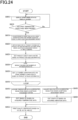
- FIG. 24 is a flowchart illustrating a print-data editing process performed by the PC in the delivery unit according to the third embodiment of the present invention.
- the PC 25 acquires vibration data in a designated range from the order-acceptance management server 11.
- the second transmission unit 55d of the delivery unit 15 transmits a quality data request for requesting quality data to the order-acceptance management server 11 by performing the quality data requesting process as needed.
- the PC 25 edits a graph ( FIG. 22(f) ) (F) based on the acquired vibration data.
- the PC 25 edits the quality certificate data based on the edited pieces of data (A), (B), (C), (D), and (F) and supplies the quality certificate data to the printer 27, to print the quality certificate 27c ( FIGS. 22 ) by the printer 27.
- the quality-data generation unit 55a since the quality-data generation unit 55a generates quality data of articles based on vibration data acquired from the memory unit 53, the quality certificate 27c including a graphic image representing the data quality of vibrations applied to the storage container 33 in chronological order can be issued. Therefore, at a delivery destination, upon reception of a container that accommodates articles therein, the quality of vibrations applied to the storage container 33 in chronological order relating to a cooling environment in the container can be confirmed immediately at the site.
- the quality-data generation unit 55a adds a graph representing vibrations applied to the storage container 33 from a road surface via a vehicle to the quality data, based on the vibration data acquired from the memory unit 53, the quality certificate 27c including a graphic image representing the vibrations applied to the storage container 33 in chronological order can be issued.
- the printer 27 since the printer 27 prints an image including at least one of a lot number and a serial number of an article, or an expiration date of the article in addition to a serial number of the article on a recording medium, the quality certificate 27c associated with a specific article can be issued.
- FIGS. 25 to FIG. 27 A delivery unit according to a fourth embodiment of the present invention is described with reference to FIGS. 25 to FIG. 27 .
- elements same as those denoted by reference signs in FIGS. 15 to FIG. 17 have the same configuration as those illustrated in FIGS. 15 to FIG. 17 , and thus descriptions thereof are omitted.
- FIGS. 25 are diagrams illustrating respective parts in a quality certificate printed by a printer of the delivery unit according to the fourth embodiment of the present invention.
- a product code (b) such as a lot number, an expiration date, and a serial number
- a bar-code (c) such as a lot number, an expiration date, and a serial number
- a temperature graph (d) such as a temperature graph
- a humidity graph (g) are arranged as an article code.
- FIG. 26 is a diagram illustrating association of respective files according to the fourth embodiment of the present invention.
- the order-acceptance management server 11 acquires temperature data and humidity data from the data logger 39 provided in the delivery unit 15, adds a unit number and a date and time to the temperature data, to generate a temperature history file F1.
- the order-acceptance management server 11 acquires status information updated by the PC 25 of the delivery unit 15, to generate a trace file F3 in which a product code, a date and time, a serial number, a unit number, and a status are associated with each other, as status information.
- the order-acceptance management server 11 uses the unit number included in the trace file F3 as a key to extract the temperature data and the humidity data from the temperature history file F1 having these keys to generate a serial temperature-history file F5, and memorizes the serial temperature-history file F5 in the database DB 13.
- FIG. 27 is a flowchart illustrating a print-data editing process performed by the PC in the delivery unit according to the fourth embodiment of the present invention.
- the PC 25 acquires humidity data in a designated range from the order-acceptance management server 11.
- the second transmission unit 55d of the delivery unit 15 transmits a quality data request for requesting quality data to the order-acceptance management server 11 by performing the quality data requesting process as needed.
- the PC 25 edits a graph ( FIG. 25(g) ) (G) based on the acquired humidity data.
- the PC 25 edits the quality certificate data based on the edited pieces of data (A), (B), (C), (D), and (G) and supplies the quality certificate data to the printer 27, to print the quality certificate 27d ( FIGS. 25 ) by the printer 27.
- the quality-data generation unit 55a since the quality-data generation unit 55a generates quality data of articles based on the humidity data acquired from the memory unit 53, a quality certificate 27d including a graphic image representing the quality of the humidity data in the storage container 33 in chronological order can be issued. Therefore, at a delivery destination, upon reception of a container that accommodates articles therein, the humidity quality in the storage container 33 in chronological order relating to a cooling environment in the container can be confirmed immediately at the site.
- the quality-data generation unit 55a adds a graph representing the humidity in the storage container 33 to the quality data, based on the humidity data acquired from the memory unit 53, the quality certificate 27d including a graphic image representing the humidity in the storage container 33 in chronological order can be issued.
- the printer 27 since the printer 27 prints an image including at least one of a lot number and a serial number of an article, or an expiration date of the article in addition to a serial number of the article on a recording medium, the quality certificate 27d associated with a specific article can be issued.
- FIGS. 28 to FIG. 30 A delivery unit according to a fifth embodiment of the present invention is described with reference to FIGS. 28 to FIG. 30 .
- elements same as those denoted by reference signs in FIGS. 15 to FIG. 17 have the same configuration as those illustrated in FIGS. 15 to FIG. 17 , and thus descriptions thereof are omitted.
- FIGS. 28 are diagrams illustrating respective parts in a quality certificate printed by a printer of the delivery unit according to the fifth embodiment of the present invention.
- a product code (b) such as a lot number, an expiration date, and a serial number
- a bar-code (c) such as a lot number, an expiration date, and a serial number
- a temperature graph (d) such as a temperature graph
- h opened/closed state graph
- the opened/closed state graph (h) illustrated in FIGS. 28 there is such a tendency that as the measurement time becomes longer, a line segment indicating an opened state becomes thinner.
- the opened state is in a rectangular waveform as illustrated in FIG. 31(h).
- FIG. 29 is a diagram illustrating association of respective files according to the fifth embodiment of the present invention.
- the order-acceptance management server 11 acquires temperature data and opened/closed state data from the data logger 39 provided in the delivery unit 15, adds a unit number and a date and time to the temperature data, to generate a temperature history file F1.
- the order-acceptance management server 11 acquires status information updated by the PC 25 of the delivery unit 15, to generate a trace file F3 in which a product code, a date and time, a serial number, a unit number, and a status are associated with each other, as status information.
- the order-acceptance management server 11 uses the unit number included in the trace file F3 as a key to extract the temperature data and the opened/closed state data from the temperature history file F1 having these keys to generate a serial temperature-history file F5, and memorizes the serial temperature-history file F5 in the database DB 13.
- FIG. 30 is a flowchart illustrating a print-data editing process performed by the PC in the delivery unit according to the fifth embodiment of the present invention.
- the PC 25 acquires opened/closed state data in a designated range from the order-acceptance management server 11.
- the second transmission unit 55d of the delivery unit 15 transmits a quality data request for requesting quality data to the order-acceptance management server 11 by performing the quality data requesting process as needed.
- the PC 25 edits a graph ( FIG. 28(h) ) (G) based on the acquired opened/closed state data.
- the PC 25 edits the quality certificate data based on the edited pieces of data (A), (B), (C), (D), and (H) and supplies the quality certificate data to the printer 27, to print the quality certificate 27e ( FIGS. 28 ) by the printer 27.
- the quality-data generation unit 55a adds opened/closed state data of a lid acquired from the memory unit 53 to quality data of articles
- the quality certificate 27a including a graphic image representing the quality of the opened/closed state data of the lid provided in the storage container 33 in chronological order can be issued. Therefore, at a delivery destination, upon reception of a container that accommodates articles therein, the opened/closed state of the lid and the temperature quality in chronological order of a cooling environment in the container can be confirmed immediately at the site.
- the quality-data generation unit 55a adds opened/closed state data of a lid acquired from the memory unit 53 to the graph representing the temperature in the storage container 33, to generate quality data, the quality certificate 27a including a graphic image representing the opened/closed state of the lid of the storage container 33 in chronological order can be issued.
- the printer 27 since the printer 27 prints an image including at least one of a lot number and a serial number of an article, or an expiration date of the article in addition to a serial number of the article on a recording medium, the quality certificate 27a associated with a specific article can be issued.
- FIGS. 31 to FIG. 33 A delivery unit according to a sixth embodiment of the present invention is described with reference to FIGS. 31 to FIG. 33 .
- elements same as those denoted by reference signs in FIGS. 15 to FIG. 17 have the same configuration as those illustrated in FIGS. 15 to FIG. 17 , and thus descriptions thereof are omitted.
- FIGS. 31 are diagrams illustrating respective parts in a quality certificate printed by a printer of the delivery unit according to the sixth embodiment of the present invention.
- a product code (b) such as a lot number, an expiration date, and a serial number
- a bar-code (c) such as a lot number, an expiration date, and a serial number
- a graph group (I) is arranged as an article code.
- the graph group (I) includes a temperature graph, a liquid level graph, a vibration graph, a humidity graph, and an opened/closed state graph.
- FIG. 32 is a diagram illustrating association of respective files according to the sixth embodiment of the present invention.
- the order-acceptance management server 11 acquires temperature data, liquid level data, vibration data, humidity data, and opened/closed state data from the data logger 39 provided in the delivery unit 15, adds a unit number and a date and time to a data group, to generate a temperature history file F1.
- the order-acceptance management server 11 acquires status information updated by the PC 25 of the delivery unit 15, to generate a trace file F3 in which a product code, a date and time, a serial number, a unit number, and a status are associated with each other, as status information.
- the order-acceptance management server 11 uses the unit number included in the trace file F3 as a key to extract the temperature data, the liquid level data, the vibration data, the humidity data, and the opened/closed state data from the temperature history file F1 having these keys to generate a serial temperature-history file F5, and memorizes the serial temperature-history file F5 in the database DB 13.
- FIG. 33 is a flowchart illustrating a print-data editing process performed by the PC in the delivery unit according to the sixth embodiment of the present invention.
- the PC 25 acquires temperature data, liquid level data, vibration data, humidity data, and opened/closed state data in a designated range from the order-acceptance management server 11.
- the second transmission unit 55d of the delivery unit 15 transmits a quality data request for requesting quality data to the order-acceptance management server 11 by performing the quality data requesting process as needed.
- the PC 25 edits a graph group ( FIG. 31(i) ) (I) based on the acquired temperature data, liquid level data, vibration data, humidity data, and opened/closed state data.
- the PC 25 edits the quality certificate data based on the edited pieces of data (A), (B), (C), and (I) and supplies the quality certificate data to the printer 27, to print the quality certificate 27f ( FIGS. 31 ) by the printer 27.
- a temperature graph, a liquid level graph, a vibration graph, a humidity file, and an opened/closed state graph are printed as the graph group (I).
- the quality-data generation unit 55a adds liquid level data, vibration data, humidity data, and opened/closed state data to temperature data, the quality certificate 27f including respective graphic images in chronological order can be issued. Therefore, at a delivery destination, upon reception of a container that accommodates articles therein, the quality in chronological order of a cooling environment in the container can be confirmed immediately at the site.
- the quality-data generation unit 55a sets temperature data, liquid level data, vibration data, humidity data, and opened/closed state data as quality data, the quality certificate 27a including the respective graphic images in chronological order can be issued.
- the printer 27 since the printer 27 prints an image including at least one of a lot number and a serial number of an article, or an expiration date of the article in addition to a serial number of the article on a recording medium, the quality certificate 27a associated with a specific article can be issued.
- the delivery unit 15 transmits a quality data request to the order-acceptance management server 11 as needed, and after the delivery unit 15 has acquired the data from the database DB 13, a quality certificate is printed.
- the present invention is not limited to such case.
- a hard disk HDD is provided in the delivery unit 15, temperature data, liquid level data, vibration data, humidity data, and opened/closed state data collected by the delivery unit 15 are once accumulated in the hard disk HDD, and after the data is acquired from the hard disk HDD as needed, a quality certificate is printed.
Landscapes
- Engineering & Computer Science (AREA)
- Business, Economics & Management (AREA)
- Physics & Mathematics (AREA)
- Mechanical Engineering (AREA)
- Economics (AREA)
- General Physics & Mathematics (AREA)
- Chemical & Material Sciences (AREA)
- Combustion & Propulsion (AREA)
- Thermal Sciences (AREA)
- General Engineering & Computer Science (AREA)
- Marketing (AREA)
- Development Economics (AREA)
- Entrepreneurship & Innovation (AREA)
- Human Resources & Organizations (AREA)
- Operations Research (AREA)
- Quality & Reliability (AREA)
- Strategic Management (AREA)
- Tourism & Hospitality (AREA)
- General Business, Economics & Management (AREA)
- Theoretical Computer Science (AREA)
- Medical Informatics (AREA)
- Health & Medical Sciences (AREA)
- Management, Administration, Business Operations System, And Electronic Commerce (AREA)
Claims (12)
- Eine Liefereinheit (15), die an einem Fahrzeug (21) befestigt ist, und wobei die Liefereinheit (15) folgende Merkmale aufweist:einen Behälter (33), der mit einem verflüssigten Kühlgas gefüllt ist, in dem Artikel aufgenommen sind, wobei der Behälter (33) in der Liefereinheit (15) zum Liefern der aufgenommenen Artikel platziert ist;eine Temperaturmesseinheit (Se1), die dazu konfiguriert ist, eine Temperatur in dem Behälter (33) zu messen;eine Speichereinheit (53), die dazu konfiguriert ist, die gemessenen Temperaturdaten in chronologischer Reihenfolge zu speichern;eine Qualitätsdatenerzeugungseinheit (55a), die dazu konfiguriert ist, Qualitätsdaten der Artikel zu erzeugen, basierend auf Temperaturdaten, die von der Speichereinheit (53) erfasst werden;eine Druckdateneditiereinheit (55h), die dazu konfiguriert ist, Druckdaten zu editieren, die sich auf ein Qualitätszertifikat (27a) beziehen, einschließlich eines grafischen Bildes, das eine Qualität einer Kühlumgebung in einem Behälter (33), der während der Lieferung Artikel aufnimmt, basierend auf einer Seriennummer des Artikels und den Qualitätsdaten in chronologischer Reihenfolge darstellt; undeine Druckeinheit (27), die dazu konfiguriert ist, die Druckdaten, die sich auf das Qualitätszertifikat (27a) beziehen, auf ein Aufzeichnungsmedium zu drucken, wobeidie Liefereinheit (15) ferner eine Flüssigkeitspegelmesseinheit (Se2) aufweist, die dazu konfiguriert ist, den Flüssigkeitspegel des verflüssigten Kühlgases zu messen, das in den Behälter (33) gefüllt ist, wobeidie Speichereinheit (53) dazu konfiguriert ist, Daten des gemessenen Flüssigkeitspegels in chronologischer Reihenfolge zu speichern, unddie Qualitätsdatenerzeugungseinheit (55a) dazu konfiguriert ist, Qualitätsdaten der Artikel basierend auf Flüssigkeitspegeldaten zu erzeugen, die von der Speichereinheit (53) erfasst werden.
- Die Liefereinheit (15) gemäß Anspruch 1, die ferner folgende Merkmale aufweist:eine Anzeigeeinheit (55f), die dazu konfiguriert ist, eine Spalte mit Druckstartdatum und -zeit und eine Spalte mit Druckenddatum und -zeit anzuzeigen, die eine Eingabe eines Bereichs von Druckdatum und -zeit anfordert, der den Temperaturdaten zugeordnet ist, die auf dem Qualitätszertifikat (27a) zu drucken sind; undeine Druckbereicherfassungseinheit (55g), die dazu konfiguriert ist, einen Bereich von Druckdatum und -zeit zu erfassen, der durch Druckstartdatum und -zeit und Druckenddatum und -zeit dargestellt ist, die auf der Anzeigeeinheit (55f) angezeigt sind, wobeidie Qualitätsdatenerzeugungseinheit (55a) dazu konfiguriert ist, Qualitätsdaten der Artikel basierend auf Temperaturdaten zu erzeugen, die von der Speichereinheit (53) erfasst werden, die einem Bereich von Druckdatum und -zeit entsprechen, der von der Druckbereicherfassungseinheit (55g) erfasst wird.
- Die Liefereinheit (15) gemäß Anspruch 1, bei der die Qualitätsdatenerzeugungseinheit (55a) dazu konfiguriert ist, einen Graphen, der einen Flüssigkeitspegel des Kühlgases darstellt, den Qualitätsdaten hinzuzufügen, die auf Flüssigkeitspegeldaten basieren, die von der Speichereinheit (53) erfasst werden.
- Die Liefereinheit (15) gemäß Anspruch 1, die ferner eine Schwingungsmesseinheit (Se3) aufweist, die dazu konfiguriert ist, Schwingungen zu messen, die von einer Straßenoberfläche über das Fahrzeug (21) an den Behälter (33) angelegt werden, wobeidie Speichereinheit (53) dazu konfiguriert ist, Daten der gemessenen Schwingungen in chronologischer Reihenfolge zu speichern unddie Qualitätsdatenerzeugungseinheit (55a) dazu konfiguriert ist, Qualitätsdaten der Artikel basierend auf Schwingungsdaten zu erzeugen, die von der Speichereinheit (53) erfasst werden.
- Die Liefereinheit (15) gemäß Anspruch 4, bei der die Qualitätsdatenerzeugungseinheit (55a) dazu konfiguriert ist, einen Graphen, der Schwingungen darstellt, die von einer Straßenoberfläche über das Fahrzeug (21) an den Behälter (33) angelegt werden, den Qualitätsdaten hinzuzufügen, die auf Schwingungsdaten basieren, die von der Speichereinheit (53) erfasst werden.
- Die Liefereinheit (15) gemäß Anspruch 1, die ferner eine Feuchtigkeitsmesseinheit (Se5) aufweist, die dazu konfiguriert ist, eine Feuchtigkeit in dem Behälter (33) zu messen, wobeidie Speichereinheit (53) dazu konfiguriert ist, Daten der gemessenen Feuchtigkeit in chronologischer Reihenfolge zu speichern unddie Qualitätsdatenerzeugungseinheit (55a) dazu konfiguriert ist, Qualitätsdaten der Artikel basierend auf Feuchtigkeitsdaten zu erzeugen, die von der Speichereinheit (53) erfasst werden.
- Die Liefereinheit (15) gemäß Anspruch 6, bei der die Qualitätsdatenerzeugungseinheit (55a) dazu konfiguriert ist, einen Graphen, der eine Feuchtigkeit in dem Behälter (33) darstellt, den Qualitätsdaten hinzuzufügen, die auf Feuchtigkeitsdaten basieren, die von der Speichereinheit (53) erfasst werden.
- Die Liefereinheit (15) gemäß Anspruch 1, die ferner eine Öffnen/Schließen-Messeinheit (Se4) aufweist, die dazu konfiguriert ist, einen geöffneten/geschlossenen Zustand eines Deckels zu messen, der in dem Behälter (33) vorgesehen ist, wobeidie Speichereinheit (53) dazu konfiguriert ist, Daten des erfassten geöffneten/geschlossenen Zustands des Deckels in chronologischer Reihenfolge zu speichern unddie Qualitätsdatenerzeugungseinheit (55a) dazu konfiguriert ist, Daten des erfassten geöffneten/geschlossenen Zustands des Deckels, die von der Speichereinheit (53) erfasst werden, den Qualitätsdaten der Artikel hinzuzufügen.
- Die Liefereinheit (15) gemäß Anspruch 8, bei der die Qualitätsdatenerzeugungseinheit (55a) dazu konfiguriert ist, Daten des erfassten geöffneten/geschlossenen Zustands eines Deckels, die von der Speichereinheit (53) erfasst werden, einem Graphen hinzuzufügen, der eine Temperatur in dem Behälter (33) darstellt, um die Qualitätsdaten zu erzeugen.
- Die Liefereinheit (15) gemäß einem der Ansprüche 1 bis 9, bei der die Druckeinheit (27) dazu konfiguriert ist, ein Bild, das zumindest eines einer Losnummer und einer Seriennummer des Artikels oder eines Ablaufdatums des Artikels zusätzlich zu einer Seriennummer des Artikels umfasst, auf das Aufzeichnungsmedium zu drucken.
- Ein Liefersystem (1), das folgende Merkmale aufweist:die Liefereinheit (15) gemäß einem der Ansprüche 1 bis 10; undeinen Server (11), wobeidie Liefereinheit (15) folgende Merkmale umfasst:eine erste Sendeeinheit (55c), die dazu konfiguriert ist, Qualitätsdaten, die durch die Qualitätsdatenerzeugungseinheit (55a) erzeugt werden, an den Server (11) zu senden,eine zweite Sendeeinheit (55d), die dazu konfiguriert ist, nach Bedarf eine Qualitätsdatenanforderung an den Server (11) zu senden undeine erste Empfangseinheit (55e), die dazu konfiguriert ist, Qualitätsdaten von dem Server (11) zu empfangen undder Server (11) folgende Merkmale umfasst:eine zweite Empfangseinheit (11b), die dazu konfiguriert ist, Qualitätsdaten von der Liefereinheit (15) zu empfangen,eine Sammeleinheit (DB13), die dazu konfiguriert ist, Qualitätsdaten zu sammeln, die von der Liefereinheit (15) empfangen werden undeine dritte Sendeeinheit (11a), die dazu konfiguriert ist, Qualitätsdaten, die von der Sammeleinheit (DB13) erfasst werden, auf den Empfang einer Qualitätsdatenanforderung von der Liefereinheit (15) hin an die Liefereinheit (15) zu senden.
- Das Liefersystem (1) gemäß Anspruch 11, das einen Anschluss (5) aufweist, wobeider Server (11) eine vierte Sendeeinheit (11c) umfasst, die dazu konfiguriert ist, Qualitätsdaten, die von der Sammeleinheit (DB13) erfasst werden, auf den Empfang einer Qualitätsdatenanforderung von dem Anschluss (5) hin an den Anschluss (5) zu senden, undder Anschluss (5) folgende Merkmale umfasst:eine fünfte Sendeeinheit (5a), die dazu konfiguriert ist, nach Bedarf eine Qualitätsdatenanforderung an den Server (11) zu senden undeine dritte Empfangseinheit (5b), die dazu konfiguriert ist, Qualitätsdaten von dem Server (11) zu empfangen.
Applications Claiming Priority (2)
| Application Number | Priority Date | Filing Date | Title |
|---|---|---|---|
| JP2018052576A JP6660972B2 (ja) | 2018-03-20 | 2018-03-20 | 配送ユニット、及び配送システム |
| PCT/JP2018/023834 WO2019180980A1 (ja) | 2018-03-20 | 2018-06-22 | 配送ユニット、及び配送システム |
Publications (4)
| Publication Number | Publication Date |
|---|---|
| EP3770088A1 EP3770088A1 (de) | 2021-01-27 |
| EP3770088A4 EP3770088A4 (de) | 2021-12-08 |
| EP3770088C0 EP3770088C0 (de) | 2024-07-31 |
| EP3770088B1 true EP3770088B1 (de) | 2024-07-31 |
Family
ID=67986816
Family Applications (1)
| Application Number | Title | Priority Date | Filing Date |
|---|---|---|---|
| EP18910745.1A Active EP3770088B1 (de) | 2018-03-20 | 2018-06-22 | Liefereinheit und liefersystem |
Country Status (7)
| Country | Link |
|---|---|
| US (7) | US11884481B2 (de) |
| EP (1) | EP3770088B1 (de) |
| JP (1) | JP6660972B2 (de) |
| CN (2) | CN115649696B (de) |
| BR (1) | BR112020015337B1 (de) |
| ES (1) | ES2995493T3 (de) |
| WO (1) | WO2019180980A1 (de) |
Families Citing this family (4)
| Publication number | Priority date | Publication date | Assignee | Title |
|---|---|---|---|---|
| JP6660972B2 (ja) * | 2018-03-20 | 2020-03-11 | 株式会社メディパルホールディングス | 配送ユニット、及び配送システム |
| WO2022244247A1 (ja) * | 2021-05-21 | 2022-11-24 | 株式会社Lozi | 物流管理システム、物流管理方法及びプログラム |
| KR20250045076A (ko) * | 2023-09-25 | 2025-04-01 | 쿠팡 주식회사 | 전자 상거래 서비스에 관한 데이터를 처리하는 방법, 장치 및 기록 매체 |
| JP2025169480A (ja) * | 2024-05-01 | 2025-11-14 | 株式会社キーエンス | 光学式情報読取端末およびデータ集計システム |
Family Cites Families (39)
| Publication number | Priority date | Publication date | Assignee | Title |
|---|---|---|---|---|
| US4607489A (en) | 1985-05-21 | 1986-08-26 | Mg Industries | Method and apparatus for producing cold gas at a desired temperature |
| EP0260343B1 (de) * | 1986-09-17 | 1993-01-20 | Viessmann Werke GmbH & Co. | Verfahren und Vorrichtung zur Temperaturregelung von Heizungs- und Kühlanlagen |
| US5309722A (en) | 1992-11-06 | 1994-05-10 | Harsco Corporation | Temperature control system for liquid nitrogen refrigerator |
| JPH0728907A (ja) * | 1993-07-13 | 1995-01-31 | Chino Corp | 輸送物の品質証明装置 |
| JP2003004368A (ja) * | 2001-06-25 | 2003-01-08 | Ricoh Co Ltd | 在庫管理機能付き冷蔵庫、冷蔵庫在庫管理システム、これらの機能を実行するプログラム及び記録媒体 |
| JP3610487B2 (ja) | 2001-10-17 | 2005-01-12 | 有限会社日本食品工学協議会 | 食品保存方法とその装置 |
| DE10228648A1 (de) * | 2002-06-26 | 2004-01-22 | Dirk Losco | Behälter zum Transport von temperaturempfindlichen Gütern |
| JP2004125168A (ja) | 2002-08-08 | 2004-04-22 | Nippon Sanso Corp | 医療用液化酸素の供給方法および酸素運搬用車両 |
| JP2004217326A (ja) * | 2003-01-09 | 2004-08-05 | Fujita Denki Seisakusho:Kk | 輸送食材品質監視方法、輸送食材品質監視システム及び輸送食材品質監視装置 |
| JP2004269178A (ja) * | 2003-03-10 | 2004-09-30 | Daikin Ind Ltd | 情報送信装置、配送装置、情報送信システム、および情報送信方法 |
| JP2005075595A (ja) * | 2003-09-02 | 2005-03-24 | Omron Corp | 運送温度品質証明方法とそのシステム |
| JP2006010138A (ja) * | 2004-06-23 | 2006-01-12 | Twinbird Corp | 保存庫 |
| JP2007219646A (ja) * | 2006-02-14 | 2007-08-30 | Canon Inc | メール印刷システム及びコンピュータプログラム |
| JP2009007097A (ja) | 2007-06-27 | 2009-01-15 | Toa Harbor Works Co Ltd | 配送物の温度管理システム |
| JP4945373B2 (ja) * | 2007-08-29 | 2012-06-06 | 株式会社日立製作所 | 物品管理システムおよび物品管理方法 |
| JP5292991B2 (ja) * | 2008-08-20 | 2013-09-18 | パナソニック株式会社 | 収納庫及び収納システム |
| US9019535B1 (en) | 2009-06-09 | 2015-04-28 | Breezyprint Corporation | Secure mobile printing from a third-party device |
| US10032239B2 (en) | 2010-06-10 | 2018-07-24 | United Parcel Service Of America, Inc. | Enhanced payments for shipping |
| US8577335B2 (en) | 2011-06-08 | 2013-11-05 | Kitaru Innovations Inc. | Method and apparatus for tracking package deliveries |
| US20130158720A1 (en) * | 2011-12-15 | 2013-06-20 | Honeywell International Inc. | Hvac controller with performance log |
| US9442500B2 (en) * | 2012-03-08 | 2016-09-13 | Honeywell International Inc. | Systems and methods for associating wireless devices of an HVAC system |
| US9488994B2 (en) * | 2012-03-29 | 2016-11-08 | Honeywell International Inc. | Method and system for configuring wireless sensors in an HVAC system |
| US9916555B2 (en) | 2012-04-10 | 2018-03-13 | Geoforce, Inc. | Location tracking with integrated identification of cargo carrier contents and related system and method |
| US20140337245A1 (en) | 2013-05-10 | 2014-11-13 | International Business Machines Corporation | Generation of shipment tracking report using text analytics |
| US10430750B2 (en) * | 2013-08-09 | 2019-10-01 | Klatu Networks, Inc. | System-independent data logging |
| US11928643B2 (en) | 2014-01-07 | 2024-03-12 | Cryoport, Inc. | Digital smart label for shipper with data logger |
| US10018366B2 (en) * | 2015-02-05 | 2018-07-10 | Intellihot, Inc. | Learning-based recirculation and temperature setpoint control system |
| JP6783789B2 (ja) * | 2015-03-30 | 2020-11-11 | ゼスト・ラブズ・インコーポレイテッドZest Labs, Inc. | アクティブに管理される食品配送 |
| JP6220825B2 (ja) * | 2015-07-22 | 2017-10-25 | 株式会社三菱ケミカルホールディングス | 物品輸送管理方法および物品輸送管理システム |
| US10147098B2 (en) * | 2015-07-31 | 2018-12-04 | Chromera, Inc. | Symbol verification for an intelligent label device |
| CN105447671A (zh) * | 2015-12-01 | 2016-03-30 | 温州润物电子商务有限公司 | 农产品物流配送系统 |
| CN205670272U (zh) * | 2016-05-30 | 2016-11-02 | 北京市大维同创医疗设备有限公司 | 一种车载医疗药品的冷藏配送系统 |
| US20170352002A1 (en) * | 2016-06-01 | 2017-12-07 | Mega Link Technology Limited | System and method for real time remote monitoring of atmospheric conditions of products |
| CN206224581U (zh) * | 2016-08-26 | 2017-06-06 | 特斯联(北京)科技有限公司 | 一种智能物流车载定位跟踪安全监控系统 |
| JP6231715B1 (ja) * | 2017-07-20 | 2017-11-15 | 一般社団法人ロジスティクスHaccp研究所 | 物流管理システム |
| JP6660972B2 (ja) | 2018-03-20 | 2020-03-11 | 株式会社メディパルホールディングス | 配送ユニット、及び配送システム |
| CN112312367B (zh) | 2019-08-01 | 2024-11-15 | 联发科技(新加坡)私人有限公司 | 蓝牙通信方法及通信设备 |
| US11913841B2 (en) | 2020-02-07 | 2024-02-27 | Carrier Corporation | Item and a method for sensing and displaying temperature therof |
| KR102459378B1 (ko) | 2021-11-15 | 2022-10-28 | 주식회사 윌로그 | 물류의 상태 관리에 이용되는 센싱 데이터의 변화량을 기반으로 데이터를 압축하여 저장하기 위한 시스템, 장치 및 방법 |
-
2018
- 2018-03-20 JP JP2018052576A patent/JP6660972B2/ja active Active
- 2018-06-22 EP EP18910745.1A patent/EP3770088B1/de active Active
- 2018-06-22 WO PCT/JP2018/023834 patent/WO2019180980A1/ja not_active Ceased
- 2018-06-22 BR BR112020015337-0A patent/BR112020015337B1/pt active IP Right Grant
- 2018-06-22 CN CN202210996835.1A patent/CN115649696B/zh active Active
- 2018-06-22 CN CN201880091408.0A patent/CN111867948B/zh active Active
- 2018-06-22 ES ES18910745T patent/ES2995493T3/es active Active
-
2020
- 2020-09-17 US US17/024,536 patent/US11884481B2/en active Active
-
2022
- 2022-06-20 US US17/807,844 patent/US12528641B2/en active Active
- 2022-06-20 US US17/807,824 patent/US12344460B2/en active Active
- 2022-06-21 US US17/808,068 patent/US12312156B2/en active Active
- 2022-06-22 US US17/808,252 patent/US12595117B2/en active Active
- 2022-06-22 US US17/808,287 patent/US12139323B2/en active Active
-
2023
- 2023-12-11 US US18/536,050 patent/US12162673B2/en active Active
Also Published As
| Publication number | Publication date |
|---|---|
| US20210002068A1 (en) | 2021-01-07 |
| US12528641B2 (en) | 2026-01-20 |
| US20220315321A1 (en) | 2022-10-06 |
| JP2019164633A (ja) | 2019-09-26 |
| ES2995493T3 (en) | 2025-02-10 |
| JP6660972B2 (ja) | 2020-03-11 |
| US11884481B2 (en) | 2024-01-30 |
| US12595117B2 (en) | 2026-04-07 |
| BR112020015337A2 (pt) | 2020-12-08 |
| CN115649696B (zh) | 2025-11-04 |
| US12162673B2 (en) | 2024-12-10 |
| CN115649696A (zh) | 2023-01-31 |
| EP3770088C0 (de) | 2024-07-31 |
| US12312156B2 (en) | 2025-05-27 |
| CN111867948B (zh) | 2022-08-23 |
| BR112020015337B1 (pt) | 2024-02-15 |
| US20220315320A1 (en) | 2022-10-06 |
| US12139323B2 (en) | 2024-11-12 |
| US20230025034A1 (en) | 2023-01-26 |
| EP3770088A1 (de) | 2021-01-27 |
| US20220315319A1 (en) | 2022-10-06 |
| US12344460B2 (en) | 2025-07-01 |
| CN111867948A (zh) | 2020-10-30 |
| US20240109719A1 (en) | 2024-04-04 |
| EP3770088A4 (de) | 2021-12-08 |
| WO2019180980A1 (ja) | 2019-09-26 |
| US20220388765A1 (en) | 2022-12-08 |
Similar Documents
| Publication | Publication Date | Title |
|---|---|---|
| US12162673B2 (en) | Delivery unit and delivery system | |
| US12112291B2 (en) | Delivery management system, delivery management method, and program | |
| CN112703521A (zh) | 订单管理系统、订单管理方法以及程序 | |
| US12460975B2 (en) | Temperature measurement device and quality control system | |
| JP2019191755A (ja) | 流通管理装置及びプログラム | |
| HK40084560A (zh) | 配送单元和配送系统 | |
| HK40084560B (zh) | 配送单元和配送系统 | |
| HK40036040A (en) | Delivery unit and delivery system | |
| HK40036040B (en) | Delivery unit and delivery system | |
| US12366669B2 (en) | Information processing device and position management system | |
| BR112020024927B1 (pt) | Sistema e método de gerenciamento de distribuição, e, meio de armazenamento legível por computador | |
| HK40044803A (en) | Received order management system, received order management method, and program | |
| BR112021016540B1 (pt) | Sistema de controle de qualidade | |
| HK40040920A (en) | Delivery management system, delivery management method, and program | |
| HK40069866B (zh) | 配送管理系统 |
Legal Events
| Date | Code | Title | Description |
|---|---|---|---|
| STAA | Information on the status of an ep patent application or granted ep patent |
Free format text: STATUS: THE INTERNATIONAL PUBLICATION HAS BEEN MADE |
|
| PUAI | Public reference made under article 153(3) epc to a published international application that has entered the european phase |
Free format text: ORIGINAL CODE: 0009012 |
|
| STAA | Information on the status of an ep patent application or granted ep patent |
Free format text: STATUS: REQUEST FOR EXAMINATION WAS MADE |
|
| 17P | Request for examination filed |
Effective date: 20200807 |
|
| AK | Designated contracting states |
Kind code of ref document: A1 Designated state(s): AL AT BE BG CH CY CZ DE DK EE ES FI FR GB GR HR HU IE IS IT LI LT LU LV MC MK MT NL NO PL PT RO RS SE SI SK SM TR |
|
| AX | Request for extension of the european patent |
Extension state: BA ME |
|
| DAV | Request for validation of the european patent (deleted) | ||
| DAX | Request for extension of the european patent (deleted) | ||
| A4 | Supplementary search report drawn up and despatched |
Effective date: 20211105 |
|
| RIC1 | Information provided on ipc code assigned before grant |
Ipc: G06Q 10/08 20120101ALI20211029BHEP Ipc: F25D 23/00 20060101ALI20211029BHEP Ipc: F25D 3/10 20060101ALI20211029BHEP Ipc: B65G 61/00 20060101ALI20211029BHEP Ipc: F25D 23/12 20060101ALI20211029BHEP Ipc: F25D 29/00 20060101AFI20211029BHEP |
|
| REG | Reference to a national code |
Ref country code: DE Ref legal event code: R079 Ref document number: 602018072610 Country of ref document: DE Free format text: PREVIOUS MAIN CLASS: B65G0061000000 Ipc: F25D0029000000 |
|
| GRAP | Despatch of communication of intention to grant a patent |
Free format text: ORIGINAL CODE: EPIDOSNIGR1 |
|
| STAA | Information on the status of an ep patent application or granted ep patent |
Free format text: STATUS: GRANT OF PATENT IS INTENDED |
|
| RIC1 | Information provided on ipc code assigned before grant |
Ipc: G06Q 10/08 20120101ALI20240123BHEP Ipc: G06Q 10/0832 20230101ALI20240123BHEP Ipc: F25D 23/12 20060101ALI20240123BHEP Ipc: B65G 61/00 20060101ALI20240123BHEP Ipc: F25D 3/10 20060101ALI20240123BHEP Ipc: F25D 23/00 20060101ALI20240123BHEP Ipc: F25D 29/00 20060101AFI20240123BHEP |
|
| INTG | Intention to grant announced |
Effective date: 20240216 |
|
| GRAS | Grant fee paid |
Free format text: ORIGINAL CODE: EPIDOSNIGR3 |
|
| GRAA | (expected) grant |
Free format text: ORIGINAL CODE: 0009210 |
|
| STAA | Information on the status of an ep patent application or granted ep patent |
Free format text: STATUS: THE PATENT HAS BEEN GRANTED |
|
| AK | Designated contracting states |
Kind code of ref document: B1 Designated state(s): AL AT BE BG CH CY CZ DE DK EE ES FI FR GB GR HR HU IE IS IT LI LT LU LV MC MK MT NL NO PL PT RO RS SE SI SK SM TR |
|
| REG | Reference to a national code |
Ref country code: CH Ref legal event code: EP Ref country code: GB Ref legal event code: FG4D |
|
| REG | Reference to a national code |
Ref country code: DE Ref legal event code: R096 Ref document number: 602018072610 Country of ref document: DE |
|
| REG | Reference to a national code |
Ref country code: IE Ref legal event code: FG4D |
|
| U01 | Request for unitary effect filed |
Effective date: 20240819 |
|
| U07 | Unitary effect registered |
Designated state(s): AT BE BG DE DK EE FI FR IT LT LU LV MT NL PT RO SE SI Effective date: 20240902 |
|
| PG25 | Lapsed in a contracting state [announced via postgrant information from national office to epo] |
Ref country code: NO Free format text: LAPSE BECAUSE OF FAILURE TO SUBMIT A TRANSLATION OF THE DESCRIPTION OR TO PAY THE FEE WITHIN THE PRESCRIBED TIME-LIMIT Effective date: 20241031 |
|
| PG25 | Lapsed in a contracting state [announced via postgrant information from national office to epo] |
Ref country code: PL Free format text: LAPSE BECAUSE OF FAILURE TO SUBMIT A TRANSLATION OF THE DESCRIPTION OR TO PAY THE FEE WITHIN THE PRESCRIBED TIME-LIMIT Effective date: 20240731 Ref country code: GR Free format text: LAPSE BECAUSE OF FAILURE TO SUBMIT A TRANSLATION OF THE DESCRIPTION OR TO PAY THE FEE WITHIN THE PRESCRIBED TIME-LIMIT Effective date: 20241101 |
|
| PG25 | Lapsed in a contracting state [announced via postgrant information from national office to epo] |
Ref country code: IS Free format text: LAPSE BECAUSE OF FAILURE TO SUBMIT A TRANSLATION OF THE DESCRIPTION OR TO PAY THE FEE WITHIN THE PRESCRIBED TIME-LIMIT Effective date: 20241130 |
|
| PG25 | Lapsed in a contracting state [announced via postgrant information from national office to epo] |
Ref country code: HR Free format text: LAPSE BECAUSE OF FAILURE TO SUBMIT A TRANSLATION OF THE DESCRIPTION OR TO PAY THE FEE WITHIN THE PRESCRIBED TIME-LIMIT Effective date: 20240731 |
|
| PG25 | Lapsed in a contracting state [announced via postgrant information from national office to epo] |
Ref country code: RS Free format text: LAPSE BECAUSE OF FAILURE TO SUBMIT A TRANSLATION OF THE DESCRIPTION OR TO PAY THE FEE WITHIN THE PRESCRIBED TIME-LIMIT Effective date: 20241031 |
|
| PG25 | Lapsed in a contracting state [announced via postgrant information from national office to epo] |
Ref country code: RS Free format text: LAPSE BECAUSE OF FAILURE TO SUBMIT A TRANSLATION OF THE DESCRIPTION OR TO PAY THE FEE WITHIN THE PRESCRIBED TIME-LIMIT Effective date: 20241031 Ref country code: PL Free format text: LAPSE BECAUSE OF FAILURE TO SUBMIT A TRANSLATION OF THE DESCRIPTION OR TO PAY THE FEE WITHIN THE PRESCRIBED TIME-LIMIT Effective date: 20240731 Ref country code: NO Free format text: LAPSE BECAUSE OF FAILURE TO SUBMIT A TRANSLATION OF THE DESCRIPTION OR TO PAY THE FEE WITHIN THE PRESCRIBED TIME-LIMIT Effective date: 20241031 Ref country code: IS Free format text: LAPSE BECAUSE OF FAILURE TO SUBMIT A TRANSLATION OF THE DESCRIPTION OR TO PAY THE FEE WITHIN THE PRESCRIBED TIME-LIMIT Effective date: 20241130 Ref country code: HR Free format text: LAPSE BECAUSE OF FAILURE TO SUBMIT A TRANSLATION OF THE DESCRIPTION OR TO PAY THE FEE WITHIN THE PRESCRIBED TIME-LIMIT Effective date: 20240731 Ref country code: GR Free format text: LAPSE BECAUSE OF FAILURE TO SUBMIT A TRANSLATION OF THE DESCRIPTION OR TO PAY THE FEE WITHIN THE PRESCRIBED TIME-LIMIT Effective date: 20241101 |
|
| REG | Reference to a national code |
Ref country code: ES Ref legal event code: FG2A Ref document number: 2995493 Country of ref document: ES Kind code of ref document: T3 Effective date: 20250210 |
|
| PG25 | Lapsed in a contracting state [announced via postgrant information from national office to epo] |
Ref country code: SM Free format text: LAPSE BECAUSE OF FAILURE TO SUBMIT A TRANSLATION OF THE DESCRIPTION OR TO PAY THE FEE WITHIN THE PRESCRIBED TIME-LIMIT Effective date: 20240731 |
|
| PG25 | Lapsed in a contracting state [announced via postgrant information from national office to epo] |
Ref country code: CZ Free format text: LAPSE BECAUSE OF FAILURE TO SUBMIT A TRANSLATION OF THE DESCRIPTION OR TO PAY THE FEE WITHIN THE PRESCRIBED TIME-LIMIT Effective date: 20240731 |
|
| PG25 | Lapsed in a contracting state [announced via postgrant information from national office to epo] |
Ref country code: SK Free format text: LAPSE BECAUSE OF FAILURE TO SUBMIT A TRANSLATION OF THE DESCRIPTION OR TO PAY THE FEE WITHIN THE PRESCRIBED TIME-LIMIT Effective date: 20240731 |
|
| PLBE | No opposition filed within time limit |
Free format text: ORIGINAL CODE: 0009261 |
|
| STAA | Information on the status of an ep patent application or granted ep patent |
Free format text: STATUS: NO OPPOSITION FILED WITHIN TIME LIMIT |
|
| 26N | No opposition filed |
Effective date: 20250501 |
|
| U20 | Renewal fee for the european patent with unitary effect paid |
Year of fee payment: 8 Effective date: 20250627 |
|
| PGFP | Annual fee paid to national office [announced via postgrant information from national office to epo] |
Ref country code: ES Payment date: 20250731 Year of fee payment: 8 |
|
| REG | Reference to a national code |
Ref country code: CH Ref legal event code: H13 Free format text: ST27 STATUS EVENT CODE: U-0-0-H10-H13 (AS PROVIDED BY THE NATIONAL OFFICE) Effective date: 20260127 |
|
| PG25 | Lapsed in a contracting state [announced via postgrant information from national office to epo] |
Ref country code: MC Free format text: LAPSE BECAUSE OF FAILURE TO SUBMIT A TRANSLATION OF THE DESCRIPTION OR TO PAY THE FEE WITHIN THE PRESCRIBED TIME-LIMIT Effective date: 20240731 |
|
| GBPC | Gb: european patent ceased through non-payment of renewal fee |
Effective date: 20250622 |
|
| PG25 | Lapsed in a contracting state [announced via postgrant information from national office to epo] |
Ref country code: GB Free format text: LAPSE BECAUSE OF NON-PAYMENT OF DUE FEES Effective date: 20250622 |
|
| PG25 | Lapsed in a contracting state [announced via postgrant information from national office to epo] |
Ref country code: IE Free format text: LAPSE BECAUSE OF NON-PAYMENT OF DUE FEES Effective date: 20250622 |
|
| PG25 | Lapsed in a contracting state [announced via postgrant information from national office to epo] |
Ref country code: CH Free format text: LAPSE BECAUSE OF NON-PAYMENT OF DUE FEES Effective date: 20250630 |