EP3770151B1 - Verfahren zur herstellung von chromenen durch thermolyse, die für die herstellung von wärmehärtbaren harzen bestimmt sind - Google Patents
Verfahren zur herstellung von chromenen durch thermolyse, die für die herstellung von wärmehärtbaren harzen bestimmt sind Download PDFInfo
- Publication number
- EP3770151B1 EP3770151B1 EP20186796.7A EP20186796A EP3770151B1 EP 3770151 B1 EP3770151 B1 EP 3770151B1 EP 20186796 A EP20186796 A EP 20186796A EP 3770151 B1 EP3770151 B1 EP 3770151B1
- Authority
- EP
- European Patent Office
- Prior art keywords
- propargyl
- propargylated
- alkene
- general formula
- group
- Prior art date
- Legal status (The legal status is an assumption and is not a legal conclusion. Google has not performed a legal analysis and makes no representation as to the accuracy of the status listed.)
- Active
Links
Classifications
-
- C—CHEMISTRY; METALLURGY
- C07—ORGANIC CHEMISTRY
- C07D—HETEROCYCLIC COMPOUNDS
- C07D493/00—Heterocyclic compounds containing oxygen atoms as the only ring hetero atoms in the condensed system
- C07D493/02—Heterocyclic compounds containing oxygen atoms as the only ring hetero atoms in the condensed system in which the condensed system contains two hetero rings
- C07D493/04—Ortho-condensed systems
-
- C—CHEMISTRY; METALLURGY
- C07—ORGANIC CHEMISTRY
- C07D—HETEROCYCLIC COMPOUNDS
- C07D311/00—Heterocyclic compounds containing six-membered rings having one oxygen atom as the only hetero atom, condensed with other rings
- C07D311/02—Heterocyclic compounds containing six-membered rings having one oxygen atom as the only hetero atom, condensed with other rings ortho- or peri-condensed with carbocyclic rings or ring systems
- C07D311/04—Benzo[b]pyrans, not hydrogenated in the carbocyclic ring
-
- C—CHEMISTRY; METALLURGY
- C07—ORGANIC CHEMISTRY
- C07D—HETEROCYCLIC COMPOUNDS
- C07D413/00—Heterocyclic compounds containing two or more hetero rings, at least one ring having nitrogen and oxygen atoms as the only ring hetero atoms
- C07D413/02—Heterocyclic compounds containing two or more hetero rings, at least one ring having nitrogen and oxygen atoms as the only ring hetero atoms containing two hetero rings
- C07D413/04—Heterocyclic compounds containing two or more hetero rings, at least one ring having nitrogen and oxygen atoms as the only ring hetero atoms containing two hetero rings directly linked by a ring-member-to-ring-member bond
Definitions
- the present invention relates to the field of thermosetting resins, and materials obtained from these resins. These resins are intended to replace phenolic resins in all the applications in which they are used, and in particular so-called “ablative” materials.
- An ablative material is defined as a material which is capable of undergoing ablation, i.e. a loss of substance by chemical decomposition, change of state or mechanical erosion under the effect of a flow of matter or radiation ( Official Journal of the French Republic of September 22, 2000 ). This is particularly the case for the materials used to make heat shields intended for the aerospace industry and for the walls of propulsion engine nozzles.
- the external layer of the ablative material which is directly in contact with the environment, undergoes under the effect of heat a chemical transformation, as well as a recession linked to this transformation. This outer layer therefore radiates outwards and its chemical transformation consumes energy.
- a good ablative material must be such that its chemical transformation under the effect of heat is endothermic, its thermal conductivity is low in steady state and/or in transient state and its chemical transformation is not accompanied by too rapid a recession.
- the chemical transformation of the ablative material must be accompanied by the formation a crust based on carbon or silica resulting from the pyrolysis of the resin.
- the coke content is defined as the mass of residue which is obtained when a sample of an organic polymer is decomposed by pyrolysis, at a temperature of 900°C under an inert atmosphere (nitrogen or argon), compared to the initial mass of this sample.
- the most interesting resins have a coke content greater than 50%.
- Phenolic resins generally have such a coke content and are obtained by polycondensation of monomers derived from petrochemicals: phenol and formaldehyde, which is why they are also called phenol-formaldehyde resins or formophenolic resins.
- the precursors of phenolic resins, phenol and formaldehyde, are respectively CMR 2 and 1B. These two compounds are therefore under the supervision of Regulation (EC) No. 1907/2006 of the European Parliament (REACH) which aims to better protect human health and the environment against the risks associated with chemical substances.
- thermosetting resins with properties similar to those of phenolic resins have been obtained from precursors different. So the patent application WO2017/129661 describes such resins and their methods of manufacture. Such resins have a coke content greater than 50% and can therefore be used as ablative materials.
- the precursors used are in particular aromatic molecules bearing propargyl ether functions. However, the excessive energy released during their polymerization could cause thermal runaway during the manufacture of composite materials.
- the inventors realized that it was possible to reduce the energy released during the polymerization of resins with propargyl ether ends by a factor of 6 by converting the propargyl ether function into a chromene function and thus to lower the enthalpy of polymerization up to a value ⁇ 500 J/g.
- the inventors realized surprisingly that it was possible to make such a conversion using an innovative thermolysis process.
- the objective of this synthetic route is to dispense with the use of a potentially toxic and expensive catalyst, by intense and brief heating of the propargyl ether functions.
- the inventors realized that it was possible to obtain chromenes during the use of such a process by using particular starting materials.
- C 2 -C 6 alkene group means any alkene group of 2 to 6 carbon atoms, linear or branched, in particular the vinyl group, the allyl group or the but-2- group. enyl.
- C 2 -C 6 alkyne group means any alkyne group of 2 to 6 carbon atoms, linear or branched, in particular the ethynyl group or the propargyl group.
- C 1 -C 6 O-alkyl group means any O-alkyl group of 1 to 6 carbon atoms, linear or branched, in particular the methoxy or ethoxy group.
- C 2 -C 6 O-alkene group means any O-alkene group of 2 to 6 carbon atoms, linear or branched.
- C 2 -C 6 O-alkyne group means any O-alkyne group of 2 to 6 carbon atoms, linear or branched, in particular the O-propargyl group.
- the aromatic propargyl ether of general formula (I) is chosen from the group consisting of propargyl resorcinol, propargyl eugenol, propargyl coupled eugenol, propargyl coupled isoeugenol, propargyl isoeugenol and their mixtures and their cis/trans isomers and their optical isomers and their racemic mixtures, more advantageously it is propargyl resorcinol.
- These products are well known to those skilled in the art and can be prepared by well known methods, such as those described in the application WO2017/129661 . They have the advantage of being able to be derived from biosourced compounds such as resorcinol, eugenol, coupled eugenol, isoeugenol and coupled isoeugenol.
- Propargylated resorcinol thus has the following general formula:
- Propargylated coupled eugenol thus has the following general formula: or the following general formula or a mixture of these two isomers.
- Propargylated isoeugenol thus has the following general formula:
- Propargylated coupled isoeugenol thus has the following general formula: or the following general formula or a mixture of these two isomers.
- thermolysis can take place in the presence of a solvent.
- This solvent must be able to solubilize the aromatic propargyl ether of general formula (I) which is therefore in dissolved form during the thermolysis.
- This solvent must also be inert at the temperatures involved. It serves as a dispersing gas.
- This solvent can advantageously be an organic solvent such as toluene.
- the aromatic propargyl ether of general formula (I) is dissolved beforehand in a solvent, advantageously toluene, before the flash thermolysis step.
- the method according to the present invention comprises an additional solvent removal step, in particular by evaporation.
- thermolysis can also take place without the use of solvent.
- the aromatic propargyl ether of general formula (I) can be introduced into the thermolysis device by gravity or by evaporation/sublimation, advantageously by evaporation/sublimation.
- the propargyl ether aromatic compound of general formula (I) is first evaporated/sublimated before the flash thermolysis step, for example at a temperature of 130° C. and a pressure of 5.5 Pa when the compound of general formula (I) is resorcinol propargylated.
- the temperature of the flash thermolysis is between 300 and 600°C, advantageously between 350 and 550°C, more advantageously between 380 and 500°C, in particular between 400 and 450°C.
- the pressure of the flash thermolysis is between 3 and 10,000 Pa, advantageously between 4 and 10,000 Pa, more advantageously between 5 and 7,000 Pa.
- the pressure is advantageously between 4000 and 10,000 Pa, more advantageously between 5000 and 7000 Pa, even more advantageously it is 6000 Pa.
- the pressure is advantageously between 4 and 10 Pa, more advantageously between 4.5 and 7 Pa, even more advantageously it is 5.5 Pa.
- the principle of the flash thermolysis process according to the invention is to move the molecules away spatially in order to promote the intramolecular reactions, and to suppress the parasitic intermolecular reactions, the intermolecular reactions include in particular the polymerization reactions between chromene units.
- This spatial separation is achieved by placing the reaction column under vacuum, the reagent finding itself in the gas phase during its intramolecular rearrangement. Reaction times are very low, generally less than a second.
- the process according to the invention therefore consists in introducing a precursor in the gaseous phase into a column preheated to a very high temperature and then rapidly condensing the product at the column outlet.
- the reaction column is usually filled with an inert solid, such as beads quartz or glass, to ensure heat exchange between the reagent and the oven.
- the column is a glass column of defined length and width, for example of length between 55 and 75 cm, preferentially between 60 and 65 cm, in particular of 64 cm and of diameter comprised between 20 and 40 mm, in particular of 30mm, filled for example with glass beads with a diameter of between 2 and 10 mm, preferably 4mm ( ⁇ 0.3mm).
- the device may further comprise a vertical tube furnace, a receiving container of sufficient volume cooled by liquid nitrogen. It may further comprise a dropping funnel through which to introduce the reagent when the thermolysis is carried out in the presence of solvent, and a connection to a membrane pump, making it possible to achieve the necessary vacuum. It can also include instead of the diaphragm pump a vane pump to obtain a higher vacuum and a reagent heating means (such as a heating band, an oven or a heat gun) in the event that this the latter is evaporated/sublimated before the thermolysis as well as a horizontal tube for introducing the reagent.
- a reagent heating means such as a heating band, an oven or a heat gun
- the inventors realized that it was not necessary to have a quantitative conversion of the propargyl ether functions into chromene to obtain a polymerization enthalpy of less than 500 J/g. Indeed the energy released during the polymerization for a given substrate is dependent on its molar mass and its functionality. By using the energy released per propargyl function and per chromene function, combined with the molar mass of each substrate, it is possible to theoretically determine the percentage of maximum residual propargyl functions in order to be below 500 J/g. these values were compared with the experimental values obtained and are similar. Thus Table 1 below indicates the percentage of theoretical residual propargyl functions in order to be below 500 J/g of reaction enthalpy during the polymerization.
- the percentage of theoretical residual propargyl functions is calculated as follows: (number of moles of propargyl functions at the end of the reaction)/(number of moles of propargyl functions before the start of the reaction) ⁇ 100.
- Table 1 Substrate M (g/mol) Functionality in propargyl groups Molar percentage of theoretical residual propargyl functions to reach an enthalpy of 500 J/g Propargylated resorcinol 186.21 2 11
- Eugenol coupled propargylated 376.44 2 39 Isoeugenol coupled propargylated 348.39 2 35
- the conversion of aromatic propargyl ethers to chromene by the process according to the present invention is not complete and the chromene obtained comprises residual propargyl functions.
- the molar percentage of residual propargyl functions of chromene is less than 11% when the aromatic propargyl ether of general formula (I) is propargyl resorcinol, the molar percentage of residual propargyl functions of chromene is less than 39% when the aromatic propargyl ether of general formula (I) is propargyl coupled eugenol and the percentage molar residual propargyl functions of the chromene is less than 35% when the aromatic propargyl ether of general formula (I) is propargyl-coupled isoeugenol.
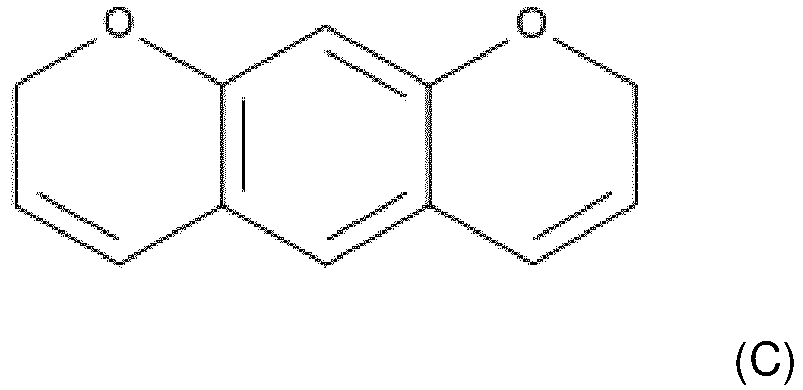
- the chromene obtained using the process according to the invention may have the following formula C and/or D, advantageously it is of a mixture of formulas C and D.
- the process according to the invention promotes the formation of compound D relative to compound C.
- the molar proportions can thus advantageously be between 75 and 96% depending on the operating conditions.
- the chromene obtained using the process according to the invention can also have the following formula A and / or B
- the molar yield of the conversion reaction of aromatic propargyl ether to chromene is between 60 and 99%, in particular between 65 and 99%.
- the polymerization of the resin can be carried out by any means capable of inducing the polymerization/crosslinking of the chromene and, in particular, by applying a heat treatment, or a light treatment (visible light, UV or IR).
- step b) is implemented by heat treatment, advantageously at a temperature between 80° C. and 180° C., more advantageously using several heating stages (in particular 5), without adding other components, such as for example 2h at 80°C, 2h at 100°C, 2h at 110°C, 2h at 120°C, 2h at 130°C and 2h at 150°C.
- the method according to the invention may comprise between steps b) and c) a step b1) of annealing at a temperature above 200° C. but below the degradation temperature of the resin, for example at 220° C. This step improves the thermomechanical properties of the resin.
- the polymerization enthalpy of step b) is less than 500 J/g.
- the coke content of the thermoset resin obtained in step b) is greater than 50%.
- thermoset resin material is a material forming the matrix of a composite material of the type comprising a matrix in which there is a reinforcement.
- the reinforcement present in the composite material can be of different types.
- it may in particular be a reinforcement consisting of fibers such as glass fibers, quartz fibers, carbon fibers, graphite fibers, silica fibers, metal fibers such as fibers of steel or aluminum fibers, boron fibers, ceramic fibers such as silicon carbide or boron carbide fibers, synthetic organic fibers such as aramid fibers, polyethylene fibers, polyester fibers or poly(p-phenylene) fibers benzobisoxazole), better known by the acronym PBO, natural organic fibers such as hemp fibers, flax fibers or silk fibers, or even mixtures of such fibers, in which case this reinforcement may be present, depending on the nature of the fibers that constitute it, in the form of chopped yarns, ground fibers, continuous filament mats, chopped filament mats, rovings (or "rovings"), fabrics, knits, felts, or again in the form of complexes made by combining different types of flat materials.
- fibers such
- the manufacture of the composite material, and therefore the addition of reinforcement in the resin can be carried out by all the techniques known to those skilled in the art of composite materials such as, for example, by impregnation, by simultaneous injection molding , by autoclaved draping moulding, by vacuum moulding, by low pressure resin injection molding (or RTM for "Resin Transfer Molding"), by low pressure "wet process” cold press moulding, by injection molding of compound (or BMC for "Bulk Molding Compound”), by compression molding of preimpregnated mats (or SMC for "Sheet Molding Compound”), by filament winding, by centrifugation or even by pultrusion, impregnation being preferred in the case where the reinforcement is made of fibers.
- RTM resin injection molding
- SMC for "Sheet Molding Compound
- the composite material is an ablative composite material and, more specifically, an ablative composite material for thermal protection, in particular for aerospace.
- the device used for the examples comprises a glass reaction column with a length of 64 cm and a diameter of 3 cm filled with spherical glass beads with a diameter of 4 mm ( ⁇ 0.3 mm), in order to ensure the heat exchange between the reagent and the furnace, a vertical electric tube furnace, a reception container of sufficient volume cooled by liquid nitrogen.
- the device further comprises a dropping funnel through which to introduce the reagent, in the case where the thermolysis is carried out in the presence of a solvent and a connection to a membrane pump, allowing the necessary vacuum to be reached when the latter is between 1000 and 6000 Pa.
- the device comprises a horizontal introduction tube surrounded by heating bands when the reagent is evaporated/sublimated before thermolysis. A vane pump is used instead of the diaphragm pump to obtain a vacuum of 5.5 Pa.
- Example 1 Conversion of propargylated resorcinol and preparation of the resin according to the invention
- the crude product is composed of 13% molar of C and 79.2% molar of D.
- the molar proportion of compound of the 2-indanone type is 7.8%.
- the molar proportion of residual propargyl functions of less than 11% complies with the set specifications.
- the polymerization of the propargyl-chromene mixtures takes place by gradual rise in temperature.
- the heat treatment applied is as follows: 2 hours at 80° C., 2 hours at 100° C., 2h at 110°C, 2h at 120°C, 2h at 130°C and 2h at 150°C.
- Annealing at 220°C can be carried out to increase the thermo-mechanical properties.
- the coke content before or after annealing is 64.3% and the reaction enthalpy is 280 J/g.
- the crude is composed of 4.4 molar % of C and 71.3 molar % of D.
- the molar proportion of compound of 2-indanone type is 23.1%.
- the molar proportion of residual propargyl functions of less than 11% complies with the set specifications.
- Example 5 Conversion of propargylated resorcinol in the absence of solvent and with sublimation/evaporation of the reagent and preparation of the resin according to the invention
- the proportion of residual propargyl functions is estimated by 1 H NMR at 0%.
- the crude is composed of 14% molar of C and 79% molar of D.
- the molar proportion of compound of 2-indanone type is 7%.
- the molar proportion of residual propargyl functions of less than 11% complies with the set specifications.
Landscapes
- Chemical & Material Sciences (AREA)
- Organic Chemistry (AREA)
- Organic Low-Molecular-Weight Compounds And Preparation Thereof (AREA)
- Polyoxymethylene Polymers And Polymers With Carbon-To-Carbon Bonds (AREA)
- Addition Polymer Or Copolymer, Post-Treatments, Or Chemical Modifications (AREA)
Claims (10)
- Verfahren zur Herstellung von Chromenen, die für die Herstellung von durch Wärme aushärtbare Harze bestimmt sind, umfassend den Schritt der Umwandlung eines aromatischen Propargylethers der nachstehenden allgemeinen Formel (I)
 R1 und R5 unabhängig voneinander ein Wasserstoffatom, eine C2-C6-Alken-, C2-C6-Alkin-, C1-C6 O-Alkyl-, C2-C6 O-Alken- oder C2-C6 O-Alkingruppe darstellen, mit der Maßgabe, dass wenigstens einer von R1 und R5 ein Wasserstoffatom darstellt,R2 und R4 unabhängig voneinander ein Wasserstoffatom, eine C2-C6-Alken-, C2-C6-Alkingruppe, wie ein Propargyl, eine C1-C6 O-Alkyl-, C2-C6 O-Alken- oder C2-C6 O-Alkingruppe, wie ein O-Propargyl darstellen,und R3 ein Wasserstoffatom, eine C1-C6 O-Alkylgruppe oder eine C2-C6-Alkengruppe darstellt, wobei die Alkengruppe eventuell durch eine Gruppe der nachstehendenallgemeinen Formel (II) substituiert ist
 R6 und R9 unabhängig voneinander ein Wasserstoffatom, eine C2-C6-Alken-, C2-C6-Alkin-, C1-C6 O-Alkyl-, C2-C6 O-Alken oder C2-C6 O-Alkingruppe darstellen, mit der Maßgabe, dass wenigstens einer von R6 und R9 ein Wasserstoffatom darstellt,und R7 et R8 unabhängig voneinander ein Wasserstoffatom, eine C2-C6-Alken-, C2-C6-Alkin-, wie ein Propargyl, eine C1-C6 O-Alkyl-, C2-C6 O-Alken- oder C2-C6 O-Alkingruppe, wie ein O-Propargyl darstellen,mit der Maßgabe, dass wenigstens einer von R1, R2, R3, R4 und R5 kein Wasserstoffatom oder keine C1-C6 O-Alkylgruppe darstellt,und seine cis/trans-Isomere und seine optischen Isomere und ihre racemischen Mischungenin ein Chromen durch Flash-Vakuum-Thermolyse, bei einer Temperatur im Bereich zwischen 300 und 600 °C, vorteilhafterweise zwischen 400 und 450 °C, unter einem Druck im Bereich zwischen 4 und 10.000 Pa, vorteilhafterweise zwischen 5 und 7.000 Pa.
 - Verfahren nach Anspruch 1, dadurch gekennzeichnet, dass der aromatische Propargylether der allgemeinen Formel (I) ausgewählt ist aus der Gruppe bestehend aus Propargylresorcin, Propargyleugenol, gekoppeltes Propargyleugenol, gekoppeltes Propargylisoeugenol, Propargylisoeugenol und deren Mischungen und deren cis /trans-Isomeren und ihren optischen Isomeren und ihren racemischen Mischungen, vorteilhafterweise handelt es sich um Propargylresorcin.
- Verfahren nach Anspruch 2, dadurch gekennzeichnet, dass der prozentuale Molanteil an restlichen Propargylfunktionen des Chromens kleiner als 11 % ist, wenn der aromatische Propargylether der allgemeinen Formel (I) Propargylresorcin ist, der prozentuale Molanteil an restlichen Propargylfunktionen des Chromens kleiner als 39 % ist, wenn der aromatische Propargylether der allgemeinen Formel (I) gekoppeltes Propargyleugenol ist, und der prozentuale Molanteil an restlichen Propargylfunktionen des Chromens kleiner als 35 % ist, wenn der aromatische Propargylether der allgemeinen Formel (I) gekoppeltes Propargylisoeugenol ist.
- Verfahren nach einem der Ansprüche 1 bis 3, dadurch gekennzeichnet, dass der aromatische Propargylether der allgemeinen Formel (I) vor dem Schritt der Flash-Thermolyse in einem Lösungsmittel, vorteilhafterweise Toluol, zuvor gelöst wird.
- Verfahren nach einem der Ansprüche 1 bis 3, dadurch gekennzeichnet, dass der aromatische Propargylether der allgemeinen Formel (I) vor dem Schritt der Flash-Thermolyse zuvor verdampft/sublimiert wird.
- Verfahren nach einem der Ansprüche 1 bis 5, dadurch gekennzeichnet, dass es sich um ein kontinuierliches Verfahren handelt.
- Verfahren nach einem der Ansprüche 2 bis 6, dadurch gekennzeichnet, dass der aromatische Propargylether der allgemeinen Formel (I) Propargylresorcin ist und dass das erhaltene Chromen die folgende Formel C und/oder D aufweist, vorteilhafterweise eine Mischung aus den Formeln C und D ist

- Verfahren zur Herstellung eines Materials aus durch Wärme ausgehärtetem Harz, umfassend die folgenden aufeinanderfolgenden Schritte:- a) Durchführung des Verfahrens nach einem der Ansprüche 1 bis 6,- b) Polymerisation des in Schritt a) erhaltenen Reaktionsproduktes, um das Material aus durch Wärme ausgehärtetem Harz zu erhalten,- c) Gewinnung des Materials aus durch Wärme ausgehärtetem Harz, das in Schritt b) erhalten wurde.
- Verfahren nach Anspruch 8, dadurch gekennzeichnet, dass die Polymerisationsenthalpie von Schritt b) weniger als 500 J/g beträgt.
- Verfahren nach einem der Ansprüche 8 oder 9, dadurch gekennzeichnet, dass der Koksgehalt des in Schritt c) erhaltenen durch Wärme ausgehärteten Harzes größer als 50 Massen-% ist.
Applications Claiming Priority (1)
| Application Number | Priority Date | Filing Date | Title |
|---|---|---|---|
| FR1908324A FR3099159B1 (fr) | 2019-07-23 | 2019-07-23 | Procede de fabrication de chromenes par thermolyse destines a la preparation de resines thermodurcissables |
Publications (2)
| Publication Number | Publication Date |
|---|---|
| EP3770151A1 EP3770151A1 (de) | 2021-01-27 |
| EP3770151B1 true EP3770151B1 (de) | 2022-05-18 |
Family
ID=69375396
Family Applications (1)
| Application Number | Title | Priority Date | Filing Date |
|---|---|---|---|
| EP20186796.7A Active EP3770151B1 (de) | 2019-07-23 | 2020-07-20 | Verfahren zur herstellung von chromenen durch thermolyse, die für die herstellung von wärmehärtbaren harzen bestimmt sind |
Country Status (3)
| Country | Link |
|---|---|
| US (1) | US11591343B2 (de) |
| EP (1) | EP3770151B1 (de) |
| FR (1) | FR3099159B1 (de) |
Families Citing this family (2)
| Publication number | Priority date | Publication date | Assignee | Title |
|---|---|---|---|---|
| FR3099158B1 (fr) | 2019-07-23 | 2021-07-30 | Arianegroup Sas | Procede de fabrication de chromenes par catalyse aux sels de cuivre destines a la preparation de resines thermodurcissables |
| FR3099157B1 (fr) * | 2019-07-23 | 2022-07-15 | Arianegroup Sas | Procede de fabrication de chromenes par catalyse a l’or destines a la preparation de resines thermodurcissables |
Family Cites Families (6)
| Publication number | Priority date | Publication date | Assignee | Title |
|---|---|---|---|---|
| US5155196A (en) | 1987-06-01 | 1992-10-13 | The Dow Chemical Company | Polymer resulting from the cure of a preformed chromene-containing mixture |
| IL90759A0 (en) | 1988-07-05 | 1990-01-18 | Dow Chemical Co | Process for making and for polymerizing chromenes and products thereof |
| DE19937772A1 (de) * | 1999-08-10 | 2001-02-15 | Bayer Ag | Substituierte Heterocyclyl-2GH-chromene |
| FR3047243B1 (fr) | 2016-01-29 | 2019-11-01 | Universite De Reims Champagne-Ardenne | Resine durcissable substitut aux resines phenoliques et ses applications |
| FR3099158B1 (fr) * | 2019-07-23 | 2021-07-30 | Arianegroup Sas | Procede de fabrication de chromenes par catalyse aux sels de cuivre destines a la preparation de resines thermodurcissables |
| FR3099157B1 (fr) * | 2019-07-23 | 2022-07-15 | Arianegroup Sas | Procede de fabrication de chromenes par catalyse a l’or destines a la preparation de resines thermodurcissables |
-
2019
- 2019-07-23 FR FR1908324A patent/FR3099159B1/fr active Active
-
2020
- 2020-07-20 EP EP20186796.7A patent/EP3770151B1/de active Active
- 2020-07-23 US US16/936,915 patent/US11591343B2/en active Active
Also Published As
| Publication number | Publication date |
|---|---|
| FR3099159A1 (fr) | 2021-01-29 |
| US11591343B2 (en) | 2023-02-28 |
| US20210024533A1 (en) | 2021-01-28 |
| EP3770151A1 (de) | 2021-01-27 |
| FR3099159B1 (fr) | 2021-07-30 |
Similar Documents
| Publication | Publication Date | Title |
|---|---|---|
| EP3408179B1 (de) | Härtbares harz als ersatz für phenolharze und anwendungen davon | |
| FR3067029A1 (fr) | Benzoxazine boree utilisable pour la synthese de polybenzoxazine | |
| EP2072508A1 (de) | Herstellungsverfahren von Laktid | |
| EP3770150B1 (de) | Verfahren zur herstellung von chromenen durch kupfersalzkatalyse, die für die herstellung von wärmehärtbaren harzen bestimmt sind | |
| EP3770151A1 (de) | Verfahren zur herstellung von chromenen durch thermolyse, die für die herstellung von wärmehärtbaren harzen bestimmt sind | |
| FR2868419A1 (fr) | Procede de fabrication de dichloropropanol | |
| EP3770152B1 (de) | Verfahren zur herstellung von chromenen durch goldkatalyse, die für die herstellung von wärmehärtbaren harzen bestimmt sind | |
| US20240306486A1 (en) | Fullerene derivative and production method therefor | |
| Fareghi-Alamdari et al. | Solvent-free synthesis of trisphenols as starting precursors for the synthesis of calix [4] arenes using sulfonated multi-walled carbon nanotubes | |
| EP0300862A2 (de) | Polycarbosilanzusammensetzung, Verfahren zur Herstellung und Anwendung zur Herstellung von Siliciumkarbid-Gegenständen | |
| EP3466921B1 (de) | Verfahren zur herstellung einer polycyclischen aromatischen aminophenolverbindung und harzzusammensetzung | |
| FR3112782A1 (fr) | Procede de polymerisation de chromenes par voie cationique | |
| EP3938356B1 (de) | Verfahren zur herstellung eines polybenzoxazin-monomers | |
| US9981887B1 (en) | Synthesis of phenylethynylbenzenes | |
| CN117209757A (zh) | 一种含支链氰基的高氰基密度可溶耐热邻苯二甲腈树脂的制备方法 | |
| FR2661181A1 (fr) | Procede de reticulation de polymeres a base de bore et d'azote, notamment pour l'obtention de fibres ceramiques. | |
| EP3798216B1 (de) | Verfahren zur herstellung eines netzartigen produkts | |
| EP3938357B1 (de) | Verfahren zur herstellung eines polybenzoxazin-monomers | |
| TW202442618A (zh) | 用於形成雙酚、環氧樹脂組成物之製程 | |
| US5097080A (en) | Process for preparing 4,4'-dihydroxybiphenyl | |
| WO2026014557A1 (ja) | メトキシメチル基を有するフェノール化合物の結晶の製造方法 | |
| US2798052A (en) | Manufacture of polymers by pyrolysis of 1, 4-dimethyl aryl compounds | |
| WO2025120291A1 (fr) | Résines thermodurcissables | |
| CN120004924A (zh) | 一种含硼酚醛树脂及其制备方法和应用 | |
| BE627280A (de) |
Legal Events
| Date | Code | Title | Description |
|---|---|---|---|
| PUAI | Public reference made under article 153(3) epc to a published international application that has entered the european phase |
Free format text: ORIGINAL CODE: 0009012 |
|
| STAA | Information on the status of an ep patent application or granted ep patent |
Free format text: STATUS: THE APPLICATION HAS BEEN PUBLISHED |
|
| AK | Designated contracting states |
Kind code of ref document: A1 Designated state(s): AL AT BE BG CH CY CZ DE DK EE ES FI FR GB GR HR HU IE IS IT LI LT LU LV MC MK MT NL NO PL PT RO RS SE SI SK SM TR |
|
| AX | Request for extension of the european patent |
Extension state: BA ME |
|
| STAA | Information on the status of an ep patent application or granted ep patent |
Free format text: STATUS: REQUEST FOR EXAMINATION WAS MADE |
|
| 17P | Request for examination filed |
Effective date: 20210531 |
|
| RBV | Designated contracting states (corrected) |
Designated state(s): AL AT BE BG CH CY CZ DE DK EE ES FI FR GB GR HR HU IE IS IT LI LT LU LV MC MK MT NL NO PL PT RO RS SE SI SK SM TR |
|
| STAA | Information on the status of an ep patent application or granted ep patent |
Free format text: STATUS: EXAMINATION IS IN PROGRESS |
|
| 17Q | First examination report despatched |
Effective date: 20210913 |
|
| RAP3 | Party data changed (applicant data changed or rights of an application transferred) |
Owner name: UNIVERSITE DE REIMS CHAMPAGNE-ARDENNE Owner name: CENTRE NATIONAL DE LA RECHERCHE SCIENTIFIQUE (C.N.R.S.) Owner name: ARIANEGROUP SAS |
|
| GRAP | Despatch of communication of intention to grant a patent |
Free format text: ORIGINAL CODE: EPIDOSNIGR1 |
|
| STAA | Information on the status of an ep patent application or granted ep patent |
Free format text: STATUS: GRANT OF PATENT IS INTENDED |
|
| INTG | Intention to grant announced |
Effective date: 20220216 |
|
| GRAS | Grant fee paid |
Free format text: ORIGINAL CODE: EPIDOSNIGR3 |
|
| GRAA | (expected) grant |
Free format text: ORIGINAL CODE: 0009210 |
|
| STAA | Information on the status of an ep patent application or granted ep patent |
Free format text: STATUS: THE PATENT HAS BEEN GRANTED |
|
| AK | Designated contracting states |
Kind code of ref document: B1 Designated state(s): AL AT BE BG CH CY CZ DE DK EE ES FI FR GB GR HR HU IE IS IT LI LT LU LV MC MK MT NL NO PL PT RO RS SE SI SK SM TR |
|
| REG | Reference to a national code |
Ref country code: GB Ref legal event code: FG4D Free format text: NOT ENGLISH |
|
| REG | Reference to a national code |
Ref country code: CH Ref legal event code: EP |
|
| REG | Reference to a national code |
Ref country code: IE Ref legal event code: FG4D Free format text: LANGUAGE OF EP DOCUMENT: FRENCH |
|
| REG | Reference to a national code |
Ref country code: DE Ref legal event code: R096 Ref document number: 602020003222 Country of ref document: DE |
|
| REG | Reference to a national code |
Ref country code: AT Ref legal event code: REF Ref document number: 1493088 Country of ref document: AT Kind code of ref document: T Effective date: 20220615 |
|
| REG | Reference to a national code |
Ref country code: LT Ref legal event code: MG9D |
|
| REG | Reference to a national code |
Ref country code: NL Ref legal event code: MP Effective date: 20220518 |
|
| REG | Reference to a national code |
Ref country code: AT Ref legal event code: MK05 Ref document number: 1493088 Country of ref document: AT Kind code of ref document: T Effective date: 20220518 |
|
| PG25 | Lapsed in a contracting state [announced via postgrant information from national office to epo] |
Ref country code: SE Free format text: LAPSE BECAUSE OF FAILURE TO SUBMIT A TRANSLATION OF THE DESCRIPTION OR TO PAY THE FEE WITHIN THE PRESCRIBED TIME-LIMIT Effective date: 20220518 Ref country code: PT Free format text: LAPSE BECAUSE OF FAILURE TO SUBMIT A TRANSLATION OF THE DESCRIPTION OR TO PAY THE FEE WITHIN THE PRESCRIBED TIME-LIMIT Effective date: 20220919 Ref country code: NO Free format text: LAPSE BECAUSE OF FAILURE TO SUBMIT A TRANSLATION OF THE DESCRIPTION OR TO PAY THE FEE WITHIN THE PRESCRIBED TIME-LIMIT Effective date: 20220818 Ref country code: NL Free format text: LAPSE BECAUSE OF FAILURE TO SUBMIT A TRANSLATION OF THE DESCRIPTION OR TO PAY THE FEE WITHIN THE PRESCRIBED TIME-LIMIT Effective date: 20220518 Ref country code: LT Free format text: LAPSE BECAUSE OF FAILURE TO SUBMIT A TRANSLATION OF THE DESCRIPTION OR TO PAY THE FEE WITHIN THE PRESCRIBED TIME-LIMIT Effective date: 20220518 Ref country code: HR Free format text: LAPSE BECAUSE OF FAILURE TO SUBMIT A TRANSLATION OF THE DESCRIPTION OR TO PAY THE FEE WITHIN THE PRESCRIBED TIME-LIMIT Effective date: 20220518 Ref country code: GR Free format text: LAPSE BECAUSE OF FAILURE TO SUBMIT A TRANSLATION OF THE DESCRIPTION OR TO PAY THE FEE WITHIN THE PRESCRIBED TIME-LIMIT Effective date: 20220819 Ref country code: FI Free format text: LAPSE BECAUSE OF FAILURE TO SUBMIT A TRANSLATION OF THE DESCRIPTION OR TO PAY THE FEE WITHIN THE PRESCRIBED TIME-LIMIT Effective date: 20220518 Ref country code: BG Free format text: LAPSE BECAUSE OF FAILURE TO SUBMIT A TRANSLATION OF THE DESCRIPTION OR TO PAY THE FEE WITHIN THE PRESCRIBED TIME-LIMIT Effective date: 20220818 Ref country code: AT Free format text: LAPSE BECAUSE OF FAILURE TO SUBMIT A TRANSLATION OF THE DESCRIPTION OR TO PAY THE FEE WITHIN THE PRESCRIBED TIME-LIMIT Effective date: 20220518 |
|
| PG25 | Lapsed in a contracting state [announced via postgrant information from national office to epo] |
Ref country code: RS Free format text: LAPSE BECAUSE OF FAILURE TO SUBMIT A TRANSLATION OF THE DESCRIPTION OR TO PAY THE FEE WITHIN THE PRESCRIBED TIME-LIMIT Effective date: 20220518 Ref country code: PL Free format text: LAPSE BECAUSE OF FAILURE TO SUBMIT A TRANSLATION OF THE DESCRIPTION OR TO PAY THE FEE WITHIN THE PRESCRIBED TIME-LIMIT Effective date: 20220518 Ref country code: LV Free format text: LAPSE BECAUSE OF FAILURE TO SUBMIT A TRANSLATION OF THE DESCRIPTION OR TO PAY THE FEE WITHIN THE PRESCRIBED TIME-LIMIT Effective date: 20220518 Ref country code: IS Free format text: LAPSE BECAUSE OF FAILURE TO SUBMIT A TRANSLATION OF THE DESCRIPTION OR TO PAY THE FEE WITHIN THE PRESCRIBED TIME-LIMIT Effective date: 20220918 |
|
| PG25 | Lapsed in a contracting state [announced via postgrant information from national office to epo] |
Ref country code: SM Free format text: LAPSE BECAUSE OF FAILURE TO SUBMIT A TRANSLATION OF THE DESCRIPTION OR TO PAY THE FEE WITHIN THE PRESCRIBED TIME-LIMIT Effective date: 20220518 Ref country code: SK Free format text: LAPSE BECAUSE OF FAILURE TO SUBMIT A TRANSLATION OF THE DESCRIPTION OR TO PAY THE FEE WITHIN THE PRESCRIBED TIME-LIMIT Effective date: 20220518 Ref country code: RO Free format text: LAPSE BECAUSE OF FAILURE TO SUBMIT A TRANSLATION OF THE DESCRIPTION OR TO PAY THE FEE WITHIN THE PRESCRIBED TIME-LIMIT Effective date: 20220518 Ref country code: ES Free format text: LAPSE BECAUSE OF FAILURE TO SUBMIT A TRANSLATION OF THE DESCRIPTION OR TO PAY THE FEE WITHIN THE PRESCRIBED TIME-LIMIT Effective date: 20220518 Ref country code: EE Free format text: LAPSE BECAUSE OF FAILURE TO SUBMIT A TRANSLATION OF THE DESCRIPTION OR TO PAY THE FEE WITHIN THE PRESCRIBED TIME-LIMIT Effective date: 20220518 Ref country code: DK Free format text: LAPSE BECAUSE OF FAILURE TO SUBMIT A TRANSLATION OF THE DESCRIPTION OR TO PAY THE FEE WITHIN THE PRESCRIBED TIME-LIMIT Effective date: 20220518 Ref country code: CZ Free format text: LAPSE BECAUSE OF FAILURE TO SUBMIT A TRANSLATION OF THE DESCRIPTION OR TO PAY THE FEE WITHIN THE PRESCRIBED TIME-LIMIT Effective date: 20220518 |
|
| REG | Reference to a national code |
Ref country code: DE Ref legal event code: R097 Ref document number: 602020003222 Country of ref document: DE |
|
| PG25 | Lapsed in a contracting state [announced via postgrant information from national office to epo] |
Ref country code: MC Free format text: LAPSE BECAUSE OF FAILURE TO SUBMIT A TRANSLATION OF THE DESCRIPTION OR TO PAY THE FEE WITHIN THE PRESCRIBED TIME-LIMIT Effective date: 20220518 |
|
| REG | Reference to a national code |
Ref country code: DE Ref legal event code: R082 Ref document number: 602020003222 Country of ref document: DE Representative=s name: CBDL PATENTANWAELTE GBR, DE Ref country code: DE Ref legal event code: R082 Ref document number: 602020003222 Country of ref document: DE Representative=s name: CBDL PATENTANWAELTE EGBR, DE |
|
| PLBE | No opposition filed within time limit |
Free format text: ORIGINAL CODE: 0009261 |
|
| STAA | Information on the status of an ep patent application or granted ep patent |
Free format text: STATUS: NO OPPOSITION FILED WITHIN TIME LIMIT |
|
| REG | Reference to a national code |
Ref country code: BE Ref legal event code: MM Effective date: 20220731 |
|
| PG25 | Lapsed in a contracting state [announced via postgrant information from national office to epo] |
Ref country code: AL Free format text: LAPSE BECAUSE OF FAILURE TO SUBMIT A TRANSLATION OF THE DESCRIPTION OR TO PAY THE FEE WITHIN THE PRESCRIBED TIME-LIMIT Effective date: 20220518 |
|
| 26N | No opposition filed |
Effective date: 20230221 |
|
| PG25 | Lapsed in a contracting state [announced via postgrant information from national office to epo] |
Ref country code: LU Free format text: LAPSE BECAUSE OF NON-PAYMENT OF DUE FEES Effective date: 20220720 |
|
| PG25 | Lapsed in a contracting state [announced via postgrant information from national office to epo] |
Ref country code: SI Free format text: LAPSE BECAUSE OF FAILURE TO SUBMIT A TRANSLATION OF THE DESCRIPTION OR TO PAY THE FEE WITHIN THE PRESCRIBED TIME-LIMIT Effective date: 20220518 Ref country code: BE Free format text: LAPSE BECAUSE OF NON-PAYMENT OF DUE FEES Effective date: 20220731 |
|
| PG25 | Lapsed in a contracting state [announced via postgrant information from national office to epo] |
Ref country code: IE Free format text: LAPSE BECAUSE OF NON-PAYMENT OF DUE FEES Effective date: 20220720 |
|
| REG | Reference to a national code |
Ref country code: CH Ref legal event code: PL |
|
| PG25 | Lapsed in a contracting state [announced via postgrant information from national office to epo] |
Ref country code: MK Free format text: LAPSE BECAUSE OF FAILURE TO SUBMIT A TRANSLATION OF THE DESCRIPTION OR TO PAY THE FEE WITHIN THE PRESCRIBED TIME-LIMIT Effective date: 20220511 Ref country code: CY Free format text: LAPSE BECAUSE OF FAILURE TO SUBMIT A TRANSLATION OF THE DESCRIPTION OR TO PAY THE FEE WITHIN THE PRESCRIBED TIME-LIMIT Effective date: 20220511 Ref country code: CH Free format text: LAPSE BECAUSE OF NON-PAYMENT OF DUE FEES Effective date: 20230731 |
|
| PG25 | Lapsed in a contracting state [announced via postgrant information from national office to epo] |
Ref country code: HU Free format text: LAPSE BECAUSE OF FAILURE TO SUBMIT A TRANSLATION OF THE DESCRIPTION OR TO PAY THE FEE WITHIN THE PRESCRIBED TIME-LIMIT; INVALID AB INITIO Effective date: 20200720 |
|
| PG25 | Lapsed in a contracting state [announced via postgrant information from national office to epo] |
Ref country code: TR Free format text: LAPSE BECAUSE OF FAILURE TO SUBMIT A TRANSLATION OF THE DESCRIPTION OR TO PAY THE FEE WITHIN THE PRESCRIBED TIME-LIMIT Effective date: 20220511 |
|
| PG25 | Lapsed in a contracting state [announced via postgrant information from national office to epo] |
Ref country code: MT Free format text: LAPSE BECAUSE OF FAILURE TO SUBMIT A TRANSLATION OF THE DESCRIPTION OR TO PAY THE FEE WITHIN THE PRESCRIBED TIME-LIMIT Effective date: 20220511 |
|
| PG25 | Lapsed in a contracting state [announced via postgrant information from national office to epo] |
Ref country code: BG Free format text: LAPSE BECAUSE OF FAILURE TO SUBMIT A TRANSLATION OF THE DESCRIPTION OR TO PAY THE FEE WITHIN THE PRESCRIBED TIME-LIMIT Effective date: 20220518 |
|
| PG25 | Lapsed in a contracting state [announced via postgrant information from national office to epo] |
Ref country code: BG Free format text: LAPSE BECAUSE OF FAILURE TO SUBMIT A TRANSLATION OF THE DESCRIPTION OR TO PAY THE FEE WITHIN THE PRESCRIBED TIME-LIMIT Effective date: 20220518 |
|
| PGFP | Annual fee paid to national office [announced via postgrant information from national office to epo] |
Ref country code: DE Payment date: 20250722 Year of fee payment: 6 |
|
| PGFP | Annual fee paid to national office [announced via postgrant information from national office to epo] |
Ref country code: IT Payment date: 20250724 Year of fee payment: 6 |
|
| PGFP | Annual fee paid to national office [announced via postgrant information from national office to epo] |
Ref country code: GB Payment date: 20250722 Year of fee payment: 6 |
|
| PGFP | Annual fee paid to national office [announced via postgrant information from national office to epo] |
Ref country code: FR Payment date: 20250725 Year of fee payment: 6 |