EP3770812B1 - Dispositif d'affichage permettant d'afficher les prix et/ou les informations sur le produit - Google Patents
Dispositif d'affichage permettant d'afficher les prix et/ou les informations sur le produit Download PDFInfo
- Publication number
- EP3770812B1 EP3770812B1 EP20194155.6A EP20194155A EP3770812B1 EP 3770812 B1 EP3770812 B1 EP 3770812B1 EP 20194155 A EP20194155 A EP 20194155A EP 3770812 B1 EP3770812 B1 EP 3770812B1
- Authority
- EP
- European Patent Office
- Prior art keywords
- self
- data record
- display device
- checkout
- product
- Prior art date
- Legal status (The legal status is an assumption and is not a legal conclusion. Google has not performed a legal analysis and makes no representation as to the accuracy of the status listed.)
- Active
Links
Images


Classifications
-
- G—PHYSICS
- G06—COMPUTING OR CALCULATING; COUNTING
- G06Q—INFORMATION AND COMMUNICATION TECHNOLOGY [ICT] SPECIALLY ADAPTED FOR ADMINISTRATIVE, COMMERCIAL, FINANCIAL, MANAGERIAL OR SUPERVISORY PURPOSES; SYSTEMS OR METHODS SPECIALLY ADAPTED FOR ADMINISTRATIVE, COMMERCIAL, FINANCIAL, MANAGERIAL OR SUPERVISORY PURPOSES, NOT OTHERWISE PROVIDED FOR
- G06Q20/00—Payment architectures, schemes or protocols
- G06Q20/08—Payment architectures
- G06Q20/20—Point-of-sale [POS] network systems
-
- G—PHYSICS
- G06—COMPUTING OR CALCULATING; COUNTING
- G06Q—INFORMATION AND COMMUNICATION TECHNOLOGY [ICT] SPECIALLY ADAPTED FOR ADMINISTRATIVE, COMMERCIAL, FINANCIAL, MANAGERIAL OR SUPERVISORY PURPOSES; SYSTEMS OR METHODS SPECIALLY ADAPTED FOR ADMINISTRATIVE, COMMERCIAL, FINANCIAL, MANAGERIAL OR SUPERVISORY PURPOSES, NOT OTHERWISE PROVIDED FOR
- G06Q20/00—Payment architectures, schemes or protocols
- G06Q20/08—Payment architectures
- G06Q20/20—Point-of-sale [POS] network systems
- G06Q20/203—Inventory monitoring
-
- G—PHYSICS
- G06—COMPUTING OR CALCULATING; COUNTING
- G06K—GRAPHICAL DATA READING; PRESENTATION OF DATA; RECORD CARRIERS; HANDLING RECORD CARRIERS
- G06K19/00—Record carriers for use with machines and with at least a part designed to carry digital markings
- G06K19/02—Record carriers for use with machines and with at least a part designed to carry digital markings characterised by the selection of materials, e.g. to avoid wear during transport through the machine
- G06K19/027—Record carriers for use with machines and with at least a part designed to carry digital markings characterised by the selection of materials, e.g. to avoid wear during transport through the machine the material being suitable for use as a textile, e.g. woven-based RFID-like labels designed for attachment to laundry items
-
- G—PHYSICS
- G06—COMPUTING OR CALCULATING; COUNTING
- G06K—GRAPHICAL DATA READING; PRESENTATION OF DATA; RECORD CARRIERS; HANDLING RECORD CARRIERS
- G06K19/00—Record carriers for use with machines and with at least a part designed to carry digital markings
- G06K19/06—Record carriers for use with machines and with at least a part designed to carry digital markings characterised by the kind of the digital marking, e.g. shape, nature, code
- G06K19/067—Record carriers with conductive marks, printed circuits or semiconductor circuit elements, e.g. credit or identity cards also with resonating or responding marks without active components
- G06K19/07—Record carriers with conductive marks, printed circuits or semiconductor circuit elements, e.g. credit or identity cards also with resonating or responding marks without active components with integrated circuit chips
- G06K19/0701—Record carriers with conductive marks, printed circuits or semiconductor circuit elements, e.g. credit or identity cards also with resonating or responding marks without active components with integrated circuit chips at least one of the integrated circuit chips comprising an arrangement for power management
- G06K19/0702—Record carriers with conductive marks, printed circuits or semiconductor circuit elements, e.g. credit or identity cards also with resonating or responding marks without active components with integrated circuit chips at least one of the integrated circuit chips comprising an arrangement for power management the arrangement including a battery
- G06K19/0705—Record carriers with conductive marks, printed circuits or semiconductor circuit elements, e.g. credit or identity cards also with resonating or responding marks without active components with integrated circuit chips at least one of the integrated circuit chips comprising an arrangement for power management the arrangement including a battery the battery being connected to a power saving arrangement
-
- G—PHYSICS
- G06—COMPUTING OR CALCULATING; COUNTING
- G06Q—INFORMATION AND COMMUNICATION TECHNOLOGY [ICT] SPECIALLY ADAPTED FOR ADMINISTRATIVE, COMMERCIAL, FINANCIAL, MANAGERIAL OR SUPERVISORY PURPOSES; SYSTEMS OR METHODS SPECIALLY ADAPTED FOR ADMINISTRATIVE, COMMERCIAL, FINANCIAL, MANAGERIAL OR SUPERVISORY PURPOSES, NOT OTHERWISE PROVIDED FOR
- G06Q10/00—Administration; Management
- G06Q10/08—Logistics, e.g. warehousing, loading or distribution; Inventory or stock management
-
- G—PHYSICS
- G06—COMPUTING OR CALCULATING; COUNTING
- G06Q—INFORMATION AND COMMUNICATION TECHNOLOGY [ICT] SPECIALLY ADAPTED FOR ADMINISTRATIVE, COMMERCIAL, FINANCIAL, MANAGERIAL OR SUPERVISORY PURPOSES; SYSTEMS OR METHODS SPECIALLY ADAPTED FOR ADMINISTRATIVE, COMMERCIAL, FINANCIAL, MANAGERIAL OR SUPERVISORY PURPOSES, NOT OTHERWISE PROVIDED FOR
- G06Q10/00—Administration; Management
- G06Q10/08—Logistics, e.g. warehousing, loading or distribution; Inventory or stock management
- G06Q10/087—Inventory or stock management, e.g. order filling, procurement or balancing against orders
- G06Q10/0872—Inventory or stock management, e.g. order filling, procurement or balancing against orders using inventory planning
- G06Q10/08726—Inventory or stock management, e.g. order filling, procurement or balancing against orders using inventory planning for replenishment processing, procedures, or recommendations using forecasting or optimisation
-
- G—PHYSICS
- G06—COMPUTING OR CALCULATING; COUNTING
- G06Q—INFORMATION AND COMMUNICATION TECHNOLOGY [ICT] SPECIALLY ADAPTED FOR ADMINISTRATIVE, COMMERCIAL, FINANCIAL, MANAGERIAL OR SUPERVISORY PURPOSES; SYSTEMS OR METHODS SPECIALLY ADAPTED FOR ADMINISTRATIVE, COMMERCIAL, FINANCIAL, MANAGERIAL OR SUPERVISORY PURPOSES, NOT OTHERWISE PROVIDED FOR
- G06Q20/00—Payment architectures, schemes or protocols
- G06Q20/08—Payment architectures
- G06Q20/20—Point-of-sale [POS] network systems
- G06Q20/204—Point-of-sale [POS] network systems comprising interface for record bearing medium or carrier for electronic funds transfer or payment credit
-
- G—PHYSICS
- G06—COMPUTING OR CALCULATING; COUNTING
- G06Q—INFORMATION AND COMMUNICATION TECHNOLOGY [ICT] SPECIALLY ADAPTED FOR ADMINISTRATIVE, COMMERCIAL, FINANCIAL, MANAGERIAL OR SUPERVISORY PURPOSES; SYSTEMS OR METHODS SPECIALLY ADAPTED FOR ADMINISTRATIVE, COMMERCIAL, FINANCIAL, MANAGERIAL OR SUPERVISORY PURPOSES, NOT OTHERWISE PROVIDED FOR
- G06Q20/00—Payment architectures, schemes or protocols
- G06Q20/08—Payment architectures
- G06Q20/20—Point-of-sale [POS] network systems
- G06Q20/206—Point-of-sale [POS] network systems comprising security or operator identification provisions, e.g. password entry
-
- G—PHYSICS
- G09—EDUCATION; CRYPTOGRAPHY; DISPLAY; ADVERTISING; SEALS
- G09F—DISPLAYING; ADVERTISING; SIGNS; LABELS OR NAME-PLATES; SEALS
- G09F3/00—Labels, tag tickets, or similar identification or indication means; Seals; Postage or like stamps
- G09F3/08—Fastening or securing by means not forming part of the material of the label itself
- G09F3/18—Casings, frames or enclosures for labels
- G09F3/20—Casings, frames or enclosures for labels for adjustable, removable, or interchangeable labels
- G09F3/204—Casings, frames or enclosures for labels for adjustable, removable, or interchangeable labels specially adapted to be attached to a shelf or the like
-
- G—PHYSICS
- G09—EDUCATION; CRYPTOGRAPHY; DISPLAY; ADVERTISING; SEALS
- G09F—DISPLAYING; ADVERTISING; SIGNS; LABELS OR NAME-PLATES; SEALS
- G09F3/00—Labels, tag tickets, or similar identification or indication means; Seals; Postage or like stamps
- G09F3/08—Fastening or securing by means not forming part of the material of the label itself
- G09F3/18—Casings, frames or enclosures for labels
- G09F3/20—Casings, frames or enclosures for labels for adjustable, removable, or interchangeable labels
- G09F3/208—Electronic labels, Labels integrating electronic displays
-
- Y—GENERAL TAGGING OF NEW TECHNOLOGICAL DEVELOPMENTS; GENERAL TAGGING OF CROSS-SECTIONAL TECHNOLOGIES SPANNING OVER SEVERAL SECTIONS OF THE IPC; TECHNICAL SUBJECTS COVERED BY FORMER USPC CROSS-REFERENCE ART COLLECTIONS [XRACs] AND DIGESTS
- Y02—TECHNOLOGIES OR APPLICATIONS FOR MITIGATION OR ADAPTATION AGAINST CLIMATE CHANGE
- Y02D—CLIMATE CHANGE MITIGATION TECHNOLOGIES IN INFORMATION AND COMMUNICATION TECHNOLOGIES [ICT], I.E. INFORMATION AND COMMUNICATION TECHNOLOGIES AIMING AT THE REDUCTION OF THEIR OWN ENERGY USE
- Y02D30/00—Reducing energy consumption in communication networks
- Y02D30/70—Reducing energy consumption in communication networks in wireless communication networks
Definitions
- the invention relates to a display device for displaying price and/or product information, a self-check device for carrying out a self-check, and a self-check system.
- a well-known display device also known as an electronic price display sign, in technical jargon also “Electronic Shelf Label”, ESL for short, is in radio contact with a base station during operation.
- the display device is supplied with price and/or product information via this radio contact and visualizes this with its display device.
- the ESL is usually attached to a shelf rail of a shelf on which the relevant product is stored or offered, to which the price and/or product information corresponds.
- Products can be equipped with a "Radio-Frequency-Identification-Device” (abbreviated to RFID) label and/or bar code for their identification.
- RFID Radio-Frequency-Identification-Device
- Such a label, its use as well as a system with such labels is for example in US 2015/0035674 A1 disclosed.
- a customer selects products to purchase, places them in their shopping cart, drives the shopping cart to the checkout counter, and places the products on a conveyor belt for registration for billing.
- the products if equipped with RFID labels, are recorded either with the help of an RFID reading device (RFID reader) or, if equipped with a barcode, with the help of a barcode reading device and a receipt listing the products and associated prices, created.
- RFID reader RFID reading device
- barcode reading device if equipped with a barcode reading device and a receipt listing the products and associated prices, created.
- the total price is paid by the customer in cash, by credit card or by "near-field communication" (abbreviated to NFC)-enabled mobile phone with the appropriate payment application (payment software) on the mobile phone.
- NFC near-field communication
- the object of the invention is therefore to eliminate the problems mentioned at the outset and to enable more efficient detection of the products.
- the subject matter of the invention is therefore a self-checkout system having a base station for communication with a number of display devices, and at least one display device which has a storage stage for storing a product data record which was received during communication with a base station via a first radio interface of the display device, and a second radio interface for communication, in particular for RFID or NFC communication, with a self-check device, wherein the display device is designed to process a self-check request received from a self-check device for the purpose of transmitting the product data record via the second radio interface, and a merchandise management system server, where the connection between a product which is assigned to a display device and the display device is known, whereby the display device when processing a self-check request for the E receive and save of user and/or device identification data for identifying the user of the self-checking device and/or the self-checking device, and wherein the display device is designed to display only those identification data for which there is a confirmation from a user
- a self-check device which has a device radio interface compatible with the second radio interface of the display device of the self-check system according to the invention for communication, in particular for RFID or NFC communication, with said display device, and a control stage for controlling a self-check request via the device Radio interface to the display device for the purpose of transmitting a product data record from the display device via the device radio interface to the self-check device.
- a use of a display device for the spatially localized provision of an individual product data record in a self-checkout system for the purpose of local transmission of the product data record from the display device to a self-checkout device requesting the display device using a self-checkout request is also disclosed.
- the measures according to the invention have the advantage that an existing infrastructure of a system of electronic display devices, in particular electronic price display signs, also known as "electronic shelf labels" in technical jargon, hereinafter referred to as ESLs for short, as a system component for self-checkout or self-payment (in technical jargon "self- checkout system”) can be used.
- ESLs electronic shelf labels
- self-checkout or self-payment in technical jargon "self- checkout system”
- a product data record can consist of a number of bits, bytes or larger amounts of data or structure.
- the product data record can have a reference that enables the self-check device that receives the product data record to provide information about the product and/or its Query price to then process this information further.
- the product data record itself preferably contains the information about the product and/or its price so that it can be further processed directly.
- Said ESLs are attached to the shelves of a self-service retailer on which their associated products are displayed. If a customer now wants to buy a product, he takes it off the shelf and holds his self-checkout device (e.g. his appropriately equipped smartphone) close to the ESL or touches it with it.
- the self-check device on which a self-check application is processed uses its device radio interface to contact the second radio interface of the ESL and transmits a self-check request to the ESL, e.g. using a self-check command, which is recognized and processed there becomes.
- the ESL reacts to this by transmitting the product data record via the second radio interface to the self-check device, which then takes over the further processing of the product data record.
- the individual booking process for the product in question essentially takes place at the ESL location (i.e. at the shelf location where the product stored) to which the product is assigned.
- the ESL and its communication infrastructure thus form part of a self-checkout system, with several ESL being used to provide the individual product data records in a distributed manner at those locations where the relevant products are also located.
- the product data sets are distributed automatically to the individual ESL and can be dynamically adapted to the situation in the self-service shop at any time without any problems. If, for example, a product runs out on a shelf and another product sneaks in there, the ESL located there can be informed of the new product data record immediately by communication via the base station.
- the self-checkout can take place offline, i.e. without an additional internet connection on the side of the self-checkout device. This ensures trouble-free and rapid booking processes and protects against criminally motivated influence.
- the entire shopping process is also much more transparent for the customer because he carries out the booking himself and thus always has a full overview and control of the booked goods.
- the problem of a possibly incorrect booking at the cash desk e.g. through automatic RFID-based or staff-supported manual booking), which is often perceived as annoying by the customer, is thus completely avoided.
- the second radio interface can be designed to communicate in a capacitive and/or inductive manner. It can be designed for communication according to a Bluetooth specification (e.g. defined by SIG) or also according to a ZigBee specification. For both types of communication, however, the relatively large radio range is rather problematic, since it requires user interaction to select different available communication partners (ESLs) if their communication areas overlap.
- SIG Bluetooth specification
- ZigBee ZigBee specification
- the second radio interface is designed for communication according to an RFID specification (or an RFID standard), such as ISO/IEC 10536, 14443, 15693, 10373 or VDI 4470, 4472 or ISO/IEC 18000 or EPCglobal or ISO/IEC 15961, 15962 or future specifications. It has proven particularly advantageous if the second interface for communication is designed according to an NFC specification, such as ISO/IEC 13157, -16353, -22536, -28361 or future specifications. In these forms of embodiment, the relatively short radio range (max. approx. 10, in particular 5 centimeters) has proven to be particularly advantageous because it is brought about by the customer himself spatially clear association between the relevant ESL and the self-check device is required in order to carry out a self-check.
- an RFID specification or an RFID standard
- a self-check device can be, for example, a portable media player without telephone functionality, a smartphone, a smartwatch or a handy tablet computer with a corresponding device radio interface. Its control stage is implemented with the help of a processor on which appropriate software or an application runs that controls the self-check request, specifically using the appropriate communication protocol to establish a connection with the display device, sends a self-check request command to it, and receives response data from it and further processed in terms of self-checking.
- the ESL has a display module for displaying price and/or product information.
- the display module can have a first microcontroller, which essentially implements the processing stage, a battery, which provides a supply voltage of, for example, three volts and feeds the display module.
- the microcontroller can have an internal memory or can also be connected to an external memory.
- the microcontroller can have an integrated co-processor and other electronic components for realizing the first radio interface or be coupled to them, so that the communication is carried out according to a first radio communication protocol using the co-processor.
- a first antenna of the first radio interface is connected to this.
- the hardware of the display module has a display device, which can have a second microcontroller coupled to the first microcontroller, in order to autonomously perform display-specific tasks delegated to it by the first microcontroller.
- the display device can be implemented using LCD technology, but preferably also using extremely energy-saving electronic ink technology (also called e-ink as a synonym for electronic paper).
- the first communication protocol used in the first radio interface can be implemented, for example, according to the "ZigBee” standard, the “BlueTooth” standard or also according to a proprietary protocol.
- the first radio interface and possibly also the processing stage have a corresponding hardware design and suitable software that is executed on this hardware in order to allow communication according to the respective communication protocol.
- a proprietary radio communication protocol that implements a time slot communication method is used in the first radio interface, with the aid of which a number of ESLs can communicate with a base station.
- a base station serves as an interface between wired communication with e.g. a data processing device (e.g. a server) and wireless communication with other devices, in this case the ESL.
- the ESLs can first be registered with or assigned to a base station in order to be usable for func communication with this base station.
- each ESL is assigned a predefined, individual time slot for communication with the base station. In this case, e.g. within n seconds, e.g. 15 seconds, m time slots, e.g.
- time slots are used.
- the n seconds form a time slot cycle that is constantly repeated and is also called the synchronization cycle.
- m time slots are therefore available within a synchronization cycle for communication with ESLs.
- Each of the ESLs is assigned to one of the time slots, it also being possible for a number of ESLs to be assigned to a specific time slot, e.g. 2, 3 or 4 ESLs.
- groups of ESLs dedicated to each base station can be controlled.
- the ESLs can use a synchronization signal structure (for example, a relatively short signal at the beginning of each time slot) sent by the base station in each of the time slots with the time grid of the time slot communication method for the first time synchronize to the to start communication operation with the base station, re-synchronize during operation if they have lost the synchronous state through any circumstances, and keep synchronous if there are minor deviations from the synchronous state, which are caused by inaccuracies such as a drift of their internal clock .
- each time slot is identified by a unique time slot symbol, with the base station being designed to transmit a synchronization data signal containing the time slot symbol for the currently available time slot.
- the ESL is designed to switch from a sleep or idle state, referred to below as sleep state for short, to an active state at a wake-up time and receives the synchronization data signal in the active state. If the received time slot symbol indicates a time slot intended for the ESL, the ESL defines a new wake-up time corresponding to the next occurrence of the time slot intended for itself in a time slot cycle following the currently present time slot cycle.
- Each ESL establishes its synchronism with the base station solely by the fact of recognizing the time slot symbol which occurs at the time it expects or in an expected time window and which indicates the time slot intended for the ESL.
- the ESL After the ESL has established its synchronicity, as discussed above, it is basically sufficient if it changes back to the sleep state, because the next wake-up time is automatically known from the time pattern of the time slot communication method, which is known to it. Defining the new wake-up time can thus be limited to restarting a timing stage (eg a timer) of the ESL with the timing parameters already used to switch from the sleep state to the active state.
- a timing stage eg a timer
- the ESL can switch back to the sleep state and remain there until, triggered by the timing control, it wakes up again and changes from the sleep state to the active state at the new wake-up time in the next time slot cycle.
- the ESL does not necessarily have to remain in the sleep state for the remainder of the time slot determined for itself, but can also process other tasks in an active state during the time slot or also the time slot cycle.
- the timing previously discussed then operates in the background independently of its other activities.
- the time slot symbol can be chosen arbitrarily. It has proven particularly advantageous if the time slot symbol is formed using a hardware address of the ESL that uniquely identifies the ESL, preferably by the least significant bits or the least significant byte of the hardware address.
- the ESL also has another wireless module electronically connected to it, with said second wireless interface.
- the display module in particular the first microcontroller, is coupled to the additional radio module.
- the second radio module can also have its own third microcontroller and its own memory. If the second radio interface is designed according to an RFID or NFC specification, it can generate the supply voltage required for your operation from the signals received and can be operated independently of said battery.
- the product data record is transmitted from the ESL to the self-check device as a result of the received self-check request.
- the product data set can be stored in the display module in a memory intended for the microcontroller of the display module.
- This memory can be accessed from the first microcontroller, but this requires its active operating state.
- the third microcontroller which forms part of the additional radio module. If, for example, the third microcontroller is supplied with energy as a result of RFID or NFC communication using the radio signals required for communication, the second microcontroller can read out and transfer the product data record without loading the internal battery of the ESL. It is particularly advantageous if the energy supply implemented with the aid of the radio signals also supplies said memory in which the product data record is stored.
- the memory that stores the product data record is particularly preferably a memory of the further radio interface and the first microcontroller has access to this memory from the display module for the purpose of creating or changing the product data record.
- the ESL according to the invention can also use the first radio interface to query the stock level for the product affected by the self-checkout requests.
- This can be advantageous in order to display the correct stock level in the retailer's central merchandise management system. Also, this can solve the problem of an apparently out of stock product. If the processing of this query, e.g. by the merchandise management system, shows that the product concerned is still available in the warehouse, this can be communicated to the self-check device via the second radio interface or an employee of the department store can be commissioned to restock the product concerned become. A customer's purchase request can thus be satisfied just-in-time.
- the storage stage has an availability data record linked to the product data record, with the help of which the availability of the product data record can be controlled, and the display device is designed to check the availability data record when processing the self-checkout request and only then the product data record to transfer when available.
- the availability data record thus embodies control data for controlling the availability of the product data record in the case of a self-check request.
- the availability data record can also consist of a number of bits, bytes or larger amounts of data or structure.
- the availability data record can be part of the product data record or exist separately from it, in particular also be stored in the same memory as the product data record or in another memory of the display device.
- the availability data record or its controlling content was also received during communication with the base station via the first radio interface or, if it already existed in the ESL, activated or adapted according to the respective requirements.
- the display device can also be designed to independently control the availability of the product data record using the availability data record in order to display the correct availability of the product data record. This can be advantageous in particular if, in the respective situation, a communication behavior of the display module that is optimized with regard to low energy consumption would lead to unacceptable delays in the manipulation or setting of the availability data record.
- the availability data record relates to the availability of the product data record as such and the display device is designed to check the availability data record as to whether the product data record can be transferred according to its availability or not, and to process the request accordingly.
- This measure can be used, for example, to make a global setting via the first radio interface.
- the unavailability of the product record may reflect the fact that the shelf is empty because all products have already been removed from the shelf. It is particularly advantageous if the ESL has a counting stage which also counts how often the product data record has been requested, which in the context of self-checkout is equivalent to the number of products removed from the shelf.
- the ESL also has a product number memory in which the number of products originally on the shelf is stored, it can be determined whether the shelf is already empty by simply comparing the number of products removed with the number of products originally on the shelf must, consequently, no further product data record for transmission via the second radio interface may be available.
- the ESL can then autonomously prevent the availability of the product data record, i.e. it can make the appropriate setting in the availability data record.
- the global availability of the product data set can be represented by a status bit in the memory, for example.
- the content of the product number memory can be changed with the help of the base station or defined according to an initial situation (eg 20 products are originally on the shelf).
- the availability of the product data record relates to a time availability in which said product data record is available, and the display device is designed to check the availability data record to determine whether the product data record is available for a limited time , and the request within the time availability with said product dataset or outside the time availability with another product dataset or other content (or no product dataset at all) or not at all or by other means, such as by internal registration and / or communication to the ERP system to edit.
- This implementation of availability can be used, for example, to define time-limited offers for a product. For example, the product in question can be 10% cheaper every day between 11:00 a.m. and 2:00 p.m. than during the remaining opening hours of the supermarket.
- a date-related availability of different product data sets can also be controlled in an analogous manner.
- Different product data sets normal price with the exception of 10/24/2014, on which a Christmas discount price is valid
- the availability of the product data record relates to its quantitative availability
- the display device is designed to check the availability data record whether the product data record is quantitatively restricted, and the request within the quantitative restriction with said product data record and when the quantitative restriction is exceeded with a different product data record or different content (or no product data record at all) or not at all or in another way, such as through internal registration and / or communication to the merchandise management system.
- This implementation of availability can be used, for example, to define limited-quantity offers for a product. For example, the first 100 pieces of the product in question can be 10% cheaper than the remaining pieces of the product in question.
- the counting stage mentioned above can be used to advantage, see above that the ESL can autonomously determine how many pieces of the product have already been sold by counting the self-check requests.
- the display device is designed to receive and store user and/or device identification data for identifying the user of the self-check device and/or the self-check device when processing a self-check request. Saving can be done in such a way that the identification data itself is saved for each request. However, the storage can also take place in such a way that the identification data itself is stored in the case of a first request, and in the case of further requests with identification data that have already been stored, a counter reading in the ESL that is assigned to these already existing identification data is increased. In order to optimize memory usage of the ESL, the stored identification data or meter readings can be automatically deleted after a predefined time or after a predefined period of time has elapsed, e.g.
- the user or device identification data form a unique identifier for each user or his device.
- a user's e-mail address can be used to uniquely identify a user or to clearly distinguish him from other users.
- a unique hardware address e.g. a MAC address
- the self-check device is preferably designed to transmit said identification data for each self-check request, which is stored locally in the ESL for immediate or further processing.
- the use of the identification data has proven particularly advantageous when the display device for checking the quantitative availability is formed taking into account a quantitative restriction per user or self-check device.
- This implementation of availability can be used to control the quantity availability of an offer at the user or device level.
- a voucher system can be implemented in which a price reduced by 10% compared to the normal price can only be claimed ten times and not more often for a specific device or user, which corresponds to ten redeemable vouchers.
- the use of the identification data has also proven to be advantageous if the display device is designed to check the time availability, taking into account a quantitative restriction per user or self-check device.
- This can be used, for example, to implement a voucher system in which a price reduced by 10% compared to the normal price can be redeemed for a specific device or user only e.g. ten times and not more often, but only in the period between 01/01/2015, 8:00 a.m o'clock, and 06.01.2015, 18:00 o'clock.
- a corresponding product data record is therefore only available for said device or said user in accordance with the stated restriction.
- the display device is designed to transmit the identification data to the base station when communicating via the first radio interface.
- the display device is designed to transmit only those identification data to the base station for which there is a confirmation from a user of the self-check device as consent to the storage or self-check of the product data record received from the display device, in particular a Confirmation of a user of the self-check device to carry out a self-check in terms of a payment transaction for the product to which the product data record belongs.
- a widespread technical problem of modern Internet-based search engines can be solved. Users use a wide variety of devices to search for information on a wide variety of products on the Internet using said search engines. Search engines return results for this search.
- the identification data that was received with the self-check request is compared with that that was saved during the Internet-based product search. Since the identification data can at least be used to clearly identify devices that are used for internet-based searches and for interaction on site with a display device on the shelf and can therefore be classified as identical, it can be clearly clarified on the internet-based search engine side whether and where a product previously searched for on the Internet was actually bought locally.
- the self-check-out device has a detection stage for detecting a confirmation from a user of the self-check-out device as consent to the storage of a product data record received from the display device.
- the detection stage can be implemented using a button, a voice recognition unit, or a unit for recognizing movements of the device or gestures by the user. It is preferably implemented using a fingerprint sensor.
- the control stage interacts with the detection stage or forms a unit with her and is designed such that it only when detected Confirmation of the storage (ie self-check) of the product record that was received as a result of the self-check request from the display device causes.
- the self-check-out device particularly preferably has a product list storage stage which can be accessed using the control stage.
- This storage level is used to store one or more product records.
- all product data records transmitted by the individual display devices are available as a list, e.g. in the form of an electronic receipt as a result of the self-checking processes, on the self-checking device.
- This memory level is preferably integrated in the second radio interface or assigned to it.
- control stage In order to implement complete self-service in a self-service shop, from the selection of goods to the payment process, the control stage is designed to carry out a payment transaction for a product data record transmitted by a display device as part of the self-checkout, preferably only if a user consents to this with the self-checkout device with the help the detection level was detected.
- Payment can be made using payment methods stored in the self-check device, e.g. cash payment with monetary units stored in the self-check device or credit card payment.
- the correct selected payment method can be used at the exit of the supermarket through communication via the device interface with a payment terminal.
- Payment can also be made using, for example, internet-based communication with a payment service provider.
- An electronic receipt contains, for example, a list of price and product information that was transferred using the product data records, as well as the payment data or payment information used.
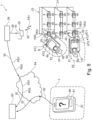
- the figure 1 shows a system 1 installed in the premises of a supermarket for radio communication with electronic price display signs that implement display devices, hereinafter referred to as ESL 2-10 and ELS 11-19 for short, with the aid of which a self-checkout system is implemented.
- Each ESL 2-19 has a display 40 and is mounted on shelves 20-22 of a shelf 23 corresponding to products (not shown) positioned on the shelf for which price and product information is displayed.
- the system also has two base stations 25 and 26, the first base station 25 with the ELS 2 - 10, symbolized by first radio signals FS1, and the second base station 26 with the ELS 11 - 19, symbolized by second radio signals FS2, using a proprietary first communication protocol is in radio contact.
- the logical assignment e.g.
- the system 1 also has a WLAN access point, called access point 27 for short below, which, shown centrally, covers the two areas to the left and right of line 30 in terms of radio technology. However, there can also be several access points 27 in order to supply the entire sales room with radio technology. With the help of the WLAN access point 27, merchandise management-related communications can be processed with portable merchandise management devices (not shown).
- the access point 27 and the two base stations 25, 26 are connected via a wired network 28 to an inventory management system server 29 of the supermarket.
- the state diagram has the time t on the abscissa axis and the communication states of the ESLs 7 - 9 cited by way of example and of the first base station 25 on the ordinate axis.
- T indicates a transmission state and pure reception state of the base station 25 and E an active state ready to receive and S an energy-saving sleep state of the ESL 7 - 9 in which there is no readiness to receive.
- N time slots Z1 . . . ZN (eg 256) with an identical time slot duration DS (eg approx. 58 milliseconds) are available during a time slot cycle duration DC (eg 15 seconds).
- the base station 25 (identified with the symbol "ST") changes between the transmission state T and the idle state R.
- the transmission state T is always assumed at the beginning of a time slot Z1...ZN and is used for a synchronization data signal Duration DSD (or transmission duration DSD of the synchronization data signal SD) maintained in order to send the respective applicable time slot symbol ZS1, ZS2, ... ZSN with the respective synchronization data signal SD.
- the first ESL 7 is in the synchronous state. It wakes up from its sleep state S at a first wake-up time TA1 and changes to its ready-to-receive active state E with a relatively short lead time DV before an expected occurrence of a synchronization data signal SD, receives the synchronization data signal SD during a reception period DE with the first timeslot symbol ZS1 (Hex 00), determines by comparing the least significant byte B0 of its hardware address (Hex 00) with the received timeslot symbol ZS1 that the first timeslot Z1 intended for the first ESL 7 is indicated (correspondence of the bytes to be compared: B0 of the hardware address and first time slot symbol ZS1), retains the parameters of its time control stage used to control the wake-up for waking up in the subsequent time slot cycle in order to define the new wake-up time and changes back to the sleep state S with a relatively short follow-up time DN after expiry of the intended sleep state ver wake up time DR according to plan at the new (second) wake
- the third ESL 9 is in the asynchronous state before a synchronization point in time TSY, which is indicated by the broken line of the arrow P1 running parallel to the time axis. It wakes up at a randomly selected first wake-up time TA1 and changes from its sleep state S to the active state E ready to receive and waits in this state until the next occurrence of the synchronization data signal SD is received, with the second time slot symbol ZS2 ( Hex 01) is received.
- the third ESL 9 recognizes from the least significant byte B0 (Hex 00) of its hardware address that the specific time slot in the present time slot cycle already belongs to the past and consequently the next time slot with the time slot symbol Hex 00 is only to be expected in the next time slot cycle , and calculates that the currently recognized time slot Z2 is one time slot next to its traditional time slot Z1, which is referred to below as the time slot difference.
- its time control stage is now programmed so that the new wake-up time TA2 lies before the occurrence of the first time slot Z1 of the subsequent time slot cycle, as in the case of an ESL in the synchronous state with said lead time DV.
- the waiting time DSA in the sleep state S is calculated automatically.
- the third ESL 9 is thus again in the synchronous state, which is indicated by the second arrow P2 with a solid line, and changes from the active state E to the sleep state S, after the dwell time DSA has elapsed at the new wake-up time TA2 to change its active state E.
- the ESL 8 has a processing stage 31 for providing operating states such as the active state and the sleep state.
- the processing stage 31 is by means of a microcontroller, an internal memory 32 and a co-processor 33, which is coupled to transmit / receive means 34 for communication with the base station 25, 26 on.
- the processing stage 31 is coupled to an external memory 36 and to a display device 38 via a first bus system 35 .
- the display device 38 has its own microcontroller 39 for display-related data processing and an electronic ink-based display 40 for visualizing information 41 .
- a voltage supply stage 42 which is implemented using a battery 42, provides a first supply voltage VCC1 with respect to a reference potential GND for the electronic components described.
- the electronic components described are in the figure 3 identified as display module 43.
- the co-processor 33 and the transmitting/receiving means 34 form a first radio interface 44 for communication according to the time slot communication protocol described above. With the aid of the first radio interface 44, a product data record PD and an availability data record VD can be transmitted from the base station 25, 26 to the relevant ESL 2-19.
- the ESL 8 also has a second radio interface implemented with the aid of an NFC module 45 .
- the NFC module 45 has analog components 46, which include the inductive coupling components 47, visualized as a coil, for contactless communication with another NFC-enabled device, and the power supply components 48. If there is an inductive coupling, the voltage supply components 48 generate a second supply voltage VCC2 compared to the reference potential GND for supplying the NFC module 45, which enables its digital components to be operated.
- the digital components are implemented using a second microcontroller 49, which also has an internal memory 50 and is connected to the analog components 46 for communication in accordance with an NFC communication protocol.
- the NFC module 45 is connected to the display module 43 , in particular to the first microcontroller 31 , by a second bus 51 .
- the operating system of the NFC module 49 can be stored in the internal memory 50 or in one of the memories 36, 32 of the display module, which the second microcontroller 49 can access. As soon as it is processed, it makes the NFC communication protocol available.
- the system components described so far essentially form stationary, i.e. permanently installed components of a self-checkout system. It stores ESL 13 a first product and availability data set PD1 and VD1, ESL 2 a second product and availability data set PD2 and VD2 and ESL8 the third product and availability data set PD3 and VD3.
- ESL 13 a first product and availability data set PD1 and VD1
- ESL 2 a second product and availability data set PD2 and VD2 and ESL8 the third product and availability data set PD3 and VD3.
- the three availability data sets VD1-VD3 indicate unrestricted availability of the associated product data sets PD1-PD3.
- Each of the product data sets PD1-PD3 can be queried using a self-check request.
- An Indian figure 1 at three different times at three positions I, II, III immediately adjacent to and within ESLs 2, 8, 13 Smartphone 57 shown in their NFC communication area implements a mobile self-check device.
- the smartphone 57 has, as in the figure 4 illustrated, a mobile radio interface 54 for communication in a mobile radio network of a mobile radio operator, an NFC-enabled device radio interface 59 for communication with the NFC module 45, a control stage 51 for controlling a self-check request, a detection stage 53 for detecting a confirmation from a user with the help of one in the figure 1 visible fingerprint sensor 61, and a product list storage stage 52 for storing one or more product data records PD received from an ESL 2-19 as a result of the self-check request.
- a data bus 56 connects the components 51, 52, 53, 54, and 59.
- the control stage 51 also has an in the figure 1 visualized touchscreen display 60, with the help of which plain text information KT1 - KT3 (see figure 1 ) for the product data records PD1 - PD3 received from the ESL 13, 2, 8 can be visualized.
- the smartphone 57 also stores device identification data ID, which are sent along with the communication via the respective interface.
- an NFC communication with the NFC module 45 of the ESL 13 is, for example, to any and in the figure 1 illustrated communication time TK set up, a self-check query is sent from the smartphone 57 specifying the device identification data ID to the ESL 13, the NFC module 45 reads the first product data record PD1, which is identified as unrestrictedly available by the first availability data record VD1, and sends it to the smartphone 57 by means of NFC communication, where its plain text information KT1 (product and price) is visualized as a new entry between angle brackets on the display 60, and with the help of the detection stage 53 the fingerprint of a finger 62 of the user is checked as approval for self-checking and If the test result is positive, the first product data record PD1 is stored using the product list storage stage 52. The product is taken by the user before or after from the shelf space where the ESL 13 is mounted and placed in
- the smartphone 57 is then transferred to the ESL 2, where the previously described process of self-checking is carried out again for the second product data record PD2. Subsequently, the smartphone 57 is tolerated for the ESL 8 and the self-checking process is carried out a final time, so that the three product data records PD1-PD3 are now in the smartphone 57.
- a payment transaction is carried out for each of the product data sets PD1-PD3 immediately when it is stored, or a joint payment transaction is carried out for all three together, finally.
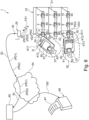
- FIG 5 is a self-checking system with search engine feedback function visualized, based on the in the 1 shown left half of the self-service shop was omitted for reasons of clarity.
- the smartphone 57 is first used, for example, at a position I outside the premises of the supermarket to search for product information, an Internet-based search engine 63 being contacted via the Internet 64 with the search query and the device identification data ID.
- the search query concerns details of the product identified by the ESL 2 in the supermarket.
- This search request is stored in the search engine 63 together with the device identification data ID and the search result.
- the user of the smartphone 57 carries out a self-checkout request from the ESL 2 on the premises of the supermarket and confirms the self-checkout (eg payment for the relevant product).
- the ESL 2 then transfers the device identification data ID to the base station 25 and from there to the merchandise management system server 29 of the supermarket, where the connection between the product that is assigned to the ESL 2 and the ESL 2 is known.
- the server 29 then forwards a product identification, e.g. the first product data record PD1 together with the device identification data ID to the search engine 63, where the information gap between the search query for a product or search result and the actual product purchase can be closed by the feedback from the ESL 2.
- advertising related to the product searched for or to the general user behavior of the user may have been transmitted to the smartphone 57 for the original search query.
- Whether this advertising led to another purchase or not can now be determined can also be determined using the measures described. For example, if the advertisement relates to the product marked with the help of the ESL 8 and the user carries out the self-checkout process for this product as well, the question posed can be answered positively with the help of the feedback from the ESL 8 on the search engine side.
- a cloud or internet-based merchandise management system can also be implemented, in which the functionality of the in the figure 1 Server 29 shown is relocated to a data processing system 65 of a provider for outsourced merchandise management services.
- the device identification data ID are delivered directly from the base station to the remote data processing system 65 .
- a connection is known there between the respective ESL 2 - 19 supplying the device identification data ID and the products assigned to them, consequently the product data records PD1 - PD19 are also available there. If the product data records are not known there, they can be used as in the 6 for the product data records PD1 and PD2 are supplied to the data processing system 65, indicated in brackets.
- a receipt printer 66 installed locally in the supermarket can be controlled via the Internet 64 with print data DD and a receipt 67 can be printed out, which has all those products for which a payment transaction was carried out.
- the invention also allows self-checkout of weight products, the price of which is only determined by weighing the product.
- a network-enabled scale with an ESL according to the invention (see figure 3 ) be equipped.
- a product is placed on the scale by the customer, the customer selects the product or product class on the scale screen, the scale determines the weight and creates and transmits the product data record to the ESL using the base station with which the scale is equipped.
- the user now uses his smartphone 57 to make a self-check request to this ESL, as a result of which the product data record of the weight product is transmitted to the smartphone 57 .
- the availability data record can be used to make the product data record in question only available once and in any case after a preset period of time in the absence of the delete the self-check request (e.g. 30 seconds) in order to be able to use the scale as quickly as possible for the next weighing process.
- the identification data ID when entering a self-service shop, can be queried by the self-check device 57 using a suitable terminal and transferred to the merchandise management system.
- Individual product data sets PD are transmitted to all or selected ESLs for the user in question or his device in order to make individualized offers available for this user (e.g. according to his past shopping behavior).
- the availability of the individual product data records for the relevant device 57 is controlled with the aid of the availability data record VD.
- the individual product data records PD are therefore only transmitted to this relevant device 57 in the event of a self-checkout request.
- other product records are stored in the ESLs and sent to the requesting device in the event of a self-check request.
- each self-checkout of a product can involve a payment transaction for that product.
Landscapes
- Business, Economics & Management (AREA)
- Engineering & Computer Science (AREA)
- Physics & Mathematics (AREA)
- General Physics & Mathematics (AREA)
- Theoretical Computer Science (AREA)
- Accounting & Taxation (AREA)
- Finance (AREA)
- Strategic Management (AREA)
- General Business, Economics & Management (AREA)
- Economics (AREA)
- Microelectronics & Electronic Packaging (AREA)
- Computer Hardware Design (AREA)
- Development Economics (AREA)
- Textile Engineering (AREA)
- Tourism & Hospitality (AREA)
- Entrepreneurship & Innovation (AREA)
- Human Resources & Organizations (AREA)
- Marketing (AREA)
- Operations Research (AREA)
- Quality & Reliability (AREA)
- Computer Security & Cryptography (AREA)
- Cash Registers Or Receiving Machines (AREA)
- Transceivers (AREA)
- Control Of Indicators Other Than Cathode Ray Tubes (AREA)
Claims (10)
- Système d'auto-imputation, comportant :- un poste de base (25, 26), destiné à communiquer avec un nombre de dispositifs d'affichage (2 à 19), et- au moins dispositif d'affichage (2 à 19), conçu sous la forme d'une étiquette électronique d'affichage des prix, qui comporte+ un étage de mémoire (50), destiné à mémoriser un jeu de données de produits (PD1 à PD3), qui lors d'une communication avec un poste de base (25, 26) a été réceptionné par l'intermédiaire d'une première interface radio (44) du dispositif d'affichage (2 à 19), et+ une deuxième interface radio (45), destinée à la communication, notamment à la communication par RFID ou par NFC, avec un appareil d'auto-imputation (57),+ le dispositif d'affichage (2 à 19) étant conçu pour traiter une demande d'auto-imputation réceptionnée par un appareil d'auto-imputation (57), aux fins de la transmission du jeu de données de produits (PD) via la deuxième interface radio (45), et- un serveur de système de gestion de marchandises (29), dans lequel la connexion entre un produit, lequel est associé à un dispositif d'affichage (2 à 19) et le dispositif d'affichage (2 à 19) est connu,- lors d'un traitement d'une demande d'auto-imputation, le dispositif d'affichage (2 à 19) étant conçu pour réceptionner et mémoriser des données d'identification (ID) concernant un utilisateur et/ou des appareils (ID), pour identifier l'utilisateur de l'appareil d'auto-imputation et/ou l'appareil d'auto-imputation (57), et- le dispositif d'affichage (2 à 19) étant conçu pour ne délivrer au poste de base (25, 26) que les données d'identification (ID) pour lesquelles une confirmation a été donnée par un utilisateur de l'appareil d'auto-imputation (57), pour la réalisation d'une transaction de paiement pour ledit jeu de données de produits (PD), au poste de base (25, 26) et de celui-ci au serveur de système de gestion de marchandises (29),- le serveur de système de gestion de marchandises (29) étant conçu pour retransmettre une identification de produits, notamment le jeu de données de produits (PD), conjointement avec les données d'identification (ID) à un moteur de recherche (63) externe, basé sur Internet, qui a été préalablement contacté par l'appareil d'auto-imputation (57) pour une demande de recherche et les données d'identification (ID) de l'appareil d'auto-imputation (57) et qui a mémorisé la demande de recherche et les données d'identification (ID), de sorte que dans le moteur de recherche (63), la lacune informationnelle entre la demande de recherche d'un produit ou le résultat de la recherche et l'achat effectif du produit se laisse fermer par le feedback du dispositif d'affichage (2 à 19).
- Système d'auto-imputation selon la revendication 1,- l'étage de mémoire (50) du dispositif d'affichage (2 à 19) comportant un jeu de données de disponibilité (VD) interconnecté avec le jeu de données de produits (PD), à l'aide duquel la disponibilité du jeu de données de produits (PD) est susceptible d'être commandée, et- lors du traitement de la demande d'auto-imputation, le dispositif d'affichage (2 à 19) étant conçu pour vérifier le jeu de données de disponibilité (VD) et ne transmettre le jeu de données de produits (PD) que s'il est disponible.
- Système d'auto-imputation selon la revendication 2,- la disponibilité concernant le jeu de données de produits (PD) en tant que telle et- le dispositif d'affichage (2 à 19) étant conçu pour vérifier le jeu de données de disponibilité (VD) pour déterminer si le jeu de données de produits est transmissible ou non et pour traiter la demande en conséquence.
- Système d'auto-imputation selon la revendication 2,- la disponibilité du jeu de données de produits (PD) concernant une disponibilité temporelle, au cours de laquelle ledit jeu de données de produits (PD) est disponible, et- le dispositif d'affichage (2 à 19) étant conçu pour vérifier le jeu de données de disponibilité (VD), pour déterminer si le jeu de données de produits (PD) est disponible de manière limitée dans le temps, et pour traiter la demande au cours de la disponibilité temporelle avec ledit jeu de données de produits (PD) ou hors de la disponibilité temporelle avec un autre jeu de données de produits ou absolument pas, ou d'une autre manière.
- Système d'auto-imputation selon la revendication 2,- la disponibilité du jeu de données de produits (PD) concernant sa disponibilité quantitative, et- le dispositif d'affichage (2 à 19) étant conçu pour vérifier le jeu de données de disponibilité (VD), pour déterminer si le jeu de données de produits (PD) est quantitativement limité, et pour traiter la demande dans le cadre de la limitation quantitative avec ledit jeu de données de produits (PD), et en cas de dépassement de la limitation quantitative, pour traiter un autre jeu de données de produits, ou absolument pas ou d'une autre manière.
- Système d'auto-imputation selon la revendication 5, le dispositif d'affichage (2 à 19) étant conçu pour vérifier la disponibilité quantitative, sous considération d'une limitation quantitative par utilisateur ou par appareil d'auto-imputation (57) .
- Système d'auto-imputation selon la revendication 4, le dispositif d'affichage (2 à 19) étant conçu pour vérifier la disponibilité temporelle, sous considération d'une limitation quantitative par utilisateur ou par appareil d'auto-imputation (57) .
- Système d'auto-imputation selon la revendication 1, le dispositif d'affichage (2 à 19)- étant conçu, lors d'une communication via la première interface radio (44), pour délivrer des données d'identification (ID) au poste de base (25, 26) .
- Système d'auto-imputation selon la revendication 8, le dispositif d'affichage (2 à 19) étant conçu :- pour ne délivrer au poste de base (25, 26) que les données d'identification (ID) pour lesquelles une confirmation a été donnée par un utilisateur de l'appareil d'auto-imputation (57), sous la forme d'un accord de mémorisation du jeu de données de produits (PD) réceptionné par le dispositif d'affichage (2 à 19).
- Système d'auto-imputation selon l'une quelconque des revendications précédentes, comportant- au moins un appareil d'auto-imputation (57) comportant+ une interface radio (59) d'appareil, compatible avec une deuxième interface radio (45) du dispositif d'affichage (2 à 19) selon la revendication 1 à 9, pour la communication par RFID ou par NFC avec ledit dispositif d'affichage (2 à 19), et+ un étage de commande (51), destiné à commander une demande d'auto-imputation adressée via l'interface radio (59) d'appareil au dispositif d'affichage (2 à 19), aux fins de la transmission d'un jeu de données de produits (PD) du dispositif d'affichage (2 à 19) via l'interface radio (59) d'appareil à l'appareil d'auto-imputation (57).
Priority Applications (1)
| Application Number | Priority Date | Filing Date | Title |
|---|---|---|---|
| EP20194155.6A EP3770812B1 (fr) | 2015-12-10 | 2015-12-10 | Dispositif d'affichage permettant d'afficher les prix et/ou les informations sur le produit |
Applications Claiming Priority (3)
| Application Number | Priority Date | Filing Date | Title |
|---|---|---|---|
| EP15820063.4A EP3387584B1 (fr) | 2015-12-10 | 2015-12-10 | Dispositif d'affichage pour afficher une information de prix et/ou de produit |
| PCT/EP2015/079193 WO2017097357A1 (fr) | 2015-12-10 | 2015-12-10 | Dispositif d'affichage pour afficher une information de prix et/ou de produit |
| EP20194155.6A EP3770812B1 (fr) | 2015-12-10 | 2015-12-10 | Dispositif d'affichage permettant d'afficher les prix et/ou les informations sur le produit |
Related Parent Applications (2)
| Application Number | Title | Priority Date | Filing Date |
|---|---|---|---|
| EP15820063.4A Division EP3387584B1 (fr) | 2015-12-10 | 2015-12-10 | Dispositif d'affichage pour afficher une information de prix et/ou de produit |
| EP15820063.4A Division-Into EP3387584B1 (fr) | 2015-12-10 | 2015-12-10 | Dispositif d'affichage pour afficher une information de prix et/ou de produit |
Publications (2)
| Publication Number | Publication Date |
|---|---|
| EP3770812A1 EP3770812A1 (fr) | 2021-01-27 |
| EP3770812B1 true EP3770812B1 (fr) | 2023-02-08 |
Family
ID=55069811
Family Applications (10)
| Application Number | Title | Priority Date | Filing Date |
|---|---|---|---|
| EP20194157.2A Active EP3770814B1 (fr) | 2015-12-10 | 2015-12-10 | Dispositif d'affichage permettant d'afficher les prix et/ou les informations sur le produit |
| EP20194161.4A Active EP3770817B1 (fr) | 2015-12-10 | 2015-12-10 | Dispositif d'affichage permettant d'afficher les prix et/ou les informations sur le produit |
| EP20194163.0A Active EP3770818B1 (fr) | 2015-12-10 | 2015-12-10 | Dispositif d'affichage permettant d'afficher les prix et/ou les informations sur le produit |
| EP21175401.5A Active EP3893157B1 (fr) | 2015-12-10 | 2015-12-10 | Système d'auto-réservation permettant d'effectuer une transaction de paiement pour un ensemble de données de produit transmis par un dispositif d'affichage |
| EP20194155.6A Active EP3770812B1 (fr) | 2015-12-10 | 2015-12-10 | Dispositif d'affichage permettant d'afficher les prix et/ou les informations sur le produit |
| EP20194160.6A Active EP3770816B1 (fr) | 2015-12-10 | 2015-12-10 | Dispositif d'affichage permettant d'afficher les prix et/ou les informations sur le produit |
| EP20194158.0A Active EP3770815B1 (fr) | 2015-12-10 | 2015-12-10 | Dispositif d'affichage permettant d'afficher les prix et/ou les informations sur le produit |
| EP15820063.4A Active EP3387584B1 (fr) | 2015-12-10 | 2015-12-10 | Dispositif d'affichage pour afficher une information de prix et/ou de produit |
| EP23192884.7A Active EP4258167B1 (fr) | 2015-12-10 | 2015-12-10 | Dispositif d'affichage avec étage de stockage pour stocker un ensemble de données de produit |
| EP20194156.4A Active EP3770813B1 (fr) | 2015-12-10 | 2015-12-10 | Dispositif d'affichage permettant d'afficher les prix et/ou les informations sur le produit |
Family Applications Before (4)
| Application Number | Title | Priority Date | Filing Date |
|---|---|---|---|
| EP20194157.2A Active EP3770814B1 (fr) | 2015-12-10 | 2015-12-10 | Dispositif d'affichage permettant d'afficher les prix et/ou les informations sur le produit |
| EP20194161.4A Active EP3770817B1 (fr) | 2015-12-10 | 2015-12-10 | Dispositif d'affichage permettant d'afficher les prix et/ou les informations sur le produit |
| EP20194163.0A Active EP3770818B1 (fr) | 2015-12-10 | 2015-12-10 | Dispositif d'affichage permettant d'afficher les prix et/ou les informations sur le produit |
| EP21175401.5A Active EP3893157B1 (fr) | 2015-12-10 | 2015-12-10 | Système d'auto-réservation permettant d'effectuer une transaction de paiement pour un ensemble de données de produit transmis par un dispositif d'affichage |
Family Applications After (5)
| Application Number | Title | Priority Date | Filing Date |
|---|---|---|---|
| EP20194160.6A Active EP3770816B1 (fr) | 2015-12-10 | 2015-12-10 | Dispositif d'affichage permettant d'afficher les prix et/ou les informations sur le produit |
| EP20194158.0A Active EP3770815B1 (fr) | 2015-12-10 | 2015-12-10 | Dispositif d'affichage permettant d'afficher les prix et/ou les informations sur le produit |
| EP15820063.4A Active EP3387584B1 (fr) | 2015-12-10 | 2015-12-10 | Dispositif d'affichage pour afficher une information de prix et/ou de produit |
| EP23192884.7A Active EP4258167B1 (fr) | 2015-12-10 | 2015-12-10 | Dispositif d'affichage avec étage de stockage pour stocker un ensemble de données de produit |
| EP20194156.4A Active EP3770813B1 (fr) | 2015-12-10 | 2015-12-10 | Dispositif d'affichage permettant d'afficher les prix et/ou les informations sur le produit |
Country Status (4)
| Country | Link |
|---|---|
| US (10) | US11392916B2 (fr) |
| EP (10) | EP3770814B1 (fr) |
| CN (3) | CN108463829B (fr) |
| WO (1) | WO2017097357A1 (fr) |
Families Citing this family (7)
| Publication number | Priority date | Publication date | Assignee | Title |
|---|---|---|---|---|
| CN108882141B (zh) * | 2018-05-25 | 2020-08-04 | 深圳市海苔科技有限公司 | 电子货架标签定位更新方法及系统 |
| CN110602660B (zh) * | 2018-06-13 | 2021-10-15 | 汉朔科技股份有限公司 | 基于esls的同步网络构建方法、装置、设备及存储介质 |
| US12033601B2 (en) * | 2018-10-26 | 2024-07-09 | Vusiongroup Gmbh | Radio base station for combined radio communication |
| WO2020253940A1 (fr) * | 2019-06-17 | 2020-12-24 | Ses-Imagotag Gmbh | Système électronique d'étiquette pour rayonnage à protocole de radiocommunication normalisé |
| TWI726488B (zh) | 2019-11-19 | 2021-05-01 | 元太科技工業股份有限公司 | 非接觸式智慧卡及其操作方法 |
| US11893612B2 (en) * | 2022-03-04 | 2024-02-06 | Agile Displays Llc | Shopping store planning and operations using large-scale distributed radio infrastructure |
| EP4720916A1 (fr) * | 2023-05-31 | 2026-04-08 | VusionGroup GmbH | Procédé de détection d'une étiquette rfid en particulier variable en position |
Family Cites Families (154)
| Publication number | Priority date | Publication date | Assignee | Title |
|---|---|---|---|---|
| US5572653A (en) * | 1989-05-16 | 1996-11-05 | Rest Manufacturing, Inc. | Remote electronic information display system for retail facility |
| US5539394A (en) * | 1994-03-16 | 1996-07-23 | International Business Machines Corporation | Time division multiplexed batch mode item identification system |
| US5468942A (en) * | 1994-04-18 | 1995-11-21 | Ahold Retail Services Ag | Dispensing device for hand scanners accessible from two sides |
| US6269342B1 (en) * | 1995-04-28 | 2001-07-31 | Telxon Corporation | Programmable shelf tag system |
| US5671362A (en) * | 1995-04-04 | 1997-09-23 | Cowe; Alan B. | Materials monitoring systems, materials management systems and related methods |
| IL114965A (en) * | 1995-08-17 | 2001-01-11 | Eldat Comm Ltd | System and method for providing a store customer with personally associated prices for selected items |
| DE19538115A1 (de) * | 1995-10-13 | 1997-04-17 | Orgalogic Gmbh | Elektronisches Preisinformationssystem |
| IL117952A0 (en) * | 1996-04-18 | 1996-08-04 | Eldat Communication Ltd | Product identification and counting system |
| US6434530B1 (en) * | 1996-05-30 | 2002-08-13 | Retail Multimedia Corporation | Interactive shopping system with mobile apparatus |
| IL119481A0 (en) * | 1996-10-24 | 1997-01-10 | Eldat Communication Ltd | Personal shopping system |
| US6243690B1 (en) * | 1997-12-17 | 2001-06-05 | Ncr Corporation | Electronic price label including a plurality of separately addressable displays |
| US6397199B1 (en) * | 1998-08-31 | 2002-05-28 | Ncr Corporation | System and method of altering transaction terms based upon current inventory levels |
| US20020167500A1 (en) * | 1998-09-11 | 2002-11-14 | Visible Techknowledgy, Llc | Smart electronic label employing electronic ink |
| GB2344025B (en) * | 1998-09-21 | 2003-07-02 | Symbol Technologies Inc | Electronic shelf label and shopping system |
| US6859786B1 (en) * | 1999-03-23 | 2005-02-22 | Ncr Corporation | System and method of displaying information by an electronic price label |
| US7119759B2 (en) * | 1999-05-03 | 2006-10-10 | E Ink Corporation | Machine-readable displays |
| US6696920B1 (en) * | 1999-09-30 | 2004-02-24 | Ncr Corporation | Method of changing an electronic price label display sequence |
| US7026913B2 (en) * | 1999-11-30 | 2006-04-11 | Ncr Corporation | Methods and apparatus for self-diagnosing electronic price labels |
| SE0002302D0 (sv) * | 2000-06-20 | 2000-06-20 | Pricer Ab | Method and system for communication checking |
| SE0002574D0 (sv) * | 2000-07-07 | 2000-07-07 | Pricer Ab | Price label system |
| US6715675B1 (en) * | 2000-11-16 | 2004-04-06 | Eldat Communication Ltd. | Electronic shelf label systems and methods |
| JP3498845B2 (ja) * | 2001-01-25 | 2004-02-23 | 株式会社イシダ | ラベル発行装置、計量ラベル発行装置、及び商品情報表示器 |
| US6844821B2 (en) * | 2001-02-15 | 2005-01-18 | Illinois Tool Works Inc. | Electronic display system tag, related interface protocal and display methods |
| US6961709B2 (en) * | 2001-04-02 | 2005-11-01 | Ncr Corporation | System and method of managing inventory |
| US6510991B2 (en) * | 2001-04-02 | 2003-01-28 | Ncr Corporation | System and method of displaying information about an item by an electronic display |
| US20020196204A1 (en) * | 2001-06-26 | 2002-12-26 | Matthew Senn Steven Michael | Retail customer and product purchase divider with interactive retail transaction functions |
| US7461009B1 (en) * | 2001-06-29 | 2008-12-02 | Ncr Corporation | System and method of sending messages to electronic shelf labels based upon priority |
| EP1298631A3 (fr) * | 2001-09-19 | 2006-03-29 | Optrex Corporation | Etiquette électronique |
| US6994252B2 (en) * | 2001-11-05 | 2006-02-07 | Frich Mark R | Combination library patron-supervisor self check-in/out workstation |
| US8339265B2 (en) * | 2002-01-09 | 2012-12-25 | Sensormatic Electronics, Llc. | Method of assigning and deducing the location of articles detected by multiple RFID antennae |
| US7403909B2 (en) * | 2002-05-29 | 2008-07-22 | Ncr Corporation | Systems and methods for asynchronous processing of electronic shelf label communication responses |
| US6736316B2 (en) * | 2002-08-23 | 2004-05-18 | Yoram Neumark | Inventory control and indentification method |
| AU2003283697A1 (en) * | 2002-12-16 | 2004-07-09 | Koninklijke Philips Electronics N.V. | Electronic shopping information system |
| US7152040B1 (en) * | 2003-05-27 | 2006-12-19 | Microsoft Corporation | Electronic shelf label |
| US8061600B2 (en) * | 2003-12-18 | 2011-11-22 | Altierre Corporation | Wireless display tag |
| US20050149414A1 (en) * | 2003-12-30 | 2005-07-07 | Kimberly-Clark Worldwide, Inc. | RFID system and method for managing out-of-stock items |
| JP2005231772A (ja) * | 2004-02-18 | 2005-09-02 | Ishida Co Ltd | 商品在庫管理装置 |
| SE0400556D0 (sv) * | 2004-03-05 | 2004-03-05 | Pricer Ab | Electronic shelf labelling system, electronic label, handheld device and method in an electronic labelling system |
| JP3988736B2 (ja) * | 2004-03-18 | 2007-10-10 | セイコーエプソン株式会社 | ストア管理システム及び管理方法 |
| US7520429B2 (en) * | 2004-03-31 | 2009-04-21 | United Parcel Service Of America, Inc. | Systems and methods for an electronic programmable merchandise tag |
| US20050246238A1 (en) * | 2004-04-28 | 2005-11-03 | Motorola, Inc. | Item of interest marking and posting system and method |
| US7380725B2 (en) * | 2004-06-26 | 2008-06-03 | Mcgill Randy | Enterprise-wide networked system and method for managing and displaying price and product information |
| JP2008512796A (ja) * | 2004-09-10 | 2008-04-24 | エピセンター ホールディングス, インコーポレイテッド | 電子小売と従来の小売との統合 |
| US20060163349A1 (en) * | 2004-09-30 | 2006-07-27 | W5 Networks, Inc. | Wireless systems suitable for retail automation and promotion |
| US20060085268A1 (en) * | 2004-10-15 | 2006-04-20 | Rki Corporation Dba Retail Media Solutions | Access to product supplemental information, in a store |
| US7600681B2 (en) * | 2004-12-20 | 2009-10-13 | Altierre Corporation | Low power wireless display tag systems and methods |
| US7429984B2 (en) * | 2005-02-04 | 2008-09-30 | Philip Morris Usa Inc. | Display management system |
| EP1889216A4 (fr) * | 2005-05-27 | 2009-07-22 | Gaba Holdings Int Inc | Systeme et procede de transaction au point de vente rfid centres sur le consommateur |
| JP4524231B2 (ja) * | 2005-09-13 | 2010-08-11 | 富士通フロンテック株式会社 | 通信システムおよび通信装置 |
| JP4881604B2 (ja) * | 2005-10-28 | 2012-02-22 | 東芝テック株式会社 | 商品登録処理システム |
| JP4616166B2 (ja) * | 2005-12-26 | 2011-01-19 | 東芝テック株式会社 | 商品登録処理システム |
| JP2007206745A (ja) * | 2006-01-30 | 2007-08-16 | Fujitsu Ltd | 電子棚札、電子棚札システムサーバ、電子棚札システム及び電子棚札表示方法 |
| JP4932281B2 (ja) * | 2006-02-28 | 2012-05-16 | 東芝テック株式会社 | 商品販売データ処理装置 |
| JP2007244795A (ja) * | 2006-03-20 | 2007-09-27 | Kazuhiko Takemura | 電子棚札システム |
| JP2007319522A (ja) * | 2006-06-02 | 2007-12-13 | Ishida Co Ltd | 電子棚札及び電子棚札システム |
| US8452660B2 (en) * | 2006-06-06 | 2013-05-28 | Fujitsu Frontech North America Inc. | Self-checkout security system and method therefor |
| JP4978083B2 (ja) * | 2006-07-04 | 2012-07-18 | 株式会社寺岡精工 | 電子棚札システム |
| WO2008032360A1 (fr) * | 2006-09-11 | 2008-03-20 | Fugaku Bussan Co., Ltd. | Système d'aide aux ventes, son procédé et son programme |
| WO2008039157A1 (fr) * | 2006-09-28 | 2008-04-03 | U-Marketing Intellectual Properties Pte Ltd | Système et procédé de gestion des rayons |
| JP2008168057A (ja) * | 2007-01-15 | 2008-07-24 | Ishida Co Ltd | 電子棚札及び電子棚札システム |
| US7940181B2 (en) * | 2007-02-01 | 2011-05-10 | Infosys Technologies Ltd. | RFID based product level availability |
| US20080284566A1 (en) * | 2007-05-15 | 2008-11-20 | Li-Cheng Richard Zai | Location based electronic sign system |
| JP4383471B2 (ja) * | 2007-07-25 | 2009-12-16 | 東芝テック株式会社 | 商品販売データ処理装置 |
| JP5211625B2 (ja) * | 2007-10-05 | 2013-06-12 | カシオ計算機株式会社 | 電子棚札システム、サーバ装置、およびそのプログラム |
| JP2011517343A (ja) * | 2008-02-22 | 2011-06-02 | マリセンス オサケ ユキチュア | 選択可能な操作モードを備えたディスプレイ装置、ディスプレイ装置における方法、およびディスプレイ装置の操作モードを変更する制御装置 |
| JP5372396B2 (ja) * | 2008-03-25 | 2013-12-18 | 株式会社イシダ | 電子棚札システム |
| FR2932590B1 (fr) * | 2008-06-17 | 2010-05-21 | Mpe Technology | Etiquette electronique multi-fonctions et sans contact pour marchandises |
| GB0812770D0 (en) * | 2008-07-11 | 2008-08-20 | Zbd Displays Ltd | A display system |
| WO2010021051A1 (fr) * | 2008-08-21 | 2010-02-25 | エスアイアイ・データサービス株式会社 | Système électronique d'étiquette d'étagère, dispositif de gestion de prix de produit, dispositif de terminal portable, dispositif électronique d'étiquette d'étagère, procédé de gestion de prix de produit, procédé de mise à jour de prix de produit, programme de gestion de prix de produit et programme de mise à jour de prix de produit |
| US20110193679A1 (en) * | 2008-08-21 | 2011-08-11 | Akihiro Okabe | Electronic shelf label system, communication control device, relay station device, electronic shelf label information distribution method, and program |
| US8523053B2 (en) * | 2008-09-03 | 2013-09-03 | First Data Corporation | Enabling consumer choice on contactless transactions when using a dual-branded payment instrument |
| US7954712B2 (en) * | 2008-09-12 | 2011-06-07 | Transparent Visibility Holdings, LLC | Product, asset, and device tracking, identification, and pricing system |
| US20100070365A1 (en) * | 2008-09-12 | 2010-03-18 | At&T Intellectual Property I, L.P. | Planogram guided shopping |
| JP4733198B2 (ja) * | 2008-11-17 | 2011-07-27 | 東芝テック株式会社 | 情報登録装置およびプログラム |
| JP2010134635A (ja) * | 2008-12-03 | 2010-06-17 | Ishida Co Ltd | 電子棚札及び商品管理システム |
| WO2010082835A1 (fr) * | 2009-01-19 | 2010-07-22 | Realtime Norway As | Système et procédé d'affichage et d'actualisation d'informations relatives à un prix et un produit |
| US20100265311A1 (en) * | 2009-04-16 | 2010-10-21 | J. C. Penney Corporation, Inc. | Apparatus, systems, and methods for a smart fixture |
| EP2431954A4 (fr) * | 2009-05-11 | 2015-03-18 | Toshiba Global Commerce Solutions Holdings Corp | Support pour le shopping en libre-service permettant d'acquérir un contenu à partir d'une étiquette de rayon électronique (esl) |
| US8403215B2 (en) * | 2009-05-11 | 2013-03-26 | Toshiba Global Commerce Solutions Holdings Corporation | Self shopping support by getting contents from electronic shelf labels |
| KR101022958B1 (ko) * | 2009-05-29 | 2011-03-16 | 엘지이노텍 주식회사 | 알에프아이디 방식을 이용한 esl 단말기와 시스템 및 그 방법 |
| CN101625785A (zh) * | 2009-08-01 | 2010-01-13 | 何志军 | 自助结账系统和方法 |
| CN102024130A (zh) * | 2009-09-15 | 2011-04-20 | 澳门科技大学 | 射频识别系统的通信方法 |
| US20110191154A1 (en) * | 2010-01-29 | 2011-08-04 | Cedric Tremayne Johnson | Methods and Apparatus for Networking and Controlling Electronic Displays |
| US20120055985A1 (en) * | 2010-03-04 | 2012-03-08 | Frank Andrew Allen | Electronic labeling system |
| JP2011186955A (ja) * | 2010-03-10 | 2011-09-22 | Toshiba Tec Corp | 情報処理装置、プログラム及び商品情報提示システム |
| US20110231236A1 (en) * | 2010-03-19 | 2011-09-22 | Felipe Gonzalez | Coupon System and Method |
| KR20110109072A (ko) * | 2010-03-30 | 2011-10-06 | 삼성전기주식회사 | 전자 가격 표시 시스템 및 이에 적용되는 상품과 전자 가격 표시 태그의 동기화 방법 및 상품 정보 업데이트 방법 |
| WO2012006098A2 (fr) * | 2010-06-28 | 2012-01-12 | Vivotech Inc. | Procédés, systèmes et supports lisibles par ordinateur pour faciliter une commande et un paiement de biens et services en magasin ou à proximité d'un magasin au moyen d'une tape unique d'un dispositif de communication en champ proche (nfc) |
| KR20120017243A (ko) * | 2010-08-18 | 2012-02-28 | 삼성전기주식회사 | 전자 선반 라벨 시스템 및 이를 이용한 통신 방법 |
| US8695872B2 (en) * | 2010-10-04 | 2014-04-15 | Zachary L. Braunstein | Apparatus improving item transactions with real-time controls and navigation |
| KR20120055106A (ko) * | 2010-11-23 | 2012-05-31 | 한국전자통신연구원 | 전파식별을 이용한 전자선반라벨 장치 및 전자선반라벨 장치의 동작 방법 |
| US20120173351A1 (en) * | 2010-12-29 | 2012-07-05 | Qthru, Llc | Mobile Electronic Shopping |
| CN102096871A (zh) * | 2011-01-21 | 2011-06-15 | 吉林大学 | 全球商品物联网智能自助查询支付系统 |
| US8751318B2 (en) * | 2011-05-30 | 2014-06-10 | Lg Electronics Inc. | Method for managing and/or controlling store and system for the same |
| US20130140357A1 (en) * | 2011-06-09 | 2013-06-06 | Michael Ure | Product information distribution |
| US20120326849A1 (en) * | 2011-06-24 | 2012-12-27 | Sensormatic Electronics, LLC | Electronic price label system and method |
| US20130024308A1 (en) * | 2011-07-18 | 2013-01-24 | Tata Consultancy Services Limited | Self check out using a portable device |
| US8833652B2 (en) * | 2011-08-23 | 2014-09-16 | Tyco Fire & Security Gmbh | Product information system and method using a tag and mobile device |
| US9367770B2 (en) * | 2011-08-30 | 2016-06-14 | Digimarc Corporation | Methods and arrangements for identifying objects |
| WO2013056169A1 (fr) * | 2011-10-14 | 2013-04-18 | Hewett Spencer Thornton | Système d'achat en libre service de client interactif |
| CN202351903U (zh) * | 2011-10-27 | 2012-07-25 | 肖丹 | 电子货架标签系统 |
| US20130117153A1 (en) * | 2011-11-04 | 2013-05-09 | Pathway Innovations And Technologies, Inc. | Fully interactive, wireless, retail video display tag, integrated with content distribution, data management, feedback data collection, inventory and product price search capabilities |
| JP2013109491A (ja) * | 2011-11-18 | 2013-06-06 | Internatl Business Mach Corp <Ibm> | モバイルショッピングにおけるブックマークによる精算 |
| US20130138520A1 (en) * | 2011-11-30 | 2013-05-30 | Hardware & Software Technology Co., Ltd. | Method for acquiring data from a point of sale (pos) system by an electronic label system, the electronic label system, and pos label management system |
| US20130179307A1 (en) * | 2012-01-10 | 2013-07-11 | Thermo Fisher Scientific Inc. | Methods And Systems For Restocking Inventory |
| CN102663469B (zh) * | 2012-04-09 | 2016-04-06 | 特赢力信息技术(上海)有限公司 | 低功耗高安全的电子货架标签及其信息处理方法 |
| FI127537B (en) * | 2012-04-11 | 2018-08-31 | Marisense Oy | Electronic label and electronic label system |
| US8800869B2 (en) * | 2012-05-23 | 2014-08-12 | Opticon Sensors Europe B.V. | Inventory control using electronic shelf label systems |
| US20140058841A1 (en) * | 2012-08-21 | 2014-02-27 | Verizon Patent And Licensing Inc. | Method and system for providing intent-based proximity marketing |
| US9235375B2 (en) * | 2012-11-16 | 2016-01-12 | Cisco Technology, Inc. | Retail digital signage |
| US20140149256A1 (en) * | 2012-11-28 | 2014-05-29 | Samsung Electro-Mechanics Co., Ltd. | Esl system, method of checking informations of goods and paying therefor |
| JP2014109868A (ja) * | 2012-11-30 | 2014-06-12 | International Business Maschines Corporation | 商品又はサービスの購入要求を処理する装置及び方法 |
| CN103889073A (zh) * | 2012-12-20 | 2014-06-25 | 北京格瑞图科技有限公司 | 无线电子货架标签系统 |
| RU2015133464A (ru) * | 2013-01-11 | 2017-02-17 | Тагнэтикс, Инк. | Датчик отсутствия товаров |
| US9069770B2 (en) * | 2013-02-12 | 2015-06-30 | Adidas Ag | Method of providing digital content for users of physical items |
| CN103198276B (zh) * | 2013-02-27 | 2015-07-08 | 杭州朗鸿科技有限公司 | 电子货架标签系统的通信方法 |
| US10115096B2 (en) * | 2013-03-11 | 2018-10-30 | 365 Retail Markets, Llc | Point of sale system, inventory system, and methods thereof |
| TWI475491B (zh) * | 2013-04-18 | 2015-03-01 | Ind Tech Res Inst | 更新電子貨架標籤的系統與方法以及一電子貨架標籤的更新裝置與方法 |
| US9911138B2 (en) * | 2013-04-19 | 2018-03-06 | Wal-Mart Stores, Inc. | Automated limited-time retail merchandise promotion system |
| KR20140136089A (ko) * | 2013-05-16 | 2014-11-28 | (주)에스모바일텍 | 진열 상품 재고 관리 솔루션을 구비한 전자 선반 라벨 시스템 |
| JP2015007963A (ja) * | 2013-05-30 | 2015-01-15 | 大日本印刷株式会社 | 情報出力装置、情報出力システム、サーバ装置及び情報出力方法並びに情報出力装置用プログラム及びサーバ装置用プログラム |
| CN103324965A (zh) * | 2013-06-05 | 2013-09-25 | 佛山市广华合志科技有限公司 | 一种基于fpga的电子货架标签 |
| CN103280039A (zh) * | 2013-06-18 | 2013-09-04 | 上海众人网络安全技术有限公司 | 自助结账终端、商家服务器、自助结账系统及方法 |
| KR20150006229A (ko) | 2013-07-08 | 2015-01-16 | 삼성전기주식회사 | 전자 선반 라벨 및 전자 선반 라벨 시스템 |
| US20150034719A1 (en) * | 2013-07-31 | 2015-02-05 | M²Communication, Inc. | System, method and apparatus for linking electronic shelf label with product |
| CN103455130B (zh) * | 2013-08-13 | 2015-12-02 | 佛山市广华合志科技有限公司 | 一种电子货架标签的节能运行方法 |
| US20150134429A1 (en) * | 2013-11-08 | 2015-05-14 | Sears Brands, L.L.C. | Wireless identifier device enabled interactive consumer experience |
| CN104376488A (zh) * | 2013-11-14 | 2015-02-25 | 天津职业技术师范大学 | 一种低功耗电子货价标签及其控制方法 |
| JP2015102988A (ja) * | 2013-11-25 | 2015-06-04 | 株式会社イシダ | 商品販売システム |
| KR20150072934A (ko) * | 2013-12-20 | 2015-06-30 | 삼성전기주식회사 | 전자 태그, 전자 선반 시스템 및 그 동작 방법 |
| KR102206175B1 (ko) * | 2013-12-20 | 2021-01-22 | 주식회사 솔루엠 | 전자 선반 시스템 및 그 통신 방법 |
| BR112016018902B1 (pt) * | 2014-02-20 | 2021-01-26 | Ses-Imagotag Gmbh | sistema de comunicação de intervalo de tempo |
| BR102014004206A2 (pt) * | 2014-02-21 | 2015-12-01 | Samsung Eletrônica Da Amazônia Ltda | método para pagamento móvel seguro e etiqueta de rf com dispositivo antifurto integrado |
| US20150269549A1 (en) * | 2014-03-20 | 2015-09-24 | Toshiba Global Commerce Solutions Holdings Corporation | Synchronizing scan activity with loss prevention cameras |
| US20150301778A1 (en) * | 2014-04-22 | 2015-10-22 | Samsung Electro-Mechanics Co., Ltd. | Electronic shelf label having near field communication (nfc) function embedded therein |
| EP2945115A1 (fr) | 2014-05-16 | 2015-11-18 | Samsung Electro-Mechanics Co., Ltd. | Système électronique d'étiquette d'étagère, balise d'étiquette de rayon électronique, procédé de reconnaissance de dispositif d'affichage d'informations |
| CN105096076A (zh) * | 2014-05-19 | 2015-11-25 | 南京莘纳吉物流有限公司 | 基于rfid手持终端的可视化电子标签系统及基于这一系统的仓储管理方法 |
| KR20150133905A (ko) * | 2014-05-20 | 2015-12-01 | 삼성전기주식회사 | 전자 선반 라벨 시스템 및 전자 선반 라벨 시스템의 운영방법 |
| WO2015188173A1 (fr) * | 2014-06-07 | 2015-12-10 | Symphony Teleca Corporation | Appareils, procédés et systèmes de gestion de corrélation d'activité et d'inventaire du monde réel et en ligne en temps réel |
| CN204028969U (zh) * | 2014-06-26 | 2014-12-17 | 上海高通半导体有限公司 | 一种文字显示电子货架标签 |
| KR20160011272A (ko) * | 2014-07-21 | 2016-02-01 | 엘지전자 주식회사 | 물품 구매 장치, 및 이를 구비하는 물품 구매 시스템 |
| DE102014215629B4 (de) * | 2014-08-07 | 2025-02-20 | Zumtobel Lighting Gmbh | Regalbeleuchtungssystem und Verfahren zum Auffinden von Waren und Verwalten von Preisinformationen |
| KR20160045995A (ko) * | 2014-10-17 | 2016-04-28 | 주식회사 비씨 | 무선 네트워크 기반 엔에프씨 융합 전자가격표시 시스템 및 그 방법 |
| CN104394604A (zh) * | 2014-11-26 | 2015-03-04 | 武汉理工大学 | 基于无线自组网的电子标价系统及通信方法 |
| US20160171473A1 (en) * | 2014-12-10 | 2016-06-16 | Meijer, Inc. | System and method for customizing a produce scale menu at a retail enterprise based on customer purchase history |
| CN204576556U (zh) * | 2015-03-23 | 2015-08-19 | 夏华 | 电子货架标签系统 |
| CN104766552A (zh) * | 2015-04-07 | 2015-07-08 | 安徽大学 | 一种电子价签显示系统 |
| US20160350703A1 (en) * | 2015-05-27 | 2016-12-01 | Mariella Labels Oy | Electronic price, inventory management and label system |
| US10032126B2 (en) * | 2015-06-18 | 2018-07-24 | Sap Se | Customer controlled home delivery |
| US9689353B2 (en) | 2015-08-27 | 2017-06-27 | GM Global Technology Operations LLC | Charge air cooler device |
| CN105117907A (zh) * | 2015-09-01 | 2015-12-02 | 丹阳伦图电子技术有限公司 | 一种基于动态二维码的电子货架标签移动支付系统 |
| MX2019007003A (es) * | 2016-12-15 | 2019-11-28 | Walmart Apollo Llc | Metodo y aparato para compras colaborativas. |
| US20180240095A1 (en) * | 2017-02-23 | 2018-08-23 | Wal-Mart Stores, Inc. | Processing self-checkout transaction using portable device linked to mobile device |
| JP2018195229A (ja) * | 2017-05-22 | 2018-12-06 | パナソニックIpマネジメント株式会社 | 買物認識システムおよび買物認識方法 |
-
2015
- 2015-12-10 EP EP20194157.2A patent/EP3770814B1/fr active Active
- 2015-12-10 EP EP20194161.4A patent/EP3770817B1/fr active Active
- 2015-12-10 EP EP20194163.0A patent/EP3770818B1/fr active Active
- 2015-12-10 EP EP21175401.5A patent/EP3893157B1/fr active Active
- 2015-12-10 CN CN201580085189.1A patent/CN108463829B/zh active Active
- 2015-12-10 EP EP20194155.6A patent/EP3770812B1/fr active Active
- 2015-12-10 EP EP20194160.6A patent/EP3770816B1/fr active Active
- 2015-12-10 EP EP20194158.0A patent/EP3770815B1/fr active Active
- 2015-12-10 EP EP15820063.4A patent/EP3387584B1/fr active Active
- 2015-12-10 EP EP23192884.7A patent/EP4258167B1/fr active Active
- 2015-12-10 WO PCT/EP2015/079193 patent/WO2017097357A1/fr not_active Ceased
- 2015-12-10 US US16/060,350 patent/US11392916B2/en active Active
- 2015-12-10 CN CN202110174762.3A patent/CN113052589B/zh active Active
- 2015-12-10 CN CN202110174999.1A patent/CN113034131B/zh active Active
- 2015-12-10 EP EP20194156.4A patent/EP3770813B1/fr active Active
-
2022
- 2022-06-09 US US17/836,055 patent/US12099984B2/en active Active
- 2022-06-09 US US17/836,022 patent/US12086781B2/en active Active
- 2022-06-09 US US17/836,018 patent/US12093913B2/en active Active
- 2022-06-09 US US17/836,051 patent/US12099983B2/en active Active
- 2022-06-09 US US17/836,040 patent/US12175445B2/en active Active
- 2022-06-09 US US17/836,035 patent/US12056678B2/en active Active
- 2022-06-09 US US17/836,029 patent/US12051051B2/en active Active
- 2022-06-09 US US17/836,014 patent/US12014345B2/en active Active
-
2024
- 2024-08-22 US US18/812,690 patent/US20240412186A1/en active Pending
Also Published As
Similar Documents
| Publication | Publication Date | Title |
|---|---|---|
| EP3770812B1 (fr) | Dispositif d'affichage permettant d'afficher les prix et/ou les informations sur le produit | |
| KR100967393B1 (ko) | 다중채널 알에프를 이용한 전자 이미지 태그 시스템 및 이를 구현하기 위한 다중채널 알에프 네트워크 | |
| DE202015009882U1 (de) | Anzeigevorrichtung zum Anzeigen einer Preis- und/oder Produktinformation | |
| CN206115485U (zh) | 一种基于物联网的库存物流管理系统 | |
| WO2013189522A1 (fr) | Procédé pour la gestion d'un coupon électronique | |
| HK1255838B (en) | Display device for displaying a price and/or product information |
Legal Events
| Date | Code | Title | Description |
|---|---|---|---|
| PUAI | Public reference made under article 153(3) epc to a published international application that has entered the european phase |
Free format text: ORIGINAL CODE: 0009012 |
|
| STAA | Information on the status of an ep patent application or granted ep patent |
Free format text: STATUS: THE APPLICATION HAS BEEN PUBLISHED |
|
| AC | Divisional application: reference to earlier application |
Ref document number: 3387584 Country of ref document: EP Kind code of ref document: P |
|
| AK | Designated contracting states |
Kind code of ref document: A1 Designated state(s): AL AT BE BG CH CY CZ DE DK EE ES FI FR GB GR HR HU IE IS IT LI LT LU LV MC MK MT NL NO PL PT RO RS SE SI SK SM TR |
|
| STAA | Information on the status of an ep patent application or granted ep patent |
Free format text: STATUS: REQUEST FOR EXAMINATION WAS MADE |
|
| 17P | Request for examination filed |
Effective date: 20210713 |
|
| RBV | Designated contracting states (corrected) |
Designated state(s): AL AT BE BG CH CY CZ DE DK EE ES FI FR GB GR HR HU IE IS IT LI LT LU LV MC MK MT NL NO PL PT RO RS SE SI SK SM TR |
|
| GRAP | Despatch of communication of intention to grant a patent |
Free format text: ORIGINAL CODE: EPIDOSNIGR1 |
|
| STAA | Information on the status of an ep patent application or granted ep patent |
Free format text: STATUS: GRANT OF PATENT IS INTENDED |
|
| INTG | Intention to grant announced |
Effective date: 20220516 |
|
| GRAJ | Information related to disapproval of communication of intention to grant by the applicant or resumption of examination proceedings by the epo deleted |
Free format text: ORIGINAL CODE: EPIDOSDIGR1 |
|
| STAA | Information on the status of an ep patent application or granted ep patent |
Free format text: STATUS: REQUEST FOR EXAMINATION WAS MADE |
|
| GRAP | Despatch of communication of intention to grant a patent |
Free format text: ORIGINAL CODE: EPIDOSNIGR1 |
|
| STAA | Information on the status of an ep patent application or granted ep patent |
Free format text: STATUS: GRANT OF PATENT IS INTENDED |
|
| INTC | Intention to grant announced (deleted) | ||
| INTG | Intention to grant announced |
Effective date: 20220810 |
|
| GRAS | Grant fee paid |
Free format text: ORIGINAL CODE: EPIDOSNIGR3 |
|
| GRAA | (expected) grant |
Free format text: ORIGINAL CODE: 0009210 |
|
| STAA | Information on the status of an ep patent application or granted ep patent |
Free format text: STATUS: THE PATENT HAS BEEN GRANTED |
|
| AC | Divisional application: reference to earlier application |
Ref document number: 3387584 Country of ref document: EP Kind code of ref document: P |
|
| AK | Designated contracting states |
Kind code of ref document: B1 Designated state(s): AL AT BE BG CH CY CZ DE DK EE ES FI FR GB GR HR HU IE IS IT LI LT LU LV MC MK MT NL NO PL PT RO RS SE SI SK SM TR |
|
| REG | Reference to a national code |
Ref country code: GB Ref legal event code: FG4D Free format text: NOT ENGLISH |
|
| REG | Reference to a national code |
Ref country code: CH Ref legal event code: EP Ref country code: AT Ref legal event code: REF Ref document number: 1547627 Country of ref document: AT Kind code of ref document: T Effective date: 20230215 |
|
| REG | Reference to a national code |
Ref country code: IE Ref legal event code: FG4D Free format text: LANGUAGE OF EP DOCUMENT: GERMAN |
|
| REG | Reference to a national code |
Ref country code: DE Ref legal event code: R096 Ref document number: 502015016261 Country of ref document: DE |
|
| REG | Reference to a national code |
Ref country code: SE Ref legal event code: TRGR |
|
| REG | Reference to a national code |
Ref country code: LT Ref legal event code: MG9D |
|
| P01 | Opt-out of the competence of the unified patent court (upc) registered |
Effective date: 20230428 |
|
| REG | Reference to a national code |
Ref country code: NL Ref legal event code: MP Effective date: 20230208 |
|
| PG25 | Lapsed in a contracting state [announced via postgrant information from national office to epo] |
Ref country code: RS Free format text: LAPSE BECAUSE OF FAILURE TO SUBMIT A TRANSLATION OF THE DESCRIPTION OR TO PAY THE FEE WITHIN THE PRESCRIBED TIME-LIMIT Effective date: 20230208 Ref country code: PT Free format text: LAPSE BECAUSE OF FAILURE TO SUBMIT A TRANSLATION OF THE DESCRIPTION OR TO PAY THE FEE WITHIN THE PRESCRIBED TIME-LIMIT Effective date: 20230609 Ref country code: NO Free format text: LAPSE BECAUSE OF FAILURE TO SUBMIT A TRANSLATION OF THE DESCRIPTION OR TO PAY THE FEE WITHIN THE PRESCRIBED TIME-LIMIT Effective date: 20230508 Ref country code: NL Free format text: LAPSE BECAUSE OF FAILURE TO SUBMIT A TRANSLATION OF THE DESCRIPTION OR TO PAY THE FEE WITHIN THE PRESCRIBED TIME-LIMIT Effective date: 20230208 Ref country code: LV Free format text: LAPSE BECAUSE OF FAILURE TO SUBMIT A TRANSLATION OF THE DESCRIPTION OR TO PAY THE FEE WITHIN THE PRESCRIBED TIME-LIMIT Effective date: 20230208 Ref country code: LT Free format text: LAPSE BECAUSE OF FAILURE TO SUBMIT A TRANSLATION OF THE DESCRIPTION OR TO PAY THE FEE WITHIN THE PRESCRIBED TIME-LIMIT Effective date: 20230208 Ref country code: HR Free format text: LAPSE BECAUSE OF FAILURE TO SUBMIT A TRANSLATION OF THE DESCRIPTION OR TO PAY THE FEE WITHIN THE PRESCRIBED TIME-LIMIT Effective date: 20230208 Ref country code: ES Free format text: LAPSE BECAUSE OF FAILURE TO SUBMIT A TRANSLATION OF THE DESCRIPTION OR TO PAY THE FEE WITHIN THE PRESCRIBED TIME-LIMIT Effective date: 20230208 |
|
| PG25 | Lapsed in a contracting state [announced via postgrant information from national office to epo] |
Ref country code: PL Free format text: LAPSE BECAUSE OF FAILURE TO SUBMIT A TRANSLATION OF THE DESCRIPTION OR TO PAY THE FEE WITHIN THE PRESCRIBED TIME-LIMIT Effective date: 20230208 Ref country code: IS Free format text: LAPSE BECAUSE OF FAILURE TO SUBMIT A TRANSLATION OF THE DESCRIPTION OR TO PAY THE FEE WITHIN THE PRESCRIBED TIME-LIMIT Effective date: 20230608 Ref country code: GR Free format text: LAPSE BECAUSE OF FAILURE TO SUBMIT A TRANSLATION OF THE DESCRIPTION OR TO PAY THE FEE WITHIN THE PRESCRIBED TIME-LIMIT Effective date: 20230509 Ref country code: FI Free format text: LAPSE BECAUSE OF FAILURE TO SUBMIT A TRANSLATION OF THE DESCRIPTION OR TO PAY THE FEE WITHIN THE PRESCRIBED TIME-LIMIT Effective date: 20230208 |
|
| PG25 | Lapsed in a contracting state [announced via postgrant information from national office to epo] |
Ref country code: SM Free format text: LAPSE BECAUSE OF FAILURE TO SUBMIT A TRANSLATION OF THE DESCRIPTION OR TO PAY THE FEE WITHIN THE PRESCRIBED TIME-LIMIT Effective date: 20230208 Ref country code: RO Free format text: LAPSE BECAUSE OF FAILURE TO SUBMIT A TRANSLATION OF THE DESCRIPTION OR TO PAY THE FEE WITHIN THE PRESCRIBED TIME-LIMIT Effective date: 20230208 Ref country code: EE Free format text: LAPSE BECAUSE OF FAILURE TO SUBMIT A TRANSLATION OF THE DESCRIPTION OR TO PAY THE FEE WITHIN THE PRESCRIBED TIME-LIMIT Effective date: 20230208 Ref country code: DK Free format text: LAPSE BECAUSE OF FAILURE TO SUBMIT A TRANSLATION OF THE DESCRIPTION OR TO PAY THE FEE WITHIN THE PRESCRIBED TIME-LIMIT Effective date: 20230208 Ref country code: CZ Free format text: LAPSE BECAUSE OF FAILURE TO SUBMIT A TRANSLATION OF THE DESCRIPTION OR TO PAY THE FEE WITHIN THE PRESCRIBED TIME-LIMIT Effective date: 20230208 |
|
| REG | Reference to a national code |
Ref country code: DE Ref legal event code: R097 Ref document number: 502015016261 Country of ref document: DE |
|
| PG25 | Lapsed in a contracting state [announced via postgrant information from national office to epo] |
Ref country code: SK Free format text: LAPSE BECAUSE OF FAILURE TO SUBMIT A TRANSLATION OF THE DESCRIPTION OR TO PAY THE FEE WITHIN THE PRESCRIBED TIME-LIMIT Effective date: 20230208 |
|
| PLBE | No opposition filed within time limit |
Free format text: ORIGINAL CODE: 0009261 |
|
| STAA | Information on the status of an ep patent application or granted ep patent |
Free format text: STATUS: NO OPPOSITION FILED WITHIN TIME LIMIT |
|
| 26N | No opposition filed |
Effective date: 20231109 |
|
| PG25 | Lapsed in a contracting state [announced via postgrant information from national office to epo] |
Ref country code: SI Free format text: LAPSE BECAUSE OF FAILURE TO SUBMIT A TRANSLATION OF THE DESCRIPTION OR TO PAY THE FEE WITHIN THE PRESCRIBED TIME-LIMIT Effective date: 20230208 |
|
| PG25 | Lapsed in a contracting state [announced via postgrant information from national office to epo] |
Ref country code: IT Free format text: LAPSE BECAUSE OF FAILURE TO SUBMIT A TRANSLATION OF THE DESCRIPTION OR TO PAY THE FEE WITHIN THE PRESCRIBED TIME-LIMIT Effective date: 20230208 |
|
| REG | Reference to a national code |
Ref country code: CH Ref legal event code: PL |
|
| PG25 | Lapsed in a contracting state [announced via postgrant information from national office to epo] |
Ref country code: LU Free format text: LAPSE BECAUSE OF NON-PAYMENT OF DUE FEES Effective date: 20231210 |
|
| PG25 | Lapsed in a contracting state [announced via postgrant information from national office to epo] |
Ref country code: MC Free format text: LAPSE BECAUSE OF FAILURE TO SUBMIT A TRANSLATION OF THE DESCRIPTION OR TO PAY THE FEE WITHIN THE PRESCRIBED TIME-LIMIT Effective date: 20230208 |
|
| REG | Reference to a national code |
Ref country code: BE Ref legal event code: MM Effective date: 20231231 |
|
| PG25 | Lapsed in a contracting state [announced via postgrant information from national office to epo] |
Ref country code: MC Free format text: LAPSE BECAUSE OF FAILURE TO SUBMIT A TRANSLATION OF THE DESCRIPTION OR TO PAY THE FEE WITHIN THE PRESCRIBED TIME-LIMIT Effective date: 20230208 Ref country code: LU Free format text: LAPSE BECAUSE OF NON-PAYMENT OF DUE FEES Effective date: 20231210 |
|
| REG | Reference to a national code |
Ref country code: IE Ref legal event code: MM4A |
|
| PG25 | Lapsed in a contracting state [announced via postgrant information from national office to epo] |
Ref country code: IE Free format text: LAPSE BECAUSE OF NON-PAYMENT OF DUE FEES Effective date: 20231210 |
|
| PG25 | Lapsed in a contracting state [announced via postgrant information from national office to epo] |
Ref country code: BE Free format text: LAPSE BECAUSE OF NON-PAYMENT OF DUE FEES Effective date: 20231231 |
|
| PG25 | Lapsed in a contracting state [announced via postgrant information from national office to epo] |
Ref country code: CH Free format text: LAPSE BECAUSE OF NON-PAYMENT OF DUE FEES Effective date: 20231231 |
|
| PG25 | Lapsed in a contracting state [announced via postgrant information from national office to epo] |
Ref country code: IE Free format text: LAPSE BECAUSE OF NON-PAYMENT OF DUE FEES Effective date: 20231210 Ref country code: CH Free format text: LAPSE BECAUSE OF NON-PAYMENT OF DUE FEES Effective date: 20231231 Ref country code: BE Free format text: LAPSE BECAUSE OF NON-PAYMENT OF DUE FEES Effective date: 20231231 |
|
| PG25 | Lapsed in a contracting state [announced via postgrant information from national office to epo] |
Ref country code: BG Free format text: LAPSE BECAUSE OF FAILURE TO SUBMIT A TRANSLATION OF THE DESCRIPTION OR TO PAY THE FEE WITHIN THE PRESCRIBED TIME-LIMIT Effective date: 20230208 |
|
| PG25 | Lapsed in a contracting state [announced via postgrant information from national office to epo] |
Ref country code: BG Free format text: LAPSE BECAUSE OF FAILURE TO SUBMIT A TRANSLATION OF THE DESCRIPTION OR TO PAY THE FEE WITHIN THE PRESCRIBED TIME-LIMIT Effective date: 20230208 |
|
| REG | Reference to a national code |
Ref country code: AT Ref legal event code: HC Ref document number: 1547627 Country of ref document: AT Kind code of ref document: T Owner name: VUSIONGROUP GMBH, AT Effective date: 20250113 |
|
| PG25 | Lapsed in a contracting state [announced via postgrant information from national office to epo] |
Ref country code: CY Free format text: LAPSE BECAUSE OF FAILURE TO SUBMIT A TRANSLATION OF THE DESCRIPTION OR TO PAY THE FEE WITHIN THE PRESCRIBED TIME-LIMIT; INVALID AB INITIO Effective date: 20151210 |
|
| PG25 | Lapsed in a contracting state [announced via postgrant information from national office to epo] |
Ref country code: HU Free format text: LAPSE BECAUSE OF FAILURE TO SUBMIT A TRANSLATION OF THE DESCRIPTION OR TO PAY THE FEE WITHIN THE PRESCRIBED TIME-LIMIT; INVALID AB INITIO Effective date: 20151210 |
|
| PG25 | Lapsed in a contracting state [announced via postgrant information from national office to epo] |
Ref country code: TR Free format text: LAPSE BECAUSE OF FAILURE TO SUBMIT A TRANSLATION OF THE DESCRIPTION OR TO PAY THE FEE WITHIN THE PRESCRIBED TIME-LIMIT Effective date: 20230208 |
|
| PGFP | Annual fee paid to national office [announced via postgrant information from national office to epo] |
Ref country code: DE Payment date: 20251211 Year of fee payment: 11 |
|
| PGFP | Annual fee paid to national office [announced via postgrant information from national office to epo] |
Ref country code: GB Payment date: 20251219 Year of fee payment: 11 |
|
| PGFP | Annual fee paid to national office [announced via postgrant information from national office to epo] |
Ref country code: AT Payment date: 20251222 Year of fee payment: 11 |
|
| PGFP | Annual fee paid to national office [announced via postgrant information from national office to epo] |
Ref country code: FR Payment date: 20251229 Year of fee payment: 11 |
|
| PGFP | Annual fee paid to national office [announced via postgrant information from national office to epo] |
Ref country code: SE Payment date: 20251219 Year of fee payment: 11 |