EP3773045B1 - Flexible einlegesohle für einen schuhartikel und orthopädischer schuh mit einer solchen einlegesohle - Google Patents
Flexible einlegesohle für einen schuhartikel und orthopädischer schuh mit einer solchen einlegesohle Download PDFInfo
- Publication number
- EP3773045B1 EP3773045B1 EP19719567.0A EP19719567A EP3773045B1 EP 3773045 B1 EP3773045 B1 EP 3773045B1 EP 19719567 A EP19719567 A EP 19719567A EP 3773045 B1 EP3773045 B1 EP 3773045B1
- Authority
- EP
- European Patent Office
- Prior art keywords
- sole
- foot
- insole
- areas
- intended
- Prior art date
- Legal status (The legal status is an assumption and is not a legal conclusion. Google has not performed a legal analysis and makes no representation as to the accuracy of the status listed.)
- Active
Links
Images

Classifications
-
- A—HUMAN NECESSITIES
- A43—FOOTWEAR
- A43B—CHARACTERISTIC FEATURES OF FOOTWEAR; PARTS OF FOOTWEAR
- A43B7/00—Footwear with health or hygienic arrangements
- A43B7/14—Footwear with health or hygienic arrangements with foot-supporting parts
- A43B7/1405—Footwear with health or hygienic arrangements with foot-supporting parts with pads or holes on one or more locations, or having an anatomical or curved form
- A43B7/141—Footwear with health or hygienic arrangements with foot-supporting parts with pads or holes on one or more locations, or having an anatomical or curved form having an anatomical or curved form
-
- A—HUMAN NECESSITIES
- A43—FOOTWEAR
- A43B—CHARACTERISTIC FEATURES OF FOOTWEAR; PARTS OF FOOTWEAR
- A43B17/00—Insoles for insertion, e.g. footbeds or inlays, for attachment to the shoe after the upper has been joined
- A43B17/003—Insoles for insertion, e.g. footbeds or inlays, for attachment to the shoe after the upper has been joined characterised by the material
- A43B17/006—Insoles for insertion, e.g. footbeds or inlays, for attachment to the shoe after the upper has been joined characterised by the material multilayered
-
- A—HUMAN NECESSITIES
- A43—FOOTWEAR
- A43B—CHARACTERISTIC FEATURES OF FOOTWEAR; PARTS OF FOOTWEAR
- A43B7/00—Footwear with health or hygienic arrangements
- A43B7/14—Footwear with health or hygienic arrangements with foot-supporting parts
- A43B7/1405—Footwear with health or hygienic arrangements with foot-supporting parts with pads or holes on one or more locations, or having an anatomical or curved form
- A43B7/1415—Footwear with health or hygienic arrangements with foot-supporting parts with pads or holes on one or more locations, or having an anatomical or curved form characterised by the location under the foot
- A43B7/142—Footwear with health or hygienic arrangements with foot-supporting parts with pads or holes on one or more locations, or having an anatomical or curved form characterised by the location under the foot situated under the medial arch, i.e. under the navicular or cuneiform bones
-
- A—HUMAN NECESSITIES
- A43—FOOTWEAR
- A43B—CHARACTERISTIC FEATURES OF FOOTWEAR; PARTS OF FOOTWEAR
- A43B7/00—Footwear with health or hygienic arrangements
- A43B7/14—Footwear with health or hygienic arrangements with foot-supporting parts
- A43B7/1405—Footwear with health or hygienic arrangements with foot-supporting parts with pads or holes on one or more locations, or having an anatomical or curved form
- A43B7/1415—Footwear with health or hygienic arrangements with foot-supporting parts with pads or holes on one or more locations, or having an anatomical or curved form characterised by the location under the foot
- A43B7/143—Footwear with health or hygienic arrangements with foot-supporting parts with pads or holes on one or more locations, or having an anatomical or curved form characterised by the location under the foot situated under the lateral arch, i.e. the cuboid bone
-
- A—HUMAN NECESSITIES
- A43—FOOTWEAR
- A43B—CHARACTERISTIC FEATURES OF FOOTWEAR; PARTS OF FOOTWEAR
- A43B7/00—Footwear with health or hygienic arrangements
- A43B7/14—Footwear with health or hygienic arrangements with foot-supporting parts
- A43B7/22—Footwear with health or hygienic arrangements with foot-supporting parts with fixed flat-foot insertions, metatarsal supports, ankle flaps or the like
- A43B7/223—Footwear with health or hygienic arrangements with foot-supporting parts with fixed flat-foot insertions, metatarsal supports, ankle flaps or the like characterised by the constructive form
-
- A—HUMAN NECESSITIES
- A43—FOOTWEAR
- A43B—CHARACTERISTIC FEATURES OF FOOTWEAR; PARTS OF FOOTWEAR
- A43B13/00—Soles; Sole-and-heel integral units
- A43B13/02—Soles; Sole-and-heel integral units characterised by the material
- A43B13/026—Composites, e.g. carbon fibre or aramid fibre; the sole, one or more sole layers or sole part being made of a composite
Definitions
- the present invention relates to the field of insoles for footwear.
- the present invention relates more specifically to an insole for footwear respecting the anatomy of the foot in order to optimize the functioning and performance of the foot in a gait cycle.
- insole for an article of footwear is meant here a sole, removable or not, intended to be placed inside an article of footwear and comprising a plantar face intended to be in direct or indirect contact with the lower face of the foot.
- Such a sole differs from an outer sole whose lower face is intended to be in direct contact with the ground.
- article of footwear within the meaning of the present invention, is meant throughout the following description any article that can be worn; it may be a shoe such as for example a city shoe or a sports shoe. It can also be a boot, slipper, or any other item that a person can put their foot in.
- the present invention will find numerous advantageous applications, in particular for orthopedists by offering them an orthopedic insole whose design respects the anatomy of the foot while offering better control of the movement of the foot during a physical activity such as walking or walking. running.
- the gait is periodic and symmetrical, which makes it possible to describe it through a gait cycle.
- the kinematics of the foot evolves during the gait cycle.
- the different movements of the foot can be described and analyzed in the following way: the simplest approach subdivides the gait cycle according to the periods of foot contact with the ground; a distinction is mainly made between the support phase (approximately 60% of the cycle) and the oscillating phase (approximately 40% of the cycle). The two phases alternate with each other for each limb during the walk.
- the gait cycle can be described as follows: At the end of the aerial phase, just before the impact of the heel on the ground, the foot is in slight dorsal flexion, inverted, with external tibial rotation.
- the foot then pronates at the same time as the knee flexes and the leg internally rotates. Calcaneal eversion unblocks the arch of the foot and the foot can adapt to the terrain and absorb the shock wave.
- the foot is then flat on the ground, bearing the full load of the individual, in eversion and abduction while the opposite limb swings back and forth.
- the foot therefore ensures during a walking cycle a certain rigidity to support the weight of the body and offers a certain elasticity to adapt to the reliefs of the ground, absorb shocks and allow good propulsion.
- the document EN 2941135A1 discloses an orthopedic module for obtaining by thermoforming an orthopedic sole aimed at solving some of the above problems.
- Such a module has a multilayer structure whose composition promotes cushioning and deformation of the sole to allow good propulsion.
- the Applicant submits that the module proposed in this document does not make it possible to follow the natural eversion and inversion movement of the feet during a gait cycle.
- the Applicant proposes a new design of insole taking into consideration the anatomy of the foot and ensuring both balance, cushioning and propulsion of the foot during a walking cycle.
- the present invention aims to improve the situation described above.
- the present invention thus aims to solve the various problems mentioned above by proposing an insole which respects the anatomy of the foot and which significantly improves the performance of the foot (balance, cushioning, propulsion, etc.) during a walking cycle.
- the object of the present invention relates, according to a first aspect, to a flexible insole capable of being placed in an article of footwear under the foot of a wearer.
- the double deformation of the sole thus increases the stability of the individual by promoting eversion and inversion of the foot while improving the propulsion of the foot by increasing the speed by raising the front part of the sole.
- the energy stored in the heel of the sole during the cushioning phase is returned to the forefoot during the propulsion phase by creating a twisting movement promoting eversion and inversion of the foot and accompanying the elevation of the front part relative to the rest of the sole, which has the particular beneficial effect of reducing energy expenditure and optimizing the dynamism of the movements (stride, step) of a user during physical activity such as walking, running or practicing any sport.
- This spin effect is obtained by the rebalancing of the second and fourth zones following the deflection of the first and third zones.
- the first and third zones are deformed, and the second and fourth zones constitute a rigid support then causing a spin movement.
- This spin movement (corresponding to internal pivoting of the part intermediate in the longitudinal direction of the sole) naturally accompanies the kinematics of the foot during the gait cycle and thus promotes the movement of inversion and eversion.
- first and second reinforcing elements are superposed one on the other.
- first and second reinforcing elements are nested one inside the other.
- they are formed one inside the other in the mass, for example by molding, thermo-molding or else thermoforming.
- the sole is made at least partially of an elastically deformable material of the type, for example a thermoplastic resin (optionally of the composite type).
- the material used thus has an elastic resistance to crushing in order in particular to limit prono-supination disorders of the midfoot.
- the resin may comprise a polyamide.
- resins can also be chosen, such as, for example, a polyolefin resin or a bio-sourced resin (for example from flax).
- the elastically deformable material is loaded with glass fibers.
- the first and second reinforcing elements consist at least partially of a rigid or semi-rigid material having respectively first and second determined hardness coefficients, the second hardness coefficient being greater than or equal to the first hardness coefficient.
- the first and second hardness coefficients are between about 10 to 50 Shore A.
- the intermediate part comprises in its middle portion a blade substantially curved transversely and arcuate longitudinally.
- This blade extends between the front edge and the rear edge of the intermediate part, the first and second zones being arranged at the level of the intermediate part on either side of the blade.
- this blade will, by deforming, promote the damping phase by absorbing part of the energy when the foot comes into contact with the ground, then will resume its shape to accelerate the elevation of the part. front of the sole.
- the curved shape of this blade is anatomical and allows a slight rise at the back of the metatarsal heads in the form of a median retro capital support. It is thus understood that the radius of curvature of the blade is dimensioned to form a median retro capital support at the level of the rear of the metatarsal heads of the foot when said foot rests on said sole.
- the first arch extends in the rear part as far as the rear end of the sole to match the arch of the foot.
- the sole comprises a peripheral rim extending in the rear part the first and second arches to form a heel cup.
- a heel cup makes it possible to match the shape of the heel for good support of the latter and of the midfoot.
- the peripheral rim has a height substantially comprised between around 8 to 20 millimeters; such a height ensures good support.
- the highest part of the rear part is on the side of the inside of the foot.
- first and second zones and the third and fourth zones are interconnected respectively by a first and second rigid joining elements.
- junction elements make it possible, thanks to their rigidity, to compensate for the deflection of the first and third zones by transmitting the energy to be absorbed in order to create support at the level of the second and fourth zones and promote the spin movement.
- the sole comprises a slipper capable of at least partially enveloping the wearer's foot.
- a slipper improves the retention of the foot in position and its comfort.
- the sole according to the present invention comprises, on the lower face, at least one wedging element positioned so as to limit the flexing of the sole.
- the present invention proposes an innovative design taking into consideration the anatomy of the foot and the kinematics of its natural biomechanical deformations to improve wearer comfort while guaranteeing stability and performance.
- the foot realizes during a damping during the first contact with the ground (here, the heel and more particularly the external side of the foot).
- This damping phase includes a lowering of the arch of the foot then, when bearing down, an eversion movement of the foot by which the heel pivots slightly around a substantially horizontal axis and oriented in the axis of the foot, in a direction in which the ankle approaches the inside of the foot.
- the foot During the subsequent propulsion phase, the foot returns to its initial position when it leaves the ground by an inversion movement (and reformation of the arch of the plantar arch).
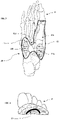
- FIG. 1 represents a 100 insole for a right foot.
- Such a sole 100 is made, for example, from a plate of thermoplastic material (such as, for example, polypropylene filled with glass fibers) and hot deformed, for example by thermoforming.
- thermoplastic material such as, for example, polypropylene filled with glass fibers
- the sole 100 according to the present invention thus has a mechanical elasticity which allows it to deform under stress and to resume an initial shape once the stress is released.
- the sole 100 comprises a front part 10 intended to receive the forefoot, a median zone 30 (or intermediate zone) and a rear zone 20 intended to receive the heel.
- the intermediate part 30 is flexible and connects the front part 10 and the rear part 20 ensuring physical continuity between the two parts 10 and 20.
- the sole 100 also has a peripheral rim 100c forming a heel cup 20a in the rear part 20 to ensure good support for the heel.
- the sole 100 to comprise on its plantar face 100a an eversion module and reverse 40.
- Such a module 40 is characteristic of the present invention.
- the module 40 comprises a first reinforcing element 41 located astride the rear part 20 and the intermediate part 30, and a second reinforcing element 44 located in the rear part 20.
- the first reinforcing element 41 has a first anatomical zone 41a comprising a first arch 42 intended to match the inner part of the foot of the wearer by extending substantially along the joints between the calcaneus, the talus, the navicular bone and the medial cuneiform bone.
- the first reinforcing element 41 also has a second anatomical zone 41b comprising a second arch 43 intended to hug the outer part of the foot of the wearer by extending substantially along the joints between the calcaneus, the cuboid and the fifth metatarsal.
- the second reinforcing element 44 comprises a third anatomical zone 44a intended to be in contact with the tuber peroneal, and a fourth anatomical zone 44b intended to be in contact with the calcaneus, the cuboid and/or the fifth metatarsal.
- first 41a and second 41b zones as well as the third 44a and fourth 44b zones are interconnected respectively by a first 41c and second 44c rigid joining elements.
- first 41 and second 44 reinforcing elements are superposed with respect to each other so that, during an initial support of the foot, the crushing E of the heel on the module 40 causes a bending of the first 41a and third 44a zones.
- This deflection is compensated by the second 41b and fourth 44b zones which in turn causes by compensation a twisting movement V of the intermediate part 30 in the axial direction of the sole 100 followed simultaneously by a raising R of the front part 10 by relative to the intermediate part 30.
- junction elements 41c and 44c which ensure the transmission of energy causing the twist V. Indeed, during the bending of the first 41a and third 44a zones, the junction elements 41c and 44c solicit the second 41b and fourth 44b areas which then serve as a support to compensate for the sagging movement and cause twisting V.
- the module 40 deforms elastically under the pressure of the foot.
- the lowering of the heel is then obtained with a flattening of the arch 41.
- This flattening causes a bending of the zones 41a and 44a followed simultaneously by a twisting V of the intermediate part 30.
- the module 40 allows the raising of the front part 10 with respect to the rest of the sole 100, which promotes the propulsion of the foot.
- the design of the module 40 thus makes it possible to better control the movement of the foot in a gait cycle by promoting the damping and propulsion properties of the foot, in particular by promoting the eversion and inversion movements of the foot.
- the second 41b and fourth 44b zones are substantially coincident with each other, which improves the twist V.
- a rigid or semi-rigid material is preferably used having different coefficients of hardness (between around 10 and 50 Shore A) for the first and second reinforcing elements.
- the coefficient of hardness of the material used for the second reinforcing element be substantially greater than or equal to the coefficient of hardness of the material used for the first reinforcing element.
- a blade 50 on the intermediate part 30 is positioned in the middle part of the intermediate part; it has a flared shape which is substantially curved transversely (shown in figure 4 ) and arcuate longitudinally between the front edge 30a and the rear edge 30b of the intermediate part 30.
- the blade 50 has a radius of curvature sized to form a median retro capital support at the rear of the metatarsal heads of the foot when said foot rests on said sole 100. Such a configuration ensures good propulsion and good support for the foot both statically and dynamically.
- the foot remains held and contained in its inversion and eversion movement (necessary moment of stability) in the stance phase in order to guide the lifting movement of the foot.
- the foot therefore remains maintained, and the module 40 contains the exaggeration of a twisting movement which compromises stability. For different reasons, foot instability causes this inversion/eversion movement.
- the action of the module 40 at this precise moment is to make it possible to contain the crushing movement of the foot without preventing it and to increase the speed by pushing forwards.
- the result is a notion of stability by the deformation carried out by the module 40.
- the role of the module 40 is to stabilize the calcaneo-tibial axis during the time of absorption of the impact on the ground. It is at this moment that the shock must be absorbed and that the member which takes the support must be stable to preserve the progression.
- Maintaining the stabilizing cup 20a and the action of the module 40 makes it possible to preserve the calcaneo-tibial axis in its alignment.
- the deformation of the module 40 allows a slight rise at the back of the metatarsal heads in the form of a median retro capital support, which has the effect of continuing the thrust towards the front and in line with the forefoot.
- the present invention therefore provides foot specialists (podiatrists and others) with a sole making it possible to optimize the stability, the verticality of the whole of the walk by correctly guiding the foot in the axis during the unfolding of the step in the three dimensions.
- the sole 100 stabilizes the calcaneo-tibial axis.
- the sole 100 deforms by twisting and thus propels the mediotarsus ensuring the stability and verticality of the foot and floor above.
- the deformation of the sole 100 continues to the rear of the metatarsal heads, continuing to stabilize the forefoot in its axis.
Landscapes
- Health & Medical Sciences (AREA)
- Epidemiology (AREA)
- General Health & Medical Sciences (AREA)
- Public Health (AREA)
- Life Sciences & Earth Sciences (AREA)
- Chemical & Material Sciences (AREA)
- Engineering & Computer Science (AREA)
- Materials Engineering (AREA)
- Wood Science & Technology (AREA)
- Footwear And Its Accessory, Manufacturing Method And Apparatuses (AREA)
Claims (13)
- Flexible Einlegesohle (100), die geeignet ist, in einem Schuhwerk unter dem Fuß eines Trägers angeordnet zu werden, wobei die Sohle (100) einen vorderen Teil (10) und einen hinteren Teil (20), die dazu bestimmt sind, den Vorderfuß bzw. die Ferse aufzunehmen, und einen flexiblen Zwischenteil (30) umfasst, der den vorderen Teil (10) und den hinteren Teil (20) verbindet,wobei die Einlegesohle (100) auf der Fußsohlenfläche (100a) ein Eversions- und Inversionsmodul (40) umfasst, das Folgendes enthält:- ein erstes Verstärkungselement (41), das sich rittlings zwischen dem hinteren Teil (20) und dem Zwischenteil (30) befindet und Folgendes aufweist:a) einen ersten anatomischen Bereich (41a) mit einer ersten Wölbung (42), die dazu bestimmt ist, sich an den inneren Teil des Fußes des Trägers anzupassen, indem sie sich im Wesentlichen entlang der Gelenke zwischen dem Fersenbein, dem Sprungbein, dem Kahnbein und dem medialen Keilbein erstreckt, undb) einen zweiten anatomischen Bereich (41b) mit einer zweiten Wölbung (43), die dazu bestimmt ist, sich an den äußeren Teil des Fußes des Trägers anzupassen, indem sie sich im Wesentlichen entlang der Gelenke zwischen dem Fersenbein, dem Würfelbein und dem fünften Mittelfußknochen erstreckt; und- ein zweites Verstärkungselement (44), das sich im hinteren Teil (20) befindet und Folgendes aufweist:c) einen dritten anatomischen Bereich (44a), der dazu bestimmt ist, mit dem Tuberkel der Wadenmuskeln in Kontakt zu stehen, undd) einen vierten anatomischen Bereich (44b), der dazu bestimmt ist, mit dem Fersenbein, dem Würfelbein und/oder dem fünften Mittelfußknochen in Kontakt zu stehen,dadurch gekennzeichnet, dass das erste (41) und das zweite (44) Verstärkungselement im Verhältnis zueinander so angeordnet sind, dass sie so zusammenwirken, dass eine Quetschung (E) des Moduls (40) im Bereich des hinteren Teils (20) zu einer Durchbiegung des ersten (41a) und des dritten (44a) Bereichs führt, die durch Kompensation mit dem zweiten (41b) und dem vierten (44b) Bereich eine Verdrehbewegung (V) des Zwischenteils (30) in der axialen Richtung der Sohle (100) und eine Erhöhung (R) des Vorderteils (10) im Verhältnis zu dem Zwischenteil (30) bewirkt,wobei der Zwischenteil (30) in seinem mittleren Teil eine Platte (50) enthält, die im Wesentlichen quer gekrümmt und in Längsrichtung zwischen der Vorderkante (30a) und der Hinterkante (30b) des Zwischenteils (30) gebogen ist, wobei der erste (41a) und der zweite (41b) Bereich im Bereich des Zwischenteils (30) auf beiden Seiten der Platte (50) angeordnet sind, undwobei der Krümmungsradius der Platte (50) so bemessen ist, dass sie eine mediale retrokapitale Auflage im Bereich der Rückseite der Metatarsalköpfchen des Fußes bildet, wenn der Fuß auf der Sohle (100) ruht.
- Sohle (100) nach Anspruch 1, wobei das erste (41) und das zweite (44) Verstärkungselement übereinander angeordnet sind.
- Sohle (100) nach Anspruch 1, wobei das erste (41) und das zweite (44) Verstärkungselement ineinander verschachtelt sind.
- Sohle (100) nach einem der Ansprüche 1 bis 3, wobei das erste (41) und das zweite (44) Verstärkungselement so im Verhältnis zueinander angeordnet sind, dass der zweite (41b) und der vierte (44b) Bereich im Wesentlichen zusammenfallen.
- Sohle (100) nach einem der vorhergehenden Ansprüche, die zumindest teilweise aus einem elastisch verformbaren Material vom Typ zum Beispiel eines thermoplastischen Verbundharzes besteht.
- Sohle (100) nach Anspruch 5, wobei das elastisch verformbare Material mit Glasfasern gefüllt ist.
- Sohle (100) nach Anspruch 5 oder 6, wobei das elastisch verformbare Material aus Polypropylen besteht.
- Sohle (100) nach einem der vorhergehenden Ansprüche, wobei das erste (41) und das zweite (44) Verstärkungselement zumindest teilweise aus einem steifen oder halbsteifen Material bestehen, das einen ersten bzw. einen zweiten bestimmten Härtekoeffizienten aufweist, wobei der zweite Härtekoeffizient größer oder gleich dem ersten Härtekoeffizienten ist.
- Sohle (100) nach einem der vorhergehenden Ansprüche, wobei sich die erste Wölbung (42) im hinteren Teil (20) bis zum hinteren Ende der Sohle (100) fortsetzt.
- Sohle (100) nach einem der vorhergehenden Ansprüche, die einen umlaufenden Rand (100c) aufweist, der die erste (42) und die zweite (43) Wölbung verlängert und im hinteren Teil (20) eine Fersenschale (20a) bildet.
- Sohle (100) nach Anspruch 10, wobei der höchste Teil des hinteren Teils (20) auf der Innenseite des Fußes liegt.
- Sohle (100) nach einem der vorhergehenden Ansprüche, wobei der erste (41a) und der zweite (41b) Bereich und der dritte (44a) und der vierte (44b) Bereich jeweils durch ein erstes (41c) und ein zweites (44c) starres Verbindungselement miteinander verbunden sind.
- Orthopädischer Schuh, der dadurch gekennzeichnet ist, dass er eine Einlegesohle (100) nach einem der vorhergehenden Ansprüche aufweist.
Applications Claiming Priority (2)
| Application Number | Priority Date | Filing Date | Title |
|---|---|---|---|
| FR1853229A FR3080007B1 (fr) | 2018-04-13 | 2018-04-13 | Semelle interieure flexible pour article chaussant et chaussure orthopedique comprenant une telle semelle |
| PCT/FR2019/050755 WO2019197749A1 (fr) | 2018-04-13 | 2019-04-01 | Semelle interieure flexible pour article chaussant et chaussure orthopedique comprenant une telle semelle |
Publications (2)
| Publication Number | Publication Date |
|---|---|
| EP3773045A1 EP3773045A1 (de) | 2021-02-17 |
| EP3773045B1 true EP3773045B1 (de) | 2023-03-01 |
Family
ID=62684917
Family Applications (1)
| Application Number | Title | Priority Date | Filing Date |
|---|---|---|---|
| EP19719567.0A Active EP3773045B1 (de) | 2018-04-13 | 2019-04-01 | Flexible einlegesohle für einen schuhartikel und orthopädischer schuh mit einer solchen einlegesohle |
Country Status (4)
| Country | Link |
|---|---|
| EP (1) | EP3773045B1 (de) |
| CA (1) | CA3094040A1 (de) |
| FR (1) | FR3080007B1 (de) |
| WO (1) | WO2019197749A1 (de) |
Family Cites Families (4)
| Publication number | Priority date | Publication date | Assignee | Title |
|---|---|---|---|---|
| FR2794005B1 (fr) * | 1999-05-26 | 2001-06-29 | Imp Ation De Diffusion Ou Dist | Semelle de chaussure |
| DE19948545A1 (de) * | 1999-10-08 | 2001-04-12 | Globus Berkemann Gmbh & Co Kg | Orthopädische Schuheinlage |
| FR2941135B1 (fr) * | 2009-01-19 | 2011-01-14 | Podo Concept | Module orthopedique |
| TWI569743B (zh) * | 2016-01-15 | 2017-02-11 | 歐立達股份有限公司 | 具足部三維運動控制及足壓分散之裝置 |
-
2018
- 2018-04-13 FR FR1853229A patent/FR3080007B1/fr not_active Expired - Fee Related
-
2019
- 2019-04-01 EP EP19719567.0A patent/EP3773045B1/de active Active
- 2019-04-01 CA CA3094040A patent/CA3094040A1/fr active Pending
- 2019-04-01 WO PCT/FR2019/050755 patent/WO2019197749A1/fr not_active Ceased
Also Published As
| Publication number | Publication date |
|---|---|
| FR3080007B1 (fr) | 2020-03-13 |
| FR3080007A1 (fr) | 2019-10-18 |
| CA3094040A1 (fr) | 2019-10-17 |
| EP3773045A1 (de) | 2021-02-17 |
| WO2019197749A1 (fr) | 2019-10-17 |
Similar Documents
| Publication | Publication Date | Title |
|---|---|---|
| EP3387937B1 (de) | Schuh mit verbesserter sohle | |
| BE1004224A3 (fr) | Dispositif de stabilisation et de ressort de talon de chaussure. | |
| EP2544637B1 (de) | Orthopädische vorrichtung zur mechanischen behandlung von hallux valgus | |
| EP2394523A1 (de) | Schuh mit verbessertem Laufkomfort | |
| FR3046723A1 (fr) | Dispositif pour le controle tridimensionnel du mouvement d'un pied et la redistribution de la pression plantaire | |
| EP0887027A1 (de) | Mehrschichtige Sohle angeordnet an einem Versteifungselement für den Schuhoberteil | |
| FR2683432A1 (fr) | Chausure de sport legere. | |
| EP2434918B1 (de) | Sportschuh mit stollen | |
| EP2645895B1 (de) | Sportschuh mit stollen | |
| EP1857005A1 (de) | Stoßdämpfende Sohle und Schuhwerk mit stoßdämpfender Sohle | |
| EP1021102B1 (de) | FUSS-STüTZVORRICHTUNG IN EINEN SPORTSCHUH | |
| EP3773045B1 (de) | Flexible einlegesohle für einen schuhartikel und orthopädischer schuh mit einer solchen einlegesohle | |
| EP0394435A1 (de) | Innensohle für tanzschuh | |
| WO2020099436A1 (fr) | Chaussure de sport incorporant une premiere de montage optimisee | |
| EP1765232B1 (de) | Schuhfersenschale, und schuh mit entsprechender fersenschale versehen | |
| EP3232846B1 (de) | Aussensohle für schuhwerk mit dämpfungsstollen | |
| FR2662916A1 (fr) | Chaussure multi-usages a section sous-astragalienne deformable. | |
| EP3880023A1 (de) | Sohle eines schuhs mit einer bevorzugten biegezone und schuh mit solch einer aussensohle | |
| FR2808977A1 (fr) | Orthese dynamique bifonctionnelle pour chaussures | |
| FR2501480A1 (fr) | Semelle dynamique a action orthotique pour chaussure | |
| FR3033685A1 (fr) | Semelle interieure pour article chaussant | |
| FR2757024A1 (fr) | Semelle active anatomo-physiologique permettant des effets d'autoelongation activo-passif sur le pied et sa voute pendant la marche ou la course | |
| FR3152110A1 (fr) | Semelle pour chaussure, notamment de type tong ou sandale | |
| FR3093407A1 (fr) | Chaussure de type tong ou sandale |
Legal Events
| Date | Code | Title | Description |
|---|---|---|---|
| STAA | Information on the status of an ep patent application or granted ep patent |
Free format text: STATUS: UNKNOWN |
|
| STAA | Information on the status of an ep patent application or granted ep patent |
Free format text: STATUS: THE INTERNATIONAL PUBLICATION HAS BEEN MADE |
|
| PUAI | Public reference made under article 153(3) epc to a published international application that has entered the european phase |
Free format text: ORIGINAL CODE: 0009012 |
|
| STAA | Information on the status of an ep patent application or granted ep patent |
Free format text: STATUS: REQUEST FOR EXAMINATION WAS MADE |
|
| 17P | Request for examination filed |
Effective date: 20200917 |
|
| AK | Designated contracting states |
Kind code of ref document: A1 Designated state(s): AL AT BE BG CH CY CZ DE DK EE ES FI FR GB GR HR HU IE IS IT LI LT LU LV MC MK MT NL NO PL PT RO RS SE SI SK SM TR |
|
| AX | Request for extension of the european patent |
Extension state: BA ME |
|
| DAV | Request for validation of the european patent (deleted) | ||
| DAX | Request for extension of the european patent (deleted) | ||
| STAA | Information on the status of an ep patent application or granted ep patent |
Free format text: STATUS: EXAMINATION IS IN PROGRESS |
|
| 17Q | First examination report despatched |
Effective date: 20220105 |
|
| RIC1 | Information provided on ipc code assigned before grant |
Ipc: A43B 13/02 20060101ALN20220907BHEP Ipc: A43B 7/22 20060101ALI20220907BHEP Ipc: A43B 17/00 20060101ALI20220907BHEP Ipc: A43B 7/143 20220101ALI20220907BHEP Ipc: A43B 7/142 20220101ALI20220907BHEP Ipc: A43B 7/1405 20220101AFI20220907BHEP |
|
| REG | Reference to a national code |
Ref country code: DE Ref legal event code: R079 Ref document number: 602019025837 Country of ref document: DE Free format text: PREVIOUS MAIN CLASS: A43B0007140000 Ipc: A43B0007140500 |
|
| RIC1 | Information provided on ipc code assigned before grant |
Ipc: A43B 13/02 20060101ALN20221019BHEP Ipc: A43B 7/22 20060101ALI20221019BHEP Ipc: A43B 17/00 20060101ALI20221019BHEP Ipc: A43B 7/143 20220101ALI20221019BHEP Ipc: A43B 7/142 20220101ALI20221019BHEP Ipc: A43B 7/1405 20220101AFI20221019BHEP |
|
| GRAP | Despatch of communication of intention to grant a patent |
Free format text: ORIGINAL CODE: EPIDOSNIGR1 |
|
| STAA | Information on the status of an ep patent application or granted ep patent |
Free format text: STATUS: GRANT OF PATENT IS INTENDED |
|
| INTG | Intention to grant announced |
Effective date: 20221130 |
|
| GRAS | Grant fee paid |
Free format text: ORIGINAL CODE: EPIDOSNIGR3 |
|
| GRAA | (expected) grant |
Free format text: ORIGINAL CODE: 0009210 |
|
| STAA | Information on the status of an ep patent application or granted ep patent |
Free format text: STATUS: THE PATENT HAS BEEN GRANTED |
|
| AK | Designated contracting states |
Kind code of ref document: B1 Designated state(s): AL AT BE BG CH CY CZ DE DK EE ES FI FR GB GR HR HU IE IS IT LI LT LU LV MC MK MT NL NO PL PT RO RS SE SI SK SM TR |
|
| REG | Reference to a national code |
Ref country code: GB Ref legal event code: FG4D Free format text: NOT ENGLISH |
|
| REG | Reference to a national code |
Ref country code: CH Ref legal event code: EP Ref country code: AT Ref legal event code: REF Ref document number: 1550404 Country of ref document: AT Kind code of ref document: T Effective date: 20230315 |
|
| REG | Reference to a national code |
Ref country code: DE Ref legal event code: R096 Ref document number: 602019025837 Country of ref document: DE |
|
| REG | Reference to a national code |
Ref country code: IE Ref legal event code: FG4D Free format text: LANGUAGE OF EP DOCUMENT: FRENCH |
|
| REG | Reference to a national code |
Ref country code: LT Ref legal event code: MG9D |
|
| REG | Reference to a national code |
Ref country code: NL Ref legal event code: MP Effective date: 20230301 |
|
| PG25 | Lapsed in a contracting state [announced via postgrant information from national office to epo] |
Ref country code: RS Free format text: LAPSE BECAUSE OF FAILURE TO SUBMIT A TRANSLATION OF THE DESCRIPTION OR TO PAY THE FEE WITHIN THE PRESCRIBED TIME-LIMIT Effective date: 20230301 Ref country code: NO Free format text: LAPSE BECAUSE OF FAILURE TO SUBMIT A TRANSLATION OF THE DESCRIPTION OR TO PAY THE FEE WITHIN THE PRESCRIBED TIME-LIMIT Effective date: 20230601 Ref country code: LV Free format text: LAPSE BECAUSE OF FAILURE TO SUBMIT A TRANSLATION OF THE DESCRIPTION OR TO PAY THE FEE WITHIN THE PRESCRIBED TIME-LIMIT Effective date: 20230301 Ref country code: LT Free format text: LAPSE BECAUSE OF FAILURE TO SUBMIT A TRANSLATION OF THE DESCRIPTION OR TO PAY THE FEE WITHIN THE PRESCRIBED TIME-LIMIT Effective date: 20230301 Ref country code: HR Free format text: LAPSE BECAUSE OF FAILURE TO SUBMIT A TRANSLATION OF THE DESCRIPTION OR TO PAY THE FEE WITHIN THE PRESCRIBED TIME-LIMIT Effective date: 20230301 Ref country code: ES Free format text: LAPSE BECAUSE OF FAILURE TO SUBMIT A TRANSLATION OF THE DESCRIPTION OR TO PAY THE FEE WITHIN THE PRESCRIBED TIME-LIMIT Effective date: 20230301 |
|
| REG | Reference to a national code |
Ref country code: AT Ref legal event code: MK05 Ref document number: 1550404 Country of ref document: AT Kind code of ref document: T Effective date: 20230301 |
|
| PG25 | Lapsed in a contracting state [announced via postgrant information from national office to epo] |
Ref country code: SE Free format text: LAPSE BECAUSE OF FAILURE TO SUBMIT A TRANSLATION OF THE DESCRIPTION OR TO PAY THE FEE WITHIN THE PRESCRIBED TIME-LIMIT Effective date: 20230301 Ref country code: PL Free format text: LAPSE BECAUSE OF FAILURE TO SUBMIT A TRANSLATION OF THE DESCRIPTION OR TO PAY THE FEE WITHIN THE PRESCRIBED TIME-LIMIT Effective date: 20230301 Ref country code: NL Free format text: LAPSE BECAUSE OF FAILURE TO SUBMIT A TRANSLATION OF THE DESCRIPTION OR TO PAY THE FEE WITHIN THE PRESCRIBED TIME-LIMIT Effective date: 20230301 Ref country code: GR Free format text: LAPSE BECAUSE OF FAILURE TO SUBMIT A TRANSLATION OF THE DESCRIPTION OR TO PAY THE FEE WITHIN THE PRESCRIBED TIME-LIMIT Effective date: 20230602 Ref country code: FI Free format text: LAPSE BECAUSE OF FAILURE TO SUBMIT A TRANSLATION OF THE DESCRIPTION OR TO PAY THE FEE WITHIN THE PRESCRIBED TIME-LIMIT Effective date: 20230301 |
|
| PG25 | Lapsed in a contracting state [announced via postgrant information from national office to epo] |
Ref country code: SM Free format text: LAPSE BECAUSE OF FAILURE TO SUBMIT A TRANSLATION OF THE DESCRIPTION OR TO PAY THE FEE WITHIN THE PRESCRIBED TIME-LIMIT Effective date: 20230301 Ref country code: RO Free format text: LAPSE BECAUSE OF FAILURE TO SUBMIT A TRANSLATION OF THE DESCRIPTION OR TO PAY THE FEE WITHIN THE PRESCRIBED TIME-LIMIT Effective date: 20230301 Ref country code: PT Free format text: LAPSE BECAUSE OF FAILURE TO SUBMIT A TRANSLATION OF THE DESCRIPTION OR TO PAY THE FEE WITHIN THE PRESCRIBED TIME-LIMIT Effective date: 20230703 Ref country code: EE Free format text: LAPSE BECAUSE OF FAILURE TO SUBMIT A TRANSLATION OF THE DESCRIPTION OR TO PAY THE FEE WITHIN THE PRESCRIBED TIME-LIMIT Effective date: 20230301 Ref country code: CZ Free format text: LAPSE BECAUSE OF FAILURE TO SUBMIT A TRANSLATION OF THE DESCRIPTION OR TO PAY THE FEE WITHIN THE PRESCRIBED TIME-LIMIT Effective date: 20230301 Ref country code: AT Free format text: LAPSE BECAUSE OF FAILURE TO SUBMIT A TRANSLATION OF THE DESCRIPTION OR TO PAY THE FEE WITHIN THE PRESCRIBED TIME-LIMIT Effective date: 20230301 |
|
| REG | Reference to a national code |
Ref country code: DE Ref legal event code: R119 Ref document number: 602019025837 Country of ref document: DE |
|
| PG25 | Lapsed in a contracting state [announced via postgrant information from national office to epo] |
Ref country code: SK Free format text: LAPSE BECAUSE OF FAILURE TO SUBMIT A TRANSLATION OF THE DESCRIPTION OR TO PAY THE FEE WITHIN THE PRESCRIBED TIME-LIMIT Effective date: 20230301 Ref country code: IS Free format text: LAPSE BECAUSE OF FAILURE TO SUBMIT A TRANSLATION OF THE DESCRIPTION OR TO PAY THE FEE WITHIN THE PRESCRIBED TIME-LIMIT Effective date: 20230701 |
|
| REG | Reference to a national code |
Ref country code: CH Ref legal event code: PL |
|
| PG25 | Lapsed in a contracting state [announced via postgrant information from national office to epo] |
Ref country code: LU Free format text: LAPSE BECAUSE OF NON-PAYMENT OF DUE FEES Effective date: 20230401 |
|
| PLBE | No opposition filed within time limit |
Free format text: ORIGINAL CODE: 0009261 |
|
| STAA | Information on the status of an ep patent application or granted ep patent |
Free format text: STATUS: NO OPPOSITION FILED WITHIN TIME LIMIT |
|
| REG | Reference to a national code |
Ref country code: BE Ref legal event code: MM Effective date: 20230430 |
|
| PG25 | Lapsed in a contracting state [announced via postgrant information from national office to epo] |
Ref country code: MC Free format text: LAPSE BECAUSE OF FAILURE TO SUBMIT A TRANSLATION OF THE DESCRIPTION OR TO PAY THE FEE WITHIN THE PRESCRIBED TIME-LIMIT Effective date: 20230301 |
|
| PG25 | Lapsed in a contracting state [announced via postgrant information from national office to epo] |
Ref country code: SI Free format text: LAPSE BECAUSE OF FAILURE TO SUBMIT A TRANSLATION OF THE DESCRIPTION OR TO PAY THE FEE WITHIN THE PRESCRIBED TIME-LIMIT Effective date: 20230301 Ref country code: MC Free format text: LAPSE BECAUSE OF FAILURE TO SUBMIT A TRANSLATION OF THE DESCRIPTION OR TO PAY THE FEE WITHIN THE PRESCRIBED TIME-LIMIT Effective date: 20230301 Ref country code: LI Free format text: LAPSE BECAUSE OF NON-PAYMENT OF DUE FEES Effective date: 20230430 Ref country code: DK Free format text: LAPSE BECAUSE OF FAILURE TO SUBMIT A TRANSLATION OF THE DESCRIPTION OR TO PAY THE FEE WITHIN THE PRESCRIBED TIME-LIMIT Effective date: 20230301 Ref country code: DE Free format text: LAPSE BECAUSE OF NON-PAYMENT OF DUE FEES Effective date: 20231103 Ref country code: CH Free format text: LAPSE BECAUSE OF NON-PAYMENT OF DUE FEES Effective date: 20230430 |
|
| 26N | No opposition filed |
Effective date: 20231204 |
|
| REG | Reference to a national code |
Ref country code: IE Ref legal event code: MM4A |
|
| GBPC | Gb: european patent ceased through non-payment of renewal fee |
Effective date: 20230601 |
|
| PG25 | Lapsed in a contracting state [announced via postgrant information from national office to epo] |
Ref country code: BE Free format text: LAPSE BECAUSE OF NON-PAYMENT OF DUE FEES Effective date: 20230430 |
|
| PG25 | Lapsed in a contracting state [announced via postgrant information from national office to epo] |
Ref country code: IE Free format text: LAPSE BECAUSE OF NON-PAYMENT OF DUE FEES Effective date: 20230401 |
|
| PG25 | Lapsed in a contracting state [announced via postgrant information from national office to epo] |
Ref country code: IE Free format text: LAPSE BECAUSE OF NON-PAYMENT OF DUE FEES Effective date: 20230401 Ref country code: GB Free format text: LAPSE BECAUSE OF NON-PAYMENT OF DUE FEES Effective date: 20230601 |
|
| PG25 | Lapsed in a contracting state [announced via postgrant information from national office to epo] |
Ref country code: IT Free format text: LAPSE BECAUSE OF FAILURE TO SUBMIT A TRANSLATION OF THE DESCRIPTION OR TO PAY THE FEE WITHIN THE PRESCRIBED TIME-LIMIT Effective date: 20230301 |
|
| PG25 | Lapsed in a contracting state [announced via postgrant information from national office to epo] |
Ref country code: BG Free format text: LAPSE BECAUSE OF FAILURE TO SUBMIT A TRANSLATION OF THE DESCRIPTION OR TO PAY THE FEE WITHIN THE PRESCRIBED TIME-LIMIT Effective date: 20230301 |
|
| PG25 | Lapsed in a contracting state [announced via postgrant information from national office to epo] |
Ref country code: BG Free format text: LAPSE BECAUSE OF FAILURE TO SUBMIT A TRANSLATION OF THE DESCRIPTION OR TO PAY THE FEE WITHIN THE PRESCRIBED TIME-LIMIT Effective date: 20230301 |
|
| PGFP | Annual fee paid to national office [announced via postgrant information from national office to epo] |
Ref country code: FR Payment date: 20250228 Year of fee payment: 7 |
|
| PG25 | Lapsed in a contracting state [announced via postgrant information from national office to epo] |
Ref country code: CY Free format text: LAPSE BECAUSE OF FAILURE TO SUBMIT A TRANSLATION OF THE DESCRIPTION OR TO PAY THE FEE WITHIN THE PRESCRIBED TIME-LIMIT; INVALID AB INITIO Effective date: 20190401 |
|
| PG25 | Lapsed in a contracting state [announced via postgrant information from national office to epo] |
Ref country code: HU Free format text: LAPSE BECAUSE OF FAILURE TO SUBMIT A TRANSLATION OF THE DESCRIPTION OR TO PAY THE FEE WITHIN THE PRESCRIBED TIME-LIMIT; INVALID AB INITIO Effective date: 20190401 |
|
| PG25 | Lapsed in a contracting state [announced via postgrant information from national office to epo] |
Ref country code: TR Free format text: LAPSE BECAUSE OF FAILURE TO SUBMIT A TRANSLATION OF THE DESCRIPTION OR TO PAY THE FEE WITHIN THE PRESCRIBED TIME-LIMIT Effective date: 20230301 |