EP3774681B1 - Unité de vitrage multiple - Google Patents
Unité de vitrage multiple Download PDFInfo
- Publication number
- EP3774681B1 EP3774681B1 EP19714700.2A EP19714700A EP3774681B1 EP 3774681 B1 EP3774681 B1 EP 3774681B1 EP 19714700 A EP19714700 A EP 19714700A EP 3774681 B1 EP3774681 B1 EP 3774681B1
- Authority
- EP
- European Patent Office
- Prior art keywords
- glazing unit
- multiple glazing
- layer
- glass pane
- tco
- Prior art date
- Legal status (The legal status is an assumption and is not a legal conclusion. Google has not performed a legal analysis and makes no representation as to the accuracy of the status listed.)
- Active
Links
Images

Classifications
-
- B—PERFORMING OPERATIONS; TRANSPORTING
- B32—LAYERED PRODUCTS
- B32B—LAYERED PRODUCTS, i.e. PRODUCTS BUILT-UP OF STRATA OF FLAT OR NON-FLAT, e.g. CELLULAR OR HONEYCOMB, FORM
- B32B17/00—Layered products essentially comprising sheet glass, or glass, slag, or like fibres
- B32B17/06—Layered products essentially comprising sheet glass, or glass, slag, or like fibres comprising glass as the main or only constituent of a layer, next to another layer of a specific material
- B32B17/10—Layered products essentially comprising sheet glass, or glass, slag, or like fibres comprising glass as the main or only constituent of a layer, next to another layer of a specific material of synthetic resin
- B32B17/10005—Layered products essentially comprising sheet glass, or glass, slag, or like fibres comprising glass as the main or only constituent of a layer, next to another layer of a specific material of synthetic resin laminated safety glass or glazing
- B32B17/10009—Layered products essentially comprising sheet glass, or glass, slag, or like fibres comprising glass as the main or only constituent of a layer, next to another layer of a specific material of synthetic resin laminated safety glass or glazing characterized by the number, the constitution or treatment of glass sheets
- B32B17/10082—Properties of the bulk of a glass sheet
- B32B17/10091—Properties of the bulk of a glass sheet thermally hardened
-
- C—CHEMISTRY; METALLURGY
- C03—GLASS; MINERAL OR SLAG WOOL
- C03C—CHEMICAL COMPOSITION OF GLASSES, GLAZES OR VITREOUS ENAMELS; SURFACE TREATMENT OF GLASS; SURFACE TREATMENT OF FIBRES OR FILAMENTS MADE FROM GLASS, MINERALS OR SLAGS; JOINING GLASS TO GLASS OR OTHER MATERIALS
- C03C17/00—Surface treatment of glass, not in the form of fibres or filaments, by coating
- C03C17/001—General methods for coating; Devices therefor
- C03C17/002—General methods for coating; Devices therefor for flat glass, e.g. float glass
-
- C—CHEMISTRY; METALLURGY
- C03—GLASS; MINERAL OR SLAG WOOL
- C03C—CHEMICAL COMPOSITION OF GLASSES, GLAZES OR VITREOUS ENAMELS; SURFACE TREATMENT OF GLASS; SURFACE TREATMENT OF FIBRES OR FILAMENTS MADE FROM GLASS, MINERALS OR SLAGS; JOINING GLASS TO GLASS OR OTHER MATERIALS
- C03C17/00—Surface treatment of glass, not in the form of fibres or filaments, by coating
- C03C17/34—Surface treatment of glass, not in the form of fibres or filaments, by coating with at least two coatings having different compositions
- C03C17/3411—Surface treatment of glass, not in the form of fibres or filaments, by coating with at least two coatings having different compositions with at least two coatings of inorganic materials
- C03C17/3429—Surface treatment of glass, not in the form of fibres or filaments, by coating with at least two coatings having different compositions with at least two coatings of inorganic materials at least one of the coatings being a non-oxide coating
- C03C17/3441—Surface treatment of glass, not in the form of fibres or filaments, by coating with at least two coatings having different compositions with at least two coatings of inorganic materials at least one of the coatings being a non-oxide coating comprising carbon, a carbide or oxycarbide
-
- C—CHEMISTRY; METALLURGY
- C03—GLASS; MINERAL OR SLAG WOOL
- C03C—CHEMICAL COMPOSITION OF GLASSES, GLAZES OR VITREOUS ENAMELS; SURFACE TREATMENT OF GLASS; SURFACE TREATMENT OF FIBRES OR FILAMENTS MADE FROM GLASS, MINERALS OR SLAGS; JOINING GLASS TO GLASS OR OTHER MATERIALS
- C03C17/00—Surface treatment of glass, not in the form of fibres or filaments, by coating
- C03C17/34—Surface treatment of glass, not in the form of fibres or filaments, by coating with at least two coatings having different compositions
- C03C17/36—Surface treatment of glass, not in the form of fibres or filaments, by coating with at least two coatings having different compositions at least one coating being a metal
-
- C—CHEMISTRY; METALLURGY
- C03—GLASS; MINERAL OR SLAG WOOL
- C03C—CHEMICAL COMPOSITION OF GLASSES, GLAZES OR VITREOUS ENAMELS; SURFACE TREATMENT OF GLASS; SURFACE TREATMENT OF FIBRES OR FILAMENTS MADE FROM GLASS, MINERALS OR SLAGS; JOINING GLASS TO GLASS OR OTHER MATERIALS
- C03C17/00—Surface treatment of glass, not in the form of fibres or filaments, by coating
- C03C17/34—Surface treatment of glass, not in the form of fibres or filaments, by coating with at least two coatings having different compositions
- C03C17/36—Surface treatment of glass, not in the form of fibres or filaments, by coating with at least two coatings having different compositions at least one coating being a metal
- C03C17/3602—Surface treatment of glass, not in the form of fibres or filaments, by coating with at least two coatings having different compositions at least one coating being a metal the metal being present as a layer
- C03C17/3618—Coatings of type glass/inorganic compound/other inorganic layers, at least one layer being metallic
-
- C—CHEMISTRY; METALLURGY
- C03—GLASS; MINERAL OR SLAG WOOL
- C03C—CHEMICAL COMPOSITION OF GLASSES, GLAZES OR VITREOUS ENAMELS; SURFACE TREATMENT OF GLASS; SURFACE TREATMENT OF FIBRES OR FILAMENTS MADE FROM GLASS, MINERALS OR SLAGS; JOINING GLASS TO GLASS OR OTHER MATERIALS
- C03C17/00—Surface treatment of glass, not in the form of fibres or filaments, by coating
- C03C17/34—Surface treatment of glass, not in the form of fibres or filaments, by coating with at least two coatings having different compositions
- C03C17/36—Surface treatment of glass, not in the form of fibres or filaments, by coating with at least two coatings having different compositions at least one coating being a metal
- C03C17/3602—Surface treatment of glass, not in the form of fibres or filaments, by coating with at least two coatings having different compositions at least one coating being a metal the metal being present as a layer
- C03C17/3626—Surface treatment of glass, not in the form of fibres or filaments, by coating with at least two coatings having different compositions at least one coating being a metal the metal being present as a layer one layer at least containing a nitride, oxynitride, boronitride or carbonitride
-
- C—CHEMISTRY; METALLURGY
- C03—GLASS; MINERAL OR SLAG WOOL
- C03C—CHEMICAL COMPOSITION OF GLASSES, GLAZES OR VITREOUS ENAMELS; SURFACE TREATMENT OF GLASS; SURFACE TREATMENT OF FIBRES OR FILAMENTS MADE FROM GLASS, MINERALS OR SLAGS; JOINING GLASS TO GLASS OR OTHER MATERIALS
- C03C17/00—Surface treatment of glass, not in the form of fibres or filaments, by coating
- C03C17/34—Surface treatment of glass, not in the form of fibres or filaments, by coating with at least two coatings having different compositions
- C03C17/36—Surface treatment of glass, not in the form of fibres or filaments, by coating with at least two coatings having different compositions at least one coating being a metal
- C03C17/3602—Surface treatment of glass, not in the form of fibres or filaments, by coating with at least two coatings having different compositions at least one coating being a metal the metal being present as a layer
- C03C17/3634—Surface treatment of glass, not in the form of fibres or filaments, by coating with at least two coatings having different compositions at least one coating being a metal the metal being present as a layer one layer at least containing carbon, a carbide or oxycarbide
-
- C—CHEMISTRY; METALLURGY
- C03—GLASS; MINERAL OR SLAG WOOL
- C03C—CHEMICAL COMPOSITION OF GLASSES, GLAZES OR VITREOUS ENAMELS; SURFACE TREATMENT OF GLASS; SURFACE TREATMENT OF FIBRES OR FILAMENTS MADE FROM GLASS, MINERALS OR SLAGS; JOINING GLASS TO GLASS OR OTHER MATERIALS
- C03C17/00—Surface treatment of glass, not in the form of fibres or filaments, by coating
- C03C17/34—Surface treatment of glass, not in the form of fibres or filaments, by coating with at least two coatings having different compositions
- C03C17/36—Surface treatment of glass, not in the form of fibres or filaments, by coating with at least two coatings having different compositions at least one coating being a metal
- C03C17/3602—Surface treatment of glass, not in the form of fibres or filaments, by coating with at least two coatings having different compositions at least one coating being a metal the metal being present as a layer
- C03C17/3644—Surface treatment of glass, not in the form of fibres or filaments, by coating with at least two coatings having different compositions at least one coating being a metal the metal being present as a layer the metal being silver
-
- C—CHEMISTRY; METALLURGY
- C03—GLASS; MINERAL OR SLAG WOOL
- C03C—CHEMICAL COMPOSITION OF GLASSES, GLAZES OR VITREOUS ENAMELS; SURFACE TREATMENT OF GLASS; SURFACE TREATMENT OF FIBRES OR FILAMENTS MADE FROM GLASS, MINERALS OR SLAGS; JOINING GLASS TO GLASS OR OTHER MATERIALS
- C03C17/00—Surface treatment of glass, not in the form of fibres or filaments, by coating
- C03C17/34—Surface treatment of glass, not in the form of fibres or filaments, by coating with at least two coatings having different compositions
- C03C17/36—Surface treatment of glass, not in the form of fibres or filaments, by coating with at least two coatings having different compositions at least one coating being a metal
- C03C17/3602—Surface treatment of glass, not in the form of fibres or filaments, by coating with at least two coatings having different compositions at least one coating being a metal the metal being present as a layer
- C03C17/3657—Surface treatment of glass, not in the form of fibres or filaments, by coating with at least two coatings having different compositions at least one coating being a metal the metal being present as a layer the multilayer coating having optical properties
- C03C17/366—Low-emissivity or solar control coatings
-
- C—CHEMISTRY; METALLURGY
- C03—GLASS; MINERAL OR SLAG WOOL
- C03C—CHEMICAL COMPOSITION OF GLASSES, GLAZES OR VITREOUS ENAMELS; SURFACE TREATMENT OF GLASS; SURFACE TREATMENT OF FIBRES OR FILAMENTS MADE FROM GLASS, MINERALS OR SLAGS; JOINING GLASS TO GLASS OR OTHER MATERIALS
- C03C17/00—Surface treatment of glass, not in the form of fibres or filaments, by coating
- C03C17/34—Surface treatment of glass, not in the form of fibres or filaments, by coating with at least two coatings having different compositions
- C03C17/36—Surface treatment of glass, not in the form of fibres or filaments, by coating with at least two coatings having different compositions at least one coating being a metal
- C03C17/3602—Surface treatment of glass, not in the form of fibres or filaments, by coating with at least two coatings having different compositions at least one coating being a metal the metal being present as a layer
- C03C17/3681—Surface treatment of glass, not in the form of fibres or filaments, by coating with at least two coatings having different compositions at least one coating being a metal the metal being present as a layer the multilayer coating being used in glazing, e.g. windows or windscreens
-
- E—FIXED CONSTRUCTIONS
- E06—DOORS, WINDOWS, SHUTTERS, OR ROLLER BLINDS IN GENERAL; LADDERS
- E06B—FIXED OR MOVABLE CLOSURES FOR OPENINGS IN BUILDINGS, VEHICLES, FENCES OR LIKE ENCLOSURES IN GENERAL, e.g. DOORS, WINDOWS, BLINDS, GATES
- E06B3/00—Window sashes, door leaves, or like elements for closing wall or like openings; Layout of fixed or moving closures, e.g. windows in wall or like openings; Features of rigidly-mounted outer frames relating to the mounting of wing frames
- E06B3/66—Units comprising two or more parallel glass or like panes permanently secured together
- E06B3/6617—Units comprising two or more parallel glass or like panes permanently secured together one of the panes being larger than another
-
- E—FIXED CONSTRUCTIONS
- E06—DOORS, WINDOWS, SHUTTERS, OR ROLLER BLINDS IN GENERAL; LADDERS
- E06B—FIXED OR MOVABLE CLOSURES FOR OPENINGS IN BUILDINGS, VEHICLES, FENCES OR LIKE ENCLOSURES IN GENERAL, e.g. DOORS, WINDOWS, BLINDS, GATES
- E06B3/00—Window sashes, door leaves, or like elements for closing wall or like openings; Layout of fixed or moving closures, e.g. windows in wall or like openings; Features of rigidly-mounted outer frames relating to the mounting of wing frames
- E06B3/66—Units comprising two or more parallel glass or like panes permanently secured together
- E06B3/6621—Units comprising two or more parallel glass or like panes permanently secured together with special provisions for fitting in window frames or to adjacent units; Separate edge protecting strips
-
- B—PERFORMING OPERATIONS; TRANSPORTING
- B32—LAYERED PRODUCTS
- B32B—LAYERED PRODUCTS, i.e. PRODUCTS BUILT-UP OF STRATA OF FLAT OR NON-FLAT, e.g. CELLULAR OR HONEYCOMB, FORM
- B32B17/00—Layered products essentially comprising sheet glass, or glass, slag, or like fibres
- B32B17/06—Layered products essentially comprising sheet glass, or glass, slag, or like fibres comprising glass as the main or only constituent of a layer, next to another layer of a specific material
- B32B17/10—Layered products essentially comprising sheet glass, or glass, slag, or like fibres comprising glass as the main or only constituent of a layer, next to another layer of a specific material of synthetic resin
- B32B17/10005—Layered products essentially comprising sheet glass, or glass, slag, or like fibres comprising glass as the main or only constituent of a layer, next to another layer of a specific material of synthetic resin laminated safety glass or glazing
- B32B17/10009—Layered products essentially comprising sheet glass, or glass, slag, or like fibres comprising glass as the main or only constituent of a layer, next to another layer of a specific material of synthetic resin laminated safety glass or glazing characterized by the number, the constitution or treatment of glass sheets
- B32B17/10036—Layered products essentially comprising sheet glass, or glass, slag, or like fibres comprising glass as the main or only constituent of a layer, next to another layer of a specific material of synthetic resin laminated safety glass or glazing characterized by the number, the constitution or treatment of glass sheets comprising two outer glass sheets
- B32B17/10045—Layered products essentially comprising sheet glass, or glass, slag, or like fibres comprising glass as the main or only constituent of a layer, next to another layer of a specific material of synthetic resin laminated safety glass or glazing characterized by the number, the constitution or treatment of glass sheets comprising two outer glass sheets with at least one intermediate layer consisting of a glass sheet
- B32B17/10055—Layered products essentially comprising sheet glass, or glass, slag, or like fibres comprising glass as the main or only constituent of a layer, next to another layer of a specific material of synthetic resin laminated safety glass or glazing characterized by the number, the constitution or treatment of glass sheets comprising two outer glass sheets with at least one intermediate layer consisting of a glass sheet with at least one intermediate air space
-
- B—PERFORMING OPERATIONS; TRANSPORTING
- B32—LAYERED PRODUCTS
- B32B—LAYERED PRODUCTS, i.e. PRODUCTS BUILT-UP OF STRATA OF FLAT OR NON-FLAT, e.g. CELLULAR OR HONEYCOMB, FORM
- B32B17/00—Layered products essentially comprising sheet glass, or glass, slag, or like fibres
- B32B17/06—Layered products essentially comprising sheet glass, or glass, slag, or like fibres comprising glass as the main or only constituent of a layer, next to another layer of a specific material
- B32B17/10—Layered products essentially comprising sheet glass, or glass, slag, or like fibres comprising glass as the main or only constituent of a layer, next to another layer of a specific material of synthetic resin
- B32B17/10005—Layered products essentially comprising sheet glass, or glass, slag, or like fibres comprising glass as the main or only constituent of a layer, next to another layer of a specific material of synthetic resin laminated safety glass or glazing
- B32B17/10165—Functional features of the laminated safety glass or glazing
- B32B17/10174—Coatings of a metallic or dielectric material on a constituent layer of glass or polymer
-
- B—PERFORMING OPERATIONS; TRANSPORTING
- B32—LAYERED PRODUCTS
- B32B—LAYERED PRODUCTS, i.e. PRODUCTS BUILT-UP OF STRATA OF FLAT OR NON-FLAT, e.g. CELLULAR OR HONEYCOMB, FORM
- B32B17/00—Layered products essentially comprising sheet glass, or glass, slag, or like fibres
- B32B17/06—Layered products essentially comprising sheet glass, or glass, slag, or like fibres comprising glass as the main or only constituent of a layer, next to another layer of a specific material
- B32B17/10—Layered products essentially comprising sheet glass, or glass, slag, or like fibres comprising glass as the main or only constituent of a layer, next to another layer of a specific material of synthetic resin
- B32B17/10005—Layered products essentially comprising sheet glass, or glass, slag, or like fibres comprising glass as the main or only constituent of a layer, next to another layer of a specific material of synthetic resin laminated safety glass or glazing
- B32B17/10165—Functional features of the laminated safety glass or glazing
- B32B17/10174—Coatings of a metallic or dielectric material on a constituent layer of glass or polymer
- B32B17/10201—Dielectric coatings
- B32B17/10211—Doped dielectric layer, electrically conductive, e.g. SnO2:F
-
- B—PERFORMING OPERATIONS; TRANSPORTING
- B32—LAYERED PRODUCTS
- B32B—LAYERED PRODUCTS, i.e. PRODUCTS BUILT-UP OF STRATA OF FLAT OR NON-FLAT, e.g. CELLULAR OR HONEYCOMB, FORM
- B32B17/00—Layered products essentially comprising sheet glass, or glass, slag, or like fibres
- B32B17/06—Layered products essentially comprising sheet glass, or glass, slag, or like fibres comprising glass as the main or only constituent of a layer, next to another layer of a specific material
- B32B17/10—Layered products essentially comprising sheet glass, or glass, slag, or like fibres comprising glass as the main or only constituent of a layer, next to another layer of a specific material of synthetic resin
- B32B17/10005—Layered products essentially comprising sheet glass, or glass, slag, or like fibres comprising glass as the main or only constituent of a layer, next to another layer of a specific material of synthetic resin laminated safety glass or glazing
- B32B17/10165—Functional features of the laminated safety glass or glazing
- B32B17/10174—Coatings of a metallic or dielectric material on a constituent layer of glass or polymer
- B32B17/1022—Metallic coatings
- B32B17/10229—Metallic layers sandwiched by dielectric layers
-
- B—PERFORMING OPERATIONS; TRANSPORTING
- B32—LAYERED PRODUCTS
- B32B—LAYERED PRODUCTS, i.e. PRODUCTS BUILT-UP OF STRATA OF FLAT OR NON-FLAT, e.g. CELLULAR OR HONEYCOMB, FORM
- B32B17/00—Layered products essentially comprising sheet glass, or glass, slag, or like fibres
- B32B17/06—Layered products essentially comprising sheet glass, or glass, slag, or like fibres comprising glass as the main or only constituent of a layer, next to another layer of a specific material
- B32B17/10—Layered products essentially comprising sheet glass, or glass, slag, or like fibres comprising glass as the main or only constituent of a layer, next to another layer of a specific material of synthetic resin
- B32B17/10005—Layered products essentially comprising sheet glass, or glass, slag, or like fibres comprising glass as the main or only constituent of a layer, next to another layer of a specific material of synthetic resin laminated safety glass or glazing
- B32B17/10165—Functional features of the laminated safety glass or glazing
- B32B17/10431—Specific parts for the modulation of light incorporated into the laminated safety glass or glazing
-
- B—PERFORMING OPERATIONS; TRANSPORTING
- B32—LAYERED PRODUCTS
- B32B—LAYERED PRODUCTS, i.e. PRODUCTS BUILT-UP OF STRATA OF FLAT OR NON-FLAT, e.g. CELLULAR OR HONEYCOMB, FORM
- B32B17/00—Layered products essentially comprising sheet glass, or glass, slag, or like fibres
- B32B17/06—Layered products essentially comprising sheet glass, or glass, slag, or like fibres comprising glass as the main or only constituent of a layer, next to another layer of a specific material
- B32B17/10—Layered products essentially comprising sheet glass, or glass, slag, or like fibres comprising glass as the main or only constituent of a layer, next to another layer of a specific material of synthetic resin
- B32B17/10005—Layered products essentially comprising sheet glass, or glass, slag, or like fibres comprising glass as the main or only constituent of a layer, next to another layer of a specific material of synthetic resin laminated safety glass or glazing
- B32B17/1055—Layered products essentially comprising sheet glass, or glass, slag, or like fibres comprising glass as the main or only constituent of a layer, next to another layer of a specific material of synthetic resin laminated safety glass or glazing characterized by the resin layer, i.e. interlayer
-
- B—PERFORMING OPERATIONS; TRANSPORTING
- B32—LAYERED PRODUCTS
- B32B—LAYERED PRODUCTS, i.e. PRODUCTS BUILT-UP OF STRATA OF FLAT OR NON-FLAT, e.g. CELLULAR OR HONEYCOMB, FORM
- B32B17/00—Layered products essentially comprising sheet glass, or glass, slag, or like fibres
- B32B17/06—Layered products essentially comprising sheet glass, or glass, slag, or like fibres comprising glass as the main or only constituent of a layer, next to another layer of a specific material
- B32B17/10—Layered products essentially comprising sheet glass, or glass, slag, or like fibres comprising glass as the main or only constituent of a layer, next to another layer of a specific material of synthetic resin
- B32B17/10005—Layered products essentially comprising sheet glass, or glass, slag, or like fibres comprising glass as the main or only constituent of a layer, next to another layer of a specific material of synthetic resin laminated safety glass or glazing
- B32B17/1055—Layered products essentially comprising sheet glass, or glass, slag, or like fibres comprising glass as the main or only constituent of a layer, next to another layer of a specific material of synthetic resin laminated safety glass or glazing characterized by the resin layer, i.e. interlayer
- B32B17/10559—Shape of the cross-section
- B32B17/10577—Surface roughness
-
- C—CHEMISTRY; METALLURGY
- C03—GLASS; MINERAL OR SLAG WOOL
- C03C—CHEMICAL COMPOSITION OF GLASSES, GLAZES OR VITREOUS ENAMELS; SURFACE TREATMENT OF GLASS; SURFACE TREATMENT OF FIBRES OR FILAMENTS MADE FROM GLASS, MINERALS OR SLAGS; JOINING GLASS TO GLASS OR OTHER MATERIALS
- C03C2217/00—Coatings on glass
- C03C2217/70—Properties of coatings
- C03C2217/77—Coatings having a rough surface
-
- C—CHEMISTRY; METALLURGY
- C03—GLASS; MINERAL OR SLAG WOOL
- C03C—CHEMICAL COMPOSITION OF GLASSES, GLAZES OR VITREOUS ENAMELS; SURFACE TREATMENT OF GLASS; SURFACE TREATMENT OF FIBRES OR FILAMENTS MADE FROM GLASS, MINERALS OR SLAGS; JOINING GLASS TO GLASS OR OTHER MATERIALS
- C03C2217/00—Coatings on glass
- C03C2217/90—Other aspects of coatings
- C03C2217/94—Transparent conductive oxide layers [TCO] being part of a multilayer coating
-
- C—CHEMISTRY; METALLURGY
- C03—GLASS; MINERAL OR SLAG WOOL
- C03C—CHEMICAL COMPOSITION OF GLASSES, GLAZES OR VITREOUS ENAMELS; SURFACE TREATMENT OF GLASS; SURFACE TREATMENT OF FIBRES OR FILAMENTS MADE FROM GLASS, MINERALS OR SLAGS; JOINING GLASS TO GLASS OR OTHER MATERIALS
- C03C2217/00—Coatings on glass
- C03C2217/90—Other aspects of coatings
- C03C2217/94—Transparent conductive oxide layers [TCO] being part of a multilayer coating
- C03C2217/944—Layers comprising zinc oxide
-
- C—CHEMISTRY; METALLURGY
- C03—GLASS; MINERAL OR SLAG WOOL
- C03C—CHEMICAL COMPOSITION OF GLASSES, GLAZES OR VITREOUS ENAMELS; SURFACE TREATMENT OF GLASS; SURFACE TREATMENT OF FIBRES OR FILAMENTS MADE FROM GLASS, MINERALS OR SLAGS; JOINING GLASS TO GLASS OR OTHER MATERIALS
- C03C2217/00—Coatings on glass
- C03C2217/90—Other aspects of coatings
- C03C2217/94—Transparent conductive oxide layers [TCO] being part of a multilayer coating
- C03C2217/948—Layers comprising indium tin oxide [ITO]
-
- C—CHEMISTRY; METALLURGY
- C03—GLASS; MINERAL OR SLAG WOOL
- C03C—CHEMICAL COMPOSITION OF GLASSES, GLAZES OR VITREOUS ENAMELS; SURFACE TREATMENT OF GLASS; SURFACE TREATMENT OF FIBRES OR FILAMENTS MADE FROM GLASS, MINERALS OR SLAGS; JOINING GLASS TO GLASS OR OTHER MATERIALS
- C03C2218/00—Methods for coating glass
- C03C2218/30—Aspects of methods for coating glass not covered above
- C03C2218/365—Coating different sides of a glass substrate
Definitions
- the invention relates to a multiple glazing unit comprising at least three glass panes, which are held apart by spacers, in which at least two intermediate gas-filled cavities each lie between two glass panes, said glazing unit comprising an inner glass pane bearing insulating coatings on both of its faces.
- the invention relates more particularly to a triple glazing unit comprising three glass panes that are held apart by spacers, in which two intermediate gas-filled cavities each lie between two panes, said glazing unit comprising an inner, middle glass pane bearing insulating coatings on both of its faces.
- insulating coatings For the purpose of the description of the present invention, functional coatings that are able to act on solar radiation and/or long-wavelength infrared radiation are named insulating coatings.
- Such an insulating coating generally comprises one or more individual layers that are deposited in a sequence on a glass sheet.
- a film for instance a dielectric film or a protective film, may comprise a single layer or a group of two or more layers, with the layers of this film fulfilling at least one common function or purpose of this film.
- the invention also relates to the use of panes bearing insulating coatings on both of the panes' faces for manufacturing thermal-insulation and/or solar-protection multiple glazing units.
- multiple glazing units may equally well be intended for fitting into buildings and into transportation means, especially with a view to reducing air-conditioning load and/or preventing excessive overheating (the glazing is then called “solar control” glazing) and/or reducing the amount of energy dissipated to the outside (the glazing is said to be “low-E” or “low-emissivity” glazing) in buildings and passenger compartments, brought about by the ever increasing use of glazed surfaces.
- multiple glazing units are integrated into an enclosure, for example a wall of a building, separating the interior of the enclosure from the exterior of the enclosure.
- the patent application US 2011/262694 A1 describes a multiple glazing unit including at least three glass substrates, wherein the inner glass pane is bearing one metal-based insulating coating on one face and one antireflection (AR) coating on the opposite face.
- High performance insulating coatings are nowadays generally stacks of multiple layers wherein a functional layer, that is the layer mainly responsible for acting on solar radiation and/or long-wavelength infrared radiation, is a metallic functional layer. It is well known that such metal-based insulating coatings are the standard choice of insulating coatings for best opto-energetical performance, whether it is for solar control performance or for low-emissivity performance.
- These insulating coatings that are based on metallic functional layers may comprise one or more metallic functional layers, for example two or three metallic functional layers, especially metallic functional layers based on silver or on silver-containing metal alloys.
- each functional layer lies between two dielectric films, each comprising in general several layers that are each made of a dielectric material of the nitride type, and especially silicon nitride or aluminum nitride or of the oxide type or of the oxynitride type.
- the purpose of these films that flank the metallic functional layer is to "antireflect" this metallic functional layer and to control the colors in transmission and in reflection of the coated glazing.
- a blocker layer or contact layer is sometimes inserted between a or each dielectric film and the metallic functional layer, the blocker layer placed beneath the functional layer, facing the pane, protects said functional layer during an optional high-temperature heat treatment of the bending and/or tempering type, and the blocker layer placed on the functional layer on the opposite side from the pane protects this layer from any degradation during the deposition of the upper dielectric film and during an optional high-temperature heat treatment of the bending and/or tempering type.
- one or both of the panes that form the outermost glass panes of the glazing usually bear a metal-based insulating coating on the side facing an intermediate gas-filled cavity.
- the pane bearing the insulating film may be on face 2 or on face 5 when considering the incident direction of the solar light passing through the faces in increasing order of their number, starting with the outermost face which is denoted by the number 1.
- the inner, middle glass pane or one of the inner glass panes may also bear an insulating coating.
- the middle pane may bear an insulating coating on face 3 or on face 4. This frees up the outermost glass panes from their insulating coatings so that other functionalities can be applied, such as for example enamels, electrochromic or thermochromic coatings.
- Such a glazing however generally shows lower opto-energetical performances than a glazing with coatings on both outermost glass panes.
- the objective of the invention in particular is to remedy the cited disadvantages and resolving the technical problem, i.e. to provide a multiple glazing unit with acceptable opto-energetical performance and bearing no insulating coating on the outermost glass panes.
- the inventors have found that the opto-energetical performance of multiple glazing units, comprising at least three glass panes, bearing no insulating coatings on the outermost glass panes, could be improved by combining insulating coatings on opposite faces of the same inner glass pane.
- unacceptable scratches appeared on one of the two insulating coatings. Indeed they acted on the problem that in any classical multiple glazing assembly line, the glass panes travel in an inclined and almost vertical position on a conveyor. Therefore one of the faces of each glass pane being assembled is necessarily in contact with the rotating support elements, for example rollers, of this conveyor. In the usual multiple glazings this did not pose any problem as the uncoated side of the glass pane will be in contact with the rollers.
- many metal-based insulating coatings were damaged by the contact with the rotating supporting elements and all tested metal-based insulating coatings were damaged when one or more rotating support element, for example one or more rollers, were blocked, which is a frequent fault on these conveyors.
- a multiple glazing comprising at least three glass panes and in particular a triple glazing, with acceptable opto-energetical performance could be manufactured using two outermost panes bearing no insulating coating and using an inner glass pane bearing insulating coatings on both faces, on one face a metal-based insulating coating and on the other face a transparent conductive oxide-based insulating coating.
- this inner glass pane could be transported on a multiple glazing assembly line with the transparent conductive oxide-based insulating coating against the rollers, without causing any visible scratches in this coating, even when a rotating support element such as a roller was blocked.
- the combination on at least one inner glass pane of one metal-based insulating coating on one face and one transparent conductive oxide-based insulating coating on the opposite face leads at the same time to improved insulating properties.
- the multiple glazing unit of the present invention comprises at least three glass panes, even if not always explicitly stated.
- the present invention is the multiple glazing unit according to claim 1 and the process for assembling a multiple glazing unit according to claim 17.
- the multiple glazing unit of present invention is a triple glazing unit comprising two outermost glass panes and one inner glass pane, wherein the inner glass pane bears on one of its faces a metal-based insulating coating and on its opposite face a transparent conductive oxide-based (TCO-based) insulating coating.
- TCO-based transparent conductive oxide-based
- one or both of the outermost glass panes of the multiple glazing unit of the present invention bear no insulating coatings.
- the multiple glazing unit of the present invention additionally comprises on at least part of one or both of its outermost glass panes a coating chosen among an solar-control coating, an enamel coating, a paint coating, an electrochromic coating or a thermochromic coating.
- this coating is placed on the face of an outermost glass pane facing an intermediate gas-filled cavity.
- the metal-based insulating coating comprises an alternating arrangement of n infrared reflecting metallic functional layers and n+1 dielectric films, with n > 1, such that each functional layer is surrounded by dielectric films.
- the metal-based insulating coating may comprise one, two, or three infrared reflecting metallic functional layers.
- the metal-based insulating coating may comprise metallic functional layers of silver or silver-containing metal alloys or may essentially consisting of silver.
- the metallic functional layer may comprise gold or copper.
- the metal-based insulating coating provides a glass pane with a normal emissivity of 0.1 or less, preferably of 0.08 or less and very advantageously of 0.05 or less.
- each infrared reflecting metallic functional layer of the metal-based insulating coating is surrounded by two dielectric films, each comprising in general one or more dielectric layers.
- the dielectric layers may comprise nitrides, oxides or oxynitrides.
- the dielectrics may comprise nitrides, oxides or oxy nitrides of silicon, aluminium, tin, zinc, titanium, zirconium or niobium.
- the dielectric layers may comprise a mixture of two or more of the nitrides, oxides or oxy nitrides of silicon, aluminium, tin, zinc, titanium, zirconium or niobium.
- each infrared reflecting metallic functional layer of the metal-based insulating coating may be in direct contact with one or more contact layers, for instance comprising zinc oxide, optionally doped with aluminium or gallium, or comprising titanium, nickel, chromium, palladium, tungsten, or niobium or comprising oxides or sub-oxides of titanium, nickel, chromium, palladium, tungsten, or niobium or comprising nitrides or oxynitrides of titanium, nickel, chromium, palladium, tungsten, or niobium.
- contact layers for instance comprising zinc oxide, optionally doped with aluminium or gallium, or comprising titanium, nickel, chromium, palladium, tungsten, or niobium or comprising oxides or sub-oxides of titanium, nickel, chromium, palladium, tungsten, or niobium or comprising nitrides or oxynitrides of titanium, nickel, chro
- At least one contact layers at least one of the infrared reflecting functional layers comprises an oxide of zinc combined with at least two elements selected from the group comprising titanium, aluminium, indium, gallium, vanadium, molybdenum, magnesium, chromium, zirconium, copper, silicon, or the like, wherein the at least one contact layer is above or below and in direct contact with the at least one of the infrared reflecting functional layers.
- the "in direct contact with" is understood, in the present invention, to mean that no intermediate layer is interposed between the two layers mentioned.
- the metal-based insulating coating may further comprise an absorbing layer, for example inserted in a dielectric film or below or above a dielectric film. It may also comprise an uppermost protective film for chemical and/or mechanical durability
- the uppermost protective film may comprise a silicon nitride comprising layer and may further comprise on the silicon nitride based layer a layer comprising an oxide of titanium and/or of zirconium.
- the metal-based insulating coating comprises an alternating arrangement of 2 infrared reflecting metallic functional layers and 3 dielectric films, such that each functional layer is surrounded by dielectric films and a barrier layer directly superposed on the last functional layer furthest away from the substrate, wherein:
- the metal-based insulating coating it may be useful to delete the edges of the coating to ensure good adhesion of the inner glass pane to the spacers and/or to avoid deterioration of the coating.
- the transparent conductive oxide-based (TCO-based) insulating coating comprises an infrared reflecting transparent conductive oxide layer (TCO layer) chosen from mixed indium tin oxide (ITO), in particular ITO with an In 2 O 3 /SnO 2 mass ratio of 90/10 or more, tin oxide doped with fluorine (SnO 2 :F), in particular doped with 0.5 to 2 atomic % of fluorine or with antimony (Sb), aluminum-doped ZnO (AZO), gallium-doped ZnO (GZO), gallium and aluminum co-doped ZnO (AGZO), and niobium-doped titanium oxide (TiO 2 :Nb).
- ITO indium tin oxide
- ITO in particular ITO with an In 2 O 3 /SnO 2 mass ratio of 90/10 or more
- tin oxide doped with fluorine (SnO 2 :F) in particular doped with 0.5 to 2 atomic % of fluor
- the TCO-based insulating coating provides a glass pane with a normal emissivity of 0.7 or less, of 0.5 or less, 0.4 or less or of 0.15 or less.
- the TCO-based insulating coatings of the present invention contain no metallic layers.
- the TCO-based insulating coating may further comprise in between the glass pane and the TCO layer an iridescence suppressing film.
- the iridescence suppressing film comprises at least one layer having a refractive index at a wavelength of 550nm of between 1.7 and 2.5.
- the iridescence suppressing film comprises at least one layer having a refractive index at a wavelength of 550nm of between 1.7 and 2.5. chosen from a titanium oxide comprising layer, a nitride-based layer, especially comprising silicon nitride and/or aluminium nitride, a tin oxide comprising layer, a mixed layer of silicon oxide and tin oxide, silicon carbide or titanium oxide.
- the iridescence suppressing film comprises at least one layer having a refractive index at a wavelength of 550nm of between 1.4 and 1.68.
- the iridescence suppressing film comprises at least one layer having a refractive index at a wavelength of 550nm of between 1.4 and 1.68, which comprises, or essentially comprises, silicon oxide. Silicon oxide layers may conveniently be doped with aluminium.
- the iridescence suppressing film comprises, in sequence as counted from the pane surface, a first layer having a refractive index at a wavelength of 550nm of between 1.7 and 2.5 and a second layer having a refractive index at a wavelength of 550 nm of between 1.4 and 1.68.
- the first layer is chosen from a titanium oxide comprising layer, a nitride-based layer, especially comprising silicon nitride and/or aluminum nitride, a tin oxide comprising layer, a mixed layer of silicon oxide and tin oxide or titanium oxide, or a layer of silicon oxycarbide (SiOxCy) and the second layer comprises, or essentially consists of silicon oxide.
- the thicknesses of the one or more layers in the iridescence suppressing film are chosen so as to make the color in reflection of the TCO-based insulating layer coated glass pane as neutral as possible, with CIELAB color coordinates a* and b* as close as possible to 0, also when viewed from an angle.
- Additional layers may be deposited above the TCO layer for improving chemical or mechanical resistance, this may in particular be a silicon nitride comprising layer, and/or for reducing reflectance and or improving transmittance, in particular energetical transmittance, this may in particular be a silicon oxide comprising layer.
- the terms “above” and “below” in the present description mean that the layer which is “above” another layer is positioned in the sequence of layers starting from the glass further away from the glass and that the layer which is “below” another layer is positioned in the sequence of layers starting from the glass closer to the glass.
- the TCO-based insulating coating includes the following layers in succession, from the glass: /silicon nitride/silicon oxide/ITO/optionally silicon nitride/silicon oxide, additional intermediate layers possibly being inserted between these various layers ; or glass/silicon oxide or oxycarbide/SnO 2 :F/ optionally silicon oxide, additional intermediate layers possibly being inserted between these various layers, or glass/tin oxide/silicon oxide/SnO 2 :F/ optionally silicon oxide.
- the thickness of the topmost silicon oxide layer may be in the range from 40 to 90 nm.
- the invention also relates to a glass pane capable of being used to form an inner pane wall of a multiple glazing unit as described above, incorporating on one face a metal-based insulating coating and on the opposite face a TCO-based insulating coating.
- Another subject of the present invention is the use of a glass pane such as described above in the manufacture of a multiple glazing unit, said glass pane forming an inner glass pane said glazing unit.
- the one or more infrared reflecting metallic functional layer of the metal-based insulating coating has a the physical thickness in the range from 6 to 16 nm.
- each infrared reflecting metallic functional layer of the metal-based insulating coating has a physical thickness in the range from 6 to 16 nm.
- the TCO-based insulating coating comprises a TCO having a thickness in the range from 50 to 800 nm.
- the one or more infrared reflecting metallic functional layer of the metal-based insulating coating has a the physical thickness in the range from 6 to 16 nm and the TCO-based insulating coating comprises a TCO having a thickness in the range from 50 to 800 nm.
- the one or more infrared reflecting metallic functional layer of the metal-based insulating coating has a the physical thickness in the range from 8 to 15 nm and the TCO-based insulating coating comprises a TCO having a thickness in the range from 80 to 350 nm.
- the one or more infrared reflecting metallic functional layer of the metal-based insulating coating has a the physical thickness in the range from 10 to 12 nm and the TCO-based insulating coating comprises a TCO having a thickness in the range from 50 to 250 nm.
- the one or more infrared reflecting metallic functional layer of the metal-based insulating coating has a the physical thickness in the range from 12 to 16 nm and the TCO-based insulating coating comprises a TCO having a thickness in the range from 100 to 450 nm.
- the TCO-based insulating coating comprises a single iridescence suppressing layer of silicon oxycarbide having a refractive index at a wavelength of 550nm in the range from 1.65 to 1.75 and a thickness comprises between 40 and 180nm and a TCO layer of fluorine doped tin oxide having a thickness in the range from 150 to 800 nm.
- this silicon oxycarbide layer has a thickness in the range from 50 to 120 nm and a fluorine doped tin oxide layer thickness in the range from 150 to 350 nm.
- the TCO-based insulating coating may for instance comprise the following sequence of layers starting from the glass: SnO 2 (30 nm) / SiO 2 (30 nm) / SnO 2 :F (370 nm).
- the insulating coatings of the present invention may be deposited on the glass panes by deposition processes well known in the art such as magnetron sputtering, chemical vapor deposition (CVD) or plasma enhanced chemical vapor deposition.
- the metal-base insulating coating is deposited using magnetron sputtering.
- the TCO-based insulating coating may be deposited using magnetron sputtering.
- the insulating coating is preferentially deposited using chemical vapor deposition. Chemical vapor deposited TCO-based insulating coatings were found to be crystalline and mechanically more resistant than magnetron sputtered coatings.
- TCO-based insulating layers having an average roughness Rq of less than 12 nm, even less than 7 nm, and even less than 5 nm were found to be even less sensitive to scratches during handling.
- the TCO-based insulating coatings are deposited by chemical vapor deposition and subsequently polished so as to reduce their surface roughness to an average roughness Rq of less than 12 nm, even less than 7 nm, or even less than 5 nm.
- the roughness value Rq is the root mean square roughness of the differences of the height z relative to the average height z - .
- glass pane is understood, in the present invention. to mean a single sheet of glass or an assembly of glass sheets, especially two glass sheets, joined together, to form what is called a laminated structure, by a polymer interlayer, especially a PVB (polyvinyl butyral) interlayer, using techniques well known in the field.
- a polymer interlayer especially a PVB (polyvinyl butyral) interlayer
- At least one of the two outermost glass panes is an assembly of two glass sheets.
- at least one of the two outermost glass panes is an assembly of two glass sheets wherein an enamel coating is deposited on one of the glass sheets on a face in contact with the polymer interlayer.
- the at least one inner glass pane is an assembly of two glass sheets.
- the metal-based insulating coating and the TCO-based insulating coating are then on the faces of each glass sheet facing the intermediate gas-filled space and not facing the polymer interlayer.
- the tin side of a glass sheet that is the side of a glass sheet that has been in contact with the glass float's tin bath may influence a coating's uniformity, chemical stability or thermal stability and thus lead to defects.
- any glass pane according to the invention are made of glass whose matrix composition is not particularly limited and may thus belong to different glass categories.
- the glass may be a soda-lime-silicate glass, an alumino-silicate glass, an alkali-free glass, a boro-silicate glass, etc.
- the glass pane of the invention is made of a soda-lime glass or an alumino-silicate glass.
- At least one of the two outermost glass panes have a high light transmittance of 91 to 92% (measured according to standard EN410). Additionally or separately the at least one inner glass pane has have a high light transmittance of 91 to 92% (measured according to standard EN410).
- the glass pane has a composition comprising, in a content expressed in percentages of the total weight of the glass: SiO 2 55 - 85% Al 2 O 3 0 - 30% B 2 O 3 0 - 20% Na 2 O 0 - 25% CaO 0 - 20% MgO 0 - 15% K 2 O 0 - 20% BaO 0 - 20%.
- the glass pane has a composition comprising, in a content expressed in percentages of the total weight of the glass: SiO 2 55 - 78% Al 2 O 3 0 - 18% B 2 O 3 0 - 18% Na 2 O 5 - 20% CaO 0 - 10% MgO 0 - 10% K 2 O 0 - 10% BaO 0 - 5%.
- the glass pane has a composition comprising, in a content expressed in percentages of the total weight of the glass: SiO 2 65 - 78% Al 2 O 3 0 - 6% B 2 O 3 0 - 4% CaO 0 - 10% MgO 0 - 10% Na 2 O 5 - 20% K 2 O 0 - 10% BaO 0 - 5%.
- Such a soda-lime-type base glass composition has the advantage to be inexpensive even if it is less mechanically resistant as such.
- the glass composition does not comprise B 2 O 3 (meaning that it is not intentionally added, but could be present as undesired impurities in very low amounts).
- the glass pane has a composition comprising, in a content expressed in percentages of the total weight of the glass: SiO 2 55 - 70% Al 2 O 3 6 - 18% B 2 O 3 0 - 4% CaO 0 - 10% MgO 0 - 10% Na 2 O 5 - 20% K 2 O 0 - 10% BaO 0 - 5%.
- Such an alumino-silicate-type base glass composition has the advantage to be more mechanically resistant but it is more expensive than soda-lime.
- any glass pane has a composition comprising a total iron content (expressed in terms of Fe 2 O 3 ) ranging from 0.002 to 0.06 weight%.
- a low total iron content (expressed in the form of Fe 2 O 3 ) of less than or equal to 0.06 weight% makes it possible to obtain a glass pane with high transmittance, almost no visible coloration and allowing a high degree of flexibility in aesthetic designs (for example, getting no distortion when white silk printing of some glass elements of smartphones).
- the minimum value makes it possible not to be excessively damaging to the cost of the glass as such low iron values often require expensive high purity starting materials.
- the composition comprises a total iron content (expressed in the form of Fe 2 O 3 ) ranging from 0.002 to 0.04 weight%. More preferably, the composition comprises a total iron content (expressed in the form of Fe 2 O 3 ) ranging from 0.002 to 0.02 weight%. In the most preferred embodiment, the composition comprises a total iron content (expressed in the form of Fe 2 O 3 ) ranging from 0.002 to 0.015 weight %.
- the glass pane of the invention is a float glass pane.
- float glass pane is understood to mean a glass pane formed by the float process, which is well known in the art.
- any glass pane of the multiple glazing units according to the invention may have a thickness of from 0.1 to 25 mm.
- the glass pane according to the invention has preferably a thickness of from 2 to 10 mm.
- the invention also relates to a multiple glazing unit wherein one or more glass panes are heat strengthened or tempered. All previously described embodiments also apply to the invention of heat strengthened or tempered glass pane.
- the at least three glass panes in of the multiple glazing units of the present invention are positioned in distinct planes parallel to each other as is usual in all multiple glazing units.
- the thickness of any one or more of the at least two intermediate gas-filled cavities, enclosed between two glass of the at least three panes, may be in the range from 6 to 30 mm, depending on the insulation requirements and on the integration of additional elements, for example structural or mechanical elements, in between the glass panes. This thickness of an intermediate gas-filled cavity corresponds to the distance in between the two glass panes enclosing it.
- the glass panes of the multiple glazing unit of the present invention may be held in position by one single spacer spanning the whole distance between the two outermost glass panes.
- the glass panes of the multiple glazing unit of the present invention may also be held in position by individual spacers in between any two glass panes enclosing an intermediate gas-filled cavity.
- all the glass panes of the multiple glazing unit have the same dimensions of length and width.
- the at least one inner glass pane of the multiple glazing unit has smaller dimensions of length and/or width than at least one of the two outermost glass panes.
- the at least one inner glass pane of the multiple glazing unit has smaller dimensions of length and/or width than the two outermost glass panes.
- the two outermost glass panes may have the same dimensions of length and width or not.
- the outermost glass pane facing the exterior of an enclosure may have a smaller dimension of length and/or width than the outermost glass sheet facing the interior of an enclosure.
- the outermost glass pane facing the exterior of an enclosure may have a larger dimension of length and/or width than the outermost glass sheet facing the interior of an enclosure.
- FIG. 1 which shows a schematic cross section of an embodiment of a multiple glazing unit according to the present invention, comprising two outermost glass panes 104, 107, and one inner glass pane 101.
- the two outermost glass panes are separated from the inner glass pane, held firmly in place and facing the inner glass pane by spacers 109 which are fastened to the glass panes by sealants 110 and by optional structural sealant 108, the assembly bounding two intermediate gas-filled cavities 105 and 106.
- the gas may be air or argon or krypton or a mixture of these gasses.
- the inner glass pane 101 bears a metal-based insulating coating 102 on one face and a TCO-based insulating coating 103 on the opposite face.
- the two outermost glass panes 104, 107 bear no insulating coating but may bear other functional coatings that are not shown.
- outermost glass sheet may be turned towards the outside of the building or transportation means.
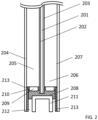
- FIG. 2 shows a schematic cross section of the lower half of an embodiment of a multiple glazing unit comprising two outermost glass panes 204, 207, and one inner glass pane 201.
- the two outermost glass panes are separated from the inner glass pane, held firmly in place and facing the inner glass pane by spacers 209 which are fastened to the glass panes by sealants 210 and by structural sealant 208, the assembly bounding two intermediate gas-filled cavities 205 and 206.
- the gas may be air or argon or krypton or a mixture of these gasses.
- the inner glass pane 201 bears a metal-based insulating coating 202 on one face and a TCO-based insulating coating 203 on the opposite face.
- the two outermost glass panes 204, 207 bear, for esthetical purposes, an enamel coating 213 around the edge of the glass pane that hides a mechanical element 211, which may be a structural element and/or elements of an opening or sliding mechanism and the surrounding air space 212.
- the two outermost glass panes 204, 207 bear no insulating coating.
- the structural element may for example provide a bending stiffness improvement. It may be present on at least one of the edges of the glazing, enclosed in between the two outermost glass panes. It may also be replaced by a sliding, tilting or rotating mechanism for the glazing.
- the present invention further relates to a process for assembling a multiple glazing unit, in particular a triple glazing unit, comprising: providing a first outermost glass pane, providing an inner glass pane, providing a second outermost glass pane, transporting the first outermost glass pane, the inner glass pane, and second outermost glass pane on a conveyor, characterized in that the inner glass pane bears one metal-based insulating coating on one face and one transparent conductive oxide-based insulating coating on the opposite face and in that the inner glass pane is transported on the conveyor with the face bearing the transparent conductive oxide-based insulating coating in contact with the conveyor.
- the present invention in particular relates to this process for assembling a multiple glazing unit according to any one or more embodiments of the multiple glazing unit of the present invention described hereinabove, in particular regarding the characteristics of the glass panes.
- the process may further include providing a single spacer for positioning the at least three glass panes.
- the process may also include providing at least two spacers for positioning the at least three glass panes.
- the process may further comprise providing and a mechanical element in an interspace in between the two outermost glass panes.
- Table 1 lists several triple glazing units (TGUs) according to the present invention.
- the TGUs comprise two outermost glass panes, one exterior outermost glass pane (EXT) which is in contact with the exterior of the building or transportation means in which the TGU is installed, and one interior outermost glass pane (INT) which is in contact with the interior of the building or transportation means in which the TGU is installed.
- EXT exterior outermost glass pane
- INT interior outermost glass pane
- the examples show different possible combinations of metal-based insulating coatings (Metal1, Metal2) on one face of the inner glass pane (INN) and of TCO-based insulating coatings (TCO1, TCO2, TCO3) on the opposite face of the inner glass pane.
- the insulating coatings may be placed on face 3 (IC pos3) or on face 4 (IC pos4) on the inner glass pane.
- the intermediate gas-filled cavities (CAV) in all examples are filled with a 90/10 Argon/air mixture and may have different thicknesses depending on the spacers that are used.
- a triple glazing unit thus comprises 6 faces, face 1 is on the outside of the building and is the face of the exterior outermost glass pane in contact with the exterior. Face 6 is inside the building and is the face of the interior outermost glass pane in contact with the interior. Faces 2 and 5 of the respective outermost glass panes being internal to the triple glazing unit, each facing a gas-filled cavity. Face 3 is the face of the inner glass pane turned towards the exterior and face 4 is the face of the inner glass pane turned towards the interior of the building.
- Table 2 shows opto-energetical properties obtained with the different exemplary TGUs.
- TL is the light transmittance measured with illuminant D65/2° according to standard EN410-2011
- the solar factor SF is measured according to the standard EN410-2011
- the glazing U-value Ug is determined according to standard EN673-2011.
- the combination of on the inner glass pane one metal-based insulating coating on one face and one transparent conductive oxide-based insulating coating on the opposite face leads to particularly low U-values, without a transparent conductive oxide-based insulating coating U-values of about 1 would be obtained in the same multiple glazing structures.
- Table 3 gives further explanations on the types of glass and types of coatings used in the examples.
- Table 2 Ex. optoenergetic performance TL SF Ug 1 72 59 0,6 2 71 58 0,6 3 71 58 0,6 4 55 59 0,7 5 71 54 0,7 6 67 51 0,6 7 71 58 0,6 8 70 58 0,6
- Table 3 glass thickness [mm] glass type 6CV 6 Low iron neutral float glass, sold by the Applicant company under the trade name Planibel Clearvision ® 4CV 4 Low iron neutral float glass, sold by the Applicant company under the trade name Planibel Clearvision ® 44CV 2x4 2 sheets of low iron neutral float glass, sold by the Applicant under the trade name Planibel Clearvision, laminated with 2 panes of PVB 4CL 4 clear neutral float glass, sold by the Applicant company under the trade name Planibel Clearlite ® coating type TCO1 TCO-based insulating coating of the following layer sequence: Glass/SiO x C y
- TCO3 examples using TCO3 were found be particularly resistant to the appearance of scratches during processing on a multiple glazing assembly line.
Landscapes
- Chemical & Material Sciences (AREA)
- Engineering & Computer Science (AREA)
- Materials Engineering (AREA)
- Organic Chemistry (AREA)
- Life Sciences & Earth Sciences (AREA)
- Chemical Kinetics & Catalysis (AREA)
- General Chemical & Material Sciences (AREA)
- Geochemistry & Mineralogy (AREA)
- Civil Engineering (AREA)
- Structural Engineering (AREA)
- Physics & Mathematics (AREA)
- Thermal Sciences (AREA)
- Joining Of Glass To Other Materials (AREA)
- Securing Of Glass Panes Or The Like (AREA)
- Surface Treatment Of Glass (AREA)
- Laminated Bodies (AREA)
Claims (17)
- Unité de vitrage multiple comprenant au moins trois vitres, deux vitres les plus à l'extérieur et au moins une vitre intérieure, dans laquelle au moins deux cavités intermédiaires remplies de gaz se trouvent chacune entre deux vitres, caractérisée en ce que ladite au moins une vitre intérieure porte un revêtement isolant à base de métal sur une face et un revêtement isolant à base d'oxyde transparent conducteur (à base de TCO) sur la face opposée,dans laquelle le revêtement isolant à base de métal comprend un agencement alterné de n couches fonctionnelles métalliques réfléchissant les infrarouges comprenant de l'argent, et n+1 films diélectriques, avec n > 1, de sorte que chaque couche fonctionnelle est entourée par des films diélectriques, etdans laquelle le revêtement isolant à base de TCO comprend une couche de TCO choisie parmi l'oxyde d'étain et d'indium mixte, l'oxyde d'étain dopé au fluor, l'oxyde d'étain dopé à l'antimoine, ZnO dopé à l'aluminium, ZnO dopé au gallium, ZnO co-dopé au gallium et à l'aluminium, et l'oxyde de titane dopé au niobium (TiO2:Nb).
- Unité de vitrage multiple selon la revendication 1, caractérisée en ce que le revêtement à base de TCO présente une rugosité moyenne Rq inférieure à 12 nm.
- Unité de vitrage multiple selon l'une quelconque des revendications précédentes, caractérisée en ce que le revêtement à base de TCO comprend une couche de TCO et un film de suppression d'iridescence entre la vitre et la couche de TCO.
- Unité de vitrage multiple selon la revendication 3, caractérisée en ce que le film de suppression d'iridescence comprend au moins une couche ayant un indice de réfraction à une longueur d'onde de 550 nm compris entre 1,7 et 2,5.
- Unité de vitrage multiple selon la revendication 3, caractérisée en ce que le film de suppression d'iridescence comprend, en séquence comme compté à partir de la surface de la vitre, une première couche ayant un indice de réfraction à une longueur d'onde de 550 nm compris entre 1,7 et 2,5 et une seconde couche ayant un indice de réfraction à une longueur d'onde de 550 nm compris entre 1,4 et 1,68.
- Unité de vitrage multiple selon l'une quelconque des revendications précédentes, caractérisée en ce que le revêtement à base de TCO comprend une couche de TCO et une couche choisie parmi le nitrure de silicium ou l'oxyde de silicium positionnée au-dessus de la couche de TCO.
- Unité de vitrage multiple selon l'une quelconque des revendications précédentes, caractérisée en ce que le revêtement à base de TCO comprend une couche de TCO et une couche d'oxyde de silicium ayant une épaisseur dans la plage de 40 à 90 nm au-dessus de la couche de TCO.
- Unité de vitrage multiple selon l'une quelconque des revendications précédentes, caractérisée en ce qu'elle comprend sur au moins une partie de l'une ou des deux de ses vitres les plus à l'extérieur un revêtement choisi parmi un revêtement à contrôle solaire, un revêtement d'émail, un revêtement de peinture, un revêtement électrochromique ou un revêtement thermochromique.
- Unité de vitrage multiple selon l'une quelconque des revendications précédentes, caractérisée en ce qu'au moins l'une des deux vitres les plus à l'extérieur est formée d'au moins deux feuilles de verre stratifiées par au moins une couche intermédiaire de polymère.
- Unité de vitrage multiple selon l'une quelconque des revendications précédentes, caractérisée en ce que l'au moins une vitre intérieure de l'unité de vitrage multiple a une dimension de longueur et/ou de largeur plus petite qu'au moins l'une des deux vitres les plus à l'extérieur.
- Unité de vitrage multiple selon la revendication 10, caractérisée en ce que l'au moins une vitre intérieure de l'unité de vitrage multiple a une dimension de longueur et/ou de largeur plus petite que les deux vitres les plus à l'extérieur et en ce que l'unité de vitrage multiple comprend en outre un espace intermédiaire entre les deux vitres les plus à l'extérieur le long d'au moins un bord de l'unité de vitrage multiple et au moins un élément mécanique choisi parmi un élément structural et un élément d'un mécanisme d'ouverture ou de coulissement au moins partiellement positionné dans l'espace intermédiaire.
- Unité de vitrage multiple selon l'une quelconque des revendications précédentes, caractérisée en ce que l'une quelconque ou plusieurs des deux vitres de verre les plus à l'extérieur et l'au moins une vitre intérieure ont une transmittance de lumière de 91 à 92 % mesurée conformément à la norme EN410.
- Unité de vitrage multiple selon l'une quelconque des revendications précédentes, caractérisée en ce que les bords du revêtement isolant à base de métal ont été enlevés.
- Unité de vitrage multiple selon l'une quelconque des revendications 2 à 13, caractérisée en ce que les films diélectriques comprennent une ou plusieurs couches diélectriques choisies parmi les nitrures, oxydes ou oxynitrures de silicium, aluminium, étain, zinc, titane, zirconium ou niobium ou à partir d'un mélange de deux ou plusieurs des nitrures, oxydes ou oxynitrures de silicium, aluminium, étain, zinc, titane, zirconium ou niobium.
- Unité de vitrage multiple selon l'une quelconque des revendications 2 à 13, caractérisée en ce que le revêtement isolant à base de métal comprend en outre au moins une couche de contact comprenant un matériau choisi parmi l'oxyde de zinc, éventuellement dopé avec de l'aluminium ou du gallium, le titane, le nickel, le chrome, le palladium, le tungstène, le niobium, les oxydes ou sous-oxydes de titane, nickel, chrome, palladium, tungstène ou niobium, les nitrures ou oxynitrures de titane, nickel, chrome, palladium, tungstène ou niobium.
- Unité de vitrage multiple selon l'une quelconque des revendications précédentes, caractérisée en ce que l'au moins une vitre intérieure comprend deux feuilles de verre assemblées avec une couche intermédiaire de polymère.
- Procédé d'assemblage d'une unité de vitrage multiple comprenant :- la fourniture d'une première vitre la plus à l'extérieur,- la fourniture d'une vitre intérieure,- la fourniture d'une deuxième vitre la plus à l'extérieur,- le transport de la première vitre la plus à l'extérieur, la vitre intérieure et la deuxième vitre la plus à l'extérieur sur un convoyeur,caractérisé en ce que la vitre intérieure porte sur une face une couche isolante à base de métal et sur la face opposée une couche isolante à base d'oxyde conducteur transparent et en ce que la vitre intérieure est transportée sur le convoyeur avec la face portant la couche isolante à base d'oxyde conducteur transparent en contact avec le convoyeur,dans laquelle le revêtement isolant à base de métal comprend un agencement alterné de n couches fonctionnelles métalliques réfléchissant les infrarouges comprenant de l'argent, et n+1 films diélectriques, avec n > 1, de sorte que chaque couche fonctionnelle est entourée par des films diélectriques, etdans laquelle le revêtement isolant à base de TCO comprend une couche de TCO choisie parmi l'oxyde d'étain et d'indium mixte, l'oxyde d'étain dopé au fluor, l'oxyde d'étain dopé à l'antimoine, ZnO dopé à l'aluminium, ZnO dopé au gallium, ZnO co-dopé au gallium et à l'aluminium, et l'oxyde de titane dopé au niobium (TiO2:Nb).
Applications Claiming Priority (2)
| Application Number | Priority Date | Filing Date | Title |
|---|---|---|---|
| EP18167066 | 2018-04-12 | ||
| PCT/EP2019/058830 WO2019197347A1 (fr) | 2018-04-12 | 2019-04-08 | Unité de vitrage multiple |
Publications (2)
| Publication Number | Publication Date |
|---|---|
| EP3774681A1 EP3774681A1 (fr) | 2021-02-17 |
| EP3774681B1 true EP3774681B1 (fr) | 2025-05-07 |
Family
ID=62091647
Family Applications (1)
| Application Number | Title | Priority Date | Filing Date |
|---|---|---|---|
| EP19714700.2A Active EP3774681B1 (fr) | 2018-04-12 | 2019-04-08 | Unité de vitrage multiple |
Country Status (9)
| Country | Link |
|---|---|
| US (1) | US20210403375A1 (fr) |
| EP (1) | EP3774681B1 (fr) |
| JP (1) | JP7385592B2 (fr) |
| CA (1) | CA3096522A1 (fr) |
| EA (1) | EA038987B1 (fr) |
| ES (1) | ES3036154T3 (fr) |
| PT (1) | PT3774681T (fr) |
| TW (1) | TW202003412A (fr) |
| WO (1) | WO2019197347A1 (fr) |
Families Citing this family (10)
| Publication number | Priority date | Publication date | Assignee | Title |
|---|---|---|---|---|
| EP4397833A3 (fr) * | 2017-12-21 | 2024-10-16 | Corning Incorporated | Unité de verre isolée multicouche comprenant une couche de verre à faible coefficient de dilatation thermique (cte) |
| JP7306502B2 (ja) * | 2019-07-12 | 2023-07-11 | Agc株式会社 | 膜付きガラス基板及びその製造方法 |
| EP3798402A1 (fr) * | 2019-09-27 | 2021-03-31 | Saint-Gobain Glass France | Unité de vitrage isolant pourvue de petite vitre médiane |
| KR102906035B1 (ko) * | 2019-12-18 | 2025-12-29 | 코닝 인코포레이티드 | 복층 유리 유닛 및 그 제조 방법 |
| JP7312331B2 (ja) * | 2020-01-06 | 2023-07-20 | サン-ゴバン グラス フランス | 向上した接着性を有するスペーサ |
| EP4741619A2 (fr) * | 2020-05-06 | 2026-05-13 | VKR Holding A/S | Vitrage isolant avec pigmentation réfléchissant les infrarouges dans le masque |
| FR3113858A1 (fr) * | 2020-07-24 | 2022-03-11 | Saint-Gobain Glass France | Triple vitrage integrant un film thermochrome |
| US11498867B2 (en) * | 2020-10-01 | 2022-11-15 | Guardian Glass, LLC | Coated article with IR reflecting layer designed for low u-value and higher g-value and method of making same |
| WO2024263827A1 (fr) * | 2023-06-23 | 2024-12-26 | Corning Incorporated | Igu ayant une vitre centrale mince avec film de sécurité et procédés associés |
| WO2025131834A1 (fr) * | 2023-12-18 | 2025-06-26 | Agc Glass Europe | Vitrage multiple assurant un confort thermique en toutes saisons |
Family Cites Families (11)
| Publication number | Priority date | Publication date | Assignee | Title |
|---|---|---|---|---|
| US20040253471A1 (en) | 2003-05-30 | 2004-12-16 | Thiel James P. | Appliance with coated transparency |
| FR2937366B1 (fr) * | 2008-10-17 | 2010-10-29 | Saint Gobain | Vitrage multiple incorporant au moins un revetement antireflet et utilisation d'un revetement antireflet dans un vitrage multiple |
| US8834976B2 (en) | 2010-02-26 | 2014-09-16 | Guardian Industries Corp. | Articles including anticondensation and/or low-E coatings and/or methods of making the same |
| PL2539291T3 (pl) * | 2010-02-26 | 2017-01-31 | Guardian Industries Corp. | Wyroby zawierające powłoki przeciwkondensacyjne i/lub o niskim E i/lub sposoby ich wytwarzania |
| FR2963343B1 (fr) | 2010-07-28 | 2012-07-27 | Saint Gobain | Vitrage pourvu d'un revetement contre la condensation |
| FR2973023B1 (fr) | 2011-03-25 | 2019-08-02 | Saint-Gobain Glass France | Vitrage multiple isolant comprenant deux empilements bas emissifs |
| US9556066B2 (en) | 2011-12-13 | 2017-01-31 | Guardian Industries Corp. | Insulating glass units with low-E and antireflective coatings, and/or methods of making the same |
| KR101596082B1 (ko) * | 2012-11-09 | 2016-02-19 | (주)엘지하우시스 | 초단열 복층 유리 |
| US9499438B2 (en) * | 2013-02-28 | 2016-11-22 | Guardian Industries Corp. | Window for attenuating RF and IR electromagnetic signals |
| CN106460447B (zh) | 2014-06-11 | 2018-12-11 | 日本板硝子株式会社 | 多层玻璃单元以及多层玻璃单元用玻璃板 |
| WO2016098839A1 (fr) | 2014-12-19 | 2016-06-23 | Agc-Lixilウィンドウテクノロジー株式会社 | Verre multi-couches |
-
2019
- 2019-04-08 PT PT197147002T patent/PT3774681T/pt unknown
- 2019-04-08 EP EP19714700.2A patent/EP3774681B1/fr active Active
- 2019-04-08 CA CA3096522A patent/CA3096522A1/fr active Pending
- 2019-04-08 JP JP2020555386A patent/JP7385592B2/ja active Active
- 2019-04-08 WO PCT/EP2019/058830 patent/WO2019197347A1/fr not_active Ceased
- 2019-04-08 ES ES19714700T patent/ES3036154T3/es active Active
- 2019-04-08 EA EA202092413A patent/EA038987B1/ru unknown
- 2019-04-08 US US17/046,496 patent/US20210403375A1/en not_active Abandoned
- 2019-04-12 TW TW108112909A patent/TW202003412A/zh unknown
Also Published As
| Publication number | Publication date |
|---|---|
| US20210403375A1 (en) | 2021-12-30 |
| WO2019197347A1 (fr) | 2019-10-17 |
| CA3096522A1 (fr) | 2019-10-17 |
| ES3036154T3 (en) | 2025-09-15 |
| EP3774681A1 (fr) | 2021-02-17 |
| EA202092413A1 (ru) | 2021-02-26 |
| JP7385592B2 (ja) | 2023-11-22 |
| PT3774681T (pt) | 2025-07-02 |
| EA038987B1 (ru) | 2021-11-18 |
| JP2021521082A (ja) | 2021-08-26 |
| TW202003412A (zh) | 2020-01-16 |
Similar Documents
| Publication | Publication Date | Title |
|---|---|---|
| US20210403375A1 (en) | Multiple glazing unit | |
| US20220326421A1 (en) | Solar Control Coating with Enhanced Solar Control Performance | |
| US10345499B2 (en) | Solar control coating with enhanced solar control performance | |
| EP3510003B1 (fr) | Article revêtu présentant une couche réfléchissant les ir et son procédé de fabrication | |
| US20240174557A1 (en) | Alloy oxide overcoat indium tin oxide coatings, coated glazings, and production methods | |
| US9566766B2 (en) | Insulating multiple glazing including two low-emissivity stacks | |
| RU2747376C2 (ru) | Подложка, снабженная набором, обладающим тепловыми свойствами, ее применение и ее изготовление | |
| US20060165963A1 (en) | Transparent substrate comprising antiglare coating | |
| CN103429549A (zh) | 提供有薄层叠层的透明基材 | |
| KR20200118069A (ko) | 4중 금속층을 갖는 태양광 제어 코팅 | |
| US8840982B2 (en) | Textured substrate provided with a stack having thermal properties | |
| US20240253330A1 (en) | Glazing for preventing bird collisions | |
| US12221377B2 (en) | Temperable UV reflecting coated glass sheet | |
| US10100572B2 (en) | Insulating glazing | |
| JP2017537046A (ja) | 複層ガラスユニット | |
| EP3419943B1 (fr) | Revêtement à faible émissivité destiné à des fenêtres sous climats froids | |
| KR20190139257A (ko) | 적층된 글레이징을 위한 태양광 제어 코팅 | |
| US20160264459A1 (en) | Insulating glazing | |
| EP4098631B1 (fr) | Revêtements d'oxyde d'étain et d'indium présentant une couche de finition d'oxyde d'alliage, vitrages revêtus et procédés de production | |
| AU2021353123A1 (en) | Coated article with IR reflecting layer designed for low U-value and higher G-value and method of making same | |
| WO2024120712A1 (fr) | Vitrage isolant multiple comprenant deux revêtements à faible émissivité | |
| JP2024546836A (ja) | 低放射率及び日射防止グレージング |
Legal Events
| Date | Code | Title | Description |
|---|---|---|---|
| STAA | Information on the status of an ep patent application or granted ep patent |
Free format text: STATUS: UNKNOWN |
|
| STAA | Information on the status of an ep patent application or granted ep patent |
Free format text: STATUS: THE INTERNATIONAL PUBLICATION HAS BEEN MADE |
|
| PUAI | Public reference made under article 153(3) epc to a published international application that has entered the european phase |
Free format text: ORIGINAL CODE: 0009012 |
|
| STAA | Information on the status of an ep patent application or granted ep patent |
Free format text: STATUS: REQUEST FOR EXAMINATION WAS MADE |
|
| 17P | Request for examination filed |
Effective date: 20201112 |
|
| AK | Designated contracting states |
Kind code of ref document: A1 Designated state(s): AL AT BE BG CH CY CZ DE DK EE ES FI FR GB GR HR HU IE IS IT LI LT LU LV MC MK MT NL NO PL PT RO RS SE SI SK SM TR |
|
| AX | Request for extension of the european patent |
Extension state: BA ME |
|
| DAV | Request for validation of the european patent (deleted) | ||
| DAX | Request for extension of the european patent (deleted) | ||
| STAA | Information on the status of an ep patent application or granted ep patent |
Free format text: STATUS: EXAMINATION IS IN PROGRESS |
|
| 17Q | First examination report despatched |
Effective date: 20230110 |
|
| P01 | Opt-out of the competence of the unified patent court (upc) registered |
Free format text: CASE NUMBER: APP_37460/2024 Effective date: 20240622 |
|
| REG | Reference to a national code |
Ipc: B32B0017100000 Ref country code: DE Ref legal event code: R079 Ref document number: 602019069602 Country of ref document: DE Free format text: PREVIOUS MAIN CLASS: C03C0017000000 Ipc: B32B0017100000 |
|
| GRAP | Despatch of communication of intention to grant a patent |
Free format text: ORIGINAL CODE: EPIDOSNIGR1 |
|
| RIC1 | Information provided on ipc code assigned before grant |
Ipc: C03C 17/34 20060101ALI20241203BHEP Ipc: E06B 3/66 20060101ALI20241203BHEP Ipc: C03C 17/00 20060101ALI20241203BHEP Ipc: C03C 17/36 20060101ALI20241203BHEP Ipc: B32B 17/10 20060101AFI20241203BHEP |
|
| STAA | Information on the status of an ep patent application or granted ep patent |
Free format text: STATUS: GRANT OF PATENT IS INTENDED |
|
| INTG | Intention to grant announced |
Effective date: 20250109 |
|
| GRAS | Grant fee paid |
Free format text: ORIGINAL CODE: EPIDOSNIGR3 |
|
| GRAA | (expected) grant |
Free format text: ORIGINAL CODE: 0009210 |
|
| STAA | Information on the status of an ep patent application or granted ep patent |
Free format text: STATUS: THE PATENT HAS BEEN GRANTED |
|
| AK | Designated contracting states |
Kind code of ref document: B1 Designated state(s): AL AT BE BG CH CY CZ DE DK EE ES FI FR GB GR HR HU IE IS IT LI LT LU LV MC MK MT NL NO PL PT RO RS SE SI SK SM TR |
|
| REG | Reference to a national code |
Ref country code: GB Ref legal event code: FG4D |
|
| REG | Reference to a national code |
Ref country code: CH Ref legal event code: EP |
|
| REG | Reference to a national code |
Ref country code: DE Ref legal event code: R096 Ref document number: 602019069602 Country of ref document: DE |
|
| REG | Reference to a national code |
Ref country code: IE Ref legal event code: FG4D |
|
| REG | Reference to a national code |
Ref country code: PT Ref legal event code: SC4A Ref document number: 3774681 Country of ref document: PT Date of ref document: 20250702 Kind code of ref document: T Free format text: AVAILABILITY OF NATIONAL TRANSLATION Effective date: 20250627 |
|
| REG | Reference to a national code |
Ref country code: NL Ref legal event code: FP |
|
| REG | Reference to a national code |
Ref country code: ES Ref legal event code: FG2A Ref document number: 3036154 Country of ref document: ES Kind code of ref document: T3 Effective date: 20250915 |
|
| PG25 | Lapsed in a contracting state [announced via postgrant information from national office to epo] |
Ref country code: FI Free format text: LAPSE BECAUSE OF FAILURE TO SUBMIT A TRANSLATION OF THE DESCRIPTION OR TO PAY THE FEE WITHIN THE PRESCRIBED TIME-LIMIT Effective date: 20250507 |
|
| REG | Reference to a national code |
Ref country code: LT Ref legal event code: MG9D |
|
| PG25 | Lapsed in a contracting state [announced via postgrant information from national office to epo] |
Ref country code: GR Free format text: LAPSE BECAUSE OF FAILURE TO SUBMIT A TRANSLATION OF THE DESCRIPTION OR TO PAY THE FEE WITHIN THE PRESCRIBED TIME-LIMIT Effective date: 20250808 Ref country code: NO Free format text: LAPSE BECAUSE OF FAILURE TO SUBMIT A TRANSLATION OF THE DESCRIPTION OR TO PAY THE FEE WITHIN THE PRESCRIBED TIME-LIMIT Effective date: 20250807 |
|
| PG25 | Lapsed in a contracting state [announced via postgrant information from national office to epo] |
Ref country code: PL Free format text: LAPSE BECAUSE OF FAILURE TO SUBMIT A TRANSLATION OF THE DESCRIPTION OR TO PAY THE FEE WITHIN THE PRESCRIBED TIME-LIMIT Effective date: 20250507 |
|
| REG | Reference to a national code |
Ref country code: AT Ref legal event code: MK05 Ref document number: 1792048 Country of ref document: AT Kind code of ref document: T Effective date: 20250507 |
|
| PG25 | Lapsed in a contracting state [announced via postgrant information from national office to epo] |
Ref country code: BG Free format text: LAPSE BECAUSE OF FAILURE TO SUBMIT A TRANSLATION OF THE DESCRIPTION OR TO PAY THE FEE WITHIN THE PRESCRIBED TIME-LIMIT Effective date: 20250507 |
|
| PG25 | Lapsed in a contracting state [announced via postgrant information from national office to epo] |
Ref country code: HR Free format text: LAPSE BECAUSE OF FAILURE TO SUBMIT A TRANSLATION OF THE DESCRIPTION OR TO PAY THE FEE WITHIN THE PRESCRIBED TIME-LIMIT Effective date: 20250507 |
|
| PG25 | Lapsed in a contracting state [announced via postgrant information from national office to epo] |
Ref country code: AT Free format text: LAPSE BECAUSE OF FAILURE TO SUBMIT A TRANSLATION OF THE DESCRIPTION OR TO PAY THE FEE WITHIN THE PRESCRIBED TIME-LIMIT Effective date: 20250507 |
|
| PG25 | Lapsed in a contracting state [announced via postgrant information from national office to epo] |
Ref country code: RS Free format text: LAPSE BECAUSE OF FAILURE TO SUBMIT A TRANSLATION OF THE DESCRIPTION OR TO PAY THE FEE WITHIN THE PRESCRIBED TIME-LIMIT Effective date: 20250807 |
|
| PG25 | Lapsed in a contracting state [announced via postgrant information from national office to epo] |
Ref country code: IS Free format text: LAPSE BECAUSE OF FAILURE TO SUBMIT A TRANSLATION OF THE DESCRIPTION OR TO PAY THE FEE WITHIN THE PRESCRIBED TIME-LIMIT Effective date: 20250907 |
|
| PG25 | Lapsed in a contracting state [announced via postgrant information from national office to epo] |
Ref country code: LV Free format text: LAPSE BECAUSE OF FAILURE TO SUBMIT A TRANSLATION OF THE DESCRIPTION OR TO PAY THE FEE WITHIN THE PRESCRIBED TIME-LIMIT Effective date: 20250507 |
|
| PG25 | Lapsed in a contracting state [announced via postgrant information from national office to epo] |
Ref country code: DK Free format text: LAPSE BECAUSE OF FAILURE TO SUBMIT A TRANSLATION OF THE DESCRIPTION OR TO PAY THE FEE WITHIN THE PRESCRIBED TIME-LIMIT Effective date: 20250507 Ref country code: SM Free format text: LAPSE BECAUSE OF FAILURE TO SUBMIT A TRANSLATION OF THE DESCRIPTION OR TO PAY THE FEE WITHIN THE PRESCRIBED TIME-LIMIT Effective date: 20250507 |
|
| PG25 | Lapsed in a contracting state [announced via postgrant information from national office to epo] |
Ref country code: CZ Free format text: LAPSE BECAUSE OF FAILURE TO SUBMIT A TRANSLATION OF THE DESCRIPTION OR TO PAY THE FEE WITHIN THE PRESCRIBED TIME-LIMIT Effective date: 20250507 |
|
| PG25 | Lapsed in a contracting state [announced via postgrant information from national office to epo] |
Ref country code: EE Free format text: LAPSE BECAUSE OF FAILURE TO SUBMIT A TRANSLATION OF THE DESCRIPTION OR TO PAY THE FEE WITHIN THE PRESCRIBED TIME-LIMIT Effective date: 20250507 |
|
| PG25 | Lapsed in a contracting state [announced via postgrant information from national office to epo] |
Ref country code: RO Free format text: LAPSE BECAUSE OF FAILURE TO SUBMIT A TRANSLATION OF THE DESCRIPTION OR TO PAY THE FEE WITHIN THE PRESCRIBED TIME-LIMIT Effective date: 20250507 Ref country code: SK Free format text: LAPSE BECAUSE OF FAILURE TO SUBMIT A TRANSLATION OF THE DESCRIPTION OR TO PAY THE FEE WITHIN THE PRESCRIBED TIME-LIMIT Effective date: 20250507 |
|
| REG | Reference to a national code |
Ref country code: DE Ref legal event code: R097 Ref document number: 602019069602 Country of ref document: DE |
|
| PLBE | No opposition filed within time limit |
Free format text: ORIGINAL CODE: 0009261 |
|
| STAA | Information on the status of an ep patent application or granted ep patent |
Free format text: STATUS: NO OPPOSITION FILED WITHIN TIME LIMIT |
|
| REG | Reference to a national code |
Ref country code: CH Ref legal event code: L10 Free format text: ST27 STATUS EVENT CODE: U-0-0-L10-L00 (AS PROVIDED BY THE NATIONAL OFFICE) Effective date: 20260318 |
|
| PGFP | Annual fee paid to national office [announced via postgrant information from national office to epo] |
Ref country code: GB Payment date: 20260216 Year of fee payment: 8 |
|
| PGFP | Annual fee paid to national office [announced via postgrant information from national office to epo] |
Ref country code: IE Payment date: 20260310 Year of fee payment: 8 |
|
| 26N | No opposition filed |
Effective date: 20260210 |
|
| PGFP | Annual fee paid to national office [announced via postgrant information from national office to epo] |
Ref country code: LU Payment date: 20260326 Year of fee payment: 8 Ref country code: BE Payment date: 20260317 Year of fee payment: 8 Ref country code: IT Payment date: 20260320 Year of fee payment: 8 |
|
| PGFP | Annual fee paid to national office [announced via postgrant information from national office to epo] |
Ref country code: NL Payment date: 20260317 Year of fee payment: 8 |
|
| PGFP | Annual fee paid to national office [announced via postgrant information from national office to epo] |
Ref country code: FR Payment date: 20260309 Year of fee payment: 8 |
|
| REG | Reference to a national code |
Ref country code: CH Ref legal event code: U11 Free format text: ST27 STATUS EVENT CODE: U-0-0-U10-U11 (AS PROVIDED BY THE NATIONAL OFFICE) Effective date: 20260501 |