EP3774698B1 - Extraction en phase solide - Google Patents
Extraction en phase solide Download PDFInfo
- Publication number
- EP3774698B1 EP3774698B1 EP19715871.0A EP19715871A EP3774698B1 EP 3774698 B1 EP3774698 B1 EP 3774698B1 EP 19715871 A EP19715871 A EP 19715871A EP 3774698 B1 EP3774698 B1 EP 3774698B1
- Authority
- EP
- European Patent Office
- Prior art keywords
- compound
- formula
- spe
- solution
- organic solvent
- Prior art date
- Legal status (The legal status is an assumption and is not a legal conclusion. Google has not performed a legal analysis and makes no representation as to the accuracy of the status listed.)
- Active
Links
Images


Classifications
-
- B—PERFORMING OPERATIONS; TRANSPORTING
- B01—PHYSICAL OR CHEMICAL PROCESSES OR APPARATUS IN GENERAL
- B01J—CHEMICAL OR PHYSICAL PROCESSES, e.g. CATALYSIS OR COLLOID CHEMISTRY; THEIR RELEVANT APPARATUS
- B01J19/00—Chemical, physical or physico-chemical processes in general; Their relevant apparatus
- B01J19/0006—Controlling or regulating processes
- B01J19/004—Multifunctional apparatus for automatic manufacturing of various chemical products
-
- B—PERFORMING OPERATIONS; TRANSPORTING
- B01—PHYSICAL OR CHEMICAL PROCESSES OR APPARATUS IN GENERAL
- B01L—CHEMICAL OR PHYSICAL LABORATORY APPARATUS FOR GENERAL USE
- B01L3/00—Containers or dishes for laboratory use, e.g. laboratory glassware; Droppers
- B01L3/50—Containers for the purpose of retaining a material to be analysed, e.g. test tubes
- B01L3/502—Containers for the purpose of retaining a material to be analysed, e.g. test tubes with fluid transport, e.g. in multi-compartment structures
- B01L3/5027—Containers for the purpose of retaining a material to be analysed, e.g. test tubes with fluid transport, e.g. in multi-compartment structures by integrated microfluidic structures, i.e. dimensions of channels and chambers are such that surface tension forces are important, e.g. lab-on-a-chip
- B01L3/502753—Containers for the purpose of retaining a material to be analysed, e.g. test tubes with fluid transport, e.g. in multi-compartment structures by integrated microfluidic structures, i.e. dimensions of channels and chambers are such that surface tension forces are important, e.g. lab-on-a-chip characterised by bulk separation arrangements on lab-on-a-chip devices, e.g. for filtration or centrifugation
-
- C—CHEMISTRY; METALLURGY
- C07—ORGANIC CHEMISTRY
- C07B—GENERAL METHODS OF ORGANIC CHEMISTRY; APPARATUS THEREFOR
- C07B59/00—Introduction of isotopes of elements into organic compounds ; Labelled organic compounds per se
- C07B59/002—Heterocyclic compounds
-
- C—CHEMISTRY; METALLURGY
- C07—ORGANIC CHEMISTRY
- C07B—GENERAL METHODS OF ORGANIC CHEMISTRY; APPARATUS THEREFOR
- C07B63/00—Purification; Separation; Stabilisation; Use of additives
-
- C—CHEMISTRY; METALLURGY
- C07—ORGANIC CHEMISTRY
- C07D—HETEROCYCLIC COMPOUNDS
- C07D237/00—Heterocyclic compounds containing 1,2-diazine or hydrogenated 1,2-diazine rings
- C07D237/02—Heterocyclic compounds containing 1,2-diazine or hydrogenated 1,2-diazine rings not condensed with other rings
- C07D237/06—Heterocyclic compounds containing 1,2-diazine or hydrogenated 1,2-diazine rings not condensed with other rings having three double bonds between ring members or between ring members and non-ring members
- C07D237/10—Heterocyclic compounds containing 1,2-diazine or hydrogenated 1,2-diazine rings not condensed with other rings having three double bonds between ring members or between ring members and non-ring members with hetero atoms or with carbon atoms having three bonds to hetero atoms with at the most one bond to halogen, e.g. ester or nitrile radicals, directly attached to ring carbon atoms
- C07D237/14—Oxygen atoms
- C07D237/16—Two oxygen atoms
-
- B—PERFORMING OPERATIONS; TRANSPORTING
- B01—PHYSICAL OR CHEMICAL PROCESSES OR APPARATUS IN GENERAL
- B01L—CHEMICAL OR PHYSICAL LABORATORY APPARATUS FOR GENERAL USE
- B01L2200/00—Solutions for specific problems relating to chemical or physical laboratory apparatus
- B01L2200/06—Fluid handling related problems
- B01L2200/0631—Purification arrangements, e.g. solid phase extraction [SPE]
-
- C—CHEMISTRY; METALLURGY
- C07—ORGANIC CHEMISTRY
- C07B—GENERAL METHODS OF ORGANIC CHEMISTRY; APPARATUS THEREFOR
- C07B2200/00—Indexing scheme relating to specific properties of organic compounds
- C07B2200/05—Isotopically modified compounds, e.g. labelled
Definitions
- the present invention relates to diagnostic imaging agents useful for positron emission tomography (PET) imaging as well as to improved means for producing such imaging agents. More specifically, the present invention is directed to method of purifying a crude [ 18 F]-labelled pyridaben derivative which in turn can then be formulated into a composition suitable for injection for myocardial perfusion imaging and methods and devices for preparing same. More specifically, the present invention is directed to the automated synthesis and purification of a [ 18 F]-labelled pyridaben derivative by means of solid phase extraction (SPE).
- SPE solid phase extraction
- [ 18 F]-labelled pyridaben derivatives are known that find use in determining the presence or absence of a cardiovascular disease or condition in a subject. Methods for the synthesis of these [ 18 F]-labelled pyridaben derivatives are described in WO2011/097649 A2 and comprise nucleophilic [ 18 F]-fluorination of an imaging agent precursor to form an imaging agent. The synthesis of an injectable composition comprising the compound [ 18 F]-flurpiridaz ([ 18 F]-FPZ) is described wherein the method comprises nucleophilic [ 18 F]-fluorination of a tosylate precursor compound, dilution with water followed by high-performance liquid chromatography (HPLC) purification. WO2013/079578 relates to a method for the production of an 18F-labelled compound wherein the production comprises a hydrolytic deprotection step of the 18F-labelled compound.
- the present invention provides a method comprising:
- the present invention provides a cassette for carrying out the method as defined in Claim 1 comprising:
- the method and cassette of the invention are particularly useful where the crude reaction mixture includes one or more impurities have very similar chromatographic elution times. Purification using SPE alone is permitted such that the requirement for HPLC in the purification process is obviated.
- a "precursor compound” comprises a non-radioactive derivative of a radiolabelled compound, designed so that chemical reaction with a convenient chemical form of an in vivo- detectable label occurs site-specifically; can be conducted in the minimum number of steps (ideally a single step); and without the need for significant purification (ideally no further purification), to give the desired in vivo imaging agent.
- Such precursor compounds are synthetic and can conveniently be obtained in good chemical purity.
- BTM biological targeting moiety
- alkylene refers to the bivalent group -(CH 2 ) n - wherein n is preferably an integer from 1-6.
- alkoxyalkylene means an alkylene as defined above comprising an ether linkage, where the term “ether linkage " refers to the group -C-O-C-.
- leaving group refers to an atom or group of atoms that is displaced as a stable species during a substitution or displacement radiofluorination reaction.
- Suitable leaving groups for the present invention are sulfonate-containing leaving groups, where " sulfonate " means -SO 3 .
- 18 F-fluoride refers to 18 F-fluoride in a chemical form suitable for displacing LG of Formula I in a nucleophilic substitution reaction to result in a compound of Formula II.
- 18 F-fluoride is normally obtained as an aqueous solution from the nuclear reaction 18 O(p,n) 18 F and is made reactive by the addition of a cationic counterion and the subsequent removal of water. Suitable cationic counterions should possess sufficient solubility within the anhydrous reaction solvent to maintain the solubility of 18 F - .
- Suitable counterions include large but soft metal ions such as rubidium or caesium, potassium complexed with a cryptand such as Kryptofix TM 222 (K222), or tetraalkylammonium salts.
- K222 Kryptofix TM 222
- a suitable tetraalkylammonium salt is tetrabutylammonium hydrogen carbonate.
- solid phase extraction refers to the well-known sample preparation process by which compounds in a solution are separated from each other based on their respective affinities for a solid (the " solid phase “, or “ stationary phase ”) through which the sample is passed and the solvent (the “ mobile phase “ or “ liquid phase ”) in which they are dissolved.
- the result is that a compound of interest is either retained on the solid phase or in the mobile phase.
- the portion that passes through the solid phase is collected or discarded, depending on whether it contains the compound of interest. If the portion retained on the stationary phase includes the compound of interest, it can then be removed from the stationary phase for collection in an additional step, in which the stationary phase is rinsed with another solution known as an " eluent ".
- SPE is suitably carried out using at least one " SPE cartridge” (also often referred to as an " SPE column "), a variety of which are readily available commercially and typically as a column packed with solid phase.
- SPE cartridge also often referred to as an " SPE column "
- Most known solid phases are based on silica that has been bonded to a specific functional group, e.g. hydrocarbon chains of variable length (suitable for reverse-phase SPE), quaternary ammonium or amino groups (suitable for anion exchange), and sulfonic acid or carboxyl groups (suitable for cation exchange).
- SPE in the context of the present invention specifically excludes HPLC.
- two SPE cartridges fluidly connected in series are used in the present invention.
- the " organic solvent” suitably comprises a solvent known to those of skill in the art for SPE elution, for example tetrahydrofuran (THF), ethyl acetate and dichloromethane (DCM), dimethylformamide (DMF), acetonitrile (MeCN), dimethyl sulfoxide (DMSO), acetic acid, t-butanol, isopropanol, n-propanol, ethanol (EtOH) and methanol (MeOH).
- THF tetrahydrofuran
- DCM dimethylformamide
- MeCN acetonitrile
- DMSO dimethyl sulfoxide
- acetic acid t-butanol
- isopropanol n-propanol
- ethanol ethanol
- MeOH methanol
- the organic solvent may be provided as an aqueous solution of said solvent.
- hydrolysing reagent refers to a reagent capable of hydrolysis wherein " hydrolysis " is a technical term well known to those of skill in the art, i.e. a reaction involving the breaking of a bond in a molecule using water, where the reaction mainly occurs between an ion and water molecules and often changes the pH of a solution.
- hydrolysis is a technical term well known to those of skill in the art, i.e. a reaction involving the breaking of a bond in a molecule using water, where the reaction mainly occurs between an ion and water molecules and often changes the pH of a solution.
- hydrolysis is a technical term well known to those of skill in the art, i.e. a reaction involving the breaking of a bond in a molecule using water, where the reaction mainly occurs between an ion and water molecules and often changes the pH of a solution.
- salt hydrolysis acid hydrolysis
- base hydrolysis there are three main types of hydrolysis.
- said BTM is a small molecule.
- the small molecule in one embodiment is an analogue of pyridaben. Methods to obtain suitable pyridaben analogues are known in the art.
- certain compounds of Formula I can be obtained following or adapting the processes described in WO2011097649 A2 , starting with etherification of the starting compounds comprising formulae: where n is 1,2,3,4, or 5; R 1 is alkyl, optionally substituted; R 2 is hydrogen or halide; R 3 can be the same or different and are alkyl, heteroalkyl, or a carbonyl-containing group, each optionally substituted, R 5 is hydroxyl or halide; and R 6 is alkyl, heteroalkyl, or a carbonyl-containing group, each optionally substituted, wherein, when R 3 is hydroxyl, at least one of R 6 and R 3 comprises a leaving group; or wherein R 5 is halide, at least one of R 6 or R 3 comprises a hydroxyl, to produce a compound comprising formula: wherein W is alkyl or heteroalkyl, optionally substituted; R 1 is alkyl, optionally substituted; R 2 is hydrogen or halide; each R 3 can be
- This compound is a precursor compound of Formula I.
- the sulfonate-containing precursor can then be reacted with 18 F-fluoride to obtain compounds of Formula II.
- said precursor compound is a compound of Formula la: and said 18 F-labelled compound is a compound of Formula IIa: wherein:
- R 1 of Formula la and Formula IIa is C 1-6 alkyl.
- R 1 of Formula la and Formula IIa is methyl, ethyl, propyl, n-butyl, s-butyl, or t-butyl.
- R 2 of Formula la and Formula IIa is halo.
- R 2 of Formula la and Formula IIa is chloro.
- W of Formula la and Formula IIa is heteroalkylene.
- W of Formula la and Formula IIa alkoxyalkylene In one embodiment W of Formula la and Formula IIa alkoxyalkylene.
- said compound of Formula I is a compound of Formula Ib: and said compound of Formula II is a compound of Formula IIb: wherein R 1 , R 2 , LINKER and LG are as variously defined herein for Formula I and Formula II.
- said compound of Formula I is: wherein LG is as variously defined herein; and said compound of Formula II is:
- LG is selected from mesylate, tosylate, triflate, nosylate, or 1,2-cyclic sulfate.
- LG is tosylate.
- said wash solution comprising an organic solvent of step (c)(iii) comprises 20-80% of said organic solvent in water.
- the mobile phase used with the SPE cartridge will depend on choice of SPE cartridge.
- aqueous acetonitrile is a suitable organic solvent, for step (iii), a non-limiting example of which would be 40% acetonitrile and 60% water.
- the eluent for the same SPE cartridge can be aqueous ethanol, a non-limiting example of which is 60% ethanol and 40% water.
- an ethanol-based organic solvent for step (iii) and for elution can be used.
- ethanol-based organic solvent for step (iii) and for elution can be used.
- 30-40% ethanol in water for the solvent for step (iii) followed by ethanol elution which can be less than 100% ethanol.
- said wash solution comprising an organic solvent of step (c)(iii) comprises 30-60% of said organic solvent in water.
- said wash solution comprising an organic solvent of step (c)(iii) comprises acetonitrile, methanol or ethanol.
- said wash solution comprising an organic solvent is an aqueous solution of acetonitrile.
- said aqueous solution of acetonitrile comprises 30-50% acetonitrile, preferably 40% acetonitrile.
- said wash solution comprising an organic solvent is an aqueous solution of methanol.
- said aqueous solution of methanol comprises 20-80% methanol, preferably 30-50% methanol.
- said wash solution comprising an organic solvent is an aqueous solution of ethanol.
- said aqueous solution of ethanol comprises 35-55% ethanol.
- said elution solution of step (v) comprises 40-100% ethanol.
- said elution solution of step (v) comprises 50-80% ethanol, preferably 65-75% ethanol and most preferably 70% ethanol.
- said elution solution of step (v) comprises 30-50% ethanol, preferably 40-50% ethanol, most preferably 45% ethanol.
- said ethanol of step (v) comprises 50-100% ethanol.
- said hydrolysing reagent is added to said crude reaction mixture in step (b).
- said hydrolysing reagent is comprised in said water of step (ii).
- said hydrolysing reagent is comprised in said water of step (iv) and steps (ii) and (iii) are repeated before carrying out step (v).
- said SPE cartridge is selected from a tC18 SPE cartridge and a mixed mode SPE cartridge.
- said SPE cartridge is a tC18 cartridge.
- said method further comprises a step before step (v) of passing a solution comprising an organic solvent through said SPE cartridge and a fluidly connected second SPE cartridge and wherein step (v) is carried out with said second SPE cartridge.
- said SPE cartridge and said second SPE cartridge are selected from Affinisep "P3 polymer”, Waters tC18 and UCT C18.
- said hydrolysing reagent is acidic. Any suitable acid may be used.
- said acidic hydrolysing reagent comprises hydrochloric acid, sulphuric acid or phosphoric acid.
- said acidic hydrolysing reagent is HCl.
- said hydrolysing reagent is alkaline.
- Any suitable base may be used.
- alkoxide, alkali metal hydroxides, or thiooxide bases can be used.
- the base is selected from the group consisting of sodium hydroxide, potassium hydroxide, sodium hydride, sodium thiomethoxide, sodium ethoxide, ammonia/ammonium hydroxide and sodium methoxide.
- said alkaline hydrolysing reagent is selected from NaOH, NH 4 OH and NaOMe. In another embodiment, said alkaline hydrolysing reagent is NaOH.
- step (c) includes prior to step (i) passing said diluted crude reaction mixture through a separate SPE cartridge configured to retain lipophilic components.
- a separate SPE cartridge configured to retain lipophilic components.
- said separate SPE cartridge is selected from a tC18 cartridge, or a polymeric cartridge from Affinisep.
- step (c) includes following step (v) passing said purified solution through a separate SPE cartridge configured to retain lipophilic components.
- TEMPO 2,2,6,6-Tetramethylpiperidin-1-yloxyl
- reacting step (a) is included in reacting step (a).
- TEMPO is present in a molar ratio to the precursor compound of between 0.01:1 and 5:1, preferably between 0.1:1 and 2:1, most preferably between 0.4:1 and 0.6:1, especially preferably around 0.5:1, e.g. 0.56:1.
- the method of the invention can be carried out using an automated synthesizer apparatus.
- automated synthesizer is meant an automated module based on the principle of unit operations as described by Satyamurthy et al (1999 Clin Positr Imag; 2(5): 233-253 ).
- unit operations means that complex processes are reduced to a series of simple operations or reactions, which can be applied to a range of materials.
- automated synthesizers are commercially available from a range of suppliers including: GE Healthcare; CTI Inc; Ion Beam Applications S.A. (Chemin du Cyclotron 3, B-1348 Louvain-La-Neuve, Belgium); Raytest (Germany) and Bioscan (USA).
- An exemplary automated synthesizer carries out a radiosynthesis by means of a cassette.
- cassette is meant a piece of apparatus designed to fit removably and interchangeably onto the automated synthesizer apparatus in such a way that mechanical movement of moving parts of the synthesizer controls the operation of the cassette from outside the cassette.
- Suitable cassettes comprise a linear array of valves, each linked to a port where reagents or vials can be attached, by either needle puncture of an inverted septum-sealed vial, or by gas-tight, marrying joints. Each valve has a male-female joint which interfaces with a corresponding moving arm of the automated synthesizer.
- a typical cassette has several positions for reagents and several suitable for attachment of syringe vials of reagents or chromatography cartridges (e.g. SPE).
- the cassette always comprises a reaction vessel.
- Such reaction vessels are preferably 1 to 10 cm 3 , most preferably 2 to 5 cm 3 in volume and are configured such that 3 or more ports of the cassette are connected thereto, to permit transfer of reagents or solvents from various ports on the cassette.
- the cassette has 15 to 40 valves in a linear array, most preferably 20 to 30, with 25 being especially preferred.
- the valves of the cassette are preferably each identical, and most preferably are 3-way valves.
- the cassettes are designed to be suitable for radiopharmaceutical manufacture so are manufactured from materials of pharmaceutical grade and ideally also resistant to radiolysis.
- the present invention provides a cassette for carrying out the method as defined in Claim 1 where said cassette comprises:
- the vessel containing the precursor compound contains the precursor compound in acetonitrile along with TEMPO in an amount as recited hereinabove for the method of the invention.
- Any feature of the cassette already recited in connection herein with the method of the invention has the same embodiments as described herein for the method of the invention.
- [ 18 F]-fluoride (ca. 100 GBq) was produced using a GE Medical Systems PETtrace cyclotron with a silver target via the [ 18 O](p,n) [ 18 F] nuclear reaction. Total target volumes of 3.2 - 4.8 mL were used.
- the radiofluoride was trapped on a Waters QMA cartridge (pre-conditioned with carbonate), and the fluoride was eluted with a solution of tetrabutylammnonium hydrogen carbonate (22 mg) in water (100 ⁇ L) and acetonitrile (400 ⁇ L). Nitrogen was used to drive the solution off the QMA cartridge to the reaction vessel.
- the [ 18 F]fluoride was dried for 9 minutes at 120 °C under a steady stream of nitrogen and vacuum.
- the precursor (10.2 mg, synthesized according to known methods) in MeCN (1.7 mL) was added to the dried [ 18 F]-fluoride and the reaction mixture was heated at 120 °C for 10 minutes.
- the crude product was diluted with water (9.3 mL) and analysed by HPLC.
- Example 2 Radiosynthesis of crude [ 18 F]Flurpiridaz with the addition of TEMPO.
- [ 18 F]-fluoride (ca. 100 GBq) was produced using a GE Medical Systems PETtrace cyclotron with a silver target via the [ 18 O](p,n) [ 18 F] nuclear reaction. Total target volumes of 3.2 - 4.8 mL were used.
- the radiofluoride was trapped on a Waters QMA cartridge (pre-conditioned with carbonate), and the fluoride was eluted with a solution of tetrabutylammnonium hydrogen carbonate (22 mg) in water (100 ⁇ L) and acetonitrile (400 ⁇ L). Nitrogen was used to drive the solution off the QMA cartridge to the reaction vessel.
- the [ 18 F]-fluoride was dried for 9 minutes at 120 °C under a steady stream of nitrogen and vacuum.
- a mixture of the precursor (10.2 mg) and TEMPO (1.7 mg) in MeCN (1.7 mL) was added to the dried [ 18 F]-fluoride and the reaction mixture was heated at 120 C for 10 minutes.
- the crude product was diluted with water (9.3 mL) and analysed by HPLC.
- the % of [ 18 F]Flurpiridaz in the crude product was 92% with 1% of the late eluting radiolysis product.
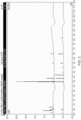
- the addition of TEMPO to the labelling reaction reduces the amount of the late eluting radiolysis product ( Figure 1 ).
- the present inventors deduce from these results that even when carried out at high activity the addition of TEMPO to the radiolabelling reaction acts to reduce the late eluting radiolysis product.
- [ 18 F]-fluoride (ca. 100 GBq) was produced using a GE Medical Systems PETtrace cyclotron with a silver target via the [ 18 O](p,n) [ 18 F] nuclear reaction. Total target volumes of 3.2 - 4.8 mL were used.
- the radiofluoride was trapped on a Waters QMA cartridge (pre-conditioned with carbonate), and the fluoride was eluted with a solution of tetrabutylammnonium hydrogen carbonate (22 mg) in water (100 ⁇ L) and acetonitrile (400 ⁇ L). Nitrogen was used to drive the solution off the QMA cartridge to the reaction vessel.
- the [ 18 F]fluoride was dried for 9 minutes at 120 °C under a steady stream of nitrogen and vacuum.
- the precursor (10.2 mg) in MeCN (1.7 mL) was added to the dried [ 18 F]-fluoride and the reaction mixture was heated at 120 C for 10 minutes.
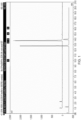
- the crude product was diluted with 2 M NaOH (1.3 mL) and water (4 mL) and left to stand for 60 seconds (see Figure 2 for comparison of with and without NaOH hydrolysis).
- the crude product was then loaded onto a tC18 SPE cartridge (Waters, product number WAT036800) and purified using the method described below.
- the SPE cartridge was washed with water (30 mL) to wash away the acetonitrile, NaOH and hydrophilic chemical and radiochemical impurities. Then the SPE cartridge was washed with a 35% ethanol solution in water (25 mL) to remove the hydroxy impurity. After this, the first SPE cartridge was connected in series to a second SPE cartridge (Waters, product number WAT036800) and the two were washed with a 40% ethanolic water solution (14 mL) followed by a stream of nitrogen to transfer the [ 18 F]Flurpiridaz onto the second cartridge and trap the more lipophilic chemical and radiochemical impurities.
- the second SPE cartridge was then eluted with a 70% ethanolic solution (3 mL) to elute the [ 18 F]Flurpiridaz into the product vial.
- the 25 mL product vial was composed of water (23 mL), ethanol (2 mL) and ascorbic acid (50 mg/mL). See Figure 3 for a chromatogram of the SPE purified product with and without ascorbic acid present.
- the non decay corrected yield was 43%, resulting in a product with an RAC of 1,800 MBq/mL.
- the RCP of the final product was 97%. Two radiolysis products were observed (1% and 2% respectively). When ascorbic acid is excluded from the product vial, the RCP is 85-88% ( Figure 3 ).
- [ 18 F]-fluoride (ca. 100 GBq) was produced using a GE Medical Systems PETtrace cyclotron with a silver target via the [ 18 O](p,n) [ 18 F] nuclear reaction. Total target volumes of 3.2 - 4.8 mL were used.
- the radiofluoride was trapped on a Waters QMA cartridge (pre-conditioned with carbonate), and the fluoride was eluted with a solution of tetrabutylammnonium hydrogen carbonate (22 mg) in water (100 ⁇ L) and acetonitrile (400 ⁇ L). Nitrogen was used to drive the solution off the QMA cartridge to the reaction vessel.
- the [ 18 F]fluoride was dried for 9 minutes at 120 °C under a steady stream of nitrogen and vacuum.
- the precursor (10.2 mg) in MeCN (1.7 mL) was added to the dried [ 18 F]-fluoride and the reaction mixture was heated at 120 C for 10 minutes.
- the crude product was diluted with 2 M NaOH (1.3 mL) and water (4 mL) and left to stand for 60 seconds (see Figure 2 for comparison of with and without NaOH hydrolysis).
- the crude product was then loaded onto a tC18 SPE cartridge (Waters, product number WAT036800) and purified using the method described below.
- the SPE cartridge was washed with water (30 mL) to wash away the acetonitrile, NaOH and hydrophilic chemical and radiochemical impurities. Then the SPE cartridge was washed with a 40% acetonitrile solution in water (10 mL) to remove the hydroxy impurity. After this, the first SPE cartridge was connected in series to a second SPE cartridge (Waters, product number WAT036800) and the two were washed with 40% acetonitrile (25 mL) followed by a stream of nitrogen to transfer the [ 18 F]Flurpiridaz onto the second cartridge and trap the more lipophilic chemical and radiochemical impurities.
- the second SPE cartridge was then eluted with a 45% ethanolic solution (7 mL) to elute the [ 18 F]Flurpiridaz into the product vial.
- the 45 mL product vial was composed of water (42 mL), ethanol (3 mL) and ascorbic acid (50 mg/mL).
- the non decay corrected yield was 40-44%, resulting in a product with an RAC of 1,700-2,000 MBq/mL.
- the RCP of the final product was 97-98%. Two radiolysis products were observed (1% and 1-2% respectively).
- a FASTlab TM automated synthesizer (GE Healthcare Ltd) with cassette was used.
- the tC18 cartridge was obtained from Waters Limited (address as above).
- Precursor 1 was reacted with [ 18 F]fluoride on the FASTlab TM according to Example 3 to give [ 18 F]Flurpiridaz.
- P refers to the Position of the cassette.
- S2 and S3 refer to syringe 2 and syringe 3:
- [ 18 F]-fluoride (ca. 100 GBq) is produced using a GE Medical Systems PETtrace cyclotron with a silver target via the [ 18 O](p,n) [ 18 F] nuclear reaction. Total target volumes of 3.2 - 4.8 mL are used.
- the radiofluoride is trapped on a Waters QMA cartridge (pre-conditioned with carbonate), and the fluoride is eluted with a solution of tetrabutylammnonium hydrogen carbonate (22 mg) in water (100 ⁇ L) and acetonitrile (400 ⁇ L). Nitrogen is used to drive the solution off the QMA cartridge to the reaction vessel.
- the [ 18 F]fluoride is dried for 9 minutes at 120 °C under a steady stream of nitrogen and vacuum.
- the precursor (10.2 mg) in MeCN (1.7 mL) is added to the dried [ 18 F]-fluoride and the reaction mixture is heated at 120 °C for 10 minutes.
- the crude product is diluted with water (5.3 mL) and loaded onto a tC18 SPE cartridge (Waters, product number WAT036800) and is purified using the method described below.
- Sodium hydroxide (2 M, ca. 3 mL) is passed through the SPE cartridge at a slow flow rate to hydrolyse the crude product.
- the SPE cartridge is then washed with aqueous solution (14 mL) to wash away the acetonitrile, NaOH and hydrophilic chemical and radiochemical impurities.
- the SPE cartridge is washed with a 40% acetonitrile solution in water (10.5 mL) to remove the hydroxy impurity.
- the SPE cartridge could be washed with NaOH here either instead of or in addition to the earlier NaOH step.
- the first SPE cartridge is connected in series to a second SPE cartridge (Waters, product number WAT036800) and the two are washed with further 40% acetonitrile water solution (24.5 mL) followed by a stream of nitrogen to transfer the [ 18 F]Flurpiridaz onto the second cartridge and trap the more lipophilic chemical and radiochemical impurities.
- the second SPE cartridge (optionally washed before ethanol elution) is then eluted with a 45% ethanolic solution (9 mL, 3-9 mL fraction collected in product vial) followed by water (4 mL) and a stream of nitrogen to elute the [ 18 F]Flurpiridaz into the product vial.
Landscapes
- Chemical & Material Sciences (AREA)
- Organic Chemistry (AREA)
- Health & Medical Sciences (AREA)
- Chemical Kinetics & Catalysis (AREA)
- Manufacturing & Machinery (AREA)
- Engineering & Computer Science (AREA)
- Molecular Biology (AREA)
- General Health & Medical Sciences (AREA)
- Hematology (AREA)
- Clinical Laboratory Science (AREA)
- Analytical Chemistry (AREA)
- Dispersion Chemistry (AREA)
- Life Sciences & Earth Sciences (AREA)
- Medicines Containing Antibodies Or Antigens For Use As Internal Diagnostic Agents (AREA)
- Organic Low-Molecular-Weight Compounds And Preparation Thereof (AREA)
- Magnetic Ceramics (AREA)
- Compositions Of Oxide Ceramics (AREA)
Claims (19)
- Procédé comprenant :(a) la mise en réaction dans de l'acétonitrile d'un composé précurseur de formule I :
BTM-LIEUR-LG (I)
dans laquelle :BTM est un groupement de ciblage biologique ;LIEUR est un alkylène ou un alcoxyalkylène ; etLG est un groupe partant contenant sulfonate ;avec du fluorure 18F pour obtenir un mélange réactionnel brut comprenant un composé de formule II marqué au 18F :
BTM-LIEUR-18F (II)
dans laquelle BTM et LIEUR sont tels que définis pour la formule I ;(b) la dilution du mélange réactionnel brut obtenu à l'étape (a) pour obtenir un mélange réactionnel brut dilué ;(c) la purification du mélange réactionnel brut dilué obtenu à l'étape (b) au moyen d'une ou de plusieurs cartouches d'extraction sur phase solide (SPE) pour obtenir un composé de formule II purifié, ladite purification comprenant les étapes successives de :dans lequel ledit composé précurseur est un composé de formule Ia :(i) transfert dudit mélange réactionnel brut dilué dans une cartouche de SPE ;(ii) éventuellement passage d'eau à travers ladite cartouche de SPE ;(iii) passage d'une solution de lavage comprenant un solvant organique à travers ladite cartouche de SPE ;(iv) éventuellement passage d'eau à travers ladite cartouche de SPE pour éliminer ledit solvant organique ; et,(v) passage d'une solution d'élution comprenant de l'éthanol à travers ladite cartouche de SPE pour éluer ledit composé de formule I de ladite cartouche de SPE ; dans lequel l'étape (b) comprend l'ajout d'un réactif d'hydrolyse audit mélange réactionnel brut et/ou ladite eau de l'étape (ii) et/ou de l'étape (iv) comprend un réactif d'hydrolyse ; et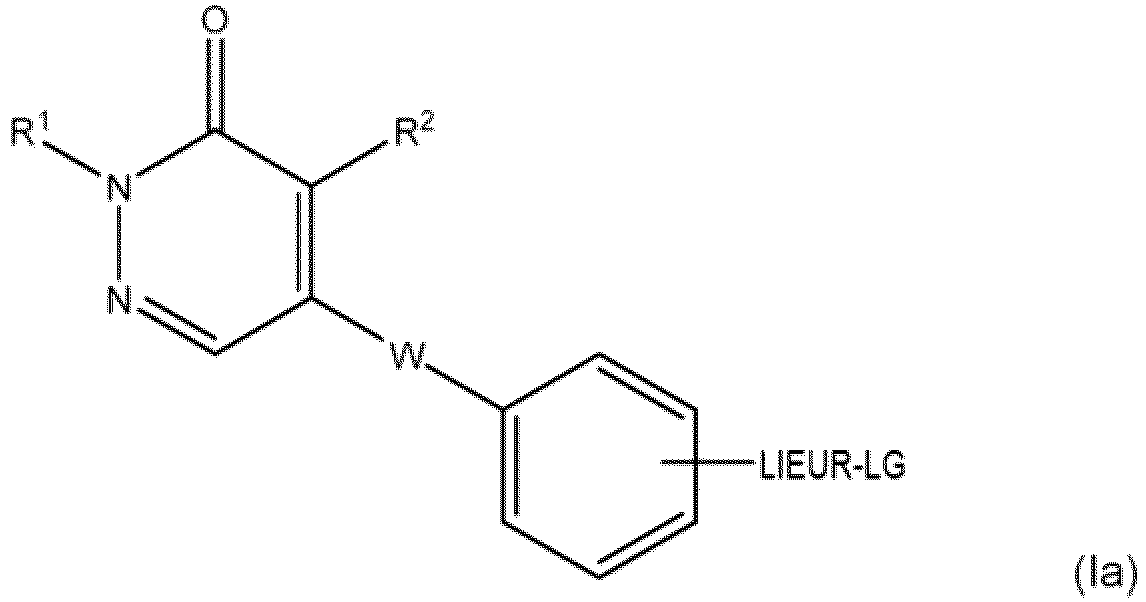
 R1 est un alkyle en C1-6 éventuellement substitué ;R2 est hydrogène ou halogéno ; etW est un alkylène ou hétéroalkylène éventuellement substitué.
 - Procédé tel que défini dans la revendication 1, dans lequel R1 est alkyle en C1-6, de préférence méthyle, éthyle, propyle, n-butyle, s-butyle ou t-butyle.
- Procédé tel que défini dans la revendication 1 ou la revendication 2, dans lequel R2 est halogéno, de préférence chloro.
- Procédé tel que défini dans l'une quelconque des revendications 1 à 3 dans lequel W est hétéroalkylène, de préférence alcoxyalkylène.
- Procédé tel que défini dans l'une quelconque des revendications 1 à 4 dans lequel ledit composé de formule I est un composé de formule Ib :


- Procédé tel que défini dans l'une quelconque des revendications 1 à 5 dans lequel ledit composé de formule I est :
 dans laquelle LG est tel que défini dans la revendication 1 ;et ledit composé de formule II est :
- Procédé tel que défini dans l'une quelconque des revendications 1 à 6 dans lequel LG est choisi parmi mésylate, tosylate, triflate, nosylate ou sulfate 1,2-cyclique.
- Procédé tel que défini dans l'une quelconque des revendications 1 à 6 dans lequel LG est tosylate.
- Procédé tel que défini dans l'une quelconque des revendications 1 à 8 dans lequel ladite solution de lavage comprenant un solvant organique de l'étape (c) (iii) comprend 20 à 80 % dudit solvant organique dans de l'eau, de préférence 30 à 60 % dudit solvant organique dans de l'eau.
- Procédé tel que défini dans l'une quelconque des revendications 1 à 9 dans lequel ladite solution de lavage comprenant un solvant organique de l'étape (c) (iii) comprend de l'acétonitrile, du méthanol ou de l'éthanol.
- Procédé selon la revendication 10, dans lequel ladite solution de lavage comprenant un solvant organique est une solution aqueuse d'acétonitrile comprenant 40 % d'acétonitrile.
- Procédé tel que défini dans l'une quelconque des revendications 1 à 11 dans lequel ladite solution d'élution de l'étape (v) comprend 45 % d'éthanol.
- Procédé tel que défini dans l'une quelconque des revendications 1 à 12 dans lequel ledit réactif d'hydrolyse est compris dans ladite eau de l'étape (iv) et les étapes (ii) et (iii) sont répétées avant la mise en œuvre de l'étape (v).
- Procédé tel que défini dans l'une quelconque des revendications 1 à 13, dans lequel ledit réactif d'hydrolyse comprend de l'acide chlorhydrique, de l'acide sulfurique ou de l'acide phosphorique, ou est choisi dans le groupe constitué par l'hydroxyde de sodium, l'hydroxyde de potassium, l'hydrure de sodium, le thiométhoxyde de sodium, l'éthoxyde de sodium, l'ammoniaque/hydroxyde d'ammonium ou le méthoxyde de sodium.
- Procédé tel que défini dans l'une quelconque des revendications 1 à 14 dans lequel ledit réactif d'hydrolyse est NaOH.
- Procédé tel que défini dans l'une quelconque des revendications 1 à 14 dans lequel ledit procédé comprend en outre, avant l'étape (v), une étape de passage d'une solution comprenant un solvant organique à travers ladite cartouche de SPE et une deuxième cartouche de SPE reliée de manière fluidique, et dans lequel l'étape (v) est mise en œuvre avec ladite deuxième cartouche de SPE.
- Procédé tel que défini dans l'une quelconque des revendications 1 à 16 dans lequel l'étape (c) comprend, avant l'étape (i), le passage dudit mélange réactionnel brut dilué à travers une cartouche de SPE distincte configurée pour retenir des composants lipophiles.
- Procédé tel que défini dans l'une quelconque des revendications 1 à 17 dans lequel du (2,2,6,6-tétraméthylpipéridin-1-yl)oxyle (TEMPO) est inclus dans l'étape de mise en réaction (a).
- Cassette pour la mise en œuvre du procédé tel que défini dans la revendication 1, comprenant :(i) un récipient contenant le composé précurseur tel que défini dans la revendication 1 ;(ii) un récipient contenant de l'eau ;(iii) une ou plusieurs cartouches de SPE ;(iv) un récipient contenant une solution comprenant un solvant organique ;(v) un récipient contenant une solution comprenant de l'éthanol ;(vi) un récipient contenant un réactif d'hydrolyse ;(vii) un récipient de réaction ;(viii) un moyen pour éluer le récipient de (i) avec une source appropriée de 18F ;(ix) un moyen de transférer le composé précurseur et la source appropriée de 18F dans le récipient de réaction ;(x) un moyen pour transférer le mélange réactionnel brut tel que défini dans la revendication 1 vers ladite ou lesdites cartouches de SPE ;(xi) un moyen pour transférer sélectivement ladite eau, ladite solution comprenant un solvant organique et ladite solution comprenant de l'éthanol vers ladite ou lesdites cartouches de SPE ;(xii) un moyen pour transférer ledit composé de formule II purifié tel que défini dans la revendication 1 dans un flacon de collecte de produit ; et,(xiii) un récipient contenant du TEMPO ;de préférence, dans laquelle ledit récipient contenant le composé précurseur contient le composé précurseur dans de l'acétonitrile conjointement avec du TEMPO.
Applications Claiming Priority (2)
| Application Number | Priority Date | Filing Date | Title |
|---|---|---|---|
| GBGB1805253.0A GB201805253D0 (en) | 2018-03-29 | 2018-03-29 | Solid phase extraction |
| PCT/EP2019/058112 WO2019185933A1 (fr) | 2018-03-29 | 2019-03-29 | Extraction en phase solide |
Publications (3)
| Publication Number | Publication Date |
|---|---|
| EP3774698A1 EP3774698A1 (fr) | 2021-02-17 |
| EP3774698B1 true EP3774698B1 (fr) | 2025-02-26 |
| EP3774698C0 EP3774698C0 (fr) | 2025-02-26 |
Family
ID=62142372
Family Applications (2)
| Application Number | Title | Priority Date | Filing Date |
|---|---|---|---|
| EP19715871.0A Active EP3774698B1 (fr) | 2018-03-29 | 2019-03-29 | Extraction en phase solide |
| EP19715067.5A Active EP3774697B1 (fr) | 2018-03-29 | 2019-03-29 | Réaction de radiomarquage stabilisé |
Family Applications After (1)
| Application Number | Title | Priority Date | Filing Date |
|---|---|---|---|
| EP19715067.5A Active EP3774697B1 (fr) | 2018-03-29 | 2019-03-29 | Réaction de radiomarquage stabilisé |
Country Status (12)
| Country | Link |
|---|---|
| US (4) | US11565257B2 (fr) |
| EP (2) | EP3774698B1 (fr) |
| JP (2) | JP7467353B2 (fr) |
| KR (2) | KR102786325B1 (fr) |
| CN (2) | CN112154130B (fr) |
| AU (2) | AU2019246403C1 (fr) |
| CA (2) | CA3095534A1 (fr) |
| ES (2) | ES2934100T3 (fr) |
| GB (1) | GB201805253D0 (fr) |
| IL (1) | IL277638B2 (fr) |
| PL (1) | PL3774698T3 (fr) |
| WO (2) | WO2019185932A1 (fr) |
Families Citing this family (3)
| Publication number | Priority date | Publication date | Assignee | Title |
|---|---|---|---|---|
| GB201915206D0 (en) | 2019-10-21 | 2019-12-04 | Ge Healthcare Ltd | Use of cyclodextrins as a radiostabilizer |
| GB202105950D0 (en) * | 2021-04-26 | 2021-06-09 | Ge Healthcare Ltd | Analytical HPLC |
| CN114832118B (zh) * | 2022-07-04 | 2022-09-27 | 北京先通国际医药科技股份有限公司 | 化合物i液体组合物、制备方法及其用途 |
Family Cites Families (14)
| Publication number | Priority date | Publication date | Assignee | Title |
|---|---|---|---|---|
| BE1010280A3 (fr) | 1996-05-02 | 1998-05-05 | Coincidence S A | Procede et dispositif de synthese de 2-[18f] fluoro-2-deoxy-d-glucose. |
| GB0329716D0 (en) | 2003-12-23 | 2004-01-28 | Amersham Plc | Radical trap |
| WO2007141529A1 (fr) | 2006-06-09 | 2007-12-13 | Ge Healthcare Limited | Méthode de fluoruration |
| WO2009108376A2 (fr) | 2008-02-29 | 2009-09-03 | Lantheus Medical Imaging, Inc. | Agents de contraste utilisés dans des applications notamment l’imagerie de perfusion |
| KR20160030589A (ko) | 2009-04-15 | 2016-03-18 | 랜티우스 메디컬 이메징, 인크. | 아스코르브산을 사용한 방사성 약제 조성물의 안정화 |
| DK3323810T3 (da) * | 2010-02-08 | 2022-03-28 | Lantheus Medical Imaging Inc | Automatiseret reaktionssystem, kassette og indretning til syntese af billeddannelsesmidler |
| GB201021263D0 (en) | 2010-12-15 | 2011-01-26 | Ge Healthcare Ltd | Solid phase extraction method |
| CN103370084B (zh) * | 2010-12-21 | 2016-11-09 | 通用电气健康护理有限公司 | 苯胺在肟连接的放射稳定化中的应用 |
| CA2852395C (fr) | 2011-10-21 | 2020-04-28 | Lantheus Medical Imaging, Inc. | Compositions renfermant de l'acide ascorbique et du pyridaben et des analogues de pyridaben fixes a une fraction d'imagerie et methodes associees |
| GB201120586D0 (en) | 2011-11-30 | 2012-01-11 | Ge Healthcare Ltd | Solid phase extraction neutralisation |
| GB201411569D0 (en) | 2014-06-30 | 2014-08-13 | Ge Healthcare Ltd | Novel formulation and method of synthesis |
| GB201209082D0 (en) * | 2012-05-24 | 2012-07-04 | Ge Healthcare Ltd | Purification method |
| GB201322456D0 (en) * | 2013-12-18 | 2014-02-05 | Ge Healthcare Ltd | Radiotracer compositions and methods |
| JP6485914B2 (ja) | 2015-10-28 | 2019-03-20 | 日本メジフィジックス株式会社 | フルテメタモルの製造方法 |
-
2018
- 2018-03-29 GB GBGB1805253.0A patent/GB201805253D0/en not_active Ceased
-
2019
- 2019-03-29 KR KR1020207030617A patent/KR102786325B1/ko active Active
- 2019-03-29 CN CN201980036252.0A patent/CN112154130B/zh active Active
- 2019-03-29 CN CN201980036255.4A patent/CN112154131B/zh active Active
- 2019-03-29 EP EP19715871.0A patent/EP3774698B1/fr active Active
- 2019-03-29 AU AU2019246403A patent/AU2019246403C1/en active Active
- 2019-03-29 CA CA3095534A patent/CA3095534A1/fr active Pending
- 2019-03-29 US US17/043,445 patent/US11565257B2/en active Active
- 2019-03-29 JP JP2020552212A patent/JP7467353B2/ja active Active
- 2019-03-29 JP JP2020552205A patent/JP7478664B2/ja active Active
- 2019-03-29 IL IL277638A patent/IL277638B2/en unknown
- 2019-03-29 KR KR1020207030746A patent/KR102794933B1/ko active Active
- 2019-03-29 CA CA3095537A patent/CA3095537A1/fr active Pending
- 2019-03-29 WO PCT/EP2019/058111 patent/WO2019185932A1/fr not_active Ceased
- 2019-03-29 ES ES19715067T patent/ES2934100T3/es active Active
- 2019-03-29 WO PCT/EP2019/058112 patent/WO2019185933A1/fr not_active Ceased
- 2019-03-29 PL PL19715871.0T patent/PL3774698T3/pl unknown
- 2019-03-29 ES ES19715871T patent/ES3020758T3/es active Active
- 2019-03-29 EP EP19715067.5A patent/EP3774697B1/fr active Active
- 2019-03-29 US US17/043,328 patent/US12162009B2/en active Active
-
2022
- 2022-12-21 US US18/086,075 patent/US20230120841A1/en not_active Abandoned
-
2023
- 2023-02-13 AU AU2023200789A patent/AU2023200789A1/en not_active Abandoned
-
2024
- 2024-10-18 US US18/919,904 patent/US20250041859A1/en active Pending
Also Published As
Similar Documents
| Publication | Publication Date | Title |
|---|---|---|
| US20250041859A1 (en) | Solid phase extraction | |
| CA2930479C (fr) | Cassette a double traitement pour la synthese de composes marques par 18f | |
| CA2851595C (fr) | Procede de synthese de biomolecules marquees au 18f | |
| CA2851599A1 (fr) | Procede de synthese de biomolecules marquees au 18f | |
| AU2013241713A1 (en) | Easily purifiable synthon composition | |
| AU2015258247A1 (en) | Purification method |
Legal Events
| Date | Code | Title | Description |
|---|---|---|---|
| STAA | Information on the status of an ep patent application or granted ep patent |
Free format text: STATUS: UNKNOWN |
|
| STAA | Information on the status of an ep patent application or granted ep patent |
Free format text: STATUS: THE INTERNATIONAL PUBLICATION HAS BEEN MADE |
|
| PUAI | Public reference made under article 153(3) epc to a published international application that has entered the european phase |
Free format text: ORIGINAL CODE: 0009012 |
|
| STAA | Information on the status of an ep patent application or granted ep patent |
Free format text: STATUS: REQUEST FOR EXAMINATION WAS MADE |
|
| 17P | Request for examination filed |
Effective date: 20201002 |
|
| AK | Designated contracting states |
Kind code of ref document: A1 Designated state(s): AL AT BE BG CH CY CZ DE DK EE ES FI FR GB GR HR HU IE IS IT LI LT LU LV MC MK MT NL NO PL PT RO RS SE SI SK SM TR |
|
| AX | Request for extension of the european patent |
Extension state: BA ME |
|
| RIN1 | Information on inventor provided before grant (corrected) |
Inventor name: ENGELL, TORGRIM Inventor name: JACKSON, ALEXANDER Inventor name: KHAN, IMTIAZ, AHMED Inventor name: CLARKE, ALAN, P. Inventor name: MCROBBIE, GRAEME Inventor name: GRIGG, JULIAN |
|
| DAV | Request for validation of the european patent (deleted) | ||
| DAX | Request for extension of the european patent (deleted) | ||
| STAA | Information on the status of an ep patent application or granted ep patent |
Free format text: STATUS: EXAMINATION IS IN PROGRESS |
|
| 17Q | First examination report despatched |
Effective date: 20220214 |
|
| P01 | Opt-out of the competence of the unified patent court (upc) registered |
Effective date: 20230529 |
|
| GRAP | Despatch of communication of intention to grant a patent |
Free format text: ORIGINAL CODE: EPIDOSNIGR1 |
|
| STAA | Information on the status of an ep patent application or granted ep patent |
Free format text: STATUS: GRANT OF PATENT IS INTENDED |
|
| INTG | Intention to grant announced |
Effective date: 20240917 |
|
| RAP3 | Party data changed (applicant data changed or rights of an application transferred) |
Owner name: GE HEALTHCARE LIMITED |
|
| GRAS | Grant fee paid |
Free format text: ORIGINAL CODE: EPIDOSNIGR3 |
|
| GRAA | (expected) grant |
Free format text: ORIGINAL CODE: 0009210 |
|
| STAA | Information on the status of an ep patent application or granted ep patent |
Free format text: STATUS: THE PATENT HAS BEEN GRANTED |
|
| AK | Designated contracting states |
Kind code of ref document: B1 Designated state(s): AL AT BE BG CH CY CZ DE DK EE ES FI FR GB GR HR HU IE IS IT LI LT LU LV MC MK MT NL NO PL PT RO RS SE SI SK SM TR |
|
| REG | Reference to a national code |
Ref country code: GB Ref legal event code: FG4D |
|
| REG | Reference to a national code |
Ref country code: CH Ref legal event code: EP |
|
| REG | Reference to a national code |
Ref country code: DE Ref legal event code: R096 Ref document number: 602019066462 Country of ref document: DE |
|
| REG | Reference to a national code |
Ref country code: IE Ref legal event code: FG4D |
|
| U01 | Request for unitary effect filed |
Effective date: 20250319 |
|
| U07 | Unitary effect registered |
Designated state(s): AT BE BG DE DK EE FI FR IT LT LU LV MT NL PT RO SE SI Effective date: 20250325 |
|
| P04 | Withdrawal of opt-out of the competence of the unified patent court (upc) registered |
Free format text: CASE NUMBER: APP_13928/2025 Effective date: 20250321 |
|
| RAP4 | Party data changed (patent owner data changed or rights of a patent transferred) |
Owner name: GE HEALTHCARE LIMITED |
|
| U1H | Name or address of the proprietor changed after the registration of the unitary effect |
Owner name: GE HEALTHCARE LIMITED; GB |
|
| REG | Reference to a national code |
Ref country code: ES Ref legal event code: FG2A Ref document number: 3020758 Country of ref document: ES Kind code of ref document: T3 Effective date: 20250523 |
|
| U20 | Renewal fee for the european patent with unitary effect paid |
Year of fee payment: 7 Effective date: 20250423 |
|
| REG | Reference to a national code |
Ref country code: GR Ref legal event code: EP Ref document number: 20250400786 Country of ref document: GR Effective date: 20250514 |
|
| PG25 | Lapsed in a contracting state [announced via postgrant information from national office to epo] |
Ref country code: RS Free format text: LAPSE BECAUSE OF FAILURE TO SUBMIT A TRANSLATION OF THE DESCRIPTION OR TO PAY THE FEE WITHIN THE PRESCRIBED TIME-LIMIT Effective date: 20250526 |
|
| PGFP | Annual fee paid to national office [announced via postgrant information from national office to epo] |
Ref country code: ES Payment date: 20250403 Year of fee payment: 7 |
|
| PG25 | Lapsed in a contracting state [announced via postgrant information from national office to epo] |
Ref country code: IS Free format text: LAPSE BECAUSE OF FAILURE TO SUBMIT A TRANSLATION OF THE DESCRIPTION OR TO PAY THE FEE WITHIN THE PRESCRIBED TIME-LIMIT Effective date: 20250626 |
|
| PG25 | Lapsed in a contracting state [announced via postgrant information from national office to epo] |
Ref country code: HR Free format text: LAPSE BECAUSE OF FAILURE TO SUBMIT A TRANSLATION OF THE DESCRIPTION OR TO PAY THE FEE WITHIN THE PRESCRIBED TIME-LIMIT Effective date: 20250226 |
|
| PGFP | Annual fee paid to national office [announced via postgrant information from national office to epo] |
Ref country code: CH Payment date: 20250401 Year of fee payment: 7 |
|
| PG25 | Lapsed in a contracting state [announced via postgrant information from national office to epo] |
Ref country code: SM Free format text: LAPSE BECAUSE OF FAILURE TO SUBMIT A TRANSLATION OF THE DESCRIPTION OR TO PAY THE FEE WITHIN THE PRESCRIBED TIME-LIMIT Effective date: 20250226 |
|
| PG25 | Lapsed in a contracting state [announced via postgrant information from national office to epo] |
Ref country code: CZ Free format text: LAPSE BECAUSE OF FAILURE TO SUBMIT A TRANSLATION OF THE DESCRIPTION OR TO PAY THE FEE WITHIN THE PRESCRIBED TIME-LIMIT Effective date: 20250226 |
|
| PG25 | Lapsed in a contracting state [announced via postgrant information from national office to epo] |
Ref country code: SK Free format text: LAPSE BECAUSE OF FAILURE TO SUBMIT A TRANSLATION OF THE DESCRIPTION OR TO PAY THE FEE WITHIN THE PRESCRIBED TIME-LIMIT Effective date: 20250226 |
|
| PG25 | Lapsed in a contracting state [announced via postgrant information from national office to epo] |
Ref country code: MC Free format text: LAPSE BECAUSE OF FAILURE TO SUBMIT A TRANSLATION OF THE DESCRIPTION OR TO PAY THE FEE WITHIN THE PRESCRIBED TIME-LIMIT Effective date: 20250226 |
|
| PLBE | No opposition filed within time limit |
Free format text: ORIGINAL CODE: 0009261 |
|
| STAA | Information on the status of an ep patent application or granted ep patent |
Free format text: STATUS: NO OPPOSITION FILED WITHIN TIME LIMIT |
|
| REG | Reference to a national code |
Ref country code: CH Ref legal event code: L10 Free format text: ST27 STATUS EVENT CODE: U-0-0-L10-L00 (AS PROVIDED BY THE NATIONAL OFFICE) Effective date: 20260107 |
|
| PG25 | Lapsed in a contracting state [announced via postgrant information from national office to epo] |
Ref country code: IE Free format text: LAPSE BECAUSE OF NON-PAYMENT OF DUE FEES Effective date: 20250329 |
|
| 26N | No opposition filed |
Effective date: 20251127 |
|
| U20 | Renewal fee for the european patent with unitary effect paid |
Year of fee payment: 8 Effective date: 20260219 |
|
| REG | Reference to a national code |
Ref country code: CH Ref legal event code: U11 Free format text: ST27 STATUS EVENT CODE: U-0-0-U10-U11 (AS PROVIDED BY THE NATIONAL OFFICE) Effective date: 20260401 |
|
| PGFP | Annual fee paid to national office [announced via postgrant information from national office to epo] |
Ref country code: GB Payment date: 20260219 Year of fee payment: 8 |
|
| PGFP | Annual fee paid to national office [announced via postgrant information from national office to epo] |
Ref country code: NO Payment date: 20260223 Year of fee payment: 8 |
|
| PGFP | Annual fee paid to national office [announced via postgrant information from national office to epo] |
Ref country code: TR Payment date: 20260227 Year of fee payment: 8 |
|
| PGFP | Annual fee paid to national office [announced via postgrant information from national office to epo] |
Ref country code: GR Payment date: 20260224 Year of fee payment: 8 Ref country code: PL Payment date: 20260224 Year of fee payment: 8 |