EP3775759B1 - Spectroscopie raman et apprentissage automatique de contrôle de qualité - Google Patents
Spectroscopie raman et apprentissage automatique de contrôle de qualité Download PDFInfo
- Publication number
- EP3775759B1 EP3775759B1 EP19781181.3A EP19781181A EP3775759B1 EP 3775759 B1 EP3775759 B1 EP 3775759B1 EP 19781181 A EP19781181 A EP 19781181A EP 3775759 B1 EP3775759 B1 EP 3775759B1
- Authority
- EP
- European Patent Office
- Prior art keywords
- polymer
- features
- properties
- computing device
- property
- Prior art date
- Legal status (The legal status is an assumption and is not a legal conclusion. Google has not performed a legal analysis and makes no representation as to the accuracy of the status listed.)
- Active
Links
Images


Classifications
-
- G—PHYSICS
- G01—MEASURING; TESTING
- G01N—INVESTIGATING OR ANALYSING MATERIALS BY DETERMINING THEIR CHEMICAL OR PHYSICAL PROPERTIES
- G01N21/00—Investigating or analysing materials by the use of optical means, i.e. using sub-millimetre waves, infrared, visible or ultraviolet light
- G01N21/84—Systems specially adapted for particular applications
- G01N21/88—Investigating the presence of flaws or contamination
- G01N21/95—Investigating the presence of flaws or contamination characterised by the material or shape of the object to be examined
- G01N21/956—Inspecting patterns on the surface of objects
- G01N21/95607—Inspecting patterns on the surface of objects using a comparative method
-
- C—CHEMISTRY; METALLURGY
- C08—ORGANIC MACROMOLECULAR COMPOUNDS; THEIR PREPARATION OR CHEMICAL WORKING-UP; COMPOSITIONS BASED THEREON
- C08L—COMPOSITIONS OF MACROMOLECULAR COMPOUNDS
- C08L23/00—Compositions of homopolymers or copolymers of unsaturated aliphatic hydrocarbons having only one carbon-to-carbon double bond; Compositions of derivatives of such polymers
- C08L23/02—Compositions of homopolymers or copolymers of unsaturated aliphatic hydrocarbons having only one carbon-to-carbon double bond; Compositions of derivatives of such polymers not modified by chemical after-treatment
- C08L23/04—Homopolymers or copolymers of ethene
- C08L23/08—Copolymers of ethene
- C08L23/0807—Copolymers of ethene with unsaturated hydrocarbons only containing four or more carbon atoms
- C08L23/0815—Copolymers of ethene with unsaturated hydrocarbons only containing four or more carbon atoms with aliphatic 1-olefins containing one carbon-to-carbon double bond
-
- C—CHEMISTRY; METALLURGY
- C08—ORGANIC MACROMOLECULAR COMPOUNDS; THEIR PREPARATION OR CHEMICAL WORKING-UP; COMPOSITIONS BASED THEREON
- C08L—COMPOSITIONS OF MACROMOLECULAR COMPOUNDS
- C08L23/00—Compositions of homopolymers or copolymers of unsaturated aliphatic hydrocarbons having only one carbon-to-carbon double bond; Compositions of derivatives of such polymers
- C08L23/02—Compositions of homopolymers or copolymers of unsaturated aliphatic hydrocarbons having only one carbon-to-carbon double bond; Compositions of derivatives of such polymers not modified by chemical after-treatment
- C08L23/10—Homopolymers or copolymers of propene
- C08L23/12—Polypropene
-
- G—PHYSICS
- G01—MEASURING; TESTING
- G01J—MEASUREMENT OF INTENSITY, VELOCITY, SPECTRAL CONTENT, POLARISATION, PHASE OR PULSE CHARACTERISTICS OF INFRARED, VISIBLE OR ULTRAVIOLET LIGHT; COLORIMETRY; RADIATION PYROMETRY
- G01J3/00—Spectrometry; Spectrophotometry; Monochromators; Measuring colours
- G01J3/28—Investigating the spectrum
- G01J3/44—Raman spectrometry; Scattering spectrometry ; Fluorescence spectrometry
- G01J3/4412—Scattering spectrometry
-
- G—PHYSICS
- G01—MEASURING; TESTING
- G01N—INVESTIGATING OR ANALYSING MATERIALS BY DETERMINING THEIR CHEMICAL OR PHYSICAL PROPERTIES
- G01N21/00—Investigating or analysing materials by the use of optical means, i.e. using sub-millimetre waves, infrared, visible or ultraviolet light
- G01N21/62—Systems in which the material investigated is excited whereby it emits light or causes a change in wavelength of the incident light
- G01N21/63—Systems in which the material investigated is excited whereby it emits light or causes a change in wavelength of the incident light optically excited
- G01N21/65—Raman scattering
-
- G—PHYSICS
- G01—MEASURING; TESTING
- G01N—INVESTIGATING OR ANALYSING MATERIALS BY DETERMINING THEIR CHEMICAL OR PHYSICAL PROPERTIES
- G01N21/00—Investigating or analysing materials by the use of optical means, i.e. using sub-millimetre waves, infrared, visible or ultraviolet light
- G01N21/84—Systems specially adapted for particular applications
- G01N21/88—Investigating the presence of flaws or contamination
- G01N21/95—Investigating the presence of flaws or contamination characterised by the material or shape of the object to be examined
-
- G—PHYSICS
- G06—COMPUTING OR CALCULATING; COUNTING
- G06N—COMPUTING ARRANGEMENTS BASED ON SPECIFIC COMPUTATIONAL MODELS
- G06N20/00—Machine learning
-
- G—PHYSICS
- G06—COMPUTING OR CALCULATING; COUNTING
- G06N—COMPUTING ARRANGEMENTS BASED ON SPECIFIC COMPUTATIONAL MODELS
- G06N20/00—Machine learning
- G06N20/20—Ensemble learning
-
- C—CHEMISTRY; METALLURGY
- C08—ORGANIC MACROMOLECULAR COMPOUNDS; THEIR PREPARATION OR CHEMICAL WORKING-UP; COMPOSITIONS BASED THEREON
- C08L—COMPOSITIONS OF MACROMOLECULAR COMPOUNDS
- C08L2203/00—Applications
- C08L2203/10—Applications used for bottles
-
- C—CHEMISTRY; METALLURGY
- C08—ORGANIC MACROMOLECULAR COMPOUNDS; THEIR PREPARATION OR CHEMICAL WORKING-UP; COMPOSITIONS BASED THEREON
- C08L—COMPOSITIONS OF MACROMOLECULAR COMPOUNDS
- C08L2205/00—Polymer mixtures characterised by other features
- C08L2205/02—Polymer mixtures characterised by other features containing two or more polymers of the same C08L -group
- C08L2205/025—Polymer mixtures characterised by other features containing two or more polymers of the same C08L -group containing two or more polymers of the same hierarchy C08L, and differing only in parameters such as density, comonomer content, molecular weight, structure
-
- G—PHYSICS
- G01—MEASURING; TESTING
- G01N—INVESTIGATING OR ANALYSING MATERIALS BY DETERMINING THEIR CHEMICAL OR PHYSICAL PROPERTIES
- G01N21/00—Investigating or analysing materials by the use of optical means, i.e. using sub-millimetre waves, infrared, visible or ultraviolet light
- G01N21/84—Systems specially adapted for particular applications
- G01N2021/8411—Application to online plant, process monitoring
- G01N2021/8416—Application to online plant, process monitoring and process controlling, not otherwise provided for
-
- G—PHYSICS
- G01—MEASURING; TESTING
- G01N—INVESTIGATING OR ANALYSING MATERIALS BY DETERMINING THEIR CHEMICAL OR PHYSICAL PROPERTIES
- G01N21/00—Investigating or analysing materials by the use of optical means, i.e. using sub-millimetre waves, infrared, visible or ultraviolet light
- G01N21/84—Systems specially adapted for particular applications
- G01N21/88—Investigating the presence of flaws or contamination
- G01N21/8851—Scan or image signal processing specially adapted therefor, e.g. for scan signal adjustment, for detecting different kinds of defects, for compensating for structures, markings, edges
- G01N2021/8883—Scan or image signal processing specially adapted therefor, e.g. for scan signal adjustment, for detecting different kinds of defects, for compensating for structures, markings, edges involving the calculation of gauges, generating models
-
- G—PHYSICS
- G01—MEASURING; TESTING
- G01N—INVESTIGATING OR ANALYSING MATERIALS BY DETERMINING THEIR CHEMICAL OR PHYSICAL PROPERTIES
- G01N21/00—Investigating or analysing materials by the use of optical means, i.e. using sub-millimetre waves, infrared, visible or ultraviolet light
- G01N21/84—Systems specially adapted for particular applications
- G01N21/88—Investigating the presence of flaws or contamination
- G01N21/95—Investigating the presence of flaws or contamination characterised by the material or shape of the object to be examined
- G01N21/956—Inspecting patterns on the surface of objects
- G01N21/95607—Inspecting patterns on the surface of objects using a comparative method
- G01N2021/95615—Inspecting patterns on the surface of objects using a comparative method with stored comparision signal
Definitions
- the present invention relates generally to methods for determining the quality of polymers, more particularly, polyolefins.
- the methods involve Raman spectroscopy and artificial intelligence.
- WO 2004/017056 A1 describes a process for determining mechanical properties of polymer products.
- US 6723804 B1 describes processes, methods and apparatus relating to olefin polymerization that include the use of Raman spectrometry to monitor the concentration of reactants, products or other chemical components.
- One aspect of the invention relates to a method as recited in claim 1.
- the method further comprises, before the computing step, transforming, by the polymer property computing device, the obtained Raman spectrum of the polymer sample to a format readable by one or more trained machine learning algorithms. In one example, the method further comprises, after the determining step, reporting, by the polymer property computing device, the one or more computed polymer properties or features.
- the polymer sample comprises a polyolefin. In one example, the polyolefin is polypropylene. In one example, the polymer sample is in a form of a pellet.
- the one or more polymer features is one or more features selected from the group consisting of an amount of one or more additives, if present, and an amount of one or more comonomers, if present.
- the processor is further configured to execute programmed instructions stored in the memory further comprising, after the determining step, reporting, by the polymer property computing device, the one or more computed polymer properties or features.
- the polymer sample comprises a polyolefin.
- the medium further comprises, after the determining step, reporting, by the polymer property computing device, the one or more computed polymer properties or features.
- the polymer sample comprises a polyolefin.
- the one or more polymer features is one or more features selected from the group consisting of an amount of one or more additives, if present, and an amount of one or more comonomers, if present.
- the main difficulty is the data dimensionality. Each point of a spectrum represents the intensity recorded at a particular wavelength.
- a Raman dataset therefore has one attribute for each point on its constituent spectra, with a typical Raman spectrum having 1,000 to 3,000 pairs of data points (about 3,000 dimensions).
- the relevant bands are manually selected based on expert knowledge of the spectroscopic behavior of the material and the rest of the information is thrown away.
- the disclosed method uses artificial intelligence, more specifically machine learning techniques, to develop a model capable of predicting relevant polymer properties/features from the Raman spectrum. Furthermore, by employing an online nondestructive fingerprinting method and artificial intelligence, real-time estimations of product specifications can be obtained, thus reducing the time and costs associated with using the conventional laboratory equipment for quality control.
- the acquisition of the Raman spectrum of the polymer sample can be initiated manually or automatically (e.g., programmed into the polymer property computing device).
- Exemplary algorithms for computing one or more polymer properties or features include, but are not limited to, Logistic Regression, Naive Bayes, Neural Networks, Deep Learning, and Kernel Machine methods such as Kernel Support Vector Machines Regression, Gaussian Processes, and Kernel Ridge Regression. Combinations of these algorithms may also be used.
- Raman spectra of known samples are acquired, and the polymer properties/features of the known samples are measured in the laboratory.
- the polymer properties/features can be measured with methods known to one skilled in the art. For example, the melt flow rate of the sample can be measured per ASTM D1238 using a load of 2.16 kg at 230°C. No particular number of calibration samples is required. One skilled in the art can determine the appropriate number of calibration samples based on the performance of the model and the incremental change in performance with additional calibration data.
- the polymer properties/features measured include those that the model will compute.
- the measured polymer properties/features and the acquired Raman spectra are then entered into the polymer property computing device.
- the data set including the measured polymer properties/features and the respective Raman spectral data for the samples is ingested into a tabulated, machine-readable database, accessible by an application programming interface (API) or a graphic user interphase.
- API application programming interface
- the input variables are typically scaled to get zero mean and standard deviation equal to one.
- the data is transformed to make it readable by the machine learning algorithms.
- This process is known as feature engineering or variable engineering.
- many possible variables are generated, even if some of them are irrelevant.
- new variables can be generated by applying basic arithmetic operations in between the original features.
- the feature/variable engineering process can also include: deleting the examples with missing values or replacing missing values for the mean of the given variable, and identifying and removing outliers.
- a "data transformations pipeline" can be written to apply the same variable operations to the data presented to the machine-learning algorithm.
- the data can be obtained from known samples with measured polymer properties/features or unknown samples.
- the next step in the training phase involves feature selection and dimensionality reduction.
- a particular input feature can be strongly relevant (has information that does not exist in any other feature), relevant, weakly relevant (some information that other features include) or irrelevant.
- feature selection a subset of strongly relevant features is used in model construction.
- the one or more peaks and/or valleys are correlated to with the measured properties/features to form a part of polymer property and feature data.
- peaks at 810 cm -1 , 841 cm -1 , 900 cm -1 , 974 cm -1 , 999 cm -1 , 1152 cm -1 , 1168 cm -1 , 1220 cm -1 , 1329 cm -1 , 1359 cm -1 , 1436 cm -1 , and 1459 cm -1 can be useful for characterizing the crystallinity, mechanical properties and tacticity of polypropylene ( See Julio Kirt-Teran et al., Applied Spectroscopy, 2016, p. 1118-1127 , for a discussion of certain peaks attributable to certain polymer properties).
- THz Low frequency bands at 106 cm -1 , 171 cm -1 , 250 cm -1 , 320 cm -1 , 398 cm -1 , 460 cm -1 , and 530 cm -1 can be used to identify crystalline modifications of isotactic polypropylene ( ⁇ , ⁇ , and ⁇ ), lamellar thickness, mechanical properties, the length of isotactic segments in the helical conformation and comonomer content ( See A Materny at al., Journal of Physics: Conference Series, 2017, p. 1-9 , for a general description of useful bands).
- the model can be trained using methods known in the art. For instance, the collected data is usually divided into two sets: a training data set (typically about 80% of the collected data) and a testing data set (typically about 20% of the collected data).
- the training data set is used to develop the model, where the machine learning algorithm is executed to analyze the training data set and produce an inferred function. Since the chosen polymer property/feature for the training data set samples is both computed and measured, the effectiveness of the model can be evaluated by comparing the computed and measured values.
- An optimization algorithm is typically used to minimize either the empirical-risk or the structural-risk. This can be done by adjusting the inferred function parameters (known as hyper-parameters) so that the error between the known outputs and the model prediction is minimized.
- the trained model i.e., machine learning algorithm
- the trained model is tasked to compute the polymer properties/features from the testing data set. This is done in order to evaluate the ability of the model to generalize.
- the trained model can then be applied to unknown sample spectra to compute the desired polymer property or feature.
- the model can be trained to predict one or more polymer properties/features. In some embodiments, separate models are developed for each polymer property/feature. In other embodiments, multiple polymer properties/features can be determined simultaneously by using the model.
- Trained models can be further enhanced by ensemble techniques, in which the goal is to combine the predictions of several base estimators built with a given learning algorithm in order to improve generalizability / robustness over a single estimator.
- Some ensemble methods include bagging methods, forests of randomized trees, AdaBoost, Gradient Tree Boosting, and voting classifiers.
- the method further comprises, before the computing step, classifying, by the polymer property computing device, the peaks and/or valleys in the obtained chemical and structural fingerprints as either a relevant polymer feature or a non-relevant polymer feature.
- peaks at 810 cm -1 , 974 cm -1 , and 1168 cm -1 may be classified as relevant polymer features because these peaks relate to the crystallinity and tacticity of polypropylene.
- the method further comprises, after the determining step, reporting, by the polymer property computing device, the one or more computed polymer properties or features.
- the one or more computed polymer properties or features may be displayed on a screen of a computer (e.g., desktop, laptop, tablet, mobile phone, and smart watches).
- the method further comprises refining, by the polymer property computing device, the one or more trained machine learning algorithms at least by repeating the executing step and the adjusting step using the in-process data.
- the machine learning algorithm is then continuously refined as the product wheel changes, thus improving its predicting capability over time.
- the polymer property computing device can determine, based on one or more computed polymer properties or features, whether the quality of the polymer sample meets a predetermined quality threshold, which typically includes acceptable lot-to-lot variations.
- the polymer sample can be deemed to meet the quality threshold, and the polymer production process can be continued without further adjustments.
- the parameters for the polymer production process can be adjusted by the polymer property computing device to achieve the polymer with the desired properties or features. These parameters include, but are not limited to, the amount/concentration of the reactants (e.g., propylene, ethylene, hydrogen), additives, and polymerization catalyst; temperature; and pressure.
- reactants e.g., propylene, ethylene, hydrogen
- additives e.g., additives, and polymerization catalyst
- Raman spectroscopy is a well-known analytical tool for molecular characterization, identification, and quantification.
- Raman spectroscopy makes use of inelastically scattered radiation from a non-resonant, non-ionizing radiation source, typically a visible or near-infrared radiation source such as a laser, to obtain information about molecular vibrational-rotational states.
- the Raman spectrum includes information directly or indirectly related to various properties of the polyolefin sample.
- Raman spectra are typically shown as plots of intensity (arbitrary units) versus "Raman shift," where the Raman shift is the difference in energy or wavelength between the excitation radiation and the scattered radiation. The Raman shift is typically reported in units of wavenumbers (cm -1 ).
- the spectral range of the Raman spectrum acquired is not particularly limited, but a useful range includes Raman shifts (Stokes and/or anti-Stokes) in the chemical fingerprint region corresponding to a typical range of polyatomic vibrational frequencies, and in the structural fingerprint region corresponding to vibrational modes.
- the spectral range generally ranges from about -200 cm -1 to about 4,000 cm -1 .
- useful spectral information can also be present in higher frequency regions. For example, overtone vibrations (harmonics) contribute to Raman scattering in the region above 4,000 cm -1 Raman shift.
- acquisition and use of a Raman spectrum as described herein can include higher frequency spectral regions.
- the spectral region acquired can be less than all of the -200 cm -1 to 4,000 cm -1 region.
- the majority of Raman scattering-intensity data useful for chemical fingerprints will be present in a region ranging from about 500 cm -1 to about 3,500 cm -1 or from about 1,000 cm -1 to about 3,000 cm -1 ; while the data in the spectral region useful for structural information is typically present in a region ranging from about - 200 cm -1 to about 500 cm -1 .
- the region acquired can also include a plurality of sub-regions that need not be contiguous.
- the Raman spectral data acquired can include a plurality of frequency or wavelength shift, scattering intensity (x, y) measurements over relatively broad spectral regions, including regions conventionally identified as spectral bands and regions conventionally identified as interband, or unresolved regions.
- the frequency spacing of acquired data can be readily determined by one skilled in the art, based on considerations of machine resolution and capacity, acquisition time, data analysis time, information density, and other factors appreciated by one skilled in the art.
- the amount of signal averaging used can be readily determined by one skilled in the art based on machine and process efficiencies and limitations.
- the instrumentation used to collect and process Raman data typically includes a Raman spectrometer, a laser source, a low-frequency filter, a Raman probe in communication with the polymer production process, and the machine learning algorithm.
- a Raman spectrometer includes an excitation source which delivers excitation radiation to the Raman probe. Scattered radiation is collected within the Raman probe, filtered of Rayleigh scattered light, and dispersed via monochromator. The dispersed Raman scattered light is then imaged onto a detector and subsequently processed in by the polymer property computing device, as further described below.
- the excitation source and frequency can be readily determined based on considerations well-known in the art.
- the excitation source is a visible or near infrared laser, such as a frequency-doubled Nd:YAG laser (532 nm), a helium-neon laser (633 nm), or a solid-state diode laser (such as 785 nm).
- the laser can be pulsed or continuous wave (CW), polarized as desired or randomly polarized, and preferably single-mode.
- Typical excitation lasers will have 100 to 400 mW power (CW), although lower or higher power can be used as desired.
- Light sources other than lasers can be used, and wavelengths and laser types and parameters other than those listed above can also be used.
- the excitation radiation can be delivered to the Raman probe, and the scattered radiation collected from the Raman probe, by any convenient means known in the art, such as conventional beam manipulation optics, or fiber optic cables.
- any convenient means known in the art such as conventional beam manipulation optics, or fiber optic cables.
- Raman spectroscopy it is a particular advantage of Raman spectroscopy that the excitation radiation typically used is readily manipulated fiber optically, and thus the excitation source can be positioned remotely from the sampling region.
- a particular fiber optic probe is described below; however, one skilled in the art will appreciate that the Raman system is not limited to any particular means of radiation manipulation.
- the scattered radiation is collected and dispersed by any convenient means known in the art, such as a fiber optic probe as described below.
- the collected scattered radiation is filtered to remove Rayleigh scattering, for instance through a low-frequency filter, and optionally filtered to remove fluorescence, then frequency (wavelength) dispersed using a suitable dispersive element, such as a blazed grating or a holographic grating, or interferometrically (e.g., using Fourier transforms).
- a suitable dispersive element such as a blazed grating or a holographic grating, or interferometrically (e.g., using Fourier transforms).
- the grating can be fixed or scanning, depending upon the type of detector used.
- the monochromator can be any such dispersive element, along with associated filters and beam manipulation optics.
- the dispersed Raman scattering is imaged onto a detector.
- detector The choice of detector is easily made by one skilled in the art, taking into account various factors such as resolution, sensitivity to the appropriate frequency range, and response time.
- Typical detectors include array detectors generally used with fixed-dispersive monochromators, such as diode arrays or charge coupled devices (CCDs), or single element detectors generally used with scanning-dispersive monochromators, such as lead sulfide detectors and indium-gallium-arsenide detectors.
- the detector is calibrated such that the frequency (wavelength) corresponding to each detector element is known.
- the detector response is delivered to the data subsystem which generates a set of frequency shift, intensity (x,y) data points which constitute the Raman spectrum.
- the Raman probe couples the Raman spectrometer to the manufacturing process.
- the excitation radiation can be delivered to and collected from the polymer sample by any convenient means, such as using conventional optics or fiber optic cables.
- the Raman probe can be a conventional Raman probe, a THz-Raman probe, or both.
- the Raman probe may or may not have immersion optics.
- Raman probes with immersion optics can be immersed in liquid samples such as molten polymers in the extruder or polymers dissolved in a solvent. For sampling of solid samples (e.g., granules, pellets, or powder), the Raman probes typically do not have immersion optics.
- the Raman probe is typically placed at an access point in the production process of the polymer.
- the access points can be close to where the engineers sample the polymers for quality control such as immediately after the pelletizer and/or after the purge bin.
- the Raman probe can be located in a pipe or in a small vessel located at the access point.
- the polymer can be a homopolymer, a copolymer, or a polymer blend.
- polymer refers to a polymeric compound prepared by polymerizing monomers, whether of the same or a different kind.
- the generic term “polymer” thus includes the term “homopolymer,” which refers to polymers prepared from only one type of monomer, as well as the term “copolymer” which refers to polymers prepared from two or more different monomers.
- blend or “polymer blend” generally refers to a physical mixture of two or more polymers which are not chemically combined. Such a blend may be miscible and may or may not be phase separated.
- the polymer can be a polyolefin.
- exemplary polyolefins include, but are not limited to, polyethylene, polypropylene, polyisobutylene, and homopolymers and copolymers thereof.
- the polyolefin is polypropylene homopolymer or a polypropylene-based copolymer, such as an impact copolymer or a random polymer.
- the polypropylene-based copolymer refers to copolymers containing at least 50 wt% propylene monomer units, based on the weight of the copolymer.
- Polypropylene-based copolymers are typically prepared by polymerizing propylene and at least one other linear ⁇ -olefin, branched ⁇ -olefin, or cyclic olefin.
- the ⁇ -olefin and the cyclic olefin may have 2 to 20 carbon atoms, 2 to 16 carbon atoms, or 2 to 12 carbon atoms, including but not limited to ethylene, 1-butene, 2-butene, 1-pentene, 3-methyl-1-butene, 1-hexene, 4-methyl-1-pentene, 3-methyl-1-pentene, 4,6-dimethyl-1-heptene, 1-octene, 1-decene, 1-undecene, 1-dodecene, 1-tetradecene, 1-hexadecene, 1-octadecene, 1-eicocene, norbornene, tetracyclododecene, and combinations thereof.
- These olefins may each contain one or more heteroatoms such as an oxygen, nitrogen, and/or silicon atom.
- the polypropylene-based copolymer can be made up of linear and/or branched polymer chains.
- Exemplary polypropylene-based copolymer includes an alternating copolymer, a periodic copolymer, a block copolymer, a random copolymer, or an impact copolymer.
- the polypropylene-based copolymer is a random copolymer or an impact copolymer optionally containing long chain branches.
- the term "random copolymer” refers to a copolymer in which the different types of monomer units are statistically distributed in the polymer molecules.
- the polypropylene-based copolymer can be a polypropylene-polyethylene random copolymer in which the content of the ethylene monomer units is typically up to 7 wt%, based on a total weight of the copolymer.
- the term "impact copolymer” refers to a heterophasic polyolefin copolymer in which one polyolefin is the continuous phase (i.e., the matrix) and an elastomeric phase is uniformly dispersed therein.
- the impact copolymer includes, for instance, a heterophasic polypropylene copolymer in which the polypropylene homopolymer is the continuous phase and an elastomeric phase, such as ethylene propylene rubber (EPR), is uniformly distributed therein.
- EPR ethylene propylene rubber
- the polyolefin is polyethylene homopolymer, such as very low density polyethylene, low density polyethylene, linear low density polyethylene, medium density polyethylene, high density polyethylenes, and ultra high molecular weight polyethylene, or a polyethylene-based copolymer such as ethylene vinyl acetate copolymer.
- the polymer property can be any property relating to the polymer that one skilled in the art can measure analytically through Raman spectroscopy, including molecular weight, melt flow rate, lamellar thickness, crystallinity, xylene solubles, mechanical properties (e.g., tensile or compressive properties), and combinations thereof.
- molecular weight can refer to number average molecular weight, weight average molecular weight, or Z-average molecular weight.
- Mechanical properties can be any mechanical property relating to the polymer known by one skilled in the art, including Young's modulus, tensile strength at yield, elongation at yield on traction, and flexural modulus at 1% secant.
- the polymer features can be the amount of one or more additives (e.g., talc, kaolin, glass fiber), if present, and an amount of one or more comonomers, if present.
- additives e.g., talc, kaolin, glass fiber
- Other polymer features known to one skilled in the art can also be determined through the disclosed process.
- the polymer property computing device includes processor or central processing unit (CPU), memory, optional configurable hardware logic, and a communication system which are coupled together by a bus device although the polymer property computing device may comprise other types and numbers of elements in other configurations.
- the bus is a PCI Express bus in this example, although other bus types and links may be used.
- the processors within the polymer property computing device may execute one or more computer-executable instructions stored in memory for the methods illustrated and described with reference to the examples herein, although the processor can execute other types and numbers of instructions and perform other types and numbers of operations.
- the processor may comprise one or more CPUs or general purpose processors with one or more processing cores, such as AMD ® processor(s), although other types of processor(s) could be used (e.g., those produced by Intel ® ).
- the memory within the polymer property computing device may comprise one or more tangible storage media, such as RAM, ROM, flash memory, CD-ROM, floppy disk, hard disk drive(s), solid state memory, DVD, or any other memory storage types or devices, including combinations thereof, which are known to those of ordinary skill in the art.
- the memory may store one or more non-transitory computer-readable instructions of this technology as illustrated and described with reference to the examples herein that may be executed by the processor.
- the exemplary flowcharts shown in Figures 4 and 5 are representative of example steps or actions of this technology that may be embodied or expressed as one or more non-transitory computer or machine readable instructions stored in the memory that may be executed by the processor and/or may be implemented by configured logic in the optional configurable logic.
- the memory of the polymer property computing device can store one or more applications that can include computer executable instructions that, when executed by the polymer property computing device, causes the polymer property computing device to perform actions, such as transmit, receive, or otherwise process messages, for example, and to perform other actions described and illustrated with reference to Figures 4 and 5 .
- the application(s) can be implemented as module or components of another application; can be implemented as operating system extensions, module, plugins, or the like; can be implemented as module or components of another application; can be implemented as operating system extensions, module, plugins, or the like; may be operative in a cloud-based computing environment; and can be executed within virtual machine(s) or virtual server(s) that may be managed in a cloud-based computing environment.
- the application(s), including the polymer property computing device itself, may be located in virtual server(s) running in a cloud-based computing environment rather than being tied to one or more specific physical network computing devices. Further, the application(s) may be running in one or more virtual machines (VMs) executing on the polymer property computing device. In at least one of the various embodiments, virtual machine(s) running on the polymer property computing device may be managed or supervised by a hypervisor.
- VMs virtual machines
- the optional configurable hardware logic device in the polymer property computing device may comprise specialized hardware configured to implement one or more steps of this technology as illustrated and described with reference to the examples herein.
- the optional configurable logic hardware device may comprise one or more of field programmable gate arrays ("FPGAs”), field programmable logic devices (“FPLDs”), application specific integrated circuits (“ASICs”) and/or programmable logic units (“PLUs").
- FPGAs field programmable gate arrays
- FPLDs field programmable logic devices
- ASICs application specific integrated circuits
- PLUs programmable logic units
- the communication system in the polymer property computing device is used to operatively couple and communicate between the polymer property computing device, and the spectrometer which are all coupled together by communication network, such as one or more local area networks (LAN) and/or the wide area network (WAN), although other types and numbers of communication networks or systems with other types and numbers of connections and configurations to other devices and elements may be used.
- communication network such as LAN and WAN can use TCP/IP over Ethernet and industry-standard protocols, including NFS, CIFS, SOAP, XML, LDAP, and SNMP, although other types and numbers of communication networks can be used.
- the polymer property computing device is illustrated in this example as including a single device, the polymer property computing device in other examples can include a plurality of devices or blades each with one or more processors, each processor with one or more processing cores that implement one or more steps of this technology.
- one or more of the devices can have a dedicated communication interface or memory.
- One or more of the devices can utilize the memory, communication interface, or other hardware or software components of one or more other communicably coupled of the devices.
- One or more of the devices that together comprise polymer property computing device in other examples can be standalone devices or integrated with one or more other devices or applications. Additionally, one or more of the devices of the polymer property computing device in these examples can be in a same or a different communication network including one or more public, private, or cloud networks, for example.
- Each of the systems may be conveniently implemented using one or more general purpose computer systems, microprocessors, digital signal processors, and micro-controllers, programmed according to the teachings, as described and illustrated herein, and as will be appreciated by those of ordinary skill in the art.
- the polymer property computing device may be configured to operate as virtual instances on the same physical machine.
- two or more computing systems or devices can be substituted for any one of the systems or devices.
- principles and advantages of distributed processing, such as redundancy and replication also can be implemented, as desired, to increase the robustness and performance of the devices and systems.
- the processes may also be implemented on computer system(s) that extend across any suitable network using any suitable interface mechanisms and traffic technologies, including, by way of example, teletraffic in any suitable form (e.g., voice and modem), wireless traffic media, wireless traffic networks, cellular traffic networks, G3 traffic networks, Public Switched Telephone Networks (PSTNs), Packet Data Networks (PDNs), the Internet, intranets, and combinations thereof.
- PSTNs Public Switched Telephone Networks
- PDNs Packet Data Networks
- the processes may also be embodied as a non-transitory computer readable medium having instructions stored thereon for one or more aspects of the technology as described and illustrated herein, which, when executed by a processor (or configurable hardware), cause the processor to carry out the steps necessary to implement the processes, as described and illustrated herein.
- another aspect of the invention relates to a non-transitory computer readable medium having stored thereon instructions for determining the quality of a polymer based on a Raman spectrum of the polymer comprising machine executable code which when executed by at least one processor, causes the processor to perform steps defined in claim 7.
- Another aspect of the invention relates to a polymer property computing device including a processor and a memory, where the memory is coupled to the processor configured to execute programmed instructions stored in the memory defined in claim 8.
- Tests were performed on polypropylene to demonstrate that the properties estimated by using Raman spectroscopy and machine learning, as disclosed in this application, correlate with historical measurements of lab data, collected through the methods shown in Table 1, below.
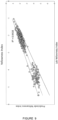
- the plots, set forth in FIGS. 6-9 show the predicted value of a given property as determined by the machine learning algorithm based on the Raman data versus the actual value of that property measured in the laboratory.
- Figure 6 shows a plot depicting the melt flow as predicted by the machine learning algorithm based on the Raman spectrum versus the true melt flow measured in the laboratory
- Figure 7 shows a plot depicting the ethylene % as predicted by the machine learning algorithm based on the Raman spectrum versus the true ethylene % measured in the laboratory
- Figure 8 shows a plot depicting the flexural modulus as predicted by the machine learning algorithm based on the Raman spectrum versus the true flexural modulus measured in the laboratory
- Figure 9 shows a plot depicting the yellowness index as predicted by the machine learning algorithm based on the Raman spectrum versus the true yellowness index measured in the laboratory.
- the disclosed method utilizing a machine learning algorithm based on Raman data is able to estimate, at least with the accuracy indicated, several key quality-control properties of the polymer, including molecular (melt flow), mechanical (flexural modulus), compositional (ethylene%) and visual (yellowness index) properties. While only certain properties have been shown, it would be expected that disclosed method utilizing machine learning algorithm based on Raman data would be able to predict other similar polymer properties and be useful on other polyolefins or polymer compositions.
Landscapes
- Physics & Mathematics (AREA)
- Health & Medical Sciences (AREA)
- Chemical & Material Sciences (AREA)
- General Physics & Mathematics (AREA)
- Life Sciences & Earth Sciences (AREA)
- Analytical Chemistry (AREA)
- Biochemistry (AREA)
- General Health & Medical Sciences (AREA)
- Immunology (AREA)
- Pathology (AREA)
- Engineering & Computer Science (AREA)
- Spectroscopy & Molecular Physics (AREA)
- Theoretical Computer Science (AREA)
- Software Systems (AREA)
- Polymers & Plastics (AREA)
- Medicinal Chemistry (AREA)
- Organic Chemistry (AREA)
- Chemical Kinetics & Catalysis (AREA)
- Nuclear Medicine, Radiotherapy & Molecular Imaging (AREA)
- Computing Systems (AREA)
- Evolutionary Computation (AREA)
- General Engineering & Computer Science (AREA)
- Mathematical Physics (AREA)
- Data Mining & Analysis (AREA)
- Artificial Intelligence (AREA)
- Computer Vision & Pattern Recognition (AREA)
- Medical Informatics (AREA)
- Investigating, Analyzing Materials By Fluorescence Or Luminescence (AREA)
- Investigating Or Analysing Materials By Optical Means (AREA)
Claims (13)
- Procédé de détermination de la qualité d'un polymère sur la base d'un spectre Raman du polymère, le procédé comprenant les étapes consistant à :obtenir, par un dispositif de calcul de propriété de polymère, un spectre Raman d'un échantillon de polymère à partir d'un spectromètre Raman, dans lequel le spectre Raman comprend une pluralité de pics et de vallées définissant des empreintes chimiques et structurelles qui correspondent à une ou plusieurs propriétés ou caractéristiques de polymère ;classer, par le dispositif de calcul de propriété de polymère, les pics et/ou les vallées dans les empreintes chimiques et structurelles obtenues soit comme pertinents pour la propriété ou la caractéristique de polymère soit comme non pertinents pour la propriété ou la caractéristique de polymère ;calculer, par le dispositif de calcul de propriété de polymère, des une ou plusieurs propriétés ou caractéristiques de polymère en comparant les pics et/ou les vallées pertinents dans les empreintes chimiques et structurelles obtenues à des données stockées de propriété et de caractéristique de polymère, dans lequel l'étape de calcul est réalisée en effectuant, par le dispositif de calcul de propriété de polymère, un ou plusieurs algorithmes d'apprentissage machine entraînés ; etdéterminer, par le dispositif de calcul de propriété de polymère, sur la base d'une ou plusieurs propriétés ou caractéristiques de polymère calculées, si la qualité de l'échantillon de polymère correspond ou ne correspond pas à un seuil de qualité prédéterminé,dans lequel les un ou plusieurs algorithmes d'apprentissage machine entraînés sont entraînés en :recevant, par le dispositif de calcul de propriété de polymère, à la fois un spectre Raman et des propriétés et des caractéristiques de polymère mesurées pour chacun d'une pluralité d'échantillons de polymère connus ;corrélant, par le dispositif de calcul de propriété de polymère, les un ou plusieurs pics et/ou vallées pertinents pour la propriété ou la caractéristique de polymère dans les empreintes structurelles et chimiques du spectre Raman reçu aux propriétés et caractéristiques de polymère mesurées pour former au moins une partie des données de propriété et de caractéristique de polymère ;exécutant, par le dispositif de calcul de propriété de polymère, les un ou plusieurs algorithmes d'apprentissage machine pour apprendre à reconnaître les un ou plusieurs pics et/ou vallées corrélés dans les empreintes structurelles et chimiques et pour calculer les propriétés et les caractéristiques de polymère ;ajustant, par le dispositif de calcul de propriété de polymère, un ou plusieurs hyper-paramètres pour minimiser de quelconques erreurs entre les propriétés et les caractéristiques de polymère calculées et les propriétés et les caractéristiques de polymère mesurées ; etrépétant, par le dispositif de calcul de propriété de polymère, au moins l'étape d'exécution et l'étape d'ajustement pour former les un ou plusieurs algorithmes d'apprentissage machine entraînés,dans lequel les une ou plusieurs propriétés de polymère sont une ou plusieurs propriétés sélectionnées dans le groupe constitué de poids moléculaire, de vitesse de fluidité à chaud, d'épaisseur lamellaire, des solubles dans le xylène, d'une ou plusieurs propriétés de traction, et d'une ou plusieurs propriétés de compression.
- Procédé tel qu'énoncé selon la revendication 1, comprenant en outre, avant l'étape de calcul, la transformation, par le dispositif de calcul de propriété de polymère, du spectre Raman obtenu de l'échantillon de polymère en un format lisible par les un ou plusieurs algorithmes d'apprentissage machine entraînés.
- Procédé tel qu'énoncé selon la revendication 1, comprenant en outre, après l'étape de détermination, le report, par le dispositif de calcul de propriété de polymère, des une ou plusieurs propriétés ou caractéristiques de polymère calculées.
- Procédé tel qu'énoncé selon la revendication 1, dans lequel l'échantillon de polymère comprend une polyoléfine, et dans lequel optionnellement la polyoléfine est le polypropylène.
- Procédé tel qu'énoncé selon la revendication 1, comprenant en outre l'ajustement, par le dispositif de calcul de propriété de polymère, d'un processus de production pour le polymère sur la base des une ou plusieurs propriétés ou caractéristiques de polymère calculées.
- Procédé tel qu'énoncé selon la revendication 1, comprenant en outre l'amélioration, par le dispositif de calcul de propriété de polymère, des un ou plusieurs algorithmes d'apprentissage machine entraînés avec une ou plusieurs techniques d'ensemble, ou comprenant en outre l'affinage, par le dispositif de calcul de propriété de polymère, des un ou plusieurs algorithmes d'apprentissage machine entraînés au moins en répétant l'étape d'exécution et l'étape d'ajustement.
- Support non transitoire lisible par ordinateur ayant stocké sur celui-ci des instructions pour déterminer la qualité d'un polymère sur la base d'un spectre Raman du polymère comprenant un code exécutable par machine qui lorsqu'exécuté par au moins un processeur, amène le processeur à effectuer les étapes comprenant :
l'entraînement d'un ou plusieurs algorithmes d'apprentissage machine, dans lequel l'étape d'entraînement comprend les étapes consistant à :recevoir à la fois un spectre Raman et des propriétés et caractéristiques de polymère mesurées pour chacun d'une pluralité d'échantillons de polymère connus ;corréler un ou plusieurs pics et/ou vallées pertinents pour la propriété ou la caractéristique de polymère dans les empreintes structurelles et chimiques du spectre Raman reçu aux propriétés et caractéristiques de polymère mesurées pour former au moins une partie des données de propriété et de caractéristique de polymère ;exécuter les un ou plusieurs algorithmes d'apprentissage machine pour apprendre à reconnaître les un ou plusieurs pics et/ou vallées corrélés dans les empreintes structurelles et chimiques et pour calculer les propriétés et les caractéristiques de polymère ;ajuster un ou plusieurs hyper-paramètres pour minimiser de quelconques erreurs entre les propriétés et les caractéristiques de polymère calculées et les propriétés et les caractéristiques de polymère mesurées ; etrépéter au moins l'étape d'exécution et l'étape d'ajustement pour former les un ou plusieurs algorithmes d'apprentissage machine entraînés ;obtenir un spectre Raman d'un échantillon de polymère à partir d'un spectromètre Raman, dans lequel le spectre Raman comprend une pluralité de pics et de vallées définissant des empreintes chimiques et structurelles qui correspondent à une ou plusieurs propriétés ou caractéristiques de polymère ;classer, par le dispositif de calcul de propriété de polymère, les pics et/ou les vallées dans les empreintes chimiques et structurelles obtenues soit comme pertinents pour la propriété ou la caractéristique de polymère soit comme non pertinents pour la propriété ou la caractéristique de polymère ;calculer les une ou plusieurs propriétés ou caractéristiques de polymère en comparant les pics et/ou les vallées pertinents à la propriété ou à la caractéristique de polymère dans les empreintes chimiques et structurelles obtenues aux données stockées de propriété et de caractéristique de polymère, dans lequel l'étape de calcul est réalisée en effectuant les un ou plusieurs algorithmes d'apprentissage machine entraînés ; etdéterminer sur la base d'une ou plusieurs propriétés ou caractéristiques de polymère calculées si la qualité de l'échantillon de polymère correspond ou ne correspond pas à un seuil de qualité prédéterminé,dans lequel les une ou plusieurs propriétés de polymère sont une ou plusieurs propriétés sélectionnées dans le groupe constitué de poids moléculaire, de vitesse de fluidité à chaud, d'épaisseur lamellaire, des solubles dans le xylène, d'une ou plusieurs propriétés de traction, et d'une ou plusieurs propriétés de compression. - Dispositif de calcul de propriété de polymère comprenant :un processeur ;une mémoire, dans lequel la mémoire est couplée au processeur configuré pour exécuter des instructions programmées stockées dans la mémoire comprenant :l'obtention d'un spectre Raman d'un échantillon de polymère à partir d'un spectromètre Raman, dans lequel le spectre Raman comprend une pluralité de pics et de vallées définissant des empreintes chimiques et structurelles qui correspondent à une ou plusieurs propriétés ou caractéristiques de polymère ;la classification, par le dispositif de calcul de propriété de polymère, des pics et/ou des vallées dans les empreintes chimiques et structurelles obtenues soit comme pertinents pour la propriété ou la caractéristique de polymère soit comme non pertinents pour la propriété ou la caractéristique de polymère ;le calcul des une ou plusieurs propriétés ou caractéristiques de polymère en comparant les pics et/ou les vallées pertinents pour la propriété ou la caractéristique de polymère dans les empreintes chimiques et structurelles obtenues aux données stockées de propriété et de caractéristique de polymère, dans lequel l'étape de calcul est réalisée en effectuant un ou plusieurs algorithmes d'apprentissage machine entraînés ; etla détermination sur la base d'une ou plusieurs propriétés ou caractéristiques de polymère calculées si la qualité de l'échantillon de polymère correspond ou ne correspond pas à un seuil de qualité prédéterminé, dans lequel le processeur est en outre configuré pour exécuter des instructions programmées stockées dans la mémoire comprenant en outre l'entraînement des un ou plusieurs algorithmes d'apprentissage machine avant l'étape d'obtention, dans lequel l'étape d'entraînement comprend :la réception à la fois d'un spectre Raman et des propriétés et des caractéristiques de polymère mesurées pour chacun d'une pluralité d'échantillons de polymère connus ;la corrélation des un ou plusieurs pics et/ou vallées pertinents pour la propriété ou la caractéristique de polymère dans les empreintes structurelles et chimiques du spectre Raman reçu aux propriétés et caractéristiques de polymère mesurées pour former au moins une partie des données de propriété et de caractéristique de polymère ;l'exécution des un ou plusieurs algorithmes d'apprentissage machine pour apprendre à reconnaître les un ou plusieurs pics et/ou vallées corrélés dans les empreintes structurelles et chimiques et pour calculer les propriétés et les caractéristiques de polymère ;l'ajustement d'un ou plusieurs hyper-paramètres pour minimiser de quelconques erreurs entre les propriétés et les caractéristiques de polymère calculées et les propriétés et les caractéristiques de polymère mesurées ; etla répétition au moins de l'étape d'exécution et de l'étape d'ajustement pour former les un ou plusieurs algorithmes d'apprentissage machine entraînés,dans lequel les une ou plusieurs propriétés de polymère sont une ou plusieurs propriétés sélectionnées dans le groupe constitué de poids moléculaire, de vitesse de fluidité à chaud, d'épaisseur lamellaire, des solubles dans le xylène, d'une ou plusieurs propriétés de traction, et d'une ou plusieurs propriétés de compression.
- Dispositif tel qu'énoncé selon la revendication 8, dans lequel le processeur est en outre configuré pour exécuter des instructions programmées stockées dans la mémoire comprenant en outre, après l'étape de détermination, le report, par le dispositif de calcul de propriété de polymère, des une ou plusieurs propriétés ou caractéristiques de polymère calculées.
- Dispositif tel qu'énoncé selon la revendication 8, dans lequel l'échantillon de polymère comprend une polyoléfine.
- Procédé selon la revendication 1, dans lequel les une ou plusieurs caractéristiques de polymère sont une ou plusieurs caractéristiques sélectionnées dans le groupe constitué d'une quantité d'un ou plusieurs additifs et d'une quantité d'un ou plusieurs comonomères.
- Support selon la revendication 7, dans lequel les une ou plusieurs caractéristiques de polymère sont une ou plusieurs caractéristiques sélectionnées dans le groupe constitué d'une quantité d'un ou plusieurs additifs et d'une quantité d'un ou plusieurs comonomères.
- Dispositif selon la revendication 8, dans lequel les une ou plusieurs caractéristiques de polymère sont une ou plusieurs caractéristiques sélectionnées dans le groupe constitué d'une quantité d'un ou plusieurs additifs et d'une quantité d'un ou plusieurs comonomères.
Applications Claiming Priority (2)
| Application Number | Priority Date | Filing Date | Title |
|---|---|---|---|
| US201862653791P | 2018-04-06 | 2018-04-06 | |
| PCT/US2019/026073 WO2019195737A1 (fr) | 2018-04-06 | 2019-04-05 | Spectroscopie raman et apprentissage automatique de contrôle de qualité |
Publications (4)
| Publication Number | Publication Date |
|---|---|
| EP3775759A1 EP3775759A1 (fr) | 2021-02-17 |
| EP3775759A4 EP3775759A4 (fr) | 2022-04-27 |
| EP3775759B1 true EP3775759B1 (fr) | 2024-12-11 |
| EP3775759C0 EP3775759C0 (fr) | 2024-12-11 |
Family
ID=68098054
Family Applications (1)
| Application Number | Title | Priority Date | Filing Date |
|---|---|---|---|
| EP19781181.3A Active EP3775759B1 (fr) | 2018-04-06 | 2019-04-05 | Spectroscopie raman et apprentissage automatique de contrôle de qualité |
Country Status (9)
| Country | Link |
|---|---|
| US (1) | US10955362B2 (fr) |
| EP (1) | EP3775759B1 (fr) |
| JP (1) | JP7053946B2 (fr) |
| KR (1) | KR102282867B1 (fr) |
| CN (1) | CN112513561B (fr) |
| CA (1) | CA3095905C (fr) |
| MX (1) | MX2020010504A (fr) |
| SG (1) | SG11202009818PA (fr) |
| WO (1) | WO2019195737A1 (fr) |
Families Citing this family (22)
| Publication number | Priority date | Publication date | Assignee | Title |
|---|---|---|---|---|
| EP3764252B1 (fr) | 2018-03-09 | 2025-06-25 | Resonac Corporation | Dispositif de prédiction de propriété physique de polymère, support de stockage et procédé de prédiction de propriété physique de polymère |
| JP7109339B2 (ja) * | 2018-11-02 | 2022-07-29 | 昭和電工株式会社 | ポリマー設計装置、プログラム、および方法 |
| CN112633307A (zh) * | 2019-10-08 | 2021-04-09 | 中强光电股份有限公司 | 用于光谱仪的自动化模型训练装置和自动化模型训练方法 |
| BR112022011151A2 (pt) * | 2019-12-18 | 2022-08-23 | Dow Global Technologies Llc | Visão de máquina para caracterização com base em dados analíticos |
| US11237111B2 (en) | 2020-01-30 | 2022-02-01 | Trustees Of Boston University | High-speed delay scanning and deep learning techniques for spectroscopic SRS imaging |
| US12135927B2 (en) | 2020-03-31 | 2024-11-05 | International Business Machines Corporation | Expert-in-the-loop AI for materials discovery |
| US12347530B2 (en) | 2020-03-31 | 2025-07-01 | International Business Machines Corporation | Expert-in-the-loop AI for materials generation |
| US11353394B2 (en) | 2020-09-30 | 2022-06-07 | X Development Llc | Deformulation techniques for deducing the composition of a material from a spectrogram |
| TW202221549A (zh) * | 2020-11-26 | 2022-06-01 | 中強光電股份有限公司 | 優化光譜儀的輸出結果的方法及使用該方法的電子裝置 |
| WO2022146103A1 (fr) * | 2020-12-31 | 2022-07-07 | 모던밸류 주식회사 | Construction et procédé de recherche pour base de données de spectre de diffusion raman par apprentissage automatique |
| US20220390278A1 (en) * | 2021-06-07 | 2022-12-08 | Tellspec, Ltd. | Spectral analysis visualization system and method |
| JP7555883B2 (ja) * | 2021-07-29 | 2024-09-25 | 横河電機株式会社 | 情報処理装置、情報処理方法、情報処理プログラム、モデル生成方法およびモデル生成プログラム |
| JP7603629B2 (ja) * | 2022-03-14 | 2024-12-20 | Dic株式会社 | 樹脂物性値予測装置及び樹脂物性値の予測方法 |
| KR102848307B1 (ko) * | 2022-09-26 | 2025-08-20 | 한국과학기술원 | 딥러닝 및 자기조립단층막 기반 알츠하이머병 진단 방법 및 이를 위한 sers 기판 |
| EP4390942A1 (fr) | 2022-12-20 | 2024-06-26 | Borealis AG | Prédiction basée sur une image de température de transition ductile à fragile de compositions polymères |
| EP4390941A1 (fr) | 2022-12-20 | 2024-06-26 | Borealis AG | Procédé mis en uvre par ordinateur pour délivrer des valeurs de paramètres décrivant au moins une réponse mécanique élastoplastique d'un ou de plusieurs matériaux |
| EP4390943A1 (fr) | 2022-12-20 | 2024-06-26 | Borealis AG | Prédiction de la température de transition ductile à fragile de compositions polymères sur la base de courbes de choc |
| EP4456077A1 (fr) | 2023-04-27 | 2024-10-30 | Borealis AG | Apprentissage automatique pour la prédiction de propriétés et recommandation de recettes de mélanges de polymères à base de polyoléfine |
| CN117451691B (zh) * | 2023-12-21 | 2024-04-02 | 浙江恒逸石化有限公司 | 一种用于预先判断纱线染色性能的方法 |
| WO2025260047A1 (fr) * | 2024-06-14 | 2025-12-18 | Nomad Ip I Llc | Substrat sers à hydrophobicité variée |
| CN118983036A (zh) * | 2024-08-05 | 2024-11-19 | 华东理工大学 | 抗冲聚丙烯微观结构的预测方法、系统及存储介质 |
| CN118961678A (zh) * | 2024-08-30 | 2024-11-15 | 安徽国电电缆股份有限公司 | 一种隔热防火电缆及其应用的复合材料的检测技术方法 |
Family Cites Families (29)
| Publication number | Priority date | Publication date | Assignee | Title |
|---|---|---|---|---|
| GB9517955D0 (en) * | 1995-07-25 | 1995-11-08 | Univ Strathclyde | Nucleotide sequence detection and analysis |
| DE19934349A1 (de) * | 1999-07-22 | 2001-01-25 | Ulrich Thiele | Analysenverfahren zur kontinuierlichen analytischen Kontrolle von Polymeren bei denen Herstellung oder Verarbeitung |
| US6723804B1 (en) | 2000-11-03 | 2004-04-20 | Chevron Phillips Chemical Company, Lp | Monitoring and control of slurry processes for polymerizing olefins |
| JP4299135B2 (ja) * | 2001-11-09 | 2009-07-22 | エクソンモービル・ケミカル・パテンツ・インク | ラマン分光分析法によるポリマーの性質のオンライン測定及び制御 |
| AU2003255419A1 (en) * | 2002-08-12 | 2004-03-03 | Basell Polyolefine Gmbh | Determination of mechanical properties of polymer products using raman spectroscopy |
| WO2004063234A1 (fr) * | 2003-01-06 | 2004-07-29 | Exxonmobil Chemical Patents Inc. | Mesure et regulation en ligne de proprietes de produits polymeres par spectroscopie raman |
| US7483129B2 (en) * | 2005-07-22 | 2009-01-27 | Exxonmobil Chemical Patents Inc. | On-line properties analysis of a molten polymer by raman spectroscopy for control of a mixing device |
| CN1963824A (zh) * | 2006-11-17 | 2007-05-16 | 东华大学 | 基于神经网络的聚合物挤出法非织造布纤维直径预测方法 |
| CN101403696A (zh) * | 2008-10-21 | 2009-04-08 | 浙江大学 | 一种基于拉曼光谱的测量汽油烯烃含量的方法 |
| CN101995395B (zh) * | 2009-08-14 | 2013-07-31 | 上海镭立激光科技有限公司 | 一种激光诱导多种光谱联合指纹网络在线检测材料的方法 |
| DE102009038746B3 (de) * | 2009-08-27 | 2011-04-14 | Airbus Operations Gmbh | Verfahren und Vorrichtung zur Qualitätsprüfung eines umgeformten thermoplastischen faserverstärkten Kunststoffbauteils |
| JP5265632B2 (ja) | 2010-08-16 | 2013-08-14 | 株式会社サイム | プラスチック等識別装置およびプラスチック等識別方法 |
| CN103376251A (zh) * | 2012-04-19 | 2013-10-30 | 上海迪亚凯特生物医药科技有限公司 | 一种物品快速检测的便携式拉曼光谱测量装置和系统 |
| SG11201501082RA (en) * | 2012-08-16 | 2015-03-30 | Univ Singapore | Diagnostic instrument and methods relating to raman spectroscopy |
| US9506867B2 (en) | 2012-12-11 | 2016-11-29 | Biogen Ma Inc. | Spectroscopic analysis of nutrient materials for use in a cell culture process |
| WO2015100374A2 (fr) * | 2013-12-23 | 2015-07-02 | Braskem America, Inc. | Compositions à base de propylène d'aspect amélioré et à excellent écoulement en moule |
| CN104089941B (zh) * | 2014-06-11 | 2018-01-05 | 华南理工大学 | 一种聚合物熔体性质的拉曼光谱在线测量装置与方法 |
| ES2847230T3 (es) * | 2014-07-02 | 2021-08-02 | Nat Univ Singapore | Sistema, aparato y procedimiento de espectroscopía RAMAN para analizar, caracterizar y/o diagnosticar un tipo o naturaleza de una muestra o un tejido, tal como un crecimiento anómalo |
| KR20160041622A (ko) * | 2014-10-08 | 2016-04-18 | 삼성전자주식회사 | 라만 분광 신호 다중 분석 방법 |
| EP3289365A1 (fr) * | 2015-04-27 | 2018-03-07 | Virtual Fluid Monitoring Services LLC | Systèmes, appareils et procédés permettant une analyse et une surveillance de fluide |
| US11051889B2 (en) * | 2015-05-10 | 2021-07-06 | Alpha Omega Engineering Ltd. | Brain navigation methods and device |
| WO2017089427A1 (fr) * | 2015-11-23 | 2017-06-01 | Celltool Gmbh | Dispositif et procédé pour analyser des objets biologiques par spectroscopie raman |
| CN105891185A (zh) * | 2016-04-08 | 2016-08-24 | 广东工业大学 | 一种贵金属微纳米结构及其制备方法和应用 |
| CN105997000B (zh) * | 2016-05-30 | 2023-04-14 | 福建师范大学 | 一种基于纤维内窥镜的拉曼光谱检测装置及其实现方法 |
| US11247905B2 (en) * | 2016-11-18 | 2022-02-15 | The Regents Of The University Of California | Synthesis of graphene nanoribbons from monomeric molecular precursors bearing reactive alkyne moieties |
| JP6438549B1 (ja) | 2017-08-24 | 2018-12-12 | 日本分光株式会社 | 機械学習を用いた未知化合物の分類方法 |
| JP2019052932A (ja) | 2017-09-14 | 2019-04-04 | 国立研究開発法人理化学研究所 | データ解析装置、プログラム及び記録媒体、並びにデータ解析方法 |
| KR102408951B1 (ko) | 2017-09-18 | 2022-06-13 | 삼성전자주식회사 | 글루코스 노출량 추정 장치 및 방법과, 글루코스 노출량 추정 모델 생성 장치 및 방법 |
| CN107818298B (zh) * | 2017-09-27 | 2021-03-09 | 厦门大学 | 用于机器学习物质识别算法的通用拉曼光谱特征提取方法 |
-
2019
- 2019-04-05 SG SG11202009818PA patent/SG11202009818PA/en unknown
- 2019-04-05 CA CA3095905A patent/CA3095905C/fr active Active
- 2019-04-05 JP JP2021504134A patent/JP7053946B2/ja active Active
- 2019-04-05 EP EP19781181.3A patent/EP3775759B1/fr active Active
- 2019-04-05 CN CN201980030351.8A patent/CN112513561B/zh active Active
- 2019-04-05 WO PCT/US2019/026073 patent/WO2019195737A1/fr not_active Ceased
- 2019-04-05 US US16/376,642 patent/US10955362B2/en active Active
- 2019-04-05 KR KR1020207031808A patent/KR102282867B1/ko active Active
- 2019-04-05 MX MX2020010504A patent/MX2020010504A/es unknown
Also Published As
| Publication number | Publication date |
|---|---|
| EP3775759A1 (fr) | 2021-02-17 |
| JP2021521463A (ja) | 2021-08-26 |
| US10955362B2 (en) | 2021-03-23 |
| CN112513561A (zh) | 2021-03-16 |
| EP3775759C0 (fr) | 2024-12-11 |
| KR20200139237A (ko) | 2020-12-11 |
| WO2019195737A1 (fr) | 2019-10-10 |
| JP7053946B2 (ja) | 2022-04-12 |
| CA3095905C (fr) | 2021-08-10 |
| CA3095905A1 (fr) | 2019-10-10 |
| KR102282867B1 (ko) | 2021-07-27 |
| US20190310207A1 (en) | 2019-10-10 |
| MX2020010504A (es) | 2021-03-25 |
| CN112513561B (zh) | 2022-04-15 |
| BR112020020417A2 (pt) | 2021-01-12 |
| SG11202009818PA (en) | 2020-11-27 |
| EP3775759A4 (fr) | 2022-04-27 |
Similar Documents
| Publication | Publication Date | Title |
|---|---|---|
| US10955362B2 (en) | Raman spectroscopy and machine learning for quality control | |
| EA009717B1 (ru) | Измерение и регулирование характеристик полимера в оперативном режиме с помощью спектроскопии комбинационного рассеяния света | |
| US7116414B2 (en) | On-line measurement and control of polymer properties by raman spectroscopy | |
| Kida et al. | Rheo-Raman spectroscopic study on uniaxial deformation behavior of high-density polyethylene solids with various molecular weight distributions | |
| US7106437B2 (en) | On-line measurement and control of polymer product properties by Raman spectroscopy | |
| Heigl et al. | Near infrared spectroscopy for polymer research, quality control and reaction monitoring | |
| CN109839358B (zh) | 农产品品质分析方法及装置 | |
| US20150293005A1 (en) | On-Line FT-NIR Method to Determine Particle Size and Distribution | |
| Cheruthazhekatt et al. | Solution crystallization and dissolution of polyolefins as monitored by a unique analytical tool: solution crystallization analysis by laser light scattering | |
| US7505127B2 (en) | On-line raman analysis and control of a high pressure reaction system | |
| Guilment et al. | Determination of polybutadiene microstructures and styrene–butadiene copolymers composition by vibrational techniques combined with chemometric treatment | |
| US7505129B2 (en) | On-line analysis of polymer properties for control of a solution phase reaction system | |
| CN101498667B (zh) | 乙丙共聚聚丙烯中乙烯或乙丙橡胶含量的检测方法 | |
| CN116861338A (zh) | 基于原料聚合物流变特性的在线质量控制方法及其系统 | |
| EP1214363B1 (fr) | Systeme raman d'analyse destine a reguler la polymerisation d'olefines | |
| JP2000159897A (ja) | 高分子化合物の不良品分離方法 | |
| Furukawa et al. | Discrimination of various poly (propylene) copolymers and prediction of their ethylene content by near‐infrared and Raman spectroscopy in combination with chemometric methods | |
| US7483129B2 (en) | On-line properties analysis of a molten polymer by raman spectroscopy for control of a mixing device | |
| He et al. | In‐line characterization of dispersion uniformity evolution during a twin‐screw blending extrusion based on near‐infrared spectroscopy | |
| EP4456077A1 (fr) | Apprentissage automatique pour la prédiction de propriétés et recommandation de recettes de mélanges de polymères à base de polyoléfine | |
| BR112020020417B1 (pt) | Método para determinar a qualidade de um polímero com base em um espectro raman do polímero, meio legível por computador não transitório, e, dispositivo de computação de propriedade de polímero | |
| EP1302764B1 (fr) | Analyse de données de particules | |
| Sanoria et al. | Raman spectroscopy as a non-destructive tool to quantify the comonomer content in ethylene/1-olefin copolymers | |
| Padilha et al. | Analysis of polyolefin compositions through near infrared spectroscopy | |
| Wang et al. | Mining spectral libraries with machine learning for soil sensing in low resource settings |
Legal Events
| Date | Code | Title | Description |
|---|---|---|---|
| STAA | Information on the status of an ep patent application or granted ep patent |
Free format text: STATUS: THE INTERNATIONAL PUBLICATION HAS BEEN MADE |
|
| PUAI | Public reference made under article 153(3) epc to a published international application that has entered the european phase |
Free format text: ORIGINAL CODE: 0009012 |
|
| STAA | Information on the status of an ep patent application or granted ep patent |
Free format text: STATUS: REQUEST FOR EXAMINATION WAS MADE |
|
| 17P | Request for examination filed |
Effective date: 20201105 |
|
| AK | Designated contracting states |
Kind code of ref document: A1 Designated state(s): AL AT BE BG CH CY CZ DE DK EE ES FI FR GB GR HR HU IE IS IT LI LT LU LV MC MK MT NL NO PL PT RO RS SE SI SK SM TR |
|
| AX | Request for extension of the european patent |
Extension state: BA ME |
|
| DAV | Request for validation of the european patent (deleted) | ||
| DAX | Request for extension of the european patent (deleted) | ||
| REG | Reference to a national code |
Ref country code: DE Ref legal event code: R079 Free format text: PREVIOUS MAIN CLASS: G01B0009020000 Ipc: G01N0021650000 Ref country code: DE Ref legal event code: R079 Ref document number: 602019063411 Country of ref document: DE Free format text: PREVIOUS MAIN CLASS: G01B0009020000 Ipc: G01N0021650000 |
|
| A4 | Supplementary search report drawn up and despatched |
Effective date: 20220328 |
|
| RIC1 | Information provided on ipc code assigned before grant |
Ipc: G06N 20/00 20190101ALI20220322BHEP Ipc: G01N 21/84 20060101ALI20220322BHEP Ipc: G01J 3/44 20060101ALI20220322BHEP Ipc: G01N 21/65 20060101AFI20220322BHEP |
|
| STAA | Information on the status of an ep patent application or granted ep patent |
Free format text: STATUS: EXAMINATION IS IN PROGRESS |
|
| P01 | Opt-out of the competence of the unified patent court (upc) registered |
Effective date: 20230524 |
|
| 17Q | First examination report despatched |
Effective date: 20230626 |
|
| GRAP | Despatch of communication of intention to grant a patent |
Free format text: ORIGINAL CODE: EPIDOSNIGR1 |
|
| STAA | Information on the status of an ep patent application or granted ep patent |
Free format text: STATUS: GRANT OF PATENT IS INTENDED |
|
| RIC1 | Information provided on ipc code assigned before grant |
Ipc: G06N 20/00 20190101ALI20240614BHEP Ipc: G01N 21/95 20060101ALI20240614BHEP Ipc: G01N 21/84 20060101ALI20240614BHEP Ipc: G01J 3/44 20060101ALI20240614BHEP Ipc: G01N 21/65 20060101AFI20240614BHEP |
|
| INTG | Intention to grant announced |
Effective date: 20240703 |
|
| GRAS | Grant fee paid |
Free format text: ORIGINAL CODE: EPIDOSNIGR3 |
|
| GRAA | (expected) grant |
Free format text: ORIGINAL CODE: 0009210 |
|
| STAA | Information on the status of an ep patent application or granted ep patent |
Free format text: STATUS: THE PATENT HAS BEEN GRANTED |
|
| AK | Designated contracting states |
Kind code of ref document: B1 Designated state(s): AL AT BE BG CH CY CZ DE DK EE ES FI FR GB GR HR HU IE IS IT LI LT LU LV MC MK MT NL NO PL PT RO RS SE SI SK SM TR |
|
| REG | Reference to a national code |
Ref country code: GB Ref legal event code: FG4D |
|
| REG | Reference to a national code |
Ref country code: CH Ref legal event code: EP |
|
| REG | Reference to a national code |
Ref country code: IE Ref legal event code: FG4D |
|
| REG | Reference to a national code |
Ref country code: DE Ref legal event code: R096 Ref document number: 602019063411 Country of ref document: DE |
|
| P04 | Withdrawal of opt-out of the competence of the unified patent court (upc) registered |
Free format text: CASE NUMBER: APP_2461/2025 Effective date: 20250115 |
|
| U01 | Request for unitary effect filed |
Effective date: 20250110 |
|
| U07 | Unitary effect registered |
Designated state(s): AT BE BG DE DK EE FI FR IT LT LU LV MT NL PT RO SE SI Effective date: 20250117 |
|
| PG25 | Lapsed in a contracting state [announced via postgrant information from national office to epo] |
Ref country code: HR Free format text: LAPSE BECAUSE OF FAILURE TO SUBMIT A TRANSLATION OF THE DESCRIPTION OR TO PAY THE FEE WITHIN THE PRESCRIBED TIME-LIMIT Effective date: 20241211 |
|
| U20 | Renewal fee for the european patent with unitary effect paid |
Year of fee payment: 7 Effective date: 20250310 |
|
| PG25 | Lapsed in a contracting state [announced via postgrant information from national office to epo] |
Ref country code: ES Free format text: LAPSE BECAUSE OF FAILURE TO SUBMIT A TRANSLATION OF THE DESCRIPTION OR TO PAY THE FEE WITHIN THE PRESCRIBED TIME-LIMIT Effective date: 20241211 |
|
| PG25 | Lapsed in a contracting state [announced via postgrant information from national office to epo] |
Ref country code: NO Free format text: LAPSE BECAUSE OF FAILURE TO SUBMIT A TRANSLATION OF THE DESCRIPTION OR TO PAY THE FEE WITHIN THE PRESCRIBED TIME-LIMIT Effective date: 20250311 |
|
| PG25 | Lapsed in a contracting state [announced via postgrant information from national office to epo] |
Ref country code: GR Free format text: LAPSE BECAUSE OF FAILURE TO SUBMIT A TRANSLATION OF THE DESCRIPTION OR TO PAY THE FEE WITHIN THE PRESCRIBED TIME-LIMIT Effective date: 20250312 |
|
| PG25 | Lapsed in a contracting state [announced via postgrant information from national office to epo] |
Ref country code: RS Free format text: LAPSE BECAUSE OF FAILURE TO SUBMIT A TRANSLATION OF THE DESCRIPTION OR TO PAY THE FEE WITHIN THE PRESCRIBED TIME-LIMIT Effective date: 20250311 |
|
| PG25 | Lapsed in a contracting state [announced via postgrant information from national office to epo] |
Ref country code: SM Free format text: LAPSE BECAUSE OF FAILURE TO SUBMIT A TRANSLATION OF THE DESCRIPTION OR TO PAY THE FEE WITHIN THE PRESCRIBED TIME-LIMIT Effective date: 20241211 |
|
| PG25 | Lapsed in a contracting state [announced via postgrant information from national office to epo] |
Ref country code: PL Free format text: LAPSE BECAUSE OF FAILURE TO SUBMIT A TRANSLATION OF THE DESCRIPTION OR TO PAY THE FEE WITHIN THE PRESCRIBED TIME-LIMIT Effective date: 20241211 |
|
| PG25 | Lapsed in a contracting state [announced via postgrant information from national office to epo] |
Ref country code: IS Free format text: LAPSE BECAUSE OF FAILURE TO SUBMIT A TRANSLATION OF THE DESCRIPTION OR TO PAY THE FEE WITHIN THE PRESCRIBED TIME-LIMIT Effective date: 20250411 |
|
| PG25 | Lapsed in a contracting state [announced via postgrant information from national office to epo] |
Ref country code: SK Free format text: LAPSE BECAUSE OF FAILURE TO SUBMIT A TRANSLATION OF THE DESCRIPTION OR TO PAY THE FEE WITHIN THE PRESCRIBED TIME-LIMIT Effective date: 20241211 |
|
| PG25 | Lapsed in a contracting state [announced via postgrant information from national office to epo] |
Ref country code: CZ Free format text: LAPSE BECAUSE OF FAILURE TO SUBMIT A TRANSLATION OF THE DESCRIPTION OR TO PAY THE FEE WITHIN THE PRESCRIBED TIME-LIMIT Effective date: 20241211 |
|
| PLBE | No opposition filed within time limit |
Free format text: ORIGINAL CODE: 0009261 |
|
| STAA | Information on the status of an ep patent application or granted ep patent |
Free format text: STATUS: NO OPPOSITION FILED WITHIN TIME LIMIT |
|
| REG | Reference to a national code |
Ref country code: CH Ref legal event code: L10 Free format text: ST27 STATUS EVENT CODE: U-0-0-L10-L00 (AS PROVIDED BY THE NATIONAL OFFICE) Effective date: 20251022 |
|
| 26N | No opposition filed |
Effective date: 20250912 |
|
| REG | Reference to a national code |
Ref country code: CH Ref legal event code: H13 Free format text: ST27 STATUS EVENT CODE: U-0-0-H10-H13 (AS PROVIDED BY THE NATIONAL OFFICE) Effective date: 20251125 |
|
| PG25 | Lapsed in a contracting state [announced via postgrant information from national office to epo] |
Ref country code: MC Free format text: LAPSE BECAUSE OF FAILURE TO SUBMIT A TRANSLATION OF THE DESCRIPTION OR TO PAY THE FEE WITHIN THE PRESCRIBED TIME-LIMIT Effective date: 20241211 |
|
| GBPC | Gb: european patent ceased through non-payment of renewal fee |
Effective date: 20250405 |
|
| PG25 | Lapsed in a contracting state [announced via postgrant information from national office to epo] |
Ref country code: GB Free format text: LAPSE BECAUSE OF NON-PAYMENT OF DUE FEES Effective date: 20250405 |
|
| PG25 | Lapsed in a contracting state [announced via postgrant information from national office to epo] |
Ref country code: CH Free format text: LAPSE BECAUSE OF NON-PAYMENT OF DUE FEES Effective date: 20250430 |
|
| PG25 | Lapsed in a contracting state [announced via postgrant information from national office to epo] |
Ref country code: IE Free format text: LAPSE BECAUSE OF NON-PAYMENT OF DUE FEES Effective date: 20250405 |
|
| U1N | Appointed representative for the unitary patent procedure changed after the registration of the unitary effect |
Representative=s name: MARKS & CLERK LLP; GB |