EP3777008B1 - Verfahren für raum-zeit-eingeschränkten unbewussten transfer - Google Patents
Verfahren für raum-zeit-eingeschränkten unbewussten transfer Download PDFInfo
- Publication number
- EP3777008B1 EP3777008B1 EP19734159.7A EP19734159A EP3777008B1 EP 3777008 B1 EP3777008 B1 EP 3777008B1 EP 19734159 A EP19734159 A EP 19734159A EP 3777008 B1 EP3777008 B1 EP 3777008B1
- Authority
- EP
- European Patent Office
- Prior art keywords
- spacetime
- party
- laboratories
- laboratory
- bob
- Prior art date
- Legal status (The legal status is an assumption and is not a legal conclusion. Google has not performed a legal analysis and makes no representation as to the accuracy of the status listed.)
- Active
Links
Images


Classifications
-
- H—ELECTRICITY
- H04—ELECTRIC COMMUNICATION TECHNIQUE
- H04L—TRANSMISSION OF DIGITAL INFORMATION, e.g. TELEGRAPHIC COMMUNICATION
- H04L9/00—Cryptographic mechanisms or cryptographic arrangements for secret or secure communications; Network security protocols
- H04L9/08—Key distribution or management, e.g. generation, sharing or updating, of cryptographic keys or passwords
- H04L9/0816—Key establishment, i.e. cryptographic processes or cryptographic protocols whereby a shared secret becomes available to two or more parties, for subsequent use
- H04L9/0852—Quantum cryptography
-
- H—ELECTRICITY
- H04—ELECTRIC COMMUNICATION TECHNIQUE
- H04L—TRANSMISSION OF DIGITAL INFORMATION, e.g. TELEGRAPHIC COMMUNICATION
- H04L9/00—Cryptographic mechanisms or cryptographic arrangements for secret or secure communications; Network security protocols
- H04L9/06—Cryptographic mechanisms or cryptographic arrangements for secret or secure communications; Network security protocols the encryption apparatus using shift registers or memories for block-wise or stream coding, e.g. DES systems or RC4; Hash functions; Pseudorandom sequence generators
- H04L9/065—Encryption by serially and continuously modifying data stream elements, e.g. stream cipher systems, RC4, SEAL or A5/3
- H04L9/0656—Pseudorandom key sequence combined element-for-element with data sequence, e.g. one-time-pad [OTP] or Vernam's cipher
- H04L9/0662—Pseudorandom key sequence combined element-for-element with data sequence, e.g. one-time-pad [OTP] or Vernam's cipher with particular pseudorandom sequence generator
-
- H—ELECTRICITY
- H04—ELECTRIC COMMUNICATION TECHNIQUE
- H04L—TRANSMISSION OF DIGITAL INFORMATION, e.g. TELEGRAPHIC COMMUNICATION
- H04L2209/00—Additional information or applications relating to cryptographic mechanisms or cryptographic arrangements for secret or secure communication H04L9/00
- H04L2209/46—Secure multiparty computation, e.g. millionaire problem
-
- H—ELECTRICITY
- H04—ELECTRIC COMMUNICATION TECHNIQUE
- H04L—TRANSMISSION OF DIGITAL INFORMATION, e.g. TELEGRAPHIC COMMUNICATION
- H04L2209/00—Additional information or applications relating to cryptographic mechanisms or cryptographic arrangements for secret or secure communication H04L9/00
- H04L2209/50—Oblivious transfer
Definitions
- One-out-of- m oblivious transfer is useful in transactions between mistrustful parties A and B, where party A has a secret database with m entries and party B requests one of the m entries. Party B may be guaranteed the secrecy of its choice, and party A may be guaranteed that party B can only obtain one entry of its database.
- One-out-of- m oblivious transfer enables the implementation of other complex cryptographic tasks such as secure multi-party computation.
- Current implementations of one-out-of- m oblivious transfer fall into two broad categories. The first category is based on the processing and transmission of classical information. The second category relies on the processing and transmission of quantum systems. Both categories are considered non-relativistic.
- the security of the first category of non-relativistic implementations of one-out-of- m oblivious transfer is based on the assumed difficulty of solving some mathematical problems, for example, the problem of finding the factors of large integer numbers. With the progressive development of more powerful computers, and better computing algorithms, solving mathematical problems that once were thought difficult may become less difficult, thereby potentially making these implementations vulnerable.
- the security of the second category of non-relativistic implementations of one-out-of- m oblivious transfer is based on assumptions on the quantum technologies that are accessible to the parties. With the development of better quantum technologies these implementations become vulnerable too.
- the disclosed technology relates to a method for performing spacetime-constrained oblivious transfer between a plurality of laboratories of a first party A and a plurality of laboratories of a second party B.
- the method includes providing the spacetime-constrained oblivious transfer to satisfy a first condition by a first spacetime region and a second spacetime region that there does not exist any causal curve in spacetime that connects any spacetime point of the first spacetime region to any spacetime point of the second spacetime region.
- the method further includes encoding, by the plurality of laboratories of the first party A, a first plurality of messages in a quantum state selected from a plurality of non-orthogonal quantum states; transmitting, by the plurality of laboratories of the first party A, the quantum state to a first laboratory of the second party B; applying, by the first laboratory of the second party B, a quantum measurement on the quantum state to obtain a classical measurement outcome; transmitting, by the first laboratory of the second party B, the classical measurement outcome to a plurality of laboratories of the second party B; providing the spacetime-constrained oblivious transfer to satisfy a second condition selected from a group consisting of a condition (2.1) and a condition (2.2).
- the condition (2.1) states that a plurality of laboratories of the second party B receive, in the causal past of at least one spacetime point of the first spacetime region, a second plurality of messages comprising information about the quantum state from the plurality of laboratories of the first party A, and the classical measurement outcome obtained by the first laboratory of the second party B; a plurality of laboratories of the second party B use the classical measurement outcome received from the first laboratory of the second party B and the messages received from the plurality of laboratories of the first party A to decode, in a plurality of spacetime regions comprising the first spacetime region, a first message from the first plurality of messages encoded by the plurality of laboratories of the first party A; no laboratory among the plurality of laboratories of the second party B can decode, in the second spacetime region, a second message from the first plurality of messages encoded by the plurality of laboratories of the first party A.
- the condition (2.2) states that no laboratory among the plurality of laboratories of the second party B receive, in the causal past of any spacetime point of the first spacetime region, any message comprising information about the quantum state from the plurality of laboratories of the first party A and no laboratory among the plurality of laboratories of the second party B can decode, in the first spacetime region, any message from the first plurality of messages encoded by the plurality of laboratories of the first party A.
- ordinal numbers e.g ., first, second, third, etc.
- an element i.e., any noun in the application.
- the use of ordinal numbers is not to imply or create any particular ordering of the elements nor to limit any element to being only a single element unless expressly disclosed, such as by the use of the terms "before”, “after”, “single”, and other such terminology. Rather, the use of ordinal numbers is to distinguish between the elements.
- a first element is distinct from a second element, and the first element may encompass more than one element and succeed (or precede) the second element in an ordering of elements.
- embodiments provide a method for spacetime-constrained oblivious transfer.
- Spacetime-constrained oblivious transfer is a variant of the cryptographic task of one-out-of- m oblivious transfer in which relativistic signaling constraints are imposed. From the imposition of relativistic signaling constraints and the use of quantum systems, various embodiments may provide unconditional security.
- One-out-of- m oblivious transfer is useful in transactions between mistrustful parties A (“Alice”) and B (“Bob"), where Alice has a secret database with m entries and Bob requests one of the m entries. More specifically, Alice has m messages x 0 , x 1 , ... x m -1 initially secret to Bob, for some integer m ⁇ 2.
- Bob obtains x b .
- Bob may obtain the secrecy of his choice, and Alice may be guaranteed that Bob can only obtain one entry of her database.
- two security conditions must be fulfilled by a one-out-of- m oblivious transfer protocol.
- Alice cannot learn Bob's input b, and second, Bob can only obtain one of Alice's messages.
- One-out-of- m oblivious transfer may, thus, be useful in transactions between mistrustful parties Alice and Bob, where Alice has a secret database with m entries.
- One-out-of- m oblivious transfer enables the implementation of other complex cryptographic tasks such as secure multi-party computation.
- Methods to implement one-out-of- m oblivious transfer generally fall in two broad categories.
- One category is based on protocols in which Alice and Bob process classical information and communicate classical messages between near laboratories, one controlled by Alice, and the other one controlled by Bob. These protocols are denoted as classical non-relativistic.
- Another category is based on protocols in which in addition to classical information, Alice and Bob process quantum systems and transmit quantum systems between near laboratories, again, one controlled by Alice, and the other one controlled by Bob. These protocols are denoted as quantum non-relativistic.
- classical-cryptography methods classical information is communicated and processed by classical computers. These methods base their security in mathematical and computational assumptions, for example, on the assumed difficulty of finding the prime factors of a large integer number. These methods become vulnerable with the development of better algorithms and more powerful computers. For example, in methods based on the assumed difficulty of the mathematical problem consisting in finding the prime factors of large integer numbers a dishonest party runs a factoring algorithm in a computer and outputs the prime factors after some time of computation. Universal quantum computers can obtain the prime factors of large integer numbers much faster than classical computers can do. Thus, with the eventual development of universal quantum computers these methods will become insecure.
- Lo's no-go theorem states in particular that if a protocol to implement one-out-of- m oblivious transfer is unconditionally secure against Alice, meaning that Alice cannot obtain any information about Bob's input b , then Bob can obtain the desired message x b by following the protocol honestly, and then by implementing a quantum operation on his quantum systems, he can obtain also Alice's message x k , for any k ⁇ ⁇ 0,1, ..., m - 11 ⁇ ⁇ b ⁇ .
- Spacetime-constrained oblivious transfer is a cryptographic task where relativistic signaling constraints are imposed on the cryptographic task of one-out-of- m oblivious transfer.
- SCOT is implemented by two mistrustful parties A (“Alice") and B ("Bob").
- Alice and Bob synchronize to a reference frame F in a spacetime that is at least approximately Minkowski, and specify m output spacetime regions R 0 , R 1 , ..., R m -1 in the frame F, with the property that every pair of output spacetime regions is spacelike separated, i.e ., there is not any pair of output spacetime regions that is connected by any causal curve in spacetime.
- Alice has m messages x 0 , x 1 , ...
- x m -1 initially secret to Bob for some integer m ⁇ 2.
- Bob has a number b ⁇ ⁇ 0, 1, ..., m -1 ⁇ initially secret to Alice.
- Bob obtains x b in the output spacetime region R b .
- Two security conditions must be fulfilled by a SCOT protocol. First, Alice cannot learn Bob's input b anywhere in spacetime and second, Bob cannot obtain x i in R i for more than one i from the set ⁇ 0, 1, ..., m -1 ⁇ .
- SCOT evades Lo's no-go theorem.
- SCOT is a cryptographic task in the setting of relativistic quantum cryptography.
- the security of the cryptographic methods is guaranteed from the properties of quantum information and the causality of spacetime.
- the no-superluminal principle of relativity theory stating that physical systems and information cannot travel faster than light is satisfied by quantum theory, and is exploited to guarantee security of the cryptographic tasks.
- relativistic-quantum cryptography is usually considered for Minkowski spacetime or for curved spacetimes that are close to Minkowski, as near the Earth surface, it can apply to arbitrary curved spacetimes with well defined causal structure. It is assumed in relativistic quantum cryptography that, within the region of spacetime where the cryptographic tasks take place, there are not wormholes or other mechanisms to send signals faster than the speed of light, that the parties participating in the cryptographic tasks have a well description of the spacetime geometry and that they cannot substantially alter the geometry of spacetime. It is also assumed that each of the parties participating in the cryptographic tasks, here denoted as Alice and Bob, consist of various agents participating in the task at different points of spacetime.
- the parties may agree on a reference frame F, which may have global spacetime coordinates ( t, x, y, z ), where the first entry is temporal and the others are spatial, and where units are used in which the speed of light is unity. It is assumed that all the agents keep their frames synchronized to the agreed frame F during the whole implementation of the cryptographic tasks, and that they do this in a cryptographically secure way.
- mistrustful cryptography which includes the task of SCOT
- Alice's (Bob's) agents work in collaboration and trust each other, but Alice's agents do not trust Bob's agents and vice versa.
- relativistic quantum cryptography and various embodiments of the present invention, can be used in the spacetime on the Earth surface and its surroundings, including the region of satellites orbiting the Earth and beyond into the solar system.
- SCOT is a variant of one-out-of- m oblivious transfer with relativistic signalling constraints, defined as follows.
- SCOT is implemented by two parties, denoted as Alice and Bob, each having one or more agents, who may control laboratories at different regions of spacetime. Alice and Bob agree on a reference frame F in spacetime, and on m spacetime regions R 0 , R 1 ,...
- R m -1 in the frame F denoted as the output spacetime regions, with the property that for any pair of different numbers j, k ⁇ I m , R j and R k are not causally connected; i.e for any spacetime point P in R j and any spacetime point Q in R k , there is not any causal curve connecting P with Q , which means that any physical system traveling at a speed not higher than the speed of light cannot leave the spacetime point P and arrive to the spacetime point Q and vice versa.
- Bob obtains an input number b ⁇ I m in the spacetime region G , which may consist in the intersection of the causal pasts of at least one spacetime point of the output spacetime region R i , for all i ⁇ I m .
- Alice obtains an input number x i in a spacetime region E i ; the spacetime region E i being, for example, the intersection of the causal pasts of all the spacetime points of R i , or the causal past of a spacetime point of R i , which may be previously agreed by Alice ad Bob, for i ⁇ I m .
- a SCOT protocol works correctly if Bob obtains the message x b in the output spacetime region R b .
- the SCOT method may allow for a small error in Bob's output: Alice and Bob may previously agree on a threshold for which Bob's output within the spacetime region R i is considered correct, for i ⁇ I m .
- a method or protocol to implement SCOT is said to be unconditionally secure if the two following conditions are satisfied: 1) if Bob follows the actions specified by the method honestly and Alice tries to cheat, Alice having access to various quantum technology, which may be arbitrarily advanced, Alice cannot obtain any information about Bob's input b anywhere in spacetime, i.e., the probability that Alice guesses b is 1/ m or arbitrarily close to 1/ m by taking some security parameter to be sufficiently large; and 2) if Alice follows the actions specified by the method honestly and Bob tries to cheat, Bob having access to quantum technology, which may be arbitrarily advanced, Bob cannot succeed in obtaining x i in R i (or a message x i ' sufficiently close to x i satisfying a threshold previously agreed by Alice and Bob) for
- the dotted lines represent light rays enclosing light cones. It can be observed from FIG. 1 that the output spacetime regions R 0 and R 1 are not causally connected.
- the spacetime region E i where Alice obtains her input x i , for i ⁇ ⁇ 0,1 ⁇ , are illustrated with vertical lines.
- the spacetime region G where Bob obtains his input b is illustrated with horizontal lines.
- the shortest time that light takes to travel between any spatial point in ⁇ L i B and any spatial point in ⁇ L k B must be greater than ⁇ , for all pair of different numbers i and k from the set I m ; for example, since the speed of light through vacuum is approximately 300 000 km/s, and since the spacetime geometry near the Earth surface is approximately Minkowski, by setting the pair of Bob's laboratories whose sets of spatial coordinates are ⁇ L i B and ⁇ L k B on (or near) the Earth surface with a straight line distance separation of at least 150 km, for all i, k ⁇ I m with i ⁇ k, and by setting the value of the time interval ⁇ to be shorter than 0.5 ms, the condition that no pair of spacetime regions from R 0 , R 1 ,..., R m -1 are causally connected is provided.
- SCOT may have the important property that it evades Lo's no-go theorem stating that one-out-of- m oblivious transfer cannot be achieved with unconditional security in the setting of quantum cryptography without relativistic signaling constraints.
- SCOT can be achieved with unconditional security, without contradicting Lo's no-go theorem, because if Bob obtains x b in the spacetime region R b by following the protocol honestly then, in agreement with Lo's theorem, Bob is also able to obtain x k in another spacetime region R' k , for any k ⁇ I m ⁇ ⁇ b ⁇ , but due to the causality of spacetime, R ' k must be necessarily in the causal future of R b , which is consistent with the security definition of SCOT because the output spacetime regions R b and R k in SCOT are by definition not causally connected.
- SCOT can have applications where, with high levels of security, a party Bob wants to learn an entry of a database from another party Alice, in some specific region of spacetime (e.g ., at a specific location and at a specific time), while keeping his entry choice private from Alice, and by guaranteeing to Alice that if Bob access a first entry of her database in a first spacetime region, then Bob cannot access a second entry of her database in a second spacetime region that is spacelike separated from the first spacetime region.
- HFT high frequency trading strategies
- Alice is a company that sells information about the stock market in real time in a set of different possible locations and Bob is a company that trades in the stock market using HFT strategies.
- Alice offers Bob one piece of her database x 0 , x 1 , ... , x m -1 , each being information on the stock market at the respective location L 0 , L 1 ,..., L m -1 at real time.
- Each L i could be the location of a stock market in some part of the world, e.g. New York, Toronto, Paris, London, Brussels, etc.
- Bob pays Alice a fixed amount of money to obtain an entry x b in the location L b in real time.
- SCOT guarantees with unconditional security that Alice cannot learn Bob's choice b anywhere in spacetime and that within a time interval smaller than 0.5 ms, which is relevant for HFT strategies, Bob cannot obtain x i in L i and also x j in L j for any pair of different numbers i, j from the set ⁇ 0, 1,..., m -1 ⁇ if the distance between any pair of locations from the set L 0 , L 1 ,..., L m -1 is at least 150 km, which is the maximum distance that light can travel in 0.5 ms, in the approximately Minkowski spacetime of the Earth surface.
- SCOT can be applied to the problem of private communication of the trajectories of moving objects in case of danger of collision.
- Alice and Bob each own a satellite orbiting the Earth and that they want to avoid their satellites to collide without revealing unnecessary information about the location and programmed trajectory of their satellite to the other party.
- Alice and Bob can perform this task by implementing SCOT as follows.
- FIG. 3 An illustration of SCOT applied to the problem described above is given in FIG. 3 in a two-dimensional spacetime diagram in the reference frame F.
- Spacetime is approximately Minkowski in the vicinities of the Earth surface.
- the diagonal dotted lines represent light rays, enclosing light cones.
- 3 provides, additionally, that satellites of a third party, Charlie, which may also be within the three dimensional region of space ⁇ L i B within the time interval ⁇ will not be able to decode Alice's laboratory trajectory information x i , even if it is able to receive messages from Alice's corresponding satellite, if Charlie does not perform SCOT with Alice, as Bob does.
- Alice and Bob share secret key material achieves the same security conditions than the method based on SCOT discussed above.
- Alice's satellite (310) may simply encode her information trajectory x i using the key material shared with Bob, for example, using the one-time pad, and broadcast this to the space region ⁇ L i B within the time interval ⁇ , if it is programmed to pass within a neighborhood of ⁇ L i B within the time interval ⁇ ' immediately after the time h + ⁇ .
- This method achieves the following: 1) Bob decodes the programmed trajectory (311) of Alice's satellite (310) for the time interval ⁇ ' only if there is danger of collision; 2) Alice cannot learn Bob's input b ; and 3) Charlie, or any third party cannot learn any information about the programmed trajectory (311) of Alice's satellite (310).
- N may be much smaller than m, and particularly N may satisfy N + 1 ⁇ m; or N may satisfy N + 1 ⁇ m .
- These extra devices may as well be other satellites, but may be labeled as 'devices' in order to distinguish them from the particular Bob's satellite (320).
- Bob's satellite (320) is in general difficult to maneuver; hence, it requires a sufficiently long time to change its trajectory (321) in an emergency situation in which it is about to collide, with Alice's satellite (310) for example.
- Bob's flying devices could maneuver their trajectories much more easily, perhaps because they are much smaller.
- Some embodiments include a situation in which Bob wants to know Alice's programmed trajectory (311) for the time interval ⁇ ' in case that there is danger of collision with Bob's satellite (320) within the time interval ⁇ '.
- Bob does not worry about his devices colliding with Alice's satellite (310), perhaps because these can maneuver their trajectories much better and hence avoid collision better.
- Bob could spread his N devices along space, so that they are at N of the m space regions ⁇ L i B within the time interval ⁇ , trying to find the position and trajectory (311) of Alice's satellite (310).
- Previous methods to implement SCOT may require the secure transmission of quantum systems over distant laboratories by Bob, for example.
- SCOT methods could require the spatial separation of the output spacetime regions R i to be considerably large in order to make their time lengths sufficiently large, which may require the transmission of quantum systems over long distances.
- transmission of quantum states over long distances can be very expensive and challenging, and providing that the quantum channel is secure is even more challenging.
- transmission of quantum states over long distances is usually done via optical fibre, with the quantum systems encoding the quantum states being photons.
- the present invention overcomes the above difficulties, by introducing a method to implement SCOT that is practical to implement with current technology, where the communication over distant laboratories is only classical, and can be easily implemented, for example via internet channels, and where the transmission of quantum states takes place at a single location, between laboratories that can be as close as a few meters or a few centimetres, something which is relatively easy to implement in practice with current technology. Furthermore, some embodiments do not require quantum memories, and the quantum communication between adjacent laboratories is allowed to take an arbitrarily long time, while still giving Bob the freedom to choose his input b only slightly in the past of the output spacetime regions R i .
- some embodiments of the present invention consider the more general situation, with respect to previous SCOT methods, in which the number M of output spacetime regions R 0 , R 1 ,..., R M -1 could be different to the number m of input messages by Alice x 0 , x 1 ,..., x m -1 . Moreover, some embodiments explicitly consider the possibility that Alice and Bob cannot access all the output spacetime regions R 0 , R 1 ,..., R M -1 , because they have a limited amount of laboratories that may be smaller than M , for example.
- This property of some embodiments of the present invention is in contrast with previous SCOT method where it is explicitly stated that Alice has m agents that are able to send information close to the output spacetime regions R 0 , R 1 ,..., R m -1 , and Bob has m agents receiving and processing information in, or close to, the output spacetime regions.
- This property of some embodiments of the present invention provides a broader range of applications than previous SCOT methods, which includes, for example, applications like the one illustrated in FIG. 3 .
- the main part of some embodiments of the present invention consists in the following actions.
- Alice and Bob specify M spacetime regions R 0 , R 1 ,..., R M -1 , denoted as the output spacetime regions, satisfying the property that there does not exist any causal curve in spacetime that connects any spacetime point of R i to any spacetime point of R j , for any pair of different numbers i and j from the set I M ⁇ ⁇ 0, 1,..., M- 1 ⁇ .
- Alice (Bob) has a laboratory L A (L B ) and a plurality of laboratories L i A L i B , for i ⁇ I A ( i ⁇ I B ), where I A (I B ) is a non-empty subset of I M with all elements being different.
- the quantum state is transmitted to Bob's laboratory L B by the exchange of signals between the laboratories L A and L B , which may include quantum and classical signals, via communication channels that may include classical and quantum channels. In some embodiments the laboratories L A and L B are close to each other during the transmission of the quantum state.
- r ⁇ ⁇ outcome , s ⁇ ⁇ basis , the probability distributions for r ⁇ ⁇ outcome and for s ⁇ ⁇ basis satisfy the following physical properties.
- ⁇ r s ⁇ the probability distributions for r ⁇ ⁇ outcome and for s ⁇ ⁇ basis satisfy the following physical properties.
- ⁇ r s ⁇ the probability distributions for r ⁇ ⁇ outcome and for s ⁇ ⁇ basis satisfy the following physical properties.
- the laboratory L B applies a quantum measurement M c on the quantum state and obtains a classical measurement outcome d, for some c ⁇ I m .
- the measurement outcome d is communicated via a communication channel C i B , of Bob, from the laboratory L B to Bob's laboratory L i B , for a plurality of numbers i from the set I B .
- the communication channel C i B is a classical channel, and may be secure and authenticated, for i ⁇ I B .
- the value of s is communicated from the laboratory L A to Alice's laboratory L i A via a communication channel C i A of Alice, which may be a secure and authenticated classical channel, for i ⁇ I A .
- the laboratory L i A transmits the value of s within a spacetime region Q i , wherein Q i satisfies the properties that it lies within the causal past of at least one spacetime point of the spacetime region R i , and that there is not any causal curve in spacetime that connects any spacetime point of Q i to any spacetime point of the spacetime region R j for all j ⁇ I M ⁇ ⁇ i ⁇ , for i ⁇ I A .
- Bob's laboratory L i B receives the value of s within the causal past of at least one spacetime point of the spacetime region R i , for i ⁇ I A ⁇ I B .
- Bob's laboratory L i B uses the values of s and d , and the label c of the implemented measurement M c , to effectively decode a message r c ' that is equal to the message r c , or very close to r c according to a predetermined threshold, in the spacetime region R i , or in the causal past of at least one spacetime point of R i , for a plurality of numbers i from the set I A ⁇ I B .
- Alice and Bob may agree on a reference frame F of global coordinates in spacetime in order to specify the output spacetime regions R 0 , R 1 ,..., R M -1 in the frame F.
- Alice's and Bob's laboratories may keep their reference frames aligned to F during the whole implementation of the method; some embodiments may do this in a way that is cryptographically secure from the other party, for example, using GPS devices with the GPS signals being encrypted.
- Alice and Bob may agree on a spacetime region Q i where one of Alice's laboratories may transmit the value of s , satisfying the property described above that Q i lies within the causal past of at least one spacetime point of R i and that there is not any causal curve in spacetime that connects any spacetime point of Q i to any spacetime point of R j for all j ⁇ I M ⁇ ⁇ i ⁇ , and for i ⁇ I M , or for i ⁇ I A .
- Alice and Bob specify sets I A and I B , with k A and k B elements respectively, where each of these sets is equal to the set I M or is a non-empty proper subset of I M .
- Alice has laboratories L i A and Bob has laboratories L j B , for i ⁇ I A and j ⁇ I B .
- the set I A is known by Alice and the set I B is known by Bob.
- Alice knows I B or has some knowledge about I B (e.g, Alice knows the value of k B ), while in other embodiments Alice does not have any knowledge about I B , except that it is a subset of I M .
- Bob knows I A or has some knowledge about I A (e.g, Bob knows the value of k A ), while in other embodiments Bob does not have any knowledge about I A , except that it is a subset of I M .
- Alice's laboratory L A is the laboratory L i A , for a i ⁇ I A ; in which case, the laboratory L B may be the laboratory L i B , if i ⁇ I B .
- FIGs. 4.1 and 4.2 illustrate examples of systems to implement some embodiments.
- the communication channel (412) between the laboratories L A and L B may transmit quantum and classical signals.
- L i A and L i B may be a classical channel from L i A to L i B .
- Alice's laboratory L i A may have a transmitter of signals (not shown).
- Bob's laboratory L i B may have a receptor of signals (not shown).
- the transmitter of Alice's laboratory L i A and the receptor of Bob's laboratory L i B may work together as a communication channel to send signals from L i A to L i B .
- i ⁇ I A there exists a communication channel C i A between Alice's laboratories L A and L i A .
- the communication channels C i A and C j A are classical, and may be secure and authenticated, for i ⁇ I A and j ⁇ I B .
- the worldlines in spacetime of Alice's and Bob's laboratories must satisfy some constraints.
- the worldline of Alice's laboratory L i A In order to transmit the value of s within the spacetime region Q i , the worldline of Alice's laboratory L i A must intersect Q i , for i ⁇ I A .
- the worldline of Bob's laboratory L i B In order to receive the value of s within the causal past of at least one spacetime point of R i , the worldline of Bob's laboratory L i B must intersect the causal future of at least one spacetime point of Q i and the causal past of at least one spacetime point of R i .
- the worldline of L i B intersects the causal future of all spacetime points of Q i and the causal past of all spacetime points of R i , for i ⁇ I A ⁇ I B , e.g., for all i ⁇ I B .
- the worldline in spacetime of Bob's laboratory L i B must intersect the spacetime region R i .
- the worldline of L i B intersects R i for all i ⁇ I B .
- the worldlines of the laboratories L A and L B intersect the causal past of at least one spacetime point of R i , for all i ⁇ I M , and the quantum state
- ⁇ r s ⁇ is transmitted to Bob's laboratory L B within the intersection of the causal pasts of at least one spacetime point of R i for all i ⁇ I M .
- FIG. 5 illustrates an example of the spacetime constraints discussed above in accordance with one or more embodiments.
- the worldlines of Alice's laboratories L A , L 0 A , L 1 A , and of Bob's laboratories L B , L 0 B , L 1 B are illustrated with the long rectangles.
- the spacetime region Q i where Alice's laboratory L i A transmits the value of s is represented by the small rectangle filled with horizontal lines.
- the output spacetime region R i is represented by the small rectangle filled with vertical lines.
- the dotted lines represent light rays, enclosing light cones.
- the worldlines of the laboratories L A and L B intersect the causal pasts of at least one spacetime point of R 0 and of at least one spacetime point of R 1 , and in fact intersect the causal pasts of all spacetime points of R 0 and of all spacetime points of R 1 .
- ⁇ r s ⁇ to Bob's laboratory L B is represented by the filled arrow with label 1, which occurs within the intersection of at least one spacetime point of R 0 and at least one spacetime point of R 1 .
- the transmission of s from Alice's laboratory L 0 A L 1 A to Bob's laboratory L 0 B L 1 B is represented by the filled arrow labelled by the number 2 (3), and is completed within the intersection of the causal future of at least one spacetime point of Q 0 ( Q 1 ) and the causal past of at least one spacetime point of R 0 ( R 1 ).
- the worldlines of Alice's laboratories L A , L 0 A and L 1 A are illustrated, as well as the worldlines of Bob's laboratories L B , L 0 B and L 1 B .
- Alice's (Bob's) laboratories are secure from Bob (Alice).
- the dotted lines represent light rays, enclosing light cones.
- the output spacetime regions R 0 and R 1 are illustrated, and can be seen to be not causally connected, as required.
- the spacetime region Q i is illustrated, and can be seen to satisfy the required properties that it lies within the causal past of a spacetime point of R i and that there is not any causal curve in spacetime that connects any spacetime point of Q i with any spacetime point of R ⁇ .
- the steps in the method are labelled by numbers, which do not represent a particular time order.
- the regions of spacetime where the steps are performed in order for the functioning of some embodiments, as previously discussed, are illustrated.
- the steps labelled by the numbers 1, 2 and 3 correspond to the steps illustrated in FIG. 5 .
- the step 1 corresponds to the transmission of the quantum state
- the step 1 may include signals from L B to L A indicating that the quantum state was transmitted to a quantum system A .
- s is randomly (or close to randomly) generated from the set of possible values ⁇ basis
- r ( r 0 , r 1 ) is generated in a way such that r i is randomly (or close to randomly) generated from the set of possible values ⁇ i , for i ⁇ ⁇ 0,1 ⁇ .
- the step 2 (3) corresponds to Alice's laboratory L 0 A L 1 A communicating s to Bob's laboratory L 0 B L 1 B in the causal past of a spacetime point of R 0 ( R 1 ), through a communication channel (not shown), which begins with a transmission step from Alice's laboratory L 0 A L 1 A in the spacetime region Q 0 ( Q 1 ) .
- the step 4 corresponds to Bob's laboratory L B generating an input c ⁇ ⁇ 0,1 ⁇ .
- any signals sent to Alice's laboratory L A do not leak any (or do not leak much) information about Bob's input c .
- the step 5 consists in implementing the quantum measurement M c on the transmitted quantum state, giving as outcome a classical message d .
- the step 6 (7) consists in communicating the outcome d from L B to Bob's laboratory L 0 B L 1 B through a communication channel C 0 B C 1 B , not shown, which may be a secure and authenticated classical channel.
- the step 8 (9) consists in communicating s from Alice's laboratory L A to Alice's laboratory L 0 A L 1 A through a communication channel C 0 A C 1 A , not shown, which may be a secure and authenticated classical channel.
- a step (not shown) in which the value of c is transmitted from Bob's laboratory L B to Bob's laboratory L i B via the communication channel C i B may be required if c is not previously known by L i B , for i ⁇ ⁇ 0,1 ⁇ .
- Bob's laboratory L i B can compute and effectively obtain r c (or a message r c ' that is very close to r c according to a predetermined threshold) in R i , which corresponds to the steps 10 and 11. If Bob only requires to effectively obtain r c in R 0 ( R 1 ), the steps 7 and 11 (6 and 10) may be discarded.
- FIGs. 11 and 12 illustrate various components that Alice's and Bob's laboratories may use in order to perform one or more embodiments, as well as the channels among them.
- Alice's laboratory L A may have a quantum source and a preparation device, and may have quantum measurement devices, among other components.
- Bob's laboratory L B includes a quantum measurement device and may include quantum sources and preparation devices, among other components. Additionally, Bob's laboratory L B may include further devices in order to detect and countermeasure security attacks from Alice's laboratory L A , for example, in the case that the quantum systems transmitted through the quantum channel are photons, these may include intensity monitors at the input of the quantum channel, phase randomizers, and auxiliary photon detectors. Alice's laboratory L A may include similar devices too.
- Laboratory L A may be controlled by Alice.
- Laboratory L A (1100) may include an atomic clock (1102), a computer (1104), a random number generator (1106), a quantum state source (1108), a preparation device (1110) which is connected to the quantum channel (138) to the laboratory L B (as illustrated in FIGs. 4.1 and 4.2 ) and a communication module (1112), which is connected to the m secure and authenticated classical channels (134.0-134. m -1) to the laboratories L 0 A , L 1 A , ... , L m ⁇ 1 A , which may be controlled by Alice.
- the random number generator (1106) may generate the random numbers, which may be provided to the computer (1104), where they may be recorded. For i ⁇ ⁇ 0, 1, ..., m -1 ⁇ , the computer (1104) may instruct the communication module (1112) to communicate the numbers r i and s to the laboratory L i A via the secure and authenticated classical channels (134.0-134. m -1) between L A and L i A .
- the communication module (1112) may be similar to the communication interface described in FIG. 14 .
- the computer (1104) may be any type of computing system, e.g., a computing system similar to the computing system discussed with reference to FIG. 14 .
- the quantum state source (1108) uses the input of the computer (1104) and the value of the time provided by the atomic clock (1102), the quantum state source (1108) produces a quantum system, which may be of n qubits, within a specific interval of time, which after passing through the preparation device (1110) may be prepared in a quantum state
- the classical communication channels (134.0 - 134. m -1) comprise only communication channels between Alice's laboratory L A and Alice's laboratories L i A , for i ⁇ I A .
- FIG. 12 shows a laboratory L B , in accordance with one or more embodiments.
- the laboratory L B (1200) may be controlled by Bob.
- Laboratory L B (1200) may include an atomic clock (1202), a computer (1204), a communication module (1206) connected to m secure and authenticated classical channels (132.0-132. m -1), which are respectively connected to the laboratories L 0 B , L 1 B , ... , L m ⁇ 1 B , which may be controlled by Bob, a quantum measurement device (1208), and a random number generator (1210).
- the computer (1204) may be any type of computing system, e.g., a computing system similar to the computing system discussed with reference to FIG. 14 .
- the quantum measurement device (1208) applies a quantum measurement M c , and obtains a classical measurement outcome d , which, via the communication module (1206), is communicated to the laboratory L i B , through the secure and authenticated classical channel (132.0-132.m-1) between L B and L i B .
- the classical communication channels 132.0 - 132. m -1) comprise only communication channels between Bob's laboratory L B and Bob's laboratories L i B , for i ⁇ I B .
- the laboratories L A , L B , L i A and L i ′ B , for i ⁇ I A and i ' ⁇ I B may include a computer, a clock with high precision (e.g., an atomic clock), communication modules, external connections to receive and to transmit information from and to the exterior, devices to keep their frames aligned to the agreed frame F (e.g., GPS devices, which may receive and decrypt encrypted GPS signals), and may include also random number generators.
- some or all of Alice's and Bob's laboratories may include quantum storage facilities. Alice's and Bob's laboratories may be secure. In particular, in some embodiments Alice's laboratories are secure from Bob's laboratories and vice versa.
- a communication channel which may be a classical channel, between the laboratory L i A and the laboratory L i B , which communicates messages at least from L i A to L i B , and which exists at least within the spacetime region where communication between L i A and L i B takes place.
- a communication channel C i A which may be a classical channel, between Alice's laboratory L A and Alice's laboratory L i A .
- a communication channel C i B which may be classical, between Bob's laboratory L B and Bob's laboratory L i B .
- the communication channel between the laboratories of agents of the same party are authenticated and secure, which can be implemented with shared secure keys that are previously distributed to them in a secure way, in the case that the channels are classical, for example.
- Bob's laboratory L B does not have any information about the possible messages r i encoded by Alice's laboratory L A , nor about the label s , apart from the fact that they belong to respective sets ⁇ i and ⁇ basis , for i ⁇ I m .
- Alice's laboratory it may not be possible for Alice's laboratory to provide that r i and s are randomly generated from ⁇ i and ⁇ basis , for i ⁇ I m .
- r i and s are generated with probability distributions that are close to be totally random, so that the information that Bob's laboratory L B may initially have about r i and s be very small, for i ⁇ I m .
- the laboratory L B in the step of the quantum state being transmitted to the laboratory L B , the laboratory L B sends a classical message to the laboratory L A indicating a quantum system A to which the quantum state was transmitted.
- a classical message to the laboratory L A indicating a quantum system A to which the quantum state was transmitted.
- the quantum channel between the laboratories L A and L B may be subject to losses.
- L A sends photon pulses to L B through a quantum channel, which may be an optical fibre
- some photons are lost in the channel and only a fraction of them arrive to Bob's laboratory L B .
- the laboratory L B may apply the quantum measurement M c by using single-photon detectors, in addition to other optical components.
- the single-photon detectors may not have unit detection efficiency, not all photons arriving at L B and then being subject to the corresponding quantum measurement may activate a detection event in the detectors in the laboratory L B . For this reason Bob's laboratory L B may require to report to Alice's laboratory L A the labels of a set of photon pulses that activated a detection event.
- ⁇ r s ⁇ is transmitted consists in the set of quantum systems encoded in the photons activating a detection and being reported by L B .
- A may correspond, for example, to the polarization degrees of freedom of the photons activating a detection and being reported by L B in embodiments in which Alice's laboratory L A encodes the message r in the polarization degrees of freedom of photons.
- Alice's laboratories and the communication channels among her laboratories are secure from Bob, and Bob's laboratories and the communication channels among his laboratories are secure from Alice.
- the embodiments described above may satisfy the following conditions: I) Bob can effectively obtain a message r c ' equal to r c , or very close to r c according to a predetermined threshold with a probability equal, or very close, to unity, in any output spacetime region R i for i ⁇ I A ⁇ I B , according to the label c ⁇ I m of his implemented measurement M c ; II) Alice cannot effectively learn Bob's input c anywhere in spacetime; and III) for any pair of different numbers i, j ⁇ I M and for any pair of different numbers l i , l j ⁇ I m , Bob cannot effectively obtain a message r l i ′ in the output spacetime region R i and a message r l j ′ in the output spacetime region R j , with r l i ′ and r l j ′ being respectively equal to r
- the probability that Bob obtains a message r l i ′ in the output spacetime region R i and a message r l j ′ in the output spacetime region R j with r l i ′ and r l j ′ being respectively equal to r l i and r l j , or very close to r l i and r l j according to a predetermined threshold, is negligible, or decreasing exponentially with n in embodiments in which r 0 , r 1 ,..., r m-1 are strings of n bits.
- Condition I basically says that the method works, while conditions II) and III) say that some security conditions hold. Conditions 11) and III) will be sometimes in what follows referred as security against dishonest Alice and security against dishonest Bob, respectively, or simply as security against Alice and security against Bob.
- ⁇ r s ⁇ gives a classical measurement outcome d , such that knowing d, s and c it is possible to effectively obtain a message r c ' that is equal to r c or very close to r c according to a predetermined threshold, with a probability that is equal, or very close, to unity.
- the laboratory L i B receives s in the causal past of at least one spacetime point of R i , for i ⁇ I A ⁇ I B .
- the laboratory L b B receives s in the causal past of at least one spacetime point of R b and can effectively compute a message r c ', that is equal to r c , or very close to r c according to a predetermined threshold, with a probability equal or very close to unity, after reception of the outcome d and the label c , which can take place within the spacetime region R b , if d and c are sent by L B in the causal past of at least one spacetime point of R b , such that their reception by L b B takes place in the causal past of at least one spacetime point of R b .
- Bob can effectively obtain r c (or a message r c ' that is very close to r c according to a predetermined threshold, with probability equal or very close to unity) in the output spacetime region R i , for a plurality of numbers i from the set I A ⁇ I B , for any c ⁇ I m .
- Bob can effectively obtain r c (or a message r c ' that is very close to r c according to a predetermined threshold, with probability equal or very close to unity) in the output spacetime region R i , for a plurality of numbers i from the set I M , for any c ⁇ I m .
- Bob does not explicitly communicate to Alice his choice of c ⁇ I m . If in the step in which the quantum state is transmitted to Bob's laboratory L B , Bob sends signals to Alice's laboratory L A , Alice may in principle obtain some information about c . But in some embodiments these signals do not leak much information about c , or they do not leak any information about c at all. Furthermore, in embodiment in which Bob's laboratories and communication channels among his laboratories are secure, Alice does not obtain any information about c .
- Bob could send the quantum state
- ⁇ r s ⁇ that he receives in his laboratory L B to another of his laboratories, say to a laboratory L b B , for some b ⁇ I B . Then, after reception of s from Alice's laboratory L b A , assuming that b ⁇ I A , Bob could apply a measurement depending on s on the quantum state and in principle decode the whole message r ( r 0 , r 1 ,..., r m -1 ) encoded by Alice in the quantum state
- the spacetime region R ' must be in the causal future of at least one spacetime point of R i , which is consistent with the security condition III), because the output spacetime regions R 0 , R 1 ,..., R M -1 are pair-wise causally disconnected, i.e. there is not any causal curve in spacetime that connects any spacetime point of R i to any spacetime point of R j for any pair of different numbers i, j from the set I M .
- the security condition III (also called security against Bob), states that for any cheating strategy by Bob, for any pair of different numbers i,j from the set I m and for any pair of different numbers l i , l j from the set I m , the probability that Bob obtains the message r l i (or a message r l i ′ very close to r l i according to a predetermined threshold) in the output spacetime region R i and the message r l j (or a message r l i ′ very close to r l j according to a predetermined threshold) in the output spacetime region R j is smaller than unity, which may be negligible, and may decrease exponentially with n in embodiments in which Alice's input messages r 0 , r 1 ,..., r m -1 are strings of n bits.
- This condition implies that the probability that Bob obtains the message r l i (or a message r l i ′ very close to r l i according to a predetermined threshold) in the output spacetime region R i for more than one element i from the set I M (i.e. for two or more i ⁇ I M ) is smaller than unity, which may be negligible, and may decrease exponentially with n in embodiments in which Alice's input messages r 0 , r 1 ,..., r m -1 are strings of n bits, for l i , l j ⁇ I m with l i ⁇ l j and for i, j ⁇ I M with i ⁇ j.
- Alice may have at least laboratories L 0 A and L 1 A and Bob may have at least laboratories L 0 B and L 1 B .
- Alice's laboratories are secure and the communication channels among her laboratories are secure and authenticated. It follows that Bob effectively learns the value of s chosen by Alice only after Alice deliberately communicates its value.
- Alice's laboratory L i A transmits s within a spacetime region Q i , which satisfies a first property that it lies within the causal past of at least one spacetime point of R i and a second property that there is not any causal curve in spacetime that connects any spacetime point of Q i with any spacetime point of R j , for all j ⁇ I M ⁇ ⁇ i ⁇ .
- the first property satisfied by Q i implies that Bob's laboratory L i B can receive s from Alice's laboratory L i A in R i , or more generally within the intersection of the causal past of at least one spacetime point of R i and the causal future of at least one spacetime point of Q i , for i ⁇ ⁇ 0,1 ⁇ .
- the world line in spacetime of L i B intersects the causal future of at least one spacetime point of Q i and the causal past of at least one spacetime point of R i , for i ⁇ ⁇ 0,1 ⁇ .
- Bob's laboratory L i B must be at the right location and at the right time in order to receive s from Alice's laboratory L i A and then be able to use this to try to effectively compute the message r l i in R i , for i ⁇ ⁇ 0,1 ⁇ .
- the second property satisfied by Q i says that for any element j ⁇ I M satisfying j ⁇ i, the spacetime region Q i where Alice's laboratory L i A transmits s is not causally connected to R j , which means in particular that a light signal leaving Q i cannot arrive to R j . Because the causality of spacetime implies that information cannot travel faster than light, it follows that the value of s transmitted by L i A cannot arrive to the spacetime region R j , for any i ⁇ I A and any j ⁇ I M ⁇ ⁇ i ⁇ .
- the value of s can only be effectively known by Bob's laboratory L i B in the causal future of at least one spacetime point of Q i because of the transmission of s performed by Alice's laboratory L i A within Q i . Therefore, in general, for i ⁇ ⁇ 0,1 ⁇ , Bob's guess of r l i in R i is the outcome of a quantum measurement M i s , which may depend on s, on a quantum system B i performed by Bob's laboratory L i B after reception of s from Alice's laboratory L i A in the causal future of at least one spacetime point of Q i and in the causal past of at least one spacetime point of R i .
- the system B i is sent to Bob's laboratory L i B ; then a quantum measurement M i s , which may depend on s , is applied on B i after reception of s from Alice's laboratory L i A , and the outcome r l i ′ is output as Bob's guess of r l i in R i .
- r m -1 are strings of n bits.
- Bob cannot effectively obtain r l 0 in R 0 and r l 1 in R 1 for any pair of different elements l 0 , l 1 from the set I m
- Bob cannot effectively obtain r l i in R i and r l j in R j for any pair of different elements i, j from the set I M and for any pair of different elements l i , l j from the set I m .
- a physical property is satisfied by the set of quantum states
- ⁇ r s ⁇ cannot be effectively cloned without knowing s . If the state
- ⁇ r s ⁇ in the quantum systems B 0 and B 1 , then by performing the measurement M ⁇ i s M l i on B i by Bob's laboratory L i B in R i , Bob could effectively obtain r l i in R i for i ⁇ ⁇ 0,1 ⁇ , violating the security condition III) above.
- ⁇ r s ′ ⁇ are not orthogonal for any pair of different numbers s and s' from the set ⁇ basis. This property makes it even more difficult for Bob's laboratory L B to clone the transmitted quantum states
- this feature implies that any pair of quantum states
- this feature provides that Bob cannot effectively obtain r l i in R i and r l j in R j , for any pair of different elements l i , l j from the set I m , and for any pair of different elements i,j from the set I M .
- a set ⁇ with / distinct elements is defined for some integer l ⁇ 2.
- a set A ⁇ ( a 0 , a 1 , ... , a m -1 )
- the number of elements of the set A is m !, hence, the number of elements of the set ⁇ n is ( m !) n .
- the number of elements of the set ⁇ n is ( l ) n .
- ⁇ r s ⁇ is transmitted to a quantum system with Hilbert space A at Bob's laboratory L B , by exchange of quantum and classical signals with Alice's laboratory L A , where the strings s ⁇ ⁇ n and r i ⁇ ⁇ n are randomly generated, for i ⁇ I m .
- the quantum state is of the form
- ⁇ r s ⁇ A ⁇ i ⁇ I m , j ⁇ n
- r ( r 0 , r 1 ,..., r m -1 ) denotes the string of m messages encoded by Alice
- D i
- the quantum measurement M c consists in measuring the quantum subsystem A i j of A in the basis D c , whose classical measurement outcome is denoted by d i j , for j ⁇ [ n ] and i ⁇ I m .
- Bob may require to obtain a message r c in one output spacetime region (or in a plurality of output spacetime regions) in order to satisfy the property I) above.
- security against Alice i.e. property 11
- the satisfaction of security against Bob i.e.
- condition III consists in the property that Bob cannot obtain r l i in an output spacetime region R i for more than one i from the set I M , unless with a negligible probability, which may decreases exponentially with n, where l i , l i , ⁇ I m with l i ⁇ l i , for i ⁇ i ' and i, i' ⁇ I M .
- the set of bases D i i ⁇ I m is chosen to satisfy the constraint ⁇ ⁇ 1 .
- the bases D i are mutually unbiased, i.e., ⁇ ⁇ r i
- the set of bases D i i ⁇ I m satisfies the constraint that there exists a maximally entangled state
- ⁇ ⁇ 1 l ⁇ r ⁇ ⁇
- the probability that Bob obtains r l i in R i for more than one i from the set I M -- where l i , l i , ⁇ I m with l i ⁇ l i' for i ⁇ i ' and i , i ' ⁇ I M -- cannot be greater than the probability that Bob obtains r l i in R i and r l i in R i , for some pair of different elements i, i' of the set I M and some pair of different elements l i , li ' of the set I m .
- Some embodiments may tolerate a small error in Bob's output r c ' with respect to Alice's original input r c , for c ⁇ I m .
- an output r c ' by Bob may be considered correct if the Hamming distance d ( r c ', r c ) to Alice's input r c is smaller than a predetermined threshold, which may be agreed a priori by Alice and Bob.
- a predetermined threshold which may be agreed a priori by Alice and Bob.
- r i is a string of n bits, for i ⁇ I m .
- Bob's output r c ' may be considered correct if d ( r c ', r c ) ⁇ n ⁇ for some small allowed error rate ⁇ ⁇ (0,1), i.e. if the number of bit errors in r c ' with respect to r c is not greater than n ⁇ , for c ⁇ I m .
- Bob succeeds in cheating if, for at least two different numbers i, j ⁇ I M and two different numbers l i , l j ⁇ I m , Bob obtains a message r ' l i in R i and r ' l j in R j satisfying d ( r ' l i , r l i ) ⁇ n ⁇ and d ( r ' l j , r l j ) ⁇ n ⁇ .
- the security bounds (6) and (7) may not be optimal and that they may be improved with mathematical techniques different to the ones used here. Furthermore, although the disclosed mathematical techniques may use the condition (5), this may not be essential. Moreover, particular examples have been given here in order to provide some quantitative security analyses. However, those of skill in the art will appreciate that the embodiments of the present invention are not limited to these particular examples. For example, while the transmitted quantum state
- ⁇ ⁇ is defined as
- ⁇ ⁇
- ⁇ + ⁇ 1 2
- D 0 and D 1 are qubit orthonormal bases, which without loss of generality are fixed on the same plane of the Bloch sphere. Without loss of generality, D 0 is set to be the computational basis, given by the states
- ⁇ r 0 ⁇
- the basis D 1 is defined by the states
- ⁇ r 1 ⁇ ⁇ 1 r cos ⁇ 2
- ⁇ r 0 ⁇
- the other bases can be expressed by the states
- ⁇ r i ⁇ ⁇ 1 r cos ⁇ i 2
- ⁇ ⁇ is set to
- ⁇ ⁇
- the probability p n that Bob obtains r l i in R i and r l j in R j satisfies the bound (6) for any pair of different numbers i, j ⁇ I A ⁇ I B , hence, also for any pair of different numbers i, j ⁇ I M , and for any pair of different numbers l i , l j ⁇ I m .
- Bob's most general cheating strategy is as follows.
- the laboratory L B After the transmission of the quantum state
- the system B i is sent to Bob's laboratory L i B ; then a quantum measurement M ⁇ i s , which may depend on s , is applied on B i after reception of s by Bob's laboratory L i B , and the outcome is output as Bob's guess of r l i . in R i .
- the most general quantum operation O consists in performing some joint unitary operation U , independent of s and independent of r , on the quantum state
- ⁇ r s ⁇ B 0 B 1 U AE
- the Appendix I of the filed provisional patent application presents a mathematical proof of a bound given in the main text of the filed provisional patent application, which is labelled as the bound ⁇ (6)', using the equations from the main text of the filed provisional patent application labelled as ⁇ (1)' to ⁇ (5)', and ⁇ (15)' and ⁇ (16)'.
- the equations ⁇ (1)' to ⁇ (4)', ⁇ (15)' and ⁇ (16)', and the bound ⁇ (6)' of the filed provisional patent application are clearly identified with the equations (1) to (4), (15) and (16), and the bound (6) here, respectively, whereas the equation ⁇ (5)' in the filed provisional patent application is replaced here by the equation (5).
- n ⁇ a w a ⁇ n ⁇ , b : w b ⁇ n ⁇ ⁇ s ⁇ ⁇ n , r ⁇ ⁇ nm ⁇ ⁇ r s
- w ( a ) denotes the Hamming weight of the n -bit string a , i.e. the number of bit entries of a equal to '1'
- w ( b ) denotes the Hamming weight of the n - b it string b .
- the embodiments of the present invention can be implemented with any type of quantum system, with some implementations being with photons.
- ⁇ r s ⁇ may be encoded in degrees of freedom of photons, for example, in polarization degrees of freedom.
- ⁇ r s ⁇ may be a tensor product of qubit states, with each qubit state being encoded with one or more photons.
- each qubit state may be encoded in the polarization degrees of freedom of one or more photons.
- the quantum channel between Alice's laboratory L A and Bob's laboratory L B could be, for example, optical fibre, the atmosphere near the Earth surface -- or even the empty space if L A and L B were on the region of satellites orbiting the Earth or beyond into the solar system.
- Alice's laboratories are secure from Bob and Bob's laboratories are secure from Alice.
- Alice's laboratory L A could analyse the light that is reflected from the optical devices in Bob's laboratory L B , for example through the optical fibre acting as quantum channel, and obtain some information about the interior of L B .
- Trojan horse attacks Bob's laboratory could be equipped with a power meter at the entrance of the quantum channel in order to detect light that is sufficiently intense that could be subject to Trojan horse attacks.
- Different kind of photonic sources could be used in the step of the transmission of the quantum state
- Alice's laboratory may have a single photon source that works by preparing pairs of entangled photons in the polarization degrees of freedom -- using parametric down conversion, for example -- and then measure the polarization degrees of freedom of one photon in the pair along one of several bases, and then send the other unmeasured photon to Bob's laboratory L B . This process may be repeated many times in order to encode messages r 0 , r 1 ,..., r m -1 of one or several bits in the quantum state
- Other type of single-photon sources may be used.
- Another type of source is a weak coherent source that emits single-photon pulses with some probability, but also pulses of zero photons with non-zero probability and pulses of two or more photons with non-zero probability.
- the quantum measurement implemented by Bob's laboratory L B may require the adjustment of various optical components, and may also require photon-detectors, which may be single-photon detectors.
- the single-photon detectors have detection efficiencies smaller than unity, the detectors have small but finite dark count probabilities, etc.
- L B may send signals to L A indicating which photon pulses sent by L A activated a detection in his detectors.
- L B is informing to L A of a quantum system A to which a quantum state
- Measures to avoid that information from Bob's laboratory L B about his choice of measurement c ⁇ I m to Alice's laboratory L A in a step in which L B reports to L A photon pulses that activate a detection may include, for example, verifying that the probabilities with which L B reports detection of photon pulses to L A are the same for all measurements M c for c ⁇ I m , which may require Bob to previously test the detection probabilities by the detectors in his laboratory L B and correct by appropriate factors so that the reported detection events by L B occur with the same probability for all c ⁇ I m .
- Another measure by L B may include testing the statistics of the detection events in his detectors according to various experimental parameters, including the implemented measurement M c for all c ⁇ I m , and provide that the detection events reported to L A do not leak any information about c , even for different parameters that could be controlled by Alice's laboratory L A .
- Alice's laboratory L A has a weak coherent source of photon pulses with small average photon number ⁇ .
- the polarization degrees of freedom of the photons of each pulse are prepared along one of various states.
- the polarization of some photon pulses may be prepared by Alice to be vertical, horizontal, diagonal, etc., and then sent to Bob's laboratory L B through an optical fibre or through empty space.
- the laboratories L A and L B are close to each other in order to decrease the amount of losses of transmitted photons.
- ⁇ the probability of generating pulses of two or more photons is small, but positive.
- property I) provides that Bob may effectively obtain a message equal to, or very close to, r c in any output spacetime region R i for i ⁇ I A ⁇ I B , according to his choice c ⁇ I m .
- Bob can also compute x ⁇ -1 ( c ) in R j .
- Alice's laboratories should transmit t i in a spacetime region that is not in the causal past of the spacetime region R j , for j ⁇ I m with j ⁇ i, for example, Alice's laboratories should transmit t i in the spacetime region Q i , for i ⁇ I A .
- the property of security against Bob, property III), in various embodiments described above (in the previous sections) provides that Bob cannot effectively obtain r j in R ⁇ ' ( j ) and r j' in R ⁇ ' ( j' ) for any pair of different numbers j and j ' from the set I m and for any permutation ⁇ ' of the m elements from the set I m , which implies ⁇ ' ( j ) , ⁇ ' ( j' ) E I m and ⁇ '( j ) ⁇ ⁇ ' ( j' ) as used in the discussion of satisfaction of the security condition III).
- Bob cannot effectively obtain x i in R i and x i ' in R i ' , for any pair of different numbers i, i' from the set I m .
- x j is only effectively obtained from t j and r ⁇ ( j ) for a permutation ⁇ of the m elements from the set I m
- Bob needs to obtain r ⁇ ( i ) in R i and r ⁇ ( i ') in R i ' .
- the SCOT method of the present invention satisfies the security condition that Bob cannot effectively obtain r j in R ⁇ ' ( j ) and r j' in R ⁇ ' ( j' ) for any pair of different numbers j and j' from the set I m and for any permutation ⁇ ' of the m elements from the set I m .
- the probability that Bob obtains a message x i ' equal or sufficiently close to x i according to a predetermined threshold in the output spacetime region R i for more than one element i from the set I m is smaller than unity, which may be negligible, and which may decrease exponentially with n in embodiments in which r 0 , r 1 ,..., r m -1 are expressed as strings of n bits.
- the worldlines in spacetime of Alice's and Bob's laboratories, and the spacetime regions Q 0 , Q 1 , R 0 and R 1 are illustrated.
- the dotted lines represent light rays enclosing light cones.
- the steps labelled by the numbers 1, 2 and 3 correspond to actions performed for the method described in some embodiments above (in previous sections), while steps labelled by the numbers 4 and forward correspond to actions that may be taken in this extended method.
- a step 1 the quantum state
- FIGs. 7 and 8 illustrate the example in which Bob obtains the message r 0 in the causal past of a spacetime point of R i , for both i ⁇ ⁇ 0,1 ⁇ .
- the permutation ⁇ is simply the identity permutation, hence, t i encodes x i using r i , for i ⁇ ⁇ 0,1 ⁇ .
- the step (labelled by 4) in which L 0 A communicates t 0 to L 0 B takes place within the causal past of at least one spacetime point of R 0 , as required, but also within the causal past of a spacetime point of R i .
- L 0 B can communicate t 0 to L 1 B in a step labelled by 7, with reception by L 1 B taking place in the causal past of a spacetime point of R 1 .
- the step (labelled by 5) in which L 1 A communicates t 1 to L 1 B takes place within the causal past of at least one spacetime point of R 1 , as required, but not within the causal past of any spacetime point of R 0 .
- L 1 B cannot communicate t 1 to L 0 B so that L 0 B receives it in the causal past of at least one spacetime point of R 0 .
- Bob obtains the message r 0 in the causal past of a spacetime point of R i , for both i ⁇ ⁇ 0,1 ⁇ .
- the permutation ⁇ is simply the identity permutation, hence, t i encodes x i using r i , for i ⁇ ⁇ 0,1 ⁇ . Therefore, L 0 B has s, r 0 and t 0 in the causal past of a spacetime point of R 0 and can compute and output x 0 in R 0 (step labelled by 6).
- L 1 B also has s, r 0 and t 0 in the causal past of a spacetime point of R 1 and can compute and output x 0 in R 1 too (step labelled by 8).
- the method described in the embodiments discussed above provides that Bob cannot effectively obtain r 1 in R 1 , because he chooses to obtain r 0 in R 0 , Bob cannot effectively obtain x 1 in R 1 , as this requires to have both t 1 and r 1 in the causal past of at least one spacetime point of R 1 .
- Bob since Bob cannot receive t 1 in the causal past of at least one spacetime point of R 0 , Bob could not obtain x 1 in R 0 , if he had chosen to obtain r 1 in R 1 (to obtain x 1 in R 1 ) rather than r 0 in R 0 .
- step labelled by 4 the step in which L 0 A communicates t 0 to L 0 B (step labelled by 4) is not in the causal past of any spacetime point of the spacetime region R 1 .
- Bob cannot receive t 0 in the causal past of any spacetime point of R 1 , hence, Bob cannot obtain x 0 in R 1 .
- FIG. 8 the step in which L 0 A communicates t 0 to L 0 B (step labelled by 4) is not in the causal past of any spacetime point of the spacetime region R 1 .
- step labelled by 5 the step in which L 1 A communicates t 1 to L 1 B (step labelled by 5) is not in the causal past of any spacetime point of the spacetime region R 0 , hence, Bob could not obtain x 1 in R 0 , if he had chosen to obtain r 1 in R 1 (to obtain x 1 in R 1 ) rather than r 0 in R 0 .
- Alice and Bob may agree in advance on a threshold for which Bob's output message x ' i may be considered correct, for example, they may agree that it should hold that the Hamming distance satisfies d ( x ' i , x i ) ⁇ n i ⁇ i , for some small positive number ⁇ i ⁇ 1, for i ⁇ I M .
- This extension of the SCOT method of the present invention is particularly useful in embodiments in which it takes a considerably long time to complete the step in which the quantum state
- messages x i are chosen by Alice in real time, for i ⁇ I A , i.e choosing these messages hours or days, or even a few seconds, in advance to the time at which Bob is able to receive them might not be useful for Bob.
- x i may correspond to some financial information generated by Alice in some local stock market with location L i at real time
- the output spacetime region may correspond to the location L i of the corresponding market slightly in the future of Alice generating x i .
- small latencies of the order of fractions of a millisecond are very important.
- HFT high frequency trading strategies
- Alice may be a financial institution selling financial information about several international stock markets at real time.
- Bob may be a trader who buys information from Alice in order to trade using HFT strategies.
- the output spacetime regions may correspond to the locations of some international stock markets within a small interval of time (e.g. of the order of half a millisecond).
- Alice's input messages x i may be the messages that Alice offers to Bob, from which Bob may only access one of his choice at the respective stock market within the corresponding small interval of time.
- Bob chooses to obtain Alice's message x ⁇ -1 ( c ) in a plurality of output spacetime regions that may include R ⁇ -1 ( c ) , at the time, or before, the quantum measurement M c is implemented on the quantum state by his laboratory L B .
- the SCOT method of the present invention is extended further so that Bob has more freedom on the time at which he chooses which of Alice's messages x 0 , x 1 ,..., x M -1 he wants to learn, for example, within his laboratory L B after the quantum measurement M c is completed.
- the laboratory L B obtains a number b ⁇ I B .
- the laboratory L B communicates b to a plurality of laboratories LB, for i ⁇ I B , including at least the laboratory L b B .
- the laboratory L A transmits the number b' to the laboratory L i A , for i ⁇ I A .
- the property I) of the method described in some embodiments above (in previous sections) may continue to hold.
- the worldlines in spacetime of Alice's and Bob's laboratories, and the spacetime regions Q 0 , Q 1 , R 0 and R 1 are illustrated.
- the dotted lines represent light rays enclosing light cones.
- the steps labelled by the numbers 1, 2, 3, 4, and 5 correspond to actions performed for the method described in some embodiments above (in previous sections), for example, those of FIG. 8 .
- This property allows Alice's laboratory L A to transmit b' to Alice's laboratory L i A on time so that it receives it within the intersection of the causal past of at least one spacetime point of R i , and can then compute t i using x i and r b '- i and then transmit it within the intersection of the causal past of at least one spacetime point of R i , for all i ⁇ I A .
- the security condition III) (security against Bob) holds in the extended method of the present invention described here. This means that Bob cannot effectively obtain a message x i ' in the output spacetime region R i and a message x j ' in the output spacetime region R j , with x i ' and x j ' being respectively equal or close to x i and x j according to a predetermined threshold, for any pair of different numbers i,j from the set I m .
- Bob's general cheating strategy consists in obtaining a guess r ' b' - i of r b' - i in the causal past of a spacetime point of R i and a guess r ' b'-j of r b' - j in the causal past of a spacetime point of R j using s, respectively, in order to obtain a message x i ' in R i , using
- Bob's laboratory L B receives the quantum state
- ⁇ r s ⁇ in a quantum system A from Alice's laboratory L A and applies a quantum operation O on A and an extra ancillary system E consisting in a unitary operation U on AE, independent of r and independent of s, producing two quantum systems B 0 and B 1 , including also a measurement M ⁇ ' producing a classical outcome (b', i, j ) ⁇ ⁇ encoded in a system B ", where ⁇ ⁇ ( k, i, j ) ⁇ I m x I m x I m
- L B then sends b' to L A (who sends b' to L k A , for k ⁇ I m ) and he sends the quantum system B 0 and the classical message ( b', i, j ) encoded in a classical system B 0 " to Bob's laboratory L i B , and the quantum system B 1 and the classical message ( b', i, j ) encoded in a classical system B 1 " to Bob's laboratory L j B .
- L B sends B 0 B 0 " to L i B and B 1 B 1 " to L j B
- B is held by L B , except for b', which L B sends to L A .
- L i B applies a quantum measurement M ⁇ 0 , b ′ , i , j s -- depending on both s and ( b', i, j ) -- on B 0 and obtains the guess r' b'-i of r b'-i .
- L j B applies a quantum measurement M ⁇ 1 , b ′ , i , j s on B 1 and obtains the guess r ' b'-j of r b'-j .
- the two steps above are mathematically equivalent to the following situation. More precisely, for any pair of different numbers i, j ⁇ I m , it is shown that the joint probability that Bob's laboratory L i B obtains a particular outcome r ' b'-i as his guess of r b '- i and Bob's laboratory L j B obtains a particular outcome r ' b'-j as his guess of r b' - j in the procedure of the two steps above is the same in the procedure described in the paragraph below.
- Bob's laboratory L B applies a quantum operation O' on the received quantum state
- the operation O' consists in L B applying the unitary operation U on AE of the quantum operation O above, partitioning AE into two subsystems B 0 and B 1 , applying the quantum measurement M ⁇ ' on B 0 B 1 and preparing each of the quantum systems B 0 ", B 1 " and B” in a quantum state
- L B sends b ' to Alice's laboratory L A in part of the system B", and L B sends the joint system B 0 B 0 " ( B 1 B 1 ") to Bob's laboratory L i B L j B .
- L i B computes his guess x i ' of x i , using t i and r ' b'-i , and outputs it in R i .
- L j B computes his guess x j ' of x j , using t j and r ' b'-j , and outputs it in R j .
- the probability to obtain respective outcomes r ' b'-i and r ' b'-j that are respectively very close to r b '- i and r b' - j according to a predetermined threshold, by respectively applying M ⁇ 0 s on B 0 ' and M ⁇ 1 s on B 1 ', is smaller than unity, which may be negligible, and which may decrease exponentially with n in embodiments in which r 0 , r 1 ,..., r m -1 can be expressed as strings of n bits, for any pair of different numbers i , j ⁇ I m .
- the probability that Bob obtains a message x i ' in the output spacetime region R i sufficiently close to x i according to a predetermined threshold, and a message x j ' in the output spacetime region R j sufficiently close to x j according to a predetermined threshold is smaller than unity, which may be negligible, and which may decrease exponentially with n in embodiments in which r 0 , r 1 ,..., r m -1 can be expressed as strings of n bits.
- the extension above allows Bob's laboratory L B to have the freedom to choose his input b after the quantum state that is transmitted to L B by Alice's laboratory L A has been received and measured; this is useful in situations where the transmission, reception and measurement of the quantum state takes a long time (e.g., from seconds to minutes, hours, or even days), while Bob wants to decide which message to obtain within a short time (e.g., a fraction of a second) in the past of the output spacetime regions R 0 , R 1 ,..., R m -1 .
- Alice's laboratory L A has the freedom to send the messages s, r 0 , r 1 ,..., r m -1 to Alice's laboratory L i A before knowing b', for i ⁇ I A ; this is helpful when b ' is announced by L B to L A slightly in the past (e.g., a fraction of a second in the past) of the spacetime regions R 0 , R 1 ,..., R m -1 and given that the size of the messages s, r 0 , r 1 ,..., r m -1 could be considerably large it could be easier and less expensive for Alice to send these via conventional classical channels (e.g., Internet channels) which could take a considerably long time to transmit the messages (e.g., a few minutes) rather than via faster classical channels.
- conventional classical channels e.g., Internet channels
- Alice's laboratory L A obtains or generates x i in the causal past of at least one spacetime point of R i and sends x i to the laboratory L i A , who receives it in the causal past of at least one spacetime point of R i , for i ⁇ I A .
- SCOT a potential application of SCOT corresponds to situations where Alice and Bob have moving objects, probably at high speeds, for which they want to keep their locations and trajectories secret to the other party. But some information about their locations or trajectories must be disclosed to the other party in some situations, for example if there is danger of collision. Particularly, one potential application of SCOT is related to the avoidance of the collision of satellites. Consider that the owners of two satellites want to keep their satellite's trajectories secret, while avoiding their satellites to collide.
- Alice has a satellite L a A and Bob has another satellite L b B . They want to keep their trajectories secret from each other, but they want to avoid their satellites to collide.
- Alice (Bob) may have further satellites or laboratories in different regions of space.
- Alice and Bob perform a SCOT protocol, which might reveal some information from Alice to Bob about the planned trajectory of Alice's satellite L a A .
- the SCOT method of the present invention may provide to Bob that Alice does not obtain much information about the location of Bob's satellite for large m : the larger is m the less information Alice has about the location of Bob's satellite L b B .
- Bob's satellite L b B obtains information about the planned trajectory of Alice's satellite L a A only if there is risk of collision, in which case Bob's satellite can change its planned trajectory and avoid collision. Additionally, some embodiments may provide to Alice that if Bob does not follow the protocol honestly, the probability that any of Bob's laboratories learns the future trajectory planned for Alice's laboratory L a A is small for large m . Moreover, some embodiments also may provide that satellites from a third party Charlie, who does not perform SCOT with Alice (nor with Bob), do not obtain any information about the planned trajectories of Alice's and Bob's satellites.
- FIG. 10 illustrates the following situation in a two-dimensional spacetime diagram in a spacetime that is approximately Minkowski, as in the region of satellites orbiting the Earth. Dotted lines represent light rays enclosing light cones.
- Alice and Bob agree in a reference frame F, where the following spacetime coordinates are defined.
- Bob owns a satellite that within a short interval of time ⁇ ⁇ ' is programmed to be in one of m continuous regions of three-dimensional space ⁇ L ′ 0 B , ⁇ L ′ 1 B , ⁇ , ⁇ L ′ m ⁇ 1 B .
- Alice owns another satellite. Examples of worldlines of Alice's and Bob's satellites are illustrated.
- Alice's satellite is labelled as L a A
- Bob's satellite is labelled as L b B
- Alice and Bob have close laboratories L A and L B on the Earth surface to implement the quantum communication stage of the method, in which the quantum state
- ⁇ r s ⁇ is transmitted to Bob's laboratory L B , where r ( r 0 , r 1 ,..., r m -1 ) .
- the output spacetime region R j of some embodiments is the three-dimensional region of space ⁇ L j B within a time interval ⁇ , which is slightly in the past of the time interval ⁇ ', where ⁇ L ′ j B is a neighborhood of ⁇ L j B , as illustrated, for j ⁇ I m .
- the spacetime region R i is defined as the set of spacetime points with three dimensional space coordinates ⁇ L i B and time interval ⁇ ⁇ , for i ⁇ I m .
- the regions ⁇ L 0 B , ⁇ L 1 B , ⁇ , ⁇ L m ⁇ 1 B are sufficiently far away and the time interval ⁇ is short enough so that the spacetime regions R 0 , R 1 ,..., R m -1 are pair-wise causally disconnected, as required by the method.
- Alice's satellite sends t a (and s ) within a spacetime region Q, satisfying a property that it is not causally connected to any output spacetime region R j , for j ⁇ I m ⁇ ⁇ a ⁇ (in addition to be in the causal past of at least one spacetime point of R a ), and if a ⁇ b, then Bob's satellite does not learn x a within the time interval ⁇ .
- Bob could in principle learn x a in a future time, but he would require sufficient resources in space to be able to intercept Alice's transmitted messages s and t a .
- Bob could have other satellites, laboratories, or devices in different regions of space trying to track Alice's satellite and/or trying to learn its programmed future trajectory.
- FIG. 10 illustrates the case a ⁇ b. This method can be iterated several times to extend the time interval of its application.
- the laboratory L i A transmits the plurality of messages t i k within the causal past of at least one spacetime point of the spacetime region R i ; the laboratory L i B receives the plurality of messages t i k within the causal past of at least one spacetime point of the spacetime region R i , if i ⁇ I B ; the laboratory L i B computes x i k (or a message x ′ i k sufficiently close to x i k according to a predetermined threshold) from t i k and r l i k (or a message r ′ l i k sufficiently close to r l i k according to a predetermined threshold) in the spacetime region R i , or in the causal past of at least one spacetime point of R i , if i ⁇ I B and if the laboratory L i B decodes
- FIG. 13 a method for performing spacetime-constrained oblivious transfer (SCOT) according to various embodiments is illustrated.
- One or more blocks in FIG. 13 may be performed by one or more components as described above in FIGs. 1-12 . While the various blocks in FIG. 13 are presented and described sequentially, one of ordinary skill in the art will appreciate that some or all of the blocks may be executed in different orders, may be combined or omitted, and some or all of the blocks may be executed in parallel. Furthermore, the blocks may be performed actively or passively.
- Step 1300 a spacetime-constrained oblivious transfer is provided that satisfies a first condition by various spacetime regions in accordance with one or more embodiments.
- the conditions may be similar to one or more conditions described above with respect to FIGs. 1-12 and the accompanying description.
- Step 1310 various message are encoded by various laboratories of party A in a quantum state selected from various non-orthogonal quantum states in accordance with various embodiments.
- Step 1320 a quantum state is transmitted by various laboratories of party A to a first laboratory of party B in accordance with various embodiments.
- a quantum measurement is applied by the first laboratory of party B on the quantum state to obtain a classical measurement outcome in accordance with various embodiments.
- Step 1340 the classical measurement outcome is transmitted by the first laboratory of party B to various laboratories of party B in accordance with one or more embodiments.
- Step 1350 the spacetime-constrained oblivious transfer is provided to satisfy a second condition in accordance with one or more embodiments.
- information may be encoded in qubits implemented in quantum systems in various ways, including the polarization degrees of freedom of photons, the time-bin degrees of freedom of photons, or the spin degrees of freedom of electrons, atoms, nucleus, molecules, etc.
- quantum memories may be implemented in accordance with various embodiments.
- Alice's and Bob's laboratories may contain quantum memories, which allow the generated quantum states by Alice to be stored in Alice's and Bob's laboratories at different steps of the above described method.
- Embodiments may be implemented on a computing system. Any combination of mobile, desktop, server, router, switch, embedded device, or other types of hardware may be used.
- the computing system (1400) may include one or more computer processor(s) (1402), associated memory (1404) (e.g. , random access memory (RAM), cache memory, flash memory, etc. ), one or more storage device(s) (1406) (e.g ., a hard disk, an optical drive such as a compact disk (CD) drive or digital versatile disk (DVD) drive, a flash memory stick, etc .), and numerous other elements and functionalities.
- the computer processor(s) (1402) may be an integrated circuit for processing instructions.
- the computer processor(s) may be one or more cores, or micro-cores of a processor.
- the computing system (1400) may also include one or more input device(s) (1410), such as a touchscreen, keyboard, mouse, microphone, touchpad, electronic pen, or any other type of input device.
- the computing system (1400) may include one or more output device(s) (1408), such as a screen ( e.g ., a liquid crystal display (LCD), a plasma display, touchscreen, cathode ray tube (CRT) monitor, projector, or other display device), a printer, external storage, or any other output device.
- a screen e.g ., a liquid crystal display (LCD), a plasma display, touchscreen, cathode ray tube (CRT) monitor, projector, or other display device
- a printer external storage, or any other output device.
- One or more of the output device(s) may be the same or different from the input device(s).
- the computing system (1400) may be connected to a network (1412) (e.g ., a local area network (LAN), a wide area network (WAN) such as the Internet, mobile network, or any other type of network) via a communication interface connection (not shown).
- the input and output device(s) may be locally or remotely (e.g., via the network (1412)) connected to the computer processor(s) (1402), memory (1404), and storage device(s) (1406).
- LAN local area network
- WAN wide area network
- the input and output device(s) may be locally or remotely (e.g., via the network (1412)) connected to the computer processor(s) (1402), memory (1404), and storage device(s) (1406).
- Software instructions in the form of computer readable program code to perform embodiments may be stored, in whole or in part, temporarily or permanently, on a nontransitory computer readable medium such as a CD, DVD, storage device, a diskette, a tape, flash memory, physical memory, or any other computer readable storage medium.
- the software instructions may correspond to computer readable program code that when executed by a processor(s), is configured to perform embodiments.
- one or more elements of the aforementioned computing system (1400) may be located at a remote location and connected to the other elements over a network (1412). Additionally, embodiments may be implemented on a distributed system having a plurality of nodes, where each portion of the invention may be located on a different node within the distributed system.
- the node corresponds to a distinct computing device.
- the node may correspond to a computer processor with associated physical memory.
- the node may alternatively correspond to a computer processor or micro-core of a computer processor with shared memory and/or resources.
- Bob's laboratory L B receives the quantum state
- ⁇ r s ⁇ A in a quantum system A from Alice's laboratory L A , it introduces an ancillary system E and applies a unitary operation U on AE, then it applies a quantum measurement M ⁇ ' on AE obtaining a classical outcome (b', i,j) ⁇ ⁇ , with (b', i, j ) being recorded in systems B 0 ", B 1 " and B", where ⁇ ⁇ ( k, i,j ) ⁇ I m x I m x I m
- L B partitions the joint system AE into B 0 and B 1 .
- L B inspects (b', i, j) from its system B" and then it sends b ' to Alice's laboratory L A , and B 0 ( B 1 ) and B 0 " ( B 1 ") to Bob's laboratory L i B L j B .
- Bob's laboratory L i B obtains the value (b', i,j) from the system B 0 " ( B 1 ") and then applies a projective measurement M ⁇ 0 , b ′ , i , j s M ⁇ 1 , b ′ , i , j s on B 0 ( B 1 ) and obtains a classical outcome e i ( e j ) which is its guess of the message r b '- i ( r b'-j ).
- the unitary operation U' consists in L B applying the quantum measurement M ⁇ ' on B 0 B 1 and preparing each of the quantum systems B 0 ", B 1 " and B” in a quantum state
- L B sends b ' to Alice's laboratory L A in part of the system B", and L B sends the joint system B 0 B 0 " ( B 1 B 1 ") to Bob's laboratory L i B L j B .
- ⁇ r s ⁇ A is transmitted to Bob's laboratory L B .
- Bob's laboratory L B introduces an ancillary system E', which includes a system E of arbitrary finite Hilbert space dimension and extra ancillary systems B 0 ", B 1 " and B", each one of Hilbert space dimension m 2 ( m- 1).
- the system E is set initially to an arbitrary quantum state
- , and the systems B 0 ", B 1 " and B” are set initially to the state
- ( k,i,j ) ⁇ ⁇ is an orthonormal basis of B 0 ", B 1 " and B", and where ⁇ ⁇ ( k, i,j ) ⁇ I m x I m x I m
- Bob's laboratory L B applies an arbitrary unitary operation U on the joint quantum system AE.
- the global state is transformed into the state
- ⁇ r s ⁇ B 0 B 1 U AE
Landscapes
- Engineering & Computer Science (AREA)
- Computer Security & Cryptography (AREA)
- Computer Networks & Wireless Communication (AREA)
- Signal Processing (AREA)
- Physics & Mathematics (AREA)
- Theoretical Computer Science (AREA)
- Electromagnetism (AREA)
- Optical Communication System (AREA)
- General Physics & Mathematics (AREA)
- Condensed Matter Physics & Semiconductors (AREA)
- Computational Mathematics (AREA)
- Data Mining & Analysis (AREA)
- Evolutionary Computation (AREA)
- Artificial Intelligence (AREA)
- Mathematical Analysis (AREA)
- Mathematical Optimization (AREA)
- Pure & Applied Mathematics (AREA)
- Computing Systems (AREA)
- General Engineering & Computer Science (AREA)
- Mathematical Physics (AREA)
- Software Systems (AREA)
Claims (15)
- Verfahren zum Durchführen eines raumzeitbeschränkten vergesslichen Transfers zwischen einer Mehrzahl von Laboratorien einer ersten Partei A und einer Mehrzahl von Laboratorien einer zweiten Partei B, aufweisend:Bereitstellen (1310) des raumzeitbeschränkten vergesslichen Transfers, um eine erste Bedingung durch einen ersten Raumzeitbereich Rj und einen zweiten Raumzeitbereich Rk zu erfüllen, dass es keine kausale Kurve in der Raumzeit gibt, die irgendeinen Raumzeitpunkt des ersten Raumzeitbereichs Rj mit irgendeinem Raumzeitpunkt des zweiten Raumzeitbereichs Rk verbindet;Kodieren (1310) einer ersten Mehrzahl von Nachrichten r i in einem Quantenzustand, der aus einer Mehrzahl von nicht-orthogonalen Quantenzuständen ausgewählt ist, durch die Mehrzahl von Laboratorien der ersten Partei A;Übertragen (1320) des Quantenzustands durch die mehreren Laboratorien der ersten Partei A an ein erstes Labor LB der zweiten Partei B;Anwenden (1330), durch das erste Labor LB der zweiten Partei B, einer Quantenmessung auf den Quantenzustand, um ein klassisches Messergebnis zu erhalten;Übertragen (1340) des Ergebnisses der klassischen Messung durch das erste Labor LB der zweiten Partei B an eine Vielzahl von Laboren der zweiten Partei B;wobei die Kommunikation zwischen verschiedenen Laboratorien der zweiten Partei B nur klassisch ist; unddie Kommunikation über entfernte Labore der Vielzahl von Laboren der ersten Partei A und der Vielzahl von Laboren der zweiten Partei B nur klassisch ist; undBereitstellen der raumzeitbeschränkten vergesslichen Übertragung, um eine zweite Bedingung zu erfüllen, die aus einer Gruppe ausgewählt ist, die besteht aus:(2.1) eine Mehrzahl von Laboratorien der zweiten Partei B empfangen in der kausalen Vergangenheit von mindestens einem Raumzeitpunkt der ersten Raumzeitregion Rj eine zweite Mehrzahl von Nachrichten, die Informationen über den Quantenzustand von einer Mehrzahl von Laboratorien der ersten Partei A und das von dem ersten Labor LB der zweiten Partei B erhaltene klassische Messergebnis aufweisen;eine Mehrzahl von Laboratorien der zweiten Partei B das von dem ersten Labor LB der zweiten Partei B empfangene klassische Messergebnis und die von der Mehrzahl von Laboratorien der ersten Partei A empfangenen Nachrichten verwendet, um in einer Mehrzahl von Raumzeitbereichen, die den ersten Raumzeitbereich Rj aufweisen, eine erste Nachricht aus der ersten Mehrzahl von Nachrichten r i zu dekodieren, die von der Mehrzahl von Laboratorien der ersten Partei A kodiert wurde; undkein Labor aus der Vielzahl von Laboren der zweiten Partei B in der zweiten Raumzeitregion Rk eine zweite Nachricht aus der ersten Vielzahl von Nachrichten r i dekodieren kann, die von der Vielzahl von Laboren der ersten Partei A kodiert wurde; und(2.2) kein Labor aus der Vielzahl von Laboren der zweiten Partei B in der kausalen Vergangenheit eines beliebigen Raumzeitpunkts der ersten Raumzeitregion Rj eine Nachricht empfängt, die Informationen über den Quantenzustand von der Vielzahl von Laboren der ersten Partei A enthält; und
kein Labor aus der Vielzahl von Laboren der zweiten Partei B in der ersten Raumzeitregion Rj irgendeine Nachricht aus der ersten Vielzahl von Nachrichten r i dekodieren kann, die von der Vielzahl von Laboren der ersten Partei A kodiert wurden. - Verfahren nach Anspruch 1, wobei die Kommunikation zwischen den entfernten Laboren über Internetkanäle erfolgt.
- Verfahren nach Anspruch 1 oder Anspruch 2, wobei die mehreren Laboratorien der ersten Partei A nicht feststellen können, welche Nachricht aus der ersten Mehrzahl von Nachrichten r i von den mehreren Laboratorien der zweiten Partei B erhalten wird, und wobei diese Bedingung mit uneingeschränkter Sicherheit versehen werden kann.
- Verfahren nach einem der vorhergehenden Ansprüche, wobei die Bedingung (2.1) mit uneingeschränkter Sicherheit erfüllt ist.
- Verfahren nach einem der vorangehenden Ansprüche, wobei,für irgendeine ganze Zahl m ≥ 2 die erste Mehrzahl von Nachrichten r;, die in dem Quantenzustand durch die Mehrzahl von Laboratorien der ersten Partei A kodiert sind, m Nachrichten r 0, r 1,..., r m-1 sind;der übertragene Quantenzustand gehört zu einer Menge nichtorthogonaler Quantenzustände

die angewandte Quantenmessung ist eine Messung M c , die zu einer Menge von Messungen {M i } i∈I m gehört, wobei c ∈ I m = {0, 1,..., m - 1};die Menge der Quantenzustände
m die folgenden Eigenschaften erfüllen:Durch Anwendung der Quantenmessung Mc auf den Quantenzustand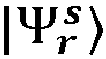 für jedes Paar verschiedener Zahlen i, j aus der Menge I m , für jede von s und von r unabhängige Quantenoperation O, die auf den Quantenzustand


- Verfahren nach einem der vorhergehenden Ansprüche, wobei die erste Mehrzahl von Nachrichten r i , die von der Mehrzahl von Laboren der ersten Partei A in dem Quantenzustand codiert werden, der an das erste Labor LB der zweiten Partei B übertragen wird, und die zweite Mehrzahl von Nachrichten, die von der Mehrzahl von Laboren der ersten Partei A an die Mehrzahl von Laboren der zweiten Partei B übertragen werden, von der Mehrzahl von Laboren der ersten Partei A verwendet werden, um eine dritte Mehrzahl von Nachrichten x a zu codieren.
- Verfahren nach einem der vorhergehenden Ansprüche, wobei der erste und der zweite Raumzeitbereich Rj und Rk verschiedene Elemente aus einer Menge von M verschiedenen Raumzeitbereichen R 0, R 1 ,..., R M-1 sind, die von den mehreren Laboren der Parteien A und B für eine ganze Zahl M ≥ 2 spezifiziert wurden, und die die Eigenschaft erfüllen, dass es keine Kausalkurve in der Raumzeit gibt, die einen beliebigen Raumzeitpunkt von Ra mit einem beliebigen Raumzeitpunkt von R a' verbindet, und zwar für jedes Paar unterschiedlicher Zahlen a und a' aus der Menge I M = {0, 1,...,M- 1}.
- Verfahren nach einem der vorhergehenden Ansprüche, wobei,für irgendeine ganze Zahl m ≥ 2 die erste Mehrzahl von Nachrichten r i , die in dem Quantenzustand durch die Mehrzahl von Laboratorien der ersten Partei A kodiert sind, m Nachrichten r 0, r 1,..., r m-1 sind;der übertragene Quantenzustand gehört zu einer Menge nichtorthogonaler Quantenzustände
 die angewandte Quantenmessung ist eine Messung M c , die zu einer Menge von Messungen {M i } i∈I m gehört, wobei c ∈ I m ≡ {0, 1,..., m - 1};die Bedingung (2.1) aufweist ferner die Bedingung:(2.1.1) ein Labor
 ein Labor
 das Labor
 das Labor
kein Labor unter der Vielzahl von Laboren der zweiten Partei B kann in der zweiten Raumzeitregion Rk eine Nachricht r ' i , die gleich der Nachricht r i ist oder gemäß einem vorbestimmten Schwellenwert nahe an r i liegt, mit einer Wahrscheinlichkeit dekodieren, die gleich eins oder nahe an eins ist, für jedes i ∈ I m mit i ≠ c; unddie Bedingung (2.2) aufweist ferner die Bedingung:(2.2.1) kein Labor aus der Vielzahl von Laboren der zweiten Partei B empfängt in der kausalen Vergangenheit eines beliebigen Raumzeitpunkts der ersten Raumzeitregion Rj eine Nachricht, die Informationen über den Wert von s von einer Vielzahl von Laboren der ersten Partei A enthält; undkein Labor aus der Vielzahl von Laboren der zweiten Partei B in der ersten Raumzeitregion Rj irgendeine Nachricht aus der ersten Vielzahl von Nachrichten r 0, r 1,..., r m-1 , die von der Vielzahl von Laboren der ersten Partei A codiert wurden, decodieren kann. - Verfahren nach einem der vorhergehenden Ansprüche, wobei,für eine ganze Zahl m ≥ 2 die erste Mehrzahl von Nachrichten r i , die in dem Quantenzustand durch die Mehrzahl von Laboratorien der ersten Partei A kodiert sind, m Nachrichten r 0, r 1,..., r m-1 sind;der übertragene Quantenzustand gehört zu einer Menge nichtorthogonaler Quantenzustände

die Menge der Quantenzustände die Quantenzustände
 die Quantenzustände
 die Nachricht r aus der Menge Ωoutcome mit einer Wahrscheinlichkeitsverteilung erzeugt wird, die zufällig ist oder dem Zufall sehr nahe kommt, undder Wert von s aus der Menge Ωbasis mit einer Wahrscheinlichkeitsverteilung erzeugt wird, die zufällig ist oder dem Zufall sehr nahe kommt.
 - Verfahren nach einem der vorhergehenden Ansprüche, wobei die raumzeitbeschränkte, vergessliche Übertragung eine Vielzahl von Bedingungen erfüllt, die aus einer Gruppe ausgewählt werden, die besteht aus:die Mehrzahl der Laboratorien der ersten Partei A und die Mehrzahl der Laboratorien der zweiten Partei B sind sicher,Nachrichten, die zwischen der Vielzahl von Laboratorien der zweiten Partei B kommuniziert werden, werden über Kommunikationskanäle kommuniziert, die eine Vielzahl von klassischen Kommunikationskanälen aufweisen, die sicher und authentifiziert sein können, undNachrichten, die zwischen der Vielzahl von Laboratorien der ersten Partei A übermittelt werden, werden über Kommunikationskanäle übermittelt, die eine Vielzahl von klassischen Kommunikationskanälen aufweisen, die sicher und authentifiziert sein können.
- Verfahren nach einem der vorhergehenden Ansprüche, wobei mehrere Labore der ersten Partei A und mehrere Labore der zweiten Partei B Raumzeit-Bezugsrahmen angleichen.
- Verfahren nach einem der vorhergehenden Ansprüche, wobei, wenn bei der Übertragung des Quantenzustands von der Mehrzahl von Laboren der ersten Partei A an das erste Labor LB der zweiten Partei B Signale von einer Mehrzahl von Laboren der zweiten Partei B an eine Mehrzahl von Laboren der zweiten Partei A gesendet werden, die Signale nicht mehr als eine vorbestimmte Menge an Informationen über die Quantenmessung, die an dem übertragenen Quantenzustand durchgeführt wird, durchlassen.
- Verfahren nach einem der vorhergehenden Ansprüche, wobei die raumzeitbeschränkte vergessliche Übertragung eine Vielzahl von Bedingungen erfüllt, die aus einer Gruppe ausgewählt sind, die aus Folgendem bestehtder übertragene Quantenzustand ist das Tensorprodukt von Qubitzuständen;der übertragene Quantenzustand ist das Tensorprodukt von Qubitzuständen, die aus dem Satz von BB84-Zuständen ausgewählt sind;der übertragene Quantenzustand ist in einer Vielzahl von Photonen kodiert;der übertragene Quantenzustand ist in den Polarisationsfreiheitsgraden der Photonen kodiert;die Übertragung des Quantenzustands an das erste Labor LB der zweiten Partei B einen Schritt aufweist, der den Austausch schwacher kohärenter Zustände mit kleiner durchschnittlicher Photonenzahl zwischen einer Vielzahl von Laboren der ersten Partei A und dem ersten Labor LB der zweiten Partei B aufweist; unddie Übertragung des Quantenzustands an das erste Labor LB der zweiten Partei B einen Schritt aufweist, der die Kommunikation klassischer Nachrichten vom ersten Labor LB der zweiten Partei B an eine Vielzahl von Laboren der ersten Partei A aufweist, die ein Quantensystem angeben, an das der Quantenzustand übertragen wird.
- Verfahren nach einem der vorhergehenden Ansprüche, wobei die erste Vielzahl von Nachrichten, die von der Vielzahl von Laboratorien der ersten Partei A in dem Quantenzustand kodiert werden, der an das erste Labor LB der zweiten Partei B übertragen wird, und die zweite Vielzahl von Nachrichten, die von der Vielzahl von Laboratorien der ersten Partei A an die Vielzahl von Laboratorien der zweiten Partei B übertragen werden, von der Vielzahl von Laboratorien der ersten Partei A verwendet werden, um Informationen über die Trajektorie einer Vielzahl von bewegten Objekten zu kodieren.
- Verfahren nach einem der vorhergehenden Ansprüche, wobeifür irgendeine ganze Zahl m ≥ 2 die Vielzahl von Nachrichten r i , die in dem Quantenzustand durch die Vielzahl von Laboratorien der ersten Partei A kodiert werden, m Nachrichten r 0, r 1,..., r m-1 sind;der übertragene Quantenzustand gehört zu einer Menge nichtorthogonaler Quantenzustände
 für i ∈ I m = {0, 1,..., m - 1} sind die Nachrichten r i von der Form r i =
 die Nachrichten s ∈ Ωbasis sind von der Form s = (s 1, s2, ···, s n) ∈ Λ n , d. h. mit s j ∈ A, wobei
 der Quantenzustand


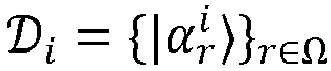 es gilt, dass λ < list, wobei
Applications Claiming Priority (2)
| Application Number | Priority Date | Filing Date | Title |
|---|---|---|---|
| US201862650791P | 2018-03-30 | 2018-03-30 | |
| PCT/IB2019/000426 WO2019186279A1 (en) | 2018-03-30 | 2019-03-29 | Method for spacetime-constrained oblivious transfer |
Publications (3)
| Publication Number | Publication Date |
|---|---|
| EP3777008A1 EP3777008A1 (de) | 2021-02-17 |
| EP3777008C0 EP3777008C0 (de) | 2023-06-07 |
| EP3777008B1 true EP3777008B1 (de) | 2023-06-07 |
Family
ID=67106072
Family Applications (1)
| Application Number | Title | Priority Date | Filing Date |
|---|---|---|---|
| EP19734159.7A Active EP3777008B1 (de) | 2018-03-30 | 2019-03-29 | Verfahren für raum-zeit-eingeschränkten unbewussten transfer |
Country Status (3)
| Country | Link |
|---|---|
| US (1) | US11856093B2 (de) |
| EP (1) | EP3777008B1 (de) |
| WO (1) | WO2019186279A1 (de) |
Families Citing this family (2)
| Publication number | Priority date | Publication date | Assignee | Title |
|---|---|---|---|---|
| US20240273382A1 (en) * | 2023-02-14 | 2024-08-15 | Jpmorgan Chase Bank, N.A. | System, method, and computer program for computing data contraction and similarity from heterogeneous data descriptors |
| CN116707831B (zh) * | 2023-07-12 | 2026-02-06 | 国网安徽省电力有限公司 | 一种零知识证明量子身份认证方法及系统 |
Family Cites Families (9)
| Publication number | Priority date | Publication date | Assignee | Title |
|---|---|---|---|---|
| JP4647748B2 (ja) | 2000-06-12 | 2011-03-09 | キヤノン株式会社 | 暗号化装置及び方法、ならびに通信方法及びシステム |
| US7184555B2 (en) | 2001-04-11 | 2007-02-27 | Magiq Technologies, Inc. | Quantum computation |
| US7525202B2 (en) | 2004-08-31 | 2009-04-28 | Microsoft Corporation | Quantum computational systems |
| US8126830B2 (en) | 2007-07-03 | 2012-02-28 | Seth Lloyd | Method for ensuring privacy while querying a database by using quantum superposition and multiple responses |
| US8171051B2 (en) * | 2008-10-15 | 2012-05-01 | Hewlett-Packard Development Company, L.P. | Quantum-based oblivious transfer and private data sampling protocols and systems for performing the same |
| US20100150349A1 (en) | 2008-12-12 | 2010-06-17 | Electronics And Telecommunications Research Institute | Method and system for performing quantum bit commitment protocol |
| US8897449B1 (en) | 2011-09-12 | 2014-11-25 | Quantum Valley Investment Fund LP | Quantum computing on encrypted data |
| US10715319B2 (en) * | 2016-12-15 | 2020-07-14 | Universite Paris Diderot | Method and system for spacetime-constrained oblivious transfer |
| US11190496B2 (en) * | 2019-02-12 | 2021-11-30 | Visa International Service Association | Fast oblivious transfers |
-
2019
- 2019-03-29 EP EP19734159.7A patent/EP3777008B1/de active Active
- 2019-03-29 US US17/043,300 patent/US11856093B2/en active Active
- 2019-03-29 WO PCT/IB2019/000426 patent/WO2019186279A1/en not_active Ceased
Also Published As
| Publication number | Publication date |
|---|---|
| WO2019186279A1 (en) | 2019-10-03 |
| EP3777008C0 (de) | 2023-06-07 |
| US20210021414A1 (en) | 2021-01-21 |
| US11856093B2 (en) | 2023-12-26 |
| EP3777008A1 (de) | 2021-02-17 |
Similar Documents
| Publication | Publication Date | Title |
|---|---|---|
| Singh et al. | Quantum internet—applications, functionalities, enabling technologies, challenges, and research directions | |
| Amer et al. | An introduction to practical quantum key distribution | |
| Wehner et al. | Quantum internet: A vision for the road ahead | |
| US9294280B2 (en) | Location verification in quantum communications | |
| US11444757B2 (en) | Quantum tokens | |
| US20160191173A1 (en) | Location Verification in Quantum Communications | |
| US10715319B2 (en) | Method and system for spacetime-constrained oblivious transfer | |
| May | Quantum tasks in holography | |
| US7702106B2 (en) | Quantum secret splitting based on non-orthogonal multi-particle states | |
| US20170324552A1 (en) | Mobile device having quantum cryptographic security function for mobile commerce, and authentication method | |
| WO2025244700A1 (en) | Broadcast-free threshold post-quantum key generation and verification over unencrypted channels from hardware-based correlated randomness | |
| Walk et al. | Sharing classical secrets with continuous-variable entanglement: composable security and network coding advantage | |
| Rückle et al. | Experimental anonymous conference key agreement using linear cluster states | |
| EP3777008B1 (de) | Verfahren für raum-zeit-eingeschränkten unbewussten transfer | |
| Shi et al. | Controlled quantum teleportation based on quantum walks: W.-M. Shi et al. | |
| Kim et al. | Complete physical simulation of the entangling-probe attack on the Bennett-Brassard 1984 protocol | |
| Yang | A quantum secure direct communication protocol without quantum memories | |
| Bacsardi | Resources for satellite-based quantum communication networks | |
| US20210135860A1 (en) | Quantum communications system having quantum key distribution and using a talbot effect image position and associated methods | |
| Li et al. | Measurement-device-independent quantum protocol for E-payment based on blockchain: E. Li et al. | |
| Zhang et al. | A novel quantum multiparty summation protocol based on a cooperative random number mechanism | |
| Song et al. | Quantum bit commitment protocol based on counterfactual quantum cryptography | |
| Rivera-Dean | Non-Classical States of Light for Device-Independent Quantum Key Distribution | |
| Srividya et al. | An Emphasis on Quantum Cryptography and Quantum Key | |
| Jin et al. | Quantum-Resistant Quantum Teleportation |
Legal Events
| Date | Code | Title | Description |
|---|---|---|---|
| STAA | Information on the status of an ep patent application or granted ep patent |
Free format text: STATUS: UNKNOWN |
|
| STAA | Information on the status of an ep patent application or granted ep patent |
Free format text: STATUS: THE INTERNATIONAL PUBLICATION HAS BEEN MADE |
|
| PUAI | Public reference made under article 153(3) epc to a published international application that has entered the european phase |
Free format text: ORIGINAL CODE: 0009012 |
|
| STAA | Information on the status of an ep patent application or granted ep patent |
Free format text: STATUS: REQUEST FOR EXAMINATION WAS MADE |
|
| 17P | Request for examination filed |
Effective date: 20201010 |
|
| AK | Designated contracting states |
Kind code of ref document: A1 Designated state(s): AL AT BE BG CH CY CZ DE DK EE ES FI FR GB GR HR HU IE IS IT LI LT LU LV MC MK MT NL NO PL PT RO RS SE SI SK SM TR |
|
| AX | Request for extension of the european patent |
Extension state: BA ME |
|
| DAV | Request for validation of the european patent (deleted) | ||
| DAX | Request for extension of the european patent (deleted) | ||
| RAP3 | Party data changed (applicant data changed or rights of an application transferred) |
Owner name: CENTRE NATIONAL DE LA RECHERCHE SCIENTIFIQUE Owner name: UNIVERSITE DE PARIS |
|
| GRAP | Despatch of communication of intention to grant a patent |
Free format text: ORIGINAL CODE: EPIDOSNIGR1 |
|
| STAA | Information on the status of an ep patent application or granted ep patent |
Free format text: STATUS: GRANT OF PATENT IS INTENDED |
|
| INTG | Intention to grant announced |
Effective date: 20220517 |
|
| RAP3 | Party data changed (applicant data changed or rights of an application transferred) |
Owner name: UNIVERSITE PARIS CITE Owner name: CENTRE NATIONAL DE LA RECHERCHE SCIENTIFIQUE |
|
| GRAJ | Information related to disapproval of communication of intention to grant by the applicant or resumption of examination proceedings by the epo deleted |
Free format text: ORIGINAL CODE: EPIDOSDIGR1 |
|
| STAA | Information on the status of an ep patent application or granted ep patent |
Free format text: STATUS: REQUEST FOR EXAMINATION WAS MADE |
|
| GRAP | Despatch of communication of intention to grant a patent |
Free format text: ORIGINAL CODE: EPIDOSNIGR1 |
|
| STAA | Information on the status of an ep patent application or granted ep patent |
Free format text: STATUS: GRANT OF PATENT IS INTENDED |
|
| INTC | Intention to grant announced (deleted) | ||
| INTG | Intention to grant announced |
Effective date: 20221020 |
|
| GRAS | Grant fee paid |
Free format text: ORIGINAL CODE: EPIDOSNIGR3 |
|
| GRAA | (expected) grant |
Free format text: ORIGINAL CODE: 0009210 |
|
| STAA | Information on the status of an ep patent application or granted ep patent |
Free format text: STATUS: THE PATENT HAS BEEN GRANTED |
|
| AK | Designated contracting states |
Kind code of ref document: B1 Designated state(s): AL AT BE BG CH CY CZ DE DK EE ES FI FR GB GR HR HU IE IS IT LI LT LU LV MC MK MT NL NO PL PT RO RS SE SI SK SM TR |
|
| REG | Reference to a national code |
Ref country code: GB Ref legal event code: FG4D |
|
| REG | Reference to a national code |
Ref country code: CH Ref legal event code: EP Ref country code: AT Ref legal event code: REF Ref document number: 1578017 Country of ref document: AT Kind code of ref document: T Effective date: 20230615 |
|
| REG | Reference to a national code |
Ref country code: DE Ref legal event code: R096 Ref document number: 602019030247 Country of ref document: DE |
|
| U01 | Request for unitary effect filed |
Effective date: 20230704 |
|
| U07 | Unitary effect registered |
Designated state(s): AT BE BG DE DK EE FI FR IT LT LU LV MT NL PT SE SI Effective date: 20230713 |
|
| REG | Reference to a national code |
Ref country code: LT Ref legal event code: MG9D |
|
| PG25 | Lapsed in a contracting state [announced via postgrant information from national office to epo] |
Ref country code: NO Free format text: LAPSE BECAUSE OF FAILURE TO SUBMIT A TRANSLATION OF THE DESCRIPTION OR TO PAY THE FEE WITHIN THE PRESCRIBED TIME-LIMIT Effective date: 20230907 Ref country code: ES Free format text: LAPSE BECAUSE OF FAILURE TO SUBMIT A TRANSLATION OF THE DESCRIPTION OR TO PAY THE FEE WITHIN THE PRESCRIBED TIME-LIMIT Effective date: 20230607 |
|
| PG25 | Lapsed in a contracting state [announced via postgrant information from national office to epo] |
Ref country code: RS Free format text: LAPSE BECAUSE OF FAILURE TO SUBMIT A TRANSLATION OF THE DESCRIPTION OR TO PAY THE FEE WITHIN THE PRESCRIBED TIME-LIMIT Effective date: 20230607 Ref country code: HR Free format text: LAPSE BECAUSE OF FAILURE TO SUBMIT A TRANSLATION OF THE DESCRIPTION OR TO PAY THE FEE WITHIN THE PRESCRIBED TIME-LIMIT Effective date: 20230607 Ref country code: GR Free format text: LAPSE BECAUSE OF FAILURE TO SUBMIT A TRANSLATION OF THE DESCRIPTION OR TO PAY THE FEE WITHIN THE PRESCRIBED TIME-LIMIT Effective date: 20230908 |
|
| PG25 | Lapsed in a contracting state [announced via postgrant information from national office to epo] |
Ref country code: SK Free format text: LAPSE BECAUSE OF FAILURE TO SUBMIT A TRANSLATION OF THE DESCRIPTION OR TO PAY THE FEE WITHIN THE PRESCRIBED TIME-LIMIT Effective date: 20230607 |
|
| PG25 | Lapsed in a contracting state [announced via postgrant information from national office to epo] |
Ref country code: IS Free format text: LAPSE BECAUSE OF FAILURE TO SUBMIT A TRANSLATION OF THE DESCRIPTION OR TO PAY THE FEE WITHIN THE PRESCRIBED TIME-LIMIT Effective date: 20231007 |
|
| PG25 | Lapsed in a contracting state [announced via postgrant information from national office to epo] |
Ref country code: SM Free format text: LAPSE BECAUSE OF FAILURE TO SUBMIT A TRANSLATION OF THE DESCRIPTION OR TO PAY THE FEE WITHIN THE PRESCRIBED TIME-LIMIT Effective date: 20230607 Ref country code: SK Free format text: LAPSE BECAUSE OF FAILURE TO SUBMIT A TRANSLATION OF THE DESCRIPTION OR TO PAY THE FEE WITHIN THE PRESCRIBED TIME-LIMIT Effective date: 20230607 Ref country code: RO Free format text: LAPSE BECAUSE OF FAILURE TO SUBMIT A TRANSLATION OF THE DESCRIPTION OR TO PAY THE FEE WITHIN THE PRESCRIBED TIME-LIMIT Effective date: 20230607 Ref country code: IS Free format text: LAPSE BECAUSE OF FAILURE TO SUBMIT A TRANSLATION OF THE DESCRIPTION OR TO PAY THE FEE WITHIN THE PRESCRIBED TIME-LIMIT Effective date: 20231007 Ref country code: CZ Free format text: LAPSE BECAUSE OF FAILURE TO SUBMIT A TRANSLATION OF THE DESCRIPTION OR TO PAY THE FEE WITHIN THE PRESCRIBED TIME-LIMIT Effective date: 20230607 |
|
| PG25 | Lapsed in a contracting state [announced via postgrant information from national office to epo] |
Ref country code: PL Free format text: LAPSE BECAUSE OF FAILURE TO SUBMIT A TRANSLATION OF THE DESCRIPTION OR TO PAY THE FEE WITHIN THE PRESCRIBED TIME-LIMIT Effective date: 20230607 |
|
| REG | Reference to a national code |
Ref country code: DE Ref legal event code: R097 Ref document number: 602019030247 Country of ref document: DE |
|
| U20 | Renewal fee for the european patent with unitary effect paid |
Year of fee payment: 6 Effective date: 20240226 |
|
| PLBE | No opposition filed within time limit |
Free format text: ORIGINAL CODE: 0009261 |
|
| STAA | Information on the status of an ep patent application or granted ep patent |
Free format text: STATUS: NO OPPOSITION FILED WITHIN TIME LIMIT |
|
| 26N | No opposition filed |
Effective date: 20240308 |
|
| PG25 | Lapsed in a contracting state [announced via postgrant information from national office to epo] |
Ref country code: MC Free format text: LAPSE BECAUSE OF FAILURE TO SUBMIT A TRANSLATION OF THE DESCRIPTION OR TO PAY THE FEE WITHIN THE PRESCRIBED TIME-LIMIT Effective date: 20230607 |
|
| PG25 | Lapsed in a contracting state [announced via postgrant information from national office to epo] |
Ref country code: MC Free format text: LAPSE BECAUSE OF FAILURE TO SUBMIT A TRANSLATION OF THE DESCRIPTION OR TO PAY THE FEE WITHIN THE PRESCRIBED TIME-LIMIT Effective date: 20230607 |
|
| PG25 | Lapsed in a contracting state [announced via postgrant information from national office to epo] |
Ref country code: IE Free format text: LAPSE BECAUSE OF NON-PAYMENT OF DUE FEES Effective date: 20240329 |
|
| PG25 | Lapsed in a contracting state [announced via postgrant information from national office to epo] |
Ref country code: IE Free format text: LAPSE BECAUSE OF NON-PAYMENT OF DUE FEES Effective date: 20240329 |
|
| U20 | Renewal fee for the european patent with unitary effect paid |
Year of fee payment: 7 Effective date: 20250225 |
|
| PGFP | Annual fee paid to national office [announced via postgrant information from national office to epo] |
Ref country code: CH Payment date: 20250401 Year of fee payment: 7 |
|
| PG25 | Lapsed in a contracting state [announced via postgrant information from national office to epo] |
Ref country code: CY Free format text: LAPSE BECAUSE OF FAILURE TO SUBMIT A TRANSLATION OF THE DESCRIPTION OR TO PAY THE FEE WITHIN THE PRESCRIBED TIME-LIMIT; INVALID AB INITIO Effective date: 20190329 |
|
| PG25 | Lapsed in a contracting state [announced via postgrant information from national office to epo] |
Ref country code: HU Free format text: LAPSE BECAUSE OF FAILURE TO SUBMIT A TRANSLATION OF THE DESCRIPTION OR TO PAY THE FEE WITHIN THE PRESCRIBED TIME-LIMIT; INVALID AB INITIO Effective date: 20190329 |
|
| PG25 | Lapsed in a contracting state [announced via postgrant information from national office to epo] |
Ref country code: TR Free format text: LAPSE BECAUSE OF FAILURE TO SUBMIT A TRANSLATION OF THE DESCRIPTION OR TO PAY THE FEE WITHIN THE PRESCRIBED TIME-LIMIT Effective date: 20230607 |
|
| REG | Reference to a national code |
Ref country code: CH Ref legal event code: U11 Free format text: ST27 STATUS EVENT CODE: U-0-0-U10-U11 (AS PROVIDED BY THE NATIONAL OFFICE) Effective date: 20260401 |
|
| U20 | Renewal fee for the european patent with unitary effect paid |
Year of fee payment: 8 Effective date: 20260226 |
|
| PGFP | Annual fee paid to national office [announced via postgrant information from national office to epo] |
Ref country code: GB Payment date: 20260323 Year of fee payment: 8 |