EP3777680A1 - Aktives miniaturisiertes erfassungssystem und verfahren - Google Patents
Aktives miniaturisiertes erfassungssystem und verfahren Download PDFInfo
- Publication number
- EP3777680A1 EP3777680A1 EP19192138.6A EP19192138A EP3777680A1 EP 3777680 A1 EP3777680 A1 EP 3777680A1 EP 19192138 A EP19192138 A EP 19192138A EP 3777680 A1 EP3777680 A1 EP 3777680A1
- Authority
- EP
- European Patent Office
- Prior art keywords
- radiation
- wavelength
- detecting
- physiological parameter
- sensor
- Prior art date
- Legal status (The legal status is an assumption and is not a legal conclusion. Google has not performed a legal analysis and makes no representation as to the accuracy of the status listed.)
- Withdrawn
Links
Images



Classifications
-
- A—HUMAN NECESSITIES
- A61—MEDICAL OR VETERINARY SCIENCE; HYGIENE
- A61B—DIAGNOSIS; SURGERY; IDENTIFICATION
- A61B5/00—Measuring for diagnostic purposes; Identification of persons
- A61B5/145—Measuring characteristics of blood in vivo, e.g. gas concentration or pH-value ; Measuring characteristics of body fluids or tissues, e.g. interstitial fluid or cerebral tissue
- A61B5/14532—Measuring characteristics of blood in vivo, e.g. gas concentration or pH-value ; Measuring characteristics of body fluids or tissues, e.g. interstitial fluid or cerebral tissue for measuring glucose, e.g. by tissue impedance measurement
-
- A—HUMAN NECESSITIES
- A61—MEDICAL OR VETERINARY SCIENCE; HYGIENE
- A61B—DIAGNOSIS; SURGERY; IDENTIFICATION
- A61B5/00—Measuring for diagnostic purposes; Identification of persons
- A61B5/145—Measuring characteristics of blood in vivo, e.g. gas concentration or pH-value ; Measuring characteristics of body fluids or tissues, e.g. interstitial fluid or cerebral tissue
- A61B5/1455—Measuring characteristics of blood in vivo, e.g. gas concentration or pH-value ; Measuring characteristics of body fluids or tissues, e.g. interstitial fluid or cerebral tissue using optical sensors, e.g. spectral photometrical oximeters
-
- A—HUMAN NECESSITIES
- A61—MEDICAL OR VETERINARY SCIENCE; HYGIENE
- A61B—DIAGNOSIS; SURGERY; IDENTIFICATION
- A61B5/00—Measuring for diagnostic purposes; Identification of persons
- A61B5/45—For evaluating or diagnosing the musculoskeletal system or teeth
- A61B5/4538—Evaluating a particular part of the muscoloskeletal system or a particular medical condition
- A61B5/4542—Evaluating the mouth, e.g. the jaw
- A61B5/4547—Evaluating teeth
-
- A—HUMAN NECESSITIES
- A61—MEDICAL OR VETERINARY SCIENCE; HYGIENE
- A61B—DIAGNOSIS; SURGERY; IDENTIFICATION
- A61B5/00—Measuring for diagnostic purposes; Identification of persons
- A61B5/0059—Measuring for diagnostic purposes; Identification of persons using light, e.g. diagnosis by transillumination, diascopy, fluorescence
-
- A—HUMAN NECESSITIES
- A61—MEDICAL OR VETERINARY SCIENCE; HYGIENE
- A61B—DIAGNOSIS; SURGERY; IDENTIFICATION
- A61B5/00—Measuring for diagnostic purposes; Identification of persons
- A61B5/0059—Measuring for diagnostic purposes; Identification of persons using light, e.g. diagnosis by transillumination, diascopy, fluorescence
- A61B5/0071—Measuring for diagnostic purposes; Identification of persons using light, e.g. diagnosis by transillumination, diascopy, fluorescence by measuring fluorescence emission
-
- A—HUMAN NECESSITIES
- A61—MEDICAL OR VETERINARY SCIENCE; HYGIENE
- A61B—DIAGNOSIS; SURGERY; IDENTIFICATION
- A61B5/00—Measuring for diagnostic purposes; Identification of persons
- A61B5/01—Measuring temperature of body parts ; Diagnostic temperature sensing, e.g. for malignant or inflamed tissue
-
- A—HUMAN NECESSITIES
- A61—MEDICAL OR VETERINARY SCIENCE; HYGIENE
- A61B—DIAGNOSIS; SURGERY; IDENTIFICATION
- A61B5/00—Measuring for diagnostic purposes; Identification of persons
- A61B5/103—Measuring devices for testing the shape, pattern, colour, size or movement of the body or parts thereof, for diagnostic purposes
- A61B5/107—Measuring physical dimensions, e.g. size of the entire body or parts thereof
- A61B5/1075—Measuring physical dimensions, e.g. size of the entire body or parts thereof for measuring dimensions by non-invasive methods, e.g. for determining thickness of tissue layer
-
- A—HUMAN NECESSITIES
- A61—MEDICAL OR VETERINARY SCIENCE; HYGIENE
- A61B—DIAGNOSIS; SURGERY; IDENTIFICATION
- A61B5/00—Measuring for diagnostic purposes; Identification of persons
- A61B5/103—Measuring devices for testing the shape, pattern, colour, size or movement of the body or parts thereof, for diagnostic purposes
- A61B5/107—Measuring physical dimensions, e.g. size of the entire body or parts thereof
- A61B5/1076—Measuring physical dimensions, e.g. size of the entire body or parts thereof for measuring dimensions inside body cavities, e.g. using catheters
-
- A—HUMAN NECESSITIES
- A61—MEDICAL OR VETERINARY SCIENCE; HYGIENE
- A61B—DIAGNOSIS; SURGERY; IDENTIFICATION
- A61B5/00—Measuring for diagnostic purposes; Identification of persons
- A61B5/145—Measuring characteristics of blood in vivo, e.g. gas concentration or pH-value ; Measuring characteristics of body fluids or tissues, e.g. interstitial fluid or cerebral tissue
- A61B5/14546—Measuring characteristics of blood in vivo, e.g. gas concentration or pH-value ; Measuring characteristics of body fluids or tissues, e.g. interstitial fluid or cerebral tissue for measuring analytes not otherwise provided for, e.g. ions, cytochromes
-
- A—HUMAN NECESSITIES
- A61—MEDICAL OR VETERINARY SCIENCE; HYGIENE
- A61B—DIAGNOSIS; SURGERY; IDENTIFICATION
- A61B5/00—Measuring for diagnostic purposes; Identification of persons
- A61B5/68—Arrangements of detecting, measuring or recording means, e.g. sensors, in relation to patient
- A61B5/6801—Arrangements of detecting, measuring or recording means, e.g. sensors, in relation to patient specially adapted to be attached to or worn on the body surface
- A61B5/6802—Sensor mounted on worn items
- A61B5/681—Wristwatch-type devices
-
- A—HUMAN NECESSITIES
- A61—MEDICAL OR VETERINARY SCIENCE; HYGIENE
- A61B—DIAGNOSIS; SURGERY; IDENTIFICATION
- A61B5/00—Measuring for diagnostic purposes; Identification of persons
- A61B5/68—Arrangements of detecting, measuring or recording means, e.g. sensors, in relation to patient
- A61B5/6801—Arrangements of detecting, measuring or recording means, e.g. sensors, in relation to patient specially adapted to be attached to or worn on the body surface
- A61B5/6813—Specially adapted to be attached to a specific body part
- A61B5/6814—Head
- A61B5/6815—Ear
- A61B5/6816—Ear lobe
-
- A—HUMAN NECESSITIES
- A61—MEDICAL OR VETERINARY SCIENCE; HYGIENE
- A61B—DIAGNOSIS; SURGERY; IDENTIFICATION
- A61B5/00—Measuring for diagnostic purposes; Identification of persons
- A61B5/68—Arrangements of detecting, measuring or recording means, e.g. sensors, in relation to patient
- A61B5/6801—Arrangements of detecting, measuring or recording means, e.g. sensors, in relation to patient specially adapted to be attached to or worn on the body surface
- A61B5/6813—Specially adapted to be attached to a specific body part
- A61B5/6824—Arm or wrist
Definitions
- the present invention relates to a non-invasive active sensing system for determining a physiological parameter in a bodily fluid of subject. Further, the present invention relates to a non-invasive method for determining a physiological parameter in a bodily fluid of a subject.
- determination of blood glucose is mainly based on invasive system and methods, wherein either a blood sample is taken and subsequently subjected to an in vitro test or a sensor is implanted for determining the glucose level in vivo.
- invasive systems and methods are disadvantageous in that they are painful or inconvenient.
- a simple, rapid and reliable determination of a physiological parameter is feasible using non-invasive systems and methods.
- These systems and methods involve irradiation of a body part of a subject, particular a human subject, with infrared visual (VIS)/rear-infrared (NIR) radiation in the range of about 500 nm to about 1500 nm and detecting emitted IR radiation from the irradiated body part of said subject in the range of about 5 ⁇ m to about 12 ⁇ m.
- VIS infrared visual
- NIR radio-infrared
- the present inventor has found that irradiating a body part, e.g. a fingertip, an earlobe, a wrist or a forearm with short-wavelength radiation and detecting emitted long-wavelength radiation from the irradiated body part allows determination for physiological parameters such as glucose in a bodily fluid such as blood
- a first aspect of the invention relates to a non-invasive system for determining a physiological parameter, particularly glucose, in a bodily fluid of a subject comprising:
- a further aspect of the invention relates to the use of the above system for non-invasively determining a physiological parameter in a bodily fluid of a subject, particularly wherein the physiological parameter is glucose, and the bodily fluid is blood.
- a still further aspect of the invention relates to a method for non-invasively determining a physiological parameter, particularly glucose in a bodily fluid of a subject comprising the steps:
- the present invention involves determination of a physiological parameter by detecting IR radiation from both previously irradiated body parts of a subject, particularly a human subject in the wavelength range of about 5 ⁇ m to about 12 ⁇ m, particularly in the range of about 8 ⁇ m to about 10 ⁇ m.
- the physiological parameter may be any compound having characteristic absorption bands in this wavelength range.
- the physiological parameter is glucose or another clinically relevant analyte such as lactate or tropon in.
- the system is adapted for the non-invasive determination of glucose in blood.
- IR radiation is detected at a glucose-specific wavelength or wavelength range where glucose has a characteristic absorption band and where the intensity of the detected IR radiation is dependent from the concentration of glucose in the blood.
- the glucose-specific wavelength or wavelength range is selected from a wavelength of about 9.2 ⁇ m, a wavelength of about 9.4 ⁇ m, a wavelength of about 9.6 ⁇ m, a wavelength range comprising at least two of the wavelengths of about 9.2 ⁇ m, about 9.4 ⁇ m and about 9.6 ⁇ m, a wavelength range comprising all three of the wavelengths of about 9.2 ⁇ m, about 9.4 ⁇ m and about 9.6 ⁇ m or any combination thereof.
- IR radiation is detected at a reference wavelength or wavelength range where glucose has no characteristic absorption band and particularly an absorption minimum and where the intensity of the detected IR radiation is substantially independent from the concentration of glucose in blood. More particularly, the reference wavelength or wavelength range is selected from a wavelength or wavelength range between about 8.7 ⁇ m to about 9.0 ⁇ m, a wavelength or a wavelength range between about 9.7 ⁇ m to about 10.2 ⁇ m or any combination thereof.
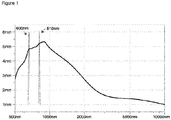
- the invention is based on the irradiation of body tissue with electromagnetic radiation in the wavelength range between about 500 nm to about 1500 nm and detection of electromagnetic radiation emitted from the irradiated body part in the wavelength range between about 5 ⁇ m to about 15 ⁇ m.
- Figure 1 shows the penetration depth of electromagnetic radiation into body tissue [mm] depending from the wavelength [nm]. It can be seen that the penetration depth is dependent from the wavelength.
- VIS visual
- NIR near-infrared
- a body part irradiated with radiation will absorb electromagnetic energy resulting in a local increase of tissue temperature.
- IR radiation e.g. IR radiation in the wavelength range of about 5 ⁇ m to about 12 ⁇ m, where certain organic compounds present in bodily fluids, i.e. physiological parameters, show absorption bands.
- the VIS/NIR radiation emitted into the body part is in the range of about 550 nm to about 1000 nm, particularly in the range of about 800 nm to about 820 nm, e.g. about 810 nm, and/or in the range of about 590 nm to about 660 nm, e.g. at about 600 nm.
- Figure 2 shows relative absorption coefficients of certain compounds present in the human body depending from the wavelength in the range between 400 nm and 1100 nm.
- the wavelengths of 600 nm and 810 nm, at which radiation may be emitted into the body part, are specifically indicated.
- In the wavelength range of about 500 nm to about 1050 nm there is a relatively low absorption of water (H 2 O).
- Hb hemoglobin
- Hboxy oxyhemoglobin
- the skin pigment melamine shows an absorption coefficient which decreases with increasing wavelength.
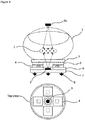
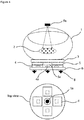
- Figure 3 shows an embodiment of a system of the present invention.
- a body part (1) e.g. a fingertip, is placed into contact with the system which is adapted to irradiate an absorption area (2) within the body part (1).
- the system comprises a cover (3) which is at least partially made of a material which is optically transparent.
- the cover is at least partially made of CaF 2 and/or BaF 2 and may have a thickness of about 0.2 mm to about 2 mm, particularly of about 0.5 mm to about 1.5 mm, more particularly about 1 mm.
- the system further comprises at least one sensor (4) which may be provided with a filter element (5) and optionally a lens element (not shown) which e.g. may be arranged between a sensor (4) and a filter element (5).
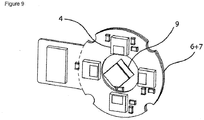
- the sensor (4) may be mounted on a circuit board (6).
- the system comprises at least one radiation source (9, 9a).
- the system may comprise a radiation source (9) located on the same side as the sensor (4) and/or a radiation source (9a) located on an opposite side of the body part (1) with regard to the sensor (4).
- a further sensor (4) may be provided without filter element (5) for monitoring the exact skin temperature of the subject.
- the system contains one or more sensors (4).
- the system comprises four different sensors (4).
- the sensor may be an optical detector, particularly an optical photovoltaic detector, e.g. an InAsSb-based detector which may be used in combination with a lock-in amplifier, if desired.
- a photovoltaic detector e.g. an InAsSb-based detector has a rise time of only few nanoseconds and is particularly useful in a set-up wherein the body part is irradiated intermittently.
- the sensor may be heat detector, e.g. a thermopile or a bolometer. Suitable sensors include a photovoltaic detector (e.g.
- a sensor (4) may be provided with a filter element (5) capable of selectively transmitting radiation of a desired wavelength or wavelength range.
- the filter element may have narrow band width, e.g. of about 50 to 100 nm, or a broader band width, e.g. of about 400 nm or more.
- a filter may be made from germanium or other filter materials which are optically transmittant for the respective wavelengths.
- a sensor may be provided with a lens element, e.g. a micro-lens capable of focusing the light falling onto the sensor.
- the senor is a miniaturized sensor having an area of about 1mm 2 to about 10,000 mm 2 , e.g. of about 10mm 2 to about 1,000 mm 2 .
- the sensor may be even more miniaturized, e.g. an ASIC (application-specific integrated circuit).
- the device may comprise a circuit board (7) on which the light source (9) is mounted and an active and/or passive heat sink (8).
- the radiation source (9, 9a) may be adapted for emitting collimated radiation, e.g. a laser-based light source, and/or adapted for emitting non-collimated radiation, e.g. an LED-based light source.
- the light source may be selected from an LED, a laser diode, a VCSEL (vertical-cavity surface-emitting laser) or a laser.
- the radiation source is adapted for emitting VIS/NIR radiation in the range of about 500 nm to about 1500 nm.
- the VIS/NIR radiation may be emitted continuously or intermittently throughout a predetermined time interval.
- the radiation source may be adapted for emitting radiation continuously at a power of about 10 mW to about 1 W, particularly for about 20 mW to about 500 mW, and more particularly of about 50 mW to about 250 mW for a time interval of about 0.1-20 s, particularly of about 1s to about 5s, and more particularly of about 0.5 s to about 2s.
- the radiation source may be adapted for emitting radiation intermittently at a power of about 10 mW to about 5 W, particularly of about 20 mW to about 1 W, and more particularly of about 50 mW to about 500 mW for a time interval of about 0.1 s to about 20 s, particularly of about 0.2 s to about 5 s, and more particularly of about 0.5 s to about 2 s.
- the radiation may be emitted intermittently with a pulse frequency of about 1 Hz to about 1 MHz.
- a single radiation source (9a) is provided on a side of the body part (1) which is opposite to a sensing unit comprising at least one sensor (4) provided with a filter (5) and a further sensor (4a) provided with a filter (5a).
- sensor (4a) is an optical sensor, e.g. a photodiode. It is adapted for a reference measurement of transmission radiation from radiation source (9a), e.g. for measuring radiation at a wavelength of about 600 nm and/or 810 nm.
- filter element (5a) may be a bandpass filter at about 600 nm and/or 810 nm.
- the system of the invention may comprise a plurality of different sensors (4).
- the system may comprise a plurality of analyte-specific, e.g. glucose-specific sensors wherein a first sensor is adapted for detecting radiation at a first wavelength or wavelength range, e.g. at a wavelength of about 9.2 ⁇ m and at least another first sensor is adapted for detecting IR radiation at a second wavelength range which encompasses the first wavelength or wavelength range and further comprises another wavelength or wavelength range.
- the other first sensor may be adapted for detecting IR radiation at a wavelength of about 9.2 ⁇ m and additionally at a wavelength of about 9.4 ⁇ m and/or about 9.6 ⁇ m, particularly at a wavelength of about 9.4 ⁇ m and a wavelength of about 9.6 ⁇ m.
- the sensing unit may comprise a plurality of reference sensors adapted for detecting reference radiation at different wavelengths or wavelength ranges.
- a reference sensor may be adapted for detecting radiation having a wavelength range between about 8.6 ⁇ m and about 9.0 ⁇ m.
- Another reference sensor is adapted for detecting radiation at a wavelength or wavelength range between about 9.8 ⁇ m and about 10.2 ⁇ m.
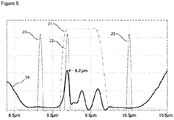
- the absorption signal of glucose (24) has three different peaks at about 9.2 ⁇ m, at about 9.4 ⁇ m and about 9.6 ⁇ m.
- a first glucose-specific sensor may be adapted for measuring only the peak at 9.2 ⁇ m. Such a sensor would be adapted with a filter element capable of transmitting radiation only in a narrow range (22).
- a further glucose-specific sensor may be adapted for measuring radiation at a broader range between about 9.1 ⁇ m and about 9.7 ⁇ m, thereby encompassing the peaks at about 9.2 ⁇ m, 9.4 ⁇ m and 9.6 ⁇ m. This sensor may be adapted with a filter element capable of transmitting radiation in a broader range (21).
- Two reference sensors may be provided, capable of transmission of radiation with a wavelength in the range of about 8.8 ⁇ m - 8.9 ⁇ m (20) and/or radiation with a wavelength of about 9.9 ⁇ m - 10.1 ⁇ m (23), respectively.
- Parallel and separate measurements at a wavelength of about 9.2 ⁇ m on the one hand and at a wavelength range including the peak at 9.2 ⁇ m, but also at least one of the other peaks, particularly the peak at about 9.6 ⁇ m have a further advantage, since they allow determination whether the subject's blood contains ethanol. Since ethanol and other alcohols have an absorption band at a wavelength of about 9.6 ⁇ m, but not at a wavelength of about 9.2 ⁇ m, the ratio between the peak at 9.2 ⁇ m and 9.6 ⁇ m may be used to determine and optionally correct a disturbance caused by blood alcohol.
- a system comprising a filter wheel (10) capable of rotating around an axis (11) and a shutter wheel (13) also capable of rotating around an axis.
- the filter wheel and the shutter wheel are provided with illumination holes (15) through which light from the radiation source (not shown) may pass into the body part of the subject (not shown). Reflected light from the irradiated body part may pass through different holes (14) of the filter wheel which may be provided with analyte-specific filter elements and/or reference filter elements as described above.
- the filter wheel's (10) and the shutter wheel's (13) position may be monitored with a magnet (12) in combination with a magnetic sensor. In operation, they may be rotated with predetermined frequencies, thereby allowing passing of radiation from the radiation source into the body part and passing of radiation emitted from the body part at predetermined time intervals.
- the system of the present invention further comprises an analyzing unit (c) for the qualitative and/or quantitative determination of a physiological parameter based on the IR radiation detected in the sensing unit (b).
- the analyzing unit may comprise, for example, an A/D converter and a microcontroller.
- the analysis of the measured signal may be based on the intensity and/or the decay time.
- FIG. 7 A still further embodiment of the invention is shown in Figure 7 .
- the system of this embodiment is adapted for being permanently fixed to the subject's body.
- This system is particularly adapted for carrying out a plurality of measurements in predetermined time intervals.
- the system comprises a housing (30) and a strap (31) for fixing the housing around the body (33), e.g. a wrist or forearm.
- the system comprises a radiation source for emitting VIS/NIR light into an absorption area (34) of the body part (33) and sensors for detecting IR radiation emitted from the irradiated body part.
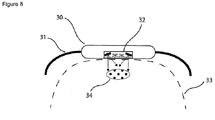
- FIG. 8 A still further embodiment of the invention is shown in Figure 8 .
- the system of this embodiment is adapted for being permanently fixed to the subject's body and particularly adapted for carrying out a plurality of measurements in predetermined time intervals.
- the system comprises a housing (30) and a strap (31) for fixing the housing around the body (33), e.g. a wrist or forearm.
- the system comprises a plurality of radiation sources, e.g. 2 radiation sources, for emitting VIS/NIR light into an absorption area (34) of the body part (33) and sensors for detecting IR radiation emitted from the irradiated body part.
- the light emitted from these sources may fall at angle, e.g. at an angle of about 30° to about 75° onto the surface of the body part (33).
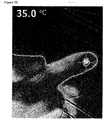
- Figure 10 shows a heat map of a fingertip after irradiation with light of 810 nm for a time period of 2s.
- the system and the method of the invention allow qualitative and/or quantitative determination of the physiological parameter to be measured, particularly qualitative and/or quantitative determination of glucose in blood.
- the concentration of the physiological parameter e.g. the concentration of glucose in blood
- the alteration rate of the measured amount of the physiological parameter is determined.
- a non-quantitative measurement e.g. a relative measurement of the alteration of the analyte amount per time unit, i.e. the increase of the analyte amount or the decrease of the analyte amount per time unit.
- the alteration of the analyte amount into a single direction i.e. increase or decrease, exceeds a predetermined level and/or time period
- the system will provide an alert.
- This embodiment is particularly useful for systems as shown in Figure 7 and Figure 8 , which may be permanently fixed at the body of the subject, e.g. around the wrist, forearm or upper arm.
- a still further aspect of the invention is a non-invasive system for determining glucose in blood, which allows identification and optional correction of disturbances caused by blood alcohol
- a sensing unit for detecting emitted IR radiation from a body part of said subject in the range of about 5 ⁇ m to about 12 ⁇ m
- said sensing unit is adapted for (i) detecting IR radiation at a wavelength of about 9.2 ⁇ m and separately therefrom for detecting IR radiation at a wavelength of at least about 9.2 ⁇ m and about 9.6 ⁇ m, particularly at a wavelength range encompassing the wavelength of about 9.2 ⁇ m, about 9.4 ⁇ m and about 9.6 ⁇ m, and an analyzing unit for the separate determination of glucose from the above sensing units.
- Still a further aspect of the invention is a method for non-invasively determining glucose in blood of a subject using this system.
- Still a further aspect of the present invention is the use of an InAsSb sensor, optionally in combination with a lock-in amplifier for the measure of IR radiation emitted from a body part.
- Still a further aspect of the present invention is a system and method for the non-quantitative measurement of glucose involving a plurality of measurements during a predetermined time interval and determining an alteration of the measurement signal indicating an alteration of the amount of analyte and providing an alter if the alteration of the glucose amount to one direction, i.e. increase or decrease, exceeds a certain level in a predetermined time period.
Landscapes
- Health & Medical Sciences (AREA)
- Life Sciences & Earth Sciences (AREA)
- Physics & Mathematics (AREA)
- Surgery (AREA)
- General Health & Medical Sciences (AREA)
- Biophysics (AREA)
- Pathology (AREA)
- Engineering & Computer Science (AREA)
- Biomedical Technology (AREA)
- Heart & Thoracic Surgery (AREA)
- Medical Informatics (AREA)
- Molecular Biology (AREA)
- Veterinary Medicine (AREA)
- Animal Behavior & Ethology (AREA)
- Public Health (AREA)
- Optics & Photonics (AREA)
- Emergency Medicine (AREA)
- Physical Education & Sports Medicine (AREA)
- Dentistry (AREA)
- Oral & Maxillofacial Surgery (AREA)
- Orthopedic Medicine & Surgery (AREA)
- Rheumatology (AREA)
- Spectroscopy & Molecular Physics (AREA)
- Measurement Of The Respiration, Hearing Ability, Form, And Blood Characteristics Of Living Organisms (AREA)
Priority Applications (11)
| Application Number | Priority Date | Filing Date | Title |
|---|---|---|---|
| EP19192138.6A EP3777680A1 (de) | 2019-08-16 | 2019-08-16 | Aktives miniaturisiertes erfassungssystem und verfahren |
| CA3150802A CA3150802A1 (en) | 2019-08-16 | 2020-08-14 | Active miniaturized sensing system and method |
| EP25158478.5A EP4578377A3 (de) | 2019-08-16 | 2020-08-14 | Aktives miniaturisiertes messsystem und verfahren |
| JP2022510082A JP7653975B2 (ja) | 2019-08-16 | 2020-08-14 | 小型化アクティブセンシングシステムおよび方法 |
| PCT/EP2020/072885 WO2021032629A1 (en) | 2019-08-16 | 2020-08-14 | Active miniaturized sensing system and method |
| US17/635,650 US20220287600A1 (en) | 2019-08-16 | 2020-08-14 | Active Miniaturized Sensing System and Method |
| AU2020331683A AU2020331683B2 (en) | 2019-08-16 | 2020-08-14 | Active miniaturized sensing system and method |
| CN202080064848.4A CN114449942B (zh) | 2019-08-16 | 2020-08-14 | 有源小型化感测系统和方法 |
| EP20754263.0A EP4013304B1 (de) | 2019-08-16 | 2020-08-14 | Aktives miniaturisiertes erfassungssystem und verfahren |
| KR1020227008813A KR20220059487A (ko) | 2019-08-16 | 2020-08-14 | 능동형 소형 감지 시스템 및 방법 |
| JP2025044150A JP2025090832A (ja) | 2019-08-16 | 2025-03-18 | 小型化アクティブセンシングシステムおよび方法 |
Applications Claiming Priority (1)
| Application Number | Priority Date | Filing Date | Title |
|---|---|---|---|
| EP19192138.6A EP3777680A1 (de) | 2019-08-16 | 2019-08-16 | Aktives miniaturisiertes erfassungssystem und verfahren |
Publications (1)
| Publication Number | Publication Date |
|---|---|
| EP3777680A1 true EP3777680A1 (de) | 2021-02-17 |
Family
ID=67659196
Family Applications (1)
| Application Number | Title | Priority Date | Filing Date |
|---|---|---|---|
| EP19192138.6A Withdrawn EP3777680A1 (de) | 2019-08-16 | 2019-08-16 | Aktives miniaturisiertes erfassungssystem und verfahren |
Country Status (1)
| Country | Link |
|---|---|
| EP (1) | EP3777680A1 (de) |
Citations (2)
| Publication number | Priority date | Publication date | Assignee | Title |
|---|---|---|---|---|
| US5313941A (en) * | 1993-01-28 | 1994-05-24 | Braig James R | Noninvasive pulsed infrared spectrophotometer |
| US20110009720A1 (en) * | 2006-11-02 | 2011-01-13 | Kislaya Kunjan | Continuous whole blood glucose monitor |
-
2019
- 2019-08-16 EP EP19192138.6A patent/EP3777680A1/de not_active Withdrawn
Patent Citations (2)
| Publication number | Priority date | Publication date | Assignee | Title |
|---|---|---|---|---|
| US5313941A (en) * | 1993-01-28 | 1994-05-24 | Braig James R | Noninvasive pulsed infrared spectrophotometer |
| US20110009720A1 (en) * | 2006-11-02 | 2011-01-13 | Kislaya Kunjan | Continuous whole blood glucose monitor |
Non-Patent Citations (1)
| Title |
|---|
| ZHENG P ET AL: "NONINVASIVE GLUCOSE DETERMINATION BY OSCILLATING THERMAL GRADIENT SPECTROMETRY", DIABETIS TECHNOLOGY & THERAPEUTICS, THOMSON REUTERS, MARY ANN LIEBERT, LARCHMONT, NY; US, vol. 2, no. 1, 1 March 2000 (2000-03-01), pages 17 - 25, XP009010296, ISSN: 1520-9156, DOI: 10.1089/152091500316692 * |
Similar Documents
| Publication | Publication Date | Title |
|---|---|---|
| US5460177A (en) | Method for non-invasive measurement of concentration of analytes in blood using continuous spectrum radiation | |
| JP3590409B2 (ja) | 温度補償を備えた自己発光非侵襲性赤外分光光度計 | |
| US20210068717A1 (en) | Blood glucose monitoring method and wearable blood glucose monitoring device using same | |
| JP2010540964A (ja) | 光学デバイス構成要素 | |
| EP4013304B1 (de) | Aktives miniaturisiertes erfassungssystem und verfahren | |
| JP2019506205A (ja) | 生理学的測定値の非侵襲的監視のための装置、システム、および方法 | |
| WO2003076883B1 (en) | Compact apparatus for noninvasive measurement of glucose through near-infrared spectroscopy | |
| EP1460413B1 (de) | Verfahren und Vorrichtung zur in vitro oder in vivo Messung der Konzentration einer Substanz | |
| WO2012136982A1 (en) | Device and method for the detection of blood analytes | |
| Sunny et al. | Optical based non invasive glucometer with IoT | |
| KR20190133107A (ko) | 혈관 검출 장치 및 방법 | |
| US12364416B2 (en) | Portable device and method for non-invasive blood glucose level estimation | |
| JP2019505275A (ja) | 血液中に存在する化合物の濃度を測定するための装置及び方法 | |
| EP3777680A1 (de) | Aktives miniaturisiertes erfassungssystem und verfahren | |
| US20240099611A1 (en) | Active Miniaturized Sensing System | |
| RU2793778C2 (ru) | Портативное устройство и способ для неинвазивной оценки уровня глюкозы в крови | |
| JP2026507446A (ja) | 高度に統合されたグルコースセンサ装置 | |
| WO1996013201A1 (en) | Non-invasive measurement of analyte concentration in blood |
Legal Events
| Date | Code | Title | Description |
|---|---|---|---|
| PUAI | Public reference made under article 153(3) epc to a published international application that has entered the european phase |
Free format text: ORIGINAL CODE: 0009012 |
|
| STAA | Information on the status of an ep patent application or granted ep patent |
Free format text: STATUS: THE APPLICATION HAS BEEN PUBLISHED |
|
| AK | Designated contracting states |
Kind code of ref document: A1 Designated state(s): AL AT BE BG CH CY CZ DE DK EE ES FI FR GB GR HR HU IE IS IT LI LT LU LV MC MK MT NL NO PL PT RO RS SE SI SK SM TR |
|
| AX | Request for extension of the european patent |
Extension state: BA ME |
|
| STAA | Information on the status of an ep patent application or granted ep patent |
Free format text: STATUS: THE APPLICATION IS DEEMED TO BE WITHDRAWN |
|
| 18D | Application deemed to be withdrawn |
Effective date: 20210818 |