EP3777963B1 - Impulsions triphasiques visant à réduire les effets secondaires indésirables dans les implants cochléaires - Google Patents
Impulsions triphasiques visant à réduire les effets secondaires indésirables dans les implants cochléaires Download PDFInfo
- Publication number
- EP3777963B1 EP3777963B1 EP20193914.7A EP20193914A EP3777963B1 EP 3777963 B1 EP3777963 B1 EP 3777963B1 EP 20193914 A EP20193914 A EP 20193914A EP 3777963 B1 EP3777963 B1 EP 3777963B1
- Authority
- EP
- European Patent Office
- Prior art keywords
- stimulation
- pulses
- phase
- pulse
- triphasic
- Prior art date
- Legal status (The legal status is an assumption and is not a legal conclusion. Google has not performed a legal analysis and makes no representation as to the accuracy of the status listed.)
- Active
Links
Images


Classifications
-
- A—HUMAN NECESSITIES
- A61—MEDICAL OR VETERINARY SCIENCE; HYGIENE
- A61N—ELECTROTHERAPY; MAGNETOTHERAPY; RADIATION THERAPY; ULTRASOUND THERAPY
- A61N1/00—Electrotherapy; Circuits therefor
- A61N1/18—Applying electric currents by contact electrodes
- A61N1/32—Applying electric currents by contact electrodes alternating or intermittent currents
- A61N1/36—Applying electric currents by contact electrodes alternating or intermittent currents for stimulation
- A61N1/36036—Applying electric currents by contact electrodes alternating or intermittent currents for stimulation of the outer, middle or inner ear
- A61N1/36038—Cochlear stimulation
-
- A—HUMAN NECESSITIES
- A61—MEDICAL OR VETERINARY SCIENCE; HYGIENE
- A61N—ELECTROTHERAPY; MAGNETOTHERAPY; RADIATION THERAPY; ULTRASOUND THERAPY
- A61N1/00—Electrotherapy; Circuits therefor
- A61N1/18—Applying electric currents by contact electrodes
- A61N1/32—Applying electric currents by contact electrodes alternating or intermittent currents
- A61N1/36—Applying electric currents by contact electrodes alternating or intermittent currents for stimulation
- A61N1/36036—Applying electric currents by contact electrodes alternating or intermittent currents for stimulation of the outer, middle or inner ear
- A61N1/36038—Cochlear stimulation
- A61N1/36039—Cochlear stimulation fitting procedures
Definitions
- the present invention relates to coding stimulation pulses for cochlear implant systems, and specifically to such pulse coding so as to reduce undesired somatic effects in the implanted patient.
- a normal ear transmits sounds as shown in Figure 1 through the outer ear 101 to the tympanic membrane (eardrum) 102 , which moves the bones of the middle ear 103 (malleus, incus, and stapes) that vibrate the oval window and round window openings of the cochlea 104 .
- the cochlea 104 is a long narrow duct wound spirally about its axis for approximately two and a half turns. It includes an upper channel known as the scala vestibuli and a lower channel known as the scala tympani, which are connected by the cochlear duct.
- the cochlea 104 forms an upright spiraling cone with a center called the modiolar where the spiral ganglion cells of the acoustic nerve 113 reside.
- the fluid-filled cochlea 104 functions as a transducer to generate electric pulses which are transmitted to the cochlear nerve 113 , and ultimately to the brain.
- Hearing is impaired when there are problems in the ability to transduce external sounds into meaningful action potentials along the neural substrate of the cochlea 104 .
- auditory prostheses have been developed.
- a conventional hearing aid may be used to provide acoustic-mechanical stimulation to the auditory system in the form of amplified sound.
- a cochlear implant with an implanted electrode contact can electrically stimulate auditory nerve tissue with small currents delivered by multiple electrode contacts distributed along the electrode.
- Figure 1 also shows some components of a typical cochlear implant system which includes an external microphone that provides an audio signal input to an external signal processor 111 where various signal processing schemes can be implemented.
- the processed signal is then converted into a digital data format, such as a sequence of data frames, for transmission into the implant 108 .
- the implant 108 also performs additional signal processing such as error correction, pulse formation, etc., and produces a stimulation pattern (based on the extracted audio information) that is sent through an electrode lead 109 to an implanted electrode array 110 .
- additional signal processing such as error correction, pulse formation, etc.
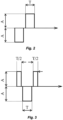
- the standard stimulation pulses in cochlear implants are biphasic. As shown in Fig. 2 , such biphasic stimulation pulses have a negative half-wave (cathodic phase) and a charge-balanced positive half-wave (anodic phase). The net charge of a given half-wave pulse corresponds to the product of its current amplitude A and its pulse duration T. To ensure that no DC components are transmitted to the auditory nerve, the biphasic stimulation pulse includes an opposite phase half-wave pulse of equal duration and opposite amplitude to the first half-wave pulse. In specific pulsatile stimulation strategies, sequential or parallel pulses can be generated at different stimulation electrodes.
- the fitting audiologist can try to change various stimulation parameters such as pulse width, stimulation rate and compression to provide a louder auditory sensation and reduce the side-effects.
- Reimplantation with a cochlear implant with a differently arranged reference electrode also has been attempted by placing separate ground electrodes at very specific locations.
- EP 0959 943 mentions that facial nerve stimulation is an unwanted somatic effect.
- US 2012/0143284 also discusses the problem of undesirable facial nerve stimulation and other unwanted side-effects. But throughout these documents this issue is always discussed in connection with extra-cochlear electrodes which are considered the source of these effects.
- U.S. Patent 5,601,617 describes selecting complex stimulus waveforms including triphasic pulses based on the "response" of the stimulated tissue. Generally the discussion assumes that this is the perceptive response and there is no mention of mitigating adverse stimulus effects.
- EP291005 describes a cochlear stimulation system wherein a change from biphasic to triphasic stimulation pulses is made in order to reduce residual charge of the stimulated auditory nerve.
- Embodiments of the present invention are directed to a fitting process for a cochlear implant system.
- Stimulation signals are applied to stimulation electrodes in a cochlear implant electrode with an initial signal format using biphasic electrical stimulation pulses.
- One or more undesired somatic responses to the stimulation pulses are identified.
- the one or more undesired somatic responses are reduced by selecting an adapted signal format using charge-balanced triphasic electrical stimulation pulses to apply stimulation signals to one or more of the stimulation electrodes.
- a variation of the adapted signal format includes charge-balanced triphasic electrical stimulation pulses whereby gaps are introduced between the first and second, and between the second and third pulse phases. These gaps are designated as inter-phase-gaps and can range from o to several hundred microseconds, i.e. they are on the same order of magnitude than the individual pulse phase durations. The inter-phase gaps may be symmetric (equal duration) or asymmetric (unequal duration). Yet another variation of the adapted signal format includes charge-balanced biphasic electrical stimulation pulses with one inter-phase gap between the first and second pulse phase. The duration of this interphase gap is on the same order of magnitude than the pulse phase durations.
- the triphasic electrical stimulation pulses may include first and third phase pulses matching each other in phase and opposite in phase to a second phase pulse.
- An alternative electrical stimulation pulse for avoiding undesired somatic responses may be a biphasic stimulation pulse with a gap between the first and second pulse phase. The gap duration is on the order of magnitude of the pulse phase duration. All the phase pulses are equal in amplitude or duration.
- the first phase pulse may be anodic or cathodic.
- the triphasic electrical stimulation pulses may be formed from consecutive biphasic pulses of opposite polarity.
- the adapted signal format may apply the stimulation pulses to the one or more stimulation electrodes sequentially one stimulation electrode at a time, or in parallel to multiple stimulation electrodes at a time.
- biphasic rather than triphasic pulses conventionally are used for cochlear implant stimulation in a normal operation mode (i.e. when the patient's auditory nerve is stimulated in order to provide auditory sensation. The situation is different for the non-hearing situation of measuring nerve responses to stimulation pulses where it is known that triphasic stimulation pulses may favourably reduce stimulation artifacts).
- triphasic stimulation pulses may favourably reduce stimulation artifacts.
- a triphasic stimulation pulse that splits the duration of one of the pulse phases may lead to an uncertain charge balance because of the limited temporal resolution of the stimulation system. That issue is not any sort of fundamental limit but rather is a purely technical one. Still there was no reason to put any significant effort into reliable higher temporal resolution that could use much shorter pulse phases with a duration of just 2 or 3 ⁇ s while still reliably ensuring charge balance between the positive and negative pulses phases. Moreover, the overall maximum stimulation rate could be considerably decreased when using triphasic pulses.
- triphasic stimulation pulses for cochlear implant systems. And the problem of adverse side effects such as facial nerve stimulation has long been known. But no one in the field has ever suggested that triphasic stimulation pulses might be used to prevent or mitigate such adverse effects. And Applicant has determined that, in contrast to conventional biphasic pulses, triphasic pulses can significantly reduce unwanted side-effects while providing the desired loudness perception to the patient.
- Embodiments of the present invention are directed to a fitting process for a cochlear implant system based on using triphasic stimulation pulses to avoid undesired somatic effects.
- Initially stimulation signals are applied to stimulation electrodes in a cochlear implant electrode with an initial signal format using conventional biphasic electrical stimulation pulses.
- those are reduced by selecting an adapted signal format using charge-balanced triphasic electrical stimulation pulses to apply stimulation signals to one or more of the stimulation electrodes.
- the adapted signal format may apply the stimulation pulses to the one or more stimulation electrodes sequentially one stimulation electrode at a time, or in parallel to multiple stimulation electrodes at a time.
- the triphasic pulses may be applied to individual stimulation electrodes, to one or more sub-groups of stimulation electrodes, or to all the stimulation electrodes. They may be applied sequentially at different electrodes or in parallel.
- Figure 3 shows an example waveform for one specific type of triphasic stimulation pulse according to an embodiment of the present invention where first and third phase pulses match each other in phase and are opposite in phase to a second phase pulse.
- all the pulses phases have equal amplitude values with the first and third pulse phases each being half the duration of the opposite second pulse phase.
- the first and third phase pulses are anodic (positive) and the second phase pulse is cathodic (negative). In other embodiments, it may be the reverse case.
- Figure 4 shows an example waveform for another specific type of triphasic stimulation pulse according to another embodiment of the present invention using what are referred to as precision pulses. By that it is meant that all the pulse phases have equal durations and different amplitude values where the combined amplitudes of the first and third pulse phases are equal and opposite to the amplitude of the second pulse phase.
- Figure 5 shows an example waveform for another specific type of triphasic stimulation pulse according to another embodiment of the present invention for systems which may not be capable of forming symmetrical triphasic stimulation pulses.
- triphasic pulses can be formed as shown based on back-to-back biphasic pulses of opposite phase.
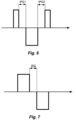
- Figure 6 shows an example waveform for another specific type of triphasic stimulation pulse according to another embodiment of the present invention wherein the adapted signal format includes inter-phase gap periods between adjacent phase pulses; i.e., between the first and second ("IPG1"), and/or between the second and third pulse phases ("IPG 2 ").
- These inter-phase gaps IPG 1 and IPG 2 are on the same order of magnitude as the individual pulse phase durations, and so typically can range from zero to several hundred microseconds.
- the inter-phase gaps may be variable in duration to adjust the one or more undesired somatic responses, and/or the inter-phase gaps may be symmetric (equal duration) or asymmetric (unequal duration).
- Figure 7 shows an example waveform for another embodiment of the present invention based on a biphasic stimulation pulse with an inter-phase gap between the first and second pulse phases.
- Embodiments of the invention may be implemented in part in any conventional computer programming language.
- preferred embodiments may be implemented in a procedural programming language (e.g., "C") or an object oriented programming language (e.g., "C++", Python).
- Alternative embodiments of the invention may be implemented as pre-programmed hardware elements, other related components, or as a combination of hardware and software components.
- Embodiments can be implemented in part as a computer program product for use with a computer system.
- Such implementation may include a series of computer instructions fixed either on a tangible medium, such as a computer readable medium (e.g., a diskette, CD-ROM, ROM, or fixed disk) or transmittable to a computer system, via a modem or other interface device, such as a communications adapter connected to a network over a medium.
- the medium may be either a tangible medium (e.g., optical or analog communications lines) or a medium implemented with wireless techniques (e.g., microwave, infrared or other transmission techniques).
- the series of computer instructions embodies all or part of the functionality previously described herein with respect to the system.
- Such computer instructions can be written in a number of programming languages for use with many computer architectures or operating systems. Furthermore, such instructions may be stored in any memory device, such as semiconductor, magnetic, optical or other memory devices, and may be transmitted using any communications technology, such as optical, infrared, microwave, or other transmission technologies. It is expected that such a computer program product may be distributed as a removable medium with accompanying printed or electronic documentation (e.g., shrink wrapped software), preloaded with a computer system (e.g., on system ROM or fixed disk), or distributed from a server or electronic bulletin board over the network (e.g., the Internet or World Wide Web). Of course, some embodiments of the invention may be implemented as a combination of both software (e.g., a computer program product) and hardware. Still other embodiments of the invention are implemented as entirely hardware, or entirely software (e.g., a computer program product).
Landscapes
- Health & Medical Sciences (AREA)
- Otolaryngology (AREA)
- Engineering & Computer Science (AREA)
- Biomedical Technology (AREA)
- Nuclear Medicine, Radiotherapy & Molecular Imaging (AREA)
- Radiology & Medical Imaging (AREA)
- Life Sciences & Earth Sciences (AREA)
- Animal Behavior & Ethology (AREA)
- General Health & Medical Sciences (AREA)
- Public Health (AREA)
- Veterinary Medicine (AREA)
- Prostheses (AREA)
- Electrotherapy Devices (AREA)
Claims (8)
- Procédé de sélection de formats de signal adaptés dans un processus d'ajustement pour des signaux de stimulation dans un implant cochléaire, lesdits signaux de stimulation étant destinés à stimuler un nerf auditif, le procédé comprenant :l'application de signaux de stimulation non thérapeutiques avec un format de signal initial au moyen d'impulsions de stimulation électrique biphasiques à des électrodes de stimulation dans une électrode d'implant cochléaire ;l'identification d'une ou plusieurs réponses somatiques indésirables aux impulsions de stimulation, ladite réponse somatique indésirable étant causée par une stimulation involontaire d'un nerf autre que le nerf auditif ; etla sélection d'un format de signal adapté qui réduit les une ou plusieurs réponses somatiques indésirables, ledit format de signal adapté utilisant des impulsions de stimulation électrique triphasiques à équilibrage de charge pour appliquer des signaux de stimulation à une ou plusieurs des électrodes de stimulation.
- Procédé selon la revendication 1, dans lequel les impulsions de stimulation électrique triphasiques comprennent des impulsions de première et troisième phase correspondant l'une à l'autre en phase et opposées en phase à une impulsion de deuxième phase.
- Procédé selon la revendication 2, dans lequel toutes les impulsions de phase sont égales en amplitude.
- Procédé selon la revendication 2, dans lequel toutes les impulsions de phase sont égales en durée.
- Procédé selon la revendication 2, dans lequel le format de signal adapté comprend une ou plusieurs périodes d'intervalle interphase entre des impulsions de phase adjacentes.
- Procédé selon la revendication 5, dans lequel les une ou plusieurs périodes d'intervalle interphase sont variables en durée pour ajuster les une ou plusieurs réponses somatiques indésirables.
- Procédé selon la revendication 1, dans lequel le format de signal adapté applique les impulsions de stimulation aux une ou plusieurs électrodes de stimulation séquentiellement une électrode de stimulation à la fois.
- Procédé selon la revendication 1, dans lequel le format de signal adapté applique les impulsions de stimulation aux une ou plusieurs électrodes de stimulation en parallèle à plusieurs électrodes de stimulation à la fois.
Applications Claiming Priority (3)
| Application Number | Priority Date | Filing Date | Title |
|---|---|---|---|
| US201361856090P | 2013-07-19 | 2013-07-19 | |
| PCT/US2014/047123 WO2015009984A1 (fr) | 2013-07-19 | 2014-07-18 | Impulsions triphasiques visant à réduire les effets secondaires indésirables dans les implants cochléaires |
| EP14826000.3A EP3021804B1 (fr) | 2013-07-19 | 2014-07-18 | Impulsions triphasiques visant à réduire les effets secondaires indésirables dans les implants cochléaires |
Related Parent Applications (1)
| Application Number | Title | Priority Date | Filing Date |
|---|---|---|---|
| EP14826000.3A Division EP3021804B1 (fr) | 2013-07-19 | 2014-07-18 | Impulsions triphasiques visant à réduire les effets secondaires indésirables dans les implants cochléaires |
Publications (2)
| Publication Number | Publication Date |
|---|---|
| EP3777963A1 EP3777963A1 (fr) | 2021-02-17 |
| EP3777963B1 true EP3777963B1 (fr) | 2023-08-30 |
Family
ID=52344176
Family Applications (2)
| Application Number | Title | Priority Date | Filing Date |
|---|---|---|---|
| EP20193914.7A Active EP3777963B1 (fr) | 2013-07-19 | 2014-07-18 | Impulsions triphasiques visant à réduire les effets secondaires indésirables dans les implants cochléaires |
| EP14826000.3A Active EP3021804B1 (fr) | 2013-07-19 | 2014-07-18 | Impulsions triphasiques visant à réduire les effets secondaires indésirables dans les implants cochléaires |
Family Applications After (1)
| Application Number | Title | Priority Date | Filing Date |
|---|---|---|---|
| EP14826000.3A Active EP3021804B1 (fr) | 2013-07-19 | 2014-07-18 | Impulsions triphasiques visant à réduire les effets secondaires indésirables dans les implants cochléaires |
Country Status (6)
| Country | Link |
|---|---|
| US (1) | US9265944B2 (fr) |
| EP (2) | EP3777963B1 (fr) |
| AU (1) | AU2014290505B2 (fr) |
| ES (1) | ES2964217T3 (fr) |
| PL (1) | PL3777963T3 (fr) |
| WO (1) | WO2015009984A1 (fr) |
Families Citing this family (18)
| Publication number | Priority date | Publication date | Assignee | Title |
|---|---|---|---|---|
| US9974455B2 (en) | 2011-05-13 | 2018-05-22 | Saluda Medical Pty Ltd. | Method and apparatus for estimating neural recruitment |
| US9872990B2 (en) | 2011-05-13 | 2018-01-23 | Saluda Medical Pty Limited | Method and apparatus for application of a neural stimulus |
| WO2012155185A1 (fr) | 2011-05-13 | 2012-11-22 | National Ict Australia Ltd | Méthode et appareil de mesure de la réponse neuronale |
| US9386934B2 (en) | 2011-05-13 | 2016-07-12 | Saluda Medical Pty Ltd. | Method and apparatus for measurement of neural response |
| DK2908904T3 (da) | 2012-11-06 | 2020-12-14 | Saluda Medical Pty Ltd | System til styring af vævs elektriske tilstand |
| ES3033225T3 (en) | 2013-11-15 | 2025-07-31 | Closed Loop Medical Pty Ltd | Monitoring brain neural potentials |
| CA2929874C (fr) | 2013-11-22 | 2023-06-13 | Saluda Medical Pty Ltd | Procede et dispositif de detection d'une reponse neurale dans une mesure neurale |
| EP3122247B1 (fr) | 2014-03-28 | 2025-05-07 | Saluda Medical Pty Ltd | Évaluation de l'état neuronal à partir de potentiels d'action |
| WO2015168735A1 (fr) | 2014-05-05 | 2015-11-12 | Saluda Medical Pty Ltd | Mesure neuronale amelioree |
| EP3838331B1 (fr) | 2014-07-25 | 2024-05-22 | Saluda Medical Pty Limited | Dosage de stimulation neurale |
| US11006846B2 (en) | 2014-11-17 | 2021-05-18 | Saluda Medical Pty Ltd | Method and device for detecting a neural response in neural measurements |
| AU2015362091B2 (en) | 2014-12-11 | 2020-11-26 | Saluda Medical Pty Ltd | Method and device for feedback control of neural stimulation |
| WO2016090420A1 (fr) | 2014-12-11 | 2016-06-16 | Saluda Medical Pty Ltd | Positionnement d'électrode implantable |
| EP3280487B1 (fr) | 2015-04-09 | 2021-09-15 | Saluda Medical Pty Limited | Estimation de distance électrode-nerf |
| JP7071257B2 (ja) | 2015-05-31 | 2022-05-18 | クローズド・ループ・メディカル・ピーティーワイ・リミテッド | 脳神経刺激装置電極の取付け |
| AU2017246242B2 (en) | 2016-04-05 | 2022-06-23 | Saluda Medical Pty Ltd | Improved feedback control of neuromodulation |
| WO2017219096A1 (fr) * | 2016-06-24 | 2017-12-28 | Saluda Medical Pty Ltd | Stimulation neurale pour un artéfact réduit |
| ES2993811T3 (en) | 2018-04-27 | 2025-01-09 | Saluda Medical Pty Ltd | Neurostimulation of mixed nerves |
Citations (1)
| Publication number | Priority date | Publication date | Assignee | Title |
|---|---|---|---|---|
| EP0959943A1 (fr) * | 1996-06-20 | 1999-12-01 | Advanced Bionics Corporation | Systeme d'implant cochleaire autoajustable et procede d'adaptation |
Family Cites Families (7)
| Publication number | Priority date | Publication date | Assignee | Title |
|---|---|---|---|---|
| US5601617A (en) | 1995-04-26 | 1997-02-11 | Advanced Bionics Corporation | Multichannel cochlear prosthesis with flexible control of stimulus waveforms |
| ATE265796T1 (de) | 1999-07-21 | 2004-05-15 | Med El Elektromed Geraete Gmbh | Mehrkanaliges cochleares implantat mit neuraler antworttelemetrie |
| WO2002082982A1 (fr) * | 2001-04-18 | 2002-10-24 | Cochlear Limited | Procede et appareil de mesure de reponses neuronales evoquees |
| US8103341B2 (en) * | 2006-08-25 | 2012-01-24 | Cardiac Pacemakers, Inc. | System for abating neural stimulation side effects |
| GB0910811D0 (en) * | 2009-06-23 | 2009-08-05 | Medical Res Council | Cochlear implant apparatus and methods |
| WO2011014909A1 (fr) | 2009-08-03 | 2011-02-10 | Cochlear Limited | Dispositif de stimulation implantable |
| US9352153B2 (en) * | 2011-01-24 | 2016-05-31 | Cochlear Limited | Systems and methods for detecting nerve stimulation with an implanted prosthesis |
-
2014
- 2014-07-18 AU AU2014290505A patent/AU2014290505B2/en active Active
- 2014-07-18 EP EP20193914.7A patent/EP3777963B1/fr active Active
- 2014-07-18 EP EP14826000.3A patent/EP3021804B1/fr active Active
- 2014-07-18 PL PL20193914.7T patent/PL3777963T3/pl unknown
- 2014-07-18 US US14/334,743 patent/US9265944B2/en active Active
- 2014-07-18 ES ES20193914T patent/ES2964217T3/es active Active
- 2014-07-18 WO PCT/US2014/047123 patent/WO2015009984A1/fr not_active Ceased
Patent Citations (1)
| Publication number | Priority date | Publication date | Assignee | Title |
|---|---|---|---|---|
| EP0959943A1 (fr) * | 1996-06-20 | 1999-12-01 | Advanced Bionics Corporation | Systeme d'implant cochleaire autoajustable et procede d'adaptation |
Also Published As
| Publication number | Publication date |
|---|---|
| US9265944B2 (en) | 2016-02-23 |
| EP3021804B1 (fr) | 2020-09-02 |
| AU2014290505B2 (en) | 2017-05-25 |
| AU2014290505A1 (en) | 2016-01-28 |
| EP3021804A1 (fr) | 2016-05-25 |
| ES2964217T3 (es) | 2024-04-04 |
| EP3021804A4 (fr) | 2017-03-29 |
| PL3777963T3 (pl) | 2024-02-19 |
| US20150025597A1 (en) | 2015-01-22 |
| EP3777963A1 (fr) | 2021-02-17 |
| WO2015009984A1 (fr) | 2015-01-22 |
Similar Documents
| Publication | Publication Date | Title |
|---|---|---|
| EP3777963B1 (fr) | Impulsions triphasiques visant à réduire les effets secondaires indésirables dans les implants cochléaires | |
| US9545516B2 (en) | Triphasic pulses to reduce undesirable side-effects in cochlear implants | |
| US8688222B2 (en) | Stimulus timing for a stimulating medical device | |
| US9283376B2 (en) | Interaural time difference enhancement strategy | |
| US9919155B2 (en) | Stimulation channel conditioning | |
| US8892212B2 (en) | Fast fitting of cochlear implants | |
| CN107921251A (zh) | 有残余听力的耳蜗植入患者的深度电极植入拟合 | |
| CN107708794A (zh) | 具有耳蜗植入物的选择性刺激 | |
| AU2018229201A1 (en) | Fast objective fitting measurements for cochlear implants | |
| EP3160576B1 (fr) | Utilisation d'un intervalle inter-impulsion étendu dans une stratégie de stimulation entrelacée continue modifiée | |
| US20130116746A1 (en) | Transpositional Acoustic Frequency Range In EAS Patients | |
| US20100331913A1 (en) | Hybrid multi-function electrode array | |
| US11351373B2 (en) | Monophasic stimulation pulses with alternating polarity and extraordinary polarity changes | |
| AU2015339077A1 (en) | Tinnitus fitting method in CI and ABI patients | |
| EP3204115B1 (fr) | Codage neuronal à intervalles courts entre les impulsions | |
| EP3826710B1 (fr) | Stimulation d'arrière-plan pour la pose d'implants cochléaires | |
| CN106999706A (zh) | 听力植入刺激的频率和延迟的双侧匹配 | |
| US20100010570A1 (en) | Auditory prosthesis | |
| US20250345597A1 (en) | Apical inner ear stimulation | |
| WO2019116186A1 (fr) | Maîtrise des interactions électroacoustiques dans des prothèses auditives | |
| EP3492137A1 (fr) | Prothèse auditive implantable faisant appel à une impulsion de stimulation |
Legal Events
| Date | Code | Title | Description |
|---|---|---|---|
| PUAI | Public reference made under article 153(3) epc to a published international application that has entered the european phase |
Free format text: ORIGINAL CODE: 0009012 |
|
| STAA | Information on the status of an ep patent application or granted ep patent |
Free format text: STATUS: THE APPLICATION HAS BEEN PUBLISHED |
|
| AC | Divisional application: reference to earlier application |
Ref document number: 3021804 Country of ref document: EP Kind code of ref document: P |
|
| AK | Designated contracting states |
Kind code of ref document: A1 Designated state(s): AL AT BE BG CH CY CZ DE DK EE ES FI FR GB GR HR HU IE IS IT LI LT LU LV MC MK MT NL NO PL PT RO RS SE SI SK SM TR |
|
| RIN1 | Information on inventor provided before grant (corrected) |
Inventor name: SUERTH, WERNER Inventor name: SCHATZER, REINHOLD |
|
| STAA | Information on the status of an ep patent application or granted ep patent |
Free format text: STATUS: REQUEST FOR EXAMINATION WAS MADE |
|
| 17P | Request for examination filed |
Effective date: 20210811 |
|
| RBV | Designated contracting states (corrected) |
Designated state(s): AL AT BE BG CH CY CZ DE DK EE ES FI FR GB GR HR HU IE IS IT LI LT LU LV MC MK MT NL NO PL PT RO RS SE SI SK SM TR |
|
| GRAP | Despatch of communication of intention to grant a patent |
Free format text: ORIGINAL CODE: EPIDOSNIGR1 |
|
| STAA | Information on the status of an ep patent application or granted ep patent |
Free format text: STATUS: GRANT OF PATENT IS INTENDED |
|
| INTG | Intention to grant announced |
Effective date: 20230324 |
|
| GRAS | Grant fee paid |
Free format text: ORIGINAL CODE: EPIDOSNIGR3 |
|
| GRAA | (expected) grant |
Free format text: ORIGINAL CODE: 0009210 |
|
| STAA | Information on the status of an ep patent application or granted ep patent |
Free format text: STATUS: THE PATENT HAS BEEN GRANTED |
|
| P01 | Opt-out of the competence of the unified patent court (upc) registered |
Effective date: 20230711 |
|
| AC | Divisional application: reference to earlier application |
Ref document number: 3021804 Country of ref document: EP Kind code of ref document: P |
|
| AK | Designated contracting states |
Kind code of ref document: B1 Designated state(s): AL AT BE BG CH CY CZ DE DK EE ES FI FR GB GR HR HU IE IS IT LI LT LU LV MC MK MT NL NO PL PT RO RS SE SI SK SM TR |
|
| REG | Reference to a national code |
Ref country code: GB Ref legal event code: FG4D |
|
| REG | Reference to a national code |
Ref country code: CH Ref legal event code: EP |
|
| REG | Reference to a national code |
Ref country code: DE Ref legal event code: R096 Ref document number: 602014088176 Country of ref document: DE |
|
| REG | Reference to a national code |
Ref country code: IE Ref legal event code: FG4D |
|
| REG | Reference to a national code |
Ref country code: LT Ref legal event code: MG9D |
|
| REG | Reference to a national code |
Ref country code: NL Ref legal event code: MP Effective date: 20230830 |
|
| REG | Reference to a national code |
Ref country code: AT Ref legal event code: MK05 Ref document number: 1604637 Country of ref document: AT Kind code of ref document: T Effective date: 20230830 |
|
| PG25 | Lapsed in a contracting state [announced via postgrant information from national office to epo] |
Ref country code: GR Free format text: LAPSE BECAUSE OF FAILURE TO SUBMIT A TRANSLATION OF THE DESCRIPTION OR TO PAY THE FEE WITHIN THE PRESCRIBED TIME-LIMIT Effective date: 20231201 |
|
| PG25 | Lapsed in a contracting state [announced via postgrant information from national office to epo] |
Ref country code: IS Free format text: LAPSE BECAUSE OF FAILURE TO SUBMIT A TRANSLATION OF THE DESCRIPTION OR TO PAY THE FEE WITHIN THE PRESCRIBED TIME-LIMIT Effective date: 20231230 |
|
| PG25 | Lapsed in a contracting state [announced via postgrant information from national office to epo] |
Ref country code: SE Free format text: LAPSE BECAUSE OF FAILURE TO SUBMIT A TRANSLATION OF THE DESCRIPTION OR TO PAY THE FEE WITHIN THE PRESCRIBED TIME-LIMIT Effective date: 20230830 Ref country code: RS Free format text: LAPSE BECAUSE OF FAILURE TO SUBMIT A TRANSLATION OF THE DESCRIPTION OR TO PAY THE FEE WITHIN THE PRESCRIBED TIME-LIMIT Effective date: 20230830 Ref country code: NO Free format text: LAPSE BECAUSE OF FAILURE TO SUBMIT A TRANSLATION OF THE DESCRIPTION OR TO PAY THE FEE WITHIN THE PRESCRIBED TIME-LIMIT Effective date: 20231130 Ref country code: LV Free format text: LAPSE BECAUSE OF FAILURE TO SUBMIT A TRANSLATION OF THE DESCRIPTION OR TO PAY THE FEE WITHIN THE PRESCRIBED TIME-LIMIT Effective date: 20230830 Ref country code: LT Free format text: LAPSE BECAUSE OF FAILURE TO SUBMIT A TRANSLATION OF THE DESCRIPTION OR TO PAY THE FEE WITHIN THE PRESCRIBED TIME-LIMIT Effective date: 20230830 Ref country code: IS Free format text: LAPSE BECAUSE OF FAILURE TO SUBMIT A TRANSLATION OF THE DESCRIPTION OR TO PAY THE FEE WITHIN THE PRESCRIBED TIME-LIMIT Effective date: 20231230 Ref country code: HR Free format text: LAPSE BECAUSE OF FAILURE TO SUBMIT A TRANSLATION OF THE DESCRIPTION OR TO PAY THE FEE WITHIN THE PRESCRIBED TIME-LIMIT Effective date: 20230830 Ref country code: GR Free format text: LAPSE BECAUSE OF FAILURE TO SUBMIT A TRANSLATION OF THE DESCRIPTION OR TO PAY THE FEE WITHIN THE PRESCRIBED TIME-LIMIT Effective date: 20231201 Ref country code: FI Free format text: LAPSE BECAUSE OF FAILURE TO SUBMIT A TRANSLATION OF THE DESCRIPTION OR TO PAY THE FEE WITHIN THE PRESCRIBED TIME-LIMIT Effective date: 20230830 Ref country code: AT Free format text: LAPSE BECAUSE OF FAILURE TO SUBMIT A TRANSLATION OF THE DESCRIPTION OR TO PAY THE FEE WITHIN THE PRESCRIBED TIME-LIMIT Effective date: 20230830 |
|
| PG25 | Lapsed in a contracting state [announced via postgrant information from national office to epo] |
Ref country code: NL Free format text: LAPSE BECAUSE OF FAILURE TO SUBMIT A TRANSLATION OF THE DESCRIPTION OR TO PAY THE FEE WITHIN THE PRESCRIBED TIME-LIMIT Effective date: 20230830 |
|
| REG | Reference to a national code |
Ref country code: ES Ref legal event code: FG2A Ref document number: 2964217 Country of ref document: ES Kind code of ref document: T3 Effective date: 20240404 |
|
| PG25 | Lapsed in a contracting state [announced via postgrant information from national office to epo] |
Ref country code: SM Free format text: LAPSE BECAUSE OF FAILURE TO SUBMIT A TRANSLATION OF THE DESCRIPTION OR TO PAY THE FEE WITHIN THE PRESCRIBED TIME-LIMIT Effective date: 20230830 Ref country code: RO Free format text: LAPSE BECAUSE OF FAILURE TO SUBMIT A TRANSLATION OF THE DESCRIPTION OR TO PAY THE FEE WITHIN THE PRESCRIBED TIME-LIMIT Effective date: 20230830 Ref country code: EE Free format text: LAPSE BECAUSE OF FAILURE TO SUBMIT A TRANSLATION OF THE DESCRIPTION OR TO PAY THE FEE WITHIN THE PRESCRIBED TIME-LIMIT Effective date: 20230830 Ref country code: DK Free format text: LAPSE BECAUSE OF FAILURE TO SUBMIT A TRANSLATION OF THE DESCRIPTION OR TO PAY THE FEE WITHIN THE PRESCRIBED TIME-LIMIT Effective date: 20230830 Ref country code: CZ Free format text: LAPSE BECAUSE OF FAILURE TO SUBMIT A TRANSLATION OF THE DESCRIPTION OR TO PAY THE FEE WITHIN THE PRESCRIBED TIME-LIMIT Effective date: 20230830 Ref country code: PT Free format text: LAPSE BECAUSE OF FAILURE TO SUBMIT A TRANSLATION OF THE DESCRIPTION OR TO PAY THE FEE WITHIN THE PRESCRIBED TIME-LIMIT Effective date: 20240102 Ref country code: SK Free format text: LAPSE BECAUSE OF FAILURE TO SUBMIT A TRANSLATION OF THE DESCRIPTION OR TO PAY THE FEE WITHIN THE PRESCRIBED TIME-LIMIT Effective date: 20230830 |
|
| REG | Reference to a national code |
Ref country code: DE Ref legal event code: R097 Ref document number: 602014088176 Country of ref document: DE |
|
| PLBE | No opposition filed within time limit |
Free format text: ORIGINAL CODE: 0009261 |
|
| STAA | Information on the status of an ep patent application or granted ep patent |
Free format text: STATUS: NO OPPOSITION FILED WITHIN TIME LIMIT |
|
| PG25 | Lapsed in a contracting state [announced via postgrant information from national office to epo] |
Ref country code: SI Free format text: LAPSE BECAUSE OF FAILURE TO SUBMIT A TRANSLATION OF THE DESCRIPTION OR TO PAY THE FEE WITHIN THE PRESCRIBED TIME-LIMIT Effective date: 20230830 |
|
| 26N | No opposition filed |
Effective date: 20240603 |
|
| PG25 | Lapsed in a contracting state [announced via postgrant information from national office to epo] |
Ref country code: BG Free format text: LAPSE BECAUSE OF FAILURE TO SUBMIT A TRANSLATION OF THE DESCRIPTION OR TO PAY THE FEE WITHIN THE PRESCRIBED TIME-LIMIT Effective date: 20230830 |
|
| PG25 | Lapsed in a contracting state [announced via postgrant information from national office to epo] |
Ref country code: BG Free format text: LAPSE BECAUSE OF FAILURE TO SUBMIT A TRANSLATION OF THE DESCRIPTION OR TO PAY THE FEE WITHIN THE PRESCRIBED TIME-LIMIT Effective date: 20230830 |
|
| PG25 | Lapsed in a contracting state [announced via postgrant information from national office to epo] |
Ref country code: MC Free format text: LAPSE BECAUSE OF FAILURE TO SUBMIT A TRANSLATION OF THE DESCRIPTION OR TO PAY THE FEE WITHIN THE PRESCRIBED TIME-LIMIT Effective date: 20230830 |
|
| REG | Reference to a national code |
Ref country code: CH Ref legal event code: PL |
|
| PG25 | Lapsed in a contracting state [announced via postgrant information from national office to epo] |
Ref country code: LU Free format text: LAPSE BECAUSE OF NON-PAYMENT OF DUE FEES Effective date: 20240718 |
|
| PG25 | Lapsed in a contracting state [announced via postgrant information from national office to epo] |
Ref country code: LU Free format text: LAPSE BECAUSE OF NON-PAYMENT OF DUE FEES Effective date: 20240718 |
|
| PG25 | Lapsed in a contracting state [announced via postgrant information from national office to epo] |
Ref country code: CH Free format text: LAPSE BECAUSE OF NON-PAYMENT OF DUE FEES Effective date: 20240731 Ref country code: BE Free format text: LAPSE BECAUSE OF NON-PAYMENT OF DUE FEES Effective date: 20240731 |
|
| REG | Reference to a national code |
Ref country code: BE Ref legal event code: MM Effective date: 20240731 |
|
| PGFP | Annual fee paid to national office [announced via postgrant information from national office to epo] |
Ref country code: PL Payment date: 20250627 Year of fee payment: 12 |
|
| PG25 | Lapsed in a contracting state [announced via postgrant information from national office to epo] |
Ref country code: IE Free format text: LAPSE BECAUSE OF NON-PAYMENT OF DUE FEES Effective date: 20240718 |
|
| PGFP | Annual fee paid to national office [announced via postgrant information from national office to epo] |
Ref country code: ES Payment date: 20250812 Year of fee payment: 12 |
|
| PGFP | Annual fee paid to national office [announced via postgrant information from national office to epo] |
Ref country code: DE Payment date: 20250728 Year of fee payment: 12 |
|
| PGFP | Annual fee paid to national office [announced via postgrant information from national office to epo] |
Ref country code: IT Payment date: 20250721 Year of fee payment: 12 |
|
| PGFP | Annual fee paid to national office [announced via postgrant information from national office to epo] |
Ref country code: GB Payment date: 20250722 Year of fee payment: 12 |
|
| PGFP | Annual fee paid to national office [announced via postgrant information from national office to epo] |
Ref country code: FR Payment date: 20250725 Year of fee payment: 12 |
|
| PG25 | Lapsed in a contracting state [announced via postgrant information from national office to epo] |
Ref country code: CY Free format text: LAPSE BECAUSE OF FAILURE TO SUBMIT A TRANSLATION OF THE DESCRIPTION OR TO PAY THE FEE WITHIN THE PRESCRIBED TIME-LIMIT; INVALID AB INITIO Effective date: 20140718 |
|
| PG25 | Lapsed in a contracting state [announced via postgrant information from national office to epo] |
Ref country code: HU Free format text: LAPSE BECAUSE OF FAILURE TO SUBMIT A TRANSLATION OF THE DESCRIPTION OR TO PAY THE FEE WITHIN THE PRESCRIBED TIME-LIMIT; INVALID AB INITIO Effective date: 20140718 |