EP3778024B1 - Dispositif et procédé de séparation de particules selon la taille, de piégeage et de manipulation de micro et nanoparticules pour la detection moléculaire - Google Patents
Dispositif et procédé de séparation de particules selon la taille, de piégeage et de manipulation de micro et nanoparticules pour la detection moléculaire Download PDFInfo
- Publication number
- EP3778024B1 EP3778024B1 EP19192141.0A EP19192141A EP3778024B1 EP 3778024 B1 EP3778024 B1 EP 3778024B1 EP 19192141 A EP19192141 A EP 19192141A EP 3778024 B1 EP3778024 B1 EP 3778024B1
- Authority
- EP
- European Patent Office
- Prior art keywords
- area
- sample solution
- trapping
- detection
- inter
- Prior art date
- Legal status (The legal status is an assumption and is not a legal conclusion. Google has not performed a legal analysis and makes no representation as to the accuracy of the status listed.)
- Active
Links
Images


Classifications
-
- B—PERFORMING OPERATIONS; TRANSPORTING
- B01—PHYSICAL OR CHEMICAL PROCESSES OR APPARATUS IN GENERAL
- B01L—CHEMICAL OR PHYSICAL LABORATORY APPARATUS FOR GENERAL USE
- B01L3/00—Containers or dishes for laboratory use, e.g. laboratory glassware; Droppers
- B01L3/50—Containers for the purpose of retaining a material to be analysed, e.g. test tubes
- B01L3/502—Containers for the purpose of retaining a material to be analysed, e.g. test tubes with fluid transport, e.g. in multi-compartment structures
- B01L3/5027—Containers for the purpose of retaining a material to be analysed, e.g. test tubes with fluid transport, e.g. in multi-compartment structures by integrated microfluidic structures, i.e. dimensions of channels and chambers are such that surface tension forces are important, e.g. lab-on-a-chip
- B01L3/502761—Containers for the purpose of retaining a material to be analysed, e.g. test tubes with fluid transport, e.g. in multi-compartment structures by integrated microfluidic structures, i.e. dimensions of channels and chambers are such that surface tension forces are important, e.g. lab-on-a-chip specially adapted for handling suspended solids or molecules independently from the bulk fluid flow, e.g. for trapping or sorting beads or physically stretching molecules
-
- G—PHYSICS
- G01—MEASURING; TESTING
- G01N—INVESTIGATING OR ANALYSING MATERIALS BY DETERMINING THEIR CHEMICAL OR PHYSICAL PROPERTIES
- G01N33/00—Investigating or analysing materials by specific methods not covered by groups G01N1/00 - G01N31/00
- G01N33/48—Biological material, e.g. blood, urine; Haemocytometers
- G01N33/50—Chemical analysis of biological material, e.g. blood, urine; Testing involving biospecific ligand binding methods; Immunological testing
- G01N33/53—Immunoassay; Biospecific binding assay; Materials therefor
- G01N33/543—Immunoassay; Biospecific binding assay; Materials therefor with an insoluble carrier for immobilising immunochemicals
- G01N33/54313—Immunoassay; Biospecific binding assay; Materials therefor with an insoluble carrier for immobilising immunochemicals the carrier being characterised by its particulate form
- G01N33/54346—Nanoparticles
-
- G—PHYSICS
- G01—MEASURING; TESTING
- G01N—INVESTIGATING OR ANALYSING MATERIALS BY DETERMINING THEIR CHEMICAL OR PHYSICAL PROPERTIES
- G01N33/00—Investigating or analysing materials by specific methods not covered by groups G01N1/00 - G01N31/00
- G01N33/48—Biological material, e.g. blood, urine; Haemocytometers
- G01N33/50—Chemical analysis of biological material, e.g. blood, urine; Testing involving biospecific ligand binding methods; Immunological testing
- G01N33/53—Immunoassay; Biospecific binding assay; Materials therefor
- G01N33/543—Immunoassay; Biospecific binding assay; Materials therefor with an insoluble carrier for immobilising immunochemicals
- G01N33/54366—Apparatus specially adapted for solid-phase testing
-
- B—PERFORMING OPERATIONS; TRANSPORTING
- B01—PHYSICAL OR CHEMICAL PROCESSES OR APPARATUS IN GENERAL
- B01L—CHEMICAL OR PHYSICAL LABORATORY APPARATUS FOR GENERAL USE
- B01L2200/00—Solutions for specific problems relating to chemical or physical laboratory apparatus
- B01L2200/06—Fluid handling related problems
- B01L2200/0647—Handling flowable solids, e.g. microscopic beads, cells, particles
- B01L2200/0652—Sorting or classification of particles or molecules
-
- B—PERFORMING OPERATIONS; TRANSPORTING
- B01—PHYSICAL OR CHEMICAL PROCESSES OR APPARATUS IN GENERAL
- B01L—CHEMICAL OR PHYSICAL LABORATORY APPARATUS FOR GENERAL USE
- B01L2200/00—Solutions for specific problems relating to chemical or physical laboratory apparatus
- B01L2200/06—Fluid handling related problems
- B01L2200/0647—Handling flowable solids, e.g. microscopic beads, cells, particles
- B01L2200/0668—Trapping microscopic beads
-
- B—PERFORMING OPERATIONS; TRANSPORTING
- B01—PHYSICAL OR CHEMICAL PROCESSES OR APPARATUS IN GENERAL
- B01L—CHEMICAL OR PHYSICAL LABORATORY APPARATUS FOR GENERAL USE
- B01L2300/00—Additional constructional details
- B01L2300/08—Geometry, shape and general structure
- B01L2300/0809—Geometry, shape and general structure rectangular shaped
- B01L2300/0816—Cards, e.g. flat sample carriers usually with flow in two horizontal directions
-
- B—PERFORMING OPERATIONS; TRANSPORTING
- B01—PHYSICAL OR CHEMICAL PROCESSES OR APPARATUS IN GENERAL
- B01L—CHEMICAL OR PHYSICAL LABORATORY APPARATUS FOR GENERAL USE
- B01L2400/00—Moving or stopping fluids
- B01L2400/04—Moving fluids with specific forces or mechanical means
- B01L2400/0403—Moving fluids with specific forces or mechanical means specific forces
- B01L2400/0406—Moving fluids with specific forces or mechanical means specific forces capillary forces
-
- B—PERFORMING OPERATIONS; TRANSPORTING
- B01—PHYSICAL OR CHEMICAL PROCESSES OR APPARATUS IN GENERAL
- B01L—CHEMICAL OR PHYSICAL LABORATORY APPARATUS FOR GENERAL USE
- B01L2400/00—Moving or stopping fluids
- B01L2400/08—Regulating or influencing the flow resistance
- B01L2400/084—Passive control of flow resistance
- B01L2400/086—Passive control of flow resistance using baffles or other fixed flow obstructions
-
- G—PHYSICS
- G01—MEASURING; TESTING
- G01N—INVESTIGATING OR ANALYSING MATERIALS BY DETERMINING THEIR CHEMICAL OR PHYSICAL PROPERTIES
- G01N21/00—Investigating or analysing materials by the use of optical means, i.e. using sub-millimetre waves, infrared, visible or ultraviolet light
- G01N21/17—Systems in which incident light is modified in accordance with the properties of the material investigated
- G01N21/55—Specular reflectivity
- G01N21/552—Attenuated total reflection
- G01N21/553—Attenuated total reflection and using surface plasmons
- G01N21/554—Attenuated total reflection and using surface plasmons detecting the surface plasmon resonance of nanostructured metals, e.g. localised surface plasmon resonance
-
- G—PHYSICS
- G01—MEASURING; TESTING
- G01N—INVESTIGATING OR ANALYSING MATERIALS BY DETERMINING THEIR CHEMICAL OR PHYSICAL PROPERTIES
- G01N21/00—Investigating or analysing materials by the use of optical means, i.e. using sub-millimetre waves, infrared, visible or ultraviolet light
- G01N21/62—Systems in which the material investigated is excited whereby it emits light or causes a change in wavelength of the incident light
- G01N21/63—Systems in which the material investigated is excited whereby it emits light or causes a change in wavelength of the incident light optically excited
- G01N21/65—Raman scattering
- G01N21/658—Raman scattering enhancement Raman, e.g. surface plasmons
Definitions
- the present invention relates to a device and a method for size-selective particle separation, trapping, and manipulation of micro and nanoparticles for molecular detection.
- Microfluidics has been an emerging and promising area of research and development for both applied and basic research in the fields of biology, fluid dynamics, material science, and diagnostics.
- Integrated micro/nanofluidic devices furthermore use both surface-specific properties of nanostructures as well as controlled fluid dynamics of microstructures to provide a platform for molecular dynamic, intermolecular interactions studies, and molecular sensing for nanoscale molecules at low concentration.
- micro- and nanofluidic devices have been used for molecule separation, sorting and trapping.
- Document US 2016/320389 A1 discloses a virus detection chip device comprising a capillary opening, a first filtering nanopillar array, a second nanopillar array, connected to the first nanopillar array, and a diode-induced fluorescence detector, connected to the second nanopillar array.
- Document US 2014/252505 A1 discloses an analysis microchip comprising a columnar structure array with a plurality of nanopillars.
- Document US 2009/214392 A1 discloses a nano-fluidic trapping device for assembling a SERS-active cluster comprising a SERS-active cluster compartment having a plurality of nanopillars.
- Integrated micro/nanofluidic solutions for Lab-on- ⁇ -chip (LoC) platforms for diagnostic applications have been of great interest in both diagnostic as well as in preventive detection of diseases.
- a lab-on- ⁇ -chip (LoC) device for size-selective separation, trapping, and manipulation of micro/nanoparticles from a flow of a sample solution for molecular detection, comprising:
- the present device represents a LoC platform that allows for particle separation, sorting and trapping at specific locations in the device for molecular sensing in the range of nano- to picomolar concentration.
- SERS surface-enhanced Raman spectroscopy
- LSPR localized surface plasmon resonance
- the in-port area may be designed as a blood drop injection area.
- the functionalized nanoparticle trapping and detection area (12) comprises a number of stages or steps (16a to 16c) that are patterned with different height to trap different particles (18a to 18c) at different stage location based on the particle size; said stages or steps (16a to 16c) preferably are supported with pillars to avoid pattern collapsing.
- a method for size-selective particle separation, trapping, and manipulation of micro/nanoparticles from a flow of a sample solution for molecular detection comprising the steps of:
- a solution comprising functionalized nanoparticles may be conveyed through the LoC device; said functionalization reflects the biomolecules intended to be trapped in the functionalized nanoparticle trapping and detection area of said LoC device.
- a solution comprising functionalized nanoparticles may be added to the sample solution before the sample solution is conveyed through the LoC device; said functionalization reflects the biomolecules intended to be trapped in the functionalized nanoparticle trapping and detection area of said LoC device.
- the biomolecule load trapped in the functionalized nanoparticle trapping at the detection area of said LoC device can be investigated using optical detection to acquire surface-enhanced Raman spectroscopy (SERS) signal of the antibody-antigen complex or fluorescent signal from the molecular assembly attached on the surface of these particles.
- SERS surface-enhanced Raman spectroscopy
- the present invention discloses a device 2 that incorporates the field of micro- and nano-fluidics for particle separation, trapping, and manipulation in different particle size ranges (from microscale to nanoscale).
- the device 2 is specifically designed to use whole blood sample as well as other fluidic solutions for the detection of target biomolecules that could be disease-specific antigens, lipids, proteins, virus or other biomolecules present in the solution.
- To perform the molecular detection the device 2 uses size-based particle separation and trapping of the micro/nanoparticles that are functionalized with the antibodies to capture the target molecules from the solution. Trapped nanoparticles are further used for optical detection to acquire surface-enhanced Raman spectroscopy (SERS) signal of the antibody-antigen complex or fluorescent signal from the molecular assembly attached on the surface of these particles.
- SERS surface-enhanced Raman spectroscopy
- Figure 1 schematically shows the architecture of lab-on- ⁇ -chip platform device 2 (top view) for early disease detection using antibody-functionalized nanoparticles.
- a blood sample is injected at an in-port area 4 in combination with functionalized nanoparticles allowing antibody-antigen binding on a nanoparticle surface, and detection of bound antibodies at a detection area.
- the blood sample solution is conveyed by capillary forces through the different sections of the LoC device 2.
- the in-port (injection) area 4, a macro particle separation area 6 and a micro particle separation area 8, a nanoparticle separation area 10, all comprise micro array pillars 14 with different inter-pillar spacing, pillar period and orientation.
- a functionalized nanoparticle trapping and detection area 12 comprises three different stages 16a to 16c to allow for size-based trapping of three different diameter nanoparticles 18a to 18c at different locations within this detection area 12.
- the LoC device 2 is specifically designed to use functionalized nanoparticles for early disease diagnosis, where nanoparticles can be functionalized with disease-specific antibodies.
- the device 2 has one in-port area 4 and one out-port area 20 as shown in Figure 1 . Both in-port area 4 and out-port area 20 are patterned with circular pillars 14 to support microstructures and avoid pattern collapsing after transferring the device pattern to elastic materials such as polydimethylsilaxone (PDMS).
- PDMS polydimethylsilaxone
- the sample solution is conveyed by capillary forces from the in-port area 4 to the out-port area 20 thereby passing all components being arranged in between.
- the out-port area 20 is patterned with 3 ⁇ m and 15 ⁇ m diameter circular pillars with 7 ⁇ m and 15 ⁇ m inter-pillar spacing, respectively, whereas the in-port area 4 is patterned with 15 ⁇ m diameter pillars with 15 ⁇ m inter-pillar spacing.
- 3 ⁇ m pillars are patterned with 2 ⁇ m inter-pillar spacing and connected with an area patterned with 5 ⁇ m x 3 ⁇ m rectangular pillars rotated at an angle of ⁇ 48.37° with 6 ⁇ m and 6.6 ⁇ m inter-pillar spacing in axial and lateral direction of the flow of the sample solution, respectively.
- the macro/nanoparticle separation area 6, 8 is directly connected with nanochannels embedded with deterministic lateral displacement (DLD) array.
- DLD arrays were achieved using 2 ⁇ m and 1 ⁇ m diameter pillars with 1 ⁇ m and 500 nm inter-pillar spacing.
- Patterned DLD arrays allow for nanoparticle sorting and separation. It furthermore promotes the directional motion of the nanoparticles helping them to be trapped at a specific direction/location.
- stages are patterned with different heights to trap different particles at different stage location based on the particle size as shown in Fig. 1 and Fig. 2 .
- the stages or steps are supported with pillars to avoid pattern collapsing as shown in Fig. 2 which depicts schematically nanochannels embedded with deterministic lateral displacement arrays and three steps for passive size-based trapping of three different nanoparticles.
- Fig. 2(b) shows the trapping of 150 nm diameter gold nanoparticles at the location of a big step inside the nanochannel;
- Fig. 2(a) shows nanochannels being imbedded with 2 ⁇ m diameter DLD pillars which also serve as supporting pillars for the nanosteps and nanochannels.
- LoC device The lab-on- ⁇ -chip (LoC) platform device (shortly also referred to as LoC device) for biosensing applications is developed using state-of-the-art lithography processes and replica molding using polydimethylsiloxane (PDMS)which is schematically shown in Figure 3 .
- PDMS polydimethylsiloxane
- a negative master was developed on a Si wafer using electron-beam lithography (Vistec EBPG 5000 Plus).
- a silicon wafer was sonicated under acetone and isopropyl alcohol (IPA) for 10 min in each solvent, and dried under nitrogen (N2) gas stream.
- BOE 7:1, HF:NH4F 12.5:87.5%, General Chemical
- the wafer was spin-coated (1000 rpm, 300 rpm/s, 60 s) with poly-(methylmethacrylate) (PMMA, 950K, 4% ethylacetate, Allresist), and pre-baked at 175 °C for 4 min.
- PMMA poly-(methylmethacrylate)
- PMMA was developed under methyl-isobutyl-ketone (MIBK):IPA (1:1) for 60 s.
- MIBK methyl-isobutyl-ketone
- a 60 nm thick gold (Au) layer was thermally deposited on the patterned wafer after the deposition of a 5 nm thin interconnect layer of chromium, transferring the patterns on the wafer.
- the PMMA resist was removed from the wafer through Acetone, IPA, DI sonication, and cleaned wafer was processed with 02 plasma.
- HSQ Fox16 (1:4) negative e-beam resist was spin coated on the wafer (3000 rpm, 500 rpm/s, 60 s).
- the wafer was further cleaned using 02 plasma for 2 min, and HSQ Fox16 (1:3) resist was spin coated (4000 rpm, 500 rpm/s, 60 s).
- the wafer was 02 plasma cleaned for 2 min and spin-coated with HSQ Fox16 (1:2) (1500 rpm, 500 rpm/s, 60 s) before the e-beam exposure.
- the exposed resist was developed for 3 min, and the wafer was 02 plasma cleaned for 2 min.
- the cleaned wafer was spin coated with HSQ Fox (1:1) resist (1000 rpm, 500 rpm/s, 60 s), and exposed with the pattern for the nanochannels.
- the wafer was again cleaned with 02 plasma, and spin coated with HSQ Fox (undiluted) resist (1000 rpm/s, 300 rpm, 60 s).
- the wafer was exposed with in-port and out-port areas, and developed in the developer solution for 7 min and later sonicated in the developer solution for 6 min.
- the final thickness of small, middle, and big steps/stages are approximately 78 nm, 100 nm, 170 nm, respectively.
- the thickness of the nanochannels and the in/out-port areas are ⁇ 330 nm and ⁇ 885 nm, respectively.
- the device pattern was transferred to PDMS mold using replica molding as shown in Figure 3 , after performing gas phase silanization of the patterned silicon wafer.
- Silanization was performed inside a vacuum chamber using a mixture of 1:1 trichloro(1H,1H,2H,@H-perfluorooctyl) silane and (tridecafluoro-1,1,2,2-tetrahydrooctyl)dimethylchlorosilane for 10 min.
- UV curable PDMS base and curing agent mixture (ShinEtsu Chemical Co. Ltd.) was used in 1:1 weight ratio and cured for 4 min under UV exposure at 30mW/cm2 and then baked at 50°C in an oven at atmospheric pressure.
- the patterned PDMS mold was further prepared for final device assembly by punching holes at the in/out-port locations. Immediately before the final device assembly a cleaned cover glass and a prepared PDMS mold were processed with air plasma for the activation of glass and PDMS surface for effective covalent binding. Before pressing both the surfaces together, the nanostructures of the patterned PDMS mold were filled with 2.5 ⁇ l of DI water through capillary force reaction. The pre-filling of the nanostructures in the patterned PDMS surface avoids a pattern collapsing during the glass-PDMS surface binding process.
- the device was specifically designed to use functionalized nanoparticles for early disease diagnosis, where nanoparticles can be functionalized with disease-specific antibodies.
- Antibody functionalized nanoparticles can be purchased directly or prepared in the laboratory using surface chemistry.
- nanoparticles need to be mixed with body fluid and injected through the in-port area into the LoC device.
- the LoC platform device comprises areas specifically designed for passive separation of micro molecules from the sample solution and size-based trapping of nanoparticles at the detection area, enabling multi-particle detection on a single device as shown in Fig. 1 .
- the LoC device provides a means to detect biomarkers using surface-enhanced Raman spectroscopy (SERS).
- SERS surface-enhanced Raman spectroscopy
- Microparticle separation experiments were performed using whole blood sample mixed with gold nanoparticles. For detection of disease-specific biomolecule detection, it is important to separate red and white blood cells, and platelets including other micro and macro particles from the gold nanoparticles at the detection area to achieve high signal to noise ratio of SERS signal from the attached molecules on the functionalized nanoparticles. Thus, preliminary experiments were performed to identify the efficiency of the device to separate these particles before the nanochannel region in the LoC device. Based on the performed experiments, it was identified that for a mixture of 100 ⁇ l of the whole blood sample and 10 ⁇ l of (-ve) 80 nm of AuNPs, all macro and micro molecules sieved out before the nanochannel region.
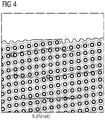
- FIG. 4 exemplarily shows a microarray of 1 ⁇ m diameter pillars with 1 ⁇ m inter-pillar spacing inside the integrated micro/nanofluidic device for size-based sorting of nanoparticle and directional motion of the particles of interest.
- the DLD arrays support both size-based particle separation as well as the directional displacement of the nanoparticles.
- the size-based nanoparticle sorting and the directional motion was investigated using DLD arrays with 1 ⁇ m diameter pillars with 2 ⁇ m and 1 ⁇ m inter-pillar spacing in the both axial and lateral directions of the flow.
- the DLD arrays were patterned with an array period (N) of 0, 1, 2, 10, 100, 200, 300, and 600.
- Preliminary experiments were performed using 150 nm and 200 nm Au NPs to examine the efficiency of the DLD arrays to allow motion of nanoparticle in the direction of the pillar array.
- the aspect ratio (height : width) 1000 : 330 the 1 ⁇ m diameter pillars inside the nanochannels were collapsing during the experiments due to nanochannel drying. Furthermore, for an array period N ⁇ 100, the lateral row shift was not sufficient enough to allow for the directed motion of the nanoparticles along the array direction.
- the next generation of the LoC device design was developed using DLD arrays with periods lower than 100 and an inter-pillar spacing of 1 ⁇ m and 500 nm for a 2 ⁇ m diameter circular array as mentioned above.
- the reduced aspect ratio of the pillars inside the nanochannel region contributed to the stability of the pillars.
- the directional motion of nanoparticles for new set of DLD arrays was not as effective as observed for 1 ⁇ m diameter pillars with inter-pillar spacing of 1 ⁇ m. Further optimization of the DLD array will lead to location specific trapping of nanoparticles based on their sizes in the detection area as shown in Figure 4 , which would allow multiplexable detection on a single LoC platform device.
- the detection area in the LoC platform device was patterned with nanometric steps/stages as shown in Figure 3 .
- the step structures allow for passive size-based trapping of nanoparticles, leading to the desired possibility of multi-diametric particle detection at the detection area.
Landscapes
- Health & Medical Sciences (AREA)
- Chemical & Material Sciences (AREA)
- Immunology (AREA)
- Life Sciences & Earth Sciences (AREA)
- Engineering & Computer Science (AREA)
- Hematology (AREA)
- Urology & Nephrology (AREA)
- Biomedical Technology (AREA)
- Molecular Biology (AREA)
- Physics & Mathematics (AREA)
- Analytical Chemistry (AREA)
- General Health & Medical Sciences (AREA)
- Medicinal Chemistry (AREA)
- Pathology (AREA)
- Microbiology (AREA)
- Biotechnology (AREA)
- Food Science & Technology (AREA)
- Biochemistry (AREA)
- Cell Biology (AREA)
- General Physics & Mathematics (AREA)
- Nanotechnology (AREA)
- Fluid Mechanics (AREA)
- Dispersion Chemistry (AREA)
- Clinical Laboratory Science (AREA)
- Chemical Kinetics & Catalysis (AREA)
- Investigating, Analyzing Materials By Fluorescence Or Luminescence (AREA)
Claims (7)
- Dispositif (2) de laboratoire-sur-puce (LsP) pour la séparation de particules selon la taille, le piégeage, et la manipulation de micro / nanoparticules dans un flux d'une solution d'échantillon pour la détection moléculaire, comprenant :a) une zone d'entrée (4) pour la réception d'une solution d'échantillon dans laquelle la zone d'entrée (4) comprend un réseau de micro-piliers (14) étant structuré avec des piliers ayant un diamètre de l'ordre de 1 à 50 µm, de préférence de l'ordre de 15 µm environ, avec un espacement entre piliers de l'ordre de 1 à 50 µm, de préférence de l'ordre de 15 µm environ ;b) une zone de séparation des macroparticules (6) et une zone de séparation des microparticules (8) disposée en aval de la zone de séparation des macro-particules (6), la zone de séparation des microparticules (8) et la zone de séparation des macroparticules (6) comprenant un réseau de piliers (6) ayant des piliers avec un diamètre de l'ordre de 1 à 20 µm, de préférence de l'ordre de 3 µm environ, avec un espacement entre piliers de l'ordre de 0,5 à 20 µm, de préférence de l'ordre de 2 à 5 µm environ, étant raccordée à une zone (8) structurée avec des piliers rectangulaires de l'ordre de 1 à 20 µm x 1 à 20 µm, de préférence de l'ordre de 5 µm x 3 µm environ, les piliers rectangulaires étant tournés selon un angle de l'ordre de 30 à 70°, de préférence de l'ordre de 45 à 55°, avec un espacement entre piliers de l'ordre de 1 à 10 µm dans un sens axial et latéral du flux de la solution d'échantillon, de préférence avec un espacement entre piliers de 6 µm et 6,6 µm environ dans le sens axial et latéral du flux de la solution d'échantillon ;c) une zone de tri et de séparation des nanoparticules (10) étant disposée en aval de la zone de séparation des microparticules (8) et comprenant des nanocanaux intégrés avec un réseau de déplacement latéral déterministe (DLD) ; ledit réseau DLD est réalisé en utilisant des piliers avec un diamètre de 0,5 à 10 µm, de préférence, 2 µm et 1 µm, avec un espacement entre piliers de 0,2 à 5 µm, de préférence, de 1 µm et 500 nm ;d) une zone de piégeage et de détection de nanoparticules fonctionnalisées (12) étant disposée dans la zone de triage et de séparation des nanoparticules (10) et comprenant un certain nombre de niveaux ou d'étapes (16a à 16c) qui sont structurés avec différentes hauteurs pour piéger différentes particules (18a à 18c) à différents emplacements de niveau sur la base de la taille des particules ; lesdits niveaux ou étapes (16a à 16c) étant soutenus, de préférence, avec des piliers pour éviter l'effondrement de la structure ; ete) une zone de sortie (20) pour la solution d'échantillon de rebut.
- Dispositif LsP (2) selon la revendication 1, dans lequel la zone d'entrée (4) est conçue comme zone d'injection de gouttes de sang.
- Dispositif LsP (2) selon la revendication 1, dans lequel les réseaux DLD sont réalisés pour une période N = 1, 2, 3, 10, 20 avec un espacement entre piliers de 1 µm ou pour une période N = 1, 10, 12, 18, 25 avec un espacement entre piliers de 500 nm.
- Procédé de séparation des particules selon la taille, de piégeage et de manipulation de micro / nanoparticules dans un flux d'une solution d'échantillon pour la détection moléculaire ; comprenant les étapes de :a) fourniture d'une solution d'échantillon à examiner ;b) acheminement - essentiellement par force capillaire - de la solution d'échantillon à travers un dispositif LsP(2) selon l'une quelconque des revendications précédentes 1 à 3.
- Procédé selon la revendication 4, dans lequel avant d'introduire la solution d'échantillon, une solution comprenant des nanoparticules fonctionnalisées est acheminée à travers le dispositif LsP (2) ; ladite fonctionnalisation met en évidence les biomolécules destinées à être piégées dans la zone de piégeage et de détection de nanoparticules fonctionnalisées (12) dudit dispositif LsP (2).
- Procédé selon la revendication 4, dans lequel une solution comprenant des nanoparticules fonctionnalisées est ajoutée à la solution d'échantillon avant que la solution d'échantillon soit acheminée à travers le dispositif LsP (2) ; ladite fonctionnalisation met en évidence les biomolécules destinées à être piégées dans la zone de piégeage et de détection des nanoparticules fonctionnalisées (12) dudit dispositif LsP (2).
- Procédé selon la revendication 5 ou 6, dans lequel une charge de biomolécules piégée dans la zone de piégeage et de détection de nanoparticules fonctionnalisées (12) dudit dispositif LsP (2) est étudiée en utilisant une détection optique pour acquérir un signal de SERS (spectroscopie Raman amplifiée en surface) du complexe anticorps-antigène ou un signal fluorescent provenant de l'ensemble moléculaire fixé à la surface de ces particules.
Priority Applications (1)
| Application Number | Priority Date | Filing Date | Title |
|---|---|---|---|
| EP19192141.0A EP3778024B1 (fr) | 2019-08-16 | 2019-08-16 | Dispositif et procédé de séparation de particules selon la taille, de piégeage et de manipulation de micro et nanoparticules pour la detection moléculaire |
Applications Claiming Priority (1)
| Application Number | Priority Date | Filing Date | Title |
|---|---|---|---|
| EP19192141.0A EP3778024B1 (fr) | 2019-08-16 | 2019-08-16 | Dispositif et procédé de séparation de particules selon la taille, de piégeage et de manipulation de micro et nanoparticules pour la detection moléculaire |
Publications (2)
| Publication Number | Publication Date |
|---|---|
| EP3778024A1 EP3778024A1 (fr) | 2021-02-17 |
| EP3778024B1 true EP3778024B1 (fr) | 2022-08-03 |
Family
ID=67659121
Family Applications (1)
| Application Number | Title | Priority Date | Filing Date |
|---|---|---|---|
| EP19192141.0A Active EP3778024B1 (fr) | 2019-08-16 | 2019-08-16 | Dispositif et procédé de séparation de particules selon la taille, de piégeage et de manipulation de micro et nanoparticules pour la detection moléculaire |
Country Status (1)
| Country | Link |
|---|---|
| EP (1) | EP3778024B1 (fr) |
Families Citing this family (5)
| Publication number | Priority date | Publication date | Assignee | Title |
|---|---|---|---|---|
| AU2021316022A1 (en) * | 2020-07-29 | 2023-03-09 | Board Of Regents, The University Of Texas System | Nanofabrication of deterministic diagnostic devices |
| EP4086631A1 (fr) * | 2021-05-04 | 2022-11-09 | Paul Scherrer Institut | Dispositif nanofluidique pour la détection rapide et multiplexée d'anticorps sérologique |
| CN114308395B (zh) * | 2021-12-20 | 2022-11-08 | 中南大学 | 纳米颗粒分选器件结构及用于颗粒捕获分选的方法 |
| EP4242654A1 (fr) * | 2022-03-10 | 2023-09-13 | Paul Scherrer Institut | Procédé de dosage immunologique rapide utilisant un système capillaire microfluidique tridimensionnel |
| GB2628401A (en) * | 2023-03-23 | 2024-09-25 | Univ Birmingham | Diagnostic device and method |
Family Cites Families (4)
| Publication number | Priority date | Publication date | Assignee | Title |
|---|---|---|---|---|
| US20090214392A1 (en) * | 2008-02-27 | 2009-08-27 | The Texas A&M University System | Nano-fluidic Trapping Device for Surface-Enhanced Raman Spectroscopy |
| US9926552B2 (en) * | 2011-06-06 | 2018-03-27 | Cornell University | Microfluidic device for extracting, isolating, and analyzing DNA from cells |
| JP5904958B2 (ja) * | 2013-03-07 | 2016-04-20 | 株式会社東芝 | 半導体マイクロ分析チップ及びその製造方法 |
| US10156568B2 (en) * | 2015-04-30 | 2018-12-18 | International Business Machines Corporation | Immunoassay for detection of virus-antibody nanocomplexes in solution by chip-based pillar array |
-
2019
- 2019-08-16 EP EP19192141.0A patent/EP3778024B1/fr active Active
Also Published As
| Publication number | Publication date |
|---|---|
| EP3778024A1 (fr) | 2021-02-17 |
Similar Documents
| Publication | Publication Date | Title |
|---|---|---|
| EP3778024B1 (fr) | Dispositif et procédé de séparation de particules selon la taille, de piégeage et de manipulation de micro et nanoparticules pour la detection moléculaire | |
| US12239973B2 (en) | Particle-drop structures and methods for making and using the same | |
| US8586348B2 (en) | Lateral flow microfluidic assaying device and related method | |
| Pinto et al. | The application of microbeads to microfluidic systems for enhanced detection and purification of biomolecules | |
| Hu et al. | Versatile microfluidic droplets array for bioanalysis | |
| Sharma et al. | Unconventional low-cost fabrication and patterning techniques for point of care diagnostics | |
| EP3433605B1 (fr) | Biocapteur microfluidique de spectroscopie raman exaltée de surface (sers) pour détecter des analytes multiples | |
| You et al. | Surface‐Tension‐Confined Microfluidics and Their Applications | |
| Rogers et al. | Single-monomer formulation of polymerized polyethylene glycol diacrylate as a nonadsorptive material for microfluidics | |
| JP2005532151A (ja) | 微細流体構造 | |
| Kang et al. | Droplet-guiding superhydrophobic arrays of plasmonic microposts for molecular concentration and detection | |
| Xia et al. | Recent progress of microfluidics in surface‐enhanced Raman spectroscopic analysis | |
| Kim et al. | Integrated microfluidic bioprocessor for solid phase capture immunoassays | |
| KR101409531B1 (ko) | 금속나노입자 고정화 탄소나노튜브 나노복합체를 포함하는 마이크로 플루이딕 칩 | |
| Jeong et al. | PDMS micro bead cage reactor for the detection of alpha feto protein (AFP) | |
| CN103278643B (zh) | 一种用于微量蛋白检测的微芯片的制备方法 | |
| WO2018165331A1 (fr) | Procédé et appareil de formation d'un capteur nanoplasmonique ordonné dans un ensemble microfluidique | |
| Yue et al. | Microfluidics for DNA and protein analysis with multiplex microbead-based assays | |
| Kazoe et al. | Nanofluidic Technologies for Drug Screening and Drug Delivery | |
| Ye et al. | One-Step Immunoassays Using Integrated Nanorod Arrays For Rapid and Sensitive Detection of Cancer Biomarkers | |
| Yang | Development of 3D Printing Enabled Methodologies for Microfluidic Cell Analysis and Surface Plasmon Resonance Sensing Enhanced by Nanoconjugates | |
| Kim et al. | Magnetic force-based immunoassay using superparamagnetic nanoparticles in microfluidic channel | |
| Lee et al. | Fabrication of disposable protein chip for simultaneous sample detection | |
| Surawathanawises | Development of Multiscale Materials in Microfluidic Devices: Case Study for Viral Separation from Whole Blood | |
| QINGDI | Microparticle Array on Gel Microstructure Chip for Multiplexed Biochemical Assays |
Legal Events
| Date | Code | Title | Description |
|---|---|---|---|
| PUAI | Public reference made under article 153(3) epc to a published international application that has entered the european phase |
Free format text: ORIGINAL CODE: 0009012 |
|
| STAA | Information on the status of an ep patent application or granted ep patent |
Free format text: STATUS: THE APPLICATION HAS BEEN PUBLISHED |
|
| AK | Designated contracting states |
Kind code of ref document: A1 Designated state(s): AL AT BE BG CH CY CZ DE DK EE ES FI FR GB GR HR HU IE IS IT LI LT LU LV MC MK MT NL NO PL PT RO RS SE SI SK SM TR |
|
| AX | Request for extension of the european patent |
Extension state: BA ME |
|
| STAA | Information on the status of an ep patent application or granted ep patent |
Free format text: STATUS: REQUEST FOR EXAMINATION WAS MADE |
|
| STAA | Information on the status of an ep patent application or granted ep patent |
Free format text: STATUS: EXAMINATION IS IN PROGRESS |
|
| 17P | Request for examination filed |
Effective date: 20210816 |
|
| RBV | Designated contracting states (corrected) |
Designated state(s): AL AT BE BG CH CY CZ DE DK EE ES FI FR GB GR HR HU IE IS IT LI LT LU LV MC MK MT NL NO PL PT RO RS SE SI SK SM TR |
|
| 17Q | First examination report despatched |
Effective date: 20210909 |
|
| RIC1 | Information provided on ipc code assigned before grant |
Ipc: G01N 21/65 20060101ALN20220222BHEP Ipc: G01N 21/552 20140101ALN20220222BHEP Ipc: G01N 33/543 20060101ALI20220222BHEP Ipc: B01L 3/00 20060101AFI20220222BHEP |
|
| RIC1 | Information provided on ipc code assigned before grant |
Ipc: G01N 21/65 20060101ALN20220323BHEP Ipc: G01N 21/552 20140101ALN20220323BHEP Ipc: G01N 33/543 20060101ALI20220323BHEP Ipc: B01L 3/00 20060101AFI20220323BHEP |
|
| GRAP | Despatch of communication of intention to grant a patent |
Free format text: ORIGINAL CODE: EPIDOSNIGR1 |
|
| STAA | Information on the status of an ep patent application or granted ep patent |
Free format text: STATUS: GRANT OF PATENT IS INTENDED |
|
| INTG | Intention to grant announced |
Effective date: 20220429 |
|
| GRAS | Grant fee paid |
Free format text: ORIGINAL CODE: EPIDOSNIGR3 |
|
| GRAA | (expected) grant |
Free format text: ORIGINAL CODE: 0009210 |
|
| STAA | Information on the status of an ep patent application or granted ep patent |
Free format text: STATUS: THE PATENT HAS BEEN GRANTED |
|
| AK | Designated contracting states |
Kind code of ref document: B1 Designated state(s): AL AT BE BG CH CY CZ DE DK EE ES FI FR GB GR HR HU IE IS IT LI LT LU LV MC MK MT NL NO PL PT RO RS SE SI SK SM TR |
|
| REG | Reference to a national code |
Ref country code: AT Ref legal event code: REF Ref document number: 1508300 Country of ref document: AT Kind code of ref document: T Effective date: 20220815 Ref country code: CH Ref legal event code: EP |
|
| REG | Reference to a national code |
Ref country code: DE Ref legal event code: R096 Ref document number: 602019017694 Country of ref document: DE |
|
| REG | Reference to a national code |
Ref country code: IE Ref legal event code: FG4D |
|
| REG | Reference to a national code |
Ref country code: LT Ref legal event code: MG9D |
|
| REG | Reference to a national code |
Ref country code: NL Ref legal event code: MP Effective date: 20220803 |
|
| PG25 | Lapsed in a contracting state [announced via postgrant information from national office to epo] |
Ref country code: SE Free format text: LAPSE BECAUSE OF FAILURE TO SUBMIT A TRANSLATION OF THE DESCRIPTION OR TO PAY THE FEE WITHIN THE PRESCRIBED TIME-LIMIT Effective date: 20220803 Ref country code: RS Free format text: LAPSE BECAUSE OF FAILURE TO SUBMIT A TRANSLATION OF THE DESCRIPTION OR TO PAY THE FEE WITHIN THE PRESCRIBED TIME-LIMIT Effective date: 20220803 Ref country code: PT Free format text: LAPSE BECAUSE OF FAILURE TO SUBMIT A TRANSLATION OF THE DESCRIPTION OR TO PAY THE FEE WITHIN THE PRESCRIBED TIME-LIMIT Effective date: 20221205 Ref country code: NO Free format text: LAPSE BECAUSE OF FAILURE TO SUBMIT A TRANSLATION OF THE DESCRIPTION OR TO PAY THE FEE WITHIN THE PRESCRIBED TIME-LIMIT Effective date: 20221103 Ref country code: NL Free format text: LAPSE BECAUSE OF FAILURE TO SUBMIT A TRANSLATION OF THE DESCRIPTION OR TO PAY THE FEE WITHIN THE PRESCRIBED TIME-LIMIT Effective date: 20220803 Ref country code: LV Free format text: LAPSE BECAUSE OF FAILURE TO SUBMIT A TRANSLATION OF THE DESCRIPTION OR TO PAY THE FEE WITHIN THE PRESCRIBED TIME-LIMIT Effective date: 20220803 Ref country code: LT Free format text: LAPSE BECAUSE OF FAILURE TO SUBMIT A TRANSLATION OF THE DESCRIPTION OR TO PAY THE FEE WITHIN THE PRESCRIBED TIME-LIMIT Effective date: 20220803 Ref country code: FI Free format text: LAPSE BECAUSE OF FAILURE TO SUBMIT A TRANSLATION OF THE DESCRIPTION OR TO PAY THE FEE WITHIN THE PRESCRIBED TIME-LIMIT Effective date: 20220803 Ref country code: ES Free format text: LAPSE BECAUSE OF FAILURE TO SUBMIT A TRANSLATION OF THE DESCRIPTION OR TO PAY THE FEE WITHIN THE PRESCRIBED TIME-LIMIT Effective date: 20220803 |
|
| REG | Reference to a national code |
Ref country code: AT Ref legal event code: MK05 Ref document number: 1508300 Country of ref document: AT Kind code of ref document: T Effective date: 20220803 |
|
| PG25 | Lapsed in a contracting state [announced via postgrant information from national office to epo] |
Ref country code: PL Free format text: LAPSE BECAUSE OF FAILURE TO SUBMIT A TRANSLATION OF THE DESCRIPTION OR TO PAY THE FEE WITHIN THE PRESCRIBED TIME-LIMIT Effective date: 20220803 Ref country code: IS Free format text: LAPSE BECAUSE OF FAILURE TO SUBMIT A TRANSLATION OF THE DESCRIPTION OR TO PAY THE FEE WITHIN THE PRESCRIBED TIME-LIMIT Effective date: 20221203 Ref country code: HR Free format text: LAPSE BECAUSE OF FAILURE TO SUBMIT A TRANSLATION OF THE DESCRIPTION OR TO PAY THE FEE WITHIN THE PRESCRIBED TIME-LIMIT Effective date: 20220803 Ref country code: GR Free format text: LAPSE BECAUSE OF FAILURE TO SUBMIT A TRANSLATION OF THE DESCRIPTION OR TO PAY THE FEE WITHIN THE PRESCRIBED TIME-LIMIT Effective date: 20221104 |
|
| REG | Reference to a national code |
Ref country code: CH Ref legal event code: PL |
|
| PG25 | Lapsed in a contracting state [announced via postgrant information from national office to epo] |
Ref country code: SM Free format text: LAPSE BECAUSE OF FAILURE TO SUBMIT A TRANSLATION OF THE DESCRIPTION OR TO PAY THE FEE WITHIN THE PRESCRIBED TIME-LIMIT Effective date: 20220803 Ref country code: RO Free format text: LAPSE BECAUSE OF FAILURE TO SUBMIT A TRANSLATION OF THE DESCRIPTION OR TO PAY THE FEE WITHIN THE PRESCRIBED TIME-LIMIT Effective date: 20220803 Ref country code: LU Free format text: LAPSE BECAUSE OF NON-PAYMENT OF DUE FEES Effective date: 20220816 Ref country code: LI Free format text: LAPSE BECAUSE OF NON-PAYMENT OF DUE FEES Effective date: 20220831 Ref country code: DK Free format text: LAPSE BECAUSE OF FAILURE TO SUBMIT A TRANSLATION OF THE DESCRIPTION OR TO PAY THE FEE WITHIN THE PRESCRIBED TIME-LIMIT Effective date: 20220803 Ref country code: CZ Free format text: LAPSE BECAUSE OF FAILURE TO SUBMIT A TRANSLATION OF THE DESCRIPTION OR TO PAY THE FEE WITHIN THE PRESCRIBED TIME-LIMIT Effective date: 20220803 Ref country code: CH Free format text: LAPSE BECAUSE OF NON-PAYMENT OF DUE FEES Effective date: 20220831 Ref country code: AT Free format text: LAPSE BECAUSE OF FAILURE TO SUBMIT A TRANSLATION OF THE DESCRIPTION OR TO PAY THE FEE WITHIN THE PRESCRIBED TIME-LIMIT Effective date: 20220803 |
|
| REG | Reference to a national code |
Ref country code: BE Ref legal event code: MM Effective date: 20220831 |
|
| REG | Reference to a national code |
Ref country code: DE Ref legal event code: R097 Ref document number: 602019017694 Country of ref document: DE |
|
| PG25 | Lapsed in a contracting state [announced via postgrant information from national office to epo] |
Ref country code: SK Free format text: LAPSE BECAUSE OF FAILURE TO SUBMIT A TRANSLATION OF THE DESCRIPTION OR TO PAY THE FEE WITHIN THE PRESCRIBED TIME-LIMIT Effective date: 20220803 Ref country code: MC Free format text: LAPSE BECAUSE OF FAILURE TO SUBMIT A TRANSLATION OF THE DESCRIPTION OR TO PAY THE FEE WITHIN THE PRESCRIBED TIME-LIMIT Effective date: 20220803 Ref country code: EE Free format text: LAPSE BECAUSE OF FAILURE TO SUBMIT A TRANSLATION OF THE DESCRIPTION OR TO PAY THE FEE WITHIN THE PRESCRIBED TIME-LIMIT Effective date: 20220803 |
|
| PLBE | No opposition filed within time limit |
Free format text: ORIGINAL CODE: 0009261 |
|
| STAA | Information on the status of an ep patent application or granted ep patent |
Free format text: STATUS: NO OPPOSITION FILED WITHIN TIME LIMIT |
|
| PG25 | Lapsed in a contracting state [announced via postgrant information from national office to epo] |
Ref country code: AL Free format text: LAPSE BECAUSE OF FAILURE TO SUBMIT A TRANSLATION OF THE DESCRIPTION OR TO PAY THE FEE WITHIN THE PRESCRIBED TIME-LIMIT Effective date: 20220803 |
|
| 26N | No opposition filed |
Effective date: 20230504 |
|
| PG25 | Lapsed in a contracting state [announced via postgrant information from national office to epo] |
Ref country code: IE Free format text: LAPSE BECAUSE OF NON-PAYMENT OF DUE FEES Effective date: 20220816 |
|
| PG25 | Lapsed in a contracting state [announced via postgrant information from national office to epo] |
Ref country code: SI Free format text: LAPSE BECAUSE OF FAILURE TO SUBMIT A TRANSLATION OF THE DESCRIPTION OR TO PAY THE FEE WITHIN THE PRESCRIBED TIME-LIMIT Effective date: 20220803 |
|
| PG25 | Lapsed in a contracting state [announced via postgrant information from national office to epo] |
Ref country code: BE Free format text: LAPSE BECAUSE OF NON-PAYMENT OF DUE FEES Effective date: 20220831 |
|
| PG25 | Lapsed in a contracting state [announced via postgrant information from national office to epo] |
Ref country code: CY Free format text: LAPSE BECAUSE OF FAILURE TO SUBMIT A TRANSLATION OF THE DESCRIPTION OR TO PAY THE FEE WITHIN THE PRESCRIBED TIME-LIMIT Effective date: 20220803 |
|
| PG25 | Lapsed in a contracting state [announced via postgrant information from national office to epo] |
Ref country code: MK Free format text: LAPSE BECAUSE OF FAILURE TO SUBMIT A TRANSLATION OF THE DESCRIPTION OR TO PAY THE FEE WITHIN THE PRESCRIBED TIME-LIMIT Effective date: 20220803 Ref country code: IT Free format text: LAPSE BECAUSE OF FAILURE TO SUBMIT A TRANSLATION OF THE DESCRIPTION OR TO PAY THE FEE WITHIN THE PRESCRIBED TIME-LIMIT Effective date: 20220803 Ref country code: HU Free format text: LAPSE BECAUSE OF FAILURE TO SUBMIT A TRANSLATION OF THE DESCRIPTION OR TO PAY THE FEE WITHIN THE PRESCRIBED TIME-LIMIT; INVALID AB INITIO Effective date: 20190816 |
|
| PG25 | Lapsed in a contracting state [announced via postgrant information from national office to epo] |
Ref country code: BG Free format text: LAPSE BECAUSE OF FAILURE TO SUBMIT A TRANSLATION OF THE DESCRIPTION OR TO PAY THE FEE WITHIN THE PRESCRIBED TIME-LIMIT Effective date: 20220803 |
|
| PG25 | Lapsed in a contracting state [announced via postgrant information from national office to epo] |
Ref country code: MT Free format text: LAPSE BECAUSE OF FAILURE TO SUBMIT A TRANSLATION OF THE DESCRIPTION OR TO PAY THE FEE WITHIN THE PRESCRIBED TIME-LIMIT Effective date: 20220803 |
|
| PGFP | Annual fee paid to national office [announced via postgrant information from national office to epo] |
Ref country code: GB Payment date: 20250902 Year of fee payment: 7 |
|
| PGFP | Annual fee paid to national office [announced via postgrant information from national office to epo] |
Ref country code: FR Payment date: 20250827 Year of fee payment: 7 |
|
| PG25 | Lapsed in a contracting state [announced via postgrant information from national office to epo] |
Ref country code: TR Free format text: LAPSE BECAUSE OF FAILURE TO SUBMIT A TRANSLATION OF THE DESCRIPTION OR TO PAY THE FEE WITHIN THE PRESCRIBED TIME-LIMIT Effective date: 20220803 |
|
| PGFP | Annual fee paid to national office [announced via postgrant information from national office to epo] |
Ref country code: DE Payment date: 20251020 Year of fee payment: 7 |