EP3778074B1 - Auf porösem titan basierender, gesinterter pressling, verfahren zur herstellung davon und elektrode - Google Patents
Auf porösem titan basierender, gesinterter pressling, verfahren zur herstellung davon und elektrode Download PDFInfo
- Publication number
- EP3778074B1 EP3778074B1 EP19774477.4A EP19774477A EP3778074B1 EP 3778074 B1 EP3778074 B1 EP 3778074B1 EP 19774477 A EP19774477 A EP 19774477A EP 3778074 B1 EP3778074 B1 EP 3778074B1
- Authority
- EP
- European Patent Office
- Prior art keywords
- titanium
- sintered body
- powder
- based powder
- present
- Prior art date
- Legal status (The legal status is an assumption and is not a legal conclusion. Google has not performed a legal analysis and makes no representation as to the accuracy of the status listed.)
- Active
Links
Images
Classifications
-
- B—PERFORMING OPERATIONS; TRANSPORTING
- B22—CASTING; POWDER METALLURGY
- B22F—WORKING METALLIC POWDER; MANUFACTURE OF ARTICLES FROM METALLIC POWDER; MAKING METALLIC POWDER; APPARATUS OR DEVICES SPECIALLY ADAPTED FOR METALLIC POWDER
- B22F1/00—Metallic powder; Treatment of metallic powder, e.g. to facilitate working or to improve properties
- B22F1/05—Metallic powder characterised by the size or surface area of the particles
-
- B—PERFORMING OPERATIONS; TRANSPORTING
- B22—CASTING; POWDER METALLURGY
- B22F—WORKING METALLIC POWDER; MANUFACTURE OF ARTICLES FROM METALLIC POWDER; MAKING METALLIC POWDER; APPARATUS OR DEVICES SPECIALLY ADAPTED FOR METALLIC POWDER
- B22F1/00—Metallic powder; Treatment of metallic powder, e.g. to facilitate working or to improve properties
- B22F1/06—Metallic powder characterised by the shape of the particles
- B22F1/065—Spherical particles
-
- B—PERFORMING OPERATIONS; TRANSPORTING
- B22—CASTING; POWDER METALLURGY
- B22F—WORKING METALLIC POWDER; MANUFACTURE OF ARTICLES FROM METALLIC POWDER; MAKING METALLIC POWDER; APPARATUS OR DEVICES SPECIALLY ADAPTED FOR METALLIC POWDER
- B22F3/00—Manufacture of workpieces or articles from metallic powder characterised by the manner of compacting or sintering; Apparatus specially adapted therefor ; Presses and furnaces
- B22F3/10—Sintering only
- B22F3/11—Making porous workpieces or articles
-
- B—PERFORMING OPERATIONS; TRANSPORTING
- B22—CASTING; POWDER METALLURGY
- B22F—WORKING METALLIC POWDER; MANUFACTURE OF ARTICLES FROM METALLIC POWDER; MAKING METALLIC POWDER; APPARATUS OR DEVICES SPECIALLY ADAPTED FOR METALLIC POWDER
- B22F3/00—Manufacture of workpieces or articles from metallic powder characterised by the manner of compacting or sintering; Apparatus specially adapted therefor ; Presses and furnaces
- B22F3/10—Sintering only
- B22F3/11—Making porous workpieces or articles
- B22F3/1103—Making porous workpieces or articles with particular physical characteristics
-
- B—PERFORMING OPERATIONS; TRANSPORTING
- B22—CASTING; POWDER METALLURGY
- B22F—WORKING METALLIC POWDER; MANUFACTURE OF ARTICLES FROM METALLIC POWDER; MAKING METALLIC POWDER; APPARATUS OR DEVICES SPECIALLY ADAPTED FOR METALLIC POWDER
- B22F3/00—Manufacture of workpieces or articles from metallic powder characterised by the manner of compacting or sintering; Apparatus specially adapted therefor ; Presses and furnaces
- B22F3/12—Both compacting and sintering
- B22F3/16—Both compacting and sintering in successive or repeated steps
-
- B—PERFORMING OPERATIONS; TRANSPORTING
- B22—CASTING; POWDER METALLURGY
- B22F—WORKING METALLIC POWDER; MANUFACTURE OF ARTICLES FROM METALLIC POWDER; MAKING METALLIC POWDER; APPARATUS OR DEVICES SPECIALLY ADAPTED FOR METALLIC POWDER
- B22F7/00—Manufacture of composite layers, workpieces, or articles, comprising metallic powder, by sintering the powder, with or without compacting wherein at least one part is obtained by sintering or compression
- B22F7/002—Manufacture of composite layers, workpieces, or articles, comprising metallic powder, by sintering the powder, with or without compacting wherein at least one part is obtained by sintering or compression of porous nature
-
- C—CHEMISTRY; METALLURGY
- C22—METALLURGY; FERROUS OR NON-FERROUS ALLOYS; TREATMENT OF ALLOYS OR NON-FERROUS METALS
- C22C—ALLOYS
- C22C1/00—Making non-ferrous alloys
- C22C1/08—Alloys with open or closed pores
-
- C—CHEMISTRY; METALLURGY
- C22—METALLURGY; FERROUS OR NON-FERROUS ALLOYS; TREATMENT OF ALLOYS OR NON-FERROUS METALS
- C22C—ALLOYS
- C22C14/00—Alloys based on titanium
-
- H—ELECTRICITY
- H01—ELECTRIC ELEMENTS
- H01M—PROCESSES OR MEANS, e.g. BATTERIES, FOR THE DIRECT CONVERSION OF CHEMICAL ENERGY INTO ELECTRICAL ENERGY
- H01M4/00—Electrodes
- H01M4/02—Electrodes composed of, or comprising, active material
- H01M4/04—Processes of manufacture in general
- H01M4/0471—Processes of manufacture in general involving thermal treatment, e.g. firing, sintering, backing particulate active material, thermal decomposition, pyrolysis
-
- H—ELECTRICITY
- H01—ELECTRIC ELEMENTS
- H01M—PROCESSES OR MEANS, e.g. BATTERIES, FOR THE DIRECT CONVERSION OF CHEMICAL ENERGY INTO ELECTRICAL ENERGY
- H01M4/00—Electrodes
- H01M4/02—Electrodes composed of, or comprising, active material
- H01M4/13—Electrodes for accumulators with non-aqueous electrolyte, e.g. for lithium-accumulators; Processes of manufacture thereof
- H01M4/134—Electrodes based on metals, Si or alloys
-
- B—PERFORMING OPERATIONS; TRANSPORTING
- B22—CASTING; POWDER METALLURGY
- B22F—WORKING METALLIC POWDER; MANUFACTURE OF ARTICLES FROM METALLIC POWDER; MAKING METALLIC POWDER; APPARATUS OR DEVICES SPECIALLY ADAPTED FOR METALLIC POWDER
- B22F2301/00—Metallic composition of the powder or its coating
- B22F2301/20—Refractory metals
- B22F2301/205—Titanium, zirconium or hafnium
-
- B—PERFORMING OPERATIONS; TRANSPORTING
- B22—CASTING; POWDER METALLURGY
- B22F—WORKING METALLIC POWDER; MANUFACTURE OF ARTICLES FROM METALLIC POWDER; MAKING METALLIC POWDER; APPARATUS OR DEVICES SPECIALLY ADAPTED FOR METALLIC POWDER
- B22F2304/00—Physical aspects of the powder
- B22F2304/10—Micron size particles, i.e. above 1 micrometer up to 500 micrometer
-
- B—PERFORMING OPERATIONS; TRANSPORTING
- B22—CASTING; POWDER METALLURGY
- B22F—WORKING METALLIC POWDER; MANUFACTURE OF ARTICLES FROM METALLIC POWDER; MAKING METALLIC POWDER; APPARATUS OR DEVICES SPECIALLY ADAPTED FOR METALLIC POWDER
- B22F2998/00—Supplementary information concerning processes or compositions relating to powder metallurgy
- B22F2998/10—Processes characterised by the sequence of their steps
-
- B—PERFORMING OPERATIONS; TRANSPORTING
- B22—CASTING; POWDER METALLURGY
- B22F—WORKING METALLIC POWDER; MANUFACTURE OF ARTICLES FROM METALLIC POWDER; MAKING METALLIC POWDER; APPARATUS OR DEVICES SPECIALLY ADAPTED FOR METALLIC POWDER
- B22F2999/00—Aspects linked to processes or compositions used in powder metallurgy
-
- Y—GENERAL TAGGING OF NEW TECHNOLOGICAL DEVELOPMENTS; GENERAL TAGGING OF CROSS-SECTIONAL TECHNOLOGIES SPANNING OVER SEVERAL SECTIONS OF THE IPC; TECHNICAL SUBJECTS COVERED BY FORMER USPC CROSS-REFERENCE ART COLLECTIONS [XRACs] AND DIGESTS
- Y02—TECHNOLOGIES OR APPLICATIONS FOR MITIGATION OR ADAPTATION AGAINST CLIMATE CHANGE
- Y02E—REDUCTION OF GREENHOUSE GAS [GHG] EMISSIONS, RELATED TO ENERGY GENERATION, TRANSMISSION OR DISTRIBUTION
- Y02E60/00—Enabling technologies; Technologies with a potential or indirect contribution to GHG emissions mitigation
- Y02E60/10—Energy storage using batteries
-
- Y—GENERAL TAGGING OF NEW TECHNOLOGICAL DEVELOPMENTS; GENERAL TAGGING OF CROSS-SECTIONAL TECHNOLOGIES SPANNING OVER SEVERAL SECTIONS OF THE IPC; TECHNICAL SUBJECTS COVERED BY FORMER USPC CROSS-REFERENCE ART COLLECTIONS [XRACs] AND DIGESTS
- Y02—TECHNOLOGIES OR APPLICATIONS FOR MITIGATION OR ADAPTATION AGAINST CLIMATE CHANGE
- Y02E—REDUCTION OF GREENHOUSE GAS [GHG] EMISSIONS, RELATED TO ENERGY GENERATION, TRANSMISSION OR DISTRIBUTION
- Y02E60/00—Enabling technologies; Technologies with a potential or indirect contribution to GHG emissions mitigation
- Y02E60/30—Hydrogen technology
- Y02E60/50—Fuel cells
Definitions
- the present invention relates to a porous titanium-based sintered body, and particularly relates to a porous titanium-based sintered body that is preferably utilized as a filter or an electrode for a fuel battery or a large storage battery.
- porous titanium-based sintered bodies obtained by sintering titanium-based powders a porous titanium-based sintered body obtained by sintering a titanium powder has been used as a filter for a high-temperature melt or the like from long ago, but in recent years, it has come into the limelight also in uses as a base material of an electrode plate for a nickel-metal hydride battery or a lithium battery, a biomaterial, a catalyst base material, a member of a fuel battery, and the like, and development thereof has been promoted.
- Patent Literature 1 a method for producing a porous titanium sintered body having a high porosity by sintering titanium fibers is disclosed in, for example, Patent Literature 1.
- Patent Literature 2 a method for producing a sintered body having a porosity of 35% to 55% by sintering spherical particulates obtained by gas atomization of titanium or a titanium alloy is disclosed in, for example, Patent Literature 2.
- Patent literature 4 discloses a method for making such a porous titanium based sintered body using a dry, pressure-less sintering process of a gas atomized spherical powder.
- the porous titanium sintered body obtained by sintering titanium fibers has a high porosity, as in the Patent Literature 1, but studies of a pore diameter and a strength have not been made.
- the porous titanium sintered body obtained by sintering a spherical titanium powder produced by a gas atomization method, as in the Patent Literature 2 has a low porosity, but because of a large circularity, it has few contact points of the powder particles, and has a low strength, so that there has been a demand for improvement in the strength.
- the porosity generally decreases.
- the strength of the sintered body increases.
- gas permeability or liquid permeability can be improved because the strength is high.
- the gas permeability or the liquid permeability of the porous body does not easily increase unless appropriate pores are ensured and the porosity is high. Therefore, there has been a demand for making good pore diameter and porosity compatible with each other and for increasing a strength in a metallic porous body.
- the present inventors have adopted, as a metal material, a titanium-based powder that was relatively lightweight among metals. Further, the present inventors had presumed that a titanium-based powder that was a crushed product, not a titanium-based powder having a high circularity produced by a gas atomization method, was effective. The crushed product had an ununiform shape as compared with the gas atomization product and had many angular parts. Therefore, the present inventors had thought that there were many contact points of the powder particles, and the powder particles form a bridge, so that a high porosity could be ensured. They have further thought that if a sintered area was appropriately ensured in a state where many contact points were present, an increase in strength could be achieved while good pore diameter and porosity were realized.
- the present inventors had made various studies on the particle diameter of a titanium-based powder that became a raw material and the sintering temperature thereof, and as a result, they had acquired knowledge that it was effective to intensively utilize a fine powder having D90 of a specific value or less in the particle size distribution measurement and to sinter the powder in the specific temperature region.
- the present inventors have made further studies, and they have achieved a high strength of 100 MPa or more while realizing a porosity of 45% or more and an average pore diameter of 5 ⁇ m to 15 ⁇ m.
- Such a porous titanium-based sintered body has a high strength and thereby is excellent in pressure resistance, and it has good pore diameter and porosity and thereby is excellent in gas permeability or liquid permeability.
- the porous titanium-based sintered body When used as a gas generating electrode, it favorably takes away a gas generated in the electrode toward the outside of the electrode.
- the porous titanium-based sintered body not only is excellent in strength but also can suppress breakage attributable to the gas generation.
- the present invention (1) provides a porous titanium-based sintered body, having a porosity of 45% to 65%, an average pore diameter of 5 ⁇ m to 15 ⁇ m, and a bending strength of 100 MPa or more.
- the present invention (2) provides an electrode comprising the porous titanium-based sintered body of (1) .
- the present invention (3) provides a method for producing a porous titanium sintered body, comprising the step of placing a titanium-based powder having an average circularity of 0.93 or less and having D90, as obtained by particle size distribution measurement, of 25 ⁇ m or less in a mold by dry process without substantially applying pressure, and the step of sintering the powder at 850°C or higher and lower than 950°C.
- a porous titanium-based sintered body having good pore diameter and porosity that are compatible with each other and having a high strength is provided.
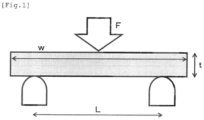
- Figure 1 is a schematic view to describe a bending test for determining a bending strength.
- the porous titanium-based sintered body of the present invention has a porosity of 45% to 65%, an average pore diameter of 5 ⁇ m to 15 ⁇ m, and a bending strength of 100 MPa or more.
- the porous titanium-based sintered body is a sintered body of a particulate titanium-based powder and has many pores inside.
- the porous titanium-based sintered body of the present invention by setting the porosity to 45% to 65%, enhancement of gas permeability or liquid permeability is achieved, and an increase in strength is also achieved. If the porosity is less than 45%, there is a possibility that good gas permeability or liquid permeability cannot be ensured. On the other hand, a porosity of more than 65% means that the porous titanium-based sintered body is too coarse, and there is concern that a desired strength cannot be ensured.
- the lower limit side of the porosity of the porous titanium-based sintered body of the present invention is preferably 48% or more, and more preferably 50% or more.
- the upper limit side of the porosity of the porous titanium-based sintered body of the present invention may be 63% or less, or may be 60% or less.
- the upper limit side of the porosity of the porous titanium-based sintered body may be 55% or less, or may be 53% or less.
- the porosity is a proportion of voids per unit volume of the porous titanium-based sintered body and is expressed as percentage.
- the porosity is calculated from the following expression using a volume V (cm 3 ) of the porous titanium-based sintered body, a mass M (g) of the porous titanium-based sintered body, and a true density D (g/cm 3 ) of a metal part that forms the sintered body (e.g., true density of pure titanium: 4.51 g/cm 3 ).
- the volume V indicates an apparent volume of the porous titanium-based sintered body.
- Porosity % 100 ⁇ M / V / D ⁇ 100
- the porous titanium-based sintered body of the present invention by setting the average pore diameter to 5 ⁇ m to 15 ⁇ m, enhancement of gas permeability or liquid permeability is achieved, and an increase in strength is also achieved. If the average pore diameter is less than 5 ⁇ m, there is a fear that bonding of fine particles to each other may have proceeded excessively, and a desired porosity and a high strength may not be made compatible. On the other hand, if the average pore diameter exceeds 15 ⁇ m, the strength tends to become insufficient.
- the lower limit side of the average pore diameter of the porous titanium-based sintered body of the present invention is preferably 7 ⁇ m or more, and more preferably 8 ⁇ m or more.
- a bending strength of 100 MPa or more can be attained. It is thought that this high strength is attained because proper sintering of fine particles is simultaneously obtained at many points in the present invention.
- the bending strength of the porous titanium-based sintered body of the present invention is preferably 110 MPa or more, more preferably 120 MPa or more, and still more preferably 130 MPa or more.
- the upper limit of the bending strength of the porous titanium-based sintered body of the present invention is not particularly set, but for example, it may be 170 MPa or less, or may be 160 MPa or less.
- ⁇ bending strength (MPa)
- F (bending) load (N)
- L inter-fulcrum distance (mm)
- t specimen thickness (mm)
- w specimen width (mm)
- Z section modulus *1 (mm 3 )
- M bending moment *2 (N ⁇ mm)
- the method for producing a porous titanium-based sintered body of the present invention is a method for producing a porous titanium sintered body, comprising the step of placing a titanium-based powder having an average circularity of 0.93 or less and having D90, as obtained by particle size distribution measurement, of 25 ⁇ m or less in a mold by dry process without substantially applying pressure, and the step of sintering the powder at 850°C or higher and lower than 950°C.
- the average circularity of the titanium-based powder for use in the production method of the present invention is 0.93 or less. By setting the average circularity to 0.93 or less, good pore diameter and porosity are made compatible. An average circularity of more than 0.93 means that the titanium-based powder comes too close to a spherical shape. That is to say, the porosity of the porous titanium-based sintered body becomes insufficient, and the contact points of the powder particles cannot be ensured, so that there is concern that the desired strength cannot be attained.
- the average circularity of the titanium-based powder for use in the production method of the present invention is preferably 0.91 or less, and more preferably 0.89 or less.
- the average circularity of the titanium-based powder is determined by the following method. Using an electron microscope, a perimeter (A) of a projected area of a particle is measured, and when a perimeter of a circle having the same area as the projected area is taken as (B), B/A is taken as a circularity.
- the average circularity is obtained by pouring particles together with a carrier liquid into a cell, photographing images of a large amount of particles by a CCD camera, measuring a perimeter (A) of a projected area of each particle and a perimeter (B) of a circle having the same area as the projected area from each particle image of 1000 to 1500 particles, calculating a circularity, and determining an average value of circularities of the particles.
- the numerical value of the circularity increases, and the circularity of a particle having a shape of a perfect true sphere becomes 1. Contrary to this, as the shape of the particle becomes further away from a true sphere, the numerical value of the circularity decreases.
- the titanium-based powder for use in the production method of the present invention has D90, as obtained by particle size distribution measurement, of 25 ⁇ m or less. By intensively utilizing fine particles, a desired strength is attained. That the D90 of the titanium-based powder exceeds 25 ⁇ m means too large particles. That is to say, a pore diameter and a porosity desired in the present invention are not obtained. D90 of the titanium-based powder for use in the production method of the present invention is preferably 23 ⁇ m or less. The lower limit side of D90 of the titanium-based powder may be 18 ⁇ m or more, or may be 20 ⁇ m or more.
- D50 as obtained by particle size distribution measurement is also preferably defined. It is preferable to set D50 of the titanium-based powder to 9 ⁇ m or more and 15 ⁇ m or less.
- the lower limit side of D50 of the titanium-based powder for use in the production method of the present invention is preferably 11 ⁇ m or more.
- the upper limit side of D50 of the titanium-based powder may be 14 ⁇ m or less, or may be 13 ⁇ m or less.
- D50 and D90 indicate particle diameters by which volume-based cumulative distributions in the measurement of particle size distribution as determined by a laser diffraction/scattering method become 50% and 90%, respectively.
- the titanium-based powder particle size distribution is measured by the following method, and D50 and D90 are measured. That is to say, they are measured based on JIS Z8825:2013.
- the average circularity of the titanium-based powder for use in the production method of the present invention can be appropriately controlled.
- the average circularity can be controlled by mixing titanium-based powders having different average circularities from each other.
- D50 and D90 of the titanium-based powder D50 and D90 can be each controlled by, for example, mixing titanium-based powders having different values.
- the porosity and the average pore diameter can be controlled by controlling the average circularity and the particle size distribution of the titanium-based powder that is a raw material. For example, if a large amount of the powder is allowed to be present on the fine particle side in the particle size distribution, the porosity and the average pore diameter can be decreased. If a large amount of the powder is allowed to be present on the coarse particle side in the particle size distribution, the porosity and the average pore diameter can be increased.
- Changes of the porosity and the average pore diameter are not always correlated with each other, but based on the control of the average circularity and the particle size distribution of the titanium-based powder, the porosity and the average pore diameter of the porous titanium-based sintered body can be controlled.
- the titanium-based powder is placed in a mold by dry process without substantially applying pressure.
- a bulk density density at the time of filling
- a sintered body having a high porosity is obtained.
- the titanium-based powder is placed in the mold by wet process
- the titanium-based powder accumulates while having anisotropy because of resistance of a fluid, and therefore, the porosity does not increase up to a desired value.
- the titanium-based powder may be filled densely up to a density equivalent to tap density.
- the pressure applied to the upper surface of the titanium-based powder in a mold is too high when the titanium-based powder is placed in the mold, the porosity does not increase.
- the expression "without substantially applying pressure” indicates that excepting a force applied to the titanium-based powder under the titanium-based powder's own weight when the titanium-based powder is filled in the mold or a force applied to the upper surface of the titanium-based powder in the mold when the titanium-based powder that has overflown and is present above the upper edge of the mold is levelled off after filling of the titanium-based powder in the mold, the pressure of a force intendedly applied to the upper surface of the titanium-based powder in the mold is 1 ⁇ 10 -2 MPa/mm 2 or less.
- the pressure applied to the upper surface of the titanium-based powder in the mold is a value obtained by dividing the force applied to the whole of the upper surface of the titanium-based powder-filled part of the mold by the area of the upper surface of the filled part.
- dry process indicates that water or an organic solvent is not intendedly used.
- a material of the mold for use in the present invention can be appropriately selected as long as the material does not react with the titanium-based powder, can withstand high temperatures and can be inhibited from thermal expansion.
- quartz, alumina, graphite, carbon, cordient, indium oxide, calcia, silica, magnesia, zirconia, spinel, silicon carbide, aluminum nitride, boron nitride or mullite is preferable as the material of the mold.
- a more preferred material of the mold is quartz, alumina, carbon, calcia, magnesia, zirconia, boron nitride or the like by the reason of good workability.
- the titanium-based powder is sintered at 850°C or higher and lower than 950°C.
- the sintering temperature is the highest reaching temperature during sintering. By the sintering in this temperature range, good pore diameter and porosity of the porous titanium-based sintered body produced are made compatible, and a high strength of the porous titanium-based sintered body is attained. If the sintering temperature is lower than 850°C, there is concern that proper sintering of the fine particles desired in the present invention is not obtained.
- the sintering temperature is 950°C or higher, sintering of the fine particles excessively proceeds, and a porosity and a strength desired in the present invention may not be made compatible.
- the lower limit side of the sintering temperature is preferably 870°C or higher, and more preferably 890°C or higher.
- the upper limit side of the sintering temperature is preferably 930°C or lower, and more preferably 920°C or lower.
- the sintering time for sintering the titanium-based powder is appropriately selected according to the size of a sintering furnace, the size of the porous titanium-based sintered body to be produced, etc.
- sintering of the titanium-based powder is usually carried out under reduced pressure.
- methods for sintering the titanium-based powder include:
- the pressure of an atmosphere in which the titanium-based powder is sintered is preferably 5.0 ⁇ 10 -3 Pa or less. If the pressure of the atmosphere is too high, the titanium-based powder is oxidized by excess oxygen present in the atmosphere, and the sintering does not easily take place.
- porous titanium-based sintered body of the present invention one obtained by placing a titanium-based powder having an average circularity of 0.93 or less and having D90, as obtained by particle size distribution measurement, of 25 ⁇ m or less in a mold by dry process without substantially applying pressure, and then sintering the powder at 850°C or higher and lower than 950°C (hereinafter, also referred to as a porous titanium-based sintered body of a first embodiment of the present invention) can be mentioned.
- the titanium-based power according to the porous titanium-based sintered body of the first embodiment of the present invention is the same as the titanium-based powder according to the porous titanium-based sintered body of the present invention. That is to say, the average circularity of the titanium-based powder according to the porous titanium-based sintered body of the first embodiment of the present invention is 0.93 or less.
- the average circularity of the titanium-based powder is preferably 0.91 or less, and more preferably 0.89 or less.
- the titanium-based powder according to the porous titanium-based sintered body of the first embodiment of the present invention has D90, as obtained by particle size distribution measurement, of 25 ⁇ m or less, preferably 23 ⁇ m or less.
- D90 as obtained by particle size distribution measurement
- the lower limit side of D90 of the titanium-based powder may be 18 ⁇ m or more, or may be 20 ⁇ m or more.
- D50 of the titanium-based powder according to the porous titanium-based sintered body of the first embodiment of the present invention is preferably 9 ⁇ m or more and 15 ⁇ m or less.
- the lower limit side of D50 of the titanium-based powder according to the porous titanium-based sintered body of the first embodiment of the present invention is preferably 11 ⁇ m or more. By setting D50 of the titanium-based powder in the above range, preferred fine particles can be more intensively utilized.
- the upper limit side of D50 of the titanium-based powder may be 14 ⁇ m or less, or may be 13 ⁇ m or less.
- the porous titanium-based sintered body of the first embodiment of the present invention is one obtained by placing the titanium-based powder in a mold by dry process without substantially applying pressure, heating the powder under reduced pressure, preferably at 5.0 ⁇ 10 -3 Pa or less, and thereby sintering the powder.
- the sintering temperature of the titanium-based powder is 850°C or higher and lower than 950°C. By the sintering in this temperature range, good pore diameter and porosity of the porous titanium-based sintered body produced are made compatible, and a high strength of the porous titanium-based sintered body is attained.
- the sintering temperature is the highest reaching temperature during sintering. If the sintering temperature is less than 850°C, there is concern that proper sintering of the fine particles desired in the present invention is not obtained. On the other hand, if the sintering temperature is 950°C or higher, sintering of the fine particles excessively proceeds, and a porosity and a high strength desired in the present invention may not be obtained.
- the lower limit side of the sintering temperature of the titanium-based powder is preferably 870°C or higher, and the upper limit side of the sintering temperature is preferably 920°C or lower.
- the porosity of the porous titanium-based sintered body of the first embodiment of the present invention is 45% to 65%.
- the porosity of the porous titanium-based sintered body of the first embodiment of the present invention in the above range, enhancement of gas permeability or liquid permeability is achieved, and an increase in strength is achieved. If the porosity is less than 45%, there is a possibility that good gas permeability or liquid permeability cannot be ensured.
- a porosity of more than 65% means that the porous titanium-based sintered body is too coarse, and there is concern that a desired strength cannot be ensured.
- the lower limit side of the porosity of the porous titanium-based sintered body of the first embodiment of the present invention is preferably 48% or more, and more preferably 50% or more.
- the upper limit side of the porosity of the porous titanium-based sintered body of the first embodiment of the present invention may be 63% or less, or may be 60% or less.
- the upper limit side of the porosity of the porous titanium-based sintered body of the first embodiment of the present invention may be 55% or less, or may be 53% or less.
- the average pore diameter of the porous titanium-based sintered body of the first embodiment of the present invention is 5 ⁇ m to 15 ⁇ m.
- the average pore diameter of the porous titanium-based sintered body of the first embodiment of the present invention in the above range, enhancement of gas permeability or liquid permeability is achieved, and an increase in strength is achieved. If the average pore diameter is less than 5 ⁇ m, there is a fear that bonding of fine particles to each other has excessively proceeded, and a desired porosity and a high strength may not be made compatible. On the other hand, if the average pore diameter exceeds 15 ⁇ m, the strength becomes insufficient.
- the lower limit side of the average pore diameter of the porous titanium-based sintered body of the first embodiment of the present invention is preferably 7 ⁇ m or more, and more preferably 8 ⁇ m or more.
- the lower limit side of the average pore diameter of the porous titanium-based sintered body of the first embodiment of the present invention is still more preferably 10 ⁇ m or more, and even more preferably 11 ⁇ m or more.
- the upper limit side of the average pore diameter of the porous titanium-based sintered body of the first embodiment of the present invention is preferably 14 ⁇ m or less.
- the upper limit side of the average pore diameter of the porous titanium-based sintered body of the first embodiment of the present invention is more preferably 12 ⁇ m or less.
- the bending strength of the porous titanium-based sintered body of the first embodiment of the present invention is 100 MPa or more. It is thought that this high strength is attained because proper sintering of fine particles can be simultaneously obtained at many points in the present invention.
- the bending strength of the porous titanium-based sintered body of the first embodiment of the present invention is preferably 110 MPa or more, more preferably 120 MPa or more, and still more preferably 130 MPa or more.
- the upper limit of the bending strength of the porous titanium-based sintered body of the first embodiment of the present invention is not particularly set, but for example, it may be 170 MPa or less, or may be 160 MPa or less.
- the porous titanium-based sintered body of the first embodiment of the present invention is one obtained by placing a titanium-based powder having an average circularity of 0.93 or less and having D90, as obtained by particle size distribution measurement, of 25 ⁇ m or less in a mold by dry process without substantially applying pressure, and then sintering the powder at 850°C or higher and lower than 950°C, and therefore, it has a high porosity, a small average pore diameter and a high strength.
- a titanium powder produced by a hydrogenation/dehydrogenation method and having a shape of a crushed product was used as a titanium-based powder.
- An average circularity, D50 and D90 of the titanium-based powder used are set forth in Table 1.
- the average circularity was determined using PITA-3 (manufactured by SEISHIN ENTERPRISE CO., LTD.).
- D50 and D90 were determined in accordance with JIS:Z8825:2013 using a measuring device: LMS-350 (manufactured by SEISHIN ENTERPRISE CO., LTD.).
- Each titanium-based powder was filled in a quartz mold under the drying and no-pressure application conditions, and a titanium-based powder having overflown and present above the upper edge of the mold was leveled off. That is to say, any excess force other than a force of leveling operation was not applied to the titanium-based powder.
- the degree of vacuum was set to at least 3.0 ⁇ 10 -3 Pa
- the mold filled with the titanium-based powder was placed, then the powder was sintered up to a sintering temperature shown in Table 1 at a temperature rise rate of 15°C/min, and sintering was carried out for 1 hour. After the sintering, the resulting sinter was cooled down to room temperature by furnace cooling, thereby obtaining a porous sintered body of the titanium-based powder.
- the resulting porous titanium-based sintered body was subjected to analyses to determine a porosity, an average pore diameter and a bending strength. The results are set forth in Table 1.
- the aforesaid calculation method (calculation backward from relative density) was used to determine the porosity.
- the average pore diameter was measured by a strain-gauge type pressure measuring method using a mercury penetration measuring device manufactured by Micromeritics Instrument Corporation.
- a maximum load was measured by a method whose outline is shown in Figure 1 , using a universal testing machine manufactured by SHIMADZU CORPORATION, and it was converted into a bending strength.
- Titanium powder properties Sintering temperature (°C) Porosity (%) Average pore diameter ( ⁇ m) bending strength (MPa) Average circularity D50 ( ⁇ m) D90 ( ⁇ m) 1 0.88 12 21 900 55 9 114.9 2 0.77 36 49 900 62 16 36.9 3 0.79 77 106 900 64 15 15.7 4 0.79 77 106 900 64 17 19.0 5 0.82 76 106 900 59 29 18.7 6 0.88 14 19 900 55 10 116.1 7 0.88 12 22 900 52 11 152.3
- No. 1, No. 6 and No. 7 that were the invention examples were excellent in fine particle shape, particle size distribution and sintering temperature. Therefore, the porous titanium-based sintered bodies produced had a porosity and an average pore diameter of preferred values, and were porous titanium-based sintered bodies of high strength. It is presumed that if the strength is attempted to be increased by a conventional method without carrying out control of the powder properties of the titanium-based powder, the porosity markedly decreases though the strength increases. In contrast therewith, in No. 1, No. 6 and No. 7 that were the invention examples, control of the powder properties of the titanium-based powder in the present invention was carried out, and therefore, the strength increased while a high porosity was maintained. Particularly in No. 7 of the invention examples, an extremely high strength could be attained by controlling the porosity and/or the average pore diameter.
Landscapes
- Chemical & Material Sciences (AREA)
- Engineering & Computer Science (AREA)
- Mechanical Engineering (AREA)
- Materials Engineering (AREA)
- Manufacturing & Machinery (AREA)
- Metallurgy (AREA)
- Organic Chemistry (AREA)
- Nanotechnology (AREA)
- Electrochemistry (AREA)
- General Chemical & Material Sciences (AREA)
- Chemical Kinetics & Catalysis (AREA)
- Composite Materials (AREA)
- Powder Metallurgy (AREA)
Claims (3)
- Poröser Sinterkörper auf Titanbasis mit einer Porosität von 45% bis 65%, einem durchschnittlichen Porendurchmesser von 5 µm bis 15 µm und einer Biegefestigkeit von 100 MPa oder mehr,
wobei die Porosität, der durchschnittliche Porendurchmesser und die Biegefestigkeit des porösen Sinterkörpers auf Titanbasis in Übereinstimmung mit den in der Beschreibung offenbarten Messverfahren bestimmt werden. - Elektrode, die den porösen Sinterkörper auf Titanbasis nach Anspruch 1 umfasst.
- Verfahren zur Herstellung eines porösen Sinterkörpers auf Titanbasis, umfassendden Schritt des Platzierens eines Pulvers auf Titanbasis mit einer durchschnittliche Rundheit von 0.93 oder weniger und mit einer durch Messung der Teilchengrößenverteilung erhaltenen D90 von 25 µm oder weniger in eine Form durch ein Trockenverfahren ohne wesentliche Anwendung von Druck, was bedeutet, dass außer einer Kraft, welche auf das Pulver auf Titanbasis unter dem Eigengewicht des Pulvers auf Titanbasis ausgeübt wird, wenn das Pulver auf Titanbasis in die Form gefüllt wird, oder einer Kraft, welche auf die obere Oberfläche des Pulvers auf Titanbasis in der Form ausgeübt wird, wenn das Pulver auf Titanbasis, das nach dem Füllen des Pulvers auf Titanbasis in die Form übergetreten und über dem oberen Rand der Form vorhanden ist geebnet wird, der Druck einer Kraft, welche absichtlich auf die obere Oberfläche des Pulvers auf Titanbasis in der Form ausgeübt wird 1x10⁻² MPa/mm2 oder weniger beträgt, undden Schritt des Sinterns des Pulvers bei 850°C oder höher und niedriger als 950°C,wobei die durchschnittliche Rundheit des Pulvers auf Titanbasis in Übereinstimmung mit dem in der Beschreibung offenbarten Messverfahren bestimmt wird und die D90 des Pulvers auf Titanbasis auf der Grundlage von JIS Z8825:2013 gemessen wird.
Applications Claiming Priority (2)
| Application Number | Priority Date | Filing Date | Title |
|---|---|---|---|
| JP2018064588 | 2018-03-29 | ||
| PCT/JP2019/011104 WO2019188480A1 (ja) | 2018-03-29 | 2019-03-18 | 多孔質チタン系焼結体、その製造方法及び電極 |
Publications (3)
| Publication Number | Publication Date |
|---|---|
| EP3778074A1 EP3778074A1 (de) | 2021-02-17 |
| EP3778074A4 EP3778074A4 (de) | 2021-12-22 |
| EP3778074B1 true EP3778074B1 (de) | 2025-04-30 |
Family
ID=68058905
Family Applications (1)
| Application Number | Title | Priority Date | Filing Date |
|---|---|---|---|
| EP19774477.4A Active EP3778074B1 (de) | 2018-03-29 | 2019-03-18 | Auf porösem titan basierender, gesinterter pressling, verfahren zur herstellung davon und elektrode |
Country Status (6)
| Country | Link |
|---|---|
| US (1) | US11554415B2 (de) |
| EP (1) | EP3778074B1 (de) |
| JP (1) | JP6559925B1 (de) |
| KR (1) | KR102640073B1 (de) |
| CN (1) | CN111886091A (de) |
| WO (1) | WO2019188480A1 (de) |
Families Citing this family (3)
| Publication number | Priority date | Publication date | Assignee | Title |
|---|---|---|---|---|
| EP3686318A1 (de) | 2019-01-23 | 2020-07-29 | Paul Scherrer Institut | Poröse transportschicht auf basis von mehreren gesinterten porösen schichten |
| AU2021350813B2 (en) * | 2020-09-28 | 2024-02-22 | Toho Titanium Co.,Ltd. | Titanium-based porous body and method for producing titanium-based porous body |
| JP2025096021A (ja) * | 2023-12-15 | 2025-06-26 | 東邦チタニウム株式会社 | チタン成形体の製造方法、チタン多孔質体の製造方法および、チタン多孔質体 |
Citations (1)
| Publication number | Priority date | Publication date | Assignee | Title |
|---|---|---|---|---|
| JP2002066229A (ja) * | 2000-08-25 | 2002-03-05 | Sumitomo Sitix Of Amagasaki Inc | 焼結チタンフィルタ及びその製造方法 |
Family Cites Families (14)
| Publication number | Priority date | Publication date | Assignee | Title |
|---|---|---|---|---|
| JPS5128507A (ja) * | 1974-09-04 | 1976-03-10 | Shoketsu Kinzoku Kogyo Kk | Shoketsukinzokufuiruta no seizohoho |
| JPH04176309A (ja) * | 1990-11-09 | 1992-06-24 | Nkk Corp | プリコート濾過用フィルターエレメント及びその洗浄方法 |
| JP3038397B2 (ja) * | 1991-06-11 | 2000-05-08 | 石川島播磨重工業株式会社 | 多孔質インプラント材 |
| JP4116263B2 (ja) * | 2001-04-19 | 2008-07-09 | 株式会社大阪チタニウムテクノロジーズ | チタン粉末焼結体 |
| DE60221643T2 (de) | 2001-02-16 | 2008-07-17 | OSAKA Titanium technologies Co., Ltd., Amagasaki | Gesinterter presskörper aus titanpulver |
| JP3569682B2 (ja) * | 2001-02-16 | 2004-09-22 | 住友チタニウム株式会社 | 高耐食性金属焼結フィルタ |
| JP2004149842A (ja) * | 2002-10-30 | 2004-05-27 | Sumitomo Titanium Corp | チタン焼結体の製造方法 |
| US20080199720A1 (en) * | 2007-02-21 | 2008-08-21 | Depuy Products, Inc. | Porous metal foam structures and methods |
| JP5573110B2 (ja) | 2009-11-06 | 2014-08-20 | 三菱マテリアル株式会社 | 電気化学部材用焼結金属シート材及び電気化学部材用焼結金属シート材の製造方法 |
| CN101935774B (zh) * | 2009-11-18 | 2012-04-11 | 中国科学院金属研究所 | 一种制备多孔钛及钛合金块体材料的方法 |
| CN102205144B (zh) * | 2010-03-31 | 2014-07-16 | 方崇凯 | 医用金属植入材料多孔钽及其制备方法 |
| JP5311689B2 (ja) | 2011-02-18 | 2013-10-09 | 東邦チタニウム株式会社 | チタン焼結多孔体およびその製造方法 |
| CA2976065C (en) * | 2015-03-05 | 2020-02-18 | Toho Titanium Co., Ltd. | Titanium powder, and ingot and sintered article of titanium powder |
| JP6485967B2 (ja) | 2016-11-04 | 2019-03-20 | 東邦チタニウム株式会社 | チタン系多孔体及びその製造方法 |
-
2019
- 2019-03-18 CN CN201980020782.6A patent/CN111886091A/zh active Pending
- 2019-03-18 US US17/040,672 patent/US11554415B2/en active Active
- 2019-03-18 EP EP19774477.4A patent/EP3778074B1/de active Active
- 2019-03-18 WO PCT/JP2019/011104 patent/WO2019188480A1/ja not_active Ceased
- 2019-03-18 JP JP2019530232A patent/JP6559925B1/ja active Active
- 2019-03-18 KR KR1020207026904A patent/KR102640073B1/ko active Active
Patent Citations (1)
| Publication number | Priority date | Publication date | Assignee | Title |
|---|---|---|---|---|
| JP2002066229A (ja) * | 2000-08-25 | 2002-03-05 | Sumitomo Sitix Of Amagasaki Inc | 焼結チタンフィルタ及びその製造方法 |
Also Published As
| Publication number | Publication date |
|---|---|
| JP6559925B1 (ja) | 2019-08-14 |
| CN111886091A (zh) | 2020-11-03 |
| EP3778074A1 (de) | 2021-02-17 |
| KR20200134235A (ko) | 2020-12-01 |
| WO2019188480A1 (ja) | 2019-10-03 |
| JPWO2019188480A1 (ja) | 2020-04-30 |
| KR102640073B1 (ko) | 2024-02-27 |
| US20210016352A1 (en) | 2021-01-21 |
| US11554415B2 (en) | 2023-01-17 |
| EP3778074A4 (de) | 2021-12-22 |
Similar Documents
| Publication | Publication Date | Title |
|---|---|---|
| EP3769867B1 (de) | Poröser gesinterter körper auf titanbasis, verfahren zur herstellung desselben und elektrode | |
| EP3718664B1 (de) | Verfahren zur herstellung von porösem körper auf titanbasis | |
| EP3778074B1 (de) | Auf porösem titan basierender, gesinterter pressling, verfahren zur herstellung davon und elektrode | |
| JP6485967B2 (ja) | チタン系多孔体及びその製造方法 | |
| JP5193341B2 (ja) | 固体電解質コンデンサを製造するためのタンタル粉末 | |
| JP7383524B2 (ja) | 多孔質金属体の製造方法及び、多孔質金属体 | |
| EP4219778A1 (de) | Poröser körper auf titanbasis und verfahren zur herstellung eines porösen körpers auf titanbasis | |
| CN1136325C (zh) | 氧化物弥散强化型铂材及其制造方法 | |
| JP3778338B2 (ja) | 酸化物分散強化型白金材料の製造方法 | |
| JP7092960B1 (ja) | 多孔質金属体の製造方法及び、多孔質金属体 | |
| US7217388B2 (en) | Method for preparing reinforced platinum material | |
| JPH02310328A (ja) | 多孔質金属及びその製法 |
Legal Events
| Date | Code | Title | Description |
|---|---|---|---|
| STAA | Information on the status of an ep patent application or granted ep patent |
Free format text: STATUS: THE INTERNATIONAL PUBLICATION HAS BEEN MADE |
|
| PUAI | Public reference made under article 153(3) epc to a published international application that has entered the european phase |
Free format text: ORIGINAL CODE: 0009012 |
|
| STAA | Information on the status of an ep patent application or granted ep patent |
Free format text: STATUS: REQUEST FOR EXAMINATION WAS MADE |
|
| 17P | Request for examination filed |
Effective date: 20200924 |
|
| AK | Designated contracting states |
Kind code of ref document: A1 Designated state(s): AL AT BE BG CH CY CZ DE DK EE ES FI FR GB GR HR HU IE IS IT LI LT LU LV MC MK MT NL NO PL PT RO RS SE SI SK SM TR |
|
| AX | Request for extension of the european patent |
Extension state: BA ME |
|
| DAV | Request for validation of the european patent (deleted) | ||
| DAX | Request for extension of the european patent (deleted) | ||
| A4 | Supplementary search report drawn up and despatched |
Effective date: 20211124 |
|
| RIC1 | Information provided on ipc code assigned before grant |
Ipc: B22F 1/00 20060101ALI20211118BHEP Ipc: C22C 14/00 20060101ALI20211118BHEP Ipc: C22C 1/08 20060101ALI20211118BHEP Ipc: B22F 3/11 20060101AFI20211118BHEP |
|
| RIC1 | Information provided on ipc code assigned before grant |
Ipc: B22F 1/065 20220101ALI20241111BHEP Ipc: B22F 1/05 20220101ALI20241111BHEP Ipc: B22F 1/00 20060101ALI20241111BHEP Ipc: C22C 14/00 20060101ALI20241111BHEP Ipc: C22C 1/08 20060101ALI20241111BHEP Ipc: B22F 3/11 20060101AFI20241111BHEP |
|
| GRAP | Despatch of communication of intention to grant a patent |
Free format text: ORIGINAL CODE: EPIDOSNIGR1 |
|
| STAA | Information on the status of an ep patent application or granted ep patent |
Free format text: STATUS: GRANT OF PATENT IS INTENDED |
|
| INTG | Intention to grant announced |
Effective date: 20250102 |
|
| RIN1 | Information on inventor provided before grant (corrected) |
Inventor name: FUJI, TAKAHIRO Inventor name: TSUMAGARI, SHOGO Inventor name: GOTO, YASUHIKO |
|
| P01 | Opt-out of the competence of the unified patent court (upc) registered |
Free format text: CASE NUMBER: APP_3441/2025 Effective date: 20250122 |
|
| GRAS | Grant fee paid |
Free format text: ORIGINAL CODE: EPIDOSNIGR3 |
|
| GRAA | (expected) grant |
Free format text: ORIGINAL CODE: 0009210 |
|
| STAA | Information on the status of an ep patent application or granted ep patent |
Free format text: STATUS: THE PATENT HAS BEEN GRANTED |
|
| AK | Designated contracting states |
Kind code of ref document: B1 Designated state(s): AL AT BE BG CH CY CZ DE DK EE ES FI FR GB GR HR HU IE IS IT LI LT LU LV MC MK MT NL NO PL PT RO RS SE SI SK SM TR |
|
| REG | Reference to a national code |
Ref country code: CH Ref legal event code: EP Ref country code: GB Ref legal event code: FG4D |
|
| REG | Reference to a national code |
Ref country code: IE Ref legal event code: FG4D |
|
| REG | Reference to a national code |
Ref country code: DE Ref legal event code: R096 Ref document number: 602019069354 Country of ref document: DE |
|
| REG | Reference to a national code |
Ref country code: NL Ref legal event code: MP Effective date: 20250430 |
|
| REG | Reference to a national code |
Ref country code: AT Ref legal event code: MK05 Ref document number: 1789588 Country of ref document: AT Kind code of ref document: T Effective date: 20250430 |
|
| PG25 | Lapsed in a contracting state [announced via postgrant information from national office to epo] |
Ref country code: FI Free format text: LAPSE BECAUSE OF FAILURE TO SUBMIT A TRANSLATION OF THE DESCRIPTION OR TO PAY THE FEE WITHIN THE PRESCRIBED TIME-LIMIT Effective date: 20250430 Ref country code: PT Free format text: LAPSE BECAUSE OF FAILURE TO SUBMIT A TRANSLATION OF THE DESCRIPTION OR TO PAY THE FEE WITHIN THE PRESCRIBED TIME-LIMIT Effective date: 20250901 Ref country code: ES Free format text: LAPSE BECAUSE OF FAILURE TO SUBMIT A TRANSLATION OF THE DESCRIPTION OR TO PAY THE FEE WITHIN THE PRESCRIBED TIME-LIMIT Effective date: 20250430 |
|
| REG | Reference to a national code |
Ref country code: LT Ref legal event code: MG9D |
|
| PG25 | Lapsed in a contracting state [announced via postgrant information from national office to epo] |
Ref country code: GR Free format text: LAPSE BECAUSE OF FAILURE TO SUBMIT A TRANSLATION OF THE DESCRIPTION OR TO PAY THE FEE WITHIN THE PRESCRIBED TIME-LIMIT Effective date: 20250731 |
|
| PG25 | Lapsed in a contracting state [announced via postgrant information from national office to epo] |
Ref country code: PL Free format text: LAPSE BECAUSE OF FAILURE TO SUBMIT A TRANSLATION OF THE DESCRIPTION OR TO PAY THE FEE WITHIN THE PRESCRIBED TIME-LIMIT Effective date: 20250430 Ref country code: NL Free format text: LAPSE BECAUSE OF FAILURE TO SUBMIT A TRANSLATION OF THE DESCRIPTION OR TO PAY THE FEE WITHIN THE PRESCRIBED TIME-LIMIT Effective date: 20250430 |
|
| PG25 | Lapsed in a contracting state [announced via postgrant information from national office to epo] |
Ref country code: BG Free format text: LAPSE BECAUSE OF FAILURE TO SUBMIT A TRANSLATION OF THE DESCRIPTION OR TO PAY THE FEE WITHIN THE PRESCRIBED TIME-LIMIT Effective date: 20250430 |
|
| PG25 | Lapsed in a contracting state [announced via postgrant information from national office to epo] |
Ref country code: HR Free format text: LAPSE BECAUSE OF FAILURE TO SUBMIT A TRANSLATION OF THE DESCRIPTION OR TO PAY THE FEE WITHIN THE PRESCRIBED TIME-LIMIT Effective date: 20250430 |
|
| PG25 | Lapsed in a contracting state [announced via postgrant information from national office to epo] |
Ref country code: AT Free format text: LAPSE BECAUSE OF FAILURE TO SUBMIT A TRANSLATION OF THE DESCRIPTION OR TO PAY THE FEE WITHIN THE PRESCRIBED TIME-LIMIT Effective date: 20250430 |
|
| PG25 | Lapsed in a contracting state [announced via postgrant information from national office to epo] |
Ref country code: RS Free format text: LAPSE BECAUSE OF FAILURE TO SUBMIT A TRANSLATION OF THE DESCRIPTION OR TO PAY THE FEE WITHIN THE PRESCRIBED TIME-LIMIT Effective date: 20250731 |
|
| PG25 | Lapsed in a contracting state [announced via postgrant information from national office to epo] |
Ref country code: IS Free format text: LAPSE BECAUSE OF FAILURE TO SUBMIT A TRANSLATION OF THE DESCRIPTION OR TO PAY THE FEE WITHIN THE PRESCRIBED TIME-LIMIT Effective date: 20250830 |
|
| PG25 | Lapsed in a contracting state [announced via postgrant information from national office to epo] |
Ref country code: LV Free format text: LAPSE BECAUSE OF FAILURE TO SUBMIT A TRANSLATION OF THE DESCRIPTION OR TO PAY THE FEE WITHIN THE PRESCRIBED TIME-LIMIT Effective date: 20250430 |
|
| PG25 | Lapsed in a contracting state [announced via postgrant information from national office to epo] |
Ref country code: DK Free format text: LAPSE BECAUSE OF FAILURE TO SUBMIT A TRANSLATION OF THE DESCRIPTION OR TO PAY THE FEE WITHIN THE PRESCRIBED TIME-LIMIT Effective date: 20250430 Ref country code: SM Free format text: LAPSE BECAUSE OF FAILURE TO SUBMIT A TRANSLATION OF THE DESCRIPTION OR TO PAY THE FEE WITHIN THE PRESCRIBED TIME-LIMIT Effective date: 20250430 |
|
| PG25 | Lapsed in a contracting state [announced via postgrant information from national office to epo] |
Ref country code: CZ Free format text: LAPSE BECAUSE OF FAILURE TO SUBMIT A TRANSLATION OF THE DESCRIPTION OR TO PAY THE FEE WITHIN THE PRESCRIBED TIME-LIMIT Effective date: 20250430 |
|
| PG25 | Lapsed in a contracting state [announced via postgrant information from national office to epo] |
Ref country code: EE Free format text: LAPSE BECAUSE OF FAILURE TO SUBMIT A TRANSLATION OF THE DESCRIPTION OR TO PAY THE FEE WITHIN THE PRESCRIBED TIME-LIMIT Effective date: 20250430 |
|
| PG25 | Lapsed in a contracting state [announced via postgrant information from national office to epo] |
Ref country code: RO Free format text: LAPSE BECAUSE OF FAILURE TO SUBMIT A TRANSLATION OF THE DESCRIPTION OR TO PAY THE FEE WITHIN THE PRESCRIBED TIME-LIMIT Effective date: 20250430 Ref country code: SK Free format text: LAPSE BECAUSE OF FAILURE TO SUBMIT A TRANSLATION OF THE DESCRIPTION OR TO PAY THE FEE WITHIN THE PRESCRIBED TIME-LIMIT Effective date: 20250430 |
|
| REG | Reference to a national code |
Ref country code: DE Ref legal event code: R097 Ref document number: 602019069354 Country of ref document: DE |
|
| PLBE | No opposition filed within time limit |
Free format text: ORIGINAL CODE: 0009261 |
|
| STAA | Information on the status of an ep patent application or granted ep patent |
Free format text: STATUS: NO OPPOSITION FILED WITHIN TIME LIMIT |
|
| REG | Reference to a national code |
Ref country code: CH Ref legal event code: L10 Free format text: ST27 STATUS EVENT CODE: U-0-0-L10-L00 (AS PROVIDED BY THE NATIONAL OFFICE) Effective date: 20260311 |
|
| 26N | No opposition filed |
Effective date: 20260202 |
|
| PGFP | Annual fee paid to national office [announced via postgrant information from national office to epo] |
Ref country code: NO Payment date: 20260320 Year of fee payment: 8 Ref country code: DE Payment date: 20260326 Year of fee payment: 8 |
|
| PGFP | Annual fee paid to national office [announced via postgrant information from national office to epo] |
Ref country code: BE Payment date: 20260323 Year of fee payment: 8 |
|
| PGFP | Annual fee paid to national office [announced via postgrant information from national office to epo] |
Ref country code: FR Payment date: 20260326 Year of fee payment: 8 |